EP4127368B1 - Vehicle interior component - Google Patents
Vehicle interior component Download PDFInfo
- Publication number
- EP4127368B1 EP4127368B1 EP21774965.4A EP21774965A EP4127368B1 EP 4127368 B1 EP4127368 B1 EP 4127368B1 EP 21774965 A EP21774965 A EP 21774965A EP 4127368 B1 EP4127368 B1 EP 4127368B1
- Authority
- EP
- European Patent Office
- Prior art keywords
- cover
- latch
- base
- figures
- component
- Prior art date
- Legal status (The legal status is an assumption and is not a legal conclusion. Google has not performed a legal analysis and makes no representation as to the accuracy of the status listed.)
- Active
Links
Images



Classifications
-
- B—PERFORMING OPERATIONS; TRANSPORTING
- B60—VEHICLES IN GENERAL
- B60N—SEATS SPECIALLY ADAPTED FOR VEHICLES; VEHICLE PASSENGER ACCOMMODATION NOT OTHERWISE PROVIDED FOR
- B60N2/00—Seats specially adapted for vehicles; Arrangement or mounting of seats in vehicles
- B60N2/24—Seats specially adapted for vehicles; Arrangement or mounting of seats in vehicles for particular purposes or particular vehicles
- B60N2/42—Seats specially adapted for vehicles; Arrangement or mounting of seats in vehicles for particular purposes or particular vehicles the seat constructed to protect the occupant from the effect of abnormal g-forces, e.g. crash or safety seats
- B60N2/43—Safety locks
-
- B—PERFORMING OPERATIONS; TRANSPORTING
- B60—VEHICLES IN GENERAL
- B60N—SEATS SPECIALLY ADAPTED FOR VEHICLES; VEHICLE PASSENGER ACCOMMODATION NOT OTHERWISE PROVIDED FOR
- B60N2/00—Seats specially adapted for vehicles; Arrangement or mounting of seats in vehicles
- B60N2/75—Arm-rests
- B60N2/79—Adaptations for additional use of the arm-rests
- B60N2/793—Adaptations for additional use of the arm-rests for use as storage compartments
-
- B—PERFORMING OPERATIONS; TRANSPORTING
- B60—VEHICLES IN GENERAL
- B60R—VEHICLES, VEHICLE FITTINGS, OR VEHICLE PARTS, NOT OTHERWISE PROVIDED FOR
- B60R7/00—Stowing or holding appliances inside vehicle primarily intended for personal property smaller than suit-cases, e.g. travelling articles, or maps
- B60R7/04—Stowing or holding appliances inside vehicle primarily intended for personal property smaller than suit-cases, e.g. travelling articles, or maps in driver or passenger space, e.g. using racks
-
- E—FIXED CONSTRUCTIONS
- E05—LOCKS; KEYS; WINDOW OR DOOR FITTINGS; SAFES
- E05B—LOCKS; ACCESSORIES THEREFOR; HANDCUFFS
- E05B47/00—Operating or controlling locks or other fastening devices by electric or magnetic means
- E05B47/0038—Operating or controlling locks or other fastening devices by electric or magnetic means using permanent magnets
-
- E—FIXED CONSTRUCTIONS
- E05—LOCKS; KEYS; WINDOW OR DOOR FITTINGS; SAFES
- E05B—LOCKS; ACCESSORIES THEREFOR; HANDCUFFS
- E05B77/00—Vehicle locks characterised by special functions or purposes
- E05B77/02—Vehicle locks characterised by special functions or purposes for accident situations
- E05B77/12—Automatic locking or unlocking at the moment of collision
-
- E—FIXED CONSTRUCTIONS
- E05—LOCKS; KEYS; WINDOW OR DOOR FITTINGS; SAFES
- E05B—LOCKS; ACCESSORIES THEREFOR; HANDCUFFS
- E05B83/00—Vehicle locks specially adapted for particular types of wing or vehicle
- E05B83/28—Locks for glove compartments, console boxes, fuel inlet covers or the like
- E05B83/32—Locks for glove compartments, console boxes, fuel inlet covers or the like for console boxes, e.g. between passenger seats
-
- E—FIXED CONSTRUCTIONS
- E05—LOCKS; KEYS; WINDOW OR DOOR FITTINGS; SAFES
- E05C—BOLTS OR FASTENING DEVICES FOR WINGS, SPECIALLY FOR DOORS OR WINDOWS
- E05C3/00—Fastening devices with bolts moving pivotally or rotatively
- E05C3/02—Fastening devices with bolts moving pivotally or rotatively without latching action
-
- E—FIXED CONSTRUCTIONS
- E05—LOCKS; KEYS; WINDOW OR DOOR FITTINGS; SAFES
- E05B—LOCKS; ACCESSORIES THEREFOR; HANDCUFFS
- E05B77/00—Vehicle locks characterised by special functions or purposes
- E05B77/02—Vehicle locks characterised by special functions or purposes for accident situations
- E05B77/04—Preventing unwanted lock actuation, e.g. unlatching, at the moment of collision
- E05B77/06—Preventing unwanted lock actuation, e.g. unlatching, at the moment of collision by means of inertial forces
-
- E—FIXED CONSTRUCTIONS
- E05—LOCKS; KEYS; WINDOW OR DOOR FITTINGS; SAFES
- E05B—LOCKS; ACCESSORIES THEREFOR; HANDCUFFS
- E05B77/00—Vehicle locks characterised by special functions or purposes
- E05B77/42—Means for damping the movement of lock parts, e.g. slowing down the return movement of a handle
-
- Y—GENERAL TAGGING OF NEW TECHNOLOGICAL DEVELOPMENTS; GENERAL TAGGING OF CROSS-SECTIONAL TECHNOLOGIES SPANNING OVER SEVERAL SECTIONS OF THE IPC; TECHNICAL SUBJECTS COVERED BY FORMER USPC CROSS-REFERENCE ART COLLECTIONS [XRACs] AND DIGESTS
- Y10—TECHNICAL SUBJECTS COVERED BY FORMER USPC
- Y10T—TECHNICAL SUBJECTS COVERED BY FORMER US CLASSIFICATION
- Y10T292/00—Closure fasteners
- Y10T292/11—Magnetic
Definitions
- the present invention is defined by a vehicle interior component according to claim 1. Useful optional features are defined by the subclaims.
- TABLE B indicates a mode of operation for a vehicle interior component with a latch mechanism and a cover movable relative to a base according to an exemplary embodiment.
- the component may comprise a console C/FC providing a storage compartment in a base B/Bx with a cover T/Tx providing an armrest AR movable relative to the base B/Bx to provide access to the storage compartment (which may contain objects, items, articles, etc.).
- a conventional vehicle interior component may comprise a console FC/1000x with cover Tx/200x moveable relative to a base Bx/100x.
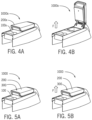
- the cover Tx/200x may be in a closed position relative to the base Bx/100x when an event is experienced in which an external force F is applied (i.e. an external force above a threshold level); as indicated in FIGURES 2B and 4B , the effect of the force F may be to cause the cover Tx/200x to come to an open position relative to the base 100x. See also FIGURE 1D .
- the conventional vehicle interior component such as shown in FIGURES 2A- 2B and 4A-4B may further comprise a mechanism or device such as a catch, magnet arrangement, friction/hinge bearing, etc. to retain/secure the cover in the closed position relative to the base in ordinary use.
- a mechanism or device such as a catch, magnet arrangement, friction/hinge bearing, etc. to retain/secure the cover in the closed position relative to the base in ordinary use.
- a vehicle interior component may comprise a console FC/1000 with cover T/200 moveable relative to a base B/100 and a latch mechanism 300. See also FIGURES 6A and 6D .
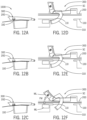
- the cover T/200 may be in a closed position relative to the base B/100 when an event is experienced in which an external force F is applied (i.e. an external force above a threshold level); as indicated in FIGURES 3B and 5B , the effect of the force F will be to actuate latch mechanism 300 to retain the cover T/200 in a closed position to the base B/100. See also FIGURES 1D and 11A-11F .
- latch mechanism 300 of the component FC/1000 may be configured to secure the cover T/200 to the base B/100 under the effect of an external force F on the vehicle. See also FIGURES 1D and 11A-11D .
- latch mechanism 300 in ordinary use (with no event applying an external force F beyond the threshold) latch mechanism 300 will remain in an unlatched state to allow to movement of the cover 200 between the closed position and the open position relative to the base 100 (e.g. as by manual closing/opening actuation by an occupant of the vehicle interior). See also TABLES A and B.
- a vehicle interior component 1000 shown as a floor console may comprise a base 100 and a cover 200 shown as an armrest covering a bin or storage compartment.
- An external force F may be applied to cover 200, for example when the vehicle rolls over.
- Cover 200 may be held in a closed position in response to application of force F of a predetermined amount.
- Cover 200 may be configured to move from a closed position as shown in FIGURE 5A to an open position in response to application of an opening force.
- Cover 200 may be configured for adjustment from an unlatched state covering the bin as shown schematically in FIGURE 5A to an open state uncovering the bin.
- Cover 200 may be configured for adjustment from the unlatched state to a latched state covering the bin as shown schematically in FIGURE 5B in response to a force exceeding a predetermined amount.
- vehicle interior component 1000 may comprise a base 100, a cover 200 and a latch mechanism 300.
- Base 100 may comprise a bin or storage compartment 102.
- Cover 200 may comprise a top portion 202 and a base portion 204.
- Fateh mechanism 300 may comprise a latch 310, a spring ST shown as a torsion spring, a spring SC shown as a cantilever spring and a counterweight 314.
- Cover 200 may comprise latch mechanism 300.
- Counterweight 314 is coupled to latch 310; latch 310 may comprise a receptacle or holder 310r configured to receive counterweight 314.
- Counterweight 314 and latch 310 may be coupled in order to move together relative to cover 200 and base 100.
- the latch mechanism may comprise the latch shown as a latch/member 310 in the cover and a catch in the base; the catch in the base may comprise a plate shown as a flange/catch 110; latch 310 of latch mechanism 300 may be configured to provide a gap G with the plate/catch 110 in the latched state. See FIGURE 11E .
- the latch mechanism may comprise a latch configured to provide a retracted position and an extended position. See FIGURES 11A-11F and 12A-12F and TABLE C.
- latch 310 when the cover is in the closed position latch 310 is in the intermediate position; when the latch is in the intermediate position the cover may be moved toward the open position relative to the base; the latch may be configured to move to the intermediate position when the cover is moved to the closed position; the latch may be configured to rotate into the intermediate position when the cover is moved to the closed position.
- latch mechanism 300 of the component may comprise a spring arrangement; the latch may be configured to move to the intermediate position by operation of the spring arrangement; the spring arrangement may comprise a torsion spring ST and/or a flat/cantilever spring SC.
- latch mechanism 300 comprises a magnet arrangement ML; the magnet arrangement comprises a magnet in the base and a magnet coupled to the latch 310; the magnet in the base may be configured to provide magnetic repulsion to the magnet in the cover; the magnet arrangement is configured to retain the latch of the latch mechanism in an intermediate position between a retracted position and an extended position; the magnet arrangement may be configured to move the latch toward a retracted position. See also FIGURES 9G-9H and TABLES A and B.
- latch mechanism 300 comprises a counterweight 314; the latch mechanism may be configured to actuate from an unlatched state to the latched state when the event for the vehicle provides an inertia force on the counterweight. See FIGURES 3B , 5B , 11A-11F and TABLE C.
- the latch mechanism may comprise a latch and the spring arrangement configured to move the latch toward a retracted position; the spring arrangement may be configured to move the latch to the retracted position when the cover is moved from the closed position toward the open position; the spring arrangement may comprise a torsion spring ST.
- the latch mechanism may comprise a magnet arrangement ML configured to compress the torsion spring; the latch mechanism may comprise a latch and a spring configured to move the latch to an intermediate position between an extended position and a retracted position.
- the component may comprise a magnet arrangement ML configured to bias the latch against the spring arrangement; the spring arrangement may comprise a stop for the magnet arrangement; the spring arrangement may comprise a flat/cantilever spring SC.
- the spring/spring arrangement may comprise at least one of (a) a beam spring; (b) a cantilever spring; (c) a stop; (d) a cam surface configured to engage a cam surface for the latch. See e.g. FIGURES 8A-8C .
- a vehicle interior component comprises a base, a cover configured to move relative to the base between a closed position and an open position and a latch mechanism configured to provide an unlatched state for the cover and a latched state for the cover. See also FIGURES 9A-9F , 10A-10F , 11A-11F , 12A-12F and TABLES A, B and C.
- the latch mechanism is configured to provide the latched state when actuated by an inertia force.
Landscapes
- Engineering & Computer Science (AREA)
- Mechanical Engineering (AREA)
- Aviation & Aerospace Engineering (AREA)
- Transportation (AREA)
- Vehicle Step Arrangements And Article Storage (AREA)
Description
- The present invention relates to a vehicle interior component.
- It is known to provide a vehicle interior component comprising a base with a bin and a cover movable relative to the base to facilitate access to the bin. It is also known to provide a vehicle interior component configured to lock or latch in response to an inertia force such as applied in a rollover event.
- It would be advantageous to provide an improved vehicle interior component configured for improved functionality and operation comprising features (and combinations of features) as shown and described in the present application including but not limited to an improved latch mechanism configured to be actuated by an external/inertia force (such as applied in an event experienced by the vehicle).
- From
WO 2019/213487 A1 a vehicle interior component with a latch mechanism is known comprising a latch, a spring, a counterweight and a bracket. - The present invention is defined by a vehicle interior component according to
claim 1. Useful optional features are defined by the subclaims. -
- FIGURE 1A
- is a schematic perspective view of a vehicle according to an exemplary embodiment.
- FIGURES 1B to 1C
- are schematic partial perspective views of a vehicle interior according to an exemplary embodiment.
- FIGURE 1D
- is a schematic perspective view of a vehicle according to an exemplary embodiment.
- FIGURES 2A to 2B
- are schematic perspective views of a conventional vehicle interior component shown as a console assembly.
- FIGURES 3A to 3B
- are schematic perspective views of a vehicle interior component shown as a console assembly according to an exemplary embodiment.
- FIGURES 4A to 4B
- are schematic perspective views of a conventional vehicle interior component shown as a console assembly.
- FIGURES 5A to 5B
- are schematic perspective views of a vehicle interior component shown as a console assembly according to an exemplary embodiment.
- FIGURES 6A to 6B
- are schematic exploded perspective views of a vehicle interior component shown as a console assembly according to an exemplary embodiment.
- FIGURE 6C
- is a schematic exploded perspective view of a cover and a mechanism of a vehicle interior component according to an exemplary embodiment.
- FIGURE 6D
- is a schematic perspective view of a vehicle interior component shown as a console assembly according to an exemplary embodiment.
- FIGURE 7 A
- is a schematic partial section view of a vehicle interior component shown as a console assembly according to an exemplary embodiment.
- FIGURE 7B
- is a schematic partial section view of a magnet arrangement for a vehicle interior component according to an exemplary embodiment.
- FIGURES 8A to 8C
- are schematic partial perspective views of a vehicle interior component shown as a console assembly according to an exemplary embodiment.
- FIGURES 9A to 9C
- are schematic partial section views of a vehicle interior component shown as a console assembly according to an exemplary embodiment.
- FIGURES 9D to 9F
- are schematic partial section views of a vehicle interior component shown as a console assembly according to an exemplary embodiment.
- FIGURE 9G
- is a schematic partial section view of a vehicle interior component shown as a console assembly according to an exemplary embodiment.
- FIGURE 9H
- is a schematic partial section view of a vehicle interior component shown as a console assembly according to an exemplary embodiment.
- FIGURES 10A to IOC
- are schematic partial section views of a vehicle interior component shown as a console assembly according to an exemplary embodiment.
- FIGURES 10D to 10F
- are schematic partial section views of a vehicle interior component shown as a console assembly according to an exemplary embodiment.
- FIGURES 11A to 11C
- are schematic partial section views of a vehicle interior component shown as a console assembly according to an exemplary embodiment.
- FIGURES 11D to 11F
- are schematic partial section views of a vehicle interior component shown as a console assembly according to an exemplary embodiment.
- FIGURES 12A to 12C
- are schematic partial section views of a vehicle interior component shown as a console assembly according to an exemplary embodiment.
- FIGURES 12D to 12F
- are schematic partial section views of a vehicle interior component shown as a console assembly according to an exemplary embodiment.
- TABLE A indicates a mode of operation for a vehicle interior component with a latch mechanism and a cover movable relative to a base according to an exemplary embodiment.
- TABLE B indicates a mode of operation for a vehicle interior component with a latch mechanism and a cover movable relative to a base according to an exemplary embodiment.
- TABLE C indicates a mode of operation for a vehicle interior component with a latch mechanism and a cover movable relative to a base according to an exemplary embodiment.
- As shown schematically according to an exemplary embodiment in
FIGURES 1A-1D , a vehicle V may include an interior I with a component shown as floor console FC comprising a base B and a cover shown as armrest AR covering a storage compartment of floor console FC. Cover/armrest AR may be configured to move between a closed position and an open position to facilitate access to the storage compartment. - As indicated schematically in
FIGURES 1A-1B and 1D , the vehicle V may be subjected to an event in which an external force shown representationally as force F operates upon the vehicle as well as upon occupants, components and contents within the vehicle interior I. As indicated schematically inFIGURE 1D , the event providing external force F may be any of a variety of types, e.g. collision, bump, roll-over, etc. As indicated schematically inFIGURES 2A-2B, 3A-3B ,4A-4B and 5A-5B , the external force F experienced during the event may act upon interior components such as the console. As indicated schematically inFIGURES 1C ,2A-2B, 3A-3B, 4A-4B and 5A-5B , the component may comprise a console C/FC providing a storage compartment in a base B/Bx with a cover T/Tx providing an armrest AR movable relative to the base B/Bx to provide access to the storage compartment (which may contain objects, items, articles, etc.). - As indicated schematically in
FIGURES 2A-2B and4A-4B , a conventional vehicle interior component may comprise a console FC/1000x with cover Tx/200x moveable relative to a base Bx/100x. As indicated inFIGURES 2A and4A , the cover Tx/200x may be in a closed position relative to the base Bx/100x when an event is experienced in which an external force F is applied (i.e. an external force above a threshold level); as indicated inFIGURES 2B and4B , the effect of the force F may be to cause the cover Tx/200x to come to an open position relative to thebase 100x. See alsoFIGURE 1D . (As indicated schematically, the conventional vehicle interior component such as shown inFIGURES 2A- 2B and 4A-4B may further comprise a mechanism or device such as a catch, magnet arrangement, friction/hinge bearing, etc. to retain/secure the cover in the closed position relative to the base in ordinary use.) - As indicated schematically according to an exemplary embodiment in
FIGURES 3A- 3B and5A-5B , a vehicle interior component may comprise a console FC/1000 with cover T/200 moveable relative to a base B/100 and alatch mechanism 300. See alsoFIGURES 6A and 6D . As indicated inFIGURES 3A and5A , the cover T/200 may be in a closed position relative to the base B/100 when an event is experienced in which an external force F is applied (i.e. an external force above a threshold level); as indicated inFIGURES 3B and5B , the effect of the force F will be to actuatelatch mechanism 300 to retain the cover T/200 in a closed position to the base B/100. See alsoFIGURES 1D and11A-11F . - As indicated schematically according to an exemplary embodiment in
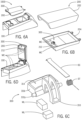
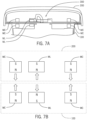
FIGURES 3A 3B ,5A-5B ,6A-6D and7A ,latch mechanism 300 of the component FC/1000 may be configured to secure the cover T/200 to the base B/100 under the effect of an external force F on the vehicle. See alsoFIGURES 1D and11A-11D . According to an exemplary embodiment as shown inFIGURES 6B-6C ,7A-7B and8A-8C , thecover 200 may comprise atop portion 202 and abase section 204;latch mechanism 300 forcover 200 may comprise a pivot/hinge shown as axle/pin 31 Op for a member shown as catch/arm configured aslatch 310 and acounterweight 314 in a base/receptacle 310r with a torsion spring ST (e.g. to provide a biasing force as indicated inFIGURES 8A-8C );latch mechanism 300 may comprise flat/cantilever spring SC (e.g. to provide a holding/biasing force as indicated inFIGURES 7A and8A-8C ) and a magnet arrangement MP (e.g. set of magnets) configured to provide a magnetic force MF (e.g. magnetic repulsion such as with N/N magnet polarity/force as indicated schematically inFIGURES 7B and9G-9H ). - As indicated schematically in
FIGURES 6B, 6D ,7A ,8A-8C, 9A-9H, 10A-10F, 11A-11F and 12A-12F , in operation oflatch mechanism 300 the member shown aslatch 310 may be configured for pivotal movement between a retracted position (e.g. disengaged and/or fully retracted/flush within opening 212 in thecover 200, see e.g.FIGURES 9F and10D ) and a partially extended/intermediate position and a fully extended position throughopening 212 incover 200 into base 100 (e.g. partially extended and/or fully extended for engagement with a catch shown asflange 110, compareFIGURES 9D-9E and11E-11F ). See also TABLES A through C. - As indicated schematically according to an exemplary embodiment in
FIGURES 9A- 9H and10A-10F , in ordinary use (with no event applying an external force F beyond the threshold)latch mechanism 300 will remain in an unlatched state to allow to movement of thecover 200 between the closed position and the open position relative to the base 100 (e.g. as by manual closing/opening actuation by an occupant of the vehicle interior). See also TABLES A and B. As indicated schematically inFIGURES 9A-9B ,9D-9E, 9G-9H, 10B- 10C and 10E-10F , in ordinaryuse latch mechanism 300 may be configured by operation of spring ST and counterweight and spring SC and magnetic force MF at magnet arrangement ML to providelatch 310 in the partially/extended position whencover 200 is in the closed position relative tobase 100. See also TABLE B andFIGURES 7A-7B and8A-8C . As indicated schematically inFIGURES 9C, 9F ,10A and 10D , in ordinary use the latch mechanism may be configured by operation of spring ST and counterweight and spring SC to provide arm/catch in the retracted position when thecover 200 is in the open position relative tobase 100. See also TABLE A andFIGURES 6D ,7A-7B and8A-8C . As indicated schematically according to an exemplary embodiment inFIGURES 6B, 6D ,7A-7B and8A , the component may comprise a mechanism shown as magnet arrangement MC (e.g. set of magnets) configured to retain/secure the cover in the closed position relative to the base in ordinary use (e.g. by net magnetic attraction with S/N magnet polarity/force as indicated schematically inFIGURE 7B ). See alsoFIGURE 1C . - As indicated schematically according to an exemplary embodiment in
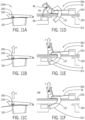
FIGURES 11A-11F and12A-12D , with thecover 200 in the closed position relative to the base 100 upon an event applying an external force F (beyond the threshold force indicated as acting upon the mass shown representationally with a center of mass CM)latch mechanism 300 will be moved into a latched state (e.g. with latch arm/member 310 fully extended throughcover 200 to be engaged by a plate/flange shown ascatch 110 of base 100) to retain thecover 200 in the closed position relative to the base 100 (and to prevent movement of thecover 200 to the open position relative to the base 100). See alsoFIGURES 1D, 3B ,5B and TABLES A and B. - As indicated schematically in
FIGURES 11A-11F , the external force F acting upon the mass CM against the spring SC engageslatch mechanism 300 into the latched state by movement oflatch 310 from thecover 200 from the intermediate position (FIGURE 11D ) into the fully-extended position (FIGURES 11E-11F ) for engagement with the flange/catch 110 of the base. See also TABLE C. When the latch mechanism is in the latched state and the cover is in a fully closed position relative to the base a gap G may be provided between the flange/catch 110 and the end of latch 310 (seeFIGURE 11E ); movement of thecover 200 to an open position relative to the base may be prevented by engagement of the end oflatch 310 with the flange/catch 110 (seeFIGURE 11F ). - As indicated schematically in
FIGURES 12A-12F , after the event (with no external force above the threshold acting upon mass CM)latch mechanism 300 may be configured by operation of spring ST and counterweight and spring SC and magnetic force MF at magnet arrangement ML to return the latch mechanism to the unlatched state with latch/member 310 moved to disengage from the flange/catch 110 and into the partially extended/intermediate position (withcover 200 in the closed position relative tobase 100 and able to be moved to the open position). See also TABLE C andFIGURES 7A-7B ,8A-8C, 9A-9F and 10A-10F . According to an exemplary embodiment, a mode of cover opening operation for the component is indicated in TABLE A. - According to an exemplary embodiment, a mode of cover closing operation for the component is indicated in TABLE B.
- According to an exemplary embodiment, a mode of latching a cover for the component in response to an extemal/inertia force is indicated in TABLE C.
TABLE A COVER OPENING FUNCTION/OPERATION ( FIGURES 9A-9H and10A-10F )Cover Latch Mechanism Set of Magnets Torsion Spring Cantilever Spring Closed Position Unlatched State (Latch in Intermediate Position) Biases Latch against cantilever spring Twisted by Magnetic Force of Set of Magnets Provides a stop against Magnetic Force of Set of Magnets Moving toward Open Position Unlatched State (Latch moving toward Retracted Position) Reducing magnetic force on Latch overcome by torsion spring Rotating Latch toward retracted position Open Position Unlatched State (Latch in Retracted Position) Holds Latch in Retracted Position TABLE B COVER CLOSING FUNCTION/OPERATION ( FIGURES 9A-9H and10A-10F )Cover Latch Mechanism Set of Magnets Torsion Spring Cantilever Spring Open Position Unlatched State (Latch in Retracted Position) Holds Latch in Retracted Position Moving toward Closed Position / Near Closed Position Unlatched State (Latch moving toward Intermediate Position) Increasing magnetic force on Latch overcomes torsion spring Twisting by Magnetic Force of Set of Magnets Closed Position Unlatched State (Latch in Intermediate Position) Biases Latch against cantilever spring Twisted by Magnetic Force of Set of Magnets Provides a stop against Magnetic Force of Set of Magnets TABLE C COVER LATCHING FUNCTION/OPERATION ( FIGURES 11A-11F and12A-12F )Cover Latch Mechanism Set of Magnets Cantilever Spring Mass of Latch Assembly Closed Position Unlatched State (Latch in Intermediate Position) Biases Latch against cantilever spring Provides a stop against Magnetic Force of Set of Magnets Moving toward Latched Position Latch Moving toward Fully Extended Position Deflected by Inertia Force on Mass Inertia Force acts on Mass to deflect Cantilever Spring and move Latch toward Fully Extended Position Latched Position Latched State (Latch in Fully Extended Position; Engaged with Flange of Base to Block Opening of Cover) Deflected by Inertia Force on Mass Inertia Force acts on Mass to deflect Cantilever Spring and move Latch into engagement with Base - As shown schematically according to an exemplary embodiment in
FIGURES 2A and 2B , a conventional floor console may comprise a cover Tx covering a storage compartment SC. An external force F may be applied to cover Tx, for example when the vehicle is subjected to a rollover. Conventional cover Tx may move from a closed position to an open position as a result of the application of force F. - As shown schematically according to an exemplary embodiment in
FIGURES 3A and 3B , a floor console may comprise a cover T covering a storage compartment. An external force F may be applied to cover T. Cover T may be held in a closed position in response to application of force F of a predetermined amount. - As shown schematically according to an exemplary embodiment in
FIGURES 4A and 4B , a conventional vehicle interior component shown as afloor console 1000x may comprise a cover Tx/200x covering a bin or storage compartment SC. An external force F may be applied to cover 200x, for example when the vehicle rolls over.Cover 200x may move from a closed position as shown schematically inFIGURE 4A to an open position as shown schematically inFIGURE 4B as a result of the application of force F exceeding a predetermined amount. - As shown schematically according to an exemplary embodiment in
FIGURES 5A and 5B , avehicle interior component 1000 shown as a floor console may comprise abase 100 and acover 200 shown as an armrest covering a bin or storage compartment. An external force F may be applied to cover 200, for example when the vehicle rolls over. Cover 200 may be held in a closed position in response to application of force F of a predetermined amount. Cover 200 may be configured to move from a closed position as shown inFIGURE 5A to an open position in response to application of an opening force. Cover 200 may be configured for adjustment from an unlatched state covering the bin as shown schematically inFIGURE 5A to an open state uncovering the bin. Cover 200 may be configured for adjustment from the unlatched state to a latched state covering the bin as shown schematically inFIGURE 5B in response to a force exceeding a predetermined amount. - As shown schematically according to an exemplary embodiment in
FIGURES 6A-6C ,vehicle interior component 1000 may comprise a base 100, acover 200 and alatch mechanism 300.Base 100 may comprise a bin or storage compartment 102. Cover 200 may comprise atop portion 202 and abase portion 204.Fateh mechanism 300 may comprise alatch 310, a spring ST shown as a torsion spring, a spring SC shown as a cantilever spring and acounterweight 314. Cover 200 may compriselatch mechanism 300.Counterweight 314 is coupled to latch 310; latch 310 may comprise a receptacle orholder 310r configured to receivecounterweight 314.Counterweight 314 and latch 310 may be coupled in order to move together relative to cover 200 andbase 100.Base portion 204 ofcover 200 may comprise a feature to receivelatch 310 and guide rotation oflatch 310 relative to cover 200; latch 310 may comprise apin 310p configured to rotate relative tobase portion 204 ofcover 200. Spring SC may be configured to deflect to allow rotation oflatch 310. Spring SC may be configured to provide a stop forlatch 310. Cover 200 may compriselatch mechanism 300. Spring ST may be configured to rotatelatch 310.Latch mechanism 300 may be assembled tobase portion 204 ofcover 200 and covered bytop portion 202 ofcover 200. - Referring to
FIGURES 1A-1D ,2A-2B, 3A-3B, 4A-4B and 5A-5B, acomponent 1000/1000x for an interior of a vehicle V of a type that may be subjected to an external force F in an event such as a rollover of the vehicle V. As shown inFIGURES 6A-6D , the component comprises acover 200 movable between a closed position and an open position relative to thebase 100 and alatch mechanism 300 configured to provide a latched state to secure the cover in the closed position relative to the base; when the vehicle is subjected to the external force F the latch mechanism may be configured to actuate to the latched state to secure the cover in the closed position relative to the base, as indicated schematically inFIGURES 3B and5B . As shown schematically inFIGURES 6A-6D and8A-8C ,latch mechanism 300 may comprise alatch 310 in the cover; the latch may be configured to be retracted when the cover is in the open position; the latch may be configured to be partially extended when the cover is in the closed position. SeeFIGURES 9A-9F and10A-10F and TABLES A and B. The latch mechanism may comprise the latch shown as a latch/member 310 in the cover and a catch in the base; the catch in the base may comprise a plate shown as a flange/catch 110; latch 310 oflatch mechanism 300 may be configured to provide a gap G with the plate/catch 110 in the latched state. SeeFIGURE 11E . The latch mechanism may comprise a latch configured to provide a retracted position and an extended position. SeeFIGURES 11A-11F and12A-12F and TABLE C. - As indicated schematically in
FIGURES 3B ,5B and11A-11D , upon the event (with external force F above a threshold force) for the vehicle when the cover is in theclosed position latch 310 oflatch mechanism 300 may be actuated to the extended position. See also TABLE C. As indicated schematically inFIGURES 9A-9F and10A-10F ,latch mechanism 300 may be configured to movelatch 310 to the retracted position when the cover is moved toward the open position; latch 310 is configured with an intermediate position between the extended position and the retracted position; the latch may be partially extended from the cover when in the intermediate position. See TABLES A and B. - According to an exemplary embodiment as shown schematically in
FIGURES 9A-9F and10A-10F , when the cover is in theclosed position latch 310 is in the intermediate position; when the latch is in the intermediate position the cover may be moved toward the open position relative to the base; the latch may be configured to move to the intermediate position when the cover is moved to the closed position; the latch may be configured to rotate into the intermediate position when the cover is moved to the closed position. - According to an exemplary embodiment as shown schematically in
FIGURES 6A-6D and8A-8C ,latch mechanism 300 of the component may comprise a spring arrangement; the latch may be configured to move to the intermediate position by operation of the spring arrangement; the spring arrangement may comprise a torsion spring ST and/or a flat/cantilever spring SC. According to the invention as shown schematically inFIGURES 7A-7B and8A-8C ,latch mechanism 300 comprises a magnet arrangement ML; the magnet arrangement comprises a magnet in the base and a magnet coupled to thelatch 310; the magnet in the base may be configured to provide magnetic repulsion to the magnet in the cover; the magnet arrangement is configured to retain the latch of the latch mechanism in an intermediate position between a retracted position and an extended position; the magnet arrangement may be configured to move the latch toward a retracted position. See alsoFIGURES 9G-9H and TABLES A and B. - According to the invention as shown schematically in
FIGURES 6A-6D ,7A and8A-8C ,latch mechanism 300 comprises acounterweight 314; the latch mechanism may be configured to actuate from an unlatched state to the latched state when the event for the vehicle provides an inertia force on the counterweight. SeeFIGURES 3B ,5B ,11A-11F and TABLE C. According to an exemplary embodiment, the latch mechanism may comprise a latch and the spring arrangement configured to move the latch toward a retracted position; the spring arrangement may be configured to move the latch to the retracted position when the cover is moved from the closed position toward the open position; the spring arrangement may comprise a torsion spring ST. According to an exemplary embodiment, the latch mechanism may comprise a magnet arrangement ML configured to compress the torsion spring; the latch mechanism may comprise a latch and a spring configured to move the latch to an intermediate position between an extended position and a retracted position. The component may comprise a magnet arrangement ML configured to bias the latch against the spring arrangement; the spring arrangement may comprise a stop for the magnet arrangement; the spring arrangement may comprise a flat/cantilever spring SC. According to an exemplary embodiment, the spring/spring arrangement may comprise at least one of (a) a beam spring; (b) a cantilever spring; (c) a stop; (d) a cam surface configured to engage a cam surface for the latch. See e.g.FIGURES 8A-8C . - Referring to
FIGURES 1A-1D, 2A-2B, 3A-3B ,4A-4B and 5A-5B , a vehicle interior component comprises a base, a cover configured to move relative to the base between a closed position and an open position and a latch mechanism configured to provide an unlatched state for the cover and a latched state for the cover. See alsoFIGURES 9A-9F ,10A-10F ,11A-11F ,12A-12F and TABLES A, B and C. According to an exemplary embodiment shown schematically inFIGURES 7A ,8A-8C ,11A-11F and12A-12F , the latch mechanism is configured to provide the latched state when actuated by an inertia force. The cover may comprise the latch mechanism. The latch mechanism may be configured to extend from the cover when the cover is in the closed position. According to an exemplary embodiment shown schematically inFIGURES 6A-6D and8A-8C , the cover may comprise a wall comprising an opening; the latch mechanism may be configured to form a generally continuous surface with the wall of the cover when the cover is in the open position. The cover may comprise a wall comprising an opening; the latch mechanism may be configured to protrude through the opening of the wall of the cover when the cover is in the closed position. The latch mechanism may be configured to rotate relative to the base to engage the base. The cover may be configured to rotate in an opening direction relative to the base between the closed position and the open position; the latch mechanism may be configured to rotate relative to the base in a direction generally orthogonal to the opening direction. See alsoFIGURES 6D ,7A ,9A-9H and 10A-10D. According to an exemplary embodiment shown schematically inFIGURES 11A-11F and12A-12F , the latch mechanism may comprise a bar configured to engage the base in the latched state. The bar of the latch mechanism may be configured to engage a flange of the base in the latched state; the bar of the latch mechanism may be configured to rotate into engagement with the base in the latched state. SeeFIGURES 6A-6D ,8A-8C and TABLE C. The component may comprise a counterweight configured to provide mass to move the bar toward engagement with the base. The component may comprise a spring mechanism configured to at least one of bias the bar in the unlatched state and move the bar in response to removal of the inertia force. SeeFIGURES 6A-6D and8A-8C and TABLES A, B and C. According to an exemplary embodiment shown schematically inFIGURES 11A-11F , the bar of the latch mechanism may be configured to provide a gap with the base in the latched state; the gap may be configured to be closed to prevent the cover from moving to the open position. According to an exemplary embodiment shown schematically inFIGURES 11A-11F and12A-12F , the latch mechanism may comprise a latch configured to move between a retracted position and an extended position through an intermediate position; the latch may comprise a curved member configured to engage the base in the latched state; the latch may be configured to move from the intermediate position toward the retracted position when the cover moves from the closed position toward the open position; the latch may be configured to move from the intermediate position toward the extended position in response to the inertia force. The cover may be configured for movement from (a) the unlatched state with the cover in the closed position and the latch in the intermediate position to (b) a transition state with the latch in the fully extended position to (c) the latched state with the cover in the closed position and the latch in the extended position. See alsoFIGURES 9A-9F ,10A-10F, 11A-11F, 12A-12F and TABLES A, B and C. The component may comprise a gap between the latch mechanism and the base in the transition state; the cover may be configured to move through the gap to contact the base in the latched state; the cover may be configured to pivot relative to the base between the closed position and the open position. See alsoFIGURES 11A-11F and TABLE C.
Claims (11)
- A vehicle interior component comprising:(a) a base (B);(b) a cover (T) configured to move relative to the base (B) between a closed position and an open position; and(c) a latch mechanism (300) configured to provide an unlatched state for the cover (T) and a latched state for the cover (T);wherein the latch mechanism (300) comprises a counterweight (314) coupled via a pivot (310p) to a latch (310) configured to move the latch (310) between a retracted position and an extended position through an intermediate position; andwherein the latch mechanism (300) is configured to provide the latched state when actuated by an inertia force on the counterweight (314);characterized in thatthe latch mechanism (300) comprises a magnet arrangement (ML), wherein the magnet arrangement comprises a magnet in the base and a magnet coupled to the latch (310), wherein the magnet in the base (B) is configured to retain the latch (310) in the intermediate position by magnetic repulsion when the cover (T) is in the closed position relative to the base (B).
- The component of Claim 1 wherein the cover (T) comprises the latch mechanism (300).
- The component of Claim 1 or 2 wherein the cover (T) comprises a wall comprising an opening (212); wherein the end of the latch (310) forms a generally continuous surface with the wall of the cover (T) when the cover (T) is in the open position.
- The component of any one of Claims 1 or 2 wherein the cover (T) comprises a wall comprising an opening (212); wherein the latch (310) protrudes through the opening (212) of the wall of the cover (T) when the cover (T) is in the closed position.
- The component of any one of Claims 1 to 4 wherein the cover (T) is configured to rotate in an opening direction relative to the base (B) between the closed position and the open position; wherein the counterweight (314) and the latch (310) are configured to rotate relative to the base (B) in a direction generally orthogonal to the opening direction.
- The component of any one of Claims 1 to 5 wherein the latch (310) is formed as a bar configured to engage the base (B) in the latched state.
- The component of Claim 6 further comprising a spring mechanism configured to at least one of (a) bias the bar in the unlatched state; (b) move the bar in response to removal of the inertia force.
- The component of Claim 6 wherein the base (B) comprises a catch (110), and wherein the bar is configured to engage the catch (110) in the extended position, wherein the bar provides a gap (G) with the base (B) in the latched state.
- The component of Claim 8 wherein the gap (G) is configured to be closed to prevent the cover (T) from moving to the open position.
- The component of any one of Claims 1 to 9 wherein the latch (310) is configured to move from the intermediate position toward the extended position in response to the inertia force on the counterweight (314).
- The component of any one of Claims 1 to 10 wherein the latch (310) is configured to move from the intermediate position toward the retracted position when the cover (T) moves from the closed position toward the open position.
Applications Claiming Priority (2)
| Application Number | Priority Date | Filing Date | Title |
|---|---|---|---|
| US202062993213P | 2020-03-23 | 2020-03-23 | |
| PCT/US2021/021057 WO2021194726A1 (en) | 2020-03-23 | 2021-03-05 | Vehicle interior component |
Publications (3)
| Publication Number | Publication Date |
|---|---|
| EP4127368A1 EP4127368A1 (en) | 2023-02-08 |
| EP4127368A4 EP4127368A4 (en) | 2024-05-01 |
| EP4127368B1 true EP4127368B1 (en) | 2025-07-02 |
Family
ID=77892183
Family Applications (1)
| Application Number | Title | Priority Date | Filing Date |
|---|---|---|---|
| EP21774965.4A Active EP4127368B1 (en) | 2020-03-23 | 2021-03-05 | Vehicle interior component |
Country Status (4)
| Country | Link |
|---|---|
| US (1) | US11466479B2 (en) |
| EP (1) | EP4127368B1 (en) |
| CN (1) | CN115362304B (en) |
| WO (1) | WO2021194726A1 (en) |
Families Citing this family (4)
| Publication number | Priority date | Publication date | Assignee | Title |
|---|---|---|---|---|
| DE102018206316B4 (en) * | 2018-04-24 | 2021-06-24 | Audi Ag | Sealed storage compartment for a motor vehicle and motor vehicle with such a storage compartment |
| US11299079B1 (en) * | 2021-03-10 | 2022-04-12 | Ford Global Technologies, Llc | Armrest with cushioned component having an integrated air channeling system |
| MX2024006850A (en) * | 2021-12-08 | 2024-08-20 | Bradley Company LLC | Magnetic lock system. |
| KR20250045059A (en) * | 2023-09-25 | 2025-04-01 | 현대자동차주식회사 | Locker for console apparatus and the console apparatus for a vehicle |
Family Cites Families (94)
| Publication number | Priority date | Publication date | Assignee | Title |
|---|---|---|---|---|
| US2873794A (en) | 1956-09-24 | 1959-02-17 | Gen Motors Corp | Inertia latch |
| US3621510A (en) | 1970-07-29 | 1971-11-23 | Collins Radio Co | Locking handle |
| US4052093A (en) | 1976-07-15 | 1977-10-04 | Fattori Lazzaro A | Telescoping rotary latch and manufacture thereof |
| GB2127285A (en) | 1982-09-22 | 1984-04-11 | Ford Motor Co | Armrest lock for a motor car |
| US4906044A (en) * | 1989-01-06 | 1990-03-06 | General Motors Corporation | Locking device for arm rest storage compartment |
| US5116099A (en) | 1991-05-14 | 1992-05-26 | Lear Seating Corporation | Mechanical latch locking a cover of pivoting armrest assembly |
| EP0525811A1 (en) | 1991-08-02 | 1993-02-03 | UNITED TECHNOLOGIES AUTOMOTIVE, Inc. | Vehicle console with inertial door lock |
| DE4130847C2 (en) | 1991-09-17 | 1995-04-13 | Daimler Benz Ag | Closure cap for closing a storage compartment in the interior of a motor vehicle |
| US5476307A (en) | 1994-01-31 | 1995-12-19 | Fisher Dynamics Corporation | Inertia hinge for seatback and armrest |
| US5658043A (en) | 1995-12-28 | 1997-08-19 | Lear Corporation | Inertia lock for side-mounted armrest |
| DE10009291B4 (en) | 2000-02-28 | 2006-06-14 | F.S. Fehrer Gmbh & Co. Kg | Armrest with storage compartment and lockable lid |
| DE10052838B4 (en) * | 2000-10-24 | 2016-09-22 | Grammer Aktiengesellschaft | Armrest, in particular center armrest of a motor vehicle |
| JP4462768B2 (en) | 2001-01-19 | 2010-05-12 | 株式会社ニフコ | Locking device with safety function and storage device for vehicle |
| DE10120435A1 (en) | 2001-04-26 | 2002-10-31 | Fischer Artur Werke Gmbh | Push-push locking mechanism |
| DE20221460U1 (en) | 2001-08-01 | 2006-01-05 | Keiper Gmbh & Co.Kg | Height adjustment system for vehicle seat has toothed members interengaging when adjustment system deforms irreversibly during crash |
| US6616206B2 (en) | 2002-01-04 | 2003-09-09 | Honda Giken Kogyo Kabushiki Kaisha | Center console assembly |
| US6843528B2 (en) * | 2002-11-05 | 2005-01-18 | Intier Automotive Inc. | Latch lockout for a vehicular trim component |
| US6802550B1 (en) * | 2003-01-08 | 2004-10-12 | Lear Corporation | Emergency locking console assembly |
| US6736438B1 (en) | 2003-05-28 | 2004-05-18 | Lear Corporation | Semi-passive latch system for a vehicle component |
| DE20311467U1 (en) | 2003-07-25 | 2003-09-18 | Sarnatech Paulmann & Crone GmbH, 58509 Lüdenscheid | Installation component has crash locking device with pivoting locking catch held in released position against force of return spring, and pivoting stop component which in released position lies upon stop indent on locking catch |
| DE10340673A1 (en) | 2003-09-04 | 2005-03-31 | Fischer Automotive Systems Gmbh | Safety locking device for a container in a vehicle |
| US7097220B2 (en) | 2004-09-23 | 2006-08-29 | Lear Corporation | G-force push-push latch |
| DE102005043593B4 (en) | 2005-09-12 | 2010-12-02 | Faurecia Innenraum Systeme Gmbh | Storage compartment for a motor vehicle |
| US7793995B2 (en) | 2006-07-27 | 2010-09-14 | Illinois Tool Works Inc. | Push/push latch |
| US7481468B2 (en) | 2006-10-25 | 2009-01-27 | Ford Global Technologies, Llc | Apparatus for blocking the movement of an inertially activated component |
| US7607727B2 (en) | 2006-12-04 | 2009-10-27 | Hyundai Mobis Co., Ltd. | Armrest locking device |
| JP4980042B2 (en) | 2006-12-21 | 2012-07-18 | カルソニックカンセイ株式会社 | Cover lock structure for vehicle storage box |
| US7614674B2 (en) | 2007-09-10 | 2009-11-10 | Honda Motor Co., Ltd. | Console box |
| AU2008230019A1 (en) * | 2007-10-24 | 2009-05-14 | Assa Abloy Australia Pty Limited | A Self Latching Latch |
| US7581774B2 (en) | 2007-11-06 | 2009-09-01 | Toyota Motor Engineering & Manufacturing North America, Inc. | Center console assembly having a ramped locating tab |
| DE102008000802B4 (en) | 2008-03-20 | 2012-05-10 | Faurecia Innenraum Systeme Gmbh | Fully automatic storage compartment |
| DE202008007673U1 (en) | 2008-06-09 | 2009-10-22 | BROSE SCHLIEßSYSTEME GMBH & CO. KG | Motor vehicle lock |
| DE102008030387A1 (en) | 2008-06-26 | 2009-01-29 | Daimler Ag | Storage compartment for interior of motor vehicle, has locking unit provided in area of end of lever unit, where locking unit is accommodated in intermediate position in corresponding locking retainer of hinge part |
| US7922228B2 (en) * | 2009-02-25 | 2011-04-12 | Nissan North America, Inc. | Vehicle interior trim assembly |
| KR101209605B1 (en) | 2009-08-19 | 2012-12-07 | 현대자동차주식회사 | Prevention of snap back for inside handle for vehicle |
| US8727399B2 (en) | 2009-10-27 | 2014-05-20 | Honda Motor Co., Ltd. | Device for prevention of door opening during roll-over |
| DE102009058988A1 (en) | 2009-12-18 | 2011-06-22 | Dr. Ing. h.c. F. Porsche Aktiengesellschaft, 70435 | motor vehicle |
| US8215684B2 (en) | 2010-01-20 | 2012-07-10 | Ford Global Technologies, Llc | Vehicle stowage assembly having electromagnetic closure |
| US8167348B2 (en) | 2010-03-22 | 2012-05-01 | Ford Global Technologies, Llc | Cable activated latch pawl for floor console armrest |
| DE102010023731A1 (en) | 2010-06-14 | 2011-12-15 | Audi Ag | Locking device for vehicle door in motor car, has pivotable component comprising mass body that is operatively connected with locking unit for deflection of mass body, where locking unit blocks movement of pivotable component |
| US8191953B2 (en) * | 2010-07-02 | 2012-06-05 | Ford Global Technologies, Llc | Integrated inertial lock and latch for console lid |
| DE112012002767T5 (en) | 2011-08-09 | 2014-04-17 | Illinois Tool Works Inc. | Push / push locking |
| DE102011053395A1 (en) | 2011-09-08 | 2013-03-14 | Dr. Ing. H.C. F. Porsche Aktiengesellschaft | Central console assembly for use in motor vehicle, has open-top storage compartment closed by pivotally mounted lid at rear end of storage compartment, and crash-lock device for preventing unintentional opening of lid in event of crash |
| JP5969754B2 (en) | 2011-10-31 | 2016-08-17 | 日本プラスト株式会社 | Assembly structure of movable member |
| DE102011090019B4 (en) | 2011-12-28 | 2014-06-12 | Flextronics Automotive Gmbh & Co.Kg | Unlocking device, storage compartment with unlocking device |
| US8961062B2 (en) | 2012-06-28 | 2015-02-24 | Ford Global Technologies, Llc | Inertial lockout mechanism |
| DE102012016884B4 (en) * | 2012-08-24 | 2021-12-23 | Audi Ag | Adjusting device for a pivotable comfort element, in particular for an armrest of a vehicle |
| US9409502B2 (en) | 2012-09-21 | 2016-08-09 | Johnson Controls Technology Company | Vertically adjustable armrest assembly for a vehicle interior component |
| DE202012010950U1 (en) | 2012-11-06 | 2014-02-14 | Kiekert Aktiengesellschaft | Motor vehicle door lock |
| DE102012025403A1 (en) | 2012-12-21 | 2014-06-26 | Kiekert Aktiengesellschaft | Motor vehicle door lock |
| DE102012025448A1 (en) | 2012-12-21 | 2014-06-26 | Kiekert Aktiengesellschaft | Motor vehicle door lock |
| DE102013108293A1 (en) | 2013-08-01 | 2015-02-05 | Kiekert Aktiengesellschaft | Motor vehicle door lock |
| US9714531B2 (en) | 2013-08-02 | 2017-07-25 | Faurecia Interior Systems, Inc. | Push-push latch arrangement |
| EP3041708B1 (en) | 2013-09-06 | 2017-11-15 | Johnson Controls Technology Company | Adjustable vehicle armrest assembly having a tambour door |
| DE102013019389A1 (en) | 2013-11-18 | 2015-05-21 | GM Global Technology Operations LLC (n. d. Ges. d. Staates Delaware) | Lockable device for storing objects in a vehicle |
| US10316551B2 (en) | 2014-01-10 | 2019-06-11 | Inteva Products, Llc | Apparatus and method for preventing undesired latch release |
| DE102014103792A1 (en) | 2014-03-20 | 2015-09-24 | Dr. Ing. H.C. F. Porsche Aktiengesellschaft | Lock for a pivotable cover in a vehicle |
| DE102014009465B4 (en) | 2014-06-30 | 2019-02-21 | Grammer Ag | Receiving device with cover for the interior of a vehicle |
| DE102014111923B4 (en) * | 2014-08-20 | 2017-03-30 | Volkswagen Aktiengesellschaft | Armrest with crash protection |
| US9415710B2 (en) | 2014-12-04 | 2016-08-16 | Ford Global Technologies, Llc | Console armrest assembly with dampening strut and integrated inertial lock |
| CN107428275B (en) | 2014-12-12 | 2020-03-06 | 上海延锋金桥汽车饰件系统有限公司 | Armrest assembly for vehicle interior |
| DE102014226472B4 (en) * | 2014-12-18 | 2018-05-17 | Bos Gmbh & Co. Kg | Backrest structure with movable section and motor vehicle |
| DE102015104722B4 (en) | 2015-03-27 | 2017-05-11 | F.S. Fehrer Automotive Gmbh | Center armrest with magnetic closure |
| US9469225B1 (en) | 2015-04-01 | 2016-10-18 | Ford Global Technologies, Llc | Center armrest inertial lock |
| US9637032B2 (en) | 2015-04-08 | 2017-05-02 | Ford Global Technologies, Llc | Center armrest lock |
| CN106394419A (en) | 2015-07-17 | 2017-02-15 | 福特环球技术公司 | Center console support plate and center console assembly |
| US9714530B2 (en) * | 2015-09-15 | 2017-07-25 | GM Global Technology Operations LLC | Inertia lock for a console armrest |
| US10112510B2 (en) | 2015-10-13 | 2018-10-30 | Windsor Machine and Stamping (2009) Ltd. | Lockable armrest |
| US20180304788A1 (en) | 2015-10-14 | 2018-10-25 | MOTHERSON AUTOMOTIVE TECHNOLOGIES & ENGINEERING (A Division of Motherson Sumi Systems Ltd.) | Controlled movement of the armrest |
| US9810003B2 (en) | 2015-11-19 | 2017-11-07 | Ford Global Technologies, Llc | Impact resistant door retainer for vehicle glove box |
| US9771743B2 (en) | 2015-12-02 | 2017-09-26 | Ford Global Technologies, Llc | Impact-activated latch lock device, system, and method for glove box doors |
| DE102016200052B4 (en) | 2016-01-06 | 2025-05-28 | Volkswagen Aktiengesellschaft | Armrest device for a vehicle |
| US10189390B2 (en) | 2016-03-31 | 2019-01-29 | Ford Global Technologies, Llc | Split wing armrest dual pawl latch mechansim |
| WO2017201190A1 (en) | 2016-05-18 | 2017-11-23 | Shanghai Yanfeng Jinqiao Automotive Trim Systems Co. Ltd | Console assembly for vehicle interior |
| FR3052408B1 (en) | 2016-06-08 | 2018-07-06 | Faurecia Interieur Industrie | INTERIOR DEVICE FOR VEHICLE WITH ROTATING UNLOCKABLE ARMREST |
| FR3052407B1 (en) | 2016-06-08 | 2018-07-06 | Faurecia Interieur Industrie | INTERIOR DEVICE FOR VEHICLE WITH TRANSLATION UNLOCKABLE ARMREST |
| KR101916513B1 (en) * | 2016-07-07 | 2018-11-07 | 현대자동차주식회사 | Multi Link Knob type Arm Rest and Arm Rest Console and Vehicle thereby |
| DE102016214520A1 (en) | 2016-08-05 | 2018-02-08 | Volkswagen Aktiengesellschaft | Armrest device for a motor vehicle |
| US10391904B2 (en) | 2016-09-08 | 2019-08-27 | Ford Global Technologies, Llc | Inertia latch for a vehicle armrest using a spring loaded cam |
| DE102016011331B4 (en) | 2016-09-21 | 2022-09-15 | Grammer Aktiengesellschaft | armrest |
| DE202016105434U1 (en) | 2016-09-29 | 2016-11-16 | Ford Global Technologies, Llc | Dual pawl locking unit integrated in console lid |
| DE102017201971B4 (en) * | 2017-02-08 | 2020-02-06 | Ford Global Technologies, Llc | Swivel armrest with locking mechanism |
| AU2018278345B2 (en) * | 2017-06-01 | 2023-05-25 | Assa Abloy Fenestration Llc | Magnetically-triggered lock mechanism |
| US10486568B2 (en) | 2017-06-14 | 2019-11-26 | Gulfstream Aerospace Corporation | Seat assemblies including an armrest with an armrest lid and a hinge arrangement |
| JP6840631B2 (en) * | 2017-06-23 | 2021-03-10 | 小島プレス工業株式会社 | Vehicle interior equipment |
| WO2019010086A1 (en) | 2017-07-07 | 2019-01-10 | Shanghai Yanfeng Jinqiao Automotive Trim Systems Co. Ltd. | Vehicle interior component |
| DE202017104655U1 (en) | 2017-08-03 | 2017-08-16 | Lisa Dräxlmaier GmbH | Locking device for a cover of a storage compartment of a vehicle |
| CN109421606A (en) * | 2017-08-29 | 2019-03-05 | 福特环球技术公司 | Inertial device in handrail console |
| US10352071B2 (en) | 2017-11-09 | 2019-07-16 | Fca Us Llc | Locking assembly for vehicle armrest |
| JP6848929B2 (en) * | 2018-04-17 | 2021-03-24 | 豊田合成株式会社 | Storage box |
| DE102018205916A1 (en) | 2018-04-18 | 2019-10-24 | Faurecia Innenraum Systeme Gmbh | Locking mechanism for a lid for opening and closing a storage compartment and storage compartment |
| WO2019213487A1 (en) | 2018-05-04 | 2019-11-07 | Shanghai Yanfeng Jinqiao Automotive Trim Systems Co. Ltd. | Vehicle interior component |
| JP7052581B2 (en) * | 2018-06-13 | 2022-04-12 | 豊田合成株式会社 | Containment device |
| JP7242586B2 (en) * | 2020-01-31 | 2023-03-20 | 森六テクノロジー株式会社 | Vehicle storage device |
-
2021
- 2021-03-05 CN CN202180020273.0A patent/CN115362304B/en active Active
- 2021-03-05 EP EP21774965.4A patent/EP4127368B1/en active Active
- 2021-03-05 WO PCT/US2021/021057 patent/WO2021194726A1/en not_active Ceased
- 2021-07-23 US US17/383,964 patent/US11466479B2/en active Active
Also Published As
| Publication number | Publication date |
|---|---|
| US20210348425A1 (en) | 2021-11-11 |
| CN115362304B (en) | 2025-08-26 |
| EP4127368A4 (en) | 2024-05-01 |
| EP4127368A1 (en) | 2023-02-08 |
| US11466479B2 (en) | 2022-10-11 |
| CN115362304A (en) | 2022-11-18 |
| WO2021194726A1 (en) | 2021-09-30 |
Similar Documents
| Publication | Publication Date | Title |
|---|---|---|
| EP4127368B1 (en) | Vehicle interior component | |
| US11578515B2 (en) | Vehicle interior component | |
| US11885171B2 (en) | Vehicle interior component | |
| KR101717041B1 (en) | Vertically adjustable armrest assembly for a vehicle interior component | |
| US9758075B2 (en) | Seat assembly having an armrest | |
| US8740265B2 (en) | Dual pawl latch mechanism for a dual door assembly | |
| US10358069B2 (en) | Armrest assembly for vehicle interior | |
| US8430440B1 (en) | Console door that pivots and stows | |
| US20120286537A1 (en) | Folding armrest | |
| US20200087967A1 (en) | Vehicle interior component | |
| KR101470024B1 (en) | Automotive console armrests | |
| US20160159258A1 (en) | Console armrest assembly with dampening strut and integrated inertial lock | |
| CN112677744A (en) | Holding-open locking device for sliding vehicle door | |
| US12083996B2 (en) | Storage device for vehicle | |
| US7758102B2 (en) | Interior folding armrest for automotive vehicle door | |
| US20220205293A1 (en) | Vehicular door device | |
| US10137840B2 (en) | Vehicle interior component | |
| US5782510A (en) | Glove box latch | |
| US20180370446A1 (en) | Vehicle interior component | |
| US11318892B2 (en) | Vehicle interior component | |
| EP4079579B1 (en) | Vehicle interior panel with fall away door | |
| US20220290473A1 (en) | Storage console | |
| US4413841A (en) | Safety seat belt arrangement for automotive seat occupant | |
| EP4249717A1 (en) | Cover opening and closing device using sliding and rotation | |
| US20250376877A1 (en) | Closure latch assembly with latch mechanism having roller pawl assembly |
Legal Events
| Date | Code | Title | Description |
|---|---|---|---|
| STAA | Information on the status of an ep patent application or granted ep patent |
Free format text: STATUS: THE INTERNATIONAL PUBLICATION HAS BEEN MADE |
|
| PUAI | Public reference made under article 153(3) epc to a published international application that has entered the european phase |
Free format text: ORIGINAL CODE: 0009012 |
|
| STAA | Information on the status of an ep patent application or granted ep patent |
Free format text: STATUS: REQUEST FOR EXAMINATION WAS MADE |
|
| 17P | Request for examination filed |
Effective date: 20220920 |
|
| AK | Designated contracting states |
Kind code of ref document: A1 Designated state(s): AL AT BE BG CH CY CZ DE DK EE ES FI FR GB GR HR HU IE IS IT LI LT LU LV MC MK MT NL NO PL PT RO RS SE SI SK SM TR |
|
| DAV | Request for validation of the european patent (deleted) | ||
| DAX | Request for extension of the european patent (deleted) | ||
| P01 | Opt-out of the competence of the unified patent court (upc) registered |
Effective date: 20230603 |
|
| A4 | Supplementary search report drawn up and despatched |
Effective date: 20240402 |
|
| RIC1 | Information provided on ipc code assigned before grant |
Ipc: E05B 77/02 20140101ALI20240325BHEP Ipc: B60R 7/04 20060101ALI20240325BHEP Ipc: B60N 2/75 20180101ALI20240325BHEP Ipc: E05B 77/06 20140101AFI20240325BHEP |
|
| STAA | Information on the status of an ep patent application or granted ep patent |
Free format text: STATUS: EXAMINATION IS IN PROGRESS |
|
| 17Q | First examination report despatched |
Effective date: 20240902 |
|
| GRAP | Despatch of communication of intention to grant a patent |
Free format text: ORIGINAL CODE: EPIDOSNIGR1 |
|
| STAA | Information on the status of an ep patent application or granted ep patent |
Free format text: STATUS: GRANT OF PATENT IS INTENDED |
|
| INTG | Intention to grant announced |
Effective date: 20250318 |
|
| GRAS | Grant fee paid |
Free format text: ORIGINAL CODE: EPIDOSNIGR3 |
|
| GRAA | (expected) grant |
Free format text: ORIGINAL CODE: 0009210 |
|
| STAA | Information on the status of an ep patent application or granted ep patent |
Free format text: STATUS: THE PATENT HAS BEEN GRANTED |
|
| AK | Designated contracting states |
Kind code of ref document: B1 Designated state(s): AL AT BE BG CH CY CZ DE DK EE ES FI FR GB GR HR HU IE IS IT LI LT LU LV MC MK MT NL NO PL PT RO RS SE SI SK SM TR |
|
| REG | Reference to a national code |
Ref country code: GB Ref legal event code: FG4D |
|
| REG | Reference to a national code |
Ref country code: CH Ref legal event code: EP |
|
| REG | Reference to a national code |
Ref country code: DE Ref legal event code: R096 Ref document number: 602021033433 Country of ref document: DE |
|
| REG | Reference to a national code |
Ref country code: IE Ref legal event code: FG4D |
|
| REG | Reference to a national code |
Ref country code: NL Ref legal event code: MP Effective date: 20250702 |
|
| PG25 | Lapsed in a contracting state [announced via postgrant information from national office to epo] |
Ref country code: PT Free format text: LAPSE BECAUSE OF FAILURE TO SUBMIT A TRANSLATION OF THE DESCRIPTION OR TO PAY THE FEE WITHIN THE PRESCRIBED TIME-LIMIT Effective date: 20251103 |
|
| PG25 | Lapsed in a contracting state [announced via postgrant information from national office to epo] |
Ref country code: NL Free format text: LAPSE BECAUSE OF FAILURE TO SUBMIT A TRANSLATION OF THE DESCRIPTION OR TO PAY THE FEE WITHIN THE PRESCRIBED TIME-LIMIT Effective date: 20250702 |
|
| REG | Reference to a national code |
Ref country code: AT Ref legal event code: MK05 Ref document number: 1809421 Country of ref document: AT Kind code of ref document: T Effective date: 20250702 |
|
| PG25 | Lapsed in a contracting state [announced via postgrant information from national office to epo] |
Ref country code: IS Free format text: LAPSE BECAUSE OF FAILURE TO SUBMIT A TRANSLATION OF THE DESCRIPTION OR TO PAY THE FEE WITHIN THE PRESCRIBED TIME-LIMIT Effective date: 20251102 |
|
| PG25 | Lapsed in a contracting state [announced via postgrant information from national office to epo] |
Ref country code: NO Free format text: LAPSE BECAUSE OF FAILURE TO SUBMIT A TRANSLATION OF THE DESCRIPTION OR TO PAY THE FEE WITHIN THE PRESCRIBED TIME-LIMIT Effective date: 20251002 |
|
| REG | Reference to a national code |
Ref country code: LT Ref legal event code: MG9D |
|
| PG25 | Lapsed in a contracting state [announced via postgrant information from national office to epo] |
Ref country code: AT Free format text: LAPSE BECAUSE OF FAILURE TO SUBMIT A TRANSLATION OF THE DESCRIPTION OR TO PAY THE FEE WITHIN THE PRESCRIBED TIME-LIMIT Effective date: 20250702 |
|
| PG25 | Lapsed in a contracting state [announced via postgrant information from national office to epo] |
Ref country code: FI Free format text: LAPSE BECAUSE OF FAILURE TO SUBMIT A TRANSLATION OF THE DESCRIPTION OR TO PAY THE FEE WITHIN THE PRESCRIBED TIME-LIMIT Effective date: 20250702 |
|
| PG25 | Lapsed in a contracting state [announced via postgrant information from national office to epo] |
Ref country code: HR Free format text: LAPSE BECAUSE OF FAILURE TO SUBMIT A TRANSLATION OF THE DESCRIPTION OR TO PAY THE FEE WITHIN THE PRESCRIBED TIME-LIMIT Effective date: 20250702 |
|
| PG25 | Lapsed in a contracting state [announced via postgrant information from national office to epo] |
Ref country code: GR Free format text: LAPSE BECAUSE OF FAILURE TO SUBMIT A TRANSLATION OF THE DESCRIPTION OR TO PAY THE FEE WITHIN THE PRESCRIBED TIME-LIMIT Effective date: 20251003 |
|
| PG25 | Lapsed in a contracting state [announced via postgrant information from national office to epo] |
Ref country code: CZ Free format text: LAPSE BECAUSE OF FAILURE TO SUBMIT A TRANSLATION OF THE DESCRIPTION OR TO PAY THE FEE WITHIN THE PRESCRIBED TIME-LIMIT Effective date: 20250702 Ref country code: SE Free format text: LAPSE BECAUSE OF FAILURE TO SUBMIT A TRANSLATION OF THE DESCRIPTION OR TO PAY THE FEE WITHIN THE PRESCRIBED TIME-LIMIT Effective date: 20250702 |
|
| PG25 | Lapsed in a contracting state [announced via postgrant information from national office to epo] |
Ref country code: LV Free format text: LAPSE BECAUSE OF FAILURE TO SUBMIT A TRANSLATION OF THE DESCRIPTION OR TO PAY THE FEE WITHIN THE PRESCRIBED TIME-LIMIT Effective date: 20250702 |
|
| PG25 | Lapsed in a contracting state [announced via postgrant information from national office to epo] |
Ref country code: BG Free format text: LAPSE BECAUSE OF FAILURE TO SUBMIT A TRANSLATION OF THE DESCRIPTION OR TO PAY THE FEE WITHIN THE PRESCRIBED TIME-LIMIT Effective date: 20250702 Ref country code: PL Free format text: LAPSE BECAUSE OF FAILURE TO SUBMIT A TRANSLATION OF THE DESCRIPTION OR TO PAY THE FEE WITHIN THE PRESCRIBED TIME-LIMIT Effective date: 20250702 |
|
| PG25 | Lapsed in a contracting state [announced via postgrant information from national office to epo] |
Ref country code: RS Free format text: LAPSE BECAUSE OF FAILURE TO SUBMIT A TRANSLATION OF THE DESCRIPTION OR TO PAY THE FEE WITHIN THE PRESCRIBED TIME-LIMIT Effective date: 20251002 |
|
| PG25 | Lapsed in a contracting state [announced via postgrant information from national office to epo] |
Ref country code: ES Free format text: LAPSE BECAUSE OF FAILURE TO SUBMIT A TRANSLATION OF THE DESCRIPTION OR TO PAY THE FEE WITHIN THE PRESCRIBED TIME-LIMIT Effective date: 20250702 |
|
| PG25 | Lapsed in a contracting state [announced via postgrant information from national office to epo] |
Ref country code: SM Free format text: LAPSE BECAUSE OF FAILURE TO SUBMIT A TRANSLATION OF THE DESCRIPTION OR TO PAY THE FEE WITHIN THE PRESCRIBED TIME-LIMIT Effective date: 20250702 |
|
| PG25 | Lapsed in a contracting state [announced via postgrant information from national office to epo] |
Ref country code: DK Free format text: LAPSE BECAUSE OF FAILURE TO SUBMIT A TRANSLATION OF THE DESCRIPTION OR TO PAY THE FEE WITHIN THE PRESCRIBED TIME-LIMIT Effective date: 20250702 |
|
| PGFP | Annual fee paid to national office [announced via postgrant information from national office to epo] |
Ref country code: DE Payment date: 20260102 Year of fee payment: 6 |
|
| PG25 | Lapsed in a contracting state [announced via postgrant information from national office to epo] |
Ref country code: IT Free format text: LAPSE BECAUSE OF FAILURE TO SUBMIT A TRANSLATION OF THE DESCRIPTION OR TO PAY THE FEE WITHIN THE PRESCRIBED TIME-LIMIT Effective date: 20250702 |
|
| PG25 | Lapsed in a contracting state [announced via postgrant information from national office to epo] |
Ref country code: EE Free format text: LAPSE BECAUSE OF FAILURE TO SUBMIT A TRANSLATION OF THE DESCRIPTION OR TO PAY THE FEE WITHIN THE PRESCRIBED TIME-LIMIT Effective date: 20250702 Ref country code: SK Free format text: LAPSE BECAUSE OF FAILURE TO SUBMIT A TRANSLATION OF THE DESCRIPTION OR TO PAY THE FEE WITHIN THE PRESCRIBED TIME-LIMIT Effective date: 20250702 |