EP4124074B1 - Übertragung eines vorrichtungszustands in einem drahtloskommunikationsnetzwerk - Google Patents
Übertragung eines vorrichtungszustands in einem drahtloskommunikationsnetzwerk Download PDFInfo
- Publication number
- EP4124074B1 EP4124074B1 EP22194236.0A EP22194236A EP4124074B1 EP 4124074 B1 EP4124074 B1 EP 4124074B1 EP 22194236 A EP22194236 A EP 22194236A EP 4124074 B1 EP4124074 B1 EP 4124074B1
- Authority
- EP
- European Patent Office
- Prior art keywords
- wireless audio
- advertising
- audio output
- output device
- storage case
- Prior art date
- Legal status (The legal status is an assumption and is not a legal conclusion. Google has not performed a legal analysis and makes no representation as to the accuracy of the status listed.)
- Active
Links
Images



Classifications
-
- H—ELECTRICITY
- H04—ELECTRIC COMMUNICATION TECHNIQUE
- H04W—WIRELESS COMMUNICATION NETWORKS
- H04W8/00—Network data management
- H04W8/22—Processing or transfer of terminal data, e.g. status or physical capabilities
-
- H—ELECTRICITY
- H04—ELECTRIC COMMUNICATION TECHNIQUE
- H04R—LOUDSPEAKERS, MICROPHONES, GRAMOPHONE PICK-UPS OR LIKE ACOUSTIC ELECTROMECHANICAL TRANSDUCERS; ELECTRIC HEARING AIDS; PUBLIC ADDRESS SYSTEMS
- H04R1/00—Details of transducers, loudspeakers or microphones
- H04R1/10—Earpieces; Attachments therefor ; Earphones; Monophonic headphones
- H04R1/1016—Earpieces of the intra-aural type
-
- H—ELECTRICITY
- H04—ELECTRIC COMMUNICATION TECHNIQUE
- H04W—WIRELESS COMMUNICATION NETWORKS
- H04W4/00—Services specially adapted for wireless communication networks; Facilities therefor
- H04W4/06—Selective distribution of broadcast services, e.g. multimedia broadcast multicast service [MBMS]; Services to user groups; One-way selective calling services
- H04W4/08—User group management
-
- H—ELECTRICITY
- H04—ELECTRIC COMMUNICATION TECHNIQUE
- H04W—WIRELESS COMMUNICATION NETWORKS
- H04W4/00—Services specially adapted for wireless communication networks; Facilities therefor
- H04W4/20—Services signaling; Auxiliary data signalling, i.e. transmitting data via a non-traffic channel
-
- H—ELECTRICITY
- H04—ELECTRIC COMMUNICATION TECHNIQUE
- H04W—WIRELESS COMMUNICATION NETWORKS
- H04W4/00—Services specially adapted for wireless communication networks; Facilities therefor
- H04W4/80—Services using short range communication, e.g. near-field communication [NFC], radio-frequency identification [RFID] or low energy communication
-
- H—ELECTRICITY
- H04—ELECTRIC COMMUNICATION TECHNIQUE
- H04W—WIRELESS COMMUNICATION NETWORKS
- H04W52/00—Power management, e.g. Transmission Power Control [TPC] or power classes
- H04W52/02—Power saving arrangements
- H04W52/0209—Power saving arrangements in terminal devices
-
- H—ELECTRICITY
- H04—ELECTRIC COMMUNICATION TECHNIQUE
- H04W—WIRELESS COMMUNICATION NETWORKS
- H04W8/00—Network data management
- H04W8/005—Discovery of network devices, e.g. terminals
-
- H—ELECTRICITY
- H04—ELECTRIC COMMUNICATION TECHNIQUE
- H04W—WIRELESS COMMUNICATION NETWORKS
- H04W92/00—Interfaces specially adapted for wireless communication networks
- H04W92/16—Interfaces between hierarchically similar devices
- H04W92/18—Interfaces between hierarchically similar devices between terminal devices
-
- H—ELECTRICITY
- H04—ELECTRIC COMMUNICATION TECHNIQUE
- H04R—LOUDSPEAKERS, MICROPHONES, GRAMOPHONE PICK-UPS OR LIKE ACOUSTIC ELECTROMECHANICAL TRANSDUCERS; ELECTRIC HEARING AIDS; PUBLIC ADDRESS SYSTEMS
- H04R2420/00—Details of connection covered by H04R, not provided for in its groups
- H04R2420/07—Applications of wireless loudspeakers or wireless microphones
-
- Y—GENERAL TAGGING OF NEW TECHNOLOGICAL DEVELOPMENTS; GENERAL TAGGING OF CROSS-SECTIONAL TECHNOLOGIES SPANNING OVER SEVERAL SECTIONS OF THE IPC; TECHNICAL SUBJECTS COVERED BY FORMER USPC CROSS-REFERENCE ART COLLECTIONS [XRACs] AND DIGESTS
- Y02—TECHNOLOGIES OR APPLICATIONS FOR MITIGATION OR ADAPTATION AGAINST CLIMATE CHANGE
- Y02D—CLIMATE CHANGE MITIGATION TECHNOLOGIES IN INFORMATION AND COMMUNICATION TECHNOLOGIES [ICT], I.E. INFORMATION AND COMMUNICATION TECHNOLOGIES AIMING AT THE REDUCTION OF THEIR OWN ENERGY USE
- Y02D30/00—Reducing energy consumption in communication networks
- Y02D30/70—Reducing energy consumption in communication networks in wireless communication networks
Definitions
- a personal area network may be defined as a computer network used for data transmission amongst devices such as computers, telephones, tablets, personal digital assistants, wearables, Internet of Things (IoT) devices, peripherals, etc.
- PAN may be used for communication between the devices themselves (e.g., interpersonal communication), or for connecting one or more devices to a higher level network and the Internet via an uplink, wherein one "master” device takes up the role as internet router.
- a wireless PAN is a network for interconnecting devices using wireless technologies, such as Bluetooth.
- Bluetooth low energy (“Bluetooth LE”) or “Bluetooth Smart” is a wireless PAN technology designed and marketed by the Bluetooth Special Interest Group aimed at applications in the healthcare, fitness, location, beacons, security, and home entertainment industries. Compared to Classic Bluetooth, Bluetooth Smart is intended to provide considerably reduced power consumption and cost while maintaining a similar communication range.
- US 2005/068169 A1 relates to a system for monitoring the location of individuals, such as parolees, which includes a wearable device worn by the individual and a portable device operatively coupled to the wearable device.
- the portable device is operatively coupled to a monitoring system through a wireless telephone network.
- the portable device transmits periodically encrypted location information as well as status information across the wireless network to the monitoring system.
- the monitoring system tracks the location of the individual and alerts the appropriate authorities when the individual violates a rule, such as a condition for parole.
- the portable device increases the time between transmissions when the individual is within a specified home location and reduces the time between transmissions when outside the specified location.
- US 2004/077383 A1 relates to a method, software tool, computer program product and low power radio device for transponder aided wake-up and connection set-up by detecting a wake up event in a sleep mode of the low power radio device, putting the radio device into an operative state, transmitting at least one advert message by radio transmission, wherein the low power radio devices put into a passive mode for a predetermined period of time in case no answer is received in response to the at least one transmitted advert message.
- the exemplary embodiments may be further understood with reference to the following description and the appended drawings, wherein like elements are referred to with the same reference numerals.
- the exemplary embodiments describe an apparatus, system and method for broadcasting a device state in a wireless communication network. It should be noted that while the exemplary embodiments described herein refer to broadcasting and advertising in a Bluetooth network, any type of wireless network may implement the systems and methods described herein. Thus, the various embodiments are not limited to a Bluetooth network in general. Furthermore, while exemplary embodiments described herein may relate to a network for use with wireless audio headphones (e.g., wireless earbuds) in communication with a mobile device, the exemplary systems and methods may be applied to connecting any wireless device and are not limited to wireless audio headphones nor any particular mobile device.
- wireless audio headphones e.g., wireless earbuds
- the wireless device may listen for advertising information transmitted by one or more other devices and may subsequently request additional information if an active scan mode is enabled.
- the master device may communicate with a plurality of devices within a piconet (e.g., an ad-hoc computer network using Bluetooth technology). Additionally, the wireless device may switch roles wherein the master device becomes the slave device, and vice versa. For example, a headset initiating a connection to a mobile telephone necessarily begins as master by initiating the connection, and then may subsequently operate as the slave device during standard usage.
- short-ranged low-power wireless technologies such as Bluetooth LE allow for the exemplary wireless device to broadcast packets to every device in its local area.
- the exemplary receiving devices may then act on this information or connect to receive more information.
- the advertising mode can be used to create a connection between multiple devices.
- the advertisement sent from the initiating device may be used to transmit specific information in a predefined data format at a predefined transmission rate.
- Advertising packets may be periodically transmitted on one or more advertising channels, wherein a time interval between packets may be a fixed interval and/or a random delay. In some instances, using a random delay may reduce the possibility of collisions between advertisements transmitted by different wireless devices.
- a connection interval defines how often one wirelessly connected device communicates (e.g., broadcasts advertisements) with another device in the network. For instance, an allowable range for a connection interval may be from 7.5 ms to 4000 ms. Accordingly, the connection interval may be the parameter that most affects data rate. Additionally, there may be a predetermined maximum number of packets (e.g., four) sent per connection interval, and each packet may have a predetermined maximum payload size (e.g., up to 20 bits).
- the information included in the advertisement packets, as well as the transmission rate of the advertisements may be adjusted based on the state of the exemplary wireless device.
- the state of the device may include (or be based on) any number of possible factors, such as, but not limited to, a location of the device relative to other equipment (e.g., ear buds in proximity to one another, an ear bud in proximity of a user device, ear buds in a case, ear buds out of a case, a case (e.g., containing ear buds) opening/closing, etc.), a location of the device relative to a user (e.g., in a user's ear(s), out of a user's ears, etc.), a geographical location of the device (e.g., at a user's home/work, in a user's living room, kitchen, etc.) an application running on the device or on a connected device (e.g., a music/video player, a telephone
- the location of any device within the network may be determined based on any number of methods, such as but not limited to, relative strength of signal measurements (e.g., received signal strength indicator (“RSSI”) data), geographical measurements (e.g., global positioning systems (“GPS”) data), etc.), wireless ranging (e.g., based on time of flight), position information broadcast by other devices (e.g., beacons, GPS data from other devices), or combinations thereof.
- RSSI received signal strength indicator
- GPS global positioning systems
- wireless ranging e.g., based on time of flight
- position information broadcast by other devices e.g., beacons, GPS data from other devices
- sensors such as optical sensors, accelerometers or any other type of sensor may be included in the wireless earbuds to detect a current state of the wireless earbuds.
- the optical sensor(s) or accelerometer(s) may detect when a wireless earbud is placed in a user's ear or removed from the user's ear.
- these sensors may also be used to detect when the wireless earbuds are placed in their case, removed from the case or a change in the state of the case, e.g., lid open or closed.
- Fig. 1 shows an exemplary embodiment of a short-range low-power network 100 including a pair of wireless audio buds 102, 104 (e.g., ear buds or wireless headphones) in communication with a user device 106 (e.g., a mobile telephone, a tablet computer, wearable, etc.).
- a user device 106 e.g., a mobile telephone, a tablet computer, wearable, etc.
- Additional devices may include, for example, Bluetooth-enabled hands-free headsets, wireless speakers, intercoms, fitness tracking devices, sensors, automobile sound systems, desktop and laptop computers, tablet computers, etc.
- the broadcasting functionality may be shared and/or transferred between each of the ear buds.
- one bud e.g., wireless audio bud 102
- a wirelessly paired device e.g., user device 106
- another bud e.g., wireless audio bud 104
- the wireless audio buds 102, 104 may broadcast advertising packets that include status information, such as a device state of the wireless audio buds 102, 104. While the user device 106 is within range (e.g., in proximity) of the wireless audio buds 102, 104, the user device 106 may receive the advertising packets and act based on the status information in the advertising broadcast payload. For instance, the user device 106 may inform a user that the wireless audio buds 102, 104 are nearby. Further, the user device 106 may provide userdirected functionality based on the status information in the advertising broadcast payload.
- the user device 106 may perform a function, such as answering an incoming call or starting audio playback when one or both of the wireless audio buds 102, 104 are placed in the user's ear.
- the user device 106 may terminate a telephone call or pause audio playback when one or both of the wireless audio buds 102, 104 are removed from the user's ear. From these examples, it can be seen that based on the status information associated with either or both of the wireless audio buds 102, 104 as indicated in an advertising broadcast payload (e.g., indicated through a connection between the user device 106 and the wireless audio buds 102, 104), the functionality of a device such as user device 106 may be controlled.
- the information in the broadcast advertising packets may be specific to the type of device broadcasting, e.g., the wireless audio buds 102, 104. Further, the information in the broadcast advertising packets may be specific to a current device state, e.g., of the wireless audio buds 102, 104. It should be noted that the user device 106 may be configured to perform any functionality based on a current state or a change of state of the wireless audio buds 102, 104. For example, an individual user of the user device 106 may, through a configuration application, define the operations or functionalities that should be performed by the user device 106 when detecting a state or change of state of the wireless audio buds 102, 104 as indicated by the advertising packets.
- the exemplary wireless audio buds 102, 104 may also broadcast additional information that is encrypted to ensure that only paired devices (e.g., the user device 106) may decrypt and process the information.
- this information may include, but is not limited to, accurate battery level information, a current audio state of a device (e.g., the wireless audio buds 102, 104 and/or the user device 106), identification information related to any currently connected paired devices (e.g., the wireless audio buds 102, 104 and/or the user device 106), etc.
- the exemplary wireless audio buds 102, 104 may also be in communication with a peripheral component, such as a storage case 108.
- a peripheral component such as a storage case 108.
- the storage case 108 also may be capable of charging the wireless audio buds 102, 104.
- this storage case 108 may also be characterized by any number of device states, such as but not limited to, an open case state (e.g., wherein a lid on the case 108 is open), a closed case state (e.g., wherein a lid on the case 108 is closed), a bud charging state (e.g., wherein batteries of the wireless audio buds 102, 104 are being charged while stored in the case 108), an idle state (e.g., wherein the wireless audio buds are simply being stored in the case 108), a case charging state (e.g., where a battery included in the case 108 is being charged), etc.
- an open case state e.g., wherein a lid on the case 108 is open
- a closed case state e.g., wherein a lid on the case 108 is closed
- a bud charging state e.g., wherein batteries of the wireless audio buds 102, 104 are being charged while stored in the case 108
- an idle state e.g
- any of these case device states may be communicated from the case 108 to any of the network devices (e.g., the wireless audio buds 102, 104 and/or the user device 106). Additionally, or alternatively, the wireless audio buds 102, 104 may be capable of detecting the device state of the case 108 and/or the wireless audio buds 102, 104 may feature a corresponding device state for one or more of those of the case 108 (e.g., a state of being charged or stored in the case 108, etc.).
- the wireless audio buds 102, 104 may be capable of detecting the device state of the case 108 and/or the wireless audio buds 102, 104 may feature a corresponding device state for one or more of those of the case 108 (e.g., a state of being charged or stored in the case 108, etc.).
- a change in the device state may trigger any number of actions, e.g., from either or both of the wireless audio buds 102, 104 and/or the user device 106.
- the change in state of the case 108 may trigger a broadcast from either or both of the wireless audio buds 102, 104, a change in the payload of a broadcast packet, a change in an advertising broadcast rate of the transmission, a change in an advertising broadcast duration of the transmission, etc.
- the broadcast rate such as increasing the rate
- the user device 106 may receive and act quickly upon the change in device state.
- the user device 106 may be provided with a longer time frame during which advertisements may be detected and a connection with either or both of the wireless audio buds 102, 104 can be made.
- the broadcast rate and/or duration may be modified by the type of device state.
- the wireless audio buds 102, 104 may be stored in the case 108 while not in use (e.g., for storage, for charging, for configuration, for software updating, etc.).
- One type of device state may indicate that the wireless audio buds 102, 104 are "in the case” or “the storage case is closed.”
- Another device state may indicate that the wireless audio buds 102, 104 are "out of the case” or "the storage case is open.” Therefore, the payload of the broadcast packet may change to indicate that state, e.g., that the case 108 has been opened.
- This updated information may be included in a packet that is then advertised more aggressively (e.g., increasing the advertising broadcast rate from 180ms to 20-30ms, increasing the advertising broadcast duration from 30 seconds to 60 seconds, etc.).
- a device such as the user device 106, can more quickly become aware that the wireless audio buds 102, 104 are about to be put into use and/or to connect with either or both of the wireless audio buds 102, 104.
- the broadcast packet may change to indicate that the case 108 has been closed.
- This updated information packet may be advertised less aggressively (e.g., decreasing the advertising broadcast rate, etc.) or not advertised at all for a period of time.
- resources e.g., battery life, etc.
- Additional device states may include further location indications from the wireless audio buds 102, 104, such as "in the user's ears” and "out of the user's ears.”
- the broadcast packet may change to indicate that the wireless audio buds 102, 104 are in or out of the user's ears, using an increased advertising broadcast rate to notify the user device 106 and/or any other nearby network devices.
- a connected device such as the user device 106 can more quickly identify the change in state (e.g., in-ear status) and execute one or more functions triggered by the state change.
- Further device states may be related to applications and operations of either the wireless audio buds 102, 104 and/or the user device 106, such as playing music, making a telephone call, listening to voice mail, using an external speaker, etc.
- these applications and/or operations may be controlled, at least in part, by a device state or device state change.
- a device state or device state change For example, an in-ear/out-of-ear state change or a connected/stored state change (or any other state change) may serve as a trigger for an application and/or operation state change (e.g., starting an application, displaying a graphical user interface ("GUI") on the user device 106 such as a GUI "pop-up" notification, answering/hanging up a telephone call, pausing/resuming media playback, etc.).
- GUI graphical user interface
- Fig. 2 shows an exemplary method 200 for broadcasting a device state in a wireless communication network according to various embodiments described herein.
- the method 200 will be described with reference to the network 100 including the wireless audio buds 102, 104 and the user device 106.
- Each of the wireless audio buds 102 and 104 may perform the operations of method 200.
- the case 108 also may perform some or all of the operations of method 200.
- the wireless audio bud 102 may serve as a primary audio bud in an advertising state with the user device 106.
- the method 200 will be described as being performed by the wireless audio bud 102, but as described above, any of the devices of the network 100 may perform the method 200.
- the wireless audio bud 102 may determine a state of a network device.
- the network device may be itself (e.g., a state of the wireless audio bud 102) or a state of another network device (e.g., a state of the wireless audio bud 104, the user device 106, or the case 108).
- the state of the network devices may be related to any number of possible scenarios, such as an in-use or active state, an idle or sleep state, a paired state, an application specific state (e.g., in media player mode, in fitness tracking mode, in voice call mode, etc.), etc.
- the state of the device may also include peripheral states, such as the storage case 108 in an open state or a closed state.
- the state of the device may further include a location-based state, such as a proximity to another device, a geographical location of the device, a location relative to a user (e.g., in ear, out of ear, etc.), etc.
- the wireless audio bud 102 may include sensors (e.g., optical sensors, accelerometers, etc.) that can detect a current state of the wireless audio bud.
- sensors e.g., optical sensors, accelerometers, etc.
- the wireless audio bud 102 may receive a Bluetooth broadcast that includes the current state of the user device.
- the wireless audio bud 102 may detect the state of another device using the sensors, e.g., an optical sensor indicating the lid of the case 108 is closed with the wireless audio bud 102 inside.
- the term network device is not limited to devices which are actually connected to a network.
- the case 108 may not have the capability of wirelessly communicating with other devices.
- the case 108 may still be considered to be a network device because the other devices (e.g., the wireless audio bud 102) may determine a state and/or a change of state for the case 108 (e.g., lid open or closed) even without the case 108 having the ability to communicate wirelessly.
- the term network device may include any devices that are capable of communicating with other devices or any device for which another device may determine a state.
- the wireless audio bud 102 may detect a change in its own state or in the state of another network device. For example, the wireless audio bud 102 may detect an activation of either of the wireless audio buds 102, 104 or the user device 106. Additionally, the wireless audio bud 102 may detect an opening of the storage case 108, a change in the proximity between devices or a specific location of the device(s) relative to the user and/or geography. The wireless audio bud 102 may detect a start to a specific application, such as the user of the user device 106 operating a voice call application, a fitness tracking application, a media player application, etc.
- a specific application such as the user of the user device 106 operating a voice call application, a fitness tracking application, a media player application, etc.
- the wireless audio bud 102 may adjust a rate and/or duration of transmission for a broadcasted advertisement transmission based on the detected change in the state. Furthermore, the change in detected device state may also adjust a payload size or content for the broadcasted advertisement transmission. Any of the detected changes in the state of the network device may be related to an immediate change in the usage of a network device.
- the opening of the audio bud storage case 108 may indicate that the wireless audio buds 102, 104 are about to be put into use by the user. Thus, it would be advantageous to aggressively advertise the change in device state within the network 100.
- the closing of the audio bud storage case 108 may indicate that the wireless audio buds 102, 104 are about to be put out of use. Thus, it would be advantageous to reduce or cease any advertisement broadcasting by either of the wireless audio buds 102, 104.
- an action such as the opening of the storage case 108 may increase the rate and duration of the advertisement broadcast from, e.g., a 20 ms connection interval every 90 seconds to, e.g., a 30 ms connection interval every 300 ms.
- the rate of an advertisement broadcast transmission may increase (or decease for deactivation) for a predetermined period of time.
- the rate and/or content of advertisement broadcast transmissions can once again be modified when a further change in a network device state is detected.
- the wireless audio bud 102 may broadcast the transmission for reception by the second wireless device, including information related to the detected change in the state of the network device.
- the wireless audio bud 102 may broadcast advertisement information to be received by another device in the network 100, such as the user device 106.
- This advertisement information may include information related to the type and identity of any of the devices within the network 100 as well as current state information of these various devices.
- the broadcast information may advertise that the wireless audio buds 102, 104 have been removed from their storage case 108 (e.g., the case 108 has been opened) and placed in to the user's ears.
- the transmission of the advertisement broadcast may incorporate any number of alterations as discussed above in 230, such as changes to the transmission rate, changes to the transmission duration, changes to the payload size of the transmission, etc.
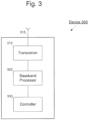
- Fig. 3 shows an exemplary device 300 (e.g., a wireless audio bud) for broadcasting a device state in a wireless communication network according to various embodiments described herein.
- the device 300 may represent any electronic device (e.g., wireless audio bud 102) that is configured to perform wireless functionalities, such as but not limited to communicating with a master device (e.g., the source device 106) as well as a slave device (e.g., the other wireless audio bud 104).
- a master device e.g., the source device 106
- a slave device e.g., the other wireless audio bud 104
- the device 300 may also represent any of the other components of the exemplary network 100, such as the user device 106, a peripheral device (e.g., the case 108) and/or the other audio bud 104.
- the device 300 is not limited to audio buds and may represent any portable wireless device, such as, but not limited to a wearable computing device, a mobile phone, a tablet computer, a personal computer, a VolP telephone, a wearable, an ioT device, etc.
- the device 300 may also be a stationary client device, such as a desktop computer.
- the exemplary device 300 may include a transceiver 310 connected (directly or indirectly) to an antenna 315, a baseband processor 320, and a controller 330, as well as other components.
- the other components may include, for example, a memory, a battery, ports to electrically connect the device 300 to other electronic devices, etc.
- the controller 330 may control the communication functions of the transceiver 310 and the baseband processor 320. In addition, the controller 330 may also control noncommunication functions related to the other components, such as the memory, the battery, etc. It is noted that the controller 330 may also be implemented and/or perform operations associated with an applications processor.
- the transceiver 310 may include a hardware transmitter, such as a Bluetooth beacon or other Bluetooth LE-enabled device capable of broadcasting advertisements to other nearby electronic devices (e.g., the user device 106).
- the baseband processor 320 may be a chip compatible with a wireless communication standard, such as Bluetooth.
- the baseband processor 320 also may be implemented as a combination chip (or system on a chip) that can support two or more wireless communication standards, such as Bluetooth and Wi-Fi.
- the baseband processor 320 may be configured to execute a plurality of applications of the device 300.
- the applications may include the above-referenced methods related to the exemplary embodiments, such as but not limited to, broadcasting a device state in a wireless communication network as described in method 200 of Fig. 2 .
- the transceiver 310 may also be configured to execute a plurality of applications of the device 300.
- the applications may include the above-referenced methods related to the exemplary embodiments, such as but not limited to, broadcasting a device state in a wireless communication network as described in method 200 of Fig. 2 .
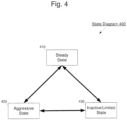
- Fig. 4 shows an exemplary state diagram 400 related to a device (e.g., the wireless audio bud 102) for broadcasting a device state in a wireless communication network according to various embodiments described herein.
- the state diagram 400 will be described with reference to the exemplary embodiment illustrated in Fig. 1 , wherein a device such as the wireless audio bud 102 may be stored in the exemplary case 108 with another wireless audio bud 104.
- Examples of the device state for the wireless audio bud 102 may include, but are not limited to, a steady state 410 (e.g., standard operating state), an aggressive state 420 (e.g., an in-use state or aboutto-be-used state) and a limited or inactive state 430 (e.g., an out-of-use state).
- a steady state 410 e.g., standard operating state
- an aggressive state 420 e.g., an in-use state or aboutto-be-used state
- a limited or inactive state 430 e.g., an out-of-use state.
- Similar states can be implemented by other devices, such as the case 108 and/or the user device 106.
- Each of the states may impact the broadcast advertising operations (e.g., the rate at which advertisements are transmitted and/or the type/content of advertisements transmitted) of the wireless audio bud 102.
- the steady state 410 may allow the wireless audio bud 102 to broadcast advertisement packets according to regular operations.
- the aggressive state 420 may allow the wireless audio bud 102 to broadcast advertising packets more aggressively (as compared to the steady state 410), such as any/all of: at a higher rate, for a longer duration, with an increased payload size, with a different payload, etc.
- the limited or inactive state 430 may allow less aggressive broadcasting (as compared to the steady state 410), including by any/all of decreasing the broadcasting rate, decreasing the broadcasting duration, decreasing the payload size, including a different payload, etc. It is noted that the inactive state 430 may refer to the wireless audio bud 102 being inactive (e.g., not in-use) and does not necessarily refer to an inactive transmission state of the wireless audio bud 102.
- the wireless audio bud 102 may continue to broadcast advertisement packets while in the limited/inactive state 430, just at a reduced rate, duration, packet size, etc.
- exemplary rates and durations for the various states have been provided above. The exemplary embodiments are not limited to these rates and/or durations, but these are merely provided to illustrate exemplary relative differences between the various states.
- the wireless audio bud 102 may transition to either the aggressive state 420 or the limited/inactive state 430 based on a detected change at any or all of the wireless audio bud 102, the other wireless audio bud 104, the user device 106, the storage case 108, or another network or peripheral device in communication with the wireless audio bud 102.
- the wireless audio bud 102 may detect a state change, such as that one of the wireless audio buds 102, 104 is in an in-ear state when a user places either of the wireless audio buds 102, 104 in the user's ear(s).
- the placement and location of the wireless audio buds 102 is merely one example of a detectable state of the wireless audio bud 102 and that the techniques can be applied in relation to any state change. Additional states may include opening/closing the storage case 108, crossing a battery threshold of the wireless audio buds 102 or the user device 106, a charging state of the wireless audio buds 102, user input (e.g., sensory input, such as a double tap) at either the wireless audio buds 102 or the user device 106, etc.
- user input e.g., sensory input, such as a double tap
- a change from an out-of-ear state to an in-ear state may transition the wireless audio bud 102 from the steady state 410 to the aggressive state 420.
- Such a transition to the aggressive state 420 may change one or more operations, such as increasing the broadcasting rate and/or duration for advertisement packets.
- an associated device e.g., the user device 106
- may quickly detect the change enabling one or more corresponding functions or operations, such as, but not limited to, answering a telephone call, starting a media player/file, starting an application, displaying a notification GUI on the user device 106, unlocking a home screen of the user device 106, switching from a speaker audio mode to an in-ear audio mode, etc.
- the wireless audio bud 102 may transition back to the steady state 410 (e.g., while remaining in the in-ear state) or directly to the inactive/limited state 430 in some circumstances (e.g., after advertising a shut down or other such inactivity).
- another state change may cause the wireless audio bud 102 to enter a different state or to continue operating in the aggressive state 420 with one or more modified parameters. For example, if wireless audio bud 102 is removed and placed into the case 108, it may enter the limited/inactive state 430. As another example, while in the aggressive state 420, a change from an in-ear state to an out-of-ear state may cause the wireless audio bud 102 to remain in the aggressive state 420, but with one or more modified parameters (e.g., a different payload). After the duration of the aggressive state 420 passes, a transition to the steady state 410 may decrease one or more advertising parameters (e.g., the broadcasting rate) for the advertisement packets. The wireless audio bud 102 can remain in the steady state 410 until another state change is detected.
- one or more modified parameters e.g., a different payload
- the wireless audio bud 102 may transition to the limited/inactive state 430.
- the user may transfer the wireless audio bud 102 into the storage case 108 (e.g., an in-case state), which may cause the wireless audio bud 102 to enter the aggressive state 420 to broadcast (or advertise) that it has entered an in-case state or to transition from the steady state 410 to the inactive/limited state 430 directly.
- the wireless audio bud 102 Once the wireless audio bud 102 enters the inactive/limited state 430 (e.g., is stored within the case 108), the advertisement broadcasting rate may decrease (or cease).
- activating the limited/inactive state 430 may trigger one or more operations (e.g., by an associated device), such as, but not limited to, terminating a telephone call, stopping/pausing a media player/file, closing an application, displaying a notification GUI on the user device 106, locking a home screen of the user device 106, switching from an in-ear audio mode to a speaker audio mode, etc.
- Fig. 5 shows an exemplary timeline 500 related to a device (e.g., the wireless audio bud 102) for broadcasting a device state in a wireless communication network according to various embodiments described herein.
- the timeline 500 will be described with reference to the exemplary embodiment illustrated in Fig. 1 , wherein a device such as the wireless audio bud 102 may be stored in the exemplary case 108 with another wireless audio bud 104.
- the operation of the wireless audio bud 102 may include a plurality of operating states, such as, but not limited to a steady state 501, an aggressive state 502 and a limited/inactive state 503.
- each of these states 501-503 may relate to an advertisement broadcasting characteristic, such as a broadcasting rate, broadcasting duration, a payload size, etc.
- the wireless audio bud 102 may initially be stored in the closed case 108 at 510. During this time, the wireless audio bud 102 may be in the limited/inactive state 503 and may broadcast advertisement packets at a limited transmission rate and/or at a limited transmission duration. Since the wireless audio bud 102 is stored in the closed case 108, it may be presumed that the wireless audio bud 102 is inactive. While Fig. 5 is primarily described with respect to representative wireless audio bud 102, the techniques also can be implemented by other devices, such as the bud 104, the user device 106, and/or the case 108.
- the case 108 may be opened (representing a state change) and the wireless audio bud 102 may transition from the limited/inactive state 503 to the aggressive state 502.
- the wireless audio bud 102 may broadcast advertisement packets at a greater transmission rate and/or for a greater transmission duration. Since the case 108 for the wireless audio bud 102 has been opened, it may be presumed that the wireless audio bud 102 may be put into use.
- the wireless audio bud 102 may transition from the aggressive state 502 to the steady state 501 (e.g., if there is no other state change).
- the wireless audio bud 102 may broadcast advertisement packets at a moderate or standard transmission rate and/or for a standard transmission duration. Further, the wireless audio bud 102 can continue to monitor its state (and optionally the state of one or more other devices) to determine whether a state change has occurred.
- the wireless audio bud 102 may be removed from the user's ear while remaining outside of the case 108. Accordingly, the wireless audio bud 102 may transition from the aggressive state 502 to the steady state 501. The wireless audio bud 102 may once again broadcast advertisement packets at a moderate or standard transmission rate and/or for a standard transmission duration. Since the wireless audio bud 102 are out of the case 108, it may be presumed that the wireless audio bud 102 may be put back into use or may be returned to the case 108 for storage and/or charging.
- the wireless audio bud 102 may be removed from the ear (e.g., a change in the in-ear state/status) and returned to the case 108. Accordingly, the wireless audio bud 102 may transition from the steady state 501 to the aggressive state 502. In the aggressive state 502, the wireless audio bud 102 may broadcast advertisement packets at a greater transmission rate and/or for a greater transmission duration to advertise the changed state.
- the wireless audio bud 102 may transition to the limited/inactive state 503 and may broadcast advertisement packets at a limited transmission rate and/or at a limited transmission duration (or cease advertising). Alternatively, in some implementations, the wireless audio bud 102 may transition to the steady state 501 before entering the limited state 503.
Landscapes
- Engineering & Computer Science (AREA)
- Signal Processing (AREA)
- Computer Networks & Wireless Communication (AREA)
- Databases & Information Systems (AREA)
- Multimedia (AREA)
- Physics & Mathematics (AREA)
- Acoustics & Sound (AREA)
- Telephone Function (AREA)
- Mobile Radio Communication Systems (AREA)
Claims (14)
- Verfahren (200), das von einer drahtlosen Audioausgabevorrichtung (102) durchgeführt wird, umfassend: Detektieren (220) einer Zustandsänderung eines Aufbewahrungsbehälters (108), der konfiguriert ist, um die drahtlose Audioausgabevorrichtung (102) aufzubewahren, wobei die Zustandsänderung des Aufbewahrungsbehälters (108) mit mindestens einem von (i) einem Deckel des Aufbewahrungsbehälters (108), der offen ist, (ii) dem Deckel des Aufbewahrungsbehälters (108), der geschlossen ist, (iii) der drahtlosen Audioausgabevorrichtung (102), die sich in einem Ladezustand innerhalb des Aufbewahrungsbehälters (108) befindet, (iv) der drahtlosen Audioausgabevorrichtung (102), die sich in dem Aufbewahrungsbehälter (108) befindet und nicht geladen wird, oder (v) dem Aufbewahrungsbehälter (108), der geladen wird, in Beziehung steht; Auswählen (230), als Reaktion auf die Zustandsänderung, eines Werbemodus für die drahtlose Audioausgabevorrichtung (102), wobei der Werbemodus mindestens eines von einer Werberate oder einer Werbedauer umfasst; und Werben (240) gemäß dem ausgewählten Werbemodus.
- Verfahren nach Anspruch 1, wobei die drahtlose Audioausgabevorrichtung (102) die Zustandsänderung des Aufbewahrungsbehälters (108) basierend auf mindestens einem von dem Aufbewahrungsbehälter (108) empfangenen Signal detektiert.
- Verfahren nach einem der vorhergehenden Ansprüche, wobei die drahtlose Audioausgabevorrichtung (102) die Zustandsänderung des Aufbewahrungsbehälters (108) basierend auf mindestens einem Sensor der drahtlosen Audioausgabevorrichtung (102) detektiert.
- Verfahren nach einem der vorhergehenden Ansprüche, wobei, wenn die detektierte Zustandsänderung umfasst, dass ein Deckel des Aufbewahrungsbehälters (108) offen ist, der ausgewählte Werbemodus umfasst, dass die eine von der Werberate oder der Werbedauer größer als eine unmittelbar vorhergehende Werberate oder Werbedauer ist.
- Verfahren nach Anspruch 1, wobei, wenn die detektierte Zustandsänderung umfasst, dass ein Deckel des Aufbewahrungsbehälters (108) geschlossen ist, der ausgewählte Werbemodus umfasst, dass die eine von der Werberate oder der Werbedauer kleiner als eine unmittelbar vorhergehende Werberate oder Werbedauer ist.
- Verfahren nach Anspruch 5, wobei der ausgewählte Werbemodus null Werbungen umfasst.
- Verfahren nach einem der vorhergehenden Ansprüche, wobei der Werbemodus ferner eine Datennutzlast einer Werbung umfasst, die der Zustandsänderung entspricht.
- Verfahren nach einem der vorhergehenden Ansprüche, umfassend eines oder mehrere der Folgenden: Koppeln der drahtlosen Audioausgabevorrichtung (102) mit einer zweiten drahtlosen Vorrichtung über eine erste Piconetverbindung, wobei die zweite drahtlose Vorrichtung eine Quelle von Audiodaten umfasst, die von der drahtlosen Audioausgabevorrichtung (102) ausgegeben werden sollen, und wobei das Verfahren vorzugsweise ferner eines oder mehrere der Folgenden umfasst: Einstellen von einem von einer Broadcastrate oder einer Broadcastdauer einer Broadcastübertragung basierend mindestens teilweise auf der detektierten Zustandsänderung; Broadcasten, zum Empfang durch die zweite drahtlose Vorrichtung, einer Werbenachricht, die Informationen enthält, die die drahtlose Audioausgabevorrichtung (102) beschreiben, über die Broadcastübertragung; oder Bestimmen eines Zustands von mindestens einem von der drahtlosen Audioausgabevorrichtung (102) oder dem Aufbewahrungsbehälter, der konfiguriert ist, um die drahtlose Audioausgabevorrichtung (102) aufzubewahren.
- Drahtlose Audioausgabevorrichtung (102), umfassend: einen Prozessor, der konfiguriert ist, um eine Zustandsänderung eines Aufbewahrungsbehälters (108) zu detektieren, der konfiguriert ist, um die drahtlose Audioausgabevorrichtung (102) aufzubewahren, und als Reaktion auf die Zustandsänderung einen Werbemodus für die drahtlose Audioausgabevorrichtung (102) auszuwählen, wobei der Werbemodus mindestens eines von einer Werberate oder einer Werbedauer umfasst, und wobei die Zustandsänderung des Aufbewahrungsbehälters (108) mit mindestens einem von (i) einem Deckel des Aufbewahrungsbehälters (108), der offen ist, (ii) dem Deckel des Aufbewahrungsbehälters (108), der geschlossen ist, (iii) der drahtlosen Audioausgabevorrichtung (102), die sich in einem Ladezustand innerhalb des Aufbewahrungsbehälters (108) befindet, (iv) der drahtlosen Audioausgabevorrichtung (102), die sich in dem Aufbewahrungsbehälter (108) befindet und nicht geladen wird, oder (v) dem Aufbewahrungsbehälter (108), der geladen wird, in Beziehung steht; und einen Sendeempfänger, der konfiguriert ist, um eine Werbenachricht gemäß dem ausgewählten Werbemodus zu broadcasten.
- Drahtlose Audioausgabevorrichtung (102) nach Anspruch 9, ferner umfassend: einen Sensor, der eine Beziehung zwischen der drahtlosen Audioausgabevorrichtung (102) und dem Aufbewahrungsbehälter (108) detektiert, wobei der Prozessor die Zustandsänderung basierend auf der Beziehung detektiert.
- Drahtlose Audioausgabevorrichtung (102) nach einem der Ansprüche 9-10, wobei, wenn die detektierte Zustandsänderung umfasst, dass ein Deckel des Aufbewahrungsbehälters (108) offen ist, der ausgewählte Werbemodus umfasst, dass die eine von der Werberate oder der Werbedauer größer als eine unmittelbar vorhergehende Werberate oder Werbedauer ist.
- Drahtlose Audioausgabevorrichtung (102) nach einem der Ansprüche 9-11, wobei, wenn die detektierte Zustandsänderung umfasst, dass ein Deckel des Aufbewahrungsbehälters (108) geschlossen ist, der ausgewählte Werbemodus umfasst, dass die eine von der Werberate oder der Werbedauer kleiner als eine unmittelbar vorhergehende Werberate oder Werbedauer ist.
- Drahtlose Audioausgabevorrichtung (102) nach einem der Ansprüche 9-12, ferner umfassend eines oder mehrere der Folgenden: die drahtlose Audioausgabevorrichtung (102) ist konfiguriert, um mit einer zweiten drahtlosen Vorrichtung über eine erste Piconetverbindung gekoppelt zu werden, wobei die zweite drahtlose Vorrichtung eine Quelle von Audiodaten umfasst, die von der drahtlosen Audioausgabevorrichtung (102) ausgegeben werden sollen, und vorzugsweise ferner umfassend eines oder mehrere der Folgenden: der Prozessor ist ferner konfiguriert, um einen Übertragungsparameter einer Broadcastübertragung basierend mindestens teilweise auf der detektierten Zustandsänderung einzustellen; der Sendeempfänger ist ferner konfiguriert, um eine Werbenachricht an die zweite drahtlose Vorrichtung zu broadcasten, die Informationen enthält, die die drahtlose Audioausgabevorrichtung (102) beschreiben, über die Broadcastübertragung; oder der Prozessor ist ferner konfiguriert, um einen Zustand von mindestens einem von der drahtlosen Audioausgabevorrichtung (102) oder dem Aufbewahrungsbehälter (108), der konfiguriert ist, um die drahtlose Audioausgabevorrichtung (102) aufzubewahren, zu bestimmen.
- Drahtlose Audioausgabevorrichtung (102) nach einem der Ansprüche 9-13, wobei der Werbemodus ferner eine Datennutzlast einer Werbung umfasst, die der Zustandsänderung entspricht.
Applications Claiming Priority (4)
| Application Number | Priority Date | Filing Date | Title |
|---|---|---|---|
| US201662398623P | 2016-09-23 | 2016-09-23 | |
| US15/696,358 US10349259B2 (en) | 2016-09-23 | 2017-09-06 | Broadcasting a device state in a wireless communication network |
| EP20192595.5A EP3761676B1 (de) | 2016-09-23 | 2017-09-11 | Übertragung eines vorrichtungszustands in einem drahtloskommunikationsnetzwerk |
| EP17190483.2A EP3300396B1 (de) | 2016-09-23 | 2017-09-11 | Übertragung eines vorrichtungszustands in einem drahtloskommunikationsnetzwerk |
Related Parent Applications (3)
| Application Number | Title | Priority Date | Filing Date |
|---|---|---|---|
| EP17190483.2A Division EP3300396B1 (de) | 2016-09-23 | 2017-09-11 | Übertragung eines vorrichtungszustands in einem drahtloskommunikationsnetzwerk |
| EP20192595.5A Division-Into EP3761676B1 (de) | 2016-09-23 | 2017-09-11 | Übertragung eines vorrichtungszustands in einem drahtloskommunikationsnetzwerk |
| EP20192595.5A Division EP3761676B1 (de) | 2016-09-23 | 2017-09-11 | Übertragung eines vorrichtungszustands in einem drahtloskommunikationsnetzwerk |
Publications (2)
| Publication Number | Publication Date |
|---|---|
| EP4124074A1 EP4124074A1 (de) | 2023-01-25 |
| EP4124074B1 true EP4124074B1 (de) | 2025-07-02 |
Family
ID=59858566
Family Applications (3)
| Application Number | Title | Priority Date | Filing Date |
|---|---|---|---|
| EP17190483.2A Active EP3300396B1 (de) | 2016-09-23 | 2017-09-11 | Übertragung eines vorrichtungszustands in einem drahtloskommunikationsnetzwerk |
| EP22194236.0A Active EP4124074B1 (de) | 2016-09-23 | 2017-09-11 | Übertragung eines vorrichtungszustands in einem drahtloskommunikationsnetzwerk |
| EP20192595.5A Active EP3761676B1 (de) | 2016-09-23 | 2017-09-11 | Übertragung eines vorrichtungszustands in einem drahtloskommunikationsnetzwerk |
Family Applications Before (1)
| Application Number | Title | Priority Date | Filing Date |
|---|---|---|---|
| EP17190483.2A Active EP3300396B1 (de) | 2016-09-23 | 2017-09-11 | Übertragung eines vorrichtungszustands in einem drahtloskommunikationsnetzwerk |
Family Applications After (1)
| Application Number | Title | Priority Date | Filing Date |
|---|---|---|---|
| EP20192595.5A Active EP3761676B1 (de) | 2016-09-23 | 2017-09-11 | Übertragung eines vorrichtungszustands in einem drahtloskommunikationsnetzwerk |
Country Status (4)
| Country | Link |
|---|---|
| US (2) | US10349259B2 (de) |
| EP (3) | EP3300396B1 (de) |
| KR (3) | KR101913295B1 (de) |
| CN (2) | CN111935652B (de) |
Families Citing this family (35)
| Publication number | Priority date | Publication date | Assignee | Title |
|---|---|---|---|---|
| US10349259B2 (en) * | 2016-09-23 | 2019-07-09 | Apple Inc. | Broadcasting a device state in a wireless communication network |
| GB2555639B (en) | 2016-11-07 | 2022-02-09 | Rheon Labs Ltd | Activity monitoring |
| KR102608996B1 (ko) * | 2016-12-16 | 2023-11-30 | 삼성전자주식회사 | 탐색 대상 기기의 위치를 판단하기 위한 단말 장치, 전자 장치 및 제어 방법 |
| US10375741B2 (en) * | 2017-09-28 | 2019-08-06 | Apple Inc. | Establishing a short-range communication pathway |
| US10555156B2 (en) | 2017-11-09 | 2020-02-04 | Audiowise Technology Inc. | Wireless bluetooth communication mechanism capable of effectively reducing number of audio packet retransmission |
| US10212569B1 (en) * | 2017-11-09 | 2019-02-19 | Pixart Imaging Inc. | Bluetooth audio communication system and method for acknowledging reception of packets of audio streams at a slave and master devices |
| US11012842B2 (en) * | 2017-11-09 | 2021-05-18 | Audiowise Technology Inc. | Wireless stereo bluetooth communication mechanism capable of effectively reducing number of audio packet retransmission |
| US10367540B1 (en) * | 2018-02-20 | 2019-07-30 | Cypress Semiconductor Corporation | System and methods for low power consumption by a wireless sensor device |
| KR20200138200A (ko) * | 2018-03-30 | 2020-12-09 | 소니 주식회사 | 스피커 장치 및 할당 방법 |
| CN109150221B (zh) * | 2018-08-01 | 2020-05-26 | Oppo广东移动通信有限公司 | 一种可穿戴设备主从切换方法及相关产品 |
| WO2020087750A1 (zh) | 2018-10-29 | 2020-05-07 | 歌尔股份有限公司 | 耳机盒的交互控制方法、装置、耳机盒以及存储介质 |
| WO2020092784A1 (en) * | 2018-10-31 | 2020-05-07 | Medtronic, Inc. | Facilitating acceleration of advertising rates for medical devices |
| TWD209434S (zh) * | 2019-03-18 | 2021-01-21 | 大陸商北京小米移動軟件有限公司 | 藍牙耳機組 |
| US11115811B2 (en) * | 2019-04-04 | 2021-09-07 | Qualcomm Incorporated | Address management for Bluetooth devices |
| US12014109B2 (en) * | 2019-09-26 | 2024-06-18 | Apple Inc. | Adaptive audio output |
| CN110781149A (zh) * | 2019-10-23 | 2020-02-11 | 北京达佳互联信息技术有限公司 | 管理直播间信息的方法、装置、设备及存储介质 |
| CN111182403A (zh) * | 2019-12-31 | 2020-05-19 | 歌尔科技有限公司 | 耳机的控制方法、控制装置和计算机可读存储介质 |
| USD932472S1 (en) * | 2020-02-05 | 2021-10-05 | Beijing Xiaomi Mobile Software Co., Ltd. | Pair of earphones with charging box |
| USD927465S1 (en) * | 2020-03-05 | 2021-08-10 | Shenzhen Zunte Digital Co., Ltd. | Combined earphones and charging case |
| USD1000423S1 (en) * | 2020-03-19 | 2023-10-03 | Molonlave Group Llc | Electronic device |
| USD929969S1 (en) * | 2020-04-15 | 2021-09-07 | Shenzhen Zijiang Plastic Mould Co., Ltd. | Combination of earphones and case |
| USD931258S1 (en) * | 2020-04-15 | 2021-09-21 | Shenzhen Zijiang Plastic Mould Co., Ltd. | Combination of earphones and case |
| CN111866644B (zh) * | 2020-07-14 | 2022-02-22 | 歌尔科技有限公司 | 蓝牙耳机、蓝牙耳机的检测方法、设备及存储介质 |
| CN112437369B (zh) * | 2020-07-27 | 2022-03-29 | 珠海市杰理科技股份有限公司 | 音频数据的传输方法、系统、tws耳机对、芯片及介质 |
| KR102864056B1 (ko) | 2020-08-19 | 2025-09-24 | 삼성전자주식회사 | 오디오 출력 장치의 충전 상태에 대한 정보를 전송하는 방법 및 그 오디오 출력 장치 |
| KR20220042770A (ko) | 2020-09-28 | 2022-04-05 | 삼성전자주식회사 | 다중 장치들을 이용한 측위 방법 및 이를 위한 전자 장치 |
| CN114679710B (zh) * | 2020-12-25 | 2025-09-02 | 华为技术有限公司 | 一种tws耳机连接方法及设备 |
| USD934204S1 (en) * | 2021-03-15 | 2021-10-26 | Guangzhou Fairy Tale Electronics Co., Ltd. | Pair of earphones |
| USD940692S1 (en) * | 2021-04-15 | 2022-01-11 | Wenxue Quan | Earphone set |
| US12621644B2 (en) * | 2021-04-30 | 2026-05-05 | Apple Inc. | Wireless accessory advertisements |
| KR102903061B1 (ko) | 2021-08-06 | 2025-12-22 | 삼성전자주식회사 | 연결 설정을 위한 장치 및 방법 |
| WO2023054842A1 (ko) * | 2021-10-01 | 2023-04-06 | 삼성전자 주식회사 | 무선 통신을 이용한 측위 방법 및 이를 지원하는 전자 장치 |
| WO2024034784A1 (ko) * | 2022-08-12 | 2024-02-15 | 삼성전자주식회사 | 다른 전자 장치의 어드버타이징 프로세스와 동기화된 어드버타이징 프로세스를 수행하는 전자 장치, 방법, 및 비일시적 컴퓨터 판독가능 저장 매체 |
| EP4498728A1 (de) * | 2023-07-24 | 2025-01-29 | NXP USA, Inc. | Audiowiedergabeverfahren und -vorrichtung |
| WO2025079810A1 (en) * | 2023-10-11 | 2025-04-17 | Samsung Electronics Co., Ltd. | A method and electronic device for controlling a connection between devices |
Family Cites Families (75)
| Publication number | Priority date | Publication date | Assignee | Title |
|---|---|---|---|---|
| US8086287B2 (en) * | 2001-01-24 | 2011-12-27 | Alcatel Lucent | System and method for switching between audio sources |
| US6591168B2 (en) * | 2001-08-31 | 2003-07-08 | Intellisist, Inc. | System and method for adaptable mobile user interface |
| RU2305111C2 (ru) * | 2001-09-25 | 2007-08-27 | Джуридикэл Фаундейшн Дзе Чемо-Серо-Терапьютик Рисерч Инститьют | Рекомбинантное антитело против остеопонтина и его применение |
| US7051102B2 (en) * | 2002-04-29 | 2006-05-23 | Microsoft Corporation | Peer-to-peer name resolution protocol (PNRP) security infrastructure and method |
| US7015817B2 (en) | 2002-05-14 | 2006-03-21 | Shuan Michael Copley | Personal tracking device |
| US7072697B2 (en) * | 2002-10-22 | 2006-07-04 | Nokia Corporation | Method and device for transponder aided wake-up of a low power radio device by a wake-up event |
| JP2004215225A (ja) * | 2002-12-17 | 2004-07-29 | Sony Corp | 通信システムおよび通信方法、並びにデータ処理装置 |
| US6983169B2 (en) * | 2003-03-14 | 2006-01-03 | Motorola, Inc. | Wireless device allowing for configuration of settings and method therefor |
| JP2005511607A (ja) * | 2003-07-10 | 2005-04-28 | アラーガン、インコーポレイテッド | EP2受容体作動剤としてのω−シクロアルキル17−ヘテロアリールプロスタグランジンE2類似体 |
| DE102004036183A1 (de) * | 2004-07-26 | 2006-03-23 | Claas Selbstfahrende Erntemaschinen Gmbh | Schrägförderer einer landwirtschaftlichen Erntemaschine |
| US7418103B2 (en) * | 2004-08-06 | 2008-08-26 | Sony Computer Entertainment Inc. | System and method for controlling states of a device |
| US7945297B2 (en) * | 2005-09-30 | 2011-05-17 | Atmel Corporation | Headsets and headset power management |
| US20070297618A1 (en) * | 2006-06-26 | 2007-12-27 | Nokia Corporation | System and method for controlling headphones |
| EP2080387B1 (de) * | 2006-10-17 | 2019-12-18 | D&M Holdings, Inc. | Konfigurieren und verbinden mit einem drahtlosen mediennetz |
| US8170623B2 (en) * | 2006-11-17 | 2012-05-01 | Apple Inc. | Charging arrangement for electronic accessories |
| TW200824436A (en) * | 2006-11-20 | 2008-06-01 | Asustek Comp Inc | Video/audio recording and playing apparatus |
| WO2008070005A2 (en) * | 2006-12-01 | 2008-06-12 | Wbl Corporation Limited | Methods and apparatus for wireless stereo audio |
| KR101427268B1 (ko) * | 2007-12-21 | 2014-08-06 | 엘지전자 주식회사 | 이동 단말기 및 그의 전화 연결 방법 |
| US8170486B2 (en) * | 2008-01-02 | 2012-05-01 | Sony Mobile Communications Ab | Wireless headset with FM transmitter |
| US9060288B2 (en) * | 2013-03-15 | 2015-06-16 | Koss Corporation | Configuring wireless devices for a wireless infrastructure network |
| US8699719B2 (en) * | 2009-03-30 | 2014-04-15 | Bose Corporation | Personal acoustic device position determination |
| CN102365875B (zh) | 2009-03-30 | 2014-09-24 | 伯斯有限公司 | 个人声学设备位置确定 |
| US8243946B2 (en) * | 2009-03-30 | 2012-08-14 | Bose Corporation | Personal acoustic device position determination |
| US8265557B2 (en) * | 2009-10-06 | 2012-09-11 | Lg Electronics Inc. | Mobile terminal capable of being connected to audio output device using short-range communication and method of controlling the operation of the mobile terminal |
| CN201639740U (zh) * | 2009-10-10 | 2010-11-17 | 三星电子株式会社 | 便携式终端的蓝牙耳机 |
| US8019092B2 (en) * | 2009-10-27 | 2011-09-13 | Savannah Marketing Group Inc. | Aural device with white noise generator |
| CN102056071A (zh) * | 2009-10-27 | 2011-05-11 | 宏碁股份有限公司 | 无线耳机及其省电方法 |
| US8533507B2 (en) * | 2009-12-23 | 2013-09-10 | Apple Inc. | Efficient service advertisement and discovery in a peer-to-peer networking environment |
| US20130038458A1 (en) * | 2010-04-23 | 2013-02-14 | Nokia Corporation | Apparatus and a method for causing a change in the state of a headset |
| US20110286615A1 (en) * | 2010-05-18 | 2011-11-24 | Robert Olodort | Wireless stereo headsets and methods |
| KR101189807B1 (ko) | 2010-12-30 | 2012-10-10 | 전자부품연구원 | 네트워크 구성 방법 및 장치 |
| US9319815B2 (en) * | 2011-07-14 | 2016-04-19 | Vivint, Inc. | Managing audio output through an intermediary |
| US20130279724A1 (en) * | 2012-04-19 | 2013-10-24 | Sony Computer Entertainment Inc. | Auto detection of headphone orientation |
| US9949205B2 (en) * | 2012-05-26 | 2018-04-17 | Qualcomm Incorporated | Smart battery wear leveling for audio devices |
| US9191988B2 (en) | 2012-05-26 | 2015-11-17 | Qualcomm Incorporated | Smart pairing using bluetooth technology |
| US9185501B2 (en) | 2012-06-20 | 2015-11-10 | Broadcom Corporation | Container-located information transfer module |
| US20140147099A1 (en) | 2012-11-29 | 2014-05-29 | Stephen Chase | Video headphones platform methods, apparatuses and media |
| KR102049781B1 (ko) * | 2013-02-26 | 2019-11-28 | 삼성전자 주식회사 | 단말기의 어플리케이션 제어 방법 및 장치와 이를 지원하는 이어폰 장치 및 어플리케이션 제어 시스템 |
| US20150177362A1 (en) * | 2013-03-13 | 2015-06-25 | ACCO Brands Corporation | Proximity tags for vehicles |
| US10420072B2 (en) * | 2013-03-14 | 2019-09-17 | Everactive, Inc. | Methods and apparatus for low power wireless communication |
| CN103200498B (zh) * | 2013-03-22 | 2015-11-18 | 广东欧珀移动通信有限公司 | 一种移动终端音乐播放方法及系统 |
| CN103257873B (zh) * | 2013-04-18 | 2016-07-06 | 小米科技有限责任公司 | 一种智能终端设备的控制方法和系统 |
| CA2835566C (en) * | 2013-07-30 | 2016-08-23 | 2397593 Ontario Inc. | Water tempering system |
| JP2015053565A (ja) * | 2013-09-05 | 2015-03-19 | ソニー株式会社 | 情報処理装置および情報処理方法 |
| US9210555B2 (en) * | 2013-10-15 | 2015-12-08 | Twisted Pair Solutions, Inc. | Pulsed input push-to-talk wireless adapter systems and methods |
| CN109121127B (zh) * | 2014-02-12 | 2019-10-18 | 索尼公司 | 信息处理设备、信息处理系统和信息处理方法 |
| EP2919482B1 (de) * | 2014-03-13 | 2019-11-06 | LG Electronics Inc. | Drahtloser Ohrhörer |
| US20150289124A1 (en) * | 2014-04-08 | 2015-10-08 | Nokia Corporation | Method, apparatus, and computer program product for seamless switching of communication connection |
| WO2015159373A1 (ja) * | 2014-04-15 | 2015-10-22 | 富士通株式会社 | 収納ケース |
| US9622214B2 (en) * | 2014-05-23 | 2017-04-11 | Samsung Electronics Co., Ltd. | Method and apparatus for providing notification |
| EP3146796B1 (de) | 2014-05-23 | 2021-10-27 | Samsung Electronics Co., Ltd. | Verfahren und vorrichtung zur bereitstellung einer benachrichtigung |
| TWI594926B (zh) * | 2014-07-18 | 2017-08-11 | 三緯國際立體列印科技股份有限公司 | 包裝拆解記錄構件 |
| US10111071B2 (en) * | 2014-09-19 | 2018-10-23 | Avago Technologies General Ip (Singapore) Pte. Ltd. | Bluetooth low energy automation mesh network |
| US9578156B2 (en) | 2014-09-30 | 2017-02-21 | Samsung Electronics Co., Ltd. | Method and apparatus for operating an electronic device |
| SG11201703774YA (en) * | 2014-11-28 | 2017-06-29 | Sony Corp | Information processing device, information processing method, and program |
| CN105721909A (zh) * | 2014-12-03 | 2016-06-29 | 青岛海尔智能技术研发有限公司 | 控制电视的方法、蓝牙耳机、电视和电视控制系统 |
| KR102325338B1 (ko) * | 2014-12-05 | 2021-11-11 | 삼성전자주식회사 | 전자 장치, 오디오 장치 및 전원 제어 방법 |
| CN104616676A (zh) * | 2014-12-15 | 2015-05-13 | 惠州Tcl移动通信有限公司 | 基于耳机使用状态的多媒体文件的播放方法及系统 |
| US10123276B2 (en) * | 2014-12-31 | 2018-11-06 | Bandwidthx Inc. | Systems and methods for optimizing mobile device radio management for user experience |
| US20160227097A1 (en) * | 2015-02-04 | 2016-08-04 | Casio Computer Co., Ltd. | Data processing device that executes predetermined data processing by linking with other apparatus |
| US9219807B1 (en) * | 2015-04-30 | 2015-12-22 | Ninjawav, Llc | Wireless audio communications device, system and method |
| US9628893B2 (en) * | 2015-05-26 | 2017-04-18 | EchoStar Technologies, L.L.C. | Method of auto-pausing audio/video content while using headphones |
| US20160366263A1 (en) * | 2015-06-09 | 2016-12-15 | Lg Electronics Inc. | Method and device for transmitting or receiving data in wireless communication system |
| US10284940B2 (en) * | 2015-07-24 | 2019-05-07 | Lg Electronics Inc. | Earset and control method therefor |
| KR101673308B1 (ko) * | 2015-08-20 | 2016-11-07 | 현대자동차주식회사 | 블루투스 듀얼모드를 이용한 블루투스 자동 연결 방법 및 장치 |
| US10117012B2 (en) * | 2015-09-28 | 2018-10-30 | Apple Inc. | Wireless ear buds with proximity sensors |
| US10397684B2 (en) * | 2016-01-05 | 2019-08-27 | Voxx International Corporation | Wireless speaker system |
| US9743171B1 (en) * | 2016-02-19 | 2017-08-22 | Logitech Europe S.A. | Method and apparatus for delivering audio content to a user |
| US10148453B2 (en) * | 2016-02-24 | 2018-12-04 | Qualcomm Incorporated | Using update slot to synchronize to Bluetooth LE isochronous channel and communicate state changes |
| US9999025B2 (en) * | 2016-03-08 | 2018-06-12 | Verily Life Sciences Llc | Beacon using an FBAR-based oscillator |
| US10951968B2 (en) * | 2016-04-19 | 2021-03-16 | Snik Llc | Magnetic earphones holder |
| US9924363B2 (en) * | 2016-06-21 | 2018-03-20 | Bose Corporation | Wireless security system for wireless audio device |
| CN105933816A (zh) * | 2016-06-27 | 2016-09-07 | 乐视控股(北京)有限公司 | 无线耳机及其播放方法和装置、耳机数据线以及播放设备 |
| US10602397B2 (en) * | 2016-09-21 | 2020-03-24 | Apple Inc. | Real-time relay of wireless communications |
| US10349259B2 (en) * | 2016-09-23 | 2019-07-09 | Apple Inc. | Broadcasting a device state in a wireless communication network |
-
2017
- 2017-09-06 US US15/696,358 patent/US10349259B2/en active Active
- 2017-09-11 EP EP17190483.2A patent/EP3300396B1/de active Active
- 2017-09-11 EP EP22194236.0A patent/EP4124074B1/de active Active
- 2017-09-11 EP EP20192595.5A patent/EP3761676B1/de active Active
- 2017-09-12 CN CN202010837099.6A patent/CN111935652B/zh active Active
- 2017-09-12 CN CN201710816845.1A patent/CN107872783B/zh active Active
- 2017-09-19 KR KR1020170120259A patent/KR101913295B1/ko active Active
-
2018
- 2018-10-24 KR KR1020180127375A patent/KR102033682B1/ko active Active
-
2019
- 2019-05-29 US US16/425,352 patent/US10834567B2/en active Active
- 2019-10-11 KR KR1020190126218A patent/KR102140404B1/ko active Active
Also Published As
| Publication number | Publication date |
|---|---|
| US20180091965A1 (en) | 2018-03-29 |
| CN107872783B (zh) | 2020-08-18 |
| US10834567B2 (en) | 2020-11-10 |
| US10349259B2 (en) | 2019-07-09 |
| EP3761676B1 (de) | 2022-11-09 |
| KR102033682B1 (ko) | 2019-10-18 |
| CN107872783A (zh) | 2018-04-03 |
| CN111935652A (zh) | 2020-11-13 |
| KR20190120114A (ko) | 2019-10-23 |
| US20190281437A1 (en) | 2019-09-12 |
| EP3300396A1 (de) | 2018-03-28 |
| CN111935652B (zh) | 2022-05-13 |
| KR20180120636A (ko) | 2018-11-06 |
| KR20180033077A (ko) | 2018-04-02 |
| KR101913295B1 (ko) | 2018-10-30 |
| EP3300396B1 (de) | 2020-10-21 |
| EP4124074A1 (de) | 2023-01-25 |
| EP3761676A1 (de) | 2021-01-06 |
| KR102140404B1 (ko) | 2020-07-31 |
Similar Documents
| Publication | Publication Date | Title |
|---|---|---|
| US10834567B2 (en) | Broadcasting a device state in a wireless communication network | |
| US11825401B2 (en) | Systems and methods for wirelessly modifying detection characteristics of portable devices | |
| US11337269B2 (en) | Cell processing method, terminal device, and network device | |
| US7973657B2 (en) | Systems for monitoring proximity to prevent loss or to assist recovery | |
| US20190150089A1 (en) | Intelligent management of a plurality of communications links | |
| WO2020207435A1 (zh) | 测量方法、测量配置方法、终端和网络设备 | |
| WO2014062344A1 (en) | Motion-based adaptive scanning | |
| WO2020151702A1 (zh) | 信息上报方法、资源分配方法、第一终端及第二终端 | |
| WO2020020010A1 (zh) | 干扰上报控制方法、用户设备和网络侧设备 | |
| WO2016029445A1 (zh) | 消息处理方法、系统及相关设备 | |
| WO2019157915A1 (zh) | Csi资源类型的确定方法、终端和网络侧设备 | |
| WO2019154066A1 (zh) | 下行信道的接收方法、发送方法、终端和基站 | |
| WO2020224659A1 (zh) | 信息上报方法、信息接收方法、终端和网络控制实体 | |
| WO2017172079A1 (en) | Load balancing and scheduling in wireless power transfer network | |
| HK40014814A (en) | Portable device, portable apparatus and computer readable medium | |
| HK1217587B (en) | A computer-implemented method and a portable processing device |
Legal Events
| Date | Code | Title | Description |
|---|---|---|---|
| PUAI | Public reference made under article 153(3) epc to a published international application that has entered the european phase |
Free format text: ORIGINAL CODE: 0009012 |
|
| STAA | Information on the status of an ep patent application or granted ep patent |
Free format text: STATUS: REQUEST FOR EXAMINATION WAS MADE |
|
| 17P | Request for examination filed |
Effective date: 20220906 |
|
| AC | Divisional application: reference to earlier application |
Ref document number: 3300396 Country of ref document: EP Kind code of ref document: P Ref document number: 3761676 Country of ref document: EP Kind code of ref document: P |
|
| AK | Designated contracting states |
Kind code of ref document: A1 Designated state(s): AL AT BE BG CH CY CZ DE DK EE ES FI FR GB GR HR HU IE IS IT LI LT LU LV MC MK MT NL NO PL PT RO RS SE SI SK SM TR |
|
| STAA | Information on the status of an ep patent application or granted ep patent |
Free format text: STATUS: EXAMINATION IS IN PROGRESS |
|
| 17Q | First examination report despatched |
Effective date: 20240313 |
|
| GRAP | Despatch of communication of intention to grant a patent |
Free format text: ORIGINAL CODE: EPIDOSNIGR1 |
|
| STAA | Information on the status of an ep patent application or granted ep patent |
Free format text: STATUS: GRANT OF PATENT IS INTENDED |
|
| INTG | Intention to grant announced |
Effective date: 20250129 |
|
| GRAS | Grant fee paid |
Free format text: ORIGINAL CODE: EPIDOSNIGR3 |
|
| GRAA | (expected) grant |
Free format text: ORIGINAL CODE: 0009210 |
|
| STAA | Information on the status of an ep patent application or granted ep patent |
Free format text: STATUS: THE PATENT HAS BEEN GRANTED |
|
| AC | Divisional application: reference to earlier application |
Ref document number: 3300396 Country of ref document: EP Kind code of ref document: P Ref document number: 3761676 Country of ref document: EP Kind code of ref document: P |
|
| AK | Designated contracting states |
Kind code of ref document: B1 Designated state(s): AL AT BE BG CH CY CZ DE DK EE ES FI FR GB GR HR HU IE IS IT LI LT LU LV MC MK MT NL NO PL PT RO RS SE SI SK SM TR |
|
| REG | Reference to a national code |
Ref country code: GB Ref legal event code: FG4D |
|
| REG | Reference to a national code |
Ref country code: CH Ref legal event code: EP |
|
| P01 | Opt-out of the competence of the unified patent court (upc) registered |
Free format text: CASE NUMBER: APP_27943/2025 Effective date: 20250611 |
|
| REG | Reference to a national code |
Ref country code: DE Ref legal event code: R096 Ref document number: 602017090403 Country of ref document: DE |
|
| REG | Reference to a national code |
Ref country code: IE Ref legal event code: FG4D |
|
| PGFP | Annual fee paid to national office [announced via postgrant information from national office to epo] |
Ref country code: DE Payment date: 20250919 Year of fee payment: 9 |
|
| PGFP | Annual fee paid to national office [announced via postgrant information from national office to epo] |
Ref country code: GB Payment date: 20250917 Year of fee payment: 9 |
|
| PGFP | Annual fee paid to national office [announced via postgrant information from national office to epo] |
Ref country code: FR Payment date: 20250922 Year of fee payment: 9 |
|
| REG | Reference to a national code |
Ref country code: NL Ref legal event code: MP Effective date: 20250702 |
|
| PG25 | Lapsed in a contracting state [announced via postgrant information from national office to epo] |
Ref country code: PT Free format text: LAPSE BECAUSE OF FAILURE TO SUBMIT A TRANSLATION OF THE DESCRIPTION OR TO PAY THE FEE WITHIN THE PRESCRIBED TIME-LIMIT Effective date: 20251103 |
|
| PG25 | Lapsed in a contracting state [announced via postgrant information from national office to epo] |
Ref country code: NL Free format text: LAPSE BECAUSE OF FAILURE TO SUBMIT A TRANSLATION OF THE DESCRIPTION OR TO PAY THE FEE WITHIN THE PRESCRIBED TIME-LIMIT Effective date: 20250702 |
|
| REG | Reference to a national code |
Ref country code: AT Ref legal event code: MK05 Ref document number: 1810681 Country of ref document: AT Kind code of ref document: T Effective date: 20250702 |
|
| PG25 | Lapsed in a contracting state [announced via postgrant information from national office to epo] |
Ref country code: IS Free format text: LAPSE BECAUSE OF FAILURE TO SUBMIT A TRANSLATION OF THE DESCRIPTION OR TO PAY THE FEE WITHIN THE PRESCRIBED TIME-LIMIT Effective date: 20251102 |
|
| PG25 | Lapsed in a contracting state [announced via postgrant information from national office to epo] |
Ref country code: NO Free format text: LAPSE BECAUSE OF FAILURE TO SUBMIT A TRANSLATION OF THE DESCRIPTION OR TO PAY THE FEE WITHIN THE PRESCRIBED TIME-LIMIT Effective date: 20251002 |
|
| REG | Reference to a national code |
Ref country code: LT Ref legal event code: MG9D |
|
| PG25 | Lapsed in a contracting state [announced via postgrant information from national office to epo] |
Ref country code: AT Free format text: LAPSE BECAUSE OF FAILURE TO SUBMIT A TRANSLATION OF THE DESCRIPTION OR TO PAY THE FEE WITHIN THE PRESCRIBED TIME-LIMIT Effective date: 20250702 |
|
| PG25 | Lapsed in a contracting state [announced via postgrant information from national office to epo] |
Ref country code: FI Free format text: LAPSE BECAUSE OF FAILURE TO SUBMIT A TRANSLATION OF THE DESCRIPTION OR TO PAY THE FEE WITHIN THE PRESCRIBED TIME-LIMIT Effective date: 20250702 |
|
| PG25 | Lapsed in a contracting state [announced via postgrant information from national office to epo] |
Ref country code: HR Free format text: LAPSE BECAUSE OF FAILURE TO SUBMIT A TRANSLATION OF THE DESCRIPTION OR TO PAY THE FEE WITHIN THE PRESCRIBED TIME-LIMIT Effective date: 20250702 |
|
| PG25 | Lapsed in a contracting state [announced via postgrant information from national office to epo] |
Ref country code: GR Free format text: LAPSE BECAUSE OF FAILURE TO SUBMIT A TRANSLATION OF THE DESCRIPTION OR TO PAY THE FEE WITHIN THE PRESCRIBED TIME-LIMIT Effective date: 20251003 |
|
| PG25 | Lapsed in a contracting state [announced via postgrant information from national office to epo] |
Ref country code: CZ Free format text: LAPSE BECAUSE OF FAILURE TO SUBMIT A TRANSLATION OF THE DESCRIPTION OR TO PAY THE FEE WITHIN THE PRESCRIBED TIME-LIMIT Effective date: 20250702 Ref country code: SE Free format text: LAPSE BECAUSE OF FAILURE TO SUBMIT A TRANSLATION OF THE DESCRIPTION OR TO PAY THE FEE WITHIN THE PRESCRIBED TIME-LIMIT Effective date: 20250702 |
|
| PG25 | Lapsed in a contracting state [announced via postgrant information from national office to epo] |
Ref country code: LV Free format text: LAPSE BECAUSE OF FAILURE TO SUBMIT A TRANSLATION OF THE DESCRIPTION OR TO PAY THE FEE WITHIN THE PRESCRIBED TIME-LIMIT Effective date: 20250702 |
|
| PG25 | Lapsed in a contracting state [announced via postgrant information from national office to epo] |
Ref country code: PL Free format text: LAPSE BECAUSE OF FAILURE TO SUBMIT A TRANSLATION OF THE DESCRIPTION OR TO PAY THE FEE WITHIN THE PRESCRIBED TIME-LIMIT Effective date: 20250702 Ref country code: BG Free format text: LAPSE BECAUSE OF FAILURE TO SUBMIT A TRANSLATION OF THE DESCRIPTION OR TO PAY THE FEE WITHIN THE PRESCRIBED TIME-LIMIT Effective date: 20250702 |
|
| PG25 | Lapsed in a contracting state [announced via postgrant information from national office to epo] |
Ref country code: RS Free format text: LAPSE BECAUSE OF FAILURE TO SUBMIT A TRANSLATION OF THE DESCRIPTION OR TO PAY THE FEE WITHIN THE PRESCRIBED TIME-LIMIT Effective date: 20251002 |
|
| PG25 | Lapsed in a contracting state [announced via postgrant information from national office to epo] |
Ref country code: ES Free format text: LAPSE BECAUSE OF FAILURE TO SUBMIT A TRANSLATION OF THE DESCRIPTION OR TO PAY THE FEE WITHIN THE PRESCRIBED TIME-LIMIT Effective date: 20250702 |
|
| PG25 | Lapsed in a contracting state [announced via postgrant information from national office to epo] |
Ref country code: RO Free format text: LAPSE BECAUSE OF FAILURE TO SUBMIT A TRANSLATION OF THE DESCRIPTION OR TO PAY THE FEE WITHIN THE PRESCRIBED TIME-LIMIT Effective date: 20250702 |
|
| PG25 | Lapsed in a contracting state [announced via postgrant information from national office to epo] |
Ref country code: SM Free format text: LAPSE BECAUSE OF FAILURE TO SUBMIT A TRANSLATION OF THE DESCRIPTION OR TO PAY THE FEE WITHIN THE PRESCRIBED TIME-LIMIT Effective date: 20250702 |
|
| REG | Reference to a national code |
Ref country code: DE Ref legal event code: R097 Ref document number: 602017090403 Country of ref document: DE |
|
| PG25 | Lapsed in a contracting state [announced via postgrant information from national office to epo] |
Ref country code: DK Free format text: LAPSE BECAUSE OF FAILURE TO SUBMIT A TRANSLATION OF THE DESCRIPTION OR TO PAY THE FEE WITHIN THE PRESCRIBED TIME-LIMIT Effective date: 20250702 |
|
| PG25 | Lapsed in a contracting state [announced via postgrant information from national office to epo] |
Ref country code: IT Free format text: LAPSE BECAUSE OF FAILURE TO SUBMIT A TRANSLATION OF THE DESCRIPTION OR TO PAY THE FEE WITHIN THE PRESCRIBED TIME-LIMIT Effective date: 20250702 |
|
| PG25 | Lapsed in a contracting state [announced via postgrant information from national office to epo] |
Ref country code: SK Free format text: LAPSE BECAUSE OF FAILURE TO SUBMIT A TRANSLATION OF THE DESCRIPTION OR TO PAY THE FEE WITHIN THE PRESCRIBED TIME-LIMIT Effective date: 20250702 Ref country code: EE Free format text: LAPSE BECAUSE OF FAILURE TO SUBMIT A TRANSLATION OF THE DESCRIPTION OR TO PAY THE FEE WITHIN THE PRESCRIBED TIME-LIMIT Effective date: 20250702 |
|
| REG | Reference to a national code |
Ref country code: CH Ref legal event code: H13 Free format text: ST27 STATUS EVENT CODE: U-0-0-H10-H13 (AS PROVIDED BY THE NATIONAL OFFICE) Effective date: 20260504 |
|
| PLBE | No opposition filed within time limit |
Free format text: ORIGINAL CODE: 0009261 |
|
| STAA | Information on the status of an ep patent application or granted ep patent |
Free format text: STATUS: NO OPPOSITION FILED WITHIN TIME LIMIT |
|
| PG25 | Lapsed in a contracting state [announced via postgrant information from national office to epo] |
Ref country code: LU Free format text: LAPSE BECAUSE OF NON-PAYMENT OF DUE FEES Effective date: 20250911 |
|
| REG | Reference to a national code |
Ref country code: CH Ref legal event code: L10 Free format text: ST27 STATUS EVENT CODE: U-0-0-L10-L00 (AS PROVIDED BY THE NATIONAL OFFICE) Effective date: 20260518 |
|
| REG | Reference to a national code |
Ref country code: BE Ref legal event code: MM Effective date: 20250930 |
|
| 26N | No opposition filed |
Effective date: 20260407 |
|
| PG25 | Lapsed in a contracting state [announced via postgrant information from national office to epo] |
Ref country code: LT Free format text: LAPSE BECAUSE OF FAILURE TO SUBMIT A TRANSLATION OF THE DESCRIPTION OR TO PAY THE FEE WITHIN THE PRESCRIBED TIME-LIMIT Effective date: 20250702 Ref country code: MC Free format text: LAPSE BECAUSE OF FAILURE TO SUBMIT A TRANSLATION OF THE DESCRIPTION OR TO PAY THE FEE WITHIN THE PRESCRIBED TIME-LIMIT Effective date: 20250702 |
|
| PG25 | Lapsed in a contracting state [announced via postgrant information from national office to epo] |
Ref country code: CH Free format text: LAPSE BECAUSE OF NON-PAYMENT OF DUE FEES Effective date: 20250930 Ref country code: IE Free format text: LAPSE BECAUSE OF NON-PAYMENT OF DUE FEES Effective date: 20250911 Ref country code: BE Free format text: LAPSE BECAUSE OF NON-PAYMENT OF DUE FEES Effective date: 20250930 |