EP4112630B1 - Method for producing capped rna - Google Patents
Method for producing capped rna Download PDFInfo
- Publication number
- EP4112630B1 EP4112630B1 EP21761932.9A EP21761932A EP4112630B1 EP 4112630 B1 EP4112630 B1 EP 4112630B1 EP 21761932 A EP21761932 A EP 21761932A EP 4112630 B1 EP4112630 B1 EP 4112630B1
- Authority
- EP
- European Patent Office
- Prior art keywords
- reaction
- rna
- results
- compound
- salt
- Prior art date
- Legal status (The legal status is an assumption and is not a legal conclusion. Google has not performed a legal analysis and makes no representation as to the accuracy of the status listed.)
- Active
Links
Images




Classifications
-
- C—CHEMISTRY; METALLURGY
- C07—ORGANIC CHEMISTRY
- C07H—SUGARS; DERIVATIVES THEREOF; NUCLEOSIDES; NUCLEOTIDES; NUCLEIC ACIDS
- C07H21/00—Compounds containing two or more mononucleotide units having separate phosphate or polyphosphate groups linked by saccharide radicals of nucleoside groups, e.g. nucleic acids
- C07H21/02—Compounds containing two or more mononucleotide units having separate phosphate or polyphosphate groups linked by saccharide radicals of nucleoside groups, e.g. nucleic acids with ribosyl as saccharide radical
-
- C—CHEMISTRY; METALLURGY
- C07—ORGANIC CHEMISTRY
- C07H—SUGARS; DERIVATIVES THEREOF; NUCLEOSIDES; NUCLEOTIDES; NUCLEIC ACIDS
- C07H1/00—Processes for the preparation of sugar derivatives
-
- C—CHEMISTRY; METALLURGY
- C12—BIOCHEMISTRY; BEER; SPIRITS; WINE; VINEGAR; MICROBIOLOGY; ENZYMOLOGY; MUTATION OR GENETIC ENGINEERING
- C12P—FERMENTATION OR ENZYME-USING PROCESSES TO SYNTHESISE A DESIRED CHEMICAL COMPOUND OR COMPOSITION OR TO SEPARATE OPTICAL ISOMERS FROM A RACEMIC MIXTURE
- C12P19/00—Preparation of compounds containing saccharide radicals
- C12P19/26—Preparation of nitrogen-containing carbohydrates
- C12P19/28—N-glycosides
- C12P19/30—Nucleotides
- C12P19/34—Polynucleotides, e.g. nucleic acids, oligoribonucleotides
Definitions
- the present invention relates to a method for producing capped RNA having a cap structure at a 5'-end.
- Eukaryotic mRNA for example, has been known to have a 5'-capped structure in which 7-methylguanosine forms 5'-5' bond with the 5'-end via a triphosphate bond.
- the cap structure has been known to promote translation of mRNA, and has therefore been desired to be efficiently introduced into mRNA, in order to efficiently synthesize a target protein typically in a protein expression system.
- mRNA may be synthesized by enzymatic transcription or by chemical synthesis based on the amidite method, wherein the latter is greatly advantageous in terms of easy introduction at will of chemical modification that is considered to be essential for mRNA medicine (since it contributes to improve stability and translation ability of mRNA).
- the cap structure there is no known method of easily introducing the cap structure into chemically synthesized mRNA. Only technique ever known relates to diphosphorylation of the 5' end by chemical synthesis, followed by enzymatic introduction of a cap (see Non-Patent Literature 1, for example).
- Fig. 16 is a conceptual diagram illustrating such prior cap introduction method. According to this method, a diphosphorylated RNA is prepared by transcription synthesis with the aid of a capping enzyme or by chemical synthesis, and the cap structure is further introduced to the 5'-end with the aid of the capping enzyme.
- An alternative known method of capping relates to enzymatic methylation of guanine, by way of solid-phase synthesis and activation of monophosphate (see Non-Patent Literature 2, for example).
- an imidazole group is introduced into a monophosphate group at the 5'-end of RNA, to which a diphosphate group such as GDP (guanine diphosphate) is reacted, thereby introducing the cap structure at the 5'-end of RNA.
- Non-Patent Literature 3 There is still another known method (see Non-Patent Literature 3, for example). Also this method relies upon solid phase synthesis in which an imidazole group is introduced into a triphosphate group at the 5'-end of RNA, to which a monophosphate group such as GMP (guanine phosphate) is then reacted, thereby introducing the cap structure at the 5'-end of RNA.
- GMP triphosphate group
- Patent Literature 1 Further relevant prior art is also disclosed in Patent Literature 1 and Non-Patent Literature 4-6.
- the present inventors have intensively studied to solve the problems.
- the present inventors have consequently found that a cap structure can be chemically introduced at the 5'-end of RNA, by using an activated capping compound obtained by activating a diphosphate compound having a cap structure with imidazole, and by reacting the capping compound with monophosphate RNA under predetermined conditions, and have arrived at the present invention.
- a method for producing a capped RNA which is an RNA having the 5'-end modified with a cap including: reacting an activated capping compound represented by formula (2) below, with a monophosphate RNA having the 5'-end monophosphorylated:
- the activated capping compound and the monophosphate RNA are preferably reacted in the presence of an imidazole compound, a metal salt, and a solvent.
- the metal salt is preferably a calcium salt.
- a reaction temperature is preferably within the range from 30 to 60°C.
- reaction time is preferably within the range from 1 to 25 hours.
- the solvent is preferably an organic solvent that contains 0 to 20% by weight of water.
- a concentration of the activated capping compound is preferably in the range from 5 to 30 mM.
- the imidazole compound is preferably 2-nitroimidazole and/or 1-methylimidazole.
- the present invention enables chemical introduction of the cap structure into RNA, with a simple operation.
- the method for producing a capped RNA of the present invention is a method for introducing a cap at the 5'-end of an RNA molecule such as mRNA, that is, a method for producing a capped RNA which is modified at the 5'-end with a cap.
- Fig. 1 is a drawing that illustrates an outline of the method for producing a capped RNA of the present invention.
- an activated capping compound represented by formula (2) below and a monophosphate RNA having the 5'-end monophosphorylated, are prepared,
- the activated capping compound represented by formula (2) below is a compound obtained by activating a diphosphate compound having a cap structure, that is, a compound in which imidazole is bound to 7-methylguanosine diphosphate.
- the activated capping compound represented by Formula (2) may be synthesized by a method of diphosphorylation of guanosine, followed by dehydration condensation with imidazole. More specifically, the synthesis may follow a scheme described later in EXAMPLES.
- the 5'-position of a ribose of guanosine is oxidized to synthesize guanosine monophosphate (guanosine-5'-phosphate), to which imidazole is then reacted, thereby bonding imidazole to the phosphate group.
- the product is reacted typically with triethanolamine phosphate to synthesize guanosine diphosphate, and further typically with iodomethane to methylate the 7-position of the base.
- the product is reacted with imidazole, to bond the imidazole to the phosphate group.
- the monophosphate RNA having the 5'-end monophosphorylated is a target compound to which the activated capping compound can bind.
- the 5'-monophosphate RNA may be synthesized typically by a method of removing pyrophosphate from 5'-triphosphate RNA with use of RNA 5'-pyrophosphohydrolase (RppH), or by a chemical solid phase synthesis method.
- RppH RNA 5'-pyrophosphohydrolase
- a counter salt of monophosphate RNA is exemplified by tetraalkylammonium salt, trialkyl acetate salt, and sodium acetate salt.
- use of an organic salt as a counter cation of phosphoric acid can improve the reactivity.
- the activated capping compound and the monophosphate RNA are reacted, in the presence of the imidazole compound; at least one metal salt selected from the group consisting of calcium salt, zinc salt, magnesium salt, nickel salt, and copper salt; and the solvent.
- the imidazole compound is exemplified by N-alkylimidazole in which an alkyl group is bound to nitrogen of imidazole, wherein the alkyl group is particularly exemplified by those having the alkyl group with 1 to 5 carbon atoms.
- the N-alkylimidazole is exemplified by 1-methylimidazole, 1-ethylimidazole, 1-propylimidazole, 4-methylimidazole, 1-methyl-1H-imidazole-2-carboxylate, 1-methylimidazole-4-carboxylate, 5-chloro-1-methyl-4-nitroimidazole, and 2-hydroxymethyl-1-methylimidazole.
- N-alkylimidazoles preferred is 1-methylimidazole for its high activity of cap introduction.
- the imidazole compound is also exemplified by imidazoles other than N-alkylimidazole, which include 1-(2-hydroxyethyl)imidazole and 2-nitroimidazole.
- the metal salt is selectable from the group consisting of calcium salt, zinc salt, magnesium salt, nickel salt, and copper salt, or may be mixture of these salts (calcium and zinc salts, for example).
- the calcium salt is exemplified by calcium chloride (CaCl 2 ) and calcium hydroxide (Ca(OH) 2 ).
- the zinc salt is exemplified by zinc chloride (ZnCl 2 ). Among them, preferred is CaCl 2 for its high activity of cap introduction.
- the solvent is exemplified by water and an organic solvent.
- the organic solvent is exemplified by dimethyl sulfoxide (DMSO), acetone, acetonitrile, tetrahydrofuran (THF), dioxane, methyl ethyl ketone, N,N-dimethylformamide (DMF), 1-methyl-2-pyrrolidone (NMP), dimethylformamide (DMF), methanol, and ethanol.
- DMSO dimethyl sulfoxide
- the solvent is preferably organic solvent that contains 0 to 20 wt% of water, and more preferably contains 1 to 10 wt% of water, in consideration of high activity of cap introduction.
- Concentration of the activated capping compound in the reaction liquid preferably falls within the range from 5 to 30 mM.
- Concentration of the heteroaromatic compound in the reaction liquid is preferably in the range from 0.5 to 20 mM, more preferably from 5 to 15 mM, and particularly preferably 10 mM.
- Concentration of the metal salt in the reaction liquid is preferably in the range of 0.5 to 10 mM.
- the reaction conditions may be suitably set, typically with the reaction temperature adjusted within the range from 30 to 60°C, preferably from 35 to 40°C, and particularly preferably at 37°C.
- the reaction time is within the range from 1 to 25 hours, preferably from 5 to 15 hours, and particularly preferably 9 hours. Cap introduction activity is kept high within these conditions, enabling efficient introduction of the cap structure into mRNA.
- Guanosine (748 mg, 2.64 mmol, 1.0 eq.) was suspended in trimethyl phosphate (7.0 mL). While stirring the suspension at -10°C, phosphonyl chloride (743 ⁇ L, 7.92 mmol, 3.0 eq.) was added dropwise, and the mixture was stirred at -10°C for 20 hours. A 1 M TBAE Buffer was added to quench the reaction. After condensing the solution, the product was purified with DEAE-sephadax. A fraction was collected and condensed, to obtain a white solid (TEA salt).
- the production conditions are as follows.
- Example 1-1 Room temperature, 37°C (Example 1-1), and 55°C (Example 1-2) were examined.
- RNA RNA
- activated capping compound CaCl 2
- CaCl 2 RNA
- This solution was evaporated to dryness, with use of a centrifugal evaporator.
- Anh. DMSO was added, and the mixture was incubated overnight at room temperature (r.t.), 37°C or 55°C.
- the mixture was desalted with use of Amicon (3K), and the reaction was quenched.
- the reaction efficiency was determined by gel electrophoresis.
- Fig. 2 In this figure, (a) summarizes the concentrations of the individual components in the reaction liquid, (b) illustrates results of electrophoresis, and (c) summarizes the yields.
- the reaction was not found to proceed at r.t. and 37°C.
- the reaction was found to proceed at 55°C, only with low efficiency.
- the activated monophosphate was found to improve the reaction efficiency by approximately 20% at 55°C.
- RNA RNA
- activated capping compound MCl 2
- MCl 2 MCl 2
- reaction efficiency was found to improve with use of CaCl 2 (Example 2-1) and MgCl 2 (Example 2-2).
- RNA RNA
- activated capping compound MCl 2
- MCl 2 MCl 2
- 1-Methylimidazole and anh. DMSO were added, and the mixture was incubated at 55°C for 17 hours.
- the mixture was desalted with use of Amicon (3K), and the reaction was quenched.
- the reaction efficiency was determined by gel electrophoresis.
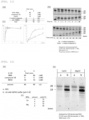
- Fig. 4 The results are illustrated in Fig. 4 . In this figure, (a) summarizes the concentrations of the individual components in the reaction liquid, (b) illustrates results of electrophoresis, (c) summarizes the yields, and (d) illustrates a graph of the yields.
- RNA RNA
- activated capping compound CaCl 2
- CaCl 2 CaCl 2
- This solution was evaporated to dryness, with use of a centrifugal evaporator.
- Necessary amounts of 1-methylimidazole and anh. DMSO (anhydrous dimethyl sulfoxide) were added, and the mixture was incubated at 55°C for 3 hours. The mixture was desalted with use of Amicon (3K), and the reaction was quenched.
- the reaction efficiency was determined by gel electrophoresis. The results are illustrated in Fig. 5 . In this figure, (a) summarizes the concentrations of the individual components in the reaction liquid, (b) illustrates results of electrophoresis, and (c) summarizes the yields.
- RNA RNA
- activated capping compound CaCl 2
- CaCl 2 CaCl 2
- This solution was evaporated to dryness, with use of a centrifugal evaporator.
- 1-Methylimidazole and anh. DMSO were added, and the mixture was incubated at 55°C for 3 hours.
- the mixture was desalted with use of Amicon (3K), and the reaction was quenched.
- the reaction efficiency was determined by gel electrophoresis.
- Fig. 6 The results are illustrated in Fig. 6 . In this figure, (a) summarizes the concentrations of the individual components in the reaction liquid, (b) illustrates results of electrophoresis, and (c) summarizes the yields.
- Fig. 7 Necessary amounts of the activated capping compound and CaCl 2 were mixed. This solution was evaporated to dryness, with use of a centrifugal evaporator. Necessary amounts of 1-methylimidazole, anh. DMSO, and RNA were added, and the mixture was incubated at 55°C for 3 hours. The mixture was desalted with use of Amicon (3K), and the reaction was quenched. The reaction efficiency was determined by gel electrophoresis. The results are illustrated in Fig. 7 . In this figure, (a) summarizes the concentrations of the individual components in the reaction liquid, (b) illustrates results of electrophoresis, and (c) summarizes the yields.
- Fig. 8 Necessary amounts of the activated capping compound and CaCl 2 were mixed. This solution was evaporated to dryness, with use of a centrifugal evaporator. Necessary amounts of 1-methylimidazole, anh. DMSO, and RNA were added, and the mixture was incubated at 55°C for 3 hours. The mixture was desalted with use of Amicon (3K), and the reaction was quenched. The reaction efficiency was determined by gel electrophoresis. The results are illustrated in Fig. 8 . In this figure, (a) summarizes the concentrations of the individual components in the reaction liquid, (b) illustrates results of electrophoresis, and (c) summarizes the yields.
- Fig. 9 Necessary amounts of the activated capping compound and CaCl 2 were mixed. This solution was evaporated to dryness, with use of a centrifugal evaporator. Necessary amounts of 1-methylimidazole, anh. DMSO, and RNA were added, and the mixture was incubated at 55°C for 3 hours. The mixture was desalted with use of Amicon (3K), and the reaction was quenched. The reaction efficiency was determined by gel electrophoresis. The results are illustrated in Fig. 9 . In this figure, (a) summarizes the concentrations of the individual components in the reaction liquid, (b) illustrates results of electrophoresis, and (c) summarizes the yields.
- RNA and CaCl 2 were respectively mixed. This solution was evaporated to dryness, with use of a centrifugal evaporator. Necessary amounts of 1-methylimidazole, anh. DMSO, RNA (Lane 1), the activated capping compound (Lane 2), and CaCl 2 (Lane 3) were respectively added, and each mixture was incubated at 55°C for 3 hours. The mixture was desalted with use of Amicon (3K), and the reaction was quenched. The reaction efficiency was determined by gel electrophoresis. The results are illustrated in Fig. 10 . In this figure, (a) summarizes the concentrations of the individual components in the reaction liquid, (b) illustrates results of electrophoresis, and (c) summarizes the yields.
- reaction efficiency was not found to be largely affected, whichever reagent was added last.
- the reaction liquid was sampled at each of 1.0, 2.0, 3.0, 4.0, 5.0, 6.0, and 20 hours after the start of reaction, and changes in the yield depending on the reaction time were examined.
- the reaction condition involved incubation at 55°C.
- the reaction liquid was sampled in shorter time intervals (at 10, 20, 30, 40, 50, 60, 90 and 120 min after) to examine difference in the reaction efficiency.
- RNA and CaCl 2 were mixed. This solution was evaporated to dryness, with use of a centrifugal evaporator. Necessary amounts of 1-methylimidazole (for "+" only), anh. DMSO, and the activated capping compound were added, and the mixture was incubated at 55°C. The mixture was desalted with use of Amicon (3K), and the reaction was quenched. The reaction efficiency was determined by gel electrophoresis. The results are illustrated in Fig. 11 . In this figure, (a) summarizes the concentrations of the individual components in the reaction liquid, (b) illustrates results of electrophoresis, and (c) summarizes the yields.
- RNA, the activated capping compound, MCl 2 , and the solvent were mixed so as to adjust the final concentrations as summarized in the table of Fig. 12(a) .
- Each mixture was incubated overnight at 55°C.
- the mixture was desalted with use of Amicon (3K), and the reaction was quenched.
- the reaction efficiency was determined by gel electrophoresis.
- the results are illustrated in Fig. 12 .
- (a) summarizes the concentrations of the individual components in the reaction liquid
- (b) illustrates results of electrophoresis
- (c) summarizes the yields.
- Influence of MgCl 2 concentration in MQ solvent was examined. Four levels of concentration, varied among 5, 10, 20, and 30 mM, were examined. The reaction condition involved overnight incubation at 55°C.
- RNA, the activated capping compound, CaCl 2 , and MQ were mixed so as to adjust the final concentrations as summarized in the table of Fig. 13(a) . Each mixture was incubated overnight at 55°C.
- the MgCl 2 concentration was not found to largely affect the reaction efficiency.
- Influence of CaCl 2 concentration in MQ solvent was examined. Seven levels of concentration, varied among 5, 10, 20, 30, 45, 60, and 90 mM, were examined. The reaction condition involved overnight incubation at 55°C.
- RNA, the activated capping compound, CaCl 2 , and MQ were mixed so as to adjust the final concentrations as summarized in the table of Fig. 14(a) . Each mixture was incubated overnight at 55°C.
- Fig. 14 The results are illustrated in Fig. 14 .
- (a) summarizes the concentrations of the individual components in the reaction liquid
- (b) illustrates results of electrophoresis
- (c) summarizes the yields
- (d) illustrates a graph of the yields.
- the CaCl 2 concentration was found to largely affect the reaction efficiency.
- the yield was found to elevate as the salt concentration increased, which was peaked at 30 mM. Excessive salt concentration, however, promoted hydrolysis, degrading the reaction efficiency.
- the reaction time was examined under MQ solvent conditions.
- the reaction liquid was sampled at each of 1.0, 2.0, 3.0, 15, 40, and 70 hours after the start of reaction, and changes in the yield depending on the reaction time were examined.
- the reaction condition involved incubation at 55°C.
- RNA, the activated capping compound, CaCl 2 , and MQ were mixed so as to adjust the final concentrations as summarized in the table of Fig. 15(a) .
- Each mixture was incubated at 55°C.
- the mixture was desalted with use of Amicon (3K), and the reaction was quenched.
- the reaction efficiency was determined by gel electrophoresis.
- the results are illustrated in Fig. 15 .
- (a) summarizes the concentrations of the individual components in the reaction liquid
- (b) illustrates results of electrophoresis
- c) illustrates a graph of the yields.
- imidazole derivatives which are heteroaromatic compounds used as additives, were used for the capping reaction.
- the imidazole derivatives verified herein are as follows.
- a cation exchange resin column (Dowex 50Wx8) was equilibrated by passing therethrough a 20% (v/w) a tetraethylammonium chloride solution, and washed with MQ, to which a solution of RNA precipitated from isopropanol was loaded, and eluted with MQ. A fraction showing absorbance A260 was collected, to obtain an RNA solution whose salt form was exchanged to tetraethylammonium chloride.
- RNA solution Ion-exchanged RNA solution (and CaCl 2 solution) was placed in an Eppendorf tube, and water was removed with a lyophilizer.
- m 7 Gpp-Im activated capping compound
- an imidazole derivative solution in DMSO DMSO for concentration adjustment were added. Final concentrations were adjusted to 10 ⁇ M for RNA, 10 mM for CaCl 2 , 10 mM for m 7 Gpp-Im, and 50 mM for imidazole derivative.
- reaction liquid was incubated at 55°C for 3 hours, a part of the reaction liquid was then mixed with 2 ⁇ loading buffer (80% formamide and 10 mM EDTA in MQ), and analyzed by gel electrophoresis (10% acrylamide, 7.5 M urea). Results of the electrophoresis are illustrated in Fig. 17(c) .
- RNA solution and CaCl 2 solution were placed in an Eppendorf tube, and water was removed with a lyophilizer.
- m7Gpp-Im, an imidazole derivative solution in DMSO, and DMSO for concentration adjustment were added.
- reaction liquid was incubated at the individual temperatures (37 or 55°C) for 3 to 23 hours, a part of the reaction liquid was then mixed with 2 ⁇ loading buffer, and analyzed by gel electrophoresis (10% acrylamide, 7.5 M urea). Results of the electrophoresis are illustrated in Fig. 18(c) .
- the capping reaction was conducted with use of several salts as a counter salt for RNA.
- the salts evaluated herein are denoted typically as K440'A in Fig. 19(b) .
- the outline of the experiment is illustrated in Fig. 19(a) .
- the counter salts used herein were tetraethylammonium salt (NEt 4 Cl), and sodium acetate salt (NaOAc).
- RNA solution and CaCl 2 solution were placed in an Eppendorf tube, and water was removed with a lyophilizer.
- m 7 Gpp-Im, an imidazole derivative solution in DMSO, and DMSO for concentration adjustment were added.
- reaction liquid was incubated at 37°C for 9 hours, a part of the reaction liquid was then mixed with 2 ⁇ loading buffer, and analyzed by gel electrophoresis (10% acrylamide, 7.5 M urea). Results of the electrophoresis are illustrated in Fig. 19(c) .
Landscapes
- Chemical & Material Sciences (AREA)
- Life Sciences & Earth Sciences (AREA)
- Organic Chemistry (AREA)
- Health & Medical Sciences (AREA)
- Molecular Biology (AREA)
- Biochemistry (AREA)
- Engineering & Computer Science (AREA)
- Biotechnology (AREA)
- General Health & Medical Sciences (AREA)
- Genetics & Genomics (AREA)
- Wood Science & Technology (AREA)
- Zoology (AREA)
- General Chemical & Material Sciences (AREA)
- Microbiology (AREA)
- Chemical Kinetics & Catalysis (AREA)
- Bioinformatics & Cheminformatics (AREA)
- General Engineering & Computer Science (AREA)
- Saccharide Compounds (AREA)
Applications Claiming Priority (2)
| Application Number | Priority Date | Filing Date | Title |
|---|---|---|---|
| JP2020032889 | 2020-02-28 | ||
| PCT/JP2021/006360 WO2021172204A1 (ja) | 2020-02-28 | 2021-02-19 | キャップ化rnaの製造方法 |
Publications (3)
| Publication Number | Publication Date |
|---|---|
| EP4112630A1 EP4112630A1 (en) | 2023-01-04 |
| EP4112630A4 EP4112630A4 (en) | 2023-08-09 |
| EP4112630B1 true EP4112630B1 (en) | 2024-10-16 |
Family
ID=77491875
Family Applications (1)
| Application Number | Title | Priority Date | Filing Date |
|---|---|---|---|
| EP21761932.9A Active EP4112630B1 (en) | 2020-02-28 | 2021-02-19 | Method for producing capped rna |
Country Status (5)
| Country | Link |
|---|---|
| US (1) | US12448408B2 (https=) |
| EP (1) | EP4112630B1 (https=) |
| JP (1) | JP7602807B2 (https=) |
| CN (1) | CN115175916B (https=) |
| WO (1) | WO2021172204A1 (https=) |
Families Citing this family (1)
| Publication number | Priority date | Publication date | Assignee | Title |
|---|---|---|---|---|
| EP4509608A4 (en) | 2022-03-04 | 2025-10-08 | Japan Science & Tech Agency | CAPPED RNA AND PRODUCTION METHOD THEREOF, PROTEIN PRODUCTION APPARATUS, AND PROTEIN PRODUCTION METHOD |
Family Cites Families (1)
| Publication number | Priority date | Publication date | Assignee | Title |
|---|---|---|---|---|
| CN120842296A (zh) | 2015-09-21 | 2025-10-28 | 垂林克生物技术有限公司 | 用于合成5’-加帽rna的组合物和方法 |
-
2021
- 2021-02-19 CN CN202180017057.0A patent/CN115175916B/zh active Active
- 2021-02-19 US US17/802,680 patent/US12448408B2/en active Active
- 2021-02-19 WO PCT/JP2021/006360 patent/WO2021172204A1/ja not_active Ceased
- 2021-02-19 JP JP2022503335A patent/JP7602807B2/ja active Active
- 2021-02-19 EP EP21761932.9A patent/EP4112630B1/en active Active
Also Published As
| Publication number | Publication date |
|---|---|
| JP7602807B2 (ja) | 2024-12-19 |
| EP4112630A1 (en) | 2023-01-04 |
| US12448408B2 (en) | 2025-10-21 |
| CN115175916A (zh) | 2022-10-11 |
| US20230097172A1 (en) | 2023-03-30 |
| CN115175916B (zh) | 2025-02-14 |
| EP4112630A4 (en) | 2023-08-09 |
| JPWO2021172204A1 (https=) | 2021-09-02 |
| WO2021172204A1 (ja) | 2021-09-02 |
Similar Documents
| Publication | Publication Date | Title |
|---|---|---|
| JP5715560B2 (ja) | mRNA CAP類似体 | |
| US5082934A (en) | Coumarin derivatives for use as nucleotide crosslinking reagents | |
| US5679785A (en) | 3'(2')-amino- or thiol-modified, fluorescent dye-coupled nucleosides, nucleotides and oligonucleotides, and a process for the preparation thereof | |
| US6320035B1 (en) | C-nucleoside derivatives and their use in the detection of nucleic acids | |
| JPS638120B2 (https=) | ||
| NZ271092A (en) | Nucleoside-5-triphosphates and phosphoramidites with a fluorescent residue for labelling, detecting and sequencing nucleic acids | |
| JP2003511386A (ja) | ヒドロキシル基を保護するための化合物及びその使用方法 | |
| CA2215176C (en) | C-nucleoside derivatives and their use in the detection of nucleic acids | |
| Pesnot et al. | Novel derivatives of UDP-glucose: concise synthesis and fluorescent properties | |
| RS60848B1 (sr) | Novi fosfotriazolni analozi 5'-kapice irnk, kompozicije koje ih sadrže, molekul rnk u koji se ugrađuju, njihova primena i postupak sintetisanja molekula rnk, proteina ili peptida | |
| EP4112630B1 (en) | Method for producing capped rna | |
| JPH06506700A (ja) | 鋳型依存性酵素的核酸合成用プライマーとしてのオリゴヌクレオチド同時合成および直接標識化のための機能性担体 | |
| AU751147B2 (en) | Novel nucleoside or nucleotide fluorescent conjugates, preparation method and uses | |
| KR100475008B1 (ko) | 디우리딘 테트라포스페이트 또는 그의 염의 결정 및 그의제조법, 그리고 그 화합물의 제조법 | |
| Shanmugasundaram et al. | Recent advances in synthesis and biological activity of modified cap analogs | |
| Nainytė et al. | Synthesis of an acp 3 U phosphoramidite and incorporation of the hypermodified base into RNA | |
| Cremo | [5] Fluorescent nucleotides: Synthesis and characterization | |
| EP1710249A1 (en) | Ribonucleic acid compound and method of liquid-phase synthesis of oligonucleic acid compound | |
| Jankowska-Anyszka et al. | Synthesis of a new class of ribose functionalized dinucleotide cap analogues for biophysical studies on interaction of cap-binding proteins with the 5′ end of mRNA | |
| Milton et al. | Synthesis and Stability of a 2′‐O‐[N‐(Aminoethyl) carbamoyl] methyladenosine‐Containing Dinucleotide | |
| CN116253766B (zh) | 一种环二核苷酸2’,3’-cGAMP的制备方法 | |
| DE4119075A1 (de) | Nucleosidtriphosphorsaeureester und deren verwendung | |
| Dunkel et al. | Synthesis of novel C‐2 substituted pyrimidine nucleoside analogs | |
| Garipova et al. | Synthesis of phosphamide conjugates of 5"-mononucleotides with carcinine and its analogs | |
| Baccolini et al. | Retracted article: First prebiotic generation of a ribonucleotide from adenine, d-ribose and trimetaphosphate |
Legal Events
| Date | Code | Title | Description |
|---|---|---|---|
| STAA | Information on the status of an ep patent application or granted ep patent |
Free format text: STATUS: THE INTERNATIONAL PUBLICATION HAS BEEN MADE |
|
| PUAI | Public reference made under article 153(3) epc to a published international application that has entered the european phase |
Free format text: ORIGINAL CODE: 0009012 |
|
| STAA | Information on the status of an ep patent application or granted ep patent |
Free format text: STATUS: REQUEST FOR EXAMINATION WAS MADE |
|
| 17P | Request for examination filed |
Effective date: 20220916 |
|
| AK | Designated contracting states |
Kind code of ref document: A1 Designated state(s): AL AT BE BG CH CY CZ DE DK EE ES FI FR GB GR HR HU IE IS IT LI LT LU LV MC MK MT NL NO PL PT RO RS SE SI SK SM TR |
|
| DAV | Request for validation of the european patent (deleted) | ||
| DAX | Request for extension of the european patent (deleted) | ||
| REG | Reference to a national code |
Ref country code: DE Ref legal event code: R079 Free format text: PREVIOUS MAIN CLASS: C07H0021020000 Ipc: C07H0001000000 Ref document number: 602021020402 Country of ref document: DE |
|
| A4 | Supplementary search report drawn up and despatched |
Effective date: 20230707 |
|
| RIC1 | Information provided on ipc code assigned before grant |
Ipc: C07H 21/02 20060101ALI20230703BHEP Ipc: C07H 1/00 20060101AFI20230703BHEP |
|
| GRAP | Despatch of communication of intention to grant a patent |
Free format text: ORIGINAL CODE: EPIDOSNIGR1 |
|
| STAA | Information on the status of an ep patent application or granted ep patent |
Free format text: STATUS: GRANT OF PATENT IS INTENDED |
|
| RIC1 | Information provided on ipc code assigned before grant |
Ipc: C07H 21/02 20060101ALI20240522BHEP Ipc: C07H 1/00 20060101AFI20240522BHEP |
|
| INTG | Intention to grant announced |
Effective date: 20240620 |
|
| RIN1 | Information on inventor provided before grant (corrected) |
Inventor name: ABE, NAOKO Inventor name: KIMURA, YASUAKI Inventor name: ABE, HIROSHI |
|
| GRAS | Grant fee paid |
Free format text: ORIGINAL CODE: EPIDOSNIGR3 |
|
| GRAA | (expected) grant |
Free format text: ORIGINAL CODE: 0009210 |
|
| STAA | Information on the status of an ep patent application or granted ep patent |
Free format text: STATUS: THE PATENT HAS BEEN GRANTED |
|
| AK | Designated contracting states |
Kind code of ref document: B1 Designated state(s): AL AT BE BG CH CY CZ DE DK EE ES FI FR GB GR HR HU IE IS IT LI LT LU LV MC MK MT NL NO PL PT RO RS SE SI SK SM TR |
|
| REG | Reference to a national code |
Ref country code: GB Ref legal event code: FG4D |
|
| REG | Reference to a national code |
Ref country code: DE Ref legal event code: R096 Ref document number: 602021020402 Country of ref document: DE Ref country code: CH Ref legal event code: EP |
|
| REG | Reference to a national code |
Ref country code: IE Ref legal event code: FG4D |
|
| REG | Reference to a national code |
Ref country code: LT Ref legal event code: MG9D |
|
| REG | Reference to a national code |
Ref country code: NL Ref legal event code: MP Effective date: 20241016 |
|
| REG | Reference to a national code |
Ref country code: AT Ref legal event code: MK05 Ref document number: 1732854 Country of ref document: AT Kind code of ref document: T Effective date: 20241016 |
|
| PG25 | Lapsed in a contracting state [announced via postgrant information from national office to epo] |
Ref country code: NL Free format text: LAPSE BECAUSE OF FAILURE TO SUBMIT A TRANSLATION OF THE DESCRIPTION OR TO PAY THE FEE WITHIN THE PRESCRIBED TIME-LIMIT Effective date: 20241016 |
|
| PG25 | Lapsed in a contracting state [announced via postgrant information from national office to epo] |
Ref country code: NL Free format text: LAPSE BECAUSE OF FAILURE TO SUBMIT A TRANSLATION OF THE DESCRIPTION OR TO PAY THE FEE WITHIN THE PRESCRIBED TIME-LIMIT Effective date: 20241016 |
|
| PG25 | Lapsed in a contracting state [announced via postgrant information from national office to epo] |
Ref country code: IS Free format text: LAPSE BECAUSE OF FAILURE TO SUBMIT A TRANSLATION OF THE DESCRIPTION OR TO PAY THE FEE WITHIN THE PRESCRIBED TIME-LIMIT Effective date: 20250216 Ref country code: PT Free format text: LAPSE BECAUSE OF FAILURE TO SUBMIT A TRANSLATION OF THE DESCRIPTION OR TO PAY THE FEE WITHIN THE PRESCRIBED TIME-LIMIT Effective date: 20250217 Ref country code: HR Free format text: LAPSE BECAUSE OF FAILURE TO SUBMIT A TRANSLATION OF THE DESCRIPTION OR TO PAY THE FEE WITHIN THE PRESCRIBED TIME-LIMIT Effective date: 20241016 |
|
| PG25 | Lapsed in a contracting state [announced via postgrant information from national office to epo] |
Ref country code: FI Free format text: LAPSE BECAUSE OF FAILURE TO SUBMIT A TRANSLATION OF THE DESCRIPTION OR TO PAY THE FEE WITHIN THE PRESCRIBED TIME-LIMIT Effective date: 20241016 |
|
| PG25 | Lapsed in a contracting state [announced via postgrant information from national office to epo] |
Ref country code: BG Free format text: LAPSE BECAUSE OF FAILURE TO SUBMIT A TRANSLATION OF THE DESCRIPTION OR TO PAY THE FEE WITHIN THE PRESCRIBED TIME-LIMIT Effective date: 20241016 |
|
| PG25 | Lapsed in a contracting state [announced via postgrant information from national office to epo] |
Ref country code: ES Free format text: LAPSE BECAUSE OF FAILURE TO SUBMIT A TRANSLATION OF THE DESCRIPTION OR TO PAY THE FEE WITHIN THE PRESCRIBED TIME-LIMIT Effective date: 20241016 |
|
| PG25 | Lapsed in a contracting state [announced via postgrant information from national office to epo] |
Ref country code: NO Free format text: LAPSE BECAUSE OF FAILURE TO SUBMIT A TRANSLATION OF THE DESCRIPTION OR TO PAY THE FEE WITHIN THE PRESCRIBED TIME-LIMIT Effective date: 20250116 |
|
| PG25 | Lapsed in a contracting state [announced via postgrant information from national office to epo] |
Ref country code: GR Free format text: LAPSE BECAUSE OF FAILURE TO SUBMIT A TRANSLATION OF THE DESCRIPTION OR TO PAY THE FEE WITHIN THE PRESCRIBED TIME-LIMIT Effective date: 20250117 Ref country code: LV Free format text: LAPSE BECAUSE OF FAILURE TO SUBMIT A TRANSLATION OF THE DESCRIPTION OR TO PAY THE FEE WITHIN THE PRESCRIBED TIME-LIMIT Effective date: 20241016 Ref country code: AT Free format text: LAPSE BECAUSE OF FAILURE TO SUBMIT A TRANSLATION OF THE DESCRIPTION OR TO PAY THE FEE WITHIN THE PRESCRIBED TIME-LIMIT Effective date: 20241016 |
|
| PG25 | Lapsed in a contracting state [announced via postgrant information from national office to epo] |
Ref country code: PL Free format text: LAPSE BECAUSE OF FAILURE TO SUBMIT A TRANSLATION OF THE DESCRIPTION OR TO PAY THE FEE WITHIN THE PRESCRIBED TIME-LIMIT Effective date: 20241016 |
|
| PG25 | Lapsed in a contracting state [announced via postgrant information from national office to epo] |
Ref country code: RS Free format text: LAPSE BECAUSE OF FAILURE TO SUBMIT A TRANSLATION OF THE DESCRIPTION OR TO PAY THE FEE WITHIN THE PRESCRIBED TIME-LIMIT Effective date: 20250116 |
|
| PG25 | Lapsed in a contracting state [announced via postgrant information from national office to epo] |
Ref country code: SM Free format text: LAPSE BECAUSE OF FAILURE TO SUBMIT A TRANSLATION OF THE DESCRIPTION OR TO PAY THE FEE WITHIN THE PRESCRIBED TIME-LIMIT Effective date: 20241016 |
|
| PG25 | Lapsed in a contracting state [announced via postgrant information from national office to epo] |
Ref country code: DK Free format text: LAPSE BECAUSE OF FAILURE TO SUBMIT A TRANSLATION OF THE DESCRIPTION OR TO PAY THE FEE WITHIN THE PRESCRIBED TIME-LIMIT Effective date: 20241016 |
|
| REG | Reference to a national code |
Ref country code: DE Ref legal event code: R097 Ref document number: 602021020402 Country of ref document: DE |
|
| PG25 | Lapsed in a contracting state [announced via postgrant information from national office to epo] |
Ref country code: EE Free format text: LAPSE BECAUSE OF FAILURE TO SUBMIT A TRANSLATION OF THE DESCRIPTION OR TO PAY THE FEE WITHIN THE PRESCRIBED TIME-LIMIT Effective date: 20241016 |
|
| PG25 | Lapsed in a contracting state [announced via postgrant information from national office to epo] |
Ref country code: RO Free format text: LAPSE BECAUSE OF FAILURE TO SUBMIT A TRANSLATION OF THE DESCRIPTION OR TO PAY THE FEE WITHIN THE PRESCRIBED TIME-LIMIT Effective date: 20241016 |
|
| PG25 | Lapsed in a contracting state [announced via postgrant information from national office to epo] |
Ref country code: SK Free format text: LAPSE BECAUSE OF FAILURE TO SUBMIT A TRANSLATION OF THE DESCRIPTION OR TO PAY THE FEE WITHIN THE PRESCRIBED TIME-LIMIT Effective date: 20241016 |
|
| PG25 | Lapsed in a contracting state [announced via postgrant information from national office to epo] |
Ref country code: CZ Free format text: LAPSE BECAUSE OF FAILURE TO SUBMIT A TRANSLATION OF THE DESCRIPTION OR TO PAY THE FEE WITHIN THE PRESCRIBED TIME-LIMIT Effective date: 20241016 |
|
| PG25 | Lapsed in a contracting state [announced via postgrant information from national office to epo] |
Ref country code: IT Free format text: LAPSE BECAUSE OF FAILURE TO SUBMIT A TRANSLATION OF THE DESCRIPTION OR TO PAY THE FEE WITHIN THE PRESCRIBED TIME-LIMIT Effective date: 20241016 |
|
| PLBE | No opposition filed within time limit |
Free format text: ORIGINAL CODE: 0009261 |
|
| STAA | Information on the status of an ep patent application or granted ep patent |
Free format text: STATUS: NO OPPOSITION FILED WITHIN TIME LIMIT |
|
| PG25 | Lapsed in a contracting state [announced via postgrant information from national office to epo] |
Ref country code: SE Free format text: LAPSE BECAUSE OF FAILURE TO SUBMIT A TRANSLATION OF THE DESCRIPTION OR TO PAY THE FEE WITHIN THE PRESCRIBED TIME-LIMIT Effective date: 20241016 |
|
| PG25 | Lapsed in a contracting state [announced via postgrant information from national office to epo] |
Ref country code: MC Free format text: LAPSE BECAUSE OF FAILURE TO SUBMIT A TRANSLATION OF THE DESCRIPTION OR TO PAY THE FEE WITHIN THE PRESCRIBED TIME-LIMIT Effective date: 20241016 |
|
| 26N | No opposition filed |
Effective date: 20250717 |
|
| PG25 | Lapsed in a contracting state [announced via postgrant information from national office to epo] |
Ref country code: LU Free format text: LAPSE BECAUSE OF NON-PAYMENT OF DUE FEES Effective date: 20250219 |
|
| REG | Reference to a national code |
Ref country code: BE Ref legal event code: MM Effective date: 20250228 |
|
| PG25 | Lapsed in a contracting state [announced via postgrant information from national office to epo] |
Ref country code: BE Free format text: LAPSE BECAUSE OF NON-PAYMENT OF DUE FEES Effective date: 20250228 |
|
| PG25 | Lapsed in a contracting state [announced via postgrant information from national office to epo] |
Ref country code: IE Free format text: LAPSE BECAUSE OF NON-PAYMENT OF DUE FEES Effective date: 20250219 |
|
| REG | Reference to a national code |
Ref country code: CH Ref legal event code: U11 Free format text: ST27 STATUS EVENT CODE: U-0-0-U10-U11 (AS PROVIDED BY THE NATIONAL OFFICE) Effective date: 20260301 |
|
| PGFP | Annual fee paid to national office [announced via postgrant information from national office to epo] |
Ref country code: GB Payment date: 20260108 Year of fee payment: 6 |
|
| PGFP | Annual fee paid to national office [announced via postgrant information from national office to epo] |
Ref country code: DE Payment date: 20260105 Year of fee payment: 6 |
|
| PGFP | Annual fee paid to national office [announced via postgrant information from national office to epo] |
Ref country code: FR Payment date: 20260108 Year of fee payment: 6 |
|
| PGFP | Annual fee paid to national office [announced via postgrant information from national office to epo] |
Ref country code: CH Payment date: 20260301 Year of fee payment: 6 |