WO2021172204A1 - キャップ化rnaの製造方法 - Google Patents
キャップ化rnaの製造方法 Download PDFInfo
- Publication number
- WO2021172204A1 WO2021172204A1 PCT/JP2021/006360 JP2021006360W WO2021172204A1 WO 2021172204 A1 WO2021172204 A1 WO 2021172204A1 JP 2021006360 W JP2021006360 W JP 2021006360W WO 2021172204 A1 WO2021172204 A1 WO 2021172204A1
- Authority
- WO
- WIPO (PCT)
- Prior art keywords
- reaction
- rna
- compound
- cap
- shows
- Prior art date
- Legal status (The legal status is an assumption and is not a legal conclusion. Google has not performed a legal analysis and makes no representation as to the accuracy of the status listed.)
- Ceased
Links
Images








Classifications
-
- C—CHEMISTRY; METALLURGY
- C07—ORGANIC CHEMISTRY
- C07H—SUGARS; DERIVATIVES THEREOF; NUCLEOSIDES; NUCLEOTIDES; NUCLEIC ACIDS
- C07H21/00—Compounds containing two or more mononucleotide units having separate phosphate or polyphosphate groups linked by saccharide radicals of nucleoside groups, e.g. nucleic acids
- C07H21/02—Compounds containing two or more mononucleotide units having separate phosphate or polyphosphate groups linked by saccharide radicals of nucleoside groups, e.g. nucleic acids with ribosyl as saccharide radical
-
- C—CHEMISTRY; METALLURGY
- C07—ORGANIC CHEMISTRY
- C07H—SUGARS; DERIVATIVES THEREOF; NUCLEOSIDES; NUCLEOTIDES; NUCLEIC ACIDS
- C07H1/00—Processes for the preparation of sugar derivatives
-
- C—CHEMISTRY; METALLURGY
- C12—BIOCHEMISTRY; BEER; SPIRITS; WINE; VINEGAR; MICROBIOLOGY; ENZYMOLOGY; MUTATION OR GENETIC ENGINEERING
- C12P—FERMENTATION OR ENZYME-USING PROCESSES TO SYNTHESISE A DESIRED CHEMICAL COMPOUND OR COMPOSITION OR TO SEPARATE OPTICAL ISOMERS FROM A RACEMIC MIXTURE
- C12P19/00—Preparation of compounds containing saccharide radicals
- C12P19/26—Preparation of nitrogen-containing carbohydrates
- C12P19/28—N-glycosides
- C12P19/30—Nucleotides
- C12P19/34—Polynucleotides, e.g. nucleic acids, oligoribonucleotides
Definitions
- the present invention relates to a method for producing capped RNA having a cap structure at the 5'end.
- a 5'cap structure in which 7-methylguanylic acid is 5'-5'bonded to the 5'end via a triphosphate bond is known.
- the cap structure is known to promote the translation of mRNA, and it is required to efficiently introduce the cap structure into mRNA in order to efficiently synthesize the target protein in a protein expression system or the like.
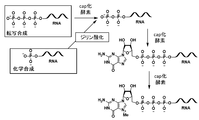
- FIG. 16 is a conceptual diagram showing this conventional cap introduction method. In this method, RNA diphosphorylated by transcriptional synthesis or chemical synthesis with a CAP-forming enzyme is prepared, and a cap structure is further introduced into the 5'end by the CAP-forming enzyme.
- Non-Patent Document 2 a method of enzymatically methylating guanine by solid-phase synthesis and activation of monophosphate is also known (see, for example, Non-Patent Document 2).
- an imidazole group is introduced into the monophosphate group at the 5'end of RNA, and a diphosphate group such as GDP (guanindiphosphate) is reacted with this to form a CAP structure at the 5'end of RNA.
- GDP guanindiphosphate
- Non-Patent Document 3 Another method is also known (see, for example, Non-Patent Document 3).
- an imidazole group is introduced into the triphosphate group at the 5'end of RNA by solid phase synthesis, and a monophosphate group such as GMP (guanine phosphate) is reacted with this to form a CAP structure at the 5'end of RNA. It has been introduced.
- An object of the present invention is to provide a method for producing a capped RNA capable of chemically introducing a cap structure into RNA by a simple operation.
- the present inventors have conducted extensive research to solve the above problems. As a result, an activated cap compound in which a diphosphate compound having a cap structure was activated with imidazole was used, and this was reacted with RNA monophosphate under predetermined conditions to chemically cap the 5'end of RNA.
- the present invention was completed by finding that it can be introduced.
- the present invention is a method for producing a capped RNA in which the 5'end is cap-modified, and the activated cap compound represented by the following formula (1) and monophosphorus with the 5'end monophosphorylated. It is a method for producing capped RNA, which comprises reacting with acid RNA. (Here, L indicates a leaving group.)
- the activated cap compound is a compound represented by the following formula (2).
- the activated cap compound and the monophosphate RNA with a heteroaromatic compound, a metal salt, and the presence of a solvent.
- the metal salt is a calcium salt.
- reaction temperature is preferably in the range of 30 to 60 ° C.
- reaction time is preferably in the range of 1 to 25 hours.
- the solvent is an organic solvent containing water in the range of 0 to 20% by weight.
- the concentration of the activated cap compound is preferably in the range of 5 to 30 mM.
- the heteroaromatic compound is 2-nitroimidazole and / or 1-methylimidazole.
- the method for producing a capped RNA of the present invention is a method for introducing a cap at the 5'end in an RNA molecule such as mRNA, that is, for producing a capped RNA in which the 5'end is a cap-modified RNA. This is the method.
- FIG. 1 shows an outline of a method for producing a capped RNA of the present invention.
- an activated cap compound represented by the following formula (1) and a monophosphate RNA having a 5'end monophosphorylated are prepared. (Here, L indicates a leaving group.)
- the activation cap compound represented by the above formula (1) is preferably a compound represented by the following formula (2).
- the activated cap compound of the following formula (2) is a compound in which a diphosphate compound having a cap structure is activated with an imidazole of a leaving group L, and is a compound in which imidazole is bound to a diphosphate compound of 7-methylguanylic acid. ..
- Examples of the leaving group L of the formula (1) include heteroaromatic ring compounds such as pyrazoles, oxazoles, thiazoles, pyridines, pyrimidines, pyrazines and triazines, in addition to the above-mentioned imidazole group. Can be done.
- heteroaromatic ring compounds such as pyrazoles, oxazoles, thiazoles, pyridines, pyrimidines, pyrazines and triazines, in addition to the above-mentioned imidazole group. Can be done.
- the activated cap compound of the formula (2) can be synthesized by the method of diphosphorylation of guanosine and subsequent dehydration condensation with imidazole. Specifically, it can be synthesized by the scheme described in the examples described later. The outline is that first phosphorylation of the 5'position of ribose of guanosine is performed to synthesize guanosine monophosphate (guanosine-5'-phosphate), and then imidazole is reacted to bind imidazole to a phosphate group.
- triethanolamine phosphate or the like is reacted to synthesize guanosine diphosphate, and iodomethane or the like is further reacted to methylate the 7-position of the base.
- the imidazole is reacted to bind the imidazole to the phosphate group.
- the monophosphate RNA whose 5'end is monophosphorylated is a target compound to which the above-mentioned activation cap compound binds.
- 5'monophosphate RNA is synthesized by removing pyrophosphate from 5'triphosphate RNA using RNA 5'pyrophosphohydrolase (RppH) or by chemical solid phase synthesis. be able to.
- RppH RNA 5'pyrophosphohydrolase
- Examples of the counter salt of monophosphate RNA include tetraalkylammonium salt, trialkyl acetate salt, sodium acetate salt and the like. In particular, it is possible to improve the reactivity by changing the counter cation of phosphoric acid to an organic salt.
- the activated cap compound and the monophosphate RNA are mixed with a heteroaromatic compound, at least one metal salt selected from the group consisting of calcium salt and zinc salt, magnesium salt, nickel salt and copper salt, and the like.
- a heteroaromatic compound at least one metal salt selected from the group consisting of calcium salt and zinc salt, magnesium salt, nickel salt and copper salt, and the like.
- the reaction is carried out in the presence of a solvent.
- an imidazole compound having an imidazole group is preferable.
- the imidazole compound include N-alkylimidazole in which an alkyl group is bonded to nitrogen of imidazole, and in particular, a compound having 1 to 5 carbon atoms can be mentioned as the alkyl group.
- N-alkylimidazole include 1-methylimidazole, 1-ethylimidazole, 1-propylimidazole, 4-methylimidazole, 1-methyl-1H-imidazole-2-carboxylate, and 1-methylimidazole-4-.
- Examples thereof include carboxylate, 5-chloro-1-methyl-4-nitroimidazole, 2-hydroxymethyl-1-methylimidazole and the like. Of these N-alkylimidazoles, 1-methylimidazole is preferable from the viewpoint of high cap-introducing activity.
- Examples of the imidazole compound include imidazoles other than N-alkylimidazole, and examples thereof include 1- (2-hydroxyethyl) imidazole and 2-nitroimidazole. Of these imidazole compounds, 2-nitroimidazole is particularly preferable from the viewpoint of high cap-introducing activity.
- the metal salt is selected from the group consisting of calcium salt, zinc salt, magnesium salt, nickel salt and copper salt, and may be a mixture thereof (for example, calcium salt and zinc salt).
- Examples of the calcium salt include calcium chloride (CaCl 2 ) and calcium hydroxide (Ca (OH) 2 ).
- Examples of the zinc salt include zinc chloride (ZnCl 2 ). Of these, CaCl 2 is particularly preferable from the viewpoint of high cap-introducing activity.
- Examples of the solvent include water and organic solvents.
- Examples of the organic solvent include dimethyl sulfoxide (DMSO), acetone, acetonitrile, tetrahydrofuran (THF), dioxane, methylethylketone, N, N-dimethylformamide (DMF), 1-methyl-2-pyrrolidone (NMP), dimethylformamide (DMF). , Methanol, ethanol and the like.
- DMSO dimethyl sulfoxide
- the solvent is preferably an organic solvent containing water in the range of 0 to 20% by weight, preferably in the range of 1 to 10% by weight, from the viewpoint of high cap-introducing activity. Is more preferable.
- the concentration of the activated cap compound in the reaction solution is preferably in the range of 5 to 30 mM.
- the concentration of the heteroaromatic compound in the reaction solution is preferably in the range of 0.5 to 20 mM, more preferably 5 to 15 mM, and particularly preferably 10 mM.
- the concentration of the metal salt in the reaction solution is preferably in the range of 0.5 to 10 mM.
- the reaction conditions can be set as appropriate, but for example, the reaction temperature is preferably in the range of 30 to 60 ° C, preferably in the range of 35 to 40 ° C, and particularly preferably 37 ° C.
- the reaction time is in the range of 1 to 25 hours, preferably in the range of 5 to 15 hours, and particularly preferably in the range of 9 hours. Within these conditions, the cap-introducing activity is high, and the cap structure can be efficiently introduced into mRNA.
- the present invention will be specifically described based on examples, but these do not limit the object of the present invention. Further, in the following examples, the “%” display is based on mass (mass percent) unless otherwise specified.
- the generation conditions are as follows. ⁇ Column: DEAE Sephatax ⁇ Elution: A) MQ B) 1.5M TEAB Buffer + 10% ACN ⁇ Gradient: 0-10min B cone. 0% 10-210min B cone. 0-100% 210-240min B cone. 100% 240min-B conc. 0% ⁇ Flow rate: 5 ml / min ⁇ Detection: 260nm
- Example 1 Examination of temperature conditions Examination was conducted at room temperature, 37 ° C (Example 1-1), and 55 ° C (Example 1-2).
- (1) Experimental item RNA, activation cap compound, and CaCl 2 were mixed in required amounts. The solution was dried by a centrifugal evaporator. anh. DMSO was added and incubated at room temperature (rt), 37 ° C or 55 ° C, over night. The reaction was quenched by desalting with Amicon (3K). The reaction efficiency was analyzed by gel electrophoresis. The result is shown in FIG. In this figure, (a) shows the concentration of each component in the reaction solution, (b) shows the result of electrophoresis, and (c) shows the yield.
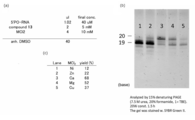
- Experimental Example 2 (Example 2): Examination of MCl 2 As Lewis acids, NiCl 2 (Reference Example 2-1), ZnCl 2 (Reference Example 2-2), CaCl 2 , (Example 2-1), MgCl 2 A total of six metal salts (Example 2-2), CuCl 2 , (Reference Example 2-3), and FeCl 2 (Reference Example 2-4) were examined.
- (1) Experimental item RNA, activation cap compound, and MCl 2 were mixed in required amounts. The solution was dried by a centrifugal evaporator. anh. DMSO was added and the mixture was incubated at 55 ° C. for 17 hours. The reaction was quenched by desalting with Amicon (3K).
- the reaction efficiency was analyzed by gel electrophoresis. The result is shown in FIG. In this figure, (a) shows the concentration of each component in the reaction solution, (b) shows the result of electrophoresis, and (c) shows the yield. (2) Results It was found that CaCl 2 (Example 2-1) and MgCl 2 (Example 2-2) improved the reaction efficiency.
- Experimental Example 5 Nucleic acid concentration examination It was investigated whether the nucleic acid concentration affects the reaction efficiency.
- (1) Experimental item RNA, activation cap compound, and CaCl 2 were mixed in required amounts. The solution was dried by a centrifugal evaporator. 1-Methylimidazole, anh. The required amount of each DMSO was added, and the mixture was incubated at 55 ° C. for 3 hours. The reaction was quenched by desalting with Amicon (3K). The reaction efficiency was analyzed by gel electrophoresis. The result is shown in FIG. In this figure, (a) shows the concentration of each component in the reaction solution, (b) shows the result of electrophoresis, and (c) shows the yield. (2) Results It was found that the nucleic acid concentration did not significantly affect the reaction efficiency.
- Experimental Example 6 Examination in the presence of water The reaction efficiency in the presence of water was investigated.
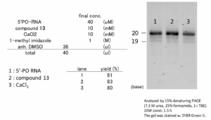
- (1) Experimental section (lane 1 (Example 6-1), lane 2 (Example 6-2)) RNA, activation cap compound, and CaCl 2 were mixed in required amounts.
- the solution was dried by a centrifugal evaporator.
- the reaction was quenched by desalting with Amicon (3K).
- the reaction efficiency was analyzed by gel electrophoresis.
- Experimental Example 7 Examination of concentration of CaCl 2 It was investigated whether the salt concentration affects the reaction efficiency.
- (1) Experimental items The activated cap compound and CaCl 2 were mixed in the required amounts. The solution was dried by a centrifugal evaporator. 1-Methylimidazole, anh. Required amounts of DMSO and RNA were added, respectively, and the mixture was incubated at 55 ° C. for 3 hours. The reaction was quenched by desalting with Amicon (3K). The reaction efficiency was analyzed by gel electrophoresis. The result is shown in FIG. In this figure, (a) shows the concentration of each component in the reaction solution, (b) shows the result of electrophoresis, and (c) shows the yield. (2) Results It was found that a certain amount of salt concentration is required to proceed with the reaction with high efficiency, but the efficiency decreases in the case of high concentration.
- Experimental Example 8 (Example 8): Examination of concentration of activated cap compound It was investigated whether the concentration of activated cap compound affects the reaction efficiency.
- Experimental Example 9 (Example 9): Examination of the reagent to be added last Under the conditions of "6.
- Experimental Example 6 (Example 6): Examination in the presence of water", the reaction efficiency due to the difference in the reagent added last is determined. investigated.
- Rane1 5'-PO RNA
- lane2 activated cap compound
- lane3 CaCl 2 are added last, respectively.
- (1) Experimental section (lane 1) The activation cap compound, CaCl 2 , (lane 2) RNA, CaCl 2 , (lane 3) RNA, and the activation cap compound were mixed in required amounts. The solution was dried by a centrifugal evaporator. 1-Methylimidazole, anh.
- Experimental Example 10 (Example 10): Examination of reaction time The reaction solution was sampled every 1.0, 2.0, 3.0, 4.0, 5.0, 6.0, and 20 hours from the start of the reaction. The change in yield with reaction time was investigated. The reaction conditions were incubated at 55 ° C. In the case of 1-methylimidazole (+), the reaction time was 1 hour and the reaction was almost progressing. Therefore, the reaction solution was prepared at shorter time intervals (10, 20, 30, 40, 50, 60, 90, 120 minutes). Was sampled and the difference in reaction efficiency was examined. (1) Experimental items RNA and CaCl 2 were mixed in required amounts. The solution was dried by a centrifugal evaporator. 1-Methylimidazole (+ only), anh.
- Experimental Example 11 Reaction study in aqueous solution In the study of "3.
- Experimental Example 3 (Example 3): Addition of 1-methylimidazole and reaction time study", it is necessary to add an activator.
- the reactions of CaCl 2 and MgCl 2 in which high yields were obtained were examined in an aqueous solution.
- the reaction conditions were 55 ° C. and incubated at overnight.
- (1) Experimental item RNA, activation cap compound, MCl 2 , and solvent were mixed so that the final concentration was as shown in the table of FIG. 12 (a). Incubated at 55 ° C. over night.
- Experimental Example 12 Examination of salt concentration (Mg) The effect of MgCl 2 concentration in the MQ solvent was examined. The concentration was examined at 4 points of 5, 10, 20, and 30 mM. The reaction conditions were incubated at 55 ° C., overnight. (1) Experimental section RNA, activation cap compound, CaCl 2 and MQ were mixed in required amounts so that the final concentration was as shown in the table of FIG. 13 (a). Incubated at 55 ° C. over night. The reaction was quenched by desalting with Amicon (3K). The reaction efficiency was analyzed by gel electrophoresis. The result is shown in FIG.
- Experimental Example 13 Examination of salt concentration (Ca) The effect of CaCl 2 concentration in the MQ solvent was investigated. Concentrations were examined at 7 points of 5, 10, 20, 30, 45, 60 and 90 mM. The reaction conditions were incubated at 55 ° C., overnight. (1) Experimental section RNA, activation cap compound, CaCl 2 and MQ were mixed in the required amounts so that the final concentration was as shown in the table of FIG. 14 (a). Incubated at 55 ° C. over night. The reaction was quenched by desalting with Amicon (3K). The reaction efficiency was analyzed by gel electrophoresis. The result is shown in FIG.
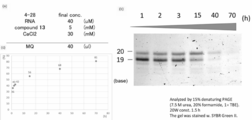
- Experimental Example 14 Examination of reaction time The reaction time was examined under MQ solvent conditions. The reaction solution was sampled every 1.0, 2.0, 3.0, 15, 40, and 70 hours from the start of the reaction, and the change in yield with the reaction time was examined. The reaction conditions were incubated at 55 ° C. (1) Experimental section RNA, activation cap compound, CaCl 2 and MQ were mixed in the required amounts so that the final concentration was as shown in the table of FIG. 15 (a). Incubated at 55 ° C. The reaction was quenched by desalting with Amicon (3K). The reaction efficiency was analyzed by gel electrophoresis. The result is shown in FIG.
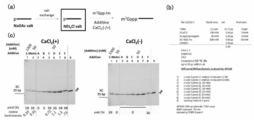
- Experimental Example 16 Screening of additive concentration, temperature, and reaction time 2-nitroimidazole was used as an additive, and a CAP conversion reaction was carried out at various concentrations, reaction temperatures, and reaction times. The reaction conditions are as shown in FIG. 18 (b).
- the reaction conditions are as shown in FIG. 18 (b).
- (1) Experimental section The outline of the experiment is as shown in FIG. 18 (a).
- the final concentration was RNA 10 ⁇ M, CaCl 2 10 mM, m 7 Gpp-Im 10 mM, and imidazole derivative 0 to 50 mM.
- the reaction solution was incubated at each temperature (37 or 55 ° C.) for 3-23 hours, a portion of the reaction solution was mixed with 2xreading buffer and analyzed by gel electrophoresis (10% acrylamide, 7.5 urea). The result of electrophoresis is shown in FIG. 18 (c).
- Experimental Example 17 Evaluation of effect of RNA counter salt
- the RNA counter salt was subjected to a CAP conversion reaction using various salts.
- the evaluated salts are shown in FIG. 19 (b) as K440'A and the like.
- (1) Experimental section The outline of the experiment is as shown in FIG. 19 (a).
- Tetraethylammonium salt (NET 4 Cl) and sodium acetate salt (NaOAc) were used as counter salts.
- [Cap conversion reaction] The RNA solution and the CaCl 2 solution were added to the Eppendorf tube, and water was removed by a lyophilizer.
- m 7 Gpp-Im a DMSO solution of the imidazole derivative and DMSO for concentration adjustment were added.
- the final concentrations were RNA 10 ⁇ M, CaCl 2 10 mM, m 7 Gpp-Im 10 mM, and 2-nitroimidazole 10 mM.
- the reaction solution was incubated at 37 ° C. for 9 hours, a part of the reaction solution was mixed with 2xreading buffer and analyzed by gel electrophoresis (10% acrylamide, 7.5 urea). The result of electrophoresis is shown in FIG. 19 (c).
Landscapes
- Chemical & Material Sciences (AREA)
- Life Sciences & Earth Sciences (AREA)
- Organic Chemistry (AREA)
- Health & Medical Sciences (AREA)
- Molecular Biology (AREA)
- Biochemistry (AREA)
- Engineering & Computer Science (AREA)
- Biotechnology (AREA)
- General Health & Medical Sciences (AREA)
- Genetics & Genomics (AREA)
- Wood Science & Technology (AREA)
- Zoology (AREA)
- General Chemical & Material Sciences (AREA)
- Microbiology (AREA)
- Chemical Kinetics & Catalysis (AREA)
- Bioinformatics & Cheminformatics (AREA)
- General Engineering & Computer Science (AREA)
- Saccharide Compounds (AREA)
Priority Applications (4)
| Application Number | Priority Date | Filing Date | Title |
|---|---|---|---|
| US17/802,680 US12448408B2 (en) | 2020-02-28 | 2021-02-19 | Method for producing capped RNA |
| EP21761932.9A EP4112630B1 (en) | 2020-02-28 | 2021-02-19 | Method for producing capped rna |
| CN202180017057.0A CN115175916B (zh) | 2020-02-28 | 2021-02-19 | 加帽rna的制造方法 |
| JP2022503335A JP7602807B2 (ja) | 2020-02-28 | 2021-02-19 | キャップ化rnaの製造方法 |
Applications Claiming Priority (2)
| Application Number | Priority Date | Filing Date | Title |
|---|---|---|---|
| JP2020032889 | 2020-02-28 | ||
| JP2020-032889 | 2020-02-28 |
Publications (1)
| Publication Number | Publication Date |
|---|---|
| WO2021172204A1 true WO2021172204A1 (ja) | 2021-09-02 |
Family
ID=77491875
Family Applications (1)
| Application Number | Title | Priority Date | Filing Date |
|---|---|---|---|
| PCT/JP2021/006360 Ceased WO2021172204A1 (ja) | 2020-02-28 | 2021-02-19 | キャップ化rnaの製造方法 |
Country Status (5)
| Country | Link |
|---|---|
| US (1) | US12448408B2 (https=) |
| EP (1) | EP4112630B1 (https=) |
| JP (1) | JP7602807B2 (https=) |
| CN (1) | CN115175916B (https=) |
| WO (1) | WO2021172204A1 (https=) |
Cited By (1)
| Publication number | Priority date | Publication date | Assignee | Title |
|---|---|---|---|---|
| WO2023167276A1 (ja) | 2022-03-04 | 2023-09-07 | 国立研究開発法人科学技術振興機構 | キャップ化rna及びその製造方法並びにタンパク質の製造装置及びタンパク質の製造方法 |
Citations (1)
| Publication number | Priority date | Publication date | Assignee | Title |
|---|---|---|---|---|
| WO2017053297A1 (en) * | 2015-09-21 | 2017-03-30 | Trilink Biotechnologies, Inc. | Compositions and methods for synthesizing 5'-capped rnas |
-
2021
- 2021-02-19 CN CN202180017057.0A patent/CN115175916B/zh active Active
- 2021-02-19 US US17/802,680 patent/US12448408B2/en active Active
- 2021-02-19 WO PCT/JP2021/006360 patent/WO2021172204A1/ja not_active Ceased
- 2021-02-19 JP JP2022503335A patent/JP7602807B2/ja active Active
- 2021-02-19 EP EP21761932.9A patent/EP4112630B1/en active Active
Patent Citations (1)
| Publication number | Priority date | Publication date | Assignee | Title |
|---|---|---|---|---|
| WO2017053297A1 (en) * | 2015-09-21 | 2017-03-30 | Trilink Biotechnologies, Inc. | Compositions and methods for synthesizing 5'-capped rnas |
Non-Patent Citations (6)
| Title |
|---|
| AKIHIRO OHKUBO ET AL.: "Chemical Synthesis of U1 snRNA Derivatives", ORGANIC LETTER, 2013 |
| HIROAKI SAWAI, WAKAI HIROMICHI, NAKAMURA-OZAKI AKIKO: "Synthesis and reactions of nucleoside 5'-diphosphate imidazolide", THE JOURNAL OF ORGANIC CHEMISTRY, vol. 64, no. 16, 1 August 1999 (1999-08-01), pages 5836 - 5840, XP055331109, ISSN: 0022-3263, DOI: 10.1021/jo990286u * |
| JANUSZ STĘPIŃSKI, JACEK JEMIELITY, MAGDALENA LEWDOROWICZ, MARZENA JANKOWSKA-ANYSZKA AND EDWARD DARŻYNKIEWICZ: "Catalytic efficiency of divalent metal salts in dinucleoside 5', 5'-triphosphate bond formation", COLLECTION SYMPOSIUM SERIES, vol. 5, 30 November 2001 (2001-11-30), pages 154 - 158, XP009530607, ISBN: 80-86241-16-5, DOI: 10.1135/css 200205154 * |
| JOSEF LEITER ET AL.: "Practical Synthesis of Cap-4 RNA", CHEMBIOCHEM, 2020 |
| See also references of EP4112630A4 |
| SEIGO NAGATATOMOHIRO HAMASAKIKOICHI UETAKEHIROFUMI MASUDAKAZUCHIKA TAKAGAKINATSUHISA OKATAKESHI WADATADAAKI OHGIJUNICHI YANO: "Synthesis and biological activity of artificial mRNA prepared with novel phosphorylating reagents", NUCLEIC ACIDS RESEARCH, vol. 38, 2010, pages 7845, XP055074797, DOI: 10.1093/nar/gkq638 |
Cited By (1)
| Publication number | Priority date | Publication date | Assignee | Title |
|---|---|---|---|---|
| WO2023167276A1 (ja) | 2022-03-04 | 2023-09-07 | 国立研究開発法人科学技術振興機構 | キャップ化rna及びその製造方法並びにタンパク質の製造装置及びタンパク質の製造方法 |
Also Published As
| Publication number | Publication date |
|---|---|
| JP7602807B2 (ja) | 2024-12-19 |
| EP4112630A1 (en) | 2023-01-04 |
| US12448408B2 (en) | 2025-10-21 |
| CN115175916A (zh) | 2022-10-11 |
| US20230097172A1 (en) | 2023-03-30 |
| EP4112630B1 (en) | 2024-10-16 |
| CN115175916B (zh) | 2025-02-14 |
| EP4112630A4 (en) | 2023-08-09 |
| JPWO2021172204A1 (https=) | 2021-09-02 |
Similar Documents
| Publication | Publication Date | Title |
|---|---|---|
| CA2659595C (en) | Process for producing di(pyrimidine nucleoside 5'-)polyphosphate | |
| JP5715560B2 (ja) | mRNA CAP類似体 | |
| CA1223831A (en) | Modified nucleotides, methods of preparing and utilizing and compositions containing the same | |
| DK171822B1 (da) | Modificerede nucleotider og fremgangsmåder til deres fremstilling og påvisning | |
| CA2896455C (en) | Method for producing p1,p4-di(uridine 5'-)tetraphosphate | |
| US6320035B1 (en) | C-nucleoside derivatives and their use in the detection of nucleic acids | |
| JPWO1987001373A1 (ja) | オリゴまたはポリヌクレオチド | |
| EP0521923B1 (en) | Process for producing nucleosides, and analogs therof | |
| CA2215176C (en) | C-nucleoside derivatives and their use in the detection of nucleic acids | |
| RS60848B1 (sr) | Novi fosfotriazolni analozi 5'-kapice irnk, kompozicije koje ih sadrže, molekul rnk u koji se ugrađuju, njihova primena i postupak sintetisanja molekula rnk, proteina ili peptida | |
| CN115175916B (zh) | 加帽rna的制造方法 | |
| US6617444B1 (en) | Dinucleotide tetraphosphate crystals | |
| KR100475008B1 (ko) | 디우리딘 테트라포스페이트 또는 그의 염의 결정 및 그의제조법, 그리고 그 화합물의 제조법 | |
| JPWO2001002416A1 (ja) | ジヌクレオチド結晶 | |
| CN112225761A (zh) | 一种嘧啶并三氮唑及其合成方法 | |
| JPWO2000020430A1 (ja) | ジウリジンテトラホスフェート又はその塩の結晶及びその製造法、並びに該化合物の製造法 | |
| Shanmugasundaram et al. | Recent advances in synthesis and biological activity of modified cap analogs | |
| Jankowska-Anyszka et al. | Synthesis of a new class of ribose functionalized dinucleotide cap analogues for biophysical studies on interaction of cap-binding proteins with the 5′ end of mRNA | |
| WO2004087939A1 (en) | A process for the preparation of fludarabine phosphate from 2-fluoroadenine and fludarabine phosphate salts with amines or ammonia | |
| JP2021505601A (ja) | カングレロール四ナトリウムの調製方法 | |
| CA3200390A1 (en) | Dna-encoded compound library and screening method thereof | |
| JP2024124589A (ja) | キャッピング剤前駆体及びその製造方法、並びに、キャッピング剤の合成方法 | |
| CN103755759A (zh) | 一种合成核苷磷酰哌啶、磷酰吗啉及磷酰吡咯烷的方法 | |
| JP6380886B2 (ja) | ヌクレオシド化合物の製造方法 | |
| RU2278869C2 (ru) | Новые субстраты концевой дезоксинуклеотидилтрансферазы |
Legal Events
| Date | Code | Title | Description |
|---|---|---|---|
| 121 | Ep: the epo has been informed by wipo that ep was designated in this application |
Ref document number: 21761932 Country of ref document: EP Kind code of ref document: A1 |
|
| ENP | Entry into the national phase |
Ref document number: 2022503335 Country of ref document: JP Kind code of ref document: A |
|
| WWE | Wipo information: entry into national phase |
Ref document number: 202217054387 Country of ref document: IN |
|
| NENP | Non-entry into the national phase |
Ref country code: DE |
|
| ENP | Entry into the national phase |
Ref document number: 2021761932 Country of ref document: EP Effective date: 20220928 |
|
| WWG | Wipo information: grant in national office |
Ref document number: 202180017057.0 Country of ref document: CN |
|
| WWG | Wipo information: grant in national office |
Ref document number: 11202252415G Country of ref document: SG |
|
| WWG | Wipo information: grant in national office |
Ref document number: 202217054387 Country of ref document: IN |
|
| WWG | Wipo information: grant in national office |
Ref document number: 17802680 Country of ref document: US |