EP4109074A1 - Particle analysis device - Google Patents
Particle analysis device Download PDFInfo
- Publication number
- EP4109074A1 EP4109074A1 EP21756875.7A EP21756875A EP4109074A1 EP 4109074 A1 EP4109074 A1 EP 4109074A1 EP 21756875 A EP21756875 A EP 21756875A EP 4109074 A1 EP4109074 A1 EP 4109074A1
- Authority
- EP
- European Patent Office
- Prior art keywords
- electrode
- liquid
- hole
- rod
- analysis device
- Prior art date
- Legal status (The legal status is an assumption and is not a legal conclusion. Google has not performed a legal analysis and makes no representation as to the accuracy of the status listed.)
- Withdrawn
Links
Images





Classifications
-
- G—PHYSICS
- G01—MEASURING; TESTING
- G01N—INVESTIGATING OR ANALYSING MATERIALS BY DETERMINING THEIR CHEMICAL OR PHYSICAL PROPERTIES
- G01N15/00—Investigating characteristics of particles; Investigating permeability, pore-volume or surface-area of porous materials
- G01N15/10—Investigating individual particles
- G01N15/1031—Investigating individual particles by measuring electrical or magnetic effects
- G01N15/12—Investigating individual particles by measuring electrical or magnetic effects by observing changes in resistance or impedance across apertures when traversed by individual particles, e.g. by using the Coulter principle
-
- G—PHYSICS
- G01—MEASURING; TESTING
- G01N—INVESTIGATING OR ANALYSING MATERIALS BY DETERMINING THEIR CHEMICAL OR PHYSICAL PROPERTIES
- G01N27/00—Investigating or analysing materials by the use of electric, electrochemical, or magnetic means
- G01N27/26—Investigating or analysing materials by the use of electric, electrochemical, or magnetic means by investigating electrochemical variables; by using electrolysis or electrophoresis
- G01N27/416—Systems
- G01N27/447—Systems using electrophoresis
- G01N27/44756—Apparatus specially adapted therefor
-
- B—PERFORMING OPERATIONS; TRANSPORTING
- B01—PHYSICAL OR CHEMICAL PROCESSES OR APPARATUS IN GENERAL
- B01L—CHEMICAL OR PHYSICAL LABORATORY APPARATUS FOR GENERAL USE
- B01L3/00—Containers or dishes for laboratory use, e.g. laboratory glassware; Droppers
- B01L3/50—Containers for the purpose of retaining a material to be analysed, e.g. test tubes
- B01L3/502—Containers for the purpose of retaining a material to be analysed, e.g. test tubes with fluid transport, e.g. in multi-compartment structures
- B01L3/5027—Containers for the purpose of retaining a material to be analysed, e.g. test tubes with fluid transport, e.g. in multi-compartment structures by integrated microfluidic structures, i.e. dimensions of channels and chambers are such that surface tension forces are important, e.g. lab-on-a-chip
- B01L3/502761—Containers for the purpose of retaining a material to be analysed, e.g. test tubes with fluid transport, e.g. in multi-compartment structures by integrated microfluidic structures, i.e. dimensions of channels and chambers are such that surface tension forces are important, e.g. lab-on-a-chip specially adapted for handling suspended solids or molecules independently from the bulk fluid flow, e.g. for trapping or sorting beads or physically stretching molecules
-
- G—PHYSICS
- G01—MEASURING; TESTING
- G01N—INVESTIGATING OR ANALYSING MATERIALS BY DETERMINING THEIR CHEMICAL OR PHYSICAL PROPERTIES
- G01N15/00—Investigating characteristics of particles; Investigating permeability, pore-volume or surface-area of porous materials
- G01N15/10—Investigating individual particles
- G01N15/1031—Investigating individual particles by measuring electrical or magnetic effects
-
- G—PHYSICS
- G01—MEASURING; TESTING
- G01N—INVESTIGATING OR ANALYSING MATERIALS BY DETERMINING THEIR CHEMICAL OR PHYSICAL PROPERTIES
- G01N33/00—Investigating or analysing materials by specific methods not covered by groups G01N1/00 - G01N31/00
- G01N33/48—Biological material, e.g. blood, urine; Haemocytometers
- G01N33/483—Physical analysis of biological material
- G01N33/487—Physical analysis of biological material of liquid biological material
- G01N33/48707—Physical analysis of biological material of liquid biological material by electrical means
- G01N33/48721—Investigating individual macromolecules, e.g. by translocation through nanopores
-
- B—PERFORMING OPERATIONS; TRANSPORTING
- B01—PHYSICAL OR CHEMICAL PROCESSES OR APPARATUS IN GENERAL
- B01L—CHEMICAL OR PHYSICAL LABORATORY APPARATUS FOR GENERAL USE
- B01L2200/00—Solutions for specific problems relating to chemical or physical laboratory apparatus
- B01L2200/06—Fluid handling related problems
- B01L2200/0647—Handling flowable solids, e.g. microscopic beads, cells, particles
- B01L2200/0652—Sorting or classification of particles or molecules
-
- B—PERFORMING OPERATIONS; TRANSPORTING
- B01—PHYSICAL OR CHEMICAL PROCESSES OR APPARATUS IN GENERAL
- B01L—CHEMICAL OR PHYSICAL LABORATORY APPARATUS FOR GENERAL USE
- B01L2300/00—Additional constructional details
- B01L2300/06—Auxiliary integrated devices, integrated components
- B01L2300/0627—Sensor or part of a sensor is integrated
- B01L2300/0645—Electrodes
-
- B—PERFORMING OPERATIONS; TRANSPORTING
- B01—PHYSICAL OR CHEMICAL PROCESSES OR APPARATUS IN GENERAL
- B01L—CHEMICAL OR PHYSICAL LABORATORY APPARATUS FOR GENERAL USE
- B01L2300/00—Additional constructional details
- B01L2300/08—Geometry, shape and general structure
- B01L2300/0861—Configuration of multiple channels and/or chambers in a single devices
- B01L2300/0874—Three dimensional network
-
- B—PERFORMING OPERATIONS; TRANSPORTING
- B01—PHYSICAL OR CHEMICAL PROCESSES OR APPARATUS IN GENERAL
- B01L—CHEMICAL OR PHYSICAL LABORATORY APPARATUS FOR GENERAL USE
- B01L2300/00—Additional constructional details
- B01L2300/16—Surface properties and coatings
- B01L2300/161—Control and use of surface tension forces, e.g. hydrophobic, hydrophilic
-
- C—CHEMISTRY; METALLURGY
- C12—BIOCHEMISTRY; BEER; SPIRITS; WINE; VINEGAR; MICROBIOLOGY; ENZYMOLOGY; MUTATION OR GENETIC ENGINEERING
- C12M—APPARATUS FOR ENZYMOLOGY OR MICROBIOLOGY; APPARATUS FOR CULTURING MICROORGANISMS FOR PRODUCING BIOMASS, FOR GROWING CELLS OR FOR OBTAINING FERMENTATION OR METABOLIC PRODUCTS, i.e. BIOREACTORS OR FERMENTERS
- C12M35/00—Means for application of stress for stimulating the growth of microorganisms or the generation of fermentation or metabolic products; Means for electroporation or cell fusion
- C12M35/02—Electrical or electromagnetic means, e.g. for electroporation or for cell fusion
-
- G—PHYSICS
- G01—MEASURING; TESTING
- G01N—INVESTIGATING OR ANALYSING MATERIALS BY DETERMINING THEIR CHEMICAL OR PHYSICAL PROPERTIES
- G01N15/00—Investigating characteristics of particles; Investigating permeability, pore-volume or surface-area of porous materials
- G01N15/01—Investigating characteristics of particles; Investigating permeability, pore-volume or surface-area of porous materials specially adapted for biological cells, e.g. blood cells
-
- G—PHYSICS
- G01—MEASURING; TESTING
- G01N—INVESTIGATING OR ANALYSING MATERIALS BY DETERMINING THEIR CHEMICAL OR PHYSICAL PROPERTIES
- G01N15/00—Investigating characteristics of particles; Investigating permeability, pore-volume or surface-area of porous materials
- G01N15/10—Investigating individual particles
- G01N2015/1024—Counting particles by non-optical means
-
- G—PHYSICS
- G01—MEASURING; TESTING
- G01N—INVESTIGATING OR ANALYSING MATERIALS BY DETERMINING THEIR CHEMICAL OR PHYSICAL PROPERTIES
- G01N15/00—Investigating characteristics of particles; Investigating permeability, pore-volume or surface-area of porous materials
- G01N15/10—Investigating individual particles
- G01N2015/1029—Particle size
-
- G—PHYSICS
- G01—MEASURING; TESTING
- G01N—INVESTIGATING OR ANALYSING MATERIALS BY DETERMINING THEIR CHEMICAL OR PHYSICAL PROPERTIES
- G01N15/00—Investigating characteristics of particles; Investigating permeability, pore-volume or surface-area of porous materials
- G01N15/10—Investigating individual particles
- G01N2015/103—Particle shape
Definitions
- the present invention relates particle analysis devices for analyzing particles contained in a liquid.
- a particle analysis device having two spaces has been proposed for analyzing particles, such as exosomes, pollens, viruses, and bacteria (Patent Documents 1-4).
- This type of particle analysis device has a pore connecting the two spaces, in which a liquid is stored in one space and another liquid containing particles to be analyzed is stored in the other space.
- These spaces are provided with different electrical potentials for causing electrophoresis, so that particles pass through the pore.
- the current value flowing through the liquid changes.
- characteristics e.g., type, shape, and size
- the present invention provides a particle analysis device capable of preventing or reducing a short circuit between two electrodes.
- a particle analysis device including multiple stacked plates joined together; an upper liquid space formed in at least one of the plates and adapted to store a first liquid; a lower liquid space formed in at least one of the plates, disposed below the upper liquid space and adapted to store a second liquid; a connection pore disposed in at least one of the plates and connecting the upper liquid space to the lower liquid space; a first hole having an opening that opens at a top surface of the particle analysis device, the first hole penetrating at least one of the plates and extending from the top surface to the upper liquid space, the first liquid flowing through the first hole; a second hole having an opening that opens at the top surface, the second hole penetrating at least two of the plates and extending from the top surface to the lower liquid space, the second liquid flowing through the second hole; a first electrode that is a sheet pinched between two of the plates and adapted to apply an electric potential to the first liquid in the upper liquid space through the first hole; a second electrode that is a sheet
- the first electrode which applies an electric potential to the first liquid
- the second electrode which applies an electric potential to the second liquid
- a first electrode is inserted into the first electrode-rod-insertion hole and is brought into contact with the first electrode
- second electrode is inserted into the second electrode-rod-insertion hole and is brought into contact with the second electrode.
- Each of the first electrode-rod-insertion hole and the second electrode-rod-insertion hole extends from the top surface of the particle analysis device to the corresponding electrode and does not open at any side surface of the particle analysis device, and the first electrode and the second electrode are not exposed at any side surface of the particle analysis device.
- the liquid leaks from the inside of the first hole and flows along the first electrode between the two plates, even if the leaking liquid may enter the first electrode-rod-insertion hole surrounded by walls of the plates, the leaking liquid is unlikely to leak from side surfaces of the particle analysis device. Therefore, if the distance between the first electrode and the second electrode is sufficiently large and the distance between the first electrode-rod-insertion hole and the second-electrode-rod insertion hole is sufficiently large, the liquid, which leaked from the inside of the first hole, is less likely to cause a short circuit between the first electrode and the second electrode.
- the liquid leaks from the inside of the second hole and flows along the second electrode between the two plates, even if the leaking liquid may enter the second electrode-rod-insertion hole surrounded by walls of the plates, the leaking liquid is unlikely to leak from side surfaces of the particle analysis device. Therefore, if the distance between the first electrode and the second electrode is sufficiently large and the distance between the first electrode-rod-insertion hole and the second-electrode-rod insertion hole is sufficiently large, the liquid, which leaked from the inside of the first hole, is less likely to cause a short circuit between the first electrode and the second electrode.
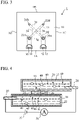
- a particle analysis device 1 As shown in FIG. 1 , a particle analysis device 1 according to an embodiment has a substantially rectangular parallelepiped shape, and the lengths of the four side surfaces 1A, 1B, 1C, and 1D are equal. That is, as shown in the plan view of FIG. 3 , the particle analysis device 1 has a substantially square contour.
- FIG. 2 is a side view of the particle analysis device 1 showing two side surfaces 1A and 1C.
- the particle analysis device 1 has an upper liquid space 20, a lower liquid space 22, and a connection pore 26.
- Each of the liquid spaces 20 and 22 extends linearly in a horizontal direction, in which a liquid 37 is stored in the first liquid space 20 and a liquid 38 is stored in the lower liquid space 22.
- the liquid (first liquid) 37 stored in the upper liquid space 20 and the liquid (second liquid) 38 stored in the lower liquid space 22 are shown by diagonal lines in different directions.
- the lower liquid space 22 is arranged below the upper liquid space 20, and the liquid spaces 20 and 22 are connected to each other by the connection pore 26.
- the liquid spaces 20 and 22 intersect each other at a right angle in plan view.
- the particle analysis device 1 also includes a hole (first hole) 20A, a hole 20B, a hole (second hole) 22A, and a hole 22B.
- Each of the holes 20A, 20B, 20C, and 20d has an opening that opens at the top surface of the particle analysis device 1.
- the hole 20A and the hole 20B extend vertically from the top surface of the particle analysis device 1 to the upper liquid space 20.
- the hole 22A and the hole 22B extend vertically from the top surface of the particle analysis device 1 to the lower liquid space 22.
- the hole 20A, the hole 20B, and the upper liquid space 20 form a reservoir for the liquid 37.
- the hole 22A, the hole 22B, and the lower liquid space 22 form another reservoir for the liquid 38.
- the particle analysis device 1 has a first electrode 28 and a second electrode 30.
- the first electrode 28 is used for applying an electric potential to the liquid 37 in the first liquid space 20 through the hole 20A.
- the second electrode 30 is used for applying an electric potential through the hole 22A to the liquid 38 in the lower liquid space 22.
- the electric potential applied by the second electrode 30 is different from that applied by the first electrode 28.
- the second electrode 30 is an anode and the first electrode 28 is a cathode. Since the liquid spaces 20 and 22 are connected via the connection pore 26, an electric current flows through the liquid 37 and the liquid 38 inside the liquid spaces 20 and 22.
- FIG. 4 schematically illustrates the principle of particle analysis used in the particle analysis device 1.
- the liquid 37 containing particles 40 to be analyzed is stored in the upper liquid space 20.
- a liquid 38 which does not originally contain the particles 40, is stored in the lower liquid space 22.
- the liquid 38 stored in the lower liquid space 22 may contain the particles 40.
- the liquid spaces 20 and 22 are connected to each other via the connection pore 26 that is a through-hole formed in a chip (nanopore chip) 24.
- a DC (direct current) power supply 35 and a current meter 36 are connected to the first electrode 28 and the second electrode 30.
- the DC power supply 35 is, for example, a battery, but is not limited to a battery.
- Electrophoresis caused by the potential difference applied to the electrodes 28 and 30 causes the particles 40 contained in the liquid 37 stored in the lowermost plate 2 to pass the connection pore 26 and to flow into the liquid 38 stored in the lower liquid space 22.
- the current value flowing through the liquid 37 and the liquid 38 changes.
- the change in current value can be observed using the current meter 36.
- characteristics e.g., type, shape, and size
- the particle analysis device 1 can be used to analyze a variety of particles, such as exosomes, pollens, viruses, and bacteria.
- the particle analysis device 1 includes multiple stacked square plates 2, 4, 6, 8, and 10 joined together.
- some or all of these plates are formed from transparent or semi-transparent material, and storage state of the liquid 37 or the liquid 38 in the cavities of the particle analysis device 1 (the hole 20A, the hole 20B, the hole 22A, and the hole 22B, and the liquid spaces 20 and 22) can be observed from outside the particle analysis device 1.
- the storage states of the liquids are observable, and these plates may be opaque.
- the plates 2, 4, 6, 8, and 10 are formed from electrically and chemically inert and insulating materials.
- Each plate may be formed from a rigid material or from an elastic material.
- Preferred rigid materials include resin materials, such as polycarbonate, polyethylene terephthalate, acrylic, cyclic olefin, polypropylene, polystyrene, polyester, and polyvinyl chloride.
- Preferred elastic materials include elastomers, for example, silicone rubber containing PDMS (polydimethylsiloxane) or urethane rubber.
- the plate 2 is formed, for example, from one of the preferred rigid materials described above.
- a horizontal groove 4g is formed in the center of the lower surface of the next plate 4.
- the groove 4g forms the lower liquid space 22.
- a communication hole 4t penetrating the plate 4 in a vertical direction is formed in the center of the groove 4g.
- the communication hole 4t connects the lower liquid space 22 (groove 4g) with the connection pore 26 of the chip 24.
- vertically penetrating cylindrical through-holes 4a and 4d are formed in the plate 4.
- the through-holes 4a and 4d have the same diameter.
- the through-hole 4a communicates with one end of the groove 4g, whereas the through-hole 4d communicates with the other end of the groove 4g.
- the plate 4 may be formed from one of the rigid materials described above, but is preferably formed from one of the elastic materials described above.
- a recess 6h having a rectangular-parallelepiped shape is formed in the center of the lower surface of the next plate 6.
- the recess 6h contains the chip 24 having the connection pore 26.
- the chip 24 is fitted into the recess 6h.
- the chip 24 may be removable or non-removable from the recess 6h.
- a horizontal groove 6g is formed in the center of the upper surface of the plate 6. When the plates 6 and 8 are joined together, the groove 6g forms the upper liquid space 20.
- a vertically penetrating communication hole 6t is formed in the center of the groove 6g.
- the communication hole 6t connects the upper liquid space 20 (the groove 6g) with the connection pore 26 of the chip 24.
- the cross sections of the communication holes 4t and 6t are circular.
- the plate 6 has vertically penetrating cylindrical through-holes 6a and 6d.
- the through-holes 6a and 6d have the same diameter as that of the through-holes 4a and 4d.
- the through-hole 6a communicates with the through-hole 4a of the plate 4 immediately below it, and thus with one end of the groove 4g, whereas the through-hole 6d communicates with the through-hole 4d, and thus with the other end of the groove 4g.
- the plate 6 may be formed from one of the rigid materials described above, but is preferably formed from one of the elastic materials described above.
- the chip (nanopore chip) 24 has a rectangular parallelepiped shape, for example, a square plate shape. In the center of the chip 24, the vertically penetrating connection pore 26 is formed.
- the chip 24 is made from an electrically and chemically inert and insulating material, such as glass, sapphire, a ceramic, a resin, an elastomer, SiO 2 , SiN, or Al 2 O 3 .
- the chip 24 is made from a material harder than the material of the plates 2, 4, 6, 8, and 10, for example, glass, sapphire, ceramics, SiO 2 , SiN, or Al 2 O 3 , but a resin or an elastomer may be used to form the chip 24.
- the user may select an appropriate chip 24 depending on the application of the particle analysis device 1. For example, the user may prepare multiple chips 24 with connection pores 26 having different dimensions or shapes, and may select a chip 24 to be fitted into the recess to change the particles 40 to be analyzed.
- the chip 24 be hydrophilized so that the liquid can easily pass through the connection hole 26 without clogging the connection pore 26.
- the hydrophilization treatment includes, for example, irradiating the chip 24 with oxygen plasma or ultraviolet rays. Ultraviolet rays may be irradiated in the form of a laser beam.
- cylindrical through-holes 8a, 8b, 8c, and 8d penetrating the plate 8 in a vertical direction are formed.
- the through-holes 8a, 8b, 8c, and 8d have the same diameter as that of the through-holes 4a, 4d, 6a and 6d.
- the through-hole 8a communicates with the through-hole 6a of the plate 6 disposed immediately below it, whereas the through-hole 8d communicates with the through-hole 6d.
- the through-hole 8b communicates with one end of the groove 6g of the plate 6, whereas the through-hole 8c communicates with the other end of the groove 6g.
- the electrodes 28 and 30 are arranged in parallel, and the first electrode 28 gives an electric potential to the liquid 37 in the through-hole 8b, whereas the second electrode 30 gives another electric potential to the liquid 38 in the through-hole 8a.
- the plate 8 may be formed from one of the rigid materials described above, but is preferably formed from one of the elastic materials described above.
- the through-holes 10a, 10b, 10c, and 10d are formed in the uppermost plate 10.
- the through-holes 10a and 10b have a diameter that is greater than that of the through-holes 8a, 8b, 8c, and 8d, whereas the through-holes 10c and 10d have a diameter that is equal to that of the through-holes 8a, 8b, 8c, and 8d.
- the through-holes 10a, 10b, 10c, and 10d respectively communicate with the through-holes 8a, 8b, 8c, and 8d of the plate 8 immediately below them.
- a first electrode-rod-insertion hole 32 exposing the first electrode 28 disposed below the plate 10 and a second electrode-rod-insertion hole 34 exposing the second electrode 30 are formed.
- Each of the electrode-rod-insertion holes 32 and 34 has an opening that opens at the top surface of the particle analysis device 1, and penetrates the plate 10 to extend from the top surface to the electrode 28 or 30.
- the plate 10 may be formed from one of the elastic materials described above, but is formed from one of the rigid materials described above.
- An electrode rod is inserted into each of the electrode-rod-insertion holes 32 and 34.
- the electrode rods are brought into contact with the electrodes 28 and 30, respectively, and apply electric potentials to the liquids 37 and 38.
- the aforementioned hole 20A is constituted of the through-holes 10b and 8B and penetrates the plates 10 and 8 to reach one end of the groove 6g in the plate 6, i.e., the upper liquid space 20.
- the through-hole 10b is the opening of the hole 20A that opens at the top surface of the particle analysis device 1.
- the first electrode 28 is provided in the middle of the hole 20A.
- the hole 20B is constituted of the through-holes 10c and 8c and penetrates the plates 10 and 8 to reach the other end of the groove 6g in the plate 6, i.e., the upper liquid space 20.
- the through-hole 10c is the opening of the hole 20B that opens at the top surface of the particle analysis device 1.
- the hole 22A is constituted of the through-holes 10a, 8a, 6a, and 4a and penetrates the plates 10, 8, 6, and 4 to reach one end of the groove 4g in the plate 4, i.e., the lower liquid space 22.
- the through-hole 10a is the opening of the hole 22A that opens at the top surface of the particle analysis device 1.
- the second electrode 30 is provided in the middle of the hole 22A.
- the hole 22B is constituted of the through-holes 10d, 8d, 6d, and 4d and penetrates the plates 10, 8, 6, and 4 to reach the other end of the groove 4g in the plate 4, i.e., the lower liquid space 22.
- the through-hole 10d is the opening of the hole 22B that opens at the top surface of the particle analysis device 1.
- plates 2, 4, 6, 8, and 10 can be bonded together with an adhesive.
- the plates 2, 4, 6, 8, and 10 be compressed in a vertical direction, so that leakage of liquid from the holes 20A, 20B, 22A, and 22B and the liquid spaces 20 and 22 is prevented as far as possible after joining.
- the chip 24 is formed from a brittle material
- at least one of the plates 4 and 6 around the chip 24 is preferably formed from one of the above-described elastic materials in order to prevent the chip 24 from being damaged.
- the plate 6, into which the chip 24 is fitted is preferably formed from one of the above-described elastic materials, and the recess 6h of the plate 6 preferably has dimensions (horizontal dimensions) suitable for the chip 24 to be tightly fitted.
- the depth of the recess 6h is preferably the same as or slightly greater than the height of the chip 24.
- the electrodes 28 and 30 are formed from materials with high electrical conductivity. For example, silver-silver chloride (Ag/AgCI), platinum, or gold can be used to form the electrodes 28 and 30. Alternatively, the electrodes 28 and 30 can be formed from a material containing any or all of these metals and an elastomer.
- Ag/AgCI silver-silver chloride
- platinum platinum
- gold gold
- the electrodes 28 and 30 can be formed from a material containing any or all of these metals and an elastomer.
- each of the electrodes 28 and 30 formed on the plate 8 is a flat sheet and is sandwiched between the two plates 8 and 10. As shown in FIG. 6 , each of the electrodes 28 and 30 has a circular annular portion 42 formed around the through-hole 8b or 8a (a part of the hole 20A or the hole 22A) of the plate 8 and a rectangular extending portion 44 connected to the circular annular portion 42.
- the circular annular portion 42 has a through-hole having a diameter that is the same as those of the through-hole 8a and 8b.
- the circular annular portion 42 is formed substantially concentrically with the through-hole 8a or 8b of the plate 8, and substantially concentrically overlaps with the through-hole 10a or 10b of the plate 10 directly above.
- the width of the extension portion 44 is less than the outer diameter of the circular annular portion 42.
- a first electrode rod 46 is inserted into the first electrode-rod-insertion hole 32 and is brought into contact with the circular annular portion 42 of the first electrode 28, and the second electrode rod 48 is inserted into the second electrode-rod-insertion hole 34 and is brought into contact with the circular annular portion 42 of the second electrode 30.
- the hole 20A has the through-hole 10b, which is disposed above the first electrode 28, and the through-hole 8b, which is disposed below the first electrode 28.
- the through-hole 10b has a greater diameter and thus a greater area than those of the through-hole 8b.
- the outer diameter of the circular annular portion 42 of the first electrode 28 is greater than the diameter of the through-hole 10b disposed immediately above it.
- the hole 22A has the through-hole 10a, which is disposed above the second electrode 30, and the through-hole 8a, which is disposed below the second electrode 30.
- the through-hole 10a has a greater diameter and thus a greater area than those of the through-hole 8a.
- the outer diameter of the circular annular portion 42 of the second electrode 30 is greater than the diameter of the through-hole 10a disposed immediately above it.
- each electrode overlaps the through-hole 10b or 10a having an opening area greater than that of the through-hole 8b or 8a. Therefore, the contact area between the liquid injected into the holes and the electrodes is secured to be large, and the reliability of analysis of the particles can be improved.
- the second electrode 30 is in contact with the liquid 38 inside the hole 22A (through-holes 10A and 8A) with a large contact area
- the first electrode 28 is in contact with the liquid 37 inside the hole 20A (through-holes 10b and 8b) with a large contact area.
- the circular annular portion 42 since the outer diameter of the circular annular portion 42 is greater than that of the through-holes 10b and 10a immediately above the circular annular portion 42, so that even when the position of the circular annular portion 42 deviates slightly from the desired position (i.e., even when the accuracy of the position of the circular annular portion 42 is incorrect), the circular annular portion 42 overlaps the through-hole 10b or 10a with a high degree of reliability. Accordingly, in a plurality of particle analysis devices 1, the contact area of the liquid injected into the holes and the electrodes is uniform, and the reliability of the particle analysis can be improved.
- each of the electrodes 28 and 30 intersects a hole 20A or hole 22A approximately orthogonally.
- Each of the electrodes 28 and 30 is a flat sheet, so that the electrodes 28 and 30 are compressed between the two plates 8 and 10 and are deformed as shown in FIG. 7 . Since the plates 8 and 10 are made from a softer material than the material of the electrodes 28 and 30, the plates 8 and 10 also deform and absorb the thickness of the electrodes 28 and 30 ( FIG. 7 shows the softer plate 8 is more deformed than the plate 10).
- gaps may occur around the electrodes 28 and 30 between the plates 8 and 10.
- the gaps between the plates 8 and 10 allow the liquid in the holes 20A and 22A to leak out.
- FIGS. 8 and 9 show the liquid leaking from holes 20A and 22A in phantom lines.
- the liquid that was in contact with the top surface of the circular annular portion 42 of each electrode may leak out into the gaps between the plates 8 and 10 around the electrodes due to the thickness of the electrodes, as liquid leakage L1.
- the ranges of the liquid leakage L1 correspond to the gaps between the plates 8 and 10 around the electrodes.
- the liquid leakage L1 travels from the side of the circular annular portion 42 of the electrode through both sides of the extending portion 44 to reach the electrode-rod-insertion holes 32 or 34, and can appear in the electrode-rod-insertion holes 32 and 34, as liquid leakage L2.
- the ranges of the liquid leakage L2 are within the electrode-rod-insertion holes 32 and 34 surrounded by the walls of the plates 8 and 10.
- the electrodes 28 and 30 are not interposed between the plates 8 and 10. Accordingly, there is almost no liquid leakage L2 outside the electrode-rod-insertion holes 32 and 34.
- the width of the extending portions 44 of the electrodes 28 and 30 is less than the width of the electrode-rod-insertion holes 32 and 34, and the ends 28E and 30E of the extending portions 44 of the electrodes 28 and 30 are disposed within the ranges of the electrode-rod-insertion holes 32 and 34, so that there is almost no liquid leakage L2 outside the electrode-rod-insertion holes 32 and 34.
- the plate 10 and the plate 8 can be regarded as being liquid-tightly bonded.
- the plate 10 directly above the first electrode 28 and the second electrode 30 is liquid-tightly bonded to the plate 8 directly below the first electrode 28 and the second electrode 30, and around the entirety of the second electrode 30, the plate 10 directly above the first electrode 28 and the second electrode 30 is liquid-tightly bonded to the plate 8 directly below the first electrode 28 and the second electrode 30.
- a region in which the plate 10 is liquid-tightly bonded to the plate 8 is interposed between the first electrode 28 and the second electrode 30.
- the liquid leakage reaches the side surface 1A of the particle analysis device 1, then the liquid is likely to travel through the interference between the plates 10 and 8 at the side surface 1A.
- the first liquid 37 that was stored in the first hole 20A may come into contact with the liquid 38 that was stored in the second hole 22A via the interference between the plates 10 and 8 at the side surface 1A.
- the electrodes 28 and 30, which are sandwiched between the same two plates 10 and 8 and arranged at the same height level, may be short-circuited. If the electrodes 28 and 30 are short-circuited, the current flowing between the electrodes 28 and 30 may become excessive and/or unstable, making it impossible to accurately analyze the particles.
- each of the electrode-rod-insertion holes 32 and 34 extends from the top surface of the particle analysis device 1 to the corresponding electrode 28 or 30 and does not open at any side surface 1A, 1B, 1C, or 1D of the particle analysis device 1, and the first electrode 28 and the second electrode 30 are not exposed at side surfaces 1A, 1B, 1C, and 1D of the particle analysis device 1.
- the electrodes 28 and 30 are located away from any side surface of the particle analysis device 1.
- the electrode 28 terminates within the electrode-rod-insertion hole 32 and is farther from the side surface 1A of the particle analysis device 1 than an end of the first electrode-rod-insertion hole 32 on the side of the side surface 1A of the particle analysis device 1 (an outer end of the hole 32).
- the electrode 30 also terminates within the electrode-rod-insertion hole 34 and is farther from the side surface 1A of the particle analysis device 1 than an end of the first electrode-rod-insertion hole 34 on the side of the side surface 1A of the particle analysis device 1 (an outer end of the hole 34). Accordingly, in a case in which the liquid leaks from the inside of the first hole 20A and flows along the first electrode 28 between the two plates 10 and 8, even if the leaking liquid may enter the first electrode-rod-insertion hole 32 surrounded by walls of the plates 10 and 8, the leaking liquid is unlikely to leak from the side surfaces of the particle analysis device 1.
- the liquid, which leaked from the inside of the first hole 20A, is less likely to cause a short circuit between the first electrode 28 and the second electrode 30.
- the plate 10 directly above the first electrode 28 and the second electrode 30 is liquid-tightly bonded to the plate 8 directly below the first electrode 28 and the second electrode 30, around the entirety of the first electrode 28.
- the plate 10 directly above the first electrode 28 and the second electrode 30 is liquid-tightly bonded to the plate 8 directly below the first electrode 28 and the second electrode 30, around the entirety of the second electrode 30.
- a region in which the plate 10 is liquid-tightly bonded to the plate 8 is interposed between the first electrode 28 and the second electrode 30.
- the liquid is unlikely to reach the second electrode 30, and even if the liquid leaks from the inside of the second hole 22 and flows along second electrode 30 between the two plates, the liquid is unlikely to reach the first electrode 28. Therefore, the risk of the liquid causing a short circuit between the first and second electrodes 28 and 30 is reduced.
- the particle analysis device 1 In a case in which the particle analysis device 1 is stored, it is preferable to place the particle analysis device 1 in a vacuum or underwater environment to protect the above-mentioned hydrophilized chip 24 from the air.
- a vacuum or underwater environment water that has entered the holes 20A and 22A causes the liquid leakage L1 and L2.
- the particle analysis device 1 Even if the particle analysis device 1 is taken out from the water for use and the surfaces of the particle analysis device 1 are wiped with a cloth, it is difficult to remove the liquid leakage L1 and L2 between two plates 10 and 8. In this case, if the liquid leakage is connected between the electrodes 28 and 30, the electrodes 28 and 30 will be short-circuited.
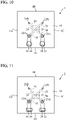
- the electrode-rod-insertion holes 32 and 34 have an approximately semicircular contour.
- the contours of the electrode-rod-insertion holes 32 and 34 are not limited to the shape in the embodiment.
- the electrode-rod-insertion holes 32 and 34 may have a circular contour, as shown in FIG. 10 , or a rectangular contour, as shown in FIG. 11 .
- the width of the electrode-rod-insertion holes 32 and 34 in the embodiment is greater than the width of the extending portions 44 of the electrodes 28 and 30.
- the relative size of the electrode-rod-insertion holes 32 and 34 to the extending portions 44 of the electrodes 28 and 30 is not limited to the embodiment. As shown in FIG. 12 , the width of the electrode-rod-insertion holes 32 and 34 may be less than the width of the extending portions 44 of the electrodes 28 and 30, and the electrode-rod-insertion holes 32 and 34 fall within the ranges of the ends of the extending portions 44.
- the electrodes 28 and 30 terminate within the electrode-rod-insertion holes 32 and 34, respectively, and the ends 28E and 30E of the electrodes 28 and 30 are distant respectively from the inner walls of the electrode-rod-insertion holes 32 and 34 on the side of the side surface 1A.
- the ends 28E and 30E of the electrodes 28 and 30 may be respectively in contact with the inner walls of the electrode-rod-insertion holes 32 and 34 on the side of the side surface 1A. Even in this case, there is almost no liquid leakage L2 outside the electrode-rod-insertion holes 32 and 34.
- the ends 28E and 30E of the electrodes 28 and 30 may extend toward the side surface 1A beyond the inner walls of the electrode-rod-insertion holes 32 and 34 on the side of the side surface 1A, respectively. However, the ends 28E and 30E do not reach the side surface 1A of the particle analysis device 1 and are not exposed at the side surface 1A.
- the plates 10 and 8 are liquid-tightly bonded by means of irradiation of vacuum ultraviolet light or oxygen plasma.
- a compression mechanism e.g., a clamping mechanism, screws, or a pinch
- a pinch e.g., a clamping mechanism, screws, or a pinch
- the number of plates in the particle analysis device is not limited to the above embodiment.
- the upper liquid space 20 is defined by the groove 6g formed in the single plate 6, but the upper liquid space 20 may be defined by multiple plates (e.g., plates 6 and 8).
- the lower liquid space 22 is defined by the groove 4g formed on the single plate 4, but the lower liquid space 22 may be defined by multiple plates (e.g., plates 4 and 2).
- the chip 24 having the connection pore 26 is located inside the single plate 6, but the chip 24 may be disposed inside multiple plates (e.g., plates 6 and 4).
- the extending portions 44 of the electrodes 28 and 30 are rectangular and has a uniform width. However, the extending portions 44 may have wider and narrower portions, or the width of the extending portions 44 may gradually decrease or increase toward the side surface 1A.
Landscapes
- Chemical & Material Sciences (AREA)
- Health & Medical Sciences (AREA)
- Life Sciences & Earth Sciences (AREA)
- Physics & Mathematics (AREA)
- Analytical Chemistry (AREA)
- General Health & Medical Sciences (AREA)
- Engineering & Computer Science (AREA)
- Pathology (AREA)
- General Physics & Mathematics (AREA)
- Immunology (AREA)
- Biochemistry (AREA)
- Dispersion Chemistry (AREA)
- Molecular Biology (AREA)
- Biomedical Technology (AREA)
- Chemical Kinetics & Catalysis (AREA)
- Hematology (AREA)
- Clinical Laboratory Science (AREA)
- Fluid Mechanics (AREA)
- Electrochemistry (AREA)
- Nanotechnology (AREA)
- Spectroscopy & Molecular Physics (AREA)
- Biophysics (AREA)
- Urology & Nephrology (AREA)
- Food Science & Technology (AREA)
- Medicinal Chemistry (AREA)
- Investigating Or Analyzing Materials By The Use Of Electric Means (AREA)
- Investigating Or Analysing Biological Materials (AREA)
Applications Claiming Priority (2)
| Application Number | Priority Date | Filing Date | Title |
|---|---|---|---|
| JP2020026876 | 2020-02-20 | ||
| PCT/JP2021/003674 WO2021166629A1 (ja) | 2020-02-20 | 2021-02-02 | 粒子解析装置 |
Publications (1)
| Publication Number | Publication Date |
|---|---|
| EP4109074A1 true EP4109074A1 (en) | 2022-12-28 |
Family
ID=77391359
Family Applications (1)
| Application Number | Title | Priority Date | Filing Date |
|---|---|---|---|
| EP21756875.7A Withdrawn EP4109074A1 (en) | 2020-02-20 | 2021-02-02 | Particle analysis device |
Country Status (5)
| Country | Link |
|---|---|
| US (1) | US20230074523A1 (https=) |
| EP (1) | EP4109074A1 (https=) |
| JP (1) | JPWO2021166629A1 (https=) |
| CN (1) | CN115151809A (https=) |
| WO (1) | WO2021166629A1 (https=) |
Family Cites Families (13)
| Publication number | Priority date | Publication date | Assignee | Title |
|---|---|---|---|---|
| US7238269B2 (en) * | 2003-07-01 | 2007-07-03 | 3M Innovative Properties Company | Sample processing device with unvented channel |
| DE10336849A1 (de) * | 2003-08-11 | 2005-03-10 | Thinxxs Gmbh | Flusszelle |
| JP4787786B2 (ja) * | 2007-04-23 | 2011-10-05 | 三井化学株式会社 | ガス生成装置およびガス生成方法 |
| CN101568830B (zh) * | 2007-04-27 | 2013-05-22 | 独立行政法人产业技术综合研究所 | 电泳芯片、电泳装置以及利用毛细电泳法的试样分析方法 |
| JP5797926B2 (ja) * | 2011-04-21 | 2015-10-21 | 株式会社エンプラス | 流体取扱装置およびその製造方法ならびに流体取扱システム |
| CN102280088A (zh) | 2011-07-26 | 2011-12-14 | 深圳市华星光电技术有限公司 | 一种led调光的方法及led调光系统 |
| WO2013136430A1 (ja) | 2012-03-13 | 2013-09-19 | 株式会社 東芝 | 一粒子解析装置および解析方法 |
| JP5904958B2 (ja) * | 2013-03-07 | 2016-04-20 | 株式会社東芝 | 半導体マイクロ分析チップ及びその製造方法 |
| JP6120437B2 (ja) | 2013-03-08 | 2017-04-26 | 国立大学法人大阪大学 | 物質の識別方法 |
| JP2014205115A (ja) * | 2013-04-12 | 2014-10-30 | ソニー株式会社 | 流路デバイスの製造方法及び流路デバイス |
| JP6258144B2 (ja) * | 2014-07-18 | 2018-01-10 | 株式会社東芝 | 半導体マイクロ分析チップ |
| US11333626B2 (en) * | 2016-02-22 | 2022-05-17 | Hitachi, Ltd. | Biological sample analysis chip, biological sample analyzer and biological sample analysis method |
| JP6762494B2 (ja) | 2016-02-29 | 2020-09-30 | 国立大学法人大阪大学 | エクソソームの形状分布の解析装置、がん検査装置、エクソソームの形状分布の解析方法、及びがん検査方法 |
-
2021
- 2021-02-02 JP JP2022501759A patent/JPWO2021166629A1/ja not_active Withdrawn
- 2021-02-02 EP EP21756875.7A patent/EP4109074A1/en not_active Withdrawn
- 2021-02-02 CN CN202180014955.0A patent/CN115151809A/zh not_active Withdrawn
- 2021-02-02 WO PCT/JP2021/003674 patent/WO2021166629A1/ja not_active Ceased
- 2021-02-02 US US17/798,187 patent/US20230074523A1/en not_active Abandoned
Also Published As
| Publication number | Publication date |
|---|---|
| WO2021166629A1 (ja) | 2021-08-26 |
| CN115151809A (zh) | 2022-10-04 |
| US20230074523A1 (en) | 2023-03-09 |
| JPWO2021166629A1 (https=) | 2021-08-26 |
Similar Documents
| Publication | Publication Date | Title |
|---|---|---|
| US9766205B2 (en) | Apparatus for the measurement of a concentration of a charged species in a sample | |
| EP3485269B1 (en) | Electrochemical sensor with opening between solid elements | |
| JPH0445069B2 (https=) | ||
| EP4109074A1 (en) | Particle analysis device | |
| CN100451640C (zh) | 一种用于样品电化学分析的传感器和制作方法 | |
| US20220260524A1 (en) | Particle analysis device | |
| JPWO2007072790A1 (ja) | 細胞電気生理センサ | |
| EP4109073A1 (en) | Particle analysis device | |
| KR20100005207A (ko) | 액체 중의 분석물질의 농도를 측정하기 위한 플러그를 갖는 시험 칩, 시험 칩용 하우징 및 플러그용 소켓 | |
| JP2021131239A (ja) | 粒子解析装置 | |
| WO2022186047A1 (ja) | 粒子解析装置 | |
| WO2022070669A1 (ja) | 粒子解析装置およびその製造方法 | |
| JP5723198B2 (ja) | 流体取扱装置及び流体取扱システム | |
| JP4682884B2 (ja) | 細胞電気生理センサおよびこれを用いた細胞電気生理現象の測定方法 | |
| JP4720638B2 (ja) | 細胞電気生理センサおよびそれを用いた細胞電気生理現象の測定方法 | |
| JP4670713B2 (ja) | 細胞電気生理センサおよびこれを用いた細胞電気生理現象の測定方法 | |
| JP4821449B2 (ja) | 細胞電気生理センサおよびそれを用いた細胞電気生理現象の測定方法 | |
| JP7587883B1 (ja) | デバイス、抵抗測定方法、細胞融合方法およびエレクトロポレーション方法 | |
| JP2007333570A (ja) | 細胞電気生理センサおよびそれを用いた細胞電気生理現象の測定方法 | |
| JP2010099038A (ja) | 細胞電気生理センサ | |
| JPH11337520A (ja) | 電気泳動装置 | |
| JPS6239759A (ja) | イオン活量測定器具 | |
| JP2014160095A (ja) | 試料中の荷電種の濃度を測定するための装置 |
Legal Events
| Date | Code | Title | Description |
|---|---|---|---|
| STAA | Information on the status of an ep patent application or granted ep patent |
Free format text: STATUS: THE INTERNATIONAL PUBLICATION HAS BEEN MADE |
|
| PUAI | Public reference made under article 153(3) epc to a published international application that has entered the european phase |
Free format text: ORIGINAL CODE: 0009012 |
|
| STAA | Information on the status of an ep patent application or granted ep patent |
Free format text: STATUS: REQUEST FOR EXAMINATION WAS MADE |
|
| 17P | Request for examination filed |
Effective date: 20220804 |
|
| AK | Designated contracting states |
Kind code of ref document: A1 Designated state(s): AL AT BE BG CH CY CZ DE DK EE ES FI FR GB GR HR HU IE IS IT LI LT LU LV MC MK MT NL NO PL PT RO RS SE SI SK SM TR |
|
| DAV | Request for validation of the european patent (deleted) | ||
| DAX | Request for extension of the european patent (deleted) | ||
| STAA | Information on the status of an ep patent application or granted ep patent |
Free format text: STATUS: THE APPLICATION HAS BEEN WITHDRAWN |
|
| 18W | Application withdrawn |
Effective date: 20230531 |