EP4101906B1 - Druckempfindliche klebstoffzusammensetzung zum kleben an geschäumten oberflächen und entsprechenade bänder und laminate - Google Patents
Druckempfindliche klebstoffzusammensetzung zum kleben an geschäumten oberflächen und entsprechenade bänder und laminate Download PDFInfo
- Publication number
- EP4101906B1 EP4101906B1 EP21177906.1A EP21177906A EP4101906B1 EP 4101906 B1 EP4101906 B1 EP 4101906B1 EP 21177906 A EP21177906 A EP 21177906A EP 4101906 B1 EP4101906 B1 EP 4101906B1
- Authority
- EP
- European Patent Office
- Prior art keywords
- sensitive adhesive
- weight
- adhesive composition
- acrylic
- monomer
- Prior art date
- Legal status (The legal status is an assumption and is not a legal conclusion. Google has not performed a legal analysis and makes no representation as to the accuracy of the status listed.)
- Active
Links
Images




Classifications
-
- C—CHEMISTRY; METALLURGY
- C09—DYES; PAINTS; POLISHES; NATURAL RESINS; ADHESIVES; COMPOSITIONS NOT OTHERWISE PROVIDED FOR; APPLICATIONS OF MATERIALS NOT OTHERWISE PROVIDED FOR
- C09J—ADHESIVES; NON-MECHANICAL ASPECTS OF ADHESIVE PROCESSES IN GENERAL; ADHESIVE PROCESSES NOT PROVIDED FOR ELSEWHERE; USE OF MATERIALS AS ADHESIVES
- C09J143/00—Adhesives based on homopolymers or copolymers of compounds having one or more unsaturated aliphatic radicals, each having only one carbon-to-carbon double bond, and containing boron, silicon, phosphorus, selenium, tellurium, or a metal; Adhesives based on derivatives of such polymers
- C09J143/04—Homopolymers or copolymers of monomers containing silicon
-
- C—CHEMISTRY; METALLURGY
- C09—DYES; PAINTS; POLISHES; NATURAL RESINS; ADHESIVES; COMPOSITIONS NOT OTHERWISE PROVIDED FOR; APPLICATIONS OF MATERIALS NOT OTHERWISE PROVIDED FOR
- C09J—ADHESIVES; NON-MECHANICAL ASPECTS OF ADHESIVE PROCESSES IN GENERAL; ADHESIVE PROCESSES NOT PROVIDED FOR ELSEWHERE; USE OF MATERIALS AS ADHESIVES
- C09J133/00—Adhesives based on homopolymers or copolymers of compounds having one or more unsaturated aliphatic radicals, each having only one carbon-to-carbon double bond, and at least one being terminated by only one carboxyl radical, or of salts, anhydrides, esters, amides, imides, or nitriles thereof; Adhesives based on derivatives of such polymers
- C09J133/04—Homopolymers or copolymers of esters
- C09J133/06—Homopolymers or copolymers of esters of esters containing only carbon, hydrogen and oxygen, the oxygen atom being present only as part of the carboxyl radical
- C09J133/08—Homopolymers or copolymers of acrylic acid esters
-
- C—CHEMISTRY; METALLURGY
- C09—DYES; PAINTS; POLISHES; NATURAL RESINS; ADHESIVES; COMPOSITIONS NOT OTHERWISE PROVIDED FOR; APPLICATIONS OF MATERIALS NOT OTHERWISE PROVIDED FOR
- C09J—ADHESIVES; NON-MECHANICAL ASPECTS OF ADHESIVE PROCESSES IN GENERAL; ADHESIVE PROCESSES NOT PROVIDED FOR ELSEWHERE; USE OF MATERIALS AS ADHESIVES
- C09J7/00—Adhesives in the form of films or foils
- C09J7/20—Adhesives in the form of films or foils characterised by their carriers
- C09J7/22—Plastics; Metallised plastics
- C09J7/26—Porous or cellular plastics
-
- C—CHEMISTRY; METALLURGY
- C09—DYES; PAINTS; POLISHES; NATURAL RESINS; ADHESIVES; COMPOSITIONS NOT OTHERWISE PROVIDED FOR; APPLICATIONS OF MATERIALS NOT OTHERWISE PROVIDED FOR
- C09J—ADHESIVES; NON-MECHANICAL ASPECTS OF ADHESIVE PROCESSES IN GENERAL; ADHESIVE PROCESSES NOT PROVIDED FOR ELSEWHERE; USE OF MATERIALS AS ADHESIVES
- C09J7/00—Adhesives in the form of films or foils
- C09J7/30—Adhesives in the form of films or foils characterised by the adhesive composition
- C09J7/38—Pressure-sensitive adhesives [PSA]
- C09J7/381—Pressure-sensitive adhesives [PSA] based on macromolecular compounds obtained by reactions involving only carbon-to-carbon unsaturated bonds
- C09J7/385—Acrylic polymers
-
- C—CHEMISTRY; METALLURGY
- C08—ORGANIC MACROMOLECULAR COMPOUNDS; THEIR PREPARATION OR CHEMICAL WORKING-UP; COMPOSITIONS BASED THEREON
- C08F—MACROMOLECULAR COMPOUNDS OBTAINED BY REACTIONS ONLY INVOLVING CARBON-TO-CARBON UNSATURATED BONDS
- C08F220/00—Copolymers of compounds having one or more unsaturated aliphatic radicals, each having only one carbon-to-carbon double bond, and only one being terminated by only one carboxyl radical or a salt, anhydride ester, amide, imide or nitrile thereof
- C08F220/02—Monocarboxylic acids having less than ten carbon atoms; Derivatives thereof
- C08F220/10—Esters
- C08F220/12—Esters of monohydric alcohols or phenols
- C08F220/16—Esters of monohydric alcohols or phenols of phenols or of alcohols containing two or more carbon atoms
- C08F220/18—Esters of monohydric alcohols or phenols of phenols or of alcohols containing two or more carbon atoms with acrylic or methacrylic acids
- C08F220/1808—C8-(meth)acrylate, e.g. isooctyl (meth)acrylate or 2-ethylhexyl (meth)acrylate
-
- C—CHEMISTRY; METALLURGY
- C09—DYES; PAINTS; POLISHES; NATURAL RESINS; ADHESIVES; COMPOSITIONS NOT OTHERWISE PROVIDED FOR; APPLICATIONS OF MATERIALS NOT OTHERWISE PROVIDED FOR
- C09J—ADHESIVES; NON-MECHANICAL ASPECTS OF ADHESIVE PROCESSES IN GENERAL; ADHESIVE PROCESSES NOT PROVIDED FOR ELSEWHERE; USE OF MATERIALS AS ADHESIVES
- C09J2203/00—Applications of adhesives in processes or use of adhesives in the form of films or foils
- C09J2203/346—Applications of adhesives in processes or use of adhesives in the form of films or foils for building applications e.g. wrap foil
-
- C—CHEMISTRY; METALLURGY
- C09—DYES; PAINTS; POLISHES; NATURAL RESINS; ADHESIVES; COMPOSITIONS NOT OTHERWISE PROVIDED FOR; APPLICATIONS OF MATERIALS NOT OTHERWISE PROVIDED FOR
- C09J—ADHESIVES; NON-MECHANICAL ASPECTS OF ADHESIVE PROCESSES IN GENERAL; ADHESIVE PROCESSES NOT PROVIDED FOR ELSEWHERE; USE OF MATERIALS AS ADHESIVES
- C09J2203/00—Applications of adhesives in processes or use of adhesives in the form of films or foils
- C09J2203/354—Applications of adhesives in processes or use of adhesives in the form of films or foils for automotive applications
-
- C—CHEMISTRY; METALLURGY
- C09—DYES; PAINTS; POLISHES; NATURAL RESINS; ADHESIVES; COMPOSITIONS NOT OTHERWISE PROVIDED FOR; APPLICATIONS OF MATERIALS NOT OTHERWISE PROVIDED FOR
- C09J—ADHESIVES; NON-MECHANICAL ASPECTS OF ADHESIVE PROCESSES IN GENERAL; ADHESIVE PROCESSES NOT PROVIDED FOR ELSEWHERE; USE OF MATERIALS AS ADHESIVES
- C09J2301/00—Additional features of adhesives in the form of films or foils
- C09J2301/10—Additional features of adhesives in the form of films or foils characterized by the structural features of the adhesive tape or sheet
- C09J2301/12—Additional features of adhesives in the form of films or foils characterized by the structural features of the adhesive tape or sheet by the arrangement of layers
- C09J2301/124—Additional features of adhesives in the form of films or foils characterized by the structural features of the adhesive tape or sheet by the arrangement of layers the adhesive layer being present on both sides of the carrier, e.g. double-sided adhesive tape
-
- C—CHEMISTRY; METALLURGY
- C09—DYES; PAINTS; POLISHES; NATURAL RESINS; ADHESIVES; COMPOSITIONS NOT OTHERWISE PROVIDED FOR; APPLICATIONS OF MATERIALS NOT OTHERWISE PROVIDED FOR
- C09J—ADHESIVES; NON-MECHANICAL ASPECTS OF ADHESIVE PROCESSES IN GENERAL; ADHESIVE PROCESSES NOT PROVIDED FOR ELSEWHERE; USE OF MATERIALS AS ADHESIVES
- C09J2400/00—Presence of inorganic and organic materials
- C09J2400/20—Presence of organic materials
- C09J2400/24—Presence of a foam
- C09J2400/243—Presence of a foam in the substrate
-
- C—CHEMISTRY; METALLURGY
- C09—DYES; PAINTS; POLISHES; NATURAL RESINS; ADHESIVES; COMPOSITIONS NOT OTHERWISE PROVIDED FOR; APPLICATIONS OF MATERIALS NOT OTHERWISE PROVIDED FOR
- C09J—ADHESIVES; NON-MECHANICAL ASPECTS OF ADHESIVE PROCESSES IN GENERAL; ADHESIVE PROCESSES NOT PROVIDED FOR ELSEWHERE; USE OF MATERIALS AS ADHESIVES
- C09J2433/00—Presence of (meth)acrylic polymer
Definitions
- the present invention relates to environmentally friendly pressure-sensitive adhesive (PSA) compositions with excellent foam adhesion performance.
- PSA pressure-sensitive adhesive
- pressure-sensitive adhesive tapes comprising said adhesive composition and the use of said adhesive composition for application on foamed substrate surfaces are described.
- adhesive foam-based laminates comprising a foam sheet and an adhesive layer comprising the aforementioned compositions, which may be used as insulation, shock absorption, cushioning and noise reduction material with excellent conformability and delamination resistance.
- PSA Pressure-sensitive adhesive
- foam-based multilayer laminates which may be used as insulation, shock absorption, cushioning and/or noise reduction materials in a wide variety of applications, such as in the transport sector (e.g., automotive or aircraft interior or exterior, etc.), in home domestic appliances (e.g., white goods) or buildings (e.g., sound absorption panels for walls or ceilings), for example.
- the PSA may be applied within a double-sided adhesive tape, which may be laminated on a foam sheet in order to provide a so-called "foam complex".
- adhesive foam-based laminates exhibit a high conformability, i.e. a capacity to adapt and conform to complex 3D shapes and stay in place without additional support.
- the pressure-sensitive adhesive composition it is necessary for the pressure-sensitive adhesive composition to enable high adhesion on both the foam-based material and the substrate surface onto which the laminate is applied to avoid anchorage failure (delamination of adhesive layer 1 from foam layer 1, as illustrated in Fig. 1B ) or adhesive failure (delamination of adhesive layer 1 from substrate 3, as illustrated in Fig. 1C ).
- thermosetting resins e.g., thermosetting epoxy foams or aromatic copolyester-based foams
- thermoplastic materials e.g., foams based on PE, PP, PS, PVC or PMMA
- rubber-based foams e.g., foams based on natural rubber, silicone rubber, EPDM rubber and styrene butadiene rubber.
- the adhesive it would be desirable for the adhesive to maintain a good debonding efficiency by maximizing stress dissipation during removal.
- JP 2011-093956 A discloses an acrylic PSA composition which advantageously combines good adhesion performance, removability and conformability to curved surfaces.
- the PSA composition of JP 2011-093956 A is applied to foamed substrates, the delamination resistance and conformability tends to be insufficient.
- PSA adhesives which are more environmentally friendly and avoid extensive use of organic solvents, such as emulsion-type pressure-sensitive adhesives using water as a dispersion medium.
- water-dispersible acrylic adhesives require modification to achieve comparable adhesive strength, especially when being applied to foamed substrates.
- JP 6 590 046 B2 discloses the addition of tackifiers to enhance adhesive strength for use on foamed substrates.
- tackifiers in emulsion and non-emulsion systems not only increases the amount of emissions (such as those of volatile organic compounds (VOC) and semi-volatile fogging compounds (FOG)) originating from the PSA compositions or tapes but also increases the selectivity of the adhesive towards specific foams, thus substantially limiting the range of application of the product.
- VOC volatile organic compounds
- FOG semi-volatile fogging compounds
- publications JP 2015-101644 A , US 2013/323498 A1 and JP 2017-071784 A disclose that the omission of tackfying agents may cause a deterioration in light-press repulsion resistance and promote the tendency to a decrease in adhesive strength to different substrates.
- EP 3 147 339 A1 discloses adhesive compositions which combine improved peel strength to SUS, PP and urethane foam substrates.
- foam conformability and adhesion performance and bonding efficiency with different foam substrates have not been addressed in this publication.
- an adhesive composition that further suppresses or entirely avoids VOC or FOG emissions, while displaying favourably high adhesion on different types of foams and high conformability both at ambient and at elevated temperatures, and which enables manufacturing of adhesive foam-based laminates which are simultaneously environmentally friendly and exhibit improved conformability, adhesion and debonding efficiency.
- acrylic pressure-sensitive adhesive composition comprising an acrylic polymer comprising, as monomer components: a) an alkyl (meth)acrylate having an alkyl group with 2 to 14 carbon atoms; b) at least one ⁇ , ⁇ -ethylenically unsaturated carboxylic acid monomer or ⁇ , ⁇ -ethylenically unsaturated carboxylic acid ester monomer other than component a); and c) an alkoxysilyl group-containing monomer; wherein the acrylic polymer has a weight-average molecular weight (M w ) of less than 1000 kDa; wherein the acrylic pressure-sensitive adhesive composition contains a tackifier in an amount of 0.2 wt.-% or less, based on the total weight of the acrylic polymer; and wherein the polydispersity index (PDI) of the acrylic polymer, defined as the ratio of the weight-average molecular weight (M w ) to the number-average molecular weight (M
- a second aspect of the present invention relates to the use of the aforementioned acrylic pressure-sensitive adhesive composition for application on foamed substrate surfaces.
- the present invention relates to a pressure-sensitive adhesive tape comprising an adhesive layer on at least one surface of a carrier layer and an optional release liner provided on the adhesive layer, wherein the adhesive layer comprises the aforementioned acrylic pressure-sensitive adhesive composition.
- the present invention relates to an adhesive foam-based laminate, comprising a foam sheet and an adhesive layer comprising the aforementioned acrylic pressure-sensitive adhesive composition or the aforementioned pressure-sensitive adhesive tape on a surface of the foam sheet.
- the present invention relates to an acrylic pressure-sensitive adhesive composition, comprising an acrylic polymer comprising, as monomer components: a) an alkyl (meth)acrylate having an alkyl group with 2 to 14 carbon atoms; b) at least one ⁇ , ⁇ -ethylenically unsaturated carboxylic acid monomer or ⁇ , ⁇ -ethylenically unsaturated carboxylic acid ester monomer other than component a); and c) an alkoxysilyl group-containing monomer; wherein the acrylic polymer has a weight-average molecular weight (M w ) of less than 1000 kDa; wherein the acrylic pressure-sensitive adhesive composition contains a tackifier in an amount of 0.2 wt.-% or less; and wherein the polydispersity index (PDI) of the acrylic polymer, defined as the ratio of the weight-average molecular weight (M w ) to the number-average molecular weight (M n ) of the acrylic polymer,
- PDI
- the acrylic pressure-sensitive adhesive composition according to the present invention preferably contains a tackifier in an amount of 0.15 wt.-% or less, such as 0.1 wt.-% or less, 0.05 wt.-% or less, or 0.01 wt.-% or less based on the total weight of the acrylic polymer. Most preferably, the acrylic pressure-sensitive adhesive composition does not contain a tackifier at all.
- tackifiers examples include rosin-based tackifier resins (e.g., gum rosin, wood rosin, tall oil rosin, stabilized rosin obtained by disproportionating or hydrogenating the rosin), and polymerized rosin), rosin derivative tackifier resins (e.g., esters of rosin-based resins, phenol-modified products of rosin-based resins), petroleum-based tackifier resins (e.g.
- aliphatic petroleum resins aromatic petroleum resins, copolymer petroleum resins, alicyclic petroleum resins, and hydrides thereof
- terpene-based tackifier resins e.g., ⁇ -pinene resin, ⁇ -pinene resin, aromatic-modified terpene resin, and terpene phenol resin
- phenol-based tackifier resins e.g., ketone-based tackifier resins obtained by condensing ketones (for example, aliphatic ketones such as methyl ethyl ketone, methyl isobutyl ketone, and acetophenone; alicyclic ketones such as cyclohexanone and methylcyclohexanone) and formaldehyde), and the like.
- Tackifiers that are used to improve the adhesive performance on substrates or foams are oligomeric compounds with high degree of volatility as opposed to polymers.
- the inclusion of these additives within the adhesive formulation leads to an increase of VOC and FOG emissions.
- the present invention avoids these problems by minimizing or entirely omitting the use of tackifiers, and by suitably adjusting the properties and composition of the acrylic polymer.
- the content of plasticizer in the PSA composition is less than 5 wt.-% based on the total weight of the pressure-sensitive adhesive, more preferably less than 3 wt.-%, such as 1 wt.-% or less, 0.5 wt.-% or less, or 0.05 wt.-% or less.
- the use of plasticizer in the acrylic PSA composition is entirely omitted.
- Plasticizers may include hydrocarbon oil components (such as aliphatic/paraffinic components, aromatic components and naphthenic components, as well as mixtures thereof), adipic ester plasticizers, as well as plasticizers selected among propylene oligomers, butene oligomers, isoprene oligomers, hydrogenated isoprene oligomers, butadiene oligomers, benzoic esters and vegetable and animal oils and derivatives thereof, for example.
- hydrocarbon oil components such as aliphatic/paraffinic components, aromatic components and naphthenic components, as well as mixtures thereof
- adipic ester plasticizers as well as plasticizers selected among propylene oligomers, butene oligomers, isoprene oligomers, hydrogenated isoprene oligomers, butadiene oligomers, benzoic esters and vegetable and animal oils and derivatives thereof, for example.
- the acrylic PSA composition generally exhibits a VOC emission of less than 100 ppm, preferably less than 80 ppm and more preferably less than 60 ppm.
- the acrylic PSA composition according to the present invention generally exhibits a FOG emission of less than 250 ppm, preferably less than 50 ppm, more preferably less than 10 ppm, such as 5 ppm or less or 1 ppm or less. Both VOC and FOG emission may be measured by a combination of thermodesorption und GC/MS methods according to VDA 278, for example.
- Monomer component a) is an alkyl (meth)acrylate having an alkyl group with 2 to 14 carbon atoms, preferably with 2 to 12 carbon atoms and more preferably with 4 to 10 carbon atoms.
- examples thereof include n-butyl (meth)acrylate, isobutyl (meth)acrylate, n-hexyl (meth)acrylate, 2-ethylhexyl (meth)acrylate, and 2-ethylhexyl (meth)acrylate, cyclohexyl (meth)acrylate, n-octyl (meth)acrylate, isooctyl (meth)acrylate, nonyl (meth)acrylate, isononyl (meth)acrylate, undecyl (meth)acrylate, isodecyl (meth)acrylate, undecyl (meth)acrylate, and the like.
- n-butyl (meth)acrylate and 2-ethylhexyl (meth)acrylate of which 2-ethylhexyl (meth)acrylate is particularly preferred.
- any term containing parentheses refers, alternatively, to the whole term as if no parentheses were present and the term without that contained in the parentheses, and combinations of each alternative.
- the term "(meth)acrylate” means acrylate, methacrylate, or mixtures thereof, and, similarly, the term “(meth)acrylic” generally refers to any of acrylic, methacrylic, and mixtures thereof.
- the amount of monomer component a) is not particularly limited. However, to ensure a soft polymer matrix and to improve contact efficiency, component a) is preferably used as main monomer at a content of more than 50 parts by weight, more preferably between 55 to 98 parts by weight, such as 60 to 97 parts by weight with respect to 100 parts by weight of the total amount of monomer components. In embodiments, component a) may be present in an amount of from 60 to 92 parts by weight of the total amount of monomer components.
- Monomer component b) is at least one ⁇ , ⁇ -ethylenically unsaturated carboxylic acid monomer or ⁇ , ⁇ -ethylenically unsaturated carboxylic acid ester monomer other than that selected for component a). While not being limited thereto, acrylic acid, methacrylic acid, beta-acryloxypropionic acid, ethacrylic acid, ⁇ -chloroacrylic acid, ⁇ -vinylacrylic acid, crotonic acid, ⁇ -phenylacrylic acid, cinnamic acid, chlorocinnamic acid, ⁇ -styrylacrylic acid, maleic acid, itaconic acid, and citraconic acid, as well as their acid esters may be mentioned as examples.
- component b) comprises - alternatively or in addition - at least one alkyl (meth)acrylate having an alkyl group with less than 4 carbon atoms, more preferably from 1 to 3 carbon atoms.
- alkyl (meth)acrylate having an alkyl group with less than 4 carbon atoms, more preferably from 1 to 3 carbon atoms.
- methyl (meth)acrylate, ethyl (meth)acrylate, n-propyl (meth)acrylate, and isopropyl (meth)acrylate may be mentioned.
- Methyl (meth)acrylate is particularly preferred as it improves stress dissipation during debonding due to the presence of methyl group in the polymer backbone.
- the (total) amount of monomer component b) is not particularly limited, a (total) amount of 2 to 40 parts by weight with respect to 100 parts by weight of the total amount of monomer components is typically employed.
- especially preferred (total) amounts range from 2 to 20 parts by weight, such as from 3 to 15 parts by weight or from 4 to 10 parts by weight.
- component b) comprises: b1) an alkyl (meth)acrylate having an alkyl group with from 1 to 3 carbon atoms, and b2) at least one ⁇ , ⁇ -ethylenically unsaturated carboxylic acid selected from acrylic acid and methacrylic acid, preferably both.
- the weight ratio of components b1) and b2) is from 1:1 to 10:1, more preferably from 2:1 to 5:1.
- Component c) is an alkoxysilyl group-containing monomer, a functional monomer which enables crosslinking by hydrolysis and condensation in presence of atmospheric moisture.
- Component c) is preferably selected from an alkoxysilyl group-containing acrylate monomer or an alkoxysilyl-group containing vinyl monomer, among which alkoxysilyl group-containing acrylate monomers are especially preferred.
- alkoxysilyl-group containing vinyl monomer include vinyltrialkoxysilanes, vinylalkyldialkoxysilanes, and the like.
- alkoxysilyl group-containing acrylate monomers (meth)acyloyloxyalkyl-trialkoxysilanes (e.g.
- the acrylic pressure-sensitive adhesive composition preferably comprises a chain transfer agent in an amount of 0.001 to 0.3 parts by weight with respect to 100 parts by weight of the total amount of monomer components, preferably between 0.01 to 0.1 parts by weight, in order to avoid an undesirable increase of the molecular weight of the acrylic polymer.
- the chain transfer agent is not particularly limited and typically selected from one or more thiol compounds including monofunctional and polyfunctional thiols.
- Monofunctional thiols include, but are not limited to, propyl mercaptan, butyl mercaptan, hexyl mercaptan, octyl mercaptan, n-dodecyl mercaptan, thioglycollic acid, mercaptopropionic acid, alkyl thioglycollates, mercaptoethanol, mercaptoundecanoic acid, thiolactic acid, and thiobutyric acid, among which n-dodecyl mercaptan is preferred.
- polyfunctional thiols examples include trifunctional compounds such as trimethylol propane tris(3-mercaptopropionate), tetrafunctional compounds such as pentaerythritol tetra(3-mercaptopropionate), pentaerythritol tetrathioglycollate, pentaerythritol tetrathiolactate, pentaerythritol tetrathiobutyrate; hexafunctional compounds such as dipentaerythritol hexa(3-mercaptopropionate), dipentaerythritol hexathioglycollate; and octafunctional thiols such as tripentaerythritol octa (3-mercaptopropionate) or tripentaerythritol octathioglycollate.
- trifunctional compounds such as trimethylol propane tris(3-mercaptopropionate),
- the PSA composition may be obtained by subjecting the monomer components described above to solvent-based or emulsion-based polymerization, preferably an emulsion-based polymerisation using water as dispersion medium.
- polymerization additives such as polymerization initiators, emulsifiers, surfactants, stabilizers and/or rheology modifiers
- polymerization initiator examples include, but are not limited to an azo initiator (such as 2,2'-azobis[N-(2-carboxyethyl)-2-methylpropionamidine]hydrate, 2,2'-azobisisobutyronitrile, 2,2'-azobis(2-methylpropionamidine) disulfate, 2,2'-azobis(2-amidinopropane) dihydrochloride, 2,2'-azobis[2-(5-methyl-2-imidazolin-2-yl) propane] dihydrochloride, 2,2'-azobis(N, N'-dimethyleneisobutylamidine) dihydrochloride, and the like); a peroxide initiator (e.g., persulfates such as potassium persulfate and ammonium persulfate; benzoyl peroxide, t-butyl hydroperoxide, di-t-butyl peroxide, t-butyl peroxybenzoate, hydrogen peroxide, and
- the amount of a polymerization initiator can be suitably selected by the skilled artisan depending on the type of initiator and the monomer composition, and will be usually about 0.01 to 1 parts by weight with respect to 100 parts by weight of the total amount of monomer components, for example.
- PSA compositions include viscosity modifiers (thickeners, etc.), leveling agents, release modifiers, plasticizers, softeners, fillers, colorants (pigments, dyes, etc.), antistatic agents, preservatives, anti-aging agents, ultraviolet absorbers, antioxidants and light stabilizers, for example.
- viscosity modifiers thickeners, etc.
- leveling agents leveling agents, release modifiers, plasticizers, softeners, fillers, colorants (pigments, dyes, etc.)
- antistatic agents preservatives, anti-aging agents, ultraviolet absorbers, antioxidants and light stabilizers, for example.
- the polymerization may be generally brought about by methods known in the art, for example by heating the above-described composition to 20 to 100 °C, typically 40 to 80 °C.
- surfactants may be suitably added to the composition prior to polymerization.
- surfactant known anionic, nonionic or cationic surfactants can be appropriately employed. Usually, an anionic surfactant is preferred. If present, the amount of the surfactant to be used is preferably from 0.01 to 18 parts by weight with respect to 100 parts by weight of the total amount of monomer components.
- the monomer phase is not miscible with the aqueous phase, so the monomer phase needs to be homogenized to create monomer droplets and micelles.
- an acid or a base may be added to adjust the pH of the polymer.
- Bases such as ammonia, are preferred stabilizers since they deprotonate the carboxylic functions of component b) and stabilize the resulting particles against coalescence.
- the acrylic polymer in the PSA composition according to the present invention generally exhibits a weight-average molecular weight (M w ) of less than 1000 kDa, which enables excellent debonding performance and mechanical resistance.
- M w weight-average molecular weight
- Particularly favourable balance of adhesion and debonding behaviour is achieved by controlling the weight-average molecular weight (M w ) in the range of more than 200 kDa and 800 kDa or less, preferably from 300 to 600 kDa, further preferably from 350 to 550 kDa, or especially preferably from 370 to 490 kDa, as measured by gel permeation chromatography (GPC).
- GPC gel permeation chromatography
- the acrylic polymer has a number-average molecular weight (M n ) of less than 500 kDa, more preferably in the range of 50 to 300 kDa, further preferably from 70 to 250 kDa, or especially preferably from 100 to 200 kDa, as measured by gel permeation chromatography (GPC).
- M n number-average molecular weight
- the polydispersity index (PDI) of the acrylic polymer defined as the ratio of the weight-average molecular weight (M w ) to the number-average molecular weight (M n ), is preferably between 2.0 and 4.0.
- the acrylic polymer used in the adhesive composition according to the present invention preferably exhibits a glass transition temperature T g of lower than -20°C, more preferably between -80°C to -30°C, further preferably between -75 to -40°C, especially preferably from -70°C to -48°C, which is measured by a differential scanning calorimetry (DSC) measurement, during which the acrylic polymer is heated at a rate of 10 °C/min to 130 °C, cooled to -90°C and heated again to 130°C.
- DSC differential scanning calorimetry
- the acrylic pressure-sensitive adhesive composition preferably exhibits a gel content in the range of from 15 to 45%, further preferably from 20 to 40%.
- the gel content is suitably determined by the procedure set out in further detail below.
- the acrylic polymer may be used as adhesive composition directly after polymerization.
- emulsion-based polymers may require the addition of a rheology modifier (after polymerization) to increase the viscosity of the adhesive.
- rheology modifiers include, but are not limited to alkali swellable emulsions (ASE) and hydrophobically modified variants thereof.
- rheology modifiers are mixed with the emulsion-based acrylic polymer at a weight ratio of 1:50 to 1:200, preferably at a weight ratio of 1:70 to 1:150.
- the PSA composition according to the present invention preferably exhibits a Young modulus of 400 Pa or less, more preferably from 50 to 350 Pa, and further preferably from 100 to 300 Pa, the Young modulus being determined according to ASTM D638.
- the adhesive exhibits excellent contact efficiency after light pressure is applied.
- a Young modulus higher than the above ranges makes the adhesive hard and less contact efficient.
- the yield point of the adhesive composition is between 40% to 100% and further preferably between 50% and 90%.
- the maximum stress is preferably between 50 and 110 kPa and more preferably between 60 and 100 kPa.
- the maximum elongation is preferably at least 1500%, more preferably between 1800% and 3200%, and especially preferably between 2000% and 2800%. These parameters may be suitably determined via stress-strain tensometry at a constant tensile speed (e.g. 300 mm/min).
- the acrylic pressure-sensitive adhesive composition has a strain hardening modulus of more than 20 Pa, more preferably from 25 to 75 Pa, an further preferably from 40 to 70 Pa.
- the strain hardening modulus is calculated from the slope of the stress vs. strain curve after the point of yield of the polymer.
- the mechanical properties may be suitably adjusted by the skilled artisan by controlling the molecular weight distribution of the polymer and the fraction of low and high molecular weight chains, for example.
- the acrylic PSA composition according to the present invention may be used for any known PSA application and is not particularly limited.
- the PSA composition is particularly advantageous for applications where high adhesion to textured surfaces of different materials, exceptionally high conformability and low environmental impact is required.
- the present invention relates to the use of the acrylic pressure-sensitive adhesive composition according to the first embodiment described above for application on foamed substrate surfaces, preferably so that the PSA composition is in direct contact with the surface of the foamed substrate.
- exemplary foams may include, but are not limited to thermosetting resins (e.g., thermosetting epoxy foams, thermosetting aromatic copolyester-based foams, thermosetting polyurethane (PUR) foams), thermoplastic materials (e.g., foams based on polyethylene (PE), polypropylene (PP), polystyrene (PS), polyvinyl chloride (PVC), ethyl vinyl acetate (EVA) or poly(methyl methacrylate) (PMMA), or thermoplastic urethanes (TPU)) and rubber-based foams (e.g., foams based on natural rubber, silicone rubber, EPDM rubber and styrenic block copolymers, such as styrene-ethylene/butylene-styrene (SEBS), styrene-ethylene/propylene-styrene (SEPS), styrene-ethylene/
- thermosetting resins e.g., thermosetting epoxy foams, thermosetting aromatic cop
- the foamed substrate may be of the closed cell-type, open cell-type, or the partially open or closed cell-type.
- the present invention relates to a pressure-sensitive adhesive tape comprising an adhesive layer on at least one surface of a carrier layer and an optional release liner provided on the adhesive layer, wherein the adhesive layer comprises the acrylic pressure-sensitive adhesive composition according to the first embodiment described above.
- the PSA tape may be a single-sided or double-sided adhesive tape.
- the carrier layer is not particularly limited and may be a paper or preferably a film composed of materials known in the art, such as polyethylene (PE), polypropylene (PP), polyether sulphones, polyamides, polyimides, polyetherimides, polyesters, polyphenyl sulphides, polyamideimides, polyetherimides, polymethacrylates, styrene-based films, polycarbonates, polyether ketones, polyaryls, polyurethanes, polyacrylates, polybutyrals, polyethylene-vinyl acetates, polyethylene naphthylates, fluorinated polymers and combinations thereof.
- the carrier layer may also incorporate nonwovens or fabrics. Foam carriers may also be mentioned as exemplary carrier layers.
- foams based on homopolymers and copolymers of ethylene e.g. PE
- ethylene-vinyl acetate copolymers EVA
- polyvinyl acetates polypropylenes
- EPDM ethylene-propylene-diene rubber
- thermoplastic elastomers based on styrene block copolymers polyurethanes based on aromatic and aliphatic diisocyanates
- PVC polyvinyl chloride
- PVC polychloroprenes
- natural rubber acrylate copolymers, and combinations thereof.
- Exemplary PSA tapes may also include multilayer PSA tapes, wherein the acrylic pressure-sensitive adhesive composition according to the first embodiment is provided between two carrier layers, wherein one of the carrier layers is preferably a foam carrier layer.
- the PSA tape is a double-sided PSA tape with the adhesive layer comprising the PSA composition according to the first embodiment on at least one surface of the carrier layer, preferably on both surfaces of the carrier layer.
- An example thereof is illustrated in Fig. 2 , wherein a first adhesive layer (12) is provided on one surface of a carrier layer (13) and a second adhesive layer (14) on the other surface of the carrier layer (13), with the optional release liner (11) being provided in contact with one of the adhesive layers.
- release liners known in the art may be used (e.g. based on polymeric films, papers, woven materials and/or metal foils) on any outer PSA layer surface.
- the present invention further relates to an adhesive foam-based laminate, comprising a foam sheet and an adhesive layer comprising the acrylic pressure-sensitive adhesive composition according to the first embodiment or a double-sided pressure-sensitive adhesive tape described in conjunction with the third embodiment on a surface of the foam sheet.
- each of the layers are not particularly limited and may be suitably adjusted by the skilled artisan depending on the choice of materials and the purpose of application.
- the solvent-based polymer of Example 2 was used without addition of any further components.
- 1 pt. per weight of a rheology modifier (Rheovis AS1125, commercially obtained from BASF) relative to 100 parts by weight of the emulsion-based polymers of Example 1 and Comparative Example 1 was added to increase the final adhesive viscosity of the PSA composition.
- the polymerization proceeded via semi-batch process with no reacting monomer present in the reactor initially.
- the reactor was purged with nitrogen (N 2 ) for 1 h before the addition of the initiator.
- the initiator solution was added once the temperature reached the set temperature of 60°C.
- the monomer feed started 10 min after the initiator solution was added to the reactor, whereupon the reactor was maintained at 60°C during the polymerization under N 2 atmosphere.
- the monomer feed was continuously purged with N 2 and fed into the reactor for 5h until the feed was depleted.
- the temperature was then raised to 65°C for 5 h to age the polymer and reduce the amount of residual monomers.
- ammonia solution was added after ageing to stabilize polymer particles against coalescence.
- the gel content was determined by an extraction experiment using ethyl acetate as a solvent.
- polymer samples were first dried in an oven for 1 h at 130 °C. Around 0.05 g of sample were weighted on a piece of Teflon, which was then closed as a bag with a Teflon string.
- the Teflon bag with the polymer was placed into a glass vial filled with ethyl acetate.
- the glass vials were stirred for 7 days at room temperature. After 7 days, the Teflon bag was removed from the vial and dried in an oven for 1 h at 130 °C.
- the glass vials containing the soluble fraction of the polymer were used for the molecular weight analysis via GPC.
- GPC Gel Permeation Chromatography
- the glass transition of polymers was determined by DSC (TA discovery Q 2000). The samples were first cooled. During the measurement, the samples were heated at a rate of 10 °C/min to 130 °C, cooled to -90°C and heated again to 130°C.
- the Young modulus, yield point, strain hardening modulus, maximum stress and maximum elongation before break were determined via stress-strain tensometry.
- the adhesive formulations of Examples 1 and 2 and Comparative Example 1 were each coated on a siliconized paper liner with a final thickness of 65 ⁇ m after drying. The adhesives were dried in an oven for 1 min at 130°C. Samples were prepared by rolling the adhesive to obtain a cylinder of approximatively 3 mm of section and 40 mm in length. The edge of each cylinder was pressed between two paper pieces of 2 mm thickness. The distance between each paper sheet was 30 mm. Stress-strain tensometry was performed using a Zwick Z005 tensile machine.
- the samples were mounted between the clamps of the apparatus.
- the initial distance between both clamps was set between 20 mm and the mobile upper clamp is moved upward at a tensile speed of 300 mm/min. All tests were done in triplicate and the average of the measurements was used for the evaluation.
- Double-sided adhesive tapes were prepared, the construction of which is illustrated in Fig. 2 .
- the acrylic adhesive compositions described above constituted both adhesive sides of the tape with a thickness of 55 ⁇ m each (55 g/m 2 ).
- a non-woven paper fabric with a thickness of 30 ⁇ m (13 g/m 2 ) was used as a carrier layer, while a siliconized paper with a thickness of 104 ⁇ m (122 g/m 2 ) was used as liner to protect the adhesive side and enable release before application.
- the total thickness of each double-sided adhesive tape (without liner) was 140 ⁇ m ⁇ 5 ⁇ m.
- Each of the double-sided adhesive tapes was applied to three types of commercially available polymer foams, Nitto EE1000 (ethylene propylene diene monomer (EPDM)-based foam having a density of 95 kg/m 3 and a Young Modulus of 0.4 ⁇ 0.5), Ramsay Rubber Superseal KD (polyurethane (PUR)-based foam having a density of 40 kg/m 3 and a Young Modulus of 1.1 ⁇ 0.8) and Sekisui Alveo TA 3510 (polyethylene (PE)-based foam having a density of 29 kg/m 3 and a Young Modulus of 12 ⁇ 4), to prepare foam complexes.
- Each of the foam materials had a thickness of 10 mm.
- polypropylene with 20% talc
- the complex angle of application was 90° with an overlap surface of 10 mm by 20 mm.
- the stress level was inversely proportional to the overlap length and surface, the smaller the surface the lower the stress applied on the DST, the longer the overlap, the lower the stress applied.
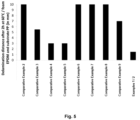
- the conformability test was performed in an oven at 60°C for 2h. The delamination of the foam complex over the overlap was measured in mm after 2h at 60°C. No delamination between the foam complex and the PP/talc substrate (0 mm) equates a high conformability. On the other hand, complete delamination between the foam complex and the PP substrate (10 mm) is a result of poor conformability.
- a double-sided adhesive tape strip of 20 mm x 50 mm was used.
- Each foam conformability test was performed in duplicate.
- One side of the double-sided adhesive tape was applied to the foam (20 mm x 50 mm) and laminated using a 2 kg-roller twice.
- the resulting foam complex was placed for 2 h in an oven at 60 °C.
- the foam complex was removed from the oven and applied to the PP/talc plate (90° complex angle, 10 mm overlap).
- the foam complex was pressed by rolling a 2 kg roller across the foam complex twice.
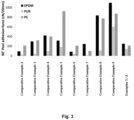
- a ZwickRoell Z2.5 tensometer in tensile mode was used to measure the peel adhesion force of the double-sided adhesive tape (60 mm x 20 mm) on the three different types of foams.
- the double-sided adhesive tapes were first applied on the foams and laminated by rolling a 2 kg rubber roller twice to prepare foam complexes. Each foam complex was placed in an oven at 60 °C for 2 hours, and left to cool to room temperature before measurement.
- a PET strip with a thickness of 37 ⁇ m was applied as a backing layer on each double-sided adhesive tape.
- the PET backing was fixed in the upper clamp of the apparatus and the foam complex was maintained at an angle of 90° during the peel test.
- the upper clamp of the apparatus was then moved 40 mm upward at a speed of 10 mm/min. Each measurement was done in duplicate.
- Non ⁇ selectivity performance Peel on EPDM + Peel on PUR + Peel on PE Standard deviation Peel
- Examples 1 and 2 of the present invention exhibit an outstanding non-selectivity performance, providing excellent adhesion to a wide range of foam types, and thereby overcoming the disadvantages of the tackified adhesives of Comparative Examples 2 to 9.
- Examples 1 and 2 according to the present invention provide for a substantially smaller delamination distance and hence remarkably improved foam conformability in comparison to Comparative Examples 2 to 9.
- no emulsion-based acrylic PSA tape could reach a delamination distance of less 10 mm, as opposed to Examples 1 and 2.
- VDA 278 specifications the values for VOC and FOG are obtained by integrating the peak areas within the carbon number range defined by VDA 278 from the gas chromatograms of the samples. Samples of around 40 mg were used for the test. The samples were measured 2 times for VOC, the sample with the highest VOC value was then used for the fogging measurement (FOG).
- VOC/FOG The results of the VOC/FOG measurements are shown in Fig. 6 .
- the emissions levels are favourably low and well within specifications of automotive OEMs (VOC ⁇ 100 ppm and FOG ⁇ 250 ppm).
- VOC emissions were low (40 ppm) because of the polymerization procedure and no FOG emissions (0 ppm) were observed due to the absence of resins in the formulation.
- Comparative Example 9 which showed the highest peel adhesion values with EPDM, PUR and PE, exhibited the highest emissions, well above the requirements of automotive OEMs.
- the acrylic pressure-sensitive adhesive composition according to the present invention is unique in that it enables production of PSA tapes which reduce or even entirely avoid VOC or FOG emissions while simultaneously displaying favourably high adhesion on different types of foams and a particularly high conformability both at ambient and at elevated temperatures.
Landscapes
- Chemical & Material Sciences (AREA)
- Organic Chemistry (AREA)
- Chemical Kinetics & Catalysis (AREA)
- Adhesives Or Adhesive Processes (AREA)
Claims (15)
- Acryl-Haftklebstoffzusammensetzung, umfassend ein Acrylpolymer, das als Monomerkomponenten umfasst:a) ein Alkyl(meth)acrylat mit einer Alkylgruppe mit 2 bis 14 Kohlenstoffatomen;b) mindestens ein α,β-ethylenisch ungesättigtes Carbonsäuremonomer oder α,β-ethylenisch ungesättigtes Carbonsäureestermonomer, das von Komponente a) verschieden ist; undc) ein Alkoxysilylgruppen enthaltendes Monomer;wobei das Acrylpolymer ein gewichtsmittleres Molekulargewicht (Mw) von weniger als 1000 kDa aufweist,wobei die Acryl-Haftklebstoffzusammensetzung einen Klebrigmacher in einer Menge bezogen auf das Gesamtgewicht des Acrylpolymers von 0,2 Gew.-% oder weniger enthält, undwobei der Polydispersitätsindex (PDI) des Acrylpolymers, definiert als das Verhältnis des gewichtsmittleren Molekulargewichts (Mw) zum zahlenmittleren Molekulargewicht (Mn) des Acrylpolymers, zwischen 1,5 und 4,5 liegt, wobei das gewichtsmittlere Molekulargewicht (Mw) und das zahlenmittlere Molekulargewicht (Mn) durch Gelpermeationschromatographie (GPC) gemessen werden.
- Acryl-Haftklebstoffzusammensetzung nach Anspruch 1, wobei die Acryl-Haftklebstoffzusammensetzung keinen Klebrigmacher enthält.
- Acryl-Haftklebstoffzusammensetzung nach einem der Ansprüche 1 oder 2,wobei das Acrylpolymer ein durch Gelpermeationschromatographie gemessenes gewichtsmittleres Molekulargewicht (Mw) im Bereich von mehr als 200 kDa und 800 kDa oder weniger, vorzugsweise von 300 bis 600 kDa, weiter vorzugsweise von 350 bis 550 kDa oder besonders bevorzugt von 370 bis 490 kDa, aufweist; und/oderwobei das Acrylpolymer ein durch Gelpermeationschromatographie gemessenes zahlenmittleres Molekulargewicht (Mn) von weniger als 500 kDa, vorzugsweise im Bereich von 50 bis 300 kDa, weiter vorzugsweise von 70 bis 250 kDa oder besonders bevorzugt von 100 bis 200 kDa aufweist.
- Acryl-Haftklebstoffzusammensetzung gemäß einem der Ansprüche 1 bis 3, wobei die Glasübergangstemperatur Tg des Acrylpolymers niedriger als -20 °C ist, vorzugsweise zwischen -80 °C und -30 °C, ferner bevorzugt zwischen -75 °C und -40 °C, besonders bevorzugt zwischen -70 °C bis -48 °C, wobei die Glasübergangstemperatur Tg mittels einer Differentialthermoanalyse bestimmt wird, bei der das Acrylpolymer mit einer Rate von 10 °C/min auf 130 °C erhitzt, auf -90 °C abgekühlt und erneut auf 130 °C erhitzt wird.
- Acryl-Haftklebstoffzusammensetzung gemäß einem der Ansprüche 1 bis 4, wobei die Acryl-Haftklebstoffzusammensetzung einen Gelgehalt im Bereich von 15 bis 45 % und vorzugsweise von 20 bis 40 % aufweist, wobei der Gelgehalt gemäß den in der Beschreibung angegebenen Verfahren bestimmt wird.
- Acryl-Haftklebstoffzusammensetzung gemäß einem der Ansprüche 1 bis 5, wobei das mindestens eine α,β-ethylenisch ungesättigte Carbonsäuremonomer oder α,β-ethylenisch ungesättigte Carbonsäureestermonomer aus Methylmethacrylat, Acrylsäure, Methacrylsäure und Kombinationen davon ausgewählt ist und vorzugsweise Methylmethacrylat, Acrylsäure und Methacrylsäure umfasst.
- Acryl-Haftkleberzusammensetzung gemäß einem der Ansprüche 1 bis 6, wobei das Alkoxysilylgruppen enthaltende Monomer ein Alkoxysilylgruppen enthaltendes Acrylatmonomer oder ein Alkoxysilylgruppen enthaltendes Vinylmonomer, vorzugsweise ein Alkoxysilylgruppen enthaltendes Acrylatmonomer, ist.
- Acryl-Haftkleberzusammensetzung gemäß einem der Ansprüche 1 bis 7, wobei die Menge der Komponente a) zwischen 60 und 97 Gewichtsteilen liegt, die (Gesamt-)Menge der Komponente(n) b) zwischen 2 bis 40 Gewichtsteilen liegt und die Menge der Komponente c) zwischen 0,001 und 1 Gewichtsteil liegt, wobei jede Menge in Bezug auf 100 Gewichtsteile der Gesamtmenge der Monomerkomponenten angegeben ist.
- Acryl-Haftklebstoffzusammensetzung gemäß einem der Ansprüche 1 bis 8, wobei die Menge der Komponente c) zwischen 0,005 und 0,05 Gewichtsteilen bezogen auf 100 Gewichtsteile der Gesamtmenge an Monomerkomponenten beträgt, vorzugsweise zwischen 0,01 und 0,03 Gewichtsteilen.
- Acryl-Haftklebstoffzusammensetzung gemäß einem der Ansprüche 1 bis 9, die ferner ein Kettenübertragungsmittel in einer Menge von 0,001 bis 0,3 Gewichtsteilen bezogen auf 100 Gewichtsteile der Gesamtmenge an Monomerkomponenten umfasst, vorzugsweise zwischen 0,02 und 0,1 Gewichtsteilen.
- Acryl-Haftklebstoffzusammensetzung gemäß einem der Ansprüche 1 bis 10, wobei das Acrylpolymer ein wasserdispergierbares Acrylpolymer ist, welches mittels Emulsionspolymerisation hergestellt wird.
- Verwendung der Acryl-Haftklebstoffzusammensetzung gemäß einem der Ansprüche 1 bis 11 zur Anwendung auf geschäumte Substratoberflächen.
- Haftklebeband, umfassend eine Klebstoffschicht auf mindestens einer Oberfläche einer Trägerschicht und eine optionale Trennschicht, die auf der Klebstoffschicht bereitgestellt ist, wobei die Klebstoffschicht die Acryl-Haftklebstoffzusammensetzung gemäß einem der Ansprüche 1 bis 11 umfasst.
- Haftklebeband nach Anspruch 13, wobei das Band ein doppelseitiges Haftklebeband ist, bei dem die Klebstoffschicht auf mindestens einer Oberfläche der Trägerschicht vorgesehen ist.
- Klebstofflaminat auf Schaumbasis, umfassend eine Schaumstoffbahn und eine Klebstoffschicht, die die Acryl-Haftklebstoffzusammensetzung gemäß einem der Ansprüche 1 bis 11 oder das doppelseitige Haftklebeband gemäß Anspruch 14 auf einer Oberfläche der Schaumstoffbahn umfasst.
Priority Applications (1)
| Application Number | Priority Date | Filing Date | Title |
|---|---|---|---|
| EP21177906.1A EP4101906B1 (de) | 2021-06-07 | 2021-06-07 | Druckempfindliche klebstoffzusammensetzung zum kleben an geschäumten oberflächen und entsprechenade bänder und laminate |
Applications Claiming Priority (1)
| Application Number | Priority Date | Filing Date | Title |
|---|---|---|---|
| EP21177906.1A EP4101906B1 (de) | 2021-06-07 | 2021-06-07 | Druckempfindliche klebstoffzusammensetzung zum kleben an geschäumten oberflächen und entsprechenade bänder und laminate |
Publications (2)
| Publication Number | Publication Date |
|---|---|
| EP4101906A1 EP4101906A1 (de) | 2022-12-14 |
| EP4101906B1 true EP4101906B1 (de) | 2025-02-26 |
Family
ID=76641573
Family Applications (1)
| Application Number | Title | Priority Date | Filing Date |
|---|---|---|---|
| EP21177906.1A Active EP4101906B1 (de) | 2021-06-07 | 2021-06-07 | Druckempfindliche klebstoffzusammensetzung zum kleben an geschäumten oberflächen und entsprechenade bänder und laminate |
Country Status (1)
| Country | Link |
|---|---|
| EP (1) | EP4101906B1 (de) |
Family Cites Families (6)
| Publication number | Priority date | Publication date | Assignee | Title |
|---|---|---|---|---|
| JP5607337B2 (ja) | 2009-10-27 | 2014-10-15 | リンテック株式会社 | 水分散型アクリル系粘着剤組成物、粘着シート及びその製造方法 |
| JP6073575B2 (ja) * | 2012-05-30 | 2017-02-01 | 日東電工株式会社 | 粘着剤組成物および粘着シート |
| JP6180294B2 (ja) * | 2013-11-21 | 2017-08-16 | 花王株式会社 | シート用液状化粧料組成物及びシート状化粧料 |
| JP6468727B2 (ja) * | 2014-05-19 | 2019-02-13 | 日東電工株式会社 | 水分散型粘着剤組成物および粘着シート |
| JP2017071784A (ja) * | 2016-11-15 | 2017-04-13 | 日東電工株式会社 | 粘着剤組成物および粘着シート |
| JP6590046B2 (ja) | 2018-08-07 | 2019-10-16 | Dic株式会社 | 粘着テープの製造方法 |
-
2021
- 2021-06-07 EP EP21177906.1A patent/EP4101906B1/de active Active
Also Published As
| Publication number | Publication date |
|---|---|
| EP4101906A1 (de) | 2022-12-14 |
Similar Documents
| Publication | Publication Date | Title |
|---|---|---|
| TWI846812B (zh) | 黏著片材 | |
| US8586186B2 (en) | Pressure-sensitive adhesive sheet | |
| KR101824852B1 (ko) | 점착 시트 | |
| EP2310470B1 (de) | Oberflächenenergiearmer klebstoff | |
| EP1829947A2 (de) | Druckempfindliche Klebefolie | |
| JP6073575B2 (ja) | 粘着剤組成物および粘着シート | |
| WO2013005506A1 (ja) | 水分散型粘着剤組成物、粘着剤及び粘着シート | |
| KR20150016160A (ko) | 감압 접착제 | |
| JP7715300B1 (ja) | 粘着剤、粘着シート、積層体 | |
| JP7125259B2 (ja) | 粘着シート | |
| JP2013189645A (ja) | 粘着シート類 | |
| CN105555898A (zh) | 水分散型粘合剂组合物和粘合片 | |
| EP3296375A1 (de) | Druckempfindliche haftmittelzusammensetzung | |
| EP4101906A1 (de) | Druckempfindliche klebstoffzusammensetzung zum kleben an geschäumten oberflächen und entsprechenade bänder und laminate | |
| KR102659187B1 (ko) | 점착 시트 | |
| JP7198576B2 (ja) | 粘着剤組成物及び粘着シート | |
| EP4428167A1 (de) | Emulsionsbasierte druckempfindliche haftzusammensetzungen und diese enthaltende bänder oder folien | |
| JPH10183085A (ja) | 粘着剤組成物及び粘着加工品 | |
| EP4428162A1 (de) | Druckempfindliche klebstoffzusammensetzungen auf emulsionsbasis und bänder oder folien mit verbesserter wärmestabilität | |
| EP4174097B1 (de) | Polymer auf basis von acrylemulsion und haftkleberzusammensetzungen damit | |
| US20250084244A1 (en) | Composite adhesives | |
| TWI924991B (zh) | 補強膜 | |
| TWI924990B (zh) | 補強膜 | |
| TWI908881B (zh) | 黏著片 | |
| KR20230132711A (ko) | 보강 필름 |
Legal Events
| Date | Code | Title | Description |
|---|---|---|---|
| PUAI | Public reference made under article 153(3) epc to a published international application that has entered the european phase |
Free format text: ORIGINAL CODE: 0009012 |
|
| STAA | Information on the status of an ep patent application or granted ep patent |
Free format text: STATUS: THE APPLICATION HAS BEEN PUBLISHED |
|
| AK | Designated contracting states |
Kind code of ref document: A1 Designated state(s): AL AT BE BG CH CY CZ DE DK EE ES FI FR GB GR HR HU IE IS IT LI LT LU LV MC MK MT NL NO PL PT RO RS SE SI SK SM TR |
|
| STAA | Information on the status of an ep patent application or granted ep patent |
Free format text: STATUS: REQUEST FOR EXAMINATION WAS MADE |
|
| 17P | Request for examination filed |
Effective date: 20230614 |
|
| RBV | Designated contracting states (corrected) |
Designated state(s): AL AT BE BG CH CY CZ DE DK EE ES FI FR GB GR HR HU IE IS IT LI LT LU LV MC MK MT NL NO PL PT RO RS SE SI SK SM TR |
|
| GRAP | Despatch of communication of intention to grant a patent |
Free format text: ORIGINAL CODE: EPIDOSNIGR1 |
|
| STAA | Information on the status of an ep patent application or granted ep patent |
Free format text: STATUS: GRANT OF PATENT IS INTENDED |
|
| INTG | Intention to grant announced |
Effective date: 20241125 |
|
| RIC1 | Information provided on ipc code assigned before grant |
Ipc: C09J 7/26 20180101ALI20241118BHEP Ipc: C09J 143/04 20060101ALI20241118BHEP Ipc: C09J 7/38 20180101ALI20241118BHEP Ipc: C09J 133/08 20060101AFI20241118BHEP |
|
| GRAS | Grant fee paid |
Free format text: ORIGINAL CODE: EPIDOSNIGR3 |
|
| GRAA | (expected) grant |
Free format text: ORIGINAL CODE: 0009210 |
|
| STAA | Information on the status of an ep patent application or granted ep patent |
Free format text: STATUS: THE PATENT HAS BEEN GRANTED |
|
| AK | Designated contracting states |
Kind code of ref document: B1 Designated state(s): AL AT BE BG CH CY CZ DE DK EE ES FI FR GB GR HR HU IE IS IT LI LT LU LV MC MK MT NL NO PL PT RO RS SE SI SK SM TR |
|
| REG | Reference to a national code |
Ref country code: GB Ref legal event code: FG4D |
|
| REG | Reference to a national code |
Ref country code: CH Ref legal event code: EP |
|
| REG | Reference to a national code |
Ref country code: DE Ref legal event code: R096 Ref document number: 602021026647 Country of ref document: DE |
|
| REG | Reference to a national code |
Ref country code: IE Ref legal event code: FG4D |
|
| REG | Reference to a national code |
Ref country code: NL Ref legal event code: MP Effective date: 20250226 |
|
| PG25 | Lapsed in a contracting state [announced via postgrant information from national office to epo] |
Ref country code: RS Free format text: LAPSE BECAUSE OF FAILURE TO SUBMIT A TRANSLATION OF THE DESCRIPTION OR TO PAY THE FEE WITHIN THE PRESCRIBED TIME-LIMIT Effective date: 20250526 |
|
| PG25 | Lapsed in a contracting state [announced via postgrant information from national office to epo] |
Ref country code: FI Free format text: LAPSE BECAUSE OF FAILURE TO SUBMIT A TRANSLATION OF THE DESCRIPTION OR TO PAY THE FEE WITHIN THE PRESCRIBED TIME-LIMIT Effective date: 20250226 |
|
| PG25 | Lapsed in a contracting state [announced via postgrant information from national office to epo] |
Ref country code: PL Free format text: LAPSE BECAUSE OF FAILURE TO SUBMIT A TRANSLATION OF THE DESCRIPTION OR TO PAY THE FEE WITHIN THE PRESCRIBED TIME-LIMIT Effective date: 20250226 |
|
| PG25 | Lapsed in a contracting state [announced via postgrant information from national office to epo] |
Ref country code: ES Free format text: LAPSE BECAUSE OF FAILURE TO SUBMIT A TRANSLATION OF THE DESCRIPTION OR TO PAY THE FEE WITHIN THE PRESCRIBED TIME-LIMIT Effective date: 20250226 |
|
| REG | Reference to a national code |
Ref country code: LT Ref legal event code: MG9D |
|
| PG25 | Lapsed in a contracting state [announced via postgrant information from national office to epo] |
Ref country code: NO Free format text: LAPSE BECAUSE OF FAILURE TO SUBMIT A TRANSLATION OF THE DESCRIPTION OR TO PAY THE FEE WITHIN THE PRESCRIBED TIME-LIMIT Effective date: 20250526 Ref country code: IS Free format text: LAPSE BECAUSE OF FAILURE TO SUBMIT A TRANSLATION OF THE DESCRIPTION OR TO PAY THE FEE WITHIN THE PRESCRIBED TIME-LIMIT Effective date: 20250626 |
|
| PG25 | Lapsed in a contracting state [announced via postgrant information from national office to epo] |
Ref country code: NL Free format text: LAPSE BECAUSE OF FAILURE TO SUBMIT A TRANSLATION OF THE DESCRIPTION OR TO PAY THE FEE WITHIN THE PRESCRIBED TIME-LIMIT Effective date: 20250226 |
|
| PG25 | Lapsed in a contracting state [announced via postgrant information from national office to epo] |
Ref country code: HR Free format text: LAPSE BECAUSE OF FAILURE TO SUBMIT A TRANSLATION OF THE DESCRIPTION OR TO PAY THE FEE WITHIN THE PRESCRIBED TIME-LIMIT Effective date: 20250226 |
|
| PG25 | Lapsed in a contracting state [announced via postgrant information from national office to epo] |
Ref country code: LV Free format text: LAPSE BECAUSE OF FAILURE TO SUBMIT A TRANSLATION OF THE DESCRIPTION OR TO PAY THE FEE WITHIN THE PRESCRIBED TIME-LIMIT Effective date: 20250226 Ref country code: PT Free format text: LAPSE BECAUSE OF FAILURE TO SUBMIT A TRANSLATION OF THE DESCRIPTION OR TO PAY THE FEE WITHIN THE PRESCRIBED TIME-LIMIT Effective date: 20250626 |
|
| PG25 | Lapsed in a contracting state [announced via postgrant information from national office to epo] |
Ref country code: GR Free format text: LAPSE BECAUSE OF FAILURE TO SUBMIT A TRANSLATION OF THE DESCRIPTION OR TO PAY THE FEE WITHIN THE PRESCRIBED TIME-LIMIT Effective date: 20250527 Ref country code: BG Free format text: LAPSE BECAUSE OF FAILURE TO SUBMIT A TRANSLATION OF THE DESCRIPTION OR TO PAY THE FEE WITHIN THE PRESCRIBED TIME-LIMIT Effective date: 20250226 |
|
| REG | Reference to a national code |
Ref country code: AT Ref legal event code: MK05 Ref document number: 1770613 Country of ref document: AT Kind code of ref document: T Effective date: 20250226 |
|
| PG25 | Lapsed in a contracting state [announced via postgrant information from national office to epo] |
Ref country code: SE Free format text: LAPSE BECAUSE OF FAILURE TO SUBMIT A TRANSLATION OF THE DESCRIPTION OR TO PAY THE FEE WITHIN THE PRESCRIBED TIME-LIMIT Effective date: 20250226 |
|
| PG25 | Lapsed in a contracting state [announced via postgrant information from national office to epo] |
Ref country code: SM Free format text: LAPSE BECAUSE OF FAILURE TO SUBMIT A TRANSLATION OF THE DESCRIPTION OR TO PAY THE FEE WITHIN THE PRESCRIBED TIME-LIMIT Effective date: 20250226 |
|
| PG25 | Lapsed in a contracting state [announced via postgrant information from national office to epo] |
Ref country code: DK Free format text: LAPSE BECAUSE OF FAILURE TO SUBMIT A TRANSLATION OF THE DESCRIPTION OR TO PAY THE FEE WITHIN THE PRESCRIBED TIME-LIMIT Effective date: 20250226 |
|
| PG25 | Lapsed in a contracting state [announced via postgrant information from national office to epo] |
Ref country code: IT Free format text: LAPSE BECAUSE OF FAILURE TO SUBMIT A TRANSLATION OF THE DESCRIPTION OR TO PAY THE FEE WITHIN THE PRESCRIBED TIME-LIMIT Effective date: 20250226 |
|
| PG25 | Lapsed in a contracting state [announced via postgrant information from national office to epo] |
Ref country code: AT Free format text: LAPSE BECAUSE OF FAILURE TO SUBMIT A TRANSLATION OF THE DESCRIPTION OR TO PAY THE FEE WITHIN THE PRESCRIBED TIME-LIMIT Effective date: 20250226 |
|
| PG25 | Lapsed in a contracting state [announced via postgrant information from national office to epo] |
Ref country code: EE Free format text: LAPSE BECAUSE OF FAILURE TO SUBMIT A TRANSLATION OF THE DESCRIPTION OR TO PAY THE FEE WITHIN THE PRESCRIBED TIME-LIMIT Effective date: 20250226 Ref country code: CZ Free format text: LAPSE BECAUSE OF FAILURE TO SUBMIT A TRANSLATION OF THE DESCRIPTION OR TO PAY THE FEE WITHIN THE PRESCRIBED TIME-LIMIT Effective date: 20250226 |
|
| PG25 | Lapsed in a contracting state [announced via postgrant information from national office to epo] |
Ref country code: RO Free format text: LAPSE BECAUSE OF FAILURE TO SUBMIT A TRANSLATION OF THE DESCRIPTION OR TO PAY THE FEE WITHIN THE PRESCRIBED TIME-LIMIT Effective date: 20250226 |
|
| PG25 | Lapsed in a contracting state [announced via postgrant information from national office to epo] |
Ref country code: SK Free format text: LAPSE BECAUSE OF FAILURE TO SUBMIT A TRANSLATION OF THE DESCRIPTION OR TO PAY THE FEE WITHIN THE PRESCRIBED TIME-LIMIT Effective date: 20250226 |
|
| REG | Reference to a national code |
Ref country code: DE Ref legal event code: R097 Ref document number: 602021026647 Country of ref document: DE |
|
| PLBE | No opposition filed within time limit |
Free format text: ORIGINAL CODE: 0009261 |
|
| STAA | Information on the status of an ep patent application or granted ep patent |
Free format text: STATUS: NO OPPOSITION FILED WITHIN TIME LIMIT |
|
| REG | Reference to a national code |
Ref country code: CH Ref legal event code: L10 Free format text: ST27 STATUS EVENT CODE: U-0-0-L10-L00 (AS PROVIDED BY THE NATIONAL OFFICE) Effective date: 20260107 |
|
| PGFP | Annual fee paid to national office [announced via postgrant information from national office to epo] |
Ref country code: DE Payment date: 20251015 Year of fee payment: 5 |
|
| REG | Reference to a national code |
Ref country code: CH Ref legal event code: H13 Free format text: ST27 STATUS EVENT CODE: U-0-0-H10-H13 (AS PROVIDED BY THE NATIONAL OFFICE) Effective date: 20260127 |
|
| PG25 | Lapsed in a contracting state [announced via postgrant information from national office to epo] |
Ref country code: MC Free format text: LAPSE BECAUSE OF FAILURE TO SUBMIT A TRANSLATION OF THE DESCRIPTION OR TO PAY THE FEE WITHIN THE PRESCRIBED TIME-LIMIT Effective date: 20250226 |
|
| 26N | No opposition filed |
Effective date: 20251127 |
|
| PG25 | Lapsed in a contracting state [announced via postgrant information from national office to epo] |
Ref country code: LU Free format text: LAPSE BECAUSE OF NON-PAYMENT OF DUE FEES Effective date: 20250607 |
|
| GBPC | Gb: european patent ceased through non-payment of renewal fee |
Effective date: 20250607 |
|
| REG | Reference to a national code |
Ref country code: BE Ref legal event code: MM Effective date: 20250630 |
|
| PG25 | Lapsed in a contracting state [announced via postgrant information from national office to epo] |
Ref country code: GB Free format text: LAPSE BECAUSE OF NON-PAYMENT OF DUE FEES Effective date: 20250607 |
|
| PG25 | Lapsed in a contracting state [announced via postgrant information from national office to epo] |
Ref country code: IE Free format text: LAPSE BECAUSE OF NON-PAYMENT OF DUE FEES Effective date: 20250607 |
|
| PG25 | Lapsed in a contracting state [announced via postgrant information from national office to epo] |
Ref country code: BE Free format text: LAPSE BECAUSE OF NON-PAYMENT OF DUE FEES Effective date: 20250630 |
|
| PG25 | Lapsed in a contracting state [announced via postgrant information from national office to epo] |
Ref country code: FR Free format text: LAPSE BECAUSE OF NON-PAYMENT OF DUE FEES Effective date: 20250630 |
|
| PG25 | Lapsed in a contracting state [announced via postgrant information from national office to epo] |
Ref country code: CH Free format text: LAPSE BECAUSE OF NON-PAYMENT OF DUE FEES Effective date: 20250630 |