EP4098718A1 - Verfahren zur herstellung von bioöl aus fettsäure mit hohem säurewert - Google Patents
Verfahren zur herstellung von bioöl aus fettsäure mit hohem säurewert Download PDFInfo
- Publication number
- EP4098718A1 EP4098718A1 EP21748318.9A EP21748318A EP4098718A1 EP 4098718 A1 EP4098718 A1 EP 4098718A1 EP 21748318 A EP21748318 A EP 21748318A EP 4098718 A1 EP4098718 A1 EP 4098718A1
- Authority
- EP
- European Patent Office
- Prior art keywords
- oil
- bio
- reactor
- fatty acid
- reaction
- Prior art date
- Legal status (The legal status is an assumption and is not a legal conclusion. Google has not performed a legal analysis and makes no representation as to the accuracy of the status listed.)
- Pending
Links
Images

Classifications
-
- C—CHEMISTRY; METALLURGY
- C11—ANIMAL OR VEGETABLE OILS, FATS, FATTY SUBSTANCES OR WAXES; FATTY ACIDS THEREFROM; DETERGENTS; CANDLES
- C11C—FATTY ACIDS FROM FATS, OILS OR WAXES; CANDLES; FATS, OILS OR FATTY ACIDS BY CHEMICAL MODIFICATION OF FATS, OILS, OR FATTY ACIDS OBTAINED THEREFROM
- C11C3/00—Fats, oils, or fatty acids by chemical modification of fats, oils, or fatty acids obtained therefrom
- C11C3/02—Fats, oils, or fatty acids by chemical modification of fats, oils, or fatty acids obtained therefrom by esterification of fatty acids with glycerol
-
- A—HUMAN NECESSITIES
- A23—FOODS OR FOODSTUFFS; TREATMENT THEREOF, NOT COVERED BY OTHER CLASSES
- A23D—EDIBLE OILS OR FATS, e.g. MARGARINES, SHORTENINGS OR COOKING OILS
- A23D9/00—Other edible oils or fats, e.g. shortenings or cooking oils
- A23D9/02—Other edible oils or fats, e.g. shortenings or cooking oils characterised by the production or working-up
-
- A—HUMAN NECESSITIES
- A23—FOODS OR FOODSTUFFS; TREATMENT THEREOF, NOT COVERED BY OTHER CLASSES
- A23D—EDIBLE OILS OR FATS, e.g. MARGARINES, SHORTENINGS OR COOKING OILS
- A23D9/00—Other edible oils or fats, e.g. shortenings or cooking oils
- A23D9/02—Other edible oils or fats, e.g. shortenings or cooking oils characterised by the production or working-up
- A23D9/04—Working-up
-
- C—CHEMISTRY; METALLURGY
- C10—PETROLEUM, GAS OR COKE INDUSTRIES; TECHNICAL GASES CONTAINING CARBON MONOXIDE; FUELS; LUBRICANTS; PEAT
- C10G—CRACKING HYDROCARBON OILS; PRODUCTION OF LIQUID HYDROCARBON MIXTURES, e.g. BY DESTRUCTIVE HYDROGENATION, OLIGOMERISATION, POLYMERISATION; RECOVERY OF HYDROCARBON OILS FROM OIL-SHALE, OIL-SAND, OR GASES; REFINING MIXTURES MAINLY CONSISTING OF HYDROCARBONS; REFORMING OF NAPHTHA; MINERAL WAXES
- C10G3/00—Production of liquid hydrocarbon mixtures from oxygen-containing organic materials, e.g. fatty oils, fatty acids
-
- C—CHEMISTRY; METALLURGY
- C10—PETROLEUM, GAS OR COKE INDUSTRIES; TECHNICAL GASES CONTAINING CARBON MONOXIDE; FUELS; LUBRICANTS; PEAT
- C10L—FUELS NOT OTHERWISE PROVIDED FOR; NATURAL GAS; SYNTHETIC NATURAL GAS OBTAINED BY PROCESSES NOT COVERED BY SUBCLASSES C10G OR C10K; LIQUIFIED PETROLEUM GAS; USE OF ADDITIVES TO FUELS OR FIRES; FIRE-LIGHTERS
- C10L1/00—Liquid carbonaceous fuels
- C10L1/02—Liquid carbonaceous fuels essentially based on components consisting of carbon, hydrogen, and oxygen only
-
- C—CHEMISTRY; METALLURGY
- C11—ANIMAL OR VEGETABLE OILS, FATS, FATTY SUBSTANCES OR WAXES; FATTY ACIDS THEREFROM; DETERGENTS; CANDLES
- C11B—PRODUCING, e.g. BY PRESSING RAW MATERIALS OR BY EXTRACTION FROM WASTE MATERIALS, REFINING OR PRESERVING FATS, FATTY SUBSTANCES, e.g. LANOLIN, FATTY OILS OR WAXES; ESSENTIAL OILS; PERFUMES
- C11B13/00—Recovery of fats, fatty oils or fatty acids from waste materials
- C11B13/02—Recovery of fats, fatty oils or fatty acids from waste materials from soap stock
-
- C—CHEMISTRY; METALLURGY
- C11—ANIMAL OR VEGETABLE OILS, FATS, FATTY SUBSTANCES OR WAXES; FATTY ACIDS THEREFROM; DETERGENTS; CANDLES
- C11B—PRODUCING, e.g. BY PRESSING RAW MATERIALS OR BY EXTRACTION FROM WASTE MATERIALS, REFINING OR PRESERVING FATS, FATTY SUBSTANCES, e.g. LANOLIN, FATTY OILS OR WAXES; ESSENTIAL OILS; PERFUMES
- C11B3/00—Refining fats or fatty oils
- C11B3/12—Refining fats or fatty oils by distillation
-
- C—CHEMISTRY; METALLURGY
- C11—ANIMAL OR VEGETABLE OILS, FATS, FATTY SUBSTANCES OR WAXES; FATTY ACIDS THEREFROM; DETERGENTS; CANDLES
- C11C—FATTY ACIDS FROM FATS, OILS OR WAXES; CANDLES; FATS, OILS OR FATTY ACIDS BY CHEMICAL MODIFICATION OF FATS, OILS, OR FATTY ACIDS OBTAINED THEREFROM
- C11C3/00—Fats, oils, or fatty acids by chemical modification of fats, oils, or fatty acids obtained therefrom
- C11C3/04—Fats, oils, or fatty acids by chemical modification of fats, oils, or fatty acids obtained therefrom by esterification of fats or fatty oils
- C11C3/06—Fats, oils, or fatty acids by chemical modification of fats, oils, or fatty acids obtained therefrom by esterification of fats or fatty oils with glycerol
Definitions
- the present disclosure relates to a method for producing bio-oil from fat and oil with high acid values and, more specifically, to a method for producing bio-oil usable as bio heavy oil and bio-marine fuel oil from fat and oil with high acid values.
- Bio-heavy oil for power generation is prepared using bio-based fat and oil resources, such as animal and vegetable oils and biodiesel process by-products, etc., as raw materials, and is an alternative fuel to heavy oil (bunker-C oil).
- bio-heavy oil is used as a heavy oil generator fuel for power generators.
- a pilot project of bio-heavy oil was launched in 2014, and after the feasibility evaluation, the main project began in 2019.
- IMO 2020 is an annex of the International Convention for the Prevention of Pollution from Ships (MARPOL) adopted by the International Marine Organization (IMO).
- MARPOL International Convention for the Prevention of Pollution from Ships
- IMO International Marine Organization
- a new limit on the sulphur environment (content) in the fuel oil used on board ships came into force.
- the sulphur cap in marine fuel oil is reduced to 0.5% from 3.5%.
- bio-oil basically has a low sulfur content and as such, when burned in an internal combustion engine, generates less sulfur oxide than conventional coal-derived oil.
- Bio-heavy oil or bio-marine fuel oil should be manufactured to be below a certain level of acid value because a high acid value can cause corrosion of internal devices and facilities. For this reason, raw materials for bio-heavy oil or bio-marine fuel oil should be low in acid value, and raw materials with high acid values can be used only after taking a measure to lower the acid values.
- Methods for removing free fatty acids to lower acid values of fat and oil in a general oil refining process includes removal of free fatty acids through neutralization with an alkaline aqueous solution and removal through free fatty acids through distillation.
- the method of neutralizing with an aqueous alkali solution has the problem in that a large amount of wastewater is generated.
- a method for converting free fatty acids into bio-oil is proposed.
- a method for production bio-oil without removing free fatty acids from fat and oil with high acid values may be exemplified by reacting fatty acid with glycerin to produce bio-oil (glyceride).
- glyceride is intended to encompass all mono-, di-, and triglycerides.
- bio-diesel FAME
- FAME fatty acid-rich oil
- MeOH methanol
- a catalyst is employed or the reaction product water is continuously removed during the reaction process.
- U.S. Patent No. 13/92435 discloses that the reaction is conducted in the presence of a solid catalyst.
- the reaction using the catalyst suffers from high production cost not only because the catalyst is expensive, but also because the lifespan of the catalyst becomes short as it is poisoned with impurities or carbon deposits.
- the water is removed in the form of vapor to induce a smooth reaction.
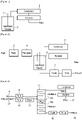
- FIG. 1 is a configurational scheme of a batch reactor conventionally used for production of bio-oil. As shown in FIG. 1 , one reactor (1) is equipped with one stirrer (3). Although reactants and products are neither fed nor drawn during the reaction therein, the batch reactor is structured to continuously remove the byproduct water produced due to esterification through a condenser (5).
- Chinese Patent Numbers CN 2012-10580909 , and CN 2018-10088660 suggest a method in which a catalyst-free reaction is conducted in a slight vacuum/reduced pressure condition or under a nitrogen flow in an atmospheric pressure condition, with the water being well removed.
- Korean Patent Number 10-1073721 discloses a method in which the reaction is conducted in the presence of a catalyst in a slight vacuum/reduced pressure condition or under a nitrogen flow in an atmospheric pressure condition with the byproduct water being removed.
- a batch reactor needs a device for readily removing the byproduct water so as to increase the reactivity.
- a batch reaction process requires a time for feeding raw materials, releasing the product, elevating the temperature, etc., suffering from the problem of lower output, higher production cost, and more operating manpower than continuous reaction processes.
- FIG. 2 is a schematic view of a continuous stirred tank reactor (CSTR).
- CSTR continuous stirred tank reactor
- a raw material is fed by a pump (2) into a reactor (6) while being heated by a heating device (4).
- the product generated in the reactor (6) is released from the lower part of the reactor while being cooled by a cooler (7).
- the by-product water formed through the esterification is distilled toward the top of the reactor and can be removed by a condenser (8).
- Korean Patent Number 10-1073721 when 583.9 g of soap stock was reacted, 654.68 g of glyceride was recovered and a total of distillation amounts to 58.58 g with about 3.5 ml of low-molecular weight fatty acids contained therein. This indicates that fatty acids were lost as a vapor in an amount of about 0.5 % by weight relative to the product, amounting to the about 5.5 % by weight of a total of distillation.
- a stirring-type reactor (batch-type reactor, CSTR reactor) is structured to be unable to recover the reactant and product released in a vapor form together with water during the removal of the byproduct water, with the resultant loss of main materials during the reaction process. Due to lack of the ability to effectively remove water without loss of the reactant and product, the reactor is not free from moisture content in raw materials.
- a stirring-type reactor cannot perfectly conduct a first-in first out process so that the feed stock cannot participate in the reaction, but excreted.
- a column-type reactor makes it possible to conduct a first-in first-out process, so that even a single reactor can guarantee sufficient reactivity.
- Some embodiments of the present disclosure provide a method for continuously producing bio-oil (glyceride) by reacting fatty acid with glycerin without using a catalyst.
- a method for producing bio-oil including the steps of: esterifying a feedstock containing glycerin and fatty acid to afford bio-oil and water in a column-type reactor which has a plurality of trays installed therein to form a plurality of compartments in the vertical direction inside the reactor, the plurality of trays each having an opening formed therein through which vertically adjacent compartments communicate with each other, with the openings in adjacent trays alternately formed in a crisscrossing manner, the feedstock containing glycerin and fatty acid being fed through respective material input ports located at the center of the column-type reactor to conduct the esterification in each tray of a reaction zone; obtaining the produced bio-oil through a lower part of the reactor; and removing the water produced through the esterification by vaporizing the water, moving the resulting water vapor to a distillation zone in an upper part of the reactor, along with the effective ingredients including the feedstock and the bio-oil
- the method for producing bio-oil from fat and oil with a high acid value is adapted to produce bio-oil (glyceride) in a continuous manner by reacting fatty acid and glycerin without using any catalyst in a column-type reactor which is structured to effectively remove the byproduct water, making purification of the raw material glycerin unnecessary, whereby glycerin can be used as a feedstock irrespective of the moisture content therein and the reaction yield can be increased, with the resultant economical production of bio-oil.
- Embodiments of the present disclosure are illustrated for describing the technical scope of the present disclosure.
- the scope of the claims according to the present disclosure is not limited to the embodiments described below or to the detailed descriptions of these embodiments.
- the term "about” is intended to include an acceptable error range in view of manufacturing process for a particular value or a slight numerical modification to the particular value within the scope of the technical scope of the present disclosure.
- the term “about” means a range of ⁇ 10% of a given value, ⁇ 5% of a given value in an aspect, and ⁇ 2% of a given value in another aspect. For the field of this disclosure, this level of approximation is appropriate unless the value is specifically stated require a tighter range.
- FIG. 3 is an overall configurational scheme of a production apparatus used in a method for producing bio-oil according to an embodiment of the present disclosure.
- the reaction apparatus used in the present disclosure is a column-type reactor which has a plurality of trays installed therein to form a plurality of compartments in the vertical direction inside the reactor.
- the plurality of trays have respective openings formed therein through which vertically adjacent trays communicate with each other therethrough.
- the openings in adjacent trays are alternately positioned in a crisscrossing manner.
- a method for producing bio-oil according to the present disclosure includes the steps of: esterifying a feedstock (10') (hereinafter referred simply to as fatty acid, as necessary) containing glycerin (10) and fatty acid to afford bio-oil (glyceride) and water by feeding the feedstock into the column-type reactor through respective material input ports located at the center of the column-type reactor to conduct the esterification in each tray of a reaction zone (13b) positioned below the material input ports; obtaining the produced bio-oil (glyceride) through a lower part of the reactor; and removing the water produced through the esterification by vaporizing the water, moving the resulting water vapor to a distillation zone in an upper part of the reactor, along with the effective ingredients including the feedstock and the bio-oil which are converted into vapor upon the vaporization, separating the vapor into water and the effective ingredients (feedstock and bio-oil), allowing the effective ingredients to flow into the reaction zone and the separated water to be removed in a
- the glycerin (10) includes purified glycerin and crude glycerin.
- the glycerin may have a concentration of 3 to 100 % by mass and particularly 5 to 99 % by mass and, in greater detail, may include a crude glycerin ranging in concentration from 5 to 85 % by mass and a purified glycerin ranging in concentration from 99 to 100 % by mass.
- the crude glycerin generated in traditional fatty acid production processes or bio-diesel production processes may be readily used without further concentration and a liquid state may be preferred.
- the feedstock (10') including fatty acid may range in fatty acid content from 15 to 100 % by weight and preferably from 20 to 97 % by weight.
- the feedstock including fatty acid contains acid oil prepared by processing a soap stock.
- the soap stock is a soap substance resulting from the reaction of free fatty acid with an alkali added in the purification of vegetable oil. Soap stock is treated with sulfuric acid to afford acid oil.
- the feedstock including fatty acid is intended to encompass a fatty acid-containing feed among products or byproducts (e.g., fatty acid pitch) generated in a process for oleochemicals.
- oleochemicals refer to vegetable and animal oils and fats or chemicals derived therefrom.
- the feedstock including fatty acid may be a product or byproduct generated upon the production of oleochemicals and may preferably range in fatty acid content from 15 to 100 % by weight.
- the feedstock including fatty acid may further contain an oil including fatty acid as a result of oil expression and purification of vegetable/animal oils and fats (e.g., palm sludge oil, palm oil mill effluent, palm fatty acid distillate, etc.), recoverable oil (e.g., waste cooking oil, brown grease, etc.), and may be preferably vegetable and animal oil and fat with a fatty acid content of 15 to 100 % by weight.
- vegetable/animal oils and fats e.g., palm sludge oil, palm oil mill effluent, palm fatty acid distillate, etc.
- recoverable oil e.g., waste cooking oil, brown grease, etc.
- the feedstock including fatty acid may be fed in a heated state by a heater (12).
- the temperature of the heater (12) may be 100 to 250°C and preferably 150 to 250°C.
- the fatty acid may have an acid value greater than 30 mgKOH/g (high acid value) and may be preferably used in a liquid state.
- the heated feedstock can uniformly maintain the internal temperature of the reactor.
- the fatty acid may be heated before being fed because the input thereof is greater than that of the glycerin.
- a mixing ratio (molar ratio) of the feedstock including fatty acid to glycerin refers to a molar ratio of the fatty acid contained in the feedstock to glycerin and may range from 3: 0.5 to 3:2 and preferably from 3:0.75 to 3:1.
- An amount of glycerin less than the lower limit of the mixing ratio (molar ratio) range cannot achieve the desired acid value.
- the amount of glycerin exceeds the upper limit of the mixing ratio (molar ratio) range abundant glycerin remains unreacted in the final product.
- the produced bio-oil (glyceride) and glycerin are separated to different layers, necessitating an additional process of separating glycerin.
- oil and fat with a high acid value can be used to obtain bio-oil low in acid value.
- oil and fat with a high acid value refers to oil and fat having an acid value of more than 30 mgKOH/g, more than 40 mgKOH/g, more than 50 mgKOH/g, more than 60 mgKOH/g, more than 70 mgKOH/g, more than 80 mgKOH/g, more than 90 mgKOH/g, more than 100 mgKOH/g, more than 110 mgKOH/g, more than 120 mgKOH/g, or more than 130 mgKOH/g, or particularly oil and fat having an acid value of more than 150 mgKOH/g, or 180 mgKOH/g.
- palm acid oil (PAO) with an acid value of 139 mgKOH/g or palm fatty acid distillate (PFAD) with an acid value of 189 mgKOH/g was used in the bio-oil production method of the present disclosure to obtain bio-oil with an acid value of as low as 22 mgKOH/g or 26.2 mgKOH/g according to retention time in the reactor.
- reaction (production) conditions for bio-oil glyceride
- a reaction condition Prior to conducting a continuous reaction in a column-type reactor, a reaction condition was set forth for a batch reaction, which is effective for optimizing reaction conditions.
- the esterification according to the present disclosure is conducted at a high temperature range, a high reaction rate and a high conversion rate of fatty acid can be obtained.
- the esterification is conducted at 170 to 350°C and preferably at 200 to 250°C and at the atmospheric pressure. Even in a non-vacuum condition, a high reaction rate and a high conversion rate are obtained.
- the reaction rate and the conversion efficiency of fatty acid are lowered or the water generated by esterification between fatty acid and glycerin is not readily removed, which may provoke a reverse reaction.
- the present disclosure is preferably proceeded without any catalyst.
- the reactivity may be further improved.
- the byproduct water can be effectively removed to sufficiently increase the reactivity.
- the catalyst is difficult to reuse and is expensive, thereby increasing the production cost.
- a process of removing the catalyst e.g., filtration process
- the reaction is carried out for 2 hours or longer or 2 hours 15 minutes or longer and is considered to be completed within about 6 hours. Therefore, the reaction time according to the present disclosure may 2 to 6 hours.
- the conversion rate has been conventionally increased by establishing a vacuum/reduced pressure condition or by flowing nitrogen. Fulfillment in such a condition requires establishment of facility for vacuum/reduced pressure operation or nitrogen injection.
- the reaction is conducted at as high as 170 to 350°C and preferably at 200 to 250°C under atmospheric pressure in the present disclosure, the water generated by the reaction is continuously removed from the reaction system without an additional facility. Therefore, the esterification according to the present disclosure exhibits an excellent reaction conversion rate close to a perfect reaction beyond the reaction equilibrium even without using an additional facility.
- the bio-oil (18) obtained in the present disclosure includes mono-, di-, triglyceride, or a mixture thereof.
- the acid value of the bio-oil (glyceride), although differing according to goals of the product, may be 30 mgKOH/g or less and preferably 25 mgKOH/g or less.
- FIG. 4 is a schematic view of a detail of the column-type reactor for production of bio-oil according to the present disclosure.
- the esterification reactor used in the present disclosure is a column-type reactor that operates in an atmospheric pressure condition.
- a plurality of trays (14a) is installed to form a plurality of compartments in the vertical direction, wherein the plurality of trays each have an opening formed therein through which vertically adjacent compartments communicate with each other, with the openings in adjacent trays alternately formed in a crisscrossing manner, so as to allow the reactants to sequentially pass through all of the plurality of compartments.
- the reaction zone is a full liquid type space fully filled with the liquid-phase feedstock and the product bio-oil.
- glycerin and fatty acid are fed through respective input ports located at a middle region of the reactor and flow down to the lower part to sequentially pass through different trays (14a) in the reaction zone (13b) while continuously undergoing esterification, whereby the short pass of the reactants can be prevented and a first-in first-out procedure can be made to secure a sufficient reaction time.
- glycerin is esterified with fatty acid to afford bio-oil (glyceride) and water.
- the water (17) produced as the byproduct is vaporized at the high reaction temperature and moves in a vapor state through a vapor path (14b) formed in each tray, such as a hole, a valve, or a bubble cap, to the distillation zone (13b) in the upper part of the column-type reactor.
- a vapor path 14b
- the effective ingredients including the feedstock and the bio-oil ascend together.
- the water to be removed and the effective ingredients (feedstock and bio-oil) to be maintained coexist in the vapor moving toward the upper part of the reactor.
- the distillation zone in the upper part of the reactor has the same structure as in the distillation column composed of trays used for general chemical processes. While undergoing gas-liquid contact on each tray in the distillation zone, the vapor escaping from the reaction zone is separated into the feedstock and bio-oil in a liquid phase due to their high boiling point and water in a gas phase due to its low boiling point.
- the separated feedstock and bio-oil flow down along the trays to the reaction zone in the lower part of the reactor while the water is released in a vapor form from the top of the reactor.
- the water released in a vapor form from the top of the reactor is cooled in a condenser. Some of the water is returned partially back to the reactor under reflux and the remaining is removed.
- the water and a trace amount of the effective ingredients cooled in the condenser are subjected to reflux to increase the separation efficiency of water and effective ingredients (feedstock and bio-oil) in the distillation zone.
- the water resulting from the reaction is removed in a vapor form and only the produced bio-oil flows down along the column trays to the lower part of the reactor.
- the effective ingredients that may lose as the vapor generated during the reaction is returned from the distillation zone to the reaction zone of the reactor, whereby the loss of effective ingredient can be minimized.
- each tray (14a) including a plurality of vapor paths (14b).
- various forms such as bubble caps, sieves, valves, etc. may be applied to the vapor paths.
- the bio-oil produced by esterification between glycerin (10) and fatty acid (10') is released, together with the unreacted raw materials glycerin (10) and fatty acid (10'), from the lower part of the reactor (15a).
- the product bio-oil (glyceride, 18) and the unreacted materials glycerin and fatty acid are cooled by a cooler (16) before being attained.
- each tray acts as a hurdle interrupting the short pass of the unreacted glycerin (10) and fatty acid (10') and allows for the first-in first-out of the feedstock, thereby guaranteeing a sufficient retention time and improving the conversion rate.
- the flow rate is determined to secure a retention time of 2 to 6 hours necessary for the reaction.
- the feedstock including fatty acid and glycerin and the product bio-oil (glyceride) that escape in the vapor form, together with water, from the reactor and thus are lost can be quantitatively minimized. Only water can be effectively removed. Being structured to effectively remove water only, the reactor can use the feedstock without limitations irrespective of the water content therein.
- the bio-oil (glyceride) thus produced can be used as bio-heavy oil and as an alternative to bunker-C oil such as marine fuel oil, industrial oil, etc.
- the continuous, column-type reactor of the present disclosure was found to decrease in the loss rate of glyceride and fatty acid and produce bio-oil with lower acid values even though proceeding the reaction at lower temperatures, compared to conventional CSTR reactors (Example 15).
- Feedstock containing fatty acid
- Purified glycerin reagent-grade glycerin with a purity of 99% or higher.
- Crude glycerin glycerin with low purity, generated in oleochemical processes (bio-diesel, fatty acid production processes).
- the acid value was decreased as the fatty acid was converted into glycerides at 170 to 250°C in Test Examples 1 to 4.
- the reaction temperature of 200 to 250°C improved the reactivity, resulting in acid values of 30 mgKOH/g or less following the reaction.
- the final acid value of Test Example 4 did not meet the requirement of the present disclosure.
- the acid value rapidly decreased at a reaction temperature of 200°C after the reaction time of up to 1 hours 45 min. in Test Example 5 to 7, but could not reach 30 mgKOH/g.
- the acid value reached 30 mgKOH/g after the reaction time of 2 hours 15 min in Test Example 8 and further decreased to 21.8 mgKOH/g after 2 hours 30 min in Test Example 9.
- the reaction time was observed to need two hours or longer.
- Fatty acid (PAO) and crude glycerin with a purity of 35 % by weight were used as feeds. Acid values of the fatty acid (PAO) and contents of oil (glyceride), moisture, and fatty acid are summarized in Table 3, below. Together with 200 g of PAO, the crude glycerin was fed into the reactor. In this regard, the amount of the reaction feed crude glycerin was determined according to the molar ratios listed in Table 3, below.
- reaction temperature was set to be 250°C, but 200°C for Test Example 11. After the reactor was heated to the reaction temperatures set forth, reaction time was counted. TABLE 3 FFA: Glycerin Molar Ratio Temp. [°C] Rxn. Time [hr] Final Acid Value [mgKOH/g] Glycerin [wt%] Oil [wt%] Moisture [wt%t] FFA [wt%] PAO - 154.7 0 23.02 1.402 75.0 Test Ex.10 3: 2 250 2.5 2.82 4.03 88.31 0.26 1.4 Test Ex. 11 3: 1.5 200 3.5 10.64 3.16 89.58 0.396 5.2 Test Ex.
- the acid value was decreased to less than 50 mgKOH/g in all of the conditions of Test Examples 10 to 14 and particularly to 30 mgKOH/g or less in Test Examples 10 to 13 where a molar ratio (mixing ratio) of fatty acid to glycerin was set to be 3:0.75-2.
- a molar ratio (mixing ratio) of fatty acid to glycerin was set to be 3:0.75-2.
- Test Examples 10 to 12 the final products were observed to contain trace amounts of glycerin. A greater input of glycerin is more likely to reduce the acid value, but is more abundantly found in the final product, which needs an additional process of separating glycerin.
- Test Examples 1 to 14 The operation conditions for the batch reaction in Test Examples 1 to 14 were applied. Bio-oil was produced at a reaction temperature of 250°C under an atmospheric condition. No catalysts were employed.
- the feedstock included the fatty acid feed PAO (acid value 139mgKOH/g), crude glycerin (glycerin content 48 % by weight). PAO was fed into the reactor while being heated whereas crude glycerin was fed into the reactor without heating.
- Bio-oil was produced at a reaction temperature of 250°C under an atmospheric condition. No catalysts were employed.
- the feedstock included the fatty acid feed PAO (acid value 139 mgKOH/g), crude glycerin (CGL, glycerin content 48 % by weight) at a molar ratio of 3: ca. 0.8.
- the mixed feedstock (PAO and CGL) was fed into the reactor while being heated.
- FIG. 4 is a plot of acid values according to internal temperatures and retention times in the reactor of the Example.
- the temperature was maintained at 140 to 243°C in the upper to the mid region and at 245°C in the mid to the lower region.
- the bio-oil (glyceride) specimen sampled from the mid region of the reaction zone at a retention time of 2.25 hours in the column-type reactor (Example) was measured to have an acid value of 34.6 mgKOH/g, which is close to the target acid value 30 mgKOH/g in spite of the section colder than the reaction temperature 250°C.
- the acid value was lower than 46.5 mgKOH/g, which was the acid value measured at a retention time of 2 hours in the CSTR (Comparative Example) (reaction temperature 250°C maintained for the retention time). In addition, the acid value reached 30 mgKOH/g or less at a retention time of 4.5 hours in the column-type reactor (Example).
- the reaction results of the column-type reactor (Example) in lower temperature conditions was similar or better than those of CSTR (Comparative Example) in higher temperature conditions, indicating that the column-type reactor (Example) is better in reaction efficiency.
- Bio-heavy oil was produced at 250°C in a catalyst-free, atmospheric condition by feeding PFAD and crude glycerin sequentially into a column-type reactor.
- the feeds PFAD (acid value 189 mgKOH/g; ultrahigh acid value oil) and crude glycerin(glycerin content 36%) were used at a molar ratio of 3: 0.9 of fatty acid (FFA): glycerin, with feeding rates of 12.8 g/min for PFAD and 3.3g/min for crude glycerin.
- PFAD was fed into the reactor while being heated whereas the crude glycerin was fed into the reactor without heating.
- reaction product water and the water contained in crude glycerin were removed as vapor in the upper part of the reactor while the bio-oil (glyceride) and unreacted glycerin and fatty acid were released at a rate of 13.3 g/min from the lower part of the reactor.
- the retention time was about 5 hours.
- the bio-oil produced at a retention time of 5 hours had an acid value of 26.2 mgKOH/g, demonstrating that the continuous column-type reactor of the present disclosure can produce bio-oil with an acid value of 30 mgKOH/g or less even when feeds with ultrahigh acid values (high content of fatty acids) are used.
Landscapes
- Chemical & Material Sciences (AREA)
- Oil, Petroleum & Natural Gas (AREA)
- Engineering & Computer Science (AREA)
- Life Sciences & Earth Sciences (AREA)
- Organic Chemistry (AREA)
- Chemical Kinetics & Catalysis (AREA)
- General Chemical & Material Sciences (AREA)
- Wood Science & Technology (AREA)
- Microbiology (AREA)
- Food Science & Technology (AREA)
- Polymers & Plastics (AREA)
- Fats And Perfumes (AREA)
- Liquid Carbonaceous Fuels (AREA)
Applications Claiming Priority (3)
| Application Number | Priority Date | Filing Date | Title |
|---|---|---|---|
| KR20200012109 | 2020-01-31 | ||
| KR1020210012281A KR102507702B1 (ko) | 2020-01-31 | 2021-01-28 | 고산가 유지로부터 바이오오일 제조방법 |
| PCT/KR2021/001198 WO2021154022A1 (ko) | 2020-01-31 | 2021-01-29 | 고산가 유지로부터 바이오오일 제조방법 |
Publications (2)
| Publication Number | Publication Date |
|---|---|
| EP4098718A1 true EP4098718A1 (de) | 2022-12-07 |
| EP4098718A4 EP4098718A4 (de) | 2023-07-19 |
Family
ID=77078288
Family Applications (1)
| Application Number | Title | Priority Date | Filing Date |
|---|---|---|---|
| EP21748318.9A Pending EP4098718A4 (de) | 2020-01-31 | 2021-01-29 | Verfahren zur herstellung von bioöl aus fettsäure mit hohem säurewert |
Country Status (6)
| Country | Link |
|---|---|
| US (1) | US12371634B2 (de) |
| EP (1) | EP4098718A4 (de) |
| JP (1) | JP7493042B2 (de) |
| CN (1) | CN115023482A (de) |
| MY (1) | MY209868A (de) |
| WO (1) | WO2021154022A1 (de) |
Families Citing this family (1)
| Publication number | Priority date | Publication date | Assignee | Title |
|---|---|---|---|---|
| CN119822955A (zh) * | 2024-10-21 | 2025-04-15 | 浙江大学 | 一种中/长链脂肪酸甘油三酯的制备方法和纯化方法 |
Family Cites Families (30)
| Publication number | Priority date | Publication date | Assignee | Title |
|---|---|---|---|---|
| SU721410A1 (ru) | 1978-03-09 | 1980-03-15 | Ереванский Завод Химических Реактивов | Способ получени концентрированных моноглицеридов высших жирных кислот |
| DE3146142A1 (de) * | 1981-11-21 | 1983-06-01 | Henkel KGaA, 4000 Düsseldorf | Reaktionskolonne und dessen verwendung |
| SU1680688A1 (ru) | 1989-05-03 | 1991-09-30 | Всесоюзный научно-исследовательский институт синтетического волокна | Способ получени сложных эфиров карбоновых кислот |
| IN171820B (de) * | 1989-12-22 | 1993-01-16 | Lever Hindustan Ltd | |
| JP4942884B2 (ja) | 2001-08-08 | 2012-05-30 | 花王株式会社 | モノグリセリドの製造法 |
| DE10155241C1 (de) | 2001-11-09 | 2003-07-03 | Gmk Ges Fuer Motoren Und Kraft | Verfahren zur Herstellung von Kraftstoffen aus sauren Fetten und Anlage zu dessen Durchführung |
| KR100877004B1 (ko) | 2002-03-16 | 2008-12-31 | 에스케이에너지 주식회사 | 연료유 수소화 분해공정의 미전환유 및 이의 감압증류분획 유분으로부터 질소화합물을 제거하는 방법 |
| US9725397B2 (en) | 2003-01-27 | 2017-08-08 | REG Seneca, LLC | Production of biodiesel and glycerin from high free fatty acid feedstocks |
| US6822105B1 (en) | 2003-08-12 | 2004-11-23 | Stepan Company | Method of making alkyl esters using glycerin |
| KR101265759B1 (ko) | 2006-04-28 | 2013-05-20 | 에스케이케미칼주식회사 | 지방산을 이용한 지방산알킬에스테르의 제조방법 및 장치 |
| MX2008011595A (es) | 2006-04-28 | 2008-09-22 | Sk Chemicals Co Ltd | Metodo y aparato para preparar un ester de alquilo de acido graso, utilizando acido graso. |
| US7420072B2 (en) | 2006-05-05 | 2008-09-02 | Orbitek, Inc. | Apparatus and method for producing biodiesel fuel |
| US20080115407A1 (en) * | 2006-11-22 | 2008-05-22 | Hoffman Mark A | System and method for producing biodiesel |
| EP2028260A1 (de) * | 2007-08-01 | 2009-02-25 | N.V. Desmet Ballestra Engineering S.A. | Veresterungsverfahren |
| KR101399207B1 (ko) | 2007-08-22 | 2014-05-26 | 에스케이루브리컨츠 주식회사 | 미전환유를 이용한 고급 윤활기유 공급원료의 제조방법 |
| US8105398B2 (en) | 2007-08-27 | 2012-01-31 | Endicott Biofuels Ii, Llc | Production of ester-based fuels such as biodiesel from renewable starting materials |
| KR20090112269A (ko) | 2008-04-24 | 2009-10-28 | 두림코리아 주식회사 | 원심분리 및 분자증류 기술을 이용한 바이오디젤 제조방법 |
| KR101554607B1 (ko) | 2008-11-07 | 2015-09-22 | 에스케이케미칼주식회사 | 지방산을 이용한 지방산알킬에스테르의 제조방법 및 장치 |
| US20100192453A1 (en) | 2009-02-02 | 2010-08-05 | VERT CAPITAL LLC, dba VERT BIODIESEL | Production of biodiesel |
| JP2009120847A (ja) | 2009-02-02 | 2009-06-04 | Cdm Consulting:Kk | バイオディーゼル燃料の製造方法 |
| JP5452582B2 (ja) | 2009-02-26 | 2014-03-26 | 関西電力株式会社 | C重油代替燃料用グリセリド組成物の製造方法 |
| BRPI1012780A2 (pt) | 2009-05-14 | 2018-03-13 | Univ Of North Dakota | método para a criação de produtos de alto teor de carbono a partir de óleo de biomassa |
| EP2697348B1 (de) | 2011-04-14 | 2015-10-21 | Alfa Laval Corporate AB | Verfahren zur autokatalytischen veresterung von fettsäuren |
| WO2014084938A1 (en) | 2012-11-27 | 2014-06-05 | Menlo Energy Management, LLC | Production of biodiesel from feedstock |
| CN103013681A (zh) | 2012-12-28 | 2013-04-03 | 北京石油化工学院 | 一种废弃食用油脂制备脂肪酸甲酯的方法 |
| US9738855B2 (en) * | 2013-02-04 | 2017-08-22 | Tehnochem | Process for converting low and high free fatty acid containing oils into no free fatty acid containing oils and associated systems and devices |
| WO2016100944A2 (en) | 2014-12-19 | 2016-06-23 | Inventure Renewables, Inc. | Systems and methods for the non-catalytic production of biodiesel from oils |
| CN107459997A (zh) | 2017-07-21 | 2017-12-12 | 中国林业科学研究院林产化学工业研究所 | 一种高酸值废油脂甘油无催化酯化降酸连续化生产工艺 |
| CN108277090B (zh) | 2018-01-30 | 2019-04-05 | 浙江工业大学 | 一种低硫生物柴油的制备方法 |
| KR102043442B1 (ko) * | 2019-02-01 | 2019-11-11 | 주식회사 천강 | 지방산 및 유리지방산을 다량 함유한 유지를 촉매를 사용하지 않고 바이오디젤 원료용 저산가 글리세라이드를 제조하는 방법 |
-
2021
- 2021-01-29 US US17/794,835 patent/US12371634B2/en active Active
- 2021-01-29 JP JP2022546687A patent/JP7493042B2/ja active Active
- 2021-01-29 EP EP21748318.9A patent/EP4098718A4/de active Pending
- 2021-01-29 CN CN202180011440.5A patent/CN115023482A/zh active Pending
- 2021-01-29 MY MYPI2022004025A patent/MY209868A/en unknown
- 2021-01-29 WO PCT/KR2021/001198 patent/WO2021154022A1/ko not_active Ceased
Also Published As
| Publication number | Publication date |
|---|---|
| WO2021154022A1 (ko) | 2021-08-05 |
| BR112022014939A2 (pt) | 2022-09-20 |
| US12371634B2 (en) | 2025-07-29 |
| MY209868A (en) | 2025-08-08 |
| CN115023482A (zh) | 2022-09-06 |
| EP4098718A4 (de) | 2023-07-19 |
| JP7493042B2 (ja) | 2024-05-30 |
| JP2023514115A (ja) | 2023-04-05 |
| US20230100175A1 (en) | 2023-03-30 |
Similar Documents
| Publication | Publication Date | Title |
|---|---|---|
| US10526564B2 (en) | System and methods for making bioproducts | |
| He et al. | A novel continuous-flow reactor using reactive distillation for biodiesel production | |
| Cho et al. | A single step non-catalytic esterification of palm fatty acid distillate (PFAD) for biodiesel production | |
| KR101554607B1 (ko) | 지방산을 이용한 지방산알킬에스테르의 제조방법 및 장치 | |
| US9556387B2 (en) | Process for the hydrotreatment of a gas-oil feedstock, reactor for implementing said process, and corresponding hydrorefining unit | |
| CN101198677B (zh) | 使用脂肪酸制备脂肪酸烷基酯的方法和设备 | |
| Kouzu et al. | A process to transesterify vegetable oil with methanol in the presence of quick lime bit functioning as solid base catalyst | |
| US8530684B2 (en) | Method for preparing fatty acid alkyl ester using fatty acid | |
| US4976892A (en) | Process for the continuous transesterification of fatty acid lower alkyl esters | |
| US12371634B2 (en) | Method for preparing bio-oil from fatty acid with high acid value | |
| US20110144364A1 (en) | Method of producing alkyl esters from vegetable or animal oil and an aliphatic monoalcohol with fixed-bed hot purification | |
| EP2970095B1 (de) | Verfahren zum verfeinerung und herstellung isomerisierter fettsäureester und fettsäuren aus erdöl-rohmaterialien | |
| JPWO2019213290A5 (de) | ||
| Dholakiya | Super phosphoric acid catalyzed biodiesel production from low cost feed stock | |
| KR20070106236A (ko) | 지방산을 이용한 지방산알킬에스테르의 제조방법 및 장치 | |
| Alagha et al. | Production of biodiesel from caster oil: experimental and optimization study | |
| US20090247785A1 (en) | Methods and systems for pretreatment of an oil stream | |
| KR102507702B1 (ko) | 고산가 유지로부터 바이오오일 제조방법 | |
| HK40072160A (en) | Method for preparing bio-oil from fatty acid with high acid value | |
| RU2800416C1 (ru) | Способ получения биомасла из жирной кислоты с высоким кислотным числом | |
| BR112022014939B1 (pt) | Método para preparar bio-óleo a partir de ácido graxo com alto valor de acidez | |
| WO2009018390A1 (en) | Vacuum distillation process | |
| US12590267B2 (en) | Methods and apparatus for producing biodiesel and products obtained therefrom | |
| US20240076575A1 (en) | Methods and apparatus for producing biodiesel and products obtained therefrom | |
| US11767481B2 (en) | Process for producing biodiesel from acidic raw materials |
Legal Events
| Date | Code | Title | Description |
|---|---|---|---|
| STAA | Information on the status of an ep patent application or granted ep patent |
Free format text: STATUS: THE INTERNATIONAL PUBLICATION HAS BEEN MADE |
|
| PUAI | Public reference made under article 153(3) epc to a published international application that has entered the european phase |
Free format text: ORIGINAL CODE: 0009012 |
|
| STAA | Information on the status of an ep patent application or granted ep patent |
Free format text: STATUS: REQUEST FOR EXAMINATION WAS MADE |
|
| 17P | Request for examination filed |
Effective date: 20220830 |
|
| AK | Designated contracting states |
Kind code of ref document: A1 Designated state(s): AL AT BE BG CH CY CZ DE DK EE ES FI FR GB GR HR HU IE IS IT LI LT LU LV MC MK MT NL NO PL PT RO RS SE SI SK SM TR |
|
| DAV | Request for validation of the european patent (deleted) | ||
| DAX | Request for extension of the european patent (deleted) | ||
| A4 | Supplementary search report drawn up and despatched |
Effective date: 20230621 |
|
| RIC1 | Information provided on ipc code assigned before grant |
Ipc: C11C 3/06 20060101ALI20230615BHEP Ipc: C11B 3/12 20060101ALI20230615BHEP Ipc: A23D 9/04 20060101ALI20230615BHEP Ipc: A23D 9/02 20060101ALI20230615BHEP Ipc: C11C 3/02 20060101ALI20230615BHEP Ipc: C10L 1/02 20060101ALI20230615BHEP Ipc: C10G 3/00 20060101AFI20230615BHEP |
|
| STAA | Information on the status of an ep patent application or granted ep patent |
Free format text: STATUS: EXAMINATION IS IN PROGRESS |
|
| 17Q | First examination report despatched |
Effective date: 20250731 |