EP4098358B1 - Katalysator und verfahren zur katalytischen oxidation-deoxidation von gas mit ungesättigten kohlenwasserstoffen - Google Patents
Katalysator und verfahren zur katalytischen oxidation-deoxidation von gas mit ungesättigten kohlenwasserstoffen Download PDFInfo
- Publication number
- EP4098358B1 EP4098358B1 EP21754181.2A EP21754181A EP4098358B1 EP 4098358 B1 EP4098358 B1 EP 4098358B1 EP 21754181 A EP21754181 A EP 21754181A EP 4098358 B1 EP4098358 B1 EP 4098358B1
- Authority
- EP
- European Patent Office
- Prior art keywords
- gas
- catalyst
- catalytic oxidation
- agent component
- content
- Prior art date
- Legal status (The legal status is an assumption and is not a legal conclusion. Google has not performed a legal analysis and makes no representation as to the accuracy of the status listed.)
- Active
Links
Images


Classifications
-
- B—PERFORMING OPERATIONS; TRANSPORTING
- B01—PHYSICAL OR CHEMICAL PROCESSES OR APPARATUS IN GENERAL
- B01D—SEPARATION
- B01D53/00—Separation of gases or vapours; Recovering vapours of volatile solvents from gases; Chemical or biological purification of waste gases, e.g. engine exhaust gases, smoke, fumes, flue gases, aerosols
- B01D53/34—Chemical or biological purification of waste gases
- B01D53/46—Removing components of defined structure
-
- B—PERFORMING OPERATIONS; TRANSPORTING
- B01—PHYSICAL OR CHEMICAL PROCESSES OR APPARATUS IN GENERAL
- B01D—SEPARATION
- B01D53/00—Separation of gases or vapours; Recovering vapours of volatile solvents from gases; Chemical or biological purification of waste gases, e.g. engine exhaust gases, smoke, fumes, flue gases, aerosols
- B01D53/34—Chemical or biological purification of waste gases
- B01D53/74—General processes for purification of waste gases; Apparatus or devices specially adapted therefor
- B01D53/86—Catalytic processes
-
- B—PERFORMING OPERATIONS; TRANSPORTING
- B01—PHYSICAL OR CHEMICAL PROCESSES OR APPARATUS IN GENERAL
- B01D—SEPARATION
- B01D53/00—Separation of gases or vapours; Recovering vapours of volatile solvents from gases; Chemical or biological purification of waste gases, e.g. engine exhaust gases, smoke, fumes, flue gases, aerosols
- B01D53/34—Chemical or biological purification of waste gases
- B01D53/74—General processes for purification of waste gases; Apparatus or devices specially adapted therefor
- B01D53/86—Catalytic processes
- B01D53/8668—Removing organic compounds not provided for in B01D53/8603 - B01D53/8665
-
- B—PERFORMING OPERATIONS; TRANSPORTING
- B01—PHYSICAL OR CHEMICAL PROCESSES OR APPARATUS IN GENERAL
- B01D—SEPARATION
- B01D53/00—Separation of gases or vapours; Recovering vapours of volatile solvents from gases; Chemical or biological purification of waste gases, e.g. engine exhaust gases, smoke, fumes, flue gases, aerosols
- B01D53/34—Chemical or biological purification of waste gases
- B01D53/74—General processes for purification of waste gases; Apparatus or devices specially adapted therefor
- B01D53/86—Catalytic processes
- B01D53/8671—Removing components of defined structure not provided for in B01D53/8603 - B01D53/8668
-
- B—PERFORMING OPERATIONS; TRANSPORTING
- B01—PHYSICAL OR CHEMICAL PROCESSES OR APPARATUS IN GENERAL
- B01J—CHEMICAL OR PHYSICAL PROCESSES, e.g. CATALYSIS OR COLLOID CHEMISTRY; THEIR RELEVANT APPARATUS
- B01J21/00—Catalysts comprising the elements, oxides, or hydroxides of magnesium, boron, aluminium, carbon, silicon, titanium, zirconium, or hafnium
- B01J21/06—Silicon, titanium, zirconium or hafnium; Oxides or hydroxides thereof
- B01J21/08—Silica
-
- B—PERFORMING OPERATIONS; TRANSPORTING
- B01—PHYSICAL OR CHEMICAL PROCESSES OR APPARATUS IN GENERAL
- B01J—CHEMICAL OR PHYSICAL PROCESSES, e.g. CATALYSIS OR COLLOID CHEMISTRY; THEIR RELEVANT APPARATUS
- B01J23/00—Catalysts comprising metals or metal oxides or hydroxides, not provided for in group B01J21/00
- B01J23/38—Catalysts comprising metals or metal oxides or hydroxides, not provided for in group B01J21/00 of noble metals
- B01J23/54—Catalysts comprising metals or metal oxides or hydroxides, not provided for in group B01J21/00 of noble metals combined with metals, oxides or hydroxides provided for in groups B01J23/02 - B01J23/36
- B01J23/56—Platinum group metals
- B01J23/58—Platinum group metals with alkali- or alkaline earth metals
-
- B—PERFORMING OPERATIONS; TRANSPORTING
- B01—PHYSICAL OR CHEMICAL PROCESSES OR APPARATUS IN GENERAL
- B01J—CHEMICAL OR PHYSICAL PROCESSES, e.g. CATALYSIS OR COLLOID CHEMISTRY; THEIR RELEVANT APPARATUS
- B01J23/00—Catalysts comprising metals or metal oxides or hydroxides, not provided for in group B01J21/00
- B01J23/70—Catalysts comprising metals or metal oxides or hydroxides, not provided for in group B01J21/00 of the iron group metals or copper
- B01J23/89—Catalysts comprising metals or metal oxides or hydroxides, not provided for in group B01J21/00 of the iron group metals or copper combined with noble metals
- B01J23/8906—Iron and noble metals
-
- B—PERFORMING OPERATIONS; TRANSPORTING
- B01—PHYSICAL OR CHEMICAL PROCESSES OR APPARATUS IN GENERAL
- B01J—CHEMICAL OR PHYSICAL PROCESSES, e.g. CATALYSIS OR COLLOID CHEMISTRY; THEIR RELEVANT APPARATUS
- B01J23/00—Catalysts comprising metals or metal oxides or hydroxides, not provided for in group B01J21/00
- B01J23/70—Catalysts comprising metals or metal oxides or hydroxides, not provided for in group B01J21/00 of the iron group metals or copper
- B01J23/89—Catalysts comprising metals or metal oxides or hydroxides, not provided for in group B01J21/00 of the iron group metals or copper combined with noble metals
- B01J23/8933—Catalysts comprising metals or metal oxides or hydroxides, not provided for in group B01J21/00 of the iron group metals or copper combined with noble metals also combined with metals, or metal oxides or hydroxides provided for in groups B01J23/02 - B01J23/36
- B01J23/8946—Catalysts comprising metals or metal oxides or hydroxides, not provided for in group B01J21/00 of the iron group metals or copper combined with noble metals also combined with metals, or metal oxides or hydroxides provided for in groups B01J23/02 - B01J23/36 with alkali or alkaline earth metals
-
- B—PERFORMING OPERATIONS; TRANSPORTING
- B01—PHYSICAL OR CHEMICAL PROCESSES OR APPARATUS IN GENERAL
- B01J—CHEMICAL OR PHYSICAL PROCESSES, e.g. CATALYSIS OR COLLOID CHEMISTRY; THEIR RELEVANT APPARATUS
- B01J35/00—Catalysts, in general, characterised by their form or physical properties
- B01J35/30—Catalysts, in general, characterised by their form or physical properties characterised by their physical properties
- B01J35/396—Distribution of the active metal ingredient
-
- B—PERFORMING OPERATIONS; TRANSPORTING
- B01—PHYSICAL OR CHEMICAL PROCESSES OR APPARATUS IN GENERAL
- B01J—CHEMICAL OR PHYSICAL PROCESSES, e.g. CATALYSIS OR COLLOID CHEMISTRY; THEIR RELEVANT APPARATUS
- B01J35/00—Catalysts, in general, characterised by their form or physical properties
- B01J35/30—Catalysts, in general, characterised by their form or physical properties characterised by their physical properties
- B01J35/396—Distribution of the active metal ingredient
- B01J35/397—Egg shell like
-
- B—PERFORMING OPERATIONS; TRANSPORTING
- B01—PHYSICAL OR CHEMICAL PROCESSES OR APPARATUS IN GENERAL
- B01J—CHEMICAL OR PHYSICAL PROCESSES, e.g. CATALYSIS OR COLLOID CHEMISTRY; THEIR RELEVANT APPARATUS
- B01J35/00—Catalysts, in general, characterised by their form or physical properties
- B01J35/40—Catalysts, in general, characterised by their form or physical properties characterised by dimensions, e.g. grain size
-
- B—PERFORMING OPERATIONS; TRANSPORTING
- B01—PHYSICAL OR CHEMICAL PROCESSES OR APPARATUS IN GENERAL
- B01J—CHEMICAL OR PHYSICAL PROCESSES, e.g. CATALYSIS OR COLLOID CHEMISTRY; THEIR RELEVANT APPARATUS
- B01J35/00—Catalysts, in general, characterised by their form or physical properties
- B01J35/60—Catalysts, in general, characterised by their form or physical properties characterised by their surface properties or porosity
- B01J35/64—Pore diameter
- B01J35/647—2-50 nm
-
- B—PERFORMING OPERATIONS; TRANSPORTING
- B01—PHYSICAL OR CHEMICAL PROCESSES OR APPARATUS IN GENERAL
- B01J—CHEMICAL OR PHYSICAL PROCESSES, e.g. CATALYSIS OR COLLOID CHEMISTRY; THEIR RELEVANT APPARATUS
- B01J35/00—Catalysts, in general, characterised by their form or physical properties
- B01J35/60—Catalysts, in general, characterised by their form or physical properties characterised by their surface properties or porosity
- B01J35/66—Pore distribution
-
- B—PERFORMING OPERATIONS; TRANSPORTING
- B01—PHYSICAL OR CHEMICAL PROCESSES OR APPARATUS IN GENERAL
- B01J—CHEMICAL OR PHYSICAL PROCESSES, e.g. CATALYSIS OR COLLOID CHEMISTRY; THEIR RELEVANT APPARATUS
- B01J37/00—Processes, in general, for preparing catalysts; Processes, in general, for activation of catalysts
- B01J37/02—Impregnation, coating or precipitation
- B01J37/0201—Impregnation
- B01J37/0203—Impregnation the impregnation liquid containing organic compounds
-
- B—PERFORMING OPERATIONS; TRANSPORTING
- B01—PHYSICAL OR CHEMICAL PROCESSES OR APPARATUS IN GENERAL
- B01J—CHEMICAL OR PHYSICAL PROCESSES, e.g. CATALYSIS OR COLLOID CHEMISTRY; THEIR RELEVANT APPARATUS
- B01J37/00—Processes, in general, for preparing catalysts; Processes, in general, for activation of catalysts
- B01J37/02—Impregnation, coating or precipitation
- B01J37/024—Multiple impregnation or coating
-
- B—PERFORMING OPERATIONS; TRANSPORTING
- B01—PHYSICAL OR CHEMICAL PROCESSES OR APPARATUS IN GENERAL
- B01J—CHEMICAL OR PHYSICAL PROCESSES, e.g. CATALYSIS OR COLLOID CHEMISTRY; THEIR RELEVANT APPARATUS
- B01J37/00—Processes, in general, for preparing catalysts; Processes, in general, for activation of catalysts
- B01J37/16—Reducing
- B01J37/18—Reducing with gases containing free hydrogen
-
- C—CHEMISTRY; METALLURGY
- C07—ORGANIC CHEMISTRY
- C07C—ACYCLIC OR CARBOCYCLIC COMPOUNDS
- C07C7/00—Purification; Separation; Use of additives
- C07C7/148—Purification; Separation; Use of additives by treatment giving rise to a chemical modification of at least one compound
- C07C7/14808—Purification; Separation; Use of additives by treatment giving rise to a chemical modification of at least one compound with non-metals as element
- C07C7/14816—Purification; Separation; Use of additives by treatment giving rise to a chemical modification of at least one compound with non-metals as element oxygen; ozone
-
- C—CHEMISTRY; METALLURGY
- C07—ORGANIC CHEMISTRY
- C07C—ACYCLIC OR CARBOCYCLIC COMPOUNDS
- C07C7/00—Purification; Separation; Use of additives
- C07C7/148—Purification; Separation; Use of additives by treatment giving rise to a chemical modification of at least one compound
- C07C7/14875—Purification; Separation; Use of additives by treatment giving rise to a chemical modification of at least one compound with organic compounds
- C07C7/14883—Purification; Separation; Use of additives by treatment giving rise to a chemical modification of at least one compound with organic compounds hydrocarbons
-
- B—PERFORMING OPERATIONS; TRANSPORTING
- B01—PHYSICAL OR CHEMICAL PROCESSES OR APPARATUS IN GENERAL
- B01D—SEPARATION
- B01D2255/00—Catalysts
- B01D2255/10—Noble metals or compounds thereof
- B01D2255/102—Platinum group metals
- B01D2255/1021—Platinum
-
- B—PERFORMING OPERATIONS; TRANSPORTING
- B01—PHYSICAL OR CHEMICAL PROCESSES OR APPARATUS IN GENERAL
- B01D—SEPARATION
- B01D2255/00—Catalysts
- B01D2255/10—Noble metals or compounds thereof
- B01D2255/102—Platinum group metals
- B01D2255/1023—Palladium
-
- B—PERFORMING OPERATIONS; TRANSPORTING
- B01—PHYSICAL OR CHEMICAL PROCESSES OR APPARATUS IN GENERAL
- B01D—SEPARATION
- B01D2255/00—Catalysts
- B01D2255/10—Noble metals or compounds thereof
- B01D2255/102—Platinum group metals
- B01D2255/1025—Rhodium
-
- B—PERFORMING OPERATIONS; TRANSPORTING
- B01—PHYSICAL OR CHEMICAL PROCESSES OR APPARATUS IN GENERAL
- B01D—SEPARATION
- B01D2255/00—Catalysts
- B01D2255/10—Noble metals or compounds thereof
- B01D2255/102—Platinum group metals
- B01D2255/1026—Ruthenium
-
- B—PERFORMING OPERATIONS; TRANSPORTING
- B01—PHYSICAL OR CHEMICAL PROCESSES OR APPARATUS IN GENERAL
- B01D—SEPARATION
- B01D2255/00—Catalysts
- B01D2255/20—Metals or compounds thereof
- B01D2255/202—Alkali metals
- B01D2255/2022—Potassium
-
- B—PERFORMING OPERATIONS; TRANSPORTING
- B01—PHYSICAL OR CHEMICAL PROCESSES OR APPARATUS IN GENERAL
- B01D—SEPARATION
- B01D2255/00—Catalysts
- B01D2255/20—Metals or compounds thereof
- B01D2255/202—Alkali metals
- B01D2255/2027—Sodium
-
- B—PERFORMING OPERATIONS; TRANSPORTING
- B01—PHYSICAL OR CHEMICAL PROCESSES OR APPARATUS IN GENERAL
- B01D—SEPARATION
- B01D2255/00—Catalysts
- B01D2255/20—Metals or compounds thereof
- B01D2255/204—Alkaline earth metals
- B01D2255/2047—Magnesium
-
- B—PERFORMING OPERATIONS; TRANSPORTING
- B01—PHYSICAL OR CHEMICAL PROCESSES OR APPARATUS IN GENERAL
- B01D—SEPARATION
- B01D2255/00—Catalysts
- B01D2255/20—Metals or compounds thereof
- B01D2255/207—Transition metals
- B01D2255/20707—Titanium
-
- B—PERFORMING OPERATIONS; TRANSPORTING
- B01—PHYSICAL OR CHEMICAL PROCESSES OR APPARATUS IN GENERAL
- B01D—SEPARATION
- B01D2255/00—Catalysts
- B01D2255/20—Metals or compounds thereof
- B01D2255/207—Transition metals
- B01D2255/20738—Iron
-
- B—PERFORMING OPERATIONS; TRANSPORTING
- B01—PHYSICAL OR CHEMICAL PROCESSES OR APPARATUS IN GENERAL
- B01D—SEPARATION
- B01D2255/00—Catalysts
- B01D2255/20—Metals or compounds thereof
- B01D2255/207—Transition metals
- B01D2255/20746—Cobalt
-
- B—PERFORMING OPERATIONS; TRANSPORTING
- B01—PHYSICAL OR CHEMICAL PROCESSES OR APPARATUS IN GENERAL
- B01D—SEPARATION
- B01D2255/00—Catalysts
- B01D2255/90—Physical characteristics of catalysts
- B01D2255/92—Dimensions
- B01D2255/9202—Linear dimensions
-
- B—PERFORMING OPERATIONS; TRANSPORTING
- B01—PHYSICAL OR CHEMICAL PROCESSES OR APPARATUS IN GENERAL
- B01D—SEPARATION
- B01D2255/00—Catalysts
- B01D2255/90—Physical characteristics of catalysts
- B01D2255/92—Dimensions
- B01D2255/9205—Porosity
-
- B—PERFORMING OPERATIONS; TRANSPORTING
- B01—PHYSICAL OR CHEMICAL PROCESSES OR APPARATUS IN GENERAL
- B01D—SEPARATION
- B01D2256/00—Main component in the product gas stream after treatment
- B01D2256/24—Hydrocarbons
-
- B—PERFORMING OPERATIONS; TRANSPORTING
- B01—PHYSICAL OR CHEMICAL PROCESSES OR APPARATUS IN GENERAL
- B01D—SEPARATION
- B01D2257/00—Components to be removed
- B01D2257/10—Single element gases other than halogens
- B01D2257/104—Oxygen
-
- B—PERFORMING OPERATIONS; TRANSPORTING
- B01—PHYSICAL OR CHEMICAL PROCESSES OR APPARATUS IN GENERAL
- B01J—CHEMICAL OR PHYSICAL PROCESSES, e.g. CATALYSIS OR COLLOID CHEMISTRY; THEIR RELEVANT APPARATUS
- B01J2235/00—Indexing scheme associated with group B01J35/00, related to the analysis techniques used to determine the catalysts form or properties
- B01J2235/30—Scanning electron microscopy; Transmission electron microscopy
-
- B—PERFORMING OPERATIONS; TRANSPORTING
- B01—PHYSICAL OR CHEMICAL PROCESSES OR APPARATUS IN GENERAL
- B01J—CHEMICAL OR PHYSICAL PROCESSES, e.g. CATALYSIS OR COLLOID CHEMISTRY; THEIR RELEVANT APPARATUS
- B01J23/00—Catalysts comprising metals or metal oxides or hydroxides, not provided for in group B01J21/00
- B01J23/38—Catalysts comprising metals or metal oxides or hydroxides, not provided for in group B01J21/00 of noble metals
- B01J23/54—Catalysts comprising metals or metal oxides or hydroxides, not provided for in group B01J21/00 of noble metals combined with metals, oxides or hydroxides provided for in groups B01J23/02 - B01J23/36
- B01J23/56—Platinum group metals
- B01J23/63—Platinum group metals with rare earths or actinides
-
- B—PERFORMING OPERATIONS; TRANSPORTING
- B01—PHYSICAL OR CHEMICAL PROCESSES OR APPARATUS IN GENERAL
- B01J—CHEMICAL OR PHYSICAL PROCESSES, e.g. CATALYSIS OR COLLOID CHEMISTRY; THEIR RELEVANT APPARATUS
- B01J23/00—Catalysts comprising metals or metal oxides or hydroxides, not provided for in group B01J21/00
- B01J23/38—Catalysts comprising metals or metal oxides or hydroxides, not provided for in group B01J21/00 of noble metals
- B01J23/54—Catalysts comprising metals or metal oxides or hydroxides, not provided for in group B01J21/00 of noble metals combined with metals, oxides or hydroxides provided for in groups B01J23/02 - B01J23/36
- B01J23/66—Silver or gold
-
- B—PERFORMING OPERATIONS; TRANSPORTING
- B01—PHYSICAL OR CHEMICAL PROCESSES OR APPARATUS IN GENERAL
- B01J—CHEMICAL OR PHYSICAL PROCESSES, e.g. CATALYSIS OR COLLOID CHEMISTRY; THEIR RELEVANT APPARATUS
- B01J23/00—Catalysts comprising metals or metal oxides or hydroxides, not provided for in group B01J21/00
- B01J23/70—Catalysts comprising metals or metal oxides or hydroxides, not provided for in group B01J21/00 of the iron group metals or copper
- B01J23/89—Catalysts comprising metals or metal oxides or hydroxides, not provided for in group B01J21/00 of the iron group metals or copper combined with noble metals
- B01J23/8933—Catalysts comprising metals or metal oxides or hydroxides, not provided for in group B01J21/00 of the iron group metals or copper combined with noble metals also combined with metals, or metal oxides or hydroxides provided for in groups B01J23/02 - B01J23/36
- B01J23/894—Catalysts comprising metals or metal oxides or hydroxides, not provided for in group B01J21/00 of the iron group metals or copper combined with noble metals also combined with metals, or metal oxides or hydroxides provided for in groups B01J23/02 - B01J23/36 with rare earths or actinides
Definitions
- the present disclosure relates to the technical field of chemical tail gas processing, and in particular to a catalyst, and a catalytic oxidation-deoxidation method for an unsaturated hydrocarbon-containing gas using the catalyst.
- Oxygen-containing organic hydrocarbon gas or tail gas is the common gas during current chemical production, storage and transportation processes, such as an organic tail gas in the oxidation and peroxidation processes, oil tank farm communication system tail gas and landfill gas, it often brings about an explosion risk due to its high oxygen content; and the industry standard SH 3009-2013 "Design specifications for combustible gas discharge system in petrochemical engineering" Version 5.3.1 stipulates that "combustible gas with an oxygen content greater than 2% by volume (v%)" should not be discharged into a whole plant combustive gas discharge system, such as a torch, an incinerator and the like.
- the oxygen content in the propylene tail gas fluctuates within a range of 0.2-8%, it is required according to the design specifications that the gas shall not be discharged into a combustive gas discharge system, the oxygen content shall be decreased to below 0.5% for emission, or that the oxygen content is further reduced to 0.1% or lower to facilitate recycling.
- the currently available deoxygenation technologies are mainly composed of physical variable-pressure adsorption deoxygenation, chemical adsorption deoxygenation, activated carbon combustion deoxygenation, catalytic combustion deoxygenation and catalytic oxidation-deoxidation, wherein physical variable-pressure adsorption deoxygenation and chemical adsorption deoxygenation have small loads and are suitable for removal of trace oxygen; activated carbon combustion deoxygenation requires a high temperature and large energy consumption; catalytic combustion deoxygenation technologies mostly require addition of reducing gas such as H 2 , and the separation of the reducing gas becomes a difficult problem; current catalytic oxidation-deoxidation technologies are mainly for methane-containing gases such as coal seam gas and landfill gas, and the deoxygenation technologies for olefins (e.g., ethylene, propylene) are only suitable for removal of ppm-level trace oxygen, and catalytic oxidation-deoxidation technologies for olefins (e.g., ethylene
- the present disclosure aims to provide a catalyst, and a catalytic oxidation-deoxidation method for an unsaturated hydrocarbon-containing gas using the catalyst.
- An use of the catalyst of the present disclosure can reduce the production of carbon deposits, and the catalytic oxidation-deoxidation method of the present disclosure obviates the need to add a reducing gas such as H 2 , allows hydrocarbons to react directly with oxygen to produce CO 2 and H 2 O, achieves the goal of deoxidating a hydrocarbon-containing tail gas, and the reaction apparatus is safe, environmentally friendly and energy-efficient.
- the present disclosure provides a catalyst comprising a carrier as well as an active component, a first co-agent component and a second co-agent component loaded on the carrier, wherein the active component is one or more selected from the group consisting of oxides of Pt, Pd, Ru, Rh, Ag and Ir; the first co-agent component comprises one or more selected from the group consisting of a rare earth metal element, a group IVB metal element and a group VIII metal element selected from iron, cobalt and nickel; and the second co-agent component comprises one or more selected from the group consisting of an alkali metal element and an alkaline earth metal element;
- the first co-agent component comprises one or more selected from the group consisting of a group IVB metal element and a group VIII metal element selected from iron, cobalt and nickel
- the second co-agent component comprises an alkali metal element
- the first co-agent component is one or more selected from the group consisting of ferric oxide, cobalt oxide, nickel oxide and titanium oxide
- the second co-agent component is sodium oxide
- the weight ratio of the first co-agent component to the second co-agent component is 1:20-220, preferably 1:60-200.
- the catalyst has a specific surface area of 100-260 m 2 /g and a pore volume of 0.2-0.7 cm 3 /g; the mesopores with a pore size more than 2nm and 50nm or less constitute 2-40% of the total pore volume, and the macropores with a pore size more than 50nm and 200nm or less constitute 50-90% of the total pore volume.
- the carrier is one or more selected from the group consisting of alumina, silica, titania, molecular sieves and carbon nanotubes.
- the content of the active component having a dispersion size less than 10nm is 80 wt% or more of the total amount of the active component.
- the present disclosure also provides a catalytic oxidation-deoxidation method for an unsaturated hydrocarbon-containing gas comprising an unsaturated hydrocarbon and oxygen, the method comprises contacting the unsaturated hydrocarbon-containing gas with a catalyst and performing a catalytic oxidation process to remove oxygen from the unsaturated hydrocarbon-containing gas; wherein the catalyst is said catalyst of the present disclosure, the contacting conditions comprise that the unsaturated hydrocarbon-containing gas has a hourly volumetric space velocity of 200-50,000 h -1 , preferably 200-20,000 h -1 , a pressure of 0.01-20 MPa, a linear velocity of 0.02-10 m/s, and a product of the pressure and the linear velocity being within a range of 0.1-5 MPa m/s.
- the unsaturated hydrocarbon-containing gas has a hourly volumetric space velocity of 500-20,000 h -1 , preferably 500-10,000 h -1 , a pressure of 0.4-10 MPa, a linear velocity of 0.02-5 m/s, and a product of the pressure and the linear velocity being within a range of 0.2-5 MPa ⁇ m/s.
- the method further comprises the following steps:
- the method further comprises prior to the catalytic oxidation, performing heat exchange between the unsaturated hydrocarbon-containing gas and the gas obtained from the catalytic oxidation reaction.
- the unsaturated hydrocarbons are unsaturated hydrocarbons of C4 or fewer carbon atoms, preferably one or more selected from the group consisting of ethylene, propylene, 1-butene, 2-butene, isobutylene, 1,3-butadiene, acetylene, propyne, 1-butyne and 2-butyne.
- the reactor inlet temperature is within a range of 60-400°C
- the reactor outlet temperature is within a range of 100-600°C.
- the reactor inlet temperature is within a range of 100-380°C
- the reactor outlet temperature is within a range of 150-550°C.
- said catalytic oxidation reaction is carried out in a fixed bed reactor.
- the method further comprises a safety control process comprising an interlock-start alarm step, wherein the interlock-start alarm step comprises determining whether the reactor inlet temperature, the reactor outlet temperature, the feed gas oxygen content, the tail gas oxygen content reach the corresponding alarm value or interlock value, and performing alarm interlock control.
- a safety control process comprising an interlock-start alarm step, wherein the interlock-start alarm step comprises determining whether the reactor inlet temperature, the reactor outlet temperature, the feed gas oxygen content, the tail gas oxygen content reach the corresponding alarm value or interlock value, and performing alarm interlock control.
- the low alarm value of the reactor inlet temperature is 60-90°C
- the low interlock value of the reactor inlet temperature is 40-60°C
- the high alarm value of the reactor outlet temperature is 580-610°C
- the high interlock value of the reactor outlet temperature is 610-650°C
- the high alarm value of the feed gas oxygen content is 7.5-8.5% by volume
- the high interlock value of the feed gas oxygen content is 8.5-10% by volume
- the high alarm value of the tail gas oxygen content is 0.2-0.3% by volume.
- the unsaturated hydrocarbon-containing gas comprises 0.2-8% of oxygen and 5-99% of unsaturated hydrocarbons in terms of the percent concentration by volume.
- the catalyst of the present disclosure can reduce the generation of carbon deposits.
- the catalytic oxygen-deoxygenation method of the present disclosure obviates the need to add a reducing gas such as H 2 , allows the (unsaturated) hydrocarbons of the unsaturated hydrocarbon-containing gas to react directly with oxygen to produce CO 2 and H 2 O, achieves the goal of deoxidating a hydrocarbon-containing tail gas, and can suppress the generation of carbon deposits on the catalyst surface and the production of by-product CO, and exhibits a strong tolerance to the fluctuations of the oxygen content of the feed gas.
- a reducing gas such as H 2
- the concentration "%” of gas refers to “% by volume”
- the term “space velocity” refers to “hourly volume space velocity”
- the pressure refers to an absolute pressure.
- a catalyst comprising a carrier as well as an active component, a first co-agent component and a second co-agent component loaded on the carrier, the active component is one or more selected from the group consisting of oxides of Pt, Pd, Ru, Rh, Ag and Ir;
- the catalyst when the catalyst has a carbon deposits percentage content by mass being 0.2% or less before measurement, the catalyst can be treated with a commonly used method of regenerating the catalyst in the art such that the carbon deposits percentage content by mass of the catalyst meets the requirement of the present disclosure before testing; and as a regeneration method, the catalyst can be calcined, for example.
- dry weight of catalyst refers to the weight of a catalyst dried to a constant weight at 200°C.
- the catalyst comprises a carrier as well as an active component, a first co-agent component and a second co-agent component loaded on the carrier,
- the active component is one or more noble metal elements selected from the group consisting of oxides of Pt, Pd, Ru, Rh, Ag and Ir
- the first co-agent component comprises one or more selected from the group consisting of a rare earth metal element, a group IVB metal element and a group VIII metal element selected from iron, cobalt and nickel
- the second co-agent component comprises one or more selected from the group consisting of an alkali metal element and an alkaline earth metal element
- the first co-agent component comprises one or more selected from the group consisting of a group IVB metal element and a group VIII metal element selected from iron, cobalt and nickel
- the second co-agent component comprises an alkali metal element
- the first co-agent component is one or more selected from the group consisting of ferric oxide, cobalt oxide, nickel oxide and titanium
- the active component is contained in an amount of 0.1-1 wt% in terms of the metallic element, the first co-agent component is contained in an amount of 0.1-1 wt% in terms of the oxide, and the second co-agent component is contained in an amount of 3-8 wt% in terms of the oxide, based on the dry weight of the catalyst; more preferably, the active component is contained in an amount of 0.2-0.5 wt% in terms of the metallic element, the first co-agent component is contained in an amount of 0.1-0.7 wt% in terms of the oxide, and the second co-agent component is contained in an amount of 4-6 wt% in terms of the oxide, based on the dry weight of the catalyst.
- the content of the active component is gradually increased and then gradually decreased to form a peak shape distribution
- the content of the first co-agent component is gradually increased and then gradually decreased to form a peak shape distribution
- the content of the second co-agent component is gradually increased, and the peak value of the content of the active component is with a range of 0.2-0.4 wt%; more preferably, along a radial direction from a core of the carrier to the outer surface of the carrier, the content of the active component is gradually increased and then gradually decreased to form a peak shape distribution, the content of the first co-agent component is gradually increased and then gradually decreased to form a peak shape distribution, the content of the second co-agent component is gradually increased, and the peak value of the content of the active component is within a range of 0.2-0.35 wt%; further preferably, along a radial direction from a core of the carrier to the outer surface of the carrier, the content of the active
- the carrier may be various substance(s) which can be used as catalyst carrier(s), preferably, in order to further reduce carbon deposits, the carrier is one or more selected from the group consisting of alumina, silica, titania, molecular sieves and carbon nanotubes, further preferably alumina, silica and the like.
- the catalyst has a specific surface area of 100-260 m 2 /g, more preferably 120-220 m 2 /g; and a pore volume of 0.2-0.7 cm 3 /g, more preferably 0.3-0.6 cm 3 /g; the mesopores with a pore size more than 2nm and 50nm or less constitute 2-40%, further preferably 5-30% of the total pore volume, and the macropores with a pore size more than 50nm and 200nm or less constitute 50-90%, further preferably 60-80% of the total pore volume.
- the specific surface area and pore volume are measured by using BET method, and the pore distribution is determined by using BJH method.
- the active component having a dispersion size less than 10nm is contained in an amount of 80 wt% or more of the total amount of active component; more preferably, the active component having a dispersion size less than 10nm is contained in an amount of 85 wt% or more, further preferably 90 wt% or more, further more preferably 95 wt% or more of the total amount of active component; wherein the active size and the corresponding content are measured by the STEM scanning analysis.
- impregnation method is preferably used, such as saturation impregnation, equivalent-volume impregnation.
- the sequence of impregnating the active component and the co-agent components is not particularly limited, the components can be simultaneous impregnated and loaded, or separately impregnated and loaded; in particular, a solution containing the active component and the co-agent components may contact with the carrier, followed by the drying and calcining process; or a solution containing the active component or the co-agent component may contact with a carrier, followed by the drying and calcining process, subsequently contacting a solution containing the co-agent component or the active component with the carrier, followed by the drying and calcining process, thereby producing a catalyst loaded with the active component and the co-agent components.
- the drying temperature may be within a range of 80-150°C and the time may be 10-100min; the calcination temperature may be within a range of 500-600°C and the time
- the catalyst is prepared according to the following steps.
- said first drying process is performed at a temperature of 70-90°C for 100-200min.
- said second drying process is performed at a temperature of 110-150°C for 50-150min.
- said third drying process is performed at a temperature of 160-190°C for 50-150min.
- the calcination temperature is within a range of 450-550°C and the calcination time is 2-10 hours.
- the organic complexing agent may be, for example, one or more selected from the group consisting of ethanolamine, diethanolamine and triethanolamine.
- the amount of the organic complexing agent is not particularly limited, and may be, for example, 1-3 mass% of the impregnating solution.
- a catalytic oxidation-deoxidation method for an unsaturated hydrocarbon-containing gas comprising an unsaturated hydrocarbon and oxygen
- the method comprises contacting the unsaturated hydrocarbon-containing gas with a catalyst and performing a catalytic oxidation process to remove oxygen from the unsaturated hydrocarbon-containing gas;
- the catalyst is said catalyst of the present disclosure
- the contacting conditions comprise that the unsaturated hydrocarbon-containing gas has a hourly volumetric space velocity of 200-50,000 h -1 , a pressure of 0.01-20 MPa, a linear velocity of 0.02-10 m/s, and a product of the pressure and the linear velocity being within a range of 0.1-5 MPa m/s.
- the contacting conditions comprise that the unsaturated hydrocarbon-containing gas has a hourly volumetric space velocity of 200-20,000 h -1 , a pressure of 0.1-20 MPa, a linear velocity of 0.02-10 m/s, and a product of the pressure and the linear velocity being within a range of 0.1-5 MPa ⁇ m/s.
- the unsaturated hydrocarbon-containing gas has a hourly volumetric space velocity of 500-20,000 h -1 , a pressure of 0.4-10 MPa, a linear velocity of 0.02-5 m/s, and a product of the pressure and the linear velocity being within a range of 0.2-5 MPa m/s.
- the unsaturated hydrocarbon-containing gas has a hourly volumetric space velocity of 500-10,000 h -1 , a pressure of 0.4-10 MPa, a linear velocity of 0.02-5 m/s, and a product of the pressure and the linear velocity being within a range of 0.2-5 MPa m/s.
- the unsaturated hydrocarbon-containing gas has a hourly volumetric space velocity of 500-10,000 h -1 , a pressure of 0.4-10 MPa, a linear velocity of 0.02-5 m/s, and a product of the pressure and the linear velocity being within a range of 0.2-2 MPa m/s.
- linear velocity of an unsaturated hydrocarbon-containing gas refers to the flow rate of the gas in m/s, and is obtained by a method of dividing a flow rate (m 3 /s) by the cross-sectional area (m 2 ).
- the unsaturated hydrocarbons are unsaturated hydrocarbons of C4 or fewer carbon atoms, preferably one or more selected from the group consisting of ethylene, propylene, 1-butene, 2-butene, isobutylene, 1,3-butadiene, acetylene, propyne, 1-butyne and 2-butyne.
- the unsaturated hydrocarbon-containing gas may contain an unsaturated hydrocarbon and oxygen, preferably in terms of the volume percent concentration, the unsaturated hydrocarbon-containing gas comprises 0.2-8% of oxygen and 5-99% of unsaturated hydrocarbon; more preferably, the unsaturated hydrocarbon-containing gas comprises 0.5-5% of oxygen, 20-95% of unsaturated hydrocarbon, and the balance being saturated hydrocarbons or other inert gases which do not significantly adversely affect the catalytic oxidation reaction, such as nitrogen gas, carbon dioxide, hydrogen gas and other organic gases.
- the gas phase obtained from the gas-liquid separation comprises oxygen gas in a volume percent concentration less than 0.2%, a CO selectivity less than 0.5%, and a CO 2 selectivity larger than 98%.
- the method of the present disclosure is particularly suited for treating the propylene tail gas of an epoxypropane device, such as the propylene tail gas from chlorohydrin method epoxypropane device and/or epoxypropane manufacturing device with hydrogen peroxide process.
- the catalyst allows the oxidation reaction of the unsaturated hydrocarbon in the unsaturated hydrocarbon-containing gas with oxygen gas to achieve the purpose of removing oxygen.
- the unsaturated hydrocarbon is fully oxidized with the reaction formula: C x H y + O 2 ⁇ CO 2 + H 2 O, wherein C x H y represents unsaturated hydrocarbon.
- the reactor inlet temperature is within a range of 60-400°C
- the reactor outlet temperature is within a range of 100-600°C; more preferably, the reactor inlet temperature is within a range of 100-380°C, the reactor outlet temperature is within a range of 150-550°C.
- the reactor outlet temperature is generally 50-270°C, preferably 80-200°C higher than the reactor inlet temperature.
- the catalytic oxidation reaction is carried out in a fixed-bed reactor, more preferably in a fixed-bed adiabatic reactor.
- the method further comprises the following steps:
- the method further comprises prior to the catalytic oxidation, performing heat exchange between the unsaturated hydrocarbon-containing gas and the gas obtained from the catalytic oxidation reaction.
- the catalytic oxidation-deoxidation method for an unsaturated hydrocarbon-containing gas further comprises a safety control step
- the safety control step comprises an interlock-start alarm step
- the interlock-start alarm step comprises determining whether the reactor inlet temperature, the reactor outlet temperature, the feed gas oxygen content, the tail gas oxygen content reach the corresponding alarm value or interlock value, and performing the following alarm interlock control:
- the interlock-start alarm step comprise: (1) setting a low alarm value of the reactor inlet temperature, turning up the power of the heating unit 2 after the alarm; setting a low interlock value of the reactor inlet temperature, closing the inlet shut-off valve and discharging the gas to a torch after the interlock-start; (2) setting a high alarm value of the reactor outlet temperature, turning down the power of the heating unit 2 and increasing circulation volume of the gas after the alarm; setting a high interlock value of the reactor outlet temperature, cutting off the reaction feed, increasing the refrigeration capacity of the reactor cooling system, filling the reactor with nitrogen
- the low alarm value of the reactor inlet temperature is 60-90°C
- the low interlock value of the reactor inlet temperature is 40-60°C
- the high alarm value of the reactor outlet temperature is 580-610°C
- the high interlock value of the reactor outlet temperature is 610-650°C
- the high alarm value of the feed gas oxygen content is 7.5-8.5% by volume
- the high interlock value of the feed gas oxygen content is 8.5-10% by volume
- the high alarm value of the tail gas oxygen content is 0.2-0.3% by volume.
- the low alarm value of the reactor inlet temperature may be 80°C
- the low interlock value of the reactor inlet temperature may be 50°C
- the high alarm value of the reactor outlet temperature may be 600°C
- the high interlock value of the reactor outlet temperature may be 630°C
- the high alarm value of the feed gas oxygen content may be 8% by volume
- the high interlock value of the feed gas oxygen content may be 9% by volume
- the high alarm value of the tail gas oxygen content may be 0.25% by volume.
- the present disclosure further provides a catalytic oxidation-deoxidation apparatus for an unsaturated hydrocarbon-containing gas, the apparatus comprising a heat exchange unit, a heating unit, a deoxygenation reaction unit, a temperature reduction unit, a gas-liquid separation unit and a hydrocarbon separation unit; wherein the heat exchange unit is used for perform heat exchange between the unsaturated hydrocarbon-containing gas with the gas treated by the deoxygenation reaction unit, so as to warm up the unsaturated hydrocarbon-containing gas while cooling down the gas treated by the deoxygenation reaction unit; the heating unit serves to further heat the unsaturated hydrocarbon-containing gas which has been undergone heat exchange in the heat exchange unit; the deoxygenation reaction unit is used for catalytically oxidizing the unsaturated hydrocarbon-containing gas derived from the heating unit, in order to remove oxygen from the unsaturated hydrocarbon-containing gas; the temperature reduction unit is connected with the heat exchange unit for further cooling down the gas treated by the deoxygenation reaction unit; and the gas-liquid separation unit serves to separate the
- the catalytic oxidation-deoxidation apparatus comprises a heat exchange unit 1, a heating unit 2, a deoxygenation reaction unit 3, a temperature reduction unit 4, a gas-liquid separation unit 5 and a hydrocarbon separation unit; wherein the heat exchange unit 1 is used for performing heat exchange between the unsaturated hydrocarbon-containing gas A with a gas treated by the deoxygenation reaction unit 3 (also referred to as "deoxygenated gas B"), so as to warm up unsaturated hydrocarbon-containing gas A while cooling down the deoxygenated gas B; the heating unit 2 is used for further heating the unsaturated hydrocarbon-containing gas that has been undergone heat exchange in the heat exchange unit 1; the deoxygenation reaction unit 3 is used for catalytically oxidizing the unsaturated hydrocarbon-containing gas derived from the heating unit 2, in order to remove oxygen from the unsaturated hydrocarbon-containing gas; the temperature reduction unit 4 is connected with the heat exchange unit 1 for further cooling down the deoxy
- the liquid phase separated from the gas-liquid separation unit 5 is regarded as waste fluid C, the obtained gas phase is used for separating hydrocarbons, and it is subjected to separation by the hydrocarbon separation unit to produce unsaturated hydrocarbons E and non-condensable gas D.
- the heat exchange unit 1 is connected with a heating unit 2 for exchanging heat between unsaturated hydrocarbon-containing gas A and deoxygenated gas B introduced into the heat exchange unit 1, the heat exchange warms up the unsaturated hydrocarbon-containing gas to expedite catalytic oxidation while cooling down deoxygenated gas B to facilitate the gas-liquid separation.
- the heat exchange unit 1 may be an available heat exchanger that can be used for heat exchange of gas.
- a jacket type heat exchanger a plate type heat exchanger, a shell and tube type heat exchanger may be used.
- the present disclosure does not impose a particular limitation on the heating unit 2, only if it is capable of heating unsaturated hydrocarbon-containing gas A to a desired temperature, it may be an available heater that serves to heat the gas, such as an electric heater, a solar heater.
- the heating unit 2 may be turned on or off as needed, and the heating unit 2 may not be turned on if, upon reaching a steady state, the heat generated by the reaction in the deoxygenation reaction unit 3 may allow the gas, after having been heat exchanged by the heat exchange unit 1, to reach the temperature required by the reaction.
- the deoxygenation reaction unit 3 is used for the catalytic oxidation of unsaturated hydrocarbon-containing gas in order to remove oxygen from the unsaturated hydrocarbon-containing gas to obtain deoxygenated gas B.
- the deoxygenation reaction unit 3 may be an available deoxygenation reactor that can be used for the catalytic oxidation of the hydrocarbon gas, preferably a fixed-bed adiabatic reactor.
- the deoxygenation reaction unit 3, the heat exchange unit 1 and the temperature reduction unit 4 are connected in sequence, such that the heat exchange unit 1 is capable of exchanging heat of deoxygenated gas B with unsaturated hydrocarbon-containing gas A, cooling deoxygenated gas B to facilitate the next step of gas-liquid separation, and sufficiently utilizing the heat from deoxygenated gas B to preheat unsaturated hydrocarbon-containing gas A to expedite the catalytic deoxygenation reaction.
- the temperature reduction unit 4 is not particularly limited in the present disclosure, only if it can further cool down deoxygenated gas B to the desired temperature; it may be an available condenser or heat exchanger which can be used for cooling the gas, for example, an air condenser.
- the gas-liquid separation unit 5 is not particularly defined in the present disclosure, only if it can perform separation of gas phase and liquid phase obtained by cooling in the temperature reduction unit 4, it may be an available gas-liquid separation tank.
- the gas-liquid separation unit 5 may particularly carry out a baffling separation, a centrifugal separation, a packing separation, a screen separation, a microporous filter separation and the like.
- the present disclosure does not impose a specific limitation to the hydrocarbon separation unit, only if it can separate at least part of the unsaturated hydrocarbons from the gas phase obtained from the gas-liquid separation unit, preferably separate the unsaturated hydrocarbons completely.
- the preferred hydrocarbon separation unit may comprise a compressor 6 and a non-condensable gas separating column 7, wherein the compressor 6 is used for compressing the gas phase obtained from the gas-liquid separation unit so that the unsaturated hydrocarbons therein are liquefied; the non-condensable gas separating column 7 is used for separating the unsaturated hydrocarbons in the compressed gas phase, in particular, separating the compressed liquid phase and the gas phase, thereby obtain liquid unsaturated hydrocarbons E and non-condensable gas D, respectively.
- the deoxygenation reaction apparatus of the present disclosure is further provided with a tail oxygen analysis unit (OA) for monitoring the oxygen content of the gas phase obtained from the gas-liquid separation unit 5.
- the tail oxygen analysis unit may be arranged in a pipeline connecting the gas-liquid separation unit 5 and the hydrocarbon separation unit.
- the apparatus of the present disclosure further comprises a feed gas analysis unit for monitoring the oxygen content of the gas introduced into the deoxygenation reaction unit 3, which may be provided in a main pipeline introducing the unsaturated hydrocarbon-containing gas.
- the tail oxygen analysis unit and the feed gas analysis unit may be an analytical measuring devices capable of determining oxygen concentration in the prior art, such as a magnetic oxygen analyzer, an electrochemical oxygen spectrometer, a gas chromatography, a laser oxygen spectrometer, a zirconia oxygen spectrometer, a cobalt oxide oxygen spectrometers.
- an analytical measuring devices capable of determining oxygen concentration in the prior art, such as a magnetic oxygen analyzer, an electrochemical oxygen spectrometer, a gas chromatography, a laser oxygen spectrometer, a zirconia oxygen spectrometer, a cobalt oxide oxygen spectrometers.
- the method further comprises recycling at least part of the gas phase separated from the gas-liquid with the unsaturated hydrocarbon-containing gas when the oxygen content of the tail gas in the gas phase separated from the gas-liquid separation is larger than or equal to 0.15%.
- the deoxygenation reaction apparatus of the present disclosure is further provided with a circulation branch pipeline connecting the unsaturated hydrocarbon-containing gas ingress pipe, the circulation branch pipeline serves to return the gas phase obtained from the gas-liquid separation unit 5 to the unsaturated hydrocarbon-containing gas ingress pipe disposed upstream of the heat exchange unit 1.
- the circulation branch pipeline is preferably arranged in a pipeline connecting the gas-liquid separation unit 5 and the hydrocarbon separation unit, more preferably, arranged downstream of the tail oxygen analysis unit.
- the circulation branch pipeline is further preferably provided with a circulation regulating valve which serves to regulate the circulation volume of the gas phase obtained from the gas-liquid separation unit 5.
- the circulation branch pipeline may be provided with a booster (e.g., a Roots fan, a compressor, a draught fan) as needed.
- a booster e.g., a Roots fan, a compressor, a draught fan
- the present disclosure further comprises an inlet temperature detector, an outlet temperature detector, a feed gas oxygen content detector and a tail gas oxygen content detector, which detect the feed gas oxygen content, the tail gas oxygen content, the reactor inlet temperature, the reactor outlet temperature, respectively.
- an inlet regulating valve is provided on an ingress pipe for introducing the unsaturated hydrocarbon-containing gas into the heat exchange unit 1, so as to regulate the introduction speed of the unsaturated hydrocarbon-containing gas; a discharge regulating valve for regulating the discharge amount of the unsaturated hydrocarbon-containing gas is provided on the inlet branch pipe; and a circulation regulating valve for regulating the circulation amount of gas obtained from gas-liquid separation unit 5 is provided on the circulation branch pipe.
- the method also comprises venting at least part of the unsaturated hydrocarbon-containing gas to a combustible gas emission system, and the venting of the unsaturated hydrocarbon-containing gas to the combustible gas emission system may be performed via an inlet branch pipeline.
- the inlet branch pipeline may be arranged on an ingress pipe that directs the unsaturated hydrocarbon-containing gas to the heat exchange unit 1.
- the scanning electron microscope is a Hitachi S-4800 type cold field emission scanning electron microscope.
- the active component content distribution is analyzed by regional sampling sites using a Hitachi S-4800 type cold field emission scanning electron microscope (provided with an X-ray Energy Disperse Spectroscopy (EDS) accessory), specifically: the scanning electron microscope is used, the voltage is set at 5 kV, the cross section of the catalyst is selected, the enlargement factor is adjusted, the points are taken for every 0.2 mm along the radial direction of the catalyst in a clear field of view, the contents of an active component, a first co-agent component and a second co-agent component are measured for each point.
- EDS X-ray Energy Disperse Spectroscopy
- Catalyst pore structure analysis is determined by using an ASAP 2020 physisorption instrument manufactured by Micropericetics Instrument Corporation in theUSA, specific surface area is calculated and determined by using the BET method, and pore size distribution is calculated and determined by using BJH method.
- Dispersion size of the catalyst and content of its corresponding active components are measured by STEM scanning analysis.
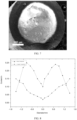
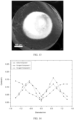
- FIG. 2 illustrates a SEM image of the catalytic oxidation catalyst obtained in Preparation Example 1;
- FIG. 3 illustrates a graph showing the content distribution of ingredients after impregnation in Preparation Example 1;
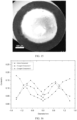
- FIG. 4 illustrates a graph showing the content distribution of ingredients after impregnation in Preparation Example 2;
- FIG. 5 illustrates a graph showing the content distribution of ingredients after impregnation in Preparation Example 3;
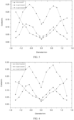
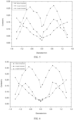
- FIG. 6 illustrates a graph showing the content distribution of ingredients after impregnation in Preparation Example 4. As shown in FIGs.
- the content of the active component is gradually increased and then gradually decreased to form a peak shape distribution
- the content of the co-agent component 1 is gradually increased and then gradually decreased to form a peak shape distribution
- the content of the co-agent component 2 is gradually increased
- the peak value of the content of the active component is 0.2 wt% or more.
- the catalysts were prepared with the same method as Preparation Example 1, except that the impregnation of co-agent component 1 was not carried out, catalyst Dl was prepared, the composition and structure of catalysts were shown below.
- FIG. 7 illustrates a SEM image of the catalytic oxidation catalyst obtained in Comparison Preparation Example 1
- FIG. 8 illustrates a graph showing the content distribution of ingredients after impregnation in Comparison Preparation Example 1; as shown in FIGs. 7-8 , along a radial direction from a core of the carrier to the outer surface of the carrier, the content of the active component is gradually increased and then gradually decreased to form a peak shape distribution, the content of the co-agent component 2 is gradually increased, and the peak value of the content of the active component is 0.2 wt% or more.
- the catalysts were prepared with the same method as Preparation Example 1, except that the impregnation of co-agent component 2 was not carried out, catalyst D2 was prepared, the composition and structure of catalysts were shown below.
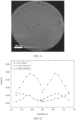
- FIG. 9 illustrates a SEM image of the catalytic oxidation catalyst obtained in Comparison Preparation Example 2
- FIG. 10 illustrates a graph showing the content distribution of ingredients after impregnation in Comparison Preparation Example 2; as shown in FIGs. 9-10 , along a radial direction from a core of the carrier to the outer surface of the carrier, the content of the active component is gradually increased and then gradually decreased to form a peak shape distribution, the content of the co-agent component 1 is gradually increased and then gradually decreased to form a peak shape distribution, and the peak value of the content of the active component is 0.2 wt% or more.
- FIG. 11 illustrates a SEM image of the catalytic oxidation catalyst obtained in Comparison Preparation Example 3
- FIG. 12 illustrates a graph showing the content distribution of ingredients after impregnation in Comparison Preparation Example 3; as shown in FIGs. 11-12 , along a radial direction from a core of the carrier to the outer surface of the carrier, the content of the active component is gradually increased and then gradually decreased to form a peak shape distribution, the content of the co-agent component 1 is gradually increased and then gradually decreased to form a peak shape distribution, the content of the co-agent component 2 is gradually increased, but the peak value of the content of the active component is below 0.2 wt%.
- the catalysts were prepared with the same method as Preparation Example 1, except that the impregnation was not performed in a step-by-step manner, but an aqueous solution containing the active ingredient, co-agent component 1, co-agent component 2, and ethanolamine was subjected to an equivalent-volume impregnation with alumina at a pH of 9, then subjected to drying at 80°C for 150min, and subsequently subjected to calcining at 500°C for 3 hours to prepare catalytic oxidation catalyst D4, the composition and structure of the catalyst were shown below.
- FIG. 13 illustrates a SEM image of the catalytic oxidation catalyst obtained in Comparison Preparation Example 4
- FIG. 14 illustrates a graph showing the content distribution of ingredients after impregnation in Comparison Preparation Example 4; as shown in FIGs. 13-14 , along a radial direction from a core of the carrier to the outer surface of the carrier, the content of the active component is gradually increased and then gradually decreased to form a peak shape distribution, the content of the co-agent component 1 is gradually increased and then gradually decreased to form a peak shape distribution, the content of the co-agent component 2 is gradually increased, but the peak value of the content of the active component is below 0.2 wt%.
- the catalysts were prepared with the same method as Preparation Example 1, except that the impregnation process was carried out in two steps.
- an aqueous solution containing active ingredient, co-agent component 1 and ethanolamine was subjected to a first equivalent-volume impregnation with alumina at a pH of 9, and then subjected to drying at 130°C for 80min;
- an aqueous solution containing co-agent component 2 selected from the group consisting of alkali metal oxides and alkaline earth metal oxides was subsequently subjected to a second equivalent-volume impregnation at a pH of 10 with alumina obtained after the first equivalent-volume impregnation, and subjected to drying at 170°C for 100min.
- calcining 500°C for 3 hours to prepare catalytic oxidation catalyst D5, the composition and structure of the catalyst were shown below.
- FIG. 15 illustrates a SEM image of the catalytic oxidation catalyst obtained in Comparison Preparation Example 5
- FIG. 16 illustrates a graph showing the content distribution of ingredients after impregnation in Comparison Preparation Example 5; as shown in FIGs. 15-16 , along a radial direction from a core of the carrier to the outer surface of the carrier, the content of the active component is gradually increased and then gradually decreased to form a peak shape distribution, the content of the co-agent component 1 is gradually increased and then gradually decreased to form a peak shape distribution, the content of the co-agent component 2 is gradually increased, but the peak value of the content of the active component is below 0.2 wt%.
- Catalyst A1 the catalyst containing 0.25 wt% of palladium oxide (based on metal element Pd), 0.1 wt% of ferric oxide, 5.67 wt% of sodium oxide, and the balance being carrier alumina, the catalyst has a specific surface area of 230 m 2 /g and a pore volume of 0.5 cm 3 /g; the mesopores with a pore size more than 2nm and 50nm or less constitute 28% of the total pore volume, and the macropores with a pore size more than 50nm and 200nm or less constitute 70% of the total pore volume; the active component having a dispersion size less than 10nm is contained in an amount of 93 wt% of the total active component in the catalyst.
- Catalyst D1 the catalyst containing 0.25 wt% of palladium oxide (based on metal element Pd), 5.67 wt% of sodium oxide, and the balance being carrier alumina, the catalyst has a specific surface area of 265 m 2 /g and a pore volume of 0.65 cm 3 /g; the mesopores with a pore size more than 2nm and 50nm or less constitute 45% of the total pore volume, and the macropores with a pore size more than 50nm and 200nm or less constitute 53% of the total pore volume; the active component having a dispersion size less than 10nm is contained in an amount of 25 wt% of the total active component in the catalyst.
- Catalyst D2 the catalyst containing 0.25 wt% of palladium oxide (based on metal element Pd), 0.1 wt% of ferric oxide, and the balance being carrier alumina, the catalyst has a specific surface area of 225 m 2 /g and a pore volume of 0.55 cm 3 /g; the mesopores with a pore size more than 2nm and 50nm or less constitute 30% of the total pore volume, and the macropores with a pore size more than 50nm and 200nm or less constitute 68% of the total pore volume; the active component having a dispersion size less than 10nm is contained in an amount of 45 wt% of the total active component in the catalyst.
- Catalyst D3 the catalyst containing 0.25 wt% of palladium oxide (based on metal element Pd), 0.1 wt% of ferric oxide, 5.67 wt% of sodium oxide, and the balance being carrier alumina, the catalyst has a specific surface area of 72 m 2 /g and a pore volume of 0.5 cm 3 /g; the mesopores with a pore size more than 2nm and 50nm or less constitute 10% of the total pore volume, and the macropores with a pore size more than 50nm and 200nm or less constitute 87% of the total pore volume; the active component having a dispersion size less than 10nm is contained in an amount of 18.5 wt% of the total active component in the catalyst.
- Catalyst D4 the catalyst containing 0.25 wt% of palladium oxide (based on metal element Pd), 0.1 wt% of ferric oxide, 5.67 wt% of sodium oxide, and the balance being carrier alumina, the catalyst has a specific surface area of 62 m 2 /g and a pore volume of 0.75 cm 3 /g; the mesopores with a pore size more than 2nm and 50nm or less constitute 1.5% of the total pore volume, and the macropores with a pore size more than 50nm and 200nm or less constitute 97% of the total pore volume; the active component having a dispersion size less than 10nm is contained in an amount of 6 wt% of the total active component in the catalyst.
- Catalyst D5 the catalyst containing 0.25 wt% of palladium oxide (based on metal element Pd), 0.1 wt% of ferric oxide, 5.67 wt% of sodium oxide, and the balance being carrier alumina, the catalyst has a specific surface area of 68 m 2 /g and a pore volume of 0.73 cm 3 /g; the mesopores with a pore size more than 2nm and 50nm or less constitute 3.8% of the total pore volume, and the macropores with a pore size more than 50nm and 200nm or less constitute 95% of the total pore volume; the active component having a dispersion size less than 10nm is contained in an amount of 9 wt% of the total active component in the catalyst.
- Catalyst A2 the catalyst containing 0.2 wt% of palladium oxide (based on metal element Pd), 0.3 wt% of cobalt oxide, 4.89 wt% of sodium oxide, and the balance being carrier alumina, the catalyst has a specific surface area of 195 m 2 /g and a pore volume of 0.52 cm 3 /g; the mesopores with a pore size more than 2nm and 50nm or less constitute 10% of the total pore volume, and the macropores with a pore size more than 50nm and 200nm or less constitute 60% of the total pore volume; the active component having a dispersion size less than 10nm is contained in an amount of 95 wt% of the total active component in the catalyst.
- Catalyst A3 the catalyst containing 0.5 wt% of ruthenium oxide (based on metal element Ru), 0.7 wt% of titanium dioxide, 4.89 wt% of magnesium oxide, and the balance being carrier alumina, the catalyst has a specific surface area of 230 m 2 /g and a pore volume of 0.5 cm 3 /g; the mesopores with a pore size more than 2nm and 50nm or less constitute 5% of the total pore volume, and the macropores with a pore size more than 50nm and 200nm or less constitute 80% of the total pore volume; the active component having a dispersion size less than 10nm is contained in an amount of 96 wt% of the total active component in the catalyst.
- Catalyst A4 the catalyst containing 0.5 wt% of rhodium oxide (based on metal element Rh), 0.7 wt% of titanium dioxide, 4.89 wt% of potassium oxide, and the balance being carrier alumina, the catalyst has a specific surface area of 230 m 2 /g and a pore volume of 0.5 cm 3 /g; the mesopores with a pore size more than 2nm and 50nm or less constitute 20% of the total pore volume, and the macropores with a pore size more than 50nm and 200nm or less constitute 70% of the total pore volume; the active component having a dispersion size less than 10nm is contained in an amount of 96 wt% of the total active component in the catalyst.
- Example 1 Example 2
- Example 3 Active component Palladium nitrate Chloroplatinic acid Ruthenium nitrate Rhodium nitrate Co-agent component 1 Iron nitrate Cobalt nitrate Titanium nitrate Titanium nitrate Co-agent component 2 Sodium nitrate Sodium nitrate Magnesium nitrate Potassium nitrate
- the carbon deposits percentage contents by mass of catalysts A1-A4 and D1-D5 were measured in a propylene atmosphere having a pressure of 0.6MPa at a temperature of 573.15K after the reaction time 100 hours, 1,000 hours and 2,000 hours, respectively, wherein the catalyst was used in an amount of 20g for 1 mole of propylene, and the results of catalyst carbon deposits are shown in Table 2.
- the catalysts A1-A4, D1-D5 were subjected to reduction with hydrogen gas under the normal pressure and the temperature of 473.15K for 10 hours, the saturated adsorption amount of oxygen by the catalysts A1-A4 following the reduction process were measured under the temperatures 323.15K, 423.15K and 623.15K, respectively, the results are shown in Table 3.
- the measurement method of saturated adsorption amount of oxygen was as follows: a chemisorber and a mass spectrometer were used in combination (chemisorber Autochem 2910, mass spectrometer OmniStar), 0.1g sample was weighted, subjected to reduction with hydrogen gas ( mixed gas of 10 vol% hydrogen gas and argon gas) at 200°C for 2 hours, the heating rate was 10°C/min, the sample was then subjected to purging with high purity helium gas at 200° C for 0.5 hour, the temperature was then reduced to 50°C (100°C, 150°C), after a purging baseline was stabilized, oxygen (mixed gas of 5 vol% oxygen and helium gas) was used for performing pulsed chemisorption to a saturated adsorption state, and a quantitative calculation of adsorption amount was performed to obtain the amount of adsorbed oxygen per gram of catalyst at different temperatures.
- hydrogen gas mixed gas of 10 vol% hydrogen gas and argon gas
- the heating rate was 10°C/min
- the treatment of propylene tail gas was carried out by using a catalytic oxidation-deoxidation apparatus for an unsaturated hydrocarbon-containing gas as illustrated in FIG. 1 , the propylene tail gas was composed of 8 vol% of oxygen, 90 vol% of propylene and 2 vol% of nitrogen.
- the catalytic oxidation-deoxidation apparatus comprised a heat exchange unit 1, a heating unit 2, a deoxygenation reaction unit 3, a temperature reduction unit 4, a gas-liquid separation unit 5 and a hydrocarbon separation unit; wherein heat exchange unit 1 was a heat exchanger for performing heat exchange between an unsaturated hydrocarbon-containing gas and a gas treated by the deoxygenation reaction unit; the heating unit 2 was an electric heater for further heating the unsaturated hydrocarbon-containing gas following the heat exchange in the heat exchange unit 1.
- the deoxygenation reaction unit 3 was a fixed-bed adiabatic reactor, which was provided with a bed layer of catalyst Al for catalytic oxidation, so as to subject the unsaturated hydrocarbon-containing gas from the heating unit 2 to the catalytic oxidation, remove oxygen from the unsaturated hydrocarbon-containing gas, thereby obtain the deoxygenated gas B;
- the temperature reduction unit 4 was an air condenser, which was connected to the heat exchange unit 1 for further cooling down the deoxygenated gas B;
- the gas-liquid separation unit 5 was a gas-liquid separation tank for separating a liquid phase from a gas phase that has been cooled by the temperature reduction unit 4;
- the hydrocarbon separation unit was consisting of a compressor 6 and a non-condensable gas separating column 7 for separating at least part of propylene from the gas phase obtained from the gas-liquid separation unit;
- a tail oxygen analysis unit was arranged in a pipeline connecting the gas-liquid separation unit 5 and the compressor 6 for monitoring the oxygen content of the gas
- the apparatus was further provided with a circulation branch pipe, which was arranged downstream of a tail oxygen analysis unit of the pipeline connecting the gas-liquid separation unit 5 and the hydrocarbon separation unit, and was connected with an unsaturated hydrocarbon-containing gas ingress pipe, which wa used to return a gas phase obtained from gas-liquid separation unit 5 to the unsaturated hydrocarbon-containing gas ingress pipe disposed before the heat exchange unit 1;
- the circulation branch pipeline was provided with a circulation regulating valve.
- Propylene tail gas at a temperature of 40°C was introduced into the catalytic oxidation-deoxidation apparatus, and was heated to 110°C (i.e., the reactor inlet temperature) in a heat exchanger, the propylene tail gas was delivered to a deoxygenation reactor for performing catalytic oxidation-deoxidation reaction with a hourly volumetric space velocity of 10,000 h -1 , a reaction pressure of 10 MPa, a linear velocity of 0.02 m/s, a product of the pressure and the linear velocity being 0.2 MPa m/s, and a reactor outlet temperature of 280°C, so as to yield deoxygenated gas B.
- the deoxygenated gas B was subjected to heat exchange with the raw material propylene tail gas and heated to 80°C and then cooled by an air condenser to 20°C, and subsequently entered a gas-liquid separation tank, which separated out a liquid phase produced during the reaction process as waste fluid C, and the separated gas phase had an tail gas oxygen content of 0.10 vol%, a CO selectivity of 0.5%, and a CO 2 selectivity of 99.1%.
- the gas phase was pressurized by compressor 6 and then introduced into non-condensable gas separating column 7, the separated gas phase was non-condensable gas D, and the separated liquid phase was propylene (with a purity of 99.5% or higher).
- the non-condensable gas D was composed of 50.3 vol% of nitrogen gas, 49.5 vol% of CO 2 , and 0.2 vol% of CO.
- the catalyst carbon deposit amount was measured to be 1.2% after 1,000h from the start of the reaction, 2.1% after 2,000h, 2.9% after 3,000h, 4.1% after 5,000h, 5.8% after 8,000h. After 15,060 hours, the tail gas oxygen content in the separated gas phase was measured to be 0.28% by volume, the carbon deposit amount was 9.8%, indicating that the catalyst was deactivated, the reaction apparatus was shut down, and it was necessary to combust the carbon deposit and regenerate the catalyst.
- the treatment of propyne tail gas was carried out by using a catalytic oxidation-deoxidation apparatus for an unsaturated hydrocarbon-containing gas as illustrated in FIG. 1 , the catalyst is catalytic oxidation catalyst A2.
- the deoxygenated gas B2 was subjected to heat exchange with the raw material propyne tail gas and heated to 110°C and then cooled by an air condenser to 20°C, and subsequently entered a gas-liquid separation tank, which separated out a liquid phase produced during the reaction process as waste fluid C, and the separated gas phase had an tail gas oxygen content of 0.13 vol%, a CO selectivity of 0.06%, and a CO 2 selectivity of 99.0%.
- the gas phase was pressurized by the compressor and then introduced into the non-condensable gas separating column, the separated gas phase was non-condensable gas, and the separated liquid phase was propyne (with a purity of 99.6% or higher).
- the non-condensable gas was composed of 5.8 vol% of nitrogen gas, 94 vol% of CO 2 , and 0.2 vol% of CO.
- the catalyst carbon deposit amount was measured to be 1.3% after 1,000h, 2.0% after 2,000h, 3.1% after 3,000h, 4.6% after 5,000h, 6.2% after 8,000h from the start of the reaction. After 16,100 hours of reaction duration, the tail gas oxygen content in the separated gas phase was measured to be 0.28% by volume, the carbon deposit amount was 10.5%, indicating that the catalyst was deactivated, the reaction apparatus was shut down, and it was necessary to combust the carbon deposit and regenerate the catalyst.
- the catalytic oxidation-deoxidation was carried out according to the same method as Example 1, except that the catalyst in use was catalytic oxidation catalyst A3, the reaction space velocity was 500 h -1 , the pressure was 0.4MPa, the linear velocity was 5m/s, the product of the pressure and linear velocity was 2 MPa • m/s.
- the catalyst carbon deposit amount was measured to be 1.0% after 1,000h, 1.8% after 2,000h, 2.7% after 3,000h, 3.9% after 5,000h, 5.85% after 8,000h from the start of the reaction.
- the tail gas oxygen content in the separated gas phase was measured to be 0.28% by volume, the carbon deposit amount was 11.9%, indicating that the catalyst was deactivated, the reaction apparatus was shut down, and it was necessary to combust the carbon deposit and regenerate the catalyst.
- the catalytic oxidation-deoxidation was carried out according to the same method as Example 1, except that the catalyst in use was catalytic oxidation catalyst A4, the linear velocity was 0.5m/s.
- the catalyst carbon deposit amount was measured to be 1.25% after 1,000h, 2.0% after 2,000h, 2.85% after 3,000h, 4.7% after 5,000h, 7.1% after 8,000h from the start of the reaction.
- the tail gas oxygen content in the separated gas phase was measured to be 0.28% by volume, the carbon deposit amount was 11%, indicating that the catalyst was deactivated, the reaction apparatus was shut down, and it was necessary to combust the carbon deposit and regenerate the catalyst.
- the catalytic oxidation-deoxidation was carried out according to the same method as Example 1, except that the linear velocity was 0.01m/s, the product of the pressure and linear velocity was 0.1 MPa.m/s, and the catalyst carbon deposit amount was measured to be 16% after 1,000h from the start of the reaction.
- the catalytic oxidation-deoxidation was carried out according to the same method as Example 1, except that the linear velocity was 11m/s, the product of the pressure and linear velocity was 55 MPa.m/s, and the catalyst carbon deposit amount was measured to be 12% after 1,000h from the start of the reaction.
- the catalytic oxidation-deoxidation was carried out according to the same method as Example 1, except that the pressure was 21 MPa, the product of the pressure and linear velocity was 0.42 MPa.m/s, and the catalyst carbon deposit amount was measured to be 15% after 1,000h from the start of the reaction.
- the catalytic oxidation-deoxidation was carried out according to the same method as Example 1, except that catalyst Al was replaced with catalyst Dl, and the catalyst carbon deposit amount was measured to be 4.5% after 1,000h from the start of the reaction.
- the catalytic oxidation-deoxidation was carried out according to the same method as Example 1, except that catalyst A1 was replaced with catalyst D2, and the catalyst carbon deposit amount was measured to be 3.6% after 1,000h from the start of the reaction.
- the catalytic oxidation-deoxidation was carried out according to the same method as Example 1, except that catalyst A1 was replaced with catalyst D3, and the catalyst carbon deposit amount was measured to be 6.8% after 1,000h from the start of the reaction.
- the catalytic oxidation-deoxidation was carried out according to the same method as Example 1, except that catalyst A1 was replaced with catalyst D4, and the catalyst carbon deposit amount was measured to be 9.1% after 1,000h from the start of the reaction.
- the catalytic oxidation-deoxidation was carried out according to the same method as Example 1, except that catalyst A1 was replaced with catalyst D5, and the catalyst carbon deposit amount was measured to be 10.2% after 1,000h from the start of the reaction.
Landscapes
- Chemical & Material Sciences (AREA)
- Engineering & Computer Science (AREA)
- Chemical Kinetics & Catalysis (AREA)
- Organic Chemistry (AREA)
- Materials Engineering (AREA)
- Environmental & Geological Engineering (AREA)
- General Chemical & Material Sciences (AREA)
- Analytical Chemistry (AREA)
- Oil, Petroleum & Natural Gas (AREA)
- Health & Medical Sciences (AREA)
- Biomedical Technology (AREA)
- Water Supply & Treatment (AREA)
- Emergency Medicine (AREA)
- Catalysts (AREA)
- Organic Low-Molecular-Weight Compounds And Preparation Thereof (AREA)
- Nanotechnology (AREA)
Claims (13)
- Katalysator umfassend einen Träger sowie eine aktive Komponente, eine erste Co-Agent-Komponente und eine zweite Co-Agent-Komponente geladen auf den Träger, wobei die aktive Komponente eine oder mehrere ist, ausgewählt aus der Gruppe, bestehend aus Oxiden von Pt, Pd, Ru, Rh, Ag und Ir;die erste Co-Agent-Komponente umfasst eines oder mehrere ausgewählt aus der Gruppe, bestehend aus einem Seltenerdmetallelement, einem Metallelement der Gruppe IVB und einem Metallelement der Gruppe VIII ausgewählt aus Eisen, Kobalt und Nickel; und die zweite Co-Agent-Komponente umfasst eines oder mehrere ausgewählt aus der Gruppe, bestehend aus einem Alkalimetallelement und einem Erdalkalimetallelement;entlang einer radialen Richtung von einem Kern des Trägers zu der äußeren Oberfläche des Trägers, wird der Gehalt der aktiven Komponente schrittweise erhöht und dann schrittweise verringert, um eine spitzenförmige Verteilung zu bilden, der Gehalt der ersten Co-Agent-Komponente wird schrittweise erhöht und dann schrittweise verringert, um eine spitzenförmige Verteilung zu bilden, der Gehalt der zweiten Co-Agent-Komponente wird schrittweise erhöht, und der Spitzenwert des Gehalts der aktiven Komponente beträgt 0,2 Gew.-% oder mehr;die aktive Komponente ist enthalten in einer Menge von 0,05-2 Gew.-%, bezogen auf das metallische Element, die erste Co-Agent-Komponente ist enthalten in einer Menge von 0,1-3 Gew.-%, bezogen auf das Oxid, und die zweite Co-Agent-Komponente ist enthalten in einer Menge von 1-7 Gew.-%, bezogen auf das Oxid, bezogen auf das Trockengewicht des Katalysators.
- Katalysator gemäß Anspruch 1, wobei der prozentuale Massengehalt y an Kohlenstoffablagerungen des Katalysators, gemessen in einer Propylenatmosphäre bei einem Druck von 0,6 MPa und einer Temperatur von 573,15 K, die folgenden Eigenschaften aufweist:
 wobei t: Reaktionszeit, innerhalb eines Bereichs von 100-2.000h;wobei der Katalysator einen prozentualen Massengehalt an Kohlenstoffablagerungen von 0,2 % oder weniger vor der Messung aufweist;vorzugsweise hat die gesättigte Sauerstoffadsorptionsmenge q des Katalysators nach der Wasserstoffreduktion unter einem normalen Druck und einer Temperatur von 473,15 K die folgenden Eigenschaften:
 wobei q: gesättigte Adsorptionsmenge an Sauerstoff, mL/g;T: Adsorptionstemperatur, innerhalb eines Bereichs von 323,15-623,15 K;
- Katalysator gemäß Anspruch 1 oder 2, wobei die erste Co-Agent-Komponente ein oder mehrere Elemente umfasst, ausgewählt aus der Gruppe, bestehend aus einem Metallelement der Gruppe IVB und einem Metallelement der Gruppe VIII, und die zweite Co-Agent-Komponente umfasst ein Alkalimetallelement;weiter bevorzugt ist die erste Co-Agent-Komponente eine oder mehrere, ausgewählt aus der Gruppe, bestehend aus Eisenoxid, Kobaltoxid, Nickeloxid und Titanoxid, und die zweite Co-Agent-Komponente ist Natriumoxid;weiter mehr bevorzugt beträgt das Gewichtsverhältnis der ersten Co-Agent-Komponente zur zweiten Co-Agent-Komponente 1:20-220, vorzugsweise 1:60-200.
- Katalysator gemäß mindestens einem der Ansprüche 1 bis 3, wobei der Katalysator eine spezifische Oberfläche von 100 bis 260 m2/g und ein Porenvolumen von 0,2 bis 0,7 cm3/g aufweist; die Mesoporen mit einer Porengröße von mehr als 2 nm und 50 nm oder weniger 2-40 %, vorzugsweise 5-30 % des gesamten Porenvolumens ausmachen, und die Makroporen mit einer Porengröße von mehr als 50 nm und 200 nm oder weniger 50-90 %, vorzugsweise 60-80 % des gesamten Porenvolumens ausmachen;
vorzugsweise ist der Träger des Katalysators einer oder mehrere, ausgewählt aus der Gruppe bestehend aus Aluminiumoxid, Siliziumdioxid, Titandioxid, Molekularsieben und Kohlenstoffnanoröhren. - Katalysator gemäß mindestens einem der Ansprüche 1 bis 4, wobei der Gehalt der aktiven Komponente mit einer Dispersionsgröße von weniger als 10 nm 80 Gew.-% oder mehr der Gesamtmenge der aktiven Komponente beträgt.
- Katalytisches Oxidations-Desoxidationsverfahren für ein ungesättigtes kohlenwasserstoffhaltiges Gas umfassend einen ungesättigten Kohlenwasserstoff und Sauerstoff, wobei das Verfahren umfasst das Inkontaktbringen des ungesättigten kohlenwasserstoffhaltigen Gases mit einem Katalysator und die Durchführung eines katalytischen Oxidationsverfahrens zur Entfernung von Sauerstoff aus dem ungesättigten kohlenwasserstoffhaltigen Gas;
wobei der Katalysator der Katalysator gemäß mindestens einem der Ansprüche 1 bis 5 ist, die Kontaktbedingungen umfassen, dass das ungesättigte kohlenwasserstoffhaltige Gas aufweist eine stündliche volumetrische Raumgeschwindigkeit von 200-50.000 h-1, vorzugsweise 200-20.000 h-1, einen Druck von 0,01-20 MPa, eine lineare Geschwindigkeit von 0,02-10 m/s, und ein Produkt aus dem Druck und der linearen Geschwindigkeit ist in einem Bereich von 0,1-5 MPa·m/s. - Katalytisches Oxidations-Desoxidationsverfahren gemäß Anspruch 6, wobei das ungesättigte kohlenwasserstoffhaltige Gas aufweist eine stündliche volumetrische Raumgeschwindigkeit von 500 bis 20.000 h-1, vorzugsweise 500 bis 10.000 h-1, einen Druck von 0,4 bis 10 MPa, eine lineare Geschwindigkeit von 0,02 bis 5 m/s, und ein Produkt aus dem Druck und der linearen Geschwindigkeit ist in einem Bereich von 0,2 bis 5 MPa-m/s.
- Katalytisches Oxidations-Desoxidationsverfahren gemäß Anspruch 6 oder 7, wobei das Verfahren ferner die folgenden Schritte umfasst:(1) Unterziehen des aus der katalytischen Oxidationsreaktion erhaltenen Gases einer Temperatursenkung und einer Gas-Flüssigkeits-Trennung;(2) Abtrennen der aus der Gas-Flüssigkeits-Trennung erhaltenen Gasphase, um mindestens einen Teil der ungesättigten Kohlenwasserstoffe zu gewinnen.
- Katalytisches Oxidations-Desoxidations-Verfahren gemäß mindestens einem der Ansprüche 6 bis 8, wobei das Verfahren ferner vor der katalytischen Oxidation die Durchführung eines Wärmeaustauschs zwischen dem ungesättigten Kohlenwasserstoff enthaltenden Gas und dem aus der katalytischen Oxidationsreaktion erhaltenen Gas umfasst.
- Katalytisches Oxidations-Desoxidations-Verfahren gemäß mindestens einem der Ansprüche 6 bis 9, wobei die ungesättigten Kohlenwasserstoffe ungesättigte Kohlenwasserstoffe mit C4 oder weniger Kohlenstoffatomen sind, vorzugsweise einer oder mehrere, ausgewählt aus der Gruppe, bestehend aus Ethylen, Propylen, 1-Buten, 2-Buten, Isobutylen, 1,3-Butadien, Acetylen, Propin, 1-Butin und 2-Butin.
- Katalytisches Oxidations-Desoxidations-Verfahren gemäß mindestens einem der Ansprüche 6 bis 10, wobei die Reaktoreinlasstemperatur in einem Bereich von 60-400°C liegt, die Reaktorauslasstemperatur in einem Bereich von 100-600°C liegt; vorzugsweise liegt die Reaktoreinlasstemperatur in einem Bereich von 100-380°C, die Reaktorauslasstemperatur in einem Bereich von 150-550°C;
vorzugsweise wird die katalytische Oxidationsreaktion in einem Festbettreaktor durchgeführt. - Katalytisches Oxidations-Desoxidations-Verfahren gemäß mindestens einem der Ansprüche 6 bis 11, wobei das Verfahren ferner einen Sicherheitskontrollprozess umfasst, der einen Interlock-Start-Alarmschritt umfasst, wobei der Interlock-Start-Alarmschritt umfasst die Bestimmung, ob die Reaktoreinlasstemperatur, die Reaktorauslasstemperatur, der Einsatzgassauerstoffgehalt (feed gas oxygen content), der Endgassauerstoffgehalt (tail gas oxygen content), den entsprechenden Alarmwert oder Interlock-Wert erreichen, und die Durchführung einer Alarm-Interlock-Kontrolle;
vorzugsweise beträgt der niedrige Alarmwert der Reaktoreinlasstemperatur 60-90°C, der niedrige Interlock-Wert der Reaktoreinlasstemperatur 40-60°C, der hohe Alarmwert der Reaktorauslasstemperatur 580-610°C, der hohe Interlock-Wert der Reaktorauslasstemperatur 610-650°C, der hohe Alarmwert des Einsatzgassauerstoffgehalts 7,5-8,5 Volumenprozent, der hohe Interlock-Wert des Einsatzgassauerstoffgehalts 8,5-10 Volumenprozent, und der hohe Alarmwert des Endgassauerstoffgehalts 0,2-0,3 Volumenprozent. - Katalytisches Oxidations-Desoxidations-Verfahren gemäß mindestens einem der Ansprüche 6 bis 12, wobei das ungesättigte Kohlenwasserstoffe enthaltende Gas umfasst 0,2-8% Sauerstoff und 5-99% ungesättigte Kohlenwasserstoffe, ausgedrückt in Volumenkonzentrationsprozent (percent concentration by volume).
Applications Claiming Priority (2)
| Application Number | Priority Date | Filing Date | Title |
|---|---|---|---|
| CN202010087815.3A CN113244931B (zh) | 2020-02-11 | 2020-02-11 | 催化剂以及含不饱和烃气体的催化氧化脱氧方法 |
| PCT/CN2021/073728 WO2021159951A1 (zh) | 2020-02-11 | 2021-01-26 | 催化剂以及含不饱和烃气体的催化氧化脱氧方法 |
Publications (4)
| Publication Number | Publication Date |
|---|---|
| EP4098358A1 EP4098358A1 (de) | 2022-12-07 |
| EP4098358A4 EP4098358A4 (de) | 2023-07-26 |
| EP4098358B1 true EP4098358B1 (de) | 2024-10-09 |
| EP4098358C0 EP4098358C0 (de) | 2024-10-09 |
Family
ID=77219628
Family Applications (1)
| Application Number | Title | Priority Date | Filing Date |
|---|---|---|---|
| EP21754181.2A Active EP4098358B1 (de) | 2020-02-11 | 2021-01-26 | Katalysator und verfahren zur katalytischen oxidation-deoxidation von gas mit ungesättigten kohlenwasserstoffen |
Country Status (4)
| Country | Link |
|---|---|
| US (1) | US12496573B2 (de) |
| EP (1) | EP4098358B1 (de) |
| CN (1) | CN113244931B (de) |
| WO (1) | WO2021159951A1 (de) |
Families Citing this family (6)
| Publication number | Priority date | Publication date | Assignee | Title |
|---|---|---|---|---|
| CN115707654B (zh) * | 2021-08-19 | 2024-06-21 | 中国石油化工股份有限公司 | 全硅分子筛及其制备方法和应用 |
| US20250115536A1 (en) * | 2021-08-19 | 2025-04-10 | China Petroleum & Chemical Corporation | Method for reducing risk of burning and explosion in deoxygenation process of oxygen-containing gas |
| CN115707516B (zh) * | 2021-08-19 | 2024-08-06 | 中国石油化工股份有限公司 | 具有脱氧功能的催化剂和对含氧气的气体进行脱氧的方法 |
| CN115894158B (zh) * | 2021-08-19 | 2026-03-03 | 中国石油化工股份有限公司 | 气态烷烃在降低含氧气体脱氧过程中燃爆风险的应用 |
| CN115707515B (zh) * | 2021-08-19 | 2023-12-26 | 中国石油化工股份有限公司 | 具有脱氧功能的催化剂及其制备方法和应用 |
| CN115707514B (zh) * | 2021-08-19 | 2024-09-10 | 中国石油化工股份有限公司 | 脱氧催化剂及其制备方法和脱除轻质烯烃中氧气的方法 |
Family Cites Families (19)
| Publication number | Priority date | Publication date | Assignee | Title |
|---|---|---|---|---|
| US6245307B1 (en) * | 1994-06-17 | 2001-06-12 | Ict Co., Ltd. | Catalyst for purifying exhaust gas from lean burn engine and method for purification |
| EP1102629A4 (de) * | 1998-07-10 | 2001-10-17 | Asec Mfg | Verbesserte katalysator-adsorbervorrichtung zur behandlung interner motor-verbrennungsabgase und verfahren zu ihrer herstellung |
| JP3767251B2 (ja) * | 1999-06-24 | 2006-04-19 | 三菱化学株式会社 | エチレンオキシド製造用触媒及びエチレンオキシドの製造方法 |
| EP1658135A1 (de) * | 2003-08-22 | 2006-05-24 | Union Carbide Chemicals & Plastics Technology Corporation | Modifizierte aluminiumoxidträger und auf silber basierende katalysatoren zur herstellung von alkylenoxiden |
| RU2372342C2 (ru) * | 2003-08-22 | 2009-11-10 | Дау Текнолоджи Инвестментс Ллс. | Улучшенные носители из оксида алюминия и катализаторы на основе серебра для получения алкиленоксидов |
| US7334407B2 (en) * | 2004-03-22 | 2008-02-26 | United Technologies Corporation | Method of suppressing coke in endothermic fuel processing |
| CN101613627B (zh) * | 2009-07-23 | 2012-10-03 | 中国科学院大连化学物理研究所 | 一种含氧煤层气催化脱氧工艺 |
| WO2011009283A1 (zh) * | 2009-07-23 | 2011-01-27 | 中国科学院大连化学物理研究所 | 煤层气脱氧催化剂机器制备方法和应用 |
| CN102041067B (zh) * | 2009-10-16 | 2014-07-23 | 中国石油化工股份有限公司 | 一种费托合成油品的加氢精制方法 |
| CN103157471B (zh) * | 2011-12-16 | 2015-07-22 | 西南化工研究设计院有限公司 | 一种烯烃气体脱氧催化剂及其制备方法和应用 |
| CN103285854B (zh) * | 2012-02-29 | 2019-02-22 | 哈尔滨工业大学深圳研究生院 | 柴油机尾气颗粒物催化剂、及其制备方法和使用方法 |
| FR3032362B1 (fr) * | 2015-02-06 | 2020-05-29 | Thales | Procede de depot de nanoparticules et de microparticules carbonees oxydees |
| CN106994319A (zh) * | 2017-03-25 | 2017-08-01 | 淄博赢信达知识产权咨询服务有限公司 | 含氧煤层气的脱氧反应装置 |
| CN107511147A (zh) * | 2017-07-12 | 2017-12-26 | 华东理工大学 | 一种高稳定性催化氧化催化剂及制备方法 |
| CN110013887B (zh) * | 2018-01-09 | 2021-11-05 | 中国石油化工股份有限公司 | 催化剂失活的原位再生方法 |
| CN110563538B (zh) * | 2018-06-06 | 2022-06-21 | 中国石油化工股份有限公司 | 一种丙烯气体催化脱氧反应装置及脱氧方法 |
| CN110559842B (zh) * | 2018-06-06 | 2022-03-04 | 中国石油化工股份有限公司 | 带温度、尾氧浓度控制的丙烯气体催化脱氧装置及方法 |
| CN110559843B (zh) * | 2018-06-06 | 2022-03-04 | 中国石油化工股份有限公司 | 一种丙烯气体催化脱氧反应装置及安全控制方法 |
| CN109985620A (zh) * | 2019-03-25 | 2019-07-09 | 北京三聚环保新材料股份有限公司 | 一种费托合成油加氢精制催化剂及其制备方法和应用 |
-
2020
- 2020-02-11 CN CN202010087815.3A patent/CN113244931B/zh active Active
-
2021
- 2021-01-26 WO PCT/CN2021/073728 patent/WO2021159951A1/zh not_active Ceased
- 2021-01-26 US US17/760,386 patent/US12496573B2/en active Active
- 2021-01-26 EP EP21754181.2A patent/EP4098358B1/de active Active
Also Published As
| Publication number | Publication date |
|---|---|
| WO2021159951A9 (zh) | 2022-01-13 |
| EP4098358A4 (de) | 2023-07-26 |
| CN113244931A (zh) | 2021-08-13 |
| US12496573B2 (en) | 2025-12-16 |
| US20230129017A1 (en) | 2023-04-27 |
| CN113244931B (zh) | 2022-05-03 |
| WO2021159951A1 (zh) | 2021-08-19 |
| EP4098358C0 (de) | 2024-10-09 |
| EP4098358A1 (de) | 2022-12-07 |
Similar Documents
| Publication | Publication Date | Title |
|---|---|---|
| EP4098358B1 (de) | Katalysator und verfahren zur katalytischen oxidation-deoxidation von gas mit ungesättigten kohlenwasserstoffen | |
| Martínez-Arias et al. | Preferential oxidation of CO in rich H2 over CuO/CeO2: Details of selectivity and deactivation under the reactant stream | |
| Zhang et al. | A plasma-activated Ni/α-Al2O3 catalyst for the conversion of CH4 to syngas | |
| WO2002026619A2 (en) | Non-pyrophoric water-glas shift reaction catalysts | |
| Morterra et al. | Role of Surface Hydration State on the Nature and Reactivity of Copper Ions in Cu-ZrO2Catalysts: N2O Decomposition | |
| Agarás et al. | Copper catalysts for the steam reforming of methanol: analysis of the preparation variables | |
| Shen et al. | Dealuminated Beta zeolite-supported robust PtFe bimetallic catalysts for CO preferential oxidation in H2 | |
| US4431566A (en) | Conversion of methanol into hydrogen and carbon monoxide | |
| Zhang et al. | Selective oxidation of CO in hydrogen rich gas over platinum–gold catalyst supported on zinc oxide for potential application in fuel cell | |
| Shigemoto et al. | Catalytic N 2 O decomposition in an electric field at low temperatures | |
| Chang et al. | Pt/Rh and Pd/Rh catalysts used for ozone decomposition and simultaneous elimination of ozone and carbon monoxide | |
| JP7599484B2 (ja) | イソプロピルベンゼンを製造するための触媒ならびにその製造方法および使用 | |
| RU2801380C1 (ru) | Катализатор и способ каталитического окисления-деоксигенирования содержащего ненасыщенный углеводород газа | |
| JPH05201702A (ja) | 一酸化炭素の選択的除去法およびその装置 | |
| Ma et al. | Nitrous oxide decomposition and reduction over copper catalysts supported on various types of carbonaceous materials | |
| JP3302402B2 (ja) | アンモニア分解触媒 | |
| CN115888379B (zh) | 脱除含氧气体中的氧气的方法 | |
| EP4365157B1 (de) | Verfahren zur verringerung des verbrennungs- und explosionsrisikos bei einem sauerstoffentzugsverfahren für ein sauerstoffhaltiges gas | |
| EP0655431B1 (de) | Verfahren zur Dehydrierung von Kohlenwasserstoffen | |
| JPH05329370A (ja) | アンモニア分解触媒 | |
| RU2211081C1 (ru) | Способ очистки водородсодержащей газовой смеси от оксида углерода | |
| CN106566566A (zh) | 一种含氧原料的甲烷化方法 | |
| CN120984258B (zh) | 一种低温高效抗中毒的脱氢用钯基催化剂及其制备方法与应用 | |
| Nagaveni et al. | Gas-Phase Hydrogenation of Benzene to Cyclohexane Over Combustion-Synthesized Ce1-x Pt x O2-δ (x= 0.01, 0.02) | |
| CN115894158B (zh) | 气态烷烃在降低含氧气体脱氧过程中燃爆风险的应用 |
Legal Events
| Date | Code | Title | Description |
|---|---|---|---|
| STAA | Information on the status of an ep patent application or granted ep patent |
Free format text: STATUS: THE INTERNATIONAL PUBLICATION HAS BEEN MADE |
|
| PUAI | Public reference made under article 153(3) epc to a published international application that has entered the european phase |
Free format text: ORIGINAL CODE: 0009012 |
|
| STAA | Information on the status of an ep patent application or granted ep patent |
Free format text: STATUS: REQUEST FOR EXAMINATION WAS MADE |
|
| 17P | Request for examination filed |
Effective date: 20220830 |
|
| AK | Designated contracting states |
Kind code of ref document: A1 Designated state(s): AL AT BE BG CH CY CZ DE DK EE ES FI FR GB GR HR HU IE IS IT LI LT LU LV MC MK MT NL NO PL PT RO RS SE SI SK SM TR |
|
| DAV | Request for validation of the european patent (deleted) | ||
| DAX | Request for extension of the european patent (deleted) | ||
| A4 | Supplementary search report drawn up and despatched |
Effective date: 20230622 |
|
| RIC1 | Information provided on ipc code assigned before grant |
Ipc: B01J 35/00 20060101ALI20230616BHEP Ipc: B01D 53/46 20060101ALI20230616BHEP Ipc: B01D 53/72 20060101ALI20230616BHEP Ipc: B01D 53/86 20060101ALI20230616BHEP Ipc: B01J 23/89 20060101AFI20230616BHEP |
|
| STAA | Information on the status of an ep patent application or granted ep patent |
Free format text: STATUS: EXAMINATION IS IN PROGRESS |
|
| 17Q | First examination report despatched |
Effective date: 20240425 |
|
| GRAP | Despatch of communication of intention to grant a patent |
Free format text: ORIGINAL CODE: EPIDOSNIGR1 |
|
| STAA | Information on the status of an ep patent application or granted ep patent |
Free format text: STATUS: GRANT OF PATENT IS INTENDED |
|
| INTG | Intention to grant announced |
Effective date: 20240723 |
|
| GRAS | Grant fee paid |
Free format text: ORIGINAL CODE: EPIDOSNIGR3 |
|
| GRAA | (expected) grant |
Free format text: ORIGINAL CODE: 0009210 |
|
| STAA | Information on the status of an ep patent application or granted ep patent |
Free format text: STATUS: THE PATENT HAS BEEN GRANTED |
|
| AK | Designated contracting states |
Kind code of ref document: B1 Designated state(s): AL AT BE BG CH CY CZ DE DK EE ES FI FR GB GR HR HU IE IS IT LI LT LU LV MC MK MT NL NO PL PT RO RS SE SI SK SM TR |
|
| REG | Reference to a national code |
Ref country code: CH Ref legal event code: EP |
|
| REG | Reference to a national code |
Ref country code: DE Ref legal event code: R096 Ref document number: 602021020001 Country of ref document: DE |
|
| REG | Reference to a national code |
Ref country code: IE Ref legal event code: FG4D |
|
| U01 | Request for unitary effect filed |
Effective date: 20241009 |
|
| U07 | Unitary effect registered |
Designated state(s): AT BE BG DE DK EE FI FR IT LT LU LV MT NL PT RO SE SI Effective date: 20241025 |
|
| U20 | Renewal fee for the european patent with unitary effect paid |
Year of fee payment: 5 Effective date: 20250123 |
|
| PG25 | Lapsed in a contracting state [announced via postgrant information from national office to epo] |
Ref country code: HR Free format text: LAPSE BECAUSE OF FAILURE TO SUBMIT A TRANSLATION OF THE DESCRIPTION OR TO PAY THE FEE WITHIN THE PRESCRIBED TIME-LIMIT Effective date: 20241009 Ref country code: IS Free format text: LAPSE BECAUSE OF FAILURE TO SUBMIT A TRANSLATION OF THE DESCRIPTION OR TO PAY THE FEE WITHIN THE PRESCRIBED TIME-LIMIT Effective date: 20250209 |
|
| PG25 | Lapsed in a contracting state [announced via postgrant information from national office to epo] |
Ref country code: ES Free format text: LAPSE BECAUSE OF FAILURE TO SUBMIT A TRANSLATION OF THE DESCRIPTION OR TO PAY THE FEE WITHIN THE PRESCRIBED TIME-LIMIT Effective date: 20241009 |
|
| PG25 | Lapsed in a contracting state [announced via postgrant information from national office to epo] |
Ref country code: NO Free format text: LAPSE BECAUSE OF FAILURE TO SUBMIT A TRANSLATION OF THE DESCRIPTION OR TO PAY THE FEE WITHIN THE PRESCRIBED TIME-LIMIT Effective date: 20250109 |
|
| PG25 | Lapsed in a contracting state [announced via postgrant information from national office to epo] |
Ref country code: GR Free format text: LAPSE BECAUSE OF FAILURE TO SUBMIT A TRANSLATION OF THE DESCRIPTION OR TO PAY THE FEE WITHIN THE PRESCRIBED TIME-LIMIT Effective date: 20250110 |
|
| PG25 | Lapsed in a contracting state [announced via postgrant information from national office to epo] |
Ref country code: PL Free format text: LAPSE BECAUSE OF FAILURE TO SUBMIT A TRANSLATION OF THE DESCRIPTION OR TO PAY THE FEE WITHIN THE PRESCRIBED TIME-LIMIT Effective date: 20241009 |
|
| PG25 | Lapsed in a contracting state [announced via postgrant information from national office to epo] |
Ref country code: RS Free format text: LAPSE BECAUSE OF FAILURE TO SUBMIT A TRANSLATION OF THE DESCRIPTION OR TO PAY THE FEE WITHIN THE PRESCRIBED TIME-LIMIT Effective date: 20250109 |
|
| PG25 | Lapsed in a contracting state [announced via postgrant information from national office to epo] |
Ref country code: SM Free format text: LAPSE BECAUSE OF FAILURE TO SUBMIT A TRANSLATION OF THE DESCRIPTION OR TO PAY THE FEE WITHIN THE PRESCRIBED TIME-LIMIT Effective date: 20241009 |
|
| PG25 | Lapsed in a contracting state [announced via postgrant information from national office to epo] |
Ref country code: SK Free format text: LAPSE BECAUSE OF FAILURE TO SUBMIT A TRANSLATION OF THE DESCRIPTION OR TO PAY THE FEE WITHIN THE PRESCRIBED TIME-LIMIT Effective date: 20241009 |
|
| PG25 | Lapsed in a contracting state [announced via postgrant information from national office to epo] |
Ref country code: CZ Free format text: LAPSE BECAUSE OF FAILURE TO SUBMIT A TRANSLATION OF THE DESCRIPTION OR TO PAY THE FEE WITHIN THE PRESCRIBED TIME-LIMIT Effective date: 20241009 |
|
| PLBE | No opposition filed within time limit |
Free format text: ORIGINAL CODE: 0009261 |
|
| STAA | Information on the status of an ep patent application or granted ep patent |
Free format text: STATUS: NO OPPOSITION FILED WITHIN TIME LIMIT |
|
| REG | Reference to a national code |
Ref country code: CH Ref legal event code: PL |
|
| PG25 | Lapsed in a contracting state [announced via postgrant information from national office to epo] |
Ref country code: MC Free format text: LAPSE BECAUSE OF FAILURE TO SUBMIT A TRANSLATION OF THE DESCRIPTION OR TO PAY THE FEE WITHIN THE PRESCRIBED TIME-LIMIT Effective date: 20241009 |
|
| 26N | No opposition filed |
Effective date: 20250710 |
|
| GBPC | Gb: european patent ceased through non-payment of renewal fee |
Effective date: 20250126 |
|
| PG25 | Lapsed in a contracting state [announced via postgrant information from national office to epo] |
Ref country code: GB Free format text: LAPSE BECAUSE OF NON-PAYMENT OF DUE FEES Effective date: 20250126 |
|
| PG25 | Lapsed in a contracting state [announced via postgrant information from national office to epo] |
Ref country code: CH Free format text: LAPSE BECAUSE OF NON-PAYMENT OF DUE FEES Effective date: 20250131 |
|
| PG25 | Lapsed in a contracting state [announced via postgrant information from national office to epo] |
Ref country code: IE Free format text: LAPSE BECAUSE OF NON-PAYMENT OF DUE FEES Effective date: 20250126 |
|
| U20 | Renewal fee for the european patent with unitary effect paid |
Year of fee payment: 6 Effective date: 20260130 |