EP4096749B1 - Vorrichtung für und verfahren in direkter arzneimittelinfusion, mit einem etikett als hängevorrichtung - Google Patents
Vorrichtung für und verfahren in direkter arzneimittelinfusion, mit einem etikett als hängevorrichtung Download PDFInfo
- Publication number
- EP4096749B1 EP4096749B1 EP21707476.4A EP21707476A EP4096749B1 EP 4096749 B1 EP4096749 B1 EP 4096749B1 EP 21707476 A EP21707476 A EP 21707476A EP 4096749 B1 EP4096749 B1 EP 4096749B1
- Authority
- EP
- European Patent Office
- Prior art keywords
- infusion
- vial
- surface area
- movable hanger
- drug
- Prior art date
- Legal status (The legal status is an assumption and is not a legal conclusion. Google has not performed a legal analysis and makes no representation as to the accuracy of the status listed.)
- Active
Links
Images




Classifications
-
- A—HUMAN NECESSITIES
- A61—MEDICAL OR VETERINARY SCIENCE; HYGIENE
- A61M—DEVICES FOR INTRODUCING MEDIA INTO, OR ONTO, THE BODY; DEVICES FOR TRANSDUCING BODY MEDIA OR FOR TAKING MEDIA FROM THE BODY; DEVICES FOR PRODUCING OR ENDING SLEEP OR STUPOR
- A61M5/00—Devices for bringing media into the body in a subcutaneous, intra-vascular or intramuscular way; Accessories therefor, e.g. filling or cleaning devices, arm-rests
- A61M5/14—Infusion devices, e.g. infusing by gravity; Blood infusion; Accessories therefor
- A61M5/1414—Hanging-up devices
- A61M5/1417—Holders or handles for hanging up infusion containers
-
- A—HUMAN NECESSITIES
- A61—MEDICAL OR VETERINARY SCIENCE; HYGIENE
- A61J—CONTAINERS SPECIALLY ADAPTED FOR MEDICAL OR PHARMACEUTICAL PURPOSES; DEVICES OR METHODS SPECIALLY ADAPTED FOR BRINGING PHARMACEUTICAL PRODUCTS INTO PARTICULAR PHYSICAL OR ADMINISTERING FORMS; DEVICES FOR ADMINISTERING FOOD OR MEDICINES ORALLY; BABY COMFORTERS; DEVICES FOR RECEIVING SPITTLE
- A61J1/00—Containers specially adapted for medical or pharmaceutical purposes
- A61J1/14—Details; Accessories therefor
-
- A—HUMAN NECESSITIES
- A61—MEDICAL OR VETERINARY SCIENCE; HYGIENE
- A61J—CONTAINERS SPECIALLY ADAPTED FOR MEDICAL OR PHARMACEUTICAL PURPOSES; DEVICES OR METHODS SPECIALLY ADAPTED FOR BRINGING PHARMACEUTICAL PRODUCTS INTO PARTICULAR PHYSICAL OR ADMINISTERING FORMS; DEVICES FOR ADMINISTERING FOOD OR MEDICINES ORALLY; BABY COMFORTERS; DEVICES FOR RECEIVING SPITTLE
- A61J1/00—Containers specially adapted for medical or pharmaceutical purposes
- A61J1/14—Details; Accessories therefor
- A61J1/1412—Containers with closing means, e.g. caps
-
- A—HUMAN NECESSITIES
- A61—MEDICAL OR VETERINARY SCIENCE; HYGIENE
- A61J—CONTAINERS SPECIALLY ADAPTED FOR MEDICAL OR PHARMACEUTICAL PURPOSES; DEVICES OR METHODS SPECIALLY ADAPTED FOR BRINGING PHARMACEUTICAL PRODUCTS INTO PARTICULAR PHYSICAL OR ADMINISTERING FORMS; DEVICES FOR ADMINISTERING FOOD OR MEDICINES ORALLY; BABY COMFORTERS; DEVICES FOR RECEIVING SPITTLE
- A61J1/00—Containers specially adapted for medical or pharmaceutical purposes
- A61J1/14—Details; Accessories therefor
- A61J1/1462—Containers with provisions for hanging, e.g. integral adaptations of the container
-
- A—HUMAN NECESSITIES
- A61—MEDICAL OR VETERINARY SCIENCE; HYGIENE
- A61J—CONTAINERS SPECIALLY ADAPTED FOR MEDICAL OR PHARMACEUTICAL PURPOSES; DEVICES OR METHODS SPECIALLY ADAPTED FOR BRINGING PHARMACEUTICAL PRODUCTS INTO PARTICULAR PHYSICAL OR ADMINISTERING FORMS; DEVICES FOR ADMINISTERING FOOD OR MEDICINES ORALLY; BABY COMFORTERS; DEVICES FOR RECEIVING SPITTLE
- A61J1/00—Containers specially adapted for medical or pharmaceutical purposes
- A61J1/14—Details; Accessories therefor
- A61J1/16—Holders for containers
-
- A—HUMAN NECESSITIES
- A61—MEDICAL OR VETERINARY SCIENCE; HYGIENE
- A61M—DEVICES FOR INTRODUCING MEDIA INTO, OR ONTO, THE BODY; DEVICES FOR TRANSDUCING BODY MEDIA OR FOR TAKING MEDIA FROM THE BODY; DEVICES FOR PRODUCING OR ENDING SLEEP OR STUPOR
- A61M5/00—Devices for bringing media into the body in a subcutaneous, intra-vascular or intramuscular way; Accessories therefor, e.g. filling or cleaning devices, arm-rests
- A61M5/14—Infusion devices, e.g. infusing by gravity; Blood infusion; Accessories therefor
-
- A—HUMAN NECESSITIES
- A61—MEDICAL OR VETERINARY SCIENCE; HYGIENE
- A61M—DEVICES FOR INTRODUCING MEDIA INTO, OR ONTO, THE BODY; DEVICES FOR TRANSDUCING BODY MEDIA OR FOR TAKING MEDIA FROM THE BODY; DEVICES FOR PRODUCING OR ENDING SLEEP OR STUPOR
- A61M5/00—Devices for bringing media into the body in a subcutaneous, intra-vascular or intramuscular way; Accessories therefor, e.g. filling or cleaning devices, arm-rests
- A61M5/14—Infusion devices, e.g. infusing by gravity; Blood infusion; Accessories therefor
- A61M5/142—Pressure infusion, e.g. using pumps
-
- B—PERFORMING OPERATIONS; TRANSPORTING
- B65—CONVEYING; PACKING; STORING; HANDLING THIN OR FILAMENTARY MATERIAL
- B65D—CONTAINERS FOR STORAGE OR TRANSPORT OF ARTICLES OR MATERIALS, e.g. BAGS, BARRELS, BOTTLES, BOXES, CANS, CARTONS, CRATES, DRUMS, JARS, TANKS, HOPPERS, FORWARDING CONTAINERS; ACCESSORIES, CLOSURES, OR FITTINGS THEREFOR; PACKAGING ELEMENTS; PACKAGES
- B65D23/00—Details of bottles or jars not otherwise provided for
- B65D23/003—Suspension means
- B65D23/005—Suspension means in the form of a label hanger
-
- G—PHYSICS
- G09—EDUCATION; CRYPTOGRAPHY; DISPLAY; ADVERTISING; SEALS
- G09F—DISPLAYING; ADVERTISING; SIGNS; LABELS OR NAME-PLATES; SEALS
- G09F3/00—Labels, tag tickets, or similar identification or indication means; Seals; Postage or like stamps
- G09F3/02—Forms or constructions
-
- G—PHYSICS
- G09—EDUCATION; CRYPTOGRAPHY; DISPLAY; ADVERTISING; SEALS
- G09F—DISPLAYING; ADVERTISING; SIGNS; LABELS OR NAME-PLATES; SEALS
- G09F3/00—Labels, tag tickets, or similar identification or indication means; Seals; Postage or like stamps
- G09F3/08—Fastening or securing by means not forming part of the material of the label itself
-
- G—PHYSICS
- G09—EDUCATION; CRYPTOGRAPHY; DISPLAY; ADVERTISING; SEALS
- G09F—DISPLAYING; ADVERTISING; SIGNS; LABELS OR NAME-PLATES; SEALS
- G09F3/00—Labels, tag tickets, or similar identification or indication means; Seals; Postage or like stamps
- G09F3/08—Fastening or securing by means not forming part of the material of the label itself
- G09F3/10—Fastening or securing by means not forming part of the material of the label itself by an adhesive layer
-
- A—HUMAN NECESSITIES
- A61—MEDICAL OR VETERINARY SCIENCE; HYGIENE
- A61M—DEVICES FOR INTRODUCING MEDIA INTO, OR ONTO, THE BODY; DEVICES FOR TRANSDUCING BODY MEDIA OR FOR TAKING MEDIA FROM THE BODY; DEVICES FOR PRODUCING OR ENDING SLEEP OR STUPOR
- A61M5/00—Devices for bringing media into the body in a subcutaneous, intra-vascular or intramuscular way; Accessories therefor, e.g. filling or cleaning devices, arm-rests
- A61M5/14—Infusion devices, e.g. infusing by gravity; Blood infusion; Accessories therefor
- A61M2005/1401—Functional features
- A61M2005/1402—Priming
-
- A—HUMAN NECESSITIES
- A61—MEDICAL OR VETERINARY SCIENCE; HYGIENE
- A61M—DEVICES FOR INTRODUCING MEDIA INTO, OR ONTO, THE BODY; DEVICES FOR TRANSDUCING BODY MEDIA OR FOR TAKING MEDIA FROM THE BODY; DEVICES FOR PRODUCING OR ENDING SLEEP OR STUPOR
- A61M2209/00—Ancillary equipment
- A61M2209/04—Tools for specific apparatus
-
- A—HUMAN NECESSITIES
- A61—MEDICAL OR VETERINARY SCIENCE; HYGIENE
- A61M—DEVICES FOR INTRODUCING MEDIA INTO, OR ONTO, THE BODY; DEVICES FOR TRANSDUCING BODY MEDIA OR FOR TAKING MEDIA FROM THE BODY; DEVICES FOR PRODUCING OR ENDING SLEEP OR STUPOR
- A61M2209/00—Ancillary equipment
- A61M2209/08—Supports for equipment
-
- G—PHYSICS
- G09—EDUCATION; CRYPTOGRAPHY; DISPLAY; ADVERTISING; SEALS
- G09F—DISPLAYING; ADVERTISING; SIGNS; LABELS OR NAME-PLATES; SEALS
- G09F3/00—Labels, tag tickets, or similar identification or indication means; Seals; Postage or like stamps
- G09F3/02—Forms or constructions
- G09F2003/0272—Labels for containers
- G09F2003/0273—Labels for bottles, flasks
Definitions
- the current subject matter described herein relates generally to drug infusion from a vial to a patient. More particularly, the current subject matter relates to an apparatus and a method that provides for direct drug infusion from a vial to a patient.
- Infusion of a drug may involve an intravenous administration of the drug into the patient.
- a drug such as one or more pharmaceuticals, biopharmaceuticals, and/or biologics
- One or more health care providers may be responsible for the intravenous administration, which may include, for example, dose preparation procedures and patient preparation procedures to provide for the drug to be intravenously administered to the patient.
- aspects of the current subject matter relate to direct drug infusion from a vial to a patient, thereby simplifying the health care provider's workflow and reducing the infusion time for the patient.
- This innovation simplifies the health care provider's workflow by allowing direct intravenous (IV) infusion of an undiluted liquid drug solution from its primary container. It does not require dilution into IV bags prior to administration and has a shorter infusion time. Therefore, it provides a more convenient and faster IV administration option for healthcare systems. Because it reduces the infusion time substantially, it is also expected to improve patient experience.
- IV intravenous
- an apparatus includes a label.
- the label includes a back surface area, and a front surface area opposite the back surface area.
- a portion of the back surface area of the label and an opposing portion of the front surface area of the label include a movable hanger.
- the movable hanger is configured to move from a first position to a second position. In the first position, the movable hanger is at least substantially aligned with a remainder portion of the back surface area and an opposing remainder portion of the front surface area. In the second position, the movable hanger is at least partially separated from the remainder portion of the back surface area and the opposing remainder portion of the front surface area.
- the remainder portion of the back surface area of the label may be configured to adhere to an outer sidewall of a vial.
- the label may include a flexible material.
- the back surface area may include the portion of the back surface area and the remainder portion of the back surface area
- the front surface area may include the opposing portion of the front surface area and the opposing remainder portion of the front surface area.
- the label may further include a perforation that extends through the back surface area and the front surface area, and the perforation may define at least a portion of a perimeter of the movable hanger.
- the perforation may be configured to cause the movable hanger to at least partially separate from the remainder portion of the back surface area and the opposing remainder portion of the front surface area.
- the movable hanger may be configured to move from the first position to the second position along the perforation.
- the movable hanger in the second position may include a loop configuration, and the loop configuration may include two fixed ends.
- the movable hanger in the second position may be configured to support a vial from an infusion stand, when the label is adhered to the vial.
- the movable hanger in the second position may be positioned such that the vial hangs substantially downward away from the infusion stand.
- the label may include text on the front surface area, and the text may be upside down, right side up, or a combination thereof when the vial hangs substantially downward.
- the movable hanger in the second position may be configured to support a weight of the vial up to about 500 kg.
- a length of the label may be between about 75 mm and about 100 mm.
- a height of the label may be between about 30 mm and about 40 mm.
- a width of the movable hanger may be between about 5 mm and about 7 mm.
- a method infusing, via an infusion pump, an infusion line with a first quantity of saline; removing a vial cap from a vial containing a drug, where the vial includes a stopper at a top portion thereof, and further where the vial cap is configured to cover the stopper; piercing the stopper with an infusion line spike at a proximal end of the infusion line; opening, from a label adhered to the vial, a movable hanger into a loop configuration, where the movable hanger is formed from a portion of the label and is configured to move from a closed configuration into the loop configuration; and hanging the vial, via the movable hanger, from an infusion stand.
- the method may further include opening an air venting cap on the infusion line spike; and setting, on the infusion pump, an infusion rate and an infusion volume for the drug to be administered to a patient, such that the drug may travel from the vial, via the infusion line spike, through the infusion line to a needle inserted into the patient, where the needle may be positioned at a distal end of the infusion line, and further where the infusion pump may interface with the infusion line to pump the drug at the infusion rate.
- the method may further include infusing, via the infusion pump and upon completion of administration of the drug to the patient, a second drug through the infusion line for administration to the patient, where the second drug may be of a same type or a different type as the drug.
- the method may further include infusing, via the infusion pump, the infusion line with a second quantity of saline. In some variations, less than 1.5% of an initial volume of the drug may remain in the infusion line following the infusion of the second quantity of saline for an infusion time of up to about 30 minutes at an infusion rate of about 3mL/min, where the infusion time may include a drug administration time and a second saline flush time.
- less than 5% of an initial volume of the drug may remain in the infusion line following the infusion of the second quantity of saline for an infusion time of up to about 10 minutes at an infusion rate of about 6mL/min, where the infusion time may include a drug administration time and a second saline flush time.
- the drug may not be diluted prior to administration.
- an initial amount of the drug in the vial may be less than about 30mL.
- the movable hanger may be formed from a portion of a back surface area and an opposing portion of a front surface area of the label.
- the label may include a perforation that extends through the back surface area and the front surface area of the label, and the perforation may further define at least a portion of a perimeter of the movable hanger. In some variations, the perforation may be configured to cause the movable hanger to open into the loop configuration from the closed configuration.
- an apparatus in another, interrelated aspect, includes means for infusing an infusion line with a first quantity of saline; means for infusing the infusion line with a drug from a vial for administration of the drug to a patient; and means for infusing the infusion line with a second quantity of saline upon completion of the administration of the drug to the patient.
- the vial is suspended from an infusion stand via a movable hanger formed from a portion of a label adhered to the vial, where the movable hanger is configured to move from a closed configuration into a loop configuration.
- a method of administering a drug to a patient in need thereof includes infusing into the patient via an infusion line a first quantity of saline; infusing into the patient via the infusion line an infusion volume of the drug from a vial for a first period of time, where an initial amount of drug in the vial is less than or equal to about 30mL and is not diluted prior to infusion into the patient; and infusing into the patient via the infusion line a second quantity of saline for a second period of time. Less than about 5% of the initial amount of the drug remains in the infusion line after infusion of the second quantity of saline.
- the drug may be administered at a fixed dose.
- the initial amount of drug in the vial may be less than or equal to about 10mL.
- the total of the first period of time and the second period of time may be less than or equal to about 60 minutes.
- the total of the first period of time and the second period of time may be less than or equal to about 30 minutes.
- the total of the first period of time and the second period of time may be less than or equal to about 15 minutes.
- less than about 1.5% of the initial amount of the drug may remain in the infusion line after infusion of the second quantity of saline.
- the infusion volume of the drug may be between about 10mL and about 30mL and the second quantity of saline may be between about 25mL and about 90mL.
- the drug and second quantity of saline may be infused into the patient at an infusion rate between about 1 mL/min and about 10 mL/min.
- Patient refers to a living organism suffering from or prone to a disease or condition that can be treated by administration of a pharmaceutical composition as provided herein.
- Non-limiting examples include humans, other mammals, bovines, rats, mice, dogs, cats, monkeys, goat, sheep, cows, deer, and other non-mammalian animals.
- a patient is human.
- Dosages may be varied depending upon the requirements of the patient and the compound being employed.
- the dose administered to a patient should be sufficient to effect a beneficial therapeutic response in the patient over time.
- the size of the dose also will be determined by the existence, nature, and extent of any adverse side-effects. Determination of the proper dosage for a particular situation is within the skill of the practitioner.
- Dosage amounts and intervals can be adjusted individually to provide levels of the administered compound effective for the particular clinical indication being treated. This will provide a therapeutic regimen that is commensurate with the severity of the individual's disease state.
- an “anticancer agent” as used herein refers to a molecule (e.g. compound, peptide, protein, nucleic acid) used to treat cancer through destruction or inhibition of cancer cells or tissues. Anticancer agents may be selective for certain cancers or certain tissues. In embodiments, anticancer agents herein may include epigenetic inhibitors and multi-kinase inhibitors.
- Anti-cancer agent and “anticancer agent” are used in accordance with their plain ordinary meaning and refers to a composition (e.g. compound, drug, antagonist, inhibitor, modulator) having antineoplastic properties or the ability to inhibit the growth or proliferation of cells.
- an anti-cancer agent is a chemotherapeutic.
- an anti-cancer agent is a biologic.
- an anti-cancer agent is an immunotherapy agent.
- an anti-cancer agent is an immune checkpoint inhibitor.
- an anti-cancer agent is an agent identified herein having utility in methods of treating cancer.
- an anti-cancer agent is an agent approved by the FDA or similar regulatory agency of a country other than the USA, for treating cancer.
- anti-cancer agents include, but are not limited to, MEK (e.g. MEK1, MEK2, or MEK1 and MEK2) inhibitors (e.g. XL518, CI-1040, PD035901, selumetinib/ AZD6244, GSK1120212/ trametinib, GDC-0973, ARRY-162, ARRY-300, AZD8330, PD0325901, U0126, PD98059, TAK-733, PD318088, AS703026, BAY 869766), alkylating agents (e.g.
- cyclophosphamide ifosfamide, chlorambucil, busulfan, melphalan, mechlorethamine, uramustine, thiotepa, nitrosoureas, nitrogen mustards (e.g., mechloroethamine, cyclophosphamide, chlorambucil, meiphalan), ethylenimine and methylmelamines (e.g., hexamethlymelamine, thiotepa), alkyl sulfonates (e.g., busulfan), nitrosoureas (e.g., carmustine, lomusitne, semustine, streptozocin), triazenes (decarbazine)), anti-metabolites (e.g., 5- azathioprine, leucovorin, capecitabine, fludarabine, gemcitabine, pemetrexed, raltitrexed, folic
- topoisomerase inhibitors e.g., irinotecan, topotecan, amsacrine, etoposide (VP16), etoposide phosphate, teniposide, etc.
- antitumor antibiotics e.g., doxorubicin, adriamycin, daunorubicin, epirubicin, actinomycin, bleomycin, mitomycin, mitoxantrone, plicamycin, etc.
- platinum-based compounds e.g.
- Taxol.TM i.e. paclitaxel
- Taxotere.TM compounds comprising the taxane skeleton, Erbulozole (i.e. R-55104), Dolastatin 10 (i.e. DLS-10 and NSC-376128), Mivobulin isethionate (i.e. as CI-980), Vincristine, NSC-639829, Discodermolide (i.e. as NVP-XX-A-296), ABT-751 (Abbott, i.e. E-7010), Altorhyrtins (e.g. Altorhyrtin A and Altorhyrtin C), Spongistatins (e.g.
- Epothilone E Epothilone F
- Epothilone B N-oxide Epothilone A N-oxide
- 16-aza-epothilone B Epothilone B
- 21-aminoepothilone B i.e. BMS-310705
- 21-hydroxyepothilone D i.e. Desoxyepothilone F and dEpoF
- 26-fluoroepothilone i.e. NSC-654663
- Soblidotin i.e. TZT-1027
- LS-4559-P Pulacia, i.e.
- LS-4577 LS-4578 (Pharmacia, i.e. LS-477-P), LS-4477 (Pharmacia), LS-4559 (Pharmacia), RPR-112378 (Aventis), Vincristine sulfate, DZ-3358 (Daiichi), FR-182877 (Fujisawa, i.e. WS-9885B), GS-164 (Takeda), GS-198 (Takeda), KAR-2 (Hungarian Academy of Sciences), BSF-223651 (BASF, i.e.
- ILX-651 and LU-223651 SAH-49960 (Lilly/Novartis), SDZ-268970 (Lilly/Novartis), AM-97 (Armad/Kyowa Hakko), AM-132 (Armad), AM-138 (Armad/Kyowa Hakko), IDN-5005 (Indena), Cryptophycin 52 (i.e. LY-355703), AC-7739 (Ajinomoto, i.e. AVE-8063A and CS-39.HCl), AC-7700 (Ajinomoto, i.e.
- T-900607 RPR-115781 (Aventis), Eleutherobins (such as Desmethyleleutherobin, Desaetyleleutherobin, lsoeleutherobin A, and Z-Eleutherobin), Caribaeoside, Caribaeolin, Halichondrin B, D-64131 (Asta Medica), D-68144 (Asta Medica), Diazonamide A, A-293620 (Abbott), NPI-2350 (Nereus), Taccalonolide A, TUB-245 (Aventis), A-259754 (Abbott), Diozostatin, (-)-Phenylahistin (i.e.
- SPA-110, trifluoroacetate salt) (Wyeth), D-82317 (Zentaris), D-82318 (Zentaris), SC-12983 (NCI), Resverastatin phosphate sodium, BPR-OY-007 (National Health Research Institutes), and SSR-250411 (Sanofi)), steroids (e.g., dexamethasone), finasteride, aromatase inhibitors, gonadotropin-releasing hormone agonists (GnRH) such as goserelin or leuprolide, adrenocorticosteroids (e.g., prednisone), progestins (e.g., hydroxyprogesterone caproate, megestrol acetate, medroxyprogesterone acetate), estrogens (e.g., diethlystilbestrol, ethinyl estradiol), antiestrogen (e.g., tamoxifen), androgens (e.
- gefitinib Iressa TM
- erlotinib Tarceva TM
- cetuximab Erbitux TM
- lapatinib Tykerb TM
- panitumumab Vectibix TM
- vandetanib Caprelsa TM
- afatinib/BIBW2992 CI-1033/canertinib
- neratinib/HKI-272 CP-724714, TAK-285
- AST-1306 ARRY334543
- ARRY-380 AG-1478
- dacomitinib/PF299804 OSI-420/desmethyl erlotinib, AZD8931, AEE788, pelitinib/EKB-569, CUDC-101, WZ8040, WZ4002, WZ3146, AG-490, XL647, PD153035, BMS-599626), sorafenib, imat
- the anti-cancer agent is an immune checkpoint inhibitor (e.g., atezolizumab (Tecentriq ® ), pembrolizumab (Keytruda ® ), Ipilimumab, Nivolumab (Opdivo ® ), Avelumab, Durvalumab, Cemiplimab, or spartalizumab).
- an immune checkpoint inhibitor e.g., atezolizumab (Tecentriq ® ), pembrolizumab (Keytruda ® ), Ipilimumab, Nivolumab (Opdivo ® ), Avelumab, Durvalumab, Cemiplimab, or spartalizumab.
- administering generally means intravenous administration, unless otherwise indicated.
- Other modes of administration include, without limitation: administration as a suppository, topical contact, oral, parenteral, intraperitoneal, intramuscular, intralesional, intrathecal, intranasal, subcutaneous administration, implantation of a slow-release device, e.g., a mini-osmotic pump, transmucosal (e.g., buccal, sublingual, palatal, gingival, nasal, vaginal, rectal, or transdermal).
- a slow-release device e.g., a mini-osmotic pump
- transmucosal e.g., buccal, sublingual, palatal, gingival, nasal, vaginal, rectal, or transdermal.
- Parenteral administration includes, e.g ., intravenous, intramuscular, intra-arteriole, intradermal, subcutaneous, intraperitoneal, intraventricular, and intracranial.
- Other modes of delivery include, but are not limited to, the use of liposomal formulations, transdermal patches, etc.
- the current subject matter is directed to direct drug infusion from a vial to a patient.
- a movable hanger label is provided to adhere to and support the vial to facilitate direct infusion of a drug, such as one or more pharmaceuticals, biopharmaceuticals, and/or biologics, from the vial to the patient.
- one or more health care providers may be responsible for the intravenous administration, which may include, for example, dose preparation procedures and patient preparation procedures to provide for the drug to be intravenously directed to the patient.
- the dose preparation procedures may involve one or more health care providers preparing a diluted drug in an intravenous bag, which expends valuable resources of time (e.g., the time of the health care providers to prepare the diluted drug) and materials (e.g., the intravenous bag).
- the dose preparation procedures need to be conducted in a sterile environment, further expending resources including sterile equipment (e.g., health care provider gloves and masks) and hospital or clinical space. Additionally, such dose preparation procedures inherently are at risk for error due to the reliance on human interaction in the preparation of the diluted drug.
- conventional drug infusion procedures typically involve a significant amount of time to administer the drug to the patient.
- the drug is diluted with, for example, saline, an increased amount of fluids are being delivered to the patient, thereby resulting in an increased amount of time for the drug administration.
- the movable hanger label consistent with implementations of the current subject matter simplifies the conventional drug infusion procedure by providing for the drug to be directly infused to the patient from the vial. This decreases the time, material, and space resources that are involved in conventional dose preparation procedures. Additionally, use of the movable hanger label for the direct drug infusion of the drug to the patient reduces the amount of time for the drug administration, thereby increasing the overall patient experience.
- FIG. 1A - FIG. 2B illustrate features of a movable hanger label 100 configured to adhere to and support a vial consistent with implementations of the current subject matter.
- FIG. 1A is a perspective view of the movable hanger label 100 in a flat orientation
- FIG. 1B is a front view of the movable hanger label 100 in the flat orientation.
- FIG. 2A is a perspective view of the movable hanger label 100 in a curved orientation (e.g., a configuration in which the movable hanger label 100 is applied to a vial)
- FIG. 2B is a perspective view of the movable hanger label 100 in a curved orientation with a movable hanger portion 150 in an open or loop configuration.
- the movable hanger label 100 has a back surface area 102 and a front surface area 104 that is opposite the back surface area 102.
- the back surface area 102 and the front surface area 104 are generally planar surfaces.
- the movable hanger portion 150 is formed from a portion of the back surface area 102 and an opposing portion of the front surface area 104 of the movable hanger label 100, and is configured to move from a first position (e.g., a closed position or a closed configuration) to a second position (e.g., an open position or an open configuration or a loop position or a loop configuration).
- the movable hanger portion 150 In the first position (e.g., the closed position), the movable hanger portion 150 is aligned with a remaining area of the movable hanger label 100. In the second position (e.g., the open position or the loop position), the movable hanger portion 150 of the movable hanger label 100 is at least partially separated from the remaining area of the movable hanger label 100. That is, consistent with implementations of the current subject matter, the movable hanger portion 150 is a portion of the movable hanger label 100 that may be moved relative to the movable hanger label 100 to form a loop or hanger 150 (as shown in FIG. 2B ).
- the movable hanger label 100 is perforated such that the movable hanger portion 150 is formed from a portion of the back surface area 102 and an opposing portion of the front surface area 104 of the movable hanger label 100.
- Perforations 152 allow for the movable hanger portion 150 to be at least partially separated from the remaining portion of the movable hanger label 100 so that the movable hanger portion 150 may move (along the perforations 152) relative to the movable hanger label 100, as shown in FIG. 2B .
- the perforations 152 define at least a portion of a perimeter of the movable hanger portion 150, as shown in FIG. 2B .
- the movable hanger portion 150 may be peeled away from the remaining portion of the movable hanger label 100 by grasping a first and/or second extended tab or corner or an end region of the movable hanger portion 150, and peeling the movable hanger portion 150 along the perforations 152.
- the movable hanger portion 150 is fixed to the movable hanger label 100 at fixed ends 154 of the movable hanger label 100.
- the perforations 152 adjacent or near the fixed ends 154 may be in a curved form or the like to provide for or facilitate movement (e.g., rotational movement) of the movable hanger portion 150.
- the curved form of the end regions of the perforations 152 may also prevent the movable hanger label 100 from tearing at the end regions.
- the movable hanger portion 150 may rotate from the closed position to the open position or the loop position by about 180°, and the curved form of the end regions of the perforations 152 provides for the rotation with no or minimal tearing of the movable hanger label 100 apart from the perforations 152.
- the movable hanger label 100 consistent with implementations of the current subject matter is made of a flexible material such that the movable hanger label 100 is able to conform to the shape of a surface on which the movable hanger label 100 is being applied.
- the movable hanger label 100 may be made of a flexible plastic or reinforced paper product.
- the movable hanger label 100 may adhere to a vial having a curved outer sidewall, and the movable hanger label 100 may substantially conform to the curvature of the outer sidewall of the vial.
- the movable hanger label 100 may conform to a variety of surface shapes and is not limited to being adhered to and used with a cylindrical vial but may also be used with, for example, a cubic vial.
- the back surface area 102 of the movable hanger label 100 may include a bonding material or substance that sticks or adheres to a variety of materials, such as glass, plastic, metal, and the like. Consistent with implementations of the current subject matter, the portion of the back surface area 102 that forms the movable hanger portion 150 does not contain the bonding material or substance, allowing the movable hanger portion 150 to separate from the remainder of the movable hanger label 100 to move between the first position (e.g., the closed position) to the second position (e.g., the open or loop position) when the movable hanger label 100 is adhered to a vial.
- first position e.g., the closed position
- the second position e.g., the open or loop position
- FIG. 3A - FIG. 3B aspects of the movable hanger label 100 when adhered to a vial 300 consistent with implementations of the current subject matter are illustrated.
- the movable hanger label 100 is shown adhered to the vial 300 with the movable hanger portion 150 in the closed configuration (or position).
- the movable hanger portion 150 is moved from the closed configuration (or position) to the open configuration (or position), in which a type of hanger is formed as a result of the separation and movement (e.g., rotational movement) of the movable hanger portion 150 away from the remainder of the movable hanger label 100.
- the movable hanger portion 150 may take the form of a loop such that when the vial 300 is turned topside down, the loop (positioned at the bottom of the vial 300) is topside up, allowing the vial 300 to be attached or secured to an apparatus with the topside of the vial 300 accessible.
- Such configuration as shown in FIG. 3B , provides for the drug contained in the vial 300 to be able to be directly accessed from the vial 300 while the vial is attached or secured (e.g., hanging from) an apparatus.
- the vial 300 may be secured to an infusion stand or the like by the movable hanger portion 150 being looped or otherwise secured to an arm or extension of the infusion stand or the like.
- text and/or markings on the movable hanger label 100 may be upside down, right side up, or a combination thereof.
- text and/or markings on the movable hanger label 100 may be upside down when the vial 300 is situated in an upright position, allowing for the text and/or markings to be right side up when the vial 300 is hanging and supported by the movable hanger portion 150.
- a process 350 of preparing the vial 300 with the movable hanger label 100 for drug administration to a patient of a drug contained in the vial 300 is shown.
- a vial cap is removed from the vial 300 containing the drug.
- the movable hanger label 100 is adhered to the vial 300.
- the vial 300 may include a stopper at a top portion thereof, and the vial cap may be configured to cover the stopper.
- the vial stopper is pierced with an infusion line spike, which interfaces with an infusion line (not shown in FIG. 3B ).
- the infusion line spike pierces a center or near center portion of the vial stopper.
- a lengthwise orientation of the infusion line spike is 90° with respect to a top surface of the vial stopper.
- the lengthwise orientation of the infusion line spike is about 80°, about 81°, about 82°, about 83°, about 84°, about 85°, about 86°, about 87°, about 88°, about 89°, about 90°, about 91°, about 92°, about 93°, about 94°, about 95°, about 96°, about 97°, about 98°, about 99°, or about 100° with respect to the top surface of the vial stopper.
- the infusion line spike is inserted through the vial stopper into the vial 300 at a point at which at least an end region of the infusion line spike is visible through the vial 300.
- the infusion line spike is inserted through the vial stopper into the vial 300 until the infusion line spike is visible at a neck portion of the vial 300.
- the process begins of moving the movable hanger portion 150 of the movable hanger label 100 from the first position (e.g., the closed position or the closed configuration) to the second position (e.g., the open position or the open configuration or the loop position or the loop configuration).
- the first position e.g., the closed position or the closed configuration
- the second position e.g., the open position or the open configuration or the loop position or the loop configuration
- a first and/or second extended tab or corner or an end region of the movable hanger portion 150 may be lifted off or peeled away from the vial 300 and the remaining portion of the movable hanger label 100.
- the process continues of moving the movable hanger portion 150 of the movable hanger label 100 from the first position to the second position. Consistent with implementations of the current subject matter, the movable hanger portion 150 is tom and/or peeled away from the movable hanger label 100 along the perforations 152, described above with reference to FIG. 1A - FIG. 2B .
- the vial 300 is inverted while holding in place in the vial the infusion line spike.
- the vial 300 is attached to an apparatus, such as an infusion stand, an infusion pole, or the like, by way of the movable hanger portion 150.
- the vial 300 may be secured to an infusion stand, an infusion pole, or the like by the movable hanger portion 150 being looped or otherwise secured to an arm or extension of the infusion stand, the infusion pole, or the like.
- the vial 300 is supported by the movable hanger portion 150 of the movable hanger label 100 with the vial 300 oriented substantially downward.
- the movable hanger portion 150 may support a weight of the vial 300 up to about 500 kg.
- the movable hanger portion 150 may support a weight of the vial 300 up to about 50 kg, about 100 kg, about 150 kg, about 200 kg, about 250 kg, about 300 kg, about 350 kg, about 400 kg, or about 450 kg.
- the movable hanger portion 150 may support a weight of the vial 300 up to about 10 kg, about 15 kg, about 20 kg, about 25 kg, about 30 kg, about 35 kg, about 40 kg, or about 45 kg.
- the movable hanger portion 150 may support a weight of the vial 300 up to about 1 kg, about 2 kg, about 3 kg, about 4 kg, about 5 kg, about 6 kg, about 7 kg, about 8 kg, or about 9 kg.
- the movable hanger portion 150 may support a weight of the vial 300 between about 0.5 kg and about 500 kg.
- the weight of the vial may be any value or subrange within the recited ranges, including endpoints.
- the movable hanger portion 150 is reinforced with extra, supportive material to resist breaking and to provide increased support for the vial 300.
- the movable hanger portion 150 may be made of a material that is stronger than the remainder of the movable hanger label 100.
- the movable hanger label 100 and the movable hanger portion 150 may be of a variety of sizes and shapes, and are not limited to particular sizes and shapes.
- an overall length of the movable hanger label 100 may be between about 75mm and 100mm
- an overall height of the movable hanger label 100 may be between about 30mm and 40mm.
- a width of a support portion (e.g., the portion from which the vial 300 is suspended when mounted or attached to an apparatus) of the movable hanger portion 150 may be between about 5.0mm and about 7.0mm; for example, about 5.0mm, about 5.1mm, about 5.2mm, about 5.3mm, about 5.4mm, about 5.5mm, about 5.6mm, about 5.7mm, about 5.8mm, about 5.9mm, about 6.0mm, about 6.1mm, about 6.2mm, about 6.3mm, about 6.4mm, about 6.5mm, about 6.6mm, about 6.7mm, about 6.8mm, about 6.9mm, or about 7.0mm.
- a thickness of the hanger label may be between about 0.05 mm and about 0.25 mm; for example about 0.15 mm to about 0.18 mm. Any indicated parameter may be any value or subrange within the recited ranges, including endpoints.
- the movable hanger label 100 and the movable hanger portion 150 are not limited to the sizes, shapes, and ratios shown in the example illustrations of FIG. 1A - FIG. 3B . Rather, the movable hanger label 100 and the movable hanger portion 150 consistent with implementations of the current subject matter may take the form of various sizes, shapes, and ratios. For example, the movable hanger label 100 and the movable hanger portion 150 may be sized and shaped to accommodate a variety of vials or containers.
- the movable hanger label 100 may be used to facilitate direct infusion of a drug contained in a vial to a patient.
- the drug contained in the vial is not, consistent with implementations of the current subject matter, diluted prior to administration.
- a process for administering the drug contained in the vial to the patient may include infusion of the drug to the patient with use of an infusion line and an infusion pump, followed by a saline flush also using the infusion line and the infusion pump.
- An infusion line spike may be positioned at a proximal end of the infusion line.
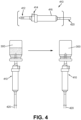
- FIG. 4 is a diagram illustrating aspects of an example infusion line spike 410 for direct drug infusion that may be employed consistent with implementations of the current subject matter.
- the infusion line spike 410 includes a drug port 412, an air venting cap 414, and a main body 416 in fluid communication with the drug port 412.
- the main body 416 interfaces with an infusion line 420 such that there is fluidic communication from the drug port 412, through the main body 416, to the infusion line 420.
- the infusion line spike 410 is configured to introduce the drug contained in the vial 300 into the infusion line 420, as illustrated in FIG. 4 .
- Other mechanisms may be used in place of the infusion line spike configuration.
- the infusion line 420 interfaces with the infusion pump (not shown), which operates to pump the fluid or material contained in the infusion line 420 at a prescribed rate.
- a needle At a distal end of the infusion line 420 is a needle (not shown) that is inserted into the patient for delivering the drug from the infusion line 420 to the patient.
- the process for drug administration utilizing the movable hanger label 100 may include infusing the infusion line with a first quantity of saline.
- the first quantity of saline may be provided in a saline bag or container (containing, for example, 0.9% NaCl), and the infusion line spike (or other mechanism) may interface with the saline bag or container to introduce (via the pump operation) the first quantity of saline into the infusion line. This may be done so that air is removed from the infusion line prior to the drug infusion into the patient (and prior to the needle insertion in the patient).
- the process may continue by removing a vial cap from the vial containing the drug.
- the vial may include a stopper at a top portion thereof, and the vial cap may be configured to cover the stopper.
- the stopper may be rubber or another resilient and compressible material to allow for the infusion line spike to pierce the stopper such that the infusion line spike is inserted into the vial, thereby allowing the drug contained in the vial to be directed to the infusion line.
- the movable hanger label 100 adhered to the vial may then be opened such that the movable hanger portion 150 is moved from the first position (e.g., the closed configuration) to the second position (e.g., the open or loop configuration).
- the vial is able to be attached to an apparatus to facilitate direct infusion of the drug from the vial.
- the vial may hang via the movable hanger portion 150 from an infusion stand or the like.
- the air venting cap on the infusion line spike may be opened, and the infusion pump may be set with an infusion rate and an infusion volume for the drug to be administered to the patient.
- the drug travels from the vial, via the infusion line spike, through the infusion line to the needle inserted into the patient at the distal end of the infusion line.
- a method of intravenously administering a drug to a patient may utilize a vial with a movable hanger label as described herein, or any other vial or container that may be suitable for this purpose.
- the method includes administering the drug to the patient by intravenous administration, without diluting the drug prior to administration.
- the method also includes intravenously administering saline to the patient after the drug.
- This saline infusion can "flush" the infusion line and reduce the amount of drug left in the line after administration.
- this step can allow administration of the full dose of drug to the patient.
- the method also can decrease the total time (drug administration plus saline flush) of administration to the patient compared to standard methods of administration.
- the method may include infusing the infusion line with a first quantity of saline (or other appropriate liquid).
- a first quantity of saline may be provided in a saline bag or container (containing, for example, 0.9% NaCl), and introduced (via the pump operation) into the infusion line. This may be done so that air is removed from the infusion line prior to the drug infusion into the patient (and prior to the needle insertion in the patient).
- the drug may be administered using an infusion pump.
- a second drug may be administered to the patient following the same or similar procedure.
- the second drug may be of the same type or a different type as the drug that was first administered.
- the infusion line may be flushed with a second quantity of saline. For example, once the dose of the drug has been dispensed, the infusion line may be moved to a saline bag or container containing saline, for example 0.9% NaCl, for flushing the infusion line.
- less than 5% of an initial volume of the drug may remain in the infusion line following the infusion of the second quantity of saline for an infusion time of up to about 10 minutes at an infusion rate of about 6 mL/min.
- the infusion time may include the drug administration time and the second saline flush time.
- An initial amount of the drug in the vial may be less than about 30 mL.
- a process for administering a drug to a patient may include infusing into the patient via an infusion line a first quantity of saline, followed by infusing into the patient via the infusion line an infusion volume of the drug from a vial for a first period of time.
- the drug may be administered at a fixed dose (e.g., the same dose regardless of the patient age and/or weight).
- An initial amount of drug in the vial may be less than or equal to about 30 mL. In embodiments, the drug is not diluted prior to infusion into the patient. In some embodiments, the initial amount of drug in the vial is between about 1 mL and about 30 mL. In some embodiments, the initial amount of drug in the vial is between about 1 mL and about 20 mL. In some embodiments, the initial amount of drug in the vial is between about 1 mL and about 15 mL. In some embodiments, the initial amount of drug in the vial is between about 5 mL and about 30 mL. In some embodiments, the initial amount of drug in the vial is between about 10 mL and about 30 mL.
- the initial amount of drug in the vial is between about 15 mL and about 30 mL. In some embodiments, the initial amount of drug in the vial is between about 5 mL and about 25 mL. In some embodiments, the initial amount of drug in the vial is between about 5 mL and about 20 mL. In some embodiments, the initial amount of drug in the vial is between about 5 mL and about 15 mL. The amount may be any value or subrange within the recited ranges, including endpoints.
- the initial amount of drug in the vial is less than or equal to about 30 mL, about 29 mL, about 28 mL, about 27 mL, about 26 mL, about 25 mL, about 24 mL, about 22 mL, or about 21 mL. In some embodiments, the initial amount of drug in the vial is less than or equal to about 20 mL. In some embodiments, the initial amount of drug in the vial is less than or equal to about 19 mL. In some embodiments, the initial amount of drug in the vial is less than or equal to about 18 mL. In some embodiments, the initial amount of drug in the vial is less than or equal to about 17 mL.
- the patient may then be infused via the infusion line with a second quantity of saline for a second period of time. Consistent with implementations of the current subject matter, less than about 10% of the initial amount of the drug may remain in the infusion line after infusion of the second quantity of saline. In some embodiments, less than about 9%, 8%, 7%, or 6% of the initial amount of the drug may remain in the infusion line after infusion of the second quantity of saline. In some embodiments, less than about 5% of the initial amount of the drug may remain in the infusion line after infusion of the second quantity of saline.
- less than about 4% of the initial amount of the drug may remain in the infusion line after infusion of the second quantity of saline. In some embodiments, less than about 3% of the initial amount of the drug may remain in the infusion line after infusion of the second quantity of saline. In some embodiments, less than about 2% of the initial amount of the drug may remain in the infusion line after infusion of the second quantity of saline. In other instances, less than about 1.5% of the initial amount of the drug may remain in the infusion line after infusion of the second quantity of saline. In some embodiments, less than about 1% of the initial amount of the drug may remain in the infusion line after infusion of the second quantity of saline.
- between about 0% and about 10% of the initial amount of the drug may remain in the infusion line after infusion of the second quantity of saline. In some embodiments, between about 0% and about 5% of the initial amount of the drug may remain in the infusion line after infusion of the second quantity of saline. In some embodiments, between about 0% and about 1.5% of the initial amount of the drug may remain in the infusion line after infusion of the second quantity of saline. In some embodiments, between about 1% and about 5% of the initial amount of the drug may remain in the infusion line after infusion of the second quantity of saline. In some embodiments, between about 1.5% and about 5% of the initial amount of the drug may remain in the infusion line after infusion of the second quantity of saline. The amount may be any value or subrange within the recited ranges, including endpoints.
- the total of the first period of time (the time for the infusion of the drug) and the second period of time (the time for the saline flush) may be less than or equal to about 60 minutes, less than or equal to about 30 minutes, or less than or equal to about 15 minutes.
- the total may be between about 5 min and about 60 min. In embodiments, the total may be between about 5 min and about 45 min. In embodiments, the total may be between about 10 min and about 45 min. In embodiments, the total may be between about 10 min and about 30 min. In embodiments, the total may be between about 15 min and about 30 min. In embodiments, the total may be between about 5 min and about 25 min. In embodiments, the total may be between about 5 min and about 20 min.
- the amount of time may be any value or subrange within the recited ranges, including endpoints.
- the infusion volume of the drug may be between about 10 mL and about 30 mL, and the second quantity of saline may be between about 25 mL and about 90 mL.
- the second quantity of saline may be between about 20 mL and about 100 mL. In embodiments, the second quantity of saline may be between about 25 mL and about 90 mL. In embodiments, the second quantity of saline may be between about 25 mL and about 80 mL. In embodiments, the second quantity of saline may be between about 25 mL and about 70 mL. In embodiments, the second quantity of saline may be between about 25 mL and about 60 mL. In embodiments, the second quantity of saline may be between about 25 mL and about 50 mL. In embodiments, the second quantity of saline may be between about 25 mL and about 40 mL. In embodiments, the second quantity of saline may be between about 25 mL and about 30 mL. The amount may be any value or subrange within the recited ranges, including endpoints.
- the drug and/or second quantity of saline may be infused into the patient at an infusion rate between about 1 mL/min and about 10 mL/min.
- the drug and/or second quantity of saline may be infused into the patient at an infusion rate between about 2 mL/min and about 10 mL/min.
- the drug and/or second quantity of saline may be infused into the patient at an infusion rate between about 3 mL/min and about 10 mL/min.
- the drug and/or second quantity of saline may be infused into the patient at an infusion rate between about 1 mL/min and about 8 mL/min.
- the following protocol is an example method for rapid infusion of a liquid drug, e.g., atezolizumab, from a vial.
- a liquid drug e.g., atezolizumab
- normal saline e.g. 0.9% NaCl
- FIG. 4 illustrates an infusion line spike alone (top) and after insertion into the vial (bottom). Ensure that the drug port section is resting in the neck region of the vial, near the stopper, as shown in the bottom of FIG. 4 . Open the hanger label and hang the vial, inverted, on an IV stand.
- Atezolizumab is available at three different doses (840 mg, 1200 mg, and 1680 mg), depending on the indication and protocol to be used.
- atezolizumab is diluted into a 250 mL infusion bag containing 0.9% Sodium Chloride Injection, USP prior to administration.
- the first infusion of atezolizumab is to be administered intravenously over 60 minutes. If the first infusion is tolerated, all subsequent infusions may be delivered over 30 minutes.
- TECENTRIQ ® (atezolizumab) Prescribing Information, www.gene.com/download/pdf/tecentriq_prescribing.pdf.
- a rapid and ready-to-infuse method for infusion of atezolizumab as described herein was tested.
- a total of six infusion scenarios were assessed. Two infusion times were assessed: 30 minutes for the initial dose, and 10 minutes for subsequent doses. Three doses were assessed: 840 mg, 1200 mg, and 1680 mg.
- the same infusion rate is used for all three tested doses under the same infusion time. In this assessment, a rate of 3 mL/min was tested for the 30 minute initial dose infusion, and a rate of 6 mL/min was tested for the 10 minute subsequent dose infusion.
- Table 1 provides the VTBI for the three doses and two infusion times. Table 1.
- Infusion Rates and Flushing Volumes Volume to be infused 840 mg 1200 mg 1680 mg Total infusion time Infusion rate Atezolizumab infusion Saline flush Atezolizumab infusion Saline flush Atezolizumab infusion Saline flush 30 min 3 mL/min 14.0 mL 76.0 mL 20.0 mL 70.0 mL 28.0 mL 62.0 mL 10 min 6 mL/min 14.0 mL 46.0 mL 20.0 mL 40.0 mL 28.0 mL 32.0 mL
- FIG. 5A and FIG. 5B are graphs 500 and 550, respectively, of the atezolizumab concentration as a function of time for two scenarios.
- Scenario 1 shown in FIG. 5A , is an 840 mg dose of atezolizumab infused over 30 minutes.
- Scenario 2 shown in FIG. 5B , is an 840 mg dose of atezolizumab infused over 10 minutes.
- the atezolizumab concentration was measured from the end of the infusion line, which is the concentration that the patients are expected to experience.
- FIG. 6A and FIG. 6B are graphs 600 and 650, respectively, of the atezolizumab concentration as a function of time for two scenarios.
- Scenario 3 shown in FIG. 6A is a 1200 mg dose of atezolizumab infused over 30 minutes.
- Scenario 4 shown in FIG. 6B is a 1200 mg dose of atezolizumab infused over 10 minutes.
- the atezolizumab concentration was measured from the end of the infusion line, which is the concentration that the patients are expected to experience.
- FIG. 7A and FIG. 7B are graphs 700 and 750, respectively, of the atezolizumab concentration as a function of time for two scenarios.
- Scenario 5, shown in FIG. 7A is a 1680 mg dose of atezolizumab infused over 30 minutes.
- Scenario 6, shown in FIG. 7B is a 1680 mg dose of atezolizumab infused over 10 minutes.
- the atezolizumab concentration was measured from the end of the infusion line, which is the concentration that the patients are expected to experience.
- Table 2 gives a summary of the six scenarios of simulated infusion and saline flush assessed.
- the maximum concentration (Cmax) of atezolizumab during infusion and saline flush was between 43.0 mg/mL and 57.1 mg/mL.
- the remaining atezolizumab in the infusion line after infusion i.e., underdose
- the underdose due to remaining atezolizumab in the infusion line also applies to current IV bag set-ups, and is not a RRTI-specific risk.
- Table 2 gives a summary of the six scenarios of simulated infusion and saline flush assessed.
- the maximum concentration (Cmax) of atezolizumab during infusion and saline flush was between 43.0 mg/mL and 57.1 mg/mL.
- the remaining atezolizumab in the infusion line after infusion i.e., underdose
- the underdose due to remaining atezolizumab in the infusion line also applies to current IV bag set-up
- Load testing of the hanger label was performed based on or similar to DIN ISO 15137 (Self-adhesive hanging devices for infusion bottles and injection vials - Requirements and test methods; available on the ISO website, e.g. www.iso.org/standard/37391.html, and is incorporated herein by reference in its entirety).
- Permanent load test 24h was performed based on/similar to DIN ISO 15137 with adapted weight of 500g.
- Short-term load test 30s based on/similar to DIN ISO 15137 with adapted weight of 1kg. The hanger label meets or exceeds the requirements based on these tests.
- spatially relative terms such as, for example, “under”, “below”, “lower”, “over”, “upper” and the like, may be used herein for ease of description to describe one element or feature's relationship to another element(s) or feature(s) as illustrated in the figures. It will be understood that the spatially relative terms are intended to encompass different orientations of the device in use or operation in addition to the orientation depicted in the figures. For example, if a device in the figures is inverted, elements described as “under” or “beneath” other elements or features would then be oriented “over” the other elements or features. Thus, the exemplary term “under” can encompass both an orientation of over and under.
- the device may be otherwise oriented (rotated 90 degrees or at other orientations) and the spatially relative descriptors used herein interpreted accordingly.
- the terms “upwardly”, “downwardly”, “vertical”, “horizontal” and the like are used herein for the purpose of explanation only unless specifically indicated otherwise.
- first and second may be used herein to describe various features/elements (including steps), these features/elements should not be limited by these terms, unless the context indicates otherwise. These terms may be used to distinguish one feature/element from another feature/element. Thus, a first feature/element discussed below could be termed a second feature/element, and similarly, a second feature/element discussed below could be termed a first feature/element without departing from the teachings provided herein.
- a numeric value may have a value that is +/- 0.1% of the stated value (or range of values), +/- 1% of the stated value (or range of values), +/- 2% of the stated value (or range of values), +/- 5% of the stated value (or range of values), +/- 10% of the stated value (or range of values), etc.
- "about” refers to +/- 10% or less of the stated value (or range of values). Any numerical values given herein should also be understood to include about or approximately that value, unless the context indicates otherwise.
- phrases such as, for example, "at least one of” or “one or more of” may occur followed by a conjunctive list of elements or features.
- the term “and/or” may also occur in a list of two or more elements or features. Unless otherwise implicitly or explicitly contradicted by the context in which it used, such a phrase is intended to mean any of the listed elements or features individually or any of the recited elements or features in combination with any of the other recited elements or features.
- the phrases “at least one of A and B;” “one or more of A and B;” and “A and/or B” are each intended to mean "A alone, B alone, or A and B together.”
- a similar interpretation is also intended for lists including three or more items.
- phrases “at least one of A, B, and C;” “one or more of A, B, and C;” and “A, B, and/or C” are each intended to mean “A alone, B alone, C alone, A and B together, A and C together, B and C together, or A and B and C together.”
- Use of the term “based on,” above and in the claims is intended to mean, “based at least in part on,” such that an unrecited feature or element is also permissible.
Landscapes
- Health & Medical Sciences (AREA)
- Life Sciences & Earth Sciences (AREA)
- Veterinary Medicine (AREA)
- Engineering & Computer Science (AREA)
- Public Health (AREA)
- General Health & Medical Sciences (AREA)
- Animal Behavior & Ethology (AREA)
- Heart & Thoracic Surgery (AREA)
- Hematology (AREA)
- Biomedical Technology (AREA)
- Anesthesiology (AREA)
- Vascular Medicine (AREA)
- Pharmacology & Pharmacy (AREA)
- General Physics & Mathematics (AREA)
- Physics & Mathematics (AREA)
- Theoretical Computer Science (AREA)
- Mechanical Engineering (AREA)
- Pharmaceuticals Containing Other Organic And Inorganic Compounds (AREA)
- Medical Preparation Storing Or Oral Administration Devices (AREA)
- Medicines That Contain Protein Lipid Enzymes And Other Medicines (AREA)
- Infusion, Injection, And Reservoir Apparatuses (AREA)
- Acyclic And Carbocyclic Compounds In Medicinal Compositions (AREA)
- Medicinal Preparation (AREA)
Claims (14)
- Vorrichtung, umfassend:
ein Etikett (100), umfassend:einen Rückflächenbereich (102); undeinen dem Rückflächenbereich entgegengesetzten Vorderflächenbereich (104);wobei ein Abschnitt des Rückflächenbereichs des Etiketts und ein entgegengesetzter Abschnitt des Vorderflächenbereichs des Etiketts einen beweglichen Aufhänger (150) umfassen, wobei der bewegliche Aufhänger dazu ausgestaltet ist, sich von einer ersten Position zu einer zweiten Position zu bewegen;wobei der bewegliche Aufhänger in der ersten Position zumindest im Wesentlichen mit einem übrigen Abschnitt des Rückflächenbereichs und einem entgegengesetzten übrigen Abschnitt des Vorderflächenbereichs ausgerichtet ist und wobei der bewegliche Aufhänger in der zweiten Position zumindest teilweise von dem übrigen Abschnitt des Rückflächenbereichs und dem entgegengesetzten übrigen Abschnitt des Vorderflächenbereichs getrennt ist;wobei der übrige Abschnitt des Rückflächenbereichs des Etiketts dazu ausgestaltet ist, an einer äußeren Seitenwand eines Injektionsfläschchens (300) zu kleben; undwobei der bewegliche Aufhänger mit zusätzlichem Stützmaterial verstärkt ist, um Brüchen zu widerstehen und dem Injektionsfläschchen einen besseren Halt zu geben. - Vorrichtung nach Anspruch 1, wobei das Etikett ein flexibles Material umfasst.
- Vorrichtung nach einem der Ansprüche 1 und 2, wobei der Rückflächenbereich den Abschnitt des Rückflächenbereichs und den übrigen Abschnitt des Rückflächenbereichs umfasst und wobei der Vorderflächenbereich den entgegengesetzten Abschnitt des Vorderflächenbereichs und den entgegengesetzten übrigen Abschnitt des Vorderflächenbereichs umfasst.
- Vorrichtung nach einem der Ansprüche 1 bis 3, wobei das Etikett ferner eine Perforation umfasst, die durch den Rückflächenbereich und den Vorderflächenbereich verläuft, und wobei die Perforation ferner mindestens einen Abschnitt eines Umfangs des beweglichen Aufhängers definiert.
- Vorrichtung nach Anspruch 4, wobei die Perforation dazu ausgestaltet ist, zu bewirken, dass sich der bewegliche Aufhänger zumindest teilweise von dem übrigen Abschnitt des Rückflächenbereichs und dem entgegengesetzten übrigen Abschnitt des Vorderflächenbereichs trennt.
- Vorrichtung nach Anspruch 4, wobei der bewegliche Aufhänger dazu ausgestaltet ist, sich entlang der Perforation von der ersten Position zur zweiten Position zu bewegen.
- Vorrichtung nach einem der Ansprüche 1 bis 6, wobei der bewegliche Aufhänger in der zweiten Position eine Schlaufenausgestaltung umfasst, wobei die Schlaufenausgestaltung zwei feste Enden umfasst.
- Vorrichtung nach einem der Ansprüche 1 bis 7, wobei der bewegliche Aufhänger in der zweiten Position dazu ausgestaltet ist, das Injektionsfläschchen von einem Infusionsständer zu tragen, wobei das Etikett an das Injektionsfläschchen geklebt ist.
- Vorrichtung nach Anspruch 8, wobei der bewegliche Aufhänger in der zweiten Position derart positioniert ist, dass das Injektionsfläschchen im Wesentlichen nach unten vom Infusionsständer weg hängt.
- Vorrichtung nach Anspruch 9, wobei das Etikett Text auf dem Vorderflächenbereich umfasst, wobei der Text auf dem Kopf steht, richtig herum ist oder eine Kombination davon ist, wenn das Injektionsfläschchen im Wesentlichen nach unten hängt.
- Vorrichtung nach Anspruch 8, wobei der bewegliche Aufhänger in der zweiten Position dazu ausgestaltet ist, ein Gewicht des Injektionsfläschchens von bis zu etwa 500 kg zumindest während einer Dauerbelastungsprüfung für 24 Stunden nach DIN ISO 15137 zu tragen.
- Vorrichtung nach einem der Ansprüche 1 bis 11, wobei eine Länge des Etiketts zwischen rund 75 mm und rund 100 mm beträgt.
- Vorrichtung nach einem der Ansprüche 1 bis 12, wobei eine Höhe des Etiketts zwischen rund 30 mm und rund 40 mm beträgt.
- Vorrichtung nach einem der Ansprüche 1 bis 13, wobei eine Breite des beweglichen Aufhängers zwischen rund 5 mm und rund 7 mm beträgt.
Applications Claiming Priority (2)
| Application Number | Priority Date | Filing Date | Title |
|---|---|---|---|
| US202062966495P | 2020-01-27 | 2020-01-27 | |
| PCT/US2021/015130 WO2021154755A1 (en) | 2020-01-27 | 2021-01-26 | Apparatus for and method in direct drug infusion using a label as a hanger |
Publications (3)
| Publication Number | Publication Date |
|---|---|
| EP4096749A1 EP4096749A1 (de) | 2022-12-07 |
| EP4096749C0 EP4096749C0 (de) | 2025-03-12 |
| EP4096749B1 true EP4096749B1 (de) | 2025-03-12 |
Family
ID=74673346
Family Applications (1)
| Application Number | Title | Priority Date | Filing Date |
|---|---|---|---|
| EP21707476.4A Active EP4096749B1 (de) | 2020-01-27 | 2021-01-26 | Vorrichtung für und verfahren in direkter arzneimittelinfusion, mit einem etikett als hängevorrichtung |
Country Status (16)
| Country | Link |
|---|---|
| US (2) | US12420008B2 (de) |
| EP (1) | EP4096749B1 (de) |
| JP (2) | JP7796651B2 (de) |
| KR (1) | KR20220131980A (de) |
| CN (2) | CN113257108B (de) |
| AU (2) | AU2021200465B2 (de) |
| BR (1) | BR112022014581A2 (de) |
| CA (1) | CA3169212A1 (de) |
| DE (1) | DE202021100328U1 (de) |
| DK (1) | DK202100006U3 (de) |
| ES (2) | ES3027186T3 (de) |
| FR (1) | FR3106499B3 (de) |
| IL (1) | IL294819A (de) |
| PL (1) | PL4096749T3 (de) |
| TW (2) | TWM618816U (de) |
| WO (1) | WO2021154755A1 (de) |
Families Citing this family (2)
| Publication number | Priority date | Publication date | Assignee | Title |
|---|---|---|---|---|
| DE202021100328U1 (de) | 2020-01-27 | 2021-03-30 | F. Hoffmann-La Roche & Co. Ag | Vorrichtung zur direkten Arzneimittelinfusion |
| KR102821786B1 (ko) * | 2024-11-13 | 2025-06-18 | 주식회사 염광산업 | 링거병 부착용 행거라벨의 제조방법 |
Family Cites Families (72)
| Publication number | Priority date | Publication date | Assignee | Title |
|---|---|---|---|---|
| AT137156B (de) * | 1933-04-20 | 1934-04-10 | Ferdinand Neubauer | Haltegestell für Vorlegeflaschen. |
| US1971528A (en) | 1933-09-14 | 1934-08-28 | Klebanow Leo | Bottle collar or tag |
| US1987418A (en) | 1933-12-16 | 1935-01-08 | Einson Freeman Co Inc | Display device |
| US2881766A (en) | 1956-02-06 | 1959-04-14 | George B Graff Company | File tab or signal |
| US3212214A (en) | 1963-03-25 | 1965-10-19 | Chet A Patterson | Blank for forming a head having a vizored headpiece |
| US3266298A (en) | 1963-07-30 | 1966-08-16 | Technicon Instr | Means and method for the identification of samples for blood typing |
| US3273781A (en) | 1964-02-25 | 1966-09-20 | James C Mills | Mailing wrapper |
| US3744658A (en) | 1971-12-13 | 1973-07-10 | M Fujio | Dripping bottle |
| US4048737A (en) | 1975-02-12 | 1977-09-20 | Mcdermott Clifton Eugene | Dual identification card and identification card holder |
| US4306662A (en) | 1980-09-17 | 1981-12-22 | Heinz Plastic Mold Co. | Intravenous bottle holder |
| USD275177S (en) | 1982-07-20 | 1984-08-21 | Villanueva Jesus R | Mounting clip |
| JPS60144445U (ja) * | 1984-03-07 | 1985-09-25 | 藤沢薬品工業株式会社 | ラベル兼用バイアル懸吊具 |
| US5135125A (en) * | 1991-02-15 | 1992-08-04 | Tapecon, Inc. | Hanging label |
| US5141254A (en) | 1991-03-22 | 1992-08-25 | Larry Tucker, Inc. | Retail coupon document |
| CN2124713U (zh) * | 1992-06-16 | 1992-12-16 | 董英凯 | 医用输液瓶挂架 |
| CN2221808Y (zh) * | 1995-01-13 | 1996-03-06 | 綦新源 | 一种行包、货运标签 |
| US5490658A (en) * | 1995-03-02 | 1996-02-13 | Avery Dennison Corporation | Label hangers for intravenous bottles |
| US5738381A (en) | 1995-09-25 | 1998-04-14 | Treleaven; Carl W. | Hanger label |
| US6349974B1 (en) | 1995-09-25 | 2002-02-26 | Pharmagraphics (Southeast), L.L.C. | Hanger label |
| US5732491A (en) | 1995-11-15 | 1998-03-31 | Ronald P. Burtch & Associates Limited | Erectable periscoping display device for planar items |
| US5782495A (en) | 1996-01-11 | 1998-07-21 | Westlake Ventures, L.L.C. | Hanger label |
| US5823503A (en) * | 1996-08-21 | 1998-10-20 | Thomas Packaging Corporation | Hanger for hanging an intravenous feeding bottle |
| US5878901A (en) * | 1997-02-21 | 1999-03-09 | Pharmagraphics (Midwest), L.L.C. | Composite hanger and label incorporating the same |
| US5829788A (en) | 1997-04-30 | 1998-11-03 | Laurence-Underwood Company Co., Inc | Label with hanging handle |
| US5967560A (en) | 1997-06-17 | 1999-10-19 | Schreiner Etiketten Und Selbstklebetechnik Gmbh & Co. | Hanging label |
| US6272780B1 (en) | 1998-04-01 | 2001-08-14 | Pharmaceutic Litho & Label Company, Inc. | Label with applied handle |
| USD443894S1 (en) | 1999-02-19 | 2001-06-19 | Productive Environments Inc. | Tabbed label |
| US6457747B1 (en) | 1999-04-01 | 2002-10-01 | Pharmagraphics (Southeast) L.L.C. | Hanger label |
| US6546656B2 (en) | 2000-12-15 | 2003-04-15 | Carl R. Twentier | Method and apparatus for adjustably sizing identification band |
| CN2465264Y (zh) * | 2001-01-11 | 2001-12-12 | 林洵洵 | 悬挂式标签 |
| US6613012B2 (en) | 2001-05-14 | 2003-09-02 | Timothy Y. Kraushaar | IV administration set identification system |
| US7316358B2 (en) | 2002-03-18 | 2008-01-08 | Precision Dynamics Corporation | Identification band with adhesively attached coupling elements |
| DE10307252B4 (de) | 2003-02-20 | 2006-09-28 | Schreiner Gmbh & Co. Kg | Bügeletikett |
| US8523829B2 (en) | 2004-01-29 | 2013-09-03 | Becton, Dickinson And Company | Intravenous delivery system |
| DE102004046552B4 (de) * | 2004-09-24 | 2010-01-28 | Schreiner Group Gmbh & Co. Kg | Etikett |
| US20070014958A1 (en) * | 2005-07-08 | 2007-01-18 | Chaplin Ernest R | Hanger labels, label assemblies and methods for forming the same |
| USD585944S1 (en) | 2007-06-01 | 2009-02-03 | Han Young Lee | Tag holder |
| TWD129022S1 (zh) | 2008-01-23 | 2009-06-01 | 新力股份有限公司 | 標籤 |
| BRPI0910698A2 (pt) | 2008-04-04 | 2018-03-27 | Molecular Insight Pharm Inc | recipiente blindado, método para administração de um composto radiomarcado, aparelho de injeção intravenosa e método para reduzir exposição à radiação durante infusão de um composto radioativo |
| USD596240S1 (en) | 2008-07-09 | 2009-07-14 | Ralph Muniz | Folding circular door hanger |
| USD613451S1 (en) | 2008-09-19 | 2010-04-06 | Michele Welsh | Skin applique |
| CN201402559Y (zh) * | 2009-04-10 | 2010-02-10 | 绿十字(中国)生物制品有限公司 | 瓶网式标签 |
| MX2012000100A (es) * | 2009-07-01 | 2012-04-02 | Fresenius Med Care Hldg Inc | Dispositivos de suministro de farmaco y sistemas y metodos relacionados. |
| TWD140218S1 (zh) | 2009-12-29 | 2011-04-21 | 新力股份有限公司 | 標籤 |
| CA137792S (en) | 2010-02-08 | 2011-06-13 | Avery Dennison Corp | Note sheet pad |
| USD683397S1 (en) | 2010-04-21 | 2013-05-28 | Avery Dennison Corporation | Pad of labels |
| US8366658B2 (en) | 2010-05-06 | 2013-02-05 | Becton, Dickinson And Company | Systems and methods for providing a closed venting hazardous drug IV set |
| USD702765S1 (en) | 2010-10-04 | 2014-04-15 | Sev-Rend Corporation | Security inherent wrap label with patterned adhesive |
| EP2691143B1 (de) * | 2011-03-30 | 2019-05-29 | Flow Med Ltd | Gesteuertes system für eine kontinuierliche bewässerung |
| US10081473B2 (en) * | 2011-04-08 | 2018-09-25 | Ampac Holdings, Llc | Packaging container with pull tab |
| USD676572S1 (en) | 2011-10-03 | 2013-02-19 | Eagle Pharmaceuticals, Inc. | Vial with collar label |
| DE102012015557A1 (de) | 2012-08-08 | 2014-02-13 | August Faller Kg | Selbstklebendes Etikett |
| DE202012007547U1 (de) * | 2012-08-08 | 2012-09-04 | August Faller Kg | Selbstklebendes Etikett |
| USD729313S1 (en) | 2014-01-22 | 2015-05-12 | Gift Card Impressions, LLC | Stored value card envelope |
| USD741955S1 (en) | 2014-06-13 | 2015-10-27 | Morgan Pierre Clark | Trading card toy |
| USD860322S1 (en) | 2014-07-03 | 2019-09-17 | National Scientific Company | Vial label and vial combination |
| EP3233658B1 (de) * | 2014-12-16 | 2020-07-01 | Société des Produits Nestlé S.A. | Produktpackung mit griff |
| USD772338S1 (en) | 2015-01-19 | 2016-11-22 | Ccl Label, Inc. | Note tab |
| CN204501645U (zh) * | 2015-02-04 | 2015-07-29 | 安徽双鹤药业有限责任公司 | 一种改进型单管与内空船式单室输液袋 |
| WO2017031381A1 (en) * | 2015-08-18 | 2017-02-23 | Meps Real-Time, Inc. | Bulk encoding of medical items using rfid tags |
| USD786976S1 (en) | 2015-09-24 | 2017-05-16 | Tuesday Morning Partners, Ltd. | Label |
| USD785710S1 (en) | 2016-01-12 | 2017-05-02 | Chyng Hong Electronic Co., Ltd. | Label for control panel |
| USD785711S1 (en) | 2016-02-25 | 2017-05-02 | Chyng Hong Electronic Co., Ltd. | Label for control panel |
| US10485926B2 (en) * | 2016-10-07 | 2019-11-26 | Carefusion 303, Inc. | Systems and methods for controlling an infusion pump |
| WO2018094854A1 (zh) * | 2016-11-25 | 2018-05-31 | 汤疆平 | 医用输液瓶内置球囊输滴净型输液器 |
| CN207020882U (zh) * | 2017-07-25 | 2018-02-16 | 上海明利包装印刷有限公司 | 一种输液瓶标签 |
| BR112020018890B1 (pt) | 2018-03-21 | 2022-07-19 | Avery Dennison Retail Information Services, Llc | Comprimento de material de fornecimento e método para fazer uma etiqueta de identificação |
| USD888828S1 (en) | 2018-12-10 | 2020-06-30 | Spectrum Diversified Designs, Llc | Label plate |
| USD927596S1 (en) | 2019-08-28 | 2021-08-10 | Michael Monarque | Shelf tag |
| USD931370S1 (en) | 2020-01-27 | 2021-09-21 | Genentech, Inc. | Label for a vial |
| DE202021100328U1 (de) | 2020-01-27 | 2021-03-30 | F. Hoffmann-La Roche & Co. Ag | Vorrichtung zur direkten Arzneimittelinfusion |
| USD999636S1 (en) | 2021-04-19 | 2023-09-26 | Elopak As | Packing container closure |
-
2021
- 2021-01-25 DE DE202021100328.6U patent/DE202021100328U1/de active Active
- 2021-01-25 AU AU2021200465A patent/AU2021200465B2/en active Active
- 2021-01-26 BR BR112022014581A patent/BR112022014581A2/pt not_active Application Discontinuation
- 2021-01-26 EP EP21707476.4A patent/EP4096749B1/de active Active
- 2021-01-26 PL PL21707476.4T patent/PL4096749T3/pl unknown
- 2021-01-26 JP JP2022544807A patent/JP7796651B2/ja active Active
- 2021-01-26 CA CA3169212A patent/CA3169212A1/en active Pending
- 2021-01-26 WO PCT/US2021/015130 patent/WO2021154755A1/en not_active Ceased
- 2021-01-26 KR KR1020227029221A patent/KR20220131980A/ko not_active Withdrawn
- 2021-01-26 US US17/795,506 patent/US12420008B2/en active Active
- 2021-01-26 DK DKBA202100006U patent/DK202100006U3/da active IP Right Grant
- 2021-01-26 ES ES21707476T patent/ES3027186T3/es active Active
- 2021-01-26 TW TW110200941U patent/TWM618816U/zh unknown
- 2021-01-26 IL IL294819A patent/IL294819A/en unknown
- 2021-01-26 TW TW110102793A patent/TW202128237A/zh unknown
- 2021-01-27 ES ES202130153U patent/ES1279849Y/es not_active Expired - Fee Related
- 2021-01-27 JP JP2021000250U patent/JP3231487U/ja active Active
- 2021-01-27 CN CN202110109340.8A patent/CN113257108B/zh active Active
- 2021-01-27 CN CN202120226781.1U patent/CN215643385U/zh active Active
- 2021-01-27 FR FR2100771A patent/FR3106499B3/fr active Active
-
2022
- 2022-08-26 AU AU2022100118A patent/AU2022100118A4/en active Active
-
2025
- 2025-01-29 US US19/040,791 patent/US20250269109A1/en active Pending
Also Published As
| Publication number | Publication date |
|---|---|
| CN113257108A (zh) | 2021-08-13 |
| JP2023511954A (ja) | 2023-03-23 |
| AU2021200465B2 (en) | 2024-05-16 |
| ES1279849Y (es) | 2022-01-18 |
| KR20220131980A (ko) | 2022-09-29 |
| EP4096749A1 (de) | 2022-12-07 |
| WO2021154755A1 (en) | 2021-08-05 |
| BR112022014581A2 (pt) | 2022-09-13 |
| EP4096749C0 (de) | 2025-03-12 |
| DK202100006U3 (da) | 2021-04-29 |
| US20230095587A1 (en) | 2023-03-30 |
| ES3027186T3 (en) | 2025-06-13 |
| ES1279849U (es) | 2021-10-21 |
| TWM618816U (zh) | 2021-11-01 |
| CN113257108B (zh) | 2025-11-21 |
| CN215643385U (zh) | 2022-01-25 |
| TW202128237A (zh) | 2021-08-01 |
| US20250269109A1 (en) | 2025-08-28 |
| JP7796651B2 (ja) | 2026-01-09 |
| DE202021100328U1 (de) | 2021-03-30 |
| AU2021200465A1 (en) | 2021-08-12 |
| FR3106499A3 (fr) | 2021-07-30 |
| PL4096749T3 (pl) | 2025-06-09 |
| CA3169212A1 (en) | 2021-08-05 |
| FR3106499B3 (fr) | 2022-01-21 |
| AU2022100118A4 (en) | 2022-09-29 |
| US12420008B2 (en) | 2025-09-23 |
| IL294819A (en) | 2022-09-01 |
| JP3231487U (ja) | 2021-04-08 |
| DE202021100328U8 (de) | 2021-06-24 |
Similar Documents
| Publication | Publication Date | Title |
|---|---|---|
| US20250269109A1 (en) | Apparatus for and method in direct drug infusion using a label as a hanger | |
| US20230277757A1 (en) | Point of care drug delivery apparatus and method | |
| US20230048576A1 (en) | Compounds for the treatment of neuropathic pain | |
| US12239714B2 (en) | Phosphatidylserine-binding conjugates | |
| US12350241B1 (en) | Method for inhibiting proliferation of cancer cells | |
| HK40056548B (zh) | 用於直接药物输注的装置和方法 | |
| HK40056548A (zh) | 用於直接药物输注的装置和方法 | |
| US20220273614A1 (en) | Intravenous vitamin c therapy protocol for the treatment of cancer | |
| US20240272078A1 (en) | Surface-enhanced raman spectroscopic method of detecting an anti-cancer drug in a solution |
Legal Events
| Date | Code | Title | Description |
|---|---|---|---|
| STAA | Information on the status of an ep patent application or granted ep patent |
Free format text: STATUS: UNKNOWN |
|
| STAA | Information on the status of an ep patent application or granted ep patent |
Free format text: STATUS: THE INTERNATIONAL PUBLICATION HAS BEEN MADE |
|
| PUAI | Public reference made under article 153(3) epc to a published international application that has entered the european phase |
Free format text: ORIGINAL CODE: 0009012 |
|
| STAA | Information on the status of an ep patent application or granted ep patent |
Free format text: STATUS: REQUEST FOR EXAMINATION WAS MADE |
|
| 17P | Request for examination filed |
Effective date: 20220719 |
|
| AK | Designated contracting states |
Kind code of ref document: A1 Designated state(s): AL AT BE BG CH CY CZ DE DK EE ES FI FR GB GR HR HU IE IS IT LI LT LU LV MC MK MT NL NO PL PT RO RS SE SI SK SM TR |
|
| DAV | Request for validation of the european patent (deleted) | ||
| DAX | Request for extension of the european patent (deleted) | ||
| GRAP | Despatch of communication of intention to grant a patent |
Free format text: ORIGINAL CODE: EPIDOSNIGR1 |
|
| STAA | Information on the status of an ep patent application or granted ep patent |
Free format text: STATUS: GRANT OF PATENT IS INTENDED |
|
| INTG | Intention to grant announced |
Effective date: 20241203 |
|
| RIN1 | Information on inventor provided before grant (corrected) |
Inventor name: BONDI, RAFFAELLA CLAUDIA Inventor name: YOHE, STEFAN Inventor name: HATCH, MICHELLE Inventor name: PESINO, LORENZO MYLES PAREDES Inventor name: WISE, GEOFFREY COLIN Inventor name: KHURANA, MAHESH Inventor name: POROCK, EDWARD Inventor name: ZHENG, KAI |
|
| GRAS | Grant fee paid |
Free format text: ORIGINAL CODE: EPIDOSNIGR3 |
|
| GRAA | (expected) grant |
Free format text: ORIGINAL CODE: 0009210 |
|
| STAA | Information on the status of an ep patent application or granted ep patent |
Free format text: STATUS: THE PATENT HAS BEEN GRANTED |
|
| AK | Designated contracting states |
Kind code of ref document: B1 Designated state(s): AL AT BE BG CH CY CZ DE DK EE ES FI FR GB GR HR HU IE IS IT LI LT LU LV MC MK MT NL NO PL PT RO RS SE SI SK SM TR |
|
| REG | Reference to a national code |
Ref country code: GB Ref legal event code: FG4D |
|
| REG | Reference to a national code |
Ref country code: CH Ref legal event code: EP |
|
| REG | Reference to a national code |
Ref country code: DE Ref legal event code: R096 Ref document number: 602021027486 Country of ref document: DE |
|
| REG | Reference to a national code |
Ref country code: IE Ref legal event code: FG4D |
|
| U01 | Request for unitary effect filed |
Effective date: 20250312 |
|
| U07 | Unitary effect registered |
Designated state(s): AT BE BG DE DK EE FI FR IT LT LU LV MT NL PT RO SE SI Effective date: 20250319 |
|
| REG | Reference to a national code |
Ref country code: ES Ref legal event code: FG2A Ref document number: 3027186 Country of ref document: ES Kind code of ref document: T3 Effective date: 20250613 |
|
| PG25 | Lapsed in a contracting state [announced via postgrant information from national office to epo] |
Ref country code: RS Free format text: LAPSE BECAUSE OF FAILURE TO SUBMIT A TRANSLATION OF THE DESCRIPTION OR TO PAY THE FEE WITHIN THE PRESCRIBED TIME-LIMIT Effective date: 20250612 |
|
| PG25 | Lapsed in a contracting state [announced via postgrant information from national office to epo] |
Ref country code: NO Free format text: LAPSE BECAUSE OF FAILURE TO SUBMIT A TRANSLATION OF THE DESCRIPTION OR TO PAY THE FEE WITHIN THE PRESCRIBED TIME-LIMIT Effective date: 20250612 |
|
| PG25 | Lapsed in a contracting state [announced via postgrant information from national office to epo] |
Ref country code: HR Free format text: LAPSE BECAUSE OF FAILURE TO SUBMIT A TRANSLATION OF THE DESCRIPTION OR TO PAY THE FEE WITHIN THE PRESCRIBED TIME-LIMIT Effective date: 20250312 |
|
| REG | Reference to a national code |
Ref country code: GR Ref legal event code: EP Ref document number: 20250400941 Country of ref document: GR Effective date: 20250613 |
|
| PG25 | Lapsed in a contracting state [announced via postgrant information from national office to epo] |
Ref country code: SM Free format text: LAPSE BECAUSE OF FAILURE TO SUBMIT A TRANSLATION OF THE DESCRIPTION OR TO PAY THE FEE WITHIN THE PRESCRIBED TIME-LIMIT Effective date: 20250312 |
|
| PG25 | Lapsed in a contracting state [announced via postgrant information from national office to epo] |
Ref country code: CZ Free format text: LAPSE BECAUSE OF FAILURE TO SUBMIT A TRANSLATION OF THE DESCRIPTION OR TO PAY THE FEE WITHIN THE PRESCRIBED TIME-LIMIT Effective date: 20250312 |
|
| PG25 | Lapsed in a contracting state [announced via postgrant information from national office to epo] |
Ref country code: SK Free format text: LAPSE BECAUSE OF FAILURE TO SUBMIT A TRANSLATION OF THE DESCRIPTION OR TO PAY THE FEE WITHIN THE PRESCRIBED TIME-LIMIT Effective date: 20250312 |
|
| PG25 | Lapsed in a contracting state [announced via postgrant information from national office to epo] |
Ref country code: IS Free format text: LAPSE BECAUSE OF FAILURE TO SUBMIT A TRANSLATION OF THE DESCRIPTION OR TO PAY THE FEE WITHIN THE PRESCRIBED TIME-LIMIT Effective date: 20250712 |
|
| PGFP | Annual fee paid to national office [announced via postgrant information from national office to epo] |
Ref country code: GB Payment date: 20251220 Year of fee payment: 6 |
|
| PGFP | Annual fee paid to national office [announced via postgrant information from national office to epo] |
Ref country code: GR Payment date: 20251218 Year of fee payment: 6 |
|
| PLBE | No opposition filed within time limit |
Free format text: ORIGINAL CODE: 0009261 |
|
| STAA | Information on the status of an ep patent application or granted ep patent |
Free format text: STATUS: NO OPPOSITION FILED WITHIN TIME LIMIT |
|
| REG | Reference to a national code |
Ref country code: CH Ref legal event code: L10 Free format text: ST27 STATUS EVENT CODE: U-0-0-L10-L00 (AS PROVIDED BY THE NATIONAL OFFICE) Effective date: 20260121 |
|
| U20 | Renewal fee for the european patent with unitary effect paid |
Year of fee payment: 6 Effective date: 20251217 |
|
| PGFP | Annual fee paid to national office [announced via postgrant information from national office to epo] |
Ref country code: PL Payment date: 20251219 Year of fee payment: 6 |
|
| REG | Reference to a national code |
Ref country code: CH Ref legal event code: U11 Free format text: ST27 STATUS EVENT CODE: U-0-0-U10-U11 (AS PROVIDED BY THE NATIONAL OFFICE) Effective date: 20260201 |
|
| 26N | No opposition filed |
Effective date: 20251215 |
|
| PGFP | Annual fee paid to national office [announced via postgrant information from national office to epo] |
Ref country code: ES Payment date: 20260202 Year of fee payment: 6 |
|
| PGFP | Annual fee paid to national office [announced via postgrant information from national office to epo] |
Ref country code: TR Payment date: 20260105 Year of fee payment: 6 |
|
| PGFP | Annual fee paid to national office [announced via postgrant information from national office to epo] |
Ref country code: CH Payment date: 20260201 Year of fee payment: 6 |