EP4092185A1 - Fibrillated regenerated cellulose fiber, and fabric using same - Google Patents
Fibrillated regenerated cellulose fiber, and fabric using same Download PDFInfo
- Publication number
- EP4092185A1 EP4092185A1 EP20913922.9A EP20913922A EP4092185A1 EP 4092185 A1 EP4092185 A1 EP 4092185A1 EP 20913922 A EP20913922 A EP 20913922A EP 4092185 A1 EP4092185 A1 EP 4092185A1
- Authority
- EP
- European Patent Office
- Prior art keywords
- treatment
- fabric
- dtex
- regenerated cellulose
- cellulose fibers
- Prior art date
- Legal status (The legal status is an assumption and is not a legal conclusion. Google has not performed a legal analysis and makes no representation as to the accuracy of the status listed.)
- Pending
Links
- 239000004744 fabric Substances 0.000 title claims abstract description 82
- 229920003043 Cellulose fiber Polymers 0.000 title claims abstract description 76
- 239000004627 regenerated cellulose Substances 0.000 title claims abstract description 51
- 238000011282 treatment Methods 0.000 claims abstract description 116
- 238000006116 polymerization reaction Methods 0.000 claims abstract description 58
- 239000002253 acid Substances 0.000 claims abstract description 10
- 239000000470 constituent Substances 0.000 claims abstract description 7
- 238000004519 manufacturing process Methods 0.000 claims abstract description 4
- 239000000835 fiber Substances 0.000 abstract description 19
- 238000000034 method Methods 0.000 abstract description 16
- 238000001035 drying Methods 0.000 abstract description 11
- 230000001747 exhibiting effect Effects 0.000 abstract description 5
- 230000005923 long-lasting effect Effects 0.000 abstract description 5
- 238000004043 dyeing Methods 0.000 description 51
- 238000005406 washing Methods 0.000 description 42
- 206010061592 cardiac fibrillation Diseases 0.000 description 37
- 230000002600 fibrillogenic effect Effects 0.000 description 37
- 229920000297 Rayon Polymers 0.000 description 34
- 239000002964 rayon Substances 0.000 description 34
- BDAGIHXWWSANSR-UHFFFAOYSA-N methanoic acid Natural products OC=O BDAGIHXWWSANSR-UHFFFAOYSA-N 0.000 description 24
- 239000002759 woven fabric Substances 0.000 description 21
- 238000009981 jet dyeing Methods 0.000 description 20
- XLYOFNOQVPJJNP-UHFFFAOYSA-N water Substances O XLYOFNOQVPJJNP-UHFFFAOYSA-N 0.000 description 20
- OSWFIVFLDKOXQC-UHFFFAOYSA-N 4-(3-methoxyphenyl)aniline Chemical compound COC1=CC=CC(C=2C=CC(N)=CC=2)=C1 OSWFIVFLDKOXQC-UHFFFAOYSA-N 0.000 description 12
- 235000019253 formic acid Nutrition 0.000 description 12
- 230000000052 comparative effect Effects 0.000 description 11
- 238000009941 weaving Methods 0.000 description 11
- QTBSBXVTEAMEQO-UHFFFAOYSA-N Acetic acid Chemical compound CC(O)=O QTBSBXVTEAMEQO-UHFFFAOYSA-N 0.000 description 9
- XUIMIQQOPSSXEZ-UHFFFAOYSA-N Silicon Chemical compound [Si] XUIMIQQOPSSXEZ-UHFFFAOYSA-N 0.000 description 8
- 229910052710 silicon Inorganic materials 0.000 description 8
- 239000010703 silicon Substances 0.000 description 8
- 229920002678 cellulose Polymers 0.000 description 7
- 239000001913 cellulose Substances 0.000 description 7
- HEMHJVSKTPXQMS-UHFFFAOYSA-M Sodium hydroxide Chemical compound [OH-].[Na+] HEMHJVSKTPXQMS-UHFFFAOYSA-M 0.000 description 6
- KRKNYBCHXYNGOX-UHFFFAOYSA-N citric acid Chemical compound OC(=O)CC(O)(C(O)=O)CC(O)=O KRKNYBCHXYNGOX-UHFFFAOYSA-N 0.000 description 6
- QKSIFUGZHOUETI-UHFFFAOYSA-N copper;azane Chemical compound N.N.N.N.[Cu+2] QKSIFUGZHOUETI-UHFFFAOYSA-N 0.000 description 6
- 239000000463 material Substances 0.000 description 6
- 210000001724 microfibril Anatomy 0.000 description 6
- 238000012986 modification Methods 0.000 description 6
- 230000004048 modification Effects 0.000 description 6
- NLXLAEXVIDQMFP-UHFFFAOYSA-N Ammonium chloride Substances [NH4+].[Cl-] NLXLAEXVIDQMFP-UHFFFAOYSA-N 0.000 description 5
- 230000000694 effects Effects 0.000 description 5
- 238000011156 evaluation Methods 0.000 description 5
- NBIIXXVUZAFLBC-UHFFFAOYSA-N Phosphoric acid Chemical compound OP(O)(O)=O NBIIXXVUZAFLBC-UHFFFAOYSA-N 0.000 description 4
- 239000003513 alkali Substances 0.000 description 4
- MHAJPDPJQMAIIY-UHFFFAOYSA-N Hydrogen peroxide Chemical compound OO MHAJPDPJQMAIIY-UHFFFAOYSA-N 0.000 description 3
- MUBZPKHOEPUJKR-UHFFFAOYSA-N Oxalic acid Chemical compound OC(=O)C(O)=O MUBZPKHOEPUJKR-UHFFFAOYSA-N 0.000 description 3
- 235000013351 cheese Nutrition 0.000 description 3
- 238000012545 processing Methods 0.000 description 3
- 239000000126 substance Substances 0.000 description 3
- 238000010998 test method Methods 0.000 description 3
- BJEPYKJPYRNKOW-REOHCLBHSA-N (S)-malic acid Chemical compound OC(=O)[C@@H](O)CC(O)=O BJEPYKJPYRNKOW-REOHCLBHSA-N 0.000 description 2
- QGZKDVFQNNGYKY-UHFFFAOYSA-N Ammonia Chemical compound N QGZKDVFQNNGYKY-UHFFFAOYSA-N 0.000 description 2
- VEXZGXHMUGYJMC-UHFFFAOYSA-N Hydrochloric acid Chemical compound Cl VEXZGXHMUGYJMC-UHFFFAOYSA-N 0.000 description 2
- QAOWNCQODCNURD-UHFFFAOYSA-N Sulfuric acid Chemical compound OS(O)(=O)=O QAOWNCQODCNURD-UHFFFAOYSA-N 0.000 description 2
- BJEPYKJPYRNKOW-UHFFFAOYSA-N alpha-hydroxysuccinic acid Natural products OC(=O)C(O)CC(O)=O BJEPYKJPYRNKOW-UHFFFAOYSA-N 0.000 description 2
- 229910000147 aluminium phosphate Inorganic materials 0.000 description 2
- 239000011260 aqueous acid Substances 0.000 description 2
- 235000015165 citric acid Nutrition 0.000 description 2
- 238000011067 equilibration Methods 0.000 description 2
- 230000001771 impaired effect Effects 0.000 description 2
- 239000001630 malic acid Substances 0.000 description 2
- 235000011090 malic acid Nutrition 0.000 description 2
- 239000002736 nonionic surfactant Substances 0.000 description 2
- 239000004745 nonwoven fabric Substances 0.000 description 2
- 230000000704 physical effect Effects 0.000 description 2
- 238000003672 processing method Methods 0.000 description 2
- 238000009991 scouring Methods 0.000 description 2
- 230000035945 sensitivity Effects 0.000 description 2
- JJLJMEJHUUYSSY-UHFFFAOYSA-L Copper hydroxide Chemical compound [OH-].[OH-].[Cu+2] JJLJMEJHUUYSSY-UHFFFAOYSA-L 0.000 description 1
- 229920000742 Cotton Polymers 0.000 description 1
- 229920000433 Lyocell Polymers 0.000 description 1
- GRYLNZFGIOXLOG-UHFFFAOYSA-N Nitric acid Chemical compound O[N+]([O-])=O GRYLNZFGIOXLOG-UHFFFAOYSA-N 0.000 description 1
- 229930006000 Sucrose Natural products 0.000 description 1
- CZMRCDWAGMRECN-UGDNZRGBSA-N Sucrose Chemical compound O[C@H]1[C@H](O)[C@@H](CO)O[C@@]1(CO)O[C@@H]1[C@H](O)[C@@H](O)[C@H](O)[C@@H](CO)O1 CZMRCDWAGMRECN-UGDNZRGBSA-N 0.000 description 1
- 241001584775 Tunga penetrans Species 0.000 description 1
- 235000011054 acetic acid Nutrition 0.000 description 1
- 150000007513 acids Chemical class 0.000 description 1
- -1 acryl Chemical group 0.000 description 1
- 229910021529 ammonia Inorganic materials 0.000 description 1
- 238000010923 batch production Methods 0.000 description 1
- 239000002131 composite material Substances 0.000 description 1
- 230000001419 dependent effect Effects 0.000 description 1
- 239000003599 detergent Substances 0.000 description 1
- 239000006185 dispersion Substances 0.000 description 1
- 230000005484 gravity Effects 0.000 description 1
- 238000009975 hank dyeing Methods 0.000 description 1
- 230000002401 inhibitory effect Effects 0.000 description 1
- 238000003780 insertion Methods 0.000 description 1
- 230000037431 insertion Effects 0.000 description 1
- 238000004898 kneading Methods 0.000 description 1
- 238000009940 knitting Methods 0.000 description 1
- 239000007788 liquid Substances 0.000 description 1
- 238000005259 measurement Methods 0.000 description 1
- 229910052751 metal Inorganic materials 0.000 description 1
- 239000002184 metal Substances 0.000 description 1
- 150000002739 metals Chemical class 0.000 description 1
- 238000002156 mixing Methods 0.000 description 1
- 239000000203 mixture Substances 0.000 description 1
- 229910017604 nitric acid Inorganic materials 0.000 description 1
- 235000006408 oxalic acid Nutrition 0.000 description 1
- 239000007800 oxidant agent Substances 0.000 description 1
- 230000002688 persistence Effects 0.000 description 1
- 238000011160 research Methods 0.000 description 1
- 230000001953 sensory effect Effects 0.000 description 1
- 238000009987 spinning Methods 0.000 description 1
- 239000007858 starting material Substances 0.000 description 1
- 239000005720 sucrose Substances 0.000 description 1
- 238000012360 testing method Methods 0.000 description 1
- 238000009976 warp beam dyeing Methods 0.000 description 1
- 210000002268 wool Anatomy 0.000 description 1
Images
Classifications
-
- D—TEXTILES; PAPER
- D03—WEAVING
- D03D—WOVEN FABRICS; METHODS OF WEAVING; LOOMS
- D03D13/00—Woven fabrics characterised by the special disposition of the warp or weft threads, e.g. with curved weft threads, with discontinuous warp threads, with diagonal warp or weft
- D03D13/008—Woven fabrics characterised by the special disposition of the warp or weft threads, e.g. with curved weft threads, with discontinuous warp threads, with diagonal warp or weft characterised by weave density or surface weight
-
- D—TEXTILES; PAPER
- D01—NATURAL OR MAN-MADE THREADS OR FIBRES; SPINNING
- D01F—CHEMICAL FEATURES IN THE MANUFACTURE OF ARTIFICIAL FILAMENTS, THREADS, FIBRES, BRISTLES OR RIBBONS; APPARATUS SPECIALLY ADAPTED FOR THE MANUFACTURE OF CARBON FILAMENTS
- D01F2/00—Monocomponent artificial filaments or the like of cellulose or cellulose derivatives; Manufacture thereof
-
- D—TEXTILES; PAPER
- D01—NATURAL OR MAN-MADE THREADS OR FIBRES; SPINNING
- D01F—CHEMICAL FEATURES IN THE MANUFACTURE OF ARTIFICIAL FILAMENTS, THREADS, FIBRES, BRISTLES OR RIBBONS; APPARATUS SPECIALLY ADAPTED FOR THE MANUFACTURE OF CARBON FILAMENTS
- D01F2/00—Monocomponent artificial filaments or the like of cellulose or cellulose derivatives; Manufacture thereof
- D01F2/02—Monocomponent artificial filaments or the like of cellulose or cellulose derivatives; Manufacture thereof from solutions of cellulose in acids, bases or salts
- D01F2/04—Monocomponent artificial filaments or the like of cellulose or cellulose derivatives; Manufacture thereof from solutions of cellulose in acids, bases or salts from cuprammonium solutions
-
- D—TEXTILES; PAPER
- D03—WEAVING
- D03D—WOVEN FABRICS; METHODS OF WEAVING; LOOMS
- D03D15/00—Woven fabrics characterised by the material, structure or properties of the fibres, filaments, yarns, threads or other warp or weft elements used
- D03D15/20—Woven fabrics characterised by the material, structure or properties of the fibres, filaments, yarns, threads or other warp or weft elements used characterised by the material of the fibres or filaments constituting the yarns or threads
- D03D15/208—Woven fabrics characterised by the material, structure or properties of the fibres, filaments, yarns, threads or other warp or weft elements used characterised by the material of the fibres or filaments constituting the yarns or threads cellulose-based
- D03D15/225—Woven fabrics characterised by the material, structure or properties of the fibres, filaments, yarns, threads or other warp or weft elements used characterised by the material of the fibres or filaments constituting the yarns or threads cellulose-based artificial, e.g. viscose
-
- D—TEXTILES; PAPER
- D03—WEAVING
- D03D—WOVEN FABRICS; METHODS OF WEAVING; LOOMS
- D03D15/00—Woven fabrics characterised by the material, structure or properties of the fibres, filaments, yarns, threads or other warp or weft elements used
- D03D15/50—Woven fabrics characterised by the material, structure or properties of the fibres, filaments, yarns, threads or other warp or weft elements used characterised by the properties of the yarns or threads
- D03D15/573—Tensile strength
-
- D—TEXTILES; PAPER
- D06—TREATMENT OF TEXTILES OR THE LIKE; LAUNDERING; FLEXIBLE MATERIALS NOT OTHERWISE PROVIDED FOR
- D06M—TREATMENT, NOT PROVIDED FOR ELSEWHERE IN CLASS D06, OF FIBRES, THREADS, YARNS, FABRICS, FEATHERS OR FIBROUS GOODS MADE FROM SUCH MATERIALS
- D06M13/00—Treating fibres, threads, yarns, fabrics or fibrous goods made from such materials, with non-macromolecular organic compounds; Such treatment combined with mechanical treatment
- D06M13/10—Treating fibres, threads, yarns, fabrics or fibrous goods made from such materials, with non-macromolecular organic compounds; Such treatment combined with mechanical treatment with compounds containing oxygen
- D06M13/184—Carboxylic acids; Anhydrides, halides or salts thereof
- D06M13/188—Monocarboxylic acids; Anhydrides, halides or salts thereof
-
- D—TEXTILES; PAPER
- D06—TREATMENT OF TEXTILES OR THE LIKE; LAUNDERING; FLEXIBLE MATERIALS NOT OTHERWISE PROVIDED FOR
- D06M—TREATMENT, NOT PROVIDED FOR ELSEWHERE IN CLASS D06, OF FIBRES, THREADS, YARNS, FABRICS, FEATHERS OR FIBROUS GOODS MADE FROM SUCH MATERIALS
- D06M15/00—Treating fibres, threads, yarns, fabrics, or fibrous goods made from such materials, with macromolecular compounds; Such treatment combined with mechanical treatment
- D06M15/19—Treating fibres, threads, yarns, fabrics, or fibrous goods made from such materials, with macromolecular compounds; Such treatment combined with mechanical treatment with synthetic macromolecular compounds
- D06M15/37—Macromolecular compounds obtained otherwise than by reactions only involving carbon-to-carbon unsaturated bonds
- D06M15/643—Macromolecular compounds obtained otherwise than by reactions only involving carbon-to-carbon unsaturated bonds containing silicon in the main chain
-
- D—TEXTILES; PAPER
- D10—INDEXING SCHEME ASSOCIATED WITH SUBLASSES OF SECTION D, RELATING TO TEXTILES
- D10B—INDEXING SCHEME ASSOCIATED WITH SUBLASSES OF SECTION D, RELATING TO TEXTILES
- D10B2201/00—Cellulose-based fibres, e.g. vegetable fibres
- D10B2201/20—Cellulose-derived artificial fibres
- D10B2201/22—Cellulose-derived artificial fibres made from cellulose solutions
Definitions
- the present invention relates to a fibrillated regenerated cellulose fiber having a characteristic surface texture, softness and a resilient feel, being fibrillated by rubbing and tanning treatment in a wetted state, and having an excellent surface texture after water washing and a long-lasting feel, thereby exhibiting high quality, as well as to a fabric including the fiber as constituent yarn.
- Regenerated cellulose fibers include cuprammonium rayon and organic solvent-obtained cellulose fibers wherein the cellulose fibers all comprise aggregated fibrils composed mainly of cellulose microfibrils, and the fibers having a feature of splitting and becoming fibrillated in the fiber axis direction when subjected to rubbing or cloth kneading treatment in a wetted state.
- a processing method involving fibrillation is disclosed in PTL 1, as a method using impact during raising treatment and dyeing with a jet dyeing machine.
- the expression level of the fibrils is not constant, being dependent on the dyeing conditions including the dyeing time, the liquor to goods ratio, the fabric speed and the concentration of the alkali used, there is a disadvantage in that products of consistent quality cannot be provided in a repeatable manner, and furthermore the polymerization degree of the regenerated cellulose fibers is specified to be 400 or greater and shedding of fibrils by water washing is not mentioned.
- PTL 2 discloses fibrillation using an aqueous alkali solution.
- the polymerization degree of the regenerated cellulose fibers is specified to be 300 or greater, and since the treatment method is carried out in an aqueous alkali solution, the regenerated cellulose fibers are structurally modified to be easily fibrillated only in an aqueous alkali solution, while fibrillation is difficult by water washing with a weak degree of weak alkalinity, and furthermore, nothing is mentioned regarding shedding of the fibrils by water washing.
- PTL 3 discloses a method using an aqueous acid solution or an aqueous oxidizing agent solution, but nothing is mentioned regarding the polymerization degree of the regenerated cellulose fibers.
- the conditions for the treatment described in PTL 3 are compared to the conditions disclosed herein, while extended treatment is carried out at high temperature under ordinary pressure in a high-concentration acid solution with the aim of inhibiting reduction in strength, nothing is mentioned regarding the rate of strength reduction by the treatment method, and although it is stated that the strength is reduced by treatment under high pressure, the processing conditions are completely different from those disclosed in the present specification.
- PTL 4 discloses a method using an aqueous acid solution, but nothing is mentioned regarding the polymerization degree of the regenerated cellulose fibers.
- PTL 4 describes tumbling treatment with an acid water-soluble solution for 30 to 80 minutes aimed at strength reduction, in order to remove long fibrils, and high-speed tumbling treatment in a dry state.
- the lyocell-containing fabric disclosed in PTL 4 has the long fibrils removed, which are responsible for producing a "hairy effect" on fabric surfaces as the characteristic surface texture that is disclosed in the present specification, while PTL 4 states that the short fibrils on the fabric surface have a characteristically "clean" surface finish, unlike a "hairy effect", and they are therefore different from the fibrillated regenerated cellulose fiber disclosed herein.
- PTL 4 completely fails to indicate the rate of strength reduction of the fabric by the treatment method used to remove the long fibrils, and also mentions nothing regarding shedding of the fibrils by water washing.
- the problem to be solved by the invention is to provide a fibrillated regenerated cellulose fiber having a characteristic surface texture, softness and resilient feel, being fibrillated by rubbing and tanning treatment in a wetted state, and having an excellent surface texture after water washing and a long-lasting feel, thereby exhibiting high quality, as well as a fabric using the fiber.
- the present inventors Upon avid research with the goal of solving this problem, the present inventors have discovered that rather than modifying the expressed fibrils so that they are not shed it is more effective to modify them so that even if the fibrils are shed they are re-expressed during washing, and as a result of much further experimentation based on this discovery, studying methods of modification whereby even if the fibrils are shed they are re-expressed during washing, the present inventors have completed this invention upon finding, unexpectedly, that if the polymerization degree of regenerated cellulose fibers is controlled to 100 to 250, the fibrils can be easily expressed with only the weak rubbing effect of washing, and a lightweight feel, softness and a resilient feel are exhibited.
- the present invention is as follows.
- the fibrillated regenerated cellulose fibers of the invention are fibers that have a characteristic surface texture, softness and resilient feel, and that are also fibrillated by rubbing and tanning treatment in a wetted state and exhibit an excellent surface texture after water washing and a long-lasting feel, thereby exhibiting high quality.
- One embodiment of the invention is regenerated cellulose fibers that are fibrillated on their surfaces, having a polymerization degree of 100 to 250, and a dry tensile strength of greater than 1.0 cN/dtex and 3.0 cN/dtex or lower.
- Regenerated cellulose fibers are regenerated cellulose fibers spun from a molten cellulose starting material such as cuprammonium rayon or organic solvent-obtained cellulose fibers, and they are preferably cuprammonium rayon or organic solvent-obtained cellulose fibers, and more preferably organic solvent-obtained cellulose fibers.
- the yarn form of the regenerated cellulose fibers may be staple fibers or long fibers, but long-fiber multifilament yarn is preferred.
- the single fiber size is not particularly restricted but is preferably 0.5 to 5.0 dtex.
- the total fineness is not particularly restricted but is preferably 22 to 330 dtex, and the yarn count is not particularly restricted but is preferably 5 to 100.
- the monofilament cross-section shape is also not particularly restricted. There are likewise no particular restrictions on the state of twisting, which may be without twists, false-twisting or with twisting, or on the number of twists, which is preferably no more than 2000 added twists. Lack of twisting is preferred from the viewpoint of the tactile feel.
- Combination with other materials is likewise not particularly restricted since this embodiment is not affected by other materials, but acryl, diacetate or wool is not preferred for such other combined materials since the processing method involves treatment under high pressure which can lead to strength reduction, hardened feel and loss of transparency.
- the proportion of regenerated cellulose fibers used in a fabric that includes a woven or knitted fabric or nonwoven fabric is not particularly restricted, but in order to satisfactorily exhibit the desired effect it is preferably 10 wt% or greater, more preferably 20 wt% or greater and even more preferably 30 wt% or greater of the total weight of the fabric. If the amount used is 10 wt% or lower, fibrillation will be observed but it will be more difficult to obtain softness and a resilient feel.
- the yarn combination method may be combined twisting, interlaced filament combination, Taslan filament combination, covering, cotton blending, worsted or woollen spinning or fine spun yarn doubling.
- the fibrillated regenerated cellulose fibers according to this embodiment have a polymerization degree of 100 to 250, preferably 150 to 250 and more preferably 200 to 250. If the polymerization degree is less than 100 the dry tensile breaking strength will fall below 1.0 cN/dtex, and the physical properties necessary for post-treatment and for use as a clothing article will not be exhibited. However, a polymerization degree of higher than 250 is not preferred since re-expression of the fibrils by water washing will not be possible.
- the polymerization degree is the value measured by the viscosity method using a copper-ammonia solution.
- the fabric may be a woven fabric, warp knit fabric, circular knit fabric, horizontal knit fabric or nonwoven fabric, and is preferably a woven fabric, warp knit fabric, circular knit fabric or horizontal knit fabric, and more preferably a woven fabric or circular knit fabric.
- the texture and density of the fabric are also not particularly restricted.
- the method of combination with other materials may be mixed weaving, mixed knitting, composite yarn or insertion of weft yarn into warp yarn.
- modifying treatment to adjust the polymerization degree of the fibrillated regenerated cellulose fiber of this embodiment to 100 to 250.
- modifying treatment to adjust the polymerization degree to 100 to 250 and the dry tensile strength to greater than 1.0 cN/dtex and 3.0 cN/dtex or lower by treatment in an acid solution, since adjustment of the physical properties of the yarn and the polymerization degree will thus be facilitated.
- the type of acid used is not particularly restricted and may be citric acid, malic acid, acetic acid, formic acid, sulfuric acid, nitric acid, hydrochloric acid or oxalic acid, preferred among which are acids with low corrosivity for metals, with formic acid, citric acid and malic acid being more preferred.
- the treatment temperature is preferably 110°C to 150°C, more preferably 120°C to 150°C and even more preferably 130°C to 140°C, for modification to the desired polymerization degree and tensile strength.
- a temperature range of lower than 110°C is not preferred because a longer treatment time will be necessary for modification and the tensile strength will be significantly reduced even with successful modification to the desired polymerization degree.
- a short period treatment time at lower than 110°C is also not preferred because it requires a lower pH, and treatment for a short period at a low pH results in local reduction in polymerization degree and strength reduction making it difficult to achieve homogeneous modification, while variation in quality between different modifying treatments also occurs.
- a temperature above 150°C or higher is also not preferred because temperature management becomes more difficult and homogeneous modification is more difficult to achieve.
- the treatment pH and treatment time must be adjusted depending on the regenerated cellulose fibers used, but the treatment pH is preferably 2.6 to 3.4 and more preferably 2.8 to 3.2, while the treatment time is preferably 10 to 30 minutes, more preferably 12 to 28 minutes and even more preferably 15 to 25 minutes.
- regenerated cellulose fibers having a polymerization degree of about 450 to 600 and a dry tensile strength of 2.0 cN/dtex or greater are treated using formic acid
- 20 minutes of treatment at 130°C in an acid bath at pH 2.8 having a 76% formic acid concentration of 1.0 g/L can modify the polymerization degree to 100 to 250 and can maintain a dry tensile strength of greater than 1.0 cN/dtex and 3.0 cN/dtex or lower.
- the form used in the modifying treatment is not particularly restricted, but it is preferably a yarn or fabric form, and more preferably a fabric form.
- the equipment used for processing is not particularly restricted for either yarn or fabrics, but for yarn forms it is preferred to use a cheese dyeing machine or skein dyeing machine and for fabric forms it is preferred to use a jet dyeing machine, airflow dyeing machine, beam dyeing machine, jigger dyeing machine, paddle dyeing machine, drum dyeing machine, washer dyeing machine or winch dyeing machine, with a jet dyeing machine or airflow dyeing machine being preferred.
- fibrillation treatment in water is necessary to express fibrils after modifying treatment, either the fibrillation treatment must be carried out simultaneously with the modifying treatment, or the fibrillation treatment must be carried out after modifying treatment.
- the form used in the fibrillation treatment is not particularly restricted but is preferably a fabric form.
- the equipment used for processing is not particularly restricted, but it is preferred to use a jet dyeing machine, airflow dyeing machine, paddle dyeing machine, drum dyeing machine, washer dyeing machine or winch dyeing machine, with a jet dyeing machine or airflow dyeing machine being preferred.
- the fibrillation treatment in water is not particularly restricted, and examples of performed fibrillation treatment are with a jet dyeing machine, airflow dyeing machine or winch dyeing machine as the equipment, at a temperature of 10 to 130°C, a fabric speed of 100 m/min or greater and a treatment time of 20 minutes or longer, or paddle dyeing machine, drum dyeing machine or washer dyeing machine as the equipment, at a temperature of 10 to 130°C and a treatment time of 20 minutes or longer.
- the regenerated cellulose fibers of this embodiment have a dry tensile strength of greater than 1.0 cN/dtex and 3.0 cN/dtex or lower, preferably 1.3 cN/dtex to 2.5 cN/dtex and more preferably 1.5 cN/dtex to 2.0 cN/dtex. If the dry tensile strength is 1.0 cN/dtex or lower, the fibers will suffer damage during the steps up until production of the fabric, making it difficult to obtain a practical fabric and impairing the resilient feel, while if it is greater than 3.0 cN/dtex the softness will be impaired.
- fibrillated refers to a state in which aggregated fibrils composed mainly of cellulose microfibrils on the surfaces of the regenerated cellulose fibers are split in the fiber axis direction.
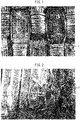
- Fig. 1 is a photograph of the surface of a woven fabric, showing the fibrillated state of the regenerated cellulose fibers as the constituent yarn, with arrow 1 indicating a state where aggregated fibrils composed mainly of cellulose microfibrils are split in the fiber axis direction (a fibrillated state).
- Fig. 2 is a magnified photograph of the fibrillated state of regenerated cellulose fibers, with arrow 2 indicating cellulose microfibrils.
- Cellulose fiber samples with different polymerization degrees were each dissolved in a copper-ammonia solution as a molecular dispersion and the polymerization degree was measured based on the formula shown above in a Nakano viscosity tube, after which the viscosity of the fiber substance sample dissolved in a copper-ammonia solution at a fixed concentration in a Tappy viscosity tube was measured, the relationship between viscosity and polymerization degree was determined, the actual viscosity dissolved in a copper-ammonia solution at the same fixed concentration in a Tappy viscosity tube was measured, and the polymerization degree was calculated from a prepared relationship table for viscosity and polymerization degree.
- the method of measuring the viscosity with a Tappy viscosity tube is as follows.
- the sample is allowed to stand for 24 hours or longer in a constant temperature and humidity room at 20°C, 65% humidity for equilibration of the moisture content.
- a 0.1 g portion of the sample is weighed out.
- the viscosity tube is set in a rotating device and rotated for 30 minutes at a speed of 3 rpm to dissolve the sample.
- the viscosity tube is removed from the rotating device and immersed for 5 minutes in a thermobath at 20°C.
- the lower plug of the viscosity tube is removed and set in a thermobath, inserting the whole into a jacket.
- the plug cock at the top of the viscosity tube is opened and the time for flow of the solution between gauge marks A and B of the viscometer is measured.
- the value calculated for the absolute viscosity is then compared with the aforementioned relationship table for viscosity and polymerization degree, to determine the polymerization degree.
- the sample was allowed to stand for 24 hours or longer in a constant temperature and humidity room at 20°C, 65% humidity for equilibration of the moisture content.
- a TENSILON RTC Series universal material tester product of A&D Co., Ltd.
- the sample was stretched to a sample length (yarn length) of 200 mm at a pull speed of 200 mm/min, and the breaking strength was recorded.
- the sample is set in a VHX-6000 microscope (product of Keyence Corp.), and with the magnification of a VH-Z20 lens (product of Keyence Corp.) set to 200x and the luminance and sensitivity adjusted, the sample is both irradiated and photographed with light that produces white dots on the fibril portions.
- the proportion of white dot area with respect to photographed area was calculated and the degree of fibrillation was evaluated based on the following 3-level evaluation scale.
- the sample both before washing and after washing, is set in a VHX-6000 microscope (product of Keyence Corp.), and with the magnification of a VH-Z20 lens (product of Keyence Corp.) set to 200x and the luminance and sensitivity adjusted, the sample is both irradiated and photographed with light that produces white dots on the fibril portions.
- the sample before washing was examined for feel by a tactile sensory test with repeated gripping and evaluated based on the following 3-level evaluation scale, also evaluating the sample after washing when the evaluation of the sample before washing was G or F.
- An 84 dtex/45 cuprammonium rayon filament was prepared with a polymerization degree of 580 and a dry tensile strength of 2.3 cN/dtex.
- the raw yarn was subjected to modifying treatment with a cheese dyeing machine at 130°C for 20 minutes using 76% formic acid at 1.0 g/L, to convert the polymerization degree to 200 and obtain modified cuprammonium rayon.
- the obtained modified cuprammonium rayon raw yarn was used as warp yarn and weft yarn for weaving of a 2/1 twill weave fabric, having a warp density of 144/2.54 cm and a weft density of 100/2.54 cm.
- the obtained greige was subjected to scouring relaxation and fibrillation treatment at 80°C for 20 minutes with a jet dyeing machine using 1 g/L of nonionic surfactant, after which dyeing of the cuprammonium rayon was again carried out for 60 minutes with a jet dyeing machine at a dyeing temperature of 60°C, followed by soaping for 10 minutes at 80°C.
- the fabric was impregnated with a 1 wt% aqueous silicon-based softener solution, padded with a pickup of 80%, dried for 1 minute at 150°C, subjected to texture treatment with an air tumbler for 30 minutes at 80°C at a speed of 700 m/min, and provided for final setting at 130°C for 1 minute to obtain a dyed fabric with a warp density of 153/2.54 cm and a weft density of 104/2.54 cm.
- the polymerization degree of the 84 dtex/45 filament cuprammonium rayon of warp yarn removed from the woven fabric was 200.
- An 84 dtex/45 cuprammonium rayon filament with a polymerization degree of 580 and a dry tensile strength of 2.3 cN/dtex was used as warp yarn and weft yarn for weaving of a 2/1 twill weave fabric, having a warp density of 144/2.54 cm and a weft density of 100/2.54 cm.
- the obtained greige was subjected to modifying and fibrillation treatment for 20 minutes with a jet dyeing machine at 130°C using 1.0 g/L of 76% formic acid, to adjust the polymerization degree to 200, after which dyeing of the cuprammonium rayon was again carried out for 60 minutes with a jet dyeing machine at a dyeing temperature of 60°C, followed by soaping for 10 minutes at 80°C.
- the fabric was impregnated with a 1 wt% aqueous silicon-based softener solution, padded with a pickup of 80%, dried for 1 minute at 150°C, subjected to texture treatment with an air tumbler for 30 minutes at 80°C at a speed of 700 m/min, and provided for final setting at 130°C for 1 minute to obtain a dyed fabric with a warp density of 153/2.54 cm and a weft density of 104/2.54 cm.
- the polymerization degree of an 84 dtex/45 cuprammonium rayon filament of warp yarn removed from the woven fabric was 200.
- An 89 dtex/30 organic solvent-obtained cellulose fiber filament was prepared with a polymerization degree of 490 and a dry tensile strength of 3.5 cN/dtex.
- the raw yarn was subjected to modifying treatment with a cheese dyeing machine at 130°C for 20 minutes using 76% formic acid at 1.0 g/L, to convert the polymerization degree to 220 and obtain modified organic solvent-obtained cellulose fibers.
- the obtained modified organic solvent-obtained cellulose fibers were used as warp yarn and weft yarn for weaving of a plain woven fabric having a warp density of 105/2.54 cm and a weft density of 89/2.54 cm.
- the obtained greige was subjected to scouring relaxation and fibrillation treatment for 20 minutes with a jet dyeing machine using 1 g/L of nonionic surfactant at 80°C, after which dyeing of the organic solvent-obtained cellulose fibers was again carried out for 60 minutes with a jet dyeing machine at a dyeing temperature of 60°C, followed by soaping for 10 minutes at 80°C.
- the fabric was impregnated with a 1 wt% aqueous silicon-based softener solution, padded with a pickup of 80%, dried for 1 minute at 150°C, subjected to texture treatment with an air tumbler for 30 minutes at 80°C at a speed of 700 m/min, and provided for final setting at 130°C for 1 minute to obtain a dyed fabric with a warp density of 109/2.54 cm and a weft density of 92/2.54 cm.
- the polymerization degree of the 89 dtex/30 filament organic solvent-obtained cellulose fibers of warp yarn removed from the woven fabric was 220.
- the 89 dtex/30 filament organic solvent-obtained cellulose fibers with a polymerization degree of 490 and a dry tensile strength of 3.5 cN/dtex were used as warp yarn and weft yarn for weaving of a plain woven fabric having a warp density of 105/2.54 cm and a weft density of 89/2.54 cm.
- the obtained greige was subjected to modifying and fibrillation treatment for 20 minutes with a jet dyeing machine at 130°C using 1.0 g/L of 76% formic acid, to adjust the polymerization degree to 220, after which dyeing of the organic solvent-obtained cellulose fibers was again carried out for 60 minutes with a jet dyeing machine at a dyeing temperature of 60°C, followed by soaping for 10 minutes at 80°C.
- the fabric was impregnated with a 1 wt% aqueous silicon-based softener solution, padded with a pickup of 80%, dried for 1 minute at 150°C, subjected to texture treatment with an air tumbler for 30 minutes at 80°C at a speed of 700 m/min, and provided for final setting at 130°C for 1 minute to obtain a dyed fabric with a warp density of 109/2.54 cm and a weft density of 92/2.54 cm.
- the polymerization degree of the 89 dtex/30 filament organic solvent-obtained cellulose fibers of warp yarn removed from the woven fabric was 220.
- An 84 dtex/45 cuprammonium rayon filament with a polymerization degree of 580 and a dry tensile strength of 2.3 cN/dtex was used as warp yarn and weft yarn for weaving of a 2/1 twill weave fabric, having a warp density of 144/2.54 cm and a weft density of 100/2.54 cm.
- the obtained greige was dye finished in the same manner as Example 2, except that modifying treatment and fibrillation treatment were not carried out, to obtain a dyed fabric having a warp density of 153/2.54 cm and a weft density of 104/2.54 cm.
- the polymerization degree of an 84 dtex/45 cuprammonium rayon filament of warp yarn removed from the woven fabric was 580.
- the 89 dtex/30 filament organic solvent-obtained cellulose fibers with a polymerization degree of 490 and a dry tensile strength of 3.5 cN/dtex were used as warp yarn and weft yarn for weaving of a plain woven fabric having a warp density of 109/2.54 cm and a weft density of 92/2.54 cm.
- the obtained greige was dye finished in the same manner as Example 4, except that modifying and fibrillation treatment were not carried out, to obtain a dyed fabric having a warp density of 109/2.54 cm and a weft density of 92/2.54 cm.
- the polymerization degree of the 89 dtex/30 filament organic solvent-obtained cellulose fibers of warp yarn removed from the woven fabric was 490.
- An 84 dtex/45 cuprammonium rayon filament with a polymerization degree of 580 and a dry tensile strength of 2.3 cN/dtex was used as warp yarn and weft yarn for weaving of a 2/1 twill weave fabric, having a warp density of 144/2.54 cm and a weft density of 100/2.54 cm.
- the obtained greige was subjected to fibrillation treatment for 120 minutes with a jet dyeing machine using 40 g/L of sodium hydroxide at 80°C, after which dyeing of the cuprammonium rayon was again carried out for 60 minutes with a jet dyeing machine at a dyeing temperature of 60°C, followed by soaping for 10 minutes at 80°C.
- the fabric was impregnated with a 1 wt% aqueous silicon-based softener solution, padded with a pickup of 80%, dried for 1 minute at 150°C, subjected to texture treatment with an air tumbler for 30 minutes at 80°C at a speed of 700 m/min, and provided for final setting at 130°C for 1 minute to obtain a dyed fabric with a warp density of 153/2.54 cm and a weft density of 104/2.54 cm.
- the polymerization degree of an 84 dtex/45 cuprammonium rayon filament of warp yarn removed from the woven fabric was 440.
- An 84 dtex/45 cuprammonium rayon filament with a polymerization degree of 580 and a dry tensile strength of 2.3 cN/dtex was used as warp yarn and weft yarn for weaving of a 2/1 twill weave fabric, having a warp density of 144/2.54 cm and a weft density of 100/2.54 cm.
- the obtained greige was subjected to fibrillation treatment for 60 minutes with a jet dyeing machine using 50 g/L of 75% phosphoric acid at 100°C, after which dyeing of the cuprammonium rayon was again carried out for 60 minutes with a jet dyeing machine at a dyeing temperature of 60°C, followed by soaping for 10 minutes at 80°C.
- the fabric was impregnated with a 1 wt% aqueous silicon-based softener solution, padded with a pickup of 80%, dried for 1 minute at 150°C, subjected to texture treatment with an air tumbler for 30 minutes at 80°C at a speed of 700 m/min, and provided for final setting at 130°C for 1 minute to obtain a dyed fabric with a warp density of 153/2.54 cm and a weft density of 104/2.54 cm.
- the polymerization degree of an 84 dtex/45 cuprammonium rayon filament of warp yarn removed from the woven fabric was 400.
- An 84 dtex/45 cuprammonium rayon filament with a polymerization degree of 580 and a dry tensile strength of 2.3 cN/dtex was used as warp yarn and weft yarn for weaving of a 2/1 twill weave fabric, having a warp density of 144/2.54 cm and a weft density of 100/2.54 cm.
- the obtained greige was subjected to fibrillation treatment for 60 minutes with a jet dyeing machine using 30 g/L of aqueous 35% hydrogen peroxide at 100°C, after which dyeing of the cuprammonium rayon was again carried out for 60 minutes with a jet dyeing machine at a dyeing temperature of 60°C, followed by soaping for 10 minutes at 80°C.
- the fabric was impregnated with a 1 wt% aqueous silicon-based softener solution, padded with a pickup of 80%, dried for 1 minute at 150°C, subjected to texture treatment with an air tumbler for 30 minutes at 80°C at a speed of 700 m/min, and provided for final setting at 130°C for 1 minute to obtain a dyed fabric with a warp density of 153/2.54 cm and a weft density of 104/2.54 cm.
- the polymerization degree of an 84 dtex/45 cuprammonium rayon filament of warp yarn removed from the woven fabric was 180.
- An 84 dtex/45 cuprammonium rayon filament with a polymerization degree of 580 and a dry tensile strength of 2.3 cN/dtex was used as warp yarn and weft yarn for weaving of a 2/1 twill weave fabric, having a warp density of 144/2.54 cm and a weft density of 100/2.54 cm.
- the obtained greige was subjected to fibrillation treatment for 45 minutes with an airflow dyeing machine at 130°C using 6.4 g/L of acetic acid, after which dyeing of the cuprammonium rayon was again carried out for 360 minutes with an airflow dyeing machine at a dyeing temperature of 60°C, followed by soaping for 10 minutes at 80°C.
- the fabric was impregnated with a 1 wt% aqueous silicon-based softener solution, padded with a pickup of 80%, dried for 1 minute at 150°C, subjected to texture treatment with an air tumbler for 30 minutes at 100°C at a speed of 900 m/min, and provided for final setting at 130°C for 1 minute to obtain a dyed fabric with a warp density of 153/2.54 cm and a weft density of 104/2.54 cm.
- the polymerization degree of an 84 dtex/45 cuprammonium rayon filament of warp yarn removed from the woven fabric was 190.
- Table 1 shows the sample yarn materials, modifying treatment and fibril treatment used in Examples 1 to 4 and Comparative Examples 1 to 6, and the evaluation results are shown in Table 2.
- Sample yarn Modifying treatment Fibrillation treatment Treatment form Treatment solution Treatment pH Treatment time Treatment temperature Treatment solution Treatment time Treatment temperature Present invention
- Example 1 Cuprammonium rayon Yarn 1.0 g/L 76% Formic acid 2.8 20 minutes 130°C In water 20 min 80°C
- Example 2 Cuprammonium rayon Fabric 1.0 g/L 76% Formic acid 2.8 20 minutes 130°C No treatment No treatment No treatment
- Example 3 Organic solvent-obtained cellulose fibers Yarn 1.0 g/L 76% Formic acid 2.8 20 minutes 130°C In water 20 min 80°C
- Organic solvent-obtained cellulose fibers Fabric 1.0 g/L 76% Formic acid 2.8 20 minutes 130°C No treatment Prior art Comp.
- Example 1 Cuprammonium rayon Fabric No treatment No treatment No treatment No treatment In water 20 min 80°C Comp.
- Example 2 Organic solvent-obtained cellulose fibers Fabric No treatment No treatment No treatment No treatment In water 20 min 80°C Comp.
- Example 3 Cuprammonium rayon Fabric No treatment No treatment No treatment No treatment 40 g/L Sodium hydroxide 120 min 80°C Comp.
- Example 4 Cuprammonium rayon Fabric No treatment No treatment No treatment 50 g/L 75% phosphoric acid 60 min 100°C Comp.
- Example 5 Cuprammonium rayon Fabric No treatment No treatment No treatment No treatment No treatment 30 g/L 35% Hydrogen peroxide solution 60 min 100°C Comp.
- Example 6 Cuprammonium rayon Fabric No treatment No treatment No treatment No treatment 6.4 g/L Acetic acid 45 min 130°C [Table 2] Polymerization degree Performance Fibrillation degree before washing Change in fibrillation degree before and after washing Feel Tensile strength Before washing After washing Present invention
- Example 1 200 G G G 1.5 cN/dtex
- Example 2 200 G G G 1.5 cN/dtex
- Example 3 220 G G G G 1.8 cN/dtex
- Example 4 220 G G G G G 1.8 cN/dtex Prior art Comp.
- Example 2 490 P P P - 3.7 cN/dtex Comp.
- Example 3 440 G P G F 1.4 cN/dtex Comp.
- Example 4 400 G P G P 1.2 cN/dtex Comp.
- Example 5 180 G G P - 0.2 cN/dtex Comp.
- Example 6 190 P P P P - 1.0 c
- the fabrics using the modified cellulose fibers of Examples 1 to 4 had satisfactory textures that were soft and resilient with no change in fibril feel by washing, and the tensile strengths were shown to be greater than 1.0 cN/dtex.
- Examples 1 to 4 had characteristic surface texture, softness and resilient feel after washing, and excellent persistence of surface texture and feel even after washing.
- the fabrics of Comparative Examples 1 to 6 had tensile strengths of 1.0 cN/dtex or lower, or had loss of fibrils at the stage before washing, or had a polymerization degree of greater than 250 and change in fibrillation degree due to shedding of fibrils after washing.
- the change in surface texture or feel after washing was large, or strength as a fabric failed to be maintained, with holes being opened by friction during wear or washing, or the fibrils were removed at the stage before washing, making the fabric unsuitable as a fiber product with fibrils which must exhibit satisfactory texture.
- the present invention can provide regenerated cellulose fibers having a characteristic surface texture, softness and resilient feel, being easily fibrillated by rubbing and tanning treatment in a wetted state, and having an excellent surface texture after water washing and a long-lasting feel, thereby exhibiting high quality, as well as a fabric using the fibers, and the invention therefore has industrial applicability.
Landscapes
- Engineering & Computer Science (AREA)
- Textile Engineering (AREA)
- Chemical & Material Sciences (AREA)
- Chemical Kinetics & Catalysis (AREA)
- General Chemical & Material Sciences (AREA)
- Chemical Or Physical Treatment Of Fibers (AREA)
- Treatments For Attaching Organic Compounds To Fibrous Goods (AREA)
Abstract
Description
- The present invention relates to a fibrillated regenerated cellulose fiber having a characteristic surface texture, softness and a resilient feel, being fibrillated by rubbing and tanning treatment in a wetted state, and having an excellent surface texture after water washing and a long-lasting feel, thereby exhibiting high quality, as well as to a fabric including the fiber as constituent yarn.
- Regenerated cellulose fibers include cuprammonium rayon and organic solvent-obtained cellulose fibers wherein the cellulose fibers all comprise aggregated fibrils composed mainly of cellulose microfibrils, and the fibers having a feature of splitting and becoming fibrillated in the fiber axis direction when subjected to rubbing or cloth kneading treatment in a wetted state.
- In order to exhibit characteristic surface texture, softness and resilient feel for clothing articles produced using regenerated cellulose fibers, many types of products have been provided wherein these properties are utilized and the regenerated cellulose fibers forming the clothing are fibrillated, but when such fibrillated clothing articles are repeatedly washed the fibrils are shed and the surface texture and feel are impaired. Prior art documents relating to fibrillated regenerated cellulose fibers can also be found, but none of the prior art documents offer specific solution means for such problems.
- For example, a processing method involving fibrillation is disclosed in
PTL 1, as a method using impact during raising treatment and dyeing with a jet dyeing machine. However, since the expression level of the fibrils is not constant, being dependent on the dyeing conditions including the dyeing time, the liquor to goods ratio, the fabric speed and the concentration of the alkali used, there is a disadvantage in that products of consistent quality cannot be provided in a repeatable manner, and furthermore the polymerization degree of the regenerated cellulose fibers is specified to be 400 or greater and shedding of fibrils by water washing is not mentioned. -
PTL 2 discloses fibrillation using an aqueous alkali solution. However, the polymerization degree of the regenerated cellulose fibers is specified to be 300 or greater, and since the treatment method is carried out in an aqueous alkali solution, the regenerated cellulose fibers are structurally modified to be easily fibrillated only in an aqueous alkali solution, while fibrillation is difficult by water washing with a weak degree of weak alkalinity, and furthermore, nothing is mentioned regarding shedding of the fibrils by water washing. - PTL 3 discloses a method using an aqueous acid solution or an aqueous oxidizing agent solution, but nothing is mentioned regarding the polymerization degree of the regenerated cellulose fibers. When the conditions for the treatment described in PTL 3 are compared to the conditions disclosed herein, while extended treatment is carried out at high temperature under ordinary pressure in a high-concentration acid solution with the aim of inhibiting reduction in strength, nothing is mentioned regarding the rate of strength reduction by the treatment method, and although it is stated that the strength is reduced by treatment under high pressure, the processing conditions are completely different from those disclosed in the present specification.
- PTL 4 discloses a method using an aqueous acid solution, but nothing is mentioned regarding the polymerization degree of the regenerated cellulose fibers. PTL 4 describes tumbling treatment with an acid water-soluble solution for 30 to 80 minutes aimed at strength reduction, in order to remove long fibrils, and high-speed tumbling treatment in a dry state. However, the lyocell-containing fabric disclosed in PTL 4 has the long fibrils removed, which are responsible for producing a "hairy effect" on fabric surfaces as the characteristic surface texture that is disclosed in the present specification, while PTL 4 states that the short fibrils on the fabric surface have a characteristically "clean" surface finish, unlike a "hairy effect", and they are therefore different from the fibrillated regenerated cellulose fiber disclosed herein. In addition, PTL 4 completely fails to indicate the rate of strength reduction of the fabric by the treatment method used to remove the long fibrils, and also mentions nothing regarding shedding of the fibrils by water washing.
-
- [PTL 1]
Japanese Unexamined Patent Publication HEI No. 08-113846 - [PTL 2]
Japanese Unexamined Patent Publication HEI No. 06-166956 - [PTL 3]
Japanese Unexamined Patent Publication HEI No. 11-315474 - [PTL 4] UK Patent No.
GB 2399094A - In light of this prior art, the problem to be solved by the invention is to provide a fibrillated regenerated cellulose fiber having a characteristic surface texture, softness and resilient feel, being fibrillated by rubbing and tanning treatment in a wetted state, and having an excellent surface texture after water washing and a long-lasting feel, thereby exhibiting high quality, as well as a fabric using the fiber.
- Upon avid research with the goal of solving this problem, the present inventors have discovered that rather than modifying the expressed fibrils so that they are not shed it is more effective to modify them so that even if the fibrils are shed they are re-expressed during washing, and as a result of much further experimentation based on this discovery, studying methods of modification whereby even if the fibrils are shed they are re-expressed during washing, the present inventors have completed this invention upon finding, unexpectedly, that if the polymerization degree of regenerated cellulose fibers is controlled to 100 to 250, the fibrils can be easily expressed with only the weak rubbing effect of washing, and a lightweight feel, softness and a resilient feel are exhibited.
- Specifically, the present invention is as follows.
- [1] Regenerated cellulose fibers that are fibrillated on their surfaces, having a polymerization degree of 100 to 250, and a dry tensile strength of greater than 1.0 cN/dtex and 3.0 cN/dtex or lower.
- [2] The regenerated cellulose fibers according to [1] above, wherein the regenerated cellulose fibers are organic solvent-obtained cellulose fibers.
- [3] A fabric including regenerated cellulose fibers according to [1] or [2] above as constituent yarn.
- [4] A method for producing the regenerated cellulose fibers according to [1] or [2] above or the fabric according to [3] above, which includes a step of modifying treatment of regenerated cellulose fibers in yarn or fabric form in an acid solution, under conditions with a temperature of 110°C to 150°C, a time of 10 to 30 minutes and a pH 2.6 to 3.4.
- The fibrillated regenerated cellulose fibers of the invention are fibers that have a characteristic surface texture, softness and resilient feel, and that are also fibrillated by rubbing and tanning treatment in a wetted state and exhibit an excellent surface texture after water washing and a long-lasting feel, thereby exhibiting high quality.
-
-
Fig. 1 is a photograph of the surface of a woven fabric, showing the fibrillated state of the regenerated cellulose fibers as the constituent yarn. -
Fig. 2 is a magnified photograph of the fibrillated state of regenerated cellulose fibers. - An embodiment of the invention will now be described in detail.
- One embodiment of the invention is regenerated cellulose fibers that are fibrillated on their surfaces, having a polymerization degree of 100 to 250, and a dry tensile strength of greater than 1.0 cN/dtex and 3.0 cN/dtex or lower.
- Regenerated cellulose fibers are regenerated cellulose fibers spun from a molten cellulose starting material such as cuprammonium rayon or organic solvent-obtained cellulose fibers, and they are preferably cuprammonium rayon or organic solvent-obtained cellulose fibers, and more preferably organic solvent-obtained cellulose fibers.
- The yarn form of the regenerated cellulose fibers may be staple fibers or long fibers, but long-fiber multifilament yarn is preferred. The single fiber size is not particularly restricted but is preferably 0.5 to 5.0 dtex. The total fineness is not particularly restricted but is preferably 22 to 330 dtex, and the yarn count is not particularly restricted but is preferably 5 to 100. The monofilament cross-section shape is also not particularly restricted. There are likewise no particular restrictions on the state of twisting, which may be without twists, false-twisting or with twisting, or on the number of twists, which is preferably no more than 2000 added twists. Lack of twisting is preferred from the viewpoint of the tactile feel.
- Combination with other materials is likewise not particularly restricted since this embodiment is not affected by other materials, but acryl, diacetate or wool is not preferred for such other combined materials since the processing method involves treatment under high pressure which can lead to strength reduction, hardened feel and loss of transparency.
- The proportion of regenerated cellulose fibers used in a fabric that includes a woven or knitted fabric or nonwoven fabric is not particularly restricted, but in order to satisfactorily exhibit the desired effect it is preferably 10 wt% or greater, more preferably 20 wt% or greater and even more preferably 30 wt% or greater of the total weight of the fabric. If the amount used is 10 wt% or lower, fibrillation will be observed but it will be more difficult to obtain softness and a resilient feel. The yarn combination method may be combined twisting, interlaced filament combination, Taslan filament combination, covering, cotton blending, worsted or woollen spinning or fine spun yarn doubling.
- The fibrillated regenerated cellulose fibers according to this embodiment have a polymerization degree of 100 to 250, preferably 150 to 250 and more preferably 200 to 250. If the polymerization degree is less than 100 the dry tensile breaking strength will fall below 1.0 cN/dtex, and the physical properties necessary for post-treatment and for use as a clothing article will not be exhibited. However, a polymerization degree of higher than 250 is not preferred since re-expression of the fibrils by water washing will not be possible. The polymerization degree is the value measured by the viscosity method using a copper-ammonia solution.
- The fabric may be a woven fabric, warp knit fabric, circular knit fabric, horizontal knit fabric or nonwoven fabric, and is preferably a woven fabric, warp knit fabric, circular knit fabric or horizontal knit fabric, and more preferably a woven fabric or circular knit fabric. The texture and density of the fabric are also not particularly restricted. The method of combination with other materials may be mixed weaving, mixed knitting, composite yarn or insertion of weft yarn into warp yarn.
- There are no particular restrictions on the method of modifying treatment to adjust the polymerization degree of the fibrillated regenerated cellulose fiber of this embodiment to 100 to 250. For regenerated cellulose fibers having a polymerization degree of 250 or higher and a dry tensile strength of 2.0 cN/dtex or greater, however, it is especially preferred to use modifying treatment to adjust the polymerization degree to 100 to 250 and the dry tensile strength to greater than 1.0 cN/dtex and 3.0 cN/dtex or lower by treatment in an acid solution, since adjustment of the physical properties of the yarn and the polymerization degree will thus be facilitated. The type of acid used is not particularly restricted and may be citric acid, malic acid, acetic acid, formic acid, sulfuric acid, nitric acid, hydrochloric acid or oxalic acid, preferred among which are acids with low corrosivity for metals, with formic acid, citric acid and malic acid being more preferred. The treatment temperature is preferably 110°C to 150°C, more preferably 120°C to 150°C and even more preferably 130°C to 140°C, for modification to the desired polymerization degree and tensile strength. A temperature range of lower than 110°C is not preferred because a longer treatment time will be necessary for modification and the tensile strength will be significantly reduced even with successful modification to the desired polymerization degree. A short period treatment time at lower than 110°C is also not preferred because it requires a lower pH, and treatment for a short period at a low pH results in local reduction in polymerization degree and strength reduction making it difficult to achieve homogeneous modification, while variation in quality between different modifying treatments also occurs. A temperature above 150°C or higher, on the other hand, is also not preferred because temperature management becomes more difficult and homogeneous modification is more difficult to achieve. The treatment pH and treatment time must be adjusted depending on the regenerated cellulose fibers used, but the treatment pH is preferably 2.6 to 3.4 and more preferably 2.8 to 3.2, while the treatment time is preferably 10 to 30 minutes, more preferably 12 to 28 minutes and even more preferably 15 to 25 minutes. For example, when regenerated cellulose fibers having a polymerization degree of about 450 to 600 and a dry tensile strength of 2.0 cN/dtex or greater are treated using formic acid, 20 minutes of treatment at 130°C in an acid bath at pH 2.8 having a 76% formic acid concentration of 1.0 g/L can modify the polymerization degree to 100 to 250 and can maintain a dry tensile strength of greater than 1.0 cN/dtex and 3.0 cN/dtex or lower. In order to lower the polymerization degree to the desired polymerization degree in a short period while modifying the dry tensile strength to greater than 1.0 cN/dtex and 3.0 cN/dtex or lower, it is necessary to use a low-concentration acid for short-period modifying treatment, which requires high-temperature, high-pressure treatment at 110°C or higher.
- The form used in the modifying treatment is not particularly restricted, but it is preferably a yarn or fabric form, and more preferably a fabric form. The equipment used for processing is not particularly restricted for either yarn or fabrics, but for yarn forms it is preferred to use a cheese dyeing machine or skein dyeing machine and for fabric forms it is preferred to use a jet dyeing machine, airflow dyeing machine, beam dyeing machine, jigger dyeing machine, paddle dyeing machine, drum dyeing machine, washer dyeing machine or winch dyeing machine, with a jet dyeing machine or airflow dyeing machine being preferred.
- Since fibrillation treatment in water is necessary to express fibrils after modifying treatment, either the fibrillation treatment must be carried out simultaneously with the modifying treatment, or the fibrillation treatment must be carried out after modifying treatment. The form used in the fibrillation treatment is not particularly restricted but is preferably a fabric form. The equipment used for processing is not particularly restricted, but it is preferred to use a jet dyeing machine, airflow dyeing machine, paddle dyeing machine, drum dyeing machine, washer dyeing machine or winch dyeing machine, with a jet dyeing machine or airflow dyeing machine being preferred. The fibrillation treatment in water is not particularly restricted, and examples of performed fibrillation treatment are with a jet dyeing machine, airflow dyeing machine or winch dyeing machine as the equipment, at a temperature of 10 to 130°C, a fabric speed of 100 m/min or greater and a treatment time of 20 minutes or longer, or paddle dyeing machine, drum dyeing machine or washer dyeing machine as the equipment, at a temperature of 10 to 130°C and a treatment time of 20 minutes or longer. After fibrils have been expressed it is necessary to avoid removal of the fibrils, and therefore it is preferred to either omit texture treatment in a dry state after fibrils have been expressed, or when texture treatment is carried out in a dry state, it is preferably carried out using an airflow dyeing machine or air tumbler drier as the equipment under conditions with a fabric speed of 800 m/min or lower and a treatment time of 60 minutes or less, or using a batch process tumbler drier as the equipment with a treatment time of 60 minutes or less.
- The regenerated cellulose fibers of this embodiment have a dry tensile strength of greater than 1.0 cN/dtex and 3.0 cN/dtex or lower, preferably 1.3 cN/dtex to 2.5 cN/dtex and more preferably 1.5 cN/dtex to 2.0 cN/dtex. If the dry tensile strength is 1.0 cN/dtex or lower, the fibers will suffer damage during the steps up until production of the fabric, making it difficult to obtain a practical fabric and impairing the resilient feel, while if it is greater than 3.0 cN/dtex the softness will be impaired.
- The term "fibrillated" as regards the fibrillated regenerated cellulose fibers of this embodiment refers to a state in which aggregated fibrils composed mainly of cellulose microfibrils on the surfaces of the regenerated cellulose fibers are split in the fiber axis direction.
Fig. 1 is a photograph of the surface of a woven fabric, showing the fibrillated state of the regenerated cellulose fibers as the constituent yarn, witharrow 1 indicating a state where aggregated fibrils composed mainly of cellulose microfibrils are split in the fiber axis direction (a fibrillated state).Fig. 2 is a magnified photograph of the fibrillated state of regenerated cellulose fibers, witharrow 2 indicating cellulose microfibrils. - The present invention will now be described in greater detail by examples, with the understanding that the invention is not limited to these examples. The performance parameters of the yarns and fabrics in the Examples were evaluated by the following methods.
- The "viscosity method" was used for the viscosity of a solution of the cellulose fibers dissolved in copper-ammonia, using the Standinger viscosity rule represented by the following formula:

- Cellulose fiber samples with different polymerization degrees were each dissolved in a copper-ammonia solution as a molecular dispersion and the polymerization degree was measured based on the formula shown above in a Nakano viscosity tube, after which the viscosity of the fiber substance sample dissolved in a copper-ammonia solution at a fixed concentration in a Tappy viscosity tube was measured, the relationship between viscosity and polymerization degree was determined, the actual viscosity dissolved in a copper-ammonia solution at the same fixed concentration in a Tappy viscosity tube was measured, and the polymerization degree was calculated from a prepared relationship table for viscosity and polymerization degree.
- The method of measuring the viscosity with a Tappy viscosity tube is as follows. The sample is allowed to stand for 24 hours or longer in a constant temperature and humidity room at 20°C, 65% humidity for equilibration of the moisture content. A 0.1 g portion of the sample is weighed out. The sample is placed in a Tappy viscosity tube with a wedge, and then a copper-ammonia solution (composition = ammonia: 205 g/L, copper (I) hydroxide: 11.0 g/L, sucrose: 10 g/L) is drawn into the viscosity tube which is then plugged. The viscosity tube is set in a rotating device and rotated for 30 minutes at a speed of 3 rpm to dissolve the sample. The viscosity tube is removed from the rotating device and immersed for 5 minutes in a thermobath at 20°C. The lower plug of the viscosity tube is removed and set in a thermobath, inserting the whole into a jacket. The plug cock at the top of the viscosity tube is opened and the time for flow of the solution between gauge marks A and B of the viscometer is measured. The absolute viscosity (V) is calculated by the following formula:

- The sample was allowed to stand for 24 hours or longer in a constant temperature and humidity room at 20°C, 65% humidity for equilibration of the moisture content. Using a TENSILON RTC Series universal material tester (product of A&D Co., Ltd.), the sample was stretched to a sample length (yarn length) of 200 mm at a pull speed of 200 mm/min, and the breaking strength was recorded.
- This was conducted according to the method of JIS L0217-103. Clothing detergent is added and dissolved in water at a liquid temperature of 40°C in a proportion of 2 g per 1 L for use as a washing solution. The sample yarn and a dummy cloth are loaded into the washing solution to a liquor to goods ratio of 1:30, and operation is initiated. After 5 minutes of washing and dewatering, water rinsing for 2 minutes in ordinary temperature water with the same liquor to goods ratio, dewatering, and further water rinsing for 2 minutes in ordinary temperature water with the same liquor to goods ratio and dewatering, the first washing cycle is complete. The drying method used was tumbler drying at 80°C for 20 minutes.
- The sample is set in a VHX-6000 microscope (product of Keyence Corp.), and with the magnification of a VH-Z20 lens (product of Keyence Corp.) set to 200x and the luminance and sensitivity adjusted, the sample is both irradiated and photographed with light that produces white dots on the fibril portions. The proportion of white dot area with respect to photographed area was calculated and the degree of fibrillation was evaluated based on the following 3-level evaluation scale.
- G (fibrillated): White dot area proportion of ≥10%
- F (insufficient fibrillation): white dot area proportion of ≥5% and <10%
- P (non-fibrillated): White dot area proportion of <5%
- The sample, both before washing and after washing, is set in a VHX-6000 microscope (product of Keyence Corp.), and with the magnification of a VH-Z20 lens (product of Keyence Corp.) set to 200x and the luminance and sensitivity adjusted, the sample is both irradiated and photographed with light that produces white dots on the fibril portions. The proportion of white dot area with respect to the photographed area was then calculated for the same both before and after washing, and the rate of change in the fibrillation degree was calculated by the following formula:

- {X: Change in fibrillation degree by washing (%), AW: white dot area proportion of sample after washing (%), BW: white dot area proportion of sample before washing (%)},
- after which the degree of change in the fibrillation degree was evaluated on the following 3-level evaluation scale.
- G (No change in fibrillation): change of ≥-10% and <+10%
- P (Change in fibrillation): change of <-10% or ≥+10%
- The sample before washing was examined for feel by a tactile sensory test with repeated gripping and evaluated based on the following 3-level evaluation scale, also evaluating the sample after washing when the evaluation of the sample before washing was G or F.
- G: Excellent softness and resilient feel
- F: Somewhat inadequate softness or resilient feel
- P: Inferior softness or resilient feel
- An 84 dtex/45 cuprammonium rayon filament was prepared with a polymerization degree of 580 and a dry tensile strength of 2.3 cN/dtex. The raw yarn was subjected to modifying treatment with a cheese dyeing machine at 130°C for 20 minutes using 76% formic acid at 1.0 g/L, to convert the polymerization degree to 200 and obtain modified cuprammonium rayon. The obtained modified cuprammonium rayon raw yarn was used as warp yarn and weft yarn for weaving of a 2/1 twill weave fabric, having a warp density of 144/2.54 cm and a weft density of 100/2.54 cm. The obtained greige was subjected to scouring relaxation and fibrillation treatment at 80°C for 20 minutes with a jet dyeing machine using 1 g/L of nonionic surfactant, after which dyeing of the cuprammonium rayon was again carried out for 60 minutes with a jet dyeing machine at a dyeing temperature of 60°C, followed by soaping for 10 minutes at 80°C. After dyeing and drying, the fabric was impregnated with a 1 wt% aqueous silicon-based softener solution, padded with a pickup of 80%, dried for 1 minute at 150°C, subjected to texture treatment with an air tumbler for 30 minutes at 80°C at a speed of 700 m/min, and provided for final setting at 130°C for 1 minute to obtain a dyed fabric with a warp density of 153/2.54 cm and a weft density of 104/2.54 cm. The polymerization degree of the 84 dtex/45 filament cuprammonium rayon of warp yarn removed from the woven fabric was 200.
- An 84 dtex/45 cuprammonium rayon filament with a polymerization degree of 580 and a dry tensile strength of 2.3 cN/dtex was used as warp yarn and weft yarn for weaving of a 2/1 twill weave fabric, having a warp density of 144/2.54 cm and a weft density of 100/2.54 cm. The obtained greige was subjected to modifying and fibrillation treatment for 20 minutes with a jet dyeing machine at 130°C using 1.0 g/L of 76% formic acid, to adjust the polymerization degree to 200, after which dyeing of the cuprammonium rayon was again carried out for 60 minutes with a jet dyeing machine at a dyeing temperature of 60°C, followed by soaping for 10 minutes at 80°C. After dyeing and drying, the fabric was impregnated with a 1 wt% aqueous silicon-based softener solution, padded with a pickup of 80%, dried for 1 minute at 150°C, subjected to texture treatment with an air tumbler for 30 minutes at 80°C at a speed of 700 m/min, and provided for final setting at 130°C for 1 minute to obtain a dyed fabric with a warp density of 153/2.54 cm and a weft density of 104/2.54 cm. The polymerization degree of an 84 dtex/45 cuprammonium rayon filament of warp yarn removed from the woven fabric was 200.
- An 89 dtex/30 organic solvent-obtained cellulose fiber filament was prepared with a polymerization degree of 490 and a dry tensile strength of 3.5 cN/dtex. The raw yarn was subjected to modifying treatment with a cheese dyeing machine at 130°C for 20 minutes using 76% formic acid at 1.0 g/L, to convert the polymerization degree to 220 and obtain modified organic solvent-obtained cellulose fibers. The obtained modified organic solvent-obtained cellulose fibers were used as warp yarn and weft yarn for weaving of a plain woven fabric having a warp density of 105/2.54 cm and a weft density of 89/2.54 cm. The obtained greige was subjected to scouring relaxation and fibrillation treatment for 20 minutes with a jet dyeing machine using 1 g/L of nonionic surfactant at 80°C, after which dyeing of the organic solvent-obtained cellulose fibers was again carried out for 60 minutes with a jet dyeing machine at a dyeing temperature of 60°C, followed by soaping for 10 minutes at 80°C. After dyeing and drying, the fabric was impregnated with a 1 wt% aqueous silicon-based softener solution, padded with a pickup of 80%, dried for 1 minute at 150°C, subjected to texture treatment with an air tumbler for 30 minutes at 80°C at a speed of 700 m/min, and provided for final setting at 130°C for 1 minute to obtain a dyed fabric with a warp density of 109/2.54 cm and a weft density of 92/2.54 cm. The polymerization degree of the 89 dtex/30 filament organic solvent-obtained cellulose fibers of warp yarn removed from the woven fabric was 220.
- The 89 dtex/30 filament organic solvent-obtained cellulose fibers with a polymerization degree of 490 and a dry tensile strength of 3.5 cN/dtex were used as warp yarn and weft yarn for weaving of a plain woven fabric having a warp density of 105/2.54 cm and a weft density of 89/2.54 cm. The obtained greige was subjected to modifying and fibrillation treatment for 20 minutes with a jet dyeing machine at 130°C using 1.0 g/L of 76% formic acid, to adjust the polymerization degree to 220, after which dyeing of the organic solvent-obtained cellulose fibers was again carried out for 60 minutes with a jet dyeing machine at a dyeing temperature of 60°C, followed by soaping for 10 minutes at 80°C. After dyeing and drying, the fabric was impregnated with a 1 wt% aqueous silicon-based softener solution, padded with a pickup of 80%, dried for 1 minute at 150°C, subjected to texture treatment with an air tumbler for 30 minutes at 80°C at a speed of 700 m/min, and provided for final setting at 130°C for 1 minute to obtain a dyed fabric with a warp density of 109/2.54 cm and a weft density of 92/2.54 cm. The polymerization degree of the 89 dtex/30 filament organic solvent-obtained cellulose fibers of warp yarn removed from the woven fabric was 220.
- An 84 dtex/45 cuprammonium rayon filament with a polymerization degree of 580 and a dry tensile strength of 2.3 cN/dtex was used as warp yarn and weft yarn for weaving of a 2/1 twill weave fabric, having a warp density of 144/2.54 cm and a weft density of 100/2.54 cm. The obtained greige was dye finished in the same manner as Example 2, except that modifying treatment and fibrillation treatment were not carried out, to obtain a dyed fabric having a warp density of 153/2.54 cm and a weft density of 104/2.54 cm. The polymerization degree of an 84 dtex/45 cuprammonium rayon filament of warp yarn removed from the woven fabric was 580.
- The 89 dtex/30 filament organic solvent-obtained cellulose fibers with a polymerization degree of 490 and a dry tensile strength of 3.5 cN/dtex were used as warp yarn and weft yarn for weaving of a plain woven fabric having a warp density of 109/2.54 cm and a weft density of 92/2.54 cm. The obtained greige was dye finished in the same manner as Example 4, except that modifying and fibrillation treatment were not carried out, to obtain a dyed fabric having a warp density of 109/2.54 cm and a weft density of 92/2.54 cm. The polymerization degree of the 89 dtex/30 filament organic solvent-obtained cellulose fibers of warp yarn removed from the woven fabric was 490.
- An 84 dtex/45 cuprammonium rayon filament with a polymerization degree of 580 and a dry tensile strength of 2.3 cN/dtex was used as warp yarn and weft yarn for weaving of a 2/1 twill weave fabric, having a warp density of 144/2.54 cm and a weft density of 100/2.54 cm. The obtained greige was subjected to fibrillation treatment for 120 minutes with a jet dyeing machine using 40 g/L of sodium hydroxide at 80°C, after which dyeing of the cuprammonium rayon was again carried out for 60 minutes with a jet dyeing machine at a dyeing temperature of 60°C, followed by soaping for 10 minutes at 80°C. After dyeing and drying, the fabric was impregnated with a 1 wt% aqueous silicon-based softener solution, padded with a pickup of 80%, dried for 1 minute at 150°C, subjected to texture treatment with an air tumbler for 30 minutes at 80°C at a speed of 700 m/min, and provided for final setting at 130°C for 1 minute to obtain a dyed fabric with a warp density of 153/2.54 cm and a weft density of 104/2.54 cm. The polymerization degree of an 84 dtex/45 cuprammonium rayon filament of warp yarn removed from the woven fabric was 440.
- An 84 dtex/45 cuprammonium rayon filament with a polymerization degree of 580 and a dry tensile strength of 2.3 cN/dtex was used as warp yarn and weft yarn for weaving of a 2/1 twill weave fabric, having a warp density of 144/2.54 cm and a weft density of 100/2.54 cm. The obtained greige was subjected to fibrillation treatment for 60 minutes with a jet dyeing machine using 50 g/L of 75% phosphoric acid at 100°C, after which dyeing of the cuprammonium rayon was again carried out for 60 minutes with a jet dyeing machine at a dyeing temperature of 60°C, followed by soaping for 10 minutes at 80°C. After dyeing and drying, the fabric was impregnated with a 1 wt% aqueous silicon-based softener solution, padded with a pickup of 80%, dried for 1 minute at 150°C, subjected to texture treatment with an air tumbler for 30 minutes at 80°C at a speed of 700 m/min, and provided for final setting at 130°C for 1 minute to obtain a dyed fabric with a warp density of 153/2.54 cm and a weft density of 104/2.54 cm. The polymerization degree of an 84 dtex/45 cuprammonium rayon filament of warp yarn removed from the woven fabric was 400.
- An 84 dtex/45 cuprammonium rayon filament with a polymerization degree of 580 and a dry tensile strength of 2.3 cN/dtex was used as warp yarn and weft yarn for weaving of a 2/1 twill weave fabric, having a warp density of 144/2.54 cm and a weft density of 100/2.54 cm. The obtained greige was subjected to fibrillation treatment for 60 minutes with a jet dyeing machine using 30 g/L of aqueous 35% hydrogen peroxide at 100°C, after which dyeing of the cuprammonium rayon was again carried out for 60 minutes with a jet dyeing machine at a dyeing temperature of 60°C, followed by soaping for 10 minutes at 80°C. After dyeing and drying, the fabric was impregnated with a 1 wt% aqueous silicon-based softener solution, padded with a pickup of 80%, dried for 1 minute at 150°C, subjected to texture treatment with an air tumbler for 30 minutes at 80°C at a speed of 700 m/min, and provided for final setting at 130°C for 1 minute to obtain a dyed fabric with a warp density of 153/2.54 cm and a weft density of 104/2.54 cm. The polymerization degree of an 84 dtex/45 cuprammonium rayon filament of warp yarn removed from the woven fabric was 180.
- An 84 dtex/45 cuprammonium rayon filament with a polymerization degree of 580 and a dry tensile strength of 2.3 cN/dtex was used as warp yarn and weft yarn for weaving of a 2/1 twill weave fabric, having a warp density of 144/2.54 cm and a weft density of 100/2.54 cm.
- The obtained greige was subjected to fibrillation treatment for 45 minutes with an airflow dyeing machine at 130°C using 6.4 g/L of acetic acid, after which dyeing of the cuprammonium rayon was again carried out for 360 minutes with an airflow dyeing machine at a dyeing temperature of 60°C, followed by soaping for 10 minutes at 80°C. After dyeing and drying, the fabric was impregnated with a 1 wt% aqueous silicon-based softener solution, padded with a pickup of 80%, dried for 1 minute at 150°C, subjected to texture treatment with an air tumbler for 30 minutes at 100°C at a speed of 900 m/min, and provided for final setting at 130°C for 1 minute to obtain a dyed fabric with a warp density of 153/2.54 cm and a weft density of 104/2.54 cm. The polymerization degree of an 84 dtex/45 cuprammonium rayon filament of warp yarn removed from the woven fabric was 190.
- For the woven fabrics obtained in Examples 1 to 4 and Comparative Examples 1 to 6, a sample fabric repeatedly washed 10 times by the washing test method described above and a sample fabric without washing were both evaluated for degree of fibrillation, and change in fibrillation degree and feel after washing. An 84 dtex/45 cuprammonium rayon filament and an 89 dtex/30 organic solvent-obtained cellulose fiber filament that had been subjected to modifying and fibrillation treatment, from warp yarn removed from the woven fabric samples of Examples 1 to 4, and an 84 dtex/45 cuprammonium rayon filament and an 89 dtex/30 organic solvent-obtained cellulose fiber filament from warp yarn that had not been subjected to modifying treatment or had been subjected to different fibrillation treatment, removed from the woven fabric samples of Comparative Examples 1 to 6, were measured for tensile strength of the dry warp yarns. Table 1 shows the sample yarn materials, modifying treatment and fibril treatment used in Examples 1 to 4 and Comparative Examples 1 to 6, and the evaluation results are shown in Table 2.
[Table 1] Sample yarn Modifying treatment Fibrillation treatment Treatment form Treatment solution Treatment pH Treatment time Treatment temperature Treatment solution Treatment time Treatment temperature Present invention Example 1 Cuprammonium rayon Yarn 1.0 g/L 76% Formic acid 2.8 20 minutes 130°C In water 20 min 80°C Example 2 Cuprammonium rayon Fabric 1.0 g/L 76% Formic acid 2.8 20 minutes 130°C No treatment No treatment No treatment Example 3 Organic solvent-obtained cellulose fibers Yarn 1.0 g/L 76% Formic acid 2.8 20 minutes 130°C In water 20 min 80°C Example 4 Organic solvent-obtained cellulose fibers Fabric 1.0 g/L 76% Formic acid 2.8 20 minutes 130°C No treatment No treatment No treatment Prior art Comp. Example 1 Cuprammonium rayon Fabric No treatment No treatment No treatment No treatment In water 20 min 80°C Comp. Example 2 Organic solvent-obtained cellulose fibers Fabric No treatment No treatment No treatment No treatment In water 20 min 80°C Comp. Example 3 Cuprammonium rayon Fabric No treatment No treatment No treatment No treatment 40 g/L Sodium hydroxide 120 min 80°C Comp. Example 4 Cuprammonium rayon Fabric No treatment No treatment No treatment No treatment 50 g/L 75% phosphoric acid 60 min 100°C Comp. Example 5 Cuprammonium rayon Fabric No treatment No treatment No treatment No treatment 30 g/L 35% Hydrogen peroxide solution 60 min 100°C Comp. Example 6 Cuprammonium rayon Fabric No treatment No treatment No treatment No treatment 6.4 g/L Acetic acid 45 min 130°C [Table 2] Polymerization degree Performance Fibrillation degree before washing Change in fibrillation degree before and after washing Feel Tensile strength Before washing After washing Present invention Example 1 200 G G G G 1.5 cN/dtex Example 2 200 G G G G 1.5 cN/dtex Example 3 220 G G G G 1.8 cN/dtex Example 4 220 G G G G 1.8 cN/dtex Prior art Comp. Example 1 580 P P P - 2.3 cN/dtex Comp. Example 2 490 P P P - 3.7 cN/dtex Comp. Example 3 440 G P G F 1.4 cN/dtex Comp. Example 4 400 G P G P 1.2 cN/dtex Comp. Example 5 180 G G P - 0.2 cN/dtex Comp. Example 6 190 P P P - 1.0 cN/dtex - The fabrics using the modified cellulose fibers of Examples 1 to 4 had satisfactory textures that were soft and resilient with no change in fibril feel by washing, and the tensile strengths were shown to be greater than 1.0 cN/dtex. In other words, Examples 1 to 4 had characteristic surface texture, softness and resilient feel after washing, and excellent persistence of surface texture and feel even after washing.
- In contrast, the fabrics of Comparative Examples 1 to 6 had tensile strengths of 1.0 cN/dtex or lower, or had loss of fibrils at the stage before washing, or had a polymerization degree of greater than 250 and change in fibrillation degree due to shedding of fibrils after washing. In other words, in Comparative Examples 1 to 6, the change in surface texture or feel after washing was large, or strength as a fabric failed to be maintained, with holes being opened by friction during wear or washing, or the fibrils were removed at the stage before washing, making the fabric unsuitable as a fiber product with fibrils which must exhibit satisfactory texture.
- The present invention can provide regenerated cellulose fibers having a characteristic surface texture, softness and resilient feel, being easily fibrillated by rubbing and tanning treatment in a wetted state, and having an excellent surface texture after water washing and a long-lasting feel, thereby exhibiting high quality, as well as a fabric using the fibers, and the invention therefore has industrial applicability.
-
- 1 State of aggregated fibrils composed mainly of cellulose microfibrils split in the fiber axis direction (fibrillated state)
- 2 Cellulose microfibrils
Claims (4)
- Regenerated cellulose fibers that are fibrillated on their surfaces, having a polymerization degree of 100 to 250, and a dry tensile strength of greater than 1.0 cN/dtex and 3.0 cN/dtex or lower.
- The regenerated cellulose fibers according to claim 1, wherein the regenerated cellulose fibers are organic solvent-obtained cellulose fibers.
- A fabric including regenerated cellulose fibers according to claim 1 or 2 as constituent yarn.
- A method for producing the regenerated cellulose fibers according to claim 1 or 2 or the fabric according to claim 3, which includes a step of modifying treatment of regenerated cellulose fibers in yarn or fabric form in an acid solution, under conditions with a temperature of 110°C to 150°C, a time of 10 to 30 minutes and a pH 2.6 to 3.4.
Applications Claiming Priority (1)
| Application Number | Priority Date | Filing Date | Title |
|---|---|---|---|
| PCT/JP2020/000906 WO2021144854A1 (en) | 2020-01-14 | 2020-01-14 | Fibrillated regenerated cellulose fiber, and fabric using same |
Publications (2)
| Publication Number | Publication Date |
|---|---|
| EP4092185A1 true EP4092185A1 (en) | 2022-11-23 |
| EP4092185A4 EP4092185A4 (en) | 2023-01-25 |
Family
ID=76864004
Family Applications (1)
| Application Number | Title | Priority Date | Filing Date |
|---|---|---|---|
| EP20913922.9A Pending EP4092185A4 (en) | 2020-01-14 | 2020-01-14 | FIBRILLATED REGENERATED CELLULOSE FIBERS AND FABRIC FINISHED THEREOF |
Country Status (4)
| Country | Link |
|---|---|
| EP (1) | EP4092185A4 (en) |
| JP (1) | JP7259088B2 (en) |
| CN (1) | CN114929962B (en) |
| WO (1) | WO2021144854A1 (en) |
Families Citing this family (1)
| Publication number | Priority date | Publication date | Assignee | Title |
|---|---|---|---|---|
| CN114717749A (en) * | 2022-04-19 | 2022-07-08 | 东华大学 | Spunlace nonwoven material containing brush structure micro/nano fibers and preparation method thereof |
Family Cites Families (14)
| Publication number | Priority date | Publication date | Assignee | Title |
|---|---|---|---|---|
| NL246561A (en) * | 1958-12-31 | |||
| GB9103297D0 (en) * | 1991-02-15 | 1991-04-03 | Courtaulds Plc | Fibre production method |
| JP3269143B2 (en) | 1992-11-27 | 2002-03-25 | 東洋紡績株式会社 | Composite fiber woven / knitted fabric excellent in texture and method for producing the same |
| JP3267746B2 (en) * | 1993-06-07 | 2002-03-25 | 東洋紡績株式会社 | Method for producing composite fiber woven / knitted fabric |
| GB9412501D0 (en) * | 1994-06-22 | 1994-08-10 | Courtaulds Fibres Holdings Ltd | Manufacture of fibre |
| GB9412500D0 (en) * | 1994-06-22 | 1994-08-10 | Courtaulds Fibres Holdings Ltd | Fibre manufacture |
| JPH08113846A (en) | 1994-08-22 | 1996-05-07 | Toyobo Co Ltd | Fabric excellent in tension, waist, and soft texture, and manufacturing method thereof |
| JP3578227B2 (en) * | 1994-10-17 | 2004-10-20 | 東洋紡績株式会社 | Easy fibrillated polynosic fiber and method for producing the same |
| JP3611350B2 (en) * | 1994-11-09 | 2005-01-19 | 旭化成せんい株式会社 | Circular knit with excellent color appearance |
| JPH08291481A (en) * | 1995-04-18 | 1996-11-05 | Toyobo Co Ltd | Dyeing of combined fiber woven or knit fabric containing regenerated cellulose-based fiber |
| JPH11315474A (en) * | 1998-04-28 | 1999-11-16 | Unitika Ltd | Method for fibrillating solvent-spun cellulose fiber-containing fabric |
| GB2399094A (en) | 2003-03-04 | 2004-09-08 | Tencel Ltd | Treatment of lyocell containing fibres/fabrics with aqueous carboxylic acid at above atmospheric pressure & elevated temperature, prior to dyeing & tumbling |
| AT515693B1 (en) * | 2014-10-29 | 2015-11-15 | Chemiefaser Lenzing Ag | Fast fibrillating lyocell fibers and their use |
| EP3536851A1 (en) | 2018-03-06 | 2019-09-11 | Lenzing Aktiengesellschaft | Lyocell fiber with increased tendency to fibrillate |
-
2020
- 2020-01-14 JP JP2021571086A patent/JP7259088B2/en active Active
- 2020-01-14 WO PCT/JP2020/000906 patent/WO2021144854A1/en not_active Ceased
- 2020-01-14 EP EP20913922.9A patent/EP4092185A4/en active Pending
- 2020-01-14 CN CN202080091831.8A patent/CN114929962B/en active Active
Also Published As
| Publication number | Publication date |
|---|---|
| CN114929962B (en) | 2024-11-26 |
| JP7259088B2 (en) | 2023-04-17 |
| JPWO2021144854A1 (en) | 2021-07-22 |
| CN114929962A (en) | 2022-08-19 |
| WO2021144854A1 (en) | 2021-07-22 |
| EP4092185A4 (en) | 2023-01-25 |
Similar Documents
| Publication | Publication Date | Title |
|---|---|---|
| JP3479078B2 (en) | Fiber processing | |
| JPH06505060A (en) | Manufacturing method of elongated material | |
| TWI770284B (en) | Knitted continuous filament lyocell fabrics | |
| JP7229802B2 (en) | Cellulose-based knitted fabric and method for producing the same | |
| EP4092185A1 (en) | Fibrillated regenerated cellulose fiber, and fabric using same | |
| KR101135377B1 (en) | Process for producing a dyed and finished lyocell fabric | |
| JP5778400B2 (en) | Water-absorbing quick-drying fabric | |
| JP2022060610A (en) | Fabric woven using bamboo fiber and its manufacturing method | |
| JP3527251B2 (en) | Method for treating solvent-spun cellulose fiber fabric | |
| CN114808209B (en) | Washable treatment process of spun silk machine | |
| JPH08291461A (en) | Cellulosic fiber and treatment of fabric comprising the same with alkali | |
| JP5425452B2 (en) | Method for producing cellulose composite fiber fabric | |
| JP2020007655A (en) | Fibrillated regenerated cellulose fiber and fabric using the same | |
| JP3533279B2 (en) | Processing method of stretch fabric | |
| JPH1018145A (en) | Cellulose multifilament union fabric for lining and its production | |
| JPH0696823B2 (en) | Method for producing fiber structure containing cellulosic fiber and fibrillated composite fiber | |
| JP2004183166A (en) | Woven and knitted fabric containing cellulosic fiber and method for producing the same | |
| CN117265741A (en) | Twisted yarn (AIR) ultra-light and ultra-soft technology | |
| JP3961841B2 (en) | Pile fabric and manufacturing method thereof | |
| Hossain et al. | Effect of Concentration of NaOH & H2O2, M: L Ratio & Time on Scouring & Bleaching (Single Bath & Double Bath) on Jute Fiber | |
| JPH1077570A (en) | Production of fibrous structure comprising cellulose multifilament and cotton | |
| JPH08291470A (en) | Cellulose fiber and method for preventing wearing of cloth made of the fiber | |
| CN119194636A (en) | Method for preparing skin-friendly and wrinkle-resistant fabric | |
| CN113550045A (en) | Production method of silk feather towel fabric | |
| JPH09111646A (en) | Spun tone cloth |
Legal Events
| Date | Code | Title | Description |
|---|---|---|---|
| STAA | Information on the status of an ep patent application or granted ep patent |
Free format text: STATUS: THE INTERNATIONAL PUBLICATION HAS BEEN MADE |
|
| PUAI | Public reference made under article 153(3) epc to a published international application that has entered the european phase |
Free format text: ORIGINAL CODE: 0009012 |
|
| STAA | Information on the status of an ep patent application or granted ep patent |
Free format text: STATUS: REQUEST FOR EXAMINATION WAS MADE |
|
| 17P | Request for examination filed |
Effective date: 20220621 |
|
| AK | Designated contracting states |
Kind code of ref document: A1 Designated state(s): AL AT BE BG CH CY CZ DE DK EE ES FI FR GB GR HR HU IE IS IT LI LT LU LV MC MK MT NL NO PL PT RO RS SE SI SK SM TR |
|
| STAA | Information on the status of an ep patent application or granted ep patent |
Free format text: STATUS: EXAMINATION IS IN PROGRESS |
|
| A4 | Supplementary search report drawn up and despatched |
Effective date: 20230102 |
|
| RIC1 | Information provided on ipc code assigned before grant |
Ipc: D03D 15/573 20210101ALI20221220BHEP Ipc: D03D 15/225 20210101ALI20221220BHEP Ipc: D03D 13/00 20060101ALI20221220BHEP Ipc: D06M 13/188 20060101ALI20221220BHEP Ipc: D04B 21/00 20060101ALI20221220BHEP Ipc: D04B 1/14 20060101ALI20221220BHEP Ipc: D03D 15/00 20210101ALI20221220BHEP Ipc: D01F 2/04 20060101ALI20221220BHEP Ipc: D01F 2/00 20060101ALI20221220BHEP Ipc: D06M 11/00 20060101AFI20221220BHEP |
|
| 17Q | First examination report despatched |
Effective date: 20230116 |
|
| DAV | Request for validation of the european patent (deleted) | ||
| DAX | Request for extension of the european patent (deleted) |