EP4083198B1 - Zusammensetzung zum produzieren von ceramiden - Google Patents
Zusammensetzung zum produzieren von ceramiden Download PDFInfo
- Publication number
- EP4083198B1 EP4083198B1 EP20906320.5A EP20906320A EP4083198B1 EP 4083198 B1 EP4083198 B1 EP 4083198B1 EP 20906320 A EP20906320 A EP 20906320A EP 4083198 B1 EP4083198 B1 EP 4083198B1
- Authority
- EP
- European Patent Office
- Prior art keywords
- ceramide
- gipc
- residue
- phospho
- digestion liquid
- Prior art date
- Legal status (The legal status is an assumption and is not a legal conclusion. Google has not performed a legal analysis and makes no representation as to the accuracy of the status listed.)
- Active
Links
Images
Classifications
-
- A—HUMAN NECESSITIES
- A23—FOODS OR FOODSTUFFS; TREATMENT THEREOF, NOT COVERED BY OTHER CLASSES
- A23L—FOODS, FOODSTUFFS OR NON-ALCOHOLIC BEVERAGES, NOT OTHERWISE PROVIDED FOR; PREPARATION OR TREATMENT THEREOF
- A23L31/00—Edible extracts or preparations of fungi; Preparation or treatment thereof
-
- A—HUMAN NECESSITIES
- A23—FOODS OR FOODSTUFFS; TREATMENT THEREOF, NOT COVERED BY OTHER CLASSES
- A23L—FOODS, FOODSTUFFS OR NON-ALCOHOLIC BEVERAGES, NOT OTHERWISE PROVIDED FOR; PREPARATION OR TREATMENT THEREOF
- A23L33/00—Modifying nutritive qualities of foods; Dietetic products; Preparation or treatment thereof
- A23L33/10—Modifying nutritive qualities of foods; Dietetic products; Preparation or treatment thereof using additives
- A23L33/105—Plant extracts, their artificial duplicates or their derivatives
-
- A—HUMAN NECESSITIES
- A61—MEDICAL OR VETERINARY SCIENCE; HYGIENE
- A61K—PREPARATIONS FOR MEDICAL, DENTAL OR TOILETRY PURPOSES
- A61K8/00—Cosmetics or similar toiletry preparations
- A61K8/18—Cosmetics or similar toiletry preparations characterised by the composition
- A61K8/30—Cosmetics or similar toiletry preparations characterised by the composition containing organic compounds
- A61K8/68—Sphingolipids, e.g. ceramides, cerebrosides, gangliosides
-
- A—HUMAN NECESSITIES
- A61—MEDICAL OR VETERINARY SCIENCE; HYGIENE
- A61Q—SPECIFIC USE OF COSMETICS OR SIMILAR TOILETRY PREPARATIONS
- A61Q19/00—Preparations for care of the skin
-
- C—CHEMISTRY; METALLURGY
- C11—ANIMAL OR VEGETABLE OILS, FATS, FATTY SUBSTANCES OR WAXES; FATTY ACIDS THEREFROM; DETERGENTS; CANDLES
- C11B—PRODUCING, e.g. BY PRESSING RAW MATERIALS OR BY EXTRACTION FROM WASTE MATERIALS, REFINING OR PRESERVING FATS, FATTY SUBSTANCES, e.g. LANOLIN, FATTY OILS OR WAXES; ESSENTIAL OILS; PERFUMES
- C11B11/00—Recovery or refining of other fatty substances, e.g. lanolin or waxes
-
- C—CHEMISTRY; METALLURGY
- C12—BIOCHEMISTRY; BEER; SPIRITS; WINE; VINEGAR; MICROBIOLOGY; ENZYMOLOGY; MUTATION OR GENETIC ENGINEERING
- C12N—MICROORGANISMS OR ENZYMES; COMPOSITIONS THEREOF; PROPAGATING, PRESERVING, OR MAINTAINING MICROORGANISMS; MUTATION OR GENETIC ENGINEERING; CULTURE MEDIA
- C12N9/00—Enzymes; Proenzymes; Compositions thereof; Processes for preparing, activating, inhibiting, separating or purifying enzymes
- C12N9/14—Hydrolases (3)
-
- C—CHEMISTRY; METALLURGY
- C12—BIOCHEMISTRY; BEER; SPIRITS; WINE; VINEGAR; MICROBIOLOGY; ENZYMOLOGY; MUTATION OR GENETIC ENGINEERING
- C12P—FERMENTATION OR ENZYME-USING PROCESSES TO SYNTHESISE A DESIRED CHEMICAL COMPOUND OR COMPOSITION OR TO SEPARATE OPTICAL ISOMERS FROM A RACEMIC MIXTURE
- C12P13/00—Preparation of nitrogen-containing organic compounds
- C12P13/02—Amides, e.g. chloramphenicol or polyamides; Imides or polyimides; Urethanes, i.e. compounds comprising N-C=O structural element or polyurethanes
-
- C—CHEMISTRY; METALLURGY
- C12—BIOCHEMISTRY; BEER; SPIRITS; WINE; VINEGAR; MICROBIOLOGY; ENZYMOLOGY; MUTATION OR GENETIC ENGINEERING
- C12P—FERMENTATION OR ENZYME-USING PROCESSES TO SYNTHESISE A DESIRED CHEMICAL COMPOUND OR COMPOSITION OR TO SEPARATE OPTICAL ISOMERS FROM A RACEMIC MIXTURE
- C12P19/00—Preparation of compounds containing saccharide radicals
-
- A—HUMAN NECESSITIES
- A61—MEDICAL OR VETERINARY SCIENCE; HYGIENE
- A61K—PREPARATIONS FOR MEDICAL, DENTAL OR TOILETRY PURPOSES
- A61K2800/00—Properties of cosmetic compositions or active ingredients thereof or formulation aids used therein and process related aspects
- A61K2800/10—General cosmetic use
Definitions
- the present disclosure relates to a use of composition for producing ceramides, a method for preparing ceramides using the composition, and the like.
- Ceramides which are the main component of human epidermal intercellular lipids, have expanded their market as, for example, functional cosmetic materials.
- the stratum corneum ceramide level is known to gradually decrease with aging. Supplementation of external ceramides is thus considered to be important for maintaining healthy skin. Since ceramides present as stratum corneum intercellular lipids are free ceramides, attention is also focused on free ceramides.
- Non-patent Literature 1 A comprehensive analysis of plant sphingolipids shows that glycosyl inositol phospho ceramides (GIPCs) and glucosylceramides (GlcCers) account for almost 90% of all plant sphingolipids (Non-patent Literature 1).
- Glucosylceramides are digested by ⁇ -glucosylceramidase into ceramides (free ceramides: Cer); however, a method for producing free ceramides from glycosyl inositol phospho ceramides has not been founded yet. If a method for preparing free ceramides from glycosyl inositol phospho ceramides could be found, efficient preparation of free ceramides would be possible.
- the present inventors conducted examination in order to provide a method for preparing a free ceramide (Cer) from a glycosyl inositol phosphor ceramide (GIPC).
- the present inventors have found the possibility that a mushroom self-digestion liquid can digest a glycosyl inositol phospho ceramide (GIPC) to produce a free ceramide. Further, the inventors have surprisingly found the possibility that the mushroom self-digestion liquid can also digest a glucosylceramide to produce a free ceramide, and they conducted further improvements.
- GIPC glycosyl inositol phospho ceramide
- a use of a composition for digesting a glycosyl inositol phospho ceramide (GIPC) or glucosylceramide for producing a free ceramide the composition comprising a mushroom self-digestion liquid or purified product thereof.
- GIPC glycosyl inositol phospho ceramide
- glucosylceramide for producing a free ceramide
- the glycosyl inositol phospho ceramide is a plant-derived glycosyl inositol phospho ceramide.
- glycosyl inositol phospho ceramide is represented by formula (1): R-GlcA-Ins-P-Cer (1) wherein GlcA represents a glucuronic acid, Ins-P-Cer represents a inositol phospho ceramide, and R represents a monosaccharide or disaccharide.
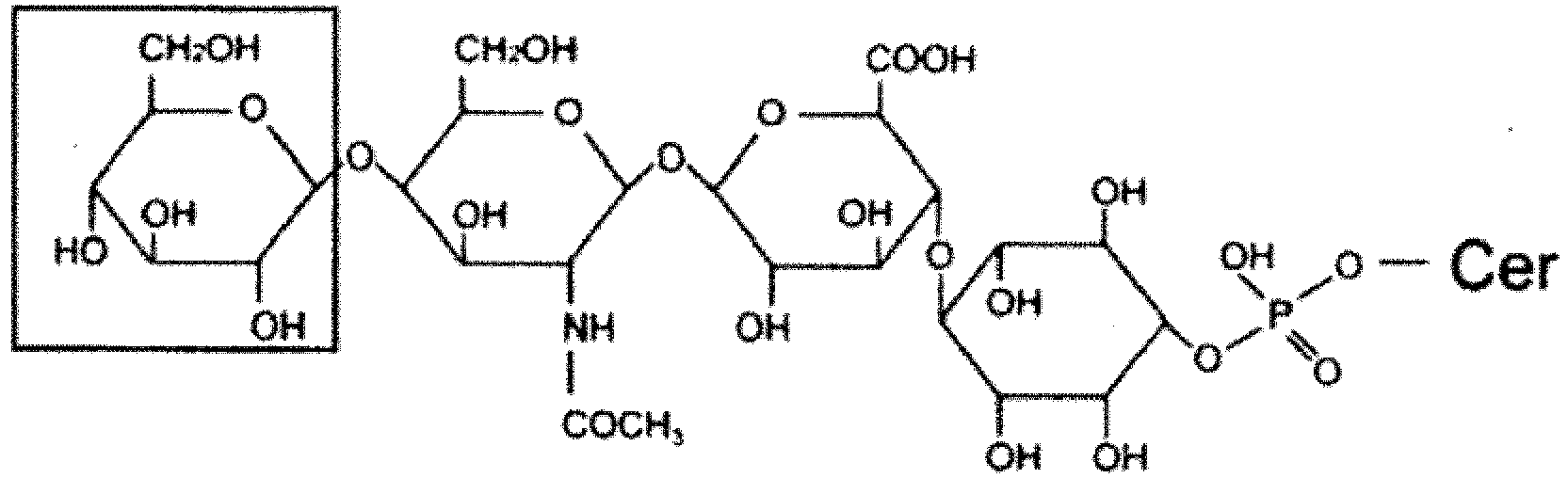
- the glycosyl inositol phospho ceramide represented by formula (1) is at least one member selected from the group consisting of the following H-GIPC, N-GIPC, NAc-GIPC, HN-GIPC, and HNAc-GIPC:
- H-GIPC with the proviso that a glucose residue surrounded by a square frame may be a mannose residue or a galactose residue.
- HN-GIPC with the proviso that a glucose residue surrounded by a square frame may be a mannose residue or a galactose residue.
- HNAc-GIPC with the proviso that a glucose residue surrounded by a square frame may be a mannose residue or a galactose residue.
- ceramide skeleton of the glycosyl inositol phospho ceramide or glucosylceramide is a combination of a sphingoid base containing 2 or 3 hydroxyl groups, 18 or 20 carbons atoms, and 0, 1, or 2 carbon-carbon double bonds and a fatty acid containing 12 to 26 carbon atoms, 0 or 1 carbon-carbon double bond, and 0, 1, or 2 hydroxyl groups.
- the invention relates to the use of the composition for digesting a glucosylceramide for producing a free ceramide, wherein the composition comprising a mushroom self-digestion liquid or purified product thereof.
- the mushroom self-digestion liquid is a self-digestion liquid of at least one mushroom selected from the group consisting of enokitake (flammulina velutipes ) , shimeji ( lyophyllum shimeji ), eringi ( pleurotus eryngii ), and shiitake ( lentinula edodes ) .
- the present invention further relates to a method for producing a free ceramide, comprising reacting a mushroom self-digestion liquid or purified product thereof with a glycosyl inositol phospho ceramide (GIPC) or glucosylceramide.
- GIPC glycosyl inositol phospho ceramide
- the method of the invention comprises reacting the composition described above with a glycosyl inositol phospho ceramide (GIPC) or glucosylceramide.
- GIPC glycosyl inositol phospho ceramide
- the present invention provides a method that is capable of producing a free ceramide from a glycosyl inositol phospho ceramide (GIPC).
- GIPC glycosyl inositol phospho ceramide
- the present invention also provides a method that is capable of producing a free ceramide from a glucosylceramide.
- Embodiments encompassed by the present disclosure are explained in more detail below.
- This disclosure encompasses a use of a composition for digesting a glycosyl inositol phospho ceramide (GIPC) or glucosylceramide (GlcCer) for producing a free ceramide, and a method for preparing a free ceramide using the composition.
- GIPC glycosyl inositol phospho ceramide
- GlcCer glucosylceramide
- glycosyl inositol phospho ceramide, glucosylceramide, free ceramide, and sphingoid base constituting a ceramide are sometimes referred to as "GIPC,” “GlcCer,” “Cer,” and “LCB,” respectively.
- the composition for digesting GIPCs or GlcCers encompassed by the present disclosure contains a mushroom self-digestion liquid or purified product thereof.
- the mushroom self-digestion liquid itself or a purified product itself may be used (in other words, the composition may consist of a mushroom self-digestion liquid or purified product thereof), or the composition may additionally contain one or more other components.
- the one or more other components a component that does not suppress the enzyme reaction is preferred, and examples include water.
- composition for digesting GIPCs or GlcCers encompassed by the present disclosure is sometimes referred to as the "composition for digestion of the present disclosure.”
- composition for digestion of the present disclosure can be used as a composition for digesting GIPCs, GlcCers, or GIPCs and GlcCers.
- the mushroom self-digestion liquid is a composition obtained by the self-digestion of a mushroom.
- the mushroom self-digestion liquid can be a liquid composition, which may contain a substance that is not digested.
- the mushroom self-digestion liquid can be obtained by holding or shaking a mushroom at an appropriate temperature (e.g., 15 to 37°C, preferably about 25°C) for 1 to 48 hours. Performing homogenization before or after holding is preferred, and performing homogenization after holding is particularly preferred.
- the mushroom self-digestion liquid may be used as a composition for digesting GIPCs or GlcCers without any treatment, or it may be purified.
- the purification method is not particularly limited, and a known method can be used.
- the mushroom self-digestion liquid may be centrifuged to separate it into a supernatant and a precipitate (pellet), and the supernatant or pellet may be used as a composition for digesting GIPCs or GlcCers.
- water or a pH adjuster is suitably added to the mushroom self-digestion liquid or purified product thereof, and the mixture may be used as a composition for digesting GIPCs or GlcCers.
- mushrooms examples include enokitake (flammulina velutipes ), shimeji ( lyophyllum shimeji ), eringi ( pleurotus eryngii ), shiitake (lentinula edodes ), matsutake ( tricholoma matsutake ), maitake ( grifola frondosa ), hiratake ( pleurotus ostreatus ), nameko ( pholiota microspora ), mushrooms, and porcini mushrooms.
- enokitake, shimeji, eringi, and shiitake are particularly preferred.
- the mushrooms can be used alone or in a combination of two or more.
- GIPCs those derived from animals, plants, and fungi can be all used. Plant-derived GIPCs are particularly preferred.
- a GIPC has a structure in which a saccharide is attached to an inositol phospho ceramide (Ins-P-Cer).
- the GIPC used in the present invention is preferably a glycosyl inositol phospho ceramide represented by formula (1): R-GlcA-Ins-P-Cer (1) wherein GlcA represents a glucuronic acid, Ins-P-Cer represents an inositol phospho ceramide, and R represents a monosaccharide or disaccharide.
- GlcA represents a glucuronic acid
- Ins-P-Cer represents an inositol phospho ceramide
- R represents a monosaccharide or disaccharide.
- H-GIPC, N-GIPC, NAc-GIPC, HN-GIPC, and HNAc-GIPC are preferred.
- glycosyl inositol phospho ceramides can be used alone or in a combination of two or more.
- the structures of various glycosyl inositol phospho ceramides are shown below (cited from Non-patent Literature 1).
- R in formula (1) represents a glucose residue; however, this is an example, and there is no limitation as long as R is a hexose residue.
- R may be a mannose residue or galactose residue rather than a glucose residue.
- H-GIPC represents hexose residue-GlcA-Ins-P-Cer, and preferable examples include glucose residue-GlcA-Ins-P-Cer, mannose residue-GlcA-Ins-P-Cer, and galactose residue-GlcA-Ins-P-Cer. The same applies to HN-GIPC and HNAc-PIPC.
- glucose residue described at the end opposite to the ceramide in the structural formulae of HN-GIPC and HNAc-PIPC is an example, and any hexose residues can be used.
- a mannose residue or galactose residue rather than a glucose residue can be used.
- a GlcCer has a structure in which a ceramide is attached to a glucose.
- GlcCers those derived from animals, plants, and fungi can be all used. Plant-derived GIPCs are particularly preferred.
- composition for digesting GIPCs or GlcCers of the present disclosure GIPCs or GlcCers are digested to excise the ceramide (Cer) portion, thus producing free ceramides.
- a free ceramide is a compound having a structure (-NH-CO-) in which the carboxyl group (-COOH) of a fatty acid is attached to the amino group (-NH 2 ) of a sphingoid base.
- Free ceramides produced from GIPCs or GlcCers by using the composition for digestion of the present disclosure are not particularly limited, and are preferably those described below.
- the sphingoid base constituting the free ceramide preferably has 2 or 3 hydroxyl groups, and more preferably 3 hydroxyl groups. Further, the sphingoid base preferably has 14 to 22 (14, 15, 16, 17, 18, 19, 20, 21, or 22) carbon atoms, more preferably 16 to 20 carbon atoms, and even more preferably 18 or 20 carbon atoms. The sphingoid base also preferably has 0 or 1 carbon-carbon double bond. More specific examples of preferable sphingoid bases include sphingosine, dihydrosphingosine, phytosphingosine, and the like. Of these, phytosphingosine is particularly preferable.
- the fatty acid constituting the free ceramide preferably has 12 or more carbon atoms, more preferably 12 to 26 (12, 13, 14, 15, 16, 17, 18, 19, 20, 21, 22, 23, 24, 25, or 26) carbon atoms, and even more preferably 16 to 26 carbon atoms.
- the fatty acid also preferably has 0 or 1 carbon-carbon double bond, and more preferably 0 carbon-carbon double bonds (i.e., a saturated fatty acid).
- the fatty acid also preferably has 0, 1, or 2 hydroxyl groups, and more preferably 1 or 2 hydroxyl groups. Although there is no particular limitation, when the fatty acid contains hydroxyl, the hydroxyl is preferably ⁇ -hydroxyl.
- the combination of the sphingoid base: LCB and the fatty acid in the ceramide skeleton of the free ceramide may be any combination of sphingoid bases and fatty acids described above.
- a preferable example of the combination is a combination of a sphingoid base containing 2 or 3 (in particular, 3) hydroxyl groups and a fatty acid that does not contain or contains hydroxyl (particularly preferably ⁇ -hydroxyl when it contains hydroxyl).
- the number of hydroxyl groups is preferably 1 or 2.
- Preferable examples include ceramide AP, which is a combination of phytosphingosine (P) and a fatty acid containing 1 hydroxyl group (preferably ⁇ -hydroxyl group) (A); ceramide NP, which is a combination of phytosphingosine (P) and a fatty acid containing 0 hydroxyl groups (N); and the like. Further, ceramide DP, which is a combination of phytosphingosine (P) and a fatty acid containing 2 hydroxyl groups (D), is also a preferable example. "Ceramide AP” and “ceramide NP” are terms commonly used in the art; however, “ceramide DP” is a term that is used in the present specification, and is not a commonly used term. Specific examples of ceramide DP include dihydroxylignoceroyl phytosphingosine and the like.
- preferable free ceramides include t18:0-22:0h, t18:1-22:0h, t18:0-23:0h, t18:1-23:0h, t18:0-24:0h, t18:1-24:0h, t20:0-24:0h, t18:1-26:0h, t18:0-25:0h, t18:0-24:0h 2 , and the like; and t18:0-23:1h, t18:1-23:1h, t18:0-24:1h, t18:1-24:1h, t20:0-24:1h, t18:1-26:1h, t18:0-25:1h, t18:0-24:1h 2 , and the like.
- d18:0-12:0 is also preferred.
- the first half (“t18:0”) is information about the sphingoid base, and indicates a sphingoid base that contains 3 hydroxyl groups ("t") ("d” indicates two hydroxyl groups), 18 carbon atoms, and 0 carbon-carbon double bonds (i.e., containing no carbon-carbon double bonds).
- the latter half (“22:0h”) is information about the fatty acid, and indicates a fatty acid that contains 22 carbon atoms, 0 carbon-carbon double bonds, and 1 hydroxyl group (“h”).
- the first half of the notation sometimes includes, after "t18:1,” a number in subscript (or in brackets), which indicates at what carbon number the double bond is present. Additionally, the notation sometimes includes "c” or "t” after “t18:1” to indicate whether the isomer due to the carbon-carbon double bond is cis (c) or trans(t). For example, “t18:1 c " indicates the cis-isomer, and “t18:1 8t " indicates the trans-isomer in which the double bond is present on the eighth carbon. For the description of the latter half, the position of the number of hydroxyl groups and the number of carbon-carbon double bonds may be reversed, e.g., "22h:0" instead of "22:0h.” A colon may be placed between these two numbers.
- the free ceramides produced by the composition for digestion of the present disclosure may be used alone or in a combination (composition) of two or more.
- ceramide skeleton of GIPCs or GlcCers digested by the composition for digestion of the present disclosure can also be used as is as an explanation of the ceramide skeleton of GIPCs or GlcCers digested by the composition for digestion of the present disclosure.
- GIPCs or GlcCers digested by the composition for digestion of the present disclosure are not particularly limited, but their ceramide skeleton moiety is preferably a skeleton that is explained in the free ceramide section.
- the present disclosure also encompasses a method for producing a free ceramide, comprising reacting a mushroom self-digestion liquid or a purified product thereof with a GIPC or GlcCer.
- the mushroom self-digestion liquid or purified product thereof, and GIPC or GlcCer can be preferably used in the method.
- the method of reaction is not particularly limited, and a method comprising mixing the mushroom self-digestion liquid or purified product thereof with a GIPC or GlcCer, and allowing the mixture to stand or shaking the mixture at an appropriate temperature (e.g., 15 to 40°C) for about 1 to 24 hours.
- Enokitake (also referred to as " enoki ”) was frozen overnight, and then self-digested as is in a thermostatic chamber at 25°C. 24 to 27 hours later, homogenization was performed in a food processor with or without EDTA. Each of the homogenates was subjected to solid-liquid separation, and the liquid portion was collected as an enoki digestion liquid.
- the collected enoki digestion liquid was centrifuged in an ultracentrifuge (Optima L-100XP, Beckman Coulter Inc.) at 32000 rpm for 1 hour at 4°C to collect a liquid portion as a supernatant portion.
- the pellet portion was washed by adding 1.5 mL of MillQ, followed by centrifugation at 16000 rpm at 0°C. The pellet was collected as a membrane protein portion.
- Table 1 shows the results obtained by quantifying proteins in the supernatant portion of the enoki digestion liquid according to the Bradford method, and the results obtained by quantifying proteins in the film protein portion according to the BCA method.
- Sample No. 2 and sample No. 3 respectively show a sample of the supernatant portion of the enoki digestion liquid and a sample of the membrane protein portion of the enoki digestion liquid. These results indicate that the addition of EDTA enhances the stability of enzyme-containing proteins.
- GIPCs isolated from a plant were used for examination.
- the GIPCs have a simple structure and are the molecular species of inositol phosphate-glucuronic acid-hexose (H-GlcA-Ins-P-Cer).
- the GIPCs were used as a reaction substrate, and reacted with the supernatant portion or membrane protein portion of the enoki digestion liquid at a pH of 5.0 and 37°C for 1 hour.
- the reaction was also performed using the supernatant portion or membrane protein portion of an enoki digestion liquid that had been subjected to inactivation treatment at 100°C for 5 minutes, and the resultants were used as a negative control.
- most of the LCB moiety is an 8-unsaturated LCB of 8-trans configuration, and most of the fatty acid moiety is a 2-hydroxy fatty acid with 24 carbon atoms.
- most of the LCB moiety is a saturated LCB with 18 carbon atoms, and most of the fatty acid moiety is a 2-hydroxy fatty acid with 24 carbon atoms.
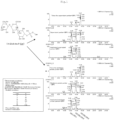
- Fig. 1 shows the results in which the treatment solutions were subjected to an LC-MS/MS analysis by setting t18:1-24h:0 or t18:0-24:0 as product ions.
- the chemical structure figure on the left shows the main molecular species (H-GlcA-Ins-P-Cer) of used plant-derived GIPCs, while the graphs on the right show the total ion chromatogram for each treatment solution.
- the supernatant portion or membrane protein portion of the enoki digestion liquid had an effect of digesting the plant-derived GIPCs of the substrate to produce free ceramides, as well as the effect of self-digesting enoki GIPCs to produce free ceramides. It was also assumed that these effects were caused by enzymes contained in the enoki digestion liquid.
- GlcCers C12-beta-glucosylceramide (d18:1-12:0-Glc) were used as a reaction substrate, and subjected to an enzyme reaction at a pH of 5.0 and 37°C for 1 hour with the supernatant portion or membrane protein portion of the enoki digestion liquid.
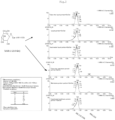
- Fig. 2 shows the results in which the treatment solutions were subjected to LC-MS/MS analysis by setting d18:1-12:0-Glc or d8:1-12:0 as product ions.
- the figure on the left shows a chemical structure figure of the substrate (GlcCer), while the graphs on the right show the total ion chromatogram for each treatment solution.
- d18:1-12:0-Glc was detected at an RT time of 7.3 minutes.
- Ceramide molecular species d18:1-12:0 that the self-digestion enoki did not possess was detected from samples other than the inactivated treatment solutions at 8.25 minutes.
Landscapes
- Life Sciences & Earth Sciences (AREA)
- Chemical & Material Sciences (AREA)
- Health & Medical Sciences (AREA)
- Organic Chemistry (AREA)
- Engineering & Computer Science (AREA)
- Wood Science & Technology (AREA)
- Zoology (AREA)
- General Health & Medical Sciences (AREA)
- Chemical Kinetics & Catalysis (AREA)
- Genetics & Genomics (AREA)
- Bioinformatics & Cheminformatics (AREA)
- Microbiology (AREA)
- Animal Behavior & Ethology (AREA)
- Biotechnology (AREA)
- Veterinary Medicine (AREA)
- Biochemistry (AREA)
- General Engineering & Computer Science (AREA)
- Public Health (AREA)
- General Chemical & Material Sciences (AREA)
- Molecular Biology (AREA)
- Dermatology (AREA)
- Oil, Petroleum & Natural Gas (AREA)
- Biophysics (AREA)
- Birds (AREA)
- Epidemiology (AREA)
- Food Science & Technology (AREA)
- Polymers & Plastics (AREA)
- Mycology (AREA)
- Nutrition Science (AREA)
- Botany (AREA)
- Medicinal Chemistry (AREA)
- Biomedical Technology (AREA)
- Medicines Containing Plant Substances (AREA)
- Enzymes And Modification Thereof (AREA)
- Preparation Of Compounds By Using Micro-Organisms (AREA)
- Cosmetics (AREA)
- Fats And Perfumes (AREA)
- Coloring Foods And Improving Nutritive Qualities (AREA)
- Peptides Or Proteins (AREA)
- Cephalosporin Compounds (AREA)
Claims (13)
- Verwendung einer Zusammensetzung zum Verdauen eines Glycosylinositolphosphoceramids (GIPC) oder Glucosylceramids zur Produktion eines freien Ceramids, wobei die Zusammensetzung eine Pilz-Selbstverdauungsflüssigkeit oder ein aufgereinigtes Produkt davon umfasst.
- Verwendung nach Anspruch 1, wobei das Glycosylinositolphosphoceramid ein von Pflanzen stammendes Glycosylinositolphosphoceramid ist.
- Verwendung nach Anspruch 1 oder 2, wobei das Glycosylinositolphosphoceramid durch die Formel (1) dargestellt ist:
R-GlcA-Ins-P-Cer (1),
wobei GlcA für eine Glucuronsäure steht, Ins-P-Cer für ein Inositolphosphoceramid steht und R für ein Monosaccharid oder Disaccharid steht. - Verwendung nach Anspruch 3, wobei das das Glycosylinositolphosphoceramid, das durch die Formel (1) dargestellt ist, mindestens ein Element ist, das aus der Gruppe bestehend aus den folgenden H-GIPC, N-GIPC, NAc-GIPC, HN-GIPC und HNAc-GIPC ausgewählt ist:


- Verwendung nach einem der Ansprüche 1 bis 4, wobei das Ceramidskelett des Glycosylinositolphosphoceramids oder Glucosylceramids eine Kombination einer Sphingoidbase, enthaltend 2 oder 3 Hydroxylgruppen, 18 oder 20 Kohlenstoffatome und 0, 1 oder 2 Kohlenstoff-Kohlenstoff-Doppelbindungen, und einer Fettsäure, enthaltend 12 bis 26 Kohlenstoffatome, 0 oder 1 Kohlenstoff-Kohlenstoff-Doppelbindung und 0, 1 oder 2 Hydroxylgruppen, ist.
- Verwendung der Zusammensetzung zum Verdauen eines Glucosylceramids zur Produktion eines freien Ceramids nach Anspruch 1, wobei die Zusammensetzung eine Pilz-Selbstverdauungsflüssigkeit oder ein aufgereinigtes Produkt davon umfasst.
- Verwendung nach einem der Ansprüche 1 bis 6, wobei die Pilz-Selbstverdauungsflüssigkeit eine Selbstverdauungsflüssigkeit mindestens eines Pilzes ist, der aus der Gruppe bestehend aus dem Gemeinen Samtfußrübling (Flammulina velutipes), Buchenpilz (Lyophyllum shimeji), Braunen Kräuterseitling (Pleurotus eryngii) und Shiitake (Lentinula edodes) ausgewählt ist.
- Verfahren zur Produktion eines freien Ceramids, umfassend ein Umsetzen einer Pilz-Selbstverdauungsflüssigkeit oder eines aufgereinigten Produkts davon mit Glycosylinositolphosphoceramid (GIPC) oder Glucosylceramid.
- Verfahren nach Anspruch 8, wobei das Glycosylinositolphosphoceramid ein von Pflanzen stammendes Glycosylinositolphosphoceramid ist.
- Verfahren nach Anspruch 8 oder 9, wobei das Glycosylinositolphosphoceramid durch die Formel (1) dargestellt ist:
R-GlcA-Ins-P-Cer (1),
wobei GlcA für eine Glucuronsäure steht, Ins-P-Cer für ein Inositolphosphoceramid steht und R für ein Monosaccharid oder Disaccharid steht. - Verfahren nach Anspruch 10, wobei das das Glycosylinositolphosphoceramid, das durch die Formel (1) dargestellt ist, mindestens ein Element ist, das aus der Gruppe bestehend aus den folgenden H-GIPC, N-GIPC, NAc-GIPC, HN-GIPC und HNAc-GIPC ausgewählt ist:


- Verfahren nach einem der Ansprüche 8 bis 11, wobei das Ceramidskelett des Glycosylinositolphosphoceramids oder Glucosylceramids eine Kombination einer Sphingoidbase, enthaltend 2 oder 3 Hydroxylgruppen, 18 oder 20 Kohlenstoffatome und 0, 1 oder 2 Kohlenstoff-Kohlenstoff-Doppelbindungen, und einer Fettsäure, enthaltend 12 bis 26 Kohlenstoffatome, 0 oder 1 Kohlenstoff-Kohlenstoff-Doppelbindung und 0, 1 oder 2 Hydroxylgruppen, ist.
- Verfahren nach einem der Ansprüche 8 bis 12, wobei die Pilz-Selbstverdauungsflüssigkeit eine Selbstverdauungsflüssigkeit mindestens eines Pilzes ist, der aus der Gruppe bestehend aus dem Gemeinen Samtfußrübling (Flammulina velutipes), Buchenpilz (Lyophyllum shimeji), Braunen Kräuterseitling (Pleurotus eryngii) und Shiitake (Lentinula edodes) ausgewählt ist.
Applications Claiming Priority (2)
| Application Number | Priority Date | Filing Date | Title |
|---|---|---|---|
| JP2019236101A JP7285007B2 (ja) | 2019-12-26 | 2019-12-26 | セラミド生成用組成物 |
| PCT/JP2020/045377 WO2021131627A1 (ja) | 2019-12-26 | 2020-12-07 | セラミド生成用組成物 |
Publications (3)
| Publication Number | Publication Date |
|---|---|
| EP4083198A1 EP4083198A1 (de) | 2022-11-02 |
| EP4083198A4 EP4083198A4 (de) | 2024-01-17 |
| EP4083198B1 true EP4083198B1 (de) | 2024-09-11 |
Family
ID=76573971
Family Applications (1)
| Application Number | Title | Priority Date | Filing Date |
|---|---|---|---|
| EP20906320.5A Active EP4083198B1 (de) | 2019-12-26 | 2020-12-07 | Zusammensetzung zum produzieren von ceramiden |
Country Status (5)
| Country | Link |
|---|---|
| US (1) | US12529081B2 (de) |
| EP (1) | EP4083198B1 (de) |
| JP (1) | JP7285007B2 (de) |
| TW (1) | TWI820368B (de) |
| WO (1) | WO2021131627A1 (de) |
Families Citing this family (1)
| Publication number | Priority date | Publication date | Assignee | Title |
|---|---|---|---|---|
| CN120019134A (zh) | 2022-10-11 | 2025-05-16 | 国立大学法人埼玉大学 | 植物来源的游离神经酰胺、及其制造方法和分析方法 |
Family Cites Families (2)
| Publication number | Priority date | Publication date | Assignee | Title |
|---|---|---|---|---|
| AU5152799A (en) | 1998-06-03 | 1999-12-20 | Deutsches Krebsforschungszentrum Stiftung Des Offentlichen Rechts | Glycosyl-inosite-phospho-ceramide (gipc), method for the production and use thereof |
| JP6823780B2 (ja) | 2016-04-28 | 2021-02-03 | 国立大学法人北海道大学 | セラミドの製造方法 |
-
2019
- 2019-12-26 JP JP2019236101A patent/JP7285007B2/ja active Active
-
2020
- 2020-12-07 US US17/789,058 patent/US12529081B2/en active Active
- 2020-12-07 EP EP20906320.5A patent/EP4083198B1/de active Active
- 2020-12-07 WO PCT/JP2020/045377 patent/WO2021131627A1/ja not_active Ceased
- 2020-12-11 TW TW109143925A patent/TWI820368B/zh active
Also Published As
| Publication number | Publication date |
|---|---|
| EP4083198A4 (de) | 2024-01-17 |
| US12529081B2 (en) | 2026-01-20 |
| WO2021131627A1 (ja) | 2021-07-01 |
| JP7285007B2 (ja) | 2023-06-01 |
| TWI820368B (zh) | 2023-11-01 |
| EP4083198A1 (de) | 2022-11-02 |
| US20230094080A1 (en) | 2023-03-30 |
| TW202136517A (zh) | 2021-10-01 |
| JP2021103950A (ja) | 2021-07-26 |
Similar Documents
| Publication | Publication Date | Title |
|---|---|---|
| Brückner et al. | Chromatographic determination of L-and D-amino acids in plants | |
| Nishihara et al. | Heptads of polar ether lipids of an archaebacterium, Methanobacterium thermoautotrophicum: structure and biosynthetic relationship | |
| Sandoval et al. | N-acylphosphatidylethanolamine in dry and imbibing cottonseeds (amounts, molecular species, and enzymatic synthesis) | |
| EP3087848A1 (de) | Ergothioneinhaltiges ei, fütterungs- und aufzuchtverfahren sowie futter für eine henne, die ergothioneinhaltige eier legt | |
| EP4083198A1 (de) | Zusammensetzung zum produzieren von ceramiden | |
| Tartaglione et al. | An aquarium hobbyist poisoning: Identification of new palytoxins in Palythoa cf. toxica and complete detoxification of the aquarium water by activated carbon | |
| US20170182108A1 (en) | Fermented food extract composition | |
| JP6923882B2 (ja) | アンジオテンシン変換酵素阻害活性の高い発酵乳および生理活性ペプチドの製造方法 | |
| Hatanaka | A new amino acid isolated from Morchella esculenta and related species | |
| JP6860209B2 (ja) | セラミドnpの製造方法 | |
| Bal et al. | The Antioxidant potential of ethanolic extract of edible mushroom Lycoperdon molle Pers.(Agaricomycetes) | |
| FR2637598A1 (fr) | Nouveaux sphingophospholipides a inositol, leur obtention, et leur application comme inducteurs de resistance a diverses maladies cryptogamiques chez les vegetaux | |
| CN1030766A (zh) | 恩卡斯丁:一类具有抑制脑啡肽酶作用的新的糖肽它们的制备方法以及作为药物的应用 | |
| JP4723630B2 (ja) | グルコシルセラミド画分 | |
| Bukhari et al. | The supercritical fluid extraction of alkaloids from papaya (Carica papaya L. var. Eksotika) leaves | |
| JP6624985B2 (ja) | ポリアミン高含有酵母 | |
| JP3370561B2 (ja) | メラトニンの抽出方法 | |
| SINGH et al. | Muraceins-Muramyl peptides produced by Nocardia orientalis as angiotensin-converting enzyme inhibitors II. Isolation and structure determination | |
| JP2006055071A (ja) | クリヴェロマイセス・マルキシアナスによる4−trans,8−trans−sphingadienineを主要なスフィンゴイド塩基として持つセレブロシドの製造法 | |
| US20260110005A1 (en) | Plant-derived free ceramide, and method for producing same and method for analyzing same | |
| KR20220081457A (ko) | 고소애 동충하초로부터 코디세핀을 추출하는 방법 | |
| Korabel et al. | Squalene in fruiting bodies of true mushrooms changes in the process of vegetation | |
| Sugai et al. | Pyrophosphatidic acid in mushrooms | |
| JP3072302B2 (ja) | 血圧降下作用を有する窒素を含有しない燐脂質類似化合物の製造方法 | |
| Amen et al. | Sphingolipids in medicinal mushrooms: structural insights, biological activities, and therapeutic potential. |
Legal Events
| Date | Code | Title | Description |
|---|---|---|---|
| STAA | Information on the status of an ep patent application or granted ep patent |
Free format text: STATUS: THE INTERNATIONAL PUBLICATION HAS BEEN MADE |
|
| PUAI | Public reference made under article 153(3) epc to a published international application that has entered the european phase |
Free format text: ORIGINAL CODE: 0009012 |
|
| STAA | Information on the status of an ep patent application or granted ep patent |
Free format text: STATUS: REQUEST FOR EXAMINATION WAS MADE |
|
| 17P | Request for examination filed |
Effective date: 20220726 |
|
| AK | Designated contracting states |
Kind code of ref document: A1 Designated state(s): AL AT BE BG CH CY CZ DE DK EE ES FI FR GB GR HR HU IE IS IT LI LT LU LV MC MK MT NL NO PL PT RO RS SE SI SK SM TR |
|
| DAV | Request for validation of the european patent (deleted) | ||
| DAX | Request for extension of the european patent (deleted) | ||
| A4 | Supplementary search report drawn up and despatched |
Effective date: 20231219 |
|
| RIC1 | Information provided on ipc code assigned before grant |
Ipc: C11B 11/00 20060101ALI20231213BHEP Ipc: A23L 33/105 20160101ALI20231213BHEP Ipc: A23L 31/00 20160101ALI20231213BHEP Ipc: C12P 19/00 20060101ALI20231213BHEP Ipc: C12P 13/02 20060101ALI20231213BHEP Ipc: C11B 1/10 20060101ALI20231213BHEP Ipc: A61Q 19/00 20060101ALI20231213BHEP Ipc: A61K 8/68 20060101ALI20231213BHEP Ipc: C12N 9/14 20060101AFI20231213BHEP |
|
| GRAP | Despatch of communication of intention to grant a patent |
Free format text: ORIGINAL CODE: EPIDOSNIGR1 |
|
| STAA | Information on the status of an ep patent application or granted ep patent |
Free format text: STATUS: GRANT OF PATENT IS INTENDED |
|
| INTG | Intention to grant announced |
Effective date: 20240506 |
|
| RIC1 | Information provided on ipc code assigned before grant |
Ipc: C11B 11/00 20060101ALI20240422BHEP Ipc: A23L 33/105 20160101ALI20240422BHEP Ipc: A23L 31/00 20160101ALI20240422BHEP Ipc: C12P 19/00 20060101ALI20240422BHEP Ipc: C12P 13/02 20060101ALI20240422BHEP Ipc: C11B 1/10 20060101ALI20240422BHEP Ipc: A61Q 19/00 20060101ALI20240422BHEP Ipc: A61K 8/68 20060101ALI20240422BHEP Ipc: C12N 9/14 20060101AFI20240422BHEP |
|
| GRAS | Grant fee paid |
Free format text: ORIGINAL CODE: EPIDOSNIGR3 |
|
| GRAA | (expected) grant |
Free format text: ORIGINAL CODE: 0009210 |
|
| STAA | Information on the status of an ep patent application or granted ep patent |
Free format text: STATUS: THE PATENT HAS BEEN GRANTED |
|
| AK | Designated contracting states |
Kind code of ref document: B1 Designated state(s): AL AT BE BG CH CY CZ DE DK EE ES FI FR GB GR HR HU IE IS IT LI LT LU LV MC MK MT NL NO PL PT RO RS SE SI SK SM TR |
|
| REG | Reference to a national code |
Ref country code: GB Ref legal event code: FG4D |
|
| REG | Reference to a national code |
Ref country code: CH Ref legal event code: EP |
|
| REG | Reference to a national code |
Ref country code: DE Ref legal event code: R096 Ref document number: 602020037735 Country of ref document: DE |
|
| REG | Reference to a national code |
Ref country code: IE Ref legal event code: FG4D |
|
| P01 | Opt-out of the competence of the unified patent court (upc) registered |
Free format text: CASE NUMBER: APP_58814/2024 Effective date: 20241028 |
|
| REG | Reference to a national code |
Ref country code: LT Ref legal event code: MG9D |
|
| PG25 | Lapsed in a contracting state [announced via postgrant information from national office to epo] |
Ref country code: NO Free format text: LAPSE BECAUSE OF FAILURE TO SUBMIT A TRANSLATION OF THE DESCRIPTION OR TO PAY THE FEE WITHIN THE PRESCRIBED TIME-LIMIT Effective date: 20241211 |
|
| REG | Reference to a national code |
Ref country code: NL Ref legal event code: MP Effective date: 20240911 |
|
| PG25 | Lapsed in a contracting state [announced via postgrant information from national office to epo] |
Ref country code: GR Free format text: LAPSE BECAUSE OF FAILURE TO SUBMIT A TRANSLATION OF THE DESCRIPTION OR TO PAY THE FEE WITHIN THE PRESCRIBED TIME-LIMIT Effective date: 20241212 Ref country code: FI Free format text: LAPSE BECAUSE OF FAILURE TO SUBMIT A TRANSLATION OF THE DESCRIPTION OR TO PAY THE FEE WITHIN THE PRESCRIBED TIME-LIMIT Effective date: 20240911 |
|
| PG25 | Lapsed in a contracting state [announced via postgrant information from national office to epo] |
Ref country code: BG Free format text: LAPSE BECAUSE OF FAILURE TO SUBMIT A TRANSLATION OF THE DESCRIPTION OR TO PAY THE FEE WITHIN THE PRESCRIBED TIME-LIMIT Effective date: 20240911 |
|
| PG25 | Lapsed in a contracting state [announced via postgrant information from national office to epo] |
Ref country code: LV Free format text: LAPSE BECAUSE OF FAILURE TO SUBMIT A TRANSLATION OF THE DESCRIPTION OR TO PAY THE FEE WITHIN THE PRESCRIBED TIME-LIMIT Effective date: 20240911 |
|
| PG25 | Lapsed in a contracting state [announced via postgrant information from national office to epo] |
Ref country code: HR Free format text: LAPSE BECAUSE OF FAILURE TO SUBMIT A TRANSLATION OF THE DESCRIPTION OR TO PAY THE FEE WITHIN THE PRESCRIBED TIME-LIMIT Effective date: 20240911 |
|
| PG25 | Lapsed in a contracting state [announced via postgrant information from national office to epo] |
Ref country code: ES Free format text: LAPSE BECAUSE OF FAILURE TO SUBMIT A TRANSLATION OF THE DESCRIPTION OR TO PAY THE FEE WITHIN THE PRESCRIBED TIME-LIMIT Effective date: 20240911 Ref country code: RS Free format text: LAPSE BECAUSE OF FAILURE TO SUBMIT A TRANSLATION OF THE DESCRIPTION OR TO PAY THE FEE WITHIN THE PRESCRIBED TIME-LIMIT Effective date: 20241211 |
|
| PG25 | Lapsed in a contracting state [announced via postgrant information from national office to epo] |
Ref country code: RS Free format text: LAPSE BECAUSE OF FAILURE TO SUBMIT A TRANSLATION OF THE DESCRIPTION OR TO PAY THE FEE WITHIN THE PRESCRIBED TIME-LIMIT Effective date: 20241211 Ref country code: NO Free format text: LAPSE BECAUSE OF FAILURE TO SUBMIT A TRANSLATION OF THE DESCRIPTION OR TO PAY THE FEE WITHIN THE PRESCRIBED TIME-LIMIT Effective date: 20241211 Ref country code: LV Free format text: LAPSE BECAUSE OF FAILURE TO SUBMIT A TRANSLATION OF THE DESCRIPTION OR TO PAY THE FEE WITHIN THE PRESCRIBED TIME-LIMIT Effective date: 20240911 Ref country code: HR Free format text: LAPSE BECAUSE OF FAILURE TO SUBMIT A TRANSLATION OF THE DESCRIPTION OR TO PAY THE FEE WITHIN THE PRESCRIBED TIME-LIMIT Effective date: 20240911 Ref country code: GR Free format text: LAPSE BECAUSE OF FAILURE TO SUBMIT A TRANSLATION OF THE DESCRIPTION OR TO PAY THE FEE WITHIN THE PRESCRIBED TIME-LIMIT Effective date: 20241212 Ref country code: FI Free format text: LAPSE BECAUSE OF FAILURE TO SUBMIT A TRANSLATION OF THE DESCRIPTION OR TO PAY THE FEE WITHIN THE PRESCRIBED TIME-LIMIT Effective date: 20240911 Ref country code: ES Free format text: LAPSE BECAUSE OF FAILURE TO SUBMIT A TRANSLATION OF THE DESCRIPTION OR TO PAY THE FEE WITHIN THE PRESCRIBED TIME-LIMIT Effective date: 20240911 Ref country code: BG Free format text: LAPSE BECAUSE OF FAILURE TO SUBMIT A TRANSLATION OF THE DESCRIPTION OR TO PAY THE FEE WITHIN THE PRESCRIBED TIME-LIMIT Effective date: 20240911 |
|
| REG | Reference to a national code |
Ref country code: AT Ref legal event code: MK05 Ref document number: 1722705 Country of ref document: AT Kind code of ref document: T Effective date: 20240911 |
|
| PG25 | Lapsed in a contracting state [announced via postgrant information from national office to epo] |
Ref country code: NL Free format text: LAPSE BECAUSE OF FAILURE TO SUBMIT A TRANSLATION OF THE DESCRIPTION OR TO PAY THE FEE WITHIN THE PRESCRIBED TIME-LIMIT Effective date: 20240911 |
|
| PG25 | Lapsed in a contracting state [announced via postgrant information from national office to epo] |
Ref country code: IS Free format text: LAPSE BECAUSE OF FAILURE TO SUBMIT A TRANSLATION OF THE DESCRIPTION OR TO PAY THE FEE WITHIN THE PRESCRIBED TIME-LIMIT Effective date: 20250111 Ref country code: PT Free format text: LAPSE BECAUSE OF FAILURE TO SUBMIT A TRANSLATION OF THE DESCRIPTION OR TO PAY THE FEE WITHIN THE PRESCRIBED TIME-LIMIT Effective date: 20250113 |
|
| PG25 | Lapsed in a contracting state [announced via postgrant information from national office to epo] |
Ref country code: SM Free format text: LAPSE BECAUSE OF FAILURE TO SUBMIT A TRANSLATION OF THE DESCRIPTION OR TO PAY THE FEE WITHIN THE PRESCRIBED TIME-LIMIT Effective date: 20240911 Ref country code: RO Free format text: LAPSE BECAUSE OF FAILURE TO SUBMIT A TRANSLATION OF THE DESCRIPTION OR TO PAY THE FEE WITHIN THE PRESCRIBED TIME-LIMIT Effective date: 20240911 |
|
| PG25 | Lapsed in a contracting state [announced via postgrant information from national office to epo] |
Ref country code: EE Free format text: LAPSE BECAUSE OF FAILURE TO SUBMIT A TRANSLATION OF THE DESCRIPTION OR TO PAY THE FEE WITHIN THE PRESCRIBED TIME-LIMIT Effective date: 20240911 Ref country code: AT Free format text: LAPSE BECAUSE OF FAILURE TO SUBMIT A TRANSLATION OF THE DESCRIPTION OR TO PAY THE FEE WITHIN THE PRESCRIBED TIME-LIMIT Effective date: 20240911 |
|
| PG25 | Lapsed in a contracting state [announced via postgrant information from national office to epo] |
Ref country code: CZ Free format text: LAPSE BECAUSE OF FAILURE TO SUBMIT A TRANSLATION OF THE DESCRIPTION OR TO PAY THE FEE WITHIN THE PRESCRIBED TIME-LIMIT Effective date: 20240911 Ref country code: PL Free format text: LAPSE BECAUSE OF FAILURE TO SUBMIT A TRANSLATION OF THE DESCRIPTION OR TO PAY THE FEE WITHIN THE PRESCRIBED TIME-LIMIT Effective date: 20240911 |
|
| PG25 | Lapsed in a contracting state [announced via postgrant information from national office to epo] |
Ref country code: SK Free format text: LAPSE BECAUSE OF FAILURE TO SUBMIT A TRANSLATION OF THE DESCRIPTION OR TO PAY THE FEE WITHIN THE PRESCRIBED TIME-LIMIT Effective date: 20240911 |
|
| REG | Reference to a national code |
Ref country code: DE Ref legal event code: R097 Ref document number: 602020037735 Country of ref document: DE |
|
| PG25 | Lapsed in a contracting state [announced via postgrant information from national office to epo] |
Ref country code: MC Free format text: LAPSE BECAUSE OF FAILURE TO SUBMIT A TRANSLATION OF THE DESCRIPTION OR TO PAY THE FEE WITHIN THE PRESCRIBED TIME-LIMIT Effective date: 20240911 |
|
| PG25 | Lapsed in a contracting state [announced via postgrant information from national office to epo] |
Ref country code: DK Free format text: LAPSE BECAUSE OF FAILURE TO SUBMIT A TRANSLATION OF THE DESCRIPTION OR TO PAY THE FEE WITHIN THE PRESCRIBED TIME-LIMIT Effective date: 20240911 |
|
| PLBE | No opposition filed within time limit |
Free format text: ORIGINAL CODE: 0009261 |
|
| STAA | Information on the status of an ep patent application or granted ep patent |
Free format text: STATUS: NO OPPOSITION FILED WITHIN TIME LIMIT |
|
| REG | Reference to a national code |
Ref country code: CH Ref legal event code: PL |
|
| PG25 | Lapsed in a contracting state [announced via postgrant information from national office to epo] |
Ref country code: LU Free format text: LAPSE BECAUSE OF NON-PAYMENT OF DUE FEES Effective date: 20241207 |
|
| 26N | No opposition filed |
Effective date: 20250612 |
|
| PG25 | Lapsed in a contracting state [announced via postgrant information from national office to epo] |
Ref country code: SE Free format text: LAPSE BECAUSE OF FAILURE TO SUBMIT A TRANSLATION OF THE DESCRIPTION OR TO PAY THE FEE WITHIN THE PRESCRIBED TIME-LIMIT Effective date: 20240911 |
|
| REG | Reference to a national code |
Ref country code: BE Ref legal event code: MM Effective date: 20241231 |
|
| PG25 | Lapsed in a contracting state [announced via postgrant information from national office to epo] |
Ref country code: BE Free format text: LAPSE BECAUSE OF NON-PAYMENT OF DUE FEES Effective date: 20241231 |
|
| PG25 | Lapsed in a contracting state [announced via postgrant information from national office to epo] |
Ref country code: CH Free format text: LAPSE BECAUSE OF NON-PAYMENT OF DUE FEES Effective date: 20241231 |
|
| PG25 | Lapsed in a contracting state [announced via postgrant information from national office to epo] |
Ref country code: IE Free format text: LAPSE BECAUSE OF NON-PAYMENT OF DUE FEES Effective date: 20241207 |
|
| PGFP | Annual fee paid to national office [announced via postgrant information from national office to epo] |
Ref country code: DE Payment date: 20251028 Year of fee payment: 6 |
|
| PGFP | Annual fee paid to national office [announced via postgrant information from national office to epo] |
Ref country code: GB Payment date: 20251030 Year of fee payment: 6 |
|
| PGFP | Annual fee paid to national office [announced via postgrant information from national office to epo] |
Ref country code: IT Payment date: 20251121 Year of fee payment: 6 |
|
| PGFP | Annual fee paid to national office [announced via postgrant information from national office to epo] |
Ref country code: FR Payment date: 20251110 Year of fee payment: 6 |
|
| PG25 | Lapsed in a contracting state [announced via postgrant information from national office to epo] |
Ref country code: CY Free format text: LAPSE BECAUSE OF FAILURE TO SUBMIT A TRANSLATION OF THE DESCRIPTION OR TO PAY THE FEE WITHIN THE PRESCRIBED TIME-LIMIT; INVALID AB INITIO Effective date: 20201207 |