EP4072722B1 - Hybride mikrokapseln - Google Patents
Hybride mikrokapseln Download PDFInfo
- Publication number
- EP4072722B1 EP4072722B1 EP20820939.5A EP20820939A EP4072722B1 EP 4072722 B1 EP4072722 B1 EP 4072722B1 EP 20820939 A EP20820939 A EP 20820939A EP 4072722 B1 EP4072722 B1 EP 4072722B1
- Authority
- EP
- European Patent Office
- Prior art keywords
- oil
- microcapsules
- chitosan
- chitosan particles
- origin
- Prior art date
- Legal status (The legal status is an assumption and is not a legal conclusion. Google has not performed a legal analysis and makes no representation as to the accuracy of the status listed.)
- Active
Links
Images
Classifications
-
- A—HUMAN NECESSITIES
- A01—AGRICULTURE; FORESTRY; ANIMAL HUSBANDRY; HUNTING; TRAPPING; FISHING
- A01N—PRESERVATION OF BODIES OF HUMANS OR ANIMALS OR PLANTS OR PARTS THEREOF; BIOCIDES, e.g. AS DISINFECTANTS, AS PESTICIDES OR AS HERBICIDES; PEST REPELLANTS OR ATTRACTANTS; PLANT GROWTH REGULATORS
- A01N25/00—Biocides, pest repellants or attractants, or plant growth regulators, characterised by their forms, or by their non-active ingredients or by their methods of application, e.g. seed treatment or sequential application; Substances for reducing the noxious effect of the active ingredients to organisms other than pests
- A01N25/26—Biocides, pest repellants or attractants, or plant growth regulators, characterised by their forms, or by their non-active ingredients or by their methods of application, e.g. seed treatment or sequential application; Substances for reducing the noxious effect of the active ingredients to organisms other than pests in coated particulate form
- A01N25/28—Microcapsules or nanocapsules
-
- A—HUMAN NECESSITIES
- A61—MEDICAL OR VETERINARY SCIENCE; HYGIENE
- A61K—PREPARATIONS FOR MEDICAL, DENTAL OR TOILETRY PURPOSES
- A61K8/00—Cosmetics or similar toiletry preparations
- A61K8/02—Cosmetics or similar toiletry preparations characterised by special physical form
- A61K8/11—Encapsulated compositions
-
- A—HUMAN NECESSITIES
- A61—MEDICAL OR VETERINARY SCIENCE; HYGIENE
- A61K—PREPARATIONS FOR MEDICAL, DENTAL OR TOILETRY PURPOSES
- A61K8/00—Cosmetics or similar toiletry preparations
- A61K8/18—Cosmetics or similar toiletry preparations characterised by the composition
- A61K8/72—Cosmetics or similar toiletry preparations characterised by the composition containing organic macromolecular compounds
- A61K8/73—Polysaccharides
- A61K8/736—Chitin; Chitosan; Derivatives thereof
-
- A—HUMAN NECESSITIES
- A61—MEDICAL OR VETERINARY SCIENCE; HYGIENE
- A61Q—SPECIFIC USE OF COSMETICS OR SIMILAR TOILETRY PREPARATIONS
- A61Q13/00—Formulations or additives for perfume preparations
-
- A—HUMAN NECESSITIES
- A61—MEDICAL OR VETERINARY SCIENCE; HYGIENE
- A61Q—SPECIFIC USE OF COSMETICS OR SIMILAR TOILETRY PREPARATIONS
- A61Q19/00—Preparations for care of the skin
- A61Q19/10—Washing or bathing preparations
-
- A—HUMAN NECESSITIES
- A61—MEDICAL OR VETERINARY SCIENCE; HYGIENE
- A61Q—SPECIFIC USE OF COSMETICS OR SIMILAR TOILETRY PREPARATIONS
- A61Q5/00—Preparations for care of the hair
- A61Q5/02—Preparations for cleaning the hair
-
- A—HUMAN NECESSITIES
- A61—MEDICAL OR VETERINARY SCIENCE; HYGIENE
- A61Q—SPECIFIC USE OF COSMETICS OR SIMILAR TOILETRY PREPARATIONS
- A61Q5/00—Preparations for care of the hair
- A61Q5/12—Preparations containing hair conditioners
-
- B—PERFORMING OPERATIONS; TRANSPORTING
- B01—PHYSICAL OR CHEMICAL PROCESSES OR APPARATUS IN GENERAL
- B01J—CHEMICAL OR PHYSICAL PROCESSES, e.g. CATALYSIS OR COLLOID CHEMISTRY; THEIR RELEVANT APPARATUS
- B01J13/00—Colloid chemistry, e.g. the production of colloidal materials or their solutions, not otherwise provided for; Making microcapsules or microballoons
- B01J13/02—Making microcapsules or microballoons
- B01J13/06—Making microcapsules or microballoons by phase separation
- B01J13/14—Polymerisation; cross-linking
- B01J13/16—Interfacial polymerisation
-
- C—CHEMISTRY; METALLURGY
- C11—ANIMAL OR VEGETABLE OILS, FATS, FATTY SUBSTANCES OR WAXES; FATTY ACIDS THEREFROM; DETERGENTS; CANDLES
- C11D—DETERGENT COMPOSITIONS; USE OF SINGLE SUBSTANCES AS DETERGENTS; SOAP OR SOAP-MAKING; RESIN SOAPS; RECOVERY OF GLYCEROL
- C11D3/00—Other compounding ingredients of detergent compositions covered in group C11D1/00
- C11D3/50—Perfumes
- C11D3/502—Protected perfumes
- C11D3/505—Protected perfumes encapsulated or adsorbed on a carrier, e.g. zeolite or clay
-
- A—HUMAN NECESSITIES
- A61—MEDICAL OR VETERINARY SCIENCE; HYGIENE
- A61K—PREPARATIONS FOR MEDICAL, DENTAL OR TOILETRY PURPOSES
- A61K2800/00—Properties of cosmetic compositions or active ingredients thereof or formulation aids used therein and process related aspects
- A61K2800/40—Chemical, physico-chemical or functional or structural properties of particular ingredients
- A61K2800/41—Particular ingredients further characterized by their size
- A61K2800/412—Microsized, i.e. having sizes between 0.1 and 100 microns
-
- A—HUMAN NECESSITIES
- A61—MEDICAL OR VETERINARY SCIENCE; HYGIENE
- A61K—PREPARATIONS FOR MEDICAL, DENTAL OR TOILETRY PURPOSES
- A61K2800/00—Properties of cosmetic compositions or active ingredients thereof or formulation aids used therein and process related aspects
- A61K2800/40—Chemical, physico-chemical or functional or structural properties of particular ingredients
- A61K2800/56—Compounds, absorbed onto or entrapped into a solid carrier, e.g. encapsulated perfumes, inclusion compounds, sustained release forms
Definitions
- the present invention relates to hybrid microcapsules, with a hydrophobic material-based core, preferably a perfume, and a polymeric shell comprising chitosan particles.
- a hydrophobic material-based core preferably a perfume
- a polymeric shell comprising chitosan particles.
- Process for preparing said microcapsules is also an object of the invention.
- Perfuming compositions and consumer products comprising said capsules, in particular perfumed consumer products in the form of home care or personal care products, are also part of the invention.
- Aminoplast microcapsules formed of a melamine-formaldehyde resin have been largely used to encapsulate hydrophobic actives, thus protecting said actives and providing their controlled release.
- capsules such as aminoplast ones suffer from stability problems when used in consumer products comprising surfactants, such as perfumery consumer products, especially after prolonged storage at elevated temperatures.
- surfactants such as perfumery consumer products
- the encapsulated active tends to leak out of the capsule by diffusion through the wall due to the presence of surfactants that are able to solubilise the encapsulated active in the product base.
- the leakage phenomenon reduces the efficiency of the capsules to protect the active and provide its controlled release.
- WO2009/063257 also describes the use of polyisocyanates as possible cross-linker for surface-modified inorganic particles in order to prepare microcapsules with increased level of protection from UV light for the contents. These products are typically intended for agrochemical applications. This type of system is not suitable for perfume encapsulation. In fact, in order to maintain a good morphology and permeability of the microcapsules, an excess of surface-modified inorganic particles is needed. Another problem is that these microcapsules show little margin for size adjustment. Furthermore, the amount of adsorbed particles at the oil-water interface is limited which affects the properties of the capsule membranes.
- WO2018/063515 discloses core-shell microcapsules comprising a polyisocyanate-based shell, an encapsulated perfume core, wherein said shell additionally comprises chitosan.
- a first aspect of the invention is therefore a core-shell microcapsule comprising:
- a core-shell microcapsule slurry comprising at least a microcapsule made of:
- a third aspect of the invention is a process for preparing core-shell microcapsules or core-shell microcapsule slurry as defined above, wherein the process comprises the steps of:
- the invention concerns a microcapsule obtainable by such a process as well as perfuming compositions and consumer products containing them.
- the invention relates to the use of crosslinked chitosan based particles, for the stabilization of a Pickering emulsion further subjected to an interfacial polymerisation reaction.
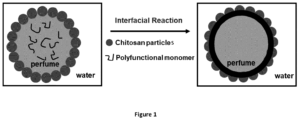
- Figure 1 is a schematic representation of the formation of a Pickering emulsion when chitosan particles are used to stabilize the oil phase.
- active ingredient it is meant a single compound or a combination of ingredients.
- perfume or flavor oil it is meant a single perfuming or flavoring compound or a mixture of several perfuming or flavoring compounds.
- consumer product or "end-product” it is meant a manufactured product ready to be distributed, sold and used by a consumer.
- a "microcapsule”, or the similar, in the present invention has a morphology that can vary from a core-shell to a matrix type. According to one embodiment, it is of the core-shell type.
- the microcapsules comprise a core based on a hydrophobic material, typically a perfume, and a shell comprising chitosan particles.
- Microcapsules have a particle size distribution in the micron range (e.g. a mean diameter) comprised between about 1 and 3000 microns, preferably comprised between 1 and 1000 microns, more preferably between 1 and 500 microns, and even more preferably between 5 and 50 microns.
- the polymeric shell of the microcapsule according to the present invention is formed by interfacial polymerization and/or interfacial reaction in the presence of chitosan particles.
- particle size it is meant an average diameter of particles based on size distribution measured by dynamic light scattering (DLS) using Zetasizer Nano ZS equipment from Malvern Instruments Ltd., UK when particles are dispersed into a water phase.
- DLS dynamic light scattering
- microcapsules size it is meant the volume mean diameter (D[4,3]) of the relevant capsules, capsules suspension as obtained by laser light scattering of a diluted sample in a Malvern Mastersizer 3000.
- polyurea-based wall or shell it is meant that the polymeric shell comprises urea linkages produced by either an amino-functional crosslinker or hydrolysis of isocyanate groups to produce amino groups capable of further reacting with isocyanate groups during interfacial polymerization.
- microcapsules of the invention therefore provides a solution to the above-mentioned problems as it improves the storage stability in challenging bases even with a low concentration of polymeric material in the shell and it improves the performance in application owing to the cationic surface charges of microcapsules from the chitosan particles.
- a first object of the invention is a core-shell microcapsule comprising:
- the hydrophobic material according to the invention can be "inert” material like solvents or active ingredients.
- hydrophobic materials are active ingredients, they are preferably chosen from the group consisting of flavors, flavor ingredients, perfumes, perfume ingredients, nutraceuticals, cosmetics, pest control agents, biocide actives and mixtures thereof.
- the hydrophobic material comprises a mixture of a perfume with another ingredient selected from the group consisting of nutraceuticals, cosmetics, pest control agents and biocide actives.
- the hydrophobic material comprises a mixture of biocide actives with another ingredient selected from the group consisting of perfumes, nutraceuticals, cosmetics, pest control agents.
- the hydrophobic material comprises a mixture of pest control agents with another ingredient selected from the group consisting of perfumes, nutraceuticals, cosmetics, biocide actives.
- the hydrophobic material comprises a perfume.
- the hydrophobic material consists of a perfume.
- the hydrophobic material consists of biocide actives.
- the hydrophobic material consists of pest control agents.
- perfume an ingredient or a composition that is a liquid at about 20°C.
- said perfume oil can be a perfuming ingredient alone or a mixture of ingredients in the form of a perfuming composition.
- a perfuming ingredient it is meant here a compound, which is used for the primary purpose of conferring or modulating an odor.
- such an ingredient, to be considered as being a perfuming one must be recognized by a person skilled in the art as being able to at least impart or modify in a positive or pleasant way the odor of a composition, and not just as having an odor.
- perfume oil also includes a combination of perfuming ingredients with substances which together improve, enhance or modify the delivery of the perfuming ingredients, such as perfume precursors, emulsions or dispersions, as well as combinations which impart an additional benefit beyond that of modifying or imparting an odor, such as long-lastingness, blooming, malodor counteraction, antimicrobial effect, microbial stability, pest control.
- perfuming ingredients such as perfume precursors, emulsions or dispersions, as well as combinations which impart an additional benefit beyond that of modifying or imparting an odor, such as long-lastingness, blooming, malodor counteraction, antimicrobial effect, microbial stability, pest control.
- perfuming ingredients present in the oil phase do not warrant a more detailed description here, which in any case would not be exhaustive, the skilled person being able to select them on the basis of its general knowledge and according to intended use or application and the desired organoleptic effect.
- these perfuming ingredients belong to chemical classes as varied as alcohols, aldehydes, ketones, esters, ethers, acetates, nitriles, terpenoids, nitrogenous or sulfurous heterocyclic compounds and essential oils, and said perfuming co-ingredients can be of natural or synthetic origin. Many of these co-ingredients are in any case listed in reference texts such as the book by S. Arctander, Perfume and Flavor Chemicals, 1969, Montclair, New Jersey, USA , or its more recent versions, or in other works of a similar nature, as well as in the abundant patent literature in the field of perfumery.
- perfuming ingredients which are commonly used in perfume formulations, such as:
- ingredients may also be compounds known to release in a controlled manner various types of perfuming compounds also known as properfume or profragrance.
- suitable properfumes may include 4-(dodecylthio)-4-(2,6,6-trimethyl-2-cyclohexen-1-yl)-2-butanone, 4-(dodecylthio)-4-(2,6,6-trimethyl-1-cyclohexen-1-yl)-2-butanone, trans-3-(dodecylthio)-1-(2,6,6-trimethyl-3-cyclohexen-1-yl)-1-butanone, 2-phenylethyl oxo(phenyl)acetate, 3,7-dimethylocta-2,6-dien-1-yl oxo(phenyl)acetate, (Z)-hex-3-en-1-yl oxo(phenyl)acetate, 3,7-dimethyl-2,6-o
- the perfuming ingredients may be dissolved in a solvent of current use in the perfume industry.
- the solvent is preferably not an alcohol.
- solvents are diethyl phthalate, isopropyl myristate, Abalyn ® (rosin resins, available from Eastman), benzyl benzoate, ethyl citrate, limonene or other terpenes, or isoparaffins.
- the solvent is very hydrophobic and highly sterically hindered, like for example Abalyn ® or benzyl benzoate.
- the perfume comprises less than 30% of solvent. More preferably the perfume comprises less than 20% and even more preferably less than 10% of solvent, all these percentages being defined by weight relative to the total weight of the perfume. Most preferably, the perfume is essentially free of solvent.
- Preferred perfuming ingredients are those having a high steric hindrance and in particular those from one of the following groups:
- the perfume comprises at least 30%, preferably at least 50%, more preferably at least 60% of ingredients selected from Groups 1 to 7, as defined above. More preferably said perfume comprises at least 30%, preferably at least 50% of ingredients from Groups 3 to 7, as defined above. Most preferably said perfume comprises at least 30%, preferably at least 50% of ingredients from Groups 3, 4, 6 or 7, as defined above.
- the perfume comprises at least 30%, preferably at least 50%, more preferably at least 60% of ingredients having a logP above 3, preferably above 3.5 and even more preferably above 3.75.
- the perfume used in the invention contains less than 10% of its own weight of primary alcohols, less than 15% of its own weight of secondary alcohols and less than 20% of its own weight of tertiary alcohols.
- the perfume used in the invention does not contain any primary alcohols and contains less than 15% of secondary and tertiary alcohols.
- the oil phase (or the oil-based core) comprises:
- biocide refers to a chemical substance capable of killing living organisms (e.g. microorganisms) or reducing or preventing their growth and/or accumulation. Biocides are commonly used in medicine, agriculture, forestry, and in industry where they prevent the fouling of, for example, water, agricultural products including seed, and oil pipelines.
- a biocide can be a pesticide, including a fungicide, herbicide, insecticide, algicide, molluscicide, miticide and rodenticide; and/or an antimicrobial such as a germicide, antibiotic, antibacterial, antiviral, antifungal, antiprotozoal and/or antiparasite.
- Pests refer to any living organism, whether animal, plant or fungus, which is invasive or troublesome to plants or animals, pests include insects notably arthropods, mites, spiders, fungi, weeds, bacteria and other microorganisms.
- the hydrophobic material is free of any active ingredient (such as perfume).
- it comprises, preferably consists of hydrophobic solvents, preferably chosen in the group consisting of isopropyl myristate, tryglycerides (e.g.
- hydrophilic solvents preferably chosen in the group consisting of 1,4-butanediol, benzyl alcohol, triethyl citrate, triacetin, benzyl acetate, ethyl acetate, propylene glycol (1,2-propanediol), 1,3-propanediol, dipropylene glycol, glycerol, glycol ethers and mixtures
- the hydrophobic material represents between about 10% and 60% w/w, or even between 15% and 45% w/w, by weight, relative to the total weight of the oil phase.
- the oil phase essentially consists of the polyfunctional monomer and a perfume or flavor oil.
- the polymeric shell comprises (or is made of) a material selected from the group consisting of polyurea, polyurethane, polyamide, polyester, polyacrylate, polysiloxane, polycarbonate, polysulfonamide, polymers of urea and formaldehyde, melamine and formaldehyde, melamine and urea, or melamine and glyoxal and mixtures thereof.
- the material is polyurea and/or polyurethane.
- the polymeric material is present in an amount less than 20% by weight based on the total weight of the microcapsule.
- the polymeric material is present in an amount less than 10% by weight based on the total weight of the microcapsule.
- the polymeric material is present in an amount less than 6% by weight based on the total weight of the microcapsule.
- the polymeric material is present in an amount less than 6% by weight based on the total weight of the microcapsule slurry.
- the polymeric material is present in an amount less than 3% by weight based on the total weight of the microcapsule slurry.
- microcapsules still show good stability in consumer products.
- chitosan comprised in the shell are solid crosslinked particles.
- the chitosan particles are embedded within the shell.
- the solid particles can be dispersed in water to form a homogeneous suspension of particles.
- Preferred chitosan particles are those having an average diameter of at most 5 ⁇ m, more preferably of at most 3 ⁇ m.
- the relative ratio of chitosan particles, relative to the hydrophobic material may be comprised between 1:1 and 1:300, preferably between 1:1 and 1:100.
- Chitosan particles are comprised within the polymeric shell, meaning that they preferably participate to the polymeric shell formation and have covalent bond interactions with the polymeric shell, or incorporate into the polymeric shell or/and adhere to the polymeric shell under non-covalent interactions.
- Chitosan particles are preferably cross-linked with a cross-linker chosen in the group consisting of water soluble inorganic polyanion, water soluble di-aldehydes or poly-aldehydes, and mixtures thereof.
- Water soluble inorganic polyanions may include phosphate based, silicate based, sulfate based, borate based salts and mixtures thereof.
- the weight ratio between chitosan polymer (i.e chitosan) and the cross-linker in the cross-linked chitosan particles is between 50:1 and 1:20, particularly between 50:1 and 1:10, more particularly between 20:1 and 1:1.
- the core-shell microcapsule comprises:
- the cross-linked chitosan particles are embedded within the polyurea-shell.
- microcapsules When microcapsules are in the form of a slurry, the microcapsule slurry comprising auxiliary ingredients selected from the group of thickening agents/rheology modifiers, antimicrobial agents, opacity-building agents, mica particles, salt, pH stabilizers/buffering ingredients, preferably in an amount comprised between 0 and 15% by weight based on the total weight of the slurry.
- auxiliary ingredients selected from the group of thickening agents/rheology modifiers, antimicrobial agents, opacity-building agents, mica particles, salt, pH stabilizers/buffering ingredients, preferably in an amount comprised between 0 and 15% by weight based on the total weight of the slurry.
- the microcapsule slurry of the invention comprises additional free (i.e non-encapsulated) perfume, preferably in an amount comprised between 5 and 50% by weight based on the total weight of the slurry.
- microcapsules according to the invention comprise an outer coating material selected from the group consisting of a polysaccharide, a cationic polymer and mixtures thereof to form an outer coating to the microcapsule.
- Polysaccharide polymers are well known to a person skilled in the art.
- Preferred non-ionic polysaccharides are selected from the group consisting of locust bean gum, xyloglucan, guar gum, hydroxypropyl guar, hydroxypropyl cellulose and hydroxypropyl methyl cellulose, pectin and mixtures thereof.
- the coating consists of a cationic coating.
- Cationic polymers are also well known to a person skilled in the art.
- Preferred cationic polymers have cationic charge densities of at least 0.5 meq/g, more preferably at least about 1.5 meq/g, but also preferably less than about 7 meq/g, more preferably less than about 6.2 meq/g.
- the cationic charge density of the cationic polymers may be determined by the Kjeldahl method as described in the US Pharmacopoeia under chemical tests for Nitrogen determination.
- the preferred cationic polymers are chosen from those that contain units comprising primary, secondary, tertiary and/or quaternary amine groups that can either form part of the main polymer chain or can be borne by a side substituent directly connected thereto.
- the weight average (Mw) molecular weight of the cationic polymer is preferably between 10,000 and 3.5M Dalton, more preferably between 50,000 and 2M Dalton.
- copolymers shall be selected from the group consisting of polyquaternium-5, polyquaternium-6, polyquaternium-7, polyquaternium10, polyquaternium-11, polyquaternium-16, polyquaternium-22, polyquaternium-28, polyquaternium-43, polyquaternium-44, polyquaternium-46, cassia hydroxypropyltrimonium chloride, guar hydroxypropyltrimonium chloride or polygalactomannan 2-hydroxypropyltrimethylammonium chloride ether, starch hydroxypropyltrimonium chloride and cellulose hydroxypropyltrimonium chloride
- Salcare ® SC60 cationic copolymer of acrylamidopropyltrimonium chloride and acrylamide, origin: BASF
- Luviquat ® such as the PQ 11N, FC 550 or Style (polyquaternium-11 to 68 or quaternized copolymers of vinylpyrrolidone origin: BASF), or also the Jaguar ® (C13S or C17, origin Rhodia).
- an amount of polymer described above comprised between about 0% and 5% w/w, or even between about 0.1% and 2% w/w, percentage being expressed on a w/w basis relative to the total weight of the slurry. It is clearly understood by a person skilled in the art that only part of said added polymers will be incorporated into/deposited on the microcapsule shell.
- Core-shell microcapsules of the invention can be prepared according different processes depending notably on the nature of the polymeric wall.
- Another object of the invention is a process for preparing core-shell microcapsules as defined above, wherein the process comprises the steps of:
- step 3 the oil phase is added into the water phase under conditions allowing the reaction of polyfunctional monomer to form polymeric shell at oil-water interface in the presence of chitosan particles.
- the interfacial polymerization and/or interfacial reaction takes place between the polyfunctional monomer and chitosan particles.
- the shell is formed via the reaction between the polyfunctional monomer in oil, with water and chitosan at oil-in-water interface.
- the polyfunctional monomer is added in the oil phase in step 2).
- the previous embodiment is particularly suitable, when the polyfunctional monomer is soluble in oil (for example when polyisocyanate is used as a polyfunctional monomer).
- the polyfunctional monomer is added in the water phase in step 1).
- the previous embodiment is particularly suitable, when the polyfunctional monomer is soluble in water (for example when a melamine resin is used as a polyfunctional monomer).
- a first polyfunctional monomer is added in the water phase in step 1) (for example a melanin resin) and a second polyfunctional monomer (for example a polyisocyanate) is added in the oil phase in step 2).
- a second polyfunctional monomer for example a polyisocyanate
- the process of the invention comprises the step of adding a polymeric emulsifier in step 1) in the water phase.
- polymeric emulsifier By “polymeric emulsifier”, it meant an emulsifier having both a polar group with an affinity for water (hydrophilic) and a nonpolar group with an affinity for oil (lipophilic). The hydrophilic part will dissolve in the water phase and the hydrophobic part will dissolve in the oil phase providing a film around droplets.
- Chitosan particles used in the present invention are not polymeric emulsifier . Chitosan particles belong to colloidal particle stabilizer.
- no polymeric emulsifier is added at any stage of the process.
- the process of the invention comprises the step of adding a reactant in step 1) and/or step 3).
- This optional reactant can participate to the shell formation of microcapsules.
- the reactant can be water soluble or water suspensible.
- suitable reactant include alcohols, amines, phenols, thiols, (meth)acrylates, epoxides, anhydrides with two or more functionalities, polyalkoxysilane, melamine-formaldehyde resin and melamine-glyoxal resin, and mixtures thereof.
- the chitosan particles are dispersed in an aqueous phase. Typically, this is done using high mechanical agitation.
- chitosan particles When chitosan particles are not cross-linked, which is not according to the invention, said particles may be obtained by:
- chitosan particles are cross-linked, said particles may be obtained by:
- step (ii) consists of mixing the cross-linker and chitosan solution obtained in step (i) during stirring or agitation.
- the total amount of chitosan particles present in water phase is comprised between 0.01 and 10 wt%, preferably between 0.1 and 5 wt% based on the total weight of the water phase.
- At least one oil soluble polyfunctional monomer is dissolved in a hydrophobic material (for example, a perfume or flavour oil) to form an oil phase, which is then added to the water phase to form a Pickering emulsion, the mean droplet size of which is comprised between 1 and 3000 microns, preferably between 1 and 500 microns, more preferably between 5 and 50 microns.
- a hydrophobic material for example, a perfume or flavour oil
- the oil-in-water Pickering emulsion is made for instance by using high speed mechanical disperser or ultrasonic dispersers at room temperature.
- the oil phase represents between 5 and 60%, preferably between 20 and 40% of the Pickering emulsion.
- the pH value is preferably maintained at 5-6, or adjusted to a value above 6.5, or adjusted to a value above 8.5 and preferably not higher than 11. However, this step can be omitted.
- the interfacial polymerization and/or interfacial reaction can be carried out typically at a temperature between 50°C and 90°C under stirring for 2 to 40 hours to complete the reaction and form hybrid microcapsules in the form of a slurry.
- the heating step can be omitted.
- the polyfunctional monomer is chosen in the group consisting of at least one polyisocyanate, poly maleic anhydride, poly acid chloride, polyepoxide, acrylate monomers, polyalkoxysilane , melamine-based resin and mixtures thereof.
- the monomer added in step 2) is at least one polyisocyanate having at least two isocyanate functional groups.
- Suitable polyisocyanates used according to the invention include aromatic polyisocyanate, aliphatic polyisocyanate and mixtures thereof. Said polyisocyanate comprises at least 2, preferably at least 3 but may comprise up to 6, or even only 4, isocyanate functional groups. According to a particular embodiment, a triisocyanate (3 isocyanate functional group) is used.
- said polyisocyanate is an aromatic polyisocyanate.
- aromatic polyisocyanate is meant here as encompassing any polyisocyanate comprising an aromatic moiety. Preferably, it comprises a phenyl, a toluyl, a xylyl, a naphthyl or a diphenyl moiety, more preferably a toluyl or a xylyl moiety.
- Preferred aromatic polyisocyanates are biurets, polyisocyanurates and trimethylol propane adducts of diisocyanates, more preferably comprising one of the above-cited specific aromatic moieties.
- the aromatic polyisocyanate is a polyisocyanurate of toluene diisocyanate (commercially available from Bayer under the tradename Desmodur ® RC), a trimethylol propane-adduct of toluene diisocyanate (commercially available from Bayer under the tradename Desmodur ® L75), a trimethylol propane-adduct of xylylene diisocyanate (commercially available from Mitsui Chemicals under the tradename Takenate ® D-110N).
- the aromatic polyisocyanate is a trimethylol propane-adduct of xylylene diisocyanate.
- said polyisocyanate is an aliphatic polyisocyanate.
- aliphatic polyisocyanate is defined as a polyisocyanate which does not comprise any aromatic moiety.
- Preferred aliphatic polyisocyanates are a trimer of hexamethylene diisocyanate, a trimer of isophorone diisocyanate, a trimethylol propane-adduct of hexamethylene diisocyanate (available from Mitsui Chemicals) or a biuret of hexamethylene diisocyanate (commercially available from Bayer under the tradename Desmodur ® N 100), among which a biuret of hexamethylene diisocyanate is even more preferred.
- the polyisocyanate is in the form of a mixture of at least one aliphatic polyisocyanate and of at least one aromatic polyisocyanate, both comprising at least two or three isocyanate functional groups, such as a mixture of a biuret of hexamethylene diisocyanate with a trimethylol propane-adduct of xylylene diisocyanate, a mixture of a biuret of hexamethylene diisocyanate with a polyisocyanurate of toluene diisocyanate and a mixture of a biuret of hexamethylene diisocyanate with a trimethylol propane-adduct of toluene diisocyanate.
- the polyisocyanate used in the process of the invention is present in amounts representing from 0.1 and 15%, preferably from 0.5 and 5% by weight based on the total amount of the oil phase.
- step 3 at the end of step 3) or during step 3), one may also add to the invention's slurry a polymer selected from the group consisting of a non-ionic polysaccharide, a cationic polymer and mixtures thereof to form an outer coating to the microcapsule.
- a polymer selected from the group consisting of a non-ionic polysaccharide, a cationic polymer and mixtures thereof to form an outer coating to the microcapsule.
- Non-ionic polysaccharide and cationic polymer are defined as previously.
- Another object of the invention is a process for preparing a microcapsule powder comprising the steps as defined above and an additional step consisting of submitting the slurry obtained in step 3) to a drying process, like spray-drying, to provide the microcapsules as such, i.e. in a powdery form. It is understood that any standard method known by a person skilled in the art to perform such drying is also applicable.
- the slurry may be spray-dried preferably in the presence of a polymeric carrier material such as polyvinyl acetate, polyvinyl alcohol, dextrins, natural or modified starch, vegetable gums, pectins, xanthans, alginates, carragenans or cellulose derivatives to provide microcapsules in a powder form.
- a polymeric carrier material such as polyvinyl acetate, polyvinyl alcohol, dextrins, natural or modified starch, vegetable gums, pectins, xanthans, alginates, carragenans or cellulose derivatives to provide microcapsules in a powder form.
- drying method such as the extrusion, plating, spray granulation, the fluidized bed, or even a drying at room temperature using materials (carrier, desiccant) that meet specific criteria as disclosed in WO2017/134179 .
- the carrier material contains free perfume oil which can be the same or different from the perfume from the core of the microcapsules.
- Another object of the invention is a microcapsule obtainable by the process as described above.
- microcapsules of the invention can be used in combination with active ingredients.
- An object of the invention is therefore a composition comprising:
- the capsules of the invention show a good performance in terms of stability in challenging medium.
- Another object of the present invention is a perfuming composition
- a perfuming composition comprising:
- an emulsifying system i.e. a solvent and a surfactant system, or a solvent commonly used in perfumery.
- a solvent and a surfactant system i.e. a solvent and a surfactant system
- a detailed description of the nature and type of solvents commonly used in perfumery cannot be exhaustive.
- solvents such as dipropyleneglycol, diethyl phthalate, isopropyl myristate, benzyl benzoate, 2-(2-ethoxyethoxy)-1-ethanol or ethyl citrate, which are the most commonly used.
- compositions which comprise both a perfumery carrier and a perfumery co-ingredient can be also ethanol, water/ethanol mixtures, limonene or other terpenes, isoparaffins such as those known under the trademark Isopar ® (origin: Exxon Chemical) or glycol ethers and glycol ether esters such as those known under the trademark Dowanol ® (origin: Dow Chemical Company).
- perfumery co-ingredient it is meant here a compound, which is used in a perfuming preparation or a composition to impart a hedonic effect and which is not a microcapsule as defined above.
- perfuming co-ingredients present in the perfuming composition do not warrant a more detailed description here, which in any case would not be exhaustive, the skilled person being able to select them on the basis of his general knowledge and according to the intended use or application and the desired organoleptic effect.
- these perfuming co-ingredients belong to chemical classes as varied as alcohols, lactones, aldehydes, ketones, esters, ethers, acetates, nitriles, terpenoids, nitrogenous or sulfurous heterocyclic compounds and essential oils, and said perfuming co-ingredients can be of natural or synthetic origin.
- co-ingredients are in any case listed in reference texts such as the book by S. Arctander, Perfume and Flavor Chemicals, 1969, Montclair, New Jersey, USA , or its more recent versions, or in other works of a similar nature, as well as in the abundant patent literature in the field of perfumery. It is also understood that said co-ingredients may also be compounds known to release in a controlled manner various types of perfuming compounds.
- perfumery adjuvant we mean here an ingredient capable of imparting additional added benefit such as a color, a particular light resistance, chemical stability, etc.
- additional added benefit such as a color, a particular light resistance, chemical stability, etc.
- the perfuming composition according to the invention comprises between 0.01 and 30 % by weight of microcapsules as defined above.
- microcapsules can advantageously be used in many application fields and used in consumer products.
- Microcapsules can be used in liquid form applicable to liquid consumer products as well as in powder form, applicable to powder consumer products.
- the consumer product as defined above is liquid and comprises:
- the consumer product as defined above is in a powder form and comprises:
- the products of the invention can in particular be of used in perfumed consumer products such as product belonging to fine fragrance or "functional" perfumery.
- Functional perfumery includes in particular personal-care products including hair-care, body cleansing, skin care, hygiene-care as well as home-care products including laundry care, surface care and air care.
- another object of the present invention consists of a perfumed consumer product comprising as a perfuming ingredient, the microcapsules defined above or a perfuming composition as defined above.
- the perfume element of said consumer product can be a combination of perfume microcapsules as defined above and free or non-encapsulated perfume, as well as other types of perfume microcapsules than those here-disclosed.
- liquid consumer product comprising:
- perfumed consumer product it is meant a consumer product which is expected to deliver among different benefits a perfuming effect to the surface to which it is applied (e.g. skin, hair, textile, paper, or home surface) or in the air (air-freshener, deodorizer etc.).
- a perfumed consumer product according to the invention is a manufactured product which comprises a functional formulation also referred to as "base”, together with benefit agents, among which an effective amount of microcapsules according to the invention.
- Non-limiting examples of suitable perfumed consumer products can be a perfume, such as a fine perfume, a cologne, an after-shave lotion, a body-splash; a fabric care product, such as a liquid or solid detergent, tablets and pods, a fabric softener, a dryer sheet, a fabric refresher, an ironing water, or a bleach; a personal-care product, such as a hair-care product (e.g. a shampoo, hair conditioner, a coloring preparation or a hair spray), a cosmetic preparation (e.g. a vanishing cream, body lotion or a deodorant or antiperspirant), or a skin-care product (e.g.
- a hair-care product e.g. a shampoo, hair conditioner, a coloring preparation or a hair spray
- a cosmetic preparation e.g. a vanishing cream, body lotion or a deodorant or antiperspirant
- a skin-care product e.g.
- a perfumed soap, shower or bath mousse, body wash, oil or gel, bath salts, or a hygiene product a perfumed soap, shower or bath mousse, body wash, oil or gel, bath salts, or a hygiene product
- an air care product such as an air freshener or a "ready to use” powdered air freshener
- a home care product such all-purpose cleaners, liquid or power or tablet dishwashing products, toilet cleaners or products for cleaning various surfaces, for example sprays & wipes intended for the treatment / refreshment of textiles or hard surfaces (floors, tiles, stone-floors etc.); a hygiene product such as sanitary napkins, diapers, toilet paper.
- Another object of the invention is a consumer product comprising:
- the personal care composition is preferably chosen in the group consisting of a hair-care product (e.g. a shampoo, hair conditioner, a coloring preparation or a hair spray), a cosmetic preparation (e.g. a vanishing cream, body lotion or a deodorant or antiperspirant), or a skin-care product (e.g. a perfumed soap, shower or bath mousse, body wash, oil or gel, bath salts, or a hygiene product);
- a hair-care product e.g. a shampoo, hair conditioner, a coloring preparation or a hair spray
- a cosmetic preparation e.g. a vanishing cream, body lotion or a deodorant or antiperspirant
- a skin-care product e.g. a perfumed soap, shower or bath mousse, body wash, oil or gel, bath salts, or a hygiene product
- Another object of the invention is a consumer product comprising:
- the consumer product comprises from 0.1 to 15 wt%, more preferably between 0.2 and 5 wt% of the microcapsules of the present invention, these percentages being defined by weight relative to the total weight of the consumer product.
- concentrations may be adapted according to the benefit effect desired in each product.
- An object of the invention is a consumer product in the form of a fabric softener composition comprising:
- An object of the invention is a consumer product in the form of a liquid detergent composition comprising:
- An object of the invention is a consumer product in the form of a solid detergent composition comprising:
- An object of the invention is a consumer product in the form of a shampoo or a shower gel composition comprising:
- An object of the invention is a consumer product in the form of a rinse-off conditioner composition
- a rinse-off conditioner composition comprising:
- An object of the invention is a consumer product in the form of an oxidative hair coloring composition
- an oxidative hair coloring composition comprising:
- oxidative hair coloring composition a composition comprising two groups of colorless dye molecules: the dye precursor and the coupling agent. Upon reaction with each other through an oxidation process, they form a wide range of colored molecules (dyes) that are then trapped into the hair due their size. In other words, the dye precursor and the coupling compound form an oxidative hair dye in the presence of the oxidizing agent.
- Dye precursors can be aromatic compounds derived from benzene substituted by at least two electron donor groups such as NH 2 and OH in para or ortho positions to confer the property of easy oxidation.
- dye precursors are chosen in the group consisting of p-phenylene diamine, 2,5-diamino toluene, N,N-bis(2-hydroxymethyl)-p-phenylene diamine, 4-aminophenol, 1,4-diamino-benzene, and mixtures thereof.
- the primary dye precursors is used in combination with coupling agents.
- Coupling agents are preferably aromatic compounds derived from benzene and substituted by groups such as NH 2 and OH in the meta position and do not produce color singly, but which modify the color, shade or intensity of the colors developed by the dye precursor.
- the coupling agent is chosen in the group consisting of resorcinol, 2-methyl resorcinol, 4-chlororesorchinol, 2,5-diamino-toluene, 1,3-diamino-benzene, 2,4-diaminophenoxyethanol HCl, 2-amino-hydroxyethylaminoanisole sulfate, 4-amino-2-hydroxytoluene, and mixtures thereof.
- the oxidative dye precursor is preferably used in an amount comprised between 0.001% and 5%, preferably between 0.1% and 4% by weight based on the total weight of the composition.
- the alkaline phase comprises an alkaline agent, preferably chosen in the group consisting of ammonia hydroxide, ammonia carbonate, ethanolamine, potassium hydroxide, sodium borate, sodium carbonate, triethanolamine and mixtures thereof.
- an alkaline agent preferably chosen in the group consisting of ammonia hydroxide, ammonia carbonate, ethanolamine, potassium hydroxide, sodium borate, sodium carbonate, triethanolamine and mixtures thereof.
- the alkaline agent is preferably used in an amount comprised between 1% and 10%, preferably between 3% and 9% by weight based on the total weight of the composition.
- the coupling agent and the dye precursor in an alkaline medium form an oxidative hair dye in the presence of the oxidizing agent.
- the oxidizing agent will supply the necessary oxygen gas to develop color molecules and create a change in hair color.
- the oxidizing agent should be safe and effective for use in the compositions herein.
- the oxidizing agent is preferably used in an amount comprised between 5 and 30%, preferably between 5 and 25% by weight based on the total weight of the composition.
- Components commonly used in cosmetic compositions may be added into the hair coloring composition as defined in the present invention.
- One may cite for example, surfactants, cationic polymers, oily substances, silicone derivatives, free perfume, preservatives, ultraviolet absorbents, antioxidants, germicides, propellants, thickeners.
- the hair coloring composition comprises one or more quaternary ammonium compounds, preferably chosen in the group consisting of cetyltrimonium chloride, stearyl trimonium chloride, benzalkonium chloride, behentrimonium chloride and mixture thereof to confer hair conditioner benefits.
- the consumer product is in the form of a perfuming composition
- a perfuming composition comprising:
- Microcapsules were prepared according to the general protocol described below.
- Chitosan polymer is firstly dissolved into acetic acid solution under stirring, and chitosan polymer is optionally crosslinked by adding sodium tripolyphosphate solution to form particles under stirring at specific pH 4 value and the pH of the suspension is increased at a pH 6 to form particles in an aqueous phase.
- an oil phase (including for example a polyisocyanate) is mixed with the aqueous phase, wherein the oil phase and/or the water phase comprises a polyfunctional monomer.
- a Pickering emulsion is made by using a homogenizer, Ultra Turrax, IKA T25, at 24 000 rpm for 5 min. The formulation is described in Tables 1-11 below.
- interfacial reaction is carried out at 80°C under stirring for 3 hours.
- microcapsules are in the form of a slurry (suspension in water).
- Table 1 - Formulation of the perfume oil Ingredients % in oil Ethyl 2-methyl-pentanoate 3.20% Eucalyptol 7.80% 2,4-Dimethyl-3-cyclohexene-1-carbaldehyde 0.75% Aldehyde C10 0.75% Citronellyl Nitrile 4.30% Isobornyl acetate 3.00% 2-tert-butyl-1-cyclohexyl acetate 9.80% Citronellyl Acetate 1.30% 2-Methylundecanal 3.00% Diphenyloxide 0.80% Aldehyde C12 1.30% Dicyclopentadiene acetate 9.85% Ionone beta 3.30% Undecalactone gamma 18.75% Hexyl Salicylate 15.90% Benzyl Salicylate 16.20%
- Table 2 Formulation of microcapsules A preparation Ingredient %wt Chitosan
- the size distribution of the microcapsules was controlled by Optical Microscopy and Light Scattering (Mastersizer 3000, Malvern).
- Zeta potential of the microcapsules was determined by using a Zetasizer Nano ZS (Malvern Instruments. Table 12 - Mean size and zeta potential of microcapsules Microcapsules Mean Size Zeta Potential d(v, 0.5) A 27 ⁇ m 18.7 mV B 32 ⁇ m 15.5 mV C 16 ⁇ m 12.1 mV D 28 ⁇ m 16.5mV E 35 ⁇ m 18.1mV F 31 ⁇ m 6.1 mV G 18 ⁇ m 9.0 mV H 31 ⁇ m 18.8 mV I 43 ⁇ m 26.5 mV J 47 ⁇ m 28.2 mV
- microcapsules of the present invention show good stability in challenging bases despite the low amount of polyfunctional monomer in the shell.
- the slurry of microcapsules is diluted in softener base at 0.11% of free perfume.
- the sample is agitated in the turbulat at 41 rpm for 5 minutes.
- the sample is diluted at 2% in deionized water. 1 mL of this solution is withdrawn and deposited on the blotter. The sample is let drying 24h at RT before processing to the evaluation before and after rubbing.
- Microcapsules show a good rubbing effect, confirming the efficient encapsulation.
- Microcapsules A-G of the present invention are dispersed in a liquid detergent base described in Table 16 to obtain a concentration of encapsulated perfume oil at 0.22%.
- Table 16 - Liquid detergent composition Ingredients Concentration [wt%] Sodium C14-17 Alkyl Sec Sulfonate 1) 7 Fatty acids, C12-18 and C18-unsaturated 2) 7.5 C12/14 fatty alcohol polyglycol ether with 7 mol EO 3) 17 Triethanolamine 7.5 Propylene Glycol 11 Citric acid 6.5 Potassium Hydroxyde 9.5 Protease 0.2 Amylase 0.2 Mannanase 0.2 Acrylates/Steareth-20 Methacrylate structuring Crosspolymer 4) 6 Deionized Water 27.4 1) Hostapur SAS 60; Origin: Clariant 2) Edenor K 12-18; Origin: Cognis 3) Genapol LA 070; Origin: Clariant 4) Aculyn 88; Origin: Dow Chemical
- Microcapsules A-G of the present invention are dispersed in a rinse-off conditioner base described in table 17 to obtain a concentration of encapsulated perfume oil at 0.5%.
- Table 17 - Rinse-off conditioner composition Ingredients Concentration [wt%] A Water deionized 81.8 Behentrimonium Chloride 1) 2.5 Hydroxyethylcellulose 2) 1.5 B Cetearyl Alcohol 3) 4 Glyceryl Stearate (and) PEG-100 Stearate 4) 2 Behentrimonium Methosulfate (and) Cetyl alcohol (and) Butylene Glycol 5) 4 Ethoxy (20) Stearyl Alcohol 6) 1 C Amodimethicone (and) Trideceth-12 (and) Cetrimonium Chloride 7) 3 Chlorhexidine Digluconate 8) 20% aqueous solution 0.2 D Citric acid 10% aqueous sol.
- Microcapsules A-G of the present invention are weighed and mixed in a shampoo composition to add the equivalent of 0.2% perfume.
- Table 18 - Shampoo composition Ingredients Concentration [wt%] A Water deionized 44.4 Polyquaternium-10 1) 0.3 Glycerin 85% 2) 1 DMDM Hydantoin 3) 0.2 B Sodium Laureth Sulfate 4) 28 Cocamidopropyl Betaine 5) 3.2 Disodium Cocoamphodiacetate 6) 4 Ethoxy (20) Stearyl Alcohol 6) 1 C Sodium Laureth Sulfate 4) 3 Glyceryl Laureate 7) 0.2 D Water deionized 1 Sodium Methylparaben 8) 0.1 E Sodium Chloride 10% aqueous sol.
- Antiperspirant roll-on emulsion composition
- Microcapsules A-G of the present invention are weighed and mixed in antiperspirant roll-on emulsion composition to add the equivalent of 0.2% perfume.
- Table 19 - Antiperspirant composition Ingredient Amount (wt %) Steareth-2 1) (Part A) 3.25 Steareth-21 2) (Part A) 0.75 PPG-15 Stearyl Ether 3) (Part A) 4 WATER deionised (Part B) 51 Aluminum Chlorohydrate 50% aqueous solution 4) (Part C) 40 Fragrance (Part D) 1 1) BRIJ 72; origin : ICI 2) BRIJ 721; origin : ICI 3) ARLAMOL E; origin : UNIQEMA-CRODA 4) LOCRON L; origin : CLARIAN
- Part A and B are heated separately to 75°C; Part A is added to Part B under stirring and the mixture is homogenized for 10 min. Then, the mixture is cooled under stirring; and Part C is slowly added when the mixture reached 45°C and Part D when the mixture reached at 35 °C while stirring. Then the mixture is cooled to room temperature.
- Microcapsules A-G of the present invention are weighed and mixed in the following composition to add the equivalent of 0.2% perfume.
- Table 20 - shower gel composition Ingredients Amount (% wt) Function WATER deionised 49.350 Solvent Tetrasodium EDTA 1) 0.050 Chelating agent Acrylates Copolymer 2) 6.000 Thickener Sodium C12-C15 Pareth Sulfate 3) 35.000 Surfactant Sodium Hydroxide 20% aqueous solution 1.000 pH adjuster Cocamidopropyl Betaine 4) 8.000 Surfactant Methylchloroisothiazolinone and Methylisothiazolinone 5) 0.100 Preservative Citric Acid (40%) 0.500 pH adjuster 1) EDETA B POWDER; trademark and origin: BASF 2) CARBOPOL AQUA SF-1 POLYMER; trademark and origin: NOVEON 3) ZETESOL AO 328 U; trademark and origin: ZSCHIMMER & SCHWARZ 4) TEGO
Landscapes
- Life Sciences & Earth Sciences (AREA)
- Health & Medical Sciences (AREA)
- Chemical & Material Sciences (AREA)
- General Health & Medical Sciences (AREA)
- Veterinary Medicine (AREA)
- Public Health (AREA)
- Animal Behavior & Ethology (AREA)
- Organic Chemistry (AREA)
- Dispersion Chemistry (AREA)
- Chemical Kinetics & Catalysis (AREA)
- Epidemiology (AREA)
- Birds (AREA)
- Wood Science & Technology (AREA)
- Engineering & Computer Science (AREA)
- Oil, Petroleum & Natural Gas (AREA)
- Dermatology (AREA)
- Toxicology (AREA)
- Pest Control & Pesticides (AREA)
- Plant Pathology (AREA)
- Agronomy & Crop Science (AREA)
- Dentistry (AREA)
- Zoology (AREA)
- Environmental Sciences (AREA)
- Fats And Perfumes (AREA)
- Cosmetics (AREA)
- Manufacturing Of Micro-Capsules (AREA)
- Chemical Or Physical Treatment Of Fibers (AREA)
- Detergent Compositions (AREA)
Claims (15)
- Kern-Schale-Mikrokapsel umfassend:a) einen Kern auf Ölbasis umfassend ein hydrophobes Material, vorzugsweise ein Parfümöl; undb) eine Polymerschale umfassend Chitosanpartikel;wobei die Chitosanpartikel vernetzte Chitosanpartikel sind.
- Mikrokapsel nach Anspruch 1, wobei die Polymerschale aus einem Polymermaterial ausgewählt aus der Gruppe bestehend aus Polyharnstoff, Polyurethan, Polyamid, Polyacrylat, Polysiloxan, Polycarbonat, Polysulfonamid, Harnstoffformaldehyd, Melaminformaldehydharz, Melaminharnstoffharz, Melaminglyoxalharz, Gelatine/Gummi-arabicum und Gemischen davon besteht.
- Mikrokapsel nach Anspruch 2, wobei die Polymerschale aus einem Material ausgewählt aus der Gruppe bestehend aus Polyharnstoff, Polyurethan und Gemischen davon besteht.
- Mikrokapsel nach einem der Ansprüche 1 bis 3, wobei die Chitosanpartikel mit einem Vernetzer ausgewählt aus der Gruppe bestehend aus wasserlöslichem anorganischem Polyanion, wasserlöslichen Dialdehyden oder Polyaldehyden und Gemischen davon vernetzt sind.
- Mikrokapsel nach einem der Ansprüche 1 bis 4, wobei der Vernetzer ausgewählt ist aus der Gruppe bestehend aus Natriumtriphosphat, Natriumhexametaphosphat, Trinatriumtrimetaphosphat, Natriumpyrophosphat, Natriumphosphat und Gemischen davon.
- Mikrokapsel nach einem der vorstehenden Ansprüche, wobei die Polymerschale weniger als 20 Gew.-% an einem Polymermaterial bezogen auf das Gesamtgewicht der Mikrokapsel umfasst.
- Mikrokapsel nach einem der vorstehenden Ansprüche, umfassend:a) einen Kern auf Ölbasis umfassend ein Parfümöl; undb) eine Schale auf Polyharnstoffbasis umfassend vernetzte Chitosanpartikel,wobei Chitosanpartikel mit Salz auf Phosphatbasis, vorzugsweise Natriumtriphosphat, vernetzt sind.
- Verfahren zur Herstellung von Kern-Schale-Mikrokapseln nach einem der Ansprüche 1-7, wobei das Verfahren die Schritte umfasst:1) Suspendieren von Chitosanpartikeln in Wasser, um eine Wasserphase zu bilden;2) Herstellen einer Ölphase, die ein hydrophobes Material, vorzugsweise ein Parfümöl, umfasst;3) Zugeben der Ölphase zu der Wasserphase und Mischen derselben, um eine Öl-in-Wasser-Pickering-Emulsion zu bilden, unter Bedingungen, die Bilden von Kern-Schale-Mikrokapsel durch Grenzflächenpolymerisation und/oder Grenzflächenreaktion ermöglichen,wobei bei Schritt 1) in der Wasserphase und/oder bei Schritt 2) in der Ölphase ein polyfunktionelles Monomer zugegeben wird.
- Verfahren nach Anspruch 8, wobei das polyfunktionelle Monomer ausgewählt ist aus der Gruppe bestehend aus wenigstens einem Polyisocyanat, Polymaleinsäureanhydrid, Polysäurechlorid, Polyepoxid, Acrylatmonomeren, Polyalkoxysilan, Harz auf Melaminbasis und Gemischen davon.
- Verfahren nach Anspruch 8 oder 9, dadurch gekennzeichnet, dass Chitosanpartikel erhalten werden durch:(i) Lösen von Chitosan in Wasser unter sauren Bedingungen; und(ii) Erhöhen des pH-Werts zum Bilden von Chitosanpartikeln.
- Verfahren nach Anspruch 8 oder 9, dadurch gekennzeichnet, dass Chitosanpartikel vernetzt werden und erhalten werden durch:(i) Lösen von Chitosan in Wasser unter sauren Bedingungen; und(ii) Zugeben eines Vernetzers in die Chitosanlösung von Schritt (i), um vernetzte Chitosanpartikel zu bilden.
- Verfahren nach Ansprüchen 8-11, wobei die Gesamtmenge an Chitosanpartikeln, die in der Wasserphase vorhanden sind, in dem Bereich zwischen 0,01 und 10 Gew.-%, vorzugsweise zwischen 0,1 und 5 Gew.-%, bezogen auf das Gesamtgewicht der Wasserphase liegt.
- Verfahren nach Anspruch 8-12, dadurch gekennzeichnet, dass die Ölphase zwischen 5 und 60 %, vorzugsweise zwischen 20 und 40 %, der Pickering-Emulsion darstellt.
- Verbraucherprodukt umfassend:- eine aktive Körperpflegegrundlage und- Mikrokapseln nach Ansprüchen 1-7,wobei das Verbraucherprodukt in der Form einer Körperpflegezusammensetzung vorliegt.
- Verbraucherprodukt umfassend:- eine aktive Haushaltspflege- oder Textilpflegegrundlage und- Mikrokapseln nach Ansprüchen 1-7,wobei das Verbraucherprodukt in der Form einer Haushaltspflege- oder einer Textilpflegezusammensetzung vorliegt.
Applications Claiming Priority (3)
| Application Number | Priority Date | Filing Date | Title |
|---|---|---|---|
| CN2019124983 | 2019-12-13 | ||
| EP20156639 | 2020-02-11 | ||
| PCT/EP2020/085575 WO2021116306A1 (en) | 2019-12-13 | 2020-12-10 | Hybrid microcapsules |
Publications (2)
| Publication Number | Publication Date |
|---|---|
| EP4072722A1 EP4072722A1 (de) | 2022-10-19 |
| EP4072722B1 true EP4072722B1 (de) | 2025-06-11 |
Family
ID=73748149
Family Applications (1)
| Application Number | Title | Priority Date | Filing Date |
|---|---|---|---|
| EP20820939.5A Active EP4072722B1 (de) | 2019-12-13 | 2020-12-10 | Hybride mikrokapseln |
Country Status (6)
| Country | Link |
|---|---|
| US (1) | US12403443B2 (de) |
| EP (1) | EP4072722B1 (de) |
| JP (1) | JP7642643B2 (de) |
| CN (1) | CN113747880A (de) |
| MX (1) | MX2022006374A (de) |
| WO (1) | WO2021116306A1 (de) |
Families Citing this family (18)
| Publication number | Priority date | Publication date | Assignee | Title |
|---|---|---|---|---|
| US20230061781A1 (en) * | 2021-08-11 | 2023-03-02 | The Procter & Gamble Company | Method of treating a fabric with delivery particles |
| WO2023018751A1 (en) | 2021-08-11 | 2023-02-16 | The Procter & Gamble Company | Fabric care composition with delivery particles |
| EP4209265A1 (de) | 2022-01-07 | 2023-07-12 | International Flavors & Fragrances Inc. | Biologisch abbaubare chitosanmikrokapseln |
| EP4212239A1 (de) | 2022-01-14 | 2023-07-19 | International Flavors & Fragrances Inc. | Biologisch abbaubare prepolymermikrokapseln |
| CN115633771B (zh) * | 2022-10-26 | 2024-03-15 | 鲜之然(天津)生物技术有限公司 | 胡椒微胶囊及其制备方法 |
| JP2025540049A (ja) * | 2022-12-01 | 2025-12-11 | ザ プロクター アンド ギャンブル カンパニー | 変性キトサンに基づく送達粒子を有する処理組成物 |
| US20250325489A1 (en) * | 2022-12-01 | 2025-10-23 | Encapsys, Llc | Degradable delivery particles from mixed acid treated chitosan |
| GB2626721A (en) * | 2022-12-01 | 2024-08-07 | Procter & Gamble | Treatment composition |
| CN119768497A (zh) * | 2022-12-01 | 2025-04-04 | 恩盖普有限公司 | 具有含香料的递送颗粒的处理组合物 |
| WO2024118690A1 (en) * | 2022-12-01 | 2024-06-06 | Encapsys, Llc | Charge modified chitosan cross-linked encapsulate |
| CA3263674A1 (en) * | 2022-12-01 | 2024-06-06 | Encapsys, Llc | DEGRADABLE DISTRIBUTION PARTICLES MANUFACTURED FROM CHITOSAN MODIFIED BY REDOX INITIATOR |
| CN120153054A (zh) * | 2022-12-01 | 2025-06-13 | 恩盖普有限公司 | 具有延性递送颗粒的处理组合物 |
| EP4627038A1 (de) | 2022-12-01 | 2025-10-08 | The Procter & Gamble Company | Behandlungszusammensetzung mit abgabepartikeln aus säurebehandeltem chitosan |
| JP2025540735A (ja) * | 2022-12-01 | 2025-12-16 | ザ プロクター アンド ギャンブル カンパニー | 香料含有送達粒子を有する処理組成物 |
| CN116445215A (zh) * | 2023-03-15 | 2023-07-18 | 深圳先进技术研究院 | 一种香精微胶囊及其制备方法 |
| CN119221284A (zh) * | 2023-06-29 | 2024-12-31 | 宝洁公司 | 包含壳聚糖的液体调理组合物 |
| WO2025068225A1 (en) * | 2023-09-28 | 2025-04-03 | Firmenich Sa | Microcapsules and process for preparing microcapsules |
| WO2025068229A1 (en) * | 2023-09-28 | 2025-04-03 | Firmenich Sa | Microcapsules and process for preparing microcapsules |
Family Cites Families (19)
| Publication number | Priority date | Publication date | Assignee | Title |
|---|---|---|---|---|
| GB9626711D0 (en) | 1996-12-23 | 1997-02-12 | Procter & Gamble | Hair colouring compositions |
| EP1443058A1 (de) * | 2003-01-29 | 2004-08-04 | Firmenich Sa | Polymerteilchen und Duftfreisetzungssysteme |
| ES2226567B1 (es) * | 2003-06-20 | 2006-07-01 | Universidad De Santiago De Compostela | Nanoparticulas de acido hialuronico. |
| GB0804700D0 (en) | 2008-03-13 | 2008-04-16 | Syngenta Ltd | Microencapsulation |
| US11311467B2 (en) * | 2009-09-18 | 2022-04-26 | International Flavors & Fragrances Inc. | Polyurea capsules prepared with a polyisocyanate and cross-linking agent |
| BR112012029551B1 (pt) | 2010-06-11 | 2019-01-29 | Firmenich Sa | processo para preparação de microcápsulas de poliureia |
| CN101947423B (zh) * | 2010-09-15 | 2012-06-13 | 中国科学院长春应用化学研究所 | 相变储能微胶囊的制备方法 |
| CN102407089B (zh) * | 2011-10-19 | 2014-07-23 | 中国海洋大学 | 一种具有核壳结构的壳聚糖复合纳/微米胶囊的制备方法 |
| EP2934464B1 (de) * | 2013-02-21 | 2018-02-28 | Dow Global Technologies LLC | Körperpflegezusammensetzungen mit anionischen tensiden und hydrophoben wirkstoffen |
| EP3083030B1 (de) * | 2013-12-19 | 2019-06-12 | Firmenich SA | Partikelstabilisierte mikrokapseln |
| ES2653560T3 (es) * | 2013-12-19 | 2018-02-07 | Firmenich Sa | Microcápsulas híbridas |
| WO2016170531A1 (en) * | 2015-04-20 | 2016-10-27 | Botanocap Ltd. | Liquid and solid core microcapsules formed by interpolymeric complexation |
| WO2016180769A1 (en) * | 2015-05-13 | 2016-11-17 | Unilever N.V. | Benefit delivery particle and composition comprising the particle |
| BR112018015347B1 (pt) | 2016-02-02 | 2021-10-26 | Firmenich S.A. | Processo para secar uma suspensão à temperatura ambiente |
| DE202017007590U1 (de) | 2016-12-22 | 2023-03-21 | Firmenich Sa | Hochwirksame Parfüm-Mikrokapseln mit Dichteausgleich |
| PL3595778T3 (pl) * | 2017-03-16 | 2026-06-01 | The Procter And Gamble Company | Kompozycje produktów konsumenckich zawierające mikrokapsułki |
| GB201715535D0 (en) * | 2017-09-26 | 2017-11-08 | Givaudan Sa | Improvements in or relating to organic compounds |
| WO2019179939A1 (en) * | 2018-03-19 | 2019-09-26 | Firmenich Sa | Process for the preparation of microcapsules |
| CN108783373A (zh) * | 2018-04-03 | 2018-11-13 | 上海应用技术大学 | 一种柠檬醛皮克林乳液及其制备方法 |
-
2020
- 2020-12-10 EP EP20820939.5A patent/EP4072722B1/de active Active
- 2020-12-10 US US17/757,274 patent/US12403443B2/en active Active
- 2020-12-10 MX MX2022006374A patent/MX2022006374A/es unknown
- 2020-12-10 CN CN202080009479.9A patent/CN113747880A/zh active Pending
- 2020-12-10 JP JP2022535555A patent/JP7642643B2/ja active Active
- 2020-12-10 WO PCT/EP2020/085575 patent/WO2021116306A1/en not_active Ceased
Also Published As
| Publication number | Publication date |
|---|---|
| US20230001373A1 (en) | 2023-01-05 |
| EP4072722A1 (de) | 2022-10-19 |
| CN113747880A (zh) | 2021-12-03 |
| WO2021116306A1 (en) | 2021-06-17 |
| US12403443B2 (en) | 2025-09-02 |
| JP7642643B2 (ja) | 2025-03-10 |
| MX2022006374A (es) | 2022-06-24 |
| JP2023506475A (ja) | 2023-02-16 |
Similar Documents
| Publication | Publication Date | Title |
|---|---|---|
| US12403443B2 (en) | Hybrid microcapsules | |
| US12569821B2 (en) | Microcapsules coated with a polysuccinimide derivative | |
| US20250345252A1 (en) | Composite microcapsules | |
| US12616948B2 (en) | Polyamide microcapsules | |
| JP7523443B2 (ja) | ポリアミドマイクロカプセルの製造方法 | |
| JP7535522B2 (ja) | ポリ(エステル尿素)マイクロカプセル | |
| US20220152571A1 (en) | Poly(amide-ester) microcapsules | |
| EP3894064B1 (de) | Verfahren zur herstellung von mikrokapseln | |
| US20240076583A1 (en) | Hybrid microcapsules comprising a regenerated biopolymer | |
| US20240149237A1 (en) | Acetoacetyl polymer - based microcapsules | |
| US20240050917A1 (en) | Process for preparing polyester microcapsules | |
| US20240076584A1 (en) | Hybrid microcapsules comprising lignin particles | |
| US20240156710A1 (en) | Functionalized chitosan preparation | |
| US11666881B2 (en) | Process for preparing polysuccinimide derivatives-based microcapsules | |
| US20240050330A1 (en) | Process for preparing polyester microcapsules |
Legal Events
| Date | Code | Title | Description |
|---|---|---|---|
| STAA | Information on the status of an ep patent application or granted ep patent |
Free format text: STATUS: UNKNOWN |
|
| STAA | Information on the status of an ep patent application or granted ep patent |
Free format text: STATUS: THE INTERNATIONAL PUBLICATION HAS BEEN MADE |
|
| PUAI | Public reference made under article 153(3) epc to a published international application that has entered the european phase |
Free format text: ORIGINAL CODE: 0009012 |
|
| STAA | Information on the status of an ep patent application or granted ep patent |
Free format text: STATUS: REQUEST FOR EXAMINATION WAS MADE |
|
| 17P | Request for examination filed |
Effective date: 20220713 |
|
| AK | Designated contracting states |
Kind code of ref document: A1 Designated state(s): AL AT BE BG CH CY CZ DE DK EE ES FI FR GB GR HR HU IE IS IT LI LT LU LV MC MK MT NL NO PL PT RO RS SE SI SK SM TR |
|
| DAV | Request for validation of the european patent (deleted) | ||
| DAX | Request for extension of the european patent (deleted) | ||
| GRAP | Despatch of communication of intention to grant a patent |
Free format text: ORIGINAL CODE: EPIDOSNIGR1 |
|
| STAA | Information on the status of an ep patent application or granted ep patent |
Free format text: STATUS: GRANT OF PATENT IS INTENDED |
|
| INTG | Intention to grant announced |
Effective date: 20250128 |
|
| P01 | Opt-out of the competence of the unified patent court (upc) registered |
Free format text: CASE NUMBER: APP_10705/2025 Effective date: 20250305 |
|
| GRAS | Grant fee paid |
Free format text: ORIGINAL CODE: EPIDOSNIGR3 |
|
| GRAA | (expected) grant |
Free format text: ORIGINAL CODE: 0009210 |
|
| STAA | Information on the status of an ep patent application or granted ep patent |
Free format text: STATUS: THE PATENT HAS BEEN GRANTED |
|
| AK | Designated contracting states |
Kind code of ref document: B1 Designated state(s): AL AT BE BG CH CY CZ DE DK EE ES FI FR GB GR HR HU IE IS IT LI LT LU LV MC MK MT NL NO PL PT RO RS SE SI SK SM TR |
|
| REG | Reference to a national code |
Ref country code: GB Ref legal event code: FG4D |
|
| REG | Reference to a national code |
Ref country code: CH Ref legal event code: EP |
|
| REG | Reference to a national code |
Ref country code: IE Ref legal event code: FG4D |
|
| REG | Reference to a national code |
Ref country code: DE Ref legal event code: R096 Ref document number: 602020052694 Country of ref document: DE |
|
| PG25 | Lapsed in a contracting state [announced via postgrant information from national office to epo] |
Ref country code: ES Free format text: LAPSE BECAUSE OF FAILURE TO SUBMIT A TRANSLATION OF THE DESCRIPTION OR TO PAY THE FEE WITHIN THE PRESCRIBED TIME-LIMIT Effective date: 20250611 Ref country code: FI Free format text: LAPSE BECAUSE OF FAILURE TO SUBMIT A TRANSLATION OF THE DESCRIPTION OR TO PAY THE FEE WITHIN THE PRESCRIBED TIME-LIMIT Effective date: 20250611 |
|
| REG | Reference to a national code |
Ref country code: LT Ref legal event code: MG9D |
|
| PG25 | Lapsed in a contracting state [announced via postgrant information from national office to epo] |
Ref country code: NO Free format text: LAPSE BECAUSE OF FAILURE TO SUBMIT A TRANSLATION OF THE DESCRIPTION OR TO PAY THE FEE WITHIN THE PRESCRIBED TIME-LIMIT Effective date: 20250911 Ref country code: GR Free format text: LAPSE BECAUSE OF FAILURE TO SUBMIT A TRANSLATION OF THE DESCRIPTION OR TO PAY THE FEE WITHIN THE PRESCRIBED TIME-LIMIT Effective date: 20250912 |
|
| PG25 | Lapsed in a contracting state [announced via postgrant information from national office to epo] |
Ref country code: BG Free format text: LAPSE BECAUSE OF FAILURE TO SUBMIT A TRANSLATION OF THE DESCRIPTION OR TO PAY THE FEE WITHIN THE PRESCRIBED TIME-LIMIT Effective date: 20250611 |
|
| PG25 | Lapsed in a contracting state [announced via postgrant information from national office to epo] |
Ref country code: HR Free format text: LAPSE BECAUSE OF FAILURE TO SUBMIT A TRANSLATION OF THE DESCRIPTION OR TO PAY THE FEE WITHIN THE PRESCRIBED TIME-LIMIT Effective date: 20250611 |
|
| PG25 | Lapsed in a contracting state [announced via postgrant information from national office to epo] |
Ref country code: RS Free format text: LAPSE BECAUSE OF FAILURE TO SUBMIT A TRANSLATION OF THE DESCRIPTION OR TO PAY THE FEE WITHIN THE PRESCRIBED TIME-LIMIT Effective date: 20250911 |
|
| PG25 | Lapsed in a contracting state [announced via postgrant information from national office to epo] |
Ref country code: LV Free format text: LAPSE BECAUSE OF FAILURE TO SUBMIT A TRANSLATION OF THE DESCRIPTION OR TO PAY THE FEE WITHIN THE PRESCRIBED TIME-LIMIT Effective date: 20250611 |
|
| PG25 | Lapsed in a contracting state [announced via postgrant information from national office to epo] |
Ref country code: PT Free format text: LAPSE BECAUSE OF FAILURE TO SUBMIT A TRANSLATION OF THE DESCRIPTION OR TO PAY THE FEE WITHIN THE PRESCRIBED TIME-LIMIT Effective date: 20251013 |
|
| PGFP | Annual fee paid to national office [announced via postgrant information from national office to epo] |
Ref country code: NL Payment date: 20251112 Year of fee payment: 6 |
|
| REG | Reference to a national code |
Ref country code: AT Ref legal event code: MK05 Ref document number: 1801957 Country of ref document: AT Kind code of ref document: T Effective date: 20250611 |
|
| REG | Reference to a national code |
Ref country code: CH Ref legal event code: U11 Free format text: ST27 STATUS EVENT CODE: U-0-0-U10-U11 (AS PROVIDED BY THE NATIONAL OFFICE) Effective date: 20260101 |
|
| PG25 | Lapsed in a contracting state [announced via postgrant information from national office to epo] |
Ref country code: IS Free format text: LAPSE BECAUSE OF FAILURE TO SUBMIT A TRANSLATION OF THE DESCRIPTION OR TO PAY THE FEE WITHIN THE PRESCRIBED TIME-LIMIT Effective date: 20251011 |
|
| PGFP | Annual fee paid to national office [announced via postgrant information from national office to epo] |
Ref country code: DE Payment date: 20251104 Year of fee payment: 6 |
|
| PGFP | Annual fee paid to national office [announced via postgrant information from national office to epo] |
Ref country code: GB Payment date: 20251114 Year of fee payment: 6 |
|
| PG25 | Lapsed in a contracting state [announced via postgrant information from national office to epo] |
Ref country code: AT Free format text: LAPSE BECAUSE OF FAILURE TO SUBMIT A TRANSLATION OF THE DESCRIPTION OR TO PAY THE FEE WITHIN THE PRESCRIBED TIME-LIMIT Effective date: 20250611 Ref country code: SM Free format text: LAPSE BECAUSE OF FAILURE TO SUBMIT A TRANSLATION OF THE DESCRIPTION OR TO PAY THE FEE WITHIN THE PRESCRIBED TIME-LIMIT Effective date: 20250611 |
|
| PGFP | Annual fee paid to national office [announced via postgrant information from national office to epo] |
Ref country code: FR Payment date: 20251110 Year of fee payment: 6 |
|
| PG25 | Lapsed in a contracting state [announced via postgrant information from national office to epo] |
Ref country code: CZ Free format text: LAPSE BECAUSE OF FAILURE TO SUBMIT A TRANSLATION OF THE DESCRIPTION OR TO PAY THE FEE WITHIN THE PRESCRIBED TIME-LIMIT Effective date: 20250611 |
|
| PG25 | Lapsed in a contracting state [announced via postgrant information from national office to epo] |
Ref country code: PL Free format text: LAPSE BECAUSE OF FAILURE TO SUBMIT A TRANSLATION OF THE DESCRIPTION OR TO PAY THE FEE WITHIN THE PRESCRIBED TIME-LIMIT Effective date: 20250611 |
|
| PG25 | Lapsed in a contracting state [announced via postgrant information from national office to epo] |
Ref country code: EE Free format text: LAPSE BECAUSE OF FAILURE TO SUBMIT A TRANSLATION OF THE DESCRIPTION OR TO PAY THE FEE WITHIN THE PRESCRIBED TIME-LIMIT Effective date: 20250611 |
|
| PG25 | Lapsed in a contracting state [announced via postgrant information from national office to epo] |
Ref country code: SK Free format text: LAPSE BECAUSE OF FAILURE TO SUBMIT A TRANSLATION OF THE DESCRIPTION OR TO PAY THE FEE WITHIN THE PRESCRIBED TIME-LIMIT Effective date: 20250611 |
|
| PG25 | Lapsed in a contracting state [announced via postgrant information from national office to epo] |
Ref country code: RO Free format text: LAPSE BECAUSE OF FAILURE TO SUBMIT A TRANSLATION OF THE DESCRIPTION OR TO PAY THE FEE WITHIN THE PRESCRIBED TIME-LIMIT Effective date: 20250611 |
|
| REG | Reference to a national code |
Ref country code: DE Ref legal event code: R097 Ref document number: 602020052694 Country of ref document: DE |
|
| PG25 | Lapsed in a contracting state [announced via postgrant information from national office to epo] |
Ref country code: DK Free format text: LAPSE BECAUSE OF FAILURE TO SUBMIT A TRANSLATION OF THE DESCRIPTION OR TO PAY THE FEE WITHIN THE PRESCRIBED TIME-LIMIT Effective date: 20250611 |
|
| PG25 | Lapsed in a contracting state [announced via postgrant information from national office to epo] |
Ref country code: IT Free format text: LAPSE BECAUSE OF FAILURE TO SUBMIT A TRANSLATION OF THE DESCRIPTION OR TO PAY THE FEE WITHIN THE PRESCRIBED TIME-LIMIT Effective date: 20250611 |
|
| PLBE | No opposition filed within time limit |
Free format text: ORIGINAL CODE: 0009261 |
|
| STAA | Information on the status of an ep patent application or granted ep patent |
Free format text: STATUS: NO OPPOSITION FILED WITHIN TIME LIMIT |
|
| PGFP | Annual fee paid to national office [announced via postgrant information from national office to epo] |
Ref country code: CH Payment date: 20260101 Year of fee payment: 6 |
|
| REG | Reference to a national code |
Ref country code: CH Ref legal event code: L10 Free format text: ST27 STATUS EVENT CODE: U-0-0-L10-L00 (AS PROVIDED BY THE NATIONAL OFFICE) Effective date: 20260423 |
|
| 26N | No opposition filed |
Effective date: 20260312 |
|
| PG25 | Lapsed in a contracting state [announced via postgrant information from national office to epo] |
Ref country code: LT Free format text: LAPSE BECAUSE OF FAILURE TO SUBMIT A TRANSLATION OF THE DESCRIPTION OR TO PAY THE FEE WITHIN THE PRESCRIBED TIME-LIMIT Effective date: 20250611 |
|
| PG25 | Lapsed in a contracting state [announced via postgrant information from national office to epo] |
Ref country code: MC Free format text: LAPSE BECAUSE OF FAILURE TO SUBMIT A TRANSLATION OF THE DESCRIPTION OR TO PAY THE FEE WITHIN THE PRESCRIBED TIME-LIMIT Effective date: 20250611 |
|
| PG25 | Lapsed in a contracting state [announced via postgrant information from national office to epo] |
Ref country code: SE Free format text: LAPSE BECAUSE OF FAILURE TO SUBMIT A TRANSLATION OF THE DESCRIPTION OR TO PAY THE FEE WITHIN THE PRESCRIBED TIME-LIMIT Effective date: 20250611 |