EP4072005A1 - Stromumwandlungsvorrichtung - Google Patents
Stromumwandlungsvorrichtung Download PDFInfo
- Publication number
- EP4072005A1 EP4072005A1 EP20897399.0A EP20897399A EP4072005A1 EP 4072005 A1 EP4072005 A1 EP 4072005A1 EP 20897399 A EP20897399 A EP 20897399A EP 4072005 A1 EP4072005 A1 EP 4072005A1
- Authority
- EP
- European Patent Office
- Prior art keywords
- axis
- value
- magnetic flux
- power
- power information
- Prior art date
- Legal status (The legal status is an assumption and is not a legal conclusion. Google has not performed a legal analysis and makes no representation as to the accuracy of the status listed.)
- Pending
Links
Images




Classifications
-
- H—ELECTRICITY
- H02—GENERATION; CONVERSION OR DISTRIBUTION OF ELECTRIC POWER
- H02P—CONTROL OR REGULATION OF ELECTRIC MOTORS, ELECTRIC GENERATORS OR DYNAMO-ELECTRIC CONVERTERS; CONTROLLING TRANSFORMERS, REACTORS OR CHOKE COILS
- H02P21/00—Arrangements or methods for the control of electric machines by vector control, e.g. by control of field orientation
- H02P21/14—Estimation or adaptation of machine parameters, e.g. flux, current or voltage
- H02P21/141—Flux estimation
-
- H—ELECTRICITY
- H02—GENERATION; CONVERSION OR DISTRIBUTION OF ELECTRIC POWER
- H02P—CONTROL OR REGULATION OF ELECTRIC MOTORS, ELECTRIC GENERATORS OR DYNAMO-ELECTRIC CONVERTERS; CONTROLLING TRANSFORMERS, REACTORS OR CHOKE COILS
- H02P21/00—Arrangements or methods for the control of electric machines by vector control, e.g. by control of field orientation
- H02P21/0003—Control strategies in general, e.g. linear type, e.g. P, PI, PID, using robust control
- H02P21/0017—Model reference adaptation, e.g. MRAS or MRAC, useful for control or parameter estimation
-
- H—ELECTRICITY
- H02—GENERATION; CONVERSION OR DISTRIBUTION OF ELECTRIC POWER
- H02P—CONTROL OR REGULATION OF ELECTRIC MOTORS, ELECTRIC GENERATORS OR DYNAMO-ELECTRIC CONVERTERS; CONTROLLING TRANSFORMERS, REACTORS OR CHOKE COILS
- H02P21/00—Arrangements or methods for the control of electric machines by vector control, e.g. by control of field orientation
- H02P21/0085—Arrangements or methods for the control of electric machines by vector control, e.g. by control of field orientation specially adapted for high speeds, e.g. above nominal speed
-
- H—ELECTRICITY
- H02—GENERATION; CONVERSION OR DISTRIBUTION OF ELECTRIC POWER
- H02P—CONTROL OR REGULATION OF ELECTRIC MOTORS, ELECTRIC GENERATORS OR DYNAMO-ELECTRIC CONVERTERS; CONTROLLING TRANSFORMERS, REACTORS OR CHOKE COILS
- H02P21/00—Arrangements or methods for the control of electric machines by vector control, e.g. by control of field orientation
- H02P21/14—Estimation or adaptation of machine parameters, e.g. flux, current or voltage
- H02P21/18—Estimation of position or speed
Definitions
- the present invention relates to a power conversion device that drives an induction motor.
- Patent Document 1 As a highly accurate control method for an induction motor, as described in Patent Document 1, there is a description of a technology for estimating a stator magnetic flux vector of an induction motor based on a difference between an output voltage from a power conversion unit to an induction motor and the amount of voltage drop caused by a winding resistance of an electric motor.
- Patent Document 1 JP 2016-32364 A
- the magnetic flux vector is estimated using a rest coordinate system ⁇ and ⁇ . At each axis component of ⁇ , the magnetic flux vector changes into a sine wave shape. Therefore, in a high-speed range, a value of the amplitude of the sine wave cannot be accurately detected unless a sampling period for detecting the change in the sine wave is sufficiently short. However, since there is a limit to the sampling period, it is difficult to improve the accuracy of magnetic flux estimation in a high-speed range exceeding the limit.
- Patent Document 1 it is considered that a speed command value and an actual rotation speed of the induction motor deviate from each other due to insufficient accuracy of magnetic flux estimation, resulting in a poor speed characteristic. Further, when the magnetic flux is estimated in a high-speed range, there is a problem that the speed characteristic deteriorates due to an error of an electric circuit constant.
- An object of the invention is to provide a power conversion device that prevents deterioration of a speed characteristic in a high-speed range.
- a preferred example of the invention is a power conversion device including
- Fig. 1 is a configuration diagram of a power conversion device in a first embodiment.
- An induction motor 1 generates torque by magnetic flux generated by a current of a magnetic flux axis (d-axis) component and a current of a torque axis (q-axis) component orthogonal to a magnetic flux axis.
- the power converter 2 includes a semiconductor element as a switching element.
- the power converter 2 inputs three-phase AC voltage command values v u *, v v *, and v w *, and outputs voltage values proportional to the three-phase AC voltage command values v u *, v v *, and v w *.
- An output voltage value and an output frequency value of the induction motor 1 are changed based on an output of the power converter 2.
- An IGBT may be used as the switching element.
- a DC power supply 3 supplies a DC voltage and a DC current to the power converter 2.
- the control unit includes a coordinate transformation unit 5, a speed control computation unit 6, a d-axis secondary magnetic flux estimation computation unit 7, a vector control computation unit 8, a frequency/phase estimation computation unit 9, and a coordinate transformation unit 10 described below. Then, the control unit controls the power converter 2.
- the control unit includes semiconductor integrated circuits (arithmetic control means) such as a microcomputer and a DSP (Digital Signal Processor).
- a part or whole of control unit can be configured by hardware such as an ASIC (Application Specific Integrated Circuit) or an FPGA (Field Programmable Gate Array).
- the coordinate transformation unit 5 outputs a d-axis current detection value i dc and a q-axis current detection value i qc from the AC current detection values i uc , i vc , and i wc of the three-phase alternating currents i u , i v , and i w and a phase computation value ⁇ dc .
- the speed control computation unit 6 outputs a q-axis current command value i q * computed based on a frequency command value ⁇ r * and a frequency estimated value ⁇ r ⁇ .
- the d-axis secondary magnetic flux estimation computation unit 7 outputs a d-axis magnetic flux estimated value ⁇ 2d ** computed based on d-axis and q-axis voltage command values v dc ** and v qc **, current detection values i dc and i qc , current command values i d * and i q *, and an output frequency command value ⁇ 1 *.
- the vector control computation unit 8 outputs the d-axis and q-axis voltage command values v dc ** and v qc ** computed based on the d-axis secondary magnetic flux estimated value ⁇ 2d **, the d-axis and q-axis current command values i d * and i q *, the current detection values i dc and i qc , and the output frequency command value ⁇ 1 *.
- the frequency/phase estimation computation unit 9 outputs the frequency estimated value ⁇ r ⁇ , the output frequency command value ⁇ 1 *, and the phase computation value ⁇ dc computed based on the q-axis voltage command value v qc **, the d-axis current command value i d *, the q-axis current command value i q *, the current detection value i qc , and the d-axis secondary magnetic flux estimated value ⁇ 2d **.
- the coordinate transformation unit 10 outputs three-phase AC voltage command values v u *, v v *, and v w * from the d-axis voltage command value v dc **, the q-axis voltage command value v qc **, and the phase computation value ⁇ dc .
- the speed control computation unit 6 computes a q-axis current command value i q *, which is a torque current command, according to (Equation 1) by proportional control and integral control so that the frequency estimated value ⁇ r ⁇ follows the frequency command value ⁇ r *.
- K sp denotes proportional gain of speed control
- K si denotes integral gain of speed control
- the vector control computation unit 8 outputs d-axis and q-axis voltage command values v ds * and v qc * according to (Equation 2) using the d-axis secondary magnetic flux estimated value ⁇ 2d **, the d-axis and q-axis current command values i d * and i q *, and the output frequency command value ⁇ 1 *.
- T acr denotes a time constant corresponding to a current control delay
- R 1 denotes a primary resistance value
- L ⁇ denotes a leakage inductance value
- M denotes a mutual inductance value
- L 2 denotes a secondary side inductance value.
- d-axis and q-axis voltage correction values ⁇ v dc and ⁇ v qc are computed according to (Equation 3) by proportional control and integral control so that the current detection values i dc and i qc of each component follow the d-axis and q-axis current command values i d * and i q *.
- K pd denotes proportional gain of d-axis current control
- K id denotes integral gain of d-axis current control
- K pq denotes proportional gain of q-axis current control
- K iq denotes integral gain of q-axis current control
- the frequency/phase estimation computation unit 9 computes the frequency estimated value ⁇ r ⁇ according to (Equation 5), computes the output frequency command value ⁇ 1 * according to (Equation 6), and computes the phase computation value ⁇ dc according to (Equation 7), respectively.
- R* denotes a set value obtained by adding primary resistance and secondary resistance
- T obs denotes a time constant for speed estimation.
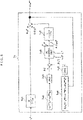
- Fig. 2 illustrates a block of the d-axis secondary magnetic flux estimation computation unit 7, which is a feature of the present embodiment.
- LPF Low Pass Filter
- gain is mutual inductance M and a time constant is a secondary time constant T 2
- a time constant is a secondary time constant T 2
- the d-axis current command value i d * is input to the LPF 71
- the LPF 71 computes a d-axis secondary magnetic flux command value ⁇ 2d *.
- a first active power computation unit 72 computes first active power P c according to (Equation 8) using the d-axis and q-axis voltage command values v dc ** and v qc ** and the current detection values i dc and i qc .
- P c v dc ⁇ ⁇ i dc + v qc ⁇ ⁇ i qc
- an output of the first active power computation unit 72 is passed through an absolute value computation unit 73 to compute the absolute value
- a second active power computation unit 74 computes second active power P c ⁇ according to (Equation 9) using the d-axis and q-axis current command values i d * and i q *, the output frequency command value ⁇ 1 *, R1, M, and L 2 which are electric circuit constants of the induction motor 1, and the d-axis secondary magnetic flux estimated value ⁇ 2d **.
- P c ⁇ R 1 ⁇ i d ⁇ 2 + i q ⁇ 2 + ⁇ 1 ⁇ M ⁇ / L 2 ⁇ ⁇ 2 d ⁇ ⁇ i d ⁇
- an output of the second active power computation unit 74 is passed through an absolute value computation unit 75 to compute the absolute value
- a PI control unit 76 performs P (proportional) control and I (integral) control so that the absolute value
- a LPF 77 has gain with a time constant of T, the secondary magnetic flux command correction value ⁇ 2d0 * is input to the LPF 77, and the LPF 77 outputs a d-axis secondary magnetic flux command correction value ⁇ 2d *.
- This figure is a simulation result when there is an error of +20% in a set value L ⁇ * of the leakage inductance included in a computation formula of the d-axis and q-axis voltage command values v dc ** and v dc ** shown in (Equation 2) and a computation formula of the frequency estimated value (speed estimated value) ⁇ r ⁇ shown in (Equation 5).
- a vertical axis in an upper part indicates the load torque T L (N ⁇ m)
- a vertical axis in a middle part indicates the frequency estimated value ⁇ r ⁇ (Hz) and the frequency ⁇ r (Hz) of the induction motor
- a vertical axis in a lower part indicates the d-axis secondary magnetic flux ⁇ 2d (p.u) and a command value ⁇ 2d * (p.u) thereof
- a horizontal axis indicates time (seconds).
- the ramp-shaped load torque T L starts from point A in the figure and becomes twice the rated torque (100%) torque at point B in the figure, and a state of applying 200% torque is kept from the right side of point B. It can be seen that the frequency ⁇ r of the induction motor is faster than the frequency command value ⁇ r * of 30 Hz.
- the frequency estimated value ⁇ r ⁇ is about 30Hz
- the output frequency command value ⁇ 1 * is calculated by (Equation 6).
- a slip error ⁇ s of the induction motor becomes ( ⁇ s - ⁇ s ⁇ ). Due to this slip error ⁇ s , the d-axis secondary magnetic flux ⁇ 2d increases.
- the control characteristic characteristic of the velocity ⁇
- the first active power P c not including information of the leakage inductance L ⁇ which is an electric circuit constant, is computed from (Equation 8) using the d-axis voltage command value v dc ** and the q-axis voltage command value v qc ** as the voltage information of the induction motor, and the d-axis current detection value i dc and the q-axis current detection value i qc as the current information of the induction motor.
- the second active power P c ⁇ not including information of the leakage inductance L ⁇ is computed by (Equation 9) using the d-axis current command value i d *, the q-axis current command value i q *, the output frequency command value ⁇ 1 *, the electric circuit constants R 1 , M, and L 2 of the induction motor, and the d-axis secondary magnetic flux estimated value ⁇ 2d **.
- the control characteristic can be improved by estimating ⁇ 2d ** so that the absolute value
- the control characteristic in the first embodiment is illustrated in Fig. 4 .
- a horizontal axis and a vertical axis are the same as those of Fig. 3 .
- the d-axis secondary magnetic flux estimation computation unit 7 is operated to apply the same load torque T L as that of Fig. 3 . Since the d-axis secondary magnetic flux ⁇ 2d is estimated with high accuracy ( ⁇ 2d ⁇ ⁇ 2d **), it can be seen that the frequency estimated value ⁇ r ⁇ almost matches the frequency ⁇ r of the induction motor, and the effect of the present embodiment is clear.
- the gains (K p and K i ) of the proportional control and the integral control are set to fixed values.
- the gains may be changed according to the output frequency command value ⁇ 1 * or the q-axis current command value iq*.
- Reference symbol 7a of Fig. 5 corresponds to the d-axis secondary magnetic flux estimation computation unit 7.
- Reference symbols 7a1, 7a2, 7a3, 7a4, 7a5, and 7a7 of Fig. 5 are the same as the LPF 71, the first active power computation unit 72, the absolute value computation unit 73, the second active power computation unit 74, the absolute value computation unit 75, and LPF 77 of Fig. 2 , respectively.
- a PI control unit 7a6 of Fig. 5 by changing the gains (K p and K i ) of the proportional control and the integral control in approximately proportion to the magnitude of the output frequency command value ⁇ 1 * or the q-axis current command value i q *, the absolute value
- a voltage detector 21 and a current detector 22 are attached to a power conversion device 20 that drives the induction motor 1, and an encoder 23 is attached to a shaft of the induction motor 1.
- Three-phase AC voltage detection values (v uc , v vc , and v wc ), which are outputs of the voltage detector 21, three-phase AC current detection values (i uc , i vc , and i wc ), and a position ⁇ , which is an output of the encoder, are input to a vector voltage/current component computation unit 24 to compute vector voltage components v dc and v qc , vector current components i dc and i qc , and a detection value ⁇ r , which is a derivative of the position ⁇ .
- the d-axis secondary magnetic flux estimated value ⁇ 2d ⁇ is computed using (Equation 11).
- the frequency estimated value ⁇ r ⁇ is computed.
- the frequency ⁇ r may be detected by attaching the encoder to the induction motor. Since the d-axis secondary magnetic flux can be estimated with high accuracy, a highly accurate control characteristic can be realized by correcting the slip command value.
- Fig. 7 is a configuration diagram of a d-axis secondary magnetic flux estimation computation unit in the second embodiment.
- the configuration other than the d-axis secondary magnetic flux estimation computation unit is the same as that in the first embodiment.
- the first active power P c is computed from the d-axis and q-axis voltage command values v dc ** and v qc ** and the current detection values i dc and i qc .
- the active power P c is computed using an amplitude value V 1 * of a voltage command of a three-phase AC as voltage information of the induction motor, an amplitude value ii of current detection as current information of the induction motor, and a cosine signal of a phase ⁇ vi .
- Reference symbol 7b of Fig. 7 corresponds to the d-axis secondary magnetic flux estimation computation unit 7 of Fig. 2 .
- reference symbols 7bl, 7b3, 7b4, 7b5, 7b6, and 7b7 of Fig. 7 are the same as the LPF 71, the absolute value computation unit 73, the second active power computation unit 74, the absolute value computation unit 75, the PI control unit 76, and LPF 77 of Fig. 2 , respectively.
- a first active power computation unit 7b2 in a first active power computation unit 7b2, the amplitude value V 1 * of the voltage command of the three-phase AC is obtained from (Equation 12), the amplitude value i 1 of the current detection value is obtained from (Equation 13), the phase ⁇ vi is obtained from (Equation 14), and the active power P c is computed using (Equation 15).
- a highly accurate control characteristic can be realized as in the first embodiment even when the present embodiment is used.
- the gains (K p and K i ) of the proportional control and the integral control can be changed in approximately proportion to the magnitude of the output frequency command value ⁇ 1 * or the q-axis current command value i q *. In this way, it is possible to realize a highly accurate control characteristic in a shorter time even from a low speed range to a high speed range and from a light load to a heavy load.
- Fig. 8 is a configuration diagram of a d-axis secondary magnetic flux estimation computation unit in a third embodiment.
- the configuration other than the d-axis secondary magnetic flux estimation computation unit is the same as that in the first embodiment.
- the first active power P c is computed from the d-axis and q-axis voltage command values v dc ** and v qc ** and the current detection values i dc and i qc .
- the active power P c is computed using a DC voltage value E DC of the DC power supply 3 that supplies a DC voltage to the power converter 2 as voltage information of the induction motor and a DC current value I DC supplied from the DC power supply 3 as current information of the induction motor.
- Reference symbol 7c of Fig. 8 corresponds to the d-axis secondary magnetic flux estimation computation unit 7 of Fig. 2 .
- reference symbols 7c1, 7c3, 7c4, 7c5, 7c6, and 7c7 of Fig. 7 are the same as the LPF 71, the absolute value computation unit 73, the second active power computation unit 74, the absolute value computation unit 75, the PI control unit 76, and LPF 77 of Fig. 2 , respectively.
- the gains (K p and K i ) of the proportional control and the integral control can be changed in approximately proportion to the magnitude of the output frequency command value ⁇ 1 * or the q-axis current command value i q *.
- Fig. 9 is a configuration diagram of a d-axis secondary magnetic flux estimation computation unit in a fourth embodiment.
- the configuration other than the d-axis secondary magnetic flux estimation computation unit is the same as that in the first embodiment.
- two pieces of active power information are used.
- two pieces of reactive power information are used.
- Reference symbol 7d of Fig. 9 corresponds to the d-axis secondary magnetic flux estimation computation unit 7 of Fig. 2 .
- reference symbols 7dl, 7d3, 7d5, 7d6, and 7d7 of Fig. 7 are the same as the LPF 71, the absolute value computation unit 73, the absolute value computation unit 75, the PI control unit 76, and LPF 77 of Fig. 2 , respectively.
- a first reactive power computation unit 7d2 computes first reactive power Q c according to (Equation 17) using the d-axis voltage command value v dc ** and q-axis voltage command value v qc ** as voltage information of the induction motor and the current detection values i dc and i qc as current information of the induction motor.
- Q c v d c **i qc ⁇ v qc **i dc
- an output of the first reactive power computation unit 7d2 is passed through an absolute value computation unit 7d3 to compute the absolute value
- a second reactive power computation unit 7d4 computes second reactive power Q c ⁇ according to (Equation 18) using the d-axis and q-axis current command values i d * and i q *, the output frequency command value ⁇ 1 *, R1, M, and L 2 which are electric circuit constants of the induction motor 1, and the d-axis magnetic flux estimated value ⁇ 2d **.
- Q c ⁇ ⁇ ⁇ 1 * L ⁇ * i d ⁇ 2 + i q ⁇ 2 ⁇ ⁇ 1 * M* / L 2 * ⁇ 2 d **i d *
- an output of the second reactive power computation unit 7d4 is passed through an absolute value computation unit 7d5 to compute the absolute value
- a PI control unit 7d6 performs P (proportional) + I (integral) control so that the absolute value
- a LPF 7d7 has gain with a time constant of T, the d-axis secondary magnetic flux command correction value ⁇ 2d0 * is input to the LPF 7d7, and the LPF 7d7 computes a d-axis secondary magnetic flux command correction value ⁇ 2d *.
- the d-axis secondary magnetic flux estimated value ⁇ 2d ** is computed according to (Equation 10).
- the gains (K p and K i ) of the proportional control and the integral control can be changed in approximately proportion to the magnitude of the output frequency command value ⁇ 1 * or the q-axis current command value i q *. In this way, it is possible to realize a highly accurate control characteristic in a shorter time even from a low speed range to a high speed range and from a light load to a heavy load.
- Fig. 10 is a configuration diagram of a d-axis secondary magnetic flux estimation computation unit in a fifth embodiment.
- the configuration other than the d-axis secondary magnetic flux estimation computation unit is the same as that in the first embodiment.
- first reactive power Q c is computed from the d-axis and q-axis voltage command values v dc ** and v qc ** and the current detection values i dc and i qc .
- the reactive power Q c is computed using an amplitude value V 1 * of a voltage command of a three-phase AC as voltage information of the induction motor, an amplitude value ii of current detection as current information of the induction motor, and a phase ⁇ vi .
- Reference symbol 7e of Fig. 10 corresponds to the d-axis secondary magnetic flux estimation computation unit 7d of Fig. 9 .
- reference symbols 7e1, 7e3, 7e4, 7e5, 7e6, and 7e7 of Fig. 10 are the same as the LPF 7dl, the absolute value computation unit 7d3, the second reactive power computation unit 7d4, the absolute value computation unit 7d5, the PI control unit 7d6, and LPF 7d7 of Fig. 9 , respectively.
- the gains (K p and K i ) of the proportional control and the integral control can be changed in approximately proportion to the magnitude of the output frequency command value ⁇ 1 * or the q-axis current command value i q *. In this way, it is possible to realize a highly accurate control characteristic in a shorter time even from a low speed range to a high speed range and from a light load to a heavy load.
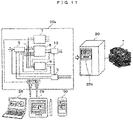
- Fig. 11 is a configuration diagram of a system including a power conversion device and an induction motor according to a sixth embodiment.
- the present embodiment is an application of the present embodiment to an induction motor drive system.
- an induction motor 1 a coordinate transformation unit 5, a speed control computation unit 6, a d-axis secondary magnetic flux estimation computation unit 7, a vector control computation unit 8, and a frequency/phase estimation computation unit 9 have the same configuration as that of Fig. 1 .
- the induction motor 1, which is a component of Fig. 1 is driven by a power conversion device 20.
- the power conversion device 20 is divided into software 20a and hardware.
- the coordinate transformation unit 5, the speed control computation unit 6, the d-axis secondary magnetic flux estimation computation unit 7, the vector control computation unit 8, the frequency/phase estimation computation unit 9, and the coordinate transformation unit 10 of Fig. 1 are the software 20a.
- the same parts of the software 20a of Fig. 11 as those of Fig. 1 are partially omitted.
- the power converter 2, the DC power supply 3, and the current detector 4 of Fig. 1 are mounted as hardware. Further, it is possible to set predetermined proportional gain 31 and predetermined integral gain 32 of the software 20a in a recording unit of the control unit or change recorded gain by a higher-level device such as a digital operator 20b, a personal computer 28, a tablet PC 29, or a smartphone 30 performing operation or display of the power conversion device 20.
- a higher-level device such as a digital operator 20b, a personal computer 28, a tablet PC 29, or a smartphone 30 performing operation or display of the power conversion device 20.
- proportional gain Kp1 or integral gain Ki1 of the PI control unit 76 in the d-axis secondary magnetic flux estimation computation unit 7 can be set externally or the gain can be changed.
- the predetermined proportional gain 31 and the predetermined integral gain 32 may be set on a fieldbus of a programmable logic controller, a local area network connected to a computer, or a control device.
- any one of the second to fifth embodiments may be used.
- the voltage correction values ⁇ v dc and ⁇ v qc are created from the current command values i d * and i q * and the current detection values i dc and i qc , and computation shown in (Equation 3) of adding the voltage correction values and a voltage reference value of vector control is performed.
- K pd1 denotes proportional gain of d-axis current control
- K id1 denotes integral gain of d-axis current control
- K pq1 denotes proportional gain of q-axis current control
- K iql denotes integral gain of q-axis current control
- T d denotes d-axis electrical time constant (L ⁇ /R)
- T q denotes q-axis electrical time constant (L ⁇ /R).
- a voltage correction value ⁇ v d_p * of a d-axis proportional computation component, a voltage correction value ⁇ v d_i * of a d-axis integral computation component, a voltage correction value ⁇ v q_p * of a q-axis proportional computation component, and a voltage correction value ⁇ v q_i * of a q-axis integral computation component used for vector control computation may be computed by (Equation 22) from the current command values i d ** and i q * and the current detection values i dc and i qc , and vector control computation shown in (Equation 23) may be performed using the output frequency command value ⁇ 1 * and the electric circuit constants of the induction motor 1.
- K pd2 denotes proportional gain of d-axis current control
- K id2 denotes integral gain of d-axis current control
- K pq2 denotes proportional gain of q-axis current control
- K iq2 denotes integral gain of q-axis current control
- an output frequency command value ⁇ 1 ** shown in (Equation 24) and vector control computation shown in (Equation 25) may be performed using the d-axis current command value i d *, a primary delay signal i qctd of the q-axis current detection value i qc , the frequency command value ⁇ r *, and the electric circuit constants of the induction motor 1.
- i qctd is a signal obtained by passing i qc through a primary delay filter.
- K pq3 is proportional gain of current control
- K iq3 is integral gain of current control
- the frequency estimated value is computed according to (Equation 5) or (Equation 26).
- equation 5 the frequency estimated value is computed according to (Equation 5) or (Equation 26).
- a switching element included in the power converter 2 it is possible to use a Si (silicon) semiconductor element, or a wide bandgap semiconductor element of SiC (Silicon Carbide), GaN (Gallium Nitride), etc.
Landscapes
- Engineering & Computer Science (AREA)
- Power Engineering (AREA)
- Control Of Ac Motors In General (AREA)
Applications Claiming Priority (2)
| Application Number | Priority Date | Filing Date | Title |
|---|---|---|---|
| JP2019220626A JP7287885B2 (ja) | 2019-12-05 | 2019-12-05 | 電力変換装置 |
| PCT/JP2020/034294 WO2021111695A1 (ja) | 2019-12-05 | 2020-09-10 | 電力変換装置 |
Publications (2)
| Publication Number | Publication Date |
|---|---|
| EP4072005A1 true EP4072005A1 (de) | 2022-10-12 |
| EP4072005A4 EP4072005A4 (de) | 2023-12-06 |
Family
ID=76220761
Family Applications (1)
| Application Number | Title | Priority Date | Filing Date |
|---|---|---|---|
| EP20897399.0A Pending EP4072005A4 (de) | 2019-12-05 | 2020-09-10 | Stromumwandlungsvorrichtung |
Country Status (4)
| Country | Link |
|---|---|
| EP (1) | EP4072005A4 (de) |
| JP (1) | JP7287885B2 (de) |
| CN (1) | CN114008912B (de) |
| WO (1) | WO2021111695A1 (de) |
Families Citing this family (4)
| Publication number | Priority date | Publication date | Assignee | Title |
|---|---|---|---|---|
| JP7449204B2 (ja) * | 2020-09-09 | 2024-03-13 | 株式会社日立産機システム | 電力変換装置 |
| JP7531717B2 (ja) | 2021-07-16 | 2024-08-09 | 三菱電機株式会社 | モータ制御装置およびモータ制御方法、電気回路定数測定装置および電気回路定数測定方法 |
| JP7627204B2 (ja) * | 2021-11-18 | 2025-02-05 | 株式会社日立産機システム | 電力変換装置 |
| JP7628071B2 (ja) | 2021-12-01 | 2025-02-07 | 株式会社日立産機システム | 電力変換装置 |
Family Cites Families (9)
| Publication number | Priority date | Publication date | Assignee | Title |
|---|---|---|---|---|
| JPH09163782A (ja) * | 1995-12-11 | 1997-06-20 | Toyo Electric Mfg Co Ltd | 速度センサレス制御インバ−タ |
| JP3454409B2 (ja) * | 1997-11-14 | 2003-10-06 | 東洋電機製造株式会社 | 誘導電動機の制御装置 |
| FI112414B (fi) * | 2001-03-19 | 2003-11-28 | Abb Industry Oy | Menetelmä vaihtosuuntaajan yhteydessä |
| JP6261396B2 (ja) * | 2014-03-13 | 2018-01-17 | 日本特殊陶業株式会社 | 永久磁石式同期モータのベクトル制御装置及び磁石磁束推定装置 |
| JP6375757B2 (ja) | 2014-07-29 | 2018-08-22 | 株式会社安川電機 | 電動機制御装置、電動機の磁束推定装置および電動機の磁束推定方法 |
| JP6447183B2 (ja) * | 2015-01-30 | 2019-01-09 | 富士電機株式会社 | 誘導電動機の制御装置 |
| JP6419669B2 (ja) * | 2015-09-30 | 2018-11-07 | 株式会社日立産機システム | 電力変換装置およびそのオートチューニング法 |
| JP2017153273A (ja) * | 2016-02-25 | 2017-08-31 | 富士電機株式会社 | 誘導電動機の制御装置 |
| JP6641445B2 (ja) * | 2018-10-26 | 2020-02-05 | 株式会社日立産機システム | 電力変換装置の制御方法および電力変換装置 |
-
2019
- 2019-12-05 JP JP2019220626A patent/JP7287885B2/ja active Active
-
2020
- 2020-09-10 EP EP20897399.0A patent/EP4072005A4/de active Pending
- 2020-09-10 WO PCT/JP2020/034294 patent/WO2021111695A1/ja not_active Ceased
- 2020-09-10 CN CN202080045421.XA patent/CN114008912B/zh active Active
Also Published As
| Publication number | Publication date |
|---|---|
| CN114008912A (zh) | 2022-02-01 |
| CN114008912B (zh) | 2023-10-24 |
| JP2021090313A (ja) | 2021-06-10 |
| JP7287885B2 (ja) | 2023-06-06 |
| WO2021111695A1 (ja) | 2021-06-10 |
| EP4072005A4 (de) | 2023-12-06 |
Similar Documents
| Publication | Publication Date | Title |
|---|---|---|
| EP4072005A1 (de) | Stromumwandlungsvorrichtung | |
| US8283881B2 (en) | Methods, systems and apparatus for synchronous current regulation of a five-phase machine | |
| JP5130031B2 (ja) | 永久磁石モータの位置センサレス制御装置 | |
| CN102751936B (zh) | 电力变换装置、电动机驱动系统 | |
| US20170264227A1 (en) | Inverter control device and motor drive system | |
| CN104584419B (zh) | 电动机控制装置 | |
| JP5223109B2 (ja) | 永久磁石形同期電動機の制御装置 | |
| US10072993B2 (en) | Torque estimating system for synchronous electric motor | |
| CN101647186A (zh) | 电力变换装置 | |
| JPWO2017187599A1 (ja) | 回転機制御装置の故障判定装置および故障判定方法 | |
| US9602035B2 (en) | Driving apparatus for electric motor | |
| US8975842B2 (en) | Permanent magnet motor control | |
| JP2014225993A (ja) | 同期機制御装置 | |
| EP3614559B1 (de) | Induktionsmotordrehzahlschätzungsverfahren und leistungsumwandlungsvorrichtung mit verwendung davon | |
| KR102409792B1 (ko) | 영구 자석 동기 전동기의 제어 장치, 마이크로 컴퓨터, 전동기 시스템 및 영구 자석 동기 전동기의 운전 방법 | |
| US20210273591A1 (en) | Power Conversion Device | |
| EP3993251B1 (de) | Stromumwandlungsvorrichtung | |
| JP2008206330A (ja) | 同期電動機の磁極位置推定装置および磁極位置推定方法 | |
| JP6591794B2 (ja) | 誘導機の電力変換装置と二次時定数測定方法及び速度制御方法 | |
| EP4075665B1 (de) | Stromwandler | |
| US20240079982A1 (en) | Power Converter Apparatus | |
| EP4625808A1 (de) | Leistungswandler | |
| JP5456873B1 (ja) | 同期機制御装置 | |
| JP5502044B2 (ja) | 回転電機の制御装置および制御方法 | |
| JPS62239897A (ja) | 電圧形インバ−タの制御方法 |
Legal Events
| Date | Code | Title | Description |
|---|---|---|---|
| STAA | Information on the status of an ep patent application or granted ep patent |
Free format text: STATUS: THE INTERNATIONAL PUBLICATION HAS BEEN MADE |
|
| PUAI | Public reference made under article 153(3) epc to a published international application that has entered the european phase |
Free format text: ORIGINAL CODE: 0009012 |
|
| STAA | Information on the status of an ep patent application or granted ep patent |
Free format text: STATUS: REQUEST FOR EXAMINATION WAS MADE |
|
| 17P | Request for examination filed |
Effective date: 20220329 |
|
| AK | Designated contracting states |
Kind code of ref document: A1 Designated state(s): AL AT BE BG CH CY CZ DE DK EE ES FI FR GB GR HR HU IE IS IT LI LT LU LV MC MK MT NL NO PL PT RO RS SE SI SK SM TR |
|
| DAV | Request for validation of the european patent (deleted) | ||
| DAX | Request for extension of the european patent (deleted) | ||
| REG | Reference to a national code |
Ref country code: DE Ref legal event code: R079 Free format text: PREVIOUS MAIN CLASS: H02P0021260000 Ipc: H02P0021000000 |
|
| A4 | Supplementary search report drawn up and despatched |
Effective date: 20231108 |
|
| RIC1 | Information provided on ipc code assigned before grant |
Ipc: H02P 21/18 20160101ALI20231102BHEP Ipc: H02P 21/14 20160101ALI20231102BHEP Ipc: H02P 21/26 20160101ALI20231102BHEP Ipc: H02P 21/00 20160101AFI20231102BHEP |
|
| STAA | Information on the status of an ep patent application or granted ep patent |
Free format text: STATUS: EXAMINATION IS IN PROGRESS |
|
| 17Q | First examination report despatched |
Effective date: 20241203 |