EP4071193B1 - Neuartiges polymer und organisches lichtemittierendes element damit - Google Patents
Neuartiges polymer und organisches lichtemittierendes element damit Download PDFInfo
- Publication number
- EP4071193B1 EP4071193B1 EP21776998.3A EP21776998A EP4071193B1 EP 4071193 B1 EP4071193 B1 EP 4071193B1 EP 21776998 A EP21776998 A EP 21776998A EP 4071193 B1 EP4071193 B1 EP 4071193B1
- Authority
- EP
- European Patent Office
- Prior art keywords
- group
- polymer
- chemical formula
- substituted
- independently
- Prior art date
- Legal status (The legal status is an assumption and is not a legal conclusion. Google has not performed a legal analysis and makes no representation as to the accuracy of the status listed.)
- Active
Links
Images

Classifications
-
- C—CHEMISTRY; METALLURGY
- C08—ORGANIC MACROMOLECULAR COMPOUNDS; THEIR PREPARATION OR CHEMICAL WORKING-UP; COMPOSITIONS BASED THEREON
- C08G—MACROMOLECULAR COMPOUNDS OBTAINED OTHERWISE THAN BY REACTIONS ONLY INVOLVING UNSATURATED CARBON-TO-CARBON BONDS
- C08G61/00—Macromolecular compounds obtained by reactions forming a carbon-to-carbon link in the main chain of the macromolecule
- C08G61/12—Macromolecular compounds containing atoms other than carbon in the main chain of the macromolecule
-
- C—CHEMISTRY; METALLURGY
- C08—ORGANIC MACROMOLECULAR COMPOUNDS; THEIR PREPARATION OR CHEMICAL WORKING-UP; COMPOSITIONS BASED THEREON
- C08G—MACROMOLECULAR COMPOUNDS OBTAINED OTHERWISE THAN BY REACTIONS ONLY INVOLVING UNSATURATED CARBON-TO-CARBON BONDS
- C08G61/00—Macromolecular compounds obtained by reactions forming a carbon-to-carbon link in the main chain of the macromolecule
- C08G61/12—Macromolecular compounds containing atoms other than carbon in the main chain of the macromolecule
- C08G61/121—Macromolecular compounds containing atoms other than carbon in the main chain of the macromolecule derived from organic halides
-
- C—CHEMISTRY; METALLURGY
- C08—ORGANIC MACROMOLECULAR COMPOUNDS; THEIR PREPARATION OR CHEMICAL WORKING-UP; COMPOSITIONS BASED THEREON
- C08L—COMPOSITIONS OF MACROMOLECULAR COMPOUNDS
- C08L65/00—Compositions of macromolecular compounds obtained by reactions forming a carbon-to-carbon link in the main chain; Compositions of derivatives of such polymers
-
- C—CHEMISTRY; METALLURGY
- C09—DYES; PAINTS; POLISHES; NATURAL RESINS; ADHESIVES; COMPOSITIONS NOT OTHERWISE PROVIDED FOR; APPLICATIONS OF MATERIALS NOT OTHERWISE PROVIDED FOR
- C09D—COATING COMPOSITIONS, e.g. PAINTS, VARNISHES OR LACQUERS; FILLING PASTES; CHEMICAL PAINT OR INK REMOVERS; INKS; CORRECTING FLUIDS; WOODSTAINS; PASTES OR SOLIDS FOR COLOURING OR PRINTING; USE OF MATERIALS THEREFOR
- C09D165/00—Coating compositions based on macromolecular compounds obtained by reactions forming a carbon-to-carbon link in the main chain; Coating compositions based on derivatives of such polymers
-
- H—ELECTRICITY
- H10—SEMICONDUCTOR DEVICES; ELECTRIC SOLID-STATE DEVICES NOT OTHERWISE PROVIDED FOR
- H10K—ORGANIC ELECTRIC SOLID-STATE DEVICES
- H10K71/00—Manufacture or treatment specially adapted for the organic devices covered by this subclass
- H10K71/10—Deposition of organic active material
- H10K71/12—Deposition of organic active material using liquid deposition, e.g. spin coating
-
- H—ELECTRICITY
- H10—SEMICONDUCTOR DEVICES; ELECTRIC SOLID-STATE DEVICES NOT OTHERWISE PROVIDED FOR
- H10K—ORGANIC ELECTRIC SOLID-STATE DEVICES
- H10K85/00—Organic materials used in the body or electrodes of devices covered by this subclass
- H10K85/10—Organic polymers or oligomers
- H10K85/111—Organic polymers or oligomers comprising aromatic, heteroaromatic, or aryl chains, e.g. polyaniline, polyphenylene or polyphenylene vinylene
-
- H—ELECTRICITY
- H10—SEMICONDUCTOR DEVICES; ELECTRIC SOLID-STATE DEVICES NOT OTHERWISE PROVIDED FOR
- H10K—ORGANIC ELECTRIC SOLID-STATE DEVICES
- H10K85/00—Organic materials used in the body or electrodes of devices covered by this subclass
- H10K85/10—Organic polymers or oligomers
- H10K85/151—Copolymers
-
- C—CHEMISTRY; METALLURGY
- C08—ORGANIC MACROMOLECULAR COMPOUNDS; THEIR PREPARATION OR CHEMICAL WORKING-UP; COMPOSITIONS BASED THEREON
- C08G—MACROMOLECULAR COMPOUNDS OBTAINED OTHERWISE THAN BY REACTIONS ONLY INVOLVING UNSATURATED CARBON-TO-CARBON BONDS
- C08G2261/00—Macromolecular compounds obtained by reactions forming a carbon-to-carbon link in the main chain of the macromolecule
- C08G2261/10—Definition of the polymer structure
- C08G2261/12—Copolymers
- C08G2261/124—Copolymers alternating
-
- C—CHEMISTRY; METALLURGY
- C08—ORGANIC MACROMOLECULAR COMPOUNDS; THEIR PREPARATION OR CHEMICAL WORKING-UP; COMPOSITIONS BASED THEREON
- C08G—MACROMOLECULAR COMPOUNDS OBTAINED OTHERWISE THAN BY REACTIONS ONLY INVOLVING UNSATURATED CARBON-TO-CARBON BONDS
- C08G2261/00—Macromolecular compounds obtained by reactions forming a carbon-to-carbon link in the main chain of the macromolecule
- C08G2261/10—Definition of the polymer structure
- C08G2261/13—Morphological aspects
- C08G2261/132—Morphological aspects branched or hyperbranched
-
- C—CHEMISTRY; METALLURGY
- C08—ORGANIC MACROMOLECULAR COMPOUNDS; THEIR PREPARATION OR CHEMICAL WORKING-UP; COMPOSITIONS BASED THEREON
- C08G—MACROMOLECULAR COMPOUNDS OBTAINED OTHERWISE THAN BY REACTIONS ONLY INVOLVING UNSATURATED CARBON-TO-CARBON BONDS
- C08G2261/00—Macromolecular compounds obtained by reactions forming a carbon-to-carbon link in the main chain of the macromolecule
- C08G2261/10—Definition of the polymer structure
- C08G2261/14—Side-groups
- C08G2261/141—Side-chains having aliphatic units
- C08G2261/1412—Saturated aliphatic units
-
- C—CHEMISTRY; METALLURGY
- C08—ORGANIC MACROMOLECULAR COMPOUNDS; THEIR PREPARATION OR CHEMICAL WORKING-UP; COMPOSITIONS BASED THEREON
- C08G—MACROMOLECULAR COMPOUNDS OBTAINED OTHERWISE THAN BY REACTIONS ONLY INVOLVING UNSATURATED CARBON-TO-CARBON BONDS
- C08G2261/00—Macromolecular compounds obtained by reactions forming a carbon-to-carbon link in the main chain of the macromolecule
- C08G2261/10—Definition of the polymer structure
- C08G2261/14—Side-groups
- C08G2261/148—Side-chains having aromatic units
-
- C—CHEMISTRY; METALLURGY
- C08—ORGANIC MACROMOLECULAR COMPOUNDS; THEIR PREPARATION OR CHEMICAL WORKING-UP; COMPOSITIONS BASED THEREON
- C08G—MACROMOLECULAR COMPOUNDS OBTAINED OTHERWISE THAN BY REACTIONS ONLY INVOLVING UNSATURATED CARBON-TO-CARBON BONDS
- C08G2261/00—Macromolecular compounds obtained by reactions forming a carbon-to-carbon link in the main chain of the macromolecule
- C08G2261/10—Definition of the polymer structure
- C08G2261/16—End groups
- C08G2261/164—End groups comprising organic end groups
- C08G2261/1642—End groups comprising organic end groups comprising reactive double bonds or triple bonds
-
- C—CHEMISTRY; METALLURGY
- C08—ORGANIC MACROMOLECULAR COMPOUNDS; THEIR PREPARATION OR CHEMICAL WORKING-UP; COMPOSITIONS BASED THEREON
- C08G—MACROMOLECULAR COMPOUNDS OBTAINED OTHERWISE THAN BY REACTIONS ONLY INVOLVING UNSATURATED CARBON-TO-CARBON BONDS
- C08G2261/00—Macromolecular compounds obtained by reactions forming a carbon-to-carbon link in the main chain of the macromolecule
- C08G2261/30—Monomer units or repeat units incorporating structural elements in the main chain
- C08G2261/31—Monomer units or repeat units incorporating structural elements in the main chain incorporating aromatic structural elements in the main chain
- C08G2261/312—Non-condensed aromatic systems, e.g. benzene
-
- C—CHEMISTRY; METALLURGY
- C08—ORGANIC MACROMOLECULAR COMPOUNDS; THEIR PREPARATION OR CHEMICAL WORKING-UP; COMPOSITIONS BASED THEREON
- C08G—MACROMOLECULAR COMPOUNDS OBTAINED OTHERWISE THAN BY REACTIONS ONLY INVOLVING UNSATURATED CARBON-TO-CARBON BONDS
- C08G2261/00—Macromolecular compounds obtained by reactions forming a carbon-to-carbon link in the main chain of the macromolecule
- C08G2261/30—Monomer units or repeat units incorporating structural elements in the main chain
- C08G2261/31—Monomer units or repeat units incorporating structural elements in the main chain incorporating aromatic structural elements in the main chain
- C08G2261/316—Monomer units or repeat units incorporating structural elements in the main chain incorporating aromatic structural elements in the main chain bridged by heteroatoms, e.g. N, P, Si or B
- C08G2261/3162—Arylamines
-
- C—CHEMISTRY; METALLURGY
- C08—ORGANIC MACROMOLECULAR COMPOUNDS; THEIR PREPARATION OR CHEMICAL WORKING-UP; COMPOSITIONS BASED THEREON
- C08G—MACROMOLECULAR COMPOUNDS OBTAINED OTHERWISE THAN BY REACTIONS ONLY INVOLVING UNSATURATED CARBON-TO-CARBON BONDS
- C08G2261/00—Macromolecular compounds obtained by reactions forming a carbon-to-carbon link in the main chain of the macromolecule
- C08G2261/30—Monomer units or repeat units incorporating structural elements in the main chain
- C08G2261/34—Monomer units or repeat units incorporating structural elements in the main chain incorporating partially-aromatic structural elements in the main chain
- C08G2261/344—Monomer units or repeat units incorporating structural elements in the main chain incorporating partially-aromatic structural elements in the main chain containing heteroatoms
-
- C—CHEMISTRY; METALLURGY
- C08—ORGANIC MACROMOLECULAR COMPOUNDS; THEIR PREPARATION OR CHEMICAL WORKING-UP; COMPOSITIONS BASED THEREON
- C08G—MACROMOLECULAR COMPOUNDS OBTAINED OTHERWISE THAN BY REACTIONS ONLY INVOLVING UNSATURATED CARBON-TO-CARBON BONDS
- C08G2261/00—Macromolecular compounds obtained by reactions forming a carbon-to-carbon link in the main chain of the macromolecule
- C08G2261/40—Polymerisation processes
- C08G2261/41—Organometallic coupling reactions
- C08G2261/411—Suzuki reactions
-
- C—CHEMISTRY; METALLURGY
- C08—ORGANIC MACROMOLECULAR COMPOUNDS; THEIR PREPARATION OR CHEMICAL WORKING-UP; COMPOSITIONS BASED THEREON
- C08G—MACROMOLECULAR COMPOUNDS OBTAINED OTHERWISE THAN BY REACTIONS ONLY INVOLVING UNSATURATED CARBON-TO-CARBON BONDS
- C08G2261/00—Macromolecular compounds obtained by reactions forming a carbon-to-carbon link in the main chain of the macromolecule
- C08G2261/40—Polymerisation processes
- C08G2261/41—Organometallic coupling reactions
- C08G2261/412—Yamamoto reactions
-
- C—CHEMISTRY; METALLURGY
- C08—ORGANIC MACROMOLECULAR COMPOUNDS; THEIR PREPARATION OR CHEMICAL WORKING-UP; COMPOSITIONS BASED THEREON
- C08G—MACROMOLECULAR COMPOUNDS OBTAINED OTHERWISE THAN BY REACTIONS ONLY INVOLVING UNSATURATED CARBON-TO-CARBON BONDS
- C08G2261/00—Macromolecular compounds obtained by reactions forming a carbon-to-carbon link in the main chain of the macromolecule
- C08G2261/50—Physical properties
- C08G2261/51—Charge transport
- C08G2261/512—Hole transport
-
- C—CHEMISTRY; METALLURGY
- C08—ORGANIC MACROMOLECULAR COMPOUNDS; THEIR PREPARATION OR CHEMICAL WORKING-UP; COMPOSITIONS BASED THEREON
- C08G—MACROMOLECULAR COMPOUNDS OBTAINED OTHERWISE THAN BY REACTIONS ONLY INVOLVING UNSATURATED CARBON-TO-CARBON BONDS
- C08G2261/00—Macromolecular compounds obtained by reactions forming a carbon-to-carbon link in the main chain of the macromolecule
- C08G2261/50—Physical properties
- C08G2261/52—Luminescence
-
- C—CHEMISTRY; METALLURGY
- C08—ORGANIC MACROMOLECULAR COMPOUNDS; THEIR PREPARATION OR CHEMICAL WORKING-UP; COMPOSITIONS BASED THEREON
- C08G—MACROMOLECULAR COMPOUNDS OBTAINED OTHERWISE THAN BY REACTIONS ONLY INVOLVING UNSATURATED CARBON-TO-CARBON BONDS
- C08G2261/00—Macromolecular compounds obtained by reactions forming a carbon-to-carbon link in the main chain of the macromolecule
- C08G2261/90—Applications
- C08G2261/95—Use in organic luminescent diodes
-
- H—ELECTRICITY
- H10—SEMICONDUCTOR DEVICES; ELECTRIC SOLID-STATE DEVICES NOT OTHERWISE PROVIDED FOR
- H10K—ORGANIC ELECTRIC SOLID-STATE DEVICES
- H10K50/00—Organic light-emitting devices
- H10K50/10—OLEDs or polymer light-emitting diodes [PLED]
- H10K50/14—Carrier transporting layers
- H10K50/15—Hole transporting layers
-
- Y—GENERAL TAGGING OF NEW TECHNOLOGICAL DEVELOPMENTS; GENERAL TAGGING OF CROSS-SECTIONAL TECHNOLOGIES SPANNING OVER SEVERAL SECTIONS OF THE IPC; TECHNICAL SUBJECTS COVERED BY FORMER USPC CROSS-REFERENCE ART COLLECTIONS [XRACs] AND DIGESTS
- Y02—TECHNOLOGIES OR APPLICATIONS FOR MITIGATION OR ADAPTATION AGAINST CLIMATE CHANGE
- Y02E—REDUCTION OF GREENHOUSE GAS [GHG] EMISSIONS, RELATED TO ENERGY GENERATION, TRANSMISSION OR DISTRIBUTION
- Y02E10/00—Energy generation through renewable energy sources
- Y02E10/50—Photovoltaic [PV] energy
- Y02E10/549—Organic PV cells
Definitions
- the present disclosure relates to a novel polymer and an organic light emitting device comprising the same.
- an organic light emitting phenomenon refers to a phenomenon where electric energy is converted into light energy by using an organic material.
- the organic light emitting device using the organic light emitting phenomenon has characteristics such as a wide viewing angle, an excellent contrast, a fast response time, an excellent luminance, driving voltage and response speed, and thus many studies have proceeded.
- the organic light emitting device generally has a structure which comprises an anode, a cathode, and an organic material layer interposed between the anode and the cathode.
- the organic material layer frequently has a multilayered structure that comprises different materials in order to enhance efficiency and stability of the organic light emitting device, and for example, the organic material layer may be formed of a hole injection layer, a hole transport layer, a light emitting layer, an electron transport layer, an electron injection layer and the like.
- the holes are injected from an anode into the organic material layer and the electrons are injected from the cathode into the organic material layer, and when the injected holes and electrons meet each other, an exciton is formed, and light is emitted when the exciton falls to a ground state again.
- the present disclosure provides a novel material for organic light emitting devices capable of being deposited by a solution process while being used for an organic light emitting device.
- an organic light emitting device comprising an anode; a cathode that is disposed opposite to the anode; a light emitting layer that is provided between the anode and the cathode; and a hole transport layer that is provided between the anode and the light emitting layer, wherein the hole transport layer comprises the above-mentioned polymer.
- the polymer according to the present disclosure can be used as a material of a hole transport layer of an organic light emitting device, is capable of being deposited by a solution process, and can improve the efficiency, achieve low driving voltage and/or improve lifetime characteristics in the organic light emitting device.
- the notation means a bond linked to another substituent group.
- substituted or unsubstituted means being unsubstituted or substituted with one or more substituents selected from the group consisting of deuterium; a halogen group; a nitrile group; a nitro group; a hydroxy group; a carbonyl group; an ester group; an imide group; an amino group; a phosphine oxide group; an alkoxy group; an aryloxy group; an alkylthioxy group; an arylthioxy group; an alkylsulfoxy group; an arylsulfoxy group; a silyl group; a boron group; an alkyl group; a cycloalkyl group; an alkenyl group; an aryl group; an aralkyl group; an aralkenyl group; an alkylaryl group; an alkylamine group; an aralkylamine group; a heteroarylamine group; an arylamine group;
- the substituent to which two or more substituents are linked may be a biphenyl group. That is, the biphenyl group may be interpreted as an aryl group, or a substituent to which two phenyl groups are linked.
- the number of carbon atoms of a carbonyl group is not particularly limited, but is preferably 1 to 40.
- the carbonyl group may be a compound having the following structural formulae, but is not limited thereto.
- an ester group may have a structure in which oxygen of the ester group may be substituted by a straight-chain, branched-chain, or cyclic alkyl group having 1 to 25 carbon atoms, or an aryl group having 6 to 25 carbon atoms.
- the ester group may be a compound having the following structural formulae, but is not limited thereto.
- the number of carbon atoms of an imide group is not particularly limited, but is preferably 1 to 25.
- the imide group may be a compound having the following structural formulae, but is not limited thereto.
- a silyl group specifically includes a trimethylsilyl group, a triethylsilyl group, a t-butyldimethylsilyl group, a vinyldimethylsilyl group, a propyldimethylsilyl group, a triphenylsilyl group, a diphenylsilyl group, a phenylsilyl group and the like, but is not limited thereto.
- a boron group specifically includes a trimethylboron group, a triethylboron group, a t-butyldimethylboron group, a triphenylboron group, and a phenylboron group, but is not limited thereto.
- examples of a halogen group include fluorine, chlorine, bromine, or iodine.
- the alkyl group may be a straight-chain or branched chain, and the number of carbon atoms thereof is not particularly limited, but is preferably 1 to 40. According to one embodiment, the number of carbon atoms of the alkyl group is 1 to 20. According to another embodiment, the number of carbon atoms of the alkyl group is 1 to 10. According to another embodiment, the number of carbon atoms of the alkyl group is 1 to 6.
- alkyl group examples include methyl, ethyl, propyl, n-propyl, isopropyl, butyl, n-butyl, isobutyl, tert-butyl, sec-butyl, 1-methyl-butyl, 1-ethyl-butyl, pentyl, n-pentyl, isopentyl, neopentyl, tert-pentyl, hexyl, n-hexyl, 1-methylpentyl, 2-methylpentyl, 4-methyl-2-pentyl, 3,3-dimethylbutyl, 2-ethylbutyl, heptyl, n-heptyl, 1-methylhexyl, cyclopentylmethyl, cyclohectylmethyl, octyl, n-octyl, tert-octyl, 1-methylheptyl, 2-ethylhexyl,
- the alkenyl group may be a straight-chain or branched chain, and the number of carbon atoms thereof is not particularly limited, but is preferably 2 to 40. According to one embodiment, the number of carbon atoms of the alkenyl group is 2 to 20. According to another embodiment, the number of carbon atoms of the alkenyl group is 2 to 10. According to still another embodiment, the number of carbon atoms of the alkenyl group is 2 to 6.
- Specific examples thereof include vinyl, 1-propenyl, isopropenyl, 1-butenyl, 2-butenyl, 3-butenyl, 1-pentenyl, 2-pentenyl, 3-pentenyl, 3-methyl-1-butenyl, 1,3-butadienyl, allyl, 1-phenylvinyl-1-yl, 2-phenylvinyl-1-yl, 2,2-diphenylvinyl-1-yl, 2-phenyl-2-(naphthyl-1-yl)vinyl-1-yl, 2,2-bis(diphenyl-1-yl)vinyl-1-yl, a stilbenyl group, a styrenyl group, and the like, but are not limited thereto.
- a cycloalkyl group is not particularly limited, but the number of carbon atoms thereof is preferably 3 to 60. According to one embodiment, the number of carbon atoms of the cycloalkyl group is 3 to 30. According to another embodiment, the number of carbon atoms of the cycloalkyl group is 3 to 20. According to still another embodiment, the number of carbon atoms of the cycloalkyl group is 3 to 6.
- cyclopropyl examples thereof include cyclopropyl, cyclobutyl, cyclopentyl, 3-methylcyclopentyl, 2,3-dimethylcyclopentyl, cyclohexyl, 3-methylcyclohexyl, 4-methylcyclohexyl, 2,3-dimethylcyclohexyl, 3,4,5-trimethylcyclohexyl, 4-tert-butylcyclohexyl, cycloheptyl, cyclooctyl, and the like, but are not limited thereto.
- an aryl group is not particularly limited, but preferably has 6 to 60 carbon atoms, and may be a monocyclic aryl group or a polycyclic aryl group. According to one embodiment, the number of carbon atoms of the aryl group is 6 to 30. According to one embodiment, the number of carbon atoms of the aryl group is 6 to 20.
- the aryl group may be a phenyl group, a biphenyl group, a terphenyl group or the like as the monocyclic aryl group, but is not limited thereto.
- polycyclic aryl group examples include a naphthyl group, an anthracenyl group, a phenanthryl group, a pyrenyl group, a perylenyl group, a chrysenyl group, a fluorenyl group, or the like, but is not limited thereto.
- a fluorenyl group may be substituted, and two substituent groups may be linked to each other to form a spiro structure.
- the fluorenyl group is substituted, and the like can be formed.
- the structure is not limited thereto.
- the aryl group in the aralkyl group, the aralkenyl group, the alkylaryl group, and the arylamine group is the same as the aforementioned examples of the aryl group.
- the alkyl group in the aralkyl group, the alkylaryl group and the alkylamine group is the same as the aforementioned examples of the alkyl group.
- the heteroaryl in the heteroarylamine can be applied to the aforementioned description of the heterocyclic group.
- the alkenyl group in the aralkenyl group is the same as the aforementioned examples of the alkenyl group.
- the repeating unit represented by Chemical Formula 1 included in the polymer according to the present disclosure has excellent hole transport properties.
- long-chain and short-chain alkyls are introduced into the terphenyl structure, which is the central structure of Chemical Formula 1, and alkyls are further introduced into the nitrogen-substituted biphenyl structure, whereby the HOMO energy level can be lowered, the hole mobility can be improved, and the solubility in a solvent can be improved.
- the conjugation in the molecular structure is weakened, and thus high luminous efficiency can be exhibited.
- Chemical Formula 1 is represented by the following Chemical Formula 1' or 1":
- each L are the same as each other.
- each L is independently phenylene, or biphenyldiyl. More preferably, each L is independently
- R 1 are the same as each other.
- each R 1 is independently a straight-chain hexyl, a straight-chain heptyl, a straight-chain octyl, a straight-chain nonyl, or a straight-chain decyl.
- R 2 are the same as each other.
- each R 2 is independently methyl, ethyl, or propyl, more preferably, methyl.
- R 3 are the same as each other.
- each R 3 is independently methyl, ethyl, or propyl.
- R 4 are the same as each other.
- each R 4 is independently methyl, ethyl, or propyl.
- Chemical Formula 1 is represented by the following formulas:
- repeating unit represented by Chemical Formula 1 is derived from a compound represented by the following Chemical Formula 1-1. wherein, in Chemical Formula 1-1, the remaining substituents excluding X are as defined above, and X is halogen, preferably bromo, or chloro.
- the compound represented by Chemical Formula 1-1 can be prepared according to the preparation method as shown in the following Reaction Scheme 1.
- Steps 1-1 and 1-2 in Reaction Scheme 1 are each an amine substitution reaction, which reactions are carried out in the presence of a palladium catalyst and a base to produce the compound represented by Chemical Formula 1-1.
- the reactive group for the amine substitution reaction can be changed as known in the art.
- the above preparation method can be further embodied in Preparation Examples described hereinafter.
- the polymer according to the present disclosure may further include a repeating unit represented by the following Chemical Formula 2:
- the repeating unit represented by Chemical Formula 2 is a branched repeating unit, and when included in the polymer structure according to the present disclosure, the polymer structure can be branched to improve the solubility in a solvent.
- each L' may be independently a single bond, or phenylene.
- Z is C, N, Si, or a trivalent benzene.
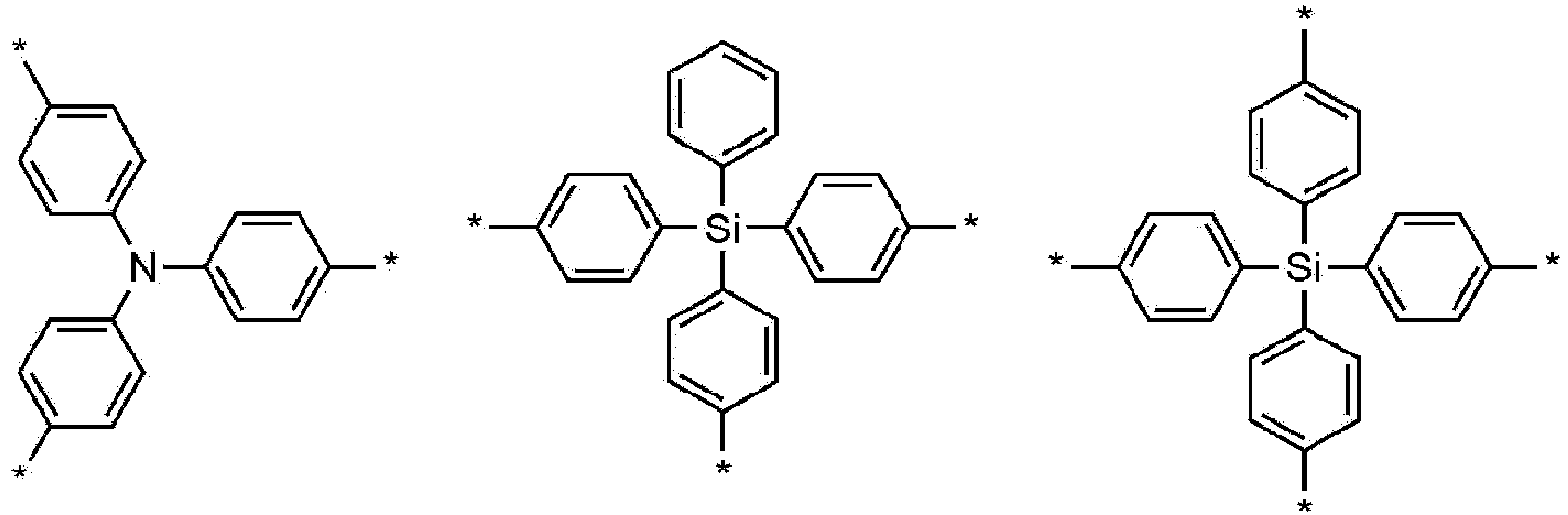
- Chemical Formula 2 is any one selected from the group consisting of:
- repeating unit represented by Chemical Formula 2 is derived from a compound represented by the following Chemical Formula 2-1. wherein, in Chemical Formula 2-1, the remaining substituents excluding X' are as defined above, and X' is halogen, preferably bromo, or chloro.
- the polymer according to the present disclosure may further include a repeating unit represented by the following Chemical Formula 3: [Chemical Formula 3] Ar-*
- the terminal group represented by Chemical Formula 3 is an aromatic cyclic terminal group, and when included in the polymer structure according to the present disclosure, the solubility in a solvent can be improved.
- Ar is phenyl or biphenylyl, and the Ar is unsubstituted or substituted with a C 1-10 alkyl, a photocurable group, or a thermosetting group.
- the photocurable group, or the thermosetting group is any one selected from the group consisting of:
- Chemical Formula 3 is any one selected from the group consisting of:
- Chemical Formula 3 is derived from a compound represented by the following Chemical Formula 3-1.
- Chemical Formula 3-1 Ar-X" wherein, in Chemical Formula 3-1, the remaining substituents excluding X" are as defined above, and X" is halogen, preferably bromo, or chloro.
- the polymer according to the present disclosure can be prepared by polymerizing the monomer represented by Chemical Formula 1-1 described above. Further, the polymer according to the present disclosure can be prepared by polymerizing the monomer represented by Chemical Formula 1-1 and the monomer represented by Chemical Formula 2-1. Further, the polymer according to the present disclosure can be prepared by polymerizing the monomer represented by Chemical Formula 1-1, the monomer represented by Chemical Formula 2-1, and the monomer represented by Chemical Formula 3-1.
- the polymer according to the present invention is a random copolymer including the repeating unit.
- the repeating unit of Chemical Formula 2 when the repeating unit of Chemical Formula 2 is included, preferably, the repeating unit of Chemical Formula 2 is contained in an amount of 10 to 50 moles based on 100 moles of the repeating unit of Chemical Formula 1. More preferably, the repeating unit of Chemical Formula 2 is contained in an amount of 15 moles or more, 20 moles or more, 25 moles or more, or 30 moles or more, and 45 moles or less, 40 moles or less, or 35 moles or less, based on 100 moles of the repeating unit represented by Chemical Formula 1.
- the repeating unit of Chemical Formula 3 when the repeating unit of Chemical Formula 3 is included, preferably, the repeating unit of Chemical Formula 3 is contained in an amount of 20 to 65 moles based on 100 moles of the repeating unit expressed by Chemical Formula 1. More preferably, the repeating unit of Chemical Formula 3 is contained in an amount of 25 moles or more, 30 moles or more, 35 moles or more, or 40 moles or more, and 60 moles or less, or 55 moles or less based on 100 moles of the repeating unit represented by Chemical Formula 1.
- reaction molar ratio of the monomer represented by Chemical Formula 1-1, the monomer represented by Chemical Formula 2-1, and/or the monomer represented by Chemical Formula 3-1 can be adjusted, thereby adjusting the molar ratio of the polymer.
- the weight average molecular weight (Mw; g/mol) of the polymer is 3,000 to 1,000,000, more preferably 10,000 or more, 20,000 or more, 30,000 or more, 40,000 or more, 50,000 or more, 60,000 or more, 70,000 or more, or 80,000 or more; and 500,000 or less, 400,000 or less, 300,000 or less, 200,000 or less, or 150,000 or less.
- the number average molecular weight (Mn; g/mol) of the polymer is 3,000 to 1,000,000, more preferably 10,000 or more, 20,000 or more, or 30,000 or more; and 100,000 or less, 90,000 or less, 80,000 or less, 70,000 or less, 60,000 or less, 50,000 or less, or 40,000 or less.
- the molecular weight distribution (PDI; Mw/Mn) of the polymer is 1.5 to 10, more preferably 2.0 or more, 2.1 or more, 2.2 or more, 2.3 or more, 2.4 or more, or 2.5 or more; 9.0 or less, 8.0 or less, 7.0 or less, 6.0 or less, 5.0 or less, or 4.0 or less.
- the polymer according to the present disclosure is represented by the following formulas, wherein a1, b1 and c1 represent the above-mentioned molar ratios:
- the polymer according to the present disclosure can form an organic material layer, particularly a hole transport layer, of the organic light emitting device by a solution process.
- one embodiment of the present disclosure provides a coating composition including the above-mentioned polymer according to the present disclosure and a solvent.
- the solvent is not particularly limited as long as it is a solvent capable of dissolving or dispersing the polymer according to the present disclosure.
- chlorine-based solvents such as chloroform, methylene chloride, 1,2-dichloroethane, 1,1,2-trichloroethane, chlorobenzene and o-dichlorobenzene
- ether-based solvents such as tetrahydrofuran and dioxane
- aromatic hydrocarbon-based solvents such as toluene, xylene, trimethylbenzene and mesitylene
- aliphatic hydrocarbon-based solvents such as cyclohexane, methylcyclohexane, n-pentane, n-hexane, n-heptane, n-octane, n-nonane and n-decane
- ketone-based solvents such as acetone, methyl ethyl ketone, and cyclohe
- the viscosity of the coating composition is preferably 1 mPa*s to 10 mPa*s (1 cP to 10 cP), and coating is easy within the above range.
- the concentration of the polymer according to the present disclosure is preferably 0.1 wt/v% to 20 wt/v%.
- the coating composition may further include one or more additives selected from the group consisting of a thermal polymerization initiator and a photopolymerization initiator.
- thermal polymerization initiator may include peroxides such as methyl ethyl ketone peroxide, methyl isobutyl ketone peroxide, acetyl acetone peroxide, methyl cyclohexanone peroxide, cyclohexanone peroxide, isobutyryl peroxide, 2,4-dichlorobenzoyl peroxide, bis-3,5,5-trimethylhexanoyl peroxide, lauryl peroxide, benzoyl peroxide, or azo-based such as azobis isobutylnitrile, azobis dimethylvaleronitrile and azobis cyclohexylnitrile, but are not limited thereto.
- peroxides such as methyl ethyl ketone peroxide, methyl isobutyl ketone peroxide, acetyl acetone peroxide, methyl cyclohexanone peroxide, cyclohexanone
- the photopolymerization initiator may include acetophenone-based or ketal-based photopolymerization initiators such as diethoxyacetophenone, 2,2-dimethoxy-1,2-diphenylethan-1-one, 1-hydroxycyclohexyl-phenyl-ketone, 4-(2-hydroxyethoxy)phenyl-(2-hydroxy-2-propyl)ketone, 2-benzyl-2-dimethylamino-1-(4-morpholinophenyl)butanone-1,2-hydroxy-2-methyl-1-phenylpropan-1-one, 2-methyl-2-morpholino(4-methylthiophenyl)propan-1-one and 1-phenyl-1,2-propanedion-2-(o-ethoxycarbonyl)oxime; benzoin ether-based photopolymerization initiators such as benzoin, benzoin methyl ether and benzoin ethyl ether; benzophenone-based photopolymerization initiators such as benzophenone,
- those having a photopolymerization accelerating effect may be used either alone or as a combination with the photopolymerization initiator.
- examples thereof may include triethanolamine, methyldiethanolamine, ethyl 4-dimethylaminobenzoate, isoamyl 4-dimethylaminobenzoate, (2-dimethylamino)ethyl benzoate, 4,4'-dimethylaminobenzophenone and the like, but are not limited thereto.
- the method includes the steps of: coating the above-mentioned coating composition according to the present disclosure on the anode or on the hole injection layer formed on the anode by a solution process; and drying the coated coating composition.
- the solution process uses the above-mentioned coating composition according to the present disclosure, and refers to spin coating, dip coating, doctor blading, inkjet printing, screen printing, spray method, roll coating, and the like, but is not limited thereto.
- an organic light emitting device including the above-mentioned polymer according to the present disclosure.
- the present disclosure provides an organic light emitting device including an anode; a cathode that is disposed opposite to the anode; a light emitting layer that is provided between the anode and the cathode; and a hole transport layer that is provided between the anode and the light emitting layer, wherein the hole transport layer includes the polymer according to the present disclosure.
- FIGS. 1 and 2 The structure of an organic light emitting device according to an embodiment of the present disclosure is illustrated in FIGS. 1 and 2 .
- FIG. 1 shows an example of an organic light emitting device comprising a substrate 1, an anode 2, a hole transport layer 3, a light emitting layer 4, and a cathode 5.
- FIG. 2 shows an example of an organic light emitting device comprising a substrate 1, an anode 2, a hole injection layer 6, a hole transport layer 3, a light emitting layer 4, an electron transport layer 7, an electron injection layer 8, and a cathode 5.
- the organic light emitting device according to the present disclosure may be manufactured by materials and methods known in the art, except that the hole transport layer includes the polymer according to the present disclosure and is manufactured according to the above-mentioned method.
- the organic light emitting device can be manufactured by sequentially stacking an anode, an organic material layer and a cathode on a substrate.
- the organic light emitting device may be manufactured by depositing a metal, metal oxides having conductivity, or an alloy thereof on the substrate using a PVD (physical vapor deposition) method such as a sputtering method or an e-beam evaporation method to form an anode, forming organic material layers including the hole injection layer, the hole transport layer, the light emitting layer and the electron transport layer thereon, and then depositing a material that can be used as the cathode thereon.
- PVD physical vapor deposition
- the organic light emitting device may be manufactured by sequentially depositing a cathode material, an organic material layer and an anode material on a substrate (International Publication WO2003/012890 ).
- the manufacturing method is not limited thereto.
- anode material generally, a material having a large work function is preferably used so that holes can be smoothly injected into the organic material layer.
- the anode material include metals such as vanadium, chrome, copper, zinc, and gold, or an alloy thereof; metal oxides such as zinc oxides, indium oxides, indium tin oxides (ITO), and indium zinc oxides (IZO); a combination of metals and oxides, such as ZnO:Al or SnO 2 :Sb; conductive polymers such as poly(3-methylthiophene), poly[3,4-(ethylene-1,2-dioxy)thiophene](PEDOT), polypyrrole, and polyaniline, and the like, but are not limited thereto.
- the cathode material generally, a material having a small work function is preferably used so that electrons can be easily injected into the organic material layer.
- the cathode material include metals such as magnesium, calcium, sodium, potassium, titanium, indium, yttrium, lithium, gadolinium, aluminum, silver, tin, and lead, or an alloy thereof; a multilayered structure material such as LiF/Al or LiO 2 /Al, and the like, but are not limited thereto.
- the hole injection material examples include metal porphyrine, oligothiophene, an arylamine-based organic material, a hexanitrilehexaazatriphenylene-based organic material, a quinacridone-based organic material, a perylene-based organic material, anthraquinone, polyaniline and polythiophene-based conductive polymer, and the like, but are not limited thereto.
- the light emitting material is preferably a material which may receive holes and electrons transported from a hole transport layer and an electron transport layer, respectively, and combine the holes and the electrons to emit light in a visible ray region, and has good quantum efficiency to fluorescence or phosphorescence.
- the light emitting material include an 8-hydroxy-quinoline aluminum complex (Alq 3 ); a carbazole-based compound; a dimerized styryl compound; BAlq; a 10-hydroxybenzoquinoline-metal compound; a benzoxazole, benzthiazole and benzimidazole-based compound; a poly(p-phenylenevinylene)(PPV)-based polymer; a spiro compound; polyfluorene, lubrene, and the like, but are not limited thereto.
- Alq 3 8-hydroxy-quinoline aluminum complex
- a carbazole-based compound a dimerized styryl compound
- BAlq a 10-hydroxybenzoquinoline-metal compound
- a benzoxazole, benzthiazole and benzimidazole-based compound a poly(p-phenylenevinylene)(PPV)-based polymer
- a spiro compound polyfluorene, lubrene, and
- the light emitting layer may include a host material and a dopant material.
- the host material may be a fused aromatic ring derivative, a heterocycle-containing compound or the like.
- the fused aromatic ring derivatives include anthracene derivatives, pyrene derivatives, naphthalene derivatives, pentacene derivatives, phenanthrene compounds, fluoranthene compounds, and the like.
- the heterocyclic-containing compounds include carbazole derivatives, dibenzofuran derivatives, ladder-type furan compounds, pyrimidine derivatives, and the like, but are not limited thereto.
- the dopant material includes an aromatic amine derivative, a styrylamine compound, a boron complex, a fluoranthene compound, a metal complex, and the like.
- the aromatic amine derivative is a substituted or unsubstituted fused aromatic ring derivative having an arylamino group, and examples thereof include pyrene, anthracene, chrysene, periflanthene and the like, which have an arylamino group.
- the styrylamine compound is a compound where at least one arylvinyl group is substituted in substituted or unsubstituted arylamine, in which one or two or more substituent groups selected from the group consisting of an aryl group, a silyl group, an alkyl group, a cycloalkyl group, and an arylamino group are substituted or unsubstituted.
- substituent groups selected from the group consisting of an aryl group, a silyl group, an alkyl group, a cycloalkyl group, and an arylamino group are substituted or unsubstituted.
- Specific examples thereof include styrylamine, styryldiamine, styryltriamine, styryltetramine, and the like, but are not limited thereto.
- the metal complex includes an iridium complex, a platinum complex, and the like, but is not limited thereto.
- the electron transport layer is a layer which receives electrons from an electron injection layer and transports the electrons to a light emitting layer
- an electron transport material is suitably a material which may receive electrons well from a cathode and transfer the electrons to a light emitting layer, and has a large mobility for electrons.
- Specific examples of the electron transport material include: an Al complex of 8-hydroxyquinoline; a complex including Alq 3 ; an organic radical compound; a hydroxyflavone-metal complex, and the like, but are not limited thereto.
- the electron transport layer may be used with any desired cathode material, as used according to the related art.
- cathode material are a typical material which has a low work function, followed by an aluminum layer or a silver layer.
- specific examples thereof include cesium, barium, calcium, ytterbium, and samarium, in each case followed by an aluminum layer or a silver layer.
- the electron injection layer is a layer which injects electrons from an electrode, and is preferably a compound which has a capability of transporting electrons, has an effect of injecting electrons from a cathode and an excellent effect of injecting electrons into a light emitting layer or a light emitting material, prevents excitons produced from the light emitting layer from moving to a hole injection layer, and is also excellent in the ability to form a thin film.
- the electron injection layer include fluorenone, anthraquinodimethane, diphenoquinone, thiopyran dioxide, oxazole, oxadiazole, triazole, imidazole, perylenetetracarboxylic acid, fluorenylidene methane, anthrone, and the like, and derivatives thereof, a metal complex compound, a nitrogen-containing 5-membered ring derivative, and the like, but are not limited thereto.
- the metal complex compound includes 8-hydroxyquinolinato lithium, bis(8-hydroxyquinolinato)zinc, bis(8-hydroxyquinolinato)copper, bis(8-hydroxyquinolinato)manganese, tris(8-hydroxyquinolinato)aluminum, tris(2-methyl-8-hydroxyquinolinato)aluminum, tris(8-hydroxyquinolinato)gallium, bis(10-hydroxybenzo[h]quinolinato)beryllium, bis(10-hydroxybenzo[h]quinolinato)zinc, bis(2-methyl-8-quinolinato)chlorogallium, bis(2-methyl-8-quinolinato)(o-cresolato)gallium, bis(2-methyl-8-quinolinato)(1-naphtholato)aluminum, bis(2-methyl-8-quinolinato)(2-naphtholato)gallium, and the like, but are not limited thereto.
- the organic light emitting device may be a bottom emission device, a top emission device, or a double-sided light emitting device, and particularly, may be a bottom emission device that requires relatively high luminous efficiency.
- Monomer A (0.765 mmol), 4,4"-dibromo-5'-(4-bromophenyl)-1,1':3',1"-terphenyl (0.158 mmol) and 4-bromo-4'-propyl-1,1'-biphenyl (0.369 mmol) were added to a round flask and dissolved in toluene (11 mL) to prepare a first solution.
- Bis(1,5-cyclooctadiene)nickel(0) (2.42 mmol) was added to a 50 mL Schlenk tube, and 2,2'-dipyridyl (2.42 mmol) and 1,5-cyclooctadiene (2.42 mmol) were added to a scintillation vial, and then dissolved in N,N'-dimethylformamide (5.5 mL) and toluene (11 mL) to prepare a second solution.
- Polymer 2 was prepared in the same manner as in Example 1, except that 3,3"-dibromo-5'-(3-bromophenyl)-1,1':3',1"-terphenyl was used instead of 4,4"-dibromo-5'-(4-bromophenyl)-1,1':3',1"-terphenyl.
- Polymer 5 was prepared in the same manner as in Example 1, except that tris(4-bromophenyl)amine was used instead of 4,4"-dibromo-5'-(4-bromophenyl)-1,1':3',1"-terphenyl.
- Polymer 7 was prepared in the same manner as in Example 1, except that Monomer B was used instead of Monomer A.
- Polymer 8 was prepared in the same manner as in Example 7, except that 3,3"-dibromo-5'-(3-bromophenyl)-1,1':3',1"-terphenyl was used instead of 4,4"-dibromo-5'-(4-bromophenyl)-1,1':3',1"-terphenyl.
- Polymer 12 was prepared in the same manner as in Example 6, except that Monomer B' was used instead of Monomer A'.
- Comparative Polymer was prepared in the same manner as in Example 1, except that Monomer A' was used instead of Monomer A.
- the number average molecular weight (Mn), weight average molecular weight (Mw) and molecular weight distribution (PDI, Mw/Mn) of Polymers 1 to 12 and Comparative Polymer prepared above were measured by GPC (Agilent 1200 series) using a PC standard.
- the prepared polymer was measured using a solution in which 1wt% of THF was dissolved. The results are shown in Table 1 below.
- the HIL material used in the preparation of the hole injection layer the material prepared in Example 1 of US Patent No. 7,351,358 was used.
- the dopant the following bis(diarylamino)benzofluorene-based compound described in US Patent No. 8,465,848 was used.
- a glass substrate on which ITO (indium tin oxide) was coated as a thin film to a thickness of 1,500 ⁇ was put into distilled water in which a detergent was dissolved, and ultrasonically cleaned.
- a product manufactured by Fischer Co. was used as the detergent, and as the distilled water, distilled water filtered twice using a filter manufactured by Millipore Co. was used.
- ultrasonic cleaning was repeated twice using distilled water for 10 minutes.
- the substrate was ultrasonically cleaned with solvents of isopropyl alcohol and acetone, dried, and then the substrate was cleaned for 5 minutes, and then dried.
- the cleaned and patterned ITO was treated with UV ozone for 10 minutes. After ozone treatment, an aqueous dispersion of HIL was spin-coated onto the ITO surface, and heat-treated at 230 °C for 10 minutes to remove the solvent, thereby forming a hole injection layer having a thickness of 400 ⁇ .
- a toluene solution in which the previously prepared Polymer 1 was dissolved at a concentration of 1.5 wt% was spin-coated onto the hole injection layer, and heat-treated at 230 °C for 10 minutes to remove the solvent, thereby forming a hole transport layer having a thickness of 1000 ⁇ .
- a methyl benzoate solution in which a host and a dopant (host: dopant 93: 7 (wt%)) were dissolved at a concentration of 2.0 wt% was spin-coated onto the hole transport layer to form a light emitting layer having a thickness of 1000 ⁇ . Then, after transferring to a vacuum evaporator, BCP (Bathocuproine) was vacuum-deposited on the light emitting layer to form an electron injection and transport layer having a thickness of 350 ⁇ . LiF and aluminum were sequentially deposited to have a thickness of 10 ⁇ and 1,000 ⁇ on the electron injection and transport layer to form a cathode.
- the vapor deposition rate of lithium fluoride on the cathode was maintained at 0.3 ⁇ /sec
- the deposition rate of aluminum was maintained at 2 ⁇ /sec
- the degree of vacuum during the deposition was maintained at 2 ⁇ 10 -7 to 5 ⁇ 10 -6 torr.
- the organic light emitting device was manufactured in the same manner as in Experimental Example 1, except that the polymers shown in Table 2 below were used instead of Polymer 1.
- the organic light emitting device was manufactured in the same manner as in Experimental Example 1, except that Comparative Polymer was used instead of Polymer 1.
- the driving voltage, luminous efficiency, power efficiency, external quantum efficiency, luminance, chromaticity diagram, and CE/CIEy were measured at a current density of 10 mA/cm 2 for the organic light emitting devices manufactured in Experimental Examples and Comparative Experimental Example above, and the results are shown in Table 2 below.
- the external quantum efficiency was calculated by (number of emitted photons) / (number of injected charge carriers), the chromaticity diagram is the x and y coordinates according to the C.I.E chromaticity diagram (Commission Internationale de L'Eclairage, 1931), and CE/CIEy is a value obtained by dividing the luminous efficiency (cd/A) by the color coordinate (y) value.
- substrate 2 anode 3: hole transport layer 4: light emitting layer 5: cathode 6: hole injection layer 7: electron transport layer 8: electron injection layer
Landscapes
- Chemical & Material Sciences (AREA)
- Engineering & Computer Science (AREA)
- Materials Engineering (AREA)
- Organic Chemistry (AREA)
- Chemical Kinetics & Catalysis (AREA)
- Medicinal Chemistry (AREA)
- Polymers & Plastics (AREA)
- Health & Medical Sciences (AREA)
- Life Sciences & Earth Sciences (AREA)
- Wood Science & Technology (AREA)
- Manufacturing & Machinery (AREA)
- Electroluminescent Light Sources (AREA)
- Polyoxymethylene Polymers And Polymers With Carbon-To-Carbon Bonds (AREA)
Claims (18)
- Polymer, umfassend eine durch die folgende chemische Formel 1 dargestellte Wiederholungseinheit:
 in der chemischen Formel 1ist jedes L unabhängig ein substituiertes oder unsubstituiertes C6-60-Arylen,jedes R1 ist unabhängig ein substituiertes oder unsubstituiertes C4-10-Alkyl,jedes R2 ist unabhängig ein substituiertes oder unsubstituiertes C1-4-Alkyl,jedes R3 ist unabhängig ein substituiertes oder unsubstituiertes C1-10-Alkyl,alle R4 sind allesamt Wasserstoff und alle R5 sind ein substituiertes oder unsubstituiertes C1-4-Alkyl oder alle R4 sind ein substituiertes oder unsubstituiertes C1-4-Alkyl und alle R5 sind Wasserstoff und* gibt den Bindungspunkt innerhalb des Polymers an.
 - Polymer gemäß Anspruch 1, wobeidie chemische Formel 1 durch die folgende chemische Formel 1' oder 1" dargestellt ist:
 in der chemischen Formel 1'sind L, R1, R2, R3 und * so wie in Anspruch 1 definiert undjedes R4 ist unabhängig ein substituiertes oder unsubstituiertes C1-4-Alkyl,
 in der chemischen Formel 1",sind L, R1, R2, R3 und * so wie in Anspruch 1 definiert undjedes R5 ist unabhängig ein substituiertes oder unsubstituiertes C1-4-Alkyl.
 - Polymer gemäß Anspruch 1, wobei
jedes L unabhängig Phenylen oder Biphenyldiyl ist. - Polymer gemäß Anspruch 1, wobei
jedes L unabhängig
- Polymer gemäß Anspruch 1, wobei
jedes R1 unabhängig ein geradkettiges Hexyl, ein geradkettiges Heptyl, ein geradkettiges Octyl, ein geradkettiges Nonyl oder ein geradkettiges Decyl ist. - Polymer gemäß Anspruch 1, wobei
jedes R2 unabhängig Methyl, Ethyl oder Propyl ist. - Polymer gemäß Anspruch 1, wobei
jedes R3 unabhängig Methyl, Ethyl oder Propyl ist. - Polymer gemäß Anspruch 1, wobei
jedes R4 unabhängig Methyl, Ethyl oder Propyl ist. - Polymer gemäß Anspruch 1, wobei
die chemische Formel 1 durch die folgenden Formeln dargestellt ist:

- Polymer gemäß Anspruch 1, wobeidas Polymer ferner eine durch die folgende chemische Formel 2 dargestellte Wiederholungseinheit umfasst:
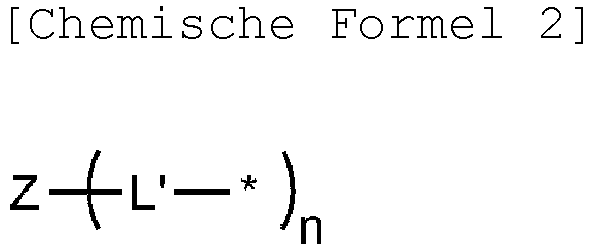 in der chemischen Formel 2 ist jedes L' unabhängig eine Einfachbindung oder ein substituiertes oder unsubstituiertes C6-60-Arylen,Z ist C, Si, N, Si (Phenyl) oder ein n-wertiger substituierter oder unsubstituierter aromatischer C6-60-Ring,n ist 3 oder 4, mit der Maßgabe, dass n 4 ist, wenn Z C oder Si ist, und n 3 ist, wenn Z N oder Si (Phenyl) ist, und* gibt den Bindungspunkt innerhalb des Polymers an.
 - Polymer gemäß Anspruch 10, wobei
jedes L' unabhängig eine Einfachbindung oder Phenylen ist. - Polymer gemäß Anspruch 10, wobei
Z C, N, Si oder ein dreiwertiges Benzol ist. - Polymer gemäß Anspruch 10, wobeidie chemische Formel 2 eine, ausgewählt aus der Gruppe, bestehend aus

- Polymer gemäß Anspruch 1, wobeidas Polymer ferner eine durch die folgende chemische Formel 3 dargestellte Endgruppe umfasst:
[Chemische Formel 3] Ar-*
in der chemischen Formel 3ist Ar ein substituiertes oder unsubstituiertes C6-60-Aryl,* gibt den Bindungspunkt innerhalb des Polymers an. - Polymer gemäß Anspruch 1, wobeiAr Phenyl oder Biphenylyl ist unddas Ar unsubstituiert oder mit einem C1-10-Alkyl, einer lichthärtbaren Gruppe oder einer wärmehärtenden Gruppe substituiert ist.
- Polymer gemäß Anspruch 14, wobei die chemische Formel 3 eine, ausgewählt aus der Gruppe, bestehend aus:


- Polymer gemäß Anspruch 1, wobei
das Polymer ein gewichtsmittleres Molekulargewicht von 3.000 bis 1.000.000 g/mol aufweist. - Organische lichtemittierende Vorrichtung, umfassend eine Anode, eine Kathode, die gegenüber der Anode angeordnet ist, eine lichtemittierende Schicht, die zwischen der Anode und der Kathode angeordnet ist, und eine Lochtransportschicht, die zwischen der Anode und der lichtemittierenden Schicht angeordnet ist, wobei die Lochtransportschicht das Polymer gemäß einem der Ansprüche 1 bis 17 umfasst.
Applications Claiming Priority (3)
| Application Number | Priority Date | Filing Date | Title |
|---|---|---|---|
| KR20200037811 | 2020-03-27 | ||
| KR1020210033357A KR102489570B1 (ko) | 2020-03-27 | 2021-03-15 | 신규한 고분자 및 이를 이용한 유기 발광 소자 |
| PCT/KR2021/003235 WO2021194148A1 (ko) | 2020-03-27 | 2021-03-16 | 신규한 고분자 및 이를 이용한 유기 발광 소자 |
Publications (3)
| Publication Number | Publication Date |
|---|---|
| EP4071193A1 EP4071193A1 (de) | 2022-10-12 |
| EP4071193A4 EP4071193A4 (de) | 2023-09-13 |
| EP4071193B1 true EP4071193B1 (de) | 2025-03-12 |
Family
ID=77892429
Family Applications (1)
| Application Number | Title | Priority Date | Filing Date |
|---|---|---|---|
| EP21776998.3A Active EP4071193B1 (de) | 2020-03-27 | 2021-03-16 | Neuartiges polymer und organisches lichtemittierendes element damit |
Country Status (5)
| Country | Link |
|---|---|
| US (1) | US20230140039A1 (de) |
| EP (1) | EP4071193B1 (de) |
| JP (1) | JP7427317B2 (de) |
| CN (1) | CN114901719B (de) |
| WO (1) | WO2021194148A1 (de) |
Families Citing this family (3)
| Publication number | Priority date | Publication date | Assignee | Title |
|---|---|---|---|---|
| US20240368463A1 (en) * | 2021-12-16 | 2024-11-07 | Lg Chem, Ltd. | Polymer and Organic Light-Emitting Device Using Same |
| CN117980369A (zh) * | 2022-06-10 | 2024-05-03 | 株式会社Lg化学 | 聚合物和使用其的有机发光器件 |
| CN115403746B (zh) * | 2022-08-29 | 2024-02-13 | 中国科学院长春应用化学研究所 | 一种星型结构化合物及其有机电致发光器件 |
Family Cites Families (25)
| Publication number | Priority date | Publication date | Assignee | Title |
|---|---|---|---|---|
| KR100430549B1 (ko) | 1999-01-27 | 2004-05-10 | 주식회사 엘지화학 | 신규한 착물 및 그의 제조 방법과 이를 이용한 유기 발광 소자 및 그의 제조 방법 |
| DE10135513B4 (de) | 2001-07-20 | 2005-02-24 | Novaled Gmbh | Lichtemittierendes Bauelement mit organischen Schichten |
| US7351358B2 (en) | 2004-03-17 | 2008-04-01 | E.I. Du Pont De Nemours And Company | Water dispersible polypyrroles made with polymeric acid colloids for electronics applications |
| JP2007220772A (ja) * | 2006-02-15 | 2007-08-30 | Idemitsu Kosan Co Ltd | 有機エレクトロルミネッセンス用高分子化合物及びその製造方法 |
| US20070292681A1 (en) * | 2006-06-20 | 2007-12-20 | Fuji Xerox Co., Ltd | Organic electroluminescence device |
| US8465848B2 (en) | 2006-12-29 | 2013-06-18 | E I Du Pont De Nemours And Company | Benzofluorenes for luminescent applications |
| EP2473580A4 (de) | 2009-09-03 | 2013-02-20 | Du Pont | Deuterierte verbindungen für elektronische anwendungen |
| TW201204687A (en) * | 2010-06-17 | 2012-02-01 | Du Pont | Electroactive materials |
| TW201200975A (en) * | 2010-06-17 | 2012-01-01 | Du Pont | Process and materials for making contained layers and devices made with same |
| WO2012073902A1 (ja) * | 2010-11-30 | 2012-06-07 | 住友化学株式会社 | 高分子化合物及びその製造方法、並びに発光素子 |
| US10586929B2 (en) * | 2013-12-12 | 2020-03-10 | Lg Chem, Ltd. | Solvent-resistant hole transport layers |
| US9954174B2 (en) * | 2015-05-06 | 2018-04-24 | E I Du Pont De Nemours And Company | Hole transport materials |
| WO2017073932A1 (ko) * | 2015-10-26 | 2017-05-04 | 주식회사 엘지화학 | 아민 화합물 및 이를 포함하는 유기 발광 소자 |
| CN108349869A (zh) * | 2015-11-05 | 2018-07-31 | E.I.内穆尔杜邦公司 | 可交联的空穴传输材料 |
| US10461259B2 (en) * | 2016-10-18 | 2019-10-29 | Lg Chem, Ltd. | Organic light emitting device |
| KR102084310B1 (ko) * | 2017-06-20 | 2020-03-03 | 주식회사 엘지화학 | 화합물, 이를 포함하는 코팅조성물 및 이를 포함한 유기 발광 소자 |
| KR102141281B1 (ko) * | 2017-09-26 | 2020-08-05 | 주식회사 엘지화학 | 화합물, 이를 포함하는 코팅 조성물, 이를 이용한 유기 발광 소자 및 이의 제조방법 |
| KR102298164B1 (ko) * | 2017-10-30 | 2021-09-03 | 주식회사 엘지화학 | 공중합체, 및 이를 포함하는 유기발광소자 |
| CN108003365B (zh) * | 2017-11-28 | 2019-03-22 | 广州华睿光电材料有限公司 | 有机复合薄膜及其在有机电子器件中的应用 |
| JP2019108296A (ja) * | 2017-12-19 | 2019-07-04 | 三星電子株式会社Samsung Electronics Co.,Ltd. | 有機エレクトロルミネッセンス素子用化合物 |
| KR102295248B1 (ko) * | 2018-01-24 | 2021-08-27 | 주식회사 엘지화학 | 중합체, 이를 포함하는 코팅 조성물 및 이를 이용한 유기 발광 소자 |
| KR102153086B1 (ko) * | 2018-07-31 | 2020-09-07 | 주식회사 엘지화학 | 신규한 고분자 및 이를 포함하는 유기 발광 소자 |
| KR102255747B1 (ko) * | 2018-09-10 | 2021-05-25 | 주식회사 엘지화학 | 신규한 화합물 및 이를 포함하는 유기 발광 소자 |
| JP2020105152A (ja) * | 2018-12-28 | 2020-07-09 | 三星電子株式会社Samsung Electronics Co.,Ltd. | 有機エレクトロルミネッセンス素子用化合物、並びにこれを含む組成物及び有機エレクトロルミネッセンス素子 |
| EP3674290B1 (de) * | 2018-12-28 | 2024-05-22 | Samsung Electronics Co., Ltd. | Heterocyclische verbindung, zusammensetzung damit und organische elektrolumineszenz vorrichtung mit dem heterocyclische verbindung |
-
2021
- 2021-03-16 US US17/792,241 patent/US20230140039A1/en active Pending
- 2021-03-16 WO PCT/KR2021/003235 patent/WO2021194148A1/ko not_active Ceased
- 2021-03-16 JP JP2022539711A patent/JP7427317B2/ja active Active
- 2021-03-16 CN CN202180007789.1A patent/CN114901719B/zh active Active
- 2021-03-16 EP EP21776998.3A patent/EP4071193B1/de active Active
Also Published As
| Publication number | Publication date |
|---|---|
| EP4071193A1 (de) | 2022-10-12 |
| WO2021194148A1 (ko) | 2021-09-30 |
| US20230140039A1 (en) | 2023-05-04 |
| CN114901719B (zh) | 2024-03-05 |
| EP4071193A4 (de) | 2023-09-13 |
| CN114901719A (zh) | 2022-08-12 |
| JP2023508214A (ja) | 2023-03-01 |
| JP7427317B2 (ja) | 2024-02-05 |
Similar Documents
| Publication | Publication Date | Title |
|---|---|---|
| EP3431467A1 (de) | Carbazolderivat und organisches lichtemittierendes element damit | |
| EP4227312B1 (de) | Neuartige verbindung und organische lichtemittierende vorrichtung damit | |
| EP3683208B1 (de) | Verbindung, beschichtungszusammensetzung damit und vorrichtung mit organischer lichtemittierender diode | |
| EP4071193B1 (de) | Neuartiges polymer und organisches lichtemittierendes element damit | |
| KR102487980B1 (ko) | 신규한 고분자 및 이를 이용한 유기발광 소자 | |
| EP3699231B1 (de) | Neuartiges polymer und organische lichtemittierende vorrichtung damit | |
| KR102489570B1 (ko) | 신규한 고분자 및 이를 이용한 유기 발광 소자 | |
| KR102861650B1 (ko) | 신규한 고분자 및 이를 이용한 유기 발광 소자 | |
| KR102255747B1 (ko) | 신규한 화합물 및 이를 포함하는 유기 발광 소자 | |
| KR20210012972A (ko) | 신규한 화합물 및 이를 이용한 유기 발광 소자 | |
| KR102863103B1 (ko) | 신규한 고분자 및 이를 이용한 유기 발광 소자 | |
| EP4092035B1 (de) | Neuartige verbindung und organische lichtemittierende vorrichtung damit | |
| KR102819365B1 (ko) | 신규한 고분자 및 이를 이용한 유기 발광 소자 | |
| KR102858769B1 (ko) | 신규한 고분자 및 이를 이용한 유기 발광 소자 | |
| EP4245760B1 (de) | Neuartige verbindung und organische lichtemittierende vorrichtung damit | |
| US11987665B2 (en) | Polymer and organic light emitting device comprising same | |
| KR102838359B1 (ko) | 신규한 고분자 및 이를 이용한 유기 발광 소자 | |
| KR102799795B1 (ko) | 신규한 화합물 및 이를 이용한 유기 발광 소자 | |
| KR102944608B1 (ko) | 신규한 화합물 및 이를 포함하는 유기발광 소자 | |
| KR102183112B1 (ko) | 신규한 화합물 및 이를 포함하는 유기발광 소자 | |
| EP3778582B1 (de) | Neue verbindung, beschichtungszusammensetzung, die diese umfasst und organische leuchtdiode, die diese umfasst | |
| KR102707652B1 (ko) | 신규한 고분자 및 이를 포함하는 유기발광 소자 | |
| KR20240176369A (ko) | 신규한 고분자 및 이를 이용한 유기 발광 소자 | |
| KR20200034519A (ko) | 신규한 공중합체 및 이를 포함하는 유기 발광 소자 |
Legal Events
| Date | Code | Title | Description |
|---|---|---|---|
| STAA | Information on the status of an ep patent application or granted ep patent |
Free format text: STATUS: THE INTERNATIONAL PUBLICATION HAS BEEN MADE |
|
| PUAI | Public reference made under article 153(3) epc to a published international application that has entered the european phase |
Free format text: ORIGINAL CODE: 0009012 |
|
| STAA | Information on the status of an ep patent application or granted ep patent |
Free format text: STATUS: REQUEST FOR EXAMINATION WAS MADE |
|
| 17P | Request for examination filed |
Effective date: 20220705 |
|
| AK | Designated contracting states |
Kind code of ref document: A1 Designated state(s): AL AT BE BG CH CY CZ DE DK EE ES FI FR GB GR HR HU IE IS IT LI LT LU LV MC MK MT NL NO PL PT RO RS SE SI SK SM TR |
|
| DAV | Request for validation of the european patent (deleted) | ||
| DAX | Request for extension of the european patent (deleted) | ||
| A4 | Supplementary search report drawn up and despatched |
Effective date: 20230811 |
|
| RIC1 | Information provided on ipc code assigned before grant |
Ipc: C08G 61/12 20060101AFI20230807BHEP |
|
| STAA | Information on the status of an ep patent application or granted ep patent |
Free format text: STATUS: EXAMINATION IS IN PROGRESS |
|
| 17Q | First examination report despatched |
Effective date: 20240115 |
|
| GRAP | Despatch of communication of intention to grant a patent |
Free format text: ORIGINAL CODE: EPIDOSNIGR1 |
|
| STAA | Information on the status of an ep patent application or granted ep patent |
Free format text: STATUS: GRANT OF PATENT IS INTENDED |
|
| INTG | Intention to grant announced |
Effective date: 20241127 |
|
| GRAS | Grant fee paid |
Free format text: ORIGINAL CODE: EPIDOSNIGR3 |
|
| GRAA | (expected) grant |
Free format text: ORIGINAL CODE: 0009210 |
|
| STAA | Information on the status of an ep patent application or granted ep patent |
Free format text: STATUS: THE PATENT HAS BEEN GRANTED |
|
| AK | Designated contracting states |
Kind code of ref document: B1 Designated state(s): AL AT BE BG CH CY CZ DE DK EE ES FI FR GB GR HR HU IE IS IT LI LT LU LV MC MK MT NL NO PL PT RO RS SE SI SK SM TR |
|
| REG | Reference to a national code |
Ref country code: GB Ref legal event code: FG4D |
|
| REG | Reference to a national code |
Ref country code: CH Ref legal event code: EP |
|
| REG | Reference to a national code |
Ref country code: DE Ref legal event code: R096 Ref document number: 602021027568 Country of ref document: DE |
|
| REG | Reference to a national code |
Ref country code: IE Ref legal event code: FG4D |
|
| PGFP | Annual fee paid to national office [announced via postgrant information from national office to epo] |
Ref country code: DE Payment date: 20250320 Year of fee payment: 5 |
|
| PGFP | Annual fee paid to national office [announced via postgrant information from national office to epo] |
Ref country code: AT Payment date: 20250417 Year of fee payment: 5 |
|
| PGFP | Annual fee paid to national office [announced via postgrant information from national office to epo] |
Ref country code: FR Payment date: 20250321 Year of fee payment: 5 |
|
| PG25 | Lapsed in a contracting state [announced via postgrant information from national office to epo] |
Ref country code: RS Free format text: LAPSE BECAUSE OF FAILURE TO SUBMIT A TRANSLATION OF THE DESCRIPTION OR TO PAY THE FEE WITHIN THE PRESCRIBED TIME-LIMIT Effective date: 20250612 |
|
| PG25 | Lapsed in a contracting state [announced via postgrant information from national office to epo] |
Ref country code: FI Free format text: LAPSE BECAUSE OF FAILURE TO SUBMIT A TRANSLATION OF THE DESCRIPTION OR TO PAY THE FEE WITHIN THE PRESCRIBED TIME-LIMIT Effective date: 20250312 |
|
| PG25 | Lapsed in a contracting state [announced via postgrant information from national office to epo] |
Ref country code: ES Free format text: LAPSE BECAUSE OF FAILURE TO SUBMIT A TRANSLATION OF THE DESCRIPTION OR TO PAY THE FEE WITHIN THE PRESCRIBED TIME-LIMIT Effective date: 20250312 |
|
| REG | Reference to a national code |
Ref country code: LT Ref legal event code: MG9D |
|
| PG25 | Lapsed in a contracting state [announced via postgrant information from national office to epo] |
Ref country code: NO Free format text: LAPSE BECAUSE OF FAILURE TO SUBMIT A TRANSLATION OF THE DESCRIPTION OR TO PAY THE FEE WITHIN THE PRESCRIBED TIME-LIMIT Effective date: 20250612 |
|
| PG25 | Lapsed in a contracting state [announced via postgrant information from national office to epo] |
Ref country code: HR Free format text: LAPSE BECAUSE OF FAILURE TO SUBMIT A TRANSLATION OF THE DESCRIPTION OR TO PAY THE FEE WITHIN THE PRESCRIBED TIME-LIMIT Effective date: 20250312 |
|
| REG | Reference to a national code |
Ref country code: NL Ref legal event code: MP Effective date: 20250312 |
|
| PG25 | Lapsed in a contracting state [announced via postgrant information from national office to epo] |
Ref country code: LV Free format text: LAPSE BECAUSE OF FAILURE TO SUBMIT A TRANSLATION OF THE DESCRIPTION OR TO PAY THE FEE WITHIN THE PRESCRIBED TIME-LIMIT Effective date: 20250312 |
|
| PG25 | Lapsed in a contracting state [announced via postgrant information from national office to epo] |
Ref country code: GR Free format text: LAPSE BECAUSE OF FAILURE TO SUBMIT A TRANSLATION OF THE DESCRIPTION OR TO PAY THE FEE WITHIN THE PRESCRIBED TIME-LIMIT Effective date: 20250613 Ref country code: BG Free format text: LAPSE BECAUSE OF FAILURE TO SUBMIT A TRANSLATION OF THE DESCRIPTION OR TO PAY THE FEE WITHIN THE PRESCRIBED TIME-LIMIT Effective date: 20250312 |
|
| REG | Reference to a national code |
Ref country code: AT Ref legal event code: MK05 Ref document number: 1774993 Country of ref document: AT Kind code of ref document: T Effective date: 20250312 |
|
| PG25 | Lapsed in a contracting state [announced via postgrant information from national office to epo] |
Ref country code: NL Free format text: LAPSE BECAUSE OF FAILURE TO SUBMIT A TRANSLATION OF THE DESCRIPTION OR TO PAY THE FEE WITHIN THE PRESCRIBED TIME-LIMIT Effective date: 20250312 |
|
| PG25 | Lapsed in a contracting state [announced via postgrant information from national office to epo] |
Ref country code: SE Free format text: LAPSE BECAUSE OF FAILURE TO SUBMIT A TRANSLATION OF THE DESCRIPTION OR TO PAY THE FEE WITHIN THE PRESCRIBED TIME-LIMIT Effective date: 20250312 |
|
| PG25 | Lapsed in a contracting state [announced via postgrant information from national office to epo] |
Ref country code: SM Free format text: LAPSE BECAUSE OF FAILURE TO SUBMIT A TRANSLATION OF THE DESCRIPTION OR TO PAY THE FEE WITHIN THE PRESCRIBED TIME-LIMIT Effective date: 20250312 |
|
| PG25 | Lapsed in a contracting state [announced via postgrant information from national office to epo] |
Ref country code: PT Free format text: LAPSE BECAUSE OF FAILURE TO SUBMIT A TRANSLATION OF THE DESCRIPTION OR TO PAY THE FEE WITHIN THE PRESCRIBED TIME-LIMIT Effective date: 20250714 |
|
| PG25 | Lapsed in a contracting state [announced via postgrant information from national office to epo] |
Ref country code: PL Free format text: LAPSE BECAUSE OF FAILURE TO SUBMIT A TRANSLATION OF THE DESCRIPTION OR TO PAY THE FEE WITHIN THE PRESCRIBED TIME-LIMIT Effective date: 20250312 Ref country code: IT Free format text: LAPSE BECAUSE OF FAILURE TO SUBMIT A TRANSLATION OF THE DESCRIPTION OR TO PAY THE FEE WITHIN THE PRESCRIBED TIME-LIMIT Effective date: 20250312 |
|
| PG25 | Lapsed in a contracting state [announced via postgrant information from national office to epo] |
Ref country code: AT Free format text: LAPSE BECAUSE OF FAILURE TO SUBMIT A TRANSLATION OF THE DESCRIPTION OR TO PAY THE FEE WITHIN THE PRESCRIBED TIME-LIMIT Effective date: 20250312 |
|
| PG25 | Lapsed in a contracting state [announced via postgrant information from national office to epo] |
Ref country code: CZ Free format text: LAPSE BECAUSE OF FAILURE TO SUBMIT A TRANSLATION OF THE DESCRIPTION OR TO PAY THE FEE WITHIN THE PRESCRIBED TIME-LIMIT Effective date: 20250312 Ref country code: EE Free format text: LAPSE BECAUSE OF FAILURE TO SUBMIT A TRANSLATION OF THE DESCRIPTION OR TO PAY THE FEE WITHIN THE PRESCRIBED TIME-LIMIT Effective date: 20250312 |
|
| REG | Reference to a national code |
Ref country code: CH Ref legal event code: H13 Free format text: ST27 STATUS EVENT CODE: U-0-0-H10-H13 (AS PROVIDED BY THE NATIONAL OFFICE) Effective date: 20251023 |
|
| PG25 | Lapsed in a contracting state [announced via postgrant information from national office to epo] |
Ref country code: RO Free format text: LAPSE BECAUSE OF FAILURE TO SUBMIT A TRANSLATION OF THE DESCRIPTION OR TO PAY THE FEE WITHIN THE PRESCRIBED TIME-LIMIT Effective date: 20250312 |
|
| PG25 | Lapsed in a contracting state [announced via postgrant information from national office to epo] |
Ref country code: SK Free format text: LAPSE BECAUSE OF FAILURE TO SUBMIT A TRANSLATION OF THE DESCRIPTION OR TO PAY THE FEE WITHIN THE PRESCRIBED TIME-LIMIT Effective date: 20250312 |
|
| PG25 | Lapsed in a contracting state [announced via postgrant information from national office to epo] |
Ref country code: IS Free format text: LAPSE BECAUSE OF FAILURE TO SUBMIT A TRANSLATION OF THE DESCRIPTION OR TO PAY THE FEE WITHIN THE PRESCRIBED TIME-LIMIT Effective date: 20250712 |
|
| PG25 | Lapsed in a contracting state [announced via postgrant information from national office to epo] |
Ref country code: LU Free format text: LAPSE BECAUSE OF NON-PAYMENT OF DUE FEES Effective date: 20250316 |
|
| REG | Reference to a national code |
Ref country code: BE Ref legal event code: MM Effective date: 20250331 |
|
| REG | Reference to a national code |
Ref country code: DE Ref legal event code: R097 Ref document number: 602021027568 Country of ref document: DE |
|
| PG25 | Lapsed in a contracting state [announced via postgrant information from national office to epo] |
Ref country code: MC Free format text: LAPSE BECAUSE OF FAILURE TO SUBMIT A TRANSLATION OF THE DESCRIPTION OR TO PAY THE FEE WITHIN THE PRESCRIBED TIME-LIMIT Effective date: 20250312 |
|
| PG25 | Lapsed in a contracting state [announced via postgrant information from national office to epo] |
Ref country code: DK Free format text: LAPSE BECAUSE OF FAILURE TO SUBMIT A TRANSLATION OF THE DESCRIPTION OR TO PAY THE FEE WITHIN THE PRESCRIBED TIME-LIMIT Effective date: 20250312 |
|
| PG25 | Lapsed in a contracting state [announced via postgrant information from national office to epo] |
Ref country code: BE Free format text: LAPSE BECAUSE OF NON-PAYMENT OF DUE FEES Effective date: 20250331 |
|
| PLBE | No opposition filed within time limit |
Free format text: ORIGINAL CODE: 0009261 |
|
| STAA | Information on the status of an ep patent application or granted ep patent |
Free format text: STATUS: NO OPPOSITION FILED WITHIN TIME LIMIT |
|
| PG25 | Lapsed in a contracting state [announced via postgrant information from national office to epo] |
Ref country code: CH Free format text: LAPSE BECAUSE OF NON-PAYMENT OF DUE FEES Effective date: 20250331 |
|
| PG25 | Lapsed in a contracting state [announced via postgrant information from national office to epo] |
Ref country code: IE Free format text: LAPSE BECAUSE OF NON-PAYMENT OF DUE FEES Effective date: 20250316 |
|
| REG | Reference to a national code |
Ref country code: CH Ref legal event code: L10 Free format text: ST27 STATUS EVENT CODE: U-0-0-L10-L00 (AS PROVIDED BY THE NATIONAL OFFICE) Effective date: 20260121 |
|
| 26N | No opposition filed |
Effective date: 20251215 |
|
| GBPC | Gb: european patent ceased through non-payment of renewal fee |
Effective date: 20250612 |