EP4060287B1 - Three-axis mems gyroscope - Google Patents
Three-axis mems gyroscope Download PDFInfo
- Publication number
- EP4060287B1 EP4060287B1 EP20896595.4A EP20896595A EP4060287B1 EP 4060287 B1 EP4060287 B1 EP 4060287B1 EP 20896595 A EP20896595 A EP 20896595A EP 4060287 B1 EP4060287 B1 EP 4060287B1
- Authority
- EP
- European Patent Office
- Prior art keywords
- axis
- proof mass
- spring beam
- rigid
- spring
- Prior art date
- Legal status (The legal status is an assumption and is not a legal conclusion. Google has not performed a legal analysis and makes no representation as to the accuracy of the status listed.)
- Active
Links
Images



Classifications
-
- G—PHYSICS
- G01—MEASURING; TESTING
- G01C—MEASURING DISTANCES, LEVELS OR BEARINGS; SURVEYING; NAVIGATION; GYROSCOPIC INSTRUMENTS; PHOTOGRAMMETRY OR VIDEOGRAMMETRY
- G01C19/00—Gyroscopes; Turn-sensitive devices using vibrating masses; Turn-sensitive devices without moving masses; Measuring angular rate using gyroscopic effects
- G01C19/56—Turn-sensitive devices using vibrating masses, e.g. vibratory angular rate sensors based on Coriolis forces
- G01C19/567—Turn-sensitive devices using vibrating masses, e.g. vibratory angular rate sensors based on Coriolis forces using the phase shift of a vibration node or antinode
- G01C19/5691—Turn-sensitive devices using vibrating masses, e.g. vibratory angular rate sensors based on Coriolis forces using the phase shift of a vibration node or antinode of essentially three-dimensional [3D] vibrators, e.g. wine glass-type vibrators
-
- G—PHYSICS
- G01—MEASURING; TESTING
- G01C—MEASURING DISTANCES, LEVELS OR BEARINGS; SURVEYING; NAVIGATION; GYROSCOPIC INSTRUMENTS; PHOTOGRAMMETRY OR VIDEOGRAMMETRY
- G01C19/00—Gyroscopes; Turn-sensitive devices using vibrating masses; Turn-sensitive devices without moving masses; Measuring angular rate using gyroscopic effects
- G01C19/56—Turn-sensitive devices using vibrating masses, e.g. vibratory angular rate sensors based on Coriolis forces
- G01C19/5642—Turn-sensitive devices using vibrating masses, e.g. vibratory angular rate sensors based on Coriolis forces using vibrating bars or beams
- G01C19/5656—Turn-sensitive devices using vibrating masses, e.g. vibratory angular rate sensors based on Coriolis forces using vibrating bars or beams the devices involving a micromechanical structure
-
- G—PHYSICS
- G01—MEASURING; TESTING
- G01C—MEASURING DISTANCES, LEVELS OR BEARINGS; SURVEYING; NAVIGATION; GYROSCOPIC INSTRUMENTS; PHOTOGRAMMETRY OR VIDEOGRAMMETRY
- G01C19/00—Gyroscopes; Turn-sensitive devices using vibrating masses; Turn-sensitive devices without moving masses; Measuring angular rate using gyroscopic effects
- G01C19/56—Turn-sensitive devices using vibrating masses, e.g. vibratory angular rate sensors based on Coriolis forces
- G01C19/5705—Turn-sensitive devices using vibrating masses, e.g. vibratory angular rate sensors based on Coriolis forces using masses driven in reciprocating rotary motion about an axis
- G01C19/5712—Turn-sensitive devices using vibrating masses, e.g. vibratory angular rate sensors based on Coriolis forces using masses driven in reciprocating rotary motion about an axis the devices involving a micromechanical structure
-
- G—PHYSICS
- G01—MEASURING; TESTING
- G01C—MEASURING DISTANCES, LEVELS OR BEARINGS; SURVEYING; NAVIGATION; GYROSCOPIC INSTRUMENTS; PHOTOGRAMMETRY OR VIDEOGRAMMETRY
- G01C19/00—Gyroscopes; Turn-sensitive devices using vibrating masses; Turn-sensitive devices without moving masses; Measuring angular rate using gyroscopic effects
- G01C19/56—Turn-sensitive devices using vibrating masses, e.g. vibratory angular rate sensors based on Coriolis forces
- G01C19/5719—Turn-sensitive devices using vibrating masses, e.g. vibratory angular rate sensors based on Coriolis forces using planar vibrating masses driven in a translation vibration along an axis
- G01C19/5733—Structural details or topology
Definitions
- the present disclosure relates to the field of microelectromechanical systems (MEMS), in particular to a three-axis MEMS gyroscope.
- MEMS microelectromechanical systems
- Capacitive resonance gyroscopes are mostly adopted as MEMS gyroscopes in this market.
- capacitive resonance gyroscopes capacitive mechanical structures are driven to make proof masses vibrate in a driving mode, and the capacitance change caused by the movement of the proof masses in a detection direction in the presence of the Coriolis force is detected by means of detection capacitor.
- the existing three-axis gyroscopes have the following problems: the driving parts cannot be completely decoupled from the detection parts; as a result, the driving parts or the detection parts affect other movement modes during the movement; and the detection proof masses include an X-axis detection proof mass, a Y-axis detection proof mass, and a Z-axis detection proof mass, resulting in a low area utilization rate of the detection proof masses.
- CN 107 782 296 A discloses a triaxial MEMS gyroscope which comprises an X-axis detection part, a Y-axis detection part and a Z-axis detection part which are arranged in an X-axis direction, wherein the three detection parts are connected with one another by external mass blocks; and the external mass blocks are connected with the three detection parts by a plurality of connecting spring beams.
- the triaxial MEMS gyroscope can realize X-axis, Y-axis and Z-axis angular velocity detection by utilizing a driving component.
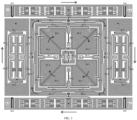
- FIG. 1 shows a structural diagram of a three-axis MEMS gyroscope in a preferred embodiment of the present disclosure.
- the three-axis MEMS gyroscope is overall symmetrical along an X axis and a Y axis (directions of the X axis, the Y axis, and a Z axis are shown in FIG. 1 , and an origin of coordinates is located at a center of the three-axis MEMS gyroscope in this embodiment).
- the proof mass M1 and the proof mass M2 have the same structure and are symmetrical with respect to the X axis; the proof mass M1 is connected to the fixed anchor A1.1 through the spring beam S1.1 and connected to the fixed anchor A1.2 through the spring beam S1.2; comb structures are coordinately arranged between the fixed electrodes E1.1-E1.4 and the proof mass M1 to form capacitors C E1.1 -C E1.4 , and comb structures are coordinately arranged between the fixed electrodes E1.9-E1.12 and the proof mass M1 to form capacitors C E1.9 -C E1.12 .
- the proof mass M2 is connected to the fixed anchor A1.3 through the spring beam S1.3 and connected to the fixed anchor A1.4 through the spring beam S1.4; comb structures are coordinately arranged between the fixed electrodes E1.5-E1.8 and the proof mass M2 to form capacitors C E1.5 -C E1.8 , and comb structures are coordinately arranged between the fixed electrodes E1.13-E1.16 and the proof mass M1 to form capacitors C E1.13 -C E1.16 .
- the fixed anchor A1.1 and the fixed anchor A1.3 as well as the fixed anchor A1.2 and the fixed anchor A1.4 are symmetrical with respect to the X axis, and the fixed anchor A1.1 and the fixed anchor A1.2 as well as the fixed anchor A1.3 and the fixed anchor A1.4 are symmetrical with respect to the Y axis.
- the rigid beams F1-F4 have the same structure in an L shape.
- the rigid beam F1 and the rigid beam F3 as well as the rigid beam F2 and the rigid beam F4 are symmetrical with respect to the X axis, and the rigid beam F1 and the rigid beam F2 as well as the rigid beam F3 and the rigid beam F4 are symmetrical with respect to the Y axis.
- the rigid beam F1 is connected to the rigid beam F2 through the spring beam S4.1; the rigid beam F2 is connected to the rigid beam F4 through the spring beam S5.2; the rigid beam F3 is connected to the rigid beam F4 through the spring beam S4.2; and the rigid beam F3 is connected to the rigid beam F1 through the spring beam S5.1.
- the spring beam S4.1 and the spring beam S4.2 have the same structure formed by combination of a T shape and an E shape, and are symmetrical with respect to the X axis; the spring beam S4.1 is connected to the proof mass M1; and the spring beam S4.2 is connected to the proof mass M2.
- the spring beam S5.1 and the spring beam S5.2 have the same structure in an E shape and are symmetrical with respect to the Y axis; the spring beam S5.1 is connected to the proof mass M3; and the spring beam S5.2 is connected to the proof mass M4.
- the proof mass M3 and the proof mass M4 have the same structure symmetrical along the X axis, and are symmetrical with respect to the Y axis and arranged on two sides of a space defined by the rigid beams F1-F4.
- the rigid beam F5 of a hollow quadrilateral structure approximately is arranged in the space defined by the rigid beams F1-F4, and is overall symmetrical along the X axis and the Y axis; and the rigid beam F5 is connected to the rigid beam F1 through the spring beam S6.1 and the spring beam S6.5, connected to the rigid beam F2 through the spring beam S6.2 and the spring beam S6.7, connected to the rigid beam F3 through the spring beam S6.3 and the spring beam S6.6, and connected to the rigid beam F4 through the spring beam S6.4 and the spring beam S6.8.
- the spring beams S8.1-58.4 are all straight; the spring beam S8.1 and the spring beam S8.2 are symmetrical with respect to the X axis and located on the Y axis; and the spring beam S8.3 and the spring beam S8.4 are symmetrical with respect to the Y axis and located on the X axis.
- the spring beams 57.1-57.8 have the same structure in a U shape; U-shaped structures of the spring beam S7.1 and the spring beam S7.2 are open towards a negative direction of the Y axis; U-shaped structures of the spring beam 57.3 and the spring beam S7.4 are open towards a positive direction of the Y axis; U-shaped structures of the spring beam S7.5 and the spring beam S7.6 are open towards a positive direction of the X axis; U-shaped structures of the spring beam S7.7 and the spring beam S7.8 are open towards a negative direction of the X axis; the spring beam S7.1 and the spring beam S7.3 as well as the spring beam S7.2 and the spring beam S7.4, the spring beam S7.5 and the spring beam S7.6, and the spring beam S7.7 and the spring beam S7.8 are symmetrical with respect to the X axis; and the spring beam S7.1 and the spring beam S7.2 as well as the spring beam S7.3 and the spring beam S7.4, the
- the fixed anchor A3.1 and the fixed anchor A3.2 are located on two sides of the Z-axis detection proof mass M5; the spring beam S3.1 and the spring beam S3.2 are located on two sides of the fixed anchor A3.1 and connected to the Z-axis detection proof mass M5, and the spring beam S3.3 and the spring beam S3.4 are located on two sides of the fixed anchor A3.2 and connected to the Z-axis detection proof mass M5; and the straight spring beams S3.1-53.4 have no elasticity in the Y-axis direction, such that the Z-axis detection proof mass M5 is restricted from horizontally moving in the Y-axis direction and rotating within the plane defined by the X axis and the Y axis.
- the Z-axis Coriolis force proof mass M3 and the Z-axis Coriolis force proof mass M4 are subjected to the Coriolis force in the X-axis direction.
- the Z-axis Coriolis force proof mass M3 and the Z-axis Coriolis force proof mass M4 are forced to reciprocate in the X-axis direction; and at the same time, the Z-axis detection proof mass M5 is driven by the Z-axis Coriolis force proof mass M3 through the spring beam S2.1 and the spring beam S2.2 to reciprocate in the X-axis direction, and the Z-axis detection proof mass M6 is driven by the Z-axis Coriolis force proof mass M4 through the spring beam S2.3 and the spring beam S2.4 to reciprocate in the X-axis direction.
- the driving proof mass M1 is connected to the fixed anchor A1.1 through the spring beam S1.1 and connected to the fixed anchor A1.2 through the spring beam 51.2, and the driving proof mass M2 is connected to the fixed anchor A1.3 through the spring beam S1.3 and connected to the fixed anchor A1.4 through the spring beam S1.4; and in this way, the driving proof mass M1 and the driving proof mass M2 can freely move only in the X-axis direction, and are restricted from moving in the Y-axis direction. From the above, the driving part does not move with the movement in the Z-axis detection mode, so that the decoupling of the driving part from the Z-axis detection part is fulfilled.
- the L-shaped rigid beam F1 has the inflection point connected to the rigid beam F5 through the spring beam S6.1 and the spring beam S6.5.
- the rigid beam F5 is connected to the fixed anchor A2.3, the fixed anchor A2.4, the fixed anchor A2.1, and the fixed anchor A2.2 sequentially through the spring beam S8.1, the spring beam S8.2, the spring beam S8.3, and the spring beam S8.4, and the spring beam S8.2, and thus is restricted from horizontally moving in the X-axis direction and the Y-axis direction.
- the rigid beam F5 does not move in an X-axis detection mode or Y-axis detection mode, and no movement of the rigid beam F5 is transferred out, so that the decoupling of the driving part and the Z-axis detection part from the X-axis/Y-axis detection part is fulfilled.
Landscapes
- Physics & Mathematics (AREA)
- Engineering & Computer Science (AREA)
- General Physics & Mathematics (AREA)
- Radar, Positioning & Navigation (AREA)
- Remote Sensing (AREA)
- Gyroscopes (AREA)
Description
- The present disclosure relates to the field of microelectromechanical systems (MEMS), in particular to a three-axis MEMS gyroscope.
- With the trend that all consumer electronics are increasingly portable and light, smaller gyroscope chips are urgently needed in the market. Capacitive resonance gyroscopes are mostly adopted as MEMS gyroscopes in this market. With regard to the capacitive resonance gyroscopes, capacitive mechanical structures are driven to make proof masses vibrate in a driving mode, and the capacitance change caused by the movement of the proof masses in a detection direction in the presence of the Coriolis force is detected by means of detection capacitor.
- Mechanical parts of the traditional three-axis gyroscopes are composed of an X-axis gyroscope, a Y-axis gyroscope, and a Z-axis gyroscope which are each independent from one another. Each single-axis gyroscope structurally includes a proof mass, a driving structure, and a detection structure which are each independent from one another. Moreover, three independent driving circuits are configured in the corresponding application-specific integrated circuit (ASIC) for respective driving, resulting in large volumes of three-axis gyroscope chips.
- The existing three-axis gyroscopes mainly adopt one set of driving parts shared by three axes, that is, the detection parts of the three axes are driven by one set of driving parts. Therefore, the total area of the MEMS gyroscopes and the cost of the gyroscope chips are reduced, and the requirements on the power consumption of the circuits are lowered.
- The existing three-axis gyroscopes have the following problems: the driving parts cannot be completely decoupled from the detection parts; as a result, the driving parts or the detection parts affect other movement modes during the movement; and the detection proof masses include an X-axis detection proof mass, a Y-axis detection proof mass, and a Z-axis detection proof mass, resulting in a low area utilization rate of the detection proof masses.
EP 2 339 293 A1US 2013/192365 A1 discloses a monolithic triaxial gyro including a mass block, a number of electrode groups and a drive comb group. The mass block includes main masses and a coupling mass coupled with the main masses. The main masses are positioned on opposite sides of the coupling mass and are symmetrical with each other along a Y-axis. The electrode groups include a first electrode group within an orthographic projection of the mass block, a second electrode group within an orthographic projection of the coupling mass and a third electrode group including a group of immovable slender flat plates and a group of movable slender flat plates. The drive comb group is connected to the main masses for driving movement of the main masses when signals are inputted into the drive comb group.CN 107 782 296 A discloses a triaxial MEMS gyroscope which comprises an X-axis detection part, a Y-axis detection part and a Z-axis detection part which are arranged in an X-axis direction, wherein the three detection parts are connected with one another by external mass blocks; and the external mass blocks are connected with the three detection parts by a plurality of connecting spring beams. The triaxial MEMS gyroscope can realize X-axis, Y-axis and Z-axis angular velocity detection by utilizing a driving component. - In order to solve the problems in the prior art, the present disclosure provides a three-axis MEMS gyroscope according to claim 1.
- The three-axis MEMS gyroscope of the present disclosure has the following advantages:
- 1. decoupling of all structures is fulfilled by combination of the rigid beams and the spring beams, and is classified as the decoupling between a driving part and a Z-axis detection part and the decoupling between an X-axis/Y-axis detection part and the Z-axis detection part;
- 2. coupling of a symmetrical structure of the Z-axis detection part is fulfilled; the driving part can move in an X-axis detection direction and a Y-axis detection direction; not only that, but two parts, located on two sides of the overall structure, of the Z-axis detection part can be coupled, so that movement consistency of a Z-axis differential detection part is achieved, and errors and interference which are caused by inconsistent movement are reduced; and
- 3. an X-axis detection proof mass and a Y-axis detection proof mass are combined to reduce the waste of the proof masses in area, so that the overall sensitivity is improved.
- In order to make the objectives, features and effects of the present disclosure fully understood, the concepts, specific structures and technical effects of the present disclosure are clearly and completely described below in conjunction with the examples and drawings.
-
-
FIG. 1 is a structural diagram of a preferred embodiment of the present disclosure; -
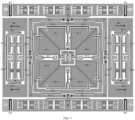
FIG. 2 is a schematic diagram illustrating a driving mode of the three-axis MEMS gyroscope inFIG. 1 ; -
FIG. 3 is a schematic diagram illustrating X-axis detection of the three-axis MEMS gyroscope inFIG. 1 ; -
FIG. 4 is a schematic diagram illustrating Y-axis detection of the three-axis MEMS gyroscope inFIG. 1 ; and -
FIG. 5 is a schematic diagram illustrating Z-axis detection of the three-axis MEMS gyroscope inFIG. 1 . - It should be understood that, in the description of the embodiments of the present disclosure, the terms such as "upper", "lower", "front", "back", "left", "right", "vertical", "horizontal", "top", "bottom", "inner", "outer", "clockwise", and "anticlockwise" are intended to indicate orientations or positional relations shown in the drawings. It should be noted that these terms are merely intended to facilitate a simple description of the present disclosure, rather than to indicate or imply that the mentioned apparatus or elements must have the specific orientation or be constructed and operated in the specific orientation. Therefore, these terms may not be construed as a limitation to the utility model. In the drawings, namely schematic diagrams or conceptual diagrams, the relationship between the thickness and width of each part, the proportional relationship among the parts, and the like are not completely consistent with their actual values.
-
FIG. 1 shows a structural diagram of a three-axis MEMS gyroscope in a preferred embodiment of the present disclosure. The three-axis MEMS gyroscope is overall symmetrical along an X axis and a Y axis (directions of the X axis, the Y axis, and a Z axis are shown inFIG. 1 , and an origin of coordinates is located at a center of the three-axis MEMS gyroscope in this embodiment). The three-axis MEMS gyroscope includes fixed anchors A1.1-A1.4, fixed anchors A2.1-A2.5, fixed anchor A3.1-A3.4, spring beams S1.1-S1.4, spring beams S2.1-S2.4, spring beams S3.1-53.8, spring beams S4.1-54.2, spring beams S5.1-55.2, spring beams S6.1-S6.8, spring beams S7.1-S7.8, spring beams S8.1-S8.4, spring beams S9.1-S9.4, rigid beams F1-F6, proof masses M1-M7, fixed electrodes E1.1-E1.16, fixed electrodes E2.1-E2.4, fixed electrodes E3.1-E3.4, and fixed electrodes E4.1-E4.4, where the fixed electrodes E3.1-E3.4 and the fixed electrodes E4.1-E4.4 are arranged at a bottom of the proof mass M7 at intervals (in a direction extending from a plane shown inFIG. 1 to a back side ofFIG. 1 ), and thus are expressed by dotted lines. - The fixed anchors A1.1-A1.4, the fixed anchors A2.1-A2.5, the fixed anchors A3.1-A3.4, the spring beams 51.1-51.4, the spring beams 52.1-52.4, the spring beams S3.1-S3.8, the spring beams S4.1-S4.2, the spring beams S5.1-S5.2, the spring beams S6.1-S6.8, the spring beams S7.1-S7.8, the spring beams 58.1-58.4, the spring beams S9.1-S9.4, the rigid beams F1-F6, and the proof masses M1-M7 are connected to one another to form a movable component PM of the gyroscope.
- The proof mass M1 and the proof mass M2 have the same structure and are symmetrical with respect to the X axis; the proof mass M1 is connected to the fixed anchor A1.1 through the spring beam S1.1 and connected to the fixed anchor A1.2 through the spring beam S1.2; comb structures are coordinately arranged between the fixed electrodes E1.1-E1.4 and the proof mass M1 to form capacitors CE1.1-CE1.4, and comb structures are coordinately arranged between the fixed electrodes E1.9-E1.12 and the proof mass M1 to form capacitors CE1.9-CE1.12.
- The proof mass M2 is connected to the fixed anchor A1.3 through the spring beam S1.3 and connected to the fixed anchor A1.4 through the spring beam S1.4; comb structures are coordinately arranged between the fixed electrodes E1.5-E1.8 and the proof mass M2 to form capacitors CE1.5-CE1.8, and comb structures are coordinately arranged between the fixed electrodes E1.13-E1.16 and the proof mass M1 to form capacitors CE1.13-CE1.16.
- In this embodiment, the spring beams S1.1-S1.4 have the same structure in a U shape open towards a direction parallel to the Y axis; the spring beam S1.1 and the spring beam S1.3 as well as the spring beam S1.2 and the spring beam S1.4 are symmetrical with respect to the X axis; and the spring beam S1.1 and the spring beam S1.2 as well as the spring beam S1.3 and the spring beam S1.4 are symmetrical with respect to the Y axis. The fixed anchor A1.1 and the fixed anchor A1.3 as well as the fixed anchor A1.2 and the fixed anchor A1.4 are symmetrical with respect to the X axis, and the fixed anchor A1.1 and the fixed anchor A1.2 as well as the fixed anchor A1.3 and the fixed anchor A1.4 are symmetrical with respect to the Y axis.
- The rigid beams F1-F4 have the same structure in an L shape. The rigid beam F1 and the rigid beam F3 as well as the rigid beam F2 and the rigid beam F4 are symmetrical with respect to the X axis, and the rigid beam F1 and the rigid beam F2 as well as the rigid beam F3 and the rigid beam F4 are symmetrical with respect to the Y axis. The rigid beam F1 is connected to the rigid beam F2 through the spring beam S4.1; the rigid beam F2 is connected to the rigid beam F4 through the spring beam S5.2; the rigid beam F3 is connected to the rigid beam F4 through the spring beam S4.2; and the rigid beam F3 is connected to the rigid beam F1 through the spring beam S5.1. In this embodiment, the spring beam S4.1 and the spring beam S4.2 have the same structure formed by combination of a T shape and an E shape, and are symmetrical with respect to the X axis; the spring beam S4.1 is connected to the proof mass M1; and the spring beam S4.2 is connected to the proof mass M2.
- In this embodiment, the spring beam S5.1 and the spring beam S5.2 have the same structure in an E shape and are symmetrical with respect to the Y axis; the spring beam S5.1 is connected to the proof mass M3; and the spring beam S5.2 is connected to the proof mass M4. The proof mass M3 and the proof mass M4 have the same structure symmetrical along the X axis, and are symmetrical with respect to the Y axis and arranged on two sides of a space defined by the rigid beams F1-F4.
- The rigid beam F5 of a hollow quadrilateral structure approximately is arranged in the space defined by the rigid beams F1-F4, and is overall symmetrical along the X axis and the Y axis; and the rigid beam F5 is connected to the rigid beam F1 through the spring beam S6.1 and the spring beam S6.5, connected to the rigid beam F2 through the spring beam S6.2 and the spring beam S6.7, connected to the rigid beam F3 through the spring beam S6.3 and the spring beam S6.6, and connected to the rigid beam F4 through the spring beam S6.4 and the spring beam S6.8. In this embodiment, the spring beams S6.1-S6.8 are all straight; the spring beams S6.1-56.4 are parallel to the X axis, and the spring beams S6.5-S6.8 are parallel to the Y axis; and the spring beams S6.1 and the spring beam S6.3 as well as the spring beam S6.2 and the spring beam S6.4, the spring beam S6.5 and the spring beam S6.6, and the spring beam S6.7 and the spring beam S6.8 are symmetrical with respect to the X axis; and the spring beam S6.1 and the spring beam S6.2 as well as the spring beam S6.3 and the spring beam S6.4, the spring beam S6.5 and the spring beam S6.7, and the spring beam S6.6 and the spring beam S6.8 are symmetrical with respect to the Y axis.
- The rigid beam F5 is connected to the fixed anchor A2.3, the fixed anchor A2.4, the fixed anchor A2.1, and the fixed anchor A2.2 sequentially through the spring beam S8.1, the spring beam S8.2, the spring beam S8.3, and the spring beam S8.4; and the fixed anchor A2.1 and the fixed anchor A2.2 are symmetrical with respect to the Y axis and located on the X axis, and the fixed anchor A2.3 and the fixed anchor A2.4 are symmetrical with respect to the X axis and located on the Y axis. In this embodiment, the spring beams S8.1-58.4 are all straight; the spring beam S8.1 and the spring beam S8.2 are symmetrical with respect to the X axis and located on the Y axis; and the spring beam S8.3 and the spring beam S8.4 are symmetrical with respect to the Y axis and located on the X axis.
- The proof mass M7 is arranged in the rigid beam F5 and is overall symmetrical along the X axis and the Y axis; a periphery of the proof mass M7 is connected to the rigid beam F5 through the spring beams S7.1-S7.8; and the spring beam S7.1 and the spring beam S7.2 are arranged close to the proof mass M1, the spring beam S7.3 and the spring beam S7.4 are arranged close to the proof mass M2, the spring beam S7.5 and the spring beam S7.6 are arranged close to the proof mass M3, and the spring beam S7.7 and the spring beam S7.8 are arranged close to the proof mass M4. In this embodiment, the spring beams 57.1-57.8 have the same structure in a U shape; U-shaped structures of the spring beam S7.1 and the spring beam S7.2 are open towards a negative direction of the Y axis; U-shaped structures of the spring beam 57.3 and the spring beam S7.4 are open towards a positive direction of the Y axis; U-shaped structures of the spring beam S7.5 and the spring beam S7.6 are open towards a positive direction of the X axis; U-shaped structures of the spring beam S7.7 and the spring beam S7.8 are open towards a negative direction of the X axis; the spring beam S7.1 and the spring beam S7.3 as well as the spring beam S7.2 and the spring beam S7.4, the spring beam S7.5 and the spring beam S7.6, and the spring beam S7.7 and the spring beam S7.8 are symmetrical with respect to the X axis; and the spring beam S7.1 and the spring beam S7.2 as well as the spring beam S7.3 and the spring beam S7.4, the spring beam S7.5 and the spring beam S7.7, and the spring beam S7.6 and the spring beam S7.8 are symmetrical with respect to the Y axis.
- The fixed electrodes E3.1-E3.4 and the fixed electrodes E4.1-E4.4 (expressed by the dotted lines) have the same structure and are arranged at the bottom of the proof mass M7 at intervals; the fixed electrode E3.1 and the fixed electrode E3.3 as well as the fixed electrode E3.2 and the fixed electrode E3.4, the fixed electrode E4.1 and the fixed electrode E4.2, and the fixed electrode E4.3 and the fixed electrode E4.4 are symmetrical with respect to the X axis; and the fixed electrode E3.1 and the fixed electrode E3.2 as well as the fixed electrode E3.3 and the fixed electrode E3.4, the fixed electrode E4.1 and the fixed electrode E4.3, and the fixed electrode E4.2 and the fixed electrode E4.4 are symmetrical with respect to the Y axis. Capacitors CE.31-CE3.4 are formed by the fixed electrodes E3.1-E3.4 and the proof mass M7, and capacitors CE4.1-CE4.4 are formed by the fixed electrodes E4.1-E4.4 and the proof mass M7.
- The rigid beam F6 is arranged in the proof mass M7 and is overall symmetrical along the X axis and the Y axis; and the rigid beam F6 is connected to the fixed anchor A2.5 through the spring beam S9.1 and the spring beam S9.2, and connected to the proof mass M7 through the spring beam S9.3 and the spring beam S9.4.
- The fixed anchor A2.5 is arranged in the rigid beam F6, and is overall symmetrical along the X axis and the Y axis; the fixed anchor A2.5 is located at the center of the three-axis MEMS gyroscope in this embodiment; and a central point of the fixed anchor A2.5 is just the origin of an X-Y-Z coordinate system in this embodiment.
- In this embodiment, the spring beams S9.1-59.4 are all straight; the spring beam S9.1 and the spring beam S9.2 are symmetrical with respect to the X axis and located on the Y axis; and the spring beam S9.3 and the spring beam S9.4 are symmetrical with respect to the Y axis and located on the X axis.
- The proof mass M5 in the proof mass M3 and the proof mass M6 in the proof mass M4 have the same structure symmetrical along the X axis, and are symmetrical with respect to the Y axis; the proof mass M5 is connected to the proof mass M3 through the spring beam S2.1 and the spring beam S2.2; and the proof mass M6 is connected to the proof mass M4 through the spring beam S2.3 and the spring beam S2.4. In this embodiment, the spring beams S2.1-S2.4 have the same structure in a U shape open towards a direction parallel to the X axis; the spring beam S2.1 and the spring beam S2.2 as well as the spring beam S2.3 and the spring beam S2.4 are symmetrical with respect to the X axis; and the spring beam S2.1 and the spring beam S2.3 as well as the spring beam S2.2 and the spring beam S2.4 are symmetrical with respect to the Y axis.
- The proof mass M5 is connected to the fixed anchor A3.1 through the spring beam S3.1 and the spring beam S3.2, and connected to the fixed anchor A3.2 through the spring beam S3.3 and the spring beam S3.4. The proof mass M6 is connected to the fixed anchor A3.3 through the spring beam S3.5 and the spring beam S3.6, and connected to the fixed anchor A3.4 through the spring beam S3.7 and the spring beam S3.8. The fixed anchors A3.1-A3.4 are located on the X axis, and the fixed anchor A3.1 and the fixed anchor A3.4 as well as the fixed anchor A3.2 and the fixed anchor A3.3 are symmetrical with respect to the Y axis. In this embodiment, the spring beams S3.1-53.8 are all straight and parallel to the Y axis; the spring beam S3.1 and the spring beam S3.2 as well as the spring beam S3.3 and the spring beam S3.4, the spring beam S3.5 and the spring beam S3.6, and the spring beam S3.7 and the spring beam S3.8 are symmetrical with respect to the X axis; and the spring beam S3.1 and the spring beam S3.7 as well as the spring beam S3.3 and the spring beam S3.5, the spring beam S3.2 and the spring beam S3.8, and the spring beam S3.4 and the spring beam S3.6 are symmetrical with respect to the Y axis.
- Comb structures are coordinately arranged between the fixed electrode E2.1 and the proof mass M5 and between the fixed electrode E2.2 and the proof mass M5 respectively to form a capacitor CE2.1 and a capacitor CE2.2. Comb structures are coordinately arranged between the fixed electrode E2.3 and the proof mass M6 and between the fixed electrode E2.4 and the proof mass M6 respectively to form a capacitor CE2.3 and a capacitor CE2.4.
- Potentials of the three-axis MEMS gyroscope in this embodiment are formed as follows:
The proof mass M1 and the driving proof mass M2 are set as driving proof masses. The capacitor CE1.1 and the capacitor CE1.4 which correspond to the driving proof mass M1 and the capacitor CE1.5 and the capacitor CE1.8 which correspond to the driving proof mass M2 constitute a driving capacitor C_DR1; the capacitor CE1.9 and the capacitor CE1.12 which correspond to the driving proof mass M1 and the capacitor CE1.13 and the capacitor CE1.16 which correspond to the driving proof mass M2 constitute a driving capacitor C_DR2; the capacitor CE1.2 and the capacitor CE1.3 which correspond to the driving proof mass M1 and the capacitor CE1.6 and the capacitor CE1.7 which correspond to the driving proof mass M2 constitute a driving detection capacitor C_DS1; and the capacitor CE1.10 and the capacitor CE1.11 which correspond to the driving proof mass M1 and the capacitor CE1.14 and the capacitor CE1.15 which correspond to the driving proof mass M2 constitute a driving detection capacitor C_DS2. - The proof mass M7 is set as an X-axis detection proof mass. The capacitor CE4.1 corresponding to the fixed electrode E4.1 and the capacitor CE4.2 corresponding to the fixed electrode E4.2 constitute an X-axis detection capacitor C_X1, and the capacitor CE4.3 corresponding to the fixed electrode E4.3 and the capacitor CE4.4 corresponding to the fixed electrode E4.4 constitute an X-axis detection capacitor C_X2.
- The proof mass M7 is also set as a Y-axis detection proof mass. The capacitor CE3.1 corresponding to the fixed electrode E3.1 and the capacitor CE3.2 corresponding to the fixed electrode E3.2 constitute a Y-axis detection capacitor C_Y1, and the capacitor CE3.3 corresponding to the fixed electrode E3.3 and the capacitor CE3.4 corresponding to the fixed electrode E3.4 constitute a Y-axis detection capacitor C_Y2.
- The proof mass M5 and the proof mass M6 are set as Z-axis detection proof masses. The capacitor CE2.1 corresponding to the fixed electrode E2.1 and the capacitor CE2.4 corresponding to the fixed electrode E2.4 constitute a Z-axis detection capacitor C_Z1, and the capacitor CE2.2 corresponding to the fixed electrode E2.2 and the capacitor CE2.3 corresponding to the fixed electrode E2.3 constitute a Z-axis detection capacitor C_Z2.
- In terms of functions, the three-axis MEMS gyroscope in this embodiment is designed to have a driving part, an X-axis detection part, a Y-axis detection part and a Z-axis detection part. The details are as follows:
FIG. 2 shows a schematic diagram illustrating a driving mode of the three-axis MEMS gyroscope in this embodiment. When alternating voltages in opposite directions are applied to both ends of the driving capacitor C_DR1 and both ends of the driving capacitor C_DR2, alternating electrostatic forces are generated, so that the proof mass M1 and the proof mass M2 reciprocate in an X-axis direction. The proof mass M1 is connected to the rigid beam F1 and the rigid beam F2 through the spring beam S4.1, and the proof mass M2 is connected to the rigid beam F3 and the rigid beam F4 through the spring beam S4.2, so that the rigid beams F1-F4 are driven to move; and the rigid beams F1-F4 are connected to the rigid beam F5 through the spring beams S6.1-S6.8, so that the rigid beam F5 is driven to move during movement of the rigid beams F1-F4. The rigid beam F5 is connected to the fixed anchor A2.3, the fixed anchor A2.4, the fixed anchor A2.1, and the fixed anchor A2.2 sequentially through the spring beam S8.1, the spring beam S8.2, the spring beam S8.3, and the spring beam S8.4, such that a movement direction of the rigid beam F5 is limited. Therefore, the rigid beams F1-F4 and the rigid beam F5 can move only with the structural center as a center of a circle, that is, the rigid beams F1-F4 and the rigid beam F5 clockwise or counterclockwise rotate around the fixed anchor A2.5. The rigid beam F5 is connected to the X-axis/Y-axis detection proof mass M7 through the spring beams S7.1-S7.8, so that the X-axis/Y-axis detection proof mass M7 is driven to clockwise or counterclockwise rotate around the structural center when the driving proof mass M1 and the driving proof mass M2 reciprocate in the X-axis direction. - The rigid beam F1and the rigid beam F3 are connected to the Z-axis Coriolis force proof mass M3 through the spring beam S5.1, and the rigid beam F2 and the rigid beam F4 are connected to the Z-axis Coriolis force proof mass M4 through the spring beam S5.2, so that the Z-axis Coriolis force proof mass M3 and the Z-axis Coriolis force proof mass M4 are driven to move when the rigid beams F1-F4 clockwise or counterclockwise rotate around the fixed anchor A2.5. The Z-axis Coriolis force proof mass M3 is connected to the Z-axis detection proof mass M5 through the spring beam S2.1 and the spring beam S2.2, the Z-axis Coriolis force proof mass M4 is connected to the Z-axis detection proof mass M6 through the spring beam S2.3 and the spring beam S2.4, and the spring beams 52.1-52.4 in the U shape have high rigidity in the X-axis direction and low rigidity in the Y-axis direction, such that the Z-axis Coriolis force proof mass M3 and the Z-axis Coriolis force proof mass M4 can move only in the Y-axis direction. In addition, the Z-axis Coriolis force proof mass M3 can be decoupled from the Z-axis detection proof mass M5 through the spring beam S2.1 and the spring beam S2.2, and the Z-axis Coriolis force proof mass M4 can be decoupled from the Z-axis detection proof mass M6 through the spring beam S2.3 and the spring beam S2.4; and in a case of decoupling, the Z-axis detection proof mass M5 and the Z-axis detection proof mass M6 are not driven to move during movement of the Z-axis Coriolis force proof mass M3 and the Z-axis Coriolis force proof mass M4.
- Preferably, in order to accurately control a driving amplitude, the driving detection capacitor C_DS1 and the driving detection capacitor C_DS2 are structurally adopted to calibrate the driving amplitude.
-
FIG. 3 shows a schematic diagram illustrating X-axis detection of the three-axis MEMS gyroscope in this embodiment. When an angular velocity is input around the X axis, the X-axis/Y-axis detection proof mass M7 clockwise or counterclockwise rotating around the structural center is subjected to a Coriolis force around the X axis. In this case, the X-axis/Y-axis detection proof mass M7 is forced to rotationally reciprocate around a Y-direction axis, namely a horizontal line defined by the spring beam S8.1, the spring beam S8.2, the spring beam S9.1, and the spring beam S9.2, and outside a plane defined by the X axis and the Y axis; and under the circumstance, the distance from the X-axis/Y-axis detection proof mass M7 to the fixed electrode E4.1 and the fixed electrode E4.2 and the distance from the X-axis/Y-axis detection proof mass M7 to the fixed electrode E4.3 and the fixed electrode E4.4 are changed oppositely, so that the capacitor C_X1 and the capacitor C_X2 are changed in a manner that one is increased and the other is decreased. The angular velocity input around the X axis can be calculated by means of a subsequent difference channel. -
FIG. 4 shows a schematic diagram illustrating Y-axis detection of the three-axis MEMS gyroscope in this embodiment. When an angular velocity is input around the Y axis is input, the X-axis/Y-axis detection proof mass M7 clockwise or counterclockwise rotating around the structural center is subjected to a Coriolis force around the Y axis. In this case, the X-axis/Y-axis detection proof mass M7 is forced to rotationally reciprocate around an X-direction axis, namely a horizontal line defined by the spring beam S8.3, the spring beam S8.4, the spring beam S9.3, and the spring beam S9.4, and outside the plane defined by the X axis and the Y axis; and under the circumstance, the distance from the X-axis/Y-axis detection proof mass M7 to the fixed electrode E3.1 and the fixed electrode E3.2 and the distance from the X-axis/Y-axis detection proof mass M7 to the fixed electrode E3.3 and the fixed electrode E3.4 are changed oppositely, so that the capacitor C_Y1 and the capacitor C_Y2 are changed in a manner that one is increased and the other is decreased. The angular velocity input around the Y axis can be calculated by means of the subsequent difference channel. -
FIG. 5 shows a schematic diagram illustrating Z-axis detection of the three-axis MEMS gyroscope in this embodiment. When an angular velocity is input around the Z axis, the Z-axis Coriolis force proof mass M3 and the Z-axis Coriolis force proof mass M4 which reciprocate in the Y-axis direction are subjected to a Coriolis force around the X axis. In this case, the Z-axis Coriolis force proof mass M3 and the Z-axis Coriolis force proof mass M4 are forced to reciprocate in the X-axis direction; and at the same time, the Z-axis detection proof mass M5 is driven by the Z-axis Coriolis force proof mass M3 through the spring beam S2.1 and the spring beam S2.2 to reciprocate in the X-axis direction, and the Z-axis detection proof mass M6 is driven by the Z-axis Coriolis force proof mass M4 through the spring beam S2.3 and the spring beam S2.4 to reciprocate in the X-axis direction. With movement directions (indicated by arrows) of the Z-axis Coriolis force proof mass M3 and the Z-axis Coriolis force proof mass M4 inFIG. 5 as an example, when the Z-axis detection proof mass M5 and the Z-axis detection proof mass M6 move towards two opposite sides, the distance from the Z-axis detection proof mass M5 to the fixed electrode E2.1 and the distance from the Z-axis detection proof mass M6 to the fixed electrode E2.4 are increased, such that the Z-axis detection capacitor C_Z1 is decreased; and the distance from the Z-axis detection proof mass M5 to the fixed electrode E2.2 and the distance from the Z-axis detection proof mass M6 to the fixed electrode E2.3 are decreased, such that the Z-axis detection capacitor C_Z2 is increased, and vice versa. The angular velocity input around the Z axis can be calculated by means of the subsequent difference channel. - The implementation and effects of this embodiment are further explained below.
- To achieve stability and consistency of a structure and an output, in the driving mode or the detection mode, any movement state of other structural parts is not expected to be affected. Therefore, it is necessary to fulfill the decoupling of the driving parts and the detection parts during movement.
- In the driving mode, as the rigid beam F1 and the rigid beam F3 are connected to the Z-axis Coriolis force proof mass M3 through the spring beam S5.1, and the rigid beam F2 and the rigid beam F4 are connected to the Z-axis Coriolis force proof mass M4 through the spring beam S5.2, the Z-axis Coriolis force proof mass M3 and the Z-axis Coriolis force proof mass M4 are driven to move when the rigid beams F1-F4 clockwise or counterclockwise rotate around the fixed anchor A2.5. The Z-axis Coriolis force proof mass M3 is connected to the Z-axis detection proof mass M5 through the spring beam S2.1 and the spring beam S2.2, and the Z-axis Coriolis force proof mass M4 is connected to the Z-axis detection proof mass M6 through the spring beam S2.3 and the spring beam S2.4. The Z-axis detection proof mass M5 is connected to the fixed anchors A2.1-A2.4 through the spring beams S3.1-S3.4, and the Z-axis detection proof mass M6 is connected to the fixed anchors A2.1-A2.4 through the spring beams S3.5-S3.8. With the Z-axis detection proof mass M5 as an example, the fixed anchor A3.1 and the fixed anchor A3.2 are located on two sides of the Z-axis detection proof mass M5; the spring beam S3.1 and the spring beam S3.2 are located on two sides of the fixed anchor A3.1 and connected to the Z-axis detection proof mass M5, and the spring beam S3.3 and the spring beam S3.4 are located on two sides of the fixed anchor A3.2 and connected to the Z-axis detection proof mass M5; and the straight spring beams S3.1-53.4 have no elasticity in the Y-axis direction, such that the Z-axis detection proof mass M5 is restricted from horizontally moving in the Y-axis direction and rotating within the plane defined by the X axis and the Y axis.
- Similarly, the Z-axis detection proof mass M6 can move only in the X-axis direction, and is restricted from horizontally moving in the Y-axis direction and rotating within the plane defined by the X axis and the Y axis.
- According to the above description, by means of the Z-axis Coriolis force proof mass M3, the Z-axis Coriolis force proof mass M4, the spring beams S2.1-S2.4, and the spring beams S3.1-53.8, the decoupling of the Z-axis detection proof masses from the driving part is fulfilled; that is, the Z-axis detection proof masses do not move in the driving mode.
- In a Z-axis detection mode, the Z-axis Coriolis force proof mass M3 and the Z-axis Coriolis force proof mass M4 are subjected to the Coriolis force in the X-axis direction. In this case, the Z-axis Coriolis force proof mass M3 and the Z-axis Coriolis force proof mass M4 are forced to reciprocate in the X-axis direction; and at the same time, the Z-axis detection proof mass M5 is driven by the Z-axis Coriolis force proof mass M3 through the spring beam S2.1 and the spring beam S2.2 to reciprocate in the X-axis direction, and the Z-axis detection proof mass M6 is driven by the Z-axis Coriolis force proof mass M4 through the spring beam S2.3 and the spring beam S2.4 to reciprocate in the X-axis direction. The Z-axis Coriolis force proof mass M3 is connected to the coupled rigid beams F1-F4 through the spring beam S5.1, and the Z-axis Coriolis force proof mass M4 is connected to the coupled rigid beams F1-F4 through the spring beam S5.2. As shown in
FIG. 5 , when the Z-axis Coriolis force proof mass M3 and the Z-axis Coriolis force proof mass M4 move leftwards and rightwards respectively in the X-axis direction, the spring beam S5.1 and the spring beam S5.2 are driven to move leftwards and rightwards respectively; and at the same time, as the spring beam S5.1 and the spring beam S5.2 are connected to the rigid beams F1-F4, connected sections are also driven to move leftwards and rightwards respectively. With the rigid beam F1 as an example, the L-shaped rigid beam F1 has an inflection point connected to the rigid beam F5 through the spring beam S6.1 and the spring beam S6.5. The rigid beam F5 is connected to the fixed anchor A2.3, the fixed anchor A2.4, the fixed anchor A2.1, and the fixed anchor A2.2 sequentially through the spring beam S8.1, the spring beam S8.2, the spring beam S8.3, and the spring beam S8.4, and thus is restricted from horizontally moving in the X-axis direction and the Y-axis direction. Accordingly, the rigid beam F1 connected to the rigid beam F5 through the spring beam S6.1 and the spring beam S6.5 is also restricted from horizontally moving in the X-axis direction and the Y-axis direction. Therefore, the rigid beam F1 rotates around the inflection point instead of horizontally moving in the X-axis direction integrally when leftwards pulled by the spring beam S5.1. Similarly, the rigid beams F2-F4 all rotate around their inflection points in the Z-axis detection mode. With rotation of the rigid beams F1-F4, junctions of the rigid beams F1-F4 and the spring beam S4.1 as well as junctions of the rigid beams F1-F4 and the spring beam S4.2 move downwards or upwards, such that a spring connecting the spring beam S4.1 and the driving proof mass M1 as well as a spring connecting the spring beam S4.2 and the driving proof mass M2 is bent. The driving proof mass M1 is connected to the fixed anchor A1.1 through the spring beam S1.1 and connected to the fixed anchor A1.2 through the spring beam 51.2, and the driving proof mass M2 is connected to the fixed anchor A1.3 through the spring beam S1.3 and connected to the fixed anchor A1.4 through the spring beam S1.4; and in this way, the driving proof mass M1 and the driving proof mass M2 can freely move only in the X-axis direction, and are restricted from moving in the Y-axis direction. From the above, the driving part does not move with the movement in the Z-axis detection mode, so that the decoupling of the driving part from the Z-axis detection part is fulfilled. - In the Z-axis detection mode, the Z-axis Coriolis force proof mass M3 and the Z-axis Coriolis force proof mass M4 are subjected to the Coriolis force in the X-axis direction. In this case, the Z-axis Coriolis force proof mass M3 and the Z-axis Coriolis force proof mass M4 are forced to reciprocate in the X-axis direction; and at the same time, the Z-axis detection proof mass M5 is driven by the Z-axis Coriolis force proof mass M3 through the spring beam S2.1 and the spring beam S2.2 to reciprocate in the X-axis direction, and the Z-axis detection proof mass M6 is driven by the Z-axis Coriolis force proof mass M4 through the spring beam S2.3 and the spring beam S2.4 to reciprocate in the X-axis direction. The Z-axis Coriolis force proof mass M3 is connected to the coupled rigid beams F1-F4 through the spring beam S5.1, and the Z-axis Coriolis force proof mass M4 is connected to the coupled rigid beams F1-F4 through the spring beam S5.2. As shown in
FIG. 5 , when the Z-axis Coriolis force proof mass M3 and the Z-axis Coriolis force proof mass M4 move leftwards and rightwards respectively in the X-axis direction, the spring beam S5.1 and the spring beam S5.2 are driven to move leftwards and rightwards respectively; and at the same time, as the spring beam S5.1 and the spring beam 55.2 are connected to the rigid beams F1-F4, connected sections are also driven to move leftwards and rightwards respectively. With the rigid beam F1 as an example, the L-shaped rigid beam F1 has the inflection point connected to the rigid beam F5 through the spring beam S6.1 and the spring beam S6.5. The rigid beam F5 is connected to the fixed anchor A2.3, the fixed anchor A2.4, the fixed anchor A2.1, and the fixed anchor A2.2 sequentially through the spring beam S8.1, the spring beam S8.2, the spring beam S8.3, and the spring beam S8.4, and the spring beam S8.2, and thus is restricted from horizontally moving in the X-axis direction and the Y-axis direction. Accordingly, the rigid beam F5 does not move in the Z-axis detection mode, so that the X-axis/Y-axis detection proof mass M7 connected to the rigid beam F5 does not move with the movement in the Z-axis detection mode. Therefore, the decoupling of the X-axis/Y-axis detection part from the Z-axis detection part is fulfilled. - When the angular velocity is input around the X axis or the Y axis, the X-axis/Y-axis detection proof mass M7 is subjected to the Coriolis force around the X axis or the Y axis. In this case, the X-axis/Y-axis detection proof mass M7 rotationally reciprocates around a horizontal line defined by the spring beam S9.1 and the spring beam S9.2, or the spring beam 59.3 and the spring beam S9.4, and outside the plane defined by the X axis and the Y axis. As the spring beams S7.1-S7.8 are in a wide U shape, ends, connected to the X-axis/Y-axis detection proof mass M7, of the spring beams S7.1-57.8 are deformed when subjected to a force in the Z-axis direction, so that the other ends, connected to the rigid beam F5, of the spring beams S7.1-S7.8 do not move obviously; and the rigid beam F5 is connected to the fixed anchor A2.3, the fixed anchor A2.4, the fixed anchor A2.1, and the fixed anchor A2.2 sequentially through the spring beam S8.1, the spring beam S8.2, the spring beam S8.3, and the spring beam S8.4, and thus is restricted from moving in the Z-axis direction. From the above, the rigid beam F5 does not move in an X-axis detection mode or Y-axis detection mode, and no movement of the rigid beam F5 is transferred out, so that the decoupling of the driving part and the Z-axis detection part from the X-axis/Y-axis detection part is fulfilled.
- To achieve stability of output of the detection part, the detection part of the three-axis MEMS gyroscope is of a differential structure in general, that is, two capacitors exist. When the angular velocity is input, one capacitor is increased, and the other capacitor is decreased. A difference value of the two capacitors is obtained by means of the subsequent difference channel, so that the input angular velocity can be calculated. To make two differential structures move in opposite directions with the same amplitude, a coupling structure for achieving symmetry and movement consistency of the differential structures is needed.
- In the Z-axis detection mode, the Z-axis Coriolis force proof mass M3 and the Z-axis Coriolis force proof mass M4 are subjected to the Coriolis force in the X-axis direction. In this case, the Z-axis Coriolis force proof mass M3 and the Z-axis Coriolis force proof mass M4 are forced to reciprocate in the X-axis direction; and at the same time, the Z-axis detection proof mass M5 is driven by the Z-axis Coriolis force proof mass M3 through the spring beam S2.1 and the spring beam S2.2 to reciprocate in the X-axis direction, and the Z-axis detection proof mass M6 is driven by the Z-axis Coriolis force proof mass M4 through the spring beam S2.3 and the spring beam S2.4 to reciprocate in the X-axis direction. The Z-axis Coriolis force proof mass M3 is connected to the coupled rigid beams F1-F4 through the spring beam S5.1, and the Z-axis Coriolis force proof mass M4 is connected to the coupled rigid beams F1-F4 through the spring beam S5.2. As shown in
FIG. 5 , when the Z-axis Coriolis force proof mass M3 and the Z-axis Coriolis force proof mass M4 move leftwards and rightwards respectively in the X-axis direction, the spring beam S5.1 and the spring beam S5.2 are driven to move leftwards and rightwards respectively; and at the same time, as the spring beam S5.1 and the spring beam S5.2 are connected to the rigid beams F1-F4, connected sections are also driven to move leftwards and rightwards respectively. With the rigid beam F1 as an example, the L-shaped rigid beam F1 has the inflection point connected to the rigid beam F5 through the spring beam S6.1 and the spring beam S6.5. The rigid beam F5 is connected to the fixed anchor A2.3, the fixed anchor A2.4, the fixed anchor A2.1, and the fixed anchor A2.2 sequentially through the spring beam S8.1, the spring beam S8.2, the spring beam S8.3, and the spring beam S8.4, and thus is restricted from horizontally moving in the X-axis direction and the Y-axis direction. Accordingly, the rigid beam F1 connected to the rigid beam F5 through the spring beam S6.1 and the spring beam S6.5 is also restricted from horizontally moving in the X-axis direction and the Y-axis direction. Therefore, the rigid beam F1 rotates around the inflection point instead of horizontally moving in the X-axis direction integrally when leftwards pulled by the spring beam S5.1. Similarly, the rigid beams F2-F4 all rotate around their inflection points in the Z-axis detection mode. In the Z-axis detection mode, the Z-axis Coriolis force proof mass M3 and the Z-axis Coriolis force proof mass M4 move leftwards and rightwards respectively in the X-axis direction. As shown inFIG. 5 , when the Z-axis Coriolis force proof mass M3 moves leftwards, the junction of the rigid beam F1 and the spring beam S4.1 moves downwards; the rigid beam F2 moves in the same way with the same amplitude by means of the spring beam S4.1, so that the rigid beam F1 and the rigid beam F2 move in the same direction with the same amplitude. However, the rigid beam F2 is connected to the Z-axis Coriolis force proof mass M4 through the spring beam S5.2, resulting in restriction on a movement state of the rigid beam F2. Therefore, stability of left-right movement of the Z-axis Coriolis force proof mass M3 and the Z-axis Coriolis force proof mass M4 is achieved. When the Z-axis Coriolis force proof mass M3 moves leftwards, as the rigid beam F1 is connected to the rigid beam F3 through the spring beam S5.1, the rigid beam F1 and the rigid beam F3 move in the same direction with the same amplitude by means of the spring beam S5.1. Similarly, the rigid beam F2 is connected to the rigid beam F4 through the spring beam S5.2, so that the rigid beam F2 and the rigid beam F4 move in the same direction with the same amplitude by means of the spring beam S5.2. In this way, the rigid beams F1-F4 move with the same amplitude on the Y-axis direction, so that the Z-axis Coriolis force proof mass M3 and the Z-axis Coriolis force proof mass M4 have no additional movement in the Y-axis direction. From the above, by means of the rigid beams F1-F4, the Z-axis Coriolis force proof masses move only in the X-axis direction in a case where a Z-axis angular velocity is input; and moreover, the Z-axis Coriolis force proof masses move in opposite directions with the same amplitude. Therefore, the Z-axis detection proof mass M5 and the Z-axis detection proof mass M6 are driven to move in a completely same way, so as to achieve a coupling effect. - In addition, in the detection parts of the three-axis MEMS gyroscope in this embodiment, to reduce volume of a chip and area of the proof masses to a greater extent, the rigid beam F6 and the spring beams S9.1-59.4 are coordinately arranged, so that the proof masses can not only rotate around the X axis, namely a straight line defined by the spring beam S9.3 and the spring beam S9.4, but also rotate around the Y axis, namely the straight line defined by the spring beam S9.1 and the spring beam S9.2. In this way, the X-axis detection proof mass and the Y-axis detection proof mass are combined to form the X-axis/Y-axis detection proof mass M7, so that the area utilization rate of the detection proof masses is effectively improved.
- The foregoing is detailed description of the preferred specific embodiments of the present disclosure. It should be understood that a person of ordinary skill in the art can make various modifications and variations according to the concept of the present disclosure without creative efforts.
Claims (6)
- A three-axis microelectromechanical system (MEMS) gyroscope, comprising:driving proof masses (M1, M2) configured to move in an X-axis direction;Z-axis detection proof masses (M5, M6) configured to move in the X-axis direction, characterized in that the three-axis MEMS gyroscope further comprises:an X-axis/Y-axis detection proof mass (M7) configured to rotate around an X-direction axis, a Y-direction axis, and a Z-direction axis;Z-axis Coriolis force proof masses (M3, M4) configured to move in the X-axis direction and a Y-axis direction; wherein the Z-axis Coriolis force proof masses (M3, M4) are connected to the Z-axis detection proof masses (M5, M6) through spring beams (S2.1-S2.4); and when the Z-axis Coriolis force proof masses (M3, M4) move in the X-axis direction, the Z-axis detection proof masses (M5, M6) are configured to be driven by the spring beams (S2.1-S2.4) to move in the X-axis direction;first rigid beams (F1-F4), wherein the first rigid beams (F1-F4) are respectively connected to the driving proof masses (M1, M2) and the Z-axis Coriolis force proof masses (M3, M4) through spring beams (S4.1-S4.2, S5.1-55.2); and when the driving proof masses (M1, M2) move in the X-axis direction, the first rigid beams (F1-F4) are configured to be driven to move, and the Z-axis Coriolis force proof masses (M3, M4) are configured to be driven by the first rigid beams (F1-F4) to move in the Y-axis direction;a second rigid beam (F5), wherein the second rigid beam (F5) is respectively connected to the X-axis/Y-axis detection proof mass (M7) and the first rigid beams (F1-F4) through spring beams (S7.1-S7.8, S6.1-S6.8); and when the driving proof masses (M1, M2) move in the X-axis direction, the first rigid beams (F1-F4) are configured to be driven to rotate around the Z-direction axis, the second rigid beam (F5) is configured to be driven by the first rigid beams (F1-F4) to rotate around the Z-direction axis, and the X-axis/Y-axis detection proof mass (M7) is configured to be driven by the second rigid beam (F5) to rotate around the Z-direction axis; anda third rigid beam (F6), wherein the third rigid beam (F6) is respectively connected to the X-axis/Y-axis detection proof mass (M7) through spring beams (S9.3-S9.4) along the X-direction axis and to a central fixed anchor (A2.5) through spring beams (S9.1-S9.2) along the Y-direction axis; wherein a central point of the central fixed anchor (A2.5) is located on the origin of X-Y-Z coordinate system, so that the X-axis/Y-axis detection proof mass (M7) is fit to rotate around the X-direction axis and the Y-direction axis.
- The three-axis MEMS gyroscope according to claim 1, characterized in that the first rigid beams (F1-F4) comprise a plurality of sub-beams, wherein a joint of the first rigid beams (F1-F4) and the driving proof masses (M1, M2) is set to connect two of the plurality of sub-beams to the driving proof masses (M1, M2) through one spring beam (S4.1-S4.2); a joint of the first rigid beams (F1-F4) and the Z-axis Coriolis force proof masses (M3, M4) is set to connect two of the plurality of sub-beams to the Z-axis Coriolis force proof masses (M3, M4) through one spring beam (S5.1-55.2); and the plurality of sub-beams are sequentially connected end to end.
- The three-axis MEMS gyroscope according to claim 1, characterized in that the second rigid beam (F5) is further connected to a fixed anchor (A2.1-A2.4) through a spring beam (S8.1-S8.4), and the second rigid beam (F5) is restricted from moving in the X-axis direction and the Y-axis direction.
- The three-axis MEMS gyroscope according to claim 1, characterized in that the Z-axis detection proof masses (M5, M6) are further connected to fixed anchors (A3.1-A3.4) through spring beams (S3.1-S3.8), and the Z-axis detection proof masses (M5, M6) are configured to move in the X-axis direction, and restricted from moving in the Y-axis direction.
- The three-axis MEMS gyroscope according to claim 1, characterized by further comprising a first fixed electrode (E3.1-E3.4) and a second fixed electrode (E4.1-E4.4), wherein the first fixed electrode (E3.1-E3.4) and the second fixed electrode (E4.1-E4.4) coordinate with the X-axis/Y-axis detection proof mass (M7) to form corresponding detection capacitors, which are respectively configured to perform detection when the X-axis/Y-axis detection proof mass (M7) rotates around the X-direction axis and around the Y-direction axis.
- The three-axis MEMS gyroscope according to claim 1, characterized by further comprising third fixed electrodes (E2.1-E2.4), wherein the third fixed electrodes (E2.1-E2.4) coordinate with the Z-axis detection proof masses (M5, M6) to form detection capacitors
Applications Claiming Priority (2)
| Application Number | Priority Date | Filing Date | Title |
|---|---|---|---|
| CN201911240938.XA CN110926445B (en) | 2019-12-06 | 2019-12-06 | Three-axis MEMS gyroscope |
| PCT/CN2020/082892 WO2021109378A1 (en) | 2019-12-06 | 2020-04-02 | Three-axis mems gyroscope |
Publications (4)
| Publication Number | Publication Date |
|---|---|
| EP4060287A1 EP4060287A1 (en) | 2022-09-21 |
| EP4060287A4 EP4060287A4 (en) | 2023-02-01 |
| EP4060287C0 EP4060287C0 (en) | 2024-07-10 |
| EP4060287B1 true EP4060287B1 (en) | 2024-07-10 |
Family
ID=69858143
Family Applications (1)
| Application Number | Title | Priority Date | Filing Date |
|---|---|---|---|
| EP20896595.4A Active EP4060287B1 (en) | 2019-12-06 | 2020-04-02 | Three-axis mems gyroscope |
Country Status (4)
| Country | Link |
|---|---|
| US (1) | US11639852B2 (en) |
| EP (1) | EP4060287B1 (en) |
| CN (1) | CN110926445B (en) |
| WO (1) | WO2021109378A1 (en) |
Families Citing this family (10)
| Publication number | Priority date | Publication date | Assignee | Title |
|---|---|---|---|---|
| CN110926445B (en) * | 2019-12-06 | 2022-03-08 | 深迪半导体(绍兴)有限公司 | Three-axis MEMS gyroscope |
| CN113203405B (en) * | 2021-05-24 | 2024-10-29 | 美新半导体(天津)有限公司 | A three-axis gyroscope |
| CN113218381B (en) * | 2021-05-24 | 2025-04-04 | 美新半导体(天津)有限公司 | A three-axis gyroscope |
| CN113203404B (en) * | 2021-05-24 | 2025-04-04 | 美新半导体(天津)有限公司 | Triaxial gyroscope |
| CN113203403B (en) * | 2021-05-24 | 2024-12-03 | 美新半导体(天津)有限公司 | A three-axis gyroscope |
| CN114526718B (en) * | 2022-02-11 | 2023-04-11 | 绍兴圆方半导体有限公司 | Gyroscope |
| CN116660570A (en) * | 2022-02-18 | 2023-08-29 | 华为技术有限公司 | Angular velocity sensors, inertial sensors and electronics |
| US12504283B2 (en) * | 2022-05-17 | 2025-12-23 | Murata Manufacturing Co., Ltd. | MEMS gyroscope sensing in-plane rotations |
| CN116659479A (en) * | 2023-05-06 | 2023-08-29 | 瑞声开泰科技(武汉)有限公司 | Micromechanical gyroscope and electronic product |
| CN119354167B (en) * | 2024-12-25 | 2025-02-28 | 河北美泰电子科技有限公司 | Triaxial integrated MEMS gyroscope structure and manufacturing method thereof |
Family Cites Families (30)
| Publication number | Priority date | Publication date | Assignee | Title |
|---|---|---|---|---|
| DE10203515A1 (en) * | 2002-01-30 | 2003-08-07 | Bosch Gmbh Robert | Micromechanical rotation rate sensor |
| US7377167B2 (en) | 2004-02-27 | 2008-05-27 | The Regents Of The University Of California | Nonresonant micromachined gyroscopes with structural mode-decoupling |
| US8113050B2 (en) * | 2006-01-25 | 2012-02-14 | The Regents Of The University Of California | Robust six degree-of-freedom micromachined gyroscope with anti-phase drive scheme and method of operation of the same |
| CN1948906B (en) * | 2006-11-10 | 2011-03-23 | 北京大学 | Capacitive type complete decoupling horizontal axis miniature mechanical gyro |
| US7934423B2 (en) * | 2007-12-10 | 2011-05-03 | Invensense, Inc. | Vertically integrated 3-axis MEMS angular accelerometer with integrated electronics |
| US8322213B2 (en) * | 2009-06-12 | 2012-12-04 | The Regents Of The University Of California | Micromachined tuning fork gyroscopes with ultra-high sensitivity and shock rejection |
| US8534127B2 (en) * | 2009-09-11 | 2013-09-17 | Invensense, Inc. | Extension-mode angular velocity sensor |
| US8549915B2 (en) * | 2009-10-23 | 2013-10-08 | The Regents Of The University Of California | Micromachined gyroscopes with 2-DOF sense modes allowing interchangeable robust and precision operation |
| ITTO20091042A1 (en) | 2009-12-24 | 2011-06-25 | St Microelectronics Srl | MICROELETTROMECHANICAL INTEGRATED GYROSCOPE WITH IMPROVED DRIVE STRUCTURE |
| CN102221361B (en) * | 2011-05-20 | 2013-04-03 | 西北工业大学 | Capacitive micro machinery gyroscope |
| CN102798386A (en) * | 2011-05-25 | 2012-11-28 | 上海飞恩微电子有限公司 | Three-degree-of-freedom resonance silicon micromechanical gyroscope |
| CN103245340B (en) * | 2012-02-01 | 2016-07-13 | 苏州敏芯微电子技术股份有限公司 | A kind of single-chip tri-axial gyroscope |
| FI125695B (en) * | 2013-09-11 | 2016-01-15 | Murata Manufacturing Co | Improved gyroscope construction and gyroscope |
| US9404747B2 (en) | 2013-10-30 | 2016-08-02 | Stmicroelectroncs S.R.L. | Microelectromechanical gyroscope with compensation of quadrature error drift |
| CN203837718U (en) * | 2014-04-22 | 2014-09-17 | 东南大学 | Dual-mass silicon micro-vibration gyroscope |
| CN106066175B (en) * | 2015-04-24 | 2019-09-24 | 意法半导体股份有限公司 | Microelectromechanical gyroscope for sensing angular rate and method for sensing angular rate |
| CN104897147B (en) * | 2015-06-29 | 2017-12-29 | 歌尔股份有限公司 | A kind of MEMS three-axis gyroscopes |
| ITUA20161498A1 (en) * | 2016-03-09 | 2017-09-09 | St Microelectronics Srl | MICROMECHANICAL DETECTION STRUCTURE OF A MEMS SENSOR DEVICE, IN PARTICULAR OF A MEMS GYRO, WITH IMPROVED DRIVE CHARACTERISTICS |
| ITUA20162160A1 (en) * | 2016-03-31 | 2017-10-01 | St Microelectronics Srl | MICROMECHANICAL STRUCTURE FOR DETECTION OF A MEMS MULTI-FACTORY GYROSCOPE, HAVING REDUCED DERIVED FROM RELATED ELECTRICAL CHARACTERISTICS |
| CN107782298B (en) * | 2016-08-27 | 2023-09-29 | 深迪半导体(绍兴)有限公司 | Triaxial MEMS gyroscope |
| CN107782296B (en) * | 2016-08-27 | 2023-10-27 | 深迪半导体(绍兴)有限公司 | Triaxial MEMS gyroscope |
| CN107782297B (en) * | 2016-08-27 | 2023-08-18 | 深迪半导体(绍兴)有限公司 | Triaxial MEMS gyroscope |
| US10697994B2 (en) * | 2017-02-22 | 2020-06-30 | Semiconductor Components Industries, Llc | Accelerometer techniques to compensate package stress |
| CN107192384B (en) * | 2017-07-24 | 2022-04-05 | 深迪半导体(绍兴)有限公司 | MEMS triaxial gyroscope |
| CN108507555B (en) * | 2018-04-16 | 2024-04-05 | 四川知微传感技术有限公司 | MEMS micromechanical full decoupling closed-loop gyroscope |
| CN109737943B (en) * | 2019-03-12 | 2024-05-10 | 苏州感测通信息科技有限公司 | High-precision MEMS gyroscope |
| CN110307833B (en) * | 2019-06-27 | 2020-12-01 | 深迪半导体(上海)有限公司 | High-precision Z-axis gyroscope |
| CN110319822B (en) * | 2019-06-27 | 2020-12-01 | 深迪半导体(上海)有限公司 | High-sensitivity single-axis MEMS gyroscope |
| CN110926445B (en) * | 2019-12-06 | 2022-03-08 | 深迪半导体(绍兴)有限公司 | Three-axis MEMS gyroscope |
| US11193771B1 (en) * | 2020-06-05 | 2021-12-07 | Analog Devices, Inc. | 3-axis gyroscope with rotational vibration rejection |
-
2019
- 2019-12-06 CN CN201911240938.XA patent/CN110926445B/en active Active
-
2020
- 2020-04-02 WO PCT/CN2020/082892 patent/WO2021109378A1/en not_active Ceased
- 2020-04-02 US US17/781,724 patent/US11639852B2/en active Active
- 2020-04-02 EP EP20896595.4A patent/EP4060287B1/en active Active
Also Published As
| Publication number | Publication date |
|---|---|
| EP4060287A4 (en) | 2023-02-01 |
| EP4060287A1 (en) | 2022-09-21 |
| EP4060287C0 (en) | 2024-07-10 |
| CN110926445B (en) | 2022-03-08 |
| US11639852B2 (en) | 2023-05-02 |
| CN110926445A (en) | 2020-03-27 |
| US20230010336A1 (en) | 2023-01-12 |
| WO2021109378A1 (en) | 2021-06-10 |
Similar Documents
| Publication | Publication Date | Title |
|---|---|---|
| EP4060287B1 (en) | Three-axis mems gyroscope | |
| US11085767B2 (en) | Three-axis MEMS gyroscope | |
| EP2846132B1 (en) | Multiple sense axis MEMS gyroscope having a single drive mode | |
| CN104897147B (en) | A kind of MEMS three-axis gyroscopes | |
| CN102062604A (en) | Capacitive micromachined tuning fork gyroscope | |
| CN103900545B (en) | Monolithic integration holohedral symmetry three-axis silicon micro-tuning fork gyroscope | |
| US10598690B2 (en) | Microelectromechanical device incorporating a gyroscope and an accelerometer | |
| CN111623762A (en) | Annular array type four-mass coupling six-axis micro-inertial sensor and processing method thereof | |
| US11009350B2 (en) | Proof mass offset compensation | |
| CN107782299B (en) | Two-axis MEMS gyroscope | |
| CN104459203A (en) | Z-axis structure in accelerometer and triaxial accelerometer | |
| US11965739B2 (en) | MEMS gyroscope having an improved rejection of the quadrature error | |
| CN103900547A (en) | Monolithic integrated full-decoupling triaxial silicon microgyroscope | |
| CN105424020B (en) | A Sensitive Structure of Tuning Fork MEMS Gyro with Decoupling Function | |
| CN107782295A (en) | A Sensitive Structure of Tuning Fork MEMS Gyro with Frequency Modulation Function | |
| CN117629164A (en) | Single-axis gyroscope | |
| CN104677355B (en) | Virtual gyro and method based on Multi-sensor Fusion | |
| CN107782297B (en) | Triaxial MEMS gyroscope | |
| CN110702088B (en) | Wheel type double-shaft micromechanical gyroscope | |
| CN104459204B (en) | Inertia measuring module and three axis accelerometer | |
| CN102116622B (en) | Heartbeat type single structure three-axis micro-electromechanical gyroscope | |
| CN106153026B (en) | A tuning-fork micro-electromechanical gyroscope | |
| CN118836838A (en) | Full decoupling angular rate sensor | |
| CN120063238A (en) | Gyroscope structure, chip, gyroscope and electronic equipment | |
| WO2023155637A1 (en) | Angular velocity sensor, inertial sensor, and electronic device |
Legal Events
| Date | Code | Title | Description |
|---|---|---|---|
| STAA | Information on the status of an ep patent application or granted ep patent |
Free format text: STATUS: THE INTERNATIONAL PUBLICATION HAS BEEN MADE |
|
| PUAI | Public reference made under article 153(3) epc to a published international application that has entered the european phase |
Free format text: ORIGINAL CODE: 0009012 |
|
| STAA | Information on the status of an ep patent application or granted ep patent |
Free format text: STATUS: REQUEST FOR EXAMINATION WAS MADE |
|
| 17P | Request for examination filed |
Effective date: 20220617 |
|
| AK | Designated contracting states |
Kind code of ref document: A1 Designated state(s): AL AT BE BG CH CY CZ DE DK EE ES FI FR GB GR HR HU IE IS IT LI LT LU LV MC MK MT NL NO PL PT RO RS SE SI SK SM TR |
|
| A4 | Supplementary search report drawn up and despatched |
Effective date: 20230105 |
|
| RIC1 | Information provided on ipc code assigned before grant |
Ipc: G01C 19/5733 20120101ALI20221223BHEP Ipc: G01C 19/56 20120101ALI20221223BHEP Ipc: G01C 19/5656 20120101AFI20221223BHEP |
|
| DAV | Request for validation of the european patent (deleted) | ||
| DAX | Request for extension of the european patent (deleted) | ||
| GRAP | Despatch of communication of intention to grant a patent |
Free format text: ORIGINAL CODE: EPIDOSNIGR1 |
|
| STAA | Information on the status of an ep patent application or granted ep patent |
Free format text: STATUS: GRANT OF PATENT IS INTENDED |
|
| INTG | Intention to grant announced |
Effective date: 20231117 |
|
| GRAS | Grant fee paid |
Free format text: ORIGINAL CODE: EPIDOSNIGR3 |
|
| GRAA | (expected) grant |
Free format text: ORIGINAL CODE: 0009210 |
|
| STAA | Information on the status of an ep patent application or granted ep patent |
Free format text: STATUS: THE PATENT HAS BEEN GRANTED |
|
| AK | Designated contracting states |
Kind code of ref document: B1 Designated state(s): AL AT BE BG CH CY CZ DE DK EE ES FI FR GB GR HR HU IE IS IT LI LT LU LV MC MK MT NL NO PL PT RO RS SE SI SK SM TR |
|
| REG | Reference to a national code |
Ref country code: CH Ref legal event code: EP |
|
| REG | Reference to a national code |
Ref country code: DE Ref legal event code: R096 Ref document number: 602020033911 Country of ref document: DE |
|
| U01 | Request for unitary effect filed |
Effective date: 20240710 |
|
| U07 | Unitary effect registered |
Designated state(s): AT BE BG DE DK EE FI FR IT LT LU LV MT NL PT SE SI Effective date: 20240719 |
|
| PG25 | Lapsed in a contracting state [announced via postgrant information from national office to epo] |
Ref country code: NO Free format text: LAPSE BECAUSE OF FAILURE TO SUBMIT A TRANSLATION OF THE DESCRIPTION OR TO PAY THE FEE WITHIN THE PRESCRIBED TIME-LIMIT Effective date: 20241010 |
|
| PG25 | Lapsed in a contracting state [announced via postgrant information from national office to epo] |
Ref country code: GR Free format text: LAPSE BECAUSE OF FAILURE TO SUBMIT A TRANSLATION OF THE DESCRIPTION OR TO PAY THE FEE WITHIN THE PRESCRIBED TIME-LIMIT Effective date: 20241011 Ref country code: PL Free format text: LAPSE BECAUSE OF FAILURE TO SUBMIT A TRANSLATION OF THE DESCRIPTION OR TO PAY THE FEE WITHIN THE PRESCRIBED TIME-LIMIT Effective date: 20240710 |
|
| PG25 | Lapsed in a contracting state [announced via postgrant information from national office to epo] |
Ref country code: IS Free format text: LAPSE BECAUSE OF FAILURE TO SUBMIT A TRANSLATION OF THE DESCRIPTION OR TO PAY THE FEE WITHIN THE PRESCRIBED TIME-LIMIT Effective date: 20241110 |
|
| PG25 | Lapsed in a contracting state [announced via postgrant information from national office to epo] |
Ref country code: HR Free format text: LAPSE BECAUSE OF FAILURE TO SUBMIT A TRANSLATION OF THE DESCRIPTION OR TO PAY THE FEE WITHIN THE PRESCRIBED TIME-LIMIT Effective date: 20240710 |
|
| PG25 | Lapsed in a contracting state [announced via postgrant information from national office to epo] |
Ref country code: ES Free format text: LAPSE BECAUSE OF FAILURE TO SUBMIT A TRANSLATION OF THE DESCRIPTION OR TO PAY THE FEE WITHIN THE PRESCRIBED TIME-LIMIT Effective date: 20240710 Ref country code: RS Free format text: LAPSE BECAUSE OF FAILURE TO SUBMIT A TRANSLATION OF THE DESCRIPTION OR TO PAY THE FEE WITHIN THE PRESCRIBED TIME-LIMIT Effective date: 20241010 |
|
| PG25 | Lapsed in a contracting state [announced via postgrant information from national office to epo] |
Ref country code: RS Free format text: LAPSE BECAUSE OF FAILURE TO SUBMIT A TRANSLATION OF THE DESCRIPTION OR TO PAY THE FEE WITHIN THE PRESCRIBED TIME-LIMIT Effective date: 20241010 Ref country code: PL Free format text: LAPSE BECAUSE OF FAILURE TO SUBMIT A TRANSLATION OF THE DESCRIPTION OR TO PAY THE FEE WITHIN THE PRESCRIBED TIME-LIMIT Effective date: 20240710 Ref country code: NO Free format text: LAPSE BECAUSE OF FAILURE TO SUBMIT A TRANSLATION OF THE DESCRIPTION OR TO PAY THE FEE WITHIN THE PRESCRIBED TIME-LIMIT Effective date: 20241010 Ref country code: IS Free format text: LAPSE BECAUSE OF FAILURE TO SUBMIT A TRANSLATION OF THE DESCRIPTION OR TO PAY THE FEE WITHIN THE PRESCRIBED TIME-LIMIT Effective date: 20241110 Ref country code: HR Free format text: LAPSE BECAUSE OF FAILURE TO SUBMIT A TRANSLATION OF THE DESCRIPTION OR TO PAY THE FEE WITHIN THE PRESCRIBED TIME-LIMIT Effective date: 20240710 Ref country code: GR Free format text: LAPSE BECAUSE OF FAILURE TO SUBMIT A TRANSLATION OF THE DESCRIPTION OR TO PAY THE FEE WITHIN THE PRESCRIBED TIME-LIMIT Effective date: 20241011 Ref country code: ES Free format text: LAPSE BECAUSE OF FAILURE TO SUBMIT A TRANSLATION OF THE DESCRIPTION OR TO PAY THE FEE WITHIN THE PRESCRIBED TIME-LIMIT Effective date: 20240710 |
|
| PG25 | Lapsed in a contracting state [announced via postgrant information from national office to epo] |
Ref country code: SM Free format text: LAPSE BECAUSE OF FAILURE TO SUBMIT A TRANSLATION OF THE DESCRIPTION OR TO PAY THE FEE WITHIN THE PRESCRIBED TIME-LIMIT Effective date: 20240710 |
|
| U20 | Renewal fee for the european patent with unitary effect paid |
Year of fee payment: 6 Effective date: 20250314 |
|
| PG25 | Lapsed in a contracting state [announced via postgrant information from national office to epo] |
Ref country code: CZ Free format text: LAPSE BECAUSE OF FAILURE TO SUBMIT A TRANSLATION OF THE DESCRIPTION OR TO PAY THE FEE WITHIN THE PRESCRIBED TIME-LIMIT Effective date: 20240710 |
|
| PG25 | Lapsed in a contracting state [announced via postgrant information from national office to epo] |
Ref country code: SK Free format text: LAPSE BECAUSE OF FAILURE TO SUBMIT A TRANSLATION OF THE DESCRIPTION OR TO PAY THE FEE WITHIN THE PRESCRIBED TIME-LIMIT Effective date: 20240710 |
|
| PLBE | No opposition filed within time limit |
Free format text: ORIGINAL CODE: 0009261 |
|
| STAA | Information on the status of an ep patent application or granted ep patent |
Free format text: STATUS: NO OPPOSITION FILED WITHIN TIME LIMIT |
|
| 26N | No opposition filed |
Effective date: 20250411 |
|
| REG | Reference to a national code |
Ref country code: CH Ref legal event code: H13 Free format text: ST27 STATUS EVENT CODE: U-0-0-H10-H13 (AS PROVIDED BY THE NATIONAL OFFICE) Effective date: 20251125 |
|
| PG25 | Lapsed in a contracting state [announced via postgrant information from national office to epo] |
Ref country code: MC Free format text: LAPSE BECAUSE OF FAILURE TO SUBMIT A TRANSLATION OF THE DESCRIPTION OR TO PAY THE FEE WITHIN THE PRESCRIBED TIME-LIMIT Effective date: 20240710 |
|
| GBPC | Gb: european patent ceased through non-payment of renewal fee |
Effective date: 20250402 |
|
| PG25 | Lapsed in a contracting state [announced via postgrant information from national office to epo] |
Ref country code: GB Free format text: LAPSE BECAUSE OF NON-PAYMENT OF DUE FEES Effective date: 20250402 |
|
| PG25 | Lapsed in a contracting state [announced via postgrant information from national office to epo] |
Ref country code: CH Free format text: LAPSE BECAUSE OF NON-PAYMENT OF DUE FEES Effective date: 20250430 |
|
| PG25 | Lapsed in a contracting state [announced via postgrant information from national office to epo] |
Ref country code: IE Free format text: LAPSE BECAUSE OF NON-PAYMENT OF DUE FEES Effective date: 20250402 |
|
| PG25 | Lapsed in a contracting state [announced via postgrant information from national office to epo] |
Ref country code: RO Free format text: LAPSE BECAUSE OF FAILURE TO SUBMIT A TRANSLATION OF THE DESCRIPTION OR TO PAY THE FEE WITHIN THE PRESCRIBED TIME-LIMIT Effective date: 20240710 |
|
| U20 | Renewal fee for the european patent with unitary effect paid |
Year of fee payment: 7 Effective date: 20260306 |