EP4056550A1 - Verfahren zur herstellung von orthoestern - Google Patents
Verfahren zur herstellung von orthoestern Download PDFInfo
- Publication number
- EP4056550A1 EP4056550A1 EP21162203.0A EP21162203A EP4056550A1 EP 4056550 A1 EP4056550 A1 EP 4056550A1 EP 21162203 A EP21162203 A EP 21162203A EP 4056550 A1 EP4056550 A1 EP 4056550A1
- Authority
- EP
- European Patent Office
- Prior art keywords
- formula
- sub
- process according
- alcohol
- sup
- Prior art date
- Legal status (The legal status is an assumption and is not a legal conclusion. Google has not performed a legal analysis and makes no representation as to the accuracy of the status listed.)
- Withdrawn
Links
- 150000002905 orthoesters Chemical class 0.000 title claims abstract description 64
- 238000000034 method Methods 0.000 title claims description 30
- 238000002360 preparation method Methods 0.000 title description 5
- 238000006243 chemical reaction Methods 0.000 claims abstract description 55
- LFQSCWFLJHTTHZ-UHFFFAOYSA-N Ethanol Chemical compound CCO LFQSCWFLJHTTHZ-UHFFFAOYSA-N 0.000 claims abstract description 37
- 150000001298 alcohols Chemical class 0.000 claims abstract description 21
- WPYMKLBDIGXBTP-UHFFFAOYSA-N benzoic acid Chemical compound OC(=O)C1=CC=CC=C1 WPYMKLBDIGXBTP-UHFFFAOYSA-N 0.000 claims abstract description 21
- 239000003054 catalyst Substances 0.000 claims abstract description 18
- 125000002496 methyl group Chemical group [H]C([H])([H])* 0.000 claims abstract description 11
- 238000004821 distillation Methods 0.000 claims abstract description 9
- 150000003014 phosphoric acid esters Chemical class 0.000 claims abstract description 5
- 238000004519 manufacturing process Methods 0.000 claims abstract description 4
- LYCAIKOWRPUZTN-UHFFFAOYSA-N Ethylene glycol Chemical compound OCCO LYCAIKOWRPUZTN-UHFFFAOYSA-N 0.000 claims description 23
- 239000000203 mixture Substances 0.000 claims description 23
- 229920001515 polyalkylene glycol Polymers 0.000 claims description 16
- WGCNASOHLSPBMP-UHFFFAOYSA-N hydroxyacetaldehyde Natural products OCC=O WGCNASOHLSPBMP-UHFFFAOYSA-N 0.000 claims description 14
- -1 aromatic carboxylic acids Chemical class 0.000 claims description 10
- 239000005711 Benzoic acid Substances 0.000 claims description 9
- 235000010233 benzoic acid Nutrition 0.000 claims description 9
- 150000002334 glycols Chemical class 0.000 claims description 8
- 125000000217 alkyl group Chemical group 0.000 claims description 5
- 125000004169 (C1-C6) alkyl group Chemical group 0.000 claims description 2
- 125000004432 carbon atom Chemical group C* 0.000 claims 1
- 125000002270 phosphoric acid ester group Chemical group 0.000 claims 1
- OKKJLVBELUTLKV-UHFFFAOYSA-N Methanol Chemical compound OC OKKJLVBELUTLKV-UHFFFAOYSA-N 0.000 description 39
- 239000000047 product Substances 0.000 description 22
- 230000015572 biosynthetic process Effects 0.000 description 21
- 238000003786 synthesis reaction Methods 0.000 description 16
- JLGLQAWTXXGVEM-UHFFFAOYSA-N triethylene glycol monomethyl ether Chemical compound COCCOCCOCCO JLGLQAWTXXGVEM-UHFFFAOYSA-N 0.000 description 14
- HDPNBNXLBDFELL-UHFFFAOYSA-N 1,1,1-trimethoxyethane Chemical compound COC(C)(OC)OC HDPNBNXLBDFELL-UHFFFAOYSA-N 0.000 description 11
- 238000005481 NMR spectroscopy Methods 0.000 description 11
- 238000005160 1H NMR spectroscopy Methods 0.000 description 6
- IJGRMHOSHXDMSA-UHFFFAOYSA-N Atomic nitrogen Chemical compound N#N IJGRMHOSHXDMSA-UHFFFAOYSA-N 0.000 description 6
- YXFVVABEGXRONW-UHFFFAOYSA-N Toluene Chemical compound CC1=CC=CC=C1 YXFVVABEGXRONW-UHFFFAOYSA-N 0.000 description 6
- MTHSVFCYNBDYFN-UHFFFAOYSA-N diethylene glycol Chemical compound OCCOCCO MTHSVFCYNBDYFN-UHFFFAOYSA-N 0.000 description 6
- 125000000956 methoxy group Chemical group [H]C([H])([H])O* 0.000 description 6
- RTZKZFJDLAIYFH-UHFFFAOYSA-N Diethyl ether Chemical compound CCOCC RTZKZFJDLAIYFH-UHFFFAOYSA-N 0.000 description 5
- NLXLAEXVIDQMFP-UHFFFAOYSA-N Ammonia chloride Chemical compound [NH4+].[Cl-] NLXLAEXVIDQMFP-UHFFFAOYSA-N 0.000 description 4
- VEXZGXHMUGYJMC-UHFFFAOYSA-N Hydrochloric acid Chemical compound Cl VEXZGXHMUGYJMC-UHFFFAOYSA-N 0.000 description 4
- 239000002841 Lewis acid Substances 0.000 description 4
- 230000000052 comparative effect Effects 0.000 description 4
- 150000007517 lewis acids Chemical class 0.000 description 4
- ZIBGPFATKBEMQZ-UHFFFAOYSA-N triethylene glycol Chemical compound OCCOCCOCCO ZIBGPFATKBEMQZ-UHFFFAOYSA-N 0.000 description 4
- QTBSBXVTEAMEQO-UHFFFAOYSA-N Acetic acid Chemical compound CC(O)=O QTBSBXVTEAMEQO-UHFFFAOYSA-N 0.000 description 3
- 239000002253 acid Substances 0.000 description 3
- VSCWAEJMTAWNJL-UHFFFAOYSA-K aluminium trichloride Chemical compound Cl[Al](Cl)Cl VSCWAEJMTAWNJL-UHFFFAOYSA-K 0.000 description 3
- 150000002148 esters Chemical class 0.000 description 3
- 238000010438 heat treatment Methods 0.000 description 3
- 150000002500 ions Chemical class 0.000 description 3
- 238000005259 measurement Methods 0.000 description 3
- 150000002825 nitriles Chemical class 0.000 description 3
- 229910052757 nitrogen Inorganic materials 0.000 description 3
- 239000007858 starting material Substances 0.000 description 3
- PYOKUURKVVELLB-UHFFFAOYSA-N trimethyl orthoformate Chemical compound COC(OC)OC PYOKUURKVVELLB-UHFFFAOYSA-N 0.000 description 3
- RFFLAFLAYFXFSW-UHFFFAOYSA-N 1,2-dichlorobenzene Chemical compound ClC1=CC=CC=C1Cl RFFLAFLAYFXFSW-UHFFFAOYSA-N 0.000 description 2
- CUVLMZNMSPJDON-UHFFFAOYSA-N 1-(1-butoxypropan-2-yloxy)propan-2-ol Chemical compound CCCCOCC(C)OCC(C)O CUVLMZNMSPJDON-UHFFFAOYSA-N 0.000 description 2
- ZNYRFEPBTVGZDN-UHFFFAOYSA-N 5S,6S-epoxy-15R-hydroxy-ETE Chemical compound COCCOCCOCCOCCO ZNYRFEPBTVGZDN-UHFFFAOYSA-N 0.000 description 2
- HEDRZPFGACZZDS-UHFFFAOYSA-N Chloroform Chemical compound ClC(Cl)Cl HEDRZPFGACZZDS-UHFFFAOYSA-N 0.000 description 2
- CSNNHWWHGAXBCP-UHFFFAOYSA-L Magnesium sulfate Chemical compound [Mg+2].[O-][S+2]([O-])([O-])[O-] CSNNHWWHGAXBCP-UHFFFAOYSA-L 0.000 description 2
- 230000002378 acidificating effect Effects 0.000 description 2
- 235000019270 ammonium chloride Nutrition 0.000 description 2
- 239000006227 byproduct Substances 0.000 description 2
- 239000007795 chemical reaction product Substances 0.000 description 2
- MVPPADPHJFYWMZ-UHFFFAOYSA-N chlorobenzene Chemical compound ClC1=CC=CC=C1 MVPPADPHJFYWMZ-UHFFFAOYSA-N 0.000 description 2
- 150000001875 compounds Chemical class 0.000 description 2
- 239000007788 liquid Substances 0.000 description 2
- BDAGIHXWWSANSR-UHFFFAOYSA-N methanoic acid Natural products OC=O BDAGIHXWWSANSR-UHFFFAOYSA-N 0.000 description 2
- 125000004108 n-butyl group Chemical group [H]C([H])([H])C([H])([H])C([H])([H])C([H])([H])* 0.000 description 2
- 230000003287 optical effect Effects 0.000 description 2
- 229920000151 polyglycol Polymers 0.000 description 2
- 239000010695 polyglycol Substances 0.000 description 2
- 238000010626 work up procedure Methods 0.000 description 2
- NDQXKKFRNOPRDW-UHFFFAOYSA-N 1,1,1-triethoxyethane Chemical compound CCOC(C)(OCC)OCC NDQXKKFRNOPRDW-UHFFFAOYSA-N 0.000 description 1
- SBASXUCJHJRPEV-UHFFFAOYSA-N 2-(2-methoxyethoxy)ethanol Chemical class COCCOCCO SBASXUCJHJRPEV-UHFFFAOYSA-N 0.000 description 1
- OEPOKWHJYJXUGD-UHFFFAOYSA-N 2-(3-phenylmethoxyphenyl)-1,3-thiazole-4-carbaldehyde Chemical compound O=CC1=CSC(C=2C=C(OCC=3C=CC=CC=3)C=CC=2)=N1 OEPOKWHJYJXUGD-UHFFFAOYSA-N 0.000 description 1
- COBPKKZHLDDMTB-UHFFFAOYSA-N 2-[2-(2-butoxyethoxy)ethoxy]ethanol Chemical compound CCCCOCCOCCOCCO COBPKKZHLDDMTB-UHFFFAOYSA-N 0.000 description 1
- FZQYZMODYSBPES-UHFFFAOYSA-N 2-ethylhexan-1-ol;phosphoric acid Chemical compound OP(O)(O)=O.CCCCC(CC)CO FZQYZMODYSBPES-UHFFFAOYSA-N 0.000 description 1
- LJKDOMVGKKPJBH-UHFFFAOYSA-N 2-ethylhexyl dihydrogen phosphate Chemical compound CCCCC(CC)COP(O)(O)=O LJKDOMVGKKPJBH-UHFFFAOYSA-N 0.000 description 1
- OSWFIVFLDKOXQC-UHFFFAOYSA-N 4-(3-methoxyphenyl)aniline Chemical compound COC1=CC=CC(C=2C=CC(N)=CC=2)=C1 OSWFIVFLDKOXQC-UHFFFAOYSA-N 0.000 description 1
- IAYPIBMASNFSPL-UHFFFAOYSA-N Ethylene oxide Chemical compound C1CO1 IAYPIBMASNFSPL-UHFFFAOYSA-N 0.000 description 1
- 238000006959 Williamson synthesis reaction Methods 0.000 description 1
- 150000001242 acetic acid derivatives Chemical class 0.000 description 1
- 150000007513 acids Chemical class 0.000 description 1
- 239000003513 alkali Substances 0.000 description 1
- 125000002947 alkylene group Chemical group 0.000 description 1
- 239000002585 base Substances 0.000 description 1
- 238000009835 boiling Methods 0.000 description 1
- 238000004364 calculation method Methods 0.000 description 1
- 150000001733 carboxylic acid esters Chemical class 0.000 description 1
- 150000001735 carboxylic acids Chemical class 0.000 description 1
- 238000001816 cooling Methods 0.000 description 1
- 238000004132 cross linking Methods 0.000 description 1
- 238000009795 derivation Methods 0.000 description 1
- 238000010494 dissociation reaction Methods 0.000 description 1
- 230000005593 dissociations Effects 0.000 description 1
- 238000009826 distribution Methods 0.000 description 1
- 230000000694 effects Effects 0.000 description 1
- 238000007046 ethoxylation reaction Methods 0.000 description 1
- 238000001914 filtration Methods 0.000 description 1
- 235000019253 formic acid Nutrition 0.000 description 1
- 238000010574 gas phase reaction Methods 0.000 description 1
- 150000004820 halides Chemical class 0.000 description 1
- 229910052500 inorganic mineral Inorganic materials 0.000 description 1
- 229910052943 magnesium sulfate Inorganic materials 0.000 description 1
- 235000019341 magnesium sulphate Nutrition 0.000 description 1
- 239000011707 mineral Substances 0.000 description 1
- 235000010755 mineral Nutrition 0.000 description 1
- 238000012986 modification Methods 0.000 description 1
- 230000004048 modification Effects 0.000 description 1
- 239000012074 organic phase Substances 0.000 description 1
- 239000003208 petroleum Substances 0.000 description 1
- 239000002244 precipitate Substances 0.000 description 1
- 238000000746 purification Methods 0.000 description 1
- 239000000376 reactant Substances 0.000 description 1
- 239000011541 reaction mixture Substances 0.000 description 1
- 230000035484 reaction time Effects 0.000 description 1
- 238000010992 reflux Methods 0.000 description 1
- 150000003839 salts Chemical class 0.000 description 1
- 239000011734 sodium Substances 0.000 description 1
- 159000000000 sodium salts Chemical class 0.000 description 1
- 239000002904 solvent Substances 0.000 description 1
- 239000000126 substance Substances 0.000 description 1
- 230000002194 synthesizing effect Effects 0.000 description 1
- 238000005809 transesterification reaction Methods 0.000 description 1
- GKASDNZWUGIAMG-UHFFFAOYSA-N triethyl orthoformate Chemical compound CCOC(OCC)OCC GKASDNZWUGIAMG-UHFFFAOYSA-N 0.000 description 1
- 239000002699 waste material Substances 0.000 description 1
- XLYOFNOQVPJJNP-UHFFFAOYSA-N water Substances O XLYOFNOQVPJJNP-UHFFFAOYSA-N 0.000 description 1
Classifications
-
- C—CHEMISTRY; METALLURGY
- C07—ORGANIC CHEMISTRY
- C07C—ACYCLIC OR CARBOCYCLIC COMPOUNDS
- C07C41/00—Preparation of ethers; Preparation of compounds having groups, groups or groups
- C07C41/60—Preparation of compounds having groups or groups
Definitions
- the present invention relates to a new process for the preparation of alkoxylated orthoesters from alkoxylated alcohols and trialkyl orthoesters, which is carried out in the absence of inorganic components.
- orthocarboxylic acid esters also referred to below as orthoesters
- US-3419580 describes the preparation of orthoesters by reacting, for example, vinylidene chloride with sodium salts of diethylene glycol monomethyl ether, based on the Williamson ether synthesis.
- GB-1128963 describes, with reference to earlier literature, the reaction of nitriles and hydrochloric acid with absolute alcohol to form the intermediate imidoester hydrochloride, which, with further alcohol in the presence of a base, leads to the formation of an orthoester and ammonium chloride.
- the reaction is normally carried out in a solvent such as chlorobenzene, diethyl ether, chloroform, o-dichlorobenzene or petroleum ether, from which the ammonium chloride precipitates.
- the alcohol and hydrochloric acid are reacted with a nitrile or a dinitrile compound, e.g. B. with adipo-1,6-dinitrile an orthoadipate is formed.
- DE-2062034 describes the preparation of orthoesters from, inter alia, trialkyl orthoformates and glycol ethers using Lewis acids such as. B. aluminum trichloride. This process gives only a low yield, requires the use of Lewis acids and laborious purification or distillation of the products.
- Roberts RM Higgins TD, Noyes PR, J. Am. Chem. Soc. 1955 (77), 3801 , and ER Alexander, HM Busch, J. Am. Chem. Soc. 1952 (74), 554 teach the transesterification of short chain trialkyl orthoformates and acetates with more complex alcohols in the presence of mineral acids.
- US-2867667 teaches the reaction of trialkyl orthoesters with alkylene oxides in the presence of BF 3 to give tris-glycol ether orthoesters or mixtures of glycol ethers and alkyl orthoesters.
- the molar ratio of alcohol of formula (I to orthoester of formula (III) is at least 2 to 1, more preferably at least 3 to 1.
- the process according to the invention for preparing an orthoester is carried out using a catalyst.
- the catalyst is then an organic carboxylic acid or an organic phosphoric acid ester, which are soluble in the end product.
- Benzoic acid and 2-ethylhexanol phosphate are particularly preferred as the catalyst.
- the alcohols R 4 OH formed during the reaction are removed by distillation via a column. In a preferred embodiment, the alcohols R 4 OH are removed by distillation at elevated temperature and reduced pressure of 1000 to 50 mbar.
- the ratio of alcohol of the formula (II) to orthoester of the formula (III) is at most 3 to 1, more preferably 2.5 to 1 and particularly preferably 2 to 1.
- the alcohol of formula (II) is added in two or more stages.
- reaction temperature during the reaction of alcohol of the formula (II) with ortho ester of the formula (III) is from 80 to 230°C.
- an increasing temperature gradient was applied in order to remove most of the low boilers. Temperature gradients of 180 - 245°C outside temperature over a period of 1 ⁇ 2 to 7 hours have proven particularly effective. In addition, up to 40% of the amount of catalyst previously used (eg benzoic acid) can be added. In addition, applying a gentle stream of nitrogen or applying a reduced pressure (50-1000 mbar) is also advantageous in order to remove any low-boiling components that are still present.
- the process described achieves the object of the present invention of finding a process for synthesizing orthoesters which, after it has been carried out, does not require the removal of any inorganic catalysts or by-products. It is therefore possible to avoid a work-up, which would reduce the yield of isolated product and generate waste.
- the product is clear, homogeneous and salt-free.
- the progress of the reaction and conversion can be monitored via the amount of alcohol formed (R 4 -OH).
- the densities of the resulting alcohols correspond to those of the expected alcohols.
- the progress of the reaction and conversion can also be determined via the mass balance.
- the conversion can also be followed by means of 1 H NMR.
- the conversion determined by means of 1 H-NMR differs from the conversion determined from the amount of alcohol distilled off by less than 2%. Since the alkyl groups of the individual orthoesters or the protons in orthoformates overlap and can only be integrated individually in exceptional cases, the equation derived below is used to determine the conversion a (0 ⁇ a ⁇ 1).
- the formula corresponds exactly to one for determining the equilibrium constants of gas-phase reactions depending on the degree of dissociation of the starting material under consideration (see e.g.: Dickerson, Gray, Haight; Principles of Chemistry, Berlin/New York 1978, p. 780 ) used formula.
- the alcohols of the formula (II) can be obtained by alkoxylation processes which are known from the literature. Alcohols of the formula (II) can be present as alkoxylation products with a broad distribution of the various homologues with a degree of alkoxylation m, or as pure components separated by distillation, and also mixtures of different alcohols of the formula (II). In one embodiment, preference is given to using mixtures of alcohols of the formula (II) which differ in R 3 , R 5 and/or m.
- the orthoester starting materials of the formula (III) used are commercially available and are used in the commercial purity, generally >90%, and without additional pretreatment.
- Trimethyl orthoformate, triethyl orthoformate, trimethyl orthoacetate and triethyl orthoacetate are preferably used.
- Ortho esters of formula (III) can also be prepared by processes known from the literature by reacting nitriles and the respective alcohols or mixtures thereof (see also GB-1128963 ).
- Polyalkylene glycols of the formula (V) can either be used at the start of the reaction as a mixture with alkylpolyalkylene glycols of the formula (II) or added to the reaction mixture during the course of the reaction between the orthoester of the formula (III) and the alkylpolyalkylene glycols of the formula (II).
- the bridging of ortho esters by means of polyalkylene glycols has the technical effect of increasing the viscosity of the products obtained in the process according to the invention, a higher proportion of polyalkylene glycol of the formula (V) being obtained by generating a larger proportion of bridged ortho esters of the formula (Id). results in higher viscosity.
- polyalkylene glycols of the formula (V) are always used as a minor component in relation to the alkylpolyalkylene glycols of the formula (II) in order to avoid the formation of larger oligomers of orthoesters and three-dimensional crosslinking or branching.
- Polyalkylene glycols of formula (V) are preferably used in an amount of 0 to 30 mol% based on the amount of alkylpolyalkylene glycols of formula (II) as 100 mol%, more preferably in the range of 0 to 15 mol%.
- reaction conditions and the reaction procedure in the presence of polyalkylene glycols of the formula (V) are identical to those described in the absence of polyalkylene glycols of the formula (V).
- the total amount of alkylpolyalkylene glycols of the formula (II) and polyalkylene glycols of the formula (V) does not exceed a molar ratio to the orthoester of 4:1, preferably 3.5:1 .
- a larger molar excess of the glycols leads to increased formation of non-bridged orthoesters of the formula (I) in which R 2 is either an alkylpolyalkylene glycol radical from the alkylpolyalkylene glycols of the formula (II) or a polyalkylene glycol radical from the polyalkylene glycols of the formula (V).
- a mixture of 160.3 g (1.33 mol) trimethyl orthoacetate and 420 mL (2.66 mol) methyl triglycol is placed under nitrogen in a 1 liter four-necked flask equipped with a stirrer and a distillation attachment including a Vigreux column and heated to 165 °C within 40 min. After the constant reaction temperature had been reached, a first portion of methanol was distilled off over a period of 60 minutes. The reaction temperature was increased to 185 ° C and maintained for a further 45 min, with a total of about 83% (71 g, 2.22 mol) of theoretical amount of methanol was distilled off.
- a further 211 ml (1.34 mol) of methyl triglycol were then metered in at constant heating power, and after one hour the reaction temperature was increased to 225° C. and maintained for one hour, with further methanol being distilled off.
- a further 50 ml (0.32 mol) of methyl triglycol were then metered in at constant heating power, and 1.9 g of benzoic acid were added. After 3 hours, a further 0.9 g and finally, after a further hour, a further 0.4 g of benzoic acid were added. Finally, the mixture was stirred at a reaction temperature of 235° C. for a further 2 h.
- a total of 140 ml/110.6 g of methanol (3.45 mol) were distilled off, which corresponds to a conversion of 86.3%.
- the ortho ester was obtained as a clear, homogeneous, yellowish liquid in an amount of 727.6 g. This corresponds to 98.7% based on the mass used and the alcohol discharge. The transparency of the product was confirmed by an optical haze measurement. From the amount of methanol removed (3.45 mol) and the starting amount of ortho ester (1.33 mol), it can be calculated that about 2.60 equivalents of the OR4 radicals in formula (III) were replaced by alkoxylated alcohols of formula (II) (3.45 mol).
- Synthesis examples B-D differ from synthesis example A in the batch size and the reactants of the formulas (II) and (III).
- the amount of benzoic acid catalyst was the same in Examples B - C as in A, as were the temperatures and reaction times. The observed yields are given in Table 1.
- Synthesis examples D, E and F were carried out under reaction conditions analogous to example A, with the difference that 0.05% by weight 2-ethylhexyl phosphate was used as catalyst. Comparative Examples H and I do not represent syntheses according to the invention, which were carried out using an insoluble, acidic ion exchanger or a Lewis acid.
- Synthesis Example B Trimethyl orthoformate + methyl triglycol in a molar ratio of 1:3.
- Synthesis Example E Trimethyl orthoacetate + dipropylene glycol monobutyl ether in a molar ratio of 1 to 3.3.
- Synthesis example F Trimethyl orthoacetate + polyglycol M 1250 in a molar ratio of 1 to 3.5.
- Synthesis example G trimethyl orthoacetate + methyl triglycol + diethylene glycol + triethylene glycol in a molar ratio of 1 to 3.08 to 0.12 to 0.08 (bridged orthoester)
- the remaining third of the glycol mixture prepared above was metered in, as well as 1.7 g of benzoic acid and, after one hour, another 0.9 g of benzoic acid were added, and the reaction temperature was increased to 225 °C after a further hour and maintained for a further hour , wherein further methanol was distilled off, a total of about 76% (94.5 g, 2.95 mol) of the theoretical amount.
- a further 50 g (0.3 mol) of methyl triglycol are metered in, and 0.7 g of benzoic acid are added, and the mixture is stirred at a reaction temperature of 225° C. for a further 7 hours.
- a total of 107.9 g of methanol (3.37 mol) were distilled off, which corresponds to a conversion of 87%.
- the ortho ester was obtained as a clear, homogeneous, amber liquid in an amount of 723.2 g. This corresponds to 98.1% based on the mass used and the alcohol discharge.
- the transparency of the product was confirmed by an optical haze measurement.
- Comparative Example H Triethyl orthoacetate 110 g (0.66 mol)+methyl triglycol in a molar ratio of 1 to 3 with acidic ion exchanger Amberjet TM 1000 H (3.3 g). The product was freed from the deposit of insoluble ion exchanger by filtration.
Landscapes
- Chemical & Material Sciences (AREA)
- Organic Chemistry (AREA)
- Organic Low-Molecular-Weight Compounds And Preparation Thereof (AREA)
Abstract
Die vorliegende Erfindung betrifft ein Verfahren zur Herstellung eines Orthoesters der Formel (I)worinR<sup>1</sup>für H oder einen C<sub>1</sub>- bis C<sub>8</sub>-Alkylrest,R<sup>2</sup>für einen C<sub>1</sub>- bis C<sub>6</sub>-Alkylrest, oder eine Gruppe der Formel (IV)R<sup>3</sup>für einen C<sub>1</sub>- bis C<sub>6</sub>-Alkylrest, undmfür eine Zahl von 1 bis 40 stehen, mit der Maßgabe, dass mindestens einer der Reste R<sup>2</sup> für eine Gruppe der Formel (IV), undR<sup>5</sup>für H oder Methyl stehtindem mindestens ein Alkohol der Formel (II)mit einem Orthoester der Formel (III)worin R<sup>4</sup> für eine C<sub>1</sub>- bis C<sub>6</sub>-Alkylgruppe stehtbei einer Temperatur von 60 bis 280°C umgesetzt wird, und die dabei entstehenden Alkohole R<sup>4</sup>-OH destillativ entfernt werden, dadurchgekennzeichnet, dass die Umsetzung entweder in Abwesenheit eines Katalysators erfolgt, eine aromatische Carbonsäure oder ein organischer Phosphorsäureester als Katalysator zugegen ist.
Description
- Die vorliegende Erfindung betrifft ein neues Verfahren zur Herstellung von alkoxylierten Orthoestern aus alkoxylierten Alkoholen und Trialkyl-Orthoestern, das in Abwesenheit von anorganischen Bestandteilen durchgeführt wird.
- Für die Herstellung von Orthocarbonsäureester (im Folgenden auch Orthoester genannt) sind verschiedene Verfahren bekannt.
-
US-3419580 beschreibt die Herstellung von Orthoestern durch Reaktion von beispielsweise Vinylidenchlorid mit Natriumsalzen von Diethylenglykolmonomethylether, in Anlehnung an die Williamson-Ethersynthese. -
GB-1128963 GB-1128963 -
DE-2062034 beschreibt die Herstellung von Orthoestern aus u. a. Trialkylorthoformiaten und Glykolethern unter Verwendung von Lewis Säuren wie z. B. Aluminiumtrichlorid. Dieses Verfahren liefert nur geringe Ausbeute, erfordert die Verwendung von Lewis-Säuren und eine aufwändige Reinigung bzw. Destillation der Produkte. - R. M. Roberts, T. D. Higgins, P. R. Noyes, J. Am. Chem. Soc. 1955 (77), 3801, und E. R. Alexander, H. M. Busch, J. Am. Chem. Soc. 1952 (74), 554 lehren die Umesterung von kurzkettigen Trialkylorthoformiaten und -acetaten mit komplexeren Alkoholen bei Anwesenheit von Mineralsäuren.
-
US-2867667 lehrt die Reaktion von Trialkylorthoestern mit Alkylenoxyden in Anwesenheit von BF3, wobei man Tris-glykolätherorthoester oder Mischungen aus Glykolethern und Alkylorthoester erhält. - All diese Verfahren verwenden anorganische Substanzen oder Salze bzw. Halogenide, welche entweder im Produkt verbleiben oder aufwändig entfernt werden müssen. Durch die Aufarbeitung der Produkte wird zusätzlich die isolierte Ausbeute deutlich reduziert.
- Es war somit die Aufgabe der vorliegenden Erfindung, ein Verfahren zu entwickeln, das es ermöglicht Orthoester, bevorzugt Orthoformiat oder -acetat, herzustellen ohne anorganische Katalysatoren und Nebenprodukte entfernen zu müssen. Es soll möglichst keine Aufarbeitung der Produkte erforderlich sein, die die Ausbeute an Orthoester mindert. Das Produkt soll möglichst klar und homogen anfallen, und es sollen keine Reste von unlöslichen bzw. anorganischen Katalysatoren enthalten sein.
- Gegenstand der Erfindung ist ein Verfahren zur Herstellung eines Orthoesters der Formel (I)

- R1
- für H oder einen C1- bis C8-Alkylrest,
- R2
- für einen C1- bis C6-Alkylrest, oder eine Gruppe der Formel (IV)
- R3
- für einen C1- bis C6-Alkylrest,
- R5
- für H oder Methyl, und
- m
- für eine Zahl von 1 bis 40 stehen,
- Wird einer der drei Reste R4O des Orthoesters der Formel (III) mit dem Alkohol der Formel (II) umgesetzt, so entspricht das erhaltene Produkt der Formel (I) worin R2 einmal der Formel (IV) entspricht, und zweimal einer Alkylgruppe. Werden zwei der drei Reste R4O des Orthoesters der Formel (III) mit dem Alkohol der Formel (II) umgesetzt, so entspricht das erhaltene Produkt der Formel (I) worin R2 zweimal der Formel (IV) entspricht, und einmal einer Alkylgruppe. Werden alle Reste R4O des Orthoesters der Formel (III) mit dem Alkohol der Formel (II) umgesetzt, so entsprechen alle Reste R2 der Formel (IV). Es sind also folgende Reaktionsprodukte der Formel (I) möglich:


- Es ist auch möglich, eine Mischung aus zwei, drei oder mehr Alkoholen der Formel (II) für die Reaktion einzusetzen, die sich in R3, R5 und/oder m unterscheiden. Dies bedeutet, dass die Reste der Formel (II) in den Verbindungen der Formel (I) voneinander unterschiedlich sein können.
- In einer bevorzugten Ausführungsform beträgt das molare Verhältnis von Alkohol der Formel (I zu Orthoester der Formel (III) mindestens 2 zu 1, mehr bevorzugt mindestens 3 zu 1.
- In einer bevorzugten Ausführungsform wird das erfindungsgemäße Verfahren zur Herstellung eines Orthoesters unter Verwendung eines Katalysators durchgeführt. Der Katalysator ist dann eine organische Carbonsäure oder ein organischer Phosphorsäureester, welche im Endprodukt löslich sind. Besonders bevorzugt als Katalysator sind Benzoesäure und 2-Ethylhexanolphosphat.
- In einer bevorzugten Ausführungsform werden die während der Reaktion gebildeten Alkohole R4OH über eine Kolonne destillativ abgetrennt. In einer bevorzugten Ausführungsform werden die Alkohole R4OH bei erhöhter Temperatur und reduziertem Druck von 1000 bis 50 mbar destillativ abgetrennt.
- In einer bevorzugten Ausführungsform beträgt zu Beginn der Reaktion das Verhältnis von Alkohol der Formel (II) zu Orthoester der Formel (III) höchstens 3 zu 1, mehr bevorzugt 2.5 zu 1 und besonders bevorzugt 2 zu 1.
- In einer bevorzugten Ausführungsform wird der Alkohol der Formel (II) in zwei oder mehr Stufen zugegeben.
- In einer bevorzugten Ausführungsform liegt die Reaktionstemperatur während der Umsetzung von Alkohol der Formel (II) mit Orthoester der Formel (III) bei 80 bis 230°C.
- In einer bevorzugten Ausführungsform wird am Ende der Reaktion, d. h. nachdem etwa 80% der erwarteten Methanol- bzw. Ethanolmenge abdestilliert wurde ein steigender Temperaturgradient angelegt, um die Niedrigsieder zum größten Teil zu entfernen. Besonders bewährt haben sich Temperaturgradienten von 180 - 245°C Außentemperatur in einem Zeitraum von ½ bis zu 7 Stunden. Dabei kann zusätzlich noch bis zu 40% der bisher verwendeten Katalysatormenge (also z. B. Benzoesäure) zugegeben werden. Darüber hinaus ist auch das Anlegen eines leichten Stickstoffstroms oder das Anlegen eines reduzierten Drucks (50 - 1000 mbar) vorteilig um noch vorhandenen Niedrigsieder zu entfernen.
- Das beschriebene Verfahren löst die Aufgabe vorliegender Erfindung ein Syntheseverfahren für Orthoester zu finden, nach dessen Durchführung keine anorganischen Katalysatoren bzw. Nebenprodukte entfernt werden müssen. Es ist daher möglich, auf eine Aufarbeitung zu verzichten, bei der die Ausbeute an isoliertem Produkt reduziert würde und Abfälle anfallen. Das Produkt fällt klar, homogen und salzfrei an.
- Der Reaktionsfortschritt und Umsatz kann über die entstehende Alkoholmenge (R4-OH) verfolgt werden. Die Dichten der entstehenden Alkohole entsprechen denen der erwarteten Alkohole.
- Reaktionsfortschritt und Umsatz können auch über die Massenbilanz ermittelt werden. Die Massenbilanz der abdestillierten Alkoholmengen stimmt mit den erwarteten Werten überein: (Masse des eingesetzten Orthoesters) + (Masse des eingesetzten Glykols) + (Masse des eingesetzten Katalysators) - (Masse des abdestillierten Alkohols) = Masse des isolierten Glykolorthoesters.
- Der Umsatz lässt sich ebenfalls mittels 1H-NMR verfolgen. Der mittels 1H-NMR bestimmte Umsatz weicht von dem über die abdestillierten Alkoholmenge bestimmten Umsatz unter 2% ab. Da die Alkylgruppen der einzelnen Orthoester bzw. die Protonen bei Orthoformaten überlagen und nur in Ausnahmefällen einzeln integriert werden können, wird die im folgenden abgeleitete Gleichung zur Umsatzbestimmung a (0≤ a ≤1) benutzt. Die Formel entspricht prinzipiell genau einer zur Bestimmung der Gleichgewichtskonstanten von Gasphasenreaktionen in Abhängigkeit des Dissoziationsgrades des betrachteten Edukts (siehe z. B.: Dickerson, Gray, Haight; Prinzipien der Chemie, Berlin/ New York 1978, S. 780) benutzten Formel.
- Die untenstehende Tabelle soll die Ableitung verdeutlichen. Zu Beginn der Reaktion liegen das verwendete Glykol und Trimethylorthoacetat (1) im stöchiometrischen Mol-Verhältnis 3 : 1 vor. Zu einem beliebigen Zeitpunkt der Reaktion hat sich der Anteil a (0≤ a ≤1) des Trimethylorthoacetat (1) umgesetzt, übrig sind also 1-a mol. Gleichzeitig haben sich - über alle Orthoacetate gemittelt - a mol Triglykolorthoacetat gebildet. Dabei wurden 3*a mol Glykol verbraucht, es liegen also noch 3-3*a mol Glykol vor. Gleichzeitig liegen noch 3*(1-a) (H3CO)-C-CH3 sowie a Me (im gebildeten Glykolorthoacetat) Gruppen vor (siehe untenstehende Tabelle).
Trimethylorthoacetat (1) Glykol Triglykolorthoacetat Methanol Start [mol] 1 3 0 0 Laufende Rkt. [mol] 1-α 3-3α α 3α [mol] (MeO)C-Me Gruppen in 1 3-(1-α)[MeO] α [Me] 
- Der Umsatz kann also aus den zusammen integrierten Methylprotonen (Me-C(OR)3) aller Orthoester (d = 1.45 - 1.48 ppm) und den zusammen integrierten Me-C(OMe)n Protonen (d = 3.27 - 3.28 ppm) aller Orthoester bestimmt werden.
- Für die entsprechenden Orthoformiate wird analog folgende Formel erhalten:

- Der Umsatz kann also hier aus den zusammen integrierten Protonen (H-C(OR)3) aller Orthoester und den zusammen integrierten H-C(OMe)n Protonen (δ = 3.27 - 3.28 ppm) aller Orthoester bestimmt werden.
- Die Alkohole der Formel (II) sind durch literaturbekannte Alkoxylierungsverfahren zugänglich. Alkohole der Formel (II) können als Alkoxylierungsprodukte mit einer breiten Verteilung der verschiedenen Homologen mit Alkoxylierungsgrad m vorliegen, oder als durch Destillation getrennte Reinkomponenten, sowie Mischungen verschiedener Alkohole nach Formel (II). In einer Ausführungsform werden bevorzugt Mischungen von Alkoholen nach Formel (II) eingesetzt, die sich in R3, R5 und/oder m unterscheiden.
- Bevorzugt werden durch Destillation gereinigten Alkoxylate mit m =1-6 verwendet, die einen geringen Alkaligehalt besitzen (Na/K < 50 ppm), sowie Mischungen solcher Alkohole.
- Folgende Alkohole der Formel (II) wurden in den Synthesebeispielen verwendet und sind als bevorzugt anzusehen:
Methyltriglykol (R3 = CH3, m = 3, R5 = H), bevorzugt in einer Reinheit von > 90% Methyltetraglykol (R3 = CH3, m = 4, R5 = H), bevorzugt in einer Reinheit von > 85% Butyltri/Butyltetraglykol-Mischung (R3 = n-Butyl), bevorzugt in einer Reinheit von > 90%, wobei insbesondere min. 60% mit m = 3 und min. 20% mit m = 4 vorliegen Dipropylenglykol-mono-Butylether (R3 = n-Butyl, m = 2, R5 = CH3), bevorzugt in einer Reinheit von > 80% Polyglykol M 1250 (R3 = CH3, m = ca. 28, R5 = H), erhältlich als Produkt der alkalischen Ethoxylierung von Methanol mit 28 Äquivalenten Ethylenoxid - Die verwendeten Orthoester-Ausgangmaterialien der Formel (III) sind kommerziell verfügbar und werden in der handelsüblichen Reinheit, in der Regel > 90% und ohne zusätzliche Vorbehandlung eingesetzt. Bevorzugte Ausgangsmaterialien sind Orthoester mit R4 = C1 bis C4, da die resultierenden Alkohole während der Umsetzung leicht entfernt werden können. Bevorzugt werden Trimethylorthoformiat, Triethylorthoformiat, Trimethylorthoacetat sowie Triethylorthoacetat eingesetzt. Orthoester Formel (III) können auch nach literaturbekannten Verfahren durch die Umsetzung von Nitrilen und den jeweiligen Alkoholen oder Mischungen daraus hergestellt werden (siehe auch
GB-1128963 - In einer Ausführungsform wird eine Mischung aus mindestens einem Alkylpolyalkylenglykol der Formel (II) und mindestens einem Polyalkylenglykol der Formel (V)
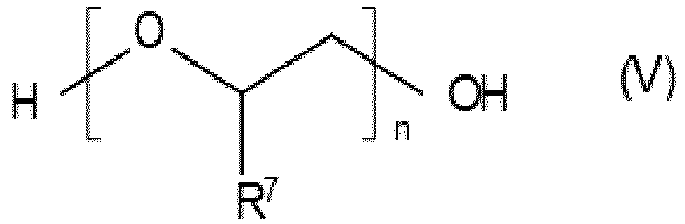
- n
- für eine Zahl von 1 bis 8 und
- R7
- für Methyl oder H stehen
- R1
- für H oder einen C1- bis C8-Alkylrest,
- R6
- für einen R2, oder eine Gruppe der Formel (VI)
- R7
- für H oder Methyl,
- n
- für eine Zahl von 1 bis 8 stehen, mit der Maßgabe, dass mindestens einer der Reste R2 für eine Gruppe der Formel (IV) steht, und dass mindestens einer der Reste R6 für R2 steht.
- Polyalkylenglykole der Formel (V) können entweder zu Beginn der Reaktion als Mischung mit Alkylpolyalkylenglykolen der Formel (II) eingesetzt werden, oder im Verlauf der Reaktion zwischen dem Orthoester der Formel (III) und den Alkylpolyalkylenglykolen der Formel (II) dem Reaktionsgemisch zugesetzt werden.
- Die Verbrückung von Orthoester mittels Polyalkylenglykolen hat den technischen Effekt, die Viskosität der im erfindungsgemäßen Verfahren erhaltenen Produkte zu erhöhen, wobei ein höherer Anteil an Polyalkylenglykol der Formel (V) durch die Erzeugung eines größeren Anteil verbrückter Orthoester der Formel (Id) eine höhere Viskosität ergibt. Dabei werden Polykalkylenglykole der Formel (V) stets als Minderkomponente in Bezug auf die Alkylpolyalkylenglykole der Formel (II) eingesetzt, um die Bildung größerer Oligomere von Orthoestern und dreidimensionale Vernetzung, oder Verzweigung, zu vermeiden.
- Polylalkylenglykole der Formel (V) werden bevorzugt in einer Menge von 0 bis 30 mol-%, bezogen auf die Menge an Alkylpolyalkylenglykole der Formel (II) als 100 mol-%, eingesetzt, mehr bevorzugt im Bereich von 0 bis 15 mol-%.
- Die Reaktionsbedingungen und die Reaktionsführung in Anwesenheit von Polylalkylenglykolen der Formel (V) sind identisch zu den in Abwesenheit von Polylalkylenglykolen der Formel (V) beschriebenen.
- Um das Entstehen verbrückter Orthoester der Formel (Id) zu erzielen ist es vorteilhaft, wenn die Gesamtmenge aus Alkylpolyalkylenglykolen der Formel (II) und Polylalkylenglykolen der Formel (V) ein molares Verhältnis zum Orthoester von 4 : 1, bevorzugt 3.5 : 1, nicht übersteigt. Ein größerer molarer Überschuss der Glykole führt verstärkt zur Bildung von nicht-verbrückten Orthoestern der Formel (I), bei denen R2 entweder einen Alkylpolyalkylenglykolrest aus den Alkylpolyalkylenglykolen der Formel (II) oder einen Polyalkylenglykolrest aus den Polylalkylenglykolen der Formel (V) bedeutet.
- In einem 1 Liter Vierhalskolben, ausgestattet mit einem Rührer und einem Destillationsaufsatz inkl. Vigreuxkolonne, wird unter Stickstoff eine Mischung aus 160.3 g (1.33 mol) Trimethylorthoacetat und 420 mL (2.66 Mol) Methyltriglykol vorgelegt und innerhalb von 40 min auf 165 °C erhitzt. Nach Erreichen der konstanten Reaktionstemperatur wurde während 60 min eine erste Teilmenge Methanol abdestilliert. Die Reaktionstemperatur wurde auf 185 °C erhöht und für weitere 45 min gehalten, wobei insgesamt ca. 83% (71 g, 2.22 Mol) der theoretischen Methanol-Menge abdestilliert wurde. Danach wurden bei konstanter Heizleistung weitere 211 ml (1.34 Mol) Methyltriglykol zudosiert, und nach einer Stunde die Reaktionstemperatur auf 225 °C erhöht und für eine Stunde gehalten, wobei weiteres Methanol abdestilliert wurde. Danach wurden bei konstanter Heizleistung weitere 50 ml (0.32 Mol) Methyltriglykol zudosiert, sowie 1.9 g Benzoesäure zugegeben. Nach 3 Stunden wurden nochmals 0.9 g und nach noch einer weiteren Stunde schließlich nochmals 0.4 g Benzoesäure zugegeben. Abschließend wurde noch 2 h bei 235 °C Reaktionstemperatur gerührt. Es wurden insgesamt 140 ml/110.6 g Methanol (3.45 Mol) abdestilliert was einem Umsatz von 86.3% entspricht.
- Der Orthoester wurde als klare, homogene, gelbliche Flüssigkeit in einer Menge von 727.6 g erhalten. Dies entspricht 98.7% bezogen auf die eingesetzte Masse und den Alkoholaustrag. Die Transparenz des Produkts wurde durch eine optische Trübungsmessung bestätigt. Durch die Menge an entferntem Methanol (3.45 mol) und der Startmenge Orthoester (1.33 mol) lässt sich berechnen, dass ca. 2.60 Äquivalente der Reste OR4 in Formel (III) durch alkoxylierte Alkohole der Formel (II) ersetzt wurden (3.45 mol).
- Die Zusammensetzung des Produktes und der Abreaktionsgrad wurde ebenfalls mit 1H-NMR bestätigt: 1H-NMR (CDCl3): δ = 1.48 (s, 3H, H3CC(OR)3), 3.38 (s, 9H, OCH3), 3.55 (mc, 6H, H3C-C(OCH2-R)3), 3.6 - 3.75 (mc, 30H, OCH2). Der Umsatz laut NMR beträgt 88%
- Nach analoger Anwendung der Vorschrift des Synthesebeispiels A wurden folgende Orthoester hergestellt. Die Synthesebeispiele B - D unterscheiden sich vom Synthesebeispiel A durch die Ansatzgröße und die Reaktionspartner der Formel (II) und (III). Die Menge an Benzoesäure als Katalysator war in den Beispielen B - C wie in A, ebenso die Temperaturen und Reaktionszeiten. Die beobachteten Ausbeuten sind in Tabelle 1 angegeben.
- Die Synthesebeispiele D, E und F wurden unter Reaktionsbedingungen analog zu Beispiel A durchgeführt, mit dem Unterschied, dass 0.05 wt.-% 2-Ethylhexylphosphat als Katalysator verwendet wurde. Die Vergleichsbeispiele H und I stellen nicht erfindungsgemäße Synthesen dar, welche durch Einsatz eines unlöslichen, sauren lonentauschers oder einer Lewis-Säure durchgeführt wurde.
Synthesebeispiel B - Trimethylorthoformiat + Methyltriglykol im molaren Verhältnis 1 : 3. 1H-NMR (CDCl3): δ = 3.38, 3.39 (2s, 9H, OCH3), 3.56 (mc, 6H, H-C(OCH2-R)3), 3.6 - 3.74 (mc, 30H, OCH2), 5.31 (s, 1H, HC(OR)3). Synthesebeispiel C - Trimethylorthoacetat + Mischung aus Methyltriglykol und Methyltetraglykol im molaren Verhältnis 1 : 1.5 zu 1.5 1H-NMR (CDCl3): δ = 1.48 (s, H3CC(OR)3), 3.38 (2 s, 2*OCH3), 3.56 (mc, H3C-C(OCH2-R)3), 3.6 - 3.75 (mc, OCH2). Synthesebeispiel D - Triethylorthoacetat + Mischung aus Methyltriglykol, Butyltriglykol und Butyltetraglykol im molaren Verhältnis 1 : 1.5 zu 1.12 zu 0.38 1H-NMR (CDCl3): δ = 0.91 (t, propyl-CH3), 1.34 - 1.39 (mc, CH2CH2-CH3), 1.48 (s, H3CC(OR)3), 1.54 - 1.58 (mc, CH2-CH2CH3), 3.38, (s, OCH3), 3.46 (mc, H3C-C(OCH2-R)3), 3.56 - 3.74 (mc, OCH2). Synthesebeispiel E - Trimethylorthoacetat + Dipropylenglykolmonobutylether in molaren Verhältnis 1 zu 3.3. Synthesebeispiel F - Trimethylorthoacetat + Polyglykol M 1250 im molaren Verhältnis 1 zu 3.5. Synthesebeispiel G - Trimethylorthoacetat + Methyltriglykol + Diethylenglykol + Triethylenglykol im molaren Verhältnis 1 zu 3.08 zu 0.12 zu 0.08 (verbrückter Orthoester) - In einem 1 Liter Vierhalskolben, ausgestattet mit einem Rührer und einem Destillationsaufsatz inkl. Vigreuxkolonne, wird unter Stickstoff eine Mischung aus 160.3 g (1.29 mol) Trimethylorthoacetat und 2/3 einer Glykolmischung - hergestellt aus 610.6 g (3.68 Mol) Methyltriglykol, 16.5 g Diethylenglykol (0.15 Mol) und 15.5 g (0.1 Mol) Triethylenglykol - vorgelegt und innerhalb von 90 min auf 150°C erhitzt. Nach Erreichen der konstanten Reaktionstemperatur wurde während 60 min eine erste Teilmenge Methanol abdestilliert. Die Reaktionstemperatur wurde auf 185 °C erhöht und für weitere 60 min gehalten, wobei insgesamt ca. 42% (51.9 g, 1.62 Mol) der theoretischen Methanol-Menge abdestilliert wurde. Danach wurden bei einer Reaktionstemperatur von 200 °C das restliche Drittel der oben hergestellten Glykolmischung zudosiert, sowie 1.7 g Benzoesäure zugegeben und nach einer Stunde nochmals 0.9 g Benzoesäure zugegeben und die Reaktionstemperatur nach einer weiteren Stunde auf 225 °C erhöht und für eine weitere Stunde gehalten, wobei weiteres Methanol abdestilliert wurde, insgesamt ca. 76% (94.5 g, 2.95 Mol) der theoretischen Menge. Bei konstanter Heizleistung werden weitere 50 g (0.3 Mol) Methyltriglykol zudosiert, sowie 0.7 g Benzoesäure zugegeben und weitere 7 Stunden bei 225 °C Reaktionstemperatur gerührt. Es wurden insgesamt 107.9 g Methanol (3.37 Mol) abdestilliert was einem Umsatz von 87% entspricht.
- Der Orthoester wurde als klare, homogene, bernsteinfarbene Flüssigkeit in einer Menge von 723.2 g erhalten. Dies entspricht 98.1% bezogen auf die eingesetzte Masse und den Alkoholaustrag. Die Transparenz des Produkts wurde durch eine optische Trübungsmessung bestätigt.
- Die Zusammensetzung des Produktes und der Abreaktionsgrad wurde ebenfalls mit 1H-NMR bestätigt: 1H-NMR (CDCl3): δ = 1.48 (s, H3CC(OR)3), 3.38 (s, OCH3), 3.55 (mc, H3C-C(OCH2-R)3), 3.6 - 3.75 (mc, OCH2).
- Eine Unterscheidung zum im Synthesebeispiel A hergestellten Produkt aus Trimethylorthoacetat + Methyltriglykol ist nur durch die anderen Integralverhältnisse im 1H-NMR möglich. Der Umsatz laut NMR beträgt 86%.
- Vergleichsbeispiel H - Triethylorthoacetat 110 g (0.66 mol) + Methyltriglykol im molaren Verhältnis 1 zu 3 mit saurem Ionenaustauscher Amberjet™ 1000 H (3.3 g). Das Produkt wurde durch Filtration vom Bodensatz an unlöslichem lonentauscher befreit.
- In einem 1 Liter Vierhalskolben, wird unter Stickstoff eine Mischung aus 160.3 g (1.33 mol) Trimethylorthoacetat, 630 mL (4.00 Mol) Methyltriglykol sowie 1.33 g Aluminiumchlorid vorgelegt und für 3 Stunden bei bis zu 140 °C unter Rückfluss gerührt. Anschließend wird über eine Kolonne 148 g Ethanol (81% der Theorie) abdestilliert, dabei wird die Temperatur bis auf 180 °C erhöht. Das nach dem Abkühlen trübe Produkt wird in Toluol gelöst und mit Wasser gewaschen und anschließend filtriert. Die organische Phase wird über Magnesiumsulfat getrocknet und das Toluol am Rotationsverdampfer entfernt. Der Rückstand entspricht ca. 64% der theoretischen Ausbeute. Die Ausbeute konnte nicht per NMR via obiger Formel bestimmt werden. Es ist davon auszugehen, dass Orthoester bevorzugt nach dem Literaturbekannten Verfahren bei Anwesenheit von Lewis-Säuren zur den entsprechenden Carbonsäureestern umgesetzt werden (vgl.
Houben-Weyl, Methoden der Organischen Chemie Vol. VI/3, Kapitel VIII, B. Umwandlung von Orthocarbonsäureestern, Seite 313ff).Tabelle 1: Ausbeuten und Umsatz der Orthoester Synthesebeispiel Isolierte Ausbeute Umsatz Esterbildung Umsatz Trübheit5 (vs. Theorie)1 (NMR)2 (NMR)3 (Alkoholaustrag)4 [NFU] A 98.7% 88% 0.08 86.3% 0.4 B 99.4% 100% 0 98% 0.2 C 100% 90% 0.06 88% 0.2 D 99.6% 90% 0.1 91% 0.3 E 99.5% 87% 0.1 88% 0.3 F 97.1% 85% 0.09 86% 0.4 G 98.1% 86% 0.05 87% 0.2 Vgl. H 100% 90% 7 87.6% 1.6 Vgl. I 64% n.b.6 n.b.6 81% 4.3 1 isolierte, gewogene Produktausbeute in Prozent gegenüber der theoretischen Einsatzmenge, abzüglich entferntem Alkohol
2 Umsatzberechnung - d.h. prozentualer Anteil der ausgetauschten MeOH bzw. EtOH Gruppen der eingesetzten Orthoester - nach 1H-NMR Signalen (Formel siehe oben). Ein kleinerer Wert als die isolierte Ausbeute ist also kein Widerspruch, weil auch nach der Reaktion noch EtO- bzw. MeO-Gruppen in den gebildeten Orthoestern vorhanden sind.
3 Ratio Glykolester (Ameisensäure/Essigsäure)/ Orthoester bestimmt durch 1H-NMR
4 Gravimetrische Umsatzbestimmung nach ausgetragenem Alkohol gegenüber der theoretischen Menge laut Einsatzmengen
5 Trübungsmessung am Turbidimeter (Hach-Lange 2100N IS) der Rohprodukte (vor Aufarbeitung bei Vergleichsbeispiel I)
6 nicht bestimmt, da eine Produktbildung nicht eindeutig nachgewiesen werden konnte.


bei einer Temperatur von 60 bis 280°C umgesetzt wird, und die dabei entstehenden Alkohole R4-OH destillativ entfernt werden, dadurch gekennzeichnet, dass die Umsetzung entweder in Abwesenheit eines Katalysators erfolgt oder ein Katalysator, ausgewählt aus aromatischen Carbonsäuren und organischen Phosphorsäureestern zugegen ist.


Claims (14)
- Verfahren zur Herstellung eines Orthoesters der Formel (I)
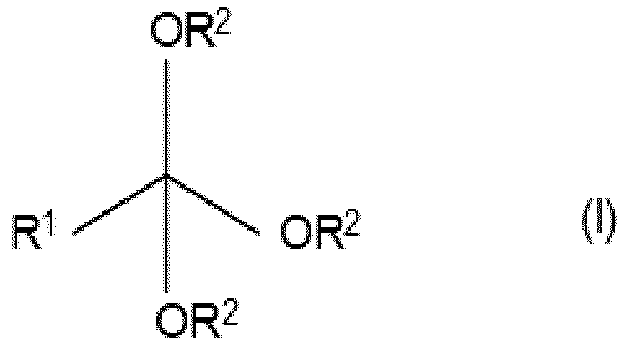 R1 für H oder einen C1- bis C8-Alkylrest,R2 für einen C1- bis C6-Alkylrest, oder eine Gruppe der Formel (IV)
 R3 für einen C1- bis C6-Alkylrest, undm für eine Zahl von 1 bis 40 stehen, mit der Maßgabe, dass mindestens einer der Reste R2 für eine Gruppe der Formel (IV), undR5 für H oder Methyl stehtindem mindestens ein Alkohol der Formel (II)

bei einer Temperatur von 60 bis 280°C umgesetzt wird, und die dabei entstehenden Alkohole R4-OH destillativ entfernt werden, dadurch gekennzeichnet, dass die Umsetzung entweder in Abwesenheit eines Katalysators erfolgt, oder ein Katalysator, ausgewählt aus aromatischen Carbonsäuren und organischen Phosphorsäureestern zugegen ist. - Verfahren zur Herstellung eines Orthoesters nach Anspruch 1, wobei das molare Verhältnis der von Alkohol der Formel (II) zu Orthoester der Formel (III) mindestens 3 zu 1 beträgt.
- Verfahren zur Herstellung eines Orthoesters nach Anspruch 1 und/oder 2, unter Verwendung eines Katalysators der eine aromatische Carbonsäure oder ein organischer Phosphorsäureester ist.
- Verfahren nach Anspruch 3, worin die aromatische Carbonsäure Benzoesäure ist.
- Verfahren nach Anspruch 3, worin der Katalysator ein Phosphorsäureester eines linearen oder verzweigten Alkohols mit 6 bis 18 Kohlenstoffatomen ist.
- Verfahren nach einem oder mehreren der Ansprüche 1 - 4, worin die Alkohole R4-OH über eine Kolonne abgetrennt werden.
- Verfahren nach einem oder mehreren der Ansprüche 1 - 6, worin am Beginn der Umsetzung das molare Verhältnis von Alkohol der Formel (II) zu Orthoester der Formel (III) höchstens 3:1 beträgt.
- Verfahren nach einem oder mehreren der Ansprüche 1 - 7, worin der Alkohol der Formel (II) in 2 oder mehr Stufen zugegeben wird.
- Verfahren nach einem oder mehreren der Ansprüche 1 - 8, worin die Reaktionstemperatur 80 bis 230°C beträgt.
- Verfahren nach einem oder mehreren der Ansprüche 1 - 9, worin der Alkohol R4-OH bei reduziertem Druck entfernt wird.
- Verfahren nach einem oder mehreren der Ansprüche 1 - 10, worin die Orthoester der Formel (I) den Formeln


- Verfahren nach einem oder mehreren der Ansprüche 1 - 11, worin eine Mischung von Alkoholen der Formel (II) eingesetzt wird, die sich in R3 und/oder m unterscheiden.
- Verfahren nach einem oder mehreren der Ansprüche 1 - 12, worin eine Mischung aus verbrückten Orthoestern der Formel (Id) sowie Orthoestern der Formel (I)
 R6 für R2 oder eine Gruppe der Formel (VI)
 R7 für H oder Methyl, undn für eine Zahl von 1 bis 8 stehen,mit der Maßgabe, dass
mindestens einer der Reste R6 für R2 steht, und
mindestens einer der Reste R2 für eine Gruppe der Formel (IV) steht,
indem neben mindestens einem Alkylpolyalkylenglykol der Formel (II) mindestens ein Polyalkylenglykol der Formel (V)
- Verfahren nach Anspruch 13, worin die Gesamtmenge aus Alkylpolyalkylenglykolen der Formel (II) und Polyalkylenglykolen der Formel (V) ein molares Verhältnis zum Orthoester der Formel (III) von 4 : 1 nicht übersteigt.
Priority Applications (1)
| Application Number | Priority Date | Filing Date | Title |
|---|---|---|---|
| EP21162203.0A EP4056550A1 (de) | 2021-03-12 | 2021-03-12 | Verfahren zur herstellung von orthoestern |
Applications Claiming Priority (1)
| Application Number | Priority Date | Filing Date | Title |
|---|---|---|---|
| EP21162203.0A EP4056550A1 (de) | 2021-03-12 | 2021-03-12 | Verfahren zur herstellung von orthoestern |
Publications (1)
| Publication Number | Publication Date |
|---|---|
| EP4056550A1 true EP4056550A1 (de) | 2022-09-14 |
Family
ID=74873519
Family Applications (1)
| Application Number | Title | Priority Date | Filing Date |
|---|---|---|---|
| EP21162203.0A Withdrawn EP4056550A1 (de) | 2021-03-12 | 2021-03-12 | Verfahren zur herstellung von orthoestern |
Country Status (1)
| Country | Link |
|---|---|
| EP (1) | EP4056550A1 (de) |
Citations (5)
| Publication number | Priority date | Publication date | Assignee | Title |
|---|---|---|---|---|
| US2867667A (en) | 1958-05-29 | 1959-01-06 | Cities Service Res & Dev Co | Olefin oxide ortho ester condensation products |
| GB1128963A (en) | 1966-08-22 | 1968-10-02 | Grace W R & Co | Novel orthoesters |
| US3419580A (en) | 1965-04-02 | 1968-12-31 | Union Carbide Corp | Ketone acetals and orthoesters |
| DE2062034A1 (de) | 1969-12-16 | 1971-07-01 | ||
| WO1999032424A1 (en) * | 1997-12-19 | 1999-07-01 | Akzo Nobel N.V. | An ortho ester-based surfactant, its preparation and use |
-
2021
- 2021-03-12 EP EP21162203.0A patent/EP4056550A1/de not_active Withdrawn
Patent Citations (5)
| Publication number | Priority date | Publication date | Assignee | Title |
|---|---|---|---|---|
| US2867667A (en) | 1958-05-29 | 1959-01-06 | Cities Service Res & Dev Co | Olefin oxide ortho ester condensation products |
| US3419580A (en) | 1965-04-02 | 1968-12-31 | Union Carbide Corp | Ketone acetals and orthoesters |
| GB1128963A (en) | 1966-08-22 | 1968-10-02 | Grace W R & Co | Novel orthoesters |
| DE2062034A1 (de) | 1969-12-16 | 1971-07-01 | ||
| WO1999032424A1 (en) * | 1997-12-19 | 1999-07-01 | Akzo Nobel N.V. | An ortho ester-based surfactant, its preparation and use |
Non-Patent Citations (3)
| Title |
|---|
| BRACHVOGEL RENÉ-CHRIS ET AL: "Orthoester exchange: a tripodal tool for dynamic covalent and systems chemistry", CHEMICAL SCIENCE, vol. 6, no. 2, 1 January 2015 (2015-01-01), United Kingdom, pages 1399 - 1403, XP055834596, ISSN: 2041-6520, Retrieved from the Internet <URL:https://pubs.rsc.org/en/content/articlepdf/2015/sc/c4sc03528c> DOI: 10.1039/C4SC03528C * |
| E. R. ALEXANDERH. M. BUSCH, J. AM. CHEM. SOC., vol. 74, 1952, pages 554 |
| R. M. ROBERTST. D. HIGGINSP. R. NOYES, J. AM. CHEM. SOC., vol. 77, 1955, pages 3801 |
Similar Documents
| Publication | Publication Date | Title |
|---|---|---|
| EP1583733B1 (de) | Verbessertes verfahren zur kontinuierlichen herstellung von alkyl(meth)acrylaten mit mehrfacher katalysatorrezyklierung | |
| EP0449913B1 (de) | Verfahren zur verbesserten herstellung von (meth)acrylsäureestern mehrwertiger alkohole (iii) | |
| WO1990007483A1 (de) | Verfahren zur verbesserten herstellung von (meth)acrylsäureestern mehrwertiger alkohole (iv) | |
| EP0449912B1 (de) | Verfahren zur verbesserten herstellung von (meth)acrylsäureestern mehrwertiger alkohole (ii) | |
| DE3520829A1 (de) | Verfahren zur herstellung von n-(alpha)-alkoxy-ethyl-formamiden | |
| EP2706056B1 (de) | Verfahren zur Herstellung und Aufarbeitung eines Triacetonamin-haltigen Reaktionsgemisches | |
| DE1932625B2 (de) | Zinnorganischer Katalysator und seine Verwendung zur Umesterung | |
| DE3843854A1 (de) | Verfahren zur verbesserten herstellung von (meth)acrylsaeureestern mehrwertiger alkohole (i) | |
| DE2842271C2 (de) | Esterdiolalkoxylate | |
| WO1995013260A1 (de) | Verfahren zur herstellung von gemischen schaumarmer nicht-ionischer tenside mit acetalstruktur | |
| EP0949256B1 (de) | Verfahren zur Herstellung von Isochroman-3-onen | |
| DE102009002632A1 (de) | Verfahren zur Herstellung von (Meth)acrylsäureestern von Polyalkoxylgruppen enthaltenden Alkoholen | |
| EP1955994A1 (de) | Verfahren zur Herstellung von DMA | |
| DE2343056A1 (de) | Verfahren zur herstellung von vanadylalkoholaten | |
| EP0498847B1 (de) | Verfahren zur herstellung von 1,4-bis-(4-hydroxybenzoyl)-benzol | |
| DE2302843A1 (de) | Verfahren zur herstellung von biseckige klammer auf di(-halogenalkyl)phosphorsaeure eckige klammer zu -polyaethylenglykolestern | |
| DE874313C (de) | Verfahren zur Herstellung von Tetrahydropyranderivaten | |
| EP2139863A2 (de) | Verfahren zur herstellung von (meth) acrylsäureestern von n-hydroxyalkylierten imidazolen | |
| EP0302331B1 (de) | Ester von Arylbisperfluoralkylcarbinolen, Verfahren zur Herstellung dieser Verbindungen und der zugrundeliegenden Arylbisperfluoralkylcarbinole | |
| EP1456161A1 (de) | Verfahren zur herstellung von deoxybenzoinen | |
| EP0806405A1 (de) | Verfahren zur Herstellung von Hexahydrofarnesylaceton aus 6.7-Dihydro-geraniol sowie neue Zwischenprodukte für dieses Verfahren | |
| EP0209060A2 (de) | Verfahren zur Herstellung von fluorhaltigen Diolen und Tetrolen | |
| DE3540216C2 (de) | Verfahren zur Herstellung von N-Methylphosphonsäurediestern von Acryl- bzw. Methacrylsäureamiden aus Methylolverbindungen | |
| EP0080118A2 (de) | Verfahren zur Herstellung von Malondialdehydtetraalkylacetalen | |
| DE4314627A1 (de) | Verfahren zur Herstellung von Ethercarbonsäuren |
Legal Events
| Date | Code | Title | Description |
|---|---|---|---|
| PUAI | Public reference made under article 153(3) epc to a published international application that has entered the european phase |
Free format text: ORIGINAL CODE: 0009012 |
|
| STAA | Information on the status of an ep patent application or granted ep patent |
Free format text: STATUS: THE APPLICATION HAS BEEN PUBLISHED |
|
| AK | Designated contracting states |
Kind code of ref document: A1 Designated state(s): AL AT BE BG CH CY CZ DE DK EE ES FI FR GB GR HR HU IE IS IT LI LT LU LV MC MK MT NL NO PL PT RO RS SE SI SK SM TR |
|
| STAA | Information on the status of an ep patent application or granted ep patent |
Free format text: STATUS: THE APPLICATION HAS BEEN WITHDRAWN |
|
| 18W | Application withdrawn |
Effective date: 20220920 |