EP4056503B1 - Vorrichtung und verfahren zur veränderung des abstands zwischen sich bewegenden gegenständen - Google Patents
Vorrichtung und verfahren zur veränderung des abstands zwischen sich bewegenden gegenständen Download PDFInfo
- Publication number
- EP4056503B1 EP4056503B1 EP21161713.9A EP21161713A EP4056503B1 EP 4056503 B1 EP4056503 B1 EP 4056503B1 EP 21161713 A EP21161713 A EP 21161713A EP 4056503 B1 EP4056503 B1 EP 4056503B1
- Authority
- EP
- European Patent Office
- Prior art keywords
- closed
- loop
- articles
- conveyor
- belt
- Prior art date
- Legal status (The legal status is an assumption and is not a legal conclusion. Google has not performed a legal analysis and makes no representation as to the accuracy of the status listed.)
- Active
Links
Images


Classifications
-
- B—PERFORMING OPERATIONS; TRANSPORTING
- B65—CONVEYING; PACKING; STORING; HANDLING THIN OR FILAMENTARY MATERIAL
- B65G—TRANSPORT OR STORAGE DEVICES, e.g. CONVEYORS FOR LOADING OR TIPPING, SHOP CONVEYOR SYSTEMS OR PNEUMATIC TUBE CONVEYORS
- B65G47/00—Article or material-handling devices associated with conveyors; Methods employing such devices
- B65G47/22—Devices influencing the relative position or the attitude of articles during transit by conveyors
- B65G47/26—Devices influencing the relative position or the attitude of articles during transit by conveyors arranging the articles, e.g. varying spacing between individual articles
- B65G47/30—Devices influencing the relative position or the attitude of articles during transit by conveyors arranging the articles, e.g. varying spacing between individual articles during transit by a series of conveyors
- B65G47/31—Devices influencing the relative position or the attitude of articles during transit by conveyors arranging the articles, e.g. varying spacing between individual articles during transit by a series of conveyors by varying the relative speeds of the conveyors forming the series
-
- B—PERFORMING OPERATIONS; TRANSPORTING
- B65—CONVEYING; PACKING; STORING; HANDLING THIN OR FILAMENTARY MATERIAL
- B65G—TRANSPORT OR STORAGE DEVICES, e.g. CONVEYORS FOR LOADING OR TIPPING, SHOP CONVEYOR SYSTEMS OR PNEUMATIC TUBE CONVEYORS
- B65G15/00—Conveyors having endless load-conveying surfaces, i.e. belts and like continuous members, to which tractive effort is transmitted by means other than endless driving elements of similar configuration
- B65G15/30—Belts or like endless load-carriers
- B65G15/32—Belts or like endless load-carriers made of rubber or plastics
- B65G15/42—Belts or like endless load-carriers made of rubber or plastics having ribs, ridges, or other surface projections
-
- B—PERFORMING OPERATIONS; TRANSPORTING
- B65—CONVEYING; PACKING; STORING; HANDLING THIN OR FILAMENTARY MATERIAL
- B65G—TRANSPORT OR STORAGE DEVICES, e.g. CONVEYORS FOR LOADING OR TIPPING, SHOP CONVEYOR SYSTEMS OR PNEUMATIC TUBE CONVEYORS
- B65G15/00—Conveyors having endless load-conveying surfaces, i.e. belts and like continuous members, to which tractive effort is transmitted by means other than endless driving elements of similar configuration
- B65G15/30—Belts or like endless load-carriers
- B65G15/58—Belts or like endless load-carriers with means for holding or retaining the loads in fixed position, e.g. magnetic
-
- B—PERFORMING OPERATIONS; TRANSPORTING
- B65—CONVEYING; PACKING; STORING; HANDLING THIN OR FILAMENTARY MATERIAL
- B65G—TRANSPORT OR STORAGE DEVICES, e.g. CONVEYORS FOR LOADING OR TIPPING, SHOP CONVEYOR SYSTEMS OR PNEUMATIC TUBE CONVEYORS
- B65G21/00—Supporting or protective framework or housings for endless load-carriers or traction elements of belt or chain conveyors
- B65G21/20—Means incorporated in, or attached to, framework or housings for guiding load-carriers, traction elements or loads supported on moving surfaces
- B65G21/2027—Suction retaining means
- B65G21/2036—Suction retaining means for retaining the load on the load-carrying surface
-
- B—PERFORMING OPERATIONS; TRANSPORTING
- B65—CONVEYING; PACKING; STORING; HANDLING THIN OR FILAMENTARY MATERIAL
- B65G—TRANSPORT OR STORAGE DEVICES, e.g. CONVEYORS FOR LOADING OR TIPPING, SHOP CONVEYOR SYSTEMS OR PNEUMATIC TUBE CONVEYORS
- B65G47/00—Article or material-handling devices associated with conveyors; Methods employing such devices
- B65G47/74—Feeding, transfer, or discharging devices of particular kinds or types
- B65G47/84—Star-shaped wheels or devices having endless travelling belts or chains, the wheels or devices being equipped with article-engaging elements
- B65G47/841—Devices having endless travelling belts or chains equipped with article-engaging elements
- B65G47/843—Devices having endless travelling belts or chains equipped with article-engaging elements the article-engaging elements being suction or magnetic means
Definitions
- the invention relates in general to manufacturing and/or packaging of articles moving at a high-speed in a production/packaging line.
- the invention relates to an apparatus and to a method for changing the pitch - operation also known as "pitch change” or "re-pitching" - between articles being conveyed.
- the invention has been developed with particular attention to the field of manufacturing or packaging of sanitary articles, such as sanitary pads, pantry liners, diapers, training pants, paper towels, female hygiene products, face masks, plasters, etc.
- rotary repitch apparatuses The main disadvantage of rotary repitch apparatuses is the need to provide a plurality of motors dedicated to several shoes for periodically accelerating and decelerating the shoes during rotation, thus making the apparatuses complex, cumbersome and expensive. Another disadvantage is the need to stock many spare parts.
- WO-2012/009491-A1 and US-6000528-A disclose different apparatuses for transferring articles, adapted to vary the linear speed of the articles conveyed on transport elements.
- the apparatus of WO-2012/009491-A1 comprises a first transfer surface driven by a first motor and second transfer surface driven by a second motor.
- the first and second transfer surfaces receive and transfer different portions of an article at different speeds such that a desired amount of spacing can be provided between discrete articles.
- the spacing between the trailing end of a previous article and the leading end of a subsequent article can be desirably controlled by adjusting the acceleration/deceleration of movable surfaces of the apparatus.
- US-6000528-A discloses an apparatus for varying the pitch between moving articles according the preamble of claim 1.
- US-6000528-A discloses moreover a method for varying the pitch between moving articles, including:- feeding a flow of articles along a machine direction spaced apart from each other in said machine direction by a first pitch, - receiving said flow of articles spaced apart from each other by said first pitch on a closed-loop central belt having a transport branch extending between an infeed section and an outfeed section,- retaining said articles on said transport branch of the closed-loop central belt by vacuum suction during the movement between the infeed section to the outfeed section, wherein said articles have a width in a direction transversal to said machine direction greater than the width of said closed-loop central belt so that said articles have lateral portions projecting laterally outside said closed-loop central belt, - driving said closed-loop central belt at
- the object of the present invention is to overcome the drawbacks and limitations of the prior art.
- Another object of the present invention is to provide an apparatus of the type indicated above, which ensures an excellent stability of the articles during the repitch operation.
- the invention relates to a method for changing the pitch between moving articles having the features of claim 11.
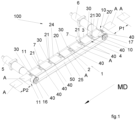
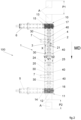
- an apparatus for varying the pitch between moving articles is indicated by the reference numeral 100.
- the apparatus 100 is configured to vary the pitch between adjacent articles A in a continuous flow of moving articles A advancing along a machine direction MD.
- the apparatus 100 comprises a phaser conveyor 1 having an infeed section 10 and an outfeed section 11, wherein the infeed section 10 is configured for receiving a flow of articles A which advance with a first pitch P1.
- the figures refer to a phaser conveyor 1 of the motor-driven-belt type.
- the apparatus 100 comprises an infeed conveyor 8 configured for feeding the phaser conveyor 1 with a flow of articles A along a machine direction MD, in which the articles A conveyed by the infeed conveyor 8 are spaced apart from each other in said machine direction MD by a first pitch P1. It is to be noted that the infeed conveyor 8 is described in detail in a subsequent section of this description.
- the phaser conveyor 1 comprises a central belt 2 having a transport branch 20' which extends along the machine direction MD.
- the central belt 2 is a closed-loop belt having a flat support surface 20 configured for receiving thereon the articles A.
- the closed-loop central belt 2 is wound about two pulleys 12, 13, at least one of which is driven by a first motor 5.
- the first motor 5 is configured to continuously drive the central belt 2 along the machine direction MD at a first speed V1.
- the phaser conveyor 1 comprises a plurality of idle support rollers 7 which support the transport branch 20' of the central belt 2.
- the apparatus 100 is configured to stably retain the articles A on the central belt 2 during transfer from a gripping position to a release position, and to stop the retaining action of the articles A in the release position.
- the apparatus 100 comprises a vacuum grip system including a stationary suction box 50 connected to a sub-atmospheric pressure source and having a suction surface facing the transport branch 20' of the closed-loop central belt 2.
- the closed-loop central belt 2 has a plurality of through holes 21 open on the flat support surface 20 and facing the stationary suction box 50, so as to provide a gripping condition for the articles A on the transport branch 20' during the movement from the infeed section 10 to the outfeed section 11.
- the vacuum gripping condition remains active to retain the articles A on the transport branch 20' during the path in which the through holes 21 face the stationary suction box 50, in the path from the infeed section 10 to the outfeed section 11.
- the phaser conveyor 1 comprises two closed-loop side belts 3, 4, having respective branches extending on opposite sides of the transport branch 20' of the central belt 2.
- the side belts 3, 4 have respective support surfaces 24, 25 which may be coplanar with the flat support surface 20 of the transport branch 20' of the central belt 2 to form a continuous surface for supporting and transporting the articles A.
- the width of the belts 2, 3, 4 in a direction transversal to the machine direction MD can be different from what is illustrated, depending on the size of the articles A to be conveyed.
- the side belts 3, 4 are driven by a second motor 6 configured to synchronously drive the side belts 3, 4 at a second speed V2 different from the first speed V1.
- the first speed V1 of the central belt 2 may be higher or lower than the second speed V2 of the side belts 3, 4.
- the side belts 3, 4 are wound on one side around two drive pulleys 15, 17 arranged on the same axis and powered by the second motor 6, and on the opposite side around two idle pulleys 14, 16 arranged on the same axis.
- the central belt 2 is a closed-loop belt wound around two pulleys 12, 13, at least one of which is driven by a first motor 5.
- the pulley 12 is a drive pulley arranged on the same axis of the idle pulleys 14, 16, and the pulley 13 is an idle pulley arranged on the same axis of the drive pulleys 15, 17.
- the side belts 3, 4 comprise respective rows of stop elements 30, 40 configured to engage side portions of said articles A projecting laterally outside the transport branch 20' of the central belt 2.
- the stop elements 30, 40 of each side belt 3, 4 are spaced apart from each other in the machine direction MD by a constant distance X.
- the stop elements 30, 40 of each side belt 3, 4 are aligned to the stop elements 30, 40 of the other belt 3, 4 in a direction transversal to the machine direction MD.
- the stop elements 30, 40 are ribs protruding from respective flat surfaces.
- the stop elements 30, 40 are ribs having a width in a direction transversal to the machine direction MD equal to the width of the side belts 3, 4.
- the phaser conveyor 1 transports articles A having a width in a direction transversal to the machine direction MD greater than the width of the central belt 2.
- the articles are retained by vacuum suction on the flat support surface 20 of the transport branch 20' of the central belt 2 and advance in the machine direction MD at the first speed V1 of the central belt 2.
- the difference between the first speed V1 of the central belt 2 and the second speed V2 of the side belts 3, 4 causes the articles A to come into contact with respective pairs of transversally aligned stop elements 30, 40.
- the articles A retained on the central belt 2 come into contact with respective pairs of stop elements 30, 40, they start to move in the machine direction MD at the second speed V2, so that they slide with respect to the flat support surface 20 of the central belt 2.
- the articles A are spaced apart from each other in the machine direction MD by a second pitch P2 corresponding to the distance X between the stop elements 30, 40.
- the speed V1 of the central belt 2 is higher than the second speed V2 of the side belts 3, 4. Consequently, in operation, an article A conveyed on the infeed section 10 of the phaser conveyor 1 reaches a pair of transversally aligned stop elements 30, 40 located in a more advanced position with respect to the article A, so as to make contact between a leading edge portion of the article A and said pair of transversally aligned stop elements 30, 40 at the outfeed section 11 of the phaser conveyor 1.
- the side belts 3, 4 are driven with a speed V2 higher than the speed V1 of the central belt 2 which retains the articles A. Consequently, in operation, an article A conveyed on the infeed section 10 of the phaser conveyor 1 is reached by a pair of transversally aligned stop elements 30, 40 located in a back position with respect to the article A, so as to make contact between a trailing edge portion of the article A and said pair of transversally aligned stop elements 30, 40 at the outfeed section 11 of the phaser conveyor 1.
- the lateral belts 3, 4 comprise a plurality of through holes facing the stationary suction box 50, so as to provide a gripping condition for the articles A on the support surfaces 24, 25 of the side belts 3, 4 during the movement from the infeed section 10 to the outfeed section 11.
- the retaining force is properly adjusted in order to give greater stability to articles A with respect to embodiments with through holes provided only on the central belt 2, but at the same time enabling sliding of the side belts 3, 4 under the articles A.
- the through holes on the side belts may be provided only on the portions adjacent to the stop elements 30, 40.
- the apparatus 100 comprises an infeed conveyor 8 - schematically illustrated in figure 4 - configured for feeding to the phaser conveyor 1 the articles A spaced apart from each other in said machine direction MD by the first pitch P1.
- the infeed conveyor 8 can be of the motor-driven-belt type.
- the infeed conveyor 8 comprises a closed-loop belt defining a downwardly facing transport branch 18 aligned with the central belt 2 along the machine direction MD and having a terminal end portion vertically overlapped to the transport branch 20' of the central belt 2 at the infeed section 10.
- the closed-loop belt of the infeed conveyor 8 has a width - in a direction transversal to said machine direction MD - substantially equal to the width of the central belt 2, so that said terminal end portion does not interfere with the stop elements 30, 40 of the side belts 3, 4.
- the transport branch 18 of the infeed conveyor 8 may have a width lower than the width of the central belt 2. In any case, if the infeed conveyor 8 is vertically superimposed on the central belt 2, the infeed conveyor 8 has to be arranged so as to not interfere with the stop elements 30, 40 of the side belts 3, 4.
- the infeed conveyor 8 comprises a vacuum grip system which is configured and controlled for holding the articles A conveyed by the infeed conveyor 8 against the downwardly facing transport branch 18 of the infeed conveyor 8 until the article A is released on, and gripped by, the central belt 2 of the phaser conveyor 1.
- the infeed conveyor 8 comprises a plurality of through holes 19 and a stationary suction box connected to a sub-atmospheric pressure source, so as to provide a sucking surface for retaining the conveyed articles A against said downwardly facing transport branch 18 of the infeed conveyor 8 until they are released on the phaser conveyor 1.
- the vacuum gripping condition of the infeed conveyor 8 remains active to retain the articles A on the transport branch 18 during the path in which the through holes 19 are faced to a stationary suction box.
- the interruption of the retaining action of the infeed conveyor 8 is phased with the beginning of the retaining action of the phaser conveyor 1 at the infeed section 10.
- the infeed conveyor 8 is phased with the side belts 3, 4, so that the articles A are passed on the infeed section 10 of the phaser conveyor 1 in a position between two consecutive stop elements 30, 40.
- the presence of the stop elements 30, 40 only on the side belts 3, 4 enables using an infeed conveyor 8 arranged above and between the side belts 3, 4, which does not interfere with the stop elements 30, 40, which ensures a smooth transition of the articles A from the infeed conveyor 8 to the phaser conveyor 1.
- the apparatus comprises an outfeed conveyor 9 operatively connected to the outfeed section 11 of the phaser conveyor 1, arranged for receiving and transporting the articles A spaced by the second pitch P2, after the repitching operation carried out on the phaser conveyor 1.
- the outfeed conveyor 9 can be arranged similarly to the infeed conveyor 8 previously described.
- the outfeed conveyor 9 is also arranged so as to avoid interference with the stop elements 30, 40 of the side belts 3, 4.
- the outfeed conveyor 9 comprises a closed-loop belt defining a downwardly facing transport branch 22 aligned with the central belt 2 along the machine direction MD and having a first portion vertically overlapped on the transport branch 20' of the central belt 2 at the outfeed section 11.
- the closed-loop belt of the outfeed conveyor 9 has a width - in a direction transversal to said machine direction MD - substantially equal to the width of the central belt 2, so that it does not interfere with the stop elements 30, 40 of the side belts 3, 4.
- the outfeed conveyor 9 comprises a vacuum grip system comprising a plurality of through holes 23 formed in the belt of the outfeed conveyor 9, configured and controlled for holding each article A conveyed by the outfeed conveyor 9 against said downwardly facing transport branch 22 of the outfeed conveyor 9. It is to be noted that the interruption of the retaining action of the phaser conveyor 1 at the outfeed section 11 is phased with the beginning of the retaining action of the outfeed conveyor 9.
- the inlet and outfeed conveyors 8, 9 provide an effective transport of the articles A to and from the phaser conveyor 1, without interference with the stop elements 30, 40.
- the presence of the stop elements 30, 40 only on the side belts 3, 4 enables infeed and outfeed conveyors 8, 9 arranged above and between the side belts 3, 4, in order to guarantee a smooth transition of the articles A .
- the present invention provides a solution capable to vary the pitch of a flow of moving articles A in a simple and automatic way, ensuring an effective transport of articles of different types.
- the invention provides a solution which is much simpler and energy-efficient, which has a positive impact on sustainability.
Landscapes
- Engineering & Computer Science (AREA)
- Mechanical Engineering (AREA)
- Attitude Control For Articles On Conveyors (AREA)
Claims (13)
- Vorrichtung (100) zur Veränderung des Abstands zwischen sich bewegenden Gegenständen (A), umfassend:- einen Einlaufförderer (8), der so konfiguriert ist, dass er einen Strom von Gegenständen (A) entlang einer Maschinenrichtung (MD) zuführt, die in der Maschinenrichtung (MD) um einen ersten Abstand (P1) voneinander beabstandet sind, und- einen Phaserförderer (1), der einen Einlaufabschnitt (10) und einen Auslaufabschnitt (11) aufweist, wobei der Einlaufabschnitt (10) so konfiguriert ist, dass er den Strom von Gegenständen (A) von dem Einlaufförderer (8) empfängt, die um den ersten Abstand (P1) voneinander beabstandet sind,wobei der Phaserförderer (1) Folgendes umfasst:- ein zentrales Band in geschlossener Schleife (2) mit einer flachen Stützfläche (20), die zur Aufnahme der Gegenstände (A) darauf konfiguriert ist, wobei das zentrale Band in geschlossener Schleife (2) eine Vielzahl von Durchgangslöchern (21), die auf der Stützfläche (20) offen sind, und einen Transportzweig (20') aufweist, der sich von dem Einlaufabschnitt (10) zu dem Auslaufabschnitt (11) erstreckt,- einen ersten Motor (5), der so konfiguriert ist, dass er das zentrale Band in geschlossener Schleife (2) mit einer ersten Geschwindigkeit (V1) antreibt,- einen stationären Saugkasten (50), der mit einer subatmosphärischen Druckquelle verbunden ist und eine Saugfläche aufweist, die dem Transportzweig (20') des zentralen Bandes in geschlossener Schleife (2) zugewandt ist, um die Gegenstände (A) während der Bewegung zwischen dem Einlaufabschnitt (10) und dem Auslaufabschnitt (11) auf dem Transportzweig (20') zu halten,- zwei Seitenbänder in geschlossener Schleife (3, 4), die jeweilige Zweige aufweisen, die sich auf gegenüberliegenden Seiten des Transportzweigs (20') des zentralen Bandes in geschlossener Schleife (2) erstrecken, wobei die Seitenbänder in geschlossener Schleife (3, 4) jeweilige Reihen von Anschlagelementen (30, 40) umfassen, wobei die Anschlagelemente (30, 40) jedes Seitenbandes in geschlossener Schleife (3, 4) um einen konstanten Abstand (X) voneinander beabstandet sind, und wobei die Anschlagelemente (30, 40) jedes Seitenbandes in geschlossener Schleife (3, 4) mit den Anschlagelementen (30, 40) des anderen Seitenbandes in geschlossener Schleife (3, 4) in einer Richtung quer zu der Maschinenrichtung (MD) ausgerichtet sind, wobei die Anschlagelemente (30, 40) so konfiguriert sind, dass sie mit Seitenabschnitten der Gegenstände (A) in Eingriff kommen, die seitlich aus dem Transportzweig (20') des zentralen Bandes in geschlossener Schleife (2) herausragen,- einen zweiten Motor (6), der so konfiguriert ist, dass er die Seitenbänder in geschlossener Schleife (3, 4) synchron mit einer zweiten Geschwindigkeit (V2) antreibt, die sich von der ersten Geschwindigkeit (V1) unterscheidet,- wobei - im Betrieb - der Phaserförderer (1) Gegenstände (A) transportiert, deren Breite in einer Richtung quer zu der Maschinenrichtung (MD) größer ist als die Breite des zentralen Bandes (2), und wobei der Geschwindigkeitsunterschied zwischen dem zentralen Band in geschlossener Schleife (2) und den Seitenbändern in geschlossener Schleife (3, 4) bewirkt, dass die Gegenstände (A) mit einem Paar quer ausgerichteter Anschlagelemente (30, 40) der Seitenbänder in geschlossener Schleife (3, 4) in Kontakt kommen und die Gegenstände (A) auf dem zentralen Band in geschlossener Schleife (2) gleiten, so dass die Gegenstände (A) an dem Auslaufabschnitt (11) des Phaserförderers (1) um einen zweiten Abstand (P2) beabstandet sind, der dem Abstand (X) zwischen den Anschlagelementen (30, 40) entspricht,- dadurch gekennzeichnet, dass die Seitenbänder in geschlossener Schleife (3, 4) jeweils dem stationären Saugkasten (50) zugewandte Zweige aufweisen und jeweilige Durchgangslöcher umfassen, um durch Vakuumansaugung seitliche Abschnitte der Gegenstände (A) zu halten, die seitlich aus dem zentralen Band in geschlossener Schleife (2) herausragen.
- Vorrichtung nach Anspruch 1, wobei die Seitenbänder (3, 4) jeweilige Stützflächen (24, 25) aufweisen, die mit der Stützfläche (20) des Transportzweigs (20') des zentralen Bandes (2) koplanar sind, um eine durchgehende Fläche zum Stützen und Transportieren der Gegenstände (A) zu bilden.
- Vorrichtung nach Anspruch 1 oder 2, wobei es sich bei den Anschlagelementen (30, 40) um Rippen handelt, die aus den jeweiligen ebenen Flächen herausragen.
- Vorrichtung nach einem der vorstehenden Ansprüche, wobei die erste Geschwindigkeit (V1) des zentralen Bandes (2) höher ist als die zweite Geschwindigkeit (V2) der Seitenbänder (3, 4), wobei - im Betrieb - ein auf dem Einlaufabschnitt (10) des Phaserförderers (1) beförderter Gegenstand (A) ein Paar quer ausgerichteter Anschlagelemente (30, 40) erreicht, die sich in einer weiter fortgeschrittenen Position in Bezug auf den Gegenstand (A) befinden, so dass ein Kontakt zwischen einem Vorderkantenabschnitt des Gegenstands (A) und dem Paar quer ausgerichteter Anschlagelemente (30, 40) an dem Auslaufabschnitt (11) des Phaserförderers (1) hergestellt wird.
- Vorrichtung nach einem der Ansprüche 1-3, wobei die erste Geschwindigkeit (V1) des zentralen Bandes (2) niedriger ist als die zweite Geschwindigkeit (V2) der Seitenbänder (3, 4), wobei - im Betrieb - ein auf dem Einlaufabschnitt (10) des Phaserförderers (1) beförderter Gegenstand (A) von einem Paar quer ausgerichteter Anschlagelemente (30, 40) erreicht wird, die sich in einer hinteren Position in Bezug auf den Gegenstand (A) befinden, so dass ein Kontakt zwischen einem hinteren Kantenabschnitt des Gegenstand (A) und dem Paar quer ausgerichteter Anschlagelemente (30, 40) an dem Auslaufabschnitt (11) des Phaserförderers (1) hergestellt wird.
- Vorrichtung nach einem der vorstehenden Ansprüche, wobei der Einlaufförderer (8) ein Band in geschlossener Schleife umfasst, das einen nach unten weisenden Transportzweig (18) definiert, der entlang der Maschinenrichtung (MD) mit dem zentralen Band (2) ausgerichtet ist und einen beendenden Endabschnitt aufweist, der vertikal über den Transportzweig (20') des zentralen Bandes (2) an dem Einlaufabschnitt (10) gelegt ist, wobei das Band in geschlossener Schleife des Einlaufförderers (8) eine Breite - in einer Richtung quer zu der Maschinenrichtung (MD) - aufweist, die gleich oder kleiner als die Breite des zentralen Bandes (2) ist, so dass der beendende Endabschnitt nicht mit den Anschlagelementen (30, 40) der Seitenbänder (3, 4) kollidiert.
- Vorrichtung nach Anspruch 1, wobei die Durchgangslöcher der Seitenbänder in geschlossener Schleife (3, 4) nur an Abschnitten der Seitenbänder in geschlossener Schleife (3, 4) positioniert sind, die an die Anschlagelemente (30, 40) angrenzen.
- Vorrichtung nach einem der vorstehenden Ansprüche, wobei das Band in geschlossener Schleife des Einlaufförderers (8) eine Vielzahl von Durchgangslöchern (19) umfasst und wobei der Einlaufförderer (8) einen stationären Saugkasten umfasst, der mit einer subatmosphärischen Druckquelle verbunden ist, um die Gegenstände (A) durch Vakuumansaugung gegen den nach unten weisenden Transportzweig (18) des Bandes in geschlossener Schleife des Einlaufförderers (8) zu halten, bis sie auf dem Phaserförderer (1) freigegeben werden.
- Vorrichtung nach einem der vorstehenden Ansprüche, die einen Auslaufförderer (9) umfasst, der so konfiguriert ist, dass er von dem Auslaufabschnitt (11) des Phaserförderers (1) den Strom von Gegenständen (A) aufnimmt, die in der Maschinenrichtung (MD) um den zweiten Abstand (P2) voneinander beabstandet sind.
- Vorrichtung nach Anspruch 9, wobei der Auslaufförderer (9) ein Band in geschlossener Schleife umfasst, das einen nach unten weisenden Transportzweig (22) definiert, der entlang der Maschinenrichtung (MD) mit dem zentralen Band (2) ausgerichtet ist und einen ersten Abschnitt aufweist, der vertikal über den Transportzweig (20') des zentralen Bandes (2) an dem Auslaufabschnitt (11) gelegt ist, wobei das Band in geschlossener Schleife des Auslaufförderers (9) eine Breite - in einer Richtung quer zu der Maschinenrichtung (MD) - aufweist, die gleich oder kleiner als die Breite des zentralen Bandes (2) ist, so dass der erste Abschnitt nicht mit den Anschlagelementen (30, 40) der Seitenbänder (3, 4) kollidiert.
- Verfahren zur Veränderung des Abstandes zwischen sich bewegenden Gegenständen (A), einschließlich:- Zuführen eines Stroms von Gegenständen (A) entlang einer Maschinenrichtung (MD), die in der Maschinenrichtung (MD) um einen ersten Abstand (P1) voneinander beabstandet sind,- Aufnehmen des Stroms von Gegenständen (A), die um den ersten Abstand (P1) voneinander beabstandet sind, auf einem zentralen Band in geschlossener Schleife (2), das einen Transportzweig (20') aufweist, der sich zwischen einem Einlaufabschnitt (10) und einem Auslaufabschnitt (11) erstreckt,- Halten der Gegenstände (A) auf dem Transportzweig (20') des zentralen Bandes in geschlossener Schleife (2) durch Vakuumansaugung während der Bewegung zwischen dem Einlaufabschnitt (10) und dem Auslaufabschnitt (11), wobei die Gegenstände (A) eine Breite in einer Richtung quer zu der Maschinenrichtung (MD) aufweisen, die größer ist als die Breite des zentralen Bandes in geschlossener Schleife (2), so dass die Gegenstände (A) seitliche Abschnitte aufweisen, die seitlich aus dem zentralen Band in geschlossener Schleife (2) herausragen,- Antreiben des zentralen Bandes in geschlossener Schleife (2) mit einer ersten Geschwindigkeit (V1),- Bereitstellen eines Paars von Seitenbändern in geschlossener Schleife (3, 4), die sich auf gegenüberliegenden Seiten des Transportzweigs (20') des zentralen Bandes in geschlossener Schleife (2) erstrecken, wobei die Seitenbänder in geschlossener Schleife (3, 4) jeweilige Reihen von Anschlagelementen (30, 40) umfassen, wobei die Anschlagelemente (30, 40) jedes Seitenbandes in geschlossener Schleife (3, 4) um einen konstanten Abstand (X) voneinander beabstandet sind, und wobei die Anschlagelemente (30, 40) jedes Seitenbandes (3, 4) mit den Anschlagelementen (30, 40) des anderen Bandes (3, 4) in einer Richtung quer zu der Maschinenrichtung (MD) ausgerichtet sind, wobei die Seitenbänder in geschlossener Schleife (3, 4) jeweilige Zweige aufweisen, die einem stationären Saugkasten (50) zugewandt sind, und jeweilige Durchgangslöcher umfassen, um durch Vakuumsaugen seitliche Abschnitte der Gegenstände (A) zu halten, die seitlich aus dem zentralen Band in geschlossener Schleife (2) herausragen,- synchrones Antreiben der Seitenbänder in geschlossener Schleife (3, 4) mit einer zweiten Geschwindigkeit (V2), die sich von der ersten Geschwindigkeit (V1) unterscheidet,- Ineingriffbringen der seitlichen Abschnitte der Gegenstände (A), die aus dem zentralen Band in geschlossener Schleife (2) herausragen, mit entsprechenden Paaren von quer ausgerichteten Anschlagelementen (30, 40) der Seitenbänder in geschlossener Schleife (3, 4), und Beabstanden der Gegenstände (A) voneinander in der Maschinenrichtung (MD) an dem Auslaufabschnitt (11) um einen zweiten Abstand (P2), der dem Abstand (X) zwischen den Anschlagelementen (30, 40) entspricht,- Halten von seitlichen Abschnitten der Gegenstände (A), die seitlich aus dem zentralen Band in geschlossener Schleife (2) herausragen, auf den Seitenbändern in geschlossener Schleife (3, 4) durch Vakuumansaugung.
- Verfahren nach Anspruch 11, wobei die erste Geschwindigkeit (V1) des zentralen Bandes (2) höher ist als die zweite Geschwindigkeit (V2) der Seitenbänder (3, 4), wobei - im Betrieb - ein auf dem Einlaufabschnitt (10) des Phaserförderers (1) beförderter Gegenstand (A) ein Paar quer ausgerichteter Anschlagelemente (30, 40) erreicht, die sich in einer weiter fortgeschrittenen Position in Bezug auf den Gegenstand (A) befinden, so dass ein Kontakt zwischen einem Vorderkantenabschnitt des Gegenstands (A) und dem Paar quer ausgerichteter Anschlagelemente (30, 40) an dem Auslaufabschnitt (11) des Phaserförderers (1) hergestellt wird.
- Verfahren nach Anspruch 11, wobei die erste Geschwindigkeit (V1) des zentralen Bandes (2) niedriger ist als die zweite Geschwindigkeit (V2) der Seitenbänder (3, 4), wobei - im Betrieb - ein auf dem Einlaufabschnitt (10) des Phaserförderers (1) beförderter Gegenstand (A) von einem Paar quer ausgerichteter Anschlagelemente (30, 40) erreicht wird, die sich in einer hinteren Position in Bezug auf den Gegenstand (A) befinden, so dass ein Kontakt zwischen einem hinteren Kantenabschnitt des Gegenstand (A) und dem Paar quer ausgerichteter Anschlagelemente (30, 40) an dem Auslaufabschnitt (11) des Phaserförderers (1) hergestellt wird.
Priority Applications (5)
| Application Number | Priority Date | Filing Date | Title |
|---|---|---|---|
| ES21161713T ES3028661T3 (en) | 2021-03-10 | 2021-03-10 | Apparatus and method for varying the pitch between moving articles |
| EP21161713.9A EP4056503B1 (de) | 2021-03-10 | 2021-03-10 | Vorrichtung und verfahren zur veränderung des abstands zwischen sich bewegenden gegenständen |
| PL21161713.9T PL4056503T3 (pl) | 2021-03-10 | 2021-03-10 | Aparat i sposób do zmieniania odstępu pomiędzy przemieszczającymi się artykułami |
| US17/688,089 US11905123B2 (en) | 2021-03-10 | 2022-03-07 | Apparatus and method for varying the pitch between moving articles |
| CN202210231746.8A CN115072347A (zh) | 2021-03-10 | 2022-03-10 | 用于改变移动的物品之间的间距的设备和方法 |
Applications Claiming Priority (1)
| Application Number | Priority Date | Filing Date | Title |
|---|---|---|---|
| EP21161713.9A EP4056503B1 (de) | 2021-03-10 | 2021-03-10 | Vorrichtung und verfahren zur veränderung des abstands zwischen sich bewegenden gegenständen |
Publications (3)
| Publication Number | Publication Date |
|---|---|
| EP4056503A1 EP4056503A1 (de) | 2022-09-14 |
| EP4056503B1 true EP4056503B1 (de) | 2025-05-07 |
| EP4056503C0 EP4056503C0 (de) | 2025-05-07 |
Family
ID=74870682
Family Applications (1)
| Application Number | Title | Priority Date | Filing Date |
|---|---|---|---|
| EP21161713.9A Active EP4056503B1 (de) | 2021-03-10 | 2021-03-10 | Vorrichtung und verfahren zur veränderung des abstands zwischen sich bewegenden gegenständen |
Country Status (5)
| Country | Link |
|---|---|
| US (1) | US11905123B2 (de) |
| EP (1) | EP4056503B1 (de) |
| CN (1) | CN115072347A (de) |
| ES (1) | ES3028661T3 (de) |
| PL (1) | PL4056503T3 (de) |
Families Citing this family (1)
| Publication number | Priority date | Publication date | Assignee | Title |
|---|---|---|---|---|
| CN111392390A (zh) * | 2020-03-17 | 2020-07-10 | 广东乐佳印刷有限公司 | 一种彩票卷转移装置 |
Family Cites Families (27)
| Publication number | Priority date | Publication date | Assignee | Title |
|---|---|---|---|---|
| US3728191A (en) | 1971-03-19 | 1973-04-17 | Kimberly Clark Co | Waistband tape application for disposable diapers |
| IT1188972B (it) | 1980-12-12 | 1988-01-28 | Gd Spa | Dispositivo di trasferimento per articoli a forma di barretta |
| IT1171559B (it) | 1981-09-29 | 1987-06-10 | Gd Spa | Dispositivo ribaltatore per articoli a forma di barretta in particolare sigarette |
| DE3515992A1 (de) * | 1985-05-03 | 1986-11-06 | Max Kettner Verpackungsmaschinenfabrik GmbH & Co KG, 8000 München | Foerdereinrichtung zur gesteuerten zufuhr von gegenstaenden zu einer bearbeitungsmaschine |
| EP0206985B1 (de) * | 1985-06-26 | 1989-03-29 | SIG Schweizerische Industrie-Gesellschaft | Vorrichtung zum Vereinzeln von aneinander anliegenden Einzelstücken |
| US4726876A (en) | 1985-10-18 | 1988-02-23 | Kimberly-Clark Corporation | Apparatus for repositioning discrete articles |
| SE462333B (sv) | 1987-01-23 | 1990-06-11 | Moelnlycke Ab | Anordning foer att oeverfoera artiklar fraan en foersta till en andra transportbana |
| DE3814341C1 (en) * | 1988-04-28 | 1989-03-09 | Effem Gmbh, 2810 Verden, De | Process and apparatus for the outward transfer of horizontal cans consisting of a magnetic material in can-filling systems |
| US5341915A (en) * | 1992-11-06 | 1994-08-30 | Kliklok Corporation | Article phasing, transfer and squaring system for packaging line |
| DE4302575A1 (de) * | 1993-01-29 | 1994-08-04 | Pactec Dresden Gmbh | Einrichtung zum Zuführen kleiner empfindlicher Stückgüter |
| IT1266343B1 (it) | 1993-05-07 | 1996-12-27 | Gd Spa | Dispositivo di cambio-passo per una successione ordinata di elementi. |
| DE19522264A1 (de) * | 1995-03-21 | 1996-09-26 | Datev Datenverarbeitungsorgani | Verfahren und Vorrichtung zum Fördern von Stückgut insbesondere in einer Verpackungsanordnung |
| EP0885823A1 (de) * | 1997-06-20 | 1998-12-23 | Klöckner Hänsel Tevopharm B.V. | Fördervorrichtung zum Beschleunigen einer Serie von Produkten |
| NL1006370C2 (nl) * | 1997-06-20 | 1998-12-22 | Kloeckner Haensel Tevopharm | Transportinrichting voor het versnellen van een reeks producten. |
| US6044959A (en) * | 1998-11-12 | 2000-04-04 | Roberts Polypro, Inc. | Apparatus for staging (pitching) articles on a conveyor system |
| US6273238B1 (en) * | 2000-01-14 | 2001-08-14 | Batching Systems, Inc. | Apparatus and method for separating adjacent objects on a conveyor |
| EP1179495A1 (de) | 2000-08-11 | 2002-02-13 | Fameccanica.Data S.p.A. | Vorrichtung zur Verstellung des Abstandes von zu transportierenden Gegenständen |
| DE10204933A1 (de) * | 2002-02-07 | 2003-08-21 | Rovema Gmbh | Vorrichtung zum Transportieren von stückigem Produkt |
| US6951271B2 (en) * | 2004-01-09 | 2005-10-04 | Roberts Polypro | Flight lug |
| AU2007257968A1 (en) * | 2006-06-15 | 2007-12-21 | Laitram, L.L.C. | Article-rotating belt conveyor |
| FR2905117B1 (fr) * | 2006-08-24 | 2009-04-17 | Sidel Participations | Agencement pour le regroupement en rang de produits d'un lot sur un tapis de convoyage a haute cadence |
| DE602007001572D1 (de) * | 2007-01-17 | 2009-08-27 | Fameccanica Data Spa | Vorrichtung zur Verstellung des Abstandes zwischen zu transportierenden Gegenständen und zum Drehen dieser Gegenstände |
| EP2593061B1 (de) | 2010-07-15 | 2015-01-07 | The Procter and Gamble Company | Verfahren und vorrichtung zur übertragung von gegenständen von verschiedenen grössen |
| CN202687474U (zh) * | 2012-03-30 | 2013-01-23 | 尤妮佳股份有限公司 | 吸收性物品输送路径变换装置 |
| EP3336023B1 (de) * | 2016-12-15 | 2019-06-26 | Fameccanica.Data S.p.A. | Vorrichtung zur verstellung des abstandes zwischen sich bewegenden gegenständen |
| CN108773624A (zh) * | 2018-06-01 | 2018-11-09 | 三峡大学 | 一种粽叶上料装置 |
| CN209455686U (zh) * | 2019-01-16 | 2019-10-01 | 良记造机工厂有限公司 | 金属薄片的集料装置 |
-
2021
- 2021-03-10 ES ES21161713T patent/ES3028661T3/es active Active
- 2021-03-10 EP EP21161713.9A patent/EP4056503B1/de active Active
- 2021-03-10 PL PL21161713.9T patent/PL4056503T3/pl unknown
-
2022
- 2022-03-07 US US17/688,089 patent/US11905123B2/en active Active
- 2022-03-10 CN CN202210231746.8A patent/CN115072347A/zh active Pending
Also Published As
| Publication number | Publication date |
|---|---|
| ES3028661T3 (en) | 2025-06-19 |
| CN115072347A (zh) | 2022-09-20 |
| PL4056503T3 (pl) | 2025-06-23 |
| EP4056503C0 (de) | 2025-05-07 |
| US11905123B2 (en) | 2024-02-20 |
| EP4056503A1 (de) | 2022-09-14 |
| US20220289498A1 (en) | 2022-09-15 |
Similar Documents
| Publication | Publication Date | Title |
|---|---|---|
| US5221079A (en) | Apparatus for braking a succession of sheets to be stacked | |
| EP0894752A1 (de) | Fördervorrichtung zum Beschleunigen einer Serie von Produkten | |
| US5348285A (en) | Hold-down device on handling machines, in particular punching machines, for thin, flat objects in particular sheets of paper | |
| US6230596B1 (en) | Method of and apparatus for conveying flat pieces of a web | |
| JPH0578000A (ja) | 鱗状に重り合つた一連の物品の形成装置 | |
| EP0885823A1 (de) | Fördervorrichtung zum Beschleunigen einer Serie von Produkten | |
| AU2004297047B2 (en) | Device and method for eliminating trimmings from series of products, such as rolls or the like | |
| JPH01203137A (ja) | シート状印刷物の搬送装置 | |
| EP4056503B1 (de) | Vorrichtung und verfahren zur veränderung des abstands zwischen sich bewegenden gegenständen | |
| WO2012064277A1 (en) | Transition device | |
| US6273238B1 (en) | Apparatus and method for separating adjacent objects on a conveyor | |
| EP0538765B1 (de) | Verfahren und Vorrichtung zum Bilden von Gruppen flacher Gegenstände, insbesondere Kekse, für die Zufuhr zu einer Verpackungsanlage | |
| CN106660711B (zh) | 用于输送块式产品的方法和装置 | |
| EP0519401B1 (de) | Vorrichtung zum abstandsgleichen, reihenweisen Fördern von zufallsverteilt zugeführten Produkten | |
| WO1991007343A1 (en) | Apparatus and method for separating a stream of lapped signatures into discrete batches | |
| US6994206B2 (en) | Apparatus for feeding rolls of cut products to a wrapper | |
| EP2709807A1 (de) | Vorrichtung und verfahren zum entfernen von verkleidungen von einer reihe von produkten wie rollen oder dergleichen | |
| EP2699499A1 (de) | Fördersystem | |
| EP0936991B1 (de) | Transportvorrichtung für kartonzuschnitte | |
| JP2001354348A (ja) | 物品を供給するための装置および方法 | |
| EP1511602B1 (de) | Vorrichtung zur beseitigung von endschnittabfall von einer rolle oder dergleichen | |
| KR102814931B1 (ko) | 시트 처리기 | |
| US20010007299A1 (en) | Process for conveying articles, for instance for automated packaging installations, and a device therefor | |
| JP7751212B2 (ja) | 物品搬送装置 | |
| EP1503939B1 (de) | Zuführvorrichtung für praline und vergleichbare artikel |
Legal Events
| Date | Code | Title | Description |
|---|---|---|---|
| PUAI | Public reference made under article 153(3) epc to a published international application that has entered the european phase |
Free format text: ORIGINAL CODE: 0009012 |
|
| STAA | Information on the status of an ep patent application or granted ep patent |
Free format text: STATUS: THE APPLICATION HAS BEEN PUBLISHED |
|
| AK | Designated contracting states |
Kind code of ref document: A1 Designated state(s): AL AT BE BG CH CY CZ DE DK EE ES FI FR GB GR HR HU IE IS IT LI LT LU LV MC MK MT NL NO PL PT RO RS SE SI SK SM TR |
|
| STAA | Information on the status of an ep patent application or granted ep patent |
Free format text: STATUS: REQUEST FOR EXAMINATION WAS MADE |
|
| 17P | Request for examination filed |
Effective date: 20230216 |
|
| RBV | Designated contracting states (corrected) |
Designated state(s): AL AT BE BG CH CY CZ DE DK EE ES FI FR GB GR HR HU IE IS IT LI LT LU LV MC MK MT NL NO PL PT RO RS SE SI SK SM TR |
|
| GRAP | Despatch of communication of intention to grant a patent |
Free format text: ORIGINAL CODE: EPIDOSNIGR1 |
|
| STAA | Information on the status of an ep patent application or granted ep patent |
Free format text: STATUS: GRANT OF PATENT IS INTENDED |
|
| RIC1 | Information provided on ipc code assigned before grant |
Ipc: B65G 47/84 20060101ALI20241105BHEP Ipc: B65G 47/31 20060101ALI20241105BHEP Ipc: B65G 21/20 20060101ALI20241105BHEP Ipc: B65G 15/58 20060101ALI20241105BHEP Ipc: B65G 15/42 20060101AFI20241105BHEP |
|
| INTG | Intention to grant announced |
Effective date: 20241203 |
|
| GRAS | Grant fee paid |
Free format text: ORIGINAL CODE: EPIDOSNIGR3 |
|
| GRAA | (expected) grant |
Free format text: ORIGINAL CODE: 0009210 |
|
| STAA | Information on the status of an ep patent application or granted ep patent |
Free format text: STATUS: THE PATENT HAS BEEN GRANTED |
|
| AK | Designated contracting states |
Kind code of ref document: B1 Designated state(s): AL AT BE BG CH CY CZ DE DK EE ES FI FR GB GR HR HU IE IS IT LI LT LU LV MC MK MT NL NO PL PT RO RS SE SI SK SM TR |
|
| REG | Reference to a national code |
Ref country code: GB Ref legal event code: FG4D |
|
| REG | Reference to a national code |
Ref country code: CH Ref legal event code: EP |
|
| REG | Reference to a national code |
Ref country code: DE Ref legal event code: R096 Ref document number: 602021030242 Country of ref document: DE |
|
| REG | Reference to a national code |
Ref country code: IE Ref legal event code: FG4D |
|
| U01 | Request for unitary effect filed |
Effective date: 20250509 |
|
| U07 | Unitary effect registered |
Designated state(s): AT BE BG DE DK EE FI FR IT LT LU LV MT NL PT RO SE SI Effective date: 20250516 |
|
| REG | Reference to a national code |
Ref country code: ES Ref legal event code: FG2A Ref document number: 3028661 Country of ref document: ES Kind code of ref document: T3 Effective date: 20250619 |
|
| PG25 | Lapsed in a contracting state [announced via postgrant information from national office to epo] |
Ref country code: NO Free format text: LAPSE BECAUSE OF FAILURE TO SUBMIT A TRANSLATION OF THE DESCRIPTION OR TO PAY THE FEE WITHIN THE PRESCRIBED TIME-LIMIT Effective date: 20250807 Ref country code: GR Free format text: LAPSE BECAUSE OF FAILURE TO SUBMIT A TRANSLATION OF THE DESCRIPTION OR TO PAY THE FEE WITHIN THE PRESCRIBED TIME-LIMIT Effective date: 20250808 |
|
| PG25 | Lapsed in a contracting state [announced via postgrant information from national office to epo] |
Ref country code: HR Free format text: LAPSE BECAUSE OF FAILURE TO SUBMIT A TRANSLATION OF THE DESCRIPTION OR TO PAY THE FEE WITHIN THE PRESCRIBED TIME-LIMIT Effective date: 20250507 |
|
| PG25 | Lapsed in a contracting state [announced via postgrant information from national office to epo] |
Ref country code: RS Free format text: LAPSE BECAUSE OF FAILURE TO SUBMIT A TRANSLATION OF THE DESCRIPTION OR TO PAY THE FEE WITHIN THE PRESCRIBED TIME-LIMIT Effective date: 20250807 |
|
| PG25 | Lapsed in a contracting state [announced via postgrant information from national office to epo] |
Ref country code: IS Free format text: LAPSE BECAUSE OF FAILURE TO SUBMIT A TRANSLATION OF THE DESCRIPTION OR TO PAY THE FEE WITHIN THE PRESCRIBED TIME-LIMIT Effective date: 20250907 |