EP4056428B1 - Verfahren zur herstellung einer dekormatte für den innenraum eines fahrzeugs - Google Patents
Verfahren zur herstellung einer dekormatte für den innenraum eines fahrzeugs Download PDFInfo
- Publication number
- EP4056428B1 EP4056428B1 EP22161457.1A EP22161457A EP4056428B1 EP 4056428 B1 EP4056428 B1 EP 4056428B1 EP 22161457 A EP22161457 A EP 22161457A EP 4056428 B1 EP4056428 B1 EP 4056428B1
- Authority
- EP
- European Patent Office
- Prior art keywords
- strips
- decoration
- flaps
- flap
- stitches
- Prior art date
- Legal status (The legal status is an assumption and is not a legal conclusion. Google has not performed a legal analysis and makes no representation as to the accuracy of the status listed.)
- Active
Links
Images


Classifications
-
- B—PERFORMING OPERATIONS; TRANSPORTING
- B60—VEHICLES IN GENERAL
- B60R—VEHICLES, VEHICLE FITTINGS, OR VEHICLE PARTS, NOT OTHERWISE PROVIDED FOR
- B60R13/00—Elements for body-finishing, identifying, or decorating; Arrangements or adaptations for advertising purposes
- B60R13/02—Internal Trim mouldings ; Internal Ledges; Wall liners for passenger compartments; Roof liners
-
- B—PERFORMING OPERATIONS; TRANSPORTING
- B60—VEHICLES IN GENERAL
- B60R—VEHICLES, VEHICLE FITTINGS, OR VEHICLE PARTS, NOT OTHERWISE PROVIDED FOR
- B60R13/00—Elements for body-finishing, identifying, or decorating; Arrangements or adaptations for advertising purposes
- B60R13/02—Internal Trim mouldings ; Internal Ledges; Wall liners for passenger compartments; Roof liners
- B60R2013/0281—Internal Trim mouldings ; Internal Ledges; Wall liners for passenger compartments; Roof liners made of a plurality of visible parts
-
- B—PERFORMING OPERATIONS; TRANSPORTING
- B60—VEHICLES IN GENERAL
- B60R—VEHICLES, VEHICLE FITTINGS, OR VEHICLE PARTS, NOT OTHERWISE PROVIDED FOR
- B60R13/00—Elements for body-finishing, identifying, or decorating; Arrangements or adaptations for advertising purposes
- B60R13/02—Internal Trim mouldings ; Internal Ledges; Wall liners for passenger compartments; Roof liners
- B60R2013/0293—Connection or positioning of adjacent panels
Definitions
- the invention relates to the interior trim of closed vehicles, in particular motor vehicles. It relates more particularly to the trim of the dashboard, the inner face of the doors or other surfaces of the passenger compartment by flexible surface trim - or covering - materials from the family of woven or non-woven textiles, natural or synthetic, including microfiber fabrics, or from the family of leathers, natural or synthetic.
- the aim of the invention is therefore to propose, for vehicle interior parts, a covering made of flexible material which has a pleated appearance, and which can take on all the complex shapes found in such an interior, including concavities and convexities, including in close proximity to each other on the same part with complex shapes. It is desired that the coating be very firmly fixed.
- a method of covering for decoration of a vehicle interior part comprising shaping a surface for decoration made of a flexible surface material, and laminating on a passenger compartment part a covering sheet comprising said surface for decoration.
- first characteristics of the process allow the use of common industrial techniques, for example the use of a press including an imprint and a piston. They are also compatible with the use of glue applied by roller on the back of the sheet, for its attachment to the part - or insert.
- the method is particular in that it comprises preparing strips of the flexible material, producing right flaps and left flaps on the long sides of said strips, producing a line of stitches over a length of at least one right flap and at least one left flap, said left flap and said right flap being brought together face to face under the surface for decoration and being secured to each other by the stitches of the line, so as to participate in said shaping of the surface for decoration, plating the secured flaps using the line of stitches as a pivot line, until said covering sheet is produced with a pleated appearance on the surface for decoration and a regular rear face for lamination on the passenger compartment part, a hot-melt or heat-reactive glue is previously coated on the back of a sheet of the flexible material over the entire surface thereof, the strips then being formed and cut from said sheet so as to form uniformly glued strips but separated from each other.
- An alternative method comprises shaping a decorative surface made of a flexible surface material, and laminating a covering sheet comprising said decorative surface to a passenger compartment part, preparing strips of the flexible material, producing right flaps and left flaps on the long sides of said strips, producing a line of stitches over a length of at least one right flap and at least one left flap, said left flap and said right flap being brought together face to face under the decorative surface and being secured to each other by the stitches of the line, so as to participate in said shaping of the decorative surface, pressing the secured flaps together using the line of stitches as a pivot line, until said covering sheet is produced with a pleated appearance on the decorative surface and a regular rear face for lamination to the passenger compartment part according to which, during the step of preparing the strips of flexible material, said strips are previously cut from a sheet of said flexible material, said sheet being assembled with a layer of lining material on one of its faces.
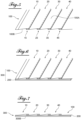
- FIG. 1 to 7 are schematic views of the different steps of a first embodiment of the invention.
- the first embodiment consists of making folds in an assembly of strips of flexible material on which no lining (for example foam) has been applied, the latter being put in place in the last stages of the process.
- no lining for example foam
- a first strip of flexible material 10 is shown in the form of a long rectangle of thin thickness, one of the surfaces of which is a decorative surface 10A and the other, opposite surface is a fixing surface 10B.
- This first strip can advantageously be obtained by cutting from a larger piece, obtained from a supplier of fabric or leather or other flexible materials such as microfibers, one surface of which has previously been glued with a hot-melt or thermoreactive glue which, in the absence of heat, is inactive and from which several strips are cut.
- the strips used are free from each other, that is to say that the fabric, textile or leather has been completely cut, and that there is no longer any connection between two strips.
- the strips can alternatively be obtained independently of each other.
- the decorative surface 10A is typically pleasant to the touch and has an attractive appearance to the eye, while the fixing surface 10B is suitable for affixing to a plastic or other material element, such as an insert or a structural element.
- the fixing surface 10B is already provided with a coating of hot melt adhesive.
- strip is used to indicate a width to length ratio of the rectangle very much in favor of the length, although the invention also applies with a slightly elongated rectangle.
- FIG. 2 In figure 2 the result of a first process step applied to the first strip of flexible material 10 has been shown.
- the treatment applied consisted in folding down, parallel to each of the two large sides of the rectangle constituting the strip, two parts of the latter, in order to distinguish three parts therein: a central strip 11, slightly narrower than the first strip of flexible material 10 taken edge to edge, and a left flap 12 as well as a right flap 13, each now being delimited and connected to the central strip 11 by a hinge or fold formed in the flexible material.
- the flaps do not constitute that a small part of the first strip of flexible material 10. It is further specified that the material being flexible, the fold remains little marked at this stage.
- FIG. 3 In figure 3 the result of the following step of processing the first strip of flexible material 10 is shown. This is brought closer to an identical or similar strip of flexible material 20, having a left flap called the left flap of the second strip 22, itself provided with an external left flap surface 22A. The external surface of the right flap 13A and the external surface of the left flap 22A are placed against each other over their entire length, the first and second strips of flexible material 10 and 20 being positioned parallel to each other in the same plane. The contact between the two surfaces can be direct, or indirect with the interposition of a layer of an additional material if necessary.
- a series of stitches 90 is then made over the entire common length of the left flap 12 and right flap 13, so as to immobilize or secure the first and second strips of flexible material 10 and 20 relative to each other.
- the stitches form a line, which is positioned very close to the fold which was not very marked, and it replaces the fold in the delimitation between the flap and the central strip.
- the stitches of the 90 stitch series may be individual stitches established in line with each other or stitches of an uninterrupted seam extending the entire length of both flaps.
- FIG. 4 In figure 4 a further step of the method is shown, during which strips of flexible material 30 and 40 were also fixed after the first two strips of flexible material 10 and 20, on the side of strip 20.
- the right flap 13 and the left flap of the second strip 22 have formed a double sewn flap 15.
- the right flap 23 and the left flap 32, having undergone another series of stitches 91 have formed a second double sewn flap 25.
- another double sewn flap 35 is formed with the flaps 33 and 42 having undergone another series of stitches 92, and a double sewn flap 45 is formed with flaps 43 and 52 having undergone another series of stitches 93.
- a sheet 100 (or pleated decoration) consisting of the assembly of the strips of flexible material 10, 20, 30, 40 and other strips which can be put in place in the same way and attached by a series of stitches.
- the sheet 100 has on one of its faces a decorative surface 100A consisting of the assembly of the decorative surfaces of the central strips of each of the strips of flexible material 10, 20, 30, 40 etc.
- the sheet 100 On its opposite face, the sheet 100 has a surface from which the double sewn flaps 15, 25, 35, 45 etc. protrude.
- FIG. 5 In figure 5 the sequence of operations is shown.
- the tablecloth is swept or brushed uniformly in a single direction, so as to fold down or lay down each of the double sewn flaps 15, 25, 35, 45 in a similar manner, with rotation of this flap along the lines of stitching points connecting the flaps of each of the strips of flexible material with its central strip.
- the tablecloth 100 (or pleated decoration) is laid flat, with the appearance of a pleated effect on the decoration surface 100A, each of the double sewn flaps 15, 25, 35, 45 being pressed against the fixing surface of the adjacent central strip, the orientation given to the movement being the same for each of the strips. Between two strips, the opening of a fold is visible on the decoration face, but the fold is kept closed by the series of stitches along the entire length of the strips. On the opposite face, a fixing surface 100B is formed. It is regular and compatible with subsequent lamination, because the flaps are pressed. They can even be glued against the rear face of the central strips, using a glue applied beforehand, as discussed in relation to the figure 1 . It is possible to use the tablecloth as is, without carrying out the steps which will be described in Figures 6 and 7 , but these are also interesting.
- FIG. 6 In figure 6 the subsequent step of the process is shown, by which the sheet 100 is glued to a single piece of foam 200 to form a consolidated sheet 300 (which will ultimately serve as a covering sheet for the automobile part), this assembly step being similar to a lamination.
- the foam piece is a single flat piece, of modest thickness compared to the dimensions of the sheet 100, one dimension of which in its plane is of the same order of magnitude as the length of the strips, and the other dimension is of the same order of magnitude as the sum of the widths of the central strips. It is a polyethylene or polyurethane foam.
- the single foam part 200 can also be glued on its face that comes into contact with the sheet 100, with a hot-melt glue, to allow assembly with the sheet 100.
- the hot-melt or thermoreactive glue present on one or the other of the two assembled surfaces, namely the fixing face 100B and the surface of the single foam part 200, or on both surfaces is activated by the application of heat, so as to secure the two elements.
- a three-dimensional textile can be used.
- the foam or the three-dimensional textile are lining materials (they thicken the sheet) and also comfort materials: they offer a pleasant padding-type welcome for the passenger.
- a cut of the consolidated sheet 300 or covering sheet is carried out as necessary to define contours, rectilinear or curvilinear, in its plane, depending on its destination.
- FIG. 7 shows in section the result of the process: we have a single piece of foam 200 (or three-dimensional textile) on which is fixed a pleated-looking tablecloth 100 showing on the face opposite the foam a decorative surface that is pleasant for the user. The stitching is invisible to the user, hidden under the folded soft material.
- the process is continued by applying a deposit of hot-melt or thermoreactive glue by roller on the fixing face 300B of the consolidated sheet, i.e. the foam face.
- the glued decoration is applied to the interior part or automotive shape - or insert - using a rolling press and a specific tool for receiving the format and the insert to be decorated.
- the tool is composed of two parts: a fixed lower female part shaped to receive the decoration and a male part shaped to receive the insert to be covered, and arranged on a piston.
- the press is opened, then the consolidated sheet 300 is placed and positioned on the fixed plate, and the insert to be decorated is placed on the movable plate positioned in the upper part of the press.
- the glue is activated by applying infrared rays to the consolidated sheet 300, and the movable plate is lowered for contact and pressing. After cooling, the decoration adheres to the insert, and the mobile plate is reassembled, then the insert carrying its covering is removed.
- the second embodiment which will now be presented, consists of making folds in an assembly of strips of flexible material (or decoration) on the back of which a lining of foam or three-dimensional textile is present from the outset.
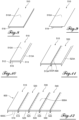
- FIG. 8 In figure 8 , the first step of this second embodiment of the invention has been shown.
- the strip of flexible material 510 comprises a decorative surface 510A and on its opposite face a complete covering of foam 518, immobilized and for example glued over its entire surface, in a uniform manner.
- the complete covering of foam 518 covers, in the variant presented, the entire face opposite the decorative surface 510A and is interrupted at its edges, for example because the strip of flexible material has been cut from a sheet composed of an assembly of a layer of foam and a sheet of flexible material.
- the foam can be a polyurethane or polyethylene foam, and it can be replaced by a three-dimensional textile.
- the visible face of the lining material (or fleece) can already be glued.
- FIG. 9 To the figure 9 a further step of the method is presented.
- the complete covering of foam 518 (or textile) is subjected to cuts parallel to the long sides of the strip of flexible material 510 on each of the 2 long sides, and the thin side strips thus cut are detached, for example peeled off, from the flexible material.
- a part of the face of the strip of flexible material 510 opposite the decorative surface is exposed, being freed from the foam cut from the complete covering of foam 518, which is removed from the method, evacuated and possibly used for other purposes or recycled.
- the width of foam removed is, on each side, greater than the thickness of the complete covering of foam 518.
- the remaining foam is referenced as the central layer of foam 519. It has a width slightly smaller than the strip of flexible material 510, taken edge to edge. It is also possible to provide that its thickness is not constant: it can for example be beveled, ultimately creating an inclination between two more of the finished product.
- left flaps 512 and right flaps 513 are formed by folding the strip of flexible material, along the central layer of foam 519 (or textile), possibly resting on the edge of the latter, and towards the face of the strip of flexible material in which the latter is located.
- the flaps are nevertheless not pressed against the strip and remain free. The fold is not marked only moderately, due to the flexible nature of the material. Since the width of these flaps is defined by the width of foam that had been removed, the flaps, if held perpendicular to the strip, each protrude by the thickness of the central foam layer 518.
- FIG. 11 In figure 11 the subsequent step of the process is shown by which a second strip of flexible material 520 identical or similar to the strip of flexible material 510, but free with respect to the strip 510, is brought closer to the latter by their respective flaps, and more precisely by the external surface of the right flap 513A and the external surface of the left flap 522A, which are placed face to face.
- a line of stitches 590 is carried out in a similar manner to that described in the first embodiment to secure the flaps, but it is carried out on the part of the flaps which exceeds the thickness of the central layer of foam or three-dimensional textile 519, just below the surface of this lining material.
- the second strip of flexible material comprises another central layer of foam 529 in the same manner as the first strip, and that the stitches are placed in the same manner with respect to this other central layer of foam.
- FIG. 12 a further step of the method is shown, in which strips of flexible material 530 and 540 similar to the first two strips were also fixed after the first two strips of flexible material 510 and 520, on the side of strip 520.
- a double sewn flap 515 and other double sewn flaps 525, 535 and 545 are formed with the flaps and sewing stitches.
- a temporary sheet 600 consisting of the assembly of the strips of flexible material 510, 520, 530, 540 and other strips.
- the temporary sheet 600 has on one of its faces a decorative surface 600A consisting of the assembly of the decorative surfaces. On its opposite face, the temporary sheet 600 has a temporary surface 600C from which the double sewn flaps 515, 525, 535, 545 etc. protrude.
- FIG. 13 the result of the scanning, laying or plating of the flaps, in a single direction, against the temporary surface 600C, forming a final fixing surface 600D, and resulting in a sheet 601 (final sheet, or covering sheet).
- the final fixing surface 600D is regular, stable and adapted to the lamination on a passenger compartment part.
- the flaps surround and cover the outermost part of the foam (or textile), under each of the strips, on a single side of each of the strips - in the figures, this is the rightmost side of each of the strips.
- the line of stitching constitutes the point of rotation, well defined and making the assembly firm and solid.
- the foam remains uncovered, the flap being drawn, by its sewing, with the flap covering the foam of the neighboring strip. It is thus the double flaps 515, 525, ... which are folded along the stitching line.
- FIG. 14 shows in section the result of the process: there is an assembly of foam (or textile) pieces 519, 529, etc. coated with the flexible material and sewn to each other by their respective long sides.
- the assembly has the pleated appearance showing on the face opposite the foam a decorative surface pleasant for the user. If the thickness of the central layer of foam 519 is not constant, a relief or an inclination can be introduced into the decorative surface 600A.
- the process is continued by applying a hot-melt or heat-reactive glue to the final fixing face 600D of the covering sheet or final sheet 601. Then the glued decoration is applied to the passenger compartment part or automotive shape - or insert - using the press and the specific tool mentioned above.
- the stitching points can be replaced, for the purpose of securing the adjacent flaps, by staples, or the use of glue, or the use of clips, without calling into question the principles of the invention.
- the invention applies to the door trims of motor vehicles, as well as to dashboard panels.
Landscapes
- Engineering & Computer Science (AREA)
- Mechanical Engineering (AREA)
- Vehicle Interior And Exterior Ornaments, Soundproofing, And Insulation (AREA)
Claims (9)
- Abdeckverfahren zur Dekoration eines Fahrzeuginnenraumteils, umfassend ein Formen einer Dekorfläche (100A; 600A), die aus einem flexiblen Oberflächenmaterial besteht, und ein Laminieren einer Abdeckmatte (300; 601), umfassend die Dekorfläche (100A; 600A), auf ein Fahrzeuginnenraumteil, das Verfahren umfassend ein Vorbereiten von Streifen (10, 20, ...; 510, 520) des flexiblen Materials, Herstellen von rechten und linken Klappen (12, 13, 22, 23, ...; 512, 513, 522, 523, ...) an den langen Seiten der Streifen, Ausführen einer Linie von Nähstichen entlang einer Länge von mindestens einer rechten Klappe (13; 513) und mindestens einer linken Klappe (22; 522), wobei die linke und die rechte Klappe unter der Dekorfläche einander gegenüberliegend angenähert und durch die Nähstiche der Linie miteinander verbunden werden, sodass sie an der Formgebung der Dekorfläche (100A, 600A) beteiligt sind, Anpressen der zusammengefügten Klappen unter Verwendung der Stichlinie als Drehpunktlinie, bis die Abdeckmatte (300; 601) mit einem plissierten Aussehen auf der Dekorfläche und einer gleichmäßigen Rückseite zum Laminieren auf das Fahrzeuginnenraumteil ausgeführt ist, wobei das Verfahren dadurch gekennzeichnet ist, dass ein Heißschmelzklebstoff oder ein thermoreaktiver Klebstoff zuvor auf die Rückseite eines Bogens des flexiblen Materials über dessen gesamte Oberfläche aufgetragen wird, wobei die Streifen (10, 20, 30, 40) anschließend geformt und aus dem Bogen geschnitten werden, um gleichmäßig verklebte, aber voneinander getrennte Streifen zu bilden.
- Abdeckverfahren nach Anspruch 1, dadurch gekennzeichnet, dass das zu abzudeckende Teil starr ist, wobei unter mindestens zwei der Streifen ein gemeinsames Futtermaterialteil (200), das auf die mindestens zwei Streifen aufgebracht wird, nach Anpressen der Klappen gegen das flexible Material in die Matte integriert ist.
- Abdeckverfahren zur Dekoration eines Fahrzeuginnenraumteils, umfassend ein Formen einer Dekorfläche (100A; 600A), die aus einem flexiblen Oberflächenmaterial besteht, und ein Laminieren einer Abdeckmatte (300; 601), umfassend die Dekorfläche (100A; 600A), auf ein Fahrzeuginnenraumteil, das Verfahren umfassend ein Vorbereiten von Streifen (10, 20, ...; 510, 520) des flexiblen Materials, Herstellen von rechten und linken Klappen (12, 13, 22, 23, ...; 512, 513, 522, 523, ...) an den langen Seiten der Streifen, Ausführen einer Linie von Nähstichen entlang einer Länge von mindestens einer rechten Klappe (13; 513) und mindestens einer linken Klappe (22; 522), wobei die linke und die rechte Klappe unter der Dekorfläche einander gegenüberliegend angenähert und durch die Nähstiche der Linie miteinander verbunden werden, sodass sie an der Formgebung der Dekorfläche (100A, 600A) beteiligt sind, Anpressen der zusammengefügten Klappen unter Verwendung der Stichlinie als Drehpunktlinie, bis die Abdeckmatte (300; 601) mit einem plissierten Aussehen auf der Dekorfläche und einer gleichmäßigen Rückseite zum Laminieren auf das Fahrzeuginnenraumteil ausgeführt ist, wobei das Verfahren dadurch gekennzeichnet ist, dass bei dem Schritt eines Vorbereitens der Streifen (510, 520, 530, 540) aus flexiblem Material die Streifen zuvor aus eine Bogen aus dem flexiblen Material geschnitten werden, wobei der Bogen auf einer seiner Seiten mit einer Schicht aus Futtermaterial zusammengefügt wird.
- Abdeckverfahren nach Anspruch 3, dadurch gekennzeichnet, dass, da das abzudeckende Teil starr ist, unter einem Streifen ein Futtermaterialteil (519), das eindeutig mit dem Streifen assoziiert ist, unter einem mittleren Abschnitt des Streifens gehalten wird, bevor eine Klappe (515) des Streifens um eine Kante des Futtermaterialteils, das eindeutig mit dem Streifen assoziiert ist, gefaltet wird, wobei das Anpressen gegen das Futtermaterial durchgeführt wird.
- Abdeckverfahren nach einem der Ansprüche 1 bis 4, dadurch gekennzeichnet, dass eine gemeinsame Anpressrichtung für mehrere aufeinanderfolgende Paare von Klappen verwendet wird, die einander gegenüberliegend angenähert und fest miteinander verbunden sind.
- Abdeckverfahren nach einem der Ansprüche 1 bis 5, dadurch gekennzeichnet, dass die Linien der Nähstiche geradlinig sind.
- Abdeckverfahren nach einem der Ansprüche 1 bis 5, dadurch gekennzeichnet, dass die Stichlinien krummlinig sind.
- Abdeckverfahren nach einem der Ansprüche 1 bis 7, dadurch gekennzeichnet, dass das flexible Material ein gewebtes Textil, ein nicht gewebtes Textil oder ein Leder ist.
- Abdeckverfahren nach einem der Ansprüche 1 bis 8, dadurch gekennzeichnet, dass das Innenraumteil eine Türverkleidung, eine Armlehne, ein Medaillon oder ein Armaturenbrett eines Kraftfahrzeugs ist.
Applications Claiming Priority (1)
| Application Number | Priority Date | Filing Date | Title |
|---|---|---|---|
| FR2102416A FR3120566B1 (fr) | 2021-03-11 | 2021-03-11 | Procédé de fabrication d’une nappe de décoration pour habitacle de véhicule |
Publications (2)
| Publication Number | Publication Date |
|---|---|
| EP4056428A1 EP4056428A1 (de) | 2022-09-14 |
| EP4056428B1 true EP4056428B1 (de) | 2024-10-23 |
Family
ID=75954015
Family Applications (1)
| Application Number | Title | Priority Date | Filing Date |
|---|---|---|---|
| EP22161457.1A Active EP4056428B1 (de) | 2021-03-11 | 2022-03-10 | Verfahren zur herstellung einer dekormatte für den innenraum eines fahrzeugs |
Country Status (3)
| Country | Link |
|---|---|
| EP (1) | EP4056428B1 (de) |
| ES (1) | ES2999288T3 (de) |
| FR (1) | FR3120566B1 (de) |
Family Cites Families (4)
| Publication number | Priority date | Publication date | Assignee | Title |
|---|---|---|---|---|
| GB796614A (en) * | 1955-11-30 | 1958-06-18 | Standard Pressed Steel Co | Laminated trim pads suitable for use in vehicle bodies |
| US8579347B2 (en) * | 2011-12-08 | 2013-11-12 | Faurecia Interior Systems, Inc. | Seam spacers for use with decorative stitching of vehicle interior components |
| FR3037012B1 (fr) * | 2015-06-08 | 2017-06-23 | Cera Tsc | Coiffe de revetement d'une matelassure de garnissage d'un element de siege de vehicule automobile |
| FR3086225B1 (fr) * | 2018-09-24 | 2020-10-23 | Psa Automobiles Sa | Procede de realisation d’une housse d’habillage de siege, a reliefs longitudinaux |
-
2021
- 2021-03-11 FR FR2102416A patent/FR3120566B1/fr active Active
-
2022
- 2022-03-10 ES ES22161457T patent/ES2999288T3/es active Active
- 2022-03-10 EP EP22161457.1A patent/EP4056428B1/de active Active
Also Published As
| Publication number | Publication date |
|---|---|
| FR3120566B1 (fr) | 2023-12-01 |
| ES2999288T3 (en) | 2025-02-25 |
| EP4056428A1 (de) | 2022-09-14 |
| FR3120566A1 (fr) | 2022-09-16 |
Similar Documents
| Publication | Publication Date | Title |
|---|---|---|
| EP0895894B1 (de) | Ein Autoteil mit einer geflockten Auskleidung und Verfahren zum Flocken eines solchen Teiles | |
| FR2608964A1 (fr) | Panneaux composites moules | |
| FR3037890A1 (fr) | Realisation d'un element d'habillage pour siege de vehicule automobile ou habitacle de vehicule automobile | |
| EP1894483A1 (de) | Schutzhelm sowie Verfahren zu dessen Herstellung | |
| EP0265313A2 (de) | Verfahren zum Herstellen einer Verkleidungsplatte sowie nach dem Verfahren hergestellte Platte | |
| FR2975649A1 (fr) | Piece de panneau interieur avec couverture d'airbag | |
| WO2015015131A1 (fr) | Procede de formage de garniture pour siege automobile | |
| EP2393690B1 (de) | Fahrzeugsitz-rückenlehne mit einem überzug-komplex und verfahren zur herstellung einer derartigen rückenlehne | |
| CN102803020A (zh) | 机动车装饰板 | |
| FR3009222A1 (fr) | Formage d'une garniture pour siege automobile | |
| EP1052076B1 (de) | Dekorationselement und Verfahren zur Herstellung eines solchen Dekorationselementes und Verfahren zur Herstellung einer Kraftfahrzeuginnenverkleidung, zum Beispiel eine Türverkleidung, die ein solches Dekorationselement verwendet | |
| EP4056428B1 (de) | Verfahren zur herstellung einer dekormatte für den innenraum eines fahrzeugs | |
| WO2020030765A1 (fr) | Procédé pour réaliser un bagage, en particulier un sac de voyage souple ou semi-rigide | |
| FR2939731A1 (fr) | Assemblage de revetement pour siege de vehicule et procede de fabrication d'un tel assemblage | |
| EP1841584B1 (de) | Verfahren zur herstellung eines mehrschichtigen teils mit flexiblem lokalem bereich, z.b. zur verwendung als innenausstattung für ein kraftfahrzeug | |
| FR2744947A1 (fr) | Procede d'habillage, par une feuille, d'une piece injectee, moule pour la mise en oeuvre du procede et piece obtenue | |
| EP3423600B1 (de) | Verfahren zur herstellung einer dekorativen auskleidung für ein kraftfahrzeuginnenraumelement und einheit mit einem auskleidungelement | |
| FR3121866A1 (fr) | Procédé de fabrication d’une pièce d’habillage intérieur de véhicule et pièce obtenue | |
| FR2757103A1 (fr) | Procede pour realiser une piece finie composite comportant un revetement recouvrant une face d'une couche de mousse en matiere plastique et piece finie | |
| FR3134957A1 (fr) | Revêtement matelassé pour intérieur de véhicule | |
| EP3774444B1 (de) | Dekorschicht für ein kraftfahrzeugbauteil | |
| EP4101700B1 (de) | Verfahren zur verkleidung eines fahrzeuginnenraumteils eines kraftfahrzeugs | |
| EP0664403B1 (de) | Vorrichtung zum Aufbringen einer Bekleidung auf einen Träger durch Verfalzung und ihre Anwendung in Kraftfahrzeugen | |
| FR3037878A1 (fr) | Realisation d'un element d'habillage pour siege de vehicule automobile | |
| EP4402001B1 (de) | Einteiliger abdeckstreifen und zusammenbauverfahren |
Legal Events
| Date | Code | Title | Description |
|---|---|---|---|
| PUAI | Public reference made under article 153(3) epc to a published international application that has entered the european phase |
Free format text: ORIGINAL CODE: 0009012 |
|
| STAA | Information on the status of an ep patent application or granted ep patent |
Free format text: STATUS: THE APPLICATION HAS BEEN PUBLISHED |
|
| AK | Designated contracting states |
Kind code of ref document: A1 Designated state(s): AL AT BE BG CH CY CZ DE DK EE ES FI FR GB GR HR HU IE IS IT LI LT LU LV MC MK MT NL NO PL PT RO RS SE SI SK SM TR |
|
| STAA | Information on the status of an ep patent application or granted ep patent |
Free format text: STATUS: REQUEST FOR EXAMINATION WAS MADE |
|
| 17P | Request for examination filed |
Effective date: 20221121 |
|
| RBV | Designated contracting states (corrected) |
Designated state(s): AL AT BE BG CH CY CZ DE DK EE ES FI FR GB GR HR HU IE IS IT LI LT LU LV MC MK MT NL NO PL PT RO RS SE SI SK SM TR |
|
| P01 | Opt-out of the competence of the unified patent court (upc) registered |
Effective date: 20230517 |
|
| GRAP | Despatch of communication of intention to grant a patent |
Free format text: ORIGINAL CODE: EPIDOSNIGR1 |
|
| STAA | Information on the status of an ep patent application or granted ep patent |
Free format text: STATUS: GRANT OF PATENT IS INTENDED |
|
| INTG | Intention to grant announced |
Effective date: 20240522 |
|
| GRAS | Grant fee paid |
Free format text: ORIGINAL CODE: EPIDOSNIGR3 |
|
| GRAA | (expected) grant |
Free format text: ORIGINAL CODE: 0009210 |
|
| STAA | Information on the status of an ep patent application or granted ep patent |
Free format text: STATUS: THE PATENT HAS BEEN GRANTED |
|
| AK | Designated contracting states |
Kind code of ref document: B1 Designated state(s): AL AT BE BG CH CY CZ DE DK EE ES FI FR GB GR HR HU IE IS IT LI LT LU LV MC MK MT NL NO PL PT RO RS SE SI SK SM TR |
|
| REG | Reference to a national code |
Ref country code: GB Ref legal event code: FG4D Free format text: NOT ENGLISH |
|
| REG | Reference to a national code |
Ref country code: CH Ref legal event code: EP |
|
| REG | Reference to a national code |
Ref country code: DE Ref legal event code: R096 Ref document number: 602022006951 Country of ref document: DE |
|
| REG | Reference to a national code |
Ref country code: IE Ref legal event code: FG4D Free format text: LANGUAGE OF EP DOCUMENT: FRENCH |
|
| REG | Reference to a national code |
Ref country code: SK Ref legal event code: T3 Ref document number: E 45636 Country of ref document: SK |
|
| REG | Reference to a national code |
Ref country code: LT Ref legal event code: MG9D Ref country code: ES Ref legal event code: FG2A Ref document number: 2999288 Country of ref document: ES Kind code of ref document: T3 Effective date: 20250225 |
|
| REG | Reference to a national code |
Ref country code: NL Ref legal event code: MP Effective date: 20241023 |
|
| REG | Reference to a national code |
Ref country code: AT Ref legal event code: MK05 Ref document number: 1734597 Country of ref document: AT Kind code of ref document: T Effective date: 20241023 |
|
| PG25 | Lapsed in a contracting state [announced via postgrant information from national office to epo] |
Ref country code: NL Free format text: LAPSE BECAUSE OF FAILURE TO SUBMIT A TRANSLATION OF THE DESCRIPTION OR TO PAY THE FEE WITHIN THE PRESCRIBED TIME-LIMIT Effective date: 20241023 |
|
| PG25 | Lapsed in a contracting state [announced via postgrant information from national office to epo] |
Ref country code: NL Free format text: LAPSE BECAUSE OF FAILURE TO SUBMIT A TRANSLATION OF THE DESCRIPTION OR TO PAY THE FEE WITHIN THE PRESCRIBED TIME-LIMIT Effective date: 20241023 |
|
| PG25 | Lapsed in a contracting state [announced via postgrant information from national office to epo] |
Ref country code: IS Free format text: LAPSE BECAUSE OF FAILURE TO SUBMIT A TRANSLATION OF THE DESCRIPTION OR TO PAY THE FEE WITHIN THE PRESCRIBED TIME-LIMIT Effective date: 20250223 Ref country code: HR Free format text: LAPSE BECAUSE OF FAILURE TO SUBMIT A TRANSLATION OF THE DESCRIPTION OR TO PAY THE FEE WITHIN THE PRESCRIBED TIME-LIMIT Effective date: 20241023 Ref country code: PT Free format text: LAPSE BECAUSE OF FAILURE TO SUBMIT A TRANSLATION OF THE DESCRIPTION OR TO PAY THE FEE WITHIN THE PRESCRIBED TIME-LIMIT Effective date: 20250224 |
|
| PGFP | Annual fee paid to national office [announced via postgrant information from national office to epo] |
Ref country code: DE Payment date: 20250331 Year of fee payment: 4 |
|
| PG25 | Lapsed in a contracting state [announced via postgrant information from national office to epo] |
Ref country code: FI Free format text: LAPSE BECAUSE OF FAILURE TO SUBMIT A TRANSLATION OF THE DESCRIPTION OR TO PAY THE FEE WITHIN THE PRESCRIBED TIME-LIMIT Effective date: 20241023 |
|
| PG25 | Lapsed in a contracting state [announced via postgrant information from national office to epo] |
Ref country code: BG Free format text: LAPSE BECAUSE OF FAILURE TO SUBMIT A TRANSLATION OF THE DESCRIPTION OR TO PAY THE FEE WITHIN THE PRESCRIBED TIME-LIMIT Effective date: 20241023 |
|
| PG25 | Lapsed in a contracting state [announced via postgrant information from national office to epo] |
Ref country code: NO Free format text: LAPSE BECAUSE OF FAILURE TO SUBMIT A TRANSLATION OF THE DESCRIPTION OR TO PAY THE FEE WITHIN THE PRESCRIBED TIME-LIMIT Effective date: 20250123 |
|
| PG25 | Lapsed in a contracting state [announced via postgrant information from national office to epo] |
Ref country code: LV Free format text: LAPSE BECAUSE OF FAILURE TO SUBMIT A TRANSLATION OF THE DESCRIPTION OR TO PAY THE FEE WITHIN THE PRESCRIBED TIME-LIMIT Effective date: 20241023 Ref country code: AT Free format text: LAPSE BECAUSE OF FAILURE TO SUBMIT A TRANSLATION OF THE DESCRIPTION OR TO PAY THE FEE WITHIN THE PRESCRIBED TIME-LIMIT Effective date: 20241023 Ref country code: GR Free format text: LAPSE BECAUSE OF FAILURE TO SUBMIT A TRANSLATION OF THE DESCRIPTION OR TO PAY THE FEE WITHIN THE PRESCRIBED TIME-LIMIT Effective date: 20250124 |
|
| PG25 | Lapsed in a contracting state [announced via postgrant information from national office to epo] |
Ref country code: PL Free format text: LAPSE BECAUSE OF FAILURE TO SUBMIT A TRANSLATION OF THE DESCRIPTION OR TO PAY THE FEE WITHIN THE PRESCRIBED TIME-LIMIT Effective date: 20241023 |
|
| PG25 | Lapsed in a contracting state [announced via postgrant information from national office to epo] |
Ref country code: RS Free format text: LAPSE BECAUSE OF FAILURE TO SUBMIT A TRANSLATION OF THE DESCRIPTION OR TO PAY THE FEE WITHIN THE PRESCRIBED TIME-LIMIT Effective date: 20250123 |
|
| PG25 | Lapsed in a contracting state [announced via postgrant information from national office to epo] |
Ref country code: SM Free format text: LAPSE BECAUSE OF FAILURE TO SUBMIT A TRANSLATION OF THE DESCRIPTION OR TO PAY THE FEE WITHIN THE PRESCRIBED TIME-LIMIT Effective date: 20241023 |
|
| PG25 | Lapsed in a contracting state [announced via postgrant information from national office to epo] |
Ref country code: DK Free format text: LAPSE BECAUSE OF FAILURE TO SUBMIT A TRANSLATION OF THE DESCRIPTION OR TO PAY THE FEE WITHIN THE PRESCRIBED TIME-LIMIT Effective date: 20241023 |
|
| PGFP | Annual fee paid to national office [announced via postgrant information from national office to epo] |
Ref country code: ES Payment date: 20250401 Year of fee payment: 4 |
|
| PGFP | Annual fee paid to national office [announced via postgrant information from national office to epo] |
Ref country code: IT Payment date: 20250331 Year of fee payment: 4 |
|
| PG25 | Lapsed in a contracting state [announced via postgrant information from national office to epo] |
Ref country code: EE Free format text: LAPSE BECAUSE OF FAILURE TO SUBMIT A TRANSLATION OF THE DESCRIPTION OR TO PAY THE FEE WITHIN THE PRESCRIBED TIME-LIMIT Effective date: 20241023 |
|
| PG25 | Lapsed in a contracting state [announced via postgrant information from national office to epo] |
Ref country code: RO Free format text: LAPSE BECAUSE OF FAILURE TO SUBMIT A TRANSLATION OF THE DESCRIPTION OR TO PAY THE FEE WITHIN THE PRESCRIBED TIME-LIMIT Effective date: 20241023 |
|
| REG | Reference to a national code |
Ref country code: DE Ref legal event code: R097 Ref document number: 602022006951 Country of ref document: DE |
|
| PG25 | Lapsed in a contracting state [announced via postgrant information from national office to epo] |
Ref country code: CZ Free format text: LAPSE BECAUSE OF FAILURE TO SUBMIT A TRANSLATION OF THE DESCRIPTION OR TO PAY THE FEE WITHIN THE PRESCRIBED TIME-LIMIT Effective date: 20241023 |
|
| PLBE | No opposition filed within time limit |
Free format text: ORIGINAL CODE: 0009261 |
|
| STAA | Information on the status of an ep patent application or granted ep patent |
Free format text: STATUS: NO OPPOSITION FILED WITHIN TIME LIMIT |
|
| PG25 | Lapsed in a contracting state [announced via postgrant information from national office to epo] |
Ref country code: SE Free format text: LAPSE BECAUSE OF FAILURE TO SUBMIT A TRANSLATION OF THE DESCRIPTION OR TO PAY THE FEE WITHIN THE PRESCRIBED TIME-LIMIT Effective date: 20241023 |
|
| 26N | No opposition filed |
Effective date: 20250724 |
|
| PG25 | Lapsed in a contracting state [announced via postgrant information from national office to epo] |
Ref country code: MC Free format text: LAPSE BECAUSE OF FAILURE TO SUBMIT A TRANSLATION OF THE DESCRIPTION OR TO PAY THE FEE WITHIN THE PRESCRIBED TIME-LIMIT Effective date: 20241023 |
|
| REG | Reference to a national code |
Ref country code: CH Ref legal event code: H13 Free format text: ST27 STATUS EVENT CODE: U-0-0-H10-H13 (AS PROVIDED BY THE NATIONAL OFFICE) Effective date: 20251024 |
|
| PG25 | Lapsed in a contracting state [announced via postgrant information from national office to epo] |
Ref country code: LU Free format text: LAPSE BECAUSE OF NON-PAYMENT OF DUE FEES Effective date: 20250310 |
|
| REG | Reference to a national code |
Ref country code: BE Ref legal event code: MM Effective date: 20250331 |
|
| PG25 | Lapsed in a contracting state [announced via postgrant information from national office to epo] |
Ref country code: BE Free format text: LAPSE BECAUSE OF NON-PAYMENT OF DUE FEES Effective date: 20250331 |
|
| PG25 | Lapsed in a contracting state [announced via postgrant information from national office to epo] |
Ref country code: CH Free format text: LAPSE BECAUSE OF NON-PAYMENT OF DUE FEES Effective date: 20250331 |
|
| PG25 | Lapsed in a contracting state [announced via postgrant information from national office to epo] |
Ref country code: IE Free format text: LAPSE BECAUSE OF NON-PAYMENT OF DUE FEES Effective date: 20250310 |
|
| PGFP | Annual fee paid to national office [announced via postgrant information from national office to epo] |
Ref country code: FR Payment date: 20260305 Year of fee payment: 5 |
|
| PGFP | Annual fee paid to national office [announced via postgrant information from national office to epo] |
Ref country code: SK Payment date: 20260226 Year of fee payment: 5 |