EP4049992B1 - Verfahren zur herstellung von monochloressigsäure aus glykolsäure - Google Patents
Verfahren zur herstellung von monochloressigsäure aus glykolsäure Download PDFInfo
- Publication number
- EP4049992B1 EP4049992B1 EP21158864.5A EP21158864A EP4049992B1 EP 4049992 B1 EP4049992 B1 EP 4049992B1 EP 21158864 A EP21158864 A EP 21158864A EP 4049992 B1 EP4049992 B1 EP 4049992B1
- Authority
- EP
- European Patent Office
- Prior art keywords
- hydrogen chloride
- mpa
- acid
- stream
- reaction
- Prior art date
- Legal status (The legal status is an assumption and is not a legal conclusion. Google has not performed a legal analysis and makes no representation as to the accuracy of the status listed.)
- Active
Links
Images

Classifications
-
- C—CHEMISTRY; METALLURGY
- C07—ORGANIC CHEMISTRY
- C07C—ACYCLIC OR CARBOCYCLIC COMPOUNDS
- C07C51/00—Preparation of carboxylic acids or their salts, halides or anhydrides
- C07C51/347—Preparation of carboxylic acids or their salts, halides or anhydrides by reactions not involving formation of carboxyl groups
- C07C51/363—Preparation of carboxylic acids or their salts, halides or anhydrides by reactions not involving formation of carboxyl groups by introduction of halogen; by substitution of halogen atoms by other halogen atoms
Definitions
- the present invention is directed to a process for producing monochloroacetic acid from glycolic acid.
- Monochloroacetic acid also known as chloroethanoic acid
- chlorine is reacted with acetic acid at elevated temperatures, via a radical reaction, to form monochloroacetic acid (MCA) and hydrogen chloride.
- MCA monochloroacetic acid
- this radical reaction leads to some over-chlorination, resulting in the formation of dichloroacetic acid, and to a lesser extent, depending on the conditions, trichloroacetic acid, as by-products.
- compounds such as dichloroacetic acid and trichloroacetic acid are undesired, for instance, due to their regulatory status.
- dichloroacetic acid/trichloroacetic acid-containing monochloroacetic acid product mixtures are often subjected to a purification process, such as a metal-catalyzed hydrodechlorination.
- a purification process such as a metal-catalyzed hydrodechlorination.
- hydrodechlorination reactions require specific specialized equipment, are never fully selective and complete, and some residual by-products can be found in the final product, albeit at low levels.
- additional hydrogen chloride is released by the hydrodechlorination reaction, which needs to be separated, treated and handled. As the hydrogen chloride market varies, finding an outlet for this additional hydrogen chloride can be problematic.
- US 4,221,921 A describes the production of monochloroacetic acid from glycolic acid by feeding glycolic acid and aqueous hydrogen chloride to a reaction zone and contacting the glycolic acid with the aqueous hydrogen chloride in the presence of hydrogen iodide catalyst at a temperature between 100 °C and 250 °C.
- hydrogen iodide catalyst in the system will result in the formation of undesired iodo derivatives.
- FR 2 575 155 A1 discloses reacting glycolic acid with aqueous or anhydrous hydrogen chloride in the presence of one or more Lewis acid catalysts, other than a hydrogen halide. Again however, the presence of a Lewis acid, such as sulfuric acid, zinc chloride or even trifluoroacetic acid, is expected to complicate the downside processing of the reaction product mixture.
- a Lewis acid such as sulfuric acid, zinc chloride or even trifluoroacetic acid
- JP53044520 A discloses reacting glycolic acid, diglycolic acid, or glycolide with aqueous hydrogen chloride under batch conditions. While Example 1 reports a glycolic acid conversion rate of 82.3 mole% with 100% selectivity for monochloroacetic acid after 20 hours of stirring, upon reproducing this example, a maximum conversion of 65 mole% with a 91% selectivity for monochloroacetic acid has been found (see Comparative Example 1 below). Thus, there is a need for a process with improved conversion and/or selectivity.
- the present disclosure is directed to a process for producing monochloroacetic acid from glycolic acid, the process comprising:
- the present disclosure is directed to a process for preparing di- and trichloroacetic acid-free monochloroacetic acid, the process comprising:
- the present invention provides a process for producing monochloroacetic acid from glycolic acid, the process comprising:
- the process of the first aspect of the invention can begin with a low initial water concentration.
- the low initial water concentration is thought to allow, in turn, for a lower final water content in the reaction mixture, thereby favouring the forward reaction of the system (i.e., the production of monochloroacetic acid and water from the glycolic acid reacting with the absorbed hydrogen chloride) and resulting in increased yields.
- the low initial water content has been found to allow for a more concentrated system, and hence, a faster rate of reaction.
- the process of the first aspect of the invention is provided with all necessary chloride ions, such that an additional chloride source, e.g., zinc chloride or calcium chloride, is not required.
- an additional chloride source e.g., zinc chloride or calcium chloride
- a liquid medium comprising glycolic acid and water is contacted with a hydrogen chloride-containing gas stream.
- the hydrogen chloride-containing gas stream is provided in a continuous manner or intermittently in at least 2, preferably at least 4, more preferably at least 6, and most preferably at least 10 portions.
- the duration of each portion and the time intervals between the portions may be the same or different. If many portions are added at short intervals, or if portions are provided for long durations, continuous dosing is approached.
- Continuous dosing which is the preferred manner of dosing, may be performed at constant or variable rate.
- the rate at which the hydrogen chloride-containing gas stream is continuously dosed is preferably controlled by an automated pressure-controlled dosing system.
- the hydrogen chloride-containing gas stream is provided to the process to maintain the reaction step at an absolute pressure of from about 0.6 MPa to about 1.7 MPa, preferably from about 0.7 MPa to about 1.5 MPa, more preferably from about 0.8 MPa to about 1.5 MPa, and even more preferably from about 0.9 MPa to about 1.3 MPa.
- this may be achieved by adding a portion of the hydrogen chloride-containing gas stream when the reactor pressure is detected to fall below a predetermined threshold within the range, while with continuous dosing, the rate of addition of the hydrogen chloride-containing gas can be varied to maintain a relatively constant reactor pressure.
- the hydrogen chloride-containing gas stream provided to the process may be a purified hydrogen chloride-containing gas stream, containing, for example, at least 95 vol%, preferably at least 99 vol%, of hydrogen chloride.
- the contacting of the liquid medium with the hydrogen chloride-containing gas stream may be carried out in manners known in the art.
- the mixing conditions should be sufficient to ensure intimate contact and proper mass-transfer between the hydrogen chloride-containing gas stream and the liquid medium.
- the liquid medium it is advantageous for the liquid medium to have a low initial water concentration. It has been found however, that a minimum concentration of water is needed to initiate the reaction step, for example, to dissolve the gaseous hydrogen chloride and solubilize the glycolic acid in the liquid medium. Accordingly, before contact with the hydrogen chloride-containing gas stream, water is preferably present in the liquid medium in an amount of from about 10 wt% to about 30 wt%, preferably from about 15 wt% to about 30 wt%, and more preferably from about 15 wt% to about 25 wt%, based on the total weight of the liquid medium.
- the liquid medium may contain hydrogen chloride, preferably in an amount of from about 5 wt% to about 15 wt% and more preferably from about 10 wt% to about 15 wt%, based on the total weight of the liquid medium.
- the liquid medium may be a mixture of glycolic acid and aqueous hydrogen chloride.
- aqueous hydrogen chloride is used in the liquid medium, it is preferably added as a solution of from 30 to 38% HCI.
- the liquid medium Before contact with the hydrogen chloride-containing gas stream, the liquid medium may also contain glycolic acid precursors.
- the glycolic acid reacts with the absorbed hydrogen chloride to form monochloroacetic acid.
- the temperature of the reaction step is from about 130 °C to about 170 °C, more preferably from about 135 °C to about 160 °C, and even more preferably from about 140 °C to 155 °C. If the temperature is too high, degradation of the products and/or reactants occurs, while if the temperature is too low, the reaction is slow to proceed.
- the reaction step may, for example, be operated at about 150 °C.
- the absolute pressure of the reaction step is preferably from about 0.6 MPa to about 1.7 MPa, preferably from about 0.7 MPa to about 1.5 MPa, more preferably from about 0.8 MPa to about 1.5 MPa, and even more preferably from about 0.9 MPa to about 1.3 MPa.
- Running the reaction step under high pressure creates a driving force for the forward reaction (i.e., the production of monochloroacetic acid and water from the glycolic acid reacting with the absorbed hydrogen chloride).
- an absolute pressure of about 2 MPa operational constraints become limiting.
- the reaction step may, for example, be operated at an absolute pressure of about 0.9 MPa.
- the process of the present invention does not require the use of a catalyst. Accordingly, preferably, no catalyst is provided to the liquid medium before, during or after the absorption step and/or the reaction step of the present process. Furthermore, the addition of other chloride sources, such as salt chloride, e.g., CaCl 2 , ZnCl 2 and LiCl, to the reaction mixture does not result in a significantly increased reaction rate. Accordingly, preferably, no other chloride source is provided to the liquid medium before, during or after the absorption step and/or the reaction step of the present process.
- salt chloride e.g., CaCl 2 , ZnCl 2 and LiCl
- the reaction step is preferably carried out for a maximum time of 24 hours, preferably for less than 10 hours, and more preferably for less than 6 hours.
- the process of the first aspect may further comprise:
- the monochloroacetic acid may be separated from the liquid medium by thermal separation, crystallization or by extraction.
- the monochloroacetic acid is separated from the liquid medium by thermal separation.
- thermal separation two or more components are separated based on their difference in relative volatility.
- the component with a higher volatility is selectively vaporized from a liquid mixture and subsequently condensed.
- Thermal separation can result in complete separation of the components present in the starting liquid mixture or partial separation resulting in concentration of selected components in the liquid mixture.
- Thermal separation can be done using reduced pressure or at elevated pressure. Separation performance of a thermal separation step can be enhanced by providing several theoretical equilibrium stages either by using trays, structured packing or random packing. A reflux can be used wherein part of the condensed vapors are returned in the thermal separation unit to enhance the separation performance.
- thermal separation processes include flash distillation, vacuum distillation, fractional distillation, short path distillation, azeotropic distillation, extractive distillation, reactive distillation, stripping and rectification.
- thermal separation is performed by distillation.
- Distillation can be performed in a distillation or a stripping column, or a flash distillation may be used.
- distillation in this specification includes any form of distillation, including flash distillation, vacuum distillation, fractional distillation, short path distillation, azeotropic distillation, extractive distillation and reactive distillation.
- the first stream of the distillation process may be an aqueous mixture comprising hydrogen chloride and water.
- the second stream of the distillation process may be an aqueous mixture comprising water and the monochloroacetic acid.
- glycolic acid precursors The third stream of the distillation process comprises glycolic acid and/or glycolic acid precursors.
- glycolic acid precursors is used herein to mean any substance that reacts or hydrolyses in water to provide glycolic acid.
- Suitable glycolic acid precursors are typically esters and ethers of glycolic acid and/or monochloroacetic acid and include, for example, glycoloyloxy acetic acid, chloroacetoxy acetic acid and diglycolic acid.
- At least part of the third stream may be recycled to the absorption and/or reaction step.
- at least a part of the first stream may be recycled to the absorption and/or reaction step.
- the present disclosure is further directed to a process for preparing di- and trichloroacetic acid-free monochloroacetic acid, the process comprising:
- the absorption step, reaction step, separation step and recycle step may be performed as described above in relation to the process of the first aspect.
- the herein disclosed processes comprise an absorption step and a reaction step.
- the absorption step hydrogen chloride is absorbed in the liquid reaction medium.
- the reaction step the absorbed hydrogen chloride is reacted with glycolic acid to form monochloroacetic acid and water.
- the hydrogen chloride-containing gas stream is provided during at least part of the absorption step (for absorption) and during at least part of the reaction step (to maintain the pressure of the reaction step).
- the absorption and reaction steps are carried out simultaneously. That is, it is preferred that the reaction step starts as soon as hydrogen chloride is absorbed into the liquid reaction medium in the absorption step, and that both the absorption and reaction steps continue, simultaneously, until the hydrochlorination process is terminated. If the liquid medium contains hydrogen chloride before contact with the hydrogen chloride-containing gas stream (as described above), the reaction step may start before or at the same time as the absorption step.
- the absorption step and the reaction step of the herein disclosed processes may be performed in one batch reactor, with the liquid medium of the batch reactor varying in content of, inter alia, glycolic acid, water, hydrogen chloride and monochloroacetic acid as the hydrochlorination process proceeds, and the hydrogen chloride-containing gas stream maintaining the pressure requirement of the reaction step.
- the absorption and reaction steps of the herein disclosed processes may be carried out in multiple batch reactors. With either set-up, the processes may include periodic removal of the liquid medium from the batch reactor(s) for separation.
- the absorption step and the reaction step of the herein disclosed processes may be performed in a continuously operating system in one reactor or in a cascade of continuous flow reactors, optionally with multiple feeding points.
- the liquid medium is continuously fed and removed from the reactor(s).
- a double wall corrosion-resistant reactor equipped with a mechanical stirrer, a gas dosing inlet, a sample outlet (in the liquid mixture in the reactor) and a bottom valve was loaded with GA (145.7 g; MW 76.05 g.mol -1 ; 1.9 mol; 1.0 equiv.)and HCI-36% (500.0 g; MW 36.46 g.mol -1 ; 4.9 mol; 2.6 equiv.).
- the reactor was then closed, and the mixture was heated while stirring (500 rpm) to the desired temperature (150 °C) using a circulating oil bath; the pressure increased to a maximal level of 1.6 MPa.
- the mixture was maintained at the desired temperature for a predetermined time while samples were taken for future analyses.
- a double wall corrosion-resistant reactor equipped with a mechanical stirrer, a gas dosing inlet, a sample outlet (in the liquid mixture in the reactor) and a bottom valve was loaded with GA (357.3 g; MW 76.05 g.mol -1 ; 4.7 mol; 1.0 equiv.) and a predetermined amount of HCI-29.5% (150.0 g; MW 36.46 g.mol -1 ; 1.2 mol; 0.26 equiv.).
- the reactor was then closed and the mixture was heated while stirring (500 rpm) to the desired temperature using a circulating oil bath.
- HCI-gas was added via a flowmeter, with a maximum rate of 4.0 g HCI / min until the predetermined target pressure (here 1.3 MPa) was reached. The pressure was then maintained at the target value (here about 1.3 MPa) by dosing HCI-gas as required over the course of the reaction while keeping the temperature constant. Samples were taken over time for future analysis.
- Examples 1 and 2 together with corresponding Figure 1 , show that using a limited amount of water at the start of the reaction (i.e., 20 wt% in Example 2 vs 50 wt% in Example 1) and applying continuous HCI gas dosing has an advantageous effect on the maximal reachable conversion level, which is increased from ca. 65% to ca. 85% after 1200 min of reaction.
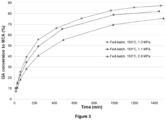
- Example 2 the procedure described in Example 2 was applied at 140 °C and 1.3 MPa. The results are shown in Table 3.
- Table 3 Results of GA conversion reaction vs time Time (min) Conv. (%) GA (%) MCA (%) GAA (%) CAAA (%) Trimer-OH (%) 0 0.8 46.2 0.5 15.0 0.1 1.8 180 34.4 27.2 18.2 7.4 4.5 0.8 278 45.9 22.4 24.1 5.2 5.1 0.5 402 55.8 18.4 29.2 3.6 5.2 0.3 530 63.6 15.4 33.9 2.5 4.9 0.2 740 68.7 13.3 36.8 1.9 4.6 0.1 920 73.4 11.2 39.3 1.4 4.2 0.1 1260 80.3 8.5 43.7 0.8 3.2 0.0
- Example 2 the procedure described in Example 2 was applied at 160 °C and 1.3 MPa. The results are shown in Table 4.
- Table 4 Results of GA conversion reaction vs time Time (min) Conv. (%) GA (%) MCA (%) GAA (%) CAAA (%) Trimer-OH (%) 90 38.2 28.6 22.6 5.9 4.0 0.5 190 50.9 23.0 30.3 3.7 4.1 0.2 320 59.0 19.2 35.7 2.8 3.7 0.2 520 62.9 17.3 38.3 2.4 3.3 0.1 750 63.4 16.9 38.9 2.4 3.2 0.1
- Example 5 Reaction of GA with HCI under fed-batch conditions at 170 °C and 1.3 MPa
- Example 2 the procedure described in Example 2 was applied at 170 °C and 1.3 MPa. The results are shown in Table 5.
- Table 5 Results of GA conversion reaction vs time Time (min) Conv. (%) GA (%) MCA (%) GAA (%) CAAA (%) Trimer-OH (%) 160 47.5 26.5 30.7 4.3 4.0 0.3 250 52.6 22.5 32.4 3.5 3.6 0.2 340 53.5 22.1 33.3 3.6 3.5 0.2 490 53.6 21.5 33.3 3.9 3.5 0.2
- the content of the headspace of the reactor was analyzed at the end of the experiment by means of GC-MS and FT-IR.
- Example 2 the procedure described in Example 2 was applied at 150 °C and 1.1 MPa. The results are shown in Table 6.
- Table 6 Results of GA conversion reaction vs time Time (min) Conv. (%) GA (%) MCA (%) GAA (%) CAAA (%) Trimer-OH (%) 15 10.4 37.5 5.6 12.1 1.7 1.6 30 14.5 36.0 7.8 11.0 2.2 1.4 60 22.5 33.3 12.4 8.9 3.0 1.0 120 34.5 28.2 18.8 6.4 3.9 0.6 240 49.3 22.1 27.2 3.9 4.2 0.3 480 65.6 14.9 36.2 2.0 3.7 0.1 995 78.9 8.9 42.5 1.0 3.1 0.0 1490 82.0 7.6 45.1 0.8 2.4 0.0
- Example 7 Reaction of GA with HCI under fed-batch conditions at 150 °C and 0.9 MPa
- Example 7 the procedure described in Example 2 was applied at 150°C and 0.9 MPa. The results are shown in Table 7.
- Table 7 Results of GA conversion reaction vs time Time (min) Conv. (%) GA (%) MCA (%) GAA (%) CAAA (%) Trimer-OH (%) 15 7.6 40.3 4.3 12.8 1.2 1.6 30 10.9 38.4 6.5 11.6 1.7 4.4 60 18.4 36.1 10.5 9.6 2.5 1.1 120 28.4 32.3 16.4 7.2 3.2 0.7 240 40.9 27.1 23.7 4.7 3.7 0.4 490 55.5 19.8 31.7 3.0 3.9 0.2 990 69.6 13.2 39.1 1.6 3.2 0.1 1500 75.7 10.5 42.5 1.2 2.8 0.1
- Example 8 Reaction of GA in 1,4-dioxane with HCI gas at 1.3 MPa at 140 °C in the (initial) absence of water
- a double wall corrosion-resistant reactor equipped with a mechanical stirrer, a gas dosing inlet, a sample outlet (in the liquid mixture in the reactor) and a bottom valve was loaded with GA (80.0 g; MW 76.05 g.mol -1 ; 4.7 mol; 1.0 equiv.) and 1,4-dioxane (609.0 g; MW 88.11 g.mol -1 ; 6.9 mol; 6.6 equiv.).
- the reactor was then closed, and the mixture was heated while stirring (500 rpm) to the desired temperature (140 °C) using a circulating oil bath.
- HCI-gas When the mixture had reached the desired temperature (140 °C) HCI-gas was added via a flowmeter, with a maximum rate of 4.0 g HCI / min until the target pressure (1.3 MPa) was reached. The pressure was then maintained at about 1.3 MPa by dosing HCI-gas as required over the course of the reaction while keeping the temperature constant. Samples were taken over time for future analysis.
- Example 9 Reaction of GA with HCI under fed-batch conditions at 140 °C and 1.3 MPa, starting from an aqueous solution of GA
- a double wall corrosion-resistant reactor equipped with a mechanical stirrer, a gas dosing inlet, a sample outlet (in the liquid mixture in the reactor) and a bottom valve was loaded with GA (357.3 g; MW 76.05 g.mol -1 ; 4.7 mol; 1.0 equiv.) and water (108.8 g; MW 18.01 g.mol -1 ; 5.9 mol; 1.26 equiv.).
- the reactor was then closed and the mixture was heated while stirring (500 rpm) to the desired temperature using a circulating oil bath.
- HCI-gas was added via a flowmeter with a maximum rate of 4.0 g HCI / min until the pressure of 1.3 MPa was reached.
- the pressure was then maintained at about 1.3 MPa by dosing HCI-gas as required over the course of the reaction while keeping the temperature constant. Samples were taken over time for future analysis.
- Example 10 Reaction of GA with HCI under fed-batch conditions at 150 °C and 1.2 MPa in the presence of zinc chloride
- a double wall corrosion-resistant reactor equipped with a mechanical stirrer, a gas dosing inlet, a sample outlet (in the liquid mixture in the reactor) and a bottom valve was loaded with GA (357.3 g; MW 76.05 g.mol -1 ; 4.7 mol; 1.0 equiv.), a predetermined amount of HCI-29.5% (150.0 g; MW36.46 g.mol -1 ; 1.2 mol; 0.26 equiv.), the required amounts of water(2.9 g; MW 18.01 g.mol -1 ; 0.2 mol; 0.05 equiv.) and zinc chloride (14.5 g; MW 136,315 g.mol -1 ; 0.1 mol; 0.05 equiv.; 2.8 wt%).
- the reactor was then closed, and the mixture was heated while stirring (500 rpm) to the desired temperature (150 °C) using a circulating oil bath.
- HCI-gas was added via a flowmeter, with a maximum rate of 4.0 g HCI / min until the predetermined pressure (1.2 MPa) was reached.
- the pressure was then maintained at about 1.2 MPa by dosing HCI-gas as required over the course of the reaction while keeping the temperature constant. Samples were taken over time for future analysis.
- the word 'or' is used in the sense of an operator that returns a true value when either or both of the stated conditions is met, as opposed to the operator 'exclusive or' which requires that only one of the conditions is met.
- the word 'comprising' is used in the sense of 'including' rather than to mean 'consisting of'.
Landscapes
- Chemical & Material Sciences (AREA)
- Organic Chemistry (AREA)
- Chemical Kinetics & Catalysis (AREA)
- Engineering & Computer Science (AREA)
- Oil, Petroleum & Natural Gas (AREA)
- Organic Low-Molecular-Weight Compounds And Preparation Thereof (AREA)
Claims (10)
- Verfahren zur Herstellung von Monochloressigsäure aus Glykolsäure, wobei das Verfahren Folgendes umfasst:in einem Absorptionsschritt, Kontaktieren eines flüssigen Mediums, das Glykolsäure und Wasser umfasst, mit einem Chlorwasserstoff enthaltenden Gasstrom, was zur Bildung eines flüssigen Mediums führt, in das Chlorwasserstoff absorbiert worden ist, undin einem Reaktionsschritt, Reagieren der Glykolsäure mit dem absorbierten Chlorwasserstoff bei einer Temperatur von etwa 120 °C bis etwa 180 °C und bei einem absoluten Druck von etwa 0,5 MPa bis etwa 2 MPa, wodurch ein flüssiges Medium bereitgestellt wird, das Monochloressigsäure umfasst,wobei der Chlorwasserstoff enthaltende Gasstrom während mindestens eines Teils des Absorptionsschritts und mindestens eines Teils des Reaktionsschritts auf kontinuierliche Weise oder zeitweise in mindestens 2 Portionen bereitgestellt wird.
- Verfahren nach Anspruch 1, wobei die Temperatur des Reaktionsschritts etwa 130 °C bis etwa 170 °C, bevorzugt etwa 135 °C bis etwa 160 °C und noch bevorzugter etwa 140 °C bis 155 °C beträgt.
- Verfahren nach Anspruch 1 oder Anspruch 2, wobei der absolute Druck des Reaktionsschritts etwa 0,6 MPa bis etwa 1,7 MPa, bevorzugt etwa 0,7 MPa bis etwa 1,5 MPa, noch bevorzugter etwa 0,8 MPa bis etwa 1,5 MPa und sogar noch bevorzugter etwa 0,9 MPa bis 1,3 MPa beträgt.
- Verfahren nach einem vorhergehenden Anspruch, wobei vor Kontakt mit dem Chlorwasserstoff enthaltenden Gasstrom im Absorptionsschritt, Wasser in dem flüssigen Medium in einer Menge von etwa 10 Gew.-% bis etwa 30 Gew.-%, bevorzugt etwa 15 Gew.-% bis etwa 30 Gew.-% und noch bevorzugter etwa 15 Gew.-% bis etwa 25 Gew.-%, auf das Gesamtgewicht des flüssigen Mediums bezogen, vorliegt.
- Verfahren nach einem vorhergehenden Anspruch, wobei der Chlorwasserstoff enthaltende Gasstrom während des Verfahrens auf kontinuierliche Weise bereitgestellt wird.
- Verfahren nach einem vorhergehenden Anspruch, wobei der Chlorwasserstoff enthaltende Gasstrom während des Verfahrens zeitweilig in mindestens 10 Portionen bereitgestellt wird.
- Verfahren nach einem vorhergehenden Anspruch, wobei der Reaktionsschritt während einer maximalen Zeitdauer von 24 Stunden, bevorzugt weniger als 10 Stunden und noch bevorzugter weniger als 6 Stunden ausgeführt wird.
- Verfahren nach einem vorhergehenden Anspruch, ferner Folgendes umfassendin einem Trennungsschritt, Trennen der Monochloressigsäure von dem flüssigen Medium, wodurch ein erster Strom, der Chlorwasserstoff umfasst, ein zweiter Strom, der Monochloressigsäure umfasst, und ein dritter Strom, der Glykolsäure und/oder Glykolsäurevorläufer umfasst, bereitgestellt wird, undwahlweise, in einem Rückführschritt, Rückführen mindestens eines Teils des ersten Stroms und/oder mindestens eines Teils des dritten Stroms zum Absorptions- und/oder Reaktionsschritt.
- Verfahren nach Anspruch 1 zur Herstellung von von Di- und Trichloressigsäure freier Monochloressigsäure aus Glykolsäure, wobei das Verfahren Folgendes umfasst:in einem Absorptionsschritt, Kontaktieren eines flüssigen Mediums, das Glykolsäure und Wasser umfasst, mit einem Chlorwasserstoff enthaltenden Gasstrom, was zur Bildung eines flüssigen Mediums führt, in das Chlorwasserstoff absorbiert worden ist,in einem Reaktionsschritt, Reagieren der Glykolsäure mit dem absorbierten Chlorwasserstoff bei einer Temperatur von etwa 120 °C bis etwa 180 °C und bei einem absoluten Druck von etwa 0,5 MPa bis etwa 2 MPa, wodurch ein flüssiges Medium bereitgestellt wird, das Monochloressigsäure umfasst,in einem Trennungsschritt, Trennen der Monochloressigsäure von dem flüssigen Medium, wodurch ein erster Strom, der Chlorwasserstoff umfasst, ein zweiter Strom, der Monochloressigsäure umfasst, und ein dritter Strom, der Glykolsäure und/oder Glykolsäurevorläufer umfasst, bereitgestellt wird, undwahlweise, in einem Rückführschritt, Rückführen mindestens eines Teils des ersten Stroms und/oder mindestens eines Teils des dritten Stroms zum Absorptions- und/oder Reaktionsschritt,wobei der Chlorwasserstoff enthaltende Gasstrom während mindestens eines Teils des Absorptionsschritts und mindestens eines Teils des Reaktionsschritts auf kontinuierliche Weise oder zeitweilig in mindestens 2 Portionen bereitgestellt wird.
- Verfahren nach einem vorhergehenden Anspruch, wobei der Absorptionsschritt und der Reaktionsschritt in einem Chargenreaktor ausgeführt werden und der Chlorwasserstoff enthaltende Gasstrom das Druckerfordernis des Reaktionsschritts aufrechterhält.
Priority Applications (1)
| Application Number | Priority Date | Filing Date | Title |
|---|---|---|---|
| EP21158864.5A EP4049992B1 (de) | 2021-02-24 | 2021-02-24 | Verfahren zur herstellung von monochloressigsäure aus glykolsäure |
Applications Claiming Priority (1)
| Application Number | Priority Date | Filing Date | Title |
|---|---|---|---|
| EP21158864.5A EP4049992B1 (de) | 2021-02-24 | 2021-02-24 | Verfahren zur herstellung von monochloressigsäure aus glykolsäure |
Publications (2)
| Publication Number | Publication Date |
|---|---|
| EP4049992A1 EP4049992A1 (de) | 2022-08-31 |
| EP4049992B1 true EP4049992B1 (de) | 2025-04-09 |
Family
ID=74732701
Family Applications (1)
| Application Number | Title | Priority Date | Filing Date |
|---|---|---|---|
| EP21158864.5A Active EP4049992B1 (de) | 2021-02-24 | 2021-02-24 | Verfahren zur herstellung von monochloressigsäure aus glykolsäure |
Country Status (1)
| Country | Link |
|---|---|
| EP (1) | EP4049992B1 (de) |
Family Cites Families (3)
| Publication number | Priority date | Publication date | Assignee | Title |
|---|---|---|---|---|
| JPS5344520A (en) | 1976-10-04 | 1978-04-21 | Mitsubishi Gas Chem Co Inc | Preparation of monochloroacetic acid |
| US4221921A (en) | 1978-05-10 | 1980-09-09 | Chevron Research Company | Monochloroacetic acid from hydroxyacetic acid |
| FR2575155A1 (fr) | 1984-12-20 | 1986-06-27 | Atochem | Procede de preparation d'acide monochloracetique a partir d'acide glycolique |
-
2021
- 2021-02-24 EP EP21158864.5A patent/EP4049992B1/de active Active
Also Published As
| Publication number | Publication date |
|---|---|
| EP4049992A1 (de) | 2022-08-31 |
Similar Documents
| Publication | Publication Date | Title |
|---|---|---|
| CN100448832C (zh) | 乙酸的生产方法 | |
| JP3632243B2 (ja) | ジフルオロ酢酸フルオリドおよびジフルオロ酢酸エステルの製造方法 | |
| EP0487284B1 (de) | Entfernung von Carbonylverunreinigungen aus dem Carbonylierungsprozessstrom | |
| UA70385C2 (en) | A method for the preparation of acetic acid a method for the preparation of acetic acid | |
| IE48289B1 (en) | Preparation of formic acid by hydrolysis of methyl formate | |
| KR100344863B1 (ko) | 디플루오로메탄의제조방법 | |
| US5545298A (en) | Process for preparing polyfluorocarboxylic acid chlorides and perfluorocarboxylic acid chlorides | |
| BG51039A3 (bg) | Метод за пречистване на етиленгликол получен от етиленкарбонат | |
| EP3225611A1 (de) | Herstellung von halidprodukten | |
| EP4049992B1 (de) | Verfahren zur herstellung von monochloressigsäure aus glykolsäure | |
| US5430186A (en) | Preparation of carboxylic chlorides | |
| JP4521277B2 (ja) | 3−メチルチオプロパナールの製造方法 | |
| EP1123911B1 (de) | Verfahren zur Herstellung von Difluormethan und Difluorchlormethan | |
| US5789632A (en) | Process of purifying 1,1,1,3,3,-pentafluoro-2,3 dichloropropane | |
| JP2006515834A5 (de) | ||
| US3995010A (en) | Purification process | |
| JPS6212211B2 (de) | ||
| JPH05286918A (ja) | アクリルニトリル二量体の製造方法 | |
| EP0660816A1 (de) | Verfahren zur herstellung von perhalochlorid | |
| KR20020029131A (ko) | 지방산 아미드의 제조방법 | |
| EP0625519B1 (de) | Verfahren zur Herstellung von Alkylen-Carbonaten | |
| US5030753A (en) | Process for the preparation of dichloro- or trichloroacetyl chloride | |
| JPH10287609A (ja) | 3,3−ジクロロ−1,1,1−トリフルオロアセトンの製造方法 | |
| US2826610A (en) | Manufacture of monochloroacetic acid | |
| CN1034359A (zh) | 二氯丁烯异构化的改进方法 |
Legal Events
| Date | Code | Title | Description |
|---|---|---|---|
| PUAI | Public reference made under article 153(3) epc to a published international application that has entered the european phase |
Free format text: ORIGINAL CODE: 0009012 |
|
| STAA | Information on the status of an ep patent application or granted ep patent |
Free format text: STATUS: THE APPLICATION HAS BEEN PUBLISHED |
|
| AK | Designated contracting states |
Kind code of ref document: A1 Designated state(s): AL AT BE BG CH CY CZ DE DK EE ES FI FR GB GR HR HU IE IS IT LI LT LU LV MC MK MT NL NO PL PT RO RS SE SI SK SM TR |
|
| STAA | Information on the status of an ep patent application or granted ep patent |
Free format text: STATUS: REQUEST FOR EXAMINATION WAS MADE |
|
| 17P | Request for examination filed |
Effective date: 20230113 |
|
| RBV | Designated contracting states (corrected) |
Designated state(s): AL AT BE BG CH CY CZ DE DK EE ES FI FR GB GR HR HU IE IS IT LI LT LU LV MC MK MT NL NO PL PT RO RS SE SI SK SM TR |
|
| STAA | Information on the status of an ep patent application or granted ep patent |
Free format text: STATUS: EXAMINATION IS IN PROGRESS |
|
| 17Q | First examination report despatched |
Effective date: 20230227 |
|
| P01 | Opt-out of the competence of the unified patent court (upc) registered |
Effective date: 20230504 |
|
| GRAP | Despatch of communication of intention to grant a patent |
Free format text: ORIGINAL CODE: EPIDOSNIGR1 |
|
| STAA | Information on the status of an ep patent application or granted ep patent |
Free format text: STATUS: GRANT OF PATENT IS INTENDED |
|
| INTG | Intention to grant announced |
Effective date: 20240315 |
|
| GRAS | Grant fee paid |
Free format text: ORIGINAL CODE: EPIDOSNIGR3 |
|
| GRAA | (expected) grant |
Free format text: ORIGINAL CODE: 0009210 |
|
| STAA | Information on the status of an ep patent application or granted ep patent |
Free format text: STATUS: THE PATENT HAS BEEN GRANTED |
|
| AK | Designated contracting states |
Kind code of ref document: B1 Designated state(s): AL AT BE BG CH CY CZ DE DK EE ES FI FR GB GR HR HU IE IS IT LI LT LU LV MC MK MT NL NO PL PT RO RS SE SI SK SM TR |
|
| REG | Reference to a national code |
Ref country code: GB Ref legal event code: FG4D |
|
| REG | Reference to a national code |
Ref country code: CH Ref legal event code: EP |
|
| REG | Reference to a national code |
Ref country code: DE Ref legal event code: R096 Ref document number: 602021028749 Country of ref document: DE |
|
| REG | Reference to a national code |
Ref country code: IE Ref legal event code: FG4D |
|
| RAP2 | Party data changed (patent owner data changed or rights of a patent transferred) |
Owner name: NOURYON CHEMICALS INTERNATIONAL B.V. |
|
| REG | Reference to a national code |
Ref country code: NL Ref legal event code: FP |
|
| REG | Reference to a national code |
Ref country code: NL Ref legal event code: PD Owner name: NOURYON CHEMICALS INTERNATIONAL B.V.; NL Free format text: DETAILS ASSIGNMENT: CHANGE OF OWNER(S), ASSIGNMENT; FORMER OWNER NAME: NOURYON CHEMICALS BV Effective date: 20250724 |
|
| REG | Reference to a national code |
Ref country code: DE Ref legal event code: R081 Ref document number: 602021028749 Country of ref document: DE Owner name: NOURYON CHEMICALS INTERNATIONAL B.V, NL Free format text: FORMER OWNER: NOURYON CHEMICALS BV, ARNHEM, NL Ref country code: DE Ref legal event code: R082 Ref document number: 602021028749 Country of ref document: DE Representative=s name: COSMOVICI INTELLECTUAL PROPERTY, DE |
|
| REG | Reference to a national code |
Ref country code: AT Ref legal event code: MK05 Ref document number: 1783447 Country of ref document: AT Kind code of ref document: T Effective date: 20250409 |
|
| PG25 | Lapsed in a contracting state [announced via postgrant information from national office to epo] |
Ref country code: PT Free format text: LAPSE BECAUSE OF FAILURE TO SUBMIT A TRANSLATION OF THE DESCRIPTION OR TO PAY THE FEE WITHIN THE PRESCRIBED TIME-LIMIT Effective date: 20250811 Ref country code: ES Free format text: LAPSE BECAUSE OF FAILURE TO SUBMIT A TRANSLATION OF THE DESCRIPTION OR TO PAY THE FEE WITHIN THE PRESCRIBED TIME-LIMIT Effective date: 20250409 Ref country code: FI Free format text: LAPSE BECAUSE OF FAILURE TO SUBMIT A TRANSLATION OF THE DESCRIPTION OR TO PAY THE FEE WITHIN THE PRESCRIBED TIME-LIMIT Effective date: 20250409 |
|
| REG | Reference to a national code |
Ref country code: LT Ref legal event code: MG9D |
|
| PG25 | Lapsed in a contracting state [announced via postgrant information from national office to epo] |
Ref country code: GR Free format text: LAPSE BECAUSE OF FAILURE TO SUBMIT A TRANSLATION OF THE DESCRIPTION OR TO PAY THE FEE WITHIN THE PRESCRIBED TIME-LIMIT Effective date: 20250710 Ref country code: NO Free format text: LAPSE BECAUSE OF FAILURE TO SUBMIT A TRANSLATION OF THE DESCRIPTION OR TO PAY THE FEE WITHIN THE PRESCRIBED TIME-LIMIT Effective date: 20250709 |
|
| PG25 | Lapsed in a contracting state [announced via postgrant information from national office to epo] |
Ref country code: BG Free format text: LAPSE BECAUSE OF FAILURE TO SUBMIT A TRANSLATION OF THE DESCRIPTION OR TO PAY THE FEE WITHIN THE PRESCRIBED TIME-LIMIT Effective date: 20250409 |
|
| PG25 | Lapsed in a contracting state [announced via postgrant information from national office to epo] |
Ref country code: HR Free format text: LAPSE BECAUSE OF FAILURE TO SUBMIT A TRANSLATION OF THE DESCRIPTION OR TO PAY THE FEE WITHIN THE PRESCRIBED TIME-LIMIT Effective date: 20250409 |
|
| PG25 | Lapsed in a contracting state [announced via postgrant information from national office to epo] |
Ref country code: AT Free format text: LAPSE BECAUSE OF FAILURE TO SUBMIT A TRANSLATION OF THE DESCRIPTION OR TO PAY THE FEE WITHIN THE PRESCRIBED TIME-LIMIT Effective date: 20250409 |
|
| PG25 | Lapsed in a contracting state [announced via postgrant information from national office to epo] |
Ref country code: RS Free format text: LAPSE BECAUSE OF FAILURE TO SUBMIT A TRANSLATION OF THE DESCRIPTION OR TO PAY THE FEE WITHIN THE PRESCRIBED TIME-LIMIT Effective date: 20250709 |
|
| PG25 | Lapsed in a contracting state [announced via postgrant information from national office to epo] |
Ref country code: IS Free format text: LAPSE BECAUSE OF FAILURE TO SUBMIT A TRANSLATION OF THE DESCRIPTION OR TO PAY THE FEE WITHIN THE PRESCRIBED TIME-LIMIT Effective date: 20250809 |
|
| PG25 | Lapsed in a contracting state [announced via postgrant information from national office to epo] |
Ref country code: LV Free format text: LAPSE BECAUSE OF FAILURE TO SUBMIT A TRANSLATION OF THE DESCRIPTION OR TO PAY THE FEE WITHIN THE PRESCRIBED TIME-LIMIT Effective date: 20250409 |