EP4046972A1 - Glaskörper - Google Patents
Glaskörper Download PDFInfo
- Publication number
- EP4046972A1 EP4046972A1 EP20877769.8A EP20877769A EP4046972A1 EP 4046972 A1 EP4046972 A1 EP 4046972A1 EP 20877769 A EP20877769 A EP 20877769A EP 4046972 A1 EP4046972 A1 EP 4046972A1
- Authority
- EP
- European Patent Office
- Prior art keywords
- film
- antifog
- glass body
- body according
- translucent reflective
- Prior art date
- Legal status (The legal status is an assumption and is not a legal conclusion. Google has not performed a legal analysis and makes no representation as to the accuracy of the status listed.)
- Pending
Links
- 239000011521 glass Substances 0.000 title claims abstract description 178
- XLYOFNOQVPJJNP-UHFFFAOYSA-N water Substances O XLYOFNOQVPJJNP-UHFFFAOYSA-N 0.000 claims description 142
- 239000010410 layer Substances 0.000 claims description 94
- 239000005871 repellent Substances 0.000 claims description 66
- 230000002940 repellent Effects 0.000 claims description 63
- VYPSYNLAJGMNEJ-UHFFFAOYSA-N Silicium dioxide Chemical compound O=[Si]=O VYPSYNLAJGMNEJ-UHFFFAOYSA-N 0.000 claims description 49
- 229920005989 resin Polymers 0.000 claims description 29
- 239000011347 resin Substances 0.000 claims description 29
- 239000002250 absorbent Substances 0.000 claims description 28
- 230000002745 absorbent Effects 0.000 claims description 26
- 239000000377 silicon dioxide Substances 0.000 claims description 24
- XOLBLPGZBRYERU-UHFFFAOYSA-N tin dioxide Chemical compound O=[Sn]=O XOLBLPGZBRYERU-UHFFFAOYSA-N 0.000 claims description 21
- 238000002834 transmittance Methods 0.000 claims description 21
- 229910001887 tin oxide Inorganic materials 0.000 claims description 18
- 230000003287 optical effect Effects 0.000 claims description 16
- 229910052710 silicon Inorganic materials 0.000 claims description 16
- 229910052751 metal Inorganic materials 0.000 claims description 15
- 239000002184 metal Substances 0.000 claims description 15
- 239000000758 substrate Substances 0.000 claims description 14
- 229910052719 titanium Inorganic materials 0.000 claims description 14
- 230000003746 surface roughness Effects 0.000 claims description 12
- 239000005329 float glass Substances 0.000 claims description 9
- 239000012790 adhesive layer Substances 0.000 claims description 5
- 229910052782 aluminium Inorganic materials 0.000 claims description 4
- 229910052804 chromium Inorganic materials 0.000 claims description 4
- 229910052709 silver Inorganic materials 0.000 claims description 4
- 229910052750 molybdenum Inorganic materials 0.000 claims description 3
- 229910052681 coesite Inorganic materials 0.000 claims 1
- 229910052906 cristobalite Inorganic materials 0.000 claims 1
- 229910052682 stishovite Inorganic materials 0.000 claims 1
- 229910052905 tridymite Inorganic materials 0.000 claims 1
- 239000002245 particle Substances 0.000 description 32
- 229910021432 inorganic complex Inorganic materials 0.000 description 29
- 229910052809 inorganic oxide Inorganic materials 0.000 description 26
- 229910044991 metal oxide Inorganic materials 0.000 description 19
- 239000000463 material Substances 0.000 description 18
- 150000003377 silicon compounds Chemical class 0.000 description 17
- XUIMIQQOPSSXEZ-UHFFFAOYSA-N Silicon Chemical compound [Si] XUIMIQQOPSSXEZ-UHFFFAOYSA-N 0.000 description 15
- 229910000765 intermetallic Inorganic materials 0.000 description 15
- 238000000034 method Methods 0.000 description 14
- -1 aliphatic aldehydes Chemical class 0.000 description 13
- 125000000524 functional group Chemical group 0.000 description 13
- 239000010936 titanium Substances 0.000 description 13
- 125000004432 carbon atom Chemical group C* 0.000 description 12
- GWEVSGVZZGPLCZ-UHFFFAOYSA-N Titan oxide Chemical compound O=[Ti]=O GWEVSGVZZGPLCZ-UHFFFAOYSA-N 0.000 description 11
- 239000011248 coating agent Substances 0.000 description 11
- 238000000576 coating method Methods 0.000 description 11
- 239000006087 Silane Coupling Agent Substances 0.000 description 10
- 125000000217 alkyl group Chemical group 0.000 description 10
- 239000010703 silicon Substances 0.000 description 10
- HUMNYLRZRPPJDN-UHFFFAOYSA-N benzaldehyde Chemical compound O=CC1=CC=CC=C1 HUMNYLRZRPPJDN-UHFFFAOYSA-N 0.000 description 9
- 235000019646 color tone Nutrition 0.000 description 9
- 150000001875 compounds Chemical class 0.000 description 9
- 230000000694 effects Effects 0.000 description 9
- 239000003822 epoxy resin Substances 0.000 description 9
- 229920000647 polyepoxide Polymers 0.000 description 9
- LNEPOXFFQSENCJ-UHFFFAOYSA-N haloperidol Chemical compound C1CC(O)(C=2C=CC(Cl)=CC=2)CCN1CCCC(=O)C1=CC=C(F)C=C1 LNEPOXFFQSENCJ-UHFFFAOYSA-N 0.000 description 8
- 230000000717 retained effect Effects 0.000 description 8
- 235000012239 silicon dioxide Nutrition 0.000 description 8
- 229920002554 vinyl polymer Polymers 0.000 description 8
- 239000011354 acetal resin Substances 0.000 description 7
- 238000001035 drying Methods 0.000 description 7
- 229920006324 polyoxymethylene Polymers 0.000 description 7
- 229920002451 polyvinyl alcohol Polymers 0.000 description 7
- 235000019422 polyvinyl alcohol Nutrition 0.000 description 7
- RTAQQCXQSZGOHL-UHFFFAOYSA-N Titanium Chemical compound [Ti] RTAQQCXQSZGOHL-UHFFFAOYSA-N 0.000 description 6
- 238000006359 acetalization reaction Methods 0.000 description 6
- 125000003545 alkoxy group Chemical group 0.000 description 6
- 230000015572 biosynthetic process Effects 0.000 description 6
- 238000005229 chemical vapour deposition Methods 0.000 description 6
- 125000006165 cyclic alkyl group Chemical group 0.000 description 6
- 125000005843 halogen group Chemical group 0.000 description 6
- 229910052718 tin Inorganic materials 0.000 description 6
- 239000004372 Polyvinyl alcohol Substances 0.000 description 5
- 238000005299 abrasion Methods 0.000 description 5
- 125000003277 amino group Chemical group 0.000 description 5
- 150000003934 aromatic aldehydes Chemical class 0.000 description 5
- 239000012298 atmosphere Substances 0.000 description 5
- 239000002585 base Substances 0.000 description 5
- 238000009833 condensation Methods 0.000 description 5
- 230000005494 condensation Effects 0.000 description 5
- 239000003431 cross linking reagent Substances 0.000 description 5
- 229910052739 hydrogen Inorganic materials 0.000 description 5
- 239000001257 hydrogen Substances 0.000 description 5
- 125000004435 hydrogen atom Chemical group [H]* 0.000 description 5
- 125000002887 hydroxy group Chemical group [H]O* 0.000 description 5
- 150000004706 metal oxides Chemical class 0.000 description 5
- QNGNSVIICDLXHT-UHFFFAOYSA-N para-ethylbenzaldehyde Natural products CCC1=CC=C(C=O)C=C1 QNGNSVIICDLXHT-UHFFFAOYSA-N 0.000 description 5
- 229920005749 polyurethane resin Polymers 0.000 description 5
- 150000003609 titanium compounds Chemical class 0.000 description 5
- 239000004408 titanium dioxide Substances 0.000 description 5
- AIFLGMNWQFPTAJ-UHFFFAOYSA-J 2-hydroxypropanoate;titanium(4+) Chemical compound [Ti+4].CC(O)C([O-])=O.CC(O)C([O-])=O.CC(O)C([O-])=O.CC(O)C([O-])=O AIFLGMNWQFPTAJ-UHFFFAOYSA-J 0.000 description 4
- ATJFFYVFTNAWJD-UHFFFAOYSA-N Tin Chemical compound [Sn] ATJFFYVFTNAWJD-UHFFFAOYSA-N 0.000 description 4
- 239000000654 additive Substances 0.000 description 4
- 238000007605 air drying Methods 0.000 description 4
- 230000007423 decrease Effects 0.000 description 4
- 229910052731 fluorine Inorganic materials 0.000 description 4
- 125000001153 fluoro group Chemical group F* 0.000 description 4
- 230000001771 impaired effect Effects 0.000 description 4
- 125000004430 oxygen atom Chemical group O* 0.000 description 4
- 229920005862 polyol Polymers 0.000 description 4
- 239000001431 2-methylbenzaldehyde Substances 0.000 description 3
- LYCAIKOWRPUZTN-UHFFFAOYSA-N Ethylene glycol Chemical compound OCCO LYCAIKOWRPUZTN-UHFFFAOYSA-N 0.000 description 3
- 238000006124 Pilkington process Methods 0.000 description 3
- 125000003302 alkenyloxy group Chemical group 0.000 description 3
- 125000004429 atom Chemical group 0.000 description 3
- 239000013522 chelant Substances 0.000 description 3
- 230000002708 enhancing effect Effects 0.000 description 3
- 238000010438 heat treatment Methods 0.000 description 3
- 238000005259 measurement Methods 0.000 description 3
- 238000006116 polymerization reaction Methods 0.000 description 3
- 150000003077 polyols Chemical class 0.000 description 3
- 239000011118 polyvinyl acetate Substances 0.000 description 3
- 229920002689 polyvinyl acetate Polymers 0.000 description 3
- 238000004544 sputter deposition Methods 0.000 description 3
- 229910052726 zirconium Inorganic materials 0.000 description 3
- ODIGIKRIUKFKHP-UHFFFAOYSA-N (n-propan-2-yloxycarbonylanilino) acetate Chemical compound CC(C)OC(=O)N(OC(C)=O)C1=CC=CC=C1 ODIGIKRIUKFKHP-UHFFFAOYSA-N 0.000 description 2
- DHKHKXVYLBGOIT-UHFFFAOYSA-N 1,1-Diethoxyethane Chemical compound CCOC(C)OCC DHKHKXVYLBGOIT-UHFFFAOYSA-N 0.000 description 2
- 239000004925 Acrylic resin Substances 0.000 description 2
- 229920000178 Acrylic resin Polymers 0.000 description 2
- ZTQSAGDEMFDKMZ-UHFFFAOYSA-N Butyraldehyde Chemical compound CCCC=O ZTQSAGDEMFDKMZ-UHFFFAOYSA-N 0.000 description 2
- 229910052684 Cerium Inorganic materials 0.000 description 2
- PEDCQBHIVMGVHV-UHFFFAOYSA-N Glycerine Chemical compound OCC(O)CO PEDCQBHIVMGVHV-UHFFFAOYSA-N 0.000 description 2
- 229910052779 Neodymium Inorganic materials 0.000 description 2
- 229910020387 SiO2 SnO2 Inorganic materials 0.000 description 2
- 229910002808 Si–O–Si Inorganic materials 0.000 description 2
- 238000010521 absorption reaction Methods 0.000 description 2
- 150000001241 acetals Chemical group 0.000 description 2
- 125000003668 acetyloxy group Chemical group [H]C([H])([H])C(=O)O[*] 0.000 description 2
- 150000001299 aldehydes Chemical class 0.000 description 2
- 239000004844 aliphatic epoxy resin Substances 0.000 description 2
- 239000003513 alkali Substances 0.000 description 2
- 125000002947 alkylene group Chemical group 0.000 description 2
- 230000008859 change Effects 0.000 description 2
- 239000003086 colorant Substances 0.000 description 2
- 238000006482 condensation reaction Methods 0.000 description 2
- 125000004122 cyclic group Chemical group 0.000 description 2
- 230000006866 deterioration Effects 0.000 description 2
- 125000003700 epoxy group Chemical group 0.000 description 2
- 230000002349 favourable effect Effects 0.000 description 2
- 238000010304 firing Methods 0.000 description 2
- 230000007062 hydrolysis Effects 0.000 description 2
- 238000006460 hydrolysis reaction Methods 0.000 description 2
- 229920013821 hydroxy alkyl cellulose Polymers 0.000 description 2
- 230000008595 infiltration Effects 0.000 description 2
- 238000001764 infiltration Methods 0.000 description 2
- 229910052746 lanthanum Inorganic materials 0.000 description 2
- 230000031700 light absorption Effects 0.000 description 2
- 238000004519 manufacturing process Methods 0.000 description 2
- 239000011159 matrix material Substances 0.000 description 2
- 229910052758 niobium Inorganic materials 0.000 description 2
- BTFQKIATRPGRBS-UHFFFAOYSA-N o-tolualdehyde Chemical compound CC1=CC=CC=C1C=O BTFQKIATRPGRBS-UHFFFAOYSA-N 0.000 description 2
- FXLOVSHXALFLKQ-UHFFFAOYSA-N p-tolualdehyde Chemical compound CC1=CC=C(C=O)C=C1 FXLOVSHXALFLKQ-UHFFFAOYSA-N 0.000 description 2
- 239000000049 pigment Substances 0.000 description 2
- 238000006068 polycondensation reaction Methods 0.000 description 2
- 229920000036 polyvinylpyrrolidone Polymers 0.000 description 2
- 239000001267 polyvinylpyrrolidone Substances 0.000 description 2
- 235000013855 polyvinylpyrrolidone Nutrition 0.000 description 2
- 238000007127 saponification reaction Methods 0.000 description 2
- 239000002356 single layer Substances 0.000 description 2
- 239000002904 solvent Substances 0.000 description 2
- 238000006467 substitution reaction Methods 0.000 description 2
- 229910052715 tantalum Inorganic materials 0.000 description 2
- VXUYXOFXAQZZMF-UHFFFAOYSA-N titanium(IV) isopropoxide Chemical compound CC(C)O[Ti](OC(C)C)(OC(C)C)OC(C)C VXUYXOFXAQZZMF-UHFFFAOYSA-N 0.000 description 2
- RYSXWUYLAWPLES-MTOQALJVSA-N (Z)-4-hydroxypent-3-en-2-one titanium Chemical compound [Ti].C\C(O)=C\C(C)=O.C\C(O)=C\C(C)=O.C\C(O)=C\C(C)=O.C\C(O)=C\C(C)=O RYSXWUYLAWPLES-MTOQALJVSA-N 0.000 description 1
- 238000001644 13C nuclear magnetic resonance spectroscopy Methods 0.000 description 1
- XHHXXUFDXRYMQI-UHFFFAOYSA-N 2-[bis(2-hydroxyethyl)amino]ethanol;titanium Chemical compound [Ti].OCCN(CCO)CCO XHHXXUFDXRYMQI-UHFFFAOYSA-N 0.000 description 1
- FPYUJUBAXZAQNL-UHFFFAOYSA-N 2-chlorobenzaldehyde Chemical compound ClC1=CC=CC=C1C=O FPYUJUBAXZAQNL-UHFFFAOYSA-N 0.000 description 1
- ZOXJGFHDIHLPTG-UHFFFAOYSA-N Boron Chemical compound [B] ZOXJGFHDIHLPTG-UHFFFAOYSA-N 0.000 description 1
- 239000005046 Chlorosilane Substances 0.000 description 1
- LFQSCWFLJHTTHZ-UHFFFAOYSA-N Ethanol Chemical compound CCO LFQSCWFLJHTTHZ-UHFFFAOYSA-N 0.000 description 1
- 239000004698 Polyethylene Substances 0.000 description 1
- 239000002202 Polyethylene glycol Substances 0.000 description 1
- 239000004721 Polyphenylene oxide Substances 0.000 description 1
- 229910018557 Si O Inorganic materials 0.000 description 1
- 229920002472 Starch Polymers 0.000 description 1
- BOTDANWDWHJENH-UHFFFAOYSA-N Tetraethyl orthosilicate Chemical compound CCO[Si](OCC)(OCC)OCC BOTDANWDWHJENH-UHFFFAOYSA-N 0.000 description 1
- QCWXUUIWCKQGHC-UHFFFAOYSA-N Zirconium Chemical compound [Zr] QCWXUUIWCKQGHC-UHFFFAOYSA-N 0.000 description 1
- 239000006096 absorbing agent Substances 0.000 description 1
- IKHGUXGNUITLKF-XPULMUKRSA-N acetaldehyde Chemical compound [14CH]([14CH3])=O IKHGUXGNUITLKF-XPULMUKRSA-N 0.000 description 1
- BTHCBXJLLCHNMS-UHFFFAOYSA-N acetyloxysilicon Chemical compound CC(=O)O[Si] BTHCBXJLLCHNMS-UHFFFAOYSA-N 0.000 description 1
- 239000003377 acid catalyst Substances 0.000 description 1
- 239000003522 acrylic cement Substances 0.000 description 1
- 125000004103 aminoalkyl group Chemical group 0.000 description 1
- 150000003863 ammonium salts Chemical class 0.000 description 1
- XJDFBLQCLSBCGQ-UHFFFAOYSA-N anthracene-1-carbaldehyde Chemical compound C1=CC=C2C=C3C(C=O)=CC=CC3=CC2=C1 XJDFBLQCLSBCGQ-UHFFFAOYSA-N 0.000 description 1
- 239000002518 antifoaming agent Substances 0.000 description 1
- 239000004599 antimicrobial Substances 0.000 description 1
- 239000012736 aqueous medium Substances 0.000 description 1
- GDFLGQIOWFLLOC-UHFFFAOYSA-N azane;2-hydroxypropanoic acid;titanium Chemical compound [NH4+].[Ti].CC(O)C([O-])=O GDFLGQIOWFLLOC-UHFFFAOYSA-N 0.000 description 1
- 150000003935 benzaldehydes Chemical class 0.000 description 1
- 230000005540 biological transmission Effects 0.000 description 1
- 238000006664 bond formation reaction Methods 0.000 description 1
- 229910052796 boron Inorganic materials 0.000 description 1
- 150000001639 boron compounds Chemical class 0.000 description 1
- YHWCPXVTRSHPNY-UHFFFAOYSA-N butan-1-olate;titanium(4+) Chemical compound [Ti+4].CCCC[O-].CCCC[O-].CCCC[O-].CCCC[O-] YHWCPXVTRSHPNY-UHFFFAOYSA-N 0.000 description 1
- QHIWVLPBUQWDMQ-UHFFFAOYSA-N butyl prop-2-enoate;methyl 2-methylprop-2-enoate;prop-2-enoic acid Chemical compound OC(=O)C=C.COC(=O)C(C)=C.CCCCOC(=O)C=C QHIWVLPBUQWDMQ-UHFFFAOYSA-N 0.000 description 1
- 229920002678 cellulose Polymers 0.000 description 1
- 239000001913 cellulose Substances 0.000 description 1
- 235000010980 cellulose Nutrition 0.000 description 1
- 239000003795 chemical substances by application Substances 0.000 description 1
- 229910052801 chlorine Inorganic materials 0.000 description 1
- 125000001309 chloro group Chemical group Cl* 0.000 description 1
- KOPOQZFJUQMUML-UHFFFAOYSA-N chlorosilane Chemical compound Cl[SiH3] KOPOQZFJUQMUML-UHFFFAOYSA-N 0.000 description 1
- 239000008119 colloidal silica Substances 0.000 description 1
- 239000000470 constituent Substances 0.000 description 1
- 239000006059 cover glass Substances 0.000 description 1
- 125000004093 cyano group Chemical group *C#N 0.000 description 1
- 238000000354 decomposition reaction Methods 0.000 description 1
- 230000018044 dehydration Effects 0.000 description 1
- 238000006297 dehydration reaction Methods 0.000 description 1
- 238000000151 deposition Methods 0.000 description 1
- 230000008021 deposition Effects 0.000 description 1
- 239000003599 detergent Substances 0.000 description 1
- GYZLOYUZLJXAJU-UHFFFAOYSA-N diglycidyl ether Chemical compound C1OC1COCC1CO1 GYZLOYUZLJXAJU-UHFFFAOYSA-N 0.000 description 1
- 239000006185 dispersion Substances 0.000 description 1
- 238000010494 dissociation reaction Methods 0.000 description 1
- 230000005593 dissociations Effects 0.000 description 1
- 238000011978 dissolution method Methods 0.000 description 1
- 238000009826 distribution Methods 0.000 description 1
- WIEGKKSLPGLWRN-UHFFFAOYSA-N ethyl 3-oxobutanoate;titanium Chemical compound [Ti].CCOC(=O)CC(C)=O WIEGKKSLPGLWRN-UHFFFAOYSA-N 0.000 description 1
- 125000001495 ethyl group Chemical group [H]C([H])([H])C([H])([H])* 0.000 description 1
- 239000005357 flat glass Substances 0.000 description 1
- 235000011187 glycerol Nutrition 0.000 description 1
- 150000002334 glycols Chemical class 0.000 description 1
- 239000000413 hydrolysate Substances 0.000 description 1
- 230000002209 hydrophobic effect Effects 0.000 description 1
- 230000006872 improvement Effects 0.000 description 1
- 230000001788 irregular Effects 0.000 description 1
- OVWYEQOVUDKZNU-UHFFFAOYSA-N m-tolualdehyde Chemical compound CC1=CC=CC(C=O)=C1 OVWYEQOVUDKZNU-UHFFFAOYSA-N 0.000 description 1
- 230000014759 maintenance of location Effects 0.000 description 1
- 239000012528 membrane Substances 0.000 description 1
- 150000002739 metals Chemical class 0.000 description 1
- WSFSSNUMVMOOMR-NJFSPNSNSA-N methanone Chemical compound O=[14CH2] WSFSSNUMVMOOMR-NJFSPNSNSA-N 0.000 description 1
- 125000002496 methyl group Chemical group [H]C([H])([H])* 0.000 description 1
- 230000004048 modification Effects 0.000 description 1
- 238000012986 modification Methods 0.000 description 1
- 239000006060 molten glass Substances 0.000 description 1
- 125000001280 n-hexyl group Chemical group C(CCCCC)* 0.000 description 1
- 230000007935 neutral effect Effects 0.000 description 1
- MCCIMQKMMBVWHO-UHFFFAOYSA-N octadecanoic acid;titanium Chemical group [Ti].CCCCCCCCCCCCCCCCCC(O)=O.CCCCCCCCCCCCCCCCCC(O)=O.CCCCCCCCCCCCCCCCCC(O)=O.CCCCCCCCCCCCCCCCCC(O)=O MCCIMQKMMBVWHO-UHFFFAOYSA-N 0.000 description 1
- KSCKTBJJRVPGKM-UHFFFAOYSA-N octan-1-olate;titanium(4+) Chemical compound [Ti+4].CCCCCCCC[O-].CCCCCCCC[O-].CCCCCCCC[O-].CCCCCCCC[O-] KSCKTBJJRVPGKM-UHFFFAOYSA-N 0.000 description 1
- WNAABDGNLSAZIM-UHFFFAOYSA-N octane-1,8-diol;titanium Chemical compound [Ti].OCCCCCCCCO WNAABDGNLSAZIM-UHFFFAOYSA-N 0.000 description 1
- 238000007254 oxidation reaction Methods 0.000 description 1
- AFEQENGXSMURHA-UHFFFAOYSA-N oxiran-2-ylmethanamine Chemical compound NCC1CO1 AFEQENGXSMURHA-UHFFFAOYSA-N 0.000 description 1
- 125000005010 perfluoroalkyl group Chemical group 0.000 description 1
- 230000002093 peripheral effect Effects 0.000 description 1
- 230000035699 permeability Effects 0.000 description 1
- 230000010363 phase shift Effects 0.000 description 1
- 238000005240 physical vapour deposition Methods 0.000 description 1
- 229920005906 polyester polyol Polymers 0.000 description 1
- 229920000570 polyether Polymers 0.000 description 1
- 229920000573 polyethylene Polymers 0.000 description 1
- 229920001223 polyethylene glycol Polymers 0.000 description 1
- 229920013716 polyethylene resin Polymers 0.000 description 1
- 229920000139 polyethylene terephthalate Polymers 0.000 description 1
- 239000005020 polyethylene terephthalate Substances 0.000 description 1
- 229920001228 polyisocyanate Polymers 0.000 description 1
- 239000005056 polyisocyanate Substances 0.000 description 1
- 238000001556 precipitation Methods 0.000 description 1
- 238000002360 preparation method Methods 0.000 description 1
- 239000011164 primary particle Substances 0.000 description 1
- 238000007639 printing Methods 0.000 description 1
- 230000002035 prolonged effect Effects 0.000 description 1
- IVHXEBVFCNBWED-UHFFFAOYSA-N prop-1-en-2-yloxysilane Chemical group CC(=C)O[SiH3] IVHXEBVFCNBWED-UHFFFAOYSA-N 0.000 description 1
- 239000000523 sample Substances 0.000 description 1
- 125000005372 silanol group Chemical group 0.000 description 1
- LIVNPJMFVYWSIS-UHFFFAOYSA-N silicon monoxide Inorganic materials [Si-]#[O+] LIVNPJMFVYWSIS-UHFFFAOYSA-N 0.000 description 1
- 229910052814 silicon oxide Inorganic materials 0.000 description 1
- 239000013464 silicone adhesive Substances 0.000 description 1
- 239000005361 soda-lime glass Substances 0.000 description 1
- 238000005507 spraying Methods 0.000 description 1
- 239000008107 starch Substances 0.000 description 1
- 235000019698 starch Nutrition 0.000 description 1
- 239000000126 substance Substances 0.000 description 1
- 230000001629 suppression Effects 0.000 description 1
- 239000004094 surface-active agent Substances 0.000 description 1
- 230000008961 swelling Effects 0.000 description 1
- OQTSOKXAWXRIAC-UHFFFAOYSA-N tetrabutan-2-yl silicate Chemical compound CCC(C)O[Si](OC(C)CC)(OC(C)CC)OC(C)CC OQTSOKXAWXRIAC-UHFFFAOYSA-N 0.000 description 1
- UQMOLLPKNHFRAC-UHFFFAOYSA-N tetrabutyl silicate Chemical compound CCCCO[Si](OCCCC)(OCCCC)OCCCC UQMOLLPKNHFRAC-UHFFFAOYSA-N 0.000 description 1
- LFQCEHFDDXELDD-UHFFFAOYSA-N tetramethyl orthosilicate Chemical compound CO[Si](OC)(OC)OC LFQCEHFDDXELDD-UHFFFAOYSA-N 0.000 description 1
- ZUEKXCXHTXJYAR-UHFFFAOYSA-N tetrapropan-2-yl silicate Chemical compound CC(C)O[Si](OC(C)C)(OC(C)C)OC(C)C ZUEKXCXHTXJYAR-UHFFFAOYSA-N 0.000 description 1
- ZQZCOBSUOFHDEE-UHFFFAOYSA-N tetrapropyl silicate Chemical compound CCCO[Si](OCCC)(OCCC)OCCC ZQZCOBSUOFHDEE-UHFFFAOYSA-N 0.000 description 1
- BCLLLHFGVQKVKL-UHFFFAOYSA-N tetratert-butyl silicate Chemical compound CC(C)(C)O[Si](OC(C)(C)C)(OC(C)(C)C)OC(C)(C)C BCLLLHFGVQKVKL-UHFFFAOYSA-N 0.000 description 1
- 238000005979 thermal decomposition reaction Methods 0.000 description 1
- 229920002803 thermoplastic polyurethane Polymers 0.000 description 1
- 238000001771 vacuum deposition Methods 0.000 description 1
- HGBOYTHUEUWSSQ-UHFFFAOYSA-N valeric aldehyde Natural products CCCCC=O HGBOYTHUEUWSSQ-UHFFFAOYSA-N 0.000 description 1
- 150000003755 zirconium compounds Chemical class 0.000 description 1
Images
Classifications
-
- C—CHEMISTRY; METALLURGY
- C03—GLASS; MINERAL OR SLAG WOOL
- C03C—CHEMICAL COMPOSITION OF GLASSES, GLAZES OR VITREOUS ENAMELS; SURFACE TREATMENT OF GLASS; SURFACE TREATMENT OF FIBRES OR FILAMENTS MADE FROM GLASS, MINERALS OR SLAGS; JOINING GLASS TO GLASS OR OTHER MATERIALS
- C03C17/00—Surface treatment of glass, not in the form of fibres or filaments, by coating
- C03C17/34—Surface treatment of glass, not in the form of fibres or filaments, by coating with at least two coatings having different compositions
- C03C17/3411—Surface treatment of glass, not in the form of fibres or filaments, by coating with at least two coatings having different compositions with at least two coatings of inorganic materials
- C03C17/3417—Surface treatment of glass, not in the form of fibres or filaments, by coating with at least two coatings having different compositions with at least two coatings of inorganic materials all coatings being oxide coatings
-
- C—CHEMISTRY; METALLURGY
- C03—GLASS; MINERAL OR SLAG WOOL
- C03C—CHEMICAL COMPOSITION OF GLASSES, GLAZES OR VITREOUS ENAMELS; SURFACE TREATMENT OF GLASS; SURFACE TREATMENT OF FIBRES OR FILAMENTS MADE FROM GLASS, MINERALS OR SLAGS; JOINING GLASS TO GLASS OR OTHER MATERIALS
- C03C17/00—Surface treatment of glass, not in the form of fibres or filaments, by coating
- C03C17/006—Surface treatment of glass, not in the form of fibres or filaments, by coating with materials of composite character
- C03C17/008—Surface treatment of glass, not in the form of fibres or filaments, by coating with materials of composite character comprising a mixture of materials covered by two or more of the groups C03C17/02, C03C17/06, C03C17/22 and C03C17/28
- C03C17/009—Mixtures of organic and inorganic materials, e.g. ormosils and ormocers
-
- C—CHEMISTRY; METALLURGY
- C03—GLASS; MINERAL OR SLAG WOOL
- C03C—CHEMICAL COMPOSITION OF GLASSES, GLAZES OR VITREOUS ENAMELS; SURFACE TREATMENT OF GLASS; SURFACE TREATMENT OF FIBRES OR FILAMENTS MADE FROM GLASS, MINERALS OR SLAGS; JOINING GLASS TO GLASS OR OTHER MATERIALS
- C03C17/00—Surface treatment of glass, not in the form of fibres or filaments, by coating
- C03C17/28—Surface treatment of glass, not in the form of fibres or filaments, by coating with organic material
- C03C17/32—Surface treatment of glass, not in the form of fibres or filaments, by coating with organic material with synthetic or natural resins
-
- C—CHEMISTRY; METALLURGY
- C03—GLASS; MINERAL OR SLAG WOOL
- C03C—CHEMICAL COMPOSITION OF GLASSES, GLAZES OR VITREOUS ENAMELS; SURFACE TREATMENT OF GLASS; SURFACE TREATMENT OF FIBRES OR FILAMENTS MADE FROM GLASS, MINERALS OR SLAGS; JOINING GLASS TO GLASS OR OTHER MATERIALS
- C03C17/00—Surface treatment of glass, not in the form of fibres or filaments, by coating
- C03C17/34—Surface treatment of glass, not in the form of fibres or filaments, by coating with at least two coatings having different compositions
- C03C17/3411—Surface treatment of glass, not in the form of fibres or filaments, by coating with at least two coatings having different compositions with at least two coatings of inorganic materials
-
- C—CHEMISTRY; METALLURGY
- C03—GLASS; MINERAL OR SLAG WOOL
- C03C—CHEMICAL COMPOSITION OF GLASSES, GLAZES OR VITREOUS ENAMELS; SURFACE TREATMENT OF GLASS; SURFACE TREATMENT OF FIBRES OR FILAMENTS MADE FROM GLASS, MINERALS OR SLAGS; JOINING GLASS TO GLASS OR OTHER MATERIALS
- C03C17/00—Surface treatment of glass, not in the form of fibres or filaments, by coating
- C03C17/34—Surface treatment of glass, not in the form of fibres or filaments, by coating with at least two coatings having different compositions
- C03C17/36—Surface treatment of glass, not in the form of fibres or filaments, by coating with at least two coatings having different compositions at least one coating being a metal
- C03C17/3602—Surface treatment of glass, not in the form of fibres or filaments, by coating with at least two coatings having different compositions at least one coating being a metal the metal being present as a layer
- C03C17/3605—Coatings of the type glass/metal/inorganic compound
-
- C—CHEMISTRY; METALLURGY
- C03—GLASS; MINERAL OR SLAG WOOL
- C03C—CHEMICAL COMPOSITION OF GLASSES, GLAZES OR VITREOUS ENAMELS; SURFACE TREATMENT OF GLASS; SURFACE TREATMENT OF FIBRES OR FILAMENTS MADE FROM GLASS, MINERALS OR SLAGS; JOINING GLASS TO GLASS OR OTHER MATERIALS
- C03C17/00—Surface treatment of glass, not in the form of fibres or filaments, by coating
- C03C17/34—Surface treatment of glass, not in the form of fibres or filaments, by coating with at least two coatings having different compositions
- C03C17/36—Surface treatment of glass, not in the form of fibres or filaments, by coating with at least two coatings having different compositions at least one coating being a metal
- C03C17/3602—Surface treatment of glass, not in the form of fibres or filaments, by coating with at least two coatings having different compositions at least one coating being a metal the metal being present as a layer
- C03C17/3657—Surface treatment of glass, not in the form of fibres or filaments, by coating with at least two coatings having different compositions at least one coating being a metal the metal being present as a layer the multilayer coating having optical properties
-
- C—CHEMISTRY; METALLURGY
- C03—GLASS; MINERAL OR SLAG WOOL
- C03C—CHEMICAL COMPOSITION OF GLASSES, GLAZES OR VITREOUS ENAMELS; SURFACE TREATMENT OF GLASS; SURFACE TREATMENT OF FIBRES OR FILAMENTS MADE FROM GLASS, MINERALS OR SLAGS; JOINING GLASS TO GLASS OR OTHER MATERIALS
- C03C17/00—Surface treatment of glass, not in the form of fibres or filaments, by coating
- C03C17/34—Surface treatment of glass, not in the form of fibres or filaments, by coating with at least two coatings having different compositions
- C03C17/42—Surface treatment of glass, not in the form of fibres or filaments, by coating with at least two coatings having different compositions at least one coating of an organic material and at least one non-metal coating
-
- G—PHYSICS
- G02—OPTICS
- G02B—OPTICAL ELEMENTS, SYSTEMS OR APPARATUS
- G02B1/00—Optical elements characterised by the material of which they are made; Optical coatings for optical elements
- G02B1/10—Optical coatings produced by application to, or surface treatment of, optical elements
- G02B1/18—Coatings for keeping optical surfaces clean, e.g. hydrophobic or photo-catalytic films
-
- G—PHYSICS
- G02—OPTICS
- G02B—OPTICAL ELEMENTS, SYSTEMS OR APPARATUS
- G02B5/00—Optical elements other than lenses
- G02B5/08—Mirrors
- G02B5/0816—Multilayer mirrors, i.e. having two or more reflecting layers
- G02B5/085—Multilayer mirrors, i.e. having two or more reflecting layers at least one of the reflecting layers comprising metal
- G02B5/0858—Multilayer mirrors, i.e. having two or more reflecting layers at least one of the reflecting layers comprising metal the reflecting layers comprising a single metallic layer with one or more dielectric layers
-
- C—CHEMISTRY; METALLURGY
- C03—GLASS; MINERAL OR SLAG WOOL
- C03C—CHEMICAL COMPOSITION OF GLASSES, GLAZES OR VITREOUS ENAMELS; SURFACE TREATMENT OF GLASS; SURFACE TREATMENT OF FIBRES OR FILAMENTS MADE FROM GLASS, MINERALS OR SLAGS; JOINING GLASS TO GLASS OR OTHER MATERIALS
- C03C2217/00—Coatings on glass
- C03C2217/70—Properties of coatings
- C03C2217/73—Anti-reflective coatings with specific characteristics
- C03C2217/734—Anti-reflective coatings with specific characteristics comprising an alternation of high and low refractive indexes
-
- C—CHEMISTRY; METALLURGY
- C03—GLASS; MINERAL OR SLAG WOOL
- C03C—CHEMICAL COMPOSITION OF GLASSES, GLAZES OR VITREOUS ENAMELS; SURFACE TREATMENT OF GLASS; SURFACE TREATMENT OF FIBRES OR FILAMENTS MADE FROM GLASS, MINERALS OR SLAGS; JOINING GLASS TO GLASS OR OTHER MATERIALS
- C03C2217/00—Coatings on glass
- C03C2217/70—Properties of coatings
- C03C2217/75—Hydrophilic and oleophilic coatings
-
- C—CHEMISTRY; METALLURGY
- C03—GLASS; MINERAL OR SLAG WOOL
- C03C—CHEMICAL COMPOSITION OF GLASSES, GLAZES OR VITREOUS ENAMELS; SURFACE TREATMENT OF GLASS; SURFACE TREATMENT OF FIBRES OR FILAMENTS MADE FROM GLASS, MINERALS OR SLAGS; JOINING GLASS TO GLASS OR OTHER MATERIALS
- C03C2217/00—Coatings on glass
- C03C2217/70—Properties of coatings
- C03C2217/76—Hydrophobic and oleophobic coatings
-
- C—CHEMISTRY; METALLURGY
- C03—GLASS; MINERAL OR SLAG WOOL
- C03C—CHEMICAL COMPOSITION OF GLASSES, GLAZES OR VITREOUS ENAMELS; SURFACE TREATMENT OF GLASS; SURFACE TREATMENT OF FIBRES OR FILAMENTS MADE FROM GLASS, MINERALS OR SLAGS; JOINING GLASS TO GLASS OR OTHER MATERIALS
- C03C2218/00—Methods for coating glass
- C03C2218/30—Aspects of methods for coating glass not covered above
- C03C2218/365—Coating different sides of a glass substrate
Definitions
- the present invention relates to a glass body.
- Patent Literature 1 discloses a glass body that is known as a half mirror. This glass body is formed by providing a covering layer containing an inorganic oxide on a glass plate, and its visible light transmittance and visible light reflectance are adjusted. That is, the glass body reflects an image in the manner of a mirror when viewed from one side of the glass body, whereas the glass body transmits light from a certain image located on the other side of the glass body, and this image can be seen from the one side thereof.
- Patent Literature 1 JP 2008-502803A
- the half mirror as mentioned above has been used in various applications, and the range of applications thereof is also expanding.
- the half mirror is used as a glass body for separating an indoor area and an outdoor area.
- the surface of the glass body may fog up due to a difference between the indoor temperature and the outdoor temperature, and suppression of fogging or removal of the fog becomes a problem.
- the present invention was made in order to solve the aforementioned problems, and it is an object thereof to provide a glass body that is capable of functioning as a half mirror and suppressing fogging.
- the glass body of the present invention is capable of functioning as a half mirror and suppressing fogging.
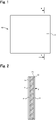
- FIG. 1 is a plan view of the glass body
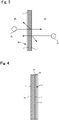
- FIG. 2 is a cross-sectional view taken along line A-A in FIG. 1
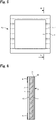
- FIG. 3 is a plan view showing an example of the environment in which this glass body is used.
- a glass body 10 includes a glass plate 1 having two principal surfaces, namely a first surface 11 and a second surface 12, a translucent reflective film 2 layered on the first surface 11, and an antifog film 3 layered on the second surface 12.
- the translucent reflective film 2 adjusts the visible light transmittance and the visible light reflectance of the glass body 10, and thus the glass body 10 forms what is known as a half mirror.
- the surface of the glass body 10 reflects light from a first image 51 located in the first zone 61, and thus the first image 51 appears on the glass body 10.
- the glass body 10 transmits light from a second image 52 located in the second zone 62, and thus the second image 52 in the second zone 62 can be visually confirmed from the first zone 61.
- these constituent elements will be described.
- the glass plate 1 There is no particular limitation on the glass plate 1, and a known glass plate can be used. Examples thereof include various glass plates made of float glass, heat-ray absorbing glass, clear glass, green glass, UV green glass, soda-lime glass, and the like.
- the thickness of the glass plate 1 is not particularly limited, but is preferably, for example, 0.5 to 10 mm, and more preferably 0.7 to 8 mm. The thickness of the glass plate 1 affects the above-described visible light transmittance and visible light reflectance, and can be therefore changed as appropriate in accordance with required reflectance and transmittance.
- the glass plate 1 is made of float glass.
- Float glass is manufactured using a float method. It is well known that, in a glass plate made of float glass, the concentrations of tin oxide at the two principal surfaces thereof are different due to the float glass manufacturing method. That is, in the float method, a flat glass plate is manufactured by allowing molten glass to flow on the surface of molten tin. At this time, a tin oxide-containing layer exists on a surface of the glass plate that has come into contact with the molten tin.
- a surface on which this tin oxide-containing layer exists is referred to as a "bottom surface”
- a surface that is located on a side opposite to the bottom surface and has not come into contact with tin is referred to as a "top surface”.
- the content of tin oxide at the bottom surface is larger than the content of tin oxide at the top surface as described later.
- the content of tin oxide is defined as the maximum value of the concentration of tin oxide in terms of tin dioxide in a region ranging from the glass surface to a depth of 10 ⁇ m.
- the content of tin oxide can be determined based on the value obtained through measurement using a wavelength dispersive X-ray detector (WDX) equipped with an electron probe micro analyzer (EPMA).
- WDX wavelength dispersive X-ray detector
- EPMA electron probe micro analyzer
- the content of tin oxide at the bottom surface is preferably 1 to 10 mass%, and the content of tin oxide at the top surface is preferably 1% or less, and more preferably 0.3% or less.
- the translucent reflective film 2 can be layered on the top surface, and the antifog film 3 can be layered on the bottom surface.
- the surface roughness Ra of the glass plate 1 is 10 nm or less. The reason for this is that the larger the surface roughness is, the higher the haze ratio is, which may lead to the glass body 10 being opaque.
- the translucent reflective film 2 includes, for example, a first layer 21 to be layered on the glass plate 1, and a second layer 22 layered on the first layer 21.
- one or more additional layers including a third layer, a fourth layer, and the like can also be provided as needed.
- a metal reflective layer made of a metal or semimetal is used as a layer included in the translucent reflective film 2
- one or more two-layer units that are each formed by layering a low refractive index layer or high refractive index layer directly on the metal reflective layer, or one or more units that are each formed by layering a low refractive index layer and a high refractive index layer on the metal reflective layer in the stated order can be layered.
- one or more units that are each formed by layering a low refractive index layer and a high refractive index layer on a high refractive index layer in the stated order can be layered.
- the refractive index of the high refractive index layer is preferably, for example, 1.6 or more, and more preferably 1.8 or more.
- the refractive index of the low refractive index layer is lower than that of the high refractive index layer, and is preferably, for example, 1.6 or less, and more preferably 1.5 or less. Note that the high refractive index layer and the low refractive index layer can also be formed by layering one or more materials as long as the conditions of the refractive indices are satisfied.
- the layers included in the translucent reflective film 2 can be constituted by a layer made of a metal or a semimetal and a layer made of an inorganic metal oxide.
- the metal or semimetal is selected as appropriate from silicon (Si), SUS, and other suitable metals or semimetals
- the inorganic metal oxide is selected as appropriate from silicon dioxide (SiO 2 ), tin oxide (SnO 2 ), titanium dioxide (TiO 2 ), and other suitable inorganic metal oxides, such that the above-described ranges of the refractive index are satisfied.
- the refractive indices of silicon, silicon dioxide, tin oxide, titanium dioxide, SUS, Ag, Al, Cr, Mo, and Ti are about 4.4, about 1.4, about 1.8, about 2.2, about 2.4, about 0.14, about 1.4, about 2.4, about 3.6 and about 2.7, respectively.
- the layer configuration of the translucent reflective film 2 is not particularly limited, but the following configuration can be employed, for example.
- the layers can also be doped with additives as appropriate in order to adjust the electrical resistance of the layers.
- Ag, Al, Cr, Ti, or Mo can also be employed instead of Si used for the first layer of Examples 2 and 3.
- a base layer made of SiO 2 can be provided between the first layer 21 and the glass plate 1.
- SUS SUS
- the visible light absorption can be improved.
- the sum of the visible light reflectance and the visible light transmittance decreases, and thus the adjustment of the visible light reflectance and the visible light transmittance can be facilitated.
- the translucent reflective film 2 formed using the inorganic metal oxides containing a metal or semimetal as described above is suitable for an optical cover glass because the color tone of the translucent reflective film 2 does not significantly change when the translucent reflective film 2 is viewed from a wide range of angles.
- the thickness (physical thickness) of the translucent reflective film 2 is preferably 3 to 300 nm, and more preferably 5 to 250 nm. If the thickness of the translucent reflective film 2 is smaller than 10 nm, it is difficult to control the thickness, and thus a problem of a decline in productivity arises. On the other hand, if the thickness is larger than 300 nm, the cost may increase, or the surface unevenness may become prominent, leading to an increase in haze ratio and poor appearance.
- the thicknesses of the layers included in the translucent reflective film 2 are not particularly limited and can be adjusted as appropriate such that the thickness of the translucent reflective film 2 is within the above-described range.
- a translucent reflective film that includes a first layer having a thickness of 18 nm, a second layer having a thickness of 85 nm, and a third layer having a thickness of 65 nm can be formed.
- a configuration can be employed in which a silicon layer has a thickness of about 18 nm, and a silicon dioxide layer has a thickness of about 30 nm.
- the thickness of a titanium dioxide layer of Examples 1 and 3 can be set to about 6 nm
- the thickness of an SUS layer of Example 5 can be set to about 8 nm.
- a low refractive material and a high refractive material can be layered to form the second layer and the third layer, respectively, in order to improve reflection at the first layer.
- the thicknesses of the first layer, the second layer, and the third layer are set to 18 nm, 85 nm, and 65 nm, respectively, and the optical thickness of the translucent reflective film is set to 135 nm ⁇ 20 nm, the optical thickness corresponds to a quarter of ⁇ , where ⁇ represents the wavelength of incident light (central wavelength: 550 nm), and thus the reflection at the interface between the first layer and the second layer can be improved.
- Materials other than those shown in Example 2 may also be used as long as the thicknesses and the refractive indices of the layers can be adjusted as described above.
- the visible light transmittance of the glass body 10 adjusted by providing the translucent reflective film 2 is preferably 20% or more and 70% or less, more preferably 35% or more and 60% or less, and particularly preferably 35% or more and 50% or less.
- the visible light transmittance and the visible light reflectance are substantially in a trade-off relationship, and therefore, it is preferable that, for example, the visible light transmittance value and the visible light reflectance value are the same in the glass body 10.
- a configuration can also be employed in which one of the visible light transmittance and the visible light reflectance is larger than the other, and the visible light transmittance and the visible light reflectance can be adjusted as appropriate in accordance with the performance required for the glass body.
- the visible light reflectance of the translucent reflective film 2 is preferably 30% or more and 80% or less, and more preferably 40% or more and 70% or less.
- the visible light transmittance and the visible light reflectance of such a glass body 10 can be adjusted by changing the materials included in or the thickness of the translucent reflective film 2, or the material or thickness of the glass plate 1.
- both a* and b* are preferably within a range of ⁇ 15, more preferably within a range of ⁇ 12, and particularly preferably within a range of ⁇ 7.
- a* and b* can be adjusted by changing the materials included in or the thickness of the translucent reflective film 2, or the material or the thickness of the glass plate 1. If a* and b* are within a range of ⁇ 15, light of a reflected image can be displayed correctly.
- the optical properties of the translucent reflective film of Example 4 above are shown below.
- the first layer made of silicon had a thickness of 18 nm, and the silicon dioxide layer had a thickness of 30 nm.
- the visible light transmittance and the visible light reflectance were measured using a spectrophotometer (U4100, manufactured by Hitachi Ltd.). L*, a*, and b* were calculated in accordance with JIS Z8781. D65 was used as a light source. The results were as follows.
- a* and b* of the reflected color tones are 6.5 or less. Moreover, b* of the transmitted color tone is increased. Accordingly, the reflected color tones are more neutral than the transmitted color tones.
- the thermal conductivity of the translucent reflective film 2 is larger than that of the glass plate 1. This makes it possible to reduce an in-plane temperature difference compared with the glass plate 1, thus making it possible to prevent partial dew condensation. Note that, since the thermal conductivity of the glass plate 1 is 0.55 to 1.00 (W/m ⁇ K), the thermal conductivity of the translucent reflective film 2 is preferably 1.2 to 200 (W/m ⁇ K), which exceeds the above-mentioned range.
- the surface roughness Ra of the translucent reflective film 2 is preferably 15 nm or less, and more preferably 10 nm or less. The reason for this is that the larger the surface roughness is, the higher the haze ratio is, which may lead to the glass body 10 being opaque. Note that "the surface roughness Ra of the translucent reflective film 2" refers to the surface roughness Ra when another layer is not layered on the translucent reflective film 2 and the surface roughness Ra of the translucent reflective film 2 can be directly measured.
- the method for forming the translucent reflective film 2 There is no particular limitation on the method for forming the translucent reflective film 2, and examples thereof include physical vapor deposition methods such as a sputtering method and a vacuum deposition method, spraying methods, and chemical vapor deposition methods (CVD methods). In particular, when a CVD method is employed, an online CVD method is preferable.
- physical vapor deposition methods such as a sputtering method and a vacuum deposition method, spraying methods, and chemical vapor deposition methods (CVD methods).
- CVD methods chemical vapor deposition methods
- an online CVD method is preferable.
- the online CVD method is one chemical vapor deposition method, and is performed as follows: in a glass manufacturing step of the float method, a material for forming a translucent reflective film is supplied from a coater onto the top surface of a glass ribbon that is located on a molten tin bath and has a temperature of 615°C or higher, and then the translucent reflective film 2 is formed through a thermal decomposition oxidation reaction.
- Each of the layers included in the translucent reflective film 2 can be formed by supplying one material from one coater, but one layer can be formed using two or more coaters when a layer has a large thickness.
- the translucent reflective film 2 can be formed by preparing first to third coaters, supplying silicon using the first coater, and supplying silicon dioxide using the second and third coaters.
- SUS layer is formed through sputtering and not CVD. It is preferable to use sputtering to form a thin layer of a certain material.
- the antifog film 3 there is no particular limitation on the antifog film 3 as long as it exhibits an antifog effect on the glass plate 1, and a known antifog film can be used.
- the types of the antifog film 3 include a hydrophilic type that makes water generated from water vapor into a water layer on its surface, a water absorbent type that absorbs water vapor, a water repellent-absorbent type that is unlikely to condense water to form waterdrops on its surface, and a water repellent type that repels waterdrops produced by water vapor. All the types of antifog films can be used.
- An antifog film of the water repellent-absorbent type will be described below as an example of the antifog film.
- An organic-inorganic complex antifog film is a single-layer film formed on the surface of the glass plate 1, or a multi-layer film layered on the surface of the glass plate 1.
- the organic-inorganic complex antifog film contains at least a water absorbent resin, a water repellent group, and a metallic oxide component.
- the antifog film 3 may further include other functional components as needed. There is no limitation on the type of water absorbent resin as long as it can absorb and hold water.
- the antifog film 3 can be supplied with a water repellent group using a metallic compound containing a water repellent group (water repellent group-containing metallic compound).
- the antifog film 3 can be supplied with a metallic oxide component using a metallic compound other than the water repellent group-containing metallic compound, minute particles of a metallic oxide, or the like.
- these components will be described.
- water absorbent resin examples thereof include polyethylene glycol, polyether-based resins, polyurethane resins, starch-based resins, cellulose-based resins, acrylic resins, epoxy resins, polyester polyols, hydroxyalkyl celluloses, polyvinyl alcohols, polyvinyl pyrrolidone, polyvinyl acetal resins, and polyvinyl acetate.
- hydroxyalkyl celluloses polyvinyl alcohols, polyvinyl pyrrolidone, polyvinyl acetal resins, polyvinyl acetate, epoxy resins, and polyurethane resins are preferable, polyvinyl acetal resins, epoxy resins, and polyurethane resins are more preferable, and polyvinyl acetal resins are particularly preferable.
- a polyvinyl acetal resin can be obtained by acetalizing an aldehyde with a polyvinyl alcohol through a condensation reaction. It is sufficient that the acetalization using polyvinyl alcohol is performed using a known method such as a precipitation method in which an aqueous medium is used in the presence of an acid catalyst, or a dissolution method in which a solvent such as an alcohol is used. The acetalization can be performed along with the saponification of polyvinyl acetate.
- the degree of acetalization is preferably 2 to 40 mol%, more preferably 3 to 30 mol%, and particularly preferably 5 to 20 mol%, and optionally 5 to 15 mol%.
- the degree of acetalization can be measured based on, for example, 13 C nuclear magnetic resonance spectroscopy.
- the polyvinyl acetal resins whose degree of acetalization is within the above-mentioned range are suitable for forming an organic-inorganic complex antifog film having favorable water absorbing properties and water resistance.
- the average degree of polymerization of the polyvinyl alcohol is preferably 200 to 4500, and more preferably 500 to 4500.
- a high average degree of polymerization is advantageous in the formation of an organic-inorganic complex antifog film having favorable water absorbing properties and water resistance, but if the average degree of polymerization is excessively high, the viscosity of the solution will be excessively high, and the formation of the film may be negatively affected.
- the degree of saponification of the polyvinyl alcohol is preferably 75 to 99.8 mol%.
- aldehyde to be condensed with polyvinyl alcohol through a condensation reaction examples include aliphatic aldehydes such as formaldehyde, acetaldehyde, butyraldehyde, hexylcarbaldehyde, octylcarbaldehyde, and decylcarbaldehyde.
- aromatic aldehydes including benzaldehyde; benzaldehyde subjected to substitution using an alkyl group such as 2-methylbenzaldehyde, 3-methylbenzaldehyde, 4-methylbenzaldehyde, or the like; benzaldehyde subjected to substitution using a halogen atom such as chlorobenzaldehyde or the like; substituted benzaldehyde in which a hydrogen atom is substituted with a functional group such as a hydroxy group, an alkoxy group, an amino group, or a cyano group, other than alkyl groups; and condensed aromatic aldehyde such as naphtaldehyde or anthraldehyde.
- aromatic aldehydes including benzaldehyde; benzaldehyde subjected to substitution using an alkyl group such as 2-methylbenzaldehyde, 3-methylbenzaldehyde, 4-methylbenzaldehyde, or the like;
- Aromatic aldehydes which are highly hydrophobic, are advantageous in the formation of an organic-inorganic complex antifog film with a low degree of acetalization and excellent water resistance. Use of aromatic aldehydes is also advantageous in that a film having high water absorbency is formed while a large number of hydroxy groups are caused to remain. It is preferable that the polyvinyl acetal resins have an acetal structure derived from an aromatic aldehyde, particularly benzaldehyde.
- epoxy resins examples include glycidyl ether-based epoxy resins, glycidyl ester-based epoxy resins, glycidyl amine-based epoxy resins, and cyclic aliphatic epoxy resins. Out of these epoxy resins, the cyclic aliphatic epoxy resins are preferable.
- polyurethane resins examples include polyurethane resins constituted by polyisocyanate and polyol. Acrylic polyol and polyoxyalkylene-based polyol are preferable as the polyol.
- the organic-inorganic complex antifog film contains a water absorbent resin as a main component.
- the term "main component" as used in the present invention means a component that is contained in the largest amount in terms of mass.
- the content of the water absorbent resin based on the weight of the organic-inorganic complex antifog film is preferably 50 weight% or more, more preferably 60 weight% or more, and particularly preferably 65 weight% or more, and is 95 weight% or less, and more preferably 90 weight% or less, from the viewpoint of film hardness, water absorbing properties, and antifog properties.
- the water repellent group is preferably at least one type of water repellent group selected from (1) chain or cyclic alkyl groups having 3 to 30 carbon atoms and (2) chain or cyclic alkyl groups having 1 to 30 carbon atoms in which at least a portion of hydrogen atoms are substituted with a fluorine atom (also referred to as "fluorine-substituted alkyl groups" hereinafter).
- the chain or cyclic alkyl groups in (1) and (2) are preferably chain alkyl groups.
- the chain alkyl groups may be branched alkyl groups, but are preferably linear alkyl groups.
- Alkyl groups having more than 30 carbon atoms may lead to the antifog film 3 being opaque.
- the number of carbon atoms in the alkyl groups is preferably 20 or less and more preferably 6 to 14, from the viewpoint of the balance between the antifog properties, strength, and external appearance of the film.
- Particularly preferable alkyl groups are linear alkyl groups having 6 to 14, particularly 6 to 12, carbon atoms such as an n-hexyl group (6 carbon atoms), an n-decyl group (10 carbon atoms), and an n-dodecyl group (12 carbon atoms).
- the fluorine-substituted alkyl groups in (2) may be groups obtained by substituting only a portion of hydrogen atoms of a chain or cyclic alkyl group with a fluorine atom, or groups obtained by substituting all of the hydrogen atoms of a chain or cyclic alkyl group with a fluorine atom, such as linear perfluoroalkyl groups.
- the fluorine-substituted alkyl groups have high water repellency, and therefore, the effects can be sufficiently obtained by adding a small amount thereof. Note that, when the content of the fluorine-substituted alkyl groups is excessively large, a component containing the fluorine-substituted alkyl groups may be separated from the other components in a coating solution for forming a film.
- a metallic compound containing a water repellent group water repellent group-containing metallic compound
- a metallic compound containing a water repellent group and a hydrolyzable functional group or a halogen atom water repellent group-containing hydrolyzable metallic compound
- a hydrolysate thereof is added to a coating solution for forming a film.
- the water repellent group may be derived from the water repellent group-containing hydrolyzable metallic compound.
- a water repellent group-containing hydrolyzable silicon compound represented by Formula (I) below is preferably used as the water repellent group-containing hydrolyzable metallic compound.
- R represents a water repellent group, that is, a chain or cyclic alkyl group having 1 to 30 carbon atoms in which at least a portion of hydrogen atoms are optionally substituted with a fluorine atom
- Y represents a hydrolyzable functional group or a halogen atom
- m represents an integer of 1 to 3.
- the hydrolyzable functional group is at least one type selected from an alkoxyl group, an acetoxy group, an alkenyloxy group, and an amino group, and preferably an alkoxy group, particularly an alkoxy group having 1 to 4 carbon atoms.
- An example of the alkenyloxy group is an isopropenoxy group.
- the halogen atom is preferably a chlorine atom. Note that the functional groups shown here as examples can also be used as "hydrolyzable functional groups" described hereinafter.
- m is preferably 1 or 2.
- R and m are as described above.
- the compounds represented by Formula (II) form a network structure in which silicon atoms are linked to one another via oxygen atoms, in the antifog film 3.
- the compounds represented by Formula (I) are hydrolyzed or partially hydrolyzed, and at least portions thereof are polycondensed.
- a network structure including siloxane bonds Si-O-Si
- Si-O-Si siloxane bonds
- a water repellent group R is linked to the silicon atom contained in this network structure.
- the water repellent group R is immobilized in the network structure that includes siloxane bonds, via an R-Si bond. This structure is advantageous in uniform dispersion of the water repellent groups R in the film.
- the network structure may contain silica components supplied from silicon compounds (e.g., tetraalkoxysilane and silane coupling agents) other than the water repellent group-containing hydrolyzable silicon compound represented by Formula (I).
- silicon compounds e.g., tetraalkoxysilane and silane coupling agents
- a silicon compound that does not contain a water repellent group and contains a hydrolyzable functional group or halogen atom water repellent group-free hydrolyzable silicon compound
- a network structure that includes siloxane bonds containing silicon atoms that are linked to water repellent groups and silicon atoms that are not linked to water repellent groups can be formed. With such a structure, it is easy to independently adjust the content of the water repellent group and the content of the metallic oxide component in the antifog film.
- the water repellent groups exhibit an effect of enhancing the antifog performance by enhancing water vapor permeability of the surface of the antifog film 3 containing a water absorbent resin.
- the two functions namely the water absorbent function and the water repellent function, are contrary to each other, and therefore, conventionally, a water absorbent material and a water repellent material are distributed in separate layers.
- the maldistribution of water near the surface of the antifog film is resolved due to the water repellent groups, so that the time it takes until dew condenses is prolonged, and the antifog properties of the antifog film having a single-layer structure are thus enhanced.
- the following is a description of the effects.
- Water vapor that has infiltrated the antifog film 3 containing the water absorbent resin forms hydrogen bonds with hydroxy groups in the water absorbent resin and the like, and is retained in the form of bound water. As the amount of water vapor increases, the form of water vapor changes from bound water to semibound water, and finally, water vapor is retained in the form of free water retained in voids in the antifog film.
- the water repellent groups prevent the formation of hydrogen bonds and facilitate the dissociation of formed hydrogen bonds in the antifog film 3. If the content of the water absorbent resin is the same, the number of hydroxy groups capable of forming a hydrogen bond in the film is the same, but the speed of hydrogen bond formation is reduced due to the water repellent groups.
- the antifog film 3 containing the water repellent groups moisture will ultimately be retained in any of the above-mentioned forms in the film, but water vapor can diffuse to the bottom portion of the film as it is until it is retained therein. Moreover, water that is once retained dissociates relatively easily and is likely to move to the bottom portion of the film in the form of water vapor. As a result, the distribution of the retention amount of moisture in the thickness direction of the film is relatively uniform between the vicinity of the surface and the bottom portion of the film.
- the entirety in the thickness direction of the antifog film can be effectively used to absorb water supplied to the surface of the film, and therefore, waterdrops are less likely to be formed on the surface through condensation, thus resulting in the enhancement of antifog properties. Furthermore, since waterdrops are less likely to be formed on the surface through condensation, the antifog film 3 is characterized in that it is less likely to freeze up even when being exposed to a low temperature after absorbing moisture.
- the water repellent groups are added in amounts at which the contact angle of water on the surface of the antifog film 3 is 70° or more, preferably 80° or more, and more preferably 90° or more.
- a measurement value obtained by dropping a 4 mg drop of water onto the surface of the film is taken as the contact angle of water.
- the repellent groups in amounts at which the contact angle of water is within the above-mentioned range.
- the upper limit of the contact angle of waterdrop is not particularly limited, but is, for example, 150° or less, 120° or less, or 100° or less. It is preferable that the water repellent groups are uniformly contained in the antifog film 3 such that the contact angle of waterdrop is within the above-mentioned range over the entire region of the surface of the antifog film 3.
- the antifog film 3 contains the water repellent groups such that the amount of water repellent groups is within a range of 0.05 parts by mass or more, preferably within a range of 0.1 parts by mass or more and more preferably within a range of 0.3 parts by mass or more, and within a range of 10 parts by mass or less and preferably within a range of 5 parts by mass or less, with respect to 100 parts by mass of the water absorbent resin.
- the inorganic oxide is, for example, an oxide of at least one type of element selected from Si, Ti, Zr, Ta, Nb, Nd, La, Ce, and Sn, and contains at least an oxide of Si (silica). It is preferable that the organic-inorganic complex antifog film contains the inorganic oxide such that the amount of the inorganic oxide is preferably 0.01 parts by weight or more, more preferably 0.1 parts by weight or more, even more preferably 0.2 parts by weight or more, particularly preferably 1 part by weight or more, most preferably 5 parts by weight or more, optionally 10 parts by weight or more, and 20 parts by weight or more if necessary, with respect to 100 parts by weight of the water absorbent resin, and preferably 50 parts by weight or less, more preferably 45 parts by weight or less, even more preferably 40 parts by weight or less, particularly preferably 35 parts by weight or less, most preferably 33 parts by weight or less, and optionally 30 parts by weight or less.
- the inorganic oxide is a component necessary for ensuring the strength of the organic-inorganic complex antifog film, particularly scratch resistance, but if the content of the inorganic oxide is large, the antifog properties of the organic-inorganic complex antifog film are impaired.
- the organic-inorganic complex antifog film may further contain minute particles of an inorganic oxide as at least a portion of the inorganic oxide.
- the inorganic oxide constituting the minute particles of an inorganic oxide is, for example an oxide of at least one type of element selected from Si, Ti, Zr, Ta, Nb, Nd, La, Ce, and Sn, with minute particles of silica being preferable.
- the minute particles of silica can be introduced into the organic-inorganic complex antifog film by adding, for example, colloidal silica thereto.
- the minute particles of an inorganic oxide excel at transmitting stress applied to the organic-inorganic complex antifog film to an article that supports the organic-inorganic complex antifog film, and also have a high hardness. Therefore, the addition of the minute particles of an inorganic oxide is advantageous from the viewpoint of enhancing the abrasion resistance and scratch resistance of the organic-inorganic complex antifog film. Moreover, when the minute particles of an inorganic oxide are added to the organic-inorganic complex antifog film, minute voids are formed in portions where the minute particles are in contact with one another or close to one another, and water vapor is likely to become trapped in the film through these voids.
- the addition of the minute particles of an inorganic oxide may advantageously act to enhance the antifog properties. Minute particles of an inorganic oxide that have been formed in advance are added to a coating solution for forming an organic-inorganic complex antifog film, and the minute particles of an inorganic oxide can thus be supplied to the organic-inorganic complex antifog film.
- the organic-inorganic complex antifog film may be opaque, whereas when the average particle diameter of the minute particles of an inorganic oxide is excessively small, the minute particles aggregate, thus making it difficult to uniformly disperse the minute particles.
- the average particle diameter of the minute particles of an inorganic oxide is preferably 1 to 20 nm, and more preferably 5 to 20 nm. Note that the average particle diameter of the minute particles of an inorganic oxide in the form of primary particles is taken as the average particle diameter of the minute particles of an inorganic oxide described herein.
- the average diameter of the minute particles of an inorganic oxide is determined by measuring, through observation using a scanning electron microscope, the particle diameters of fifty randomly selected minute particles and employing the average value thereof. If the content of the minute particles of an inorganic oxide is large, there is a risk that the amount of water absorption will decrease in the entire organic-inorganic complex antifog film, and thus the organic-inorganic complex antifog film becomes opaque. It is preferable to add the minute particles of an inorganic oxide such that the amount thereof is preferably 0 to 50 parts by weight, more preferably 2 to 30 parts by weight, even more preferably 5 to 25 parts by weight, and particularly preferably 10 to 20 parts by weight, with respect to 100 parts by weight of the water absorbent resin.
- the antifog film may contain a metallic oxide component derived from a hydrolyzable metallic compound that does not contain a water repellent group (water repellent group-free hydrolyzable compound).
- a preferable water repellent group-free hydrolyzable metallic compound is a hydrolyzable silicon compound that does not contain a water repellent group.
- the hydrolyzable silicon compound that does not contain a water repellent group is at least one type of silicon compound (note that a water repellent group is not contained) selected from silicon alkoxide, chlorosilane, acetoxysilane, alkenyloxysilane, and aminosilne, with silicon alkoxide that does not contain a water repellent group being preferable.
- an example of the alkenyloxysilane is isopropenoxysilane.
- the hydrolyzable silicon compound that does not contain a water repellent group may be a compound represented by Formula (III) below.
- Y represents a hydrolyzable functional group, and is preferably at least one selected from an alkoxyl group, an acetoxy group, an alkenyloxy group, an amino group, and a halogen atom.
- the water repellent group-free hydrolyzable metallic compounds are hydrolyzed or partially hydrolyzed, and at least portions thereof are polycondensed.
- a metallic oxide component in which metallic atoms and oxygen atoms are linked is supplied. This component firmly joins the minute particles of a metallic oxide and the water absorbent resin, and may contribute to the enhancement of the abrasion resistance, hardness, water resistance, and the like of the antifog film.
- the amount of metallic oxide component derived from the hydrolyzable metallic compound that does not contain a water repellent group is preferable to be within a range of 0 to 40 parts by mass, preferably 0.1 to 30 parts by mass, more preferably 1 to 20 parts by mass, particularly preferably 3 to 10 parts by mass, and optionally 4 to 12 parts by mass, with respect to 100 parts by mass of the water absorbent resin.
- a preferable example of the hydrolyzable silicon compound that does not contain a water repellent group is tetraalkoxysilane, and more specifically, tetraalkoxysilane containing an alkoxy group having 1 to 4 carbon atoms.
- the tetraalkoxysilane is, for example, at least one selected from tetramethoxysilane, tetraethoxysilane, tetra-n-propoxysilane, tetraisopropoxysilane, tetra-n-butoxysilane, tetraisobutoxysilane, tetra-sec-butoxysilane, and tetra-tert-butoxysilane.
- the antifog properties of the antifog film may be impaired.
- the flexibility of the antifog film is impaired, and thus the swelling and shrinkage of the film caused by the absorption and discharge of moisture are limited.
- the metallic oxide component derived from tetraalkoxysilane such that the amount thereof is within a range of 0 to 30 parts by mass, preferably 1 to 20 parts by mass, and more preferably 3 to 10 parts by mass, with respect to 100 parts by mass of the water absorbent resin.
- the hydrolyzable silicon compound that does not contain a water repellent group is a silane coupling agent.
- the silane coupling agent is a silicon compound containing active functional groups that are different from each other. It is preferable that a portion of the active functional groups are hydrolyzable functional groups.
- An example of the silane coupling agent is a silicon compound containing an epoxy group and/or an amino group and a hydrolyzable functional group.
- Preferable examples of the silane coupling agent include glycidyloxyalkyltrialkoxysilane and aminoalkyltrialkoxysilane. It is preferable that, in these silane coupling agents, an alkylene group that is directly linked to a silicon atom has 1 to 3 carbon atoms. Since a glycidyloxyalkyl group and an aminoalkyl group contain a hydrophilic functional group (epoxy group, amino group), they are not water-repellent as a whole even though they contain an alkylene group.
- the silane coupling agent firmly couples water absorbent resin, which is an organic component, and the minute particles of a metallic oxide and the like, which are inorganic components, and may contribute to the enhancement of the abrasion resistance, hardness, water resistance, and the like of the antifog film 3.
- the content of the metallic oxide (silica) component derived from the silane coupling agent is excessively large, the antifog properties of the antifog film 3 is impaired, and the antifog film 3 may be opaque in some cases.
- the metallic oxide component derived from the silane coupling agent such that the amount thereof is within a range of 0 to 10 parts by mass, preferably 0.05 to 5 parts by mass, and more preferably 0.1 to 2 parts by mass, with respect to 100 parts by mass of the water absorbent resin.
- the antifog film 3 may also include a cross-linked structure formed using a cross-linking agent, preferably at least one type of cross-linking agent selected from an organic boron compound, an organic titanium compound, and an organic zirconium compound.
- a cross-linking agent preferably at least one type of cross-linking agent selected from an organic boron compound, an organic titanium compound, and an organic zirconium compound.
- the introduction of the cross-linked structure enhances the abrasion resistance, scratch resistance, and water resistance of the antifog film 3. From another viewpoint, the introduction of the cross-linked structure facilitates the improvement of the durability of the antifog film 3 without impairing the antifog properties thereof.
- the antifog film 3 may contain a metallic atom other than silicon, preferably boron, titanium, or zirconium, in addition to silicon, as metallic atoms.
- the organic titanium compound is, for example, at least one selected from a titanium alkoxide, a titanium chelate-based compound, and titanium acylate.
- the titanium alkoxide include titanium tetraisopropoxide, titanium tetra-n-butoxide, and titanium tetraoctoxide.
- the titanium chelate-based compound include titanium acetylacetonate, titanium ethyl acetoacetate, titanium octyleneglycol, titanium triethanolamine, and titanium lactate.
- the titanium lactate may be an ammonium salt thereof (titanium lactate ammonium).
- An example of the titanium acylate is titanium stearate.
- a preferable organic titanium compound is a titanium chelate compound, particularly titanium lactate.
- a preferable cross-linking agent is an organic titanium compound, particularly titanium lactate.
- additives may also be blended into the antifog film 3.
- examples of the additives include glycols such as glycerin and ethylene glycol that have the function of improving the antifog properties.
- a surfactant, a leveling agent, an ultraviolet absorbing agent, a coloring agent, an antifoaming agent, an antiseptic agent, and the like may be used as the additives.
- the antifog film 3 can be layered directly on the glass plate 1, the antifog film 3 can also be layered on a base layer formed on the glass plate 1. Layering the antifog film 3 on the glass plate 1 via the base layer as described above makes it less likely that the antifog film 3 peels off.
- the base layer can be made of, for example, a silane coupling agent.
- the thickness of the organic-inorganic complex antifog film is adjusted as appropriate according to required antifog performance and the like.
- the thickness of the organic-inorganic complex antifog film is preferably 2 to 15 ⁇ m, more preferably 2 to 12 ⁇ m, and even more preferably 3 to 10 ⁇ m. If the thickness of the antifog film 3 is 2 ⁇ m or more, a sufficient antifog effect can be obtained. On the other hand, if the thickness of the antifog film 3 is excessively large, a reflected image may be distorted due to an uneven thickness.
- the antifog film 3 is made of a resin material as mentioned above and thus has a birefringence index. Accordingly, the thickness is excessively large, a blurred image may be obtained.
- the thickness of the antifog film 3 is determined based on a different viewpoint.
- the antifog film 3 adheres to the glass plate 1, and therefore, it is preferable that the thickness of the antifog film 3 is, for example, 5 ⁇ m or more because it is possible to prevent broken pieces of the glass plate 1 from scattering. From this viewpoint, the thickness of the antifog film 3 is more preferably 10 ⁇ m or more.
- a difference in an optical thickness of the antifog film 3 is preferably 150 nm or more. Note that the difference in an optical thickness is defined as a value obtained by multiplying a difference between the minimum thickness and the maximum thickness when observing the antifog film 3 by the refractive index of the antifog film.
- the inventors of the present invention obtained the following findings regarding interference fringes that may occur in the glass body 10 when the antifog film 3 is formed.
- light that enters the glass body 10 is incoherent light such as natural light or light from a lamp, but incident incoherent light has an irregular wave front. If an optical path length is short, regularity is observed in the wave front of incoherent light at the light entrance surface, and thus interference fringes occur. On the other hand, if an optical path length is long, the regularity of the wave front observed at the light entrance surface becomes difficult to recognize, and if an optical path length is longer than the coherence length, the regularity of the wave front observed at the light entrance surface vanishes. Accordingly, if an optical path length is long, the regularity of the wave front of reflected light becomes difficult to recognize, and thus interference fringes formed by light reflected by the light entrance surface become unclear. Furthermore, if an optical path length is longer than the coherence length, interference fringes vanish.
- the above-described organic-inorganic complex antifog film 3 can be formed, for example, by applying a coating solution for forming an organic-inorganic complex antifog film onto a transparent substrate or the like serving as the glass plate 1, and drying the glass plate 1 onto which the coating solution has been applied. It is sufficient that known materials and methods are respectively used as the solvent to be used for the preparation of the coating solution and a method for applying the coating solution. At this time, the atmosphere is preferably kept at a relative humidity less than 40%, and more preferably 30% or less.
- the step of drying the glass plate 1 onto which the coating solution has been applied includes an air-drying step and a heat-drying step for performing drying by heating. It is preferable to perform the air-drying step by exposing the coating solution to an atmosphere that is kept at a relative humidity of less than 40%, and more preferably 30% or less.
- the air-drying step can be performed as a non-heating step. In other words, it can be performed at room temperature.
- the heat-drying step dehydration progresses in which silanol groups contained in the hydrolysates of silicon compounds and hydroxy groups present on an article are involved, and a matrix structure (network of Si-O bonds) that includes silicon atoms and oxygen atoms develops.
- the air-drying step can be performed for, for example, about 10 minutes.
- the temperature applied in the heat-drying step is not excessively high.
- an appropriate heating temperature is 300°C or lower (e.g., 100 to 200°C).
- three steps can be performed. For example, firing is performed at a temperature of about 120°C for about 5 minutes, drying is performed at a temperature of about 80°C and a humidity of 90% for about 2 hours, and then firing is performed at a temperature of about 120°C for about 30 minutes. The formation of the antifog film 3 is thus completed.
- the glass body 10 is a half mirror, and can be used as a cover for an article. Accordingly, it is preferable that the glass body has a low haze ratio such that an article can be visually confirmed through the glass body 10.
- the haze ratio of the glass body 10 is preferably 2.0% or less, and more preferably 1.5% or less.
- the haze ratio can be measured using, for example, an integrating sphere-type light transmittance measurement apparatus ("HGM?2DP", manufactured by Suga Test Instruments Co., Ltd.; a C light source is used, and light is made incident from the membrane surface side).
- the haze ratio can be measured from translucent reflective film 2 side as well as the antifog film 3 side.
- the glass body 10 according to this embodiment can exhibit the following effects.
- the antifog film 3 faces a side on which fogging is likely to occur (e.g., higher-temperature side).
- the antifog film 3 is layered on the second surface 12 of the glass plate 1.
- the antifog film 3 can also be layered on the translucent reflective film 2 as shown in FIG. 4 . With this configuration, the following effects can be obtained.
- the difference in a refractive index is preferably 0.1 or less. If the difference in a refractive index is reduced, reflection at the interface between the antifog film 3 and the translucent reflective film 2 can be suppressed, thus making it possible to suppress interference. Moreover, if the difference in a refractive index is small, the amplitude of light will be reduced, and thus interference fringes are less likely to be observed. Furthermore, interference fringes can be further suppressed by setting the refractive index of the antifog film 3 to 1.6 or less.
- the antifog film 3 can also be layered on both the translucent reflective film 2 and the second surface 12 of the glass plate 1.
- the antifog film 3 is layered directly on the second surface 12 of the glass plate 1.
- a configuration can also be employed in which an antifog sheet is attached thereto.
- the antifog sheet includes a transparent sheet-like film substrate, the above-mentioned antifog layer layered on one surface of the film substrate, and a transparent adhesive layer layered on the other surface of the film substrate.
- the antifog sheet can be fixed to the glass plate 1 by fixing the adhesive layer to the second surface 12 of the glass plate 1.
- the film substrate can be formed using, for example, a transparent resin sheet made of polyethylene, polyethylene terephthalate, or the like.
- the thickness of the film substrate can be set to, for example, 10 to 100 ⁇ m, and is preferably 75 to 100 ⁇ m. If the thickness of the film substrate is 10 ⁇ m or more, the occurrence of interference fringes between the translucent reflective film 2 and the antifog film 3 can be suppressed.
- the adhesive layer can be formed by using, for example, an acrylic adhesive or a silicone adhesive. Note that such an antifog sheet can also be attached to the translucent reflective film 2. In this case, interference fringe can be suppressed because the film substrate has a sufficient thickness.
- a light-shielding film can also be formed on the antifog film 3.
- a light-shielding film 4 can be formed along the peripheral edge of the glass body 10.
- the shape of the light-shielding film 4 and it is sufficient that the light-shielding film 4 is formed on a region to be shielded from light as appropriate.
- the material constituting the light-shielding film 4 as long as it has light-shielding properties, and, for example, dark-colored ink such as black ink, brown ink, gray ink, or dark blue ink can be layered on the antifog film 3 through printing.
- the material of the light-shielding film 4 include resins such as a urethane resin, an epoxy resin, an acrylic resin, and polyethylene resin into which a color pigment is blended.
- the thickness of the light-shielding film 3 is not particularly limited, but can be set to, for example, 30 to 100 ⁇ m.
- a dark-colored film can be attached to the antifog film 3 and used as the light-shielding film.
- the "light-shielding properties" means, for example, a visible light transmittance of 20% or less.
- the light-shielding film 4 can also be colored a warm color or the like instead of a dark color by adjusting a pigment.
- the color of the light-shielding film 4 is represented using the L*,a*,b* color system (CIE standard)
- the chromaticity a* can be set to -10 to 50
- the chromaticity b* can be set to -10 to 50
- the chromaticity L* can be set to 10 to 100.
- the chromaticity a* is preferably 0 to 30, and more preferably 5 to 20.
- the chromaticity b* is preferably 0 to 30, and more preferably 5 to 20.
- the chromaticity L* is preferably 10 to 50, and more preferably 10 to 30.
- the light-shielding film 4 can also be formed on the translucent reflective film 2 in the same manner.
- the light-shielding film 4 can also be formed on both the antifog film 3 and the translucent reflective film 2.
- the shape of the glass plate there is no particular limitation on the shape of the glass plate 1, and various shapes are possible. Moreover, there is no need to form the translucent reflective film 2 and the antifog film 3 over the entire surface of the glass plate 1, and it is sufficient that they are each formed corresponding to a required area on the glass plate 1.
Landscapes
- Chemical & Material Sciences (AREA)
- Chemical Kinetics & Catalysis (AREA)
- Geochemistry & Mineralogy (AREA)
- Materials Engineering (AREA)
- Organic Chemistry (AREA)
- Life Sciences & Earth Sciences (AREA)
- Engineering & Computer Science (AREA)
- General Chemical & Material Sciences (AREA)
- Physics & Mathematics (AREA)
- Optics & Photonics (AREA)
- General Physics & Mathematics (AREA)
- Inorganic Chemistry (AREA)
- Composite Materials (AREA)
- Surface Treatment Of Glass (AREA)
- Optical Elements Other Than Lenses (AREA)
- Surface Treatment Of Optical Elements (AREA)
- Laminated Bodies (AREA)
Applications Claiming Priority (2)
| Application Number | Priority Date | Filing Date | Title |
|---|---|---|---|
| JP2019190615 | 2019-10-17 | ||
| PCT/JP2020/038233 WO2021075359A1 (ja) | 2019-10-17 | 2020-10-09 | ガラス体 |
Publications (2)
| Publication Number | Publication Date |
|---|---|
| EP4046972A1 true EP4046972A1 (de) | 2022-08-24 |
| EP4046972A4 EP4046972A4 (de) | 2023-11-01 |
Family
ID=75538463
Family Applications (1)
| Application Number | Title | Priority Date | Filing Date |
|---|---|---|---|
| EP20877769.8A Pending EP4046972A4 (de) | 2019-10-17 | 2020-10-09 | Glaskörper |
Country Status (8)
| Country | Link |
|---|---|
| US (1) | US20230350103A1 (de) |
| EP (1) | EP4046972A4 (de) |
| JP (2) | JP7548923B2 (de) |
| BR (1) | BR112022006038A2 (de) |
| CL (1) | CL2022000958A1 (de) |
| MX (1) | MX2022004481A (de) |
| PE (1) | PE20221016A1 (de) |
| WO (1) | WO2021075359A1 (de) |
Families Citing this family (1)
| Publication number | Priority date | Publication date | Assignee | Title |
|---|---|---|---|---|
| US12286559B2 (en) * | 2019-05-14 | 2025-04-29 | UniversitéLaval | Method for plasma deposition of anti-fog coatings |
Family Cites Families (14)
| Publication number | Priority date | Publication date | Assignee | Title |
|---|---|---|---|---|
| JPS63315541A (ja) * | 1987-06-18 | 1988-12-23 | Asahi Glass Co Ltd | ハ−フミラ−熱線反射ガラス |
| JPH0714342Y2 (ja) * | 1990-03-27 | 1995-04-05 | 旭硝子株式会社 | 機能ガラス |
| JP2000347013A (ja) * | 1999-04-02 | 2000-12-15 | Nippon Sheet Glass Co Ltd | 親水性鏡及びその製造方法 |
| JP2001033608A (ja) * | 1999-07-26 | 2001-02-09 | Nippon Sheet Glass Co Ltd | 親水性防曇ミラー |
| EP1398146A1 (de) * | 2001-06-11 | 2004-03-17 | Murakami Corporation | Beschlaghinderndes element und verfahren zur herstellung desselben |
| SE0401535D0 (sv) | 2004-06-14 | 2004-06-14 | Hoeganaes Ab | Sintered metal parts and method for the manufacturing thereof |
| FR2993200B1 (fr) * | 2012-07-13 | 2014-07-18 | Saint Gobain | Element transparent a reflexion diffuse comprenant une couche sol-gel |
| BR122020004549B1 (pt) * | 2014-06-05 | 2021-06-22 | Nippon Sheet Glass Company, Limited | Artigo transparente revestido de antiembaçante |
| JP6539051B2 (ja) * | 2014-11-28 | 2019-07-03 | 日本板硝子株式会社 | 防曇膜つき物品 |
| JP2017107778A (ja) * | 2015-12-10 | 2017-06-15 | パナソニックIpマネジメント株式会社 | 照明装置、及び、浴室 |
| JP6703267B2 (ja) * | 2016-07-06 | 2020-06-03 | セントラル硝子株式会社 | グレー色調低放射ガラス |
| JP6989502B2 (ja) * | 2016-07-20 | 2022-01-05 | 日本板硝子株式会社 | 防曇性フィルム |
| WO2018105669A1 (ja) * | 2016-12-07 | 2018-06-14 | 日本板硝子株式会社 | ウインドシールド |
| DE102017203105B4 (de) * | 2017-02-27 | 2019-05-16 | Fraunhofer-Gesellschaft zur Förderung der angewandten Forschung e.V. | Verglasungseinheit, Verfahren zu deren Herstellung und deren Verwendung |
-
2020
- 2020-10-09 BR BR112022006038A patent/BR112022006038A2/pt unknown
- 2020-10-09 PE PE2022000620A patent/PE20221016A1/es unknown
- 2020-10-09 JP JP2021552363A patent/JP7548923B2/ja active Active
- 2020-10-09 EP EP20877769.8A patent/EP4046972A4/de active Pending
- 2020-10-09 WO PCT/JP2020/038233 patent/WO2021075359A1/ja not_active Ceased
- 2020-10-09 MX MX2022004481A patent/MX2022004481A/es unknown
- 2020-10-09 US US17/769,040 patent/US20230350103A1/en active Pending
-
2022
- 2022-04-14 CL CL2022000958A patent/CL2022000958A1/es unknown
-
2024
- 2024-08-29 JP JP2024147894A patent/JP2024159939A/ja active Pending
Also Published As
| Publication number | Publication date |
|---|---|
| PE20221016A1 (es) | 2022-06-15 |
| EP4046972A4 (de) | 2023-11-01 |
| WO2021075359A1 (ja) | 2021-04-22 |
| JPWO2021075359A1 (de) | 2021-04-22 |
| US20230350103A1 (en) | 2023-11-02 |
| MX2022004481A (es) | 2022-07-21 |
| CL2022000958A1 (es) | 2022-11-25 |
| BR112022006038A2 (pt) | 2022-07-12 |
| JP7548923B2 (ja) | 2024-09-10 |
| JP2024159939A (ja) | 2024-11-08 |
Similar Documents
| Publication | Publication Date | Title |
|---|---|---|
| US10400130B2 (en) | Anti-fogging coated transparent article | |
| US8815378B2 (en) | Substrate having a photocatalytic coating | |
| EP2810924B1 (de) | Mit einem photokatalysatorfilm ausgestatteter glasartikel | |
| JP4527272B2 (ja) | 低反射ガラス物品 | |
| JP6955866B2 (ja) | ガラス板の製造方法及び自動車用ガラス板 | |
| US12528733B2 (en) | Transparent laminate | |
| EP3835099B1 (de) | Windschutzscheibe | |
| JP2003522092A (ja) | 膜が酸化セリウムを有する防反射性uv遮断多層コーティング | |
| KR100676405B1 (ko) | 반사 감소 필름 | |
| JP2012017394A (ja) | 防曇性物品 | |
| EP3543006A1 (de) | Beschlaghemmendes laminat und verfahren zur befestigung einer beschlaghemmenden folie | |
| US20230350103A1 (en) | Glass body | |
| EP3955702A1 (de) | Windschutzscheibe | |
| EP3805170A1 (de) | Windschutzscheibe | |
| JP7592488B2 (ja) | 透明積層体 | |
| JP3912938B2 (ja) | 着色被膜形成法 | |
| JP7502022B2 (ja) | カバーガラス | |
| JP7824391B2 (ja) | 鏡 | |
| JP7344091B2 (ja) | 光吸収性組成物、光吸収膜、及び光学フィルタ | |
| JP2021096458A (ja) | カバーガラス | |
| KR20090030196A (ko) | 반사 방지 필름 | |
| JP2012017220A (ja) | 防曇性物品 |
Legal Events
| Date | Code | Title | Description |
|---|---|---|---|
| STAA | Information on the status of an ep patent application or granted ep patent |
Free format text: STATUS: THE INTERNATIONAL PUBLICATION HAS BEEN MADE |
|
| PUAI | Public reference made under article 153(3) epc to a published international application that has entered the european phase |
Free format text: ORIGINAL CODE: 0009012 |
|
| STAA | Information on the status of an ep patent application or granted ep patent |
Free format text: STATUS: REQUEST FOR EXAMINATION WAS MADE |
|
| 17P | Request for examination filed |
Effective date: 20220321 |
|
| AK | Designated contracting states |
Kind code of ref document: A1 Designated state(s): AL AT BE BG CH CY CZ DE DK EE ES FI FR GB GR HR HU IE IS IT LI LT LU LV MC MK MT NL NO PL PT RO RS SE SI SK SM TR |
|
| DAV | Request for validation of the european patent (deleted) | ||
| DAX | Request for extension of the european patent (deleted) | ||
| A4 | Supplementary search report drawn up and despatched |
Effective date: 20230929 |
|
| RIC1 | Information provided on ipc code assigned before grant |
Ipc: C03C 17/42 20060101ALI20230925BHEP Ipc: C03C 17/36 20060101ALI20230925BHEP Ipc: C03C 17/34 20060101ALI20230925BHEP Ipc: C03C 17/32 20060101ALI20230925BHEP Ipc: G02B 5/08 20060101ALI20230925BHEP Ipc: G02B 1/18 20150101ALI20230925BHEP Ipc: E06B 9/24 20060101ALI20230925BHEP Ipc: C03C 17/38 20060101AFI20230925BHEP |