EP4045259B1 - Verfahren zur herstellung von produkten aus expandiertem polymermaterial mit mehreren gradienten - Google Patents
Verfahren zur herstellung von produkten aus expandiertem polymermaterial mit mehreren gradienten Download PDFInfo
- Publication number
- EP4045259B1 EP4045259B1 EP20790388.1A EP20790388A EP4045259B1 EP 4045259 B1 EP4045259 B1 EP 4045259B1 EP 20790388 A EP20790388 A EP 20790388A EP 4045259 B1 EP4045259 B1 EP 4045259B1
- Authority
- EP
- European Patent Office
- Prior art keywords
- polymeric material
- preform
- mold
- virtual model
- process according
- Prior art date
- Legal status (The legal status is an assumption and is not a legal conclusion. Google has not performed a legal analysis and makes no representation as to the accuracy of the status listed.)
- Active
Links
Images



Classifications
-
- B—PERFORMING OPERATIONS; TRANSPORTING
- B29—WORKING OF PLASTICS; WORKING OF SUBSTANCES IN A PLASTIC STATE IN GENERAL
- B29C—SHAPING OR JOINING OF PLASTICS; SHAPING OF MATERIAL IN A PLASTIC STATE, NOT OTHERWISE PROVIDED FOR; AFTER-TREATMENT OF THE SHAPED PRODUCTS, e.g. REPAIRING
- B29C44/00—Shaping by internal pressure generated in the material, e.g. swelling or foaming ; Producing porous or cellular expanded plastics articles
- B29C44/34—Auxiliary operations
- B29C44/3442—Mixing, kneading or conveying the foamable material
- B29C44/3446—Feeding the blowing agent
- B29C44/3453—Feeding the blowing agent to solid plastic material
-
- B—PERFORMING OPERATIONS; TRANSPORTING
- B29—WORKING OF PLASTICS; WORKING OF SUBSTANCES IN A PLASTIC STATE IN GENERAL
- B29C—SHAPING OR JOINING OF PLASTICS; SHAPING OF MATERIAL IN A PLASTIC STATE, NOT OTHERWISE PROVIDED FOR; AFTER-TREATMENT OF THE SHAPED PRODUCTS, e.g. REPAIRING
- B29C44/00—Shaping by internal pressure generated in the material, e.g. swelling or foaming ; Producing porous or cellular expanded plastics articles
- B29C44/34—Auxiliary operations
- B29C44/3469—Cell or pore nucleation
- B29C44/348—Cell or pore nucleation by regulating the temperature and/or the pressure, e.g. suppression of foaming until the pressure is rapidly decreased
-
- B—PERFORMING OPERATIONS; TRANSPORTING
- B29—WORKING OF PLASTICS; WORKING OF SUBSTANCES IN A PLASTIC STATE IN GENERAL
- B29C—SHAPING OR JOINING OF PLASTICS; SHAPING OF MATERIAL IN A PLASTIC STATE, NOT OTHERWISE PROVIDED FOR; AFTER-TREATMENT OF THE SHAPED PRODUCTS, e.g. REPAIRING
- B29C44/00—Shaping by internal pressure generated in the material, e.g. swelling or foaming ; Producing porous or cellular expanded plastics articles
- B29C44/02—Shaping by internal pressure generated in the material, e.g. swelling or foaming ; Producing porous or cellular expanded plastics articles for articles of definite length, i.e. discrete articles
- B29C44/04—Shaping by internal pressure generated in the material, e.g. swelling or foaming ; Producing porous or cellular expanded plastics articles for articles of definite length, i.e. discrete articles consisting of at least two parts of chemically or physically different materials, e.g. having different densities
-
- B—PERFORMING OPERATIONS; TRANSPORTING
- B29—WORKING OF PLASTICS; WORKING OF SUBSTANCES IN A PLASTIC STATE IN GENERAL
- B29C—SHAPING OR JOINING OF PLASTICS; SHAPING OF MATERIAL IN A PLASTIC STATE, NOT OTHERWISE PROVIDED FOR; AFTER-TREATMENT OF THE SHAPED PRODUCTS, e.g. REPAIRING
- B29C44/00—Shaping by internal pressure generated in the material, e.g. swelling or foaming ; Producing porous or cellular expanded plastics articles
- B29C44/02—Shaping by internal pressure generated in the material, e.g. swelling or foaming ; Producing porous or cellular expanded plastics articles for articles of definite length, i.e. discrete articles
- B29C44/12—Incorporating or moulding on preformed parts, e.g. inserts or reinforcements
- B29C44/1261—Avoiding impregnation of a preformed part
-
- B—PERFORMING OPERATIONS; TRANSPORTING
- B29—WORKING OF PLASTICS; WORKING OF SUBSTANCES IN A PLASTIC STATE IN GENERAL
- B29C—SHAPING OR JOINING OF PLASTICS; SHAPING OF MATERIAL IN A PLASTIC STATE, NOT OTHERWISE PROVIDED FOR; AFTER-TREATMENT OF THE SHAPED PRODUCTS, e.g. REPAIRING
- B29C44/00—Shaping by internal pressure generated in the material, e.g. swelling or foaming ; Producing porous or cellular expanded plastics articles
- B29C44/02—Shaping by internal pressure generated in the material, e.g. swelling or foaming ; Producing porous or cellular expanded plastics articles for articles of definite length, i.e. discrete articles
- B29C44/12—Incorporating or moulding on preformed parts, e.g. inserts or reinforcements
- B29C44/1285—Incorporating or moulding on preformed parts, e.g. inserts or reinforcements the preformed part being foamed
-
- B—PERFORMING OPERATIONS; TRANSPORTING
- B29—WORKING OF PLASTICS; WORKING OF SUBSTANCES IN A PLASTIC STATE IN GENERAL
- B29C—SHAPING OR JOINING OF PLASTICS; SHAPING OF MATERIAL IN A PLASTIC STATE, NOT OTHERWISE PROVIDED FOR; AFTER-TREATMENT OF THE SHAPED PRODUCTS, e.g. REPAIRING
- B29C44/00—Shaping by internal pressure generated in the material, e.g. swelling or foaming ; Producing porous or cellular expanded plastics articles
- B29C44/34—Auxiliary operations
- B29C44/35—Component parts; Details or accessories
- B29C44/352—Means for giving the foam different characteristics in different directions
-
- B—PERFORMING OPERATIONS; TRANSPORTING
- B29—WORKING OF PLASTICS; WORKING OF SUBSTANCES IN A PLASTIC STATE IN GENERAL
- B29C—SHAPING OR JOINING OF PLASTICS; SHAPING OF MATERIAL IN A PLASTIC STATE, NOT OTHERWISE PROVIDED FOR; AFTER-TREATMENT OF THE SHAPED PRODUCTS, e.g. REPAIRING
- B29C44/00—Shaping by internal pressure generated in the material, e.g. swelling or foaming ; Producing porous or cellular expanded plastics articles
- B29C44/34—Auxiliary operations
- B29C44/60—Measuring, controlling or regulating
-
- C—CHEMISTRY; METALLURGY
- C08—ORGANIC MACROMOLECULAR COMPOUNDS; THEIR PREPARATION OR CHEMICAL WORKING-UP; COMPOSITIONS BASED THEREON
- C08J—WORKING-UP; GENERAL PROCESSES OF COMPOUNDING; AFTER-TREATMENT NOT COVERED BY SUBCLASSES C08B, C08C, C08F, C08G or C08H
- C08J9/00—Working-up of macromolecular substances to porous or cellular articles or materials; After-treatment thereof
- C08J9/04—Working-up of macromolecular substances to porous or cellular articles or materials; After-treatment thereof using blowing gases generated by a previously added blowing agent
- C08J9/12—Working-up of macromolecular substances to porous or cellular articles or materials; After-treatment thereof using blowing gases generated by a previously added blowing agent by a physical blowing agent
- C08J9/122—Hydrogen, oxygen, CO2, nitrogen or noble gases
-
- G—PHYSICS
- G06—COMPUTING OR CALCULATING; COUNTING
- G06F—ELECTRIC DIGITAL DATA PROCESSING
- G06F30/00—Computer-aided design [CAD]
- G06F30/20—Design optimisation, verification or simulation
-
- C—CHEMISTRY; METALLURGY
- C08—ORGANIC MACROMOLECULAR COMPOUNDS; THEIR PREPARATION OR CHEMICAL WORKING-UP; COMPOSITIONS BASED THEREON
- C08J—WORKING-UP; GENERAL PROCESSES OF COMPOUNDING; AFTER-TREATMENT NOT COVERED BY SUBCLASSES C08B, C08C, C08F, C08G or C08H
- C08J2203/00—Foams characterized by the expanding agent
- C08J2203/06—CO2, N2 or noble gases
-
- G—PHYSICS
- G06—COMPUTING OR CALCULATING; COUNTING
- G06F—ELECTRIC DIGITAL DATA PROCESSING
- G06F2113/00—Details relating to the application field
- G06F2113/10—Additive manufacturing, e.g. three-dimensional [3D] printing
Definitions
- the present invention regards a process for making products of multi-gradient foamed polymeric material, i.e. with areas differentiated in terms of density and/or pore size distribution (morphology) of the material.
- the process allows making optimized products (optimized regarding structure and/or function, e.g. rigidity, strength, resilience, impact absorption performances, thermal insulation performances, acoustic absorption performances), allowing the distribution of the material only where strictly required by the product.
- a topological optimization software is used together with a procedure for producing the foamed polymeric material capable of making multi-gradients of density and/or morphology.
- Such procedure provides for the solubilization of the physical foaming agents, necessary for foaming said material, characterized by variable conditions over time and/or space and function of the previously-performed topological optimization. More particularly, the variable conditions over time and/or space of the solubilization step generate, in the polymer, non-uniform profiles of the concentrations of the physical foaming agents which, at the time of expansion, generate non-uniform densities and morphologies in the product corresponding to those defined with the topological optimization.
- the more remote portions (with respect to the free surfaces in contact with the foaming agent under pressure, hence the more internal portions) of the samples to be foamed contain a smaller concentration of the foaming agent than the portions adjacent to said surfaces (more external portions), in which the concentration of foaming agent readily reaches the conditions of equilibrium with the external pressure of the foaming agent. Consequently, the internal portion of the sample will be less foamed or non-foamed, while the external portions will be completely foamed.
- the design of structures of such type assumes the knowledge of the diffusion coefficient of the foaming agent in the polymer, available for a large number of polymer/foaming agent systems. Even if the described method is simple to achieve, it is rather limited, since it only allows making foamed materials with single gradient, characterized by less-foamed layers within the sample and more foamed layers externally.
- Topological optimization software is also presently known. Such software was attained in the scope of computer-aided production engineering (CAE) and underwent a strong development in the scope of additive manufacturing.
- Additive manufacturing is a process of joining materials via manufacturing of objects from computerized 3D models. For example, the dissertation “Strutture leggere: ottimizzazione topologica e stamps 3D" [" Lightweight structures: topology optimization and 3D printing”] by N.
- Document WO2006053132A2 discloses a method for manufacturing a prosthetic bone implant.
- a virtual model is made using a finite element analysis system to choose the material, density profile, etc.
- a precursor including basic polymeric material and a foaming agent already combined is inserted into a mold. Then, the foaming agent is activated and made to expand by heat and applying pressure.
- Document US2015351493A1 relates to articles of footwear having traction elements and systems and methods for manufacturing same. Customized footwear elements are manufactured through a plurality of manufacturing techniques.
- a blowing agent is incorporated into a manufacturing material during extrusion or powderization of the material and then activated to foam and expand the part upon exposure of the part to controlled conditions.
- WO2014205180A2 discloses ways to manufacture reduced density thermoplastics. Various parameters, such as temperature, pressure, gas foaming agent and timing, are adjusted to provide various characteristics of resulting foamed plastic.
- Document WO2011066051A1 discloses a foam article formed from an extruded polymeric composition incorporating a blowing agent.
- the composition is prepared by incorporating the blowing agent into a polymer composition in granules. Expansion is achieved by heating the granules and exposing them to steam.
- polymeric material indicates a polymeric material comprising a homo-polymer or a co-polymer, thermoplastic or thermosetting.
- foamable polymeric material indicates a polymeric material capable of absorbing a foaming agent at a certain temperature and under pressure, of allowing the nucleation of the bubbles upon release of the pressure itself and of resisting the elongational stresses during the growth of the bubbles, up to solidification.
- foaming agent indicates a substance capable of causing the expansion of the polymeric material by means of the formation of bubbles within the polymeric material.
- the term "density” indicates the ratio between the weight of a given volume of the polymeric material and such volume.
- morphology indicates the shape, the size and the numerousness per unit of volume of the bubbles (density of the bubbles) formed within the foamed polymeric material, as well as the local distribution of polymer between the walls and the pillars of the bubbles.
- foaming agent indicates a polymeric material at whose interior bubbles have been formed by means of a foaming agent.
- the density of a foamed polymeric material also depends on the morphology of the bubbles formed within said foamed polymeric material as well as on the numerousness of the same.
- relative density it is intended the ratio between the density of a given volume of the foamed polymeric material and the density of the same volume of the same solid polymeric material, i.e. not foamed, in which there are no bubbles.
- topological optimization defines the study, carried out by means of software, capable of redefining the distribution of the masses within a component, on millimetric or micrometric scale, maintaining unaltered the macroscopic geometry, thus allowing the lightening of the component, i.e. increasing the specific performances thereof.
- the topological optimization allows exploiting, in an organic manner, the set of the masses used which synergistically collaborate with the component performances.
- topological optimization investigates the optimal distribution of the material in a constrained design space.
- topological optimization of a foamed polymeric material it is intended the calculation via-software capable of redefining the distribution of mass of a structure in said foamed polymeric material, so as to lighten it.
- the topological optimization of a structure of foamed polymeric material allows defining the density gradients (i.e. shape, size and numerousness per unit of volume of the bubbles) of said foamed material, in order to obtain high-performing, sustainable and light structures.
- the design step provides for the design of the volume of the structure, the definition of the stresses, of the properties of the foamable polymeric material (solid, not yet porous) and the constraint conditions. Subsequently, the topological optimization is started, in order to obtain the virtual structure with the same shape and volume but with differentiated morphologies and densities, i.e. with morphology and density gradients of the foamed polymeric material.
- the Applicant has felt the need to make products of polymer foams that are more complex, higher-performing, more sustainable and lighter than those obtainable with the methods of the prior art.
- the Applicant has set as objective that of proposing a process for making polymer foam products provided with the abovementioned properties, which is fast and relatively inexpensive.
- the Applicant has also set as objective that of producing polymer foam products that are very different from each other and belonging to different fields, diversified by using a same principle.
- the Applicant has therefore set as objective that of proposing a process for producing polymer foam products which is flexible and optimizes the use of the material.
- the Applicant has found that the above-listed objects and still others can be substantially achieved by combining the use of topological optimization software with a particular technology in order to attain multi-gradient polymer foams, in which the morphology and density gradients, together with the orientation of the pores, are designed by using said topological optimization software.
- the present invention regards a process for manufacturing products of multi-gradient foamed polymeric material.
- the process comprises the following steps:
- the present invention regards a product made of foamed polymeric material manufactured according to the process of the first aspect and/or according to one or more of the aspects listed hereinbelow.
- foaming agent By “solubilization under pressure of a foaming agent in the polymeric material” it is intended that the foaming agent, introduced under pressure in a mold that already contains the foamable polymeric material, penetrates into the polymeric material and saturates said polymeric material (i.e. the foamable polymeric material absorbs the foaming agent), so that, when the pressure of the foaming agent is released, bubbles are formed and grow within the polymeric material and the latter is foamed.
- pressure profile of said at least one foaming agent variable over time and/or space it is intended that the pressure of the foaming agent that is introduced in the mold and acts on the foamable polymeric material can be made to vary over time according to a predefined profile, e.g. a profile designed for the specific foamed product.
- the same pressure can assume variable values over space as a function of the surface portion of the foamable polymeric material.
- the pressure profile(s) of the foaming agent are calculated starting from the result of the previously-performed topological optimization and determine the shape, size and numerousness per unit of volume of the bubbles formed within the foamed polymeric material and hence the local density of said foamed polymeric material.
- the density of the foamed polymeric material can be defined during design phase area by area or even point by point.
- the process according to the invention allows manufacturing products made of foamed polymeric material provided with density gradients and/or morphology such to maximize the performances and minimize the weights.
- the foamed polymeric material has a relative average density lower than one, i.e. lower than that of the starting solid foamable polymeric material, and density gradients or morphology gradients (with relative density uniform and less than one) or both density and morphology gradients.
- the Applicant has verified that the same result of the coupling of layers with different rigidity is obtained herein by using the same polymer in different densities and/or morphologies, ensuring recyclability since it is single-material.
- step i. (generating, via software, a virtual model of a product to be manufactured in a solid foamable polymeric material) is performed by means of a software computing program such as Autocad ® by Autodesk ® or 3D design by Ansys ® .
- step ii. (performing a topological optimization via software of the virtual model in order to obtain an optimized virtual model with areas of differentiated relative density) comprises: defining properties of the foamable polymeric material, stresses and conditions of constraint of the product to be manufactured; redefining the distribution of the masses of the product to be manufactured as a function of said properties of the foamable polymeric material, stresses and constraint conditions.
- the virtual model of the product to be manufactured in the solid foamable polymeric material and the optimized virtual model with areas of differentiated relative density and/or areas with differentiated morphology have the same shape and occupy the same volume.
- the relative density of the virtual model of the product to be manufactured in the solid foamable polymeric material is equal to one everywhere.
- the optimized virtual model, with areas of differentiated relative density and possibly areas with differentiated morphology has a relative density that is variable over space (density gradients).
- the relative density of the optimized virtual model with areas of differentiated relative density is less than one and optionally also equal to one, optionally the relative density is comprised between 0.01 and 1.
- step iii. (preparing said foamable polymeric material) comprises: manufacturing a preform in said solid foamable polymeric material.
- manufacturing the preform comprises: injection molding the preform or using other technologies such as compression molding, blowing, roto-molding, etc..
- step iv. (inserting said foamable polymeric material into a mold) comprises: placing the preform in the mold, more precisely in an internal chamber of the mold.
- the mold has the final shape of the product of foamed polymeric material.
- the preform has a volume smaller than a volume of the product of foamed polymeric material.
- the preform has a shape different from the final shape of the product of foamed polymeric material.
- the preform has a shape similar to that obtained by the topological optimization and, in particular, relative to the areas with relative density equal to one.
- the mold has at least one inlet and at least one outlet in fluid communication with the chamber for introducing or releasing said at least one foaming agent.
- the mold is internally compartmented, i.e. the chamber of the mold has internal separators which divide the chamber into sub-chambers.
- different foaming agents with the same pressure profile or with different pressure profiles or the same foaming agent with different pressure profiles is/are introduced into the different sub-chambers.
- each sub-chamber is provided with a respective inlet and a respective outlet in order to introduce or release the foaming agent or the foaming agents.
- the preform placed in the mold partially fills said mold, leaving empty volumes in order to allow the expansion of the foamable polymeric material during step vi. (releasing the pressure in order to obtain a product of foamed polymeric material with said areas of differentiated relative density).
- the preform constituted by the solid polymer (i.e. not foamed) with which it is desired to attain the final product, only partially fills the final mold, leaving empty volumes. Only through the subsequent foaming step, such empty volumes are filled with the foam of the foamed polymer.
- the manufactured preform comprises the areas left visible with relative density equal to one and additional material distributed so as to generate, once foamed, the areas of differentiated relative density less than one.
- the virtual model of the preform is obtained starting from the optimized virtual model by virtually removing, step by step, volumes at lower density from said optimized virtual model until the mass of the virtual model of the preform obtained (in solid polymer, i.e. not foamed) is equal to the mass of the optimized virtual model, i.e. the volume of the virtual model of the preform is equal to the volume actually occupied (without the bubbles, as if it had not foamed) by the polymeric material of the optimized model.
- the virtual model of the preform is generated by virtually compressing areas of the optimized virtual model provided with a relative density less than one up to bringing said areas a relative density equal to one.
- the virtual model of the preform has a volume smaller than a volume of the optimized virtual model and a mass equal to a mass of the optimized virtual model.
- said foamable polymeric material is chosen from the group consisting of thermoplastic or thermosetting polymeric materials.
- thermoplastic polymeric material is chosen from the group which comprises polyolefins, polyurethanes, polyesters.
- thermosetting polymeric material is chosen from the group which comprises polyurethanes, polyester resins, epoxy resins, cyanoacrylic resins, polyphenol, vinyl esters, melamines, polydicyclopentadiene and polyimides.
- step v. (solubilizing under pressure at least one foaming agent in the foamable polymeric material placed in the mold with a pressure profile of said at least one foaming agent variable over time and/or space as a function of the topological optimization) is performed in accordance with that illustrated in the publication M. Trofa, E. Di Maio, P.L. Maffettone, in "Multi-graded foams upon time-dependent exposition to blowing agent", Chemical Engineering Journal 362 (2019) 812-817 , i.e. according to a method which comprises at least one step of non-equilibrium in the mass transport of a foaming agent in a polymer using at least one condition of variability over time of the solubilization step preceding the expansion.
- step v. comprises: solubilizing under pressure a plurality of foaming agents in the foamable polymeric material placed in the mold.
- step v. comprises: solubilizing said foaming agents in succession one after the other.
- said at least one foaming agent comprises a mixture of two or more foaming agents.
- said at least one foaming agent is a gas.
- said at least one foaming agent is chosen from the group consisting of inert gases and substituted or unsubstituted aliphatic hydrocarbons (linear, branched or cyclic) and having 3 to 8 carbon atoms.
- said at least one foaming agent is chosen from the group consisting of nitrogen, carbon dioxide, n-butane, iso-butane, n-pentane, iso-pentane, 1,1,1,2-tetrafluoroethane (Freon R-134a), 1,1-difluoroethane (Freon R-152a), difluoromethane (Freon R-32), and pentafluoroethane, sulfur hexafluoride.
- said pressure profile varies over time periodically or non-periodically.
- said pressure profile varies from a minimum pressure equal to the atmospheric pressure to a maximum of 300 bar, optionally from the atmospheric pressure to 250 bar, optionally from the atmospheric pressure to 200 bar.
- step vi. of releasing the pressure is carried out instantaneously, i.e. with a speed of reduction of the pressure from 0.1 MPa/s to 1 000MPa/s, optionally from 1 MPa/s to 10 MPa/s.
- a thermal profile is set to the polymeric material during step iv. and/or v. and/or step vi. in order to optimize the different steps.
- the temperature of the system is controlled in order to optimize the different steps.
- a thermal profile can be set in concert with the solubilization step, in order to make complex multi-gradient systems for the pores.
- step v. of solubilization is actuated to a temperature higher than 20°C. In one aspect, it is provided to heat the mold, and hence the polymeric material, during step(s) iv. (inserting) and/or v. (solubilizing) and/or vi. (releasing).
- the mold is heated according to a thermal profile, optionally variable over time and/or space.
- the mold is heated to a temperature comprised between 50°C and 350°C, optionally up to 250°C.
- step vi. releasing
- step vii. removing
- step vi. it is provided to cool the mold before step vi. (releasing) so as to pass from the solubilization temperature to the solidification/release temperature of the foaming agent.
- the mold is cooled up to a temperature comprised between 5°C and 150°C, optionally to 100°C.
- step v. (solubilizing) is actuated for a solubilization time on the order of minutes or tens of minutes.
- the mold is provided to partially fill the empty volumes of the mold with incoherent material, optionally in granules or balls, in a foamable polymeric material.
- the incoherent material is the same foamable polymeric material as the preform or a different material.
- the incoherent material differs from that of the preform by degree of crystallinity and/or structural order.
- incoherent material and its quantity so as to locally limit or prevent the solubilization of the foaming agent in the foamable polymeric material.
- Said incoherent material therefore carries out a double function: reducing the time of step v. of solubilization and contributing to making complex multi-gradient density products.
- the partial filling of the empty volumes is performed after step iv. (inserting said foamable polymeric material in the mold).
- the balls or the granules of the incoherent material have size on the order of a millimeter, optionally the balls have a diameter comprised between 0.01 mm and 3 mm.
- the inclusion of the incoherent material of the polymer, in order to fill the mold in more remote areas allows reducing the time of step v. of solubilization.
- the reduced dimensions of the balls/granules allow maintaining the process times low.
- the step of solubilization can be reduced to times on order to a minute.
- it is provided to partially or totally mask one or more portions of the preform placed in the mold in order to locally limit or prevent the solubilization of said at least one foaming agent in the foamable polymeric material.
- This is an alteration instrument that contributes to making complex multi-gradient density products of the polymeric material.
- masking partially or totally one or more portions of the preform comprises: applying a film on the portion(s) of the preform, in which said film is configured for preventing or limiting the passage of the foaming agent.
- applying a film comprises: applying an aqueous solution of a polymer with barrier properties to the foaming agent on the portion(s) of the surface of the preform, allowing the water of the solution to evaporate or making it evaporate in order to obtain the film.
- the product of foamed polymeric material does not have density discontinuities.
- the product of foamed polymeric material has density gradients (even high gradients), i.e. the density is not constant, but has gradual variations and not discontinuities.
- said product is an article/element that can belong to different fields and is an article/element that is separate/stand-alone or it can be part of a more complex assembly.
- said product is, or is part of, a vehicle, a boat (e.g. the hull of a boat, an aircraft, a building structure, optionally for soundproofing, a garment or a clothing accessory, a medical device, an individual protection device (e.g. a helmet) or a collective protection device, a piece of furniture (for example a table), or a sports equipment piece.
- a boat e.g. the hull of a boat, an aircraft, a building structure, optionally for soundproofing, a garment or a clothing accessory, a medical device, an individual protection device (e.g. a helmet) or a collective protection device, a piece of furniture (for example a table), or a sports equipment piece.
- a boat e.g. the hull of a boat, an aircraft, a building structure, optionally for soundproofing, a garment or a clothing accessory, a medical device, an individual protection device (e.g. a helmet) or a collective protection device, a piece of
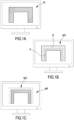
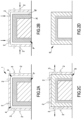
- Figures 1A, 1B, 1C , 2A, 2B, 2C, 2D and the flow diagram of figure 3 schematically illustrate an example of the process for manufacturing products of foamed polymeric material according to the present invention.
- the illustrated product is a kind of portal represented in two dimensions only for exemplifying purposes in order to explain the process and does not intend to represent a real product.
- a virtual model M of the product to be manufactured is first of all generated, for which also the foamable polymeric material used ( Figure 1A ) is defined.
- foamable polymeric material is a thermoplastic polymeric material such as polystyrene or thermosetting such as polyurethanes, polyester resins, epoxy resins, cyanoacrylic resins, polyphenol, vinyl esters, melamines, polydicyclopentadiene and polyimides.
- the foamable polymeric material of the virtual model M is solid (it is not porous, no bubbles are present), i.e. it is in a compact and non-foamed conformation.
- topological optimization software program for example Fusion 360 by Autodesk ® or Ansys ® Topology Optimization
- Fusion 360 by Autodesk ® or Ansys ® Topology Optimization
- the topological optimization software recalculates the density of the various parts of the virtual model M as a function of the typical loads and constraints such to, for example, maintain an overall rigidity of the product structure, preventing points of stress beyond the threshold of the material itself and to lighten such structure.
- the software usually allows inserting different optimization targets: for example maximizing the resistance to the load and/or reducing the mass up to a certain percentage.
- the topological optimization generates an optimized virtual model MO with areas of differentiated relative density.
- Figure 1A illustrates the virtual model M in solid polystyrene with uniform density.
- Figure 1B illustrates the optimized virtual model MO in which an area with greater density A and an area with lower density B are visible.
- the virtual model M of the product to be manufactured in the solid foamable polymeric material and the optimized virtual model MO with areas of differentiated relative density have the same shape and occupy the same volume.
- the relative density of the virtual model M of the product to be manufactured in the solid foamable polymeric material is everywhere equal to one.
- the relative density (given by the ratio between the density of a given volume of the foamed polymeric material and the density of the same volume of the same solid polymeric material, i.e. not foamed, in which there are no bubbles) of the area A of the optimized virtual model MO is for example equal to 0.9 and the relative density of the area B of the optimized virtual model MO is for example equal to 0.6.
- the clear separation between the area A and the area B was illustrated only for the sake of clarity, but the process is aimed to avoid sudden variations of density.
- the optimized virtual model MO is processed, always via-software, so as to virtually compress the areas A and B of the optimized virtual model MO, provided with a relative density lower than one, up to bringing said areas with relative density equal to one and obtain a virtual model of a preform MP which has a volume smaller than a volume of the optimized virtual model MO and a mass equal to a mass of the optimized virtual model ( Figure 1C ).
- the virtual model of the preform MP can also have a shape different from that of the optimized virtual model MO.
- An actual preform P constituted by the solid foamable polymeric material in the described case, polystyrene that is not foamed
- the shape of the preform is calculated starting from the optimized virtual model, darkening areas provided with a relative density lower than one and leaving visible only the areas with relative density equal to one. Additional material with relative density equal to one is distributed on the abovementioned areas with relative density equal to one. The additional material is that which, once foamed, generates the areas with differentiated relative density lower than one of the final foamed polymeric material product.
- the virtual model of the preform MP is obtained starting from the optimized virtual model MO by virtually removing, step by step, volumes at lower density from said optimized virtual model MO until the mass of the virtual model of the preform MP obtained (in solid polymer, i.e. not foamed) is equal to the mass of the optimized virtual model MO, i.e. the volume of the virtual model of the preform MP is equal to the volume actually occupied (without the bubbles, as if it was not foamed) by the polymeric material of the optimized model MP.
- the volume and the shape of the virtual model of the preform MP are derived from the optimized virtual model MO, maintaining the mass of polymeric material as constant.
- the preform P is then housed in a chamber of a mold 1 which reproduces a reverse image of the final shape of the product of foamed polymeric material to be manufactured ( Figure 2A ).
- the mold 1 is structured in order to allow the injection, in its chamber, of a foaming agent, for example a gas (e.g. N 2 ), configured for saturating the foamable polymeric material of the preform P through one or more steps of solubilization under pressure.
- a foaming agent for example a gas (e.g. N 2 )
- the mold 1 is therefore provided with inlets 2 connected to one or more pumps, e.g. volumetric, driven by an electronic control unit in order to control the pump(s) and actuate different programs of injection of the foaming agent and of management of the pressure of said foaming agent.
- the mold 1 is also provided with outlets 3 managed by means of valves connected to the control unit in order to allow the discharging of said foaming agent.
- the chamber of the mold 1 has a volume greater than that of the preform P so that, as is visible in Figure 2A , the preform P placed in the mold 1 only partially fills said mold, leaving empty volumes 4.
- an empty volume 4 is delimited between an upper and lateral external surface of the preform P and a lower and lateral internal surface of the chamber of the mold 1.
- the electronic control unit is programmed as a function of the previously performed topological optimization and drives the pumps so that they introduce the foaming agent in the mold 1 with one or more pressure profiles that are variable over time and/or space.
- the pressure of the foaming agent that is introduced in the mold 1 and acts on the foamable polymeric material of the preform P is made to vary over time according to a predefined profile.
- the pressure profile is made to vary over time periodically or non-periodically.
- the pressure of the foaming agent can be adjusted so as to take on different values on different portions of a surface of the preform P.
- the mold 1 for example can be provided with internal separators which divide the chamber into sub-chambers, each provided for example with an inlet 2, in order to introduce a respective foaming agent with a respective pressure profile.
- the pressure profile is made to vary from a minimum pressure equal to the atmospheric pressure to a maximum of 300 bar.
- the foaming agent is solubilized in the foamable polymeric material of the preform P and different concentrations of the foaming agent are attained in different areas of the polymer constituting the preform P.
- more internal areas of the preform P (A' at greater distance from the free surfaces) will have lower concentrations of foaming agent while more external areas of the preform P (B' at lower distance from the free surfaces) will have higher concentrations of foaming agent.
- the pressure profile(s) of the foaming agent generated by the pump(s) under the control of the control unit are calculated starting from the result of the previously performed topological optimization and determine the shape, the size and the numerousness per unit of volume of the bubbles formed within the foamed polymeric material (morphology) and hence the local density of said foamed polymeric material.
- the foamed polymeric material has density gradients (even high) but not discontinuity.
- the product of foamed polymeric material S can then be removed from the mold 1 ( Figure 2D ).
- Such product of foamed polymeric material S mirrors the characteristics of the optimized virtual model MO.
- the preform P has a volume smaller than a volume of the product of foamed polymeric material S and a shape different from the final shape of said product of foamed polymeric material S.
- the solubilization step is performed by using multiple foaming agents injected in succession in the chamber of the mold 1 or mixtures of foaming agents.
- the agent or the foaming agent(s) can be chosen from the group consisting of inert gases and substituted or unsubstituted aliphatic hydrocarbons (linear, branched or cyclic) and having 3 to 8 carbon atoms.
- the foaming agent can be nitrogen, carbon dioxide, n-butane, iso-butane, n-pentane, iso-pentane, 1,1,1,2-tetrafluoroethane (Freon R-134a), 1,1-difluoroethane (Freon R-152a), difluoromethane (Freon R-32), pentafluoroethane, sulfur hexafluoride.
- the foaming agent is solubilized both in the foamable polymeric material of the preform P and in the granules/balls of the compliant material also included in the mold.
- solubilization step can be reduced by tens of minutes, to times on the order of a minute.
- balls can also be chosen (as material, number and size) so as to locally limit the solubilization of the foaming agent in the foamable polymeric material and hence obtain multi-gradient products that are even more complex.
- aqueous solution of a polymer can be applied (e.g. polyvinyl alcohol PVA) with barrier property against the foaming agent (e.g. CO 2 ) on the portion(s) of the surface of the preform P.
- barrier property against the foaming agent e.g. CO 2
- step v. of solubilization is actuated at a temperature higher than 20°C.
- a thermal profile that is variable over time and/or space can be set, in concert with the solubilization step, in order to attain complex multi-gradient systems with the density of the polymeric material.
- the mold 1 is heated up to a temperature comprised between 50°C and 350°C.
- the mold 1 can also be cooled, for example to a temperature comprised between 5°C and 150°C, after step vi. (releasing) and before step vii. (removing). This allows solidifying the foam and stabilizing the attained multi-gradient foamed structure.
- control of the pressure and/or of the temperature and/or of the type of foaming agent allows manufacturing products with a relative average density lower than one, i.e. less than that of the starting solid foamable polymeric material, and density gradients or morphology gradients (but with relative density uniform and less than one) or both density and morphology gradients.
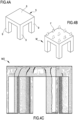
- Figures 4A - 4F illustrate a different example for making a stool 5 of polystyrene.
- Figure 4A illustrates the stool to be made.
- Figure 4B illustrates the virtual model M of the stool 5 with a load F applied that is vertically distributed on the seat of the stool 5.
- Figure 4C illustrates the optimized virtual model MO in which the darker areas represent the portions with greater density and the lighter areas represent the portions with lower density.
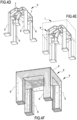
- Figure 4D illustrates the preform P of polystyrene, calculated as detailed above and made for by injection molding.
- the preform P has four longer legs 6 and four shorter arms 7.
- the four arms 7 together with upper parts of the four legs 6 are configured to form, after the solubilization and the foaming, the seat 8 of the stool.
- the lower parts of the four legs 6 are configured for forming the legs 9 of the stool 5.
- the preform P is inserted in the mold 1 with the final shape of the stool ( Figure 4E ).
- the preform P partially fills the mold 1, leaving empty volumes. Only through the subsequent foaming step, such empty volumes are filled with the foam.
- Such empty volumes can be possibly filled with balls of polystyrene with a diameter of several millimeters, in order to keep the process times low.
- the solubilization provides for a first pressurization with nitrogen N 2 (characterized by a lower solubility in the polystyrene) at 100 bar. Subsequently, a washing with carbon dioxide CO 2 (characterized by a greater solubility in the polystyrene) is actuated at 100 bar, substituting N 2 with CO 2 . More internal areas of the preform P (at greater distance from the free surfaces) will have lower concentrations of foaming agent. The parts of the preform P exposed to the foaming agents will be, at the time of their subsequent foaming, characterized by a density profile increasing towards the interior, resulting less dense externally and denser internally. In the present case, the mold 1 is kept at 100°C during all steps of the process.
- Figure 4F illustrates the stool 5 obtained after the release of the pressure in the mold 1 and the foaming of the polystyrene.
- the darker areas of the figure represent portions with greater density and the lighter areas are the portions with lower density, in accordance with the optimized virtual model MO.
- Figures 5A, 5B , 5C and 6 illustrate another example for making a cap 10 of a helmet of polystyrene.
- Figure 5A illustrates the preform P
- figure 5B illustrates the preform in the mold
- figure 5C illustrates the final product of foamed polymeric material S.
- the preform P has a hemispherical external portion 11 and excrescences 12 which are radially extended towards the interior of the hemispherical external portion 11.
- the excrescences 11 form an internal portion of the cap 10.
- Figure 6 illustrates the optimized virtual model MO of the cap with areas of differentiated relative density in which the darker areas represent the portions with greater density and the lighter areas represent the portions with smaller density.
- the products obtainable with the process according to the invention are multiple and relative to different fields.
- the product is, or is part of, a vehicle, a boat, an aircraft, a building structure, optionally for soundproofing, a garment or a clothing accessory, a medical device, an individual protection device (e.g. the above-described helmet) or collective protection device, a piece of furniture (such as the above-described small table, or a piece of sports equipment.
Landscapes
- Engineering & Computer Science (AREA)
- Physics & Mathematics (AREA)
- Theoretical Computer Science (AREA)
- Chemical & Material Sciences (AREA)
- General Engineering & Computer Science (AREA)
- Computer Hardware Design (AREA)
- General Physics & Mathematics (AREA)
- Geometry (AREA)
- Evolutionary Computation (AREA)
- Chemical Kinetics & Catalysis (AREA)
- Medicinal Chemistry (AREA)
- Organic Chemistry (AREA)
- Health & Medical Sciences (AREA)
- Polymers & Plastics (AREA)
- Materials Engineering (AREA)
- Manufacture Of Porous Articles, And Recovery And Treatment Of Waste Products (AREA)
- Molding Of Porous Articles (AREA)
- Injection Moulding Of Plastics Or The Like (AREA)
Claims (15)
- Verfahren zur Herstellung von Produkten aus geschäumtem Polymermaterial mit mehreren Gradienten, das die folgenden Schritte umfasst:i. Erzeugen eines virtuellen Modells (M) eines herzustellenden Produkts aus einem festen, schäumbaren Polymermaterial mittels einer Software;ii. Zuweisen von Beschränkungen und/oder Lasten, die durch die Verwendung diktiert werden, und Durchführen einer topologischen Optimierung des virtuellen Modells (M) mittels Software, um ein optimiertes virtuelles Modell (MO) mit Bereichen von differenzierter relativer Dichte und/oder differenzierter Morphologie zu erhalten;iii. Vorbereiten des schäumbaren Polymermaterials;iv. Einbringen des schäumbaren Polymermaterials in eine Form (1);v. Lösen mindestens eines Schaumbildners unter Druck in dem schäumbaren Polymermaterial, das in der Form (1) angeordnet ist, mit einem Druckprofil des mindestens einen Schaumbildners, das über die Zeit und/oder den Raum als eine Funktion der topologischen Optimierung variabel ist;vi. Ablassen des Drucks, um ein Produkt (S) aus geschäumtem Polymermaterial herzustellen, das mit den Bereichen unterschiedlicher relativer Dichte und/oder unterschiedlicher Morphologie versehen ist; undvii. Entfernen des Produkts (S) aus geschäumtem Polymermaterial aus der Form (1).
- Verfahren nach Anspruch 1, wobei Schritt iii. umfasst: Herstellen eines Vorformlings (P) aus dem festen schäumbaren Polymermaterial; wobei Schritt iv. umfasst: Anordnen des Vorformlings (P) in der Form (1).
- Verfahren nach Anspruch 2, wobei, zumindest vor Schritt v., der in die Form (1) eingebrachte Vorformling (P) die Form (1) teilweise ausfüllt, wobei leere Volumina (4) verbleiben, um die Expansion des schäumbaren Polymermaterials während Schritt vi. zu ermöglichen.
- Verfahren nach Anspruch 2 oder 3, umfassend: Erzeugen eines virtuellen Modells des Vorformlings (MP) aus dem optimierten virtuellen Modell (MO) mittels Software und Herstellen des Vorformlings (P) aus dem virtuellen Modell des Vorformlings (MP).
- Verfahren nach Anspruch 4, wobei das virtuelle Modell des Vorformlings (MP) erzeugt wird, indem schrittweise Volumina mit geringerer Dichte aus dem optimierten virtuellen Modell (MO) virtuell entfernt werden, bis die Masse des virtuellen Modells des Vorformlings (MP), das aus festem Polymer, d.h. nicht geschäumt, erhalten wird, gleich der Masse des optimierten virtuellen Modells (MO) ist.
- Verfahren nach einem der Ansprüche 2 bis 5, wobei die Herstellung des Vorformlings (P) umfasst: Formen des Vorformlings, gegebenenfalls Spritzgießen oder Formpressen, Herstellen des Vorformlings durch Blasen oder Rotationsformen.
- Verfahren nach einem der Ansprüche 3 bis 6, wenn Anspruch 4 und 6 von Anspruch 3 abhängen, umfassend: teilweises Füllen der leeren Volumina (4) der Form (1) mit inkohärentem Material, gegebenenfalls in Form von Granulat oder Kugeln, desselben schäumbaren Polymermaterials, um die Auflösung zu beschleunigen.
- Verfahren nach einem der Ansprüche 2 bis 7, umfassend: teilweises oder vollständiges Maskieren von Teilen des in die Form (1) eingebrachten Vorformlings (P), um die Auflösung des mindestens einen Schaumbildners in dem schäumbaren Polymermaterial lokal zu begrenzen oder zu verhindern.
- Verfahren nach Anspruch 8, wobei das teilweise oder vollständige Maskieren von Teilen des Vorformlings (P) umfasst: Aufbringen einer Folie auf die Teile des Vorformlings (P).
- Verfahren nach Anspruch 7, umfassend: Auswählen des inkohärenten Materials und seiner Menge in einer solchen Weise, dass die Auflösung des Schaumbildners in dem schäumbaren Polymermaterial lokal begrenzt oder verhindert wird.
- Verfahren nach einem der Ansprüche 1 bis 10, umfassend: Erwärmen der Form (1), gegebenenfalls nach einem thermischen Profil, während Schritt(en) iv. und/oder v. und/oder vi.; gegebenenfalls Abkühlen der Form (1) vor Schritt vi. und/oder nach Schritt vi. und vor Schritt vii, wobei das Druckprofil im Laufe der Zeit periodisch oder nicht periodisch variiert.
- Verfahren nach einem der Ansprüche 1 bis 11, wobei das Druckprofil von einem Minimaldruck gleich dem Atmosphärendruck bis zu einem Maximum von 300 bar variiert, gegebenenfalls von dem Atmosphärendruck bis zu 250 bar, gegebenenfalls von dem Atmosphärendruck bis zu 200 bar.
- Verfahren nach einem der Ansprüche 1 bis 12, wobei Schritt v. das Auflösen mehrerer Schaumbildner in dem in die Form (1) eingebrachten schäumbaren Polymermaterial unter Druck umfasst, wobei die Schaumbildner gegebenenfalls nacheinander, einer nach dem anderen, aufgelöst werden.
- Verfahren nach einem der Ansprüche 1 bis 13, wobei mindestens ein Schaumbildner aus der Gruppe ausgewählt wird, die aus Gasen, gegebenenfalls Stickstoff und/oder Kohlendioxid, und substituierten oder unsubstituierten aliphatischen Kohlenwasserstoffen (linear, verzweigt oder zyklisch) mit 3 bis 8 Kohlenstoffatomen besteht; wobei das schäumbare Polymermaterial aus der Gruppe ausgewählt wird, die aus thermoplastischen oder wärmehärtbaren Polymermaterialien besteht.
- Verfahren nach einem der Ansprüche 1 bis 14, wobei der Schritt v. des Lösens unter Druck umfasst: Einbringen des Schaumbildners unter Druck in die Form (1), die das schäumbare Polymermaterial enthält, so dass der Schaumbildner das schäumbare Polymermaterial sättigt, so dass, wenn der Druck des Schaumbildners abgelassen wird, das schäumbare Polymermaterial geschäumt wird.
Applications Claiming Priority (2)
| Application Number | Priority Date | Filing Date | Title |
|---|---|---|---|
| IT102019000019310A IT201900019310A1 (it) | 2019-10-18 | 2019-10-18 | Procedimento per realizzare prodotti in materiale polimerico espanso multi-gradiente |
| PCT/IB2020/059090 WO2021074729A1 (en) | 2019-10-18 | 2020-09-29 | Process for making products of multi-gradient foamed polymeric material |
Publications (2)
| Publication Number | Publication Date |
|---|---|
| EP4045259A1 EP4045259A1 (de) | 2022-08-24 |
| EP4045259B1 true EP4045259B1 (de) | 2024-04-17 |
Family
ID=69701430
Family Applications (1)
| Application Number | Title | Priority Date | Filing Date |
|---|---|---|---|
| EP20790388.1A Active EP4045259B1 (de) | 2019-10-18 | 2020-09-29 | Verfahren zur herstellung von produkten aus expandiertem polymermaterial mit mehreren gradienten |
Country Status (7)
| Country | Link |
|---|---|
| US (1) | US12447655B2 (de) |
| EP (1) | EP4045259B1 (de) |
| JP (1) | JP7706167B2 (de) |
| CN (1) | CN114555316B (de) |
| CA (1) | CA3156145A1 (de) |
| IT (1) | IT201900019310A1 (de) |
| WO (1) | WO2021074729A1 (de) |
Families Citing this family (2)
| Publication number | Priority date | Publication date | Assignee | Title |
|---|---|---|---|---|
| IT202200003512A1 (it) * | 2022-02-24 | 2023-08-24 | Materias S R L | Procedimento per la realizzazione di materiali polimerici espansi |
| CN116108763B (zh) * | 2023-04-13 | 2023-06-27 | 湖南工商大学 | 基于温度的发泡材料气泡破裂临界点预测的方法 |
Family Cites Families (19)
| Publication number | Priority date | Publication date | Assignee | Title |
|---|---|---|---|---|
| DE2440022C2 (de) * | 1974-08-21 | 1982-07-08 | Bayer Ag, 5090 Leverkusen | Verfahren zur Herstellung von Dämm- und Leichtbaustoffen und Vorrichtung zur Durchführung dieses Verfahrens |
| US4473665A (en) * | 1982-07-30 | 1984-09-25 | Massachusetts Institute Of Technology | Microcellular closed cell foams and their method of manufacture |
| IT1215335B (it) * | 1987-01-13 | 1990-02-08 | Tecnos Spa | Procedimento e stampo per la formazione di uno strato di poliuretano espanso su materiale in fogli. |
| JPH02222821A (ja) * | 1988-11-21 | 1990-09-05 | Hitachi Metals Ltd | 応力測定用モデル及びその測定方法 |
| JPH0593085A (ja) * | 1991-03-25 | 1993-04-16 | Boehringer Ingelheim Kg | ポリオレフインフオームの製造方法 |
| US5427853A (en) * | 1993-12-20 | 1995-06-27 | General Motors Corporation | Reinforcement preform, method of making same and reinforced composite made therefrom |
| JP4199034B2 (ja) * | 2003-03-28 | 2008-12-17 | ニチアス株式会社 | 感熱膨張材及びその製造方法 |
| US20050261387A1 (en) | 2004-05-20 | 2005-11-24 | Stevenson James F | Noise suppression structure manufacturing method |
| ITRM20040375A1 (it) * | 2004-07-23 | 2004-10-23 | Tekno Garden S R L | Materiali compositi a base di resine leganti, procedimenti per la loro preparazione e usi. |
| WO2006053132A2 (en) * | 2004-11-10 | 2006-05-18 | Ohio University | Prosthetic bone implants |
| US20120237734A1 (en) | 2009-11-24 | 2012-09-20 | Maurer Myron J | Process for forming a double-sided shaped foam article |
| MX338862B (es) * | 2012-12-05 | 2016-04-28 | Mexicano Inst Petrol | Composicion espumante con propiedades modificadoras de la mojabilidad e inhibitorias de la corrosion para alta temperatura y ulra alta temperatura. |
| US10279581B2 (en) * | 2012-12-19 | 2019-05-07 | New Balance Athletics, Inc. | Footwear with traction elements |
| US9282785B2 (en) | 2013-03-15 | 2016-03-15 | New Balance Athletic Shoe, Inc. | Multi-density sole elements, and systems and methods for manufacturing same |
| US20140377523A1 (en) * | 2013-06-19 | 2014-12-25 | Mike Waggoner | Methods for making multi-layered plastic end products |
| WO2015054836A1 (en) * | 2013-10-16 | 2015-04-23 | Henkel (China) Company Limited | Subframe and method for reinforcing the same |
| FR3054594B1 (fr) * | 2016-07-29 | 2020-07-17 | IFP Energies Nouvelles | Procede d’exploitation d’un gisement d’hydrocarbures par injection d’un gaz sous forme de mousse |
| WO2018104009A1 (en) * | 2016-12-07 | 2018-06-14 | Huntsman International Llc | Method for producing expanded thermoplastic polymers |
| CN108491651A (zh) * | 2018-03-29 | 2018-09-04 | 福建工程学院 | 一种孔隙材料结构的设计方法 |
-
2019
- 2019-10-18 IT IT102019000019310A patent/IT201900019310A1/it unknown
-
2020
- 2020-09-29 CN CN202080072123.XA patent/CN114555316B/zh active Active
- 2020-09-29 CA CA3156145A patent/CA3156145A1/en active Pending
- 2020-09-29 EP EP20790388.1A patent/EP4045259B1/de active Active
- 2020-09-29 WO PCT/IB2020/059090 patent/WO2021074729A1/en not_active Ceased
- 2020-09-29 JP JP2022522962A patent/JP7706167B2/ja active Active
- 2020-09-29 US US17/769,100 patent/US12447655B2/en active Active
Also Published As
| Publication number | Publication date |
|---|---|
| JP2022553668A (ja) | 2022-12-26 |
| US20230271358A1 (en) | 2023-08-31 |
| IT201900019310A1 (it) | 2021-04-18 |
| US12447655B2 (en) | 2025-10-21 |
| CN114555316A (zh) | 2022-05-27 |
| JP7706167B2 (ja) | 2025-07-11 |
| EP4045259A1 (de) | 2022-08-24 |
| CA3156145A1 (en) | 2021-04-22 |
| CN114555316B (zh) | 2024-09-10 |
| WO2021074729A1 (en) | 2021-04-22 |
Similar Documents
| Publication | Publication Date | Title |
|---|---|---|
| EP3781377B1 (de) | Verfahren zur herstellung von geschichteten, geschäumten polymermaterialien | |
| Zhang et al. | 3D printing thermoplastic polyurethane hierarchical cellular foam with outstanding energy absorption capability | |
| US12447655B2 (en) | Process for making products of multi-gradient foamed polymeric material | |
| CN114207002B (zh) | 具有密度和/或泡孔形态梯度的膨胀珠粒以及由其获得的烧结泡沫 | |
| AU2018373661B2 (en) | High-temperature foams with reduced resin absorption for producing sandwich materials | |
| JP2022087824A (ja) | 複合材部品用のツーリングとしてのフレキシブルな表皮を有する膨張性媒体 | |
| JP7186252B2 (ja) | 発泡体構成要素を作製する方法 | |
| Savvas et al. | Review of the Integration of Fused Filament Fabrication with Complementary Methods for Fabricating Hierarchical Porous Polymer Structures | |
| RU2743042C2 (ru) | Способ производства экспандированных термопластичных полимеров | |
| CN118201522A (zh) | 具有发泡的三维网格结构的中底 | |
| CN118922289A (zh) | 用于制造膨胀聚合物材料的方法 | |
| Grigolato et al. | Components by Polylactic Acid Foaming | |
| Emami et al. | The Role of Rheology in Non-Pressurized Polymer Foaming Systems | |
| Pawar | Fabrication of foamed composites processed by additive manufacturing with micro-cellular control for adjustable end-user propoerties | |
| JP3519468B2 (ja) | 発泡射出成形方法 | |
| RU2784396C2 (ru) | Высокотемпературные пенопласты с пониженным впитыванием смолы для изготовления материалов многослойной структуры | |
| US20230354960A1 (en) | Production of a foam-molded shoe component by way of pre-treatment in an autoclave | |
| Esteves et al. | Characterization of Polypropylene Structural Foams for Large Part Applications | |
| JP2010208202A (ja) | 発泡体の製造方法及び製造装置 | |
| JP2010241956A (ja) | 樹脂発泡体の製造方法 |
Legal Events
| Date | Code | Title | Description |
|---|---|---|---|
| STAA | Information on the status of an ep patent application or granted ep patent |
Free format text: STATUS: UNKNOWN |
|
| STAA | Information on the status of an ep patent application or granted ep patent |
Free format text: STATUS: THE INTERNATIONAL PUBLICATION HAS BEEN MADE |
|
| PUAI | Public reference made under article 153(3) epc to a published international application that has entered the european phase |
Free format text: ORIGINAL CODE: 0009012 |
|
| STAA | Information on the status of an ep patent application or granted ep patent |
Free format text: STATUS: REQUEST FOR EXAMINATION WAS MADE |
|
| 17P | Request for examination filed |
Effective date: 20220414 |
|
| AK | Designated contracting states |
Kind code of ref document: A1 Designated state(s): AL AT BE BG CH CY CZ DE DK EE ES FI FR GB GR HR HU IE IS IT LI LT LU LV MC MK MT NL NO PL PT RO RS SE SI SK SM TR |
|
| DAV | Request for validation of the european patent (deleted) | ||
| DAX | Request for extension of the european patent (deleted) | ||
| P01 | Opt-out of the competence of the unified patent court (upc) registered |
Effective date: 20230526 |
|
| GRAP | Despatch of communication of intention to grant a patent |
Free format text: ORIGINAL CODE: EPIDOSNIGR1 |
|
| STAA | Information on the status of an ep patent application or granted ep patent |
Free format text: STATUS: GRANT OF PATENT IS INTENDED |
|
| INTG | Intention to grant announced |
Effective date: 20231113 |
|
| GRAS | Grant fee paid |
Free format text: ORIGINAL CODE: EPIDOSNIGR3 |
|
| GRAA | (expected) grant |
Free format text: ORIGINAL CODE: 0009210 |
|
| STAA | Information on the status of an ep patent application or granted ep patent |
Free format text: STATUS: THE PATENT HAS BEEN GRANTED |
|
| AK | Designated contracting states |
Kind code of ref document: B1 Designated state(s): AL AT BE BG CH CY CZ DE DK EE ES FI FR GB GR HR HU IE IS IT LI LT LU LV MC MK MT NL NO PL PT RO RS SE SI SK SM TR |
|
| REG | Reference to a national code |
Ref country code: GB Ref legal event code: FG4D |
|
| REG | Reference to a national code |
Ref country code: CH Ref legal event code: EP |
|
| REG | Reference to a national code |
Ref country code: DE Ref legal event code: R096 Ref document number: 602020029244 Country of ref document: DE |
|
| REG | Reference to a national code |
Ref country code: IE Ref legal event code: FG4D |
|
| REG | Reference to a national code |
Ref country code: LT Ref legal event code: MG9D |
|
| REG | Reference to a national code |
Ref country code: NL Ref legal event code: MP Effective date: 20240417 |
|
| REG | Reference to a national code |
Ref country code: AT Ref legal event code: MK05 Ref document number: 1676862 Country of ref document: AT Kind code of ref document: T Effective date: 20240417 |
|
| PG25 | Lapsed in a contracting state [announced via postgrant information from national office to epo] |
Ref country code: NL Free format text: LAPSE BECAUSE OF FAILURE TO SUBMIT A TRANSLATION OF THE DESCRIPTION OR TO PAY THE FEE WITHIN THE PRESCRIBED TIME-LIMIT Effective date: 20240417 |
|
| PG25 | Lapsed in a contracting state [announced via postgrant information from national office to epo] |
Ref country code: NL Free format text: LAPSE BECAUSE OF FAILURE TO SUBMIT A TRANSLATION OF THE DESCRIPTION OR TO PAY THE FEE WITHIN THE PRESCRIBED TIME-LIMIT Effective date: 20240417 |
|
| PG25 | Lapsed in a contracting state [announced via postgrant information from national office to epo] |
Ref country code: IS Free format text: LAPSE BECAUSE OF FAILURE TO SUBMIT A TRANSLATION OF THE DESCRIPTION OR TO PAY THE FEE WITHIN THE PRESCRIBED TIME-LIMIT Effective date: 20240817 |
|
| PG25 | Lapsed in a contracting state [announced via postgrant information from national office to epo] |
Ref country code: BG Free format text: LAPSE BECAUSE OF FAILURE TO SUBMIT A TRANSLATION OF THE DESCRIPTION OR TO PAY THE FEE WITHIN THE PRESCRIBED TIME-LIMIT Effective date: 20240417 |
|
| PG25 | Lapsed in a contracting state [announced via postgrant information from national office to epo] |
Ref country code: FI Free format text: LAPSE BECAUSE OF FAILURE TO SUBMIT A TRANSLATION OF THE DESCRIPTION OR TO PAY THE FEE WITHIN THE PRESCRIBED TIME-LIMIT Effective date: 20240417 Ref country code: HR Free format text: LAPSE BECAUSE OF FAILURE TO SUBMIT A TRANSLATION OF THE DESCRIPTION OR TO PAY THE FEE WITHIN THE PRESCRIBED TIME-LIMIT Effective date: 20240417 |
|
| PG25 | Lapsed in a contracting state [announced via postgrant information from national office to epo] |
Ref country code: GR Free format text: LAPSE BECAUSE OF FAILURE TO SUBMIT A TRANSLATION OF THE DESCRIPTION OR TO PAY THE FEE WITHIN THE PRESCRIBED TIME-LIMIT Effective date: 20240718 |
|
| PG25 | Lapsed in a contracting state [announced via postgrant information from national office to epo] |
Ref country code: PT Free format text: LAPSE BECAUSE OF FAILURE TO SUBMIT A TRANSLATION OF THE DESCRIPTION OR TO PAY THE FEE WITHIN THE PRESCRIBED TIME-LIMIT Effective date: 20240819 |
|
| PG25 | Lapsed in a contracting state [announced via postgrant information from national office to epo] |
Ref country code: ES Free format text: LAPSE BECAUSE OF FAILURE TO SUBMIT A TRANSLATION OF THE DESCRIPTION OR TO PAY THE FEE WITHIN THE PRESCRIBED TIME-LIMIT Effective date: 20240417 |
|
| PG25 | Lapsed in a contracting state [announced via postgrant information from national office to epo] |
Ref country code: AT Free format text: LAPSE BECAUSE OF FAILURE TO SUBMIT A TRANSLATION OF THE DESCRIPTION OR TO PAY THE FEE WITHIN THE PRESCRIBED TIME-LIMIT Effective date: 20240417 |
|
| PG25 | Lapsed in a contracting state [announced via postgrant information from national office to epo] |
Ref country code: PL Free format text: LAPSE BECAUSE OF FAILURE TO SUBMIT A TRANSLATION OF THE DESCRIPTION OR TO PAY THE FEE WITHIN THE PRESCRIBED TIME-LIMIT Effective date: 20240417 |
|
| PG25 | Lapsed in a contracting state [announced via postgrant information from national office to epo] |
Ref country code: LV Free format text: LAPSE BECAUSE OF FAILURE TO SUBMIT A TRANSLATION OF THE DESCRIPTION OR TO PAY THE FEE WITHIN THE PRESCRIBED TIME-LIMIT Effective date: 20240417 |
|
| PG25 | Lapsed in a contracting state [announced via postgrant information from national office to epo] |
Ref country code: PT Free format text: LAPSE BECAUSE OF FAILURE TO SUBMIT A TRANSLATION OF THE DESCRIPTION OR TO PAY THE FEE WITHIN THE PRESCRIBED TIME-LIMIT Effective date: 20240819 Ref country code: PL Free format text: LAPSE BECAUSE OF FAILURE TO SUBMIT A TRANSLATION OF THE DESCRIPTION OR TO PAY THE FEE WITHIN THE PRESCRIBED TIME-LIMIT Effective date: 20240417 Ref country code: NO Free format text: LAPSE BECAUSE OF FAILURE TO SUBMIT A TRANSLATION OF THE DESCRIPTION OR TO PAY THE FEE WITHIN THE PRESCRIBED TIME-LIMIT Effective date: 20240717 Ref country code: LV Free format text: LAPSE BECAUSE OF FAILURE TO SUBMIT A TRANSLATION OF THE DESCRIPTION OR TO PAY THE FEE WITHIN THE PRESCRIBED TIME-LIMIT Effective date: 20240417 Ref country code: IS Free format text: LAPSE BECAUSE OF FAILURE TO SUBMIT A TRANSLATION OF THE DESCRIPTION OR TO PAY THE FEE WITHIN THE PRESCRIBED TIME-LIMIT Effective date: 20240817 Ref country code: HR Free format text: LAPSE BECAUSE OF FAILURE TO SUBMIT A TRANSLATION OF THE DESCRIPTION OR TO PAY THE FEE WITHIN THE PRESCRIBED TIME-LIMIT Effective date: 20240417 Ref country code: GR Free format text: LAPSE BECAUSE OF FAILURE TO SUBMIT A TRANSLATION OF THE DESCRIPTION OR TO PAY THE FEE WITHIN THE PRESCRIBED TIME-LIMIT Effective date: 20240718 Ref country code: FI Free format text: LAPSE BECAUSE OF FAILURE TO SUBMIT A TRANSLATION OF THE DESCRIPTION OR TO PAY THE FEE WITHIN THE PRESCRIBED TIME-LIMIT Effective date: 20240417 Ref country code: ES Free format text: LAPSE BECAUSE OF FAILURE TO SUBMIT A TRANSLATION OF THE DESCRIPTION OR TO PAY THE FEE WITHIN THE PRESCRIBED TIME-LIMIT Effective date: 20240417 Ref country code: BG Free format text: LAPSE BECAUSE OF FAILURE TO SUBMIT A TRANSLATION OF THE DESCRIPTION OR TO PAY THE FEE WITHIN THE PRESCRIBED TIME-LIMIT Effective date: 20240417 Ref country code: AT Free format text: LAPSE BECAUSE OF FAILURE TO SUBMIT A TRANSLATION OF THE DESCRIPTION OR TO PAY THE FEE WITHIN THE PRESCRIBED TIME-LIMIT Effective date: 20240417 Ref country code: RS Free format text: LAPSE BECAUSE OF FAILURE TO SUBMIT A TRANSLATION OF THE DESCRIPTION OR TO PAY THE FEE WITHIN THE PRESCRIBED TIME-LIMIT Effective date: 20240717 |
|
| PG25 | Lapsed in a contracting state [announced via postgrant information from national office to epo] |
Ref country code: DK Free format text: LAPSE BECAUSE OF FAILURE TO SUBMIT A TRANSLATION OF THE DESCRIPTION OR TO PAY THE FEE WITHIN THE PRESCRIBED TIME-LIMIT Effective date: 20240417 |
|
| REG | Reference to a national code |
Ref country code: DE Ref legal event code: R097 Ref document number: 602020029244 Country of ref document: DE |
|
| PG25 | Lapsed in a contracting state [announced via postgrant information from national office to epo] |
Ref country code: EE Free format text: LAPSE BECAUSE OF FAILURE TO SUBMIT A TRANSLATION OF THE DESCRIPTION OR TO PAY THE FEE WITHIN THE PRESCRIBED TIME-LIMIT Effective date: 20240417 |
|
| PG25 | Lapsed in a contracting state [announced via postgrant information from national office to epo] |
Ref country code: CZ Free format text: LAPSE BECAUSE OF FAILURE TO SUBMIT A TRANSLATION OF THE DESCRIPTION OR TO PAY THE FEE WITHIN THE PRESCRIBED TIME-LIMIT Effective date: 20240417 |
|
| PG25 | Lapsed in a contracting state [announced via postgrant information from national office to epo] |
Ref country code: SK Free format text: LAPSE BECAUSE OF FAILURE TO SUBMIT A TRANSLATION OF THE DESCRIPTION OR TO PAY THE FEE WITHIN THE PRESCRIBED TIME-LIMIT Effective date: 20240417 Ref country code: RO Free format text: LAPSE BECAUSE OF FAILURE TO SUBMIT A TRANSLATION OF THE DESCRIPTION OR TO PAY THE FEE WITHIN THE PRESCRIBED TIME-LIMIT Effective date: 20240417 |
|
| PG25 | Lapsed in a contracting state [announced via postgrant information from national office to epo] |
Ref country code: SM Free format text: LAPSE BECAUSE OF FAILURE TO SUBMIT A TRANSLATION OF THE DESCRIPTION OR TO PAY THE FEE WITHIN THE PRESCRIBED TIME-LIMIT Effective date: 20240417 |
|
| PG25 | Lapsed in a contracting state [announced via postgrant information from national office to epo] |
Ref country code: SM Free format text: LAPSE BECAUSE OF FAILURE TO SUBMIT A TRANSLATION OF THE DESCRIPTION OR TO PAY THE FEE WITHIN THE PRESCRIBED TIME-LIMIT Effective date: 20240417 Ref country code: SK Free format text: LAPSE BECAUSE OF FAILURE TO SUBMIT A TRANSLATION OF THE DESCRIPTION OR TO PAY THE FEE WITHIN THE PRESCRIBED TIME-LIMIT Effective date: 20240417 Ref country code: RO Free format text: LAPSE BECAUSE OF FAILURE TO SUBMIT A TRANSLATION OF THE DESCRIPTION OR TO PAY THE FEE WITHIN THE PRESCRIBED TIME-LIMIT Effective date: 20240417 Ref country code: EE Free format text: LAPSE BECAUSE OF FAILURE TO SUBMIT A TRANSLATION OF THE DESCRIPTION OR TO PAY THE FEE WITHIN THE PRESCRIBED TIME-LIMIT Effective date: 20240417 Ref country code: DK Free format text: LAPSE BECAUSE OF FAILURE TO SUBMIT A TRANSLATION OF THE DESCRIPTION OR TO PAY THE FEE WITHIN THE PRESCRIBED TIME-LIMIT Effective date: 20240417 Ref country code: CZ Free format text: LAPSE BECAUSE OF FAILURE TO SUBMIT A TRANSLATION OF THE DESCRIPTION OR TO PAY THE FEE WITHIN THE PRESCRIBED TIME-LIMIT Effective date: 20240417 |
|
| PLBE | No opposition filed within time limit |
Free format text: ORIGINAL CODE: 0009261 |
|
| STAA | Information on the status of an ep patent application or granted ep patent |
Free format text: STATUS: NO OPPOSITION FILED WITHIN TIME LIMIT |
|
| 26N | No opposition filed |
Effective date: 20250120 |
|
| PG25 | Lapsed in a contracting state [announced via postgrant information from national office to epo] |
Ref country code: SI Free format text: LAPSE BECAUSE OF FAILURE TO SUBMIT A TRANSLATION OF THE DESCRIPTION OR TO PAY THE FEE WITHIN THE PRESCRIBED TIME-LIMIT Effective date: 20240417 Ref country code: MC Free format text: LAPSE BECAUSE OF FAILURE TO SUBMIT A TRANSLATION OF THE DESCRIPTION OR TO PAY THE FEE WITHIN THE PRESCRIBED TIME-LIMIT Effective date: 20240417 |
|
| REG | Reference to a national code |
Ref country code: CH Ref legal event code: PL |
|
| PG25 | Lapsed in a contracting state [announced via postgrant information from national office to epo] |
Ref country code: LU Free format text: LAPSE BECAUSE OF NON-PAYMENT OF DUE FEES Effective date: 20240929 |
|
| REG | Reference to a national code |
Ref country code: BE Ref legal event code: MM Effective date: 20240930 |
|
| PG25 | Lapsed in a contracting state [announced via postgrant information from national office to epo] |
Ref country code: BE Free format text: LAPSE BECAUSE OF NON-PAYMENT OF DUE FEES Effective date: 20240930 |
|
| PG25 | Lapsed in a contracting state [announced via postgrant information from national office to epo] |
Ref country code: CH Free format text: LAPSE BECAUSE OF NON-PAYMENT OF DUE FEES Effective date: 20240930 |
|
| PG25 | Lapsed in a contracting state [announced via postgrant information from national office to epo] |
Ref country code: IE Free format text: LAPSE BECAUSE OF NON-PAYMENT OF DUE FEES Effective date: 20240929 |
|
| PG25 | Lapsed in a contracting state [announced via postgrant information from national office to epo] |
Ref country code: SE Free format text: LAPSE BECAUSE OF FAILURE TO SUBMIT A TRANSLATION OF THE DESCRIPTION OR TO PAY THE FEE WITHIN THE PRESCRIBED TIME-LIMIT Effective date: 20240417 |
|
| PGFP | Annual fee paid to national office [announced via postgrant information from national office to epo] |
Ref country code: DE Payment date: 20250926 Year of fee payment: 6 |
|
| PGFP | Annual fee paid to national office [announced via postgrant information from national office to epo] |
Ref country code: IT Payment date: 20250922 Year of fee payment: 6 |
|
| PGFP | Annual fee paid to national office [announced via postgrant information from national office to epo] |
Ref country code: GB Payment date: 20250923 Year of fee payment: 6 |
|
| PGFP | Annual fee paid to national office [announced via postgrant information from national office to epo] |
Ref country code: FR Payment date: 20250925 Year of fee payment: 6 |
|
| PG25 | Lapsed in a contracting state [announced via postgrant information from national office to epo] |
Ref country code: CY Free format text: LAPSE BECAUSE OF FAILURE TO SUBMIT A TRANSLATION OF THE DESCRIPTION OR TO PAY THE FEE WITHIN THE PRESCRIBED TIME-LIMIT; INVALID AB INITIO Effective date: 20200929 |
|
| PG25 | Lapsed in a contracting state [announced via postgrant information from national office to epo] |
Ref country code: HU Free format text: LAPSE BECAUSE OF FAILURE TO SUBMIT A TRANSLATION OF THE DESCRIPTION OR TO PAY THE FEE WITHIN THE PRESCRIBED TIME-LIMIT; INVALID AB INITIO Effective date: 20200929 |