EP3781377B1 - Verfahren zur herstellung von geschichteten, geschäumten polymermaterialien - Google Patents
Verfahren zur herstellung von geschichteten, geschäumten polymermaterialien Download PDFInfo
- Publication number
- EP3781377B1 EP3781377B1 EP19702485.4A EP19702485A EP3781377B1 EP 3781377 B1 EP3781377 B1 EP 3781377B1 EP 19702485 A EP19702485 A EP 19702485A EP 3781377 B1 EP3781377 B1 EP 3781377B1
- Authority
- EP
- European Patent Office
- Prior art keywords
- foamed
- pressure
- layer
- morphology
- polymeric material
- Prior art date
- Legal status (The legal status is an assumption and is not a legal conclusion. Google has not performed a legal analysis and makes no representation as to the accuracy of the status listed.)
- Active
Links
Images








Classifications
-
- B—PERFORMING OPERATIONS; TRANSPORTING
- B29—WORKING OF PLASTICS; WORKING OF SUBSTANCES IN A PLASTIC STATE IN GENERAL
- B29C—SHAPING OR JOINING OF PLASTICS; SHAPING OF MATERIAL IN A PLASTIC STATE, NOT OTHERWISE PROVIDED FOR; AFTER-TREATMENT OF THE SHAPED PRODUCTS, e.g. REPAIRING
- B29C44/00—Shaping by internal pressure generated in the material, e.g. swelling or foaming ; Producing porous or cellular expanded plastics articles
- B29C44/34—Auxiliary operations
- B29C44/3442—Mixing, kneading or conveying the foamable material
- B29C44/3446—Feeding the blowing agent
- B29C44/3453—Feeding the blowing agent to solid plastic material
-
- A—HUMAN NECESSITIES
- A61—MEDICAL OR VETERINARY SCIENCE; HYGIENE
- A61L—METHODS OR APPARATUS FOR STERILISING MATERIALS OR OBJECTS IN GENERAL; DISINFECTION, STERILISATION OR DEODORISATION OF AIR; CHEMICAL ASPECTS OF BANDAGES, DRESSINGS, ABSORBENT PADS OR SURGICAL ARTICLES; MATERIALS FOR BANDAGES, DRESSINGS, ABSORBENT PADS OR SURGICAL ARTICLES
- A61L27/00—Materials for grafts or prostheses or for coating grafts or prostheses
- A61L27/14—Macromolecular materials
- A61L27/18—Macromolecular materials obtained otherwise than by reactions only involving carbon-to-carbon unsaturated bonds
-
- A—HUMAN NECESSITIES
- A61—MEDICAL OR VETERINARY SCIENCE; HYGIENE
- A61L—METHODS OR APPARATUS FOR STERILISING MATERIALS OR OBJECTS IN GENERAL; DISINFECTION, STERILISATION OR DEODORISATION OF AIR; CHEMICAL ASPECTS OF BANDAGES, DRESSINGS, ABSORBENT PADS OR SURGICAL ARTICLES; MATERIALS FOR BANDAGES, DRESSINGS, ABSORBENT PADS OR SURGICAL ARTICLES
- A61L27/00—Materials for grafts or prostheses or for coating grafts or prostheses
- A61L27/28—Materials for coating prostheses
- A61L27/34—Macromolecular materials
-
- A—HUMAN NECESSITIES
- A61—MEDICAL OR VETERINARY SCIENCE; HYGIENE
- A61L—METHODS OR APPARATUS FOR STERILISING MATERIALS OR OBJECTS IN GENERAL; DISINFECTION, STERILISATION OR DEODORISATION OF AIR; CHEMICAL ASPECTS OF BANDAGES, DRESSINGS, ABSORBENT PADS OR SURGICAL ARTICLES; MATERIALS FOR BANDAGES, DRESSINGS, ABSORBENT PADS OR SURGICAL ARTICLES
- A61L27/00—Materials for grafts or prostheses or for coating grafts or prostheses
- A61L27/50—Materials characterised by their function or physical properties, e.g. injectable or lubricating compositions, shape-memory materials, surface modified materials
-
- B—PERFORMING OPERATIONS; TRANSPORTING
- B29—WORKING OF PLASTICS; WORKING OF SUBSTANCES IN A PLASTIC STATE IN GENERAL
- B29C—SHAPING OR JOINING OF PLASTICS; SHAPING OF MATERIAL IN A PLASTIC STATE, NOT OTHERWISE PROVIDED FOR; AFTER-TREATMENT OF THE SHAPED PRODUCTS, e.g. REPAIRING
- B29C44/00—Shaping by internal pressure generated in the material, e.g. swelling or foaming ; Producing porous or cellular expanded plastics articles
- B29C44/02—Shaping by internal pressure generated in the material, e.g. swelling or foaming ; Producing porous or cellular expanded plastics articles for articles of definite length, i.e. discrete articles
- B29C44/04—Shaping by internal pressure generated in the material, e.g. swelling or foaming ; Producing porous or cellular expanded plastics articles for articles of definite length, i.e. discrete articles consisting of at least two parts of chemically or physically different materials, e.g. having different densities
- B29C44/06—Making multilayered articles
-
- B—PERFORMING OPERATIONS; TRANSPORTING
- B29—WORKING OF PLASTICS; WORKING OF SUBSTANCES IN A PLASTIC STATE IN GENERAL
- B29C—SHAPING OR JOINING OF PLASTICS; SHAPING OF MATERIAL IN A PLASTIC STATE, NOT OTHERWISE PROVIDED FOR; AFTER-TREATMENT OF THE SHAPED PRODUCTS, e.g. REPAIRING
- B29C44/00—Shaping by internal pressure generated in the material, e.g. swelling or foaming ; Producing porous or cellular expanded plastics articles
- B29C44/34—Auxiliary operations
- B29C44/3469—Cell or pore nucleation
- B29C44/348—Cell or pore nucleation by regulating the temperature and/or the pressure, e.g. suppression of foaming until the pressure is rapidly decreased
-
- C—CHEMISTRY; METALLURGY
- C08—ORGANIC MACROMOLECULAR COMPOUNDS; THEIR PREPARATION OR CHEMICAL WORKING-UP; COMPOSITIONS BASED THEREON
- C08J—WORKING-UP; GENERAL PROCESSES OF COMPOUNDING; AFTER-TREATMENT NOT COVERED BY SUBCLASSES C08B, C08C, C08F, C08G or C08H
- C08J9/00—Working-up of macromolecular substances to porous or cellular articles or materials; After-treatment thereof
- C08J9/0061—Working-up of macromolecular substances to porous or cellular articles or materials; After-treatment thereof characterized by the use of several polymeric components
-
- C—CHEMISTRY; METALLURGY
- C08—ORGANIC MACROMOLECULAR COMPOUNDS; THEIR PREPARATION OR CHEMICAL WORKING-UP; COMPOSITIONS BASED THEREON
- C08J—WORKING-UP; GENERAL PROCESSES OF COMPOUNDING; AFTER-TREATMENT NOT COVERED BY SUBCLASSES C08B, C08C, C08F, C08G or C08H
- C08J9/00—Working-up of macromolecular substances to porous or cellular articles or materials; After-treatment thereof
- C08J9/04—Working-up of macromolecular substances to porous or cellular articles or materials; After-treatment thereof using blowing gases generated by a previously added blowing agent
- C08J9/12—Working-up of macromolecular substances to porous or cellular articles or materials; After-treatment thereof using blowing gases generated by a previously added blowing agent by a physical blowing agent
- C08J9/122—Hydrogen, oxygen, CO2, nitrogen or noble gases
-
- C—CHEMISTRY; METALLURGY
- C08—ORGANIC MACROMOLECULAR COMPOUNDS; THEIR PREPARATION OR CHEMICAL WORKING-UP; COMPOSITIONS BASED THEREON
- C08J—WORKING-UP; GENERAL PROCESSES OF COMPOUNDING; AFTER-TREATMENT NOT COVERED BY SUBCLASSES C08B, C08C, C08F, C08G or C08H
- C08J9/00—Working-up of macromolecular substances to porous or cellular articles or materials; After-treatment thereof
- C08J9/04—Working-up of macromolecular substances to porous or cellular articles or materials; After-treatment thereof using blowing gases generated by a previously added blowing agent
- C08J9/12—Working-up of macromolecular substances to porous or cellular articles or materials; After-treatment thereof using blowing gases generated by a previously added blowing agent by a physical blowing agent
- C08J9/14—Working-up of macromolecular substances to porous or cellular articles or materials; After-treatment thereof using blowing gases generated by a previously added blowing agent by a physical blowing agent organic
- C08J9/141—Hydrocarbons
-
- C—CHEMISTRY; METALLURGY
- C08—ORGANIC MACROMOLECULAR COMPOUNDS; THEIR PREPARATION OR CHEMICAL WORKING-UP; COMPOSITIONS BASED THEREON
- C08J—WORKING-UP; GENERAL PROCESSES OF COMPOUNDING; AFTER-TREATMENT NOT COVERED BY SUBCLASSES C08B, C08C, C08F, C08G or C08H
- C08J9/00—Working-up of macromolecular substances to porous or cellular articles or materials; After-treatment thereof
- C08J9/04—Working-up of macromolecular substances to porous or cellular articles or materials; After-treatment thereof using blowing gases generated by a previously added blowing agent
- C08J9/12—Working-up of macromolecular substances to porous or cellular articles or materials; After-treatment thereof using blowing gases generated by a previously added blowing agent by a physical blowing agent
- C08J9/14—Working-up of macromolecular substances to porous or cellular articles or materials; After-treatment thereof using blowing gases generated by a previously added blowing agent by a physical blowing agent organic
- C08J9/143—Halogen containing compounds
- C08J9/144—Halogen containing compounds containing carbon, halogen and hydrogen only
- C08J9/146—Halogen containing compounds containing carbon, halogen and hydrogen only only fluorine as halogen atoms
-
- C—CHEMISTRY; METALLURGY
- C08—ORGANIC MACROMOLECULAR COMPOUNDS; THEIR PREPARATION OR CHEMICAL WORKING-UP; COMPOSITIONS BASED THEREON
- C08J—WORKING-UP; GENERAL PROCESSES OF COMPOUNDING; AFTER-TREATMENT NOT COVERED BY SUBCLASSES C08B, C08C, C08F, C08G or C08H
- C08J9/00—Working-up of macromolecular substances to porous or cellular articles or materials; After-treatment thereof
- C08J9/16—Making expandable particles
- C08J9/18—Making expandable particles by impregnating polymer particles with the blowing agent
-
- C—CHEMISTRY; METALLURGY
- C08—ORGANIC MACROMOLECULAR COMPOUNDS; THEIR PREPARATION OR CHEMICAL WORKING-UP; COMPOSITIONS BASED THEREON
- C08J—WORKING-UP; GENERAL PROCESSES OF COMPOUNDING; AFTER-TREATMENT NOT COVERED BY SUBCLASSES C08B, C08C, C08F, C08G or C08H
- C08J9/00—Working-up of macromolecular substances to porous or cellular articles or materials; After-treatment thereof
- C08J9/34—Chemical features in the manufacture of articles consisting of a foamed macromolecular core and a macromolecular surface layer having a higher density than the core
-
- A—HUMAN NECESSITIES
- A61—MEDICAL OR VETERINARY SCIENCE; HYGIENE
- A61L—METHODS OR APPARATUS FOR STERILISING MATERIALS OR OBJECTS IN GENERAL; DISINFECTION, STERILISATION OR DEODORISATION OF AIR; CHEMICAL ASPECTS OF BANDAGES, DRESSINGS, ABSORBENT PADS OR SURGICAL ARTICLES; MATERIALS FOR BANDAGES, DRESSINGS, ABSORBENT PADS OR SURGICAL ARTICLES
- A61L2420/00—Materials or methods for coatings medical devices
- A61L2420/02—Methods for coating medical devices
-
- A—HUMAN NECESSITIES
- A61—MEDICAL OR VETERINARY SCIENCE; HYGIENE
- A61L—METHODS OR APPARATUS FOR STERILISING MATERIALS OR OBJECTS IN GENERAL; DISINFECTION, STERILISATION OR DEODORISATION OF AIR; CHEMICAL ASPECTS OF BANDAGES, DRESSINGS, ABSORBENT PADS OR SURGICAL ARTICLES; MATERIALS FOR BANDAGES, DRESSINGS, ABSORBENT PADS OR SURGICAL ARTICLES
- A61L2430/00—Materials or treatment for tissue regeneration
- A61L2430/02—Materials or treatment for tissue regeneration for reconstruction of bones; weight-bearing implants
-
- A—HUMAN NECESSITIES
- A61—MEDICAL OR VETERINARY SCIENCE; HYGIENE
- A61L—METHODS OR APPARATUS FOR STERILISING MATERIALS OR OBJECTS IN GENERAL; DISINFECTION, STERILISATION OR DEODORISATION OF AIR; CHEMICAL ASPECTS OF BANDAGES, DRESSINGS, ABSORBENT PADS OR SURGICAL ARTICLES; MATERIALS FOR BANDAGES, DRESSINGS, ABSORBENT PADS OR SURGICAL ARTICLES
- A61L2430/00—Materials or treatment for tissue regeneration
- A61L2430/24—Materials or treatment for tissue regeneration for joint reconstruction
-
- A—HUMAN NECESSITIES
- A61—MEDICAL OR VETERINARY SCIENCE; HYGIENE
- A61L—METHODS OR APPARATUS FOR STERILISING MATERIALS OR OBJECTS IN GENERAL; DISINFECTION, STERILISATION OR DEODORISATION OF AIR; CHEMICAL ASPECTS OF BANDAGES, DRESSINGS, ABSORBENT PADS OR SURGICAL ARTICLES; MATERIALS FOR BANDAGES, DRESSINGS, ABSORBENT PADS OR SURGICAL ARTICLES
- A61L2430/00—Materials or treatment for tissue regeneration
- A61L2430/38—Materials or treatment for tissue regeneration for reconstruction of the spine, vertebrae or intervertebral discs
-
- B—PERFORMING OPERATIONS; TRANSPORTING
- B29—WORKING OF PLASTICS; WORKING OF SUBSTANCES IN A PLASTIC STATE IN GENERAL
- B29K—INDEXING SCHEME ASSOCIATED WITH SUBCLASSES B29B, B29C OR B29D, RELATING TO MOULDING MATERIALS OR TO MATERIALS FOR MOULDS, REINFORCEMENTS, FILLERS OR PREFORMED PARTS, e.g. INSERTS
- B29K2023/00—Use of polyalkenes or derivatives thereof as moulding material
-
- B—PERFORMING OPERATIONS; TRANSPORTING
- B29—WORKING OF PLASTICS; WORKING OF SUBSTANCES IN A PLASTIC STATE IN GENERAL
- B29K—INDEXING SCHEME ASSOCIATED WITH SUBCLASSES B29B, B29C OR B29D, RELATING TO MOULDING MATERIALS OR TO MATERIALS FOR MOULDS, REINFORCEMENTS, FILLERS OR PREFORMED PARTS, e.g. INSERTS
- B29K2025/00—Use of polymers of vinyl-aromatic compounds or derivatives thereof as moulding material
- B29K2025/04—Polymers of styrene
- B29K2025/06—PS, i.e. polystyrene
-
- B—PERFORMING OPERATIONS; TRANSPORTING
- B29—WORKING OF PLASTICS; WORKING OF SUBSTANCES IN A PLASTIC STATE IN GENERAL
- B29K—INDEXING SCHEME ASSOCIATED WITH SUBCLASSES B29B, B29C OR B29D, RELATING TO MOULDING MATERIALS OR TO MATERIALS FOR MOULDS, REINFORCEMENTS, FILLERS OR PREFORMED PARTS, e.g. INSERTS
- B29K2067/00—Use of polyesters or derivatives thereof, as moulding material
-
- B—PERFORMING OPERATIONS; TRANSPORTING
- B29—WORKING OF PLASTICS; WORKING OF SUBSTANCES IN A PLASTIC STATE IN GENERAL
- B29K—INDEXING SCHEME ASSOCIATED WITH SUBCLASSES B29B, B29C OR B29D, RELATING TO MOULDING MATERIALS OR TO MATERIALS FOR MOULDS, REINFORCEMENTS, FILLERS OR PREFORMED PARTS, e.g. INSERTS
- B29K2075/00—Use of PU, i.e. polyureas or polyurethanes or derivatives thereof, as moulding material
-
- B—PERFORMING OPERATIONS; TRANSPORTING
- B29—WORKING OF PLASTICS; WORKING OF SUBSTANCES IN A PLASTIC STATE IN GENERAL
- B29K—INDEXING SCHEME ASSOCIATED WITH SUBCLASSES B29B, B29C OR B29D, RELATING TO MOULDING MATERIALS OR TO MATERIALS FOR MOULDS, REINFORCEMENTS, FILLERS OR PREFORMED PARTS, e.g. INSERTS
- B29K2077/00—Use of PA, i.e. polyamides, e.g. polyesteramides or derivatives thereof, as moulding material
-
- C—CHEMISTRY; METALLURGY
- C08—ORGANIC MACROMOLECULAR COMPOUNDS; THEIR PREPARATION OR CHEMICAL WORKING-UP; COMPOSITIONS BASED THEREON
- C08J—WORKING-UP; GENERAL PROCESSES OF COMPOUNDING; AFTER-TREATMENT NOT COVERED BY SUBCLASSES C08B, C08C, C08F, C08G or C08H
- C08J2203/00—Foams characterized by the expanding agent
- C08J2203/06—CO2, N2 or noble gases
-
- C—CHEMISTRY; METALLURGY
- C08—ORGANIC MACROMOLECULAR COMPOUNDS; THEIR PREPARATION OR CHEMICAL WORKING-UP; COMPOSITIONS BASED THEREON
- C08J—WORKING-UP; GENERAL PROCESSES OF COMPOUNDING; AFTER-TREATMENT NOT COVERED BY SUBCLASSES C08B, C08C, C08F, C08G or C08H
- C08J2203/00—Foams characterized by the expanding agent
- C08J2203/14—Saturated hydrocarbons, e.g. butane; Unspecified hydrocarbons
- C08J2203/142—Halogenated saturated hydrocarbons, e.g. H3C-CF3
-
- C—CHEMISTRY; METALLURGY
- C08—ORGANIC MACROMOLECULAR COMPOUNDS; THEIR PREPARATION OR CHEMICAL WORKING-UP; COMPOSITIONS BASED THEREON
- C08J—WORKING-UP; GENERAL PROCESSES OF COMPOUNDING; AFTER-TREATMENT NOT COVERED BY SUBCLASSES C08B, C08C, C08F, C08G or C08H
- C08J2203/00—Foams characterized by the expanding agent
- C08J2203/18—Binary blends of expanding agents
- C08J2203/182—Binary blends of expanding agents of physical blowing agents, e.g. acetone and butane
-
- C—CHEMISTRY; METALLURGY
- C08—ORGANIC MACROMOLECULAR COMPOUNDS; THEIR PREPARATION OR CHEMICAL WORKING-UP; COMPOSITIONS BASED THEREON
- C08J—WORKING-UP; GENERAL PROCESSES OF COMPOUNDING; AFTER-TREATMENT NOT COVERED BY SUBCLASSES C08B, C08C, C08F, C08G or C08H
- C08J2207/00—Foams characterised by their intended use
-
- C—CHEMISTRY; METALLURGY
- C08—ORGANIC MACROMOLECULAR COMPOUNDS; THEIR PREPARATION OR CHEMICAL WORKING-UP; COMPOSITIONS BASED THEREON
- C08J—WORKING-UP; GENERAL PROCESSES OF COMPOUNDING; AFTER-TREATMENT NOT COVERED BY SUBCLASSES C08B, C08C, C08F, C08G or C08H
- C08J2207/00—Foams characterised by their intended use
- C08J2207/10—Medical applications, e.g. biocompatible scaffolds
-
- C—CHEMISTRY; METALLURGY
- C08—ORGANIC MACROMOLECULAR COMPOUNDS; THEIR PREPARATION OR CHEMICAL WORKING-UP; COMPOSITIONS BASED THEREON
- C08J—WORKING-UP; GENERAL PROCESSES OF COMPOUNDING; AFTER-TREATMENT NOT COVERED BY SUBCLASSES C08B, C08C, C08F, C08G or C08H
- C08J2300/00—Characterised by the use of unspecified polymers
- C08J2300/22—Thermoplastic resins
-
- C—CHEMISTRY; METALLURGY
- C08—ORGANIC MACROMOLECULAR COMPOUNDS; THEIR PREPARATION OR CHEMICAL WORKING-UP; COMPOSITIONS BASED THEREON
- C08J—WORKING-UP; GENERAL PROCESSES OF COMPOUNDING; AFTER-TREATMENT NOT COVERED BY SUBCLASSES C08B, C08C, C08F, C08G or C08H
- C08J2300/00—Characterised by the use of unspecified polymers
- C08J2300/24—Thermosetting resins
-
- C—CHEMISTRY; METALLURGY
- C08—ORGANIC MACROMOLECULAR COMPOUNDS; THEIR PREPARATION OR CHEMICAL WORKING-UP; COMPOSITIONS BASED THEREON
- C08J—WORKING-UP; GENERAL PROCESSES OF COMPOUNDING; AFTER-TREATMENT NOT COVERED BY SUBCLASSES C08B, C08C, C08F, C08G or C08H
- C08J2323/00—Characterised by the use of homopolymers or copolymers of unsaturated aliphatic hydrocarbons having only one carbon-to-carbon double bond; Derivatives of such polymers
- C08J2323/02—Characterised by the use of homopolymers or copolymers of unsaturated aliphatic hydrocarbons having only one carbon-to-carbon double bond; Derivatives of such polymers not modified by chemical after treatment
-
- C—CHEMISTRY; METALLURGY
- C08—ORGANIC MACROMOLECULAR COMPOUNDS; THEIR PREPARATION OR CHEMICAL WORKING-UP; COMPOSITIONS BASED THEREON
- C08J—WORKING-UP; GENERAL PROCESSES OF COMPOUNDING; AFTER-TREATMENT NOT COVERED BY SUBCLASSES C08B, C08C, C08F, C08G or C08H
- C08J2325/00—Characterised by the use of homopolymers or copolymers of compounds having one or more unsaturated aliphatic radicals, each having only one carbon-to-carbon double bond, and at least one being terminated by an aromatic carbocyclic ring; Derivatives of such polymers
- C08J2325/02—Homopolymers or copolymers of hydrocarbons
- C08J2325/04—Homopolymers or copolymers of styrene
- C08J2325/06—Polystyrene
-
- C—CHEMISTRY; METALLURGY
- C08—ORGANIC MACROMOLECULAR COMPOUNDS; THEIR PREPARATION OR CHEMICAL WORKING-UP; COMPOSITIONS BASED THEREON
- C08J—WORKING-UP; GENERAL PROCESSES OF COMPOUNDING; AFTER-TREATMENT NOT COVERED BY SUBCLASSES C08B, C08C, C08F, C08G or C08H
- C08J2361/00—Characterised by the use of condensation polymers of aldehydes or ketones; Derivatives of such polymers
- C08J2361/20—Condensation polymers of aldehydes or ketones with only compounds containing hydrogen attached to nitrogen
-
- C—CHEMISTRY; METALLURGY
- C08—ORGANIC MACROMOLECULAR COMPOUNDS; THEIR PREPARATION OR CHEMICAL WORKING-UP; COMPOSITIONS BASED THEREON
- C08J—WORKING-UP; GENERAL PROCESSES OF COMPOUNDING; AFTER-TREATMENT NOT COVERED BY SUBCLASSES C08B, C08C, C08F, C08G or C08H
- C08J2363/00—Characterised by the use of epoxy resins; Derivatives of epoxy resins
-
- C—CHEMISTRY; METALLURGY
- C08—ORGANIC MACROMOLECULAR COMPOUNDS; THEIR PREPARATION OR CHEMICAL WORKING-UP; COMPOSITIONS BASED THEREON
- C08J—WORKING-UP; GENERAL PROCESSES OF COMPOUNDING; AFTER-TREATMENT NOT COVERED BY SUBCLASSES C08B, C08C, C08F, C08G or C08H
- C08J2367/00—Characterised by the use of polyesters obtained by reactions forming a carboxylic ester link in the main chain; Derivatives of such polymers
-
- C—CHEMISTRY; METALLURGY
- C08—ORGANIC MACROMOLECULAR COMPOUNDS; THEIR PREPARATION OR CHEMICAL WORKING-UP; COMPOSITIONS BASED THEREON
- C08J—WORKING-UP; GENERAL PROCESSES OF COMPOUNDING; AFTER-TREATMENT NOT COVERED BY SUBCLASSES C08B, C08C, C08F, C08G or C08H
- C08J2367/00—Characterised by the use of polyesters obtained by reactions forming a carboxylic ester link in the main chain; Derivatives of such polymers
- C08J2367/04—Polyesters derived from hydroxy carboxylic acids, e.g. lactones
-
- C—CHEMISTRY; METALLURGY
- C08—ORGANIC MACROMOLECULAR COMPOUNDS; THEIR PREPARATION OR CHEMICAL WORKING-UP; COMPOSITIONS BASED THEREON
- C08J—WORKING-UP; GENERAL PROCESSES OF COMPOUNDING; AFTER-TREATMENT NOT COVERED BY SUBCLASSES C08B, C08C, C08F, C08G or C08H
- C08J2375/00—Characterised by the use of polyureas or polyurethanes; Derivatives of such polymers
- C08J2375/04—Polyurethanes
-
- C—CHEMISTRY; METALLURGY
- C08—ORGANIC MACROMOLECULAR COMPOUNDS; THEIR PREPARATION OR CHEMICAL WORKING-UP; COMPOSITIONS BASED THEREON
- C08J—WORKING-UP; GENERAL PROCESSES OF COMPOUNDING; AFTER-TREATMENT NOT COVERED BY SUBCLASSES C08B, C08C, C08F, C08G or C08H
- C08J2377/00—Characterised by the use of polyamides obtained by reactions forming a carboxylic amide link in the main chain; Derivatives of such polymers
-
- C—CHEMISTRY; METALLURGY
- C08—ORGANIC MACROMOLECULAR COMPOUNDS; THEIR PREPARATION OR CHEMICAL WORKING-UP; COMPOSITIONS BASED THEREON
- C08J—WORKING-UP; GENERAL PROCESSES OF COMPOUNDING; AFTER-TREATMENT NOT COVERED BY SUBCLASSES C08B, C08C, C08F, C08G or C08H
- C08J2379/00—Characterised by the use of macromolecular compounds obtained by reactions forming in the main chain of the macromolecule a linkage containing nitrogen with or without oxygen, or carbon only, not provided for in groups C08J2361/00 - C08J2377/00
- C08J2379/04—Polycondensates having nitrogen-containing heterocyclic rings in the main chain; Polyhydrazides; Polyamide acids or similar polyimide precursors
- C08J2379/08—Polyimides; Polyester-imides; Polyamide-imides; Polyamide acids or similar polyimide precursors
-
- C—CHEMISTRY; METALLURGY
- C08—ORGANIC MACROMOLECULAR COMPOUNDS; THEIR PREPARATION OR CHEMICAL WORKING-UP; COMPOSITIONS BASED THEREON
- C08J—WORKING-UP; GENERAL PROCESSES OF COMPOUNDING; AFTER-TREATMENT NOT COVERED BY SUBCLASSES C08B, C08C, C08F, C08G or C08H
- C08J2429/00—Characterised by the use of homopolymers or copolymers of compounds having one or more unsaturated aliphatic radicals, each having only one carbon-to-carbon double bond, and at least one being terminated by an alcohol, ether, aldehydo, ketonic, acetal, or ketal radical; Hydrolysed polymers of esters of unsaturated alcohols with saturated carboxylic acids; Derivatives of such polymer
- C08J2429/02—Homopolymers or copolymers of unsaturated alcohols
- C08J2429/04—Polyvinyl alcohol; Partially hydrolysed homopolymers or copolymers of esters of unsaturated alcohols with saturated carboxylic acids
Definitions
- the present invention concerns a process for preparing layered foamed polymeric materials, both in terms of cell morphology and in terms of density.
- the process uses a procedure for the solubilisation of physical foaming agents, necessary for the subsequent foaming, characterised by variable conditions over time. More specifically, the variable conditions over time of the solubilisation step generate non-uniform profiles of the concentrations of the physical foaming agents in the polymer, which, upon foaming, generate correspondingly non-uniform morphologies and densities.
- sintering also known as steam-chest moulding or bead-foaming
- sintering also known as steam-chest moulding or bead-foaming
- pre-foamed beads almost spherical in shape and with dimensions nearing a millimetre
- the final foaming is mainly due to foaming agents, for example pentane, which are still contained in the pre-foamed bead and evolve with heating.
- Some commercial products such as golf balls or sports impact protection devices, are layered products with one or more foamed layers (see, for example, Sullivan et al., US 2015/0283432 and Donzis, US 4486901 ).
- European patent application EP1878450A1 cellular gradient polymer composites are disclosed.
- EP1452191A2 and EP1878450A1 procedures are described for the creation of layered structures via the use of composite materials.
- mixtures of two polymeric materials are used with a concentration gradient varying from a step mainly constituted by a first material to a step mainly constituted by a second component
- EP1878450A1 composite preforms are made using the precise positioning of fillers and/or fibres in a mould together with a foamable polymeric material.
- EP0610953A1 Another procedure is disclosed in EP0610953A1 .
- the most remote portions (with respect to the free surfaces in contact with the foaming agent under pressure, thus the innermost portions) of the samples to be foamed contain a lower concentration of the foaming agent with respect to the portions adjacent to said surfaces (more external portions), in which the concentration of the foaming agent readily reaches equilibrium conditions with the foaming agent's external pressure.
- the internal portion of the sample will be less foamed or lack foam, while the outer portions will be completely foamed.
- the process of the present invention aims to overcome the disadvantages of the methods known in the art.
- the Applicant has observed that the layered foamed structures obtained with the process of the present invention do not present discontinuities at the interface between the layers, but on the contrary show a gradual variation of both the density and morphology of the bubbles present in the foamed material.
- the Applicant has observed that the use of one or more variable conditions over time in the solubilisation step of one or more foaming agents in a polymer generate non-uniform profiles of the concentrations of the foaming agents in the same polymer, which upon foaming correspondingly generate non-uniform morphologies and densities.
- the relation itself indicates the thickness, at each time T after the imposition of the variation itself, within which the effect of the variation is relevant.
- the Applicant has first found that the pressure variation can be appropriately adjusted through the use of a management program capable of causing periodic variations characterised by a certain period T and by the waveform, which can be, for example, sinusoidal, triangular, square, sawtooth, and so on.
- the Applicant has also found that the pressure variation can be appropriately adjusted through the use of a management program capable of operating non-periodic variations, quickly or slowly, following linear, parabolic, exponential, impulsive profiles, and so on.
- the Applicant has found that the variation in the composition of the expanding gas can be suitably adjusted by varying the partial pressures of two or more foaming agents (such as nitrogen and carbon dioxide) characterised by different diffusivities, D.
- two or more foaming agents such as nitrogen and carbon dioxide
- thermo diffusivity a parameter that influences the dynamics of mass transport dependent on the pressure and the composition of the expanding gas to obtain different layers.
- the Applicant has therefore found that, by appropriately designing the solubilisation step by means of periodic variations in the pressure of one or more foaming agents, also by using temperature variations, it is possible to obtain foamed polymers with a multi-layer structure, each layer having a specific and different morphology and density.
- a first object of the present invention is represented by a process for preparing layered foamed polymeric materials by means of the use of one or more foaming agents, where said process comprises the following steps:
- a second object of the present invention is represented by a foamed polymeric material with a multi-layer structure obtained by the process according to the first object of the present invention.
- a third object of the present invention is represented by a foamed polymeric material with a multi-layer structure and uniform composition, where said multi-layer structure comprises at least two layers and where each of said at least two layers has a specific and different morphology and/or density, characterised in that it presents a gradual variation in density and/or morphology at the interface between said at least two layers present in the foamed material.
- the foamed polymeric material in accordance with the third object of the present invention, is characterised in that it does not present discontinuities in morphology and/or density at the interface between said at least two layers.
- a fourth object of the present invention is represented by a manufactured product made wholly or in part with a foamed polymeric material with a multi-layer structure and uniform composition, where said multi-layer structure comprises at least two layers and where each of said at least two layers has a specific and different morphology and/or density, characterised in that it presents a gradual variation in density and/or morphology at the interface between said at least two layers present in the foamed material.
- polymeric material indicates a polymeric material comprising a thermoplastic or thermosetting homo-polymer or co-polymer, or mixtures thereof.
- fluable polymeric material indicates a polymeric material capable of absorbing a foaming agent at a certain temperature and under pressure, allowing the nucleation of bubbles upon the release of the same pressure and resisting the straightening stresses during the growth of the bubbles, up to solidification.
- foaming agent indicates a substance capable of causing the expansion of the polymeric material through the formation of bubbles inside the polymeric material.
- multi-layer structure indicates a structure comprising two or more layers, preferably three or more layers.
- uniform composition indicates a composition consisting of a polymeric material of uniform and constant composition in all its points.
- discontinuity indicates a net and distinct boundary between two adjacent layers, typical of composite materials made by hot junction means or with adhesives of two layers with different structures made separately.
- density indicates the ratio between the weight of a given volume of a layer of polymeric material and this volume.
- morphology indicates the shape, size and number of units per volume of the bubbles formed within the foamed polymeric material.
- foaming agent indicates a polymeric material inside which bubbles have been formed by means of a foaming agent.
- a first object of the present invention is represented by a process for preparing layered foamed polymeric materials by means of the use of one or more foaming agents, where said process comprises the following steps:
- said pressure profile preferably varies over time in a periodic or non-periodic manner.
- said pressure profile preferably varies over time in a periodic manner with a waveform selected from the group consisting of the sinusoidal, triangular, square or sawtooth type, or combinations thereof.
- said pressure profile preferably varies over time in a non-periodic manner following a linear, sectioned, curvilinear, parabolic, exponential, impulsive profile or combinations thereof.
- said pressure profile varies from a minimum pressure equal to atmospheric pressure to a maximum of 300 bars, more preferably from atmospheric pressure to 250 bars, and advantageously from atmospheric pressure to 200 bars.
- said pressure profile preferably comprises at least one step with an increasing pressure profile over time and at least one step with a decreasing pressure profile over time.
- said pressure profile can advantageously comprise at least one step with a constant pressure profile over time.
- the solubilisation step is carried out with a foaming agent or with a mixture of two or more foaming agents, preferably with a mixture of two foaming agents.
- the solubilisation step can be carried out by varying the concentration of the foaming agent over time.
- the concentration of the foaming agents of said mixture can vary over time.
- the solubilisation step is preferably carried out at a temperature comprised between 20° and 350°C, more preferably between 30° and 250°C, and advantageously between 50° and 200°C.
- said one or more foaming agents are selected from the group consisting of inert gases, carbon dioxide, and substituted or not substituted aliphatic hydrocarbons (linear, branched or cyclic), having from 3 to 8 carbon atoms.
- the foaming agent is selected from the group comprising nitrogen, carbon dioxide, n-butane, iso-butane, n-pentane, and iso-pentane.
- the substituted aliphatic hydrocarbons comprise halogenated hydrocarbons, in particular chlorocarbons, chlorofluorocarbons and fluorocarbons, such as, for example, 1,1,1,2-tetrafluoroethane (Freon R-134a), 1,1-difluoroethane (Freon R-152a), difluoromethane (Freon R-32), pentafluoroethane (Freon R-125).
- halogenated hydrocarbons in particular chlorocarbons, chlorofluorocarbons and fluorocarbons, such as, for example, 1,1,1,2-tetrafluoroethane (Freon R-134a), 1,1-difluoroethane (Freon R-152a), difluoromethane (Freon R-32), pentafluoroethane (Freon R-125).
- said polymeric material is preferably selected from the group consisting of thermoplastic or thermosetting polymeric materials.
- thermoplastic polymeric materials are selected from the group which comprises polyolefins, polyurethanes, polyesters and polyamides.
- thermosetting polymeric materials are selected from the group comprising polyurethanes, epoxy resins, melamine resins, polyphenols, and polyimides.
- said polymeric materials are polymers and copolymers of styrene, ethylene, propylene, and other olefins, such as polystyrene, polyethylene, and polypropylene.
- said polymeric materials can comprise one or more co-monomers.
- the co-monomers can include, for example, alkylstyrenes, divinylbenzene, acrylonitrile, diphenylether, alpha-methylstyrene, or combinations thereof.
- the polymeric material can comprise from about 0% by weight to about 30% by weight, preferably from about 0.1 % by weight to about 15% by weight, and more preferably from about 1 % by weight to about 10% by weight of co-monomer.
- the polymeric materials can have a molecular weight Mw (measured by GPC) from about 10,000 Daltons to about 500,000 Daltons, more preferably from about 150,000 Daltons to about 400,000 Daltons, and even more preferably from about 200,000 Daltons to about 350,000 Daltons.
- Mw measured by GPC
- the polymeric materials have a sliding index, measured according to standard ASTM D 1238 at a temperature of 200°C and a load of 10 kg, comprised between 1.0 and 20 g/10 min.
- the polymeric material used in the present invention has a uniform composition for its entire thickness, i.e. it has a uniform and constant composition in all its points.
- the process of the present invention makes it possible to produce multi-layer products with two or more layers while avoiding the use of composite materials comprising a composition gradient as described in EP1452191A2 and EP1878450A1 .
- the process of the present invention advantageously makes it possible to create multiple gradients during the solubilisation procedure of the foaming agent (or of the mixture of foaming agents), thus producing a multi-layer material with three, four, five or even more layers having a different morphology and/or density.
- the pressure is released instantaneously at a speed of no less than 10 bars/s, more preferably no less than 100 bars/s.
- a second object of the present invention is represented by a foamed polymeric material with a multi-layer structure obtained by the process according to the first object of the present invention.
- said foamed polymeric material comprises at least two layers having different density and/or morphology without having discontinuities in morphology and/or density at the interface between said at least two layers.
- said foamed polymeric material comprises at least two layers having different density and/or morphology and has a gradual variation in the density and/or morphology present in the foamed material.
- the foamed polymeric material preferably consists of multi-layer pre-foamed beads or multi-layer foamed sheets.
- said multi-layer foamed sheets comprise at least one layer with lower density and finer morphology and at least one layer with higher density and coarser morphology.
- said multi-layer foamed sheets comprise at least one layer with lower density and coarser morphology and at least one layer with higher density and finer morphology.
- said multi-layer foamed sheets comprise at least one layer with lower density and at least one layer with higher density, with uniform morphology.
- said multi-layer foamed sheets comprise at least one layer with coarser morphology and at least one layer with finer morphology, with uniform density.
- said multi-layer pre-foamed beads comprise at least one non-foamed layer and at least one pre-foamed layer, where said non-foamed layer is in a radially external position with respect to the pre-foamed layer.
- a third object of the present invention is therefore represented by a foamed polymeric material with a multi-layer structure and uniform composition, where said multi-layer structure comprises at least two layers and where each of said at least two layers has a specific and different morphology and/or density, characterised in that it presents a gradual variation in density and / or morphology at the interface between said at least two layers present in the foamed material.
- the foamed polymeric material in accordance with the third object of the present invention, is characterised in that it does not present discontinuities in morphology and density at the interface between said at least two layers.
- said foamed polymeric material comprises at least two layers having different density and/or morphology and having a gradual variation in the density and/or morphology present in the foamed material.
- the multi-layer structure comprises at least three layers, and more particularly comprises three, four, five or more layers with specific and different morphology and/or density.
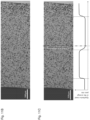
- the three-layer materials are particularly preferred, the embodiment of which is described in examples 1, 4, 5, and 6, and illustrated in Figures 2C , 5B , 6B , and 7B , as well as the five-layer materials, the embodiment of which is described in examples 2 and 10, and illustrated in Figures 3B and 11B .
- the polymeric material according to the second and third objects of the present invention lends itself to being used for the creation of manufactured products of complex shape with multi-gradient and anisotropic morphology, that is to say with a morphology determined by the porosity.
- a fourth object of the present invention is represented by a manufactured product made wholly or in part with a foamed polymeric material with a multi-layer structure and uniform composition, where said multi-layer structure comprises at least two layers and where each of said at least two layers has a specific and different morphology and/or density, characterised in that it presents a gradual variation in density and/or morphology at the interface between said at least two layers present in the foamed material.
- said multi-layer structure comprises a multi-gradient morphology.
- said multi-layer structure comprises an anisotropic morphology.
- said manufactured product is represented, for example, by protection systems (shin guards, back braces, shoulder and elbow pads, knee pads, shells and pads, bullet-proof vests), helmets and helms, orthopaedic prostheses, dental prostheses, epidermis prostheses, tissue engineering scaffolds, absorption and soundproofing slabs and systems, thermal insulation systems and slabs, soles and elements for sports shoes, panels for cars, sports equipment, furnishings, packaging, filtration membranes and systems, sacrificial foams for ceramic materials and porous metals, foams for diffusers and aerators, biomedical systems, pads and patches for controlled drug delivery, progressive mechanical response systems, progressive functional response systems, electromagnetic shielding systems, catalytic systems, foams for aeronautics and aerospace, foams for optoelectronics, flotation systems, frames and chassis, and glasses frames.
- protection systems shin guards, back braces, shoulder and elbow pads, knee pads, shells and pads, bullet-proof vests
- helmets and helms ortho
- said manufactured product is represented, for example, by orthopaedic prostheses, i.e. medical devices capable of replicating the bone structure of a skeletal segment of a human or animal body with the same structural characteristics.
- orthopaedic prostheses i.e. medical devices capable of replicating the bone structure of a skeletal segment of a human or animal body with the same structural characteristics.
- the orthopaedic prosthesis according to the fourth object of the present invention comprises orthopaedic endoprostheses of the lower limbs (foot, ankle, knee, femur, hip), of the upper limbs (hand, wrist, elbow, humerus, shoulder), and of the vertebral column.
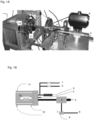
- Figure 1 shows a photograph ( Figure 1A ) and a diagram ( Figure 1B ) of the discontinuous foaming apparatus used in the present invention.
- the reactor is cylindrical, thermoregulated and pressurised, with a volume of 0.3 L (HiP, model BC-1).
- HiP model BC-1
- the reactor was modified to allow the measurement and control of the process parameters of interest.
- an electric heater (11) was used as a heating element and a heat exchanger with an oil bath (12) as a cooling element.
- the heater (11) and the exchanger (12) were controlled by a PID thermoregulator (Ascon, model X1), which read the temperature inside the reactor using a Pt100 probe (4).
- the valve (1) was connected to the expanding gas supply while the valve (2) was connected to a vacuum pump.
- the pressure release system consists of an HiP ball discharge valve, model 15-71 NFB (5), an HiP electromechanical actuator, model 15-72 NFB TSR8 (6), and a solenoid valve (7) connected to the piping for the compressed air (8) and the cable (9) for the solenoid valve actuation signal (7).
- This system allowed the opening of the valve to be reproduced.
- the pressure pattern over time during pressure release, P (t) was recorded using a DAQ PCI6036E data acquisition system, National Instruments, Austin, TX, USA.
- the pressure program was managed by the Teledyne ISCO 500D volumetric pump (Lincoln NE, USA). Through the serial interface of the pump controller it was possible to control the pump via a computer and implement any pressure program. In addition, the controller can handle up to four pumps for different fluids.
- variable condition of the solubilisation step can occur through a variation of the solubilisation pressure of the foaming agent, with a periodic pattern (for example, a triangular or sinusoidal wave), or with a non-periodic pattern (for example, a linear or curvilinear profile), as described in the following examples.
- a periodic pattern for example, a triangular or sinusoidal wave
- a non-periodic pattern for example, a linear or curvilinear profile
- the polymer used is a polystyrene (PS), code N2380, supplied by Versalis SpA (Mantua, Italy) with a mean molecular weight, density and melt flow index respectively equal to 300 kDa, 1.05 g/cm 3 and 2.0 g/10 min at 200°C and 10 kg, respectively.
- PS polystyrene
- code N2380 supplied by Versalis SpA (Mantua, Italy) with a mean molecular weight, density and melt flow index respectively equal to 300 kDa, 1.05 g/cm 3 and 2.0 g/10 min at 200°C and 10 kg, respectively.
- the sample consists of a cylindrical disk of PS with a diameter of 25 mm and thickness of 2.2 mm.
- mass transport occurs in the direction of the cylinder axis and can be studied as a one-dimensional problem.
- the use of the barrier film is, in this case and in those described in examples 2, 3, 4, 5 and 6, in which the sample to be foamed is cylindrical, dictated solely by the need to render the one-dimensional treatment of the material transport more rigorous. It is not considered necessary for the purpose of obtaining the multi-layer structure.
- the sample was housed in the batch foaming system illustrated in Figure 1 and described above, at room temperature. The reactor was then closed and brought to a temperature of 100°C.
- step 3 the pressure was instantaneously released (at a maximum speed of 1000 bars/s) for foaming.
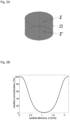
- the concentration profile as calculated using Comsol Multiphysics 10.0 simulation software, using data on CO 2 diffusivity in PS at 100°C reported by Sato et al., in "Solubilities and diffusion coefficients of carbon dioxide in poly(vinyl acetate) and polystyrene", The Journal of Supercritical Fluids 19 (2001) 187-198 , and the geometry described above resulted in that shown in Figure 2B .
- the areas with a high concentration of foaming agent were foamed with a morphology and density depending on the foaming conditions (here in particular the temperature of 100°C, the concentration of about 6% by weight and the pressure release rate of 1000 bars/s), while the central area lacking foaming agent was not foamed, even though it had the same operating conditions as the high concentration areas.
- Figure 2C shows a scanned electron microscope image of the section of the produced foam, with an evident three-layer structure.
- the two areas near the base surfaces were foamed, with a density of about 0.1 g/cm 3 , and minimum pore size of about 20 ⁇ m, while the central area was not foamed.
- the pressure profile comprised four phases:
- step 4 the pressure was instantaneously released (at a maximum speed of 1000 bars/s) for foaming.
- foamed areas were recognised and distinguished in the foamed cylindrical disk, two near the base surfaces, with a high concentration of foaming agent, two intermediate areas with a lesser concentration, and a central area with again a high concentration of foaming agent.
- the areas with a high concentration of foaming agent were foamed (indicated in Figure 3B with "highly foamed area") with a morphology and density depending on the foaming conditions (here in particular the temperature of 100°C, the concentration of about 5% by weight and the pressure release rate of 1000 bars/s), while the two intermediate areas with less foaming agent (concentration of about 3%), had a lower degree of foaming (shown in Figure 3B with "less foamed area").
- Figures 3B-D show some images of the section of foam produced at different magnifications taken with a scanning electron microscope, with a clear five-layer structure.
- the two areas near the base surfaces and the central area were foamed, with a density of about 0.1 g/cm 3 , and pore size of about 20 ⁇ m.
- the two intermediate areas were less foamed, with a density of 0.3g/cm 3 and pore size of about 80 ⁇ m.
- Images 3C and 3D show some enlargements of the transition zones, where the variation in the size of the bubbles can be noted.
- the process of the present invention allows broad freedom in design, differently from the method described in Zhou C. et al., in "Fabrication of functionally graded porous polymer via supercritical CO2 foaming", Composites: Part B 42 (2011) 318-325 .
- step 2 the pressure was instantaneously released (at a maximum speed of 1000 bars/s) for foaming.
- the concentration profile is constant and equal to about 6% by weight of CO 2 .
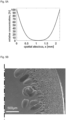
- FIG. 4A A graph showing the concentration values of CO 2 at the end of phase 2 (immediately before foaming), expressed as a percentage with respect to the equilibrium concentration at maximum pressure, as a function of the spatial abscissa "cylinder axis", x, is shown in Figure 4A .
- Figure 4B A scanned electron microscope image of the resulting foam is shown in Figure 4B .
- step 2 the pressure was instantaneously released (at a maximum speed of 1000 bars/s) for foaming.
- the concentration profile is that described by the error function (erf), widely described in scientific and technical literature.
- the concentration of foaming agent in the cylindrical disk progressively changes from the outside to the inside, as described in Zhou C. et al., in "Fabrication of functionally graded porous polymer via supercritical CO2 foaming", Composites: Part B 42 (2011) 318-325 .
- the gas concentration is 6% by weight, while in the inner layer it is null, as the solubilisation time (20 minutes in this case) is much lower than that necessary for complete solubilisation.
- FIG. 5A A graph showing the concentration values of CO 2 at the end of phase 2 (immediately before foaming), expressed as a percentage with respect to the equilibrium concentration at maximum pressure, as a function of the spatial abscissa "cylinder axis", x, is shown in Figure 5A .
- Figure 5B A scanned electron microscope image of the resulting foam is shown in Figure 5B .
- foamed areas can be recognised and distinguished, two near the base surfaces, foamed with a density of about 0.1 g/cm 3 and fine morphology, and a non-foamed central area.
- the foamed area has a non-uniform morphology, with the number of bubbles per unit of volume decreasing gradually from the outer surface towards the inner one (and, correspondingly, a larger bubble size), indicating the lower concentration of gas from the outside inward.
- This type of structure known in the state of the art ( Zhou C.
- step 4 the pressure was instantaneously released (at a maximum speed of 1000 bars/s) for foaming.
- the areas with a high concentration of foaming agent were foamed with a morphology and density depending on the foaming conditions, while the central area lacking foaming agent was not foamed, even though it had the same operating conditions as the high concentration areas.
- Figure 6B shows a scanned electron microscope image of the section of the produced foam, with an evident three-layer structure.
- the two areas near the base surfaces were foamed, with a density of about 0.1 g/cm 3 , and minimum pore size of about 20 ⁇ m, while the central area was not foamed.
- the foamed morphology is more uniform, as a consequence of the outermost area with a constant concentration, and only further inside does the number of bubbles decrease (and the average size increases) as a consequence of the lower concentration of gas.
- step 4 the pressure was instantaneously released (at a maximum speed of 1000 bars/s) for foaming.
- the concentration profile as calculated using Comsol Multiphysics 10.0 simulation software, using data on CO 2 diffusivity in PS at 100°C reported by Sato et al., in "Solubilities and diffusion coefficients of carbon dioxide in poly(vinyl acetate) and polystyrene", The Journal of Supercritical Fluids 19 (2001) 187-198 , and the geometry described above resulted in that shown in Figure 7A .
- the diffusion coefficient of the gas 134a was set much higher than that of the CO 2 , neglecting, for all practical effects, the absorption of 134a in the polymer.
- the areas with a high concentration of foaming agent were foamed with a morphology and density depending on the foaming conditions, while the central area lacking foaming agent was not foamed.
- Figure 7B shows a scanned electron microscope image of the section of the produced foam, with an evident three-layer structure. The two areas near the base surfaces were foamed, but the central area was not foamed. Differently from the case described in Figure 5B , however, in this case the foamed morphology can be described by two gradients, with a density of bubbles, moving from the outside towards the inside, first increasing and then decreasing, corresponding to the pressure profile shown in Figure 7A .
- the polymer used is a polystyrene (PS), code N2380, supplied by Versalis SpA (Mantua, Italy) with a mean molecular weight, density and melt flow index respectively equal to 300 kDa, 1.05 g/cm 3 and 2.0 g/10 min at 200°C and 10 kg, respectively.
- PS polystyrene
- code N2380 supplied by Versalis SpA (Mantua, Italy) with a mean molecular weight, density and melt flow index respectively equal to 300 kDa, 1.05 g/cm 3 and 2.0 g/10 min at 200°C and 10 kg, respectively.
- the sample consists of a sphere of PS with a diameter of 1 mm, schematically shown in Fig. 8 .
- These objects are used to make the so-called pre-foamed beads to be sintered in systems using water vapours to create a finished product downstream of a sintering process of the pre-foamed beads.
- mass transport occurs in the radial direction and can be studied as a one-dimensional problem.
- the sample devoid of any barrier layer was housed in the batch foaming system illustrated in Figure 1 and described above, at room temperature. The reactor was then closed and brought to a temperature of 100°C.
- step 2 the pressure was instantaneously released (at a maximum speed of 1000 bars/s) for foaming.
- the concentration profile is constant and equal to about 6% by weight of CO 2 .
- the gas concentration profile is shown in Figure 8A .
- FIG. 8B A scanned electron microscope image of the resulting foam is shown in Figure 8B .
- step 4 the pressure was instantaneously released (at a maximum speed of 1000 bars/s) for foaming.
- FIG. 9B A scanned electron microscope image of the resulting foam is shown in Figure 9B .
- N 2 has a greater nucleating power than CO 2 , despite the lower concentration (at the same pressure), which determines lower densities in the case of the use of CO 2 .
- the pressure profile comprised four phases:
- step 4 the pressure was instantaneously released (at a maximum speed of 1000 bars/s) for foaming.
- FIG. 10B A scanned electron microscope image of the resulting foam is shown in Figure 10B .
- an outer layer of about 50 micrometres, not foamed, and then a foamed inner core. This morphology cannot be obtained except by varying the saturation conditions.
- This polymer has a carbon dioxide diffusivity of about two orders of magnitude lower than those of the polystyrene in question and can be effectively used to obtain an unsymmetrical concentration profile with respect to the plane, parallel to the base planes, of the centre line of the cylindrical sample.
- This sample was housed in the reactor of the batch foaming system illustrated in Figure 1 and previously described at room temperature. The reactor was then closed and brought to a temperature of 100°C.
- the pressure profile comprised four phases:
- step 4 the pressure was instantaneously released (at a maximum speed of 1000 bars/s) for foaming.
- the areas with a high concentration of foaming agent were more foamed with a morphology and density depending on the foaming conditions, while the areas with a low concentration of foaming agent were less foamed.
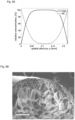
- Figure 11B and 11C show a scanned electron microscope image of a section of the foam produced, with an evident unsymmetrical four-layer structure with respect to the centre of the sample (indicated in the image in Figure 11C as the "centre line of the sample").
- a diagram has been inserted that shows the qualitative trend of the pore size at the different areas of the SEM micrograph.
- the vertical dotted lines outline the different areas.
- step 4 the temperature was brought to 40°C, and at the end of step 4 the pressure was instantaneously released (at a maximum speed of 1000 bars/s) for the foaming.
- Figure 12B illustrates a longitudinal section
- Figure 12C illustrates a transversal section
- the similarity with the bone structure of the femur, illustrated in Figure 12D is surprising.
- the straight dotted line of Figure 12D indicates an area of the actual femur structure which is very similar to that shown in Figure 12B of the foamed sample
- the circular line of Figure 12D indicates an area of the actual femur structure which is very similar to that shown in Figure 12C of the foamed sample.
- Note the orientation and the elongated pore shape in Figure 12C just like in an actual femur, obtained during the filling of the mould (the pores follow the flow lines of the polymer during the foaming phase).
Landscapes
- Chemical & Material Sciences (AREA)
- Health & Medical Sciences (AREA)
- Medicinal Chemistry (AREA)
- Chemical Kinetics & Catalysis (AREA)
- Organic Chemistry (AREA)
- Polymers & Plastics (AREA)
- Materials Engineering (AREA)
- Engineering & Computer Science (AREA)
- Transplantation (AREA)
- General Health & Medical Sciences (AREA)
- Public Health (AREA)
- Veterinary Medicine (AREA)
- Animal Behavior & Ethology (AREA)
- Life Sciences & Earth Sciences (AREA)
- Epidemiology (AREA)
- Oral & Maxillofacial Surgery (AREA)
- Dermatology (AREA)
- Manufacture Of Porous Articles, And Recovery And Treatment Of Waste Products (AREA)
- Laminated Bodies (AREA)
- Optical Fibers, Optical Fiber Cores, And Optical Fiber Bundles (AREA)
- Glass Compositions (AREA)
Claims (23)
- Verfahren zur Herstellung von geschichteten geschäumten Polymermaterialien mittels der Verwendung eines oder mehrerer Schaumbildner, wobei das Verfahren die folgenden Schritte umfasst:• Bereitstellen eines schäumbaren Polymermaterials;• Solubilisieren des einen oder der mehreren Schaumbildner in dem schäumbaren Polymermaterial unter Druck und bei einer Temperatur von mehr als 20°C; und• sofortiges Ablassen des Drucks;dadurch gekennzeichnet, dass der Solubilisierungsschritt mit einem Druckprofil des einen oder der mehreren Schaumbildner durchgeführt wird, das über die Zeit variabel ist.
- Verfahren nach Anspruch 1, dadurch gekennzeichnet, dass das Druckprofil über die Zeit auf periodische oder nicht-periodische Weise variiert.
- Verfahren nach Anspruch 2, dadurch gekennzeichnet, dass das Druckprofil über die Zeit auf periodische Weise mit einer Wellenform variiert, die aus der Gruppe ausgewählt ist, die aus dem Sinus-, Dreieck-, Rechteck- oder Sägezahntyp oder Kombinationen davon besteht.
- Verfahren nach Anspruch 2, dadurch gekennzeichnet, dass das Druckprofil über die Zeit auf nicht-periodische Weise variiert, und einem linearen, unterteilten, kurvenlinigen, parabolischen, exponentiellen oder impulsartigen Profil oder Kombinationen davon folgt.
- Verfahren nach einem der vorhergehenden Ansprüche 1 bis 4, dadurch gekennzeichnet, dass das Druckprofil von einem Minimaldruck gleich dem Atmosphärendruck bis zu einem Maximum von 300 bar variiert, vorzugsweise von Atmosphärendruck bis 250 bar und vorteilhafterweise von Atmosphärendruck bis 200 bar.
- Verfahren nach einem der vorhergehenden Ansprüche 1 bis 5, dadurch gekennzeichnet, dass das Druckprofil mindestens einen Schritt mit einem über die Zeit zunehmenden Druckprofil und mindestens einen Schritt mit einem über die Zeit abnehmenden Druckprofil umfasst.
- Verfahren nach Anspruch 6, dadurch gekennzeichnet, dass das Druckprofil mindestens einen Schritt mit einem über die Zeit konstanten Druckprofil umfasst.
- Verfahren nach Anspruch 1, dadurch gekennzeichnet, dass ein Schaumbildner verwendet wird.
- Verfahren nach Anspruch 1, dadurch gekennzeichnet, dass eine Mischung aus zwei oder mehreren Schaumbildnern verwendet wird.
- Verfahren nach Anspruch 9, dadurch gekennzeichnet, dass die Konzentration der Schaumbildner in dem Gemisch über die Zeit variiert.
- Verfahren nach Anspruch 1, dadurch gekennzeichnet, dass das Polymermaterial aus der Gruppe ausgewählt ist, die aus thermoplastischen und wärmehärtenden Polymermaterialien besteht, wobei die thermoplastischen Polymermaterialien vorzugsweise aus der Gruppe ausgewählt sind, die Polyolefine, Polyurethane, Polyester und Polyamide umfasst, und wobei die wärmehärtenden Polymermaterialien vorzugsweise aus der Gruppe ausgewählt sind, die Polyurethane, Epoxidharze, Melaminharze, Polyphenole und Polyimide umfasst.
- Geschäumtes Polymermaterial, das nach dem Verfahren von Anspruch 1 erhalten wurde, wobei das geschäumte Polymermaterial eine mehrschichtige Struktur und eine gleichmäßige und konstante Zusammensetzung in all seinen Punkten aufweist, wobei die mehrschichtige Struktur mindestens zwei Schichten umfasst und wobei jede der mindestens zwei Schichten eine spezifische und unterschiedliche Morphologie und/oder Dichte aufweist, dadurch gekennzeichnet, dass es eine allmähliche Veränderung der Dichte und/oder Morphologie an der Grenzfläche zwischen den mindestens zwei in dem geschäumten Material vorhandenen Schichten aufweist.
- Geschäumtes Polymermaterial nach Anspruch 12, dadurch gekennzeichnet, dass das geschäumte Polymermaterial aus mehrschichtigen vorgeschäumten Perlen oder mehrschichtigen geschäumten Platten besteht.
- Geschäumtes Polymermaterial nach Anspruch 13, dadurch gekennzeichnet, dass die mehrschichtigen vorgeschäumten Perlen mindestens eine ungeschäumte Schicht und mindestens eine vorgeschäumte Schicht umfassen, wobei sich die ungeschäumte Schicht in einer radial äußeren Position in Bezug auf die vorgeschäumte Schicht befindet.
- Geschäumtes Polymermaterial nach Anspruch 13, dadurch gekennzeichnet, dass die mehrschichtigen geschäumten Platten (i) mindestens eine Schicht mit geringerer Dichte und feinerer Morphologie und mindestens eine Schicht mit höherer Dichte und gröberer Morphologie oder (ii) mindestens eine Schicht mit geringerer Dichte und gröberer Morphologie und mindestens eine Schicht mit höherer Dichte und feinerer Morphologie, oder (iii) mindestens eine Schicht mit geringerer Dichte und mindestens eine Schicht mit höherer Dichte mit einheitlicher Morphologie, oder (iv) mindestens eine Schicht mit gröberer Morphologie und mindestens eine Schicht mit feinerer Morphologie mit einheitlicher Dichte umfassen.
- Geschäumtes Polymermaterial nach Anspruch 12, dadurch gekennzeichnet, dass die mehrschichtige Struktur mindestens drei Schichten umfasst.
- Geschäumtes Polymermaterial nach Anspruch 12, dadurch gekennzeichnet, dass die mehrschichtige Struktur drei bis fünf Schichten umfasst.
- Erzeugnis, das ganz oder teilweise aus dem geschäumten Polymermaterial mit einer mehrschichtigen Struktur und einer einheitlichen und konstanten Zusammensetzung in all seinen Punkten gemäß Anspruch 12 hergestellt ist.
- Erzeugnis nach Anspruch 18, wobei die mehrschichtige Struktur eine Morphologie mit mehreren Gradienten aufweist.
- Hergestelltes Produkt nach Anspruch 18, wobei die mehrschichtige Struktur eine anisotrope Morphologie aufweist.
- Erzeugnis nach Anspruch 18, wobei das Erzeugnis aus der Gruppe ausgewählt ist, die aus Schutzsystemen (Schienbeinschützer, Rückenstützen, Schulter- und Ellbogenpolster, Knieposter, Schalen und Polster, kugelsichere Westen), Helmen, orthopädischen Prothesen, Zahnprothesen, Epidermisprothesen, Gerüsten für die Gewebezüchtung, Absorptions- und Schallschutzplatten und -systemen, Wärmedämmungssystemen und -platten, Sohlen und Elementen für Sportschuhe, Panelen für Autos, Sportgeräte, Möbel, Verpackungen, Filtermembranen und -systeme, Opferschäumen für keramische Materialien und poröse Metalle, Schäumen für Diffusoren und Belüfter, biomedizinischen Systemen, Pads und Pflastern für die kontrollierte Abgabe von Arzneimitteln, Systemen mit progressiver mechanischer Reaktion, Systemen mit progressiver funktionaler Reaktion, elektromagnetischen Abschirmsystemen, katalytischen Systemen, Schaumstoffen für die Luft- und Raumfahrt, Schaumstoffen für die Optoelektronik, Schwimmsystemen, Rahmen und Untergestellen und Brillengestellen besteht.
- Erzeugnis nach Anspruch 18, wobei das Erzeugnis aus der Gruppe ausgewählt ist, die aus orthopädischen Prothesen besteht.
- Erzeugnis nach Anspruch 22, wobei die orthopädischen Prothesen aus der Gruppe ausgewählt sind, die aus orthopädischen Endoprothesen der unteren Gliedmaßen (Fuß, Knöchel, Knie, Oberschenkelknochen, Hüfte), der oberen Gliedmaßen (Hand, Handgelenk, Ellbogen, Oberarmknochen, Schulter) und der Wirbelsäule besteht.
Applications Claiming Priority (2)
| Application Number | Priority Date | Filing Date | Title |
|---|---|---|---|
| IT102018000004727A IT201800004727A1 (it) | 2018-04-19 | 2018-04-19 | Metodo per la realizzazione di materiali polimerici espansi stratificati |
| PCT/IB2019/050068 WO2019202407A1 (en) | 2018-04-19 | 2019-01-04 | Process for preparing layered foamed polymeric materials |
Publications (2)
| Publication Number | Publication Date |
|---|---|
| EP3781377A1 EP3781377A1 (de) | 2021-02-24 |
| EP3781377B1 true EP3781377B1 (de) | 2024-04-03 |
Family
ID=62952259
Family Applications (1)
| Application Number | Title | Priority Date | Filing Date |
|---|---|---|---|
| EP19702485.4A Active EP3781377B1 (de) | 2018-04-19 | 2019-01-04 | Verfahren zur herstellung von geschichteten, geschäumten polymermaterialien |
Country Status (8)
| Country | Link |
|---|---|
| US (1) | US20210114266A1 (de) |
| EP (1) | EP3781377B1 (de) |
| JP (1) | JP7698573B2 (de) |
| CN (1) | CN111989202B (de) |
| CA (1) | CA3095536A1 (de) |
| ES (1) | ES2983872T3 (de) |
| IT (1) | IT201800004727A1 (de) |
| WO (1) | WO2019202407A1 (de) |
Families Citing this family (9)
| Publication number | Priority date | Publication date | Assignee | Title |
|---|---|---|---|---|
| IT201900012666A1 (it) * | 2019-07-23 | 2021-01-23 | Materias S R L | Perline espanse con gradienti di morfologia e/o densità, e schiume sinterizzate da esse ottenute |
| US12275520B2 (en) | 2020-02-11 | 2025-04-15 | The Boeing Company | Liquid-diverting panel assemblies |
| US12269574B2 (en) * | 2020-02-11 | 2025-04-08 | The Boeing Company | Methods for forming liquid flow paths on a surface of a structure |
| JP7853673B2 (ja) * | 2020-09-03 | 2026-04-30 | 国立研究開発法人産業技術総合研究所 | ナノ発泡ポリマーの製造方法およびナノ発泡ポリマー |
| USD1100451S1 (en) | 2020-12-03 | 2025-11-04 | Puma SE | Shoe |
| USD1022420S1 (en) | 2020-12-03 | 2024-04-16 | Puma SE | Shoe |
| IT202200003512A1 (it) | 2022-02-24 | 2023-08-24 | Materias S R L | Procedimento per la realizzazione di materiali polimerici espansi |
| CN114872399B (zh) * | 2022-05-06 | 2025-02-25 | 江苏中科聚合新材料产业技术研究院有限公司 | 一种超临界夹心聚芳醚酮发泡板材及其制备方法 |
| CN116333371B (zh) * | 2023-04-10 | 2025-04-29 | 哈尔滨工程大学 | 多级泡孔结构的聚酰亚胺泡沫制备方法及产品 |
Family Cites Families (15)
| Publication number | Priority date | Publication date | Assignee | Title |
|---|---|---|---|---|
| US3787542A (en) * | 1971-10-14 | 1974-01-22 | Ici Ltd | Production of extruded foamed synthetic thermoplastic polymeric materials |
| US5670102A (en) * | 1993-02-11 | 1997-09-23 | Minnesota Mining And Manufacturing Company | Method of making thermoplastic foamed articles using supercritical fluid |
| JPH07102103A (ja) * | 1993-09-30 | 1995-04-18 | Sekisui Chem Co Ltd | 発泡体の製造方法 |
| AU782297B2 (en) * | 1999-06-30 | 2005-07-14 | Ethicon Inc. | Porous tissue scaffoldings for the repair or regeneration of tissue |
| US6306424B1 (en) * | 1999-06-30 | 2001-10-23 | Ethicon, Inc. | Foam composite for the repair or regeneration of tissue |
| DE60042901D1 (de) * | 1999-06-30 | 2009-10-15 | Ethicon Inc | Poröses Stützgewebe zur Gewebewiederherstellung oder -regeneration |
| US20030211310A1 (en) * | 2001-06-21 | 2003-11-13 | Haas Christopher K. | Foam and method of making |
| JP2003049018A (ja) * | 2001-08-08 | 2003-02-21 | Idemitsu Petrochem Co Ltd | 発泡体、その製造方法および反射板 |
| US20050261387A1 (en) * | 2004-05-20 | 2005-11-24 | Stevenson James F | Noise suppression structure manufacturing method |
| WO2006053132A2 (en) * | 2004-11-10 | 2006-05-18 | Ohio University | Prosthetic bone implants |
| EP1878450A1 (de) * | 2006-07-10 | 2008-01-16 | Ecole Polytechnique Federale De Lausanne (Epfl) | Polymerkomposit mit einem Porengradient |
| US7807260B2 (en) | 2007-01-17 | 2010-10-05 | Microgreen Polymers, Inc. | Multi-layered foamed polymeric objects and related methods |
| US20080281011A1 (en) | 2007-05-10 | 2008-11-13 | William Strauss | High temperature resistant, structural polymer foam |
| WO2014041516A1 (en) * | 2012-09-14 | 2014-03-20 | Ecole Polytechnique Federale De Lausanne (Epfl) | Biocompatible multi-layered structure comprising foam layers and a functional interface |
| JP2019137726A (ja) | 2018-02-06 | 2019-08-22 | 株式会社クレハ | フッ化ビニリデン単独重合体の発泡成形体および発泡成形体の製造方法 |
-
2018
- 2018-04-19 IT IT102018000004727A patent/IT201800004727A1/it unknown
-
2019
- 2019-01-04 CN CN201980026327.7A patent/CN111989202B/zh active Active
- 2019-01-04 ES ES19702485T patent/ES2983872T3/es active Active
- 2019-01-04 JP JP2021506079A patent/JP7698573B2/ja active Active
- 2019-01-04 CA CA3095536A patent/CA3095536A1/en active Pending
- 2019-01-04 WO PCT/IB2019/050068 patent/WO2019202407A1/en not_active Ceased
- 2019-01-04 EP EP19702485.4A patent/EP3781377B1/de active Active
- 2019-01-04 US US17/047,486 patent/US20210114266A1/en active Pending
Also Published As
| Publication number | Publication date |
|---|---|
| CN111989202B (zh) | 2024-07-05 |
| CA3095536A1 (en) | 2019-10-24 |
| JP7698573B2 (ja) | 2025-06-25 |
| CN111989202A (zh) | 2020-11-24 |
| ES2983872T3 (es) | 2024-10-25 |
| WO2019202407A1 (en) | 2019-10-24 |
| JP2021522400A (ja) | 2021-08-30 |
| IT201800004727A1 (it) | 2019-10-19 |
| US20210114266A1 (en) | 2021-04-22 |
| EP3781377A1 (de) | 2021-02-24 |
Similar Documents
| Publication | Publication Date | Title |
|---|---|---|
| US20210114266A1 (en) | Process for preparing layered foamed polymeric materials | |
| CN114207002B (zh) | 具有密度和/或泡孔形态梯度的膨胀珠粒以及由其获得的烧结泡沫 | |
| Peng et al. | Microstructure of ceramic foams | |
| EP0610953B1 (de) | Thermoplastische Schaumstoffgegenstände und deren Herstellungsverfahren | |
| Liu et al. | Porous morphology, porosity, mechanical properties of poly (α‐hydroxy acid)–tricalcium phosphate composite scaffolds fabricated by low‐temperature deposition | |
| KR20170035915A (ko) | 팽창성 폼을 제조하기 위한 재료 시스템 및 방법 | |
| DK172678B1 (da) | Mikroporøst polytetrafluorethylen i form af en cylindrisk stang eller en film, og fremgangsmåde til fremstilling deraf | |
| JP7096873B2 (ja) | 積層体の製造方法 | |
| KR20180132646A (ko) | 열가소성 폴리우레탄 발포 입자 | |
| Barry et al. | Porous methacrylate tissue engineering scaffolds: using carbon dioxide to control porosity and interconnectivity | |
| Di Maio et al. | Foams and their applications | |
| JP7706167B2 (ja) | マルチ・グラジエントの発泡ポリマー材料の製品を製造するための方法 | |
| CA1128268A (en) | Panel based on polycondensable resin and a method for the manufacture of this panel | |
| Di Maio et al. | Foaming with Supercritical Fluids | |
| Kunsági et al. | Exploring the potential of in-situ foam 3D printing: Effects of printing parameters and the development of functionally graded foams. | |
| Domingos et al. | BioExtruder: Study of the influence of process parameters on PCL scaffolds properties | |
| Grigolato et al. | Components by Polylactic Acid Foaming | |
| JP5306137B2 (ja) | 型内発泡成形用ポリ乳酸系樹脂発泡粒子の製造方法 | |
| Jianga et al. | Article published in Composites Part B: Engineering, Vol. 235 (2022) 109733 | |
| Ali et al. | for Engineering Artificial Bone | |
| JPH0428739B2 (de) | ||
| Bajpai et al. | Macroporous Polymeric Materials: Synthetic Strategies and Morphological Characterizations | |
| Shastri et al. | Polymer Foams | |
| Shastri et al. | Foams: Polymer | |
| Bernardo García et al. | Highly anisotropic crosslinked HDPE foams with a controlled anisotropy ratio: Production and characterization of the cellular structure and mechanical properties |
Legal Events
| Date | Code | Title | Description |
|---|---|---|---|
| STAA | Information on the status of an ep patent application or granted ep patent |
Free format text: STATUS: UNKNOWN |
|
| STAA | Information on the status of an ep patent application or granted ep patent |
Free format text: STATUS: THE INTERNATIONAL PUBLICATION HAS BEEN MADE |
|
| PUAI | Public reference made under article 153(3) epc to a published international application that has entered the european phase |
Free format text: ORIGINAL CODE: 0009012 |
|
| STAA | Information on the status of an ep patent application or granted ep patent |
Free format text: STATUS: REQUEST FOR EXAMINATION WAS MADE |
|
| 17P | Request for examination filed |
Effective date: 20200922 |
|
| AK | Designated contracting states |
Kind code of ref document: A1 Designated state(s): AL AT BE BG CH CY CZ DE DK EE ES FI FR GB GR HR HU IE IS IT LI LT LU LV MC MK MT NL NO PL PT RO RS SE SI SK SM TR |
|
| AX | Request for extension of the european patent |
Extension state: BA ME |
|
| DAV | Request for validation of the european patent (deleted) | ||
| DAX | Request for extension of the european patent (deleted) | ||
| RAP3 | Party data changed (applicant data changed or rights of an application transferred) |
Owner name: MATERIAS S.R.L. |
|
| STAA | Information on the status of an ep patent application or granted ep patent |
Free format text: STATUS: EXAMINATION IS IN PROGRESS |
|
| 17Q | First examination report despatched |
Effective date: 20211115 |
|
| P01 | Opt-out of the competence of the unified patent court (upc) registered |
Effective date: 20230526 |
|
| REG | Reference to a national code |
Ref country code: DE Ref legal event code: R079 Free format text: PREVIOUS MAIN CLASS: B29C0044340000 Ipc: C08J0009120000 Ref country code: DE Ref legal event code: R079 Ref document number: 602019049398 Country of ref document: DE Free format text: PREVIOUS MAIN CLASS: B29C0044340000 Ipc: C08J0009120000 |
|
| GRAP | Despatch of communication of intention to grant a patent |
Free format text: ORIGINAL CODE: EPIDOSNIGR1 |
|
| STAA | Information on the status of an ep patent application or granted ep patent |
Free format text: STATUS: GRANT OF PATENT IS INTENDED |
|
| RIC1 | Information provided on ipc code assigned before grant |
Ipc: C08J 9/18 20060101ALI20231012BHEP Ipc: B29C 44/34 20060101ALI20231012BHEP Ipc: C08J 9/14 20060101ALI20231012BHEP Ipc: C08J 9/34 20060101ALI20231012BHEP Ipc: B29K 23/00 20060101ALI20231012BHEP Ipc: B29K 67/00 20060101ALI20231012BHEP Ipc: B29K 75/00 20060101ALI20231012BHEP Ipc: B29K 77/00 20060101ALI20231012BHEP Ipc: C08J 9/12 20060101AFI20231012BHEP |
|
| INTG | Intention to grant announced |
Effective date: 20231031 |
|
| GRAS | Grant fee paid |
Free format text: ORIGINAL CODE: EPIDOSNIGR3 |
|
| GRAA | (expected) grant |
Free format text: ORIGINAL CODE: 0009210 |
|
| STAA | Information on the status of an ep patent application or granted ep patent |
Free format text: STATUS: THE PATENT HAS BEEN GRANTED |
|
| AK | Designated contracting states |
Kind code of ref document: B1 Designated state(s): AL AT BE BG CH CY CZ DE DK EE ES FI FR GB GR HR HU IE IS IT LI LT LU LV MC MK MT NL NO PL PT RO RS SE SI SK SM TR |
|
| REG | Reference to a national code |
Ref country code: CH Ref legal event code: EP |
|
| REG | Reference to a national code |
Ref country code: IE Ref legal event code: FG4D |
|
| REG | Reference to a national code |
Ref country code: DE Ref legal event code: R096 Ref document number: 602019049398 Country of ref document: DE |
|
| REG | Reference to a national code |
Ref country code: LT Ref legal event code: MG9D |
|
| REG | Reference to a national code |
Ref country code: NL Ref legal event code: MP Effective date: 20240403 |
|
| REG | Reference to a national code |
Ref country code: AT Ref legal event code: MK05 Ref document number: 1672285 Country of ref document: AT Kind code of ref document: T Effective date: 20240403 |
|
| PG25 | Lapsed in a contracting state [announced via postgrant information from national office to epo] |
Ref country code: NL Free format text: LAPSE BECAUSE OF FAILURE TO SUBMIT A TRANSLATION OF THE DESCRIPTION OR TO PAY THE FEE WITHIN THE PRESCRIBED TIME-LIMIT Effective date: 20240403 |
|
| PG25 | Lapsed in a contracting state [announced via postgrant information from national office to epo] |
Ref country code: NL Free format text: LAPSE BECAUSE OF FAILURE TO SUBMIT A TRANSLATION OF THE DESCRIPTION OR TO PAY THE FEE WITHIN THE PRESCRIBED TIME-LIMIT Effective date: 20240403 |
|
| PG25 | Lapsed in a contracting state [announced via postgrant information from national office to epo] |
Ref country code: IS Free format text: LAPSE BECAUSE OF FAILURE TO SUBMIT A TRANSLATION OF THE DESCRIPTION OR TO PAY THE FEE WITHIN THE PRESCRIBED TIME-LIMIT Effective date: 20240803 |
|
| PG25 | Lapsed in a contracting state [announced via postgrant information from national office to epo] |
Ref country code: BG Free format text: LAPSE BECAUSE OF FAILURE TO SUBMIT A TRANSLATION OF THE DESCRIPTION OR TO PAY THE FEE WITHIN THE PRESCRIBED TIME-LIMIT Effective date: 20240403 |
|
| PG25 | Lapsed in a contracting state [announced via postgrant information from national office to epo] |
Ref country code: HR Free format text: LAPSE BECAUSE OF FAILURE TO SUBMIT A TRANSLATION OF THE DESCRIPTION OR TO PAY THE FEE WITHIN THE PRESCRIBED TIME-LIMIT Effective date: 20240403 Ref country code: FI Free format text: LAPSE BECAUSE OF FAILURE TO SUBMIT A TRANSLATION OF THE DESCRIPTION OR TO PAY THE FEE WITHIN THE PRESCRIBED TIME-LIMIT Effective date: 20240403 |
|
| PG25 | Lapsed in a contracting state [announced via postgrant information from national office to epo] |
Ref country code: GR Free format text: LAPSE BECAUSE OF FAILURE TO SUBMIT A TRANSLATION OF THE DESCRIPTION OR TO PAY THE FEE WITHIN THE PRESCRIBED TIME-LIMIT Effective date: 20240704 |
|
| PG25 | Lapsed in a contracting state [announced via postgrant information from national office to epo] |
Ref country code: PT Free format text: LAPSE BECAUSE OF FAILURE TO SUBMIT A TRANSLATION OF THE DESCRIPTION OR TO PAY THE FEE WITHIN THE PRESCRIBED TIME-LIMIT Effective date: 20240805 |
|
| PG25 | Lapsed in a contracting state [announced via postgrant information from national office to epo] |
Ref country code: CZ Free format text: LAPSE BECAUSE OF FAILURE TO SUBMIT A TRANSLATION OF THE DESCRIPTION OR TO PAY THE FEE WITHIN THE PRESCRIBED TIME-LIMIT Effective date: 20240403 |
|
| PG25 | Lapsed in a contracting state [announced via postgrant information from national office to epo] |
Ref country code: AT Free format text: LAPSE BECAUSE OF FAILURE TO SUBMIT A TRANSLATION OF THE DESCRIPTION OR TO PAY THE FEE WITHIN THE PRESCRIBED TIME-LIMIT Effective date: 20240403 |
|
| REG | Reference to a national code |
Ref country code: ES Ref legal event code: FG2A Ref document number: 2983872 Country of ref document: ES Kind code of ref document: T3 Effective date: 20241025 |
|
| PG25 | Lapsed in a contracting state [announced via postgrant information from national office to epo] |
Ref country code: PL Free format text: LAPSE BECAUSE OF FAILURE TO SUBMIT A TRANSLATION OF THE DESCRIPTION OR TO PAY THE FEE WITHIN THE PRESCRIBED TIME-LIMIT Effective date: 20240403 |
|
| PG25 | Lapsed in a contracting state [announced via postgrant information from national office to epo] |
Ref country code: LV Free format text: LAPSE BECAUSE OF FAILURE TO SUBMIT A TRANSLATION OF THE DESCRIPTION OR TO PAY THE FEE WITHIN THE PRESCRIBED TIME-LIMIT Effective date: 20240403 |
|
| PG25 | Lapsed in a contracting state [announced via postgrant information from national office to epo] |
Ref country code: PT Free format text: LAPSE BECAUSE OF FAILURE TO SUBMIT A TRANSLATION OF THE DESCRIPTION OR TO PAY THE FEE WITHIN THE PRESCRIBED TIME-LIMIT Effective date: 20240805 Ref country code: PL Free format text: LAPSE BECAUSE OF FAILURE TO SUBMIT A TRANSLATION OF THE DESCRIPTION OR TO PAY THE FEE WITHIN THE PRESCRIBED TIME-LIMIT Effective date: 20240403 Ref country code: NO Free format text: LAPSE BECAUSE OF FAILURE TO SUBMIT A TRANSLATION OF THE DESCRIPTION OR TO PAY THE FEE WITHIN THE PRESCRIBED TIME-LIMIT Effective date: 20240703 Ref country code: LV Free format text: LAPSE BECAUSE OF FAILURE TO SUBMIT A TRANSLATION OF THE DESCRIPTION OR TO PAY THE FEE WITHIN THE PRESCRIBED TIME-LIMIT Effective date: 20240403 Ref country code: IS Free format text: LAPSE BECAUSE OF FAILURE TO SUBMIT A TRANSLATION OF THE DESCRIPTION OR TO PAY THE FEE WITHIN THE PRESCRIBED TIME-LIMIT Effective date: 20240803 Ref country code: HR Free format text: LAPSE BECAUSE OF FAILURE TO SUBMIT A TRANSLATION OF THE DESCRIPTION OR TO PAY THE FEE WITHIN THE PRESCRIBED TIME-LIMIT Effective date: 20240403 Ref country code: GR Free format text: LAPSE BECAUSE OF FAILURE TO SUBMIT A TRANSLATION OF THE DESCRIPTION OR TO PAY THE FEE WITHIN THE PRESCRIBED TIME-LIMIT Effective date: 20240704 Ref country code: FI Free format text: LAPSE BECAUSE OF FAILURE TO SUBMIT A TRANSLATION OF THE DESCRIPTION OR TO PAY THE FEE WITHIN THE PRESCRIBED TIME-LIMIT Effective date: 20240403 Ref country code: CZ Free format text: LAPSE BECAUSE OF FAILURE TO SUBMIT A TRANSLATION OF THE DESCRIPTION OR TO PAY THE FEE WITHIN THE PRESCRIBED TIME-LIMIT Effective date: 20240403 Ref country code: BG Free format text: LAPSE BECAUSE OF FAILURE TO SUBMIT A TRANSLATION OF THE DESCRIPTION OR TO PAY THE FEE WITHIN THE PRESCRIBED TIME-LIMIT Effective date: 20240403 Ref country code: AT Free format text: LAPSE BECAUSE OF FAILURE TO SUBMIT A TRANSLATION OF THE DESCRIPTION OR TO PAY THE FEE WITHIN THE PRESCRIBED TIME-LIMIT Effective date: 20240403 Ref country code: RS Free format text: LAPSE BECAUSE OF FAILURE TO SUBMIT A TRANSLATION OF THE DESCRIPTION OR TO PAY THE FEE WITHIN THE PRESCRIBED TIME-LIMIT Effective date: 20240703 |
|
| REG | Reference to a national code |
Ref country code: DE Ref legal event code: R097 Ref document number: 602019049398 Country of ref document: DE |
|
| PG25 | Lapsed in a contracting state [announced via postgrant information from national office to epo] |
Ref country code: DK Free format text: LAPSE BECAUSE OF FAILURE TO SUBMIT A TRANSLATION OF THE DESCRIPTION OR TO PAY THE FEE WITHIN THE PRESCRIBED TIME-LIMIT Effective date: 20240403 |
|
| PG25 | Lapsed in a contracting state [announced via postgrant information from national office to epo] |
Ref country code: EE Free format text: LAPSE BECAUSE OF FAILURE TO SUBMIT A TRANSLATION OF THE DESCRIPTION OR TO PAY THE FEE WITHIN THE PRESCRIBED TIME-LIMIT Effective date: 20240403 |
|
| PG25 | Lapsed in a contracting state [announced via postgrant information from national office to epo] |
Ref country code: RO Free format text: LAPSE BECAUSE OF FAILURE TO SUBMIT A TRANSLATION OF THE DESCRIPTION OR TO PAY THE FEE WITHIN THE PRESCRIBED TIME-LIMIT Effective date: 20240403 Ref country code: SK Free format text: LAPSE BECAUSE OF FAILURE TO SUBMIT A TRANSLATION OF THE DESCRIPTION OR TO PAY THE FEE WITHIN THE PRESCRIBED TIME-LIMIT Effective date: 20240403 |
|
| PG25 | Lapsed in a contracting state [announced via postgrant information from national office to epo] |
Ref country code: SM Free format text: LAPSE BECAUSE OF FAILURE TO SUBMIT A TRANSLATION OF THE DESCRIPTION OR TO PAY THE FEE WITHIN THE PRESCRIBED TIME-LIMIT Effective date: 20240403 |
|
| PG25 | Lapsed in a contracting state [announced via postgrant information from national office to epo] |
Ref country code: SM Free format text: LAPSE BECAUSE OF FAILURE TO SUBMIT A TRANSLATION OF THE DESCRIPTION OR TO PAY THE FEE WITHIN THE PRESCRIBED TIME-LIMIT Effective date: 20240403 Ref country code: SK Free format text: LAPSE BECAUSE OF FAILURE TO SUBMIT A TRANSLATION OF THE DESCRIPTION OR TO PAY THE FEE WITHIN THE PRESCRIBED TIME-LIMIT Effective date: 20240403 Ref country code: RO Free format text: LAPSE BECAUSE OF FAILURE TO SUBMIT A TRANSLATION OF THE DESCRIPTION OR TO PAY THE FEE WITHIN THE PRESCRIBED TIME-LIMIT Effective date: 20240403 Ref country code: EE Free format text: LAPSE BECAUSE OF FAILURE TO SUBMIT A TRANSLATION OF THE DESCRIPTION OR TO PAY THE FEE WITHIN THE PRESCRIBED TIME-LIMIT Effective date: 20240403 Ref country code: DK Free format text: LAPSE BECAUSE OF FAILURE TO SUBMIT A TRANSLATION OF THE DESCRIPTION OR TO PAY THE FEE WITHIN THE PRESCRIBED TIME-LIMIT Effective date: 20240403 |
|
| PLBE | No opposition filed within time limit |
Free format text: ORIGINAL CODE: 0009261 |
|
| STAA | Information on the status of an ep patent application or granted ep patent |
Free format text: STATUS: NO OPPOSITION FILED WITHIN TIME LIMIT |
|
| 26N | No opposition filed |
Effective date: 20250106 |
|
| PG25 | Lapsed in a contracting state [announced via postgrant information from national office to epo] |
Ref country code: SI Free format text: LAPSE BECAUSE OF FAILURE TO SUBMIT A TRANSLATION OF THE DESCRIPTION OR TO PAY THE FEE WITHIN THE PRESCRIBED TIME-LIMIT Effective date: 20240403 |
|
| REG | Reference to a national code |
Ref country code: CH Ref legal event code: PL |
|
| PG25 | Lapsed in a contracting state [announced via postgrant information from national office to epo] |
Ref country code: SE Free format text: LAPSE BECAUSE OF FAILURE TO SUBMIT A TRANSLATION OF THE DESCRIPTION OR TO PAY THE FEE WITHIN THE PRESCRIBED TIME-LIMIT Effective date: 20240403 |
|
| PG25 | Lapsed in a contracting state [announced via postgrant information from national office to epo] |
Ref country code: MC Free format text: LAPSE BECAUSE OF FAILURE TO SUBMIT A TRANSLATION OF THE DESCRIPTION OR TO PAY THE FEE WITHIN THE PRESCRIBED TIME-LIMIT Effective date: 20240403 Ref country code: LU Free format text: LAPSE BECAUSE OF NON-PAYMENT OF DUE FEES Effective date: 20250104 |
|
| GBPC | Gb: european patent ceased through non-payment of renewal fee |
Effective date: 20250104 |
|
| PG25 | Lapsed in a contracting state [announced via postgrant information from national office to epo] |
Ref country code: BE Free format text: LAPSE BECAUSE OF NON-PAYMENT OF DUE FEES Effective date: 20250131 Ref country code: GB Free format text: LAPSE BECAUSE OF NON-PAYMENT OF DUE FEES Effective date: 20250104 |
|
| PG25 | Lapsed in a contracting state [announced via postgrant information from national office to epo] |
Ref country code: CH Free format text: LAPSE BECAUSE OF NON-PAYMENT OF DUE FEES Effective date: 20250131 |
|
| REG | Reference to a national code |
Ref country code: BE Ref legal event code: MM Effective date: 20250131 |
|
| PG25 | Lapsed in a contracting state [announced via postgrant information from national office to epo] |
Ref country code: IT Free format text: LAPSE BECAUSE OF NON-PAYMENT OF DUE FEES Effective date: 20250104 |
|
| PG25 | Lapsed in a contracting state [announced via postgrant information from national office to epo] |
Ref country code: IE Free format text: LAPSE BECAUSE OF NON-PAYMENT OF DUE FEES Effective date: 20250104 |
|
| PGFP | Annual fee paid to national office [announced via postgrant information from national office to epo] |
Ref country code: ES Payment date: 20260210 Year of fee payment: 8 |
|
| PGFP | Annual fee paid to national office [announced via postgrant information from national office to epo] |
Ref country code: DE Payment date: 20260127 Year of fee payment: 8 |
|
| PG25 | Lapsed in a contracting state [announced via postgrant information from national office to epo] |
Ref country code: IT Free format text: LAPSE BECAUSE OF NON-PAYMENT OF DUE FEES Effective date: 20250104 |
|
| PGFP | Annual fee paid to national office [announced via postgrant information from national office to epo] |
Ref country code: IT Payment date: 20260122 Year of fee payment: 8 |
|
| PGRI | Patent reinstated in contracting state [announced from national office to epo] |
Ref country code: IT Effective date: 20250603 |
|
| PGFP | Annual fee paid to national office [announced via postgrant information from national office to epo] |
Ref country code: FR Payment date: 20260126 Year of fee payment: 8 |