EP4043418A1 - Verbundwerkstoff, sinterkörper, werkzeug und verfahren - Google Patents
Verbundwerkstoff, sinterkörper, werkzeug und verfahren Download PDFInfo
- Publication number
- EP4043418A1 EP4043418A1 EP21156865.4A EP21156865A EP4043418A1 EP 4043418 A1 EP4043418 A1 EP 4043418A1 EP 21156865 A EP21156865 A EP 21156865A EP 4043418 A1 EP4043418 A1 EP 4043418A1
- Authority
- EP
- European Patent Office
- Prior art keywords
- composite material
- sintered body
- tool
- percent
- composite
- Prior art date
- Legal status (The legal status is an assumption and is not a legal conclusion. Google has not performed a legal analysis and makes no representation as to the accuracy of the status listed.)
- Withdrawn
Links
Images

Classifications
-
- B—PERFORMING OPERATIONS; TRANSPORTING
- B22—CASTING; POWDER METALLURGY
- B22F—WORKING METALLIC POWDER; MANUFACTURE OF ARTICLES FROM METALLIC POWDER; MAKING METALLIC POWDER; APPARATUS OR DEVICES SPECIALLY ADAPTED FOR METALLIC POWDER
- B22F3/00—Manufacture of workpieces or articles from metallic powder characterised by the manner of compacting or sintering; Apparatus specially adapted therefor ; Presses and furnaces
- B22F3/12—Both compacting and sintering
- B22F3/16—Both compacting and sintering in successive or repeated steps
-
- C—CHEMISTRY; METALLURGY
- C22—METALLURGY; FERROUS OR NON-FERROUS ALLOYS; TREATMENT OF ALLOYS OR NON-FERROUS METALS
- C22C—ALLOYS
- C22C1/00—Making non-ferrous alloys
- C22C1/04—Making non-ferrous alloys by powder metallurgy
- C22C1/05—Mixtures of metal powder with non-metallic powder
- C22C1/051—Making hard metals based on borides, carbides, nitrides, oxides or silicides; Preparation of the powder mixture used as the starting material therefor
-
- C—CHEMISTRY; METALLURGY
- C04—CEMENTS; CONCRETE; ARTIFICIAL STONE; CERAMICS; REFRACTORIES
- C04B—LIME, MAGNESIA; SLAG; CEMENTS; COMPOSITIONS THEREOF, e.g. MORTARS, CONCRETE OR LIKE BUILDING MATERIALS; ARTIFICIAL STONE; CERAMICS; REFRACTORIES; TREATMENT OF NATURAL STONE
- C04B35/00—Shaped ceramic products characterised by their composition; Ceramics compositions; Processing powders of inorganic compounds preparatory to the manufacturing of ceramic products
- C04B35/515—Shaped ceramic products characterised by their composition; Ceramics compositions; Processing powders of inorganic compounds preparatory to the manufacturing of ceramic products based on non-oxide ceramics
- C04B35/58—Shaped ceramic products characterised by their composition; Ceramics compositions; Processing powders of inorganic compounds preparatory to the manufacturing of ceramic products based on non-oxide ceramics based on borides, nitrides, i.e. nitrides, oxynitrides, carbonitrides or oxycarbonitrides or silicides
- C04B35/5805—Shaped ceramic products characterised by their composition; Ceramics compositions; Processing powders of inorganic compounds preparatory to the manufacturing of ceramic products based on non-oxide ceramics based on borides, nitrides, i.e. nitrides, oxynitrides, carbonitrides or oxycarbonitrides or silicides based on borides
- C04B35/58064—Shaped ceramic products characterised by their composition; Ceramics compositions; Processing powders of inorganic compounds preparatory to the manufacturing of ceramic products based on non-oxide ceramics based on borides, nitrides, i.e. nitrides, oxynitrides, carbonitrides or oxycarbonitrides or silicides based on borides based on refractory borides
-
- C—CHEMISTRY; METALLURGY
- C04—CEMENTS; CONCRETE; ARTIFICIAL STONE; CERAMICS; REFRACTORIES
- C04B—LIME, MAGNESIA; SLAG; CEMENTS; COMPOSITIONS THEREOF, e.g. MORTARS, CONCRETE OR LIKE BUILDING MATERIALS; ARTIFICIAL STONE; CERAMICS; REFRACTORIES; TREATMENT OF NATURAL STONE
- C04B35/00—Shaped ceramic products characterised by their composition; Ceramics compositions; Processing powders of inorganic compounds preparatory to the manufacturing of ceramic products
- C04B35/622—Forming processes; Processing powders of inorganic compounds preparatory to the manufacturing of ceramic products
- C04B35/64—Burning or sintering processes
- C04B35/645—Pressure sintering
-
- C—CHEMISTRY; METALLURGY
- C04—CEMENTS; CONCRETE; ARTIFICIAL STONE; CERAMICS; REFRACTORIES
- C04B—LIME, MAGNESIA; SLAG; CEMENTS; COMPOSITIONS THEREOF, e.g. MORTARS, CONCRETE OR LIKE BUILDING MATERIALS; ARTIFICIAL STONE; CERAMICS; REFRACTORIES; TREATMENT OF NATURAL STONE
- C04B35/00—Shaped ceramic products characterised by their composition; Ceramics compositions; Processing powders of inorganic compounds preparatory to the manufacturing of ceramic products
- C04B35/622—Forming processes; Processing powders of inorganic compounds preparatory to the manufacturing of ceramic products
- C04B35/64—Burning or sintering processes
- C04B35/645—Pressure sintering
- C04B35/6455—Hot isostatic pressing
-
- C—CHEMISTRY; METALLURGY
- C22—METALLURGY; FERROUS OR NON-FERROUS ALLOYS; TREATMENT OF ALLOYS OR NON-FERROUS METALS
- C22C—ALLOYS
- C22C1/00—Making non-ferrous alloys
- C22C1/10—Alloys containing non-metals
- C22C1/1084—Alloys containing non-metals by mechanical alloying (blending, milling)
-
- C—CHEMISTRY; METALLURGY
- C22—METALLURGY; FERROUS OR NON-FERROUS ALLOYS; TREATMENT OF ALLOYS OR NON-FERROUS METALS
- C22C—ALLOYS
- C22C29/00—Alloys based on carbides, oxides, nitrides, borides, or silicides, e.g. cermets, or other metal compounds, e.g. oxynitrides, sulfides
- C22C29/005—Alloys based on carbides, oxides, nitrides, borides, or silicides, e.g. cermets, or other metal compounds, e.g. oxynitrides, sulfides comprising a particular metallic binder
-
- C—CHEMISTRY; METALLURGY
- C22—METALLURGY; FERROUS OR NON-FERROUS ALLOYS; TREATMENT OF ALLOYS OR NON-FERROUS METALS
- C22C—ALLOYS
- C22C29/00—Alloys based on carbides, oxides, nitrides, borides, or silicides, e.g. cermets, or other metal compounds, e.g. oxynitrides, sulfides
- C22C29/14—Alloys based on carbides, oxides, nitrides, borides, or silicides, e.g. cermets, or other metal compounds, e.g. oxynitrides, sulfides based on borides
-
- B—PERFORMING OPERATIONS; TRANSPORTING
- B22—CASTING; POWDER METALLURGY
- B22F—WORKING METALLIC POWDER; MANUFACTURE OF ARTICLES FROM METALLIC POWDER; MAKING METALLIC POWDER; APPARATUS OR DEVICES SPECIALLY ADAPTED FOR METALLIC POWDER
- B22F10/00—Additive manufacturing of workpieces or articles from metallic powder
- B22F10/10—Formation of a green body
- B22F10/14—Formation of a green body by jetting of binder onto a bed of metal powder
-
- B—PERFORMING OPERATIONS; TRANSPORTING
- B22—CASTING; POWDER METALLURGY
- B22F—WORKING METALLIC POWDER; MANUFACTURE OF ARTICLES FROM METALLIC POWDER; MAKING METALLIC POWDER; APPARATUS OR DEVICES SPECIALLY ADAPTED FOR METALLIC POWDER
- B22F5/00—Manufacture of workpieces or articles from metallic powder characterised by the special shape of the product
- B22F2005/001—Cutting tools, earth boring or grinding tool other than table ware
-
- B—PERFORMING OPERATIONS; TRANSPORTING
- B22—CASTING; POWDER METALLURGY
- B22F—WORKING METALLIC POWDER; MANUFACTURE OF ARTICLES FROM METALLIC POWDER; MAKING METALLIC POWDER; APPARATUS OR DEVICES SPECIALLY ADAPTED FOR METALLIC POWDER
- B22F2998/00—Supplementary information concerning processes or compositions relating to powder metallurgy
- B22F2998/10—Processes characterised by the sequence of their steps
-
- B—PERFORMING OPERATIONS; TRANSPORTING
- B22—CASTING; POWDER METALLURGY
- B22F—WORKING METALLIC POWDER; MANUFACTURE OF ARTICLES FROM METALLIC POWDER; MAKING METALLIC POWDER; APPARATUS OR DEVICES SPECIALLY ADAPTED FOR METALLIC POWDER
- B22F2999/00—Aspects linked to processes or compositions used in powder metallurgy
-
- B—PERFORMING OPERATIONS; TRANSPORTING
- B33—ADDITIVE MANUFACTURING TECHNOLOGY
- B33Y—ADDITIVE MANUFACTURING, i.e. MANUFACTURING OF THREE-DIMENSIONAL [3D] OBJECTS BY ADDITIVE DEPOSITION, ADDITIVE AGGLOMERATION OR ADDITIVE LAYERING, e.g. BY 3D PRINTING, STEREOLITHOGRAPHY OR SELECTIVE LASER SINTERING
- B33Y80/00—Products made by additive manufacturing
-
- C—CHEMISTRY; METALLURGY
- C04—CEMENTS; CONCRETE; ARTIFICIAL STONE; CERAMICS; REFRACTORIES
- C04B—LIME, MAGNESIA; SLAG; CEMENTS; COMPOSITIONS THEREOF, e.g. MORTARS, CONCRETE OR LIKE BUILDING MATERIALS; ARTIFICIAL STONE; CERAMICS; REFRACTORIES; TREATMENT OF NATURAL STONE
- C04B2235/00—Aspects relating to ceramic starting mixtures or sintered ceramic products
- C04B2235/02—Composition of constituents of the starting material or of secondary phases of the final product
- C04B2235/30—Constituents and secondary phases not being of a fibrous nature
- C04B2235/38—Non-oxide ceramic constituents or additives
- C04B2235/3817—Carbides
- C04B2235/3839—Refractory metal carbides
-
- C—CHEMISTRY; METALLURGY
- C04—CEMENTS; CONCRETE; ARTIFICIAL STONE; CERAMICS; REFRACTORIES
- C04B—LIME, MAGNESIA; SLAG; CEMENTS; COMPOSITIONS THEREOF, e.g. MORTARS, CONCRETE OR LIKE BUILDING MATERIALS; ARTIFICIAL STONE; CERAMICS; REFRACTORIES; TREATMENT OF NATURAL STONE
- C04B2235/00—Aspects relating to ceramic starting mixtures or sintered ceramic products
- C04B2235/02—Composition of constituents of the starting material or of secondary phases of the final product
- C04B2235/30—Constituents and secondary phases not being of a fibrous nature
- C04B2235/40—Metallic constituents or additives not added as binding phase
-
- C—CHEMISTRY; METALLURGY
- C04—CEMENTS; CONCRETE; ARTIFICIAL STONE; CERAMICS; REFRACTORIES
- C04B—LIME, MAGNESIA; SLAG; CEMENTS; COMPOSITIONS THEREOF, e.g. MORTARS, CONCRETE OR LIKE BUILDING MATERIALS; ARTIFICIAL STONE; CERAMICS; REFRACTORIES; TREATMENT OF NATURAL STONE
- C04B2235/00—Aspects relating to ceramic starting mixtures or sintered ceramic products
- C04B2235/02—Composition of constituents of the starting material or of secondary phases of the final product
- C04B2235/30—Constituents and secondary phases not being of a fibrous nature
- C04B2235/40—Metallic constituents or additives not added as binding phase
- C04B2235/402—Aluminium
-
- C—CHEMISTRY; METALLURGY
- C04—CEMENTS; CONCRETE; ARTIFICIAL STONE; CERAMICS; REFRACTORIES
- C04B—LIME, MAGNESIA; SLAG; CEMENTS; COMPOSITIONS THEREOF, e.g. MORTARS, CONCRETE OR LIKE BUILDING MATERIALS; ARTIFICIAL STONE; CERAMICS; REFRACTORIES; TREATMENT OF NATURAL STONE
- C04B2235/00—Aspects relating to ceramic starting mixtures or sintered ceramic products
- C04B2235/02—Composition of constituents of the starting material or of secondary phases of the final product
- C04B2235/30—Constituents and secondary phases not being of a fibrous nature
- C04B2235/40—Metallic constituents or additives not added as binding phase
- C04B2235/405—Iron group metals
-
- C—CHEMISTRY; METALLURGY
- C04—CEMENTS; CONCRETE; ARTIFICIAL STONE; CERAMICS; REFRACTORIES
- C04B—LIME, MAGNESIA; SLAG; CEMENTS; COMPOSITIONS THEREOF, e.g. MORTARS, CONCRETE OR LIKE BUILDING MATERIALS; ARTIFICIAL STONE; CERAMICS; REFRACTORIES; TREATMENT OF NATURAL STONE
- C04B2235/00—Aspects relating to ceramic starting mixtures or sintered ceramic products
- C04B2235/70—Aspects relating to sintered or melt-casted ceramic products
- C04B2235/96—Properties of ceramic products, e.g. mechanical properties such as strength, toughness, wear resistance
Definitions
- the present invention relates to a composite material comprising a first and a second material, and, in particular, to a composite material for producing a hard metal.
- a hard metal usually consists of hard phase materials and at least one binder.
- Typical hard phase materials are hard constituents of carbides or nitrides, e.g. WC or TiC.
- a typical metallic binder is cobalt.
- Hard metals are useful in applications demanding for high hardness and high toughness. Examples of areas of application are drill bits, in particular percussive drill bits, sawblade teeth, or the like.
- a first aspect is a composite material, comprising a first material and a second material, wherein the first material comprises a tungsten boride, and the second material comprises a titanium aluminide.
- a basic idea behind the invention is to provide a composite material comprising the tungsten boride, that is generally capable of providing material properties favorable for the previously named areas of application, in particular high hardness and / or high toughness.
- the tungsten boride is then combined with the titanium aluminide, preferably using the titanium aluminide as metallic binder.
- a body for example a tool for a handheld power tool or for a mobile construction robot, may be manufactured from the composite material by sintering.
- a green body to be sintered can thus easily be formed, if the composite material is in the form of a powder mixture.
- the first material in particular the tungsten boride comprised therein, may amount to at least 50 percent, preferably at least 65 percent, by volume of the composite material. It may be limited to at most 85 percent, preferably to at most 75 percent.
- a preferred second material may comprise TiAl 3 .
- the second material in particular the titanium aluminide comprised therein, may amount to at least 5 percent by volume of the composite material. It may be limited to at most 12 percent. In a particularly preferred embodiment the second material, in particular the titanium aluminide comprised therein, may amount to at most 10 percent. Preferably, the second material may thus limit the formation of unfavorable aluminium borides, in particular of aluminium diboride. TiAl 3 additions may help in stabilizing non-boride binder phases via Ni 3 (Ti,Al) type intermetallics. Such additions may be carefully calculated to avoid the formation of AlB 2 borides.
- the composite material may be significantly improved in sinterability, if the composite material comprises nickel as a third material.
- the third material may additionally or alternatively comprise iron.
- the presence of iron in the binder phase may enhance a decomposition of tungsten borides, e. g. WB 4 to WB 2 . Furthermore, it may also hinder densification.
- the third material, in particular nickel comprised therein, may amount to 2 to 36 percent by volume of the composite material. In particularly preferred embodiments, the amount of nickel is between 23 and 28 percent.
- the composite material may further comprise a fourth material, the fourth material comprising at least one of titanium, zirconium, zirconium carbide, aluminium, magnesium, or a material capable to form an intermetallic phase, the intermetallic phase containing at least one of nickel, iron, titanium, magnesium, or aluminium.
- intermetallic phases are Ni-AI, Ni-Ti, Ni-Al-Ti, Ni-Al-Ti-Cr, Ni-Al-Fe, Ti-Al, Ti-Al-Nb, Ti-Al-Mo, Ti-Al-V, Ti-Nb, or Al-Mg- intermetallics.
- the composite material comprises materials as previously described as “first material” and “second material”, whereas it may or may not comprise at least one of a material as previously described as “third material” or a material as previously described as “fourth material”.
- At least one of the first, the second, the third, or the fourth material may be milled using a planetary ball mill.
- at least one of the materials may be milled using a ball milling shaker.
- balls used for milling at least one of the first, the second, the third, or the fourth material may comprise at least one of stainless steel, titanium diboride or a composition of tungsten carbide and cobalt, thus WC-Co balls.
- milling with balls made of tungsten carbide and cobalt and using a planetary ball mill may lead to particularly favorable results with the sintered body having higher homogeneity and the milled material providing better wetting and less exudation during pressure treatments after sintering. Also, more gamma prime phases may be provided after sintering in materials milled with WC-Co balls.
- the first material amounts to 65 to 70 percent by volume of the composite material
- the second material amounts to 5 to 8 percent by volume
- the third material amounts to 24 to 28 percent by volume of the composite material.
- An example of such an embodiment is a composite material #12 comprising 70 percent by volume WB 4 as first material, 24 percent by volume of Ni as third material and 6 percent TiAl 3 as second material.
- the materials may be milled in a planetary ball mill using balls made of WC-Co or TiB 2 .
- the composite material #12 provides both hardness and toughness after sintering.
- a further example of such an embodiment is a composite material #20 comprising 65 percent by volume WB 4 as first material, 27 percent by volume of Ni as third material and 8 percent TiAl 3 as second material.
- the materials may be milled in a planetary ball mill using balls made of WC-Co.
- the composite material #20 provides a good transverse rupture strength (in the following: TRS).
- the composite materials presented may be used in sawing tools, e. g. for sawblade teeth, in particular for sawblades of circular saws, for drilling tools, e. g. for drill bit heads, or for chiseling tools, e. g. for tips of chisel bits.
- the composite material may be configured to be used with an additive manufacturing method, in particular with 3D-printing, preferably with 3D-printing via binder jetting or solvent-jetting.
- the composite material may be in form of a powder, in particular in form of a powder mixture. It may comprise a plurality of granules.
- the average size of the granules may be less than or equal to 100 ⁇ m, preferably less than or equal to 50 ⁇ m. Particularly preferably, the average size of the granules may be less than 1 ⁇ m, for example between 50 nm and 500 nm.
- the composite material may comprise first granules each of which being made of at least two different materials.
- the first granules may comprise at least the first and the second material.
- the first granules may comprise at least one of the third or the fourth material.
- the first granules may comprise a granule binder binding the at least two different materials to one another and at least within each of the first granules.
- the composite material may comprise second granules each of which comprising only one of the first, the second, the third, or the fourth material.
- the composite material is a powder mixture comprising a mixture of such second granules.
- a further aspect of the invention is a sintered body manufactured from the previously described composite material.
- the sintered body may have a layered structure. It may be manufactured by an additive manufacturing method, in particular by a layer-by-layer process.
- the additive manufacturing method may be a 3D-printing method, for example a binder-jetting or a solvent-on-granules-jetting 3D-printing method.
- the sintered body may be characterized in that it has a toughness according to a K1c value of at least 5 MPa m 1/2 .
- Vicker's hardness HV10
- HV10 Vicker's hardness
- a tool for a mobile power tool for example a tool for a handheld power tool or a tool for a construction robot, may comprise such a sintered body.
- the tool may be a sawing, drilling, or chiseling tool.
- the tool may be a sawblade having teeth made by sintering a green body of the previously described composite material.
- the tool may be a percussive drill bit having a drill bit head comprising the composite material.
- a green body may be made from the composite material.
- the green body can be shaped to a form derived from a form of the tool or body to be manufactured.
- the green body may be sintered.
- the sintering may comprise a liquid phase sintering, i.e. a sintering at a temperature above the liquidus of the second material or the metallic binder, so that the first and the second material undergo metallurgical reaction, thus solidifying the green body into a brown body.
- a further aspect of the invention concerns a method for producing the sintered body or for producing the tool, the method comprising the steps:
- the green body may be formed by an additive manufacturing method, in particular using a layer-by-layer process.
- the additive manufacturing method may be a 3D-printing method, for example a binder-jetting or a solvent-on-granules-jetting 3D-printing method.
- a particular advantage is that this method is scalable to industrial scales.
- a further optimization of the method is possible by post-processing of the brown body.
- hard metals for tools for the above-mentioned applications should have a low porosity.
- the porosity mainly results from the transition of the green body into the brown body, the porosity may be reduced, if the method comprises a further step d of pressing, in particular of hot pressing or hot isostatic pressing.
- At least one of the first, the second, the third or the fourth material may be milled using a planetary ball mill, and particularly preferably using balls comprising a material composition of tungsten carbide and cobalt.
- a boron getter in particular at least one of titanium, zirconium, titanium carbide, zirconium carbide, aluminium, magnesium, or an aluminium magnesium intermetallic, may be added such that free boron and boron oxides present are at least partially, preferably fully, captured. This addition may also further stabilize the metallic phase.
- the second material may be chosen accordingly.
- Another aspect of the invention is the use of the composite material as described previously for producing a tool for a mobile power tool.
- the tool may be, for example, a drill bit, a core drill bit, a chisel or a saw blade.
- the composite material may in particular be used for producing a saw blade tooth, in particular for forming a cutting edge of a saw blade tooth.
- the Vickers hardness of the HV10 type may be measured in accordance with the requirements of the DIN EN ISO 6507-1 standard of, for example, March 2006.
- the standard may provide for the following measuring setup.
- a pyramidal indenter has an angle of 136 degrees at the tip. The indenter is pressed into the surface with a force of approximately 98 Newtons. The time of action ranges between 10 seconds and 30 seconds. The ratio of the test force to the area of the indentation is the hardness value.
- Figure 1 schematically shows a detail of a tool 10.
- the tool 10 is a disk-shaped saw blade.
- the main body 12 comprises a low-alloy steel.
- the main body has several tooth recesses 14, which are disposed along the circumference of the main body 12. Tooth recesses 14 respectively have facets 16 pointing in a direction of rotation 18 of the tool 10. Wear-resistant cutters 20 are welded onto the respective facets 16.
- the wear-resistant cutters 20 may comprise two parts each: a base 22 and a working portion 24. Each of the working portions 24 has a cutting edge 26 and points in the direction of rotation 18.
- At least one of the bases 22 or one of the working portions 24 is sintered.
- the bases 22 and / or the working portions 24, in the present example both parts 22 and 24, form sintered bodies 28.
- the sintered bodies 28 are made of hard metal.
- both parts 22 and 24 are manufactured together.
- the composite materials as proposed according to the invention comprise a first material and a second material, wherein the first material is a tungsten boride and the second material is a titanium aluminide.
- the second material serves as a metallic binder for the first material during sintering.
- the composite materials comprise a third material, the third material improving sinterability of the respective composite material. Table 1.
- Table 1 lists a selection of preferred composite materials.
- the composite materials Prior to sintering, are in the form of powder mixtures, in order to enable sintering.
- the balls used for milling were either made of stainless steel (in Table 1 noted as “SS”), TiB 2 or WC-Co.
- sintered bodies comprise more gamma prime phases than after alternative pre-processing methods.
- Table 1 lists specific combinations of materials and pre-processing methods as examples, other combinations are also possible.
- preferred embodiments of the invention also comprise the combinations of materials according to Table 1, pre-processed in ways other than according to Table 1.
- the pre-processing may make use of a planetary ball mill in combination with WC-Co balls.
- tungsten tetraboride is used as first material in the examples according to Table 1.
- TiAl 3 is used as second material in the examples according to Table 1. Materials with amounts of the second material TiAl 3 of less than approximately 10 percent by volume have shown a reduced or no tendency to form aluminum diborides.
- HV10 (kg/mm 2 ) HIP 1100 °C/ 1500 bar Ar/1h h HIP 1100 °C/ 1500 bar Ar/ 5 min HP 1100 °C/ 350 bar Ar/5 min #1 2065 ⁇ 30 - - #12 1802 ⁇ 44 1774 ⁇ 77 1702 ⁇ 47 #18 1533 ⁇ 20 1492 ⁇ 29 - #19 1565 ⁇ 28 1513 ⁇ 40 - #20 1678 ⁇ 50 1684 ⁇ 64 -
- Table 2 lists Vicker's hardness values for some of the above-mentioned selection of composite materials depending on post-processing methods applied. As post-processing after sintering, the composite materials have either undergone hot isostatic pressing (in Table 2: HIP) or hot pressing (in Table 2: HP), at various temperatures, pressures and for various durations in argon atmospheres.
- HIP hot isostatic pressing
- HP hot pressing
- the composite materials #1, and #12 to #20 provide hardnesses that are particularly suitable for sawing applications but may also be suitable for other applications like drilling.
- composite material #1 The highest hardness values are provided by composite material #1, followed by composite material #12.
- composite material #12 provides, furthermore, for balanced mechanical properties, that particularly balance between hardness and toughness.
- Table 3. Transverse rupture strengths of selected composite materials.
- Table 3 lists transverse rupture strength (in the following: TRS) values for composite materials #12, #18, and #20.
- TRS transverse rupture strength
- Figure 2 shows an electron image of a cross-section of a post-processed sintered (brown) body made of composite material #20.
- Boron in particular Boron-containing compounds like Boron-oxides, is over-stoichiometrically present in relation to the tungsten.
- a tungsten to boron ratio of approximately 6.6 has been found.
- Such an over-stoichiometry may happen, if, for example, the primary materials, in particular the first material, comprises boron or boron-compounds in stoichiometry-exceeding amounts.
- the composite materials may be added a fourth material (not shown in Table 1).
- the fourth material may comprise at least one of titanium, zirconium, zirconium carbide, magnesium, aluminium, or, generally speaking, a material capable to form an intermetallic phase, the intermetallic phase containing at least one of nickel, iron, titanium, aluminium, or magnesium.
- titanium, zirconium, their respective carbides, or aluminium magnesium intermetallics may act as boron getters during sintering, they may be added to the powder mixture in quantities corresponding to the amount of boron excess, so as to capture free boron or boron oxides during sintering.
- aluminium for example, may be added to additionally stabilize metallic phases.
- the percentages according to Table 1 add up to 100% or to at least substantially 100%, though the percentages may be understood as relative proportions instead of absolute amounts. In particular, when adding a further material, for example the fourth material, the total amount may exceed 100%.
- X-ray diffraction measurements of the sintered body made of composite material #20 have shown that, apart from WB 4 , other borides, such that WB 2 , W 2 B 5 and/or nickel borides, may be present in the microstructure of the sintered body.
- Ni 3 Ti phase may also be present. This phase may dissolve aluminium and form a type of gamma prime phase.
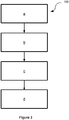
- Figure 3 shows a flowchart of a method 100 for producing a sintered body 28 (see figure 1 ) or for producing a tool 10 (see figure 1 ), the method 100 comprising the steps:
- the sintered brown body may then constitute the sintered body 28 to be produced.
- the method 100 may comprise a further step d of treating the brown body by hot pressing or by hot isostatic pressing.
- the sintered body 28 may result from the brown body after pressing.
- the pressing according to step d may be combined with the sintering according to step c of the method 100.
- step a The milling and mixing according to step a may take place according to several different milling procedures.
- ethanol may be used as liquid for milling.
- approximately 100 cm 3 to 150 cm 3 , preferably 130 cm 3 , ethanol per 50 g of powder mixture may be added.
- a pressing aid for example paraffin, may be added, in particular amounting to 1.5 to 2 wt.%, preferably 1.8 wt.%, with respect to the powder content.
- the composite material is milled using a planetary ball mill at 100 rpm for a total of 5 hours. After 4 hours of milling in ethanol, the paraffin is added.
- the milling vessel volume is 250 cm 3 .
- the ratio of the composite material to the milling media may be 1:5 in respect to weight.
- the milling media may comprise 175 g WC-Co balls having a diameter of 12 mm and 75 g of WC-Co balls having a diameter of 6 mm.
- the WC-Co balls may have 10 wt.% of Co.
- the composite material may be milled using a ball milling shaker, e. g. Turbula T2C shaker, at 46 rpm for a total of 5 hours. Again, after 4 hours of milling in ethanol, the paraffin is added.
- a ball milling shaker e. g. Turbula T2C shaker
- the milling vessel volume is also 250 cm 3 .
- the ratio of the composite material to the milling media may be 1:5 in respect to weight.
- the milling media may comprise 140 g 316L stainless steel balls having a diameter of 12 mm and 110 g of 316L stainless steel balls having a diameter of 6 mm.
- the milling media may comprise 270 g titanium diboride balls having a diameter of 12 mm.
- the composite material After milling and mixing, the composite material is dried. The drying can take place for 90 min in a paraffin bath at 80°C.
- the composite material is sieved for approximately 15 min with openings of 500 ⁇ m, 300 ⁇ m, and 100 ⁇ m.
- the composite material is pressed at 100-150 MPa using a uniaxial press having punches and dies of hardened steel for two geometries, in particular, circular sections with diameters of 6 mm and 16 mm, or rectangular sections with 20 mm x 7 mm.
- the sintering according to the step c takes place using a furnace having graphite crucibles and heating elements and using alumina trays.
- the heating rate is adjusted to 10 K / min in a vacuum of about 10 -2 mbar.
- a dewaxing plateau is maintained for 20 min.
- an argon atmosphere of 100 mbar is introduced.
- Sintering takes place at 1500 °C with a dwelling time of 1 h. Subsequently, the brown body is cooled down with a cooling rate of 10 K/ min.
- the sintering according to the step c is combined with hot isostatic pressing according to the step d.
- Graphite crucibles are used together with hexagonal boron nitride powder as sintering barrier.
- the heating rate is 10 K / min in a vacuum of 10 -2 mbar.
- Pressing is started at 900 °C with a pressure of up to 150 MPa of argon. At 450 °C a dewaxing plateau is maintained for 20 min. At 1300 °C, an argon atmosphere of 100 mbar is introduced. The sintering temperature ranges from 1000 °C to 1350 °C with a dwelling time of 5 min up to 1h. Subsequently, the brown body is cooled down with a cooling rate of 65 K / min.
- the sintering according to the step c is combined with hot isostatic pressing according to the step d using a graphite die and punches.
- the heating rate is set to 60 K / min in a vacuum of 10 -1 mbar.
- the sintering temperature ranges from 1100 °C to 1250 °C with a dwelling time of 3 min up to 5 min. Subsequently, the brown body is cooled down.
Landscapes
- Chemical & Material Sciences (AREA)
- Engineering & Computer Science (AREA)
- Materials Engineering (AREA)
- Organic Chemistry (AREA)
- Mechanical Engineering (AREA)
- Metallurgy (AREA)
- Manufacturing & Machinery (AREA)
- Ceramic Engineering (AREA)
- Structural Engineering (AREA)
- Inorganic Chemistry (AREA)
- Powder Metallurgy (AREA)
Priority Applications (1)
| Application Number | Priority Date | Filing Date | Title |
|---|---|---|---|
| EP21156865.4A EP4043418A1 (de) | 2021-02-12 | 2021-02-12 | Verbundwerkstoff, sinterkörper, werkzeug und verfahren |
Applications Claiming Priority (1)
| Application Number | Priority Date | Filing Date | Title |
|---|---|---|---|
| EP21156865.4A EP4043418A1 (de) | 2021-02-12 | 2021-02-12 | Verbundwerkstoff, sinterkörper, werkzeug und verfahren |
Publications (1)
| Publication Number | Publication Date |
|---|---|
| EP4043418A1 true EP4043418A1 (de) | 2022-08-17 |
Family
ID=74595174
Family Applications (1)
| Application Number | Title | Priority Date | Filing Date |
|---|---|---|---|
| EP21156865.4A Withdrawn EP4043418A1 (de) | 2021-02-12 | 2021-02-12 | Verbundwerkstoff, sinterkörper, werkzeug und verfahren |
Country Status (1)
| Country | Link |
|---|---|
| EP (1) | EP4043418A1 (de) |
Citations (2)
| Publication number | Priority date | Publication date | Assignee | Title |
|---|---|---|---|---|
| JPH07157835A (ja) * | 1993-12-02 | 1995-06-20 | Nippon Tungsten Co Ltd | 焼結チタン・アルミニウム合金とその製造方法 |
| JP2005213605A (ja) * | 2004-01-30 | 2005-08-11 | Tocalo Co Ltd | 複合材料、溶射皮膜被覆部材およびその部材の製造方法 |
-
2021
- 2021-02-12 EP EP21156865.4A patent/EP4043418A1/de not_active Withdrawn
Patent Citations (2)
| Publication number | Priority date | Publication date | Assignee | Title |
|---|---|---|---|---|
| JPH07157835A (ja) * | 1993-12-02 | 1995-06-20 | Nippon Tungsten Co Ltd | 焼結チタン・アルミニウム合金とその製造方法 |
| JP2005213605A (ja) * | 2004-01-30 | 2005-08-11 | Tocalo Co Ltd | 複合材料、溶射皮膜被覆部材およびその部材の製造方法 |
Similar Documents
| Publication | Publication Date | Title |
|---|---|---|
| US7070643B2 (en) | Compositionally graded sintered alloy and method of producing the same | |
| RU2107607C1 (ru) | Металлорежущий инструмент для стружкообразующей обработки, уплотненная керамическая композиция, способ стружкообразующей обработки, способ уплотнения изделий, способ изготовления режущих пластин, керамическое изделие | |
| US4022584A (en) | Sintered cermets for tool and wear applications | |
| EP0918097B1 (de) | Gesinterte hartlegierung | |
| JP7272353B2 (ja) | 超硬合金、切削工具および超硬合金の製造方法 | |
| JPH08944B2 (ja) | ホウ化物、窒化物および鉄バインダー金属に基づく混合焼結金属材料 | |
| JP2668955B2 (ja) | 複硼化物基焼結体及びその製造方法 | |
| EP0373609A1 (de) | Sinterkörper für Präzisionswerkzeuge | |
| EP3187476B1 (de) | Sintermaterial, werkzeug mit sintermaterial und sintermaterialherstellungsverfahren | |
| EP1518938B1 (de) | Schneidewerkzeug | |
| EP4043418A1 (de) | Verbundwerkstoff, sinterkörper, werkzeug und verfahren | |
| JP3318887B2 (ja) | 微粒超硬合金及びその製造方法 | |
| JPH1179839A (ja) | 炭化タングステン系超硬質材料およびその製造方法 | |
| JPH0698540B2 (ja) | 耐摩耗性のすぐれたサ−メツト製切削工具の製造法 | |
| JPS644989B2 (de) | ||
| JPS6246510B2 (de) | ||
| JP4413022B2 (ja) | 複合酸化物分散焼結合金 | |
| JP3448840B2 (ja) | 炭窒化タングステン及びその製造方法 | |
| JPS6251911B2 (de) | ||
| JPH0121857B2 (de) | ||
| JP3481702B2 (ja) | 硬質合金を結合材とする立方晶窒化硼素燒結体及びその製造方法 | |
| JP2805339B2 (ja) | 高密度相窒化ホウ素基焼結体及び複合焼結体 | |
| JPH0121214B2 (de) | ||
| JP2005194556A (ja) | 希土類含有焼結合金 | |
| JPH0611897B2 (ja) | 高強度焼結合金 |
Legal Events
| Date | Code | Title | Description |
|---|---|---|---|
| PUAI | Public reference made under article 153(3) epc to a published international application that has entered the european phase |
Free format text: ORIGINAL CODE: 0009012 |
|
| STAA | Information on the status of an ep patent application or granted ep patent |
Free format text: STATUS: THE APPLICATION HAS BEEN PUBLISHED |
|
| AK | Designated contracting states |
Kind code of ref document: A1 Designated state(s): AL AT BE BG CH CY CZ DE DK EE ES FI FR GB GR HR HU IE IS IT LI LT LU LV MC MK MT NL NO PL PT RO RS SE SI SK SM TR |
|
| STAA | Information on the status of an ep patent application or granted ep patent |
Free format text: STATUS: THE APPLICATION IS DEEMED TO BE WITHDRAWN |
|
| 18D | Application deemed to be withdrawn |
Effective date: 20230218 |