EP4036618B1 - Polarisationsplatte - Google Patents
Polarisationsplatte Download PDFInfo
- Publication number
- EP4036618B1 EP4036618B1 EP20868984.4A EP20868984A EP4036618B1 EP 4036618 B1 EP4036618 B1 EP 4036618B1 EP 20868984 A EP20868984 A EP 20868984A EP 4036618 B1 EP4036618 B1 EP 4036618B1
- Authority
- EP
- European Patent Office
- Prior art keywords
- less
- layer
- retardation
- polarizing plate
- thickness
- Prior art date
- Legal status (The legal status is an assumption and is not a legal conclusion. Google has not performed a legal analysis and makes no representation as to the accuracy of the status listed.)
- Active
Links
Images
Classifications
-
- G—PHYSICS
- G02—OPTICS
- G02B—OPTICAL ELEMENTS, SYSTEMS OR APPARATUS
- G02B5/00—Optical elements other than lenses
- G02B5/30—Polarising elements
-
- G—PHYSICS
- G02—OPTICS
- G02B—OPTICAL ELEMENTS, SYSTEMS OR APPARATUS
- G02B1/00—Optical elements characterised by the material of which they are made; Optical coatings for optical elements
- G02B1/10—Optical coatings produced by application to, or surface treatment of, optical elements
- G02B1/11—Anti-reflection coatings
-
- G—PHYSICS
- G02—OPTICS
- G02B—OPTICAL ELEMENTS, SYSTEMS OR APPARATUS
- G02B1/00—Optical elements characterised by the material of which they are made; Optical coatings for optical elements
- G02B1/04—Optical elements characterised by the material of which they are made; Optical coatings for optical elements made of organic materials, e.g. plastics
-
- G—PHYSICS
- G02—OPTICS
- G02B—OPTICAL ELEMENTS, SYSTEMS OR APPARATUS
- G02B1/00—Optical elements characterised by the material of which they are made; Optical coatings for optical elements
- G02B1/10—Optical coatings produced by application to, or surface treatment of, optical elements
-
- G—PHYSICS
- G02—OPTICS
- G02B—OPTICAL ELEMENTS, SYSTEMS OR APPARATUS
- G02B1/00—Optical elements characterised by the material of which they are made; Optical coatings for optical elements
- G02B1/10—Optical coatings produced by application to, or surface treatment of, optical elements
- G02B1/14—Protective coatings, e.g. hard coatings
-
- G—PHYSICS
- G02—OPTICS
- G02B—OPTICAL ELEMENTS, SYSTEMS OR APPARATUS
- G02B5/00—Optical elements other than lenses
- G02B5/30—Polarising elements
- G02B5/3016—Polarising elements involving passive liquid crystal elements
-
- G—PHYSICS
- G02—OPTICS
- G02B—OPTICAL ELEMENTS, SYSTEMS OR APPARATUS
- G02B5/00—Optical elements other than lenses
- G02B5/30—Polarising elements
- G02B5/3083—Birefringent or phase retarding elements
-
- H—ELECTRICITY
- H10—SEMICONDUCTOR DEVICES; ELECTRIC SOLID-STATE DEVICES NOT OTHERWISE PROVIDED FOR
- H10K—ORGANIC ELECTRIC SOLID-STATE DEVICES
- H10K50/00—Organic light-emitting devices
- H10K50/80—Constructional details
- H10K50/868—Arrangements for polarized light emission
-
- H—ELECTRICITY
- H10—SEMICONDUCTOR DEVICES; ELECTRIC SOLID-STATE DEVICES NOT OTHERWISE PROVIDED FOR
- H10K—ORGANIC ELECTRIC SOLID-STATE DEVICES
- H10K59/00—Integrated devices, or assemblies of multiple devices, comprising at least one organic light-emitting element covered by group H10K50/00
- H10K59/80—Constructional details
- H10K59/8791—Arrangements for improving contrast, e.g. preventing reflection of ambient light
Definitions
- the present application relates to a polarizing plate, an organic light-emitting display device, and a display device.
- OLED organic light-emitting device
- the reference wavelength of optical properties is approximately 550 nm, unless otherwise specified.
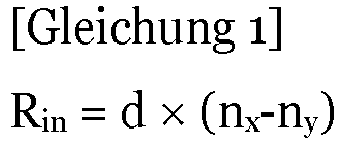
- Equation 1 the term in-plane retardation is an optical property defined by Equation 1 below
- thickness direction retardation is an optical property defined by Equation 2 below.
- R in d ⁇ n x ⁇ n y
- R th d ⁇ n z ⁇ n y
- R in is the in-plane retardation
- R th is the thickness direction retardation
- d is the thickness of a first or second retardation layer
- n x is the refractive index of the first or second retardation layer in the slow axis direction
- n y is the refractive index of the first or second retardation layer in the fast axis direction
- n z is the refractive index of the first or second retardation layer in the thickness direction.
- the term layer is a layer to be measured for the in-plane retardation or the thickness direction retardation, and thus, for example, the layer in the equations for obtaining the in-plane retardation or the thickness direction retardation of the retardation layer is the retardation layer.
- the terms vertical, horizontal, orthogonal, parallel and angular numerical values, which define angles are substantially vertical, horizontal, orthogonal, parallel and numerical values, which may include an error within approximately ⁇ 10 degrees, within ⁇ 9 degrees, within ⁇ 8 degrees, within ⁇ 7 degrees, within ⁇ 6 degrees, within ⁇ 5 degrees, within ⁇ 4 degrees, within ⁇ 3 degrees, within ⁇ 2 degrees or within ⁇ 1 degree.
- the polarizing plate of the claimed invention comprises inter alia a polarizing film, a hard coating layer formed on the top of the polarizing film and a retardation layer formed on the bottom of the polarizing film.
- the retardation layer may have a single layer structure or may be a laminate with a multilayer structure.
- the term bottom means a direction from the polarizing film toward the retardation layer, and the top means the opposite direction.
- the bottom when the polarizing plate of the present application has been applied to an organic light-emitting display device, the bottom may coincide with the direction from the polarizing plate toward an organic light-emitting display panel to be described below, and the top may coincide with the direction toward the viewer side.
- the polarizing plate is a polarizing plate in which the hard coating layer is formed directly on the polarizing film without interposing another layer.
- a protective film may be applied thereto to protect the polarizing film so that scratches and the like do not occur on the polarizing film.
- the protective film may be a glass substrate and/or a polymer film.
- the hard coating layer is directly formed on the top of the polarizing film without applying another layer such as the protective film, and without interposing other layers.
- the hard coating layer having characteristics to be described below is directly formed on the top of the polarizing film without interposing other layers as above, it can reduce the total thickness of the polarizing plate while serving to protect the polarizing film upon handling and/or using the organic light-emitting display device. Accordingly, it is possible to provide a thin polarizing plate having not only excellent durability against short wavelengths, but also excellent folding durability.
- the hard coating layer may be a layer having pencil hardness equal to or more than a certain level.
- the pencil hardness may be measured by a method of drawing a pencil lead on the surface of the hard coating layer with a load of 500 g and at an angle of 45 degrees under a temperature of about 25 °C and 50% relative humidity using a general pencil hardness measuring instrument.
- the pencil hardness may be measured by increasing the hardness of the pencil lead in stages until occurrence of defects such as impressions, scratches or rupture on the surface of the hard coating layer is confirmed.
- the hard coating layer of the present application has a pencil hardness of about 0.5H or more, and in another example, the pencil hardness may be about 0.6H or more, 0.7H or more, 0.8H or more, 0.9H or more, 1H or more, or 2H or more, or may be 10H or less, 9H or less, 8H or less, 7H or less, 6H or less, 5H or less, 4H or less, 3H or less, or 2H or less.
- the hard coating layer has a thickness in a range of 1 ⁇ m to 10 ⁇ m.
- the thickness may be 1.5 ⁇ m or more, 2.0 ⁇ m or more, 2.5 ⁇ m or more, 3 ⁇ m or more, or may be 9 ⁇ m or less, 8 ⁇ m or less, 7 ⁇ m or less, 6 ⁇ m or less, 5 ⁇ m or less, 4 ⁇ m or less, or 3 ⁇ m or less.
- the hard coating layer controlling the thickness as above and/or formed of a material to be described below while having the pencil hardness in the above range, is applied thereto, it can protect the polarizing plate against external impact and/or short wavelength light even if it is formed alone without interposing another layer on the top of the polarizing film, and the folding durability of the polarizing plate can also be secured through reduction of the thickness of the polarizing plate or the like.
- the hard coating layer formed on the polarizing plate generally includes a hard coating layer formed on the surface of a protective film attached to one side of a polarizing film, or a hard coating layer formed on a so-called single-sided polarizing plate that a protective film is attached to one side of a polarizing film, and a hard coating layer and a pressure-sensitive adhesive layer are sequentially formed on the other side, where the material applied to formation of such a hard coating layer can also be applied equally to the polarizing plate of the present application.
- a hard coating layer comprising a polymerizable epoxy compound and an oxetane compound is applied.
- a material can be exemplified by, for example, materials known as the protective layer material formed on one side of the polarizing film in Korean Laid-Open Patent Publication No. 2019-0072151 , Korean Laid-Open Patent Publication No. 2019-0072168 or Korean Laid-Open Patent Publication No. 2019-0072460 , and the like.
- the hard coating layers in the prior arts as described above were not directly formed on the upper surface of the polarizing film in consideration of, for example, tearing of the polarizing film or the like. That is, the hard coating layer applied to the conventional polarizing plate was formed on the surface of the protective film attached to the polarizing plate without being formed directly on the polarizing film, or even if it was formed directly on the polarizing film, it was formed on the bottom of the polarizing film, that is, the surface of the polarizing film facing the display device when the polarizing plate was applied to the display device.
- the present inventors have found that by applying the hard coating layer to a polarizing plate having a unique structure described in this specification, it is possible to provide a polarizing plate having excellent folding durability and short wavelength durability along with other desired physical properties.
- the polarizing plate of the present application has a reflective color value change of 10 or less according to Equation 4 below.
- ⁇ L* may be L* a -L* i
- ⁇ a* may be a* a -a* i
- ⁇ b* may be b* a -b* i
- L* a , a* a and b* a may be color coordinates L*, a* and b* before exposing the polarizing plate to light having a wavelength of 420nm in a light quantity of 0.75 to 0.85W/m 2 at a temperature of 25°C for 50 hours, respectively
- L* i , a* i and b* i may be color coordinates L*, a* and b* after exposing the polarizing plate to light having a wavelength of 420nm in a light quantity of 0.75 to 0.85W/m 2 at a temperature of 25°C for 50 hours.
- the L, a and b values may mean L, a and b of the CIE Lab color space as described below.
- the L value represents brightness, wherein an L value of 0 indicates black and an L value of 100 indicates white.
- the a value is negative, the color is biased toward green, and when it is positive, the color is biased toward red or purple.
- the b value is negative, the color is biased to blue, and when the b value is positive, the color is biased to yellow.
- Each numerical value in the CIE Lab color space can be measured by applying a general method of measuring each coordinate of the color space, and for example, after placing a spectrophotometer (KONICA MINOLTA, CM-2600d) having a detector in the form of an integrating sphere at the measurement position, it can be measured according to the manufacturer's manual. Such a measurement may be performed under a temperature condition of 20°C to 30°C and a humidity condition of 40 to 50%, but is not limited thereto.
- the reflective color value change ( ⁇ E* ab ) of the polarizing plate in the present application according to Equation 4 above may be 9 or less, 8 or less, 7 or less, 6 or less, 5 or less, 4 or less, 3 or less, 2.9 or less, 2.8 or less, 2.7 or less, 2.6 or less, 2.5 or less, 2.4 or less, 2.3 or less, 2.2 or less, 2.1 or less, 2.0 or less, 1.9 or less, 1.8 or less, 1.7 or less, 1.6 or less, 1.5 or less, 1.4 or less, 1.3 or less, 1.2 or less, 1.1 or less, 1.0 or less, 0.9 or less, 0.8 or less, 0.7 or less, 0.6 or less, 0.5 or less, 0.4 or less, 0.3 or less, or 0.2 or less, but is not limited thereto.
- the polarizing plate of the present application particularly introduces the above-described hard coating layer on the polarizing film without interposing other layers, whereby a polarizing plate forming the thickness thin and simultaneously controlling the problem such as the lifespan reduction of the polarizing plate even when it is exposed to a short wavelength for a long time, can be provided.
- the polarizing plate of the present application may have a thickness of 45 ⁇ m or less.
- the thickness of the polarizing plate may be 44 ⁇ m or less, 43 ⁇ m or less, 42 ⁇ m or less, 41 ⁇ m or less, 40 ⁇ m or less, 39 ⁇ m or less, 38 ⁇ m or less, 37 ⁇ m or less, 36 ⁇ m or less, or 35 ⁇ m or less, or may be 5 ⁇ m or more, 10 ⁇ m or more, 15 ⁇ m or more, 20 ⁇ m or more, 25 ⁇ m or more, 30 ⁇ m or more, or 35 ⁇ m or more, but is not limited thereto.
- the thickness of the polarizing plate in the above range, it is possible to provide a polarizing plate that does not cause appearance defects such as cracks during folding, and by applying the polarizing plate to an organic light-emitting display device and a flexible display device comprising the same, it is possible to provide a flexible display device having excellent folding durability.
- the polarizing plate of the claimed invention also comprises a retardation layer on the bottom of the polarizing film.
- the retardation layer may have a single layer structure or a multilayer structure.
- the retardation layer may comprise, for example, a first retardation layer and/or a second retardation layer.
- the first retardation layer is present on the bottom of the polarizing film
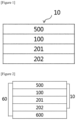
- the second retardation layer is present on the bottom of the first retardation layer, so that the hard coating layer (500), the polarizing film (100), the first retardation layer (201) and the second retardation layer (202) may be sequentially laminated as in Figure 1 .
- each retardation layer is designed as follows, whereby a polarizing plate having excellent antireflection performance and/or color characteristics in all directions including the side as well as the front, and also having short wavelength durability can be provided when it is applied to a display device, especially an organic light-emitting display device.
- the term retardation layer means an element which is an optically anisotropic layer and is capable of converting incident polarized light by controlling birefringence.
- the x-axis means a direction parallel to the in-plane slow axis of the retardation layer
- the y-axis means a direction parallel to the in-plane fast axis of the retardation layer
- the z-axis means the thickness direction of the retardation layer.
- the x-axis and y-axis may be orthogonal to each other in the plane.
- the in-plane retardation (based on a wavelength of 550nm) of Equation 1 above may be in a range of about 100 to 150 nm.
- the in-plane retardation may be about 110nm or more, 120nm or more, 130nm or more, 131nm or more, 132nm or more, 133nm or more, 134nm or more, 135nm or more, 136nm or more, 137nm or more, 138nm or more, 139nm or more, or 140nm or more, or may be 149nm or less, 148nm or less, 147nm or less, 146nm or less, 145nm or less, 144nm or less, 143nm or less, 142nm or less, or 141nm or less.
- the first retardation layer may be arranged such that, for example, the slow axis may form an angle in a range of approximately 35 degrees to 55 degrees with the absorption axis of the polarizing film.
- the angle may be approximately 15 degrees or more, 20 degrees or more, 25 degrees or more, 30 degrees or more, 35 degrees or more, 40 degrees or more, or 45 degrees or more, or may be 65 degrees or less, 60 degrees or less, 55 degrees or less, 50 degrees or less, or 45 degrees or less or so. More preferably, it may be arranged to form an angle in the range of approximately 40 degrees to 50 degrees, but is not limited thereto.
- Rin(450) is the in-plane retardation of the first retardation layer based on a wavelength of 450nm
- Rin(550) is the in-plane retardation of the first retardation layer based on a wavelength of 550nm.
- the first retardation layer may also be a QWP (quarter wave plate).
- QWP means a wave plate having a 1/4 wavelength phase retardation characteristic, wherein the wave plate serves to change incident polarized light, which is linearly polarized light, into circularly polarized light.
- the n-wavelength phase retardation characteristic means a characteristic capable of retarding incident light by n times the wavelength of the incident light within at least a partial wavelength range.
- the 1/4 wavelength phase retardation characteristic may mean a characteristic capable of retarding the incident light by 1/4 times the wavelength of the incident light within at least a partial wavelength range.
- the first retardation layer of the present application may have a thickness of 25 ⁇ m or less.
- the thickness may be 24 ⁇ m or less, 23 ⁇ m or less, 22 ⁇ m or less, 21 ⁇ m or less, 20 ⁇ m or less, 19 ⁇ m or less, 18 ⁇ m or less, 17 ⁇ m or less, 16 ⁇ m or less, 15 ⁇ m or less, 14 ⁇ m or less, 13 ⁇ m or less, 12 ⁇ m or less, 11 ⁇ m or less, 10 ⁇ m or less, 9 ⁇ m or less, 8 ⁇ m or less, 7 ⁇ m or less, 6 ⁇ m or less, 5 ⁇ m or less, 4 ⁇ m or less, or 3 ⁇ m or less, or may be 0.1 ⁇ m or more, 0.2 ⁇ m or more, 0.3 ⁇ m or more, 0.4 ⁇ m or more, 0.5 ⁇ m or more, 0.6 ⁇ m or more, 0.7 ⁇ m or more, 0.8 ⁇ m or more, 0.9 ⁇ m or more, 1.0 ⁇ m or more, 1.1 ⁇ m or more, 1.2 ⁇ m or more, 1.3
- the first retardation layer in which the slow axis of the first retardation layer and the absorption axis of the polarizing film are disposed within the above range, while showing the in-plane retardation in the above range, it is possible to exhibit an appropriate level of compensation function according to the wavelength in the visible light region through a combination with the second retardation layer to be described below, whereby excellent omnidirectional antireflection performance, color characteristics and/or short wavelength durability can be secured.
- the polarizing plate of the present application may comprise, for example, a second retardation layer on the bottom of the first retardation layer.
- the second retardation layer may be in contact with the first retardation layer, or other elements, for example, a pressure-sensitive adhesive layer and the like, or a polymer film and the like may also be present between the first and second retardation layers.
- the thickness direction retardation (based on a wavelength of 550nm) of Equation 2 above may be in a range of approximately 30nm to 150nm.
- the thickness direction retardation may be approximately 35nm or more, 40nm or more, 45nm or more, 50nm or more, 55nm or more, or 60nm or more, or may be 140nm or less, 130nm or less, 120nm or less, 110nm or less, 100nm or less, 90nm or less, 80nm or less, or 70nm or less.
- the second retardation layer may be a layer that does not substantially have an in-plane retardation.
- the in-plane retardation (based on a wavelength of 550nm) of such a second retardation layer may be, for example, approximately 10nm or less, 9nm or less, 8nm or less, 7nm or less, 6nm or less, 5nm or less, 4nm or less, 3nm or less, 2nm or less, or 1nm or less, or substantially 0nm.
- the isotropic layer may have a thickness, for example, in a range of 5 ⁇ m to 35 ⁇ m. By controlling the thickness of the isotropic layer as above, it is possible to secure folding durability and the like according to the thinning of the polarizing plate.
- the thickness of the isotropic layer may be 6 ⁇ m or more, 7 ⁇ m or more, 8 ⁇ m or more, 9 ⁇ m or more, 10 ⁇ m or more, 11 ⁇ m or more, 12 ⁇ m or more, 13 ⁇ m or more, 14 ⁇ m or more, 15 ⁇ m or more, 16 ⁇ m or more, 17 ⁇ m or more, 18 ⁇ m or more, or 19 ⁇ m or more, or may be 34 ⁇ m or less, 33 ⁇ m or less, 32 ⁇ m or less, 31 ⁇ m or less, 30 ⁇ m or less, 29 ⁇ m or less, 28 ⁇ m or less, 27 ⁇ m or less, 26 ⁇ m or less, 25 ⁇ m or less, 24 ⁇ m or less, 23 ⁇ m or less, 22 ⁇ m or less, or 21 ⁇ m or less.
- the desired effect can be further maximized.
- the ratio (H/T) of the thickness (H) of the hard coating layer to the thickness (T) of the retardation layer may be 0.2 or more, 0.3 or more, 0.4 or more, 0.5 or more, 0.6 or more, 0.7 or more, 0.8 or more, or 0.9 or more, or may be 4.5 or less, 4.0 or less, 3.5 or less, 3.0 or less, 2.5 or less, 2.0 or less, or 1.5 or less.
- the polarizing film may be, for example, a polyvinyl alcohol polarizing film.
- the terms polarizing film and polarizing plate refer to objects that are distinguished from each other.
- the polarizing film refers to a film, sheet or element itself exhibiting a polarizing function, and the polarizing film is a functional element capable of extracting light vibrating in one direction from incident light vibrating in various directions.
- the polarizing plate means an optical element comprising other elements together with the polarizing film.
- the other elements that may be included in the optical element together with the polarizing film can be exemplified by a polarizing film, protective film or a retardation layer, and the like, but are not limited thereto.
- the polarizing film may be an absorption type or reflective type polarizing film, without basically particular limitation.
- the polarizing film may be, for example, a polyvinyl alcohol polarizing film.
- the term polyvinyl alcohol polarizing film may mean, for example, a resin film of polyvinyl alcohol (hereinafter, referred to as polyvinyl alcohol) series containing an anisotropic absorbing material such as iodine or a dichroic dye.
- polyvinyl alcohol polarizing film may mean, for example, a resin film of polyvinyl alcohol (hereinafter, referred to as polyvinyl alcohol) series containing an anisotropic absorbing material such as iodine or a dichroic dye.
- Such a film can be produced by including an anisotropic absorbing material in a polyvinyl alcohol-based resin film and orienting the mixture by stretching or the like.
- the anisotropic absorbing material may be adsorbed and/or oriented on the polyvinyl alcohol-based film.
- This dyeing process may be performed together with the stretching process.
- the dyeing may be performed by immersing the film in a solution containing an anisotropic absorbing material, for example, an iodine solution.
- an iodine solution for example, an aqueous solution containing iodine ions by iodine and an iodide compound, which is a solubilizing agent, may be used.
- the iodide compound for example, potassium iodide, lithium iodide, sodium iodide, zinc iodide, aluminum iodide, lead iodide, copper iodide, barium iodide, calcium iodide, tin iodide or titanium iodide, and the like may be used.
- the concentration of iodine and/or iodide ions in the iodine solution may be adjusted in consideration of the optical properties of the desired polarizing film, and such a control method is known.
- the temperature of the iodine solution is typically about 20°C to 50°C or 25°C to 40°C or so, and the immersion time is usually about 10 seconds to 300 seconds or 20 seconds to 240 seconds, without being limited thereto.
- the crosslinking process performed in the manufacturing process of the polarizing film may be performed using, for example, a crosslinking agent such as a boron compound.
- a crosslinking agent such as a boron compound.
- the order of the crosslinking process is not particularly limited, and for example, it may be performed together with the dyeing and/or stretching process, or may be performed separately.
- the crosslinking process may also be performed several times.
- the boron compound boric acid or borax may be used.
- the boron compound may be generally used in the form of an aqueous solution or a mixed solution of water and an organic solvent, and a boric acid aqueous solution is usually used.
- the boric acid concentration in the boric acid aqueous solution may be selected in an appropriate range in consideration of crosslinking degree and the heat resistance thereof, and the like.
- An iodide compound such as potassium iodide can also be contained in the boric acid aqueous solution or the like.
- the crosslinking process can be performed by immersing the polyvinyl alcohol-based film in a boric acid aqueous solution or the like, and in this process, the treatment temperature is typically in the range of 25°C or higher, 30°C to 85°C or 30°C to 60°C or so, and the treatment time is typically 5 seconds to 800 seconds or 8 seconds to 500 seconds or so.
- the stretching process is generally performed by uniaxial stretching. This stretching may also be performed together with the dyeing and/or crosslinking process.
- the stretching method is not particularly limited, where for example, a wet stretching method may be applied. In such a wet stretching method, for example, it is common to perform stretching after dyeing, but the stretching may be performed together with crosslinking, which may also be performed multiple times or in multiple stages.
- An iodide compound such as potassium iodide can be contained in the treatment liquid applied to the wet stretching method.
- the treatment temperature is usually in the range of 25°C or higher, 30°C to 85°C or 50°C to 70°C or so, and the treatment time is usually 10 seconds to 800 seconds or 30 seconds to 500 seconds, without being limited thereto.
- the total draw ratio may be adjusted in consideration of orientation characteristics, and the like, and the total draw ratio may be 3 to 10 times, 4 to 8 times, or 5 to 7 times or so based on the original length of the polyvinyl alcohol-based film, but is not limited thereto.
- the total draw ratio may mean the cumulative draw ratio including the stretching in each process. This total draw ratio may be adjusted to an appropriate range in consideration of orientation, processability of the polarizing film, or possibility of stretching and cutting, and the like.
- a swelling process may also be performed in addition to the dyeing, crosslinking and stretching before performing the above processes. It is possible to clean contaminants or an anti-blocking agent on the surface of the polyvinyl alcohol-based film surface by swelling, whereby there is also an effect of capable of reducing unevenness such as dyeing deviation.
- water In the swelling process, water, distilled water or pure water, and the like may be used.
- the main component of the relevant treatment liquid is water, and if necessary, an iodide compound such as potassium iodide or an additive such as a surfactant, or an alcohol, and the like may be contained in a small amount.
- the treatment temperature in the swelling process is usually 20°C to 45°C or 20°C to 40°C or so, but is not limited thereto. Since swelling deviation can cause dyeing deviation, the process parameters can be adjusted so that the occurrence of such swelling deviation is suppressed as much as possible.
- suitable stretching may also be performed in the swelling process.
- the draw ratio may be 6.5 times or less, 1.2 to 6.5 times, 2 to 4 times, or 2 to 3 times or so, based on the original length of the polyvinyl alcohol-based film.
- the stretching in the swelling process can be controlled so that the stretching in the stretching process performed after the swelling process can be controlled to be small, and can be controlled so that the stretching breakage of the film does not occur.
- a metal ion treatment may be performed. Such a treatment is performed, for example, by immersing a polyvinyl alcohol-based film in an aqueous solution containing a metal salt.
- a metal ion treatment is performed, for example, by immersing a polyvinyl alcohol-based film in an aqueous solution containing a metal salt.
- metal ions can be exemplified by metal ions of a transition metal such as cobalt, nickel, zinc, chromium, aluminum, copper, manganese or iron, and it is also possible to adjust the color tone by selecting an appropriate type thereof.
- a washing process may be performed after dyeing, crosslinking and stretching.
- Such a washing process can be performed with water or a solution of an iodine compound such as potassium iodide.
- the washing with water and the washing with an iodine compound solution may also be combined, and a solution containing a liquid alcohol such as methanol, ethanol, isopropyl alcohol, butanol or propanol may also be used.
- a liquid alcohol such as methanol, ethanol, isopropyl alcohol, butanol or propanol
- a drying process may be performed to produce a polarizing film.
- the drying process may be performed, for example, at an appropriate temperature for an appropriate time in consideration of the moisture content required for the polarizing film or the like, and such conditions are not particularly limited.
- the polarizing film comprises a zinc component such as zinc ions to secure high-temperature durability of the polarizing plate.
- the polarizing film comprises a zinc component (Zn) in a range of 0.1 to 10 wt%.
- the content may be about 0.2 wt% or more or so, 0.3 wt% or more or so, 0.4 wt% or more or so, or 0.5 wt% or more or so, or may be 9 wt% or less or so, 8 wt% or less or so, 7 wt% or less or so, 6 wt% or less or so, 5 wt% or less or so, 4 wt% or less or so, 3 wt% or less or so, 2 wt% or less or so, 1 wt% or less or so, 0.9 wt% or less or so, 0.8 wt% or less or so, 0.7 wt% or less or so, 0.6 wt% or less or so, 0.5 wt% or less or so, 0.4 wt% or less or less or
- the zinc component in such a form in the polarizing film, it may be possible to provide a polarizing plate having excellent high-temperature durability, which can maintain excellent optical properties even when maintained and/or driven at high temperature.
- the present application also relates to a use of the polarizing plate.
- the polarizing plate can be effectively applied, for example, to an organic light-emitting display device.
- Figure 2 is a cross-sectional diagram illustratively showing the organic light-emitting display device.
- the organic light-emitting display device (60) comprises an organic light-emitting display panel (600) and a polarizing plate (10) located on one side of the organic light-emitting display panel (600).
- the first retardation layer (201) and the second retardation layer (202) of the polarizing plate (10) may be disposed adjacent to the organic light-emitting display panel (600) compared to the polarizing film (100).
- the organic light-emitting display panel may comprise a base substrate, a lower electrode, an organic light-emitting layer, an upper electrode and an encapsulation substrate, and the like.
- One of the lower electrode and the upper electrode may be an anode and the other may be a cathode.
- the anode is an electrode into which holes are injected, which may be made of a conductive material having a high work function
- the cathode is an electrode into which electrons are injected, which may be made of a conductive material having a low work function.
- At least one of the lower electrode and the upper electrode may be made of a transparent conductive material, such as ITO or IZO, through which emitted light can be emitted to the outside.
- the organic light-emitting layer may comprise an organic material capable of emitting light when a voltage has been applied to the lower electrode and the upper electrode.
- Additional layers may be further included between the lower electrode and the organic light-emitting layer and between the upper electrode and the organic light-emitting layer.
- the additional layer may include a hole transporting layer, a hole injecting layer, an electron injecting layer and an electron transporting layer for balancing electrons and holes, but is not limited thereto.
- the sealing substrate may be made of glass, metal, and/or a polymer, and may seal the lower electrode, the organic light-emitting layer, and the upper electrode to prevent moisture and/or oxygen from being introduced from the outside.
- the polarizing plate (10) may be disposed on the side where the light comes out from the organic light-emitting display panel (600). For example, in the case of a bottom emission structure in which light is emitted toward the base substrate, it may be disposed outside the base substrate, and in the case of a top emission structure in which light is emitted toward the sealing substrate, it may be disposed outside the sealing substrate.
- the polarizing plate (10) can improve display characteristics of the organic light-emitting device by preventing external light from being reflected by the reflective layer made of metal such as electrodes and wiring of the organic light-emitting display panel (600) and from coming out of the organic light-emitting device (60). In addition, since the polarizing plate (10) of the present application can exhibit an antireflection effect on the side as well as the front, as described above, the lateral visibility can be improved.
- the present application also relates to a display device comprising the organic light-emitting device.
- the display device may be a flexible display device.
- the organic light-emitting device comprising the polarizing plate of the present application is applied to the display device, other components constituting the device or the like or a method of constituting the device are not particularly limited, and as long as the organic light-emitting device is used, any material or method known in the relevant field may be employed.
- the organic light-emitting device comprising the polarizing plate of the present application is applied to the flexible display device, it is possible to provide a flexible display having excellent omnidirectional antireflection performance, folding durability and durability against short wavelengths.
- the present application can provide a thin polarizing plate having excellent antireflection performance in all directions including the side as well as the front, and having excellent folding durability and durability against short wavelengths.
- the present application can provide an organic light-emitting display device to which the polarizing plate is applied and a display device comprising the same.
- a poly(vinyl alcohol) film (Kuraray, TS20) having a thickness of about 20 ⁇ m was immersed in a dyeing solution of 28°C containing 0.3 wt% of iodine (I 2 ) and 3.0 wt% of potassium iodide (KI) for 60 seconds and subjected to dyeing treatment. Subsequently, the dyed polyvinyl alcohol film was immersed in an aqueous solution (crosslinking solution) of 35°C containing 1 wt% of boron and 3 wt% of potassium iodide (KI) for 60 seconds and subjected to crosslinking treatment.
- aqueous solution crosslinking solution
- the crosslinked polyvinyl alcohol film was stretched at a draw ratio of 5.4 times by using an inter-roll stretching method.
- the stretched polyvinyl alcohol film was washed by immersing in ion-exchanged water of 25° C for 60 seconds, and immersed in an aqueous solution of 25°C containing about 3 wt% of zinc nitrate for 30 seconds.
- the polyvinyl alcohol film was dried at a temperature of 80°C for 60 seconds to produce a polyvinyl alcohol polarizing film.
- a polarizing plate comprising a hard coating layer, a polarizing film, and a laminate of retardation layers sequentially was produced.
- the retardation layer with a multilayered structure was attached to one side of the polarizing film using an optical UV adhesive (thickness: 2 ⁇ m).
- the surface that the first and second liquid crystal retardation layers were not formed on the triacetyl cellulose film was attached to the polarizing film, and the laminate of the retardation layers was disposed so that the small angle of the angles formed by the slow axis of the first liquid crystal retardation layer and the absorption axis of the polarizing film was 45 degrees.
- a polarizing plate comprising a cycloolefin film, a polarizing film, a hard coating layer and a laminate of retardation layers sequentially was prepared.
- the polarizing film prepared in Production Example 1 was applied as the polarizing film.
- the final thickness of the produced polarizing film was about 7 ⁇ m or so, and the zinc component was contained in an amount of about 0.2 to 0.3 wt%.
- a hard-coated cycloolefin polymer film (Zeon, about 29 ⁇ m thick) was attached to one side of the polarizing film using an optical UV adhesive (thickness: 2 ⁇ m), and the hard coating layer was coated on the other side of the polarizing film in a bar coating method so that the thickness was about 3 ⁇ m.
- the laminate of retardation layers was produced by coating QWP (quarter wave plate) liquid crystals (Fuji) having an inverse dispersion characteristic and in-plane retardation of 141nm for a wavelength of 550nm on a positive C film (Merck, thickness about 1 ⁇ m) having thickness direction retardation of 62nm for a wavelength of 550nm to a thickness of about 2 ⁇ m.
- QWP quarter wave plate liquid crystals
- liquid crystal layer part of the laminate of retardation layers was attached to the hard coating layer using a general optical UV adhesive (thickness: 2 ⁇ m).
- the polarizing plate having a structure that the cycloolefin polymer film/UV adhesive layer/polarizing film/hard coating layer/UV adhesive layer/laminate of retardation layers (reverse dispersion QWP/positive C film) were sequentially laminated was produced, and the final thickness of the polarizing plate was about 46 ⁇ m.
- the conditions were set to be subjected to (1) folding 200,000 times at 25°C/20%, (2) folding 20,000 times at 60°C/20% (3) folding 20,000 times at 60°C/90%, (4) folding 20,000 times at -20°C/0%, and the durability was tested by folding at a rate of 60 times per minute for each condition.
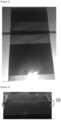
- the polarizing plate was checked for appearance defects such as cracks and tears, and the results were shown in Table 1 and Figures 3 and 4 .
- the polarizing plates of Examples and Comparative Examples were each attached to an OLED panel (reflectance of 55% for a wavelength of 550nm) such that the first and second retardation layers were closer to the OLED panel than the polarizing film. Then, the color coordinates L, a and b were measured for the polarizing plate before/after the short wavelength test using KONICA MINOLTA's CM-2600d equipment.
- the short wavelength test is a test in which the polarizing plate is placed in a chamber (Atlas) at a temperature of 25°C, and light having a wavelength of 420nm is exposed at a light quantity of 0.75 to 0.85W/m 2 for 50 hours.
- the polarizing plate of Example 1 also has the reflective color value change ( ⁇ E* ab ) smaller than that of the polarizing plate of Comparative Example 1, whereby it can be confirmed that the polarizing plate of the present application has excellent short-wavelength durability.
Landscapes
- Physics & Mathematics (AREA)
- Optics & Photonics (AREA)
- General Physics & Mathematics (AREA)
- Chemical & Material Sciences (AREA)
- Crystallography & Structural Chemistry (AREA)
- Polarising Elements (AREA)
- Electroluminescent Light Sources (AREA)
- Devices For Indicating Variable Information By Combining Individual Elements (AREA)
- Optical Elements Other Than Lenses (AREA)
- Surface Treatment Of Optical Elements (AREA)
Claims (10)
- Polarisationsplatte (10) aufweisend einen Polarisationsfilm (100);eine Hardcoating-Schicht (500), die auf der Oberseite des Polarisationsfilms (100) ausgebildet ist;eine Verzögerungsschicht, die auf der Unterseite des Polarisationsfilms (100) ausgebildet ist; undwobei die Hardcoating-Schicht (500) direkt auf der Oberseite des Polarisationsfilms (100) ohne Zwischenschaltung anderer Schichten ausgebildet ist,wobei der Polarisationsfilm (100) eine Zinkkomponente (Zn) enthält,wobei die Hardcoating-Schicht (500) eine polymerisierbare Epoxyverbindung enthält,wobei die Hardcoating-Schicht (500) eine Bleistifthärte von 0,5 H oder mehr aufweist,wobei die Hardcoating-Schicht (500) eine Dicke in einem Bereich von 1 µm bis 10 µm aufweist, unddadurch gekennzeichnet, dass die Polarisationsplatte ferner eine isotrope Schicht aufweist, wobei die Verzögerungsschicht auf der ersten Oberfläche der isotropen Schicht ausgebildet ist und die zweite Oberfläche der isotropen Schicht durch eine UV-Klebeschicht an dem Polarisationsfilm (100) befestigt ist, wobei die Zinkkomponente in dem Polarisationsfilm in einem Bereich von 0,1 bis 10 Gew.-% liegt, wobei die Hardcoating-Schicht (500) ferner eine Oxetanverbindung enthält, undwobei die Änderung des Reflexionsfarbwerts (ΔE*ab) gemäß der nachstehenden Gleichung 4 10 oder weniger beträgt:
 wobei ΔL* (L*a-L*i) ist, Δa* (a*a-a*i) ist, Δb* (b*a-b*i) ist und L*a, a*a und b*a die Farbkoordinaten L*, a* und b* sind, bevor die Polarisationsplatte (10) Licht mit einer Wellenlänge von 420 nm in einer Lichtmenge von 0,75 bis 0,85 W/m2 bei einer Temperatur von 25°C für jeweils 50 Stunden ausgesetzt wird, und L*i, a*i und b*i die Farbkoordinaten L*, a* und b* sind, nachdem die Polarisationsplatte (10) Licht mit einer Wellenlänge von 420 nm in einer Lichtmenge von 0,75 bis 0,85 W/m2 bei einer Temperatur von 25 °C für 50 Stunden ausgesetzt wird.
 - Polarisationsplatte (10) nach Anspruch 1, wobei die Dicke der Polarisationsplatte (10) 45 µm oder weniger beträgt.
- Polarisationsplatte (10) nach Anspruch 1, wobei die Verzögerungsschicht eine erste Verzögerungsschicht (201), die sich auf der Unterseite des Polarisationsfilms (100) befindet und eine Verzögerung in der Ebene gemäß der folgenden Gleichung 1 in einem Bereich von 100 bis 150 nm basierend auf einer Wellenlänge von 550 nm aufweist und so angeordnet ist, dass ein kleiner Winkel von Winkeln, die durch die langsame Achse mit der Absorptionsachse des Polarisationsfilms (100) gebildet werden, einen Winkel in einem Bereich von 35 Grad bis 55 Grad bildet; und eine zweite Verzögerungsschicht (202) aufweist, die sich auf einer Unterseite der ersten Verzögerungsschicht (201) befindet und eine Dickenrichtungsverzögerung gemäß der folgenden Gleichung 2 in einem Bereich von 30 bis 150 nm basierend auf einer Wellenlänge von 550 nm aufweist:

- Polarisationsplatte (10) nach Anspruch 4, wobei die erste Verzögerungsschicht (201) einen Dispersionskoeffizienten von weniger als 1 gemäß nachstehender Gleichung 3 aufweist.

- Polarisationsplatte (10) nach Anspruch 1, wobei das Verhältnis (H/S) einer Dicke (H) der Hardcoating-Schicht (500) zu einer Dicke (S) des Polarisationsfilms (100) in einem Bereich von 0,01 bis 1,5 liegt.
- Polarisationsplatte (10) nach Anspruch 1, wobei das Verhältnis (H/T) einer Dicke (H) der Hardcoating-Schicht (500) zu einer Dicke (T) der Verzögerungsschicht in einem Bereich von 0,1 bis 5 liegt.
- Polarisationsplatte (10) nach Anspruch 1, wobei das Verhältnis (H/P) einer Dicke (H) der Hardcoating-Schicht (500) zu einer Dicke (P) der isotropen Schicht in einem Bereich von 0,01 bis 1,5 liegt.
- Polarisationsplatte (10) nach Anspruch 1, ferner aufweisend eine druckempfindliche Klebeschicht, die nur auf einer Unterseite der Verzögerungsschicht ausgebildet ist.
- Organische lichtemittierende Anzeigevorrichtung (60) aufweisend die Polarisationsplatte (10) nach Anspruch 1.
- Anzeigevorrichtung aufweisend die organische lichtemittierende Anzeigevorrichtung (60) nach Anspruch 9.
Applications Claiming Priority (2)
| Application Number | Priority Date | Filing Date | Title |
|---|---|---|---|
| KR20190116807 | 2019-09-23 | ||
| PCT/KR2020/012675 WO2021060779A1 (ko) | 2019-09-23 | 2020-09-21 | 편광판 |
Publications (3)
| Publication Number | Publication Date |
|---|---|
| EP4036618A1 EP4036618A1 (de) | 2022-08-03 |
| EP4036618A4 EP4036618A4 (de) | 2022-11-16 |
| EP4036618B1 true EP4036618B1 (de) | 2024-12-04 |
Family
ID=75165905
Family Applications (1)
| Application Number | Title | Priority Date | Filing Date |
|---|---|---|---|
| EP20868984.4A Active EP4036618B1 (de) | 2019-09-23 | 2020-09-21 | Polarisationsplatte |
Country Status (7)
| Country | Link |
|---|---|
| US (1) | US12235484B2 (de) |
| EP (1) | EP4036618B1 (de) |
| JP (1) | JP7439238B2 (de) |
| KR (1) | KR102577330B1 (de) |
| CN (1) | CN114341680B (de) |
| TW (1) | TWI747518B (de) |
| WO (1) | WO2021060779A1 (de) |
Families Citing this family (5)
| Publication number | Priority date | Publication date | Assignee | Title |
|---|---|---|---|---|
| JP7517345B2 (ja) * | 2019-09-30 | 2024-07-17 | 大日本印刷株式会社 | 光学フィルム、偏光板、画像表示装置及び光学フィルムの選定方法 |
| KR102705599B1 (ko) * | 2020-11-03 | 2024-09-10 | 삼성에스디아이 주식회사 | 광학표시장치용 모듈 및 이를 포함하는 광학표시장치 |
| KR102763783B1 (ko) * | 2022-04-28 | 2025-02-07 | 동우 화인켐 주식회사 | 투과율 가변 광학 적층체 및 이의 제조방법과, 이를 포함하는 스마트 윈도우 |
| KR20240102687A (ko) * | 2022-12-26 | 2024-07-03 | 동우 화인켐 주식회사 | 반사방지용 편광판 및 이를 포함하는 화상표시장치 |
| KR20240102686A (ko) * | 2022-12-26 | 2024-07-03 | 동우 화인켐 주식회사 | 반사방지용 편광판 및 이를 포함하는 화상표시장치 |
Citations (2)
| Publication number | Priority date | Publication date | Assignee | Title |
|---|---|---|---|---|
| JP2000035512A (ja) * | 1998-07-17 | 2000-02-02 | Sumitomo Chem Co Ltd | 偏光フィルム |
| KR20190072151A (ko) * | 2017-12-15 | 2019-06-25 | 주식회사 엘지화학 | 편광판, 편광판-캐리어 필름 적층체, 편광판-캐리어 필름 적층체의 제조방법, 편광판의 제조방법 및 활성 에너지선 경화형 조성물 |
Family Cites Families (29)
| Publication number | Priority date | Publication date | Assignee | Title |
|---|---|---|---|---|
| JP2005283872A (ja) * | 2004-03-29 | 2005-10-13 | Fuji Photo Film Co Ltd | 反射防止能付き偏光板、その製造方法、およびそれを用いた画像表示装置 |
| JP2007279705A (ja) * | 2006-03-13 | 2007-10-25 | Fujifilm Corp | 半透過型液晶表示装置 |
| JP2009157361A (ja) * | 2007-12-06 | 2009-07-16 | Nitto Denko Corp | 偏光板及び画像表示装置 |
| JP2010284840A (ja) * | 2009-06-10 | 2010-12-24 | Kaneka Corp | コーティング層が付与されたフィルム、偏光子保護フィルム、及び、それを用いてなる偏光板 |
| JP5546933B2 (ja) * | 2010-04-07 | 2014-07-09 | 日東電工株式会社 | 粘着型偏光板及び画像表示装置 |
| KR101437139B1 (ko) * | 2010-12-29 | 2014-09-02 | 제일모직주식회사 | 편광판, 광학장치 및 편광판 제조방법 |
| KR101525998B1 (ko) | 2011-12-12 | 2015-06-04 | 제일모직주식회사 | 유기발광소자용 편광판 및 이를 포함하는 유기발광소자 표시 장치 |
| JP6321435B2 (ja) * | 2012-06-21 | 2018-05-09 | 日東電工株式会社 | 偏光板および有機elパネル |
| US9329315B2 (en) * | 2012-06-21 | 2016-05-03 | Konica Minolta, Inc. | Polarizing plate, method for manufacturing polarizing plate, and image display device |
| JP5528606B2 (ja) * | 2012-06-21 | 2014-06-25 | 日東電工株式会社 | 偏光板および有機elパネル |
| JP2015529344A (ja) * | 2012-08-27 | 2015-10-05 | エルジー・ケム・リミテッド | 偏光板 |
| KR101565321B1 (ko) * | 2012-12-13 | 2015-11-03 | 동우 화인켐 주식회사 | 편광판 및 이를 포함하는 화상 표시 장치 |
| JP2014206725A (ja) | 2013-03-19 | 2014-10-30 | 富士フイルム株式会社 | 偏光板および液晶表示装置 |
| KR101436441B1 (ko) | 2013-07-23 | 2014-09-02 | 동우 화인켐 주식회사 | 반사 방지용 편광판 및 이를 포함하는 화상표시장치 |
| KR101622018B1 (ko) | 2014-02-27 | 2016-05-17 | 제일모직주식회사 | 편광판 및 이를 포함하는 광학표시장치 |
| US9835780B2 (en) * | 2014-06-27 | 2017-12-05 | Samsung Electronics Co., Ltd. | Optical film, manufacturing method thereof, and display device |
| CN111948742B (zh) * | 2015-11-20 | 2023-04-28 | 日东电工株式会社 | 光学层叠体及使用了该光学层叠体的有机电致发光显示装置 |
| KR102458598B1 (ko) | 2015-12-30 | 2022-10-24 | 엘지디스플레이 주식회사 | 유기발광다이오드 표시장치 |
| JP7044468B2 (ja) * | 2016-02-05 | 2022-03-30 | 三菱ケミカル株式会社 | 光学積層体および該光学積層体を用いた画像表示装置 |
| KR101813813B1 (ko) | 2016-03-18 | 2017-12-29 | 삼성에스디아이 주식회사 | 발광표시장치용 편광판 및 이를 포함하는 발광표시장치 |
| JP6868343B2 (ja) * | 2016-04-20 | 2021-05-12 | 日東電工株式会社 | 偏光フィルムおよびその製造方法、光学フィルムおよび画像表示装置 |
| CN109844581B (zh) * | 2016-10-14 | 2022-04-19 | 株式会社Lg化学 | 用于抗反射的滤光器和有机发光器件 |
| CN109791242B (zh) * | 2016-10-24 | 2021-07-06 | 株式会社Lg化学 | 用于抗反射的滤光器和有机发光器件 |
| JP6510113B2 (ja) | 2017-05-09 | 2019-05-08 | 日東電工株式会社 | 光学部材用組成物、光学部材及び画像表示装置 |
| KR20200022032A (ko) | 2017-07-12 | 2020-03-02 | 스미또모 가가꾸 가부시끼가이샤 | 타원 편광판 |
| JP2019053168A (ja) | 2017-09-14 | 2019-04-04 | 日東電工株式会社 | 光学積層体 |
| KR102084118B1 (ko) * | 2017-09-29 | 2020-03-03 | 삼성에스디아이 주식회사 | Oled용 편광판 및 이를 포함하는 광학표시장치 |
| EP3709062B1 (de) | 2017-12-15 | 2025-07-30 | Shanjin Optoelectronics (Nanjing) Co., LTD. | Trägerfilmlaminat für polarisationsplatte, verfahren zur herstellung davon, verfahren zur herstellung einer polarisationsplatte damit und polarisationsplatte |
| KR102244791B1 (ko) | 2017-12-15 | 2021-04-26 | 주식회사 엘지화학 | 편광판, 편광판-캐리어 필름 적층체, 편광판-캐리어 필름 적층체의 제조방법, 편광판의 제조방법 및 활성 에너지선 경화형 조성물 |
-
2020
- 2020-09-21 WO PCT/KR2020/012675 patent/WO2021060779A1/ko not_active Ceased
- 2020-09-21 EP EP20868984.4A patent/EP4036618B1/de active Active
- 2020-09-21 KR KR1020200121415A patent/KR102577330B1/ko active Active
- 2020-09-21 CN CN202080060849.1A patent/CN114341680B/zh active Active
- 2020-09-21 US US17/635,657 patent/US12235484B2/en active Active
- 2020-09-21 JP JP2022510838A patent/JP7439238B2/ja active Active
- 2020-09-23 TW TW109132865A patent/TWI747518B/zh active
Patent Citations (3)
| Publication number | Priority date | Publication date | Assignee | Title |
|---|---|---|---|---|
| JP2000035512A (ja) * | 1998-07-17 | 2000-02-02 | Sumitomo Chem Co Ltd | 偏光フィルム |
| KR20190072151A (ko) * | 2017-12-15 | 2019-06-25 | 주식회사 엘지화학 | 편광판, 편광판-캐리어 필름 적층체, 편광판-캐리어 필름 적층체의 제조방법, 편광판의 제조방법 및 활성 에너지선 경화형 조성물 |
| US20200393603A1 (en) * | 2017-12-15 | 2020-12-17 | Lg Chem, Ltd. | Polarizing Plate, Polarizing Plate-Carrier Film Laminate, Method for Preparing Polarizing Plate-Carrier Film Laminate, Method for Preparing Polarizing Plate, and Active Energy Ray Curable Composition |
Also Published As
| Publication number | Publication date |
|---|---|
| US20220291436A1 (en) | 2022-09-15 |
| EP4036618A1 (de) | 2022-08-03 |
| JP7439238B2 (ja) | 2024-02-27 |
| KR20210035055A (ko) | 2021-03-31 |
| TW202113404A (zh) | 2021-04-01 |
| TWI747518B (zh) | 2021-11-21 |
| KR102577330B1 (ko) | 2023-09-12 |
| JP2022544820A (ja) | 2022-10-21 |
| CN114341680B (zh) | 2025-04-08 |
| EP4036618A4 (de) | 2022-11-16 |
| CN114341680A (zh) | 2022-04-12 |
| WO2021060779A1 (ko) | 2021-04-01 |
| US12235484B2 (en) | 2025-02-25 |
Similar Documents
| Publication | Publication Date | Title |
|---|---|---|
| EP4036618A1 (de) | Polarisationsplatte | |
| KR101348469B1 (ko) | 편광자, 그것을 사용한 광학 필름, 그것들을 사용한 화상 표시 장치 | |
| TWI619973B (zh) | 偏光膜、含有偏光膜的光學功能薄膜層合體、含有偏光膜的光學薄膜層合體之製造方法、及具有偏光膜之有機電致發光顯示裝置 | |
| EP2426524B1 (de) | Polarisationsfolie, optisches Filmlaminat mit Polarisationsfolie, gestrecktes Laminat zur Verwendung bei der Herstellung von optischem Filmlaminat mit Polarisationsfolie, Herstellungsverfahren dafür und organische EL-Anzeigevorrichtung mit Polarisationsfolie | |
| JP2005309394A (ja) | 偏光板の製造方法、偏光板およびそれを用いた画像表示装置 | |
| TW201827870A (zh) | 顯示裝置 | |
| CN113272369A (zh) | 用于保护偏振器的聚酯膜、其制造方法和包括其的偏光膜 | |
| CN106023822B (zh) | Oled显示装置以及其制造方法 | |
| EP3528015B1 (de) | Optischer antireflexionsfilter und organische lichtemittierende vorrichtung | |
| JP2004341503A (ja) | 偏光子、その製造方法、偏光板、光学フィルムおよび画像表示装置 | |
| EP3929636A1 (de) | Verfahren zur herstellung einer polarisationsplatte | |
| KR20160076701A (ko) | 광학필름 및 이를 구비한 oled 표시장치 | |
| KR20200100068A (ko) | 위상차판, 광학 보상층 부착 편광판, 화상 표시 장치, 및 터치 패널 화상 표시 장치 | |
| EP2662712A1 (de) | Mehrschichtige optische Folie, Herstellungsverfahren dafür, und Anzeigevorrichtung | |
| KR20100102292A (ko) | 편광자의 제조방법, 편광자 및 이것이 구비된 편광판 | |
| JP4975236B2 (ja) | 偏光子、およびそれを用いた光学フィルム、ならびにそれらを用いた画像表示装置 | |
| JP2005266325A (ja) | 偏光フィルムの製造方法、偏光フィルムおよびそれを用いた光学フィルムならびに画像表示装置 | |
| KR102641067B1 (ko) | 편광판 | |
| EP2960693B1 (de) | Optische folie, herstellungsverfahren dafür und anzeigevorrichtung | |
| JP2005266326A (ja) | 偏光フィルムの製造方法、偏光フィルムおよびそれを用いた光学フィルムならびに画像表示装置 | |
| TW200412274A (en) | Method for cutting laminating sheets and laminating sheets and image display device | |
| CN114341684A (zh) | 相位差板,以及具有该相位差板的圆偏光板、液晶显示装置及有机el显示装置 | |
| JP2004125817A (ja) | 偏光フィルム、偏光板、補償偏光板及び表示装置、並びにインハウス製造方法 | |
| TWI843007B (zh) | 偏光板、附相位差層之偏光板及有機電致發光顯示裝置 | |
| JP2004125816A (ja) | 偏光フィルムの製造方法、偏光板、補償偏光板及び表示装置、並びにインハウス製造方法 |
Legal Events
| Date | Code | Title | Description |
|---|---|---|---|
| STAA | Information on the status of an ep patent application or granted ep patent |
Free format text: STATUS: THE INTERNATIONAL PUBLICATION HAS BEEN MADE |
|
| PUAI | Public reference made under article 153(3) epc to a published international application that has entered the european phase |
Free format text: ORIGINAL CODE: 0009012 |
|
| STAA | Information on the status of an ep patent application or granted ep patent |
Free format text: STATUS: REQUEST FOR EXAMINATION WAS MADE |
|
| 17P | Request for examination filed |
Effective date: 20220208 |
|
| AK | Designated contracting states |
Kind code of ref document: A1 Designated state(s): AL AT BE BG CH CY CZ DE DK EE ES FI FR GB GR HR HU IE IS IT LI LT LU LV MC MK MT NL NO PL PT RO RS SE SI SK SM TR |
|
| A4 | Supplementary search report drawn up and despatched |
Effective date: 20221017 |
|
| RIC1 | Information provided on ipc code assigned before grant |
Ipc: H01L 51/52 20060101ALI20221011BHEP Ipc: G02F 1/13363 20060101ALI20221011BHEP Ipc: H01L 27/32 20060101ALI20221011BHEP Ipc: G02B 1/04 20060101ALI20221011BHEP Ipc: G02B 1/14 20150101ALI20221011BHEP Ipc: G02B 5/30 20060101AFI20221011BHEP |
|
| DAV | Request for validation of the european patent (deleted) | ||
| DAX | Request for extension of the european patent (deleted) | ||
| STAA | Information on the status of an ep patent application or granted ep patent |
Free format text: STATUS: EXAMINATION IS IN PROGRESS |
|
| 17Q | First examination report despatched |
Effective date: 20231207 |
|
| GRAP | Despatch of communication of intention to grant a patent |
Free format text: ORIGINAL CODE: EPIDOSNIGR1 |
|
| STAA | Information on the status of an ep patent application or granted ep patent |
Free format text: STATUS: GRANT OF PATENT IS INTENDED |
|
| RIC1 | Information provided on ipc code assigned before grant |
Ipc: G02B 1/11 20150101ALI20240911BHEP Ipc: H10K 59/80 20230101ALI20240911BHEP Ipc: G02B 1/04 20060101ALI20240911BHEP Ipc: G02B 1/14 20150101ALI20240911BHEP Ipc: G02B 5/30 20060101AFI20240911BHEP |
|
| INTG | Intention to grant announced |
Effective date: 20240924 |
|
| GRAS | Grant fee paid |
Free format text: ORIGINAL CODE: EPIDOSNIGR3 |
|
| GRAA | (expected) grant |
Free format text: ORIGINAL CODE: 0009210 |
|
| STAA | Information on the status of an ep patent application or granted ep patent |
Free format text: STATUS: THE PATENT HAS BEEN GRANTED |
|
| AK | Designated contracting states |
Kind code of ref document: B1 Designated state(s): AL AT BE BG CH CY CZ DE DK EE ES FI FR GB GR HR HU IE IS IT LI LT LU LV MC MK MT NL NO PL PT RO RS SE SI SK SM TR |
|
| REG | Reference to a national code |
Ref country code: CH Ref legal event code: EP |
|
| REG | Reference to a national code |
Ref country code: DE Ref legal event code: R096 Ref document number: 602020042723 Country of ref document: DE |
|
| REG | Reference to a national code |
Ref country code: IE Ref legal event code: FG4D |
|
| REG | Reference to a national code |
Ref country code: LT Ref legal event code: MG9D |
|
| REG | Reference to a national code |
Ref country code: NL Ref legal event code: MP Effective date: 20241204 |
|
| PG25 | Lapsed in a contracting state [announced via postgrant information from national office to epo] |
Ref country code: HR Free format text: LAPSE BECAUSE OF FAILURE TO SUBMIT A TRANSLATION OF THE DESCRIPTION OR TO PAY THE FEE WITHIN THE PRESCRIBED TIME-LIMIT Effective date: 20241204 |
|
| PG25 | Lapsed in a contracting state [announced via postgrant information from national office to epo] |
Ref country code: FI Free format text: LAPSE BECAUSE OF FAILURE TO SUBMIT A TRANSLATION OF THE DESCRIPTION OR TO PAY THE FEE WITHIN THE PRESCRIBED TIME-LIMIT Effective date: 20241204 |
|
| PG25 | Lapsed in a contracting state [announced via postgrant information from national office to epo] |
Ref country code: BG Free format text: LAPSE BECAUSE OF FAILURE TO SUBMIT A TRANSLATION OF THE DESCRIPTION OR TO PAY THE FEE WITHIN THE PRESCRIBED TIME-LIMIT Effective date: 20241204 |
|
| PG25 | Lapsed in a contracting state [announced via postgrant information from national office to epo] |
Ref country code: ES Free format text: LAPSE BECAUSE OF FAILURE TO SUBMIT A TRANSLATION OF THE DESCRIPTION OR TO PAY THE FEE WITHIN THE PRESCRIBED TIME-LIMIT Effective date: 20241204 |
|
| PG25 | Lapsed in a contracting state [announced via postgrant information from national office to epo] |
Ref country code: NO Free format text: LAPSE BECAUSE OF FAILURE TO SUBMIT A TRANSLATION OF THE DESCRIPTION OR TO PAY THE FEE WITHIN THE PRESCRIBED TIME-LIMIT Effective date: 20250304 |
|
| PG25 | Lapsed in a contracting state [announced via postgrant information from national office to epo] |
Ref country code: GR Free format text: LAPSE BECAUSE OF FAILURE TO SUBMIT A TRANSLATION OF THE DESCRIPTION OR TO PAY THE FEE WITHIN THE PRESCRIBED TIME-LIMIT Effective date: 20250305 Ref country code: LV Free format text: LAPSE BECAUSE OF FAILURE TO SUBMIT A TRANSLATION OF THE DESCRIPTION OR TO PAY THE FEE WITHIN THE PRESCRIBED TIME-LIMIT Effective date: 20241204 |
|
| PG25 | Lapsed in a contracting state [announced via postgrant information from national office to epo] |
Ref country code: RS Free format text: LAPSE BECAUSE OF FAILURE TO SUBMIT A TRANSLATION OF THE DESCRIPTION OR TO PAY THE FEE WITHIN THE PRESCRIBED TIME-LIMIT Effective date: 20250304 |
|
| RAP2 | Party data changed (patent owner data changed or rights of a patent transferred) |
Owner name: SHANJIN OPTOELECTRONICS (SUZHOU) CO., LTD. |
|
| PG25 | Lapsed in a contracting state [announced via postgrant information from national office to epo] |
Ref country code: NL Free format text: LAPSE BECAUSE OF FAILURE TO SUBMIT A TRANSLATION OF THE DESCRIPTION OR TO PAY THE FEE WITHIN THE PRESCRIBED TIME-LIMIT Effective date: 20241204 |
|
| REG | Reference to a national code |
Ref country code: AT Ref legal event code: MK05 Ref document number: 1748746 Country of ref document: AT Kind code of ref document: T Effective date: 20241204 |
|
| PG25 | Lapsed in a contracting state [announced via postgrant information from national office to epo] |
Ref country code: SM Free format text: LAPSE BECAUSE OF FAILURE TO SUBMIT A TRANSLATION OF THE DESCRIPTION OR TO PAY THE FEE WITHIN THE PRESCRIBED TIME-LIMIT Effective date: 20241204 |
|
| PG25 | Lapsed in a contracting state [announced via postgrant information from national office to epo] |
Ref country code: PL Free format text: LAPSE BECAUSE OF FAILURE TO SUBMIT A TRANSLATION OF THE DESCRIPTION OR TO PAY THE FEE WITHIN THE PRESCRIBED TIME-LIMIT Effective date: 20241204 |
|
| PG25 | Lapsed in a contracting state [announced via postgrant information from national office to epo] |
Ref country code: IS Free format text: LAPSE BECAUSE OF FAILURE TO SUBMIT A TRANSLATION OF THE DESCRIPTION OR TO PAY THE FEE WITHIN THE PRESCRIBED TIME-LIMIT Effective date: 20250404 |
|
| PG25 | Lapsed in a contracting state [announced via postgrant information from national office to epo] |
Ref country code: PT Free format text: LAPSE BECAUSE OF FAILURE TO SUBMIT A TRANSLATION OF THE DESCRIPTION OR TO PAY THE FEE WITHIN THE PRESCRIBED TIME-LIMIT Effective date: 20250404 |
|
| PG25 | Lapsed in a contracting state [announced via postgrant information from national office to epo] |
Ref country code: EE Free format text: LAPSE BECAUSE OF FAILURE TO SUBMIT A TRANSLATION OF THE DESCRIPTION OR TO PAY THE FEE WITHIN THE PRESCRIBED TIME-LIMIT Effective date: 20241204 |
|
| PG25 | Lapsed in a contracting state [announced via postgrant information from national office to epo] |
Ref country code: RO Free format text: LAPSE BECAUSE OF FAILURE TO SUBMIT A TRANSLATION OF THE DESCRIPTION OR TO PAY THE FEE WITHIN THE PRESCRIBED TIME-LIMIT Effective date: 20241204 Ref country code: AT Free format text: LAPSE BECAUSE OF FAILURE TO SUBMIT A TRANSLATION OF THE DESCRIPTION OR TO PAY THE FEE WITHIN THE PRESCRIBED TIME-LIMIT Effective date: 20241204 |
|
| PG25 | Lapsed in a contracting state [announced via postgrant information from national office to epo] |
Ref country code: SK Free format text: LAPSE BECAUSE OF FAILURE TO SUBMIT A TRANSLATION OF THE DESCRIPTION OR TO PAY THE FEE WITHIN THE PRESCRIBED TIME-LIMIT Effective date: 20241204 |
|
| PG25 | Lapsed in a contracting state [announced via postgrant information from national office to epo] |
Ref country code: CZ Free format text: LAPSE BECAUSE OF FAILURE TO SUBMIT A TRANSLATION OF THE DESCRIPTION OR TO PAY THE FEE WITHIN THE PRESCRIBED TIME-LIMIT Effective date: 20241204 |
|
| PG25 | Lapsed in a contracting state [announced via postgrant information from national office to epo] |
Ref country code: IT Free format text: LAPSE BECAUSE OF FAILURE TO SUBMIT A TRANSLATION OF THE DESCRIPTION OR TO PAY THE FEE WITHIN THE PRESCRIBED TIME-LIMIT Effective date: 20241204 |
|
| REG | Reference to a national code |
Ref country code: DE Ref legal event code: R097 Ref document number: 602020042723 Country of ref document: DE |
|
| PG25 | Lapsed in a contracting state [announced via postgrant information from national office to epo] |
Ref country code: SE Free format text: LAPSE BECAUSE OF FAILURE TO SUBMIT A TRANSLATION OF THE DESCRIPTION OR TO PAY THE FEE WITHIN THE PRESCRIBED TIME-LIMIT Effective date: 20241204 |
|
| PG25 | Lapsed in a contracting state [announced via postgrant information from national office to epo] |
Ref country code: DK Free format text: LAPSE BECAUSE OF FAILURE TO SUBMIT A TRANSLATION OF THE DESCRIPTION OR TO PAY THE FEE WITHIN THE PRESCRIBED TIME-LIMIT Effective date: 20241204 |
|
| PGFP | Annual fee paid to national office [announced via postgrant information from national office to epo] |
Ref country code: DE Payment date: 20250606 Year of fee payment: 6 |
|
| PLBE | No opposition filed within time limit |
Free format text: ORIGINAL CODE: 0009261 |
|
| STAA | Information on the status of an ep patent application or granted ep patent |
Free format text: STATUS: NO OPPOSITION FILED WITHIN TIME LIMIT |
|
| REG | Reference to a national code |
Ref country code: GB Ref legal event code: 732E Free format text: REGISTERED BETWEEN 20250918 AND 20250924 Ref country code: CH Ref legal event code: L10 Free format text: ST27 STATUS EVENT CODE: U-0-0-L10-L00 (AS PROVIDED BY THE NATIONAL OFFICE) Effective date: 20251015 |
|
| PGFP | Annual fee paid to national office [announced via postgrant information from national office to epo] |
Ref country code: GB Payment date: 20250703 Year of fee payment: 6 |
|
| PGFP | Annual fee paid to national office [announced via postgrant information from national office to epo] |
Ref country code: FR Payment date: 20250703 Year of fee payment: 6 |
|
| 26N | No opposition filed |
Effective date: 20250905 |
|
| REG | Reference to a national code |
Ref country code: DE Ref legal event code: R081 Ref document number: 602020042723 Country of ref document: DE Owner name: SHANJIN OPTOELECTRONICS (SUZHOU) CO., LTD., ZH, CN Free format text: FORMER OWNER: LG CHEM, LTD., SEOUL, KR |
|
| REG | Reference to a national code |
Ref country code: CH Ref legal event code: H13 Free format text: ST27 STATUS EVENT CODE: U-0-0-H10-H13 (AS PROVIDED BY THE NATIONAL OFFICE) Effective date: 20260504 |