EP4036246B1 - Procédé de clarification optique de tissus biologiques à l'état vivant - Google Patents
Procédé de clarification optique de tissus biologiques à l'état vivant Download PDFInfo
- Publication number
- EP4036246B1 EP4036246B1 EP20868918.2A EP20868918A EP4036246B1 EP 4036246 B1 EP4036246 B1 EP 4036246B1 EP 20868918 A EP20868918 A EP 20868918A EP 4036246 B1 EP4036246 B1 EP 4036246B1
- Authority
- EP
- European Patent Office
- Prior art keywords
- nucleotide
- biological tissue
- tissue
- transparentization
- transparentizing
- Prior art date
- Legal status (The legal status is an assumption and is not a legal conclusion. Google has not performed a legal analysis and makes no representation as to the accuracy of the status listed.)
- Active
Links
Images


Classifications
-
- G—PHYSICS
- G01—MEASURING; TESTING
- G01N—INVESTIGATING OR ANALYSING MATERIALS BY DETERMINING THEIR CHEMICAL OR PHYSICAL PROPERTIES
- G01N1/00—Sampling; Preparing specimens for investigation
- G01N1/28—Preparing specimens for investigation including physical details of (bio-)chemical methods covered elsewhere, e.g. G01N33/50, C12Q
- G01N1/30—Staining; Impregnating ; Fixation; Dehydration; Multistep processes for preparing samples of tissue, cell or nucleic acid material and the like for analysis
-
- G—PHYSICS
- G01—MEASURING; TESTING
- G01N—INVESTIGATING OR ANALYSING MATERIALS BY DETERMINING THEIR CHEMICAL OR PHYSICAL PROPERTIES
- G01N33/00—Investigating or analysing materials by specific methods not covered by groups G01N1/00 - G01N31/00
- G01N33/48—Biological material, e.g. blood, urine; Haemocytometers
- G01N33/50—Chemical analysis of biological material, e.g. blood, urine; Testing involving biospecific ligand binding methods; Immunological testing
- G01N33/5005—Chemical analysis of biological material, e.g. blood, urine; Testing involving biospecific ligand binding methods; Immunological testing involving human or animal cells
- G01N33/5008—Chemical analysis of biological material, e.g. blood, urine; Testing involving biospecific ligand binding methods; Immunological testing involving human or animal cells for testing or evaluating the effect of chemical or biological compounds, e.g. drugs, cosmetics
- G01N33/5082—Supracellular entities, e.g. tissue, organisms
- G01N33/5088—Supracellular entities, e.g. tissue, organisms of vertebrates
Definitions
- the present invention relates to a method for transparentizing biological tissue in a living state, the use of a composition and the use of a kit therefor.
- the inventors have made intensive studies to solve the above-described problem, and have found that biological tissue can be transparentized in a living state by applying a solution containing one or more compounds selected from the group consisting of a nucleotide, a nucleotide derivative, a macromolecule containing a nucleotide or a nucleotide derivative, and a nucleotide polymer to the biological tissue, thereby arriving at the completion of the present invention.
- the present invention provides a method for transparentizing biological tissue in a living state, which comprises applying a solution to the biological tissue, the solution containing one or more compounds selected from the group consisting of a nucleotide, a nucleotide derivative, a macromolecule containing a nucleotide or a nucleotide derivative, and a nucleotide polymer.
- composition used comprises one or more compounds selected from the group consisting of AMP, CMP, TMP, ADP, and poly A.
- composition used comprises one or more compounds selected from the group consisting of AMP, ADP, and poly A.
- kits for transparentizing biological tissue in a living state which comprises one or more compounds selected from the group consisting of a nucleotide, a nucleotide derivative, a macromolecule containing a nucleotide or a nucleotide derivative, and a nucleotide polymer.
- kit used comprises one or more compounds selected from the group consisting of AMP, CMP, TMP, ADP, and poly A.
- the kit used comprises one or more compounds selected from the group consisting of AMP, ADP, and poly A.
- the present invention provides a method for observing biological tissue, which comprises transparentizing biological tissue in a living state using the method according to any one of (1) to (3), the composition according to any one of (4) to (6), or the kit according to any one of (7) to (9) to observe the inside of the biological tissue.
- the present invention provides a method for transparentizing biological tissue in a living state, which comprises applying a solution to the biological tissue, the solution containing one or more compounds selected from the group consisting of a nucleotide, a nucleotide derivative, a macromolecule containing a nucleotide or a nucleotide derivative, and a nucleotide polymer.
- a nucleotide is a compound having a nucleoside bonded to a phosphate group.
- a nucleoside is a compound having a base bonded to a sugar.
- Typical examples of the base include, but are not limited to, purine bases such as adenine and guanine and pyrimidine bases such as thymine, cytosine, and uracil. Examples of the base also include nicotinamide and dimethylisoalloxazine.
- Typical examples of the sugar include, but are not limited to, ribose and deoxyribose.
- a nucleotide containing ribose as a sugar is referred to as a ribonucleoside, and a ribonucleoside having a phosphate group bonded thereto is referred to as a ribonucleotide.
- a nucleoside containing deoxyribose as a sugar is referred to as a deoxyribonucleoside, and a deoxyribonucleoside having a phosphate group bonded thereto is referred to as a deoxyribonucleotide.
- the nucleotide polymer refers to a compound in which two or more nucleotides are bonded through phosphodiester bond between the phosphate group of one nucleotide and the sugar of another nucleotide.
- Typical examples of the nucleotide polymer include polymers of ribonucleotides and polymers of deoxyribonucleotides.
- the nucleotide polymer may be a polymer of ribonucleotides, a polymer of deoxyribonucleotides, or a polymer of ribonucleotides and deoxyribonucleotides.
- deoxyribonucleotide examples include, but are not limited to, deoxyadenosine monophosphate (dAMP), deoxyadenosine diphosphate (dADP), deoxyadenosine triphosphate (dATP), deoxyguanosine monophosphate (dGMP), deoxyguanosine diphosphate (dGDP), deoxyguanosine triphosphate (dGTP), thymidine monophosphate (dTMP), thymidine diphosphate (dTDP), thymidine triphosphate (dTTP), deoxyuridine monophosphate (dUMP), deoxyuridine diphosphate (dUDP), deoxyuridine triphosphate (dUTP), deoxycytidine monophosphate (dCMP), deoxycytidine diphosphate (dCDP), and deoxycytidine triphosphate (dCTP).
- Preferred examples of the deoxyribonucleotide include dAMP, dGMP, dTMP, dUMP
- the nucleotide in such a macromolecule may be a ribonucleotide, a deoxyribonucleotide, a ribonucleotide and deoxyribonucleotide, or a derivative thereof.
- Nucleotides constituting the nucleotide polymer may be ribonucleotides, deoxyribonucleotides, or ribonucleotides and deoxyribonucleotides.
- a polymer of ribonucleotides may be formed from a single kind of ribonucleotide or may be formed from two or more kinds of ribonucleotides.
- Preferred examples of the ribonucleotide polymer include, but are not limited to, poly A that is polymerized AMP.
- a molecular weight of the ribonucleotide polymer is not particularly limited, and may be, for example, from about 100 to several hundred kDa.
- a polymer of deoxyribonucleotides may be formed from one kind of deoxyribonucleotide or may be formed from two or more kinds of deoxyribonucleotides.
- a molecular weight of the deoxyribonucleotide polymer is not particularly limited, and may be, for example, from about 100 to several hundred kDa.
- nucleotides are commercially available and can be used in the present invention. Methods for chemical synthesis and enzymatic synthesis of nucleotides are also known. A variety of nucleotide polymers are commercially available and can be used. Methods for synthesizing polymers of nucleotides are also known, including solid-phase synthesis and liquid-phase synthesis. Typical examples of the solid-phase synthesis include the phosphoramidite method. Methods for synthesizing nucleotide derivatives are also known. Methods for synthesizing macromolecules containing nucleotides or nucleotide derivatives are also known. Those skilled in the art can obtain a desired nucleotide, nucleotide derivative, macromolecule containing a nucleotide or a nucleotide derivative, and nucleotide polymer using a known synthesis method.
- nucleotide, nucleotide derivative, macromolecule containing a nucleotide or nucleotide derivative, and nucleotide polymer that are used in the present invention have low or no toxicity to cells.
- a solution containing the above-described compound is applied to biological tissue.
- the solution can be prepared by dissolving the above-described compound in water or a buffer solution.
- the buffer solution is known and can be selected as appropriate. Examples of the buffer solution include, but are not limited to, Tris-HCl buffer, phosphate buffer, and phosphate-buffered saline.
- a concentration of the compound in the solution is preferably such that the solution has a refractive index of about 1.35 or more, preferably about 1.4 or more. Since the refractive index varies from compound to compound, the concentration to obtain a desired refractive index also varies from compound to compound. Selection of the compound and adjustment of its concentration are within the skill of those skilled in the art. Means and methods for measuring a refractive index are known.
- the solution above described may be applied to biological tissue in any manner as long as the compound can surround the biological tissue to transparentize the biological tissue.
- the solution may be poured into a container containing biological tissue attached thereto so that the entire of the tissue is submerged, or biological tissue may be suspended in the solution in a suitable container.
- medium is removed from biological tissue being cultured, for example, in a dish or well or on a membrane, and then the solution is added to cover the biological tissue. The resultant is allowed to stand until transparentization as desired is attained, and then the solution is removed to observe the tissue.
- biological tissue is isolated from culture medium and transferred into a container containing the solution. The resultant is allowed to stand until transparentization as desired is attained, and then the solution is removed to observe the tissue.
- the applying manner is not limited to the embodiments described above.
- Bio tissue encompasses tissue derived from any organism, and examples of the biological tissue include, but are not limited to, those derived from animals, plants, fish, amphibians, reptiles, insects, and microorganisms.
- Biological tissue may be derived from a mammal such as a human, a monkey, a dog, a cat, a pig, a cow, a rabbit, a rat, a mouse, or a guinea pig, or may be derived from an avian such as a chicken.
- Biological tissue may be derived from any site of an organism.
- the biological tissue may be derived from, for example, a heart, lung, liver, kidney, stomach, intestine, pancreas, gallbladder, reproductive organ, brain, skin, muscle, or others.
- Biological tissue may be biopsy specimen, tissue from surgery, tissue from dissection, or the like.
- Biological tissue may be artificially prepared. Examples of the artificial biological tissue include, but are not limited to, those prepared by a LbL method that is described, for example, in Japanese Patent Laid-Open No. 2012-115254 .
- Biological tissue may be obtained by a known culture method.
- Biological tissue may be a spheroid.
- Biological tissue may be a graft.
- Bio tissue may be a normal tissue or a tissue having a disease, for example, a cancer tissue.
- the term "biological tissue” as used herein encompasses cells, cell masses, tissues, apparatus, organs, and individual orgamisns (excluding living human individuals).
- Biological tissue may be a decellularized tissue.
- a living state means that survival rate of cells in biological tissue subjected to the transparentization treatment using the above-described compound is about 30% or more, preferably about 40% or more, more preferably about 50% or more, still more preferably about 60% or more, most preferably about 70% or more, for example, about 80% or more.
- the cell survival rate can be measured by a known method such as trypan blue staining.
- the transparentization may be carried out so that, for example, the transmittance of light at 600 nm is about 30% or more, preferably about 40% or more, more preferably about 50% or more, still more preferably about 60% or more, most preferably about 70% or more, for example, about 80% or more, at a desired site in the tissue.
- the transmittance is expressed in terms of a ratio of transmitted light to incident light. Methods and means for measuring transmittance are known to those skilled in the art. Those skilled in the art can select and determine conditions for achieving transparentization, including selection of a compound, concentration of a compound, transparentization treatment time, temperature, pH, and presence or absence of shaking, in consideration of type of biological tissue and a desired transparentization depth, for example.
- composition used for transparentizing biological tissue in a living state comprises one or more compounds selected from the group consisting of a nucleotide, a nucleotide derivative, a macromolecule containing a nucleotide or a nucleotide derivative, and a nucleotide polymer.
- Form of the composition is not particularly limited but is usually a solution containing the above-described compound.
- the solution is preferably obtained by dissolving the compound in an aqueous medium.
- the aqueous medium include water and a buffer solution.
- the buffer solution is as described above.
- the concentration of the compound in the solution is as described above.
- the composition may be solid (e.g., powder, granules, pellets, etc.) or semi-solid (e.g., paste, gel, etc.).
- the composition of the present invention may be diluted with or dissolved in an aqueous medium prior to use.
- the composition of the present invention may further contain any compound, e.g., components such as an organic material and an inorganic material.
- the composition can be applied to biological tissue to transparentize the biological tissue in a living state. The application is as described above.
- the kit used for transparentizing biological tissue in a living state comprises one or more compounds selected from the group consisting of a nucleotide, a nucleotide derivative, a macromolecule containing a nucleotide or a nucleotide derivative, and a nucleotide polymer.
- the kit comprises the above-described compound as an essential component.
- the kit of the present invention may include a container containing the above-described compound in the form of a solution in an aqueous medium, or a container containing the above-described compound in the form of, for example, powder, granules, pellets, paste, or gel.
- Form of the container is not particularly limited and may be, for example, a bottle, a bag, or a tube.
- an instruction for use is attached to the kit of the present invention.
- the present invention provides a method for observing biological tissue, which comprises transparentizing the biological tissue in a living state using the method, composition, or kit of the present invention to observe the inside of the biological tissue.
- biological tissue transparentized in a living state that is obtained using the method, composition, or kit of the present invention is observed with the naked eye or using an instrument such as a microscope.
- Means and methods for observation are known to those skilled in the art and can be selected and used as appropriate according to the type and size of the tissue.
- a transparentized sample is immunostained with a fluorescence-labeled antibody
- a specific substance or site in biological tissue may be detected by a fluorescence microscope.
- it is possible to see state of a deep part of biological tissue for example, development of a vascular system, production of a substance, gene expression, and a lesion.
- the method of the present invention is preferably applicable to living biological tissue, however are of course applicable to non-living biological tissue as well.
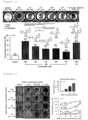
- Aqueous solutions of test compounds were added to multi-well plates containing aqueous solutions of sCMF (sonicated collagen microfiber) and allowed to stand at room temperature for a certain period of time, and subsequently, apparent transparency and transmittance at 600 mn were measured.
- sCMF sonicated collagen microfiber
- the upper panel of Figure 1 shows the plate from the transparentization treatment for 2 hours, and the lower panel of Figure 1 shows the transmittance.
- the transmittance when AMP was used (75.6%) was the highest, and the transmittance when poly A was used (69.0%) was the second highest.
- the transmittances when CMP and TMP were used were 45.2% and 31.6%, respectively.
- the cell survival rates in the transparentization using AMP, ADP, ATP, CMP, TMP, fructose, glucose, trehalose, sucrose, antipyrine, RapiClear 1.52, and poly A were examined.
- 1.0 x 10 5 human skin fibroblasts were seeded in a 24-well plate and cultured in DMEM medium.
- the survival rate in the transparentization treatment with AMP was the highest.
- the survival rate in the transparentization treatment with ADP was the next highest.
- the cell survival rate was higher in the case of treatment with CMP and TMP as well than in the case of treatment with RapiClear 1.52 and antipyrine, which are known transparentizing agents.
- the left panel of Figure 1 shows the plate from the transparentization treatment for 2 hours.
- the upper right panel of Figure 1 shows the relationship between the sCMF concentration and the transmittance when 50 wt% AMP was used.
- the effects of the AMP concentration and the sCMF concentration on transmittance are shown in Figure 2 .
- the concentration of the compound used for the transparentization can be adjusted according to, for example, thickness of biological tissue (a desired transparentization depth) and cell density of biological tissue.
- the upper part of Figure 3 shows photographs of the tissue (in a direction perpendicular to the dish) before and after the transparentization. It was confirmed with the naked eye that the tissue was completely transparentized.
- the lower part of Figure 3 shows images of immunostained blood vessels inside the tissue (in a direction perpendicular to the dish) before and after the transparentization treatment. The blood vessels in the deep part of the tissue were unclear before the transparentization treatment (left), whereas the blood vessels in the deep part of the tissue from the transparentization treatment were clearly observed (right).
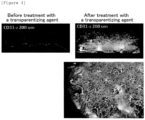
- the upper part of Figure 4 shows images of immunostained blood vessels inside the tissue (in a direction horizontal to the dish) before and after the transparentization treatment. Almost no blood vessels were observed before the transparentization treatment, whereas the blood vessels in the deep part were clearly observed by the transparentization treatment.
- the lower right panel of Figure 4 is a confocal laser microscope photograph of the entire vascular network after a transparentization treatment. From this photograph, it was confirmed that a vascular netwok was formed throughout a large space of several millimeters.
Landscapes
- Health & Medical Sciences (AREA)
- Life Sciences & Earth Sciences (AREA)
- Biochemistry (AREA)
- General Health & Medical Sciences (AREA)
- Molecular Biology (AREA)
- Physics & Mathematics (AREA)
- Chemical & Material Sciences (AREA)
- Analytical Chemistry (AREA)
- Engineering & Computer Science (AREA)
- Biomedical Technology (AREA)
- General Physics & Mathematics (AREA)
- Immunology (AREA)
- Pathology (AREA)
- Investigating Or Analysing Biological Materials (AREA)
- Measuring Or Testing Involving Enzymes Or Micro-Organisms (AREA)
- Sampling And Sample Adjustment (AREA)
- Micro-Organisms Or Cultivation Processes Thereof (AREA)
Claims (10)
- Procédé de clarification d'un tissu biologique dans un état vivant, qui comprend l'application d'une solution au tissu biologique, la solution contenant un ou plusieurs composés choisis dans le groupe consistant en nucléotide, dérivé nucléotidique, macromolécule contenant un nucléotide ou un dérivé nucléotidique, et polymère nucléotidique.
- Procédé selon la revendication 1, dans lequel le composé est un ou plusieurs composés choisis dans le groupe consistant en AMP, CMP, TMP, ADP, et poly A.
- Procédé selon la revendication 2, dans lequel le composé est un ou plusieurs composés choisis dans le groupe consistant en AMP, ADP, et poly A.
- Utilisation d'une composition de clarification d'un tissu biologique dans un état vivant, qui comprend un ou plusieurs composés choisis dans le groupe consistant en nucléotide, dérivé nucléotidique, macromolécule contenant un nucléotide ou un dérivé nucléotidique, et polymère nucléotidique.
- Utilisation d'une composition selon la revendication 4, dans laquelle le composé est un ou plusieurs composés choisis dans le groupe consistant en AMP, CMP, TMP, ADP, et poly A.
- Utilisation d'une composition selon la revendication 5, dans laquelle le composé est un ou plusieurs composés choisis dans le groupe consistant en AMP, ADP, et poly A.
- Utilisation d'un kit de clarification d'un tissu biologique dans un état vivant, qui comprend un ou plusieurs composés choisis dans le groupe consistant en nucléotide, dérivé nucléotidique, macromolécule contenant un nucléotide ou un dérivé nucléotidique, et polymère nucléotidique.
- Utilisation d'un kit selon la revendication 7, dans laquelle le composé est un ou plusieurs composés choisis dans le groupe consistant en AMP, CMP, TMP, ADP, et poly A.
- Utilisation d'un kit selon la revendication 8, dans laquelle le composé est un ou plusieurs composés choisis dans le groupe consistant en AMP, ADP, et poly A.
- Procédé permettant d'observer un tissu biologique, qui comprend la clarification du tissu biologique dans un état vivant en utilisant le procédé selon l'une quelconque des revendications 1 à 3, l'utilisation d'une composition selon l'une quelconque des revendications 4 à 6, ou l'utilisation d'un kit selon l'une quelconque des revendications 7 à 9 pour observer l'intérieur du tissu biologique.
Applications Claiming Priority (2)
| Application Number | Priority Date | Filing Date | Title |
|---|---|---|---|
| JP2019172865 | 2019-09-24 | ||
| PCT/JP2020/036017 WO2021060373A1 (fr) | 2019-09-24 | 2020-09-24 | Composition de clarification de tissu compatible avec les cellules |
Publications (3)
| Publication Number | Publication Date |
|---|---|
| EP4036246A1 EP4036246A1 (fr) | 2022-08-03 |
| EP4036246A4 EP4036246A4 (fr) | 2022-11-16 |
| EP4036246B1 true EP4036246B1 (fr) | 2025-04-09 |
Family
ID=75165235
Family Applications (1)
| Application Number | Title | Priority Date | Filing Date |
|---|---|---|---|
| EP20868918.2A Active EP4036246B1 (fr) | 2019-09-24 | 2020-09-24 | Procédé de clarification optique de tissus biologiques à l'état vivant |
Country Status (4)
| Country | Link |
|---|---|
| US (1) | US20220341825A1 (fr) |
| EP (1) | EP4036246B1 (fr) |
| JP (1) | JP7579578B2 (fr) |
| WO (1) | WO2021060373A1 (fr) |
Families Citing this family (1)
| Publication number | Priority date | Publication date | Assignee | Title |
|---|---|---|---|---|
| JPWO2024177108A1 (fr) | 2023-02-22 | 2024-08-29 |
Family Cites Families (15)
| Publication number | Priority date | Publication date | Assignee | Title |
|---|---|---|---|---|
| US4880918A (en) * | 1982-07-13 | 1989-11-14 | Eliezer Rapaport | Arrest and killing of tumor cells by adenosine 5-diphosphate and adenosine-5-triphosphate |
| US5227371A (en) * | 1982-07-13 | 1993-07-13 | Eliezer Rapaport | Utilization of adenine nucleotides and/or adenosine and inorganic phosphate for elevation of liver, blood and blood plasma adenosine 5'-triphosphate concentrations |
| US7671038B1 (en) * | 1993-10-08 | 2010-03-02 | Eliezer Rapaport | Method of therapeautic treatments including human immunodeficiency virus (HIV) disease and other conditions in a human host by administering adenine nucleotides |
| US7629329B2 (en) * | 2001-06-04 | 2009-12-08 | Tsi Health Sciences, Inc. | Method for increasing muscle mass and strength through administration of adenosine triphosphate |
| JP2003066035A (ja) * | 2001-08-06 | 2003-03-05 | Anse Ko | 水溶性組織清澄溶液 |
| JP5850419B2 (ja) | 2010-11-11 | 2016-02-03 | 国立大学法人大阪大学 | 細胞の三次元構造体、及び、これを製造する方法 |
| WO2014115206A1 (fr) * | 2013-01-28 | 2014-07-31 | 独立行政法人科学技術振興機構 | Procédé pour rendre un tissu transparent, réactif pour rendre un tissu transparent, et procédé d'observation d'un tissu |
| JP6433901B2 (ja) * | 2013-08-14 | 2018-12-05 | 国立研究開発法人理化学研究所 | 光透過性に優れた生物材料を調製するための組成物およびその利用 |
| JP2016538569A (ja) * | 2013-09-20 | 2016-12-08 | カリフォルニア インスティチュート オブ テクノロジー | 無傷全組織の表現型分類のための方法 |
| WO2015143638A1 (fr) * | 2014-03-26 | 2015-10-01 | 南京工业大学 | Procédé de production de nucléotides |
| EP3450953B1 (fr) | 2016-04-28 | 2025-11-19 | Riken | Composition pour préparer un matériel biologique présentant une excellente transmissivité de la lumière et utilisation de la composition |
| US20190195753A1 (en) * | 2016-08-10 | 2019-06-27 | Shiseido Company, Ltd. | Transparent skin sample |
| KR101866249B1 (ko) * | 2016-11-29 | 2018-06-12 | 박순현 | 생체 조직 투명화용 조성물 및 이를 이용한 생체 조직 투명화 방법 |
| JP7160350B2 (ja) * | 2017-07-06 | 2022-10-25 | 公立大学法人大阪 | 生体組織透明化法及びその試薬 |
| US20190128785A1 (en) * | 2017-10-31 | 2019-05-02 | Texas A&M System Technology Commercialization | Compositions and methods for tissue clearing |
-
2020
- 2020-09-24 JP JP2021548987A patent/JP7579578B2/ja active Active
- 2020-09-24 US US17/761,052 patent/US20220341825A1/en not_active Abandoned
- 2020-09-24 WO PCT/JP2020/036017 patent/WO2021060373A1/fr not_active Ceased
- 2020-09-24 EP EP20868918.2A patent/EP4036246B1/fr active Active
Also Published As
| Publication number | Publication date |
|---|---|
| EP4036246A1 (fr) | 2022-08-03 |
| JPWO2021060373A1 (fr) | 2021-04-01 |
| US20220341825A1 (en) | 2022-10-27 |
| WO2021060373A1 (fr) | 2021-04-01 |
| JP7579578B2 (ja) | 2024-11-08 |
| EP4036246A4 (fr) | 2022-11-16 |
Similar Documents
| Publication | Publication Date | Title |
|---|---|---|
| DE112020002516B4 (de) | Multivalente bindungszusammensetzung zur nukleinsäureanalyse | |
| Osborne | Microchemical Analysis of Nervous Tissue: Methods in Life Sciences | |
| EP3523314A1 (fr) | Dinucléotides cycliques contenant du benzimidazole, procédé pour leur préparation et leur utilisation pour activer un stimulateur des voies de signalisation dépendantes de gènes régulés par l'interféron (sting) | |
| JP6327565B2 (ja) | クマリン誘導体が結合した蛍光標識糖誘導体を用いた細胞イメージング方法及びイメージング剤 | |
| Ganim et al. | Mouse phospholamban gene expression during development in vivo and in vitro. | |
| JP2024518437A (ja) | 細胞以下の分解能での時空間分解トランスクリプトミクス | |
| Schreier et al. | Active uptake and trafficking of nucleoside triphosphates in vivo | |
| EP4036246B1 (fr) | Procédé de clarification optique de tissus biologiques à l'état vivant | |
| JP2022519324A (ja) | 核酸分析方法 | |
| JP5682881B2 (ja) | D−グルコースの細胞内への特異的な取り込みを評価するための方法 | |
| JP4866162B2 (ja) | 抗がん作用の評価方法 | |
| CA2530350A1 (fr) | Cellule numerique | |
| JPH10502655A (ja) | ジヌクレオシド−5’,5’−ピロリン酸 | |
| CN105754026A (zh) | 实现细胞膜修饰的糖胺聚糖类似物及其合成方法及其体外诱导干细胞定向分化的应用方法 | |
| WO2016029889A1 (fr) | Procédé de détermination de l'activité d'enzymes de conversion de dérivés de cytosine en dérivés d'uracile dans des cellules, des tissus et des organismes | |
| Gromovykh et al. | Development of bacterial cellulose biomaterial: preparation and establishment of cytotoxicity for eukaryotic cells | |
| Wold et al. | Mechanical measurement of contractile function of isolated ventricular myocytes | |
| RU2084523C1 (ru) | Способ получения питательной среды для культивирования лимфоцитов крови человека | |
| RU2346277C1 (ru) | Способ диагностики специфического синовита | |
| Grunwell | I. Studying DNA hairpin folding using single molecule FRET and II. Characterization and mutagenesis of Gal/GlcNAc-6-O-sulfotransferases | |
| EP4671362A1 (fr) | Polymère transparent permettant l'observation en profondeur d'un tissu tridimensionnel vivant | |
| Buolamwini et al. | Solution NMR Conformational Analysis of the Potent Equilibrative Sensitive (ES) Nucleoside Transporter Inhibitor, S 6-(4-Nitrobenzyl) mercaptopurine Riboside (NBMPR) | |
| CZ308090B6 (cs) | Transportér nukleosidtrifosfátů přes buněčnou membránu, způsob jeho přípravy a použití | |
| Klimová | Štefan Harsányi Daniela Klimová and colleagues | |
| Mrowietz | Shear Stress and NETosis |
Legal Events
| Date | Code | Title | Description |
|---|---|---|---|
| STAA | Information on the status of an ep patent application or granted ep patent |
Free format text: STATUS: THE INTERNATIONAL PUBLICATION HAS BEEN MADE |
|
| PUAI | Public reference made under article 153(3) epc to a published international application that has entered the european phase |
Free format text: ORIGINAL CODE: 0009012 |
|
| STAA | Information on the status of an ep patent application or granted ep patent |
Free format text: STATUS: REQUEST FOR EXAMINATION WAS MADE |
|
| 17P | Request for examination filed |
Effective date: 20220316 |
|
| AK | Designated contracting states |
Kind code of ref document: A1 Designated state(s): AL AT BE BG CH CY CZ DE DK EE ES FI FR GB GR HR HU IE IS IT LI LT LU LV MC MK MT NL NO PL PT RO RS SE SI SK SM TR |
|
| A4 | Supplementary search report drawn up and despatched |
Effective date: 20221014 |
|
| RIC1 | Information provided on ipc code assigned before grant |
Ipc: G01N 33/50 20060101ALI20221010BHEP Ipc: G01N 33/48 20060101ALI20221010BHEP Ipc: G01N 1/30 20060101ALI20221010BHEP Ipc: C12Q 1/68 20180101ALI20221010BHEP Ipc: C12Q 1/02 20060101AFI20221010BHEP |
|
| DAV | Request for validation of the european patent (deleted) | ||
| DAX | Request for extension of the european patent (deleted) | ||
| GRAP | Despatch of communication of intention to grant a patent |
Free format text: ORIGINAL CODE: EPIDOSNIGR1 |
|
| STAA | Information on the status of an ep patent application or granted ep patent |
Free format text: STATUS: GRANT OF PATENT IS INTENDED |
|
| INTG | Intention to grant announced |
Effective date: 20241112 |
|
| GRAS | Grant fee paid |
Free format text: ORIGINAL CODE: EPIDOSNIGR3 |
|
| GRAA | (expected) grant |
Free format text: ORIGINAL CODE: 0009210 |
|
| STAA | Information on the status of an ep patent application or granted ep patent |
Free format text: STATUS: THE PATENT HAS BEEN GRANTED |
|
| AK | Designated contracting states |
Kind code of ref document: B1 Designated state(s): AL AT BE BG CH CY CZ DE DK EE ES FI FR GB GR HR HU IE IS IT LI LT LU LV MC MK MT NL NO PL PT RO RS SE SI SK SM TR |
|
| REG | Reference to a national code |
Ref country code: GB Ref legal event code: FG4D |
|
| REG | Reference to a national code |
Ref country code: CH Ref legal event code: EP |
|
| REG | Reference to a national code |
Ref country code: DE Ref legal event code: R096 Ref document number: 602020049285 Country of ref document: DE |
|
| REG | Reference to a national code |
Ref country code: IE Ref legal event code: FG4D |
|
| REG | Reference to a national code |
Ref country code: NL Ref legal event code: MP Effective date: 20250409 |
|
| PG25 | Lapsed in a contracting state [announced via postgrant information from national office to epo] |
Ref country code: NL Free format text: LAPSE BECAUSE OF FAILURE TO SUBMIT A TRANSLATION OF THE DESCRIPTION OR TO PAY THE FEE WITHIN THE PRESCRIBED TIME-LIMIT Effective date: 20250409 |
|
| REG | Reference to a national code |
Ref country code: AT Ref legal event code: MK05 Ref document number: 1783557 Country of ref document: AT Kind code of ref document: T Effective date: 20250409 |
|
| PG25 | Lapsed in a contracting state [announced via postgrant information from national office to epo] |
Ref country code: FI Free format text: LAPSE BECAUSE OF FAILURE TO SUBMIT A TRANSLATION OF THE DESCRIPTION OR TO PAY THE FEE WITHIN THE PRESCRIBED TIME-LIMIT Effective date: 20250409 Ref country code: ES Free format text: LAPSE BECAUSE OF FAILURE TO SUBMIT A TRANSLATION OF THE DESCRIPTION OR TO PAY THE FEE WITHIN THE PRESCRIBED TIME-LIMIT Effective date: 20250409 Ref country code: PT Free format text: LAPSE BECAUSE OF FAILURE TO SUBMIT A TRANSLATION OF THE DESCRIPTION OR TO PAY THE FEE WITHIN THE PRESCRIBED TIME-LIMIT Effective date: 20250811 |
|
| REG | Reference to a national code |
Ref country code: LT Ref legal event code: MG9D |
|
| PG25 | Lapsed in a contracting state [announced via postgrant information from national office to epo] |
Ref country code: GR Free format text: LAPSE BECAUSE OF FAILURE TO SUBMIT A TRANSLATION OF THE DESCRIPTION OR TO PAY THE FEE WITHIN THE PRESCRIBED TIME-LIMIT Effective date: 20250710 Ref country code: NO Free format text: LAPSE BECAUSE OF FAILURE TO SUBMIT A TRANSLATION OF THE DESCRIPTION OR TO PAY THE FEE WITHIN THE PRESCRIBED TIME-LIMIT Effective date: 20250709 |
|
| PG25 | Lapsed in a contracting state [announced via postgrant information from national office to epo] |
Ref country code: PL Free format text: LAPSE BECAUSE OF FAILURE TO SUBMIT A TRANSLATION OF THE DESCRIPTION OR TO PAY THE FEE WITHIN THE PRESCRIBED TIME-LIMIT Effective date: 20250409 |
|
| PG25 | Lapsed in a contracting state [announced via postgrant information from national office to epo] |
Ref country code: BG Free format text: LAPSE BECAUSE OF FAILURE TO SUBMIT A TRANSLATION OF THE DESCRIPTION OR TO PAY THE FEE WITHIN THE PRESCRIBED TIME-LIMIT Effective date: 20250409 |
|
| PG25 | Lapsed in a contracting state [announced via postgrant information from national office to epo] |
Ref country code: HR Free format text: LAPSE BECAUSE OF FAILURE TO SUBMIT A TRANSLATION OF THE DESCRIPTION OR TO PAY THE FEE WITHIN THE PRESCRIBED TIME-LIMIT Effective date: 20250409 |
|
| PG25 | Lapsed in a contracting state [announced via postgrant information from national office to epo] |
Ref country code: AT Free format text: LAPSE BECAUSE OF FAILURE TO SUBMIT A TRANSLATION OF THE DESCRIPTION OR TO PAY THE FEE WITHIN THE PRESCRIBED TIME-LIMIT Effective date: 20250409 |
|
| PG25 | Lapsed in a contracting state [announced via postgrant information from national office to epo] |
Ref country code: RS Free format text: LAPSE BECAUSE OF FAILURE TO SUBMIT A TRANSLATION OF THE DESCRIPTION OR TO PAY THE FEE WITHIN THE PRESCRIBED TIME-LIMIT Effective date: 20250709 |
|
| PG25 | Lapsed in a contracting state [announced via postgrant information from national office to epo] |
Ref country code: IS Free format text: LAPSE BECAUSE OF FAILURE TO SUBMIT A TRANSLATION OF THE DESCRIPTION OR TO PAY THE FEE WITHIN THE PRESCRIBED TIME-LIMIT Effective date: 20250809 |
|
| PG25 | Lapsed in a contracting state [announced via postgrant information from national office to epo] |
Ref country code: LV Free format text: LAPSE BECAUSE OF FAILURE TO SUBMIT A TRANSLATION OF THE DESCRIPTION OR TO PAY THE FEE WITHIN THE PRESCRIBED TIME-LIMIT Effective date: 20250409 |
|
| REG | Reference to a national code |
Ref country code: DE Ref legal event code: R097 Ref document number: 602020049285 Country of ref document: DE |
|
| PG25 | Lapsed in a contracting state [announced via postgrant information from national office to epo] |
Ref country code: DK Free format text: LAPSE BECAUSE OF FAILURE TO SUBMIT A TRANSLATION OF THE DESCRIPTION OR TO PAY THE FEE WITHIN THE PRESCRIBED TIME-LIMIT Effective date: 20250409 Ref country code: SM Free format text: LAPSE BECAUSE OF FAILURE TO SUBMIT A TRANSLATION OF THE DESCRIPTION OR TO PAY THE FEE WITHIN THE PRESCRIBED TIME-LIMIT Effective date: 20250409 |
|
| PG25 | Lapsed in a contracting state [announced via postgrant information from national office to epo] |
Ref country code: CZ Free format text: LAPSE BECAUSE OF FAILURE TO SUBMIT A TRANSLATION OF THE DESCRIPTION OR TO PAY THE FEE WITHIN THE PRESCRIBED TIME-LIMIT Effective date: 20250409 |
|
| PG25 | Lapsed in a contracting state [announced via postgrant information from national office to epo] |
Ref country code: EE Free format text: LAPSE BECAUSE OF FAILURE TO SUBMIT A TRANSLATION OF THE DESCRIPTION OR TO PAY THE FEE WITHIN THE PRESCRIBED TIME-LIMIT Effective date: 20250409 |
|
| PG25 | Lapsed in a contracting state [announced via postgrant information from national office to epo] |
Ref country code: SK Free format text: LAPSE BECAUSE OF FAILURE TO SUBMIT A TRANSLATION OF THE DESCRIPTION OR TO PAY THE FEE WITHIN THE PRESCRIBED TIME-LIMIT Effective date: 20250409 |
|
| PG25 | Lapsed in a contracting state [announced via postgrant information from national office to epo] |
Ref country code: IT Free format text: LAPSE BECAUSE OF FAILURE TO SUBMIT A TRANSLATION OF THE DESCRIPTION OR TO PAY THE FEE WITHIN THE PRESCRIBED TIME-LIMIT Effective date: 20250409 |
|
| PG25 | Lapsed in a contracting state [announced via postgrant information from national office to epo] |
Ref country code: RO Free format text: LAPSE BECAUSE OF FAILURE TO SUBMIT A TRANSLATION OF THE DESCRIPTION OR TO PAY THE FEE WITHIN THE PRESCRIBED TIME-LIMIT Effective date: 20250409 |
|
| PLBE | No opposition filed within time limit |
Free format text: ORIGINAL CODE: 0009261 |
|
| STAA | Information on the status of an ep patent application or granted ep patent |
Free format text: STATUS: NO OPPOSITION FILED WITHIN TIME LIMIT |
|
| REG | Reference to a national code |
Ref country code: CH Ref legal event code: L10 Free format text: ST27 STATUS EVENT CODE: U-0-0-L10-L00 (AS PROVIDED BY THE NATIONAL OFFICE) Effective date: 20260218 |
|
| 26N | No opposition filed |
Effective date: 20260112 |