EP4032485B1 - System mit kurzer hämostatischer klammer - Google Patents
System mit kurzer hämostatischer klammer Download PDFInfo
- Publication number
- EP4032485B1 EP4032485B1 EP21217039.3A EP21217039A EP4032485B1 EP 4032485 B1 EP4032485 B1 EP 4032485B1 EP 21217039 A EP21217039 A EP 21217039A EP 4032485 B1 EP4032485 B1 EP 4032485B1
- Authority
- EP
- European Patent Office
- Prior art keywords
- clip arms
- capsule
- clip
- tension member
- yoke
- Prior art date
- Legal status (The legal status is an assumption and is not a legal conclusion. Google has not performed a legal analysis and makes no representation as to the accuracy of the status listed.)
- Active
Links
Images


Classifications
-
- A—HUMAN NECESSITIES
- A61—MEDICAL OR VETERINARY SCIENCE; HYGIENE
- A61B—DIAGNOSIS; SURGERY; IDENTIFICATION
- A61B17/00—Surgical instruments, devices or methods
- A61B17/12—Surgical instruments, devices or methods for ligaturing or otherwise compressing tubular parts of the body, e.g. blood vessels or umbilical cord
- A61B17/122—Clamps or clips, e.g. for the umbilical cord
- A61B17/1227—Spring clips
-
- A—HUMAN NECESSITIES
- A61—MEDICAL OR VETERINARY SCIENCE; HYGIENE
- A61B—DIAGNOSIS; SURGERY; IDENTIFICATION
- A61B17/00—Surgical instruments, devices or methods
- A61B17/0057—Implements for plugging an opening in the wall of a hollow or tubular organ, e.g. for sealing a vessel puncture or closing a cardiac septal defect
-
- A—HUMAN NECESSITIES
- A61—MEDICAL OR VETERINARY SCIENCE; HYGIENE
- A61B—DIAGNOSIS; SURGERY; IDENTIFICATION
- A61B17/00—Surgical instruments, devices or methods
- A61B17/08—Wound clamps or clips, i.e. not or only partly penetrating the tissue ; Devices for bringing together the edges of a wound
- A61B17/083—Clips, e.g. resilient
-
- A—HUMAN NECESSITIES
- A61—MEDICAL OR VETERINARY SCIENCE; HYGIENE
- A61B—DIAGNOSIS; SURGERY; IDENTIFICATION
- A61B17/00—Surgical instruments, devices or methods
- A61B17/12—Surgical instruments, devices or methods for ligaturing or otherwise compressing tubular parts of the body, e.g. blood vessels or umbilical cord
- A61B17/128—Surgical instruments, devices or methods for ligaturing or otherwise compressing tubular parts of the body, e.g. blood vessels or umbilical cord for applying or removing clamps or clips
- A61B17/1285—Surgical instruments, devices or methods for ligaturing or otherwise compressing tubular parts of the body, e.g. blood vessels or umbilical cord for applying or removing clamps or clips for minimally invasive surgery
-
- A—HUMAN NECESSITIES
- A61—MEDICAL OR VETERINARY SCIENCE; HYGIENE
- A61B—DIAGNOSIS; SURGERY; IDENTIFICATION
- A61B17/00—Surgical instruments, devices or methods
- A61B2017/0046—Surgical instruments, devices or methods with a releasable handle; with handle and operating part separable
- A61B2017/00473—Distal part, e.g. tip or head
-
- A—HUMAN NECESSITIES
- A61—MEDICAL OR VETERINARY SCIENCE; HYGIENE
- A61B—DIAGNOSIS; SURGERY; IDENTIFICATION
- A61B17/00—Surgical instruments, devices or methods
- A61B17/0057—Implements for plugging an opening in the wall of a hollow or tubular organ, e.g. for sealing a vessel puncture or closing a cardiac septal defect
- A61B2017/00575—Implements for plugging an opening in the wall of a hollow or tubular organ, e.g. for sealing a vessel puncture or closing a cardiac septal defect for closure at remote site, e.g. closing atrial septum defects
- A61B2017/00584—Clips
-
- A—HUMAN NECESSITIES
- A61—MEDICAL OR VETERINARY SCIENCE; HYGIENE
- A61B—DIAGNOSIS; SURGERY; IDENTIFICATION
- A61B17/00—Surgical instruments, devices or methods
- A61B2017/00743—Type of operation; Specification of treatment sites
- A61B2017/00818—Treatment of the gastro-intestinal system
-
- A—HUMAN NECESSITIES
- A61—MEDICAL OR VETERINARY SCIENCE; HYGIENE
- A61B—DIAGNOSIS; SURGERY; IDENTIFICATION
- A61B17/00—Surgical instruments, devices or methods
- A61B17/12—Surgical instruments, devices or methods for ligaturing or otherwise compressing tubular parts of the body, e.g. blood vessels or umbilical cord
- A61B2017/12004—Surgical instruments, devices or methods for ligaturing or otherwise compressing tubular parts of the body, e.g. blood vessels or umbilical cord for haemostasis, for prevention of bleeding
-
- A—HUMAN NECESSITIES
- A61—MEDICAL OR VETERINARY SCIENCE; HYGIENE
- A61B—DIAGNOSIS; SURGERY; IDENTIFICATION
- A61B90/00—Instruments, implements or accessories specially adapted for surgery or diagnosis and not covered by any of the groups A61B1/00 - A61B50/00, e.g. for luxation treatment or for protecting wound edges
- A61B90/03—Automatic limiting or abutting means, e.g. for safety
- A61B2090/037—Automatic limiting or abutting means, e.g. for safety with a frangible part, e.g. by reduced diameter
-
- A—HUMAN NECESSITIES
- A61—MEDICAL OR VETERINARY SCIENCE; HYGIENE
- A61B—DIAGNOSIS; SURGERY; IDENTIFICATION
- A61B90/00—Instruments, implements or accessories specially adapted for surgery or diagnosis and not covered by any of the groups A61B1/00 - A61B50/00, e.g. for luxation treatment or for protecting wound edges
- A61B90/03—Automatic limiting or abutting means, e.g. for safety
Definitions
- the present disclosure relates to endoscopic devices and, in particular, relates to endoscopic clipping devices for treating tissue along the gastrointestinal tract.
- Hemostasis clips may be used for hemostasis of, for example, mucosal/sub-mucosal defects, bleeding ulcers, arteries, polyps, diverticula, along with closure of luminal tract perforations. Depending on the size of the defect, multiple clips may be required.
- EP 2 455 009 A2 describes a ligating device comprising a clip having arms for holding tissue, a press tube, and a tightening member for opening the arms of the clip when fitted on the clip.
- the device comprises a connection member that is inserted in the press tube and is joined to the clip, and projections, as connection portions, for holding the arms of the clip in a closed state when the clip and the press tube are joined together.
- the tension member and yoke are configured to separate from one another to release the device from a proximal portion thereof, in response to a predetermined proximal force relative to the tension member.
- a locking mechanism is coupled to the deployment mechanism and including a pair of locking fingers configured to engage a corresponding locking feature of the capsule to lock the first and second clip arms in the closed configuration, when the yoke is separated from the tension member.
- the locking mechanism is separate from the one-piece clipping element.
- the first and second clip arms may be defined via a one-piece clipping element extending from a first end to a second end and including a bend along a portion thereof, the bend extending along a midpoint of the one-piece clipping element so that a length of the first and second clip arms substantially correspond.
- a distal end of tension member may be connected to the proximal end of the clip arms via a pin extending diametrically across the distal end of the tension member and through a substantially rounded space formed at the proximal end of the clip arms via the bend along the one-piece clipping element.
- the locking mechanism may include a ring coupled to the distal end of the tension member via the pin, the pair of locking fingers extending proximally from the ring.
- the capsule may have a length ranging from between approximately 7.5 mm to 8.5 mm.
- the first and second clip arms may be biased toward the open configuration so that, when the first and second clip arms are drawn proximally into the capsule, the first and second clip arms are constrained toward the closed configuration, and when the first and second clip arms are moved distally out of the capsule, the first and second clip arms are permitted to revert to their biased open configuration.
- the present disclosure also relates to a clipping device, comprising a clip including a capsule extending longitudinally from a proximal end to a distal end and including a channel extending therethrough. Proximal ends of first and second clip arms are slidably received within the channel of the capsule to move the first and second clip arms relative to one another between an open configuration and a closed configuration.
- a deployment mechanism includes a tension member connected to a proximal end of the first and second clip arms.
- a yoke is releasably coupled to the tension member and is couplable to a control member, which is movable relative to the capsule to move the first and second clip arms between the open and closed configurations.
- the tension member and yoke are configured to separate in response to a predetermined proximal force relative to the tension member.
- a locking mechanism is coupled to the deployment mechanism and includes a pair of locking fingers configured to engage a corresponding locking feature of the capsule to lock the first and second clip arms in the closed configuration, when the yoke is separated from the tension member.
- a proximal portion is releasably coupled to the proximal end of the capsule so that, upon separation of the yoke from the tension member, the clip is released from the proximal portion and deployed in a body over the target tissue.
- the first and second clip arms may be defined via a one-piece clipping element extending from a first end to a second end and including a bend along a portion thereof, the bend extending along a midpoint of the one-piece clipping element so that a length of the first and second clip arms substantially correspond
- a distal end of the tension member may be connected to the proximal end of the clip arms via a pin extending diametrically across the distal end of the tension member and through a substantially rounded space formed at the proximal end of the clip arms via the bend along the one-piece clipping element.
- the locking mechanism may include a ring coupled to the distal end of the tension member via the pin, the pair of locking fingers extending proximally from the ring.
- the locking fingers may be biased radially outward and include locking structures extending from proximal ends thereof.
- the yoke may include a pair of overhangs constraining the proximal ends of the locking fingers against the yoke and preventing the locking structures from engaging the locking features of the capsule until the yoke is separated from the tension member.
- the capsule may have a length ranging from between approximately 7.5 mm to 8.5 mm.
- the clip device is locked in the closed configuration, once the target tissue is gripped as desired, by applying a predetermined proximal force along the control member to separate the yoke from the tension member, which permits locking fingers of a locking mechanism to engage corresponding locking features of the capsule.
- the present disclosure is directed to an endoscopic clipping device for treating internal tissue perforations, defects and/or bleeds.
- a shorter deployed clip may be preferred to improve visualization of the target site and to allow better maneuverability when placing multiple clips.
- Exemplary embodiments of the present disclosure describe a clip including clip arms defined via a one-piece element slidable within a capsule to move the clip between an open configuration and a closed configuration to clip target tissue, as desired.
- the one-piece element is connected to a separate deployment mechanism and locking mechanism to decrease a length of a deployed clip relative to other conventional clip designs which include capsules.
- proximal and distal are intended to refer to a direction toward and away from, respectively, a user of the device.
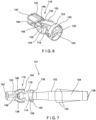
- a clip device 100 comprises a clip 101 including a one-piece element 102 defining a pair of clip arms 104 received within a capsule 106 to move the clip arms 104 between an open configuration, in which distal ends 108 of the clip arms 104 are separated from one another, and a closed configuration, in which the distal ends 108 are drawn toward one another to grip tissue.
- the one-piece element 102 extends from a first end 110 to a second end 112 and is bent, for example, at a joint or midpoint 114 to define the clip arms 104.
- the midpoint 114 is connected to a deployment mechanism 116 including a tension member 118 and a yoke 120, which are slidably received within the capsule 106 to move the clip arms 104 between the open and the closed configuration.
- a locking mechanism 122 is coupled to the one-piece element 102 and the deployment mechanism 116 so that, when the clip 101 is deployed over target tissue in a body, the clip 101 is locked in the closed configuration.
- the clip 101 is releasably coupled to an elongated proximal portion 160 of the device 100 sized to facilitate insertion of the clip 101 through a working channel of an endoscope to a target site within the body while a proximal end remains outside the body accessible to a user.
- the proximal portion 160 may include, for example, a handle member 162 including actuators 164 enabling a user to control movement and deployment of the clip 101 and a flexible shaft 166 extending distally from the handle member 162 to the clip 101, a distal end 168 of the flexible shaft 166 being releasably coupled to the clip 101 via, for example, a bushing 172.
- the user manipulates the actuators 164 to move a control member 170 that extends from the handle member 162, through the flexible shaft 166 to connect to the clip arms 104 to control movement of the clip arms 104 between the open and closed configurations.
- the capsule 106 extends from a proximal end 124 to a distal end 126 and includes a channel 128 extending therethrough.
- the proximal end 124 is configured to be releasably coupled to the proximal portion of the device via tabs 130 at the proximal end 124 of the capsule 106, which may be crimped radially inward to engage a corresponding portion of the proximal portion.
- the capsule 106 also includes, for example, locking features formed in a capsule wall such as, for example, locking windows 132 that extend laterally through the capsule wall for engaging a portion of the locking mechanism 122, as will be described in further detail below.
- the capsule 106 may have a length ranging from between 7.5 mm to 8.55 mm.
- the capsule 106 of this embodiment is substantially shorter than capsule lengths of some conventional clips, which may have lengths ranging from between 12.5 mm to 13.5 mm. It will be understood by those of skill in the art that the one-piece design of the clip arms 104 and the separate locking mechanism 122, which will be described in further detail below, permits the capsule 106 to have a shorter length relative to some existing clips without sacrificing an opening width of the clip arms 104.
- the clip arms 104 are formed from a one-piece element 102 which extends along a length from the first end 110 to the second end 112 and is bent at, for example, the midpoint 114 so that the clip arms 104 extend along a portion of a length extending from opposite sides of the midpoint 114, e.g., proximal of the first and second ends 110, 112.
- the first and second ends 110, 112 of the one-piece element 102 correspond to the distal ends 108 of the clip arms 104.
- the midpoint 114 is connected to the deployment mechanism 116 which is slidably received within the channel 128 of the capsule 106 so that the clip arms 104 are movable between the open and the closed configurations.
- the clip arms 104 are biased toward the open configuration so that, when advanced distally out of the capsule 106, the clip arms 104 move apart from one another into the open configuration under their natural bias.
- the clip arms 104 are constrained by the wall of the capsule 106 and drawn together into the closed position with the distal ends 108 adjacent one another.
- proximal ends of clip arms may be attached to one another such that the proximal ends are connectable to the tension member 118.
- the clip arms 104 of this embodiment also include engaging features 134 extending therefrom and configured to engage a portion of the capsule 106 so that, when the engaging features 134 engage the capsule 106, the clip arms 104 are prevented from being moved further proximally into the capsule 106.
- the engaging features 134 extend laterally outward from portions of the clip arms 104 so that portions of the clip arms 104 distal of the engaging features 134 have a greater width than portions of the clip arms 104 proximal of the engaging features 134.
- the portions of the clip arms 104 extending proximal of the engaging features 134 are sized to permit these portions of the clip arms 104 to be drawn proximally into the capsule 106.
- the engaging features 134 abut a portion of a distal face 127 of the capsule 106 preventing the clip arms 104 from being drawn further proximally into the capsule 106.
- the engaging features 134 are positioned along the length of the clip arms 104 so that, at the point where the engaging features 134 have engaged the capsule 106, the clip arms 104 have been drawn sufficiently proximally into the capsule 106 to draw the clip arms 104 together into the closed configuration.
- the engaging features 134 are configured as wings extending laterally from longitudinal edges of the clip arms 104.
- the pin 140 extends immediately distal of the midpoint 114 so that the pin 140 extends between the pair of arms 104 along an interior surface of the one-piece element 102 along the bend at the midpoint 114.
- the tension member 118 and the pin 140 are connected to the one-piece element 102 such that longitudinal movement of the tension member 118 relative to the capsule 106 correspondingly moves the clip arms 104 relative to the capsule 106.
- the proximal end 136 of the tension member 118 is sized and shaped to engage a correspondingly sized and shaped portion of the yoke 120.
- the proximal end 136 includes a substantially C-shaped protrusion.
- the overhangs 148 are configured to constrain proximal ends 154 of locking arms 152 of the locking mechanism 122 so that the locking arms 154 are prevented from engaging the locking features 134 of the capsule 106 until the clip 101 has been deployed over target tissue.
- the locking arms 152 extend proximally from the opposing sides of the ring 150 to the proximal ends 154 and, in one embodiment, are biased radially outward.
- the ring 150 is connected to the tension member 118 so that the locking arms 152 extend along opposing sides of the tension member 118 to be constrained via the overhangs 148 of the yoke 120.
- the proximal ends 154 of the locking arms 152 include locking structures 156 extending therefrom so that, when the proximal ends 154 are permitted to revert to their biased configuration, the locking structures 156 engage the locking features 132 of the capsule 106.
- the locking structures 156 are configured as locking tabs extending from the proximal ends 154 to engage locking windows 132 of the capsule 106 when the proximal ends 154 are released from the overhangs 148.
- the proximal ends 154 are released and permitted to revert to their radially outwardly biased configuration when the predetermined force is exerted on the yoke 120 to separate the yoke 120 from the tension member 118.
- the clip 101 of the clip device 100 is inserted to a target site within the body via, for example, a working channel of an endoscope.
- the clip 101 is inserted through the working channel in the closed configuration so that the clip arms 104 do not damage in interior of the working channel.
- the clip arms 104 are moved distally relative to the capsule 106 extending distal portions of the clip arms 104 out of the capsule 106 and freeing the clip arms 104 to move apart under their natural bias toward the open configuration so that target tissue may be received between the clip arms 104.
- the clip 101 may be repeatedly moved between the open and closed configurations until a target portion of tissue is positioned between the clip arms 104 as desired.
- the user then draws the clip arms 104 proximally into capsule 106 so that, as the clip arms 104 are drawn into the capsule 106, the clip arms 104 are drawn toward one another to grip the target tissue between the distal ends 108 of the clip arms 104.
- the clip 101 may be moved between the open and closed configurations via movement of, for example, the control member 170 coupled to the yoke 120.
- the user applies increasing proximally directed force to the control member 170 after the engaging features 134 have engaged the capsule 106, as described above, until the predetermined force is pulling the yoke 120 proximally away from the tension member 118 so that they disengage from one another.
- the proximal ends 154 of the locking mechanism 122 of the clip arms 104 are released from the overhangs 148 of the yoke 120, freeing the proximal ends 154 to spring toward their radially outwardly biased configuration until the locking tabs 156 engage the locking windows 132 of the capsule 106, thereby locking the clip 101 in the closed configuration.
- the yoke 120 may then be drawn further proximally relative to the capsule 106 (e.g., via the control member connected thereto) until a portion of the yoke 120 having a width corresponding to the channel 128 of the capsule 106 is positioned within the proximal end 124 of the capsule 106, urging the radially inwardly crimped tabs 130 radially outward, out of engagement with, for example, the bushing 172 of the proximal portion 160 of the device 100 and separating the clip 101 from the proximal portion 160.
- the clip 101 remains clipped over the target tissue while the proximal portion 160 may be removed from the body.
- the tabs 130 revert to their radially inwardly crimped configuration so that the yoke 120, although separated from the tension member 118, remains attached to the proximal end 124 of the capsule 106.
- a further proximal force exerted on the control member 170 separates the control member from the yoke 120, leaving the clip 101 in the body and allowing the proximal portion 160 of the device 100, including the control member 170, to be removed therefrom.
- the yoke 120 may be drawn proximally out of the capsule 106 so that the clip 101 remains within the body, clipped over the target tissue, while the proximal portion 160 and the yoke 120 may be removed from the body.
Landscapes
- Health & Medical Sciences (AREA)
- Surgery (AREA)
- Life Sciences & Earth Sciences (AREA)
- Medical Informatics (AREA)
- Animal Behavior & Ethology (AREA)
- Engineering & Computer Science (AREA)
- Biomedical Technology (AREA)
- Heart & Thoracic Surgery (AREA)
- Veterinary Medicine (AREA)
- Molecular Biology (AREA)
- Nuclear Medicine, Radiotherapy & Molecular Imaging (AREA)
- General Health & Medical Sciences (AREA)
- Public Health (AREA)
- Reproductive Health (AREA)
- Vascular Medicine (AREA)
- Cardiology (AREA)
- Surgical Instruments (AREA)
- Oral & Maxillofacial Surgery (AREA)
- Pathology (AREA)
Claims (10)
- Vorrichtung zur Behandlung von Gewebe, die aufweist:eine Kapsel (106), die sich longitudinal von einem proximalen Ende (124) zu einem distalen Ende (126) erstreckt und einen Kanal (128) aufweist, der sich dort hindurch erstreckt;ein einteiliges Klammerelement (102), das ein Paar Klammerarme (104) definiert, deren proximale Enden (158) in dem Kanal (128) aufgenommen sind, so dass der erste und der zweite Klammerarm (104) relativ zueinander zwischen einer offenen Konfiguration und einer geschlossenen Konfiguration beweglich sind;einen Freisetzungsmechanismus (116), der ein Spannelement (118), das mit einem proximalen Ende (158) der ersten und zweiten Klammerarme (104) verbunden ist, ein Joch (120) aufweist, das lösbar mit dem Spannelement (118) gekoppelt und longitudinal relativ zur Kapsel (106) beweglich ist, um die ersten und zweiten Klammerarme (104) zwischen der offenen und geschlossenen Konfiguration zu bewegen, wobei das Spannelement (118) und das Joch (120) konfiguriert sind, sich als Reaktion auf eine vorbestimmte proximale Kraft relativ zum Spannelement voneinander zu trennen, um die Vorrichtung von einem proximalen Abschnitt davon zu lösen;einen Verriegelungsmechanismus (122), der mit dem einteiligen Klammerelement (102) und dem Freisetzungsmechanismus (116) gekoppelt ist und ein Paar von Verriegelungsfingern (152) aufweist, die konfiguriert sind, in ein entsprechendes Verriegelungsmerkmal (132) der Kapsel (106) einzugreifen, um die ersten und zweiten Klammerarme (104) in der geschlossenen Konfiguration zu verriegeln, wenn das Joch (120) von dem Spannelement (118) getrennt ist; unddadurch gekennzeichnet, dassder Verriegelungsmechanismus (122) von dem einteiligen Klammerelement (102) separat ist.
- Vorrichtung nach Anspruch 1, wobei das einteilige Klammerelement (102) von dem Freisetzungsmechanismus (116) und dem Verriegelungsmechanismus (122) separat ist, wobei das einteilige Klammerelement (102) mit dem separaten Freisetzungsmechanismus (116) und Verriegelungsmechanismus (122) verbunden ist.
- Vorrichtung nach Anspruch 1 oder 2, die ferner einen Stift (140) aufweist, wobei ein distales Ende des Spannelements (118) mit dem proximalen Ende (158) der Klammerarme (104) über den Stift (140) verbunden ist, der sich diametral über das distale Ende (138) des Spannelements (118) und durch einen im Wesentlichen abgerundeten Raum erstreckt, der am proximalen Ende (158) der Klammerarme (104) über eine Biegung entlang des einteiligen Klammerelements (102) gebildet ist.
- Vorrichtung nach Anspruch 3, wobei sich das einteilige Klammerelement (102) von einem ersten Ende (110) zu einem zweiten Ende (112) erstreckt, wobei sich die Biegung entlang eines Mittelpunkts (114) des einteiligen Klammerelements (102) erstreckt, so dass eine Länge der ersten und zweiten Klammerarme (104) im Wesentlichen übereinstimmt.
- Vorrichtung nach Anspruch 3 oder 4, wobei der Verriegelungsmechanismus (122) einen Ring (150) aufweist, der über den Stift (140) mit dem distalen Ende des Spannelements (118) gekoppelt ist, wobei sich das Paar Verriegelungsfinger (152) proximal von dem Ring (150) erstreckt.
- Vorrichtung nach einem der Ansprüche 1 bis 5, wobei die Verriegelungsfinger (152) radial nach außen vorgespannt sind und Verriegelungsstrukturen (156) aufweisen, die sich von deren proximalen Enden erstrecken.
- Vorrichtung nach Anspruch 6, wobei das Joch (120) ein Paar Überhänge (148) aufweist, die die proximalen Enden der Verriegelungsfinger (152) gegen das Joch (120) halten und verhindern, dass die Verriegelungsstrukturen (156) in die Verriegelungsmerkmale (132) der Kapsel (106) in Eingriff kommen, bis das Joch (120) von dem Spannelement (118) getrennt wird.
- Vorrichtung nach einem der Ansprüche 1 bis 7, wobei die Kapsel (106) eine Länge im Bereich von etwa 7,5 mm bis 8,5 mm aufweist.
- Vorrichtung nach einem der Ansprüche 1 bis 8, wobei die ersten und zweiten Klammerarme (104) zur offenen Konfiguration vorgespannt sind, so dass, wenn die ersten und zweiten Klammerarme (104) in proximaler Richtung in die Kapsel (106) gezogen werden, die ersten und zweiten Klammerarme (104) zur geschlossenen Konfiguration gezwungen werden, und wenn die ersten und zweiten Klammerarme (104) distal aus der Kapsel (106) heraus bewegt werden, es ermöglicht wird, dass die ersten und zweiten Klammerarme (104) in ihre vorgespannte offene Konfiguration zurückkehren.
- Vorrichtung nach einem der Ansprüche 1 bis 9, die ferner einen proximalen Abschnitt (160) aufweist, der lösbar mit dem proximalen Ende (124) der Kapsel (106) gekoppelt ist, so dass bei Trennung des Jochs (120) vom Spannelement (118) die Klammer vom proximalen Abschnitt (160) gelöst und in einem Körper über dem Zielgewebe freigesetzt wird;
wobei die proximalen Enden (158) der ersten und zweiten Klammerarme (104) verschiebbar in dem Kanal (128) der Kapsel (106) aufgenommen sind und wobei das Joch (120) mit einem Steuerelement (170) koppelbar ist.
Applications Claiming Priority (3)
| Application Number | Priority Date | Filing Date | Title |
|---|---|---|---|
| US201962863016P | 2019-06-18 | 2019-06-18 | |
| EP20751372.2A EP3905970B1 (de) | 2019-06-18 | 2020-06-10 | System mit kurzer hämostatischer klammer |
| PCT/US2020/037037 WO2020257024A1 (en) | 2019-06-18 | 2020-06-10 | Hemostasis clip short system |
Related Parent Applications (2)
| Application Number | Title | Priority Date | Filing Date |
|---|---|---|---|
| EP20751372.2A Division EP3905970B1 (de) | 2019-06-18 | 2020-06-10 | System mit kurzer hämostatischer klammer |
| EP20751372.2A Division-Into EP3905970B1 (de) | 2019-06-18 | 2020-06-10 | System mit kurzer hämostatischer klammer |
Publications (2)
| Publication Number | Publication Date |
|---|---|
| EP4032485A1 EP4032485A1 (de) | 2022-07-27 |
| EP4032485B1 true EP4032485B1 (de) | 2025-05-07 |
Family
ID=71948708
Family Applications (2)
| Application Number | Title | Priority Date | Filing Date |
|---|---|---|---|
| EP20751372.2A Active EP3905970B1 (de) | 2019-06-18 | 2020-06-10 | System mit kurzer hämostatischer klammer |
| EP21217039.3A Active EP4032485B1 (de) | 2019-06-18 | 2020-06-10 | System mit kurzer hämostatischer klammer |
Family Applications Before (1)
| Application Number | Title | Priority Date | Filing Date |
|---|---|---|---|
| EP20751372.2A Active EP3905970B1 (de) | 2019-06-18 | 2020-06-10 | System mit kurzer hämostatischer klammer |
Country Status (8)
| Country | Link |
|---|---|
| US (3) | US11484314B2 (de) |
| EP (2) | EP3905970B1 (de) |
| JP (3) | JP7368487B2 (de) |
| KR (3) | KR102814683B1 (de) |
| CN (2) | CN113924051B (de) |
| AU (1) | AU2020295355B2 (de) |
| CA (1) | CA3129467C (de) |
| WO (1) | WO2020257024A1 (de) |
Families Citing this family (4)
| Publication number | Priority date | Publication date | Assignee | Title |
|---|---|---|---|---|
| US11484314B2 (en) * | 2019-06-18 | 2022-11-01 | Boston Scientific Scimed, Inc. | Hemostasis clip short system |
| JP7848333B2 (ja) * | 2022-02-09 | 2026-04-20 | ボストン サイエンティフィック サイムド,インコーポレイテッド | 止血クリップのためのロック機構 |
| CN115884718B (zh) * | 2022-03-21 | 2026-04-24 | 宁波新跃医疗科技股份有限公司 | 插入式组织夹闭装置及其运动杆 |
| WO2024072629A1 (en) * | 2022-09-27 | 2024-04-04 | Boston Scientific Scimed, Inc. | Locking feature for hemostasis clip |
Family Cites Families (23)
| Publication number | Priority date | Publication date | Assignee | Title |
|---|---|---|---|---|
| DE4319829C1 (de) * | 1993-06-16 | 1994-08-25 | Lerch Karl Dieter | Set zur Behandlung von Gefäßmißbildungen |
| JP4472217B2 (ja) * | 2000-10-16 | 2010-06-02 | オリンパス株式会社 | 生体組織のクリップ装置 |
| US6991634B2 (en) * | 2001-05-23 | 2006-01-31 | Pentax Corporation | Clip device of endoscope |
| US7094245B2 (en) * | 2001-10-05 | 2006-08-22 | Scimed Life Systems, Inc. | Device and method for through the scope endoscopic hemostatic clipping |
| US7357805B2 (en) * | 2001-12-13 | 2008-04-15 | Sumitomo Bakelite Company | Clip device for endoscope and clip for endoscope for use therein |
| EP2455009A3 (de) * | 2002-08-21 | 2017-09-06 | Olympus Corporation | Bindungsvorrichtung für biologisches Gewebe |
| US7727247B2 (en) | 2002-08-21 | 2010-06-01 | Olympus Corporation | Living tissue ligation device |
| JP4242614B2 (ja) | 2002-08-21 | 2009-03-25 | オリンパス株式会社 | 生体組織の結紮装置 |
| EP1670365B1 (de) | 2003-09-30 | 2018-12-05 | Boston Scientific Scimed, Inc. | Vorrichtung zum setzen eines hämostase-clips |
| US7494461B2 (en) | 2003-09-30 | 2009-02-24 | Boston Scientific Scimed, Inc. | Through the scope tension member release clip |
| JP4758173B2 (ja) * | 2004-12-24 | 2011-08-24 | オリンパス株式会社 | 結紮装置 |
| JP5244816B2 (ja) * | 2006-12-05 | 2013-07-24 | クック メディカル テクノロジーズ エルエルシー | 併用療法止血クリップ |
| JP5006753B2 (ja) * | 2007-10-17 | 2012-08-22 | Hoya株式会社 | 内視鏡用クリップ装置 |
| EP2630923B1 (de) * | 2008-06-19 | 2015-02-11 | Boston Scientific Scimed, Inc. | Blutstillende Klemmsetzvorrichtungen |
| JP5588711B2 (ja) | 2010-03-30 | 2014-09-10 | 富士フイルム株式会社 | 結紮装置 |
| JP2013027458A (ja) | 2011-07-27 | 2013-02-07 | Sony Corp | 情報処理装置、情報処理方法及びプログラム |
| JP5343113B2 (ja) | 2011-09-15 | 2013-11-13 | 富士フイルム株式会社 | クリップユニット及びこれを用いる結紮装置 |
| US9138234B2 (en) | 2011-11-14 | 2015-09-22 | Anrei Medical (Hz) Co., Ltd. | Clip apparatus for ligature of living tissue |
| JP2015532859A (ja) * | 2012-09-24 | 2015-11-16 | ボストン サイエンティフィック サイムド,インコーポレイテッドBoston Scientific Scimed,Inc. | 止血クリップのための解法機構 |
| CA3027258C (en) * | 2016-08-22 | 2021-01-05 | Boston Scientific Limited | Hemostasis reloadable clipping device with sleeve engagement |
| CN109922743B (zh) * | 2016-11-22 | 2021-12-14 | 波士顿科学有限公司 | 止血可重新加载的夹子释放机构 |
| EP3487423B1 (de) * | 2016-12-06 | 2022-03-23 | Boston Scientific Scimed, Inc. | Koppler für nachladbare hämostaseklammervorrichtung |
| US11484314B2 (en) * | 2019-06-18 | 2022-11-01 | Boston Scientific Scimed, Inc. | Hemostasis clip short system |
-
2020
- 2020-06-10 US US16/898,130 patent/US11484314B2/en active Active
- 2020-06-10 EP EP20751372.2A patent/EP3905970B1/de active Active
- 2020-06-10 CA CA3129467A patent/CA3129467C/en active Active
- 2020-06-10 KR KR1020247022622A patent/KR102814683B1/ko active Active
- 2020-06-10 EP EP21217039.3A patent/EP4032485B1/de active Active
- 2020-06-10 JP JP2021551836A patent/JP7368487B2/ja active Active
- 2020-06-10 AU AU2020295355A patent/AU2020295355B2/en active Active
- 2020-06-10 CN CN202080042308.6A patent/CN113924051B/zh active Active
- 2020-06-10 CN CN202510094311.7A patent/CN119655819A/zh active Pending
- 2020-06-10 KR KR1020257017357A patent/KR20250085837A/ko active Pending
- 2020-06-10 KR KR1020217027744A patent/KR102683750B1/ko active Active
- 2020-06-10 WO PCT/US2020/037037 patent/WO2020257024A1/en not_active Ceased
-
2022
- 2022-09-29 US US17/936,726 patent/US12076015B2/en active Active
-
2023
- 2023-08-04 JP JP2023127658A patent/JP7635313B2/ja active Active
-
2024
- 2024-07-31 US US18/790,650 patent/US20240390005A1/en active Pending
-
2025
- 2025-02-12 JP JP2025020420A patent/JP2025072594A/ja active Pending
Also Published As
| Publication number | Publication date |
|---|---|
| EP4032485A1 (de) | 2022-07-27 |
| JP2025072594A (ja) | 2025-05-09 |
| KR20210130731A (ko) | 2021-11-01 |
| CA3129467A1 (en) | 2020-12-24 |
| US20240390005A1 (en) | 2024-11-28 |
| AU2020295355B2 (en) | 2022-12-15 |
| CA3129467C (en) | 2025-06-10 |
| EP3905970B1 (de) | 2022-12-14 |
| JP7635313B2 (ja) | 2025-02-25 |
| US20230014853A1 (en) | 2023-01-19 |
| WO2020257024A1 (en) | 2020-12-24 |
| EP3905970A1 (de) | 2021-11-10 |
| KR20240110115A (ko) | 2024-07-12 |
| AU2020295355A1 (en) | 2021-08-12 |
| US12076015B2 (en) | 2024-09-03 |
| CN113924051B (zh) | 2025-02-11 |
| KR102814683B1 (ko) | 2025-05-29 |
| CN113924051A (zh) | 2022-01-11 |
| JP2023162219A (ja) | 2023-11-08 |
| KR20250085837A (ko) | 2025-06-12 |
| KR102683750B1 (ko) | 2024-07-10 |
| US20200397436A1 (en) | 2020-12-24 |
| JP7368487B2 (ja) | 2023-10-24 |
| JP2022522496A (ja) | 2022-04-19 |
| US11484314B2 (en) | 2022-11-01 |
| CN119655819A (zh) | 2025-03-21 |
Similar Documents
| Publication | Publication Date | Title |
|---|---|---|
| JP7477548B2 (ja) | 止血クリップ | |
| US12076015B2 (en) | Hemostasis clip short system | |
| US12220133B2 (en) | Hemostasis clip deployment | |
| KR102810437B1 (ko) | 전개된 클립의 길이를 단축시키는 전개 메커니즘을 갖는 클리핑 장치 | |
| EP3897406B1 (de) | Hämostase-clip mit zusammenklappbarer kapsel | |
| EP3937798B1 (de) | Federbelasteter mechanismus zum entfalten eines hämostatischen clips |
Legal Events
| Date | Code | Title | Description |
|---|---|---|---|
| PUAI | Public reference made under article 153(3) epc to a published international application that has entered the european phase |
Free format text: ORIGINAL CODE: 0009012 |
|
| STAA | Information on the status of an ep patent application or granted ep patent |
Free format text: STATUS: REQUEST FOR EXAMINATION WAS MADE |
|
| 17P | Request for examination filed |
Effective date: 20211222 |
|
| AC | Divisional application: reference to earlier application |
Ref document number: 3905970 Country of ref document: EP Kind code of ref document: P |
|
| AK | Designated contracting states |
Kind code of ref document: A1 Designated state(s): AL AT BE BG CH CY CZ DE DK EE ES FI FR GB GR HR HU IE IS IT LI LT LU LV MC MK MT NL NO PL PT RO RS SE SI SK SM TR |
|
| GRAP | Despatch of communication of intention to grant a patent |
Free format text: ORIGINAL CODE: EPIDOSNIGR1 |
|
| STAA | Information on the status of an ep patent application or granted ep patent |
Free format text: STATUS: GRANT OF PATENT IS INTENDED |
|
| INTG | Intention to grant announced |
Effective date: 20241220 |
|
| GRAS | Grant fee paid |
Free format text: ORIGINAL CODE: EPIDOSNIGR3 |
|
| GRAA | (expected) grant |
Free format text: ORIGINAL CODE: 0009210 |
|
| STAA | Information on the status of an ep patent application or granted ep patent |
Free format text: STATUS: THE PATENT HAS BEEN GRANTED |
|
| AC | Divisional application: reference to earlier application |
Ref document number: 3905970 Country of ref document: EP Kind code of ref document: P |
|
| AK | Designated contracting states |
Kind code of ref document: B1 Designated state(s): AL AT BE BG CH CY CZ DE DK EE ES FI FR GB GR HR HU IE IS IT LI LT LU LV MC MK MT NL NO PL PT RO RS SE SI SK SM TR |
|
| RAP3 | Party data changed (applicant data changed or rights of an application transferred) |
Owner name: BOSTON SCIENTIFIC SCIMED, INC. |
|
| REG | Reference to a national code |
Ref country code: GB Ref legal event code: FG4D |
|
| REG | Reference to a national code |
Ref country code: CH Ref legal event code: EP |
|
| REG | Reference to a national code |
Ref country code: DE Ref legal event code: R096 Ref document number: 602020051128 Country of ref document: DE |
|
| REG | Reference to a national code |
Ref country code: IE Ref legal event code: FG4D |
|
| PGFP | Annual fee paid to national office [announced via postgrant information from national office to epo] |
Ref country code: DE Payment date: 20250520 Year of fee payment: 6 |
|
| PGFP | Annual fee paid to national office [announced via postgrant information from national office to epo] |
Ref country code: GB Payment date: 20250619 Year of fee payment: 6 |
|
| PGFP | Annual fee paid to national office [announced via postgrant information from national office to epo] |
Ref country code: NL Payment date: 20250606 Year of fee payment: 6 |
|
| REG | Reference to a national code |
Ref country code: NL Ref legal event code: FP |
|
| PGFP | Annual fee paid to national office [announced via postgrant information from national office to epo] |
Ref country code: IE Payment date: 20250623 Year of fee payment: 6 |
|
| PG25 | Lapsed in a contracting state [announced via postgrant information from national office to epo] |
Ref country code: ES Free format text: LAPSE BECAUSE OF FAILURE TO SUBMIT A TRANSLATION OF THE DESCRIPTION OR TO PAY THE FEE WITHIN THE PRESCRIBED TIME-LIMIT Effective date: 20250507 Ref country code: PT Free format text: LAPSE BECAUSE OF FAILURE TO SUBMIT A TRANSLATION OF THE DESCRIPTION OR TO PAY THE FEE WITHIN THE PRESCRIBED TIME-LIMIT Effective date: 20250908 Ref country code: FI Free format text: LAPSE BECAUSE OF FAILURE TO SUBMIT A TRANSLATION OF THE DESCRIPTION OR TO PAY THE FEE WITHIN THE PRESCRIBED TIME-LIMIT Effective date: 20250507 |
|
| REG | Reference to a national code |
Ref country code: LT Ref legal event code: MG9D |
|
| PG25 | Lapsed in a contracting state [announced via postgrant information from national office to epo] |
Ref country code: NO Free format text: LAPSE BECAUSE OF FAILURE TO SUBMIT A TRANSLATION OF THE DESCRIPTION OR TO PAY THE FEE WITHIN THE PRESCRIBED TIME-LIMIT Effective date: 20250807 Ref country code: GR Free format text: LAPSE BECAUSE OF FAILURE TO SUBMIT A TRANSLATION OF THE DESCRIPTION OR TO PAY THE FEE WITHIN THE PRESCRIBED TIME-LIMIT Effective date: 20250808 |
|
| PG25 | Lapsed in a contracting state [announced via postgrant information from national office to epo] |
Ref country code: PL Free format text: LAPSE BECAUSE OF FAILURE TO SUBMIT A TRANSLATION OF THE DESCRIPTION OR TO PAY THE FEE WITHIN THE PRESCRIBED TIME-LIMIT Effective date: 20250507 |
|
| REG | Reference to a national code |
Ref country code: AT Ref legal event code: MK05 Ref document number: 1791579 Country of ref document: AT Kind code of ref document: T Effective date: 20250507 |
|
| PG25 | Lapsed in a contracting state [announced via postgrant information from national office to epo] |
Ref country code: BG Free format text: LAPSE BECAUSE OF FAILURE TO SUBMIT A TRANSLATION OF THE DESCRIPTION OR TO PAY THE FEE WITHIN THE PRESCRIBED TIME-LIMIT Effective date: 20250507 |
|
| PG25 | Lapsed in a contracting state [announced via postgrant information from national office to epo] |
Ref country code: HR Free format text: LAPSE BECAUSE OF FAILURE TO SUBMIT A TRANSLATION OF THE DESCRIPTION OR TO PAY THE FEE WITHIN THE PRESCRIBED TIME-LIMIT Effective date: 20250507 |
|
| PG25 | Lapsed in a contracting state [announced via postgrant information from national office to epo] |
Ref country code: AT Free format text: LAPSE BECAUSE OF FAILURE TO SUBMIT A TRANSLATION OF THE DESCRIPTION OR TO PAY THE FEE WITHIN THE PRESCRIBED TIME-LIMIT Effective date: 20250507 |
|
| PG25 | Lapsed in a contracting state [announced via postgrant information from national office to epo] |
Ref country code: RS Free format text: LAPSE BECAUSE OF FAILURE TO SUBMIT A TRANSLATION OF THE DESCRIPTION OR TO PAY THE FEE WITHIN THE PRESCRIBED TIME-LIMIT Effective date: 20250807 |
|
| PG25 | Lapsed in a contracting state [announced via postgrant information from national office to epo] |
Ref country code: IS Free format text: LAPSE BECAUSE OF FAILURE TO SUBMIT A TRANSLATION OF THE DESCRIPTION OR TO PAY THE FEE WITHIN THE PRESCRIBED TIME-LIMIT Effective date: 20250907 |
|
| PG25 | Lapsed in a contracting state [announced via postgrant information from national office to epo] |
Ref country code: LV Free format text: LAPSE BECAUSE OF FAILURE TO SUBMIT A TRANSLATION OF THE DESCRIPTION OR TO PAY THE FEE WITHIN THE PRESCRIBED TIME-LIMIT Effective date: 20250507 |
|
| PG25 | Lapsed in a contracting state [announced via postgrant information from national office to epo] |
Ref country code: SM Free format text: LAPSE BECAUSE OF FAILURE TO SUBMIT A TRANSLATION OF THE DESCRIPTION OR TO PAY THE FEE WITHIN THE PRESCRIBED TIME-LIMIT Effective date: 20250507 Ref country code: DK Free format text: LAPSE BECAUSE OF FAILURE TO SUBMIT A TRANSLATION OF THE DESCRIPTION OR TO PAY THE FEE WITHIN THE PRESCRIBED TIME-LIMIT Effective date: 20250507 |
|
| PG25 | Lapsed in a contracting state [announced via postgrant information from national office to epo] |
Ref country code: CZ Free format text: LAPSE BECAUSE OF FAILURE TO SUBMIT A TRANSLATION OF THE DESCRIPTION OR TO PAY THE FEE WITHIN THE PRESCRIBED TIME-LIMIT Effective date: 20250507 |
|
| PG25 | Lapsed in a contracting state [announced via postgrant information from national office to epo] |
Ref country code: EE Free format text: LAPSE BECAUSE OF FAILURE TO SUBMIT A TRANSLATION OF THE DESCRIPTION OR TO PAY THE FEE WITHIN THE PRESCRIBED TIME-LIMIT Effective date: 20250507 |
|
| PG25 | Lapsed in a contracting state [announced via postgrant information from national office to epo] |
Ref country code: SK Free format text: LAPSE BECAUSE OF FAILURE TO SUBMIT A TRANSLATION OF THE DESCRIPTION OR TO PAY THE FEE WITHIN THE PRESCRIBED TIME-LIMIT Effective date: 20250507 |
|
| REG | Reference to a national code |
Ref country code: CH Ref legal event code: H13 Free format text: ST27 STATUS EVENT CODE: U-0-0-H10-H13 (AS PROVIDED BY THE NATIONAL OFFICE) Effective date: 20260127 |
|
| PG25 | Lapsed in a contracting state [announced via postgrant information from national office to epo] |
Ref country code: IT Free format text: LAPSE BECAUSE OF FAILURE TO SUBMIT A TRANSLATION OF THE DESCRIPTION OR TO PAY THE FEE WITHIN THE PRESCRIBED TIME-LIMIT Effective date: 20250507 |
|
| PG25 | Lapsed in a contracting state [announced via postgrant information from national office to epo] |
Ref country code: RO Free format text: LAPSE BECAUSE OF FAILURE TO SUBMIT A TRANSLATION OF THE DESCRIPTION OR TO PAY THE FEE WITHIN THE PRESCRIBED TIME-LIMIT Effective date: 20250507 |
|
| REG | Reference to a national code |
Ref country code: DE Ref legal event code: R097 Ref document number: 602020051128 Country of ref document: DE |
|
| PG25 | Lapsed in a contracting state [announced via postgrant information from national office to epo] |
Ref country code: LU Free format text: LAPSE BECAUSE OF NON-PAYMENT OF DUE FEES Effective date: 20250610 |
|
| PG25 | Lapsed in a contracting state [announced via postgrant information from national office to epo] |
Ref country code: MC Free format text: LAPSE BECAUSE OF FAILURE TO SUBMIT A TRANSLATION OF THE DESCRIPTION OR TO PAY THE FEE WITHIN THE PRESCRIBED TIME-LIMIT Effective date: 20250507 |
|
| REG | Reference to a national code |
Ref country code: BE Ref legal event code: MM Effective date: 20250630 |
|
| PLBE | No opposition filed within time limit |
Free format text: ORIGINAL CODE: 0009261 |
|
| STAA | Information on the status of an ep patent application or granted ep patent |
Free format text: STATUS: NO OPPOSITION FILED WITHIN TIME LIMIT |
|
| REG | Reference to a national code |
Ref country code: CH Ref legal event code: L10 Free format text: ST27 STATUS EVENT CODE: U-0-0-L10-L00 (AS PROVIDED BY THE NATIONAL OFFICE) Effective date: 20260318 |
|
| 26N | No opposition filed |
Effective date: 20260210 |
|
| PG25 | Lapsed in a contracting state [announced via postgrant information from national office to epo] |
Ref country code: BE Free format text: LAPSE BECAUSE OF NON-PAYMENT OF DUE FEES Effective date: 20250630 |
|
| PG25 | Lapsed in a contracting state [announced via postgrant information from national office to epo] |
Ref country code: FR Free format text: LAPSE BECAUSE OF NON-PAYMENT OF DUE FEES Effective date: 20250707 |