EP4019303B1 - Lutfeder - Google Patents
Lutfeder Download PDFInfo
- Publication number
- EP4019303B1 EP4019303B1 EP21210018.4A EP21210018A EP4019303B1 EP 4019303 B1 EP4019303 B1 EP 4019303B1 EP 21210018 A EP21210018 A EP 21210018A EP 4019303 B1 EP4019303 B1 EP 4019303B1
- Authority
- EP
- European Patent Office
- Prior art keywords
- air spring
- spring according
- stop buffer
- annular collar
- truncated cone
- Prior art date
- Legal status (The legal status is an assumption and is not a legal conclusion. Google has not performed a legal analysis and makes no representation as to the accuracy of the status listed.)
- Active
Links
Images



Classifications
-
- B—PERFORMING OPERATIONS; TRANSPORTING
- B60—VEHICLES IN GENERAL
- B60G—VEHICLE SUSPENSION ARRANGEMENTS
- B60G17/00—Resilient suspensions having means for adjusting the spring or vibration-damper characteristics, for regulating the distance between a supporting surface and a sprung part of vehicle or for locking suspension during use to meet varying vehicular or surface conditions, e.g. due to speed or load
- B60G17/015—Resilient suspensions having means for adjusting the spring or vibration-damper characteristics, for regulating the distance between a supporting surface and a sprung part of vehicle or for locking suspension during use to meet varying vehicular or surface conditions, e.g. due to speed or load the regulating means comprising electric or electronic elements
- B60G17/019—Resilient suspensions having means for adjusting the spring or vibration-damper characteristics, for regulating the distance between a supporting surface and a sprung part of vehicle or for locking suspension during use to meet varying vehicular or surface conditions, e.g. due to speed or load the regulating means comprising electric or electronic elements characterised by the type of sensor or the arrangement thereof
-
- G—PHYSICS
- G01—MEASURING; TESTING
- G01B—MEASURING LENGTH, THICKNESS OR SIMILAR LINEAR DIMENSIONS; MEASURING ANGLES; MEASURING AREAS; MEASURING IRREGULARITIES OF SURFACES OR CONTOURS
- G01B17/00—Measuring arrangements characterised by the use of infrasonic, sonic or ultrasonic vibrations
-
- G—PHYSICS
- G01—MEASURING; TESTING
- G01S—RADIO DIRECTION-FINDING; RADIO NAVIGATION; DETERMINING DISTANCE OR VELOCITY BY USE OF RADIO WAVES; LOCATING OR PRESENCE-DETECTING BY USE OF THE REFLECTION OR RERADIATION OF RADIO WAVES; ANALOGOUS ARRANGEMENTS USING OTHER WAVES
- G01S15/00—Systems using the reflection or reradiation of acoustic waves, e.g. sonar systems
- G01S15/02—Systems using the reflection or reradiation of acoustic waves, e.g. sonar systems using reflection of acoustic waves
- G01S15/06—Systems determining the position data of a target
- G01S15/08—Systems for measuring distance only
-
- G—PHYSICS
- G01—MEASURING; TESTING
- G01S—RADIO DIRECTION-FINDING; RADIO NAVIGATION; DETERMINING DISTANCE OR VELOCITY BY USE OF RADIO WAVES; LOCATING OR PRESENCE-DETECTING BY USE OF THE REFLECTION OR RERADIATION OF RADIO WAVES; ANALOGOUS ARRANGEMENTS USING OTHER WAVES
- G01S15/00—Systems using the reflection or reradiation of acoustic waves, e.g. sonar systems
- G01S15/88—Sonar systems specially adapted for specific applications
-
- G—PHYSICS
- G01—MEASURING; TESTING
- G01S—RADIO DIRECTION-FINDING; RADIO NAVIGATION; DETERMINING DISTANCE OR VELOCITY BY USE OF RADIO WAVES; LOCATING OR PRESENCE-DETECTING BY USE OF THE REFLECTION OR RERADIATION OF RADIO WAVES; ANALOGOUS ARRANGEMENTS USING OTHER WAVES
- G01S7/00—Details of systems according to groups G01S13/00, G01S15/00, G01S17/00
- G01S7/52—Details of systems according to groups G01S13/00, G01S15/00, G01S17/00 of systems according to group G01S15/00
- G01S7/521—Constructional features
-
- B—PERFORMING OPERATIONS; TRANSPORTING
- B60—VEHICLES IN GENERAL
- B60G—VEHICLE SUSPENSION ARRANGEMENTS
- B60G2202/00—Indexing codes relating to the type of spring, damper or actuator
- B60G2202/10—Type of spring
- B60G2202/15—Fluid spring
- B60G2202/152—Pneumatic spring
-
- B—PERFORMING OPERATIONS; TRANSPORTING
- B60—VEHICLES IN GENERAL
- B60G—VEHICLE SUSPENSION ARRANGEMENTS
- B60G2204/00—Indexing codes related to suspensions per se or to auxiliary parts
- B60G2204/10—Mounting of suspension elements
- B60G2204/11—Mounting of sensors thereon
- B60G2204/111—Mounting of sensors thereon on pneumatic springs
-
- B—PERFORMING OPERATIONS; TRANSPORTING
- B60—VEHICLES IN GENERAL
- B60G—VEHICLE SUSPENSION ARRANGEMENTS
- B60G2206/00—Indexing codes related to the manufacturing of suspensions: constructional features, the materials used, procedures or tools
- B60G2206/01—Constructional features of suspension elements, e.g. arms, dampers, springs
- B60G2206/40—Constructional features of dampers and/or springs
- B60G2206/42—Springs
- B60G2206/424—Plunger or top retainer construction for bellows or rolling lobe type air springs
-
- B—PERFORMING OPERATIONS; TRANSPORTING
- B60—VEHICLES IN GENERAL
- B60G—VEHICLE SUSPENSION ARRANGEMENTS
- B60G2400/00—Indexing codes relating to detected, measured or calculated conditions or factors
- B60G2400/25—Stroke; Height; Displacement
- B60G2400/252—Stroke; Height; Displacement vertical
Definitions
- the invention relates to an air spring for a motor vehicle, the air spring having a device for non-contact distance measurement using the pulse-echo method inside the air spring of the motor vehicle, the air spring having at least one rolling piston, a rolling bellows and an end plate and the device having a transceiver -Have component with a sound source and a reflector component.
- Such devices are for example from DE 36 20 957 A1 previously known.
- the round sound transducers used in practice with a flat radiation surface generate a club-shaped sound field.
- the half-width of the sound intensity which is also specified as the opening angle of the sound cone, depends on the diameter of the sound-generating surface and the frequency of the ultrasound. Both factors reduce the opening angle.
- the opening angle of its sound cone is between 10° and 15°.
- the reflecting surface should be as perpendicular as possible to the propagation direction of the sound beam.
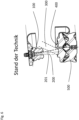
- the 6 shows such a device according to the prior art in a schematic representation.
- a sound transducer 100 generates a sound lobe 200 with an opening angle 201.
- connection plate and the piston are inclined towards one another in accordance with the suspension kinematics.
- transit time measurement is disrupted if too small a part of the reflector is in the sound field and therefore too little sound energy is reflected back to the sound transducer.
- the patent specification DE 196 48 112 C1 proposes a buffer which is convex in shape according to the installation position of the sound transducer, so that it reflects a sufficiently strong echo back to the sound transducer in all kinematic situations of the spring. This approach involves a lot of effort because the shape of the reflective buffer has to be adapted to each type of air spring.
- an air spring according to the preamble of claim 1 is disclosed. It describes a device for non-contact distance measurement of the type described above, in which the reflector has a reflective surface that has more or less punctiform bumps, the bumps having a predetermined arrangement on the reflective surface and a predetermined shape and size.
- Such predetermined bumps cause a widely scattered reflection of sound waves, which, depending on the angle of incidence of the sound beam, radiates back in many different spatial directions and which cause a multiple echo of the ultrasonic waves emitted by the sound beam, which is typical for the corresponding position, shape and size of the bumps.
- the U.S. 2014/091505 A1 discloses a gas spring assembly having a first end, a second end opposite the first end, and a plurality of reflector surfaces formed along the first end.
- a first reflective region extends from the first end surface at a first included angle.
- a second reflective area extends from the first reflective area at a second included angle that is different than the first included angle.
- the orthogonality between the direction of the sound beam and the reflecting plane is also dependent on the individual angles of the connection plate and the piston relative to one another.
- the invention was based on the object of improving the device described at the outset in such a way that there is a reliable reflection of the sound waves to the sound transducer that is as strong as possible for evaluating the distance measurement in every kinematic condition of the air spring, with the device also being suitable for requirements in the event of bump stop contacts.
- the reflector component has a reflection surface made of reflective bodies, which is in the form of truncated cones that are lined up in a ring, touching each other and are roughly bisected lengthways, with the reflective bodies formed in this way also being referred to as truncated cone sectors and with the truncated cone sectors being aligned radially and have such a conicity that the vertices of all truncated cone sectors protruding from the reflection surface touch a common plane and thereby intersect in such a way that the sector angles of the individual truncated cone sectors are always smaller than 180°.
- This design of the reflector ensures that an impinging sound is reflected in such a way that the sound front generated is wide and does not break off when the angular position of the reflecting surface in relation to the incident sound changes as long as the incident sound cone still hits the reflector.
- Under angling there is always a reflection edge that reflects directly in the direction of the sound source.
- the device itself is also suitable as a stop buffer.
- the air spring When the air spring is fully deflected, the crests of all truncated cone sectors of the reflector touch the end plate at the same time, so that no plastic deformation of the reflector is to be expected in the event of a buffer impact.
- the device is clipped onto the rolling piston.
- the device is screwed onto the rolling piston.
- the device has a diameter that can communicate with an opening in the rolling bellows, so that the rolling bellows can still be arranged on the rolling piston even when the device is clipped or screwed on.
- the device is designed in the form of a ring collar, with the inner opening of the ring collar having a stop buffer.
- the ring collar and the stop buffer are designed in two parts.
- the ring collar and the stop buffer are vulcanized together.
- the annular collar and the stop buffer are vulcanized together in one piece from rubber.
- the ring collar and the stop buffer are made of rubber materials of different hardnesses.
- the reflector is made of rubber or plastic.
- Such a design offers the possibility of selecting the materials in such a way that the reflector itself can be used as a stop buffer.
- the 1 shows a device 1 according to the invention in a perspective view.
- the device 1 has a reflection surface 2 which is formed from roughly halved, lined up and touching truncated cones 3 in the shape of a circular ring.
- the device 1 has an opening 4 in the middle, which is provided for receiving a stop buffer, not shown here.
- a stop buffer not shown here.
- bores 5 Arranged centrally around the opening 4 are bores 5 which allow air to be exchanged between the device 1 and a rolling piston (not shown here).
- the truncated cone sectors 3 are arranged in such a way that all their outer surfaces 6 protruding from the reflection surface 2 touch an imaginary common plane with their apex.
- the truncated cone sectors 3 are designed in such a way that their large radii 7 come to rest on the outer edge 8 of the reflection surface 2 and their small radii 9 on the inner edge 10 of the reflection surface 2 .
- the 2 shows a partial detail of the reflection surface 2 at its outer edge 8.
- the truncated cone sectors 3 touch and are arranged such that a sector angle 11 is formed on each truncated cone section 3, which is smaller than 180°.
- the 3 shows a partial detail of the reflection surface 2 at its inner edge 10.
- the truncated cone sectors 3 touch and are arranged such that a sector angle 12 is formed on each truncated cone section 3, which is also smaller than 180°.
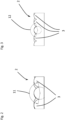
- a basic sketch of the device 1 according to the invention with a sound cone 13 is shown.
- the reflection surface 2 is opposite the imaginary center line of the Sound cone 13 inclined so that it does not form a right angle with the imaginary center line of the sound cone 13 .
- a sound wave symbolized by an arrow 14 is shown as an example, which, due to the formation of the reflection surface 2, strikes one of the truncated cone sectors 3 and is reflected from there in exactly the same direction, symbolized here by an arrow 15.
- the design of the reflection surface 2 ensures that this applies to all sound waves that hit the reflection surface 2 .
- FIG 5 an embodiment of the device 1 according to the invention is shown, in which a stop buffer 16 is arranged in the center of the device 1 .
- the device 1 is made of a plastic and the stop buffer 16 is made of a rubber material.
- the stop buffer 16 protrudes with its foot 17 through the opening 4 of the device 1.
- 2 barb-like holding elements 18 are arranged, with which the device 1 can be clipped into a rolling piston, not shown here.
- the stop buffer 16 is vulcanized onto the device 1 at a contact surface 19 .
- the stop buffer 16 protrudes beyond the common imaginary plane of the lateral surfaces 6 of the truncated cone sectors 3 by a predetermined amount, so that components of an air spring (not shown here) are prevented from striking the device 1 .
Landscapes
- Engineering & Computer Science (AREA)
- Physics & Mathematics (AREA)
- Radar, Positioning & Navigation (AREA)
- Remote Sensing (AREA)
- General Physics & Mathematics (AREA)
- Computer Networks & Wireless Communication (AREA)
- Acoustics & Sound (AREA)
- Mechanical Engineering (AREA)
- Measurement Of Velocity Or Position Using Acoustic Or Ultrasonic Waves (AREA)
Description
- Die Erfindung betrifft eine Luftfeder für ein Kraftfahrzeug, wobei die Luftfeder eine Vorrichtung zur berührungslosen Abstandsmessung nach dem Impuls-Echo-Verfahren innerhalb der Luftfeder des Kraftfahrzeuges aufweist, wobei die Luftfeder mindestens einen Abrollkolben, einen Abrollbalg und eine Abschlussplatte und die Vorrichtung eine Sende-Empfangs-Komponente mit einer Schallquelle und einer Reflektorkomponente aufweisen.
- Derartige Vorrichtungen sind z.B. aus der
DE 36 20 957 A1 vorbekannt. Die in der Praxis verwendeten runden Schallwandler mit ebener Abstrahlfläche erzeugen ein keulenförmiges Schallfeld. Die Halbwertsbreite der Schallintensität, die auch als Öffnungswinkel der Schallkeule angegeben wird, ist abhängig von dem Durchmesser der schallerzeugenden Fläche und der Frequenz des Ultraschalls. Beide Faktoren verkleinern den Öffnungswinkel. Bei der üblichen Auslegung des Wandlers für Nutzfahrzeug-Luftfedern beträgt der Öffnungswinkel seiner Schallkeule zwischen 10° und 15°. - Für die Messung der Federhöhe ist es notwendig, dass die reflektierten Schallimpulse den Schallwandler mit hinreichender Intensität erreichen, um ein auswertbares elektrisches Echosignal zu erzeugen. Um dies zu gewährleisten, sollte die Reflexionsfläche möglichst senkrecht zur Ausbreitungsrichtung des Schallstrahles liegen.
- Die
Fig. 6 zeigt eine derartige Vorrichtung gemäß dem Stand der Technik in einer Prinzipdarstellung. Ein Schallwandler 100 erzeugt eine Schallkeule 200 mit einem Öffnungswinkel 201. Im gezeigten Betriebspunkt kommt es zu einer Reflexion 300 der Schallkeule 200 an einer Prallplatte 400 eines Luftfederkolbens 500, die aufgrund der gezeigten Geometrie und der glatten Oberfläche der Prallplatte 400 keinerlei Echo auf den Schallwandler 100 zurückwirft. - Nach dem Stand der Technik käme es im gezeigten Fall also zu einem Versagen der Abstandsmessung.
- Während des Betriebes von Luftfedern ist die Forderung nach der Orthogonalität zwischen der Richtung des Schallstrahls und der reflektierenden Ebene häufig nicht erfüllt, wenn die Anschlussplatte und der Kolben entsprechend der Federungskinematik gegeneinander geneigt sind. Auch bei einem horizontalen Versatz zwischen den beiden Enden der Luftfeder wird die Laufzeitmessung gestört, wenn sich ein zu kleiner Teil des Reflektors in dem Schallfeld befindet und deshalb zu wenig Schallenergie zu dem Schallwandler zurückstrahlt.
- Die Patentschrift
DE 196 48 112 C1 schlägt einen Puffer vor, der entsprechend der Einbauposition des Schallwandlers konvex geformt ist, so dass er in allen kinematischen Situationen der Feder ein hinreichend starkes Echo zu dem Schallwandler zurückstrahlt. Dieser Ansatz verursacht hohen Aufwand, weil die Form des reflektierenden Puffers an jeden Luftfedertyp angepasst werden muss. - In der
DE 10 2018 216 155 A1 ist eine Luftfeder entsprechend dem Oberbegriff des Anspruchs 1 offenbart. Sie beschreibt eine Vorrichtung zur berührungslosen Abstandsmessung der eingangs geschilderten Art offenbart, bei der der Reflektor eine Reflexionsfläche aufweist, die mehr oder weniger punktförmige Unebenheiten aufweist, wobei die Unebenheiten eine vorbestimmte Anordnung auf der Reflexionsfläche sowie eine vorbestimmte Form und Größe aufweisen. - Derartige vorbestimmte Unebenheiten verursachen eine breit gestreute Reflexion von Schallwellen, die je nach Auftreffwinkel der Schallkeule in viele verschiedene Raumrichtungen zurückstrahlt und die ein mehrfaches, für die entsprechende Lage, Form und Größe der Unebenheiten typisches Echo der ausgesendeten Ultraschallwellen der Schallkeule verursachen.
- Durch die punktuelle Schallreflexion ist jedoch die reflektierte Leistung recht gering. Außerdem kann ein auf die Reflexionsfläche Auftreffen der Puffer wegen der geringen Größe der Unebenheiten und der damit verbundenen lokal hohen Flächenpressung Schaden nehmen oder auch die Unebenheiten selbst beschädigen. Insbesondere trifft dies auf Kunststoffpuffer zu.
- Die
US 2014/091505 A1 offenbart eine Gasfederanordnung mit einem ersten Ende, einem dem ersten Ende gegenüberliegenden zweiten Ende und einer Mehrzahl von entlang dem ersten Ende ausgebildeten Reflektorflächen. Ein erster reflektierender Bereich erstreckt sich von der ersten Endfläche in einem ersten eingeschlossenen Winkel. Ein zweiter reflektierender Bereich erstreckt sich von dem ersten reflektierenden Bereich in einem zweiten eingeschlossenen Winkel, der sich von dem ersten eingeschlossenen Winkel unterscheidet. Nachteiliger Weise ist die Orthogonalität zwischen der Richtung des Schallstrahls und der reflektierenden Ebene weiterhin abhängig von einzelnen Winkeln der Anschlussplatte und des Kolbens zueinander. - Der Erfindung lag die Aufgabe zugrunde, die eingangs geschilderte Vorrichtung derart zu verbessern, dass eine zuverlässige, zur Auswertung der Abstandsmessung möglichst starke Reflexion der Schallwellen zum Schallwandler in jeder kinematischen Bedingung der Luftfeder gegeben ist, wobei die Vorrichtung auch für Anforderungen bei Anschlagpufferberührungen geeignet ist.
- Diese Aufgabe wird dadurch gelöst, dass die Reflektorkomponente eine Reflexionsfläche aus Rückstrahlkörpern aufweist, die eine Form von ringförmig aneinander aufgereihten, einander sich berührenden, etwa längshalbierten Kegelstümpfen aufweist, wobei die derart ausgebildeten Reflexionskörper auch als Kegelstumpfsektoren bezeichnet werden und wobei die Kegelstumpfsektoren radial ausgerichtet sind und eine so geartete Konizität aufweisen, dass die aus der Reflexionsfläche herausragenden Scheitel aller Kegelstumpfsektoren eine gemeinsame Ebene tangieren und sich dabei so überschneiden, dass die dabei gebildeten Sektorwinkel der einzelnen Kegelstumpfsektoren immer kleiner als 180° sind.
- Bei diesem Aufbau des Reflektors wird sichergestellt, dass ein auftreffender Schall so reflektiert wird, dass die dabei erzeugte Schallfront breit ist und auch nicht abreißt, wenn sich die Winkellage der Reflexionsfläche gegenüber dem auftreffenden Schall ändert, solange die auftreffende Schallkeule den Reflektor noch trifft. Es bleibt unter Verwinkelung immer eine Rückstrahlkante erhalten, die direkt in die Richtung der Schallquelle reflektiert. Es erfolgt immer eine direkte Reflexion, weil durch Interferenz der Rückstrahl-Schallkeulen der benachbarten Kegelstumpfsektoren auch Zwischenzustände abgedeckt sind.
- Durch die Ausbildung der Reflexionsfläche, bei der die Scheitel aller Kegelstumpfsektoren alle eine gemeinsame Ebene tangieren, ist die Vorrichtung auch selbst als Anschlagpuffer geeignet. Bei voller Einfederung der Luftfeder tangieren die Scheitel aller Kegelstumpfsektoren des Reflektors die Abschlussplatte daher gleichzeitig, so dass keine plastische Deformation des Reflektors im Pufferanschlagfall zu erwarten ist.
- In einer Weiterbildung der Erfindung ist die Vorrichtung an den Abrollkolben angeclipst.
- In einer Weiterbildung der Erfindung ist die Vorrichtung an den Abrollkolben angeschraubt.
- In einer Weiterbildung der Erfindung weist die Vorrichtung einen Durchmesser auf, der mit einer Öffnung des Abrollbalges kommunizieren kann, sodass der Abrollbalg auch bei angeclipster oder angeschraubter Vorrichtung noch auf dem Abrollkolben angeordnet werden kann.
- Diese Anordnungen haben den Vorteil, dass die Montage der Luftfeder vereinfacht ist.
- In einer Weiterbildung der Erfindung ist die Vorrichtung ringkragenförmig ausgebildet, wobei die innere Öffnung des Ringkragens einen Anschlagpuffer aufweist.
- In einer Weiterbildung der Erfindung sind der Ringkragen und der Anschlagpuffer zweiteilig ausgebildet.
- In einer Weiterbildung der Erfindung sind der Ringkragen und der Anschlagpuffer zusammenvulkanisiert.
- In einer Weiterbildung der Erfindung sind der Ringkragen und der Anschlagpuffer einstückig aus Gummi zusammenvulkanisiert.
- In einer Weiterbildung der Erfindung sind der Ringkragen und der Anschlagpuffer aus Gummiwerkstoffen unterschiedlicher Härte ausgebildet.
- Diese Ausführungsformen bieten eine große Vielfalt an Gestaltungs- und Montagemöglichkeiten, sodass eine individuelle Anpassung an verschiedene Luftfeder Typen leicht möglich ist.
- In einer Weiterbildung der Erfindung ist der Reflektor aus Gummi oder Kunststoff ausgebildet.
- Eine derartige Ausbildung bietet die Möglichkeit, die Werkstoffe so auszuwählen, dass der Reflektor selbst als Anschlagpuffer verwendet werden kann.
- Anhand der Zeichnung wird nachstehend ein Beispiel der Erfindung näher erläutert. Es zeigt
- Fig. 1
- eine perspektivische Draufsicht auf eine erfindungsgemäße Vorrichtung,
- Fig. 2
- eine Prinzipdarstellung der Kegelstumpfanordnung auf der Reflexionsfläche von außen,
- Fig. 3
- eine Prinzipdarstellung der Kegelstumpfanordnung auf der Reflexionsfläche von innen,
- Fig. 4
- eine Prinzipskizze einer Schallreflexion bei verwickelter Vorrichtung,
- Fig. 5
- einen Schnitt durch eine erfindungsgemäße Vorrichtung mit anvulkanisiertem Anschlagpuffer
- Fig. 6
- eine Prinzipdarstellung einer gattungsgemäßen Vorrichtung nach dem Stand der Technik.
- Die
Fig. 1 zeigt eine erfindungsgemäße Vorrichtung 1 in einer perspektivischen Ansicht. Die Vorrichtung 1 weist eine Reflexionsfläche 2 auf, die aus etwa halbierten, aneinandergereihten und sich berührenden Kegelstümpfen 3 kreisringförmig ausgebildet ist. - Mittig weist die Vorrichtung 1 eine Öffnung 4 auf, die zur Aufnahme eines hier nicht gezeigten Anschlagpuffers vorgesehen ist. Um die Öffnung 4 herum zentrisch angeordnet sind Bohrungen 5, die einen Luftaustausch zwischen der Vorrichtung 1 und einem hier nicht gezeigten Abrollkolben ermöglichen.
- Die Kegelstumpfsektoren 3 sind so angeordnet, dass alle ihre aus der Reflexionsfläche 2 herausragenden Mantelflächen 6 mit ihrem Scheitel eine gedachte gemeinsame Ebene berühren. Dazu sind die Kegelstumpfsektoren 3 so ausgebildet, dass ihre großen Radien 7 am Außenrand 8 der Reflexionsfläche 2 und ihre kleinen Radien 9 am Innenrand 10 der Reflexionsfläche 2 zu liegen kommen.
- Die
Fig. 2 zeigt einen Teilausschnitt der Reflexionsfläche 2 an ihrem Außenrand 8. Die Kegelstumpfsektoren 3 berühren sich und sind so angeordnet, dass an jedem Kegelstumpfabschnitt 3 ein Sektorwinkel 11 ausgebildet ist, der kleiner als 180° ist. - Die
Fig. 3 zeigt einen Teilausschnitt der Reflexionsfläche 2 an ihrem Innenrand 10. Die Kegelstumpfsektoren 3 berühren sich und sind so angeordnet, dass an jedem Kegelstumpfabschnitt 3 ein Sektorwinkel 12 ausgebildet ist, der ebenfalls kleiner als 180° ist. - Durch die Ausbildung von Sektorenwinkeln <180° wird eine Bildung von Hinterschnitten vermieden.
- In der
Fig. 4 ist eine Prinzipskizze der erfindungsgemäßen Vorrichtung 1 mit einem Schallkegel 13 gezeigt. Die Reflexionsfläche 2 ist gegenüber der gedachten Mittellinie des Schallkegels 13 geneigt, sodass sie mit der gedachten Mittellinie des Schallkegels 13 keinen rechten Winkel bildet. Exemplarisch ist eine durch einen Pfeil 14 symbolisierte Schallwelle gezeigt, die aufgrund der Ausbildung der Reflexionsfläche 2 auf einen der Kegelstumpfsektoren 3 trifft und von dort in genau gleicher Richtung, hier durch einen Pfeil 15 symbolisiert, wieder reflektiert wird. Die Ausbildung der Reflexionsfläche 2 sorgt dafür, dass dies bei allen die Reflexionsfläche 2 treffenden Schallwellen zutrifft. - In der
Fig. 5 ist eine Ausführungsform der erfindungsgemäßen Vorrichtung 1 gezeigt, bei der ein Anschlagpuffer 16 mittig in der Vorrichtung 1 angeordnet ist. Die Vorrichtung 1 ist aus einem Kunststoff und der Anschlagpuffer 16 aus einem Gummiwerkstoff ausgebildet. Der Anschlagpuffer 16 ragt mit seinem Fuß 17 durch die Öffnung 4 der Vorrichtung 1. Auf der der Reflexionsfläche 2 abgewandten Seite der Vorrichtung 1 sind 2 widerhakenartige Halteelemente 18 angeordnet, mit der die Vorrichtung 1 in einen hier nicht gezeigten Abrollkolben einclipsbar ist. - An einer Berührungsfläche 19 ist der Anschlagpuffer 16 an der Vorrichtung 1 anvulkanisiert. Der Anschlagpuffer 16 ragt über die gemeinsame gedachte Ebene der Mantelflächen 6 der Kegelstumpfsektoren 3 über ein vorbestimmtes Maß hinaus, sodass ein Auftreffen von Bauteilen einer hier nicht gezeigten Luftfeder auf die Vorrichtung 1 vermieden wird.
-
- 1
- Vorrichtung
- 2
- Reflexionsfläche der Vorrichtung 1
- 3
- Kegelstumpfsektoren der Reflexionsfläche 2
- 4
- Öffnung in der Vorrichtung 1
- 5
- Bohrungen in der Vorrichtung 1
- 6
- Mantelflächen der Kegelstumpfsektoren 3
- 7
- große Radien der Kegelstumpfsektoren 3
- 8
- Außenrand der Reflexionsfläche 2
- 9
- kleine Radien der Kegelstumpfsektoren 3
- 10
- Innenrand der Reflexionsfläche 2
- 11, 12
- Sektorwinkel
- 13
- Schallkegel
- 14
- Pfeil, Schallwelle
- 15
- Pfeil, Reflexionswelle
- 16
- Anschlagpuffer
- 17
- Fuß des Anschlagpuffers 16
- 18
- Halteelemente der Vorrichtung 1
- 19
- Berührungsfläche zwischen Anschlagpuffer 16 und Vorrichtung 1
- 100
- Ultraschallwandler/Sende-Empfangs-Komponente (Stand der Technik)
- 200
- Schallkeule des Ultraschallwandlers 100 (Stand der Technik)
- 201
- Öffnungswinkel der Schallkeule 200 (Stand der Technik)
- 300
- Reflexion der Schallkeule 200 (Stand der Technik)
- 400
- Prallplatte (Stand der Technik)
- 500
- Luftfederkolben (Stand der Technik)
Claims (11)
- Luftfeder für ein Kraftfahrzeug, wobei die Luftfeder eine Vorrichtung (1) zur berührungslosen Abstandsmessung nach dem Impuls-Echo-Verfahren innerhalb der Luftfeder des Kraftfahrzeuges aufweist, wobei die Luftfeder mindestens einen Abrollkolben, einen Abrollbalg und eine Abschlussplatte und die Vorrichtung eine Sende-Empfangs-Komponente (100) mit einem Schallkegel(13) und einer Reflektorkomponente (2, 3, 400) aufweisen,
dadurch gekennzeichnet, dass
die Reflektorkomponente eine Reflexionsfläche (2) aus Rückstrahlkörpern (3) aufweist, die eine Form von ringförmig aufgereihten, einander sich berührenden etwa längshalbierten Kegelstümpfen (3) aufweist, wobei die derart ausgebildeten Reflexionskörper auch als Kegelstumpfsektoren bezeichnet werden und die Kegelstumpfsektoren (3) radial ausgerichtet sind und eine so geartete Konizität aufweisen, dass die aus der Reflexionsfläche (2) herausragenden Scheitel aller Kegelstumpfsektoren (3) eine gedachte gemeinsame Ebene tangieren und sich dabei so überschneiden, dass die dabei gebildeten Sektorwinkel (11, 12) der einzelnen Kegelstumpfsektoren (3) immer kleiner als 180° sind. - Luftfeder nach Anspruch 1, dadurch gekennzeichnet, dass die Vorrichtung (1) an den Abrollkolben angeclipst ist.
- Luftfeder nach Anspruch 1, dadurch gekennzeichnet, dass die Vorrichtung (1) an den Abrollkolben angeschraubt ist.
- Luftfeder nach Anspruch 1, 2 oder 3, dadurch gekennzeichnet, dass die Vorrichtung (1) einen Durchmesser aufweist, der mit einer Öffnung des Abrollbalges kommuniziert, sodass der Abrollbalg auch bei angeclipster oder angeschraubter Vorrichtung (1) noch auf dem Abrollkolben montierbar ist.
- Luftfeder nach einem der vorstehenden Ansprüche, dadurch gekennzeichnet, dass die Vorrichtung (1) ringkragenförmig ausgebildet ist, wobei die innere Öffnung (4) des Ringkragens einen Anschlagpuffer (16) aufweist.
- Luftfeder nach Anspruch 5, dadurch gekennzeichnet, dass der Ringkragen und der Anschlagpuffer (16) zweiteilig ausgebildet sind.
- Luftfeder nach Anspruch 5, dadurch gekennzeichnet, dass der Ringkragen und der Anschlagpuffer (16) aneinander vulkanisiert sind.
- Luftfeder nach Anspruch 5, dadurch gekennzeichnet, dass der Ringkragen und der Anschlagpuffer einstückig aus Gummi vulkanisiert sind.
- Luftfeder nach Anspruch 5, dadurch gekennzeichnet, dass der Ringkragen und der Anschlagpuffer (16) aus Gummiwerkstoffen unterschiedlicher Härte ausgebildet sind.
- Luftfeder nach Anspruch 5, dadurch gekennzeichnet, dass der Ringkragen und der Anschlagpuffer (16) aus Kunststoff oder Gummi ausgeführt sind, wobei ein Teil an das andere angespritzt ist.
- Luftfeder nach Anspruch 1 bis 4, dadurch gekennzeichnet, dass der Reflektor aus Gummi oder Kunststoff ausgebildet ist.
Applications Claiming Priority (1)
| Application Number | Priority Date | Filing Date | Title |
|---|---|---|---|
| DE102020216447.9A DE102020216447A1 (de) | 2020-12-22 | 2020-12-22 | Einrichtung zur berührungslosen Abstandsmessung |
Publications (2)
| Publication Number | Publication Date |
|---|---|
| EP4019303A1 EP4019303A1 (de) | 2022-06-29 |
| EP4019303B1 true EP4019303B1 (de) | 2023-08-23 |
Family
ID=78829582
Family Applications (1)
| Application Number | Title | Priority Date | Filing Date |
|---|---|---|---|
| EP21210018.4A Active EP4019303B1 (de) | 2020-12-22 | 2021-11-23 | Lutfeder |
Country Status (3)
| Country | Link |
|---|---|
| EP (1) | EP4019303B1 (de) |
| CN (1) | CN217606084U (de) |
| DE (1) | DE102020216447A1 (de) |
Families Citing this family (1)
| Publication number | Priority date | Publication date | Assignee | Title |
|---|---|---|---|---|
| DE102022124631A1 (de) * | 2022-09-26 | 2024-03-28 | Zf Cv Systems Global Gmbh | Einrichtung zur Messung der Karosseriehöhe |
Family Cites Families (4)
| Publication number | Priority date | Publication date | Assignee | Title |
|---|---|---|---|---|
| GB8516765D0 (en) | 1985-07-02 | 1985-08-07 | Dunlop Ltd | Suspension systems |
| DE19648112C1 (de) | 1996-11-21 | 1998-03-05 | Contitech Luftfedersyst Gmbh | Einrichtung zur berührungslosen Abstandsmessung |
| US9168804B2 (en) * | 2007-01-08 | 2015-10-27 | Firestone Industrial Products Company, Llc | End members, gas spring assemblies and suspension systems |
| DE102018216155A1 (de) | 2018-09-21 | 2020-03-26 | Contitech Luftfedersysteme Gmbh | Einrichtung zur berührungslosen Abstandsmessung |
-
2020
- 2020-12-22 DE DE102020216447.9A patent/DE102020216447A1/de not_active Withdrawn
-
2021
- 2021-11-23 EP EP21210018.4A patent/EP4019303B1/de active Active
- 2021-12-22 CN CN202123251448.5U patent/CN217606084U/zh active Active
Also Published As
| Publication number | Publication date |
|---|---|
| CN217606084U (zh) | 2022-10-18 |
| EP4019303A1 (de) | 2022-06-29 |
| DE102020216447A1 (de) | 2022-06-23 |
Similar Documents
| Publication | Publication Date | Title |
|---|---|---|
| EP3049772B1 (de) | Flüssigkeitstank mit einem ultraschallsensor | |
| EP3168642B1 (de) | Optoelektronischer sensor und verfahren zur erfassung eines objekts | |
| DE102019108299B4 (de) | THz-Messvorrichtung und THz-Messverfahren zum Ermitteln einer Schichtdicke oder eines Abstandes eines Messobjektes | |
| DE4435156A1 (de) | Ultraschallsensor | |
| DE102017009572B4 (de) | Radarabsorbierendes Flächenelement für ein einen Radarsensor aufweisendes Karosseriebauteil sowie Karosseriebauteil eines Fahrzeugs mit einem Radarsensor | |
| EP4019303B1 (de) | Lutfeder | |
| EP3018495B1 (de) | Sensor | |
| EP2449406A1 (de) | Radarsensor für kraftfahrzeuge | |
| EP2447733A1 (de) | Optoelektronischer Sensor | |
| EP3677877A1 (de) | Messrohr und ultraschall-durchflussmengenmesser | |
| DE60222788T2 (de) | Radarkuppel mit niedrigem radarquerschnitt | |
| DE102014224605A1 (de) | Fahrzeug-Ultraschallsensor | |
| EP1503226B1 (de) | Optischer Sensor | |
| DE102018006127B4 (de) | 1D-Ultraschallwandler-Einheit für die Materialerfassung | |
| DE4413894C2 (de) | Biegewandler in Topfform | |
| DE102014212633A1 (de) | Messvorrichtung und Verfahren zur Vermessung von Prüfobjekten | |
| DE102018216155A1 (de) | Einrichtung zur berührungslosen Abstandsmessung | |
| DE19510731C2 (de) | Ultraschall-Strecke in schmalen Kanälen von Gehäusen | |
| DE69015171T2 (de) | Reflektor für elektromagnetische energie. | |
| DE69222858T2 (de) | Radarreflektoren | |
| DE102014102374B4 (de) | Verfahren zur Prüfung eines Werkstücks mittels Ultraschall | |
| DE102007008401B4 (de) | Ultraschallsensor | |
| EP3265763A1 (de) | Schallwandler zum empfangen von wasserschallwellen, wandlervorrichtung, sonar und wasserfahrzeug | |
| EP2653883A1 (de) | Optischer Sensor | |
| DE2029049C3 (de) | Verfahren zur Lageermittlung von be wegten Objekten und eine Anordnung zur Durchführung des Verfahrens |
Legal Events
| Date | Code | Title | Description |
|---|---|---|---|
| PUAI | Public reference made under article 153(3) epc to a published international application that has entered the european phase |
Free format text: ORIGINAL CODE: 0009012 |
|
| STAA | Information on the status of an ep patent application or granted ep patent |
Free format text: STATUS: THE APPLICATION HAS BEEN PUBLISHED |
|
| AK | Designated contracting states |
Kind code of ref document: A1 Designated state(s): AL AT BE BG CH CY CZ DE DK EE ES FI FR GB GR HR HU IE IS IT LI LT LU LV MC MK MT NL NO PL PT RO RS SE SI SK SM TR |
|
| STAA | Information on the status of an ep patent application or granted ep patent |
Free format text: STATUS: REQUEST FOR EXAMINATION WAS MADE |
|
| 17P | Request for examination filed |
Effective date: 20230102 |
|
| RBV | Designated contracting states (corrected) |
Designated state(s): AL AT BE BG CH CY CZ DE DK EE ES FI FR GB GR HR HU IE IS IT LI LT LU LV MC MK MT NL NO PL PT RO RS SE SI SK SM TR |
|
| GRAP | Despatch of communication of intention to grant a patent |
Free format text: ORIGINAL CODE: EPIDOSNIGR1 |
|
| STAA | Information on the status of an ep patent application or granted ep patent |
Free format text: STATUS: GRANT OF PATENT IS INTENDED |
|
| INTG | Intention to grant announced |
Effective date: 20230321 |
|
| GRAS | Grant fee paid |
Free format text: ORIGINAL CODE: EPIDOSNIGR3 |
|
| GRAA | (expected) grant |
Free format text: ORIGINAL CODE: 0009210 |
|
| STAA | Information on the status of an ep patent application or granted ep patent |
Free format text: STATUS: THE PATENT HAS BEEN GRANTED |
|
| P01 | Opt-out of the competence of the unified patent court (upc) registered |
Effective date: 20230627 |
|
| AK | Designated contracting states |
Kind code of ref document: B1 Designated state(s): AL AT BE BG CH CY CZ DE DK EE ES FI FR GB GR HR HU IE IS IT LI LT LU LV MC MK MT NL NO PL PT RO RS SE SI SK SM TR |
|
| REG | Reference to a national code |
Ref country code: GB Ref legal event code: FG4D Free format text: NOT ENGLISH |
|
| REG | Reference to a national code |
Ref country code: CH Ref legal event code: EP |
|
| REG | Reference to a national code |
Ref country code: DE Ref legal event code: R096 Ref document number: 502021001316 Country of ref document: DE |
|
| REG | Reference to a national code |
Ref country code: IE Ref legal event code: FG4D Free format text: LANGUAGE OF EP DOCUMENT: GERMAN |
|
| REG | Reference to a national code |
Ref country code: LT Ref legal event code: MG9D |
|
| REG | Reference to a national code |
Ref country code: NL Ref legal event code: MP Effective date: 20230823 |
|
| PG25 | Lapsed in a contracting state [announced via postgrant information from national office to epo] |
Ref country code: GR Free format text: LAPSE BECAUSE OF FAILURE TO SUBMIT A TRANSLATION OF THE DESCRIPTION OR TO PAY THE FEE WITHIN THE PRESCRIBED TIME-LIMIT Effective date: 20231124 |
|
| PG25 | Lapsed in a contracting state [announced via postgrant information from national office to epo] |
Ref country code: IS Free format text: LAPSE BECAUSE OF FAILURE TO SUBMIT A TRANSLATION OF THE DESCRIPTION OR TO PAY THE FEE WITHIN THE PRESCRIBED TIME-LIMIT Effective date: 20231223 |
|
| PG25 | Lapsed in a contracting state [announced via postgrant information from national office to epo] |
Ref country code: SE Free format text: LAPSE BECAUSE OF FAILURE TO SUBMIT A TRANSLATION OF THE DESCRIPTION OR TO PAY THE FEE WITHIN THE PRESCRIBED TIME-LIMIT Effective date: 20230823 Ref country code: RS Free format text: LAPSE BECAUSE OF FAILURE TO SUBMIT A TRANSLATION OF THE DESCRIPTION OR TO PAY THE FEE WITHIN THE PRESCRIBED TIME-LIMIT Effective date: 20230823 Ref country code: PT Free format text: LAPSE BECAUSE OF FAILURE TO SUBMIT A TRANSLATION OF THE DESCRIPTION OR TO PAY THE FEE WITHIN THE PRESCRIBED TIME-LIMIT Effective date: 20231226 Ref country code: NO Free format text: LAPSE BECAUSE OF FAILURE TO SUBMIT A TRANSLATION OF THE DESCRIPTION OR TO PAY THE FEE WITHIN THE PRESCRIBED TIME-LIMIT Effective date: 20231123 Ref country code: NL Free format text: LAPSE BECAUSE OF FAILURE TO SUBMIT A TRANSLATION OF THE DESCRIPTION OR TO PAY THE FEE WITHIN THE PRESCRIBED TIME-LIMIT Effective date: 20230823 Ref country code: LV Free format text: LAPSE BECAUSE OF FAILURE TO SUBMIT A TRANSLATION OF THE DESCRIPTION OR TO PAY THE FEE WITHIN THE PRESCRIBED TIME-LIMIT Effective date: 20230823 Ref country code: LT Free format text: LAPSE BECAUSE OF FAILURE TO SUBMIT A TRANSLATION OF THE DESCRIPTION OR TO PAY THE FEE WITHIN THE PRESCRIBED TIME-LIMIT Effective date: 20230823 Ref country code: IS Free format text: LAPSE BECAUSE OF FAILURE TO SUBMIT A TRANSLATION OF THE DESCRIPTION OR TO PAY THE FEE WITHIN THE PRESCRIBED TIME-LIMIT Effective date: 20231223 Ref country code: HR Free format text: LAPSE BECAUSE OF FAILURE TO SUBMIT A TRANSLATION OF THE DESCRIPTION OR TO PAY THE FEE WITHIN THE PRESCRIBED TIME-LIMIT Effective date: 20230823 Ref country code: GR Free format text: LAPSE BECAUSE OF FAILURE TO SUBMIT A TRANSLATION OF THE DESCRIPTION OR TO PAY THE FEE WITHIN THE PRESCRIBED TIME-LIMIT Effective date: 20231124 Ref country code: FI Free format text: LAPSE BECAUSE OF FAILURE TO SUBMIT A TRANSLATION OF THE DESCRIPTION OR TO PAY THE FEE WITHIN THE PRESCRIBED TIME-LIMIT Effective date: 20230823 |
|
| PG25 | Lapsed in a contracting state [announced via postgrant information from national office to epo] |
Ref country code: PL Free format text: LAPSE BECAUSE OF FAILURE TO SUBMIT A TRANSLATION OF THE DESCRIPTION OR TO PAY THE FEE WITHIN THE PRESCRIBED TIME-LIMIT Effective date: 20230823 |
|
| PG25 | Lapsed in a contracting state [announced via postgrant information from national office to epo] |
Ref country code: ES Free format text: LAPSE BECAUSE OF FAILURE TO SUBMIT A TRANSLATION OF THE DESCRIPTION OR TO PAY THE FEE WITHIN THE PRESCRIBED TIME-LIMIT Effective date: 20230823 |
|
| PG25 | Lapsed in a contracting state [announced via postgrant information from national office to epo] |
Ref country code: SM Free format text: LAPSE BECAUSE OF FAILURE TO SUBMIT A TRANSLATION OF THE DESCRIPTION OR TO PAY THE FEE WITHIN THE PRESCRIBED TIME-LIMIT Effective date: 20230823 Ref country code: RO Free format text: LAPSE BECAUSE OF FAILURE TO SUBMIT A TRANSLATION OF THE DESCRIPTION OR TO PAY THE FEE WITHIN THE PRESCRIBED TIME-LIMIT Effective date: 20230823 Ref country code: ES Free format text: LAPSE BECAUSE OF FAILURE TO SUBMIT A TRANSLATION OF THE DESCRIPTION OR TO PAY THE FEE WITHIN THE PRESCRIBED TIME-LIMIT Effective date: 20230823 Ref country code: EE Free format text: LAPSE BECAUSE OF FAILURE TO SUBMIT A TRANSLATION OF THE DESCRIPTION OR TO PAY THE FEE WITHIN THE PRESCRIBED TIME-LIMIT Effective date: 20230823 Ref country code: DK Free format text: LAPSE BECAUSE OF FAILURE TO SUBMIT A TRANSLATION OF THE DESCRIPTION OR TO PAY THE FEE WITHIN THE PRESCRIBED TIME-LIMIT Effective date: 20230823 Ref country code: CZ Free format text: LAPSE BECAUSE OF FAILURE TO SUBMIT A TRANSLATION OF THE DESCRIPTION OR TO PAY THE FEE WITHIN THE PRESCRIBED TIME-LIMIT Effective date: 20230823 Ref country code: SK Free format text: LAPSE BECAUSE OF FAILURE TO SUBMIT A TRANSLATION OF THE DESCRIPTION OR TO PAY THE FEE WITHIN THE PRESCRIBED TIME-LIMIT Effective date: 20230823 |
|
| REG | Reference to a national code |
Ref country code: DE Ref legal event code: R097 Ref document number: 502021001316 Country of ref document: DE |
|
| PG25 | Lapsed in a contracting state [announced via postgrant information from national office to epo] |
Ref country code: IT Free format text: LAPSE BECAUSE OF FAILURE TO SUBMIT A TRANSLATION OF THE DESCRIPTION OR TO PAY THE FEE WITHIN THE PRESCRIBED TIME-LIMIT Effective date: 20230823 |
|
| PLBE | No opposition filed within time limit |
Free format text: ORIGINAL CODE: 0009261 |
|
| STAA | Information on the status of an ep patent application or granted ep patent |
Free format text: STATUS: NO OPPOSITION FILED WITHIN TIME LIMIT |
|
| PG25 | Lapsed in a contracting state [announced via postgrant information from national office to epo] |
Ref country code: MC Free format text: LAPSE BECAUSE OF FAILURE TO SUBMIT A TRANSLATION OF THE DESCRIPTION OR TO PAY THE FEE WITHIN THE PRESCRIBED TIME-LIMIT Effective date: 20230823 |
|
| PG25 | Lapsed in a contracting state [announced via postgrant information from national office to epo] |
Ref country code: LU Free format text: LAPSE BECAUSE OF NON-PAYMENT OF DUE FEES Effective date: 20231123 |
|
| 26N | No opposition filed |
Effective date: 20240524 |
|
| PG25 | Lapsed in a contracting state [announced via postgrant information from national office to epo] |
Ref country code: MC Free format text: LAPSE BECAUSE OF FAILURE TO SUBMIT A TRANSLATION OF THE DESCRIPTION OR TO PAY THE FEE WITHIN THE PRESCRIBED TIME-LIMIT Effective date: 20230823 Ref country code: LU Free format text: LAPSE BECAUSE OF NON-PAYMENT OF DUE FEES Effective date: 20231123 Ref country code: SI Free format text: LAPSE BECAUSE OF FAILURE TO SUBMIT A TRANSLATION OF THE DESCRIPTION OR TO PAY THE FEE WITHIN THE PRESCRIBED TIME-LIMIT Effective date: 20230823 |
|
| REG | Reference to a national code |
Ref country code: BE Ref legal event code: MM Effective date: 20231130 |
|
| REG | Reference to a national code |
Ref country code: IE Ref legal event code: MM4A |
|
| PG25 | Lapsed in a contracting state [announced via postgrant information from national office to epo] |
Ref country code: IE Free format text: LAPSE BECAUSE OF NON-PAYMENT OF DUE FEES Effective date: 20231123 |
|
| PG25 | Lapsed in a contracting state [announced via postgrant information from national office to epo] |
Ref country code: BE Free format text: LAPSE BECAUSE OF NON-PAYMENT OF DUE FEES Effective date: 20231130 |
|
| PG25 | Lapsed in a contracting state [announced via postgrant information from national office to epo] |
Ref country code: IE Free format text: LAPSE BECAUSE OF NON-PAYMENT OF DUE FEES Effective date: 20231123 Ref country code: BE Free format text: LAPSE BECAUSE OF NON-PAYMENT OF DUE FEES Effective date: 20231130 |
|
| PG25 | Lapsed in a contracting state [announced via postgrant information from national office to epo] |
Ref country code: BG Free format text: LAPSE BECAUSE OF FAILURE TO SUBMIT A TRANSLATION OF THE DESCRIPTION OR TO PAY THE FEE WITHIN THE PRESCRIBED TIME-LIMIT Effective date: 20230823 |
|
| PG25 | Lapsed in a contracting state [announced via postgrant information from national office to epo] |
Ref country code: BG Free format text: LAPSE BECAUSE OF FAILURE TO SUBMIT A TRANSLATION OF THE DESCRIPTION OR TO PAY THE FEE WITHIN THE PRESCRIBED TIME-LIMIT Effective date: 20230823 |
|
| REG | Reference to a national code |
Ref country code: CH Ref legal event code: PL |
|
| REG | Reference to a national code |
Ref country code: CH Ref legal event code: PL |
|
| PG25 | Lapsed in a contracting state [announced via postgrant information from national office to epo] |
Ref country code: CH Free format text: LAPSE BECAUSE OF NON-PAYMENT OF DUE FEES Effective date: 20241130 |
|
| PG25 | Lapsed in a contracting state [announced via postgrant information from national office to epo] |
Ref country code: CY Free format text: LAPSE BECAUSE OF FAILURE TO SUBMIT A TRANSLATION OF THE DESCRIPTION OR TO PAY THE FEE WITHIN THE PRESCRIBED TIME-LIMIT; INVALID AB INITIO Effective date: 20211123 |
|
| PGFP | Annual fee paid to national office [announced via postgrant information from national office to epo] |
Ref country code: DE Payment date: 20251130 Year of fee payment: 5 |
|
| PGFP | Annual fee paid to national office [announced via postgrant information from national office to epo] |
Ref country code: AT Payment date: 20260113 Year of fee payment: 5 |
|
| PGFP | Annual fee paid to national office [announced via postgrant information from national office to epo] |
Ref country code: FR Payment date: 20251126 Year of fee payment: 5 |
|
| PGFP | Annual fee paid to national office [announced via postgrant information from national office to epo] |
Ref country code: TR Payment date: 20251118 Year of fee payment: 5 |
|
| PG25 | Lapsed in a contracting state [announced via postgrant information from national office to epo] |
Ref country code: HU Free format text: LAPSE BECAUSE OF FAILURE TO SUBMIT A TRANSLATION OF THE DESCRIPTION OR TO PAY THE FEE WITHIN THE PRESCRIBED TIME-LIMIT; INVALID AB INITIO Effective date: 20211123 |