EP4011884B1 - Verbindungen und organisches elektrolumineszentes element - Google Patents
Verbindungen und organisches elektrolumineszentes element Download PDFInfo
- Publication number
- EP4011884B1 EP4011884B1 EP21757420.1A EP21757420A EP4011884B1 EP 4011884 B1 EP4011884 B1 EP 4011884B1 EP 21757420 A EP21757420 A EP 21757420A EP 4011884 B1 EP4011884 B1 EP 4011884B1
- Authority
- EP
- European Patent Office
- Prior art keywords
- substituted
- unsubstituted
- group
- carbon atoms
- group including
- Prior art date
- Legal status (The legal status is an assumption and is not a legal conclusion. Google has not performed a legal analysis and makes no representation as to the accuracy of the status listed.)
- Active
Links
Images
Classifications
-
- C—CHEMISTRY; METALLURGY
- C07—ORGANIC CHEMISTRY
- C07D—HETEROCYCLIC COMPOUNDS
- C07D487/00—Heterocyclic compounds containing nitrogen atoms as the only ring hetero atoms in the condensed system, not provided for by groups C07D451/00 - C07D477/00
- C07D487/22—Heterocyclic compounds containing nitrogen atoms as the only ring hetero atoms in the condensed system, not provided for by groups C07D451/00 - C07D477/00 in which the condensed system contains four or more hetero rings
-
- C—CHEMISTRY; METALLURGY
- C07—ORGANIC CHEMISTRY
- C07D—HETEROCYCLIC COMPOUNDS
- C07D491/00—Heterocyclic compounds containing in the condensed ring system both one or more rings having oxygen atoms as the only ring hetero atoms and one or more rings having nitrogen atoms as the only ring hetero atoms, not provided for by groups C07D451/00 - C07D459/00, C07D463/00, C07D477/00 or C07D489/00
- C07D491/22—Heterocyclic compounds containing in the condensed ring system both one or more rings having oxygen atoms as the only ring hetero atoms and one or more rings having nitrogen atoms as the only ring hetero atoms, not provided for by groups C07D451/00 - C07D459/00, C07D463/00, C07D477/00 or C07D489/00 in which the condensed system contains four or more hetero rings
-
- C—CHEMISTRY; METALLURGY
- C07—ORGANIC CHEMISTRY
- C07D—HETEROCYCLIC COMPOUNDS
- C07D519/00—Heterocyclic compounds containing more than one system of two or more relevant hetero rings condensed among themselves or condensed with a common carbocyclic ring system not provided for in groups C07D453/00 or C07D455/00
-
- C—CHEMISTRY; METALLURGY
- C09—DYES; PAINTS; POLISHES; NATURAL RESINS; ADHESIVES; COMPOSITIONS NOT OTHERWISE PROVIDED FOR; APPLICATIONS OF MATERIALS NOT OTHERWISE PROVIDED FOR
- C09K—MATERIALS FOR MISCELLANEOUS APPLICATIONS, NOT PROVIDED FOR ELSEWHERE
- C09K11/00—Luminescent materials, e.g. electroluminescent or chemiluminescent
- C09K11/06—Luminescent materials, e.g. electroluminescent or chemiluminescent containing organic luminescent materials
-
- H—ELECTRICITY
- H10—SEMICONDUCTOR DEVICES; ELECTRIC SOLID-STATE DEVICES NOT OTHERWISE PROVIDED FOR
- H10K—ORGANIC ELECTRIC SOLID-STATE DEVICES
- H10K85/00—Organic materials used in the body or electrodes of devices covered by this subclass
- H10K85/60—Organic compounds having low molecular weight
- H10K85/615—Polycyclic condensed aromatic hydrocarbons, e.g. anthracene
- H10K85/622—Polycyclic condensed aromatic hydrocarbons, e.g. anthracene containing four rings, e.g. pyrene
-
- H—ELECTRICITY
- H10—SEMICONDUCTOR DEVICES; ELECTRIC SOLID-STATE DEVICES NOT OTHERWISE PROVIDED FOR
- H10K—ORGANIC ELECTRIC SOLID-STATE DEVICES
- H10K85/00—Organic materials used in the body or electrodes of devices covered by this subclass
- H10K85/60—Organic compounds having low molecular weight
- H10K85/615—Polycyclic condensed aromatic hydrocarbons, e.g. anthracene
- H10K85/623—Polycyclic condensed aromatic hydrocarbons, e.g. anthracene containing five rings, e.g. pentacene
-
- H—ELECTRICITY
- H10—SEMICONDUCTOR DEVICES; ELECTRIC SOLID-STATE DEVICES NOT OTHERWISE PROVIDED FOR
- H10K—ORGANIC ELECTRIC SOLID-STATE DEVICES
- H10K85/00—Organic materials used in the body or electrodes of devices covered by this subclass
- H10K85/60—Organic compounds having low molecular weight
- H10K85/615—Polycyclic condensed aromatic hydrocarbons, e.g. anthracene
- H10K85/626—Polycyclic condensed aromatic hydrocarbons, e.g. anthracene containing more than one polycyclic condensed aromatic rings, e.g. bis-anthracene
-
- H—ELECTRICITY
- H10—SEMICONDUCTOR DEVICES; ELECTRIC SOLID-STATE DEVICES NOT OTHERWISE PROVIDED FOR
- H10K—ORGANIC ELECTRIC SOLID-STATE DEVICES
- H10K85/00—Organic materials used in the body or electrodes of devices covered by this subclass
- H10K85/60—Organic compounds having low molecular weight
- H10K85/631—Amine compounds having at least two aryl rest on at least one amine-nitrogen atom, e.g. triphenylamine
- H10K85/636—Amine compounds having at least two aryl rest on at least one amine-nitrogen atom, e.g. triphenylamine comprising heteroaromatic hydrocarbons as substituents on the nitrogen atom
-
- H—ELECTRICITY
- H10—SEMICONDUCTOR DEVICES; ELECTRIC SOLID-STATE DEVICES NOT OTHERWISE PROVIDED FOR
- H10K—ORGANIC ELECTRIC SOLID-STATE DEVICES
- H10K85/00—Organic materials used in the body or electrodes of devices covered by this subclass
- H10K85/60—Organic compounds having low molecular weight
- H10K85/649—Aromatic compounds comprising a hetero atom
- H10K85/657—Polycyclic condensed heteroaromatic hydrocarbons
-
- H—ELECTRICITY
- H10—SEMICONDUCTOR DEVICES; ELECTRIC SOLID-STATE DEVICES NOT OTHERWISE PROVIDED FOR
- H10K—ORGANIC ELECTRIC SOLID-STATE DEVICES
- H10K85/00—Organic materials used in the body or electrodes of devices covered by this subclass
- H10K85/60—Organic compounds having low molecular weight
- H10K85/649—Aromatic compounds comprising a hetero atom
- H10K85/657—Polycyclic condensed heteroaromatic hydrocarbons
- H10K85/6574—Polycyclic condensed heteroaromatic hydrocarbons comprising only oxygen in the heteroaromatic polycondensed ring system, e.g. cumarine dyes
-
- H—ELECTRICITY
- H10—SEMICONDUCTOR DEVICES; ELECTRIC SOLID-STATE DEVICES NOT OTHERWISE PROVIDED FOR
- H10K—ORGANIC ELECTRIC SOLID-STATE DEVICES
- H10K85/00—Organic materials used in the body or electrodes of devices covered by this subclass
- H10K85/60—Organic compounds having low molecular weight
- H10K85/649—Aromatic compounds comprising a hetero atom
- H10K85/657—Polycyclic condensed heteroaromatic hydrocarbons
- H10K85/6576—Polycyclic condensed heteroaromatic hydrocarbons comprising only sulfur in the heteroaromatic polycondensed ring system, e.g. benzothiophene
-
- H—ELECTRICITY
- H10—SEMICONDUCTOR DEVICES; ELECTRIC SOLID-STATE DEVICES NOT OTHERWISE PROVIDED FOR
- H10K—ORGANIC ELECTRIC SOLID-STATE DEVICES
- H10K50/00—Organic light-emitting devices
- H10K50/10—OLEDs or polymer light-emitting diodes [PLED]
- H10K50/11—OLEDs or polymer light-emitting diodes [PLED] characterised by the electroluminescent [EL] layers
-
- H—ELECTRICITY
- H10—SEMICONDUCTOR DEVICES; ELECTRIC SOLID-STATE DEVICES NOT OTHERWISE PROVIDED FOR
- H10K—ORGANIC ELECTRIC SOLID-STATE DEVICES
- H10K85/00—Organic materials used in the body or electrodes of devices covered by this subclass
- H10K85/60—Organic compounds having low molecular weight
- H10K85/615—Polycyclic condensed aromatic hydrocarbons, e.g. anthracene
-
- H—ELECTRICITY
- H10—SEMICONDUCTOR DEVICES; ELECTRIC SOLID-STATE DEVICES NOT OTHERWISE PROVIDED FOR
- H10K—ORGANIC ELECTRIC SOLID-STATE DEVICES
- H10K85/00—Organic materials used in the body or electrodes of devices covered by this subclass
- H10K85/60—Organic compounds having low molecular weight
- H10K85/649—Aromatic compounds comprising a hetero atom
- H10K85/657—Polycyclic condensed heteroaromatic hydrocarbons
- H10K85/6572—Polycyclic condensed heteroaromatic hydrocarbons comprising only nitrogen in the heteroaromatic polycondensed ring system, e.g. phenanthroline or carbazole
Definitions
- a compound capable of fabricating an organic EL device having a long lifetime can be provided.
- a hydrogen atom includes its isotopes different in the number of neutrons, namely, a protium, a deuterium and a tritium.
- a hydrogen atom that is, a protium atom, a deuterium atom or a tritium atom is bonded.
- the number of ring carbon atoms represents the number of carbon atoms forming a subject ring itself among the carbon atoms of a compound having a structure in which atoms are bonded in a ring form (for example, a monocyclic compound, a fused ring compound, a cross-linked compound, a carbocyclic compound, or a heterocyclic compound).
- a compound having a structure in which atoms are bonded in a ring form for example, a monocyclic compound, a fused ring compound, a cross-linked compound, a carbocyclic compound, or a heterocyclic compound.
- the number of carbon atoms of the alkyl group is not included in the number of ring carbon atoms of the benzene ring. Therefore, the number of ring carbon atoms of the benzene ring substituted by the alkyl group is 6.
- the number of carbon atoms of the alkyl group is not included in the number of ring carbon atoms of the naphthalene ring. Therefore, the number of ring carbon atoms of the naphthalene ring substituted by the alkyl group is 10.
- the number of ring atoms described below, unless otherwise specified.
- the number of atoms of a pyridine ring is 6, the number of atoms of a quinazoline ring is 10, and the number of a furan ring is 5.
- hydrogen atoms bonded to a pyridine ring and atoms constituting a substituent substituted on the pyridine ring are not included in the number of ring atoms of the pyridine ring. Therefore, the number of ring atoms of a pyridine ring with which a hydrogen atom or a substituent is bonded is 6.
- XX to YY carbon atoms in the expression “a substituted or unsubstituted ZZ group including XX to YY carbon atoms” represents the number of carbon atoms in the case where the ZZ group is unsubstituted by a substituent, and does not include the number of carbon atoms of a substituent in the case where the ZZ group is substituted by the substituent.
- YY is larger than “XX"
- XX means an integer of 1 or more
- YY means an integer of 2 or more.
- XX to YY atoms in the expression "a substituted or unsubstituted ZZ group including XX to YY atoms” represents the number of atoms in the case where the ZZ group is unsubstituted by a substituent, and does not include the number of atoms of a substituent in the case where the ZZ group is substituted by the substituent.
- YY is larger than “XX”
- XX means an integer of 1 or more
- YY means an integer of 2 or more.
- the unsubstituted ZZ group represents the case where the "substituted or unsubstituted ZZ group" is a "ZZ group unsubstituted by a substituent”
- the substituted ZZ group represents the case where the "substituted or unsubstituted ZZ group” is a " ZZ group substituted by a substituent” .
- a term "unsubstituted” in the case of "a substituted or unsubstituted ZZ group” means that hydrogen atoms in the ZZ group are not substituted by a substituent.
- Hydrogen atoms in a term “unsubstituted ZZ group” are a protium atom, a deuterium atom, or a tritium atom.
- a term “substituted” in the case of "a substituted or unsubstituted ZZ group” means that one or more hydrogen atoms in the ZZ group are substituted by a substituent.
- a term “substituted” in the case of "a BB group substituted by an AA group” means that one or more hydrogen atoms in the BB group are substituted by the AA group.
- the number of ring carbon atoms of the "unsubstituted aryl group" described in this specification is 6 to 50, preferably 6 to 30, and more preferably 6 to 18, unless otherwise specified.
- the number of ring atoms of the "unsubstituted heterocyclic group" described in this specification is 5 to 50, preferably 5 to 30, and more preferably 5 to 18, unless otherwise specified.
- the number of carbon atoms of the "unsubstituted alkyl group" described in this specification is 1 to 50, preferably 1 to 20, and more preferably 1 to 6, unless otherwise specified.
- the number of carbon atoms of the "unsubstituted alkenyl group" described in this specification is 2 to 50, preferably 2 to 20, and more preferably 2 to 6, unless otherwise specified.
- the number of carbon atoms of the "unsubstituted alkynyl group" described in this specification is 2 to 50, preferably 2 to 20, and more preferably 2 to 6, unless otherwise specified.
- the number of ring carbon atoms of the "unsubstituted cycloalkyl group" described in this specification is 3 to 50, preferably 3 to 20, and more preferably 3 to 6, unless otherwise specified.
- the number of ring carbon atoms of the "unsubstituted arylene group" described in this specification is 6 to 50, preferably 6 to 30, and more preferably 6 to 18, unless otherwise specified.
- the number of ring atoms of the "unsubstituted divalent heterocyclic group" described in this specification is 5 to 50, preferably 5 to 30, and more preferably 5 to 18, unless otherwise specified.
- the number of carbon atoms of the "unsubstituted alkylene group" described in this specification is 1 to 50, preferably 1 to 20, and more preferably 1 to 6, unless otherwise specified.
- substituted or unsubstituted aryl group examples include the following unsubstituted aryl groups (specific example group G1A), substituted aryl groups (specific example group G1B), and the like.
- the unsubstituted aryl group refers to the case where the "substituted or unsubstituted aryl group” is an " aryl group unsubstituted by a substituent”
- the substituted aryl group refers to the case where the "substituted or unsubstituted aryl group” is an " aryl group substituted by a substituent”.
- aryl group it includes both a "unsubstituted aryl group” and a "substituted aryl group.”
- the "substituted aryl group” means a group in which one or more hydrogen atoms of the "unsubstituted aryl group” are substituted by a substituent.
- Specific examples of the "substituted aryl group” include, for example, groups in which one or more hydrogen atoms of the "unsubstituted aryl group” of the following specific example group G1A are substituted by a substituent, the substituted aryl groups of the following specific example group G1B, and the like.
- the examples of the "unsubstituted aryl group” and the examples of the “substituted aryl group” enumerated in this specification are mere examples, and the "substituted aryl group” described in this specification also includes a group in which a hydrogen atom bonded with a carbon atom of the aryl group itself in the "substituted aryl group” of the following specific group G1B is further substituted by a substituent, and a group in which a hydrogen atom of a substituent in the "substituted aryl group” of the following specific group G1B is further substituted by a substituent.
- heterocyclic group is a ring group having at least one hetero atom in the ring atom.
- the hetero atom include a nitrogen atom, an oxygen atom, a sulfur atom, a silicon atom, a phosphorus atom, and a boron atom.
- heterocyclic group in this specification is a monocyclic group or a fused ring group.
- heterocyclic group in this specification is an aromatic heterocyclic group or a non-aromatic heterocyclic group.
- the "substituted or unsubstituted heterocyclic group" (specific example group G2) described in this specification include the following unsubstituted heterocyclic group (specific example group G2A), the following substituted heterocyclic group (specific example group G2B), and the like.
- the unsubstituted heterocyclic group refers to the case where the "substituted or unsubstituted heterocyclic group” is a " heterocyclic group unsubstituted by a substituent”
- the substituted heterocyclic group refers to the case where the "substituted or unsubstituted heterocyclic group” is a " heterocyclic group substituted by a substituent”.
- the substituted heterocyclic group refers to the case where the "substituted or unsubstituted heterocyclic group” is a " heterocyclic group substituted by a substituent”.
- the examples of the "unsubstituted heterocyclic group” and the examples of the “substituted heterocyclic group” enumerated in this specification are mere examples, and the "substituted heterocyclic group” described in this specification includes groups in which hydrogen atom bonded with a ring atom of the heterocyclic group itself in the "substituted heterocyclic group” of the specific example group G2B is further substituted by a substituent, and a group in which hydrogen atom of a substituent in the "substituted heterocyclic group” of the specific example group G2B is further substituted by a substituent.
- Specific example group G2A includes, for example, the following unsubstituted heterocyclic group containing a nitrogen atom (specific example group G2A1), the following unsubstituted heterocyclic group containing an oxygen atom (specific example group G2A2), the following unsubstituted heterocyclic group containing a sulfur atom (specific example group G2A3), and the monovalent heterocyclic group derived by removing one hydrogen atom from the ring structures represented by any of the following general formulas (TEMP-16) to (TEMP-33) (specific example group G2A4).
- Specific example group G2B includes, for example, the following substituted heterocyclic group containing a nitrogen atom (specific example group G2B1), the following substituted heterocyclic group containing an oxygen atom (specific example group G2B2), the following substituted heterocyclic group containing a sulfur atom (specific example group G2B3), and the following group in which one or more hydrogen atoms of the monovalent heterocyclic group derived from the ring structures represented by any of the following general formulas (TEMP-16) to (TEMP-33) are substituted by a substituent (specific example group G2B4).
- X A and Y A are independently an oxygen atom, a sulfur atom, NH, or CH 2 . Provided that at least one of X A and Y A is an oxygen atom, a sulfur atom, or NH.
- the monovalent heterocyclic group derived from the ring structures represented by any of the general formulas (TEMP-16) to (TEMP-33) includes a monovalent group derived by removing one hydrogen atom from these NH or CH 2 .
- substituted or unsubstituted alkyl group (specific example group G3) described in this specification include the following unsubstituted alkyl groups (specific example group G3A) and the following substituted alkyl groups (specific example group G3B).
- the unsubstituted alkyl group refers to the case where the "substituted or unsubstituted alkyl group” is an " alkyl group unsubstituted by a substituent”
- substituted alkyl group refers to the case where the "substituted or unsubstituted alkyl group” is an " alkyl group substituted by a substituent”.
- alkyl group includes both the "unsubstituted alkyl group” and the "substituted alkyl group.”
- the "substituted alkyl group” means a group in which one or more hydrogen atoms in the "unsubstituted alkyl group” are substituted by a substituent.
- Specific examples of the "substituted alkyl group” include groups in which one or more hydrogen atoms in the following "unsubstituted alkyl group” (specific example group G3A) are substituted by a substituent, the following substituted alkyl group (specific example group G3B), and the like.
- the alkyl group in the "unsubstituted alkyl group” means a linear alkyl group.
- the "unsubstituted alkyl group” includes a straight-chain “unsubstituted alkyl group” and a branched-chain “unsubstituted alkyl group”. It should be noted that the examples of the "unsubstituted alkyl group” and the examples of the “substituted alkyl group” enumerated in this specification are mere examples, and the “substituted alkyl group” described in this specification includes a group in which hydrogen atom of the alkyl group itself in the "substituted alkyl group” of the specific example group G3B is further substituted by a substituent, and a group in which hydrogen atom of a substituent in the "substituted alkyl group” of the specific example group G3B is further substituted by a substituent.
- specific examples of the "substituted or unsubstituted alkenyl group" described in this specification include the following unsubstituted alkenyl group (specific example group G4A), the following substituted alkenyl group (specific example group G4B), and the like.
- the unsubstituted alkenyl group refers to the case where the "substituted or unsubstituted alkenyl group” is a " alkenyl group unsubstituted by a substituent"
- the "substituted alkenyl group” refers to the case where the "substituted or unsubstituted alkenyl group” is a " alkenyl group substituted by a substituent.”
- alkenyl group includes both the "unsubstituted alkenyl group” and the "substituted alkenyl group.”
- the "substituted alkenyl group” means a group in which one or more hydrogen atoms in the "unsubstituted alkenyl group” are substituted by a substituent.
- Specific examples of the "substituted alkenyl group” include a group in which the following "unsubstituted alkenyl group” (specific example group G4A) has a substituent, the following substituted alkenyl group (specific example group G4B), and the like.
- the examples of the "unsubstituted alkenyl group” and the examples of the “substituted alkenyl group” enumerated in this specification are mere examples, and the "substituted alkenyl group” described in this specification includes a group in which a hydrogen atom of the alkenyl group itself in the "substituted alkenyl group” of the specific example group G4B is further substituted by a substituent, and a group in which a hydrogen atom of a substituent in the "substituted alkenyl group” of the specific example group G4B is further substituted by a substituent.
- substituted or unsubstituted alkynyl group described in this specification (specific example group G5) include the following unsubstituted alkynyl group (specific example group G5A) and the like.
- the unsubstituted alkynyl group refers to the case where the "substituted or unsubstituted alkynyl group” is an " alkynyl group unsubstituted by a substituent".
- alkynyl group includes both the "unsubstituted alkynyl group” and the "substituted alkynyl group.”
- the "substituted alkynyl group” means a group in which one or more hydrogen atoms in the "unsubstituted alkynyl group” are substituted by a substituent.
- Specific examples of the "substituted alkynyl group” include a group in which one or more hydrogen atoms in the following "unsubstituted alkynyl group” (specific example group G5A) are substituted by a substituent, and the like.
- specific examples of the "substituted or unsubstituted cycloalkyl group" described in this specification include the following unsubstituted cycloalkyl group (specific example group G6A), the following substituted cycloalkyl group (specific example group G6B), and the like.
- the unsubstituted cycloalkyl group refers to the case where the "substituted or unsubstituted cycloalkyl group” is a " cycloalkyl group unsubstituted by a substituent"
- the substituted cycloalkyl group refers to the case where the "substituted or unsubstituted cycloalkyl group” is a " cycloalkyl group substituted by a substituent”.
- cycloalkyl group includes both the "unsubstituted cycloalkyl group” and the "substituted cycloalkyl group.”
- the "substituted cycloalkyl group” means a group in which one or more hydrogen atoms in the "unsubstituted cycloalkyl group” are substituted by a substituent.
- Specific examples of the "substituted cycloalkyl group” include a group in which one or more hydrogen atoms in the following "unsubstituted cycloalkyl group” (specific example group G6A) are substituted by a substituent, and examples of the following substituted cycloalkyl group (specific example group G6B), and the like.
- the examples of the "unsubstituted cycloalkyl group” and the examples of the “substituted cycloalkyl group” enumerated in this specification are mere examples, and the "substituted cycloalkyl group" in this specification includes a group in which one or more hydrogen atoms bonded with the carbon atom of the cycloalkyl group itself in the "substituted cycloalkyl group” of the specific example group G6B are substituted by a substituent, and a group in which a hydrogen atom of a substituent in the "substituted cycloalkyl group” of specific example group G6B is further substituted by a substituent.
- Specific examples of the group represented by -Si(R 901 )(R 902 )(R 903 ) described in this specification include: -Si(G1)(G1), -Si(G1)(G2)(G2), -Si(G1)(G1)(G2), -Si(G2)(G2)(G2), -Si(G3)(G3)(G3), and -Si(G6)(G6)(G6).
- G1 is the "substituted or unsubstituted aryl group" described in the specific example group G1.
- G2 is the "substituted or unsubstituted heterocyclic group" described in the specific example group G2.
- G3 is the "substituted or unsubstituted alkyl group" described in the specific example group G3.
- G6 is the "substituted or unsubstituted cycloalkyl group" described in the specific example group G6.
- Plural G1's in -Si(G1)(G1)(G1) are the same or different.
- Plural G2's in -Si(G1)(G2)(G2) are the same or different.
- Plural G1's in -Si(G1)(G1)(G2) are the same or different.
- Plural G2's in -Si(G2)(G2)(G2) are be the same or different.
- Plural G3's in -Si(G3)(G3)(G3) are the same or different.
- Plural G6's in -Si(G6)(G6)(G6) are be the same or different.
- Specific examples of the group represented by -O-(R 904 ) in this specification include: -O(G1), -O(G2), -O(G3), and -O(G6).
- G1 is the "substituted or unsubstituted aryl group" described in the specific example group G1.
- G2 is the "substituted or unsubstituted heterocyclic group" described in the specific example group G2.
- G3 is the "substituted or unsubstituted alkyl group" described in the specific example group G3.
- G6 is the "substituted or unsubstituted cycloalkyl group" described in the specific example group G6.
- Specific examples of the group represented by -S-(R 905 ) in this specification include: -S(G1), -S(G2), -S(G3), and -S(G6).
- G1 is the "substituted or unsubstituted aryl group" described in the specific example group G1.
- G2 is the "substituted or unsubstituted heterocyclic group" described in the specific example group G2.
- G3 is the "substituted or unsubstituted alkyl group" described in the specific example group G3.
- G6 is the "substituted or unsubstituted cycloalkyl group" described in the specific example group G6.
- Specific examples of the group represented by -N(R 906 )(R 907 ) in this specification include: -N(G1)(G1), -N(G2)(G2), -N(G1)(G2), -N(G3)(G3), and -N(G6)(G6).
- G1 is the "substituted or unsubstituted aryl group" described in the specific example group G1.
- G2 is the "substituted or unsubstituted heterocyclic group" described in the specific example group G2.
- G3 is the "substituted or unsubstituted alkyl group" described in the specific example group G3.
- G6 is the "substituted or unsubstituted cycloalkyl group" described in the specific example group G6.
- Plural G1's in -N(G1)(G1) are the same or different.
- Plural G2's in -N(G2)(G2) are the same or different.
- Plural G3's in -N(G3)(G3) are the same or different.
- Plural G6's in -N(G6)(G6) are the same or different.
- halogen atom described in this specification (specific example group G11) include a fluorine atom, a chlorine atom, a bromine atom, an iodine atom, and the like.
- the "substituted or unsubstituted fluoroalkyl group" described in this specification is a group in which at least one hydrogen atom bonded with a carbon atom constituting the alkyl group in the "substituted or unsubstituted alkyl group" is substituted by a fluorine atom, and includes a group in which all hydrogen atoms bonded with a carbon atom constituting the alkyl group in the "substituted or unsubstituted alkyl group” are substituted by a fluorine atom (a perfluoro group).
- the number of carbon atoms of the "unsubstituted fluoroalkyl group” is 1 to 50, preferably 1 to 30, more preferably 1 to 18, unless otherwise specified in this specification.
- the "substituted fluoroalkyl group” means a group in which one or more hydrogen atoms of the "fluoroalkyl group” are substituted by a substituent.
- the "substituted fluoroalkyl group” described in this specification also includes a group in which one or more hydrogen atoms bonded with a carbon atom of the alkyl chains in the "substituted fluoroalkyl group” are further substituted by a substituent, and a group in which one or more hydrogen atom of a substituent in the "substituted fluoroalkyl group” are further substituted by a substituent.
- Specific examples of the "unsubstituted fluoroalkyl group” include a group in which one or more hydrogen atoms in the "alkyl group” (specific group G3) are substituted by a fluorine atom, and the like.
- the "substituted or unsubstituted haloalkyl group" described in this specification is a group in which at least one hydrogen atom bonded with a carbon atom constituting the alkyl group in the "substituted or unsubstituted alkyl group" is substituted by a halogen atom, and also includes a group in which all hydrogen atoms bonded with a carbon atom constituting the alkyl group in the "substituted or unsubstituted alkyl group" are substituted by a halogen atom.
- the number of carbon atoms of the "unsubstituted haloalkyl group” is 1 to 50, preferably 1 to 30, more preferably 1 to 18, unless otherwise specified in this specification.
- the "substituted haloalkyl group” means a group in which one or more hydrogen atoms of the "haloalkyl group” are substituted by a substituent.
- the "substituted haloalkyl group” described in this specification also includes a group in which one or more hydrogen atoms bonded with a carbon atom of the alkyl chain in the "substituted haloalkyl group” are further substituted by a substituent, and a group in which one or more hydrogen atoms of a substituent in the "substituted haloalkyl group” are further substituted by a substituent.
- Specific examples of the "unsubstituted haloalkyl group” include a group in which one or more hydrogen atoms in the "alkyl group” (specific example group G3) are substituted by a halogen atom, and the like.
- a haloalkyl group is sometimes referred to as an alkyl halide group.
- substituted or unsubstituted alkoxy group examples include a group represented by -O(G3), wherein G3 is the "substituted or unsubstituted alkyl group” described in the specific example group G3.
- the number of carbon atoms of the "unsubstituted alkoxy group” is 1 to 50, preferably 1 to 30, more preferably 1 to 18, unless otherwise specified in this specification.
- substituted or unsubstituted alkylthio group examples include a group represented by -S(G3), wherein G3 is the "substituted or unsubstituted alkyl group” described in the specific example group G3.
- the number of carbon atoms of the "unsubstituted alkylthio group” is 1 to 50, preferably 1 to 30, more preferably 1 to 18, unless otherwise specified in this specification.
- substituted or unsubstituted aryloxy group examples include a group represented by -O(G1), wherein G1 is the “substituted or unsubstituted aryl group” described in the specific example group G1.
- the number of ring carbon atoms of the "unsubstituted aryloxy group” is 6 to 50, preferably 6 to 30, more preferably 6 to 18, unless otherwise specified in this specification.
- substituted or unsubstituted arylthio group described in this specification include a group represented by -S(G1), wherein G1 is a "substituted or unsubstituted aryl group” described in the specific example group G1.
- the number of ring carbon atoms of the "unsubstituted arylthio group” is 6 to 50, preferably 6 to 30, more preferably 6 to 18, unless otherwise specified in this specification.
- trialkylsilyl group described in this specification include a group represented by -Si(G3)(G3)(G3), where G3 is the "substituted or unsubstituted alkyl group” described in the specific example group G3.
- G3 is the "substituted or unsubstituted alkyl group” described in the specific example group G3.
- Plural G3's in -Si(G3)(G3)(G3)(G3) are the same or different.
- the number of carbon atoms in each alkyl group of the "trialkylsilyl group” is 1 to 50, preferably 1 to 20, more preferably 1 to 6, unless otherwise specified in this specification.
- Specific examples of the "substituted or unsubstituted aralkyl group” described in this specification is a group represented by -(G3)-(G1), wherein G3 is the "substituted or unsubstituted alkyl group” described in the specific example group G3, and G1 is the "substituted or unsubstituted aryl group” described in the specific example group G1.
- the "aralkyl group” is a group in which a hydrogen atom of the "alkyl group” is substituted by an “aryl group” as a substituent, and is one form of the "substituted alkyl group.”
- the "unsubstituted aralkyl group” is the “unsubstituted alkyl group” substituted by the "unsubstituted aryl group”, and the number of carbon atoms of the "unsubstituted aralkyl group” is 7 to 50, preferably 7 to 30, more preferably 7 to 18, unless otherwise specified in this specification.
- substituted or unsubstituted aralkyl group examples include a benzyl group, a 1-phenylethyl group, a 2-phenylethyl group, a 1-phenylisopropyl group, a 2-phenylisopropyl group, a phenyl-t-butyl group, an ⁇ -naphthylmethyl group, a 1- ⁇ -naphthylethyl group, a 2- ⁇ -naphthylethyl group, a 1- ⁇ -naphthylisopropyl group, a 2- ⁇ -naphthylisopropyl group, a ⁇ -naphthylmethyl group, a 1- ⁇ -naphthylethyl group, a 2- ⁇ -naphthylethyl group, a 1- ⁇ -naphthylisopropyl group, a 2- ⁇ -naphthylmethyl
- examples of the substituted or unsubstituted aryl group described in this specification preferably include a phenyl group, a p-biphenyl group, a m-biphenyl group, an o-biphenyl group, a p-terphenyl-4-yl group, a p-terphenyl-3-yl group, a p-terphenyl-2-yl group, a m-terphenyl-4-yl group, a m-terphenyl-3-yl group, a m-terphenyl-2-yl group, an o-terphenyl-4-yl group, an o-terphenyl-3-yl group, an o-terphenyl-2-yl group, a 1-naphthyl group, a 2-naphthyl group, an anthryl group, a phenanthryl group, a pyrenyl group, a phenyl group,
- examples of the substituted or unsubstituted heterocyclic groups described in this specification preferably include a pyridyl group, a pyrimidinyl group, a triazinyl group, a quinolyl group, an isoquinolyl group, a quinazolinyl group, a benzimidazolyl group, a phenanthrolinyl group, a carbazolyl group (a 1-carbazolyl group, a 2-carbazolyl group, a 3-carbazolyl group, a 4-carbazolyl group, or a 9-carbazolyl group), a benzocarbazolyl group, an azacarbazolyl group, a diazacarbazolyl group, a dibenzofuranyl group, a naphthobenzofuranyl group, an azadibenzofuranyl group, a diazadibenzofuranyl group, a dibenzothi
- carbazolyl group is specifically any of the following groups, unless otherwise specified in this specification.
- the (9-phenyl)carbazolyl group is specifically any of the following groups, unless otherwise specified in this specification.
- dibenzofuranyl group and the dibenzothiophenyl group are specifically any of the following groups, unless otherwise specified in this specification.
- the substituted or unsubstituted alkyl group described in this specification is preferably a methyl group, an ethyl group, a propyl group, an isopropyl group, a n-butyl group, an isobutyl group, a t-butyl group, or the like, unless otherwise specified in this specification.
- the "substituted or unsubstituted arylene group" described in this specification is a divalent group derived by removing one hydrogen atom on the aryl ring of the "substituted or unsubstituted aryl group", unless otherwise specified.
- Specific examples of the "substituted or unsubstituted arylene group” include a divalent group derived by removing one hydrogen atom on the aryl ring of the "substituted or unsubstituted aryl group” described in the specific example group G1, and the like.
- the "substituted or unsubstituted divalent heterocyclic group” described in this specification is a divalent group derived by removing one hydrogen atom on the heterocyclic ring of the "substituted or unsubstituted heterocyclic group", unless otherwise specified.
- Specific examples of the "substituted or unsubstituted divalent heterocyclic group” include a divalent group derived by removing one hydrogen atom on the heterocyclic ring of the "substituted or unsubstituted heterocyclic group” described in the specific example group G2, and the like.
- the "substituted or unsubstituted alkylene group” described in this specification is a divalent group derived by removing one hydrogen atom on the alkyl chain of the "substituted or unsubstituted alkyl group", unless otherwise specified.
- Specific examples of the "substituted or unsubstituted alkylene group” include a divalent group derived by removing one hydrogen atom on the alkyl chain of the "substituted or unsubstituted alkyl group” described in the specific example group G3, and the like.
- the substituted or unsubstituted arylene group described in this specification is preferably any group of the following general formulas (TEMP-42) to (TEMP-68), unless otherwise specified in this specification.
- Q 1 to Q 10 are independently a hydrogen atom or a substituent.
- Q 9 and Q 10 may be bonded with each other via a single bond to form a ring.
- Q 1 to Q 8 are independently a hydrogen atom or a substituent.
- the substituted or unsubstituted divalent heterocyclic group described in this specification is preferably any group of the following general formulas (TEMP-69) to (TEMP-102), unless otherwise specified in this specification.
- Q 1 to Q 9 are independently a hydrogen atom or a substituent.
- Q 1 to Q 8 are independently a hydrogen atom or a substituent.
- the case where "one or more sets of adjacent two or more form a substituted or unsubstituted monocycle by bonding with each other, form a substituted or unsubstituted fused ring by bonding with each other, or do not bond with each other” means the case where "one or more sets of adjacent two or more form a substituted or unsubstituted monocycle by bonding with each other"; the case where "one or more sets of adjacent two or more form a substituted or unsubstituted fused ring by bonding with each other"; and the case where "one or more sets of adjacent two or more do not bond with each other.”
- the one set of adjacent two includes a pair of R 921 and R 922 , a pair of R 922 and R 923 , a pair of R 923 and R 924 , a pair of R 924 and R 930 , a pair of R 930 and R 925 , a pair of R 925 and R 926 , a pair of R 926 and R 927 , a pair of R 927 and R 928 , a pair of R 928 and R 929 , and a pair of R 929 and R 921 .
- the "one or more sets” means that two or more sets of the adjacent two or more sets may form a ring at the same time.
- R 921 and R 922 form a ring Q A by bonding with each other
- time R 925 and R 926 form a ring Q B by bonding with each other
- the anthracene compound represented by the general formula (TEMP-103) is represented by the following general formula (TEMP-104).
- the case where the "set of adjacent two or more" form a ring includes not only the case where the set (pair) of adjacent "two” is bonded with as in the above-mentioned examples, but also the case where the set of adjacent "three or more" are bonded with each other.
- R 921 and R 922 form a ring Q A by bonding with each other
- R 922 and R 923 form a ring Qc by bonding with each other
- adjacent three (R 921 , R 922 and R 923 ) form rings by bonding with each other and together fused to the anthracene mother skeleton.
- the anthracene compound represented by the general formula (TEMP-103) is represented by the following general formula (TEMP-105).
- the ring Q A and the ring Qc share R 922 .
- the "monocycle” or “fused ring” formed may be a saturated ring or an unsaturated ring, as a structure of the formed ring alone. Even when the “one pair of adjacent two" forms a “monocycle” or a “fused ring” , the “monocycle” or the “fused ring” may form a saturated ring or an unsaturated ring.
- the ring Q A and the ring Q B formed in the general formula (TEMP-104) are independently a "monocycle” or a “fused ring.”
- the ring Q A and the ring Qc formed in the general formula (TEMP-105) are "fused ring.”
- the ring Q A and ring Qc of the general formula (TEMP-105) are fused ring by fusing the ring Q A and the ring Qc together.
- the ring Q A of the general formula (TMEP-104) is a benzene ring
- the ring Q A is a monocycle.
- the ring Q A of the general formula (TMEP-104) is a naphthalene ring
- the ring Q A is a fused ring.
- the "unsaturated ring” means an aromatic hydrocarbon ring or an aromatic heterocyclic ring.
- the “saturated ring” means an aliphatic hydrocarbon ring, or a non-aromatic heterocyclic ring.
- aromatic hydrocarbon ring examples include a structure in which the group listed as a specific example in the specific example group G1 is terminated by a hydrogen atom.
- aromatic heterocyclic ring examples include a structure in which the aromatic heterocyclic group listed as a specific example in the example group G2 is terminated by a hydrogen atom.
- aliphatic hydrocarbon ring examples include a structure in which the group listed as a specific example in the specific example group G6 is terminated by a hydrogen atom.
- the term "to form a ring” means forming a ring only with plural atoms of the mother skeleton, or with plural atoms of the mother skeleton and one or more arbitrary elements in addition.
- the ring Q A shown in the general formula (TEMP-104) which is formed by bonding R 921 and R 922 with each other, is a ring formed from the carbon atom of the anthracene skeleton with which R 921 is bonded, the carbon atom of the anthracene skeleton with which R 922 is bonded, and one or more arbitrary elements.
- the ring Q A is formed with R 921 and R 922
- a monocyclic unsaturated ring is formed with the carbon atom of the anthracene skeleton with which R 921 is bonded
- the carbon atom of the anthracene skeleton with which R 922 is bonded is bonded
- four carbon atoms the ring formed with R 921 and R 922 is a benzene ring.
- the "arbitrary element” is preferably at least one element selected from the group consisting of a carbon element, a nitrogen element, an oxygen element, and a sulfur element, unless otherwise specified in this specification.
- a bond which does not form a ring may be terminated with a hydrogen atom or the like, or may be substituted with "arbitrary substituent" described below.
- the ring formed is a heterocyclic ring.
- the number of "one or more arbitrary element(s)" constituting a monocycle or a fused ring is preferably 2 or more and 15 or less, more preferably 3 or more and 12 or less, and still more preferably 3 or more and 5 or less, unless otherwise specified in this specification.
- the “monocycle” is preferable among the “monocycle” and the “fused ring”, unless otherwise specified in this specification.
- the "unsaturated ring” is preferable among the “saturated ring” and the “unsaturated ring", unless otherwise specified in this specification.
- the "monocycle” is preferably a benzene ring.
- the "unsaturated ring” is preferably a benzene ring.
- one or more sets of adjacent two or more are “bonded with each other to form a substituted or unsubstituted monocycle” or “bonded with each other to form a substituted or unsubstituted fused ring"
- one or more sets of adjacent two or more are preferably bonded with each other to form a substituted or unsubstituted "unsaturated ring” from plural atoms of the mother skeleton and one or more and 15 or less elements which is at least one kind selected from a carbon elements, a nitrogen element, an oxygen element, and a sulfur element.
- the substituent in the case where the above-mentioned "monocycle” or “fused ring” has a substituent is, for example, an "arbitrary substituent” described below.
- Specific examples of the substituent which the above-mentioned “monocycle” or “fused ring” has include the substituent described above in the "Substituent described in this specification” section.
- the substituent in this specification, sometimes referred to as an "arbitrary substituent" in the case of "substituted or unsubstituted" is, for example, a group selected from the group consisting of:
- the two or more R 901 's may be the same or different.
- the two or more R 902 's may be the same or different.
- the two or more R 903 's may be the same or different.
- the two or more R 904 's may be the same or different.
- the two or more R 905 's may be the same or different.
- the two or more R 906 's may be the same or different.
- the two or more R 907 's may be the same or different.
- the substituent in the case of "substituted or unsubstituted" is a group selected from the group consisting of:
- the substituent in the case of "substituted or unsubstituted" is a group selected from the group consisting of:
- adjacent arbitrary substituents may form a "saturated ring" or an "unsaturated ring", preferably form a substituted or unsubstituted saturated 5-membered ring, a substituted or unsubstituted saturated 6-membered ring, a substituted or unsubstituted unsaturated 5-membered ring, or a substituted or unsubstituted unsaturated 6-membered ring, more preferably form a benzene ring.
- the arbitrary substituent may further have a substituent.
- the substituent which the arbitrary substituent further has is the same as that of the above-mentioned arbitrary substituent.
- the numerical range represented by “AA to BB” means the range including the numerical value AA described on the front side of “AA to BB” as the lower limit and the numerical value BB described on the rear side of “AA to BB” as the upper limit.
- a compound according to an aspect of the invention is a compound represented by the formulas (9-2) and (9-3) as disclosed below.
- an organic EL device having a long lifetime can be fabricated.
- Examples of the "one or more sets of adjacent two or more of R 1 to R 16 " include, for example, a combination of R 1 and R 2 ; R 2 and R 3 ; R 3 and R 4 ; R 5 and R 6 ; R 6 and R 7 ; R 1 , R 2 , and R 3 ; and the like.
- saturated or unsaturated ring refers to, for example, in the case when R 1 and R 2 form a ring, a ring formed by a carbon atom with which R 1 is bonded, a carbon atom with which R 2 is bonded, and one or more arbitrary atoms.
- the ring formed by R 1 and R 2 is a benzene ring when a carbon atom with which R 1 is bonded, a carbon atom with which R 2 is bonded, and four carbon atoms form an unsaturated ring.
- the "arbitrary atom” is preferably a C atom, an N atom, an O atom, or an S atom.
- a bonding hand which does not form a ring may be terminated with a hydrogen atom or the like.
- the "one or more arbitrary atoms" is preferably 2 or more and 15 or less, more preferably 3 or more and 12 or less, and further preferably 3 or more and 5 or less arbitrary atoms.
- the invention relates to a compound represented by the following formula (9-2): wherein in the formula (9-2),
- the invention relates to a compound represented by following formula (9-3): wherein in the formula (9-3),
- R A and R B , and R C and R D do not form a ring by bonding with R 1 to R 17 if present.
- R A , R B , R C , and R D are independently a substituted or unsubstituted aryl group including 6 to 50 ring carbon atoms or a substituted or unsubstituted monovalent heterocyclic group including 5 to 50 ring atoms.
- R A , R B , R C , and R D are independently a substituted or unsubstituted aryl group including 6 to 50 ring carbon atoms or a substituted or unsubstituted monovalent heterocyclic group including 5 to 50 ring atoms, all or a part of the hydrogen atoms contained in R A , R B , R C , and R D are deuterium atoms.
- R A , R B , R C , and R D are independently a substituted or unsubstituted phenyl group. All or a part of the hydrogen atoms contained in the phenyl group may be deuterium atoms.
- examples of the substituent of the aryl group including 6 to 50 ring carbon atoms (for example, a phenyl group) or the monovalent heterocyclic group including 5 to 50 ring atoms include an alkyl group including 1 to 5 carbon atoms, an aryl group including 6 to 12 carbon atoms (e.g., a phenyl group or a naphthyl group), and both of an alkyl group including 1 to 5 carbon atoms and an aryl group including 6 to 12 carbon atoms may be substituted for a phenyl group, for example.
- all or a part of the hydrogen atoms contained in the aryl group including 6 to 12 carbon atoms may be deuterium atoms.
- R A , R B , R C , and R D are independently a phenyl group substituted with an alkyl group including 1 to 5 carbon atoms, a phenyl group substituted with an aryl group including 6 to 12 carbon atoms, a phenyl group substituted with an alkyl group including 1 to 5 carbon atoms and an aryl group including 6 to 12 carbon atoms, or an unsubstituted phenyl group.
- examples of the combination of R A and R B include, for example, (an unsubstituted phenyl group, an unsubstituted phenyl group), (an unsubstituted phenyl group, a phenyl group substituted with an alkyl group including 1 to 5 carbon atoms), (a phenyl group substituted with an alkyl group including 1 to 5 carbon atoms, a phenyl group substituted with an alkyl group including 1 to 5 carbon atoms), (an unsubstituted phenyl group, a phenyl group substituted with an aryl group including 6 to 12 carbon atoms), (a phenyl group substituted with an alkyl group including 1 to 5 carbon atoms, a phenyl group substituted with an aryl group including 6 to 12 carbon atoms), (a phenyl group substituted with an aryl group including 6 to 12 carbon atoms, a phenyl group substituted with an aryl group including
- Rc and R D examples include the same combinations as the combination of R A and R B (R A , R B ).
- R 17 s are independently a hydrogen atom.
- the substituent in the case of "substituted or unsubstituted" in the compound represented by the formulas (9-2) and (9-3) is an alkyl group including 1 to 50 carbon atoms, an aryl group including 6 to 50 ring carbon atoms, and a monovalent heterocyclic group including 5 to 50 ring atoms.
- the substituent in the case of "substituted or unsubstituted" in the compound represented by the formulas (9-2) and (9-3) is selected from the group consisting of an alkyl group including 1 to 30 carbon atoms, an aryl group including 6 to 30 ring carbon atoms, and a monovalent heterocyclic group including 5 to 30 ring atoms.
- the substituent in the case of "substituted or unsubstituted" in the compound represented by the formulas (9-2) and (9-3) is selected from the group consisting of an alkyl group including 1 to 18 carbon atoms, an aryl group including 6 to 18 ring carbon atoms, and a monovalent heterocyclic group including 5 to 18 ring atoms.
- the compound represented by the formulas (9-2) and (9-3) can be synthesized in accordance with the synthetic methods described in Examples by using known alternative reactions or raw materials tailored to the target compound.
- the compound according to an aspect of the invention is useful as a material for an organic EL device, and is useful as a material for an emitting layer of an organic EL device, and is particularly useful as a dopant material for an emitting layer.
- an organic EL device having a long lifetime can be obtained.
- An organic EL device contain a cathode, an anode, and at least one organic layer disposed between the cathode and the anode, and at least one of the at least one organic layer contains a compound represented by the formulas (9-2) and (9-3).
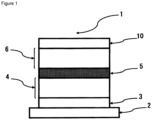
- the organic EL device 1 includes a substrate 2, an anode 3, an emitting layer 5 as an organic layer, a cathode 10, an organic layer 4 between the anode 3 and the emitting layer 5, and an organic layer 6 between the emitting layer 5 and the cathode 10.
- Each of the organic layer 4 and the organic layer 6 may be a single layer or may consist of a plurality of layers.
- the organic layer 4 may contain a hole-transporting zone.
- the hole-transporting zone may contain a hole-injecting layer, a hole-transporting layer, an electron barrier layer, and the like.
- the organic layer 6 may contain an electron-transporting zone.
- the electron-transporting zone may contain an electron-injecting layer, an electron-transporting layer, a hole barrier layer, and the like.
- the compound represented by the formulas (9-2) and (9-3) are contained in the organic layer 4, the emitting layer 5, or the organic layer 6.
- the compound represented by the formulas (9-2) and (9-3) is contained in the emitting layer 5.
- the compound represented by the formulas (9-2) and (9-3) can function as a dopant material in the emitting layer 5.
- At least one of the at least one organic layer contains a first compound and a second compound which is not the same as the first compound, and the first compound is a compound represented by the formulas (9-2) and (9-3).
- the second compound is an anthracene derivative.
- one or more sets of adjacent two or more of R 101 to R 110 form a substituted or unsubstituted, saturated or unsaturated ring by bonding with each other, or do not form the substituted or unsubstituted, saturated or unsaturated ring.
- R 101 to R 110 which do not form the substituted or unsubstituted, saturated or unsaturated ring are independently
- each of R 901 to R 907 When two or more of each of R 901 to R 907 are present, the two or more of each of R 901 to R 907 may be the same as or different from each other.
- the compound represented by the formula (10) may have a deuterium atom as a hydrogen atom.
- At least one Ar 101 in the formula (10) is a substituted or unsubstituted aryl group including 6 to 50 ring carbon atoms.
- At least one Ar 101 in the formula (10) is a substituted or unsubstituted monovalent heterocyclic group including 5 to 50 ring atoms.
- all of Ar 101 s in the formula (10) are a substituted or unsubstituted aryl group including 6 to 50 ring carbon atoms.
- the plurality of Ar 101 s may be the same as or different from each other.
- one of Ar 101 in the formula (10) is a substituted or unsubstituted monovalent heterocyclic group including 5 to 50 ring atoms, and the remaining Ar 101 is a substituted or unsubstituted aryl group including 6 to 50 ring carbon atoms.
- the plurality of Ar 101 s may be the same as or different from each other.
- At least one L 101 in the formula (10) is a single bond.
- all of L 101 s in the formula (10) are single bonds.
- At least one L 101 in the formula (10) is a substituted or unsubstituted arylene group including 6 to 50 ring carbon atoms.
- the group represented by -L 101 -Ar 101 in the formula (10) is selected from the group consisting of
- the substituent R in the formula (10) are independently a substituted or unsubstituted alkyl group including 1 to 50 carbon atoms,
- substituents in the case of "substituted or unsubstituted" in the formula (10) are independently
- R 901 to R 907 are as defined in the formula (10).
- substituents in the case of "substituted or unsubstituted" in the formula (10) are independently
- R 901 to R 907 are as defined in the formula (10).
- the substituent in the case of "substituted or unsubstituted" in the formula (10) is selected from the group consisting of
- the substituent in the case of "substituted or unsubstituted" in the formula (10) is an alkyl group including 1 to 5 carbon atoms.
- the compound represented by the formula (10) is a compound represented by the following formula (20).
- R 101 to R 108 , L 101 , and Ar 101 are as defined in the formula (10).
- the compound represented by the formula (20) may have a deuterium atom as a hydrogen atom.
- the compound represented by the formula (10) or the formula (20) has at least two groups represented by the formula (11).
- the compound represented by the formula (10) or the formula (20) has two or three groups represented by the formula (11).
- R 101 to R 110 in the formula (10) and (20) do not form the substituted or unsubstituted, saturated or unsaturated ring.
- R 101 to R 110 in the formula (10) and (20) are hydrogen atoms.
- At least one Ar 101 is a monovalent group having a structure represented by the following formula (50).
- X 151 is O, S, or C(R 161 )(R 162 ).
- R 151 to R 160 is a single bond which bonds with L 101 .
- One or more sets of adjacent two or more of R 151 to R 154 and one or more sets of adjacent two or more of R 155 to R 160 which are not a single bond which bonds with L 101 , form a substituted or unsubstituted, saturated or unsaturated ring by bonding with each other, or do not form a substituted or unsubstituted, saturated or unsaturated ring.
- R 161 and R 162 form a substituted or unsubstituted, saturated or unsaturated ring by bonding with each other, or do not form a substituted or unsubstituted, saturated or unsaturated ring.
- R 161 and R 162 which do not form the substituted or unsubstituted, saturated or unsaturated ring, and R 151 to R 160 which are not a single bond which bonds with L 101 and do not form the substituted or unsubstituted, saturated or unsaturated ring are independently a hydrogen atom or a substituent R.
- the substituent R is as defined in the formula (10).
- Ar 101 which is not a monovalent group having the structure represented by the formula (50) is
- the position to be a single bond which bonds with L 101 in the formula (50) is not particularly limited.
- one of R 151 to R 154 or one of R 155 to R 160 in the formula (50) is a single bond which bonds with L 101 .
- Ar 101 is a monovalent group represented by the following formula (50-R 152 ), (50-R 153 ), (50-R 154 ), (50-R 157 ), or (50-R 158 ).
- the compound represented by the formula (20) is a compound represented by the following formula (30).
- L 101 and Ar 101 are as defined in the formula (10).
- Adjacent two of R 101A to R 108A do not form a substituted or unsubstituted, saturated or unsaturated ring.
- R 101A to R 108A are independently
- the substituent R is as defined in the formula (10).
- the compound represented by the formula (30) is a compound having two groups represented by the formula (11).
- the compound represented by the formula (30) has substantially only protium atoms as hydrogen atoms.
- has substantially only protium atoms means the case where the ratio of protium compound based on the total moles of the compound having only protium atoms as hydrogen atoms (protium compound) and the compound having the same structure as the former and having a deuterium atom as a hydrogen atom (deuterium compound), is 90 mol% or more, 95 mol% or more, or 99 mol% or more.
- the compound represented by the formula (30) is a compound represented by the following formula (31).
- L 101 and Ar 101 are as defined in the formula (10).
- R 101A to R 108A are as defined in the formula (30) above.
- X b is O, S, N(R 131 ), or C(R 132 )(R 133 ).
- R 121 to R 128 and R 131 to R 133 is a single bond which bonds with L 101 .
- R 121 to R 128 which are not a single bond which bonds with L 101 form a substituted or unsubstituted, saturated or unsaturated ring by bonding with each other, or do not form the substituted or unsubstituted, saturated or unsaturated ring.
- R 121 to R 128 which are not a single bond which bonds with L 101 and do not form the substituted or unsubstituted, saturated or unsaturated ring are independently a hydrogen atom, or a substituent R.
- the substituent R is as defined in the formula (10).
- R 131 to R 133 which are not a single bond which bonds with L 101 are independently
- each of R 131 to R 133 When two or more of each of R 131 to R 133 are present, the two or more of each of R 131 to R 133 may be the same as or different from each other.
- the compound represented by the formula (31) is a compound represented by the following formula (32).
- R 101A to R 108A , L 101 , Ar 101 , R 121 to R 128 , R 132 , and R 133 are as defined in the formula (31).
- the compound represented by the formula (31) is a compound represented by the following formula (33).
- R 101A to R 108A , L 101 , Ar 101 , and R 121 to R 128 are as defined in the formula (31).
- X c is O, S, or NR 131 .
- R 131 is as defined in the formula (31).
- the compound represented by the formula (31) is a compound represented by the following formula (34).
- R 101A to R 108A , L 101 , and Ar 101 are as defined in the formula (31).
- X c is O, S, or NR 131 .
- R 131 is as defined in the formula (31).
- R 121A to R 128A is a single bond which bonds with L 101 .
- One or more sets of adjacent two or more of R 121A to R 128A which are not a single bond which bonds with L 101 do not form a substituted or unsubstituted, saturated or unsaturated ring.
- R 121A to R 128A which are not a single bond which bonds with L 101 are independently a hydrogen atom, or a substituent R.
- the substituent R is as defined in the formula (10).
- the compound represented by the formula (31) is a compound represented by the following formula (35).
- R 101A to R 108A , L 101 , Ar 101 , and X b are as defined in the formula (31).
- One or more sets of adjacent two or more of R 121A to R 124A do not form a substituted or unsubstituted, saturated or unsaturated ring by bonding with each other.
- R 125B and R 126B , R 126B and R 127B , and R 127B and R 128B form a ring represented by the following formula (35a) or (35b) by bonding with each other.
- R 141 to R 144 are independently
- the substituent R is as defined in the formula (10).
- X d is O or S.
- R 121A to R 124A R 125B to R 128B which do not form the ring represented by the formula (35a) or (35b), and R 141 to R 144 is a single bond which bonds with L 101 .
- R 121A to R 124A which are not a single bond which bonds with L 101 and R 125B to R 128B which are not a single bond which bonds with L 101 and do not form the ring represented by the formula (35a) or (35b) are independently
- the substituent R is as defined in the formula (10).
- the compound represented by the formula (35) is a compound represented by the following formula (36).
- R 101A to R 108A , L 101 , Ar 101 , and R 125B to R 128B are as defined in the formula (35).
- the compound represented by the formula (34) is a compound represented by the following formula (37).
- R 101A to R 108A , R 125A to R 128A , L 101 , and Ar 101 are as defined in the formula (34).
- R 101A to R 108A in the formulas (30) to (37) are hydrogen atoms.
- the compound represented by the formula (10) is a compound represented by the following formula (40).
- L 101 and Ar 101 are as defined in the formula (10).
- R 101A and R 103A to R 108A form a substituted or unsubstituted, saturated or unsaturated ring by bonding with each other, or do not form the substituted or unsubstituted, saturated or unsaturated ring.
- R 101A and R 103A to R 108A which do not form the substituted or unsubstituted, saturated or unsaturated ring are independently
- the substituent R is as defined in the formula (10).
- the compound represented by the formula (40) is a compound having three groups represented by the formula (11).
- the compound represented by the formula (40) has substantially only protium atoms as hydrogen atoms.
- the compound represented by the formula (40) is a compound represented by the following formula (41).
- L 101 and Ar 101 are as defined in the formula (40).
- the compound represented by the formula (40) is a compound represented by any one of the following formulas (42-1) to (42-3).
- R 101A to R 108A , L 101 , and Ar 101 are as defined in the formula (40).
- the compound represented by the formulas (42-1) to (42-3) is a compound represented by any one of the following formulas (43-1) to (43-3).
- L 101 and Ar 101 are as defined in the formula (40).
- the group represented by -L 101 -Ar 101 in the formulas (40), (41), (42-1) to (42-3), and (43-1) to (43-3) is selected from the group consisting of
- the compound represented by the formula (10) or the formula (20) include a compound in which at least one of the hydrogen atoms possessed by these compounds is a deuterium atom.
- the compounds represented by each of the formulas (30) to (37) include a compound in which at least one of the hydrogen atoms possessed by these compounds is a deuterium atom.
- At least one of the hydrogen atoms which bonds with the carbon atoms constituting the anthracene skeleton in the compounds represented by each of the formulas (30) to (37) is a deuterium atom.
- the compound represented by the formula (30) is a compound represented by the following formula (30D).
- R 101A to R 108A , L 101 , and Ar 101 are as defined in the formula (30).
- the compound represented by the formula (30D) is a compound in which at least one of the hydrogen atoms possessed by the compound represented by the formula (30) is a deuterium atom.
- At least one of R 101A to R 108A which is a hydrogen atom, in the formula (30D) is a deuterium atom.
- the compound represented by the formula (30D) is a compound represented by the following formula (31D).
- R 101A to R 108A , L 101 , and Ar 101 are as defined in the formula (30D).
- X d is O or S.
- R 121 to R 128 is a single bond which bonds with L 101 .
- R 121 to R 128 which are not a single bond which bonds with L 101 form a substituted or unsubstituted, saturated or unsaturated ring or do not form a substituted or unsubstituted by bonding with each other, saturated or unsaturated ring.
- R 121 to R 128 which are not a single bond which bonds with L 101 and do not form the substituted or unsubstituted, saturated or unsaturated ring are independently
- the substituent R is as defined in the formula (10).
- the compound represented by the formula (31D) is a compound represented by the following formula (32D).
- R 101A to R 108A , R 125A to R 128A , L 101 , and Ar 101 are as defined in the formula (31D).
- the compound represented by the formula (32D) is a compound represented by the following formula (32D-1) or (32D-2).
- R 101A to R 108A , R 125A to R 128A , L 101 , and Ar 101 are as defined in the formula (32D).
- At least one of the hydrogen atoms possessed by the compounds represented by each of the formulas (40), (41), (42-1) to (42-3), and (43-1) to (43-3) is a deuterium atom.
- At least one of the hydrogen atoms which bond with the carbon atoms constituting the anthracene skeleton in the compound represented by the formula (41) is a deuterium atom.
- the compound represented by the formula (40) is a compound represented by the following formula (40D).
- L 101 and Ar 101 are as defined in the formula (10).
- One or more sets of adjacent two or more of R 101A and R 103A to R 108A do not form a substituted or unsubstituted, saturated or unsaturated ring.
- R 101A and R 103A to R 108A are independently
- the substituent R is as defined in the formula (10).
- At least one of R 101A and R 103A to R 108A in the formula (40D) is a deuterium atom.
- the compound represented by the formula (40D) is a compound represented by the following formula (41D).
- L 101 and Ar 101 are as defined in the formula (40D).
- the compound represented by the formula (40D) is a compound represented by any one of the following formulas (42D-1) to (42D-3).
- R 101A to R 108A , L 101 , and Ar 101 are as defined in the formula (40D).
- the compounds represented by the formulas (42D-1) to (42D-3) are compounds represented by the following formulas (43D-1) to (43D-3).
- L 101 and Ar 101 are as defined in the formula (40D).
- Specific examples of the compound represented by the formula (10) include the following compounds.
- the compound represented by the formula (10) is not limited to these specific examples.
- Me represents a methyl group
- D represents a deuterium atom.
- the organic EL device may be applied to the organic EL device according to an aspect of the invention, as long as the device contains a cathode, an anode, and an emitting layer between the cathode and the anode, wherein the emitting layer contains a compound represented by the formulas (9-2) and (9-3), and the effect of the invention is not impaired.
- the content of the compound represented by the formulas (9-2) and (9-3)in the emitting layer is preferably 1% by mass or more and 20% by mass or less based on the total mass of the emitting layer.
- a typified device configuration of the organic EL device of the invention include structures such as
- the configuration of (8) is preferably used, but the device configuration of the organic EL device is not limited thereto.
- the "hole-injecting (and/or) transporting layer” in this specification means “at least one of the hole-injecting layer and the hole-transporting layer"
- the “electron-injecting (and/or) transporting layer” in this specification means “at least one of the electron-injecting layer and the electron-transporting layer”.
- a substrate is used as a support of an emitting device.
- glass, quartz, plastics or the like can be used, for example.
- a flexible substrate may be used.
- the "flexible substrate” means a bendable (flexible) substrate, and specific examples thereof include a plastic substrate formed of polycarbonate, polyvinyl chloride, or the like.
- metals, alloys, electrically conductive compounds, mixtures thereof, and the like which have a large work function (specifically 4.0 eV or more) are preferably used.
- specific examples thereof include indium oxide-tin oxide (ITO: Indium Tin Oxide), indium oxide-tin oxide containing silicon or silicon oxide, indium oxide-zinc oxide, tungsten oxide, indium oxide containing zinc oxide, graphene, and the like.
- ITO Indium Tin Oxide
- ITO Indium Tin Oxide
- indium oxide-tin oxide containing silicon or silicon oxide indium oxide-zinc oxide
- tungsten oxide indium oxide containing zinc oxide, graphene, and the like.
- specific examples thereof include gold (Au), platinum (Pt), a nitride of a metallic material (for example, titanium nitride), and the like.
- the hole-injecting layer is a layer containing a substance having high hole-injecting property.
- a substance having high hole-injecting property molybdenum oxide, titanium oxide, vanadium oxide, rhenium oxide, ruthenium oxide, chromium oxide, zirconium oxide, hafnium oxide, tantalum oxide, silver oxide, tungsten oxide, manganese oxide, an aromatic amine compound, or a polymer compound (oligomers, dendrimers, polymers, etc.) can be given.
- the hole-transporting layer is a layer containing a substance having high hole-transporting property.
- an aromatic amine compound such as poly(N-vinylcarbazole) (abbreviation: PVK) and poly(4-vinyltriphenylamine) (abbreviation: PVTPA) can also be used.
- PVK poly(N-vinylcarbazole)
- PVTPA poly(4-vinyltriphenylamine)
- a material other than the above-described materials may be used as long as the material has higher hole-transporting properties of holes in comparison with electrons.
- the layer containing the material having high hole-transporting properties may be formed into not only a single layer, but also a stacked layer in which two or more layers formed of the above-described materials are stacked.
- the emitting layer is a layer containing a substance having a high emitting property, and various materials can be used in addition to the materials used in the invention described above (the compound represented by the formulas (9-2) and (9-3)).
- a fluorescent compound which emits fluorescence or a phosphorescent compound which emits phosphorescence can be used as the substance having a high emitting property.
- the fluorescent compound is a compound which can emit from a singlet excited state
- the phosphorescent compound is a compound which can emit from a triplet excited state.
- blue fluorescent emitting material which can be used for an emitting layer
- pyrene derivatives, styrylamine derivatives, chrysene derivatives, fluoranthene derivatives, fluorene derivatives, diamine derivatives, triarylamine derivatives, and the like can be used.
- green fluorescent emitting material which can be used for an emitting layer
- aromatic amine derivatives and the like can be used.
- red fluorescent emitting material which can be used for an emitting layer, tetracene derivatives, diamine derivatives and the like can be used.
- metal complexes such as iridium complexes, osmium complexes, platinum complexes and the like are used.
- a green phosphorescent emitting material which can be used for an emitting layer, iridium complexes and the like are used.
- a red phosphorescent emitting material which can be used for an emitting layer, metal complexes such as iridium complexes, platinum complexes, terbium complexes, europium complexes and the like are used.
- the emitting layer may have a constitution in which the substance having a high emitting property (guest material) is dispersed in another substance (host material).
- a substance for dispersing the substance having a high emitting property in addition to the compound used in addition to the materials used in the invention described above (a compound represented by the formula (10)), a variety of substances can be used, and it is preferable to use a substance having a higher lowest unoccupied orbital level (LUMO level) and a lower highest occupied orbital level (HOMO level) rather than the substance having a high emitting property.
- LUMO level lowest unoccupied orbital level
- HOMO level lower highest occupied orbital level
- 1) metal complexes such as aluminum complexes, beryllium complexes, or zinc complexes
- 2) heterocyclic compounds such as oxadiazole derivatives, benzimidazole derivatives, or phenanthroline derivatives
- 3) condensed aromatic compounds such as carbazole derivatives, anthracene derivatives, phenanthrene derivatives, pyrene derivatives, naphthacenes, fluoranthenes, triphenylene derivatives, fluorene derivatives, or chrysene derivatives
- aromatic amine compounds such as triarylamine derivatives or condensed polycyclic aromatic amine derivatives can be used.
- a compound having delayed fluorescence can be used as a host material. It is also preferable that the emitting layer contain materials used in the invention described above and a host compound having delayed fluorescence.
- An electron-transporting layer is a layer that comprises a substance having a high electron-transporting property.
- metal complexes such as aluminum complexes, beryllium complexes, zinc complexes, or the like
- heteroaromatic complexes such as imidazole derivatives, benzimidazole derivatives, azine derivatives, carbazole derivatives, phenanthroline derivatives, or the like
- polymer compounds can be used.
- An electron-injecting layer is a layer which contains a substance having a high electron-injecting property.
- metal complex compounds such as lithium (Li), ytterbium (Yb), lithium fluoride (LiF), cesium fluoride (CsF), calcium fluoride (CaF 2 ), 8-hydroxyquinolinolato-lithium (Liq); alkali metals such as lithium oxide (LiO x ); alkaline earth metals; or a compound thereof can be used.
- cathode metals, alloys, electrically conductive compounds, mixtures thereof, and the like having a small work function (specifically, 3.8 eV or less) are preferably used.
- a cathode material include elements belonging to Group 1 or Group 2 of the Periodic Table of the Elements, i.e., alkali metals such as lithium (Li) and cesium (Cs), alkaline earth metals such as magnesium (Mg), calcium (Ca) and strontium (Sr), and alloys containing these metals (e.g., MgAg and AlLi); rare earth metals such as europium (Eu) and ytterbium (Yb), and alloys containing these metals.
- alkali metals such as lithium (Li) and cesium (Cs)
- alkaline earth metals such as magnesium (Mg), calcium (Ca) and strontium (Sr)
- alloys containing these metals e.g., MgAg and AlLi
- the methods for forming the respective layers are not particularly limited.
- a conventionally-known method for forming each layer according to a vacuum deposition process, a spin coating process or the like can be used.
- Each layer such as the emitting layer can be formed by a known method such as a vacuum deposition process, a molecular beam deposition process (MBE process), or an application process such as a dipping process, a spin coating process, a casting process, a bar coating process and a roll coating process, using a solution prepared by dissolving the material in a solvent.
- MBE process molecular beam deposition process
- an application process such as a dipping process, a spin coating process, a casting process, a bar coating process and a roll coating process, using a solution prepared by dissolving the material in a solvent.
- the thickness of each layer is not particularly limited, but is generally preferable that the thickness be in the range of several nm to 1 ⁇ m in order to suppress defects such as pinholes, to suppress applied voltages to be low, and to improve luminous efficiency.
- the electronic apparatus according to an aspect of the invention is characterized in that the organic EL device according to an aspect of the invention is equipped with.
- the electronic apparatus include display components such as an organic EL panel module, and the like; display devices for a television, a cellular phone, a personal computer, and the like; and emitting devices such as a light, a vehicular lamp, and the like.
- a 25 mm ⁇ 75 mm ⁇ 1.1 mm-thick glass substrate with an ITO transparent electrode (anode) (manufactured by GEOMATEC Co., Ltd.) was subjected to ultrasonic cleaning in isopropyl alcohol for 5 minutes, and then subjected to UV-ozone cleaning for 30 minutes.
- the thickness of the ITO film was 130 nm.
- the glass substrate with the transparent electrode after being cleaned was mounted onto a substrate holder in a vacuum vapor deposition apparatus.
- Compound HI was deposited on a surface on the side on which the transparent electrode was formed so as to cover the transparent electrode to form a compound HI film having a thickness of 5 nm. This HI film functions as a hole-injecting layer.
- Compound HT1 was deposited thereon to form an HT1 film having a thickness of 80 nm on the HI film.
- the HT1 film functions as a first hole-transporting layer.
- Compound HT2 was deposited thereon to form an HT2 film having a thickness of 10 nm on the HT1 film.
- the HT2 film functions as a second hole-transporting layer.
- BH-1 host material
- BD-1 dopant material
- Compound HBL was deposited on the emitting layer to form an electron-transporting layer having a thickness of 10 nm.
- Compound ET as an electron-injecting material was deposited on the electron-transporting layer to form an electron-injecting layer having a thickness of 15 nm.
- LiF was deposited on the electron-injecting layer to form a LiF film having a thickness of 1 nm.
- Metal Al was deposited on the LiF film to form a metal cathode having a thickness of 80 nm.
- the device configuration of the organic EL device of Example 1 is schematically shown as follows.
- BD-1 was synthesized according to the synthetic route described below.
- BD-1 (0.72 g, 70% yield).
- Synthesis was performed in the same manner as in the synthesis of Compound BD-1, except that 4,4'-dimethyl-diphenylamine was used instead of diphenylamine as a reaction raw material.
- Synthesis was performed in the same manner as in the synthesis of Compound BD-1, except that 4,4'-diethyl-diphenylamine was used instead of diphenylamine as a reaction raw material.
- Synthesis was performed in the same manner as in the synthesis of Compound BD-1, except that 4-isopropyl-diphenylamine was used instead of diphenylamine as a reaction raw material.
- Synthesis was performed in the same manner as in the synthesis of Compound BD-1, except that 3,3'-dimethyl-diphenylamine was used instead of diphenylamine as a reaction raw material.
- Synthesis was performed in the same manner as in the synthesis of Compound BD-1, except that 3-t-butyl-diphenylamine was used instead of diphenylamine as a reaction raw material.
- Intermediate F-Ref was synthesized in the same manner as in the synthesis of Intermediates B-1 to F-1, except that cyclohexanone was used instead of 4-t-butylcyclohexan-1-one as the reaction raw material.
- Synthesis was performed in the same manner as in the synthesis of Compound BD-1, except that N-(4-t-butylphenyl)-[1,1'-biphenyl]-2-amine was used instead of diphenylamine as a reaction raw material.
- Synthesis was performed in the same manner as in the synthesis of Compound BD-1, except that N-phenyl-[1,1'-biphenyl]-2-amine was used instead of diphenylamine as a reaction raw material.
- Synthesis was performed in the same manner as in the synthesis of Compound BD-1, except that 2-(1-naphthalenyl)-diphenylamine was used instead of diphenylamine as a reaction raw material.
- Intermediate G-2 was synthesized in the same manner as in the synthesis of Intermediate G-1, except that 4-t-butyl-[1,1'-biphenyl]-2-amine was used instead of [1,1'-biphenyl]-2-amine and bromobenzene was used instead of 1-bromo-3-t-butylbenzene, as a reaction raw material.
- Intermediate G-3 was synthesized in the same manner as Intermediate G-1, except that [1,1'-biphenyl-2',3',4',5',6'-d5]-2-amine was used instead of [1,1'-biphenyl]-2-amine, and bromobenzene-d5 was used instead of 1-bromo-3-t-butylbenzene, as the raw reaction material.
- Synthesis was performed in the same manner as in the synthesis of a compound BD-1, except that Intermediate G-3 was used instead of diphenylamine as a reaction raw material.
- Intermediate G-4 was synthesized in the same manner as in the synthesis of Intermediate G-1, except that bromobenzene-d5 was used instead of 1-bromo-3-t-butylbenzene as the reaction raw material.
- Intermediate G-5 was synthesized in the same manner as Intermediate G-1, except that [1,1'-biphenyl-2',3',4',5',6'-d5]-2-amine was used instead of [1,1'-biphenyl]-2-amine, and bromobenzene was used instead of 1-bromo-3-t-butylbenzene, as the raw reaction material.
- Intermediate G-6 was synthesized in the same manner as in the synthesis of Intermediate G-1, except that [1,1'-biphenyl-2',3,3',4,4',5,5',6,6'-d9]-2-amine was used instead of [1,1'-biphenyl]-2-amine and bromobenzene-d5 was used instead of 1-bromo-3-t-butylbenzene, as a reaction raw material.
- Synthesis was performed in the same manner as in the synthesis of Compound BD-1, except that Intermediate G-6 was used instead of diphenylamine as a reaction raw material.
- Intermediate F-2 was synthesized in the same manner as in the synthesis of Intermediates B-1 to F-1, except that 2-t-butylcyclohexan-1-one was used instead of 4-t-butylcyclohexan-1-one as the reaction raw material.
Landscapes
- Chemical & Material Sciences (AREA)
- Organic Chemistry (AREA)
- Physics & Mathematics (AREA)
- Engineering & Computer Science (AREA)
- Materials Engineering (AREA)
- Spectroscopy & Molecular Physics (AREA)
- Optics & Photonics (AREA)
- Plural Heterocyclic Compounds (AREA)
- Electroluminescent Light Sources (AREA)
- Heterocyclic Carbon Compounds Containing A Hetero Ring Having Oxygen Or Sulfur (AREA)
Claims (14)
- Verbindung, dargestellt durch Formel (9-2):
 R3 und R12 unabhängig eine substituierte oder unsubstituierte Alkylgruppe mit 1 bis 50 Kohlenstoffatomen, eine substituierte oder unsubstituierte Halogenalkylgruppe mit 1 bis 50 Kohlenstoffatomen, eine substituierte oder unsubstituierte Alkenylgruppe mit 2 bis 50 Kohlenstoffatomen, eine substituierte oder unsubstituierte Alkinylgruppe mit 2 bis 50 Kohlenstoffatomen, eine substituierte oder unsubstituierte Cycloalkylgruppe mit 3 bis 50 Ringkohlenstoffatomen, eine substituierte oder unsubstituierte Alkoxygruppe mit 1 bis 50 Kohlenstoffatomen, eine substituierte oder unsubstituierte Alkylthiogruppe mit 1 bis 50 Kohlenstoffatomen, eine substituierte oder unsubstituierte Aryloxygruppe mit 6 bis 50 Ringkohlenstoffatomen, eine substituierte oder unsubstituierte Arylthiogruppe mit 6 bis 50 Ringkohlenstoffatomen, eine substituierte oder unsubstituierte Aralkylgruppe mit 7 bis 50 Kohlenstoffatomen, -S(R31)(R32)(R33), -C(=O)R34, -COOR35, -N(R36)(R37), ein Halogenatom, eine Cyanogruppe, eine Nitrogruppe, eine substituierte oder unsubstituierte Arylgruppe mit 6 bis 50 Ringkohlenstoffatomen oder eine substituierte oder unsubstituierte einwertige heterocyclische Gruppe mit 5 bis 50 Ringatomen sind,R17 ein Wasserstoffatom, eine substituierte oder unsubstituierte Alkylgruppe mit 1 bis 50 Kohlenstoffatomen, eine substituierte oder unsubstituierte Halogenalkylgruppe mit 1 bis 50 Kohlenstoffatomen, eine substituierte oder unsubstituierte Alkenylgruppe mit 2 bis 50 Kohlenstoffatomen, eine substituierte oder unsubstituierte Alkinylgruppe mit 2 bis 50 Kohlenstoffatomen, eine substituierte oder unsubstituierte Cycloalkylgruppe mit 2 bis 50 Ringkohlenstoffatomen, eine substituierte oder unsubstituierte Alkoxygruppe mit 1 bis 50 Kohlenstoffatomen, eine substituierte oder unsubstituierte Alkylthiogruppe mit 1 bis 50 Kohlenstoffatomen, eine substituierte oder unsubstituierte Aryloxygruppe mit 6 bis 50 Ringkohlenstoffatomen, eine substituierte oder unsubstituierte Arylthiogruppe mit 6 bis 50 Kohlenstoffatomen, eine substituierte oder unsubstituierte Aralkylgruppe mit 7 bis 50 Kohlenstoffatomen, -S(R31)(R32)(R33), -C(=O)R34, -COOR35, -N(R36)(R37), ein Halogenatom, eine Cyanogruppe, eine Nitrogruppe, eine substituierte oder unsubstituierte Arylgruppe mit 6 bis 50 Ringkohlenstoffatomen oder eine substituierte oder unsubstituierte einwertige heterocyclische Gruppe mit 5 bis 50 Ringatomen ist, zwei R17 gleich oder voneinander verschieden sein können undRA, RB, RC und RD unabhängig eine substituierte oder unsubstituierte Alkylgruppe mit 1 bis 50 Kohlenstoffatomen, eine substituierte oder unsubstituierte Arylgruppe mit 6 bis 50 Ringkohlenstoffatomen oder eine substituierte oder unsubstituierte einwertige heterocyclische Gruppe mit 5 bis 50 Ringatomen sind.
 - Verbindung, dargestellt durch Formel (9-3):
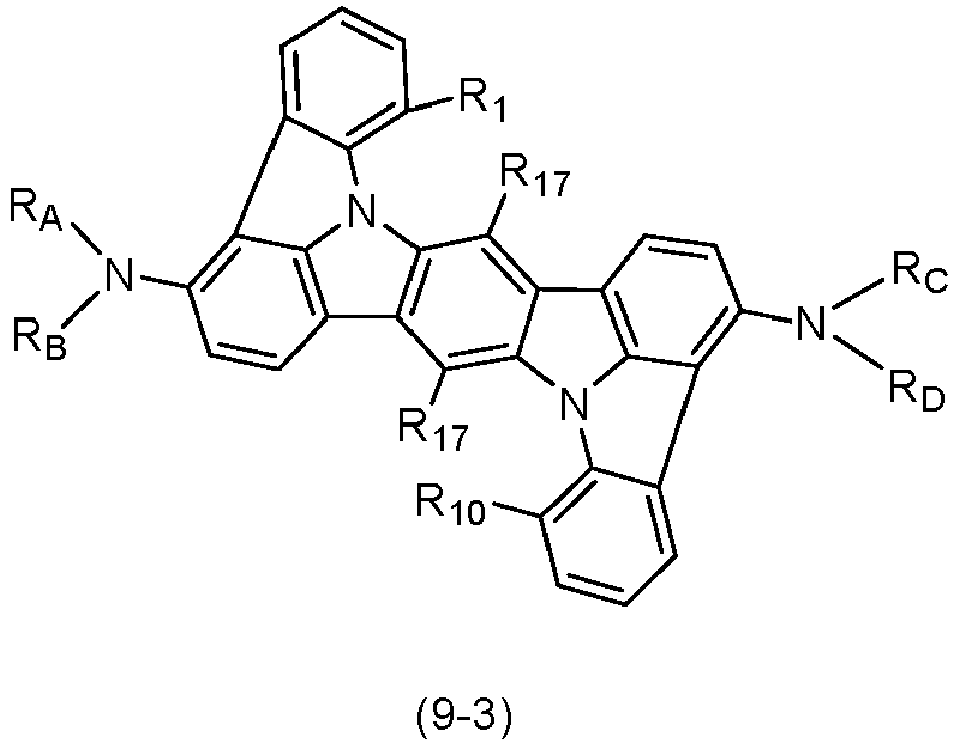 R1 und R10 unabhängig eine substituierte oder unsubstituierte Alkylgruppe mit 1 bis 50 Kohlenstoffatomen, eine substituierte oder unsubstituierte Halogenalkylgruppe mit 1 bis 50 Kohlenstoffatomen, eine substituierte oder unsubstituierte Alkenylgruppe mit 2 bis 50 Kohlenstoffatomen, eine substituierte oder unsubstituierte Alkinylgruppe mit 2 bis 50 Kohlenstoffatomen, eine substituierte oder unsubstituierte Cycloalkylgruppe mit 3 bis 50 Ringkohlenstoffatomen, eine substituierte oder unsubstituierte Alkoxygruppe mit 1 bis 50 Kohlenstoffatomen, eine substituierte oder unsubstituierte Alkylthiogruppe mit 1 bis 50 Kohlenstoffatomen, eine substituierte oder unsubstituierte Aryloxygruppe mit 6 bis 50 Ringkohlenstoffatomen, eine substituierte oder unsubstituierte Arylthiogruppe mit 6 bis 50 Ringkohlenstoffatomen, eine substituierte oder unsubstituierte Aralkylgruppe mit 7 bis 50 Kohlenstoffatomen, -S(R31)(R32)(R33), -C(=O)R34, -COOR35, -N(R36)(R37), ein Halogenatom, eine Cyanogruppe, eine Nitrogruppe, eine substituierte oder unsubstituierte Arylgruppe mit 6 bis 50 Ringkohlenstoffatomen oder eine substituierte oder unsubstituierte einwertige heterocyclische Gruppe mit 5 bis 50 Ringatomen sind,R17 ein Wasserstoffatom, eine substituierte oder unsubstituierte Alkylgruppe mit 1 bis 50 Kohlenstoffatomen, eine substituierte oder unsubstituierte Halogenalkylgruppe mit 1 bis 50 Kohlenstoffatomen, eine substituierte oder unsubstituierte Alkenylgruppe mit 2 bis 50 Kohlenstoffatomen, eine substituierte oder unsubstituierte Alkinylgruppe mit 2 bis 50 Kohlenstoffatomen, eine substituierte oder unsubstituierte Cycloalkylgruppe mit 2 bis 50 Ringkohlenstoffatomen, eine substituierte oder unsubstituierte Alkoxygruppe mit 1 bis 50 Kohlenstoffatomen, eine substituierte oder unsubstituierte Alkylthiogruppe mit 1 bis 50 Kohlenstoffatomen, eine substituierte oder unsubstituierte Aryloxygruppe mit 6 bis 50 Ringkohlenstoffatomen, eine substituierte oder unsubstituierte Arylthiogruppe mit 6 bis 50 Kohlenstoffatomen, eine substituierte oder unsubstituierte Aralkylgruppe mit 7 bis 50 Kohlenstoffatomen, -S(R31)(R32)(R33), -C(=O)R34, -COOR35, -N(R36)(R37), ein Halogenatom, eine Cyanogruppe, eine Nitrogruppe, eine substituierte oder unsubstituierte Arylgruppe mit 6 bis 50 Ringkohlenstoffatomen oder eine substituierte oder unsubstituierte einwertige heterocyclische Gruppe mit 5 bis 50 Ringatomen ist, zwei R17 gleich oder voneinander verschieden sein können undRA, RB, RC und RD unabhängig eine substituierte oder unsubstituierte Alkylgruppe mit 1 bis 50 Kohlenstoffatomen, eine substituierte oder unsubstituierte Arylgruppe mit 6 bis 50 Ringkohlenstoffatomen oder eine substituierte oder unsubstituierte einwertige heterocyclische Gruppe mit 5 bis 50 Ringatomen sind.
 - Verbindung gemäß einem der Ansprüche 1 oder 2, wobei RA, RB, RC und RD unabhängig eine substituierte oder unsubstituierte Arylgruppe mit 6 bis 50 Ringkohlenstoffatomen oder eine substituierte oder unsubstituierte einwertige heterocyclische Gruppe mit 5 bis 50 Ringatomen sind.
- Verbindung gemäß einem der Ansprüche 1 bis 3, wobei RA, RB, RC und RD unabhängig eine substituierte oder unsubstituierte Phenylgruppe sind.
- Verbindung gemäß einem der Ansprüche 1 bis 4, wobei RA, RB, RC und RD unabhängig eine Phenylgruppe, die mit einer Alkylgruppe mit 1 bis 5 Kohlenstoffatomen substituiert ist, oder eine unsubstituierte Phenylgruppe sind.
- Verbindung gemäß einem der Ansprüche 1 bis 5, wobei die R17 Wasserstoffatome sind.
- Verbindung gemäß einem der Ansprüche 1 bis 6, wobei der Substituent für den Fall "substituiert oder unsubstituiert" aus der Gruppe, bestehend aus einer Alkylgruppe mit 1 bis 50 Kohlenstoffatomen, einer Halogenalkylgruppe mit 1 bis 50 Kohlenstoffatomen, einer Alkenylgruppe mit 2 bis 50 Kohlenstoffatomen, einer Alkinylgruppe mit 2 bis 50 Kohlenstoffatomen, einer Cycloalkylgruppe mit 3 bis 50 Ringkohlenstoffatomen, einer Alkoxygruppe mit 1 bis 50 Kohlenstoffatomen, einer Alkylthiogruppe mit 1 bis 50 Kohlenstoffatomen, einer Aryloxygruppe mit 6 bis 50 Ringkohlenstoffatomen und einer Arylthiogruppe mit 6 bis 50 Ringkohlenstoffatomen, einer Aralkylgruppe mit 7 bis 50 Kohlenstoffatomen, -S(R41)(R42)(R43), -C(=O)R44, -COOR45, -S(=O)2R46, -P(=O)(R47)(R48), -Ge(R49)(R50)(R51), -N(R52)(R53), einer Hydroxygruppe, einem Halogenatom, einer Cyanogruppe, einer Nitrogruppe, einer Arylgruppe mit 6 bis 50 Ringkohlenstoffatomen und einer einwertigen heterocyclischen Gruppe mit 5 bis 50 Ringatomen, ausgewählt ist und R41 bis R53 unabhängig ein Wasserstoffatom, eine Alkylgruppe mit 1 bis 50 Kohlenstoffatomen, eine Arylgruppe mit 6 bis 50 Ringkohlenstoffatomen oder eine einwertige heterocyclische Gruppe mit 5 bis 50 Ringatomen sind, wenn zwei oder mehr von jedem von R41 bis R53 vorhanden sind, die zwei oder mehr von jedem von R41 bis R53 gleich oder voneinander verschieden sein können.
- Verbindung gemäß einem der Ansprüche 1 bis 7, wobei der Substituent für den Fall "substituiert oder unsubstituiert" eine Gruppe, ausgewählt aus der Gruppe, bestehend aus
einer Alkylgruppe mit 1 bis 18 Kohlenstoffatomen und einer Arylgruppe mit 6 bis 18 Ringkohlenstoffatomen, ist. - Material für eine organische Elektrolumineszenzvorrichtung, umfassend eine Verbindung gemäß einem der Ansprüche 1 bis 8.
- Organische Elektrolumineszenzvorrichtung, umfassend:eine Kathode,eine Anode undmindestens eine organische Schicht, die zwischen der Kathode und der Anode angeordnet ist, wobeimindestens eine Schicht von der mindestens einen organischen Schicht die Verbindung gemäß einem der Ansprüche 1 bis 8 umfasst.
- Organische Elektrolumineszenzvorrichtung gemäß Anspruch 10, wobei die mindestens eine Schicht von der mindestens einen organischen Schicht eine zweite Verbindung umfasst, die nicht dieselbe wie die Verbindung gemäß einem der Ansprüche 1 bis 8 ist.
- Organische Elektrolumineszenzvorrichtung gemäß Anspruch 11, wobei die zweite Verbindung eine durch die folgende Formel (10) dargestellte Verbindung ist:
 ein oder mehrere Sätze von benachbarten zwei oder mehr von R101 bis R110 einen substituierten oder unsubstituierten, gesättigten oder ungesättigten Ring bilden oder keinen substituierten oder unsubstituierten, gesättigten oder ungesättigten Ring bilden,R101 bis R110, die keinen substituierten oder unsubstituierten, gesättigten oder ungesättigten Ring bilden, unabhängigein Wasserstoffatom,ein Substituent R odereine durch die folgende Formel (11) dargestellte Gruppe sind:
-L101-Ar101 (11)
wobei in der Formel (11)L101eine Einfachbindung,eine substituierte oder unsubstituierte Arylengruppe mit 6 bis 50 Ringkohlenstoffatomen odereine substituierte oder unsubstituierte zweiwertige heterocyclische Gruppe mit 5 bis 50 Ringatomen ist,Ar101eine substituierte oder unsubstituierte Arylgruppe mit 6 bis 50 Ringkohlenstoffatomen odereine substituierte oder unsubstituierte einwertige heterocyclische Gruppe mit 5 bis 50 Ringatomen ist,der Substituent Reine substituierte oder unsubstituierte Alkylgruppe mit 1 bis 50 Kohlenstoffatomen,eine substituierte oder unsubstituierte Alkenylgruppe mit 2 bis 50 Kohlenstoffatomen,eine substituierte oder unsubstituierte Alkinylgruppe mit 2 bis 50 Kohlenstoffatomen,eine substituierte oder unsubstituierte Cycloalkylgruppe mit 3 bis 50 Ringkohlenstoffatomen,
-Si(R901)(R902)(R903),
-O-(R904),
-S-(R905),
-N(R906)(R907),
ein Halogenatom, eine Cyanogruppe, eine Nitrogruppe,eine substituierte oder unsubstituierte Arylgruppe mit 6 bis 50 Kohlenstoffatomen odereine substituierte oder unsubstituierte einwertige heterocyclische Gruppe mit 5 bis 50 Ringatomen ist,wenn zwei oder mehr Substituenten R vorhanden sind, die zwei oder mehr Substituenten R gleich oder voneinander verschieden sein können,R901 bis R907 unabhängigein Wasserstoffatom,eine substituierte oder unsubstituierte Alkylgruppe mit 1 bis 50 Kohlenstoffatomen,eine substituierte oder unsubstituierte Cycloalkylgruppe mit 3 bis 50 Ringkohlenstoffatomen,eine substituierte oder unsubstituierte Arylgruppe mit 6 bis 50 Ringkohlenstoffatomen odereine substituierte oder unsubstituierte einwertige heterocyclische Gruppe mit 5 bis 50 Ringatomen sind,wenn zwei oder mehr von jedem von R901 bis R907 vorhanden sind, die zwei oder mehr von jedem R901 bis R907 gleich oder voneinander verschieden sein können,vorausgesetzt, dass mindestens eines von R101 bis R110, das keinen substituierten oder unsubstituierten, gesättigten oder ungesättigten Ring bildet, eine durch die Formel (11) dargestellte Gruppe ist, undwenn zwei oder mehr von der Formel (11) vorhanden sind, die zwei oder mehr durch die Formel (11) dargestellten Gruppen gleich oder voneinander verschieden sein können. - Organische Elektrolumineszenzvorrichtung gemäß einem der Ansprüche 10 bis 11, wobei mindestens eine von der mindestens einen organischen Schicht eine emittierende Schicht ist.
- Organische Elektrolumineszenzvorrichtung gemäß Anspruch 13, wobei die emittierende Schicht ferner eine Wirtsverbindung mit verzögerter Fluoreszenz umfasst.
Applications Claiming Priority (2)
| Application Number | Priority Date | Filing Date | Title |
|---|---|---|---|
| JP2020028708 | 2020-02-21 | ||
| PCT/JP2021/006260 WO2021167045A1 (ja) | 2020-02-21 | 2021-02-19 | 化合物及び有機エレクトロルミネッセンス素子 |
Publications (3)
| Publication Number | Publication Date |
|---|---|
| EP4011884A1 EP4011884A1 (de) | 2022-06-15 |
| EP4011884A4 EP4011884A4 (de) | 2023-08-02 |
| EP4011884B1 true EP4011884B1 (de) | 2024-12-25 |
Family
ID=77392028
Family Applications (1)
| Application Number | Title | Priority Date | Filing Date |
|---|---|---|---|
| EP21757420.1A Active EP4011884B1 (de) | 2020-02-21 | 2021-02-19 | Verbindungen und organisches elektrolumineszentes element |
Country Status (6)
| Country | Link |
|---|---|
| US (1) | US20230039299A1 (de) |
| EP (1) | EP4011884B1 (de) |
| JP (1) | JP7667129B2 (de) |
| KR (1) | KR20220144791A (de) |
| CN (1) | CN114206879B (de) |
| WO (1) | WO2021167045A1 (de) |
Families Citing this family (3)
| Publication number | Priority date | Publication date | Assignee | Title |
|---|---|---|---|---|
| CN117700422A (zh) * | 2022-09-07 | 2024-03-15 | 北京大学深圳研究生院 | 一种蓝光客体材料及应用 |
| WO2024050708A1 (zh) * | 2022-09-07 | 2024-03-14 | 北京大学深圳研究生院 | 一种蓝光客体材料及应用 |
| KR20250068642A (ko) | 2022-09-13 | 2025-05-16 | 닛테츠 케미컬 앤드 머티리얼 가부시키가이샤 | 발광 재료 및 유기 전계 발광 소자 |
Citations (2)
| Publication number | Priority date | Publication date | Assignee | Title |
|---|---|---|---|---|
| WO2019111971A1 (ja) * | 2017-12-06 | 2019-06-13 | 出光興産株式会社 | 有機エレクトロルミネッセンス素子及び新規化合物 |
| WO2019240251A1 (ja) * | 2018-06-15 | 2019-12-19 | 出光興産株式会社 | 有機エレクトロルミネッセンス素子及びそれを用いた電子機器 |
Family Cites Families (5)
| Publication number | Priority date | Publication date | Assignee | Title |
|---|---|---|---|---|
| US10249832B1 (en) * | 2017-12-06 | 2019-04-02 | Idemitsu Kosan Co., Ltd. | Organic electroluminescence device and novel compound |
| CN113924302B (zh) * | 2019-06-14 | 2024-12-10 | 出光兴产株式会社 | 有机电致发光元件和使用其的电子设备 |
| JP7487223B2 (ja) * | 2019-11-08 | 2024-05-20 | 出光興産株式会社 | 有機エレクトロルミネッセンス素子及び電子機器 |
| KR20250173582A (ko) * | 2019-11-08 | 2025-12-10 | 이데미쓰 고산 가부시키가이샤 | 유기 일렉트로루미네센스 소자 및 전자 기기 |
| JP2024058673A (ja) * | 2021-01-21 | 2024-04-26 | 出光興産株式会社 | 有機エレクトロルミネッセンス素子及び電子機器 |
-
2021
- 2021-02-19 KR KR1020227004498A patent/KR20220144791A/ko active Pending
- 2021-02-19 US US17/634,119 patent/US20230039299A1/en active Pending
- 2021-02-19 CN CN202180004882.7A patent/CN114206879B/zh active Active
- 2021-02-19 JP JP2022502001A patent/JP7667129B2/ja active Active
- 2021-02-19 WO PCT/JP2021/006260 patent/WO2021167045A1/ja not_active Ceased
- 2021-02-19 EP EP21757420.1A patent/EP4011884B1/de active Active
Patent Citations (2)
| Publication number | Priority date | Publication date | Assignee | Title |
|---|---|---|---|---|
| WO2019111971A1 (ja) * | 2017-12-06 | 2019-06-13 | 出光興産株式会社 | 有機エレクトロルミネッセンス素子及び新規化合物 |
| WO2019240251A1 (ja) * | 2018-06-15 | 2019-12-19 | 出光興産株式会社 | 有機エレクトロルミネッセンス素子及びそれを用いた電子機器 |
Also Published As
| Publication number | Publication date |
|---|---|
| CN114206879B (zh) | 2025-12-02 |
| US20230039299A1 (en) | 2023-02-09 |
| EP4011884A1 (de) | 2022-06-15 |
| WO2021167045A1 (ja) | 2021-08-26 |
| JPWO2021167045A1 (de) | 2021-08-26 |
| EP4011884A4 (de) | 2023-08-02 |
| KR20220144791A (ko) | 2022-10-27 |
| JP7667129B2 (ja) | 2025-04-22 |
| CN114206879A (zh) | 2022-03-18 |
Similar Documents
| Publication | Publication Date | Title |
|---|---|---|
| EP3998322B1 (de) | Organisches elektrolumineszenzelement, zusammensetzung, pulver, elektronisches gerät und neuartige verbindung | |
| CN113924302B (zh) | 有机电致发光元件和使用其的电子设备 | |
| WO2021025162A1 (ja) | 新規化合物、それを用いた有機エレクトロルミネッセンス素子及び電子機器 | |
| EP4257657A1 (de) | Verbindung, organisches elektrolumineszenzelement und elektronische vorrichtung | |
| WO2020036197A1 (ja) | 有機エレクトロルミネッセンス素子及びそれを用いた電子機器 | |
| EP4011884A1 (de) | Verbindungen und organisches elektrolumineszentes element | |
| JP2021172592A (ja) | 化合物及び有機エレクトロルミネッセンス素子 | |
| EP3998323B1 (de) | Organisches elektrolumineszentes element und elektronische vorrichtung | |
| JP2020188121A (ja) | 有機エレクトロルミネッセンス素子及び電子機器 | |
| KR20260040593A (ko) | 화합물, 유기 일렉트로루미네센스 소자 및 전자 기기 | |
| KR20260018836A (ko) | 화합물, 유기 일렉트로루미네센스 소자, 및 전자 기기 | |
| EP4458794A1 (de) | Verbindung, organisches elektrolumineszenzelement und elektronische vorrichtung | |
| US20230042547A1 (en) | Compound, organic electroluminescence device, and electronic apparatus | |
| JP2023006723A (ja) | 有機エレクトロルミネッセンス素子、電子機器及び有機エレクトロルミネッセンス素子の製造方法 | |
| KR102897065B1 (ko) | 화합물, 유기 일렉트로루미네센스 소자용 재료, 유기 일렉트로루미네센스 소자, 및 전자 기기 | |
| KR102842918B1 (ko) | 화합물, 유기 일렉트로루미네센스 소자용 재료, 유기 일렉트로루미네센스 소자, 및 전자 기기 | |
| US20260013394A1 (en) | Compound, material for organic electroluminescence device, organic electroluminescence device, and electronic apparatus | |
| KR20250040895A (ko) | 화합물, 유기 일렉트로루미네센스 소자용 재료, 유기 일렉트로루미네센스 소자, 및 전자 기기 | |
| KR20250173491A (ko) | 화합물, 유기 일렉트로루미네센스 소자, 및 전자 기기 | |
| WO2024210019A1 (ja) | 化合物、組成物、有機エレクトロルミネッセンス素子、及び電子機器 | |
| WO2024190824A1 (ja) | 有機エレクトロルミネッセンス素子及び電子機器 | |
| KR20240120724A (ko) | 화합물, 유기 일렉트로루미네센스 소자용 재료, 유기 일렉트로루미네센스 소자, 및 전자 기기 | |
| JP2023155624A (ja) | 化合物、有機エレクトロルミネッセンス素子用材料、有機エレクトロルミネッセンス素子、及び電子機器 | |
| KR20220144806A (ko) | 화합물 및 유기 일렉트로루미네센스 소자 | |
| JP2022160225A (ja) | 化合物及び有機エレクトロルミネッセンス素子 |
Legal Events
| Date | Code | Title | Description |
|---|---|---|---|
| STAA | Information on the status of an ep patent application or granted ep patent |
Free format text: STATUS: THE INTERNATIONAL PUBLICATION HAS BEEN MADE |
|
| PUAI | Public reference made under article 153(3) epc to a published international application that has entered the european phase |
Free format text: ORIGINAL CODE: 0009012 |
|
| STAA | Information on the status of an ep patent application or granted ep patent |
Free format text: STATUS: REQUEST FOR EXAMINATION WAS MADE |
|
| 17P | Request for examination filed |
Effective date: 20220208 |
|
| AK | Designated contracting states |
Kind code of ref document: A1 Designated state(s): AL AT BE BG CH CY CZ DE DK EE ES FI FR GB GR HR HU IE IS IT LI LT LU LV MC MK MT NL NO PL PT RO RS SE SI SK SM TR |
|
| DAV | Request for validation of the european patent (deleted) | ||
| DAX | Request for extension of the european patent (deleted) | ||
| A4 | Supplementary search report drawn up and despatched |
Effective date: 20230705 |
|
| RIC1 | Information provided on ipc code assigned before grant |
Ipc: H10K 50/11 20230101ALN20230629BHEP Ipc: H10K 85/60 20230101ALI20230629BHEP Ipc: C09K 11/06 20060101ALI20230629BHEP Ipc: C07D 487/22 20060101AFI20230629BHEP |
|
| STAA | Information on the status of an ep patent application or granted ep patent |
Free format text: STATUS: EXAMINATION IS IN PROGRESS |
|
| 17Q | First examination report despatched |
Effective date: 20230929 |
|
| RIC1 | Information provided on ipc code assigned before grant |
Ipc: H10K 50/11 20230101ALN20240801BHEP Ipc: H10K 85/60 20230101ALI20240801BHEP Ipc: C09K 11/06 20060101ALI20240801BHEP Ipc: C07D 487/22 20060101AFI20240801BHEP |
|
| GRAP | Despatch of communication of intention to grant a patent |
Free format text: ORIGINAL CODE: EPIDOSNIGR1 |
|
| STAA | Information on the status of an ep patent application or granted ep patent |
Free format text: STATUS: GRANT OF PATENT IS INTENDED |
|
| RIC1 | Information provided on ipc code assigned before grant |
Ipc: H10K 50/11 20230101ALN20240829BHEP Ipc: H10K 85/60 20230101ALI20240829BHEP Ipc: C09K 11/06 20060101ALI20240829BHEP Ipc: C07D 487/22 20060101AFI20240829BHEP |
|
| INTG | Intention to grant announced |
Effective date: 20240909 |
|
| GRAS | Grant fee paid |
Free format text: ORIGINAL CODE: EPIDOSNIGR3 |
|
| GRAA | (expected) grant |
Free format text: ORIGINAL CODE: 0009210 |
|
| STAA | Information on the status of an ep patent application or granted ep patent |
Free format text: STATUS: THE PATENT HAS BEEN GRANTED |
|
| AK | Designated contracting states |
Kind code of ref document: B1 Designated state(s): AL AT BE BG CH CY CZ DE DK EE ES FI FR GB GR HR HU IE IS IT LI LT LU LV MC MK MT NL NO PL PT RO RS SE SI SK SM TR |
|
| P01 | Opt-out of the competence of the unified patent court (upc) registered |
Free format text: CASE NUMBER: APP_61449/2024 Effective date: 20241115 |
|
| REG | Reference to a national code |
Ref country code: GB Ref legal event code: FG4D |
|
| REG | Reference to a national code |
Ref country code: CH Ref legal event code: EP |
|
| REG | Reference to a national code |
Ref country code: DE Ref legal event code: R096 Ref document number: 602021023929 Country of ref document: DE |
|
| REG | Reference to a national code |
Ref country code: IE Ref legal event code: FG4D |
|
| REG | Reference to a national code |
Ref country code: LT Ref legal event code: MG9D |
|
| PG25 | Lapsed in a contracting state [announced via postgrant information from national office to epo] |
Ref country code: HR Free format text: LAPSE BECAUSE OF FAILURE TO SUBMIT A TRANSLATION OF THE DESCRIPTION OR TO PAY THE FEE WITHIN THE PRESCRIBED TIME-LIMIT Effective date: 20241225 |
|
| PG25 | Lapsed in a contracting state [announced via postgrant information from national office to epo] |
Ref country code: FI Free format text: LAPSE BECAUSE OF FAILURE TO SUBMIT A TRANSLATION OF THE DESCRIPTION OR TO PAY THE FEE WITHIN THE PRESCRIBED TIME-LIMIT Effective date: 20241225 |
|
| PG25 | Lapsed in a contracting state [announced via postgrant information from national office to epo] |
Ref country code: BG Free format text: LAPSE BECAUSE OF FAILURE TO SUBMIT A TRANSLATION OF THE DESCRIPTION OR TO PAY THE FEE WITHIN THE PRESCRIBED TIME-LIMIT Effective date: 20241225 |
|
| PG25 | Lapsed in a contracting state [announced via postgrant information from national office to epo] |
Ref country code: NO Free format text: LAPSE BECAUSE OF FAILURE TO SUBMIT A TRANSLATION OF THE DESCRIPTION OR TO PAY THE FEE WITHIN THE PRESCRIBED TIME-LIMIT Effective date: 20250325 |
|
| PG25 | Lapsed in a contracting state [announced via postgrant information from national office to epo] |
Ref country code: GR Free format text: LAPSE BECAUSE OF FAILURE TO SUBMIT A TRANSLATION OF THE DESCRIPTION OR TO PAY THE FEE WITHIN THE PRESCRIBED TIME-LIMIT Effective date: 20250326 Ref country code: LV Free format text: LAPSE BECAUSE OF FAILURE TO SUBMIT A TRANSLATION OF THE DESCRIPTION OR TO PAY THE FEE WITHIN THE PRESCRIBED TIME-LIMIT Effective date: 20241225 |
|
| PGFP | Annual fee paid to national office [announced via postgrant information from national office to epo] |
Ref country code: AT Payment date: 20250417 Year of fee payment: 5 |
|
| PG25 | Lapsed in a contracting state [announced via postgrant information from national office to epo] |
Ref country code: RS Free format text: LAPSE BECAUSE OF FAILURE TO SUBMIT A TRANSLATION OF THE DESCRIPTION OR TO PAY THE FEE WITHIN THE PRESCRIBED TIME-LIMIT Effective date: 20250325 |
|
| REG | Reference to a national code |
Ref country code: NL Ref legal event code: MP Effective date: 20241225 |
|
| PG25 | Lapsed in a contracting state [announced via postgrant information from national office to epo] |
Ref country code: NL Free format text: LAPSE BECAUSE OF FAILURE TO SUBMIT A TRANSLATION OF THE DESCRIPTION OR TO PAY THE FEE WITHIN THE PRESCRIBED TIME-LIMIT Effective date: 20241225 |
|
| REG | Reference to a national code |
Ref country code: AT Ref legal event code: MK05 Ref document number: 1754085 Country of ref document: AT Kind code of ref document: T Effective date: 20241225 |
|
| PG25 | Lapsed in a contracting state [announced via postgrant information from national office to epo] |
Ref country code: SM Free format text: LAPSE BECAUSE OF FAILURE TO SUBMIT A TRANSLATION OF THE DESCRIPTION OR TO PAY THE FEE WITHIN THE PRESCRIBED TIME-LIMIT Effective date: 20241225 |
|
| PG25 | Lapsed in a contracting state [announced via postgrant information from national office to epo] |
Ref country code: PL Free format text: LAPSE BECAUSE OF FAILURE TO SUBMIT A TRANSLATION OF THE DESCRIPTION OR TO PAY THE FEE WITHIN THE PRESCRIBED TIME-LIMIT Effective date: 20241225 |
|
| PG25 | Lapsed in a contracting state [announced via postgrant information from national office to epo] |
Ref country code: ES Free format text: LAPSE BECAUSE OF FAILURE TO SUBMIT A TRANSLATION OF THE DESCRIPTION OR TO PAY THE FEE WITHIN THE PRESCRIBED TIME-LIMIT Effective date: 20241225 |
|
| PG25 | Lapsed in a contracting state [announced via postgrant information from national office to epo] |
Ref country code: IS Free format text: LAPSE BECAUSE OF FAILURE TO SUBMIT A TRANSLATION OF THE DESCRIPTION OR TO PAY THE FEE WITHIN THE PRESCRIBED TIME-LIMIT Effective date: 20250425 |
|
| PG25 | Lapsed in a contracting state [announced via postgrant information from national office to epo] |
Ref country code: PT Free format text: LAPSE BECAUSE OF FAILURE TO SUBMIT A TRANSLATION OF THE DESCRIPTION OR TO PAY THE FEE WITHIN THE PRESCRIBED TIME-LIMIT Effective date: 20250428 |
|
| PG25 | Lapsed in a contracting state [announced via postgrant information from national office to epo] |
Ref country code: EE Free format text: LAPSE BECAUSE OF FAILURE TO SUBMIT A TRANSLATION OF THE DESCRIPTION OR TO PAY THE FEE WITHIN THE PRESCRIBED TIME-LIMIT Effective date: 20241225 |
|
| PG25 | Lapsed in a contracting state [announced via postgrant information from national office to epo] |
Ref country code: AT Free format text: LAPSE BECAUSE OF FAILURE TO SUBMIT A TRANSLATION OF THE DESCRIPTION OR TO PAY THE FEE WITHIN THE PRESCRIBED TIME-LIMIT Effective date: 20241225 Ref country code: RO Free format text: LAPSE BECAUSE OF FAILURE TO SUBMIT A TRANSLATION OF THE DESCRIPTION OR TO PAY THE FEE WITHIN THE PRESCRIBED TIME-LIMIT Effective date: 20241225 |
|
| PG25 | Lapsed in a contracting state [announced via postgrant information from national office to epo] |
Ref country code: SK Free format text: LAPSE BECAUSE OF FAILURE TO SUBMIT A TRANSLATION OF THE DESCRIPTION OR TO PAY THE FEE WITHIN THE PRESCRIBED TIME-LIMIT Effective date: 20241225 |
|
| PG25 | Lapsed in a contracting state [announced via postgrant information from national office to epo] |
Ref country code: CZ Free format text: LAPSE BECAUSE OF FAILURE TO SUBMIT A TRANSLATION OF THE DESCRIPTION OR TO PAY THE FEE WITHIN THE PRESCRIBED TIME-LIMIT Effective date: 20241225 |
|
| PG25 | Lapsed in a contracting state [announced via postgrant information from national office to epo] |
Ref country code: IT Free format text: LAPSE BECAUSE OF FAILURE TO SUBMIT A TRANSLATION OF THE DESCRIPTION OR TO PAY THE FEE WITHIN THE PRESCRIBED TIME-LIMIT Effective date: 20241225 |
|
| PG25 | Lapsed in a contracting state [announced via postgrant information from national office to epo] |
Ref country code: SE Free format text: LAPSE BECAUSE OF FAILURE TO SUBMIT A TRANSLATION OF THE DESCRIPTION OR TO PAY THE FEE WITHIN THE PRESCRIBED TIME-LIMIT Effective date: 20241225 |
|
| PG25 | Lapsed in a contracting state [announced via postgrant information from national office to epo] |
Ref country code: MC Free format text: LAPSE BECAUSE OF FAILURE TO SUBMIT A TRANSLATION OF THE DESCRIPTION OR TO PAY THE FEE WITHIN THE PRESCRIBED TIME-LIMIT Effective date: 20241225 |
|
| REG | Reference to a national code |
Ref country code: DE Ref legal event code: R097 Ref document number: 602021023929 Country of ref document: DE |
|
| REG | Reference to a national code |
Ref country code: CH Ref legal event code: PL |
|
| PG25 | Lapsed in a contracting state [announced via postgrant information from national office to epo] |
Ref country code: DK Free format text: LAPSE BECAUSE OF FAILURE TO SUBMIT A TRANSLATION OF THE DESCRIPTION OR TO PAY THE FEE WITHIN THE PRESCRIBED TIME-LIMIT Effective date: 20241225 |
|
| PG25 | Lapsed in a contracting state [announced via postgrant information from national office to epo] |
Ref country code: LU Free format text: LAPSE BECAUSE OF NON-PAYMENT OF DUE FEES Effective date: 20250219 |
|
| PG25 | Lapsed in a contracting state [announced via postgrant information from national office to epo] |
Ref country code: CH Free format text: LAPSE BECAUSE OF NON-PAYMENT OF DUE FEES Effective date: 20250228 |
|
| PLBE | No opposition filed within time limit |
Free format text: ORIGINAL CODE: 0009261 |
|
| STAA | Information on the status of an ep patent application or granted ep patent |
Free format text: STATUS: NO OPPOSITION FILED WITHIN TIME LIMIT |
|
| GBPC | Gb: european patent ceased through non-payment of renewal fee |
Effective date: 20250325 |
|
| 26N | No opposition filed |
Effective date: 20250926 |
|
| REG | Reference to a national code |
Ref country code: BE Ref legal event code: MM Effective date: 20250228 |
|
| PG25 | Lapsed in a contracting state [announced via postgrant information from national office to epo] |
Ref country code: GB Free format text: LAPSE BECAUSE OF NON-PAYMENT OF DUE FEES Effective date: 20250325 |
|
| PG25 | Lapsed in a contracting state [announced via postgrant information from national office to epo] |
Ref country code: FR Free format text: LAPSE BECAUSE OF NON-PAYMENT OF DUE FEES Effective date: 20250225 |
|
| PG25 | Lapsed in a contracting state [announced via postgrant information from national office to epo] |
Ref country code: BE Free format text: LAPSE BECAUSE OF NON-PAYMENT OF DUE FEES Effective date: 20250228 |
|
| PG25 | Lapsed in a contracting state [announced via postgrant information from national office to epo] |
Ref country code: IE Free format text: LAPSE BECAUSE OF NON-PAYMENT OF DUE FEES Effective date: 20250219 |
|
| PGFP | Annual fee paid to national office [announced via postgrant information from national office to epo] |
Ref country code: DE Payment date: 20251230 Year of fee payment: 6 |