EP4005550B1 - Hydrophilisiertes anorganisches pulver und mit dem hydrophilisierten anorganischen pulver zusammengesetztes kosmetikum - Google Patents
Hydrophilisiertes anorganisches pulver und mit dem hydrophilisierten anorganischen pulver zusammengesetztes kosmetikum Download PDFInfo
- Publication number
- EP4005550B1 EP4005550B1 EP19938137.7A EP19938137A EP4005550B1 EP 4005550 B1 EP4005550 B1 EP 4005550B1 EP 19938137 A EP19938137 A EP 19938137A EP 4005550 B1 EP4005550 B1 EP 4005550B1
- Authority
- EP
- European Patent Office
- Prior art keywords
- powder
- polyoxyethylene
- cosmetic
- inorganic powder
- hydrophobic
- Prior art date
- Legal status (The legal status is an assumption and is not a legal conclusion. Google has not performed a legal analysis and makes no representation as to the accuracy of the status listed.)
- Active
Links
Images

Classifications
-
- A—HUMAN NECESSITIES
- A61—MEDICAL OR VETERINARY SCIENCE; HYGIENE
- A61K—PREPARATIONS FOR MEDICAL, DENTAL OR TOILETRY PURPOSES
- A61K8/00—Cosmetics or similar toiletry preparations
- A61K8/02—Cosmetics or similar toiletry preparations characterised by special physical form
- A61K8/0216—Solid or semisolid forms
- A61K8/022—Powders; Compacted Powders
-
- A—HUMAN NECESSITIES
- A61—MEDICAL OR VETERINARY SCIENCE; HYGIENE
- A61K—PREPARATIONS FOR MEDICAL, DENTAL OR TOILETRY PURPOSES
- A61K8/00—Cosmetics or similar toiletry preparations
- A61K8/18—Cosmetics or similar toiletry preparations characterised by the composition
- A61K8/19—Cosmetics or similar toiletry preparations characterised by the composition containing inorganic ingredients
-
- A—HUMAN NECESSITIES
- A61—MEDICAL OR VETERINARY SCIENCE; HYGIENE
- A61K—PREPARATIONS FOR MEDICAL, DENTAL OR TOILETRY PURPOSES
- A61K8/00—Cosmetics or similar toiletry preparations
- A61K8/02—Cosmetics or similar toiletry preparations characterised by special physical form
- A61K8/0241—Containing particulates characterized by their shape and/or structure
-
- A—HUMAN NECESSITIES
- A61—MEDICAL OR VETERINARY SCIENCE; HYGIENE
- A61K—PREPARATIONS FOR MEDICAL, DENTAL OR TOILETRY PURPOSES
- A61K8/00—Cosmetics or similar toiletry preparations
- A61K8/18—Cosmetics or similar toiletry preparations characterised by the composition
- A61K8/19—Cosmetics or similar toiletry preparations characterised by the composition containing inorganic ingredients
- A61K8/25—Silicon; Compounds thereof
-
- A—HUMAN NECESSITIES
- A61—MEDICAL OR VETERINARY SCIENCE; HYGIENE
- A61K—PREPARATIONS FOR MEDICAL, DENTAL OR TOILETRY PURPOSES
- A61K8/00—Cosmetics or similar toiletry preparations
- A61K8/18—Cosmetics or similar toiletry preparations characterised by the composition
- A61K8/19—Cosmetics or similar toiletry preparations characterised by the composition containing inorganic ingredients
- A61K8/27—Zinc; Compounds thereof
-
- A—HUMAN NECESSITIES
- A61—MEDICAL OR VETERINARY SCIENCE; HYGIENE
- A61K—PREPARATIONS FOR MEDICAL, DENTAL OR TOILETRY PURPOSES
- A61K8/00—Cosmetics or similar toiletry preparations
- A61K8/18—Cosmetics or similar toiletry preparations characterised by the composition
- A61K8/19—Cosmetics or similar toiletry preparations characterised by the composition containing inorganic ingredients
- A61K8/29—Titanium; Compounds thereof
-
- A—HUMAN NECESSITIES
- A61—MEDICAL OR VETERINARY SCIENCE; HYGIENE
- A61K—PREPARATIONS FOR MEDICAL, DENTAL OR TOILETRY PURPOSES
- A61K8/00—Cosmetics or similar toiletry preparations
- A61K8/18—Cosmetics or similar toiletry preparations characterised by the composition
- A61K8/30—Cosmetics or similar toiletry preparations characterised by the composition containing organic compounds
- A61K8/33—Cosmetics or similar toiletry preparations characterised by the composition containing organic compounds containing oxygen
- A61K8/39—Derivatives containing from 2 to 10 oxyalkylene groups
-
- A—HUMAN NECESSITIES
- A61—MEDICAL OR VETERINARY SCIENCE; HYGIENE
- A61K—PREPARATIONS FOR MEDICAL, DENTAL OR TOILETRY PURPOSES
- A61K8/00—Cosmetics or similar toiletry preparations
- A61K8/18—Cosmetics or similar toiletry preparations characterised by the composition
- A61K8/30—Cosmetics or similar toiletry preparations characterised by the composition containing organic compounds
- A61K8/40—Cosmetics or similar toiletry preparations characterised by the composition containing organic compounds containing nitrogen
- A61K8/44—Aminocarboxylic acids or derivatives thereof, e.g. aminocarboxylic acids containing sulfur; Salts; Esters or N-acylated derivatives thereof
-
- A—HUMAN NECESSITIES
- A61—MEDICAL OR VETERINARY SCIENCE; HYGIENE
- A61K—PREPARATIONS FOR MEDICAL, DENTAL OR TOILETRY PURPOSES
- A61K8/00—Cosmetics or similar toiletry preparations
- A61K8/18—Cosmetics or similar toiletry preparations characterised by the composition
- A61K8/30—Cosmetics or similar toiletry preparations characterised by the composition containing organic compounds
- A61K8/58—Cosmetics or similar toiletry preparations characterised by the composition containing organic compounds containing atoms other than carbon, hydrogen, halogen, oxygen, nitrogen, sulfur or phosphorus
- A61K8/585—Organosilicon compounds
-
- A—HUMAN NECESSITIES
- A61—MEDICAL OR VETERINARY SCIENCE; HYGIENE
- A61K—PREPARATIONS FOR MEDICAL, DENTAL OR TOILETRY PURPOSES
- A61K8/00—Cosmetics or similar toiletry preparations
- A61K8/18—Cosmetics or similar toiletry preparations characterised by the composition
- A61K8/72—Cosmetics or similar toiletry preparations characterised by the composition containing organic macromolecular compounds
- A61K8/84—Cosmetics or similar toiletry preparations characterised by the composition containing organic macromolecular compounds obtained by reactions otherwise than those involving only carbon-carbon unsaturated bonds
- A61K8/86—Polyethers
-
- A—HUMAN NECESSITIES
- A61—MEDICAL OR VETERINARY SCIENCE; HYGIENE
- A61K—PREPARATIONS FOR MEDICAL, DENTAL OR TOILETRY PURPOSES
- A61K8/00—Cosmetics or similar toiletry preparations
- A61K8/18—Cosmetics or similar toiletry preparations characterised by the composition
- A61K8/72—Cosmetics or similar toiletry preparations characterised by the composition containing organic macromolecular compounds
- A61K8/84—Cosmetics or similar toiletry preparations characterised by the composition containing organic macromolecular compounds obtained by reactions otherwise than those involving only carbon-carbon unsaturated bonds
- A61K8/89—Polysiloxanes
- A61K8/891—Polysiloxanes saturated, e.g. dimethicone, phenyl trimethicone, C24-C28 methicone or stearyl dimethicone
-
- A—HUMAN NECESSITIES
- A61—MEDICAL OR VETERINARY SCIENCE; HYGIENE
- A61Q—SPECIFIC USE OF COSMETICS OR SIMILAR TOILETRY PREPARATIONS
- A61Q17/00—Barrier preparations; Preparations brought into direct contact with the skin for affording protection against external influences, e.g. sunlight, X-rays or other harmful rays, corrosive materials, bacteria or insect stings
- A61Q17/04—Topical preparations for affording protection against sunlight or other radiation; Topical sun tanning preparations
-
- A—HUMAN NECESSITIES
- A61—MEDICAL OR VETERINARY SCIENCE; HYGIENE
- A61Q—SPECIFIC USE OF COSMETICS OR SIMILAR TOILETRY PREPARATIONS
- A61Q19/00—Preparations for care of the skin
-
- A—HUMAN NECESSITIES
- A61—MEDICAL OR VETERINARY SCIENCE; HYGIENE
- A61K—PREPARATIONS FOR MEDICAL, DENTAL OR TOILETRY PURPOSES
- A61K2800/00—Properties of cosmetic compositions or active ingredients thereof or formulation aids used therein and process related aspects
- A61K2800/10—General cosmetic use
-
- A—HUMAN NECESSITIES
- A61—MEDICAL OR VETERINARY SCIENCE; HYGIENE
- A61K—PREPARATIONS FOR MEDICAL, DENTAL OR TOILETRY PURPOSES
- A61K2800/00—Properties of cosmetic compositions or active ingredients thereof or formulation aids used therein and process related aspects
- A61K2800/40—Chemical, physico-chemical or functional or structural properties of particular ingredients
- A61K2800/42—Colour properties
- A61K2800/43—Pigments; Dyes
-
- A—HUMAN NECESSITIES
- A61—MEDICAL OR VETERINARY SCIENCE; HYGIENE
- A61K—PREPARATIONS FOR MEDICAL, DENTAL OR TOILETRY PURPOSES
- A61K2800/00—Properties of cosmetic compositions or active ingredients thereof or formulation aids used therein and process related aspects
- A61K2800/40—Chemical, physico-chemical or functional or structural properties of particular ingredients
- A61K2800/54—Polymers characterized by specific structures/properties
- A61K2800/542—Polymers characterized by specific structures/properties characterized by the charge
- A61K2800/5422—Polymers characterized by specific structures/properties characterized by the charge nonionic
-
- A—HUMAN NECESSITIES
- A61—MEDICAL OR VETERINARY SCIENCE; HYGIENE
- A61K—PREPARATIONS FOR MEDICAL, DENTAL OR TOILETRY PURPOSES
- A61K2800/00—Properties of cosmetic compositions or active ingredients thereof or formulation aids used therein and process related aspects
- A61K2800/40—Chemical, physico-chemical or functional or structural properties of particular ingredients
- A61K2800/60—Particulates further characterized by their structure or composition
- A61K2800/61—Surface treated
- A61K2800/612—By organic compounds
-
- A—HUMAN NECESSITIES
- A61—MEDICAL OR VETERINARY SCIENCE; HYGIENE
- A61K—PREPARATIONS FOR MEDICAL, DENTAL OR TOILETRY PURPOSES
- A61K2800/00—Properties of cosmetic compositions or active ingredients thereof or formulation aids used therein and process related aspects
- A61K2800/40—Chemical, physico-chemical or functional or structural properties of particular ingredients
- A61K2800/60—Particulates further characterized by their structure or composition
- A61K2800/61—Surface treated
- A61K2800/62—Coated
- A61K2800/622—Coated by organic compounds
-
- A—HUMAN NECESSITIES
- A61—MEDICAL OR VETERINARY SCIENCE; HYGIENE
- A61K—PREPARATIONS FOR MEDICAL, DENTAL OR TOILETRY PURPOSES
- A61K2800/00—Properties of cosmetic compositions or active ingredients thereof or formulation aids used therein and process related aspects
- A61K2800/40—Chemical, physico-chemical or functional or structural properties of particular ingredients
- A61K2800/60—Particulates further characterized by their structure or composition
- A61K2800/61—Surface treated
- A61K2800/62—Coated
- A61K2800/623—Coating mediated by organosilicone compounds
-
- A—HUMAN NECESSITIES
- A61—MEDICAL OR VETERINARY SCIENCE; HYGIENE
- A61K—PREPARATIONS FOR MEDICAL, DENTAL OR TOILETRY PURPOSES
- A61K2800/00—Properties of cosmetic compositions or active ingredients thereof or formulation aids used therein and process related aspects
- A61K2800/40—Chemical, physico-chemical or functional or structural properties of particular ingredients
- A61K2800/60—Particulates further characterized by their structure or composition
- A61K2800/61—Surface treated
- A61K2800/62—Coated
- A61K2800/624—Coated by macromolecular compounds
-
- A—HUMAN NECESSITIES
- A61—MEDICAL OR VETERINARY SCIENCE; HYGIENE
- A61K—PREPARATIONS FOR MEDICAL, DENTAL OR TOILETRY PURPOSES
- A61K2800/00—Properties of cosmetic compositions or active ingredients thereof or formulation aids used therein and process related aspects
- A61K2800/40—Chemical, physico-chemical or functional or structural properties of particular ingredients
- A61K2800/60—Particulates further characterized by their structure or composition
- A61K2800/61—Surface treated
- A61K2800/62—Coated
- A61K2800/63—More than one coating
-
- A—HUMAN NECESSITIES
- A61—MEDICAL OR VETERINARY SCIENCE; HYGIENE
- A61K—PREPARATIONS FOR MEDICAL, DENTAL OR TOILETRY PURPOSES
- A61K2800/00—Properties of cosmetic compositions or active ingredients thereof or formulation aids used therein and process related aspects
- A61K2800/40—Chemical, physico-chemical or functional or structural properties of particular ingredients
- A61K2800/60—Particulates further characterized by their structure or composition
- A61K2800/65—Characterized by the composition of the particulate/core
- A61K2800/651—The particulate/core comprising inorganic material
-
- A—HUMAN NECESSITIES
- A61—MEDICAL OR VETERINARY SCIENCE; HYGIENE
- A61Q—SPECIFIC USE OF COSMETICS OR SIMILAR TOILETRY PREPARATIONS
- A61Q1/00—Make-up preparations; Body powders; Preparations for removing make-up
- A61Q1/02—Preparations containing skin colorants, e.g. pigments
-
- A—HUMAN NECESSITIES
- A61—MEDICAL OR VETERINARY SCIENCE; HYGIENE
- A61Q—SPECIFIC USE OF COSMETICS OR SIMILAR TOILETRY PREPARATIONS
- A61Q1/00—Make-up preparations; Body powders; Preparations for removing make-up
- A61Q1/02—Preparations containing skin colorants, e.g. pigments
- A61Q1/04—Preparations containing skin colorants, e.g. pigments for lips
- A61Q1/06—Lipsticks
-
- A—HUMAN NECESSITIES
- A61—MEDICAL OR VETERINARY SCIENCE; HYGIENE
- A61Q—SPECIFIC USE OF COSMETICS OR SIMILAR TOILETRY PREPARATIONS
- A61Q1/00—Make-up preparations; Body powders; Preparations for removing make-up
- A61Q1/02—Preparations containing skin colorants, e.g. pigments
- A61Q1/10—Preparations containing skin colorants, e.g. pigments for eyes, e.g. eyeliner, mascara
-
- A—HUMAN NECESSITIES
- A61—MEDICAL OR VETERINARY SCIENCE; HYGIENE
- A61Q—SPECIFIC USE OF COSMETICS OR SIMILAR TOILETRY PREPARATIONS
- A61Q1/00—Make-up preparations; Body powders; Preparations for removing make-up
- A61Q1/12—Face or body powders for grooming, adorning or absorbing
-
- A—HUMAN NECESSITIES
- A61—MEDICAL OR VETERINARY SCIENCE; HYGIENE
- A61Q—SPECIFIC USE OF COSMETICS OR SIMILAR TOILETRY PREPARATIONS
- A61Q15/00—Anti-perspirants or body deodorants
-
- A—HUMAN NECESSITIES
- A61—MEDICAL OR VETERINARY SCIENCE; HYGIENE
- A61Q—SPECIFIC USE OF COSMETICS OR SIMILAR TOILETRY PREPARATIONS
- A61Q5/00—Preparations for care of the hair
- A61Q5/06—Preparations for styling the hair, e.g. by temporary shaping or colouring
-
- A—HUMAN NECESSITIES
- A61—MEDICAL OR VETERINARY SCIENCE; HYGIENE
- A61Q—SPECIFIC USE OF COSMETICS OR SIMILAR TOILETRY PREPARATIONS
- A61Q5/00—Preparations for care of the hair
- A61Q5/12—Preparations containing hair conditioners
Definitions
- the present invention relates to a hydrophilized inorganic powder, and a cosmetic including the hydrophilized inorganic powder.
- a pigment or a UV scattering agent containing zinc oxide, titanium oxide, or the like as a base material is blended.
- zinc oxide or titanium oxide itself shows strong aggregability, and gives a powdery sensation and physical irritation to the skin, and therefore is generally subjected to a surface treatment.
- Cited Document 1 In the light of the demand for blending in the aqueous layer, it is conceivable that the surface of zinc oxide is coated with a hydrophilization treatment agent (for example, silica), but zinc oxide having a surface coat of silica is eluted by reacting with an acid or an alkali blended in a cosmetic (see Cited Document 1). Therefore, in Cited Document 1, first, a hydrophobic first coat is formed on the surface of zinc oxide with a hydrophobization treatment agent (octyltriethoxysilane), and subsequently, a hydrophilic second coat is formed from a surfactant (emulsifier: PEG-11 methyl ether dimethicone) (see Cited Document 1).
- a hydrophilization treatment agent for example, silica
- octyltriethoxysilane octyltriethoxysilane
- a hydrophilic second coat is formed from a surfactant (emulsifier: PEG-11 methyl
- Cited Document 2 discloses a technology in which titanium dioxide is first subjected to a hydrophobization treatment with sodium stearate and subsequently subjected to a hydrophilization treatment with isodecyl alcohol 6-ethoxylate or the like.
- Cited document 3 discloses the coating of a powder comprising a silicone resin and/or an organic powder containing a metal oxide and/or a metal hydroxide with a specific hydrophilizing agent, wherein the hydrophilizing agent includes water-soluble polyoxyalkylene glycol derivate.
- Cited Documents 1 and 2 a wide variety of combinations of a hydrophobization treatment agent and a hydrophilization treatment agent can be selected, but there is a problem that desired properties cannot be achieved depending on the combination thereof.
- the blending amount of the hydrophilization treatment agent is preferably as small as possible from the viewpoint of irritation to the skin, but in Cited Document 1, the amount of PEG-11 methyl ether dimethicone with respect to coated zinc oxide is 10 wt%, and in Cited Document 2, with respect to 150 g of titanium dioxide, 18 g of isodecyl alcohol 6-ethoxylate and 12 g of cetyl alcohol 10-ethoxylate are used, and there is room for improvement.
- an object of the present invention is to contribute to the provision of a hydrophilized inorganic powder having favorable properties while reducing the blending amount of a surfactant, and a cosmetic including the hydrophilized inorganic powder.
- a cosmetic including the hydrophilized inorganic powder is provided.
- a technology that contributes to the provision of a hydrophilized inorganic powder having favorable properties while reducing the blending amount of a surfactant(s), and a cosmetic including the hydrophilized inorganic powder is provided.
- a powder for a cosmetic, a base material for a powder cosmetic, and the like are also considered.
- the inorganic powder is a powder that serves as a base of the hydrophilized inorganic powder, and is preferably a powder composed of particles of a metal oxide or a metal hydroxide containing at least one of Ti, Zn, Si, Al, Fe, Mg, and Ce. Concrete examples thereof include titanium oxide, zinc oxide, silica, aluminum oxide, iron oxide, iron hydroxide, magnesium oxide, and cerium oxide.
- the inorganic oxide powder particles may be coated with another oxide or hydroxide.
- the inorganic powder is not particularly limited as long as it is a powder used for ordinary cosmetics. That is, the inorganic powder also includes cericite, natural mica, calcined mica, synthetic mica, synthetic sericite, alumina, mica, talc, kaolin, bentonite, smectite, calcium carbonate, magnesium carbonate, magnesium silicate, aluminum silicate, calcium phosphate, silicic anhydride, magnesium oxide, barium sulfate, magnesium aluminometasilicate, iron oxide, chromium oxide, titanium oxide, zinc oxide, cerium oxide, aluminum oxide, magnesium oxide, Prussian blue, ultramarine, calcium carbonate, magnesium carbonate, calcium phosphate, aluminum hydroxide, magnesium sulfate, silicic acid, magnesium aluminum silicate, calcium silicate, barium silicate, strontium silicate, silicon carbide, a metal tungstate, magnesium aluminate, magnesium aluminometasilicate, chlorohydroxy
- the hydrophobic coat means a coat that is hydrophobic and covers the surface of the powder (also referred to as a hydrophobic first coat), and in the present application, the inorganic powder covered with the hydrophobic coat is referred to as a hydrophobic inorganic powder.
- the hydrophobic coat is formed from an organic surface treatment agent, and therefore, the composition of the hydrophobic coat can be said to be an organic surface treatment agent.
- the hydrophobic inorganic powder of the present invention is an inorganic powder having hydrophobicity.
- 20 g of purified water and 20 cc of isododecane are placed in a 50 cc glass vial, and 0.2 g of the powder is added thereto, and the vial is vigorously shaken up and down 10 times by hand at a shaking width of about 30 cm.
- the vial is left to stand in a constant temperature bath at 50°C for 3 days, and then taken out and vigorously shaken 10 times by hand in the same manner as described above.
- the powder is preferably such that the powder particles do not transfer to the aqueous layer after the vial is left to stand for 3 minutes.
- the organic surface treatment agent is an organic treatment agent for coating the surface of the inorganic powder to make it hydrophobic, and is also referred to as a hydrophobization treatment agent.
- a hydrophobization treatment agent one or more types of compounds selected from a silicone compound, an alkyl silane, an alkyl titanate, a polyolefin, an acylated amino acid, a fatty acid, lecithin, an ester oil, a fructooligosaccharide, an acrylic polymer, and a urethane polymer are exemplified.
- methyl hydrogen polysiloxane (Shin-Etsu Chemical Co., Ltd.: KF99P, KF9901, X-24-9171, X-24-9221, or the like), dimethiconol, one-terminal alkoxysilyl dimethylpolysiloxane, trimethylsiloxysilicate, a cyclic methylhydrogen silicone such as tetrahydro tetramethylcyclotetrasiloxane, an acrylic silicone, a silicone acrylic, an amino-modified silicone, a carboxy-modified silicone, a phosphate-modified silicone, or the like can also be used.
- KF-9908 triethoxysilylethyl polydimethylsiloxyethyl dimethicone
- KF-9909 triethoxysilylethyl polydimethylsiloxyethyl hexyl dimethicone
- hydrogen dimethicone, dimethylpolysiloxane, and methyl hydrogen polysiloxane are exemplified.
- alkyl silane examples include an alkyl alkoxy silane.
- Examples of the length of the alkyl chain include 1 to 18 carbon atoms, and concrete examples thereof include methyltriethoxysilane, octyltriethoxysilane, octadecyltriethoxysilane, aminopropyltriethoxysilane, and the like.
- alkyl titanate examples include one having a Ti(OR 1 ) 4 structure as a basic skeleton, wherein R 1 's are independent of one another and is an alkyl group or an organic carbonyl group.
- R 1 's are independent of one another and is an alkyl group or an organic carbonyl group.
- isopropyl triisostearoyl titanate Plenact TTS; Ajinomoto Fine-Techno Co., Inc.
- polyolefin resins having at least one carboxyl group in the molecule such as polyethylene and polypropylene can be exemplified.
- polyethylene and polypropylene can be exemplified.
- low molecular weight polyethylene having a molecular weight of 500 to 40,000 and a melting point of 40°C or higher described in JP-A-63-179972 polyethylene oxide obtained by oxidizing polypropylene, maleated polyethylene, polypropylene oxide, and the like are exemplified.
- the acylated amino acid an acylated compound of a saturated fatty acid having 12 or more and 18 or less carbon atoms and an amino acid is exemplified.
- the amino acid includes aspartic acid, glutamic acid, alanine, glycine, sarcosine, proline, and hydroxyproline.
- the acylated amino acid also includes total hydrolysates such as peptides derived from plants such as wheat and peas, silk peptides, and peptides derived from animals.
- the carboxyl group of the amino acid may be in a free form or in the form of a salt of K, Na, Fe, Zn, Ca, Mg, Al, Zr, Ti, or the like. For example, it is exemplified by disodium stearoyl glutamate.
- Amisoft CS-11, CS-22, MS-11, HS-11P, HS-21P, etc. which are commercially available from Ajinomoto Co., Inc., Soypon SLP, Soypon SCA, and Alanon AMP, which are commercially available from Kawaken Fine Chemicals, Co., Ltd., SEPILIFT DPHP, etc., which are commercially available from French SEPPIC Company, and Sarcosinate MN, etc., which are commercially available from Nikko Chemical Co., Ltd.
- the acylated amino acids may be in the form of a composition with a fatty acid.
- acylated lipoamino acid composition examples include SEPIFEEL ONE (a composition composed of four components of palmitoyl proline, palmitoyl sarcosine, palmitoyl glutamate, and palmitic acid) commercially available from SEPPIC Company.
- fatty acid a linear or branched saturated or unsaturated fatty acid having 12 to 22 carbon atoms is exemplified.
- a fatty acid such as lauric acid, myristic acid, palmitic acid, stearic acid, oleic acid, linoleic acid, palmitoleic acid, behenic acid, lignoceric acid, 2-ethylhexanoic acid, isotridecanoic acid, isomyristic acid, isopalmitic acid, isostearic acid, or isobehenic acid, or a metal salt of Ca, Mg, Zn, Zr, Al, Ti, or the like.
- lecithin natural lecithin extracted from egg yolk, soybeans, corns, rapeseed, sunflower, or the like is exemplified, and also a glyceride which is obtained by hydrogenating synthetic lecithin and is a hydrogenated lecithin having an iodine value of 15 or less and has a phosphate group is exemplified.
- the lecithin in the form of a salt include water-insoluble hydrogenated lecithin metal salts of Al, Mg, Ca, Zn, Zr, Ti, or the like.
- the ester oil includes an ester compound having 16 or more carbon atoms in total, which can be obtained by allowing one type or two or more types of alcohols having 1 to 36 carbon atoms to react with one type or two or more types of carboxylic acids having 1 to 36 carbon atoms.
- a compound having an acid value of 15 or more is preferred.
- Specific examples thereof include Salacos MIS (isostearyl sebacate), Salacos MOD (octyldodecanol azelate), Salacos 1A (octyldodecanol adipate), and Salacos HD (octyldodecanol dimerate) of Nisshin Oillio Group, Ltd.
- a dextrin fatty acid ester or a fructooligosaccharide fatty acid ester is an ester composed of a dextrin or a fructooligosaccharide and a fatty acid, or a derivative thereof, and is exemplified by, for example, Rheopearl KL, Rheopearl MKL, Rheopearl TT, Rheopearl KE, Rheopearl TL, or Rheopearl ISK which is commercially available from Chiba Flour Milling Co., Ltd., or the like.
- the acrylic polymer is a copolymer of one or more types of monomers composed of acrylic acid or methacrylic acid and an alkyl acrylate, and is exemplified by, for example, as an INCI name, an (acrylate/(C10-30) alkyl acrylate) crosspolymer, an (acrylate/behenes-25 methacrylate) copolymer, an (acrylate/steareth-20 methacrylate) crosspolymer, or the like.
- a polyurethane polymer is a polymer having a hydrophilic group portion of a polyurethane skeleton and has a hydrophobic moiety in the molecule, and is exemplified by, for example, as an INCI name, a (PEG-240/decyltetradeceth-20/HDI) copolymer (ADEKA NOL GT-700; ADEKA Corporation), a bis-stearyl PEG/PPG-8/6 (SMDI/PEG-400) copolymer (Aqupec HU C2002; Sumitomo Seika Chemicals Company, Limited), or the like.
- INCI name a (PEG-240/decyltetradeceth-20/HDI) copolymer
- ADEKA NOL GT-700 ADEKA Corporation
- SMDI/PEG-400 bis-stearyl PEG/PPG-8/6 copolymer
- the hydrophobic inorganic powder can be prepared in various ways by the combination of the type of inorganic powder as the base and the type of organic surface treatment agent (single or multiple), but need only be an inorganic powder made hydrophobic by coating the surface with an organic surface treatment agent.
- the hydrophobic inorganic powder described in detail in the present application includes those listed below, and all of them are generally available.
- the hydrophobic inorganic powder itself is generally available, and therefore, the details of the hydrophobization treatment are omitted, but it can be prepared with reference to, for example, WO 2014/102862 .
- the hydrophilic coat means a coat that is hydrophilic and covers the surface of the powder, and in the present application, particularly means a coat that is hydrophilic and covers the surface of the hydrophobic inorganic powder (also referred to as a hydrophilic second coat).
- the hydrophobic inorganic powder covered with the hydrophilic coat is referred to as a hydrophilized inorganic powder.
- the hydrophilic coat is formed from a hydrophilization treatment agent (particularly, a nonionic surfactant), the composition of the hydrophilic coat can be said to be a nonionic surfactant.
- the nonionic surfactant as the hydrophilic coat is a key component for self-dispersibility in water or an aqueous solvent.
- the nonionic surfactant means a surfactant that does not ionize in water, and basically means a surfactant having a structure in which a hydrophilic moiety and a hydrophobic moiety are bonded through an ether bond or an ester bond.
- a glycerin conjugate (glyceride) to which a structure in which a hydrophilic moiety and a hydrophobic moiety are bonded through an ether bond or an ester bond is linked by polyoxyethylene glycerin is also included in the nonionic surfactant.
- the hydrophilic moiety means a moiety having a structure in which ethylene oxide is polymerized (that is, a polyoxyethylene structure) or a structure in which glycerin is polymerized (that is, a polyglycerin structure).
- the polyoxyethylene structure is a structure that can be represented by H-(OCH 2 CH 2 ) n -, and is sometimes simply denoted by "POE”. It is also referred to as polyethylene glycol and is sometimes denoted by "PEG”.
- the polyglycerin structure is a structure that can be represented by H-(OCH 2 CHOHCH 2 ) n -, and is sometimes simply denoted by "PG".
- n indicates the degree of polymerization of ethylene oxide or glycerin, and is generally also referred to as the number of moles added.
- a polyoxyethylene structure in which the number of moles added is 10 can be represented by POE (10).
- the number of moles added is an average value or a peak value.
- POE (10), POE (9), POE (11), or the like can be mixed.
- the polyglycerin structure in which the number of moles added is 5 can be represented by PG (5).
- a carbon chain moiety means a moiety derived from a higher alcohol or a higher fatty acid, and can also be referred to as a hydrophobic moiety.
- the carbon chain moiety derived from a higher alcohol is bonded to the hydrophilic moiety through an ether bond, and therefore has a structure that can be represented by -O(CH 2 ) m H.
- the carbon chain moiety derived from a higher fatty acid is bonded to the hydrophilic moiety through an ester bond, and therefore has a structure that can be represented by -OCO(CH 2 ) m-1 H.
- m in the above formulae corresponds to the number of carbon atoms in the carbon chain moiety.
- the number of carbon atoms is also an average value or a peak value.
- the number of carbon atoms in the carbon chain moiety can also be represented by, for example, (C 18 ).
- the branched structure means a structure of a branched carbon chain, that is, a non-linear carbon chain moiety.
- the hydrophobic moiety of the nonionic surfactant which is the hydrophilic coat of the present invention is a branched higher alcohol or a branched higher fatty acid.
- the branched structure is classified into a monomethyl type, a dimethyl type, and a multi-branched type, but the branched type does not matter as long as it is a branched structure sufficient to impart self-dispersibility to the hydrophobic inorganic powder.
- nonionic surfactants can be classified according to the structures thereof, but the types of nonionic surfactants described in detail in the present application are summarized as follows.
- Type No. Hydrophobic moiety Hydrophilic moiety Bonding mode Remarks
- Type 1 Branched higher alcohol POE Monoether
- Example Type 2 Branched higher fatty acid POE Monoester
- Type 3 Branched higher fatty acid POE glycerin ether
- Ester Type 4 Branched higher fatty acid POE Monoester
- Type 5 Linear higher alcohol POE Monoether Comparative
- Type 6 Linear higher fatty acid POE Monoester Type 7 Linear higher fatty acid POE glycerin ether Ester
- Type 8 Linear higher fatty acid POE Monoester
- Type 1 is a nonionic surfactant in which POE and a branched higher alcohol are bonded through a monoether bond, and is also referred to as a polyoxyethylene monobranched higher alkyl ether.
- the number of moles added of POE is preferably 5 to 20.
- the number of carbon atoms in the branched higher alcohol is preferably 12 to 20.
- the number of moles added of POE and the number of carbon atoms of the branched higher alcohol are the same for the other types described below.
- Examples of the branched higher alcohol include isododecanol (C 12 ), isomyristyl alcohol (C 14 ), isocetyl alcohol (C 16 ), isostearyl alcohol (C 18 ), and isoeicosanol (C 20 ), and the like.
- Nonionic surfactant of Type 1 examples include Nonion IS-205 (polyoxyethylene-5 isostearyl ether: HLB 9.0), Nonion IS-210 (polyoxyethylene-10 isostearyl ether: HLB 12.4), Nonion IS-215 (polyoxyethylene-15 isostearyl ether: HLB 14.2), Nonion IS-220 (polyoxyethylene-20 isostearyl ether: HLB 15.3), and Nonion OD-220 (polyoxyethylene-20 octyldodecyl ether: HLB 14.9) of NOF Corporation, and EMALEX 1605 (polyoxyethylene-5 hexyldecyl ether: HLB 9.5), EMALEX 1610 (polyoxyethylene-10 hexyldecyl ether: HLB 12.9), EMALEX 1805 (polyoxyethylene-5 isostearyl ether: HLB 9.0), EMALEX 1810 (polyoxyethylene-10 isostearyl ether: H
- Type 2 is a nonionic surfactant in which POE and a branched higher fatty acid are bonded through a monoester bond, and is also referred to as a polyoxyethylene branched higher fatty acid monoester.
- Examples of an iso-type fatty acid include isododecanoic acid (C 12 ), isomyristic acid (C 14 ), isopalmitic acid (C 16 ), isostearic acid (C 18 ), and isoeicosanoic acid (C 20 ).
- Nonionic surfactant of Type 2 examples include Nonion IS-4 (polyoxyethylene-8 isostearate: HLB 11.6), Nonion IS-6 (polyoxyethylene-12 isostearate: HLB 13.7) of NOF Corporation, and the like.
- Type 3 is a nonionic surfactant in which an etherified product of POE and glycerin and a branched higher fatty acid are bonded through an ester bond, and is also referred to as a polyoxyethylene glyceryl branched higher fatty acid ester.
- nonionic surfactant of Type 3 examples include Uniox GT-20IS (polyoxyethylene-20 glyceryl triisostearate: HLB 10.4), Uniox GT-30IS (polyoxyethylene-30 glyceryl triisostearate: HLB 12.3), Uniox GM-8IS (polyoxyethylene-8 glyceryl isostearate: HLB 12.0) of NOF Corporation, and the like.
- Type 4 is a nonionic surfactant in which PG and a branched higher fatty acid are bonded through a monoester bond, and is also referred to as a polyglycerin branched higher fatty acid ester.
- the degree of polymerization of PG is the same as that of POE.
- Examples of the nonionic surfactant of Type 4 that is generally available include Decaglyn 1-ISV (polyglyceryl-10 monoisostearate: HLB 15.5) of Nikko Chemicals Co., Ltd, and the like.
- another structure may intervene between the hydrophilic moiety and the hydrophobic moiety of the nonionic surfactant.
- the another structure include sorbitan, erythritol, and sucrose. Specifically, it has a structure called a polyoxyethylene sorbitan branched higher fatty acid ester, a polyoxyethylene erythritol branched higher fatty acid ester, a polyoxyethylene sucrose branched higher fatty acid ester, a polyglycerin branched higher fatty acid ester, or the like, and is exemplified by, for example, Nonion IST-221 (polyoxyethylene-20 sorbitan isostearate: HLB 15.7) of NOF Corporation.
- Nonion IST-221 polyoxyethylene-20 sorbitan isostearate: HLB 15.7
- the HLB Hydrophilic-Lipophilic Balance
- the HLB is a value indicating the degree of affinity of a surfactant for water and oil.
- the hydrophilization treatment method is not particularly limited, and the preparation can be carried out by mixing in a state where the nonionic surfactant(s) and the hydrophobic inorganic powder are in contact with each other.
- the mixing method is also not particularly limited, and a mixing machine capable of uniformly performing the treatment may be adopted.
- a Henschel mixer, a ribbon blender, a kneader, an extruder, a disper mixer, a homomixer, a bead mill, and the like are exemplified. After mixing, drying is performed with a hot air dryer, a spray dryer, a flash dryer, a conical dryer, or the like, whereby the powder can be obtained.
- the blending ratio is preferably 0.1/99.9 to 15.0/85.0 (wt%), and more preferably 0.1/99.9 to 10.0/90.0 (wt%).
- the blending amount of the surfactant is preferably as small as possible from the viewpoint of irritation to the skin.
- the hydrophilized inorganic powder of the present application has self-dispersibility in water.
- Water as used herein refers to ion exchanged water, distilled water, or the like.
- As water to be blended in a cosmetic, aseptic or sterilized water is used.
- the aqueous solvent of the present application refers to a liquid containing a water-soluble alcohol as another component.
- Examples thereof include alcohols such as ethanol, a polyhydric alcohol, propylene glycol, dipropylene glycol, 1,3-butylene glycol, polyethylene glycol, glycerin, diglycerin, polyglycerin, hexylglycerin, cyclohexylglycerin, trimethylolpropane, xylitol, erythritol, trehalose, and sorbitol.
- a surfactant for example, a surfactant, a moisturizer, a UV absorber, a preservative, an antioxidant, a coat forming agent, a thickener, a dye, a pigment, various chemicals, a fragrance, or the like can be appropriately blended.
- a nonionic surfactant particularly, polyoxyethylene (10) isostearyl ether can be contained, but it is clearly distinguished from one used at the time of preparing the hydrophilized inorganic powder (one for the use of the present invention).
- the thickener can be added for the purpose of stably dispersing the hydrophilized inorganic powder in the aqueous dispersion composition over a long period of time, in other words, ensuring the storage stability. That is, the hydrophilized inorganic powder floats or precipitates or liquid separation can occur depending on the difference in specific gravity between the hydrophilized inorganic powder and water or the aqueous solvent depending on the type of the inorganic powder or the like.
- the thickener is added to water or the aqueous solvent, the floating or precipitation of the hydrophilized inorganic powder can be suppressed.
- thickener examples include sodium hyaluronate, cationized sodium hyaluronate, a polymer and a copolymer having acryloyldimethyltaurine or a salt thereof as a constituent unit, and polyvinylpyrrolidone.
- Specific examples thereof include (sodium acrylate/ acryloyldimethyltaurate/dimethylacrylamide) crosspolymer (trade name: SEPINOV P88; Seiwa Kasei Co., Ltd.), polyacrylate crosspolymer-6 (trade name: SEPIMAX ZEN; Seiwa Kasei Co., Ltd.), (hydroxyethyl acrylate/sodium acryloyldimethyltaurate) copolymer (trade name: SEPINOV EMT 10; Seiwa Kasei Co., Ltd.), polyvinylpyrrolidone (trade name: Luviskol K17, Luviskol K30, Luviskol K90; BASF Japan Ltd.), a (PEG-240/decyltetradeceth-20/HDI) copolymer/potassium laurate/BG/water mixture (ADEKA NOL GT-730; ADEKA Corporation), a polyurethane-59/BG/water mixture (ADEKA NOL GT-930
- silicic acid Na/Mg
- OVEIL ER Osaka Gas Chemical Co., Ltd.
- bentonite trade name: OVEIL BR (Osaka Gas Chemical Co., Ltd.)
- the cosmetic includes a makeup cosmetic, a skin care cosmetic, a hair cosmetic, and the like.
- the makeup cosmetic include a makeup base, a white powder foundation (water-based, oil-based), a powder foundation, a liquid foundation, a W/O-type emulsion foundation, an oily foundation, an oily solid foundation, a stick foundation, a pressed powder, a face powder, a white powder, a lipstick, a lipstick overcoat, a lip gloss, a concealer, a cheek color, an eye shadow (water-based, oil-based), an eyebrow, an eyeliner, a mascara, an aqueous nail enamel, an oily nail enamel, an emulsion nail enamel, an enamel top coat, and an enamel base coat.
- Examples of the skin care cosmetic include an emollient cream, a cold cream, a whitening cream, a milky lotion, a toner lotion, a beauty essence serum, a facial pack, a carmine lotion, a liquid face wash, a face wash foam, a face wash cream, a face wash powder, a makeup cleansing, a body gloss, a sunscreen or suntan cream or lotion, a water-based suncut lotion, an O/W-type sunscreen cosmetic, and the like.
- Examples of the hair cosmetic include a hair gloss, a hair cream, a hair shampoo, a hair rinse, a hair color, a hair brushing agent, a hair treatment, and the like.
- Examples of an antiperspirant include cream, lotion, powder, spray-type deodorant products, and the like.
- a milky lotion, a soap, a bathing agent, a perfume, and the like are also included in the cosmetic in the present application.
- hydrophilized inorganic powders shown in the following Examples 1 to 17 and Comparative Examples 1 to 7 were prepared, and the hydrophilicity and self-dispersibility of each powder were evaluated.
- Example 1 102 g of polyoxyethylene (10) isostearyl ether (Nonion IS-210) was added to 1.5 kg of ion exchanged water and dissolved in a white turbid state at 60°C. The resulting white turbid solution was added to 5 kg of octyltriethoxysilane-treated hydrophobic pigment grade titanium oxide (trade name: ALT-TSR-10; Miyoshi Kasei, Inc.), kneaded with a kneader mixer for 30 minutes, and then stirred under vacuum heating to distill off ion exchanged water, whereby a powder of Example 1 was obtained.
- octyltriethoxysilane-treated hydrophobic pigment grade titanium oxide trade name: ALT-TSR-10; Miyoshi Kasei, Inc.
- IPA ion exchanged water/isopropyl alcohol
- IPA ion exchanged water/isopropyl alcohol
- Example 5 102 g of polyoxyethylene (10) isostearyl ether (Nonion IS-210) was added to 200 g of ion exchanged water and dissolved in a white turbid state. 5 kg of disodium stearoyl glutamate-treated hydrophobic pigment grade titanium oxide (trade name: NAI-TSR-10; Miyoshi Kasei, Inc.) and the resulting white turbid solution were added to a heater Henschel and stirred for 30 minutes. Heated steam was allowed to pass through the jacket of the heater Henschel and ion exchanged water was distilled off by stirring with heating. The resultant was pulverized with an atomizer, whereby a powder of Example 5 was obtained.
- disodium stearoyl glutamate-treated hydrophobic pigment grade titanium oxide trade name: NAI-TSR-10; Miyoshi Kasei, Inc.
- SI-TSR-10 ion exchanged water/isopropyl alcohol
- IPA ion exchanged water/isopropyl alcohol
- IPA ion exchanged water/isopropyl alcohol
- IPA ion exchanged water/isopropyl alcohol
- Example 12 A powder of Example 12 was obtained by performing a procedure in the same manner as in Example 1 except that the polyoxyethylene (10) isostearyl ether in Example 1 was changed to polyglyceryl (10) monoisostearate (Decaglyn 1-ISV).
- Example 13 A powder of Example 13 was obtained by performing a procedure in the same manner as in Example 1 except that the polyoxyethylene (10) isostearyl ether in Example 1 was changed to polyoxyethylene (20) octyldodecyl ether (EMALEX OD-20).
- Example 14 A powder of Example 14 was obtained by performing a procedure in the same manner as in Example 1 except that the polyoxyethylene (10) isostearyl ether in Example 1 was changed to polyoxyethylene (8) glyceryl isostearate (Uniox GM-8IS).
- Example 15 A powder of Example 15 was obtained by performing a procedure in the same manner as in Example 1 except that the polyoxyethylene (10) isostearyl ether in Example 1 was changed to polyoxyethylene (8) glyceryl isostearate (Uniox GM-8IS).
- Example 16 102 g of polyoxyethylene (5) hexyldecyl ether (EMALEX 1605) was added to 1.5 kg of ion exchanged water and dissolved at 60°C. The resulting white turbid solution was added to 5 kg of hydrogen dimethicone-treated hydrophobic fine particle zinc oxide (trade name: SI-fine zinc oxide; Miyoshi Kasei, Inc.), and kneaded with a kneader mixer for 30 minutes. The resulting kneaded material was dried and pulverized with a flash dryer, whereby a powder of Example 16 was obtained.
- EMALEX 1605 polyoxyethylene (5) hexyldecyl ether
- Example 17 A powder of Example 17 was obtained by performing a procedure in the same manner as in Example 5 except that the hydrophobic pigment grade titanium oxide in Example 5 was changed to hydrogen dimethicone-treated talc (trade name: SI-talc JA-46R; Miyoshi Kasei, Inc.).
- a powder of Comparative Example 1 was obtained by performing a procedure in the same manner as in Example 1 except that the polyoxyethylene (10) isostearyl ether in Example 1 was changed to polyoxyethylene (10) stearyl ether (trade name: EMALEX 610 (HLB 12.4); Nihon Emulsion Co., Ltd.).
- a powder of Comparative Example 2 was obtained by performing a procedure in the same manner as in Example 6 except that the polyoxyethylene (10) isododecyl ether in Example 6 was changed to polyoxyethylene (10) lauryl ether (trade name: Nonion K-210 (HLB 14.1); NOF Corporation)).
- a powder of Comparative Example 3 was obtained by performing a procedure in the same manner as in Example 7 except that the polyoxyethylene (10) isostearyl ether in Example 7 was changed to polyglyceryl (10) monostearate (trade name: Decaglyn 1-SV (HLB 15.5)).
- a powder of Comparative Example 4 was obtained by performing a procedure in the same manner as in Example 8 except that the polyoxyethylene (10) isostearyl ether in Example 8 was changed to polyoxyethylene (5) oleyl ether (trade name: Nonion E-205S (HLB 9.0); NOF Corporation).
- a powder of Comparative Example 5 was obtained by performing a procedure in the same manner as in Example 9 except that the polyoxyethylene (10) isostearyl ether in Example 9 was changed to polyoxyethylene (20) monooleate (trade name: RHEODOL TW-O120V (HLB 15.0); Kao Corporation).
- a powder of Comparative Example 6 was obtained by performing a procedure in the same manner as in Example 10 except that the polyoxyethylene (12) isostearate in Example 10 was changed to polyoxyethylene (6) isodecyl ether (trade name: Nonion ID-203 (HLB 9.1); NOF Corporation).
- a powder of Comparative Example 7 was obtained by performing a procedure in the same manner as in Example 11 except that the polyoxyethylene (20) glyceryl triisostearate in Example 11 was changed to polyoxyethylene (20) glyceryl tristearate (trade name: EMALEX GWS-320 (HLB 11.6); Nihon Emulsion Co., Ltd.).
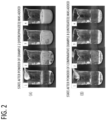
- FIGS. 1 and 2 show evaluation examples of hydrophilicity and self-dispersibility, and show changes in state with the passage of time from (1) immediately after each powder was added to ion exchanged water to (4) 60 seconds later.
- FIG. 1(A) shows changes in state of the powder of Example 1 (the powder obtained by performing the hydrophilization treatment of octyltriethoxysilane-treated hydrophobic pigment grade titanium oxide with polyoxyethylene (10) isostearyl ether), which is an example of the evaluation criterion: A.
- FIG. 1(B) shows changes in state of the powder of Comparative Example 8 (octyltriethoxysilane-treated hydrophobic pigment grade titanium oxide itself used in Example 1), which is an example of the evaluation criterion: C.
- FIG. 2(A) shows changes in state of the powder of Example 2 (the powder obtained by performing the hydrophilization treatment of octyltriethoxysilane-treated hydrophobic yellow iron oxide with polyoxyethylene (10) isostearyl ether), which is an example of the evaluation criterion: A.
- FIG. 2(B) shows changes in state of the powder of Comparative Example 8 (octyltriethoxysilane-treated hydrophobic yellow iron oxide itself used in Example 2), which is an example of the evaluation criterion: C.
- Test 1 ion exchanged water
- Test 2 ion exchanged water/BG Test 3: ion exchanged water/G
- Hydrophilizatio n treatment Untreated (Comparativ e Example 8)
- Hydrophilizatio n treatment Untreated (Comparativ e Example 8)
- Hydrophilizatio n treatment Untreated (Comparativ e Example 8)
- Example 1 A C A C A C Example 2 A C A C A C Example 3 A C A C A C A C Example 4 A C A C A C A C Example 5 A C A C A C Example 6 A C A C A C A C Example 7 A C A C A C Example 8 A C A C A C Example 9 A C A C A C Example 10 A C A C A C A C Example 11 A C A C A C Example 12 A C A C A C Example 13 A C A C A C Example 14 A C A C A C A C Example 15 A C A C A C Example 16 A C A C A C Example 17 A C A C A C A C Comparativ e Example 1 B - C
- Example 1 and Comparative Example 8 From the evaluation results of Example 1 and Comparative Example 8, and the like, it was found that the hydrophilicity and self-dispersibility are clearly improved by subjecting the inorganic powder as the base body to both the hydrophobization treatment and the hydrophilization treatment.
- the powders of Examples 1 to 17 have remarkable usefulness in the property of naturally diffusing and dispersing in water without performing any physical stirring operation (that is, self-dispersibility) after being dropped into ion exchanged water or the like. More specifically, it can be said that the powders of Examples 1 to 17 spontaneously disperse and uniformly mix within several tens of seconds (within at most 60 seconds) after being dropped into an aqueous solvent.
- Example 1 A
- Example 1: B B
- polyoxyethylene (10) isostearyl ether is used as the surfactant
- Example 1 A different point between Example 1 and Comparative Example 1 resides in the structure of the carbon chain moiety of the surfactant (that is, Example 1: branched structure, Comparative Example 1: linear structure), and therefore, it was found that the surfactant in which the carbon chain moiety has a branched structure (that is, a nonionic surfactant of Type 1) is useful from the viewpoint of hydrophilicity and self-dispersibility. The same can be said said said from the evaluation results of Example 6 and Comparative Example 2 (that is, the number of carbon atoms in the carbon chain moiety is C12 in both cases).
- the surfactant in which the number of carbon atoms in the carbon chain moiety is the smallest in Examples 1 to 17 is polyoxyethylene (10) isododecyl ether used in Example 6 with a chain length of C12
- the surfactant in which the number of carbon atoms in the carbon chain moiety is the largest in Examples 1 to 17 is polyoxyethylene (20) octyldodecyl ether used in Example 13 with a chain length of C20. Therefore, the surfactant useful from the viewpoint of hydrophilicity and self-dispersibility can be selected from the perspective that the number of carbon atoms in the carbon chain moiety is C12 to C20.
- the surfactant having the lowest HLB in Examples 1 to 17 is polyoxyethylene (5) hexyldecyl ether used in Example 16 with an HLB of 9.5, and the surfactant having the highest HLB in Examples 1 to 17 is polyglyceryl (10) monoisostearate used in Example 12 with an HLB of 15.5. Therefore, the surfactant useful from the viewpoint of hydrophilicity and self-dispersibility can be selected from the perspective that the HLB is 9.5 to 15.5.
- Example 11 From the evaluation results of Example 11 and Comparative Example 7, it can be said that the usefulness of the surfactant in which the carbon chain moiety has a branched structure does not depend on whether or not it is a glycerin conjugate.
- Example 12 From the evaluation results of Example 12 and Comparative Example 5, it can be said that the usefulness of the surfactant in which the carbon chain moiety has a branched structure does not depend on the bond type (that is, an ether bond or an ester bond) between the hydrophilic moiety and the carbon chain moiety.
- the bond type that is, an ether bond or an ester bond
- composition of the hydrophobic coat can be selected from octyltriethoxysilane, disodium stearoyl glutamate, hydrogen dimethicone, dimethylpolysiloxane, and methyl hydrogen polysiloxane.
- the composition of the hydrophilic coat that can achieve good hydrophilicity and self-dispersibility is a nonionic surfactant in which the carbon chain moiety has a branched structure and has 12 to 20 carbon atoms.
- the surfactant is a nonionic surfactant of a monoether type being Type 1 or a condition that the HLB is 9.5 to 15.5 is met, particularly good hydrophilicity and self-dispersibility can be achieved.
- O/W-type emulsion foundations having compositions shown in the following Example 18 and Comparative Example 9 were prepared, and the sense of use, cosmetic effect, and cosmetic durability of each O/W-type emulsion foundation were evaluated.
- the sense of use, cosmetic effect, and cosmetic durability were evaluated based on the average of scores given by 25 expert panelists who were asked to use each O/W-type emulsion foundation for one day and score on a five-point scale shown below.
- the sense of use was evaluated in terms of good smoothness, no stickiness, and comfort.
- the cosmetic effect is evaluated in terms of powderiness, no uneven coating, uniformity of the cosmetic coat, and natural luster.
- the cosmetic durability is evaluated in terms of occurrence of color dullness or shininess with the passage of time, and no powder aggregation.
- Example 18 From the evaluation results of Example 18, it was found that even if the powders of Examples 1 to 4 are prepared into an O/W-type emulsion foundation, good sense of use, cosmetic effect, and cosmetic durability are obtained.
- Comparative Example 9 it was found that when the powders of Comparative Examples 2 to 5 are prepared into an O/W-type emulsion foundation, the sense of use, cosmetic effect, and cosmetic durability are poorer than in the case where the powders of Examples 1 to 4 are used.
- O/W-type emulsion foundations having a composition shown in any of the following Example 19 and Comparative Examples 10 and 11 were prepared, and the sense of use, cosmetic effect, and cosmetic durability of each O/W-type emulsion foundation were evaluated.
- the production method and evaluation method are the same as those in the above Example 18, but are significantly different in that comparison is made with Comparative Example 10 in which octyltriethoxysilane-treated hydrophobic pigment grade titanium oxide, octyltriethoxysilane-treated hydrophobic yellow iron oxide, octyltriethoxysilane-treated hydrophobic red iron oxide, and octyltriethoxysilane-treated hydrophobic black iron oxide (each corresponds to the hydrophobic inorganic powder before the hydrophilization treatment in Examples 1 to 4) were blended in the aqueous layer components.
- octyltriethoxysilane-treated hydrophobic pigment grade titanium oxide octyltriethoxysilane-treated hydrophobic yellow iron oxide, octyltriethoxysilane-treated hydrophobic red iron oxide, and octyltriethoxysilane-treated hydrophobic black iron oxide (each corresponds to
- Example 19 From the evaluation results of Example 19, it was found that when the powders of Examples 1 to 4 are blended as the aqueous layer components of the O/W-type emulsion foundation (Example 19), good sense of use, cosmetic effect, and cosmetic durability are obtained.
- Comparative Example 10 From the evaluation results of Comparative Example 10, it was found that even when the hydrophobic inorganic powders before the hydrophilization treatment are blended as the oil layer components of the O/W-type emulsion foundation (Comparative Example 10), reasonable sense of use, cosmetic effect, and cosmetic durability are obtained, but the sense of use and cosmetic effect are poorer than in Example 19.
- Comparative Examples 10 and 11 From the evaluation results of Comparative Examples 10 and 11, it was found that in the case where the powders of Comparative Examples 2 to 5 are used, the sense of use, cosmetic effect, and cosmetic durability are poorer than in the case where the powders before the hydrophilization treatment are used. That is, it was found that in the case where the treatment is performed with a nonionic surfactant having a linear carbon chain moiety, deterioration occurs in terms of sense of use, cosmetic effect, and cosmetic durability as compared with the case where the hydrophobic inorganic powders before the hydrophilization treatment are used. Note that Comparative Examples 10 and 11 are different in whether the powders are blended in the aqueous layer or the oil layer, but are interpreted as rational in consideration of the surface coat of each powder. For example, when the powders of Comparative Examples 2 to 5 (powders subjected to the hydrophilization treatment) are blended as the oil layer components, further deterioration in the sense of use, cosmetic effect, and cosmetic durability is expected.
- Water-based suncut lotions having a composition shown in any of the following Example 20 and Comparative Examples 12 and 13 were prepared, and the sense of use, cosmetic effect, cosmetic durability, and SPF value of each water-based suncut lotion was evaluated.
- the in-vitro SPF value was measured as an additional item.
- the other evaluation methods are the same as those for the above-mentioned O/W-type emulsion foundation, but are significantly different in that comparison is made with the example in which the hydrophobic inorganic powders before the hydrophilization treatment (each corresponds to the hydrophobic inorganic powder before the hydrophilization treatment in Examples 10 and 11) in Comparative Example 12 are blended in the aqueous layer components.
- O/W-type sunscreen cosmetics having compositions shown in the following Example 21 and Comparative Example 14 were prepared, and the sense of use, cosmetic effect, cosmetic durability, and SPF value of each O/W-type sunscreen cosmetic were evaluated.
- the O/W-type sunscreen cosmetic obtained by blending the powder of Example 7 has a high UV shielding ability and excellent sense of use, cosmetic effect, and cosmetic durability.
- O/W-type sunscreen cosmetics having a composition shown in either of the following Example 22 and Comparative Example 15 were prepared, and the sense of use, cosmetic effect, cosmetic durability, and SPF value of each O/W-type sunscreen cosmetic were evaluated.
- Powder foundations having compositions shown in the following Example 23 and Comparative Example 16 were prepared, and the sense of use, cosmetic effect, and cosmetic durability of each powder foundation were evaluated.
- Oily solid foundations having a composition shown in either of the following Example 24 and Comparative Example 17 were prepared, and the sense of use, cosmetic effect, and cosmetic durability of each oily solid foundation were evaluated.
- Example 24 Comparative Example 17 Oily components Polyglyceryl-2 triisostearate 8.5 (wt%) 8.5 (wt%) Propylene glycol dicaprate 10.0 10.0 Dimethylpolysiloxane (20 cs) 9.0 9.0 (Dimethicone/vinyl dimethicone) crosspolymer 5.0 5.0 Petrolatum 7.5 7.5 Polyethylene wax 4.0 4.0 Candelilla wax 1.5 1.5 2-Ethylhexyl p-methoxycinnamate 3.0 3.0 Alkylsilane-treated talc balance balance Powder of Example 1 (titanium oxide) 7.0 - Powder of Example 2 (yellow iron oxide) 3.0 - Powder of Example 3 (red iron oxide) 2.2 - Powder components Powder of Example 4 (black iron oxide) 0.2 - Powder of Comparative Example 2 (titanium oxide) - 7.0
- Water-based white powder foundations having compositions shown in either of the following Example 25 and Comparative Example 18 were prepared, and the sense of use, cosmetic effect, and cosmetic durability of each water-based white powder foundation were evaluated.
- Example 25 Comparative Example 18 Powder components Talc 10.0 (wt%) 10.0 (wt%) Boron nitride 3.0 3.0 Synthetic mica 3.5 3.5 Powder of Example 5 (titanium oxide) 3.0 - Powder of Comparative Example 1 (titanium oxide) - 3.0 Polyurethane powder 5.0 - Aqueous layer components BG 5.0 5.0 Glycerin 5.0 5.0 Ethanol 5.0 5.0 EDTA ⁇ 2Na 0.2 0.2 Phenoxyethanol 0.3 0.3 SEPINOV P88 0.2 0.2 Ion exchanged water balance balance balance Evaluation results Sense of use 4.2 3.3 Cosmetic effect 4.1 3.1 Cosmetic durability 3.5 3.0
- Water-based eye shadows having compositions shown in the following Example 26 and Comparative Example 19 were prepared, and the sense of use, cosmetic effect, and cosmetic durability of each water-based eye shadow were evaluated.
- Water-based makeup bases having compositions shown in the following Example 27 and Comparative Example 20 were prepared, and the sense of use, cosmetic effect, and cosmetic durability of each water-based makeup base were evaluated.
- Example 27 Comparative Example 20 Powder components Silicone-treated talc 7.0 (wt%) 7.0 (wt%) Powder of Example 2 (yellow iron oxide) 0.7 - Powder of Example 3 (red iron oxide) 0.3 - Powder of Example 4 (black iron oxide) 3.0 - Powder of Comparative Example 3 (yellow iron oxide) - 0.7 Powder of Comparative Example 4 (red iron oxide) - 0.3 Powder of Comparative Example 5 (black iron oxide) - 3.0 Aqueous layer components BG 10.0 10.0 Glycerin 5.0 5.0 Ethanol 9.0 9.0 EDTA ⁇ 2Na 0.2 0.2 Phenoxyethanol 0.3 0.3 Ion exchanged water balance balance balance Evaluation results Sense of use 4.5 3.1 Cosmetic effect 4.5 3.0 Cosmetic durability 4.5 2.4
- Lipsticks having a composition shown in either of the following Example 28 and Comparative Example 21 were prepared, and the sense of use, cosmetic effect, and cosmetic durability of each lipstick were evaluated.
- Antiperspirants having compositions shown in the following Example 29 and Comparative Example 22 were prepared, and the no stickiness, no oily sensation, and comfort of each antiperspirant were evaluated.
- the evaluation method for the antiperspirant is the same as that for the O/W-type emulsion foundation described above except that the antiperspirant was evaluated for no stickiness, no oily sensation, and comfort.
- talc was used as the inorganic powder.
- the talc as the inorganic powder is untreated talc which does not have a hydrophobic coat or a hydrophilic coat.
- Example 29 Comparative Example 22 Powder components Powder of Example 16 (zinc oxide) 2.5 (wt%) - Powder of Example 17 (talc) 6.0 - Powder of Comparative Example 7 (zinc oxide) - 2.5 (wt%) Talc as inorganic powder - 6.0 Silica beads 5.0 5.0 Aqueous layer components Sodium chloride 0.1 0.1 Ethanol 38.0 38.0 BG 2.0 2.0 Polyoxyethylene sorbitan monolaurate 0.2 0.2 Phenoxyethanol 0.3 0.3 Ion exchanged water balance balance balance Evaluation results No stickiness 4.3 3.7 No oily sensation 4.5 3.8 Comfort 4.4 2.6
- Hair treatments having a composition shown in either of the following Example 30 and Comparative Example 23 were prepared, and the no stickiness, hair combability, and hair smoothness of each hair treatment were evaluated.
- the no stickiness, hair combability, and hair smoothness can also be reworded as luster and silkiness.
- the evaluation method for the hair treatment is the same as that for the O/W-type emulsion foundation described above except that the hair treatment was evaluated for no stickiness, hair combability, and hair smoothness.
- talc was used as the inorganic powder.
- the talc as the inorganic powder is untreated talc which does not have a hydrophobic coat or a hydrophilic coat.
- Example 30 Comparative Example 23 Oil layer components Ethylene glycol distearate 1.5 (wt%) 1.5 (wt%) Liquid paraffin 10.0 10.0 Squalene 5.0 5.0 Stearyl alcohol 1.5 1.5 Dimethylpolysiloxane (10 cs) 3.5 3.5 Stearic acid 5.0 5.0 Aqueous layer components Powder of Example 17 (talc) 5.0 - Talc as inorganic powder - 5.0 Polyoxyethylene (3) stearyl alcohol 4.5 4.5 Polyoxyethylene (10) cetyl ether 2.0 2.0 BG 6.0 6.0 Preservative q.S. q.s. Purified water balance balance Evaluation results No stickiness upon use 4.3 3.8 Hair combability 4.3 3.7 Hair smoothness 4.5 3.6
- a nonionic surfactant(s) that is (are) hydrophilic and has a branched structure in a carbon chain moiety can be selected.
- a condition that the number of carbon atoms in the carbon chain moiety is 12 to 20 or a condition that the HLB is 9.5 to 15.5 is met, good hydrophilicity and self-dispersibility can be achieved.
- the self-dispersibility is particularly remarkable, and it can be said that the properties cannot be achieved by known hydrophilized inorganic powders.
Landscapes
- Health & Medical Sciences (AREA)
- Life Sciences & Earth Sciences (AREA)
- Veterinary Medicine (AREA)
- Animal Behavior & Ethology (AREA)
- General Health & Medical Sciences (AREA)
- Public Health (AREA)
- Birds (AREA)
- Epidemiology (AREA)
- Inorganic Chemistry (AREA)
- Chemical & Material Sciences (AREA)
- Dermatology (AREA)
- Emergency Medicine (AREA)
- Cosmetics (AREA)
Claims (2)
- Hydrophilisiertes anorganisches Pulver, umfassend ein anorganisches Pulver als Basismaterial, einen hydrophoben Überzug, der die Oberfläche des anorganischen Pulvers bedeckt, und einen hydrophilen Überzug, der den hydrophoben Überzug bedeckt, wobeider hydrophile Überzug eine Zusammensetzung aufweist, bei der es sich um ein nichtionisches Tensid oder nichtionische Tenside mit einer hydrophilen Gruppierung und einer Kohlenstoffkettengruppierung handelt,die Kohlenstoffkettengruppierung des nichtionischen Tensids bzw. der nichtionischen Tenside eine verzweigte Struktur aufweist, die ausreicht, um dem anorganischen Pulver mit Hydrophobie Selbstdispergierbarkeit zu verleihen,es sich bei dem nichtionischen Tensid bzw. den nichtionischen Tensiden um eines oder mehrere handelt, die aus den folgenden Substanzen ausgewählt sind:Polyoxyethylen-(10)-isostearylether;Polyoxyethylen-(10)-isododecylether,Polyoxyethylen-(12)-isostearat;Polyoxyethylen-(8)-glycerylisostearat;Polyoxyethylen-(20)-glyceryltriisostearat;Polyoxyethylen-(20)-octyldodecylether;Polyoxyethylen-(5)-hexyldecylether undPolyglyceryl-(10)-monoisostearat, undes sich bei der Zusammensetzung des hydrophoben Überzugs um eine oder mehrere handelt, die aus Octyltriethoxysilan, Dinatriumstearoylglutamat, Hydrogen Dimethicone, Dimethylpolysiloxan und Methylhydrogenpolysiloxan ausgewählt ist bzw. sind.
- Kosmetikum, umfassend das hydrophilisierte anorganische Pulver nach Anspruch 1.
Applications Claiming Priority (1)
| Application Number | Priority Date | Filing Date | Title |
|---|---|---|---|
| PCT/JP2019/029294 WO2021014655A1 (ja) | 2019-07-25 | 2019-07-25 | 親水化無機粉体及び当該親水化無機粉体を配合した化粧料 |
Publications (3)
| Publication Number | Publication Date |
|---|---|
| EP4005550A1 EP4005550A1 (de) | 2022-06-01 |
| EP4005550A4 EP4005550A4 (de) | 2023-05-10 |
| EP4005550B1 true EP4005550B1 (de) | 2025-05-07 |
Family
ID=74192553
Family Applications (1)
| Application Number | Title | Priority Date | Filing Date |
|---|---|---|---|
| EP19938137.7A Active EP4005550B1 (de) | 2019-07-25 | 2019-07-25 | Hydrophilisiertes anorganisches pulver und mit dem hydrophilisierten anorganischen pulver zusammengesetztes kosmetikum |
Country Status (5)
| Country | Link |
|---|---|
| US (1) | US20220249333A1 (de) |
| EP (1) | EP4005550B1 (de) |
| JP (1) | JP7357951B2 (de) |
| CN (1) | CN114173756A (de) |
| WO (1) | WO2021014655A1 (de) |
Families Citing this family (2)
| Publication number | Priority date | Publication date | Assignee | Title |
|---|---|---|---|---|
| JP7521827B2 (ja) * | 2021-12-21 | 2024-07-24 | 三好化成株式会社 | 水性分散体、及び化粧料 |
| US12291637B2 (en) | 2022-09-30 | 2025-05-06 | L'oreal | Acidic bonding compositions and methods for restoring and color toning lightened hair |
Family Cites Families (21)
| Publication number | Priority date | Publication date | Assignee | Title |
|---|---|---|---|---|
| JPS63179972A (ja) | 1987-01-21 | 1988-07-23 | Miyoshi Kasei:Kk | ポリオレフイン樹脂処理顔料および化粧料 |
| JPH01301760A (ja) * | 1988-05-30 | 1989-12-05 | Pentel Kk | 水性顔料分散体 |
| JP5001486B2 (ja) * | 2000-09-11 | 2012-08-15 | 三好化成株式会社 | 超分散安定性を有する粉体の油性分散体及びこれを配合した化粧料 |
| GB0127325D0 (en) | 2001-11-14 | 2002-01-02 | Acma | Metal oxide composition |
| US20060013843A1 (en) * | 2004-07-16 | 2006-01-19 | L'oreal | Cosmetic composition comprising a defined silicone polymer and a surfactant |
| WO2007007403A1 (ja) * | 2005-07-13 | 2007-01-18 | Miyoshi Kasei, Inc. | 表面処理粉体及びこれを含有する化粧料 |
| EP2380938B8 (de) * | 2009-01-21 | 2013-09-25 | Nihon Parkerizing Co., Ltd. | Hydrophilierungsmittel für ein aluminiumhaltiges metallmaterial, hydrophilierungsverfahren und hydrophiliertes aluminiumhaltiges metallmaterial |
| WO2012014761A1 (ja) * | 2010-07-24 | 2012-02-02 | 株式会社日本触媒 | 親水化処理剤 |
| JP5832118B2 (ja) * | 2011-04-05 | 2015-12-16 | ライオン株式会社 | 粉体含有化粧料 |
| JP6130094B2 (ja) * | 2011-09-28 | 2017-05-17 | 株式会社コーセー | 水中油型乳化化粧料 |
| EP2939652B1 (de) | 2012-12-26 | 2018-05-23 | Miyoshi Kasei, Inc. | Oberflächenbehandeltes pulver und kosmetikum damit |
| JP6291732B2 (ja) * | 2013-06-26 | 2018-03-14 | 堺化学工業株式会社 | 複合粉体分散体の製造方法 |
| JP2016117698A (ja) * | 2014-12-24 | 2016-06-30 | ライオン株式会社 | エアゾール型制汗デオドラント組成物 |
| JPWO2016133154A1 (ja) * | 2015-02-19 | 2017-04-27 | 旭化成株式会社 | 変性共役ジエン系重合体及びその製造方法、ゴム組成物、並びにタイヤ |
| JP6682200B2 (ja) | 2015-05-29 | 2020-04-15 | テイカ株式会社 | 表面処理粉体、並びにこの表面処理粉体を用いた水分散性化粧料用組成物及びこの表面処理粉体を用いたo/w型化粧料 |
| JP6542099B2 (ja) * | 2015-10-28 | 2019-07-10 | 富士フイルム株式会社 | 水中油型皮膚外用剤 |
| KR102417771B1 (ko) * | 2015-10-30 | 2022-07-06 | (주)아모레퍼시픽 | 수분산성 이산화티탄 복합 분체 |
| EP3449896B1 (de) * | 2016-04-28 | 2021-03-17 | Shiseido Company, Ltd. | Festes öl-in-wasser-kosmetikum |
| JP6905726B2 (ja) * | 2016-07-27 | 2021-07-21 | 株式会社トキワ | 固形粉末化粧料及び固形粉末化粧料の製造方法 |
| KR102672901B1 (ko) * | 2017-02-27 | 2024-06-10 | (주)아모레퍼시픽 | 유해 광선 차단 화장료 조성물 |
| CN107416844B (zh) * | 2017-08-09 | 2019-09-06 | 中国石油天然气股份有限公司 | 具有双亲特性和双粒子结构的纳米二氧化硅分散液及制法 |
-
2019
- 2019-07-25 JP JP2021534522A patent/JP7357951B2/ja active Active
- 2019-07-25 EP EP19938137.7A patent/EP4005550B1/de active Active
- 2019-07-25 WO PCT/JP2019/029294 patent/WO2021014655A1/ja not_active Ceased
- 2019-07-25 CN CN201980098756.5A patent/CN114173756A/zh active Pending
- 2019-07-25 US US17/629,606 patent/US20220249333A1/en active Pending
Also Published As
| Publication number | Publication date |
|---|---|
| EP4005550A4 (de) | 2023-05-10 |
| CN114173756A (zh) | 2022-03-11 |
| US20220249333A1 (en) | 2022-08-11 |
| WO2021014655A1 (ja) | 2021-01-28 |
| JPWO2021014655A1 (de) | 2021-01-28 |
| JP7357951B2 (ja) | 2023-10-10 |
| EP4005550A1 (de) | 2022-06-01 |
Similar Documents
| Publication | Publication Date | Title |
|---|---|---|
| JP6976146B2 (ja) | ワックス状組成物 | |
| EP2048178B1 (de) | Veresterungsreaktionsprodukte und ihre verwendung in kosmetischen zubereitungen | |
| EP3126450B1 (de) | Neuartiges silikontensid, wasser-in-öl-emulsionszusammensetzung, pulverzusammensetzung und kosmetische/medizinische anwendung davon | |
| JP7186125B2 (ja) | 化粧料 | |
| JP7129768B2 (ja) | 表面処理粉体 | |
| JP7583570B2 (ja) | 水中油型乳化固形化粧料 | |
| JP7456866B2 (ja) | エアゾール化粧料 | |
| EP2474300B1 (de) | Zusammensetzung für ein kosmetikpräparat mit uv-abschirmender wirkung und talgverfestigungsfunktion sowie kosmetikpräparat | |
| EP4005640A1 (de) | Kosmetikum und verfahren zur herstellung des kosmetikums | |
| EP4005551B1 (de) | Hydrophilisiertes anorganisches pulver und kosmetische zubereitung mit diesem hydrophilisierten anorganischen pulver | |
| JP7306952B2 (ja) | 粉末化粧料およびその製造方法 | |
| EP4005550B1 (de) | Hydrophilisiertes anorganisches pulver und mit dem hydrophilisierten anorganischen pulver zusammengesetztes kosmetikum | |
| JP2007055925A (ja) | 油性基剤及びこれを含有する化粧料及び皮膚外用剤 | |
| WO2023026999A1 (ja) | 粉体含有組成物 | |
| JP7539781B2 (ja) | 化粧料用粉体、色持ち向上剤、及び色持ち向上方法 | |
| JP6077216B2 (ja) | 油性化粧料 | |
| JP2017193540A (ja) | 固形化粧料 | |
| EP4005552B1 (de) | Hydrophilisiertes organisches pulver und kosmetikum mit hydrophilisiertem organischem pulver | |
| US12514795B2 (en) | Glycerin dispersion and cosmetic | |
| JP7752812B1 (ja) | 金属酸化物分散組成物 | |
| JP7724655B2 (ja) | 粉末化粧料 | |
| JP2025158931A (ja) | 化粧料 | |
| JP2025090556A (ja) | 水中油型乳化化粧料 |
Legal Events
| Date | Code | Title | Description |
|---|---|---|---|
| STAA | Information on the status of an ep patent application or granted ep patent |
Free format text: STATUS: THE INTERNATIONAL PUBLICATION HAS BEEN MADE |
|
| PUAI | Public reference made under article 153(3) epc to a published international application that has entered the european phase |
Free format text: ORIGINAL CODE: 0009012 |
|
| STAA | Information on the status of an ep patent application or granted ep patent |
Free format text: STATUS: REQUEST FOR EXAMINATION WAS MADE |
|
| 17P | Request for examination filed |
Effective date: 20220224 |
|
| AK | Designated contracting states |
Kind code of ref document: A1 Designated state(s): AL AT BE BG CH CY CZ DE DK EE ES FI FR GB GR HR HU IE IS IT LI LT LU LV MC MK MT NL NO PL PT RO RS SE SI SK SM TR |
|
| DAV | Request for validation of the european patent (deleted) | ||
| DAX | Request for extension of the european patent (deleted) | ||
| A4 | Supplementary search report drawn up and despatched |
Effective date: 20230406 |
|
| RIC1 | Information provided on ipc code assigned before grant |
Ipc: A61Q 19/02 20060101ALI20230331BHEP Ipc: A61Q 5/00 20060101ALI20230331BHEP Ipc: A61Q 1/12 20060101ALI20230331BHEP Ipc: A61K 8/89 20060101ALI20230331BHEP Ipc: A61K 8/44 20060101ALI20230331BHEP Ipc: A61K 8/39 20060101ALI20230331BHEP Ipc: A61K 8/19 20060101ALI20230331BHEP Ipc: A61K 8/86 20060101AFI20230331BHEP |
|
| GRAP | Despatch of communication of intention to grant a patent |
Free format text: ORIGINAL CODE: EPIDOSNIGR1 |
|
| STAA | Information on the status of an ep patent application or granted ep patent |
Free format text: STATUS: GRANT OF PATENT IS INTENDED |
|
| RIC1 | Information provided on ipc code assigned before grant |
Ipc: A61K 8/58 20060101ALI20250124BHEP Ipc: A61K 8/29 20060101ALI20250124BHEP Ipc: A61K 8/27 20060101ALI20250124BHEP Ipc: A61K 8/02 20060101ALI20250124BHEP Ipc: A61K 8/19 20060101ALI20250124BHEP Ipc: A61K 8/39 20060101ALI20250124BHEP Ipc: A61K 8/44 20060101ALI20250124BHEP Ipc: A61K 8/89 20060101ALI20250124BHEP Ipc: A61Q 1/12 20060101ALI20250124BHEP Ipc: A61Q 5/00 20060101ALI20250124BHEP Ipc: A61Q 19/02 20060101ALI20250124BHEP Ipc: A61K 8/86 20060101AFI20250124BHEP |
|
| INTG | Intention to grant announced |
Effective date: 20250218 |
|
| GRAS | Grant fee paid |
Free format text: ORIGINAL CODE: EPIDOSNIGR3 |
|
| GRAA | (expected) grant |
Free format text: ORIGINAL CODE: 0009210 |
|
| STAA | Information on the status of an ep patent application or granted ep patent |
Free format text: STATUS: THE PATENT HAS BEEN GRANTED |
|
| AK | Designated contracting states |
Kind code of ref document: B1 Designated state(s): AL AT BE BG CH CY CZ DE DK EE ES FI FR GB GR HR HU IE IS IT LI LT LU LV MC MK MT NL NO PL PT RO RS SE SI SK SM TR |
|
| REG | Reference to a national code |
Ref country code: GB Ref legal event code: FG4D |
|
| REG | Reference to a national code |
Ref country code: CH Ref legal event code: EP |
|
| REG | Reference to a national code |
Ref country code: DE Ref legal event code: R096 Ref document number: 602019069823 Country of ref document: DE |
|
| REG | Reference to a national code |
Ref country code: IE Ref legal event code: FG4D |
|
| REG | Reference to a national code |
Ref country code: NL Ref legal event code: MP Effective date: 20250507 |
|
| PG25 | Lapsed in a contracting state [announced via postgrant information from national office to epo] |
Ref country code: FI Free format text: LAPSE BECAUSE OF FAILURE TO SUBMIT A TRANSLATION OF THE DESCRIPTION OR TO PAY THE FEE WITHIN THE PRESCRIBED TIME-LIMIT Effective date: 20250507 Ref country code: PT Free format text: LAPSE BECAUSE OF FAILURE TO SUBMIT A TRANSLATION OF THE DESCRIPTION OR TO PAY THE FEE WITHIN THE PRESCRIBED TIME-LIMIT Effective date: 20250908 Ref country code: ES Free format text: LAPSE BECAUSE OF FAILURE TO SUBMIT A TRANSLATION OF THE DESCRIPTION OR TO PAY THE FEE WITHIN THE PRESCRIBED TIME-LIMIT Effective date: 20250507 |
|
| REG | Reference to a national code |
Ref country code: LT Ref legal event code: MG9D |
|
| PG25 | Lapsed in a contracting state [announced via postgrant information from national office to epo] |
Ref country code: GR Free format text: LAPSE BECAUSE OF FAILURE TO SUBMIT A TRANSLATION OF THE DESCRIPTION OR TO PAY THE FEE WITHIN THE PRESCRIBED TIME-LIMIT Effective date: 20250808 Ref country code: NO Free format text: LAPSE BECAUSE OF FAILURE TO SUBMIT A TRANSLATION OF THE DESCRIPTION OR TO PAY THE FEE WITHIN THE PRESCRIBED TIME-LIMIT Effective date: 20250807 |
|
| PG25 | Lapsed in a contracting state [announced via postgrant information from national office to epo] |
Ref country code: NL Free format text: LAPSE BECAUSE OF FAILURE TO SUBMIT A TRANSLATION OF THE DESCRIPTION OR TO PAY THE FEE WITHIN THE PRESCRIBED TIME-LIMIT Effective date: 20250507 Ref country code: PL Free format text: LAPSE BECAUSE OF FAILURE TO SUBMIT A TRANSLATION OF THE DESCRIPTION OR TO PAY THE FEE WITHIN THE PRESCRIBED TIME-LIMIT Effective date: 20250507 |
|
| REG | Reference to a national code |
Ref country code: AT Ref legal event code: MK05 Ref document number: 1791697 Country of ref document: AT Kind code of ref document: T Effective date: 20250507 |
|
| PG25 | Lapsed in a contracting state [announced via postgrant information from national office to epo] |
Ref country code: BG Free format text: LAPSE BECAUSE OF FAILURE TO SUBMIT A TRANSLATION OF THE DESCRIPTION OR TO PAY THE FEE WITHIN THE PRESCRIBED TIME-LIMIT Effective date: 20250507 |
|
| PG25 | Lapsed in a contracting state [announced via postgrant information from national office to epo] |
Ref country code: HR Free format text: LAPSE BECAUSE OF FAILURE TO SUBMIT A TRANSLATION OF THE DESCRIPTION OR TO PAY THE FEE WITHIN THE PRESCRIBED TIME-LIMIT Effective date: 20250507 |
|
| PG25 | Lapsed in a contracting state [announced via postgrant information from national office to epo] |
Ref country code: AT Free format text: LAPSE BECAUSE OF FAILURE TO SUBMIT A TRANSLATION OF THE DESCRIPTION OR TO PAY THE FEE WITHIN THE PRESCRIBED TIME-LIMIT Effective date: 20250507 |
|
| PGFP | Annual fee paid to national office [announced via postgrant information from national office to epo] |
Ref country code: FR Payment date: 20250723 Year of fee payment: 7 |
|
| PG25 | Lapsed in a contracting state [announced via postgrant information from national office to epo] |
Ref country code: RS Free format text: LAPSE BECAUSE OF FAILURE TO SUBMIT A TRANSLATION OF THE DESCRIPTION OR TO PAY THE FEE WITHIN THE PRESCRIBED TIME-LIMIT Effective date: 20250807 |
|
| PG25 | Lapsed in a contracting state [announced via postgrant information from national office to epo] |
Ref country code: IS Free format text: LAPSE BECAUSE OF FAILURE TO SUBMIT A TRANSLATION OF THE DESCRIPTION OR TO PAY THE FEE WITHIN THE PRESCRIBED TIME-LIMIT Effective date: 20250907 |
|
| PG25 | Lapsed in a contracting state [announced via postgrant information from national office to epo] |
Ref country code: LV Free format text: LAPSE BECAUSE OF FAILURE TO SUBMIT A TRANSLATION OF THE DESCRIPTION OR TO PAY THE FEE WITHIN THE PRESCRIBED TIME-LIMIT Effective date: 20250507 |
|
| PG25 | Lapsed in a contracting state [announced via postgrant information from national office to epo] |
Ref country code: DK Free format text: LAPSE BECAUSE OF FAILURE TO SUBMIT A TRANSLATION OF THE DESCRIPTION OR TO PAY THE FEE WITHIN THE PRESCRIBED TIME-LIMIT Effective date: 20250507 Ref country code: SM Free format text: LAPSE BECAUSE OF FAILURE TO SUBMIT A TRANSLATION OF THE DESCRIPTION OR TO PAY THE FEE WITHIN THE PRESCRIBED TIME-LIMIT Effective date: 20250507 |
|
| PG25 | Lapsed in a contracting state [announced via postgrant information from national office to epo] |
Ref country code: CZ Free format text: LAPSE BECAUSE OF FAILURE TO SUBMIT A TRANSLATION OF THE DESCRIPTION OR TO PAY THE FEE WITHIN THE PRESCRIBED TIME-LIMIT Effective date: 20250507 |
|
| PG25 | Lapsed in a contracting state [announced via postgrant information from national office to epo] |
Ref country code: EE Free format text: LAPSE BECAUSE OF FAILURE TO SUBMIT A TRANSLATION OF THE DESCRIPTION OR TO PAY THE FEE WITHIN THE PRESCRIBED TIME-LIMIT Effective date: 20250507 |
|
| PG25 | Lapsed in a contracting state [announced via postgrant information from national office to epo] |
Ref country code: SK Free format text: LAPSE BECAUSE OF FAILURE TO SUBMIT A TRANSLATION OF THE DESCRIPTION OR TO PAY THE FEE WITHIN THE PRESCRIBED TIME-LIMIT Effective date: 20250507 Ref country code: RO Free format text: LAPSE BECAUSE OF FAILURE TO SUBMIT A TRANSLATION OF THE DESCRIPTION OR TO PAY THE FEE WITHIN THE PRESCRIBED TIME-LIMIT Effective date: 20250507 |
|
| PG25 | Lapsed in a contracting state [announced via postgrant information from national office to epo] |
Ref country code: IT Free format text: LAPSE BECAUSE OF FAILURE TO SUBMIT A TRANSLATION OF THE DESCRIPTION OR TO PAY THE FEE WITHIN THE PRESCRIBED TIME-LIMIT Effective date: 20250507 |
|
| REG | Reference to a national code |
Ref country code: DE Ref legal event code: R119 Ref document number: 602019069823 Country of ref document: DE |
|
| REG | Reference to a national code |
Ref country code: CH Ref legal event code: H13 Free format text: ST27 STATUS EVENT CODE: U-0-0-H10-H13 (AS PROVIDED BY THE NATIONAL OFFICE) Effective date: 20260224 |
|
| PLBE | No opposition filed within time limit |
Free format text: ORIGINAL CODE: 0009261 |
|
| STAA | Information on the status of an ep patent application or granted ep patent |
Free format text: STATUS: NO OPPOSITION FILED WITHIN TIME LIMIT |
|
| PG25 | Lapsed in a contracting state [announced via postgrant information from national office to epo] |
Ref country code: LU Free format text: LAPSE BECAUSE OF NON-PAYMENT OF DUE FEES Effective date: 20250725 |
|
| REG | Reference to a national code |
Ref country code: CH Ref legal event code: L10 Free format text: ST27 STATUS EVENT CODE: U-0-0-L10-L00 (AS PROVIDED BY THE NATIONAL OFFICE) Effective date: 20260318 |
|
| REG | Reference to a national code |
Ref country code: BE Ref legal event code: MM Effective date: 20250731 |
|
| PG25 | Lapsed in a contracting state [announced via postgrant information from national office to epo] |
Ref country code: DE Free format text: LAPSE BECAUSE OF NON-PAYMENT OF DUE FEES Effective date: 20260203 |
|
| 26N | No opposition filed |
Effective date: 20260210 |
|
| PG25 | Lapsed in a contracting state [announced via postgrant information from national office to epo] |
Ref country code: BE Free format text: LAPSE BECAUSE OF NON-PAYMENT OF DUE FEES Effective date: 20250731 |