EP3991663B1 - Appareil de mammographie - Google Patents
Appareil de mammographie Download PDFInfo
- Publication number
- EP3991663B1 EP3991663B1 EP21204434.1A EP21204434A EP3991663B1 EP 3991663 B1 EP3991663 B1 EP 3991663B1 EP 21204434 A EP21204434 A EP 21204434A EP 3991663 B1 EP3991663 B1 EP 3991663B1
- Authority
- EP
- European Patent Office
- Prior art keywords
- compression plate
- operation portion
- speed
- mammography apparatus
- case
- Prior art date
- Legal status (The legal status is an assumption and is not a legal conclusion. Google has not performed a legal analysis and makes no representation as to the accuracy of the status listed.)
- Active
Links
Images










Classifications
-
- A—HUMAN NECESSITIES
- A61—MEDICAL OR VETERINARY SCIENCE; HYGIENE
- A61B—DIAGNOSIS; SURGERY; IDENTIFICATION
- A61B6/00—Apparatus or devices for radiation diagnosis; Apparatus or devices for radiation diagnosis combined with radiation therapy equipment
- A61B6/04—Positioning of patients; Tiltable beds or the like
- A61B6/0407—Supports, e.g. tables or beds, for the body or parts of the body
- A61B6/0414—Supports, e.g. tables or beds, for the body or parts of the body with compression means
-
- A—HUMAN NECESSITIES
- A61—MEDICAL OR VETERINARY SCIENCE; HYGIENE
- A61B—DIAGNOSIS; SURGERY; IDENTIFICATION
- A61B6/00—Apparatus or devices for radiation diagnosis; Apparatus or devices for radiation diagnosis combined with radiation therapy equipment
- A61B6/50—Apparatus or devices for radiation diagnosis; Apparatus or devices for radiation diagnosis combined with radiation therapy equipment specially adapted for specific body parts; specially adapted for specific clinical applications
- A61B6/502—Apparatus or devices for radiation diagnosis; Apparatus or devices for radiation diagnosis combined with radiation therapy equipment specially adapted for specific body parts; specially adapted for specific clinical applications for diagnosis of breast, i.e. mammography
-
- A—HUMAN NECESSITIES
- A61—MEDICAL OR VETERINARY SCIENCE; HYGIENE
- A61B—DIAGNOSIS; SURGERY; IDENTIFICATION
- A61B6/00—Apparatus or devices for radiation diagnosis; Apparatus or devices for radiation diagnosis combined with radiation therapy equipment
- A61B6/54—Control of apparatus or devices for radiation diagnosis
Definitions
- the technology of the present disclosure relates to a mammography apparatus.
- a mammography apparatus that irradiates a breast of a subject with radiation and captures a radiation image of the breast.
- the mammography apparatus is provided with an imaging table on which the breast is placed and a compression plate which is disposed to face the imaging table and compresses the breast.
- the compression plate can be raised and lowered in a vertical direction with respect to the imaging table, and the breast is compressed by lowering the compression plate toward the imaging table.
- an operation portion operated to raise and lower the compression plate a button operation portion, a pedal operation portion, a rotation operation portion, and the like are known.
- the button operation portion and the pedal operation portion have two buttons or two foot pedals corresponding to a raising instruction and a lowering instruction, and are operated by a pressing operation of the button or a depressing operation of the pedal.
- Document US 2014/348291 A1 provides an X-ray imaging apparatus including an X-ray source to emit an X-ray onto a breast, a detector assembly configured to detect the X-ray transmitted through the breast, a compression paddle configured to compress the breast positioned on the detector assembly, a paddle manipulator configured to control the compression paddle according to a command, a degree-of-compression sensor configured to measure a degree of compression to which the breast is compressed by the compression paddle, and a pressure controller configured to supply a pressure corresponding to the measured degree of compression of the breast to the paddle manipulator.
- the operation direction is not along a movement direction of the compression plate in the vertical direction.
- the operation directions of the pressing operation of the button or the depressing operation of the pedal, and the rotation operation of the rotation knob or the jog dial are all significantly different from the vertical direction, which is the movement direction of the raising and lowering operation of the compression plate.
- the operation direction of the operation portion is not along the movement direction of the compression plate as described above, it is difficult to understand a correspondence between the operation direction of the operation portion and the movement direction of the compression plate.
- Document JP H04 64346 A discloses a mamma pressing mechanism for a mamma roentgenograph. When a lift lever is depressed in a first direction to lower a support member in a second direction, a mamma pressing plate lowers to a cassette while as it is lifted in a third direction, a pinion is turned freely and the support member rises in a fourth direction.
- a knob for fine adjustment is provided on the outer end of a rotating shaft to turn the pinion meshed with a rack direct manually and linked thereto.
- a pressing force of the mamma by the mamma pressing plate can be adjusted.
- a pinion, a rack and a spring are used for translating a movement of the lift lever and the knob into a movement of the mamma pressing plate.
- the present invention is to provide a mammography apparatus having better operability of a compression plate than the related art.
- the present invention relates to a mammography apparatus with the features of claim 1.
- the mammography apparatus further comprises a support portion that is connected to and moves together with the compression plate to be movable with respect to the imaging table, in which the operation portion is provided on the support portion.
- the mammography apparatus may comprise a support portion that supports the compression plate to be movable with respect to the imaging table, and a movable portion that is disposed between the compression plate and the support portion and is moved in the vertical direction together with the compression plate, in which the operation portion is provided on the support portion.
- the mammography apparatus further comprises an actuator that drives the compression plate, in which the actuator is activated in response to an operation of the operation portion, and the compression plate is moved by driving force generated by the actuator.
- the mammography apparatus further comprises a processor that controls the actuator to change a movement speed of the compression plate.
- the mammography apparatus further comprises a displacement amount detection unit that detects a displacement amount of the operation portion, in which the processor changes the movement speed of the compression plate based on the displacement amount detected by the displacement amount detection unit.
- the mammography apparatus further comprises a height detection unit that detects a height of the compression plate with respect to the imaging table, in which the processor changes the movement speed of the compression plate in response to the height of the compression plate.
- the processor sets an initial speed of the compression plate in a case in which the compression plate is raised from a state in which the compression plate is positioned at a relatively low position to be faster than an initial speed of the compression plate in a case in which the compression plate is raised from a state in which the compression plate is positioned at a relatively high position.
- the processor sets an initial speed of the compression plate in a case in which the compression plate is lowered from a state in which the compression plate is positioned at a relatively high position to be faster than an initial speed of the compression plate in a case in which the compression plate is lowered from a state in which the compression plate is positioned at a relatively low position.
- the mammography apparatus further comprises a displacement speed detection unit that detects a displacement speed of the operation portion, in which the processor sets the movement speed of the compression plate to be faster as the displacement speed of the operation portion is faster.
- the mammography apparatus further comprises a pressure detection unit that detects a pressure received by the compression plate from the breast.
- the processor sets a rate of change in speed, which is a ratio of a change amount of the movement speed of the compression plate to a unit displacement amount of the operation portion, to be smaller as the pressure is larger.
- the processor stops movement of the compression plate in a case in which the pressure detected by the pressure detection unit is equal to or larger than a preset threshold value.
- the mammography apparatus further comprises a load increasing unit that increases a load for operating the operation portion as a displacement amount of the operation portion is larger.
- the operation portion is a cantilever type lever having one end, which is a free end, and at least the free end is displaced along the movement direction of the compression plate.
- the operation portion stretches in an anteroposterior direction or a lateral direction.
- the operation portion rotates about a fulcrum provided on a base end side.
- the operation portion includes a main shaft portion that extends from the base end side to a free end side, and a protruding portion that is provided on the main shaft portion and protrudes to at least one of a lower side or an upper side with an axial direction of the main shaft portion as a reference.
- the protruding portion includes a first protruding portion that protrudes to the lower side of the main shaft portion, and a second protruding portion that protrudes to the upper side of the main shaft portion.
- the protruding portion has a hook shape or a ring shape.
- FIG. 1 shows an example of an overall configuration of a mammography apparatus according to a first embodiment.
- a mammography apparatus 10 uses a breast M of a subject (see Fig. 3 ) as an object.
- the mammography apparatus 10 is a radiography apparatus that irradiates the breast M with radiation (for example, X-rays or ⁇ -rays) and captures a radiation image of the breast M.
- radiation for example, X-rays or ⁇ -rays
- the mammography apparatus 10 comprises an apparatus body 11 and a control device 12.
- the apparatus body 11 is installed in a radiography room of a medical facility, for example.
- the control device 12 is installed in a control room adjacent to the radiography room, for example.
- the control device 12 is a desktop-type personal computer, for example.
- the control device 12 is communicably connected to an image database server (not shown) via a network (not shown) such as a local area network (LAN).
- LAN local area network
- the apparatus body 11 includes a stand 20 and an arm 21.
- the stand 20 is configured by a seat 20A installed on a floor of the radiography room and a support column 20B extending in a height direction from the seat 20A.
- the arm 21 has a substantially C-shape as viewed from the side, and is connected to the support column 20B. Since the arm 21 is movable in the height direction with respect to the support column 20B, a height thereof can be adjusted in response to a height of the subject. In addition, the arm 21 can rotate around a rotation shaft perpendicular to the support column 20B.
- the arm 21 is configured by a radiation source housing portion 22, an imaging table 23, and a body portion 24.
- a radiation source 25 is housed in the radiation source housing portion 22.
- the breast M of the subject is placed on the imaging table 23.
- a radiation detector 26 is housed in the imaging table 23.
- the body portion 24 integrally connects the radiation source housing portion 22 and the imaging table 23.
- the body portion 24 holds the radiation source housing portion 22 and the imaging table 23 at facing positions.
- Handrails 27 held by the subject by the hands are provided on the both sides of the body portion 24.
- the radiation source 25 irradiates the breast M placed on the imaging table 23 with the radiation.
- the radiation emitted from the radiation source 25 is transmitted through a compression plate 33 and then incident on the breast M.
- the radiation detector 26 detects the radiation transmitted through the breast M and outputs the radiation image.
- the radiation detector 26 is called a flat panel detector (FPD).
- the radiation detector 26 may include a scintillator that converts the radiation into visible light, and may be an indirect conversion type that converts the visible light emitted by the scintillator into an electric signal, or a direct conversion type that directly converts the radiation into an electric signal.
- An irradiation field limiter 31 is provided between the radiation source housing portion 22 and the imaging table 23.
- the irradiation field limiter 31 is also called a collimator, and defines an irradiation field of the radiation to the imaging table 23.
- a face guard 32 is attached to the radiation source housing portion 22.
- the face guard 32 is made or coated with a material through which the radiation is not transmitted, and protects a face of the subject from the radiation.
- the compression plate 33 which interposes and compresses the breast M with the imaging table 23, is provided between the imaging table 23 and the irradiation field limiter 31.
- the compression plate 33 is made of a material through which the radiation is transmitted.
- the compression plate 33 is disposed at a position facing the imaging table 23.
- the compression plate 33 has a box shape with an open upper surface side.
- the compression plate 33 may have another shape, such as a flat plate shape.
- the body portion 24 of the arm 21 supports the compression plate 33 to be movable with respect to the imaging table 23.
- the body portion 24 is an example of a "support portion” according to the technology of the present disclosure.
- a movable portion 34 is disposed between the compression plate 33 and the body portion 24.
- the movable portion 34 is held by a rail 28 provided on the body portion 24 to be movable slidingly.
- the rail 28 stretches in a vertical direction.
- the compression plate 33 is attached to the movable portion 34.
- the movable portion 34 is moved in the vertical direction together with the compression plate 33 by a drive mechanism, which will be described below.
- the vertical direction is a direction in which the compression plate 33 is moved toward the imaging table 23 (downward direction) and a direction in which the compression plate 33 is separated from the imaging table 23 (upward direction).
- the compression plate 33 is configured to be movable with respect to the imaging table 23.
- Fig. 2 is a partially enlarged view of the mammography apparatus 10.
- the mammography apparatus 10 is provided with an operation portion 40 that moves the compression plate 33 in the vertical direction.
- the operation portion 40 is provided separately from the compression plate 33, and is displaced along a movement direction of the compression plate 33.
- the operation portion 40 is provided on the movable portion 34.
- the operation portion 40 is operated in a case in which an operator, such as a radiologist, compresses the breast with respect to the imaging table 23 with the compression plate 33 to perform positioning of the breast M during radiography.
- the operation portion 40 is operated in a case in which the operator releases the compression of the breast M by the compression plate 33 after the radiography is terminated.
- the operation portion 40 is a cantilever type lever having one end, which is a free end, and the free end is displaced along the movement direction of the compression plate 33.
- the operation portion 40 is configured by a rod-shaped main shaft portion 40A and a spherical-shaped grip portion 40B.
- the grip portion 40B is attached to one end (that is, free end) of the main shaft portion 40A.
- a rotation shaft 41 is provided at the other end (that is, base end) of the main shaft portion 40A.
- the rotation shaft 41 is disposed inside the movable portion 34.
- the operation portion 40 is attached to the movable portion 34 such that the main shaft portion 40A stretches toward a side of the subject who places the breast M on the imaging table 23.
- the main shaft portion 40A obliquely stretches in the upward direction toward the side of the subject. That is, assuming that a direction of a position of the subject who places the breast on the imaging table 23 is anterior and an opposite direction thereof is posterior, the operation portion 40 having a lever shape stretches in an anteroposterior direction.
- the anteroposterior direction is, in other words, a depth direction of the mammography apparatus 10, and the operation portion 40 stretches in the depth direction of the mammography apparatus 10.
- the anteroposterior direction which is a stretching direction of the operation portion 40, is a concept including a case other than a case of being parallel to the floor (horizontal plane) as in the present example, and does not include a width direction and a perpendicular direction of the mammography apparatus 10.
- the stretching direction of the operation portion 40 at a neutral position (position indicated by a solid line in Fig. 3 ) in a state of not being operated is about 60° or less with respect to the horizontal plane, preferably 45° or less as in the present example.
- the operation portion 40 rotates with the rotation shaft 41 provided on a base end side as a fulcrum.
- the grip portion 40B is displaced in a direction along the movement direction of the compression plate 33, that is, in the vertical direction.
- the operator can displace the grip portion 40B in the vertical direction in a state of gripping the grip portion 40B.
- the compression plate 33 In a case in which the grip portion 40B is displaced in the downward direction, the compression plate 33 is moved (that is, lowered) toward the imaging table 23.
- the compression plate 33 moves (that is, raised) in a direction separated from the imaging table 23.
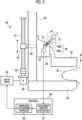
- Fig. 3 shows an example of configurations of the drive mechanism of the compression plate 33 and a processor that controls movement of the compression plate 33.
- a drive mechanism 50 shown in Fig. 3 is a so-called electric linear actuator.
- the drive mechanism 50 is provided, for example, inside the body portion 24 and is activated by an operation of the operation portion 40.
- the drive mechanism 50 includes a rod screw 51, a nut 52, a coupling 53, a motor 54, and a motor driver 55.
- the rod screw 51 extends in the vertical direction along the rail 28 (see Fig. 2 ).
- the rod screw 51 is a trapezoidal screw, for example.
- the nut 52 is screwed with the rod screw 51.
- the movable portion 34 is connected to the nut 52 via a connection portion 56. The movable portion 34 is moved in the vertical direction together with the nut 52 by rotation of the rod screw 51.
- the compression plate 33 is moved together with the movable portion 34 by driving force generated by the drive mechanism 50 as the actuator.
- a processor 60 is configured by, for example, a central processing unit (CPU), a memory, and the like.
- the processor 60 realizes various functions by executing a process by the CPU based on a program stored in the memory.
- the processor 60 is provided, for example, inside the body portion 24.
- the processor 60 includes a displacement direction detection unit 61 and a compression plate movement controller 62.
- the displacement direction detection unit 61 detects a displacement direction of the operation portion 40 based on a detection signal output from a potentiometer 42 as an angle detection sensor connected to the rotation shaft 41 of the operation portion 40.
- the potentiometer 42 is provided inside the movable portion 34, and outputs the detection signal in response to an angle of the operation portion 40. Note that it is also possible to use an encoder as the angle detection sensor instead of the potentiometer 42.
- a state in which the operation portion 40 is positioned at the neutral position is shown by the solid line.
- the displacement direction detection unit 61 detects a case in which the grip portion 40B of the operation portion 40 is displaced in the downward direction from the neutral position as "displacement in a positive direction” and detects a case in which the grip portion 40B of the operation portion 40 is displaced in the upward direction from the neutral position as "displacement in a negative direction", and detects whether the displacement direction is positive or negative.
- the compression plate movement controller 62 controls the drive mechanism 50 based on the displacement direction detected by the displacement direction detection unit 61. Specifically, the compression plate movement controller 62 controls the motor driver 55 in response to the displacement direction detected by the displacement direction detection unit 61 to change a rotation direction of the motor 54. In a case in which the displacement direction is the positive direction (that is, downward direction), the compression plate movement controller 62 lowers the compression plate 33 together with the movable portion 34 by rotating the motor 54 clockwise. In addition, in a case in which the displacement direction is the negative direction (that is, upward direction), the compression plate movement controller 62 raises the compression plate 33 together with the movable portion 34 by rotating the motor 54 counterclockwise.
- the compression plate movement controller 62 determines whether or not the operation of the operation portion 40 is started (step S10). For example, the compression plate movement controller 62 determines that the operation of the operation portion 40 is started in a case in which the operation portion 40 is displaced from the neutral position.
- the compression plate movement controller 62 acquires the displacement direction detected by the displacement direction detection unit 61 (step S11). The compression plate movement controller 62 determines whether or not the acquired displacement direction is the downward direction (step S12). In a case in which it is determined that the displacement direction is the downward direction (step S12: YES), the compression plate movement controller 62 controls the drive mechanism 50 to lower the compression plate 33 (step S13). On the other hand, in a case in which it is determined that the displacement direction is the upward direction (step S12: NO), the compression plate movement controller 62 controls the drive mechanism 50 to raise the compression plate 33 (step S14).
- step S15 the compression plate movement controller 62 determines whether or not the operation of the operation portion 40 is terminated. For example, the compression plate movement controller 62 determines that the operation of the operation portion 40 is terminated in a case in which the operation portion 40 is returned to the neutral position. In a case in which it is determined that the operation of the operation portion 40 is not terminated (step S15: NO), the compression plate movement controller 62 returns the process to step S11.
- the compression plate movement controller 62 repeats the processes of steps S11 to S15 until it is determined that the operation of the operation portion 40 is terminated, and terminates the process in a case in which it is determined that the operation of the operation portion 40 is terminated (step S15: YES).
- the operator who operates the operation portion 40 need only operate the operation portion 40 in a direction in which the compression plate 33 is lowered.
- the operator who operates the operation portion 40 need only operate the operation portion 40 in a direction in which the compression plate 33 is raised.
- the operation portion is displaced along the movement direction of the compression plate, and thus the operation direction of the operation portion and the movement direction of the compression plate are substantially the same. Therefore, the operator can intuitively operate the operation portion. That is, the mammography apparatus according to the present embodiment has better operability of the compression plate as compared with an apparatus in the related art in which the operation direction of the operation portion and the movement direction of the compression plate are significantly different. Therefore, according to the technology of the present disclosure, it is possible to provide the mammography apparatus having better operability of the compression plate than the related art.
- the second embodiment is different from the first embodiment only in a functional configuration of the processor 60.
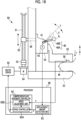
- Fig. 5 shows a configuration of the mammography apparatus according to the second embodiment.
- the processor 60 includes a displacement amount detection unit 63 and the compression plate movement controller 62.
- the compression plate movement controller 62 includes a speed controller 62A.
- the displacement amount detection unit 63 detects an angle ⁇ of the operation portion 40 based on the detection signal output from the potentiometer 42.
- the angle ⁇ represents a rotation angle of the operation portion 40 from the neutral position.
- the angle ⁇ has a "positive value” in a case in which the grip portion 40B of the operation portion 40 is displaced in the downward direction from the neutral position, and has a "negative value” in a case in which the grip portion 40B of the operation portion 40 is displaced in the upward direction from the neutral position. That is, the angle ⁇ is a concept including the "displacement direction" described in the first embodiment. Note that the angle ⁇ is an example of a "displacement amount" according to the technology of the present disclosure.
- the speed controller 62A obtains a speed V corresponding to the angle ⁇ as the displacement amount detected by the displacement amount detection unit 63, and controls the motor driver 55 such that the compression plate 33 is moved at the obtained speed V.
- the speed V has a "positive value” in a case in which the compression plate 33 is lowered, and has a “negative value” in a case in which the compression plate 33 is raised. That is, the speed V is a concept including the "movement direction" described in the first embodiment.
- the speed controller 62A controls a rotation speed (including the rotation direction) of the motor 54 via the motor driver 55 to change the speed V at which the compression plate 33 is moved.
- Fig. 6 shows an example of a relationship between the angle ⁇ and the speed V.
- the speed V has a proportional relationship with the angle ⁇ .
- the speed controller 62A obtains the speed V corresponding to the angle ⁇ detected by the displacement amount detection unit 63 based on the relationship between the angle ⁇ and the speed V shown in Fig. 6 .
- the speed controller 62A may store the relationship between the angle ⁇ and the speed V as a function to obtain the speed V based on the function.
- the speed controller 62A may store the relationship between the angle ⁇ and the speed V in the memory as a look up table (LUT), and obtain the speed V based on the LUT.
- LUT look up table
- the speed controller 62A performs a speed control using the relationship between the angle ⁇ and the speed V shown in Fig. 6 , the speed V of the compression plate 33 is changed in proportion to the displacement amount of the operation portion 40. That is, a rate of change in the speed V of the compression plate 33 with respect to a unit displacement amount of the operation portion 40 is fixed.
- Fig. 7 shows another example of the relationship between the angle ⁇ and the speed V.
- a relationship between the speed V and the angle ⁇ is non-linear, and the rate of change in the speed V is larger as the angle ⁇ is larger.
- the speed V is changed with respect to the angle ⁇ at a rate of change such as an exponential function, for example.
- Steps S20 to S24 shown in Fig. 8 are the same as steps S10 to S14 shown in Fig. 4 , and thus the description thereof will be omitted.
- the compression plate movement controller 62 acquires the angle ⁇ as the displacement amount detected by the displacement amount detection unit 63 (step S25).
- the speed controller 62A obtains the speed V based on the angle ⁇ acquired by the compression plate movement controller 62 (step S26). Then, the speed controller 62A controls the drive mechanism 50 such that the compression plate 33 is moved at the obtained speed V (step S27).
- the compression plate movement controller 62 determines whether or not the operation of the operation portion 40 is terminated (step S28). In a case in which it is determined that the operation of the operation portion 40 is not terminated (step S28: NO), the compression plate movement controller 62 returns the process to step S25. In a case in which it is determined that the operation of the operation portion 40 is terminated (step S28: YES), the compression plate movement controller 62 terminates the process.
- Fig. 9 describes an action of the mammography apparatus according to the second embodiment.
- Fig. 9 shows the change in the speed V in a case in which the angle ⁇ of the operation portion 40 is increased.
- the speed V of the compression plate 33 is increased from V 1 to V 2 .
- Fig. 9 shows a case in which the operation portion 40 is displaced in the downward direction, but the same applies to a case in which the operation portion 40 is displaced in the upward direction.
- the movement speed of the compression plate 33 is faster as the displacement amount of the operation portion 40 is larger, so that the operator can intuitively perform the operation.
- the third embodiment is different from the first embodiment in the functional configuration of the processor 60 and in that an encoder 57 is connected to the motor 54.
- Fig. 10 shows a configuration of the mammography apparatus according to the third embodiment.
- the processor 60 includes the displacement amount detection unit 63, a height detection unit 64, and the compression plate movement controller 62.
- the compression plate movement controller 62 includes the speed controller 62A and a speed adjustment unit 62B.
- the encoder 57 is connected to the motor 54.
- the displacement amount detection unit 63 and the speed controller 62A have the same functions as the displacement amount detection unit 63 and the speed controller 62A described in the second embodiment.
- the displacement amount detection unit 63 detects the angle ⁇ of the operation portion 40.
- the speed controller 62A obtains the speed V corresponding to the angle ⁇ detected by the displacement amount detection unit 63, and controls the motor driver 55 such that the compression plate 33 is moved at the obtained speed V.
- the encoder 57 converts a mechanical displacement amount of the rotation of the motor 54 into an electric signal and outputs the converted electric signal.
- the height detection unit 64 detects a height H of the compression plate 33 with respect to the imaging table 23 based on the output signal output from the encoder 57.
- the height H refers to an interval between the compression plate 33 and the imaging table 23.
- the height H of the compression plate 33 with respect to the imaging table 23 is higher as the interval between the compression plate 33 and the imaging table 23 is wider, and the height H of the compression plate 33 with respect to the imaging table 23 is lower as the interval therebetween is narrower.
- the output signal of the encoder 57 includes a pulse in response to the rotation of the motor 54.
- the height detection unit 64 counts the number of the pulses included in the output signal of the encoder 57, and converts the counted number of the pulses into a distance to obtain the height H. Note that it is also possible to use a potentiometer instead of the encoder 57.
- the speed adjustment unit 62B adjusts the speed V of the compression plate 33 controlled by the speed controller 62A.
- the speed adjustment unit 62B adjusts an initial speed Vi of the compression plate 33 in response to the height H detected by the height detection unit 64 and the displacement direction of the compression plate 33.
- the initial speed Vi is the movement speed immediately after the start of movement of the compression plate 33, which is moved from a stationary state.
- the speed adjustment unit 62B applies the initial speed Vi in response to the height H and the displacement direction of the compression plate 33 instead of the speed V obtained by the speed controller 62A.
- the period of time during which the initial speed Vi is applied may be a fixed value, but may be the time from the start of movement of the compression plate 33 to the time when a movement amount reaches a defined value.
- the speed adjustment unit 62B decides the initial speed Vi, for example, based on a relationship between the height H and the initial speed Vi shown in Fig. 11 .
- the speed adjustment unit 62B obtains the displacement direction of the compression plate 33 based on the angle ⁇ as the displacement amount detected by the displacement amount detection unit 63.
- the speed adjustment unit 62B decides the initial speed Vi by using a first function F1. In addition, in a case in which the displacement direction of the compression plate 33 is the upward direction, the speed adjustment unit 62B decides the initial speed Vi by using a second function F2. In the first function F1, the initial speed Vi is faster as the height H is higher. On the contrary, in the second function F2, the initial speed Vi is faster as the height H is lower. In the present embodiment, the first function F1 and the second function F2 are linear functions, but the first function F1 and the second function F2 may be non-linear functions. In addition, the speed adjustment unit 62B may store information representing the first function F1 and the second function F2 as the LUT in the memory, and decide the initial speed Vi based on the LUT.
- Steps S30 to S34 shown in Fig. 12 are the same as steps S10 to S14 shown in Fig. 4 , and thus the description thereof will be omitted.
- the compression plate movement controller 62 acquires the height H detected by the height detection unit 64 (step S35).
- the speed adjustment unit 62B decides the initial speed Vi based on the height H acquired by the compression plate movement controller 62 (step S36).
- the speed adjustment unit 62B selects one of the first function F1 or the second function F2 based on the displacement direction detected by the displacement amount detection unit 63, and uses the selected function to decide the initial speed Vi corresponding to the height H.
- the compression plate movement controller 62 acquires the angle ⁇ as the displacement amount detected by the displacement amount detection unit 63 (step S37).
- the speed controller 62A obtains the speed V based on the angle ⁇ acquired by the compression plate movement controller 62 (step S38).
- the speed controller 62A controls the drive mechanism 50 based on the initial speed Vi decided by the speed adjustment unit 62B and the obtained speed V (step S39).
- the speed controller 62A applies the initial speed Vi instead of the speed V for a certain period of time.
- the compression plate movement controller 62 determines whether or not the operation of the operation portion 40 is terminated (step S40). In a case in which it is determined that the operation of the operation portion 40 is not terminated (step S40: NO), the compression plate movement controller 62 returns the process to step S37. In a case in which it is determined that the operation of the operation portion 40 is terminated (step S40: YES), the compression plate movement controller 62 terminates the process.
- step S35 the acquisition of the height H (step S35) and the decision of the initial speed Vi (step S36) are executed only immediately after the start of the operation of the operation portion 40.
- Figs. 13 and 14 are views describing an action of the mammography apparatus according to the third embodiment.
- Fig. 13 shows the initial speed Vi in a case in which the compression plate 33 is lowered from two different heights H.
- An initial speed Vi 1d of the compression plate 33 in a case in which the compression plate 33 is lowered from a state in which the compression plate 33 is positioned at a relatively high position (height H 1 ) is faster than an initial speed Vi 2d of the compression plate 33 in a case in which the compression plate 33 is lowered from a state in which the compression plate 33 is positioned at a relatively low position (height H 2 ).
- Fig. 14 shows the initial speed Vi in a case in which the compression plate 33 is raised from two different heights H.
- An initial speed Vi 2u of the compression plate 33 in a case in which the compression plate 33 is raised from a state in which the compression plate 33 is positioned at a relatively low position (height H 2 ) is faster than an initial speed Vi 1u of the compression plate 33 in a case in which the compression plate 33 is raised from a state in which the compression plate 33 is positioned at a relatively high position (height H 1 ).
- the initial speed Vi is decreased in a case in which the compression plate 33 is moved from a position close to an upper limit or a lower limit of a movable range of the compression plate 33, so that the safety of the apparatus is improved.
- the fourth embodiment is different from the first embodiment only in the functional configuration of the processor 60.
- Fig. 15 shows a configuration of the mammography apparatus according to the fourth embodiment.
- the processor 60 includes the displacement amount detection unit 63, a displacement speed detection unit 65, and the compression plate movement controller 62.
- the compression plate movement controller 62 includes the speed controller 62A and the speed adjustment unit 62B.
- the displacement amount detection unit 63 has the same function as the displacement amount detection unit 63 described in the second embodiment.
- the displacement amount detection unit 63 detects the angle ⁇ of the operation portion 40.
- the displacement speed detection unit 65 detects a displacement speed ⁇ of the operation portion 40 by obtaining a rate of temporal change in the angle ⁇ detected by the displacement amount detection unit 63.
- the displacement speed ⁇ is an angular speed.
- the speed adjustment unit 62B adjusts the speed V based on the displacement speed ⁇ detected by the displacement speed detection unit 65. For example, the speed adjustment unit 62B adjusts the speed V by multiplying the speed V by a coefficient proportional to the magnitude of the displacement speed ⁇ . That is, the speed adjustment unit 62B performs adjustment to set the speed V to be faster as the displacement speed ⁇ is faster.
- the speed controller 62A controls the motor driver 55 such that the compression plate 33 is moved at the speed V adjusted by the speed adjustment unit 62B.
- Steps S50 to S54 shown in Fig. 16 are the same as steps S10 to S14 shown in Fig. 4 , and thus the description thereof will be omitted.
- the compression plate movement controller 62 acquires the angle ⁇ as the displacement amount detected by the displacement amount detection unit 63 (step S55).
- the speed controller 62A obtains the speed V based on the angle ⁇ acquired by the compression plate movement controller 62 (step S56).
- the compression plate movement controller 62 acquires the displacement speed ⁇ detected by the displacement speed detection unit 65 (step S57).
- the speed adjustment unit 62B adjusts the speed V based on the displacement speed ⁇ acquired by the compression plate movement controller 62 (step S58).
- the speed controller 62A controls the drive mechanism 50 such that the compression plate 33 is moved at the adjusted speed V (step S59).
- the compression plate movement controller 62 determines whether or not the operation of the operation portion 40 is terminated (step S60). In a case in which it is determined that the operation of the operation portion 40 is not terminated (step S60: NO), the compression plate movement controller 62 returns the process to step S55. In a case in which it is determined that the operation of the operation portion 40 is terminated (step S60: YES), the compression plate movement controller 62 terminates the process.
- Fig. 17 describes an action of the mammography apparatus according to the fourth embodiment.
- Fig. 17 shows the speed V of the compression plate 33 in a case in which the angle ⁇ of the operation portion 40 is the same and the displacement speed ⁇ is different. Even in a case in which the angle ⁇ is the same, in a case in which the displacement speed ⁇ is relatively slow (displacement speed ⁇ 1 ), the speed V is slow (speed V 1 ), and in a case in which the displacement speed ⁇ is relatively fast (displacement speed ⁇ 2 ), the speed V is fast (speed V 2 ).
- Fig. 17 shows a case in which the operation portion 40 is displaced in the downward direction, but the same applies to a case in which the operation portion 40 is displaced in the upward direction.
- the movement speed of the compression plate 33 is faster as the operation portion 40 is displaced faster, so that the operator can intuitively perform the operation.
- the fifth embodiment is different from the first embodiment in the functional configuration of the processor 60 and in that a pressure sensor is provided on the compression plate 33.
- Fig. 18 shows a configuration of the mammography apparatus according to the fifth embodiment.
- the processor 60 includes the displacement amount detection unit 63 and the compression plate movement controller 62.
- the compression plate movement controller 62 includes the speed controller 62A and the speed adjustment unit 62B.
- the compression plate 33 is provided with a pressure sensor 58 that detects a pressure P received from the breast M interposed between the imaging table 23 and the compression plate 33.
- the pressure sensor 58 for example, a piezoelectric element is used.
- the pressure sensor 58 is an example of a "pressure detection unit" according to the technology of the present disclosure. Note that the pressure sensor 58 may be provided on the imaging table 23.
- the displacement amount detection unit 63 has the same function as the displacement amount detection unit 63 described in the second embodiment.
- the displacement amount detection unit 63 detects the angle ⁇ of the operation portion 40.
- the speed adjustment unit 62B adjusts the speed V based on the pressure P detected by the pressure sensor 58. For example, the speed adjustment unit 62B adjusts the speed V by multiplying the speed V by a coefficient that is inversely proportional to the magnitude of the pressure P. That is, the speed adjustment unit 62B performs adjustment to set the speed V to be slower as the pressure P is larger.
- the speed controller 62A controls the motor driver 55 such that the compression plate 33 is moved at the speed V adjusted by the speed adjustment unit 62B.
- the rate of change in speed which is a ratio of the change amount of the movement speed of the compression plate 33 to a unit displacement amount of the operation portion 40, is smaller as the pressure P is larger.
- Fig. 19 shows a relationship between the rate of change in speed and the pressure P.
- the relationship between the speed V and the angle ⁇ is a proportional relationship
- an inclination corresponding to the rate of change in speed is changed in response to the pressure P.
- the inclination is smaller as the pressure P is larger.
- the angle ⁇ of the operation portion 40 is fixed, the speed V is slower as the pressure P is larger.
- Steps S70 to S74 shown in Fig. 20 are the same as steps S10 to S14 shown in Fig. 4 , and thus the description thereof will be omitted.
- the compression plate movement controller 62 acquires the angle ⁇ as the displacement amount detected by the displacement amount detection unit 63 (step S75).
- the speed controller 62A obtains the speed V based on the angle ⁇ acquired by the compression plate movement controller 62 (step S76).
- the compression plate movement controller 62 acquires the pressure P detected by the pressure sensor 58 (step S77).
- the speed adjustment unit 62B adjusts the speed V based on the pressure P acquired by the compression plate movement controller 62 (step S78).
- the speed controller 62A controls the drive mechanism 50 such that the compression plate 33 is moved at the adjusted speed V (step S79).
- the compression plate movement controller 62 determines whether or not the operation of the operation portion 40 is terminated (step S80). In a case in which it is determined that the operation of the operation portion 40 is not terminated (step S80: NO), the compression plate movement controller 62 returns the process to step S75. In a case in which it is determined that the operation of the operation portion 40 is terminated (step S80: YES), the compression plate movement controller 62 terminates the process.
- Fig. 21 describes an action of the mammography apparatus according to the fifth embodiment.
- Fig. 21 shows the speed V of the compression plate 33 in a case in which the angle ⁇ of the operation portion 40 is the same and the pressure P is different. Even in a case in which the angle ⁇ is the same, in a case in which the pressure P is relatively low (pressure P 1 ), the speed V is high (speed V 1 ), and in a case in which the pressure P is relatively high (pressure P 2 ), the speed V is slow (speed V 2 ).
- the movement speed of the compression plate 33 is slower as the pressure of the breast M compressed by the compression plate 33 is larger, so that the safety of the apparatus is improved.
- Fig. 22 is a flowchart describing a movement control of the compression plate 33 according to a modification example of the fifth embodiment.
- the flowchart shown in Fig. 22 is different from the flowchart shown in Fig. 20 in that steps S90 and S91 are added.
- step S90 the compression plate movement controller 62 determines whether or not the pressure P detected by the pressure sensor 58 is equal to or larger than a preset threshold value. In a case in which it is determined that the pressure P is not equal to or larger than the threshold value (step S90: NO), the compression plate movement controller 62 shifts the process to step S78. On the other hand, in a case in which it is determined that the pressure P is equal to or larger than the threshold value, the compression plate movement controller 62 stops the movement of the compression plate 33 (step S91). Thereafter, the compression plate movement controller 62 shifts the process to step S80.
- the movement of the compression plate 33 is stopped in a case in which the pressure P is equal to or larger than the threshold value, and the height of the compression plate 33 is not changed, so that the safety is further improved.
- Fig. 23 shows the operation portion 40 according to a first modification example.
- a coil spring 43 is attached to the rotation shaft 41 of the operation portion 40.
- the coil spring 43 is a biasing member that biases the operation portion 40 in a direction toward the neutral position shown by the solid line. Therefore, in a case in which the operation portion 40 is not operated, a posture of the operation portion 40 is maintained in the neutral position by the coil spring 43.
- the coil spring 43 increases a load for operating the operation portion 40. That is, the coil spring 43 functions as a load increasing unit for operating the operation portion 40.
- the load is larger as the displacement amount of the operation portion 40 is larger.
- Fig. 24 describes an action of the load increasing unit. As shown in Fig. 24 , in a case in which the operator manually displaces the operation portion 40 in the downward direction, the load increasing unit generates the load in a direction of returning the operation portion 40 to the neutral position. In a case in which the hand is released from the operation portion 40, the operation portion 40 is returned to the neutral position.
- the operation portion 40 By biasing the operation portion 40 to the neutral position, the operation portion 40 can be easily displaced in the vertical direction with the neutral position as a reference. In addition, the operator can intuitively recognize the displacement amount of the operation portion 40 depending on the magnitude of the load.
- a coil spring is used as the load increasing unit, but the load increasing unit is not limited to the coil spring, and various springs can be used.
- the load increasing unit is not limited to the spring, and a gear or the like may be used.
- a frictional force generation mechanism in which an electric actuator and a friction plate are combined may be used. The frictional force generation mechanism increases the frictional force in a direction opposite to the operation direction of the operation portion 40 in response to the displacement amount of the operation portion 40, for example. It is needless to say that in a case in which the spring is used as in the present example, a configuration is simple as compared with a case in which such a frictional force generation mechanism is used.
- Figs. 25 and 26 show an operation portion 70 according to a second modification example.
- the operation portion 70 includes a main shaft portion 71 extending from the base end side to the free end side, and a protruding portion 72 provided at the free end of the main shaft portion 71.
- the protruding portion 72 includes a first protruding portion 72A and a second protruding portion 72B.
- the first protruding portion 72A and the second protruding portion 72B are integrally formed.
- the protruding portion 72 intersects an axis A of the main shaft portion 71 and is curved in a convex shape toward the base end side of the main shaft portion 71.
- the first protruding portion 72A protrudes to a lower side with the axis A of the main shaft portion 71 as a reference.
- the second protruding portion 72B protrudes to an upper side with the axis A of the main shaft portion 71 as a reference.
- the axis A represents an axial direction of the main shaft portion 71.
- Fig. 27 shows an aspect in which the operator displaces the operation portion 70 in the downward direction.
- the operator can rotate the operation portion 70 in a direction in which the compression plate 33 is lowered by pressing the first protruding portion 72A in the downward direction, for example.
- the operator can also rotate the operation portion 70 in the direction in which the compression plate 33 is lowered by pressing the second protruding portion 72B in the downward direction.
- Fig. 28 shows an aspect in which the operator displaces the operation portion 70 in the upward direction.
- the operator can rotate the operation portion 70 in a direction in which the compression plate 33 is raised by pressing the second protruding portion 72B to the base end side of the main shaft portion 71.
- the operator can also rotate the operation portion 70 in the direction in which the compression plate 33 raised by pressing the first protruding portion 72A in the upward direction.
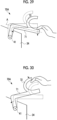
- Figs. 29 and 30 show an operation portion 70A according to a third modification example.
- the operation portion 70A includes the main shaft portion 71 extending from the base end side to the free end side, and the protruding portion 72 provided at the free end of the main shaft portion 71.
- the protruding portion 72 has a hook shape that is curved in a convex toward the body portion 24 (see Fig. 3 ) side of the mammography apparatus 10 (that is, the base end side of the main shaft portion 71), and is joined to the main shaft portion 71.
- the protruding portion 72 is provided on the upper side of the main shaft portion 71 with the axis A as a reference.
- the operator can rotate the operation portion 70A in the direction in which the compression plate 33 is lowered by pressing a lower part of the protruding portion 72 in the downward direction, for example.
- the operator can rotate the operation portion 70A in the direction in which the compression plate 33 is raised by pressing an upper part of the protruding portion 72 to the base end side of the main shaft portion 71, for example.
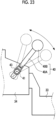
- Figs. 31 and 32 show an operation portion 70B according to a fourth modification example.
- the operation portion 70B includes the main shaft portion 71 extending from the base end side to the free end side, and the protruding portion 72 provided at the free end of the main shaft portion 71.
- the protruding portion 72 has a ring shape.
- the protruding portion 72 has an elliptical shape in which a long axis is parallel to the axis A of the main shaft portion 71, for example.
- the protruding portion 72 is provided on the upper side of the main shaft portion 71 with the axis A as a reference.
- the operator can rotate the operation portion 70B in the direction in which the compression plate 33 is lowered by pressing the lower part of the protruding portion 72 in the downward direction, for example.
- the operator can rotate the operation portion 70B in the direction in which the compression plate 33 is raised by pressing the upper part of the protruding portion 72 to the base end side of the main shaft portion 71, for example.
- the protruding portion 72 is provided on the upper side of the main shaft portion 71 with the axis A as a reference, but may be provided on the lower side with the axis A as a reference.
- the operation portion rotates in a first direction about the fulcrum.
- the operator disposes the hand from the free end side to the upper side of the main shaft portion 71 and presses the protruding portion 72 that protrudes to the upper side of the main shaft portion 71 to the base end side it is possible to rotate the protruding portion 72 about the fulcrum.
- the operator can generate rotation moment with respect to the operation portion in a direction opposite to that of a case in which the operation portion is pressed in the downward direction from the upper side without changing a position of the hand disposed on the upper side of the main shaft portion.
- the same effect can be obtained even in a case in which the protruding portion 72 is provided on the lower side of the main shaft portion 71 depending on the positional relationship with the fulcrum.
- the operation portion is configured by only the main shaft portion 71 without providing the protruding portion 72.
- the operator in a case in which the operation portion rotates in the first direction, the operator can dispose the hand on the upper side of the main shaft portion 71 and press the upper side of the main shaft portion 71 in the downward direction to rotate the operation portion in the first direction.
- the operation portion rotates in the second direction
- the operator in a case in which the operation portion rotates in the second direction, the operator can dispose the hand on the lower side of the main shaft portion 71 and press the lower side of the main shaft portion 71 in the upward direction to rotate the operation portion in the second direction.
- the operator intends to change the rotation direction of the operation portion, it is necessary to change the position of the hand disposed on one of the upper side or the lower side of the main shaft portion 71.
- the protruding portion 72 on the main shaft portion 71 as described above, even in a case in which the operator cannot grip the operation portion 70 from both sides of the upper side and the lower side, the operator can rotate the operation portion 70 any one direction of the first direction or the second direction only by the pressing operation without changing the position of the hand disposed one of the upper side or the lower side of the main shaft portion 71 to the opposite side.
- the protruding portion 72 on the main shaft portion 71 the operability of the operation portion 70 is improved.
- the effect of improving the operability of the operation portion 70 obtained by providing the protruding portion 72 on the main shaft portion 71 is significantly effective for the operator of the mammography apparatus 10 of which the movement of the hand is restricted. Further, the operation portion 70 is displaced along the vertical direction, which is the movement direction of the compression plate 33. In such an operation portion 70, it is significantly effective to improve the operability in the two directions of the upward direction and the downward direction by providing the protruding portion 72.
- the operation portion is provided on the movable portion. Therefore, the operation portion is moved together with the movable portion. An action and an effect of providing the operation portion on the movable portion will be described.
- the operation portion 40 is raised together with the movable portion 34.
- the movable portion 34 continues to be raised while the operator grips the operation portion 40 by the hand, there is a possibility that the hand comes into contact with the radiation source housing portion 22 provided above the body portion 24, and the hand is interposed between the operation portion 40 and the radiation source housing portion 22.
- the safety is improved as well as the operability of the compression plate 33 is improved.
- the operation portion is provided on the movable portion, but in an example not forming part of the present invention the operation portion may be provided in a place other than the movable portion.
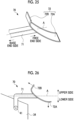
- Fig. 34 shows an example in which the operation portion 40 is provided on the body portion 24 of the arm 21 as a support portion.
- the operation portion 40 includes the main shaft portion 40A and the grip portion 40B.
- the main shaft portion 40A is bent in an L shape, and the base end side is rotatably connected to a side surface of the body portion 24.
- the free end side of the main shaft portion 40A stretches toward the side of the subject who places the breast M on the imaging table 23.
- the operation portion 40 is provided on a left side of the body portion 24 as viewed from a front side of the mammography apparatus 10, but the operation portion 40 may be provided on a right side of the body portion 24 or may be provided on both the right and left sides.
- the operation portion need only be a cantilever type lever having one end, which is the free end, and at least the free end need only be displaced along the movement direction of the compression plate.
- the displacement of the free end and the movement of the compression plate do not necessarily have to be in the same direction, and a form may be adopted in which the free end rotates and the compression plate is moved in a linear direction as described above.
- the operation portion does not rotate around the base end and is displaced in the linear direction in the vertical direction.
- the displacement direction of the operation portion completely coincides with the movement direction of the compression plate.
- the displacement amount detected by the displacement amount detection unit 63 described above corresponds to a slide movement amount, not the angle.
- the displacement speed detected by the displacement speed detection unit 65 corresponds to the speed, not the angular speed.
- a form of the lever has been described as an example of the operation portion, for example, a slide type switch can be used as the operation portion. In this case, the switch need only be disposed such that a sliding direction of the switch and the movement direction of the compression plate coincide with each other.
- the stretching direction of the operation portion has been described with an example of the anteroposterior direction (corresponding to the depth direction) of the mammography apparatus 10, a form may be adopted in which the stretching direction stretches in the width direction of the mammography apparatus 10.
- the lateral direction is a direction that intersects (for example, orthogonal to) the anteroposterior direction and the vertical direction.
- the first operation portion and the second operation portion are provided on, for example, a right side surface and a left side surface of the movable portion 34, respectively.
- the drive mechanism 50 is configured by the actuator using the rod screw, but it can also be configured by a belt type actuator. Further, a mechanical manual type movement mechanism can be used instead of the drive mechanism 50.
- the belt type actuator and the manual type movement mechanism are known, for example, in JP2010-179030A .
- processors described above include the CPU, which is a general-purpose processor that functions by executing a software (program), as well as a processor such as a field programmable gate array (FPGA) of which a circuit configuration can be changed after manufacturing.
- the FPGA includes a dedicated electric circuit, which is a processor having a circuit configuration specially designed for executing a specific process such as a programmable logic device (PLD) or an application specific integrated circuit (ASIC).
- PLD programmable logic device
- ASIC application specific integrated circuit
- the controller may be configured by one of these various processors or a combination of two or more processors of the same type or different types (for example, a combination of a plurality of the FPGAs, or a combination of the CPU and the FPGA).
- a plurality of the controllers may be configured by one processor.
- the plurality of controllers are configured by one processor.
- a computer such as a client computer or a server
- one processor is configured by a combination of one or more CPUs and software, and the processor functions as the plurality of controllers.
- a system on chip SOC
- the processor that realizes the functions of the entire system including the plurality of controllers by one IC chip is used.
- the controller can be configured by one or more of the various processors described above as the hardware structure.
Landscapes
- Health & Medical Sciences (AREA)
- Life Sciences & Earth Sciences (AREA)
- Medical Informatics (AREA)
- Engineering & Computer Science (AREA)
- Optics & Photonics (AREA)
- Biomedical Technology (AREA)
- Biophysics (AREA)
- High Energy & Nuclear Physics (AREA)
- Veterinary Medicine (AREA)
- Nuclear Medicine, Radiotherapy & Molecular Imaging (AREA)
- Public Health (AREA)
- Pathology (AREA)
- Radiology & Medical Imaging (AREA)
- Physics & Mathematics (AREA)
- Heart & Thoracic Surgery (AREA)
- Molecular Biology (AREA)
- Surgery (AREA)
- Animal Behavior & Ethology (AREA)
- General Health & Medical Sciences (AREA)
- Dentistry (AREA)
- Oral & Maxillofacial Surgery (AREA)
- Apparatus For Radiation Diagnosis (AREA)
Claims (16)
- Appareil de mammographie (10) comprenant :une table d'imagerie (23) sur laquelle est placé un sein (M) d'un sujet ;une plaque de compression (33) qui comprime le sein, la plaque de compression (33) étant disposée pour faire face à la table d'imagerie (23) et étant mobile dans une direction verticale par rapport à la table d'imagerie (23) ;une partie d'opération (40) qui est actionnée pour déplacer la plaque de compression (33), la partie d'opération (40) étant prévue séparément de la plaque de compression (33) et étant déplacée le long d'une direction de déplacement de la plaque de compression (33), dans laquelle une direction d'opération de la partie d'opération (40) et la direction de déplacement de la plaque de compression (33) sont pratiquement mêmes, dans laquelle la partie d'opération (33) est un levier du type en porte -à-faux ayant une extrémité, qui est une extrémité libre, et dans laquelle au moins l'extrémité libre est déplacée le long de la direction de déplacement de la plaque de compression (33) ;une partie de support (24) qui soutient la plaque de compression (33) pour être mobile par rapport à la table d'imagerie (23); et une partie mobile (34) qui est disposée entre la plaque de compression et la partie de support et est déplacée dans la direction verticale ensemble avec la plaque de compression, dans laquelle la partie d'opération (40) est prévue sur la partie mobile (34) ; etun actionneur (50) qui entraîne la plaque de compression (33), dans lequel l'actionneur (50) est activé en réponse à une opération de la partie d'opération (40) et dans lequel la plaque de compression (33) est déplacée par la force motrice générée par l'actionneur (40).
- Appareil de mammographie selon la revendication 1, comprenant en outre :
un processeur (60) qui contrôle l'actionneur (50) pour modifier une vitesse de déplacement de la plaque de compression (33). - Appareil de mammographie selon la revendication 2, comprenant en outre :une unité de détection de quantité de déplacement (63) qui détecte une quantité de déplacement de la partie d'opération (40),dans lequel le processeur (60) modifie la vitesse de déplacement de la plaque de compression (33) sur la base de la quantité de déplacement détectée par l'unité de détection de quantité de déplacement (63).
- Appareil de mammographie selon la revendication 2 ou 3, comprenant en outre :une unité de détection de hauteur (64) qui détecte une hauteur de la plaque de compression (33) par rapport à la table d'imagerie (23),dans lequel le processeur (60) modifie la vitesse de déplacement de la plaque de compression (33) en réponse à la hauteur de la plaque de compression (33).
- Appareil de mammographie selon la revendication 4,
dans lequel le processeur (60) règle une vitesse initiale de la plaque de compression (33) dans un cas où la plaque de compression (33) est élevée d'un état dans lequel la plaque de compression (33) est positionnée à une position relativement basse pour être plus rapide qu'une vitesse initiale de la plaque de compression (33) dans un cas où la plaque de compression (33) est élevée d'un état dans lequel la plaque de compression (33) est positionnée à une position relativement haute. - Appareil de mammographie selon la revendication 4 ou 5,
dans lequel le processeur (60) règle une vitesse initiale de la plaque de compression (33) dans un cas où la plaque de compression (33) est abaissée d'un état dans lequel la plaque de compression (33) est positionnée à une position relativement haute pour être plus rapide qu'une vitesse initiale de la plaque de compression (33) dans un cas où la plaque de compression (33) est abaissée d'un état dans lequel la plaque de compression (33) est positionnée à une position relativement basse. - Appareil de mammographie selon l'une quelconque des revendications 2 à 6, comprenant en outre :une unité de détection de vitesse de déplacement (65) qui détecte une vitesse de déplacement de la partie d'opération (40),dans lequel le processeur (60) règle la vitesse de déplacement de la plaque de compression (33) pour qu'elle soit plus rapide lorsque la vitesse de déplacement de la partie d'opération (40) augmente.
- Appareil de mammographie selon l'une quelconque des revendications 2 à 7, comprenant en outre :
une unité de détection de pression (58) qui détecte une pression reçue par la plaque de compression (33) provenant du sein. - Appareil de mammographie selon la revendication 8,
dans lequel le processeur (60) règle un taux de changement de vitesse, qui est le rapport d'une quantité de changement de la vitesse de déplacement de la plaque de compression (33) à une quantité de déplacement unitaire de la partie d'opération (40), pour être plus petit lorsque la pression est plus grande. - Appareil de mammographie selon la revendication 8 ou 9,
dans lequel le processeur (60) arrête le déplacement de la plaque de compression (33) dans uns cas où la pression détectée par l'unité de détection de pression (58) est égale ou supérieure à une valeur seuil prédéfinie. - Appareil de mammographie selon l'une quelconque des revendications 1 à 10, comprenant en outre :
une unité d'augmentation de charge (43) qui augmente une charge pour faire fonctionner la partie d'opération (40) lorsqu'une quantité de déplacement de la partie d'opération est plus grande. - Appareil de mammographie selon l'une quelconque des revendications précédentes,
dans lequel en supposant qu'une direction d'une position du sujet, qui place le sein sur la table d'imagerie (23), est antérieure et qu'une direction opposée de celle-ci est postérieure, la partie d'opération (40) s'étend dans une direction antéropostérieure ou dans une direction latérale. - Appareil de mammographie selon l'une quelconque des revendications précédentes,
dans lequel la partie d'opération (40) tourne autour d'un point d'appui (41) prévu sur un côté d'extrémité de base. - Appareil de mammographie selon la revendication 13,
dans lequel la partie d'opération (40) comprend :une partie d'arbre principale (71) qui s'étend du côté d'extrémité de base à un côté d'extrémité libre, etune partie saillante (72) qui est prévue sur la partie d'arbre principale (71) et qui fait saillie vers au moins l'un d'un côté inférieur et un côté supérieur en prenant une direction axiale de la partie d'arbre principale (71) comme une référence. - Appareil de mammographie selon la revendication 14,
dans lequel la partie saillante (72) comprend :une première partie saillante (72A) qui fait saillie vers le côté inférieur de la partie d'arbre principale (71), etune deuxième partie saillante (72B) qui fait saillie vers la côté supérieur de la partie d'arbre principale (71). - Appareil de mammographie selon la revendication 14 ou 15,
dans lequel la partie saillante (72) a une forme de crochet ou une forme d'anneau.
Applications Claiming Priority (1)
| Application Number | Priority Date | Filing Date | Title |
|---|---|---|---|
| JP2020181852A JP7531365B2 (ja) | 2020-10-29 | 2020-10-29 | 乳房撮影装置 |
Publications (3)
| Publication Number | Publication Date |
|---|---|
| EP3991663A2 EP3991663A2 (fr) | 2022-05-04 |
| EP3991663A3 EP3991663A3 (fr) | 2022-07-06 |
| EP3991663B1 true EP3991663B1 (fr) | 2025-03-19 |
Family
ID=78598735
Family Applications (1)
| Application Number | Title | Priority Date | Filing Date |
|---|---|---|---|
| EP21204434.1A Active EP3991663B1 (fr) | 2020-10-29 | 2021-10-25 | Appareil de mammographie |
Country Status (3)
| Country | Link |
|---|---|
| US (1) | US12042312B2 (fr) |
| EP (1) | EP3991663B1 (fr) |
| JP (2) | JP7531365B2 (fr) |
Families Citing this family (1)
| Publication number | Priority date | Publication date | Assignee | Title |
|---|---|---|---|---|
| US20230329653A1 (en) * | 2020-12-20 | 2023-10-19 | Shabbir Bakir Bambot | Method and apparatus for breast imaging |
Family Cites Families (11)
| Publication number | Priority date | Publication date | Assignee | Title |
|---|---|---|---|---|
| JPH0464346A (ja) * | 1990-07-03 | 1992-02-28 | Hitachi Medical Corp | 乳房x線撮影装置の乳房圧迫機構 |
| JPH0576409U (ja) * | 1992-03-26 | 1993-10-19 | 株式会社日立メディコ | 乳房x線撮影装置 |
| FR2842722B1 (fr) | 2002-07-29 | 2005-03-25 | Ge Med Sys Global Tech Co Llc | Mammographie a compression simplifiee |
| JP2010179030A (ja) | 2009-02-09 | 2010-08-19 | Toshiba Corp | マンモグラフィ装置 |
| KR20140137623A (ko) | 2013-05-23 | 2014-12-03 | 삼성전자주식회사 | 엑스선 영상 장치 및 그 제어 방법 |
| KR20160057674A (ko) | 2014-11-14 | 2016-05-24 | 삼성전자주식회사 | 유방 영상 촬영기기 |
| KR20160071938A (ko) | 2014-12-12 | 2016-06-22 | 삼성전자주식회사 | 엑스선 영상 장치 |
| JP6625021B2 (ja) | 2016-06-22 | 2019-12-25 | 富士フイルム株式会社 | マンモグラフィ装置、制御装置、マンモグラフィ装置の制御方法、及びマンモグラフィ装置の制御プログラム |
| JP6625020B2 (ja) | 2016-06-22 | 2019-12-25 | 富士フイルム株式会社 | マンモグラフィ装置、制御装置、マンモグラフィ装置の制御方法、及びマンモグラフィ装置の制御プログラム |
| WO2019226792A1 (fr) | 2018-05-25 | 2019-11-28 | Hologic, Inc. | Dispositifs et procédés de bras de compression |
| ES2990213T3 (es) | 2018-09-24 | 2024-11-29 | Hologic Inc | Sistema de obtención de imágenes de múltiples pantallas para flujo de trabajo mejorado |
-
2020
- 2020-10-29 JP JP2020181852A patent/JP7531365B2/ja active Active
-
2021
- 2021-10-20 US US17/505,639 patent/US12042312B2/en active Active
- 2021-10-25 EP EP21204434.1A patent/EP3991663B1/fr active Active
-
2024
- 2024-04-09 JP JP2024062942A patent/JP7628207B2/ja active Active
Also Published As
| Publication number | Publication date |
|---|---|
| JP2024083522A (ja) | 2024-06-21 |
| EP3991663A3 (fr) | 2022-07-06 |
| JP2022072429A (ja) | 2022-05-17 |
| EP3991663A2 (fr) | 2022-05-04 |
| US20220133247A1 (en) | 2022-05-05 |
| JP7628207B2 (ja) | 2025-02-07 |
| US12042312B2 (en) | 2024-07-23 |
| JP7531365B2 (ja) | 2024-08-09 |
Similar Documents
| Publication | Publication Date | Title |
|---|---|---|
| EP3856036B1 (fr) | Système d'imagerie à écrans multiples pour un flux de travail amélioré | |
| CN1723850A (zh) | X射线成像装置 | |
| US10064588B2 (en) | Mobile x-ray diagnostic apparatus | |
| JP7628207B2 (ja) | 乳房撮影装置 | |
| US10898155B2 (en) | X-ray diagnostic apparatus | |
| US12268534B2 (en) | Compression arm devices and methods | |
| US10835191B2 (en) | X-ray imaging apparatus | |
| JPH0464346A (ja) | 乳房x線撮影装置の乳房圧迫機構 | |
| CN114269254A (zh) | 带有可倾斜调整的辅助显示器的超声成像系统 | |
| CN113759990B (zh) | 一种乳腺机的控制方法及乳腺机 | |
| US12582367B2 (en) | X-ray diagnostic device and medical couch device comprising a couchtop, a drive mechansm, a console, and processing circuitry | |
| US11344274B2 (en) | Radiographic imaging apparatus | |
| US20260007373A1 (en) | X-ray diagnostic apparatus and medical bed device | |
| CN102140737B (zh) | 缝纫机的压布装置 | |
| CN111904596B (zh) | 导航调节机构及具有其的手术机器人系统 | |
| JP7432301B2 (ja) | X線管保持装置、検出部保持装置及び駆動モード設定装置 | |
| JP2024082260A (ja) | X線診断装置及び医用寝台装置 | |
| JP2024053998A (ja) | 超音波診断装置 | |
| CN116999078A (zh) | 控制c形臂移动的方法及成像设备 | |
| US11185299B2 (en) | X-ray fluoroscopic imaging apparatus | |
| US20220096038A1 (en) | Display device and control program | |
| CN121622094A (zh) | 乳腺x射线摄影设备和用于运行乳腺x射线摄影设备的方法 | |
| JP2026008815A (ja) | X線診断装置及び医用寝台装置 | |
| CN112533538A (zh) | X射线摄影装置 | |
| JP2003199735A (ja) | 医用電気機器の動作制御装置 |
Legal Events
| Date | Code | Title | Description |
|---|---|---|---|
| PUAI | Public reference made under article 153(3) epc to a published international application that has entered the european phase |
Free format text: ORIGINAL CODE: 0009012 |
|
| STAA | Information on the status of an ep patent application or granted ep patent |
Free format text: STATUS: THE APPLICATION HAS BEEN PUBLISHED |
|
| AK | Designated contracting states |
Kind code of ref document: A2 Designated state(s): AL AT BE BG CH CY CZ DE DK EE ES FI FR GB GR HR HU IE IS IT LI LT LU LV MC MK MT NL NO PL PT RO RS SE SI SK SM TR |
|
| PUAL | Search report despatched |
Free format text: ORIGINAL CODE: 0009013 |
|
| AK | Designated contracting states |
Kind code of ref document: A3 Designated state(s): AL AT BE BG CH CY CZ DE DK EE ES FI FR GB GR HR HU IE IS IT LI LT LU LV MC MK MT NL NO PL PT RO RS SE SI SK SM TR |
|
| RIC1 | Information provided on ipc code assigned before grant |
Ipc: A61B 6/00 20060101ALI20220527BHEP Ipc: A61B 6/04 20060101AFI20220527BHEP |
|
| STAA | Information on the status of an ep patent application or granted ep patent |
Free format text: STATUS: REQUEST FOR EXAMINATION WAS MADE |
|
| 17P | Request for examination filed |
Effective date: 20221122 |
|
| RBV | Designated contracting states (corrected) |
Designated state(s): AL AT BE BG CH CY CZ DE DK EE ES FI FR GB GR HR HU IE IS IT LI LT LU LV MC MK MT NL NO PL PT RO RS SE SI SK SM TR |
|
| GRAP | Despatch of communication of intention to grant a patent |
Free format text: ORIGINAL CODE: EPIDOSNIGR1 |
|
| STAA | Information on the status of an ep patent application or granted ep patent |
Free format text: STATUS: GRANT OF PATENT IS INTENDED |
|
| INTG | Intention to grant announced |
Effective date: 20241024 |
|
| GRAS | Grant fee paid |
Free format text: ORIGINAL CODE: EPIDOSNIGR3 |
|
| GRAA | (expected) grant |
Free format text: ORIGINAL CODE: 0009210 |
|
| STAA | Information on the status of an ep patent application or granted ep patent |
Free format text: STATUS: THE PATENT HAS BEEN GRANTED |
|
| P01 | Opt-out of the competence of the unified patent court (upc) registered |
Free format text: CASE NUMBER: APP_4155/2025 Effective date: 20250127 |
|
| AK | Designated contracting states |
Kind code of ref document: B1 Designated state(s): AL AT BE BG CH CY CZ DE DK EE ES FI FR GB GR HR HU IE IS IT LI LT LU LV MC MK MT NL NO PL PT RO RS SE SI SK SM TR |
|
| REG | Reference to a national code |
Ref country code: GB Ref legal event code: FG4D |
|
| REG | Reference to a national code |
Ref country code: CH Ref legal event code: EP |
|
| REG | Reference to a national code |
Ref country code: DE Ref legal event code: R096 Ref document number: 602021027749 Country of ref document: DE |
|
| REG | Reference to a national code |
Ref country code: IE Ref legal event code: FG4D |
|
| PG25 | Lapsed in a contracting state [announced via postgrant information from national office to epo] |
Ref country code: RS Free format text: LAPSE BECAUSE OF FAILURE TO SUBMIT A TRANSLATION OF THE DESCRIPTION OR TO PAY THE FEE WITHIN THE PRESCRIBED TIME-LIMIT Effective date: 20250619 |
|
| PG25 | Lapsed in a contracting state [announced via postgrant information from national office to epo] |
Ref country code: FI Free format text: LAPSE BECAUSE OF FAILURE TO SUBMIT A TRANSLATION OF THE DESCRIPTION OR TO PAY THE FEE WITHIN THE PRESCRIBED TIME-LIMIT Effective date: 20250319 |
|
| REG | Reference to a national code |
Ref country code: LT Ref legal event code: MG9D |
|
| PG25 | Lapsed in a contracting state [announced via postgrant information from national office to epo] |
Ref country code: NO Free format text: LAPSE BECAUSE OF FAILURE TO SUBMIT A TRANSLATION OF THE DESCRIPTION OR TO PAY THE FEE WITHIN THE PRESCRIBED TIME-LIMIT Effective date: 20250619 |
|
| PG25 | Lapsed in a contracting state [announced via postgrant information from national office to epo] |
Ref country code: HR Free format text: LAPSE BECAUSE OF FAILURE TO SUBMIT A TRANSLATION OF THE DESCRIPTION OR TO PAY THE FEE WITHIN THE PRESCRIBED TIME-LIMIT Effective date: 20250319 |
|
| PG25 | Lapsed in a contracting state [announced via postgrant information from national office to epo] |
Ref country code: LV Free format text: LAPSE BECAUSE OF FAILURE TO SUBMIT A TRANSLATION OF THE DESCRIPTION OR TO PAY THE FEE WITHIN THE PRESCRIBED TIME-LIMIT Effective date: 20250319 |
|
| PG25 | Lapsed in a contracting state [announced via postgrant information from national office to epo] |
Ref country code: GR Free format text: LAPSE BECAUSE OF FAILURE TO SUBMIT A TRANSLATION OF THE DESCRIPTION OR TO PAY THE FEE WITHIN THE PRESCRIBED TIME-LIMIT Effective date: 20250620 Ref country code: BG Free format text: LAPSE BECAUSE OF FAILURE TO SUBMIT A TRANSLATION OF THE DESCRIPTION OR TO PAY THE FEE WITHIN THE PRESCRIBED TIME-LIMIT Effective date: 20250319 |
|
| REG | Reference to a national code |
Ref country code: NL Ref legal event code: MP Effective date: 20250319 |
|
| REG | Reference to a national code |
Ref country code: AT Ref legal event code: MK05 Ref document number: 1776270 Country of ref document: AT Kind code of ref document: T Effective date: 20250319 |
|
| PG25 | Lapsed in a contracting state [announced via postgrant information from national office to epo] |
Ref country code: NL Free format text: LAPSE BECAUSE OF FAILURE TO SUBMIT A TRANSLATION OF THE DESCRIPTION OR TO PAY THE FEE WITHIN THE PRESCRIBED TIME-LIMIT Effective date: 20250319 |
|
| PG25 | Lapsed in a contracting state [announced via postgrant information from national office to epo] |
Ref country code: SE Free format text: LAPSE BECAUSE OF FAILURE TO SUBMIT A TRANSLATION OF THE DESCRIPTION OR TO PAY THE FEE WITHIN THE PRESCRIBED TIME-LIMIT Effective date: 20250319 |
|
| PG25 | Lapsed in a contracting state [announced via postgrant information from national office to epo] |
Ref country code: SM Free format text: LAPSE BECAUSE OF FAILURE TO SUBMIT A TRANSLATION OF THE DESCRIPTION OR TO PAY THE FEE WITHIN THE PRESCRIBED TIME-LIMIT Effective date: 20250319 |
|
| PG25 | Lapsed in a contracting state [announced via postgrant information from national office to epo] |
Ref country code: PT Free format text: LAPSE BECAUSE OF FAILURE TO SUBMIT A TRANSLATION OF THE DESCRIPTION OR TO PAY THE FEE WITHIN THE PRESCRIBED TIME-LIMIT Effective date: 20250721 Ref country code: ES Free format text: LAPSE BECAUSE OF FAILURE TO SUBMIT A TRANSLATION OF THE DESCRIPTION OR TO PAY THE FEE WITHIN THE PRESCRIBED TIME-LIMIT Effective date: 20250319 |
|
| PG25 | Lapsed in a contracting state [announced via postgrant information from national office to epo] |
Ref country code: IT Free format text: LAPSE BECAUSE OF FAILURE TO SUBMIT A TRANSLATION OF THE DESCRIPTION OR TO PAY THE FEE WITHIN THE PRESCRIBED TIME-LIMIT Effective date: 20250319 Ref country code: PL Free format text: LAPSE BECAUSE OF FAILURE TO SUBMIT A TRANSLATION OF THE DESCRIPTION OR TO PAY THE FEE WITHIN THE PRESCRIBED TIME-LIMIT Effective date: 20250319 |
|
| PG25 | Lapsed in a contracting state [announced via postgrant information from national office to epo] |
Ref country code: AT Free format text: LAPSE BECAUSE OF FAILURE TO SUBMIT A TRANSLATION OF THE DESCRIPTION OR TO PAY THE FEE WITHIN THE PRESCRIBED TIME-LIMIT Effective date: 20250319 |
|
| PG25 | Lapsed in a contracting state [announced via postgrant information from national office to epo] |
Ref country code: CZ Free format text: LAPSE BECAUSE OF FAILURE TO SUBMIT A TRANSLATION OF THE DESCRIPTION OR TO PAY THE FEE WITHIN THE PRESCRIBED TIME-LIMIT Effective date: 20250319 Ref country code: EE Free format text: LAPSE BECAUSE OF FAILURE TO SUBMIT A TRANSLATION OF THE DESCRIPTION OR TO PAY THE FEE WITHIN THE PRESCRIBED TIME-LIMIT Effective date: 20250319 |
|
| PG25 | Lapsed in a contracting state [announced via postgrant information from national office to epo] |
Ref country code: RO Free format text: LAPSE BECAUSE OF FAILURE TO SUBMIT A TRANSLATION OF THE DESCRIPTION OR TO PAY THE FEE WITHIN THE PRESCRIBED TIME-LIMIT Effective date: 20250319 |
|
| PG25 | Lapsed in a contracting state [announced via postgrant information from national office to epo] |
Ref country code: SK Free format text: LAPSE BECAUSE OF FAILURE TO SUBMIT A TRANSLATION OF THE DESCRIPTION OR TO PAY THE FEE WITHIN THE PRESCRIBED TIME-LIMIT Effective date: 20250319 |
|
| PG25 | Lapsed in a contracting state [announced via postgrant information from national office to epo] |
Ref country code: IS Free format text: LAPSE BECAUSE OF FAILURE TO SUBMIT A TRANSLATION OF THE DESCRIPTION OR TO PAY THE FEE WITHIN THE PRESCRIBED TIME-LIMIT Effective date: 20250719 |
|
| REG | Reference to a national code |
Ref country code: DE Ref legal event code: R097 Ref document number: 602021027749 Country of ref document: DE |
|
| PGFP | Annual fee paid to national office [announced via postgrant information from national office to epo] |
Ref country code: DE Payment date: 20250902 Year of fee payment: 5 |
|
| PG25 | Lapsed in a contracting state [announced via postgrant information from national office to epo] |
Ref country code: DK Free format text: LAPSE BECAUSE OF FAILURE TO SUBMIT A TRANSLATION OF THE DESCRIPTION OR TO PAY THE FEE WITHIN THE PRESCRIBED TIME-LIMIT Effective date: 20250319 |
|
| PLBE | No opposition filed within time limit |
Free format text: ORIGINAL CODE: 0009261 |
|
| STAA | Information on the status of an ep patent application or granted ep patent |
Free format text: STATUS: NO OPPOSITION FILED WITHIN TIME LIMIT |
|
| REG | Reference to a national code |
Ref country code: CH Ref legal event code: L10 Free format text: ST27 STATUS EVENT CODE: U-0-0-L10-L00 (AS PROVIDED BY THE NATIONAL OFFICE) Effective date: 20260128 |
|
| 26N | No opposition filed |
Effective date: 20251222 |
|
| REG | Reference to a national code |
Ref country code: CH Ref legal event code: H13 Free format text: ST27 STATUS EVENT CODE: U-0-0-H10-H13 (AS PROVIDED BY THE NATIONAL OFFICE) Effective date: 20260527 |
|
| PG25 | Lapsed in a contracting state [announced via postgrant information from national office to epo] |
Ref country code: LU Free format text: LAPSE BECAUSE OF NON-PAYMENT OF DUE FEES Effective date: 20251025 |
|
| REG | Reference to a national code |
Ref country code: BE Ref legal event code: MM Effective date: 20251031 |
|
| GBPC | Gb: european patent ceased through non-payment of renewal fee |
Effective date: 20251025 |
|
| PG25 | Lapsed in a contracting state [announced via postgrant information from national office to epo] |
Ref country code: LT Free format text: LAPSE BECAUSE OF FAILURE TO SUBMIT A TRANSLATION OF THE DESCRIPTION OR TO PAY THE FEE WITHIN THE PRESCRIBED TIME-LIMIT Effective date: 20250319 |
|
| PG25 | Lapsed in a contracting state [announced via postgrant information from national office to epo] |
Ref country code: MC Free format text: LAPSE BECAUSE OF FAILURE TO SUBMIT A TRANSLATION OF THE DESCRIPTION OR TO PAY THE FEE WITHIN THE PRESCRIBED TIME-LIMIT Effective date: 20250319 |
|
| PG25 | Lapsed in a contracting state [announced via postgrant information from national office to epo] |
Ref country code: GB Free format text: LAPSE BECAUSE OF NON-PAYMENT OF DUE FEES Effective date: 20251025 |
|
| PG25 | Lapsed in a contracting state [announced via postgrant information from national office to epo] |
Ref country code: CH Free format text: LAPSE BECAUSE OF NON-PAYMENT OF DUE FEES Effective date: 20251031 Ref country code: BE Free format text: LAPSE BECAUSE OF NON-PAYMENT OF DUE FEES Effective date: 20251031 |
|
| PG25 | Lapsed in a contracting state [announced via postgrant information from national office to epo] |
Ref country code: FR Free format text: LAPSE BECAUSE OF NON-PAYMENT OF DUE FEES Effective date: 20251031 |