EP3984431B1 - Reinigungsvorrichtung sowie verwendung - Google Patents
Reinigungsvorrichtung sowie verwendung Download PDFInfo
- Publication number
- EP3984431B1 EP3984431B1 EP20201554.1A EP20201554A EP3984431B1 EP 3984431 B1 EP3984431 B1 EP 3984431B1 EP 20201554 A EP20201554 A EP 20201554A EP 3984431 B1 EP3984431 B1 EP 3984431B1
- Authority
- EP
- European Patent Office
- Prior art keywords
- volume flow
- air volume
- liquid
- suctioned
- section
- Prior art date
- Legal status (The legal status is an assumption and is not a legal conclusion. Google has not performed a legal analysis and makes no representation as to the accuracy of the status listed.)
- Active
Links
Images


Classifications
-
- A—HUMAN NECESSITIES
- A47—FURNITURE; DOMESTIC ARTICLES OR APPLIANCES; COFFEE MILLS; SPICE MILLS; SUCTION CLEANERS IN GENERAL
- A47L—DOMESTIC WASHING OR CLEANING; SUCTION CLEANERS IN GENERAL
- A47L9/00—Details or accessories of suction cleaners, e.g. mechanical means for controlling the suction or for effecting pulsating action; Storing devices specially adapted to suction cleaners or parts thereof; Carrying-vehicles specially adapted for suction cleaners
- A47L9/10—Filters; Dust separators; Dust removal; Automatic exchange of filters
- A47L9/18—Liquid filters
- A47L9/181—Separating by passing the air through a liquid bath
-
- A—HUMAN NECESSITIES
- A47—FURNITURE; DOMESTIC ARTICLES OR APPLIANCES; COFFEE MILLS; SPICE MILLS; SUCTION CLEANERS IN GENERAL
- A47L—DOMESTIC WASHING OR CLEANING; SUCTION CLEANERS IN GENERAL
- A47L7/00—Suction cleaners adapted for additional purposes; Tables with suction openings for cleaning purposes; Containers for cleaning articles by suction; Suction cleaners adapted to cleaning of brushes; Suction cleaners adapted to taking-up liquids
- A47L7/0061—Suction cleaners adapted for additional purposes; Tables with suction openings for cleaning purposes; Containers for cleaning articles by suction; Suction cleaners adapted to cleaning of brushes; Suction cleaners adapted to taking-up liquids adapted for disinfecting or sterilising
-
- A—HUMAN NECESSITIES
- A61—MEDICAL OR VETERINARY SCIENCE; HYGIENE
- A61L—METHODS OR APPARATUS FOR STERILISING MATERIALS OR OBJECTS IN GENERAL; DISINFECTION, STERILISATION OR DEODORISATION OF AIR; CHEMICAL ASPECTS OF BANDAGES, DRESSINGS, ABSORBENT PADS OR SURGICAL ARTICLES; MATERIALS FOR BANDAGES, DRESSINGS, ABSORBENT PADS OR SURGICAL ARTICLES
- A61L9/00—Disinfection, sterilisation or deodorisation of air
- A61L9/16—Disinfection, sterilisation or deodorisation of air using physical phenomena
- A61L9/18—Radiation
- A61L9/20—Ultraviolet radiation
-
- F—MECHANICAL ENGINEERING; LIGHTING; HEATING; WEAPONS; BLASTING
- F24—HEATING; RANGES; VENTILATING
- F24F—AIR-CONDITIONING; AIR-HUMIDIFICATION; VENTILATION; USE OF AIR CURRENTS FOR SCREENING
- F24F8/00—Treatment, e.g. purification, of air supplied to human living or working spaces otherwise than by heating, cooling, humidifying or drying
- F24F8/10—Treatment, e.g. purification, of air supplied to human living or working spaces otherwise than by heating, cooling, humidifying or drying by separation, e.g. by filtering
- F24F8/117—Treatment, e.g. purification, of air supplied to human living or working spaces otherwise than by heating, cooling, humidifying or drying by separation, e.g. by filtering using wet filtering
- F24F8/133—Treatment, e.g. purification, of air supplied to human living or working spaces otherwise than by heating, cooling, humidifying or drying by separation, e.g. by filtering using wet filtering by direct contact with liquid, e.g. with sprayed liquid
-
- F—MECHANICAL ENGINEERING; LIGHTING; HEATING; WEAPONS; BLASTING
- F24—HEATING; RANGES; VENTILATING
- F24F—AIR-CONDITIONING; AIR-HUMIDIFICATION; VENTILATION; USE OF AIR CURRENTS FOR SCREENING
- F24F8/00—Treatment, e.g. purification, of air supplied to human living or working spaces otherwise than by heating, cooling, humidifying or drying
- F24F8/20—Treatment, e.g. purification, of air supplied to human living or working spaces otherwise than by heating, cooling, humidifying or drying by sterilisation
- F24F8/22—Treatment, e.g. purification, of air supplied to human living or working spaces otherwise than by heating, cooling, humidifying or drying by sterilisation using UV light
Definitions
- the present invention relates to a cleaning device for sucking in a suction air volume flow loaded with particles, aerosols, bacteria and/or viruses according to the preamble of claim 1. Furthermore, the present invention relates to the use of the cleaning device according to the invention as an ambient air cleaning device and/or as a wet vacuum cleaner.
- Cleaning devices with a liquid intake unit for sucking in and cleaning a suction air volume flow loaded with particles are generally known from the prior art.
- the known cleaning devices comprise means for generating a vacuum in order to suck in the suction air volume flow together with the particles via an air intake opening.
- the suction air volume flow loaded with the particles is then guided via a dip tube into a liquid which is absorbed by a liquid absorption unit.
- the suction air volume flow is cleaned because the particles carried along are largely bound in the liquid and can therefore be retained there.
- the KR 2012 0061 784 A already teaches a miniaturized water-purifying dust collector. To prevent malfunction, it is ensured that no water leaks outside the dust collector.
- the filter arrangement comprises a tank and a Air inlet pipe.
- the tank is designed to accommodate a liquid and has an air inlet and an air outlet.
- the air inlet pipe is connected to the air inlet, has an air outlet end located in the tank and extending toward the liquid or immersed in the liquid, and has a cross-sectional area that gradually increases along a fluid flow direction within the air inlet pipe
- the US 979 211 A already a dust separation device or a vacuum cleaner device.
- the US 5 199 963 A Vacuum cleaner which treats air by forcing the air through a liquid bath to remove suspended particles in the air.
- the vacuum cleaner comprises a bowl member adapted to receive the liquid bath, a cleaning air inlet, an upper housing carried by and secured to the bowl member, and a motor mounted on the upper housing having a cooling air inlet and a cooling air outlet separate from that of the cleaning air.
- the cleaning air inlet is enclosed by a main baffle which catches the overspray effect caused by the liquid turbulence created in the liquid bath by the incoming cleaning air.
- a disadvantage here is a high flow velocity of the suction air volume flow when flowing through the liquid, since large bubbles are formed and the liquid flows through quickly, which is detrimental to the retention of the particles in the liquid and thus to a good cleaning effect of generic cleaning devices.
- the object of the present invention is solved by a cleaning device according to claim 1.
- the invention provides for specifying a cleaning device for sucking in a suction air volume flow loaded with particles, aerosols, bacteria and/or viruses from an environment, having an air intake opening comprising a first line cross-section for sucking in the suction air volume flow loaded with the particles from the environment, a liquid intake unit comprising an immersion tube for taking up a liquid, in particular water, wherein the immersion tube is connected at a first end to the air intake opening in a suction air-conducting manner and is designed such that at a second end it partially dips into the absorbable liquid, in particular into the water, such that in an active operating state of the cleaning device the absorbable liquid is flowed through by the suction air volume flow loaded with the particles to retain the particles, and vacuum generating means for generating the suction air volume flow in the active operating state.
- a second line cross-section of the immersion tube for guiding the suction air volume flow is larger at least at the second end than the first line cross-section of the air intake opening.
- the cleaning device comprises an air intake opening with a first line cross-section, which Suction of an air-particle mixture from an environment, whereby the term particles in the context of the present invention also includes dust, preferably ultra-fine dust, fine dust and/or coarse dust, aerosol particles, bacteria and/or viruses.
- the suction air volume flow loaded with the particles is formed by means of negative pressure generation, which are included in the cleaning device.
- the cleaning device according to the invention comprises a liquid receiving unit which has a dip tube according to the invention and is designed to receive a liquid, in particular a cleaning liquid.
- the immersion tube is connected at one end, in particular directly or indirectly via a supply line, to the suction opening in a suction air-conducting manner and opens at the other end into the absorbable liquid in order to ensure that the suction air volume flow loaded with the particles flows through the liquid along a flow path in order to separate the particles from the suction air volume flow in a first filter stage formed by the liquid and to bind them in the liquid.
- the immersion tube has, at least at the end immersed in the liquid, a second line cross-section which is larger in relation to the first line cross-section of the air intake opening.
- the cross-sectional expansion from the air intake opening arranged on the inlet side to the immersion pipe of the first filter stage arranged on the outlet side leads to a slowing down of the flow velocity of the suction air volume flow generated in an active operating state of the cleaning device, which is why Smaller air bubbles form when the liquid flows through and the dwell time of the suction air volume flow when flowing through the absorbable liquid can be increased due to the reduced flow speed.
- This advantageously improves the cleaning effect because relatively more particles can be retained in the liquid.
- the internal expansion of the line cross-section according to the invention does not affect the suction air volume flow required for sucking in the particles and/or the particle-air mixture at the air intake opening, which is why a sufficiently high suction power can be achieved there in relation to the flow velocity for sucking in particles.
- water or tap water is preferably used as the cleaning liquid for the liquid receiving unit in order to enable rapid replacement and easy disposal in the event of heavy contamination of the liquid.
- a rest state of the cleaning device is understood to mean a passive operating state of the cleaning device in which the liquid absorption unit absorbs liquid, in particular water, in such a way that the dip tube is immersed at least partially in the absorbable liquid at the end.
- a particle-air mixture is sucked in by the suction air volume flow that can be generated by means of the vacuum generating means. Furthermore, in the active operating state, the suction air volume flow loaded with particles flows through the dip tube into the absorbable liquid, which is why turbulence, eddies and/or vortices are formed there, whereby the liquid is flowed through along a flow path and whereby particles carried along by the generated suction air volume flow are retained and fixed.
- the ratio of the diameter or cross section of the dip tube at the second end to the diameter or cross section of the air intake opening should be greater than or equal to 2, preferably greater than or equal to 3, more preferably greater than or equal to 3.5, in order to thereby influence the flow velocity of the suction air volume flow.
- the sudden, continuous and/or step-by-step increase in the line cross section from the air intake opening to the second end of the dip tube leads to a Reduction of the average flow velocity of the suction air volume flow, whereby with such a selected ratio a particularly efficient cleaning (high cleaning effect) of the suction air volume flow loaded with the particles can be achieved when flowing through the liquid along the flow path.
- such a ratio ensures that, on the one hand, a high cleaning effect can be achieved when the liquid flows through and, on the other hand, sufficient suction power is still possible to suck in the particle-air mixture through the air intake opening.
- the dip tube comprises at least one arcuate and/or angle-shaped deflection section and a lowering section, in particular aligned along a vertical axis, wherein the deflection section is designed such that in the active operating state the suction air volume flow loaded with the particles is deflected and swirled with respect to an inflow direction and thus a first influence on the flow velocity can be realized.
- the dip tube is designed in two or more parts.
- a two- or multi-part design of the dip tube is particularly advantageous if a flap and/or a cover can be removed from the dip tube in order to remove the particles collected in the coarse filter in a passive operating state of the cleaning device and thus facilitate cleaning of the coarse filter.
- the lowering section is preferably designed such that the suction air volume flow deflected, swirled and slowed down in the deflection section in the active operating state of the cleaning device is a sudden, step-by-step or continuous expansion of the pipe cross-section is additionally slowed down with respect to an average inflow velocity.
- the lowering section is dimensioned in terms of its length (longitudinal extension) in such a way that the turbulence that has formed largely recedes and subsides before flowing into the liquid. This advantageously slows down the suction air volume flow and ensures a homogeneous distribution of the particles, which has an effect on the entire line cross-section of the immersion pipe.
- the deflection section is designed such that in the active operating state, the suction air volume flow loaded with the particles is deflected with respect to the inflow direction defined by the air intake opening by a deflection angle ⁇ of more than 60°, preferably more than 70°, particularly preferably more than 80°, very particularly preferably substantially 90°.
- a first reduction in the flow velocity of the suction air volume flow can thus be realized by deflecting the suction air volume flow, since the suction air volume flow at least partially impacts the inner wall of the dip tube in the deflection section.
- a deflection angle ⁇ of approximately 90° is understood to mean in particular a range which is preferably between 88° and 92°.
- the dip tube is arranged within the liquid receiving unit so that that the lowering section extends in the vertical direction.
- a lowering section extending along the vertical axis advantageously leads to the suction air volume flow loaded with the particles flowing transversely to a liquid surface that can be formed by the liquid in the passive operating state and thus also flowing into the liquid transversely, i.e. at right angles to this liquid surface.
- the liquid in the active operating state, the liquid does not form a flat liquid surface, since the incoming suction air volume flow causes turbulence, eddies and/or overlapping waves in the absorbable liquid of the liquid absorption unit. Nevertheless, the flow path of the suction air volume flow when flowing through the liquid can be positively influenced in terms of the cleaning effect by vertically feeding the suction air volume flow into the absorbable liquid.
- the dip tube is preferably arranged in the liquid receiving unit in such a way that the longitudinal extension of the dip tube, at least in the region of the second end, is aligned transversely or at right angles to a liquid surface formed in the resting state, i.e. extends along a vertical axis.
- the suction air volume flow must therefore undergo a deflection of 180° in relation to its inflow direction in order to flow out of the liquid again. This advantageously has a positive effect on the cleaning effect.
- the cleaning device comprises a second filter stage, which is characterized by a grid-like coarse filter for retaining large particles.
- the coarse filter is preferably formed and/or arranged in a region of the immersion tube that is completely immersed in the liquid.
- the coarse filter is preferably formed by a plurality of rod-shaped prongs, each of which is arranged at a distance from one another and extends lengthways to the axis of extension of the immersion tube, in particular lengthways to the longitudinal extension of the lowering section, i.e. in particular in the vertical direction.
- the prongs form gap-like openings in the outer surface of the immersion tube for the suction air volume flow, which then in turn hold back large particles and fix and collect them within the immersion tube because they do not fit through the gap-like openings.
- large particles are understood to mean particle sizes that have a longitudinal, transverse and/or width extension of greater than 2 mm.
- the coarse filter In addition to retaining large particles within the dip tube, the coarse filter also improves the cleaning effect of smaller particles as they flow through the liquid, since large particles floating freely in the liquid have a negative impact on the cleaning effect for small particles, particularly particles with a lengthwise, crosswise and/or widthwise dimension of less than 2 mm.
- the dip tube has a front side at the second end which is provided with a Bottom element of the liquid absorption unit such that in the active operating state the suction air volume flow can flow exclusively through the openings formed by the coarse filter.
- the dip tube thus extends in particular to the base element of the liquid intake unit, with the front side of the dip tube preferably being connected to the base element.
- the suction air volume flow loaded with particles can only flow out of the dip tube through the lateral openings of the coarse filter formed in the outer surface of the dip tube.
- the dip tube can also be closed at the end by a closing element, in particular a disk-shaped one, to ensure that the suction air volume flow flows completely out of the dip tube through the openings of the coarse filter.
- the cleaning device comprises a droplet separator which is arranged between the liquid receiving unit and the vacuum generating means in a suction-air-conducting manner to retain liquid droplets and other particles absorbed by the suction air volume flow
- the droplet separator advantageously implements a third filter stage of the cleaning device, since after the liquid has flowed through to retain particles (first filter stage) and after the coarse filter has flowed through to retain large particles (second filter stage), particles are also filtered out of the suction air volume flow by the droplet separator (third filter stage). In addition to filtering out particles, the droplet separator also separates liquid droplets from the suction air volume flow that were previously absorbed by the suction air volume flow as it flowed through the liquid.
- the droplet separator is advantageously arranged in relation to the liquid absorption unit in an area that allows the liquid drops absorbed from the suction air volume flow to be returned to the liquid absorption unit. This advantageously prevents a rapid loss of liquid during operation of the cleaning device, which is why longer operating times of the cleaning device can be achieved. Furthermore, the cleaning effect can be further improved because in addition to absorbing liquid drops, particles can also be released from the suction air volume flow that could not be bound in the liquid when flowing through the liquid absorption unit.
- the droplet separator comprises an inflow region which is formed by a plurality of profiled, spaced-apart, in particular sheet-like, slats, wherein a flow channel with at least two deflection regions for the suction air volume flow is formed between two adjacent slats and/or wherein the inflow region is aligned at a fixing angle between 20° to 70°, preferably 30° to 60°, particularly preferably 40° to 50°, very particularly preferably substantially 45° to a horizontal plane, in particular to a liquid surface of the liquid to be absorbed by the liquid absorption unit.
- the inflow area is formed by a surface against which the suction air volume flow flows, from which a large number of slot-like passages for the suction air volume flow emanate.
- the suction air volume flow flows onto the inflow area which is aligned at an angle to a horizontal plane, which is why the suction air volume flow is divided into a large number of partial flows, each of which flows along a line between the slats. formed passage (flow channel).
- the passages include deflection areas that are formed by an arcuate curvature of the lamellae and thus form negative pressure areas. The deflection of the partial flows advantageously leads to the inertia acting on the liquid drops and other particles causing them to be absorbed by the partial flows.
- the droplet separator is also advantageously aligned at an angle to a horizontal plane, which causes the absorbed liquid drops to flow back into the liquid absorption unit due to the force of gravity. Rapid drainage of the liquid drops also means that the liquid drops are not absorbed again. This advantageously leads to a reduction in the moisture absorbed by the suction air volume flow and/or the number of liquid drops contained therein, which are discharged back into the environment through an air discharge opening on the outlet side of the cleaning device.
- the pot separator and the flow channels formed are aligned and/or designed in such a way that the liquid drops can be guided away from the flow channels after being separated from the suction air volume flow due to the weight force acting on them.
- the droplet separator is static and/or immobile and in particular does not include any rotating elements. This advantageously leads to the realization of a A cleaning device that is efficient in terms of energy consumption. Furthermore, a cleaning device can be specified that is characterized by low noise levels during operation and is therefore generally perceived as quiet and therefore not disturbing to people present.
- the cleaning device comprises a filter unit for filtering out fine particles (residual particles) carried by the suction air volume flow, which is arranged in particular in the suction air path in a channel passage between the droplet separator and the vacuum generating means so as to conduct suction air.
- the filter unit also includes a receiving unit that is designed to accommodate a replaceable fabric filter.
- the suction air volume flow can also be freed of fine dust and/or ultra-fine dust, as this settles in the fabric filter when flowing through the fabric filter depending on a selectable porosity.
- UV and/or UVC light generating means are also provided, which are included in the cleaning device.
- the light generating means are advantageously arranged in the cleaning device in such a way that the light generated in the active operating state the suction air path passing through the generated suction air volume flow within the cleaning device is illuminated at least in regions, in particular along an internal passage, with light rays of a specific wavelength range, preferably between 100 nm and 450 nm, more preferably between 100 nm and 280 nm, in such a way that the suction air volume flow that can be generated in the active operating state is completely illuminated to kill viruses and germs carried along.
- the passage within which the illumination takes place is designed as a closed unit, in particular to prevent the (harmful) UVC rays from escaping into the environment at the operating location of the cleaning device.
- the cleaning device according to the invention is used as an air cleaning device for cleaning ambient air and/or as a wet vacuum cleaner.
- the Fig.1 shows a cleaning device 1 according to the invention for sucking in a suction air volume flow loaded with particles from an environment in a perspective view according to a first preferred embodiment.
- the cleaning device 1 shown comprises an air intake opening 2, designed to suck in the suction air volume flow from an environment in an active operating state of the cleaning device 1, wherein the air intake opening 2 can preferably be connected to a suction hose (not shown graphically) in a suction air-conducting manner in order to form a wet vacuum cleaner in particular.
- the cleaning device 1 can be used without a suction hose in order to directly suck in ambient air through the air intake opening 2 and thus form an ambient air cleaning device for filtering out sucked-in particles.
- the cleaning device 1 comprises an upper housing element 5 and is arranged on four rollers. On two opposite side surfaces 23, 24 of the upper housing element 5, closure means 25 are arranged which connect the upper housing element 5 with a lower housing element 26 of the cleaning device 1.
- the air intake opening 2 is arranged on the front side 32 of the cleaning device 1 in the lower housing element 26, through which the suction air volume flow, i.e. a particle-air mixture sucked in from the environment, is sucked in when the cleaning device 1 is in the active operating state.
- the upper housing element 5 comprises a plurality of ventilation openings 36 (perforations) for a cooling circuit of the cleaning device 1.
- air discharge openings 31 are arranged on the side surfaces 23, 24, through which the suction air volume flow is discharged back into the environment after a multi-stage cleaning.
- the exact course of the suction air volume flow loaded with the particles as well as the different cleaning stages of the cleaning device 1 according to the invention is determined by Fig.3 and the Fig.4 described.
- Fig.2 is an exploded view of the Fig.1 known cleaning device 1 is shown. From the illustration it can be seen that the lower housing element 26 of the cleaning device 1 is formed by a liquid receiving unit 4, which has a tray for receiving liquid and a dip tube 3.
- the air intake opening 2 formed on the front side 32 for sucking in the suction air volume flow loaded with the particles from the environment in the active operating state of the cleaning device 1 comprises a first line cross-section 21 and is connected via a supply line 33 in a suction air-conducting manner to a first end 7 of the dip tube 3 of the liquid receiving unit 4.
- the dip tube 3 protrudes at a second end 8 into the absorbable liquid so that in the active operating state of the cleaning device 1 the suction air volume flow loaded with the particles flows through the absorbable liquid along a flow path to retain and bind the particles in the liquid.
- the immersion tube 3 comprises a cover element 35 for forming a cleaning opening in order to manually remove particles retained in the immersion tube 3 (by operating personnel).
- the cover element 35 is pressed airtight onto the immersion tube 3 by means of spring means (not shown) through the upper housing element 5, wherein a pressurized locking of the cover element 35 in the active operating state of the cleaning device 1 is realized by the closure means 25 arranged on both sides.
- the airtight arrangement of the cover element 35 on the immersion tube 3 can advantageously prevent the formation of bypasses of the suction air volume flow, which is why the entire suction air volume flow flows through the liquid to retain particles in the active operating state.
- the cleaning device 1 shown comprises vacuum generating means 6, which in the present case are formed by an electric motor which, in the active operating state of the cleaning device 1, generates the suction air volume flow for sucking in an air-particle mixture by rotation.
- the electric motor is cooled by a cooling circuit using ambient air, wherein the cooling circuit sucks in the air through the openings 36 in the upper housing element 5.
- the vacuum generating means 6 comprise a peripherally formed cooling circuit discharge opening 38 for discharging the sucked air of the cooling circuit as well as a peripherally formed Suction air volume flow discharge opening 37 for discharging the suction air volume flow.
- the upper housing element 5 comprises only two air discharge openings 31, each of which is arranged through a perforation in the side surfaces 23, 24 of the cleaning device 1 in order to discharge both the air from the cooling circuit and the cleaned suction air volume flow back into the environment.
- the cleaning device 1 comprises a droplet separator 13 through which the suction air volume flow flows, wherein liquid droplets and other particles can be cut off from the suction air volume flow due to provided flow channels 20.
- a further filter stage of the cleaning device 1 is formed by a filter unit 27 with a receiving unit 28 for a fabric filter 30.
- the fabric filter 30 is arranged in a suction air path of the suction air volume flow by the receiving unit 28 in such a way that the air flows through the fabric filter 30 to retain the particles.
- the minimum size of the residual particles can advantageously be determined by selecting the pore density, which is why this filter stage is particularly suitable for filtering out fine dust.
- FIG.3 a sectional view of the known cleaning device 1 is shown in a vertical plane, wherein the suction air path 29 through which the generated suction air volume flow passes in the active operating state of the cleaning device 1 is schematically sketched by directional arrows.
- the suction air volume flow is sucked in from the environment through the air intake opening 2, wherein the air intake opening 2 comprises a first line cross-section 21.
- the air intake opening 2 is operatively connected to a first end 7 of the immersion tube 3 of the liquid intake unit 4 via a hollow cylindrical supply line 33.
- the dip tube 3 comprises a deflection section 9 which is designed such that in the active operating state the suction air volume flow loaded with the particles is deflected with respect to a horizontal inflow direction R_in at the first end 7 to a substantially vertical outflow direction. Furthermore, the dip tube 3 comprises a lowering section 10 which extends along a vertical axis V and which is immersed at least in regions into the liquid that can be absorbed by the liquid absorption unit 4.
- the dip tube 3 comprises a second line cross-section 22 at the second end 8, which is larger in relation to the first line cross-section 21 of the air intake opening 2.
- the expansion of the line cross-section from the air intake opening 2 to the second end 8 of the dip tube 3 advantageously leads to a reduction in the flow rate of the suction air volume flow.
- the flow rate of the suction air volume flow is thus reduced when flowing through the liquid, which is why the cleaning effect when flowing through the liquid is improved.
- more particles from the suction air volume flow are bound in the liquid due to the lower flow rate.
- the deflection section 9 is designed in such a way that, on the one hand, an extension of the line cross-section from the first line cross-section 21 to the second line cross-section 22 and, on the other hand, an angle element with a deflection angle ⁇ of 90° is provided, which is why the first line cross-section 21, which is aligned in a vertical plane, merges into the second line cross-section 22, which runs in a horizontal plane.
- the lowering section 10 of the dip tube 3 has an outlet region 15 on the casing side, which has a plurality of openings 14 for forming a coarse filter 17, wherein the openings 14 are formed by a plurality of rod-shaped prongs 16.
- the prongs 16 are aligned parallel to one another and extend along the lowering section 10, wherein two immediately adjacent prongs 16 form the openings 14, which are formed in the shape of a gap.
- prongs 16 which extend along a vertical axis, are connected in an intermediate section to increase the stability of the dip tube 3, two adjacent prongs 16 always form two gap-like openings 14 with a width of approximately 2 mm and a length of approximately 20 mm, which are arranged offset from one another in relation to a vertical axis.
- the coarse filter 17 forms a second filter stage of the cleaning device 1, which retains large particles that do not fit through the 2 mm wide openings 14 from the suction air volume flow.
- the spring force on the dip tube 2 arranged cover element 35 has a maintenance opening and/or cleaning opening in order to manually remove particles retained by the coarse filter 17 from the dip tube 3.
- the sectional view also shows that the dip tube 3 is connected at the second end 8 to a base element 12 of the liquid receiving unit 4.
- the front side 11 of the dip tube 3 at the second end 8 rests directly on the base element 12.
- the base element 12 thus forms a barrier for the suction air volume flow, which leads to the suction air volume flow flowing out of the dip tube 3 through the openings formed in the casing.
- the suction air volume flow hits the droplet separator 13, which is arranged in the suction air path 28 behind the liquid absorption unit 4 in a suction air-conducting manner, in order to separate liquid droplets that were absorbed by the suction air volume flow when the liquid flowed through from the suction air volume flow and return them to the liquid absorption unit 4.
- the droplet separator 13 realizes a third cleaning stage of the cleaning device 1.
- the droplet separator 13 is arranged at a fixing angle ⁇ of 45° with respect to a horizontal plane and, in addition, the lowermost edge of the droplet separator 13, which extends along a depth axis into the image plane 13, is arranged above the liquid receiving unit 4 in order to facilitate the return of the liquid to the liquid receiving unit 4.
- the recovered, separated liquid drops due to the weight force acting on them, is returned to the liquid absorption unit 4.
- the suction air volume flow also flows through the filter unit 27, which is arranged in a suction air-conducting manner between the vacuum generating means 6 and the droplet separator 13.
- the filter unit 27 enables the filtering out of fine particles carried along by the suction air volume flow, which can advantageously be influenced in a targeted manner by selecting a pore density of the fabric filter 30.
- the filter unit 27 comprises the receiving unit 28, which is designed in particular for clamping the fabric filter 30.
- a fourth cleaning stage of the cleaning device 1 can thus advantageously be realized.
- the suction air volume flow flows through a passage which is preferably illuminated by UVC light rays generated by UVC light generating means 34.
- the UVC light rays advantageously kill viruses and germs carried along by the suction air volume flow, which is why a fifth cleaning stage of the cleaning device 1 can be realized in this way.
- the suction air volume flow After flowing through the illuminated passage, the suction air volume flow reaches the vacuum generating means 6, which in this case are formed by a rotating electric motor. The cleaned suction air volume flow is then released back into the environment through the already known air discharge openings 31 in the side surfaces 23, 24.
- the vacuum generating means 6 are arranged in an upper region of the cleaning device 1. This advantageously makes it possible to achieve a spatial separation between the lower region that comes into contact with the liquid and the upper region of the cleaning device 1 that is sensitive to moisture due to the installed electronics.
- FIG.4 a second sectional view of the known cleaning device 1 along a horizontal plane is shown.
- the illustration shows the output-side course of the suction air volume flow along the sketched suction air path 29, which is first discharged to the environment via the suction air volume flow discharge opening 37 and then via the air discharge opening 31 formed in the housing by the perforation in the opposite side surfaces 23, 24.
- a cooling air circuit of the vacuum generating means 6 is also shown schematically, wherein ambient air for cooling the vacuum generating means 6 is sucked in through the ventilation opening 36 and is discharged back to the environment through the cooling circuit discharge openings 38 arranged on the circumference of the vacuum generating means 6 and the air discharge opening 31.
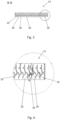
- Fig.5 is a sectional view of the droplet separator 13 according to a Fig.3 indicated perspective B.
- the sectional view first shows the inflow area 18 extending in a plane, from which a plurality of profiled, spaced-apart slats 19 are formed, with a flow channel 20 being formed between each two immediately adjacent slats 19. designed to absorb a partial flow of the suction air volume flow impinging on the inflow area 18 at the front.
- the sheet-like lamellae 19 have arcuate profiles along the flow channels 20 in the predetermined flow direction, which force the partial flows to change direction and create a negative pressure area. Due to the changes in direction, the liquid drops carried along experience a centrifugal force due to the mass-related inertia, which leads to the absorption of the liquid as well as of the particles carried along (residual particles).
- Fig.6 is the one in the Fig.5
- the circled area is shown on an enlarged scale.
- the course of a partial flow of the suction air volume flow as it flows through the flow channels 20 of the droplet separator 13 is schematically sketched.
- the arcuate profiling creates deflection areas for the partial flows, which is why the partial flows are forced to make at least two changes in direction when flowing through the flow channels 20, which lead to the separation of the entrained liquid droplets and residual particles.
- the flow area 18 of the liquid absorber 13 is selected to be small and/or smaller in relation to the second line cross-section 22 of the immersion tube 3.
- the flow speed of the suction air volume flow can thus advantageously be increased again when it hits the liquid absorber 13 in order to increase the centrifugal force acting on the liquid drops and/or residual particles.
- a large proportion of the entrained liquid drops can thus advantageously be separated from the suction air volume flow and returned to the Fluid collection unit.
Landscapes
- Engineering & Computer Science (AREA)
- Mechanical Engineering (AREA)
- Chemical & Material Sciences (AREA)
- Combustion & Propulsion (AREA)
- General Engineering & Computer Science (AREA)
- Health & Medical Sciences (AREA)
- Public Health (AREA)
- Life Sciences & Earth Sciences (AREA)
- Animal Behavior & Ethology (AREA)
- General Health & Medical Sciences (AREA)
- Epidemiology (AREA)
- Veterinary Medicine (AREA)
- Cleaning In General (AREA)
- Separating Particles In Gases By Inertia (AREA)
- Filtering Of Dispersed Particles In Gases (AREA)
- Filters For Electric Vacuum Cleaners (AREA)
- Disinfection, Sterilisation Or Deodorisation Of Air (AREA)
- Separation Of Particles Using Liquids (AREA)
- Separation Of Suspended Particles By Flocculating Agents (AREA)
- Control Of Vending Devices And Auxiliary Devices For Vending Devices (AREA)
- Detergent Compositions (AREA)
Priority Applications (7)
| Application Number | Priority Date | Filing Date | Title |
|---|---|---|---|
| EP20201554.1A EP3984431B1 (de) | 2020-10-13 | 2020-10-13 | Reinigungsvorrichtung sowie verwendung |
| KR1020237015889A KR20230086738A (ko) | 2020-10-13 | 2021-10-13 | 세정 장치 및 용도 |
| US18/031,744 US12593949B2 (en) | 2020-10-13 | 2021-10-13 | Cleaning device and use |
| AU2021359787A AU2021359787A1 (en) | 2020-10-13 | 2021-10-13 | Cleaning device and use |
| JP2023524163A JP2023546213A (ja) | 2020-10-13 | 2021-10-13 | 清掃装置とその使用 |
| PCT/EP2021/078244 WO2022079069A1 (de) | 2020-10-13 | 2021-10-13 | Reinigungsvorrichtung sowie verwendung |
| CN202180080300.3A CN117062556A (zh) | 2020-10-13 | 2021-10-13 | 清洁装置和用途 |
Applications Claiming Priority (1)
| Application Number | Priority Date | Filing Date | Title |
|---|---|---|---|
| EP20201554.1A EP3984431B1 (de) | 2020-10-13 | 2020-10-13 | Reinigungsvorrichtung sowie verwendung |
Publications (3)
| Publication Number | Publication Date |
|---|---|
| EP3984431A1 EP3984431A1 (de) | 2022-04-20 |
| EP3984431B1 true EP3984431B1 (de) | 2024-06-19 |
| EP3984431C0 EP3984431C0 (de) | 2024-06-19 |
Family
ID=72852473
Family Applications (1)
| Application Number | Title | Priority Date | Filing Date |
|---|---|---|---|
| EP20201554.1A Active EP3984431B1 (de) | 2020-10-13 | 2020-10-13 | Reinigungsvorrichtung sowie verwendung |
Country Status (7)
| Country | Link |
|---|---|
| US (1) | US12593949B2 (https=) |
| EP (1) | EP3984431B1 (https=) |
| JP (1) | JP2023546213A (https=) |
| KR (1) | KR20230086738A (https=) |
| CN (1) | CN117062556A (https=) |
| AU (1) | AU2021359787A1 (https=) |
| WO (1) | WO2022079069A1 (https=) |
Families Citing this family (2)
| Publication number | Priority date | Publication date | Assignee | Title |
|---|---|---|---|---|
| GB2624884B (en) * | 2022-11-29 | 2025-04-09 | Dyson Technology Ltd | Floor cleaner |
| WO2024184416A1 (de) * | 2023-03-09 | 2024-09-12 | Robert Thomas Metall- Und Elektrowerke Gmbh & Co. Kg | Sauger und reinigungsverfahren |
Family Cites Families (14)
| Publication number | Priority date | Publication date | Assignee | Title |
|---|---|---|---|---|
| US979211A (en) * | 1910-05-21 | 1910-12-20 | Vacuna Company | Dust-separating or vacuum cleaning apparatus. |
| JPS5811485U (ja) | 1981-07-15 | 1983-01-25 | 三洋電機株式会社 | 洗濯機 |
| US5199963A (en) * | 1992-07-30 | 1993-04-06 | Scarp Arcoline J | Dual filtering vacuum system |
| JPH06222190A (ja) * | 1992-12-03 | 1994-08-12 | Hitachi Ltd | 蒸気乾燥器及び気水分離システム並びに湿分分離器 |
| US6494940B1 (en) * | 2000-09-29 | 2002-12-17 | Hamilton Beach/Proctor-Silex, Inc. | Air purifier |
| JP2005218827A (ja) | 2004-02-06 | 2005-08-18 | Nicchu Kikaku Kk | 水フィルタを利用したゴミ収集、加湿加冷、空気浄化装置 |
| KR20050106259A (ko) | 2004-05-04 | 2005-11-09 | 삼성전자주식회사 | 배수 케이싱을 구비한 세탁기 |
| US7530140B2 (en) * | 2005-09-23 | 2009-05-12 | Royal Appliance Mfg. Co. | Vacuum cleaner with ultraviolet light source and ozone |
| JP2012152664A (ja) | 2011-01-24 | 2012-08-16 | Hitachi-Ge Nuclear Energy Ltd | 蒸気乾燥器及び沸騰水型原子炉 |
| KR101335675B1 (ko) * | 2012-04-27 | 2013-12-03 | 박명덕 | 물세척 집진장치 |
| US10391438B2 (en) * | 2016-03-25 | 2019-08-27 | Midea Group Co., Ltd. | Filter assembly and cleaner having the same |
| DE102017208968B4 (de) * | 2017-05-29 | 2020-04-16 | BSH Hausgeräte GmbH | Staubsauger mit abluftbetriebener Strahlpumpe |
| US10780541B2 (en) | 2017-09-08 | 2020-09-22 | G.A.W. Inc. | Vacuum dust extraction apparatus for a percussive air tool |
| DE102019111821B4 (de) * | 2019-05-07 | 2022-09-29 | CleanControlling GmbH | Partikelsammelvorrichtung, Partikelsammelsystem sowie Verfahren zum Betreiben eines solchen |
-
2020
- 2020-10-13 EP EP20201554.1A patent/EP3984431B1/de active Active
-
2021
- 2021-10-13 US US18/031,744 patent/US12593949B2/en active Active
- 2021-10-13 CN CN202180080300.3A patent/CN117062556A/zh active Pending
- 2021-10-13 WO PCT/EP2021/078244 patent/WO2022079069A1/de not_active Ceased
- 2021-10-13 JP JP2023524163A patent/JP2023546213A/ja active Pending
- 2021-10-13 AU AU2021359787A patent/AU2021359787A1/en active Pending
- 2021-10-13 KR KR1020237015889A patent/KR20230086738A/ko active Pending
Also Published As
| Publication number | Publication date |
|---|---|
| KR20230086738A (ko) | 2023-06-15 |
| AU2021359787A1 (en) | 2023-05-25 |
| US12593949B2 (en) | 2026-04-07 |
| US20230380646A1 (en) | 2023-11-30 |
| JP2023546213A (ja) | 2023-11-01 |
| AU2021359787A9 (en) | 2024-10-03 |
| EP3984431A1 (de) | 2022-04-20 |
| CN117062556A (zh) | 2023-11-14 |
| EP3984431C0 (de) | 2024-06-19 |
| WO2022079069A1 (de) | 2022-04-21 |
Similar Documents
| Publication | Publication Date | Title |
|---|---|---|
| DE102008014283B4 (de) | Wrasenabzugsvorrichtung und eine solche umfassende Aufnahmevorrichtung für mindestens eine Speisenzubereitungseinheit | |
| DE20109699U1 (de) | Unterteilter Wirbel-Staubfilter für einen Staubsauger | |
| EP3984431B1 (de) | Reinigungsvorrichtung sowie verwendung | |
| DE2233480A1 (de) | Abscheider fuer die im abluftstrom eines wasserkuehlturms enthaltenen wassertroepfchen | |
| EP1506805B1 (de) | Luft-Reinigungsvorrichtung | |
| EP1661662B1 (de) | Grobabscheider für abgesaugte Materialteilchen | |
| DE60212692T2 (de) | Abfalltrennvorrichtung für staubsauger | |
| DE102016118807A1 (de) | Rückspülbarer Luftfilter und Staubsauger mit einem rückspülbaren Luftfilter | |
| EP1685784B1 (de) | Sauggerät | |
| DE112018004424T5 (de) | Austragsverarbeitungseinrichtung für ein Fahrzeugdruckluftbremsenfüllsystem | |
| EP3189760A1 (de) | Bodenreinigungsmaschine | |
| DE602004012047T2 (de) | Abfalltrennvorrichtung für Staubsauger | |
| DE2600407A1 (de) | Vorrichtung zum reinigen eines mit fremdstoffteilchen beladenen gasstromes | |
| AT522780B1 (de) | Vorrichtung zur reinigung von gas | |
| DE69108015T2 (de) | Tragbares hochdruckreinigungsgerät. | |
| DE19923195C1 (de) | Luftansaugvorrichtung | |
| EP2040817A1 (de) | Filtervorrichtung für dunstabzugshauben, ablufthauben, umlufthauben oder dergleichen | |
| DE10207537A1 (de) | Spänesammelsystem | |
| DE1546677A1 (de) | Verfahren und Vorrichtung zur Reinigung eines Gasstromes | |
| EP4025107B1 (de) | Tragbares saugaggregat und sauggerät | |
| WO2015043617A1 (de) | Reinigungsgerät | |
| EP3863011B1 (de) | Kühlmöbel mit schallabsorber | |
| DE3201946C2 (de) | Vorrichtung zum Absaugen von Farbnebeln aus Farbspritzräumen | |
| DE102006039647A1 (de) | Partikelabscheider | |
| DE202013009217U1 (de) | Filtersystem mit einem Rotationsfilter |
Legal Events
| Date | Code | Title | Description |
|---|---|---|---|
| PUAI | Public reference made under article 153(3) epc to a published international application that has entered the european phase |
Free format text: ORIGINAL CODE: 0009012 |
|
| STAA | Information on the status of an ep patent application or granted ep patent |
Free format text: STATUS: THE APPLICATION HAS BEEN PUBLISHED |
|
| AK | Designated contracting states |
Kind code of ref document: A1 Designated state(s): AL AT BE BG CH CY CZ DE DK EE ES FI FR GB GR HR HU IE IS IT LI LT LU LV MC MK MT NL NO PL PT RO RS SE SI SK SM TR |
|
| STAA | Information on the status of an ep patent application or granted ep patent |
Free format text: STATUS: REQUEST FOR EXAMINATION WAS MADE |
|
| 17P | Request for examination filed |
Effective date: 20221017 |
|
| RBV | Designated contracting states (corrected) |
Designated state(s): AL AT BE BG CH CY CZ DE DK EE ES FI FR GB GR HR HU IE IS IT LI LT LU LV MC MK MT NL NO PL PT RO RS SE SI SK SM TR |
|
| GRAP | Despatch of communication of intention to grant a patent |
Free format text: ORIGINAL CODE: EPIDOSNIGR1 |
|
| STAA | Information on the status of an ep patent application or granted ep patent |
Free format text: STATUS: GRANT OF PATENT IS INTENDED |
|
| RIC1 | Information provided on ipc code assigned before grant |
Ipc: A47L 9/18 20060101AFI20240116BHEP |
|
| INTG | Intention to grant announced |
Effective date: 20240202 |
|
| GRAS | Grant fee paid |
Free format text: ORIGINAL CODE: EPIDOSNIGR3 |
|
| GRAA | (expected) grant |
Free format text: ORIGINAL CODE: 0009210 |
|
| STAA | Information on the status of an ep patent application or granted ep patent |
Free format text: STATUS: THE PATENT HAS BEEN GRANTED |
|
| AK | Designated contracting states |
Kind code of ref document: B1 Designated state(s): AL AT BE BG CH CY CZ DE DK EE ES FI FR GB GR HR HU IE IS IT LI LT LU LV MC MK MT NL NO PL PT RO RS SE SI SK SM TR |
|
| REG | Reference to a national code |
Ref country code: GB Ref legal event code: FG4D Free format text: NOT ENGLISH |
|
| REG | Reference to a national code |
Ref country code: CH Ref legal event code: EP |
|
| REG | Reference to a national code |
Ref country code: DE Ref legal event code: R096 Ref document number: 502020008303 Country of ref document: DE |
|
| U01 | Request for unitary effect filed |
Effective date: 20240715 |
|
| U07 | Unitary effect registered |
Designated state(s): AT BE BG DE DK EE FI FR IT LT LU LV MT NL PT SE SI Effective date: 20240723 |
|
| PG25 | Lapsed in a contracting state [announced via postgrant information from national office to epo] |
Ref country code: HR Free format text: LAPSE BECAUSE OF FAILURE TO SUBMIT A TRANSLATION OF THE DESCRIPTION OR TO PAY THE FEE WITHIN THE PRESCRIBED TIME-LIMIT Effective date: 20240619 |
|
| PG25 | Lapsed in a contracting state [announced via postgrant information from national office to epo] |
Ref country code: GR Free format text: LAPSE BECAUSE OF FAILURE TO SUBMIT A TRANSLATION OF THE DESCRIPTION OR TO PAY THE FEE WITHIN THE PRESCRIBED TIME-LIMIT Effective date: 20240920 |
|
| PG25 | Lapsed in a contracting state [announced via postgrant information from national office to epo] |
Ref country code: NO Free format text: LAPSE BECAUSE OF FAILURE TO SUBMIT A TRANSLATION OF THE DESCRIPTION OR TO PAY THE FEE WITHIN THE PRESCRIBED TIME-LIMIT Effective date: 20240919 Ref country code: HR Free format text: LAPSE BECAUSE OF FAILURE TO SUBMIT A TRANSLATION OF THE DESCRIPTION OR TO PAY THE FEE WITHIN THE PRESCRIBED TIME-LIMIT Effective date: 20240619 Ref country code: GR Free format text: LAPSE BECAUSE OF FAILURE TO SUBMIT A TRANSLATION OF THE DESCRIPTION OR TO PAY THE FEE WITHIN THE PRESCRIBED TIME-LIMIT Effective date: 20240920 Ref country code: RS Free format text: LAPSE BECAUSE OF FAILURE TO SUBMIT A TRANSLATION OF THE DESCRIPTION OR TO PAY THE FEE WITHIN THE PRESCRIBED TIME-LIMIT Effective date: 20240919 |
|
| U20 | Renewal fee for the european patent with unitary effect paid |
Year of fee payment: 5 Effective date: 20241023 |
|
| PG25 | Lapsed in a contracting state [announced via postgrant information from national office to epo] |
Ref country code: PL Free format text: LAPSE BECAUSE OF FAILURE TO SUBMIT A TRANSLATION OF THE DESCRIPTION OR TO PAY THE FEE WITHIN THE PRESCRIBED TIME-LIMIT Effective date: 20240619 |
|
| PG25 | Lapsed in a contracting state [announced via postgrant information from national office to epo] |
Ref country code: IS Free format text: LAPSE BECAUSE OF FAILURE TO SUBMIT A TRANSLATION OF THE DESCRIPTION OR TO PAY THE FEE WITHIN THE PRESCRIBED TIME-LIMIT Effective date: 20241019 |
|
| PG25 | Lapsed in a contracting state [announced via postgrant information from national office to epo] |
Ref country code: CZ Free format text: LAPSE BECAUSE OF FAILURE TO SUBMIT A TRANSLATION OF THE DESCRIPTION OR TO PAY THE FEE WITHIN THE PRESCRIBED TIME-LIMIT Effective date: 20240619 |
|
| PG25 | Lapsed in a contracting state [announced via postgrant information from national office to epo] |
Ref country code: RO Free format text: LAPSE BECAUSE OF FAILURE TO SUBMIT A TRANSLATION OF THE DESCRIPTION OR TO PAY THE FEE WITHIN THE PRESCRIBED TIME-LIMIT Effective date: 20240619 Ref country code: SK Free format text: LAPSE BECAUSE OF FAILURE TO SUBMIT A TRANSLATION OF THE DESCRIPTION OR TO PAY THE FEE WITHIN THE PRESCRIBED TIME-LIMIT Effective date: 20240619 |
|
| PG25 | Lapsed in a contracting state [announced via postgrant information from national office to epo] |
Ref country code: SM Free format text: LAPSE BECAUSE OF FAILURE TO SUBMIT A TRANSLATION OF THE DESCRIPTION OR TO PAY THE FEE WITHIN THE PRESCRIBED TIME-LIMIT Effective date: 20240619 Ref country code: ES Free format text: LAPSE BECAUSE OF FAILURE TO SUBMIT A TRANSLATION OF THE DESCRIPTION OR TO PAY THE FEE WITHIN THE PRESCRIBED TIME-LIMIT Effective date: 20240619 |
|
| PG25 | Lapsed in a contracting state [announced via postgrant information from national office to epo] |
Ref country code: SM Free format text: LAPSE BECAUSE OF FAILURE TO SUBMIT A TRANSLATION OF THE DESCRIPTION OR TO PAY THE FEE WITHIN THE PRESCRIBED TIME-LIMIT Effective date: 20240619 Ref country code: SK Free format text: LAPSE BECAUSE OF FAILURE TO SUBMIT A TRANSLATION OF THE DESCRIPTION OR TO PAY THE FEE WITHIN THE PRESCRIBED TIME-LIMIT Effective date: 20240619 Ref country code: RO Free format text: LAPSE BECAUSE OF FAILURE TO SUBMIT A TRANSLATION OF THE DESCRIPTION OR TO PAY THE FEE WITHIN THE PRESCRIBED TIME-LIMIT Effective date: 20240619 Ref country code: PL Free format text: LAPSE BECAUSE OF FAILURE TO SUBMIT A TRANSLATION OF THE DESCRIPTION OR TO PAY THE FEE WITHIN THE PRESCRIBED TIME-LIMIT Effective date: 20240619 Ref country code: IS Free format text: LAPSE BECAUSE OF FAILURE TO SUBMIT A TRANSLATION OF THE DESCRIPTION OR TO PAY THE FEE WITHIN THE PRESCRIBED TIME-LIMIT Effective date: 20241019 Ref country code: ES Free format text: LAPSE BECAUSE OF FAILURE TO SUBMIT A TRANSLATION OF THE DESCRIPTION OR TO PAY THE FEE WITHIN THE PRESCRIBED TIME-LIMIT Effective date: 20240619 Ref country code: CZ Free format text: LAPSE BECAUSE OF FAILURE TO SUBMIT A TRANSLATION OF THE DESCRIPTION OR TO PAY THE FEE WITHIN THE PRESCRIBED TIME-LIMIT Effective date: 20240619 |
|
| PLBE | No opposition filed within time limit |
Free format text: ORIGINAL CODE: 0009261 |
|
| STAA | Information on the status of an ep patent application or granted ep patent |
Free format text: STATUS: NO OPPOSITION FILED WITHIN TIME LIMIT |
|
| 26N | No opposition filed |
Effective date: 20250320 |
|
| GBPC | Gb: european patent ceased through non-payment of renewal fee |
Effective date: 20241013 |
|
| PG25 | Lapsed in a contracting state [announced via postgrant information from national office to epo] |
Ref country code: MC Free format text: LAPSE BECAUSE OF FAILURE TO SUBMIT A TRANSLATION OF THE DESCRIPTION OR TO PAY THE FEE WITHIN THE PRESCRIBED TIME-LIMIT Effective date: 20240619 |
|
| PG25 | Lapsed in a contracting state [announced via postgrant information from national office to epo] |
Ref country code: GB Free format text: LAPSE BECAUSE OF NON-PAYMENT OF DUE FEES Effective date: 20241013 |
|
| PG25 | Lapsed in a contracting state [announced via postgrant information from national office to epo] |
Ref country code: IE Free format text: LAPSE BECAUSE OF NON-PAYMENT OF DUE FEES Effective date: 20241013 |
|
| REG | Reference to a national code |
Ref country code: CH Ref legal event code: U11 Free format text: ST27 STATUS EVENT CODE: U-0-0-U10-U11 (AS PROVIDED BY THE NATIONAL OFFICE) Effective date: 20251101 |
|
| U20 | Renewal fee for the european patent with unitary effect paid |
Year of fee payment: 6 Effective date: 20251028 |
|
| PGFP | Annual fee paid to national office [announced via postgrant information from national office to epo] |
Ref country code: CH Payment date: 20251101 Year of fee payment: 6 |
|
| PG25 | Lapsed in a contracting state [announced via postgrant information from national office to epo] |
Ref country code: CY Free format text: LAPSE BECAUSE OF FAILURE TO SUBMIT A TRANSLATION OF THE DESCRIPTION OR TO PAY THE FEE WITHIN THE PRESCRIBED TIME-LIMIT; INVALID AB INITIO Effective date: 20201013 |
|
| PG25 | Lapsed in a contracting state [announced via postgrant information from national office to epo] |
Ref country code: HU Free format text: LAPSE BECAUSE OF FAILURE TO SUBMIT A TRANSLATION OF THE DESCRIPTION OR TO PAY THE FEE WITHIN THE PRESCRIBED TIME-LIMIT; INVALID AB INITIO Effective date: 20201013 |