EP3981669B1 - Verfahren zur steuerung eines lenkunterstützungssystems eines fahrzeugs - Google Patents
Verfahren zur steuerung eines lenkunterstützungssystems eines fahrzeugs Download PDFInfo
- Publication number
- EP3981669B1 EP3981669B1 EP20200787.8A EP20200787A EP3981669B1 EP 3981669 B1 EP3981669 B1 EP 3981669B1 EP 20200787 A EP20200787 A EP 20200787A EP 3981669 B1 EP3981669 B1 EP 3981669B1
- Authority
- EP
- European Patent Office
- Prior art keywords
- vehicle
- fluid pump
- steering assist
- fluid
- flow
- Prior art date
- Legal status (The legal status is an assumption and is not a legal conclusion. Google has not performed a legal analysis and makes no representation as to the accuracy of the status listed.)
- Active
Links
Images


Classifications
-
- B—PERFORMING OPERATIONS; TRANSPORTING
- B62—LAND VEHICLES FOR TRAVELLING OTHERWISE THAN ON RAILS
- B62D—MOTOR VEHICLES; TRAILERS
- B62D6/00—Arrangements for automatically controlling steering depending on driving conditions sensed and responded to, e.g. control circuits
-
- B—PERFORMING OPERATIONS; TRANSPORTING
- B62—LAND VEHICLES FOR TRAVELLING OTHERWISE THAN ON RAILS
- B62D—MOTOR VEHICLES; TRAILERS
- B62D5/00—Power-assisted or power-driven steering
- B62D5/06—Power-assisted or power-driven steering fluid, i.e. using a pressurised fluid for most or all the force required for steering a vehicle
- B62D5/065—Power-assisted or power-driven steering fluid, i.e. using a pressurised fluid for most or all the force required for steering a vehicle characterised by specially adapted means for varying pressurised fluid supply based on need, e.g. on-demand, variable assist
-
- B—PERFORMING OPERATIONS; TRANSPORTING
- B62—LAND VEHICLES FOR TRAVELLING OTHERWISE THAN ON RAILS
- B62D—MOTOR VEHICLES; TRAILERS
- B62D6/00—Arrangements for automatically controlling steering depending on driving conditions sensed and responded to, e.g. control circuits
- B62D6/001—Arrangements for automatically controlling steering depending on driving conditions sensed and responded to, e.g. control circuits the torque NOT being among the input parameters
-
- B—PERFORMING OPERATIONS; TRANSPORTING
- B62—LAND VEHICLES FOR TRAVELLING OTHERWISE THAN ON RAILS
- B62D—MOTOR VEHICLES; TRAILERS
- B62D6/00—Arrangements for automatically controlling steering depending on driving conditions sensed and responded to, e.g. control circuits
- B62D6/007—Arrangements for automatically controlling steering depending on driving conditions sensed and responded to, e.g. control circuits adjustable by the driver, e.g. sport mode
-
- B—PERFORMING OPERATIONS; TRANSPORTING
- B62—LAND VEHICLES FOR TRAVELLING OTHERWISE THAN ON RAILS
- B62D—MOTOR VEHICLES; TRAILERS
- B62D15/00—Steering not otherwise provided for
- B62D15/02—Steering position indicators ; Steering position determination; Steering aids
- B62D15/025—Active steering aids, e.g. helping the driver by actively influencing the steering system after environment evaluation
Definitions
- the present disclosure relates to a method for controlling a steering assist system of a vehicle.
- the present disclosure also relates to a corresponding steering assist system.
- the method and system will mainly be described in relation to a heavy-duty vehicle, i.e. a truck, they may also be applicable for other types of vehicles using a fluid pump for generate a steering assist force.
- the steering system in vehicles are continuously developed to meet the demands from the market, mainly in terms of improving the steering feeling for an operator controlling the vehicle.
- the steering system generally forms part of a steering assist system arranged to generate a steering force for steer assist during a turning maneuver.
- a conventional steering assist system for e.g. heavy-duty vehicles uses a fluid pump connected to a steering system, such as a steering gear, in order to generate the steering force.
- the steering assist system uses the vehicle velocity as well as a wheel angle to generate a steering force.
- the steering assist system generates a sufficient steering force during a turning maneuver
- the conventional steering assist system are contributing to a substantial amount of energy consumption of the vehicle. There is thus a desire to reduce the energy consumption associated with the steering assist operation.
- EP 3 495 242 relates to a steering assistance device that includes a steering angle detection unit that detects the steering angle of a vehicle; a pump unit that performs steering assistance of the vehicle by using oil pressure; a motor that performs steering assistance of the vehicle by using electrical power; and a steering control unit that causes the pump unit to perform steering assistance with the steering assistance amount thereof reduced by a predetermined amount from the predetermined steering assistance amount, and causes the motor to perform steering assistance, in a case where the pump unit can perform steering assistance in a steering assistance amount predetermined for the detected steering angle.
- US 2020/180693 describes in its abstract a lane maintaining assistance device provided with a first assistance unit that performs steering assistance of a vehicle by hydraulic pressure, and a second assistance unit that performs steering assistance of the vehicle using a motor.
- EP 3 492 347 describes in its abstract a steering assistance device in which a steering control unit causes a first auxiliary unit to generate torque by a predetermined amount and to cause a second auxiliary unit to generate torque equal to or less than a decreased predetermined amount, in case where the first auxiliary unit is able to generate a steering assistance force such that a steering angle of a vehicle can reach a target steering angle determined according to curvature so as to make the vehicle travel in the center of a lane.
- a method for controlling a steering assist system of a vehicle comprising a fluid pump connected to a steering system of the vehicle, wherein the fluid pump is arranged to supply a flow of fluid for generating a steering assist force to a wheel of the vehicle during operation, the method comprising: obtaining a signal indicative of a road characteristics of a road segment operable by the vehicle; determining a required wheel angle for operating the vehicle during the road segment; determining a desired steering assist force to be applied to the wheel based on the required wheel angle; and controlling the flow of fluid supplied by the fluid pump based on the steering assist force when operating the vehicle at the road segment.
- the steering system may for example include a steering wheel, as well as a steering gear.
- the fluid pump is preferably connected to the steering gear of the steering system, if such steering gear is present.
- the road characteristics of the road segment should be construed as e.g. a curvature of the road at which the vehicle is driving, or the road curvature of an upcoming road segment ahead of the vehicle.
- the road characteristics thus presents an indication of the road curvature and serve as an input for how much steering needed for sufficiently handle the steering maneuver associated with the curvature.
- the characteristics of the road segment may be determined by e.g. a GPS, a camera, or other suitable positioning device.
- the steering assist system should be construed as applicable for any steerable wheels of the vehicle.
- the present disclosure can be applied to the front steerable wheels as well as to steerable wheels of e.g. a tag axle or a pusher axle of the vehicle.
- An advantage is that data indicative of the road curvature can be used as an input parameter for controlling the flow of fluid supplied by the fluid pump during the turning maneuver.
- the fluid pump can be controlled to supply a sufficient amount of fluid flow for the specific wheel angle associated with the road curvature.
- the fluid pump does not need to be operated at its full operational capacity if not required to.
- the fluid pump can be controlled to reduce its operational capacity to handle that specific low wheel angle.
- the overall energy consumption of the fluid pump can hereby be reduced as the fluid pump will not need to continuously operate at its full capacity.
- the flow of fluid supplied by the fluid pump may be controlled proportionally to the desired steering assist force.
- portionally should be construed such that the fluid pump can be controlled to supply a low level of fluid during substantially straight-ahead driving, and to increase the flow of fluid proportionally to the desired steering assist force.
- the fluid pump may be controlled to its maximum capacity.
- method may further comprise: obtaining a signal indicative of a parameter value relating to a lateral acceleration of the vehicle; and controlling the flow of fluid supplied by the fluid pump based on the steering assist force and the lateral acceleration.
- the parameter value relating to the lateral acceleration may, for example, be the instantaneous lateral acceleration exposed to a wheel of the vehicle, or another parameter that can serve as an input parameter for calculating or determining the lateral acceleration.
- the signal indicative of a parameter value relating to the lateral acceleration may be received from an acceleration sensor when operating the vehicle during the road segment.
- An advantage of also using the lateral acceleration as an input for controlling the flow of fluid supplied by the fluid pump is that, in case the signal indicative of the road characteristics is lost or for other reason not available, the steering assist force can still be provided.
- the flow of fluid supplied by the fluid pump is controlled proportionally to the lateral acceleration.
- the method may further comprise: obtaining a signal indicative of an applied steering wheel torque applied by a vehicle operator; and controlling the flow of fluid supplied by the fluid pump based on the steering assist force and the applied steering wheel torque.
- the steering assist system can still generate a steering assist force.
- the flow of fluid supplied by the fluid pump is controlled proportionally to the applied steering wheel torque.
- the method may further comprise: comparing the required wheel angle with a predetermined threshold angle; and reducing the flow of fluid supplied by the fluid pump to a lower steering assist force limit when the required wheel angle is below the predetermined threshold wheel angle.
- the steering assist system will generate a low level of steering assist force even during e.g. straight-ahead driving. A reduction to the low level of steering assist force will thus substantially reduce the energy consumption when the vehicle is operated at a road segment with no substantial curvatures.
- the lower steering assist force limit may be between 20% - 40% of a maximum steering assist force capacity/capability of the fluid pump.
- the predetermined threshold wheel angle may be between 0-2 degrees. This range is a preferred indication that the vehicle is driving substantially straight ahead.
- the fluid pump may be a hydraulic fluid pump arranged to supply a flow of a hydraulic fluid for generating the steering assist force.
- a hydraulic fluid pump is beneficial as it can handle relatively high steering assist forces.
- the steering assist system may further comprise a positioning system, the positioning system being arranged to determine the road characteristics of the road segment.
- the positioning system may be one of a global positioning system (GPS), a satellite positioning system (GNSS), a road ahead camera arranged on the vehicle, or predefined road map data.
- GPS global positioning system
- GNSS satellite positioning system
- the data received by the positioning system is preferably transmitted to a control unit for controlling the steering assist system, and in turn the flow of fluid supplied by the fluid pump.
- the fluid pump may be connected to an internal combustion engine of the vehicle for operation of the fluid pump.
- the fluid pump may comprising a valve for controlling the supply of fluid flow, wherein the method comprises: controlling the flow of fluid supplied by the fluid pump by controlling an openness degree of the valve.
- the fluid pump may be connected to an electric machine of the vehicle for controlling operation of the fluid pump, the method comprising: controlling the flow of fluid supplied by the fluid pump by electrically controlling a rotational velocity of the electric machine.
- the method is applicable for vehicles operated by an internal combustion engine as well operated by an electric machine.
- the present disclosure is also applicable for both manually operated vehicles as well as autonomously controlled vehicles.
- a steering assist system of a vehicle comprising a positioning system; a fluid pump connected to a steering system of the vehicle, wherein the fluid pump is arranged to supply a flow of fluid for generating a steering assist force to a wheel of the vehicle during operation; and a control unit arranged to communicate with the positioning system, wherein the control unit is configured to obtain a signal from the positioning system, the signal being indicative of a road characteristics of a road segment operable by the vehicle; determine a required wheel angle for operating the vehicle during the road segment; determine a desired steering assist force to be applied to the wheel based on the required steering angle; and control the fluid pump to supply a flow of fluid based on the steering assist force when operating the vehicle at the road segment.
- a computer readable medium carrying a computer program comprising program code means for performing the steps of any one of the embodiments described above in relation to the first aspect when the program means is run on a computer.
- a computer program comprising program code means for performing the steps of any one of the embodiments described above in relation to the first aspect when the program is run on a computer.
- a vehicle 100 in the form of a truck.
- the vehicle 100 comprises a pair of steerable wheels 102 connected to a steering wheel 104 of the vehicle 100.
- the vehicle also comprises a steering assist system 150 for steering assist during operation of the vehicle 100.
- the steering assist system 150 comprises a steering system 300 connected to the wheels 102 as well as to the steering wheel 104.
- the steering assist system 150 further comprises a positioning system 200, 400, in the following also exemplified as a GPS 200 and a camera 400 arranged to visually determine the characteristics of the road ahead of the vehicle 100.
- Fig. 1 illustrates a positioning system comprising both a camera 400 and a GPS 200, the present disclosure is not limited to the use of both of these devices, it is equally applicable with the use of only one of them.
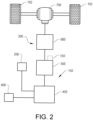
- Fig. 2 is a schematic illustration of the steering assist system 150 according to an example embodiment.
- the steering assist system 150 comprises the positioning system 200, 400, a fluid pump 500 connected to the steering system 300 of the vehicle, and a control unit 450 arranged in communication with the positioning system 200, 400 and the fluid pump 500.
- the control unit 450 is arranged to receive control signal(s) from the positioning system and to control the fluid pump 500 based on this/these signals.
- the control unit may include a microprocessor, microcontroller, programmable digital signal processor or another programmable device.
- the control unit may also, or instead, include an application specific integrated circuit, a programmable gate array or programmable array logic, a programmable logic device, or a digital signal processor.
- the control unit includes a programmable device such as the microprocessor, microcontroller or programmable digital signal processor mentioned above, the processor may further include computer executable code that controls operation of the programmable device.
- the steering system comprises a steering gear 600 and a cardan joint 700 connecting the fluid pump 500 to the steerable wheels 102.
- the fluid pump 500 is thus arranged to supply a flow of fluid for generating a steering assist force to the steerable wheels 102 of the vehicle during e.g. a turning maneuver.
- the fluid pump is preferably arranged as a hydraulic fluid pump 500 configured to generate the steering assist force to the steerable wheels 102 by supplying a flow of hydraulic fluid for operation of the fluid pump 500.
- the fluid pump can be connected to a prime mover 550, in the form of an internal combustion engine, of the vehicle for controlling operation thereof.
- the flow of fluid supplied by the fluid pump can be controlled by means of a valve (not shown).
- the operational capacity, and thus in turn the steering assist force generated to the steerable wheels is controlled by controlling the openness degree of the valve. When reducing the flow of fluid through the valve, the operational capacity of the fluid pump will be reduced, whereby a reduced steering assist force is generated.
- the fluid pump can instead be connected to, and controlled by, a prime mover 550 in the form of an electric machine.
- the flow of fluid supplied by the fluid pump 500 is controlled by controlling the rotational velocity of the electric machine.
- an increased rotational velocity generates an increased supply of fluid flow, and in turn an increased steering assist force.
- Fig. 3 In order to describe the functionality of controlling the steering assist system 150 in further detail, reference is made to Fig. 3 , in combination with the features illustrated in Fig. 2 .
- a signal indicative of the road characteristics of a road segment operable by the vehicle is obtained S1 by the control unit 450.
- the signal is received from the positioning system 200, 400.
- the control unit 450 receives data indicative of the upcoming road characteristics, e.g. the curvature of the road. Based on the road characteristics, the control unit 450 determines S2 a required steering angle of the steerable wheels 102, whereby the determined required steering angle is sufficient for operating the vehicle during the road segment.
- the control unit 450 further determines S3, based on the required steering angle, a desired steering assist force to be applied to the steerable wheels 102 of the vehicle.
- the control unit 450 controls S4 the flow of fluid supplied by the fluid pump 500 based on the determined steering assist force.
- the flow of fluid can be controlled by a valve or by the rotational velocity of an electric machine depending on the current application and type of vehicle.
- the fluid pump 500 is not operated at its full capacity if not needed to.
- the flow of fluid supplied by the fluid pump is controlled proportionally to the desired steering assist force.
- the fluid pump 500 is controlled to supply a flow of fluid of approximately 70% of its full flow capacity.
- the fluid pump is controlled to always maintain a minimum steering assist force.
- the fluid pump 500 is preferably controlled to supply a flow of fluid to generate a lower steering assist force.
- the lower steering assist force is preferably between 20 - 40% of a maximum steering assist force capacity of the fluid pump 500.
- the steering assist force is thus preferably increased proportionally from the lower steering assist force level up to its full capacity.
- the above described fluid pump 500 may also be controlled based on a signal received from an acceleration sensor (not shown).
- the acceleration sensor is in such a case arranged to obtain a current lateral acceleration of the vehicle.
- the lateral acceleration signal is transmitted to the control unit 450, whereby the control unit 450 controls the fluid pump 500 to supply a flow of fluid also based on the determined lateral acceleration.
- the control unit 450 can receive a signal indicative of a current steering wheel torque applied by an operator of the vehicle. In such a case, the control unit controls the flow of fluid supplied by the fluid pump 500 also based on the applied steering wheel torque.
Landscapes
- Engineering & Computer Science (AREA)
- Chemical & Material Sciences (AREA)
- Combustion & Propulsion (AREA)
- Transportation (AREA)
- Mechanical Engineering (AREA)
- Steering Control In Accordance With Driving Conditions (AREA)
- Power Steering Mechanism (AREA)
Claims (14)
- Verfahren zur Steuerung eines Lenkunterstützungssystems (150) eines Fahrzeugs (100); das Lenkunterstützungssystem (150) umfassend eine Fluidpumpe (500), die mit einem Lenksystem (300) des Fahrzeugs (100) verbunden ist, wobei die Fluidpumpe (500) angeordnet ist, um einen Fluidstrom zum Erzeugen einer Lenkunterstützungskraft auf ein Rad (102) des Fahrzeugs (100) während des Betriebs zu liefern, das Verfahren umfassend:- Erhalten (S1) eines Signals, das eine Straßencharakteristik eines Straßenabschnitts anzeigt, der von dem Fahrzeug (100) befahrbar ist;- Bestimmen (S2) eines erforderlichen Radwinkels für den Betrieb des Fahrzeugs während des Straßenabschnitts;- Bestimmen (S3) einer gewünschten Lenkunterstützungskraft, die auf der Grundlage des erforderlichen Radwinkels auf das Rad (102) aufzubringen ist; gekennzeichnet durch- Steuern (S4) des von der Fluidpumpe (500) gelieferten Fluidstroms auf der Grundlage der Lenkunterstützungskraft beim Betrieb des Fahrzeugs (100) auf dem Straßenabschnitt, wobei der von der Fluidpumpe (500) gelieferte Fluidstrom proportional zur gewünschten Lenkunterstützungskraft gesteuert wird.
- Verfahren nach Anspruch 1, das Verfahren ferner umfassend:- Erhalten eines Signals, das einen Parameterwert bezüglich einer Querbeschleunigung des Fahrzeugs (100) anzeigt; und- Steuern des von der Fluidpumpe (500) gelieferten Fluidstroms auf der Grundlage der Lenkunterstützungskraft und der Querbeschleunigung.
- Verfahren nach Anspruch 2, wobei das Signal, das einen Parameterwert bezüglich der Querbeschleunigung angibt, von einem Beschleunigungssensor empfangen wird, wenn das Fahrzeug während des Straßenabschnitts betrieben wird.
- Verfahren nach einem der vorhergehenden Ansprüche, das Verfahren ferner umfassend:- Erhalten eines Signals, das ein von einem Fahrzeugbediener aufgebrachtes Lenkraddrehmoment anzeigt; und- Steuern des von der Fluidpumpe (500) gelieferten Fluidstroms auf der Grundlage der Lenkunterstützungskraft und dem Lenkraddrehmoment.
- Verfahren nach einem der vorhergehenden Ansprüche, ferner umfassend:- Vergleichen des erforderlichen Radwinkels mit einem vorbestimmten Schwellenwinkel; und- Reduzieren des von der Fluidpumpe (500) gelieferten Fluidstroms auf einen unteren Grenzwert der Lenkunterstützungskraft, wenn der erforderliche Radwinkel unter dem vorbestimmten Schwellenradwinkel liegt.
- Verfahren nach Anspruch 5, wobei der untere Grenzwert für die Lenkunterstützungskraft zwischen 20 % und 40 % einer maximalen Lenkunterstützungskraftkapazität der Fluidpumpe (500) liegt.
- Verfahren nach einem der vorhergehenden Ansprüche 5-6, wobei der vorbestimmte Schwellenradwinkel zwischen 0-2 Grad liegt.
- Verfahren nach einem der vorhergehenden Ansprüche, wobei die Fluidpumpe (500) eine Hydraulikfluidpumpe ist, die angeordnet ist, um einen Strom eines Hydraulikfluids zur Erzeugung der Lenkunterstützungskraft zu liefern.
- Verfahren nach einem der vorhergehenden Ansprüche, wobei das Lenkunterstützungssystem (150) ferner ein Positionierungssystem (200, 400) umfasst, wobei das Positionierungssystem angeordnet ist, die Straßencharakteristik des Straßenabschnitts zu bestimmen.
- Verfahren nach einem der vorhergehenden Ansprüche, wobei die Fluidpumpe (500) mit einem Verbrennungsmotor (550) des Fahrzeugs (100) zum Betrieb der Fluidpumpe (500) verbunden ist, die Fluidpumpe umfassend ein Ventil zur Steuerung der Zufuhr des Fluidstroms, wobei das Verfahren umfasst:- Steuern des von der Fluidpumpe gelieferten Fluidstroms durch Steuerung des Öffnungsgrads des Ventils.
- Verfahren nach einem der Ansprüche 1-9, wobei die Fluidpumpe (500) mit einer elektrischen Maschine (550) des Fahrzeugs verbunden ist, um den Betrieb der Fluidpumpe (500) zu steuern, das Verfahren umfassend:- Steuern des von der Fluidpumpe gelieferten Fluidstroms durch elektrische Steuerung der Drehgeschwindigkeit der elektrischen Maschine.
- Lenkunterstützungssystems (150) eines Fahrzeugs (100), das Lenkunterstützungssystem (150) umfassend:- ein Positionierungssystem (200, 400);- eine Fluidpumpe (500), die mit einem Lenksystem (300) des Fahrzeugs (100) verbunden ist, wobei die Fluidpumpe (500) angeordnet ist, um einen Fluidstrom zum Erzeugen einer Lenkunterstützungskraft auf ein Rad (102) des Fahrzeugs (100) während des Betriebs zu liefern; und- eine Steuereinheit (450), die angeordnet ist, um mit dem Positionierungssystem (200, 400) zu kommunizieren, wobei die Steuereinheit (450) konfiguriert ist, zum:- Erhalten eines Signals vom Positionierungssystem (200, 400), das eine Straßencharakteristik eines Straßenabschnitts anzeigt, der von dem Fahrzeug (100) befahrbar ist;- Bestimmen eines erforderlichen Radwinkels für den Betrieb des Fahrzeugs (100) während des Straßenabschnitts;- Bestimmen einer gewünschten Lenkunterstützungskraft, die auf der Grundlage des erforderlichen Lenkwinkels auf das Rad (102) aufzubringen ist; dadurch gekennzeichnet, dass die Steuereinheit ferner so konfiguriert ist, zum- Steuern des von der Fluidpumpe (500) gelieferten Fluidstroms auf der Grundlage der Lenkunterstützungskraft beim Betrieb des Fahrzeugs (100) auf dem Straßenabschnitt, wobei der von der Fluidpumpe (500) gelieferte Fluidstrom proportional zur gewünschten Lenkunterstützungskraft gesteuert wird.
- Computerlesbares Medium mit einem Computerprogramm, das Programmcodemittel zum Durchführen der Schritte nach einem der Ansprüche 1-11 umfasst, wenn das Programmmittel auf einem Computer ausgeführt wird.
- Computerprogramm, das Programmcodemittel zum Durchführen der Schritte nach einem der Ansprüche 1-11 umfasst, wenn das Programm auf einem Computer ausgeführt wird.
Priority Applications (3)
| Application Number | Priority Date | Filing Date | Title |
|---|---|---|---|
| EP20200787.8A EP3981669B1 (de) | 2020-10-08 | 2020-10-08 | Verfahren zur steuerung eines lenkunterstützungssystems eines fahrzeugs |
| CN202111145614.5A CN114394152B (zh) | 2020-10-08 | 2021-09-28 | 用于控制车辆的转向辅助系统的方法 |
| US17/487,399 US11643137B2 (en) | 2020-10-08 | 2021-09-28 | Method for controlling a steering assist system of a vehicle |
Applications Claiming Priority (1)
| Application Number | Priority Date | Filing Date | Title |
|---|---|---|---|
| EP20200787.8A EP3981669B1 (de) | 2020-10-08 | 2020-10-08 | Verfahren zur steuerung eines lenkunterstützungssystems eines fahrzeugs |
Publications (3)
| Publication Number | Publication Date |
|---|---|
| EP3981669A1 EP3981669A1 (de) | 2022-04-13 |
| EP3981669C0 EP3981669C0 (de) | 2024-11-27 |
| EP3981669B1 true EP3981669B1 (de) | 2024-11-27 |
Family
ID=72811691
Family Applications (1)
| Application Number | Title | Priority Date | Filing Date |
|---|---|---|---|
| EP20200787.8A Active EP3981669B1 (de) | 2020-10-08 | 2020-10-08 | Verfahren zur steuerung eines lenkunterstützungssystems eines fahrzeugs |
Country Status (3)
| Country | Link |
|---|---|
| US (1) | US11643137B2 (de) |
| EP (1) | EP3981669B1 (de) |
| CN (1) | CN114394152B (de) |
Families Citing this family (1)
| Publication number | Priority date | Publication date | Assignee | Title |
|---|---|---|---|---|
| EP4397572B1 (de) * | 2023-01-05 | 2025-02-26 | Volvo Truck Corporation | Servolenksystem und verfahren zum betrieb des servolenksystems |
Family Cites Families (19)
| Publication number | Priority date | Publication date | Assignee | Title |
|---|---|---|---|---|
| DE3410033A1 (de) * | 1984-03-19 | 1985-09-26 | Alfred Teves Gmbh, 6000 Frankfurt | Vorrichtung zur hydraulischen unterstuetzung der lenkkraft |
| EP0665157A1 (de) * | 1993-12-22 | 1995-08-02 | CENTRO RICERCHE FIAT Società Consortile per Azioni | Servolenkung für Motorfahrzeuge |
| CN1702007A (zh) * | 2005-05-26 | 2005-11-30 | 江苏大学 | 车辆四轮独立转向机构及其控制方法 |
| DE102007054018A1 (de) * | 2007-11-13 | 2009-05-14 | Trw Automotive Gmbh | Verfahren zur aktiven Ansteuerung einer Servoventilbaugruppe |
| US8408352B2 (en) * | 2007-12-20 | 2013-04-02 | Ford Global Technologies, Llc | Energy efficient power steering pump control system |
| CN101239625B (zh) * | 2008-03-10 | 2011-06-01 | 江苏大学 | 一种电机驱动的大客车液压转向系统及其控制转向的方法 |
| CN102267487B (zh) * | 2011-05-11 | 2012-11-07 | 江苏大学 | 一种基于车速和载荷信号控制的电动液压助力转向系统 |
| CN103010298B (zh) * | 2012-11-27 | 2015-12-02 | 江苏大学 | 重型车辆电控液压转向系统及其控制方法 |
| KR101534985B1 (ko) | 2013-12-27 | 2015-07-07 | 현대자동차주식회사 | 전동식 조향 장치의 프릭션 조절 방법 및 프릭션 조절 장치 |
| CN105253192A (zh) * | 2015-11-11 | 2016-01-20 | 盐城市盐海拖拉机制造有限公司 | 一种汽车电动液压助力转向系统的控制方法 |
| CN105835946B (zh) * | 2016-05-17 | 2018-11-13 | 上海汽车集团股份有限公司 | 液压转向辅助系统 |
| JP6809019B2 (ja) * | 2016-07-27 | 2021-01-06 | いすゞ自動車株式会社 | 操舵補助装置及び操舵補助方法 |
| JP6753199B2 (ja) * | 2016-08-02 | 2020-09-09 | いすゞ自動車株式会社 | 車線維持支援装置及び車線維持支援方法 |
| JP6759822B2 (ja) * | 2016-08-02 | 2020-09-23 | いすゞ自動車株式会社 | 操舵補助装置及び操舵補助方法 |
| CN206719320U (zh) * | 2017-04-18 | 2017-12-08 | 清华大学 | 一种商用车蓄能电动液压混合式助力转向系统 |
| JP6596043B2 (ja) | 2017-07-31 | 2019-10-23 | 株式会社Subaru | 車両の走行制御システム |
| US20190054915A1 (en) * | 2017-08-16 | 2019-02-21 | Deere & Company | Service Brake Assist Steering |
| CN107901979B (zh) * | 2017-11-10 | 2020-02-28 | 南京双环电器股份有限公司 | 一种汽车电液主动转向路感控制系统及其控制方法 |
| CN110723206A (zh) | 2018-07-16 | 2020-01-24 | 郑州宇通客车股份有限公司 | 一种路面凹凸度自适应调整转向方法及系统 |
-
2020
- 2020-10-08 EP EP20200787.8A patent/EP3981669B1/de active Active
-
2021
- 2021-09-28 US US17/487,399 patent/US11643137B2/en active Active
- 2021-09-28 CN CN202111145614.5A patent/CN114394152B/zh active Active
Also Published As
| Publication number | Publication date |
|---|---|
| EP3981669A1 (de) | 2022-04-13 |
| EP3981669C0 (de) | 2024-11-27 |
| US11643137B2 (en) | 2023-05-09 |
| CN114394152A (zh) | 2022-04-26 |
| CN114394152B (zh) | 2024-07-26 |
| US20220111890A1 (en) | 2022-04-14 |
Similar Documents
| Publication | Publication Date | Title |
|---|---|---|
| US10556621B2 (en) | Steering assist apparatus | |
| US6256561B1 (en) | Vehicle steering control system | |
| JP6528786B2 (ja) | 車両の運転支援装置 | |
| JP6801565B2 (ja) | 車両の操舵支援装置および操舵支援方法 | |
| US20150259006A1 (en) | Travel trajectory control device for a vehicle | |
| KR100964423B1 (ko) | 스티어링 제어 장치 | |
| JP2004082862A (ja) | 電動式パワーステアリング装置 | |
| US6073721A (en) | Method for limiting hydraulic assist in a power assist steering system | |
| US12145589B2 (en) | Controller for vehicle, computer-readable medium storing control program for vehicle, and control method for vehicle | |
| KR101646385B1 (ko) | 전자제어 능동 후륜 조향 시스템 및 그 제어 방법 | |
| JP2013010380A (ja) | パワーステアリング装置 | |
| CN114987600B (zh) | 汽车方向盘中心位置保持的控制方法、装置及汽车 | |
| EP3981669B1 (de) | Verfahren zur steuerung eines lenkunterstützungssystems eines fahrzeugs | |
| US20090292420A1 (en) | Method of reducing current consumption of electric hydraulic power steering system for vehicle | |
| US20050247512A1 (en) | Motor-driven power steering system | |
| US20240034408A1 (en) | Power steering controller and power steering control method | |
| CN111032491A (zh) | 通过差速轮制动提供车辆转向支持的方法、系统、车辆、计算机程序和计算机可读介质 | |
| CN110712678A (zh) | 车辆转向系统的控制方法及其车辆 | |
| KR102020752B1 (ko) | 전동식 파워 스티어링 시스템의 토크 보상 장치 및 방법 | |
| US20190270480A1 (en) | Apparatus and method for turning steerable vehicle wheels | |
| JP6346406B2 (ja) | 油圧パワーステアリングシステム、それを搭載した車両、及び油圧パワーステアリングシステムの制御方法 | |
| EP0665157A1 (de) | Servolenkung für Motorfahrzeuge | |
| CN112238892B (zh) | 一种基于eps和ehps的转向系统及其控制方法 | |
| JP7339203B2 (ja) | 車両制御装置 | |
| JP4066933B2 (ja) | パワーステアリング装置用流量制御装置 |
Legal Events
| Date | Code | Title | Description |
|---|---|---|---|
| PUAI | Public reference made under article 153(3) epc to a published international application that has entered the european phase |
Free format text: ORIGINAL CODE: 0009012 |
|
| STAA | Information on the status of an ep patent application or granted ep patent |
Free format text: STATUS: THE APPLICATION HAS BEEN PUBLISHED |
|
| AK | Designated contracting states |
Kind code of ref document: A1 Designated state(s): AL AT BE BG CH CY CZ DE DK EE ES FI FR GB GR HR HU IE IS IT LI LT LU LV MC MK MT NL NO PL PT RO RS SE SI SK SM TR |
|
| STAA | Information on the status of an ep patent application or granted ep patent |
Free format text: STATUS: REQUEST FOR EXAMINATION WAS MADE |
|
| 17P | Request for examination filed |
Effective date: 20220914 |
|
| RBV | Designated contracting states (corrected) |
Designated state(s): AL AT BE BG CH CY CZ DE DK EE ES FI FR GB GR HR HU IE IS IT LI LT LU LV MC MK MT NL NO PL PT RO RS SE SI SK SM TR |
|
| GRAP | Despatch of communication of intention to grant a patent |
Free format text: ORIGINAL CODE: EPIDOSNIGR1 |
|
| STAA | Information on the status of an ep patent application or granted ep patent |
Free format text: STATUS: GRANT OF PATENT IS INTENDED |
|
| INTG | Intention to grant announced |
Effective date: 20240709 |
|
| GRAS | Grant fee paid |
Free format text: ORIGINAL CODE: EPIDOSNIGR3 |
|
| GRAA | (expected) grant |
Free format text: ORIGINAL CODE: 0009210 |
|
| STAA | Information on the status of an ep patent application or granted ep patent |
Free format text: STATUS: THE PATENT HAS BEEN GRANTED |
|
| AK | Designated contracting states |
Kind code of ref document: B1 Designated state(s): AL AT BE BG CH CY CZ DE DK EE ES FI FR GB GR HR HU IE IS IT LI LT LU LV MC MK MT NL NO PL PT RO RS SE SI SK SM TR |
|
| REG | Reference to a national code |
Ref country code: GB Ref legal event code: FG4D |
|
| REG | Reference to a national code |
Ref country code: CH Ref legal event code: EP |
|
| REG | Reference to a national code |
Ref country code: IE Ref legal event code: FG4D |
|
| REG | Reference to a national code |
Ref country code: DE Ref legal event code: R096 Ref document number: 602020041961 Country of ref document: DE |
|
| U01 | Request for unitary effect filed |
Effective date: 20241212 |
|
| U07 | Unitary effect registered |
Designated state(s): AT BE BG DE DK EE FI FR IT LT LU LV MT NL PT RO SE SI Effective date: 20241223 |
|
| PG25 | Lapsed in a contracting state [announced via postgrant information from national office to epo] |
Ref country code: HR Free format text: LAPSE BECAUSE OF FAILURE TO SUBMIT A TRANSLATION OF THE DESCRIPTION OR TO PAY THE FEE WITHIN THE PRESCRIBED TIME-LIMIT Effective date: 20241127 Ref country code: IS Free format text: LAPSE BECAUSE OF FAILURE TO SUBMIT A TRANSLATION OF THE DESCRIPTION OR TO PAY THE FEE WITHIN THE PRESCRIBED TIME-LIMIT Effective date: 20250327 |
|
| PG25 | Lapsed in a contracting state [announced via postgrant information from national office to epo] |
Ref country code: ES Free format text: LAPSE BECAUSE OF FAILURE TO SUBMIT A TRANSLATION OF THE DESCRIPTION OR TO PAY THE FEE WITHIN THE PRESCRIBED TIME-LIMIT Effective date: 20241127 |
|
| PG25 | Lapsed in a contracting state [announced via postgrant information from national office to epo] |
Ref country code: NO Free format text: LAPSE BECAUSE OF FAILURE TO SUBMIT A TRANSLATION OF THE DESCRIPTION OR TO PAY THE FEE WITHIN THE PRESCRIBED TIME-LIMIT Effective date: 20250227 |
|
| PG25 | Lapsed in a contracting state [announced via postgrant information from national office to epo] |
Ref country code: GR Free format text: LAPSE BECAUSE OF FAILURE TO SUBMIT A TRANSLATION OF THE DESCRIPTION OR TO PAY THE FEE WITHIN THE PRESCRIBED TIME-LIMIT Effective date: 20250228 |
|
| PG25 | Lapsed in a contracting state [announced via postgrant information from national office to epo] |
Ref country code: PL Free format text: LAPSE BECAUSE OF FAILURE TO SUBMIT A TRANSLATION OF THE DESCRIPTION OR TO PAY THE FEE WITHIN THE PRESCRIBED TIME-LIMIT Effective date: 20241127 |
|
| PG25 | Lapsed in a contracting state [announced via postgrant information from national office to epo] |
Ref country code: RS Free format text: LAPSE BECAUSE OF FAILURE TO SUBMIT A TRANSLATION OF THE DESCRIPTION OR TO PAY THE FEE WITHIN THE PRESCRIBED TIME-LIMIT Effective date: 20250227 |
|
| PG25 | Lapsed in a contracting state [announced via postgrant information from national office to epo] |
Ref country code: SM Free format text: LAPSE BECAUSE OF FAILURE TO SUBMIT A TRANSLATION OF THE DESCRIPTION OR TO PAY THE FEE WITHIN THE PRESCRIBED TIME-LIMIT Effective date: 20241127 |
|
| PG25 | Lapsed in a contracting state [announced via postgrant information from national office to epo] |
Ref country code: SK Free format text: LAPSE BECAUSE OF FAILURE TO SUBMIT A TRANSLATION OF THE DESCRIPTION OR TO PAY THE FEE WITHIN THE PRESCRIBED TIME-LIMIT Effective date: 20241127 |
|
| PG25 | Lapsed in a contracting state [announced via postgrant information from national office to epo] |
Ref country code: CZ Free format text: LAPSE BECAUSE OF FAILURE TO SUBMIT A TRANSLATION OF THE DESCRIPTION OR TO PAY THE FEE WITHIN THE PRESCRIBED TIME-LIMIT Effective date: 20241127 |
|
| PLBE | No opposition filed within time limit |
Free format text: ORIGINAL CODE: 0009261 |
|
| STAA | Information on the status of an ep patent application or granted ep patent |
Free format text: STATUS: NO OPPOSITION FILED WITHIN TIME LIMIT |
|
| 26N | No opposition filed |
Effective date: 20250828 |
|
| U20 | Renewal fee for the european patent with unitary effect paid |
Year of fee payment: 6 Effective date: 20251027 |