EP3980331B1 - Système de siège - Google Patents
Système de siège Download PDFInfo
- Publication number
- EP3980331B1 EP3980331B1 EP20733696.7A EP20733696A EP3980331B1 EP 3980331 B1 EP3980331 B1 EP 3980331B1 EP 20733696 A EP20733696 A EP 20733696A EP 3980331 B1 EP3980331 B1 EP 3980331B1
- Authority
- EP
- European Patent Office
- Prior art keywords
- booking
- unit
- seat
- seating
- designed
- Prior art date
- Legal status (The legal status is an assumption and is not a legal conclusion. Google has not performed a legal analysis and makes no representation as to the accuracy of the status listed.)
- Active
Links
Images




Classifications
-
- B—PERFORMING OPERATIONS; TRANSPORTING
- B64—AIRCRAFT; AVIATION; COSMONAUTICS
- B64D—EQUIPMENT FOR FITTING IN OR TO AIRCRAFT; FLIGHT SUITS; PARACHUTES; ARRANGEMENT OR MOUNTING OF POWER PLANTS OR PROPULSION TRANSMISSIONS IN AIRCRAFT
- B64D11/00—Passenger or crew accommodation; Flight-deck installations not otherwise provided for
- B64D11/06—Arrangements of seats, or adaptations or details specially adapted for aircraft seats
-
- B—PERFORMING OPERATIONS; TRANSPORTING
- B64—AIRCRAFT; AVIATION; COSMONAUTICS
- B64D—EQUIPMENT FOR FITTING IN OR TO AIRCRAFT; FLIGHT SUITS; PARACHUTES; ARRANGEMENT OR MOUNTING OF POWER PLANTS OR PROPULSION TRANSMISSIONS IN AIRCRAFT
- B64D11/00—Passenger or crew accommodation; Flight-deck installations not otherwise provided for
-
- B—PERFORMING OPERATIONS; TRANSPORTING
- B64—AIRCRAFT; AVIATION; COSMONAUTICS
- B64D—EQUIPMENT FOR FITTING IN OR TO AIRCRAFT; FLIGHT SUITS; PARACHUTES; ARRANGEMENT OR MOUNTING OF POWER PLANTS OR PROPULSION TRANSMISSIONS IN AIRCRAFT
- B64D11/00—Passenger or crew accommodation; Flight-deck installations not otherwise provided for
- B64D11/0015—Arrangements for entertainment or communications, e.g. radio, television
-
- G—PHYSICS
- G06—COMPUTING OR CALCULATING; COUNTING
- G06Q—INFORMATION AND COMMUNICATION TECHNOLOGY [ICT] SPECIALLY ADAPTED FOR ADMINISTRATIVE, COMMERCIAL, FINANCIAL, MANAGERIAL OR SUPERVISORY PURPOSES; SYSTEMS OR METHODS SPECIALLY ADAPTED FOR ADMINISTRATIVE, COMMERCIAL, FINANCIAL, MANAGERIAL OR SUPERVISORY PURPOSES, NOT OTHERWISE PROVIDED FOR
- G06Q10/00—Administration; Management
- G06Q10/02—Reservations, e.g. for tickets, services or events
Definitions
- the invention relates to a seating system.
- the object of the invention is in particular to provide a generic device with improved properties with regard to a user-specific range of functions and/or performance.
- the object is achieved according to the invention by the features of patent claim 1, while advantageous embodiments and further developments of the invention can be found in the subclaims.
- a seat system in particular an aircraft seat system, is proposed with at least one seat device that comprises at least one seat and with an additional booking and/or debiting system, wherein the additional booking and/or debiting system is at least partially provided for the purpose of adding and/or debiting at least one individual service and/or at least one comfort feature.
- the design according to the invention advantageously makes it possible to provide a seat system with a user-specific range of functions and/or services. This allows a user to advantageously select which individual services and/or comfort features he would like to use and/or which he would not like to use.
- the design according to the invention advantageously increases ease of maintenance and cleaning, since only individual services and/or comfort features that are used need to be checked, cleaned and/or maintained.
- the design according to the invention advantageously makes it possible to produce a product that is optimally tailored to the user, in particular a Transport services can be offered. This can advantageously lead to an increase in revenue for a transport provider, in particular an airline.
- the seating system is intended in particular for use in a means of transport, in particular in an aircraft.
- the means of transport comprises the seating system. "Intended” is to be understood in particular as specially programmed, designed and/or equipped.
- the fact that an object is intended for a specific function is to be understood in particular as meaning that the object fulfills and/or carries out this specific function in at least one application and/or operating state.
- the at least one seating device comprises at least one seat.
- the at least one seating device forms at least one seating area.
- the at least one seating area is intended in particular for a user to stay in during transport, in particular during a flight.
- An "individual service” is to be understood in particular as a service that is used by the user during transport, in particular during the flight.
- the at least one individual service is designed as catering, as in-flight entertainment (IFE) and/or as a sale of goods.
- a "comfort feature” is to be understood in particular as a feature of the at least one seating device that improves comfort and/or well-being for the user.
- a "user” is to be understood in particular as a passenger.
- “Add-on booking” is to be understood in particular as meaning that the at least one individual service and/or the at least one comfort feature can be optionally booked in addition to an actual booking of the transport, in particular the flight, whereby an additional booking is in particular independent of the time of the booking of the transport.
- This allows the user to advantageously only book the at least one individual service and/or the at least one comfort feature, in particular for a fee, that he would like to use.
- the transport provider can advantageously generate additional income by booking the at least one individual service and/or the at least one comfort feature.
- Debit is to be understood in particular as meaning that the at least one individual service and/or the at least one comfort feature can be booked in addition to an actual booking of the transport, in particular the flight. is included as standard in the actual booking of the transport, in particular the flight, and can be optionally deselected, whereby a debit is in particular independent of the time of the booking of the transport. This can advantageously enable a cost reduction and/or a credit for the user if they forego at least one individual service and/or at least one comfort feature.
- the seat system has at least one, in particular central, computing unit and at least one data transmission unit, wherein the at least one data transmission unit is at least provided to connect the at least one computing unit to the at least one seat device for data transmission wirelessly and/or with a cable.
- This design can advantageously achieve structured data processing.
- "Central” is to be understood in particular as meaning that the at least one computing unit is connected to at least two seat devices.
- the at least one computing unit is connected to several seat devices via the at least one data transmission unit.
- the at least one computing unit is in particular provided to process data for several seat devices.
- the at least one computing unit is provided to be connected to at least one row of seats, at least one seat column and/or at least one seat compartment.
- a "seat compartment" is to be understood in particular as an area in an aircraft cabin in which several seat devices are arranged, wherein the area is separated from at least one further area, in particular by at least one partition wall.
- the at least one data transmission unit has at least one transmitting and/or receiving unit and/or at least one data cable.
- the at least one data cable is designed in particular as a network data cable.
- the at least one computing unit is connected to the at least one seat device via the at least one data cable.
- the at least one computing unit is connected to the at least one seat device via the at least one data cable by means of a bus system, in particular a CAN bus system.
- the at least one computing unit is connected to the at least one seat device wirelessly via WLAN, Bluetooth and/or near-field communication.
- the data transmission is designed to be encrypted.
- the at least one computing unit is designed to be decentralized.
- the term "decentralized" is to be understood in particular as meaning that the at least one computing unit is assigned to at least one grouping of several seating devices of the at least one seating device, the at least one seating device and/or the at least one seat, wherein the at least one computing unit is arranged in the at least one seating device and/or on the at least one seat.
- a "grouping of several seating devices” is to be understood in particular as an arrangement that comprises several seating devices, wherein the several seating devices are preferably arranged adjacent to one another.
- the at least one grouping of several seating devices could comprise two seating devices arranged one behind the other and/or next to one another.
- the at least one grouping of several seating devices can also be designed as the at least one seat compartment.
- the seating system particularly preferably has at least two decentralized computing units that are arranged in different groupings of several seating devices, in different seating devices and/or in different seats.
- the at least one decentralized computing unit is preferably provided for seat-specific data processing.
- the at least one data transmission unit is provided for data transmission of booking data.
- the at least one computing unit is particularly provided for processing booking data for several seating devices.
- “Booking data” is to be understood in particular as data that contains information about whether an additional booking and/or a debit has been made for the at least one individual service and/or the at least one comfort feature.
- the booking data preferably includes at least one release indicator.
- the at least one release indicator is particularly provided for electrical and/or electromechanical activation of the at least one additionally booked individual service and/or the at least one additionally booked comfort feature.
- the data transmission of booking data is preferably encrypted.
- the seat system has the at least one, in particular central, computing unit and the at least one data transmission unit, wherein the at least one computing unit and/or the at least one data transmission unit has at least one further function, in particular an IFE function and/or a seat control function, in addition to an additional booking and/or debiting function of the additional booking and/or debiting system.
- This design advantageously allows one data transmission path to be used for multiple purposes.
- an existing data transmission unit can also be used to transmit booking data. This design advantageously saves installation space and weight. This also saves manufacturing and maintenance costs.
- IFE function is to be understood in particular as a function that provides in-flight entertainment for a user, wherein content from the in-flight entertainment can be called up by the user according to his or her personal needs.
- the IFE function preferably provides the user with at least one film, at least one piece of music and/or at least one game.
- the IFE function can preferably be used personally by the user.
- a "seat control function” is to be understood in particular as a function that enables a control, in particular electromechanical control, of the at least one seat based on a user input, wherein the at least one seat can be adjusted by means of the control.
- the seating system has at least one communication interface that is intended to enable communication between a person and the at least one computing unit, wherein the at least one individual service and/or the at least one comfort feature can be added and/or debited using the at least one communication interface.
- This design enables an advantageously simple addition and/or debit. As a result, an addition and/or debit can advantageously be made directly and independently of time by the user, without having to interact with staff. This design can advantageously increase the user's well-being.
- the at least one communication interface is intended to provide information about an addition and/or debit and/or to enable an addition and/or debit by a user.
- the at least one communication interface is arranged in the at least one seat device. Particularly preferably, the at least one communication interface is part of the at least one seat device. In principle, the at least one communication interface can also be designed as a central communication interface, in particular in the means of transport.
- the at least one communication interface is designed as a PED.
- This design allows for an advantageously convenient additional booking and/or debiting, since the user can make the additional booking and/or the debiting without leaving the at least one seat device.
- This design allows an additional booking and/or a debiting to be carried out advantageously with the user's own, known PED.
- This design also allows the user to be presented with individual offers that are tailored to the user.
- a "PED" is to be understood in particular as a personal electronic device of a user.
- the PED is intended in particular to be coupled to the at least one computing unit.
- the at least one control function is intended in particular to control the at least one seat device.
- the at least one communication interface can also be designed as a remote control for the at least one seat device.
- the PED comprises at least one application which is at least intended to receive, store, process and/or send booking data.
- the at least one application comprises a booking function for the transport and an additional booking and/or debit function for an additional booking and/or a debit of the at least one individual service and/or the at least one comfort feature.
- data of the at least one application is stored on the PED. This enables a Advantageously, reliable use of the application can be ensured, since data is available independently of an internet connection of the PED.
- the PED is provided to exchange data, in particular booking data, with the at least one computing unit via the at least one data transmission unit.
- This design allows booking data from the PED to be transferred to the at least one computing unit, in particular the at least one central computing unit or the at least one decentralized computing unit, advantageously easily by means of the at least one application.
- This enables advantageously simple and user-friendly data capture, since user-specific booking data can be automatically captured by a user-specific PED.
- a "personal communication service” is to be understood in particular as a service that is intended to enable communication between at least two people in order to recognize and/or evaluate at least one common need of the at least two people.
- the personal communication service is preferably intended to provide the at least two people with at least one offer for the at least one common need or to forward the at least one common need to a service provider.
- the personal communication service preferably includes a chat function and/or a telephone function, with the chat function and/or the telephone function being intended in particular for communication within the means of transport.
- the personal communication service is particularly preferably designed as indirect communication.
- “Indirect communication” is to be understood in particular as communication in which the users do not communicate directly with one another, but merely exchange information about the users and/or the users' needs.
- a “need” is to be understood in particular as a desire for a certain service.
- the need is designed as a taxi ride, a hotel stay, an activity and/or a travel partnership.
- the personal communication service has a match function intended to is to evaluate common interests and/or needs of several users.
- the match function is intended in particular to identify similarities with the personal interests and/or needs of other users based on information provided by the user.
- the match function is preferably intended to allow users with common personal interests and/or needs to be made known to one another via at least one communication interface.
- a "personal communication service” should not be understood to mean in-flight entertainment, in particular a telephone function for communication beyond the means of transport and in particular an Internet function.
- the at least one seat device comprises at least one adjustable seat function unit, which comprises the at least one comfort feature that can be added and/or canceled and which has at least one standard operating state and at least one further operating state, wherein the at least one seat function unit is provided to be adjusted to the at least one further operating state when the at least one comfort feature is added and/or canceled.
- This design can advantageously provide a user-specific range of functions and/or services. This allows a user to advantageously add and/or cancel comfort features as needed.
- a "standard operating state" of a seat function unit is to be understood in particular as an operating state that is set by default without an addition of the at least one comfort feature that can be booked.
- a “further operating state" of a seat function unit is to be understood in particular as an operating state that can be set when the at least one comfort feature that can be booked.
- the at least one comfort feature is particularly preferably available to the user in the at least one further operating state.
- the term "adjustable” should be understood in particular to mean that a position of the seat function unit and/or a range of functions of the seat function unit can be changed by an additional booking.
- the at least one seat function unit is at least substantially formed by a mechanical component, wherein the mechanical component is provided to be moved into the at least one further operating state when the at least one comfort feature is added.
- a “mechanical component” is to be understood in particular as a component that can be controlled manually and/or electrically and can be moved between the at least one standard operating state and the at least one further operating state via at least one bearing point of the mechanical component.
- the mechanical component preferably has at least one pivot bearing and/or at least one linear bearing.
- the mechanical component is designed as a backrest, as an armrest, as a headrest, as a seat base, as a legrest, as a footrest, as a table unit, as a PED holder, as a cup holder, as a storage unit, as a door unit and/or as a privacy screen element.
- This design allows the user to advantageously add comfort features available on the at least one seat device that are mechanically movable. This advantageously makes it possible to provide a user-specific range of functions.
- the seat base preferably has at least two different seat hardnesses that can be adjusted.
- the storage unit is preferably designed as a storage compartment, a storage drawer and/or a storage cabinet.
- the door unit preferably has at least one privacy screen unit that is intended to at least visually separate the at least one seat area of the at least one seat device from an aisle of the means of transport and/or from an adjacent seat area of another seat device.
- the privacy protection element is particularly intended to partially separate the at least one seating area of the at least one seating device from the aisle of the means of transport, from an adjacent seating area of the at least one seating device and/or from the adjacent seating area of the further seating device.
- the at least one seat function unit is designed as a screen, as a lighting element, as a power connection, as a massage system and/or as a seat heater.
- This design allows the user to advantageously add and/or deduct comfort features available on the at least one seat device that are electrically adjustable. This advantageously allows a user-specific range of functions can be provided.
- the screen, the lighting element, the power connection, the massage system and/or the seat heating are designed to be electronically adjustable.
- the at least one seat function unit designed as a screen is preferably designed as the at least one communication interface designed as a screen.
- the screen is at least intended to visually display the IFE function and/or the seat control function.
- the seat control function is provided for electromechanical control of the at least one mechanical component of the at least one seat function unit.
- the lighting element is designed in particular as a reading lamp. In principle, the lighting element can also provide colored mood lighting.
- the power connection is designed as a socket. The power connection is intended in particular to provide electrical energy for a PED.
- the additional booking and/or debiting system has at least one electromechanical release unit that is intended to release the at least one seat function unit.
- This design advantageously enables a booked comfort feature to be released. This advantageously enables an automated release of the at least one seat function unit after an additional booking.
- This design advantageously allows interaction with the staff to be avoided, whereby a workload for the staff can advantageously be reduced and the user advantageously experiences at least substantially no waiting time until the at least one seat function unit is released.
- the at least one release unit is arranged on the at least one seat device, in particular on the at least one seat function unit.
- the additional booking and/or debiting system comprises at least one control unit that is intended to control the at least one release unit in at least one operating state.
- the at least one control unit is coupled to the computing unit.
- the at least one control unit is arranged centrally or arranged in the at least one seat device.
- the at least one release unit has at least one release element.
- the at least one release element is provided in particular to enable a movement of the at least one seat function unit between the standard operating position and the at least one further operating position in at least an operating state.
- the at least one release element is designed as a bolt, as a hook, as a latch and/or as a clamp.
- the at least one release unit has at least one actuator.
- the at least one actuator preferably comprises at least one motor, in particular an electric motor, at least one spring element and/or at least one magnet.
- the at least one release element can be actuated in particular by means of the at least one actuator.
- the at least one seat function unit has at least one locking element designed to correspond to the at least one release element.
- the at least one release element and the at least one locking element are mounted so as to be movable relative to one another in at least one operating state.
- the at least one release element is immovably coupled to the at least one locking element in the standard operating position.
- the at least one release element has at least two operating states. In a first operating state, the at least one release element is preferably coupled to the at least one locking element.
- the at least one release element is decoupled from the at least one locking element in the further operating state.
- the at least one seat function unit is added and released in the further operating state.
- the at least one release unit has at least one sensor element.
- the at least one sensor element is provided in particular to sense a position of the at least one seat function unit.
- the at least one sensor element is provided to detect the first operating state and the further operating state. This advantageously allows the use of added and/or canceled seat function units to be recorded and evaluated. This advantageously allows a statistical evaluation to be created which includes data on a usage period and/or a usage frequency of the at least one seat function unit.
- the at least one sensor element can be arranged, for example, on or in the at least one release element.
- the at least one sensor element is connected to the at least one computing unit and/or to the at least one control unit.
- the at least one release unit has at least one release element which is at least partially made of a shape memory alloy is formed.
- This design advantageously makes it possible to provide a maintenance-friendly release unit.
- the design makes it possible to provide a release element with an advantageously small installation space requirement.
- the at least one release element, which is at least partially formed from a shape memory alloy is designed to change its shape by being controlled with a current, wherein the at least one release element always assumes the same position when controlled with the same current.
- a "shape memory alloy” is to be understood in particular as a metal alloy that can exist in two different lattice structures, whereby the at least one release element, which is at least partially formed from a shape memory alloy, deforms back into its previous shape after a strong deformation due to the effect of heat in particular, without any further external influence.
- the control with current causes a temperature change of the shape memory alloy.
- the shape memory alloy it would also be conceivable for the shape memory alloy to be designed so that it can be influenced by at least one magnetic field.
- the at least one release element can also be designed as an electric motor.
- the seat system has at least one data transmission unit, in particular the aforementioned at least one data transmission unit, which is at least intended to receive booking data from at least one external device, in particular a server and/or a cloud.
- This design advantageously allows booking data to be transmitted from outside the means of transport, in particular the aircraft. This advantageously enables an additional booking and/or a debit for individual services and/or comfort features to be made before the transport. This can advantageously improve comfort for the user.
- the design advantageously enables predetermined booking data to be transmitted for the user, in particular a regular customer, so that an additional booking and/or a debit does not have to be made individually for each transport.
- an additional booking and/or a debit can already be made when booking a ticket for the means of transport and/or when the user is checked in.
- a "check-in” is to be understood in particular as a check-in process, a waiting process and/or a boarding process.
- the Data transmission unit intended to exchange booking data via a satellite and/or via a terminal building, in particular an airport building.
- the additional booking and/or debit system comprises at least one identification unit which is intended to check the correct assignment of an identification means, in particular a boarding pass, to the at least one seating device.
- This design can advantageously be used to check whether a holder of the boarding pass is at the seating device assigned to him or selected by him. This can advantageously ensure that the at least one booked individual service and/or the at least one booked comfort feature is provided to the user at the current seating device.
- it can advantageously be prevented that an additional booking benefits another user or that a debit inadvertently restricts another user. This can advantageously increase user satisfaction.
- the boarding pass particularly preferably has an optical code which can be detected by the at least one identification unit.
- the optical code is preferably designed as a barcode or as a QR code.
- the boarding pass is preferably designed as an electronic boarding pass.
- the electronic boarding pass is designed in particular as an electronic data set.
- the boarding pass can in particular be mapped on the user's PED.
- the identification means can also be designed as an identity document, as a customer card and/or as a credit card.
- the electronic boarding pass can be transmitted wirelessly to the at least one identification unit, in particular by means of near-field communication, Bluetooth and/or WLAN.
- the electronic boarding pass can also be transmitted by cable, in particular by means of a USB cable that can be coupled to the PED, from the PED to the at least one identification unit, in particular via a USB connection of the at least one identification unit.
- the additional booking and/or debit system comprises at least one payment unit that is intended for payment of an additional booking of the at least one individual service and/or the at least one comfort feature.
- This design enables the user to pay for an additional booking immediately.
- the at least one payment unit is coupled to the at least one computing unit.
- the at least one payment unit is arranged in the at least one seating device.
- the at least one payment unit has at least one radio interface.
- the at least one radio interface is designed in particular as a near-field communication interface and/or as a Bluetooth communication interface.
- the at least one radio interface is provided for transmitting payment data between the PED and the at least one computing unit.
- a payment process is carried out using the PED.
- the PED is provided to run at least one mobile payment application, in particular Apple Pay® , Google Pay TM and/or another application that appears suitable to the person skilled in the art.
- the at least one payment unit can also have a card reader.
- the card reader is provided in particular to read a credit card and/or a customer card.
- the at least one payment unit can also be designed as a central payment unit, in particular in the means of transport.
- the at least one payment unit can also be provided to carry out a credit when the at least one individual service and/or the at least one convenience feature is debited.
- the booking and/or debiting system comprises at least one output unit which is provided for outputting booking data for the at least one seat device.
- This design advantageously enables booking data to be output to the personnel, in particular a crew, cleaning personnel and/or maintenance personnel.
- This advantageously enables only booked seat function units to be checked and/or cleaned during handling of the means of transport.
- this design advantageously enables only table units to be cleaned which were used during transport. Table units which were not used during transport advantageously do not need to be cleaned.
- the output unit has a personal screen and/or a printer.
- the seating device in particular the aircraft seating device, is proposed for the seating system.
- This design makes it possible to provide an advantageously user-friendly seating system.
- This design allows the user to advantageously select a personal, user-specific range of functions and/or services by making an additional booking and/or a debit.
- the seat system according to the invention should not be limited to the application and embodiment described above.
- the seat system according to the invention can have a number of individual elements, components and units that differs from the number mentioned herein in order to fulfill a function described herein.
- a means of transport 10 with a seating system 12 is shown.
- the means of transport 10 is designed as an aircraft.
- the seating system 12 is intended for use in the means of transport 10.
- the means of transport 10 comprises the seating system 12.
- the seating system 12 is designed as an aircraft seating system.
- the seating system 12 has a plurality of seating devices 14, 16.
- the seating devices 14, 16 are arranged in a cabin 18 of the means of transport 10.
- the seating devices 14, 16 are mounted on a cabin floor 20 of the means of transport 10.
- the seating system 12 has a plurality of first seating devices 14 which are designed in the same way.
- the first seating devices 14 are arranged in a first seating compartment 22 of the seating system 12.
- the first seating devices 14 each comprise three seats 24, 26, 28 ( Fig. 3 and 4 ).
- the seats 24, 26, 28 of the first seating devices 14 are each designed as an economy class seat.
- the first seating devices 14 each form three seating areas 30, 32, 34.
- Each seating area 30, 32, 34 is intended for a user to stay in during transport, in particular during a flight.
- the seat system 12 has several second seat devices 16 which are designed in the same way.
- the second seat devices 16 are arranged in a second seat compartment 36 of the seat system 12, whereby the second seat compartment 36 is not shown in detail.
- the second seat devices 16 are in the Figures 1 and 2 not shown and are intended to serve to understand an alternative design of the first seat devices 14.
- the second seat devices 16 each comprise a seat 38 ( Fig. 5 ).
- the seat 38 of the second seating devices 16 is designed as a business class seat.
- the second seating devices 16 each form a seating area 40.
- the seating system 12 has a booking and/or debiting system 42 ( Fig. 1 and 2 ).
- the additional booking and/or debiting system 42 is at least partially intended to book and/or debit several individual services and several comfort features.
- the seat system 12 has a central processing unit 44 and a data transmission unit 46, wherein the data transmission unit 46 is at least provided to connect the processing unit 44 to the first seat devices 14 and the second seat devices 16 by cable for data transmission ( Fig. 1 ).
- the data transmission unit 46 can also be provided at least to wirelessly connect the computing unit 44 to the first seat devices 14 and the second seat devices 16 for data transmission.
- each seat device 14, 16 or each seat 24, 26, 28, 38 can be assigned a decentralized computing unit, wherein the decentralized computing unit is provided for seat-specific data processing.
- the computing unit 44 is connected to the first seat devices 14 and the second seat devices 16.
- the computing unit 44 is connected to the first seat devices 14 and the second seat devices 16 via the data transmission unit 46.
- the computing unit 44 is provided to process data for the first seat devices 14 and the second seat devices 16.
- the computing unit 44 is provided to be connected to the first seat compartment 22 and the second seat compartment 36.
- a computing unit it would also be conceivable for a computing unit to be provided for at least one row of seats and/or for at least one column of seats in order to connect the at least one row of seats and/or the at least one column of seats to a computing unit.
- the data transmission unit 46 has a transmitting and/or receiving unit 48 and a plurality of data cables 50.
- the data cables 50 are each designed as a network data cable.
- the computing unit 44 is connected to the first seat devices 14 and the second seat devices 16 by cable via the data cables 50.
- the computing unit 44 is connected to the first seat devices 14 and the second seat devices 16 by cable via the data cables 50 by means of a bus system 52.
- the bus system 52 is designed as a CAN bus system.
- the data transmission is encrypted.
- the data transmission unit 46 is provided for data transmission of booking data.
- the computing unit 44 is provided to process booking data for the first seating devices 14 and the second seating devices 16.
- the booking data includes at least one release indicator.
- the at least one release indicator is provided to effect an electrical and/or electromechanical activation of the booked individual services and the booked comfort features.
- the data transmission of booking data is encrypted.
- the computing unit 44 and the data transmission unit 46 have a further function in addition to a booking and/or debiting function of the booking and/or debiting system 42.
- the further function is designed as an IFE function or as a seat control function.
- the IFE function provides the user with at least one film, at least one piece of music and/or at least one game.
- the IFE function can be used personally by the user.
- the computing unit 44 has a storage unit (not shown in detail).
- the storage unit is intended to store booking data.
- the storage unit is intended to store IFE data.
- the IFE data is designed as film files, music files and game files.
- the computing unit 44 is intended to process IFE data.
- the seating system 12 has several communication interfaces ( Fig. 3 to 5 ).
- the communication interfaces are each provided to enable communication between a person and the computing unit 44, wherein the individual services and the comfort features can be added and/or debited using the communication interface.
- the communication interface is provided to provide information about an additional booking and/or a debit and to enable an additional booking and/or a debit by a user.
- the communication interfaces are arranged in the first seating devices 14.
- the communication interfaces are part of the first seating devices 14.
- the communication interfaces are arranged in the second seating devices 16.
- the communication interfaces are part of the second seating devices 16.
- the communication interfaces can also be designed as a central communication interface in the means of transport 10.
- the communication interfaces are each designed as a non-used screen 54 of the first seating device 14.
- the communication interfaces are each designed as a non-used screen 56 of the second seating device 16.
- the communication interfaces are each designed as a PED 58.
- the PED 58 is intended to be coupled to the computing unit 44.
- the PED 58 is coupled to the computing unit 44 by means of a pairing process.
- the computing unit 44 is connected wirelessly to the PED 58 via WLAN.
- the computing unit 44 can also be connected wirelessly to the PED 58 via Bluetooth and/or near-field communication.
- the transmitting and/or receiving unit 48 has a WLAN antenna 60.
- the transmitting and/or receiving unit 48 is intended to transmit data via the WLAN antenna 60 with the PED 58.
- the PED 58 comprises an application which is at least intended to receive, store, process and send booking data.
- the application comprises a booking function for transport and an additional booking and/or debiting function for an additional booking and/or a debiting of the individual services and the comfort features.
- Data of the application is stored on the PED 58.
- the PED 58 is intended to exchange booking data with the computing unit 44 via the data transmission unit 46.
- the screen 54 is intended for a visual output of the IFE function.
- the screen 56 is intended for a visual output of a seat control function.
- the one seat control function is intended to control one of the second seat devices 16.
- the screen 54, 56 is touch-sensitive.
- the screen 54, 56 is designed as a touchscreen.
- the communication interface can also be designed as a remote control for the first seat devices 14 and/or as a remote control 61 for the second seat devices 16.
- the remote control 61 is intended for operating the in-flight entertainment.
- the PED 58 it would be conceivable for the PED 58 to be designed as a remote control for the screen 54.
- the communication interface can also be designed as an antenna, in particular a Bluetooth antenna or an NFC antenna.
- the individual services are designed as catering, in-flight entertainment, the sale of goods and a personal communication service.
- the personal communication service is intended to provide at least two people with at least one offer for at least one common need or to forward the at least one common need to a service provider.
- the personal communication service includes a chat function and a telephone function, whereby the chat function and the telephone function are intended for communication within the means of transport 10.
- the personal communication service is designed as indirect communication.
- the personal communication service has a match function which is intended to evaluate common interests and needs of several users.
- the match function is intended to identify commonalities with personal interests and needs of other users based on information provided by the user.
- the match function is intended to match users with common personal interests and needs to be communicated to each other via the communication interfaces.
- the first seat devices 14 and the second seat devices 16 each comprise a plurality of adjustable seat function units.
- Each of the seat function units comprises one of the plurality of comfort features that can be added and/or canceled.
- Each of the seat function units has a standard operating state 62 and a further operating state 64, wherein the seat function units are each provided to be adjusted to the further operating state 64 when the comfort feature is added and/or canceled.
- the comfort feature is available to the user in the further operating state 64.
- the seat function units are each formed at least substantially by a mechanical component, wherein the mechanical component is intended to be moved into the further operating state 64 when the comfort feature is added.
- the mechanical component has at least one pivot bearing (not shown in detail) and/or at least one linear bearing (not shown in detail).
- the mechanical components are each assigned to one of the seats 24, 26, 28, 38.
- the mechanical component is designed as a backrest 66.
- the mechanical component is designed as an armrest 68.
- the mechanical component is designed as a headrest 70.
- the mechanical component is designed as a seat base 72.
- the seat base 72 has at least two different seat hardnesses, which are adjustable.
- the mechanical component is designed as a legrest 74.
- the mechanical component is designed as a footrest 76.
- the mechanical component is designed as a table unit 78.
- the mechanical component is designed as a PED holder (not shown in detail).
- the mechanical component is designed as a cup holder 80.
- the mechanical component is designed as a storage unit 82.
- the storage unit 82 is designed as a storage compartment.
- the storage unit 82 can also be designed as a storage drawer or as a storage cabinet.
- the mechanical component can also be designed as a door unit.
- the door unit could have at least one privacy protection unit, which is intended to protect one of the seating areas 30, 32, 34, 40 of one of the seating devices 14, 16 from an aisle 83 of the means of transport 10 and/or from an adjacent seating area 30, 32, 34, 40 of a further seating device 14, 16.
- the mechanical component can also be designed as a privacy screen element, which is intended to partially separate one of the seating areas 30, 32, 34, 40 of one of the seating devices 14, 16 from the aisle 83 of the means of transport 10 and/or from an adjacent seating area 30, 32, 34, 40 of the further seating device 14, 16.
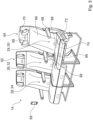
- the standard operating state 62 of the backrest 66, the headrest 70 and the legrest 74 is shown for the seat 26.
- the further operating state 64 of the backrest 66, the headrest 70 and the legrest 74 is shown for the seat 24.
- the backrest 66, the headrest 70 and the legrest 74 are booked for the seat 24.
- the standard operating state 62 of the footrest 76 is shown for the seat 26.
- the further operating state 64 of the footrest 76 is shown for the seat 24.
- the footrest 76 is booked for the seat 24.
- the seat function unit is designed as the screen 54.
- the screen 54 is designed to be electronically adjustable.
- the seat function unit designed as a screen 54 is designed as the communication interface designed as a screen 54.
- the screen 54 is at least intended to visually display the IFE function.
- the screen 56 is at least intended to visually display the seat control function.
- the seat control function is intended for electromechanical control of several mechanical components of the seat function units in the second seat device 16. User input for the control takes place via the screen 56.
- the screen 56 is designed as a user interface for adjusting the seat device 16.
- the seat function unit is designed as a lighting element 84.
- the lighting element 84 is designed to be electronically adjustable.
- the lighting element 84 is designed as a reading lamp. In principle, the lighting element 84 can also provide colored mood lighting.
- the seat function unit is designed as a power connection 86.
- the power connection 86 is designed to be electronically adjustable.
- the power connection 86 is designed as a socket.
- the power connection 86 is intended to provide electrical energy for the PED 58.
- the seat function unit is designed as a massage system (not shown in detail).
- the massage system is designed to be electronically adjustable.
- the seat function unit is designed as a seat heater (not shown in detail).
- the seat heater is designed to be electronically adjustable.
- the additional booking and/or debiting system 42 has a plurality of electromechanical release units 88 which are provided for releasing the seat function units.
- the release units 88 are arranged on the first seat device 14 and on the second seat device 16.
- the release units 88 are arranged on the seat function units.
- the additional booking and/or debiting system 42 comprises a plurality of control units 90 which are provided in at least one operating state to control the release units 88.
- the control units 90 are coupled to the computing unit 44.
- the control units 90 are arranged in the first seat devices 14 and the second seat devices 16. In principle, it would also be conceivable for a control unit to be arranged centrally.
- the release units 88 each have at least one release element (not shown in detail).
- the at least one release element is provided for preventing movement of the seat function unit between the standard operating state 62 and the further operating state 64 in at least one operating state.
- the at least one release element is designed as a bolt, as a hook, as a latch and/or as a clamp.
- the release units 88 have at least one actuator (not shown in detail).
- the at least one actuator comprises at least one motor, in particular an electric motor, at least one spring element and/or at least one magnet.
- the at least one release element can be actuated by means of the at least one actuator.
- the seat function units have at least one locking element designed to correspond to the at least one release element.
- the at least one release element and the at least one locking element are mounted so that they can move relative to one another in at least one operating state.
- the at least one release element is immovably coupled to the at least one locking element in the standard operating state 62.
- the at least one release element has at least two operating states. In a first operating state, the at least one release element is coupled to the at least one locking element. In the further operating state, the at least one release element is decoupled from the at least one locking element.
- the seat function units are added and released in the further operating state.
- the release units 88 are connected to the control units 90 by cables not shown in detail. In principle, it would also be conceivable for the release units 88 to be connected wirelessly to the control units 90.
- the release units 88 each have a sensor element not shown in detail.
- the sensor element is provided to sense a position of the respective seat function unit.
- the sensor element is provided to detect the standard operating state 62 and the further operating state 64.
- the sensor element is arranged, for example, on the at least one release element. In the present case, the sensor element is connected to the computing unit 44.
- the release units 88 can have at least one release element that is at least partially made of a shape memory alloy.
- the at least one release element that is at least partially made of a shape memory alloy is designed to change its shape when actuated with a current, wherein the at least one release element always assumes the same position when actuated with the same current.
- the seating system 12 has a further data transmission unit 92, which is at least intended to receive booking data from two external devices 94, 96.
- the further data transmission unit 92 can also be designed as the data transmission unit 46.
- a first external device 94 is designed as a server.
- a second external device 96 is designed as a cloud.
- an additional booking and/or a debit can already take place when booking the means of transport 10 and/or when the user is checked in.
- the further data transmission unit 92 is intended to exchange booking data via a satellite 98 or via a terminal building 100, in particular an airport building.
- the further data transmission unit 92 has a second transmitting and/or receiving unit 102.
- the second transmitting and/or receiving unit 102 comprises a further WLAN antenna 104.
- the further WLAN antenna 104 is arranged on an outside of the means of transport 10.
- the further data transmission unit 92 has a third transmitting and/or receiving unit 106.
- the third transmitting and/or receiving unit 106 comprises a satellite antenna 108.
- the satellite antenna 108 is arranged on the outside of the means of transport 10.
- the third transmitting and/or receiving unit 106 is intended to exchange data with the second external device 96 via the satellite 98.
- the first external device 94 and the second external device 96 are intended to exchange data with one another.
- the booking and/or debiting system 42 comprises several identification units 110.
- the identification units 110 are in the first Seat devices 14 and the second seat devices 16. Each seat 24, 26, 28 of the first seat devices 14 is assigned an identification unit 110.
- the seat 38 of the second seat devices 16 is assigned an identification unit 110.
- the identification units 110 each have a camera 112.
- the identification units 110 are provided to check the correct assignment of an identification means to one of the first seat devices 14 or one of the second seat devices 16.
- the identification means is designed as a boarding pass (not shown in detail).
- the boarding pass has an optical code that can be detected by the identification units 110.
- the optical code is designed as a barcode or as a QR code.
- the camera 112 is provided to scan the optical code.
- the boarding pass is designed as an electronic boarding pass.
- the boarding pass can be displayed on the user's PED 58.
- the boarding pass can also be made of paper and/or plastic.
- the electronic boarding pass is designed as an electronic data set.
- the electronic boarding pass can be transmitted wirelessly to the identification unit 110, in this case by means of near-field communication or Bluetooth.
- the identification unit 110 can also have an RFID reader.
- the means of identification can also be designed as an ID document, a customer card or a credit card.
- the additional booking and/or debiting system 42 comprises a plurality of payment units 114.
- the payment units 114 are arranged in the first seating devices 14 and the second seating devices 16. Each seat 24, 26, 28, 38 of the seating devices 14, 16 is assigned a payment unit 114.
- the payment units 114 are intended for payment of an additional booking of the individual services and the comfort features.
- the payment units 114 are coupled to the computing unit 44.
- the payment units 114 each have a radio interface (not shown in detail). In the present case, the radio interface is designed as a near-field communication interface.
- the radio interface is intended for transmission of payment data between the PED 58 and the computing unit 44. A payment process is carried out using the PED 58.
- the PED 58 is designed to run at least one mobile payment application, such as Apple Pay ® and/or Google Pay TM .
- the Payment units 114 can also be designed as a central payment unit, which is arranged, for example, on a door 116 of the means of transport 10.
- the additional booking and/or debit system 42 comprises an output unit 118.
- the output unit 118 is intended to output booking data for the first seating devices 14 and the second seating devices 16.
- the output unit 118 has a staff screen (not shown in detail) and a printer (not shown in detail).
- the staff screen is designed as a flight attendant panel.
- the additional booking and/or debit system 42 can comprise several output units 118 that are arranged at several locations in the means of transport 10.
- a method 120 for operating the seating system 12 is shown.
- the user books at least one ticket for the means of transport 10, for example mobile, from a computer or at a ticket counter.
- the user is presented with offers for additional bookings and/or deductions for individual services and/or comfort features.
- the user can add and/or deduct individual services and comfort features while booking at least one ticket.
- the user is processed for a trip with the means of transport 10.
- the processing of the user includes at least a check-in process, a waiting process and a boarding process.
- the user is presented with offers for additional bookings for individual services and comfort features.
- booking data is sent to the means of transport 10.
- the means of transport 10 receives booking data from the first external device 94 or the second external device 96 via the further data transmission unit 92.
- the booking data is processed in the computing unit 44 stored.
- the identification unit 110 is used to check whether the user has taken the seat 24, 26, 28, 38 assigned to him.
- the booking data for the user from the computing unit 44 is processed.
- Individual services and comfort features that have already been booked can be used by the user after approval by the identification unit 110.
- the user is presented with offers for additional bookings of individual services and/or comfort features via the screen 54.
- the user can book additional bookings of individual services and comfort features during the trip.
- the user can use the PED 58 to book individual services and comfort features.
- the user can use the payment unit 114 to pay for an additional booking of individual services and comfort features.
- the payment unit 114 exchanges data with the first external device 94 or the second external device 96.
- the PED 58 can be used to pay for an additional booking, for example through contactless data transmission.
- the newly booked individual services and comfort features are stored in the computing unit 44.
- the booking data is updated in the process. Newly booked individual services and comfort features can be used by the user after approval by the payment unit 114.
- the booking data is sent to the output unit 118.
- a crew can use the output unit 118 to identify which user has booked which individual services and comfort features.
- the booking data is printed out using the printer. In this way, cleaning staff and maintenance staff can identify which seating units associated with the individual services and comfort features need to be cleaned and/or maintained.
- the booking data is sent via the additional data transmission unit 92 to the first external device 94 or to the second external device 96.
Landscapes
- Engineering & Computer Science (AREA)
- Business, Economics & Management (AREA)
- Aviation & Aerospace Engineering (AREA)
- Tourism & Hospitality (AREA)
- Operations Research (AREA)
- Entrepreneurship & Innovation (AREA)
- Human Resources & Organizations (AREA)
- Marketing (AREA)
- Economics (AREA)
- Quality & Reliability (AREA)
- Strategic Management (AREA)
- Physics & Mathematics (AREA)
- General Business, Economics & Management (AREA)
- General Physics & Mathematics (AREA)
- Theoretical Computer Science (AREA)
- Development Economics (AREA)
- Seats For Vehicles (AREA)
Claims (14)
- Système de siège, en particulier système de siège d'avion, avec au moins un dispositif de siège (14, 16), qui comprend au moins un siège (24, 26, 28, 38), et avec un système pour ajouter et/ou supprimer une réservation (42), où le système pour ajouter et/ou supprimer une réservation (42) est au moins prévu pour ajouter et/ou supprimer au moins une prestation de service individuelle et au moins une propriété de confort, où l'au moins un dispositif de siège (14, 16) comprend au moins une unité fonctionnelle de siège réglable, qui comprend l'au moins une propriété de confort ajoutable et/ou supprimable et qui présente au moins un état de fonctionnement standard (62) et au moins un autre état de fonctionnement (64), où l'au moins une unité fonctionnelle de siège est prévue pour être réglée dans l'au moins un autre état de fonctionnement (64) lors d'un ajout de l'au moins une propriété de confort, où le système pour ajouter et/ou supprimer une réservation (42) présente au moins une unité de libération électromécanique (88), qui est prévue pour libérer l'au moins une unité fonctionnelle de siège, où le système de siège présente au moins une interface de communication, qui est prévue pour permettre une communication entre une personne et au moins une unité de calcul (44), où l'au moins une prestation de service individuelle et/ou l'au moins une propriété de confort est/sont ajoutable(s) et/ou supprimable(s) au moyen de l'au moins une interface de communication, caractérisé en ce que l'au moins une interface de communication est réalisée sous forme d'appareil électronique personnel (58), PED.
- Système de siège selon la revendication 1, caractérisé par au moins une unité de transmission de données (46), où l'au moins une unité de transmission de données (46) est au moins prévue pour relier sans fil et/ou par câble l'au moins une unité de calcul (44), en particulier une unité de calcul centrale, à l'au moins un dispositif de siège (14, 16) pour une transmission de données.
- Système de siège selon la revendication 2, caractérisé en ce que l'au moins une unité de transmission de données (46) est prévue pour une transmission de données de réservation.
- Système de siège selon l'une des revendications précédentes, caractérisé par au moins une unité de transmission de données (46), où l'au moins une unité de calcul (44), en particulier une unité de calcul centrale, et/ou l'au moins une unité de transmission de données (46) présente au moins une autre fonction, en particulier une fonction de divertissement en vol, fonction IFE, en plus d'une fonction d'ajout et/ou de suppression de réservation du système pour ajouter et/ou supprimer une réservation (42).
- Système de siège selon l'une des revendications précédentes, caractérisé en ce que la prestation de service individuelle est réalisée sous forme de prestation de service de communication personnelle.
- Système de siège selon la revendication 1, caractérisé en ce que l'au moins une unité fonctionnelle de siège est formée au moins essentiellement par un composant mécanique, où le composant mécanique est prévu pour être déplacé dans l'au moins un autre état de fonctionnement (64) lors d'un ajout de l'au moins une propriété de confort.
- Système de siège selon la revendication 6, caractérisé en ce que le composant mécanique est réalisé sous forme de dossier (66), d'accoudoir (68), d'appuie-tête (70), d'assise du siège (72), de repose-jambes (74), de repose-pieds (76), d'unité de table (78), de support PED, de support de boissons (80), d'unité de rangement (82), d'unité de porte et/ou d'élément de protection visuelle.
- Système de siège selon la revendication 1 ou 6, caractérisé en ce que l'au moins une unité fonctionnelle de siège est réalisée sous forme d'écran (54, 56), d'élément d'éclairage (84), de connexion électrique (86), de système de massage et/ou de chauffage de siège.
- Système de siège selon la revendication 8, caractérisé en ce que l'au moins une unité de libération (88) présente au moins un élément de libération, qui est formé au moins partiellement d'un alliage à mémoire de forme.
- Système de siège selon l'une des revendications précédentes, caractérisé par au moins une unité de transmission de données (92), qui est au moins prévue pour recevoir des données de réservation d'au moins un appareil externe (94, 96), en particulier un serveur et/ou un cloud.
- Système de siège selon l'une des revendications précédentes, caractérisé en ce que le système pour ajouter et/ou supprimer une réservation (42) comprend au moins une unité d'identification (110), qui est prévue pour vérifier une affectation correcte d'un moyen d'identification, en particulier d'une carte d'embarquement, à l'au moins un dispositif de siège (14, 16).
- Système de siège selon l'une des revendications précédentes, caractérisé en ce que le système pour ajouter et/ou supprimer une réservation (42) comprend au moins une unité de paiement (114), qui est prévue pour un paiement d'un ajout de l'au moins une prestation de service individuelle et/ou de l'au moins une propriété de confort.
- Système de siège selon l'une des revendications précédentes, caractérisé en ce que le système pour ajouter et/ou supprimer une réservation (42) comprend au moins une unité de sortie (118), qui est prévue pour délivrer des données de réservation pour l'au moins un dispositif de siège (14, 16).
- Procédé (120) pour faire fonctionner un système de siège (12) selon l'une des revendications 1 à 13.
Applications Claiming Priority (2)
| Application Number | Priority Date | Filing Date | Title |
|---|---|---|---|
| DE102019115203.8A DE102019115203A1 (de) | 2019-06-05 | 2019-06-05 | Sitzsystem |
| PCT/EP2020/065630 WO2020245359A1 (fr) | 2019-06-05 | 2020-06-05 | Système de siège |
Publications (2)
| Publication Number | Publication Date |
|---|---|
| EP3980331A1 EP3980331A1 (fr) | 2022-04-13 |
| EP3980331B1 true EP3980331B1 (fr) | 2025-01-29 |
Family
ID=71108556
Family Applications (1)
| Application Number | Title | Priority Date | Filing Date |
|---|---|---|---|
| EP20733696.7A Active EP3980331B1 (fr) | 2019-06-05 | 2020-06-05 | Système de siège |
Country Status (3)
| Country | Link |
|---|---|
| EP (1) | EP3980331B1 (fr) |
| DE (1) | DE102019115203A1 (fr) |
| WO (1) | WO2020245359A1 (fr) |
Families Citing this family (1)
| Publication number | Priority date | Publication date | Assignee | Title |
|---|---|---|---|---|
| DE102024114861A1 (de) * | 2024-05-27 | 2025-11-27 | Recaro Aircraft Seating Gmbh & Co. Kg | Computerimplementiertes Verfahren zur Steuerung eines Fluggastsitzbereichs |
Family Cites Families (10)
| Publication number | Priority date | Publication date | Assignee | Title |
|---|---|---|---|---|
| US8403411B2 (en) * | 2003-12-15 | 2013-03-26 | Digecor, Inc. | Detachable seat mounted audio-visual entertainment system with locally storable, selectable, and updatable content |
| CA2617626A1 (fr) * | 2005-08-16 | 2007-02-22 | Telezygology Inc. | Ensemble de blocage |
| US20100224727A1 (en) * | 2009-03-06 | 2010-09-09 | Hans-Achim Bauer | System and a method for making functions available to a passenger |
| DE102009001366B4 (de) * | 2009-03-06 | 2014-07-03 | Airbus Operations Gmbh | System zum Bereitstellen von Funktionen für einen Passagier |
| US9143732B2 (en) * | 2010-06-22 | 2015-09-22 | Livetv, Llc | Aircraft IFE system cooperating with a personal electronic device (PED) operating as a commerce device and associated methods |
| GB2538339B (en) * | 2014-03-24 | 2017-05-24 | British Airways Plc | Travel environment control |
| FR3035073B1 (fr) * | 2015-04-14 | 2018-09-07 | Stelia Aerospace | Cabine d'aeronef interactive |
| US10412173B2 (en) * | 2015-04-22 | 2019-09-10 | Panasonic Avionics Corporation | Passenger seat pairing system |
| US10757451B2 (en) * | 2017-02-16 | 2020-08-25 | Thales Avionics, Inc. | User centric service and content curation through in-flight entertainment system |
| US10370116B2 (en) * | 2017-07-25 | 2019-08-06 | Gogo Llc | Wireless cabin seatback screen location determination |
-
2019
- 2019-06-05 DE DE102019115203.8A patent/DE102019115203A1/de active Pending
-
2020
- 2020-06-05 WO PCT/EP2020/065630 patent/WO2020245359A1/fr not_active Ceased
- 2020-06-05 EP EP20733696.7A patent/EP3980331B1/fr active Active
Also Published As
| Publication number | Publication date |
|---|---|
| WO2020245359A1 (fr) | 2020-12-10 |
| DE102019115203A1 (de) | 2020-12-10 |
| EP3980331A1 (fr) | 2022-04-13 |
Similar Documents
| Publication | Publication Date | Title |
|---|---|---|
| EP2130354B1 (fr) | Unité fonctionnelle électrique à commande sans fil pour aéronef | |
| EP3552962B1 (fr) | Système de maintenance de fichier d'une restauration de bord d'un véhicule | |
| DE60002405T2 (de) | Vorrichtung zur Regelung des Zugangs zu Attraktionen und dazugehöriges Verfahren | |
| DE102009001366B4 (de) | System zum Bereitstellen von Funktionen für einen Passagier | |
| US10318893B2 (en) | Dynamic in flight seat management | |
| US20100224727A1 (en) | System and a method for making functions available to a passenger | |
| DE2013439A1 (de) | Anlage zur automatischen Abfertigung von Flugscheinen/Kreditkarten | |
| EP2901378A1 (fr) | Logiciel, système et procédé de communication dans un avion | |
| EP2754135B1 (fr) | Sas de passage pour l'utilisation dans des aéroports | |
| EP2901573B1 (fr) | Système de communication dans un avion avec une interface champ proche. | |
| EP2328119A1 (fr) | Système de billetterie | |
| EP2539872A1 (fr) | Système et procédé permettant de fournir une habilitation d'accès par voie électronique | |
| DE102014106448A1 (de) | Verfahren und Vorrichtungsanordnung zur Abwicklung der Aufgabe von Reisegepäck | |
| DE202018006743U1 (de) | System zur Getränkezubereitung | |
| WO2014049074A1 (fr) | Système et procédé de communication pour un avion | |
| EP3980331B1 (fr) | Système de siège | |
| CN108830424A (zh) | 基于民航共享座位的旅行团坐席分配调度管理系统 | |
| WO2007140735A1 (fr) | Système et procédé d'approvisionnement individuel des passagers d'un moyen de transport en produits, notamment en aliments et boissons | |
| EP3987492A1 (fr) | Stockage d'objets à l'intérieur d'un véhicule | |
| DE102014001242A1 (de) | Computergestütztes Servicesystem, insbesondere Restaurantsystem sowie Verfahren zum Betrieb eines derartigen Servicesystems | |
| DE102012105146A1 (de) | Verfahren zum mobilen Einchecken | |
| WO2008080540A1 (fr) | Siège de moyen de transport et procédé pour collecter des données dans un moyen de transport | |
| DE102013210027A1 (de) | Belegungserkennungssystem für fahrzeuge, endkunden-informationseinrichtung, verfahren und fahrzeug | |
| DE102007023496A1 (de) | Einrichtung zur Passagierabfertigung, insbesondere beim Boarding im Flugverkehr | |
| DE102024118651A1 (de) | Verfahren zur Unterhaltung von Fluggästen und entsprechendes Flugzeug |
Legal Events
| Date | Code | Title | Description |
|---|---|---|---|
| STAA | Information on the status of an ep patent application or granted ep patent |
Free format text: STATUS: UNKNOWN |
|
| STAA | Information on the status of an ep patent application or granted ep patent |
Free format text: STATUS: THE INTERNATIONAL PUBLICATION HAS BEEN MADE |
|
| PUAI | Public reference made under article 153(3) epc to a published international application that has entered the european phase |
Free format text: ORIGINAL CODE: 0009012 |
|
| STAA | Information on the status of an ep patent application or granted ep patent |
Free format text: STATUS: REQUEST FOR EXAMINATION WAS MADE |
|
| 17P | Request for examination filed |
Effective date: 20211222 |
|
| AK | Designated contracting states |
Kind code of ref document: A1 Designated state(s): AL AT BE BG CH CY CZ DE DK EE ES FI FR GB GR HR HU IE IS IT LI LT LU LV MC MK MT NL NO PL PT RO RS SE SI SK SM TR |
|
| DAV | Request for validation of the european patent (deleted) | ||
| DAX | Request for extension of the european patent (deleted) | ||
| STAA | Information on the status of an ep patent application or granted ep patent |
Free format text: STATUS: EXAMINATION IS IN PROGRESS |
|
| 17Q | First examination report despatched |
Effective date: 20230711 |
|
| GRAP | Despatch of communication of intention to grant a patent |
Free format text: ORIGINAL CODE: EPIDOSNIGR1 |
|
| STAA | Information on the status of an ep patent application or granted ep patent |
Free format text: STATUS: GRANT OF PATENT IS INTENDED |
|
| RIC1 | Information provided on ipc code assigned before grant |
Ipc: G06Q 10/02 20120101ALI20240729BHEP Ipc: G06Q 10/06 20120101ALI20240729BHEP Ipc: B64D 11/06 20060101ALI20240729BHEP Ipc: B64D 11/00 20060101AFI20240729BHEP |
|
| INTG | Intention to grant announced |
Effective date: 20240826 |
|
| GRAS | Grant fee paid |
Free format text: ORIGINAL CODE: EPIDOSNIGR3 |
|
| GRAA | (expected) grant |
Free format text: ORIGINAL CODE: 0009210 |
|
| STAA | Information on the status of an ep patent application or granted ep patent |
Free format text: STATUS: THE PATENT HAS BEEN GRANTED |
|
| AK | Designated contracting states |
Kind code of ref document: B1 Designated state(s): AL AT BE BG CH CY CZ DE DK EE ES FI FR GB GR HR HU IE IS IT LI LT LU LV MC MK MT NL NO PL PT RO RS SE SI SK SM TR |
|
| REG | Reference to a national code |
Ref country code: GB Ref legal event code: FG4D Free format text: NOT ENGLISH |
|
| REG | Reference to a national code |
Ref country code: CH Ref legal event code: EP |
|
| REG | Reference to a national code |
Ref country code: DE Ref legal event code: R096 Ref document number: 502020010325 Country of ref document: DE |
|
| REG | Reference to a national code |
Ref country code: IE Ref legal event code: FG4D Free format text: LANGUAGE OF EP DOCUMENT: GERMAN |
|
| REG | Reference to a national code |
Ref country code: NL Ref legal event code: MP Effective date: 20250129 |
|
| PG25 | Lapsed in a contracting state [announced via postgrant information from national office to epo] |
Ref country code: NL Free format text: LAPSE BECAUSE OF FAILURE TO SUBMIT A TRANSLATION OF THE DESCRIPTION OR TO PAY THE FEE WITHIN THE PRESCRIBED TIME-LIMIT Effective date: 20250129 |
|
| PG25 | Lapsed in a contracting state [announced via postgrant information from national office to epo] |
Ref country code: RS Free format text: LAPSE BECAUSE OF FAILURE TO SUBMIT A TRANSLATION OF THE DESCRIPTION OR TO PAY THE FEE WITHIN THE PRESCRIBED TIME-LIMIT Effective date: 20250429 |
|
| PG25 | Lapsed in a contracting state [announced via postgrant information from national office to epo] |
Ref country code: FI Free format text: LAPSE BECAUSE OF FAILURE TO SUBMIT A TRANSLATION OF THE DESCRIPTION OR TO PAY THE FEE WITHIN THE PRESCRIBED TIME-LIMIT Effective date: 20250129 |
|
| PG25 | Lapsed in a contracting state [announced via postgrant information from national office to epo] |
Ref country code: PL Free format text: LAPSE BECAUSE OF FAILURE TO SUBMIT A TRANSLATION OF THE DESCRIPTION OR TO PAY THE FEE WITHIN THE PRESCRIBED TIME-LIMIT Effective date: 20250129 |
|
| PGFP | Annual fee paid to national office [announced via postgrant information from national office to epo] |
Ref country code: DE Payment date: 20250618 Year of fee payment: 6 |
|
| PG25 | Lapsed in a contracting state [announced via postgrant information from national office to epo] |
Ref country code: ES Free format text: LAPSE BECAUSE OF FAILURE TO SUBMIT A TRANSLATION OF THE DESCRIPTION OR TO PAY THE FEE WITHIN THE PRESCRIBED TIME-LIMIT Effective date: 20250129 |
|
| PGFP | Annual fee paid to national office [announced via postgrant information from national office to epo] |
Ref country code: GB Payment date: 20250620 Year of fee payment: 6 |
|
| REG | Reference to a national code |
Ref country code: LT Ref legal event code: MG9D |
|
| PG25 | Lapsed in a contracting state [announced via postgrant information from national office to epo] |
Ref country code: IS Free format text: LAPSE BECAUSE OF FAILURE TO SUBMIT A TRANSLATION OF THE DESCRIPTION OR TO PAY THE FEE WITHIN THE PRESCRIBED TIME-LIMIT Effective date: 20250529 Ref country code: NO Free format text: LAPSE BECAUSE OF FAILURE TO SUBMIT A TRANSLATION OF THE DESCRIPTION OR TO PAY THE FEE WITHIN THE PRESCRIBED TIME-LIMIT Effective date: 20250429 |
|
| PG25 | Lapsed in a contracting state [announced via postgrant information from national office to epo] |
Ref country code: HR Free format text: LAPSE BECAUSE OF FAILURE TO SUBMIT A TRANSLATION OF THE DESCRIPTION OR TO PAY THE FEE WITHIN THE PRESCRIBED TIME-LIMIT Effective date: 20250129 |
|
| PG25 | Lapsed in a contracting state [announced via postgrant information from national office to epo] |
Ref country code: PT Free format text: LAPSE BECAUSE OF FAILURE TO SUBMIT A TRANSLATION OF THE DESCRIPTION OR TO PAY THE FEE WITHIN THE PRESCRIBED TIME-LIMIT Effective date: 20250529 Ref country code: LV Free format text: LAPSE BECAUSE OF FAILURE TO SUBMIT A TRANSLATION OF THE DESCRIPTION OR TO PAY THE FEE WITHIN THE PRESCRIBED TIME-LIMIT Effective date: 20250129 |
|
| PGFP | Annual fee paid to national office [announced via postgrant information from national office to epo] |
Ref country code: FR Payment date: 20250618 Year of fee payment: 6 |
|
| PG25 | Lapsed in a contracting state [announced via postgrant information from national office to epo] |
Ref country code: GR Free format text: LAPSE BECAUSE OF FAILURE TO SUBMIT A TRANSLATION OF THE DESCRIPTION OR TO PAY THE FEE WITHIN THE PRESCRIBED TIME-LIMIT Effective date: 20250430 Ref country code: BG Free format text: LAPSE BECAUSE OF FAILURE TO SUBMIT A TRANSLATION OF THE DESCRIPTION OR TO PAY THE FEE WITHIN THE PRESCRIBED TIME-LIMIT Effective date: 20250129 |
|
| PG25 | Lapsed in a contracting state [announced via postgrant information from national office to epo] |
Ref country code: SE Free format text: LAPSE BECAUSE OF FAILURE TO SUBMIT A TRANSLATION OF THE DESCRIPTION OR TO PAY THE FEE WITHIN THE PRESCRIBED TIME-LIMIT Effective date: 20250129 |
|
| P01 | Opt-out of the competence of the unified patent court (upc) registered |
Free format text: CASE NUMBER: UPC_APP_3340_3980331/2025 Effective date: 20250814 |
|
| PG25 | Lapsed in a contracting state [announced via postgrant information from national office to epo] |
Ref country code: SM Free format text: LAPSE BECAUSE OF FAILURE TO SUBMIT A TRANSLATION OF THE DESCRIPTION OR TO PAY THE FEE WITHIN THE PRESCRIBED TIME-LIMIT Effective date: 20250129 |
|
| PG25 | Lapsed in a contracting state [announced via postgrant information from national office to epo] |
Ref country code: DK Free format text: LAPSE BECAUSE OF FAILURE TO SUBMIT A TRANSLATION OF THE DESCRIPTION OR TO PAY THE FEE WITHIN THE PRESCRIBED TIME-LIMIT Effective date: 20250129 |
|
| PG25 | Lapsed in a contracting state [announced via postgrant information from national office to epo] |
Ref country code: IT Free format text: LAPSE BECAUSE OF FAILURE TO SUBMIT A TRANSLATION OF THE DESCRIPTION OR TO PAY THE FEE WITHIN THE PRESCRIBED TIME-LIMIT Effective date: 20250129 |
|
| PG25 | Lapsed in a contracting state [announced via postgrant information from national office to epo] |
Ref country code: CZ Free format text: LAPSE BECAUSE OF FAILURE TO SUBMIT A TRANSLATION OF THE DESCRIPTION OR TO PAY THE FEE WITHIN THE PRESCRIBED TIME-LIMIT Effective date: 20250129 Ref country code: EE Free format text: LAPSE BECAUSE OF FAILURE TO SUBMIT A TRANSLATION OF THE DESCRIPTION OR TO PAY THE FEE WITHIN THE PRESCRIBED TIME-LIMIT Effective date: 20250129 |
|
| PG25 | Lapsed in a contracting state [announced via postgrant information from national office to epo] |
Ref country code: RO Free format text: LAPSE BECAUSE OF FAILURE TO SUBMIT A TRANSLATION OF THE DESCRIPTION OR TO PAY THE FEE WITHIN THE PRESCRIBED TIME-LIMIT Effective date: 20250129 |
|
| PG25 | Lapsed in a contracting state [announced via postgrant information from national office to epo] |
Ref country code: SK Free format text: LAPSE BECAUSE OF FAILURE TO SUBMIT A TRANSLATION OF THE DESCRIPTION OR TO PAY THE FEE WITHIN THE PRESCRIBED TIME-LIMIT Effective date: 20250129 |
|
| REG | Reference to a national code |
Ref country code: DE Ref legal event code: R097 Ref document number: 502020010325 Country of ref document: DE |
|
| PLBE | No opposition filed within time limit |
Free format text: ORIGINAL CODE: 0009261 |
|
| STAA | Information on the status of an ep patent application or granted ep patent |
Free format text: STATUS: NO OPPOSITION FILED WITHIN TIME LIMIT |
|
| 26N | No opposition filed |
Effective date: 20251030 |