EP3979397B1 - Plaque d'électrode positive et dispositif électrochimique et équipement associés à celle-ci - Google Patents
Plaque d'électrode positive et dispositif électrochimique et équipement associés à celle-ci Download PDFInfo
- Publication number
- EP3979397B1 EP3979397B1 EP20849080.5A EP20849080A EP3979397B1 EP 3979397 B1 EP3979397 B1 EP 3979397B1 EP 20849080 A EP20849080 A EP 20849080A EP 3979397 B1 EP3979397 B1 EP 3979397B1
- Authority
- EP
- European Patent Office
- Prior art keywords
- positive electrode
- derivatives
- phosphate
- electrode plate
- carbonate
- Prior art date
- Legal status (The legal status is an assumption and is not a legal conclusion. Google has not performed a legal analysis and makes no representation as to the accuracy of the status listed.)
- Active
Links
Images

Classifications
-
- H—ELECTRICITY
- H01—ELECTRIC ELEMENTS
- H01M—PROCESSES OR MEANS, e.g. BATTERIES, FOR THE DIRECT CONVERSION OF CHEMICAL ENERGY INTO ELECTRICAL ENERGY
- H01M10/00—Secondary cells; Manufacture thereof
- H01M10/42—Methods or arrangements for servicing or maintenance of secondary cells or secondary half-cells
- H01M10/4235—Safety or regulating additives or arrangements in electrodes, separators or electrolyte
-
- H—ELECTRICITY
- H01—ELECTRIC ELEMENTS
- H01M—PROCESSES OR MEANS, e.g. BATTERIES, FOR THE DIRECT CONVERSION OF CHEMICAL ENERGY INTO ELECTRICAL ENERGY
- H01M10/00—Secondary cells; Manufacture thereof
- H01M10/05—Accumulators with non-aqueous electrolyte
- H01M10/052—Li-accumulators
- H01M10/0525—Rocking-chair batteries, i.e. batteries with lithium insertion or intercalation in both electrodes; Lithium-ion batteries
-
- H—ELECTRICITY
- H01—ELECTRIC ELEMENTS
- H01M—PROCESSES OR MEANS, e.g. BATTERIES, FOR THE DIRECT CONVERSION OF CHEMICAL ENERGY INTO ELECTRICAL ENERGY
- H01M4/00—Electrodes
- H01M4/02—Electrodes composed of, or comprising, active material
- H01M4/13—Electrodes for accumulators with non-aqueous electrolyte, e.g. for lithium-accumulators; Processes of manufacture thereof
-
- H—ELECTRICITY
- H01—ELECTRIC ELEMENTS
- H01M—PROCESSES OR MEANS, e.g. BATTERIES, FOR THE DIRECT CONVERSION OF CHEMICAL ENERGY INTO ELECTRICAL ENERGY
- H01M4/00—Electrodes
- H01M4/02—Electrodes composed of, or comprising, active material
- H01M4/62—Selection of inactive substances as ingredients for active masses, e.g. binders, fillers
- H01M4/624—Electric conductive fillers
- H01M4/625—Carbon or graphite
-
- H—ELECTRICITY
- H01—ELECTRIC ELEMENTS
- H01M—PROCESSES OR MEANS, e.g. BATTERIES, FOR THE DIRECT CONVERSION OF CHEMICAL ENERGY INTO ELECTRICAL ENERGY
- H01M4/00—Electrodes
- H01M4/02—Electrodes composed of, or comprising, active material
- H01M2004/026—Electrodes composed of, or comprising, active material characterised by the polarity
- H01M2004/028—Positive electrodes
-
- Y—GENERAL TAGGING OF NEW TECHNOLOGICAL DEVELOPMENTS; GENERAL TAGGING OF CROSS-SECTIONAL TECHNOLOGIES SPANNING OVER SEVERAL SECTIONS OF THE IPC; TECHNICAL SUBJECTS COVERED BY FORMER USPC CROSS-REFERENCE ART COLLECTIONS [XRACs] AND DIGESTS
- Y02—TECHNOLOGIES OR APPLICATIONS FOR MITIGATION OR ADAPTATION AGAINST CLIMATE CHANGE
- Y02E—REDUCTION OF GREENHOUSE GAS [GHG] EMISSIONS, RELATED TO ENERGY GENERATION, TRANSMISSION OR DISTRIBUTION
- Y02E60/00—Enabling technologies; Technologies with a potential or indirect contribution to GHG emissions mitigation
- Y02E60/10—Energy storage using batteries
Definitions
- This application relates to the electrochemical filed, and in particular to a positive electrode plate as specified in any of claims 1-10 and an electrochemical apparatus as specified in claim 11 and a device as specified in claim 12.
- Lithium-ion batteries are widely applied to electric vehicles and consumer electronic products due to their advantages such as high energy density, high output power, long cycle life, and low environmental pollution.
- lithium-ion batteries sometimes have safety issues such as fire and explosion during overcharge, which poses a great threat to the safety of people's lives and property.
- the recycling rate of lithium-ion batteries has also been questioned.
- Overcharge of a lithium-ion battery generally deteriorates its electrical performance, resulting in lithium precipitation on its negative electrode, which significantly deteriorates electrical performance such as cycling and capacity, and even causes short circuit in the battery. Results of a large number of experiments show that short circuit in the battery is the root cause of safety hazards of lithium-ion batteries.
- PTC Positive Temperature Coefficient
- a known typical practice to improve safety of a lithium-ion battery is adding a PTC material to an active material layer of the battery. As the battery temperature rises, resistance of the PTC material grows, increasing resistance of the entire active material layer, and even damaging the charge conducting path of the entire active material layer, thus cutting off the power and prohibiting further electrochemical reaction. However, experiments have shown that the PTC material added to the active material layer has an adverse effect on electrochemical performance of the battery.
- the PTC material layer is extremely easy to be taken to the edge because of squeezing, resulting in direct contact between the active material layer and the current collector, thereby failing to improve the safety performance.
- performances such as response speed and current blocking effect of the PTC material layer all need to be greatly improved.
- EP 3809502 A1 which is post-published but has an earlier priority date than the present application discloses (abstract) a positive electrode current collector, a positive electrode plate, an electrochemical device, and an electric equipment including the electrochemical device.
- the positive electrode current collector includes: a metal conductive layer; an overcharge blocking activation layer disposed on a surface of the metal conductive layer, the overcharge blocking activation layer including an overcharge blocking activation material, a binder material and a conductive material, wherein the overcharge blocking activation material includes an esterified saccharide.
- EP 3809502 A1 is silent on the weight-average molecular weight range of the esterified saccharide and on the capacity of the positive electrode plate.
- US 2020/083527 A1 discloses (abstract) a positive electrode for lithium ion secondary batteries that includes a current collector including a sheet-shaped conductive substrate and a coating layer disposed on one or both sides of the conductive substrate, and a positive electrode active material layer disposed on the coating layer, wherein the coating layer includes a powdery conductive material and a first binder, the positive electrode active material layer includes a positive electrode active material, a conductive auxiliary and a second binder.
- the first binder may comprise an esterified polysaccharide [0055].
- US 2020/083527 A1 is silent on the capacity of the positive electrode plate.
- US 2014/065491 A1 discloses (claim 1) a secondary battery which comprises a positive electrode and a negative electrode, wherein the negative electrode includes a negative electrode collector and a negative electrode active material layer, and the negative electrode collector comprises a base material, which is formed of aluminum foil, and a resin film which has a thickness of 0.01 to 5 ⁇ m, includes a polysaccharide, and does not allow a non-aqueous electrolyte to permeate.
- the polysaccharide can be ester-bonded to an organic acid (claim7).
- US 2014/065491 A1 is also silent on the capacity of the positive electrode plate.
- the present application provides a positive electrode plate as specified in any of claims 1-10 with improved safety and electrical performance (such as cycling performance) and an electrochemical apparatus and device associated therewith.
- this application provides a positive electrode plate, including a positive electrode current collector, a positive electrode active material layer disposed on at least one surface of the positive electrode current collector, and a safety layer disposed between the positive electrode active material layer and the positive electrode current collector.
- the safety layer includes a binding substance, a conductive substance, and a special sensitive substance.
- Each molecule of the special sensitive substance includes monosaccharide structural units, and carbonate groups and/or phosphate groups; and at least part of the carbonate groups and/or phosphate groups are bonded to two or more of the monosaccharide structural units.
- this application provides an electrochemical apparatus as specified in claim 11, including the positive electrode plate according to the first aspect of this application.
- the positive electrode plate and the electrochemical apparatus including such positive electrode plate in this application undergo chemical changes first instead of physical changes at excessive high voltage and certain temperature, providing faster response, controllable response voltage, better overcharge safety and reliability, and improved electrical performance (such as cycling performance) of the electrochemical apparatus.
- the traditional PTC material whose volume swelling relies on changes in crystallinity only undergoes physical changes at high temperature. Such change is greatly affected by preparation processes of a material coating and the electrochemical apparatus.
- temperature and coating speed in the preparation process of the material coating and an electrolyte in the electrochemical apparatus all have an uncontrollable effect on crystallinity of the material.
- the electrochemical apparatus When the electrochemical apparatus is overcharged, the material may probably not be excited, and therefore the charging current cannot be cut off in time, posing a safety hazard.
- this application provides a device as specified in claim 12 including the foregoing electrochemical apparatus.
- the electrochemical apparatus can be used as a power source of the device or as an energy storage unit of the device.
- the battery module, battery pack, and device in this application include the electrochemical apparatus provided by this application, and therefore have at least the same advantages as the electrochemical device in this application.
- any lower limit may be combined with any upper limit to form a range not expressly recorded; any lower limit may be combined with any other lower limit to form a range not expressly recorded; and any upper limit may be combined with any other upper limit to form a range not expressly recorded.
- each point or individual value between endpoints of a range is included in the range. Therefore, each point or individual value may be used as its own lower limit or upper limit to be combined with any other point or individual value or combined with any other lower limit or upper limit to form a range not expressly recorded. It should be understood that the enumeration of numerical values is merely giving examples and should not be interpreted as exhaustive.
- a positive electrode plate including a positive electrode current collector, a positive electrode active material layer disposed on at least one surface of the positive electrode current collector, and a safety layer disposed between the positive electrode current collector and the positive electrode active material layer.
- the safety layer includes a special sensitive substance.
- the special sensitive substance includes at least one product of esterification of polysaccharide.
- the applicant has found that disposing the product of esterification of polysaccharide in the safety layer leads to an electrochemical degradation reaction at certain voltage or temperature to produce molecular fragments with monosaccharide structural units and ester groups. These molecular fragments have good affinity with an electrolyte.
- the degraded polysaccharide esterified product is dissolved or dispersed in the electrolyte, able to block the charging process.
- a weight-average molecular weight of the special sensitive substance cannot be excessively high or excessively low. Excessive high molecular weight affects the affinity of the special sensitive substance with the electrolyte and the solubility in preparing the safety layer, causing failure to respond quickly. Excessively low weight-average molecular weight would not only fail to maintain a charge conducting network in the safety layer but also lead to excessively low decomposition voltage or temperature so that the battery cannot function properly.
- the weight-average molecular weight M w of the special sensitive substance is from 1000 to 28000.
- the weight-average molecular weight M w of the special sensitive substance may be 1000, 1200, 1500, 2000, 2500, 3000, 3500, 4000, 4500, 5000, 5500, 6000, 6500, 7000, 7500, 8000, 8200, 8500, 9000, 9500, 10000, 11000, 12000, 13000, 14000, 15000, 16000, 17000, 18000, 19000, 20000, 25000, or 28000, including any and all ranges and sub-ranges thereof, for example, 1000 to 10000, 1000 to 20000, 1000 to 25000, 1200 to 10000, 1200 to 28000, 1200 to 19000, 1200 to 10000, 3000 to 10000, 3000 to 20000, 3000 to 28000, 5000 to 10000, 5000 to 11000, 5000 to 20000, or 5000 to 28000.
- the special sensitive substance includes at least one product of esterification of polysaccharide containing 2 to 80 monosaccharide units, for example, 2, 5, 10, 15, 20, 25, 30, 35, 40, 45, 50, 55, 60, 65, 70, 75, or 80, including any and all ranges and sub-ranges thereof, for example, 2 to 50, 2 to 40, 2 to 30, 5 to 10, 5 to 30, 10 to 30, 20 to 30, 30 to 40, 40 to 50, 50 to 60, 60 to 70, or 60 to 80.
- the quantity of monosaccharide units in the special sensitive substance is related to overcharge safety performance and electrical performance of the electrochemical apparatus using the positive electrode plate.
- the degree of esterification of the monosaccharide units in the special sensitive substance further affects the amount of its residual hydroxyl groups.
- These residual hydroxyl groups can activate and promote degradation of the special sensitive substance under certain voltage or temperature.
- excessive residual hydroxyl groups may deteriorate the electrical performance of the electrochemical apparatus.
- the degree of esterification of the monosaccharide units in the special sensitive substance is 50% to 98%, which is more conducive to affinity between the special sensitive substance and the electrolyte.
- the degree of esterification of monosaccharide units in the special sensitive substance may be 50%, 55%. 60%, 65%, 70%, 75%, 80%, 85%, 88%, 90%, 92%, or 98%, including any and all ranges and sub-ranges thereof, for example, 50% to 92%, 50% to 90%, 50% to 88%, 60% to 98%, 60% to 92%, 60% to 90%, or 60% to 88%.
- the product of esterification of polysaccharide is selected from at least one of the following: dextrin carbonate and its derivatives, dextrin phosphate and its derivatives, dextrin sulfate and its derivatives, chitosan carbonate and its derivatives, chitosan phosphate and its derivatives, chitosan sulfate and its derivatives, degraded cellulose carbonate and its derivatives, degraded cellulose phosphate and its derivatives, degraded cellulose sulfate and its derivatives, hyaluronic acid carbonate and its derivatives, hyaluronic acid phosphate and its derivatives, hyaluronic acid sulfate and its derivatives, chondroitin sulfate carbonate and its derivatives, chondroitin sulfate sulfate and its derivatives, chondroitin sulfate phosphate and its derivatives, sucrose carbonate and its derivatives, sucrose carbonate and its derivatives
- the product of esterification of polysaccharide is selected from at least one of the following: dextrin carbonate and its derivatives, dextrin phosphate and its derivatives, chitosan carbonate and its derivatives, chitosan phosphate and its derivatives, degraded cellulose carbonate and its derivatives, degraded cellulose sulfate and its derivatives, degraded cellulose phosphate and its derivatives, hyaluronic acid sulfate and its derivatives, or sucrose phosphate and its derivatives.
- the carbonate, sulfate, and phosphate groups in polysaccharide carbonated products, polysaccharide sulfated products, or polysaccharide phosphorylated products have good compatibility with carbonate groups in common electrolytes, favorable for infiltration of the electrolyte.
- the carbonate, sulfate, and phosphate groups contained in small molecules resulting from breakage due to overcharge have good affinity with the electrolyte, and are miscible in the electrolyte to become a colloidal state, thereby increasing response speed of the safety layer.
- the product of esterification of polysaccharide is selected from at least one of the following: dextrin methyl carbonate, dextrin ethyl carbonate, dextrin methyl phosphate, dextrin ethyl phosphate, chitosan methyl carbonate, chitosan ethyl carbonate, chitosan methyl phosphate, chitosan ethyl phosphate, degraded cellulose methyl carbonate, degraded cellulose ethyl carbonate, degraded cellulose methyl sulfate, degraded cellulose ethyl sulfate, degraded cellulose methyl phosphate, degraded cellulose ethyl phosphate, hyaluronic acid methyl sulfate, hyaluronic acid ethyl sulfate, sucrose methyl phosphate, or sucrose ethyl phosphate.
- the special sensitive substance accounts for 25% to 60% of total mass of the safety layer, for example, 25%, 30%, 35%, 37%, 40%, 45%, 50%, 54%, 55%, or 60%, including any and all ranges and sub-ranges thereof, for example, 20% to 55%, 20% to 50%, 20% to 40%, 30% to 60%, 30% to 55%, 30% to 50%, or 30% to 40%.
- the safety layer further includes a binding substance
- the binding substance includes one or more of polyvinylidene fluoride (PVDF), vinylidene fluoride-hexafluoropropylene copolymers, polyurethane, polyacrylonitrile, polyimide, epoxy resin, silicone resin, ethylene-vinyl acetate copolymers, sodium carboxymethyl cellulose (CMC), styrene-butadiene rubber (SBR), styrene-acrylic rubber, polyacrylic acid, polyacrylic acid-acrylate copolymers, and polyethylene-acrylate copolymers.
- PVDF polyvinylidene fluoride
- VDF vinylidene fluoride-hexafluoropropylene copolymers
- polyurethane polyacrylonitrile
- polyimide epoxy resin
- silicone resin ethylene-vinyl acetate copolymers
- SBR styrene-butadiene
- the binding substance includes one or more of polyvinylidene fluoride, vinylidene fluoride-hexafluoropropylene copolymers, styrene-butadiene rubber, and sodium carboxymethyl cellulose.
- a ratio of the binding substances is not particularly limited provided that the technical solution of this application can be implemented.
- a mass ratio therebetween may be 1:1, 2:8 or 8:2, 3:7 or 7:3, or 4:6 or 6:4.
- the binding substance accounts for 25% to 60% of total mass of the safety layer, for example, 25%, 28%, 30%, 32%, 35%, 40%, 45%, 50%, 53%, 54%, 55%, 57%, 58%, 59%, or 60%, including any and all ranges and sub-ranges thereof, for example, 25% to 59%, 25% to 58%, 25% to 57%, 25% to 55%, 25% to 53%, 25% to 50%, 28% to 60%, 28% to 55%, 28% to 50, 30% to 60%, 30% to 55%, or 30% to 50%.
- the safety layer further includes a conductive substance, and the embodiments of this application impose no limitations on a type of the conductive substance.
- the conductive substance includes one or more of a metal conductive material, a carbon-based conductive material, and a conductive polymer material.
- the metal conductive material is selected from at least one of aluminum, aluminum alloy, copper, copper alloy, nickel, nickel alloy, titanium, or silver.
- the carbon-based conductive material is selected from at least one of Ketjen black, carbonaceous mesophase spherule, activated carbon, graphite, conductive carbon black (Super-P), acetylene black, carbon fiber, carbon nanotube (CNT), or graphene.
- the conductive polymer material includes at least one of polysulfur nitrides, aliphatic conjugated polymers, aromatic conjugated polymers, or aromatic heterocyclic conjugated polymers.
- a ratio of the conductive substances is not particularly limited provided that the technical solution of this application can be implemented. For example, in a case of two such conductive substances, a mass ratio therebetween may be 1:1, 2:8 or 8:2, 3:7 or 7:3, or 4:6 or 6:4.
- the conductive substance accounts for 4% to 20% of total mass of the safety layer, for example, 4%, 5%, 6%, 8%, 10%, 15%, 18%, or 20%, including any and all ranges and sub-ranges thereof, for example, 4% to 10%, 4% to 18%, 5% to 20%, 5% to 18%, 5% to 10%, 6% to 20%, 6% to 18%, or 6% to 10%.
- the positive electrode current collector is a conventional positive electrode current collector (such as aluminum foil) known in the art that can be used in a capacitor, a primary battery, or a secondary battery, and composition and preparation methods thereof are known in the art and are not limited or further described herein provided that the technical solution of this application can be implemented.
- a conventional positive electrode current collector such as aluminum foil
- composition and preparation methods thereof are known in the art and are not limited or further described herein provided that the technical solution of this application can be implemented.
- At least one surface of the positive electrode current collector is coated with a positive electrode active material layer.
- one or two surfaces of the positive electrode current collector are coated with the positive electrode active material layer.
- the safety layer is disposed between the positive electrode current collector and the positive electrode active material layer, and therefore the safety layer has the same quantity as the positive electrode active material layer.
- the positive electrode current collector has one safety layer; and if two surfaces of the positive electrode current collector are both coated with the positive electrode active material layer, the positive electrode current collector has two safety layers.
- the safety layer has no special requirements for thickness, and for example, its thickness may be 1 ⁇ m, 1.5 ⁇ m, 2 ⁇ m, 2.5 ⁇ m, or 3 ⁇ m, including any and all ranges and sub-ranges thereof, for example, 1 ⁇ m to 3 ⁇ m, 2 ⁇ m to 3 ⁇ m, or ⁇ 3 ⁇ m.
- the thickness is not limited or further described herein provided that the technical solution of this application can be implemented.
- the positive electrode active material layer used in this application can be selected from various positive electrode active material layers known in the art that are suitable for capacitors, primary batteries, or secondary batteries, and composition and preparation methods thereof are known in the art.
- the positive electrode active material layer includes a positive electrode active material, which may be a conventional positive electrode active material known in the art that can be used in a capacitor, a primary battery, or a secondary battery, for example, lithium-containing composite metal oxides, and specifically, for example, LiCoO 2 (LCO), LiNiO 2 (LNO), LiMn 2 O 4 (LMO), LiFePO 4 (LFP), one or more of lithium nickel cobalt manganese oxides (NCM) (such as NCM811, MCM523, and MCM622, 811, 523, and 622 for short), or one or more of lithium nickel manganese oxides (NCA), which is not limited or further described herein provided that the technical solution of this application can be implemented.
- NCM lithium nickel cobalt manganese oxides
- the positive electrode plate of this application can be prepared according to conventional methods in the art.
- the binding substance, conductive substance, and special sensitive substance are dissolved in a solvent at a ratio.
- the resulting mixture is thoroughly stirred and then applied evenly onto at least one surface of the positive electrode current collector, followed by drying to obtain a safety layer applied on the positive electrode current collector.
- the positive electrode active material is dissolved in the solvent to form a uniform positive electrode slurry, and the positive electrode slurry is evenly applied onto the surface of the positive electrode current collector that has been coated with the safety layer, and after drying and cold pressing, the positive electrode plate of this application is obtained.
- the solvent used in this application is not particularly limited provided that the technical solution of this application can be implemented.
- the solvent may be an organic solvent, for example, an ether, a hydrocarbon, an ester, a nitrile, an amide, an alcohol, a halogenated hydrocarbon, or the like.
- the ether is selected from at least one of diethyl ether, tetrahydrofuran, and ethylene glycol dimethyl ether;
- the hydrocarbon is selected from at least one of n-pentane, n-hexane, cyclohexane, toluene, or xylene, or trimethylbenzene;
- the ester is selected from at least one of ethyl acetate, methyl formate, and dimethyl phthalate;
- the nitriles are selected from acetonitrile;
- the amide is selected from N-methylpyrrolidone (NMP) and/or N,N-dimethylformamide (DMF);
- the alcohol is selected from at least one of ethanol or propanol; and
- the halogenated hydrocarbon is selected from methylene chloride and/or 1,2-dichloroethane.
- a high-capacity positive electrode plate generally undergoes thermal runaway at a faster rate under overcharge. Therefore, a positive electrode plate with appropriate capacity often has greater advantages in terms of fast charging reliability.
- Tests have shown that when a single-sided capacity per unit area of the positive electrode plate in this application is ⁇ 4.1 mAh/cm 2 , for example, 4.1 mAh/cm 2 , 4 mAh/cm 2 , 3.5 mAh/cm 2 , 3.12 mAh/cm 2 , 3 mAh/cm 2 , 2.5 mAh/cm 2 , 2 mAh/cm 2 , 1.5 mAh/cm 2 , 1.2 mAh/cm 2 , 1.0 mAh/cm 2 , or any value thereof, the positive electrode plate manifests the best performance.
- the overcharge sensitive substance of the positive electrode plate is degraded at a charging voltage of ⁇ V and temperature of ⁇ °C, where 4.2 ⁇ 5.5, 4.2 ⁇ 4.5, 4.5 ⁇ 4.8, 4.8 ⁇ 5.2, 5.2 ⁇ 5.5, 5.5 ⁇ 6.0, or 6.0 ⁇ 6.5, and 35 ⁇ 80, 35 ⁇ 40, 40 ⁇ 45, 45 ⁇ 50, 50 ⁇ ⁇ 55, 55 ⁇ 60, 60 ⁇ 65, 65 ⁇ 70, 70 ⁇ 75, 75 ⁇ 80, 80 ⁇ 85, 85 ⁇ 90, or 90 ⁇ 95.
- a positive electrode plate with the above ⁇ and ⁇ ranges can ensure both normal use at normal voltage and temperature and reliability of safety performance under overcharge.
- this application further provides an electrochemical apparatus, including the positive electrode plate described above.
- the electrochemical apparatus may be a capacitor, a bare cell, or a primary or secondary battery containing a bare cell, for example, a lithium primary battery, a lithium-ion secondary battery, a sodium-ion battery, or a magnesium-ion battery, but is not limited thereto.
- the electrochemical apparatus In addition to including the positive electrode plate in this application, the electrochemical apparatus is known in the art in terms of construction and preparation method.
- the electrochemical apparatus has improved safety and electrical performance (such as cycling performance) because of use of the positive electrode plate in this application.
- the positive electrode plate in this application can be easily processed, and therefore manufacturing costs of the electrochemical apparatus using the positive electrode plate in this application can be reduced.
- the special sensitive substance in the safety layer undergoes a chemical reaction, which in turn causes conductive substance particles in the safety layer to separate and the charge conducting network to break, making internal resistance of the electrochemical apparatus increase sharply, thereby cutting off the charging current in time, effectively preventing the electrochemical apparatus from thermal runaway, and avoiding safety problems such as fire and explosion, which greatly improves the overcharge safety performance of the electrochemical apparatus.
- the safety layer including the special sensitive substance in this application has better reliability, allowing an electrochemical apparatus prepared by using a positive electrode plate including such safety layer, for example, a lithium-ion secondary battery, to have better safety.
- the traditional PTC material whose volume swelling relies on changes in crystallinity only undergoes physical changes at high temperature. Such change is greatly affected by preparation processes of a material coating and the electrochemical apparatus. For example, temperature and coating speed in the preparation process of the material coating and an electrolyte in the electrochemical apparatus all have an uncontrollable effect on crystallinity of the material. When the electrochemical apparatus is overcharged, the material may probably not be excited, and therefore the charging current cannot be cut off in time, posing a safety hazard.
- the electrochemical apparatus is a secondary battery.
- This application does not impose special limitations on a shape of the secondary battery, and the lithium-ion battery may be of a cylindrical shape, a square shape, or any other shapes.
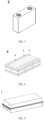
- FIG. 3 is a secondary battery 5 of a square structure as an example.
- such secondary batteries may be combined to assemble a battery module.
- the battery module may include a plurality of secondary batteries whose quantity may be adjusted according to the use case and capacity of the battery module.
- FIG. 4 shows a battery module 4 used as an example.
- a plurality of secondary batteries 5 may be sequentially arranged along a length direction of the battery module 4.
- the plurality of lithium metal batteries 5 may be arranged in any other manners.
- the plurality of secondary batteries 5 may be fastened by using fasteners.
- the battery module 4 may further include a housing with an accommodating space, and the plurality of secondary batteries 5 are accommodated in the accommodating space.
- such battery modules may be further combined to assemble a battery pack, and a quantity of battery modules included in the battery pack may be adjusted based on the use case and capacity of the battery pack.
- FIG. 5 and FIG. 6 show a battery pack 1 as an example.
- the battery pack 1 may include a battery box and a plurality of battery modules 4 disposed in the battery box.
- the battery box includes an upper box body 2 and a lower box body 3, where the upper box body 2 can cover the lower box body 3 to form an enclosed space for accommodating the battery modules 4.
- the plurality of battery modules 4 may be arranged in the battery box in any manner.
- the device may be, but is not limited to, a mobile device (for example, a mobile phone or a notebook computer), an electric vehicle (for example, a battery electric vehicle, a hybrid electric vehicle, a plug-in hybrid electric vehicle, an electric bicycle, an electric scooter, an electric golf vehicle, or an electric truck), an electric train, a ship, a satellite, an energy storage system, and the like.
- a mobile device for example, a mobile phone or a notebook computer
- an electric vehicle for example, a battery electric vehicle, a hybrid electric vehicle, a plug-in hybrid electric vehicle, an electric bicycle, an electric scooter, an electric golf vehicle, or an electric truck
- an electric train for example, a ship, a satellite, an energy storage system, and the like.
- a secondary battery (cell), a battery module (module), or a battery pack (pack) may be selected for the device according to requirements for using the device.
- FIG. 7 is a device as an example.
- the device is a battery electric vehicle, a hybrid electric vehicle, a plug-in hybrid electric vehicle, or the like.
- a battery pack or a battery module may be used.
- the device may be a mobile phone, a tablet computer, a notebook computer, or the like.
- Such device is generally required to be light and thin, and may use a secondary battery as its power source.
- a binding substance, a conductive substance, and a special sensitive substance were dissolved in a solvent at a ratio.
- the resulting mixture was thoroughly stirred and then evenly applied onto at least one surface of a positive electrode current collector, followed by drying to obtain a safety layer applied onto the positive electrode current collector.
- Positive electrode plate of this application A positive electrode active material and a solvent were mixed at a ratio. The resulting mixture was thoroughly stirred to obtain a uniform positive electrode slurry, and then the positive electrode slurry was evenly applied onto a the positive electrode current collector that has been coated with the safety layer in step 1), followed by drying and cold pressing to obtain a positive electrode plate.
- Positive electrode plate not of this application A positive electrode active material, a conductive substance, and a binding substance were mixed at a ratio and dissolved in a solvent. The resulting mixture was thoroughly stirred and evenly applied onto at least one surface of a positive electrode current collector, followed by drying and cold pressing to obtain a positive electrode plate.
- the solvents used in step 1) and step 2) could be N-methylpyrrolidone (NMP) and/or N,N-dimethylformamide (DMF), or other types of solvents previously described.
- NMP N-methylpyrrolidone
- DMF N,N-dimethylformamide
- Ethylene carbonate (EC), propylene carbonate (PC), and dimethyl carbonate (DMC) were mixed uniformly at a mass ratio of 1:1:1 to obtain a mixed organic solvent; then a lithium salt LiPF 6 was dissolved in the mixed organic solvent. The mixture was mixed uniformly to obtain an electrolyte. A concentration of LiPF 6 was 1 mol/L.
- the positive electrode plate, a separator porous polyethylene, and the negative electrode plate were stacked in order and the resulting stack was wound to obtain a battery cell; and the battery cell was placed in an outer package, the electrolyte was injected, and then the outer package was sealed to obtain a lithium-ion secondary battery.
- Lithium-ion secondary batteries of this application were prepared in the foregoing method according to specific components and proportions shown in Table 1.
- Lithium-ion secondary batteries not of this application were prepared in the foregoing method according to specific components and proportions shown in Table 1.
- the lithium-ion secondary battery was charged to 4.25V at a constant current rate of 1C, then charged to a current of 0.05C at a constant voltage of 4.25V, and then left standing for 30 minutes. Then, the battery was fixed with a clamper and placed on an overcharge safety test device with ambient temperature controlled within 25 ⁇ 2°C. After standing for 5 minutes, the fully charged battery was overcharged at a rate of 1C, and the real-time voltage and temperature changes of each battery were recorded until the battery caught a fire or exploded, or the charging stopped. Six samples of lithium-ion secondary batteries were tested for each of the examples and comparative examples. The test passed if no battery caught a fire or exploded, and otherwise failed.
- the lithium-ion secondary battery was charged to 4.25 V at a constant current of 1C, charged to a current of 0.05C at a constant voltage of 4.25V, left standing for 5 min, and then discharged to 2.8V at a constant current of 1C, which was one charge and discharge cycle. Discharge capacity of this cycle was discharge capacity of the 1st cycle.
- Example 1 Pass rate of overcharge safety performance test Capacity retention rate (%) after 200 cycles at 45°C
- Example 1 6/6 91.2
- Example 2 6/6 92.8
- Example 3 6/6 93.7
- Example 4 5/6 94.5
- Example 5 3/6 94.1
- Example 6 6/6 94.2
- Example 7 3/6 94
- Example 8 2/6 93.9
- Example 9 6/6 94.3
- Example 10 6/6 94.4
- Example 11 3/6 94.1
- Example 12 2/6 93.8
- Example 13 6/6 94.1
- Example 14 5/6 94.5
- Example 15 3/6 94.2
- Example 16 6/6 95.10
- Example 17 6/6 91.20
- Example 18 4/6 89.30
- Example 19 3/6 83.30
- Example 20 6/6 93.90
- Example 21 4/6 94.30
- Example 22 5/6 94.20
- Example 23 6/6 93.90
- Example 24 6/6 91.40
- Example 27 6/6 92.40
- Example 28 6/6 93.10
- Example 34 used a special sensitive substance with only a low degree of esterification (only 35%), and the safety performance of the lithium-ion battery was slightly improved and the electrical performance (such as cycling performance) was slightly deteriorated, but overall performance of the battery was still better than that of Comparative Examples 1 to 4.
- Examples 16 to 19 used positive electrode plates with different single-sided capacity per unit area, and it can be seen that as the single-sided capacity per unit area increased, the improvement of safety performance of the battery brought by the safety layer tended to drop and the electrical performance (such as cycling performance) declined, but the overall performance of the battery was still better than that of Comparative Examples 1 to 4.
- Table 1 and Table 2 it can be seen from Table 1 and Table 2 that the lithium-ion secondary battery manifested significantly improved safety and electrical performance (such as cycling performance) whether the safety layer containing the special sensitive substance in this application was applied onto one or two sides of the positive electrode current collector.
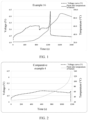
- FIG. 1 is a voltage-temperature-time curve of the lithium-ion secondary battery of Example 16 according to this application. It can be seen that when the battery was overcharged, the special sensitive substance in the safety layer could respond quickly to cut off external charging current and restrain the battery temperature from rising, thereby improving the overcharge safety performance of the battery.
- FIG. 2 is a voltage-temperature-time curve of the lithium-ion secondary battery of Comparative Example 4. It can be seen that when the battery was overcharged, the temperature of the battery rose sharply, and the battery failed due to thermal runaway, making the battery prone to safety risks such as fire and explosion. It can be seen from comparing FIG. 1 and FIG. 2 that the lithium-ion secondary battery prepared by adding a special sensitive substance in the safety layer had significantly improved overcharge safety performance.
Landscapes
- Chemical & Material Sciences (AREA)
- Engineering & Computer Science (AREA)
- Chemical Kinetics & Catalysis (AREA)
- Electrochemistry (AREA)
- General Chemical & Material Sciences (AREA)
- Manufacturing & Machinery (AREA)
- Materials Engineering (AREA)
- Secondary Cells (AREA)
- Battery Electrode And Active Subsutance (AREA)
Claims (12)
- Plaque d'électrode positive, comprenant :un collecteur de courant d'électrode positive,une couche de matériau actif d'électrode positive disposée sur au moins une surface du collecteur de courant d'électrode positive, etune couche de sécurité disposée entre le collecteur de courant d'électrode positive et la couche de matériau actif d'électrode positive ;la couche de sécurité comprenant une substance liante, une substance conductrice, et une substance sensible spéciale ; etla substance sensible spéciale comprenant au moins un produit d'estérification de polysaccharide, un poids moléculaire moyen en poids Mw de la substance sensible spéciale étant de 1 000 à 28 000, une capacité simple face par unité de surface de la plaque d'électrode positive étant ≤ 4,1 mAh/cm2, etun degré d'estérification de motifs de monosaccharide dans le produit d'estérification de polysaccharide étant de 50 % à 98 %.
- Plaque d'électrode positive selon la revendication 1, la substance sensible spéciale comprenant au moins un produit d'estérification de polysaccharide contenant 2 à 80 motifs de monosaccharide.
- Plaque d'électrode positive selon l'une quelconque des revendications 1 à 2, le produit d'estérification de polysaccharide étant choisi parmi l'un ou plusieurs parmi les suivants : un carbonate de dextrine et ses dérivés, un phosphate de dextrine et ses dérivés, un sulfate de dextrine et ses dérivés, un carbonate de chitosane et ses dérivés, un phosphate de chitosane et ses dérivés, un sulfate de chitosane et ses dérivés, un carbonate de cellulose dégradée et ses dérivés, un phosphate de cellulose dégradée et ses dérivés, un sulfate de cellulose dégradée et ses dérivés, un carbonate d'acide hyaluronique et ses dérivés, un phosphate d'acide hyaluronique et ses dérivés, un sulfate d'acide hyaluronique et ses dérivés, un sulfate carbonate de chondroïtine et ses dérivés, un sulfate sulfate de chondroïtine et ses dérivés, un sulfate phosphate de chondroïtine et ses dérivés, un carbonate de saccharose et ses dérivés, un phosphate de saccharose et ses dérivés, un sulfate de saccharose et ses dérivés, un carbonate d'héparine et ses dérivés, un sulfate d'héparine et ses dérivés, et un phosphate d'héparine et ses dérivés.
- Plaque d'électrode positive selon l'une quelconque des revendications 1 à 3, le produit d'estérification de polysaccharide étant choisi parmi l'un ou plusieurs parmi les suivants : un carbonate de dextrine et de méthyle, un carbonate de dextrine et d'éthyle, un phosphate de dextrine et de méthyle, un phosphate de dextrine et d'éthyle, un carbonate de chitosane et de méthyle, un carbonate de chitosane et d'éthyle, un phosphate de chitosane et de méthyle, un phosphate de chitosane et d'éthyle, un carbonate de cellulose dégradée et de méthyle, un carbonate de cellulose dégradée et d'éthyle, un sulfate de cellulose dégradée et de méthyle, un sulfate de cellulose dégradée et d'éthyle, un phosphate de cellulose dégradée et de méthyle, un phosphate de cellulose dégradée et d'éthyle, un sulfate d'acide hyaluronique et de méthyle, un sulfate d'acide hyaluronique et d'éthyle, un phosphate de saccharose et de méthyle, et un phosphate de saccharose et d'éthyle.
- Plaque d'électrode positive selon l'une quelconque des revendications 1 à 4, la substance sensible spéciale comptant pour 25 % à 60 % de la masse totale de la couche de sécurité.
- Plaque d'électrode positive selon l'une quelconque des revendications 1 à 5, la substance liante comprenant l'un ou plusieurs parmi un poly(fluorure de vinylidène), des copolymères de fluorure de vinylidène-hexafluoropropylène, un polyuréthane, un polyacrylonitrile, un polyimide, une résine époxy, une résine de silicone, des copolymères d'éthylène-acétate de vinyle, un caoutchouc de styrène-butadiène, un caoutchouc de styrène-acrylique, un poly(acide acrylique), des copolymères polyacide acrylique-acrylate, et des copolymères polyéthylène-acrylate.
- Plaque d'électrode positive selon l'une quelconque des revendications 1 à 6, la substance liante comptant pour 25 % à 60 % de la masse totale de la couche de sécurité.
- Plaque d'électrode positive selon l'une quelconque des revendications 1 à 7, la substance conductrice comprenant l'un ou plusieurs parmi un matériau conducteur métallique, un matériau conducteur à base de carbone, et un matériau polymère conducteur.
- Plaque d'électrode positive selon l'une quelconque des revendications 1 à 8, le matériau conducteur métallique comprenant l'un ou plusieurs parmi l'aluminium, un alliage d'aluminium, le cuivre, un alliage de cuivre, le nickel, un alliage de nickel, le titane, et l'argent ; le matériau conducteur à base de carbone comprenant l'un ou plusieurs parmi un noir de Ketjen, une sphérulite en mésophase carbonée, un carbone activé, un graphite, un noir de carbone conducteur, un noir d'acétylène, une fibre de carbone, un nanotube de carbone, et un graphène ; et le matériau polymère conducteur comprenant l'un ou plusieurs parmi des poly(nitrures de soufre), des polymères conjugués aliphatiques, des polymères conjugués aromatiques, et des polymères conjugués hétérocycliques aromatiques.
- Plaque d'électrode positive selon l'une quelconque des revendications 1 à 9, la substance conductrice comptant pour 4 % à 20 % de la masse totale de la couche de sécurité.
- Appareil électrochimique, comprenant la plaque d'électrode positive selon l'une quelconque des revendications 1 à 10 ;
préférablement, l'appareil électrochimique pouvant être un condensateur, une batterie primaire, ou une batterie secondaire. - Dispositif, comprenant l'appareil électrochimique selon la revendication 11, le dispositif étant choisi parmi l'un ou plusieurs parmi un véhicule électrique, un bateau électrique, un outil électrique, un dispositif électronique, et un système de stockage d'énergie.
Applications Claiming Priority (2)
| Application Number | Priority Date | Filing Date | Title |
|---|---|---|---|
| CN201910731214.9A CN110429240B (zh) | 2019-08-08 | 2019-08-08 | 正极极片及包括该正极极片的电化学装置 |
| PCT/CN2020/106467 WO2021023133A1 (fr) | 2019-08-08 | 2020-07-31 | Plaque d'électrode positive et dispositif électrochimique et équipement associés à celle-ci |
Publications (3)
| Publication Number | Publication Date |
|---|---|
| EP3979397A1 EP3979397A1 (fr) | 2022-04-06 |
| EP3979397A4 EP3979397A4 (fr) | 2022-07-27 |
| EP3979397B1 true EP3979397B1 (fr) | 2023-09-06 |
Family
ID=68413307
Family Applications (1)
| Application Number | Title | Priority Date | Filing Date |
|---|---|---|---|
| EP20849080.5A Active EP3979397B1 (fr) | 2019-08-08 | 2020-07-31 | Plaque d'électrode positive et dispositif électrochimique et équipement associés à celle-ci |
Country Status (4)
| Country | Link |
|---|---|
| US (1) | US11894524B2 (fr) |
| EP (1) | EP3979397B1 (fr) |
| CN (1) | CN110429240B (fr) |
| WO (1) | WO2021023133A1 (fr) |
Families Citing this family (4)
| Publication number | Priority date | Publication date | Assignee | Title |
|---|---|---|---|---|
| CN110429240B (zh) * | 2019-08-08 | 2020-12-04 | 宁德时代新能源科技股份有限公司 | 正极极片及包括该正极极片的电化学装置 |
| CN110400933B (zh) * | 2019-08-08 | 2020-12-04 | 宁德时代新能源科技股份有限公司 | 正极极片及包括该正极极片的电化学装置 |
| CN110444764B (zh) * | 2019-08-08 | 2020-12-22 | 宁德时代新能源科技股份有限公司 | 一种正极极片及电化学储能装置 |
| CN114256518B (zh) | 2020-09-25 | 2024-04-26 | 珠海冠宇电池股份有限公司 | 一种正极极片及包括该正极极片的锂离子电池 |
Family Cites Families (32)
| Publication number | Priority date | Publication date | Assignee | Title |
|---|---|---|---|---|
| JPH08329978A (ja) | 1995-05-30 | 1996-12-13 | Shin Kobe Electric Mach Co Ltd | アルカリ蓄電池の製造方法 |
| JP2000100437A (ja) | 1998-09-24 | 2000-04-07 | Daicel Chem Ind Ltd | 結着剤、積層体およびそれを用いたリチウム二次電池 |
| JP5249258B2 (ja) * | 2005-02-10 | 2013-07-31 | 昭和電工株式会社 | 二次電池用集電体、二次電池用正極、二次電池用負極、二次電池及びそれらの製造方法 |
| JP2010108716A (ja) * | 2008-10-29 | 2010-05-13 | Toyota Motor Corp | 電極、電池およびその処理方法 |
| JP2011210450A (ja) | 2010-03-29 | 2011-10-20 | Panasonic Corp | 電池用電極板および電池 |
| CN103097472A (zh) * | 2010-09-02 | 2013-05-08 | 昭和电工株式会社 | 涂布液、集电体和集电体的生产方法 |
| US20140065491A1 (en) * | 2011-04-26 | 2014-03-06 | Showa Denko K.K. | Secondary battery |
| JPWO2013005739A1 (ja) | 2011-07-06 | 2015-02-23 | 昭和電工株式会社 | リチウム二次電池用電極、リチウム二次電池及びリチウム二次電池用電極の製造方法 |
| WO2013108365A1 (fr) | 2012-01-17 | 2013-07-25 | トヨタ自動車株式会社 | Batterie rechargeable au lithium sans entretien |
| KR101691757B1 (ko) * | 2012-09-26 | 2016-12-30 | 쇼와 덴코 가부시키가이샤 | 2차 전지용 부극 및 2차 전지 |
| JP6303785B2 (ja) | 2014-05-09 | 2018-04-04 | 凸版印刷株式会社 | リチウムイオン二次電池用正極、リチウムイオン二次電池用正極の製造方法及びリチウムイオン二次電池 |
| JP6589267B2 (ja) * | 2014-10-08 | 2019-10-16 | 凸版印刷株式会社 | リチウムイオン電池の正極電極の製造方法 |
| CN104409681A (zh) | 2014-11-19 | 2015-03-11 | 上海航天电源技术有限责任公司 | 一种含ptc涂层的锂离子电池极片的制备方法 |
| US10020487B2 (en) * | 2014-11-25 | 2018-07-10 | American Lithium Energy Corporation | Rechargeable battery with voltage activated current interrupter |
| CN105810885B (zh) | 2016-04-27 | 2018-08-21 | 宁德时代新能源科技股份有限公司 | 一种正极极片及锂离子电池 |
| CN106099043A (zh) | 2016-06-21 | 2016-11-09 | 上海产业技术研究院 | 一种含ptc元件锂离子电池负极制备方法 |
| CN107768589A (zh) * | 2016-08-15 | 2018-03-06 | 万向二三股份公司 | 一种高安全型高能量密度锂离子电池 |
| JPWO2018180742A1 (ja) * | 2017-03-30 | 2020-02-06 | 昭和電工株式会社 | リチウムイオン二次電池用正極およびリチウムイオン二次電池 |
| CN109755463B (zh) | 2017-11-08 | 2020-12-29 | 宁德时代新能源科技股份有限公司 | 一种电极极片、电化学装置及安全涂层 |
| CN109755466B (zh) | 2017-11-08 | 2020-11-17 | 宁德时代新能源科技股份有限公司 | 一种正极极片、电化学装置及安全涂层 |
| CN108091825A (zh) * | 2017-11-16 | 2018-05-29 | 东莞市迈科新能源有限公司 | 一种锂离子电池极片及其电池 |
| CN108258249B (zh) | 2017-12-15 | 2020-04-24 | 深圳宇锵新材料有限公司 | 一种集流体涂层、浆料及其制备方法、电池极片和锂离子电池 |
| JP2019114393A (ja) * | 2017-12-22 | 2019-07-11 | 昭和電工株式会社 | リチウムイオン二次電池用負極及びリチウムイオン二次電池 |
| JP7276316B2 (ja) | 2018-03-19 | 2023-05-18 | Tdk株式会社 | 全固体電池 |
| CN208298924U (zh) | 2018-04-27 | 2018-12-28 | 宁德新能源科技有限公司 | 极片以及电化学装置 |
| CN108987666A (zh) | 2018-06-29 | 2018-12-11 | 成都三乙医疗科技有限公司 | 一种电池电极片制备方法 |
| CN109786708B (zh) | 2019-01-18 | 2022-03-01 | 中国科学院宁波材料技术与工程研究所 | 一种锂金属负极、其制备方法及金属锂二次电池 |
| CN110265665B (zh) * | 2019-05-24 | 2020-11-17 | 宁德时代新能源科技股份有限公司 | 正极集流体、正极极片及电化学装置 |
| CN110429240B (zh) * | 2019-08-08 | 2020-12-04 | 宁德时代新能源科技股份有限公司 | 正极极片及包括该正极极片的电化学装置 |
| CN110400933B (zh) | 2019-08-08 | 2020-12-04 | 宁德时代新能源科技股份有限公司 | 正极极片及包括该正极极片的电化学装置 |
| CN110444764B (zh) * | 2019-08-08 | 2020-12-22 | 宁德时代新能源科技股份有限公司 | 一种正极极片及电化学储能装置 |
| CN110474114B (zh) * | 2019-08-08 | 2020-11-10 | 宁德时代新能源科技股份有限公司 | 一种电化学储能装置 |
-
2019
- 2019-08-08 CN CN201910731214.9A patent/CN110429240B/zh active Active
-
2020
- 2020-07-31 WO PCT/CN2020/106467 patent/WO2021023133A1/fr not_active Ceased
- 2020-07-31 EP EP20849080.5A patent/EP3979397B1/fr active Active
-
2022
- 2022-01-31 US US17/589,705 patent/US11894524B2/en active Active
Non-Patent Citations (1)
| Title |
|---|
| WU XIANGKUN ET AL: "Safety Issues in Lithium Ion Batteries: Materials and Cell Design", FRONTIERS IN ENERGY RESEARCH, vol. 7, 17 July 2019 (2019-07-17), XP055968523, Retrieved from the Internet <URL:http://dx.doi.org/10.3389/fenrg.2019.00065> DOI: 10.3389/fenrg.2019.00065 * |
Also Published As
| Publication number | Publication date |
|---|---|
| WO2021023133A1 (fr) | 2021-02-11 |
| CN110429240B (zh) | 2020-12-04 |
| CN110429240A (zh) | 2019-11-08 |
| US11894524B2 (en) | 2024-02-06 |
| EP3979397A1 (fr) | 2022-04-06 |
| US20220158257A1 (en) | 2022-05-19 |
| EP3979397A4 (fr) | 2022-07-27 |
Similar Documents
| Publication | Publication Date | Title |
|---|---|---|
| EP3944365B1 (fr) | Batterie au lithium-métal et son procédé de préparation, et appareil comprenant une batterie au lithium-métal et une plaque d'électrode négative | |
| EP3979372B1 (fr) | Pièce polaire positive, dispositif électrochimique et équipement associé | |
| US11894524B2 (en) | Positive electrode plate, and electrochemical apparatus and device associated therewith | |
| US12176545B2 (en) | Positive electrode plate and related electrochemical energy storage apparatus and device | |
| JP7590414B2 (ja) | 二次電池、二次電池を含む装置、二次電池の製造方法及び接着剤組成物 | |
| US12040455B2 (en) | Electrochemical energy storage apparatus and device | |
| US20220093921A1 (en) | Secondary battery and battery module, battery pack and apparatus containing the same | |
| US20230197962A1 (en) | Secondary battery, preparation method thereof, apparatus containing same, and binder formula | |
| US11791460B2 (en) | Electrode assembly, secondary battery, battery module, battery pack and power consuming device | |
| US20230124276A1 (en) | Lithium-Ion Battery | |
| CN117355953A (zh) | 一种用于锂离子二次电池的正极复合材料、正极和电池 | |
| EP4195349B1 (fr) | Batterie secondaire | |
| CN115832181B (zh) | 正极极片及其制备方法和二次电池、电池模组、电池包、用电装置 | |
| EP4614625A1 (fr) | Électrode, batterie et dispositif de consommation d'énergie | |
| US20230307644A1 (en) | Artificial graphite and preparation method thereof, secondary battery containing such artificial graphite, and electric apparatus | |
| CN117254129A (zh) | 二次电池和用电装置 | |
| CN116982176A (zh) | 一种粘结剂及其应用 | |
| EP4318726A1 (fr) | Batterie secondaire et son procédé de préparation, et module de batterie, bloc-batterie et appareil électrique | |
| EP4318677A1 (fr) | Agent de formation de pores pour batterie secondaire, procédé de préparation d'agent porogène, feuille d'électrode négative, ensemble électrode et batterie secondaire | |
| EP4668356A1 (fr) | Feuille d'électrode positive et son procédé de préparation, batterie secondaire et dispositif électrique | |
| EP4564456A1 (fr) | Batterie secondaire, son procédé de préparation et dispositif électrique | |
| EP4564447A1 (fr) | Élément de batterie et son procédé de préparation, batterie secondaire et appareil électrique |
Legal Events
| Date | Code | Title | Description |
|---|---|---|---|
| STAA | Information on the status of an ep patent application or granted ep patent |
Free format text: STATUS: THE INTERNATIONAL PUBLICATION HAS BEEN MADE |
|
| PUAI | Public reference made under article 153(3) epc to a published international application that has entered the european phase |
Free format text: ORIGINAL CODE: 0009012 |
|
| STAA | Information on the status of an ep patent application or granted ep patent |
Free format text: STATUS: REQUEST FOR EXAMINATION WAS MADE |
|
| 17P | Request for examination filed |
Effective date: 20211230 |
|
| AK | Designated contracting states |
Kind code of ref document: A1 Designated state(s): AL AT BE BG CH CY CZ DE DK EE ES FI FR GB GR HR HU IE IS IT LI LT LU LV MC MK MT NL NO PL PT RO RS SE SI SK SM TR |
|
| A4 | Supplementary search report drawn up and despatched |
Effective date: 20220629 |
|
| RIC1 | Information provided on ipc code assigned before grant |
Ipc: H01M 4/02 20060101ALN20220623BHEP Ipc: H01M 10/42 20060101ALI20220623BHEP Ipc: H01M 4/62 20060101AFI20220623BHEP |
|
| STAA | Information on the status of an ep patent application or granted ep patent |
Free format text: STATUS: EXAMINATION IS IN PROGRESS |
|
| DAV | Request for validation of the european patent (deleted) | ||
| DAX | Request for extension of the european patent (deleted) | ||
| 17Q | First examination report despatched |
Effective date: 20221021 |
|
| REG | Reference to a national code |
Ref country code: DE Ref legal event code: R079 Free format text: PREVIOUS MAIN CLASS: H01M0010660000 Ipc: H01M0004620000 Ref country code: DE Ref legal event code: R079 Ref document number: 602020017430 Country of ref document: DE Free format text: PREVIOUS MAIN CLASS: H01M0010660000 Ipc: H01M0004620000 |
|
| GRAP | Despatch of communication of intention to grant a patent |
Free format text: ORIGINAL CODE: EPIDOSNIGR1 |
|
| STAA | Information on the status of an ep patent application or granted ep patent |
Free format text: STATUS: GRANT OF PATENT IS INTENDED |
|
| RIC1 | Information provided on ipc code assigned before grant |
Ipc: H01M 4/02 20060101ALN20230607BHEP Ipc: H01M 10/42 20060101ALI20230607BHEP Ipc: H01M 4/62 20060101AFI20230607BHEP |
|
| GRAS | Grant fee paid |
Free format text: ORIGINAL CODE: EPIDOSNIGR3 |
|
| INTG | Intention to grant announced |
Effective date: 20230626 |
|
| GRAA | (expected) grant |
Free format text: ORIGINAL CODE: 0009210 |
|
| STAA | Information on the status of an ep patent application or granted ep patent |
Free format text: STATUS: THE PATENT HAS BEEN GRANTED |
|
| AK | Designated contracting states |
Kind code of ref document: B1 Designated state(s): AL AT BE BG CH CY CZ DE DK EE ES FI FR GB GR HR HU IE IS IT LI LT LU LV MC MK MT NL NO PL PT RO RS SE SI SK SM TR |
|
| REG | Reference to a national code |
Ref country code: GB Ref legal event code: FG4D |
|
| REG | Reference to a national code |
Ref country code: CH Ref legal event code: EP |
|
| REG | Reference to a national code |
Ref country code: DE Ref legal event code: R096 Ref document number: 602020017430 Country of ref document: DE |
|
| REG | Reference to a national code |
Ref country code: IE Ref legal event code: FG4D |
|
| P01 | Opt-out of the competence of the unified patent court (upc) registered |
Effective date: 20230908 |
|
| REG | Reference to a national code |
Ref country code: LT Ref legal event code: MG9D |
|
| REG | Reference to a national code |
Ref country code: NL Ref legal event code: MP Effective date: 20230906 |
|
| PG25 | Lapsed in a contracting state [announced via postgrant information from national office to epo] |
Ref country code: GR Free format text: LAPSE BECAUSE OF FAILURE TO SUBMIT A TRANSLATION OF THE DESCRIPTION OR TO PAY THE FEE WITHIN THE PRESCRIBED TIME-LIMIT Effective date: 20231207 |
|
| PG25 | Lapsed in a contracting state [announced via postgrant information from national office to epo] |
Ref country code: SE Free format text: LAPSE BECAUSE OF FAILURE TO SUBMIT A TRANSLATION OF THE DESCRIPTION OR TO PAY THE FEE WITHIN THE PRESCRIBED TIME-LIMIT Effective date: 20230906 Ref country code: RS Free format text: LAPSE BECAUSE OF FAILURE TO SUBMIT A TRANSLATION OF THE DESCRIPTION OR TO PAY THE FEE WITHIN THE PRESCRIBED TIME-LIMIT Effective date: 20230906 Ref country code: NO Free format text: LAPSE BECAUSE OF FAILURE TO SUBMIT A TRANSLATION OF THE DESCRIPTION OR TO PAY THE FEE WITHIN THE PRESCRIBED TIME-LIMIT Effective date: 20231206 Ref country code: LV Free format text: LAPSE BECAUSE OF FAILURE TO SUBMIT A TRANSLATION OF THE DESCRIPTION OR TO PAY THE FEE WITHIN THE PRESCRIBED TIME-LIMIT Effective date: 20230906 Ref country code: LT Free format text: LAPSE BECAUSE OF FAILURE TO SUBMIT A TRANSLATION OF THE DESCRIPTION OR TO PAY THE FEE WITHIN THE PRESCRIBED TIME-LIMIT Effective date: 20230906 Ref country code: HR Free format text: LAPSE BECAUSE OF FAILURE TO SUBMIT A TRANSLATION OF THE DESCRIPTION OR TO PAY THE FEE WITHIN THE PRESCRIBED TIME-LIMIT Effective date: 20230906 Ref country code: GR Free format text: LAPSE BECAUSE OF FAILURE TO SUBMIT A TRANSLATION OF THE DESCRIPTION OR TO PAY THE FEE WITHIN THE PRESCRIBED TIME-LIMIT Effective date: 20231207 Ref country code: FI Free format text: LAPSE BECAUSE OF FAILURE TO SUBMIT A TRANSLATION OF THE DESCRIPTION OR TO PAY THE FEE WITHIN THE PRESCRIBED TIME-LIMIT Effective date: 20230906 |
|
| REG | Reference to a national code |
Ref country code: AT Ref legal event code: MK05 Ref document number: 1609730 Country of ref document: AT Kind code of ref document: T Effective date: 20230906 |
|
| PG25 | Lapsed in a contracting state [announced via postgrant information from national office to epo] |
Ref country code: NL Free format text: LAPSE BECAUSE OF FAILURE TO SUBMIT A TRANSLATION OF THE DESCRIPTION OR TO PAY THE FEE WITHIN THE PRESCRIBED TIME-LIMIT Effective date: 20230906 |
|
| PG25 | Lapsed in a contracting state [announced via postgrant information from national office to epo] |
Ref country code: IS Free format text: LAPSE BECAUSE OF FAILURE TO SUBMIT A TRANSLATION OF THE DESCRIPTION OR TO PAY THE FEE WITHIN THE PRESCRIBED TIME-LIMIT Effective date: 20240106 |
|
| PG25 | Lapsed in a contracting state [announced via postgrant information from national office to epo] |
Ref country code: AT Free format text: LAPSE BECAUSE OF FAILURE TO SUBMIT A TRANSLATION OF THE DESCRIPTION OR TO PAY THE FEE WITHIN THE PRESCRIBED TIME-LIMIT Effective date: 20230906 |
|
| PG25 | Lapsed in a contracting state [announced via postgrant information from national office to epo] |
Ref country code: ES Free format text: LAPSE BECAUSE OF FAILURE TO SUBMIT A TRANSLATION OF THE DESCRIPTION OR TO PAY THE FEE WITHIN THE PRESCRIBED TIME-LIMIT Effective date: 20230906 |
|
| PG25 | Lapsed in a contracting state [announced via postgrant information from national office to epo] |
Ref country code: SM Free format text: LAPSE BECAUSE OF FAILURE TO SUBMIT A TRANSLATION OF THE DESCRIPTION OR TO PAY THE FEE WITHIN THE PRESCRIBED TIME-LIMIT Effective date: 20230906 Ref country code: RO Free format text: LAPSE BECAUSE OF FAILURE TO SUBMIT A TRANSLATION OF THE DESCRIPTION OR TO PAY THE FEE WITHIN THE PRESCRIBED TIME-LIMIT Effective date: 20230906 Ref country code: IS Free format text: LAPSE BECAUSE OF FAILURE TO SUBMIT A TRANSLATION OF THE DESCRIPTION OR TO PAY THE FEE WITHIN THE PRESCRIBED TIME-LIMIT Effective date: 20240106 Ref country code: ES Free format text: LAPSE BECAUSE OF FAILURE TO SUBMIT A TRANSLATION OF THE DESCRIPTION OR TO PAY THE FEE WITHIN THE PRESCRIBED TIME-LIMIT Effective date: 20230906 Ref country code: EE Free format text: LAPSE BECAUSE OF FAILURE TO SUBMIT A TRANSLATION OF THE DESCRIPTION OR TO PAY THE FEE WITHIN THE PRESCRIBED TIME-LIMIT Effective date: 20230906 Ref country code: CZ Free format text: LAPSE BECAUSE OF FAILURE TO SUBMIT A TRANSLATION OF THE DESCRIPTION OR TO PAY THE FEE WITHIN THE PRESCRIBED TIME-LIMIT Effective date: 20230906 Ref country code: AT Free format text: LAPSE BECAUSE OF FAILURE TO SUBMIT A TRANSLATION OF THE DESCRIPTION OR TO PAY THE FEE WITHIN THE PRESCRIBED TIME-LIMIT Effective date: 20230906 Ref country code: SK Free format text: LAPSE BECAUSE OF FAILURE TO SUBMIT A TRANSLATION OF THE DESCRIPTION OR TO PAY THE FEE WITHIN THE PRESCRIBED TIME-LIMIT Effective date: 20230906 Ref country code: PT Free format text: LAPSE BECAUSE OF FAILURE TO SUBMIT A TRANSLATION OF THE DESCRIPTION OR TO PAY THE FEE WITHIN THE PRESCRIBED TIME-LIMIT Effective date: 20240108 |
|
| PG25 | Lapsed in a contracting state [announced via postgrant information from national office to epo] |
Ref country code: PL Free format text: LAPSE BECAUSE OF FAILURE TO SUBMIT A TRANSLATION OF THE DESCRIPTION OR TO PAY THE FEE WITHIN THE PRESCRIBED TIME-LIMIT Effective date: 20230906 Ref country code: IT Free format text: LAPSE BECAUSE OF FAILURE TO SUBMIT A TRANSLATION OF THE DESCRIPTION OR TO PAY THE FEE WITHIN THE PRESCRIBED TIME-LIMIT Effective date: 20230906 |
|
| REG | Reference to a national code |
Ref country code: DE Ref legal event code: R097 Ref document number: 602020017430 Country of ref document: DE |
|
| PG25 | Lapsed in a contracting state [announced via postgrant information from national office to epo] |
Ref country code: DK Free format text: LAPSE BECAUSE OF FAILURE TO SUBMIT A TRANSLATION OF THE DESCRIPTION OR TO PAY THE FEE WITHIN THE PRESCRIBED TIME-LIMIT Effective date: 20230906 |
|
| PLBE | No opposition filed within time limit |
Free format text: ORIGINAL CODE: 0009261 |
|
| STAA | Information on the status of an ep patent application or granted ep patent |
Free format text: STATUS: NO OPPOSITION FILED WITHIN TIME LIMIT |
|
| PG25 | Lapsed in a contracting state [announced via postgrant information from national office to epo] |
Ref country code: DK Free format text: LAPSE BECAUSE OF FAILURE TO SUBMIT A TRANSLATION OF THE DESCRIPTION OR TO PAY THE FEE WITHIN THE PRESCRIBED TIME-LIMIT Effective date: 20230906 Ref country code: SI Free format text: LAPSE BECAUSE OF FAILURE TO SUBMIT A TRANSLATION OF THE DESCRIPTION OR TO PAY THE FEE WITHIN THE PRESCRIBED TIME-LIMIT Effective date: 20230906 |
|
| REG | Reference to a national code |
Ref country code: DE Ref legal event code: R081 Ref document number: 602020017430 Country of ref document: DE Owner name: CONTEMPORARY AMPEREX TECHNOLOGY (HONG KONG) LI, HK Free format text: FORMER OWNER: CONTEMPORARY AMPEREX TECHNOLOGY CO., LIMITED, NINGDE, FUJIAN, CN |
|
| 26N | No opposition filed |
Effective date: 20240607 |
|
| REG | Reference to a national code |
Ref country code: GB Ref legal event code: 732E Free format text: REGISTERED BETWEEN 20240829 AND 20240904 |
|
| PG25 | Lapsed in a contracting state [announced via postgrant information from national office to epo] |
Ref country code: BG Free format text: LAPSE BECAUSE OF FAILURE TO SUBMIT A TRANSLATION OF THE DESCRIPTION OR TO PAY THE FEE WITHIN THE PRESCRIBED TIME-LIMIT Effective date: 20230906 |
|
| PG25 | Lapsed in a contracting state [announced via postgrant information from national office to epo] |
Ref country code: BG Free format text: LAPSE BECAUSE OF FAILURE TO SUBMIT A TRANSLATION OF THE DESCRIPTION OR TO PAY THE FEE WITHIN THE PRESCRIBED TIME-LIMIT Effective date: 20230906 |
|
| PG25 | Lapsed in a contracting state [announced via postgrant information from national office to epo] |
Ref country code: MC Free format text: LAPSE BECAUSE OF FAILURE TO SUBMIT A TRANSLATION OF THE DESCRIPTION OR TO PAY THE FEE WITHIN THE PRESCRIBED TIME-LIMIT Effective date: 20230906 |
|
| REG | Reference to a national code |
Ref country code: CH Ref legal event code: PL |
|
| PG25 | Lapsed in a contracting state [announced via postgrant information from national office to epo] |
Ref country code: LU Free format text: LAPSE BECAUSE OF NON-PAYMENT OF DUE FEES Effective date: 20240731 |
|
| PG25 | Lapsed in a contracting state [announced via postgrant information from national office to epo] |
Ref country code: LU Free format text: LAPSE BECAUSE OF NON-PAYMENT OF DUE FEES Effective date: 20240731 |
|
| PG25 | Lapsed in a contracting state [announced via postgrant information from national office to epo] |
Ref country code: BE Free format text: LAPSE BECAUSE OF NON-PAYMENT OF DUE FEES Effective date: 20240731 Ref country code: CH Free format text: LAPSE BECAUSE OF NON-PAYMENT OF DUE FEES Effective date: 20240731 |
|
| REG | Reference to a national code |
Ref country code: BE Ref legal event code: MM Effective date: 20240731 |
|
| PGFP | Annual fee paid to national office [announced via postgrant information from national office to epo] |
Ref country code: GB Payment date: 20250612 Year of fee payment: 6 |
|
| PGFP | Annual fee paid to national office [announced via postgrant information from national office to epo] |
Ref country code: FR Payment date: 20250610 Year of fee payment: 6 |
|
| PG25 | Lapsed in a contracting state [announced via postgrant information from national office to epo] |
Ref country code: IE Free format text: LAPSE BECAUSE OF NON-PAYMENT OF DUE FEES Effective date: 20240731 |
|
| PGFP | Annual fee paid to national office [announced via postgrant information from national office to epo] |
Ref country code: DE Payment date: 20250604 Year of fee payment: 6 |
|
| PG25 | Lapsed in a contracting state [announced via postgrant information from national office to epo] |
Ref country code: CY Free format text: LAPSE BECAUSE OF FAILURE TO SUBMIT A TRANSLATION OF THE DESCRIPTION OR TO PAY THE FEE WITHIN THE PRESCRIBED TIME-LIMIT; INVALID AB INITIO Effective date: 20200731 |
|
| PG25 | Lapsed in a contracting state [announced via postgrant information from national office to epo] |
Ref country code: HU Free format text: LAPSE BECAUSE OF FAILURE TO SUBMIT A TRANSLATION OF THE DESCRIPTION OR TO PAY THE FEE WITHIN THE PRESCRIBED TIME-LIMIT; INVALID AB INITIO Effective date: 20200731 |