EP3958752B1 - Systeme zur ausseraxialen verstärkung eines wirbelkörpers - Google Patents
Systeme zur ausseraxialen verstärkung eines wirbelkörpers Download PDFInfo
- Publication number
- EP3958752B1 EP3958752B1 EP20724685.1A EP20724685A EP3958752B1 EP 3958752 B1 EP3958752 B1 EP 3958752B1 EP 20724685 A EP20724685 A EP 20724685A EP 3958752 B1 EP3958752 B1 EP 3958752B1
- Authority
- EP
- European Patent Office
- Prior art keywords
- hub
- shaft
- cannula
- sheath
- distal end
- Prior art date
- Legal status (The legal status is an assumption and is not a legal conclusion. Google has not performed a legal analysis and makes no representation as to the accuracy of the status listed.)
- Active
Links
Images







Classifications
-
- A—HUMAN NECESSITIES
- A61—MEDICAL OR VETERINARY SCIENCE; HYGIENE
- A61B—DIAGNOSIS; SURGERY; IDENTIFICATION
- A61B17/00—Surgical instruments, devices or methods
- A61B17/16—Instruments for performing osteoclasis; Drills or chisels for bones; Trepans
- A61B17/1642—Instruments for performing osteoclasis; Drills or chisels for bones; Trepans for producing a curved bore
-
- A—HUMAN NECESSITIES
- A61—MEDICAL OR VETERINARY SCIENCE; HYGIENE
- A61B—DIAGNOSIS; SURGERY; IDENTIFICATION
- A61B17/00—Surgical instruments, devices or methods
- A61B17/34—Trocars; Puncturing needles
- A61B17/3417—Details of tips or shafts, e.g. grooves, expandable, bendable; Multiple coaxial sliding cannulas, e.g. for dilating
- A61B17/3421—Cannulas
-
- A—HUMAN NECESSITIES
- A61—MEDICAL OR VETERINARY SCIENCE; HYGIENE
- A61B—DIAGNOSIS; SURGERY; IDENTIFICATION
- A61B17/00—Surgical instruments, devices or methods
- A61B17/34—Trocars; Puncturing needles
- A61B17/3472—Trocars; Puncturing needles for bones, e.g. intraosseus injections
-
- A—HUMAN NECESSITIES
- A61—MEDICAL OR VETERINARY SCIENCE; HYGIENE
- A61B—DIAGNOSIS; SURGERY; IDENTIFICATION
- A61B17/00—Surgical instruments, devices or methods
- A61B17/34—Trocars; Puncturing needles
- A61B17/3478—Endoscopic needles, e.g. for infusion
-
- A—HUMAN NECESSITIES
- A61—MEDICAL OR VETERINARY SCIENCE; HYGIENE
- A61B—DIAGNOSIS; SURGERY; IDENTIFICATION
- A61B17/00—Surgical instruments, devices or methods
- A61B17/56—Surgical instruments or methods for treatment of bones or joints; Devices specially adapted therefor
- A61B17/58—Surgical instruments or methods for treatment of bones or joints; Devices specially adapted therefor for osteosynthesis, e.g. bone plates, screws or setting implements
- A61B17/88—Osteosynthesis instruments; Methods or means for implanting or extracting internal or external fixation devices
- A61B17/8802—Equipment for handling bone cement or other fluid fillers
- A61B17/8805—Equipment for handling bone cement or other fluid fillers for introducing fluid filler into bone or extracting it
- A61B17/8811—Equipment for handling bone cement or other fluid fillers for introducing fluid filler into bone or extracting it characterised by the introducer tip, i.e. the part inserted into or onto the bone
-
- A—HUMAN NECESSITIES
- A61—MEDICAL OR VETERINARY SCIENCE; HYGIENE
- A61B—DIAGNOSIS; SURGERY; IDENTIFICATION
- A61B17/00—Surgical instruments, devices or methods
- A61B17/56—Surgical instruments or methods for treatment of bones or joints; Devices specially adapted therefor
- A61B17/58—Surgical instruments or methods for treatment of bones or joints; Devices specially adapted therefor for osteosynthesis, e.g. bone plates, screws or setting implements
- A61B17/88—Osteosynthesis instruments; Methods or means for implanting or extracting internal or external fixation devices
- A61B17/8802—Equipment for handling bone cement or other fluid fillers
- A61B17/8805—Equipment for handling bone cement or other fluid fillers for introducing fluid filler into bone or extracting it
- A61B17/8819—Equipment for handling bone cement or other fluid fillers for introducing fluid filler into bone or extracting it characterised by the introducer proximal part, e.g. cannula handle, or by parts which are inserted inside each other, e.g. stylet and cannula
-
- A—HUMAN NECESSITIES
- A61—MEDICAL OR VETERINARY SCIENCE; HYGIENE
- A61B—DIAGNOSIS; SURGERY; IDENTIFICATION
- A61B17/00—Surgical instruments, devices or methods
- A61B17/56—Surgical instruments or methods for treatment of bones or joints; Devices specially adapted therefor
- A61B17/58—Surgical instruments or methods for treatment of bones or joints; Devices specially adapted therefor for osteosynthesis, e.g. bone plates, screws or setting implements
- A61B17/88—Osteosynthesis instruments; Methods or means for implanting or extracting internal or external fixation devices
- A61B17/885—Tools for expanding or compacting bones or discs or cavities therein
- A61B17/8852—Tools for expanding or compacting bones or discs or cavities therein capable of being assembled or enlarged, or changing shape, inside the bone or disc
- A61B17/8855—Tools for expanding or compacting bones or discs or cavities therein capable of being assembled or enlarged, or changing shape, inside the bone or disc inflatable, e.g. kyphoplasty balloons
-
- A—HUMAN NECESSITIES
- A61—MEDICAL OR VETERINARY SCIENCE; HYGIENE
- A61B—DIAGNOSIS; SURGERY; IDENTIFICATION
- A61B17/00—Surgical instruments, devices or methods
- A61B17/00234—Surgical instruments, devices or methods for minimally invasive surgery
- A61B2017/00238—Type of minimally invasive operation
- A61B2017/00261—Discectomy
-
- A—HUMAN NECESSITIES
- A61—MEDICAL OR VETERINARY SCIENCE; HYGIENE
- A61B—DIAGNOSIS; SURGERY; IDENTIFICATION
- A61B17/00—Surgical instruments, devices or methods
- A61B17/00234—Surgical instruments, devices or methods for minimally invasive surgery
- A61B2017/00292—Surgical instruments, devices or methods for minimally invasive surgery mounted on or guided by flexible, e.g. catheter-like, means
- A61B2017/003—Steerable
- A61B2017/00305—Constructional details of the flexible means
- A61B2017/00314—Separate linked members
-
- A—HUMAN NECESSITIES
- A61—MEDICAL OR VETERINARY SCIENCE; HYGIENE
- A61B—DIAGNOSIS; SURGERY; IDENTIFICATION
- A61B17/00—Surgical instruments, devices or methods
- A61B17/00234—Surgical instruments, devices or methods for minimally invasive surgery
- A61B2017/00292—Surgical instruments, devices or methods for minimally invasive surgery mounted on or guided by flexible, e.g. catheter-like, means
- A61B2017/003—Steerable
- A61B2017/00318—Steering mechanisms
- A61B2017/00323—Cables or rods
-
- A—HUMAN NECESSITIES
- A61—MEDICAL OR VETERINARY SCIENCE; HYGIENE
- A61B—DIAGNOSIS; SURGERY; IDENTIFICATION
- A61B17/00—Surgical instruments, devices or methods
- A61B17/00234—Surgical instruments, devices or methods for minimally invasive surgery
- A61B2017/00292—Surgical instruments, devices or methods for minimally invasive surgery mounted on or guided by flexible, e.g. catheter-like, means
- A61B2017/003—Steerable
- A61B2017/00318—Steering mechanisms
- A61B2017/00331—Steering mechanisms with preformed bends
-
- A—HUMAN NECESSITIES
- A61—MEDICAL OR VETERINARY SCIENCE; HYGIENE
- A61B—DIAGNOSIS; SURGERY; IDENTIFICATION
- A61B17/00—Surgical instruments, devices or methods
- A61B17/00234—Surgical instruments, devices or methods for minimally invasive surgery
- A61B2017/00292—Surgical instruments, devices or methods for minimally invasive surgery mounted on or guided by flexible, e.g. catheter-like, means
- A61B2017/00336—Surgical instruments, devices or methods for minimally invasive surgery mounted on or guided by flexible, e.g. catheter-like, means with a protective sleeve, e.g. retractable or slidable
-
- A—HUMAN NECESSITIES
- A61—MEDICAL OR VETERINARY SCIENCE; HYGIENE
- A61B—DIAGNOSIS; SURGERY; IDENTIFICATION
- A61B17/00—Surgical instruments, devices or methods
- A61B17/32—Surgical cutting instruments
- A61B2017/320044—Blunt dissectors
- A61B2017/320048—Balloon dissectors
Definitions
- a common source of back pain is a vertebral compression fracture in which a weakened or injured vertebral body loses height or collapses.
- the weakening of the vertebral body may be due to acute injury or, more often, degenerative changes such as osteoporosis.
- the compression fractures often appear on lateral radiographs as wedge deformities with greater loss of height anteriorly.
- a vertebroplasty includes delivering curable material, for example a bone cement, within an interior of the vertebral body. The material interdigitates with cancellous bone and cures to stabilize the vertebral body.
- a kyphoplasty includes creating a cavity within the interior of the vertebral body by compressing the cancellous bone with an expandable member such as a balloon, and delivering the curable material into the cavity. The expandable member may facilitate elevating or restoring the height of the vertebral body.
- Accessing the interior of the vertebral body often includes percutaneously placing an access cannula through a pedicle of the vertebra. Owing to the structure of the vertebra, accessing a location on the contralateral side of the vertebral body is not especially feasible with straight instrumentation. As such, one existing kyphoplasty technique employs a bipedicular approach in which two access cannulas are placed, followed by two balloons each positioned ipsilaterally within the interior of the vertebral body. The bipedicular approach undesirably requires twice the trauma to tissue, and often requires twice the instrumentation.
- Document US 2011/0295262 A1 describes methods and devices that displace bone or other hard tissue to create a cavity in the tissue. Such methods and devices rely on a driving mechanism for providing moving of the device to from a profile that improves displacement of the tissue. These methods and devices also allow for creating a path or cavity in bone for insertion of bone cement or other filler to treat a fracture or other condition in the bone.
- the features relating to the methods and devices can be applied in any region of bone or hard tissue where the tissue or bone is displaced to define a bore or cavity instead of being extracted from the body such as during a drilling or ablation procedure.
- Claim 1 is directed to a system for augmenting a vertebral body.
- the system includes an access cannula, and introducer device, and a flexible sheath.
- the access cannula includes a cannula hub, and a cannula shaft extending from the cannula hub.
- the cannula shaft includes a distal end positionable within the vertebral body and defining a lumen along a longitudinal axis.
- the introducer device includes an actuator configured to receive an input from a user, and a shaft.
- the shaft includes a rigid proximal portion coupled to the actuator and defining a proximal end of the shaft, and a flexible distal portion.
- a length of the shaft between the proximal end and a distal end is sufficient for the shaft to extend through and be operable beyond the distal end of the access cannula.
- the flexible distal portion includes a pre-set curve in an unconstrained state.
- the introducer device includes a pulling element coupled to the actuator and to the shaft at or near the distal end. The pulling element extends along at least a portion of the pre-set curve.
- a distal portion of said flexible sheath is configured to conform to said flexible distal portion as said pre-set curve is moved between said constrained state and said unconstrained state.
- tension on the pulling element is configured to be increased in response to the input provided to the actuator to move the pre-set curve from the unconstrained state to a constrained state in which the flexible distal portion at least partially straightens.
- the tension on the pulling element is configured to be reduced to facilitate the pre-set curve moving from the constrained state to the unconstrained state to position the distal end of the shaft within the vertebral body at a target site that is offset from the longitudinal axis.
- the flexible sheath of the system of claim 1 at least partially overlying the shaft with the flexible sheath including a distal end positionable near the distal end of the shaft such that the flexible sheath is configured to extend through and be operable beyond the distal end of the access cannula with a distal portion of the flexible sheath conforming to the flexible distal portion as the pre-set curve moves between the constrained state and the unconstrained state, wherein the introducer device is removable from the flexible sheath with the distal end of the flexible sheath remaining at the target site offset from the longitudinal axis.
- the pre-set curve defines an inner curved surface opposite an outer curved surface.
- the pulling element may extend along at least a portion of the outer curved surface.
- the introducer device may include a housing, and a locking mechanism operably coupling the housing and the actuator, wherein the locking mechanism is configured to permit selective locking of the actuator in one of a plurality of positions.
- the system includes an expandable member assembly including a balloon hub, a balloon tube extending from the balloon hub, and a balloon coupled to a distal end of the balloon tube.
- the balloon hub is adapted to be coupled to a fluid source.
- the balloon tube may be sized to be slidably inserted within the flexible sheath.
- the balloon may be configured to be inflated with fluid from the fluid source to displace cancellous bone within the vertebral body.
- the balloon tube has a length such that the balloon is positioned proximate the distal end of the flexible sheath when the balloon tube is slidably inserted within the flexible sheath.
- An exemplary aspect of the disclosure involves a method of operating the system according to the first example (the method is described herein to aid understanding the invention, but not claimed), and optionally, any of its corresponding implementations.
- An exemplary further aspect of the present disclosure is directed to a system for augmenting a vertebral body.
- the system includes an access cannula, a delivery cannula, an expandable member assembly, and a spacer hub.
- the access cannula includes a cannula hub, and a cannula shaft extending from the cannula hub.
- the cannula shaft includes a distal end positionable within the vertebral body.
- the delivery cannula includes a delivery hub, and a sheath extending from the delivery hub.
- the sheath includes a distal end opposite a proximal end collectively defining a length sufficient to extend through and be operable beyond the distal end of the access cannula.
- the delivery hub is movable relative to the cannula hub such that the sheath is slidably disposed within the cannula shaft.
- the expandable member assembly includes a balloon hub adapted to be coupled to a fluid source.
- a balloon tube extends from the balloon hub and is sized to be slidably inserted within the sheath.
- a balloon is coupled to a distal end of the balloon tube and configured to be inflated with fluid from the fluid source to displace cancellous bone within the vertebral body.
- the spacer hub is configured to facilitate proximal movement of the delivery cannula relative to the access cannula and the expandable member assembly.
- the sheath is retracted to expose the balloon within the vertebral body through a syringe-style input from a user.
- the spacer hub includes a distal portion engaging the cannula hub and a proximal portion for engaging the balloon hub.
- the distal and proximal portions include opposing stop surfaces defining a void space with the delivery hub configured to be movably disposed within the void space such that the opposing stop surfaces provide a terminus of movement of the delivery hub.
- the system includes a biasing element operably coupled to the pulling element and the actuator.
- the biasing element may be configured to be at least initially in a stressed state to bias the pulling element to the constrained state.
- the biasing element may be further configured to relax in response to the input to provided to the actuator to facilitate altering the tension on the pulling element to permit the flexible distal portion to move to the unconstrained state.
- An exemplary further aspect of the disclosure is directed to a system for augmenting a vertebral body.
- the system includes an access cannula, a delivery cannula, an expandable member assembly, and a spacer hub.
- the access cannula includes a cannula hub, and a cannula shaft extending from the cannula hub.
- the cannula shaft includes a distal end positionable within the vertebral body.
- the delivery cannula includes a delivery hub, and a sheath extending from the delivery hub.
- the sheath includes a distal end opposite a proximal end collectively defining a length sufficient to extend through and be operable beyond the distal end of the access cannula.
- the delivery hub is movable relative to the cannula hub such that the sheath is slidably disposed within the cannula shaft.
- the expandable member assembly includes a balloon hub adapted to be coupled to a fluid source.
- a balloon tube extends from the balloon hub and sized to be slidably inserted within the sheath.
- a balloon is coupled to a distal end of the balloon tube and configured to be inflated with fluid from the fluid source to displace cancellous bone within the vertebral body.
- the spacer hub is configured to facilitate proximal movement of the delivery cannula relative to the access cannula and the expandable member assembly.
- the sheath is retracted to expose the balloon within the vertebral body through a syringe-style input from a user.
- the spacer hub includes a distal portion engaging the cannula hub, a proximal portion configured to engage the balloon hub, and a pivot pivotably coupling the distal portion to the proximal
- the balloon hub includes a body portion, a transition surface configured to engage the proximal portion of the spacer hub, and a control surface opposite the transition surface and sized to receive a thumb of the user to facilitate providing the syringe-style input.
- the delivery hub may define a lumen and each of the distal and proximal portions of the spacer hubs define coaxial apertures. At least a portion of the balloon tube may extend through the lumen and the coaxial apertures such that the delivery hub is slidable along the balloon tube between the distal and proximal portions of the spacer hub. At least one side may extend between the distal and proximal portions. The side(s) may be two sides defining opposed slots extending between the distal and proximal portions.
- the delivery hub comprises wings extending through the opposed slots and configured to receive the syringe-style input from the user.
- the spacer hub includes a pivot pivotably coupling the distal portion and the proximal portion.
- the delivery hub may include a coupler defining an opening in communication with the sheath, wherein pivoting the proximal portion relative to the distal portion exposes the coupler for removably coupling a cement delivery system with the coupler.
- the spacer hub is configured to be operable with the system according to the first aspect of the present disclosure, and optionally, any of its corresponding implementations.
- An exemplary further aspect of the disclosure involves a method of operating the system according to the third example (the method is described herein to aid understanding the invention, but not claimed), and optionally, any of its corresponding implementations.
- An exemplary further aspect of the disclosure is directed to a system for augmenting a vertebral body.
- the system includes an access cannula and an instrument.
- the access cannula includes a cannula shaft includes a distal end positionable within the vertebral body that defines a lumen along a longitudinal axis.
- a cannula hub includes a shaft hub rigidly coupled to the cannula shaft, and a tuning hub movably coupled to the shaft hub.
- the shaft hub is at a fixed distance from the vertebral body when the distal end of the cannula shaft is positioned within the vertebral body to provide a datum.
- the tuning hub includes an interference surface movable relative to the shaft hub between plurality of supported positions.
- the instrument includes an elongate member slidably disposed within the lumen of the cannula shaft and includes a length defined between proximal and distal ends being sufficient for the elongate member to extend through and be operable beyond the distal end of the access cannula.
- An instrument hub is coupled to the proximal end of the elongate member.
- the cannula hub is configured to be engaged by the instrument hub to prevent distal movement of the instrument relative to the access cannula while permitting proximal movement of the instrument relative to the access cannula.
- the movement of the tuning hub relative to the shaft hub to one of the plurality of supported positions facilitates selective adjustment of an axial position of the interference surface of the tuning hub relative to the datum.
- each of the shaft hub and the tuning hub may include complementary threading for permitting the selective adjustment of the interference surface through a twisting input from the user.
- Each of the shaft hub and the tuning hub may define apertures coaxially aligned with the lumen with at least one of the instrument hub and the elongate member extending through the coaxial apertures.
- the instrument may be one of an introducer device, a delivery cannula, and an expandable member assembly.
- the instrument hub is configured to be operable with the systems according to the first and third aspects of the present disclosure, and optionally, any of their corresponding implementations.
- An exemplary further aspect of the disclosure is directed to a method of operating the system according to the fifth example (the method is described herein to aid understanding the invention, but not claimed), and optionally, any of its corresponding implementations.
- At least two radiopaque markers are disposed on the distal portion of the flexible sheath and spaced apart from one another. As the distal portion is curved within the vertebral body, relative positions between the at least two radiopaque markers are viewable on radiography to determine a curvature of the curve.
- the radiopaque markers are exactly two radiopaque markers.
- the radiopaque markers may be one of dots, bands, rings, and lines.
- the radiopaque markers are configured to be operable with the systems according to the first, third, fifth and seventh aspects of the present disclosure, and optionally, any of their corresponding implementations.
- Another exemplary aspect of the disclosure is directed to a method of operating the system according to the seventh example (the method is described herein to aid understanding the invention, but not claimed), and optionally, any of its corresponding implementations.
- FIG. 1 shows a system 40 for augmenting a vertebral body.
- An illustration of an axial section of a vertebra (V) is shown with certain structures and regions to be referenced throughout the present disclosure.
- the vertebra (V) includes pedicles (P) on opposing lateral sides of a spinal canal (SC) that provide a generally linear path from a posterior approach to an interior (I) region of the vertebral body (VB).
- the vertebral body (VB) includes a cortical rim (CR) formed from cortical bone that at least partially defines the interior (I) region.
- a volume of cancellous bone (CB) is within the interior (I) region.
- the anatomical directions may also be referenced in accordance with standard medical convention; i.e., medial (M) to the center of the body, lateral (L) to the sides of the body, anterior (A) to the front of the body, and posterior (P) to the rear of the body.
- medial (M) to the center of the body
- lateral (L) to the sides of the body
- anterior (A) to the front of the body
- posterior (P) to the rear of the body.
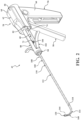
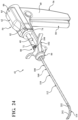
- the system 40 includes an introducer device 42 and an access cannula 44.
- the access cannula 44 includes a cannula hub 46, and a cannula shaft 48 extending from the cannula hub 46.
- the cannula shaft 48 includes a proximal end 50 coupled to the cannula hub 46, and a distal end 52 opposite the proximal end 50.
- the cannula shaft 48 may be straight and define a lumen (not identified) extending between the proximal and distal ends 50, 52 such that the cannula shaft 48 is tubular in shape.
- the cannula shaft 48 may be formed from biocompatible materials with sufficient mechanical properties to maintain integrity as the cannula shaft 48 is driven through the pedicle of the vertebra.
- the system 40 may include a trocar (not shown) removably positioned within the cannula shaft 48 during placement of the distal end 52 of the cannula shaft 48 into the vertebral body.
- the trocar may include a length slightly greater than a length of the cannula shaft 48 such that a sharp tip of the trocar pierces the cortical bone of the cortical rim, and the trocar prevents coring of tissue within the lumen of the cannula shaft 48.
- the access cannula 44 provides a working channel to within the interior region of the vertebral body along a longitudinal axis (LA) defined by the cannula shaft 48.
- the cannula hub 46 is exposed above the tissue overlying the vertebra, and configured to be engaged by the introducer device 42.
- the housing 56 also includes a frame 62 coupled to the handle 60.
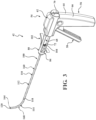
- Figures 1-3 show the frame 62 integrally formed with the handle 60 in a generally L-shaped arrangement.
- the housing 56 may be formed from mirrored housing shells 64, 66 joined together, which be manufactured from polymers, metals, composites, and combinations thereof.
- each of the housing shells 64, 66 may be injection molded so as to be low cost and disposable after a single use.
- the housing shells 64, 66 may at least partially define an interior of the housing 56 sized and shaped to accommodate several components of the actuator 54 to be described.
- the housing 56 may further include a barrel 68 extending distal to (or forward of) the frame 62.
- distal or distally refers to a direction away from the practitioner, and proximal or proximally refers to a direction towards the practitioner.
- the barrel 68 defines a bore in communication with the interior of the housing 56.
- a distal end 70 of the barrel 68 may define a distal end of the actuator 54, and a proximal end 72 of the barrel 68 may be defined by a transition surface 74 extending radially from the barrel 68.
- the engagement of the distal end 70 of the barrel 68 with the coupler 104 of the delivery cannula 100 prevents premature proximal movement of the delivery cannula 100 while the introducer device 42 is being placed within the vertebral body through the access cannula 44.
- the introducer device 42 includes a shaft 110 coupled to the actuator 54, and more particularly to the frame 62 of the handle 60.
- the shaft 110 includes a rigid proximal portion 112 and a flexible distal portion 114.
- Figures 4 and 5 show the proximal portion 112 of the shaft 110 extending through the bore of the barrel 68 to a position within the interior of the handle 60.
- the proximal portion 112 of the shaft 110 may be axially and rotationally fixed relative to the actuator 54.
- the proximal portion 112 may be defined between a proximal end 116 of the shaft 110, and an interface 118 between the proximal and distal portions 112, 114 of the shaft 110.
- the distal portion 114 may be defined between the interface 118 and a distal end 120 of the shaft 110 opposite the proximal end 116.
- a length of the shaft 110 may be defined between the proximal and distal ends 116, 120 with the length being sufficient for the shaft 110 to extend through and be operable beyond the distal end 52 of the access cannula 44 as shown in Figure 1 .
- the introducer device 42 is configured to be directed through the access cannula 44 to locations within the interior region of the vertebral body.
- the proximal portion 112 may include rigid material(s) with sufficient mechanical properties to avoid more than minimal flexure. Further, the proximal portion 112 may define a lumen 121 extending between the proximal end 116 of the shaft 110 and the interface 118 such that the proximal portion 112 is tubular in shape with the tubular geometry contributing to its relatively greater stiffness than the geometry of the distal portion 114.
- the distal portion 114 may include a proximal segment 122, a distal segment 124, and a flexing region 126 between the proximal and distal segments 122, 124.
- the proximal segment 122 includes a boss 128 disposed within a complementary bore 130 of the proximal portion 112 of the shaft 110.
- the engagement of the boss 128 and the bore 130 defines the interface 118 joining the proximal and distal portions 112, 114 of the shaft 110, and the joining may be facilitated through brazing, welding, adhesive, or other suitable joining process.
- the proximal segment 122 distal to the boss 128 may be tubular in shape with an outer diameter equal to that of the proximal portion 112 of the shaft 110 to provide a smooth transition across the interface 118.
- the distal segment 124 may also be tubular in shape with an outer diameter equal to that of the proximal segment 122.
- the distal segment 124 defines a channel 132 sized to receive a pulling element 150 of the introducer device 42 to be described.
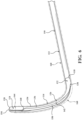
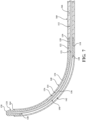
- the flexing region 126 includes a pre-set curve in an unconstrained state to define an inner curved surface 134 opposite an outer curved surface 136. More particularly, a taper 138, 140 at each of the opposing ends of the flexing region 126 define transitions from the flexing region 126 to the proximal and distal segments 122, 124.
- the tapers 138, 140 extend radially inward to form a cavity 142 in communication with the lumen 121 of the proximal portion 112.
- the cavity 142 may be considered an axial bifurcation of a curved segment of a tubular structure.
- the distal portion 114 may include a superelastic shape memory material such as a nickel titanium alloy (i.e., Nitinol).
- the superelastic shape memory material is formed to assume the pre-set curve such that, in the unconstrained state, the superelastic shape memory material moves the distal portion 114 of the shaft 110 upwardly away from the proximal portion 112 of the shaft 110.
- Figure 6 and 7 show the distal portion 114 oriented at an angle of approximately 90 degrees relative to the proximal portion 112.
- the pre-set curve may be designed within the range of approximately 50 to 150 degrees, and more particularly within the range of approximately 65 to 125 degrees, and even more particularly within the range of approximately 80 to 100 degrees. As to be described in greater detail, when the introducer device 42 is directed through the access cannula 44, the pre-set curve facilitates positioning the distal end 120 of the shaft 110 at a location within the vertebral body that is offset from the longitudinal axis.
- the introducer device 42 includes the pulling element 150 coupled to the actuator 54 and the shaft 110.
- the pulling element 150 is configured to be selectively tensioned to alter the extent of the pre-set curve.
- the pulling element 150 includes a proximal end 152 coupled to the actuator 54, and more particularly the control surface 58 of the actuator 54.
- the pulling element 150 may extend through an aperture (not identified) in the control surface 58 and secured proximal to the control surface 58 with an interference connector 78, for example a ferrule, nut, swaged sleeve, clamp, or other suitable connector.
- the connector 78 may be sized to movably ride within a slot defined by complementary pockets 76 in each of the housing shells 64, 66 (one identified in Figures 4 and 5 ).
- An input to the control surface 58 e.g., pulled towards the handle 60 urges the connector 78 proximally within the slot, thereby tensioning the pulling element 150.
- the pulling element 150 includes a distal end 154 opposite the proximal end 152 coupled at or near the distal end 120 of the shaft 110. As best shown in Figures 6 and 7 , the pulling element 150 extends through the lumen 121 of the proximal portion 112 of the shaft 110, along the outer curved surface 136 of the flexing region 126, and through the channel 132 of the distal segment 124.
- the distal end 154 may be coterminous with the distal end 120 of the shaft 110.
- the distal end 154 of the pulling element 150 may be joined at or near the distal end 120 of the shaft 110 through brazing, welding, adhesive, interference fit, or other suitable joining process.
- the pulling element 150 may be monolithic in construction and formed from a metal, polymer, composite, or combination thereof.
- the pulling element 150 may be a wire rope, a wire, a rod, and the like, of solid or hollow construction.
- the flexing region 126 includes the pre-set curve in the unconstrained state, which may include minimal or zero tension being exerted on the pulling element 150. It should be appreciated that some tension may be on the pulling element 150 in the unconstrained state.
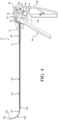
- the distal portion 114 of the shaft 110 is oriented, curved, bent, or angled relative to the proximal portion 112 of the shaft 110, as shown in Figures 4 , 6 and 7 .
- the input to the control surface 58 increases the tension on the pulling element 150 to move the pre-set curve to a constrained state in which the distal portion 114, and more particularly the flexing region 126, at least partially straightens.
- the constrained state may include more tension being exerted on the pulling element 150 than the unconstrained state.
- Figure 5 shows the pre-set curve in one example of the constrained state. In a manner to be described, moving the pre-set curve to the constrained state may be indicated for directing the introducer device 42 through and/or removing the introducer device 42 from the access cannula 44.
- the superelastic shape memory material of the distal portion 114 stores potential energy.
- the potential energy stored by the superelastic shape memory material is sufficient to overcome the tension on the pulling element 150 no longer constrained by the input.
- releasing the input to the control surface 58 relaxes ( i.e., reduces the tension on) the pulling element 150, and the pre-set curve moves from the constrained state to the unconstrained state in which the distal portion 114 of the shaft 110 orients, curves, bends, or angles relative to the proximal portion 112 of the shaft 110 to a greater extent than the constrained state.
- the pre-set curve moving from the constrained state to the unconstrained state may displace cancellous bone within the vertebral body, and/or position the distal end 120 of the shaft 110 at a target site that is offset from the longitudinal axis, as shown in Figure 1 .
- a direction of the orientation, curve, bend, or angle may correlate to indicia 79 disposed on a proximal side of the actuator 54, and more particularly the frame 62, thereby visible to the practitioner.
- the actuator 54 may include a locking mechanism 59 operably coupling the housing 56 and the control surface 58 and configured to permit selective locking of the control surface 58 in one of a plurality of positions.
- Figures 4 and 5 show one possible implementation of the locking mechanism 59 as a ratchet including a rack 61 coupled to the control surface 58 configured to engage a pawl 63 coupled to the housing 56.
- the rack 61 is shown as a protrusion extending proximally from the control surface 58 with a plurality of teeth disposed along an arcuate surface.
- the pawl 63 may be a cross-member extending between the housing shells 64, 66 and including an edge configured to releasably engage one of the plurality of teeth of the rack 61.
- Each of the teeth may correspond to one of the plurality of positions in which the control surface 58 may be locked relative to the housing 56. Actuating the locking mechanism 59 to lock the control surface 58 maintains the tension on the pulling element 150, and consequently an extent of the constrained state of the pre-set curve in the plurality of positions. Other possible constructions of the locking mechanism are contemplated.
- the introducer device 42 includes the delivery cannula 100, and the delivery cannula 100 includes a delivery hub 102, the coupler 104 on the delivery hub 102, and a flexible sheath 160 extending from the delivery hub 102.
- the sheath 160 overlies the shaft 110 of the introducer device 42 and, in manners to be further described, performs several functions of the vertebral augmentation, for example, providing a pathway for positioning of a balloon 206 and/or for the delivery of the curable material.
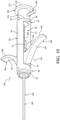
- the sheath 160 includes a proximal end 162 (see Figure 15 ) coupled to the delivery hub 102, and a distal end 164 opposite the proximal end 162 and configured to be positioned at or near the distal end 120 of the shaft 110.
- the distal end 164 of the sheath 160 is slightly proximal to the distal end 120 of the shaft 110.
- the sheath 160 may be tubular in shape and define a lumen 166 sized to slidably and snugly receive the shaft 110 and the pulling element 150. Owing to the presence of the cavity 142 of the flexing region 126, a slight gap may exist within the lumen 166 between the sheath 160 and the outer curved surface 136 of the distal portion 114 of the shaft 110.
- a length of the sheath 160 defined between the proximal and distal ends 162, 164 may be sufficient for the sheath 160 to extend through and be operable beyond the distal end 52 of the access cannula 44, as shown in Figure 1 .
- the sheath 160 is flexible and configured to conform to the shaft 110, and more particularly to the distal portion 114 of the shaft 110.
- the sheath 160 may be formed from a flexible biocompatible polymer having sufficient hoop strength such that the lumen 166 remains patent upon removal of the introducer device 42 from the sheath 160.
- Suitable flexible polymers include polypropylene, polyether ether ketone (PEEK), and the like.
- the sheath 160 may be formed from a flexible biocompatible metal, composite, and combinations thereof, with or without reinforcing features such as filament windings or braids.
- At least a distal portion 168 of the sheath 160 is configured to conform to the distal portion 114 of the shaft 110 as the pre-set curve is in the constrained state for insertion of the distal portion 114 and the distal portion 168 of the sheath 160 through the lumen of the access cannula 44 to within the vertebral body, and further configured to conform to the distal portion 114 of the shaft 110 as the pre-set curve is moved from the constrained state to the unconstrained state.
- Figure 1 shows the pre-set curve in the unconstrained state with the distal portion 114 of the sheath 160 conforming to the distal portion 114 of the shaft 110.
- the introducer device 42 is removable from the sheath 160 with the distal end 164 of the sheath 160 remaining positioned at the target site offset from the longitudinal axis.
- the aforementioned pathway(s) are achievable to contralateral locations within the vertebral body.
- the pathway(s) facilitate the remaining steps of the vertebral augmentation procedure to be described.
- the vertebra augmentation procedure may include directing an electrode assembly through the sheath 160 with the distal portion 114 of the sheath 160 remaining curved.
- One exemplary electrode assembly that is sufficiently flexible for navigating the curved distal portion 114 is described in United States Patent Publication No. 2013/0006232, published January 3, 2013 .
- the electrode assembly may be bipolar or monopolar. It is contemplated that the electrode assembly may be irrigated such that a fluid is infused into the adjacent tissue prior to and/or during ablation. It is further contemplated that the electrode assembly may be cooled, for example, by circulating a fluid within pathways internal to the electrode assembly. With the electrode assembly being deployed contralaterally, procedures such as intraosseous tumor ablation, basivertebral denervation, and the like, are achievable through a unipedicular approach.
- the vertebra augmentation procedure may include deploying an implant through the sheath 160 with the distal portion 114 of the sheath 160 remaining curved.
- an implant is described in commonly-owned United States Patent No. 7,846,206, issued December 17, 2010 , and commonly-owned United States Patent No. 8,986,386, issued March 24, 2015 .
- the implant may include an intervertebral spacer (i.e., a cage), a mesh bag, or the like, to be deployed within the intervertebral disc space or another appropriate anatomical location, respectively.
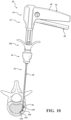
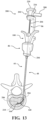
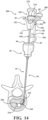
- a workflow of performing a vertebral augmentation with the system 40 will now be described with particular reference to Figure 8-11 , 13 , 14 and 20 .
- the vertebra with the offending vertebral body may be confirmed on fluoroscopic imaging. An incision may be made in the overlying paraspinal musculature lateral of midline generally in alignment with one of the pedicles of the vertebra.
- the distal end 52 of the access cannula 44, with the trocar disposed therein, is directed through the pedicle a position beyond the cortical rim and within the interior region of the vertebral body, and the trocar is removed.
- the access cannula 44 provides the working channel to within the interior region of the vertebral body along the longitudinal axis.
- the cannula hub 46 is exposed and configured to be engaged by the introducer device 42.
- the shaft 110 of the introducer device 42 has a length sufficient to extend through and be operable beyond the distal end 52 of the access cannula 44. Further, the length of the shaft 110 is fixed relative to the actuator 54. Thus, when the introducer device 42 is positioned in operable engagement with the cannula hub 46 of the access cannula 44, the shaft 110 having a fixed length extends beyond the distal end 52 of the cannula shaft 48, also having a fixed length, by a fixed distance. In other words, with the access cannula 44 secured to the vertebra, the cannula hub 46 may be at a fixed distance from the distal end 52 and serve as a datum for subsequently introduced instrumentation.
- the practitioner may be desirable for the practitioner to have the shaft 110 of the introducer device 42 extend beyond the distal end 52 of the access cannula 44 by a distance less than the fixed distance. To do so, the practitioner may manually retract the introducer device 42 proximally relative to the access cannula 44. The arrangement may require the practitioner to manually support and control the introducer device 42, perhaps for prolonged periods, which may be undesirable or unfeasible with deploying additional instrumentation.
- the system 40 of the present disclosure advantageously provides for the access cannula 44 being selectively adjustable such that the datum provided by the access cannula 44 may be selectively tuned.
- the practitioner may position the introducer device 42 in operable engagement with the cannula hub 46, as this is generally preferable, yet selectively control the distance of extension of the shaft 110 of the introducer device 42 from the distal end 52 of the access cannula 44.
- the access cannula 44 that is adjustable is an optional feature of the system 40, and more conventional access cannulas may also be utilized.
- the cannula hub 46 includes a shaft hub 47, a tuning hub 49, and complementary coupling features 51 movably coupling the tuning hub 49 to the shaft hub 47.
- the shaft hub 47 is rigidly coupled to the cannula shaft 48, and more particularly to the proximal end 50 of the cannula shaft 48.
- Each of the shaft hub 47 and the tuning hub 49 define bores (not identified) coaxially aligned with one another and with the lumen of the access cannula 44 for receiving an elongate member of instrumentation of the system 40, for example, the shaft 110 of the introducer device 42, the sheath 160 of the delivery cannula 100, and/or a balloon tube 204 of the expandable member assembly 200.
- the shaft hub 47 includes a proximally-directed surface 53, and owing to the cannula shaft 48 having a fixed length and being rigidly fixed to the cannula shaft 48, the proximally-directed surface 53 is at a fixed distance from the vertebral body when the distal end 52 of the cannula shaft 48 is positioned within the vertebral body. Thus, it may be considered that the proximally-directed surface 53 provides the datum previously mentioned.
- the tuning hub 49 is movably coupled to the shaft hub 47 with the coupling features 51. Figures 8 and 9 show the coupling features 51 including complementary threading.
- the tuning hub 49 may include a distally-directed surface 55, and an interference surface 57 opposite the distally-directed surface 55.
- the interference surface 57 in a broadest sense, is configured to be engaged by the instrumentation of the system 40, for example, the introducer device 42, the spacer hub 80, the delivery cannula 100, and/or the expandable member assembly 200.
- Figures 8 and 9 show the distal portion 84 of the spacer hub 80 engaging the interference surface 57.
- the interference surface 57 prevents distal movement of the instrument 42, 80, 100, 200 relative to the access cannula 44 while permitting proximal movement of the instrument 42, 80, 100, 200 relative to the access cannula 44.
- a distance from the interference surface 57 to the proximally-directed surface 53 providing the datum contributes to the distance by which the shaft 110 of the introducer device 42 extends from the distal end 52 of the access cannula 44.
- the tuning hub 49 is configured to be supported in a plurality of supported positions to facilitate selective adjustment of an axial position of the interference surface 57 of the tuning hub 49 relative to the datum.
- the tuning hub 49 may be in an initial position (not shown) in which the distally-directed surface 55 of the tuning hub 49 abuts the proximally-directed surface 53 of the shaft hub 47.
- the interference surface 57 of the tuning hub 49 is at a minimum distance from the datum in the initial position.
- the shaft 110 of the introducer device 42 extends from the distal end 52 of the access cannula 44 by an initial length, which may be resolved in an x-component along the longitudinal axis and a y-component perpendicular to the longitudinal axis.
- the initial distance may be a greatest length by which the shaft 110 of the introducer device 42 extends from the distal end 52 of the access cannula 44.
- the practitioner may selectively tune the access cannula 44 to selectively adjust the axial position of the interference surface 57 relative to the datum.
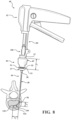
- the practitioner may proximally move the tuning hub 49 relative to the shaft hub 47 to a first position in which the interference surface 57 is at a first distance (d 1 ) from the datum provided by the shaft hub 47, as shown in Figure 8 .
- the selective adjustment of the interference surface 57 may be facilitated by the coupling features 51, for example the complementary threads, which move the tuning hub 49 relative to the shaft hub 47 upon receiving a twisting input from the practitioner.
- the shaft 110 of the introducer device 42 extends from the distal end 52 of the access cannula 44 by a first length, which may be resolved in the x-component (x 1 ) and the y-component (y 1 ).
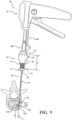
- the practitioner may proximally move the tuning hub 49 relative to the shaft hub 47 to a first supported position in which the interference surface 57 is at a second distance (d 2 ) from the datum provided by the shaft hub 47, as shown in Figure 9 .
- the shaft 110 of the introducer device 42 extends from the distal end 52 of the access cannula 44 by a second length, which may be resolved in the x-component (x 2 ) and the y-component (y 2 ). It is appreciated that that second length is less than the first length in each of the x- and y-components, as the second distance is greater than the first distance, which increases an overall length of the access cannula 44 defined between the interference surface 57 and the distal end 52.
- the instrument 42, 100, 200 may be the delivery cannula 100 including the delivery hub 102 and the sheath 160 extending from the delivery hub 102.
- Figures 8 and 9 show the delivery hub 102 abutting the distal portion 84 of the spacer hub 80, which is engaging the interference surface 57 of the tuning hub 49.
- the interference surface 57 may be selectively adjusted to move the distal end 164 of the sheath 160 relative to the distal end 52 of the access cannula 44.
- Figure 8 shows the distal end 164 of the sheath 160 at the first length, resolved in the x- and y-components (x 1 , y 1 ), with the interference surface 57 at the first distance (d 1 ) from the datum
- Figure 9 shows the distal end 164 of the sheath 160 at the second length, resolved in the x- and y-components (x 2 , y 2 ), with the interference surface 57 at the second distance (d 2 ) from the datum.
- the practitioner may enjoy the benefit of engaging the instrument 42, 100, 200 with the access cannula 44 (e.g., abutting, removably coupling, etc.), and achieving a desired length of extension of the instrument 42, 100, 200 from the distal end 52 of the access cannula 44 without needing to manually retract or support the instrument 42, 100, 200.
- the access cannula 44 e.g., abutting, removably coupling, etc.
- the introducer device 42 including the sheath 160, is directed through the access cannula 44 in the manner previously described.
- the introducer device 42 may be provided with the pre-set curve in the unconstrained state, and the distal portion 168 of the sheath 160 conforming to the pre-set curve.
- the superelastic shape memory material biases the distal portion 114 of the shaft 110, along with the distal portion 168 of the sheath 160, away from an axis of the proximal portion 112 of the shaft 110.
- the practitioner provides an input to the actuator 54, for example moving the control surface 58 towards the handle 60, to increase the tension the pulling element 150.
- the tensioning of the pulling element 150 moves the pre-set curved from the unconstrained state to the constrained state against the biasing force from the superelastic shape memory material.
- the pre-set curve at least partially straightens along with the distal portion 168 of the sheath 160. More particularly, the pre-set curve straightens to an extent that the distal portion 114 of the shaft 110 and the distal portion 168 of the sheath 160 may be directed through the lumen of the access cannula 44. It is understood that the distal portion 114 of the shaft 110 need not be entirely straight, as the access cannula 44 constrains the distal portion 114 as it is advanced therethrough.
- distal portion 114 of the shaft 110 should be straightened to an extent to permit ease with insertion of the shaft 110 and the sheath 160 along the lumen of the access cannula 44 as it is advanced therethrough.
- the pre-set curve may be selectively locked with the locking mechanism 59.
- the shaft 110 of the introducer device 42 and the sheath 160 of the delivery cannula 100 are directed through the access cannula 44 in the constrained state.
- Another input is provided to the actuator 54, which may be considered removal of the earlier input.
- the removal of the input may be performed quickly or in a controlled manner.
- the pulling element 150 is relaxed, and/or the tension on the pulling element 150 is reduced.
- the superelastic shape memory material releases the stored potential energy to move the pre-set curve from the constrained state to the unconstrained state.
- the removal of the input may be performed when the distal end 120 of the shaft 110 is at least substantially in registration with the distal end 52 of the access cannula 44.
- the pre-set curve may not be constrained from the pulling element 150 but otherwise constrained from the cannula shaft 48 of the access cannula 44.
- the introducer device 42 and the sheath 160 are advanced distally relative to the access cannula 44 to position the distal portion 114 of the shaft 110 and the distal portion 168 of the sheath 160 within the interior of the vertebral body.
- any number of subsequent inputs may be provided to the control surface 58 to selectively adjust the curvature of the distal portion 114 of the shaft 110 and the distal portion 168 of the sheath 160, and multiple inputs may be provided for creating a cavity of a desired shape within the interior region of the vertebral body.
- relative positions between the radiopaque markers 170 may be viewable on the x-ray imaging to determine a curvature of the distal portion 168 of the sheath 160.
- utilizing the lateral and A/P x-ray imaging in tandem in the aforementioned manner facilitates visually ascertaining and/or confirming intraoperatively the position and/or the curvature of the distal portion 168 of the sheath 160 within the interior region of the vertebral body, particularly in three-dimensions.
- the lateral x-ray images provide the practitioner with precise positional information in the cranial (CR) and anterior (A) directions, and additional deducible information in the lateral (L) direction ( i.e., based on practicioner experience assessing the relative positions between the radiopaque markers 170).
- the A/P x-ray images provide the practitioner with precise positional information in the cranial (CR) and lateral (L) directions, and additional deducible information in the anterior (A) direction.
- the practitioner is able to view the x-ray image set on the display 172 and readily ascertain the position and/or curvature of the distal portion 168 of the sheath 160 within the interior region of the vertebral body.
- the spacer hub 80 includes a distal portion 84 configured to engage the cannula hub 46, and more particularly the tuning hub 49, as shown in Figure 1 .
- the distal portion 84 may include a boss 85 sized to be seated within a complementary cavity in the cannula hub 46 (see Figures 18 and 19 ).
- Each of the distal portion 84 and the cannula hub 46 may include complementary coupling features (not shown), for example a releasable detent, configured to removably couple the spacer hub 80 to the access cannula 44.
- the spacer hub 80 further includes the proximal portion 82 configured to be engaged by the balloon hub 202, as best shown in Figures 13-15 .
- the syringe-style input may include one of the first control surfaces 107 is engaged by the index finger of the practitioner, the other one of the first control surfaces 107 being engaged by the middle finger of the practitioner, and the second control surface 220 being engaged by the thumb of the practitioner.
- the arrangement and ergonomics may be similar to the medical syringe, and thus the arrangement is intuitive to the practitioner.
- the syringe-style input may include the thumb maintaining the position of the expandable member assembly 200 while at least one finger actuates first the control surface 107 to draw the delivery hub 102 towards the balloon hub 202.
- Constraining the delivery hub 102 from rotation prevents the sheath 160 from correspondingly rotating within the vertebral body, which may prevent kinking of the sheath 160 and/or prevent the sheath 160 from deviating from its existing path or curvature. Further, the wings 106 remaining in a fixed rotational position may instill confidence to the practitioner that the curvature of the distal portion 168 of the sheath 160 is correspondingly fixed.
- the spacer hub 80 may be configured to pivot for exposing the coupler 104 of the delivery hub 102 for coupling of a cement delivery system 230 to be described.
- the spacer hub 80 may include a pivot 95 pivotably coupling the distal portion 84 to the proximal portion 82.
- Each of the proximal and distal portions 82, 84 may include a surface 94 a , 94 b collectively forming the side 94 of the spacer hub 80.
- the pivot 95 couples the surfaces 94 a, 94 b such that, when the spacer hub 80 is provided between a first position shown in Figure 17 and a second position shown in Figure 19 , the proximal portion 82 articulates in a direction away from the void space 86.
- the spacer hub 80 may be generally U-shaped when in the first position with the surfaces 94 a, 94 b generally aligned, for example coplanar.
- the proximal portion 82 may substantially inverted and the surfaces 94 a, 94 b are parallel.
- the cement delivery system 230 may include a housing 232, a first control surface 234 coupled to the housing, and a second control surface 236 coupled to the housing 232.
- the first and second control surfaces 234, 236 are configured to receive inputs from the practitioner. For example, a rotational input to the first control surface 234 with one hand of the practitioner may advance a piston (not shown) with a chamber 238 to urge the curable material through the system 230.
- An input to the second control surface 236 with the other hand of the practitioner may be required to permit advancement of the piston, and release of the input to the second control surface 236 may act as a "dead man's switch" for ceasing distal movement of the piston (and permitting proximal movement of the piston).
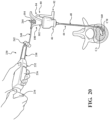
- the cement delivery system 230 may include an extension tube 240 is adapted to be coupled to the coupler 104 of the delivery cannula 100, as shown in Figure 20 .
- the extension tube 240 includes a proximal coupler 242 coupled to the chamber 238, and a distal coupler 244 coupled to the coupler 104.
- the arrangement establishes communication between the chamber 238 and the sheath 160 of the delivery cannula 100.
- One or both of the proximal and distal couplers 242, 244 may be pivotable, and additional segments of tubing may be provided. Further construction of the extension tube 240 is disclosed in the aforementioned United States Provisional Patent Application No. 62/656,033 .
- the spacer hub 80 is moved from the first position to the second position.
- the distal coupler 244 of the extension tube 240 may be coupled to the coupler 104 of the delivery cannula 100, and the cement delivery system 230 operated to direct the curable material (CM) from the chamber 238 through the delivery hub 102, through the sheath 160 including the distal portion 168 in the curve configuration, and into the cavity (CA) within the interior region of the vertebral body.
- the sheath 160 may be proximally retracting while the curable material is being delivered so as to move the distal end 164 of the sheath 160 and locate the entry point of the curable material as desired.
- the spacer hub 80 may be returned from the second position to the first position to facilitate the practitioner utilizing the syringe-style input previously described.
- the delivery cannula 100 is removed from the access cannula 44.
- the trocar may be reintroduced through the access cannula 44, and the access cannula 44 and trocar removed from the vertebral body.
- the overlying tissue may be sutured.
- FIG. 23 shows the introducer device 250 in a first or slack configuration
- Figure 24 shows the introducer device 250 in a second or tensioned configuration.
- the distal portion 114 of the shaft 110 includes a plurality of links 252 interconnected to one another and configured to articulate relative to one another.
- a system for augmenting a vertebral body includes an introducer device includes an actuator configured to receive an input from a user, a shaft including a rigid proximal portion coupled to the actuator and defining a proximal end of the shaft and a flexible distal portion including a pre-set curve in an unconstrained state, and a pulling element coupled to the actuator and to the shaft at or near the distal end with the pulling element extending along at least a portion of the pre-set curve, wherein tension on the pulling element is configured to be increased in response to the input to provided to the actuator to move the pre-set curve from the unconstrained state to a constrained state in which the flexible distal portion at least partially straightens, and wherein the tension on the pulling element is configured to be reduced to the unconstrained state to position the distal end of the shaft within the vertebral body at a target site that is offset from the longitudinal axis; a flexible sheath at least partially overlying the shaft with the flexible sheath having a distal end
- the system may include a biasing element operably coupled to the pulling element and the actuator with the biasing element configured to be at least initially in a stressed state to bias the pulling element to the constrained state, wherein the biasing element is further configured to relax in response to the input to provided to the actuator to facilitate altering the tension on the pulling element to permit the flexible distal portion to move to the unconstrained state.
- the biasing element may be, for example, a compression spring.
- the compression spring may be in the stressed state, for example, stretched relative to its natural length. The forces from the compression spring are sufficient to overcome the forces associated with the pre-set curve biased towards the unconstrained state such that the compression spring maintains the pre-set curve in the constrained state in which the flexible distal portion at least mostly straight.
- the compressing spring may be relaxed such that the tension on the pulling element is reduced, and the pre-set curve moves from the constrained state to the unconstrained state.
Landscapes
- Health & Medical Sciences (AREA)
- Life Sciences & Earth Sciences (AREA)
- Surgery (AREA)
- Orthopedic Medicine & Surgery (AREA)
- Medical Informatics (AREA)
- General Health & Medical Sciences (AREA)
- Biomedical Technology (AREA)
- Heart & Thoracic Surgery (AREA)
- Nuclear Medicine, Radiotherapy & Molecular Imaging (AREA)
- Molecular Biology (AREA)
- Animal Behavior & Ethology (AREA)
- Engineering & Computer Science (AREA)
- Public Health (AREA)
- Veterinary Medicine (AREA)
- Pathology (AREA)
- Dentistry (AREA)
- Oral & Maxillofacial Surgery (AREA)
- Surgical Instruments (AREA)
- Prostheses (AREA)
Claims (10)
- System (40) zur Vergrößerung eines Wirbelkörpers, wobei das System (40) Folgendes umfasst:eine Zugangskanüle (44), die eine Kanülennabe (46) und einen Kanülenschaft (48) umfasst, der sich von der Kanülennabe (46) erstreckt, wobei der Kanülenschaft (48) ein distales Ende (52) umfasst, das innerhalb des Wirbelkörpers positionierbar ist und ein Lumen entlang einer Längsachse (LA) definiert;eine Einführungsvorrichtung (42), umfassend:einen Aktuator (54), der so konfiguriert ist, dass er eine Eingabe von einem Benutzer empfängt;einen Schaft (110), umfassend einen starren proximalen Abschnitt (112), der mit dem Aktuator (54) gekoppelt ist und ein proximales Ende (116) des Schafts (110) definiert, und einen flexiblen distalen Abschnitt (114), wobei der Schaft ein distales Ende (120) umfasst und eine Länge des Schafts (110) zwischen dem proximalen Ende (116) und dem distalen Ende (120) ausreicht, damit sich der Schaft (110) durch das distale Ende (52) der Zugangskanüle (44) hindurch erstreckt und jenseits davon operabel ist; undein Zugelement (150), das mit dem Aktuator (54) und mit dem Schaft (110) am oder in der Nähe des distalen Endes (120) gekoppelt ist; undeine flexible Hülle (160), die zumindest teilweise über dem Schaft (110) liegt, wobei die flexible Hülle (160) ein distales Ende (614) umfasst, das in der Nähe des distalen Endes (120) des Schafts (110) positioniert werden kann, so dass die flexible Hülle (160) so konfiguriert ist, dass sie sich durch das distale Ende (52) der Zugangskanüle (44) hindurch erstreckt und jenseits davon operabel ist, dadurch gekennzeichnet, dassder flexible distale Abschnitt (114) des Schafts (110) in einem unbelasteten Zustand eine voreingestellte Krümmung aufweist,das Zugelement (150) sich entlang mindestens eines Abschnitts der voreingestellten Krümmung erstreckt, wobei der Aktuator (54) so konfiguriert ist, dass er die Spannung an dem Zugelement (150) als Reaktion auf eine Benutzereingabe ändert, und das Zugelement (150) als Reaktion auf die Änderung der Spannung an dem Zugelement (150) so konfiguriert ist, dass es die voreingestellte Krümmung zwischen dem unbelasteten Zustand und einem belasteten Zustand bewegt, in dem sich der flexible distale Abschnitt (114) mindestens teilweise begradigt, undwobei ein distaler Abschnitt (168) der flexiblen Hülle (160) so konfiguriert ist, dass er sich an den flexiblen distalen Abschnitt (114) anpasst, wenn die voreingestellte Krümmung zwischen dem belasteten Zustand und dem unbelasteten Zustand bewegt wird, und wobei die Einführungsvorrichtung (42) von der flexiblen Hülle (160) entfernt werden kann, wobei das distale Ende (164) von der flexiblen Hülle (160) so konfiguriert ist, dass es an der Zielstelle versetzt von der Längsachse (LA) bleibt.
- System (40) nach Anspruch 1, ferner umfassend ein Vorspannelement, das funktionsfähig mit dem Zugelement (150) und dem Aktuator (54) verbunden ist, wobei das Vorspannelement so konfiguriert ist, dass es sich zumindest anfänglich in einem gespannten Zustand befindet, um das Zugelement (150) in den belasteten Zustand vorzuspannen, wobei das Vorspannelement ferner so konfiguriert ist, dass es sich in Reaktion auf die dem Aktuator zugeführte Eingabe entspannt, um die Änderung der Spannung an dem Zugelement (150) zu erleichtern, damit sich der flexible distale Abschnitt (114) in den unbelasteten Zustand bewegen kann.
- System (40) nach Anspruch 1, wobei der Aktuator (54) so konfiguriert ist, dass er die Spannung auf das Zugelement (150) als Reaktion auf eine Benutzereingabe erhöht, und wobei das Zugelement (150) als Reaktion auf die Erhöhung der Spannung auf das Zugelement (150) so konfiguriert ist, dass es die voreingestellte Krümmung aus dem unbelasteten Zustand in einen belasteten Zustand bewegt, in dem sich der flexible distale Abschnitt (114) zumindest teilweise begradigt, und wobei der Aktuator (54) so konfiguriert ist, dass er die Spannung auf das Zugelement (150) reduziert, um die Bewegung der voreingestellten Krümmung aus dem belasteten Zustand in den unbelasteten Zustand zu erleichtern, um das distale Ende (120) des Schafts (110) innerhalb des Wirbelkörpers an einer Zielstelle zu positionieren, die von der Längsachse (LA) versetzt ist.
- System (40) nach Anspruch 3, wobei die voreingestellte Krümmung eine innere gekrümmte Fläche (134) gegenüber einer äußeren gekrümmten Fläche (136) definiert, wobei sich das Zugelement (150) zumindest entlang eines Teils der äußeren gekrümmten Fläche (136) erstreckt.
- System (40) nach einem der Ansprüche 3 und 4, ferner umfassend eine ausdehnbare Baugruppe (200), die eine Ballonnabe (202), die an eine Fluidquelle angeschlossen werden kann, einen Ballonschlauch (204), der sich von der Ballonnabe (202) erstreckt und so bemessen ist, dass er gleitend in die flexible Hülle (160) eingeführt werden kann, und einen Ballon (206), der mit einem distalen Ende des Ballonschlauchs (204) gekoppelt und so konfiguriert ist, dass er mit Fluid aus der Fluidquelle aufgeblasen wird, um spongiösen Knochen innerhalb des Wirbelkörpers zu verschieben, umfasst, wobei der Schlauch (204) eine solche Länge aufweist, dass der Ballon (206) in der Nähe des distalen Endes (164) der flexiblen Hülle (160) positioniert ist, wenn der Ballonschlauch (204) gleitend in die flexible Hülle (160) eingeführt ist.
- System (40) nach Anspruch 5, ferner umfassend eine Abstandsnabe (80), die so konfiguriert ist, dass sie die proximale Bewegung der flexiblen Hülle (160) relativ zu der Zugangskanüle (44) und der ausdehnbaren Baugruppe (200) erleichtert, um den Ballon (206) innerhalb des Wirbelkörpers durch eine spritzenartige Eingabe durch einen Benutzer freizulegen, die Abstandsnabe (80) umfassend einen distalen Abschnitt (84), der in die Kanülennabe (46) eingreift, und einen proximalen Abschnitt (82), der von dem distalen Abschnitt (84) beabstandet ist und in die Ballonnabe (204) mit einer Zuführungsnabe (102) einer Zuführungskanüle (100) der Einführungsvorrichtung (42) eingreift, die so konfiguriert ist, dass sie beweglich zwischen dem distalen und dem proximalen Abschnitt (84, 82) angeordnet ist.
- System (40) nach einem der Ansprüche 3 bis 6, wobei die Kanülennabe (46) ferner eine starr mit dem Kanülenschaft (48) gekoppelte Schaftnabe (47) zum Bereitstellen eines Bezugspunkts und eine beweglich mit der Schaftnabe (47) gekoppelte Abstimmnabe (49) mit einer Interferenzfläche (57) umfasst, wobei eine Bewegung der Abstimmnabe (49) relativ zu der Schaftnabe (47) so konfiguriert ist, dass sie die selektive Einstellung der axialen Position der Interferenzfläche (57) relativ zu dem Bezugspunkt erleichtert.
- System (40) nach Anspruch 7, wobei sowohl die Schaftnabe (47) als auch die Abstimmnabe (49) ein komplementäres Gewinde aufweisen, um eine selektive Einstellung der Interferenzfläche (57) durch eine Dreheingabe des Benutzers zu ermöglichen.
- System (40) nach einem der Ansprüche 3 bis 8, ferner umfassend mindestens zwei röntgenopake Marker (170), die auf dem distalen Abschnitt (168) der flexiblen Hülle (160) angeordnet und voneinander beabstandet sind, so dass, wenn der distale Abschnitt (168) innerhalb des Wirbelkörpers gekrümmt wird, relative Positionen zwischen den mindestens zwei röntgenopaken Markern (170) auf einer Röntgenaufnahme sichtbar sind, um ein Ausmaß der Krümmung zu bestimmen.
- System (40) nach einem der Ansprüche 3 bis 9, wobei die Einführungsvorrichtung (42) ferner ein Gehäuse (56) und einen Verriegelungsmechanismus (59) umfasst, der das Gehäuse (56) und den Aktuator (54) funktionsfähig koppelt, wobei der Verriegelungsmechanismus (59) so konfiguriert ist, dass er ein selektives Verriegeln des Aktuators (54) in einer von einer Vielzahl von Positionen ermöglicht.
Priority Applications (1)
| Application Number | Priority Date | Filing Date | Title |
|---|---|---|---|
| EP25162483.9A EP4545014A3 (de) | 2019-04-24 | 2020-04-20 | Systeme zur ausseraxialen verstärkung eines wirbelkörpers |
Applications Claiming Priority (2)
| Application Number | Priority Date | Filing Date | Title |
|---|---|---|---|
| US201962837930P | 2019-04-24 | 2019-04-24 | |
| PCT/US2020/028989 WO2020219392A2 (en) | 2019-04-24 | 2020-04-20 | Systems and methods for off-axis augmentation of a vertebral body |
Related Child Applications (1)
| Application Number | Title | Priority Date | Filing Date |
|---|---|---|---|
| EP25162483.9A Division EP4545014A3 (de) | 2019-04-24 | 2020-04-20 | Systeme zur ausseraxialen verstärkung eines wirbelkörpers |
Publications (2)
| Publication Number | Publication Date |
|---|---|
| EP3958752A2 EP3958752A2 (de) | 2022-03-02 |
| EP3958752B1 true EP3958752B1 (de) | 2025-03-12 |
Family
ID=70614655
Family Applications (2)
| Application Number | Title | Priority Date | Filing Date |
|---|---|---|---|
| EP20724685.1A Active EP3958752B1 (de) | 2019-04-24 | 2020-04-20 | Systeme zur ausseraxialen verstärkung eines wirbelkörpers |
| EP25162483.9A Pending EP4545014A3 (de) | 2019-04-24 | 2020-04-20 | Systeme zur ausseraxialen verstärkung eines wirbelkörpers |
Family Applications After (1)
| Application Number | Title | Priority Date | Filing Date |
|---|---|---|---|
| EP25162483.9A Pending EP4545014A3 (de) | 2019-04-24 | 2020-04-20 | Systeme zur ausseraxialen verstärkung eines wirbelkörpers |
Country Status (3)
| Country | Link |
|---|---|
| US (3) | US11849986B2 (de) |
| EP (2) | EP3958752B1 (de) |
| WO (1) | WO2020219392A2 (de) |
Families Citing this family (26)
| Publication number | Priority date | Publication date | Assignee | Title |
|---|---|---|---|---|
| US10390877B2 (en) | 2011-12-30 | 2019-08-27 | Relievant Medsystems, Inc. | Systems and methods for treating back pain |
| AU2013337680B2 (en) | 2012-11-05 | 2019-04-18 | Relievant Medsystems, Inc. | Systems and methods for creating curved paths through bone and modulating nerves within the bone |
| DE102019105438A1 (de) * | 2019-03-04 | 2020-09-10 | Jürgen Kress | Endoskop mit Schnellwechselschläuchen |
| EP3958752B1 (de) | 2019-04-24 | 2025-03-12 | Stryker Corporation | Systeme zur ausseraxialen verstärkung eines wirbelkörpers |
| WO2020243386A1 (en) * | 2019-05-30 | 2020-12-03 | Devicor Medical Products, Inc. | Shape memory marker deployment device |
| WO2021050767A1 (en) | 2019-09-12 | 2021-03-18 | Relievant Medsystems, Inc. | Systems and methods for tissue modulation |
| EP4054460A4 (de) * | 2019-11-05 | 2022-12-07 | Sirona Medical Technologies, Inc. | Multimodaler katheter zur verbesserten elektrischen abbildung und ablation |
| AU2021306313A1 (en) | 2020-07-10 | 2023-03-02 | Relievant Medsystems, Inc. | Vertebral denervation in conjunction with vertebral fusion |
| US12082876B1 (en) | 2020-09-28 | 2024-09-10 | Relievant Medsystems, Inc. | Introducer drill |
| EP4268150A4 (de) | 2020-12-22 | 2024-12-18 | Relievant Medsystems, Inc. | Vorhersage von kandidaten für die spinale neuromodulation |
| US12433668B1 (en) | 2021-11-08 | 2025-10-07 | Relievant Medsystems, Inc. | Impedance stoppage mitigation during radiofrequency tissue ablation procedures |
| USD1065528S1 (en) * | 2022-03-21 | 2025-03-04 | MFr Technologies, Inc. | Orthopedic surgical instrument |
| USD1104262S1 (en) * | 2022-03-23 | 2025-12-02 | Stryker Corporation | Surgical introducer |
| US20260026858A1 (en) * | 2024-07-26 | 2026-01-29 | Relievant Medsystems, Inc. | Steerable assembly for treating a vertebral body |
| EP4717210A1 (de) | 2024-09-25 | 2026-04-01 | In Life Vet Sa | Expandierbares knochenimplantat für die veterinäre orthopädische chirurgie, orthopädisches system und verfahren zur herstellung des implantats |
| EP4717205A1 (de) | 2024-09-25 | 2026-04-01 | Lock-In VCF SA | Expandierbares knochenimplantat für die menschliche orthopädische chirurgie, orthopädisches system und verfahren zur herstellung des implantats |
| EP4717207A1 (de) | 2024-09-25 | 2026-04-01 | Lock-In VCF SA | Instrumente für die orthopädische chirurgie zur installation von expandierbaren knochenimplantaten |
| EP4717211A1 (de) | 2024-09-25 | 2026-04-01 | In Life Vet Sa | Expandierbares knochenimplantat für die veterinäre orthopädische chirurgie, orthopädisches system und verfahren zur herstellung des implantats |
| EP4717208A1 (de) | 2024-09-25 | 2026-04-01 | Lock-In VCF SA | Expandierbares knochenimplantat für die menschliche orthopädische chirurgie, orthopädisches system und verfahren zur herstellung des implantats |
| EP4717200A1 (de) | 2024-09-25 | 2026-04-01 | In Life Vet Sa | Expandierbares knochenimplantat, orthopädisches system und verfahren zur herstellung des implantats |
| EP4717199A1 (de) | 2024-09-25 | 2026-04-01 | Lock-In VCF SA | Expandierbares knochenimplantat für die menschliche orthopädische chirurgie und orthopädisches system |
| EP4717206A1 (de) | 2024-09-25 | 2026-04-01 | Lock-In VCF SA | Expandierbares knochenimplantat für die menschliche orthopädische chirurgie, orthopädisches system und verfahren zur herstellung des implantats |
| EP4717212A1 (de) | 2024-09-25 | 2026-04-01 | In Life Vet Sa | Expandierbares knochenimplantat für die veterinäre orthopädische chirurgie, orthopädisches system und verfahren zur herstellung des implantats |
| EP4717201A1 (de) | 2024-09-25 | 2026-04-01 | In Life Vet Sa | Expandierbares knochenimplantat für die veterinäre orthopädische chirurgie, orthopädisches system und verfahren zur herstellung des implantats |
| EP4717198A1 (de) | 2024-09-25 | 2026-04-01 | Lock-In VCF SA | Expandierbares knochenimplantat für die menschliche orthopädische chirurgie, orthopädisches system und verfahren zur herstellung des implantats |
| EP4717209A1 (de) | 2024-09-25 | 2026-04-01 | In Life Vet Sa | Expandierbares knochenimplantat für die veterinäre orthopädische chirurgie, orthopädisches system und verfahren zur herstellung des implantats |
Family Cites Families (262)
| Publication number | Priority date | Publication date | Assignee | Title |
|---|---|---|---|---|
| US3320957A (en) | 1964-05-21 | 1967-05-23 | Sokolik Edward | Surgical instrument |
| US4326530A (en) | 1980-03-05 | 1982-04-27 | Fleury Jr George J | Surgical snare |
| US4607626A (en) | 1984-06-18 | 1986-08-26 | German Borodulin | Expandable urethral bougie comprising bendable rods with reciprocating driver |
| US4748969A (en) * | 1987-05-07 | 1988-06-07 | Circon Corporation | Multi-lumen core deflecting endoscope |
| DE3840466A1 (de) | 1988-12-01 | 1990-06-07 | Lieke Michael | Spezial-fraeser zur anwendung in der implantattechnik |
| US4947827A (en) * | 1988-12-30 | 1990-08-14 | Opielab, Inc. | Flexible endoscope |
| US4969888A (en) | 1989-02-09 | 1990-11-13 | Arie Scholten | Surgical protocol for fixation of osteoporotic bone using inflatable device |
| CA2007210C (en) | 1989-05-10 | 1996-07-09 | Stephen D. Kuslich | Intervertebral reamer |
| US5295980A (en) | 1989-10-30 | 1994-03-22 | Ersek Robert A | Multi-use cannula system |
| US5891088A (en) | 1990-02-02 | 1999-04-06 | Ep Technologies, Inc. | Catheter steering assembly providing asymmetric left and right curve configurations |
| US5209749A (en) | 1990-05-11 | 1993-05-11 | Applied Urology Inc. | Fluoroscopically alignable cutter assembly and method of using the same |
| US5292330A (en) | 1990-05-31 | 1994-03-08 | Linvatec Corporation | Retractable surgical instrument with curved operative element |
| US5269785A (en) | 1990-06-28 | 1993-12-14 | Bonutti Peter M | Apparatus and method for tissue removal |
| US5242461A (en) | 1991-07-22 | 1993-09-07 | Dow Corning Wright | Variable diameter rotating recanalization catheter and surgical method |
| CA2075241A1 (en) | 1991-10-03 | 1993-04-04 | Stephen W. Gerry | Handle for manipulating a laparoscopic tool |
| US5387215A (en) | 1992-02-12 | 1995-02-07 | Sierra Surgical Inc. | Surgical instrument for cutting hard tissue and method of use |
| WO1993019679A1 (en) | 1992-04-07 | 1993-10-14 | The Johns Hopkins University | A percutaneous mechanical fragmentation catheter system |
| DE59308494D1 (de) | 1992-08-03 | 1998-06-10 | Targor Gmbh | Verfahren zur Herstellung eines Olefinpolymers unter Verwendung von Metallocenen mit speziell substituierten Indenylliganden |
| US5224488A (en) | 1992-08-31 | 1993-07-06 | Neuffer Francis H | Biopsy needle with extendable cutting means |
| US5306272A (en) | 1992-11-02 | 1994-04-26 | Neuro Navigational Corporation | Advancer for surgical instrument |
| US5282821A (en) | 1993-01-26 | 1994-02-01 | Donahue John R | Adjustable surgical instrument |
| US5476495A (en) | 1993-03-16 | 1995-12-19 | Ep Technologies, Inc. | Cardiac mapping and ablation systems |
| US5327906A (en) | 1993-04-28 | 1994-07-12 | Medtronic, Inc. | Steerable stylet handle |
| US5501654A (en) | 1993-07-15 | 1996-03-26 | Ethicon, Inc. | Endoscopic instrument having articulating element |
| US5575810A (en) | 1993-10-15 | 1996-11-19 | Ep Technologies, Inc. | Composite structures and methods for ablating tissue to form complex lesion patterns in the treatment of cardiac conditions and the like |
| US6248110B1 (en) | 1994-01-26 | 2001-06-19 | Kyphon, Inc. | Systems and methods for treating fractured or diseased bone using expandable bodies |
| US5885299A (en) | 1994-09-15 | 1999-03-23 | Surgical Dynamics, Inc. | Apparatus and method for implant insertion |
| US5591170A (en) | 1994-10-14 | 1997-01-07 | Genesis Orthopedics | Intramedullary bone cutting saw |
| US5814044A (en) | 1995-02-10 | 1998-09-29 | Enable Medical Corporation | Apparatus and method for morselating and removing tissue from a patient |
| US5860995A (en) | 1995-09-22 | 1999-01-19 | Misener Medical Co. Inc. | Laparoscopic endoscopic surgical instrument |
| US5709697A (en) | 1995-11-22 | 1998-01-20 | United States Surgical Corporation | Apparatus and method for removing tissue |
| US5695513A (en) * | 1996-03-01 | 1997-12-09 | Metagen, Llc | Flexible cutting tool and methods for its use |
| US5826576A (en) | 1996-08-08 | 1998-10-27 | Medtronic, Inc. | Electrophysiology catheter with multifunction wire and method for making |
| US5695515A (en) | 1996-12-26 | 1997-12-09 | Orejola; Wilmo C. | Mitral valve dilator |
| CA2280117A1 (en) | 1997-02-12 | 1998-08-13 | Prolifix Medical, Inc. | Apparatus for removal of material from stents |
| US5843103A (en) | 1997-03-06 | 1998-12-01 | Scimed Life Systems, Inc. | Shaped wire rotational atherectomy device |
| US20060271061A1 (en) | 2001-07-25 | 2006-11-30 | Disc-O-Tech, Ltd. | Deformable tools and implants |
| US5944690A (en) | 1997-03-17 | 1999-08-31 | C.R. Bard, Inc. | Slidable control mechanism for steerable catheter |
| US5873817A (en) * | 1997-05-12 | 1999-02-23 | Circon Corporation | Endoscope with resilient deflectable section |
| US5899914A (en) * | 1997-06-11 | 1999-05-04 | Endius Incorporated | Surgical instrument |
| AU8507398A (en) | 1997-07-24 | 1999-02-16 | James F. Mcguckin Jr. | Breast surgery method and apparatus |
| US6626903B2 (en) | 1997-07-24 | 2003-09-30 | Rex Medical, L.P. | Surgical biopsy device |
| US6056743A (en) | 1997-11-04 | 2000-05-02 | Scimed Life Systems, Inc. | Percutaneous myocardial revascularization device and method |
| US6036682A (en) | 1997-12-02 | 2000-03-14 | Scimed Life Systems, Inc. | Catheter having a plurality of integral radiopaque bands |
| US6468279B1 (en) | 1998-01-27 | 2002-10-22 | Kyphon Inc. | Slip-fit handle for hand-held instruments that access interior body regions |
| US6659105B2 (en) | 1998-02-26 | 2003-12-09 | Senorx, Inc. | Tissue specimen isolating and damaging device and method |
| US6344026B1 (en) | 1998-04-08 | 2002-02-05 | Senorx, Inc. | Tissue specimen encapsulation device and method thereof |
| US6540693B2 (en) | 1998-03-03 | 2003-04-01 | Senorx, Inc. | Methods and apparatus for securing medical instruments to desired locations in a patients body |
| US6331166B1 (en) | 1998-03-03 | 2001-12-18 | Senorx, Inc. | Breast biopsy system and method |
| US6454727B1 (en) | 1998-03-03 | 2002-09-24 | Senorx, Inc. | Tissue acquisition system and method of use |
| US5928239A (en) | 1998-03-16 | 1999-07-27 | University Of Washington | Percutaneous surgical cavitation device and method |
| US6440138B1 (en) | 1998-04-06 | 2002-08-27 | Kyphon Inc. | Structures and methods for creating cavities in interior body regions |
| US6059739A (en) | 1998-05-29 | 2000-05-09 | Medtronic, Inc. | Method and apparatus for deflecting a catheter or lead |
| US6027462A (en) | 1998-07-30 | 2000-02-22 | Medtronic, Inc. | Method and apparatus for deflecting a screw-in-lead |
| US6440147B1 (en) | 1998-09-03 | 2002-08-27 | Rubicor Medical, Inc. | Excisional biopsy devices and methods |
| US6022362A (en) | 1998-09-03 | 2000-02-08 | Rubicor Medical, Inc. | Excisional biopsy devices and methods |
| US6036698A (en) | 1998-10-30 | 2000-03-14 | Vivant Medical, Inc. | Expandable ring percutaneous tissue removal device |
| EP1054703B1 (de) * | 1998-12-09 | 2004-09-15 | Cook Incorporated | Super-elastische gebogene hohlnadel zur medizinischen verwendung |
| US6224604B1 (en) | 1999-07-30 | 2001-05-01 | Loubert Suddaby | Expandable orthopedic drill for vertebral interbody fusion techniques |
| US6425919B1 (en) | 1999-08-18 | 2002-07-30 | Intrinsic Orthopedics, Inc. | Devices and methods of vertebral disc augmentation |
| US6821276B2 (en) | 1999-08-18 | 2004-11-23 | Intrinsic Therapeutics, Inc. | Intervertebral diagnostic and manipulation device |
| US7081122B1 (en) * | 1999-10-19 | 2006-07-25 | Kyphon Inc. | Hand-held instruments that access interior body regions |
| US6440062B1 (en) | 1999-11-10 | 2002-08-27 | Asahi Kogaku Kogyo Kabushiki Kaisha | Control wire driving mechanism for use in endoscope |
| US6319257B1 (en) | 1999-12-20 | 2001-11-20 | Kinamed, Inc. | Inserter assembly |
| US6383188B2 (en) | 2000-02-15 | 2002-05-07 | The Spineology Group Llc | Expandable reamer |
| US20070260270A1 (en) | 2000-02-16 | 2007-11-08 | Trans1 Inc. | Cutter for preparing intervertebral disc space |
| US6790210B1 (en) * | 2000-02-16 | 2004-09-14 | Trans1, Inc. | Methods and apparatus for forming curved axial bores through spinal vertebrae |
| US6575979B1 (en) | 2000-02-16 | 2003-06-10 | Axiamed, Inc. | Method and apparatus for providing posterior or anterior trans-sacral access to spinal vertebrae |
| US7014633B2 (en) | 2000-02-16 | 2006-03-21 | Trans1, Inc. | Methods of performing procedures in the spine |
| US6899716B2 (en) | 2000-02-16 | 2005-05-31 | Trans1, Inc. | Method and apparatus for spinal augmentation |
| US6558390B2 (en) | 2000-02-16 | 2003-05-06 | Axiamed, Inc. | Methods and apparatus for performing therapeutic procedures in the spine |
| US20030191474A1 (en) | 2000-02-16 | 2003-10-09 | Cragg Andrew H. | Apparatus for performing a discectomy through a trans-sacral axial bore within the vertebrae of the spine |
| US6673071B2 (en) | 2000-02-24 | 2004-01-06 | Vandusseldorp Gregg A. | Partial ablation procedure and device therefor |
| US6358251B1 (en) | 2000-03-21 | 2002-03-19 | University Of Washington | Method and apparatus for forming a cavity in soft tissue or bone |
| US20010031981A1 (en) | 2000-03-31 | 2001-10-18 | Evans Michael A. | Method and device for locating guidewire and treating chronic total occlusions |
| ES2262642T3 (es) | 2000-04-05 | 2006-12-01 | Kyphon Inc. | Dispositivo para el tratamiento de huesos fracturados y/o enfermos. |
| US6491681B1 (en) | 2000-04-06 | 2002-12-10 | Scimed Life Systems, Inc. | Handle for use with steerable device for introducing diagnostic and therapeutic elements into the body |
| US6663602B2 (en) | 2000-06-16 | 2003-12-16 | Novo Nordisk A/S | Injection device |
| US20020068974A1 (en) | 2000-07-21 | 2002-06-06 | Kuslich Stephen D. | Expandable porous mesh bag device and methods of use for reduction, filling, fixation and supporting of bone |
| AU8485701A (en) | 2000-08-11 | 2002-02-25 | Sdgi Holdings Inc | Surgical instrumentation and method for treatment of the spine |
| US7114501B2 (en) | 2000-08-14 | 2006-10-03 | Spine Wave, Inc. | Transverse cavity device and method |
| US6679886B2 (en) | 2000-09-01 | 2004-01-20 | Synthes (Usa) | Tools and methods for creating cavities in bone |
| US6805675B1 (en) | 2000-09-12 | 2004-10-19 | Medtronic, Inc. | Method and apparatus for deflecting a screw-in lead |
| DE60140558D1 (de) * | 2000-10-25 | 2009-12-31 | Kyphon S A R L | Systeme zur reposition von gebrochenen knochen mittels einer kanüle zur reponierung von knochenfrakturen |
| US6663588B2 (en) | 2000-11-29 | 2003-12-16 | C.R. Bard, Inc. | Active counterforce handle for use in bidirectional deflectable tip instruments |
| JP4588906B2 (ja) | 2001-03-13 | 2010-12-01 | オリンパス株式会社 | 内視鏡用採取具 |
| US6575978B2 (en) | 2001-04-05 | 2003-06-10 | Spineology, Inc. | Circumferential resecting reamer tool |
| US6647281B2 (en) | 2001-04-06 | 2003-11-11 | Scimed Life Systems, Inc. | Expandable diagnostic or therapeutic apparatus and system for introducing the same into the body |
| ATE373449T1 (de) | 2001-04-27 | 2007-10-15 | Bard Inc C R | Handgriffdesign für einen medizinischen katheter |
| US6746451B2 (en) | 2001-06-01 | 2004-06-08 | Lance M. Middleton | Tissue cavitation device and method |
| US6814734B2 (en) | 2001-06-18 | 2004-11-09 | Sdgi Holdings, Inc, | Surgical instrumentation and method for forming a passage in bone having an enlarged cross-sectional portion |
| US6547432B2 (en) | 2001-07-16 | 2003-04-15 | Stryker Instruments | Bone cement mixing and delivery device for injection and method thereof |
| CA2454375A1 (en) * | 2001-07-17 | 2003-01-30 | Yale University | Tunneler-needle combination for tunneled catheter placement |
| US6632231B2 (en) | 2001-08-23 | 2003-10-14 | Scimed Life Systems, Inc. | Segmented balloon catheter blade |
| US7736336B2 (en) * | 2001-09-13 | 2010-06-15 | Allegiance Corporation | Paracentesis device having multiple detachable components |
| US6585734B2 (en) | 2001-09-17 | 2003-07-01 | Melvin Levinson | Tissue cutting and retrieval device and method |
| US6939352B2 (en) | 2001-10-12 | 2005-09-06 | Cordis Corporation | Handle deployment mechanism for medical device and method |
| US6866669B2 (en) | 2001-10-12 | 2005-03-15 | Cordis Corporation | Locking handle deployment mechanism for medical device and method |
| US7604611B2 (en) | 2001-10-19 | 2009-10-20 | C.R. Bard, Inc. | Handle thumb wheel mechanism which maintains holding forces when sterilized and when engaged |
| US9320503B2 (en) | 2001-11-28 | 2016-04-26 | Medtronic Vascular, Inc. | Devices, system, and methods for guiding an operative tool into an interior body region |
| US6676668B2 (en) | 2001-12-12 | 2004-01-13 | C.R. Baed | Articulating stone basket |
| US6913594B2 (en) | 2001-12-31 | 2005-07-05 | Biosense Webster, Inc. | Dual-function catheter handle |
| US6726690B2 (en) | 2002-01-17 | 2004-04-27 | Concept Matrix, Llc | Diskectomy instrument and method |
| US7699849B2 (en) | 2002-01-17 | 2010-04-20 | Concept Matrix, Llc | Diskectomy instrument with disposable blade head |
| GB0203177D0 (en) | 2002-02-11 | 2002-03-27 | Anson Medical Ltd | An improved control mechanism for medical catheters |
| US6796989B2 (en) | 2002-05-06 | 2004-09-28 | Renan Uflacker | Intraluminal cutter for vascular, biliary and other applications |
| US6840944B2 (en) | 2002-05-21 | 2005-01-11 | Loubert Suddaby | Vertebral body end plate cutter |
| US7153315B2 (en) | 2002-06-11 | 2006-12-26 | Boston Scientific Scimed, Inc. | Catheter balloon with ultrasonic microscalpel blades |
| US7004947B2 (en) | 2002-06-24 | 2006-02-28 | Endius Incorporated | Surgical instrument for moving vertebrae |
| US7993351B2 (en) * | 2002-07-24 | 2011-08-09 | Pressure Products Medical Supplies, Inc. | Telescopic introducer with a compound curvature for inducing alignment and method of using the same |
| US8361067B2 (en) * | 2002-09-30 | 2013-01-29 | Relievant Medsystems, Inc. | Methods of therapeutically heating a vertebral body to treat back pain |
| US7575571B2 (en) | 2002-10-29 | 2009-08-18 | Medtronic, Inc. | Indexing cell delivery catheter |
| AU2003230740B2 (en) | 2002-11-08 | 2008-10-09 | Warsaw Orthopedic, Inc. | Transpedicular intervertebral disk access methods and devices |
| US7828804B2 (en) | 2002-11-08 | 2010-11-09 | Warsaw Orthopedic, Inc. | Transpedicular intervertebral disk access methods and devices |
| US7329267B2 (en) | 2002-12-23 | 2008-02-12 | Boston Scientific Scimed, Inc. | Medical cutting devices and methods of use |
| WO2004060175A1 (en) | 2002-12-27 | 2004-07-22 | The Cleveland Clinic Foundation | Articulatable apparatus for cutting bone |
| US6849084B2 (en) | 2002-12-31 | 2005-02-01 | Intek Technology L.L.C. | Stent delivery system |
| EP2329778A3 (de) | 2003-01-31 | 2012-06-20 | Spinalmotion, Inc. | Anzeige für die Wirbelsäulenmittellinie |
| US6875219B2 (en) | 2003-02-14 | 2005-04-05 | Yves P. Arramon | Bone access system |
| US7131981B2 (en) | 2003-03-25 | 2006-11-07 | Angiodynamics, Inc. | Device and method for converting a balloon catheter into a cutting balloon catheter |
| JP2006523542A (ja) | 2003-04-17 | 2006-10-19 | セカント メディカル エルエルシー | 展開可能な切削刃を備えた工具 |
| WO2005018507A2 (en) * | 2003-07-18 | 2005-03-03 | Ev3 Santa Rosa, Inc. | Remotely activated mitral annuloplasty system and methods |
| US7226451B2 (en) | 2003-08-26 | 2007-06-05 | Shluzas Alan E | Minimally invasive access device and method |
| EP1663029A4 (de) | 2003-09-03 | 2010-06-09 | Kyphon Sarl | Vorrichtungen zur erzeugung von hohlräumen in inneren körperregionen und relevante verfahren |
| DE202004021947U1 (de) | 2003-09-12 | 2013-05-13 | Vessix Vascular, Inc. | Auswählbare exzentrische Remodellierung und/oder Ablation von atherosklerotischem Material |
| US7993384B2 (en) | 2003-09-12 | 2011-08-09 | Abbott Cardiovascular Systems Inc. | Delivery system for medical devices |
| US7758625B2 (en) | 2003-09-12 | 2010-07-20 | Abbott Vascular Solutions Inc. | Delivery system for medical devices |
| US7967829B2 (en) | 2003-10-09 | 2011-06-28 | Boston Scientific Scimed, Inc. | Medical device delivery system |
| JP2007516738A (ja) | 2003-10-23 | 2007-06-28 | トランスワン インコーポレイティッド | 背骨に対して最小の侵入処理を行うための道具及び道具キット |
| US7682358B2 (en) | 2003-10-30 | 2010-03-23 | Medtronic, Inc. | Steerable catheter |
| US20050113836A1 (en) | 2003-11-25 | 2005-05-26 | Lozier Antony J. | Expandable reamer |
| US7641664B2 (en) | 2004-02-12 | 2010-01-05 | Warsaw Orthopedic, Inc. | Surgical instrumentation and method for treatment of a spinal structure |
| US8784421B2 (en) | 2004-03-03 | 2014-07-22 | Boston Scientific Scimed, Inc. | Apparatus and methods for removing vertebral bone and disc tissue |
| US20050197661A1 (en) | 2004-03-03 | 2005-09-08 | Scimed Life Systems, Inc. | Tissue removal probe with sliding burr in cutting window |
| US7959634B2 (en) | 2004-03-29 | 2011-06-14 | Soteira Inc. | Orthopedic surgery access devices |
| AU2004319780A1 (en) | 2004-05-19 | 2005-11-24 | Sintea Biotech S.P.A | Intravertebral widening device, injection device, and kit and method for kyphoplasty |
| US20050261692A1 (en) | 2004-05-21 | 2005-11-24 | Scimed Life Systems, Inc. | Articulating tissue removal probe and methods of using the same |
| FR2871366A1 (fr) | 2004-06-09 | 2005-12-16 | Ceravic Soc Par Actions Simpli | Implant expansible prothetique osseux |
| EP1773205A2 (de) | 2004-06-16 | 2007-04-18 | Warsaw Orthopedic, Inc. | Chirurgische instrumente für die reparatur von wirbelkörpern |
| CN100518482C (zh) | 2004-07-26 | 2009-07-22 | 株式会社日立制作所 | 部件追踪管理装置、管理方法及管理程序 |
| US20060085005A1 (en) | 2004-10-01 | 2006-04-20 | Kenealy James N Iii | Bone drill system with highly visible depth markings |
| US7555343B2 (en) * | 2004-10-15 | 2009-06-30 | Baxano, Inc. | Devices and methods for selective surgical removal of tissue |
| US7682378B2 (en) | 2004-11-10 | 2010-03-23 | Dfine, Inc. | Bone treatment systems and methods for introducing an abrading structure to abrade bone |
| US8562607B2 (en) | 2004-11-19 | 2013-10-22 | Dfine, Inc. | Bone treatment systems and methods |
| US8858495B2 (en) | 2004-12-28 | 2014-10-14 | St. Jude Medical, Atrial Fibrillation Division, Inc. | Five degree of freedom ultrasound catheter and catheter control handle |
| US20060195106A1 (en) | 2005-02-02 | 2006-08-31 | Jones Bryan S | Ultrasonic cutting device |
| US20060184192A1 (en) | 2005-02-11 | 2006-08-17 | Markworth Aaron D | Systems and methods for providing cavities in interior body regions |
| JP4976370B2 (ja) | 2005-03-07 | 2012-07-18 | パチェコ,ヘクター,オー. | 後湾形成、椎骨形成、椎体生検、またはスクリューの配置のための椎体に進入する改良されたシステムおよび方法 |
| DE602006005674D1 (de) | 2005-07-06 | 2009-04-23 | Vascular Pathways Inc | Gerät zur intravenösen kathetereinführung und verwendungsverfahren |
| US20070010844A1 (en) * | 2005-07-08 | 2007-01-11 | Gorman Gong | Radiopaque expandable body and methods |
| US8021366B2 (en) | 2005-07-11 | 2011-09-20 | Kyphon Sarl | Axial load limiting system and methods |
| US20070021835A1 (en) | 2005-07-11 | 2007-01-25 | Edidin Avram A | Systems and methods for providing prostheses |
| US20070006692A1 (en) | 2005-07-11 | 2007-01-11 | Phan Christopher U | Torque limiting device |
| US20070149990A1 (en) | 2005-07-11 | 2007-06-28 | Palmer Erika I | Apparatus and methods of tissue removal within a spine |
| KR20080074847A (ko) | 2005-07-11 | 2008-08-13 | 메드트로닉 스파인 엘엘씨 | 큐레트 시스템 |
| US7591828B2 (en) * | 2005-07-22 | 2009-09-22 | Ethicon Endo-Surgery, Inc. | Resposable anastomotic ring applier device |
| US7666226B2 (en) | 2005-08-16 | 2010-02-23 | Benvenue Medical, Inc. | Spinal tissue distraction devices |
| US20070055259A1 (en) | 2005-08-17 | 2007-03-08 | Norton Britt K | Apparatus and methods for removal of intervertebral disc tissues |
| EP1915113B1 (de) | 2005-08-17 | 2010-03-03 | C.R. Bard, Inc. | Stentabgabesystem mit variabler geschwindigkeit |
| US20070067034A1 (en) | 2005-08-31 | 2007-03-22 | Chirico Paul E | Implantable devices and methods for treating micro-architecture deterioration of bone tissue |
| US20070118144A1 (en) | 2005-09-01 | 2007-05-24 | Csaba Truckai | Systems for sensing retrograde flows of bone fill material |
| US20070123889A1 (en) | 2005-10-14 | 2007-05-31 | Malandain Hugues F | Mechanical cavity-creation surgical device and methods and kits for using such devices |
| US7799035B2 (en) | 2005-11-18 | 2010-09-21 | Carefusion 2200, Inc. | Device, system and method for delivering a curable material into bone |
| US8690884B2 (en) | 2005-11-18 | 2014-04-08 | Carefusion 2200, Inc. | Multistate-curvature device and method for delivering a curable material into bone |
| US7713273B2 (en) | 2005-11-18 | 2010-05-11 | Carefusion 2200, Inc. | Device, system and method for delivering a curable material into bone |
| US10702285B2 (en) | 2005-12-20 | 2020-07-07 | Quantum Medical Innovations, LLC | Method and apparatus for performing minimally invasive arthroscopic procedures |
| US20070270863A1 (en) | 2006-04-20 | 2007-11-22 | Sdgi Holdings, Inc. | Devices and methods for contouring an intervertebral space between vertebral members |
| US7615044B2 (en) | 2006-05-03 | 2009-11-10 | Greatbatch Ltd. | Deflectable sheath handle assembly and method therefor |
| US7959642B2 (en) | 2006-05-16 | 2011-06-14 | Ethicon Endo-Surgery, Inc. | Medical instrument having a needle knife |
| US8465491B2 (en) | 2006-06-01 | 2013-06-18 | Osteo Innovations Llc | Bone drill |
| US8480673B2 (en) | 2006-06-01 | 2013-07-09 | Osteo Innovations Llc | Cavity creation device and methods of use |
| US20070293947A1 (en) | 2006-06-19 | 2007-12-20 | Mansmann Kevin A | Multi-part implants for combined repair of hyaline and meniscal cartilage in joints |
| US20080009877A1 (en) | 2006-07-07 | 2008-01-10 | Meera Sankaran | Medical device with expansion mechanism |
| US7686809B2 (en) | 2006-09-25 | 2010-03-30 | Stryker Spine | Rod inserter and rod with reduced diameter end |
| WO2008045329A2 (en) | 2006-10-06 | 2008-04-17 | Stryker Corporation | Bone cement mixing and delivery system and method |
| US7879041B2 (en) * | 2006-11-10 | 2011-02-01 | Illuminoss Medical, Inc. | Systems and methods for internal bone fixation |
| US20080114364A1 (en) | 2006-11-15 | 2008-05-15 | Aoi Medical, Inc. | Tissue cavitation device and method |
| EP1923083A1 (de) | 2006-11-17 | 2008-05-21 | Sanofi-Aventis Deutschland GmbH | Antriebsmechanismen für Medikamentenabgabevorrichtungen |
| US20070276392A1 (en) | 2007-01-09 | 2007-11-29 | Disc-O-Tech Medical Technologies Ltd | Soft Tissue to Bone Fixation |
| EP2124778B1 (de) | 2007-02-21 | 2019-09-25 | Benvenue Medical, Inc. | Vorrichtungen zur wirbelsäulenbehandlung |
| KR20090125778A (ko) | 2007-02-22 | 2009-12-07 | 스파인 뷰 인코포레이티드 | 확장형 회전 장치 및 조직 흡인 방법 |
| US8353911B2 (en) | 2007-05-21 | 2013-01-15 | Aoi Medical, Inc. | Extendable cutting member |
| US7935082B2 (en) | 2007-09-27 | 2011-05-03 | Biosense Webster, Inc. | Control handle with device advancing mechanism |
| US8142441B2 (en) | 2008-10-16 | 2012-03-27 | Aesculap Implant Systems, Llc | Surgical instrument and method of use for inserting an implant between two bones |
| US20090131886A1 (en) | 2007-11-16 | 2009-05-21 | Liu Y King | Steerable vertebroplasty system |
| US20090299282A1 (en) | 2007-11-16 | 2009-12-03 | Osseon Therapeutics, Inc. | Steerable vertebroplasty system with a plurality of cavity creation elements |
| US20090131867A1 (en) | 2007-11-16 | 2009-05-21 | Liu Y King | Steerable vertebroplasty system with cavity creation element |
| US7842040B2 (en) * | 2008-01-18 | 2010-11-30 | Illuminoss Medical, Inc. | Internal bone fixation system with integrated mixer |
| JP5105605B2 (ja) | 2008-01-22 | 2012-12-26 | 富士フイルム株式会社 | 内視鏡 |
| US20090198272A1 (en) | 2008-02-06 | 2009-08-06 | Lawrence Kerver | Method and apparatus for articulating the wrist of a laparoscopic grasping instrument |
| US20090210046A1 (en) | 2008-02-20 | 2009-08-20 | Abbott Laboratories | Handle assembly for a delivery system |
| US20090270862A1 (en) | 2008-04-25 | 2009-10-29 | Greg Arcenio | Medical device with one-way rotary drive mechanism |
| US20090270893A1 (en) | 2008-04-25 | 2009-10-29 | Greg Arcenio | Medical device for tissue disruption with serrated expandable portion |
| US20090270892A1 (en) | 2008-04-25 | 2009-10-29 | Greg Arcenio | Steerable medical device for tissue disruption |
| US20090287236A1 (en) | 2008-05-16 | 2009-11-19 | Ethicon Endo-Surgery, Inc. | Endoscopic rotary access needle |
| WO2009155319A1 (en) | 2008-06-17 | 2009-12-23 | Soteira, Inc. | Devices and methods for fracture reduction |
| US8246627B2 (en) | 2008-08-07 | 2012-08-21 | Stryker Corporation | Cement delivery device for introducing cement into tissue, the device having a cavity creator |
| WO2010039894A1 (en) | 2008-09-30 | 2010-04-08 | Dfine, Inc. | System for use in treatment of vertebral fractures |
| US8758349B2 (en) | 2008-10-13 | 2014-06-24 | Dfine, Inc. | Systems for treating a vertebral body |
| US8083687B2 (en) | 2008-12-18 | 2011-12-27 | Devicor Medical Products, Inc. | Tissue biopsy device with rotatably linked thumbwheel and tissue sample holder |
| US20100160819A1 (en) | 2008-12-18 | 2010-06-24 | Parihar Shailendra K | Biopsy Device with Central Thumbwheel |
| US20100160921A1 (en) | 2008-12-19 | 2010-06-24 | Arthrocare Corporation | Cancellous bone displacement system and methods of use |
| AU2009341783B2 (en) | 2009-03-12 | 2014-11-13 | Stryker European Operations Limited | Apparatus for bone restoration of the spine and methods of use |
| US9254123B2 (en) | 2009-04-29 | 2016-02-09 | Hansen Medical, Inc. | Flexible and steerable elongate instruments with shape control and support elements |
| US20100298832A1 (en) * | 2009-05-20 | 2010-11-25 | Osseon Therapeutics, Inc. | Steerable curvable vertebroplasty drill |
| US8372082B2 (en) | 2009-07-30 | 2013-02-12 | Kyphon Sarl | Surgical apparatus with force limiting clutch |
| US9005209B2 (en) | 2009-07-30 | 2015-04-14 | Kyphon Sarl | High pressure surgical system |
| US20110098759A1 (en) | 2009-10-28 | 2011-04-28 | Kyphon Sarl | Expandable device for bone manipulation |
| US8894658B2 (en) * | 2009-11-10 | 2014-11-25 | Carefusion 2200, Inc. | Apparatus and method for stylet-guided vertebral augmentation |
| EP2501297B1 (de) | 2009-11-17 | 2021-04-07 | Cook Medical Technologies LLC | Ablenkbare biopsievorrichtung |
| US20110184447A1 (en) | 2010-01-26 | 2011-07-28 | Warsaw Orthopedic, Inc. | Surgical cutting tool and method |
| US8292889B2 (en) | 2010-02-26 | 2012-10-23 | Tyco Healthcare Group Lp | Drive mechanism for articulation of a surgical instrument |
| US10058336B2 (en) | 2010-04-08 | 2018-08-28 | Dfine, Inc. | System for use in treatment of vertebral fractures |
| WO2011137357A1 (en) | 2010-04-29 | 2011-11-03 | Dfine, Inc. | System for use in treatment of vertebral fractures |
| CN106618669B (zh) * | 2010-04-29 | 2019-11-12 | Dfine有限公司 | 用于治疗椎骨骨折的系统 |
| WO2012027581A2 (en) | 2010-08-27 | 2012-03-01 | Massachusetts Institute Of Technology | Tip actuated disposable endoscope |
| EP2438954B1 (de) | 2010-10-08 | 2016-12-28 | Greatbatch Ltd. | Bidirektionaler Katheterlenkgriff |
| US9308013B2 (en) | 2010-11-03 | 2016-04-12 | Gyrus Ent, L.L.C. | Surgical tool with sheath |
| US9320535B2 (en) | 2010-11-15 | 2016-04-26 | Spine View, Inc. | Tissue removal system with retention mechanism |
| US9649116B2 (en) | 2010-11-22 | 2017-05-16 | Dfine, Inc. | System for use in treatment of vertebral fractures |
| CA2824058A1 (en) * | 2011-01-10 | 2012-07-19 | Spotlight Technology Partners Llc | Apparatus and methods for accessing and treating a body cavity, lumen, or ostium |
| BR112013022976A2 (pt) | 2011-03-11 | 2016-12-06 | Smith & Nephew Inc | instrumento de corte |
| US9308001B2 (en) | 2011-03-18 | 2016-04-12 | Carlos Andres Rodriguez | Vertebral cavitation surgical tool |
| WO2012178018A2 (en) | 2011-06-24 | 2012-12-27 | Benvenue Medical, Inc. | Devices and methods for treating bone tissue |
| US20130012958A1 (en) | 2011-07-08 | 2013-01-10 | Stanislaw Marczyk | Surgical Device with Articulation and Wrist Rotation |
| US9351751B2 (en) | 2011-07-08 | 2016-05-31 | Covidien Lp | Swinging bars with axial wheels to drive articulating cables |
| US9119639B2 (en) | 2011-08-09 | 2015-09-01 | DePuy Synthes Products, Inc. | Articulated cavity creator |
| CN103957825B (zh) | 2011-10-13 | 2018-12-07 | 阿瑟罗迈德公司 | 粥样斑块切除装置、系统和方法 |
| US20130150831A1 (en) | 2011-12-13 | 2013-06-13 | Symmetry Medical New Bedford, Inc | System and method for an articulating distal end of an endoscopic medical device |
| CA3201083A1 (en) | 2012-06-20 | 2013-12-27 | Stryker Corporation | Systems and methods for off-axis tissue manipulation |
| EP2892437A4 (de) | 2012-09-07 | 2016-06-15 | Basel S Hassoun | Verbessertes chirurgisches instrument |
| US10588691B2 (en) * | 2012-09-12 | 2020-03-17 | Relievant Medsystems, Inc. | Radiofrequency ablation of tissue within a vertebral body |
| AU2013337680B2 (en) * | 2012-11-05 | 2019-04-18 | Relievant Medsystems, Inc. | Systems and methods for creating curved paths through bone and modulating nerves within the bone |
| US9687281B2 (en) * | 2012-12-20 | 2017-06-27 | Illuminoss Medical, Inc. | Distal tip for bone fixation devices |
| FR3000700B1 (fr) | 2013-01-10 | 2015-02-27 | Herakles | Revetement anti-foudre |
| US9504479B2 (en) | 2013-03-11 | 2016-11-29 | Eca Medical Instruments | Co-axial hot swappable system for minimally invasive medical procedures |
| WO2014162441A1 (ja) | 2013-04-01 | 2014-10-09 | テルモ株式会社 | 作動部材、および医療器具 |
| CA2914820A1 (en) | 2013-05-20 | 2014-11-27 | Medrobotics Corporation | Articulating surgical instruments and method of deploying the same |
| CN105392433B (zh) * | 2013-08-05 | 2019-02-19 | 库克医学技术有限责任公司 | 具有可释放管状构件的医疗装置及其使用方法 |
| US10271830B2 (en) | 2013-09-09 | 2019-04-30 | Lenkbar, Llc | Surgical navigation instrument |
| CA2927436C (en) | 2013-10-15 | 2022-04-26 | Stryker Corporation | Device for creating a void space in living tissue, the device including a handle with a control knob that can be set regardless of the orientation of the handle |
| JP6276961B2 (ja) | 2013-10-18 | 2018-02-07 | テルモ株式会社 | 医療用処置具 |
| JP6372734B2 (ja) | 2013-10-24 | 2018-08-15 | Tdk株式会社 | 生体センサ検査装置および検査方法 |
| ITFI20130277A1 (it) | 2013-11-19 | 2015-05-20 | Fiab S P A | Manipolatore per cateteri o cannule ad uso medicale. |
| CN103690228B (zh) | 2013-12-12 | 2015-11-25 | 宁波华科润生物科技有限公司 | 椎体扩张球囊系统 |
| US9821097B2 (en) | 2014-06-27 | 2017-11-21 | Merit Medical Systems, Inc. | Body cavity drainage devices including drainage tubes having inline portions and related methods |
| US9649415B2 (en) | 2014-06-27 | 2017-05-16 | Harrison M. Lazarus | Surgical kits for body cavity drainage and related methods |
| US10314605B2 (en) * | 2014-07-08 | 2019-06-11 | Benvenue Medical, Inc. | Apparatus and methods for disrupting intervertebral disc tissue |
| US9730707B2 (en) | 2014-08-20 | 2017-08-15 | Kyphon SÀRL | Surgical instrument with graduated markings correlating to angulation |
| ES2929779T3 (es) | 2014-09-18 | 2022-12-01 | Omniguide Inc | Pieza de mano laparoscópica para guías de ondas |
| US10820923B2 (en) | 2016-05-16 | 2020-11-03 | Biosense Webster (Israel) Ltd. | Insertion tube with deflectable tip |
| WO2017212321A1 (en) | 2016-06-10 | 2017-12-14 | Gyrus Acmi, Inc. | Control mechanism for medical device |
| US10932845B2 (en) | 2017-04-27 | 2021-03-02 | Ethicon Llc | Detent feature for articulation control in surgical instrument |
| WO2018218084A2 (en) * | 2017-05-26 | 2018-11-29 | Pan Medical Us Corporation | Kyphoplasty device and method |
| US10842448B2 (en) | 2017-06-30 | 2020-11-24 | Surgentec Llc | Device and method for determining proper screw or implant size during orthopedic surgery |
| WO2019030848A1 (ja) | 2017-08-09 | 2019-02-14 | オリンパス株式会社 | 処置具 |
| WO2019200091A1 (en) | 2018-04-11 | 2019-10-17 | Stryker Corporation | Curable material dispensing system and methods of operating and packaging the same |
| US11766524B2 (en) * | 2019-04-08 | 2023-09-26 | Jasperate, Inc. | Device and method for high-control-steerable tip needles having rudder/keel and tip steering/angle changing means |
| EP3958752B1 (de) | 2019-04-24 | 2025-03-12 | Stryker Corporation | Systeme zur ausseraxialen verstärkung eines wirbelkörpers |
| US11191575B2 (en) * | 2019-06-07 | 2021-12-07 | Stryker Corporation | Systems and methods for off-axis augmentation of a vertebral body |
| KR102757360B1 (ko) | 2020-02-03 | 2025-01-21 | 보스톤 싸이엔티픽 싸이메드 인코포레이티드 | 조종 가능한 회전 지혈 클립 |
| WO2022009094A1 (en) | 2020-07-08 | 2022-01-13 | Baylis Medical Company Inc. | Steerable medical device, handle for a medical device, and method for operating a medical device |
-
2020
- 2020-04-20 EP EP20724685.1A patent/EP3958752B1/de active Active
- 2020-04-20 US US17/603,148 patent/US11849986B2/en active Active
- 2020-04-20 WO PCT/US2020/028989 patent/WO2020219392A2/en not_active Ceased
- 2020-04-20 EP EP25162483.9A patent/EP4545014A3/de active Pending
-
2023
- 2023-11-16 US US18/511,157 patent/US12279799B2/en active Active
-
2025
- 2025-03-19 US US19/084,095 patent/US20250213284A1/en active Pending
Also Published As
| Publication number | Publication date |
|---|---|
| EP3958752A2 (de) | 2022-03-02 |
| US20220192722A1 (en) | 2022-06-23 |
| US20250213284A1 (en) | 2025-07-03 |
| US11849986B2 (en) | 2023-12-26 |
| US20240081883A1 (en) | 2024-03-14 |
| EP4545014A2 (de) | 2025-04-30 |
| WO2020219392A3 (en) | 2020-12-10 |
| EP4545014A3 (de) | 2025-06-25 |
| US12279799B2 (en) | 2025-04-22 |
| WO2020219392A2 (en) | 2020-10-29 |
Similar Documents
| Publication | Publication Date | Title |
|---|---|---|
| US12279799B2 (en) | Systems and methods for off-axis treatment of a vertebral body | |
| EP4497402B1 (de) | Systeme zur verstärkung eines wirbelkörpers | |
| US12465400B2 (en) | Systems for off-axis treatment of a vertebral body | |
| EP4275616B1 (de) | Systeme zur ausseraxialen verstärkung eines wirbelkörpers | |
| US11723697B2 (en) | Patient-mounted surgical support | |
| US10292716B2 (en) | Devices and methods for vertebrostenting |
Legal Events
| Date | Code | Title | Description |
|---|---|---|---|
| STAA | Information on the status of an ep patent application or granted ep patent |
Free format text: STATUS: UNKNOWN |
|
| STAA | Information on the status of an ep patent application or granted ep patent |
Free format text: STATUS: THE INTERNATIONAL PUBLICATION HAS BEEN MADE |
|
| PUAI | Public reference made under article 153(3) epc to a published international application that has entered the european phase |
Free format text: ORIGINAL CODE: 0009012 |
|
| STAA | Information on the status of an ep patent application or granted ep patent |
Free format text: STATUS: REQUEST FOR EXAMINATION WAS MADE |
|
| 17P | Request for examination filed |
Effective date: 20211007 |
|
| AK | Designated contracting states |
Kind code of ref document: A2 Designated state(s): AL AT BE BG CH CY CZ DE DK EE ES FI FR GB GR HR HU IE IS IT LI LT LU LV MC MK MT NL NO PL PT RO RS SE SI SK SM TR |
|
| DAV | Request for validation of the european patent (deleted) | ||
| DAX | Request for extension of the european patent (deleted) | ||
| GRAP | Despatch of communication of intention to grant a patent |
Free format text: ORIGINAL CODE: EPIDOSNIGR1 |
|
| STAA | Information on the status of an ep patent application or granted ep patent |
Free format text: STATUS: GRANT OF PATENT IS INTENDED |
|
| INTG | Intention to grant announced |
Effective date: 20241010 |
|
| RAP3 | Party data changed (applicant data changed or rights of an application transferred) |
Owner name: STRYKER CORPORATION |
|
| GRAS | Grant fee paid |
Free format text: ORIGINAL CODE: EPIDOSNIGR3 |
|
| GRAA | (expected) grant |
Free format text: ORIGINAL CODE: 0009210 |
|
| STAA | Information on the status of an ep patent application or granted ep patent |
Free format text: STATUS: THE PATENT HAS BEEN GRANTED |
|
| AK | Designated contracting states |
Kind code of ref document: B1 Designated state(s): AL AT BE BG CH CY CZ DE DK EE ES FI FR GB GR HR HU IE IS IT LI LT LU LV MC MK MT NL NO PL PT RO RS SE SI SK SM TR |
|
| P01 | Opt-out of the competence of the unified patent court (upc) registered |
Free format text: CASE NUMBER: APP_5015/2025 Effective date: 20250130 |
|
| REG | Reference to a national code |
Ref country code: GB Ref legal event code: FG4D |
|
| REG | Reference to a national code |
Ref country code: CH Ref legal event code: EP |
|
| REG | Reference to a national code |
Ref country code: DE Ref legal event code: R096 Ref document number: 602020047573 Country of ref document: DE |
|
| REG | Reference to a national code |
Ref country code: IE Ref legal event code: FG4D |
|
| REG | Reference to a national code |
Ref country code: NL Ref legal event code: FP |
|
| PG25 | Lapsed in a contracting state [announced via postgrant information from national office to epo] |
Ref country code: RS Free format text: LAPSE BECAUSE OF FAILURE TO SUBMIT A TRANSLATION OF THE DESCRIPTION OR TO PAY THE FEE WITHIN THE PRESCRIBED TIME-LIMIT Effective date: 20250612 |
|
| PG25 | Lapsed in a contracting state [announced via postgrant information from national office to epo] |
Ref country code: FI Free format text: LAPSE BECAUSE OF FAILURE TO SUBMIT A TRANSLATION OF THE DESCRIPTION OR TO PAY THE FEE WITHIN THE PRESCRIBED TIME-LIMIT Effective date: 20250312 |
|
| PGFP | Annual fee paid to national office [announced via postgrant information from national office to epo] |
Ref country code: DE Payment date: 20250325 Year of fee payment: 6 |
|
| PG25 | Lapsed in a contracting state [announced via postgrant information from national office to epo] |
Ref country code: ES Free format text: LAPSE BECAUSE OF FAILURE TO SUBMIT A TRANSLATION OF THE DESCRIPTION OR TO PAY THE FEE WITHIN THE PRESCRIBED TIME-LIMIT Effective date: 20250312 |
|
| REG | Reference to a national code |
Ref country code: LT Ref legal event code: MG9D |
|
| PG25 | Lapsed in a contracting state [announced via postgrant information from national office to epo] |
Ref country code: NO Free format text: LAPSE BECAUSE OF FAILURE TO SUBMIT A TRANSLATION OF THE DESCRIPTION OR TO PAY THE FEE WITHIN THE PRESCRIBED TIME-LIMIT Effective date: 20250612 |
|
| PG25 | Lapsed in a contracting state [announced via postgrant information from national office to epo] |
Ref country code: HR Free format text: LAPSE BECAUSE OF FAILURE TO SUBMIT A TRANSLATION OF THE DESCRIPTION OR TO PAY THE FEE WITHIN THE PRESCRIBED TIME-LIMIT Effective date: 20250312 |
|
| PG25 | Lapsed in a contracting state [announced via postgrant information from national office to epo] |
Ref country code: LV Free format text: LAPSE BECAUSE OF FAILURE TO SUBMIT A TRANSLATION OF THE DESCRIPTION OR TO PAY THE FEE WITHIN THE PRESCRIBED TIME-LIMIT Effective date: 20250312 |
|
| PG25 | Lapsed in a contracting state [announced via postgrant information from national office to epo] |
Ref country code: GR Free format text: LAPSE BECAUSE OF FAILURE TO SUBMIT A TRANSLATION OF THE DESCRIPTION OR TO PAY THE FEE WITHIN THE PRESCRIBED TIME-LIMIT Effective date: 20250613 Ref country code: BG Free format text: LAPSE BECAUSE OF FAILURE TO SUBMIT A TRANSLATION OF THE DESCRIPTION OR TO PAY THE FEE WITHIN THE PRESCRIBED TIME-LIMIT Effective date: 20250312 |
|
| REG | Reference to a national code |
Ref country code: AT Ref legal event code: MK05 Ref document number: 1774352 Country of ref document: AT Kind code of ref document: T Effective date: 20250312 |
|
| PG25 | Lapsed in a contracting state [announced via postgrant information from national office to epo] |
Ref country code: SE Free format text: LAPSE BECAUSE OF FAILURE TO SUBMIT A TRANSLATION OF THE DESCRIPTION OR TO PAY THE FEE WITHIN THE PRESCRIBED TIME-LIMIT Effective date: 20250312 |
|
| PG25 | Lapsed in a contracting state [announced via postgrant information from national office to epo] |
Ref country code: SM Free format text: LAPSE BECAUSE OF FAILURE TO SUBMIT A TRANSLATION OF THE DESCRIPTION OR TO PAY THE FEE WITHIN THE PRESCRIBED TIME-LIMIT Effective date: 20250312 |
|
| PG25 | Lapsed in a contracting state [announced via postgrant information from national office to epo] |
Ref country code: PT Free format text: LAPSE BECAUSE OF FAILURE TO SUBMIT A TRANSLATION OF THE DESCRIPTION OR TO PAY THE FEE WITHIN THE PRESCRIBED TIME-LIMIT Effective date: 20250714 |
|
| PG25 | Lapsed in a contracting state [announced via postgrant information from national office to epo] |
Ref country code: IT Free format text: LAPSE BECAUSE OF FAILURE TO SUBMIT A TRANSLATION OF THE DESCRIPTION OR TO PAY THE FEE WITHIN THE PRESCRIBED TIME-LIMIT Effective date: 20250312 Ref country code: PL Free format text: LAPSE BECAUSE OF FAILURE TO SUBMIT A TRANSLATION OF THE DESCRIPTION OR TO PAY THE FEE WITHIN THE PRESCRIBED TIME-LIMIT Effective date: 20250312 |
|
| PG25 | Lapsed in a contracting state [announced via postgrant information from national office to epo] |
Ref country code: AT Free format text: LAPSE BECAUSE OF FAILURE TO SUBMIT A TRANSLATION OF THE DESCRIPTION OR TO PAY THE FEE WITHIN THE PRESCRIBED TIME-LIMIT Effective date: 20250312 |
|
| PG25 | Lapsed in a contracting state [announced via postgrant information from national office to epo] |
Ref country code: EE Free format text: LAPSE BECAUSE OF FAILURE TO SUBMIT A TRANSLATION OF THE DESCRIPTION OR TO PAY THE FEE WITHIN THE PRESCRIBED TIME-LIMIT Effective date: 20250312 Ref country code: CZ Free format text: LAPSE BECAUSE OF FAILURE TO SUBMIT A TRANSLATION OF THE DESCRIPTION OR TO PAY THE FEE WITHIN THE PRESCRIBED TIME-LIMIT Effective date: 20250312 |
|
| PG25 | Lapsed in a contracting state [announced via postgrant information from national office to epo] |
Ref country code: RO Free format text: LAPSE BECAUSE OF FAILURE TO SUBMIT A TRANSLATION OF THE DESCRIPTION OR TO PAY THE FEE WITHIN THE PRESCRIBED TIME-LIMIT Effective date: 20250312 |
|
| PG25 | Lapsed in a contracting state [announced via postgrant information from national office to epo] |
Ref country code: SK Free format text: LAPSE BECAUSE OF FAILURE TO SUBMIT A TRANSLATION OF THE DESCRIPTION OR TO PAY THE FEE WITHIN THE PRESCRIBED TIME-LIMIT Effective date: 20250312 |
|
| PG25 | Lapsed in a contracting state [announced via postgrant information from national office to epo] |
Ref country code: IS Free format text: LAPSE BECAUSE OF FAILURE TO SUBMIT A TRANSLATION OF THE DESCRIPTION OR TO PAY THE FEE WITHIN THE PRESCRIBED TIME-LIMIT Effective date: 20250712 |
|
| REG | Reference to a national code |
Ref country code: CH Ref legal event code: H13 Free format text: ST27 STATUS EVENT CODE: U-0-0-H10-H13 (AS PROVIDED BY THE NATIONAL OFFICE) Effective date: 20251125 |
|
| PG25 | Lapsed in a contracting state [announced via postgrant information from national office to epo] |
Ref country code: LU Free format text: LAPSE BECAUSE OF NON-PAYMENT OF DUE FEES Effective date: 20250420 |
|
| REG | Reference to a national code |
Ref country code: DE Ref legal event code: R097 Ref document number: 602020047573 Country of ref document: DE |
|
| PG25 | Lapsed in a contracting state [announced via postgrant information from national office to epo] |
Ref country code: MC Free format text: LAPSE BECAUSE OF FAILURE TO SUBMIT A TRANSLATION OF THE DESCRIPTION OR TO PAY THE FEE WITHIN THE PRESCRIBED TIME-LIMIT Effective date: 20250312 |
|
| REG | Reference to a national code |
Ref country code: BE Ref legal event code: MM Effective date: 20250430 |
|
| PG25 | Lapsed in a contracting state [announced via postgrant information from national office to epo] |
Ref country code: DK Free format text: LAPSE BECAUSE OF FAILURE TO SUBMIT A TRANSLATION OF THE DESCRIPTION OR TO PAY THE FEE WITHIN THE PRESCRIBED TIME-LIMIT Effective date: 20250312 |
|
| PG25 | Lapsed in a contracting state [announced via postgrant information from national office to epo] |
Ref country code: BE Free format text: LAPSE BECAUSE OF NON-PAYMENT OF DUE FEES Effective date: 20250430 |
|
| PLBE | No opposition filed within time limit |
Free format text: ORIGINAL CODE: 0009261 |
|
| STAA | Information on the status of an ep patent application or granted ep patent |
Free format text: STATUS: NO OPPOSITION FILED WITHIN TIME LIMIT |
|
| PG25 | Lapsed in a contracting state [announced via postgrant information from national office to epo] |
Ref country code: CH Free format text: LAPSE BECAUSE OF NON-PAYMENT OF DUE FEES Effective date: 20250430 |
|
| REG | Reference to a national code |
Ref country code: CH Ref legal event code: L10 Free format text: ST27 STATUS EVENT CODE: U-0-0-L10-L00 (AS PROVIDED BY THE NATIONAL OFFICE) Effective date: 20260121 |
|
| 26N | No opposition filed |
Effective date: 20251215 |
|
| PGFP | Annual fee paid to national office [announced via postgrant information from national office to epo] |
Ref country code: GB Payment date: 20260313 Year of fee payment: 7 |
|
| PGFP | Annual fee paid to national office [announced via postgrant information from national office to epo] |
Ref country code: IE Payment date: 20260310 Year of fee payment: 7 |
|
| PGFP | Annual fee paid to national office [announced via postgrant information from national office to epo] |
Ref country code: NL Payment date: 20260317 Year of fee payment: 7 |
|
| PGFP | Annual fee paid to national office [announced via postgrant information from national office to epo] |
Ref country code: FR Payment date: 20260309 Year of fee payment: 7 |