EP3950426B1 - Campingbox - Google Patents
Campingbox Download PDFInfo
- Publication number
- EP3950426B1 EP3950426B1 EP21189786.3A EP21189786A EP3950426B1 EP 3950426 B1 EP3950426 B1 EP 3950426B1 EP 21189786 A EP21189786 A EP 21189786A EP 3950426 B1 EP3950426 B1 EP 3950426B1
- Authority
- EP
- European Patent Office
- Prior art keywords
- base plate
- camping box
- camping
- box
- roof element
- Prior art date
- Legal status (The legal status is an assumption and is not a legal conclusion. Google has not performed a legal analysis and makes no representation as to the accuracy of the status listed.)
- Active
Links
Images

Classifications
-
- B—PERFORMING OPERATIONS; TRANSPORTING
- B60—VEHICLES IN GENERAL
- B60P—VEHICLES ADAPTED FOR LOAD TRANSPORTATION OR TO TRANSPORT, TO CARRY, OR TO COMPRISE SPECIAL LOADS OR OBJECTS
- B60P3/00—Vehicles adapted to transport, to carry or to comprise special loads or objects
- B60P3/32—Vehicles adapted to transport, to carry or to comprise special loads or objects comprising living accommodation for people, e.g. caravans, camping, or like vehicles
- B60P3/34—Vehicles adapted to transport, to carry or to comprise special loads or objects comprising living accommodation for people, e.g. caravans, camping, or like vehicles the living accommodation being expansible, collapsible or capable of rearrangement
Definitions
- the invention relates to a camping box that is removably arranged in the cargo area of a suitable automobile and can be unfolded into a usable space.
- the usable space is arranged at the loading edge of the automobile, closed off from the outside, and only open to the interior of the automobile.
- Suitable automobiles include, in particular, vans, delivery vans, or other vehicles with a hatchback and one or two rear doors or a tailgate.
- camp boxes of the usual design are loaded into the vehicle before the start of the trip or attached to the roof. They are usually used to store cooking areas, refrigerators, toilets, or sleeping areas.
- the KR 2018 0 045 903 A describes a car tent and a car with such a tent.
- the car tent comprises a floor panel arranged on the floor of the trunk of the car.
- the floor panel can be pulled out from the rear floor section of the trunk.
- a plurality of supports are provided, as well as tent fabric that can be pulled out from winding devices and stretched between the ends of the supports.
- fastening devices are provided on the supports for releasably holding the tent fabric.
- Several support rods are pivotally connected to the inner edge of the open trunk lid. Support rods brace the rear lower section of the floor panel against the ground.
- the tent-like design is limited in its possibilities with regard to weather resistance and thermal insulation.
- the WO2020/111355 A1 discloses a space expansion module and a space expansion vehicle comprising the same, the space expansion module comprising: an outer expansion plate part intended to be pulled out from a cargo space of a vehicle; and an inner expansion plate part intended to be locked to the outer expansion plate part and to be extended from the outside of the cargo space of the vehicle to the left or right side with respect to the outer Expansion plate part is moved to expand the interior of the outer trim part.
- the KR10143763 B1 describes a motorhome with a pull-out camping box, whereby the camping box remains as a permanent component in the cargo area of the vehicle.
- the KR20180045903 A A car tent comprising a floor panel provided on a floor of a trunk to be pulled out to a rear floor portion of the trunk; a plurality of supports; tent fabric coupled between both ends of the support to cover a plurality of support rods to be detachably wound in a roll-sash type; and a fixing unit provided on the support so that an end portion of the tent fabric detached from the support is detachably fixed.
- the plurality of support rods are rotatably coupled to an inner edge of a trunk lid located at a rear upper portion of the trunk, one end of which is open.
- the plurality of support rods are provided so that the other end can be supported by an upper edge of the floor panel pulled toward the rear floor portion of the trunk.
- the DE102015005661 B3 discloses a camping box consisting of a cuboid box with a front wall, a rear wall, and side walls connecting the front and rear walls.
- the sleeping area is segmented and extends above the box.
- Pivoting cuboid first and second cabinet sections are arranged on the side walls, with the second cabinet sections projecting beyond the front wall at the level of the sleeping area.
- the cabinet sections can be folded onto the front of the cabinet sections and pivoted into an opening in the box.
- JP2000052845 A A cab designed as a separate body from a vehicle and retractable into the vehicle. Supported by front and rear rollers, the cab is movable when the rollers are extended, and lifting parts may be arranged in a stationary part when the rollers are raised.
- the vehicle's design should still allow for normal use outside of camping.
- the camping box should also be very space-saving to transport and store.
- the camping box according to the invention comprises at least one base plate, three side walls, a roof element, at least one or two support elements, and fastening elements.
- the camping box has two basic states: a transport state and an unfolded state.
- the camping box When transported, the camping box is folded up and forms a flat, closed box or crate of essentially cuboid shape that fits on the loading area of a car.
- the box or crate accommodates at least the side walls, support elements, and fastening elements lying between the base plate and the roof element.
- the base plate and roof element form an upper and a lower box section.
- the base plate or the roof element, or both have a circumferential edge that extends perpendicularly from the base plate or the roof element.
- the base plate forms the lower box wall
- the roof element forms the upper box wall
- the edge forms the side box walls.
- the circumferential edge of the base plate and roof element on the first side is designed as a common removable or foldable closure panel.
- locking elements are provided that detachably connect the box parts to each other.
- the edge on a first side, with which the base plate or the roof element connects to the cargo space of the car when the camping box is unfolded, can be removed or folded down.
- the side panels When unfolded, the side panels are placed on the base plate (or on this edge if there is one) so that the first side remains open.
- Side elements are attached to the base plate (or resting on its edge, if present) using easy-to-remove fasteners.
- the side elements are attached to the base plate or the surrounding edge of the base plate using hinges.
- the side elements are connected to each other using easy-to-remove fasteners.
- the side walls and the base plate or the roof element, or the edges of the base plate and roof element have positive connection aids to improve the connection. These connection aids include, for example, tongue-and-groove connections or tenon and hole connections.
- the camping box When unfolded, the camping box forms an extension of the vehicle's cargo space. It is positioned at the rear opening of the cargo space.
- the base plate rests on the first side at the rear end of the vehicle and is supported by the support elements on a side opposite the first side.
- the three side walls are arranged on the base plate (or edge) using suitable fastening elements to form a usable space open to the vehicle's loading area.
- the roof of the unfolded camping box is formed by the roof element.
- the roof element thus forms the upper cover of the usable space when the camping box is unfolded.
- the side elements are also detachably connected to the roof element using easy-to-remove fasteners, or, if the roof element has a surrounding edge, to this edge.
- the roof element of the unfolded camping box can be detachably engaged with the lock of the raised tailgate.
- the raised tailgate of the vehicle forms the roof of the camping box, or at least part of the roof of the usable space.
- the side walls are connected to the raised tailgate with locking elements that are designed as rigid molded parts and/or as flexible molded pieces. These locking elements preferably also find space in the camping box when folded together.
- the tailgate of the vehicle thus partially or completely forms the upper cover of the usable space.
- the roof element of the unfolded camping box is releasably engaged with the lock of the folded tailgate.
- the roof element is designed in several parts, so that only a part of the roof element is used as an upper cover in combination with the raised tailgate of the vehicle and optionally additional locking elements.
- Toggle fasteners wing screws, rotary latches and similar are preferred as easily removable fastening elements.
- the side walls are preferably made of a rigid, thermally insulated material. Suitable side walls include a honeycomb core with a metal frame, a Styrofoam panel in a metal frame, a sandwich element, or a similarly rigid, thermally insulating, and lightweight material or combination of materials.
- the floor slab and roof element can be constructed in a similar way to the side walls. Additional stiffeners, a more load-bearing material, or a sandwich construction with stiffer or thicker layers can be used for the floor slab if necessary. This ensures the stability of the floor slab for the loads when unfolded (e.g., from walking on it and/or additional furniture or interior furnishings of the usable space).
- one or more of the side walls can have windows, ventilation openings, or similar features.
- the windows and other openings can optionally be closed using suitable covers.
- the camping box During transport, the camping box fits perfectly on the loading area of the car. When unfolded, the camping box rests with its first side on the end of the car's loading sill and/or a trailer hitch. When the base plate rests with its first side on the trailer hitch, an optional rear carrier connects the first side of the base plate to the trailer hitch.
- the floor panel can optionally be secured on the first side to the loading sill and/or the rear end of the loading area using detachable clamping devices. This can be achieved, for example, by using expansion elements on the first side of the floor panel, which, when unscrewed, create a clamping effect in the opening of the vehicle's loading area. Of course, other detachable connections are also possible.
- the camping box When unfolded, the camping box is supported on the side opposite the first side by at least one, preferably two support elements.
- the support elements can also be arranged on the sides of the base plate, spaced apart from the first side.
- the support elements are preferably arranged at the ends of the sides of the base plate that are spaced apart from the first side.
- These support elements are preferably height-adjustable in order to ensure that the base plate is as horizontal as possible.
- the camping box is optionally possible to convert the camping box from its transport position to its unfolded position and install it in the vehicle before the trip.
- the camping box is simply pulled out of the car's cargo area in its unfolded position and the support elements are installed and adjusted to achieve its final size.
- the closure elements are rigid molded parts that are releasably attached to the free spaces.
- the molded parts are preferably designed depending on the type of automobile.
- the closure elements are implemented as flexible molded pieces.
- These flexible molded pieces can, for example, be textile covers that are releasably attached to the open spaces.
- the releasable attachment is possible, for example, using hook-and-loop fasteners or magnetic strips arranged in the molded pieces.
- the textile cover can be waterproof or designed as a gauze for ventilation of the usable space or the cargo area of the vehicle.
- the camping box When folded, the camping box preferably also accommodates the locking elements and/or optional parts of the interior fittings.
- the invention is not limited to the specifically described combinations of features, but can also be defined by any other combination of specific features of all individual features disclosed as a whole, provided that the individual features do not exclude each other or a specific combination of individual features is not explicitly excluded.
- roof element 11 When folded, camping box 1 is 120 cm wide, 130 cm long, and 28 cm high.
- the top surface of the folded camping box 1 is formed by roof element 11.
- Roof element 11 is made of carbon fiber reinforced PP honeycomb panel (Ultraflight) and has a material thickness of 1 cm.
- Base plate 12 is made of an aluminum honeycomb panel (Alucore) with a material thickness of 1 cm.
- Both roof element 11 and base plate 12 have a surrounding edge (111, 121) each 14 cm high.
- the surrounding edges correspond to the side walls in terms of both material thickness and structure.
- the surrounding edges (111, 121) are designed as a common removable cover on the first side.
- the camping box 1 When folded, the camping box 1 still contains three side walls 15.
- the side wall 15 for the side opposite the first side (rear wall) has dimensions of 120 cm wide and 92 cm high. This side wall 15 has via a window.
- the two side walls 15 adjacent to the first side measure 130 cm by 92 cm. All three side walls 15 are made of polypropylene and are 1 cm thick.
- the folded camping box 1 contains two height-adjustable support elements 14 and shaped pieces for closing gaps (see below).
- the first side of the base plate 12 rests on the loading edge of the vehicle 2 and is secured there to the trailer coupling 22 by means of a rear carrier (not shown).
- the tailgate 21 of the vehicle 2 is folded up and extends above the roof element 11.
- the tailgate 22 is locked to the camping box 1.
- the vehicle's original lock engages with the roof element 11.
- the two support elements 14 are arranged, which are adjusted by means of their height adjustment so that the base plate 12 of the unfolded camping box 1 is offset, but runs parallel to the loading area of the automobile 2.
- the side walls 15 have hinges (not shown) on the edge with which they are placed on the circumferential edge 121 of the base plate 12. When the camping box 1 is not unfolded, the side walls 15 lie inside the camping box 1.
- the side walls 15 are pivotally mounted on the hinges and are positioned vertically when unfolded.
- the side walls 15 On their upper side, the side walls 15 have openings, each with a cross strut (not shown).
- the roof element 11 is provided with rotary locks (not shown) on its circumferential edge 111. The rotary locks have hooks which, when locked, engage behind the cross struts of the openings in the side walls 15, thus creating a detachable connection.
- the side walls 15 are still resting on their hinges and folded into the interior of the camping box 1.
- the attachment of the roof element 11 with its edge 111 to the edge of the base plate 12 with its edge 121 is achieved by having openings in the edge 121 of the base plate 12, each with a cross strut, into which the rotary locks of the roof element 11 that are closest to the first side engage.
- these rotary locks are positioned very close to the first side.
- the camping box 1 On the side opposite the first side, the camping box 1 has two tension locks that hold the upper and lower box parts together.
- the first side of the camping box 1 is closed when folded up by a locking plate, which is also attached to the upper and lower parts of the camping box 1 by means of tension locks and additionally holds these two parts together.
- the locking plate unites the circumferential edges 111, 121 on the first side of the camping box 1. When the camping box 1 is unfolded, the locking plate is used as a sideboard on the outside of the camping box 1.
Landscapes
- Engineering & Computer Science (AREA)
- Health & Medical Sciences (AREA)
- Public Health (AREA)
- Transportation (AREA)
- Mechanical Engineering (AREA)
- Fittings On The Vehicle Exterior For Carrying Loads, And Devices For Holding Or Mounting Articles (AREA)
Description
- Die Erfindung betrifft eine Campingbox, die herausnehmbar im Ladebereich eines geeigneten Automobils angeordnet ist und zu einem nutzbaren Raum entfaltet werden kann. Der nutzbare Raum ist an der Ladekante des Automobils angeordnet, gegenüber der Umgebung abgeschlossen und lediglich gegenüber dem Inneren des Automobils geöffnet. Geeignete Automobile umfassen dabei insbesondere VANs, Transporter, Lieferwagen oder sonstige mit Steilheck und einer oder zwei Hecktüren oder einer Heckklappe ausgestattete Fahrzeuge.
- Campingboxen üblicher Bauart werden vor Reiseantritt in das jeweilige Fahrzeug geladen oder auf dem Dach befestigt. Sie dienen meist zum Lagern von Kochstellen, Kühlgeräten, Toiletten oder Liegeflächen.
- Es gibt auch Varianten den Wohnraum von Caravans zu vergrößern. Diese sind meist mit dem Fahrzeug fest verbunden. Das Fahrzeug wird dadurch stark auf die Nutzung als Caravan eingeschränkt. Um dieses Problem zu umgehen werden verschiedene Konstruktionen vorgeschlagen, die ein vollständiges Entfernen der Campingbox und damit die übliche Nutzung des Fahrzeugs außerhalb seiner Caravan-Funktion ermöglichen.
- Die
KR 2018 0 045 903 A - Die
WO2020/111355 A1 offenbart ein Raumerweiterungsmodul und ein dieses umfassendes Raumerweiterungsmobil, wobei das Raumerweiterungsmodul umfasst: ein äußeres Erweiterungsplattenteil, das dazu vorgesehen ist, aus einem Frachtladeraum eines Fahrzeugs herausgezogen zu werden; und ein inneres Ausdehnungsplattenteil, das vorgesehen ist, um mit dem äußeren Ausdehnungsplattenteil verriegelt zu werden, und von der Außenseite des Frachtladeraums des Fahrzeugs zur linken oder rechten Seite in Bezug auf das äußere Ausdehnungsplattenteil bewegt wird, um sich auszudehnen den Innenraum des äußeren Verkleidungsteils. - Die
KR10143763 B1 - Weiterhin beschreibt die
KR20180045903 A - Die
DE102015005661 B3 offenbart eine Campingbox bestehend aus einem quaderförmigen Kasten mit der Vorderwand, der Rückwand sowie die Vorder- und Rückwand verbindende Seitenwände. Die Liegefläche ist segmentiert und erstreckt sich oberhalb des Kastens. An den Seitenwänden sind verschwenkbare quaderförmige erste und zweite Schrankteile angeordnet, wobei die zweiten Schrankteile die Vorderwand in der Liegeflächenebene überragen. Die Schrankteile lassen sich angeklappt an die Vorderfront der Schrankteile in eine Öffnung des Kastens verschwenken. - Schließlich offenbart die
JP2000052845 A - Es stellt sich daher die Aufgabe, eine Campingbox vorzuschlagen, mit deren Hilfe es möglich wird, den Wohnraum üblicher Transporter, Kleinbusse, Vans und Kombis, in sehr kurzer Zeit, mit wenigen Handgriffen zu vergrößern. Das Fahrzeug soll in seiner Form aber in der Zeit außerhalb der Campingnutzung in der üblichen Weise verwendbar sein. Die Campingbox soll weiterhin sehr platzsparend zu transportieren bzw. zu lagern sein.
- Erfindungsgemäß wird die Aufgabe mit einer Campingbox nach Anspruch 1 gelöst. Vorteilhafte Ausgestaltungen sind in den rückbezogenen Unteransprüchen offenbart.
- Die erfindungsgemäße Campingbox weist mindestens eine Bodenplatte, drei Seitenwände, ein Dachelement, mindestens ein oder zwei Stützelemente, sowie Befestigungselemente auf. Die Campingbox nimmt zwei Grundzustände ein. Einen Transportzustand und einen ausgeklappten Zustand.
- Im Transportzustand ist die Campingbox zusammengeklappt und bildet eine flache, auf die Ladefläche eines Automobils passende geschlossene Box oder Kiste von im Wesentlichen quaderförmiger Gestalt.
- Im Transportzustand finden in der Box oder Kiste mindestens die Seitenwände, die Stützelemente und die Befestigungselemente liegend zwischen der Bodenplatte und dem Dachelement Platz. Die Bodenplatte und das Dachelement bilden dabei ein oberes und ein unteres Boxteil aus.
- Die Bodenplatte oder das Dachelement oder beide (die Bodenplatte und das Dachelement) weisen dabei erfindungsgemäß einen umlaufenden Rand auf, der sich senkrecht von der Bodenplatte bzw. dem Dachelement weg erstreckt. Beim Zusammenfügen des oberen und unteren Boxteils bildet die Bodenplatte die untere Boxwandung, das Dachelement die obere Boxwandung und der Rand die seitlichen Boxwandungen aus. Alternativ ist erfindungsgemäß der umlaufende Rand von Bodenplatte und Dachelement an der ersten Seite als eine gemeinsame abnehmbare oder umklappbare Verschlussplatte ausgeführt.
- Zum Verschließen der Box sind Verschlusselemente vorgesehen, die die Boxteile lösbar miteinander verbinden.
- Optional ist der Rand an einer ersten Seite, mit der die Bodenplatte bzw. das Dachelement im ausgeklappten Zustand der Campingbox an den Laderaum des Automobils anschließt, abnehmbar oder umklappbar.
- Im ausgeklappten Zustand werden auf die Bodenplatte (bzw. wenn ein Rand vorhanden ist, auf diesen Rand) die Seitenteile so aufgesetzt, dass die erste Seite offen bleibt. Die Seitenelemente werden mittels leicht zu lösenden Befestigungselementen mit der Bodenplatte (bzw. aufsitzend auf deren Rand, wenn vorhanden) befestigt. Optional sind die Seitenteile an der Bodenplatte bzw. dem umlaufenden Rand der Bodenplatte mittels Scharnieren befestigt. Weiterhin optional werden die Seitenelemente untereinander mit leicht zu lösenden Befestigungselementen verbunden. Vorzugsweise weisen die Seitenwände und die Bodenplatte bzw. das Dachelement oder die Ränder von Bodenplatte und Dachelement zur Verbesserung der Verbindung untereinander formschlüssige Verbindungshilfen auf. Bei diesen Verbindungshilfen handelt es sich bspw. um Nut-Feder-Verbindungen oder Loch-Zapfen-Verbindungen.
- Die Campingbox bildet im ausgeklappten Zustand eine Erweiterung des Laderaumes des Automobils, indem sie an der hinteren Öffnung des Laderaumes angeordnet ist und die Bodenplatte an der ersten Seite am hinteren Ende des Automobils aufliegt und an einer der ersten Seite gegenüberliegenden Seite durch die Stützelemente abgestützt wird. Die drei Seitenwände sind mittels geeigneter Befestigungselemente auf der Bodenplatte (bzw. dem Rand) so angeordnet, dass sie einen zur Ladefläche des Automobils hin geöffneten nutzbaren Raum ausbilden.
- Das Dach der ausgeklappten Campingbox wird in einer ersten Ausführungsform durch das Dachelement gebildet. Das Dachelement bildet somit im ausgeklappten Zustand der Campingbox die obere Abdeckung des nutzbaren Raumes. In diesem Falle werden die Seitenelemente ebenfalls mittels leicht zu lösenden Befestigungselementen mit dem Dachelement bzw. wenn das Dachelement einen umlaufenden Rand aufweist, mit diesem Rand, lösbar verbunden. Optional steht das Dachelement der ausgeklappten Campingbox mit dem Schloss der hochgeklappten Heckklappe lösbar in Eingriff.
- In einer zweiten Ausführungsform bildet die hochgeklappte Heckklappe des Automobils das Dach der Campingbox, oder zumindest einen Teil des Daches des nutzbaren Raums. In diesem Falle erfolgt eine Verbindung der Seitenwände mit der hochgeklappten Heckklappe mit Verschlusselementen die als starre Formteile und/oder als flexible Formstücken ausgeführt sind. Vorzugsweise finden auch diese Verschlusselemente im zusammengeklappten Zustand in der Campingbox Platz. In dieser Ausführungsform bildet somit die Heckklappe des Automobils teilweise oder vollständig die obere Abdeckung des nutzbaren Raumes. Optional steht auch in dieser Ausführungsform das Dachelement der ausgeklappten Campingbox mit dem Schloss der hochgeklappten Heckklappe lösbar in Eingriff.
- Optional ist das Dachelement mehrteilig ausgeführt, so dass lediglich ein Teil des Dachelements als obere Abdeckung in Kombination mit der hochgeklappten Heckklappe des Automobils und optional weiteren Verschlusselementen eingesetzt wird.
- Als leicht zu lösende Befestigungselemente kommen bevorzugt Spannverschlüsse, Flügelschrauben, Drehriegel und ähnliches zum Einsatz.
- Die Seitenwände bestehen bevorzugt aus einem starren, wärmegedämmten Material. Geeignet für die Seitenwände ist bspw. ein Wabenkern mit Metallrahmen, eine Styroporplatte in einem Metallrahmen, ein Sandwichelement oder ein ähnlich steifes, wärmedämmendes und leichtes Material bzw. eine Materialkombination.
- Die Bodenplatte und das Dachelement können analog zu den Seitenwänden aufgebaut sein. Bei der Bodenplatte werden bei Bedarf zusätzliche Versteifungen, ein tragfähigeres Material oder ein Sandwichaufbau mit steiferen oder dickeren Schichten eingesetzt. Dies soll die Festigkeit der Bodenplatte für die Belastungen im ausgeklappten Zustand (bspw. durch Begehung und/oder zusätzliches Mobiliar oder Inneneinrichtung des nutzbaren Raumes) gewährleisten.
- Optional weisen eine oder mehrere der Seitenwände Fenster, Lüftungsöffnungen oder ähnliches auf. Die Fenster und sonstigen Öffnungen sind optional mittels geeigneter Abdeckungen verschließbar.
- Während des Transportes passt die Campingbox im Transportzustand auf die Ladefläche des Automobils. Im ausgeklappten Zustand liegt die Campingbox mit einer ersten Seite auf dem Ende der Ladekante des Automobils und/oder einer Anhängerkupplung auf. Wenn die Bodenplatte mit der ersten Seite auf der Anhängerkupplung aufliegt, stellt optional ein Heckträger die Verbindung der ersten Seite der Bodenplatte zur Anhängerkupplung her.
- Wenn die Bodenplatte auf der Ladekante des Automobils aufliegt, wird die Bodenplatte optional an der ersten Seite mittels lösbarer Spannmittel an der Ladekante und/oder dem hinteren Ende der Ladefläche fixiert. Dazu können bspw. Spreizelement an der ersten Seite der Bodenplatte dienen, die durch Herausschrauben eine Klemmwirkung in der Öffnung der Ladefläche des Automobils erzeigen. Selbstverständlich sind auch andere lösbare Verbindungen möglich.
- Die Campingbox wird im ausgeklappten Zustand an der Seite, die der ersten Seite gegenüberliegt, durch mindestens ein, vorzugsweise zwei Stützelemente abgestützt.
- Optional können die Stützelemente auch an den Seiten der Bodenplatte, beabstandet zur ersten Seite, angeordnet sein. Die Stützelemente sind in diesem Falle bevorzugt an den Enden der Seiten der Bodenplatte angeordnet, die von der ersten Seite entfernt sind.
- Diese Stützelemente sind vorzugsweise höhenverstellbar, um eine möglichst waagerechte Ausrichtung der Bodenplatte herstellen zu können.
- Für den Fall, dass der Laderaum des Automobils hinreichend Platz bietet, ist es optional möglich, die Campingbox vor der Reise aus dem Transportzustand in den ausgeklappten Zustand zu bringen und im Fahrzeug zu montieren. Am Aufstellungsort wird zum Erreichen der endgültigen Größe nur noch die Campingbox im ausgeklappten Zustand aus dem Laderaum des Automobils herausgezogen und die Stützelemente installiert und justiert.
- Zwischen der Campingbox im ausgeklappten Zustand und dem Laderaum des Automobils, an dem sie montiert ist, entstehen bauartbedingt Freiräume zu den Seitenwänden. Die Freiräume variieren abhängig vom Typ des Automobils. Die Freiräume, werden vorzugsweise mit Verschlusselementen verschlossen.
- Bei den Verschlusselementen handelt es sich in einer ersten Ausführungsform um starre Formteile die lösbar in den Freiräumen befestigt werden. Die Formteile sind vorzugsweise abhängig von dem Typ des Automobils ausgebildet.
- In einer zweiten Ausführungsform sind die Verschlusselemente als flexible Formstücke realisiert. Diese flexiblen Formstücke können bspw. textile Abdeckungen sein, die in den Freiräumen lösbar befestigt werden. Die lösbare Befestigung ist bspw. mittels Klettverschlüssen oder in den Formstücken angeordneten Magnetstreifen möglich. Die textile Abdeckung kann je nach Bedarf wasserdicht oder als Gaze zur Belüftung des nutzbaren Raumes bzw. des Laderaumes des Automobils ausgeführt sein.
- Die Campingbox nimmt im zusammengelegten Zustand bevorzugt auch die Verschlusselemente und/oder optional Teile der Inneneinrichtung auf.
- Die Erfindung ist nicht auf die dargestellten und beschriebenen Ausführungsformen beschränkt, sondern umfasst auch alle im Sinne der Erfindung gleich wirkenden
- Ausführungsformen. Ferner ist die Erfindung auch nicht auf die speziell beschriebenen Merkmalskombinationen beschränkt, sondern kann auch durch jede beliebige andere Kombination von bestimmten Merkmalen aller insgesamt offenbarten Einzelmerkmale definiert sein, sofern sich die Einzelmerkmale nicht gegenseitig ausschließen, oder eine spezifische Kombination von Einzelmerkmalen nicht explizit ausgeschlossen ist.
-
-
Fig. 1 zeigt schematisch die Campingbox 1 im zusammengelegten Zustand. Die Deckfläche der Campingbox 1 wird durch das Dachelement 11 gebildet. Die Bodenfläche besteht aus der Bodenplatte 12. Die Seitenflächen der zusammengelegten Campingbox 1 werden durch den Rand 111 des Dachelements 11, der auf den Rand 121 der Bodenplatte 12 aufgesetzt ist, gebildet. -
Fig. 2 zeigt schematisch die Campingbox 1 im ausgeklappten Zustand. Die Seitenwände 15 sind auf den Rand 121 der Bodenplatte 12 aufgesetzt. Das Dachelement 11 mit seinem Rand 111 schließt die Campingbox nach oben ab. In der rückwärtigen Seitenwand 15 (der von der ersten Seite abgewandten Seite) ist ein Fenster 13 angeordnet. Die Stützelemente 14 stützen die Campingbox 1 an der von der ersten Seite abgewandten Seite der Campingbox 1. -
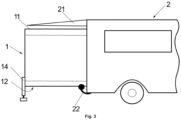
Fig. 3 zeigt schematisch die Campingbox 1 im ausgeklappten Zustand. Die Campingbox 1 ist an das Automobil 2 in Verlängerung der Ladefläche unterhalb der Heckklappe 21 angebaut. Die Campingbox 1 wird hier zusätzlich von der Anhängerkupplung 22 gehalten. - Die Campingbox 1 ist im zusammengeklappten Zustand 120 cm breit, 130 cm lang und 28 cm hoch. Die Deckfläche der zusammengeklappten Campingbox 1 wird durch das Dachelement 11 gebildet Das Dachelement 11 besteht aus carbonfaserverstärkten PP Wabenplatte (Ultraflight) und weist eine Materialdicke von 1 cm auf. Die Bodenplatte 12 besteht aus einer Aluminiumwabenplatte (Alucore) von 1 cm Materialdicke. Sowohl Dachelement 11 als auch Bodenplatte 12 weisen einen umlaufenden Rand (111, 121) von jeweils 14 cm Höhe auf. Die umlaufenden Ränder entsprechen sowohl hinsichtlich Materialdicke als auch -aufbau den Seitenwänden. Die umlaufenden Ränder (111, 121) sind an der ersten Seite als eine gemeinsame abnehmbare Abdeckung ausgebildet.
- Im zusammengeklappten Zustand sind in der Campingbox 1 weiterhin drei Seitenwände 15 enthalten. Die Seitenwand 15 für die der ersten Seite gegenüberliegende Seite (Heckwand) weist Abmessungen von 120 cm Breite und 92 cm Höhe auf. Diese Seitenwand 15 verfügt über ein Fenster. Die beiden Seitenwände 15 für der ersten Seite benachbarten Seiten weisen Abmessungen von 130 cm mal 92 cm auf. Alle drei Seitenwände 15 bestehen aus Polypropylen und sind 1 cm dick.
- Weiterhin sind in der zusammengeklappten Campingbox 1 zwei höhenverstellbare Stützelemente 14 sowie Formstücken zum Lückenverschluss (siehe unten) enthalten.
- Im ausgeklappten Zustand ruht die Bodenplatte 12 mit der ersten Seite auf der Ladekante des Automobils 2 und wird dort an der Anhängerkupplung 22 mittels eines Heckträgers (nicht dargestellt) gehalten. Die Heckklappe 21 des Automobils 2 ist hochgeklappt und verläuft oberhalb des Dachelements 11. In der vorliegenden Ausführungsform wird die Heckklappe 22 mit der Campingbox 1 verriegelt. Das Orginalschloß des Fahrzeugs rastet dabei in dem Dachelement 11 ein.
- Auf der von der ersten Seite abgewandten Seite sind die beiden Stützelemente 14 angeordnet, die mittels ihrer Höhenverstellung so eingestellt werden, dass die Bodenplatte 12 der ausgeklappten Campingbox 1 versetzt, jedoch parallel zur Ladefläche des Automobils 2 verläuft.
- Die Seitenwände 15 weisen an der Kante, mit der Sie auf den umlaufenden Rand 121 der Bodenplatte 12 aufgesetzt werden Scharniere (nicht dargestellt) auf. Im nicht ausgeklappten Zustand der Campingbox 1 liegen die Seitenwände 15 im Inneren der Campingbox 1. Die Seitenwände 15 sind in den Scharnieren drehbar gelagert und werden beim Ausklappen senkrecht gestellt. An ihrer Oberseite weisen die Seitenwände 15 Öffnungen mit jeweils einer Querstrebe (nicht dargestellt) auf. Das Dachelement 11 ist in seinem umlaufenden Rand 111 mit Drehriegeln (nicht dargestellt) versehen. Die Drehriegel weisen Haken auf, die beim Verriegeln hinter die Querstreben der Öffnungen der Seitenwände 15 greifen und so eine lösbare Verbindung herstellen.
- Im ausgeklappten Zustand der Campingbox 1 entstehen Freiräume (nicht dargestellt) oder Lücken zwischen der Campingbox 1 an ihrer ersten Seite und dem Laderaum des Automobils 2. Die Freiräume werden mittels Formstücke (nicht dargestellt) aus Schaumplast verschlossen, die Magnetstreifen aufweisen, mittels derer sie an dem Metallrahmen des Laderaumes des Automobils 2 haften.
- Im zusammengeklappten Zustand der Campingbox 1 sind die Seitenwände 15, immer noch in ihren Scharnieren ruhend ins Innere der Campingbox 1 geklappt. Die Befestigung des Dachelements 11 mit seinem Rand 111 auf dem Rand der Bodenplatte 12 mit ihrem Rand 121 erfolgt, indem im Rand 121 der Bodenplatte 12 ebenfalls Öffnungen mit jeweils einer Querstrebe aufweisen, in die jene die Drehriegel des Dachelements 11 eingreifen, die der ersten Seite am nächsten liegen. Um eine leichte Erreichbarkeit der Drehriegel im zusammengeklappten Zustand der Campingbox 1 zu gewährleisten, sind diese Drehriegel sehr nah zur ersten Seite positioniert. Auf der der ersten Seite gegenüberliegenden Seite weist die Campingbox 1 zwei Spannverschlüsse auf, die oberes und unteres Boxteil zusammenhalten. Die erste Seite der Campingbox 1 wird im zusammengeklappten Zustand durch eine Verschlussplatte verschlossen, die an Oberteil- und Unterteil der Campingbox 1 ebenfalls mittels Spannverschlüssen befestigt ist und diese beiden Teile zusätzlich zusammenhält. Die Verschlussplatte vereint dabei die umlaufenden Ränder 111, 121 an der ersten Seite der Campingbox 1. Die Verschlussplatte wird im ausgeklappten Zustand der Campingbox 1 als Sideboard an der Außenseite der Campingbox 1 genutzt.
-
- 1
- Campingbox
- 11
- Dachelement
- 111
- Rand des Dachelements
- 12
- Bodenplatte
- 121
- Rand der Bodenplatte
- 13
- Fenster
- 14
- Stützelement
- 15
- Seitenwand
- 2
- Automobil
- 21
- Heckklappe
- 22
- Anhängerkupplung
Claims (15)
- Campingbox, aufweisend mindestens eine Bodenplatte, drei Seitenwände, ein Dachelement, ein oder zwei Stützelemente, sowie Befestigungselemente, wobei- die Campingbox in einem Transportzustand eine geschlossene flache Box bildet, in der die Seitenwände, die Stützelemente und die Befestigungselemente liegend zwischen der Bodenplatte und dem Dachelement angeordnet sind, wobei die Campingbox im zusammengelegten Zustand auf die Ladefläche eines Automobils passt,die Campingbox in einem ausgeklappten Zustand eine Erweiterung des Laderaumes des Automobils ausbildet, indem sie an der hinteren Öffnung des Laderaumes angeordnet ist und die Bodenplatte an einer ersten Seite am hinteren Ende des Automobils aufliegt und an einer der ersten Seite gegenüberliegenden Seite durch die Stützelemente abgestützt wird, sowie die drei Seitenwände mittels geeigneter Befestigungselemente an der Bodenplatte so angeordnet sind, dass sie einen zur Ladefläche des Automobils hin geöffneten nutzbaren Raum ausbilden, dadurch gekennzeichnet , dass die Bodenplatte oder das Dachelement oder beide (die Bodenplatte und das Dachelement) einen umlaufenden Rand aufweisen, der sich senkrecht von der Bodenplatte bzw. dem Dachelement weg erstreckt, wobei im Transportzustand die Bodenplatte die untere Boxwandung der Campingbox, das Dachelement die obere Boxwandung der Campingbox unda. der Rand der Bodenplatte oder des Dachelements die seitlichen Boxwandungen bildet, oderb. der Rand der Bodenplatte und der Rand des Dachelements die seitlichen Boxwandungen bilden, oderc. a. oder b. zutrifft, sowie auf der ersten Seite der Rand von Bodenplatte und Dachelement als eine gemeinsame Verschlussplatte ausgeführt ist.
- Campingbox nach Anspruch 1, dadurch gekennzeichnet, dass das Dachelement im ausgeklappten Zustand der Campingbox die obere Abdeckung des nutzbaren Raumes bildet.
- Campingbox nach Anspruch 1, dadurch gekennzeichnet, dass im ausgeklappten Zustand der Campingbox eine Heckklappe des Automobils teilweise oder vollständig die obere Abdeckung des nutzbaren Raumes bildet.
- Campingbox nach Anspruch 1, dadurch gekennzeichnet, dass im ausgeklappten Zustand der Campingbox die Bodenplatte und die Seitenwände durch leicht zu lösende Befestigungselemente oder Scharniere untereinander verbunden sind.
- Campingbox nach Anspruch 2, dadurch gekennzeichnet, dass im ausgeklappten Zustand der Campingbox das Dachelement und die Seitenwände durch leicht zu lösende Befestigungselemente untereinander verbunden sind, wobei als leicht zu lösende Befestigungselemente bevorzugt Spannverschlüsse, Flügelschrauben, Drehriegel zum Einsatz kommen.
- Campingbox nach Anspruch 1, dadurch gekennzeichnet, dass der Rand an einer ersten Seite, mit der die Bodenplatte bzw. das Dachelement im ausgeklappten Zustand der Campingbox an den Laderaum des Automobils anschließt, abnehmbar oder umklappbar ist.
- Campingbox nach einem der vorhergehenden Ansprüche, dadurch gekennzeichnet, dass die Stützelemente höhenverstellbar sind.
- Campingbox nach einem der vorhergehenden Ansprüche, dadurch gekennzeichnet, dass die Seitenwände aus einem starren, wärmegedämmten Material bestehen.
- Campingbox nach einem der vorhergehenden Ansprüche, dadurch gekennzeichnet, dass in einer oder mehreren Seitenwänden Fenster angeordnet sind.
- Campingbox nach einem der vorhergehenden Ansprüche, dadurch gekennzeichnet, dass im ausgeklappten Zustand der Campingbox Freiräume zwischen den Seitenwänden, die an den Laderaum des Automobils grenzen sowie ggf. dem Dachelement und dem Laderaum des Automobils entstehen, mit Verschlusselementen verschlossen sind.
- Campingbox nach Anspruch 10, dadurch gekennzeichnet, dass es sich bei den Verschlusselementen um starre Formteile und/oder flexible Formstücken handelt, die lösbar in den Freiräumen befestigt werden.
- Campingbox nach einem der vorhergehenden Ansprüche, dadurch gekennzeichnet, dass die Campingbox im zusammengelegten Zustand weiterhin auch die Verschlusselemente und/oder Teile der Inneneinrichtung aufnimmt.
- Campingbox nach einem der vorhergehenden Ansprüche, dadurch gekennzeichnet, dass im ausgeklappten Zustand der Campingbox die Bodenplatte mit der ersten Seite auf der Ladekante des Automobils und/oder auf einer Anhängerkupplung aufliegt.
- Campingbox nach Anspruch 13, dadurch gekennzeichnet, dass im ausgeklappten Zustand der Campingbox und wenn die Bodenplatte mit der ersten Seite auf der Anhängerkupplung aufliegt, ein Heckträger die Verbindung der ersten Seite der Bodenplatte zur Anhängerkupplung herstellt.
- Campingbox nach Anspruch 13, dadurch gekennzeichnet, dass im ausgeklappten Zustand der Campingbox und wenn die Bodenplatte auf der Ladekante des Automobils aufliegt, die Bodenplatte an der ersten Seite mittels lösbarer Spannmittel an der Ladekante und/oder dem hinteren Ende der Ladefläche fixiert ist.
Applications Claiming Priority (2)
| Application Number | Priority Date | Filing Date | Title |
|---|---|---|---|
| DE202020003416.9U DE202020003416U1 (de) | 2020-08-08 | 2020-08-08 | Campingbox zur Erweiterung des Wohnraums für Transporter, Kleinbusse, Caravans, Vans und Kombis |
| DE202020004416.4U DE202020004416U1 (de) | 2020-10-21 | 2020-10-21 | Campingbox zur Erweiterung des Wohnraumes für Transporter, Kleinbusse, Caravans, Vans und Kombis |
Publications (3)
| Publication Number | Publication Date |
|---|---|
| EP3950426A1 EP3950426A1 (de) | 2022-02-09 |
| EP3950426B1 true EP3950426B1 (de) | 2025-05-21 |
| EP3950426C0 EP3950426C0 (de) | 2025-05-21 |
Family
ID=77226655
Family Applications (1)
| Application Number | Title | Priority Date | Filing Date |
|---|---|---|---|
| EP21189786.3A Active EP3950426B1 (de) | 2020-08-08 | 2021-08-05 | Campingbox |
Country Status (2)
| Country | Link |
|---|---|
| EP (1) | EP3950426B1 (de) |
| PL (1) | PL3950426T3 (de) |
Families Citing this family (1)
| Publication number | Priority date | Publication date | Assignee | Title |
|---|---|---|---|---|
| US11643002B1 (en) * | 2020-03-25 | 2023-05-09 | Life Cube, Inc. | Temporary shelter |
Family Cites Families (5)
| Publication number | Priority date | Publication date | Assignee | Title |
|---|---|---|---|---|
| JP4199852B2 (ja) * | 1998-08-11 | 2008-12-24 | 正雄 地引 | キャンピングカー |
| KR101437963B1 (ko) * | 2014-08-06 | 2014-09-12 | (주) 태화정공 | 캠핑카 |
| DE102015005661B3 (de) * | 2015-04-27 | 2016-08-25 | Erich Hilger | Campingbox |
| KR101868133B1 (ko) | 2016-10-25 | 2018-06-19 | 주식회사 서연이화 | 차량용 텐트 및 이를 갖춘 차량 |
| KR102180835B1 (ko) * | 2018-11-29 | 2020-11-19 | 남상학 | 공간확장 모듈 및 이를 구비한 공간확장형 캠핑카 |
-
2021
- 2021-08-05 PL PL21189786.3T patent/PL3950426T3/pl unknown
- 2021-08-05 EP EP21189786.3A patent/EP3950426B1/de active Active
Also Published As
| Publication number | Publication date |
|---|---|
| PL3950426T3 (pl) | 2025-09-01 |
| EP3950426C0 (de) | 2025-05-21 |
| EP3950426A1 (de) | 2022-02-09 |
Similar Documents
| Publication | Publication Date | Title |
|---|---|---|
| DE102006005518B4 (de) | Fahrzeug-Stauanordnung | |
| DE60128199T2 (de) | Lieferwagen | |
| DE102019123934B3 (de) | Klappbare Wandstruktur zur Erweiterung des Innenraums von transportablen Aufbauten, insbesondere Wohnmobilen | |
| WO2013011041A2 (de) | Dachbox, kraftfahrzeugdach mit dachbox sowie kraftfahrzeug mit dachbox | |
| DE19837685A1 (de) | Laderaum für ein Kraftfahrzeug und Segmentierungsvorrichtung | |
| DE102021103413A1 (de) | Campingfahrzeug | |
| DE102010018337A1 (de) | Abdeckungseinrichtung für einen Laderaum, Rückbankanordnung, Laderaum und Kraftfahrzeug, sowie Verwendung einer Abdeckungseinrichtung | |
| EP3950426B1 (de) | Campingbox | |
| DE102008048151A1 (de) | Vorrichtung zum Unterteilen eines Frachtraums | |
| DE202006007784U1 (de) | Höhenverstellbarer Ladeboden für Kraftfahrzeuge | |
| DE102007007064A1 (de) | Schließanordnung für einen Fahrzeugbau | |
| DE102008031124B4 (de) | Hecktür eines Kraftfahrzeugs | |
| DE202008007633U1 (de) | Ausschubelement für Reisemobil | |
| EP1457373A1 (de) | Hecktüre für ein Fahrzeug | |
| DE10219394A1 (de) | Heckklappe für Kraftfahrzeuge mit einem beweglich gehaltenen Heckklappenteil | |
| DE102019124071A1 (de) | Fahrzeug mit Faltschiebedach und versenkbarer Heckscheibe | |
| DE102021132776A1 (de) | Freizeitfahrzeug mit Raumerweiterung | |
| DE4328886C2 (de) | Cabriolet mit einem Fondstauraum | |
| DE102013212552B4 (de) | Stauvorrichtung für einen Laderaum eines Kraftfahrzeugs | |
| EP2620327B1 (de) | Multifunktionseinheit für einen Personenkraftwagen | |
| DE102011115935A1 (de) | Vorrichtung zum Transportieren von länglichem Transportgut | |
| DE8101731U1 (de) | Wohnmobil | |
| EP4472468A1 (de) | Mobile sanitärkabine | |
| DE102006054378B4 (de) | Struktur einer Hilfs-Heckklappe eines Fahrzeugs | |
| DE602005001031T2 (de) | Heckplatte mit Rollo für Kraftfahrzeug |
Legal Events
| Date | Code | Title | Description |
|---|---|---|---|
| PUAI | Public reference made under article 153(3) epc to a published international application that has entered the european phase |
Free format text: ORIGINAL CODE: 0009012 |
|
| STAA | Information on the status of an ep patent application or granted ep patent |
Free format text: STATUS: THE APPLICATION HAS BEEN PUBLISHED |
|
| AK | Designated contracting states |
Kind code of ref document: A1 Designated state(s): AL AT BE BG CH CY CZ DE DK EE ES FI FR GB GR HR HU IE IS IT LI LT LU LV MC MK MT NL NO PL PT RO RS SE SI SK SM TR |
|
| STAA | Information on the status of an ep patent application or granted ep patent |
Free format text: STATUS: REQUEST FOR EXAMINATION WAS MADE |
|
| 17P | Request for examination filed |
Effective date: 20220331 |
|
| RBV | Designated contracting states (corrected) |
Designated state(s): AL AT BE BG CH CY CZ DE DK EE ES FI FR GB GR HR HU IE IS IT LI LT LU LV MC MK MT NL NO PL PT RO RS SE SI SK SM TR |
|
| STAA | Information on the status of an ep patent application or granted ep patent |
Free format text: STATUS: EXAMINATION IS IN PROGRESS |
|
| 17Q | First examination report despatched |
Effective date: 20230329 |
|
| GRAP | Despatch of communication of intention to grant a patent |
Free format text: ORIGINAL CODE: EPIDOSNIGR1 |
|
| STAA | Information on the status of an ep patent application or granted ep patent |
Free format text: STATUS: GRANT OF PATENT IS INTENDED |
|
| INTG | Intention to grant announced |
Effective date: 20241217 |
|
| GRAS | Grant fee paid |
Free format text: ORIGINAL CODE: EPIDOSNIGR3 |
|
| GRAA | (expected) grant |
Free format text: ORIGINAL CODE: 0009210 |
|
| STAA | Information on the status of an ep patent application or granted ep patent |
Free format text: STATUS: THE PATENT HAS BEEN GRANTED |
|
| AK | Designated contracting states |
Kind code of ref document: B1 Designated state(s): AL AT BE BG CH CY CZ DE DK EE ES FI FR GB GR HR HU IE IS IT LI LT LU LV MC MK MT NL NO PL PT RO RS SE SI SK SM TR |
|
| REG | Reference to a national code |
Ref country code: GB Ref legal event code: FG4D Free format text: NOT ENGLISH |
|
| REG | Reference to a national code |
Ref country code: CH Ref legal event code: EP |
|
| REG | Reference to a national code |
Ref country code: DE Ref legal event code: R096 Ref document number: 502021007512 Country of ref document: DE |
|
| REG | Reference to a national code |
Ref country code: IE Ref legal event code: FG4D Free format text: LANGUAGE OF EP DOCUMENT: GERMAN |
|
| U01 | Request for unitary effect filed |
Effective date: 20250604 |
|
| U07 | Unitary effect registered |
Designated state(s): AT BE BG DE DK EE FI FR IT LT LU LV MT NL PT RO SE SI Effective date: 20250611 |
|
| U20 | Renewal fee for the european patent with unitary effect paid |
Year of fee payment: 5 Effective date: 20250613 |
|
| PG25 | Lapsed in a contracting state [announced via postgrant information from national office to epo] |
Ref country code: ES Free format text: LAPSE BECAUSE OF FAILURE TO SUBMIT A TRANSLATION OF THE DESCRIPTION OR TO PAY THE FEE WITHIN THE PRESCRIBED TIME-LIMIT Effective date: 20250521 |
|
| PG25 | Lapsed in a contracting state [announced via postgrant information from national office to epo] |
Ref country code: NO Free format text: LAPSE BECAUSE OF FAILURE TO SUBMIT A TRANSLATION OF THE DESCRIPTION OR TO PAY THE FEE WITHIN THE PRESCRIBED TIME-LIMIT Effective date: 20250821 Ref country code: GR Free format text: LAPSE BECAUSE OF FAILURE TO SUBMIT A TRANSLATION OF THE DESCRIPTION OR TO PAY THE FEE WITHIN THE PRESCRIBED TIME-LIMIT Effective date: 20250822 |
|
| PGFP | Annual fee paid to national office [announced via postgrant information from national office to epo] |
Ref country code: PL Payment date: 20250724 Year of fee payment: 5 |
|
| PG25 | Lapsed in a contracting state [announced via postgrant information from national office to epo] |
Ref country code: HR Free format text: LAPSE BECAUSE OF FAILURE TO SUBMIT A TRANSLATION OF THE DESCRIPTION OR TO PAY THE FEE WITHIN THE PRESCRIBED TIME-LIMIT Effective date: 20250521 |
|
| PGFP | Annual fee paid to national office [announced via postgrant information from national office to epo] |
Ref country code: CH Payment date: 20250901 Year of fee payment: 5 |
|
| PG25 | Lapsed in a contracting state [announced via postgrant information from national office to epo] |
Ref country code: RS Free format text: LAPSE BECAUSE OF FAILURE TO SUBMIT A TRANSLATION OF THE DESCRIPTION OR TO PAY THE FEE WITHIN THE PRESCRIBED TIME-LIMIT Effective date: 20250821 |
|
| PG25 | Lapsed in a contracting state [announced via postgrant information from national office to epo] |
Ref country code: IS Free format text: LAPSE BECAUSE OF FAILURE TO SUBMIT A TRANSLATION OF THE DESCRIPTION OR TO PAY THE FEE WITHIN THE PRESCRIBED TIME-LIMIT Effective date: 20250921 |
|
| PG25 | Lapsed in a contracting state [announced via postgrant information from national office to epo] |
Ref country code: SM Free format text: LAPSE BECAUSE OF FAILURE TO SUBMIT A TRANSLATION OF THE DESCRIPTION OR TO PAY THE FEE WITHIN THE PRESCRIBED TIME-LIMIT Effective date: 20250521 |
|
| PG25 | Lapsed in a contracting state [announced via postgrant information from national office to epo] |
Ref country code: CZ Free format text: LAPSE BECAUSE OF FAILURE TO SUBMIT A TRANSLATION OF THE DESCRIPTION OR TO PAY THE FEE WITHIN THE PRESCRIBED TIME-LIMIT Effective date: 20250521 |
|
| PG25 | Lapsed in a contracting state [announced via postgrant information from national office to epo] |
Ref country code: SK Free format text: LAPSE BECAUSE OF FAILURE TO SUBMIT A TRANSLATION OF THE DESCRIPTION OR TO PAY THE FEE WITHIN THE PRESCRIBED TIME-LIMIT Effective date: 20250521 |
|
| PLBE | No opposition filed within time limit |
Free format text: ORIGINAL CODE: 0009261 |
|
| STAA | Information on the status of an ep patent application or granted ep patent |
Free format text: STATUS: NO OPPOSITION FILED WITHIN TIME LIMIT |
|
| PG25 | Lapsed in a contracting state [announced via postgrant information from national office to epo] |
Ref country code: MC Free format text: LAPSE BECAUSE OF FAILURE TO SUBMIT A TRANSLATION OF THE DESCRIPTION OR TO PAY THE FEE WITHIN THE PRESCRIBED TIME-LIMIT Effective date: 20250521 |
|
| REG | Reference to a national code |
Ref country code: CH Ref legal event code: L10 Free format text: ST27 STATUS EVENT CODE: U-0-0-L10-L00 (AS PROVIDED BY THE NATIONAL OFFICE) Effective date: 20260402 |
|
| 26N | No opposition filed |
Effective date: 20260224 |