EP3940021A1 - Materiau fibreux impregne de polymere thermoplastique - Google Patents
Materiau fibreux impregne de polymere thermoplastique Download PDFInfo
- Publication number
- EP3940021A1 EP3940021A1 EP21187016.7A EP21187016A EP3940021A1 EP 3940021 A1 EP3940021 A1 EP 3940021A1 EP 21187016 A EP21187016 A EP 21187016A EP 3940021 A1 EP3940021 A1 EP 3940021A1
- Authority
- EP
- European Patent Office
- Prior art keywords
- polyamide
- fibrous material
- fibers
- polymer
- semi
- Prior art date
- Legal status (The legal status is an assumption and is not a legal conclusion. Google has not performed a legal analysis and makes no representation as to the accuracy of the status listed.)
- Pending
Links
Images

Classifications
-
- C—CHEMISTRY; METALLURGY
- C08—ORGANIC MACROMOLECULAR COMPOUNDS; THEIR PREPARATION OR CHEMICAL WORKING-UP; COMPOSITIONS BASED THEREON
- C08J—WORKING-UP; GENERAL PROCESSES OF COMPOUNDING; AFTER-TREATMENT NOT COVERED BY SUBCLASSES C08B, C08C, C08F, C08G or C08H
- C08J5/00—Manufacture of articles or shaped materials containing macromolecular substances
- C08J5/04—Reinforcing macromolecular compounds with loose or coherent fibrous material
-
- C—CHEMISTRY; METALLURGY
- C08—ORGANIC MACROMOLECULAR COMPOUNDS; THEIR PREPARATION OR CHEMICAL WORKING-UP; COMPOSITIONS BASED THEREON
- C08J—WORKING-UP; GENERAL PROCESSES OF COMPOUNDING; AFTER-TREATMENT NOT COVERED BY SUBCLASSES C08B, C08C, C08F, C08G or C08H
- C08J5/00—Manufacture of articles or shaped materials containing macromolecular substances
- C08J5/04—Reinforcing macromolecular compounds with loose or coherent fibrous material
- C08J5/10—Reinforcing macromolecular compounds with loose or coherent fibrous material characterised by the additives used in the polymer mixture
-
- B—PERFORMING OPERATIONS; TRANSPORTING
- B29—WORKING OF PLASTICS; WORKING OF SUBSTANCES IN A PLASTIC STATE IN GENERAL
- B29B—PREPARATION OR PRETREATMENT OF THE MATERIAL TO BE SHAPED; MAKING GRANULES OR PREFORMS; RECOVERY OF PLASTICS OR OTHER CONSTITUENTS OF WASTE MATERIAL CONTAINING PLASTICS
- B29B15/00—Pretreatment of the material to be shaped, not covered by groups B29B7/00 - B29B13/00
- B29B15/08—Pretreatment of the material to be shaped, not covered by groups B29B7/00 - B29B13/00 of reinforcements or fillers
- B29B15/10—Coating or impregnating independently of the moulding or shaping step
- B29B15/12—Coating or impregnating independently of the moulding or shaping step of reinforcements of indefinite length
- B29B15/122—Coating or impregnating independently of the moulding or shaping step of reinforcements of indefinite length with a matrix in liquid form, e.g. as melt, solution or latex
- B29B15/125—Coating or impregnating independently of the moulding or shaping step of reinforcements of indefinite length with a matrix in liquid form, e.g. as melt, solution or latex by dipping
-
- C—CHEMISTRY; METALLURGY
- C08—ORGANIC MACROMOLECULAR COMPOUNDS; THEIR PREPARATION OR CHEMICAL WORKING-UP; COMPOSITIONS BASED THEREON
- C08J—WORKING-UP; GENERAL PROCESSES OF COMPOUNDING; AFTER-TREATMENT NOT COVERED BY SUBCLASSES C08B, C08C, C08F, C08G or C08H
- C08J5/00—Manufacture of articles or shaped materials containing macromolecular substances
- C08J5/04—Reinforcing macromolecular compounds with loose or coherent fibrous material
- C08J5/0405—Reinforcing macromolecular compounds with loose or coherent fibrous material with inorganic fibres
- C08J5/042—Reinforcing macromolecular compounds with loose or coherent fibrous material with inorganic fibres with carbon fibres
-
- C—CHEMISTRY; METALLURGY
- C08—ORGANIC MACROMOLECULAR COMPOUNDS; THEIR PREPARATION OR CHEMICAL WORKING-UP; COMPOSITIONS BASED THEREON
- C08J—WORKING-UP; GENERAL PROCESSES OF COMPOUNDING; AFTER-TREATMENT NOT COVERED BY SUBCLASSES C08B, C08C, C08F, C08G or C08H
- C08J5/00—Manufacture of articles or shaped materials containing macromolecular substances
- C08J5/04—Reinforcing macromolecular compounds with loose or coherent fibrous material
- C08J5/0405—Reinforcing macromolecular compounds with loose or coherent fibrous material with inorganic fibres
- C08J5/043—Reinforcing macromolecular compounds with loose or coherent fibrous material with inorganic fibres with glass fibres
-
- C—CHEMISTRY; METALLURGY
- C08—ORGANIC MACROMOLECULAR COMPOUNDS; THEIR PREPARATION OR CHEMICAL WORKING-UP; COMPOSITIONS BASED THEREON
- C08J—WORKING-UP; GENERAL PROCESSES OF COMPOUNDING; AFTER-TREATMENT NOT COVERED BY SUBCLASSES C08B, C08C, C08F, C08G or C08H
- C08J5/00—Manufacture of articles or shaped materials containing macromolecular substances
- C08J5/24—Impregnating materials with prepolymers which can be polymerised in situ, e.g. manufacture of prepregs
-
- C—CHEMISTRY; METALLURGY
- C08—ORGANIC MACROMOLECULAR COMPOUNDS; THEIR PREPARATION OR CHEMICAL WORKING-UP; COMPOSITIONS BASED THEREON
- C08K—Use of inorganic or non-macromolecular organic substances as compounding ingredients
- C08K3/00—Use of inorganic substances as compounding ingredients
- C08K3/02—Elements
- C08K3/04—Carbon
-
- B—PERFORMING OPERATIONS; TRANSPORTING
- B29—WORKING OF PLASTICS; WORKING OF SUBSTANCES IN A PLASTIC STATE IN GENERAL
- B29K—INDEXING SCHEME ASSOCIATED WITH SUBCLASSES B29B, B29C OR B29D, RELATING TO MOULDING MATERIALS OR TO MATERIALS FOR MOULDS, REINFORCEMENTS, FILLERS OR PREFORMED PARTS, e.g. INSERTS
- B29K2101/00—Use of unspecified macromolecular compounds as moulding material
- B29K2101/12—Thermoplastic materials
-
- C—CHEMISTRY; METALLURGY
- C08—ORGANIC MACROMOLECULAR COMPOUNDS; THEIR PREPARATION OR CHEMICAL WORKING-UP; COMPOSITIONS BASED THEREON
- C08J—WORKING-UP; GENERAL PROCESSES OF COMPOUNDING; AFTER-TREATMENT NOT COVERED BY SUBCLASSES C08B, C08C, C08F, C08G or C08H
- C08J2371/00—Characterised by the use of polyethers obtained by reactions forming an ether link in the main chain; Derivatives of such polymers
- C08J2371/02—Polyalkylene oxides
-
- C—CHEMISTRY; METALLURGY
- C08—ORGANIC MACROMOLECULAR COMPOUNDS; THEIR PREPARATION OR CHEMICAL WORKING-UP; COMPOSITIONS BASED THEREON
- C08J—WORKING-UP; GENERAL PROCESSES OF COMPOUNDING; AFTER-TREATMENT NOT COVERED BY SUBCLASSES C08B, C08C, C08F, C08G or C08H
- C08J2377/00—Characterised by the use of polyamides obtained by reactions forming a carboxylic amide link in the main chain; Derivatives of such polymers
-
- C—CHEMISTRY; METALLURGY
- C08—ORGANIC MACROMOLECULAR COMPOUNDS; THEIR PREPARATION OR CHEMICAL WORKING-UP; COMPOSITIONS BASED THEREON
- C08J—WORKING-UP; GENERAL PROCESSES OF COMPOUNDING; AFTER-TREATMENT NOT COVERED BY SUBCLASSES C08B, C08C, C08F, C08G or C08H
- C08J2377/00—Characterised by the use of polyamides obtained by reactions forming a carboxylic amide link in the main chain; Derivatives of such polymers
- C08J2377/04—Polyamides derived from alpha-amino carboxylic acids
-
- C—CHEMISTRY; METALLURGY
- C08—ORGANIC MACROMOLECULAR COMPOUNDS; THEIR PREPARATION OR CHEMICAL WORKING-UP; COMPOSITIONS BASED THEREON
- C08J—WORKING-UP; GENERAL PROCESSES OF COMPOUNDING; AFTER-TREATMENT NOT COVERED BY SUBCLASSES C08B, C08C, C08F, C08G or C08H
- C08J2377/00—Characterised by the use of polyamides obtained by reactions forming a carboxylic amide link in the main chain; Derivatives of such polymers
- C08J2377/06—Polyamides derived from polyamines and polycarboxylic acids
-
- C—CHEMISTRY; METALLURGY
- C08—ORGANIC MACROMOLECULAR COMPOUNDS; THEIR PREPARATION OR CHEMICAL WORKING-UP; COMPOSITIONS BASED THEREON
- C08J—WORKING-UP; GENERAL PROCESSES OF COMPOUNDING; AFTER-TREATMENT NOT COVERED BY SUBCLASSES C08B, C08C, C08F, C08G or C08H
- C08J2379/00—Characterised by the use of macromolecular compounds obtained by reactions forming in the main chain of the macromolecule a linkage containing nitrogen with or without oxygen, or carbon only, not provided for in groups C08J2361/00 - C08J2377/00
- C08J2379/04—Polycondensates having nitrogen-containing heterocyclic rings in the main chain; Polyhydrazides; Polyamide acids or similar polyimide precursors
- C08J2379/08—Polyimides; Polyester-imides; Polyamide-imides; Polyamide acids or similar polyimide precursors
-
- C—CHEMISTRY; METALLURGY
- C08—ORGANIC MACROMOLECULAR COMPOUNDS; THEIR PREPARATION OR CHEMICAL WORKING-UP; COMPOSITIONS BASED THEREON
- C08J—WORKING-UP; GENERAL PROCESSES OF COMPOUNDING; AFTER-TREATMENT NOT COVERED BY SUBCLASSES C08B, C08C, C08F, C08G or C08H
- C08J2381/00—Characterised by the use of macromolecular compounds obtained by reactions forming in the main chain of the macromolecule a linkage containing sulfur with or without nitrogen, oxygen, or carbon only; Polysulfones; Derivatives of such polymers
- C08J2381/04—Polysulfides
-
- C—CHEMISTRY; METALLURGY
- C08—ORGANIC MACROMOLECULAR COMPOUNDS; THEIR PREPARATION OR CHEMICAL WORKING-UP; COMPOSITIONS BASED THEREON
- C08J—WORKING-UP; GENERAL PROCESSES OF COMPOUNDING; AFTER-TREATMENT NOT COVERED BY SUBCLASSES C08B, C08C, C08F, C08G or C08H
- C08J2400/00—Characterised by the use of unspecified polymers
- C08J2400/12—Polymers characterised by physical features, e.g. anisotropy, viscosity or electrical conductivity
Definitions
- the present invention relates to a fibrous material, in particular monolayer, impregnated with thermoplastic polymer.
- the invention relates to a fibrous material, in particular monolayer, impregnated with thermoplastic polymer, in particular the number of fibers for carbon fibers greater than or equal to 30K, in particular greater than or equal to 50K, or the grammage for the glass fiber is greater than or equal to 1200 Tex, and whose fiber content by volume is in particular constant, in particular the fiber content by volume is constant in at least 70% of the volume of the tape or ribbon.
- the term “fibrous material” is understood to mean an assembly of reinforcing fibers. Before shaping, it comes in the form of locks. After its formatting, it comes in the form of strips (or tape), ribbon or tablecloths. When the reinforcing fibers are continuous, their assembly constitutes a unidirectional reinforcement or a fabric or a nonwoven (NCF). When the fibers are short, their assembly constitutes a felt or a fiber mat.
- Such impregnated fibrous materials are in particular intended for the production of lightweight composite materials for the manufacture of mechanical parts having a three-dimensional structure and having good mechanical and thermal properties.
- these fibrous materials are capable of discharging electrostatic charges.
- the use of flame retardant resins or flame retardant additives in resins that are not, allows the impregnated fibrous materials to be fire resistant. They therefore have properties compatible with the manufacture of parts, particularly in the fields of mechanics, aeronautics, nautical, automotive, oil and gas, in particular offshore, gas storage, energy, health and medical, sports and leisure and electronics.
- Such impregnated fibrous materials are also called composite materials. They include the fibrous material, consisting of reinforcing fibers, and a matrix consisting of the polymer impregnating the fibers.
- the first role of this matrix is to keep the reinforcing fibers in a compact shape and to give the desired shape to the final product. This matrix also ensures the load transfer between the fibers and therefore conditions the mechanical strength of the composite.
- Such a matrix also serves to protect the reinforcing fibers against abrasion and an aggressive environment, to control the surface appearance and to disperse any fillers between the fibers.
- the role of this matrix is important for the long-term behavior of the composite material, in particular with regard to fatigue and creep.
- strip is used to designate strips of fibrous material whose width is greater than or equal to 400 mm.
- ribbon is used to designate ribbons of calibrated width less than or equal to 400mm.
- wick is also used to designate the fibrous material.
- thermoplastic polymer or thermosetting polymer was carried out according to several processes which depend in particular on the nature of the polymer, the type of final composite material desired and its field of application. applications, some of these processes consisting of an impregnation step followed by a step of hot calendering the impregnated fibrous material or of a drying step optionally followed by a step of melting the thermoplastic polymer.
- thermosetting polymers such as epoxy resins for example, such as described in the patent WO2012/066241A2 .
- the impregnation processes by crosshead extrusion of a molten polymer are suitable for the use of low viscosity thermoplastic polymers only.
- Thermoplastic polymers in particular those with a high glass transition temperature, have too high a viscosity in the molten state to allow satisfactory impregnation of fibers and semi-finished or finished products of good quality.
- Requirement US 2014/0005331A1 describes a process for the preparation of fibers impregnated with a polymer resin, the strip obtained being asymmetrical, that is to say it has a face rich in polymer and an opposite face rich in fibres.
- the process is carried out by the molten route with a device allowing majority impregnation only on one of the faces.
- Another known impregnation process is the continuous passage of the fibers in an aqueous dispersion of polymer powder or aqueous dispersion of polymer particles or emulsion or aqueous suspension of polymer.
- a dispersion of powders of micrometric size (approximately 20 ⁇ m) is used.
- the fibers After soaking in the aqueous solution, the fibers are impregnated with the polymer powder.
- the method then involves a drying step consisting of passing the impregnated fibers through a first oven in order to evaporate the water absorbed during the soaking.
- a heat treatment step consisting of passing the impregnated and dried fibers through a second heating zone, at high temperature, is then necessary to melt the polymer so that it adheres, distributes and covers the fibers.
- the main drawback of this method is the homogeneity of the deposit which is sometimes imperfect, a coating carried out only on the surface.
- the particle size of the powders usually used is fine (typically 20 ⁇ m of D50 by volume) and this also increases the final cost of the impregnated ribbon or sheet.
- the drying step of this method induces porosity in the impregnated fibers by water evaporation.
- the material obtained is a fibrous material covered with polymer and therefore a multilayer material.
- the document EP 0 406 067 filed in the joint names of Atochem and the French State, as well as the document EP0 201 367 describe for their part a technique of impregnation on a fluidized bed of polymer powder.
- the fibers enter a closed fluidization vessel where, as far as EP 0 406 067 , they are optionally separated from each other by means of rollers or fluted cylinders, the fibers being charged electrostatically, by friction in contact with these rollers or cylinders. This electrostatic charge allows the polymer powder to stick to the surface of the fibers and thus to impregnate them.
- the material obtained is therefore a fibrous material covered with polymer and therefore a multilayer material.
- the international request WO 2016/062896 describes powdering the wick by an electrostatic process under voluntary charge, by grounding the wick and applying a potential difference between the tip of a gun or powder nozzles and the wick.
- the document WO2008/135663 describes, in a third variant, the production of an impregnated ribbon of fibers.
- the ribbon of fibers is already preformed prior to the impregnation step, in the form of a ribbon formed from fibers held together by restraint means.
- the ribbon thus preformed is previously charged with static electricity and immersed in an enclosure containing a fluidized bed of fine particles of polymer suspended in compressed air, so as to coat the ribbon with a layer of polymer coating.
- Such a document does not make it possible to carry out an impregnation of one or more rovings of fibers simultaneously or a shaping, continuously, of the rovings impregnated in the form of ribbons.
- the international request WO 2015/121583 describes a process for manufacturing an impregnated fibrous material by impregnating said material in a fluidized bed then hot calendering said roving allowing the shaping of said roving or said parallel rovings of said material.
- Hot calendering is carried out downstream of the impregnation device and makes it possible to homogenize the distribution of the polymer and the impregnation of the fibers but does not make it possible to obtain a tape impregnated in a homogeneous manner.
- the porosity obtained is not quantified.
- the document EP0335186 describes the possibility of using a calender or a press to compact a composite comprising impregnated metal fibers, used for the manufacture of molded bodies for shielding against electromagnetic radiation.
- the quality of the strips of impregnated fibrous material, and therefore the quality of the final composite material depends not only on the homogeneity of the impregnation of the fibers and therefore on the control and reproducibility of the porosity of the impregnated fibrous material and its appearance. monolayer, but also the size and more particularly the width and thickness of the final ribbons. Regularity and control of these dimensional parameters make it possible to improve the mechanical strength of the composite materials obtained (from the tapes).
- this mode of impregnation by the molten process does not make it possible to obtain a high fiber content or high production speeds because of the high viscosity of thermoplastic resins, in particular when they have high glass transition temperatures, which is necessary to obtain high performance composite materials.
- the object of the invention is therefore to remedy at least one of the drawbacks of the prior art and in particular to obtaining fibrous material, in particular monolayer.
- the invention aims in particular to propose an impregnated fibrous material, in particular monolayer, and in particular whose number of fibers for carbon fibers is greater than or equal to 30K, in particular greater than or equal to 50K, or the grammage for the fiber of glass is greater than or equal to 1200 Tex, in particular greater than or equal to 2400 Tex, greater than or equal to 4800 Tex, and whose fiber content by volume is in particular constant in at least 70% of the volume of the strip or ribbon, the impregnation of the fibers being homogeneous, said material having controlled dimensions, with a reduced, controlled and reproducible porosity as well as a homogeneous distribution of the fibers of said fibrous material on which the performance of the final composite part depends.
- the subject of the invention is an impregnated fibrous material comprising a fibrous material in continuous fibers and at least one thermoplastic polymer matrix, characterized in that the said at least thermoplastic polymer is a non-reactive amorphous polymer whose glass transition temperature is such that Tg ⁇ 80°C, in particular Tg ⁇ 100°C, in particular ⁇ 120°C, in particular ⁇ 140°C, or a non-reactive semi-crystalline polymer whose the melting temperature Tm ⁇ 150°C, the fiber content by volume is constant in at least 70% of the volume of the strip or ribbon, in particular in at least 80% of the volume of the strip or ribbon, in particular in at least 90% of the volume of the strip or ribbon, more particularly in at least 95% of the volume of the strip or ribbon, the content of fibers in the said impregnated fibrous material being comprised from 45 to 65% by volume, preferably from 50 to 60 % by volume, in particular from 54 to 60% on both sides of said fibrous material, the degree of poros
- said impregnated fibrous material is non-flexible.
- said impregnated fibrous material is devoid of liquid crystal polymers (LCP).
- the LCPs are as described in the international application WO 2017/017388 .
- the LCPs are chosen in particular from aromatic polyesters obtained by polycondensation of 4-hydroxy benzoic acid or hydroxy naphthenic acid (6-hydroxy-naphthalene-2 carboxylic acid), copolyesters based on two preceding hydroxy acids or from copolyesters- structurally similar aromatic amides.
- LCP aromatic copolyester include Vectran ®.
- said aromatic copolyesters based on hydroxy benzoic acid and hydroxy naphthenic have a hydroxy benzoic (hydroxy benzoate) content of around 70 to 75% by weight and 25-30% by weight of hydroxy naphthenic acid ( hydroxy naphthenate).
- the number of fibers in said fibrous material is for carbon fibers greater than or equal to 30K, preferably greater than or equal to 50K.
- the grammage for the fiberglass is greater than or equal to 1200 Tex, in particular greater than or equal to 2400 Tex, greater than or equal to 4800 Tex.
- the Tex means that 1000 m of basic yarn weighs 1 gr.
- the distribution of the fibers is homogeneous in at least 95% of the volume of the strip or tape.
- the fiber content by volume is measured locally on a representative elementary volume (VER).
- constant means that the fiber content by volume is constant to the nearest measurement uncertainty, which is plus or minus 1%.
- homogeneous means that the impregnation is uniform and that there are no dry fibers, that is to say, not impregnated, in at least 95% of the volume of the strip or ribbon of material fibrous impregnated.
- said impregnated fibrous material is monolayer.
- the term "monolayer” means that when the impregnation of the fibrous material is carried out, the impregnation having been carried out in a particularly homogeneous manner and to the core, and in particular with at least one expansion during the impregnation, said fibrous material and the polymer are inseparable from each other and form a material consisting of a single layer based on fibers and polymer.
- thermoplastic or thermoplastic polymer
- Tg glass transition temperature
- Tm melting temperature
- Tg and Tf are determined by differential scanning calorimetry (DSC) according to standard 11357-2:2013 and 11357-3:2013 respectively.
- the polymer matrix is a non-reactive amorphous polymer having a glass transition temperature Tg greater than or equal to 80° C., in particular greater than or equal to 100° C., in particular greater than or equal to 120° C., in particular greater than or equal to 140° C. C, or is a non-reactive semi-crystalline polymer whose melting point Tm is greater than 150°C.
- Tg glass transition temperature
- non-reactive polymer means that the molecular weight is no longer likely to change significantly, that is to say that its molecular mass in number (Mn) changes by less than 50% when it is placed in work and therefore corresponds to the final polyamide polymer of the thermoplastic matrix.
- thermoplastic polymer or a mixture of thermoplastic polymers.
- This polymer or mixture of thermoplastic polymers can be ground in powder form, in order to be able to use it in a device such as a tank, in particular in a fluidized bed or in aqueous dispersion.
- the device in the form of a tank, in particular in a fluidized bed, can be open or closed.
- thermoplastic polymer or blend of thermoplastic polymers further comprises carbon fillers, in particular carbon black or carbon nanofillers, preferably chosen from carbon nanofillers, in particular graphenes and/or carbon nanotubes and /or carbon nanofibrils or mixtures thereof. These charges conduct electricity and heat, and therefore facilitate the melting of the polymer matrix when heated.
- said thermoplastic polymer comprises at least one additive, chosen in particular from a catalyst, an antioxidant, a thermal stabilizer, a UV stabilizer, a light stabilizer, a lubricant, a filler, a plasticizer, a flame retardant, a nucleating agent , a dye, an electrically conductive agent, a thermal conductive agent or a mixture thereof.
- a catalyst an antioxidant, a thermal stabilizer, a UV stabilizer, a light stabilizer, a lubricant, a filler, a plasticizer, a flame retardant, a nucleating agent , a dye, an electrically conductive agent, a thermal conductive agent or a mixture thereof.
- said additive is chosen from a flame retardant, an electrically conductive agent and a thermal conductive agent.
- thermoplastic polymer or mixture of thermoplastic polymers may also comprise liquid crystal polymers or cyclized poly(butylene terephthalate), or mixtures containing them, such as the CBT100 resin marketed by the company CYCLICS CORPORATION. These compounds make it possible in particular to fluidify the polymer matrix in the molten state, for better penetration into the heart of the fibers. Depending on the nature of the polymer, or mixture of thermoplastic polymers, used to produce the impregnation matrix, in particular its melting point, one or the other of these compounds will be chosen.
- polymer P1 and P2 when said polymer is a mixture of two polymers P1 and P2, the proportion by weight of polymer P1 and P2 is between 1-99% and 99-1%.
- thermoplastic polymer is a mixture
- pre-impregnation process uses a dry powder
- this mixture is in the form of a powder obtained either by "dry blend” before introduction into the pre-impregnation tank or by “dry blend” carried out directly in the tank or, by grinding a compound carried out beforehand in an extruder.
- this mixture is composed of a powder obtained by “dry blend”, before introduction into the tank or directly into the tank, and this mixture of two polymers P1 and P2 is a mixture of PEKK and PEI.
- the PEKK/PEI mixture is comprised from 90-10% to 60-40% by weight, in particular from 90-10% to 70-30% by weight.
- the number-average molecular weight Mn of said final polymer of the thermoplastic matrix is preferably in a range ranging from 10,000 to 40,000, preferably from 12,000 to 30,000. These Mn values may correspond to inherent viscosities greater than or equal to 0.8 such determined in m-cresol according to the ISO 307:2007 standard but changing the solvent (use of m-cresol instead of sulfuric acid and the temperature being 20°C).
- the Mn are determined in particular by calculation from the rate of the terminal functions determined by potentiometric titration in solution.
- the Mn masses can also be determined by steric exclusion chromatography or by NMR.
- the polyamide can be a homopolyamide or a copolyamide or a mixture thereof.
- the polymers constituting the matrix are chosen from Polyamides (PA), in particular chosen from aliphatic polyamides, cycloaliphatic polyamides, and semi-aromatic polyamides (polyphthalamides) optionally modified with urea units, and their copolymers, Polymethyl methacrylate (PPMA) and its copolymers, Polyether imides (PEI), Poly(phenylene sulfide) (PPS), Poly(phenylene sulfone) (PPSU), Polyetherketoneketone (PEKK), Polyetheretherketone (PEEK ), fluorinated polymers such as poly(vinylidene fluoride) (PVDF).
- PA Polyamides
- PPS Poly(phenylene sulfide)
- PPSU Poly(phenylene sulfone)
- PEKK Polyetherketoneketone
- PEEK Polyetheretherketone
- fluorinated polymers such as poly(vinylidene fluoride) (PVDF).
- VDF vinylidene fluoride homopolymer
- VDF copolymer comprising by weight at least 50% by mass of VDF and at least one other monomer copolymerizable with the VDF.
- the VDF content must be greater than 80% by mass, or even better 90% by mass, to ensure good mechanical and chemical resistance to the structural part, especially when it is subjected to thermal and chemical stresses.
- the comonomer can be a fluorinated monomer such as for example vinyl fluoride.
- poly(ArylEtherketone) PAEKs are advantageously used according to the invention, such as poly(etherketones) PEK, poly(etheretherketone) PEEK, poly(etherketone ketone) PEKK, Poly(etherketoneetherketoneketone) PEKEKK or PAs with a high glass transition temperature Tg).
- thermoplastic polymer is a non-reactive amorphous polyamide polymer whose glass transition temperature is such that Tg ⁇ 80°C, in particular Tg ⁇ 100°C, in particular ⁇ 120°C, in particular ⁇ 140°C, or a polymer non-reactive semi-crystalline whose melting point Tm ⁇ 150°C.
- the non-reactive semi-crystalline polymer has a melting temperature Tm ⁇ 150°C and glass transition temperature Tg ⁇ 80°C, in particular Tg ⁇ 100°C, in particular ⁇ 120°C, in particular ⁇ 140°C.
- T stands for terephthalic acid
- MXD stands for m-xylylene diamine
- MPMD stands for methylpentamethylene diamine
- BAC stands for bis(aminomethyl)cyclohexane.
- these fibers forming said fibrous material are in particular fibers of mineral, organic or plant origin in the form of rovings.
- the number of fibers per strand is for carbon fibers greater than or equal to 30K, in particular is greater than or equal to 50K.
- the grammage for the fiberglass is greater than or equal to 1200 Tex, in particular greater than or equal to 2400 Tex, greater than or equal to 4800 Tex.
- fibers of mineral origin mention may be made of carbon fibers, glass fibers, basalt fibers, silica fibers, or silicon carbide fibers for example.
- fibers of organic origin mention may be made of fibers based on a thermoplastic or thermosetting polymer, such as semi-aromatic polyamide fibers, aramid fibers or polyolefin fibers for example.
- they are based on an amorphous thermoplastic polymer and have a glass transition temperature Tg higher than the Tg of the polymer or mixture of thermoplastic polymer constituting the impregnation matrix when the latter is amorphous, or higher than the Tm of the polymer or mixture of thermoplastic polymer constituting the impregnation matrix when the latter is semi-crystalline.
- they are based on semi-crystalline thermoplastic polymer and have a melting point Tf higher than the Tg of the polymer or mixture of thermoplastic polymer constituting the impregnation matrix when the latter is amorphous, or higher than the Tm of the polymer or mixture of thermoplastic polymer constituting the impregnation matrix when the latter is semi-crystalline.
- the organic fibers forming the fibrous material during impregnation by the thermoplastic matrix of the final composite.
- the fibers of plant origin mention may be made of natural fibers based on flax, hemp, lignin, bamboo, silk, in particular spider silk, sisal, and other cellulosic fibers, in particular viscose. These fibers of plant origin can be used pure, treated or else coated with a coating layer, in order to facilitate adhesion and impregnation of the thermoplastic polymer matrix.
- the fibrous material can also be a fabric, braided or woven with fibers.
- building fibers can be used alone or in mixtures.
- organic fibers can be mixed with mineral fibers to be impregnated with thermoplastic polymer and form the impregnated fibrous material.
- Organic fiber rovings can have several grammages. They may also have several geometries.
- the fibers can be in the form of cut fibers, which then make up felts or mats which can be in the form of strips, layers, or pieces, or in the form of continuous fibers, which make up 2D fabrics, nonwovens (NCF), braids or rovings of unidirectional (UD) or non-woven fibers.
- the fibers making up the fibrous material may also be in the form of a mixture of these reinforcing fibers of different geometries.
- the fibers are continuous.
- the fibrous material consists of continuous carbon, glass or silicon carbide fibers or a mixture thereof, in particular carbon fibers. It is used in the form of a wick or several wicks.
- impregnated materials also called “ready to use”
- the impregnating polymer or mixture of thermoplastic polymers is distributed uniformly and homogeneously around the fibers.
- the impregnating thermoplastic polymer must be distributed as homogeneously as possible within the fibers in order to obtain a minimum of porosities, that is to say a minimum of voids between the fibers.
- porosities can act as stress concentration points, when placed under mechanical tensile stress for example, and which then form break initiation points of the impregnated fibrous material. and weaken it mechanically.
- a homogeneous distribution of the polymer or mixture of polymers therefore improves the mechanical strength and the homogeneity of the composite material formed from these impregnated fibrous materials.
- the fiber content in said impregnated fibrous material is between 45 and 65% by volume, preferably from 50 to 60% by volume, in particular from 54 to 60% by volume.
- the measurement of the impregnation rate can be carried out by image analysis (use of a microscope or camera or digital camera, in particular), of a transverse section of the tape, by dividing the surface of the tape impregnated with the polymer by the total surface of the product (impregnated surface plus surface of the pores).
- image analysis use of a microscope or camera or digital camera, in particular
- the porosity rate of said impregnated fibrous material is less than 10%, in particular less than 5%, in particular less than 2%.
- the porosity rate is greater than 0% but less than the rates mentioned above.
- the porosity rate corresponds to the closed porosity rate and can be determined either by electron microscopy, or as being the relative difference between the theoretical density and the experimental density of said impregnated fibrous material as described in the examples part of the present invention.
- the impregnated fibrous material in particular monolayer, can be prepared in two stages: A first stage of pre-impregnation with a polymer matrix and a second stage of heating by means of at least one bridging piece (E) and at less a heating system.
- the first pre-impregnation step to obtain a material can be carried out according to techniques well known to those skilled in the art and in particular chosen from those described above.
- the baffle can be a concave, convex or cylindrical compression roller, in particular it is cylindrical.
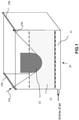
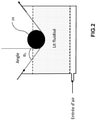
- the figure 1 presents an example of a tank fitted with a barrier and the figure 2 presents an example of a tank comprising a fluidized bed in which the baffle is a cylindrical compression roller.
- the same tank can be used without the presence of a fluidized bed and equipped with a spray gun.
- the pre-impregnation can also be carried out with a system as defined above in which one or more embedment(s) (E") is (are) present upstream of said system, in particular before the tank in which the pre-impregnation is carried out.
- bridging parts (E) and (E") may be identical or different, whether in terms of material or shape and its characteristics (diameter, length, width, height, etc. depending on the form).
- the pre-impregnation step can be carried out by the molten route, in particular by pultrusion.
- Molten pre-impregnation techniques are well known to those skilled in the art and are described in the references above.
- the pre-impregnation step is carried out in particular by cross-head extrusion of the polymer matrix and passing said wick or wicks through this cross-head then passing through a heated die, the cross-head optionally being provided with fixed or rotating yokes on which the wick passes thus causing a development of said wick allowing a pre-impregnation of said wick.
- the pre-impregnation can in particular be carried out as described in US 2014/0005331A1 with the difference that the resin supply is carried out on both sides of said wick and that there is no contact surface eliminating part of the resin on one of the two surfaces.
- the pre-impregnation step is carried out by high-speed melting, that is to say with a running speed of said wick or said wicks greater than or equal to 5m/min, in particular greater than 9 m /min.
- the pre-impregnation step can be carried out in a fluidized bed.
- This system describes the use of a tank comprising a fluidized bed to carry out the pre-impregnation step and can be used within the scope of the invention.
- the tank comprising the fluidized bed is provided with at least one bridging part (E') ( figure 1 ) which can be a compression roller ( figure 2 )).
- the embedment piece (E') can have any shape as long as the wick can pass over it.
- bridging parts (E) and (E') may be identical or different, whether in terms of material or shape and its characteristics (diameter, length, width, height, etc. depending on the form).
- the bridging part (E') is neither heated nor heated.
- the step of pre-impregnation of the fibrous material is carried out by passing one or more wicks through a continuous pre-impregnation device, comprising a tank (10) provided with at least one bridging piece (E') and comprising a fluidized bed (12) of powder of said polymer matrix.
- the powder of said polymer or polymer matrix is suspended in a gas G (air for example) introduced into the tank and circulating in the tank (10) through a hopper (11).
- the wick(s) are circulated in this fluidized bed (12).
- the tank can have any shape, in particular cylindrical or parallelepipedal, in particular a rectangular parallelepiped or a cube, advantageously a rectangular parallelepiped.
- the tank (10) can be an open or closed tank.
- the tank is closed, it is then equipped with a sealing system so that the powder of said polymer matrix cannot escape from said tank.
- thermoplastic polymer matrix is in the form of a powder, in particular in suspension in a gas, in particular air, but cannot be in dispersion. in a solvent or in water.
- wick to be pre-impregnated is unwound from a reel device under the traction generated by cylinders (not shown).
- Each reel is provided with a brake (not shown) so as to apply tension to each roving of fibres.
- a brake (not shown) so as to apply tension to each roving of fibres.
- an alignment module makes it possible to arrange the rovings of fibers parallel to each other. In this way the rovings of fibers cannot be in contact with each other, which makes it possible to avoid mechanical degradation of the fibers by friction between them.
- the roving of fibers or the rovings of parallel fibers then pass into a tank (10), comprising in particular a fluidized bed (12), provided with a bridging part (E') which is a compression roller (24) in the case of the figure 2 .
- the roving of fibers or the rovings of parallel fibers then emerge(s) from the tank after pre-impregnation after possible control of the residence time in the powder.
- pellet residence time means the time during which the wick is in contact with said powder in the fluidized bed.
- an optional de-sizing step can be carried out before the fibrous material passes through the tank.
- the tank used comprises a fluidized bed with a baffle and said pre-impregnation step is carried out with simultaneous expansion of said lock or locks between the inlet and the outlet of the tank comprising said fluidized bed.
- the expression "vessel inlet” corresponds to the vertical tangent of the edge of the vessel which includes the fluidized bed.
- outlet of the tank corresponds to the vertical tangent of the other edge of the tank which includes the fluidized bed.
- the expansion consists in singling out as much as possible each fiber constituting said lock from the other fibers which surround it in its closest space. It corresponds to the transverse spreading of the wick.
- the transverse spreading or the width of the wick increases between the inlet of the tank comprising the fluidized bed and the outlet of the tank comprising the fluidized bed and thus allows an improved pre-impregnation of the fibrous material.
- baffle (E′) in particular a cylindrical compression roller, in the pre-impregnation step therefore allows improved pre-impregnation compared to the methods of the prior art.
- compression roller means that the roving that travels rests partially or totally on the surface of said compression roller, which induces the expansion of said rove.
- said at least one compression roller is cylindrical in shape and the percentage of expansion of said lock or locks between the inlet and the outlet of the tank of said fluidized bed is between 1% and 1000%, preferably 100 % to 800% preferably from 200% to 800%, preferably from 400% to 800%.
- the lift percentage is equal to the ratio of the final width of the lock to the initial width of the lock multiplied by 100.
- the diameter of said at least one compression roller is from 3 mm to 500 mm, preferably from 10 mm to 100 mm, in particular from 20 mm to 60 mm.
- the compression roller is cylindrical and not corrugated and in particular is metallic.
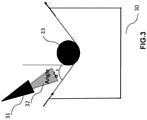
- a single compression roller is present in the fluidized bed and said pre-impregnation is carried out at the angle ⁇ 1 formed by said wick or said wicks between the entrance of said compression roller and the vertical tangent to said compression roller.
- the angle ⁇ 1 formed by said wick or said wicks between the entry of said compression roller and the vertical tangent to said compression roller allows the formation of a zone in which the powder will concentrate, thus leading to a "wedge effect which with the simultaneous development of the wick by said compression roller allows pre-impregnation over a greater width of wick and therefore improved pre-impregnation compared to improved techniques of the prior art.
- the angle ⁇ 1 is comprised from 0 to 89°, preferentially 5° to 85°, preferentially from 5° to 45°, preferentially from 5° to 30°.
- an angle ⁇ 1 comprised from 0 to 5° is likely to generate risks of mechanical stress, which will lead to the breakage of the fibers and an angle ⁇ 1 comprised from 85° to 89° does not create sufficient force. mechanism to create the "corner effect".
- a value of the angle ⁇ 1 equal to 0° therefore corresponds to a vertical fiber. It is obvious that the height of the cylindrical compression roller is adjustable, thus making it possible to position the fiber vertically.
- the inlet edge of the tank (23a) is fitted with a roller, in particular cylindrical and rotating, on which the said wick or the said wicks pass, thus leading to a development prior to the pre-impregnation.
- the angle ⁇ 1 is as defined above.
- the volume diameter D90 of the thermoplastic polymer powder particles is between 30 and 500 ⁇ m, advantageously from 80 to 300 ⁇ m.
- the volume diameter D10 of the thermoplastic polymer powder particles is between 5 and 200 ⁇ m, advantageously between 15 and 100 ⁇ m.
- the diameter by volume of the thermoplastic polymer powder particles is included in the D90/D10 ratio, i.e. between 1.5 and 50, advantageously from 2 to 10.
- the average diameter D50 by volume of the particles of thermoplastic polymer powder is between 10 and 300 ⁇ m, in particular from 30 to 200 ⁇ m, more particularly from 45 to 200 ⁇ m.
- the volume diameters of the particles are defined according to the ISO 9276:2014 standard.
- the “D50” corresponds to the volume average diameter, ie the value of the particle size which divides the population of particles examined exactly in two.
- the "D90” corresponds to the value at 90% of the cumulative curve of the particle size distribution by volume.
- the “D10” corresponds to the size of 10% of the volume of the particles.
- two, three or more rollers can be present in the fluidized bed.
- the step of pre-impregnating the fibrous material can also be carried out by passing one or more wicks through a device for continuous pre-impregnation by spraying, comprising a tank, comprising one or more nozzle(s) or one or more gun(s) projecting the polymer powder onto the fibrous material at the roller inlet.
- a device for continuous pre-impregnation by spraying comprising a tank, comprising one or more nozzle(s) or one or more gun(s) projecting the polymer powder onto the fibrous material at the roller inlet.
- the polymer(s) or polymer powder is projected into the tank by means of nozzle(s) or gun(s) at the level of the bridging part, in particular of the compression roller (inlet) onto said fibrous material.
- the wick(s) are circulated in this tank.
- two, three or more rollers may be present, each provided with a gun.
- the pre-impregnation step can therefore be carried out by any means provided or not with at least one barrier (E′).
- baffle allows the development of the wick and promotes pre-impregnation.
- this bridging is not essential from the moment when a heating system provided with at least one bridging part (E) is present after the pre-impregnation step
- carrier part (E) means any system on which the bit has the possibility of scrolling.
- the embedment piece (E) can have any shape as long as the wick can pass over it. It can be fixed or rotating.
- the heating system is any system releasing heat or emitting radiation capable of heating the loading part (E).
- It can be infrared heater, UV lamp, convection heater.
- the bridging part (E) is therefore conductive or absorbs the radiation emitted by the heat.
- baffle piece (E) means that the baffle piece (E) is made of a material capable of absorbing and conducting heat. It can also be a microwave or laser heating system.
- the bridging part is not a heat conductor or does not absorb the radiation emitted by the heat.
- non-heat-conductive baffle piece (E) means that the baffle piece (E) is made of a material incapable of absorbing and conducting heat.
- Said at least one bridging part (E) is located or included in the environment of the heating system, that is to say it is not outside the heating system.
- said heating system overcomes said at least one barring part (E).
- the heating system is at a sufficient height for the polymer present on the wick to be able to melt but without degrading said polymer.
- said heating system comprises either only said at least one baffling part (E) but can also comprise a portion of the wick, outside of said baffling system (E), said wick portion being located before and/or after said barring system (E).
- a second heating system can be present under the embarrages thus allowing a uniform melting of said polymer on the two surfaces of the wick.
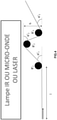
- the heating system shown figure 4 is a horizontal system. However, the heating system(s) can be arranged vertically with also vertical scrolling of the wick through the entanglements.
- this heating step makes it possible to perfect the impregnation of the wick carried out beforehand during the pre-impregnation step and in particular to obtain a homogeneous and thorough impregnation.
- a first blooming occurs during this step, in particular if the pre-impregnation step is carried out with the use of bridging parts (E'), such as in a fluidized bed with at least one bridging as described above.
- a first development of the wick occurs at the level of said compression rollers corresponding to the bridging parts (E ') with "wedge effect" due to the partial or total scrolling of the said wick on the said part (s) of baffling (E') and a second development occurs during the heating step, at the level of said compression rollers corresponding to the baffling parts (E) due to the partial or total scrolling of said roving on said part or parts ( s) bonding (E).
- This second expansion combined with the melting of said polymer matrix by the heating system and the retraction of the wick make it possible to homogenize the pre-impregnation and thus finalize the impregnation and thus to have a deep impregnation and to have a high content of fibers by volume, in particular constant in at least 70% of the volume of the strip or ribbon, in particular in at least 80% of the volume of the strip or ribbon, in particular in at least 90% of the volume of the strip or tape, more particularly in at least 95% of the volume of the tape or ribbon, as well as to reduce the porosity.
- the percentage expansion during the heating step between the entry of the first compression roller R′ 1 and the exit of the last compression roller R′ i is approximately 0 to 300%, in particular 0 at 50%.
- the different expansions during the heating step combined with the melting of the thermoplastic polymer and the retraction of the wick during said heating step make it possible to obtain a rate of fibers impregnated after the heating step ranging from 45% to 64% by volume, preferably from 50 to 60% by volume, in particular from 54 to 60% by volume (fiber content which cannot be achieved by conventional melt-process techniques), the fiber content by volume and the distribution of the fibers being substantially identical on average on either side of the median plane of the fibrous material over the entire length of said fibrous material, thus resulting in the obtaining of a fibrous material in particular monolayer.
- the porosity rate in said impregnated fibrous material is less than 10%, in particular less than 5%, in particular less than 2%.
- a step of shaping the wick or said parallel wicks of said impregnated fibrous material is carried out.
- a calendering system as described in WO 2015/121583 can be used.
- the present invention relates to the use of an impregnated fibrous material, as defined above, for the preparation of calibrated ribbons suitable for the manufacture of composite parts in three dimensions, by automatic depositing of said ribbons by means of of a robot.
- the present invention relates to a tape comprising at least one fibrous material as defined above.
- said ribbon is a single unidirectional ribbon or a plurality of unidirectional parallel ribbons.
- said tape has a width (l) and a thickness (ep) suitable for removal by robot in the manufacture of three-dimensional parts, without the need for slitting, and preferably has a width (l) of at least 5 mm and up to 400 mm, preferably between 5 and 50 mm and even more preferably between 5 and 15 mm.
- thermoplastic polymer of said tape is a polyamide as defined above
- PA 6 PA 11, PA 12, PA 66, PA 46, PA 610, PA 612, PA 1010, PA 1012, PA 11/1010 or PA 12/1010 or a semi-aromatic polyamide such as a PA MXD6 and a PA MXD10 or chosen from PA 6/6T, PA 6I/6T, PA 66/6T, PA 11/10T, PA 11/6T/10T, PA MXDT/10T, PA MPMDT /10T, PA BACT/6T, PA BACT/10T and PA BACT/10T/6T, a PVDF, a PEEK, PEKK and a PEI or a mixture thereof.
- aliphatic polyamide such as PA 6, PA 11, PA 12, PA 66, PA 46, PA 610, PA 612, PA 1010, PA 1012, PA 11/1010 or PA 12/1010 or a semi-aromatic polyamide such as a PA MXD6 and a PA MXD10 or chosen from PA 6/6T, PA 6I/6T, PA 66/6T, PA 11/10
- PA 6 PA 11, PA 12, PA 11/1010 or PA 12/1010 or a semi-aromatic polyamide such as PA MXD6 and PA MXD10 or chosen from PA 6/6T , PA 6I/6T, PA 66/6T, PA 11/10T, PA 11/6T/10T, PA MXDT/10T, PA MPMDT/10T and PA BACT/10T, PA BACT/6T, PA BACT/10T/6T.
- the present invention relates to the use of a tape as defined above, in the manufacture of three-dimensional composite parts.
- said manufacture of said composite parts relates to the fields of transport, in particular automotive, oil and gas, in particular offshore, gas storage, aeronautics, nautical, railway; renewable energies, in particular wind turbines, tidal turbines, energy storage devices, solar panels; thermal protection panels; sports and leisure, health and medical and electronics.
- the present invention relates to a three-dimensional composite part characterized in that it results from the use of at least one unidirectional strip of impregnated fibrous material as defined above.
- the fibrous material is chosen from carbon fiber rovings in particular greater than or equal to 30K, in particular greater than or equal to 50K and glass fibers in particular whose weight is greater than or equal to 1200 Tex, in particular greater than or equal to 2400 Tex, greater than or equal to 4800 Tex.
- the thermoplastic prepolymer used to impregnate the carbon fiber is chosen from a polyamide, in particular an aliphatic polyamide such as PA 11, PA 12, a PA 11/1010 and a PA 12/1010, a semi-aromatic polyamide, in particular PA 11/10T, PA 11/6T/10T, PA MXDT/10T, PA MPMDT/10T, PA BACT/10T, PA BACT/6T, PA BACT/10T/6T, PA MXD6 and a PA MXD10, a PEKK and a PEI or a mixture thereof.
- a polyamide in particular an aliphatic polyamide such as PA 11, PA 12, a PA 11/1010 and a PA 12/1010
- a semi-aromatic polyamide in particular PA 11/10T, PA 11/6T/10T, PA MXDT/10T, PA MPMDT/10T, PA BACT/10T, PA BACT/6T, PA BACT/10T/6T, PA MXD6 and a PA MXD10, a PEKK and
- the thermoplastic prepolymer used to impregnate the fiberglass is chosen from a polyamide, in particular an aliphatic polyamide such as PA 11, PA 12, a PA 11/1010 and a PA 12/1010, a semi-aromatic polyamide, in particular a PA 11/10T, a PA 11/6T/10T, a PA MXDT/10T, a PA MPMDT/10T, a PA BACT/10T, a PA BACT/6T, a PA BACT/10T/6T a PEKK and a PEI or a mixture of these.
- a polyamide in particular an aliphatic polyamide such as PA 11, PA 12, a PA 11/1010 and a PA 12/1010
- a semi-aromatic polyamide in particular a PA 11/10T, a PA 11/6T/10T, a PA MXDT/10T, a PA MPMDT/10T, a PA BACT/10T, a PA BACT/6T, a PA BACT/10T/6T a PEKK and a PE
- the fibrous material comprises rovings of carbon fiber greater than or equal to 30K, in particular greater than or equal to 50K
- the thermoplastic polymer used to pre-impregnate the carbon fiber is chosen from a polyamide, in particular an aliphatic polyamide such as PA 11, PA 12, a PA 11/1010 and a PA 12/1010, a semi-aromatic polyamide, in particular a PA 11/10T, a PA 11/6T/10T, a PA MXDT/10T, a PA MPMDT/10T , a PA BACT/10T, a PA BACT/6T, a PA BACT/10T/6T, a PA MXD6 and a PA MXD10, a PEKK and a PEI or a mixture thereof.
- the fibrous material consists of strands of carbon fiber greater than or equal to 30K, in particular greater than or equal to 50K
- the thermoplastic polymer used to pre-impregnate the carbon fiber is chosen from a polyamide, in particular an aliphatic polyamide such as PA 11, PA 12, a PA 11/1010 and a PA 12/1010, a semi-aromatic polyamide, in particular a PA 11/10T, a PA 11/6T/10T, a PA MXDT/10T, a PA MPMDT/ 10T, PA BACT/10T, PA BACT/6T, PA BACT/10T/6T, PA MXD6 and PA MXD10, PEKK and PEI or a mixture thereof.
- the fibrous material comprises fiberglass rovings whose basis weight is greater than or equal to 1200 Tex, in particular greater than or equal to 2400 Tex, greater than or equal to 4800 Tex and the thermoplastic polymer used to pre-impregnate the fiberglass is chosen from a polyamide, in particular an aliphatic polyamide such as PA 11, PA 12, a PA 11/1010 and a PA 12/1010, a semi-aromatic polyamide, in particular a PA 11/10T, a PA 11/6T/ 10T, PA MXDT/10T, PA MPMDT/10T, PA BACT/10T, PA BACT/6T, PA BACT/10T/6T, PA MXD6 and PA MXD10, PEKK and PEI or a mixture of these.
- a polyamide in particular an aliphatic polyamide such as PA 11, PA 12, a PA 11/1010 and a PA 12/1010
- a semi-aromatic polyamide in particular a PA 11/10T, a PA 11/6T/ 10T, PA MX
- the fibrous material consists of fiberglass rovings whose basis weight is greater than or equal to 1200 Tex, in particular greater than or equal to 2400 Tex, greater than or equal to 4800 Tex and the thermoplastic polymer used to pre-impregnate the glass fiber.
- a glass is chosen from a polyamide, in particular an aliphatic polyamide such as PA 11, PA 12, a PA 11/1010 and a PA 12/1010, a semi-aromatic polyamide, in particular a PA 11/10T, a PA 11/6T /10T, a PA MXDT/10T, a PA MPMDT/10T, a PA BACT/10T, a PA BACT/6T, a PA BACT/10T/6T, a PA MXD6 and a PA MXD10, a PEKK and a PEI or a mixture of these.
- a polyamide in particular an aliphatic polyamide such as PA 11, PA 12, a PA 11/1010 and a PA 12/1010
- a semi-aromatic polyamide in particular a PA 11/10T, a PA 11/6T /10T, a PA MXDT/10T, a PA MPMDT/10T, a PA BACT/10T, a PA BACT/6T, a PA BACT/10T/6T,
- the fibrous material comprises strands of carbon fiber greater than or equal to 30K, in particular greater than or equal to 50K
- the thermoplastic polymer used to pre-impregnate the carbon fiber is chosen from a polyamide, in particular an aliphatic polyamide such as PA 11, PA 12, a PA 11/1010 and a PA 12/1010, a semi-aromatic polyamide, in particular a PA 11/10T, a PA 11/6T/10T, a PA MXDT/10T, a PA MPMDT/10T , a PA BACT/10T, a PA BACT/6T, a PA BACT/10T/6T, a PA MXD6 and a PA MXD10, a PEKK and a PEI or a mixture thereof and the Tg of said thermoplastic polymer is ⁇ 80 °C, in particular ⁇ 100°C, in particular ⁇ 120°C, in particular ⁇ 140°C or the Tm is ⁇ 150°C.
- the fibrous material consists of strands of carbon fiber greater than or equal to 30K, in particular greater than or equal to 50K
- the thermoplastic polymer used to pre-impregnate the carbon fiber is chosen from a polyamide, in particular an aliphatic polyamide such as PA 11, PA 12, a PA 11/1010 and a PA 12/1010, a semi-aromatic polyamide, in particular a PA 11/10T, a PA 11/6T/10T, a PA MXDT/10T, a PA MPMDT/ 10T, a PA BACT/10T, a PA BACT/6T, a PA BACT/10T/6T, a PA MXD6 and a PA MXD10, a PEKK and a PEI or a mixture thereof and the Tg of said thermoplastic polymer is ⁇ 80°C, in particular ⁇ 100°C, in particular ⁇ 120°C, in particular ⁇ 140°C or the Tm is ⁇ 150°C.
- the fibrous material comprises fiberglass rovings whose basis weight is greater than or equal to 1200 Tex, in particular greater than or equal to 2400 Tex, greater than or equal to 4800 Tex and the thermoplastic polymer used to pre-impregnate the glass fiber is chosen from a polyamide, in particular an aliphatic polyamide such as PA 11, PA 12, a PA 11/1010 and a PA 12/1010, a semi-aromatic polyamide, in particular a PA 11/10T, a PA 11 /6T/10T, PA MXDT/10T, PA MPMDT/10T, PA BACT/10T, PA BACT/6T, PA BACT/10T/6T, PA MXD6 and PA MXD10, PEKK and PEI or a mixture of these and the Tg of said thermoplastic polymer is ⁇ 80°C, in particular ⁇ 100°C, in particular ⁇ 120°C, in particular ⁇ 140°C or the Tm is ⁇ 150°C.
- a polyamide in particular an aliphatic polyamide such
- the fibrous material consists of fiberglass rovings whose basis weight is greater than or equal to 1200 Tex, in particular greater than or equal to 2400 Tex, greater than or equal to 4800 Tex and the thermoplastic polymer used to pre-impregnate the glass fiber.
- a glass is chosen from a polyamide, in particular an aliphatic polyamide such as PA 11, PA 12, a PA 11/1010 and a PA 12/1010, a semi-aromatic polyamide, in particular a PA 11/10T, a PA 11/6T /10T, a PA MXDT/10T, a PA MPMDT/10T, a PA BACT/10T, a PA BACT/6T, a PA BACT/10T/6T, a PA MXD6 and a PA MXD10, a PEKK and a PEI or a mixture of these and the Tg of said thermoplastic polymer is ⁇ 80°C, in particular ⁇ 100°C, in particular ⁇ 120°C, in particular ⁇ 140°C or the Tm is ⁇ 150°C.
- a polyamide in particular an aliphatic polyamide such as PA 11, PA 12, a PA 11/1010 and a PA 12/1010
- a semi-aromatic polyamide in particular a PA 11/10T, a PA 11/6
- a roving of Zoltek carbon fiber, 50K was impregnated with PA MPMDT/10T as described in WO 2015/121583 .
- D50 115 ⁇ M.
- Example 2 Fibrous material (Zoltek carbon fiber, 50K) monolayer impregnated with MPMDT/10T
- the rollers are 54 cm apart (distance between the first and the last roller)
- the heating system used is that described in the figure 4 but with eight fixed cylindrical rollers R' 1 to R' 8 with a diameter of 8 mm.
- the forward speed of the wick is 10 m/min
- the infrared used has a power of 25 kW, the height between the infrared and the upper roller is 4 cm and the height between the infrared and the lower rollers is 9 cm.
- the angles ⁇ ′ 1 to ⁇ ′ 8 are identical and 25°.
- the height h is 20 mm
- the length l is 1000 mm
- the eight rollers are each 43 mm apart.
- Calendering by means of two calenders mounted in series equipped with an IR of 1kW each after the heating stage.
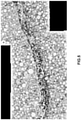
- the figure 6 presents the impregnated fibrous material obtained.
- the fibrous material obtained is a single-layer material which has homogeneity of impregnation and low porosity with a very good distribution of the fibers.
- the porosity was determined by image analysis on a wick of 50K carbon fiber impregnated with MPMDT/10T in a fluidized bed followed by a heating step as defined above.
- Example 4 Determination of the porosity rate the relative difference between theoretical density and experimental density (general method)
- the measurement of carbon fiber content can be determined according to ISO 14127:2008.
Landscapes
- Chemical & Material Sciences (AREA)
- Engineering & Computer Science (AREA)
- Organic Chemistry (AREA)
- Health & Medical Sciences (AREA)
- Chemical Kinetics & Catalysis (AREA)
- Medicinal Chemistry (AREA)
- Polymers & Plastics (AREA)
- Materials Engineering (AREA)
- Manufacturing & Machinery (AREA)
- Inorganic Chemistry (AREA)
- Mechanical Engineering (AREA)
- Reinforced Plastic Materials (AREA)
- Moulding By Coating Moulds (AREA)
- Compositions Of Macromolecular Compounds (AREA)
Applications Claiming Priority (3)
| Application Number | Priority Date | Filing Date | Title |
|---|---|---|---|
| FR1755702A FR3067968B1 (fr) | 2017-06-22 | 2017-06-22 | Materiau fibreux impregne de polymere thermoplastique |
| EP19204501.1A EP3617254B1 (fr) | 2017-06-22 | 2018-06-21 | Materiau fibreux impregne de polymere thermoplastique |
| EP18178994.2A EP3418323B1 (fr) | 2017-06-22 | 2018-06-21 | Materiau fibreux impregne de polymere thermoplastique |
Related Parent Applications (2)
| Application Number | Title | Priority Date | Filing Date |
|---|---|---|---|
| EP19204501.1A Division EP3617254B1 (fr) | 2017-06-22 | 2018-06-21 | Materiau fibreux impregne de polymere thermoplastique |
| EP18178994.2A Division EP3418323B1 (fr) | 2017-06-22 | 2018-06-21 | Materiau fibreux impregne de polymere thermoplastique |
Publications (1)
| Publication Number | Publication Date |
|---|---|
| EP3940021A1 true EP3940021A1 (fr) | 2022-01-19 |
Family
ID=59859256
Family Applications (3)
| Application Number | Title | Priority Date | Filing Date |
|---|---|---|---|
| EP21187016.7A Pending EP3940021A1 (fr) | 2017-06-22 | 2018-06-21 | Materiau fibreux impregne de polymere thermoplastique |
| EP19204501.1A Revoked EP3617254B1 (fr) | 2017-06-22 | 2018-06-21 | Materiau fibreux impregne de polymere thermoplastique |
| EP18178994.2A Revoked EP3418323B1 (fr) | 2017-06-22 | 2018-06-21 | Materiau fibreux impregne de polymere thermoplastique |
Family Applications After (2)
| Application Number | Title | Priority Date | Filing Date |
|---|---|---|---|
| EP19204501.1A Revoked EP3617254B1 (fr) | 2017-06-22 | 2018-06-21 | Materiau fibreux impregne de polymere thermoplastique |
| EP18178994.2A Revoked EP3418323B1 (fr) | 2017-06-22 | 2018-06-21 | Materiau fibreux impregne de polymere thermoplastique |
Country Status (8)
| Country | Link |
|---|---|
| US (1) | US10675785B2 (https=) |
| EP (3) | EP3940021A1 (https=) |
| JP (2) | JP6975804B2 (https=) |
| KR (2) | KR102405670B1 (https=) |
| CN (2) | CN112625272A (https=) |
| ES (2) | ES2894921T3 (https=) |
| FR (1) | FR3067968B1 (https=) |
| WO (1) | WO2018234436A1 (https=) |
Families Citing this family (20)
| Publication number | Priority date | Publication date | Assignee | Title |
|---|---|---|---|---|
| FR3067968B1 (fr) | 2017-06-22 | 2020-11-06 | Arkema France | Materiau fibreux impregne de polymere thermoplastique |
| FR3067969B1 (fr) | 2017-06-22 | 2022-08-12 | Arkema France | Materiau fibreux impregne de prepolymere thermoplastique reactif |
| FR3067961B1 (fr) | 2017-06-22 | 2020-11-06 | Arkema France | Procede de fabrication d'un materiau fibreux impregne de polymere thermoplastique |
| FR3071184B1 (fr) * | 2017-09-18 | 2021-11-19 | Arkema France | Procede d'impregnation de fibres de renfort avec des polyarylethercetones et semi-produits ainsi obtenus |
| ES2962144T3 (es) * | 2018-04-25 | 2024-03-15 | Asahi Chemical Ind | Moldeado de resina reforzado con fibra continua y método para la fabricación de la misma |
| FR3102701B1 (fr) | 2019-11-06 | 2022-12-23 | Arkema France | Procédé d’imprégnation d’un matériau fibreux avec un système optimisé de réalimentation et de nettoyage des particules fines |
| CN115485423B (zh) * | 2020-04-29 | 2024-03-12 | 苏黎世联邦理工学院 | 用于大型复合材料部件的双组分或多组分纤维 |
| RU2765042C1 (ru) * | 2020-11-02 | 2022-01-25 | Федеральное государственное унитарное предприятие "Всероссийский научно-исследовательский институт авиационных материалов" Национального исследовательского центра "Курчатовский институт" (НИЦ "Курчатовский институт" - ВИАМ) | Способ изготовления углепластика на основе тканого углеродного наполнителя и термопластичного связующего |
| FR3116468B1 (fr) | 2020-11-24 | 2023-06-30 | Arkema France | Structure multicouche pour le transport ou le stockage de l’hydrogene |
| FR3117913B1 (fr) | 2020-12-17 | 2023-07-14 | Arkema France | Procédé de fabrication d’un matériau fibreux en fibres continues imprégné de polymère thermoplastique |
| FR3119561A1 (fr) | 2021-02-05 | 2022-08-12 | Arkema France | Procede de preparation de pieces composites a fort degre de consolidation |
| FR3121627B1 (fr) | 2021-04-07 | 2023-12-29 | Arkema France | Structure multicouche pour le transport ou le stockage de l’hydrogene |
| FR3121680B1 (fr) | 2021-04-08 | 2024-04-12 | Arkema France | Compositions de polyamide ignifuges, leurs utilisations et leurs procedes de preparation |
| FR3121681B1 (fr) | 2021-04-08 | 2024-05-03 | Arkema France | Compositions de polyamide ignifuges, leurs utilisations et leurs procedes de preparation |
| FR3125742B1 (fr) | 2021-07-27 | 2024-03-01 | Arkema France | Tube comportant un élément cylindrique pultrudé |
| DE102022110684A1 (de) | 2022-05-02 | 2023-11-02 | Delcotex Delius Techtex Gmbh & Co. Kg | Verfahren zur Herstellung einer Prepreg-Lage, Prepreg-Lagen und deren Verwendung |
| GB202216920D0 (en) | 2022-11-14 | 2022-12-28 | Victrex Mfg Ltd | A component and method of formation of a component |
| FR3146828A1 (fr) | 2023-03-20 | 2024-09-27 | Arkema France | Structure composite surmoulée |
| FR3146829A1 (fr) | 2023-03-20 | 2024-09-27 | Arkema France | Structure composite surmoulée |
| FR3148637A1 (fr) | 2023-05-10 | 2024-11-15 | Arkema France | Structure monocouche ou multicouche pour le transport, le stockage ou la distribution de gaz comprime |
Citations (14)
| Publication number | Priority date | Publication date | Assignee | Title |
|---|---|---|---|---|
| EP0201367A1 (fr) | 1985-03-25 | 1986-11-12 | Elf Atochem S.A. | Matériau composite polymère thermoplastique renforcé de fibres |
| EP0324680A2 (fr) | 1988-01-11 | 1989-07-19 | Arjo Wiggins S.A. | Procédé de préparation d'une feuille de matériau thermoplastique renforcé et feuille ainsi obtenue |
| EP0335186A2 (de) | 1988-03-29 | 1989-10-04 | Bayer Ag | Metallfasern enthaltende Verbundstoffe sowie deren Verwendung zur Herstellung von Formteilen zur Abschirmung von elektromagnetischer Strahlung |
| EP0406067A1 (fr) | 1989-06-22 | 1991-01-02 | ETAT-FRANCAIS représenté par le DELEGUE GENERAL POUR L'ARMEMENT (DPAG) | Matériau composite à caractéristiques modulables par préimprégnation d'une fibre continue |
| EP1505099A2 (fr) | 2003-08-05 | 2005-02-09 | Arkema | Polymides semi aromatiques souples à faible reprise en humidité |
| WO2008135663A2 (fr) | 2007-03-21 | 2008-11-13 | Technip France | Conduite flexible pour le transport des hydrocarbures à couche de maintien renforcée |
| WO2012066241A2 (fr) | 2010-11-17 | 2012-05-24 | Arkema France | Procede de fabrication de materiau fibreux pre-impregne de polymere thermodurcissable |
| US20140005331A1 (en) | 2011-12-09 | 2014-01-02 | Ticona Llc | Asymmetric Fiber Reinforced Polymer Tape |
| FR2997089A1 (fr) * | 2012-10-23 | 2014-04-25 | Arkema France | Materiau composite thermoplastique a base de polyamide semi-cristallin et procede de fabrication |
| FR2997036A1 (fr) * | 2012-10-23 | 2014-04-25 | Arkema France | Procede de fabrication d'une piece composite thermoplastique en moule ferme, avec injection dans un moule froid |
| FR3017330A1 (fr) * | 2014-02-13 | 2015-08-14 | Arkema France | Procede de fabrication d'un materiau fibreux pre-impregne de polymere thermoplastique en utilisant une dispersion aqueuse de polymere |
| WO2015121583A2 (fr) | 2014-02-13 | 2015-08-20 | Arkema France | Procede de fabrication d'un materiau fibreux pre-impregne de polymere thermoplastique en lit fluidise |
| WO2016062896A1 (fr) | 2014-10-24 | 2016-04-28 | Porcher Industries | Mèches poudrées par procédé électrostatique |
| WO2017017388A1 (fr) | 2015-07-29 | 2017-02-02 | Arkema France | Procédé pour matériau fibreux pre-impregne par un polymère thermoplastique a l'aide d'un polymère a cristaux liquides |
Family Cites Families (34)
| Publication number | Priority date | Publication date | Assignee | Title |
|---|---|---|---|---|
| DE1629830C3 (de) | 1964-04-22 | 1974-01-03 | Herbert Dr.-Ing. 6243 Falkenstein Vohrer | Verfahren und Vorrichtung zur Herstellung von in der Längs- und Querrichtung durch Textilfaden verstärkten schmalen Bändern aus thermoplastischen Kunststoffen |
| EP0102159B1 (en) | 1982-07-28 | 1988-01-27 | Imperial Chemical Industries Plc | Method of producing fibre-reinforced composition |
| FR2584258B1 (fr) | 1985-06-28 | 1995-04-14 | Elf Aquitaine | Procede et dispositif pour le traitement thermique d'un element conducteur au moins partiellement constitue d'un materiau conducteur |
| FR2613661B1 (fr) | 1987-04-09 | 1989-10-06 | Atochem | Procede de fabrication de profiles de resine thermoplastique renforces de fibres continues, appareillage pour leur obtention |
| US5171630A (en) | 1989-04-17 | 1992-12-15 | Georgia Tech Research Corporation | Flexible multiply towpreg |
| FR2653436A1 (fr) | 1989-10-24 | 1991-04-26 | Atochem | Copolyesters aromatiques thermotropes et leur procede de preparation. |
| US5888580A (en) | 1991-07-03 | 1999-03-30 | Hoechst Aktiengesellschaft | Production of composites from polymer powder dispersions |
| DE69130172T2 (de) * | 1991-11-28 | 1999-05-12 | Solutia Europe N.V./S.A., Bruessel/Bruxelles | Nylon Pultrusionsverfahren |
| FR2694008B1 (fr) | 1992-07-24 | 1994-10-21 | Atochem Elf Sa | Polymères et copolymères issus de l'addition d'oligomères à terminaisons di-amino et di-hydroxy et de bisoxazinones ou de bisoxazolinones, et leur procédé d'obtention. |
| FR2694009B1 (fr) | 1992-07-24 | 1994-10-21 | Atochem Elf Sa | Polymères et copolymères issus de l'addition d'oligomères à terminaisons di-carboxy et de bisoxazines ou bisoxazolines, et leur procédé d'obtention. |
| US5756206A (en) | 1995-03-15 | 1998-05-26 | Custom Composite Materials, Inc. | Flexible low bulk pre-impregnated tow |
| JPH08294918A (ja) * | 1995-04-27 | 1996-11-12 | Toray Ind Inc | Frtp品製造用素材およびその製造方法 |
| FR2733757B1 (fr) | 1995-04-27 | 1997-06-20 | Atochem Elf Sa | Polymeres et copolymeres issus de l'addition d'oligomeres a terminaisons di-carboxy et de bisimidazolines, et leur procede d'obtention |
| DE59905066D1 (de) | 1998-01-16 | 2003-05-22 | Neopreg Ag Gelterkinden | Verfahren zum beschichten von fasern |
| US6652872B2 (en) * | 1999-07-06 | 2003-11-25 | Ramat At Tel Aviv University Ltd. | Scaffold formed of tissue treated to eliminate cellular and cytosolic elements |
| ATE445660T1 (de) | 2007-05-03 | 2009-10-15 | Ems Patent Ag | Teilaromatische polyamidformmassen und deren verwendungen |
| FR2933973B1 (fr) * | 2008-07-16 | 2011-09-09 | Messier Bugatti | Procede de fabrication d'une piece de friction en materiau composite carbone/carbone |
| EP2725055B1 (en) | 2011-06-24 | 2017-10-11 | Toray Industries, Inc. | Molding material, molding method using same, method for producing molding material, and method for producing fiber-reinforced composite material |
| FR2981653B1 (fr) | 2011-10-25 | 2014-08-22 | Arkema France | Materiau composite thermoplastique renforce de fibres synthetiques et procede de fabrication |
| JP5774465B2 (ja) | 2011-12-27 | 2015-09-09 | フクビ化学工業株式会社 | 繊維強化プラスチック製テープの製造方法およびそれに用いる製造装置 |
| FR2991331B1 (fr) | 2012-06-01 | 2015-05-15 | Arkema France | Materiau composite thermoplastique a base de fibres naturelles |
| FR2997035B1 (fr) | 2012-10-23 | 2016-07-01 | Arkema France | Procede de fabrication d'une piece composite thermoplastique, par injection-compression-moulage sous vide, dispositif de mise en œuvre et piece ainsi obtenue |
| FR3019825B1 (fr) | 2014-04-15 | 2017-10-27 | Arkema France | Materiau composite thermoplastique a base de polyamide semi-cristallin et procede de fabrication |
| FR3019826B1 (fr) | 2014-04-15 | 2017-10-20 | Arkema France | Composition thermoplastique a base de polyamide polymere issu d'un prepolymere et d'un allongeur de chaine et procede de fabrication |
| WO2016053465A1 (en) * | 2014-09-30 | 2016-04-07 | E. I. Du Pont De Nemours And Company | Acoustic emission reduction of composites containing semi-aromatic polyamides |
| FR3030548B1 (fr) * | 2014-12-22 | 2018-03-30 | Rhodia Operations | Composition thermoplastique a haute fluidite |
| FR3037962B1 (fr) | 2015-06-24 | 2019-11-29 | Arkema France | Procede en moule ouvert pour un materiau composite de matrice en polyamide semi-cristallin renforce fibres a partir de composition precurseur reactive de prepolymere |
| FR3045640B1 (fr) | 2015-12-18 | 2020-08-28 | Arkema France | Structure barriere a base de copolyamide mpmdt/xt de haute tg |
| FR3061068B1 (fr) | 2016-12-22 | 2020-02-14 | Arkema France | Procede de fabrication d'un materiau fibreux pre-impregne de polymere thermoplastique sous forme de poudre |
| FR3061067B1 (fr) | 2016-12-22 | 2020-02-14 | Arkema France | Procede de fabrication d'un materiau fibreux pre-impregne de polymere thermoplastique par projection |
| FR3061066B1 (fr) | 2016-12-22 | 2020-02-14 | Arkema France | Procede de fabrication d'un materiau fibreux pre-impregne de polymere thermoplastique en lit fluidise |
| FR3061069B1 (fr) | 2016-12-22 | 2020-05-01 | Arkema France | Procede de fabrication d'un materiau fibreux pre-impregne de polymere thermoplastique sous forme de poudre seche |
| FR3067961B1 (fr) * | 2017-06-22 | 2020-11-06 | Arkema France | Procede de fabrication d'un materiau fibreux impregne de polymere thermoplastique |
| FR3067968B1 (fr) | 2017-06-22 | 2020-11-06 | Arkema France | Materiau fibreux impregne de polymere thermoplastique |
-
2017
- 2017-06-22 FR FR1755702A patent/FR3067968B1/fr active Active
-
2018
- 2018-06-21 ES ES19204501T patent/ES2894921T3/es active Active
- 2018-06-21 EP EP21187016.7A patent/EP3940021A1/fr active Pending
- 2018-06-21 CN CN202011203282.7A patent/CN112625272A/zh active Pending
- 2018-06-21 JP JP2019569771A patent/JP6975804B2/ja active Active
- 2018-06-21 US US16/623,991 patent/US10675785B2/en active Active
- 2018-06-21 CN CN201880042039.6A patent/CN110799578B/zh active Active
- 2018-06-21 EP EP19204501.1A patent/EP3617254B1/fr not_active Revoked
- 2018-06-21 KR KR1020207029871A patent/KR102405670B1/ko active Active
- 2018-06-21 ES ES18178994T patent/ES2763700T3/es active Active
- 2018-06-21 EP EP18178994.2A patent/EP3418323B1/fr not_active Revoked
- 2018-06-21 KR KR1020197037896A patent/KR102170064B1/ko active Active
- 2018-06-21 WO PCT/EP2018/066561 patent/WO2018234436A1/fr not_active Ceased
-
2021
- 2021-11-08 JP JP2021181914A patent/JP7466512B2/ja active Active
Patent Citations (15)
| Publication number | Priority date | Publication date | Assignee | Title |
|---|---|---|---|---|
| EP0201367A1 (fr) | 1985-03-25 | 1986-11-12 | Elf Atochem S.A. | Matériau composite polymère thermoplastique renforcé de fibres |
| EP0324680A2 (fr) | 1988-01-11 | 1989-07-19 | Arjo Wiggins S.A. | Procédé de préparation d'une feuille de matériau thermoplastique renforcé et feuille ainsi obtenue |
| EP0335186A2 (de) | 1988-03-29 | 1989-10-04 | Bayer Ag | Metallfasern enthaltende Verbundstoffe sowie deren Verwendung zur Herstellung von Formteilen zur Abschirmung von elektromagnetischer Strahlung |
| EP0406067A1 (fr) | 1989-06-22 | 1991-01-02 | ETAT-FRANCAIS représenté par le DELEGUE GENERAL POUR L'ARMEMENT (DPAG) | Matériau composite à caractéristiques modulables par préimprégnation d'une fibre continue |
| EP1505099A2 (fr) | 2003-08-05 | 2005-02-09 | Arkema | Polymides semi aromatiques souples à faible reprise en humidité |
| WO2008135663A2 (fr) | 2007-03-21 | 2008-11-13 | Technip France | Conduite flexible pour le transport des hydrocarbures à couche de maintien renforcée |
| WO2012066241A2 (fr) | 2010-11-17 | 2012-05-24 | Arkema France | Procede de fabrication de materiau fibreux pre-impregne de polymere thermodurcissable |
| US20140005331A1 (en) | 2011-12-09 | 2014-01-02 | Ticona Llc | Asymmetric Fiber Reinforced Polymer Tape |
| FR2997089A1 (fr) * | 2012-10-23 | 2014-04-25 | Arkema France | Materiau composite thermoplastique a base de polyamide semi-cristallin et procede de fabrication |
| FR2997036A1 (fr) * | 2012-10-23 | 2014-04-25 | Arkema France | Procede de fabrication d'une piece composite thermoplastique en moule ferme, avec injection dans un moule froid |
| FR3017330A1 (fr) * | 2014-02-13 | 2015-08-14 | Arkema France | Procede de fabrication d'un materiau fibreux pre-impregne de polymere thermoplastique en utilisant une dispersion aqueuse de polymere |
| WO2015121583A2 (fr) | 2014-02-13 | 2015-08-20 | Arkema France | Procede de fabrication d'un materiau fibreux pre-impregne de polymere thermoplastique en lit fluidise |
| US20170165875A1 (en) * | 2014-02-13 | 2017-06-15 | Arkema France | Method of producing a fibrous material pre-impregnated with thermoplastic polymer in a fluid bed |
| WO2016062896A1 (fr) | 2014-10-24 | 2016-04-28 | Porcher Industries | Mèches poudrées par procédé électrostatique |
| WO2017017388A1 (fr) | 2015-07-29 | 2017-02-02 | Arkema France | Procédé pour matériau fibreux pre-impregne par un polymère thermoplastique a l'aide d'un polymère a cristaux liquides |
Also Published As
| Publication number | Publication date |
|---|---|
| US10675785B2 (en) | 2020-06-09 |
| JP7466512B2 (ja) | 2024-04-12 |
| EP3617254B1 (fr) | 2021-08-18 |
| KR102405670B1 (ko) | 2022-06-03 |
| CN110799578A (zh) | 2020-02-14 |
| FR3067968B1 (fr) | 2020-11-06 |
| JP6975804B2 (ja) | 2021-12-01 |
| ES2763700T3 (es) | 2020-05-29 |
| ES2894921T3 (es) | 2022-02-16 |
| US20200139586A1 (en) | 2020-05-07 |
| EP3418323B1 (fr) | 2019-11-20 |
| EP3617254A1 (fr) | 2020-03-04 |
| JP2022033750A (ja) | 2022-03-02 |
| KR102170064B1 (ko) | 2020-10-26 |
| FR3067968A1 (fr) | 2018-12-28 |
| KR20200121924A (ko) | 2020-10-26 |
| WO2018234436A1 (fr) | 2018-12-27 |
| JP2020524615A (ja) | 2020-08-20 |
| EP3418323A1 (fr) | 2018-12-26 |
| CN110799578B (zh) | 2020-11-24 |
| CN112625272A (zh) | 2021-04-09 |
| KR20200003932A (ko) | 2020-01-10 |
Similar Documents
| Publication | Publication Date | Title |
|---|---|---|
| EP3617254B1 (fr) | Materiau fibreux impregne de polymere thermoplastique | |
| EP3393738B1 (fr) | Procédé de fabrication d'un matériau fibreux pré-imprégné de polymère thermoplastique en lit fluidise | |
| EP3558612B1 (fr) | Procede de fabrication d'un materiau fibreux pre-impregne de polymere thermoplastique sous forme de poudre | |
| EP3418017B1 (fr) | Procede de fabrication d'un materiau fibreux impregne de polymere thermoplastique | |
| EP3418016B1 (fr) | Procede de fabrication d'un materiau fibreux impregne de polymere thermoplastique | |
| EP3558613A1 (fr) | Procédé de fabrication d'un matériau fibreux pré-imprégné de polymère thermoplastique sous forme de poudre sèche | |
| EP3558614A1 (fr) | Procede de fabrication d'un materiau fibreux pre-impregne de polymere thermoplastique par projection | |
| EP3768768B1 (fr) | Materiau fibreux impregne de polymere thermoplastique et d'epaisseur inferieure ou egale a 100 micrometre et son procede de preparation | |
| EP3887115B1 (fr) | Procede d'impregnation d'un materiau fibreux en lit fluidise interpenetre | |
| FR3102701A1 (fr) | Procédé d’imprégnation d’un matériau fibreux avec un système optimisé de réalimentation et de nettoyage des particules fines | |
| EP3670130B1 (fr) | Procede de fabrication d'un materiau fibreux impregne de polymere thermoplastique | |
| EP3670128B1 (fr) | Procede de fabrication d'un materiau fibreux pre-impregne de polymere thermoplastique en lit fluidise | |
| FR3079163A1 (fr) | Nappe de materiau fibreux impregne, son procede de fabrication et son utilisation pour la fabrication de pieces composites en trois dimensions |
Legal Events
| Date | Code | Title | Description |
|---|---|---|---|
| PUAI | Public reference made under article 153(3) epc to a published international application that has entered the european phase |
Free format text: ORIGINAL CODE: 0009012 |
|
| STAA | Information on the status of an ep patent application or granted ep patent |
Free format text: STATUS: REQUEST FOR EXAMINATION WAS MADE |
|
| 17P | Request for examination filed |
Effective date: 20210721 |
|
| AC | Divisional application: reference to earlier application |
Ref document number: 3418323 Country of ref document: EP Kind code of ref document: P Ref document number: 3617254 Country of ref document: EP Kind code of ref document: P |
|
| AK | Designated contracting states |
Kind code of ref document: A1 Designated state(s): AL AT BE BG CH CY CZ DE DK EE ES FI FR GB GR HR HU IE IS IT LI LT LU LV MC MK MT NL NO PL PT RO RS SE SI SK SM TR |
|
| RBV | Designated contracting states (corrected) |
Designated state(s): AL AT BE BG CH CY CZ DE DK EE ES FI FR GB GR HR HU IE IS IT LI LT LU LV MC MK MT NL NO PL PT RO RS SE SI SK SM TR |
|
| TPAC | Observations filed by third parties |
Free format text: ORIGINAL CODE: EPIDOSNTIPA |
|
| STAA | Information on the status of an ep patent application or granted ep patent |
Free format text: STATUS: EXAMINATION IS IN PROGRESS |
|
| 17Q | First examination report despatched |
Effective date: 20230419 |
|
| RAP3 | Party data changed (applicant data changed or rights of an application transferred) |
Owner name: ARKEMA FRANCE |