EP3938221B1 - Mobilteil mit zumindest einem auf dem mobilteil angeordneten aufsatzmodul - Google Patents
Mobilteil mit zumindest einem auf dem mobilteil angeordneten aufsatzmodul Download PDFInfo
- Publication number
- EP3938221B1 EP3938221B1 EP20707180.4A EP20707180A EP3938221B1 EP 3938221 B1 EP3938221 B1 EP 3938221B1 EP 20707180 A EP20707180 A EP 20707180A EP 3938221 B1 EP3938221 B1 EP 3938221B1
- Authority
- EP
- European Patent Office
- Prior art keywords
- wheel
- mobile part
- receiving unit
- linear guide
- part according
- Prior art date
- Legal status (The legal status is an assumption and is not a legal conclusion. Google has not performed a legal analysis and makes no representation as to the accuracy of the status listed.)
- Active
Links
Images

Classifications
-
- B—PERFORMING OPERATIONS; TRANSPORTING
- B60—VEHICLES IN GENERAL
- B60B—VEHICLE WHEELS; CASTORS; AXLES FOR WHEELS OR CASTORS; INCREASING WHEEL ADHESION
- B60B29/00—Apparatus or tools for mounting or dismounting wheels
- B60B29/001—Apparatus or tools for mounting or dismounting wheels comprising lifting or aligning means
-
- B—PERFORMING OPERATIONS; TRANSPORTING
- B60—VEHICLES IN GENERAL
- B60B—VEHICLE WHEELS; CASTORS; AXLES FOR WHEELS OR CASTORS; INCREASING WHEEL ADHESION
- B60B29/00—Apparatus or tools for mounting or dismounting wheels
- B60B29/002—Apparatus or tools for mounting or dismounting wheels provided with a dolly
Definitions
- the invention relates to a handset with at least one add-on module arranged on the handset.
- the invention is therefore based on the object of improving automation in the motor vehicle industry.
- the task is solved in the handset according to the features specified in claim 1.
- the advantage here is that the handset transports the wheel from the warehouse and fine positioning is also possible. This means that the handset only has to position with approximately centimeter precision and positioning with millimeter precision can be carried out by operating the linear guides.
- the advantage here is that fully automatic fine positioning can be carried out.
- the screwing of the screw nuts for fastening the wheel to the shaft flange part can therefore be carried out by a robot which has a suitable screwing tool instead of the worker.
- the base plate is connected to the chassis of the handset, in particular the base plate is connected to the top of the chassis, in particular is screw-connected by means of screws.
- the advantage here is that the attachment module can be easily but securely mounted on the top of the chassis of the handset.
- one or more of the linear guides can be fixed by means of a, in particular by means of a single, locking pin.
- the wheel receiving unit has a particularly concave receiving surface for a wheel.
- the advantage here is that self-centering is possible.
- the receiving surface is concave.
- the receiving surface has rollers, so that the wheel accommodated in the receiving surface can be rotated about its wheel axis essentially without force, as long as the wheel is not screw-connected to a shaft part of a motor vehicle.
- the advantage here is that the wheel is not only self-centering in the concave receiving surface, but also rotatable.
- a limiting part delimits the wheel received in the receiving surface, in particular in the axial direction, i.e. in the direction of the wheel axis.
- the mobile part has a secondary winding on its underside for the contactless transmission of electrical power from an elongated primary conductor laid on the floor, i.e. on the travel plane, to the secondary winding.
- the advantage here is that contactless transmission of electrical power is possible.
- the mobile part has a control with which a steering and a travel drive of the mobile part can be controlled.
- the advantage is that the handset can be used as an automatically guided vehicle or as a driverless transport system.
- a handle bar is firmly connected to the wheel receiving part.
- one of the linear guides functions as a lifting device for the wheel receiving unit, the lifting device having a counterweight so that the positioning of the wheel receiving unit is made possible essentially without force.
- the advantage is that a Force-free positioning is possible, so only frictional forces have to be overcome and no gravity.
- the advantage here is that the wheel is brought automatically from the warehouse and can be brought into the assembly position without any force.
- the locking is monitored by means of a sensor and the handset continues to travel depending on the signal from the sensor.
- the two add-on modules are designed in the same way, i.e. identical to each other.
- a handset not shown in the figures, is used to hold the add-on modules on its top.
- the mobile part has a travel drive, in particular a traction drive, a steering system and an energy storage device as well as a control system.
- a secondary coil is arranged on the underside of the handset, which can be inductively coupled to an elongated primary conductor laid on the floor, into which an alternating current is impressed.
- a capacitance is connected in series or parallel to the secondary coil, so that the resonance frequency of the resonant circuit formed in this way equals the frequency of the alternating current. This means that electrical power can be transferred from the primary conductor to the handset with high efficiency, even with weak and/or fluctuating inductive coupling.
- the energy storage is supplied from the resonant circuit via a rectifier and a DC/DC converter and/or charge controller.
- the travel drive in particular the electric motor driving at least one wheel of the handset, is fed from the energy storage and the control and steering are supplied.
- the top modules in particular a respective base plate 1 of the respective top module, are mounted, in particular screwed, on the top of the handset.
- the handset carries out intralogistical transports. For example, it travels to a warehouse where it is filled with one or more wheels.
- a wheel in particular a wheel of a motor vehicle, such as a car, truck or the like, is accommodated on a wheel receiving part 4 of the attachment module.
- the handset then moves independently, i.e. automatically, preferably along the primary conductor laid on the floor to an assembly position.
- the wheel receiving part 4 including the wheel is positioned in such a way that the axis of rotation of the wheel is in alignment with a shaft flange, in particular of the motor vehicle, and can therefore be screwed onto the shaft flange by means of screw nuts screwed onto threaded pins.
- the wheel receiving part 4 can be moved relative to the base plate 1 by means of three linear guides, each aligned perpendicular to one another.
- the base plate 1 is screwed to the top, in particular of the chassis, of the handset using screws.
- the base plate 1 has a groove in which the first linear guide 6 is arranged.
- the linear axis is parallel to the axis of the wheel.
- the first linear guide 6 has a guide carriage which can be moved linearly in the groove.
- the guide carriage has further wheels on its side facing away from the base plate, which can be moved linearly in a groove in a sliding plate.
- a second linear guide is thus implemented.
- the groove of the sliding plate 2 is directed perpendicular to the groove of the base plate 1.
- holding columns 3 On the sliding plate 2, holding columns 3 are attached, which have a rope pulley 20, from which a rope is deflected, which is connected at its first end to the wheel receiving part 4 and at its other end to a counterweight.
- the holding columns have the third linear guide, which is aligned perpendicular to the first and perpendicular to the second linear guide.
- the counterweight enables an almost force-free displacement of the wheel receiving unit 4 together with the wheel being received.
- the holding columns also serve as tipping protection for the wheel being held, with a limiting part 5 on the side of the wheel receiving part 4 facing away from the holding columns 3 acting as a limitation and/or tipping protection.
- the wheel receiving unit 4 After screwing the wheel onto the shaft flange, the wheel receiving unit 4 is lowered slightly and then moved back to its basic position. Locking is done with a locking pin, which locks and/or fixes the relative position of the sliding plate 2 to the base plate 1.
- a handle bar 10 is attached to the wheel receiving part 4, with which the wheel received can be positioned essentially without force.
Landscapes
- Engineering & Computer Science (AREA)
- Mechanical Engineering (AREA)
- Handcart (AREA)
- Electric Propulsion And Braking For Vehicles (AREA)
- Warehouses Or Storage Devices (AREA)
Description
- Die Erfindung betrifft ein Mobilteil mit zumindest einem auf dem Mobilteil angeordneten Aufsatzmodul.
- Aus der
DE 21 59 082 A ist ein von einem Bediener verschiebbarer, antriebsloser Radmontage-Hubwagen bekannt. - Aus der
US 2012/057954 A ist als nächstliegender Stand der Technik eine Anordnung zum Positinieren eines Rades für die Radmontage bekannt. - Es ist allgemein bekannt, dass als fahrerloses Transportsysteme ausgeführte Mobilteile in einer Anlage zum intralogistischen Transport verwendbar sind.
- Der Erfindung liegt daher die Aufgabe zugrunde, die Automatisierung in der Kraftfahrzeugindustrie verbessert wird.
- Erfindungsgemäß wird die Aufgabe bei dem Mobilteil nach den in Anspruch 1 angegebenen Merkmalen gelöst.
- Wichtige Merkmale der Erfindung bei dem Mobilteil sind, dass das Mobilteil mit zumindest einem auf dem Mobilteil angeordneten, insbesondere montierten, Aufsatzmodul ausgeführt ist,
- wobei das Aufsatzmodul eine Grundplatte aufweist und eine Radaufnahmeeinheit (Radaufnahmeteil) aufweist,
- wobei auf der Grundplatte eine erste Linearführung angeordnet ist,
- wobei eine zweite Linearführung gegenüber der ersten Linearführung bewegbar angeordnet ist,
- wobei die Radaufnahmeeinheit über eine dritte Linearführung bewegbar angeordnet ist, welche gegenüber der zweiten Linearführung bewegbar angeordnet ist,
- wobei jede der Linearführung zu jeder anderen der Linearführunge einen nicht verschwindenden Winkel aufweist, insbesondere einen rechten Winkel aufweist.
- Von Vorteil ist dabei, dass das Mobilteil das Rad aus dem Lager herantransportiert und eine Feinpositionierung zusätzlich ermöglicht ist. Somit muss das Mobilteil nur etwa Zentimetergenau positionieren und mittels der Betätigung der Linearführungen ist eine Millimetergenaue Positionierung ausführbar. Von Vorteil ist dabei, dass eine vollautomatische Feinpositionierung ausführbar ist. Somit ist das Anschrauben der Schraubmuttern zum Befestigen des Rades auf dem Wellenflanschteil von einem Roboter ausführbar, der statt des Werkers ein geeignetes Schraubwerkzeug aufweist.
- Bei einer vorteilhaften Ausgestaltung ist die Grundplatte mit dem Fahrgestell des Mobilteils verbunden, insbesondere wobei die Grundplatte mit der Oberseite des Fahrgestells verbunden ist, insbesondere mittels Schrauben schraubverbunden ist. Von Vorteil ist dabei, dass eine einfache aber sichere Aufnahme des Aufsatzmoduls an der Oberseite des Fahrgestells des Mobilteils ermöglicht ist.
- Bei einer vorteilhaften Ausgestaltung ist eine oder mehrere der Linearführungen mittels eines, insbesondere mittels eines einzigen, Arretierstiftes fixierbar. Von Vorteil ist dabei, dass die Sicherheit erhöht ist. Während der Fahrt des Mobilteils ist somit ein unbeabsichtigtes Lösen des Rades verhinderbar.
- Bei einer vorteilhaften Ausgestaltung weist die Radaufnahmeeinheit eine insbesondere konkave Aufnahmefläche für ein Rad auf. Von Vorteil ist dabei, dass eine Selbstzentrierung ermöglicht ist.
- Bei einer vorteilhaften Ausgestaltung ist die Aufnahmefläche konkav ausgeführt. Von Vorteil ist dabei, dass das Rad Selbs zentrierend gelagert ist.
- Bei einer vorteilhaften Ausgestaltung weist die Aufnahmefläche Rollen auf, so dass das in der Aufnahmefläche aufgenommene Rad um seine Radachse im Wesentlichen kraftfrei drehbar ist, solange das Rad nicht schraubverbunden mit einem Wellenteil eines Kraftfahrzeugs ist. Von Vorteil ist dabei, dass das Rad nicht nur in der konkaven Aufnahmefläche selbstzentrierend, sondern auch drehbar aufgenommen ist.
- Bei einer vorteilhaften Ausgestaltung begrenzt auf der von der dritten Linearführung abgewandten Seite des Radaufnahmeteils ein Begrenzungsteil das in der Aufnahmefläche aufgenommene Rad, insbesondere in axialer Richtung, also in Richtung der Radachse. Von Vorteil ist dabei, dass das Rad gegen Herunterfallen gesichert ist.
- Bei einer vorteilhaften Ausgestaltung weist das Mobilteil an seiner Unterseite eine Sekundärwicklung auf zur berührungslosen Übertagung elektrischer Leistung von einem am Boden, also an der Verfahrebene verlegten, langgestreckt ausgeführten Primärleiter an die Sekundärwicklung. Von Vorteil ist dabei, dass eine berührungslose Übertragung elektrischer Leistung ermöglicht ist.
- Bei einer vorteilhaften Ausgestaltung weist das Mobilteil eine Steuerung auf, mit welcher eine Lenkung und ein Fahrantrieb des Mobilteils steuerbar sind. Von Vorteil ist dabei, dass das Mobilteil als automatisch geführtes Fahrzeug oder als fahrerloses Transportsystem verwendbar ist.
- Bei einer vorteilhaften Ausgestaltung ist eine Griffstange mit dem Radaufnahmeteil fest verbunden. Von Vorteil ist dabei, dass eine einfache sichere Positionierung ausführbar ist.
- Bei einer vorteilhaften Ausgestaltung fungiert eine der Linearführungen, insbesondere die dritte Linearführung, als Hubvorrichtung für die Radaufnahmeeinheit, wobei die Hubvorrichtung ein Gegengewicht aufweist, so dass die Positionierung der Radaufnahmeeinheit im Wesentlichen kraftfrei ermöglicht ist. Von Vorteil ist dabei, dass ein kraftfreies Positionieren ermöglicht ist, also nur Reibungskräfte zu überwinden sind und keine Schwerkraft.
- Wichtige Merkmale bei einem erfindungsgemäßen Verfahren zum Montieren eines Rads an ein Kraftfahrzeug mit Hilfe des Mobilteils sind, dass das Mobilteil ein in der Radaufnahmeeinheit des Aufsatzmoduls aufgenommenes Rad zum Montagebereich transportiert,
wobei im Montagebereich das Rad an das Kraftfahrzeug, insbesondere an ein Wellenflanschteil des Kraftfahrzeugs, anmontiert wird, - indem zuerst eine Arretierung, insbesondere ein Arretierstift, gelöst wird,
- indem danach das Rad zu einer Position kraftfrei verschoben wird, bei welcher das Rad in Flucht zur Drehachse eines Wellenflanschteils ist,
- indem zuletzt das Rad an das Wellenflanschteil, insbesondere mittels Schraubmuttern und Schrauben, anmontiert wird.
- Von Vorteil ist dabei, dass das Rad automatisiert aus dem Lager herangebracht und kraftfrei in die Montageposition bringbar ist.
- Bei einer vorteilhaften Ausgestaltung wird die Arretierung mittels eines Sensors überwacht und eine Weiterfahrt des Mobilteils erfolgt in Abhängigkeit vom Signal des Sensors. Von Vorteil ist dabei, dass die Sicherheit weiter verbessert ist.
- Weitere Vorteile ergeben sich aus den Unteransprüchen. Die Erfindung ist nur durch den Schutzumfang der Ansprüche eingeschränkt.
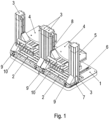
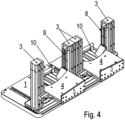
- Die Erfindung wird nun anhand von schematischen Abbildungen näher erläutert:
- In der
Figur 1 sind zwei erfindungsgemäße Aufsatzmodule für ein intralogistisches Mobilteil in Schrägansicht dargestellt. - In der
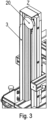
Figur 2 sind die Aufsatzmodule aus einem anderen Blickwinkel und teilweise angeschnitten dargestellt. - In der
Figur 3 ist der angeschnittene Bereich derFigur 2 vergrößert dargestellt. - In der
Figur 4 sind die Aufsatzmodule in anderer Stellung dargestellt. - Wie in den Figuren dargestellt, sind die beiden Aufsatzmodule gleichartig ausgeführt, also identisch zueinander.
- Ein nicht in den Figuren dargestelltes Mobilteil dient zur Aufnahme der Aufsatzmodule auf seiner Oberseite.
- Das Mobilteil weist einen Fahrantrieb, insbesondere Traktionsantrieb, eine Lenkung und einen Energiespeicher sowie eine Steuerung auf. Außerdem ist an der Unterseite des Mobilteils eine Sekundärspule angeordnet, welche induktiv koppelbar ist an einen am Boden verlegten, langgestreckt ausgeführten Primärleiter, in welchen ein Wechselstrom eingeprägt wird.
- Der Sekundärspule ist eine Kapazität in Reihe oder parallel zugeschaltet, so dass die Resonanzfrequenz des so gebildeten Schwingkreises der Frequenz des Wechselstroms gleicht. Somit ist elektrische Leistung vom Primärleiter zum Mobilteil mit hohem Wirkungsgrad auch bei schwacher und/oder schwankender induktiver Kopplung übertragbar.
- Aus dem Schwingkreis wird der Energiespeicher über einen Gleichrichter und einen DC/DC-Wandler und/oder Laderegler versorgt.
- Aus dem Energiespeicher wird der Fahrantrieb, insbesondere zumindest ein Rad des Mobilteils antreibender Elektromotor, gespeist sowie die Steuerung und Lenkung versorgt.
- Auf der Oberseite des Mobilteils sind die Aufsatzmodule, insbesondere eine jeweilige Grundplatte 1 des jeweiligen Aufsatzmoduls, anmontiert, insbesondere angeschraubt.
- Das Mobilteil führt intralogistische Transporte aus. Beispielsweise fährt es in ein Lager, in welchem es mit einem oder mehr Rädern befüllt wird.
- Dabei wird ein Rad, insbesondere Rad eines Kraftfahrzeugs, wie PKW, LKW oder dergleichen, auf einem Radaufnahmeteil 4 des Aufsatzmoduls aufgenommen.
- Danach fährt das Mobilteil eigenständig, also automatisch, vorzugsweise entlang dem am Boden verlegten Primärleiter zu einer Montageposition. Dort wird das Radaufnahmeteil 4 samt Rad derart positioniert, dass die Drehachse des Rads in Flucht mit einem Wellenflansch, insbesondere des Kraftfahrzeugs, ist und somit mittels auf Gewindestifte angeschraubten Schraubmuttern angeschraubt werden kann an den Wellenflansch.
- Zur Positionierung ist das Radaufnahmeteil 4 mittels dreier, jeweils zueinander senkrecht ausgerichteter Linearführungen relativ zur Grundplatte 1 bewegbar.
- Die Grundplatte 1 ist mittels Schrauben an die Oberseite, insbesondere des Fahrgestells, des Mobilteils angeschraubt.
- Die Grundplatte 1 weist eine Nut auf, in welcher die erste Linearführung 6 angeordnet ist, Dabei ist die Linearachse parallel zur Achse des Rads.
- Die erste Linearführung 6 weist einen Führungswagen auf, welcher in der Nut linear bewegbar ist. Der Führungswagen weist an seiner von der Grundplatte abgewandten Seite weitere Räder auf, welche in einer Nut einer Schiebeplatte linear bewegbar sind. Somit ist eine zweite Linearführung realisiert.
- Die Nut der Schiebeplatte 2 ist senkrecht zur Nut der Grundplatte 1 gerichtet.
- Auf der Schiebeplatte 2 sind Haltesäulen 3 befestigt, welche eine Seilrolle 20 aufweist, von der ein Seil umgelenkt wird, das an seinem ersten Ende mit dem Radaufnahmeteil 4 verbunden ist und an seinem anderen Ende mit einem Gegengewicht.
- Die Haltesäulen weisen die dritte Linearführung auf, welche senkrecht zu der ersten und senkrecht zu der zweiten Linearführung ausgerichtet ist. Durch das Gegengewicht ist eine beinahe kraftfreie Verschiebung der Radaufnahmeeinheit 4 samt aufgenommenem Rad ermöglicht.
- Die Haltesäulen dienen auch als Kippschutz für das aufgenommene Rad, wobei ein Begrenzungsteil 5 auf der von den Haltesäulen 3 abgewandten Seite des Radaufnahmeteils 4 als Begrenzung und/oder Kippschutz fungiert.
- Nach dem Anschrauben des Rades an den wellenflansch wird die Radaufnahmeeinheit 4 etwas abgesenkt und dann wieder in ihre Grundposition gefahren. Eine Arretierung erfolgt mit einem Arretierstift, welche die relative Position der Schiebeplatte 2 zur Grundplatte 1 arretiert und/oder fixiert.
- Am Radaufnahmeteil 4 ist eine Griffstange 10 befestigt, mit der somit das aufgenommene Rad im Wesentlichen kraftfrei positionierbar ist.
-
- 1 Grundplatte
- 2 Schiebeplatte
- 3 Haltesäule
- 4 Radaufnahmeteil
- 5 Begrenzungsteil
- 6 erste Linearführung
- 7 zweite Linearführung
- 8 dritte Linearführung
- 9 Arretierstift
- 10 Griffstange
Claims (12)
- Mobilteil, insbesondere auf einem Boden verfahrbares Mobilteil, mit zumindest einem auf dem Mobilteil angeordneten, insbesondere montierten, Aufsatzmodul,wobei das Aufsatzmodul eine Grundplatte (1) aufweist und eine Radaufnahmeeinheit (4) aufweist,wobei auf der Grundplatte (1) eine erste Linearführung (6) angeordnet ist,dadurch gekennzeichnet, dass eine zweite Linearführung (7) gegenüber der ersten Linearführung (6) bewegbar angeordnet ist,und dass die Radaufnahmeeinheit über eine dritte Linearführung (8) bewegbar angeordnet ist, welche gegenüber der zweiten Linearführung (7) bewegbar angeordnet ist, wobei jede der Linearführungen (6, 7, 8) zu jeder anderen der Linearführungen (6, 7, 8) einen nicht verschwindenden Winkel aufweist, insbesondere einen rechten Winkel aufweist.
- Mobilteil nach einem der vorangegangenen Ansprüche,
dadurch gekennzeichnet, dass
die Grundplatte (1) mit dem Fahrgestell des Mobilteils verbunden ist, insbesondere wobei die Grundplatte (1) mit der Oberseite des Fahrgestells verbunden ist, insbesondere mittels Schrauben schraubverbunden ist. - Mobilteil nach einem der vorangegangenen Ansprüche,
dadurch gekennzeichnet, dass
eine oder mehrere der Linearführungen (6, 7, 8) mittels eines, insbesondere mittels eines einzigen, Arretierstiftes (9) fixierbar ist. - Mobilteil nach einem der vorangegangenen Ansprüche,
dadurch gekennzeichnet, dass
die Radaufnahmeeinheit eine insbesondere konkave Aufnahmefläche für ein Rad aufweist. - Mobilteil nach Anspruch 4,
dadurch gekennzeichnet, dassdie Aufnahmefläche konkav ausgeführt ist
und/oder dassdie Aufnahmefläche Rollen aufweist, so dass das in der Aufnahmefläche aufgenommene Rad um seine Radachse im Wesentlichen kraftfrei drehbar ist, solange das Rad nicht schraubverbunden mit einem Wellenteil eines Kraftfahrzeugs ist. - Mobilteil nach einem der vorangegangenen Ansprüche,
dadurch gekennzeichnet, dass
auf der von der dritten Linearführung (8) abgewandten Seite der Radaufnahmeeinheit (4) ein Begrenzungsteil (5) das in der Aufnahmefläche aufgenommene Rad begrenzt, insbesondere in Axialer Richtung, also in Richtung der Radachse. - Mobilteil nach einem der vorangegangenen Ansprüche,
dadurch gekennzeichnet, dass
das Mobilteil an seiner Unterseite eine Sekundärwicklung aufweist zur berührungslosen Übertragung elektrischer Leistung von einem am Boden, also an der Verfahrebene verlegten, langgestreckt ausgeführten Primärleiter an die Sekundärwicklung. - Mobilteil nach einem der vorangegangenen Ansprüche,
dadurch gekennzeichnet, dass
das Mobilteil eine Steuerung aufweist, mit welcher eine Lenkung und ein Fahrantrieb des Mobilteils steuerbar sind. - Mobilteil nach einem der vorangegangenen Ansprüche,
dadurch gekennzeichnet, dass
eine Griffstange (10) mit der Radaufnahmeeinheit (4) fest verbunden ist. - Mobilteil nach einem der vorangegangenen Ansprüche,
dadurch gekennzeichnet, dasseine der Linearführungen (6, 7, 8), insbesondere die dritte Linearführung (8), als Hubvorrichtung für die Radaufnahmeeinheit fungiert,wobei die Hubvorrichtung ein Gegengewicht aufweist, so dass die Positionierung der Radaufnahmeeinheit im Wesentlichen kraftfrei ermöglicht ist. - Verfahren zum Montieren eines Rads an ein Kraftfahrzeug mit Hilfe eines Mobilteils nach einem der vorangegangenen Ansprüche,
dadurch gekennzeichnet, dassdas Mobilteil ein in der Radaufnahmeeinheit des Aufsatzmoduls aufgenommenes Rad zum Montagebereich transportiert,wobei im Montagebereich das Rad an das Kraftfahrzeug, insbesondere an ein Wellenflanschteil des Kraftfahrzeugs, anmontiert wird,- indem zuerst eine Arretierung, insbesondere ein Arretierstift (9), gelöst wird,- indem danach das Rad zu einer Position kraftfrei verschoben wird, bei welcher das Rad in Flucht zur Drehachse eines Wellenflanschteils ist,- indem zuletzt das Rad an das Wellenflanschteil, insbesondere mittels Schraubmuttern und Schrauben, anmontiert wird. - Verfahren nach einem der vorangegangenen Ansprüche,
dadurch gekennzeichnet, dass
die Arretierung mittels eines Sensors überwacht wird und eine Weiterfahrt des Mobilteils in Abhängigkeit vom Signal des Sensors erfolgt.
Applications Claiming Priority (2)
| Application Number | Priority Date | Filing Date | Title |
|---|---|---|---|
| DE102019001824 | 2019-03-15 | ||
| PCT/EP2020/025081 WO2020187446A1 (de) | 2019-03-15 | 2020-02-20 | Mobilteil mit zumindest einem auf dem mobilteil angeordneten aufsatzmodul |
Publications (3)
| Publication Number | Publication Date |
|---|---|
| EP3938221A1 EP3938221A1 (de) | 2022-01-19 |
| EP3938221B1 true EP3938221B1 (de) | 2023-10-25 |
| EP3938221C0 EP3938221C0 (de) | 2023-10-25 |
Family
ID=69701144
Family Applications (1)
| Application Number | Title | Priority Date | Filing Date |
|---|---|---|---|
| EP20707180.4A Active EP3938221B1 (de) | 2019-03-15 | 2020-02-20 | Mobilteil mit zumindest einem auf dem mobilteil angeordneten aufsatzmodul |
Country Status (5)
| Country | Link |
|---|---|
| US (1) | US12233666B2 (de) |
| EP (1) | EP3938221B1 (de) |
| CN (1) | CN113597377B (de) |
| DE (1) | DE102020001114A1 (de) |
| WO (1) | WO2020187446A1 (de) |
Family Cites Families (18)
| Publication number | Priority date | Publication date | Assignee | Title |
|---|---|---|---|---|
| USRE25602E (en) * | 1964-06-16 | lyons | ||
| US3145859A (en) * | 1961-07-18 | 1964-08-25 | Walker Mfg Co | Jack |
| DE2159082A1 (de) | 1971-11-29 | 1973-05-30 | Rubner Kg G E | Radmontage-hubwagen |
| DK151917C (da) * | 1979-08-24 | 1988-06-27 | Osmond Beissbarth | Indretning til maaling af koeretoejshjuls stillinger |
| US5180274A (en) * | 1990-05-07 | 1993-01-19 | Vix Design Products, Inc. | Wheel handling apparatus |
| JP2501973B2 (ja) | 1991-06-21 | 1996-05-29 | 日産自動車株式会社 | タイヤ取付装置 |
| US6237206B1 (en) * | 1998-03-12 | 2001-05-29 | Kiene Diesel Accessories, Inc. | Wheel pulling and transporting device |
| US7431314B2 (en) * | 2004-09-24 | 2008-10-07 | International Tire Shuttle, Inc. | Handling device for wheel assembly components |
| EP2571140B1 (de) | 2010-05-14 | 2018-04-25 | Kabushiki Kaisha Toyota Jidoshokki | Kontaktloses resonanzgesteuertes stromversorgungssystem sowie einstellungsverfahren zur anpassung einer einheit während der ladung des kontaktlosen resonanzgesteuerten stromversorgungssystems |
| US8684654B2 (en) * | 2010-08-24 | 2014-04-01 | Quality Stainless Products, Inc. | Wheel assembly positioning device |
| CN103298625B (zh) | 2011-01-12 | 2016-01-06 | 技术信息有限公司 | 车轮更换方法 |
| CN203282964U (zh) | 2013-06-19 | 2013-11-13 | 中联重科股份有限公司 | 车轮总成安装拆卸装置 |
| CN104985592A (zh) | 2015-07-17 | 2015-10-21 | 付建生 | 一种五轴联动机器人 |
| JP6554006B2 (ja) * | 2015-09-28 | 2019-07-31 | 本田技研工業株式会社 | 車両用操舵装置 |
| US10909132B2 (en) * | 2017-06-09 | 2021-02-02 | Snap-On Incorporated | Analyzing vehicles based on common circuit elements |
| US11835646B2 (en) * | 2018-04-30 | 2023-12-05 | BPG Sales and Technology Investments, LLC | Target alignment for vehicle sensor calibration |
| US11597091B2 (en) * | 2018-04-30 | 2023-03-07 | BPG Sales and Technology Investments, LLC | Robotic target alignment for vehicle sensor calibration |
| US11433494B2 (en) * | 2020-12-10 | 2022-09-06 | Honda Motor Co., Ltd. | Jig for mounting a component on a structure |
-
2020
- 2020-02-20 DE DE102020001114.4A patent/DE102020001114A1/de active Pending
- 2020-02-20 WO PCT/EP2020/025081 patent/WO2020187446A1/de not_active Ceased
- 2020-02-20 CN CN202080021679.6A patent/CN113597377B/zh active Active
- 2020-02-20 US US17/439,642 patent/US12233666B2/en active Active
- 2020-02-20 EP EP20707180.4A patent/EP3938221B1/de active Active
Also Published As
| Publication number | Publication date |
|---|---|
| US12233666B2 (en) | 2025-02-25 |
| DE102020001114A1 (de) | 2020-09-17 |
| CN113597377A (zh) | 2021-11-02 |
| EP3938221A1 (de) | 2022-01-19 |
| CN113597377B (zh) | 2024-06-11 |
| WO2020187446A1 (de) | 2020-09-24 |
| US20220185014A1 (en) | 2022-06-16 |
| EP3938221C0 (de) | 2023-10-25 |
Similar Documents
| Publication | Publication Date | Title |
|---|---|---|
| EP2744741B1 (de) | Mobilteil | |
| EP3562618B1 (de) | Transportsystem mit selbstfahrenden werkstückwagen | |
| DE102012025152B4 (de) | Fahrzeug, insbesondere fahrerloses Transportsystem (FTS) oder automated guided vehicle (AGV), mit Tragteil | |
| EP3924202B1 (de) | Mobilteil | |
| DE102011109531B4 (de) | Anlage zur Energieversorgung einer Maschine mittels eines Mobilteils und Verfahren zum Betreiben einer Anlage | |
| EP3077784B1 (de) | Anordnung und verfahren zur prüfung von weichenantrieben | |
| WO2016155862A1 (de) | Lagersystem mit einem omnidirektionalen fahrzeug und verfahren zum betreiben eines solchen lagersystems | |
| DE102011109532A1 (de) | Anlage und Verfahren zum Betreiben einer Anlage | |
| WO2018103892A1 (de) | Fahrzeug, insbesondere logistikfahrzeug | |
| DE10000103A1 (de) | Einrichtung zum Spannen und Schweißen von Blechen | |
| EP3938221B1 (de) | Mobilteil mit zumindest einem auf dem mobilteil angeordneten aufsatzmodul | |
| WO2014037568A2 (de) | VERSCHIEBESYSTEM FÜR EINEN MONTAGE- ODER SCHWEIßTISCH | |
| DE102013009705B4 (de) | Linearantrieb, Hubtisch und Mobilteil | |
| DE69102067T2 (de) | Auf-der-stelle-umlenkvorrichtung für flurförderfahrzeug. | |
| DE102019006264B4 (de) | Förderanlage zum Transportieren von Gegenständen im Karosseriebau der Kfz-Industrie, Verfahren zum Transportieren von mehrachsigen Robotern und Bauteilen sowie Verwendung eines Drehtisches und eines Magazins oder Haltebahnhofs für Roboter im Zusammenhang mit derartigen Fördervorrichtungen und Steuerung zum Durchführen eines derartigen Verfahrens | |
| EP2178783B1 (de) | Hubwerk | |
| EP3817890A1 (de) | Palettensystem zum speichern und transportieren von paletten für werkzeugmaschinen | |
| EP3305476B1 (de) | Manipulationsvorrichtung | |
| DE102012022479A1 (de) | Fahrzeug, System und Verfahren zum Betreiben eines Systems | |
| CN110002363B (zh) | 一种工件托运装置及工件托运方法 | |
| DE102012004059B4 (de) | Anlage zur Herstellung eines Produktes und Verfahren | |
| WO2010127778A1 (de) | Anlage zur montage von karosserieteilen | |
| DE102012009465B4 (de) | Roboter mit Verfahreinheit auf einer Führungsbahn laufend zum Manipulieren mit hoher Positionsgenauigkeit | |
| DE102016010948A1 (de) | Transportfahrzeug | |
| EP3960361A1 (de) | Roboterbasierte laserbearbeitungsanlage |
Legal Events
| Date | Code | Title | Description |
|---|---|---|---|
| STAA | Information on the status of an ep patent application or granted ep patent |
Free format text: STATUS: UNKNOWN |
|
| STAA | Information on the status of an ep patent application or granted ep patent |
Free format text: STATUS: THE INTERNATIONAL PUBLICATION HAS BEEN MADE |
|
| PUAI | Public reference made under article 153(3) epc to a published international application that has entered the european phase |
Free format text: ORIGINAL CODE: 0009012 |
|
| STAA | Information on the status of an ep patent application or granted ep patent |
Free format text: STATUS: REQUEST FOR EXAMINATION WAS MADE |
|
| 17P | Request for examination filed |
Effective date: 20211015 |
|
| AK | Designated contracting states |
Kind code of ref document: A1 Designated state(s): AL AT BE BG CH CY CZ DE DK EE ES FI FR GB GR HR HU IE IS IT LI LT LU LV MC MK MT NL NO PL PT RO RS SE SI SK SM TR |
|
| DAV | Request for validation of the european patent (deleted) | ||
| DAX | Request for extension of the european patent (deleted) | ||
| GRAP | Despatch of communication of intention to grant a patent |
Free format text: ORIGINAL CODE: EPIDOSNIGR1 |
|
| STAA | Information on the status of an ep patent application or granted ep patent |
Free format text: STATUS: GRANT OF PATENT IS INTENDED |
|
| INTG | Intention to grant announced |
Effective date: 20230606 |
|
| GRAS | Grant fee paid |
Free format text: ORIGINAL CODE: EPIDOSNIGR3 |
|
| GRAA | (expected) grant |
Free format text: ORIGINAL CODE: 0009210 |
|
| STAA | Information on the status of an ep patent application or granted ep patent |
Free format text: STATUS: THE PATENT HAS BEEN GRANTED |
|
| AK | Designated contracting states |
Kind code of ref document: B1 Designated state(s): AL AT BE BG CH CY CZ DE DK EE ES FI FR GB GR HR HU IE IS IT LI LT LU LV MC MK MT NL NO PL PT RO RS SE SI SK SM TR |
|
| REG | Reference to a national code |
Ref country code: GB Ref legal event code: FG4D Free format text: NOT ENGLISH |
|
| REG | Reference to a national code |
Ref country code: CH Ref legal event code: EP |
|
| REG | Reference to a national code |
Ref country code: DE Ref legal event code: R096 Ref document number: 502020005762 Country of ref document: DE |
|
| REG | Reference to a national code |
Ref country code: IE Ref legal event code: FG4D Free format text: LANGUAGE OF EP DOCUMENT: GERMAN |
|
| U01 | Request for unitary effect filed |
Effective date: 20231106 |
|
| U07 | Unitary effect registered |
Designated state(s): AT BE BG DE DK EE FI FR IT LT LU LV MT NL PT SE SI Effective date: 20231114 |
|
| PG25 | Lapsed in a contracting state [announced via postgrant information from national office to epo] |
Ref country code: GR Free format text: LAPSE BECAUSE OF FAILURE TO SUBMIT A TRANSLATION OF THE DESCRIPTION OR TO PAY THE FEE WITHIN THE PRESCRIBED TIME-LIMIT Effective date: 20240126 |
|
| PG25 | Lapsed in a contracting state [announced via postgrant information from national office to epo] |
Ref country code: IS Free format text: LAPSE BECAUSE OF FAILURE TO SUBMIT A TRANSLATION OF THE DESCRIPTION OR TO PAY THE FEE WITHIN THE PRESCRIBED TIME-LIMIT Effective date: 20240225 |
|
| U20 | Renewal fee for the european patent with unitary effect paid |
Year of fee payment: 5 Effective date: 20240229 |
|
| PG25 | Lapsed in a contracting state [announced via postgrant information from national office to epo] |
Ref country code: ES Free format text: LAPSE BECAUSE OF FAILURE TO SUBMIT A TRANSLATION OF THE DESCRIPTION OR TO PAY THE FEE WITHIN THE PRESCRIBED TIME-LIMIT Effective date: 20231025 |
|
| PG25 | Lapsed in a contracting state [announced via postgrant information from national office to epo] |
Ref country code: IS Free format text: LAPSE BECAUSE OF FAILURE TO SUBMIT A TRANSLATION OF THE DESCRIPTION OR TO PAY THE FEE WITHIN THE PRESCRIBED TIME-LIMIT Effective date: 20240225 Ref country code: GR Free format text: LAPSE BECAUSE OF FAILURE TO SUBMIT A TRANSLATION OF THE DESCRIPTION OR TO PAY THE FEE WITHIN THE PRESCRIBED TIME-LIMIT Effective date: 20240126 Ref country code: ES Free format text: LAPSE BECAUSE OF FAILURE TO SUBMIT A TRANSLATION OF THE DESCRIPTION OR TO PAY THE FEE WITHIN THE PRESCRIBED TIME-LIMIT Effective date: 20231025 |
|
| PG25 | Lapsed in a contracting state [announced via postgrant information from national office to epo] |
Ref country code: RS Free format text: LAPSE BECAUSE OF FAILURE TO SUBMIT A TRANSLATION OF THE DESCRIPTION OR TO PAY THE FEE WITHIN THE PRESCRIBED TIME-LIMIT Effective date: 20231025 Ref country code: PL Free format text: LAPSE BECAUSE OF FAILURE TO SUBMIT A TRANSLATION OF THE DESCRIPTION OR TO PAY THE FEE WITHIN THE PRESCRIBED TIME-LIMIT Effective date: 20231025 Ref country code: NO Free format text: LAPSE BECAUSE OF FAILURE TO SUBMIT A TRANSLATION OF THE DESCRIPTION OR TO PAY THE FEE WITHIN THE PRESCRIBED TIME-LIMIT Effective date: 20240125 Ref country code: HR Free format text: LAPSE BECAUSE OF FAILURE TO SUBMIT A TRANSLATION OF THE DESCRIPTION OR TO PAY THE FEE WITHIN THE PRESCRIBED TIME-LIMIT Effective date: 20231025 |
|
| PG25 | Lapsed in a contracting state [announced via postgrant information from national office to epo] |
Ref country code: CZ Free format text: LAPSE BECAUSE OF FAILURE TO SUBMIT A TRANSLATION OF THE DESCRIPTION OR TO PAY THE FEE WITHIN THE PRESCRIBED TIME-LIMIT Effective date: 20231025 |
|
| REG | Reference to a national code |
Ref country code: DE Ref legal event code: R097 Ref document number: 502020005762 Country of ref document: DE |
|
| PG25 | Lapsed in a contracting state [announced via postgrant information from national office to epo] |
Ref country code: SK Free format text: LAPSE BECAUSE OF FAILURE TO SUBMIT A TRANSLATION OF THE DESCRIPTION OR TO PAY THE FEE WITHIN THE PRESCRIBED TIME-LIMIT Effective date: 20231025 |
|
| PG25 | Lapsed in a contracting state [announced via postgrant information from national office to epo] |
Ref country code: SM Free format text: LAPSE BECAUSE OF FAILURE TO SUBMIT A TRANSLATION OF THE DESCRIPTION OR TO PAY THE FEE WITHIN THE PRESCRIBED TIME-LIMIT Effective date: 20231025 Ref country code: SK Free format text: LAPSE BECAUSE OF FAILURE TO SUBMIT A TRANSLATION OF THE DESCRIPTION OR TO PAY THE FEE WITHIN THE PRESCRIBED TIME-LIMIT Effective date: 20231025 Ref country code: RO Free format text: LAPSE BECAUSE OF FAILURE TO SUBMIT A TRANSLATION OF THE DESCRIPTION OR TO PAY THE FEE WITHIN THE PRESCRIBED TIME-LIMIT Effective date: 20231025 Ref country code: CZ Free format text: LAPSE BECAUSE OF FAILURE TO SUBMIT A TRANSLATION OF THE DESCRIPTION OR TO PAY THE FEE WITHIN THE PRESCRIBED TIME-LIMIT Effective date: 20231025 |
|
| PLBE | No opposition filed within time limit |
Free format text: ORIGINAL CODE: 0009261 |
|
| STAA | Information on the status of an ep patent application or granted ep patent |
Free format text: STATUS: NO OPPOSITION FILED WITHIN TIME LIMIT |
|
| PG25 | Lapsed in a contracting state [announced via postgrant information from national office to epo] |
Ref country code: MC Free format text: LAPSE BECAUSE OF FAILURE TO SUBMIT A TRANSLATION OF THE DESCRIPTION OR TO PAY THE FEE WITHIN THE PRESCRIBED TIME-LIMIT Effective date: 20231025 |
|
| REG | Reference to a national code |
Ref country code: CH Ref legal event code: PL |
|
| 26N | No opposition filed |
Effective date: 20240726 |
|
| PG25 | Lapsed in a contracting state [announced via postgrant information from national office to epo] |
Ref country code: CH Free format text: LAPSE BECAUSE OF NON-PAYMENT OF DUE FEES Effective date: 20240229 |
|
| PG25 | Lapsed in a contracting state [announced via postgrant information from national office to epo] |
Ref country code: CH Free format text: LAPSE BECAUSE OF NON-PAYMENT OF DUE FEES Effective date: 20240229 |
|
| PG25 | Lapsed in a contracting state [announced via postgrant information from national office to epo] |
Ref country code: IE Free format text: LAPSE BECAUSE OF NON-PAYMENT OF DUE FEES Effective date: 20240220 |
|
| PG25 | Lapsed in a contracting state [announced via postgrant information from national office to epo] |
Ref country code: IE Free format text: LAPSE BECAUSE OF NON-PAYMENT OF DUE FEES Effective date: 20240220 |
|
| U20 | Renewal fee for the european patent with unitary effect paid |
Year of fee payment: 6 Effective date: 20250228 |
|
| PG25 | Lapsed in a contracting state [announced via postgrant information from national office to epo] |
Ref country code: CY Free format text: LAPSE BECAUSE OF FAILURE TO SUBMIT A TRANSLATION OF THE DESCRIPTION OR TO PAY THE FEE WITHIN THE PRESCRIBED TIME-LIMIT; INVALID AB INITIO Effective date: 20200220 |
|
| PG25 | Lapsed in a contracting state [announced via postgrant information from national office to epo] |
Ref country code: HU Free format text: LAPSE BECAUSE OF FAILURE TO SUBMIT A TRANSLATION OF THE DESCRIPTION OR TO PAY THE FEE WITHIN THE PRESCRIBED TIME-LIMIT; INVALID AB INITIO Effective date: 20200220 |
|
| PG25 | Lapsed in a contracting state [announced via postgrant information from national office to epo] |
Ref country code: TR Free format text: LAPSE BECAUSE OF FAILURE TO SUBMIT A TRANSLATION OF THE DESCRIPTION OR TO PAY THE FEE WITHIN THE PRESCRIBED TIME-LIMIT Effective date: 20231025 |
|
| U20 | Renewal fee for the european patent with unitary effect paid |
Year of fee payment: 7 Effective date: 20260302 |
|
| PGFP | Annual fee paid to national office [announced via postgrant information from national office to epo] |
Ref country code: GB Payment date: 20260106 Year of fee payment: 7 |