EP3926232B1 - Scheinwerfervorrichtung für ein fahrzeug - Google Patents
Scheinwerfervorrichtung für ein fahrzeug Download PDFInfo
- Publication number
- EP3926232B1 EP3926232B1 EP21180441.4A EP21180441A EP3926232B1 EP 3926232 B1 EP3926232 B1 EP 3926232B1 EP 21180441 A EP21180441 A EP 21180441A EP 3926232 B1 EP3926232 B1 EP 3926232B1
- Authority
- EP
- European Patent Office
- Prior art keywords
- light
- low
- focal point
- incident surface
- lens
- Prior art date
- Legal status (The legal status is an assumption and is not a legal conclusion. Google has not performed a legal analysis and makes no representation as to the accuracy of the status listed.)
- Active
Links
Images




Classifications
-
- F—MECHANICAL ENGINEERING; LIGHTING; HEATING; WEAPONS; BLASTING
- F21—LIGHTING
- F21S—NON-PORTABLE LIGHTING DEVICES; SYSTEMS THEREOF; VEHICLE LIGHTING DEVICES SPECIALLY ADAPTED FOR VEHICLE EXTERIORS
- F21S41/00—Illuminating devices specially adapted for vehicle exteriors, e.g. headlamps
- F21S41/10—Illuminating devices specially adapted for vehicle exteriors, e.g. headlamps characterised by the light source
- F21S41/14—Illuminating devices specially adapted for vehicle exteriors, e.g. headlamps characterised by the light source characterised by the type of light source
- F21S41/141—Light emitting diodes [LED]
- F21S41/147—Light emitting diodes [LED] the main emission direction of the LED being angled to the optical axis of the illuminating device
-
- F—MECHANICAL ENGINEERING; LIGHTING; HEATING; WEAPONS; BLASTING
- F21—LIGHTING
- F21S—NON-PORTABLE LIGHTING DEVICES; SYSTEMS THEREOF; VEHICLE LIGHTING DEVICES SPECIALLY ADAPTED FOR VEHICLE EXTERIORS
- F21S41/00—Illuminating devices specially adapted for vehicle exteriors, e.g. headlamps
- F21S41/10—Illuminating devices specially adapted for vehicle exteriors, e.g. headlamps characterised by the light source
- F21S41/14—Illuminating devices specially adapted for vehicle exteriors, e.g. headlamps characterised by the light source characterised by the type of light source
- F21S41/141—Light emitting diodes [LED]
- F21S41/147—Light emitting diodes [LED] the main emission direction of the LED being angled to the optical axis of the illuminating device
- F21S41/148—Light emitting diodes [LED] the main emission direction of the LED being angled to the optical axis of the illuminating device the main emission direction of the LED being perpendicular to the optical axis
-
- F—MECHANICAL ENGINEERING; LIGHTING; HEATING; WEAPONS; BLASTING
- F21—LIGHTING
- F21S—NON-PORTABLE LIGHTING DEVICES; SYSTEMS THEREOF; VEHICLE LIGHTING DEVICES SPECIALLY ADAPTED FOR VEHICLE EXTERIORS
- F21S41/00—Illuminating devices specially adapted for vehicle exteriors, e.g. headlamps
- F21S41/20—Illuminating devices specially adapted for vehicle exteriors, e.g. headlamps characterised by refractors, transparent cover plates, light guides or filters
- F21S41/25—Projection lenses
- F21S41/265—Composite lenses; Lenses with a patch-like shape
-
- F—MECHANICAL ENGINEERING; LIGHTING; HEATING; WEAPONS; BLASTING
- F21—LIGHTING
- F21S—NON-PORTABLE LIGHTING DEVICES; SYSTEMS THEREOF; VEHICLE LIGHTING DEVICES SPECIALLY ADAPTED FOR VEHICLE EXTERIORS
- F21S41/00—Illuminating devices specially adapted for vehicle exteriors, e.g. headlamps
- F21S41/30—Illuminating devices specially adapted for vehicle exteriors, e.g. headlamps characterised by reflectors
- F21S41/32—Optical layout thereof
- F21S41/321—Optical layout thereof the reflector being a surface of revolution or a planar surface, e.g. truncated
-
- F—MECHANICAL ENGINEERING; LIGHTING; HEATING; WEAPONS; BLASTING
- F21—LIGHTING
- F21S—NON-PORTABLE LIGHTING DEVICES; SYSTEMS THEREOF; VEHICLE LIGHTING DEVICES SPECIALLY ADAPTED FOR VEHICLE EXTERIORS
- F21S41/00—Illuminating devices specially adapted for vehicle exteriors, e.g. headlamps
- F21S41/40—Illuminating devices specially adapted for vehicle exteriors, e.g. headlamps characterised by screens, non-reflecting members, light-shielding members or fixed shades
- F21S41/43—Illuminating devices specially adapted for vehicle exteriors, e.g. headlamps characterised by screens, non-reflecting members, light-shielding members or fixed shades characterised by the shape thereof
-
- F—MECHANICAL ENGINEERING; LIGHTING; HEATING; WEAPONS; BLASTING
- F21—LIGHTING
- F21S—NON-PORTABLE LIGHTING DEVICES; SYSTEMS THEREOF; VEHICLE LIGHTING DEVICES SPECIALLY ADAPTED FOR VEHICLE EXTERIORS
- F21S41/00—Illuminating devices specially adapted for vehicle exteriors, e.g. headlamps
- F21S41/60—Illuminating devices specially adapted for vehicle exteriors, e.g. headlamps characterised by a variable light distribution
- F21S41/65—Illuminating devices specially adapted for vehicle exteriors, e.g. headlamps characterised by a variable light distribution by acting on light sources
- F21S41/663—Illuminating devices specially adapted for vehicle exteriors, e.g. headlamps characterised by a variable light distribution by acting on light sources by switching light sources
-
- F—MECHANICAL ENGINEERING; LIGHTING; HEATING; WEAPONS; BLASTING
- F21—LIGHTING
- F21S—NON-PORTABLE LIGHTING DEVICES; SYSTEMS THEREOF; VEHICLE LIGHTING DEVICES SPECIALLY ADAPTED FOR VEHICLE EXTERIORS
- F21S45/00—Arrangements within vehicle lighting devices specially adapted for vehicle exteriors, for purposes other than emission or distribution of light
- F21S45/40—Cooling of lighting devices
- F21S45/47—Passive cooling, e.g. using fins, thermal conductive elements or openings
Definitions
- the invention relates to a headlamp device for a vehicle capable of emitting low beam and high beam light rays.
- a conventional headlamp device disclosed in Taiwanese Utility Model Patent No. M248960 includes a headlamp 80 and a headlight function switching device 90.
- the headlamp 80 includes a light emitting member 81, a reflecting member 82 and a lens 83.
- the light emitting member 81 generates light beams.
- the reflecting member 82 and the lens 83 are respectively located at two opposite sides of the light emitting member 81.
- the headlight function switching device 90 is disposed between the light emitting member 81 and the lens 83, and includes a fixed plate 901, a solenoid valve 902 and a blocking board 903.
- the solenoid valve 902 is fixedly mounted to the fixed plate 901.
- the blocking board 903 is operable by the solenoid valve 902 to move relative to the light emitting member 81 in an up-down direction between an upper position and a lower position.
- the blocking board 903 When the blocking board 903 is at the upper position, the light beams generated by the light emitting member 81 are reflected by the reflecting member 82 and propagate in such a manner that some of the light beams are blocked by the blocking board 903 while the remaining light beams pass through the lens 83 to serve as low beam light rays (see Figure 8 ) which form a light distribution pattern that has a clear cut-off line.
- the blocking board 903 When the blocking board 903 is at the lower position, the light beams generated by the light emitting member 81 are reflected by the reflecting member 82 and pass through the lens 83 without being blocked by the blocking board 903, so as to serve as high beam light rays (see Figure 7 ).
- the conventional headlamp device is switchable between a low beam mode where the low beam light rays are generated and a high beam mode where the high beam light rays are generated.
- the solenoid valve 902 may be slow to react to user input and is prone to malfunction. Once the solenoid valve 902 has malfunctioned, the conventional headlamp device can no longer switch between the low beam mode and the high beam mode.
- an object of the invention is to provide a headlamp device that can alleviate at least one of the drawbacks of the prior art.
- the headlamp device includes a compound lens unit, a low-beam reflector, a high-beam reflector, a blocking board and a light emitting unit.
- the compound lens unit includes an upper lens and a lower lens assembly.
- the upper lens has a low-beam optical axis, an upper light-incident surface, an upper light-emergent surface and an upper focal point.
- the upper light-incident surface and the upper light-emergent surface are respectively located at two opposite sides of the upper lens in a direction of the low-beam optical axis.
- the upper focal point is located at one side of the upper light-incident surface opposite to the upper light-emergent surface.
- the lower lens assembly is located below the upper lens, includes a plurality of lower lenses, and has a lower light-incident surface, a lower light-emergent surface and a lower focal point.
- the lower light-incident surface is cooperatively formed by the lower lenses, faces in a direction that is the same as that of the upper light-incident surface, and is offset from the upper light-incident surface.
- the lower light-emergent surface is cooperatively formed by the lower lenses, and is opposite to the lower light-incident surface in the direction of the low-beam optical axis.
- the lower focal point is located at one side of the lower light-incident surface opposite to the lower light-emergent surface.
- the low-beam reflector is located at one side of the upper focal point opposite to the upper light-incident surface, and has a low-beam reflecting surface that is arc-shaped and that has a first low-beam reflecting focal point and a second low-beam reflecting focal point.
- the first low-beam reflecting focal point and the second low-beam reflecting focal point are respectively distal from and proximate to the upper light-incident surface of the upper lens.
- the second low-beam reflecting focal point coincides with the upper focal point of the upper lens.
- the high-beam reflector is located at one side of the lower focal point opposite to the lower light-incident surface, and has a reflector axis and a high-beam reflecting surface.
- the high-beam reflecting surface is arc-shaped, and has a first high-beam reflecting focal point and a second high-beam reflecting focal point.
- the first high-beam reflecting focal point and the second high-beam reflecting focal point are respectively distal from and proximate to the lower light-incident surface of the lower lens assembly.
- the second high-beam reflecting focal point coincides with the lower focal point of the lower lens assembly.
- the first high-beam reflecting focal point and the second high-beam reflecting focal point are located on and cooperatively define the reflector axis.
- the blocking board has a top end at which the second low-beam focal point is located.
- the light emitting unit includes a first light source and a second light source.
- the first light source substantially coincides with the first low-beam reflecting focal point of the low-beam reflector.
- the second light source substantially coincides with the first high-beam reflecting focal point of the high-beam reflector.
- Each of the first light source and the second light source is operable to switch between an on-state in which light beams are generated, and an off-state in which light beams cease to be generated.
- the light beams generated by the first light source are reflected by the low-beam reflecting surface of the low-beam reflector such that some of the light beams are blocked by the blocking board while the remaining light beams travel into the upper lens through the upper light-incident surface and exit the upper lens through the upper light-emergent surface to serve as low beam light rays.
- the light beams generated by the second light source are reflected by the high-beam reflecting surface of the high-beam reflector such that the light beams travel into the lower lens assembly through the lower light-incident surface and exit the lower lens assembly through the lower light-emergent surface to serve as high beam light rays.
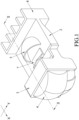
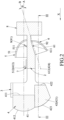
- an embodiment of a headlamp device is adapted for a vehicle, and includes a compound lens unit 4, a base 2, a low-beam reflector 5, a high-beam reflector 6, a blocking board 7 and a light emitting unit 9.
- the compound lens unit 4 includes an upper lens 41 and a lower lens assembly 42.
- the upper lens 41 has a low-beam optical axis (A), an upper light-incident surface 411, an upper light-emergent surface 412 and an upper focal point 413.
- the upper light-incident surface 411 and the upper light-emergent surface 412 are respectively located at two opposite sides of the upper lens 41 in a direction (X) of the low-beam optical axis (A).
- the upper light-emergent surface 412 is in front of the upper light-incident surface 411 with "front" being the forward-facing side of the headlamp device.
- the upper focal point 413 is located at one side of the upper light-incident surface 411 opposite to the upper light-emergent surface 412.
- the lower lens assembly 42 is located below the upper lens 41, includes a plurality of lower lenses 421, and has a lower light-incident surface 422, a lower light-emergent surface 423 and a lower focal point 424.
- the lower lenses 421 and the upper lens 41 are formed as one-piece.
- the lower light-incident surface 422 is cooperatively formed by the lower lenses 421, faces in a direction that is the same as that of the upper light-incident surface 411 of the upper lens 41, and is offset from the upper light-incident surface 411 in the direction (X) of the low-beam optical axis (A) (i.e., the lower light-incident surface 422 is not flush with the upper light-incident surface 411).
- the upper light-incident surface 411 is forwardly offset from the lower light-incident surface 422.
- the lower light-emergent surface 423 is cooperatively formed by the lower lenses 421, is opposite to the lower light-incident surface 422 in the direction (X) of the low-beam optical axis (A) of the upper lens 41, and has a first section 425 and two second sections 426 located below the low-beam optical axis (A).
- the second sections 426 are respectively located at two opposite sides of the first section 425 in a transverse direction (Y) transverse to the direction (X) of the low-beam optical axis (A) and are offset from the first section 425 in the direction (X) of the low-beam optical axis (A) (i.e., the lower light-emergent surface 423 is configured to not be a smooth surface).
- the lower focal point 424 is located at one side of the lower light-incident surface 422 opposite to the lower light-emergent surface 423.
- the lower lens assembly 42 of the compound lens unit 4 includes four lower lenses 421.
- the first section 425 of the lower light-emergent surface 423 is formed by two of the lower lenses 421, and the second sections 426 of the lower light-emergent surface 423 are respectively formed by the other two of the lower lenses 421.
- each of the upper lens 41 and the lower lenses 421 of the lower lens assembly 42 of the compound lens unit 4 is a plano-convex lens.
- the base 2 is located rearwardly of the upper lens 41 and the lower lens assembly 42, and is where the low-beam reflector 5, the high-beam reflector 6, the blocking board 7 and the light-emitting unit 9 are disposed on.
- the low-beam reflector 5 and the high-beam reflector 6 are respectively disposed at two opposite sides of the base 2.
- the low-beam reflector 5 is located at one side of the upper focal point 413 of the upper lens 41 opposite to the upper light-incident surface 411 of the upper lens 41, and has a low-beam reflecting surface 51 that is arc-shaped and that faces the upper light-incident surface 411.
- the low-beam reflecting surface 51 has a first low-beam reflecting focal point 511 and a second low-beam reflecting focal point 512.
- the first low-beam reflecting focal point 511 and the second low-beam reflecting focal point 512 are respectively distal from and proximate to the upper light-incident surface 411 of the upper lens 41.
- the second low-beam reflecting focal point 512 coincides with the upper focal point 413 of the upper lens 41.
- the high-beam reflector 6 is located at one side of the lower focal point 424 of the lower lens assembly 42 opposite to the lower light-incident surface 422 of the lower lens assembly 42, and has a reflector axis (B) and a high-beam reflecting surface 61.
- the high-beam reflecting surface 61 is arc-shaped, faces the lower light-incident surface 422, and has a first high-beam reflecting focal point 611 and a second high-beam reflecting focal point 612.
- the first high-beam reflecting focal point 611 and the second high-beam reflecting focal point 612 are respectively distal from and proximate to the lower light-incident surface 422 of the lower lens assembly 42.
- the second high-beam reflecting focal point 612 coincides with the lower focal point 424 of the lower lens assembly 42.
- the first high-beam reflecting focal point 611 and the second high-beam reflecting focal point 612 are located on and cooperatively define the reflector axis (B).
- the low-beam optical axis (A) of the upper lens 41 and the reflector axis (B) of the high-beam reflector 6 intersect, and cooperatively form an angle ( ⁇ ) of intersection.
- the angle ( ⁇ ) of intersection of the low-beam optical axis (A) and the reflector axis (B) is greater than 0 degree, but is not greater than 60 degrees.
- the blocking board 7 has a top end at which the second low-beam focal point 512 is located.
- the light emitting unit 9 includes a first light source 91 and a second light source 92.
- the first light source 91 substantially coincides with the first low-beam reflecting focal point 511 of the low-beam reflector 5.
- the second light source 92 substantially coincides with the first high-beam reflecting focal point 611 of the high-beam reflector 6.
- Each of the first light source 91 and the second light source 92 is operable to switch between an on-state in which light beams are generated, and an off-state in which light beams cease to be generated.
- Each of the first light source 91 and the second light source 92 is a light-emitting diode made of at least one semiconductor die.
- the light beams generated by the first light source 91 are reflected by the low-beam reflecting surface 51 of the low-beam reflector 5 such that some of the light beams are blocked by the blocking board 7 (i.e., some of the reflected light beams that do not perfectly pass through the second low-beam reflecting focal point 512 of the low-beam reflecting surface 51 are blocked by the blocking board 7) while the remaining light beams travel into the upper lens 41 through the upper light-incident surface 411 and exit the upper lens 41 through the upper light-emergent surface 412 to serve as low beam light rays.
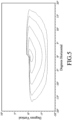
- the blocking board 7 blocking some of the light beams, light distribution pattern formed by the low beam light rays has a clear cut-off line as shown in Figure 5 .
- the light beams generated by the second light source 92 are reflected by the high-beam reflecting surface 61 of the high-beam reflector 6 such that the light beams travel into the lower lens assembly 42 through the lower light-incident surface 422 and exit the lower lens assembly 42 through the lower light-emergent surface 423 to serve as high beam light rays.
- Light distribution pattern formed by the high beam light rays is shown in Figure 6 .
- the compound lens unit 4 may provide relatively good stray-light rejection when the low beam light rays are generated. That is to say, when the first light source 91 is in the on-state and when the second light source 92 is in the off-state, the light beams generated by the first light source 91 but traveling in undesirable paths (namely, stray light) may be prevented from exiting the lower lens assembly 42 through the lower light-emergent surface 423. Therefore, stray light will not substantially affect the light distribution pattern formed by the low beam light rays.
- a distance between the upper light-incident surface 411 of the upper lens 41 and the lower light-incident surface 422 of the lower lens assembly 42 in the direction (X) of the low-beam optical axis (A) ranges from 1 to 30 millimeters.
- each individual one of the lower lenses 421 of the lower lens assembly 42 constitutes only one of the first section 425 and the second sections 426
- curvature of each of the first section 425 and the second sections 426 is individually adjustable by adjusting the curvature of the corresponding lower lens(es) 421.
- the high-beam reflector 6 may prevent the light beams generated by the second light source 92 from dispersing.
- the lower lens assembly 42 may achieve a better effect of focusing light so that the light beams exiting the lower lens assembly 42 through the lower light-emergent surface 423 may be adjusted to serve as the high beam light rays even when only the second light source 92 is in the on-state (i.e., for the high beam light rays to be generated, it is not necessary for the first light source 91 and the second light source 92 to simultaneously be in the on-state to create overlapping light beams or patterns). Consequently, the embodiment may be relatively energy-saving.
- the embodiment further includes a heat dissipating member 8 and a fixing frame 3.
- the heat dissipating member 8 is disposed on the base 2 and serves the purpose of heat dissipation.
- the fixing frame 3 is disposed in front of the base 2, connects the base 2 to the compound lens unit 4, and has the compound lens unit 4 disposed thereon.
- the upper lens 41 and the lower lens assembly 42 of the compound lens unit 4 are held fixedly by the fixing frame 3.
- the embodiment of the headlamp device is capable of emitting low beam light rays and high beam light rays and is switchable between the low-beam mode and the high-beam mode without a solenoid valve. Therefore, the headlamp device according to the disclosure may react relatively quickly when operated and may have a relatively long service life so reliability of the headlamp device is improved. Consequently, the drawbacks of the prior art have been alleviated and the purpose of the invention can certainly be fulfilled.
Landscapes
- Engineering & Computer Science (AREA)
- General Engineering & Computer Science (AREA)
- Physics & Mathematics (AREA)
- Microelectronics & Electronic Packaging (AREA)
- Optics & Photonics (AREA)
- Non-Portable Lighting Devices Or Systems Thereof (AREA)
Claims (10)
- Für ein Fahrzeug angepasste Scheinwerfervorrichtung, wobei die Scheinwerfervorrichtung umfasst:eine Verbundlinseneinheit (4) einschließlicheine obere Linse (41), miteiner optischen Abblendlichtachse (A),einer oberen Lichteinfallsfläche (411),einer oberen Lichtausfallsfläche (412), undeinem oberen Brennpunkt (413), wobei die obere Lichteinfallfläche (411) und die obere Lichtausfallsfläche (412) jeweils an zwei gegenüberliegenden Seiten der oberen Linse (41) in einer Richtung (X) der optischen Abblendlichtachse (A) angeordnet sind, wobei sich der obere Brennpunkt (413) an einer Seite der oberen Lichteinfallsfläche (411) gegenüber der oberen Lichtausfallsfläche (412) befindet, undeine untere Linsenanordnung (42), die unterhalb der oberen Linse (41) angeordnet ist, die mehrere untere Linsen (421) aufweist, miteiner unteren Lichteinfallsfläche (422), die durch die unteren Linsen (421) gemeinsam gebildet wird, die in eine Richtung weist, die die gleiche ist wie die der oberen Lichteinfallsfläche (411), und die von der oberen Lichteinfallsfläche (411) versetzt ist,einer unteren Lichtausfallsfläche (423), die durch die unteren Linsen (421) gemeinsam gebildet wird und der unteren Lichteinfallsfläche (422) in der Richtung (X) der optischen Abblendlichtachse (A) gegenüberliegt, undeinem unteren Brennpunkt (424), der sich auf einer Seite der unteren Lichteinfallsfläche (422) gegenüber der unteren Lichtausfallsfläche (423) befindet;einem Abblendlichtreflektor (5), der sich an einer Seite des oberen Brennpunkts (413) gegenüber der oberen Lichteinfallsfläche (411) befindet und eine bogenförmige abblendlichtreflektierende Oberfläche (51) aufweist, mit
einem ersten abblendlichtreflektierenden Brennpunkt (511) und einem zweiten abblendlichtreflektierenden Brennpunkt (512), die jeweils distal von und in der Nähe der oberen Lichteinfallsfläche (411) der oberen Linse (41) liegen, wobei der zweite abblendlichtreflektierende Brennpunkt (512) mit dem oberen Brennpunkt (413) der oberen Linse (41) zusammenfällt;einem Fernlichtreflektor (6), der sich auf einer Seite des unteren Brennpunkts (424) gegenüber der unteren Lichteinfallsfläche (422) befindet, miteiner Reflektorachse (B) undeiner fernlichtreflektierenden Oberfläche (61), die bogenförmig ist und
einen ersten fernlichtreflektierenden Brennpunkt (611) und einen zweiten fernlichtreflektierenden Brennpunkt (612) aufweist, die jeweils distal von und in der Nähe der unteren Lichteinfallsfläche (422) der unteren Linsenanordnung (42) liegen, wobei der zweite fernlichtreflektierende Brennpunkt (612) mit dem unteren Brennpunkt (424) der unteren Linsenanordnung (42) zusammenfällt, wobei sich der erste fernlichtreflektierende Brennpunkt (611) und der zweite fernlichtreflektierende Brennpunkt (612) auf der Reflektorachse (B) befinden und diese gemeinsam definieren;eine Sperrplatte (7) mit einem oberen Ende, an dem sich der zweite Abblendlichtbrennpunkt (512) befindet; undeine lichtemittierende Einheit (9);die Scheinwerfervorrichtung dadurch gekennzeichnet ist, dass:
die lichtemittierende Einheit (9) miteiner ersten Lichtquelle (91), die im Wesentlichen mit dem ersten abblendlichtreflektierenden Brennpunkt (511) des Abblendlichtreflektors (5) übereinstimmt, undeiner zweiten Lichtquelle (92), die im Wesentlichen mit dem ersten fernlichtreflektierenden Brennpunkt (611) des Fernlichtreflektors (6) übereinstimmt, wobei sowohl die erste Lichtquelle (91) als auch die zweite Lichtquelle (92) so betrieben werden können, dass sie zwischen einem Ein-Zustand, in dem Lichtstrahlen erzeugt werden, und einem Aus-Zustand, in dem keine Lichtstrahlen mehr erzeugt werden, umschalten;wobei, wenn die erste Lichtquelle (91) im Ein-Zustand ist und wenn die zweite Lichtquelle (92) im Aus-Zustand ist, die von der ersten Lichtquelle (91) erzeugten Lichtstrahlen von der abblendlichtreflektierenden Oberfläche (51) des Abblendlichtreflektors (5) reflektiert werden, so dass einige der Lichtstrahlen von der Sperrplatte (7) blockiert werden, während die verbleibenden Lichtstrahlen durch die obere Lichteinfallsfläche (411) in die obere Linse (41) eintreten und durch die obere Lichtausfallsfläche (412) aus der oberen Linse (41) austreten, um als Abblendlichtstrahlen zu dienen; undwenn sich die zweite Lichtquelle (92) im Ein-Zustand befindet, die von der zweiten Lichtquelle (92) erzeugten Lichtstrahlen von der fernlichtreflektierenden Oberfläche (61) des Fernlichtreflektors (6) reflektiert werden, so dass die Lichtstrahlen durch die untere Linsenanordnung (42) durch die untere Lichteinfallsfläche (422) eintreten und die untere Linsenanordnung (42) durch die untere Lichtausfallsfläche (423) verlassen, um als Fernlicht-Lichtstrahlen zu dienen. - Scheinwerfervorrichtung nach Anspruch 1, dadurch gekennzeichnet, dass die optische Abblendlichtachse (A) der oberen Linse (41) und die Reflektorachse (B) des Fernlichtreflektors (6) sich schneiden und gemeinsam einen Schnittwinkel (θ) bilden.
- Scheinwerfervorrichtung nach Anspruch 2, dadurch gekennzeichnet, dass der Schnittwinkel (θ) der optischen Abblendlichtachse (A) und der Reflektorachse (B) größer als 0 Grad und kleiner oder gleich 60 Grad ist.
- Scheinwerfervorrichtung nach Anspruch 1, dadurch gekennzeichnet, dass:die obere Lichtausfallsfläche (412) vor der oberen Lichteinfallsfläche (411) der oberen Linse (41) der Verbundlinseneinheit (4) liegt; unddie obere Lichteinfallsfläche (411) der oberen Linse (41) der Verbundlinseneinheit (4) gegenüber der unteren Lichteinfallsfläche (422) nach vorne versetzt ist.
- Scheinwerfervorrichtung nach Anspruch 4, dadurch gekennzeichnet, dass ein Abstand zwischen der oberen Lichteinfallsfläche (411) der oberen Linse (41) und der unteren Lichteinfallsfläche (422) der unteren Linsenanordnung (42) in Richtung (X) der optischen Abblendlichtachse (A) im Bereich von 1 bis 30 Millimetern liegt.
- Scheinwerfervorrichtung nach Anspruch 1, dadurch gekennzeichnet, dass die untere Lichtausfallsfläche (423)einen ersten Abschnitt (425), undzwei zweite Abschnitte (426) aufweist, die jeweils an zwei gegenüberliegenden Seiten des ersten Abschnitts (425) in einer Querrichtung (Y) quer zur Richtung (X) der optischen Abblendlichtachse (A) angeordnet sind, wobei die zweiten Abschnitte (426) gegenüber dem ersten Abschnitt (425) versetzt sind.
- Scheinwerfervorrichtung nach Anspruch 6, dadurch gekennzeichnet, dass:
die untere Linsenanordnung (42) der Verbundlinseneinheit (4) vier der unteren Linsen (421) einschließt; und der erste Abschnitt (425) der unteren Lichtausfallsfläche (423) der unteren Linsenanordnung (42) durch zwei der unteren Linsen (421) gebildet wird, und die zweiten Abschnitte (426) der unteren Lichtausfallsfläche (423) jeweils durch die anderen zwei der unteren Linsen (421) gebildet werden. - Scheinwerfervorrichtung nach Anspruch 1, dadurch gekennzeichnet, dass die obere Linse (41) und die unteren Linsen (421) einteilig ausgebildet sind.
- Scheinwerfervorrichtung nach Anspruch 1, dadurch gekennzeichnet, dass die erste Lichtquelle (91) und die zweite Lichtquelle (92) der lichtemittierenden Einheit (9) jeweils eine lichtemittierende Diode ist, die aus wenigstens einem Halbleiterchip besteht.
- Scheinwerfervorrichtung nach Anspruch 1, ferner gekennzeichnet durch einen Sockel (2), auf dem der Abblendlichtreflektor (5), der Fernlichtreflektor (6), die Sperrplatte (7) und die lichtemittierende Einheit (9) angeordnet sind.
Applications Claiming Priority (1)
| Application Number | Priority Date | Filing Date | Title |
|---|---|---|---|
| TW109120993A TWI721914B (zh) | 2020-06-20 | 2020-06-20 | 車用照明裝置 |
Publications (3)
| Publication Number | Publication Date |
|---|---|
| EP3926232A1 EP3926232A1 (de) | 2021-12-22 |
| EP3926232B1 true EP3926232B1 (de) | 2023-08-23 |
| EP3926232C0 EP3926232C0 (de) | 2023-08-23 |
Family
ID=76036057
Family Applications (1)
| Application Number | Title | Priority Date | Filing Date |
|---|---|---|---|
| EP21180441.4A Active EP3926232B1 (de) | 2020-06-20 | 2021-06-18 | Scheinwerfervorrichtung für ein fahrzeug |
Country Status (2)
| Country | Link |
|---|---|
| EP (1) | EP3926232B1 (de) |
| TW (1) | TWI721914B (de) |
Families Citing this family (2)
| Publication number | Priority date | Publication date | Assignee | Title |
|---|---|---|---|---|
| CN117091098A (zh) * | 2022-05-11 | 2023-11-21 | 嘉兴海拉灯具有限公司 | 车用远近一体灯 |
| TW202500417A (zh) * | 2023-06-15 | 2025-01-01 | 巨鎧精密工業股份有限公司 | 車燈裝置 |
Family Cites Families (9)
| Publication number | Priority date | Publication date | Assignee | Title |
|---|---|---|---|---|
| JP4615417B2 (ja) * | 2005-10-13 | 2011-01-19 | 株式会社小糸製作所 | 車両用前照灯の灯具ユニット |
| JP2011100583A (ja) * | 2009-11-04 | 2011-05-19 | Koito Mfg Co Ltd | 光学ユニット |
| JP2014082164A (ja) * | 2012-10-18 | 2014-05-08 | Ichikoh Ind Ltd | 車両用灯具 |
| JP6205713B2 (ja) * | 2012-11-13 | 2017-10-04 | 市光工業株式会社 | 車両用灯具 |
| FR3026466B1 (fr) * | 2014-09-30 | 2020-03-20 | Valeo Vision Belgique | Dispositif lumineux de vehicule avec des moyens de positionnement d'une carte electronique |
| JP6627282B2 (ja) * | 2015-06-30 | 2020-01-08 | 市光工業株式会社 | 車両用前照灯 |
| CN106813176A (zh) * | 2015-11-27 | 2017-06-09 | 欧司朗有限公司 | 一种车前灯 |
| TWM539600U (zh) * | 2016-04-01 | 2017-04-11 | Adi Optics Co Ltd | 車燈裝置及其光源模組 |
| TWI650257B (zh) * | 2018-02-13 | 2019-02-11 | 誠益光電科技股份有限公司 | 光線投射裝置 |
-
2020
- 2020-06-20 TW TW109120993A patent/TWI721914B/zh active
-
2021
- 2021-06-18 EP EP21180441.4A patent/EP3926232B1/de active Active
Also Published As
| Publication number | Publication date |
|---|---|
| EP3926232A1 (de) | 2021-12-22 |
| TWI721914B (zh) | 2021-03-11 |
| EP3926232C0 (de) | 2023-08-23 |
| TW202200930A (zh) | 2022-01-01 |
Similar Documents
| Publication | Publication Date | Title |
|---|---|---|
| US11879608B2 (en) | Automotive lamp optical element, automotive lamp module, and vehicle | |
| EP2119958B1 (de) | Lampe für ein Fahrzeug | |
| JP5077543B2 (ja) | 車両用灯具ユニット | |
| EP3480515B1 (de) | Fahrzeuglampe | |
| EP2767750B1 (de) | Fahrzeugscheinwerfer | |
| JP2022189607A (ja) | 車両用灯具 | |
| US20200141553A1 (en) | Lamp for vehicle | |
| CN112469941A (zh) | 前灯装置 | |
| CN103906970A (zh) | 车辆头灯 | |
| JP2018078099A (ja) | ライトガイドを備えた自動車両用の照明装置 | |
| EP3926232B1 (de) | Scheinwerfervorrichtung für ein fahrzeug | |
| WO2020075536A1 (ja) | 車両用導光体および車両用灯具 | |
| EP3916291B1 (de) | Scheinwerfervorrichtung für ein fahrzeug | |
| CN113847577B (zh) | 车用照明装置 | |
| WO2023048043A1 (ja) | 車両用灯具 | |
| TWM601310U (zh) | 車用照明裝置 | |
| JP2021111446A (ja) | 車両用灯具 | |
| JP7577673B2 (ja) | 車両用灯具 | |
| JP7268339B2 (ja) | 車両用導光体、光源ユニット及び車両用前照灯 | |
| JP7665783B2 (ja) | 自動車両の発光システムの光学モジュール | |
| JPWO2019124188A1 (ja) | 車両用前照灯 | |
| KR20220111063A (ko) | 차량용 램프 모듈 및 그 램프 모듈을 포함하는 차량용 램프 | |
| EP4050251B1 (de) | Scheinwerfervorrichtung für ein fahrzeug | |
| EP4624800A1 (de) | Fahrzeugleuchte | |
| CN220540932U (zh) | 车辆用灯具 |
Legal Events
| Date | Code | Title | Description |
|---|---|---|---|
| PUAI | Public reference made under article 153(3) epc to a published international application that has entered the european phase |
Free format text: ORIGINAL CODE: 0009012 |
|
| STAA | Information on the status of an ep patent application or granted ep patent |
Free format text: STATUS: THE APPLICATION HAS BEEN PUBLISHED |
|
| AK | Designated contracting states |
Kind code of ref document: A1 Designated state(s): AL AT BE BG CH CY CZ DE DK EE ES FI FR GB GR HR HU IE IS IT LI LT LU LV MC MK MT NL NO PL PT RO RS SE SI SK SM TR |
|
| B565 | Issuance of search results under rule 164(2) epc |
Effective date: 20211022 |
|
| STAA | Information on the status of an ep patent application or granted ep patent |
Free format text: STATUS: REQUEST FOR EXAMINATION WAS MADE |
|
| 17P | Request for examination filed |
Effective date: 20220616 |
|
| RBV | Designated contracting states (corrected) |
Designated state(s): AL AT BE BG CH CY CZ DE DK EE ES FI FR GB GR HR HU IE IS IT LI LT LU LV MC MK MT NL NO PL PT RO RS SE SI SK SM TR |
|
| GRAP | Despatch of communication of intention to grant a patent |
Free format text: ORIGINAL CODE: EPIDOSNIGR1 |
|
| STAA | Information on the status of an ep patent application or granted ep patent |
Free format text: STATUS: GRANT OF PATENT IS INTENDED |
|
| INTG | Intention to grant announced |
Effective date: 20230309 |
|
| GRAS | Grant fee paid |
Free format text: ORIGINAL CODE: EPIDOSNIGR3 |
|
| GRAA | (expected) grant |
Free format text: ORIGINAL CODE: 0009210 |
|
| STAA | Information on the status of an ep patent application or granted ep patent |
Free format text: STATUS: THE PATENT HAS BEEN GRANTED |
|
| AK | Designated contracting states |
Kind code of ref document: B1 Designated state(s): AL AT BE BG CH CY CZ DE DK EE ES FI FR GB GR HR HU IE IS IT LI LT LU LV MC MK MT NL NO PL PT RO RS SE SI SK SM TR |
|
| REG | Reference to a national code |
Ref country code: GB Ref legal event code: FG4D |
|
| REG | Reference to a national code |
Ref country code: CH Ref legal event code: EP |
|
| REG | Reference to a national code |
Ref country code: IE Ref legal event code: FG4D |
|
| REG | Reference to a national code |
Ref country code: DE Ref legal event code: R096 Ref document number: 602021004453 Country of ref document: DE |
|
| U01 | Request for unitary effect filed |
Effective date: 20230901 |
|
| U07 | Unitary effect registered |
Designated state(s): AT BE BG DE DK EE FI FR IT LT LU LV MT NL PT SE SI Effective date: 20230908 |
|
| PG25 | Lapsed in a contracting state [announced via postgrant information from national office to epo] |
Ref country code: GR Free format text: LAPSE BECAUSE OF FAILURE TO SUBMIT A TRANSLATION OF THE DESCRIPTION OR TO PAY THE FEE WITHIN THE PRESCRIBED TIME-LIMIT Effective date: 20231124 |
|
| PG25 | Lapsed in a contracting state [announced via postgrant information from national office to epo] |
Ref country code: IS Free format text: LAPSE BECAUSE OF FAILURE TO SUBMIT A TRANSLATION OF THE DESCRIPTION OR TO PAY THE FEE WITHIN THE PRESCRIBED TIME-LIMIT Effective date: 20231223 |
|
| PG25 | Lapsed in a contracting state [announced via postgrant information from national office to epo] |
Ref country code: RS Free format text: LAPSE BECAUSE OF FAILURE TO SUBMIT A TRANSLATION OF THE DESCRIPTION OR TO PAY THE FEE WITHIN THE PRESCRIBED TIME-LIMIT Effective date: 20230823 Ref country code: NO Free format text: LAPSE BECAUSE OF FAILURE TO SUBMIT A TRANSLATION OF THE DESCRIPTION OR TO PAY THE FEE WITHIN THE PRESCRIBED TIME-LIMIT Effective date: 20231123 Ref country code: IS Free format text: LAPSE BECAUSE OF FAILURE TO SUBMIT A TRANSLATION OF THE DESCRIPTION OR TO PAY THE FEE WITHIN THE PRESCRIBED TIME-LIMIT Effective date: 20231223 Ref country code: HR Free format text: LAPSE BECAUSE OF FAILURE TO SUBMIT A TRANSLATION OF THE DESCRIPTION OR TO PAY THE FEE WITHIN THE PRESCRIBED TIME-LIMIT Effective date: 20230823 Ref country code: GR Free format text: LAPSE BECAUSE OF FAILURE TO SUBMIT A TRANSLATION OF THE DESCRIPTION OR TO PAY THE FEE WITHIN THE PRESCRIBED TIME-LIMIT Effective date: 20231124 |
|
| PG25 | Lapsed in a contracting state [announced via postgrant information from national office to epo] |
Ref country code: PL Free format text: LAPSE BECAUSE OF FAILURE TO SUBMIT A TRANSLATION OF THE DESCRIPTION OR TO PAY THE FEE WITHIN THE PRESCRIBED TIME-LIMIT Effective date: 20230823 |
|
| PG25 | Lapsed in a contracting state [announced via postgrant information from national office to epo] |
Ref country code: ES Free format text: LAPSE BECAUSE OF FAILURE TO SUBMIT A TRANSLATION OF THE DESCRIPTION OR TO PAY THE FEE WITHIN THE PRESCRIBED TIME-LIMIT Effective date: 20230823 |
|
| PG25 | Lapsed in a contracting state [announced via postgrant information from national office to epo] |
Ref country code: SM Free format text: LAPSE BECAUSE OF FAILURE TO SUBMIT A TRANSLATION OF THE DESCRIPTION OR TO PAY THE FEE WITHIN THE PRESCRIBED TIME-LIMIT Effective date: 20230823 Ref country code: RO Free format text: LAPSE BECAUSE OF FAILURE TO SUBMIT A TRANSLATION OF THE DESCRIPTION OR TO PAY THE FEE WITHIN THE PRESCRIBED TIME-LIMIT Effective date: 20230823 Ref country code: ES Free format text: LAPSE BECAUSE OF FAILURE TO SUBMIT A TRANSLATION OF THE DESCRIPTION OR TO PAY THE FEE WITHIN THE PRESCRIBED TIME-LIMIT Effective date: 20230823 Ref country code: CZ Free format text: LAPSE BECAUSE OF FAILURE TO SUBMIT A TRANSLATION OF THE DESCRIPTION OR TO PAY THE FEE WITHIN THE PRESCRIBED TIME-LIMIT Effective date: 20230823 Ref country code: SK Free format text: LAPSE BECAUSE OF FAILURE TO SUBMIT A TRANSLATION OF THE DESCRIPTION OR TO PAY THE FEE WITHIN THE PRESCRIBED TIME-LIMIT Effective date: 20230823 |
|
| REG | Reference to a national code |
Ref country code: DE Ref legal event code: R097 Ref document number: 602021004453 Country of ref document: DE |
|
| PLBE | No opposition filed within time limit |
Free format text: ORIGINAL CODE: 0009261 |
|
| STAA | Information on the status of an ep patent application or granted ep patent |
Free format text: STATUS: NO OPPOSITION FILED WITHIN TIME LIMIT |
|
| U20 | Renewal fee for the european patent with unitary effect paid |
Year of fee payment: 4 Effective date: 20240613 |
|
| 26N | No opposition filed |
Effective date: 20240524 |
|
| PG25 | Lapsed in a contracting state [announced via postgrant information from national office to epo] |
Ref country code: MC Free format text: LAPSE BECAUSE OF FAILURE TO SUBMIT A TRANSLATION OF THE DESCRIPTION OR TO PAY THE FEE WITHIN THE PRESCRIBED TIME-LIMIT Effective date: 20230823 |
|
| REG | Reference to a national code |
Ref country code: CH Ref legal event code: PL |
|
| PG25 | Lapsed in a contracting state [announced via postgrant information from national office to epo] |
Ref country code: IE Free format text: LAPSE BECAUSE OF NON-PAYMENT OF DUE FEES Effective date: 20240618 |
|
| PG25 | Lapsed in a contracting state [announced via postgrant information from national office to epo] |
Ref country code: CH Free format text: LAPSE BECAUSE OF NON-PAYMENT OF DUE FEES Effective date: 20240630 |
|
| PGFP | Annual fee paid to national office [announced via postgrant information from national office to epo] |
Ref country code: GB Payment date: 20250612 Year of fee payment: 5 |
|
| U20 | Renewal fee for the european patent with unitary effect paid |
Year of fee payment: 5 Effective date: 20250616 |
|
| PG25 | Lapsed in a contracting state [announced via postgrant information from national office to epo] |
Ref country code: CY Free format text: LAPSE BECAUSE OF FAILURE TO SUBMIT A TRANSLATION OF THE DESCRIPTION OR TO PAY THE FEE WITHIN THE PRESCRIBED TIME-LIMIT; INVALID AB INITIO Effective date: 20210618 |
|
| PG25 | Lapsed in a contracting state [announced via postgrant information from national office to epo] |
Ref country code: HU Free format text: LAPSE BECAUSE OF FAILURE TO SUBMIT A TRANSLATION OF THE DESCRIPTION OR TO PAY THE FEE WITHIN THE PRESCRIBED TIME-LIMIT; INVALID AB INITIO Effective date: 20210618 |