EP3923745B1 - Aerosol generating material comprising reconstituted cocoa husk fiber material - Google Patents
Aerosol generating material comprising reconstituted cocoa husk fiber material Download PDFInfo
- Publication number
- EP3923745B1 EP3923745B1 EP20714320.7A EP20714320A EP3923745B1 EP 3923745 B1 EP3923745 B1 EP 3923745B1 EP 20714320 A EP20714320 A EP 20714320A EP 3923745 B1 EP3923745 B1 EP 3923745B1
- Authority
- EP
- European Patent Office
- Prior art keywords
- fibers
- weight
- aerosol generating
- cocoa
- reconstituted
- Prior art date
- Legal status (The legal status is an assumption and is not a legal conclusion. Google has not performed a legal analysis and makes no representation as to the accuracy of the status listed.)
- Active
Links
Images






Classifications
-
- A—HUMAN NECESSITIES
- A24—TOBACCO; CIGARS; CIGARETTES; SIMULATED SMOKING DEVICES; SMOKERS' REQUISITES
- A24B—MANUFACTURE OR PREPARATION OF TOBACCO FOR SMOKING OR CHEWING; TOBACCO; SNUFF
- A24B15/00—Chemical features or treatment of tobacco; Tobacco substitutes, e.g. in liquid form
- A24B15/10—Chemical features of tobacco products or tobacco substitutes
- A24B15/16—Chemical features of tobacco products or tobacco substitutes of tobacco substitutes
- A24B15/167—Chemical features of tobacco products or tobacco substitutes of tobacco substitutes in liquid or vaporisable form, e.g. liquid compositions for electronic cigarettes
-
- A—HUMAN NECESSITIES
- A24—TOBACCO; CIGARS; CIGARETTES; SIMULATED SMOKING DEVICES; SMOKERS' REQUISITES
- A24B—MANUFACTURE OR PREPARATION OF TOBACCO FOR SMOKING OR CHEWING; TOBACCO; SNUFF
- A24B15/00—Chemical features or treatment of tobacco; Tobacco substitutes, e.g. in liquid form
- A24B15/10—Chemical features of tobacco products or tobacco substitutes
- A24B15/12—Chemical features of tobacco products or tobacco substitutes of reconstituted tobacco
-
- A—HUMAN NECESSITIES
- A24—TOBACCO; CIGARS; CIGARETTES; SIMULATED SMOKING DEVICES; SMOKERS' REQUISITES
- A24B—MANUFACTURE OR PREPARATION OF TOBACCO FOR SMOKING OR CHEWING; TOBACCO; SNUFF
- A24B15/00—Chemical features or treatment of tobacco; Tobacco substitutes, e.g. in liquid form
- A24B15/10—Chemical features of tobacco products or tobacco substitutes
- A24B15/12—Chemical features of tobacco products or tobacco substitutes of reconstituted tobacco
- A24B15/14—Chemical features of tobacco products or tobacco substitutes of reconstituted tobacco made of tobacco and a binding agent not derived from tobacco
-
- A—HUMAN NECESSITIES
- A24—TOBACCO; CIGARS; CIGARETTES; SIMULATED SMOKING DEVICES; SMOKERS' REQUISITES
- A24B—MANUFACTURE OR PREPARATION OF TOBACCO FOR SMOKING OR CHEWING; TOBACCO; SNUFF
- A24B15/00—Chemical features or treatment of tobacco; Tobacco substitutes, e.g. in liquid form
- A24B15/10—Chemical features of tobacco products or tobacco substitutes
- A24B15/16—Chemical features of tobacco products or tobacco substitutes of tobacco substitutes
-
- A—HUMAN NECESSITIES
- A24—TOBACCO; CIGARS; CIGARETTES; SIMULATED SMOKING DEVICES; SMOKERS' REQUISITES
- A24B—MANUFACTURE OR PREPARATION OF TOBACCO FOR SMOKING OR CHEWING; TOBACCO; SNUFF
- A24B15/00—Chemical features or treatment of tobacco; Tobacco substitutes, e.g. in liquid form
- A24B15/18—Treatment of tobacco products or tobacco substitutes
- A24B15/28—Treatment of tobacco products or tobacco substitutes by chemical substances
- A24B15/287—Treatment of tobacco products or tobacco substitutes by chemical substances by inorganic substances only
-
- A—HUMAN NECESSITIES
- A24—TOBACCO; CIGARS; CIGARETTES; SIMULATED SMOKING DEVICES; SMOKERS' REQUISITES
- A24B—MANUFACTURE OR PREPARATION OF TOBACCO FOR SMOKING OR CHEWING; TOBACCO; SNUFF
- A24B15/00—Chemical features or treatment of tobacco; Tobacco substitutes, e.g. in liquid form
- A24B15/18—Treatment of tobacco products or tobacco substitutes
- A24B15/28—Treatment of tobacco products or tobacco substitutes by chemical substances
- A24B15/30—Treatment of tobacco products or tobacco substitutes by chemical substances by organic substances
-
- A—HUMAN NECESSITIES
- A24—TOBACCO; CIGARS; CIGARETTES; SIMULATED SMOKING DEVICES; SMOKERS' REQUISITES
- A24B—MANUFACTURE OR PREPARATION OF TOBACCO FOR SMOKING OR CHEWING; TOBACCO; SNUFF
- A24B15/00—Chemical features or treatment of tobacco; Tobacco substitutes, e.g. in liquid form
- A24B15/18—Treatment of tobacco products or tobacco substitutes
- A24B15/28—Treatment of tobacco products or tobacco substitutes by chemical substances
- A24B15/30—Treatment of tobacco products or tobacco substitutes by chemical substances by organic substances
- A24B15/302—Treatment of tobacco products or tobacco substitutes by chemical substances by organic substances by natural substances obtained from animals or plants
-
- A—HUMAN NECESSITIES
- A24—TOBACCO; CIGARS; CIGARETTES; SIMULATED SMOKING DEVICES; SMOKERS' REQUISITES
- A24B—MANUFACTURE OR PREPARATION OF TOBACCO FOR SMOKING OR CHEWING; TOBACCO; SNUFF
- A24B15/00—Chemical features or treatment of tobacco; Tobacco substitutes, e.g. in liquid form
- A24B15/18—Treatment of tobacco products or tobacco substitutes
- A24B15/28—Treatment of tobacco products or tobacco substitutes by chemical substances
- A24B15/30—Treatment of tobacco products or tobacco substitutes by chemical substances by organic substances
- A24B15/32—Treatment of tobacco products or tobacco substitutes by chemical substances by organic substances by acyclic compounds
-
- A—HUMAN NECESSITIES
- A24—TOBACCO; CIGARS; CIGARETTES; SIMULATED SMOKING DEVICES; SMOKERS' REQUISITES
- A24B—MANUFACTURE OR PREPARATION OF TOBACCO FOR SMOKING OR CHEWING; TOBACCO; SNUFF
- A24B15/00—Chemical features or treatment of tobacco; Tobacco substitutes, e.g. in liquid form
- A24B15/18—Treatment of tobacco products or tobacco substitutes
- A24B15/28—Treatment of tobacco products or tobacco substitutes by chemical substances
- A24B15/42—Treatment of tobacco products or tobacco substitutes by chemical substances by organic and inorganic substances
-
- A—HUMAN NECESSITIES
- A24—TOBACCO; CIGARS; CIGARETTES; SIMULATED SMOKING DEVICES; SMOKERS' REQUISITES
- A24B—MANUFACTURE OR PREPARATION OF TOBACCO FOR SMOKING OR CHEWING; TOBACCO; SNUFF
- A24B3/00—Preparing tobacco in the factory
- A24B3/14—Forming reconstituted tobacco products, e.g. wrapper materials, sheets, imitation leaves, rods, cakes; Forms of such products
-
- A—HUMAN NECESSITIES
- A24—TOBACCO; CIGARS; CIGARETTES; SIMULATED SMOKING DEVICES; SMOKERS' REQUISITES
- A24D—CIGARS; CIGARETTES; TOBACCO SMOKE FILTERS; MOUTHPIECES OF CIGARS OR CIGARETTES; MANUFACTURE OF TOBACCO SMOKE FILTERS OR MOUTHPIECES
- A24D1/00—Cigars; Cigarettes
- A24D1/002—Cigars; Cigarettes with additives, e.g. for flavouring
-
- A—HUMAN NECESSITIES
- A24—TOBACCO; CIGARS; CIGARETTES; SIMULATED SMOKING DEVICES; SMOKERS' REQUISITES
- A24D—CIGARS; CIGARETTES; TOBACCO SMOKE FILTERS; MOUTHPIECES OF CIGARS OR CIGARETTES; MANUFACTURE OF TOBACCO SMOKE FILTERS OR MOUTHPIECES
- A24D1/00—Cigars; Cigarettes
- A24D1/02—Cigars; Cigarettes with special covers
-
- A—HUMAN NECESSITIES
- A24—TOBACCO; CIGARS; CIGARETTES; SIMULATED SMOKING DEVICES; SMOKERS' REQUISITES
- A24D—CIGARS; CIGARETTES; TOBACCO SMOKE FILTERS; MOUTHPIECES OF CIGARS OR CIGARETTES; MANUFACTURE OF TOBACCO SMOKE FILTERS OR MOUTHPIECES
- A24D1/00—Cigars; Cigarettes
- A24D1/02—Cigars; Cigarettes with special covers
- A24D1/025—Cigars; Cigarettes with special covers the covers having material applied to defined areas, e.g. bands for reducing the ignition propensity
-
- A—HUMAN NECESSITIES
- A24—TOBACCO; CIGARS; CIGARETTES; SIMULATED SMOKING DEVICES; SMOKERS' REQUISITES
- A24D—CIGARS; CIGARETTES; TOBACCO SMOKE FILTERS; MOUTHPIECES OF CIGARS OR CIGARETTES; MANUFACTURE OF TOBACCO SMOKE FILTERS OR MOUTHPIECES
- A24D1/00—Cigars; Cigarettes
- A24D1/04—Cigars; Cigarettes with mouthpieces or filter-tips
- A24D1/045—Cigars; Cigarettes with mouthpieces or filter-tips with smoke filter means
-
- A—HUMAN NECESSITIES
- A24—TOBACCO; CIGARS; CIGARETTES; SIMULATED SMOKING DEVICES; SMOKERS' REQUISITES
- A24D—CIGARS; CIGARETTES; TOBACCO SMOKE FILTERS; MOUTHPIECES OF CIGARS OR CIGARETTES; MANUFACTURE OF TOBACCO SMOKE FILTERS OR MOUTHPIECES
- A24D1/00—Cigars; Cigarettes
- A24D1/18—Selection of materials, other than tobacco, suitable for smoking
-
- A—HUMAN NECESSITIES
- A24—TOBACCO; CIGARS; CIGARETTES; SIMULATED SMOKING DEVICES; SMOKERS' REQUISITES
- A24D—CIGARS; CIGARETTES; TOBACCO SMOKE FILTERS; MOUTHPIECES OF CIGARS OR CIGARETTES; MANUFACTURE OF TOBACCO SMOKE FILTERS OR MOUTHPIECES
- A24D1/00—Cigars; Cigarettes
- A24D1/20—Cigarettes specially adapted for simulated smoking devices
-
- A—HUMAN NECESSITIES
- A24—TOBACCO; CIGARS; CIGARETTES; SIMULATED SMOKING DEVICES; SMOKERS' REQUISITES
- A24F—SMOKERS' REQUISITES; MATCH BOXES; SIMULATED SMOKING DEVICES
- A24F40/00—Electrically operated smoking devices; Component parts thereof; Manufacture thereof; Maintenance or testing thereof; Charging means specially adapted therefor
- A24F40/20—Devices using solid inhalable precursors
-
- A—HUMAN NECESSITIES
- A24—TOBACCO; CIGARS; CIGARETTES; SIMULATED SMOKING DEVICES; SMOKERS' REQUISITES
- A24F—SMOKERS' REQUISITES; MATCH BOXES; SIMULATED SMOKING DEVICES
- A24F40/00—Electrically operated smoking devices; Component parts thereof; Manufacture thereof; Maintenance or testing thereof; Charging means specially adapted therefor
- A24F40/40—Constructional details, e.g. connection of cartridges and battery parts
- A24F40/46—Shape or structure of electric heating means
-
- A—HUMAN NECESSITIES
- A61—MEDICAL OR VETERINARY SCIENCE; HYGIENE
- A61K—PREPARATIONS FOR MEDICAL, DENTAL OR TOILETRY PURPOSES
- A61K36/00—Medicinal preparations of undetermined constitution containing material from algae, lichens, fungi or plants, or derivatives thereof, e.g. traditional herbal medicines
- A61K36/18—Magnoliophyta (angiosperms)
- A61K36/185—Magnoliopsida (dicotyledons)
- A61K36/348—Cannabaceae
- A61K36/3482—Cannabis
Definitions
- the present disclosure is directed to an aerosol generating material according to claim 1, that contains a reconstituted cocoa bean husk material.
- the reconstituted cocoa husk material contains extracted cocoa husk fibers combined with web building fibers.
- the reconstituted cocoa husk material contains water soluble cocoa husk components in an amount of less than about 50% by weight, such as in an amount of less than 10% by weight.
- the aerosol generating material can contain a humectant.
- the humectant for instance, may comprise glycerol, propylene glycol, or mixtures thereof.
- the humectant can be present in various amounts. For instance, in one embodiment, the humectant can be present in an amount of about 5% by weight or less. Alternatively, the humectant may be present in an amount of greater than about 5% by weight, such as greater than about 10% by weight, such as greater than about 20% by weight, and generally in an amount less than about 50% by weight.
- the term "refine” is used to mean that the plant material is subjected to a mechanical treatment that modifies the fibers of the material so that they are better suited to forming a fibrous sheet or substrate. Refining can be accomplished using a conical refiner, disks refiner or a beater, such as a Valley beater. The mechanical process exerts an abrasive and bruising action on the plant material such that the plant material is deformed and declustered. Refining is a different process than delignification and pulping.
- stem is used herein to refer to the structural portion of a plant connecting the leaves or laminae to the stalk and also to the veins or ribs that extend through the leaves.
- stem does not encompass the term “stalk” and vice versus.
- the Freeness value measures generally the rate at which a dilute suspension of refined fibers may be drained.
- the freeness is measured by the Schopper Riegler Method for drainability. As used herein, freeness is measured according to Test NORM EN ISO 5267-1.
- the present disclosure is generally directed to an aerosol generating material according to claim 1, that can regulate the amount of nicotine delivered to a user when the material is incorporated into an aerosol-producing article, such as a smoking article or a heat but not burn aerosol generating device.
- the reconstituted plant material of the present disclosure due to its neutral characteristics, does not in any way mask the taste of the tobacco materials and, in fact, can enhance the smoking or aerosol experience by diluting and decreasing irritants in addition to reducing nicotine levels.
- the cocoa shell or husk contains fibers which are well suited to producing substrates and web materials.
- the cocoa husks are optionally sized or ground and then subjected to an extraction process for removing water soluble components.
- the extracted cocoa husks can then be combined with web building fibers and formed into a substrate, such as a reconstituted sheet.
- the substrate can optionally be treated with the extract obtained from the cocoa husks.
- the extract obtained from the cocoa husks can be discarded and not recombined with the water insoluble fibers and other materials.
- the reconstituted material is then dried and formed into an aerosol generating material, such as a smokable filler.
- the aerosol generating material can then optionally be combined with various other components.
- the material can be treated with various aerosol delivery agents and/or combined with various other aerosol or smoking fillers, such as tobacco materials or other herbal fillers.
- the resulting aerosol generating material made in accordance with the present disclosure can then be used in numerous different types of consumer products.
- the aerosol generating material can be incorporated into smoking articles, such as cigarettes, cigarillos, cigars, and the like.
- the aerosol generating material of the present disclosure can be packaged and sold as a loose filler material for use in pipes or to allow consumers to roll their own cigarettes or other smoking articles.
- the aerosol generating material of the present disclosure can be incorporated into devices that heat the material without burning the material to produce an aerosol that is inhaled.
- the aerosol generating material can be cut, shredded, or otherwise processed into a form best suited for the particular application and product.
- the cocoa shells or husks are first collected and optionally reduced in size.
- the cocoa components can be subjected to a grinding operation, milling operation or beating operation that can reduce the size of the cocoa components and/or reduce the cocoa husks into individual fibers.
- the cocoa materials including the cocoa shells can be fed to a hammer mill that beats the cocoa materials against a screen for producing a fibrous material.
- the cocoa husk is subjected to an extraction process for removing water soluble components.
- the extraction process can provide various different benefits. For instance, the extraction process can remove from the cocoa husk pectin which makes it easier to process the cocoa husk into a fiber substrate or a reconstituted plant sheet. It is believed that removing the pectin from the cocoa husk also contributes to the neutral taste of the final product.
- Subjecting the cocoa husk to an extraction process also cleans the husk and removes any herbicides, pesticides and/or microorganisms that may be present on the material.
- the cocoa husk is contacted with a solvent in order to remove the water soluble components.
- the solvent comprises only water.
- various solvents that are water-miscible such as alcohols (e.g., ethanol), can be combined with water to form an aqueous solvent.
- the water content of the aqueous solvent can, in some instances, be greater than 50 wt.% of the solvent, and particularly greater than 90 wt.% of the solvent. Deionized water, distilled water or tap water may be employed.
- oils and fats may be used as the solvent.
- the oils and fats can be used alone or in combination with water to form a two-phase solvent.
- the amount of the solvent in the suspension can vary widely, but is generally added in an amount from about 50 wt.% to about 99 wt.%, in some embodiments from about 60 wt.% to about 95 wt.%, and in some embodiments, from about 75 wt.% to about 90 wt.% of the suspension.
- the amount of solvent can vary with the nature of the solvent, the temperature at which the extraction is to be carried out, and the type of cocoa furnish.
- a soluble fraction of the furnish mixture may be separated from the mixture.
- the aqueous solvent/cocoa furnish mixture can be agitated by stirring, shaking or otherwise mixing the mixture in order to increase the rate of solubilization. Typically, the process is carried out for about one-half hour to about 6 hours. Process temperatures may range from about 10°C to about 100°C., such as from about 40°C to about 90°C.
- the resulting concentrated cocoa soluble fraction may be used in a separate process, or can be later coated onto the reconstituted plant material of the present disclosure as will be described in greater detail below.
- the resulting water insoluble cocoa fraction is generally in an unrefined state.
- the cocoa material can comprise particles and fibers.
- the insoluble and extracted cocoa fraction can be subjected to a refining process.
- the extracted cocoa husk material can be fed through any suitable refining device, such as a conical refiner or a disks refiner.
- Other refining devices include a beater, such as a Valley beater.
- Refining can occur while the cocoa materials are moist or after being combined with water.
- refining can occur while the cocoa husk material is at a consistency of less than about 10%, such as less than about 5%, such as less than about 3%.
- the extracted cocoa husk material is combined with web building fibers in forming a fiber substrate, such as a reconstituted plant material.
- the extracted cocoa husk can be combined with water or an aqueous solution to form a pulp suspension.
- the web building fibers such as delignified cellulosic fibers, can be combined with the cocoa husk material in forming the slurry.
- the web building fibers can be combined with the extracted cocoa husk material and subjected to a refining process.
- the extracted cocoa husk material can be fed through a refining process and then combined with the web building fibers.
- the extracted cocoa husk material can be fed through a refining process, combined with web building fibers, and then fed through a further refining process.
- the amount the extracted cocoa husk material and/or the web building fibers are refined can impact various properties of the reconstituted material formed later. For instance, increasing the amount the cocoa husk material and/or the web building fibers are refined can make it easier to cut and shred the reconstituted material. In addition, increasing the amount of refining can also help trap particles and prevent particle loss during handling of the reconstituted material.
- the cocoa husk material and the web building fibers together can have a refining level or refining degree of greater than about 60° SR, such as greater than about 65° SR, such as greater than about 70° SR, such as greater than about 75° SR.
- the refining level can generally be less than about 100° SR, such as less than about 90° SR, such as less than about 80° SR.
- the fiber slurry containing the extracted cocoa husk fibers and the web building fibers is used to form a continuous reconstituted sheet.
- the fiber slurry is fed to a papermaking process that can include a forming wire, gravity drain, suction drain, a felt press, and a dryer, such as a Yankee dryer, a drum dryer, or the like.
- the fiber slurry is formed into a continuous sheet on a Fourdrinier table.
- the fiber slurry is laid onto a porous forming surface and formed into a sheet. Excess water is removed by a gravity drain and/or a suction drain. In addition, various presses can be used to facilitate water removal.
- the formed sheet can be dried and further treated.
- Reconstituted substrates can also be made using various other different methods.
- the extracted cocoa husks and web building fibers may be extruded into a reconstituted material.
- the reconstituted material can also be subjected to an expansion process.
- Expanded sheets can be made using, for instance, a gas, such as carbon dioxide, or by using a foaming agent.
- Suitable expansion mediums include starch, pullulan or other polysaccharides, solid foaming agents, inorganic salts and organic acids that provide in situ gaseous components, organic gaseous agents, inorganic gaseous agents, and volatile liquid foaming agents. Extruding also allows for the formation of rods or strands in addition to sheet materials.
- the reconstituted plant material can be formed according to a cast leaf process.
- a cast leaf process the plant material is shredded and then blended with other materials, such as a binder, and formed into a slurry.
- Web building fibers can be contained within the slurry.
- the slurry is transferred to a sheet forming apparatus.
- the sheet forming apparatus can be a continuous belt where the slurry may be continuously spread onto the belt.
- the slurry is distributed on the surface to form a sheet.
- the sheet is then dried, such as by using heat.
- the sheet can be wound onto a bobbin, trimmed, slitted or otherwise manipulated for forming products.
- the reconstituted plant material that is produced can also be treated with the cocoa soluble portion, such as a concentrated cocoa soluble portion that was separated from the insoluble fraction.
- the cocoa soluble portion can be applied to the web using various application methods, such as spraying, using a size press, saturating, etc.
- the amount of water soluble cocoa extracts applied to the reconstituted material can depend upon various factors and the anticipated end use application. In general, the water soluble cocoa extracts can be applied to the reconstituted plant material in an amount insufficient to adversely interfere with the neutral taste of the underlying material.
- the water soluble cocoa extracts are applied to the reconstituted material such that the reconstituted material contains water soluble cocoa extracts in an amount up to about 10% by weight, such as in an amount less than about 8% by weight, such as in an amount less than about 6% by weight, such as in an amount less than about 4% by weight, such as in an amount less than about 2% by weight, such as in an amount less than about 1% by weight and generally in an amount greater than about 0.5% by weight.
- greater amounts of water soluble cocoa extracts may be applied to the reconstituted material.
- the water soluble cocoa extracts are applied to the reconstituted material such that the reconstituted material contains the water soluble cocoa extracts in an amount greater than about 8% by weight, such as in an amount greater than about 10% by weight, such as in an amount greater than about 12% by weight, and generally in an amount less than about 25% by weight, such as in an amount less than about 23% by weight, such as in an amount less than about 21% by weight, such as in an amount less than about 20% by weight, such as in an amount less than about 18% by weight.
- the reconstituted plant material of the present disclosure contains extracted cocoa husk fibers in combination with web building fibers.
- the web building fibers are incorporated into the reconstituted plant material or fiber substrate in an amount sufficient to provide strength and/or integrity to the resulting material.
- Web building fibers can also be incorporated into the reconstituted plant material so as to trap and prevent cocoa fibers and other cocoa components from separating from the fiber substrate.
- the web building fibers comprise softwood fibers hardwood fibers, flax fibers, hemp fibers, abaca fibers, bamboo fibers, coconut fibers, ramie fibers, jute fibers, or mixtures thereof.
- the reconstituted plant material contains softwood fibers alone or in combination with other fibers such as hardwood fibers, abaca fibers, or the like.
- the web building fibers are present in the reconstituted plant material in an amount greater than 10% by weight, such as in an amount greater than about 15% by weight, such as in an amount greater than about 20% by weight, such as in an amount greater than about 25% by weight, such as in an amount greater than about 30% by weight, such as in an amount greater than about 35% by weight, such as in an amount greater than about 40% by weight; and an amount less than 50% by weight.
- the amount of web building fibers selected for use in the reconstituted plant material can be in an amount sufficient to provide integrity to the reconstituted material. Greater amounts of web building fibers, however, can increase the difficulty in cutting or shredding the material. Increased amounts of web building fibers can also lead to the production of an aerosol that has a "paper" taste.
- the web building fibers are present in the reconstituted plant material in an amount generally greater than about 18% by weight, such as in an amount greater than about 20% by weight, such as in an amount greater than about 22% by weight.
- the web building fibers can also be present in an amount less than about 30% by weight, such as in an amount less than about 28% by weight, such as in an amount less than about 26% by weight.
- the web building fibers can be present in the reconstituted plant material in one aspect in an amount from about 20% to about 25% by weight.
- the web building fibers can be present in the reconstituted plant material in an amount from about 23% to about 27% by weight.
- the web building fibers incorporated into the reconstituted plant material include a combination of longer fibers and shorter fibers.
- the longer fibers can generally have an average length of greater than about 2 mm, while the shorter fibers can generally have an average length of less than about 1.5 mm.
- the longer fibers can be used to improve strength and integrity, while the shorter fibers can better retain the cocoa fibers and other components within the fiber substrate.
- the short fibers may be present in the reconstituted plant material in an amount greater than about 5% by weight, such as in an amount greater than about 10% by weight, and generally in an amount less than about 20% by weight.
- the longer fibers can be present in the reconstituted web material in an amount greater than about 5% by weight, such as greater than about 10% by weight, such as in an amount greater than about 20% by weight, and generally in an amount less than about 50% by weight, such as in an amount less than about 40% by weight.
- the shorter fibers comprise hardwood fibers, while the longer fibers comprise softwood fibers.
- the weight ratio between the longer fibers and the shorter fibers can be from about 6:1 to about 1:2, such as from about 6:1 to about 1:0.75.
- the weight ratio between the longer fibers (e.g. softwood fibers) and the shorter fibers (e.g. hardwood fibers) can be from about 4:1 to about 1:1.
- the total amount of web building fibers contained in the reconstituted plant material can be, in one aspect, from about 18% to about 30%, such as from about 20% to about 28% bv weight in conjunction with the above weight ratios.
- the reconstituted web material can further contain a humectant.
- the humectant can be incorporated into the reconstituted plant material for various different reasons in order to provide different benefits and advantages.
- a humectant may be incorporated into the reconstituted plant material in order to improve the processability and handling of the resulting fiber substrate.
- a humectant can be added to the reconstituted plant material in greater amounts so that the material is well suited for use in applications where the material is heated but not burned in order to produce an inhalable aerosol.
- humectants can be incorporated into the reconstituted plant material.
- the humectant may comprise glycerol, propylene glycol, or mixtures thereof.
- Other humectants that may be used include sorbitol, triethylene glycol, lactic acid, glyceryl diacetate, glyceryl triacetate, triethyl citrate, isopropyl myristate, and mixtures thereof including mixtures with glycerol and/or propylene glycol.
- the amount of humectant applied to the reconstituted plant material can depend upon various factors.
- the humectant is present on the reconstituted plant material in an amount less than about 5% by weight, such as in an amount less than about 3% by weight, and generally in an amount greater than about 1% by weight.
- the humectant may be present on the plant material in an amount greater than about 5% by weight, such as in an amount greater than about 10% by weight, such as in an amount greater than about 15% by weight, such as in an amount greater than about 20% by weight, and generally in an amount less than about 50% by weight, such as in an amount less than about 40% by weight, such as in an amount less than about 30% by weight, such as in an amount less than about 25% by weight.
- the reconstituted plant material can be formulated so that the material can be easy to cut and/or shred.
- the reconstituted plant material can be formulated so that the material does not shed particles or pieces of material when handled.
- the amount of web building fibers contained in the reconstituted plant material can be minimized without compromising the strength of the material.
- smaller fibers, such as hardwood fibers can be used instead of or in addition to longer fibers, such as softwood fibers.
- the intensity of refining of the fibers can also be increased in order to improve the cutting ability and to prevent particle loss during handling.
- the cutting properties can also be improved by decreasing the basis weight of the material.
- Tar in smoke (mg/cig) is measured according to standard ISO 4387.
- a cocoa filler according to the present disclosure comprising fibres originating from cocoa (Theobroma cacao) tree was manufactured according to the following method: cocoa husks were ground using a knife mill so as to obtain particles about 1 mm in size. The ground husk material was then mixed with water at 70°C for 45 minutes, in a husk/water ratio of 1/10. The mixture was then pressed so as to separate the aqueous part (cocoa husk fluid) from the insoluble part (cocoa husk fibres). The fibrous fraction was refined using disc refiners.
- Bursting resistance of the samples is also illustrated in FIG. 2 .
- the bursting resistance is related to the stiffness of the product. Replacing softwood fibers with hardwood fibers, decreasing the amount of softwood fibers, decreasing the basis weight and adding cocoa extracts all can be used to decrease the stiffness of the product. Adding cocoa extracts increases the product stiffness by increasing its basis weight but it also improves its ability to be cut by making the product more flexible and dense.
- the filling power of the reconstituted plant material samples is illustrated in FIG. 3 .
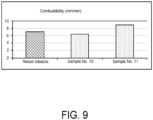
- Sample No. 10 water soluble extracts were not applied to the reconstituted plant material. Water soluble extracts, however, were applied to the material in Sample No. 11 in a target amount of 21% by weight. As shown, Sample No. 10 contained residual water soluble extracts in an amount of 6% by weight, while Sample No. 11 contained extracts in an amount of 14% by weight. These amounts were measured after the reconstituted plant material was dry.
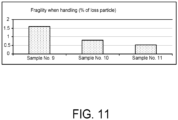
- FIGS. 6 through 11 illustrate the results.
- FIG. 6 is directed to EMC percent which is the humidity of the product after being conditioned at least 48 hours at 22°C and at a relative humidity of 60%.
- FIG. 7 illustrates bursting resistance
- FIG. 8 illustrates filling power
- FIG. 9 illustrates combustibility
- FIG. 10 illustrates fragility when cutting
- FIG. 11 illustrates fragility when handling.
- the material of the present disclosure generally absorbs less moisture than a tobacco product.
- the figures demonstrate that changing various parameters can reduce bursting resistance, decrease filling power and can have an impact on fragility.
- the following example demonstrates the ability to control mainstream smoke components when blending a cocoa filler made in accordance with the present disclosure with a standard tobacco filler.
- a reconstituted cocoa filler was produced using generally the same method as described above with respect to Example 5.
- the reconstituted cocoa material contained 9% by weight softwood fibers, 9% by weight hardwood fibers, 5% by weight glycerine, 5% by weight calcium carbonate and the remainder cocoa material. Sixteen (16)% by weight cocoa extract was applied to the material.
- the above reconstituted cocoa material was combined with a standard tobacco filler, American blend type. Five different samples were formulated in which the amount of the cocoa material in relation to the tobacco material was varied. The five samples are as follows:
- the amount of tobacco specific nitrosamines can be determined using Coresta Method No. 72.
- Coresta Method No. 72 was modified as follows:
- Figure 12 is a graphical representation of the amount of reducing sugar, total alkaloids, nitrates, and tobacco specific nitrosamines present in each blend as the percent of tobacco in the blend changes. As shown in Figure 12 , the various different components can be controlled by controlling the amount of tobacco in relation to the amount of the reconstituted cocoa material.
- Figure 13 illustrates the amount of reducing sugar, total alkaloids and nitrates present in each sample.
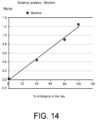
- Figures 14 and 15 are graphical representations of the results.
- Figure 14 illustrates the reduction of nicotine as the amount of tobacco in the mix is reduced.
- Figure 15 shows that TPM and tar are reduced as the amount of tobacco in the mix is reduced.
- the reconstituted cocoa material is particularly well suited to controlling nicotine levels in aerosol generating articles, including smoking articles and heat but not burn applications.
- the reconstituted cocoa material is combined with a tobacco material such that the resulting blend produces nicotine when smoked in an amount less than about 0.0008 mg/mg, such as less than about 0.0006 mg/mg, such as less than about 0.0004 mg/mg.
- the reconstituted cocoa material can be blended with the tobacco in order to lower nicotine levels below addictive amounts.
- the blend can produce greater than about 0.0001 mg/mg of nicotine, such as greater than about 0.0002 mg/mg of nicotine.
- the aerosol generating material of the present disclosure can take many forms according to claims 1-12 and can be used in many products according to claims 13 and 14.
- the aerosol generating material comprises a reconstituted cocoa husk material comprising extracted cocoa husk fibers combined with web building fibers.
- the aerosol generating material further comprises an aerosol delivery composition containing an aerosol delivery agent.
- the aerosol generating material may contain a humectant alone or in combination with the aerosol delivery composition.
- the reconstituted cocoa husk also contains water soluble cocoa husk components in an amount of less than about 50% by weight.
- the water soluble cocoa husk components can be obtained from the extracted cocoa husk fibers, optionally concentrated, and applied to the reconstituted material.
- the aerosol generating material can contain water soluble cocoa husk components, in an embodiment, in an amount of less than 15% by weight, such as less than about 10% by weight. In an alternative embodiment, the aerosol generating material can contain water soluble cocoa husk components in an amount greater than 10% by weight, such as in an amount greater than 15% by weight.
- the aerosol generating material includes the reconstituted cocoa husk material containing extracted cocoa husk fibers and web building fibers treated with a humectant.
- the humectant can be glycerol, propylene glycol, or a combination of glycerol and propylene glycol.
- the humectant may be present in the reconstituted cocoa husk material in an amount of about 8% by weight or less.
- the humectant may be present in the reconstituted cocoa husk material in an amount of about 8% by weight or greater, such as in an amount of about 10% by weight or greater, such as in an amount of about 15% by weight or greater, and generally in an amount of about 50% by weight or less.
- the web building fibers combined with the reconstituted plant material in any of the embodiments described above can vary within the scope of the claims.
- the web building fibers contain softwood fibers and hardwood fibers in a ratio of from 1:2 to 2:1.
- the web building fibers comprise flax fibers.
- the web building fibers are abaca fibers.
- the web building fibers are bamboo fibers.
- the web building fibers are coconut fibers.
- the web building fibers are ramie fibers.
- the web building fibers are jute fibers.
- the web building fibers are hem fibers.
- the hemp fibers can be used alone or in combination with softwood fibers hardwood fibers, or mixtures thereof.
- the web building fibers are present in the aerosol generating material in an amount greater than 10% by weight and less than 50% by weight. In an embodiment, the web building fibers are present in the aerosol generating material in an amount greater than about 12% by weight. In an embodiment, the web building fibers are present in the aerosol generating material in an amount greater than about 18% by weight. In an embodiment, the web building fibers are present in the aerosol generating material in an amount less than about 40% by weight.
- the reconstituted cocoa husk material can further contain a filler.
- the filler is calcium carbonate particles.
- the calcium carbonate particles can be present in the reconstituted cocoa husk material in an amount from about 2% to about 10% by weight.
- the reconstituted cocoa husk material comprises extracted cocoa husk fibers, web building fibers, and a filler.
- the filler can be calcium carbonate particles.
- the web building fibers can be softwood fibers, hardwood fibers, or mixtures thereof.
- the reconstituted cocoa husk material contains softwood fibers and hardwood fibers.
- the reconstituted cocoa husk material contains extracted cocoa husk fibers, web building fibers, a filler, a humectant, and water soluble cocoa husk components.
- the reconstituted cocoa husk material contains 5% to 15% by weight softwood fibers, 5% to 15% by weight hardwood fibers, 3% to 8% glycerine, 3% to 10% calcium carbonate particles, and 10% to 30% by weight water soluble cocoa husk components. The remainder can comprise extracted cocoa husk fibers.
- the extracted cocoa husk fibers and the web building fibers can be refined in an amount greater than 60° SR, such as greater than about 65° SR, such as greater than about 70° SR, such as greater than about 75° SR.
- the amount of refining can be less than about 95° SR.
- the aerosol generating material can be in the form of a filler material comprised of a strip, strips, shreds, or mixtures thereof.
- the filler material can have a static burn rate of greater than 4 mm/mm, such as greater than 5 mm/mm.
- the filler material can have a filling power of greater than 4 cm 3 /g, such as greater than 5 cm 3 /g, such as greater than 6 cm 3 /g.
- the aerosol generating material is combined with a tobacco material.
- the aerosol generating material is combined with a tobacco material comprising cut tobacco leaf.
- the aerosol generating material is combined with a tobacco material comprising a reconstituted tobacco material.
- the aerosol generating material is combined with a cut leaf tobacco and a reconstituted tobacco material.
- the aerosol generating material is combined with the tobacco material in order to control nicotine levels.
- the resulting blend produces nicotine when smoked of less than 0.0008 mg/mg, such as less than 0.0006 mg/mg, such as less than 0.0004 mg/mg.
- the reconstituted cocoa husk material can be treated with a burn control agent, such as a salt of a carboxylic acid.
- the aerosol generating material in any of the embodiments described above can be used in products according to claims 13 and 14.
- the aerosol generating material of any of the above embodiments can be formed into a smokable rod surrounded by an outer wrapper to form a smoking article.
- the smoking article can optionally include a filter located at one end.
- the wrapper can include a plurality of discrete reduced ignition areas.
- any of the aerosol generating materials described above can be used in a heat but not burn device.
Landscapes
- Health & Medical Sciences (AREA)
- Chemical & Material Sciences (AREA)
- General Chemical & Material Sciences (AREA)
- Chemical Kinetics & Catalysis (AREA)
- General Health & Medical Sciences (AREA)
- Toxicology (AREA)
- Life Sciences & Earth Sciences (AREA)
- Natural Medicines & Medicinal Plants (AREA)
- Botany (AREA)
- Agronomy & Crop Science (AREA)
- Biotechnology (AREA)
- Veterinary Medicine (AREA)
- Pharmacology & Pharmacy (AREA)
- Epidemiology (AREA)
- Animal Behavior & Ethology (AREA)
- Microbiology (AREA)
- Public Health (AREA)
- Mycology (AREA)
- Medicinal Chemistry (AREA)
- Medical Informatics (AREA)
- Alternative & Traditional Medicine (AREA)
- Engineering & Computer Science (AREA)
- Inorganic Chemistry (AREA)
- Paper (AREA)
- Manufacture Of Tobacco Products (AREA)
Applications Claiming Priority (3)
| Application Number | Priority Date | Filing Date | Title |
|---|---|---|---|
| US201962803842P | 2019-02-11 | 2019-02-11 | |
| US201962857544P | 2019-06-05 | 2019-06-05 | |
| PCT/US2020/017718 WO2020167805A1 (en) | 2019-02-11 | 2020-02-11 | Aerosol generating material comprising reconstituted cocoa husk fiber material |
Publications (2)
| Publication Number | Publication Date |
|---|---|
| EP3923745A1 EP3923745A1 (en) | 2021-12-22 |
| EP3923745B1 true EP3923745B1 (en) | 2025-03-12 |
Family
ID=70005702
Family Applications (1)
| Application Number | Title | Priority Date | Filing Date |
|---|---|---|---|
| EP20714320.7A Active EP3923745B1 (en) | 2019-02-11 | 2020-02-11 | Aerosol generating material comprising reconstituted cocoa husk fiber material |
Country Status (8)
| Country | Link |
|---|---|
| US (1) | US20200275688A1 (https=) |
| EP (1) | EP3923745B1 (https=) |
| JP (1) | JP7539217B2 (https=) |
| KR (1) | KR20210126684A (https=) |
| CN (1) | CN113677221B (https=) |
| AU (1) | AU2020222960A1 (https=) |
| CA (1) | CA3129114A1 (https=) |
| WO (1) | WO2020167805A1 (https=) |
Families Citing this family (17)
| Publication number | Priority date | Publication date | Assignee | Title |
|---|---|---|---|---|
| CN114269169A (zh) | 2019-02-11 | 2022-04-01 | 斯瓦蒙卢森堡公司 | 用于吸烟制品的可可包装物 |
| EP3923746A1 (en) | 2019-02-11 | 2021-12-22 | SWM Luxembourg | Reconstituted cannabis material for generating aerosols |
| CA3129133A1 (en) | 2019-02-11 | 2020-08-20 | Swm Luxembourg | Cannabis wrapper for smoking articles |
| AU2020223088B2 (en) | 2019-02-11 | 2025-11-20 | SWM Holdco Luxembourg S.A.R.L. | Reconstituted cocoa material for generating aerosols |
| US11957160B2 (en) | 2019-02-11 | 2024-04-16 | Mativ Holdings, Inc. | Filler containing blends of aerosol generating materials |
| GB201903287D0 (en) * | 2019-03-11 | 2019-04-24 | Nicoventures Trading Ltd | Composition |
| US11363834B2 (en) | 2020-10-01 | 2022-06-21 | Tobacco Technology, Inc. | Shisha, heat-not-burn, or combustion casing, product, and method of making the same |
| US11058142B1 (en) | 2020-10-01 | 2021-07-13 | Tobacco Technology, Inc. | Shisha, heat-not-burn, or combustion casing with active ingredient, product and casing with active ingredient, and method of making the same |
| GB202019625D0 (en) * | 2020-12-11 | 2021-01-27 | Nicoventures Trading Ltd | Aerosol generating material |
| CN114732147A (zh) * | 2021-01-08 | 2022-07-12 | 中烟施伟策(云南)再造烟叶有限公司 | 利用湿法造纸粉体成型技术进行“非烟草-可可型”烟用材料制备的方法 |
| CN114732146A (zh) * | 2021-01-08 | 2022-07-12 | 中烟施伟策(云南)再造烟叶有限公司 | 利用湿法造纸粉体成型技术进行“非烟草-沉香型”烟用材料制备的方法 |
| EP3942948A1 (en) * | 2021-04-16 | 2022-01-26 | Hmist Technology (Fujian) Co., Ltd. | Heated-smokable product containing cannabis extract and preparation method thereof |
| EP4331387A4 (en) * | 2021-04-27 | 2025-04-30 | Japan Tobacco Inc. | Tobacco sheet for non-combustion heating type flavor inhaler, non-combustion heating type flavor inhaler, and non-combustion heating type flavor inhalation system |
| JP2024524437A (ja) * | 2021-07-07 | 2024-07-05 | フィリップ・モーリス・プロダクツ・ソシエテ・アノニム | 熱強化エアロゾル形成基体 |
| CN115187049A (zh) * | 2022-07-07 | 2022-10-14 | 云南中烟工业有限责任公司 | 一种卷烟燃烧质量指标重要性评价综合分析方法 |
| GB202303668D0 (en) * | 2023-03-13 | 2023-04-26 | Nicoventures Trading Ltd | A consumable |
| WO2025229902A1 (ja) * | 2024-04-30 | 2025-11-06 | 日本たばこ産業株式会社 | エアロゾル生成セグメント及びエアロゾル生成物品 |
Citations (1)
| Publication number | Priority date | Publication date | Assignee | Title |
|---|---|---|---|---|
| WO2020025727A1 (en) * | 2018-07-31 | 2020-02-06 | Nicoventures Trading Limited | Aerosol generating substrate |
Family Cites Families (22)
| Publication number | Priority date | Publication date | Assignee | Title |
|---|---|---|---|---|
| US3429316A (en) * | 1965-04-20 | 1969-02-25 | Backman Chocolate Mfg Co | Tobacco compositions |
| GB1143500A (en) * | 1966-11-21 | 1969-02-19 | Sutton Res Corp | Smoking products |
| GB1180710A (en) * | 1968-10-01 | 1970-02-11 | Peter Paul Inc | Tobacco Compositions |
| US3934594A (en) * | 1972-03-02 | 1976-01-27 | Tamag Basel Ag | Process for the manufacture of tobacco substitute |
| DE2307974C3 (de) * | 1972-03-02 | 1980-11-06 | Fabriques De Tabac Reunies S.A., Neuenburg (Schweiz) | Rauchprodukt |
| LU66134A1 (https=) * | 1972-09-21 | 1974-03-25 | ||
| LU73096A1 (https=) * | 1975-07-29 | 1977-03-24 | ||
| LU74233A1 (https=) * | 1976-01-23 | 1977-07-27 | ||
| GB9605116D0 (en) * | 1996-03-07 | 1996-05-08 | British American Tobacco Co | Smokable filler material for smoking articles |
| US20040173229A1 (en) * | 2003-03-05 | 2004-09-09 | Crooks Evon Llewellyn | Smoking article comprising ultrafine particles |
| EP2494876B1 (en) * | 2007-02-23 | 2019-01-09 | Schweitzer-Mauduit International, Inc. | Wrappers for smoking articles having reduced diffusion leading to reduced ignition proclivity characteristics |
| US20100187143A1 (en) * | 2007-04-26 | 2010-07-29 | Swedish Match North Europe Ab | Moist non-tobacco snuff product |
| US20120031415A1 (en) * | 2008-11-05 | 2012-02-09 | Swedish Match North Europe Ab | Non-tobacco moist snuff composition and a method for its manufacture |
| EP3892125A3 (en) * | 2011-09-06 | 2022-01-05 | Nicoventures Trading Limited | Heating smokable material |
| CN104797147B (zh) * | 2012-10-11 | 2019-08-13 | 施韦特-莫迪国际公司 | 具有降低引燃倾向特性的包装材料 |
| CN103174052B (zh) * | 2013-02-07 | 2016-06-01 | 赵鸿 | 烟用薄片的制备方法及烟用薄片 |
| CN117502539A (zh) * | 2013-08-02 | 2024-02-06 | 施韦特-莫迪国际公司 | 包含经重构植物材料的可食用产品 |
| GB201314917D0 (en) * | 2013-08-21 | 2013-10-02 | British American Tobacco Co | Treated Tobacco and processes for preparing the same, Devices including the same and uses thereof |
| CN103750535B (zh) * | 2014-01-22 | 2015-12-02 | 红云红河烟草(集团)有限责任公司 | 一种加热非燃烧型卷烟烟块的制备方法 |
| FR3072003B1 (fr) * | 2017-10-06 | 2021-10-15 | Swm Luxembourg Sarl | Feuille de plante reconstituee pour les dispositifs chauffant le tabac sans le bruler |
| CN108236126B (zh) * | 2018-01-09 | 2020-10-23 | 福建金闽再造烟叶发展有限公司 | 一种制浆工艺、所制的浆料及其应用 |
| CN109043639A (zh) * | 2018-07-05 | 2018-12-21 | 福建金闽再造烟叶发展有限公司 | 一种用于加热不燃烧烟草制品的再造烟叶的制备方法 |
-
2020
- 2020-02-11 WO PCT/US2020/017718 patent/WO2020167805A1/en not_active Ceased
- 2020-02-11 EP EP20714320.7A patent/EP3923745B1/en active Active
- 2020-02-11 JP JP2021546664A patent/JP7539217B2/ja active Active
- 2020-02-11 CN CN202080026785.3A patent/CN113677221B/zh active Active
- 2020-02-11 AU AU2020222960A patent/AU2020222960A1/en not_active Abandoned
- 2020-02-11 US US16/788,009 patent/US20200275688A1/en active Pending
- 2020-02-11 KR KR1020217029325A patent/KR20210126684A/ko active Pending
- 2020-02-11 CA CA3129114A patent/CA3129114A1/en active Pending
Patent Citations (1)
| Publication number | Priority date | Publication date | Assignee | Title |
|---|---|---|---|---|
| WO2020025727A1 (en) * | 2018-07-31 | 2020-02-06 | Nicoventures Trading Limited | Aerosol generating substrate |
Also Published As
| Publication number | Publication date |
|---|---|
| EP3923745A1 (en) | 2021-12-22 |
| JP7539217B2 (ja) | 2024-08-23 |
| CN113677221B (zh) | 2023-06-13 |
| CN113677221A (zh) | 2021-11-19 |
| KR20210126684A (ko) | 2021-10-20 |
| AU2020222960A1 (en) | 2021-08-19 |
| US20200275688A1 (en) | 2020-09-03 |
| CA3129114A1 (en) | 2020-08-20 |
| JP2022519754A (ja) | 2022-03-24 |
| WO2020167805A1 (en) | 2020-08-20 |
Similar Documents
| Publication | Publication Date | Title |
|---|---|---|
| EP3923745B1 (en) | Aerosol generating material comprising reconstituted cocoa husk fiber material | |
| US20240180232A1 (en) | Filler Containing Blends of Aerosol Generating Materials | |
| US12127579B2 (en) | Reconstituted cannabis material for generating aerosols | |
| US20240298696A1 (en) | Reconstituted Cocoa Material For Generating Aerosol |
Legal Events
| Date | Code | Title | Description |
|---|---|---|---|
| STAA | Information on the status of an ep patent application or granted ep patent |
Free format text: STATUS: UNKNOWN |
|
| STAA | Information on the status of an ep patent application or granted ep patent |
Free format text: STATUS: THE INTERNATIONAL PUBLICATION HAS BEEN MADE |
|
| PUAI | Public reference made under article 153(3) epc to a published international application that has entered the european phase |
Free format text: ORIGINAL CODE: 0009012 |
|
| STAA | Information on the status of an ep patent application or granted ep patent |
Free format text: STATUS: REQUEST FOR EXAMINATION WAS MADE |
|
| 17P | Request for examination filed |
Effective date: 20210716 |
|
| AK | Designated contracting states |
Kind code of ref document: A1 Designated state(s): AL AT BE BG CH CY CZ DE DK EE ES FI FR GB GR HR HU IE IS IT LI LT LU LV MC MK MT NL NO PL PT RO RS SE SI SK SM TR |
|
| DAV | Request for validation of the european patent (deleted) | ||
| DAX | Request for extension of the european patent (deleted) | ||
| P01 | Opt-out of the competence of the unified patent court (upc) registered |
Effective date: 20230508 |
|
| STAA | Information on the status of an ep patent application or granted ep patent |
Free format text: STATUS: EXAMINATION IS IN PROGRESS |
|
| 17Q | First examination report despatched |
Effective date: 20240119 |
|
| REG | Reference to a national code |
Ref country code: DE Ref legal event code: R079 Free format text: PREVIOUS MAIN CLASS: A24B0015120000 Ipc: A24B0015300000 Ref country code: DE Ref legal event code: R079 Ref document number: 602020047561 Country of ref document: DE Free format text: PREVIOUS MAIN CLASS: A24B0015120000 Ipc: A24B0015300000 |
|
| GRAP | Despatch of communication of intention to grant a patent |
Free format text: ORIGINAL CODE: EPIDOSNIGR1 |
|
| STAA | Information on the status of an ep patent application or granted ep patent |
Free format text: STATUS: GRANT OF PATENT IS INTENDED |
|
| RIC1 | Information provided on ipc code assigned before grant |
Ipc: A24D 1/00 20200101ALI20240527BHEP Ipc: A24D 1/18 20060101ALI20240527BHEP Ipc: A24B 15/14 20060101ALI20240527BHEP Ipc: A24B 15/12 20060101ALI20240527BHEP Ipc: A24B 15/16 20200101ALI20240527BHEP Ipc: A24D 1/20 20200101ALI20240527BHEP Ipc: A24D 1/02 20060101ALI20240527BHEP Ipc: A24B 15/42 20060101ALI20240527BHEP Ipc: A24B 15/30 20060101AFI20240527BHEP |
|
| INTG | Intention to grant announced |
Effective date: 20240611 |
|
| RAP3 | Party data changed (applicant data changed or rights of an application transferred) |
Owner name: SWM LUXEMBOURG |
|
| GRAJ | Information related to disapproval of communication of intention to grant by the applicant or resumption of examination proceedings by the epo deleted |
Free format text: ORIGINAL CODE: EPIDOSDIGR1 |
|
| STAA | Information on the status of an ep patent application or granted ep patent |
Free format text: STATUS: EXAMINATION IS IN PROGRESS |
|
| GRAP | Despatch of communication of intention to grant a patent |
Free format text: ORIGINAL CODE: EPIDOSNIGR1 |
|
| STAA | Information on the status of an ep patent application or granted ep patent |
Free format text: STATUS: GRANT OF PATENT IS INTENDED |
|
| INTC | Intention to grant announced (deleted) | ||
| INTG | Intention to grant announced |
Effective date: 20241113 |
|
| GRAS | Grant fee paid |
Free format text: ORIGINAL CODE: EPIDOSNIGR3 |
|
| GRAA | (expected) grant |
Free format text: ORIGINAL CODE: 0009210 |
|
| STAA | Information on the status of an ep patent application or granted ep patent |
Free format text: STATUS: THE PATENT HAS BEEN GRANTED |
|
| AK | Designated contracting states |
Kind code of ref document: B1 Designated state(s): AL AT BE BG CH CY CZ DE DK EE ES FI FR GB GR HR HU IE IS IT LI LT LU LV MC MK MT NL NO PL PT RO RS SE SI SK SM TR |
|
| REG | Reference to a national code |
Ref country code: GB Ref legal event code: FG4D |
|
| REG | Reference to a national code |
Ref country code: CH Ref legal event code: EP |
|
| REG | Reference to a national code |
Ref country code: DE Ref legal event code: R096 Ref document number: 602020047561 Country of ref document: DE |
|
| REG | Reference to a national code |
Ref country code: IE Ref legal event code: FG4D |
|
| PG25 | Lapsed in a contracting state [announced via postgrant information from national office to epo] |
Ref country code: RS Free format text: LAPSE BECAUSE OF FAILURE TO SUBMIT A TRANSLATION OF THE DESCRIPTION OR TO PAY THE FEE WITHIN THE PRESCRIBED TIME-LIMIT Effective date: 20250612 |
|
| PG25 | Lapsed in a contracting state [announced via postgrant information from national office to epo] |
Ref country code: FI Free format text: LAPSE BECAUSE OF FAILURE TO SUBMIT A TRANSLATION OF THE DESCRIPTION OR TO PAY THE FEE WITHIN THE PRESCRIBED TIME-LIMIT Effective date: 20250312 |
|
| PG25 | Lapsed in a contracting state [announced via postgrant information from national office to epo] |
Ref country code: ES Free format text: LAPSE BECAUSE OF FAILURE TO SUBMIT A TRANSLATION OF THE DESCRIPTION OR TO PAY THE FEE WITHIN THE PRESCRIBED TIME-LIMIT Effective date: 20250312 |
|
| REG | Reference to a national code |
Ref country code: LT Ref legal event code: MG9D |
|
| PG25 | Lapsed in a contracting state [announced via postgrant information from national office to epo] |
Ref country code: NO Free format text: LAPSE BECAUSE OF FAILURE TO SUBMIT A TRANSLATION OF THE DESCRIPTION OR TO PAY THE FEE WITHIN THE PRESCRIBED TIME-LIMIT Effective date: 20250612 |
|
| PG25 | Lapsed in a contracting state [announced via postgrant information from national office to epo] |
Ref country code: HR Free format text: LAPSE BECAUSE OF FAILURE TO SUBMIT A TRANSLATION OF THE DESCRIPTION OR TO PAY THE FEE WITHIN THE PRESCRIBED TIME-LIMIT Effective date: 20250312 |
|
| REG | Reference to a national code |
Ref country code: NL Ref legal event code: MP Effective date: 20250312 |
|
| PG25 | Lapsed in a contracting state [announced via postgrant information from national office to epo] |
Ref country code: LV Free format text: LAPSE BECAUSE OF FAILURE TO SUBMIT A TRANSLATION OF THE DESCRIPTION OR TO PAY THE FEE WITHIN THE PRESCRIBED TIME-LIMIT Effective date: 20250312 |
|
| PG25 | Lapsed in a contracting state [announced via postgrant information from national office to epo] |
Ref country code: BG Free format text: LAPSE BECAUSE OF FAILURE TO SUBMIT A TRANSLATION OF THE DESCRIPTION OR TO PAY THE FEE WITHIN THE PRESCRIBED TIME-LIMIT Effective date: 20250312 Ref country code: GR Free format text: LAPSE BECAUSE OF FAILURE TO SUBMIT A TRANSLATION OF THE DESCRIPTION OR TO PAY THE FEE WITHIN THE PRESCRIBED TIME-LIMIT Effective date: 20250613 |
|
| REG | Reference to a national code |
Ref country code: AT Ref legal event code: MK05 Ref document number: 1774233 Country of ref document: AT Kind code of ref document: T Effective date: 20250312 |
|
| PG25 | Lapsed in a contracting state [announced via postgrant information from national office to epo] |
Ref country code: NL Free format text: LAPSE BECAUSE OF FAILURE TO SUBMIT A TRANSLATION OF THE DESCRIPTION OR TO PAY THE FEE WITHIN THE PRESCRIBED TIME-LIMIT Effective date: 20250312 |
|
| PG25 | Lapsed in a contracting state [announced via postgrant information from national office to epo] |
Ref country code: SE Free format text: LAPSE BECAUSE OF FAILURE TO SUBMIT A TRANSLATION OF THE DESCRIPTION OR TO PAY THE FEE WITHIN THE PRESCRIBED TIME-LIMIT Effective date: 20250312 |
|
| PG25 | Lapsed in a contracting state [announced via postgrant information from national office to epo] |
Ref country code: SM Free format text: LAPSE BECAUSE OF FAILURE TO SUBMIT A TRANSLATION OF THE DESCRIPTION OR TO PAY THE FEE WITHIN THE PRESCRIBED TIME-LIMIT Effective date: 20250312 |
|
| PG25 | Lapsed in a contracting state [announced via postgrant information from national office to epo] |
Ref country code: PT Free format text: LAPSE BECAUSE OF FAILURE TO SUBMIT A TRANSLATION OF THE DESCRIPTION OR TO PAY THE FEE WITHIN THE PRESCRIBED TIME-LIMIT Effective date: 20250714 |
|
| PG25 | Lapsed in a contracting state [announced via postgrant information from national office to epo] |
Ref country code: IT Free format text: LAPSE BECAUSE OF FAILURE TO SUBMIT A TRANSLATION OF THE DESCRIPTION OR TO PAY THE FEE WITHIN THE PRESCRIBED TIME-LIMIT Effective date: 20250312 Ref country code: PL Free format text: LAPSE BECAUSE OF FAILURE TO SUBMIT A TRANSLATION OF THE DESCRIPTION OR TO PAY THE FEE WITHIN THE PRESCRIBED TIME-LIMIT Effective date: 20250312 |
|
| PG25 | Lapsed in a contracting state [announced via postgrant information from national office to epo] |
Ref country code: AT Free format text: LAPSE BECAUSE OF FAILURE TO SUBMIT A TRANSLATION OF THE DESCRIPTION OR TO PAY THE FEE WITHIN THE PRESCRIBED TIME-LIMIT Effective date: 20250312 |
|
| PG25 | Lapsed in a contracting state [announced via postgrant information from national office to epo] |
Ref country code: CZ Free format text: LAPSE BECAUSE OF FAILURE TO SUBMIT A TRANSLATION OF THE DESCRIPTION OR TO PAY THE FEE WITHIN THE PRESCRIBED TIME-LIMIT Effective date: 20250312 Ref country code: EE Free format text: LAPSE BECAUSE OF FAILURE TO SUBMIT A TRANSLATION OF THE DESCRIPTION OR TO PAY THE FEE WITHIN THE PRESCRIBED TIME-LIMIT Effective date: 20250312 |
|
| PG25 | Lapsed in a contracting state [announced via postgrant information from national office to epo] |
Ref country code: RO Free format text: LAPSE BECAUSE OF FAILURE TO SUBMIT A TRANSLATION OF THE DESCRIPTION OR TO PAY THE FEE WITHIN THE PRESCRIBED TIME-LIMIT Effective date: 20250312 |
|
| PG25 | Lapsed in a contracting state [announced via postgrant information from national office to epo] |
Ref country code: SK Free format text: LAPSE BECAUSE OF FAILURE TO SUBMIT A TRANSLATION OF THE DESCRIPTION OR TO PAY THE FEE WITHIN THE PRESCRIBED TIME-LIMIT Effective date: 20250312 |
|
| PG25 | Lapsed in a contracting state [announced via postgrant information from national office to epo] |
Ref country code: IS Free format text: LAPSE BECAUSE OF FAILURE TO SUBMIT A TRANSLATION OF THE DESCRIPTION OR TO PAY THE FEE WITHIN THE PRESCRIBED TIME-LIMIT Effective date: 20250712 |
|
| REG | Reference to a national code |
Ref country code: DE Ref legal event code: R097 Ref document number: 602020047561 Country of ref document: DE |
|
| PG25 | Lapsed in a contracting state [announced via postgrant information from national office to epo] |
Ref country code: DK Free format text: LAPSE BECAUSE OF FAILURE TO SUBMIT A TRANSLATION OF THE DESCRIPTION OR TO PAY THE FEE WITHIN THE PRESCRIBED TIME-LIMIT Effective date: 20250312 |
|
| PLBE | No opposition filed within time limit |
Free format text: ORIGINAL CODE: 0009261 |
|
| STAA | Information on the status of an ep patent application or granted ep patent |
Free format text: STATUS: NO OPPOSITION FILED WITHIN TIME LIMIT |
|
| REG | Reference to a national code |
Ref country code: CH Ref legal event code: L10 Free format text: ST27 STATUS EVENT CODE: U-0-0-L10-L00 (AS PROVIDED BY THE NATIONAL OFFICE) Effective date: 20260121 |
|
| 26N | No opposition filed |
Effective date: 20251215 |