EP3914720B9 - Vgll4 mit ucp-1-cis-regulierendem element und verfahren zu dessen verwendung - Google Patents
Vgll4 mit ucp-1-cis-regulierendem element und verfahren zu dessen verwendung Download PDFInfo
- Publication number
- EP3914720B9 EP3914720B9 EP20747295.2A EP20747295A EP3914720B9 EP 3914720 B9 EP3914720 B9 EP 3914720B9 EP 20747295 A EP20747295 A EP 20747295A EP 3914720 B9 EP3914720 B9 EP 3914720B9
- Authority
- EP
- European Patent Office
- Prior art keywords
- seq
- vgll4
- cis
- protein
- bat
- Prior art date
- Legal status (The legal status is an assumption and is not a legal conclusion. Google has not performed a legal analysis and makes no representation as to the accuracy of the status listed.)
- Active
Links
Images








Classifications
-
- C—CHEMISTRY; METALLURGY
- C07—ORGANIC CHEMISTRY
- C07K—PEPTIDES
- C07K14/00—Peptides having more than 20 amino acids; Gastrins; Somatostatins; Melanotropins; Derivatives thereof
- C07K14/435—Peptides having more than 20 amino acids; Gastrins; Somatostatins; Melanotropins; Derivatives thereof from animals; from humans
- C07K14/46—Peptides having more than 20 amino acids; Gastrins; Somatostatins; Melanotropins; Derivatives thereof from animals; from humans from vertebrates
- C07K14/47—Peptides having more than 20 amino acids; Gastrins; Somatostatins; Melanotropins; Derivatives thereof from animals; from humans from vertebrates from mammals
- C07K14/4701—Peptides having more than 20 amino acids; Gastrins; Somatostatins; Melanotropins; Derivatives thereof from animals; from humans from vertebrates from mammals not used
- C07K14/4702—Regulators; Modulating activity
- C07K14/4705—Regulators; Modulating activity stimulating, promoting or activating activity
-
- C—CHEMISTRY; METALLURGY
- C07—ORGANIC CHEMISTRY
- C07K—PEPTIDES
- C07K14/00—Peptides having more than 20 amino acids; Gastrins; Somatostatins; Melanotropins; Derivatives thereof
- C07K14/435—Peptides having more than 20 amino acids; Gastrins; Somatostatins; Melanotropins; Derivatives thereof from animals; from humans
- C07K14/46—Peptides having more than 20 amino acids; Gastrins; Somatostatins; Melanotropins; Derivatives thereof from animals; from humans from vertebrates
- C07K14/47—Peptides having more than 20 amino acids; Gastrins; Somatostatins; Melanotropins; Derivatives thereof from animals; from humans from vertebrates from mammals
- C07K14/4701—Peptides having more than 20 amino acids; Gastrins; Somatostatins; Melanotropins; Derivatives thereof from animals; from humans from vertebrates from mammals not used
- C07K14/4702—Regulators; Modulating activity
-
- A—HUMAN NECESSITIES
- A61—MEDICAL OR VETERINARY SCIENCE; HYGIENE
- A61K—PREPARATIONS FOR MEDICAL, DENTAL OR TOILETRY PURPOSES
- A61K48/00—Medicinal preparations containing genetic material which is inserted into cells of the living body to treat genetic diseases; Gene therapy
- A61K48/005—Medicinal preparations containing genetic material which is inserted into cells of the living body to treat genetic diseases; Gene therapy characterised by an aspect of the 'active' part of the composition delivered, i.e. the nucleic acid delivered
- A61K48/0058—Nucleic acids adapted for tissue specific expression, e.g. having tissue specific promoters as part of a contruct
-
- C—CHEMISTRY; METALLURGY
- C12—BIOCHEMISTRY; BEER; SPIRITS; WINE; VINEGAR; MICROBIOLOGY; ENZYMOLOGY; MUTATION OR GENETIC ENGINEERING
- C12N—MICROORGANISMS OR ENZYMES; COMPOSITIONS THEREOF; PROPAGATING, PRESERVING, OR MAINTAINING MICROORGANISMS; MUTATION OR GENETIC ENGINEERING; CULTURE MEDIA
- C12N15/00—Mutation or genetic engineering; DNA or RNA concerning genetic engineering, vectors, e.g. plasmids, or their isolation, preparation or purification; Use of hosts therefor
- C12N15/09—Recombinant DNA-technology
- C12N15/63—Introduction of foreign genetic material using vectors; Vectors; Use of hosts therefor; Regulation of expression
- C12N15/79—Vectors or expression systems specially adapted for eukaryotic hosts
- C12N15/85—Vectors or expression systems specially adapted for eukaryotic hosts for animal cells
- C12N15/86—Viral vectors
-
- A—HUMAN NECESSITIES
- A01—AGRICULTURE; FORESTRY; ANIMAL HUSBANDRY; HUNTING; TRAPPING; FISHING
- A01K—ANIMAL HUSBANDRY; AVICULTURE; APICULTURE; PISCICULTURE; FISHING; REARING OR BREEDING ANIMALS, NOT OTHERWISE PROVIDED FOR; NEW BREEDS OF ANIMALS
- A01K2207/00—Modified animals
- A01K2207/25—Animals on a special diet
-
- A—HUMAN NECESSITIES
- A01—AGRICULTURE; FORESTRY; ANIMAL HUSBANDRY; HUNTING; TRAPPING; FISHING
- A01K—ANIMAL HUSBANDRY; AVICULTURE; APICULTURE; PISCICULTURE; FISHING; REARING OR BREEDING ANIMALS, NOT OTHERWISE PROVIDED FOR; NEW BREEDS OF ANIMALS
- A01K2227/00—Animals characterised by species
- A01K2227/10—Mammal
- A01K2227/105—Murine
-
- A—HUMAN NECESSITIES
- A01—AGRICULTURE; FORESTRY; ANIMAL HUSBANDRY; HUNTING; TRAPPING; FISHING
- A01K—ANIMAL HUSBANDRY; AVICULTURE; APICULTURE; PISCICULTURE; FISHING; REARING OR BREEDING ANIMALS, NOT OTHERWISE PROVIDED FOR; NEW BREEDS OF ANIMALS
- A01K2267/00—Animals characterised by purpose
- A01K2267/03—Animal model, e.g. for test or diseases
- A01K2267/035—Animal model for multifactorial diseases
- A01K2267/0362—Animal model for lipid/glucose metabolism, e.g. obesity, type-2 diabetes
-
- C—CHEMISTRY; METALLURGY
- C12—BIOCHEMISTRY; BEER; SPIRITS; WINE; VINEGAR; MICROBIOLOGY; ENZYMOLOGY; MUTATION OR GENETIC ENGINEERING
- C12N—MICROORGANISMS OR ENZYMES; COMPOSITIONS THEREOF; PROPAGATING, PRESERVING, OR MAINTAINING MICROORGANISMS; MUTATION OR GENETIC ENGINEERING; CULTURE MEDIA
- C12N2750/00—MICROORGANISMS OR ENZYMES; COMPOSITIONS THEREOF; PROPAGATING, PRESERVING, OR MAINTAINING MICROORGANISMS; MUTATION OR GENETIC ENGINEERING; CULTURE MEDIA ssDNA viruses
- C12N2750/00011—Details
- C12N2750/14011—Parvoviridae
- C12N2750/14111—Dependovirus, e.g. adenoassociated viruses
- C12N2750/14141—Use of virus, viral particle or viral elements as a vector
- C12N2750/14143—Use of virus, viral particle or viral elements as a vector viral genome or elements thereof as genetic vector
-
- C—CHEMISTRY; METALLURGY
- C12—BIOCHEMISTRY; BEER; SPIRITS; WINE; VINEGAR; MICROBIOLOGY; ENZYMOLOGY; MUTATION OR GENETIC ENGINEERING
- C12N—MICROORGANISMS OR ENZYMES; COMPOSITIONS THEREOF; PROPAGATING, PRESERVING, OR MAINTAINING MICROORGANISMS; MUTATION OR GENETIC ENGINEERING; CULTURE MEDIA
- C12N2830/00—Vector systems having a special element relevant for transcription
- C12N2830/001—Vector systems having a special element relevant for transcription controllable enhancer/promoter combination
-
- C—CHEMISTRY; METALLURGY
- C12—BIOCHEMISTRY; BEER; SPIRITS; WINE; VINEGAR; MICROBIOLOGY; ENZYMOLOGY; MUTATION OR GENETIC ENGINEERING
- C12N—MICROORGANISMS OR ENZYMES; COMPOSITIONS THEREOF; PROPAGATING, PRESERVING, OR MAINTAINING MICROORGANISMS; MUTATION OR GENETIC ENGINEERING; CULTURE MEDIA
- C12N2830/00—Vector systems having a special element relevant for transcription
- C12N2830/008—Vector systems having a special element relevant for transcription cell type or tissue specific enhancer/promoter combination
Definitions
- Obesity is a global epidemic that plagues the human society, threatening the health of both adult and children. Effective pharmacological therapies for obesity are urgently needed. Obesity-related pathologies include, among others, diabetes and liver disease. Adipose tissue overgrowth is the root of obesity, with deleterious health effects. Adipose tissue is composed of white and brown adipose tissue (BAT). White adipose tissue (WAT) stores triglycerides in adipocytes, and BAT burns triglycerides and glucose for generating heat. The development of obesity depends not only on the balance between food intake and caloric utilization but also on the balance between BAT and WAT.
- BAT white adipose tissue
- the cis-regulatory element has at least 90% homology with a sequence selected from SEQ ID NO: 3, SEQ ID NO: 6, and SEQ ID NO: 9.
- the cis-regulatory element is selected from SEQ ID NO: 3, SEQ ID NO: 6, and SEQ ID NO: 9.
- the vestigial like 4 protein has at least 90% homology with a sequence selected from SEQ ID NO: 11, SEQ ID NO: 13, SEQ ID NO: 15, SEQ ID NO: 17, SEQ ID NO: 19, SEQ ID NO: 21, SEQ ID NO: 23, SEQ ID NO: 25, SEQ ID NO: 27, SEQ ID NO: 29, SEQ ID NO: 31, and SEQ ID NO: 33.
- the vestigial like 4 protein is selected from SEQ ID NO: 11, SEQ ID NO: 13, SEQ ID NO: 15, SEQ ID NO: 17, SEQ ID NO: 19, SEQ ID NO: 21, SEQ ID NO: 23, SEQ ID NO: 25, SEQ ID NO: 27, SEQ ID NO: 29, SEQ ID NO: 31, and SEQ ID NO: 33.
- Another example further includes an intron between the cis-regulatory element and the nucleotide sequence encoding a vestigial like 4 protein.
- the intron has at least 90% homology with SEQ ID NO: 34.
- the intron is SEQ ID NO: 34.
- the disclosure also describes a method.
- the method includes transfecting a cell with any of the foregoing examples of a polynucleotide that include a cis-regulatory element and a nucleotide sequence encoding a vestigial like 4 protein.
- transfecting includes contacting the cell with any of the foregoing examples of a viral vector that include any of the foregoing examples of a polynucleotide that include a cis-regulatory element and a nucleotide sequence encoding a vestigial like 4 protein.
- the vestigial like protein 4 does not comprise an HF to AA substitution in a TDU domain and the transfecting includes reducing a ratio of a volume of adipose tissue to a volume of non-adipose tissue in the organism.
- the vestigial like protein 4 includes an HF to AA substitution in each of two TDU domains, and the transfecting includes treating hepatic steatosis in the organism. In a further example, the vestigial like protein 4 includes an HF to AA substitution in each of two TDU domains, and the transfecting includes reducing hepatic steatosis in the organism.
- reducing or minimizing blood glucose levels or a rise in glucose levels in an organism by contacting an organism with the construct such as by transfecting cells of an organism with the construct.
- increasing expression of mitochondrial genes such as mitochondrial genes involved in mitochondrial respiration, in an organism by contacting an organism with the construct, such as by transfecting cells of an organism with the construct.
- decreasing expression of genes that promote lipogenesis in an organism by contacting an organism with the construct, such as by transfecting cells of an organism with the construct.
- a viral vector including the construct is used to transfect cells of an organism with the construct.
- a viral vector may be an adeno-associated viral vector or another viral vector known to be able to transfect cells.
- the organism may be a mammal, such as a rodent or human or any other mammal.
- a reduced BAT volume, reduced intrahepatic fat accumulation, or both may result from increased expression of mitochondrial genes involved in mitochondrial respiration, decreased expression of genes involved in lipogenesis, or both.
- cis-regulatory elements of uncoupling protein 1 may be placed adjacent to a coding sequence for a Vgll4.
- cis-regulatory element what is meant is a nucleotide sequence that regulates the transcription of neighboring gene or coding sequences.
- Ucp1 is considered to be expressed specifically in BAT cells.
- a cis-regulatory element may drive expression mostly, or predominantly, or in some cases exclusively, in BAT cells.
- such a cis-regulatory element may drive expression in liver cells in addition to expression in BAT cells.
- such a cis-regulatory element may drive expression only in BAT and liver cells.
- Cis Regulatory Element Sequences SEQ ID NO Identity Sequence 1 Mouse Ucp1 enhancer 2 Mouse Ucp1 promoter 3 Mouse Ucp1 enhancer-promoter 4 Rat adipose- specific UCP1 enhancer 5 Rat basal UCP1 promoter 6 Rat UCP1 enhancer with rat basal UCP1 promoter 7 Human Ucp1 enhancer 8 Human Ucp1 promoter 9 Human Ucp1 enhancer-promoter
- a Ucp1 cis-regulatory element may include a sequence of SEQ ID NO: 3, SEQ ID NO: 6, or SEQ ID NO: 9. Or, it may include a Ucp1 promotor without a Ucp1 enhancer.
- a Ucp1 cis-regulatory element may also include combinations of a Ucp1 enhancer and a Ucp1 promotor other than the aforementioned examples, such as any one or more of enhancer SEQ ID NO: 1, SEQ ID NO: 4, and SEQ ID NO: 7, together with any one of promotor SEQ ID NO: 2, SEQ ID NO: 5, and SEQ ID NO: 8. All possible combinations and permutations of the foregoing are explicitly contemplated herein and explicitly included as examples of the present disclosure.
- Vgll4 sequences SEQ ID NO Identity Sequence 10 Vgll4A nucleotide 11 Vgll4A amino acid 12 Vgll4B nucleotide 13 Vgll4B peptide 14 Vgll4C nucleotide 15 Vgll4C amino acid 16 Vgll4D nucleotide 17 Vgll4D amino acid 18 Vgll4E nucleotide 19 Vgll4E amino acid 20 Vgll4F nucleotide 21 Vgll4F amino acid
- any nucleotide sequence that encodes any of the foregoing Vgll4 isoforms including, without limitation, SEQ ID NO 10, SEQ ID NO: 12, SEQ ID NO 14, SEQ ID NO 16, SEQ ID NO 18, and SEQ ID NO: 20, including one or more codon substitution to any of the foregoing nucleotide sequences that nevertheless still encodes a Vgl4 (e.g., A-F), owing to codon degeneracy.
- a Vgll peptide may include a TDU_1 domain having an amino acid sequence of SEQ ID NO: 43 instead of an amino acid sequence of SEQ ID NO: 41 and include a TDU_2 domain having an amino acid sequence of SEQ ID NO: 44 instead of an amino acid sequence of SEQ ID NO: 42.
- a Vgll4 peptide e.g., Vgll4A, Vgll4B, Vgll4C, Vgll4D, Vgll4E, or Vgll4F
- Vgll4-HF4A peptide having TDU domains with amino acid sequences SEQ ID NO: 43 and SEQ ID NO: 44 instead of SEQ ID NO: 41 and SEQ ID NO: 42 is referred to herein as a Vgll4-HF4A peptide.
- At least six isoforms (A-F) of Vgll4-HF4A are disclosed herein, referred to herein as Vgll4A-HF4A, Vgll4B-HF4A, Vgll4C-HF4A, Vgll4D-HF4A, Vgll4E-HF4A, and Vgll4F-HF4A.
- Amino acid sequences, and non-limiting examples of nucleotide sequences encoding such Vgll4-HF4A peptide sequences, are shown in Table III.
- Vgll4-HF4A peptide may have an amino acid sequence of s SEQ ID NO 23, SEQ ID NO 25, SEQ ID NO 27, SEQ ID NO 29, SEQ ID NO 31, or SEQ ID NO 33. These six isoforms are collectively included in the term Vgll4-HF4A as used herein.
- any nucleotide sequence that encodes any of the foregoing Vgll4 isoforms including, without limitation, SEQ ID NO 22, SEQ ID NO: 24, SEQ ID NO 26, SEQ ID NO 28, SEQ ID NO 30, and SEQ ID NO: 32, including one or more codon substitution to any of the foregoing nucleotide sequences that nevertheless still encodes a Vgl4-HF4A (e.g., A-F), owing to codon degeneracy.
- a construct as disclosed herein may include a cis regulatory element and a nucleotide sequence encoding a Vgll4 or Vgll4-HF4A peptide.
- a cis regulatory element may include, for example, any one or more of enhancer sequence SEQ ID NO: 1, SEQ ID NO: 4, and SEQ ID NO: 7, and any one of promoter sequence SEQ ID NO: 2, SEQ ID NO: 5, and SEQ ID NO: 8. All permutations of the foregoing are expressly contemplated and included in the present disclosure.
- a cis-regulatory element may include 2, 3, or 4 enhancer sequences each independently selected from SEQ ID NO: 1, SEQ ID NO: 4, and SEQ ID NO: 7.
- Examples of cis regulatory elements include SEQ ID NO: 3, SEQ ID NO: 6, and SEQ ID NO: 9.
- a reporter gene may be used or included in a construct to verify expression of a construct gene included in a vector or for testing tissue- or cell-type specific expression of a gene under control of a given cis-regulatory element.
- Numerous reporter genes are known and have been widely used in the relevant field.
- SEQ ID NO: 39 may be modified to replace SEQ ID NO: 41 therein and SEQ ID NO: 42 therein with SEQ ID NO: 43 and SEQ ID NO: 44, respectively, to encode a Vgll4-HF4A and a GFP reporter protein.
- a viral vector or viral-like particle such as an AAV vector
- an AAV vector can be injected into an organism, such as subcutaneously, intramuscularly, intravenously, intraperitoneally, or by other methods for introduction of the vector into the organism for contact with cells thereof.
- a vector may contact various different cell and tissue types and transfect them.
- inclusion of a cell- or tissue-specific cis-regulatory element may restrict expression of the transfected gene to a given cell or tissue type or types, wherein the construct is not transcribed or is otherwise dormant or at most barely or minimally expressed in other cell types.
- transfecting cells of an organism with a nucleotide sequence including a Ucp1 cis-regulatory element and a coding sequence for a Vgll4 protein or variant may reduce a volume of adipose tissue of the organism.
- transfecting cells of an organism with a nucleotide sequence including a Ucp1 cis-regulatory element and a coding sequence for a Vgll4 protein or variant may reduce a mass ratio BAT to body weight of the organism.
- transfecting cells of an organism with a nucleotide sequence including a Ucp1 cis-regulatory element and a coding sequence for a Vgll4 protein or variant may reduce a liver volume, liver weight, intrahepatic fat content, or any combination of two or more of the foregoing, of the organism.
- An intrahepatic fat content of at least 5% of liver weight is referred to as hepatic steatosis.
- Obesity, or risk of developing obesity such as genetic or life-style factors (e.g., high-calorie or high-fat diet, low exercise or caloric burn rate, sedentary lifestyle, etc.), are risk factors for developing elevated hepatic steatosis.
- Obesity may be defined as having a body mass index (BMI) of 30 or higher.
- BMI body mass index
- An example of a risk factor for developing obesity may be having a BMI of from 25 to 29, which is considered being overweight.
- Prolonged hepatic steatosis is is a risk factor for disorders including liver metabolic dysfunction, inflammation, and advanced forms of nonalcoholic fatty liver disease.
- Disclosed herein is a method for prevention or treatment of hepatic steatosis, by transfecting cells of an organism with any of the foregoing constructs disclosed herein including a cis-regulatory element and nucleotide sequence encoding a Vgll4 peptide or a Vgll4-HF4A peptide.
- Increasing mitochondrial genes that promote mitochondrial respiration, or decreasing expression of genes involved in lipogenesis may include advantageously promote BAT levels, decrease lipogenesis in adipose cells, decrease hepatic steatosis, or any combination of the foregoing.
- contacting cells of an organism with a nucleotide sequence including a Ucp1 cis-regulatory element neighboring a Vgll4-HF4A coding sequence may surprisingly decreases adipose tissue volume.
- a volume of BAT is decreased.
- decreased volume of BAT following transfection with such a construct may be related to stimulation of expression of mitochondrial genes involved in mitochondrial respiration, inhibition of expression of genes involved in lipogenesis, an inhibition of lipogenesis, or any combination of two or more of the foregoing, in BAT, caused by the transfection.
- hepatic steatosis is decreased.
- decreased hepatic steatosis following transfection with such a construct may be related to stimulation of expression of mitochondrial genes involved in mitochondrial respiration, inhibition of expression of genes involved in lipogenesis, an inhibition of lipogenesis, or any combination of two or more of the foregoing, in liver, caused by the transfection.
- Example 1 A Ucp1 cis-regulatory element drives expression in BAT when transfection occurs during early development.
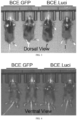
- Adeno-associated viral vectors were synthesized incorporating constructs as illustrated for determining an ability of BCE to drive expression of a downstream coding sequence.
- adeno-associated viral vectors of serotype 9 were constructed carrying constructs as illustrated in FIG. 1 .
- Constructs include a BCE having a sequence of SEQ ID NO: 3 and an intron of SEQ ID NO: 34.
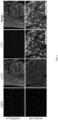
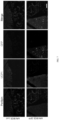
- FIGs. 6 and 7 interscapular adipose tissues (i.e., in the region where BAT is located) were collected at postnatal day 60 and used for immunofluorescence staining.
- FIG. 6 shows immunofluorescence staining images of interscapular BAT (using UCP1 imaging to identify BAT cells)
- FIG. 7 shows immunofluorescence staining images of both BAT and white adipose tissue (using perilipin staining to mark adipose tissue, both BAT and WAT.).
- Nuclear stain DAPI is also shown in FIG.
- An intron is present between the cis-regulatory element and nucleotide sequence encoding a vestigial like 4 protein.
- the construct was packaged in an adeno-associated viral vector (AAV9) for transfection of cells of an organism with the construct.
- AAV9 adeno-associated viral vector
- FIG. 9 illustrates time course of treatment of mice with a viral vectors as illustrated in FIG. 8 for determining effects on adipose tissue volume.
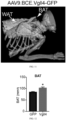
- mice On postnatal day 5 mice were injected dorsally sc with AAV (AAV9.BCE.Vgll4-GFP, or AAV9.BCE.GFP, carrying the construct shown in FIG. 1 , as a control), at a dose of 1 ⁇ 10 10 genome copies per gram of body weight, in phosphate-buffered saline.
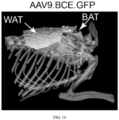
- a micro CT scan was taken to measure intrascapular adipose tissue volume, using standard commercially available micro CT scan software (analyze 12 TM ).
- BAT volume was measured as graphically represented in FIG. 12 .
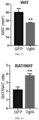
- WAT volume was measured as graphically represented in FIG. 13 .
- Ratio of BAT/WAT volume was measured as graphically represented in FIG. 14 .
- Example 2 A Ucp1 cis-regulatory element drives expression in BAT and liver when transfection occurs during adulthood.
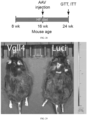
- An AAV vector (AAV9) containing a construct with a BCE cis regulatory element (SEQ ID NO: 3) driving expression of luciferase (AAV.BCE.Luci) was administered to to 6 weeks old mice.
- the cis regulatory element (MiniUcp1) included a Ucp1 enhancer (SEQ ID NO: 4) but not a Ucp1 promoter (AAV.MiniUcp1.Luci).
- Subjects were tested for luciferase signals one week later. Results are illustrated in FIGs. 15-18 .
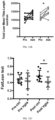
- Both BAT ( FIG. 16 ) and liver ( FIG. 17 ) had luciferase signals, with BCE cis regulatory element driving higher liver expression that MiniUcp1.
- AAV.BCE.Luci drives expression in liver when transfection occurs later in development such as in adulthood.
- FIG. 18 shows that BAT and liver included viral vector genome copies, as assessed by real-time PCR.
- Double heterozygous YAP and TAZ knockout mice have previously been shown to have much smaller BAT than their littermate controls at four weeks after birth.
- YAP/TAZ interacts with TEAD proteins to regulate downstream targets expression.
- TEAD1 may regulated the postnatal growth of BAT.
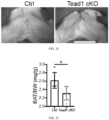
- Ucp1::Cre transgenic mice were crossed with Tead1 flox allele to specifically delete Tead1 in the BAT ( FIG. 22 ).
- TEAD1 depletion in BAT of Tead1 cKO mice was confirmed by western blot ( FIG. 23 ).
- the Tead1 cKO mice had smaller interscapular BAT deposits ( FIGs. 24 and 25 ).
- BAT plays important roles in non-shivering thermogenesis and energy homeostasis.
- AAV-mediated overexpression of VGLL4 increased BAT volume.
- AAV.BCE.VGLL4 including SEQ ID NO: 39
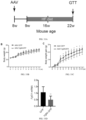
- SEQ ID NO: 39 AAV.BCE.VGLL4 into high fat diet induced obesity mice, and their body weight monitored for 7 weeks.
- Controls received AAV with luciferase controlled by the cis regulatory element (SEQ ID NO: 3). 8 weeks after AAV delivery, luciferase signals were easily detected in the AAV.BCE.luci transduced mice ( FIG. 29 ).
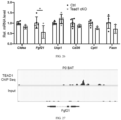
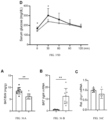
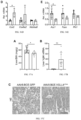
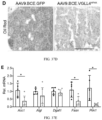
- FIG. 36A Compared to that of the GFP control mice, the mass of BAT was significantly lower in the VGLL4HF4A mice ( FIG. 36A ).
- qRT-PCR confirmed that VGLL4 was overexpressed in the BAT of VGLL4HF4A mice ( FIG. 36B ).
- the expression of Ucp1 was not affected by VGLL4HF4A ( FIG. 36C ).
- Expression levels of three more genes that regulate mitochondria respiration activity were also measured in BAT: Cox2, Cox6a, Ndufsa8. Cox2 was significantly upregulated in the VGLL4HF4A BAT ( FIG. 36D ).
- VGLL4HF4A also suppressed expression of Acc1, a gene involved in fatty acid synthesis ( FIG. 36E ).
- VGLL4HF4A may therefore preserve BAT function by both increasing the mitochondria respiration activity and attenuating fatty acid synthesis.
Landscapes
- Health & Medical Sciences (AREA)
- Life Sciences & Earth Sciences (AREA)
- Chemical & Material Sciences (AREA)
- Genetics & Genomics (AREA)
- Organic Chemistry (AREA)
- Engineering & Computer Science (AREA)
- Zoology (AREA)
- General Health & Medical Sciences (AREA)
- Biomedical Technology (AREA)
- Biochemistry (AREA)
- Molecular Biology (AREA)
- Biotechnology (AREA)
- Wood Science & Technology (AREA)
- Bioinformatics & Cheminformatics (AREA)
- Biophysics (AREA)
- General Engineering & Computer Science (AREA)
- Medicinal Chemistry (AREA)
- Plant Pathology (AREA)
- Toxicology (AREA)
- Physics & Mathematics (AREA)
- Virology (AREA)
- Gastroenterology & Hepatology (AREA)
- Microbiology (AREA)
- Proteomics, Peptides & Aminoacids (AREA)
- Animal Behavior & Ethology (AREA)
- Epidemiology (AREA)
- Pharmacology & Pharmacy (AREA)
- Public Health (AREA)
- Veterinary Medicine (AREA)
- Medicines That Contain Protein Lipid Enzymes And Other Medicines (AREA)
- Micro-Organisms Or Cultivation Processes Thereof (AREA)
- Peptides Or Proteins (AREA)
- Steroid Compounds (AREA)
- Shaping Of Tube Ends By Bending Or Straightening (AREA)
- Control Of Electric Motors In General (AREA)
Claims (16)
- Polynukleotid, umfassendein cis-regulatorisches Element und eine Nukleotidsequenz, die ein Rest-Like-4-Protein kodiert, wobeidas cis-regulatorische Element einen Entkopplerprotein-1-Enhancer und einen Entkopplerprotein-1-Promotor umfasst.
- Polynukleotid nach Anspruch 1, wobei der Entkopplerprotein-1-Enhancer zumindest 90 % Identität mit einer Sequenz aufweist, die ausgewählt ist aus SEQ ID NO: 1, SEQ ID NO 4 und SEQ ID NO: 7.
- Polynukleotid nach Anspruch 1 oder Anspruch 2, wobei der Entkopplerprotein-1-Promotor zumindest 90 % Identität mit einer Sequenz aufweist, die ausgewählt ist aus SEQ ID NO: 2, SEQ ID NO 5 und SEQ ID NO: 8.
- Polynukleotid nach einem der Ansprüche 1 bis 3, wobei das cis-regulatorische Element zumindest 90 % Homologie mit einer Sequenz aufweist, die ausgewählt ist aus SEQ ID NO: 3, SEQ ID NO: 6 und SEQ ID NO: 9.
- Polynukleotid nach einem der Ansprüche 1 bis 4, wobei das Rest-Like-4-Protein zumindest 90 % Homologie mit einer Sequenz aufweist, die ausgewählt ist aus SEQ ID NO: 11, SEQ ID NO: 13, SEQ ID NO: 15, SEQ ID NO: 17, SEQ ID NO: 19, SEQ ID NO: 21, SEQ ID NO: 23, SEQ ID NO: 25, SEQ ID NO: 27, SEQ ID NO: 29, SEQ ID NO: 31 und SEQ ID NO: 33.
- Polynukleotid nach einem der Ansprüche 1 bis 5, wobei das Rest-Like-4-Protein ausgewählt ist aus SEQ ID NO: 11, SEQ ID NO: 13, SEQ ID NO: 15, SEQ ID NO: 17, SEQ ID NO: 19, SEQ ID NO: 21, SEQ ID NO: 23, SEQ ID NO: 25, SEQ ID NO: 27, SEQ ID NO: 29, SEQ ID NO: 31 und SEQ ID NO: 33.
- Polynukleotid nach einem der Ansprüche 1 bis 6, wobei die Sequenz, die ein Rest-Like-4-Protein kodiert, zumindest 90 % Identität mit einer Sequenz aufweist, die ausgewählt ist aus SEQ ID NO: 10, SEQ ID Nr. 12, SEQ ID NO: 14, SEQ ID NO: 16, SEQ ID NO: 18, SEQ ID NO: 20, SEQ ID NO: 22, SEQ ID NO: 24, SEQ ID NO: 26, SEQ ID NO: 28, SEQ ID NO: 30 und SEQ ID NO: 32.
- Polynukleotid nach einem der Ansprüche 1 bis 7, wobei die Sequenz, die ein Rest-Like-4-Protein kodiert, ausgewählt ist aus SEQ ID NO: 10, SEQ ID Nr. 12, SEQ ID NO: 14, SEQ ID NO: 16, SEQ ID NO: 18, SEQ ID NO: 20, SEQ ID NO: 22, SEQ ID NO: 24, SEQ ID NO: 26, SEQ ID NO: 28, SEQ ID NO: 30 und SEQ ID NO: 32.
- Polynukleotid nach einem der Ansprüche 1, 5 oder 7, wobei das Rest-Like-4-Protein 0 bis 3 Substitutionen an einer Sequenz aufweist, die ausgewählt ist aus SEQ ID NO: 11, SEQ ID NO: 13, SEQ ID NO: 15, SEQ ID NO: 17, SEQ ID NO: 19 und SEQ ID NO: 21, wobei die Substitutionen nicht in einer TDU-Domäne sind.
- Polynukleotid nach einem der Ansprüche 1, 5 oder 7, wobei das Rest-Like-4-Protein 0 bis 3 Substitutionen an einer Sequenz aufweist, die ausgewählt ist aus SEQ ID NO: 23, SEQ ID NO: 25, SEQ ID NO: 27, SEQ ID NO: 29, SEQ ID NO: 31 und SEQ ID NO: 33, wobei die Substitutionen nicht in einer TDU-Domäne sind.
- Polynukleotid nach einem der Ansprüche 1 bis 9, ferner umfassend ein Intron zwischen dem cis-regulatorischen Element und der Nukleotidsequenz, die ein Rest-Like-4-Protein kodiert.
- Polynukleotid nach Anspruch 10, wobei das Intron zumindest 90 % Homologie mit SEQ ID NO: 34 aufweist.
- Polynukleotid nach Anspruch 11, wobei das Intron SEQ ID NO: 34 ist.
- Viraler Vektor, umfassend ein Polynukleotid nach einem der Ansprüche 1 bis 13.
- Viraler Vektor nach Anspruch 14, wobei der virale Vektor einen Adenovirus-assoziierten Vektor umfasst.
- Polynukleotid nach einem der Ansprüche 1 bis 12 oder viraler Vektor nach Anspruch 13 oder 14 zur Verwendung als Medikament.
Priority Applications (1)
| Application Number | Priority Date | Filing Date | Title |
|---|---|---|---|
| EP23172590.4A EP4252783A3 (de) | 2019-07-10 | 2020-07-10 | Vgll4 mit ucp-1-cis-regulierendem element und verfahren zu dessen verwendung |
Applications Claiming Priority (2)
| Application Number | Priority Date | Filing Date | Title |
|---|---|---|---|
| US201962872624P | 2019-07-10 | 2019-07-10 | |
| PCT/US2020/041496 WO2021007473A1 (en) | 2019-07-10 | 2020-07-10 | Vgll4 with ucp-1 cis-regulatory element and method of use thereof |
Related Child Applications (2)
| Application Number | Title | Priority Date | Filing Date |
|---|---|---|---|
| EP23172590.4A Division EP4252783A3 (de) | 2019-07-10 | 2020-07-10 | Vgll4 mit ucp-1-cis-regulierendem element und verfahren zu dessen verwendung |
| EP23172590.4A Division-Into EP4252783A3 (de) | 2019-07-10 | 2020-07-10 | Vgll4 mit ucp-1-cis-regulierendem element und verfahren zu dessen verwendung |
Publications (4)
| Publication Number | Publication Date |
|---|---|
| EP3914720A1 EP3914720A1 (de) | 2021-12-01 |
| EP3914720B1 EP3914720B1 (de) | 2023-06-07 |
| EP3914720C0 EP3914720C0 (de) | 2023-06-07 |
| EP3914720B9 true EP3914720B9 (de) | 2023-09-27 |
Family
ID=71842873
Family Applications (2)
| Application Number | Title | Priority Date | Filing Date |
|---|---|---|---|
| EP23172590.4A Pending EP4252783A3 (de) | 2019-07-10 | 2020-07-10 | Vgll4 mit ucp-1-cis-regulierendem element und verfahren zu dessen verwendung |
| EP20747295.2A Active EP3914720B9 (de) | 2019-07-10 | 2020-07-10 | Vgll4 mit ucp-1-cis-regulierendem element und verfahren zu dessen verwendung |
Family Applications Before (1)
| Application Number | Title | Priority Date | Filing Date |
|---|---|---|---|
| EP23172590.4A Pending EP4252783A3 (de) | 2019-07-10 | 2020-07-10 | Vgll4 mit ucp-1-cis-regulierendem element und verfahren zu dessen verwendung |
Country Status (5)
| Country | Link |
|---|---|
| US (3) | US11319354B2 (de) |
| EP (2) | EP4252783A3 (de) |
| CA (1) | CA3137622A1 (de) |
| ES (1) | ES2948620T3 (de) |
| WO (1) | WO2021007473A1 (de) |
Families Citing this family (3)
| Publication number | Priority date | Publication date | Assignee | Title |
|---|---|---|---|---|
| US11319354B2 (en) | 2019-07-10 | 2022-05-03 | Masonic Medical Research Laboratory | VGLL4 with UCP-1 cis-regulatory element and method of use thereof |
| CN115181756B (zh) * | 2022-08-03 | 2023-06-16 | 四川省医学科学院·四川省人民医院 | 一种重组慢病毒载体、重组慢病毒质粒、细胞模型及相关应用 |
| WO2025226943A1 (en) * | 2024-04-25 | 2025-10-30 | Masonic Medical Research Laboratory | Polynucleotide for hepatocyte expression of vestigial like protein 4 and method of use thereof |
Family Cites Families (75)
| Publication number | Priority date | Publication date | Assignee | Title |
|---|---|---|---|---|
| US5139941A (en) | 1985-10-31 | 1992-08-18 | University Of Florida Research Foundation, Inc. | AAV transduction vectors |
| US5436146A (en) | 1989-09-07 | 1995-07-25 | The Trustees Of Princeton University | Helper-free stocks of recombinant adeno-associated virus vectors |
| US6268213B1 (en) | 1992-06-03 | 2001-07-31 | Richard Jude Samulski | Adeno-associated virus vector and cis-acting regulatory and promoter elements capable of expressing at least one gene and method of using same for gene therapy |
| US5869305A (en) | 1992-12-04 | 1999-02-09 | The University Of Pittsburgh | Recombinant viral vector system |
| US5478745A (en) | 1992-12-04 | 1995-12-26 | University Of Pittsburgh | Recombinant viral vector system |
| US5464758A (en) | 1993-06-14 | 1995-11-07 | Gossen; Manfred | Tight control of gene expression in eucaryotic cells by tetracycline-responsive promoters |
| US5446143A (en) | 1993-09-14 | 1995-08-29 | Board Of Regents, The University Of Texas System | Adipose-specific promoter region of human aromatase cytochrome P450 gene |
| US6204059B1 (en) | 1994-06-30 | 2001-03-20 | University Of Pittsburgh | AAV capsid vehicles for molecular transfer |
| GB9506466D0 (en) | 1994-08-26 | 1995-05-17 | Prolifix Ltd | Cell cycle regulated repressor and dna element |
| US5741683A (en) | 1995-06-07 | 1998-04-21 | The Research Foundation Of State University Of New York | In vitro packaging of adeno-associated virus DNA |
| US6093570A (en) | 1995-06-07 | 2000-07-25 | The University Of North Carolina At Chapel Hill | Helper virus-free AAV production |
| CA2222574A1 (en) | 1995-06-07 | 1996-12-19 | Yale University | Oral delivery of adeno-associated viral vectors |
| US6001650A (en) | 1995-08-03 | 1999-12-14 | Avigen, Inc. | High-efficiency wild-type-free AAV helper functions |
| US5952221A (en) | 1996-03-06 | 1999-09-14 | Avigen, Inc. | Adeno-associated virus vectors comprising a first and second nucleic acid sequence |
| US5869037A (en) | 1996-06-26 | 1999-02-09 | Cornell Research Foundation, Inc. | Adenoviral-mediated gene transfer to adipocytes |
| US6133027A (en) | 1996-08-07 | 2000-10-17 | City Of Hope | Inducible expression system |
| JP2001500376A (ja) | 1996-09-06 | 2001-01-16 | カイロン コーポレイション | 組換えaavベクターを使用する治療分子の肝臓特異的送達のための方法および組成物 |
| US20030215422A1 (en) | 1996-09-11 | 2003-11-20 | John A. Chiorini | Aav4 vector and uses thereof |
| US20030219409A1 (en) | 1997-01-10 | 2003-11-27 | Biovex Limited | Eukaryotic gene expression cassette and uses thereof |
| DE69824859T2 (de) | 1997-04-14 | 2005-08-04 | Cell Genesys, Inc., Foster City | Methoden zur erhöhung der effizienz rekombinanter aav produkte |
| US6207455B1 (en) | 1997-05-01 | 2001-03-27 | Lung-Ji Chang | Lentiviral vectors |
| US6277633B1 (en) | 1997-05-13 | 2001-08-21 | The University Of North Carolina At Chapel Hill | Lentivirus-based gene transfer vectors |
| US6156303A (en) | 1997-06-11 | 2000-12-05 | University Of Washington | Adeno-associated virus (AAV) isolates and AAV vectors derived therefrom |
| US6136597A (en) | 1997-09-18 | 2000-10-24 | The Salk Institute For Biological Studies | RNA export element |
| US5994136A (en) | 1997-12-12 | 1999-11-30 | Cell Genesys, Inc. | Method and means for producing high titer, safe, recombinant lentivirus vectors |
| US6218181B1 (en) | 1998-03-18 | 2001-04-17 | The Salk Institute For Biological Studies | Retroviral packaging cell line |
| EP1080218A1 (de) | 1998-05-27 | 2001-03-07 | University of Florida | Methode zur darstellung von rekombinanten adeno-assoziierten virus zusammensetzungen mit hilfe von iodixanol gradienten |
| CA2329060C (en) | 1998-05-28 | 2011-09-13 | John A. Chiorini | Aav5 vector and uses thereof |
| PT1127150E (pt) | 1998-11-05 | 2007-08-22 | Univ Pennsylvania | ''sequências de ácido nucleico do vírus adeno associado do serotipo 1, vectores e células hospedeiras que as contêm'' |
| AU780231B2 (en) | 1998-11-10 | 2005-03-10 | University Of North Carolina At Chapel Hill, The | Virus vectors and methods of making and administering the same |
| DE19909769A1 (de) | 1999-03-05 | 2000-09-07 | Bundesrepublik Deutschland Let | Von SIVagm abgeleitete lentivirale Vektoren, Verfahren zu ihrer Herstellung und ihre Verwendung zur Genübertragung in Säugerzellen |
| AU781958C (en) | 1999-08-09 | 2006-03-30 | Targeted Genetics Corporation | Enhancement of expression of a single-stranded, heterologous nucleotide sequence from recombinant viral vectors by designing the sequence such that it forms intrastrand base pairs |
| US6608038B2 (en) | 2000-03-15 | 2003-08-19 | Novartis Ag | Methods and compositions for treatment of diabetes and related conditions via gene therapy |
| CA2406743A1 (en) | 2000-04-28 | 2001-11-08 | The Trustees Of The University Of Pennsylvania | Recombinant aav vectors with aav5 capsids and aav5 vectors pseudotyped in heterologous capsids |
| AU2001268149B2 (en) | 2000-06-01 | 2005-08-18 | University Of North Carolina At Chapel Hill | Methods and compounds for controlled release of recombinant parvovirus vectors |
| WO2001094605A2 (en) | 2000-06-09 | 2001-12-13 | University Of Florida Research Foundation, Inc. | Recombinant aav vectors for gene therapy of obesity |
| ES2170720B1 (es) | 2000-12-20 | 2003-12-16 | Univ Barcelona Autonoma | Utilizacion conjunta del gen de la insulina y del gen de la glucoquinasa en el desarrollo de aproximaciones terapeuticas para la diabetes mellitus. |
| JP2004538005A (ja) | 2001-08-08 | 2004-12-24 | ザ・トラステイーズ・オブ・ザ・ユニバーシテイ・オブ・ペンシルベニア | シアル酸に結合するタンパク質を有するウイルスベクターの精製法 |
| US6723551B2 (en) | 2001-11-09 | 2004-04-20 | The United States Of America As Represented By The Department Of Health And Human Services | Production of adeno-associated virus in insect cells |
| SG10201506627PA (en) | 2001-11-13 | 2015-10-29 | Univ Pennsylvania | A method of detecting and/or identifying adeno-associated virus (aav) sequences and isolating novel sequences identified thereby |
| ES2975413T3 (es) | 2001-12-17 | 2024-07-05 | Univ Pennsylvania | Secuencias de serotipo 8 de virus adenoasociado (AAV), vectores que las contienen y usos de las mismas |
| ES2526341T3 (es) | 2001-12-17 | 2015-01-09 | The Trustees Of The University Of Pennsylvania | Secuencias de serotipo 9 de virus adeno-asociado (AAV), vectores que las contienen, y usos de las mismas |
| ES2280694T3 (es) | 2002-04-29 | 2007-09-16 | The Trustees Of The University Of Pennsylvania | Metodo para la extraccion directa y la amplificacion de virus integrados del adn celular de tejidos. |
| US20070015238A1 (en) | 2002-06-05 | 2007-01-18 | Snyder Richard O | Production of pseudotyped recombinant AAV virions |
| AU2003265855A1 (en) | 2002-08-28 | 2004-03-19 | University Of Florida | Modified aav |
| DK1677735T3 (da) | 2003-10-17 | 2014-10-27 | Joslin Diabetes Center Inc | Fremgangsmåder og sammensætninger til modulering af adipocytfunktion |
| CN101203613B (zh) | 2005-04-07 | 2012-12-12 | 宾夕法尼亚大学托管会 | 增强腺相关病毒载体功能的方法 |
| JP4495210B2 (ja) | 2005-06-09 | 2010-06-30 | パナソニック株式会社 | 振幅誤差補償装置及び直交度誤差補償装置 |
| US9198984B2 (en) | 2006-04-28 | 2015-12-01 | The Trustees Of The University Of Pennsylvania | Scalable production method for AAV |
| JP2009539844A (ja) | 2006-06-06 | 2009-11-19 | マサチューセッツ・インスティテュート・オブ・テクノロジー | Sirt1およびlxrのコレステロール制御複合体ならびに使用法 |
| US8586006B2 (en) * | 2006-08-09 | 2013-11-19 | Institute For Systems Biology | Organ-specific proteins and methods of their use |
| US20100111873A1 (en) | 2007-02-20 | 2010-05-06 | Russell Stephen J | Treating cancer with viral nucleic acid |
| AR066354A1 (es) | 2007-05-01 | 2009-08-12 | Genzyme Corp | La terapia sistematica con factor-1 de crecimiento de tipo insulina reduce la neuropatia periferica diabetica y mejora la funcion renal en la nefropatia diabetica |
| EP1995309A1 (de) | 2007-05-21 | 2008-11-26 | Vivalis | Rekombinante Proteinproduktion in EBx -Vogelzellen |
| WO2009140206A1 (en) | 2008-05-11 | 2009-11-19 | The Gov. Of The U. S. A., As Represented By The Secretary Of The Dept. Of Health And Human Services | Improved expression of il-12 family heterodimers |
| US8455204B2 (en) | 2008-05-27 | 2013-06-04 | Energesis Pharmaceuticals, Inc. | Brown adipocyte progenitors in human skeletal muscle and methods for identifying differentiation agents therefor |
| WO2010010887A1 (ja) | 2008-07-24 | 2010-01-28 | 塩野義製薬株式会社 | 組織発現プロモーター |
| EP2221066A1 (de) | 2009-02-18 | 2010-08-25 | Sanofi-Aventis | Verwendung des VgII3-Aktivitätsmodulators zur Modulierung von Adipogenese |
| GB0903207D0 (en) | 2009-02-25 | 2009-04-08 | Ucb Pharma Sa | Method for expressing multimeric proteins |
| EP2394667A1 (de) | 2010-06-10 | 2011-12-14 | Laboratorios Del Dr. Esteve, S.A. | Vektoren und Sequenzen zur Behandlung von Erkrankungen |
| US9309534B2 (en) | 2010-07-12 | 2016-04-12 | Universidad Autonoma De Barcelona | Gene therapy composition for use in diabetes treatment |
| SE536352C2 (sv) * | 2011-10-24 | 2013-09-03 | Chundsell Medicals Ab | Markörgener för klassificiering av prostatacancer |
| EP2771455B1 (de) | 2011-10-28 | 2016-10-05 | The University of North Carolina At Chapel Hill | Zelllinie zur produktion eines adenoassoziierten virus |
| US9034839B2 (en) | 2012-04-20 | 2015-05-19 | Aptamir Therapeutics, Inc. | miRNA modulators of thermogenesis |
| EP2492347A1 (de) | 2012-05-22 | 2012-08-29 | Laboratorios Del. Dr. Esteve, S.A. | Verfahren zur Herstellung von Vektoren |
| EP2692868A1 (de) | 2012-08-02 | 2014-02-05 | Universitat Autònoma De Barcelona | Adenoassoziierte virale (AAV) Vektoren für die Transduktion von Fettgewebe |
| EP2883053A2 (de) * | 2012-08-08 | 2015-06-17 | Institut National de la Santé et de la Recherche Médicale (INSERM) | Verfahren zur beurteilung der disposition eines krebspatienten zu einer reaktion auf eine therapie |
| CN104548131B (zh) | 2013-10-18 | 2019-04-16 | 中国科学院上海生命科学研究院 | Vgll4基因治疗肿瘤的用途及其相关药物 |
| AR100419A1 (es) | 2014-05-14 | 2016-10-05 | Esteve Labor Dr | Vectores de virus adenoasociados para el tratamiento de trastornos de almacenamiento lisosómico |
| US10973931B2 (en) | 2014-09-16 | 2021-04-13 | Universitat Autònoma De Barcelona | Adeno-associated viral vectors for the gene therapy of metabolic diseases |
| EP3101125A1 (de) | 2015-06-05 | 2016-12-07 | Laboratorios Del Dr. Esteve, S.A. | Adenoassoziierte virusvektoren zur behandlung von mucopolysaccharidosen |
| WO2017127750A1 (en) * | 2016-01-22 | 2017-07-27 | Modernatx, Inc. | Messenger ribonucleic acids for the production of intracellular binding polypeptides and methods of use thereof |
| EP3519569B1 (de) | 2016-09-30 | 2020-12-02 | Esteve Pharmaceuticals, S.A. | Adenoassoziierte virusvektoren zur behandlung von mucopolysaccharidosen |
| EP3630160A1 (de) | 2017-05-24 | 2020-04-08 | Universitat Autònoma De Barcelona | Konstrukt zur viralen expression mit einer codierungssequenz des fibroblasten-wachstumsfaktors 21 (fgf21) |
| US11319354B2 (en) | 2019-07-10 | 2022-05-03 | Masonic Medical Research Laboratory | VGLL4 with UCP-1 cis-regulatory element and method of use thereof |
-
2020
- 2020-07-10 US US16/925,632 patent/US11319354B2/en active Active
- 2020-07-10 EP EP23172590.4A patent/EP4252783A3/de active Pending
- 2020-07-10 CA CA3137622A patent/CA3137622A1/en active Pending
- 2020-07-10 ES ES20747295T patent/ES2948620T3/es active Active
- 2020-07-10 EP EP20747295.2A patent/EP3914720B9/de active Active
- 2020-07-10 WO PCT/US2020/041496 patent/WO2021007473A1/en not_active Ceased
-
2022
- 2022-04-27 US US17/731,201 patent/US12384823B2/en active Active
-
2025
- 2025-07-10 US US19/264,969 patent/US20250333457A1/en active Pending
Also Published As
| Publication number | Publication date |
|---|---|
| US12384823B2 (en) | 2025-08-12 |
| US20250333457A1 (en) | 2025-10-30 |
| ES2948620T3 (es) | 2023-09-14 |
| US11319354B2 (en) | 2022-05-03 |
| CA3137622A1 (en) | 2021-01-14 |
| US20220259276A1 (en) | 2022-08-18 |
| EP4252783A3 (de) | 2023-11-15 |
| WO2021007473A1 (en) | 2021-01-14 |
| EP3914720A1 (de) | 2021-12-01 |
| EP4252783A2 (de) | 2023-10-04 |
| EP3914720B1 (de) | 2023-06-07 |
| US20210009646A1 (en) | 2021-01-14 |
| EP3914720C0 (de) | 2023-06-07 |
Similar Documents
| Publication | Publication Date | Title |
|---|---|---|
| US20250333457A1 (en) | Vgll4 with ucp-1 cis-regulatory element and method of use thereof | |
| Jimenez et al. | FGF21 gene therapy as treatment for obesity and insulin resistance | |
| Baoutina et al. | Potential use of gene transfer in athletic performance enhancement | |
| Qiao et al. | Transcriptional regulation of fatty acid translocase/CD36 expression by CCAAT/enhancer-binding protein α | |
| Do Koo et al. | SUMO-specific protease 2 mediates leptin-induced fatty acid oxidation in skeletal muscle | |
| MX2014005318A (es) | Terapia genica para la neuropatia diabetica usando una isoforma hgf. | |
| Lorenzi et al. | Nerve growth factor regulation of choline acetyltransferase gene expression in rat embryo basal forebrain cultures | |
| EP3285813B1 (de) | Smad7-genverabreichung als therapeutikum | |
| US11793862B2 (en) | Pharmaceutical composition for treating non-alcoholic fatty liver, non-alcoholic steatohepatitis, or hepatic fibrosis using Ssu72 protein or a polynucleotide encoding the same | |
| Park et al. | Therapeutic potential of AAV-FL-Klotho in obesity: impact on weight loss and lipid metabolism in mice | |
| KR101048766B1 (ko) | 미토콘드리아 기능이상을 동반하는 질환의 예방/치료용 조성물 | |
| WO2012119949A1 (en) | Means and methods for the treatment of neurodegenerative disorders | |
| AU2022211175B2 (en) | Ssu72 protein or polynucleotide for treating and diagnosing liver cancer | |
| CN114432333B (zh) | MiR-503簇海绵在制备用于治疗2型糖尿病药物中的应用 | |
| CA2694222C (en) | Insulin secretion inducer, and accelerator for increasing the number of pancreatic .beta.-cells | |
| WO2025226943A1 (en) | Polynucleotide for hepatocyte expression of vestigial like protein 4 and method of use thereof | |
| EP4635519A1 (de) | Verfahren zur genregulierung und verwendung davon | |
| Kubo et al. | Protective effects of Mkl1/2 against lipodystrophy and muscle atrophy via PI3K/AKT-independent FoxO repression | |
| KR20070007894A (ko) | 항비만약 | |
| EP1902729A1 (de) | Int6-protein beteiligt an der induktion von hypoxie-stress und seine verwendung | |
| WO2024005157A1 (ja) | 脂肪細胞活性化剤 | |
| KR20240147898A (ko) | Hgf를 인코딩하는 폴리뉴클레오타이드를 유효성분으로 포함하는 성문 폐쇄 부전증 또는 성대 손상 치료용 약제학적 조성물 | |
| CN105709217A (zh) | Psat1及其产物在制备调节胰岛素敏感性的药物中的用途 | |
| Lewis | The role of VGF and its derived peptides in the regulation of energy homeostasis | |
| Zori et al. | 214. Dominant-Negative Interference in the Pahenu2 Mouse: Modified Forms of PAH |
Legal Events
| Date | Code | Title | Description |
|---|---|---|---|
| STAA | Information on the status of an ep patent application or granted ep patent |
Free format text: STATUS: UNKNOWN |
|
| STAA | Information on the status of an ep patent application or granted ep patent |
Free format text: STATUS: THE INTERNATIONAL PUBLICATION HAS BEEN MADE |
|
| PUAI | Public reference made under article 153(3) epc to a published international application that has entered the european phase |
Free format text: ORIGINAL CODE: 0009012 |
|
| STAA | Information on the status of an ep patent application or granted ep patent |
Free format text: STATUS: REQUEST FOR EXAMINATION WAS MADE |
|
| 17P | Request for examination filed |
Effective date: 20210823 |
|
| AK | Designated contracting states |
Kind code of ref document: A1 Designated state(s): AL AT BE BG CH CY CZ DE DK EE ES FI FR GB GR HR HU IE IS IT LI LT LU LV MC MK MT NL NO PL PT RO RS SE SI SK SM TR |
|
| RAP3 | Party data changed (applicant data changed or rights of an application transferred) |
Owner name: MASONIC MEDICAL RESEARCH LABORATORY |
|
| STAA | Information on the status of an ep patent application or granted ep patent |
Free format text: STATUS: EXAMINATION IS IN PROGRESS |
|
| 17Q | First examination report despatched |
Effective date: 20220421 |
|
| GRAP | Despatch of communication of intention to grant a patent |
Free format text: ORIGINAL CODE: EPIDOSNIGR1 |
|
| STAA | Information on the status of an ep patent application or granted ep patent |
Free format text: STATUS: GRANT OF PATENT IS INTENDED |
|
| RIC1 | Information provided on ipc code assigned before grant |
Ipc: A61K 48/00 20060101ALI20220824BHEP Ipc: C07K 14/47 20060101ALI20220824BHEP Ipc: C12N 15/86 20060101ALI20220824BHEP Ipc: C12N 15/85 20060101AFI20220824BHEP |
|
| INTG | Intention to grant announced |
Effective date: 20220907 |
|
| DAV | Request for validation of the european patent (deleted) | ||
| DAX | Request for extension of the european patent (deleted) | ||
| GRAS | Grant fee paid |
Free format text: ORIGINAL CODE: EPIDOSNIGR3 |
|
| GRAA | (expected) grant |
Free format text: ORIGINAL CODE: 0009210 |
|
| STAA | Information on the status of an ep patent application or granted ep patent |
Free format text: STATUS: THE PATENT HAS BEEN GRANTED |
|
| AK | Designated contracting states |
Kind code of ref document: B1 Designated state(s): AL AT BE BG CH CY CZ DE DK EE ES FI FR GB GR HR HU IE IS IT LI LT LU LV MC MK MT NL NO PL PT RO RS SE SI SK SM TR |
|
| REG | Reference to a national code |
Ref country code: GB Ref legal event code: FG4D |
|
| REG | Reference to a national code |
Ref country code: CH Ref legal event code: EP Ref country code: AT Ref legal event code: REF Ref document number: 1575112 Country of ref document: AT Kind code of ref document: T Effective date: 20230615 |
|
| REG | Reference to a national code |
Ref country code: DE Ref legal event code: R096 Ref document number: 602020012219 Country of ref document: DE |
|
| U01 | Request for unitary effect filed |
Effective date: 20230621 |
|
| U07 | Unitary effect registered |
Designated state(s): AT BE BG DE DK EE FI FR IT LT LU LV MT NL PT SE SI Effective date: 20230628 |
|
| U20 | Renewal fee for the european patent with unitary effect paid |
Year of fee payment: 4 Effective date: 20230628 |
|
| REG | Reference to a national code |
Ref country code: CH Ref legal event code: PK Free format text: BERICHTIGUNG B9 |
|
| REG | Reference to a national code |
Ref country code: ES Ref legal event code: FG2A Ref document number: 2948620 Country of ref document: ES Kind code of ref document: T3 Effective date: 20230914 |
|
| REG | Reference to a national code |
Ref country code: LT Ref legal event code: MG9D |
|
| PG25 | Lapsed in a contracting state [announced via postgrant information from national office to epo] |
Ref country code: NO Free format text: LAPSE BECAUSE OF FAILURE TO SUBMIT A TRANSLATION OF THE DESCRIPTION OR TO PAY THE FEE WITHIN THE PRESCRIBED TIME-LIMIT Effective date: 20230907 |
|
| PG25 | Lapsed in a contracting state [announced via postgrant information from national office to epo] |
Ref country code: RS Free format text: LAPSE BECAUSE OF FAILURE TO SUBMIT A TRANSLATION OF THE DESCRIPTION OR TO PAY THE FEE WITHIN THE PRESCRIBED TIME-LIMIT Effective date: 20230607 Ref country code: HR Free format text: LAPSE BECAUSE OF FAILURE TO SUBMIT A TRANSLATION OF THE DESCRIPTION OR TO PAY THE FEE WITHIN THE PRESCRIBED TIME-LIMIT Effective date: 20230607 Ref country code: GR Free format text: LAPSE BECAUSE OF FAILURE TO SUBMIT A TRANSLATION OF THE DESCRIPTION OR TO PAY THE FEE WITHIN THE PRESCRIBED TIME-LIMIT Effective date: 20230908 |
|
| PG25 | Lapsed in a contracting state [announced via postgrant information from national office to epo] |
Ref country code: SK Free format text: LAPSE BECAUSE OF FAILURE TO SUBMIT A TRANSLATION OF THE DESCRIPTION OR TO PAY THE FEE WITHIN THE PRESCRIBED TIME-LIMIT Effective date: 20230607 |
|
| PG25 | Lapsed in a contracting state [announced via postgrant information from national office to epo] |
Ref country code: IS Free format text: LAPSE BECAUSE OF FAILURE TO SUBMIT A TRANSLATION OF THE DESCRIPTION OR TO PAY THE FEE WITHIN THE PRESCRIBED TIME-LIMIT Effective date: 20231007 |
|
| PG25 | Lapsed in a contracting state [announced via postgrant information from national office to epo] |
Ref country code: SM Free format text: LAPSE BECAUSE OF FAILURE TO SUBMIT A TRANSLATION OF THE DESCRIPTION OR TO PAY THE FEE WITHIN THE PRESCRIBED TIME-LIMIT Effective date: 20230607 Ref country code: SK Free format text: LAPSE BECAUSE OF FAILURE TO SUBMIT A TRANSLATION OF THE DESCRIPTION OR TO PAY THE FEE WITHIN THE PRESCRIBED TIME-LIMIT Effective date: 20230607 Ref country code: RO Free format text: LAPSE BECAUSE OF FAILURE TO SUBMIT A TRANSLATION OF THE DESCRIPTION OR TO PAY THE FEE WITHIN THE PRESCRIBED TIME-LIMIT Effective date: 20230607 Ref country code: IS Free format text: LAPSE BECAUSE OF FAILURE TO SUBMIT A TRANSLATION OF THE DESCRIPTION OR TO PAY THE FEE WITHIN THE PRESCRIBED TIME-LIMIT Effective date: 20231007 Ref country code: CZ Free format text: LAPSE BECAUSE OF FAILURE TO SUBMIT A TRANSLATION OF THE DESCRIPTION OR TO PAY THE FEE WITHIN THE PRESCRIBED TIME-LIMIT Effective date: 20230607 |
|
| PG25 | Lapsed in a contracting state [announced via postgrant information from national office to epo] |
Ref country code: PL Free format text: LAPSE BECAUSE OF FAILURE TO SUBMIT A TRANSLATION OF THE DESCRIPTION OR TO PAY THE FEE WITHIN THE PRESCRIBED TIME-LIMIT Effective date: 20230607 |
|
| REG | Reference to a national code |
Ref country code: CH Ref legal event code: PL |
|
| REG | Reference to a national code |
Ref country code: DE Ref legal event code: R097 Ref document number: 602020012219 Country of ref document: DE |
|
| PG25 | Lapsed in a contracting state [announced via postgrant information from national office to epo] |
Ref country code: MC Free format text: LAPSE BECAUSE OF FAILURE TO SUBMIT A TRANSLATION OF THE DESCRIPTION OR TO PAY THE FEE WITHIN THE PRESCRIBED TIME-LIMIT Effective date: 20230607 |
|
| PG25 | Lapsed in a contracting state [announced via postgrant information from national office to epo] |
Ref country code: MC Free format text: LAPSE BECAUSE OF FAILURE TO SUBMIT A TRANSLATION OF THE DESCRIPTION OR TO PAY THE FEE WITHIN THE PRESCRIBED TIME-LIMIT Effective date: 20230607 |
|
| PLBE | No opposition filed within time limit |
Free format text: ORIGINAL CODE: 0009261 |
|
| STAA | Information on the status of an ep patent application or granted ep patent |
Free format text: STATUS: NO OPPOSITION FILED WITHIN TIME LIMIT |
|
| REG | Reference to a national code |
Ref country code: IE Ref legal event code: MM4A |
|
| PG25 | Lapsed in a contracting state [announced via postgrant information from national office to epo] |
Ref country code: CH Free format text: LAPSE BECAUSE OF NON-PAYMENT OF DUE FEES Effective date: 20230731 |
|
| 26N | No opposition filed |
Effective date: 20240308 |
|
| PG25 | Lapsed in a contracting state [announced via postgrant information from national office to epo] |
Ref country code: IE Free format text: LAPSE BECAUSE OF NON-PAYMENT OF DUE FEES Effective date: 20230710 |
|
| U20 | Renewal fee for the european patent with unitary effect paid |
Year of fee payment: 5 Effective date: 20240619 |
|
| PG25 | Lapsed in a contracting state [announced via postgrant information from national office to epo] |
Ref country code: IE Free format text: LAPSE BECAUSE OF NON-PAYMENT OF DUE FEES Effective date: 20230710 |
|
| U1N | Appointed representative for the unitary patent procedure changed after the registration of the unitary effect |
Representative=s name: SCHLICH; GB |
|
| PGFP | Annual fee paid to national office [announced via postgrant information from national office to epo] |
Ref country code: GB Payment date: 20250619 Year of fee payment: 6 |
|
| PG25 | Lapsed in a contracting state [announced via postgrant information from national office to epo] |
Ref country code: CY Free format text: LAPSE BECAUSE OF FAILURE TO SUBMIT A TRANSLATION OF THE DESCRIPTION OR TO PAY THE FEE WITHIN THE PRESCRIBED TIME-LIMIT; INVALID AB INITIO Effective date: 20200710 |
|
| U20 | Renewal fee for the european patent with unitary effect paid |
Year of fee payment: 6 Effective date: 20250620 |
|
| PG25 | Lapsed in a contracting state [announced via postgrant information from national office to epo] |
Ref country code: HU Free format text: LAPSE BECAUSE OF FAILURE TO SUBMIT A TRANSLATION OF THE DESCRIPTION OR TO PAY THE FEE WITHIN THE PRESCRIBED TIME-LIMIT; INVALID AB INITIO Effective date: 20200710 |
|
| PGFP | Annual fee paid to national office [announced via postgrant information from national office to epo] |
Ref country code: ES Payment date: 20250801 Year of fee payment: 6 |
|
| PG25 | Lapsed in a contracting state [announced via postgrant information from national office to epo] |
Ref country code: TR Free format text: LAPSE BECAUSE OF FAILURE TO SUBMIT A TRANSLATION OF THE DESCRIPTION OR TO PAY THE FEE WITHIN THE PRESCRIBED TIME-LIMIT Effective date: 20230607 |