EP3912858B1 - Bordwand eines nutzfahrzeugs, zurrelement und zurranordnung - Google Patents
Bordwand eines nutzfahrzeugs, zurrelement und zurranordnung Download PDFInfo
- Publication number
- EP3912858B1 EP3912858B1 EP21173125.2A EP21173125A EP3912858B1 EP 3912858 B1 EP3912858 B1 EP 3912858B1 EP 21173125 A EP21173125 A EP 21173125A EP 3912858 B1 EP3912858 B1 EP 3912858B1
- Authority
- EP
- European Patent Office
- Prior art keywords
- lashing
- channel
- side wall
- leg
- recess
- Prior art date
- Legal status (The legal status is an assumption and is not a legal conclusion. Google has not performed a legal analysis and makes no representation as to the accuracy of the status listed.)
- Active
Links
Images



Classifications
-
- B—PERFORMING OPERATIONS; TRANSPORTING
- B60—VEHICLES IN GENERAL
- B60P—VEHICLES ADAPTED FOR LOAD TRANSPORTATION OR TO TRANSPORT, TO CARRY, OR TO COMPRISE SPECIAL LOADS OR OBJECTS
- B60P7/00—Securing or covering of load on vehicles
- B60P7/06—Securing of load
- B60P7/08—Securing to the vehicle floor or sides
- B60P7/0807—Attachment points
Definitions
- the invention relates to a side wall of a commercial vehicle according to the preamble of claim 1.
- the invention also relates to a lashing element and a lashing arrangement for or with such a side wall.
- a side wall of the type mentioned at the beginning is made, for example, from DE 20 2009 009 270 U1 known.
- DE 20 2009 009 270 U1 describes a side wall of a commercial vehicle, where the side wall has a side wall leg and a floor leg.
- the floor leg is used to support a vehicle floor or to connect the side wall to a vehicle floor.
- the side wall is hollow overall and has a recess on the inside of the side wall leg. Holes are arranged in the recess through which a lashing eye extends.
- the recess is designed in such a way that the lashing eye is arranged completely in the recess in a non-use position or rest position and thus does not protrude beyond the inside of the side wall leg. This ensures that the entire loading width of a commercial vehicle is maintained when the lashing eye is not needed to secure the load.
- Options for flexible positioning of lashing eyes are mainly provided by rail systems, such as those known as airline rail systems for cargo spaces in passenger cars.
- EN 10 2018 103 497 A1 , EP 0 588 761 B1 , DE 20 2011 051 399 U1 , DE 20 2004 003303 U1 , DE 103 49 936 A1 and EP 2 206 623 B1 describe rail systems for load securing.
- DE 36 05 988 A1 discloses a side wall profile with undercuts for accommodating longitudinal flanges of lashing rails for load securing systems.
- US 2015/123425 A1 relates to a truck bed side wall and a clamping mechanism having an actuator configured to attach fingers of the clamping device to the side wall.
- the object of the invention is to provide a side wall of a commercial vehicle that enables a lashing element to be positioned flexibly in a permanent and reliable manner, while at the same time retaining the advantage that the lashing element does not protrude beyond the inside of a side wall leg in a rest position. Furthermore, the object of the invention is to provide a lashing element for such a side wall and a lashing arrangement with such a side wall.
- the invention is based on the idea of specifying a side wall of a commercial vehicle, in particular a vehicle trailer, wherein the side wall has a Base leg and a side wall leg.
- the side wall leg comprises an inner side on which at least one recess is provided, wherein at least one channel for fastening and guiding a lashing element is arranged in the recess and the channel has an opening which opens into the recess in the direction of the base leg.
- inner surfaces of the channel adjacent to the opening are inclined towards the opening.
- the invention therefore provides for a channel to be arranged in the recess.
- This channel similar to a rail system, makes it possible to attach a lashing element at any position along the side wall or to guide it along the side wall in a displaceable manner.
- the channel in the invention has an opening that opens into the recess in the direction of the base leg.
- the downward-facing opening allows bulk material that penetrates the channel, in particular fine-grained bulk material such as sand, to be guided out of the channel by gravity when the commercial vehicle is unloaded. For example, sand can simply trickle out of the channel. This permanently and safely ensures that a lashing element can be moved along the channel and thus used at any point along the channel for load securing.
- the special arrangement of the channel in the side wall therefore avoids the problem of the channel becoming clogged with bulk material and thus hindering the movement of the lashing element.
- the inner surfaces adjacent to the opening run at an angle to the bottom leg so that fine-grained bulk material can flow out of the channel due to gravity.
- cam-shaped refers to an inner contour of the channel which, in cross section, is reminiscent of the shape of a cam on a camshaft of an internal combustion engine.
- Such a shape can essentially be described as a triangular shape, with the corners of the triangle being strongly rounded.
- the sides of the triangle can be slightly curved, with the curvature pointing outwards.
- cam-shaped cross-sectional contour on the one hand promotes bulk material entering the channel to flow out of the channel again due to gravity.
- this cam-shaped cross-sectional contour also enables a lashing element to be anchored well in the channel.
- the cam-shaped cross-sectional contour can essentially have a tip.
- the tip is the area of the cross-sectional contour with the smallest radius of curvature.
- the tip corresponds to the area of the cam that determines the highest valve opening.
- this tip can preferably point diagonally downwards towards the bottom leg of the side wall.
- a long side of the cam-shaped cross-sectional contour adjacent to this tip, also running at an angle to the bottom leg, can then encompass the opening that opens into the recess.
- the channel can comprise a nose which projects into the opening and forms a support for an anchoring section of the lashing element.
- the nose can be formed in particular in the region of the tip of the cam-shaped cross-sectional contour.
- the nose preferably points in the direction of an outer side of the side wall leg.
- the nose forms a support for an anchoring section of the lashing element.
- the lashing element has an anchoring section for anchoring in the channel.
- This anchoring section can be supported on the nose of the channel.
- the anchoring section can engage in the tip of the cam-shaped inner contour and thus rest on the nose adjacent to the tip.
- the anchoring section of the lashing element can therefore be fixed in the channel, with the nose forming a corresponding support or contributing to the positive connection or frictional connection between the anchoring section and the channel.
- the side wall leg is designed as a hollow chamber profile.
- the side wall leg should be designed in such a way that it can introduce particularly high forces into a vehicle frame or withstand high forces that arise when lashing loads. If a lashing element is inserted into the channel and the lashing element is loaded with a lashing strap, for example, the side wall leg should absorb the forces applied by the lashing strap via the lashing element.
- the side wall leg is designed as a hollow chamber profile.
- the hollow chamber profile can be designed to reduce weight on the one hand, and to save material on the other, and can also be designed to be stable enough to absorb the lashing forces that are introduced into the side wall leg via the lashing element.
- the side wall leg preferably has several hollow chambers that are separated by crossbars.
- the side wall leg preferably forms a lattice profile.
- the side wall leg is formed in one piece with the base leg as an extruded aluminum profile.
- Such a profile design can be produced particularly cost-effectively.
- the extruded aluminum profile is formed as a hollow chamber profile. It is advantageous if all crossbars that separate the hollow chambers of the hollow chamber profile from one another, as well as all other walls within the hollow chamber profile, have the same wall thickness.
- the framework structure forming the hollow chamber profile therefore has load-bearing structural elements that have essentially the same wall thickness. Accordingly, the framework structure is preferably designed in such a way that, despite the uniform wall thickness, good force absorption is ensured, in particular with regard to load securing forces that are introduced into the side wall leg via a lashing element.
- a keder profile is formed in the channel.
- an alternative lashing element can be used which surrounds the keder element and can thus be moved along the keder element.
- the keder element thus forms a guide rail which is designed similarly to railway tracks.
- the keder element preferably projects vertically downwards or is aligned at a 90° angle to the base leg. This ensures that bulk material which penetrates into the channel can also flow downwards from the keder profile.
- the recess and the channel preferably extend longitudinally over the entire length of the side wall leg.
- the channel and the recess form part of the hollow chamber profile or extruded aluminum profile.
- a secondary aspect of the invention relates to a lashing arrangement with a lashing element and a previously described side wall.
- the lashing element comprises an anchoring section that can be inserted into the channel of the side wall and anchored in the channel so that the lashing element can be moved along the channel in a rest position and can be fixed in the channel in a frictionally and/or positively locking manner in a position of use.
- the anchoring section is formed in one piece or monolithically with a lashing eyelet section and has an outer contour that is adapted so that the anchoring section holds the lashing element in the channel in cooperation with an inner contour of the channel of the side wall leg.
- the anchoring section itself is shaped in such a way that it can be anchored there in a positively and/or frictionally locking manner when inserted into the channel.
- Such a design of the lashing element is particularly simple, so that the lashing element as a whole can be produced cost-effectively.
- the lashing element is therefore constructed by means of its anchoring section in such a way that it can preferably be inserted into the channel at any point. Furthermore, it can be anchored in the channel in a form-fitting and/or friction-fitting manner so that it maintains the position selected in this way. This fixed position can be assumed in particular when the lashing element is transferred to the position of use, for example when a lashing strap for securing the load engages the lashing element. A particularly good anchoring of the lashing element in the channel can therefore be achieved in particular when the lashing element is subjected to lashing forces.
- the anchoring of the lashing element in the channel is carried out both positively and frictionally.
- a mainly frictionally locked connection can be created in the longitudinal direction of the channel, whereas in a cross-sectional plane of the side wall leg there is mainly a positive connection between the channel and the anchoring section causes the fastening of the lashing element.
- the frictional connection in the longitudinal direction of the channel can be caused by applying lashing forces to the lashing element. Without these lashing forces, the frictional connection is preferably reduced or eliminated so that the lashing element can be moved along the channel.
- the lashing element in the lashing element of the lashing arrangement, a recess is formed between the anchoring section and the lashing eye section to support the lashing element in a position of use.
- the lashing element generally has an anchoring section and a lashing eye section.
- the anchoring section can be formed in several parts on the one hand, or in one part on the other.
- a recess is arranged between the anchoring section and the lashing eye section, which makes it possible to support the lashing element in a position of use.
- the recess can interact with a nose of the channel that protrudes into the opening of the channel.
- the nose can engage in the recess of the lashing element, so that the lashing element is supported on the nose by means of the recess. Lashing forces that are applied to the lashing eye section of the lashing element can thus be introduced into the side wall leg via the recess of the lashing element and the nose of the channel of the side wall leg.
- the recess in the side wall leg is preferably designed such that the lashing element is completely accommodated therein in a rest position.
- the lashing element can be accommodated in the recess in the rest position such that the lashing element does not protrude beyond the inside of the side wall leg. In a rest position, the lashing element is therefore completely sunk into the side wall leg or arranged in the recess. This ensures that the lashing element does not protrude into the loading space in the rest position and reduce the space available there for arranging cargo.
- the lashing element has a recess between the anchoring section and the lashing eyelet section, which in a position of use of the lashing element interacts with a protruding nose of the channel to transfer lashing forces to the side wall.
- the interaction of the recess with the nose enables particularly good force transmission and support for the lashing element, so that secure load securing is possible, for example using lashing straps.
- additional spacers can be provided between two lashing elements anchored in the channel.
- several lashing elements can be inserted into a channel of a side wall leg in the lashing arrangement.
- additional spacers can be provided. The spacers can be snap-connected to the channel.
- the spacers can prevent one lashing element from being pulled against another lashing element, for example when lashing loads diagonally. If lashing forces are applied to the lashing element that mainly have a force component in the longitudinal direction of the channel, there is a risk that the lashing element will be displaced in the channel due to the lashing forces.
- the spacers can hinder or block such a displacement, thus ensuring that the lashing elements are held in the best possible position for securing the load.
- a further secondary aspect of the invention relates to a lashing element for a side wall of the type described above, wherein the lashing element has an anchoring section that can be inserted into the channel of the side wall and anchored in the channel, so that the lashing element can be moved along the channel in a rest position and can be fixed in the channel in a frictionally engaged and/or positively engaged manner in a position of use.
- the anchoring section is formed in one piece with a lashing eyelet section and has an outer contour that is adapted so that the anchoring section holds the lashing element in the channel in cooperation with an inner contour of the channel of the side wall leg.
- the lashing element according to the invention further comprises a locking element that is spring-loaded and articulated to the anchoring section.
- the spring-loaded locking element can, for example, be deflected against a spring force relative to the anchoring section to insert the lashing element into the channel. As soon as the anchoring section is arranged in the channel, the locking element moves into a locking position due to the spring preload, so that the lashing element is then fixed in the channel with a positive and/or friction fit. In this way, a particularly simple and safe positioning of the lashing element in the channel of the side wall is possible.
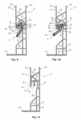
- Fig.1 shows a side wall 1 in cross section, the side wall 1 having a base leg 10 and a side wall leg 20.
- the base leg 10 and the side wall leg 20 are aligned at right angles to each other.
- the side wall leg 20 comprises an inner side 21 and an outer side 22.
- the outer side 22 merges into the base leg 10 at right angles.
- the base leg 10 limits the side wall leg 20 downwards and extends beyond the inner side 21 of the side wall leg 20.
- the side wall 1 thus has an L-shape.
- the side wall leg 20 is preferably constructed from a plurality of longitudinal webs 24 and transverse webs 25.
- the longitudinal webs 24 essentially refer to those wall elements of the side wall leg 20 which are aligned perpendicular to the base leg 10.
- Transverse webs 25 extend between the longitudinal webs 24. The transverse webs 25 can be aligned parallel to the base leg 10.
- crosspieces 25 which are aligned obliquely or at an angle to the base leg 10.
- the side wall leg 20 has a cross-sectional contour that resembles a lattice structure. Between the longitudinal webs 24 and the transverse webs 25, corresponding hollow chambers 29 are formed. The side wall leg 20 as a whole forms a hollow chamber profile.
- a recess 23 is arranged in the side wall leg 20, which extends from the inner side 21.
- the recess preferably extends over the entire length of the side wall leg 20.
- the recess 23 arranged on the inner wall side 21 essentially has an upper boundary 26, a rear boundary 27 and a lower boundary 28.
- the lower boundary 28 is formed by a transverse web 25 of the side wall leg 20 that is aligned obliquely to the base leg 10.
- the rear boundary 27 is formed by a longitudinal web 24 that runs perpendicular to the base leg 10.
- a channel 30 is formed in the side wall leg 20.
- the channel 30 has an opening 31 and a nose 34 adjacent to the opening.
- the nose 34 and the opening 31 essentially form the upper boundary 26 of the recess 23.
- the channel 30, which is formed in particular above the recess 23 on the side wall leg 20, is essentially delimited by curved transverse webs 25 of the side wall leg 20.
- the channel 30 includes the opening 31.
- the opening 31 is open towards the recess 23 or opens into the recess 23. Specifically, the opening 31 opens into the recess 23 in the direction of the base leg 10.
- the channel 30 has a cross-sectional contour which is essentially pronounced of the shape of a cam, as is known from cams of a camshaft of an internal combustion engine, in particular a reciprocating piston engine.
- the channel 30 has a tip 35 which points obliquely downwards in the direction of the base leg 10.
- the tip is limited by the nose 34 which points from the inner side 21 of the side wall leg to the rear boundary 27 of the recess 23.
- the nose 34 delimits the opening 31.
- the opening 31 preferably extends over the entire length of the channel 30. In this respect, the opening 31 can form a slot running along the channel 30. Overall, the channel 30 with the opening 31 can extend over the entire length of the side wall leg 20.
- a significant advantage of the invention is achieved by the fact that, as described in Fig.1 As shown, two inner surfaces 32, 33 of the channel 30 are inclined towards the opening 31. Specifically, the channel 30 has a first inner surface 32 which comprises the tip 35 on the one hand and the nose 34 on the other. A second inner surface 33 borders the opening 31 opposite the nose 34. The first inner surface 32 and the second inner surface 33 are inclined towards the opening 31 so that they are arranged at an angle to the base leg 10. This inclination ensures that fine-grained bulk material entering the channel 30 can easily trickle out of the channel 30, in particular under the influence of gravity.
- the lower boundary 28 of the depression 23 also runs obliquely or at an angle to the base leg 10 so that bulk material trickling out of the channel 30 is guided onto the loading floor.
- the loading floor is preferably mounted on the base leg 10.
- a loading floor is arranged on the base leg 10, the height of which essentially corresponds to the distance between the lower boundary 28 and the base leg 10 or at least does not exceed it.
- the loading floor can also have a smaller height.
- a lashing element 2 is shown, as it is preferably used in combination with the side wall 1 according to Fig.1 is used. Together, the lashing element 2 and the side wall 1 can form a lashing arrangement.
- the lashing element 2 according to Fig.2 comprises an anchoring section 40 and a lashing eye section 50.
- the lashing eye section 50 has an eyelet 51.
- the eyelet 51 is designed as an elongated hole with a substantially rectangular contour, the corners of the rectangle being strongly rounded.
- the eyelet 51 serves to connect a lashing strap, a lashing chain or a similar lashing means to the lashing element 2.
- a lashing strap can be hooked into the eyelet 51 or looped through the eyelet 51.
- the recess 45 delimits the lashing eye section 50.
- the lashing eye section 50 has a bulge 52 which enables improved support of the lashing eye section 50 on the side wall leg 20 of the side wall 1.
- the recess 45 also serves to support the lashing element 2 on the side wall 1. The functionality will be explained in more detail later.
- the lashing element 2 has a locking element 41 which is mounted in an articulated manner via an axis 42 in two axis receptacles 43 of the anchoring section 40. Between the axis receptacles 43, a free space 44 is formed which accommodates the locking element 41.
- the locking element 41 is mounted so as to be rotatable about the axis 42.
- the locking element 41 can be spring-loaded, whereby a corresponding spring, preferably a torsion spring, can be arranged in the axis 42.
- the spring preload of the locking element 41 ensures that the locking element 41 automatically moves into an angular arrangement, whereby the locking element 41 is at an angle to the lashing eye section 50.
- the spring preload is preferably aligned so that a right or acute angle is formed between the lashing eye section 50 and the locking element 41, as is the case, for example, in Fig.3 can be seen.
- the angle between the lashing eyelet section and the locking element 41 can be between 50° and 90°, preferably between 60° and 70°.
- Fig.3 the locking element 41 is shown in a position predetermined by the spring preload. Without any force acting on the locking element 41, the locking element 41 assumes approximately the angle shown to the lashing eye section 50.
- the locking element 41 is deflected against the spring preload so that the angle between the locking element 41 and the lashing eyelet section 50 becomes obtuse. This is in Fig.1 shown.
- the locking element 41 is then inserted into the opening 31.
- the lashing element 42 can be pushed further into the channel 30 until the locking element is completely arranged in the channel 30. Due to the spring preload, the locking element 41 folds after passing through the opening 31 returns to its angular position specified by the spring, so that it comes into contact with the inner contour of the channel 30.
- the locking element 41 slides along the inner contour until it comes to rest in the tip 35 ( Fig.3 ).
- the locking element 41 is supported on the nose 34.
- This movement also causes the axle mounts 43 of the anchoring section 40 to enter the channel 30.
- the anchoring section 40 is thus inserted into the channel 30 as a whole. This is shown in Fig. 3 and 4 visible.
- the anchoring section 40 is supported on the one hand on the tip 35 or nose 34 or on the first inner surface 32 of the channel 30.
- the anchoring section 40 is also supported on the second inner surface 32 of the channel 30. In this way, the lashing element 2 is firmly anchored in the channel 30 and in particular held in a form-fitting and/or friction-fitting manner.
- Fig.3 the lashing element 2 is shown as it is inserted into the channel 30 of the side wall 1.
- the lashing element 2 assumes a rest position, with the spring preload of the locking element 41 causing the lashing element 2 to be folded towards the rear boundary 27 of the recess 23. It is clearly visible that the lashing element 2 is arranged completely in the recess 23 in the rest position. In particular, the lashing element 2 does not protrude beyond the inner side 21 of the side wall leg 20. This means that the entire loading area or the entire loading volume of the commercial vehicle remains available up to the inner side 21. The lashing element 2 therefore does not restrict the loading capacity of a commercial vehicle.
- Fig.4 shows the lashing element 2 in a position of use.
- the lashing element 2 is deflected so that it protrudes beyond the inner side 21 of the side wall leg 20 and is thus easily accessible.
- the position of use is assumed when a lashing device is to be inserted into the eyelet 51 of the lashing eyelet section 50. This can be, for example, a lashing strap that is hooked into the eyelet 51.
- the lashing element 2 is tilted out of the recess 23, whereby the distance between the eyelet 51 and the rear boundary 27 of the recess 23 increases.
- the recess 45 comes into contact with the nose 34.
- the recess 45 is therefore supported on the nose 34.
- the bulge 52 is also supported on the nose 34.
- a lashing means engaging in the eyelet 51 now transmits forces to the lashing eyelet section 50, whereby these forces are transmitted via the recess 45 and the bulge 52 into the nose 34. From there, the forces run along the longitudinal webs 24 and transverse webs 25, so that the side wall leg 20 absorbs the lashing forces.
- the channel 30 with its opening 31 preferably extends over the entire length of the side wall 1.
- the lashing element 2 can thus be fixed at any point along the side wall 1. This allows for a particularly high level of flexibility when lashing cargo in a commercial vehicle.
- Fig.6 The side wall is shown again in cross-section.
- the side wall is essentially structurally identical to the side wall according to Fig.1 .
- Fig.6 now shows an embodiment of a lashing arrangement in which an alternative lashing element 2 is inserted into this side wall 1.
- the lashing element 2 is in accordance with Fig.6 in one piece or monolithic.
- Fig.6 a cross-sectional view of the side wall 1 according to Fig.1 , wherein a lashing element 2 according to Fig.7 is used.
- the lashing element 2 is formed in one piece and also has a lashing eye section 50 and an anchoring section 40.
- the lashing eye section 50 is separated from the anchoring section 40 by a recess 45.
- a bulge 52 which is assigned to the lashing eye section 50, borders on the recess 45.
- the bulge 52 provides an enlarged contact surface for the nose 34, so that good force transmission from the lashing element 2 to the side wall 1 is ensured.
- the anchoring section 40 essentially has an outer contour that is reminiscent of the number "8".
- the "8" is angled slightly diagonally to the lashing eye section 50.
- the anchoring section 40 is designed in such a way that it can be inserted into the channel 30 via the opening 31 and anchored in the channel 30.
- the anchoring is carried out analogously to the lashing element 2 according to Fig.2
- the anchoring section 40 in the inserted state as shown in Fig.6 shown, on the one hand on the tip 35 or nose 34 or first inner surface 32 of the channel 30.
- the anchoring section 40 is supported on the second inner surface 33 of the channel 30 in the inserted state.
- Fig.6 shows the position of use of the lashing element 2, wherein the recess 45 rests against the nose 34.
- the lashing element 2 protrudes beyond the inner side 21 of the side wall leg 20.
- Fig.8 another alternative of a lashing element 2 is shown.
- This is also a one-piece lashing element 2, which does not differ in its functionality from the lashing element according to Fig.7
- the lashing element 2 is according to Fig.8 bent from a wire.
- the wire defines an eyelet 51 on the one hand, which in this case also extends into the anchoring section 40.
- the anchoring section 40 has a locking section 46, which is formed by a U-shaped wire bend.
- the locking section 46 or the U-shaped wire bend is supported on the first inner surface 32 of the channel 30 in the state of use.
- the lashing element 2 according to Fig.8 is particularly cost-effective to produce due to its simple design.
- Fig.9 shows the lashing element according to Fig.8 in combination with a side wall 1.
- the side wall 1 has the same dimensions as the side wall 1 according to Fig.1 a base leg 10 and a side wall leg 20.
- the side wall leg 20 is essentially analogous to the side wall leg 20 according to Fig.1 constructed.
- the nose 34 which adjoins the opening 31 of the channel 30, has a thicker wall thickness.
- the nose 34 has a straight contact surface 37 on which the anchoring section 40 of the lashing element 2 can rest.
- the rear boundary 27 of the recess 23 has an offset 38 in an upper region opposite the nose 34.
- the longitudinal web 24, which forms the rear boundary 27, is offset in particular towards the outer side 22, so that a support surface is formed for the anchoring section 40 of the lashing element 2.
- the lashing element 2 has an anchoring section 40 and a lashing eye section 50.
- the lashing eye section 50 is separated from the anchoring section 40 by a bend 53.
- the anchoring section 40 essentially has a hook shape.
- the hook shape is preferably designed such that the anchoring section in a rest position of the lashing element ( Fig.9 ) is supported on the one hand on the tip 35 of the channel 30 or the first inner surface 32 and on the other hand on the offset 38.
- the lashing element 2 is thus held firmly, but displaceably, in the channel 30 in the rest position.
- the lashing element 2, in particular the lashing eyelet section 50 is completely sunk into the recess 23 so that the lashing element 2 does not protrude beyond the inner side 21 of the side wall leg 20.
- the anchoring section 40 of the lashing element 2 continues to rest on the tip 35 or the first inner surface 32. At the same time, the anchoring section 40 rests on the contact surface 37 of the nose 34, so that lashing forces can be introduced into the side wall 1. In contrast to the rest position, however, the anchoring section 40 is not supported on the offset 38. Instead, the anchoring section 40 now rests on the second inner surface 32 of the channel 30 ( Fig.10 ). The lashing element 2 is guided out of the recess 23 in such a way that the lashing eyelet section 50 protrudes beyond the inner side 21 of the side wall leg 20.
- the lashing element 2 according to Fig.8 can be designed in such a way that the wire is so flexible that the anchoring section 40 can be inserted into the channel 30 through the opening 31 by bending the U-shaped locking section 46.
- the lashing element 2 is made of such a stiff wire that the lashing element 2 can be inserted into the channel 30 at one longitudinal end via a longitudinal opening.
- preferably several lashing elements 2 are firmly connected to the side wall 1, but can be pushed to different positions along the channel 30.
- the latter also applies to the lashing element 2 according to Fig.7 .
- the one-piece lashing element 2 is preferably fixed, but longitudinally displaceable, in the channel 30.
- the lashing elements 2 can be arranged according to Figs. 7 and 8 already be arranged in the channel 30 in the appropriate or preselected number upon delivery. However, the user can still determine the position of the lashing elements 2 in the longitudinal direction of the side wall 1 by moving them.
- Fig. 11 an alternative embodiment of a side wall 1 is shown, which makes it possible to arrange and fix lashing elements 2 at different longitudinal positions along the side wall.
- the side wall 1 comprises a channel 30, the first inner surface 32 and the second inner surface 33 of which are aligned essentially perpendicular to the base leg 20.
- the channel 30 therefore has a comparatively wide opening 31, which opens into the recess 23 in the direction of the base leg 10.
- the side wall leg 20 is designed as a hollow chamber profile, analogous to the other embodiments.
- the side wall leg 20 has a lattice structure in cross section, which is formed from longitudinal webs 24 and transverse webs 25.
- the recess 23 comprises a lower boundary 28, which is formed by an obliquely running transverse web 25.
- the recess 23 is delimited by a rear boundary 27, which is formed by a longitudinal web 24.
- the upper boundary 26 of the recess 23 is formed by the opening 31 of the channel 30.
- the side wall 1 according to Fig. 11 A piping profile 36 is provided in the channel 30.
- the piping profile 36 makes it possible to accommodate a corresponding lashing element 2 which has a negative profile corresponding to the piping profile 36.
- the lashing element 2 can be moved along the piping profile 36 to different positions along the side wall 1.
- the lashing element 2 can have a swivel joint between the anchoring section 40 and the lashing eye section 50.
- the swivel joint can be used to fold the lashing eye section 50 out of the recess 23 in order to attach a lashing device to it.
- the swivel joint can be designed as a simple swivel joint, in particular without spring preload. Such a swivel joint can be so smooth that the lashing element 2 hangs vertically downwards in the rest position due to gravity, so that it is completely arranged in the recess 23.
- FIG. 12 A perspective view of a side wall 1 is shown again, into which lashing elements 2 are inserted.
- the side wall 1 has a channel 30 into which several lashing elements 2 are inserted according to Fig.7 are inserted. It can be seen that the lashing elements 2 are arranged completely recessed in the recess 23 in a rest position, i.e. they do not protrude beyond the inner side 21 of the side wall leg 20.
- the lashing arrangement can comprise the side wall 1 and several lashing elements 2.
- identical lashing elements 2 or different lashing elements 2 can be provided.
- a side wall to be provided with permanently pre-assembled lashing elements 2 according to at least one of the embodiments according to Fig. 7 or 8 is delivered and the user may, if required, add one or more lashing elements 2 in accordance with Fig.2 adds.
- spacers 3 are provided which can be snap-connected to the channel 30.
- the spacers 3 are preferably made of a plastic material.
- the plastic material can have a high coefficient of friction.
- the section holders 3 are particularly clamped in the channel 30 so that they form a high frictional connection which limits the movement of a lashing element 2 along the channel 30.
- a lashing element 2 can be arranged between two spacers 3, wherein the spacers 3 limit the freedom of movement of the lashing element in the longitudinal direction of the channel 30.
- the side wall 1 is preferably designed as an extruded aluminum profile. This enables a particularly cost-effective production of the side wall 1.
- the lashing elements 2 are preferably made of metal, in particular steel, preferably stainless steel.
- the spacers 3 are preferably made of plastic, in particular of a plastic with a high coefficient of friction.
Landscapes
- Engineering & Computer Science (AREA)
- Transportation (AREA)
- Mechanical Engineering (AREA)
- Connection Of Plates (AREA)
Description
- Die Erfindung betrifft eine Bordwand eines Nutzfahrzeugs gemäß dem Oberbegriff des Patentanspruchs 1. Ferner betrifft die Erfindung ein Zurrelement und eine Zurranordnung für bzw. mit einer solchen Bordwand. Eine Bordwand der eingangs genannten Art ist beispielsweise aus
DE 20 2009 009 270 U1 bekannt. -
DE 20 2009 009 270 U1 beschreibt eine Bordwand eines Nutzfahrzeugs, wobei die Bordwand einen Seitenwandschenkel und einen Bodenschenkel aufweist. Der Bodenschenkel dient dazu, einen Fahrzeugboden zu tragen bzw. die Bordwand mit einem Fahrzeugboden zu verbinden. Die Bordwand ist insgesamt hohl ausgebildet und weist an einer Innenseite des Seitenwandschenkels eine Vertiefung auf. In der Vertiefung sind Löcher angeordnet, durch die sich eine Zurröse erstreckt. Dabei ist die Vertiefung so gestaltet, dass die Zurröse in einer Nichtgebrauchsstellung bzw. Ruhestellung vollständig in der Vertiefung angeordnet ist und so nicht über die Innenseite des Seitenwandschenkels vorsteht. Damit wird erreicht, dass die gesamte Ladebreite eines Nutzfahrzeugs erhalten bleibt, wenn die Zurröse nicht zur Ladungssicherung benötigt wird. - Im Zuge der Weiterentwicklung einer solchen Bordwand hat es sich gezeigt, dass es vorteilhaft wäre, wenn die verwendeten Zurrösen nicht nur an einer definierten Stelle der Bordwand genutzt werden können, sondern wenn der Benutzer flexibel die Position der Zurrösen entlang der Bordwand festlegen kann. Gleichzeitig sollten die Vorteile der bisherigen Lösung jedoch beibehalten werden.
- Möglichkeiten zur flexiblen Positionierung von Zurrösen bieten im Wesentlichen Schienensysteme, wie sie beispielsweise für Laderäume in Personenkraftwagen als Airline-Schienensysteme bekannt sind. Auch
DE 10 2018 103 497 A1 ,EP 0 588 761 B1 ,DE 20 2011 051 399 U1 ,DE 20 2004 003303 U1 ,DE 103 49 936 A1 undEP 2 206 623 B1 beschreiben Schienensysteme zur Ladungssicherung.DE 36 05 988 A1 offenbart ein Bordwandprofil mit Hinterschneidungen zur Aufnahme von Längsflanschen von Zurrschienen für Ladungssicherungssysteme.US 2015/123425 A1 betrifft eine Ladeflächen-Seitenwand und einen Klemmmechanismus mit einem Aktuator, der konfiguriert ist, um Finger der Klemmvorrichtung an der Seitenwand zu befestigen. - Solche Schienensysteme haben jedoch bei der Anwendung in Nutzfahrzeugen, insbesondere Fahrzeuganhängern, Nachteile. Oft werden Nutzfahrzeuge bzw. deren Ladeflächen zum Transport von Schüttgut, insbesondere Sand oder Erde, genutzt. Das Schüttgut kann dabei in die Ladungssicherungsschienen eindringen und lässt sich daraus nur schwer entfernen. Damit wäre also die Verschiebbarkeit bzw. flexible Positionierbarkeit von Zurrösen stark beeinträchtigt, was zu einer hohen Nutzerunzufriedenheit führt.
- Vor diesem Hintergrund besteht die Aufgabe der Erfindung darin, eine Bordwand eines Nutzfahrzeugs anzugeben, die dauerhaft und zuverlässig eine flexible Positionierung eines Zurrelements ermöglicht, wobei gleichzeitig der Vorteil beibehalten sein soll, dass das Zurrelement in einer Ruhestellung nicht über die Innenseite eines Seitenwandschenkels vorragt. Ferner ist es Aufgabe der Erfindung, ein Zurrelement für eine solche Bordwand sowie eine Zurranordnung mit einer solchen Bordwand anzugeben.
- Erfindungsgemäß wird diese Aufgabe im Hinblick auf die Bordwand durch den Gegenstand des Patentanspruchs 1, im Hinblick auf die Zurranordnung durch den Gegenstand des Patentanspruchs 8 und im Hinblick auf das Zurrelement durch den Gegenstand des Patentanspruchs 13 gelöst.
- So beruht die Erfindung auf dem Gedanken, eine Bordwand eines Nutzfahrzeugs, insbesondere eines Fahrzeuganhängers, anzugeben, wobei die Bordwand einen Bodenschenkel und einen Seitenwandschenkel aufweist. Der Seitenwandschenkel umfasst eine Innenseite, an der wenigstens eine Vertiefung vorgesehen ist, wobei in der Vertiefung wenigstens ein Kanal zur Befestigung und Führung eines Zurrelements angeordnet ist und der Kanal eine Öffnung aufweist, die in Richtung des Bodenschenkels in die Vertiefung mündet. Erfindungsgemäß sind an die Öffnung angrenzende Innenflächen des Kanals zur Öffnung hin geneigt.
- Bei der Erfindung ist folglich vorgesehen, dass in der Vertiefung ein Kanal angeordnet ist. Dieser Kanal ermöglicht es, ähnlich wie ein Schienensystem, ein Zurrelement an beliebiger Position entlang der Bordwand zu befestigen bzw. es entlang der Bordwand verschiebbar zu führen. Besonders vorteilhaft ist es, dass der Kanal bei der Erfindung eine Öffnung aufweist, die in Richtung des Bodenschenkels in die Vertiefung mündet. Die insoweit nach unten gerichtete Öffnung ermöglicht es, dass in den Kanal eindringendes Schüttgut, insbesondere feinkörniges Schüttgut wie Sand, beim Entladen des Nutzfahrzeugs schwerkraftbedingt aus dem Kanal herausgeführt wird. Beispielsweise kann Sand einfach aus dem Kanal herausrieseln. Damit ist dauerhaft und sicher gewährleistet, dass ein Zurrelement entlang des Kanals verschoben und so an einer beliebigen Stelle entlang des Kanals für die Ladungssicherung verwendet werden kann. Die besondere Anordnung des Kanals in der Bordwand vermeidet also das Problem, dass sich der Kanal mit Schüttgut zusetzt und so ein Verschieben des Zurrelements behindert. Vorzugsweise verlaufen also die an die Öffnung angrenzenden Innenflächen in einem Winkel zum Bodenschenkel, so dass feinkörniges Schüttgut schwerkraftbedingt aus dem Kanal herausfließen kann.
- Besonders bevorzugt ist es, wenn der Kanal eine nockenförmige Querschnittskontur aufweist. Als nockenförmig wird im Sinne der vorliegenden Anmeldung eine Innenkontur des Kanals bezeichnet, die im Querschnitt an die Form einer Nocke einer Nockenwelle eines Verbrennungsmotors erinnert. Eine solche Form lässt sich im Wesentlichen als Dreiecksform beschreiben, wobei die Ecken des Dreiecks stark abgerundet sind. Zudem können die Dreiecksseiten leicht gewölbt sein, wobei die Wölbung nach außen weist.
- Es hat sich gezeigt, dass eine solche nockenförmige Querschnittskontur einerseits begünstigt, dass in den Kanal eindringendes Schüttgut aufgrund der Schwerkraft wieder aus dem Kanal herausfließt. Andererseits ermöglicht diese nockenförmige Querschnittskontur auch eine gute Verankerung eines Zurrelements in dem Kanal.
- Die nockenförmige Querschnittskontur kann im Wesentlichen eine Spitze aufweisen. Als Spitze wird der Bereich der Querschnittskontur mit dem kleinsten Krümmungsradius bezeichnet. In der Analogie zum Nocken einer Nockenwelle eines Verbrennungsmotors entspricht die Spitze dem Bereich des Nockens, der die höchste Ventilöffnung bestimmt. Bei der Erfindung kann diese Spitze vorzugsweise schräg nach unten zum Bodenschenkel der Bordwand hin weisen. Eine an diese Spitze angrenzende, ebenfalls winklig zum Bodenschenkel verlaufende Langseite der nockenförmigen Querschnittskontur kann dann die Öffnung umfassen, die in die Vertiefung mündet.
- In einer weiteren Ausgestaltung der Erfindung kann der Kanal eine in die Öffnung ragende Nase umfassen, die eine Abstützung für einen Verankerungsabschnitt des Zurrelements bildet. Die Nase kann insbesondere im Bereich der Spitze der nockenförmigen Querschnittskontur ausgebildet sein. Vorzugsweise zeigt die Nase in Richtung einer Außenseite des Seitenwandschenkels.
- Die Nase bildet eine Abstützung für einen Verankerungsabschnitt des Zurrelements. Konkret kann vorgesehen sein, dass das Zurrelement zur Verankerung in dem Kanal einen Verankerungsabschnitt aufweist. Dieser Verankerungsabschnitt kann sich an der Nase des Kanals abstützen. Insbesondere kann der Verankerungsabschnitt in die Spitze der nockenförmigen Innenkontur eingreifen und so auf der an die Spitze angrenzenden Nase aufliegen. Im Wesentlichen lässt sich der Verankerungsabschnitt des Zurrelements also in dem Kanal fixieren, wobei die Nase eine entsprechende Abstützung bildet bzw. zum Formschluss bzw. Reibschluss zwischen dem Verankerungsabschnitt und dem Kanal beiträgt.
- Bei einer weiteren bevorzugten Variante der erfindungsgemäßen Bordwand ist vorgesehen, dass der Seitenwandschenkel als Hohlkammerprofil ausgebildet ist. Der Seitenwandschenkel sollte so gestaltet sein, dass er besonders hohe Kräfte in einen Fahrzeugrahmen einleiten bzw. hohen Kräften standhalten kann, die beim Verzurren von Ladung entstehen. Wenn ein Zurrelement in den Kanal eingesetzt ist und das Zurrelement beispielsweise mit einem Zurrgurt beaufschlagt wird, so sollte der Seitenwandschenkel diese vom Zurrgurt über das Zurrelement aufgebrachten Kräfte aufnehmen.
- Gleichzeitig soll aus Kostengründen der Materialeinsatz für die Bordwand insgesamt reduziert sein. Insofern ist es vorteilhaft, wenn der Seitenwandschenkel als Hohlkammerprofil ausgebildet ist. Das Hohlkammerprofil kann einerseits zur Gewichtsreduktion, andererseits zur Materialeinsparung und darüber hinaus dennoch so stabil gestaltet sein, dass es die Zurrkräfte, die über das Zurrelement in den Seitenwandschenkel eingebracht werden, aufnehmen kann. Dazu weist der Seitenwandschenkel vorzugsweise mehrere Hohlkammern auf, die durch Querstege getrennt sind. Insofern bildet der Seitenwandschenkel vorzugsweise ein Fachwerkprofil.
- Insbesondere ist es bevorzugt, wenn der Seitenwandschenkel mit dem Bodenschenkel einstückig als Aluminium-Stranggussprofil ausgebildet ist. Eine solche Profilgestaltung ist besonders kostengünstig herstellbar. Bevorzugt ist es dabei, wenn das Aluminium-Stranggussprofil als Hohlkammerprofil ausgebildet ist. Dabei ist es vorteilhaft, wenn alle Querstege, die die Hohlkammern des Hohlkammerprofils voneinander trennen, ebenso wie alle weiteren Wandungen innerhalb des Hohlkammerprofils dieselbe Wandstärke aufweisen. Die das Hohlkammerprofil bildende Fachwerkstruktur weist also tragende Strukturelemente auf, die im Wesentlichen dieselbe Wandstärke haben. Dementsprechend ist die Fachwerkstruktur vorzugsweise so gestaltet, dass trotz der einheitlichen Wandstärke eine gute Kraftaufnahme sichergestellt ist, insbesondere im Hinblick auf Ladungssicherungskräfte, die über ein Zurrelement in den Seitenwandschenkel eingetragen werden.
- Bei einer weiteren Ausführungsform der erfindungsgemäßen Bordwand ist vorgesehen, dass in dem Kanal ein Kederprofil ausgebildet ist. Bei dieser Variante kann ein alternatives Zurrelement eingesetzt werden, welches das Kederelement umgreift und so entlang des Kederelements verschiebbar ist. Das Kederelement bildet insoweit eine Führungsschiene, die ähnlich wie Eisenbahnschienen ausgebildet ist. Vorzugsweise ragt das Kederelement senkrecht nach unten bzw. ist in einem 90°-Winkel zum Bodenschenkel ausgerichtet. Damit ist sichergestellt, dass Schüttgut, welches in den Kanal eindringt, auch vom Kederprofil nach unten abfließen kann.
- Für alle bevorzugten Ausführungsformen der erfindungsgemäßen Bordwand gilt vorzugsweise, dass sich die Vertiefung und der Kanal in Längsrichtung über die gesamte Länge des Seitenwandschenkels erstrecken. Mit anderen Worten können der Kanal und die Vertiefung Teil des Hohlkammerprofils bzw. Aluminium-Stranggussprofils bilden. Damit ist einerseits eine einfache und kostengünstige Herstellung der Bordwand sichergestellt. Andererseits kann so gewährleistet werden, dass das Zurrelement über die gesamte Länge der Bordwand an beliebiger Position befestigt werden kann.
- Ein nebengeordneter Aspekt der Erfindung betrifft eine Zurranordnung mit einem Zurrelement und einer zuvor beschriebenen Bordwand. Das Zurrelement umfasst einen Verankerungsabschnitt, der in den Kanal der Bordwand einführbar und in dem Kanal verankerbar ist, so dass das Zurrelement in einer Ruhestellung entlang des Kanals verschiebbar und in einer Gebrauchsstellung im Kanal reibschlüssig und/oder formschlüssig fixierbar ist. Erfindungsgemäß ist der Verankerungsabschnitt mit einem Zurrösenabschnitt einstückig bzw. monolithisch ausgebildet und weist eine Außenkontur auf, die so angepasst ist, dass der Verankerungsabschnitt das Zurrelement im Zusammenwirken mit einer Innenkontur des Kanals des Seitenwandschenkels in dem Kanal hält. Anstelle eines federvorgespannten Rastelements ist also vorgesehen, dass der Verankerungsabschnitt selbst derart geformt ist, dass er beim Einsetzen in den Kanal dort formschlüssig und/oder reibschlüssig verankerbar ist. Eine solche Gestaltung des Zurrelements ist besonders einfach, so dass das Zurrelement insgesamt kostengünstig produzierbar ist.
- Das Zurrelement ist also mittels seines Verankerungsabschnitts so aufgebaut, dass es vorzugsweise an beliebiger Stelle in den Kanal eingeführt werden kann. Ferner kann es im Kanal formschlüssig und/oder reibschlüssig verankert werden, so dass es seine so gewählte Position beibehält. Diese fixierte Position kann insbesondere dann eingenommen werden, wenn das Zurrelement in die Gebrauchsstellung überführt wird, also beispielsweise ein Zurrgurt zur Ladungssicherung an dem Zurrelement angreift. Eine besonders gute Verankerung des Zurrelements im Kanal kann also insbesondere dann erreicht werden, wenn das Zurrelement mit Zurrkräften beaufschlagt ist.
- Generell gilt, dass es bei der Erfindung bevorzugt ist, wenn die Verankerung der Zurrelements in dem Kanal sowohl formschlüssig, als auch reibschlüssig erfolgt. Dabei kann insbesondere in Längsrichtung des Kanals eine hauptsächlich reibschlüssige Verbindung erzeugt werden, wogegen in einer Querschnittsebene des Seitenwandschenkels hauptsächlich ein Formschluss zwischen dem Kanal und dem Verankerungsabschnitt die Befestigung des Zurrelements bewirkt. Der Reibschluss in Längsrichtung des Kanals kann durch das Aufbringen von Zurrkräften auf das Zurrelement bewirkt werden. Ohne diese Zurrkräfte ist der Reibschluss vorzugsweise vermindert oder aufgelöst, so dass sich das Zurrelement entlang des Kanals verschieben lässt.
- Generell kann vorgesehen sein, dass bei dem Zurrelement der Zurranordnung zwischen dem Verankerungsabschnitt und dem Zurrösenabschnitt eine Ausnehmung zur Abstützung des Zurrelements in einer Gebrauchsstellung ausgebildet ist. Vorzugsweise weist das Zurrelement im Allgemeinen einen Verankerungsabschnitt und einen Zurrösenabschnitt auf. Der Verankerungsabschnitt kann einerseits mehrteilig, andererseits einteilig ausgebildet sein.
- Jedenfalls ist bevorzugt vorgesehen, dass zwischen dem Verankerungsabschnitt und dem Zurrösenabschnitt eine Ausnehmung angeordnet ist, die es ermöglicht, das Zurrelement in einer Gebrauchsstellung abzustützen. Insbesondere kann die Ausnehmung mit einer Nase des Kanals zusammenwirken, die in die Öffnung des Kanals ragt. Die Nase kann in die Ausnehmung des Zurrelements eingreifen, so dass sich das Zurrelement mittels der Ausnehmung an der Nase abstützt. So können Zurrkräfte, die am Zurrösenabschnitt des Zurrelements anliegen, über die Ausnehmung des Zurrelements und die Nase des Kanals des Seitenwandschenkels in den Seitenwandschenkel eingetragen werden.
- Bei der erfindungsgemäßen Zurranordnung ist die Vertiefung im Seitenwandschenkel vorzugsweise so ausgebildet, dass das Zurrelement in einer Ruhestellung vollständig darin aufgenommen ist. Insbesondere kann das Zurrelement in der Ruhestellung so in die Vertiefung aufgenommen sein, dass das Zurrelement nicht über die Innenseite des Seitenwandschenkels vorsteht. In einer Ruhestellung ist das Zurrelement also vollständig in den Seitenwandschenkel versenkt bzw. in der Vertiefung angeordnet. Damit ist sichergestellt, dass das Zurrelement in der Ruhestellung nicht in den Laderaum hineinragt und dort verfügbaren Raum zur Anordnung von Ladegütern verringert.
- Besonders bevorzugt ist es bei einer Variante der erfindungsgemäßen Zurranordnung, wenn das Zurrelement zwischen dem Verankerungsabschnitt und dem Zurrösenabschnitt eine Ausnehmung aufweist, die in einer Gebrauchsstellung des Zurrelements mit einer vorstehenden Nase des Kanals zusammenwirkt, um Zurrkräfte auf die Bordwand zu übertragen. Das Zusammenwirken der Ausnehmung mit der Nase ermöglicht eine besonders gute Kraftübertragung und Abstützung für das Zurrelement, so dass eine sichere Ladungssicherung, beispielsweise mittels Zurrgurten, ermöglicht ist.
- Ferner kann bei einer Ausführungsform der Zurranordnung vorgesehen sein, dass zwischen zwei in dem Kanal verankerten Zurrelementen zusätzliche Abstandshalter vorgesehen sind. Insgesamt können bei der Zurranordnung mehrere Zurrelemente in einen Kanal eines Seitenwandschenkels eingesetzt sein. Um sicherzustellen, dass zwischen diesen Zurrelementen ein ausreichender Mindestabstand besteht, können zusätzliche Abstandshalter vorgesehen sein. Die Abstandshalter können mit dem Kanal rastverbindbar sein.
- Ferner können die Abstandshalter verhindern, dass ein Zurrelement gegen ein anderes Zurrelement gezogen wird, wenn beispielsweise eine Verzurrung von Ladung diagonal erfolgt. Wenn also Zurrkräfte auf das Zurrelement ausgeübt werden, die hauptsächlich eine Kraftkomponente in Längsrichtung des Kanals aufweisen, so besteht die Gefahr, dass das Zurrelement aufgrund der Zurrkräfte im Kanal verschoben wird. Die Abstandshalter können eine solche Verschiebung behindern bzw. blockieren, so dass damit auch sichergestellt wird, dass die Zurrelemente an einer für die Ladungssicherung bestmöglichen Position gehalten werden.
- Ein weiterer nebengeordneter Aspekt der Erfindung betrifft ein Zurrelement für eine Bordwand der vorstehend beschriebenen Art, wobei das Zurrelement einen Verankerungsabschnitt aufweist, der in den Kanal der Bordwand einführbar und in dem Kanal verankerbar ist, so dass das Zurrelement in einer Ruhestellung entlang des Kanals verschiebbar und in einer Gebrauchsstellung im Kanal reibschlüssig und/oder formschlüssig fixierbar ist. Bei dem erfindungsgemäßen Zurrelement ist der Verankerungsabschnitt mit einem Zurrösenabschnitt einstückig ausgebildet und weist Außenkontur auf, die so angepasst ist, dass der Verankerungsabschnitt das Zurrelement im Zusammenwirken mit einer Innenkontur des Kanals des Seitenwandschenkels in dem Kanal hält. Das erfindungsgemäße Zurrelement umfasst ferner ein Rastelement, das federvorgespannt und gelenkig mit dem Verankerungsabschnitt verbunden ist.
- Das federvorgespannte Rastelement kann beispielsweise zum Einsetzen des Zurrelements in den Kanal gegen eine Federkraft gegenüber dem Verankerungsabschnitt umgelenkt werden. Sobald der Verankerungsabschnitt in dem Kanal angeordnet ist, begibt sich das Rastelement aufgrund der Federvorspannung in eine Rastposition, so dass sich dann die formschlüssige und/oder reibschlüssige Fixierung des Zurrelements im Kanal ergibt. Auf diese Weise ist eine besonders einfache und sichere Positionierung des Zurrelements im Kanal der Bordwand möglich.
- Die Erfindung wird im Folgenden anhand von Ausführungsbeispielen unter Bezugnahme auf die beigefügten schematischen Zeichnungen näher erläutert. Darin zeigen:
- Fig. 1
- eine Querschnittsansicht einer erfindungsgemäßen Bordwand mit einem Zurrelement nach einem bevorzugten Ausführungsbeispiel, beim Einsetzen des Zurrelements;
- Fig. 2
- eine perspektivische Darstellung des Zurrelements gemäß
Fig. 1 ; - Fig. 3
- eine Querschnittsansicht der Bordwand gemäß
Fig. 1 , wobei das Zurrelement in einer Ruhestellung in den Kanal eingesetzt ist; - Fig. 4
- eine Querschnittsansicht der Bordwand gemäß
Fig. 1 zur Bildung einer erfindungsgemäßen Zurranordnung, wobei das Zurrelement in einer Gebrauchsstellung in dem Kanal eingesetzt ist; - Fig. 5
- eine perspektivische Darstellung der Zurranordnung aus Bordwand und Zurrelement gemäß
Fig. 4 ; - Fig. 6
- eine Querschnittsansicht der Bordwand gemäß
Fig. 1 mit einem alternativen Zurrelement zur Bildung einer erfindungsgemäßen Zurranordnung; - Fig. 7
- eine perspektivische Ansicht des alternativen Zurrelements gemäß
Fig. 6 ; - Fig. 8
- eine perspektivische Ansicht eines alternativen Zurrelements einer erfindungsgemäßen Zurranordnung nach einem bevorzugten Ausführungsbeispiel, wobei das Zurrelement einstückig aus einem Draht gebildet ist;
- Fig. 9
- eine Querschnittsansicht einer erfindungsgemäßen Bordwand nach einem weiteren bevorzugten Ausführungsbeispiel, wobei das Zurrelement gemäß
Fig. 8 in einer Ruhestellung in der Vertiefung der Bordwand angeordnet ist; - Fig. 10
- die Querschnittsdarstellung gemäß
Fig. 9 , wobei das Zurrelement in einer Gebrauchsstellung der Vertiefung der Bordwand angeordnet ist; - Fig. 11
- eine Querschnittsansicht einer erfindungsgemäßen Bordwand gemäß einem weiteren bevorzugten Ausführungsbeispiel, wobei der Kanal ein Kederprofil umfasst; und
- Fig. 12
- eine perspektivische Querschnittsansicht der Bordwand gemäß
Fig. 1 , wobei zwischen zwei Zurrelementen Abstandshalter vorgesehen sind. -
Fig. 1 zeigt eine Bordwand 1 im Querschnitt, wobei die Bordwand 1 einen Bodenschenkel 10 und einen Seitenwandschenkel 20 aufweist. Der Bodenschenkel 10 und der Seitenwandschenkel 20 sind rechtwinklig zueinander ausgerichtet. Der Seitenwandschenkel 20 umfasst eine Innenseite 21 und eine Außenseite 22. Die Außenseite 22 geht rechtwinklig in den Bodenschenkel 10 über. Der Bodenschenkel 10 begrenzt den Seitenwandschenkel 20 nach unten und erstreckt sich über die Innenseite 21 des Seitenwandschenkels 20 hinaus. Insgesamt weist die Bordwand 1 somit eine L-Form auf. - Der Seitenwandschenkel 20 ist vorzugsweise aus mehrere Längsstegen 24 und Querstegen 25 aufgebaut. Als Längsstege 24 werden im Rahmen der vorliegenden Anmeldung im Wesentlichen diejenigen Wandungselemente des Seitenwandschenkels 20 bezeichnet, die senkrecht zum Bodenschenkel 10 ausgerichtet sind. Zwischen den Längsstegen 24 erstrecken sich Querstege 25. Die Querstege 25 können parallel zum Bodenschenkel 10 ausgerichtet sein.
- Es sind jedoch auch Querstege 25 vorhanden, die schräg bzw. winklig zum Bodenschenkel 10 ausgerichtet sind.
- Insgesamt weist der Seitenwandschenkel 20 eine Querschnittskontur auf, die einer Fachwerkstruktur ähnelt. Zwischen den Längsstegen 24 und den Querstegen 25 sind insoweit entsprechende Hohlkammern 29 ausgebildet. Der Seitenwandschenkel 20 bildet in seiner Gesamtheit ein Hohlkammerprofil.
- In dem Seitenwandschenkel 20 ist eine Vertiefung 23 angeordnet, die von der Innenseite 21 ausgeht. Die Vertiefung erstreckt sich vorzugsweise über die gesamte Länge des Seitenwandschenkels 20. Die an der Innenwandseite 21 angeordnete Vertiefung 23 weist im Wesentlichen eine obere Begrenzung 26, eine hintere Begrenzung 27 und eine untere Begrenzung 28 auf. Die untere Begrenzung 28 ist durch einen schräg zum Bodenschenkel 10 ausgerichteten Quersteg 25 des Seitenwandschenkels 20 gebildet. Die hintere Begrenzung 27 ist durch einen senkrecht zum Bodenschenkel 10 verlaufenden Längssteg 24 gebildet. Oberhalb der oberen Begrenzung 26 ist ein Kanal 30 im Seitenwandschenkel 20 ausgebildet. Der Kanal 30 weist eine Öffnung 31 und eine an die Öffnung angrenzende Nase 34 auf. Die Nase 34 und die Öffnung 31 bilden im Wesentlichen die obere Begrenzung 26 der Vertiefung 23.
- Der Kanal 30, der insbesondere oberhalb der Vertiefung 23 am Seitenwandschenkel 20 ausgebildet ist, ist im Wesentlichen durch gewölbte Querstege 25 des Seitenwandschenkels 20 begrenzt. Im unteren Bereich umfasst der Kanal 30 die Öffnung 31. Die Öffnung 31 ist zur Vertiefung 23 hin geöffnet bzw. mündet in die Vertiefung 23. Konkret mündet die Öffnung 31 in Richtung des Bodenschenkels 10 in die Vertiefung 23.
- Der Kanal 30 weist eine Querschnittskontur auf, die im Wesentlichen an die Form eines Nockens erinnert, wie sie von Nocken einer Nockenwelle eines Verbrennungsmotors, insbesondere eines Hubkolbenmotors, bekannt sind.
- Im Wesentlichen weist der Kanal 30 eine Spitze 35 auf, die schräg nach unten in Richtung des Bodenschenkels 10 weist. Die Spitze wird durch die Nase 34 begrenzt, die ausgehend von der Innenseite 21 des Seitenwandschenkels zur hinteren Begrenzung 27 der Vertiefung 23 zeigt.
- Die Nase 34 begrenzt die Öffnung 31. Der Quersteg 25, der die hintere Begrenzung 27 der Vertiefung 23 bildet, bildet die gegenüberliegende Begrenzung der Öffnung 31. Die Öffnung 31 erstreckt sich vorzugsweise über die gesamte Länge des Kanals 30. Insofern kann die Öffnung 31 einen entlang des Kanals 30 verlaufenden Schlitz bilden. Insgesamt kann sich der Kanal 30 mit der Öffnung 31 über die gesamte Länge des Seitenwandschenkels 20 erstrecken.
- Ein wesentlicher Vorteil der Erfindung wird dadurch erreicht, dass, wie es in
Fig. 1 gezeigt ist, zwei Innenflächen 32, 33 des Kanals 30 schräg zur Öffnung 31 hin geneigt sind. Konkret weist der Kanal 30 eine erste Innenfläche 32 auf, die einerseits die Spitze 35 und andererseits die Nase 34 umfasst. Eine zweite Innenfläche 33 grenzt gegenüber der Nase 34 an die Öffnung 31 an. Die erste Innenfläche 32 und die zweite Innenfläche 33 sind zur Öffnung 31 hin geneigt, so dass sie zum Bodenschenkel 10 winklig angeordnet sind. Diese Neigung sorgt dafür, dass in den Kanal 30 eintretendes, feinkörniges Schüttgut einfach, insbesondere unter Schwerkrafteinfluss, aus dem Kanal 30 herausrieseln kann. - Im Übrigen verläuft auch die untere Begrenzung 28 der Vertiefung 23 schräg bzw. winklig zum Bodenschenkel 10, damit aus dem Kanal 30 herausrieselndes Schüttgut auf den Ladeboden geleitet wird. Der Ladeboden ist vorzugsweise auf dem Bodenschenkel 10 montiert. Insbesondere kann vorgesehen sein, dass ein Ladeboden auf dem Bodenschenkel 10 angeordnet ist, dessen Höhe im Wesentlichen dem Abstand zwischen der unteren Begrenzung 28 und dem Bodenschenkel 10 entspricht oder jedenfalls nicht übersteigt. Der Ladeboden kann auch eine kleinere Höhe aufweisen.
- In
Fig. 2 ist ein Zurrelement 2 gezeigt, wie es vorzugsweise in Kombination mit der Bordwand 1 gemäßFig. 1 verwendet wird. Gemeinsam können das Zurrelement 2 und die Bordwand 1 eine Zurranordnung bilden. - Das Zurrelement 2 gemäß
Fig. 2 umfasst einen Verankerungsabschnitt 40 und einen Zurrösenabschnitt 50. Der Zurrösenabschnitt 50 weist eine Öse 51 auf. Die Öse 51 ist als Langloch mit einer im Wesentlichen rechteckigen Kontur ausgebildet, wobei die Ecken des Rechtecks stark abgerundet sind. Die Öse 51 dient dazu, einen Zurrgurt, eine Zurrkette oder ein ähnliches Zurrmittel mit dem Zurrelement 2 zu verbinden. Insbesondere kann ein Zurrgurt in die Öse 51 eingehakt oder durch die Öse 51 geschlauft werden. - Oberhalb des Zurrösenabschnitts 50 befindet sich eine Ausnehmung 45. Die Ausnehmung 45 begrenzt den Zurrösenabschnitt 50. Zur Ausnehmung 45 hin weist der Zurrösenabschnitt 50 eine Auswölbung 52 auf, die eine verbesserte Abstützung des Zurrösenabschnitts 50 an dem Seitenwandschenkel 20 der Bordwand 1 ermöglicht. Die Ausnehmung 45 dient ebenfalls zur Abstützung des Zurrelements 2 an der Bordwand 1. Die Funktionsweise wird später näher erläutert.
- Oberhalb grenzt an die Ausnehmung 45 der Verankerungsabschnitt 40 an. Bei dem Ausführungsbeispiel des Zurrelements 2 gemäß
Fig. 2 weist das Zurrelement 2 ein Rastelement 41 auf, das über eine Achse 42 gelenkig in zwei Achsaufnahmen 43 des Verankerungsabschnitts 40 gelagert ist. Zwischen den Achsaufnahmen 43 ist ein Freiraum 44 ausgebildet, der das Rastelement 41 aufnimmt. Das Rastelement 41 ist um die Achse 42 drehbar gelagert. Insbesondere kann das Rastelement 41 federvorgespannt sein, wobei in der Achse 42 eine entsprechende Feder, vorzugsweise eine Torsionsfeder, angeordnet sein kann. Die Federvorspannung des Rastelements 41 sorgt dafür, dass sich das Rastelement 41 selbstständig in eine winklige Anordnung begibt, wobei das Rastelement 41 in einem Winkel zum Zurrösenabschnitt 50 steht. Vorzugsweise ist die Federvorspannung so ausgerichtet, dass sich zwischen dem Zurrösenabschnitt 50 und dem Rastelement 41 ein rechter oder spitzer Winkel ergibt, wie er beispielsweise inFig. 3 erkennbar ist. Insbesondere kann der Winkel zwischen dem Zurrösenabschnitt und dem Rastelement 41 zwischen 50° und 90°, vorzugsweise zwischen 60° und 70°, betragen. - In
Fig. 3 ist das Rastelement 41 in einer von der Federvorspannung vorgegebenen Position gezeigt. Ohne Krafteinwirkung auf das Rastelement 41 nimmt das Rastelement 41 also etwa den gezeigten Winkel zum Zurrösenabschnitt 50 ein. - Zum Einsetzen des Zurrelements 2 in den Kanal 30 der Bordwand 1 wird das Rastelement 41 gegen die Federvorspannung ausgelenkt, so dass der Winkel zwischen dem Rastelement 41 und dem Zurrösenabschnitt 50 stumpf wird. Dies ist in
Fig. 1 gezeigt. Das Rastelement 41 wird dann in die Öffnung 31 eingeführt. Das Zurrelement 42 kann weiter in den Kanal 30 eingeschoben werden, bis das Rastelement vollständig in dem Kanal 30 angeordnet ist. Wegen der Federvorspannung klappt das Rastelement 41 nach Durchtritt durch die Öffnung 31 in seine von der Feder vorgegebene Winkelposition zurück, so dass es in Anlage an die Innenkontur des Kanals 30 gelangt. An der Innenkontur gleitet das Rastelement 41 entlang, bis es in der Spitze 35 zu liegen kommt (Fig. 3 ). Das Rastelement 41 stützt sich dabei an der Nase 34 ab. Durch diesen Bewegungsablauf gelangen auch die Achsaufnahmen 43 des Verankerungsabschnitts 40 in den Kanal 30. Der Verankerungsabschnitt 40 wird so insgesamt in den Kanal 30 eingesetzt. Dies ist inFig. 3 und 4 erkennbar. In der eingesetzten Position stützt sich der Verankerungsabschnitt 40 einerseits an der Spitze 35 bzw. Nase 34 bzw. an der ersten Innenfläche 32 des Kanals 30 ab. Ebenso stützt sich der Verankerungsabschnitt 40 auf der zweiten Innenfläche 32 des Kanals 30 ab. Auf diese Weise ist das Zurrelement 2 in dem Kanal 30 fest verankert und insbesondere form- und/oder reibschlüssig gehalten. - In
Fig. 3 ist das Zurrelement 2 gezeigt, wie es in den Kanal 30 der Bordwand 1 eingesetzt ist. Dabei nimmt das Zurrelement 2 eine Ruhestellung ein, wobei die Federvorspannung des Rastelements 41 dazu führt, dass das Zurrelement 2 zur hinteren Begrenzung 27 der Vertiefung 23 hin geklappt ist. Es ist gut erkennbar, dass das Zurrelement 2 in der Ruhestellung vollständig in der Vertiefung 23 angeordnet ist. Insbesondere ragt das Zurrelement 2 nicht über die Innenseite 21 des Seitenwandschenkels 20 vor. Damit bleibt die gesamte Ladefläche bzw. das gesamte Ladevolumen des Nutzfahrzeugs bis zur Innenseite 21 verfügbar. Das Zurrelement 2 schränkt also die Beladekapazität eines Nutzfahrzeugs nicht ein. -
Fig. 4 zeigt das Zurrelement 2 in einer Gebrauchsstellung. In der Gebrauchsstellung ist das Zurrelement 2 so ausgelenkt, dass es über die Innenseite 21 des Seitenwandschenkels 20 vorsteht und damit leicht zugänglich ist. Die Gebrauchsstellung wird dann eingenommen, wenn in die Öse 51 des Zurrösenabschnitts 50 ein Zurrmittel eingesetzt werden soll. Das kann beispielsweise ein Zurrgurt sein, der in die Öse 51 eingehakt wird. - Um die Gebrauchsstellung einzunehmen, wird das Zurrelement 2 aus der Vertiefung 23 heraus geneigt, wobei sich der Abstand zwischen der Öse 51 und der hinteren Begrenzung 27 der Vertiefung 23 erhöht. Dabei gelangt die Ausnehmung 45 in Anlage zur Nase 34. Die Ausnehmung 45 stützt sich also an der Nase 34 ab. Ebenso stützt sich die Auswölbung 52 an der Nase 34 ab. Ein in die Öse 51 eingreifendes Zurrmittel überträgt nun Kräfte auf den Zurrösenabschnitt 50, wobei diese Kräfte über die Ausnehmung 45 und die Auswölbung 52 in die Nase 34 eingeleitet werden. Von dort verlaufen die Kräfte entlang der Längsstege 24 und Querstege 25, so dass der Seitenwandschenkel 20 die Zurrkräfte aufnimmt.
- In
Fig. 4 ist zudem erkennbar, dass durch das drehgelenkige Ausklappen des Zurrelements 2 zwischen dem Zurrelement 2 und der unteren Begrenzung 28 der Vertiefung 23 ein größerer Abstand entsteht, der es ermöglicht, dass ein Zurrmittel einfach in die Öse 51 eingeführt werden kann. - In
Fig. 4 ist nochmal deutlich erkennbar, dass sich der Kanal 30 mit seiner Öffnung 31 vorzugsweise über die gesamte Länge der Bordwand 1 erstreckt. Das Zurrelement 2 kann so an beliebigen Stellen entlang der Bordwand 1 fixiert werden. Dies ermöglicht eine besonders hohe Flexibilität bei der Verzurrung von Ladungsgütern in einem Nutzfahrzeug. - In
Fig. 6 ist die Bordwand nochmals im Querschnitt dargestellt. Im Wesentlichen entspricht die Bordwand strukturell der Bordwand gemäßFig. 1 .Fig. 6 zeigt nun ein Ausführungsbeispiel einer Zurranordnung, bei welcher in diese Bordwand 1 ein alternatives Zurrelement 2 eingesetzt ist. Im Unterschied zu dem Zurrelement 2 gemäßFig. 2 ist das Zurrelement 2 gemäßFig. 6 einstückig bzw. monolithisch ausgebildet. Konkret zeigtFig. 6 eine Querschnittsansicht der Bordwand 1 gemäßFig. 1 , wobei ein Zurrelement 2 gemäßFig. 7 eingesetzt ist. - Das Zurrelement 2 gemäß
Fig. 7 ist einstückig ausgebildet und weist ebenfalls einen Zurrösenabschnitt 50 und einen Verankerungsabschnitt 40 auf. Der Zurrösenabschnitt 50 ist vom Verankerungsabschnitt 40 durch eine Ausnehmung 45 getrennt. An die Ausnehmung 45 grenzt eine Auswölbung 52 an, die dem Zurrösenabschnitt 50 zugeordnet ist. Die Auswölbung 52 stellt eine vergrößerte Anlagefläche zur Nase 34 bereit, so dass eine gute Kraftübertragung vom Zurrelement 2 auf die Bordwand 1 gewährleistet ist. Der Verankerungsabschnitt 40 weist im Wesentlichen eine Außenkontur auf, die an die Zahl "8" erinnert. Dabei ist die "8" etwas schräg zum Zurrösenabschnitt 50 angewinkelt. Jedenfalls ist der Verankerungsabschnitt 40 derart gestaltet, dass er sich in den Kanal 30 über die Öffnung 31 einsetzen und in dem Kanal 30 verankern lässt. - Die Verankerung erfolgt analog zu dem Zurrelement 2 gemäß
Fig. 2 . Insbesondere stützt sich der Verankerungsabschnitt 40 im eingesetzten Zustand, wie er inFig. 6 dargestellt ist, an der Spitze 35 bzw. Nase 34 bzw. ersten Innenfläche 32 des Kanals 30 einerseits ab. Andererseits stützt sich der Verankerungsabschnitt 40 im eingesetzten Zustand an der zweiten Innenfläche 33 des Kanals 30 ab.Fig. 6 zeigt die Gebrauchsstellung des Zurrelements 2, wobei die Ausnehmung 45 an der Nase 34 anliegt. Das Zurrelement 2 steht insoweit über die Innenseite 21 des Seitenwandschenkels 20 vor. - In
Fig. 8 ist eine weitere Alternative eines Zurrelements 2 gezeigt. Dabei handelt es sich ebenfalls um ein einstückig ausgebildetes Zurrelement 2, das sich in seiner Funktionsweise nicht von dem Zurrelement gemäßFig. 7 unterscheidet. Im Unterschied zu dem Zurrelement gemäßFig. 7 , das einstückig, beispielsweise als Gussteil oder Stranggussteil ausgebildet ist, ist das Zurrelement 2 gemäßFig. 8 aus einem Draht gebogen. Der Draht begrenzt einerseits eine Öse 51, die in diesem Fall auch bis in den Verankerungsabschnitt 40 reicht. Der Verankerungsabschnitt 40 weist einen Rastabschnitt 46 auf, der durch eine U-förmige Drahtbiegung gebildet ist. Der Rastabschnitt 46 bzw. die U-förmige Drahtbiegung stützt sich im Gebrauchszustand an der ersten Innenfläche 32 des Kanals 30 ab. Das Zurrelement 2 gemäßFig. 8 ist aufgrund seiner einfachen Bauweise besonders kostengünstig herstellbar. -
Fig. 9 zeigt das Zurrelement gemäßFig. 8 in Kombination mit einer Bordwand 1. Die Bordwand 1 weist analog zu der Bordwand 1 gemäßFig. 1 einen Bodenschenkel 10 und einen Seitenwandschenkel 20 auf. Der Seitenwandschenkel 20 ist im Wesentlichen analog zum Seitenwandschenkel 20 gemäßFig. 1 aufgebaut. Ein Unterschied besteht jedoch darin, dass die Nase 34, die an die Öffnung 31 des Kanals 30 angrenzt, eine dickere Wandstärke aufweist. Insbesondere weist die Nase 34 eine gerade Anlagefläche 37 auf, an welcher sich der Verankerungsabschnitt 40 des Zurrelements 2 abstützen kann. Ein weiterer Unterschied besteht darin, dass die hintere Begrenzung 27 der Vertiefung 23 in einem oberen Bereich, der der Nase 34 gegenüberliegt, einen Versatz 38 aufweist. Der Längssteg 24, der die hintere Begrenzung 27 bildet, ist insbesondere zur Außenseite 22 hin versetzt, so dass sich eine Auflagefläche für den Verankerungsabschnitt 40 des Zurrelements 2 bildet. - Das Zurrelement 2 gemäß
Fig. 8 weist einen Verankerungsabschnitt 40 und einen Zurrösenabschnitt 50 auf. Der Zurrösenabschnitt 50 ist durch einen Knick 53 vom Verankerungsabschnitt 40 getrennt. In der Seitenansicht des Zurrelements 2, wie es inFig. 9 und 10 dargestellt ist, weist der Verankerungsabschnitt 40 im Wesentlichen eine Hakenform auf. Dabei ist die Hakenform vorzugsweise so gestaltet, dass der Verankerungsabschnitt in einer Ruhestellung des Zurrelements (Fig. 9 ) einerseits an der Spitze 35 des Kanals 30 bzw. der ersten Innenfläche 32 und andererseits an dem Versatz 38 abgestützt ist. Damit ist das Zurrelement 2 in der Ruhestellung fest, jedoch verschiebbar, in dem Kanal 30 gehalten. Das Zurrelement 2, insbesondere der Zurrösenabschnitt 50 ist dabei vollständig in der Vertiefung 23 versenkt, so dass das Zurrelement 2 nicht über die Innenseite 21 des Seitenwandschenkels 20 vorsteht. - In einer Gebrauchsstellung stützt sich der Verankerungsabschnitt 40 des Zurrelements 2 weiterhin an der Spitze 35 bzw. der ersten Innenfläche 32 ab. Gleichzeitig liegt der Verankerungsabschnitt 40 an der Anlagefläche 37 der Nase 34 an, so dass Zurrkräfte in die Bordwand 1 eingetragen werden können. Im Unterschied zur Ruhestellung erfolgt jedoch keine Abstützung des Verankerungsabschnitts 40 an dem Versatz 38. Vielmehr stützt sich der Verankerungsabschnitt 40 nun an der zweiten Innenfläche 32 des Kanals 30 ab (
Fig. 10 ). Dabei ist das Zurrelement 2 so aus der Vertiefung 23 herausgelenkt, dass der Zurrösenabschnitt 50 über die Innenseite 21 des Seitenwandschenkels 20 vorsteht. - Das Zurrelement 2 gemäß
Fig. 8 kann so gestaltet sein, dass der Draht so flexibel ist, dass sich der Verankerungsabschnitt 40 durch Verbiegen des U-förmigen Rastabschnitts 46 durch die Öffnung 31 in den Kanal 30 einsetzen lässt. Alternativ kann vorgesehen sein, dass das Zurrelement 2 aus einem derart steifen Draht gebildet ist, dass sich das Zurrelement 2 an einem Längsende des Kanals 30 in diesen über eine längsseitige Öffnung einsetzen lässt. In diesem Fall sind dann vorzugsweise mehrere Zurrelemente 2 fest mit der Bordwand 1 verbunden, können jedoch entlang des Kanals 30 an unterschiedliche Positionen geschoben werden. - Letzteres gilt auch für das Zurrelement 2 gemäß
Fig. 7 . Das einstückige Zurrelement 2 ist vorzugsweise fest, aber längsverschiebbar, in dem Kanal 30 angeordnet. Insbesondere können die Zurrelemente 2 gemäßFig. 7 und 8 bereits bei Auslieferung in entsprechender bzw. vorgewählter Anzahl in dem Kanal 30 angeordnet sein. Der Nutzer kann jedoch weiterhin durch Verschieben der Zurrelemente 2 deren Position in Längsrichtung der Bordwand 1 festlegen. - In
Fig. 11 ist ein alternatives Ausführungsbeispiel einer Bordwand 1 gezeigt, die es ermöglicht, Zurrelemente 2 an unterschiedlichen Längspositionen entlang der Bordwand anzuordnen und zu fixieren. Die Bordwand 1 umfasst einen Kanal 30, dessen erste Innenfläche 32 und dessen zweite Innenfläche 33 im Wesentlichen senkrecht zum Bodenschenkel 20 ausgerichtet sind. Der Kanal 30 weist insofern eine vergleichsweise breite Öffnung 31 auf, die in Richtung des Bodenschenkels 10 in die Vertiefung 23 mündet. Im Übrigen ist der Seitenwandschenkel 20 analog zu den übrigen Ausführungsbeispielen als Hohlkammerprofil ausgebildet. Insbesondere weist der Seitenwandschenkel 20 im Querschnitt eine Fachwerkstruktur auf, die aus Längsstegen 24 und Querstegen 25 gebildet ist. Die Vertiefung 23 umfasst eine untere Begrenzung 28, die durch einen schräg verlaufenden Quersteg 25 gebildet ist. Ferner ist die Vertiefung 23 durch eine hintere Begrenzung 27 begrenzt, die durch einen Längssteg 24 gebildet ist. Die obere Begrenzung 26 der Vertiefung 23 ist durch die Öffnung 31 des Kanals 30 gebildet. - Im Unterschied zu den vorherigen Ausführungsbeispielen ist bei der Bordwand 1 gemäß
Fig. 11 im Kanal 30 ein Kederprofil 36 vorgesehen. Das Kederprofil 36 ermöglicht es, ein entsprechendes Zurrelement 2 aufzunehmen, das ein zum Kederprofil 36 korrespondierendes Negativprofil aufweist. Entlang des Kederprofils 36 kann das Zurrelement 2 an unterschiedliche Positionen entlang der Bordwand 1 verschoben werden. - Das Zurrelement 2 kann ein Drehgelenk zwischen dem Verankerungsabschnitt 40 und dem Zurrösenabschnitt 50 aufweisen. Mittels des Drehgelenks kann der Zurrösenabschnitt 50 aus der Vertiefung 23 ausgeklappt werden, um ein Zurrmittel daran zu befestigen. Das Drehgelenk kann dazu als einfaches Drehgelenk, insbesondere ohne Federvorspannung, ausgeführt sein. Ein solches Drehgelenk kann so leichtgängig sein, dass das Zurrelement 2 in der Ruhestellung schwerkraftbedingt senkrecht nach unten hängt, sodass es vollständig in der Vertiefung 23 angeordnet ist.
- In
Fig. 12 ist in perspektivischer Darstellung nochmals eine Bordwand 1 dargestellt, in die Zurrelemente 2 eingesetzt sind. Die Bordwand 1 weist dazu einen Kanal 30 auf, in den mehrere Zurrelemente 2 gemäßFig. 7 eingesetzt sind. Es ist erkennbar, dass die Zurrelemente 2 in einer Ruhestellung in der Vertiefung 23 vollständig versenkt angeordnet sind, also nicht über die Innenseite 21 des Seitenwandschenkels 20 vorstehen. - Generell kann die Zurranordnung die Bordwand 1 und mehrere Zurrelemente 2 aufweisen. Dabei können jeweils gleiche Zurrelemente 2 oder verschiedene Zurrelemente 2 vorgesehen sein. Beispielsweise ist es möglich, dass eine Bordwand mit fest vormontierten Zurrelementen 2 gemäß mindestens einem der Ausführungsbeispiele nach
Fig. 7 oder 8 ausgeliefert wird und der Nutzer bedarfsweise noch ein oder mehrere Zurrelemente 2 gemäßFig. 2 hinzufügt. - Beim Verzurren von Ladungsgütern ergibt sich oftmals die Schwierigkeit, dass die Zurrkräfte nicht senkrecht zum Seitenwandschenkel 20 aufgebracht werden. Teilweise werden Ladungsgüter auch diagonal verspannt, so dass auf die Zurrelemente 2 auch Längskräfte ausgeübt werden. Wenn diese Längskräfte zu groß werden, besteht die Gefahr, dass die im Kanal 30 verschiebbaren Zurrelemente 2 ihre Position im Kanal 30 nicht beibehalten, sondern entlang des Kanals 30 aufgrund der Zurrkräfte verschoben werden. Dies kann dazu führen, dass die Ladungssicherung nicht mehr sicher gewährleistet ist.
- Um ein solches Verschieben der Zurrelemente 2 entlang des Kanals 30 zu vermeiden, sind bei dem Ausführungsbeispiel gemäß
Fig. 12 zusätzliche Abstandshalter 3 vorgesehen, die mit dem Kanal 30 rastverbindbar sind. Die Abstandshalter 3 sind vorzugsweise aus einem Kunststoffmaterial gefertigt. Das Kunststoffmaterial kann einen hohen Reibwert aufweisen. Die Abschnittshalter 3 werden insbesondere in dem Kanal 30 verklemmt, so dass sie einen hohen Reibschluss bilden, der eine Bewegung eines Zurrelements 2 entlang des Kanals 30 begrenzt. Insofern kann ein Zurrelement 2 zwischen zwei Abstandshaltern 3 angeordnet sein, wobei die Abstandshalter 3 die Bewegungsfreiheit des Zurrelements in Längsrichtung des Kanals 30 begrenzen. - Für alle Ausführungsbeispiele gilt, dass die Bordwand 1 vorzugsweise als Aluminium-Stranggussprofil ausgebildet ist. Das ermöglicht eine besonders kostengünstige Herstellung der Bordwand 1. Die Zurrelemente 2 sind vorzugsweise aus Metall, insbesondere Stahl, vorzugsweise Edelstahl, gebildet. Die Abstandshalter 3 sind vorzugsweise aus Kunststoff gefertigt, insbesondere aus einem Kunststoff mit einem hohen Reibwert.
-
- 1
- Bordwand
- 2
- Zurrelement
- 3
- Abstandshalter
- 10
- Bodenschenkel
- 20
- Seitenwandschenkel
- 21
- Innenseite
- 22
- Außenseite
- 23
- Vertiefung
- 24
- Längssteg
- 25
- Quersteg
- 26
- obere Begrenzung
- 27
- hintere Begrenzung
- 28
- untere Begrenzung
- 29
- Hohlkammer
- 30
- Kanal
- 31
- Öffnung
- 32
- erste Innenfläche
- 33
- zweite Innenfläche
- 34
- Nase
- 35
- Spitze
- 36
- Kederprofil
- 37
- Anlagefläche
- 38
- Versatz
- 40
- Verankerungsabschnitt
- 41
- Rastelement
- 42
- Achse
- 43
- Achsaufnahme
- 44
- Freiraum
- 45
- Ausnehmung
- 46
- Rastabschnitt
- 50
- Zurrösenabschnitt
- 51
- Öse
- 52
- Auswölbung
- 53
- Knick
Claims (13)
- Bordwand (1) eines Nutzfahrzeugs, insbesondere eines Fahrzeuganhängers, mit einem Bodenschenkel (10) und einem Seitenwandschenkel (20), wobei der Seitenwandschenkel (20) eine Innenseite (21) aufweist, an der wenigstens eine Vertiefung (23) vorgesehen ist, wobei in der Vertiefung (23) wenigstens ein Kanal (30) zur Befestigung und Führung eines Zurrelements (2) angeordnet ist, wobei der Kanal (30) eine Öffnung (31) aufweist, die in Richtung des Bodenschenkels (10) in die Vertiefung (23) mündet,
dadurch gekennzeichnet, dass
an die Öffnung (31) angrenzende Innenflächen (32, 33) des Kanals (30) zur Öffnung (31) hin geneigt sind. - Bordwand (1) nach Anspruch 1,
dadurch gekennzeichnet, dass
der Kanal (30) eine nockenförmige Querschnittskontur aufweist. - Bordwand (1) nach einem der vorhergehenden Ansprüche,
dadurch gekennzeichnet, dass
der Kanal (30) eine in die Öffnung (31) ragende Nase (34) umfasst, die eine Abstützung für einen Verankerungsabschnitt (40) des Zurrelements (2) bildet. - Bordwand (1) nach einem der vorhergehenden Ansprüche,
dadurch gekennzeichnet, dass
der Seitenwandschenkel (20) als Hohlkammerprofil ausgebildet ist. - Bordwand (1) nach einem der vorhergehenden Ansprüche,
dadurch gekennzeichnet, dass
der Seitenwandschenkel (20) mit dem Bodenschenkel (10) einstückig als Aluminium-Stranggussprofil ausgebildet ist - Bordwand (1) nach einem der vorhergehenden Ansprüche,
dadurch gekennzeichnet, dass
in dem Kanal (30) ein Kederprofil (36) ausgebildet ist. - Bordwand (1) nach einem der vorhergehenden Ansprüche,
dadurch gekennzeichnet, dass
sich die Vertiefung (23) und der Kanal (30) in Längsrichtung über die gesamte Länge des Seitenwandschenkels (20) erstrecken. - Zurranordnung mit einem Zurrelement (2) und einer Bordwand (1) nach einem der vorhergehenden Ansprüche, wobei das Zurrelement (2) einen Verankerungsabschnitt (40) aufweist, der in den Kanal (30) einführbar und in dem Kanal (30) verankerbar ist, so dass das Zurrelement (2) in einer Ruhestellung entlang des Kanals (30) verschiebbar und in einer Gebrauchsstellung im Kanal (30) reibschlüssig und/oder formschlüssig fixierbar ist,
dadurch gekennzeichnet, dass
der Verankerungsabschnitt (40) mit einem Zurrösenabschnitt (50) einstückig ausgebildet ist und eine Außenkontur aufweist, die so angepasst ist, dass der Verankerungsabschnitt (40) das Zurrelement (2) im Zusammenwirken mit einer Innenkontur des Kanals (30) des Seitenwandschenkels (20) in dem Kanal (30) hält. - Zurranordnung nach Anspruch 8,
dadurch gekennzeichnet, dass
zwischen dem Verankerungsabschnitt (40) und einem/dem Zurrösenabschnitt (50) eine Ausnehmung (45) zur Abstützung des Zurrelements (2) in einer Gebrauchsstellung ausgebildet ist. - Zurranordnung nach Anspruch 8 oder 9,,
dadurch gekennzeichnet, dass
die Vertiefung (23) so ausgebildet ist, dass das Zurrelement (2) in einer Ruhestellung vollständig darin aufgenommen ist, insbesondere so dass das Zurrelement (2) nicht über die Innenseite (21) des Seitenwandschenkels (20) vorsteht. - Zurranordnung nach einem der Ansprüche 8 bis 10,
dadurch gekennzeichnet, dass
das Zurrelement (2) zwischen dem Verankerungsabschnitt (40) und dem Zurrösenabschnitt (50) eine Ausnehmung (45) aufweist, die in einer Gebrauchsstellung des Zurrelements (2) mit einer vorstehenden Nase (34) des Kanals (30) zusammenwirkt, um Zurrkräfte auf die Bordwand (1) zu übertragen. - Zurranordnung nach einem der Ansprüche 8 bis 11,
dadurch gekennzeichnet, dass
zwischen zwei in dem Kanal (30) verankerten Zurrelementen (2) zusätzlich Abstandshalter (10) vorgesehen sind, die mit dem Kanal (30) rastverbindbar sind. - Zurrelement (2) für eine Bordwand (1) nach einem der Ansprüche 1 bis 7, aufweisend einen Verankerungsabschnitt (40), der in den Kanal (30) einführbar und in dem Kanal (30) verankerbar ist, so dass das Zurrelement (2) in einer Ruhestellung entlang des Kanals (30) verschiebbar und in einer Gebrauchsstellung im Kanal (30) reibschlüssig und/oder formschlüssig fixierbar ist, wobei der Verankerungsabschnitt (40) mit einem Zurrösenabschnitt (50) einstückig ausgebildet ist und eine Außenkontur aufweist, die so angepasst ist, dass der Verankerungsabschnitt (40) das Zurrelement (2) im Zusammenwirken mit einer Innenkontur des Kanals (30) des Seitenwandschenkels (20) in dem Kanal (30) hält,
dadurch gekennzeichnet, dass
ein Rastelement (41) vorgesehen ist, das federvorgespannt und gelenkig mit dem Verankerungsabschnitt (40) verbunden ist.
Applications Claiming Priority (1)
| Application Number | Priority Date | Filing Date | Title |
|---|---|---|---|
| DE102020113556.4A DE102020113556B3 (de) | 2020-05-19 | 2020-05-19 | Bordwand eines Nutzfahrzeugs, Zurrelement und Zurranordnung |
Publications (3)
| Publication Number | Publication Date |
|---|---|
| EP3912858A1 EP3912858A1 (de) | 2021-11-24 |
| EP3912858B1 true EP3912858B1 (de) | 2024-07-24 |
| EP3912858C0 EP3912858C0 (de) | 2024-07-24 |
Family
ID=76250034
Family Applications (1)
| Application Number | Title | Priority Date | Filing Date |
|---|---|---|---|
| EP21173125.2A Active EP3912858B1 (de) | 2020-05-19 | 2021-05-10 | Bordwand eines nutzfahrzeugs, zurrelement und zurranordnung |
Country Status (2)
| Country | Link |
|---|---|
| EP (1) | EP3912858B1 (de) |
| DE (1) | DE102020113556B3 (de) |
Families Citing this family (1)
| Publication number | Priority date | Publication date | Assignee | Title |
|---|---|---|---|---|
| DE102021114060A1 (de) | 2021-05-31 | 2022-12-01 | Brose Fahrzeugteile SE & Co. Kommanditgesellschaft, Coburg | Objekt mit Fixierungsvorrichtung |
Citations (2)
| Publication number | Priority date | Publication date | Assignee | Title |
|---|---|---|---|---|
| DE3605988A1 (de) * | 1986-02-25 | 1987-08-27 | Gross Aluminium Gmbh | Bordwandprofil mit zurrschienenhalterung |
| US20150123425A1 (en) * | 2013-10-13 | 2015-05-07 | Club Car, Llc | System and apparatus for utility vehicle accessory mounting |
Family Cites Families (11)
| Publication number | Priority date | Publication date | Assignee | Title |
|---|---|---|---|---|
| DK0588761T3 (da) * | 1992-09-17 | 1996-04-09 | Alusuisse Lonza Services Ag | Indretning til sikring af lastgods |
| US5560576A (en) | 1994-06-24 | 1996-10-01 | Cargill; Lee B. | Cargo restraint anchor device for pick up trucks |
| DE10349936A1 (de) | 2003-10-24 | 2005-06-16 | Bos Gmbh & Co. Kg | Laderaumabdeckung mit Verzurrmitteln |
| DE202004003303U1 (de) * | 2004-02-25 | 2004-12-02 | Ortlieb, Thomas | Ladungssicherungsleiste für Profilladungen |
| DE102006033384A1 (de) | 2006-07-12 | 2008-01-17 | Bos Gmbh & Co. Kg | Laderaumfunktionsvorrichtung für ein Kraftfahrzeug |
| DE102007018254A1 (de) | 2007-04-13 | 2008-10-16 | Bos Gmbh & Co. Kg | Vorrichtung zum Befestigen von Ladegut in einem Transportmittel |
| GB2466801A (en) * | 2009-01-07 | 2010-07-14 | Unwin C N Ltd | Anchorage system for fixing articles to vehicle floor rail |
| DE202009009270U1 (de) | 2009-07-06 | 2010-11-18 | Humbaur, Ulrich | Fahrzeug und Zurrelement |
| DE202011051399U1 (de) * | 2011-07-18 | 2011-11-02 | Ford-Werke Gmbh | Ladeschiene sowie Gleitstein für eine Ladeschiene |
| AT13309U1 (de) | 2012-09-06 | 2013-10-15 | Meiller Fahrzeuge | Bordwandzurrösensystem |
| DE102018103497A1 (de) * | 2018-02-16 | 2019-08-22 | Werner Meyer | System zur ladungssicherung bei fahrzeugen, insbesondere bei anhängern, und anhänger mit einem solchen system |
-
2020
- 2020-05-19 DE DE102020113556.4A patent/DE102020113556B3/de active Active
-
2021
- 2021-05-10 EP EP21173125.2A patent/EP3912858B1/de active Active
Patent Citations (2)
| Publication number | Priority date | Publication date | Assignee | Title |
|---|---|---|---|---|
| DE3605988A1 (de) * | 1986-02-25 | 1987-08-27 | Gross Aluminium Gmbh | Bordwandprofil mit zurrschienenhalterung |
| US20150123425A1 (en) * | 2013-10-13 | 2015-05-07 | Club Car, Llc | System and apparatus for utility vehicle accessory mounting |
Also Published As
| Publication number | Publication date |
|---|---|
| EP3912858A1 (de) | 2021-11-24 |
| EP3912858C0 (de) | 2024-07-24 |
| DE102020113556B3 (de) | 2021-10-28 |
Similar Documents
| Publication | Publication Date | Title |
|---|---|---|
| DE69022742T2 (de) | Gepäckträger. | |
| DE2830676C2 (de) | Skihaltevorrichtung | |
| EP1028868A1 (de) | Teleskop-ladebalken mit längenarretierung | |
| AT518211A2 (de) | Runge für einen nutzfahrzeug- oder anhängeraufbau | |
| EP3912858B1 (de) | Bordwand eines nutzfahrzeugs, zurrelement und zurranordnung | |
| DE1680150C3 (de) | Feststellvorrichtung für einen in Längsrichtung verschiebbaren Sitz, insbesondere für Kraftfahrzeuge | |
| EP3210808A1 (de) | Planenroller und nutzfahrzeug mit einem planenaufbau | |
| DE102020102186A1 (de) | Verschlusssystem zur lösbaren Befestigung einer Runge an ein Nutzfahrzeug | |
| DE4318724C2 (de) | Befestigungsvorrichtung | |
| AT523751B1 (de) | Schiene zum Halten einer Sperrstange in einem Kipperfahrzeug | |
| DE202015100194U1 (de) | Arretierungsplatte | |
| EP1878614B1 (de) | Laderaumfunktionsvorrichtung für ein Kraftfahrzeug | |
| EP0572873B1 (de) | Verbindungseinrichtung | |
| DE10155728B4 (de) | Fahrzeug mit Ladeboden | |
| EP2837549B1 (de) | Runge für ein Nutzfahrzeug | |
| EP3623219B1 (de) | Profil zur ladungssicherung sowie ladefläche zur aufnahme eines transportguts | |
| EP0900727B1 (de) | Schiebestück mit Sicherung | |
| DE102021105984A1 (de) | Möbel und Verfahren zur Montage einer Schiebetür an einem Möbelkorpus | |
| EP4124709B1 (de) | Führungsprofil für eine auszugssperre, auszugssperre, möbel und verfahren zur bestückung eines führungsprofils | |
| DE102014214975B4 (de) | Schienenanordnung für einen Fahrzeugsitz und Fahrzeugsitz | |
| EP0575812B1 (de) | Tragegriffvorrichtung sowie Behälter | |
| DE102009013590A1 (de) | Teleskopschienensystem | |
| AT526255B1 (de) | Vorrichtung zum Fixieren eines Schubkastens | |
| EP3566901B1 (de) | Zurrpunkt mit montagestellung | |
| DE69204758T2 (de) | Runge für eine Ladefläche und Methode zum Montieren einer Schliess- und Beeinflussungsvorrichtung in dieser. |
Legal Events
| Date | Code | Title | Description |
|---|---|---|---|
| PUAI | Public reference made under article 153(3) epc to a published international application that has entered the european phase |
Free format text: ORIGINAL CODE: 0009012 |
|
| STAA | Information on the status of an ep patent application or granted ep patent |
Free format text: STATUS: THE APPLICATION HAS BEEN PUBLISHED |
|
| AK | Designated contracting states |
Kind code of ref document: A1 Designated state(s): AL AT BE BG CH CY CZ DE DK EE ES FI FR GB GR HR HU IE IS IT LI LT LU LV MC MK MT NL NO PL PT RO RS SE SI SK SM TR |
|
| B565 | Issuance of search results under rule 164(2) epc |
Effective date: 20211013 |
|
| STAA | Information on the status of an ep patent application or granted ep patent |
Free format text: STATUS: REQUEST FOR EXAMINATION WAS MADE |
|
| 17P | Request for examination filed |
Effective date: 20220518 |
|
| RBV | Designated contracting states (corrected) |
Designated state(s): AL AT BE BG CH CY CZ DE DK EE ES FI FR GB GR HR HU IE IS IT LI LT LU LV MC MK MT NL NO PL PT RO RS SE SI SK SM TR |
|
| STAA | Information on the status of an ep patent application or granted ep patent |
Free format text: STATUS: EXAMINATION IS IN PROGRESS |
|
| 17Q | First examination report despatched |
Effective date: 20230623 |
|
| GRAP | Despatch of communication of intention to grant a patent |
Free format text: ORIGINAL CODE: EPIDOSNIGR1 |
|
| STAA | Information on the status of an ep patent application or granted ep patent |
Free format text: STATUS: GRANT OF PATENT IS INTENDED |
|
| INTG | Intention to grant announced |
Effective date: 20240220 |
|
| GRAS | Grant fee paid |
Free format text: ORIGINAL CODE: EPIDOSNIGR3 |
|
| GRAA | (expected) grant |
Free format text: ORIGINAL CODE: 0009210 |
|
| STAA | Information on the status of an ep patent application or granted ep patent |
Free format text: STATUS: THE PATENT HAS BEEN GRANTED |
|
| AK | Designated contracting states |
Kind code of ref document: B1 Designated state(s): AL AT BE BG CH CY CZ DE DK EE ES FI FR GB GR HR HU IE IS IT LI LT LU LV MC MK MT NL NO PL PT RO RS SE SI SK SM TR |
|
| REG | Reference to a national code |
Ref country code: GB Ref legal event code: FG4D Free format text: NOT ENGLISH |
|
| REG | Reference to a national code |
Ref country code: CH Ref legal event code: EP |
|
| REG | Reference to a national code |
Ref country code: DE Ref legal event code: R096 Ref document number: 502021004464 Country of ref document: DE |
|
| REG | Reference to a national code |
Ref country code: IE Ref legal event code: FG4D Free format text: LANGUAGE OF EP DOCUMENT: GERMAN |
|
| U01 | Request for unitary effect filed |
Effective date: 20240808 |
|
| U07 | Unitary effect registered |
Designated state(s): AT BE BG DE DK EE FI FR IT LT LU LV MT NL PT SE SI Effective date: 20240826 |
|
| PG25 | Lapsed in a contracting state [announced via postgrant information from national office to epo] |
Ref country code: NO Free format text: LAPSE BECAUSE OF FAILURE TO SUBMIT A TRANSLATION OF THE DESCRIPTION OR TO PAY THE FEE WITHIN THE PRESCRIBED TIME-LIMIT Effective date: 20241024 |
|
| PG25 | Lapsed in a contracting state [announced via postgrant information from national office to epo] |
Ref country code: PL Free format text: LAPSE BECAUSE OF FAILURE TO SUBMIT A TRANSLATION OF THE DESCRIPTION OR TO PAY THE FEE WITHIN THE PRESCRIBED TIME-LIMIT Effective date: 20240724 Ref country code: GR Free format text: LAPSE BECAUSE OF FAILURE TO SUBMIT A TRANSLATION OF THE DESCRIPTION OR TO PAY THE FEE WITHIN THE PRESCRIBED TIME-LIMIT Effective date: 20241025 |
|
| PG25 | Lapsed in a contracting state [announced via postgrant information from national office to epo] |
Ref country code: IS Free format text: LAPSE BECAUSE OF FAILURE TO SUBMIT A TRANSLATION OF THE DESCRIPTION OR TO PAY THE FEE WITHIN THE PRESCRIBED TIME-LIMIT Effective date: 20241124 |
|
| PG25 | Lapsed in a contracting state [announced via postgrant information from national office to epo] |
Ref country code: HR Free format text: LAPSE BECAUSE OF FAILURE TO SUBMIT A TRANSLATION OF THE DESCRIPTION OR TO PAY THE FEE WITHIN THE PRESCRIBED TIME-LIMIT Effective date: 20240724 |
|
| PG25 | Lapsed in a contracting state [announced via postgrant information from national office to epo] |
Ref country code: RS Free format text: LAPSE BECAUSE OF FAILURE TO SUBMIT A TRANSLATION OF THE DESCRIPTION OR TO PAY THE FEE WITHIN THE PRESCRIBED TIME-LIMIT Effective date: 20241024 Ref country code: ES Free format text: LAPSE BECAUSE OF FAILURE TO SUBMIT A TRANSLATION OF THE DESCRIPTION OR TO PAY THE FEE WITHIN THE PRESCRIBED TIME-LIMIT Effective date: 20240724 |
|
| PG25 | Lapsed in a contracting state [announced via postgrant information from national office to epo] |
Ref country code: RS Free format text: LAPSE BECAUSE OF FAILURE TO SUBMIT A TRANSLATION OF THE DESCRIPTION OR TO PAY THE FEE WITHIN THE PRESCRIBED TIME-LIMIT Effective date: 20241024 Ref country code: PL Free format text: LAPSE BECAUSE OF FAILURE TO SUBMIT A TRANSLATION OF THE DESCRIPTION OR TO PAY THE FEE WITHIN THE PRESCRIBED TIME-LIMIT Effective date: 20240724 Ref country code: NO Free format text: LAPSE BECAUSE OF FAILURE TO SUBMIT A TRANSLATION OF THE DESCRIPTION OR TO PAY THE FEE WITHIN THE PRESCRIBED TIME-LIMIT Effective date: 20241024 Ref country code: IS Free format text: LAPSE BECAUSE OF FAILURE TO SUBMIT A TRANSLATION OF THE DESCRIPTION OR TO PAY THE FEE WITHIN THE PRESCRIBED TIME-LIMIT Effective date: 20241124 Ref country code: HR Free format text: LAPSE BECAUSE OF FAILURE TO SUBMIT A TRANSLATION OF THE DESCRIPTION OR TO PAY THE FEE WITHIN THE PRESCRIBED TIME-LIMIT Effective date: 20240724 Ref country code: GR Free format text: LAPSE BECAUSE OF FAILURE TO SUBMIT A TRANSLATION OF THE DESCRIPTION OR TO PAY THE FEE WITHIN THE PRESCRIBED TIME-LIMIT Effective date: 20241025 Ref country code: ES Free format text: LAPSE BECAUSE OF FAILURE TO SUBMIT A TRANSLATION OF THE DESCRIPTION OR TO PAY THE FEE WITHIN THE PRESCRIBED TIME-LIMIT Effective date: 20240724 |
|
| PG25 | Lapsed in a contracting state [announced via postgrant information from national office to epo] |
Ref country code: SM Free format text: LAPSE BECAUSE OF FAILURE TO SUBMIT A TRANSLATION OF THE DESCRIPTION OR TO PAY THE FEE WITHIN THE PRESCRIBED TIME-LIMIT Effective date: 20240724 Ref country code: RO Free format text: LAPSE BECAUSE OF FAILURE TO SUBMIT A TRANSLATION OF THE DESCRIPTION OR TO PAY THE FEE WITHIN THE PRESCRIBED TIME-LIMIT Effective date: 20240724 |
|
| PG25 | Lapsed in a contracting state [announced via postgrant information from national office to epo] |
Ref country code: CZ Free format text: LAPSE BECAUSE OF FAILURE TO SUBMIT A TRANSLATION OF THE DESCRIPTION OR TO PAY THE FEE WITHIN THE PRESCRIBED TIME-LIMIT Effective date: 20240724 |
|
| PG25 | Lapsed in a contracting state [announced via postgrant information from national office to epo] |
Ref country code: SK Free format text: LAPSE BECAUSE OF FAILURE TO SUBMIT A TRANSLATION OF THE DESCRIPTION OR TO PAY THE FEE WITHIN THE PRESCRIBED TIME-LIMIT Effective date: 20240724 |
|
| PLBE | No opposition filed within time limit |
Free format text: ORIGINAL CODE: 0009261 |
|
| STAA | Information on the status of an ep patent application or granted ep patent |
Free format text: STATUS: NO OPPOSITION FILED WITHIN TIME LIMIT |
|
| 26N | No opposition filed |
Effective date: 20250425 |
|
| U20 | Renewal fee for the european patent with unitary effect paid |
Year of fee payment: 5 Effective date: 20250528 |
|
| PGFP | Annual fee paid to national office [announced via postgrant information from national office to epo] |
Ref country code: CH Payment date: 20250601 Year of fee payment: 5 |
|
| GBPC | Gb: european patent ceased through non-payment of renewal fee |
Effective date: 20250510 |
|
| PG25 | Lapsed in a contracting state [announced via postgrant information from national office to epo] |
Ref country code: MC Free format text: LAPSE BECAUSE OF FAILURE TO SUBMIT A TRANSLATION OF THE DESCRIPTION OR TO PAY THE FEE WITHIN THE PRESCRIBED TIME-LIMIT Effective date: 20240724 |
|
| PG25 | Lapsed in a contracting state [announced via postgrant information from national office to epo] |
Ref country code: GB Free format text: LAPSE BECAUSE OF NON-PAYMENT OF DUE FEES Effective date: 20250510 |
|
| PG25 | Lapsed in a contracting state [announced via postgrant information from national office to epo] |
Ref country code: IE Free format text: LAPSE BECAUSE OF NON-PAYMENT OF DUE FEES Effective date: 20250510 |