EP3912641B1 - Hydrophilic drug-linker compounds - Google Patents
Hydrophilic drug-linker compounds Download PDFInfo
- Publication number
- EP3912641B1 EP3912641B1 EP21168364.4A EP21168364A EP3912641B1 EP 3912641 B1 EP3912641 B1 EP 3912641B1 EP 21168364 A EP21168364 A EP 21168364A EP 3912641 B1 EP3912641 B1 EP 3912641B1
- Authority
- EP
- European Patent Office
- Prior art keywords
- drug
- linker
- ligand
- unit
- antibody
- Prior art date
- Legal status (The legal status is an assumption and is not a legal conclusion. Google has not performed a legal analysis and makes no representation as to the accuracy of the status listed.)
- Active
Links
Images
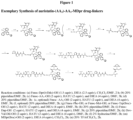
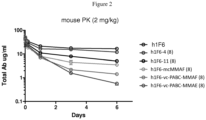


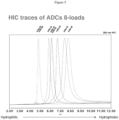

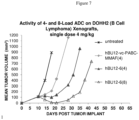

Classifications
-
- A—HUMAN NECESSITIES
- A61—MEDICAL OR VETERINARY SCIENCE; HYGIENE
- A61K—PREPARATIONS FOR MEDICAL, DENTAL OR TOILETRY PURPOSES
- A61K38/00—Medicinal preparations containing peptides
- A61K38/04—Peptides having up to 20 amino acids in a fully defined sequence; Derivatives thereof
- A61K38/05—Dipeptides
-
- A—HUMAN NECESSITIES
- A61—MEDICAL OR VETERINARY SCIENCE; HYGIENE
- A61K—PREPARATIONS FOR MEDICAL, DENTAL OR TOILETRY PURPOSES
- A61K38/00—Medicinal preparations containing peptides
- A61K38/04—Peptides having up to 20 amino acids in a fully defined sequence; Derivatives thereof
- A61K38/08—Peptides having 5 to 11 amino acids
-
- A—HUMAN NECESSITIES
- A61—MEDICAL OR VETERINARY SCIENCE; HYGIENE
- A61K—PREPARATIONS FOR MEDICAL, DENTAL OR TOILETRY PURPOSES
- A61K47/00—Medicinal preparations characterised by the non-active ingredients used, e.g. carriers or inert additives; Targeting or modifying agents chemically bound to the active ingredient
- A61K47/50—Medicinal preparations characterised by the non-active ingredients used, e.g. carriers or inert additives; Targeting or modifying agents chemically bound to the active ingredient the non-active ingredient being chemically bound to the active ingredient, e.g. polymer-drug conjugates
- A61K47/51—Medicinal preparations characterised by the non-active ingredients used, e.g. carriers or inert additives; Targeting or modifying agents chemically bound to the active ingredient the non-active ingredient being chemically bound to the active ingredient, e.g. polymer-drug conjugates the non-active ingredient being a modifying agent
- A61K47/68—Medicinal preparations characterised by the non-active ingredients used, e.g. carriers or inert additives; Targeting or modifying agents chemically bound to the active ingredient the non-active ingredient being chemically bound to the active ingredient, e.g. polymer-drug conjugates the non-active ingredient being a modifying agent the modifying agent being an antibody, an immunoglobulin or a fragment thereof, e.g. an Fc-fragment
- A61K47/6801—Drug-antibody or immunoglobulin conjugates defined by the pharmacologically or therapeutically active agent
-
- A—HUMAN NECESSITIES
- A61—MEDICAL OR VETERINARY SCIENCE; HYGIENE
- A61K—PREPARATIONS FOR MEDICAL, DENTAL OR TOILETRY PURPOSES
- A61K47/00—Medicinal preparations characterised by the non-active ingredients used, e.g. carriers or inert additives; Targeting or modifying agents chemically bound to the active ingredient
- A61K47/50—Medicinal preparations characterised by the non-active ingredients used, e.g. carriers or inert additives; Targeting or modifying agents chemically bound to the active ingredient the non-active ingredient being chemically bound to the active ingredient, e.g. polymer-drug conjugates
- A61K47/51—Medicinal preparations characterised by the non-active ingredients used, e.g. carriers or inert additives; Targeting or modifying agents chemically bound to the active ingredient the non-active ingredient being chemically bound to the active ingredient, e.g. polymer-drug conjugates the non-active ingredient being a modifying agent
- A61K47/68—Medicinal preparations characterised by the non-active ingredients used, e.g. carriers or inert additives; Targeting or modifying agents chemically bound to the active ingredient the non-active ingredient being chemically bound to the active ingredient, e.g. polymer-drug conjugates the non-active ingredient being a modifying agent the modifying agent being an antibody, an immunoglobulin or a fragment thereof, e.g. an Fc-fragment
- A61K47/6801—Drug-antibody or immunoglobulin conjugates defined by the pharmacologically or therapeutically active agent
- A61K47/6803—Drugs conjugated to an antibody or immunoglobulin, e.g. cisplatin-antibody conjugates
- A61K47/68031—Drugs conjugated to an antibody or immunoglobulin, e.g. cisplatin-antibody conjugates the drug being an auristatin
-
- A—HUMAN NECESSITIES
- A61—MEDICAL OR VETERINARY SCIENCE; HYGIENE
- A61K—PREPARATIONS FOR MEDICAL, DENTAL OR TOILETRY PURPOSES
- A61K47/00—Medicinal preparations characterised by the non-active ingredients used, e.g. carriers or inert additives; Targeting or modifying agents chemically bound to the active ingredient
- A61K47/50—Medicinal preparations characterised by the non-active ingredients used, e.g. carriers or inert additives; Targeting or modifying agents chemically bound to the active ingredient the non-active ingredient being chemically bound to the active ingredient, e.g. polymer-drug conjugates
- A61K47/51—Medicinal preparations characterised by the non-active ingredients used, e.g. carriers or inert additives; Targeting or modifying agents chemically bound to the active ingredient the non-active ingredient being chemically bound to the active ingredient, e.g. polymer-drug conjugates the non-active ingredient being a modifying agent
- A61K47/68—Medicinal preparations characterised by the non-active ingredients used, e.g. carriers or inert additives; Targeting or modifying agents chemically bound to the active ingredient the non-active ingredient being chemically bound to the active ingredient, e.g. polymer-drug conjugates the non-active ingredient being a modifying agent the modifying agent being an antibody, an immunoglobulin or a fragment thereof, e.g. an Fc-fragment
- A61K47/6835—Medicinal preparations characterised by the non-active ingredients used, e.g. carriers or inert additives; Targeting or modifying agents chemically bound to the active ingredient the non-active ingredient being chemically bound to the active ingredient, e.g. polymer-drug conjugates the non-active ingredient being a modifying agent the modifying agent being an antibody, an immunoglobulin or a fragment thereof, e.g. an Fc-fragment the modifying agent being an antibody or an immunoglobulin bearing at least one antigen-binding site
- A61K47/6851—Medicinal preparations characterised by the non-active ingredients used, e.g. carriers or inert additives; Targeting or modifying agents chemically bound to the active ingredient the non-active ingredient being chemically bound to the active ingredient, e.g. polymer-drug conjugates the non-active ingredient being a modifying agent the modifying agent being an antibody, an immunoglobulin or a fragment thereof, e.g. an Fc-fragment the modifying agent being an antibody or an immunoglobulin bearing at least one antigen-binding site the antibody targeting a determinant of a tumour cell
- A61K47/6861—Medicinal preparations characterised by the non-active ingredients used, e.g. carriers or inert additives; Targeting or modifying agents chemically bound to the active ingredient the non-active ingredient being chemically bound to the active ingredient, e.g. polymer-drug conjugates the non-active ingredient being a modifying agent the modifying agent being an antibody, an immunoglobulin or a fragment thereof, e.g. an Fc-fragment the modifying agent being an antibody or an immunoglobulin bearing at least one antigen-binding site the antibody targeting a determinant of a tumour cell the tumour determinant being from kidney or bladder cancer cell
-
- A—HUMAN NECESSITIES
- A61—MEDICAL OR VETERINARY SCIENCE; HYGIENE
- A61K—PREPARATIONS FOR MEDICAL, DENTAL OR TOILETRY PURPOSES
- A61K47/00—Medicinal preparations characterised by the non-active ingredients used, e.g. carriers or inert additives; Targeting or modifying agents chemically bound to the active ingredient
- A61K47/50—Medicinal preparations characterised by the non-active ingredients used, e.g. carriers or inert additives; Targeting or modifying agents chemically bound to the active ingredient the non-active ingredient being chemically bound to the active ingredient, e.g. polymer-drug conjugates
- A61K47/51—Medicinal preparations characterised by the non-active ingredients used, e.g. carriers or inert additives; Targeting or modifying agents chemically bound to the active ingredient the non-active ingredient being chemically bound to the active ingredient, e.g. polymer-drug conjugates the non-active ingredient being a modifying agent
- A61K47/68—Medicinal preparations characterised by the non-active ingredients used, e.g. carriers or inert additives; Targeting or modifying agents chemically bound to the active ingredient the non-active ingredient being chemically bound to the active ingredient, e.g. polymer-drug conjugates the non-active ingredient being a modifying agent the modifying agent being an antibody, an immunoglobulin or a fragment thereof, e.g. an Fc-fragment
- A61K47/6835—Medicinal preparations characterised by the non-active ingredients used, e.g. carriers or inert additives; Targeting or modifying agents chemically bound to the active ingredient the non-active ingredient being chemically bound to the active ingredient, e.g. polymer-drug conjugates the non-active ingredient being a modifying agent the modifying agent being an antibody, an immunoglobulin or a fragment thereof, e.g. an Fc-fragment the modifying agent being an antibody or an immunoglobulin bearing at least one antigen-binding site
- A61K47/6851—Medicinal preparations characterised by the non-active ingredients used, e.g. carriers or inert additives; Targeting or modifying agents chemically bound to the active ingredient the non-active ingredient being chemically bound to the active ingredient, e.g. polymer-drug conjugates the non-active ingredient being a modifying agent the modifying agent being an antibody, an immunoglobulin or a fragment thereof, e.g. an Fc-fragment the modifying agent being an antibody or an immunoglobulin bearing at least one antigen-binding site the antibody targeting a determinant of a tumour cell
- A61K47/6867—Medicinal preparations characterised by the non-active ingredients used, e.g. carriers or inert additives; Targeting or modifying agents chemically bound to the active ingredient the non-active ingredient being chemically bound to the active ingredient, e.g. polymer-drug conjugates the non-active ingredient being a modifying agent the modifying agent being an antibody, an immunoglobulin or a fragment thereof, e.g. an Fc-fragment the modifying agent being an antibody or an immunoglobulin bearing at least one antigen-binding site the antibody targeting a determinant of a tumour cell the tumour determinant being from a cell of a blood cancer
-
- A—HUMAN NECESSITIES
- A61—MEDICAL OR VETERINARY SCIENCE; HYGIENE
- A61K—PREPARATIONS FOR MEDICAL, DENTAL OR TOILETRY PURPOSES
- A61K47/00—Medicinal preparations characterised by the non-active ingredients used, e.g. carriers or inert additives; Targeting or modifying agents chemically bound to the active ingredient
- A61K47/50—Medicinal preparations characterised by the non-active ingredients used, e.g. carriers or inert additives; Targeting or modifying agents chemically bound to the active ingredient the non-active ingredient being chemically bound to the active ingredient, e.g. polymer-drug conjugates
- A61K47/51—Medicinal preparations characterised by the non-active ingredients used, e.g. carriers or inert additives; Targeting or modifying agents chemically bound to the active ingredient the non-active ingredient being chemically bound to the active ingredient, e.g. polymer-drug conjugates the non-active ingredient being a modifying agent
- A61K47/68—Medicinal preparations characterised by the non-active ingredients used, e.g. carriers or inert additives; Targeting or modifying agents chemically bound to the active ingredient the non-active ingredient being chemically bound to the active ingredient, e.g. polymer-drug conjugates the non-active ingredient being a modifying agent the modifying agent being an antibody, an immunoglobulin or a fragment thereof, e.g. an Fc-fragment
- A61K47/6835—Medicinal preparations characterised by the non-active ingredients used, e.g. carriers or inert additives; Targeting or modifying agents chemically bound to the active ingredient the non-active ingredient being chemically bound to the active ingredient, e.g. polymer-drug conjugates the non-active ingredient being a modifying agent the modifying agent being an antibody, an immunoglobulin or a fragment thereof, e.g. an Fc-fragment the modifying agent being an antibody or an immunoglobulin bearing at least one antigen-binding site
- A61K47/6881—Cluster-antibody conjugates, i.e. the modifying agent consists of a plurality of antibodies covalently linked to each other or of different antigen-binding fragments covalently linked to each other
-
- A—HUMAN NECESSITIES
- A61—MEDICAL OR VETERINARY SCIENCE; HYGIENE
- A61K—PREPARATIONS FOR MEDICAL, DENTAL OR TOILETRY PURPOSES
- A61K47/00—Medicinal preparations characterised by the non-active ingredients used, e.g. carriers or inert additives; Targeting or modifying agents chemically bound to the active ingredient
- A61K47/50—Medicinal preparations characterised by the non-active ingredients used, e.g. carriers or inert additives; Targeting or modifying agents chemically bound to the active ingredient the non-active ingredient being chemically bound to the active ingredient, e.g. polymer-drug conjugates
- A61K47/51—Medicinal preparations characterised by the non-active ingredients used, e.g. carriers or inert additives; Targeting or modifying agents chemically bound to the active ingredient the non-active ingredient being chemically bound to the active ingredient, e.g. polymer-drug conjugates the non-active ingredient being a modifying agent
- A61K47/68—Medicinal preparations characterised by the non-active ingredients used, e.g. carriers or inert additives; Targeting or modifying agents chemically bound to the active ingredient the non-active ingredient being chemically bound to the active ingredient, e.g. polymer-drug conjugates the non-active ingredient being a modifying agent the modifying agent being an antibody, an immunoglobulin or a fragment thereof, e.g. an Fc-fragment
- A61K47/6889—Conjugates wherein the antibody being the modifying agent and wherein the linker, binder or spacer confers particular properties to the conjugates, e.g. peptidic enzyme-labile linkers or acid-labile linkers, providing for an acid-labile immuno conjugate wherein the drug may be released from its antibody conjugated part in an acidic, e.g. tumoural or environment
-
- A—HUMAN NECESSITIES
- A61—MEDICAL OR VETERINARY SCIENCE; HYGIENE
- A61K—PREPARATIONS FOR MEDICAL, DENTAL OR TOILETRY PURPOSES
- A61K9/00—Medicinal preparations characterised by special physical form
- A61K9/0012—Galenical forms characterised by the site of application
- A61K9/0019—Injectable compositions; Intramuscular, intravenous, arterial, subcutaneous administration; Compositions to be administered through the skin in an invasive manner
-
- A—HUMAN NECESSITIES
- A61—MEDICAL OR VETERINARY SCIENCE; HYGIENE
- A61P—SPECIFIC THERAPEUTIC ACTIVITY OF CHEMICAL COMPOUNDS OR MEDICINAL PREPARATIONS
- A61P31/00—Antiinfectives, i.e. antibiotics, antiseptics, chemotherapeutics
-
- A—HUMAN NECESSITIES
- A61—MEDICAL OR VETERINARY SCIENCE; HYGIENE
- A61P—SPECIFIC THERAPEUTIC ACTIVITY OF CHEMICAL COMPOUNDS OR MEDICINAL PREPARATIONS
- A61P35/00—Antineoplastic agents
-
- A—HUMAN NECESSITIES
- A61—MEDICAL OR VETERINARY SCIENCE; HYGIENE
- A61P—SPECIFIC THERAPEUTIC ACTIVITY OF CHEMICAL COMPOUNDS OR MEDICINAL PREPARATIONS
- A61P37/00—Drugs for immunological or allergic disorders
-
- A—HUMAN NECESSITIES
- A61—MEDICAL OR VETERINARY SCIENCE; HYGIENE
- A61P—SPECIFIC THERAPEUTIC ACTIVITY OF CHEMICAL COMPOUNDS OR MEDICINAL PREPARATIONS
- A61P37/00—Drugs for immunological or allergic disorders
- A61P37/02—Immunomodulators
-
- Y—GENERAL TAGGING OF NEW TECHNOLOGICAL DEVELOPMENTS; GENERAL TAGGING OF CROSS-SECTIONAL TECHNOLOGIES SPANNING OVER SEVERAL SECTIONS OF THE IPC; TECHNICAL SUBJECTS COVERED BY FORMER USPC CROSS-REFERENCE ART COLLECTIONS [XRACs] AND DIGESTS
- Y02—TECHNOLOGIES OR APPLICATIONS FOR MITIGATION OR ADAPTATION AGAINST CLIMATE CHANGE
- Y02P—CLIMATE CHANGE MITIGATION TECHNOLOGIES IN THE PRODUCTION OR PROCESSING OF GOODS
- Y02P20/00—Technologies relating to chemical industry
- Y02P20/50—Improvements relating to the production of bulk chemicals
- Y02P20/55—Design of synthesis routes, e.g. reducing the use of auxiliary or protecting groups
Definitions
- mAbs monoclonal antibodies
- the structural elements for and mechanism of agent release must be consonant with the intracellular trafficking of the conjugate.
- auristatins related to the natural product dolastatin 10.
- Representative auristatins include MMAE (N-methylvaline-valine-dolaisoleuine-dolaproine-norephedrine) and MMAF (N-methylvaline-valine-dolaisoleuine-dolaproine-phenylalanine).
- MMAE is an example of a cytotoxic agent that is active as a free drug, and is highly potent after conjugation to a monoclonal antibody (mAb) and release after internalization into cells.
- MMAE has been successfully conjugated to a mAb at the N-terminal amino acid of MMAE via a cathepsin B-cleavable peptide-based linker containing maleimidocaproyl-valine-citrulline (mc-vc-) and a self-immolative group, p-aminobenzyl-carbamoyl (PABC), to produce antibody-drug conjugates of the following structure, mAb-(mc-vc-PABC-MMAE) p .
- PABC p-aminobenzyl-carbamoyl
- p refers to the number of (mc-vc-PABC-MMAE) units per mAb or antibody.
- MMAF auristatin
- mAb monoclonal antibody
- PABC p-aminobenzyl-carbamoyl
- MMAF is also active as a non-cleavable conjugate, containing the drug-linker maleimidocaproyl MMAF (mcMMAF).
- mcMMAF drug-linker maleimidocaproyl MMAF
- the active species released is cys-mcMMAF.
- the linker is non-cleavable, the maleimidocaproyl and a cysteine residue of the antibody remain attached to the N-terminus of MMAF.
- MMAF was also reported to be active as a C-terminal conjugate, attached at its C-terminal amino acid, phenylalanine, to a peptide-maleimidocaproyl linker.
- (MMAF-peptide-mc) p -mAb is internalized into cells, the active species, MMAF, is released following cleavage of the MMAF(phenylalanine)-peptide bond.
- these MMAE and MMAF conjugates generally exhibited a drug loading-dependent decrease in pharmacokinetic properties.
- the pharmacokinetics (PK) of the conjugates decreased.
- the present invention relates to a Drug-Linker Compound as defined in appended claims 1 to 15.
- hydrophilic Ligand-Linker-Drug Conjugates By designing the conjugates to have a hydrophilicity similar to the unconjugated targeting agent (e.g., a ligand such as an antibody), the conjugates retain the ability to provide pharmacokinetic (PK) properties similar to that of the unconjugated targeting agent in vivo.
- the conjugates can also have higher drug loadings (i.e., higher numbers of hydrophilic drug-linkers per targeting agent), as compared to lower loaded conjugates, while retaining such desirable PK properties and having the same or better activity in vivo.
- 4-loaded or 8-loaded conjugates can have the same or better PK properties than their 2 or 4 loaded counterparts, respectively; such 4-loaded or 8-loaded conjugates can have the same or better activity than their 2 or 4 loaded counterparts, respectively.
- targeting agents selected on the basis of certain desirable properties can be conjugated with drug linkers without substantially impairing such desirable properties as PK properties of the targeting agent alone. Also disclosed herein are methods of making and using such conjugates.
- trade name includes the product formulation, the generic drug, and the active pharmaceutical ingredient(s) of the trade name product, unless otherwise indicated by context.
- hydrophilicity index refers to a measure of the hydrophilicity of a conjugate relative to the hydrophilicity of the targeting agent alone (i.e., a Ligand, typically an antibody).
- the hydrophilicity index is measured as the retention time of a conjugate to that of the corresponding unconjugated targeting agent (alone) under high performance liquid chromatography (HPLC) conditions, as further described herein.
- HPLC high performance liquid chromatography
- the retention time of the conjugate is not greater than two minutes slower than the retention time of the unconjugated ligand, as determined as described in the examples (referred to as a hydrophilicity index of 2). In certain embodiments, the retention time of the conjugate is not greater than one minute slower than the retention time of the unconjugated ligand, as determined as described in the examples (referred to as a hydrophilicity index of 1). In certain embodiments, the retention time of the conjugate is not greater than one half minute slower than the retention time of the unconjugated ligand, as determined as described in the examples (referred to as a hydrophilicity index of 0.5).
- a different hydrophobic interaction column and/or method can be calibrated using conjugates from Tables 2 as references to determine reference conjugate mobilities (elution times) on the selected column and/or method.
- the determined reference mobilities on the selected hydrophobic interaction column and/or method can then be used to calculate a hydrophilicity index of a test article (as would be determined following Example 3).
- an auristatin T - Glu- Dpr - MA, an mc-MMAF and an mc-vc-PABC-MMAE drug linkers can be used to form conjugates to use as references.
- an auristatin T-Glu-Dpr-MA-h1F6 ADC, an h1F6-mc-MMAF and an h1F6-mc-vc-PABC-MMAE ADC can be used as references.
- alkyl by itself or as part of another substituent, means, unless otherwise stated, a straight or branched chain hydrocarbon radical, having the number of carbon atoms designated (i.e. C 1 - 8 means one to eight carbons).
- alkyl groups include methyl, ethyl, n-propyl, isopropyl, n-butyl, t-butyl, isobutyl, sec-butyl, n-pentyl, n-hexyl, n-heptyl, n-octyl, and the like.
- alkenyl refers to an unsaturated alkyl group having one or more double bonds.
- alkynyl refers to an unsaturated alkyl group having one or more triple bonds.
- unsaturated alkyl groups include vinyl, 2-propenyl, crotyl, 2-isopentenyl, 2-(butadienyl), 2,4-pentadienyl, 3-(1,4-pentadienyl), ethynyl, 1- and 3-propynyl, 3-butynyl, and the higher homologs and isomers.
- cycloalkyl refers to hydrocarbon rings having the indicated number of ring atoms ( e .
- Cycloalkyl is also meant to refer to bicyclic and polycyclic hydrocarbon rings such as, for example, bicyclo[2.2.1]heptane, bicyclo[2.2.2]octane, etc.
- heterocycloalkane or “heterocycloalkyl” refers to a cycloalkyl group that contain from one to five heteroatoms selected from N, O, and S, wherein the nitrogen and sulfur atoms are optionally oxidized, and the nitrogen atom(s) are optionally quaternized.
- the heterocycloalkane may be a monocyclic, a bicyclic or a polycylic ring system.
- Non limiting examples of heterocycloalkane groups include pyrrolidine, imidazolidine, pyrazolidine, butyrolactam, valerolactam, imidazolidinone, hydantoin, dioxolane, phthalimide, piperidine, 1,4-dioxane, morpholine, thiomorpholine, thiomorpholine-S-oxide, thiomorpholine-S,S-oxide, piperazine, pyran, pyridone, 3-pyrroline, thiopyran, pyrone, tetrahydrofuran, tetrhydrothiophene, quinuclidine, and the like.
- a heterocycloalkane group can be attached to the remainder of the molecule through a ring carbon or a heteroatom.
- alkylene by itself or as part of another substituent means a divalent radical derived from an alkane, as exemplified by -CH 2 CH 2 CH 2 CH 2 -.
- an alkyl (or alkylene) group will have from 1 to 24 carbon atoms, with those groups having 10 or fewer carbon atoms being preferred in the present invention.
- a “lower alkyl” or “lower alkylene” is a shorter chain alkyl or alkylene group, generally having four or fewer carbon atoms.
- alkenylene and “alkynylene” refer to the unsaturated forms of "alkylene” having double or triple bonds, respectively.
- a wavy line, " ", that intersects a single, double or triple bond in any chemical structure depicted herein, represent the point attachment of the single, double, or triple bond to the remainder of the molecule.
- alkoxy alkylamino and “alkylthio” (or thioalkoxy) are used in their conventional sense, and refer to those alkyl groups attached to the remainder of the molecule via an oxygen atom, an amino group, or a sulfur atom, respectively. Additionally, for dialkylamino groups, the alkyl portions can be the same or different and can also be combined to form a 3-7 membered ring with the nitrogen atom to which each is attached. Accordingly, a group represented as dialkylamino or -NR a R b is meant to include piperidinyl, pyrrolidinyl, morpholinyl, azetidinyl and the like.
- halo or halogen
- substituents mean, unless otherwise stated, a fluorine, chlorine, bromine, or iodine atom.
- terms such as “haloalkyl,” are meant to include monohaloalkyl and polyhaloalkyl.
- C 1 - 4 haloalkyl is mean to include trifluoromethyl, 2,2,2-trifluoroethyl, 4-chlorobutyl, 3-bromopropyl, and the like.
- aryl means, unless otherwise stated, a polyunsaturated, typically aromatic, hydrocarbon group which can be a single ring or multiple rings (up to three rings) which are fused together or linked covalently.
- heteroaryl refers to aryl groups (or rings) that contain from one to five heteroatoms selected from N, O, and S, wherein the nitrogen and sulfur atoms are optionally oxidized, and the nitrogen atom(s) are optionally quaternized.
- a heteroaryl group can be attached to the remainder of the molecule through a heteroatom.
- Non-limiting examples of aryl groups include phenyl, naphthyl and biphenyl, while non-limiting examples of heteroaryl groups include pyridyl, pyridazinyl, pyrazinyl, pyrimindinyl, triazinyl, quinolinyl, quinoxalinyl, quinazolinyl, cinnolinyl, phthalazinyl, benzotriazinyl, purinyl, benzimidazolyl, benzopyrazolyl, benzotriazolyl, benzisoxazolyl, isobenzofuryl, isoindolyl, indolizinyl, benzotriazinyl, thienopyridinyl, thienopyrimidinyl, pyrazolopyrimidinyl, imidazopyridines, benzothiaxolyl, benzofuranyl, benzothienyl, indolyl, quinolyl
- arylalkyl is meant to include those radicals in which an aryl group is attached to an alkyl group (e.g., benzyl, phenethyl, and the like).
- heteroaryl-alkyl is meant to include those radicals in which a heteroaryl group is attached to an alkyl group (e.g., pyridylmethyl, thiazolylethyl, and the like).
- R', R" and R′′′ each independently refer to hydrogen, unsubstituted C 1 - 8 alkyl, unsubstituted aryl, aryl substituted with 1-3 halogens, unsubstituted C 1 - 8 alkyl, C 1 - 8 alkoxy or C 1 - 8 thioalkoxy groups, or unsubstituted aryl-C 1 - 4 alkyl groups.
- R' and R" are attached to the same nitrogen atom, they can be combined with the nitrogen atom to form a 3-, 4-, 5-, 6-, or 7-membered ring.
- -NR'R is meant to include 1-pyrrolidinyl and 4-morpholinyl.
- base refers to a functional group that deprotonates water to produce a hydroxide ion.
- exemplary bases are amines and nitrogen containing heterocycles.
- Representative bases include -N(R 3 )(R 4 ) wherein R 3 and R 4 are independently selected from H or C 1-6 alkyl, preferably H or methyl, wherein R 5 , R 6 , R 7 and R 8 are, at each occurrence, independently selected from hydrogen or C 1-6 alkyl, preferably H or methyl, and e is 0-4.
- the base is a nitrogenous base.
- antibody is used herein in the broadest sense and specifically covers intact monoclonal antibodies, polyclonal antibodies, monospecific antibodies, multispecific antibodies (e.g., bispecific antibodies), and antibody fragments that exhibit the desired biological activity (i.e., specific binding to a target antigen).
- An intact antibody has primarily two regions: a variable region and a constant region.
- the variable region specifically binds to and interacts with a target antigen.
- the variable region includes complementary determining regions (CDR) that recognize and bind to a specific binding site on a particular antigen.
- CDR complementary determining regions
- the constant region may be recognized by and interact with the immune system ( see, e.g., Janeway et al., 2001, Immuno. Biology, 5th Ed., Garland Publishing, New York ).
- An antibody can be of any type (e.g., IgG, IgE, IgM, IgD, and IgA), class (e.g., IgG1, IgG2, IgG3, IgG4, IgA1 and IgA2) or subclass.
- the antibody can be derived from any suitable species.
- the antibody is of human or murine origin.
- a monoclonal antibody can be, for example, human, humanized or chimeric.
- the term "monoclonal antibody” as used herein refers to an antibody obtained from a population of substantially homogeneous antibodies, i.e., the individual antibodies comprising the population are identical except for possible naturally-occurring mutations that may be present in minor amounts. Monoclonal antibodies are highly specific, being directed against a single antigenic site. The modifier “monoclonal” indicates the character of the antibody as being obtained from a substantially homogeneous population of antibodies, and is not to be construed as requiring production of the antibody by any particular method.
- an “intact antibody” is one which comprises an antigen-binding variable region as well as a light chain constant domain (C L ) and heavy chain constant domains, C H 1, C H 2, C H 3 and C H 4, as appropriate for the antibody class.
- the constant domains may be native sequence constant domains (e.g., human native sequence constant domains) or amino acid sequence variant thereof.
- antibody fragment comprises a portion of an intact antibody, comprising the antigen-binding or variable region thereof.
- antibody fragments include Fab, Fab', F(ab') 2 , and Fv fragments, diabodies, triabodies, tetrabodies, linear antibodies, single-chain antibody molecules, scFv, scFv-Fc, multispecific antibody fragments formed from antibody fragment(s), a fragment(s) produced by a Fab expression library, or an epitope-binding fragments of any of the above which specifically bind to a target antigen (e.g., a cancer cell antigen, a viral antigen or a microbial antigen).
- a target antigen e.g., a cancer cell antigen, a viral antigen or a microbial antigen.
- an "antigen” is an entity to which an antibody specifically binds.
- An antigen can be, for example, proteinaceous (e.g., a protein, polypeptide or peptide), non-proteinaceous (e.g., a carbohydrate), or a combination of the two.
- the terms “specific binding” and “specifically binds” mean that the targeting agent or Ligand, such as an antibody or antigen binding fragment, will bind in a highly selective manner with its corresponding target antigen and not with the multitude of other antigens.
- the antibody or antibody fragment typically binds with an affinity of at least about 1 ⁇ 10 -7 M, and preferably 10 -8 M to 10 -9 M, 10 -10 M, 10 -11 M, or 10 -12 M and binds to the predetermined antigen with an affinity that is at least two-fold greater than its affinity for binding to a non-specific antigen (e.g ., BSA, casein) other than the predetermined antigen or a closely-related antigen having the same epitope.
- a non-specific antigen e.g ., BSA, casein
- inhibitor or “inhibition of” means to a reduce by a measurable amount, or to prevent entirely.
- a therapeutically effective amount refers to an amount of a conjugate (e.g., an antibody drug conjugate) that is effective to treat a disease or disorder in a mammal.
- a therapeutically effective amount of the conjugate may reduce the number of cancer cells; reduce the tumor size; inhibit ( i . e ., slow to some extent and preferably stop) cancer cell infiltration into peripheral organs; inhibit ( i.e., slow to some extent and preferably stop) tumor metastasis; inhibit tumor growth; and/or relieve one or more of the symptoms associated with the cancer.
- the drug may inhibit growth and/or kill existing cancer cells, it may be cytostatic and/or cytotoxic.
- efficacy can, for example, be measured by assessing the time to disease progression (TTP) and/or determining the response rate (RR).
- substantially refers to a majority, i.e. >50% of a population, of a mixture or a sample, preferably more than 50%, 55%, 60%, 65%, 70%, 75%, 80%, 85%, 90%, 91%, 92%, 93%, 94%, 95%, 96%, 97 %, 98%, or 99% of a population.
- Intracellularly cleaved and “intracellular cleavage” refer to a metabolic process or reaction inside a cell on a Ligand-Linker-Drug conjugate (e . g ., an Antibody Drug Conjugate (ADC), or the like), whereby the covalent attachment (the Linker unit), between the D E moiety and the Ligand unit (e . g ., an antibody (Ab)) is broken, resulting in the release of the D E unit.
- ADC Antibody Drug Conjugate
- the cleaved moieties of the Ligand-Linker-Drug conjugate are thus intracellular metabolites.
- cytotoxic activity refers to a cell-killing or a cytotoxic effect of a Ligand-Linker-Drug conjugate compound, typically via the released Drug unit, on the target cell. Cytotoxic activity may be expressed as the IC 50 value (also referred to as the half maximal inhibitory concentration), which is the concentration (molar or mass) per unit volume at which half the cells survive exposure to the conjugate.
- cytotoxic agent refers to a substance that kills cells or otherwise causes destruction of cells.
- cancer and “cancerous” refer to or describe the physiological condition or disorder in mammals that is typically characterized by unregulated cell growth.
- a “tumor” comprises cancerous cells.
- autoimmune disease is a disease or disorder arising from and directed against an individual's own tissues or proteins.
- Examples of a "patient” include, but are not limited to, a human, rat, mouse, guinea pig, monkey, pig, goat, cow, horse, dog, cat, bird and fowl.
- the patient is a human.
- treat or “treatment,” unless otherwise indicated by context, refer to therapeutic treatment and prophylactic measures to prevent relapse, wherein the object is to inhibit or slow down (lessen) an undesired physiological change or disorder, such as the development or spread of cancer.
- beneficial or desired clinical results include, but are not limited to, alleviation of symptoms, diminishment of extent of disease, a stabilized (i. e., not worsening) state of disease, delay or slowing of disease progression, amelioration or palliation of the disease state, and remission (whether partial or complete), whether detectable or undetectable.
- Treatment can also mean prolonging survival as compared to expected survival if not receiving treatment. Those in need of treatment include those already with the condition or disorder.
- treating includes any or all of: inhibiting growth of tumor cells, cancer cells, or of a tumor; inhibiting replication of tumor cells or cancer cells, lessening of overall tumor burden or decreasing the number of cancerous cells, and ameliorating one or more symptoms associated with the disease.
- treating includes any or all of: inhibiting replication of cells associated with an autoimmune disease state including, but not limited to, cells that produce an autoimmune antibody, lessening the autoimmune-antibody burden and ameliorating one or more symptoms of an autoimmune disease.
- pharmaceutically acceptable salt refers to pharmaceutically acceptable organic or inorganic salts of a compound (e.g. , a Drug, Drug-Linker, or a Ligand-Linker-Drug Conjugate).
- the compound can contain at least one amino group, and accordingly acid addition salts can be formed with the amino group.
- Exemplary salts include, but are not limited to, sulfate, trifluoroacetate, citrate, acetate, oxalate, chloride, bromide, iodide, nitrate, bisulfate, phosphate, acid phosphate, isonicotinate, lactate, salicylate, acid citrate, tartrate, oleate, tannate, pantothenate, bitartrate, ascorbate, succinate, maleate, gentisinate, fumarate, gluconate, glucuronate, saccharate, formate, benzoate, glutamate, methanesulfonate, ethanesulfonate, benzenesulfonate, p -toluenesulfonate, and pamoate ( i.e., 1,1'-methylene-bis -(2-hydroxy-3- naphthoate)) salts.
- pamoate i.e., 1,1'-
- a pharmaceutically acceptable salt may involve the inclusion of another molecule such as an acetate ion, a succinate ion or other counterion.
- the counterion may be any organic or inorganic moiety that stabilizes the charge on the parent compound.
- a pharmaceutically acceptable salt may have more than one charged atom in its structure. Instances where multiple charged atoms are part of the pharmaceutically acceptable salt can have multiple counter ions. Hence, a pharmaceutically acceptable salt can have one or more charged atoms and/or one or more counterion.
- the present invention is based, in part, on the discovery that certain combinations of linking groups and cytotoxic agents can be used to prepare Ligand-Linker-Drug conjugates, such as antibody-drug conjugates (ADCs), that have a hydrophilicity similar to that of the unconjugated Ligand (i.e., a targeting agent, such as an antibody or antigen binding fragment).
- ADCs antibody-drug conjugates
- the resulting conjugates can have higher drug loadings (e.g., at least 4 or 8 drug linkers per Ligand), while maintaining certain desirable characteristics of the Ligand alone, such as reduced clearance in vivo, increased pharmacokinetic profile in vivo, increased exposure of the conjugates to the target cell(s), etc.
- hydrophilic conjugates can be designed to have a hydrophilicity similar to that of the Ligand without the need to include additional solubilizing groups, such as polyethylene glycol or other water soluble polymers.
- Ligand-Linker-Drug conjugates are also referred to as Drug-Ligand conjugates, Ligand-Drug conjugates or Ligand Drug conjugates herein.
- the hydrophilic linking groups (also referred to as Linkers or Linker units) of the Drug-Linker compounds of the invention are designed for increased hydrophilicity.
- the linking group allows efficient release of the cytotoxic agent (also referred to as a Drug unit or Drug) at the target cell, sufficient to induce cytotoxicity or a cytostatic effect in the case of a cytotoxic agent.
- the hydrophilic linkers are designed for efficient release of the Drug unit once a Ligand-Linker Drug conjugate comprising the Drug-Linker compound has been internalized into the target cell.
- Suitable recognition sites for release of the Drug unit by cleavage are those that allow efficient separation of the unit from the hydrophilic linking group.
- the recognition site is a peptide cleavage site. Examples of peptide cleavage sites include those recognized by intracellular proteases, such as those present in lysosomes. The cleavable peptide bond is susceptible to cleavage by proteases when the conjugate reaches its targeted site.
- the Drug units are auristatins that are designed to have increased hydrophilicity in combination with a hydrophilic Linker unit.
- the Drug units advantageously can be designed to have hydrophilic substituents, while retaining potent cytotoxic activity.
- Auristatin Drug units are attached at their C-terminal end to a Linker unit, as more fully described herein.
- L H is a hydrophilic linker containing one, two, or three hydrophilic amino acids, wherein the first amino acid forms a cleavage site with the portion of the Drug unit to which it is attached.
- L H is a hydrophilic linker comprising one or two hydrophilic amino acids, wherein the first amino acid forms a cleavage site with the portion of the Drug unit to which it is attached.
- Conjugate hydrophilicity for Ligand-Drug Conjugates comprising a Drug-Linker compound according to the appended claims can be determined by comparing the hydrophilicity of the conjugate to that of the unconjugated targeting agent (i.e., Ligand or Ligand unit), referred to as the hydrophilicity index.
- the hydrophilicity index i.e., Ligand or Ligand unit
- Example 3 discloses a preferred method for determining the hydrophilicity index of a conjugate.
- a different hydrophobic interaction column and/or method can be calibrated using conjugates from Tables 2 as references to determine reference conjugate mobilities (elution times) of the references on the selected column and/or method.
- the determined reference mobilities on the selected hydrophobic interaction column and/or method can then be used to calculate a hydrophilicity index of a test article (as would be determined following Example 3).
- an auristatin T - Glu- Dpr - MA, an mc-MMAF and an mc-vc-PABC-MMAE drug linkers can be used to form conjugates to use as references.
- an auristatin T-Glu-Dpr-MA-h1F6 ADC, an h1F6-mc-MMAF and an h1F6-mc-vc-PABC-MMAE ADC can be used as references.
- a Ligand-Linker-Drug Conjugate comprising a Ligand unit and multiple Drug-Linker compounds attached to the Ligand unit.
- the Linker unit comprises a hydrophilic linker (L H ) assembly, including a Ligand attachment component, such as via a thioether linkage.
- the Drug unit comprises a cytotoxic agent having an attachment component for connection to the Linker unit.
- Linker portion comprises a hydrophilic linker (L H ) assembly having a Ligand attachment component (an attached maleimide moiety), suitable for reacting with a Ligand.
- Ligand-Linker Drug Conjugates do not fall within the scope of the appended claims. However, Ligand-Linker Drug Conjugates may be formed comprising Drug-Linker Compounds of the appended claims.
- Ligand-Linker-Drug conjugates having the following formula are disclosed herein: or a pharmaceutically acceptable salt or solvate thereof, wherein:
- Ligand-Linker-Drug conjugates having the following formula are also disclosed herein: or a pharmaceutically acceptable salt or solvate thereof, wherein:
- Ligand-Linker-Drug conjugates of formulas I and I' are described in more detail below.
- the Ligand-Linker-Drug conjugates may comprise a Ligand unit and at least four Linker-Drug units, wherein the Ligand unit and each of the Drug unit(s) are joined by a Linker unit(s) comprising a hydrophilic linker (L H ) assembly.
- the Linker units may be attached to the Ligand unit via a thioether bond.
- each Linker unit may further comprise a hydrolyzed succinimide ring (or succinic acid) directly conjugated to the Ligand unit via a thioether linkage.
- the Ligand-Linker-Drug conjugates may comprise a Ligand unit and at least six Linker-Drug units, wherein the Ligand unit and each of the Drug unit(s) are joined by a Linker unit(s) comprising a hydrophilic linker (L H ) assembly.
- the Linker units may be attached to the Ligand unit via a thioether bond.
- each Linker unit may further comprise a hydrolyzed succinimide ring (or succinic acid) directly conjugated to the Ligand unit via a thioether linkage.
- the Ligand-Linker-Drug conjugates may comprise a Ligand unit and at least eight Linker-Drug units, wherein the Ligand unit and each of the Drug unit(s) are joined by a Linker unit(s) comprising a hydrophilic linker (L H ) assembly.
- the Linker units may be attached to the Ligand unit via a thioether bond.
- each Linker unit may further comprise a hydrolyzed succinimide ring (or succinic acid) directly conjugated to the Ligand unit via a thioether linkage.
- the Ligand-Linker-Drug conjugates comprise a Ligand unit and at least ten Linker-Drug units, wherein the Ligand unit and each of the Drug unit(s) are joined by a Linker unit(s) comprising a hydrophilic linker (L H ) assembly.
- the Linker units may be attached to the Ligand unit via a thioether bond.
- each Linker unit may further comprise a hydrolyzed succinimide ring (or succinic acid) directly conjugated to the Ligand unit via a thioether linkage.
- the Ligand-Linker-Drug conjugates comprise a Ligand unit and at least sixteen Linker-Drug units, wherein the Ligand unit and each of the Drug unit(s) are joined by a Linker unit(s) comprising a hydrophilic linker (L H ) assembly.
- the Linker units may attached to the Ligand unit via a thioether bond.
- each Linker unit may further comprise a hydrolyzed succinimide ring (or succinic acid) directly conjugated to the Ligand unit via a thioether linkage.
- R 12 may be selected from H, optionally substituted -C 1 -C 8 alkyl, optionally substituted aryl, optionally substituted -X 1 aryl, optionally substituted -C 3 -C 8 carbocycle, optionally substituted -X 1 -(C 3 -C 8 carbocycle), optionally substituted -C 1 -C 8 alkylene-NH 2 , optionally substituted -C 3 -C 8 heterocycle and optionally substituted -X 1 -(C 3 -C 8 heterocycle).
- R 12 is not the side chain of phenylalanine or proline. In some further aspects, R 12 is not the side chain of phenylalanine, methionine, tryptophan or proline.
- R 12 is selected from the side chains of natural L-amino acids other than proline, and glycine. In some further aspects, R 12 is selected from the side chains of natural L-amino acids other than proline, glycine or phenylalanine. In some further aspects, R 12 is selected from the side chains of natural L-amino acids other than proline, glycine, tryptophan, methionine or phenylalanine.
- R 12 is selected from the side chains of the group of hydrophilic amino acids consisting of threonine, serine, asparagine, aspartic acid, glutamine, glutamic acid, homoserine, hydroxyvaline, furyl alanine, threonine(PO 3 H 2 ), pyrazolyl alanine, triazolyl alanine and thiazolyl alanine.
- R 12 is the side chain of threonine.
- Exemplary Drug units have the following formula, or a pharmaceutically acceptable salt thereof, wherein the wavy line indicates site of attachment to the Linker unit.
- the Drug unit is dimethyl- or monomethyl-auristatin F, as shown below: or a pharmaceutically acceptable salt or solvate thereof.
- exemplary Drug units are the dimethyl- or monomethyl forms of auristatin T. or or a pharmaceutically acceptable salt or solvate thereof.
- the Linker Unit The Linker Unit
- L A is covalently linked to a sulfur atom of the Ligand.
- the sulfur atom is that of a cysteine residue that can form an interchain disulfide bond of an antibody.
- the sulfur atom is that of a cysteine residue that has been introduced into the Ligand unit (e.g., by site directed mutagenesis or chemical reaction).
- the sulfur atoms to which the L A 's are attached are selected from cysteine residues that form an interchain disulfide bond of an antibody and cysteine residues that have been introduced into the Ligand unit (e.g., by site directed mutagenesis or chemical reaction).
- AA 1 forms a cleavable bond with the Drug unit.
- AA 1 is attached to an amino acid of the Drug unit
- AA 1 forms a cleavable peptide bond with the Drug unit.
- the cleavable peptide bond is susceptible to cleavage by proteases when the conjugate reaches its target site.
- AA 1 is a hydrophilic amino acid, typically an amino acid that is selected from the group consisting of Glycine and L forms of Aspartate, Glutamate, Asparagine, Glutamine, Histidine, Lysine, Arginine, Serine and Alanine.
- AA 1 is Glutamate.
- R L1 is present and is a hydrophilic amino acid
- it can be selected from the group consisting of Glycine; L or D forms of Aspartate, Glutamate, Asparagine, Glutamine, Histidine, Lysine, Arginine, Serine and Alanine; -NH - CH(R a ) - CO-; and -NH - CH(COOH) - R b -; wherein R a is selected
- R L1 is present and is an optionally substituted alkylene, it can be a C 1 - C 6 alkylene, optionally substituted with 1-4 substituents selected from -NH-, -C(O)-, - COOH, -N(C 1 - C 3 alkyl), - NH 2 or -NH(C 1 - C 3 alkyl).
- R L1 is ethylenediamine, -NH - CH(COOH)- CH 2 -NH - or -C(O) - CH(CH 2 NH 2 ) -.
- R L2 is present and is a hydrophilic amino acid
- it can be selected from the group consisting of Glycine; L or D forms of Aspartate, Glutamate, Asparagine, Glutamine, Histidine, Lysine, Arginine, Serine and Alanine; -NH - CH(R a )- C(O)-; and - NH- CH(COOH) - R b -; wherein R a is selected
- R L2 is present and is an optionally substituted alkylene, it can be a C 1 - C 6 alkylene, optionally substituted with 1-4 substituents selected from -NH-, -C(O)-, - COOH, -N(C 1 - C 3 alkyl)-, -NH 2 or -NH(C 1 - C 3 alkyl).
- R L2 is ethylenediamine, -NH - CH(COOH) - CH 2 -NH - or -C(O)- CH(CH 2 NH 2 ) -.
- R L3 is present, and is a hydrophilic amino acid
- it can be selected from the group consisting of Glycine; L or D forms of Aspartate, Glutamate, Asparagine, Glutamine, Histidine, Lysine, Arginine, Serine and Alanine; -NH - CH(R a )- C(O)-; and - NH- CH(COOH) - R b -; wherein R a is selected
- R L3 is selected from the group consisting of the D amino acids of Aspartate, Glutamate, Asparagine, Glutamine, Histidine, Lysine, Arginine, Serine and Alanine; Glycine; -NH - CH(R a )- C(O)-; and -NH - CH(COOH)- R b -; wherein R a is selected
- R L3 is present and is an optionally substituted alkylene, it can be a C 1 - C 6 alkylene, optionally substituted with 1-4 substituents selected from -NH-, -C(O)-, - COOH, -N(C 1 - C 3 alkyl)-, -NH 2 or -NH(C 1 - C 3 alkyl).
- R L1 is ethylenediamine, -NH- CH(COOH)- CH 2 -NH - or -C(O)- CH(CH 2 NH 2 ) -.
- AA 1 is present and R L1 , R L2 and R L3 are absent.
- AA 1 is present, R L1 is present and R L2 and R L3 are absent.
- AA 1 is present, R L1 is present, R L2 is present and R L3 is absent.
- AA 1 is present, R L1 is present, R L2 is present and R L3 is present.
- AA 1 is a hydrophilic amino acid and at least one of R L1 , R L2 and R L3 is present and is an optionally substituted alkylene, as set forth above.
- AA 1 is Glutamate and at least one of R L1 , R L2 and R L3 is present and is an optionally substituted alkylene, as set forth above.
- AA 1 is Glutamate
- R L1 is a hydrophilic amino acid and at least one of R L2 and R L3 is present and is an optionally substituted alkylene, as set forth above.
- AA 1 and R L1 are hydrophilic amino acids and at least one of R L2 and R L3 is present and is an optionally substituted alkylene, as set forth above.
- AA 1 is a hydrophilic amino acid and R L1 and optionally R L2 are an optionally substituted alkylene, as set forth above.
- L H does not include a glycine dipeptide (Gly-Gly), tripeptide or tetrapeptide. In some aspects, L H does not include the peptide Asn - (D)Lys.
- L H will include a modified peptide, having from two to four amino acids.
- the modified peptide has an amino acid in the 1-position (AA 1 ) that is selected to optimize release of the Drug unit (e.g., by protease cleavage via an amide peptide bond).
- R L1 and R L2 is an amino acid that reverses the orientation of typical N to C linkages of peptides (forming amide bonds) and facilitates attachment of the last amino acid (e.g., R L2 or R L3 ) which, prior to attachment of the Ligand unit, includes an ⁇ -amino group protected as a maleimide.
- the amino acid having a reversed N to C linkage is attached to the next group via its side chain.
- this amino acid is an alpha amino acid. In other aspects, it can be a beta or gamma amino acid.
- the side chain is selected from -CH 2 NH 2 -, -CH 2 CH 2 NH 2 -, -CH 2 CH 2 CH 2 NH 2 -, and -CH 2 CH 2 CH 2 CH 2 NH 2 -.
- the amino acid having a reversed N to C linkage (R L1 ) is attached to R L2 or R L3 , where R L2 or R L3 is a hydrophilic amino acid or an optionally substituted alkylene, according to any of the aspects described above.
- the amino acid having a reversed N to C linkage (R L1 ) is attached to R L2 , where R L2 is an optionally substituted alkylene, according to any of the aspects described above.
- L H is a hydrophilic, cleavable linker, each branch having the formula: wherein R 21 is selected from -CH 2 NH 2 , -CH 2 CH 2 NH 2 , -CH 2 OH, -CH 2 CH 2 OH, -CH 2 CO 2 H, -CH 2 CH 2 CO 2 H, -CH 2 CH 2 CH 2 CO 2 H and -CH 2 CH 2 CH 2 CO 2 H; and R 22 is selected from -CH 2 NH 2 , -CH 2 CH 2 NH 2 , -CH 2 OH, and -CH 2 CH 2 OH.
- the left and right wavy lines indicate attachments to the Drug unit and L A , or the branch of L H , respectively.
- L H has the formula: wherein R 22 is selected from -CH 2 NH 2 , -CH 2 CH 2 NH 2 , -CH 2 OH, and -CH 2 CH 2 OH. In some aspects, R 22 is selected from -CH 2 NH 2 and -CH 2 CH 2 NH 2 .
- the left and right wavy lines indicate attachments to the Drug unit and L A , or the branch of L H , respectively.
- L H has the formula:
- the left and right wavy lines indicate attachments to the Drug unit and L A , respectively.
- L H has the formula:
- the left and right wavy lines indicate attachments to the Drug unit and L A , or the branch of L H , respectively.
- L H has the formula:
- the left and right wavy lines indicate attachments to the Drug unit and L A , or the branch of L H , respectively.
- L H has the formula:
- the left and right wavy lines indicate attachments to the Drug unit and L A , or the branch of L H , respectively.
- L H has the formula:
- the left and right wavy lines indicate attachments to the Drug unit and L A , or the branch of L H , respectively.
- L H has the formula:
- the left and right wavy lines indicate attachments to the Drug unit and L A , respectively.
- L H has the formula:
- the left and right wavy lines indicate attachments to the Drug unit and L A , or the branch of L H , respectively.
- L H is a branched hydrophilic linker having the formula:
- L H is a branched hydrophilic linker having the formula: wherein each of the bars indicates attachment to a Drug unit, and the vertical dashed line indicates an attachment to a Ligand unit.
- the L A subunit is described in more detail below.
- the Ligand-Linker-Drug conjugates may have a formula selected from: and wherein S refers to a sulfur atom of the Ligand.
- the Ligand-Linker-Conjugates may have the following structures: wherein S refers to a sulfur atom of the Ligand, or a pharmaceutically acceptable salt or solvate thereof.
- Ligand-Linker-Drug conjugates having the following formula are disclosed herein: wherein:
- Ligand-Linker-Drug conjugates of formula II are described in more detail below.
- the Ligand-Linker-Drug conjugates may comprise a Ligand unit and at least four Linker-D E units, wherein the Ligand unit and each of the D E unit(s) are joined by a Linker unit comprising a hydrophilic linker (L H ) assembly.
- the Linker units may be attached to the Ligand unit via a thioether bond.
- the Linker unit may further comprise a hydrolyzed succinimide ring (or succinic acid) directly conjugated to the Ligand unit via a thioether linkage.
- the Ligand-Linker-Drug conjugates may comprise a Ligand unit and at least six Linker- D E units, wherein the Ligand unit and each of the D E unit(s) are joined by a Linker unit comprising a hydrophilic linker (L H ) assembly.
- the Linker units may be attached to the Ligand unit via a thioether bond.
- the Linker unit may further comprise a hydrolyzed succinimide ring (or succinic acid) directly conjugated to the Ligand unit via a thioether linkage.
- the Ligand-Linker-Drug conjugates may comprise a Ligand unit and at least eight Linker- D E units, wherein the Ligand unit and each of the D E unit(s) are joined by a Linker unit comprising a hydrophilic linker (L H ) assembly.
- the Linker units may be attached to the Ligand unit via a thioether bond.
- the Linker unit may further comprise a hydrolyzed succinimide ring (or succinic acid) directly conjugated to the Ligand unit via a thioether linkage.
- the Ligand-Linker-Drug conjugates may comprise a Ligand unit and at least ten Linker- D E units, wherein the Ligand unit and each of the D E unit(s) are joined by a Linker unit comprising a hydrophilic linker (L H ) assembly.
- the Linker units may be attached to the Ligand unit via a thioether bond.
- the Linker unit may further comprise a hydrolyzed succinimide ring (or succinic acid) directly conjugated to the Ligand unit via a thioether linkage.
- the Ligand-Linker-Drug conjugates may comprise a Ligand unit and at least sixteen Linker- D E units, wherein the Ligand unit and each of the D E unit(s) are joined by a Linker unit comprising a hydrophilic linker (L H ) assembly.
- the Linker units may be attached to the Ligand unit via a thioether bond.
- the Linker unit may further comprise a hydrolyzed succinimide ring (or succinic acid) directly conjugated to the Ligand unit via a thioether linkage.
- L A is covalently linked to a sulfur atom of the Ligand.
- the sulfur atom is that of a cysteine residue that forms an interchain disulfide bond of an antibody.
- the sulfur atom is that of a cysteine residue that has been introduced into the Ligand unit (e.g., by site directed mutagenesis or chemical reaction).
- the sulfur atom(s) to which the L A 's are attached are selected from cysteine residues that form an interchain disulfide bond of an antibody and cysteine residues that have been introduced into the Ligand unit (e.g., by site directed mutagenesis or chemical reaction).
- AA 1 forms a cleavable bond with the D E unit.
- AA 1 forms a cleavable peptide bond with the D E unit.
- the cleavable peptide bond is susceptible to cleavage by proteases when the conjugate reaches its target site.
- AA 1 forms an amide bond with an attachment site of the effector moiety (D E ) that is susceptible to cleavage (e.g., by proteases) when the conjugate reaches its targeted site.
- AA 1 is a hydrophilic amino acid, typically a natural amino acid that is selected from the group consisting of Glycine and L forms of Aspartate, Glutamate, Asparagine, Glutamine, Histidine, Lysine, Arginine, Serine and Alanine. In some aspects, AA 1 is Glutamate.
- R L1 is present and is a hydrophilic amino acid
- it can be selected from the group consisting of Glycine; L or D forms of Aspartate, Glutamate, Asparagine, Glutamine, Histidine, Lysine, Arginine, Serine and Alanine; -NH - CH(R a )- C(O)-; and - NH - CH(COOH) - R b -; wherein R a is selected
- R L1 is present and is an optionally substituted alkylene, it can be a C 1 - C 6 alkylene, optionally substituted with 1-4 substituents selected from -NH-, -C(O)-, - COOH, -N(C 1 - C 3 alkyl)-, -NH 2 or -NH(C 1 - C 3 alkyl).
- R L1 is ethylenediamine, -NH - CH(COOH) - CH 2 -NH - or -C(O)- CH(CH 2 NH 2 ) -.
- R L2 is present and is a hydrophilic amino acid
- it can be selected from the group consisting of Glycine; L or D forms of Aspartate, Glutamate, Asparagine, Glutamine, Histidine, Lysine, Arginine, Serine and Alanine; -NH - CH(R a )- C(O)-; and - NH - CH(COOH) - R b -; wherein R a is selected
- R L2 is selected from the group consisting of the D amino acids of Aspartate, Glutamate, Asparagine, Glutamine, Histidine, Lysine, Arginine, Serine and Alanine; Glycine; -NH - CH(R a ) - C(O)-; and -NH - CH(COOH) - R b -; wherein R a is selected
- R L2 is present and is an optionally substituted alkylene, it can be a C 1 - C 6 alkylene, optionally substituted with 1-4 substituents selected from -NH-, -C(O)-, - COOH, -N(C 1 - C 3 alkyl)-, -NH 2 or -NH(C 1 - C 3 alkyl).
- R L2 is ethylenediamine, -NH - CH(COOH) - CH 2 -NH - or -C(O)- CH(CH 2 NH 2 ) -.
- R L3 is present, and is a hydrophilic amino acid
- it can be selected from the group consisting of Glycine; L or D forms of Aspartate, Glutamate, Asparagine, Glutamine, Histidine, Lysine, Arginine, Serine and Alanine; -NH - CH(R a ) - C(O)-; and - NH - CH(COOH) - R b -; wherein R a is selected
- R L3 is selected from the group consisting of the D amino acids of Aspartate, Glutamate, Asparagine, Glutamine, Histidine, Lysine, Arginine, Serine and Alanine; Glycine; -NH - CH(R a ) - C(O)-; and -NH - CH(COOH) - R b -; wherein R a is selected
- R L3 is present, and is an optionally substituted alkylene, it can be a C 1 - C 6 alkylene, optionally substituted with 1-4 substituents selected from -NH-, -C(O)-, - COOH, -N(C 1 - C 3 alkyl)-, -NH 2 or -NH(C 1 - C 3 alkyl).
- R L3 is ethylenediamine, -NH - CH(COOH) - CH 2 -NH - or -C(O) - CH(CH 2 NH 2 ) -.
- AA 1 is present and R L1 , R L2 and R L3 are absent.
- AA 1 is present, R L1 is present and R L2 and R L3 are absent.
- AA 1 is present, R L1 is present, R L2 is present and R L3 is absent.
- AA 1 is present, R L1 is present, R L2 is present and R L3 is present.
- AA 1 is a hydrophilic amino acid and at least one of R L1 , R L2 and R L3 is present and is an optionally substituted alkylene, as set forth above.
- AA 1 is Glutamate and at least one of R L1 , R L2 and R L3 is present and is an optionally substituted alkylene, as set forth above.
- AA 1 is Glutamate
- R L1 is a hydrophilic amino acid and at least one of R L2 and R L3 is present and is an optionally substituted alkylene, as set forth above.
- AA 1 and R L1 are hydrophilic amino acids and at least one of R L2 and R L3 is present and is an optionally substituted alkylene, as set forth above.
- AA 1 is a hydrophilic amino acid and R L1 and optionally R L2 are an optionally substituted alkylene, as set forth above.
- L H does not include a glycine dipeptide (Gly-Gly), tripeptide or tetrapeptide. In some aspects, L H does not include the peptide Asn - (D)Lys.
- L H will include a modified peptide, having from two to four amino.
- the modified peptide has an amino acid in the 1-position (AA 1 ) that is selected to optimize release of the D E unit (e.g., by protease cleavage via an amide peptide bond).
- R L1 and R L2 is an amino acid which reverses the orientation of typical N to C linkages of peptides and facilitates attachment of the last amino acid (e.g., R L2 or R L3 ) which, prior to attachment of the Ligand unit, includes an ⁇ -amino group protected as a maleimide.
- the amino acid having a reversed N to C linkage is attached to the next group via its side chain.
- this amino acid is an alpha amino acid. In other aspects, it can be a beta or gamma amino acid.
- the side chain is selected from -CH 2 NH 2 , -CH 2 CH 2 NH 2 , -CH 2 CH 2 CH 2 NH 2 , and -CH 2 CH 2 CH 2 CH 2 NH 2 .
- the amino acid having a reversed N to C linkage (R L1 ) is attached to R L2 or R L3 , where R L2 or R L3 is a hydrophilic amino acid or an optionally substituted alkylene, according to any of the aspects described above.
- the amino acid having a reversed N to C linkage (R L1 ) is attached to R L2 , where R L2 is an optionally substituted alkylene, according to any of the aspects described above.
- L H is a hydrophilic, cleavable linker, each branch having the formula: wherein R 21 is selected
- L H has the formula: wherein R 22 is selected from -CH 2 NH 2 , -CH 2 CH 2 NH 2 , -CH 2 OH, and -CH 2 CH 2 OH.
- R 2 is selected from -CH 2 NH 2 and -CH 2 CH 2 NH 2 .
- the left and right wavy lines indicate attachments to the D E unit and L A , respectively.
- L H has the formula:
- the left and right wavy lines indicate attachments to the D E unit and L A , or the branch of L H , respectively.
- L H has the formula:
- the left and right wavy lines indicate attachments to the D E unit and L A , or the branch of L H , respectively.
- L H has the formula:
- the left and right wavy lines indicate attachments to the D E unit and L A , or the branch of L H , respectively.
- L H has the formula:
- the left and right wavy lines indicate attachments to the D E unit and L A , or the branch of L H , respectively.
- L H has the formula:
- the left and right wavy lines indicate attachments to the D E unit and L A , respectively.
- L H has the formula:
- the left and right wavy lines indicate attachments to the D E unit and L A , or the branch of L H , respectively.
- L H has the formula:
- the left and right wavy lines indicate attachments to the D E unit and L A , or the branch of L H , respectively.
- L H is a branched hydrophilic linker having the formula: wherein each R 31 is independently selected from the group consisting of -CH 2 NH 2 , -CH 2 CH 2 NH 2 , -CH 2 OH, -CH 2 CH 2 OH, -CH 2 CO 2 H, -CH 2 CH 2 CO 2 H, -CH 2 CH 2 CH 2 CO 2 H, and -CH 2 CH 2 CH 2 CO 2 H; and each of the bars adjacent the R 31 indicates an attachment to a D E unit and the vertical dashed line indicates an attachment to a Ligand unit.
- L H is a branched hydrophilic linker having the formula: wherein each of the bars indicates attachment to a D E unit, and the vertical dashed line indicates an attachment to a Ligand unit.
- a branched hydrophilic linker has the formula:
- the Ligand-Linker-Drug conjugates may have a formula selected from: and wherein S refers to a sulfur atom of the Ligand.
- L A is a Ligand attachment component.
- L A can be a maleimide or a hydrolyzed maleimide or succinimide group (illustrated below as a succinic acid moiety).
- L A When L A is attached to a Ligand unit, it may be a hydrolyzed maleimide or succinimide group (illustrated as a succinic acid moiety). Accordingly, L A may have the formula: wherein the wavy line indicates the point of attachment to L H and the ⁇ indicates the point of attachment to L, the Ligand unit.
- L A may have the formula: wherein the wavy line indicates the point of attachment to L H and the ⁇ indicates the point of attachment to L, the Ligand unit.
- L A may be the vestige of a maleimide group used for attachment of the Ligand portion.
- the design of L H and L A allows for facile addition of a Ligand unit, as well as providing an additional carboxylic acid group which increases the hydrophilicity of the Ligand-Drug Conjugate.
- the maleimide nitrogen becomes an ⁇ -amine of amino acid 3 (with reference to L H ).
- the Ligand unit (L-) is a targeting agent that specifically binds to a target moiety.
- the Ligand can specifically bind to a cell component or to other target molecules of interest.
- the target moiety, or target is typically on the cell surface.
- the Ligand unit may act to deliver the Drug unit to the particular target cell population with which the Ligand unit interacts.
- Ligands include, but are not limited to, proteins, polypeptides and peptides as well as non-proteinaceous agents such as carbohydrates.
- Suitable Ligand units include, for example, antibodies, e.g., full-length (intact) antibodies, as well as antigen binding fragments thereof.
- the Ligand unit is a non-antibody targeting agent
- it can be a peptide or polypeptide, or a non-proteinaceous molecule.
- targeting agents include an interferon, a lymphokine, a hormone, a growth factor and a colony-stimulating factor, a vitamin, a nutrient-transport molecule (such as, but not limited to, transferrin), or any other cell binding molecule or substance.
- L A may be covalently linked to a sulfur atom of the Ligand.
- the sulfur atom may be that of a cysteine residue that forms an interchain disulfide bond of an antibody.
- the sulfur atom may be that of a cysteine residue that has been introduced into the Ligand unit (e.g., by site directed mutagenesis or chemical reaction).
- the sulfur atoms to which the L A 's are attached may be selected from cysteine residues that form an interchain disulfide bond of an antibody and cysteine residues that have been introduced into the Ligand unit (e.g., by site directed mutagenesis or chemical reaction).
- the cysteine residue may be introduced into the Fc region at position 239 according to the EU index numbering system as in Kabat ( Kabat E. A. et al. (1991) Sequences of Proteins of Immunological Interest, 5th edition, NIH Publication No 91 3242 ).
- the Ligand unit may form a bond with the maleimide present on L H via a sulfhydryl group of the Ligand to form a thio-substituted succinimide.
- the sulfhydryl group can be present on the Ligand in the Ligand's natural state, for example a naturally-occurring antibody, or can be introduced into the Ligand via chemical modification. Hydrolysis of the remaining succinimide produces the L A portion.
- the Ligand unit may have one or more lysine residues that can be chemically modified to introduce one or more sulfhydryl groups.
- the reagents that can be used to modify lysines include, but are not limited to, N-succinimidyl S-acetylthioacetate (SATA) and 2-Iminothiolane hydrochloride (Traut's Reagent).
- the Ligand unit can have one or more carbohydrate groups that can be chemically modified to have one or more sulfhydryl groups.
- the sulfhydryl groups can be generated by reduction of the interchain disulfides. Accordingly, a Linker unit may be conjugated to a cysteine residue of the reduced interchain disulfides.
- the sulfhydryl group may be chemically introduced into the antibody, for example by introduction of a cysteine residue. Accordingly, in some embodiments, the Linker unit is conjugated to an introduced cysteine residue.
- Useful non-immunoreactive protein, polypeptide, or peptide Ligands include, but are not limited to, transferrin, epidermal growth factors ("EGF"), bombesin, gastrin, gastrin-releasing peptide, platelet-derived growth factor, IL-2, IL-6, transforming growth factors ("TGF”), such as TGF- ⁇ and TGF- ⁇ , vaccinia growth factor (“VGF”), insulin and insulin-like growth factors I and II, somatostatin, lectins and apoprotein from low density lipoprotein.
- EGF epidermal growth factors
- TGF transforming growth factors
- VGF vaccinia growth factor
- I and II insulin and insulin-like growth factors I and II
- somatostatin lectins and apoprotein from low density lipoprotein.
- Particularly preferred Ligands are antibodies.
- Useful polyclonal antibodies are heterogeneous populations of antibody molecules derived from the sera of immunized animals.
- Useful monoclonal antibodies are homogeneous populations of antibodies to a particular antigenic determinant (e . g ., to a cancer cell antigen, a viral antigen, a microbial antigen, a protein, a peptide, a carbohydrate, a chemical, nucleic acid, or fragments thereof).
- a monoclonal antibody (mAb) to an antigen-of-interest can be prepared by using any technique known in the art which provides for the production of antibody molecules by continuous cell lines in culture.
- Useful monoclonal antibodies include, but are not limited to, human monoclonal antibodies, humanized monoclonal antibodies, or chimeric human-mouse (or other species) monoclonal antibodies.
- the antibodies include full-length antibodies and antigen binding fragments thereof.
- Human monoclonal antibodies may be made by any of numerous techniques known in the art (e.g ., Teng et al., 1983, Proc. Natl. Acad. Sci. USA. 80:7308-7312 ; Kozbor et al., 1983, Immunology Today 4:72-79 ; and Olsson et al., 1982, Meth. Enzymol. 92:3-16 ).
- the antibody can be an antigen binding fragment, derivative or analog of an antibody that immunospecifically binds to target cells (e.g ., cancer cell antigens, viral antigens, or microbial antigens) or other antibody bound to tumor cells or matrix.
- target cells e.g ., cancer cell antigens, viral antigens, or microbial antigens
- antigen binding means that the fragment, derivative or analog is able to specifically bind to the target moiety.
- the antigenicity of the idiotype of the immunoglobulin molecule can be enhanced by deletion of framework and CDR sequences that are C-terminal to the CDR sequence that specifically recognizes the antigen.
- synthetic peptides containing the CDR sequences can be used in binding assays with the antigen by any binding assay method known in the art (e.g ., the BIA core assay) (see , e.g., Kabat et al., 1991, Sequences of Proteins of Immunological Interest, Fifth Edition, National Institute of Health, Bethesda, Md ; Kabat E et al., 1980, J. Immunology 125(3):961-969 ).
- antibodies include antigen binding fragments of antibodies such as, but not limited to, F(ab') 2 fragments, Fab fragments, Fvs, single chain antibodies, diabodies, tribodies, tetrabodies, scFv, scFv-FV, or any other molecule derived from an antibody and having the same specificity as the antibody.
- recombinant antibodies such as chimeric and humanized monoclonal antibodies, comprising both human and non-human portions, which can be made using standard recombinant DNA techniques, are useful antibodies.
- a chimeric antibody is a molecule in which different portions are derived from different animal species, such as for example, those having a variable region derived from a murine monoclonal and human immunoglobulin constant regions.
- Humanized antibodies are antibody molecules from non-human species having one or more complementarity determining regions (CDRs) from the non-human species and a framework region derived from a human immunoglobulin molecule.
- CDRs complementarity determining regions
- Such chimeric and humanized monoclonal antibodies can be produced by recombinant DNA techniques known in the art, for example using methods described in International Publication No. WO 87/02671 ; European Patent Publication No. 0 184 187 ; European Patent Publication No. 0 171 496 ; European Patent Publication No. 0 173 494 ; International Publication No. WO 86/01533 ; U.S.
- Patent No. 4,816,567 European Patent Publication No.012 023 ; Berter et al., 1988, Science 240:1041-1043 ; Liu et al., 1987, Proc. Natl. Acad. Sci. USA 84:3439-3443 ; Liu et al., 1987, J. Immunol. 139:3521-3526 ; Sun et al., 1987, Proc. Natl. Acad. Sci. USA 84:214-218 ; Nishimura et al., 1987, Cancer. Res. 47:999-1005 ; Wood et al., 1985, Nature 314:446-449 ; and Shaw et al., 1988, J. Natl. Cancer Inst.
- Completely human antibodies are particularly desirable and can be produced using transgenic mice that are incapable of expressing endogenous immunoglobulin heavy and light chains variable region genes, but which can express human heavy and light chain variable region genes.
- Antibodies can have modifications (e . g ., substitutions, deletions and/or additions) in amino acid residues that interact with Fc receptors.
- antibodies can have modifications in amino acid residues identified as involved in the interaction between the anti-Fc domain and the FcRn receptor ( see, e.g., International Publication No. WO 97/34631 ).
- Antibodies also can have modifications in amino acid residues identified as involved in the interaction between the anti-Fc domain and the Fc gamma receptor III.
- Antibodies immunospecific for a cancer cell antigen can be obtained commercially or produced by any method known to one of skill in the art such as, e . g ., chemical synthesis or recombinant expression techniques.
- the nucleotide sequence encoding antibodies immunospecific for a cancer cell antigen can be obtained, e . g ., from the GenBank database or a database like it, the literature publications, or by routine cloning and sequencing.
- Antibodies for the treatment of cancer can be used.
- Antibodies immunospecific for a cancer cell antigen can be obtained commercially or produced by any method known to one of skill in the art such as, e . g ., recombinant expression techniques.
- the nucleotide sequence encoding antibodies immunospecific for a cancer cell antigen can be obtained, e . g ., from the GenBank database or a database like it, the literature publications, or by routine cloning and sequencing.
- Antibodies for the treatment of an autoimmune disease can also be used.
- Antibodies immunospecific for an antigen of a cell that is responsible for producing autoimmune antibodies can be obtained from any organization ( e . g ., a university scientist or a company) or produced by any method known to one of skill in the art such as, e . g ., chemical synthesis or recombinant expression techniques.
- Useful antibodies can bind to a receptor or a receptor complex.
- the receptor or receptor complex can comprise, for example, an immunoglobulin gene superfamily member, a TNF receptor superfamily member, an integrin, a cytokine receptor, a chemokine receptor, a major histocompatibility protein, a lectin, or a complement control protein.
- the antibody may be a humanized CD70 antibody (see, e.g., US 2009/0148942 ), a humanized CD19 antibody (see, e.g., US 2009/0136526 ), a chimeric or humanized CD30 antibody (see, e.g., US 2010/0239571 ), a humanized CD33 antibody ( US 2013/0309223 ), a humanized Beta6 antibody (see, e.g., WO 2013/123152 ), or a humanized Liv-1 antibody (see, e.g., US 2013/0259860 ).
- a humanized CD70 antibody see, e.g., US 2009/0148942
- a humanized CD19 antibody see, e.g., US 2009/0136526
- a chimeric or humanized CD30 antibody see, e.g., US 2010/0239571
- a humanized CD33 antibody see, e.g., US 2013/0309223
- the number of Drug-Linker units per Ligand is represented by p.
- the drug of the Drug-Linker can be a cytotoxic agent.
- p represents the number of Drug-Linker molecules per Ligand (e.g., antibody).
- p is an integer representing the number of Drug-Linker molecules per Ligand.
- p represents the average number of Drug-Linkers per Ligand (or in embodiments where the linkers are not branched, the average number of Drug-Linker molecules per Ligand (e.g., antibody)).
- the variable p ranges from 4 to 20, typically 6 to 12, 8 to 12 or 8 to 16, or up to 20.
- the average number of Drug-Linker units per Ligand unit in a preparation from a conjugation reaction may be characterized by conventional means such as mass spectroscopy, ELISA assay, HIC and HPLC.
- the quantitative distribution of Ligand-Linker-Drug conjugates in terms of p may also be determined.
- separation, purification, and characterization of homogeneous Ligand-Drug Conjugates, where p is a certain value from Ligand-Drug Conjugate with other drug loadings may be achieved by means such as reverse phase HPLC or electrophoresis.
- Ligand-Drug Conjugate has a cytotoxic effect on the cells if the cells of the culture have reduced 3 H-thymidine incorporation compared to same cells cultured under the same conditions but not contacted with the Ligand-Drug Conjugate.
- cell viability is measured by determining in a cell the uptake of a dye such as neutral red, trypan blue, or ALAMAR TM blue (see, e.g., Page et al., 1993, Intl. J. of Oncology 3:473-476 ).
- a dye such as neutral red, trypan blue, or ALAMAR TM blue
- the cells are incubated in media containing the dye, the cells are washed, and the remaining dye, reflecting cellular uptake of the dye, is measured spectrophotometrically.
- Preferred Ligand-Drug Conjugates include those with an IC 50 value (defined as the mAb concentration that gives 50% cell kill) of less than 1000 ng/ml, preferably less than 500 ng/ml, more preferably less than 100 ng/ml, even most preferably less than 50 or even less than 10 ng/ml on the cell line.
- IC 50 value defined as the mAb concentration that gives 50% cell kill
- Drug-Linker compounds are disclosed herein, having the formula: or a pharmaceutically acceptable salt or solvate thereof, wherein:
- Drug-Linker compounds having the following formula are also disclosed herein: or a pharmaceutically acceptable salt or solvate thereof, wherein:
- the components of the Drug-Linker Compounds of formulas IV and IV' e.g., D E , and L H , can be as defined above in relation to Ligand-Linker-Drug conjugates.
- R is the side chain of threonine.
- the Linker Unit The Linker Unit
- AA 2 forms a cleavable bond with the Drug unit.
- AA 2 forms a cleavable peptide bond with the Drug unit.
- the cleavable peptide bond is susceptible to cleavage by proteases.
- AA 2 is a hydrophilic amino acid, typically a natural amino acid that is selected from the group consisting of Glycine and L forms of Aspartate, Glutamate, Asparagine, Glutamine, Histidine, Lysine, Arginine, Serine and Alanine.
- AA 2 is Glutamate.
- AA 1 is a hydrophilic amino acid selected from the group consisting of Glycine; and L or D forms of Aspartate, Glutamate, Asparagine, Glutamine, Histidine, Lysine, Arginine, Serine and Alanine.
- AA 1 is selected from the group consisting of D amino acids of Aspartate, Glutamate, Asparagine, Glutamine, Histidine, Lysine, Arginine, Serine and Alanine.
- the hydrophilic linker ( L H ) does not include a glycine dipeptide (Gly-Gly), or tripeptide. In some embodiments, L H does not include the peptide Asn - (D)Lys.
- L H has the formula:
- the left and right wavy lines indicate attachments to the Drug unit and maleimide, respectively.
- L H has the formula:
- the left and right wavy lines indicate attachments to the Drug unit and maleimide, respectively.
- L H has the formula:
- the left and right wavy lines indicate attachments to the Drug unit and maleimide, respectively.
- the Drug-Linkers have a formula selected from: wherein D E is the Drug Unit.
- a specific embodiment includes the following: (IVa) ; or a pharmaceutically acceptable salt or solvate thereof.
- Ligand-Linker-Drug conjugates comprising Drug-Linker compounds as defined in the appended claims may be used to treat disease.
- the disease can be, for example, a cancer or an autoimmune disease.
- Such Ligand-Linker-Drug conjugates may be administered in a therapeutically effective amount and on a therapeutically effective schedule.
- compositions comprising: Ligand-Linker-Drug Conjugates comprising a Drug-Linker Compound as defined in the appended claims; and a pharmaceutically acceptable carrier.
- the Ligand-Linker-Drug Conjugates can be in any form that allows for the compound to be administered to a patient for treatment of a disorder associated with expression of the antigen to which the Ligand unit specifically binds.
- the conjugates can be in the form of a liquid or solid.
- the methods may comprise the steps of providing a Drug-Linker or Linker unit as described herein, conjugating said Drug-Linker or Linker unit to a sulfhydryl group of a Ligand unit to form a conjugate.
- the thio-substituted maleimide or succinimide group(s) of conjugate may undergo a hydrolysis reaction.
- the methods for preparing a Ligand-Drug Conjugate may comprise the steps of providing a Drug-Linker or Linker unit; conjugating said Drug-Linker or Linker unit to a sulfhydryl group of a Ligand to form a Ligand-Drug Conjugate conjugate comprising a non-hydrolyzed thio-substituted succinimide; allowing the non-hydrolyzed thio-substituted succinimide to undergo a hydrolysis reaction, wherein all, substantially all, or at least 50%, 60%, 70%, 80% or even 85% of the succinimide is hydrolyzed from 10 minutes to 4 hours following conjugation.
- the hydrolysis reaction may occur under the same reaction conditions as the conjugation reaction.
- the conjugation conditions may be a pH of about 7.4 and a temperature of about 22° C.
- Ligand-Drug conjugates disclosed herein can be assembled following the general scheme outlined in Figure 1 .
- Mass spectra data were obtained on a XEVO TOF MS interfaced to a Waters 2795 HPLC equipped with a C12 Phenomenex Synergi 2.0 ⁇ 150 mm, 4 ⁇ m, 80 ⁇ reverse-phase column.
- the eluent consisted of a linear gradient of acetonitrile from 5% to 95% in 0.1% aqueous formic acid over 10 min, followed by isocratic 95% acetonitrile for 5 min at flow rate 0.4 mL/min.
- the humanized h1F6 antibody specifically binds to the human CD70 antigen ( Cancer Res 2006, 66(4), p. 2328 ; U.S. Patent No. 8,067,546 ).
- the humanized hBU12 antibody specifically binds to the human CD19 antigen ( Blood, 2009, 113(18), p. 4362 ; U.S. Patent No. 7,968,687 ).
- Human renal cell carcinoma cell lines 786-O and Caki-1 expressing human CD70, and human transformed follicular lymphoma DOHH2 cells expressing human CD19 were purchased from the American Type Culture Collection (ATCC; Manassas, Virginia). All cell lines were grown according to the suppliers' recommendations and routinely checked for mycoplasma contamination.
- DPR means diaminopropionic acid
- ivDde is 1-(4,4-dimethyl-2,6-dioxocyclohex-1-ylidene)-3-methylbutyl-.
- N ⁇ -Boc-L-2,3-diaminopropionic acid (1 mmol) and maleic anhydride (98 mg, 1 mmol) were dissolved in acetic acid (1 mL) in a 50 ml round bottom flask, and the solution was stirred at room temperature for 3 hours. The solution was then concentrated to an oil under reduced pressure.
- the maleic acid intermediate was precipitated by adding ⁇ 10 mL CH 2 Cl 2 /hexane, 1/1, v/v, and the precipitate was collected by vacuum filtration. This material was then suspended in toluene (9 mL), followed by the addition of DMA (0.3 mL), and triethylamine (0.42 mL, 3 mmol).
- the mixture was stirred at 40-60°C under N 2 until all material was in solution.
- the flask was then equipped with a condenser and the solution heated to 120°C and refluxed for 4 hours over molecular sieves.
- the reaction mixture was filtered through a sintered glass funnel and concentrated to near dryness under reduced pressure.
- the residue was dissolved in ethyl acetate (10 mL), transferred to a separatory funnel and washed with 10% citric acid in water (2 ⁇ 10 mL) and brine (2 ⁇ 10 mL).
- the organic layer was dried over magnesium sulfate, concentrated under reduced pressure, and dried under high vacuum overnight yielding product as a white powder with 72% yield.
- Figure 1 illustrates an exemplary synthesis of auristatin-(AA 2 )-AA 1 -MDpr drug-linkers.
- Resin loading In a 20 mL solid phase reaction vessel (plastic syringe with PET frit) was added 1 g of 2-chlorotrityl chloride resin (1 mmol based on the manufacturer's label), followed by a solution of Fmoc-Dpr(ivDde)-OH or Fmoc-Lys(ivDde)-OH (1.5 mmol, 1.5 equiv), and DIEA (1 mmol, 1 equiv) in 10 mL of dry CH 2 Cl 2 /DMF, 1/1, v/v. The vessel was shaken for 5 min, and then more DIEA (1.5 mmol, 1.5 equiv) was added. The mixture was shaken for additional 2 hours at RT.
- 2-chlorotrityl chloride resin 1 mmol based on the manufacturer's label
- Fmoc-Dpr(ivDde)-OH or Fmoc-Lys(ivDde)-OH 1.5 mmol,
- Fmoc removal step Resin containing Fmoc-protected peptide was treated with 20% piperidine in DMF (10 mL per gram of resin) for 2 h at room temperature. Then the resin was washed with DMF (5 ⁇ 1 mL per gram of resin), CH 2 Cl 2 (5 ⁇ 1 mL per gram of resin), ethyl ether (5 ⁇ 1 mL per gram of resin), and dried in vacuo.
- Drug-linkers with MA maleimide were prepared in a similar way as described above using ⁇ -maleimidoacetic acid-NHS (Molecular Biosciences, Boulder CO) instead of MDpr(Boc)-OH.
- Drug-linkers with an ethylene diamine (EDA) stretcher were prepared by the procedure similar to the one reported earlier ( Bioconjugate Chem. 2008, 19, 1960-1963 ).
- Drug linkers were synthesized as described above.
- the general formula was as follows: (In this formula, note the designation of AA 2 and AA 1 is reversed. R corresponds to R 12 .)
- the following Table 1 summarizes the syntheses and characterizations of the various drug linkers.
- the first column (left) refers to the Compound Number.
- the second column (left) refers to amino acid at the C-terminus of the auristatin.
- the third, fourth and fifth columns refer to the components of the linker.
- the amino acid components of the linker are identified.
- additional amino acid and/or non-amino acid components of the linker are identified.
- the composition of the maleimide moiety of the linker is identified.
- the sixth column refers to the yield of the drug-linker.
- the seventh and eighth columns refer to the calculated and observed masses of the drug-linkers, as determined by mass spectroscopy.
- the last column (at right) refers to the HIC retention time of ADCs containing the drug linkers as 8 loads (generally determined as described in Example 3).
- Table 1 # Position 5 of the auristatin Linker Yield, % MS: Calculated (MH)+ MS: Found, m / z HIC retention time (min) Amino Acid(s) Amino Acid or other stretcher Maleimide (MA or MDpr) 1 Phe none Dpr MA 14 969.6 969.7 NT 2 Phe Glu Dpr MA 11 1098.6 1098.8 NT 3 Thr none Dpr MA 7.3 923.5 923.7 NT 4 Thr Glu Dpr MA 8.1 1052.6 1052.8 5 5 Phe Glu Dpr MDpr 20 1127.6 1127.4 NT 6 Thr Glu Dpr MDpr 20 1081.6 1081.7 4.5 7 Thr Glu Lys MDpr 36 1123.7 562.5 Dbl chrgd 4.6 8 Thi
- Ala refers to L-alanine
- Asn refers to asparagine
- Asp refers to L-aspartate
- Gln refers to L-glutamine
- Glu refers to L-glutamate
- Ile refers to L-isoleucine
- Leu refers to L-leucine
- Lys refers to L-lysine
- Phe refers to L-phenylalanine
- PhosphoThr refers to L-phosphothreonine
- Thr refers to L-threonine;
- h1F6 antibody-drug conjugates with eight drugs per antibody were prepared by full reduction of the antibody followed by reaction with the desired drug-linker.
- the antibody (10 mg/mL) was fully reduced by addition of 10 molar equivalents of tris(2-carboxyethyl)phosphine (TCEP) in phosphate buffered saline (PBS) pH 7.4 (Invitrogen, Carlsbad, CA) with 1 mM diethylenetriaminepentaacetic acid (DTPA), followed by incubation at 37°C for ⁇ 1 h.
- TCEP tris(2-carboxyethyl)phosphine
- PBS phosphate buffered saline
- DTPA diethylenetriaminepentaacetic acid
- HIC Hydrophobic Interaction Chromatography
- Figures 4 and 5 show the results of HIC analyses of various 8 loaded ADCs, as compared to the parent, unconjugated antibody (h1F6).
- the ADCs were prepared as described above. The results generally show that increasing the hydrophilicity of the auristatin, in combination with a hydrophilic linker, decreases the apparent hydrophobicity of the conjugate.
- Table 2 summarizes the compositions of various drug linkers of Table 1 and analyses of the resulting 8-loaded antibody drug conjugates with antibody h1F6.
- the HIC retention time (HIC RT) was determined as described above.
- h1F6 ADCs containing the drug linkers MC-vc-PABC-MMAE, MC-vc-PABC-MMAF and MC-MMAF were used as controls.
- In vitro cytotoxicity assays were performed generally as described previously (see supra, Activity Assays). Briefly, log phase cultures of cells were collected and cells plated at seeding densities ranging from 500 - 10,000 cells/well according to pre-determined conditions. After incubating 24 hours to allow surface protein reconstitution, serial dilutions of test conjugates were added and cultures incubated further for 4 days. Assessment of cellular growth and dye reduction to generate IC 50 values was done using Alamar Blue (Biosource International, Camarillo, CA) dye reduction assay. Briefly, a 40% solution (wt/vol) of Alamar Blue was freshly prepared in complete media just before cultures were added. Ninety-two hours after drug exposure, Alamar Blue solution was added to cells to constitute 10% culture volume. Cells were incubated for 4 h, and dye reduction was measured on a Fusion HT fluorescent plate reader (Packard Instruments, Meriden, CT).
- h1F6 ADCs have an average drug loading of 8 drugs/antibody, unless otherwise indicated.
- the hydrophilic h1F6 ADCs tested showed activity (IC 50 values) comparable to, or better than, the control, h1F6-mcMMAF (1269), in these studies.
- PK test articles were radiolabeled using the following procedure.
- the mixture was centrifuged at 4,000 x g for 5 minutes and the lower aqueous layer was removed and split into Amicon Ultra-15 Centrifugal Filter Units (Millipore, Cat. No.: UFC903024, 30 kDa MWCO). Unconjugated radioactivity was removed by 4 rounds of dilution and centrifugation at 4,000 x g. The resulting products were filtered through sterile 0.22 ⁇ m Ultrafree-MC Centrifugal Filter Units (Millipore, Cat. No.: UFC30GV0S) and the final antibody or ADC concentration was measured spectrophotometrically. The specific activity ( ⁇ Ci/mg) of each product was determined by liquid scintillation counting.
- h1F6 and two hydrophilic ADCs thereof were compared to the properties three control ADCs.
- the hydrophilic ADCs were h1F6-4 (8-loaded (auristatin-T)-Glu-Dpr-MA) 8 - h1F6) and h1F6-11 ((auristatin F)-Ile-EDA-MDpr) 8 - h1F6).
- the results show that the hydrophilic ADCs exhibited improved pharmacokinetic stability over the course of this mouse study.
- the hydrophilic auristatin with an auristatin-T exhibited stability close to that of the unconjugated antibody.
- the hydrophilic design of ADC h1F6-11 exhibited improved pK stability compared to the controls, two of which include a monomethyl form of the same auristatin (auristatin F vs monomethyl auristatin F).
- hydrophilic conjugates of another monoclonal antibody were compared to the properties of a control conjugate, mAb-mcMMAF. All of the ADCs had an average drug loading of 8. Each of the hydrophilic ADCs exhibited improved pharmacokinetic stability, as compared to the control ADC.
- hydrophilic ADCs thereof were compared to the properties three control ADCs.
- the hydrophilic ADCs were h1F6-8 (8-loaded (auristatin-thiazole)-Glu-Lys-MDpr) 8 - h1F6) and h1F6-11 ((auristatin F)-Ile-EDA-MDpr) 8 - h1F6).
- the results show that the hydrophilic ADCs exhibited improved pharmacokinetic stability over the course of this mouse study.
- the hydrophilic design of h1F6-11 exhibited improved stability compared to the controls, two of which include a monomethyl form of the same auristatin (auristatin F vs monomethyl auristatin F).
- 786-O cells were obtained from American Type Culture Collection (ATCC, Manassas, VA) and propagated in culture conditions recommended by ATCC. To establish 786-O tumors, 5 ⁇ 10 6 cells were implanted into the right flank of athymic nu/nu female donor mice (Harlan, Indianapolis, IN). When donor tumors were approximately 500 mm 3 , mice were euthanized and tumors were aseptically excised and ⁇ 0.5 ⁇ 0.5 mm fragments were loaded into a sterilized 13-gauge trocar for implantation into nu/nu mice. When tumors reached ⁇ 100 mm 3 , mice were randomly allocated to treatment groups.
- mice To establish DOHH2 tumors, 5 ⁇ 10 6 cells were implanted into the right flank of C.B.-17 SCID mice (Harlan, Indianapolis, IN). When tumors were approximately ⁇ 100 mm 3 , mice were randomly allocated to treatment groups.
- Tumor quadrupling times were chosen as time to endpoint (TTE), which was determined by using the non-liner regression analysis for exponential growth of each individual tumor growth data sets from each experimental animal.
- the median tumor quadrupling time was calculated based on the tumor volume at the beginning of treatment. Animals that did not reach the endpoint were assigned a TTE value equal to the last day of the study.
Landscapes
- Health & Medical Sciences (AREA)
- Life Sciences & Earth Sciences (AREA)
- Bioinformatics & Cheminformatics (AREA)
- Engineering & Computer Science (AREA)
- Chemical & Material Sciences (AREA)
- Medicinal Chemistry (AREA)
- Public Health (AREA)
- Veterinary Medicine (AREA)
- Pharmacology & Pharmacy (AREA)
- Animal Behavior & Ethology (AREA)
- General Health & Medical Sciences (AREA)
- Immunology (AREA)
- Epidemiology (AREA)
- Cell Biology (AREA)
- Oncology (AREA)
- Nuclear Medicine, Radiotherapy & Molecular Imaging (AREA)
- General Chemical & Material Sciences (AREA)
- Chemical Kinetics & Catalysis (AREA)
- Organic Chemistry (AREA)
- Urology & Nephrology (AREA)
- Hematology (AREA)
- Gastroenterology & Hepatology (AREA)
- Proteomics, Peptides & Aminoacids (AREA)
- Dermatology (AREA)
- Communicable Diseases (AREA)
- Inorganic Chemistry (AREA)
- Medicinal Preparation (AREA)
- Peptides Or Proteins (AREA)
- Medicines Containing Antibodies Or Antigens For Use As Internal Diagnostic Agents (AREA)
- Medicines That Contain Protein Lipid Enzymes And Other Medicines (AREA)
- Pharmaceuticals Containing Other Organic And Inorganic Compounds (AREA)
Applications Claiming Priority (4)
| Application Number | Priority Date | Filing Date | Title |
|---|---|---|---|
| US201461940759P | 2014-02-17 | 2014-02-17 | |
| US201461947368P | 2014-03-03 | 2014-03-03 | |
| EP15748980.8A EP3107557B1 (en) | 2014-02-17 | 2015-02-17 | Hydrophilic antibody-drug conjugates |
| PCT/US2015/016185 WO2015123679A1 (en) | 2014-02-17 | 2015-02-17 | Hydrophilic antibody-drug conjugates |
Related Parent Applications (2)
| Application Number | Title | Priority Date | Filing Date |
|---|---|---|---|
| EP15748980.8A Division EP3107557B1 (en) | 2014-02-17 | 2015-02-17 | Hydrophilic antibody-drug conjugates |
| EP15748980.8A Division-Into EP3107557B1 (en) | 2014-02-17 | 2015-02-17 | Hydrophilic antibody-drug conjugates |
Publications (2)
| Publication Number | Publication Date |
|---|---|
| EP3912641A1 EP3912641A1 (en) | 2021-11-24 |
| EP3912641B1 true EP3912641B1 (en) | 2024-11-06 |
Family
ID=53800705
Family Applications (2)
| Application Number | Title | Priority Date | Filing Date |
|---|---|---|---|
| EP21168364.4A Active EP3912641B1 (en) | 2014-02-17 | 2015-02-17 | Hydrophilic drug-linker compounds |
| EP15748980.8A Active EP3107557B1 (en) | 2014-02-17 | 2015-02-17 | Hydrophilic antibody-drug conjugates |
Family Applications After (1)
| Application Number | Title | Priority Date | Filing Date |
|---|---|---|---|
| EP15748980.8A Active EP3107557B1 (en) | 2014-02-17 | 2015-02-17 | Hydrophilic antibody-drug conjugates |
Country Status (14)
| Country | Link |
|---|---|
| US (4) | US10933112B2 (enExample) |
| EP (2) | EP3912641B1 (enExample) |
| JP (5) | JP6716461B2 (enExample) |
| KR (3) | KR20240036143A (enExample) |
| CN (1) | CN106029083B (enExample) |
| AU (3) | AU2015218202B2 (enExample) |
| CA (1) | CA2937753A1 (enExample) |
| EA (1) | EA201691650A1 (enExample) |
| ES (2) | ES2885686T3 (enExample) |
| IL (4) | IL309933A (enExample) |
| MX (2) | MX385823B (enExample) |
| SG (2) | SG10202001468UA (enExample) |
| WO (1) | WO2015123679A1 (enExample) |
| ZA (1) | ZA201605111B (enExample) |
Families Citing this family (36)
| Publication number | Priority date | Publication date | Assignee | Title |
|---|---|---|---|---|
| CA2937753A1 (en) * | 2014-02-17 | 2015-08-20 | Seattle Genetics, Inc. | Hydrophilic antibody-drug conjugates |
| CN107029242A (zh) | 2015-11-03 | 2017-08-11 | 财团法人工业技术研究院 | 抗体药物复合物及其制造方法 |
| TWI851531B (zh) | 2016-08-09 | 2024-08-11 | 美商思進公司 | 具有改善之生理化學性質之具自我穩定連接子之藥物結合物 |
| US11419944B2 (en) | 2016-10-11 | 2022-08-23 | Byondis B.V. | Non-linear self-immolative linkers and conjugates thereof |
| CN110177805B (zh) | 2016-10-19 | 2024-04-02 | 英温拉公司 | 抗体构建体 |
| AU2017383142A1 (en) | 2016-12-22 | 2019-07-04 | Università Degli Studi Magna Graecia Catanzaro | A monoclonal antibody targeting a unique sialoglycosilated cancer-associated epitope of CD43 |
| MX2019011635A (es) | 2017-03-30 | 2020-01-20 | Jiangsu Hengrui Medicine Co | Método para la preparación de conjugados anticuerpo-fármaco. |
| US12605458B2 (en) | 2017-06-19 | 2026-04-21 | Systimmune, Inc. | Antibody-drug conjugate having acidic self-stabilization junction |
| WO2019034176A1 (zh) * | 2017-08-18 | 2019-02-21 | 四川百利药业有限责任公司 | 一种喜树碱-抗体偶联物 |
| WO2019034177A1 (zh) * | 2017-08-18 | 2019-02-21 | 四川百利药业有限责任公司 | 具有两种不同药物的抗体药物偶联物 |
| WO2019096867A1 (en) | 2017-11-14 | 2019-05-23 | Debiopharm Research & Manufacturing S.A. | Ligand-drug-conjugates as substrates for selective cleavage by the exopeptidase activity of cathepsin b |
| SG11202007540SA (en) | 2018-02-20 | 2020-09-29 | Seattle Genetics Inc | Hydrophobic auristatin f compounds and conjugates thereof |
| CN120795120A (zh) | 2018-06-05 | 2025-10-17 | 伦敦大学国王学院 | 向胃肠系统递送酬载的btnl3/8导引构建体 |
| CN114728073B (zh) * | 2019-09-19 | 2024-12-27 | 思进股份有限公司 | 药物从生物活性化合物的内化缀合物的选择性释放 |
| WO2021180969A1 (en) | 2020-03-12 | 2021-09-16 | Technische Universität München | Cyclic peptides and their conjugates for addressing alpha-v-beta-6 integrin in vivo |
| BR112023018676A2 (pt) | 2021-03-18 | 2023-10-10 | Seagen Inc | Conjugado anticorpo-fármaco, composição farmacêutica, métodos de tratamento de uma doença ou condição e de um câncer, e, composição de conjugado ligante-fármaco |
| US20240209080A1 (en) | 2021-04-10 | 2024-06-27 | Profoundbio Us Co. | Folr1 binding agents, conjugates thereof and methods of using the same |
| CA3216459A1 (en) | 2021-04-23 | 2022-10-27 | Profoundbio Us Co. | Anti-cd70 antibodies, conjugates thereof and methods of using the same |
| TW202320857A (zh) | 2021-07-06 | 2023-06-01 | 美商普方生物製藥美國公司 | 連接子、藥物連接子及其結合物及其使用方法 |
| US11806405B1 (en) | 2021-07-19 | 2023-11-07 | Zeno Management, Inc. | Immunoconjugates and methods |
| TW202320858A (zh) | 2021-07-19 | 2023-06-01 | 美商薩諾管理公司 | 免疫接合物及方法 |
| CN118119409A (zh) | 2021-09-03 | 2024-05-31 | 东丽株式会社 | 癌的治疗和/或预防用药物组合物 |
| WO2023083381A1 (zh) | 2021-11-15 | 2023-05-19 | 成都百利多特生物药业有限责任公司 | 双特异性抗体-喜树碱类药物偶联物及其医药用途 |
| WO2023092099A1 (en) | 2021-11-19 | 2023-05-25 | Ardeagen Corporation | Gpc3 binding agents, conjugates thereof and methods of using the same |
| WO2023098889A1 (zh) * | 2021-12-03 | 2023-06-08 | 成都百利多特生物药业有限责任公司 | 抗人Trop2抗体-喜树碱类药物偶联物及其医药用途 |
| CN119317646A (zh) * | 2022-06-16 | 2025-01-14 | 山东博安生物技术股份有限公司 | 抗liv-1抗体及其药物偶联物 |
| EP4548932A1 (en) | 2022-06-30 | 2025-05-07 | Toray Industries, Inc. | Pharmaceutical composition for treating and/or preventing cancer |
| WO2025027529A1 (en) | 2023-07-31 | 2025-02-06 | Advesya | Anti-il-1rap antibody drug conjugates and methods of use thereof |
| CN121793988A (zh) | 2023-09-13 | 2026-04-03 | 东丽株式会社 | 癌的治疗、预防和/或诊断用药物组合物 |
| AR133955A1 (es) | 2023-09-26 | 2025-11-19 | Profoundbio Us Co | Agentes de unión a ptk7, conjugados de éstos y métodos de uso de los mismos |
| TW202530255A (zh) | 2023-12-15 | 2025-08-01 | 法商亞維西亞有限公司 | 抗il-1rap結合結構域及其抗體-藥物偶聯物 |
| WO2025149661A1 (en) | 2024-01-10 | 2025-07-17 | Genmab A/S | Slitrk6 binding agents, conjugates thereof and methods of using the same |
| US20250381289A1 (en) | 2024-02-29 | 2025-12-18 | Genmab A/S | Egfr and c-met bispecific binding agents, conjugates thereof and methods of using the same |
| WO2026007511A1 (en) * | 2024-07-05 | 2026-01-08 | Beijing Innocare Pharma Tech Co., Ltd. | Drug conjugates, their preparation methods and uses |
| WO2026027771A1 (en) | 2024-08-02 | 2026-02-05 | Trimt Gmbh | Alpha v beta 6-integrin binding cyclopeptides with non-natural amino acids, and conjugates thereof |
| US20260048137A1 (en) | 2024-08-16 | 2026-02-19 | Ardeagen Corporation | Anti-mesothelin antibody conjugates and methods of use thereof |
Family Cites Families (30)
| Publication number | Priority date | Publication date | Assignee | Title |
|---|---|---|---|---|
| US3628624A (en) | 1967-04-26 | 1971-12-21 | Buero Patent Ag | Guidance system for self-propelled trackless carriages |
| GB2036891B (en) | 1978-12-05 | 1983-05-05 | Windsor Smith C | Change speed gear |
| GB8308235D0 (en) | 1983-03-25 | 1983-05-05 | Celltech Ltd | Polypeptides |
| US4816567A (en) | 1983-04-08 | 1989-03-28 | Genentech, Inc. | Recombinant immunoglobin preparations |
| JPS6147500A (ja) | 1984-08-15 | 1986-03-07 | Res Dev Corp Of Japan | キメラモノクロ−ナル抗体及びその製造法 |
| EP0173494A3 (en) | 1984-08-27 | 1987-11-25 | The Board Of Trustees Of The Leland Stanford Junior University | Chimeric receptors by dna splicing and expression |
| GB8422238D0 (en) | 1984-09-03 | 1984-10-10 | Neuberger M S | Chimeric proteins |
| JPS61134325A (ja) | 1984-12-04 | 1986-06-21 | Teijin Ltd | ハイブリツド抗体遺伝子の発現方法 |
| DE3689123T2 (de) | 1985-11-01 | 1994-03-03 | Xoma Corp | Modulare einheit von antikörpergenen, daraus hergestellte antikörper und verwendung. |
| US5225539A (en) | 1986-03-27 | 1993-07-06 | Medical Research Council | Recombinant altered antibodies and methods of making altered antibodies |
| US5530101A (en) | 1988-12-28 | 1996-06-25 | Protein Design Labs, Inc. | Humanized immunoglobulins |
| JP4046354B2 (ja) | 1996-03-18 | 2008-02-13 | ボード オブ リージェンツ,ザ ユニバーシティ オブ テキサス システム | 増大した半減期を有する免疫グロブリン様ドメイン |
| JP2001505194A (ja) * | 1996-11-05 | 2001-04-17 | ブリストル―マイヤーズ・スクイブ・カンパニー | 分枝ペプチド・リンカー |
| DK1545613T3 (da) * | 2002-07-31 | 2011-11-14 | Seattle Genetics Inc | Auristatinkonjugater og deres anvendelse til behandling af cancer, en autoimmun sygdom eller en infektiøs sygdom |
| EP2478912B1 (en) | 2003-11-06 | 2016-08-31 | Seattle Genetics, Inc. | Auristatin conjugates with anti-HER2 or anti-CD22 antibodies and their use in therapy |
| JP5122441B2 (ja) | 2005-04-19 | 2013-01-16 | シアトル ジェネティックス, インコーポレイテッド | ヒト化抗cd70結合剤およびその使用 |
| ES2708763T3 (es) * | 2005-07-07 | 2019-04-11 | Seattle Genetics Inc | Compuestos de monometilvalina que tienen modificaciones de la cadena lateral de fenilalanina en el extremo C |
| WO2007086083A1 (en) | 2006-01-24 | 2007-08-02 | Tecnoimage Srl | Supporting frame for covering elements |
| US8257706B2 (en) | 2006-08-25 | 2012-09-04 | Seattle Genetics, Inc. | CD30 binding agents and uses thereof |
| AR065404A1 (es) | 2007-02-21 | 2009-06-03 | Medarex Inc | Conjugados farmaco-ligando, los que se unen a citotoxinas potentes, composicion farmaceutica que los contienen y su uso para retardar o detener el crecimiento de un tumor en un mamifero |
| DK2211904T3 (en) | 2007-10-19 | 2016-10-24 | Seattle Genetics Inc | Cd19-binding agents and uses thereof |
| DK2265283T3 (da) * | 2008-03-18 | 2014-10-20 | Seattle Genetics Inc | Auristatin-lægemiddel-linker-konjugater |
| EP2648752B1 (en) | 2010-12-06 | 2017-02-15 | Seattle Genetics, Inc. | Humanized antibodies to liv-1 and use of same to treat cancer |
| SG11201404354UA (en) | 2012-02-17 | 2014-10-30 | Seattle Genetics Inc | ANTIBODIES TO INTEGRIN αVβ6 AND USE OF SAME TO TREAT CANCER |
| EP2832856A4 (en) | 2012-03-29 | 2016-01-27 | Chugai Pharmaceutical Co Ltd | ANTI-LAMP5 ANTIBODIES AND USE THEREOF |
| US20130309223A1 (en) | 2012-05-18 | 2013-11-21 | Seattle Genetics, Inc. | CD33 Antibodies And Use Of Same To Treat Cancer |
| CA2937753A1 (en) | 2014-02-17 | 2015-08-20 | Seattle Genetics, Inc. | Hydrophilic antibody-drug conjugates |
| CN114728073B (zh) | 2019-09-19 | 2024-12-27 | 思进股份有限公司 | 药物从生物活性化合物的内化缀合物的选择性释放 |
| CA3213625A1 (en) | 2021-03-18 | 2022-09-22 | Seagen Inc. | Selective drug release from internalized conjugates of biologically active compounds |
| BR112023018676A2 (pt) | 2021-03-18 | 2023-10-10 | Seagen Inc | Conjugado anticorpo-fármaco, composição farmacêutica, métodos de tratamento de uma doença ou condição e de um câncer, e, composição de conjugado ligante-fármaco |
-
2015
- 2015-02-17 CA CA2937753A patent/CA2937753A1/en active Pending
- 2015-02-17 ES ES15748980T patent/ES2885686T3/es active Active
- 2015-02-17 KR KR1020247007857A patent/KR20240036143A/ko not_active Withdrawn
- 2015-02-17 SG SG10202001468UA patent/SG10202001468UA/en unknown
- 2015-02-17 EA EA201691650A patent/EA201691650A1/ru unknown
- 2015-02-17 IL IL309933A patent/IL309933A/en unknown
- 2015-02-17 SG SG11201605886RA patent/SG11201605886RA/en unknown
- 2015-02-17 EP EP21168364.4A patent/EP3912641B1/en active Active
- 2015-02-17 AU AU2015218202A patent/AU2015218202B2/en not_active Ceased
- 2015-02-17 ES ES21168364T patent/ES2994375T3/es active Active
- 2015-02-17 KR KR1020167025612A patent/KR20160120777A/ko not_active Ceased
- 2015-02-17 KR KR1020237014278A patent/KR102647074B1/ko active Active
- 2015-02-17 EP EP15748980.8A patent/EP3107557B1/en active Active
- 2015-02-17 MX MX2016009862A patent/MX385823B/es unknown
- 2015-02-17 US US15/118,031 patent/US10933112B2/en active Active
- 2015-02-17 IL IL290116A patent/IL290116B2/en unknown
- 2015-02-17 JP JP2016552268A patent/JP6716461B2/ja not_active Expired - Fee Related
- 2015-02-17 CN CN201580008876.3A patent/CN106029083B/zh not_active Expired - Fee Related
- 2015-02-17 WO PCT/US2015/016185 patent/WO2015123679A1/en not_active Ceased
-
2016
- 2016-07-19 IL IL246829A patent/IL246829B/en active IP Right Grant
- 2016-07-21 ZA ZA2016/05111A patent/ZA201605111B/en unknown
- 2016-07-28 MX MX2021010550A patent/MX2021010550A/es unknown
-
2020
- 2020-02-17 JP JP2020024690A patent/JP2020073607A/ja not_active Withdrawn
- 2020-09-24 AU AU2020239744A patent/AU2020239744B2/en not_active Ceased
-
2021
- 2021-01-27 US US17/160,225 patent/US11510959B2/en active Active
- 2021-04-19 IL IL282434A patent/IL282434B/en unknown
-
2022
- 2022-05-12 JP JP2022078761A patent/JP7447183B2/ja active Active
- 2022-10-11 US US17/963,939 patent/US20230132738A1/en not_active Abandoned
- 2022-12-05 JP JP2022194229A patent/JP2023018157A/ja active Pending
-
2023
- 2023-03-06 AU AU2023201373A patent/AU2023201373A1/en not_active Abandoned
- 2023-07-28 US US18/361,558 patent/US12257281B2/en active Active
-
2024
- 2024-05-06 JP JP2024075020A patent/JP2024096335A/ja active Pending
Also Published As
Similar Documents
| Publication | Publication Date | Title |
|---|---|---|
| US12257281B2 (en) | Hydrophilic antibody-drug conjugates | |
| JP2021505676A (ja) | 抗cd22抗体−メイタンシンコンジュゲートおよびその使用方法 | |
| JP7356677B2 (ja) | 複合体 | |
| JP2026503087A (ja) | リンカー、薬物リンカー、およびそれらの複合体、ならびにそれらを使用する方法 | |
| HK40065597A (en) | Hydrophilic drug-linker compounds | |
| HK1232123B (en) | Hydrophilic antibody-drug conjugates | |
| NZ761646B2 (en) | Hydrophilic antibody-drug conjugates | |
| NZ761642B2 (en) | Hydrophilic antibody-drug conjugates | |
| NZ722252B2 (en) | Hydrophilic antibody-drug conjugates | |
| NZ761644B2 (en) | Hydrophilic antibody-drug conjugates | |
| EA040940B1 (ru) | Гидрофильные конъюгаты антитело-лекарственное средство |
Legal Events
| Date | Code | Title | Description |
|---|---|---|---|
| PUAI | Public reference made under article 153(3) epc to a published international application that has entered the european phase |
Free format text: ORIGINAL CODE: 0009012 |
|
| STAA | Information on the status of an ep patent application or granted ep patent |
Free format text: STATUS: THE APPLICATION HAS BEEN PUBLISHED |
|
| AC | Divisional application: reference to earlier application |
Ref document number: 3107557 Country of ref document: EP Kind code of ref document: P |
|
| AK | Designated contracting states |
Kind code of ref document: A1 Designated state(s): AL AT BE BG CH CY CZ DE DK EE ES FI FR GB GR HR HU IE IS IT LI LT LU LV MC MK MT NL NO PL PT RO RS SE SI SK SM TR |
|
| B565 | Issuance of search results under rule 164(2) epc |
Effective date: 20210930 |
|
| STAA | Information on the status of an ep patent application or granted ep patent |
Free format text: STATUS: REQUEST FOR EXAMINATION WAS MADE |
|
| 17P | Request for examination filed |
Effective date: 20220524 |
|
| RBV | Designated contracting states (corrected) |
Designated state(s): AL AT BE BG CH CY CZ DE DK EE ES FI FR GB GR HR HU IE IS IT LI LT LU LV MC MK MT NL NO PL PT RO RS SE SI SK SM TR |
|
| REG | Reference to a national code |
Ref country code: HK Ref legal event code: DE Ref document number: 40065597 Country of ref document: HK |
|
| STAA | Information on the status of an ep patent application or granted ep patent |
Free format text: STATUS: EXAMINATION IS IN PROGRESS |
|
| 17Q | First examination report despatched |
Effective date: 20220926 |
|
| P01 | Opt-out of the competence of the unified patent court (upc) registered |
Effective date: 20230523 |
|
| GRAP | Despatch of communication of intention to grant a patent |
Free format text: ORIGINAL CODE: EPIDOSNIGR1 |
|
| STAA | Information on the status of an ep patent application or granted ep patent |
Free format text: STATUS: GRANT OF PATENT IS INTENDED |
|
| INTG | Intention to grant announced |
Effective date: 20240606 |
|
| GRAS | Grant fee paid |
Free format text: ORIGINAL CODE: EPIDOSNIGR3 |
|
| GRAA | (expected) grant |
Free format text: ORIGINAL CODE: 0009210 |
|
| STAA | Information on the status of an ep patent application or granted ep patent |
Free format text: STATUS: THE PATENT HAS BEEN GRANTED |
|
| AC | Divisional application: reference to earlier application |
Ref document number: 3107557 Country of ref document: EP Kind code of ref document: P |
|
| AK | Designated contracting states |
Kind code of ref document: B1 Designated state(s): AL AT BE BG CH CY CZ DE DK EE ES FI FR GB GR HR HU IE IS IT LI LT LU LV MC MK MT NL NO PL PT RO RS SE SI SK SM TR |
|
| REG | Reference to a national code |
Ref country code: GB Ref legal event code: FG4D |
|
| REG | Reference to a national code |
Ref country code: CH Ref legal event code: EP |
|
| REG | Reference to a national code |
Ref country code: DE Ref legal event code: R096 Ref document number: 602015090372 Country of ref document: DE |
|
| REG | Reference to a national code |
Ref country code: IE Ref legal event code: FG4D |
|
| REG | Reference to a national code |
Ref country code: ES Ref legal event code: FG2A Ref document number: 2994375 Country of ref document: ES Kind code of ref document: T3 Effective date: 20250123 |
|
| REG | Reference to a national code |
Ref country code: LT Ref legal event code: MG9D |
|
| REG | Reference to a national code |
Ref country code: NL Ref legal event code: MP Effective date: 20241106 |
|
| PG25 | Lapsed in a contracting state [announced via postgrant information from national office to epo] |
Ref country code: PT Free format text: LAPSE BECAUSE OF FAILURE TO SUBMIT A TRANSLATION OF THE DESCRIPTION OR TO PAY THE FEE WITHIN THE PRESCRIBED TIME-LIMIT Effective date: 20250306 Ref country code: IS Free format text: LAPSE BECAUSE OF FAILURE TO SUBMIT A TRANSLATION OF THE DESCRIPTION OR TO PAY THE FEE WITHIN THE PRESCRIBED TIME-LIMIT Effective date: 20250306 Ref country code: HR Free format text: LAPSE BECAUSE OF FAILURE TO SUBMIT A TRANSLATION OF THE DESCRIPTION OR TO PAY THE FEE WITHIN THE PRESCRIBED TIME-LIMIT Effective date: 20241106 |
|
| PGFP | Annual fee paid to national office [announced via postgrant information from national office to epo] |
Ref country code: DE Payment date: 20250109 Year of fee payment: 11 |
|
| PG25 | Lapsed in a contracting state [announced via postgrant information from national office to epo] |
Ref country code: NL Free format text: LAPSE BECAUSE OF FAILURE TO SUBMIT A TRANSLATION OF THE DESCRIPTION OR TO PAY THE FEE WITHIN THE PRESCRIBED TIME-LIMIT Effective date: 20241106 Ref country code: FI Free format text: LAPSE BECAUSE OF FAILURE TO SUBMIT A TRANSLATION OF THE DESCRIPTION OR TO PAY THE FEE WITHIN THE PRESCRIBED TIME-LIMIT Effective date: 20241106 |
|
| REG | Reference to a national code |
Ref country code: AT Ref legal event code: MK05 Ref document number: 1738656 Country of ref document: AT Kind code of ref document: T Effective date: 20241106 |
|
| PG25 | Lapsed in a contracting state [announced via postgrant information from national office to epo] |
Ref country code: BG Free format text: LAPSE BECAUSE OF FAILURE TO SUBMIT A TRANSLATION OF THE DESCRIPTION OR TO PAY THE FEE WITHIN THE PRESCRIBED TIME-LIMIT Effective date: 20241106 |
|
| PGFP | Annual fee paid to national office [announced via postgrant information from national office to epo] |
Ref country code: ES Payment date: 20250311 Year of fee payment: 11 |
|
| PGFP | Annual fee paid to national office [announced via postgrant information from national office to epo] |
Ref country code: IE Payment date: 20250127 Year of fee payment: 11 |
|
| PG25 | Lapsed in a contracting state [announced via postgrant information from national office to epo] |
Ref country code: NO Free format text: LAPSE BECAUSE OF FAILURE TO SUBMIT A TRANSLATION OF THE DESCRIPTION OR TO PAY THE FEE WITHIN THE PRESCRIBED TIME-LIMIT Effective date: 20250206 |
|
| PG25 | Lapsed in a contracting state [announced via postgrant information from national office to epo] |
Ref country code: AT Free format text: LAPSE BECAUSE OF FAILURE TO SUBMIT A TRANSLATION OF THE DESCRIPTION OR TO PAY THE FEE WITHIN THE PRESCRIBED TIME-LIMIT Effective date: 20241106 Ref country code: GR Free format text: LAPSE BECAUSE OF FAILURE TO SUBMIT A TRANSLATION OF THE DESCRIPTION OR TO PAY THE FEE WITHIN THE PRESCRIBED TIME-LIMIT Effective date: 20250207 Ref country code: LV Free format text: LAPSE BECAUSE OF FAILURE TO SUBMIT A TRANSLATION OF THE DESCRIPTION OR TO PAY THE FEE WITHIN THE PRESCRIBED TIME-LIMIT Effective date: 20241106 |
|
| PG25 | Lapsed in a contracting state [announced via postgrant information from national office to epo] |
Ref country code: PL Free format text: LAPSE BECAUSE OF FAILURE TO SUBMIT A TRANSLATION OF THE DESCRIPTION OR TO PAY THE FEE WITHIN THE PRESCRIBED TIME-LIMIT Effective date: 20241106 |
|
| PGFP | Annual fee paid to national office [announced via postgrant information from national office to epo] |
Ref country code: FR Payment date: 20250110 Year of fee payment: 11 |
|
| PGFP | Annual fee paid to national office [announced via postgrant information from national office to epo] |
Ref country code: IT Payment date: 20250212 Year of fee payment: 11 Ref country code: GB Payment date: 20250109 Year of fee payment: 11 |
|
| PG25 | Lapsed in a contracting state [announced via postgrant information from national office to epo] |
Ref country code: RS Free format text: LAPSE BECAUSE OF FAILURE TO SUBMIT A TRANSLATION OF THE DESCRIPTION OR TO PAY THE FEE WITHIN THE PRESCRIBED TIME-LIMIT Effective date: 20250206 |
|
| PG25 | Lapsed in a contracting state [announced via postgrant information from national office to epo] |
Ref country code: SM Free format text: LAPSE BECAUSE OF FAILURE TO SUBMIT A TRANSLATION OF THE DESCRIPTION OR TO PAY THE FEE WITHIN THE PRESCRIBED TIME-LIMIT Effective date: 20241106 |
|
| PG25 | Lapsed in a contracting state [announced via postgrant information from national office to epo] |
Ref country code: DK Free format text: LAPSE BECAUSE OF FAILURE TO SUBMIT A TRANSLATION OF THE DESCRIPTION OR TO PAY THE FEE WITHIN THE PRESCRIBED TIME-LIMIT Effective date: 20241106 |
|
| PG25 | Lapsed in a contracting state [announced via postgrant information from national office to epo] |
Ref country code: EE Free format text: LAPSE BECAUSE OF FAILURE TO SUBMIT A TRANSLATION OF THE DESCRIPTION OR TO PAY THE FEE WITHIN THE PRESCRIBED TIME-LIMIT Effective date: 20241106 |
|
| PG25 | Lapsed in a contracting state [announced via postgrant information from national office to epo] |
Ref country code: RO Free format text: LAPSE BECAUSE OF FAILURE TO SUBMIT A TRANSLATION OF THE DESCRIPTION OR TO PAY THE FEE WITHIN THE PRESCRIBED TIME-LIMIT Effective date: 20241106 |
|
| PG25 | Lapsed in a contracting state [announced via postgrant information from national office to epo] |
Ref country code: SK Free format text: LAPSE BECAUSE OF FAILURE TO SUBMIT A TRANSLATION OF THE DESCRIPTION OR TO PAY THE FEE WITHIN THE PRESCRIBED TIME-LIMIT Effective date: 20241106 |
|
| PG25 | Lapsed in a contracting state [announced via postgrant information from national office to epo] |
Ref country code: CZ Free format text: LAPSE BECAUSE OF FAILURE TO SUBMIT A TRANSLATION OF THE DESCRIPTION OR TO PAY THE FEE WITHIN THE PRESCRIBED TIME-LIMIT Effective date: 20241106 |
|
| REG | Reference to a national code |
Ref country code: DE Ref legal event code: R097 Ref document number: 602015090372 Country of ref document: DE |
|
| PG25 | Lapsed in a contracting state [announced via postgrant information from national office to epo] |
Ref country code: SE Free format text: LAPSE BECAUSE OF FAILURE TO SUBMIT A TRANSLATION OF THE DESCRIPTION OR TO PAY THE FEE WITHIN THE PRESCRIBED TIME-LIMIT Effective date: 20241106 |
|
| PLBE | No opposition filed within time limit |
Free format text: ORIGINAL CODE: 0009261 |
|
| STAA | Information on the status of an ep patent application or granted ep patent |
Free format text: STATUS: NO OPPOSITION FILED WITHIN TIME LIMIT |
|
| PG25 | Lapsed in a contracting state [announced via postgrant information from national office to epo] |
Ref country code: MC Free format text: LAPSE BECAUSE OF FAILURE TO SUBMIT A TRANSLATION OF THE DESCRIPTION OR TO PAY THE FEE WITHIN THE PRESCRIBED TIME-LIMIT Effective date: 20241106 |
|
| REG | Reference to a national code |
Ref country code: CH Ref legal event code: PL |
|
| 26N | No opposition filed |
Effective date: 20250807 |
|
| PG25 | Lapsed in a contracting state [announced via postgrant information from national office to epo] |
Ref country code: LU Free format text: LAPSE BECAUSE OF NON-PAYMENT OF DUE FEES Effective date: 20250217 |
|
| PG25 | Lapsed in a contracting state [announced via postgrant information from national office to epo] |
Ref country code: CH Free format text: LAPSE BECAUSE OF NON-PAYMENT OF DUE FEES Effective date: 20250228 |
|
| REG | Reference to a national code |
Ref country code: BE Ref legal event code: MM Effective date: 20250228 |
|
| PG25 | Lapsed in a contracting state [announced via postgrant information from national office to epo] |
Ref country code: BE Free format text: LAPSE BECAUSE OF NON-PAYMENT OF DUE FEES Effective date: 20250228 |