EP3909918A1 - Verfahren zur elektrostatischen abscheidung von polymerpartikeln aus abwässern - Google Patents
Verfahren zur elektrostatischen abscheidung von polymerpartikeln aus abwässern Download PDFInfo
- Publication number
- EP3909918A1 EP3909918A1 EP20174119.6A EP20174119A EP3909918A1 EP 3909918 A1 EP3909918 A1 EP 3909918A1 EP 20174119 A EP20174119 A EP 20174119A EP 3909918 A1 EP3909918 A1 EP 3909918A1
- Authority
- EP
- European Patent Office
- Prior art keywords
- mixture
- roller
- polymeric particles
- particles
- potential
- Prior art date
- Legal status (The legal status is an assumption and is not a legal conclusion. Google has not performed a legal analysis and makes no representation as to the accuracy of the status listed.)
- Granted
Links
Images


Classifications
-
- C—CHEMISTRY; METALLURGY
- C02—TREATMENT OF WATER, WASTE WATER, SEWAGE, OR SLUDGE
- C02F—TREATMENT OF WATER, WASTE WATER, SEWAGE, OR SLUDGE
- C02F1/00—Treatment of water, waste water, or sewage
- C02F1/46—Treatment of water, waste water, or sewage by electrochemical methods
- C02F1/461—Treatment of water, waste water, or sewage by electrochemical methods by electrolysis
- C02F1/463—Treatment of water, waste water, or sewage by electrochemical methods by electrolysis by electrocoagulation
-
- C—CHEMISTRY; METALLURGY
- C02—TREATMENT OF WATER, WASTE WATER, SEWAGE, OR SLUDGE
- C02F—TREATMENT OF WATER, WASTE WATER, SEWAGE, OR SLUDGE
- C02F1/00—Treatment of water, waste water, or sewage
- C02F1/68—Treatment of water, waste water, or sewage by addition of specified substances, e.g. trace elements, for ameliorating potable water
-
- C—CHEMISTRY; METALLURGY
- C02—TREATMENT OF WATER, WASTE WATER, SEWAGE, OR SLUDGE
- C02F—TREATMENT OF WATER, WASTE WATER, SEWAGE, OR SLUDGE
- C02F1/00—Treatment of water, waste water, or sewage
- C02F1/46—Treatment of water, waste water, or sewage by electrochemical methods
- C02F1/461—Treatment of water, waste water, or sewage by electrochemical methods by electrolysis
- C02F1/46104—Devices therefor; Their operating or servicing
- C02F1/46109—Electrodes
- C02F1/46114—Electrodes in particulate form or with conductive and/or non conductive particles between them
-
- C—CHEMISTRY; METALLURGY
- C02—TREATMENT OF WATER, WASTE WATER, SEWAGE, OR SLUDGE
- C02F—TREATMENT OF WATER, WASTE WATER, SEWAGE, OR SLUDGE
- C02F1/00—Treatment of water, waste water, or sewage
- C02F1/66—Treatment of water, waste water, or sewage by neutralisation; pH adjustment
-
- C—CHEMISTRY; METALLURGY
- C02—TREATMENT OF WATER, WASTE WATER, SEWAGE, OR SLUDGE
- C02F—TREATMENT OF WATER, WASTE WATER, SEWAGE, OR SLUDGE
- C02F1/00—Treatment of water, waste water, or sewage
- C02F1/46—Treatment of water, waste water, or sewage by electrochemical methods
- C02F1/461—Treatment of water, waste water, or sewage by electrochemical methods by electrolysis
- C02F1/46104—Devices therefor; Their operating or servicing
- C02F1/46109—Electrodes
- C02F2001/46123—Movable electrodes
-
- C—CHEMISTRY; METALLURGY
- C02—TREATMENT OF WATER, WASTE WATER, SEWAGE, OR SLUDGE
- C02F—TREATMENT OF WATER, WASTE WATER, SEWAGE, OR SLUDGE
- C02F1/00—Treatment of water, waste water, or sewage
- C02F1/46—Treatment of water, waste water, or sewage by electrochemical methods
- C02F1/461—Treatment of water, waste water, or sewage by electrochemical methods by electrolysis
- C02F1/46104—Devices therefor; Their operating or servicing
- C02F1/46109—Electrodes
- C02F2001/46133—Electrodes characterised by the material
- C02F2001/46138—Electrodes comprising a substrate and a coating
-
- C—CHEMISTRY; METALLURGY
- C02—TREATMENT OF WATER, WASTE WATER, SEWAGE, OR SLUDGE
- C02F—TREATMENT OF WATER, WASTE WATER, SEWAGE, OR SLUDGE
- C02F2101/00—Nature of the contaminant
- C02F2101/30—Organic compounds
-
- C—CHEMISTRY; METALLURGY
- C02—TREATMENT OF WATER, WASTE WATER, SEWAGE, OR SLUDGE
- C02F—TREATMENT OF WATER, WASTE WATER, SEWAGE, OR SLUDGE
- C02F2305/00—Use of specific compounds during water treatment
- C02F2305/04—Surfactants, used as part of a formulation or alone
Definitions
- the present invention relates to a method for lowering the concentration of polymeric particles in an aqueous mixture with the aid of an electrostatic field and a device for carrying out this method.
- SBR simultaneous biological cleaning
- Crossflow filtration has also been established to remove particles in the range of a few micrometers from liquids, described as an example at https://www.bokela.com/de/crossflow-filtration.
- a current approach to removing contamination from polymer particles is to enrich the polymer particles using an activated sludge process and then to burn them.
- the object of the invention was therefore to provide a method that is ahead of conventional methods in terms of efficiency and ease of implementation. Furthermore, a device should be provided by means of which this method can be carried out.
- the ⁇ potential of polymer particles that are in a mixture that has such particles in an aqueous medium can be used in order to at least partially remove the polymer particles from this mixture.
- the invention accordingly provides a method for lowering the concentration of polymeric particles in a mixture which has polymeric particles in an aqueous medium, which is characterized in that the polymeric particles in the aqueous medium have a ⁇ potential, wherein, if the ⁇ - Potential is zero, the mixture is admixed with at least one emulsifier, which causes the ⁇ potential is not equal to 0, and the mixture is placed between two electrodes, between which at least one electrostatic field is generated, so that the polymer particles at least part of the surface of the positive or negative electrode can be deposited.
- charged polymer particles (PMMA) in the nanometer to submicrometer range (130 nm) can be deposited on an electrode (anode) and thus removed from the wastewater.
- the mixture can preferably be waste water, for example process waste water or process water. Furthermore, the mixture can preferably be a suspension of polymeric particles in at least one aqueous medium.
- the medium is preferably water.
- the ⁇ potential on electrically charged surfaces and its calculation are known to the person skilled in the art.
- the zeta potential is measured with a spectrometer type DT1200 Dispersion Technology Inc. determines which works with electroacoustic vibration current.
- the mixture is exposed to an ultrasonic signal.
- the pressure waves that result from the conversion of the high-frequency signal via a piezo transducer cause the particles to move relative to the aqueous environment, which can contain at least one emulsifier.
- the movement of the particles leads to a distortion of the double layer known to the person skilled in the art on the polymeric particles and consequently to the formation of dipoles.
- the electric field of the dipoles is measured as a colloidal vibration current, abbreviated as "CVI", across the electrodes. From the CVI, the strength of the dipole field and thus the zeta potential of the polymeric particles is inferred within the scope of the measurement method.
- CVI colloidal vibration current
- Negative ⁇ potential means that the polymer particles have a negative surface charge. In the case of a positive ⁇ potential, it is the other way around. The greater the amount of the ⁇ potential, the more successfully the method according to the invention can be carried out.
- At least one emulsifier is used, this is preferably selected from C15 paraffin sulfonate. It is also possible to use other emulsifiers which are known to the person skilled in the art. A combination of such emulsifiers can also be used with preference.
- the polymeric particles are preferably in the form of a suspension in an aqueous medium. It is observed that this suspension is all the more stable, the greater the magnitude of the ⁇ potential of the polymeric particles. In the context of the invention, a suspension is stable when there is no agglomeration of the polymeric particles in the absence of externally applied electrostatic fields.
- an electrostatic field is generated between the positive and negative electrodes by preferably applying a direct voltage to the electrodes and the mixture being at least partially between the positive electrode (anode) and the negative electrode (cathode).
- the current intensity between the electrodes can be advantageous to keep the current intensity between the electrodes constant by operating the voltage accordingly.
- the method of regulating the current intensity manually or with electronic aids in this way is known to the person skilled in the art. It is also clear to the person skilled in the art that the current intensity within the scope of the invention is proportional to the area of the electrodes in contact with the mixture and inversely proportional to the distance between the electrodes protruding into the mixture, so that the respective measured current intensity that is present in the Examples are reported, each related to the said area and the electrode spacing is to be understood.
- the inventors believe that the polymeric particles are deposited on at least part of the surface of the anode or cathode by the electrostatic field causes the polymeric particles to migrate in the aqueous medium due to their negative or positive surface charge to the anode or cathode, shown schematically in FIG Fig. 1 for the case of negative surface charge, significantly negative ⁇ potential.
- the electric field strength between the positive and the negative electrode can be set to a value of 800 to 12,000 V m ⁇ 1 .
- the measurement of the electric field strength which is synonymous with the strength of the electrostatic field in the context of the invention, is known to the person skilled in the art.
- Coagulation of the particles takes place at the anode or cathode, in that the amount of the ⁇ potential at the anode or cathode is reduced at the same time, which means that the charge on the surfaces of the particles is reduced.
- a necessary prerequisite for the migration and coagulation of the particles at the anode or cathode is the predominance of the forces that attract the particles, for example the sum of electroosmotic, electrophoretic and van der Waals force, against repulsive forces, for example electrostatic repulsion.
- the said reduction of the charge is included in the measurement of the current strength explained above, so that a change, preferably a decrease in the current strength must be expected if only a limited amount of polymeric particles with non-vanishing ⁇ potential is available in the mixture.
- the mixture was continuously exchanged and the current strength was kept constant in each case. It was observed that while the method according to the invention was being carried out, hardly any changes had to be made to the respectively applied DC voltage in order to keep the current intensity constant.
- the reduction of the charge on the surfaces of the particles is supported all the more, the lower the pH value of the aqueous medium at the anode. If, on the one hand, the suspension of the polymeric particles is more stable, the more negative their ⁇ -potential is, the ⁇ -potential amount, on the other hand, at the anode, the sooner or faster the lower the pH value of the aqueous medium the anode is.
- the pH can preferably be lowered by adding an acid, for example sulfuric acid.
- the pH of the aqueous medium at the anode is also preferably lowered, particularly preferably in the acidic range (pH ⁇ 7), by applying a direct voltage which causes at least partial electrolysis of the water.
- the pH of the aqueous medium in a range from 1 to 12 pH, more preferably from 1 to 7 pH, particularly preferably from 1 to 4 pH.
- the pH of the aqueous medium is in a range from 1 to 12 pH, more preferably from 1 to 7 pH, particularly preferably from 1 to 4 pH.
- the pH changes while the method according to the invention is being carried out.
- the electrolysis of the water generates H + ions at the anode, which cause the pH value at the anode to drop from 3.5 to 1 at the beginning. This also reduces the ⁇ potential and the polymer particles separate out.
- the ⁇ -potential as a function of the pH value of the aqueous environment is exemplified in the Fig.3a shown.
- the polymer particles are latex particles.
- the pH was adjusted by titration of NaOH (1 mol / l) with sulfuric acid H 2 SO 4 (1 mol / l).
- a qualitatively comparable representation along with typical technical terms can be found at Schmidt, Volkmar M., "Electrochemical Process Engineering", Weinheim, WILEY-VCH Verlag, 2003 , Fig. 3b .
- the areas in which the suspension is stable within the scope of the invention are also highlighted there, which means that no agglomeration of the polymeric particles takes place in the absence of externally applied electrostatic fields.
- polymeric particles can advantageously be used which have a ⁇ potential of 30 mV to 300 mV or -30 mV to -300 mV.
- the ⁇ potential of the polymeric particles deposited on the anode or cathode does not necessarily have to be reduced to zero after the method according to the invention has been carried out.
- a reduction in the ⁇ potential from -140 mV to -20 mV is sufficient, more preferably from -140 mV to -10 mV, or a reduction in the ⁇ potential from 140 mV to 20 mV, more preferably from 140 mV to 10 mV.
- Polymeric particles with a ⁇ potential of -140 mV are very particularly preferred.
- the polymeric particles are also very particularly preferably latex particles.
- polymeric particles can also be those particles which have at least one polymer on their surface.
- the particle size of the polymer particles is determined with the aid of dynamic light scattering (DLS) Zetasizer Nano ZS90 from Malvem Instruments was used. The measurement method is based on a correlation of Brownian molecular motion with particle size.
- DLS dynamic light scattering
- the coagulated polymeric particles deposited according to the invention on the anode or cathode are also referred to as “polymeric mass” in the context of the invention.
- the polymeric particles are deposited on the anode or cathode or are deposited there as a polymeric mass if at least some of the coagulated polymeric particles leave the mixture, if the anode or cathode is at least partially moved out of the mixture with a mechanical movement will. Accordingly, this anode or cathode is preferably designed as a movable body.
- the movable body which can at least partially be moved out of the mixture, is preferably a belt that is partially or completely immersed in the mixture and can be pulled out of the mixture, more preferably a rotating belt, for example a rotating endless belt, even more preferred a rotating roller.
- a rotating belt for example a rotating endless belt, even more preferred a rotating roller.
- part of its surface is immersed in the mixture, so that when the roller rotates, part of its surface always emerges from the mixture and another part dips into the mixture.
- the part of the polymeric mass which leaves the mixture can then be removed mechanically, meaning that it can be lifted from the anode or cathode outside the mixture.
- This part of the polymer mass can preferably be lifted off by means of conventional doctor blades, rinsing, blowing, brushing or suction.
- At least one doctor blade can particularly preferably be used in the method according to the invention.
- the doctor blade can be spaced apart from the movable body in a conventional manner, particularly preferably subject to statistical test planning. Further information with regard to statistical test planning can be found, for example, at Siebertz, Karl, van Bebber, David and Hochmün, Thomas, "Statistical Experimental Planning", Heidelberg, Springer-Verlag, 2010 .
- the process according to the invention can very particularly preferably be carried out continuously.
- the method according to the invention can be carried out on a continuously adjusted mixture, so that polymeric particles are continuously provided in an aqueous medium and polymeric mass can be continuously deposited on the anode or cathode.
- the inventive method can particularly preferably in a flowing mixture or in the Mixture can be carried out, which flows through between anode and cathode or is conveyed through by means of pumps.
- the claimed method can also be carried out on a large scale, for example in the purification of waters polluted by polymer particles.
- the device according to the invention is shown schematically in FIG Fig. 4 shown.
- the DC voltage source and its contact with the anode or cathode are not shown.
- the direction of rotation about the axis A equivalent to the longitudinal axis of the roller W , is in the Fig. 4 indicated with an arrow.
- the material of the roller W is preferably selected from steel, titanium, carbon, graphite, aluminum, platinum, copper, silver, gold, palladium, iron, nickel, titanium, tantalum, lead, or a diamond electrode.
- the device is equipped with a steel roller, one obtains, inter alia, a yellow coloration of the deposited polymeric mass when carrying out the claimed method.
- Yellow color indicates iron atoms that have been removed from the roller material while the method according to the invention was being carried out.
- this can be undesirable because it is associated with corrosion of the material of the roller.
- the selection of titanium as the material of the roller is therefore more preferred. This means that corrosion does not occur.
- the roller W of the device according to the invention has a roughened surface.
- a suspension of latex particles with a particle size d 50% of 130 nm in water was used as a mixture and the method according to the invention was carried out using the device according to the invention.
- the polymeric mass had a moisture content of 47%.
- the energy costs achieved were 0.07 euros / kg at a separation rate of 1.46 kg m -2 h -1 .
- a yellow coloration was observed on the polymer mass, which indicated corrosion processes on the roll surface.
- Example 2 As in Example 1, but the material of the roller W was titanium, the surface of which was coated with iridium oxide, so-called "DSA".
- the polymeric mass had a moisture content of 79%.
- the energy costs achieved were 0.60 euros / kg at a separation rate of 0.24 kg m -2 h -1 . No yellow coloration was observed on the polymer mass.
- Example 2 As in Example 2, but the surface of the roller W was additionally equipped with a nylon membrane.
- the polymeric mass had a moisture content of 44%.
- the energy costs achieved were 0.19 euros / kg at a separation rate of 0.60 kg m -2 h -1 .
- Example 3 the parameters of roller speed, current intensity, distance between the electrodes and the volume flow of the mixture were optimized according to a statistical test planning with regard to the relationship between the deposition rate and energy costs.
Landscapes
- Chemical & Material Sciences (AREA)
- Organic Chemistry (AREA)
- Life Sciences & Earth Sciences (AREA)
- Hydrology & Water Resources (AREA)
- Engineering & Computer Science (AREA)
- Environmental & Geological Engineering (AREA)
- Water Supply & Treatment (AREA)
- Electrochemistry (AREA)
- General Chemical & Material Sciences (AREA)
- Chemical Kinetics & Catalysis (AREA)
- Health & Medical Sciences (AREA)
- Medicinal Chemistry (AREA)
- Water Treatment By Electricity Or Magnetism (AREA)
- Physical Or Chemical Processes And Apparatus (AREA)
Abstract
Description
- Die vorliegende Erfindung betrifft ein Verfahren zur Senkung der Konzentration polymerer Partikel in einem wässrigen Gemisch mit Hilfe eines elektrostatischen Feldes sowie eine Vorrichtung zur Durchführung dieses Verfahrens.
- Obwohl die Reinhaltung der Gewässer unseres Planeten seit Langem in dem Bewusstsein der Öffentlichkeit ist, liegt in der Entfernung von durch Polymere bestehenden Verunreinigungen noch immer eine große technische Herausforderung.
- Etablierte Verfahren, die Qualität von Trink- und Brauchwasser auf ein definiertes Niveau zu bringen, sind neben Filtertechniken und gezielter Ergänzung von Stoffen zwecks Einstellung des pH-Wertes die Enteisenung, Entmanganung, Enthärtung und Entsalzung (https://de.wikipedia.org/wiki/Wasseraufbereitung).
- Ebenso bekannt ist die "Sequenzielle biologische Reinigung" (SBR) zur Entkeimung (https://www.graf-online.de/abwasser/so-funktioniert-abwassertechnik/wie-funktioniert-eine-sbr-klaeranlage.html).
Des Weiteren finden sich in Kläranlagen Kombinationen der SBR Verfahren mit Fest-, Wirbel- und Schwebebett-Klärverfahren (http://www.wassertechniksachsen.de/cms/website.php?id=/de/index/klaervf.htm). - Am Fraunhofer Institut wurde eine Methode entwickelt, schwer abbaubare Schadstoffe aus Industrieabwasser zu entfernen, indem in der Umgebungsluft brennendes Plasma in einen direkten Kontakt mit der Wasseroberfläche gebracht wird (https://www.igb.fraunhofer.de/de/presse-medien/presseinformationen/2013/schad--undspurenstoffe-aus-abwasser-entfernen.html).
- In Wasser suspendierte, kolloidale Feststoffpartikel können auch zur Flockung gebracht werden. Grundlagen dazu finden sich bereits im Brockhaus, "ABC Chemie", Brockhaus Verlag Leibzig, 1965. Die Wirkungsweise von Flockungsmitteln wird in einer neueren Veröffentlichung der TU Wien, http://www.kan.at/upload/medialibrary/Kreuzinger_-_Flockungshilfsmittel.pdf, vorgestellt.
- Zur Entfernung von Teilchen im Bereich einiger Mikrometer aus Flüssigkeiten hat sich ebenfalls die Crossflow-Filtration etabliert, beispielhaft beschrieben bei https://www.bokela.com/de/crossflow-filtration.
- Bei der sogenannten Bandfiltration werden aus Suspensionen, die die Dichte von Schlamm erreichen, mittels Bändern oder Gurten unter Druck, Schwerkraft und/oder Rüttelvorrichtungen diverse Filtrate abgetrennt (https://de.wikipedia.org/wiki/Bandfilter_(Verfahrenstechnik)).
- Weiterhin geben technische Regelwerke einen Überblick über die Möglichkeiten, aus Suspensionen Teilchen abzutrennen, beispielsweise die VDI Richtlinie 2762, Blatt 1, 2 und 3.
- Eine aktuelle Vorgehensweise, Verschmutzungen durch Polymerpartikel zu beseitigen, besteht darin, die Polymerpartikel über ein Belebtschlammverfahren anzureichern und anschließend zu verbrennen.
- Aufgabe der Erfindung war daher die Bereitstellung eines Verfahrens, das konventionellen Verfahren im Hinblick auf Effizienz und einfache Durchführbarkeit voraus ist. Des Weiteren sollte eine Vorrichtung bereitgestellt werden, mittels der dieses Verfahren durchgeführt werden kann.
- Überraschenderweise lässt sich das ζ - Potential polymerer Partikel nutzen, die sich in einem Gemisch befinden, das solche Partikel in wässrigem Medium aufweist, um die polymeren Partikel zumindest teilweise aus diesem Gemisch zu entfernen.
- Gegenstand der Erfindung ist demnach ein Verfahren zur Senkung der Konzentration polymerer Partikel in einem Gemisch, das polymere Partikel in wässrigem Medium aufweist, das dadurch gekennzeichnet ist, dass die polymeren Partikel in dem wässrigen Medium ein ζ - Potential aufweisen, wobei, falls das ζ - Potential gleich Null ist, dem Gemisch zumindest ein Emulgator zugemischt wird, der bewirkt, dass das ζ - Potential ungleich 0 ist, und das Gemisch zwischen zwei Elektroden gebracht wird, zwischen denen zumindest ein elektrostatisches Feld erzeugt wird, so dass die polymeren Partikel auf zumindest einem Teil der Oberfläche der positiven oder negativen Elektrode abgeschieden werden.
- Mit Hilfe dieser Technologie können geladene Polymerpartikel (PMMA) im Nanometer- bis Submikrometerbereich (130 nm) an einer Elektrode (Anode) abgeschieden und somit aus dem Abwasser entfernt werden.
- Die Erfindung wird im Folgenden näher erläutert.
- Vorzugsweise kann das Gemisch Abwasser, beispielsweise Prozessabwasser oder Prozesswasser sein. Weiterhin bevorzugt kann das Gemisch eine Suspension polymerer Partikel in zumindest einem wässrigen Medium sein. Das Medium ist vorzugsweise Wasser.
- Das ζ - Potential auf elektrisch geladenen Oberflächen und dessen Berechnung sind dem Fachmann bekannt. Im Rahmen der Erfindung wird das Zeta-Potential mit einem Spektrometer Typ DT1200 der Firma Dispersion Technology Inc. bestimmt, das mit elektroakustischem Vibrationsstrom arbeitet. Bei dieser elektroakustischen Messmethode wird das Gemisch einem Ultraschallsignal ausgesetzt. Die Druckwellen, die durch die Umwandlung des hochfrequenten Signals über einen Piezoumwandler entstehen, bewirken eine Bewegung der Partikel relativ zur wässrigen Umgebung, die zumindest einen Emulgator enthalten kann. Die Bewegung der Partikel führt zu einer Verzerrung der dem Fachmann bekannten Doppelschicht auf den polymeren Partikeln und infolgedessen zur Bildung von Dipolen. Das elektrische Feld der Dipole wird als kolloidaler Vibrationsstrom, abgekürzt "CVI", über die Elektroden gemessen. Aus dem CVI wird im Rahmen der Messmethode auf die Stärke des Dipolfeldes und somit auf das Zeta-Potential der polymeren Partikel geschlossen.
- Negatives ζ - Potential ist gleichbedeutend damit, dass die polymeren Partikel eine negative Oberflächenladung aufweisen. Bei positivem ζ - Potential ist es entsprechend umgekehrt. Je größer der Betrag des ζ - Potentials ist, desto erfolgreicher ist das erfindungsgemäße Verfahren durchführbar.
- Falls zumindest ein Emulgator eingesetzt wird, ist dieser vorzugsweise ausgewählt aus C15-Paraffinsulfonat. Es können auch andere Emulgatoren eingesetzt werden, die dem Fachmann bekannt sind. Weiterhin vorzugsweise kann eine Kombination solcher Emulgatoren eingesetzt werden.
- Vorzugsweise liegen die polymeren Partikel in wässrigem Medium als Suspension vor. Es wird beobachtet, dass diese Suspension umso stabiler ist, je größer der Betrag des ζ - Potentials der polymeren Partikel ist. Eine Suspension ist im Rahmen der Erfindung dann stabil, wenn keine Agglomeration der polymeren Partikel in Abwesenheit von außen angelegter elektrostatischer Felder stattfindet.
- In dem erfindungsgemäßen Verfahren wird ein elektrostatisches Feld zwischen positiver und negativer Elektrode erzeugt, indem vorzugsweise an den Elektroden eine Gleichspannung angelegt wird und sich das Gemisch zumindest teilweise zwischen der positiven Elektrode (Anode) und der negativen Elektrode (Kathode) befindet.
- Es kann vorteilhaft sein, die Stromstärke zwischen den Elektroden konstant zu halten, indem die Spannung entsprechend gefahren wird. Die Methode, die Stromstärke manuell oder mit elektronischen Hilfsmitteln derart zu regeln, ist dem Fachmann bekannt. Ebenfalls ist dem Fachmann klar, dass die Stromstärke im Rahmen der Erfindung proportional zu der mit dem Gemisch in Kontakt stehenden Fläche der Elektroden und umgekehrt proportional zu dem Abstand zwischen den in das Gemisch ragenden Elektroden ist, so dass die jeweils gemessene Stromstärke, die in den Beispielen berichtet wird, jeweils auf die besagte Fläche und den Elektrodenabstand bezogen zu verstehen ist.
- Ohne an eine bestimmte Theorie gebunden zu sein, sind die Erfinder der Ansicht, dass die polymeren Partikel auf zumindest einem Teil der Oberfläche der Anode oder Kathode abgeschieden werden, indem das elektrostatische Feld eine Wanderung der polymeren Partikel in dem wässrigen Medium aufgrund ihrer negativen oder positiven Oberflächenladung zu der Anode oder Kathode bewirkt, schematisch dargestellt in
Abb. 1 für den Fall negativer Oberflächenladung, bedeutend negativem ζ - Potential. - Es kann vorteilhaft sein, in dem erfindungsgemäßen Verfahren die elektrische Feldstärke zwischen der positiven und der negativen Elektrode auf einen Wert von 800 bis 12000 V m-1 einzustellen. Die Messung der elektrischen Feldstärke, im Rahmen der Erfindung gleichbedeutend mit der Stärke des elektrostatischen Feldes, ist dem Fachmann bekannt.
- An der Anode oder Kathode findet eine Koagulation der Partikel statt, indem gleichzeitig deren Betrag des ζ-Potentials an der Anode oder Kathode abgebaut wird, gleichbedeutend mit einem Abbau der Ladung an den Oberflächen der Partikel.
- Notwendige Voraussetzung der Wanderung und der Koagulation der Partikel an der Anode oder Kathode ist das Überwiegen der auf die Partikel anziehenden Kräfte, beispielsweise der Summe aus elektroosmotischer, elektrophoretischer und Van-der-Waals-Kraft, gegen abstoßende Kräfte, beispielsweise der elektrostatischen Abstoßung. Dies zeigt schematisch die
Abb. 2 für den Fall negativer Oberflächenladung. - Der besagte Abbau der Ladung geht in die Messung der oben erläuterten Stromstärke ein, so dass mit einer Veränderung, vorzugsweise einer Verringerung der Stromstärke gerechnet werden muss, falls in dem Gemisch nur eine begrenzte Menge polymerer Partikel mit nicht verschwindendem ζ-Potential bereitsteht. In den Beispielen wurde jedoch das Gemisch kontinuierlich ausgetauscht und die Stromstärke jeweils konstant gehalten. Es wurde beobachtet, dass während der Durchführung des erfindungsgemäßen Verfahrens kaum Veränderungen der jeweils angelegten Gleichspannung vorgenommen werden mussten, um die Stromstärke konstant zu halten.
- Im Falle negativer Oberflächenladungen wird der Abbau der Ladung an den Oberflächen der Partikel umso mehr unterstützt, je geringer der pH-Wert des wässrigen Mediums an der Anode ist. Ist demnach, einerseits, die Suspension der polymeren Partikel umso stabiler, je stärker negativ deren ζ-Potential ist, wird der ζ-Potential Betrag, andererseits, an der Anode umso eher oder rascher verringert, je kleiner der pH-Wert des wässrigen Mediums an der Anode ist. Der pH-Wert kann vorzugsweise durch Zugabe einer Säure, beispielsweise Schwefelsäure, gesenkt werden. Der pH-Wert des wässrigen Mediums an der Anode wird ebenso bevorzugt abgesenkt, besonders bevorzugt in den sauren Bereich (pH < 7), indem eine Gleichspannung angelegt wird, die eine zumindest teilweise Elektrolyse des Wassers bewirkt.
- Es kann vorteilhaft sein, den pH-Wert des wässrigen Mediums in einem Bereich von 1 bis 12 pH, mehr bevorzugt von 1 bis 7 pH, besonders bevorzugt von 1 bis 4 pH zu wählen.
- Wird das erfindungsgemäße Verfahren mit Latexpartikeln durchgeführt, ist besonders vorteilhaft, wenn der pH-Wert des wässrigen Mediums in einem Bereich von 1 bis 12 pH liegt, mehr bevorzugt von 1 bis 7 pH, besonders bevorzugt von 1 bis 4 pH.
Auch in diesen Fällen ändert sich der pH-Wert während der Durchführung des erfindungsgemäßen Verfahrens. Durch die Elektrolyse des Wassers werden an der Anode H+ Ionen erzeugt, welche den pH-Wert an der Anode von anfangs 3,5 auf 1 fallen lassen. Dadurch reduziert sich auch das ζ-Potential, und die polymeren Partikel scheiden sich ab. - Für den Fall positiver Oberflächenladungen sind alle Verhältnisse umgekehrt, d.h. auf die Kathode bezogen, und zwar mit positivem ζ-Potential und basischen pH-Werten, die vorzugsweise umso höher an der Kathode sind, um den Abbau positiver Ladungen auf den polymeren Partikeln zu unterstützen.
- Das ζ-Potential in Abhängigkeit des pH-Wertes der wässrigen Umgebung ist beispielhaft in der
Abb. 3a dargestellt. Bei den polymeren Partikeln handelt es sich um Latexpartikel. Der pH-Wert wurde mittels Titration von NaOH (1 mol/l) mit Schwefelsäure H2SO4 (1 mol/l) eingestellt. Eine qualitativ vergleichbare Darstellung nebst fachtypischen Begriffen findet sich bei Schmidt, Volkmar M., "Elektrochemische Verfahrenstechnik", Weinheim, WILEY-VCH Verlag, 2003,Abb. 3b . Dort sind auch die Bereiche hervorgehoben, in denen die Suspension im Rahmen der Erfindung stabil ist, gleichbedeutend damit, dass keine Agglomeration der polymeren Partikel in Abwesenheit von außen angelegter elektrostatischer Felder stattfindet. - Vorteilhaft können solche polymeren Partikel eingesetzt werden, die ein ζ - Potential von 30 mV bis 300 mV oder von -30 mV bis -300 mV aufweisen.
Das ζ-Potential der an der Anode bzw. Kathode abgeschiedenen polymeren Partikel muss nach der Durchführung des erfindungsgemäßen Verfahrens nicht notwendig bis auf Null abgebaut sein. Für die erfolgreiche Durchführung des erfindungsgemäßen Verfahrens mit negativem ζ-Potential reicht vorzugsweise ein Abbau des ζ - Potentials von -140 mV auf -20 mV aus, weiter bevorzugt von -140 mV auf -10 mV, bzw. ein Abbau des ζ - Potentials von 140 mV auf 20 mV, weiter bevorzugt von 140 mV auf 10 mV.
Ganz besonders bevorzugt sind polymere Partikel mit einem ζ - Potential von -140 mV. Weiterhin ganz besonders bevorzugt sind die polymeren Partikel Latexpartikel. - Im Rahmen der Erfindung können polymere Partikel auch solche Partikel sein, die zumindest ein Polymer an ihrer Oberfläche aufweisen.
Die polymeren Partikel, vorzugsweise Latexpartikel, können eine Partikelgröße d50% von 50 bis 1000 nm aufweisen, besonders bevorzugt d50% = 130 nm. Die Partikelgröße der Polymerpartikel wird mit Hilfe der dynamischen Lichtstreuung (DLS) ermittelt, wobei im Rahmen der Erfindung ein Zetasizer Nano ZS90 der Firma Malvem Instruments eingesetzt wurde. Die Messmethode beruht auf einer Korrelation der Brown'schen Molekularbewegung mit der Partikelgröße. - Die erfindungsgemäß an der Anode oder Kathode abgeschiedenen koagulierten polymeren Partikel sind im Rahmen der Erfindung auch als "polymere Masse" bezeichnet.
- Im Rahmen der Erfindung werden die polymeren Partikel auf der Anode oder Kathode abgeschieden oder sind dort als polymere Masse abgeschieden, wenn zumindest ein Teil der koagulierten polymeren Partikel das Gemisch verlässt, falls die Anode oder Kathode mit einer mechanischen Bewegung zumindest teilweise aus dem Gemisch heraus bewegt wird. Demnach ist vorzugsweise diese Anode oder Kathode als beweglicher Körper ausgeführt.
- Der bewegliche Körper, der zumindest teilweise aus dem Gemisch heraus bewegt werden kann, ist vorzugsweise ein Band, das teilweise oder ganz in das Gemisch eintaucht und aus dem Gemisch herausgezogen werden kann, weiter bevorzugt ein rotierendes Band, beispielsweise ein rotierendes Endlosband, noch weiter bevorzugt eine rotierende Walze. Besonders bevorzugt wird die rotierende Walze zu einem Teil ihrer Oberfläche in das Gemisch eingetaucht, so dass bei der Rotation der Walze stets ein Teil ihrer Oberfläche aus dem Gemisch heraustritt und ein anderer Teil in das Gemisch eintaucht. Der Teil der polymeren Masse, die das Gemisch verlässt, kann sodann mechanisch abgetragen, gleichbedeutend von der Anode oder Kathode außerhalb des Gemisches abgehoben werden. Vorzugsweise kann dieser Teil der polymeren Masse mittels konventionellem Rakeln, Spülen, Blasen, Bürsten oder Saugen abgehoben werden. Besonders bevorzugt kann in dem erfindungsgemäßen Verfahren zumindest eine Rakel eingesetzt werden.
Um einerseits Störungen des elektrostatischen Feldes zu minimieren, andererseits möglichst große Mengen an abgeschiedener polymerer Masse abzuheben, kann die Rakel auf fachübliche Weise, besonders bevorzugt unter den Maßgaben statistischer Versuchsplanung von dem beweglichen Körper beabstandet sein. Nähere Angaben im Hinblick auf statistische Versuchsplanung finden sich beispielsweise bei Siebertz, Karl, van Bebber, David und Hochkirchen, Thomas, "Statistische Versuchsplanung", Heidelberg, Springer-Verlag, 2010. - Das weitere Vorgehen mit der, wie oben gesagt, aus dem Gemisch entfernten und von der Anode oder Kathode abgehobenen polymeren Masse liegt im Ermessensbereich des Fachmanns. Beispielsweise kann die Masse der abgeschiedenen Polymerpartikel rezykliert oder konventionellen Methoden der Entsorgung zugeführt werden, z.B. der Verbrennung oder anderweitigen Methoden der Umsetzung.
- Demnach kann ganz besonders bevorzugt das erfindungsgemäße Verfahren kontinuierlich durchgeführt werden. Gleichfalls bevorzugt kann das erfindungsgemäße Verfahren an kontinuierlich nachgeführtem Gemisch durchgeführt werden, so dass kontinuierlich polymere Partikel in wässrigem Medium bereitgestellt sind und an der Anode oder Kathode kontinuierlich polymere Masse abgeschieden werden kann. Das erfindungsgemäße Verfahren kann besonders bevorzugt in fließendem Gemisch oder in dem Gemisch durchgeführt werden, das zwischen Anode und Kathode hindurchfließt oder mittels Pumpen hindurch befördert wird. Dadurch lässt sich das beanspruchte Verfahren auch in großem Maßstab durchführen, beispielsweise in der Reinigung von durch polymere Partikel verunreinigten Gewässern.
- Gegenstand der Erfindung ist daher ebenfalls eine Vorrichtung zur Senkung der Konzentration polymerer Partikel in einem Gemisch, das polymere Partikel in wässrigem Medium aufweist, zur Durchführung des erfindungsgemäßen Verfahrens, umfassend
- zumindest eine Walze W als Anode oder Kathode, die in Rotation um eine Achse A versetzt ist und zumindest teilweise in das Gemisch G eintaucht, und
- zumindest einen Behälter B als Kathode oder Anode, der zumindest teilweise mit dem Gemisch befüllt ist, und
- zumindest eine Rakel R, dazu geeignet, die auf zumindest einem Teil der Oberfläche der Walze W abgeschiedenen polymeren Partikel p von der Oberfläche der in Rotation versetzten Walze W abzuheben.
- Die erfindungsgemäße Vorrichtung ist schematisch in
Abb. 4 dargestellt. Die Gleichspannungsquelle sowie deren Kontaktierung mit der Anode bzw. Kathode sind nicht gezeigt. Der Drehsinn der Rotation um die Achse A, gleichbedeutend mit der Längsachse der Walze W, ist in derAbb. 4 mit einem Pfeil angedeutet. - Die technischen Möglichkeiten, die Walze W und den Behälter B mit einer geeigneten Gleichspannungsquelle zu kontaktieren, sind dem Fachmann bekannt. Ebenfalls stellt der Stand der Technik eine geeignete Gleichspannungsquelle zur Verfügung, mit der sich die Gleichspannung oder die Stromstärke regeln lässt.
- Vorzugsweise ist das Material der Walze W ausgewählt aus Stahl, Titan, Kohlenstoff, Graphit, Aluminium, Platin, Kupfer, Silber, Gold, Palladium, Eisen, Nickel, Titan, Tantal, Blei, oder Diamantelektrode.
- Wird die Vorrichtung mit einer Stahlwalze ausgestattet, erhält man bei der Durchführung des beanspruchten Verfahrens u.a. eine Gelbfärbung der abgeschiedenen polymeren Masse. Gelbfärbung weist auf Eisenatome hin, die von dem Walzenmaterial während der Durchführung des erfindungsgemäßen Verfahrens abgetragen worden sind. Dies kann jedoch unerwünscht sein, da es mit einer Korrosion des Materials der Walze verbunden ist. Mehr bevorzugt ist daher die Auswahl von Titan als Material der Walze. Korrosion tritt damit nicht auf.
- Des Weiteren kann es vorteilhaft sein, wenn die Walze W zumindest eine Beschichtung aufweist, vorzugsweise Iridiumoxid (DSA), Nylon-Membran, Kupfer, Gold, Silber, Blei, Platin, Tantal, Nickel, oder eine Kombination dieser Beschichtungen.
Weist die Vorrichtung Titan als Walzenmaterial und zusätzlich eine Iridiumoxid-Beschichtung auf, tritt bei der Durchführung des erfindungsgemäßen Verfahrens keine Gelbfärbung der polymeren Masse auf, gleichbedeutend mit dem Ausbleiben von Korrosion. Im Vergleich zum Walzenmaterial Stahl werden jedoch geringere sogenannte "Abscheideraten" erzielt, und außerdem weist die polymere Masse einen höheren Feuchtegehalt auf. Weist dagegen die Vorrichtung Titan als Walzenmaterial und zusätzlich eine Iridiumoxid und eine Nylon-Membran auf, bleiben Korrosionserscheinungen aus, und die polymere Masse weist einen geringeren Feuchtegehalt auf. Im Rahmen der Erfindung ist die "Abscheiderate" definiert durch den Ausdruck
- Δm
- die auf der Anode bzw. Kathode während der Zeit t abgeschiedene polymere Masse. Diese wiederum wird in Gewichtsanteilen angegeben, die auf die gesamte Masse des Gemisches bezogen sind.
- ρ
- die Dichte des Gemisches;
- V
- das Volumen des Gemisches, in welchem das elektrostatische Feld erzeugt wird;
- f
- der prozentuale Feuchtegehalt der abgeschiedenen polymeren Masse;
- a
- die Fläche der mit dem Gemisch in Kontakt stehenden Elektrode, an der die polymere Masse abgeschieden wird.
- In einer weiteren vorteilhaften Ausführung weist die Walze W der erfindungsgemäßen Vorrichtung eine angeraute Oberfläche auf. Dies hat den Vorteil, dass den polymeren Partikeln eine größere Oberfläche zur Verfügung gestellt ist, an der die Partikel abgeschieden werden können. Eine solchermaßen ausgeprägte Vorrichtung funktioniert effizienter, gleichbedeutend damit, dass bei der Durchführung des beanspruchten Verfahrens mit einer solchen Vorrichtung im gleichen Zeitraum größere polymere Massen abgeschieden werden.
- Am Ausdruck der Abscheiderate ist ersichtlich, dass diese umso niedriger ist, je höher der Feuchtegehalt f bzw. je größer die Fläche a bzw. je länger die Zeitdauer t ist.
Da die polymeren Partikel, wie oben erläutert, durch das elektrostatische Feld bewegt werden, muss sich die Abscheiderate wiederum erhöhen, indem man höhere elektrostatische Feldstärken durch Einspeisen von mehr elektrischer Leistung erzeugt. Einerseits nimmt man dadurch unerwünscht gesteigerte Energiekosten in Kauf.
Bezogen auf die auf der Anode bzw. Kathode während der Zeit t abgeschiedene polymere Masse Δm mit dem Feuchtegehalt f kann man die Energiekosten mit dem Ausdruck
Hierbei sind - U
- die an den Elektroden angelegte Spannung;
- l
- die Stromstärke, die während der Zeit t gemessen wird, während der die polymere Masse abgeschieden wird;
- w
- der Energiepreis, angegeben beispielsweise in Euro/kWh.
- Andererseits ist die Vermeidung, zumindest Verminderung von Korrosionsvorgängen des Elektrodenmaterials von Bedeutung, um die Wirtschaftlichkeit des erfindungsgemäßen Verfahrens zu steigern bzw. zu optimieren.
- Daher wird im Folgenden anhand von Beispielen erläutert, wie die Erfindung anhand der Auswahl des Walzenmaterials und seiner Beschichtung, sowie der Abscheiderate und der Energiekosten optimiert worden ist.
- In allen Beispielen wurde als Gemisch eine Suspension von Latexpartikeln mit einer Partikelgröße d50% von 130 nm in Wasser eingesetzt und das erfindungsgemäße Verfahren anhand der erfindungsgemäßen Vorrichtung durchgeführt.
- In den Beispielen 1, 2 und 3 wurden die folgend genannten Einstellung gewählt:
- die Walzendrehzahl betrug 0,08 U/min,
- die Stromstärke 10 A, und
- der Abstand zwischen den Elektroden, gegeben durch B und der Oberfläche der Walze W in
Abb. 4 , war auf 12 mm eingestellt, und - das Volumen des Gemisches, in welchem das elektrostatische Feld erzeugt wurde, wurde mit einem Volumenstrom von 90 I/h zwischen diesen Elektroden hindurch befördert.
- Mit den o.g. Einstellungen wurde als Material der Walze W Stahl eingesetzt.
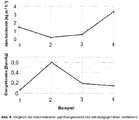
Die polymere Masse wies einen Feuchtegehalt von 47 % auf. Als Energiekosten wurden 0,07 Euro/kg bei einer Abscheiderate von 1,46 kg m-2 h-1 erzielt.
Außerdem wurde an der polymeren Masse eine Gelbfärbung beobachtet, was auf Korrosionsvorgänge an der Walzenoberfläche hinwies. - Wie Beispiel 1, jedoch war das Material der Walze W Titan, deren Oberfläche mit Iridiumoxid, sogenannt "DSA", beschichtet war.
Die polymere Masse wies einen Feuchtegehalt von 79 % auf. Als Energiekosten wurden 0,60 Euro/kg bei einer Abscheiderate von 0,24 kg m-2 h-1 erzielt.
An der polymeren Masse wurde keine Gelbfärbung beobachtet. - Wie Beispiel 2, jedoch war die Oberfläche der Walze W zusätzlich mit einer Nylon-Membran ausgestattet.
Die polymere Masse wies einen Feuchtegehalt von 44 % auf. Als Energiekosten wurden 0,19 Euro/kg bei einer Abscheiderate von 0,60 kg m-2 h-1 erzielt. - Wie Beispiel 3, jedoch wurden die Parameter Walzendrehzahl, Stromstärke, Abstand zwischen den Elektroden, sowie der Volumenstrom des Gemisches gemäß einer statistischen Versuchsplanung im Hinblick auf das Verhältnis von Abscheiderate und Energiekosten optimiert.
- Bei
- einer Walzendrehzahl von 0,045 U/min,
- einer Stromstärke von 22 A,
- einem Abstand zwischen den Elektroden von 6 mm, sowie
- einem Volumenstrom des Gemisches von 60 I/h
- Ausgehend von einem Anteil an Latexpartikeln in dem Gemisch von etwa 7 % vor der Durchführung des erfindungsgemäßen Verfahrens, war der Anteil bereits nach 20 min der Durchführung auf unter 1 % gesunken. Dies zeigt die
Abb. 5 . - Den Vergleich der Abscheideraten und Energiekosten anhand der Beispiele 1 - 4 zeigen die Diagramme in
Abb. 6 .
Claims (12)
- Verfahren zur Senkung der Konzentration polymerer Partikel in einem Gemisch, das polymere Partikel in wässrigem Medium aufweist,
dadurch gekennzeichnet, dass
die polymeren Partikel in dem wässrigen Medium ein ζ - Potential aufweisen, wobei,
falls das ζ - Potential gleich Null ist, dem Gemisch zumindest ein Emulgator zugemischt wird, der bewirkt, dass das ζ -Potential ≠ 0 ist,
und
das Gemisch zwischen zwei Elektroden gebracht wird, zwischen denen zumindest ein elektrostatisches Feld erzeugt wird,
so dass
die polymeren Partikel auf zumindest einem Teil der Oberfläche der positiven oder negativen Elektrode abgeschieden werden. - Verfahren nach Anspruch 1, wobei
zumindest eine positive Elektrode ein beweglicher Körper ist, der zumindest teilweise aus dem Gemisch herausbewegt werden kann, vorzugsweise ein Band, das teilweise oder ganz in das Gemisch eintaucht, weiter bevorzugt ein rotierendes Band, weiter bevorzugt ein rotierendes Endlosband oder eine rotierende Walze. - Verfahren nach Anspruch 2, wobei der bewegliche Körper eine rotierende Walze ist, die zu einem Teil ihrer Oberfläche in das Gemisch eingetaucht ist, so dass bei der Rotation der Walze stets ein Teil ihrer Oberfläche aus dem Gemisch heraustritt und ein anderer Teil in das Gemisch eintaucht.
- Verfahren nach einem der vorhergehenden Ansprüche, wobei
die elektrische Feldstärke zwischen jeweils einer positiven und einer negativen Elektrode eingestellt wird von 800 bis 12000 V m-1. - Verfahren nach einem der vorhergehenden Ansprüche, wobei
die polymeren Partikel Latexpartikel sind. - Verfahren nach einem der vorhergehenden Ansprüche, wobei
der Emulgator C15-Paraffinsulfonat ist. - Verfahren nach einem der vorhergehenden Ansprüche, wobei
der pH-Wert des wässrigen Mediums in einem Bereich von 1 bis 12 pH liegt, mehr bevorzugt von 1 bis 7 pH, besonders bevorzugt von 1 bis 4 pH. - Verfahren nach einem der vorhergehenden Ansprüche, wobei die abgeschiedenen polymeren Partikel mittels Rakeln, Spülen, Blasen, Bürsten oder Saugen von dem aus dem Gemisch herausbewegten Körper abgehoben werden.
- Vorrichtung zur Senkung der Konzentration polymerer Partikel in einem Gemisch, das polymere Partikel in wässrigem Medium aufweist, zur Durchführung des Verfahrens nach einem der Ansprüche 1 - 8, umfassend- zumindest eine Walze W als Anode oder Kathode, die in Rotation um eine Achse A versetzt ist und zumindest teilweise in das Gemisch G eintaucht, und- zumindest einen Behälter B als Kathode oder Anode, der zumindest teilweise mit dem Gemisch befüllt ist, und- zumindest eine Rakel R, dazu geeignet, die auf zumindest einem Teil der Oberfläche der Walze W abgeschiedenen polymeren Partikel p von der Oberfläche der in Rotation versetzten Walze W abzuheben.
- Vorrichtung nach Anspruch 9, wobei das Material der Walze W ausgewählt ist aus Stahl, Titan, Tantal, Kohlenstoff, Graphit, Aluminium, Platin, Kupfer, Silber, Gold, Palladium, Eisen, Nickel, Titan, Blei, oder Diamantelektrode.
- Vorrichtung nach Anspruch 9 oder 10, wobei die Walze W zumindest eine Beschichtung aufweist, vorzugsweise Iridiumoxid (DSA), Nylon-Membran, Kupfer, Gold, Silber, Blei, Platin, Nickel, oder eine Kombination dieser Beschichtungen.
- Vorrichtung nach einem der Ansprüche 9-11, wobei die Oberfläche der Walze W angeraut ist.
Priority Applications (1)
| Application Number | Priority Date | Filing Date | Title |
|---|---|---|---|
| EP20174119.6A EP3909918B1 (de) | 2020-05-12 | 2020-05-12 | Verfahren und vorrichtung zur elektrostatischen abscheidung von polymerpartikeln aus abwässern |
Applications Claiming Priority (1)
| Application Number | Priority Date | Filing Date | Title |
|---|---|---|---|
| EP20174119.6A EP3909918B1 (de) | 2020-05-12 | 2020-05-12 | Verfahren und vorrichtung zur elektrostatischen abscheidung von polymerpartikeln aus abwässern |
Publications (3)
| Publication Number | Publication Date |
|---|---|
| EP3909918A1 true EP3909918A1 (de) | 2021-11-17 |
| EP3909918B1 EP3909918B1 (de) | 2024-01-24 |
| EP3909918C0 EP3909918C0 (de) | 2024-01-24 |
Family
ID=70682600
Family Applications (1)
| Application Number | Title | Priority Date | Filing Date |
|---|---|---|---|
| EP20174119.6A Active EP3909918B1 (de) | 2020-05-12 | 2020-05-12 | Verfahren und vorrichtung zur elektrostatischen abscheidung von polymerpartikeln aus abwässern |
Country Status (1)
| Country | Link |
|---|---|
| EP (1) | EP3909918B1 (de) |
Citations (3)
| Publication number | Priority date | Publication date | Assignee | Title |
|---|---|---|---|---|
| DE4102238A1 (de) * | 1991-01-23 | 1992-07-30 | Univ Chemnitz Tech | Verfahren und vorrichtung zur aufbereitung von waessriger plastdispersion |
| JP2005087789A (ja) * | 2003-09-12 | 2005-04-07 | Fuji Photo Film Co Ltd | 廃水処理方法 |
| CN104710063A (zh) * | 2015-03-09 | 2015-06-17 | 中国海洋石油总公司 | 高盐含聚废水的光电催化/芬顿耦合处理系统及处理方法 |
-
2020
- 2020-05-12 EP EP20174119.6A patent/EP3909918B1/de active Active
Patent Citations (3)
| Publication number | Priority date | Publication date | Assignee | Title |
|---|---|---|---|---|
| DE4102238A1 (de) * | 1991-01-23 | 1992-07-30 | Univ Chemnitz Tech | Verfahren und vorrichtung zur aufbereitung von waessriger plastdispersion |
| JP2005087789A (ja) * | 2003-09-12 | 2005-04-07 | Fuji Photo Film Co Ltd | 廃水処理方法 |
| CN104710063A (zh) * | 2015-03-09 | 2015-06-17 | 中国海洋石油总公司 | 高盐含聚废水的光电催化/芬顿耦合处理系统及处理方法 |
Non-Patent Citations (2)
| Title |
|---|
| SCHMIDTVOLKMAR M.: "Elektrochemische Verfahrenstechnik", 2003, WILEY-VCH VERLAG |
| SIEBERTZKARLVAN BEBBERDAVIDHOCHKIRCHEN, THOMAS: "tatistische Versuchsplanung", 2010, SPRINGER-VERLAG |
Also Published As
| Publication number | Publication date |
|---|---|
| EP3909918B1 (de) | 2024-01-24 |
| EP3909918C0 (de) | 2024-01-24 |
Similar Documents
| Publication | Publication Date | Title |
|---|---|---|
| DE2930194C2 (de) | Vorrichtung zum Aufbereiten von Abwasser | |
| DE60308281T2 (de) | Verfahren zur Herstellung von elektrolysiertem Wasser | |
| EP0729796B1 (de) | Verfahren zur Abtötung von Mikroorganismen und/oder Mineralisierung organischer Substanzen im Boden und/oder im Grundwasser | |
| DE2545909A1 (de) | Verfahren und vorrichtung zur entfernung von schmutzstoffen aus abwasser | |
| DE2555175B2 (de) | Verfahren und Vorrichtung zum Reinigen von Abwässern | |
| WO1996017667A2 (de) | Vorrichtung zur spaltung von öl-in-wasser-emulsionen mittels elektrokoagulation | |
| DE1621916C3 (de) | Verfahren zum Überziehen eines elektrisch leitenden Gegenstandes in einem wässrigen Bad mit einem ionisierten organischen Harz und hierfür geeignete Vorrichtungen | |
| EP3909918B1 (de) | Verfahren und vorrichtung zur elektrostatischen abscheidung von polymerpartikeln aus abwässern | |
| DE2644357B1 (de) | Verfahren und Vorrichtung zur Aufbereitung von verunreinigtem Wasser | |
| DE3824289C2 (de) | ||
| EP3074347B1 (de) | Verfahren und vorrichtung zur behandlung einer wässrigen dispersion | |
| DE3838181A1 (de) | Verfahren und vorrichtung zur entfernung von stickstoffverbindungen aus waessrigen loesungen | |
| DE2644744C3 (de) | Verfahren und Vorrichtung zum Reinigen einer leitfähigen, verunreinigende Partikel enthaltenden Kühlflüssigkeit | |
| DE2421266C3 (de) | Vorrichtung zur elektrolytischen Abwasserbehandlung | |
| DE2500455C3 (de) | Verfahren zur Behandlung von Abwasser mittels Flotation | |
| DE102009036080A1 (de) | Verfahren zum Abbau von organischen Schadstoffen in industriellem Abwasser und zugehörige Anlage | |
| WO2015120963A1 (de) | Anlage zur beschichtung von gegenständen | |
| DE2218124A1 (de) | Verfahren zur Verringerung des Metallgehaltes einer Lösung | |
| DE883888C (de) | Verfahren zur Ausscheidung fester Stoffe oder von Kolloiden aus Fluessigkeiten mittels elektrischen Stromes | |
| DE19624023A1 (de) | Verfahren zur Anhebung des pH-Wertes sauerer Wässer | |
| EP0074530A1 (de) | Verfahren zur Abscheidung von in verunreinigtem Wasser enthaltenen Stoffen und Vorrichtung zur Durchführung des Verfahrens | |
| DE102018109314A1 (de) | Elektrochemischer Fällungsreaktor mit bewegter Elektrode | |
| EP3278866A1 (de) | Trennmodul und verfahren zur aufreinigung fluider medien | |
| DE102013103468A1 (de) | Reinigen von Abwasser schwankender elektrolytischer Leitfähigkeit mittels Elektroflotation | |
| DE102008010951A1 (de) | Filtrationsvorrichtung und Verfahren zum Betreiben einer Filtrationsvorrichtung für ein Elektrotauchlackiersystem |
Legal Events
| Date | Code | Title | Description |
|---|---|---|---|
| PUAI | Public reference made under article 153(3) epc to a published international application that has entered the european phase |
Free format text: ORIGINAL CODE: 0009012 |
|
| STAA | Information on the status of an ep patent application or granted ep patent |
Free format text: STATUS: THE APPLICATION HAS BEEN PUBLISHED |
|
| AK | Designated contracting states |
Kind code of ref document: A1 Designated state(s): AL AT BE BG CH CY CZ DE DK EE ES FI FR GB GR HR HU IE IS IT LI LT LU LV MC MK MT NL NO PL PT RO RS SE SI SK SM TR |
|
| B565 | Issuance of search results under rule 164(2) epc |
Effective date: 20201113 |
|
| STAA | Information on the status of an ep patent application or granted ep patent |
Free format text: STATUS: REQUEST FOR EXAMINATION WAS MADE |
|
| 17P | Request for examination filed |
Effective date: 20220420 |
|
| RBV | Designated contracting states (corrected) |
Designated state(s): AL AT BE BG CH CY CZ DE DK EE ES FI FR GB GR HR HU IE IS IT LI LT LU LV MC MK MT NL NO PL PT RO RS SE SI SK SM TR |
|
| STAA | Information on the status of an ep patent application or granted ep patent |
Free format text: STATUS: EXAMINATION IS IN PROGRESS |
|
| 17Q | First examination report despatched |
Effective date: 20220927 |
|
| GRAP | Despatch of communication of intention to grant a patent |
Free format text: ORIGINAL CODE: EPIDOSNIGR1 |
|
| STAA | Information on the status of an ep patent application or granted ep patent |
Free format text: STATUS: GRANT OF PATENT IS INTENDED |
|
| RIC1 | Information provided on ipc code assigned before grant |
Ipc: C02F 1/66 20060101ALN20230904BHEP Ipc: C02F 101/30 20060101ALN20230904BHEP Ipc: C02F 1/461 20060101ALN20230904BHEP Ipc: C02F 1/68 20060101ALI20230904BHEP Ipc: C02F 1/463 20060101AFI20230904BHEP |
|
| INTG | Intention to grant announced |
Effective date: 20231006 |
|
| GRAS | Grant fee paid |
Free format text: ORIGINAL CODE: EPIDOSNIGR3 |
|
| GRAA | (expected) grant |
Free format text: ORIGINAL CODE: 0009210 |
|
| STAA | Information on the status of an ep patent application or granted ep patent |
Free format text: STATUS: THE PATENT HAS BEEN GRANTED |
|
| AK | Designated contracting states |
Kind code of ref document: B1 Designated state(s): AL AT BE BG CH CY CZ DE DK EE ES FI FR GB GR HR HU IE IS IT LI LT LU LV MC MK MT NL NO PL PT RO RS SE SI SK SM TR |
|
| REG | Reference to a national code |
Ref country code: GB Ref legal event code: FG4D Free format text: NOT ENGLISH |
|
| REG | Reference to a national code |
Ref country code: CH Ref legal event code: EP |
|
| REG | Reference to a national code |
Ref country code: IE Ref legal event code: FG4D Free format text: LANGUAGE OF EP DOCUMENT: GERMAN |
|
| REG | Reference to a national code |
Ref country code: DE Ref legal event code: R096 Ref document number: 502020006801 Country of ref document: DE |
|
| REG | Reference to a national code |
Ref country code: DE Ref legal event code: R081 Ref document number: 502020006801 Country of ref document: DE Owner name: FREISTAAT BAYERN (FRIEDRICH-ALEXANDER-UNIVERSI, DE Free format text: FORMER OWNER: FREISTAAT BAYERN (FRIEDRICH-ALEXANDER-UNIVERSITAET ERLANGEN-NUERNBERG), 91054 ERLANGEN, DE Ref country code: DE Ref legal event code: R081 Ref document number: 502020006801 Country of ref document: DE Owner name: EVONIK OPERATIONS GMBH, DE Free format text: FORMER OWNER: FREISTAAT BAYERN (FRIEDRICH-ALEXANDER-UNIVERSITAET ERLANGEN-NUERNBERG), 91054 ERLANGEN, DE |
|
| U01 | Request for unitary effect filed |
Effective date: 20240205 |
|
| U07 | Unitary effect registered |
Designated state(s): AT BE BG DE DK EE FI FR IT LT LU LV MT NL PT SE SI Effective date: 20240214 |
|
| PG25 | Lapsed in a contracting state [announced via postgrant information from national office to epo] |
Ref country code: IS Free format text: LAPSE BECAUSE OF FAILURE TO SUBMIT A TRANSLATION OF THE DESCRIPTION OR TO PAY THE FEE WITHIN THE PRESCRIBED TIME-LIMIT Effective date: 20240524 |
|
| U20 | Renewal fee for the european patent with unitary effect paid |
Year of fee payment: 5 Effective date: 20240527 |
|
| PG25 | Lapsed in a contracting state [announced via postgrant information from national office to epo] |
Ref country code: GR Free format text: LAPSE BECAUSE OF FAILURE TO SUBMIT A TRANSLATION OF THE DESCRIPTION OR TO PAY THE FEE WITHIN THE PRESCRIBED TIME-LIMIT Effective date: 20240425 |
|
| PG25 | Lapsed in a contracting state [announced via postgrant information from national office to epo] |
Ref country code: HR Free format text: LAPSE BECAUSE OF FAILURE TO SUBMIT A TRANSLATION OF THE DESCRIPTION OR TO PAY THE FEE WITHIN THE PRESCRIBED TIME-LIMIT Effective date: 20240124 Ref country code: RS Free format text: LAPSE BECAUSE OF FAILURE TO SUBMIT A TRANSLATION OF THE DESCRIPTION OR TO PAY THE FEE WITHIN THE PRESCRIBED TIME-LIMIT Effective date: 20240424 |
|
| PG25 | Lapsed in a contracting state [announced via postgrant information from national office to epo] |
Ref country code: ES Free format text: LAPSE BECAUSE OF FAILURE TO SUBMIT A TRANSLATION OF THE DESCRIPTION OR TO PAY THE FEE WITHIN THE PRESCRIBED TIME-LIMIT Effective date: 20240124 |
|
| PG25 | Lapsed in a contracting state [announced via postgrant information from national office to epo] |
Ref country code: RS Free format text: LAPSE BECAUSE OF FAILURE TO SUBMIT A TRANSLATION OF THE DESCRIPTION OR TO PAY THE FEE WITHIN THE PRESCRIBED TIME-LIMIT Effective date: 20240424 Ref country code: NO Free format text: LAPSE BECAUSE OF FAILURE TO SUBMIT A TRANSLATION OF THE DESCRIPTION OR TO PAY THE FEE WITHIN THE PRESCRIBED TIME-LIMIT Effective date: 20240424 Ref country code: IS Free format text: LAPSE BECAUSE OF FAILURE TO SUBMIT A TRANSLATION OF THE DESCRIPTION OR TO PAY THE FEE WITHIN THE PRESCRIBED TIME-LIMIT Effective date: 20240524 Ref country code: HR Free format text: LAPSE BECAUSE OF FAILURE TO SUBMIT A TRANSLATION OF THE DESCRIPTION OR TO PAY THE FEE WITHIN THE PRESCRIBED TIME-LIMIT Effective date: 20240124 Ref country code: GR Free format text: LAPSE BECAUSE OF FAILURE TO SUBMIT A TRANSLATION OF THE DESCRIPTION OR TO PAY THE FEE WITHIN THE PRESCRIBED TIME-LIMIT Effective date: 20240425 Ref country code: ES Free format text: LAPSE BECAUSE OF FAILURE TO SUBMIT A TRANSLATION OF THE DESCRIPTION OR TO PAY THE FEE WITHIN THE PRESCRIBED TIME-LIMIT Effective date: 20240124 |
|
| PG25 | Lapsed in a contracting state [announced via postgrant information from national office to epo] |
Ref country code: PL Free format text: LAPSE BECAUSE OF FAILURE TO SUBMIT A TRANSLATION OF THE DESCRIPTION OR TO PAY THE FEE WITHIN THE PRESCRIBED TIME-LIMIT Effective date: 20240124 |
|
| PG25 | Lapsed in a contracting state [announced via postgrant information from national office to epo] |
Ref country code: PL Free format text: LAPSE BECAUSE OF FAILURE TO SUBMIT A TRANSLATION OF THE DESCRIPTION OR TO PAY THE FEE WITHIN THE PRESCRIBED TIME-LIMIT Effective date: 20240124 |
|
| PG25 | Lapsed in a contracting state [announced via postgrant information from national office to epo] |
Ref country code: SM Free format text: LAPSE BECAUSE OF FAILURE TO SUBMIT A TRANSLATION OF THE DESCRIPTION OR TO PAY THE FEE WITHIN THE PRESCRIBED TIME-LIMIT Effective date: 20240124 |
|
| PG25 | Lapsed in a contracting state [announced via postgrant information from national office to epo] |
Ref country code: CZ Free format text: LAPSE BECAUSE OF FAILURE TO SUBMIT A TRANSLATION OF THE DESCRIPTION OR TO PAY THE FEE WITHIN THE PRESCRIBED TIME-LIMIT Effective date: 20240124 |
|
| REG | Reference to a national code |
Ref country code: DE Ref legal event code: R097 Ref document number: 502020006801 Country of ref document: DE |
|
| PG25 | Lapsed in a contracting state [announced via postgrant information from national office to epo] |
Ref country code: SK Free format text: LAPSE BECAUSE OF FAILURE TO SUBMIT A TRANSLATION OF THE DESCRIPTION OR TO PAY THE FEE WITHIN THE PRESCRIBED TIME-LIMIT Effective date: 20240124 |
|
| PG25 | Lapsed in a contracting state [announced via postgrant information from national office to epo] |
Ref country code: SM Free format text: LAPSE BECAUSE OF FAILURE TO SUBMIT A TRANSLATION OF THE DESCRIPTION OR TO PAY THE FEE WITHIN THE PRESCRIBED TIME-LIMIT Effective date: 20240124 Ref country code: SK Free format text: LAPSE BECAUSE OF FAILURE TO SUBMIT A TRANSLATION OF THE DESCRIPTION OR TO PAY THE FEE WITHIN THE PRESCRIBED TIME-LIMIT Effective date: 20240124 Ref country code: CZ Free format text: LAPSE BECAUSE OF FAILURE TO SUBMIT A TRANSLATION OF THE DESCRIPTION OR TO PAY THE FEE WITHIN THE PRESCRIBED TIME-LIMIT Effective date: 20240124 |
|
| U1N | Appointed representative for the unitary patent procedure changed after the registration of the unitary effect |
Representative=s name: EVONIK PATENT ASSOCIATION; DE |
|
| PLBE | No opposition filed within time limit |
Free format text: ORIGINAL CODE: 0009261 |
|
| STAA | Information on the status of an ep patent application or granted ep patent |
Free format text: STATUS: NO OPPOSITION FILED WITHIN TIME LIMIT |
|
| REG | Reference to a national code |
Ref country code: CH Ref legal event code: PL |
|
| 26N | No opposition filed |
Effective date: 20241025 |
|
| PG25 | Lapsed in a contracting state [announced via postgrant information from national office to epo] |
Ref country code: MC Free format text: LAPSE BECAUSE OF FAILURE TO SUBMIT A TRANSLATION OF THE DESCRIPTION OR TO PAY THE FEE WITHIN THE PRESCRIBED TIME-LIMIT Effective date: 20240124 |
|
| GBPC | Gb: european patent ceased through non-payment of renewal fee |
Effective date: 20240512 |
|
| PG25 | Lapsed in a contracting state [announced via postgrant information from national office to epo] |
Ref country code: MC Free format text: LAPSE BECAUSE OF FAILURE TO SUBMIT A TRANSLATION OF THE DESCRIPTION OR TO PAY THE FEE WITHIN THE PRESCRIBED TIME-LIMIT Effective date: 20240124 Ref country code: CH Free format text: LAPSE BECAUSE OF NON-PAYMENT OF DUE FEES Effective date: 20240531 |
|
| PG25 | Lapsed in a contracting state [announced via postgrant information from national office to epo] |
Ref country code: IE Free format text: LAPSE BECAUSE OF NON-PAYMENT OF DUE FEES Effective date: 20240512 |
|
| PG25 | Lapsed in a contracting state [announced via postgrant information from national office to epo] |
Ref country code: GB Free format text: LAPSE BECAUSE OF NON-PAYMENT OF DUE FEES Effective date: 20240512 |
|
| U20 | Renewal fee for the european patent with unitary effect paid |
Year of fee payment: 6 Effective date: 20250528 |
|
| PG25 | Lapsed in a contracting state [announced via postgrant information from national office to epo] |
Ref country code: RO Free format text: LAPSE BECAUSE OF FAILURE TO SUBMIT A TRANSLATION OF THE DESCRIPTION OR TO PAY THE FEE WITHIN THE PRESCRIBED TIME-LIMIT Effective date: 20240124 |
|
| PG25 | Lapsed in a contracting state [announced via postgrant information from national office to epo] |
Ref country code: CY Free format text: LAPSE BECAUSE OF FAILURE TO SUBMIT A TRANSLATION OF THE DESCRIPTION OR TO PAY THE FEE WITHIN THE PRESCRIBED TIME-LIMIT; INVALID AB INITIO Effective date: 20200512 |
|
| PG25 | Lapsed in a contracting state [announced via postgrant information from national office to epo] |
Ref country code: HU Free format text: LAPSE BECAUSE OF FAILURE TO SUBMIT A TRANSLATION OF THE DESCRIPTION OR TO PAY THE FEE WITHIN THE PRESCRIBED TIME-LIMIT; INVALID AB INITIO Effective date: 20200512 |