EP3904888B1 - Automatic analysis device - Google Patents
Automatic analysis device Download PDFInfo
- Publication number
- EP3904888B1 EP3904888B1 EP19905745.6A EP19905745A EP3904888B1 EP 3904888 B1 EP3904888 B1 EP 3904888B1 EP 19905745 A EP19905745 A EP 19905745A EP 3904888 B1 EP3904888 B1 EP 3904888B1
- Authority
- EP
- European Patent Office
- Prior art keywords
- temperature
- reagent
- unit
- automatic analysis
- analysis device
- Prior art date
- Legal status (The legal status is an assumption and is not a legal conclusion. Google has not performed a legal analysis and makes no representation as to the accuracy of the status listed.)
- Active
Links
Images


Classifications
-
- G—PHYSICS
- G01—MEASURING; TESTING
- G01N—INVESTIGATING OR ANALYSING MATERIALS BY DETERMINING THEIR CHEMICAL OR PHYSICAL PROPERTIES
- G01N35/00—Automatic analysis not limited to methods or materials provided for in any single one of groups G01N1/00 - G01N33/00; Handling materials therefor
- G01N35/10—Devices for transferring samples or any liquids to, in, or from, the analysis apparatus, e.g. suction devices, injection devices
- G01N35/1002—Reagent dispensers
-
- G—PHYSICS
- G01—MEASURING; TESTING
- G01N—INVESTIGATING OR ANALYSING MATERIALS BY DETERMINING THEIR CHEMICAL OR PHYSICAL PROPERTIES
- G01N35/00—Automatic analysis not limited to methods or materials provided for in any single one of groups G01N1/00 - G01N33/00; Handling materials therefor
- G01N35/00584—Control arrangements for automatic analysers
- G01N35/00594—Quality control, including calibration or testing of components of the analyser
- G01N35/00613—Quality control
- G01N35/00663—Quality control of consumables
-
- B—PERFORMING OPERATIONS; TRANSPORTING
- B01—PHYSICAL OR CHEMICAL PROCESSES OR APPARATUS IN GENERAL
- B01L—CHEMICAL OR PHYSICAL LABORATORY APPARATUS FOR GENERAL USE
- B01L3/00—Containers or dishes for laboratory use, e.g. laboratory glassware; Droppers
- B01L3/52—Containers specially adapted for storing or dispensing a reagent
-
- B—PERFORMING OPERATIONS; TRANSPORTING
- B01—PHYSICAL OR CHEMICAL PROCESSES OR APPARATUS IN GENERAL
- B01L—CHEMICAL OR PHYSICAL LABORATORY APPARATUS FOR GENERAL USE
- B01L3/00—Containers or dishes for laboratory use, e.g. laboratory glassware; Droppers
- B01L3/56—Labware specially adapted for transferring fluids
-
- B—PERFORMING OPERATIONS; TRANSPORTING
- B01—PHYSICAL OR CHEMICAL PROCESSES OR APPARATUS IN GENERAL
- B01L—CHEMICAL OR PHYSICAL LABORATORY APPARATUS FOR GENERAL USE
- B01L7/00—Heating or cooling apparatus; Heat insulating devices
-
- B—PERFORMING OPERATIONS; TRANSPORTING
- B01—PHYSICAL OR CHEMICAL PROCESSES OR APPARATUS IN GENERAL
- B01L—CHEMICAL OR PHYSICAL LABORATORY APPARATUS FOR GENERAL USE
- B01L2200/00—Solutions for specific problems relating to chemical or physical laboratory apparatus
- B01L2200/16—Reagents, handling or storing thereof
-
- B—PERFORMING OPERATIONS; TRANSPORTING
- B01—PHYSICAL OR CHEMICAL PROCESSES OR APPARATUS IN GENERAL
- B01L—CHEMICAL OR PHYSICAL LABORATORY APPARATUS FOR GENERAL USE
- B01L2300/00—Additional constructional details
- B01L2300/06—Auxiliary integrated devices, integrated components
- B01L2300/0627—Sensor or part of a sensor is integrated
- B01L2300/0663—Whole sensors
-
- B—PERFORMING OPERATIONS; TRANSPORTING
- B01—PHYSICAL OR CHEMICAL PROCESSES OR APPARATUS IN GENERAL
- B01L—CHEMICAL OR PHYSICAL LABORATORY APPARATUS FOR GENERAL USE
- B01L2300/00—Additional constructional details
- B01L2300/18—Means for temperature control
-
- G—PHYSICS
- G01—MEASURING; TESTING
- G01N—INVESTIGATING OR ANALYSING MATERIALS BY DETERMINING THEIR CHEMICAL OR PHYSICAL PROPERTIES
- G01N35/00—Automatic analysis not limited to methods or materials provided for in any single one of groups G01N1/00 - G01N33/00; Handling materials therefor
- G01N2035/00346—Heating or cooling arrangements
- G01N2035/00425—Heating or cooling means associated with pipettes or the like, e.g. for supplying sample/reagent at given temperature
-
- G—PHYSICS
- G01—MEASURING; TESTING
- G01N—INVESTIGATING OR ANALYSING MATERIALS BY DETERMINING THEIR CHEMICAL OR PHYSICAL PROPERTIES
- G01N35/00—Automatic analysis not limited to methods or materials provided for in any single one of groups G01N1/00 - G01N33/00; Handling materials therefor
- G01N35/00584—Control arrangements for automatic analysers
- G01N35/00594—Quality control, including calibration or testing of components of the analyser
- G01N35/00613—Quality control
- G01N35/00663—Quality control of consumables
- G01N2035/00673—Quality control of consumables of reagents
Definitions
- the present invention relates to an automatic analysis device, and in particular, an automatic analysis device that adjusts the temperature of reagents used for analysis.
- PTL 1 describes that a rotating unit that houses and rotates a reaction vessel is supported via a bearing; the temperature of the fixed unit of the bearing is adjusted with the temperature adjusting unit to adjust the temperature of the reaction vessel via the bearing and the rotating unit; a temperature sensor is arranged in the temperature control unit, which is the fixed unit, to make it possible to detect the temperature of the temperature control unit; and it is possible to maintain the temperature at a predetermined temperature without impairing the measurement accuracy while having a simple configuration.
- An automatic analysis device is a device that performs analysis by dispensing a specimen solution containing a substance to be analyzed and a reaction reagent into a reaction vessel and reacting them, and optically measuring the reaction solution.
- an automatic analysis device for example, specific biological components and chemical substances contained in biological samples such as blood, serum, and urine are detected.
- An object of the present invention is to provide an automatic analysis device capable of controlling a temperature of a reagent used in the device with high accuracy compared to the related art.
- WO2018/047545 and EP2940477A1 discloses automatic analysers devices configured to adjust the temperature of the reagent supplied to the reaction vessel by the supply equipment.
- JPS63205567A relates to a pipetter for reagent.
- WO2018147029A1 relates to an automatic analysis device which has the function to regulate the temperature of a reactant to a prescribed temperature range.
- the present invention includes a plurality of means for solving the above-mentioned problems and an example thereof is an automatic analysis device according to claim 1.
- the temperature of the reagent used in the device can be controlled with high accuracy compared to the related art.
- the following examples are examples when applied to an automatic immunoassay analyzer.
- the present invention is not limited to the automatic immunoassay analyzer and can be applied to other types of automatic analysis devices such as automatic biochemical analysis devices that require temperature adjustment of reagents.
- it can be applied to an analysis unit that analyzes electrolyte analysis items of an automatic biochemical analysis device.
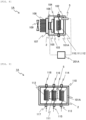
- Example 1 of the automatic analysis device of the present invention will be described with reference to Figs. 1 to 6 .
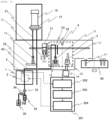
- Fig. 1 is a plan view showing the overall configuration of the automatic analysis device of Example 1.
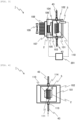
- Fig. 2 is an enlarged view of a processing unit and a liquid temperature adjusting unit in the automatic analysis device shown in Fig. 2 .
- an automatic analysis device 100 in this example is a device which reacts a specimen and a reagent and measures the reacted reaction solution and includes a specimen dispensing nozzle 303, a reaction table 60, a reaction vessel transport mechanism 306, a specimen dispensing tip and reaction vessel holding member 307, a reagent disk 311, a reagent dispensing nozzle 314, a processing unit 3, a detector 16, a rack conveyance line 317, and a control device 319.
- the rack conveyance line 317 is a line for transporting a rack 301 on which a plurality of specimen containers 302 containing a specimen can be placed to a specimen dispensing position or the like.
- the specimen dispensing nozzle 303 is a nozzle for sucking the specimen contained in the specimen container 302 and discharging the specimen to a reaction vessel 11.
- the reaction table 60 is a disk for performing the reaction between the specimen and the reagent at a constant temperature, and the temperature is maintained at a predetermined temperature by a heater (not illustrated) to promote the reaction between the specimen and the reagent.
- a plurality of reaction vessels 11 are held in the reaction table 60 and serve as a place for mixing and reacting the specimen and the reagent.
- the reaction vessel transport mechanism 306 transports the reaction vessel 11.
- the specimen dispensing tip and reaction vessel holding member 307 stores the disposable tip and the reaction vessel 11 used for specimen dispensation.
- the reagent disk 311 is a disk which stores a reagent bottle and is kept cold in order to suppress deterioration of the reagent.
- the reagent dispensing nozzle 314 is a nozzle for sucking the reagent stored in the reagent bottle within the reagent disk 311 and discharging the reagent to the reaction vessel 11.
- the processing unit 3 performs the treatment on the specimen before the analysis of the specimen by the detector 16.
- the detector 16 performs detection using the liquid in which the reaction has been completed within the reaction vessel 11. The details of the processing unit 3 and the detector 16 will be described later.
- the control device 319 controls various operations of the above-mentioned members and also performs computation processing for obtaining the concentration of a predetermined component in the specimen from the detection result performed by the detector 16.
- the control device 319 is provided with a control unit 219 that executes temperature control of a liquid temperature adjusting unit 1. The details of the control unit 219 will also be described later.
- the user disposes consumables such as the reagent bottles, the specimen dispensing tips, and the reaction vessels 11 necessary for the analysis on the reagent disk 311 and the specimen dispensing tip and reaction vessel holding member 307 within the analysis device.
- consumables such as the reagent bottles, the specimen dispensing tips, and the reaction vessels 11 necessary for the analysis on the reagent disk 311 and the specimen dispensing tip and reaction vessel holding member 307 within the analysis device.
- the user inserts the rack 301 into the automatic analysis device in a state where the specimen such as blood or urine to be analyzed is put in the specimen container 302.
- the specimen such as blood or urine to be analyzed
- an unused reaction vessel 11 and specimen dispensing tip are transported to the reaction table 60 and the specimen dispensing tip mounting position by the reaction vessel transport mechanism 306 of the analysis device.
- the reagent dispensing nozzle 314 accesses the inside of the reagent disk 311 to dispense the reagent stored within the reagent bottle into the reaction vessel 11 on the reaction table 60.
- the specimen is dispensed into the reaction vessel 11 by the specimen dispensing nozzle 303 and the reaction between the specimen and the reagent starts.
- the reaction referred to here means, for example, binding a specimen to a luminescent labeled substance by an antigen-antibody reaction using a luminescent labeled antibody that reacts only with a specific antigen of the specimen as a reagent.
- the stirring of the specimen and the reagent is performed by sucking and discharging the mixture of the specimen and the reagent within the specimen dispensing tip.
- the used specimen dispensing tip is transported to the disposal unit by the reaction vessel transport mechanism 306 and discarded.
- reaction vessel 11 placed on the reaction table 60 for a predetermined time by a transport mechanism 51 is transported to a magnetic separating unit 12 in the processing unit 3 which performs pretreatment of the analysis.
- the specimen is magnetically separated, then an unnecessary solution is discharged from a suction nozzle 52, and a reagent called a replacement solution is discharged from a discharge nozzle 53.
- the replacement solution is stored in a reagent storing unit 30 and is supplied by opening a solenoid valve 34 and closing a solenoid valve 35 to suck the reagent into a syringe pump 26 which intermittently feeds the reagent, and then closing the solenoid valve 34 and opening the solenoid valve 35 to discharge the reagent from the syringe pump 26.
- the temperature of the replacement solution is adjusted in advance in the liquid temperature adjusting unit 1 by a method described later.
- the suction nozzle 52, the discharge nozzle 53, the reagent storing unit 30, the solenoid valves 34 and 35, and the syringe pump 26 correspond to supply equipment which supplies reagents to the reaction vessel 11 disposed in the processing unit 3.
- the reaction vessel 11 is transported to a stirrer 13 in the processing unit 3 by the transport mechanism 51.
- the stirring is performed by rotating the reaction vessel 11 by a motor 14.
- the reaction vessel 11 is transported to the reaction table 60 again by the transport mechanism 51.
- the reaction vessel 11 that has passed a predetermined time while being placed on the reaction table 60 is transported to a container holding unit 22 by the transport mechanism 51, and the reaction solution is guided from the suction nozzle 21 to a detection container 15.
- the detector 16 detects the signal from the reaction solution, and the analysis result is notified to the user and recorded in the storage device.
- reaction vessel 11 is transported to the disposal unit by the transport mechanism 51 and the reaction vessel transport mechanism 306 and discarded.
- the temperature adjustment of the replacement solution by the liquid temperature adjusting unit 1 shown below is preferably started at the time of warming up of the automatic analysis device 100 and stably executed at the time of standby.
- the timing is not particularly limited and it is desirable that the temperature adjustment is stably performed during the analysis.
- a first temperature detection unit 4 which detects the temperature of the air within the processing unit 3 is provided in the vicinity of the magnetic separating unit 12 and the stirrer 13 in the processing unit 3.
- liquid temperature adjusting unit 1 which adjusts the temperature of the replacement solution is provided with a second temperature detection unit 5 which measures the liquid temperature at the outlet of a spiral pipe 110 (see Fig. 3 and the like) in order to detect the temperature of the reagent supplied to the processing unit 3.
- the first temperature detection unit 4 and the second temperature detection unit 5 are composed of a thermistor, a thermocouple, or the like, and the detection signal is taken into a sensor input processing unit 202 of a control unit 201.
- the signals from the first temperature detection unit 4 and the second temperature detection unit 5 are taken into the sensor input processing unit 202 of the control unit 201, a target temperature computation unit 203 calculates a target liquid temperature of the second temperature detection unit 5, and a Peltier element control unit 204 controls the energization of the Peltier element.
- the control unit 201 obtains a target value of the second temperature to be detected by the second temperature detection unit 5 based on a first temperature detected by the first temperature detection unit 4 and outputs a control signal which executes temperature adjustment based on a difference between the measured second temperature and the target value with respect to the liquid temperature adjusting unit 1.
- the liquid temperature adjusting unit 1 executes the temperature adjustment of the replacement solution based on the control signal.
- control unit 201 executes temperature adjustment such that as the first temperature is higher, the second temperature is lower, and the first temperature is lower, the second temperature is higher.
- the liquid temperature adjusting unit 1 includes a metal block 101, the spiral pipe 110, connectors 113 and 114, thermal interfaces 104, 105, and 106, a heat diffusion plate 103, a first Peltier element 2, a fin base 107, fins 108, and a heat insulating material 102.
- the metal block 101 is a metal block made of a metal having high thermal conductivity such as aluminum, and the spiral pipe 110 obtained by spirally forming a pipe such as stainless steel is attached.
- a method of attaching the spiral pipe 110 there is a method of making a through hole in the metal block 101 open, inserting the spiral pipe 110, pouring solder or the like into the periphery, and fixing the spiral pipe 110.
- the connectors 113 and 114 are attached to the inlet and outlet of the spiral pipe 110.
- the connectors 113 and 114 are threaded and are connected to a tube 43 for supplying the replacement solution from the reagent storing unit 30 to the discharge nozzle 53 by a tube joint. It is not necessary to use the spiral pipe 110, and a pipe having another shape such as a straight line may be used.
- the heat diffusion plate 103 made of aluminum or the like is connected to the metal block 101 described above via the thermal interface 104 such as grease. Further, the first Peltier element 2 is connected to the surface of the metal block 101 different from the surface connected to the heat diffusion plate 103 via the thermal interface 105. Further, a heat sink composed of the fin base 107 and the fin 108 is connected to the opposite surface of the first Peltier element 2 via the thermal interface 106.
- the first Peltier element 2, the thermal interfaces 104, 105, and 106, and the heat diffusion plate 103 are fixed by a method of sandwiching them between the metal block 101 and the fin base 107 and fixing them with screws.
- the periphery of the metal block 101 is insulated by the heat insulating material 102.
- thermal interfaces 104, 105, and 106 are all described as thermal grease.
- the first Peltier element 2 is energized such that temperature of the surface on the metal block 101 side is low and the temperature of the surface on the fin base 107 side is high.
- the heat of the reagent moving in the spiral pipe 110 or the heat of the reagent staying therein is absorbed by the first Peltier element 2 through the metal block 101, a grease 104, the heat diffusion plate 103, and a grease 105. Further, the surface of the first Peltier element 2 on the opposite side generates heat (radiate heat), and the heat is transferred from a grease 106 and the fin base 107 to the fins 108, and is radiated to the air flowing between the fin 108 by a fan 109.
- the element is energized such that the surface of the first Peltier element 2 on the metal block 101 side is high and the temperature of the fin base 107 side is low.
- the temperature of the fins 108 is lower than the air temperature, and the heat is taken from the air flowing between the fins by the fan 109 and absorbed by the first Peltier element 2 via the fin base 107 and the grease 106. Further, the surface of the first Peltier element 2 on the opposite side generates heat (radiate heat), and the heat is applied to the reagent moving in the spiral pipe 110 or the reagent staying therein through the grease 105, the heat diffusion plate 103, the grease 104, and the metal block 101.
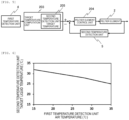
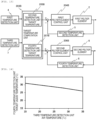
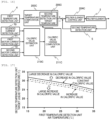
- Fig. 5 shows a block diagram of the Peltier element control.
- the target temperature computation unit 203 calculates a target temperature 205 to be detected by the second temperature detection unit 5 from the air temperature in the vicinity of the processing unit 3 detected by the first temperature detection unit 4.
- the Peltier element control unit 204 obtains a current value to be output to the first Peltier element 2 based on a difference between the target temperature of the second temperature detection unit 5 calculated by the target temperature computation unit 203 and the temperature of the reagent actually detected by the second temperature detection unit 5 and outputs a command signal such that the obtained current value flows to the first Peltier element 2.
- the current on and off time ratio that is, the duty is controlled based on the proportional-integro-differential control (PID control) at regular time intervals, thereby controlling the cooling or heating capacity of the first Peltier element 2.
- PID control proportional-integro-differential control
- the cooling and heating capacities of the Peltier element may be controlled by changing the current flowing through the first Peltier element 2.
- the first Peltier element 2 is continuously energized.
- Fig. 6 shows an example of the relationship between the air temperature detected by the first temperature detection unit 4 and the target liquid temperature of the second temperature detection unit 5.
- the target temperature of the second temperature detection unit 5 that is, the liquid temperature of the reagent (replacement solution) is set to be lower.
- the target temperature of the second temperature detection unit 5 that is, the liquid temperature of the reagent (replacement solution) may be set to be high.
- the automatic analysis device 100 of Example 1 of the present invention described above includes the processing unit 3 which performs the treatment on a specimen before the analysis of the specimen, the supply equipment which supplies a reagent to the reaction vessel 11 disposed in the processing unit 3, the liquid temperature adjusting unit 1 which adjusts the temperature of the reagent supplied to the reaction vessel 11 by the supply equipment, the control unit 201, and the first temperature detection unit 4 which detects at least one temperature of the temperature of the air within the processing unit 3 and the temperature of the reagent supplied to the reaction vessel 11, in which the liquid temperature adjusting unit 1 and the control unit 201 execute temperature adjustment of the reagent based on the first temperature detected by the first temperature detection unit 4.
- the temperature of the reagent in the magnetic separating unit 12 and the stirrer 13 can be maintained in a constant temperature range, the reaction between the specimen and the reagent is performed under more appropriate conditions and the analytical accuracy of the detector 16 can be improved. That is, the temperature of the reagent in the pretreatment step of analysis can be controlled more accurately, and an automatic analysis device with high analytical accuracy can be realized.
- a second temperature detection unit 5 which is disposed within the liquid temperature adjusting unit 1 and detects the temperature of the reagent supplied to the processing unit 3 is further provided, and since the liquid temperature adjusting unit 1 and the control unit 201 obtain a target value of the second temperature detected by the second temperature detection unit 5 based on the first temperature and the temperature adjustment is executed based on a difference between the second temperature and the target value, the temperature of the reagent in the magnetic separating unit 12 and the stirrer 13 can be maintained in a constant temperature range with higher accuracy.
- liquid temperature adjusting unit 1 and the control unit 201 execute temperature adjustment such that as the first temperature is higher, the second temperature is lower, and as the first temperature is lower, the second temperature is higher. Therefore, the temperature of the reagent in the magnetic separating unit 12 and the stirrer 13 can be maintained in a constant temperature range.
- the processing unit 3 is set as a portion to perform treatment with respect to the reaction solution at a position that greatly contributes to the improvement of analytical accuracy, thereby making it possible to further contribute to the improvement of analytical accuracy.
- the control unit 201 may use the average value of both or may use both with weight on either one.
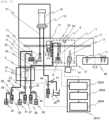
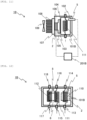
- FIG. 7 is an enlarged view of a processing unit and a liquid temperature adjusting unit in the automatic analysis device according to Example 2.
- Fig. 8 is a diagram showing the structure of the processing unit of the automatic analysis device in Example 2
- Fig. 9 is a diagram showing the structure of the liquid temperature adjusting unit when viewed from a direction different from that of Fig. 8 .
- a reagent container 9 for containing the reaction auxiliary liquid which is a reagent supplied to the detection container 15, and a reagent container 10 for containing a cleaning solution are disposed in the container holding unit 22.
- the reagent (reaction auxiliary liquid) in the reagent container 9 is supplied from the reagent storing unit 31 by operating a syringe pump 27 and solenoid valves 36 and 37.
- the reagent (cleaning solution) of the reagent container 10 is supplied from the reagent storing unit 32 by operating a syringe pump 28 and solenoid valves 38 and 39.
- the container holding unit 22 can rotate and move up and down.
- the reagents within the reagent containers 9 and 10 and the solution within the reaction vessel 11 are guided to the detection container 15 by operating a syringe pump 29 and solenoid valves 40 and 41, in a state where the container holding unit 22 is rotated and moved up and down such that the tip of the suction nozzle 21 enters the required container.
- the detector 16 detects the signal from the reaction solution, and then the reaction solution and the reagent are discharged to a waste liquid container 42.
- the operation of the container holding unit 22 and the operations of the syringe pumps 27 and 28 and the solenoid valves 36, 37, 38, and 39 are executed according to a predetermined sequence.
- spiral pipes 111 and 112 having the same shape as the spiral pipe 110 are attached to a metal block 101A such as aluminum, in addition to the spiral pipe 110 obtained by spirally forming a pipe such as stainless steel.
- Connectors 113, 114, 115, 116, 117, are 118 are attached to the inlet and outlet of the spiral pipes 110, 111, and 112.
- the connectors 113, 114, 115, 116, 117, and 118 are threaded and connected to the tube 43 by a tube joint.
- a control unit 201A controls the temperature adjustment by a liquid temperature adjusting unit 1A such that the temperature of the reagents supplied to the reagent containers 9 and 10 is also adjusted based on the first temperature.
- a sensor input processing unit 202A The configuration and operation of a sensor input processing unit 202A, a target temperature computation unit 203A, and a Peltier element control unit 204A are the same as those of the sensor input processing unit 202, the target temperature computation unit 203, and the Peltier element control unit 204, respectively.
- the automatic analysis device of Example 2 of the present invention also has almost the same effect as the automatic analysis device of Example 1 described above.
- the reagent containers 9 and 10 which temporarily hold the reagent supplied to the detection container 15 for analyzing the specimen, and the container holding unit 22 which holds the reaction vessel 11 and the reagent containers 9 and 10 are further provided and the liquid temperature adjusting unit 1A and the control unit 201A also adjust the temperature of the reagent supplied to the reagent containers 9 and 10 based on the first temperature. Therefore, the temperature of the reagent supplied to the detection container 15 via the reagent containers 9 and 10 located closer to the detector 16 can also be adjusted and the analytical accuracy in the detector 16 can be further improved.
- Fig. 10 is an enlarged view of a processing unit and a liquid temperature adjusting unit in the automatic analysis device in Example 3.
- Fig. 11 is a diagram showing the structure of the liquid temperature adjusting unit of the automatic analysis device in Example 3
- Fig. 12 is a diagram showing the structure when viewed from a direction different from that of Fig. 11 .
- Fig. 13 is a block diagram showing a control method of the liquid temperature adjusting unit of the automatic analysis device in Example 3.
- Fig. 14 is a diagram showing an example of the relationship between the air temperature of a third temperature detection unit and a target liquid temperature of a fourth temperature detection unit of the automatic analysis device in Example 3.
- a third temperature detection unit 7 which detects the air temperature around the container holding unit 22 is further provided.
- a liquid temperature adjusting unit 1B which adjusts the temperature of the replacement solution and the reagent of this example is provided with a fourth temperature detection unit 8 which detects the temperature of the reagents supplied to the reagent containers 9 and 10 in addition to the second temperature detection unit 5 which measures the liquid temperature at the outlet of the reagent.
- the signals from the first temperature detection unit 4, the second temperature detection unit 5, the third temperature detection unit 7, and the fourth temperature detection unit 8 are taken into a sensor input processing unit 202B of a control unit 201B.
- a metal block 101B is connected to a second Peltier element 6 via the thermal interface 105 in addition to the heat sink including the heat diffusion plate 103, the first Peltier element 2, the fin base 107, and the fins 108.
- the fourth temperature detection unit 8 composed of a thermistor or a thermocouple is provided in the vicinity of the outlets of the spiral pipes 111 and 112. The signal from the fourth temperature detection unit 8 is taken into the sensor input processing unit 202B of the control unit 201B.
- first Peltier element 2 and the second Peltier element 6 are provided in the same metal block 101B
- first Peltier element 2 and the second Peltier element 6 can be provided in separate metal blocks, and in this case, a heat insulating material or the like can be used therebetween.
- a target temperature computation unit 203B calculates a target temperature 205B of the second temperature detection unit 5 from the air temperature in the vicinity of the processing unit 3 detected by the second temperature detection unit 5. Further, the target temperature computation unit 203B calculates a target temperature 207B of the test solution to be detected by the fourth temperature detection unit from the air temperature in the vicinity of the container holding unit 22 detected by the third temperature detection unit 7.
- a first Peltier element control unit 204B controls the duty of the current output to the first Peltier element 2 based on the target temperature of the second temperature detection unit 5 calculated by the target temperature computation unit 203B and the actual temperature detected by the second temperature detection unit 5.
- a second Peltier element control unit 206B controls the duty of the current output to the second Peltier element 6 based on the target temperature of the fourth temperature detection unit calculated by the target temperature computation unit 203B and the actual temperature detected by the fourth temperature detection unit 8.
- the target temperature of the second temperature detection unit 5 obtained by the target temperature computation unit 203B, as shown in Fig. 6 , as the air temperature in the vicinity of the processing unit 3 detected by the first temperature detection unit 4 is higher, the target temperature of the second temperature detection unit 5, that is, the temperature of the reagent (replacement solution) is set to be lower.
- the target temperature of the fourth temperature detection unit 8 that is, the temperature of the reagent (the reaction auxiliary liquid and cleaning solution) is set to be lower.
- the automatic analysis device of Example 3 of the present invention also has almost the same effect as the automatic analysis device of Example 1 described above.
- the third temperature detection unit 7 which detects at least one of the temperature of the air around the container holding unit 22 and the temperature of the reagents within the reagent containers 9 and 10 is further provided, and the liquid temperature adjusting unit 1B and the control unit 201B execute temperature adjustment of the reagents supplied to the reagent containers 9 and 10 based on the third temperature detected by the third temperature detection unit 7, and thus, the temperature of the reagent supplied to the detection container 15 via the reagent containers 9 and 10 can be adjusted and the analytical accuracy can be further improved as compared with Example 2.
- the liquid temperature adjusting unit 1B and the control unit 201B further include the fourth temperature detection unit 8 which detects the temperature of the reagents supplied to the reagent containers 9 and 10, and the liquid temperature adjusting unit 1B and the control unit 201B obtain a target value of the fourth temperature detected by the fourth temperature detection unit 8 based on the third temperature and execute temperature adjustment based on the difference between the fourth temperature and the target value.
- the liquid temperature adjusting unit 1B and the control unit 201B execute temperature adjustment such that as the third temperature is higher, the fourth temperature is lower, and as the third temperature is lower, the fourth temperature is higher.
- the temperature of the reagents supplied to the container 15 via the reagent containers 9 and 10 can be adjusted with higher accuracy.
- the first temperature detection unit 4 detects the air temperature in the vicinity of the processing unit 3, but instead or additionally, the temperature of the reagent within the reaction vessel 11 can be detected. Further, although the case where the third temperature detection unit 7 detects the air temperature in the vicinity of the container holding unit 22 has been described, instead or additionally, the liquid temperature within the reagent container 9 and/or the reagent container 10 can be detected.
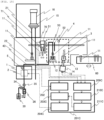
- Fig. 15 is an enlarged view of a processing unit and a liquid temperature adjusting unit in the automatic analysis device in Example 4.
- Fig. 16 is a block diagram showing a control method of the liquid temperature adjusting unit of the automatic analysis device in Example 4.
- Fig. 17 is a diagram showing an example of the relationship between the estimated values of the air temperature and the change in the calorific value of the first temperature detection unit and a target liquid temperature of the second temperature detection unit in the automatic analysis device in Example 4.
- detection units 70 and 71 of a motor and solenoid provided in the transport mechanism 51 and a detection unit 72 of a motor 14 for rotationally driving the stirrer 13 are provided to detect a current flowing through the motor or the like.
- the detection units 70, 71, and 72 may detect voltage or both current and voltage.
- a control unit 201C is provided with a second sensor input processing unit 209C, a calorific value estimation unit 210C, and a calorific value change computation unit 211C.
- the calorific value estimation unit 210C estimates the calorific value based on the current of the motor or the like detected by the detection units 70, 71, and 72, and the calorific value change computation unit 211C calculates a change in the calorific value.
- a target temperature computation unit 203C calculates a target temperature 205C of the second temperature detection unit 5 based on the air temperature in the vicinity of the processing unit 3 detected by the first temperature detection unit 4 and the change in the calorific value obtained by the calorific value change computation unit 211C.
- a Peltier element control unit 204C controls the duty of the current output to the first Peltier element 2 based on the target temperature 205C of the second temperature detection unit 5 and the temperature actually detected by the second temperature detection unit 5.
- Fig. 17 shows an example of the relationship between the temperature detected by the first temperature detection unit 4 and the target liquid temperature of the second temperature detection unit 5 with the change in the calorific value obtained by the calorific value change computation unit 211C as a parameter.
- Fig. 17 it is set such that as the air temperature in the vicinity of the processing unit 3 detected by the first temperature detection unit 4 is higher, the target temperature of the second temperature detection unit 5, that is, the temperature of the reagent (replacement solution) is lower, and it is set such that as the increase in the calorific value is greater, the target liquid temperature of the second temperature detection unit 5 is lower, and as the decrease in the calorific value is greater, the target liquid temperature of the second temperature detection unit 5 is higher.
- the automatic analysis device of Example 4 of the present invention also has almost the same effect as the automatic analysis device of Example 1 described above.
- an estimation unit which estimates the calorific value of the heating element existing within the automatic analysis device 100 is further provided, and the liquid temperature adjusting unit 1 and the control unit 201C obtain the target value of the second temperature detected by the second temperature detection unit 5 based on the change in the calorific value estimated by the estimation unit in addition to the first temperature and execute temperature adjustment based on the difference between the second temperature and the target value.
- the liquid temperature adjusting unit 1 and the control unit 201C execute temperature adjustment such that as the increase in the calorific value is greater, the second temperature is lower, and as the increase in the calorific value is smaller, the second temperature is higher.
- the cooling capacity of the first Peltier element 2 is adjusted in response to fluctuations in the calorific value, the temperature of the reagent in the magnetic separating unit 12 and the stirrer 13 can be maintained in a constant temperature range with higher accuracy. Therefore, the reaction between the specimen and the reagent can be performed under more appropriate conditions, and the analytical accuracy in the detector 16 can be further improved.
- the estimation of the calorific value as in this example can be executed by the liquid temperature adjusting unit 1A of Example 2 and the liquid temperature adjusting unit 1B of Example 3.
- the liquid temperature adjusting unit 1 and the control unit 201C can obtain the target value of the fourth temperature described in Example 3 based on the change in the calorific value estimated by the estimation unit in addition to the third temperature described in Example 3 and execute temperature adjustment based on the difference between the fourth temperature and the target value.
- the temperature adjustment can be executed such that as the increase in the calorific value is greater, the fourth temperature is lower, and as the increase in the calorific value is smaller, the fourth temperature becomes higher.
- the temperature of the reagent supplied to the detection container 15 via the reagent containers 9 and 10 can be adjusted with higher accuracy and the analytical accuracy of the detector 16 can be further improved.
- the present invention is not limited to the above embodiments and includes various modifications.
- the above-mentioned embodiments have been described in detail in order to explain the present invention in an easy-to-understand manner and are not necessarily limited to those having all the described configurations.
Landscapes
- Health & Medical Sciences (AREA)
- Chemical & Material Sciences (AREA)
- Clinical Laboratory Science (AREA)
- Chemical Kinetics & Catalysis (AREA)
- Quality & Reliability (AREA)
- Engineering & Computer Science (AREA)
- Life Sciences & Earth Sciences (AREA)
- Biochemistry (AREA)
- General Health & Medical Sciences (AREA)
- General Physics & Mathematics (AREA)
- Immunology (AREA)
- Pathology (AREA)
- Analytical Chemistry (AREA)
- Physics & Mathematics (AREA)
- Medicinal Chemistry (AREA)
- Automatic Analysis And Handling Materials Therefor (AREA)
Applications Claiming Priority (2)
| Application Number | Priority Date | Filing Date | Title |
|---|---|---|---|
| JP2018246148A JP7157658B2 (ja) | 2018-12-27 | 2018-12-27 | 自動分析装置 |
| PCT/JP2019/039745 WO2020137081A1 (ja) | 2018-12-27 | 2019-10-09 | 自動分析装置 |
Publications (3)
| Publication Number | Publication Date |
|---|---|
| EP3904888A1 EP3904888A1 (en) | 2021-11-03 |
| EP3904888A4 EP3904888A4 (en) | 2022-09-28 |
| EP3904888B1 true EP3904888B1 (en) | 2025-06-25 |
Family
ID=71126263
Family Applications (1)
| Application Number | Title | Priority Date | Filing Date |
|---|---|---|---|
| EP19905745.6A Active EP3904888B1 (en) | 2018-12-27 | 2019-10-09 | Automatic analysis device |
Country Status (5)
| Country | Link |
|---|---|
| US (1) | US11953508B2 (enExample) |
| EP (1) | EP3904888B1 (enExample) |
| JP (1) | JP7157658B2 (enExample) |
| CN (1) | CN112912734A (enExample) |
| WO (1) | WO2020137081A1 (enExample) |
Families Citing this family (6)
| Publication number | Priority date | Publication date | Assignee | Title |
|---|---|---|---|---|
| CN115244404B (zh) * | 2020-03-17 | 2025-12-09 | 株式会社日立高新技术 | 自动分析装置 |
| US20250004003A1 (en) * | 2021-09-30 | 2025-01-02 | Hitachi High-Tech Corporation | Automatic analyzer |
| WO2023127878A1 (ja) * | 2021-12-28 | 2023-07-06 | 積水メディカル株式会社 | 自動分析装置及び自動分析装置の試薬分注方法 |
| US12050232B2 (en) * | 2021-12-31 | 2024-07-30 | Instrumentation Laboratory Company | Systems and methods for probe tip heating |
| JPWO2023189671A1 (enExample) | 2022-03-31 | 2023-10-05 | ||
| JP2024030088A (ja) * | 2022-08-23 | 2024-03-07 | 株式会社日立ハイテク | 自動分析装置 |
Citations (1)
| Publication number | Priority date | Publication date | Assignee | Title |
|---|---|---|---|---|
| US20160018426A1 (en) * | 2014-07-21 | 2016-01-21 | Sakae Co., Ltd. | Automatic analysis device |
Family Cites Families (21)
| Publication number | Priority date | Publication date | Assignee | Title |
|---|---|---|---|---|
| JPS63205567A (ja) | 1987-02-20 | 1988-08-25 | Nittec Co Ltd | 試薬用ピペツト装置 |
| US6558626B1 (en) * | 2000-10-17 | 2003-05-06 | Nomadics, Inc. | Vapor sensing instrument for ultra trace chemical detection |
| JP4118618B2 (ja) | 2002-07-01 | 2008-07-16 | シスメックス株式会社 | 試料分析装置 |
| US7691334B2 (en) * | 2005-09-20 | 2010-04-06 | Yamaha Corporation | Temperature control apparatus for microchemical chip |
| CN1963527B (zh) * | 2005-11-10 | 2011-12-14 | 深圳迈瑞生物医疗电子股份有限公司 | 全自动生化分析仪及其分析方法 |
| JP5205802B2 (ja) * | 2007-05-11 | 2013-06-05 | ソニー株式会社 | リアルタイムpcr装置 |
| JP2010066108A (ja) * | 2008-09-10 | 2010-03-25 | Olympus Corp | 自動分析装置および自動分析装置の駆動制御方法 |
| JP5393608B2 (ja) * | 2010-07-20 | 2014-01-22 | 株式会社日立ハイテクノロジーズ | 自動分析装置 |
| CN102537978A (zh) * | 2010-12-16 | 2012-07-04 | 株式会社久保田 | 污泥燃烧控制方法以及污泥燃烧设备 |
| CN102623725A (zh) * | 2011-01-30 | 2012-08-01 | 扬光绿能股份有限公司 | 燃料电池系统及其控制方法 |
| JP2012159392A (ja) * | 2011-01-31 | 2012-08-23 | Sysmex Corp | 分析装置及び分析方法 |
| JP2013088164A (ja) * | 2011-10-14 | 2013-05-13 | Hitachi High-Technologies Corp | 自動分析装置 |
| JP5921336B2 (ja) | 2012-05-28 | 2016-05-24 | 株式会社日立ハイテクノロジーズ | 自動分析装置及び前処理装置 |
| JP5882177B2 (ja) * | 2012-10-19 | 2016-03-09 | 株式会社日立製作所 | 生体物質回収方法及び生体物質回収装置 |
| CN104871007A (zh) * | 2012-12-26 | 2015-08-26 | 株式会社日立高新技术 | 自动分析装置 |
| JP6546374B2 (ja) * | 2014-07-21 | 2019-07-17 | 株式会社サカエ | 自動分析装置 |
| JP6718679B2 (ja) * | 2015-12-28 | 2020-07-08 | マクセルホールディングス株式会社 | 温風乾燥機 |
| EP3511720B1 (en) * | 2016-09-08 | 2021-04-28 | Hitachi High-Tech Corporation | Automatic analyzer |
| CN108181210A (zh) * | 2016-12-08 | 2018-06-19 | 深圳市帝迈生物技术有限公司 | 一种血液细胞分析仪及其反应池温度控制装置 |
| US11300488B2 (en) | 2017-02-07 | 2022-04-12 | Hitachi High-Tech Corporation | Automatic analysis device |
| EP3633366B1 (en) * | 2017-04-26 | 2025-11-19 | Shimadzu Corporation | Liquid feeding device and fluid chromatograph |
-
2018
- 2018-12-27 JP JP2018246148A patent/JP7157658B2/ja active Active
-
2019
- 2019-10-09 US US17/285,972 patent/US11953508B2/en active Active
- 2019-10-09 CN CN201980068157.9A patent/CN112912734A/zh active Pending
- 2019-10-09 EP EP19905745.6A patent/EP3904888B1/en active Active
- 2019-10-09 WO PCT/JP2019/039745 patent/WO2020137081A1/ja not_active Ceased
Patent Citations (1)
| Publication number | Priority date | Publication date | Assignee | Title |
|---|---|---|---|---|
| US20160018426A1 (en) * | 2014-07-21 | 2016-01-21 | Sakae Co., Ltd. | Automatic analysis device |
Also Published As
| Publication number | Publication date |
|---|---|
| EP3904888A4 (en) | 2022-09-28 |
| JP2020106424A (ja) | 2020-07-09 |
| CN112912734A (zh) | 2021-06-04 |
| JP7157658B2 (ja) | 2022-10-20 |
| EP3904888A1 (en) | 2021-11-03 |
| WO2020137081A1 (ja) | 2020-07-02 |
| US20210382078A1 (en) | 2021-12-09 |
| US11953508B2 (en) | 2024-04-09 |
Similar Documents
| Publication | Publication Date | Title |
|---|---|---|
| US11953508B2 (en) | Automatic analysis device | |
| EP3971578B1 (en) | Automated analyzer | |
| EP3511720B1 (en) | Automatic analyzer | |
| JP6742463B2 (ja) | 自動分析装置およびメンテナンスの要否を推奨する方法 | |
| EP3822640B1 (en) | Automated analyzer | |
| US11498076B2 (en) | Methods and apparatus for rapid heating of biological specimens | |
| EP2593054B1 (en) | Methods, systems, and apparatus providing temperatures-controlled process fluid | |
| EP2856039B1 (en) | Method and system providing a temperature- controlled process liquid | |
| JP6126387B2 (ja) | 二重管構造試料吸引ノズルを備えた電解質分析装置 | |
| US20250010301A1 (en) | Examination apparatus | |
| JP5978039B2 (ja) | 自動分析装置 | |
| EP4675280A1 (en) | Liquid storage device | |
| JP2024030088A (ja) | 自動分析装置 | |
| HK40013943A (zh) | 用於快速加热生物样本的方法和设备 |
Legal Events
| Date | Code | Title | Description |
|---|---|---|---|
| STAA | Information on the status of an ep patent application or granted ep patent |
Free format text: STATUS: THE INTERNATIONAL PUBLICATION HAS BEEN MADE |
|
| PUAI | Public reference made under article 153(3) epc to a published international application that has entered the european phase |
Free format text: ORIGINAL CODE: 0009012 |
|
| STAA | Information on the status of an ep patent application or granted ep patent |
Free format text: STATUS: REQUEST FOR EXAMINATION WAS MADE |
|
| 17P | Request for examination filed |
Effective date: 20210419 |
|
| AK | Designated contracting states |
Kind code of ref document: A1 Designated state(s): AL AT BE BG CH CY CZ DE DK EE ES FI FR GB GR HR HU IE IS IT LI LT LU LV MC MK MT NL NO PL PT RO RS SE SI SK SM TR |
|
| DAV | Request for validation of the european patent (deleted) | ||
| DAX | Request for extension of the european patent (deleted) | ||
| A4 | Supplementary search report drawn up and despatched |
Effective date: 20220826 |
|
| RIC1 | Information provided on ipc code assigned before grant |
Ipc: G01N 35/10 20060101ALI20220822BHEP Ipc: B01L 7/00 20060101ALI20220822BHEP Ipc: G01N 35/00 20060101AFI20220822BHEP |
|
| STAA | Information on the status of an ep patent application or granted ep patent |
Free format text: STATUS: EXAMINATION IS IN PROGRESS |
|
| 17Q | First examination report despatched |
Effective date: 20231213 |
|
| GRAP | Despatch of communication of intention to grant a patent |
Free format text: ORIGINAL CODE: EPIDOSNIGR1 |
|
| STAA | Information on the status of an ep patent application or granted ep patent |
Free format text: STATUS: GRANT OF PATENT IS INTENDED |
|
| INTG | Intention to grant announced |
Effective date: 20250317 |
|
| GRAS | Grant fee paid |
Free format text: ORIGINAL CODE: EPIDOSNIGR3 |
|
| GRAA | (expected) grant |
Free format text: ORIGINAL CODE: 0009210 |
|
| STAA | Information on the status of an ep patent application or granted ep patent |
Free format text: STATUS: THE PATENT HAS BEEN GRANTED |
|
| AK | Designated contracting states |
Kind code of ref document: B1 Designated state(s): AL AT BE BG CH CY CZ DE DK EE ES FI FR GB GR HR HU IE IS IT LI LT LU LV MC MK MT NL NO PL PT RO RS SE SI SK SM TR |
|
| REG | Reference to a national code |
Ref country code: GB Ref legal event code: FG4D |
|
| REG | Reference to a national code |
Ref country code: CH Ref legal event code: EP |
|
| REG | Reference to a national code |
Ref country code: DE Ref legal event code: R096 Ref document number: 602019071763 Country of ref document: DE |
|
| REG | Reference to a national code |
Ref country code: CH Ref legal event code: EP |
|
| REG | Reference to a national code |
Ref country code: IE Ref legal event code: FG4D |
|
| PG25 | Lapsed in a contracting state [announced via postgrant information from national office to epo] |
Ref country code: FI Free format text: LAPSE BECAUSE OF FAILURE TO SUBMIT A TRANSLATION OF THE DESCRIPTION OR TO PAY THE FEE WITHIN THE PRESCRIBED TIME-LIMIT Effective date: 20250625 |
|
| REG | Reference to a national code |
Ref country code: LT Ref legal event code: MG9D |
|
| PG25 | Lapsed in a contracting state [announced via postgrant information from national office to epo] |
Ref country code: NO Free format text: LAPSE BECAUSE OF FAILURE TO SUBMIT A TRANSLATION OF THE DESCRIPTION OR TO PAY THE FEE WITHIN THE PRESCRIBED TIME-LIMIT Effective date: 20250925 Ref country code: GR Free format text: LAPSE BECAUSE OF FAILURE TO SUBMIT A TRANSLATION OF THE DESCRIPTION OR TO PAY THE FEE WITHIN THE PRESCRIBED TIME-LIMIT Effective date: 20250926 |
|
| PG25 | Lapsed in a contracting state [announced via postgrant information from national office to epo] |
Ref country code: BG Free format text: LAPSE BECAUSE OF FAILURE TO SUBMIT A TRANSLATION OF THE DESCRIPTION OR TO PAY THE FEE WITHIN THE PRESCRIBED TIME-LIMIT Effective date: 20250625 |
|
| PG25 | Lapsed in a contracting state [announced via postgrant information from national office to epo] |
Ref country code: HR Free format text: LAPSE BECAUSE OF FAILURE TO SUBMIT A TRANSLATION OF THE DESCRIPTION OR TO PAY THE FEE WITHIN THE PRESCRIBED TIME-LIMIT Effective date: 20250625 |
|
| PG25 | Lapsed in a contracting state [announced via postgrant information from national office to epo] |
Ref country code: RS Free format text: LAPSE BECAUSE OF FAILURE TO SUBMIT A TRANSLATION OF THE DESCRIPTION OR TO PAY THE FEE WITHIN THE PRESCRIBED TIME-LIMIT Effective date: 20250925 |
|
| PG25 | Lapsed in a contracting state [announced via postgrant information from national office to epo] |
Ref country code: LV Free format text: LAPSE BECAUSE OF FAILURE TO SUBMIT A TRANSLATION OF THE DESCRIPTION OR TO PAY THE FEE WITHIN THE PRESCRIBED TIME-LIMIT Effective date: 20250625 |
|
| REG | Reference to a national code |
Ref country code: NL Ref legal event code: MP Effective date: 20250625 |
|
| PG25 | Lapsed in a contracting state [announced via postgrant information from national office to epo] |
Ref country code: NL Free format text: LAPSE BECAUSE OF FAILURE TO SUBMIT A TRANSLATION OF THE DESCRIPTION OR TO PAY THE FEE WITHIN THE PRESCRIBED TIME-LIMIT Effective date: 20250625 |
|
| PG25 | Lapsed in a contracting state [announced via postgrant information from national office to epo] |
Ref country code: PT Free format text: LAPSE BECAUSE OF FAILURE TO SUBMIT A TRANSLATION OF THE DESCRIPTION OR TO PAY THE FEE WITHIN THE PRESCRIBED TIME-LIMIT Effective date: 20251027 |
|
| REG | Reference to a national code |
Ref country code: AT Ref legal event code: MK05 Ref document number: 1806956 Country of ref document: AT Kind code of ref document: T Effective date: 20250625 |
|
| PG25 | Lapsed in a contracting state [announced via postgrant information from national office to epo] |
Ref country code: IS Free format text: LAPSE BECAUSE OF FAILURE TO SUBMIT A TRANSLATION OF THE DESCRIPTION OR TO PAY THE FEE WITHIN THE PRESCRIBED TIME-LIMIT Effective date: 20251025 |
|
| PGFP | Annual fee paid to national office [announced via postgrant information from national office to epo] |
Ref country code: DE Payment date: 20251021 Year of fee payment: 7 |
|
| PG25 | Lapsed in a contracting state [announced via postgrant information from national office to epo] |
Ref country code: AT Free format text: LAPSE BECAUSE OF FAILURE TO SUBMIT A TRANSLATION OF THE DESCRIPTION OR TO PAY THE FEE WITHIN THE PRESCRIBED TIME-LIMIT Effective date: 20250625 Ref country code: SM Free format text: LAPSE BECAUSE OF FAILURE TO SUBMIT A TRANSLATION OF THE DESCRIPTION OR TO PAY THE FEE WITHIN THE PRESCRIBED TIME-LIMIT Effective date: 20250625 |
|
| PGFP | Annual fee paid to national office [announced via postgrant information from national office to epo] |
Ref country code: FR Payment date: 20251021 Year of fee payment: 7 |
|
| PG25 | Lapsed in a contracting state [announced via postgrant information from national office to epo] |
Ref country code: CZ Free format text: LAPSE BECAUSE OF FAILURE TO SUBMIT A TRANSLATION OF THE DESCRIPTION OR TO PAY THE FEE WITHIN THE PRESCRIBED TIME-LIMIT Effective date: 20250625 |
|
| PG25 | Lapsed in a contracting state [announced via postgrant information from national office to epo] |
Ref country code: PL Free format text: LAPSE BECAUSE OF FAILURE TO SUBMIT A TRANSLATION OF THE DESCRIPTION OR TO PAY THE FEE WITHIN THE PRESCRIBED TIME-LIMIT Effective date: 20250625 |
|
| PG25 | Lapsed in a contracting state [announced via postgrant information from national office to epo] |
Ref country code: EE Free format text: LAPSE BECAUSE OF FAILURE TO SUBMIT A TRANSLATION OF THE DESCRIPTION OR TO PAY THE FEE WITHIN THE PRESCRIBED TIME-LIMIT Effective date: 20250625 |
|
| PG25 | Lapsed in a contracting state [announced via postgrant information from national office to epo] |
Ref country code: SK Free format text: LAPSE BECAUSE OF FAILURE TO SUBMIT A TRANSLATION OF THE DESCRIPTION OR TO PAY THE FEE WITHIN THE PRESCRIBED TIME-LIMIT Effective date: 20250625 |
|
| PG25 | Lapsed in a contracting state [announced via postgrant information from national office to epo] |
Ref country code: ES Free format text: LAPSE BECAUSE OF FAILURE TO SUBMIT A TRANSLATION OF THE DESCRIPTION OR TO PAY THE FEE WITHIN THE PRESCRIBED TIME-LIMIT Effective date: 20250625 |
|
| PG25 | Lapsed in a contracting state [announced via postgrant information from national office to epo] |
Ref country code: RO Free format text: LAPSE BECAUSE OF FAILURE TO SUBMIT A TRANSLATION OF THE DESCRIPTION OR TO PAY THE FEE WITHIN THE PRESCRIBED TIME-LIMIT Effective date: 20250625 |
|
| REG | Reference to a national code |
Ref country code: DE Ref legal event code: R097 Ref document number: 602019071763 Country of ref document: DE |
|
| PG25 | Lapsed in a contracting state [announced via postgrant information from national office to epo] |
Ref country code: DK Free format text: LAPSE BECAUSE OF FAILURE TO SUBMIT A TRANSLATION OF THE DESCRIPTION OR TO PAY THE FEE WITHIN THE PRESCRIBED TIME-LIMIT Effective date: 20250625 |
|
| PG25 | Lapsed in a contracting state [announced via postgrant information from national office to epo] |
Ref country code: IT Free format text: LAPSE BECAUSE OF FAILURE TO SUBMIT A TRANSLATION OF THE DESCRIPTION OR TO PAY THE FEE WITHIN THE PRESCRIBED TIME-LIMIT Effective date: 20250625 |
|
| PLBE | No opposition filed within time limit |
Free format text: ORIGINAL CODE: 0009261 |
|
| STAA | Information on the status of an ep patent application or granted ep patent |
Free format text: STATUS: NO OPPOSITION FILED WITHIN TIME LIMIT |
|
| REG | Reference to a national code |
Ref country code: CH Ref legal event code: L10 Free format text: ST27 STATUS EVENT CODE: U-0-0-L10-L00 (AS PROVIDED BY THE NATIONAL OFFICE) Effective date: 20260507 |
|
| REG | Reference to a national code |
Ref country code: CH Ref legal event code: H13 Free format text: ST27 STATUS EVENT CODE: U-0-0-H10-H13 (AS PROVIDED BY THE NATIONAL OFFICE) Effective date: 20260527 |
|
| 26N | No opposition filed |
Effective date: 20260326 |
|
| PG25 | Lapsed in a contracting state [announced via postgrant information from national office to epo] |
Ref country code: LU Free format text: LAPSE BECAUSE OF NON-PAYMENT OF DUE FEES Effective date: 20251009 |
|
| REG | Reference to a national code |
Ref country code: BE Ref legal event code: MM Effective date: 20251031 |
|
| GBPC | Gb: european patent ceased through non-payment of renewal fee |
Effective date: 20251009 |
|
| PG25 | Lapsed in a contracting state [announced via postgrant information from national office to epo] |
Ref country code: LT Free format text: LAPSE BECAUSE OF FAILURE TO SUBMIT A TRANSLATION OF THE DESCRIPTION OR TO PAY THE FEE WITHIN THE PRESCRIBED TIME-LIMIT Effective date: 20250625 |
|
| PG25 | Lapsed in a contracting state [announced via postgrant information from national office to epo] |
Ref country code: MC Free format text: LAPSE BECAUSE OF FAILURE TO SUBMIT A TRANSLATION OF THE DESCRIPTION OR TO PAY THE FEE WITHIN THE PRESCRIBED TIME-LIMIT Effective date: 20250625 |
|
| PG25 | Lapsed in a contracting state [announced via postgrant information from national office to epo] |
Ref country code: GB Free format text: LAPSE BECAUSE OF NON-PAYMENT OF DUE FEES Effective date: 20251009 |
|
| PG25 | Lapsed in a contracting state [announced via postgrant information from national office to epo] |
Ref country code: CH Free format text: LAPSE BECAUSE OF NON-PAYMENT OF DUE FEES Effective date: 20251031 Ref country code: BE Free format text: LAPSE BECAUSE OF NON-PAYMENT OF DUE FEES Effective date: 20251031 |
|
| PG25 | Lapsed in a contracting state [announced via postgrant information from national office to epo] |
Ref country code: SE Free format text: LAPSE BECAUSE OF FAILURE TO SUBMIT A TRANSLATION OF THE DESCRIPTION OR TO PAY THE FEE WITHIN THE PRESCRIBED TIME-LIMIT Effective date: 20250625 |