EP3872900B1 - Auf silicium basierendes lithiumspeichermaterial und verfahren zu seiner herstellung - Google Patents
Auf silicium basierendes lithiumspeichermaterial und verfahren zu seiner herstellung Download PDFInfo
- Publication number
- EP3872900B1 EP3872900B1 EP19915579.7A EP19915579A EP3872900B1 EP 3872900 B1 EP3872900 B1 EP 3872900B1 EP 19915579 A EP19915579 A EP 19915579A EP 3872900 B1 EP3872900 B1 EP 3872900B1
- Authority
- EP
- European Patent Office
- Prior art keywords
- silicon
- shell
- coating
- storage material
- core
- Prior art date
- Legal status (The legal status is an assumption and is not a legal conclusion. Google has not performed a legal analysis and makes no representation as to the accuracy of the status listed.)
- Active
Links
Images
Classifications
-
- H—ELECTRICITY
- H01—ELECTRIC ELEMENTS
- H01M—PROCESSES OR MEANS, e.g. BATTERIES, FOR THE DIRECT CONVERSION OF CHEMICAL ENERGY INTO ELECTRICAL ENERGY
- H01M4/00—Electrodes
- H01M4/02—Electrodes composed of, or comprising, active material
- H01M4/13—Electrodes for accumulators with non-aqueous electrolyte, e.g. for lithium-accumulators; Processes of manufacture thereof
- H01M4/134—Electrodes based on metals, Si or alloys
-
- H—ELECTRICITY
- H01—ELECTRIC ELEMENTS
- H01M—PROCESSES OR MEANS, e.g. BATTERIES, FOR THE DIRECT CONVERSION OF CHEMICAL ENERGY INTO ELECTRICAL ENERGY
- H01M10/00—Secondary cells; Manufacture thereof
- H01M10/05—Accumulators with non-aqueous electrolyte
- H01M10/052—Li-accumulators
- H01M10/0525—Rocking-chair batteries, i.e. batteries with lithium insertion or intercalation in both electrodes; Lithium-ion batteries
-
- H—ELECTRICITY
- H01—ELECTRIC ELEMENTS
- H01M—PROCESSES OR MEANS, e.g. BATTERIES, FOR THE DIRECT CONVERSION OF CHEMICAL ENERGY INTO ELECTRICAL ENERGY
- H01M4/00—Electrodes
- H01M4/02—Electrodes composed of, or comprising, active material
- H01M4/13—Electrodes for accumulators with non-aqueous electrolyte, e.g. for lithium-accumulators; Processes of manufacture thereof
- H01M4/139—Processes of manufacture
- H01M4/1395—Processes of manufacture of electrodes based on metals, Si or alloys
-
- H—ELECTRICITY
- H01—ELECTRIC ELEMENTS
- H01M—PROCESSES OR MEANS, e.g. BATTERIES, FOR THE DIRECT CONVERSION OF CHEMICAL ENERGY INTO ELECTRICAL ENERGY
- H01M4/00—Electrodes
- H01M4/02—Electrodes composed of, or comprising, active material
- H01M4/36—Selection of substances as active materials, active masses, active liquids
- H01M4/362—Composites
- H01M4/364—Composites as mixtures
-
- H—ELECTRICITY
- H01—ELECTRIC ELEMENTS
- H01M—PROCESSES OR MEANS, e.g. BATTERIES, FOR THE DIRECT CONVERSION OF CHEMICAL ENERGY INTO ELECTRICAL ENERGY
- H01M4/00—Electrodes
- H01M4/02—Electrodes composed of, or comprising, active material
- H01M4/36—Selection of substances as active materials, active masses, active liquids
- H01M4/362—Composites
- H01M4/366—Composites as layered products
-
- H—ELECTRICITY
- H01—ELECTRIC ELEMENTS
- H01M—PROCESSES OR MEANS, e.g. BATTERIES, FOR THE DIRECT CONVERSION OF CHEMICAL ENERGY INTO ELECTRICAL ENERGY
- H01M4/00—Electrodes
- H01M4/02—Electrodes composed of, or comprising, active material
- H01M4/36—Selection of substances as active materials, active masses, active liquids
- H01M4/38—Selection of substances as active materials, active masses, active liquids of elements or alloys
- H01M4/386—Silicon or alloys based on silicon
-
- H—ELECTRICITY
- H01—ELECTRIC ELEMENTS
- H01M—PROCESSES OR MEANS, e.g. BATTERIES, FOR THE DIRECT CONVERSION OF CHEMICAL ENERGY INTO ELECTRICAL ENERGY
- H01M4/00—Electrodes
- H01M4/02—Electrodes composed of, or comprising, active material
- H01M4/36—Selection of substances as active materials, active masses, active liquids
- H01M4/48—Selection of substances as active materials, active masses, active liquids of inorganic oxides or hydroxides
- H01M4/483—Selection of substances as active materials, active masses, active liquids of inorganic oxides or hydroxides for non-aqueous cells
-
- H—ELECTRICITY
- H01—ELECTRIC ELEMENTS
- H01M—PROCESSES OR MEANS, e.g. BATTERIES, FOR THE DIRECT CONVERSION OF CHEMICAL ENERGY INTO ELECTRICAL ENERGY
- H01M4/00—Electrodes
- H01M4/02—Electrodes composed of, or comprising, active material
- H01M4/62—Selection of inactive substances as ingredients for active masses, e.g. binders, fillers
-
- H—ELECTRICITY
- H01—ELECTRIC ELEMENTS
- H01M—PROCESSES OR MEANS, e.g. BATTERIES, FOR THE DIRECT CONVERSION OF CHEMICAL ENERGY INTO ELECTRICAL ENERGY
- H01M4/00—Electrodes
- H01M4/02—Electrodes composed of, or comprising, active material
- H01M4/62—Selection of inactive substances as ingredients for active masses, e.g. binders, fillers
- H01M4/624—Electric conductive fillers
- H01M4/625—Carbon or graphite
-
- H—ELECTRICITY
- H01—ELECTRIC ELEMENTS
- H01M—PROCESSES OR MEANS, e.g. BATTERIES, FOR THE DIRECT CONVERSION OF CHEMICAL ENERGY INTO ELECTRICAL ENERGY
- H01M10/00—Secondary cells; Manufacture thereof
- H01M10/05—Accumulators with non-aqueous electrolyte
- H01M10/052—Li-accumulators
-
- H—ELECTRICITY
- H01—ELECTRIC ELEMENTS
- H01M—PROCESSES OR MEANS, e.g. BATTERIES, FOR THE DIRECT CONVERSION OF CHEMICAL ENERGY INTO ELECTRICAL ENERGY
- H01M4/00—Electrodes
- H01M4/02—Electrodes composed of, or comprising, active material
- H01M2004/026—Electrodes composed of, or comprising, active material characterised by the polarity
- H01M2004/027—Negative electrodes
-
- Y—GENERAL TAGGING OF NEW TECHNOLOGICAL DEVELOPMENTS; GENERAL TAGGING OF CROSS-SECTIONAL TECHNOLOGIES SPANNING OVER SEVERAL SECTIONS OF THE IPC; TECHNICAL SUBJECTS COVERED BY FORMER USPC CROSS-REFERENCE ART COLLECTIONS [XRACs] AND DIGESTS
- Y02—TECHNOLOGIES OR APPLICATIONS FOR MITIGATION OR ADAPTATION AGAINST CLIMATE CHANGE
- Y02E—REDUCTION OF GREENHOUSE GAS [GHG] EMISSIONS, RELATED TO ENERGY GENERATION, TRANSMISSION OR DISTRIBUTION
- Y02E60/00—Enabling technologies; Technologies with a potential or indirect contribution to GHG emissions mitigation
- Y02E60/10—Energy storage using batteries
Definitions
- the present disclosure relates to the field of lithium ion batteries, and in particular to a silicon-based lithium storage material and a preparation method thereof.
- the silicon-based lithium storage materials prepared by the method have a low first-time coulombic efficiency and a poor cycle characteristics, and it is difficult for the method to form a silicon-based lithium storage material containing uniformly doped elements (such as sulfur, phosphorus, etc.).
- WO2019103499A1 discloses an anode active material for a lithium secondary battery, capable of exhibiting excellent initial efficiency and lifespan characteristics since the anode active material comprises silicon-based particles represented by M-SiO x (M is Li, Mg, Ca, Al or Ti, and 0 ⁇ x ⁇ 2), wherein the M-SiO x comprises 20-70 wt% of an amorphous phase; and a preparation method therefor.
- M-SiO x M is Li, Mg, Ca, Al or Ti, and 0 ⁇ x ⁇ 2
- D3 discloses a silicon composite including a porous silicon secondary particle and a first carbon flake on a surface of the porous silicon secondary particle; a carbonaceous coating layer on the porous silicon composite, the carbonaceous coating layer comprising a first amorphous carbon; and the silicon composite comprises a second amorphous carbon and has a density that is equal to or less than a density of the carbonaceous coating layer, wherein the porous silicon secondary particle includes an aggregate of silicon composite primary particles, each including silicon, a silicon suboxide on a surface of the silicon, and a second carbon flake on a surface of the silicon suboxide.
- D4 discloses a high-performance lithium ion battery negative electrode Si@N-C composite material and a preparation method therefor.
- gulfweed is used as the raw material to prepare SiO 2 and then reduction is preformed to obtain a Si material; and next, pyrrole is used as the main raw material to coat polypyrrole on the surface of the Si material, and calcining is preformed to obtain the Si@N-C composite material.
- D14 discloses a silicon-based composite material used for a lithium ion secondary battery and a preparation method thereof.
- the composite material includes a silicon-based material particle having lithium ions, the silicon-based material particle has a core-shell structure, and the outside of the particle is coated with a composite film layer;
- the composite film layer is divided into two layers: the inner layer is a carbon film layer completely covering or partially covering the surface of the silicon-based material particle or a carbon film/conductive additive composite film layer formed by the carbon film layer and a conductive additive;
- the outer layer is a partially crystallized or completely crystallized metal compound cladding layer, and the cladding layer completely covers or partially covers the surface of the silicon-based material particle or the surface of the inner layer.
- D15 discloses a lithium ion battery cathode material containing a three-dimensional conductive structure and a preparation method thereof.
- Nano silicon powder is adopted as a core and is coated by a nano carbon material to form a core-containing conductor, and the core-containing conductor is coated by nano metal or metal oxide again, so lithium ion battery cathode material silicon nanoparticles containing the three-dimensional conductive structure are formed through the two-time coating.
- the present disclosure provides a new silicon-based lithium storage material and a preparation method thereof, to obtain a silicon-based lithium storage material with market-required higher capacity, higher first-cycle coulombic efficiency, and higher safety.
- One aspect of the present disclosure provides a silicon-based lithium storage material, according to the independent claim 1, comprising
- the graphitized carbon coating is doped with nitrogen atoms.
- the second shell is a coexisting phase formed from one or more selected from the group consisting of a oxide of a group IIA element, a oxide of a rare earth element, and a compound formed between Ti, Zr and oxygen.
- the doping element R at least comprises one of elements of group IA, group IIA, and group IIIA.
- the elements of group IA, group IIA, and group IIIA comprises Li, Na, Mg, Ca, or Al.
- the first shell has a thickness of 1-40 nm.
- the present disclosure also provides a method for preparing a silicon-based lithium storage material, according to the independent claim 7, comprising
- cooling the molten first mixture to room temperature at a cooling rate of 5-30 °C/S comprises pouring the molten first mixture onto a fast roller, and separating the molten first mixture from the roller by a centrifugal action of the roller to obtain a flaky cooled product.
- coating a surface the core with a first shell comprises
- the gaseous carbon source substance includes methane, ethane, ethylene, acetylene, propane, and propylene; the vaporized carbon source substance includes n-hexane, ethanol, and benzene; and the atomized carbon source substance includes polyethylene and polypropylene.
- the method further comprises introducing a N-containing substance during the depositing and coating reaction, wherein the N-containing substance includes one or more of NH 3 , tripolycyanamide, acetonitrile, aniline, and butylamine.
- the cycle performance, stability and safety characteristics of the silicon-based lithium storage material as a whole are improved, and meanwhile meets market requirements for higher capacity, higher first-cycle coulombic efficiency and higher safety of lithium-ion batteries.
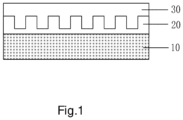
- Figure 1 shows a schematic atomic structure of the silicon-based lithium storage material according to an embodiment of the present disclosure.
- An embodiment of the present disclosure provides a silicon-based lithium storage material, according to the independent claim 1.
- Si with a valence of 0-4 includes a Si particle in an elemental state, a silicon oxide SiO x (0 ⁇ x ⁇ 2) and a silicate such as a compound represented by a general formula M y SiO 3 , where 1 ⁇ y ⁇ 2, and M is an element of groups IA, IIA and IIIA, such as Li, Na, Mg, Ca, or Al, etc.
- C Si(1-4) /C Si(0) 0 ⁇ C Si(1-4) /C Si(0) ⁇ 1
- C Si(1-4) refers to the molar amount of silicon with a valence of 1-4
- C Si(0) refers to the molar amount of silicon atom present in a form of elementary substance and with a valence of 0
- C Si(1-4)/ C Si(0) refers to a molar ratio (a ratio of the number of an atom) of a silicon with a valence of 1-4 to elementary substance silicon.
- the value of C Si(1-4) /C Si(0) can be achieved by adjusting the contents of the silicon particle, the silicon oxide, and the silicate contained in the silicon-based lithium storage material.
- the doping element is marked as R, then the doping element R may be an element that is capable of accepting electrons, and at least include one of elements of group IA, group IIA, and group IIIA.
- the elements of group IA, group IIA, and group IIIA are Li, Na, Mg, Ca, Al and so on.
- the elements of group IA, group IIA, and group IIIA can be combined with other elements capable of accepting electrons to form an electrically neutral material.
- the other elements capable of accepting electrons include N, P, O, C, S, Se, and so on.
- the doping element R may be present in an atomic state or an ionic state in the silicon-based lithium storage material, and atoms of the doping element may combine with each other to form an ionic state, such as elementary substance Mg or elementary substance Al; for another example, the elements of group IA, group IIA, and group IIIA combine with one or more of N, P, O, C, S, Se to form a metal oxide or metal salt, such as MgO, Na 2 O, CaO, Na 3 PO 4 , MgSO 3 , etc.
- the doping element may combine with Si with a valence of 0-4 to form a silicon oxide, a silicate, etc., such as MgSiO 3 , CaSiO 3 , Li 2 SiO 3 or Na 2 SiO 3 , etc. Also, 0 ⁇ C R /C Si(0-4) ⁇ 1.5, where C R refers to the molar amount of the doping element R, and C Si(0-4) refers to the molar amount of silicon with a valence of 0-4.
- the doping amount of the doping element R By adjusting the doping amount of the doping element R, it is possible to change the characteristics of the silicon-based lithium storage material under a high-temperature storage condition after being intercalated with an active lithium and obtain the best results, and meanwhile improve the overall cycle performance and first-cycle coulombic efficiency of a battery containing the silicon-based lithium storage material.
- the value of C R /C Si(0-4) is, for example, 0.2, 0.5, 0.8, 1, or 1.2 etc.
- Si with a valence of 0-4 and the doping element R are uniformly distributed.
- the heating treatment could be performed in advance under the protection of inert gas.
- the elemental silicon crystal grains with a valence of 0 in the core the elemental silicon crystal grains and the surrounding compound crystals are in a homogeneous system. All grains has a size not larger than 300 nm, as measured by powder X-ray diffraction and Scherrer calculation and analysis.
- the core As analyzed by differential thermal scanning calorimetry (DSC), the core has 1-2 crystallization transition peaks between 800 and 1000 degrees, and the corresponding activation energy for crystallization transition is 100-250 KJ/mol.
- the 2P result of Si XPS test contains a peak between 98 eV (Si (0) peak) and 102.5 eV (Si(4+) peak)
- the surface of the core of the silicon-based lithium storage material is further coated with a first shell, wherein the first shell is a carbon-containing material has a Raman Id/Ig ratio less than 0.5 and a conductivity lager than 10 2 S/m.
- the first shell layer has a comb-shaped surface, and the comb-shaped structure could improve the cycle performance of a battery made from the silicon-based lithium storage material, and endow the battery with better rate capability.
- the graphitized carbon coating has a thickness of 1-40 nm; for example, the graphitized carbon coating has a thickness of 5 nm, 10 nm, 15 nm, 20 nm, 25 nm, 30 nm, etc.
- the graphitized carbon coating could further improve conduction characteristics of the material.
- the “coated (or coating)” described in the embodiments of the present disclosure may be “partially coated” or “completely coated”.
- the degree of coating in “coated (or coating)” also varies with the manufacturing process of the silicon-based lithium storage material. In some embodiments of the present disclosure, it could be considered as “completely coating” if the graphitized carbon coating has a thickness of around 5 nm.
- the graphitized carbon coating has a crystalline carbon structure with a high graphitization, it has a certain binding effect on the expansion of the silicon-based lithium storage material when being intercalated with lithium, and could prevent the cracking of the coating and the deactivation of the active substance material in the silicon-based lithium storage material during the deintercalation of lithium. Therefore, the first shell makes it possible to better adjust the charge-discharge performance of the silicon-based lithium storage material and improve the cycle life of the battery.
- the graphitized carbon coating is doped with nitrogen atoms.
- the nitrogen atom may be derived from a N-containing substance, such as one or more of NH 3 , tripolycyanamide, acetonitrile, aniline or butylamine. Introducing nitrogen atoms to the graphitized carbon coating could further improve the charge-discharge capability of the silicon-based lithium storage material, because nitrogen doping can further improve conductivity of the material, so as to reduce internal resistance of the battery, thereby ensuring charge and discharge capacity of the battery with a large current.
- the silicon-based lithium storage material further comprises a second shell coating the first shell, wherein the second shell is a metal oxide that has a dielectric constant of 10-40.
- the second shell is a coexisting phase formed from one or more selected from the group consisting of a oxide of a group IIA element, a oxide of a rare earth element, and a compound formed between Ti, Zr and oxygen.
- the second shell is one or more selected from the group consisting of MgO, CaO, Al 2 O 3 , TiO 2 , ZrO 2 , CeO 2 , Eu 2 O 3 , and Y 2 O 3 .
- the second shell is a ceramic like material, which is formed on the outer layer of the silicon-based lithium storage material, to prevent lithium leakage from the material and significantly improve the safety performance of the silicon-based lithium storage material after being made into a battery.
- the silicon-based lithium storage material is a homogeneous doped system, so as to realize a uniform modification of the valence state, structure, crystal shape, and magnetic environment of the silicon-based lithium storage material, improve its characteristics under a high-temperature storage condition after it is intercalated with an active lithium as an active substance of a lithium-ion secondary battery and obtain the best result, and meanwhile improve cycle characteristics and initial charge-discharge coulombic efficiency of the battery.
- the cycle performance, stability and safety characteristics of the silicon-based lithium storage material as a whole is improved, and meanwhile meets market requirements for higher capacity, higher first-cycle coulombic efficiency and higher safety of lithium-ion batteries.
- the present disclosure also provides a method for preparing a silicon-based lithium storage material, according to the independent claim 7, comprising
- the elementary substance silicon is, for example, polysilicon.
- the silicon with an oxidation state of +4 is, for example, silica, and the raw material containing silica is, for example, quartz, and optionally, for example, ⁇ -type quartz.
- the silicon with an oxidation state of +4 may also be a silicate, for example, a compound represented by a general formula M y SiO 3 , where 1 ⁇ y ⁇ 2, and M is an element of group IA, group IIA, and group IIIA such as Li, Na, Mg, Ca, etc .
- the first mixture comprises a doping element R, where the doping element Rat least includes one of N, P, O, C, S, and Se, and may also includes elements of group IA, group IIA, and group IIIA such as Li, Na, Mg, Ca, etc.; the raw material providing the doping element may be an metal elementary substance such as Mg, or may be a metal oxide, a metal hydroxide, or a metal salt, such as MgO, Na 2 O, CaO, Na 3 PO 4 , MgSO 3 , LiOH, Li 2 CO 3 , MgCO 3 , MgSiO 3 , CaSiO 3 , Li 2 SiO 3 or Na 2 SiO 3 , etc.
- the doping element Rat least includes one of N, P, O, C, S, and Se and may also includes elements of group IA, group IIA, and group IIIA such as Li, Na, Mg, Ca, etc.
- the raw material providing the doping element may be an metal elementary substance such as Mg, or may be
- a composition ratio of each raw material in the first mixture is adjusted, to meet the proviso that 0 ⁇ C R /C Si(0-4) ⁇ 1.5, where C R is the molar amount of the doping element R, and C Si(0-4) is the molar amount of element silicon with a valance of 0-4, for example, the sum of the molar amount of the silicon atoms in elementary substance silicon and silicon with an oxidation state of +4.
- the raw material includes polysilicon, ⁇ -type quartz and Li 2 CO 3 .
- the raw material includes polysilicon, ⁇ -type quartz and LiOH.
- the raw material includes polysilicon, ⁇ -type quartz, and MgCO 3 .
- the non-oxidizing gas described in the embodiments of the present disclosure is, for example, an inert gas, such as helium, neon, and argon etc.
- the temperature when heating to a molten state is for example, 2000 °C, 2500 °C, etc.
- the molten mixture is cooled rapidly to room temperature at a cooling rate of 5 °C/S-30 °C/S (°C/S: Celsius/second).
- the rapid cooling process may make the prepared material have the best cycle performance after being made into a battery.
- cooling the molten first mixture to room temperature at a cooling rate of 5 °C/S-30 °C/S comprises pouring the molten first mixture onto a rapidly rotating roller, and separating the molten first mixture from the roller by a centrifugal action of the roller, to obtain a flaky cooled product.
- the rapidly rotating may be adjusted according to the gear position or the rotation speed setting of the used equipment with rollers, and is not specifically limited in the present disclosure.
- the atoms in the silicon-based lithium storage material are recombined, to meet the proviso that 0 ⁇ C Si(1-4) /C Si(0) ⁇ 1, where C Si(1-4) is the molar amount of element silicon with a valence of 1-4, and C Si(0) is the molar amount of element silicon with a valence of 0.
- a process for pulverizing the flaky cooled product may be any conventional process for pulverizing and performed with any conventional device, which will not repeated here.
- the pulverized silicon-based lithium storage material has a median particle size of 1-8 ⁇ m.
- Step S2 is performed.
- a surface of the core is coated with a first shell, wherein the first shell is a carbon-containing material that has a Raman Id/Ig ratio less than 0.5 and a conductivity lager than 10 2 S/m.
- a process for coating a surface of the core with a first shell is a deposition-coating process.
- the first shell for example is a carbon coating.
- a process for depositing the carbon coating comprises
- a coating equipment such as a revolver, a rotary furnace and the like can be used to prepare the carbon coating, to achieve a uniform coating.
- the coating equipment may be configured to comprise a pre-decomposition zone and a depositing-coating zone, wherein both the pre-decomposition zone and the depositing-coating zone comprise a reaction chamber.
- the pre-decomposition zone is used to pre-decompose the carbon source substance.
- the carbon source substance is introduced into the pre-decomposition zone of the coating equipment, and then subjected to pyrolysis, cracking, polycondensation reactions and the like in a non-oxidizing atmosphere, to become a gaseous substance.
- the carbon source comprises a low-molecular-weight substance and a high-molecular-weight substance, wherein the low-molecular-weight substance becomes a medium/large-molecular-weight substance via pyrolysis, polycondensation, and addition reactions and the like; the high-molecular-weight substance is cracked into a medium/small-molecular-weight substance, which is also accompanied by pyrolysis, polycondensation, addition reactions and the like.
- the gas that provides the non-oxidizing atmosphere includes, for example, any one or more of hydrogen, nitrogen, or inert gas, and is used as a protective gas, a carrier gas, and a diluent gas for the reaction in the pre-decomposition zone.
- the gaseous carbon source substance includes a hydrocarbon that is gaseous at room temperature and an aldehyde that is gaseous at room temperature.
- the gaseous carbon source substance includes methane, ethane, ethylene, acetylene, propane, and propylene.
- the vaporized carbon source substance is the carbonaceous material that is liquid at room temperature, and is gaseous at a temperature above room temperature but lower than the temperature of the pre-decomposition zone.
- the vaporized carbon source substance includes n-hexane, ethanol, and benzene.
- the atomized carbon source substance is a substance that is difficult to evaporate by heating, and can be made into small droplets by an atomizing device, for example, a substance that is liquid at a temperature lower than the temperature of the pre-decomposition zone.
- the atomized carbon source substance includes polyethylene and polypropylene.
- the flow rate V G of the decomposition product into the reaction chamber of the depositing-coating zone and a ratio M C /M of the molar flow rate of the decomposition product to the mass of the core are adjusted, to subject the core and the decomposition product to a depositing and coating reaction in the depositing-coating zone, forming a graphitized carbon coating on a surface of the core, with the proviso that 10 ⁇ V G ⁇ 100 and 0.001 ⁇ M C /M ⁇ 1, where V G is in a unit of m/min, M C is in a unit of mol/min, in terms of carbon atoms, and M is the mass of the core, in a unit of kg.
- the first shell is a graphitized carbon coating. That is to say, in the preparation process of the silicon-based lithium storage material described in the embodiments of the present disclosure, the thickness of the formed graphitized carbon coating may be adjusted by adjusting the flow rate and mass of the reactants and the reaction time.
- the crystal structure of the carbon coating can be controlled by adjusting V G (m/min) and M C /M (M C is in a unit of mol/min, in terms of carbon atoms, and M is the mass of the core, in a unit of kg), thereby obtaining a graphitized carbon coating.
- V G m/min
- M C is in a unit of mol/min, in terms of carbon atoms
- M is the mass of the core, in a unit of kg
- Adjusting the operation speed of the core and the flow rate of the decomposition product into the reaction chamber can ensure that a uniform and continuous graphitized carbon coating are obtained during the reaction process, and meanwhile the loss of materials could be reduced.
- the graphitized carbon coating Since the graphitized carbon coating has a crystalline carbon structure with a high graphitization, it has a certain binding effect on the expansion of the silicon-based lithium storage material when being intercalated with lithium, and prevents the cracking of the coating and the deactivation of the active substance in the silicon-based lithium storage material during the deintercalation of lithium. Therefore, the graphitized carbon coating structure makes it possible to better adjust the charge-discharge performance of the silicon-based lithium storage material and improve the cycle life of the battery.
- a molar flow rate M C of the pyrolysis product after thermally decomposing the atomized carbon source in the pre-decomposition zone can be determined by measuring the CO 2 content after an oxidative combustion.
- a molar flow rate M C of the pyrolysis product can be directly determined according to the molecular structure of the intake gas.
- the temperature range for pre-decomposing the carbon source substance is set to 500-1500 °C, and preferably 700 °C-1300 °C, so that the carbon source substance can turn into gaseous in the pre-decomposition zone, and be quickly subjected to pyrolysis or polycondensation reactions, forming a pre-decomposition zone product that can quickly be subjected to the subsequent coating reaction.
- the desired temperature can be realized by means of a conventional heating method or microwave or a radio frequency method.
- the microwave heating method can ionize the C-containing substance, and reduce the pre-decomposition temperature and improve the pre-decomposition efficiency compared with other heating methods.
- the gaseous carbon source substance after passing through the pre-decomposition zone, is subjected to dehydrogenation, free radical addition reactions and the like, tobecome a straight-chain or aromatic compound with a larger relative molecular mass and a lower Gibbs free energy.
- the vaporized carbon source substance After passing through the pre-decomposition zone, the vaporized carbon source substance is subjected to dehydrogenation (cracking), free radical addition reactions and the like, to become a straight-chain or aromatic compound.
- the atomized carbon source substance After passing through the pre-decomposition zone, is subjected to cracking, free radical addition reactions and the like, to become a straight-chain or aromatic compound.
- the mixed gas that passes through the pre-decomposition zone is a decomposition product
- the decomposition product comprises a non-oxidizing gas that are introduced into the reaction atmosphere and a pre-decomposed carbon source substance.
- the pre-decomposition reaction step can make the reaction temperature control in the preparation method of the silicon-based lithium storage material more flexible, is beneficial to control the reaction progress (such as the decomposition, addition etc.) of the carbon source substance, and has little interference to the temperature in the coating zone.
- the decomposition product is introduced into the depositing and coating zone of the coating equipment, so that the core and the pre-decomposed carbon source substance can be subjected to a depositing and coating reaction, so as to form a graphitized carbon coating on a surface of the core, wherein the surface of the core is directly coated by the graphitized carbon coating.
- the depositing and coating reaction is carried out at a temperature of 500 °C-1100 °C.
- the depositing and coating reaction is carried out at a temperature of 650 °C-1000 °C.
- the temperature is too low, the C/H ratio of the coating on the surface of the anode material is too high, resulting in poor conductivity and having a negative effect on performance; if the temperature is too high, the silicon oxide in the core may be excessively disproportionated, having a negative effect on the capacity and cycle performance of the silicon-based lithium storage material.
- a N-containing substance may also be introduced.
- the N-containing substance includes one or more of NH 3 , acetonitrile, aniline, or butylamine.
- Step S3 coating a surface of the first shell with a second shell, wherein the second shell is a metal oxide that has a dielectric constant of 10-40.
- the second shell is a coexisting phase formed from one or more selected from the group consisting of a oxide of a group IIA element, a oxide of a rare earth element, and a compound formed between Ti, Zr and oxygen.
- the second shell is one or more selected from the group consisting of MgO, CaO, Al 2 O 3 , TiO 2 , ZrO 2 , CeO 2 , Eu 2 O 3 , and Y 2 O 3 .
- the second shell is a ceramic like material, which is formed on the outer layer of the silicon-based lithium storage material, to prevent lithium leakage of the material and significantly improve the safety performance of the silicon-based lithium storage material after being made into a battery.
- a precursor compound or a combination thereof is selected and mixed with the core coated with the first shell, and the precursor compound (which could be decomposed into the second shell) is decomposed through a thermal decomposition reaction. Thereby, a surface of the first shell is coated with a second shell.
- the precursor compound could be directly mixed with the core coated with the first shell, and then heated to a decomposition temperature of the precursor compound, thereby coating a surface of the first shell with a second shell.
- the precursor compound may also be gasified, and the gasified precursor compound and the core coated with the first shell are introduced into a reaction chamber where the depositing and coating reaction occurs.
- the temperature in the reaction chamber is set greater than or equal to the decomposition temperature of the precursor compound and maintained for a specific time, thereby coating a surface of the first shell with a second shell.
- Ti(OC 2 H 5 ) 4 is selected as the precursor compound. After Ti(OC 2 H 5 ) 4 was heated to a temperature higher than the boiling point of Ti(OC 2 H 5 ) 4 , it is introduced into a reaction chamber of a vapor deposition equipment at a certain flow rate.
- the core coated with the first shell is also sent into the reaction chamber of the vapor deposition equipment. Steam condensation deposition occurs in the reaction chamber, so that the precursor compound is decomposed, a surface of the first shell is coated with TiO 2 after decomposition.
- TiO 2 has a thickness of greater than 0 nm and less than 20 nm, for example, the second shell has a thickness of 5 nm, 10 nm, 13 nm, 18 nm, etc.
- a physical vapor deposition process could be adopted directly to directly deposit the second shell on the surface of the first shell.
- a second shell material such as one or more of MgO, CaO, Al 2 O 3 , TiO 2 , ZrO 2 , CeO 2 , Eu 2 O 3 and Y 2 O 3 , and the core coated with the first shell are placed in a physical vapor deposition equipment and heated until the second shell material evaporates and deposits on the surface of the first shell.
- the first mixture was prepared, and it comprised a component A (polysilicon), a component B ( ⁇ -type quartz), and a component C (Li 2 CO 3 ), wherein the doping element R was based on element Li in the component C.
- the molar ratio of the component B to the component A (marked as Si(+4)/Si(0), representing a molar ratio of silicon with a valance of +4 in the component B to silicon with a valance of 0 in the component A) was 5: 3, and the molar ratio of element Li in the component C to element Si in the component A and the component B (C R /C Si(0-4) ) was 0.5.
- the first mixture was heated to 2600 °C and into a molten state under the protection of argon gas and then cooled to room temperature at a cooling rate of 20 °C/S (the molten first mixture was poured onto a fast roller and separated from the roller by a centrifugal action of the roller, to obtain a flaky cooled product).
- the flaky cooled product was then subjected to a pulverization to form a powder with a median particle size of 5 ⁇ m, as the core of the silicon-based lithium storage material.
- a rotary furnace including a pre-decomposition zone and a depositing-coating zone was used.
- 1 kg of the core (with a median particle size of 5 ⁇ m) of the silicon-based lithium storage material of silicon is used as the silicon substrate material, nitrogen was used as the protective gas.
- a mixture of ethane gas and ethanol vapor with a flow rate V G of 10 m/min was introduced into the pre-decomposition area, in which the molar ratio of ethane to ethanol was 1 : 1, and the reaction temperature was 900 °C.
- M C /M was adjusted to 0.05 mol/min, and the pre-decomposed product was introduced into the depositing-coating zone of the rotary furnace, in which the temperature was 900 °C, and the total reaction time was 20 min, forming a first shell on the surface of the core, with a thickness of 10 nm.
- the core material coated with the first shell was introduced into a chemical vapor deposition equipment, and magnesium isopropoxide was heated to vaporize, and then introduced into the chemical vapor deposition equipment. Magnesium isopropoxide was decomposed by rapid condensation, and thereby a second shell of MgO was coated on the surface of the first shell, and the thickness of the second shell was 5 nm.
- a first mixture was prepared.
- the first mixture comprised component A (polysilicon), component B ( ⁇ -Type quartz), and component C (MgCO 3 ).
- the doped element R was based on Mg element in component C.
- a molar ratio of component B to component A (marked as Si(+4) / Si(0), representing the molar ratio of +4-valent silicon in component B to 0-valent silicon in component A was 5 : 5, and the molar ratio of Mg element in component C to Si element in component A and component B (C R /C Si(0-4) ) was 0.9.
- the first mixture was heated to 2600 °C to a molten state under the protection of argon, and then cooled to room temperature at a cooling rate of 15 °C/S (the molten first mixture was poured onto a fast roller, and separated from the roller through the centrifugal action of the roller, obtaining a flaky cooled product).
- the flaky cooled product was pulverized, forming a powder with a median particle size of 4 ⁇ m, as the core of the silicon-based lithium storage material.
- a rotary furnace including a pre-decomposition zone and a depositing-coating zone was used.
- 1 kg of the core (with a median particle size of 4 ⁇ m) of the silicon-based lithium storage material of silicon was used as the silicon substrate material.
- Nitrogen was used as the protective gas.
- a mixture of ethane gas and ethanol vapor with a flow rate V G of 30 m/min was introduced into the pre-decomposition zone, in which the molar ratio of ethane to ethanol was 1 : 1.
- the reaction temperature was 950 °C.
- M C /M was adjusted to 0.03 mol/min, and the pre-decomposed product mixture was introduced into the depositing-coating zone of the rotary furnace.
- the temperature in the depositing-coating zone was 1000 °C.
- the total reaction time was 20 min, and thereby a first shell was formed on the surface of the core, with a thickness of 12 nm.
- the core material coated with the first shell was introduced into a chemical vapor deposition equipment, and magnesium isopropoxide was heated to vaporize and then also introduced into the chemical vapor deposition equipment. Magnesium isopropoxide was decomposed by rapid condensation, and a second shell of MgO was coated on the surface of the first shell, and the thickness of the second shell was 20 nm.
- a first mixture was prepared.
- the first mixture comprised component A (polysilicon) and component B ( ⁇ -Type quartz), and component C (LiOH).
- the doped element R was based on Li element in component C.
- the molar ratio of component B to component A (marked as Si (+4)/Si(0), representing the molar ratio of +4-valent silicon in component B to 0-valent silicon in component A) was 5 : 3, and the molar ratio of Li element in component C to Si element in component A and component B (C R /C Si(0-4) ) was 1.2.
- the first mixture was heated to 2800 °C to a molten state under the protection of argon, and then cooled to room temperature at a cooling rate of 10 °C/S (the molten first mixture was poured onto a fast roller, and separated from the roller through the centrifugal action of the roller, obtaining a flaky cooled product).
- the flaky cooled product was pulverized, forming a powder with a median particle size of 8 ⁇ m, as the core of the silicon-based lithium storage material.
- a rotary furnace including a pre-decomposition zone and a depositing-coating zone was used.
- 1 kg of the core (with a median particle size of 8 ⁇ m) of the silicon-based lithium storage material of silicon was used as the silicon substrate material.
- Nitrogen was used as the protective gas.
- a mixture of ethane gas and ethanol vapor with a flow rate V G of 60 m/min was introduced into the pre-decomposition zone, in which the molar ratio of ethane to ethanol was 1 : 1.
- the reaction temperature was 1000 °C.
- M C /M was adjusted to 0.08 mol/min, and the pre-decomposed product mixture was introduced into the depositing-coating zone of the rotary furnace.
- the temperature in the depositing-coating zone was 1050 °C.
- the total reaction time was 20 min, and thereby a first shell was formed on the surface of the core, with a thickness of 8 nm.
- the core material coated with the first shell was introduced into a chemical vapor deposition equipment, and phenylmagnesium bromide was heated to vaporize and also introduced into the chemical vapor deposition equipment. Phenylmagnesium bromide was decomposed by rapid condensation. A second shell of MgO was coated on the surface of the first shell, and the thickness of the second shell was 8 nm.
- Examples 4-10 were performed according to the Examples except that the process parameters were adjusted, forming the silicon-based lithium storage materials shown in Examples 1 to 10 as described in Table 1.
- the silicon-based lithium storage material could pass through the acupuncture test, indicating that the second shell formed on the outer layer of the silicon-based lithium storage material could prevent lithium leakage from the material and significantly improve the safety performance of the silicon-based lithium storage material after being made into a battery.
- the acupuncture experiment was performed according to the acupuncture method specified in GBT 31485-2015.
- the prepared silicon-based lithium storage material was mixed with standard graphite material (with a capacity of 355 mAh/g and a first-cycle coulombic efficiency of 93%) to form 420 mAh/g negative electrode material, and then a soft pack battery made from the same was tested .
- the silicon-based lithium storage material formed by the method for preparing the silicon-based lithium storage material as described in this example was used as the negative electrode material of a lithium battery, the first-cycle lithium removal capacity, first-cycle coulombic efficiency and 100-cycle capacity retention at room temperature were much higher than those of the silicon-based negative electrode material in comparative example.
- the cycle performance, stability and safety characteristics of the silicon-based lithium storage material as a whole were improved, and meanwhile the requirements for high-capacity, high first-cycle coulombic efficiency and high safety of lithium-ion batteries were met, meeting the market demand.
- the silicon-based lithium storage material was a doped homogeneous system, which realized the uniform modification of the valence state, structure, crystal form and magnetic environment of the silicon-based lithium storage material, improved its characteristics under a high-temperature storage condition after it is intercalated with an active lithium as an active substance of a lithium-ion secondary battery and obtain the best result, and improved the cycle characteristics and initial charge-discharge coulombic efficiency of the battery.
- first, second, third, etc. may be used herein to describe various elements, these elements should not be limited by these terms. These terms are only used to distinguish one element from another. Therefore, the first element in some embodiments may be referred to as the second element in other embodiments without departing from the teachings of the present disclosure.
- the same reference numerals or the same reference signs denote the same elements throughout the specification.
Landscapes
- Chemical & Material Sciences (AREA)
- Chemical Kinetics & Catalysis (AREA)
- Electrochemistry (AREA)
- General Chemical & Material Sciences (AREA)
- Composite Materials (AREA)
- Engineering & Computer Science (AREA)
- Materials Engineering (AREA)
- Manufacturing & Machinery (AREA)
- Inorganic Chemistry (AREA)
- Battery Electrode And Active Subsutance (AREA)
- Silicon Compounds (AREA)
Claims (11)
- Auf Silicium basierendes Lithiumspeichermaterial, umfassend einen Kern umfassend dereine erste Komponente enthaltend Si mit einer Valenz von 0 bis 4, mit der Bedingung, dass 0 ≤ Csi(1-4)/Csi(0) ≤ 1, wobei CSi(1-4) eine molare Menge des Elements Silicium mit einer Valenz von 1 bis 4 ist und Csi(0) eine molare Menge des Elements Silicium mit einer Valenz von 0 ist; undeine zweite Komponente enthaltend ein Dotierungselement R, wobei das Dotierungselement R ein Element ist, das Elektronen akzeptiert, unter der Bedingung, dass 0 ≤ CR/Csi(0-4) ≤ 1,5, wobei CR eine molare Menge des Dotierungselements R ist und Csi(0-4) eine molare Menge des Elements Silicium mit einer Valenz von 0 bis 4 ist;eine erste Schale, die den Kern umhüllt, wobei die erste Schale ein kohlenstoffhaltiges Material ist, das eine Leitfähigkeit von mehr als 10 2 S/m aufweist;eine zweite Schale, die die erste Schale umhüllt, wobei die zweite Schale ein Metalloxid ist, das eine Dielektrizitätskonstante von 10 bis 40 aufweist, wobei dieses Metalloxid aus MgO, Al2O3 und TiO2 ausgewählt wird,dadurch gekennzeichnet, dassdie erste Schale eine graphitisierte Kohlenstoffumhüllung ist;die zweite Schale eine Dicke von 5 bis 20 nm aufweist; undSi mit einer Valenz von 0 bis 4 sowie das Dotierungselement R gleichmäßig verteilt sind.
- Auf Silicium basierende Lithiumspeichermaterial nach Anspruch 1, dadurch gekennzeichnet, dass die graphitisierte Kohlenstoffumhüllung mit Stickstoffatomen dotiert wird.
- Auf Silicium basierende Lithiumspeichermaterial nach Anspruch 1, dadurch gekennzeichnet, dass die zweite Schale eine koexistierende Phase ist, die aus einem oder mehreren, die aus der Gruppe bestehend aus einem Oxid eines Elements der Gruppe IIA, einem Oxid eines Seltenen Erden Elements und einer Verbindung, die zwischen Ti, Zr und Sauerstoff gebildet wird, ausgewählt wird, gebildet wird.
- Auf Silicium basierende Lithiumspeichermaterial nach Anspruch 1, dadurch gekennzeichnet, dass das Dotierungselement R mindestens ein der Elemente der Gruppe IA, Gruppe IIA und Gruppe IIIA umfasst.
- Auf Silicium basierende Lithiumspeichermaterial nach Anspruch 4, dadurch gekennzeichnet, dass die Elemente der Gruppe IA, Gruppe IIA und Gruppe IIIA Li, Na, Mg, Ca oder Al umfassen.
- Auf Silicium basierende Lithiumspeichermaterial nach Anspruch 1, dadurch gekennzeichnet, dass die erste Schale eine Dicke von 1 bis 40 nm aufweist.
- Verfahren zur Herstellung des auf Silicium basierenden Lithiumspeichermaterials nach Anspruch 1 bis 6, umfassendHerstellen eines Kerns des auf Silicium basierenden Lithiumspeichermaterials, wobei der Kern umfassteine erste Komponente enthaltend Si mit einer Valenz von 0 bis 4, unter der Bedingung, dass 0 ≤ CSi(1-4)/CSi(0) ≤ 1, wobei CSi(1-4) eine molare Menge des Elements Silicium mit einer Valenz von 1 bis 4 ist und Csi(0) eine molare Menge des Elements Silicium mit einer Valenz von 0 ist; undeine zweite Komponente enthaltend ein Dotierungselement R, wobei das Dotierungselement R ein Elektronen akzeptierendes Element ist, unter der Bedingung, dass 0 ≤ CR/Csi(0-4) ≤ 1,5, wobei CR eine molare Menge des Dotierungselements R ist und Csi(0-4) eine molare Menge des Elements Silicium mit einer Valenz von 0 bis 4 ist;Umhüllen der Oberfläche des Kerns mit einer ersten Schale, wobei die erste Schale ein kohlenstoffhaltiges Material ist, das eine Leitfähigkeit von mehr als 10 2 S/m aufweist, wobei die erste Schale eine graphitisierte Kohlenstoffumhüllung ist; undUmhüllen der Oberfläche der ersten Schale mit einer zweiten Schale, wobei die zweite Schale ein Metalloxid ist, das eine Dielektrizitätskonstante von 10 bis 40 aufweist, wobei dieses Metalloxid aus MgO, Al2O3 und TiO2 ausgewählt wird,dadurch gekennzeichnet, dass das Herstellen des Kerns des auf Silicium basierenden Lithiumspeichermaterials umfasstBereitstellen einer ersten Mischung, wobei die erste Mischung mindestens elementares Silicium-Substanz und Silicium mit einer Oxidationszustand von +4 sowie ein Dotierungselement R enthält, wobei das Dotierungselement R mindestens ein Element der Gruppe IA, Gruppe IIA und Gruppe IIIA umfasst, unter der Bedingung, dass 0 ≤ CR/Csi(0-4) ≤ 1,5, wobei CR die molare Menge des Dotierungselements R ist und Csi(0-4) die molare Menge des Elements Silicium mit einer Valenz von 0 bis 4 ist;Erhitzen der ersten Mischung bis zu einem Schmelzzustand unter Schutz eines nichtoxidierenden Gases und anschließend Abkühlen bei Raumtemperatur mit einer Abkühlgeschwindigkeit von 5 °C/S bis 30 °C/S, um ein abgekühltes Flockenprodukt zu erreichen; undZerkleinern des abgekühlten Flockenprodukts zum Bilden des Kerns des auf Silicium basierenden Lithiumspeichermaterials; wobeidie Temperatur beim Erhitzen bis zu einem Schmelzzustand zwischen 1500 °C und 3000 °C liegt;
undwobei das Umhüllen der Oberfläche der ersten Schale mit der zweiten Schale umfasstMischen einer Vorläuferverbindung oder einer Kombination davon mit dem Kern, der mit der ersten Schale umhüllt wird, und Zersetzen der Vorläuferverbindung durch eine thermische Zersetzungsreaktion und Umhüllen der Oberfläche der ersten Schale mit einer zweiten Schale, wobei die Vorläuferverbindung in die zweite Schale zersetzt wird, wobeidie Vorläuferverbindung aus Tetrabutyl-Titanate, Aluminiumisopropoxid, Magnesiumisopropoxid oder Phenylmagnesiumbromid besteht. - Verfahren zur Herstellung eines auf Silicium basierenden Lithiumspeichermaterials nach Anspruch 7, dadurch gekennzeichnet, dass Abkühlen einer geschmolzenen ersten Mischung bei Raumtemperatur mit einer Abkühlgeschwindigkeit von 5 bis 30 °C/S umfasst Gießen der geschmolzenen ersten Mischung auf eine Schnellwalze und Trennen der geschmolzenen ersten Mischung von der Walze durch die Zentrifugalwirkung der Walze, um ein abgekühltes Flockenprodukt zu erreichen.
- Verfahren zur Herstellung eines auf Silicium basierenden Lithiumspeichermaterials nach Anspruch 7, dadurch gekennzeichnet, dass Umhüllen der Oberfläche des Kerns mit einer ersten Schale umfasstin einer nichtoxidierenden Atmosphäre Durchlassen einer Kohlenstoffquellensubstanz durch eine Zersetzungszone zum Bilden eines Zersetzungsprodukts, wobei die Kohlenstoffquellensubstanz eine oder mehrere einer gasförmigen Kohlenstoffquellensubstanz, einer verdampften Kohlenstoffquellensubstanz und einer zerstäubten Kohlenstoffquellensubstanz umfasst; undEinstellen des Volumenstroms VG des Zersetzungsprodukts in eine Reaktionskammer einer Abscheidung-Umhüllungszone sowie eines Verhältnisses Mc/M des molaren Volumenstroms des Zersetzungsprodukts zu der Masse des Kerns, Unterziehen des Kerns und des Zersetzungsprodukts einer Abscheidungs- und Umhüllungssreaktion in der Abscheidungs-Umhüllungszone, wodurch eine erste Schale auf der Oberfläche des Kerns gebildet wird, unter der Bedingung, dass 10 ≤ VG ≤ 100 und 0,001 ≤ Mc/M < 1, wobei VG in m/min ausgedrückt wird, Mc in mol/min in Bezug auf Kohlenstoffatome ausgedrückt wird und M die Masse des Kerns in kg ist.
- Verfahren zur Herstellung eines auf Silicium basierenden Lithiumspeichermaterials nach Anspruch 9,
dadurch gekennzeichnet, dass die gasförmige Kohlenstoffquellensubstanz Methan, Ethan, Ethylen, Acetylen, Propan und Propylen umfasst; die verdampfte Kohlenstoffquellensubstanz n-Hexan, Ethanol und Benzol umfasst; und die zerstäubte Kohlenstoffquellensubstanz Polyethylen und Polypropylen umfasst. - Verfahren zur Herstellung eines auf Silicium basierenden Lithiumspeichermaterials nach Anspruch 9, ferner
umfassend Einführen einer N-haltigen Substanz während der Abscheidungs- und Umhüllungsreaktion, wobei die N-haltige Substanz eine oder mehrere der folgenden umfasst: NH3, Tripolycyanamide, Acetonitril, Anilin und Butylamin.
Applications Claiming Priority (1)
| Application Number | Priority Date | Filing Date | Title |
|---|---|---|---|
| PCT/CN2019/129886 WO2021134195A1 (zh) | 2019-12-30 | 2019-12-30 | 硅基储锂材料及其制备方法 |
Publications (4)
| Publication Number | Publication Date |
|---|---|
| EP3872900A1 EP3872900A1 (de) | 2021-09-01 |
| EP3872900A4 EP3872900A4 (de) | 2021-09-01 |
| EP3872900B1 true EP3872900B1 (de) | 2025-05-21 |
| EP3872900C0 EP3872900C0 (de) | 2025-05-21 |
Family
ID=70525119
Family Applications (1)
| Application Number | Title | Priority Date | Filing Date |
|---|---|---|---|
| EP19915579.7A Active EP3872900B1 (de) | 2019-12-30 | 2019-12-30 | Auf silicium basierendes lithiumspeichermaterial und verfahren zu seiner herstellung |
Country Status (4)
| Country | Link |
|---|---|
| EP (1) | EP3872900B1 (de) |
| CN (1) | CN111149241B (de) |
| CA (1) | CA3203418A1 (de) |
| WO (1) | WO2021134195A1 (de) |
Families Citing this family (2)
| Publication number | Priority date | Publication date | Assignee | Title |
|---|---|---|---|---|
| CN116264271B (zh) * | 2021-12-13 | 2025-10-10 | 清华大学 | 储锂碳化硅孪晶材料及其制备方法 |
| CN116544381B (zh) * | 2023-05-30 | 2024-04-05 | 广东凯金新能源科技股份有限公司 | 预镁硅氧负极材料及其制备方法、及二次电池 |
Citations (2)
| Publication number | Priority date | Publication date | Assignee | Title |
|---|---|---|---|---|
| CN101986442A (zh) * | 2010-05-25 | 2011-03-16 | 耿世达 | 一种内部含有三维导电结构的锂离子电池负极材料及其制备方法 |
| CN109713286A (zh) * | 2018-12-29 | 2019-05-03 | 安普瑞斯(南京)有限公司 | 一种用于锂离子二次电池的硅基复合材料及其制备方法 |
Family Cites Families (29)
| Publication number | Priority date | Publication date | Assignee | Title |
|---|---|---|---|---|
| CN1419303A (zh) * | 2001-09-28 | 2003-05-21 | 株式会社东芝 | 非水电解质电池用负极材料及其制造方法、负极及电池 |
| US8709653B2 (en) * | 2004-03-08 | 2014-04-29 | Samsung Sdi Co., Ltd. | Negative active material for a rechargeable lithium battery, a method of preparing the same, and a rechargeable lithium battery comprising the same |
| CN101271974A (zh) * | 2007-03-22 | 2008-09-24 | 中信国安盟固利新能源科技有限公司 | 锂离子二次电池的负极材料、负极极片及锂离子二次电池 |
| JP4834615B2 (ja) * | 2007-06-14 | 2011-12-14 | 日立造船株式会社 | 気相生成炭素構造体の製造装置および製造方法 |
| CN102122708A (zh) * | 2010-01-08 | 2011-07-13 | 中国科学院物理研究所 | 用于锂离子二次电池的负极材料、含该负极材料的负极及其制备方法以及含该负极的电池 |
| JP5406799B2 (ja) * | 2010-07-29 | 2014-02-05 | 信越化学工業株式会社 | 非水電解質二次電池用負極材とその製造方法及びリチウムイオン二次電池 |
| KR101708360B1 (ko) * | 2011-10-05 | 2017-02-21 | 삼성에스디아이 주식회사 | 음극 활물질 및 이를 채용한 리튬 전지 |
| WO2013098962A1 (ja) * | 2011-12-27 | 2013-07-04 | 株式会社日立製作所 | 非水二次電池 |
| WO2015025443A1 (ja) * | 2013-08-21 | 2015-02-26 | 信越化学工業株式会社 | 負極活物質、負極活物質材料、負極電極、リチウムイオン二次電池、負極活物質の製造方法、並びに、リチウムイオン二次電池の製造方法 |
| TWI565127B (zh) * | 2013-10-31 | 2017-01-01 | Lg化學股份有限公司 | 陽極活性材料及製備彼之方法 |
| EP3093910B1 (de) * | 2014-01-09 | 2019-06-19 | Showa Denko K.K. | Negativelektroden-aktivmaterial für lithium-ionen-sekundärbatterie |
| CN104979536B (zh) * | 2014-04-10 | 2018-05-29 | 宁德新能源科技有限公司 | 锂离子电池及其阳极片、阳极活性材料的制备方法 |
| JP6448525B2 (ja) * | 2015-02-26 | 2019-01-09 | 信越化学工業株式会社 | 非水電解質二次電池用負極活物質、非水電解質二次電池用負極、及び非水電解質二次電池、並びに非水電解質二次電池用負極材の製造方法 |
| US10427982B2 (en) * | 2015-09-17 | 2019-10-01 | Korea Institute Of Energy Research | Method of carbon coating on nanoparticle and carbon coated nanoparticle produced by the same |
| CN105226260B (zh) * | 2015-10-19 | 2017-11-24 | 中南大学 | 一种锂离子电池用硅基负极材料的制备方法 |
| CN106099062B (zh) * | 2016-07-21 | 2018-09-25 | 中国科学院山西煤炭化学研究所 | 双包覆硅基复合材料Si@C@TiO2及其制备方法 |
| CN107799723A (zh) * | 2016-08-30 | 2018-03-13 | 华为技术有限公司 | 一种硅基复合负极片及其制备方法和锂离子二次电池 |
| CN106384825B (zh) * | 2016-11-07 | 2019-02-19 | 北京壹金新能源科技有限公司 | 一种硅碳复合微球及其制备方法和应用 |
| CN107195890B (zh) * | 2017-06-28 | 2019-10-18 | 山东大学 | 一种高性能锂离子电池负极Si@N-C复合材料及其制备方法 |
| WO2019080346A1 (zh) * | 2017-10-23 | 2019-05-02 | 中航锂电(洛阳)有限公司 | 一种空间缓冲、掺杂锂的硅氧化物复合材料及其制备方法、锂离子电池 |
| US12009515B2 (en) * | 2017-11-24 | 2024-06-11 | Lg Energy Solution, Ltd. | Negative electrode active material for lithium secondary battery and preparation method thereof |
| CN110085856B (zh) * | 2018-01-26 | 2024-08-06 | 三星电子株式会社 | 含硅结构体、其制备方法、使用其的碳复合物及各自包括其的电极、锂电池和设备 |
| CN109004208A (zh) * | 2018-07-04 | 2018-12-14 | 合肥国轩高科动力能源有限公司 | 一种氮掺杂碳包覆的氧化亚硅材料的制备方法及其应用 |
| CN115064671B (zh) * | 2018-12-05 | 2024-04-09 | 华为技术有限公司 | 一种硅氧复合负极材料及其制作方法 |
| CN109599551B (zh) * | 2018-12-28 | 2021-08-24 | 安普瑞斯(南京)有限公司 | 一种用于锂离子电池的掺杂型多层核壳硅基复合材料及其制备方法 |
| CN109786666A (zh) * | 2019-03-21 | 2019-05-21 | 福建蓝海黑石新材料科技有限公司 | 一种氮掺杂碳包覆硅纳米颗粒复合材料、制备方法及应用 |
| CN110048114A (zh) * | 2019-04-30 | 2019-07-23 | 中国科学院宁波材料技术与工程研究所 | 一种双壳硅碳材料及其制备方法 |
| CN110176585B (zh) * | 2019-05-15 | 2022-04-05 | 河南颍川新材料股份有限公司 | 一种硅碳复合材料及其粉末冶金制备方法 |
| CN110556529B (zh) * | 2019-10-15 | 2023-03-14 | 溧阳天目先导电池材料科技有限公司 | 具有多层核壳结构的负极复合材料及其制备方法和应用 |
-
2019
- 2019-12-30 WO PCT/CN2019/129886 patent/WO2021134195A1/zh not_active Ceased
- 2019-12-30 CA CA3203418A patent/CA3203418A1/en active Pending
- 2019-12-30 CN CN201980003445.6A patent/CN111149241B/zh active Active
- 2019-12-30 EP EP19915579.7A patent/EP3872900B1/de active Active
Patent Citations (2)
| Publication number | Priority date | Publication date | Assignee | Title |
|---|---|---|---|---|
| CN101986442A (zh) * | 2010-05-25 | 2011-03-16 | 耿世达 | 一种内部含有三维导电结构的锂离子电池负极材料及其制备方法 |
| CN109713286A (zh) * | 2018-12-29 | 2019-05-03 | 安普瑞斯(南京)有限公司 | 一种用于锂离子二次电池的硅基复合材料及其制备方法 |
Also Published As
| Publication number | Publication date |
|---|---|
| CN111149241B (zh) | 2023-11-28 |
| EP3872900C0 (de) | 2025-05-21 |
| CA3203418A1 (en) | 2021-07-08 |
| WO2021134195A1 (zh) | 2021-07-08 |
| EP3872900A1 (de) | 2021-09-01 |
| EP3872900A4 (de) | 2021-09-01 |
| CN111149241A (zh) | 2020-05-12 |
Similar Documents
| Publication | Publication Date | Title |
|---|---|---|
| JP7594790B2 (ja) | リチウム二次電池負極材用シリコン複合酸化物及びその製造方法 | |
| KR102452874B1 (ko) | 리튬 이차전지 음극재용 탄소-규소복합산화물 복합체 및 이의 제조방법 | |
| EP3907792A1 (de) | Negativelektrodenmaterial aus siliciumverbundstoff und herstellungsverfahren dafür und lithium-ionen-batterie | |
| KR101999191B1 (ko) | 리튬 이차전지 음극재용 실리콘 복합산화물 및 이의 제조방법 | |
| US10700348B2 (en) | Negative electrode material for nonaqueous electrolyte secondary batteries, and secondary battery | |
| KR101960855B1 (ko) | 리튬 이차전지 음극재용 실리콘 복합산화물 및 이의 제조방법 | |
| JP5411780B2 (ja) | 非水電解質二次電池用負極材及び非水電解質二次電池用負極材の製造方法並びにリチウムイオン二次電池 | |
| KR20190116011A (ko) | 규소-산화규소-탄소 복합체 및 규소-산화규소-탄소 복합체의 제조 방법 | |
| KR20160011633A (ko) | 부극 활물질 및 비수전해질 이차 전지, 및 그들의 제조 방법 | |
| KR20190116012A (ko) | 규소 복합 산화물 및 이의 제조 방법 | |
| CN108963194A (zh) | 一种硅基复合材料及其制备方法和应用 | |
| EP3872900B1 (de) | Auf silicium basierendes lithiumspeichermaterial und verfahren zu seiner herstellung | |
| CN111149242B (zh) | 硅基储锂材料及其制备方法 | |
| JP2004296161A (ja) | 珪素の導電性物質被覆物及びその製造方法並びに非水電解質二次電池用負極材 | |
| JP7801660B2 (ja) | 活物質粒子、電気化学素子、および電気化学デバイス | |
| KR20190116010A (ko) | 규소-탄소 복합체 및 규소-탄소 복합체의 제조 방법 | |
| TW202607121A (zh) | 低膨脹矽-碳複合體、其製備方法及包括該複合體的負極材料、包括該負極材料的鋰離子電池和全固態電池 | |
| TW202606076A (zh) | 具有增強導電性的低膨脹矽—碳複合體、其製備方法及包括其的負極材料、包括該負極材料的鋰離子電池和全固態電池 |
Legal Events
| Date | Code | Title | Description |
|---|---|---|---|
| STAA | Information on the status of an ep patent application or granted ep patent |
Free format text: STATUS: UNKNOWN |
|
| STAA | Information on the status of an ep patent application or granted ep patent |
Free format text: STATUS: THE INTERNATIONAL PUBLICATION HAS BEEN MADE |
|
| PUAI | Public reference made under article 153(3) epc to a published international application that has entered the european phase |
Free format text: ORIGINAL CODE: 0009012 |
|
| STAA | Information on the status of an ep patent application or granted ep patent |
Free format text: STATUS: REQUEST FOR EXAMINATION WAS MADE |
|
| 17P | Request for examination filed |
Effective date: 20200826 |
|
| A4 | Supplementary search report drawn up and despatched |
Effective date: 20210414 |
|
| AK | Designated contracting states |
Kind code of ref document: A1 Designated state(s): AL AT BE BG CH CY CZ DE DK EE ES FI FR GB GR HR HU IE IS IT LI LT LU LV MC MK MT NL NO PL PT RO RS SE SI SK SM TR |
|
| DAV | Request for validation of the european patent (deleted) | ||
| DAX | Request for extension of the european patent (deleted) | ||
| STAA | Information on the status of an ep patent application or granted ep patent |
Free format text: STATUS: EXAMINATION IS IN PROGRESS |
|
| 17Q | First examination report despatched |
Effective date: 20240508 |
|
| GRAP | Despatch of communication of intention to grant a patent |
Free format text: ORIGINAL CODE: EPIDOSNIGR1 |
|
| STAA | Information on the status of an ep patent application or granted ep patent |
Free format text: STATUS: GRANT OF PATENT IS INTENDED |
|
| RIC1 | Information provided on ipc code assigned before grant |
Ipc: H01M 4/02 20060101ALN20241205BHEP Ipc: H01M 10/052 20100101ALN20241205BHEP Ipc: H01M 4/62 20060101ALI20241205BHEP Ipc: H01M 4/1395 20100101ALI20241205BHEP Ipc: H01M 4/134 20100101ALI20241205BHEP Ipc: H01M 4/38 20060101ALI20241205BHEP Ipc: H01M 4/36 20060101AFI20241205BHEP |
|
| INTG | Intention to grant announced |
Effective date: 20241217 |
|
| RIC1 | Information provided on ipc code assigned before grant |
Ipc: H01M 4/02 20060101ALN20241209BHEP Ipc: H01M 10/052 20100101ALN20241209BHEP Ipc: H01M 4/62 20060101ALI20241209BHEP Ipc: H01M 4/1395 20100101ALI20241209BHEP Ipc: H01M 4/134 20100101ALI20241209BHEP Ipc: H01M 4/38 20060101ALI20241209BHEP Ipc: H01M 4/36 20060101AFI20241209BHEP |
|
| GRAS | Grant fee paid |
Free format text: ORIGINAL CODE: EPIDOSNIGR3 |
|
| GRAA | (expected) grant |
Free format text: ORIGINAL CODE: 0009210 |
|
| STAA | Information on the status of an ep patent application or granted ep patent |
Free format text: STATUS: THE PATENT HAS BEEN GRANTED |
|
| AK | Designated contracting states |
Kind code of ref document: B1 Designated state(s): AL AT BE BG CH CY CZ DE DK EE ES FI FR GB GR HR HU IE IS IT LI LT LU LV MC MK MT NL NO PL PT RO RS SE SI SK SM TR |
|
| REG | Reference to a national code |
Ref country code: GB Ref legal event code: FG4D |
|
| REG | Reference to a national code |
Ref country code: CH Ref legal event code: EP |
|
| REG | Reference to a national code |
Ref country code: DE Ref legal event code: R096 Ref document number: 602019070407 Country of ref document: DE |
|
| REG | Reference to a national code |
Ref country code: IE Ref legal event code: FG4D |
|
| U01 | Request for unitary effect filed |
Effective date: 20250610 |
|
| U07 | Unitary effect registered |
Designated state(s): AT BE BG DE DK EE FI FR IT LT LU LV MT NL PT RO SE SI Effective date: 20250617 |
|
| PG25 | Lapsed in a contracting state [announced via postgrant information from national office to epo] |
Ref country code: ES Free format text: LAPSE BECAUSE OF FAILURE TO SUBMIT A TRANSLATION OF THE DESCRIPTION OR TO PAY THE FEE WITHIN THE PRESCRIBED TIME-LIMIT Effective date: 20250521 |
|
| PG25 | Lapsed in a contracting state [announced via postgrant information from national office to epo] |
Ref country code: NO Free format text: LAPSE BECAUSE OF FAILURE TO SUBMIT A TRANSLATION OF THE DESCRIPTION OR TO PAY THE FEE WITHIN THE PRESCRIBED TIME-LIMIT Effective date: 20250821 Ref country code: GR Free format text: LAPSE BECAUSE OF FAILURE TO SUBMIT A TRANSLATION OF THE DESCRIPTION OR TO PAY THE FEE WITHIN THE PRESCRIBED TIME-LIMIT Effective date: 20250822 |
|
| PG25 | Lapsed in a contracting state [announced via postgrant information from national office to epo] |
Ref country code: PL Free format text: LAPSE BECAUSE OF FAILURE TO SUBMIT A TRANSLATION OF THE DESCRIPTION OR TO PAY THE FEE WITHIN THE PRESCRIBED TIME-LIMIT Effective date: 20250521 |
|
| PG25 | Lapsed in a contracting state [announced via postgrant information from national office to epo] |
Ref country code: HR Free format text: LAPSE BECAUSE OF FAILURE TO SUBMIT A TRANSLATION OF THE DESCRIPTION OR TO PAY THE FEE WITHIN THE PRESCRIBED TIME-LIMIT Effective date: 20250521 |
|
| PG25 | Lapsed in a contracting state [announced via postgrant information from national office to epo] |
Ref country code: RS Free format text: LAPSE BECAUSE OF FAILURE TO SUBMIT A TRANSLATION OF THE DESCRIPTION OR TO PAY THE FEE WITHIN THE PRESCRIBED TIME-LIMIT Effective date: 20250821 |
|
| PG25 | Lapsed in a contracting state [announced via postgrant information from national office to epo] |
Ref country code: IS Free format text: LAPSE BECAUSE OF FAILURE TO SUBMIT A TRANSLATION OF THE DESCRIPTION OR TO PAY THE FEE WITHIN THE PRESCRIBED TIME-LIMIT Effective date: 20250921 |
|
| PG25 | Lapsed in a contracting state [announced via postgrant information from national office to epo] |
Ref country code: SM Free format text: LAPSE BECAUSE OF FAILURE TO SUBMIT A TRANSLATION OF THE DESCRIPTION OR TO PAY THE FEE WITHIN THE PRESCRIBED TIME-LIMIT Effective date: 20250521 |
|
| PG25 | Lapsed in a contracting state [announced via postgrant information from national office to epo] |
Ref country code: CZ Free format text: LAPSE BECAUSE OF FAILURE TO SUBMIT A TRANSLATION OF THE DESCRIPTION OR TO PAY THE FEE WITHIN THE PRESCRIBED TIME-LIMIT Effective date: 20250521 |
|
| PG25 | Lapsed in a contracting state [announced via postgrant information from national office to epo] |
Ref country code: SK Free format text: LAPSE BECAUSE OF FAILURE TO SUBMIT A TRANSLATION OF THE DESCRIPTION OR TO PAY THE FEE WITHIN THE PRESCRIBED TIME-LIMIT Effective date: 20250521 |
|
| U20 | Renewal fee for the european patent with unitary effect paid |
Year of fee payment: 7 Effective date: 20251222 |
|
| PLBE | No opposition filed within time limit |
Free format text: ORIGINAL CODE: 0009261 |
|
| STAA | Information on the status of an ep patent application or granted ep patent |
Free format text: STATUS: NO OPPOSITION FILED WITHIN TIME LIMIT |
|
| REG | Reference to a national code |
Ref country code: CH Ref legal event code: L10 Free format text: ST27 STATUS EVENT CODE: U-0-0-L10-L00 (AS PROVIDED BY THE NATIONAL OFFICE) Effective date: 20260402 |