EP3872461A1 - Verfahren zur ermittlung des beladungszustandes eines transporters und transportmanagementsystem - Google Patents
Verfahren zur ermittlung des beladungszustandes eines transporters und transportmanagementsystem Download PDFInfo
- Publication number
- EP3872461A1 EP3872461A1 EP20315024.8A EP20315024A EP3872461A1 EP 3872461 A1 EP3872461 A1 EP 3872461A1 EP 20315024 A EP20315024 A EP 20315024A EP 3872461 A1 EP3872461 A1 EP 3872461A1
- Authority
- EP
- European Patent Office
- Prior art keywords
- goods
- management system
- loading
- transport management
- transporter
- Prior art date
- Legal status (The legal status is an assumption and is not a legal conclusion. Google has not performed a legal analysis and makes no representation as to the accuracy of the status listed.)
- Granted
Links
Images
Classifications
-
- G—PHYSICS
- G01—MEASURING; TESTING
- G01G—WEIGHING
- G01G19/00—Weighing apparatus or methods adapted for special purposes not provided for in the preceding groups
- G01G19/08—Weighing apparatus or methods adapted for special purposes not provided for in the preceding groups for incorporation in vehicles
Definitions
- the invention relates to a method for determining the loading condition of a transporter loaded with goods, the transporter having a loading space for receiving the goods, which is delimited by a loading area, a front wall, a rear wall, several side walls and a roof, at least the front wall and / or the Rear wall and / or a side wall has a door for loading the loading area with goods and a transport management system.
- transport management systems are increasingly being used for planning and controlling transport orders and vehicle deployments, as well as for route planning, for order-oriented navigation and for route guidance of individual transports.
- the aim is to avoid empty trips as far as possible due to an unknown load condition.
- a sensor system in the cargo holds would allow the loading status to be recognized. However, this sensor system would increase the transport costs, so that they are often not used. Additional maintenance of the sensors and / or regular replacement would also increase transport costs. By not installing sensors in the cargo space, the transport managers are often not able to accept additional loads on the routes their vans take.
- the AT 521202 A1 discloses a system for route planning for a transport vehicle with a first sensor integrated in the transport vehicle for measuring a free loading space of the transport vehicle, a second sensor for detecting a vehicle position of the transport vehicle and a navigation system connected to the second sensor for calculating a route to be followed for the transport vehicle on the basis the vehicle position, wherein a database is provided which contains data relating to the position and type of cargo to be transported, a processor is provided which is set up for data exchange with the first sensor, the navigation system and the database, with at least one wireless remote data transmission connection when exchanging data with the First sensor, the navigation system or the database is used, and wherein the processor is set up to select an additional charge from data queried from the database while driving, the additional charge taking into account the free cargo space detected by the first sensor and a remaining remainder of the route to be traveled is suitable with regard to a charge position of the additional charge and a type of charge of the additional charge, and the processor is configured to change the remainder of the route to be traveled by means of an intervention
- the weight can be determined, for example, by a tire pressure monitoring system (TPMS), by strain gauges, or by checking the air springs etc. or other possibilities (e.g. estimates by the OEM based on the acceleration and braking behavior of the trucks and comparison to trucks with known weight).
- TPMS tire pressure monitoring system
- strain gauges or by checking the air springs etc. or other possibilities (e.g. estimates by the OEM based on the acceleration and braking behavior of the trucks and comparison to trucks with known weight).
- the manually recorded image can for example be recorded by the driver using a mobile unit and evaluated using an image recognition algorithm (image detection algorithm).
- image recognition algorithm image detection algorithm
- This can, for example, be based on AI methods and have been trained in advance on various goods.
- a free weight van may not have any available volume and vice versa.
- the invention can be used for all transport vehicles, such as trucks, but also small vans and the like.
- the manual image is generated from outside the transporter.
- This can be generated, for example, with a camera in a mobile unit, for example a tablet or a cell phone. From outside means that the camera is outside of the transporter.
- the value of the weight and the loading volume are preferably transmitted to a transport management system.
- the original route can be modified so that suitable additional goods can be picked up.
- the transporter and / or the driver preferably generates information about the status of the transporter, which information is transmitted to a transport management system.
- This can be data generated by the driver, for example, or data generated by a driver assistance system, such as data on traffic jams, new arrival times, etc.
- the image is preferably generated by means of a recording device, in particular an image sensor.
- the image is a photo that is generated by a camera in a mobile unit.
- the free cargo space is preferably determined on the basis of an image processing algorithm applied to the image. This can be, for example, an AI (Artificial Intelligence) method that has been trained in advance.
- AI Artificial Intelligence
- the object is further achieved by a transport management system for controlling at least one transporter using a method as described above.
- Such a transport management system allows vans to pick up additional loads during a journey.
- the invention makes it possible, for example, to dispense with bilateral communication with the individual drivers of the transporters. Possible empty trips can thus be prevented by incorrect or insufficient information.
- the transport management system always has the latest information on weight and cargo volume.
- the additional loading capacity consisting of volume and weight, can be provided on freight exchanges, for example.
- the invention enables the simple acceptance of further orders, for example, so that an improved utilization of the loading volume can be achieved.
- the invention can thus save time and maximize the utilization of the cargo space. By including additional goods, the CO2 emissions per goods can also be reduced.
- the control preferably takes place using information from the group of location and time information for the manufacture and / or classification of the goods.
- control preferably takes place using information about special conditions of the goods, with special conditions including information from the group of waste and / or hazardous goods and / or fresh goods. This means that the goods that have been loaded and, if necessary, newly loaded goods can be better coordinated with one another.
- the transport management system is designed to transmit information about available loading space to a logistics system.
- the logistics system is, for example, a freight exchange or another transport management system.
- the transport management system or the operator of the transport management system can optimize its real utilization by making available the free loading space on such a freight exchange and
- a logistics system or such a freight exchange can be configured on a platform. Freight orders are offered on the freight exchange, possibly with publication. Furthermore, the transport management system is designed to transmit information about the available loading space to the freight exchange. These can then be called up by a sender.
- Shippers can also offer their goods to be shipped on the freight exchange.
- the number, size and weight of the goods, dangerous goods classes and freight dates can be specified here.
- the transport management system is preferably designed to provide additional information about the destination and / or the country of destination and / or information about the loaded goods and / or the route planning of the loaded goods on the logistics system.
- the logistics system is, for example, a freight exchange or other transport management system.
- the transport management system is designed to dynamically adapt a route planning based on the determined weight of the loaded goods and the determined load status if new orders are accepted and / or existing orders are changed while following the route.
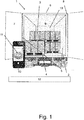
- FIG 1 shows a transporter 1 with a loading area 2 on which goods 3 are loaded.
- the transporter 1 has side walls 5, a front wall 13 and a roof 6.
- the transporter 1 is designed here for rear loading, in that a rear wall is formed from a door 7 with a door frame 8 for loading the loading area 2 with goods 3.
- the side wall 5, the roof 6 and the door 7 as well as the loading area 2 form the loading space 9.
- the door frame 8 is preferably rectangular and the loading space 9 is cuboid.
- the goods 3 can, for example, be loaded on pallets 4 in the loading space 9 on the loading area 2 for transport.
- an image 11, preferably a photo, of the loaded transporter 1, that is to say of the goods 3 on the loading area 2, is first taken by means of a camera.
- This camera is preferably arranged in a mobile unit, such as, for example, in a tablet or a cell phone 10.
- the tablet or the cell phone 10 has an inertial measuring unit (IMU), which is connected to the camera, or the camera itself has an inertial measuring unit (IMU).
- IMU inertial measuring unit
- Such an inertial measuring unit has acceleration and rotation rate sensors with which changes in position are calculated. As a result, an optimized image 11 can be created.
- the camera records the loading space 9 with the goods 3, in which, for example, a driver operates the camera manually.
- Image 11 is thus created manually.
- the image 11 is preferably recorded by the driver from outside the transporter 1.
- the manually recorded image can be created, for example, by the driver using the cell phone 10.
- This image recognition algorithm is then applied to image 11 to recognize the occupied and unoccupied cargo space volume.
- This image recognition algorithm can be an AI algorithm which was previously trained using various goods 3.
- This AI algorithm can be designed, for example, as an artificial neural network or, for example, another self-learning algorithm. Algorithms trained by artificial intelligence can deliver a suitable result in a fraction of a second, so that a quick evaluation of the image 11 is possible as a result.
- the free cargo space volume can thus be recognized by the image recognition algorithm.
- the weight of the loaded goods 3 is determined and the weight that can still be loaded is calculated from this.
- the weight can be determined, for example, by a tire pressure monitoring system 12 (TPMS), by strain gauges or by checking the air springs, etc.
- the free load volume and weight can be controlled by a transporter telematics unit 15 ( FIG 2 ) to a transport management system 14 ( FIG 2 ) are transmitted.
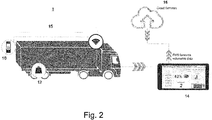
- FIG 2 shows a transport management system 14 of a transporter 1.
- the value of the calculated weight and the value of the calculated free cargo space volume can be transmitted to the transport management system 14 by the mobile phone 10. This can also be displayed to the driver in the transporter 1.
- the transport management system 14 preferably transmits the information about the available loading space and the weight to a logistics system.
- a freight exchange 16 This can be constructed on a platform. Freight orders are offered on the freight exchange 16, possibly with publication. These can then be called up by a sender. Shippers can also offer their goods to be allocated on the freight exchange. For example, the number, size and weight of the freight items, dangerous goods classes, freight dates, etc.
- the transport management system 14 provides additional information about the destination and / or country of destination and / or information about the loaded goods 3 and / or the route planning of the loaded goods on the freight exchange 16.
- the transport management system 14 can accept or reject orders using information from the group of location and time details for the manufacture and / or classification of the goods or make this information available on the freight exchange 16.
- the transport management system 14 can accept or reject orders using further information about special conditions, such as information from the group of waste and / or dangerous goods and / or fresh goods, or make this information available on the freight exchange 16.
- the transport management system 14 is designed to dynamically adapt a route planning based on the accepted order.
- the additional information about free loading area 2 in combination with the weight enables efficient logistics management to be carried out.
- the determination of unused loading area 2 can be used to optimize basic logistics management tasks, to accept and reject orders and to optimize storage.
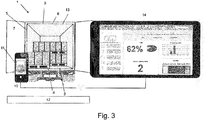
- FIG 3 shows the display of such a transport management system 14 in detail.
- the invention can reduce the number of empty trips for Transporter 1 ( FIG 2 ) and the better utilization of capacities can be achieved. Furthermore, fewer unnecessary journeys and less CO2 per transported good are required. This is a great advantage, especially in times of increasing awareness of climate change.
- this information can be used without additional technical equipment such as image sensors in cargo hold 9 ( FIG 1 ) be won. No additional hardware needs to be purchased, installed, delivered, or serviced.
- the information about the load status of the transporter 1 is obtained from the same images 11 that are recorded to demonstrate compliance with load securing. This means that no additional process steps have to be carried out, which simplifies the work processes for the van driver and saves time.
Landscapes
- Physics & Mathematics (AREA)
- General Physics & Mathematics (AREA)
- Management, Administration, Business Operations System, And Electronic Commerce (AREA)
Abstract
umfassend der Schritte:
- Ermitteln des Gewichtes der geladenen Güter (3),
- Ermitteln des freien Ladevolumens in dem Laderaum (2) anhand der Auswertung zumindest eines manuell aufgenommenen Bildes (11) des mit Gütern (3) beladenen Laderaums (9).
Description
- Die Erfindung betrifft ein Verfahren zur Ermittlung des Beladungszustandes eines mit Gütern beladenen Transporters, wobei der Transporter einen von einer Ladefläche, einer Vorderwand, einer Rückwand, mehreren Seitenwänden sowie einem Dach umgrenzten Laderaum zur Aufnahme der Güter aufweist, wobei zumindest die Vorderwand und/oder die Rückwand und/oder eine Seitenwand eine Türe zum Beladen der Ladefläche mit Gütern aufweist sowie ein Transportmanagementsystem.
- In modernen Transportfahrzeugen werden zunehmend Transportmanagementsysteme zur Planung und Steuerung von Transportaufträgen und Fahrzeugeinsätzen sowie zur Tourenplanung, zur auftragsorientierten Navigation und zur Zielführung von einzelnen Transporten eingesetzt. Ziel ist es, Leerfahrten durch einen unbekannten Beladungszustand so weit wie möglich zu vermeiden.
- Durch eine Sensorik in den Laderäumen würde sich der Beladungszustand erkennen lassen. Diese Sensorik würde jedoch die Transportkosten erhöhen, so dass oftmals auf deren Einsatz verzichtet wird. Auch die zusätzliche Wartung der Sensoren und/oder regelmäßige Austausch würde die Transportkosten erhöhen. Durch den Verzicht auf den Verbau von Sensorik im Laderaum sind die Transportmanager oft nicht in der Lage, zusätzliche Ladungen auf den Routen, die ihre Transporter abfahren, anzunehmen.
- Die
AT 521202 A1 - Es ist daher eine Aufgabe der Erfindung ein kostengünstiges und aufwandsarmes Verfahren anzugeben, welche den Fahrer als auch das Transportunternehmen dabei unterstützt, den Laderaum des Transporters individuell und optimal auszunutzen. Auf teure, im Laderaum zu verbauende Sensorik soll verzichtet werden. Ferner ist die Angabe eines verbesserten Transportmanagementsystems eine weitere Aufgabe der Erfindung.
- Diese Aufgabe wird durch ein Verfahren mit den Merkmalen des Anspruchs 1 sowie ein Transportmanagementsystem mit den Merkmalen des Anspruchs 8 gelöst.
- In den Unteransprüchen sind weitere vorteilhafte Maßnahmen aufgelistet, die miteinander kombiniert werden können, um weitere Vorteile zu erzielen.
- Die Aufgabe wird gelöst durch ein Verfahren zur Ermittlung des Beladungszustandes eines mit Gütern beladenen Transporters, wobei der Transporter einen von einer Ladefläche, einer Vorderwand, einer Rückwand, mehreren Seitenwänden sowie einem Dach umgrenzten Laderaum zur Aufnahme der Güter aufweist, wobei zumindest die Vorderwand und/oder die Rückwand und/oder eine Seitenwand zumindest teilweise eine Türe zum Beladen der Ladefläche mit Gütern aufweist,
umfassend der Schritte: - Ermitteln des Gewichtes der geladenen Güter,
- Ermitteln des freien Ladevolumens in dem Laderaum anhand der Auswertung zumindest eines manuell aufgenommenen Bildes des mit Gütern beladenen Laderaums.
- Das Gewicht kann beispielsweise durch ein Reifendruckkontrollsystem (TPMS), durch Dehnungsmessstreifen, oder durch eine Kontrolle der Luftfedern etc. festgestellt werden oder andere Möglichkeiten (e.g. Schätzungen der OEM basierend auf Beschleunigungs- und Bremsverhalten der LKW und Vergleich zu LKW mit bekanntem Gewicht).
- Das manuell aufgenommene Bild kann beispielsweise durch den Fahrer mittels einer mobilen Einheit aufgenommen werden und mittels eines Bilderkennungsalgorithmus (Bilddetektionsalgorithmus) ausgewertet werden. Dieser kann beispielsweise auf KI-Methoden beruhen und vorab an verschiedenen Gütern trainiert worden sein.
- Durch die Kombination des Gewichtes mit dem verfügbaren Volumen kann einfach beurteilt werden, ob zusätzliche Belastungen oder Transportaufträge akzeptiert werden können. Ein Transporter mit freiem Gewicht hat möglicherweise kein verfügbares Volumen und vice versa.
- Durch die Aufnahme und Auswertung des manuellen Bildes beispielsweise durch den Fahrer kann auf eine kostenintensive Installation von Sensorik in dem Laderaum zur Ermittlung des freien Volumens verzichtet werden.
- Die Erfindung kann für sämtliche Transportfahrzeuge eingesetzt werden, wie zum Beispiel LKWs, aber auch Kleintransporter und dergleichen.
- Mithilfe der Erfindung ist es möglich, den zur Verfügung stehenden freien Laderaum optimal auszunützen, da dieser noch während der gerade abgefahrenen Route neu zugeteilt werden kann und Aufträge mit neuen Gütern angenommen werden können.
Dadurch reduzieren sich die Kosten pro einzelnen transportierten Güter als auch die CO2 Bilanz der einzelnen transportierten Güter. - In bevorzugter Ausgestaltung wird das manuelle Bild von außerhalb des Transporters erzeugt. Dies kann beispielsweise mit einer Kamera in einer mobilen Einheit beispielsweise einem Tablet oder einem Handy erzeugt werden. Dabei bedeutet von Außerhalb, dass sich die Kamera außerhalb des Transporters befindet.
- Vorzugsweise werden der Wert des Gewichtes und des Ladevolumens an ein Transportmanagementsystem übermittelt. Dadurch kann beispielsweise die ursprüngliche Route abgeändert werden, damit geeignete zusätzliche Güter aufgenommen werden können.
- Weiterhin vorzugsweise generiert der Transporter und/ oder der Fahrer Informationen über den Status des Transporters, welche an ein Transportmanagementsystem übermittelt werden. Dies können beispielsweise vom Fahrer erzeugte Daten sein oder von einem Fahrerassistenzsystem erzeugte Daten wie beispielsweise Daten über Staus, neue Ankunftszeiten etc.
- Vorzugsweise wird das Bild mittels eines Aufnahmegerätes, insbesondere eines Bildsensors erzeugt. Insbesondere ist das Bild ein Foto, welches durch eine Kamera in einer mobilen Einheit erzeugt wird.
Weiterhin vorzugsweise wird der freie Laderaum anhand eines auf das Bild angewendeten Bildverarbeitungsalgorithmus ermittelt. Dies kann beispielsweise ein KI (Künstliche Intelligenz) Verfahren sein, welches vorab trainiert worden ist. - Die Aufgabe wird weiter gelöst durch ein Transportmanagementsystem zur Steuerung zumindest eines Transporters unter Verwendung eines wie oben beschriebenen Verfahrens.
- Durch ein solches Transportmanagementsystem können Transporter zusätzliche Ladung während einer Fahrt aufnehmen. Durch die Erfindung kann auf beispielsweise eine bilaterale Kommunikation mit den einzelnen Fahrern der Transporter verzichtet werden. Mögliche Leerfahrten können somit durch falsche oder unzureichende Informationen verhindert werden.
- Durch die Erfindung verfügt das Transportmanagementsystem ständig über die aktuellen Informationen über Gewicht und Ladungsvolumen.
- Die zusätzliche Ladekapazität, bestehend aus Volumen und Gewicht, kann beispielsweise auf Frachtenbörsen bereitgestellt werden.
- Durch die Erfindung ist eine einfache Annahme beispielsweise weiterer Aufträge möglich, so dass eine verbesserte Auslastung des Ladevolumens bewerkstelligt werden kann.
- Der Prozess des Abgleichs von zusätzlichen Ladungen mit der verfügbaren Kapazität kann stark vereinfacht werden. Dies ermöglicht es, den Transport als Dienstleistung anzubieten.
- Durch die Erfindung kann somit Zeit eingespart und die Auslastung des Laderaums maximiert werden. Durch die Aufnahme zusätzlicher Güter kann zudem die CO2-Emission pro Güter reduziert werden.
- Vorzugsweise erfolgt die Steuerung unter Verwendung von Informationen aus der Gruppe Orts- und Zeitangaben zur Herstellung und/oder Klassifizierung zu den Gütern.
- Weiterhin vorzugsweise erfolgt die Steuerung unter Verwendung von Informationen über spezielle Bedingungen der Güter, wobei spezielle Bedingungen Informationen aus der Gruppe Abfall und/oder Gefahrgut und/oder Frischware umfassen.
Somit können die geladenen und ggf. neu zu ladenden Güter besser aufeinander abgestimmt werden. - In weiterer bevorzugter Ausgestaltung ist das Transportmanagementsystem dazu ausgebildet, Informationen über zur Verfügung stehenden Laderaum an ein Logistiksystem zu übermitteln. Dabei ist das Logistiksystem beispielsweise eine Frachtenbörse oder ein anderes Transportmanagementsystem.
Dadurch kann das Transportmanagementsystem bzw der Betreiber des Transportmanagementsystem seine Realauslastung optimieren, indem er bei den freiem Laderaum auf einer solchen Frachtenbörse zur Verfügung stellt und - Ein Logistiksystem bzw. solche Frachtenbörse kann auf einer Plattform ausgebildet sein. Auf der Frachtenbörse werden Frachtaufträge, gegebenenfalls unter Veröffentlichung, angeboten. Weiterhin ist das Transportmanagementsystem dazu ausgebildet, Informationen über zur Verfügung stehenden Laderaum an die Frachtenbörse zu übermitteln. Diese können dann von einem Versender abgerufen werden.
- Auch können Versender ihre zu versendenden Güter auf der Frachtenbörse anbieten. Hier können beispielsweise Anzahl, Größe und Gewicht der Güter, Gefahrgutklassen, Frachttermine angegeben werden.
- Vorzugsweise ist das Transportmanagementsystem dazu ausgebildet, zusätzliche Informationen über Bestimmungsort und/oder Bestimmungsland und/oder Informationen über die geladenen Güter und /oder die Tourenplanung der geladenen Güter auf dem Logistiksystem zur Verfügung zu stellen. Dabei ist das Logistiksystem beispielsweise eine Frachtenbörse oder andere Transportmanagementsystem.
- In weiterer bevorzugter Ausgestaltung ist das Transportmanagementsystem dazu ausgelegt, anhand des ermittelten Gewichtes der geladenen Güter und des ermittelten Beladungszustandes eine Routenplanung dynamisch anzupassen, wenn während des Abfahrens der Route neue Aufträge angenommen und/oder eine Änderung von bestehenden Aufträgen erfolgt.
- Weitere Eigenschaften und Vorteile der vorliegenden Erfindung ergeben sich aus der nachfolgenden Beschreibung unter Bezugnahme auf die beiliegenden Figuren. Darin zeigen schematisch:
-
FIG 1 : eine Aufnahme eines Ladungsraums mittels einer Kamera gemäß der Erfindung, -
FIG 2 : ein Transporter gemäß der Erfindung, -
FIG 3 : ein Transportmanagementsystem gemäß der Erfindung. -
FIG 1 zeigt einen Transporter 1 mit einer Ladefläche 2 auf der Güter 3 geladen sind. Der Transporter 1 weist Seitenwände 5, eine Vorderwand 13 und ein Dach 6 auf. Der Transporter 1 ist hier zur heckseitigen Beladung ausgebildet, indem eine Rückwand aus einer Tür 7 mit einem Türrahmen 8 zur Beladung der Ladefläche 2 mit Gütern 3 ausgebildet ist. Die Seitenwand 5, das Dach 6 und die Türe 7 sowie die Ladefläche 2 bilden den Laderaum 9 aus. - Vorzugsweise ist der Türrahmen 8 rechtwinkelig und der Laderaum 9 quaderförmig ausgebildet.
- Die Güter 3 können beispielsweise zum Transport auf Paletten 4 im Laderaum 9 auf der Ladefläche 2 geladen sein.
- Zur Erkennung des freien Laderaums 9 wird zunächst ein Bild 11, vorzugsweise ein Foto von dem beladenen Transporter 1, das heißt von den Gütern 3 auf der Ladefläche 2, mittels einer Kamera getätigt. Vorzugsweise ist diese Kamera in einer mobilen Einheit, wie beispielsweise in einem Tablet oder einem Handy 10 angeordnet. Dabei weist das Tablet oder das Handy 10 eine inertiale Messeinheit (IMU), welche mit der Kamera verbunden ist, oder die Kamera selber eine inertiale Messeinheit (IMU) auf.
- Eine solche inertiale Messeinheit weist Beschleunigungs- und Drehratensensoren mit denen Lageänderungen berechnet werden, auf. Dadurch kann ein optimiertes Bild 11 erstellt werden.
- Die Kamera nimmt den Laderaum 9 mit den Gütern 3 auf, in dem beispielsweise ein Fahrer die Kamera manuell bedient. Somit wird das Bild 11 manuell erstellt. Vorzugsweise wird die Aufnahme des Bildes 11 von dem Fahrer von außerhalb des Transporters 1 getätigt. Das manuell aufgenommene Bild kann bspw. durch den Fahrer mittels dem Handy 10 erstellt werden.
- Anschließend wird ein Bilderkennungsalgorithmus auf das Bild 11 zur Erkennung des belegten und unbelegten Laderaumvolumens angewandt. Dieser Bilderkennungsalgorithmus kann ein KI-Algorithmus sein, welcher vorher unter Verwendung verschiedener Güter 3 trainiert wurde. Dieser KI-Algorithmus kann beispielsweise als ein künstliches neuronales Netz ausgestaltet sein oder beispielsweise ein anderer selbstlernender Algorithmus sein. Durch künstliche Intelligenz trainierte Algorithmen können in Bruchteilen einer Sekunde ein passendes Ergebnis liefern, so dass hierdurch eine schnelle Auswertung des Bildes 11 möglich ist.
- Durch den Bilderkennungsalgorithmus kann somit das freie Laderaumvolumen erkannt werden.
- Ferner wird das Gewicht der geladenen Güter 3 bestimmt und daraus das Gewicht berechnet, welches noch geladen werden kann. Das Gewicht kann beispielsweise durch ein Reifendruckkontrollsystem 12 (TPMS), durch Dehnungsmessstreifen oder durch eine Kontrolle der Luftfedern etc. festgestellt werden.
- Durch die Kombination des Gewichtes mit dem verfügbaren Ladevolumen kann einfach beurteilt werden, ob zusätzliche Belastungen akzeptiert werden können. Somit kann verhindert werden, dass ein Transporter 1 mit freiem Gewicht kein verfügbares Volumen mehr hat und umgekehrt, und dies nicht erkannt wird.
- Das freie Ladevolumen und das Gewicht können durch eine Transportertelematikeinheit 15 (
FIG 2 ) an ein Transportmanagementsystem 14 (FIG 2 ) übermittelt werden. -
FIG 2 zeigt ein Transportmanagementsystem 14 eines Transporters 1.
Alternativ kann der Wert des berechneten Gewichts und der Wert des berechneten freien Laderaumvolumens durch das Handy 10 an das Transportmanagementsystem 14 übermittelt werden. Auch kann dieses dem Fahrer zusätzlich im Transporter 1 angezeigt werden. - Ferner übermittelt das Transportmanagementsystem 14 vorzugsweise die Informationen über zur Verfügung stehenden Laderaum und das Gewicht an eine Logistiksystem. Dies ist vor allem eine Frachtenbörse 16. Diese kann auf einer Plattform ausgebildet sein. Auf der Frachtenbörse 16 werden Frachtaufträge, gegebenenfalls unter Veröffentlichung, angeboten. Diese können dann von einem Versender abgerufen werden.
Auch können Versender ihre zu vergebenden Güter auf der Frachtenbörse anbieten. Anzugeben sind beispielsweise Anzahl, Größe und Gewicht der Frachtstücke, Gefahrgutklassen, Frachttermine etc. - Ferner werden vom Transportmanagementsystem 14 zusätzliche Informationen über Bestimmungsort und/oder Bestimmungsland und/oder Informationen über die geladenen Güter 3 und /oder die Tourenplanung der geladenen Güter auf der Frachtenbörse 16 zur Verfügung gestellt.
- Ferner kann das Transportmanagementsystem 14 Aufträge unter Verwendung von Informationen aus der Gruppe Orts- und Zeitangaben zur Herstellung und/oder Klassifizierung zu den Gütern annehmen oder ablehnen oder diese Informationen auf der Frachtenbörse 16 zur Verfügung stellen.
- Ferner kann das Transportmanagementsystem 14 Aufträge unter Verwendung weiterer Informationen über spezielle Bedingungen wie Informationen aus der Gruppe Abfall und/oder Gefahrgut und/oder Frischware annehmen oder ablehnen oder diese Informationen auf der Frachtenbörse 16 zur Verfügung stellen.
- Werden während des Abfahrens der Route neue Aufträge angenommen, beispielsweise in dem auf der Frachtenbörse 16 von einem Versender freie Ladefläche 2 gekauft wird, so erfolgt eine Änderung von bestehenden Aufträgen. In diesem Fall ist das Transportmanagementsystem 14 dazu ausgelegt, anhand des angenommenen Auftrags eine Routenplanung dynamisch anzupassen.
- Durch die zusätzliche Information über freie Ladefläche 2 in Kombination mit dem Gewicht kann ein effizientes Logistikmanagement durchgeführt werden. Die Ermittlung von ungenutzter Ladefläche 2 kann zur Optimierung grundlegender Logistikmanagementaufgaben, An- und Ablehnung von Aufträgen und zur Optimierung der Lagerhaltung verwendet werden.
-
FIG 3 zeigt das Display eines solchen Transportmanagementsystems 14 im Detail. Durch die Erfindung kann eine Reduzierung der Leerfahrten für Transporter 1 (FIG 2 ) und die bessere Auslastung von Kapazitäten erzielt werden. Ferner werden weniger unnötige Fahrten und weniger CO2 pro transportiertem Gut notwendig. Gerade in Zeiten des steigenden Bewusstseins für den Klimawandel ist dies ein großer Vorteil. - Insbesondere kann diese Information ohne technische Zusatzausstattung wie Bildsensoren im Laderaum 9 (
FIG 1 ) gewonnen werden. Es muss daher keine zusätzliche Hardware gekauft, installiert, geliefert oder gewartet werden.
Die Informationen über den Ladungszustand des Transporters 1 werden durch dieselben Bilder 11 gewonnen, die zum Nachweis der Einhaltung der Ladungssicherung aufgenommen werden. Dadurch müssen keine zusätzlichen Prozessschritte durchgeführt werden, was die Arbeitsabläufe für die Transporter -Fahrer vereinfacht und Zeit spart. - Zudem muss kein weiterer technischer Aufwand betrieben werden; es wird nur ein Bild 11 benötigt, um die Tiefe abzuschätzen und daraus die freie Ladefläche 2 zu berechnen. Dabei kann jede beliebige Kamera verwendet werden. Zudem muss die Kamera nicht kalibriert sein.
Claims (13)
- Verfahren zur Ermittlung des Beladungszustandes eines mit Gütern (3) beladenen Transporters (1), wobei der Transporter (1) einen von einer Ladefläche (2), einer Vorderwand (13), einer Rückwand, mehreren Seitenwänden (5) sowie einem Dach (6) umgrenzten Laderaum (9) zur Aufnahme der Güter (3) aufweist, wobei zumindest die Vorderwand (13), und/oder die Rückwand und/oder eine Seitenwand (7) eine Türe (7) zum Beladen der Ladefläche (2) mit Gütern (3) aufweist,
umfassend der Schritte:- Ermitteln des Gewichtes der geladenen Güter (3),- Ermitteln des freien Ladevolumens in dem Laderaum (2) anhand der Auswertung zumindest eines manuell aufgenommenen Bildes (11) des mit Gütern (3) beladenen Laderaums (9). - Verfahren nach Anspruch 1, dadurch gekennzeichnet, dass das manuelle Bild (11) von außerhalb des Transporters (1) erzeugt wird.
- Verfahren nach Anspruch 1 oder 2, dadurch gekennzeichnet, dass der Wert des Gewichtes und des Ladevolumens an ein Transportmanagementsystem (14) übermittelt werden.
- Verfahren nach einem der vorhergehenden Ansprüche, dadurch gekennzeichnet, dass
der Transporter (1) und/oder der Fahrer Informationen über den Status des Transporters (1) generiert, welche an ein Transportmanagementsystem (14) übermittelt werden. - Verfahren nach einem der vorhergehenden Ansprüche, dadurch gekennzeichnet, dass
das manuelle Bild (11) mittels eines Aufnahmegerätes erzeugt wird. - Verfahren nach Anspruch 5, dadurch gekennzeichnet, dass
das manuelle Bild (11) durch eine Kamera in einer mobilen Einheit erzeugt wird. - Verfahren nach einem der vorhergehenden Ansprüche, dadurch gekennzeichnet, dass
der freie Laderaum (9) anhand eines auf das Bild (11) angewendeten Bildverarbeitungsalgorithmus ermittelt wird. - Transportmanagementsystem (14) zur Steuerung zumindest eines Transporters (1) unter Verwendung des Verfahrens nach einem der vorangegangenen Ansprüche.
- Transportmanagementsystem (14) nach Anspruch 8, dadurch gekennzeichnet, dass die Steuerung unter Verwendung von Informationen aus der Gruppe Orts- und Zeitangaben zur Herstellung und/oder Klassifizierung zu den Gütern (3) erfolgt.
- Transportmanagementsystem (14) nach Anspruch 8 oder 9, dadurch gekennzeichnet, dass
die Steuerung unter Verwendung von Informationen über spezielle Bedingungen der Güter (3) erfolgt, wobei spezielle Bedingungen Informationen aus der Gruppe Abfall und/oder Gefahrgut und/oder Frischware umfassen. - Transportmanagementsystem (14) nach einem der vorhergehenden Ansprüche 8 bis 10, dadurch gekennzeichnet, dass
das Transportmanagementsystem (14) dazu ausgebildet ist, Informationen über zur Verfügung stehenden Laderaum (9) an ein Logistiksystem zu übermitteln. - Transportmanagementsystem (14) nach Anspruch 11, dadurch gekennzeichnet, dass das Transportmanagementsystem (14) dazu ausgebildet ist, Informationen über Bestimmungsort und/oder Bestimmungsland und/oder Informationen über die geladenen Güter (3) und /oder die Tourenplanung der geladenen Güter (3) auf dem ein Logistiksystem zur Verfügung zu stellen.
- Transportmanagementsystem (14) nach einem der vorhergehenden Ansprüche 8 bis 12, dadurch gekennzeichnet, dass
das Transportmanagementsystem (14) dazu ausgelegt ist, anhand des ermittelten Gewichtes der geladenen Güter (3) und des ermittelten Beladungszustandes eine Routenplanung dynamisch anzupassen, wenn während des Abfahrens der Route neue Aufträge angenommen und/oder eine Änderung von bestehenden Aufträgen erfolgt.
Priority Applications (1)
| Application Number | Priority Date | Filing Date | Title |
|---|---|---|---|
| EP20315024.8A EP3872461B1 (de) | 2020-02-27 | 2020-02-27 | Verfahren zur ermittlung des beladungszustandes eines transporters und transportmanagementsystem |
Applications Claiming Priority (1)
| Application Number | Priority Date | Filing Date | Title |
|---|---|---|---|
| EP20315024.8A EP3872461B1 (de) | 2020-02-27 | 2020-02-27 | Verfahren zur ermittlung des beladungszustandes eines transporters und transportmanagementsystem |
Publications (2)
| Publication Number | Publication Date |
|---|---|
| EP3872461A1 true EP3872461A1 (de) | 2021-09-01 |
| EP3872461B1 EP3872461B1 (de) | 2023-09-13 |
Family
ID=70613727
Family Applications (1)
| Application Number | Title | Priority Date | Filing Date |
|---|---|---|---|
| EP20315024.8A Active EP3872461B1 (de) | 2020-02-27 | 2020-02-27 | Verfahren zur ermittlung des beladungszustandes eines transporters und transportmanagementsystem |
Country Status (1)
| Country | Link |
|---|---|
| EP (1) | EP3872461B1 (de) |
Cited By (1)
| Publication number | Priority date | Publication date | Assignee | Title |
|---|---|---|---|---|
| DE102021211827A1 (de) | 2021-10-20 | 2023-04-20 | Continental Automotive Technologies GmbH | Verfahren und Prozessorschaltung zum Schätzen eines absoluten Flächenwerts einer freien Ladefläche und/oder eines absoluten Längenwerts freier Lademeter in einem Frachtraum sowie Logistiksystem |
Citations (2)
| Publication number | Priority date | Publication date | Assignee | Title |
|---|---|---|---|---|
| DE10334708A1 (de) * | 2003-07-30 | 2005-02-24 | Daimlerchrysler Ag | Nutzfahrzeug zum Stückguttransport |
| AT521202A1 (de) | 2018-05-11 | 2019-11-15 | Manuel Lindner | System und Verfahren zur besseren Auslastung eines Transportfahrzeugs |
-
2020
- 2020-02-27 EP EP20315024.8A patent/EP3872461B1/de active Active
Patent Citations (2)
| Publication number | Priority date | Publication date | Assignee | Title |
|---|---|---|---|---|
| DE10334708A1 (de) * | 2003-07-30 | 2005-02-24 | Daimlerchrysler Ag | Nutzfahrzeug zum Stückguttransport |
| AT521202A1 (de) | 2018-05-11 | 2019-11-15 | Manuel Lindner | System und Verfahren zur besseren Auslastung eines Transportfahrzeugs |
Cited By (2)
| Publication number | Priority date | Publication date | Assignee | Title |
|---|---|---|---|---|
| DE102021211827A1 (de) | 2021-10-20 | 2023-04-20 | Continental Automotive Technologies GmbH | Verfahren und Prozessorschaltung zum Schätzen eines absoluten Flächenwerts einer freien Ladefläche und/oder eines absoluten Längenwerts freier Lademeter in einem Frachtraum sowie Logistiksystem |
| WO2023066435A1 (de) | 2021-10-20 | 2023-04-27 | Continental Automotive Technologies GmbH | Verfahren und prozessorschaltung zum schätzen eines absoluten flächenwerts einer freien ladefläche und/oder eines absoluten längenwerts freier lademeter in einem frachtraum sowie logistiksystem |
Also Published As
| Publication number | Publication date |
|---|---|
| EP3872461B1 (de) | 2023-09-13 |
Similar Documents
| Publication | Publication Date | Title |
|---|---|---|
| EP4026722B1 (de) | Verfahren und reichweitenermittlungsvorrichtung zur ermittlung einer zu erwartenden reichweite eines fahrzeugs im anhängerbetrieb | |
| DE102020100734A1 (de) | Fahrzeugdatenmomentaufnahme für flott | |
| EP3671621A1 (de) | Verfahren zum betrieb einer autonomen fahrzeugflotte und servicemodul für ein autonomes flottenfahrzeug | |
| EP3616180B1 (de) | Verfahren zur datenerhebung | |
| EP3597490B1 (de) | Verfahren zur überwachung des beladungszustandes von nutzfahrzeugen oder wechselaufbauten für nutzfahrzeuge | |
| DE112018005737T5 (de) | Fahrzeugflottenmanagement mit einer hiearachie von prioritätsfaktoren | |
| EP3623763A1 (de) | Sendungsverteilungssystem und verfahren zum verteilen von warensendungen | |
| EP3872725A1 (de) | Verfahren zur ermittlung des beladungszustandes, system und transportmanagementsystem | |
| DE102018212629A1 (de) | Verfahren zur Bestimmung von Fahrbahnzuständen | |
| EP3713790B1 (de) | Verfahren zur transportgutüberwachung | |
| DE102018203392A1 (de) | Fahrerassistenzverfahren zum Planen einer Routengestaltung eines Elektrokraftfahrzeuges mit einem oder mehreren Ladestopps an Ladestationen und entsprechende Fahrerassistenzvorrichtung | |
| DE102018003801A1 (de) | Verfahren und Steueranordnung zur Vorhersage einer Fehlfunktion einer Radlagereinheit einer Achse in einem Fahrzeug | |
| DE102020114292A1 (de) | Parkhaus und verfahren zum betreiben eines parkhauses | |
| DE102021110705A1 (de) | Vorrichtungen, verfahren und systeme zur lieferungsverfolgung, routenplanung und bewertung | |
| DE102016215523A1 (de) | Verfahren für eine Datenverarbeitungsanlage zur Erhaltung eines Betriebszustands eines Fahrzeugs | |
| EP3872461B1 (de) | Verfahren zur ermittlung des beladungszustandes eines transporters und transportmanagementsystem | |
| DE102010054343A1 (de) | Vorrichtung und Verfahren zur Ermittlung der Auslastung von bewegbaren Laderäumen und/oder eines Transportgutvolumens in einer Umschlagstelle | |
| DE10334708A1 (de) | Nutzfahrzeug zum Stückguttransport | |
| DE112016006488T5 (de) | System und verfahren zum bereitstellen eines mobilitätsnetzes | |
| DE102015223970A1 (de) | Verfahren und Vorrichtung zur Bestimmung einer Radlast an einem Fahrzeugrad | |
| DE102020208506B4 (de) | Verfahren sowie System zum Planen einer Beladung eines Fahrzeugs mit einem Gepäckstück sowie Kraftfahrzeug | |
| DE102024113607A1 (de) | Steuersystem | |
| WO2024041870A1 (de) | Verfahren für ein elektrisch antreibbares kraftfahrzeug zum dynamischen reservieren eines ladepunktes einer mehrere ladepunkte umfassenden ladestation, computerprogramm, datenverarbeitungsvorrichtung für ein kraftfahrzeug, kraftfahrzeug, verfahren für einen server, server-datenverarbeitungsvorrichtung und server | |
| DE102018202469A1 (de) | Verfahren zur Höhenbestimmung eines Kraftfahrzeuges und Kraftfahrzeug | |
| DE102015013815A1 (de) | Kraftfahrzeug |
Legal Events
| Date | Code | Title | Description |
|---|---|---|---|
| PUAI | Public reference made under article 153(3) epc to a published international application that has entered the european phase |
Free format text: ORIGINAL CODE: 0009012 |
|
| STAA | Information on the status of an ep patent application or granted ep patent |
Free format text: STATUS: THE APPLICATION HAS BEEN PUBLISHED |
|
| AK | Designated contracting states |
Kind code of ref document: A1 Designated state(s): AL AT BE BG CH CY CZ DE DK EE ES FI FR GB GR HR HU IE IS IT LI LT LU LV MC MK MT NL NO PL PT RO RS SE SI SK SM TR |
|
| STAA | Information on the status of an ep patent application or granted ep patent |
Free format text: STATUS: REQUEST FOR EXAMINATION WAS MADE |
|
| 17P | Request for examination filed |
Effective date: 20220301 |
|
| RBV | Designated contracting states (corrected) |
Designated state(s): AL AT BE BG CH CY CZ DE DK EE ES FI FR GB GR HR HU IE IS IT LI LT LU LV MC MK MT NL NO PL PT RO RS SE SI SK SM TR |
|
| RAP1 | Party data changed (applicant data changed or rights of an application transferred) |
Owner name: CONTINENTAL AUTOMOTIVE TECHNOLOGIES GMBH |
|
| GRAP | Despatch of communication of intention to grant a patent |
Free format text: ORIGINAL CODE: EPIDOSNIGR1 |
|
| STAA | Information on the status of an ep patent application or granted ep patent |
Free format text: STATUS: GRANT OF PATENT IS INTENDED |
|
| INTG | Intention to grant announced |
Effective date: 20230411 |
|
| GRAS | Grant fee paid |
Free format text: ORIGINAL CODE: EPIDOSNIGR3 |
|
| GRAA | (expected) grant |
Free format text: ORIGINAL CODE: 0009210 |
|
| STAA | Information on the status of an ep patent application or granted ep patent |
Free format text: STATUS: THE PATENT HAS BEEN GRANTED |
|
| AK | Designated contracting states |
Kind code of ref document: B1 Designated state(s): AL AT BE BG CH CY CZ DE DK EE ES FI FR GB GR HR HU IE IS IT LI LT LU LV MC MK MT NL NO PL PT RO RS SE SI SK SM TR |
|
| REG | Reference to a national code |
Ref country code: CH Ref legal event code: EP |
|
| REG | Reference to a national code |
Ref country code: DE Ref legal event code: R096 Ref document number: 502020005226 Country of ref document: DE |
|
| REG | Reference to a national code |
Ref country code: IE Ref legal event code: FG4D Free format text: LANGUAGE OF EP DOCUMENT: GERMAN |
|
| REG | Reference to a national code |
Ref country code: SE Ref legal event code: TRGR |
|
| REG | Reference to a national code |
Ref country code: LT Ref legal event code: MG9D |
|
| REG | Reference to a national code |
Ref country code: NL Ref legal event code: MP Effective date: 20230913 |
|
| PG25 | Lapsed in a contracting state [announced via postgrant information from national office to epo] |
Ref country code: GR Free format text: LAPSE BECAUSE OF FAILURE TO SUBMIT A TRANSLATION OF THE DESCRIPTION OR TO PAY THE FEE WITHIN THE PRESCRIBED TIME-LIMIT Effective date: 20231214 |
|
| PG25 | Lapsed in a contracting state [announced via postgrant information from national office to epo] |
Ref country code: RS Free format text: LAPSE BECAUSE OF FAILURE TO SUBMIT A TRANSLATION OF THE DESCRIPTION OR TO PAY THE FEE WITHIN THE PRESCRIBED TIME-LIMIT Effective date: 20230913 Ref country code: NO Free format text: LAPSE BECAUSE OF FAILURE TO SUBMIT A TRANSLATION OF THE DESCRIPTION OR TO PAY THE FEE WITHIN THE PRESCRIBED TIME-LIMIT Effective date: 20231213 Ref country code: LV Free format text: LAPSE BECAUSE OF FAILURE TO SUBMIT A TRANSLATION OF THE DESCRIPTION OR TO PAY THE FEE WITHIN THE PRESCRIBED TIME-LIMIT Effective date: 20230913 Ref country code: LT Free format text: LAPSE BECAUSE OF FAILURE TO SUBMIT A TRANSLATION OF THE DESCRIPTION OR TO PAY THE FEE WITHIN THE PRESCRIBED TIME-LIMIT Effective date: 20230913 Ref country code: HR Free format text: LAPSE BECAUSE OF FAILURE TO SUBMIT A TRANSLATION OF THE DESCRIPTION OR TO PAY THE FEE WITHIN THE PRESCRIBED TIME-LIMIT Effective date: 20230913 Ref country code: GR Free format text: LAPSE BECAUSE OF FAILURE TO SUBMIT A TRANSLATION OF THE DESCRIPTION OR TO PAY THE FEE WITHIN THE PRESCRIBED TIME-LIMIT Effective date: 20231214 Ref country code: FI Free format text: LAPSE BECAUSE OF FAILURE TO SUBMIT A TRANSLATION OF THE DESCRIPTION OR TO PAY THE FEE WITHIN THE PRESCRIBED TIME-LIMIT Effective date: 20230913 |
|
| REG | Reference to a national code |
Ref country code: DE Ref legal event code: R081 Ref document number: 502020005226 Country of ref document: DE Owner name: CONTINENTAL AUTOMOTIVE TECHNOLOGIES GMBH, DE Free format text: FORMER OWNER: CONTINENTAL AUTOMOTIVE TECHNOLOGIES GMBH, 30165 HANNOVER, DE Ref country code: DE Ref legal event code: R081 Ref document number: 502020005226 Country of ref document: DE Owner name: AUMOVIO GERMANY GMBH, DE Free format text: FORMER OWNER: CONTINENTAL AUTOMOTIVE TECHNOLOGIES GMBH, 30165 HANNOVER, DE |
|
| PG25 | Lapsed in a contracting state [announced via postgrant information from national office to epo] |
Ref country code: NL Free format text: LAPSE BECAUSE OF FAILURE TO SUBMIT A TRANSLATION OF THE DESCRIPTION OR TO PAY THE FEE WITHIN THE PRESCRIBED TIME-LIMIT Effective date: 20230913 |
|
| PG25 | Lapsed in a contracting state [announced via postgrant information from national office to epo] |
Ref country code: IS Free format text: LAPSE BECAUSE OF FAILURE TO SUBMIT A TRANSLATION OF THE DESCRIPTION OR TO PAY THE FEE WITHIN THE PRESCRIBED TIME-LIMIT Effective date: 20240113 |
|
| RAP4 | Party data changed (patent owner data changed or rights of a patent transferred) |
Owner name: CONTINENTAL AUTOMOTIVE TECHNOLOGIES GMBH |
|
| PG25 | Lapsed in a contracting state [announced via postgrant information from national office to epo] |
Ref country code: ES Free format text: LAPSE BECAUSE OF FAILURE TO SUBMIT A TRANSLATION OF THE DESCRIPTION OR TO PAY THE FEE WITHIN THE PRESCRIBED TIME-LIMIT Effective date: 20230913 |
|
| PG25 | Lapsed in a contracting state [announced via postgrant information from national office to epo] |
Ref country code: SM Free format text: LAPSE BECAUSE OF FAILURE TO SUBMIT A TRANSLATION OF THE DESCRIPTION OR TO PAY THE FEE WITHIN THE PRESCRIBED TIME-LIMIT Effective date: 20230913 Ref country code: IS Free format text: LAPSE BECAUSE OF FAILURE TO SUBMIT A TRANSLATION OF THE DESCRIPTION OR TO PAY THE FEE WITHIN THE PRESCRIBED TIME-LIMIT Effective date: 20240113 Ref country code: ES Free format text: LAPSE BECAUSE OF FAILURE TO SUBMIT A TRANSLATION OF THE DESCRIPTION OR TO PAY THE FEE WITHIN THE PRESCRIBED TIME-LIMIT Effective date: 20230913 Ref country code: EE Free format text: LAPSE BECAUSE OF FAILURE TO SUBMIT A TRANSLATION OF THE DESCRIPTION OR TO PAY THE FEE WITHIN THE PRESCRIBED TIME-LIMIT Effective date: 20230913 Ref country code: CZ Free format text: LAPSE BECAUSE OF FAILURE TO SUBMIT A TRANSLATION OF THE DESCRIPTION OR TO PAY THE FEE WITHIN THE PRESCRIBED TIME-LIMIT Effective date: 20230913 Ref country code: PT Free format text: LAPSE BECAUSE OF FAILURE TO SUBMIT A TRANSLATION OF THE DESCRIPTION OR TO PAY THE FEE WITHIN THE PRESCRIBED TIME-LIMIT Effective date: 20240115 Ref country code: SK Free format text: LAPSE BECAUSE OF FAILURE TO SUBMIT A TRANSLATION OF THE DESCRIPTION OR TO PAY THE FEE WITHIN THE PRESCRIBED TIME-LIMIT Effective date: 20230913 |
|
| REG | Reference to a national code |
Ref country code: CH Ref legal event code: PK Free format text: DIE PUBLIKATION VOM 27.03.2024 WURDE AM 24.04.2024 IRRTUEMLICHERWEISE ERNEUT PUBLIZIERT. LA PUBLICATION DU 27.03.2024 A ETE REPUBLIEE PAR ERREUR LE 24.04.2024. LA PUBBLICAZIONE DEL 27.03.2024 E STATA ERRONEAMENTE RIPUBBLICATA IL 24.04.2024. |
|
| PG25 | Lapsed in a contracting state [announced via postgrant information from national office to epo] |
Ref country code: PL Free format text: LAPSE BECAUSE OF FAILURE TO SUBMIT A TRANSLATION OF THE DESCRIPTION OR TO PAY THE FEE WITHIN THE PRESCRIBED TIME-LIMIT Effective date: 20230913 Ref country code: IT Free format text: LAPSE BECAUSE OF FAILURE TO SUBMIT A TRANSLATION OF THE DESCRIPTION OR TO PAY THE FEE WITHIN THE PRESCRIBED TIME-LIMIT Effective date: 20230913 |
|
| REG | Reference to a national code |
Ref country code: DE Ref legal event code: R097 Ref document number: 502020005226 Country of ref document: DE |
|
| PG25 | Lapsed in a contracting state [announced via postgrant information from national office to epo] |
Ref country code: DK Free format text: LAPSE BECAUSE OF FAILURE TO SUBMIT A TRANSLATION OF THE DESCRIPTION OR TO PAY THE FEE WITHIN THE PRESCRIBED TIME-LIMIT Effective date: 20230913 |
|
| PLBE | No opposition filed within time limit |
Free format text: ORIGINAL CODE: 0009261 |
|
| STAA | Information on the status of an ep patent application or granted ep patent |
Free format text: STATUS: NO OPPOSITION FILED WITHIN TIME LIMIT |
|
| PG25 | Lapsed in a contracting state [announced via postgrant information from national office to epo] |
Ref country code: DK Free format text: LAPSE BECAUSE OF FAILURE TO SUBMIT A TRANSLATION OF THE DESCRIPTION OR TO PAY THE FEE WITHIN THE PRESCRIBED TIME-LIMIT Effective date: 20230913 |
|
| 26N | No opposition filed |
Effective date: 20240614 |
|
| PG25 | Lapsed in a contracting state [announced via postgrant information from national office to epo] |
Ref country code: MC Free format text: LAPSE BECAUSE OF FAILURE TO SUBMIT A TRANSLATION OF THE DESCRIPTION OR TO PAY THE FEE WITHIN THE PRESCRIBED TIME-LIMIT Effective date: 20230913 |
|
| REG | Reference to a national code |
Ref country code: CH Ref legal event code: PL |
|
| PG25 | Lapsed in a contracting state [announced via postgrant information from national office to epo] |
Ref country code: LU Free format text: LAPSE BECAUSE OF NON-PAYMENT OF DUE FEES Effective date: 20240227 |
|
| PG25 | Lapsed in a contracting state [announced via postgrant information from national office to epo] |
Ref country code: CH Free format text: LAPSE BECAUSE OF NON-PAYMENT OF DUE FEES Effective date: 20240229 |
|
| GBPC | Gb: european patent ceased through non-payment of renewal fee |
Effective date: 20240227 |
|
| PG25 | Lapsed in a contracting state [announced via postgrant information from national office to epo] |
Ref country code: SI Free format text: LAPSE BECAUSE OF FAILURE TO SUBMIT A TRANSLATION OF THE DESCRIPTION OR TO PAY THE FEE WITHIN THE PRESCRIBED TIME-LIMIT Effective date: 20230913 |
|
| PG25 | Lapsed in a contracting state [announced via postgrant information from national office to epo] |
Ref country code: SI Free format text: LAPSE BECAUSE OF FAILURE TO SUBMIT A TRANSLATION OF THE DESCRIPTION OR TO PAY THE FEE WITHIN THE PRESCRIBED TIME-LIMIT Effective date: 20230913 Ref country code: LU Free format text: LAPSE BECAUSE OF NON-PAYMENT OF DUE FEES Effective date: 20240227 Ref country code: CH Free format text: LAPSE BECAUSE OF NON-PAYMENT OF DUE FEES Effective date: 20240229 |
|
| PG25 | Lapsed in a contracting state [announced via postgrant information from national office to epo] |
Ref country code: BG Free format text: LAPSE BECAUSE OF FAILURE TO SUBMIT A TRANSLATION OF THE DESCRIPTION OR TO PAY THE FEE WITHIN THE PRESCRIBED TIME-LIMIT Effective date: 20230913 |
|
| PG25 | Lapsed in a contracting state [announced via postgrant information from national office to epo] |
Ref country code: BG Free format text: LAPSE BECAUSE OF FAILURE TO SUBMIT A TRANSLATION OF THE DESCRIPTION OR TO PAY THE FEE WITHIN THE PRESCRIBED TIME-LIMIT Effective date: 20230913 |
|
| REG | Reference to a national code |
Ref country code: BE Ref legal event code: MM Effective date: 20240229 |
|
| PG25 | Lapsed in a contracting state [announced via postgrant information from national office to epo] |
Ref country code: BE Free format text: LAPSE BECAUSE OF NON-PAYMENT OF DUE FEES Effective date: 20240229 |
|
| PG25 | Lapsed in a contracting state [announced via postgrant information from national office to epo] |
Ref country code: GB Free format text: LAPSE BECAUSE OF NON-PAYMENT OF DUE FEES Effective date: 20240227 |
|
| PG25 | Lapsed in a contracting state [announced via postgrant information from national office to epo] |
Ref country code: IE Free format text: LAPSE BECAUSE OF NON-PAYMENT OF DUE FEES Effective date: 20240227 |
|
| PG25 | Lapsed in a contracting state [announced via postgrant information from national office to epo] |
Ref country code: IE Free format text: LAPSE BECAUSE OF NON-PAYMENT OF DUE FEES Effective date: 20240227 Ref country code: GB Free format text: LAPSE BECAUSE OF NON-PAYMENT OF DUE FEES Effective date: 20240227 Ref country code: BE Free format text: LAPSE BECAUSE OF NON-PAYMENT OF DUE FEES Effective date: 20240229 |
|
| PGFP | Annual fee paid to national office [announced via postgrant information from national office to epo] |
Ref country code: DE Payment date: 20250228 Year of fee payment: 6 |
|
| PGFP | Annual fee paid to national office [announced via postgrant information from national office to epo] |
Ref country code: RO Payment date: 20250218 Year of fee payment: 6 |
|
| PGFP | Annual fee paid to national office [announced via postgrant information from national office to epo] |
Ref country code: SE Payment date: 20250218 Year of fee payment: 6 |
|
| PGFP | Annual fee paid to national office [announced via postgrant information from national office to epo] |
Ref country code: AT Payment date: 20250417 Year of fee payment: 5 |
|
| PGFP | Annual fee paid to national office [announced via postgrant information from national office to epo] |
Ref country code: FR Payment date: 20250224 Year of fee payment: 6 |
|
| PG25 | Lapsed in a contracting state [announced via postgrant information from national office to epo] |
Ref country code: CY Free format text: LAPSE BECAUSE OF FAILURE TO SUBMIT A TRANSLATION OF THE DESCRIPTION OR TO PAY THE FEE WITHIN THE PRESCRIBED TIME-LIMIT; INVALID AB INITIO Effective date: 20200227 |
|
| PG25 | Lapsed in a contracting state [announced via postgrant information from national office to epo] |
Ref country code: HU Free format text: LAPSE BECAUSE OF FAILURE TO SUBMIT A TRANSLATION OF THE DESCRIPTION OR TO PAY THE FEE WITHIN THE PRESCRIBED TIME-LIMIT; INVALID AB INITIO Effective date: 20200227 |
|
| PG25 | Lapsed in a contracting state [announced via postgrant information from national office to epo] |
Ref country code: TR Free format text: LAPSE BECAUSE OF FAILURE TO SUBMIT A TRANSLATION OF THE DESCRIPTION OR TO PAY THE FEE WITHIN THE PRESCRIBED TIME-LIMIT Effective date: 20230913 |
|
| REG | Reference to a national code |
Ref country code: DE Ref legal event code: R081 Ref document number: 502020005226 Country of ref document: DE Owner name: AUMOVIO GERMANY GMBH, DE Free format text: FORMER OWNER: CONTINENTAL AUTOMOTIVE TECHNOLOGIES GMBH, 30175 HANNOVER, DE |
|
| PG25 | Lapsed in a contracting state [announced via postgrant information from national office to epo] |
Ref country code: AT Free format text: LAPSE BECAUSE OF NON-PAYMENT OF DUE FEES Effective date: 20250227 |
|
| REG | Reference to a national code |
Ref country code: AT Ref legal event code: MM01 Ref document number: 1611724 Country of ref document: AT Kind code of ref document: T Effective date: 20250227 |