EP3868796B1 - Katalysatorkomponente und katalysator für olefinpolymerisation und deren verwendung - Google Patents
Katalysatorkomponente und katalysator für olefinpolymerisation und deren verwendung Download PDFInfo
- Publication number
- EP3868796B1 EP3868796B1 EP19874270.2A EP19874270A EP3868796B1 EP 3868796 B1 EP3868796 B1 EP 3868796B1 EP 19874270 A EP19874270 A EP 19874270A EP 3868796 B1 EP3868796 B1 EP 3868796B1
- Authority
- EP
- European Patent Office
- Prior art keywords
- unsubstituted
- substituted
- compound
- catalyst component
- group
- Prior art date
- Legal status (The legal status is an assumption and is not a legal conclusion. Google has not performed a legal analysis and makes no representation as to the accuracy of the status listed.)
- Active
Links
Images


Classifications
-
- C—CHEMISTRY; METALLURGY
- C08—ORGANIC MACROMOLECULAR COMPOUNDS; THEIR PREPARATION OR CHEMICAL WORKING-UP; COMPOSITIONS BASED THEREON
- C08F—MACROMOLECULAR COMPOUNDS OBTAINED BY REACTIONS ONLY INVOLVING CARBON-TO-CARBON UNSATURATED BONDS
- C08F10/00—Homopolymers and copolymers of unsaturated aliphatic hydrocarbons having only one carbon-to-carbon double bond
-
- C—CHEMISTRY; METALLURGY
- C07—ORGANIC CHEMISTRY
- C07F—ACYCLIC, CARBOCYCLIC OR HETEROCYCLIC COMPOUNDS CONTAINING ELEMENTS OTHER THAN CARBON, HYDROGEN, HALOGEN, OXYGEN, NITROGEN, SULFUR, SELENIUM OR TELLURIUM
- C07F7/00—Compounds containing elements of Groups 4 or 14 of the Periodic Table
- C07F7/28—Titanium compounds
-
- C—CHEMISTRY; METALLURGY
- C08—ORGANIC MACROMOLECULAR COMPOUNDS; THEIR PREPARATION OR CHEMICAL WORKING-UP; COMPOSITIONS BASED THEREON
- C08F—MACROMOLECULAR COMPOUNDS OBTAINED BY REACTIONS ONLY INVOLVING CARBON-TO-CARBON UNSATURATED BONDS
- C08F10/00—Homopolymers and copolymers of unsaturated aliphatic hydrocarbons having only one carbon-to-carbon double bond
- C08F10/04—Monomers containing three or four carbon atoms
- C08F10/06—Propene
-
- C—CHEMISTRY; METALLURGY
- C08—ORGANIC MACROMOLECULAR COMPOUNDS; THEIR PREPARATION OR CHEMICAL WORKING-UP; COMPOSITIONS BASED THEREON
- C08F—MACROMOLECULAR COMPOUNDS OBTAINED BY REACTIONS ONLY INVOLVING CARBON-TO-CARBON UNSATURATED BONDS
- C08F110/00—Homopolymers of unsaturated aliphatic hydrocarbons having only one carbon-to-carbon double bond
- C08F110/04—Monomers containing three or four carbon atoms
- C08F110/06—Propene
-
- C—CHEMISTRY; METALLURGY
- C08—ORGANIC MACROMOLECULAR COMPOUNDS; THEIR PREPARATION OR CHEMICAL WORKING-UP; COMPOSITIONS BASED THEREON
- C08F—MACROMOLECULAR COMPOUNDS OBTAINED BY REACTIONS ONLY INVOLVING CARBON-TO-CARBON UNSATURATED BONDS
- C08F4/00—Polymerisation catalysts
- C08F4/42—Metals; Metal hydrides; Metallo-organic compounds; Use thereof as catalyst precursors
- C08F4/44—Metals; Metal hydrides; Metallo-organic compounds; Use thereof as catalyst precursors selected from light metals, zinc, cadmium, mercury, copper, silver, gold, boron, gallium, indium, thallium, rare earths or actinides
- C08F4/60—Metals; Metal hydrides; Metallo-organic compounds; Use thereof as catalyst precursors selected from light metals, zinc, cadmium, mercury, copper, silver, gold, boron, gallium, indium, thallium, rare earths or actinides together with refractory metals, iron group metals, platinum group metals, manganese, rhenium technetium or compounds thereof
- C08F4/62—Refractory metals or compounds thereof
- C08F4/64—Titanium, zirconium, hafnium or compounds thereof
- C08F4/647—Catalysts containing a specific non-metal or metal-free compound
- C08F4/649—Catalysts containing a specific non-metal or metal-free compound organic
- C08F4/6491—Catalysts containing a specific non-metal or metal-free compound organic hydrocarbon
- C08F4/6492—Catalysts containing a specific non-metal or metal-free compound organic hydrocarbon containing aliphatic unsaturation
-
- C—CHEMISTRY; METALLURGY
- C08—ORGANIC MACROMOLECULAR COMPOUNDS; THEIR PREPARATION OR CHEMICAL WORKING-UP; COMPOSITIONS BASED THEREON
- C08F—MACROMOLECULAR COMPOUNDS OBTAINED BY REACTIONS ONLY INVOLVING CARBON-TO-CARBON UNSATURATED BONDS
- C08F4/00—Polymerisation catalysts
- C08F4/42—Metals; Metal hydrides; Metallo-organic compounds; Use thereof as catalyst precursors
- C08F4/44—Metals; Metal hydrides; Metallo-organic compounds; Use thereof as catalyst precursors selected from light metals, zinc, cadmium, mercury, copper, silver, gold, boron, gallium, indium, thallium, rare earths or actinides
- C08F4/60—Metals; Metal hydrides; Metallo-organic compounds; Use thereof as catalyst precursors selected from light metals, zinc, cadmium, mercury, copper, silver, gold, boron, gallium, indium, thallium, rare earths or actinides together with refractory metals, iron group metals, platinum group metals, manganese, rhenium technetium or compounds thereof
- C08F4/62—Refractory metals or compounds thereof
- C08F4/64—Titanium, zirconium, hafnium or compounds thereof
- C08F4/647—Catalysts containing a specific non-metal or metal-free compound
- C08F4/649—Catalysts containing a specific non-metal or metal-free compound organic
- C08F4/6494—Catalysts containing a specific non-metal or metal-free compound organic containing oxygen
-
- C—CHEMISTRY; METALLURGY
- C08—ORGANIC MACROMOLECULAR COMPOUNDS; THEIR PREPARATION OR CHEMICAL WORKING-UP; COMPOSITIONS BASED THEREON
- C08F—MACROMOLECULAR COMPOUNDS OBTAINED BY REACTIONS ONLY INVOLVING CARBON-TO-CARBON UNSATURATED BONDS
- C08F4/00—Polymerisation catalysts
- C08F4/42—Metals; Metal hydrides; Metallo-organic compounds; Use thereof as catalyst precursors
- C08F4/44—Metals; Metal hydrides; Metallo-organic compounds; Use thereof as catalyst precursors selected from light metals, zinc, cadmium, mercury, copper, silver, gold, boron, gallium, indium, thallium, rare earths or actinides
- C08F4/60—Metals; Metal hydrides; Metallo-organic compounds; Use thereof as catalyst precursors selected from light metals, zinc, cadmium, mercury, copper, silver, gold, boron, gallium, indium, thallium, rare earths or actinides together with refractory metals, iron group metals, platinum group metals, manganese, rhenium technetium or compounds thereof
- C08F4/62—Refractory metals or compounds thereof
- C08F4/64—Titanium, zirconium, hafnium or compounds thereof
- C08F4/65—Pretreating the metal or compound covered by group C08F4/64 before the final contacting with the metal or compound covered by group C08F4/44
- C08F4/652—Pretreating with metals or metal-containing compounds
- C08F4/654—Pretreating with metals or metal-containing compounds with magnesium or compounds thereof
- C08F4/6543—Pretreating with metals or metal-containing compounds with magnesium or compounds thereof halides of magnesium
-
- C—CHEMISTRY; METALLURGY
- C08—ORGANIC MACROMOLECULAR COMPOUNDS; THEIR PREPARATION OR CHEMICAL WORKING-UP; COMPOSITIONS BASED THEREON
- C08F—MACROMOLECULAR COMPOUNDS OBTAINED BY REACTIONS ONLY INVOLVING CARBON-TO-CARBON UNSATURATED BONDS
- C08F2410/00—Features related to the catalyst preparation, the catalyst use or to the deactivation of the catalyst
- C08F2410/06—Catalyst characterized by its size
Definitions
- the present invention belongs to the field of petrochemical engineering, and in particular relates to a catalyst component for olefin polymerization, a catalyst comprising the catalyst component, and use thereof.
- melt flow rate is an important indicator used to evaluate fluidity of a plastic melt, and it is also an important factor in selecting materials and grades of materials for plastic processing.
- Melt flow rate depends mainly on the molecular weight of a polymer, and a low-molecular weight polymer has a high melt flow rate.
- it is usually necessary to add a large amount of hydrogen during polymerization to enable the polymer to have a low molecular weight.
- an upper limit of the amount of hydrogen that can be added is limited by pressure resistance of a polymerization reactor. Partial pressure of an olefin gas that is polymerized has to be lowered in order to add more hydrogen, in which case productivity will be decreased.
- US4298718 and US4495338 disclose a Ziegler-Natta catalyst using a magnesium halide as a carrier.
- the catalyst produced by reacting the carrier with titanium tetrachloride exhibits a relatively high catalytic activity in catalyzing the polymerization of propylene, but isotacticity of the obtained polypropylene is relatively low. This indicates that the catalyst has low stereospecificity.
- an electron donor compound such as ethyl benzoate or phthalate
- another electron donor alkoxysilane compound
- researchers obtains polypropylene with relatively high isotacticity when propylene polymerization is catalyzed.
- the addition of the electron donor compound improves the stereospecificity of the catalyst.
- a diester internal electron donor is more helpful in improving the stereospecificity of the catalyst.
- this type of catalyst does not have sufficient hydrogen response, and can hardly be used to produce products with a high melt index by a direct hydrogen regulation method.
- phthalate compounds plasticizers
- CN1580034A , CN1580035A , CN1580033A , CN1436766A , and CN1552740A each disclose use of diol ester compound as an electron donor of a Ziegler-Natta catalyst for propylene polymerization.
- the catalyst is characterized by a high polymerization activity and the polymerization product has a wide molecular weight distribution. But when a spherical catalyst comprising a carboxylate diol ester internal electron donor is used for propylene polymerization, the catalyst exhibits relatively low stereospecificity and results in polypropylene having low isotacticity.
- WO2015/177732A1 discloses various Ziegler-Natta catalyst compositions comprising Ti, Mg, Cl, 9,9-bis (methoxymethyl) fluorene, ethyl benzoate ( in situ generated), silane and TEAL.
- CN1463990A discloses various solid ball catalyst components comprising Ti, Mg, Cl, 9,9-bis (methoxymethyl) fluorene and ethyl benzoate.
- CN103012632A discloses a ratio of 2,4-glycol dibenzoate (1.3mol) and 9,9-bis (methoxymethyl)-9H-fluorene (3mol) of 0.43.
- CN107629153A discloses that 2-isopropyl-2-isopentyl-1,3-dimethoxypropane is replaced with the same amount of 2,4-pentanediol dibenzoate.
- US4425258A1 describes a solid catalyst for olefin polymerization obtained by treating magnesium halide with a sulfur compound and an electron donor compound and a halogen-containing titanium compound.
- the present invention provides a catalyst component for olefin polymerization, a catalyst comprising the catalyst component, and an olefin polymerization method.
- the catalyst component has both high hydrogen response and high stereospecificity, and does not comprise a phthalate compound (a plasticizer).
- the inventor of the present invention unexpectedly found during research that when the internal electron donor comprises a monocarboxylic ester compound and a diether compound, and when a molar ratio of the monocarboxylic ester compound to the diether compound is in a specific range namely (0.0035-0.7): 1, the two internal electron donors can work together perfectly to improve the hydrogen response and stereospecificity of the catalyst in a more effective way.
- a catalyst comprising a monocarboxylic ester compound and a diether compound with a molar ratio of the monocarboxylic ester compound to the diether compound being (0.0035-0.7): 1 has a significantly improved stereospecificity. That is, the two internal electron donors realize a synergistic effect in improving the stereospecificity of the catalyst. Meanwhile, the hydrogen response of the catalyst is still maintained at a high level.
- the present invention in its first aspect, provides a catalyst component for olefin polymerization as further defined in claim 1.
- the catalyst component comprises magnesium, titanium, a halogen, and an internal electron donor.
- the internal electron donor comprises a monocarboxylic ester compound and a diether compound.
- a molar ratio of the monocarboxylic ester compound to the diether compound is (0.0035-0.7): 1.
- the present invention in its second aspect, provides a catalyst for olefin polymerization.
- the catalyst comprises:
- the present invention in its third aspect, provides use of the catalyst according to the second aspect of the present invention in olefin polymerization.
- the present invention in its fourth aspect, provides an olefin polymerization method.
- the method comprises contacting one or more olefins with the catalyst according to the second aspect of the present invention under an olefin polymerization condition.
- the present invention in its first aspect, provides a catalyst component for olefin polymerization.
- the catalyst component comprises magnesium, titanium, a halogen, and an internal electron donor.
- the internal electron donor comprises a monocarboxylic ester compound and a diether compound.
- a molar ratio of the monocarboxylic ester compound to the diether compound is (0.0035-0.7): 1.
- the molar ratio of the monocarboxylic ester compound to the diether compound is (0.004-0.7):1, preferably (0.0045-0.6):1, more preferably (0.005-0.5):1, further more preferably (0.01-0.35):1. According to a most preferred embodiment, the molar ratio of the monocarboxylic ester compound to the diether compound is (0.02-0.25):1.
- the two internal electron donors can work perfectly together to more effectively improve hydrogen response and stereospecificity of a catalyst, and in particular significantly improve the stereospecificity of the catalyst, i.e., significantly improve the isotacticity of a prepared polymer.
- the molar ratio of the monocarboxylic ester compound to the diether compound may exemplarily be 0.0035:1, 0.004:1, 0.0045:1, 0.005:1, 0.008:1, 0.01:1, 0.012:1, 0.015:1, 0.020:1, 0.023:1, 0.03:1, 0.04:1, 0.05:1, 0.06:1, 0.07:1, 0.08:1, 0.09:1, 0.10:1, 0.11:1, 0.12:1, 0.15:1, 0.18:1, 0.20:1, 0.23:1, 0.24:1, 0.25:1, 0.28:1, 0.30:1, 0.32:1, 0.34:1, 0.36:1, 0.40: 1. 0.42:1, 0.44:1, 0.46:1, 0.48:1, 0.50:1, 0.55:1, 0.60:1, 0.65:1, etc.
- the diether compound is a 1,3-diether compound, preferably a diether compound as shown in Formula I.
- formula I is a 1,3-diether compound, preferably a diether compound as shown in Formula I.
- the diether compound is a 1,3-diether compound as shown in
- R 9 ' and R 10 ' are identical to or different from each other, each independently selected from a group consisting of hydrogen, halogen, substituted or unsubstituted C 1 -C 18 linear or branched alkyl, substituted or unsubstituted C 3 -C 18 cycloalkyl, substituted or unsubstituted C 6 -C 18 aryl, substituted or unsubstituted C 7 -C 18 aralkyl, and substituted or unsubstituted C 7 -C 18 alkaryl, preferably selected from a group consisting of hydrogen, halogen, substituted or unsubstituted C 1 -C 10 linear or branched alkyl, substituted or unsubstituted C 3 -C 10 cycloalkyl, substituted or unsubstituted C 6 -C 15 aryl, substituted or unsubstituted C 7 -C 15 aralkyl, and substituted or unsubstitute
- examples of the diether compound may include but be not limited to: 2-(2-ethylhexyl)-1,3-dimethoxypropane, 2-isopropyl-1,3-dimethoxypropane, 2-butyl-1,3-dimethoxypropane, 2-sec-butyl-1,3-dimethoxypropane, 2-cyclohexy 1-1,3 -dimethoxypropane, 2-phenyl-1,3-dimethoxypropane, 2-(2-phenylethyl)-1,3-dimethoxypropane, 2-(2-cyclohexylethyl)-1,3-dimethoxypropane, 2-(p-chlorophenyl)-1,3-dimethoxypropane, 2-(diphenylmethyl)-1,3-dimethoxypropane, 2,2-dicyclohexyl-1,3-dimethoxypropane, 2,2-dicyclopentyl-1,3
- the diether compound is 2-isopropyl-2-isopentyl-1,3-dimethoxypropane and/or 9,9-dimethoxymethylfluorene.
- the 1,3-diether compound may be synthesized by a method which can be found in the disclosure of CN1020448C , CN100348624C and CN1141285A .
- the monocarboxylic ester compound is selected from an aromatic monocarboxylic ester.
- the aromatic monocarboxylic ester is a monoester formed by an aromatic monocarboxylic acid having 7-10 carbon atoms and an aliphatic mono- or polyhydric alcohol having 1-15 carbon atoms or an aromatic alcohol having 6-15 carbon atoms.
- the aromatic monocarboxylic ester is a monoester formed by an aromatic monocarboxylic acid having 7-10 carbon atoms and an aliphatic mono- or polyhydric alcohol having 1-15 carbon atoms or an aromatic alcohol having 6-15 carbon atoms.
- the aromatic monocarboxylic ester is an aromatic monocarboxylic ester as shown in Formula III.
- Ri- R 5 are identical to or different from each other, each independently selected from a group consisting of hydrogen, hydroxyl, halogen, amino, substituted or unsubstituted C 1 -C 10 linear or branched alkyl, substituted or unsubstituted C 1 -C 10 alkoxy, substituted or unsubstituted C 3 -C 10 cycloalkyl, substituted or unsubstituted C 6 -C 10 aryl, substituted or unsubstituted C 7 -C 10 aralkyl, and substituted or unsubstituted C 7 -C 10 alkaryl; or any two of R 1 -R 5 form an aromatic ring or an aliphatic ring;
- R 6 is selected from a group consisting of substituted or unsubstituted C 1 -C 10 linear or branched alkyl, substituted or unsubstituted C 3 -C 10 cycloalkyl, substituted or unsubstituted C
- the aromatic monocarboxylic ester may specifically be at least one selected from a group consisting of benzoate, o-hydroxybenzoate, o-methoxybenzoate, and o-ethoxybenzoate.
- the internal electron donor comprises a diether compound and a monocarboxylic ester compound.
- the diether compound and the monocarboxylic ester compound may produce a certain synergistic effect.
- a total amount of the monocarboxylic ester compound and the diether compound is 70-100% by weight, more preferably 80-100% by weight, further more preferably 90-100% by weight, most preferably 100% by weight.
- the catalyst component is a product resulted from a reaction of a magnesium source, a titanium source, and the internal electron donor.
- the magnesium source comprises one or more magnesium compounds selected from a group consisting of magnesium dihalide, magnesium alkoxide, magnesium alkyl, a hydrate or alcoholate of magnesium dihalide, and a derivative derived by substituting a halogen atom in a formula of magnesium dihalide with alkoxy or halogenated alkoxy.
- the magnesium source comprises a magnesium compound as shown in Formula IV.
- the titanium source comprises titanium halide, titanium alkoxide halide, and titanium alkoxide. More preferably, the titanium source comprises a compound represented by a general formula Ti(OR') 3-a Z a and/or Ti(OR') 4-b Z b , where R' is C 1 -C 20 alkyl; Z is F, Cl, Br or I; a is an integer from 1 to 3; and b is an integer from 1 to 4.
- the magnesium source further comprises sulfur.
- a molar ratio of sulfur to magnesium in the magnesium source is q: 1, where 0 ⁇ q ⁇ 0.5, preferably 0.001 ⁇ q ⁇ 0.2.
- the inventor of the present invention unexpectedly found in research that sulfur added during preparation of a carrier (a magnesium source) for an olefin polymerization catalys can reduce collision probability among unshaped particles and reduce adhesion among carrier particles, so that resulting carrier particles have a small particle size, a narrow particle size distribution, and good morphology.
- the carrier particles prepared in this way are good in morphology and smooth at surface, and among them there are basically no nonspherical particles.
- the particle size of the carrier particles can be less than 20 microns, and the particle size distribution is narrow.
- the magnesium source is prepared by a method including the following steps:
- X 1 is halogen, preferably chlorine or bromine;
- Y is selected from a group consisting of halogen, substituted or unsubstituted C 1 -C 10 linear alkyl, substituted or unsubstituted C 3 -C 10 branched alkyl, substituted or unsubstituted C 3 -C 10 cycloalkyl, substituted or unsubstituted C 6 -C 20 aryl, substituted or unsubstituted C 1 -C 10 alkoxy, substituted or unsubstituted C 6 -C 20 aryloxy, substituted or unsubstituted C 7 -C 20 aralkyl, and substituted or unsubstituted C 7 -C 20 alkaryl.
- R 1 is selected from a group consisting of substituted or unsubstituted C 1 -C 10 linear alkyl, substituted or unsubstituted C 3 -C 10 branched alkyl, substituted or unsubstituted C 3 -C 10 cycloalkyl, substituted or unsubstituted C 6 -C 20 aryl, substituted or unsubstituted C 7 -C 20 aralkyl, and substituted or unsubstituted C 7 -C 20 alkaryl; preferably, R 1 is selected from a group consisting of substituted or unsubstituted C 1 -C 8 linear alkyl, substituted or unsubstituted C 3 -C 8 branched alkyl, substituted or unsubstituted C 3 -C 8 cycloalkyl, substituted or unsubstituted C 6 -C 15 aryl, substituted or unsubstituted C 7 -C
- the ethylene oxide compound has a structure shown in Formula V.
- R 25 and R 26 are each independently selected from a group consisting of hydrogen, substituted or unsubstituted C 1 -C 10 linear alkyl, substituted or unsubstituted C 3 -C 10 branched alkyl, substituted or unsubstituted C 3 -C 10 cycloalkyl, substituted or unsubstituted C 6 -C 20 aryl, substituted or unsubstituted C 7 -C 20 aralkyl, and substituted or unsubstituted C 7 -C 20 alkaryl; preferably, R 25 and R 26 are each independently selected from a group consisting of hydrogen, substituted or unsubstituted C 1 -C 8 linear alkyl, substituted or unsubstituted C 3 -C 8 branched alkyl, substituted or unsubstituted C 3 -C 8 cycloalkyl, substituted or unsubstituted C 6 -C 10 aryl, substituted or unsubstitute
- X 1 is chlorine or bromine
- Y is chlorine, bromine, C 1 -C 5 alkoxy or C 6 -C 10 aryloxy.
- the magnesium halide represented by the general formula MgX 1 Y is at least one selected from a group consisting of magnesium chloride, magnesium bromide, phenoxymagnesium chloride, isopropoxymagnesium chloride, and n-butoxymagnesium chloride.
- R 1 is C 1 -C 8 alkyl.
- the compound represented by the general formula R 1 OH is at least one selected from a group consisting of ethanol, n-propanol, isopropanol, n-butanol, isobutanol, n-pentanol, isopentanol, n-hexanol, 2-ethylhexanol, and n-octanol.
- R 25 and R 26 are each independently hydrogen, C 1 -C 3 alkyl, or C 1 -C 3 halogenated alkyl.
- the ethylene oxide compound is at least one selected from a group consisting of ethylene oxide, epoxypropane, epoxybutane, epoxychloropropane, epoxychlorobutane, epoxybromopropane, and epoxybromobutane.
- contents of the above-mentioned components in the magnesium source of the catalyst for olefin polymerization may be selected and varied within a relatively wide range.
- the elemental sulfur is present in an amount of 0.0001-0.5 mol
- the compound represented by the general formula R 1 OH is present in an amount of 4-30 mol
- the ethylene oxide compound is present in an amount of 1-10 mol.
- the compound represented by the general formula R 1 OH is present in an amount of 6-20 mol, and the ethylene oxide compound is present in an amount of 2-6 mol.
- step (1) conditions for heating the mixture of the elemental sulfur, the magnesium halide represented by the general formula MgX 1 Y, the compound represented by the general formula RiOH, and the optional inert liquid medium and/or the surfactant are not limited, so long as the conditions for the heating are such that the magnesium halide represented by the general formula MgXiY melts and sufficiently reacts with sulfur.
- the heating is conducted at a temperature of 80-120°C for a time period of 0.5-5 hours, preferably at a temperature of 80-100°C for 0.5-3 hours.
- conditions for the contact reaction of the mixture with the ethylene oxide compound may be any existing conditions that can be used to form a carrier for an olefin polymerization catalyst.
- the conditions for the contact reaction include reacting at temperature of 40-120°C for a time period of 15-60 minutes, preferably reacting at a temperature of 60-100°C for a time period of 20-50 minutes.
- the method may further include subjecting the product obtained from the contact reaction to solid-liquid separation, and washing and drying a solid phase product obtained from the separation.
- the solid-liquid separation may be realized by any existing method capable of separating a solid phase from a liquid phase, such as suction filtration, filter pressing, or centrifugal separation.
- the method of the solid-liquid separation is filter pressing. Conditions for the filter pressing are not particularly limited in the present invention so long as a solid phase and a liquid phase can be separated as fully as possible.
- the washing may be realized by a method well known to those skilled in the art which can be used to wash the obtained solid phase product.
- an inert hydrocarbon solvent such as pentane, hexane, heptane, petroleum ether, and gasoline
- an inert hydrocarbon solvent such as pentane, hexane, heptane, petroleum ether, and gasoline
- the drying may be conducted at a temperature of 20-70°C for a period of time of 0.5-10 hours.
- the drying may be conducted at a normal pressure or a reduced pressure.
- solid component particles obtained in the above process of preparing the solid component are washed with an inert hydrocarbon solvent (such as hexane, heptane, octane, decane, toluene, etc.) and dried, and then used in a subsequent step (2) to prepare the catalyst component for olefin polymerization.
- an inert hydrocarbon solvent such as hexane, heptane, octane, decane, toluene, etc.
- the elemental sulfur may be any subtype of elemental sulfur, including but not limited to at least one of ⁇ -sulfur, ⁇ -sulfur, ⁇ -sulfur, and polymeric sulfur.
- the elemental sulfur may be anhydrous elemental sulfur or elemental sulfur containing bound water.
- the elemental sulfur may be commercially available.
- the inert liquid medium may be any liquid medium commonly used in the art that does not chemically react with reactants and products of the reaction.
- the inert liquid medium is a silicone oil solvent and/or a hydrocarbon solvent.
- the inert liquid medium is at least one selected from a group consisting of kerosene, paraffin oil, petrolatum oil, white oil, methyl silicone oil, ethyl silicone oil, methyl ethyl silicone oil, phenyl silicone oil, and methyl phenyl silicone.
- the inert liquid medium is present in an amount of 0.8-10 L.
- the surfactant is at least one selected from a group consisting of polyvinylpyrrolidone, polyethylene glycol, polyvinyl alcohol, polyacrylic acid, polyacrylate, polyacrylamide, polystyrene sulfonate, naphthalenesulfonic acid formaldehyde condensate, condensed alkyl phenyl ether sulfate, condensed alkyl phenol polyoxyethylene ether phosphate, oxyalkyl acrylate copolymer modified polyethyleneimine, 1-dodeca-4-vinylpyridine bromide polymer, polyvinylbenzyltrimethylamine salt, polyethylene oxide propylene oxide block copolymer, polyvinylpyrrolidone vinyl acetate copolymer, alkyl phenyl polyoxyethylene ether, and polyalkyl methacrylate.
- the surfactant is present in an amount of 1-20 g.
- An average particle size of the spherical carrier for the olefin polymerization catalyst of the present invention may be controlled within a wide range, for example, within a range of 10-100 microns.
- an average particle diameter (D50) of the spherical carrier for the olefin polymerization catalyst of the present invention may be controlled to be less than or equal to 30 microns, preferably less than or equal to 20 microns, and a particle size distribution ((D90-D10)/D50) thereof may be controlled to be less than 1.2, preferably less than or equal to 0.8.
- the catalyst prepared from the spherical carrier for the olefin polymerization catalyst can be used to obtain an olefin polymer having a higher bulk density.
- the average particle diameter and a particle size distribution of the spherical carrier for the olefin polymerization catalyst may be measured with a particle size analyzer namely Master Sizer 2000 laser (manufactured by Malvern Instruments Ltd).
- the catalyst component obtained by reacting the carrier with the titanium compound, the monocarboxylic ester compound, and the diether compound is also spherical particles.
- the prepared catalyst component due to the smaller particle size and the narrow particle size distribution of the spherical carrier, the prepared catalyst component also has a relatively small particle size and a relatively narrow particle size distribution.
- the spherical carrier for the olefin polymerization catalyst may contain water coming from a trace water carried by a raw material used in the synthesis and a reaction media.
- the trace water in the above-mentioned reactants may also participate in the reaction to form the spherical carrier for the olefin polymerization catalyst.
- contents of magnesium, titanium, the halogen, and the internal electron donor are not particularly limited, and can be reasonably selected according to conventional used amounts in the art.
- a weight ratio of titanium as titanium element, to magnesium as magnesium element, to the halogen, and to the internal electron donor is 1:(2-15):(8-30):(2-15), preferably 1:(3-12):(10-25):(3-13). More preferably, a weight ratio of titanium as titanium element, to magnesium as magnesium element, and to the internal electron donor is 1:(4-10):(4-10).
- the titanium compound may be a titanium compound commonly used in the art.
- the titanium compound is a compound represented by Formula XI and/or Formula XII. TiX p (OR 27 ) 4-p Formula XI TiX q (OR 28 ) 3-q Formula XII
- X is a halogen
- R 27 and R 28 are each independently C 1 -C 20 alkyl
- p is an integer from 1 to 4
- q is an integer from 1 to 3.
- the titanium compound is one or more selected from a group consisting of titanium tetrachloride, titanium tetrabromide, titanium tetraiodide, tributoxy titanium chloride, dibutoxy titanium dichloride, butoxy titanium trichloride, triethoxy titanium chloride, diethoxy titanium dichloride, ethoxy titanium trichloride, and titanium trichloride. Most preferably, the titanium compound is titanium tetrachloride.
- a method for preparing the catalyst component for olefin polymerization of the present invention may include the following steps.
- a magnesium compound and a titanium compound are subjected to a reaction.
- an internal electron donor is added.
- the internal electron donor comprises the above-mentioned monocarboxylic ester compound and the above-mentioned diether compound.
- the reaction of the magnesium compound and the titanium compound may be carried out by a method disclosed in the prior arts.
- the titanium compound may be cooled to a temperature below 0°C (preferably to a temperature ranging from -5°C to -25°C), followed by adding the magnesium compound.
- a resulting mixture is stirred and mixed at this temperature for 10-60 minutes, and then heated to a reaction temperature (preferably 60-130°C) and maintained at this reaction temperature for 0.5-10 hours. During the heating, the monocarboxylic ester compound and the diether compound are added. Then, the titanium compound is added, and a resulting mixture is treated one or more times. Finally, the treated mixture is washed with an inert solvent multiple times to obtain the catalyst component.
- the inert solvent may include but are not limited to hexane, heptane, octane, decane, and toluene.
- the internal electron donor component is added in one or more time periods before, during, and after the reaction of the magnesium compound with the titanium compound.
- a time period before the reaction of the magnesium compound with the titanium compound refers to a time period after the magnesium compound is added to a reactor but before the temperature is raised to the reaction temperature.
- step (2) includes adding an internal electron donor at least comprising a monocarboxylic ester compound and a diether compound in one or more time periods before, during, and after the reaction of the solid component with the titanium compound.
- the internal electron donor at least comprising the monocarboxylic ester compound and the diether compound may be added at one time, or may be added separately in different time periods.
- the internal electron donor at least comprising the monocarboxylic ester compound and the diether compound is added during heating the mixture of the solid component and the titanium compound.
- the method for preparing the catalyst component further includes: filtering off a liquid and recovering a solid, and then treating the recovered solid with a liquid titanium compound (such as titanium tetrachloride) one or more times, preferably two to four times; and then washing the obtained solid catalyst component multiple times with a hydrocarbon solvent.
- a liquid titanium compound such as titanium tetrachloride
- the hydrocarbon solvent may be selected from aliphatic hydrocarbons, aromatic hydrocarbons or alicyclic hydrocarbons, such as hexane, heptane, octane, decane, toluene, etc.
- a molar ratio of the magnesium compound, to the titanium compound, and to the internal electron donor component is not particularly limited, and a content of each of these components may be varied in a wide range.
- the molar ratio of the magnesium compound as magnesium element, to the titanium compound as titanium element, and to the internal electron donor is 1:(5-200):(0.04-0.6). More preferably, the molar ratio of the magnesium compound as magnesium element, to the titanium compound as titanium element, and to the internal electron donor is 1:(10-160):(0.07-0.5).
- the molar ratio of the magnesium compound as magnesium element, to the titanium compound as titanium element, and to the internal electron donor is 1:(15-120):(0.1-0.4).
- examples of C 1 -C 20 linear or branched alkyl may include but are not limited to: methyl, ethyl, n-propyl, isopropyl, n-butyl, sec-butyl, isobutyl, tert-butyl, n-pentyl, 1-ethylpropyl, 2-methylbutyl, 3-methylbutyl, 2,2-dimethylpropyl, n-hexyl, 2-methylpentyl, 3-methylpentyl, 4-methylpentyl, n-heptyl, 2-methylhexyl, 3-methylhexyl, 4-methylhexyl, 5-methylhexyl, n-heptyl, n-octyl, n-nonyl, n-decyl, tetrahydrogeranyl, n-dodecyl, n-tridecyl, n-tetradecyl, n
- examples of C 2 -C 20 linear or branched alkenyl may include but are not limited to: vinyl, allyl, isopropenyl, 1-propenyl, 2-methyl-1-propenyl, 1-butenyl, 2-butenyl, 3-butenyl, 2-ethyl-1-butenyl, 3-methyl-2-butenyl, 1-pentenyl, 2-pentenyl, 3-pentenyl, 4-pentenyl, 4-methyl-3-pentenyl, 1-hexenyl, 2-hexenyl, 3-hexenyl, 4-hexenyl, 5-hexenyl, 1-heptenyl, 1-octenyl, phenylvinyl, phenyl-n-butenyl, geranyl, 1-decenyl, 1-tetradecenyl, 1-octadecenyl, 9-octadecenyl, 1-eicosenyl, and 3,7,
- examples of C 3 -C 20 cycloalkyl may include but are not limited to: cyclopropyl, cyclobutyl, cyclopentyl, cyclohexyl, 4-methylcyclohexyl, 4-ethylcyclohexyl, 4-n-propylcyclohexyl, 4-n-butylcyclohexyl, cycloundecyl, and cyclododecyl.
- C 6 -C 20 aryl includes C 6 -C 20 phenyl and C 10 -C 20 fused aryl, and its examples may include but are not limited to: phenyl, naphthyl, methylnaphthyl, ethylnaphthyl, anthryl, methylanthryl, ethylanthryl, phenanthryl, methylphenanthryl, ethylphenanthryl, pyrenyl, indenyl, o-tolyl, m-tolyl, p-tolyl, o-ethylphenyl, m-ethylphenyl, p-ethylphenyl, and naphthyl.
- C 7 -C 20 aralkyl refers to an alkyl group having an aryl substituent with 7-20 carbon atoms.
- Examples of C 7 -C 20 aralkyl may include but are not limited to: phenylmethyl, phenylethyl, phenyl n-propyl, phenyl n-butyl, phenyl t-butyl, phenylisopropyl, and phenyl n-pentyl.
- C 7 -C 20 alkaryl refers to an aryl group having an alkyl substituent with 7-20 carbon atoms.
- substituted or unsubstituted C 7 -C 20 alkaryl may include but are not limited to: methylphenyl, ethylphenyl, n-propylphenyl, n-butylphenyl, tert-butylphenyl, isopropylphenyl, and n-pentylphenyl.
- examples of C 1 -C 6 alkoxy may include but are not limited to: methoxy, ethoxy, n-propoxy, isopropoxy, n-butoxy, sec-butoxy, isobutoxy, tert-butoxy, n-pentoxy, isopentoxy, tert-pentoxy, and hexyloxy.
- C 6 -C 10 aryloxy may be, for example, phenoxy or naphthoxy.
- substituted means that one or more hydrogen atoms on a carbon atom of a described group can be substituted by a common substituent, which can be alkyl, alkoxy, halogen, amino, hydroxyl, etc., such as C 1 -C 6 alkyl, C 1 -C 6 alkoxy, halogen, amino, hydroxyl, etc.
- the elemental sulfur may be any subtype of elemental sulfur, including but not limited to at least one of ⁇ -sulfur, ⁇ -sulfur, ⁇ -sulfur, and polymeric sulfur.
- the elemental sulfur may be anhydrous elemental sulfur or elemental sulfur containing bound water.
- the elemental sulfur may be commercially available.
- halogen is selected from fluorine, chlorine, bromine, and iodine.
- C 6 -C 10 aryloxy may be, for example, phenoxy or naphthoxy.
- C 3 -C 8 cycloalkyl may be, for example, cyclopentyl, cyclopentylmethyl, cyclopentylethyl, cyclohexyl, or cyclohexylmethyl.
- the present invention in its second aspect, provides a catalyst for olefin polymerization.
- the catalyst comprises:
- the alkyl aluminum compound in the above-mentioned catalyst for olefin polymerization, may be any alkyl aluminum compound commonly used in the field of olefin polymerization that can be used as a co-catalyst for a catalyst for olefin polymerization.
- the alkyl aluminum compound is a compound represented by Formula XIII AlR' n' X' 3-n' Formula XIII
- R' is C 1 -C 8 alkyl or halogenated alkyl;
- X' is a halogen, preferably one or more selected from chlorine, bromine, and iodine, more preferably chlorine; and
- n' is an integer from 1 to 3.
- the alkyl aluminum compound is one or more selected from a group consisting of triethyl aluminum, tripropyl aluminum, tri-n-butyl aluminum, tri-isobutyl aluminum, tri-n-hexyl aluminum, tri-n-octyl aluminum, tri-isobutyl aluminum, monohydrogen diethyl aluminum, monohydrogen diisobutyl aluminum, diethyl aluminum chloride, diisobutyl aluminum chloride, ethyl aluminum dichloride, Al(n-C 6 H 13 ) 3 , and Al(n-C 8 H 17 ) 3 .
- the alkyl aluminum compound is triethyl aluminum and/or triisobutyl aluminum.
- an amount of the alkyl aluminum compound may be a conventional amount in the art.
- a molar ratio of aluminum in the alkyl aluminum compound to titanium in the catalyst component is 1-2000:1. More preferably, the molar ratio of aluminum in the alkyl aluminum compound to titanium in the catalyst component is 10-500:1.
- a type and a content of the external electron donor in the catalyst for olefin polymerization are not particularly limited.
- a molar ratio of aluminum in the alkyl aluminum compound to the external electron donor compound is 1-200:1, more preferably 2.5-100:1.
- the use of the external electron donor compound in combination with the monocarboxylic ester compound and the diether compound can further increase the isotactic index of an olefin polymer obtained by the method of the present invention.
- the external electron donor compound may be any external electron donor compound commonly used in the art that can achieve the above purpose, and may be, for example, one or more selected from carboxylic acid, carboxylic acid anhydride, carboxylic acid ester, ketone, ether, alcohol, lactone, organophosphorus compounds and organosilicon compounds.
- the external electron donor compound is an organosilicon compound represented by Formula XIV (R 29 ) m' (R 30 ) p Si(OR 31 ) q' Formula XIV
- R 29 , R 30 , and R 31 are each independently C 1 -C 18 hydrocarbon, and each optionally containing heteroatoms, the heteroatoms being one or more selected from F, Cl, Br, N and I; m' and p' are each independently an integer from 0 to 2; q' is an integer from 1 to 3; and a sum of m', p', and q' is 4.
- R 29 and R 30 are each independently selected from a group consisting of C 3 -C 10 linear or branched alkyl, C 3 -C 10 linear or branched alkenyl, substituted or unsubstituted C 3 -C 10 alkylene, substituted or unsubstituted C 3 -C 10 cycloalkyl, and substituted or unsubstituted C 6 -C 10 aryl, and each optionally containing heteroatoms, the heteroatoms being one or more of F, Cl, Br, N, and I; and R 31 is C 1 -C 10 linear or branched alkyl, more preferably methyl.
- specific examples of the external electron donor compound may include but are not limited to one or more selected from a group consisting of cyclohexylmethyldimethoxysilane, diisopropyldimethoxysilane, di-n-butyldimethoxysilane, diisobutyldimethoxysilane, diphenyldimethoxysilane, methyltert-butyldimethoxysilane, cyclohexyltrimethoxysilane, tert-butyltrimethoxysilane, tert-hexyltrimethoxysilane, dicyclopentyldimethoxysilane, 2-ethylpiperidyl-2-tert-butyldimethoxysilane, (1,1,1-trifluoro-2-propyl)-2-ethylpiperidyldimethoxysilane, and (1,1,1-, trifluoro-2-propyl)-
- the external electron donor compound is cyclohexylmethyldimethoxysilane and/or dicyclopentyldimethoxysilane.
- the alkyl aluminum and the optional external electron donor compound may be mixed and reacted respectively with the catalyst component for olefin polymerization, or the alkyl aluminum and the optional external electron donor compound may be mixed first and then mixed and reacted with the catalyst component for olefin polymerization.
- the catalyst component for olefin polymerization, the alkyl aluminum, and the optional external electron donor may be separately added to a polymerization reactor, or may be mixed first and then added to the polymerization reactor, or may be added to the polymerization reactor after the olefin is pre-polymerized according to a pre-polymerization method known in the art.
- the present invention in its third aspect, provides use of the above-mentioned catalyst in olefin polymerization.
- the present invention in its fourth aspect, provides an olefin polymerization method, comprising: contacting one or more olefins with the above-mentioned catalyst under olefin polymerization conditions.
- An improvement that is made in the present invention is the use of a new catalyst component and a new catalyst for olefin polymerization, and therefore specific types of the olefin(s) and methods and conditions of the polymerization reaction can all be the same as used in the existing technologies.
- the olefin polymerization method of the present invention may be homopolymerization of a single olefin or copolymerization of a plurality of olefins.
- the polymerization reaction of the olefin can be carried out according to an existing method. Specifically, the polymerization reaction is carried out under the protection of an inert gas, in a liquid phase monomer or an inert solvent comprising a polymerized monomer, or in a gas phase, or in a combined polymerization process in a gas-liquid phase.
- the polymerization reaction may be carried out usually at a temperature of 0-150°C, preferably at a temperature of 60-90°C.
- the polymerization reaction may be carried out at a normal pressure or a higher pressure, which may be, for example, 0.01-10 MPa, preferably 0.01-6 MPa, more preferably 0.1-4 MPa.
- the pressure in the present invention refers to a gauge pressure.
- hydrogen may be added to the reaction system as a polymer molecular weight regulator to adjust the molecular weight and the melt index of the polymer.
- types and amounts of the inert gas and the solvent are well known to those skilled in the art, and will not be repeated herein.
- the catalyst component for olefin polymerization of the present invention by using the diether compound and the monocarboxylic ester compound as the internal electron donor, can effectively improve the hydrogen response and stereospecificity of the catalyst.
- the spherical carrier Z1 of the olefin polymerization catalyst had an average particle diameter (D50) of 15 microns, and a particle size distribution ((D90-D10)/D50) of 0.6.
- D50 average particle diameter
- D90-D10/D50 particle size distribution
- particles of the spherical carrier Z1 of the olefin polymerization catalyst have relatively regular morphology and smooth surfaces, are basically all spherical, and have a relatively narrow particle size distribution, and among them are basically no non-spherical particles.
- components of Z1 include a magnesium-containing compound represented by a structural formula and sulfur.
- a molar ratio of magnesium in the magnesium-containing compound to sulfur is 1:0.2.
- the spherical carrier Z2 of the olefin polymerization catalyst had an average particle diameter (D50) of 18 microns, and a particle size distribution ((D90-D10)/D50) of 0.7.
- D50 average particle diameter
- D90-D10/D50 particle size distribution
- particles of the spherical carrier Z2 of the olefin polymerization catalyst have relatively regular morphology and smooth surfaces, are basically all spherical, and have a relatively narrow particle size distribution, and among them are basically no non-spherical particles.
- components of Z2 include a magnesium-containing compound represented by a structural formula and sulfur.
- a molar ratio of magnesium in the magnesium-containing compound to sulfur is 1:0.01.
- the spherical carrier Z3 of the olefin polymerization catalyst had an average particle diameter (D50) of 20 microns, and a particle size distribution ((D90-D10)/D50) of 0.8.
- D50 average particle diameter
- D90-D10/D50 particle size distribution
- particles of the spherical carrier Z3 of the olefin polymerization catalyst have relatively regular morphology and smooth surfaces, are basically all spherical, and have a relatively narrow particle size distribution, and among them are basically no non-spherical particles.
- components of Z3 include a magnesium-containing compound represented by a structural formula and sulfur.
- a molar ratio of magnesium in the magnesium-containing compound to sulfur is 1:0.007.
- the carrier DZ1 of the olefin polymerization catalyst had an average particle diameter (D50) of 60 microns, and a particle size distribution ((D90-D10)/D50) of 1.3. Morphology of particles of the carrier observed through an optical microscope is as shown in Fig. 2 . As can be seen from Fig. 2 , among the particles of the carrier DZ1 of the olefin polymerization catalyst, there are non-spherical particles, and surfaces of the particles of the carrier DZ1 are relatively rough.
- a catalyst component was prepared and liquid phase bulk polymerization of propylene was carried out in a same way as those in Example 2, except that amounts of ethyl o-methoxybenzoate and 2-isopropyl-2-isopentyl-1,3-dimethoxypropane added during the heating were 5.6 mmol and 8 mmol, respectively.
- the obtained catalyst component for olefin polymerization was Cat-4.
- a catalyst component was prepared and liquid phase bulk polymerization of propylene was carried out in a same way as those in Example 2, except that what were added during the heating were 1.1 mmol of ethyl o-methoxybenzoate and 7.3 mmol of 9,9-dimethoxymethylfluorene rather than o-methoxybenzoate and 2-isopropyl-2-isopentyl-1,3-dimethoxypropane.
- the obtained catalyst component for olefin polymerization was Cat-5.
- a catalyst component was prepared and liquid phase bulk polymerization of propylene was carried out in a same way as those in Example 2, except that during the heating 2.8 mmol of ethyl o-methoxybenzoate and 8 mmol of 9,9-dimethoxymethylfluorene were added.
- the obtained catalyst component for olefin polymerization was Cat-6.
- a catalyst component was prepared and liquid phase bulk polymerization of propylene was carried out in a same way as those in Example 2, except that during the heating 0.8 mmol of ethyl o-methoxybenzoate and 8 mmol of 2-isopropyl-2-isopentyl-1,3-dimethoxypropane were added.
- the obtained catalyst component for olefin polymerization was Cat-7.
- a catalyst component was prepared and liquid phase bulk polymerization of propylene was carried out in a same way as those in Example 2, except that during the heating 5 mmol of ethyl o-methoxybenzoate and 7 mmol of 2-isopropyl-2-isopentyl-1,3-dimethoxypropane were added.
- the obtained catalyst component for olefin polymerization was Cat-8.
- a catalyst component was prepared and liquid phase bulk polymerization of propylene was carried out in a same way as those in Example 2, except that during the heating 2.5 mmol of ethyl o-methoxybenzoate and 8.5 mmol of 2-isopropyl-2-isopentyl-1,3-dimethoxypropane were added.
- the obtained catalyst component for olefin polymerization was Cat-9.
- a catalyst component was prepared and liquid phase bulk polymerization of propylene was carried out in a same way as those in Example 2, except that during the heating 3 mmol of ethyl o-methoxybenzoate and 8 mmol of 2-isopropyl-2-isopentyl-1,3-dimethoxypropane were added.
- the obtained catalyst component for olefin polymerization was Cat-10.
- a catalyst component was prepared and liquid phase bulk polymerization of propylene was carried out in a same way as those in Example 2, except that during the heating 2.3 mmol of ethyl o-hydroxybenzoate and 8.7 mmol of 2-isopropyl-2-isopentyl-1,3-dimethoxypropane were added.
- the obtained catalyst component for olefin polymerization was Cat-11.
- a catalyst component was prepared and liquid phase bulk polymerization of propylene was carried out in a same way as those in Example 2, except that during the heating 4 mmol of ethyl benzoate and 7 mmol of 9,9-dimethoxymethylfluorene were added.
- the obtained catalyst component for olefin polymerization was Cat-12.
- a catalyst component was prepared and liquid phase bulk polymerization of propylene was carried out in a same way as those in Example 13, except that the internal electron donor added during the heating was 1.5 mmol of ethyl o-ethoxybenzoate and 10 mmol of 2-isopropyl-2-isopentyl-1,3-dimethoxypropane.
- the obtained catalyst component for olefin polymerization was Cat-14.
- a catalyst component was prepared and liquid phase bulk polymerization of propylene was carried out in a same way as those in Example 2, except that the internal electron donor added during the heating was 9 mmol of 2-isopropyl-2-isopentyl-1,3-dimethoxypropane.
- the obtained catalyst component for olefin polymerization was Com-Cat-1.
- a catalyst component was prepared and liquid phase bulk polymerization of propylene was carried out in a same way as those in Example 2, except that the internal electron donor added during the heating was 9 mmol of ethyl o-methoxybenzoate.
- the obtained catalyst component for olefin polymerization was Com-Cat-2.
- a catalyst component was prepared and liquid phase bulk polymerization of propylene was carried out in a same way as those in Example 2, except that the internal electron donor added during the heating was 9 mmol of ethyl benzoate.
- the obtained catalyst component for olefin polymerization was Com-Cat-3.
- a catalyst component was prepared and liquid phase bulk polymerization of propylene was carried out in a same way as those in Example 13, except that the internal electron donor added during the heating was 0.3 mmol of ethyl o-ethoxybenzoate and 8.5 mmol of 9,9-dimethoxymethylfluorene.
- the obtained catalyst component for olefin polymerization was Com-Cat-4.
- a catalyst component was prepared and liquid phase bulk polymerization of propylene was carried out in a same way as those in Example 2, except that the internal electron donor added during the heating was 7 mmol of ethyl o-methoxybenzoate and 9 mmol of 2-isopropyl-2-isopentyl-1,3-dimethoxypropane.
- the obtained catalyst component for olefin polymerization was Com-Cat-5.
- a catalyst component was prepared and liquid phase bulk polymerization of propylene was carried out in a same way as those in Example 2, except that the internal electron donor added during the heating was 5 mmol of ethyl o-ethoxybenzoate and 5 mmol of 2-isopropyl-2-isopentyl-1,3-dimethoxypropane.
- the obtained catalyst component for olefin polymerization was Com-Cat-6.
- the catalyst component of the present invention in which the internal electron donor comprises both a monocarboxylic ester compound and a diether compound especially when the molar ratio of the monocarboxylic ester compound to the diether compound is (0.0035-0.7): 1, preferably (0.0040-0.7): 1, more preferably (0.0045-0.060): 1, further more preferably (0.005-0.5): 1, still more preferably (0.01-0.35):1, is used, the prepared polypropylene has a significantly improved isotactic index as well as a high melt index.
- the catalyst of the present invention can be used to prepare a polymer with both a high isotactic index and a high melt flow index.
- the catalyst of the present invention free of a phthalate compound (plasticizer) has characteristics of high stereospecificity and high hydrogen response.
Landscapes
- Chemical & Material Sciences (AREA)
- Organic Chemistry (AREA)
- Health & Medical Sciences (AREA)
- Chemical Kinetics & Catalysis (AREA)
- Medicinal Chemistry (AREA)
- Polymers & Plastics (AREA)
- Engineering & Computer Science (AREA)
- Materials Engineering (AREA)
- Emergency Medicine (AREA)
- Transition And Organic Metals Composition Catalysts For Addition Polymerization (AREA)
Claims (18)
- Katalysatorkomponente für die Olefinpolymerisation, umfassend Magnesium, Titan, ein Halogen und einen internen Elektronendonor,wobei der interne Elektronendonor eine Monocarbonsäureesterverbindung und eine Dietherverbindung umfasst,die Monocarbonsäureesterverbindung ein aromatischer Monocarbonsäureester ist,die Dietherverbindung ein 1,3-Diether ist,die Gesamtmenge der Monocarbonsäureesterverbindung und der Dietherverbindung 70-100 Gew.-%, bezogen auf eine Menge des internen Elektronendonors, beträgt,ein Molverhältnis von der Monocarbonsäureesterverbindung zu der Dietherverbindung (0,0035-0,7):1 ist, unddie Katalysatorkomponente ein Produkt, hergestellt aus einer Reaktion von einer Magnesiumquelle, umfassend Schwefel, einer Titanquelle und dem internen Elektronendonor, ist, wobei in der Magnesiumquelle ein Molverhältnis von Schwefel zu Magnesium q:1 ist, wobei 0<q≦0,5, bevorzugt 0,001<q≦0,2.
- Katalysatorkomponente gemäß Anspruch 1, wobei das Molverhältnis von der Monocarbonsäureesterverbindung zu der Dietherverbindung (0,0040-0,7):1, bevorzugt (0,0045-0,6):1, mehr bevorzugt (0,005-0,5):1, noch mehr bevorzugt (0,01-0,35):1, am meisten bevorzugt (0,02-0,25):1, ist.
- Katalysatorkomponente gemäß Anspruch 1 oder 2, wobei die Dietherverbindung eine Dietherverbindung, wie in Formel I gezeigt, ist,
 R1', R2', R3', R4', R5' und R6' gleich oder voneinander verschieden sind, jeweils unabhängig voneinander aus der Gruppe ausgewählt sind, die aus Wasserstoff, Halogen, substituiertem oder unsubstituiertem linearem oder verzweigtem C1-C20-Alkyl, substituiertem oder unsubstituiertem C3-C20-Cycloalkyl, substituiertem oder unsubstituiertem C6-C20-Aryl, substituiertem oder unsubstituiertem C7-C20-Aralkyl und substituiertem oder unsubstituiertem C7-C20-Alkaryl besteht, bevorzugt aus der Gruppe ausgewählt sind, die aus Wasserstoff, Halogen, substituiertem oder unsubstituiertem linearem oder verzweigtem C1-C18-Alkyl, substituiertem oder unsubstituiertem C3-C18-Cycloalkyl, substituiertem oder unsubstituiertem C6-C18-Aryl, substituiertem oder unsubstituiertem C7-C18-Aralkyl und substituiertem oder unsubstituiertem C7-C18-Alkaryl besteht; oder zwei oder mehr von R1', R2', R3', R4', R5' und R6' unter Bildung eines Rings aneinander gebunden sind;R7' und R8' gleich oder voneinander verschieden sind, jeweils unabhängig voneinander aus der Gruppe ausgewählt sind, die aus substituiertem oder unsubstituiertem linearem oder verzweigtem C1-C20-Alkyl, substituiertem oder unsubstituiertem C3-C20-Cycloalkyl, substituiertem oder unsubstituiertem C6-C20-Aryl, substituiertem oder unsubstituiertem C7-C20-Aralkyl und substituiertem oder unsubstituiertem C7-C20-Alkaryl besteht, bevorzugt aus der Gruppe ausgewählt sind, die aus substituiertem oder unsubstituiertem linearem oder verzweigtem C1-C10-Alkyl, substituiertem oder unsubstituiertem C3-C10-Cycloalkyl, substituiertem oder unsubstituiertem C6-C15-Aryl, substituiertem oder unsubstituiertem C7-C15-Aralkyl und substituiertem oder unsubstituiertem C7-C15-Alkaryl besteht.
 - Katalysatorkomponente gemäß einem der Ansprüche 1 bis 3, wobei die Dietherverbindung eine 1,3-Dietherverbindung, wie in Formel II gezeigt, ist,
 R9' und R10' gleich oder voneinander verschieden sind, jeweils unabhängig voneinander aus der Gruppe ausgewählt sind, die aus Wasserstoff, Halogen, substituiertem oder unsubstituiertem linearem oder verzweigtem C1-C18-Alkyl, substituiertem oder unsubstituiertem C3-C18-Cycloalkyl, substituiertem oder unsubstituiertem C6-C18-Aryl, substituiertem oder unsubstituiertem C7-C18-Aralkyl und substituiertem oder unsubstituiertem C7-C18-Alkaryl besteht, bevorzugt aus der Gruppe ausgewählt sind, die aus Wasserstoff, Halogen, substituiertem oder unsubstituiertem linearem oder verzweigtem C1-C10-Alkyl, substituiertem oder unsubstituiertem C3-C10-Cycloalkyl, substituiertem oder unsubstituiertem C6-C15-Aryl, substituiertem oder unsubstituiertem C7-C15-Aralkyl und substituiertem oder unsubstituiertem C7-C15-Alkaryl besteht; oder R9' und R10' unter Bildung eines Rings aneinander gebunden sind; R9' und R10' bevorzugt unter Bildung eines Fluorenrings aneinander gebunden sind; undR11' und R12' gleich oder voneinander verschieden sind, jeweils unabhängig voneinander substituiertes oder unsubstituiertes lineares oder verzweigtes C1-C10-Alkyl sind.
 - Katalysatorkomponente gemäß einem der Ansprüche 1 bis 4, wobei der aromatische Monocarbonsäureester ein Monoester, gebildet von einer aromatischen Monocarbonsäure mit 7-10 Kohlenstoffatomen und einem aliphatischen ein- oder mehrwertigen Alkohol mit 1-15 Kohlenstoffatomen oder einem aromatischen Alkohol mit 6-15 Kohlenstoffatomen, ist.
- Katalysatorkomponente gemäß einem der Ansprüche 1 bis 5, wobei der aromatische Monocarbonsäureester ein aromatischer Monocarbonsäureester, wie in Formel III gezeigt, ist:

R1"-R5" gleich oder voneinander verschieden sind, jeweils unabhängig voneinander aus der Gruppe ausgewählt sind, die aus Wasserstoff, Hydroxyl, Halogen, Amino, substituiertem oder unsubstituiertem linearem oder verzweigtem C1-C10-Alkyl, substituiertem oder unsubstituiertem C1-C10-Alkoxy, substituiertem oder unsubstituiertem C3-C10-Cycloalkyl, substituiertem oder unsubstituiertem C6-C10-Aryl, substituiertem oder unsubstituiertem C7-C10-Aralkyl und substituiertem oder unsubstituiertem C7-C10-Alkaryl besteht; oder beliebige zwei von R1"-R5" einen aromatischen Ring oder einen aliphatischen Ring bilden; R6" aus der Gruppe ausgewählt ist, die aus substituiertem oder unsubstituiertem linearem oder verzweigtem C1-C10-Alkyl, substituiertem oder unsubstituiertem C3-C10-Cycloalkyl, substituiertem oder unsubstituiertem C6-C10-Aryl, substituiertem oder unsubstituiertem C7-C10-Aralkyl und substituiertem oder unsubstituiertem C7-C10-Alkaryl besteht, bevorzugt aus substituiertem oder unsubstituiertem linearem oder verzweigtem C1-C6-Alkyl ausgewählt ist. - Katalysatorkomponente gemäß einem der Ansprüche 1 bis 6, wobei die Magnesiumquelle eine oder mehrere Magnesiumverbindungen umfasst, die aus der Gruppe ausgewählt sind, die aus Magnesiumdihalogenid, Magnesiumalkoxid, Alkylmagnesium, einem Hydrat oder Alkoholat eines Magnesiumdihalogenids und einem Derivat, erhalten durch Ersetzen eines Halogenatoms in einer Formel des Magnesiumdihalogenids durch Alkoxy oder halogeniertes Alkoxy, besteht.
- Katalysatorkomponente gemäß Anspruch 7, wobei die Magnesiumquelle eine Magnesiumverbindung, wie in Formel IV gezeigt, umfasst,
 R1‴ aus der Gruppe ausgewählt ist, die aus substituiertem oder unsubstituiertem linearem C1-C10-Alkyl, substituiertem oder unsubstituiertem verzweigtem C3-C10-Alkyl, substituiertem oder unsubstituiertem C3-C10-Cycloalkyl, substituiertem oder unsubstituiertem C6-C20-Aryl, substituiertem oder unsubstituiertem C7-C20-Aralkyl und substituiertem oder unsubstituiertem C7-C20-Alkaryl besteht; R1‴ bevorzugt aus der Gruppe ausgewählt ist, die aus substituiertem oder unsubstituiertem linearem C1-C8-Alkyl, substituiertem oder unsubstituiertem verzweigten C3-C8-Alkyl, substituiertem oder unsubstituiertem C3-C8-Cycloalkyl, substituiertem oder unsubstituiertem C6-C15-Aryl, substituiertem oder unsubstituiertem C7-C15-Aralkyl und substituiertem oder unsubstituiertem C7-C15-Alkaryl besteht; R1‴ mehr bevorzugt aus der Gruppe ausgewählt ist, die aus substituiertem oder unsubstituiertem linearem C1-C6-Alkyl, substituiertem oder unsubstituiertem verzweigtem C3-C6-Alkyl, substituiertem oder unsubstituiertem C3-C6-Cycloalkyl, substituiertem oder unsubstituiertem C6-C10-Aryl, substituiertem oder unsubstituiertem C7-C10-Aralkyl und substituiertem oder unsubstituiertem C7-C10-Alkaryl besteht;R2‴ und R3‴ gleich oder voneinander verschieden sind, jeweils unabhängig voneinander aus der Gruppe ausgewählt sind, die aus Wasserstoff, substituiertem oder unsubstituiertem linearem C1-C10-Alkyl, substituiertem oder unsubstituiertem verzweigtem C3-C10-Alkyl, substituiertem oder unsubstituiertem C3-C10-Cycloalkyl, substituiertem oder unsubstituiertem C6-C20-Aryl, substituiertem oder unsubstituiertem C7-C20-Aralkyl und substituiertem oder unsubstituiertem C7-C20-Alkaryl besteht; R2‴ und R3‴ bevorzugt jeweils unabhängig voneinander aus der Gruppe ausgewählt sind, die aus Wasserstoff, substituiertem oder unsubstituiertem linearem C1-C10-Alkyl, substituiertem oder unsubstituiertem verzweigtem C3-C8-Alkyl, substituiertem oder unsubstituiertem C3-C8-Cycloalkyl, substituiertem oder unsubstituiertem C6-C10-Aryl, substituiertem oder unsubstituiertem C7-C10-Aralkyl und substituiertem oder unsubstituiertem C7-C10-Alkaryl besteht; R2‴ und R3‴ mehr bevorzugt jeweils unabhängig voneinander aus der Gruppe ausgewählt sind, die aus Wasserstoff, substituiertem oder unsubstituiertem linearem C1-C6-Alkyl, substituiertem oder unsubstituiertem verzweigten C3-C6-Alkyl, substituiertem oder unsubstituiertem C3-C6-Cycloalkyl, substituiertem oder unsubstituiertem C6-C8-Aryl, substituiertem oder unsubstituiertem C7-C9-Aralkyl und substituiertem oder unsubstituiertem C7-C9-Alkylaryl besteht;X ein Halogen, bevorzugt Chlor oder Brom, ist;m 0,1-1,9 ist; n 0,1-1,9 ist; und m+n=2;wobei die Titanquelle bevorzugt Titanhalogenid, Titanalkoxidhalogenid und Titanalkoxid umfasst; die Titanquelle mehr bevorzugt eine Verbindung umfasst, die durch eine allgemeine Formel Ti(OR')3-aZa und/oder Ti(OR')4-bZb dargestellt wird, worin R' C1-C20-Alkyl ist; Z F, Cl, Br oder I ist; a eine ganze Zahl von 1 bis 3 ist; und b eine ganze Zahl von 1 bis 4 ist.
 - Katalysatorkomponente gemäß einem der Ansprüche 7 bis 8, wobei die Magnesiumquelle durch ein Verfahren hergestellt wird, das die folgenden Schritte umfasst:(1) das Herstellen eines Gemischs, wobei das Gemisch elementaren Schwefel, ein Magnesiumhalogenid, dargestellt durch eine allgemeine Formel MgX1Y, eine Verbindung, dargestellt durch eine allgemeine Formel R1OH, ein optionales inertes flüssiges Medium und ein optionales Tensid umfasst; das Gemisch bevorzugt durch gleichzeitiges oder schrittweises Mischen von elementarem Schwefel, dem Magnesiumhalogenid, dargestellt durch die allgemeine Formel MgX1Y, der Verbindung, dargestellt durch die allgemeine Formel R1OH, dem optionalen inerten flüssigen Medium und dem optionalen Tensid und anschließendes Erhitzen eines resultierenden Gemischs erhalten wird; und(2) das Unterziehen des in Schritt (1) erhaltenen Gemischs einer Kontaktreaktion mit einer Ethylenoxidverbindung;wobei in der allgemeinen Formel MgX1Y X1 ein Halogen ist, und bevorzugt Chlor oder Brom ist; Y aus der Gruppe ausgewählt ist, die aus Halogen, substituiertem oder unsubstituiertem linearem C1-C10-Alkyl, substituiertem oder unsubstituiertem verzweigtem C3-C10-Alkyl, substituiertem oder unsubstituiertem C3-C10-Cycloalkyl, substituiertem oder unsubstituiertem C6-C20-Aryl, substituiertem oder unsubstituiertem C1-C10-Alkoxy, substituiertem oder unsubstituiertem C6-C20-Aryloxy, substituiertem oder unsubstituiertem C7-C20-Aralkyl und substituiertem oder unsubstituiertem C7-C20-Alkaryl besteht;in der allgemeinen Formel R1OH R1 aus der Gruppe ausgewählt ist, die aus substituiertem oder unsubstituiertem linearem C1-C10-Alkyl, substituiertem oder unsubstituiertem verzweigtem C3-C10-Alkyl, substituiertem oder unsubstituiertem C3-C10-Cycloalkyl, substituiertem oder unsubstituiertem C6-C20-Aryl, substituiertem oder unsubstituiertem C7-C20-Aralkyl und substituiertem oder unsubstituiertem C7-C20-Alkaryl besteht; R1 bevorzugt aus der Gruppe ausgewählt ist, die aus substituiertem oder unsubstituiertem linearem C1-C8-Alkyl, substituiertem oder unsubstituiertem verzweigtem C3-C8-Alkyl, substituiertem oder unsubstituiertem C3-C8-Cycloalkyl, substituiertem oder unsubstituiertem C6-C15-Aryl, substituiertem oder unsubstituiertem C7-C15-Aralkyl und substituiertem oder unsubstituiertem C7-C15-Alkaryl besteht; R1 mehr bevorzugt aus der Gruppe ausgewählt ist, die aus substituiertem oder unsubstituiertem linearem C1-C6-Alkyl, substituiertem oder unsubstituiertem verzweigtem C3-C6-Alkyl, substituiertem oder unsubstituiertem C3-C6-Cycloalkyl, substituiertem oder unsubstituiertem C6-C10-Aryl, substituiertem oder unsubstituiertem C7-C10-Aralkyl und substituiertem oder unsubstituiertem C7-C10-Alkaryl besteht;die Ethylenoxidverbindung eine Struktur, wie in Formel V gezeigt, aufweist:
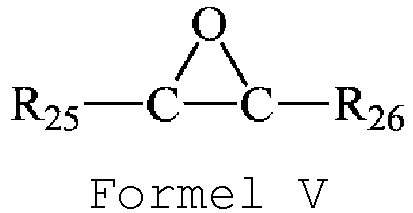 wobei in Formel V R25 und R26 jeweils unabhängig voneinander aus der Gruppe ausgewählt sind, die aus Wasserstoff, substituiertem oder unsubstituiertem linearem C1-C10-Alkyl, substituiertem oder unsubstituiertem verzweigtem C3-C10-Alkyl, substituiertem oder unsubstituiertem C3-C10-Cycloalkyl, substituiertem oder unsubstituiertem C6-C20-Aryl, substituiertem oder unsubstituiertem C7-C20-Aralkyl und substituiertem oder unsubstituiertem C7-C20-Alkaryl besteht; R25 und R26 bevorzugt jeweils unabhängig voneinander aus der Gruppe ausgewählt sind, die aus Wasserstoff, substituiertem oder unsubstituiertem linearem C1-C8-Alkyl, substituiertem oder unsubstituiertem verzweigtem C3-C8-Alkyl, substituiertem oder unsubstituiertem C3-C8-Cycloalkyl, substituiertem oder unsubstituiertem C6-C10-Aryl, substituiertem oder unsubstituiertem C7-C10-Aralkyl und substituiertem oder unsubstituiertem C7-C10-Alkaryl besteht; R25 und R26 mehr bevorzugt jeweils unabhängig voneinander aus der Gruppe ausgewählt sind, die aus Wasserstoff, substituiertem oder unsubstituiertem linearem C1-C6-Alkyl, substituiertem oder unsubstituiertem verzweigtem C3-C6-Alkyl, substituiertem oder unsubstituiertem C3-C6-Cycloalkyl, substituiertem oder unsubstituiertem C6-C8-Aryl, substituiertem oder unsubstituiertem C7-C9-Aralkyl und substituiertem oder unsubstituiertem C7-C9-Alkylaryl besteht.
 - Katalysatorkomponente gemäß Anspruch 9, wobei bezogen auf 1 Mol des Magnesiumhalogenids, dargestellt durch die allgemeine Formel MgX1Y, der elementare Schwefel in einer Menge von 0,0001-0,5 Mol vorliegt, die Verbindung, dargestellt durch die allgemeine Formel R1OH, in einer Menge von 4-30 Mol vorliegt und die Ethylenoxidverbindung in einer Menge von 1-10 Mol vorliegt;
bezogen auf 1 Mol des Magnesiumhalogenids, dargestellt durch die allgemeine Formel MgX1Y, die Verbindung, dargestellt durch die allgemeine Formel R1OH, bevorzugt in einer Menge von 6-20 Mol vorliegt und die Ethylenoxidverbindung bevorzugt in einer Menge von 2-6 Mol vorliegt. - Katalysatorkomponente gemäß Anspruch 9 oder 10, wobei in Schritt (1) das Erhitzen bei einer Temperatur von 80-120°C für eine Zeitdauer von 0,5-5 Stunden, bevorzugt bei einer Temperatur von 80-100°C für eine Zeitdauer von 0,5-3 Stunden, durchgeführt wird; und
in Schritt (2) die Kontaktreaktion unter Bedingungen durchgeführt wird, die das Reagieren bei einer Temperatur von 40-120°C für eine Zeitdauer von 15-60 Minuten, bevorzugt bei einer Temperatur von 60-100°C für eine Zeitdauer von 20-50 Minuten, umfassen. - Katalysatorkomponente gemäß einem der Ansprüche 9 bis 11, wobei das inerte flüssige Medium ein Silikonöl-Lösungsmittel und/oder ein KohlenwasserstoffLösungsmittel ist; das inerte flüssige Medium bevorzugt mindestens eines ist, das aus der Gruppe ausgewählt ist, die aus Kerosin, Paraffinöl, Petrolatumöl, Weißöl, Methylsilikonöl, Ethylsilikonöl, Methylethylsilikonöl, Phenylsilikonöl und Methylphenylsilikonöl besteht; und/oder
bezogen auf 1 Mol des Magnesiumhalogenids, dargestellt durch die allgemeine Formel MgX1Y, das inerte flüssige Medium in einer Menge von 0,8-10 l vorliegt. - Katalysatorkomponente gemäß einem der Ansprüche 9 bis 12, wobei das Tensid mindestens eines ist, das aus der Gruppe ausgewählt ist, die aus Polyvinylpyrrolidon, Polyethylenglycol, Polyvinylalkohol, Polyacrylsäure, Polyacrylat, Polyacrylamid, Polystyrolsulfonat, Naphthalinsulfonsäure-Formaldehyd-Kondensat, kondensiertem Alkylphenylethersulfat, kondensiertem Alkylphenolpolyoxyethylenetherphosphat, Oxyalkylacrylat-Copolymer, modifiziertem Polyethylenimin, 1-Dodeca-4-vinylpyridinbromid-Polymer, Polyvinylbenzyltrimethylaminsalz, Polyethylenoxid-Propylenoxid-Blockcopolymer, Polyvinylpyrrolidon-Vinylacetat-Copolymer, Alkylphenylpolyoxyethylenether und Polyalkylmethacrylat besteht; und/oder
bezogen auf 1 Mol des Magnesiumhalogenids, dargestellt durch die allgemeine Formel MgX1Y, das Tensid in einer Menge von 1-20 g vorliegt. - Katalysatorkomponente gemäß einem der Ansprüche 9 bis 13, wobei in der allgemeinen Formel MgX1Y X1 Chlor oder Brom ist, und Y Chlor, Brom, C1-C5-Alkoxy oder C6-C10-Aryloxy ist; das Magnesiumhalogenid, dargestellt durch die allgemeine Formel MgX1Y, bevorzugt mindestens eines ist, das aus der Gruppe ausgewählt ist, die aus Magnesiumchlorid, Magnesiumbromid, Phenoxymagnesiumchlorid, Isopropoxymagnesiumchlorid und n-Butoxymagnesiumchlorid besteht; und/oderin der allgemeinen Formel R1OH R1 C1-C8-Alkyl ist; die Verbindung, dargestellt durch die allgemeine Formel R1OH, bevorzugt mindestens eine ist, die aus der Gruppe ausgewählt ist, die aus Ethanol, n-Propanol, Isopropanol, n-Butanol, Isobutanol, n-Pentanol, Isopentanol, n-Hexanol, 2-Ethylhexanol und n-Octanol besteht; und/oderin der Ethylenoxidverbindung mit der in Formel V gezeigten Struktur R25 und R26 jeweils unabhängig voneinander Wasserstoff, C1-C3-Alkyl oder halogeniertes C1-C3-Alkyl sind; die Ethylenoxidverbindung bevorzugt mindestens eine ist, die aus der Gruppe ausgewählt ist, die aus Ethylenoxid, Epoxypropan, Epoxybutan, Epoxychlorpropan, Epoxychlorbutan, Epoxybrompropan und Epoxybrombutan besteht.
- Katalysatorkomponente gemäß einem der Ansprüche 1 bis 14, wobei in der Katalysatorkomponente ein Gewichtsverhältnis von Titan als Titanelement zu Magnesium als Magnesiumelement zu dem Halogen und zu dem internen Elektronendonor 1:2-15:8-30:2-15, bevorzugt 1:3-12:10-25:3-13, ist.
- Katalysator für die Olefinpolymerisation, umfassend:(1) die Katalysatorkomponente gemäß einem der Ansprüche 1 bis 15;(2) mindestens eine Alkylaluminiumverbindung; und(3) optional eine externe Elektronendonorverbindung.
- Verwendung des Katalysators gemäß Anspruch 16 bei der Polymerisation eines Olefins, wobei das Olefin bevorzugt mindestens ein Olefin, dargestellt durch eine Formel CH2=CHR, umfasst, worin R Wasserstoff oder lineares oder verzweigtes C1-C6-Alkyl ist.
- Olefinpolymerisationsverfahren, umfassend: das Inkontaktbringen des Olefins mit einem Katalysator gemäß Anspruch 16 unter Olefinpolymerisationsbedingungen, wobei das Olefin bevorzugt mindestens ein Olefin, dargestellt durch eine Formel CH2=CHR, umfasst, worin R Wasserstoff oder lineares oder verzweigtes C1-C6-Alkyl ist.
Applications Claiming Priority (5)
| Application Number | Priority Date | Filing Date | Title |
|---|---|---|---|
| CN201811223634.8A CN111072807A (zh) | 2018-10-19 | 2018-10-19 | 用于烯烃聚合的催化剂组分和催化剂及其应用与烯烃聚合方法 |
| CN201811224580.7A CN111072815A (zh) | 2018-10-19 | 2018-10-19 | 用于烯烃聚合的催化剂组分和催化剂及其应用与烯烃聚合方法 |
| CN201811224578.XA CN111072814A (zh) | 2018-10-19 | 2018-10-19 | 用于烯烃聚合的催化剂组分和催化剂及其应用与烯烃聚合方法 |
| CN201811223600.9A CN111072805A (zh) | 2018-10-19 | 2018-10-19 | 用于烯烃聚合的催化剂组分和催化剂及其应用与烯烃聚合方法 |
| PCT/CN2019/111252 WO2020078352A1 (zh) | 2018-10-19 | 2019-10-15 | 用于烯烃聚合催化剂组分、催化剂及其应用 |
Publications (3)
| Publication Number | Publication Date |
|---|---|
| EP3868796A1 EP3868796A1 (de) | 2021-08-25 |
| EP3868796A4 EP3868796A4 (de) | 2022-07-13 |
| EP3868796B1 true EP3868796B1 (de) | 2024-07-31 |
Family
ID=70283685
Family Applications (1)
| Application Number | Title | Priority Date | Filing Date |
|---|---|---|---|
| EP19874270.2A Active EP3868796B1 (de) | 2018-10-19 | 2019-10-15 | Katalysatorkomponente und katalysator für olefinpolymerisation und deren verwendung |
Country Status (12)
| Country | Link |
|---|---|
| US (1) | US11970510B2 (de) |
| EP (1) | EP3868796B1 (de) |
| JP (1) | JP7479361B2 (de) |
| KR (1) | KR102868882B1 (de) |
| ES (1) | ES2986988T3 (de) |
| FI (1) | FI3868796T3 (de) |
| MY (1) | MY209414A (de) |
| PT (1) | PT3868796T (de) |
| SA (1) | SA521421681B1 (de) |
| SG (1) | SG11202103779QA (de) |
| TW (1) | TWI851609B (de) |
| WO (1) | WO2020078352A1 (de) |
Families Citing this family (6)
| Publication number | Priority date | Publication date | Assignee | Title |
|---|---|---|---|---|
| CN111072797B (zh) * | 2018-10-19 | 2021-07-02 | 中国石油化工股份有限公司 | 烯烃聚合催化剂球形载体及其制备方法和催化剂组分与催化剂及应用 |
| CN114149523B (zh) * | 2020-09-05 | 2022-11-18 | 中国石油化工股份有限公司 | 一种用于烯烃聚合的催化剂球形载体及其制备方法与应用和一种催化剂及其应用 |
| CN115838447B (zh) * | 2021-09-18 | 2023-09-08 | 中国石油化工股份有限公司 | 用于烯烃聚合的催化剂组分、制备方法及其应用、催化剂及其应用 |
| CN115975077B (zh) * | 2021-10-15 | 2024-06-04 | 中国石油化工股份有限公司 | 一种用于烯烃聚合的催化剂组分及催化剂和应用 |
| CN119798490A (zh) * | 2023-10-10 | 2025-04-11 | 中国石油化工股份有限公司 | 用于烯烃聚合的固体催化剂组分及其制备方法和应用 |
| CN119841978B (zh) * | 2023-10-16 | 2025-11-28 | 中国石油化工股份有限公司 | 一种用于烯烃聚合的固体催化剂组分及其制备方法、催化剂和应用 |
Citations (1)
| Publication number | Priority date | Publication date | Assignee | Title |
|---|---|---|---|---|
| US4425258A (en) * | 1981-06-24 | 1984-01-10 | Denki Kagaku Kogyo Kabushiki Kaisha | Catalysts for polymerization of olefins |
Family Cites Families (25)
| Publication number | Priority date | Publication date | Assignee | Title |
|---|---|---|---|---|
| SE363977B (de) | 1968-11-21 | 1974-02-11 | Montedison Spa | |
| YU35844B (en) | 1968-11-25 | 1981-08-31 | Montedison Spa | Process for obtaining catalysts for the polymerization of olefines |
| IT1227260B (it) | 1988-09-30 | 1991-03-28 | Himont Inc | Dieteri utilizzabili nella preparazione di catalizzatori ziegler-natta |
| IT1274250B (it) | 1995-02-21 | 1997-07-15 | Himont Inc | Dieteri utilizzabili nella preparazione di catalizzatori ziegler-natta |
| EP0994905B1 (de) * | 1998-05-06 | 2004-01-21 | Basell Poliolefine Italia S.p.A. | Katalysatorbestandteile für die olefinpolymerisation |
| CN1151183C (zh) | 2000-06-15 | 2004-05-26 | 中国石油化工股份有限公司 | 用于烯烃聚合或共聚合的球形催化剂组分及其催化剂 |
| CN1169845C (zh) | 2002-02-07 | 2004-10-06 | 中国石油化工股份有限公司 | 用于烯烃聚合的固体催化剂组分和含该催化剂组分的催化剂及其应用 |
| CN100441561C (zh) | 2002-02-07 | 2008-12-10 | 中国石油化工股份有限公司 | 用于制备烯烃聚合催化剂的多酯化合物 |
| CN1463990A (zh) | 2002-06-10 | 2003-12-31 | 营口市向阳催化剂有限责任公司 | 一种烯烃聚合球型催化剂组分及载体的制备方法 |
| CN1310962C (zh) | 2003-05-30 | 2007-04-18 | 中国石油化工股份有限公司 | 用于烯烃聚合反应的催化剂组分及其催化剂 |
| CN100338016C (zh) | 2003-08-06 | 2007-09-19 | 中国石油化工股份有限公司 | 用于制备烯烃聚合催化剂的二醇酯化合物 |
| CN1297534C (zh) | 2003-08-06 | 2007-01-31 | 中国石油化工股份有限公司 | 用于制备烯烃聚合催化剂的二醇酯化合物 |
| CN100338015C (zh) | 2003-08-06 | 2007-09-19 | 中国石油化工股份有限公司 | 用于制备烯烃聚合催化剂的二醇酯化合物 |
| CN100348624C (zh) | 2005-01-13 | 2007-11-14 | 中国石油化工股份有限公司 | 用于烯烃聚合反应的催化剂组分和催化剂 |
| SA3686B1 (ar) | 2009-10-16 | 2014-10-22 | China Petroleum& Chemical Corp | مكون حفاز لبلمرة الأولفين وحفاز يشتمل عليه |
| CN102040690A (zh) | 2009-10-20 | 2011-05-04 | 中国石油化工股份有限公司 | 一种低灰分聚丙烯的制备方法 |
| CN102796210B (zh) * | 2011-05-27 | 2014-05-28 | 中国石油化工股份有限公司 | 用于烯烃聚合的催化剂组分和催化剂体系及其应用和烯烃聚合方法 |
| CN103012632B (zh) | 2011-09-23 | 2015-03-11 | 中国石油化工股份有限公司 | 一种丙烯聚合物的制备方法 |
| US9815918B2 (en) * | 2012-03-19 | 2017-11-14 | Formosa Plastics Corporation, U.S.A. | Catalyst component for high activity and high stereoselectivity in olefin polymerization |
| CN104558282B (zh) * | 2013-10-18 | 2017-02-15 | 中国石油化工股份有限公司 | 用于烯烃聚合的催化剂组分及其制备方法和用于烯烃聚合的催化剂与应用 |
| MY172451A (en) | 2013-10-18 | 2019-11-26 | China Petroleum & Chem Corp | Spherical carriers for olefin polymerization catalyst, catalyst components, catalyst, and preparation methods therefor |
| US20170121430A1 (en) * | 2014-05-20 | 2017-05-04 | Reliance Industries Limited | Ziegler-Natta Catalyst Composition And A Process For Its Preparation |
| CN107629153B (zh) * | 2016-07-18 | 2020-04-07 | 中国石油化工股份有限公司 | 用于烯烃聚合的催化剂组分及其制备方法和用于烯烃聚合的催化剂及其应用 |
| KR102461635B1 (ko) | 2016-10-06 | 2022-10-31 | 더블유.알. 그레이스 앤드 캄파니-콘. | 내부 전자 공여체의 조합물로 제조된 전구촉매 조성물 |
| CN111072797B (zh) | 2018-10-19 | 2021-07-02 | 中国石油化工股份有限公司 | 烯烃聚合催化剂球形载体及其制备方法和催化剂组分与催化剂及应用 |
-
2019
- 2019-10-15 EP EP19874270.2A patent/EP3868796B1/de active Active
- 2019-10-15 JP JP2021520594A patent/JP7479361B2/ja active Active
- 2019-10-15 WO PCT/CN2019/111252 patent/WO2020078352A1/zh not_active Ceased
- 2019-10-15 US US17/286,776 patent/US11970510B2/en active Active
- 2019-10-15 KR KR1020217015086A patent/KR102868882B1/ko active Active
- 2019-10-15 MY MYPI2021001946A patent/MY209414A/en unknown
- 2019-10-15 PT PT198742702T patent/PT3868796T/pt unknown
- 2019-10-15 FI FIEP19874270.2T patent/FI3868796T3/fi active
- 2019-10-15 ES ES19874270T patent/ES2986988T3/es active Active
- 2019-10-15 SG SG11202103779QA patent/SG11202103779QA/en unknown
- 2019-10-17 TW TW108137362A patent/TWI851609B/zh active
-
2021
- 2021-04-07 SA SA521421681A patent/SA521421681B1/ar unknown
Patent Citations (1)
| Publication number | Priority date | Publication date | Assignee | Title |
|---|---|---|---|---|
| US4425258A (en) * | 1981-06-24 | 1984-01-10 | Denki Kagaku Kogyo Kabushiki Kaisha | Catalysts for polymerization of olefins |
Also Published As
| Publication number | Publication date |
|---|---|
| PT3868796T (pt) | 2024-08-26 |
| WO2020078352A1 (zh) | 2020-04-23 |
| JP2022504961A (ja) | 2022-01-13 |
| US11970510B2 (en) | 2024-04-30 |
| FI3868796T3 (fi) | 2024-08-27 |
| JP7479361B2 (ja) | 2024-05-08 |
| ES2986988T3 (es) | 2024-11-13 |
| KR20210080466A (ko) | 2021-06-30 |
| BR112021006289A2 (pt) | 2021-07-06 |
| SG11202103779QA (en) | 2021-05-28 |
| SA521421681B1 (ar) | 2024-06-11 |
| TW202031690A (zh) | 2020-09-01 |
| TWI851609B (zh) | 2024-08-11 |
| MY209414A (en) | 2025-07-08 |
| EP3868796A1 (de) | 2021-08-25 |
| KR102868882B1 (ko) | 2025-10-02 |
| US20210340165A1 (en) | 2021-11-04 |
| EP3868796A4 (de) | 2022-07-13 |
Similar Documents
| Publication | Publication Date | Title |
|---|---|---|
| EP3868796B1 (de) | Katalysatorkomponente und katalysator für olefinpolymerisation und deren verwendung | |
| CN107629153B (zh) | 用于烯烃聚合的催化剂组分及其制备方法和用于烯烃聚合的催化剂及其应用 | |
| RU2668082C2 (ru) | Сферические носители для катализатора полимеризации олефинов, компоненты катализатора, катализатор и методы их получения | |
| KR102877758B1 (ko) | 올레핀 중합 촉매용 담체, 및 이의 제조 방법 및 용도 | |
| CN111072812B (zh) | 用于烯烃聚合的催化剂组分和催化剂及其应用与烯烃聚合方法 | |
| KR20160102017A (ko) | 올레핀 중합용 촉매 시스템 | |
| CN115975078B (zh) | 一种用于烯烃聚合的催化剂组分及催化剂和应用 | |
| CN111072806B (zh) | 用于烯烃聚合的催化剂组分和催化剂及其应用与烯烃聚合方法 | |
| CN111072810B (zh) | 用于烯烃聚合的催化剂组分和催化剂及其应用与烯烃聚合方法 | |
| CN115975077B (zh) | 一种用于烯烃聚合的催化剂组分及催化剂和应用 | |
| CN111234067B (zh) | 用于烯烃聚合的固体催化剂组分和催化剂及其应用 | |
| CN111072815A (zh) | 用于烯烃聚合的催化剂组分和催化剂及其应用与烯烃聚合方法 | |
| CN115975075A (zh) | 一种用于烯烃聚合的催化剂组分及催化剂和应用 | |
| CN108117617B (zh) | 一种用于烯烃聚合的固体催化剂组分和催化剂 | |
| CN112661883B (zh) | 用于制备聚烯烃的固体催化剂组分、催化剂体系及其应用 | |
| RU2801219C9 (ru) | Компонент катализатора и катализатор, предназначенный для полимеризации олефина, и его применение | |
| RU2801219C2 (ru) | Компонент катализатора и катализатор, предназначенный для полимеризации олефина, и его применение | |
| CN111072805A (zh) | 用于烯烃聚合的催化剂组分和催化剂及其应用与烯烃聚合方法 | |
| CN112661881A (zh) | 一种烯烃聚合催化剂组分、催化剂体系及烯烃聚合方法 | |
| CN111072813B (zh) | 用于烯烃聚合的催化剂组分和催化剂及其应用与烯烃聚合方法 | |
| CN111072807A (zh) | 用于烯烃聚合的催化剂组分和催化剂及其应用与烯烃聚合方法 | |
| TW202500596A (zh) | 用於烯烴聚合的催化劑組分及其製備方法和用途 | |
| BR112021006289B1 (pt) | Componente de catalisador e catalisador para a polimerização de olefina, seu uso e método para a polimerização de olefina | |
| CN111072814A (zh) | 用于烯烃聚合的催化剂组分和催化剂及其应用与烯烃聚合方法 |
Legal Events
| Date | Code | Title | Description |
|---|---|---|---|
| STAA | Information on the status of an ep patent application or granted ep patent |
Free format text: STATUS: THE INTERNATIONAL PUBLICATION HAS BEEN MADE |
|
| PUAI | Public reference made under article 153(3) epc to a published international application that has entered the european phase |
Free format text: ORIGINAL CODE: 0009012 |
|
| STAA | Information on the status of an ep patent application or granted ep patent |
Free format text: STATUS: REQUEST FOR EXAMINATION WAS MADE |
|
| 17P | Request for examination filed |
Effective date: 20210409 |
|
| AK | Designated contracting states |
Kind code of ref document: A1 Designated state(s): AL AT BE BG CH CY CZ DE DK EE ES FI FR GB GR HR HU IE IS IT LI LT LU LV MC MK MT NL NO PL PT RO RS SE SI SK SM TR |
|
| DAV | Request for validation of the european patent (deleted) | ||
| DAX | Request for extension of the european patent (deleted) | ||
| A4 | Supplementary search report drawn up and despatched |
Effective date: 20220613 |
|
| RIC1 | Information provided on ipc code assigned before grant |
Ipc: C08F 10/00 20060101ALI20220608BHEP Ipc: C08F 110/06 20060101ALI20220608BHEP Ipc: C08F 4/654 20060101ALI20220608BHEP Ipc: C08F 4/649 20060101ALI20220608BHEP Ipc: C08F 10/06 20060101AFI20220608BHEP |
|
| STAA | Information on the status of an ep patent application or granted ep patent |
Free format text: STATUS: EXAMINATION IS IN PROGRESS |
|
| 17Q | First examination report despatched |
Effective date: 20230414 |
|
| GRAP | Despatch of communication of intention to grant a patent |
Free format text: ORIGINAL CODE: EPIDOSNIGR1 |
|
| STAA | Information on the status of an ep patent application or granted ep patent |
Free format text: STATUS: GRANT OF PATENT IS INTENDED |
|
| INTG | Intention to grant announced |
Effective date: 20240320 |
|
| P01 | Opt-out of the competence of the unified patent court (upc) registered |
Effective date: 20240416 |
|
| GRAS | Grant fee paid |
Free format text: ORIGINAL CODE: EPIDOSNIGR3 |
|
| GRAA | (expected) grant |
Free format text: ORIGINAL CODE: 0009210 |
|
| STAA | Information on the status of an ep patent application or granted ep patent |
Free format text: STATUS: THE PATENT HAS BEEN GRANTED |
|
| AK | Designated contracting states |
Kind code of ref document: B1 Designated state(s): AL AT BE BG CH CY CZ DE DK EE ES FI FR GB GR HR HU IE IS IT LI LT LU LV MC MK MT NL NO PL PT RO RS SE SI SK SM TR |
|
| REG | Reference to a national code |
Ref country code: CH Ref legal event code: EP Ref country code: GB Ref legal event code: FG4D |
|
| REG | Reference to a national code |
Ref country code: DE Ref legal event code: R096 Ref document number: 602019056307 Country of ref document: DE |
|
| REG | Reference to a national code |
Ref country code: PT Ref legal event code: SC4A Ref document number: 3868796 Country of ref document: PT Date of ref document: 20240826 Kind code of ref document: T Free format text: AVAILABILITY OF NATIONAL TRANSLATION Effective date: 20240821 |
|
| REG | Reference to a national code |
Ref country code: FI Ref legal event code: FGE |
|
| REG | Reference to a national code |
Ref country code: NL Ref legal event code: FP Ref country code: IE Ref legal event code: FG4D |
|
| REG | Reference to a national code |
Ref country code: ES Ref legal event code: FG2A Ref document number: 2986988 Country of ref document: ES Kind code of ref document: T3 Effective date: 20241113 |
|
| REG | Reference to a national code |
Ref country code: LT Ref legal event code: MG9D |
|
| REG | Reference to a national code |
Ref country code: GR Ref legal event code: EP Ref document number: 20240402153 Country of ref document: GR Effective date: 20241111 |
|
| PG25 | Lapsed in a contracting state [announced via postgrant information from national office to epo] |
Ref country code: NO Free format text: LAPSE BECAUSE OF FAILURE TO SUBMIT A TRANSLATION OF THE DESCRIPTION OR TO PAY THE FEE WITHIN THE PRESCRIBED TIME-LIMIT Effective date: 20241031 |
|
| PG25 | Lapsed in a contracting state [announced via postgrant information from national office to epo] |
Ref country code: PL Free format text: LAPSE BECAUSE OF FAILURE TO SUBMIT A TRANSLATION OF THE DESCRIPTION OR TO PAY THE FEE WITHIN THE PRESCRIBED TIME-LIMIT Effective date: 20240731 |
|
| PG25 | Lapsed in a contracting state [announced via postgrant information from national office to epo] |
Ref country code: BG Free format text: LAPSE BECAUSE OF FAILURE TO SUBMIT A TRANSLATION OF THE DESCRIPTION OR TO PAY THE FEE WITHIN THE PRESCRIBED TIME-LIMIT Effective date: 20240731 |
|
| PG25 | Lapsed in a contracting state [announced via postgrant information from national office to epo] |
Ref country code: LV Free format text: LAPSE BECAUSE OF FAILURE TO SUBMIT A TRANSLATION OF THE DESCRIPTION OR TO PAY THE FEE WITHIN THE PRESCRIBED TIME-LIMIT Effective date: 20240731 |
|
| PG25 | Lapsed in a contracting state [announced via postgrant information from national office to epo] |
Ref country code: IS Free format text: LAPSE BECAUSE OF FAILURE TO SUBMIT A TRANSLATION OF THE DESCRIPTION OR TO PAY THE FEE WITHIN THE PRESCRIBED TIME-LIMIT Effective date: 20241130 |
|
| PG25 | Lapsed in a contracting state [announced via postgrant information from national office to epo] |
Ref country code: HR Free format text: LAPSE BECAUSE OF FAILURE TO SUBMIT A TRANSLATION OF THE DESCRIPTION OR TO PAY THE FEE WITHIN THE PRESCRIBED TIME-LIMIT Effective date: 20240731 |
|
| PG25 | Lapsed in a contracting state [announced via postgrant information from national office to epo] |
Ref country code: RS Free format text: LAPSE BECAUSE OF FAILURE TO SUBMIT A TRANSLATION OF THE DESCRIPTION OR TO PAY THE FEE WITHIN THE PRESCRIBED TIME-LIMIT Effective date: 20241031 |
|
| PG25 | Lapsed in a contracting state [announced via postgrant information from national office to epo] |
Ref country code: RS Free format text: LAPSE BECAUSE OF FAILURE TO SUBMIT A TRANSLATION OF THE DESCRIPTION OR TO PAY THE FEE WITHIN THE PRESCRIBED TIME-LIMIT Effective date: 20241031 Ref country code: PL Free format text: LAPSE BECAUSE OF FAILURE TO SUBMIT A TRANSLATION OF THE DESCRIPTION OR TO PAY THE FEE WITHIN THE PRESCRIBED TIME-LIMIT Effective date: 20240731 Ref country code: NO Free format text: LAPSE BECAUSE OF FAILURE TO SUBMIT A TRANSLATION OF THE DESCRIPTION OR TO PAY THE FEE WITHIN THE PRESCRIBED TIME-LIMIT Effective date: 20241031 Ref country code: LV Free format text: LAPSE BECAUSE OF FAILURE TO SUBMIT A TRANSLATION OF THE DESCRIPTION OR TO PAY THE FEE WITHIN THE PRESCRIBED TIME-LIMIT Effective date: 20240731 Ref country code: IS Free format text: LAPSE BECAUSE OF FAILURE TO SUBMIT A TRANSLATION OF THE DESCRIPTION OR TO PAY THE FEE WITHIN THE PRESCRIBED TIME-LIMIT Effective date: 20241130 Ref country code: HR Free format text: LAPSE BECAUSE OF FAILURE TO SUBMIT A TRANSLATION OF THE DESCRIPTION OR TO PAY THE FEE WITHIN THE PRESCRIBED TIME-LIMIT Effective date: 20240731 Ref country code: BG Free format text: LAPSE BECAUSE OF FAILURE TO SUBMIT A TRANSLATION OF THE DESCRIPTION OR TO PAY THE FEE WITHIN THE PRESCRIBED TIME-LIMIT Effective date: 20240731 |
|
| PG25 | Lapsed in a contracting state [announced via postgrant information from national office to epo] |
Ref country code: RO Free format text: LAPSE BECAUSE OF FAILURE TO SUBMIT A TRANSLATION OF THE DESCRIPTION OR TO PAY THE FEE WITHIN THE PRESCRIBED TIME-LIMIT Effective date: 20240731 Ref country code: SM Free format text: LAPSE BECAUSE OF FAILURE TO SUBMIT A TRANSLATION OF THE DESCRIPTION OR TO PAY THE FEE WITHIN THE PRESCRIBED TIME-LIMIT Effective date: 20240731 Ref country code: DK Free format text: LAPSE BECAUSE OF FAILURE TO SUBMIT A TRANSLATION OF THE DESCRIPTION OR TO PAY THE FEE WITHIN THE PRESCRIBED TIME-LIMIT Effective date: 20240731 |
|
| PG25 | Lapsed in a contracting state [announced via postgrant information from national office to epo] |
Ref country code: EE Free format text: LAPSE BECAUSE OF FAILURE TO SUBMIT A TRANSLATION OF THE DESCRIPTION OR TO PAY THE FEE WITHIN THE PRESCRIBED TIME-LIMIT Effective date: 20240731 |
|
| PG25 | Lapsed in a contracting state [announced via postgrant information from national office to epo] |
Ref country code: CZ Free format text: LAPSE BECAUSE OF FAILURE TO SUBMIT A TRANSLATION OF THE DESCRIPTION OR TO PAY THE FEE WITHIN THE PRESCRIBED TIME-LIMIT Effective date: 20240731 |
|
| PG25 | Lapsed in a contracting state [announced via postgrant information from national office to epo] |
Ref country code: SK Free format text: LAPSE BECAUSE OF FAILURE TO SUBMIT A TRANSLATION OF THE DESCRIPTION OR TO PAY THE FEE WITHIN THE PRESCRIBED TIME-LIMIT Effective date: 20240731 |
|
| REG | Reference to a national code |
Ref country code: DE Ref legal event code: R097 Ref document number: 602019056307 Country of ref document: DE |
|
| REG | Reference to a national code |
Ref country code: CH Ref legal event code: PL |
|
| PLBE | No opposition filed within time limit |
Free format text: ORIGINAL CODE: 0009261 |
|
| STAA | Information on the status of an ep patent application or granted ep patent |
Free format text: STATUS: NO OPPOSITION FILED WITHIN TIME LIMIT |
|
| GBPC | Gb: european patent ceased through non-payment of renewal fee |
Effective date: 20241031 |
|
| PG25 | Lapsed in a contracting state [announced via postgrant information from national office to epo] |
Ref country code: MC Free format text: LAPSE BECAUSE OF FAILURE TO SUBMIT A TRANSLATION OF THE DESCRIPTION OR TO PAY THE FEE WITHIN THE PRESCRIBED TIME-LIMIT Effective date: 20240731 |
|
| 26N | No opposition filed |
Effective date: 20250501 |
|
| PG25 | Lapsed in a contracting state [announced via postgrant information from national office to epo] |
Ref country code: GB Free format text: LAPSE BECAUSE OF NON-PAYMENT OF DUE FEES Effective date: 20241031 |
|
| PG25 | Lapsed in a contracting state [announced via postgrant information from national office to epo] |
Ref country code: LU Free format text: LAPSE BECAUSE OF NON-PAYMENT OF DUE FEES Effective date: 20241015 |
|
| PG25 | Lapsed in a contracting state [announced via postgrant information from national office to epo] |
Ref country code: CH Free format text: LAPSE BECAUSE OF NON-PAYMENT OF DUE FEES Effective date: 20241031 |
|
| PG25 | Lapsed in a contracting state [announced via postgrant information from national office to epo] |
Ref country code: SE Free format text: LAPSE BECAUSE OF FAILURE TO SUBMIT A TRANSLATION OF THE DESCRIPTION OR TO PAY THE FEE WITHIN THE PRESCRIBED TIME-LIMIT Effective date: 20240731 |
|
| PGFP | Annual fee paid to national office [announced via postgrant information from national office to epo] |
Ref country code: NL Payment date: 20250814 Year of fee payment: 7 |
|
| PGFP | Annual fee paid to national office [announced via postgrant information from national office to epo] |
Ref country code: GR Payment date: 20250911 Year of fee payment: 7 |
|
| PGFP | Annual fee paid to national office [announced via postgrant information from national office to epo] |
Ref country code: IT Payment date: 20250922 Year of fee payment: 7 |
|
| REG | Reference to a national code |
Ref country code: AT Ref legal event code: UEP Ref document number: 1708423 Country of ref document: AT Kind code of ref document: T Effective date: 20240731 |
|
| PGFP | Annual fee paid to national office [announced via postgrant information from national office to epo] |
Ref country code: BE Payment date: 20250917 Year of fee payment: 7 |
|
| PGFP | Annual fee paid to national office [announced via postgrant information from national office to epo] |
Ref country code: FR Payment date: 20250808 Year of fee payment: 7 |
|
| PG25 | Lapsed in a contracting state [announced via postgrant information from national office to epo] |
Ref country code: IE Free format text: LAPSE BECAUSE OF NON-PAYMENT OF DUE FEES Effective date: 20241015 |
|
| PGFP | Annual fee paid to national office [announced via postgrant information from national office to epo] |
Ref country code: PT Payment date: 20251013 Year of fee payment: 7 |
|
| PGFP | Annual fee paid to national office [announced via postgrant information from national office to epo] |
Ref country code: DE Payment date: 20250819 Year of fee payment: 7 |
|
| PGFP | Annual fee paid to national office [announced via postgrant information from national office to epo] |
Ref country code: AT Payment date: 20250925 Year of fee payment: 7 |
|
| PGFP | Annual fee paid to national office [announced via postgrant information from national office to epo] |
Ref country code: FI Payment date: 20251014 Year of fee payment: 7 |
|
| PG25 | Lapsed in a contracting state [announced via postgrant information from national office to epo] |
Ref country code: CY Free format text: LAPSE BECAUSE OF FAILURE TO SUBMIT A TRANSLATION OF THE DESCRIPTION OR TO PAY THE FEE WITHIN THE PRESCRIBED TIME-LIMIT; INVALID AB INITIO Effective date: 20191015 |
|
| PGFP | Annual fee paid to national office [announced via postgrant information from national office to epo] |
Ref country code: ES Payment date: 20251106 Year of fee payment: 7 |