EP3868792B1 - Verfahren zur herstellung eines ethylen-carbonsäure-compolymers - Google Patents
Verfahren zur herstellung eines ethylen-carbonsäure-compolymers Download PDFInfo
- Publication number
- EP3868792B1 EP3868792B1 EP21156306.9A EP21156306A EP3868792B1 EP 3868792 B1 EP3868792 B1 EP 3868792B1 EP 21156306 A EP21156306 A EP 21156306A EP 3868792 B1 EP3868792 B1 EP 3868792B1
- Authority
- EP
- European Patent Office
- Prior art keywords
- monomer
- discharging unit
- carboxylic acid
- ethylene
- monomer solution
- Prior art date
- Legal status (The legal status is an assumption and is not a legal conclusion. Google has not performed a legal analysis and makes no representation as to the accuracy of the status listed.)
- Active
Links
Images


Classifications
-
- C—CHEMISTRY; METALLURGY
- C08—ORGANIC MACROMOLECULAR COMPOUNDS; THEIR PREPARATION OR CHEMICAL WORKING-UP; COMPOSITIONS BASED THEREON
- C08F—MACROMOLECULAR COMPOUNDS OBTAINED BY REACTIONS ONLY INVOLVING CARBON-TO-CARBON UNSATURATED BONDS
- C08F2/00—Processes of polymerisation
-
- C—CHEMISTRY; METALLURGY
- C08—ORGANIC MACROMOLECULAR COMPOUNDS; THEIR PREPARATION OR CHEMICAL WORKING-UP; COMPOSITIONS BASED THEREON
- C08F—MACROMOLECULAR COMPOUNDS OBTAINED BY REACTIONS ONLY INVOLVING CARBON-TO-CARBON UNSATURATED BONDS
- C08F2/00—Processes of polymerisation
- C08F2/001—Multistage polymerisation processes characterised by a change in reactor conditions without deactivating the intermediate polymer
-
- C—CHEMISTRY; METALLURGY
- C08—ORGANIC MACROMOLECULAR COMPOUNDS; THEIR PREPARATION OR CHEMICAL WORKING-UP; COMPOSITIONS BASED THEREON
- C08F—MACROMOLECULAR COMPOUNDS OBTAINED BY REACTIONS ONLY INVOLVING CARBON-TO-CARBON UNSATURATED BONDS
- C08F2/00—Processes of polymerisation
- C08F2/01—Processes of polymerisation characterised by special features of the polymerisation apparatus used
-
- C—CHEMISTRY; METALLURGY
- C08—ORGANIC MACROMOLECULAR COMPOUNDS; THEIR PREPARATION OR CHEMICAL WORKING-UP; COMPOSITIONS BASED THEREON
- C08F—MACROMOLECULAR COMPOUNDS OBTAINED BY REACTIONS ONLY INVOLVING CARBON-TO-CARBON UNSATURATED BONDS
- C08F2/00—Processes of polymerisation
- C08F2/12—Polymerisation in non-solvents
- C08F2/14—Organic medium
-
- C—CHEMISTRY; METALLURGY
- C08—ORGANIC MACROMOLECULAR COMPOUNDS; THEIR PREPARATION OR CHEMICAL WORKING-UP; COMPOSITIONS BASED THEREON
- C08F—MACROMOLECULAR COMPOUNDS OBTAINED BY REACTIONS ONLY INVOLVING CARBON-TO-CARBON UNSATURATED BONDS
- C08F2/00—Processes of polymerisation
- C08F2/38—Polymerisation using regulators, e.g. chain terminating agents, e.g. telomerisation
-
- C—CHEMISTRY; METALLURGY
- C08—ORGANIC MACROMOLECULAR COMPOUNDS; THEIR PREPARATION OR CHEMICAL WORKING-UP; COMPOSITIONS BASED THEREON
- C08F—MACROMOLECULAR COMPOUNDS OBTAINED BY REACTIONS ONLY INVOLVING CARBON-TO-CARBON UNSATURATED BONDS
- C08F2/00—Processes of polymerisation
- C08F2/44—Polymerisation in the presence of compounding ingredients, e.g. plasticisers, dyestuffs, fillers
-
- C—CHEMISTRY; METALLURGY
- C08—ORGANIC MACROMOLECULAR COMPOUNDS; THEIR PREPARATION OR CHEMICAL WORKING-UP; COMPOSITIONS BASED THEREON
- C08F—MACROMOLECULAR COMPOUNDS OBTAINED BY REACTIONS ONLY INVOLVING CARBON-TO-CARBON UNSATURATED BONDS
- C08F210/00—Copolymers of unsaturated aliphatic hydrocarbons having only one carbon-to-carbon double bond
- C08F210/02—Ethene
-
- C—CHEMISTRY; METALLURGY
- C08—ORGANIC MACROMOLECULAR COMPOUNDS; THEIR PREPARATION OR CHEMICAL WORKING-UP; COMPOSITIONS BASED THEREON
- C08F—MACROMOLECULAR COMPOUNDS OBTAINED BY REACTIONS ONLY INVOLVING CARBON-TO-CARBON UNSATURATED BONDS
- C08F220/00—Copolymers of compounds having one or more unsaturated aliphatic radicals, each having only one carbon-to-carbon double bond, and only one being terminated by only one carboxyl radical or a salt, anhydride ester, amide, imide or nitrile thereof
- C08F220/02—Monocarboxylic acids having less than ten carbon atoms; Derivatives thereof
- C08F220/10—Esters
- C08F220/12—Esters of monohydric alcohols or phenols
- C08F220/16—Esters of monohydric alcohols or phenols of phenols or of alcohols containing two or more carbon atoms
- C08F220/18—Esters of monohydric alcohols or phenols of phenols or of alcohols containing two or more carbon atoms with acrylic or methacrylic acids
-
- C—CHEMISTRY; METALLURGY
- C08—ORGANIC MACROMOLECULAR COMPOUNDS; THEIR PREPARATION OR CHEMICAL WORKING-UP; COMPOSITIONS BASED THEREON
- C08F—MACROMOLECULAR COMPOUNDS OBTAINED BY REACTIONS ONLY INVOLVING CARBON-TO-CARBON UNSATURATED BONDS
- C08F2400/00—Characteristics for processes of polymerization
- C08F2400/02—Control or adjustment of polymerization parameters
Definitions
- the present invention relates to a method of producing an ethylene-carboxylic acid copolymer. More particularly, the present invention relates to a method of producing an ethylene-carboxylic acid copolymer including pumping of a carboxylic acid monomer.
- an ethylene-carboxylic acid copolymer such as an ethylene-acrylic acid copolymer is used for various products such as a sealing material, an adhesive, a packing material, an optical film, etc.
- the ethylene-carboxylic acid copolymer may be prepared by polymerizing ethylene and a carboxylic acid-based compound (e.g., acrylic acid, methacrylic acid, etc.) as a comonomer through a continuous reactor.
- a carboxylic acid-based compound e.g., acrylic acid, methacrylic acid, etc.
- the carboxylic acid-based compounds have higher self-reactivity than that of ethylene, and thus may be self-polymerized when exposed to a high temperature while being supplied through a flow path, a pump, a compressor, or the like.
- equipment failures such as clogging or blocking of the above-described equipment such as the pump, the compressor and the flow path may be caused to result in a degradation of a production yield of the copolymer, and a uniform process repetition may not be easily performed.
- WO 2016/077512 A2 and JP S58 559 64 B2 disclose lubricant compositions used for polymerizations of ethylene-based inter polymers, wherein the reduction in viscosity of methacrylic acid monomers and oligomers coming from a discharge unit should be achieved by adding additives, i.e. compounds both lubricating and reducing the self-polymerization of the unsaturated carboxylic aacid monomers.
- a monomer solution containing a carboxylic acid monomer is supplied from a discharging unit.
- the carboxylic acid monomer is copolymerized with an ethylene-based monomer.
- a coefficient of friction between the discharging unit and the monomer solution is maintained as 0.3 or less when measured by a Mini-Traction Machine 2 (MTM 2) at 55 °C and 5,400 bar.
- MTM 2 Mini-Traction Machine 2
- the coefficient of friction between the discharging unit and the monomer solution may be maintained as 0.1 or less.
- the discharging unit may include a piston and a packing unit surrounding the piston.
- the coefficient of friction between a surface of the piston and the monomer solution, and the coefficient of friction between the packing unit and the monomer solution may be all maintained as 0.3 or less.
- the piston and the packing unit may each have a surface roughness (Ra) of less than 75 nm.
- the piston and the packing unit may each have a surface roughness (Ra) of 2 nm or less.
- a temperature in the discharging unit may be 85°C or less.
- a temperature in the discharging unit may be from 20°C to 60°C.
- a lubricating composition is supplied into the discharging unit.
- an amount of a dissolved oxygen in the lubricating composition is 10 ppm or less.
- the lubricating composition may include a base oil and a phenothiazine-based polymerization inhibitor, and an amount of the polymerization inhibitor in the lubricating composition may be from 0.1 ppm to 10 ppm.
- the ethylene-based monomer may be injected after the monomer solution is supplied from the discharging unit in the copolymerizing the carboxylic acid monomer with the ethylene-based monomer.
- the monomer solution may further include the ethylene-based monomer.
- the monomer solution containing the carboxylic acid monomer and the ethylene-based monomer may be injected into a reactor from the discharging unit in the copolymerizing the carboxylic acid monomer with the ethylene-based monomer.
- generation of a self-polymer such as polyacrylic acid (PAA) may be suppressed by adjusting a friction coefficient of a discharging unit in contact with a carboxylic acid monomer. Accordingly, a desired copolymer yield may be achieved while suppressing a clogging of a polymerization equipment.
- PAA polyacrylic acid
- a friction coefficient at which a self-polymerization does not occur may be stably maintained by adjusting a surface roughness of the discharging unit and temperature/pressure at an inside of the discharging unit.
- a method of producing an ethylene-carboxylic acid copolymer including a pumping of a carboxylic acid monomer through a discharging unit to prevent a self-polymerization of the carboxylic acid monomer.
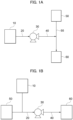
- FIGS. 1A and 1B are flow diagram illustrating a method of producing a copolymer in accordance with exemplary embodiments.
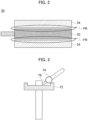
- FIG. 2 is a schematic cross-sectional view illustrating a discharging unit in accordance with exemplary embodiments.
- a first monomer solution including a carboxylic acid-based monomer may be supplied from a first monomer supply unit 10.
- the carboxylic acid-based monomer may include an unsaturated carboxylic acid capable of inducing a chain polymerization reaction.
- (meth)acrylic acid or an ester thereof e.g., (meth)acrylate
- (meth)acrylic acid is used to include both methacrylic acid and acrylic acid.
- a first monomer solution including a carboxylic acid-based monomer may be transferred to a discharging unit 30 from the first monomer supply unit 10 such as a storage tank through a first flow path 20.
- one or more additive such as a reaction inhibitor and an antioxidant may be included in the first monomer solution.
- the first monomer solution may be delivered to the discharging unit 30 and may be discharged through a discharge flow path 40 for a copolymerization with, e.g., an ethylene-based polymerizable monomer.
- the discharging unit 30 may include, e.g., a discharging device such as a pump, a compressor, etc.
- the discharging unit 30 may include a piston 32 and a packing unit 34.
- the carboxylic acid-based monomer supplied through the first flow path 20 may be pumped or ejected by a reciprocating motion of the piston 32 in the packing unit 34.
- the packing unit 34 may be, e.g., a sealing member such as a bushing or a cylinder.
- the first monomer solution may be ejected through a relative reciprocating motion and/or rotational motion of the piston 32 and the packing unit 34.
- a friction between the piston 32 and the packing unit 34 may be repeatedly generated in a gap between the piston 32 and the packing unit 34 to create a friction generating region FR.
- a local temperature increase may be caused by a frictional heat in the friction generating region FR. Accordingly, when a temperature exceeds a self-polymerization temperature of the carboxylic acid-based monomer or an activation energy required for the self-polymerization is satisfied by a friction energy, a self-polymer such as polyacrylic acid (PAA) may be generated.
- PAA polyacrylic acid
- a coefficient of friction (CoF) between the first monomer solution and the discharging unit 30 may be adjusted to be 0.3 or less.
- both the coefficient of friction between the first monomer solution and the piston 32 and the coefficient of friction between the first monomer solution and the packing unit 34 may be adjusted to be 0.3 or less.
- the coefficient of friction (CoF) between the first monomer solution and the discharging unit 30 may be adjusted to be 0.1 or less.
- the coefficient of friction between the first monomer solution and the discharging unit 30 may be controlled by a contact pressure in the discharging unit 30, a pumping temperature, a rotational speed or a translational speed of the piston 34 in the packing unit 34, a surface roughness of the piston 32 and/or the packing unit 34, etc.
- a surface roughness (Ra) of a contact surface with the first monomer solution of the discharging unit 30 may be less than 75 nm.
- the surface roughness of the contact surface with the first monomer solution of the discharging unit 30 may be 2 nm or less. In this case, an increase of a frictional force may be suppressed even under harsh discharging conditions to substantially prevent a self-polymer formation.
- a temperature (e.g., a pumping temperature) in the discharging unit 30 may be 85°C or less. Within the temperature range, a possibility of the self-polymerization of the carboxylic acid monomer may be substantially reduced.
- the temperature in the discharging unit 30 may be from 20°C to 60°C.
- the coefficient of friction in the discharging unit 30 may be constantly maintained without fluctuation or disturbance, so that a stable discharge process may be continuously maintained.
- a contact pressure between the piston 32 and the packing unit 34 in the discharging unit 30 may be about 5,400 bar or more. Within the above range, the coefficient of friction in the discharging unit 30 may be easily maintained as 0.3 or less. In a preferable embodiment, the contact pressure between the piston 32 and the packing unit 34 may be about 8,100 bar or more.
- a lubricating composition may be supplied into the discharging unit 30 together with the first monomer solution.
- the lubricating composition may include a mineral oil, and may further include a self-polymerization inhibitor such as a phenothiazine-based compound.
- the phenothiazine-based compound may cause environmental pollution issues.
- the phenothiazine-based compound when included in the lubricating composition, may be included in a range of 20 ppm or less, preferably from 0.1 ppm to 10 ppm.
- the generation of the self-polymer may be sufficiently suppressed by adjusting the coefficient of friction in the discharging unit 30 as described above.
- dissolved oxygen in the lubricating composition may be adjusted to be 10 ppm or less. Within the above range, for example, an acceleration of a radical self-polymerization by a reactive oxygen species contained in the lubricating composition may be prevented.
- a second monomer solution stored in a second monomer supply unit 50 may be transferred through a second flow path 55 to contact the carboxylic acid-based monomer supplied through the discharge flow path 40, and may be copolymerized in a reactor 60.
- the second monomer solution may include an ethylene-based polymerizable monomer.
- ethylene is used as the second monomer
- copolymerization of the carboxylic acid-based monomer and ethylene may be performed in the reactor 60 to prepare an ethylene-carboxylic acid copolymer (e.g., an EAA copolymer).
- a polymerization initiator may be introduced together into the reactor 60 through the second flow path 55 or through another flow path.
- the polymerization initiator may prevent the self-polymerization of the carboxylic acid-based monomer from being accelerated in advance.
- the polymerization initiator widely known in the field of a polymerization may be used.
- a peroxide-based or peroxy-based compound, an azobis-based compound or the like may be used as the polymerization initiator.
- a chain transfer agent may be introduced during the polymerization process through, e.g., the second flow path 55.
- a molecular weight and a molecular weight distribution of a polymer product may be easily controlled within a desired range by the chain transfer agent.
- the chain transfer agent may include, e.g., a non-polar organic compound such as isobutane and propene, or a polar organic compound such as methyl ethyl ketone, isopropylaldehyde and vinyl acetate.
- a temperature in the reactor 60 may be higher than a temperature in the discharging unit 30.
- the temperature in the reactor 60 may be from about 150 °C to about 270°C.
- a pressure in the reactor 60 may range from 1,100 bar to 2,500 bar, preferably from 1,300 bar to 2,300 bar.
- a pumping pressure in the discharging unit 30 may be greater than a copolymerization pressure in the reactor 60.
- the pumping pressure in the discharging unit 30 may be in a range from 1,500 bar to 3,000 bar.
- a monomer solution may be supplied from each of the first monomer supply unit 10 and the second monomer supply unit 50 to be mixed with each other. Accordingly, a mixed monomer solution including the carboxylic acid-based monomer and the ethylene-based monomer may be supplied to the discharging unit 30 through the first flow path 20.
- the mixed monomer solution may be pumped from the discharging unit 30 and supplied to the reactor 60 through the discharge flow path 40.
- the polymerization initiator injected into the reactor 60 may react with the mixed monomer solution to obtain an ethylene-carboxylic acid copolymer.
- an EAA copolymer may be produced in advance to cause the clogging of the discharging unit 30.
- the friction coefficient between the discharging unit 30 and the mixed monomer solution may be adjusted as described above so that a fouling by the EAA copolymer and a decrease in process efficiency may be reduced or prevented.
- a monomer solution was prepared by mixing 20 wt% of acrylic acid (AA) (99% purity, manufactured by Sigma-Aldrich) in base oil (HYPERCOMP-1000, manufactured by SK Innovation).
- the prepared monomer solution was subjected to a frictional force measurement equipment (MTM (Mini-Traction Machine) 2) to measure a coefficient of friction while rotating a disk and a ball therein, and to detect a generation of a self-polymer.
- MTM frictional force measurement equipment
- FIG. 3 is a schematic view illustrating a disk and a ball in a measuring device of a friction coefficient.
- FIG. 4 is an image showing a disk and a ball in a measuring device of a friction coefficient.
- CoF coefficient of friction
- SRR slide roll ratio
- the load between the disk 72 and the ball 74 may substantially correspond to a contact pressure between the piston 32 and the packing unit 34 in the discharging unit 30.
- a load of 37N corresponds to a contact pressure of 1 GPa (about 10,000 bar).
- a load of 20N corresponds to about 5,400 bar.
- the SRR As the SRR increases, probability of friction may increase.
- the SRR is 0%, the ball 74 and the disk 72 may rotate in the same direction and at the same speed.
- the SRR 100%, for example, only the ball 74 may rotate while the disk 72 is stopped.
- the SRR is 200%, the ball 74 and the disk 72 may rotate in opposite directions and at the same speed.
- the experiment was repeated using two disks each having a surface roughness of 2 nm (hereinafter, referred to as a polished disk) and a 75 nm disk (hereinafter, referred to as a rough disk).
- a polished disk a surface roughness of 2 nm
- a rough disk a 75 nm disk
- FIGS. 5 to 7 are graphs showing a change of friction coefficient according to Experimental Example 1.
- Sample 1 was an example using the base oil (excluding AA) and the polished disk
- Sample 2 was an example using the monomer solution and the polished disk
- Sample 3 was an example using the base oil and the rough disk
- Sample 4 was an example using the monomer solution and the rough disk.
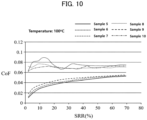
- FIGS. 8 to 10 are graphs showing a change of friction coefficient according to Experimental Example 2.
- Sample 5 was an example using the base oil (excluding AA) in a load 20N
- Sample 6 was an example using the monomer solution in a load of 20N
- Sample 7 was an example using the base oil (excluding AA) in a load of 30N
- Sample 8 was an example using the monomer solution in a load of 30N
- Sample 9 was an example using the base oil (excluding AA) in a load of 50N
- Sample 10 was an example using the monomer solution in a load of 50N.
- the coefficient of friction was stably maintained lower than 0.1 at which the self-polymerization was suppressed in all samples.
Landscapes
- Chemical & Material Sciences (AREA)
- Health & Medical Sciences (AREA)
- Chemical Kinetics & Catalysis (AREA)
- Medicinal Chemistry (AREA)
- Polymers & Plastics (AREA)
- Organic Chemistry (AREA)
- Addition Polymer Or Copolymer, Post-Treatments, Or Chemical Modifications (AREA)
- Polymerisation Methods In General (AREA)
Claims (12)
- Verfahren zur Herstellung eines Ethylen-Carbonsäure-Copolymers, wobei das Verfahren umfasst:Zuführen einer Schmiermittelzusammensetzung in eine Austragseinheit;Zuführen einer Monomerlösung, die ein Carbonsäuremonomer enthält, von der Austragseinheit; undCopolymerisation des Carbonsäuremonomers mit einem Monomer auf Ethylenbasis,wobei ein Reibungskoeffizient zwischen der Austragseinheit und der Monomerlösung kleiner gleich 0,3 gehalten wird, undder Reibungskoeffizient zwischen der Austragseinheit und der Monomerlösung durch einen Wert definiert ist, der mit einer Mini-Traction-Machine 2 (MTM 2) bei 55 °C und 5400 bar gemessen wurde.
- Verfahren nach Anspruch 1, wobei der Reibungskoeffizient zwischen der Austragseinheit und der Monomerlösung bei oder unter 0,1 gehalten wird.
- Verfahren nach Anspruch 1, wobei die Austragseinheit einen Kolben und eine den Kolben umgebende Dichtungseinheit aufweist.
- Verfahren nach Anspruch 3, wobei der Reibungskoeffizient zwischen einer Oberfläche des Kolbens und der Monomerlösung und der Reibungskoeffizient zwischen der Dichtungseinheit und der Monomerlösung alle auf kleiner gleich 0,3 gehalten werden.
- Verfahren nach Anspruch 3, wobei der Kolben und die Dichtungseinheit jeweils eine Oberflächenrauheit (Ra) von weniger als 75 nm aufweisen.
- Verfahren nach Anspruch 3, wobei der Kolben und die Dichtungseinheit jeweils eine Oberflächenrauigkeit (Ra) von 2 nm oder weniger aufweisen.
- Verfahren nach Anspruch 1, wobei eine Temperatur in der Austragseinheit 85°C oder weniger beträgt.
- Verfahren nach Anspruch 1, wobei eine Temperatur in der Austragseinheit zwischen 20°C und 60°C liegt.
- Verfahren nach Anspruch 1, wobei eine Menge an gelöstem Sauerstoff in der Schmiermittelzusammensetzung 10 ppm oder weniger beträgt.
- Verfahren nach Anspruch 1, wobei die Schmiermittelzusammensetzung ein Grundöl und einen Polymerisationsinhibitor auf Phenothiazinbasis aufweist und eine Menge des Polymerisationsinhibitors in der Schmiermittelzusammensetzung zwischen 0,1 ppm und 10 ppm liegt.
- Verfahren nach Anspruch 1, wobei die Copolymerisation des Carbonsäuremonomers mit dem Monomer auf Ethylenbasis das Einspritzen des Monomers auf Ethylenbasis nach der Zufuhr der Monomerlösung aus der Austragseinheit umfasst.
- Verfahren nach Anspruch 1, wobei die Monomerlösung ferner das Monomer auf Ethylenbasis aufweist,
wobei die Copolymerisation des Carbonsäuremonomers mit dem Monomer auf Ethylenbasis das Einspritzen der Monomerlösung, die das Carbonsäuremonomer und das Monomer auf Ethylenbasis enthält, von der Austragseinheit in einen Reaktor umfasst.
Applications Claiming Priority (1)
| Application Number | Priority Date | Filing Date | Title |
|---|---|---|---|
| KR1020200020783A KR102865445B1 (ko) | 2020-02-20 | 2020-02-20 | 에틸렌-카르복실산 공중합체의 제조 방법 |
Publications (3)
| Publication Number | Publication Date |
|---|---|
| EP3868792A1 EP3868792A1 (de) | 2021-08-25 |
| EP3868792B1 true EP3868792B1 (de) | 2024-06-26 |
| EP3868792B8 EP3868792B8 (de) | 2024-07-17 |
Family
ID=74586914
Family Applications (1)
| Application Number | Title | Priority Date | Filing Date |
|---|---|---|---|
| EP21156306.9A Active EP3868792B8 (de) | 2020-02-20 | 2021-02-10 | Verfahren zur herstellung eines ethylen-carbonsäure-compolymers |
Country Status (6)
| Country | Link |
|---|---|
| US (1) | US11685795B2 (de) |
| EP (1) | EP3868792B8 (de) |
| JP (1) | JP7671594B2 (de) |
| KR (1) | KR102865445B1 (de) |
| CN (1) | CN113278101A (de) |
| ES (1) | ES2987210T3 (de) |
Family Cites Families (10)
| Publication number | Priority date | Publication date | Assignee | Title |
|---|---|---|---|---|
| JPS5855964B2 (ja) * | 1975-09-11 | 1983-12-13 | 住友化学工業株式会社 | エチレン重合体又は共重合体の製造法 |
| JPS61127709A (ja) * | 1984-11-27 | 1986-06-16 | Sumitomo Chem Co Ltd | エチレン共重合体の製造方法 |
| KR100189853B1 (ko) * | 1991-07-31 | 1999-06-01 | 윤종용 | 전자사진 화상형성장치 |
| GB9415720D0 (en) * | 1994-08-03 | 1994-09-21 | Environmental Polymers Ltd | Extrusion and moulding apparatus and method |
| KR20150046208A (ko) | 2012-09-24 | 2015-04-29 | 엑손모빌 케미칼 패턴츠 인코포레이티드 | 고압 폴리에틸렌 중합체 및 공중합체를 제조하기 위한 장치 및 방법 |
| WO2014105110A2 (en) | 2012-12-28 | 2014-07-03 | Dow Global Technologies Llc | Method to reduce the crystallization temperature of carboxylic acid comonomer at elevated pressures, and to improve the copolymerization of the same |
| CN105980414A (zh) | 2014-02-06 | 2016-09-28 | 株式会社可乐丽 | (甲基)丙烯酸类树脂组合物的制造方法 |
| WO2016077512A2 (en) * | 2014-11-13 | 2016-05-19 | Dow Global Technologies Llc | Lubricant compositions for improved high pressure free-radical polymerizations |
| TWI624480B (zh) | 2015-04-20 | 2018-05-21 | 藝康美國公司 | 供不飽和單體用作防污劑之受阻對苯二酚 |
| US11498986B2 (en) * | 2018-03-16 | 2022-11-15 | Basf Se | High-pressure polymerization process for liquid ethylene copolymers |
-
2020
- 2020-02-20 KR KR1020200020783A patent/KR102865445B1/ko active Active
-
2021
- 2021-02-10 ES ES21156306T patent/ES2987210T3/es active Active
- 2021-02-10 EP EP21156306.9A patent/EP3868792B8/de active Active
- 2021-02-16 JP JP2021022682A patent/JP7671594B2/ja active Active
- 2021-02-19 US US17/179,938 patent/US11685795B2/en active Active
- 2021-02-20 CN CN202110193565.6A patent/CN113278101A/zh active Pending
Also Published As
| Publication number | Publication date |
|---|---|
| KR102865445B1 (ko) | 2025-09-25 |
| ES2987210T3 (es) | 2024-11-14 |
| CN113278101A (zh) | 2021-08-20 |
| EP3868792A1 (de) | 2021-08-25 |
| US11685795B2 (en) | 2023-06-27 |
| US20210261695A1 (en) | 2021-08-26 |
| KR20210106092A (ko) | 2021-08-30 |
| JP7671594B2 (ja) | 2025-05-02 |
| EP3868792B8 (de) | 2024-07-17 |
| JP2021130813A (ja) | 2021-09-09 |
Similar Documents
| Publication | Publication Date | Title |
|---|---|---|
| EP3763779B1 (de) | Schmiermittelzusammensetzung und verfahren zur herstellung eines copolymers damit | |
| ES2314471T3 (es) | Procedimiento para producir copolimeros que contienen monomeros de tipo olefinico. | |
| US10144898B2 (en) | Lubricant compositions for improved high pressure free-radical polymerizations | |
| US11685795B2 (en) | Method of producing ethylene-carboxylic acid compolymer | |
| EP2310429B1 (de) | Nicht schmelz- und fliessfähiges perfluorpolymer mit mehreren einheiten aus tetrafluorethylen und einem monomer mit einer funktionellen gruppe und einer polymerisierbaren kohlenstoff-kohlenstoff-doppelbindung | |
| EP4012008B1 (de) | Verwendung einer schmiermittelzusammensetzung zur verhinderung von verstopfung | |
| Kuo et al. | Synthesis of high‐solid‐content, acrylic pressure‐sensitive adhesives by solvent polymerization | |
| EP4596591A1 (de) | Verfahren zur herstellung eines copolymers auf ethylenbasis | |
| KR20200096126A (ko) | 에틸렌-카르복실산 공중합체의 제조 방법 | |
| KR20250146751A (ko) | 윤활 조성물 및 이를 이용한 에틸렌계 중합체의 제조 방법 | |
| JP7862490B2 (ja) | 潤滑組成物及びそれを用いた共重合体の製造方法 | |
| JPH0535165B2 (de) | ||
| KR20240140949A (ko) | 에틸렌 산 공중합체의 제조에서의 카르복시산 공용매 | |
| JP2009173791A (ja) | ポリマー粉末の製造方法 | |
| JPS6144997A (ja) | トラクシヨンオイルの製造方法 |
Legal Events
| Date | Code | Title | Description |
|---|---|---|---|
| PUAI | Public reference made under article 153(3) epc to a published international application that has entered the european phase |
Free format text: ORIGINAL CODE: 0009012 |
|
| STAA | Information on the status of an ep patent application or granted ep patent |
Free format text: STATUS: REQUEST FOR EXAMINATION WAS MADE |
|
| 17P | Request for examination filed |
Effective date: 20210210 |
|
| AK | Designated contracting states |
Kind code of ref document: A1 Designated state(s): AL AT BE BG CH CY CZ DE DK EE ES FI FR GB GR HR HU IE IS IT LI LT LU LV MC MK MT NL NO PL PT RO RS SE SI SK SM TR |
|
| RBV | Designated contracting states (corrected) |
Designated state(s): AL AT BE BG CH CY CZ DE DK EE ES FI FR GB GR HR HU IE IS IT LI LT LU LV MC MK MT NL NO PL PT RO RS SE SI SK SM TR |
|
| RAP3 | Party data changed (applicant data changed or rights of an application transferred) |
Owner name: SK GEO CENTRIC CO., LTD. Owner name: SK INNOVATION CO., LTD. |
|
| P01 | Opt-out of the competence of the unified patent court (upc) registered |
Effective date: 20230622 |
|
| STAA | Information on the status of an ep patent application or granted ep patent |
Free format text: STATUS: EXAMINATION IS IN PROGRESS |
|
| 17Q | First examination report despatched |
Effective date: 20231025 |
|
| GRAP | Despatch of communication of intention to grant a patent |
Free format text: ORIGINAL CODE: EPIDOSNIGR1 |
|
| STAA | Information on the status of an ep patent application or granted ep patent |
Free format text: STATUS: GRANT OF PATENT IS INTENDED |
|
| INTG | Intention to grant announced |
Effective date: 20240222 |
|
| GRAS | Grant fee paid |
Free format text: ORIGINAL CODE: EPIDOSNIGR3 |
|
| GRAA | (expected) grant |
Free format text: ORIGINAL CODE: 0009210 |
|
| STAA | Information on the status of an ep patent application or granted ep patent |
Free format text: STATUS: THE PATENT HAS BEEN GRANTED |
|
| GRAT | Correction requested after decision to grant or after decision to maintain patent in amended form |
Free format text: ORIGINAL CODE: EPIDOSNCDEC |
|
| AK | Designated contracting states |
Kind code of ref document: B1 Designated state(s): AL AT BE BG CH CY CZ DE DK EE ES FI FR GB GR HR HU IE IS IT LI LT LU LV MC MK MT NL NO PL PT RO RS SE SI SK SM TR |
|
| REG | Reference to a national code |
Ref country code: GB Ref legal event code: FG4D |
|
| REG | Reference to a national code |
Ref country code: CH Ref legal event code: EP |
|
| RAP4 | Party data changed (patent owner data changed or rights of a patent transferred) |
Owner name: SK GEO CENTRIC CO., LTD. Owner name: SK INNOVATION CO., LTD. |
|
| REG | Reference to a national code |
Ref country code: DE Ref legal event code: R096 Ref document number: 602021014686 Country of ref document: DE |
|
| REG | Reference to a national code |
Ref country code: NL Ref legal event code: FP |
|
| PG25 | Lapsed in a contracting state [announced via postgrant information from national office to epo] |
Ref country code: BG Free format text: LAPSE BECAUSE OF FAILURE TO SUBMIT A TRANSLATION OF THE DESCRIPTION OR TO PAY THE FEE WITHIN THE PRESCRIBED TIME-LIMIT Effective date: 20240626 |
|
| PG25 | Lapsed in a contracting state [announced via postgrant information from national office to epo] |
Ref country code: HR Free format text: LAPSE BECAUSE OF FAILURE TO SUBMIT A TRANSLATION OF THE DESCRIPTION OR TO PAY THE FEE WITHIN THE PRESCRIBED TIME-LIMIT Effective date: 20240626 Ref country code: FI Free format text: LAPSE BECAUSE OF FAILURE TO SUBMIT A TRANSLATION OF THE DESCRIPTION OR TO PAY THE FEE WITHIN THE PRESCRIBED TIME-LIMIT Effective date: 20240626 |
|
| REG | Reference to a national code |
Ref country code: LT Ref legal event code: MG9D |
|
| PG25 | Lapsed in a contracting state [announced via postgrant information from national office to epo] |
Ref country code: GR Free format text: LAPSE BECAUSE OF FAILURE TO SUBMIT A TRANSLATION OF THE DESCRIPTION OR TO PAY THE FEE WITHIN THE PRESCRIBED TIME-LIMIT Effective date: 20240927 |
|
| PG25 | Lapsed in a contracting state [announced via postgrant information from national office to epo] |
Ref country code: LV Free format text: LAPSE BECAUSE OF FAILURE TO SUBMIT A TRANSLATION OF THE DESCRIPTION OR TO PAY THE FEE WITHIN THE PRESCRIBED TIME-LIMIT Effective date: 20240626 |
|
| PG25 | Lapsed in a contracting state [announced via postgrant information from national office to epo] |
Ref country code: NO Free format text: LAPSE BECAUSE OF FAILURE TO SUBMIT A TRANSLATION OF THE DESCRIPTION OR TO PAY THE FEE WITHIN THE PRESCRIBED TIME-LIMIT Effective date: 20240926 Ref country code: LV Free format text: LAPSE BECAUSE OF FAILURE TO SUBMIT A TRANSLATION OF THE DESCRIPTION OR TO PAY THE FEE WITHIN THE PRESCRIBED TIME-LIMIT Effective date: 20240626 Ref country code: HR Free format text: LAPSE BECAUSE OF FAILURE TO SUBMIT A TRANSLATION OF THE DESCRIPTION OR TO PAY THE FEE WITHIN THE PRESCRIBED TIME-LIMIT Effective date: 20240626 Ref country code: GR Free format text: LAPSE BECAUSE OF FAILURE TO SUBMIT A TRANSLATION OF THE DESCRIPTION OR TO PAY THE FEE WITHIN THE PRESCRIBED TIME-LIMIT Effective date: 20240927 Ref country code: FI Free format text: LAPSE BECAUSE OF FAILURE TO SUBMIT A TRANSLATION OF THE DESCRIPTION OR TO PAY THE FEE WITHIN THE PRESCRIBED TIME-LIMIT Effective date: 20240626 Ref country code: BG Free format text: LAPSE BECAUSE OF FAILURE TO SUBMIT A TRANSLATION OF THE DESCRIPTION OR TO PAY THE FEE WITHIN THE PRESCRIBED TIME-LIMIT Effective date: 20240626 Ref country code: RS Free format text: LAPSE BECAUSE OF FAILURE TO SUBMIT A TRANSLATION OF THE DESCRIPTION OR TO PAY THE FEE WITHIN THE PRESCRIBED TIME-LIMIT Effective date: 20240926 |
|
| REG | Reference to a national code |
Ref country code: ES Ref legal event code: FG2A Ref document number: 2987210 Country of ref document: ES Kind code of ref document: T3 Effective date: 20241114 |
|
| REG | Reference to a national code |
Ref country code: AT Ref legal event code: MK05 Ref document number: 1697642 Country of ref document: AT Kind code of ref document: T Effective date: 20240626 |
|
| PG25 | Lapsed in a contracting state [announced via postgrant information from national office to epo] |
Ref country code: PT Free format text: LAPSE BECAUSE OF FAILURE TO SUBMIT A TRANSLATION OF THE DESCRIPTION OR TO PAY THE FEE WITHIN THE PRESCRIBED TIME-LIMIT Effective date: 20241028 |
|
| PG25 | Lapsed in a contracting state [announced via postgrant information from national office to epo] |
Ref country code: PT Free format text: LAPSE BECAUSE OF FAILURE TO SUBMIT A TRANSLATION OF THE DESCRIPTION OR TO PAY THE FEE WITHIN THE PRESCRIBED TIME-LIMIT Effective date: 20241028 |
|
| PG25 | Lapsed in a contracting state [announced via postgrant information from national office to epo] |
Ref country code: PL Free format text: LAPSE BECAUSE OF FAILURE TO SUBMIT A TRANSLATION OF THE DESCRIPTION OR TO PAY THE FEE WITHIN THE PRESCRIBED TIME-LIMIT Effective date: 20240626 |
|
| PG25 | Lapsed in a contracting state [announced via postgrant information from national office to epo] |
Ref country code: EE Free format text: LAPSE BECAUSE OF FAILURE TO SUBMIT A TRANSLATION OF THE DESCRIPTION OR TO PAY THE FEE WITHIN THE PRESCRIBED TIME-LIMIT Effective date: 20240626 |
|
| PG25 | Lapsed in a contracting state [announced via postgrant information from national office to epo] |
Ref country code: AT Free format text: LAPSE BECAUSE OF FAILURE TO SUBMIT A TRANSLATION OF THE DESCRIPTION OR TO PAY THE FEE WITHIN THE PRESCRIBED TIME-LIMIT Effective date: 20240626 Ref country code: IS Free format text: LAPSE BECAUSE OF FAILURE TO SUBMIT A TRANSLATION OF THE DESCRIPTION OR TO PAY THE FEE WITHIN THE PRESCRIBED TIME-LIMIT Effective date: 20241026 |
|
| PG25 | Lapsed in a contracting state [announced via postgrant information from national office to epo] |
Ref country code: CZ Free format text: LAPSE BECAUSE OF FAILURE TO SUBMIT A TRANSLATION OF THE DESCRIPTION OR TO PAY THE FEE WITHIN THE PRESCRIBED TIME-LIMIT Effective date: 20240626 |
|
| PG25 | Lapsed in a contracting state [announced via postgrant information from national office to epo] |
Ref country code: SK Free format text: LAPSE BECAUSE OF FAILURE TO SUBMIT A TRANSLATION OF THE DESCRIPTION OR TO PAY THE FEE WITHIN THE PRESCRIBED TIME-LIMIT Effective date: 20240626 Ref country code: RO Free format text: LAPSE BECAUSE OF FAILURE TO SUBMIT A TRANSLATION OF THE DESCRIPTION OR TO PAY THE FEE WITHIN THE PRESCRIBED TIME-LIMIT Effective date: 20240626 |
|
| PG25 | Lapsed in a contracting state [announced via postgrant information from national office to epo] |
Ref country code: SM Free format text: LAPSE BECAUSE OF FAILURE TO SUBMIT A TRANSLATION OF THE DESCRIPTION OR TO PAY THE FEE WITHIN THE PRESCRIBED TIME-LIMIT Effective date: 20240626 |
|
| PG25 | Lapsed in a contracting state [announced via postgrant information from national office to epo] |
Ref country code: SM Free format text: LAPSE BECAUSE OF FAILURE TO SUBMIT A TRANSLATION OF THE DESCRIPTION OR TO PAY THE FEE WITHIN THE PRESCRIBED TIME-LIMIT Effective date: 20240626 Ref country code: SK Free format text: LAPSE BECAUSE OF FAILURE TO SUBMIT A TRANSLATION OF THE DESCRIPTION OR TO PAY THE FEE WITHIN THE PRESCRIBED TIME-LIMIT Effective date: 20240626 Ref country code: RO Free format text: LAPSE BECAUSE OF FAILURE TO SUBMIT A TRANSLATION OF THE DESCRIPTION OR TO PAY THE FEE WITHIN THE PRESCRIBED TIME-LIMIT Effective date: 20240626 Ref country code: PL Free format text: LAPSE BECAUSE OF FAILURE TO SUBMIT A TRANSLATION OF THE DESCRIPTION OR TO PAY THE FEE WITHIN THE PRESCRIBED TIME-LIMIT Effective date: 20240626 Ref country code: IS Free format text: LAPSE BECAUSE OF FAILURE TO SUBMIT A TRANSLATION OF THE DESCRIPTION OR TO PAY THE FEE WITHIN THE PRESCRIBED TIME-LIMIT Effective date: 20241026 Ref country code: EE Free format text: LAPSE BECAUSE OF FAILURE TO SUBMIT A TRANSLATION OF THE DESCRIPTION OR TO PAY THE FEE WITHIN THE PRESCRIBED TIME-LIMIT Effective date: 20240626 Ref country code: CZ Free format text: LAPSE BECAUSE OF FAILURE TO SUBMIT A TRANSLATION OF THE DESCRIPTION OR TO PAY THE FEE WITHIN THE PRESCRIBED TIME-LIMIT Effective date: 20240626 Ref country code: AT Free format text: LAPSE BECAUSE OF FAILURE TO SUBMIT A TRANSLATION OF THE DESCRIPTION OR TO PAY THE FEE WITHIN THE PRESCRIBED TIME-LIMIT Effective date: 20240626 |
|
| PG25 | Lapsed in a contracting state [announced via postgrant information from national office to epo] |
Ref country code: IT Free format text: LAPSE BECAUSE OF FAILURE TO SUBMIT A TRANSLATION OF THE DESCRIPTION OR TO PAY THE FEE WITHIN THE PRESCRIBED TIME-LIMIT Effective date: 20240626 |
|
| REG | Reference to a national code |
Ref country code: DE Ref legal event code: R097 Ref document number: 602021014686 Country of ref document: DE |
|
| PG25 | Lapsed in a contracting state [announced via postgrant information from national office to epo] |
Ref country code: DK Free format text: LAPSE BECAUSE OF FAILURE TO SUBMIT A TRANSLATION OF THE DESCRIPTION OR TO PAY THE FEE WITHIN THE PRESCRIBED TIME-LIMIT Effective date: 20240626 |
|
| PLBE | No opposition filed within time limit |
Free format text: ORIGINAL CODE: 0009261 |
|
| STAA | Information on the status of an ep patent application or granted ep patent |
Free format text: STATUS: NO OPPOSITION FILED WITHIN TIME LIMIT |
|
| 26N | No opposition filed |
Effective date: 20250327 |
|
| PG25 | Lapsed in a contracting state [announced via postgrant information from national office to epo] |
Ref country code: SE Free format text: LAPSE BECAUSE OF FAILURE TO SUBMIT A TRANSLATION OF THE DESCRIPTION OR TO PAY THE FEE WITHIN THE PRESCRIBED TIME-LIMIT Effective date: 20240626 |
|
| PG25 | Lapsed in a contracting state [announced via postgrant information from national office to epo] |
Ref country code: MC Free format text: LAPSE BECAUSE OF FAILURE TO SUBMIT A TRANSLATION OF THE DESCRIPTION OR TO PAY THE FEE WITHIN THE PRESCRIBED TIME-LIMIT Effective date: 20240626 |
|
| REG | Reference to a national code |
Ref country code: CH Ref legal event code: PL |
|
| PG25 | Lapsed in a contracting state [announced via postgrant information from national office to epo] |
Ref country code: LU Free format text: LAPSE BECAUSE OF NON-PAYMENT OF DUE FEES Effective date: 20250210 |
|
| PG25 | Lapsed in a contracting state [announced via postgrant information from national office to epo] |
Ref country code: CH Free format text: LAPSE BECAUSE OF NON-PAYMENT OF DUE FEES Effective date: 20250228 |
|
| REG | Reference to a national code |
Ref country code: BE Ref legal event code: MM Effective date: 20250228 |
|
| PGFP | Annual fee paid to national office [announced via postgrant information from national office to epo] |
Ref country code: GB Payment date: 20251222 Year of fee payment: 6 |
|
| PGFP | Annual fee paid to national office [announced via postgrant information from national office to epo] |
Ref country code: NL Payment date: 20251223 Year of fee payment: 6 Ref country code: FR Payment date: 20251223 Year of fee payment: 6 |
|
| PG25 | Lapsed in a contracting state [announced via postgrant information from national office to epo] |
Ref country code: BE Free format text: LAPSE BECAUSE OF NON-PAYMENT OF DUE FEES Effective date: 20250228 |
|
| PG25 | Lapsed in a contracting state [announced via postgrant information from national office to epo] |
Ref country code: IE Free format text: LAPSE BECAUSE OF NON-PAYMENT OF DUE FEES Effective date: 20250210 |
|
| PGFP | Annual fee paid to national office [announced via postgrant information from national office to epo] |
Ref country code: ES Payment date: 20260324 Year of fee payment: 6 |
|
| PGFP | Annual fee paid to national office [announced via postgrant information from national office to epo] |
Ref country code: DE Payment date: 20251222 Year of fee payment: 6 |