EP3839241B1 - Antriebssystem, insbesondere für eine selbstfahrende baumaschine, insbesondere bodenverdichter - Google Patents
Antriebssystem, insbesondere für eine selbstfahrende baumaschine, insbesondere bodenverdichter Download PDFInfo
- Publication number
- EP3839241B1 EP3839241B1 EP21153924.2A EP21153924A EP3839241B1 EP 3839241 B1 EP3839241 B1 EP 3839241B1 EP 21153924 A EP21153924 A EP 21153924A EP 3839241 B1 EP3839241 B1 EP 3839241B1
- Authority
- EP
- European Patent Office
- Prior art keywords
- drive
- hydraulic
- fluid reservoir
- unit
- hydraulic pump
- Prior art date
- Legal status (The legal status is an assumption and is not a legal conclusion. Google has not performed a legal analysis and makes no representation as to the accuracy of the status listed.)
- Active
Links
Images

Classifications
-
- B—PERFORMING OPERATIONS; TRANSPORTING
- B60—VEHICLES IN GENERAL
- B60K—ARRANGEMENT OR MOUNTING OF PROPULSION UNITS OR OF TRANSMISSIONS IN VEHICLES; ARRANGEMENT OR MOUNTING OF PLURAL DIVERSE PRIME-MOVERS IN VEHICLES; AUXILIARY DRIVES FOR VEHICLES; INSTRUMENTATION OR DASHBOARDS FOR VEHICLES; ARRANGEMENTS IN CONNECTION WITH COOLING, AIR INTAKE, GAS EXHAUST OR FUEL SUPPLY OF PROPULSION UNITS IN VEHICLES
- B60K6/00—Arrangement or mounting of plural diverse prime-movers for mutual or common propulsion, e.g. hybrid propulsion systems comprising electric motors and internal combustion engines
- B60K6/08—Prime-movers comprising combustion engines and mechanical or fluid energy storing means
- B60K6/12—Prime-movers comprising combustion engines and mechanical or fluid energy storing means by means of a chargeable fluidic accumulator
-
- E—FIXED CONSTRUCTIONS
- E02—HYDRAULIC ENGINEERING; FOUNDATIONS; SOIL SHIFTING
- E02F—DREDGING; SOIL-SHIFTING
- E02F9/00—Component parts of dredgers or soil-shifting machines, not restricted to one of the kinds covered by groups E02F3/00 - E02F7/00
- E02F9/20—Drives; Control devices
- E02F9/22—Hydraulic or pneumatic drives
- E02F9/2217—Hydraulic or pneumatic drives with energy recovery arrangements, e.g. using accumulators, flywheels
-
- E—FIXED CONSTRUCTIONS
- E02—HYDRAULIC ENGINEERING; FOUNDATIONS; SOIL SHIFTING
- E02F—DREDGING; SOIL-SHIFTING
- E02F9/00—Component parts of dredgers or soil-shifting machines, not restricted to one of the kinds covered by groups E02F3/00 - E02F7/00
- E02F9/20—Drives; Control devices
- E02F9/22—Hydraulic or pneumatic drives
- E02F9/2278—Hydraulic circuits
- E02F9/2292—Systems with two or more pumps
-
- E—FIXED CONSTRUCTIONS
- E02—HYDRAULIC ENGINEERING; FOUNDATIONS; SOIL SHIFTING
- E02F—DREDGING; SOIL-SHIFTING
- E02F9/00—Component parts of dredgers or soil-shifting machines, not restricted to one of the kinds covered by groups E02F3/00 - E02F7/00
- E02F9/20—Drives; Control devices
- E02F9/22—Hydraulic or pneumatic drives
- E02F9/2278—Hydraulic circuits
- E02F9/2296—Systems with a variable displacement pump
-
- F—MECHANICAL ENGINEERING; LIGHTING; HEATING; WEAPONS; BLASTING
- F02—COMBUSTION ENGINES; HOT-GAS OR COMBUSTION-PRODUCT ENGINE PLANTS
- F02N—STARTING OF COMBUSTION ENGINES; STARTING AIDS FOR SUCH ENGINES, NOT OTHERWISE PROVIDED FOR
- F02N7/00—Starting apparatus having fluid-driven auxiliary engines or apparatus
-
- F—MECHANICAL ENGINEERING; LIGHTING; HEATING; WEAPONS; BLASTING
- F15—FLUID-PRESSURE ACTUATORS; HYDRAULICS OR PNEUMATICS IN GENERAL
- F15B—SYSTEMS ACTING BY MEANS OF FLUIDS IN GENERAL; FLUID-PRESSURE ACTUATORS, e.g. SERVOMOTORS; DETAILS OF FLUID-PRESSURE SYSTEMS, NOT OTHERWISE PROVIDED FOR
- F15B1/00—Installations or systems with accumulators; Supply reservoir or sump assemblies
- F15B1/02—Installations or systems with accumulators
- F15B1/024—Installations or systems with accumulators used as a supplementary power source, e.g. to store energy in idle periods to balance pump load
-
- F—MECHANICAL ENGINEERING; LIGHTING; HEATING; WEAPONS; BLASTING
- F15—FLUID-PRESSURE ACTUATORS; HYDRAULICS OR PNEUMATICS IN GENERAL
- F15B—SYSTEMS ACTING BY MEANS OF FLUIDS IN GENERAL; FLUID-PRESSURE ACTUATORS, e.g. SERVOMOTORS; DETAILS OF FLUID-PRESSURE SYSTEMS, NOT OTHERWISE PROVIDED FOR
- F15B21/00—Common features of fluid actuator systems; Fluid-pressure actuator systems or details thereof, not covered by any other group of this subclass
- F15B21/14—Energy-recuperation means
-
- B—PERFORMING OPERATIONS; TRANSPORTING
- B60—VEHICLES IN GENERAL
- B60K—ARRANGEMENT OR MOUNTING OF PROPULSION UNITS OR OF TRANSMISSIONS IN VEHICLES; ARRANGEMENT OR MOUNTING OF PLURAL DIVERSE PRIME-MOVERS IN VEHICLES; AUXILIARY DRIVES FOR VEHICLES; INSTRUMENTATION OR DASHBOARDS FOR VEHICLES; ARRANGEMENTS IN CONNECTION WITH COOLING, AIR INTAKE, GAS EXHAUST OR FUEL SUPPLY OF PROPULSION UNITS IN VEHICLES
- B60K6/00—Arrangement or mounting of plural diverse prime-movers for mutual or common propulsion, e.g. hybrid propulsion systems comprising electric motors and internal combustion engines
- B60K6/08—Prime-movers comprising combustion engines and mechanical or fluid energy storing means
- B60K6/12—Prime-movers comprising combustion engines and mechanical or fluid energy storing means by means of a chargeable fluidic accumulator
- B60K2006/123—Prime-movers comprising combustion engines and mechanical or fluid energy storing means by means of a chargeable fluidic accumulator for driving pneumatic motors
-
- B—PERFORMING OPERATIONS; TRANSPORTING
- B60—VEHICLES IN GENERAL
- B60K—ARRANGEMENT OR MOUNTING OF PROPULSION UNITS OR OF TRANSMISSIONS IN VEHICLES; ARRANGEMENT OR MOUNTING OF PLURAL DIVERSE PRIME-MOVERS IN VEHICLES; AUXILIARY DRIVES FOR VEHICLES; INSTRUMENTATION OR DASHBOARDS FOR VEHICLES; ARRANGEMENTS IN CONNECTION WITH COOLING, AIR INTAKE, GAS EXHAUST OR FUEL SUPPLY OF PROPULSION UNITS IN VEHICLES
- B60K6/00—Arrangement or mounting of plural diverse prime-movers for mutual or common propulsion, e.g. hybrid propulsion systems comprising electric motors and internal combustion engines
- B60K6/08—Prime-movers comprising combustion engines and mechanical or fluid energy storing means
- B60K6/12—Prime-movers comprising combustion engines and mechanical or fluid energy storing means by means of a chargeable fluidic accumulator
- B60K2006/126—Prime-movers comprising combustion engines and mechanical or fluid energy storing means by means of a chargeable fluidic accumulator the hydraulic accumulator starts the engine
-
- B—PERFORMING OPERATIONS; TRANSPORTING
- B60—VEHICLES IN GENERAL
- B60W—CONJOINT CONTROL OF VEHICLE SUB-UNITS OF DIFFERENT TYPE OR DIFFERENT FUNCTION; CONTROL SYSTEMS SPECIALLY ADAPTED FOR HYBRID VEHICLES; ROAD VEHICLE DRIVE CONTROL SYSTEMS FOR PURPOSES NOT RELATED TO THE CONTROL OF A PARTICULAR SUB-UNIT
- B60W2300/00—Indexing codes relating to the type of vehicle
- B60W2300/17—Construction vehicles, e.g. graders, excavators
-
- F—MECHANICAL ENGINEERING; LIGHTING; HEATING; WEAPONS; BLASTING
- F02—COMBUSTION ENGINES; HOT-GAS OR COMBUSTION-PRODUCT ENGINE PLANTS
- F02N—STARTING OF COMBUSTION ENGINES; STARTING AIDS FOR SUCH ENGINES, NOT OTHERWISE PROVIDED FOR
- F02N2300/00—Control related aspects of engine starting
- F02N2300/10—Control related aspects of engine starting characterised by the control output, i.e. means or parameters used as a control output or target
- F02N2300/102—Control of the starter motor speed; Control of the engine speed during cranking
-
- F—MECHANICAL ENGINEERING; LIGHTING; HEATING; WEAPONS; BLASTING
- F15—FLUID-PRESSURE ACTUATORS; HYDRAULICS OR PNEUMATICS IN GENERAL
- F15B—SYSTEMS ACTING BY MEANS OF FLUIDS IN GENERAL; FLUID-PRESSURE ACTUATORS, e.g. SERVOMOTORS; DETAILS OF FLUID-PRESSURE SYSTEMS, NOT OTHERWISE PROVIDED FOR
- F15B2211/00—Circuits for servomotor systems
- F15B2211/20—Fluid pressure source, e.g. accumulator or variable axial piston pump
- F15B2211/205—Systems with pumps
- F15B2211/2053—Type of pump
- F15B2211/20569—Type of pump capable of working as pump and motor
-
- F—MECHANICAL ENGINEERING; LIGHTING; HEATING; WEAPONS; BLASTING
- F15—FLUID-PRESSURE ACTUATORS; HYDRAULICS OR PNEUMATICS IN GENERAL
- F15B—SYSTEMS ACTING BY MEANS OF FLUIDS IN GENERAL; FLUID-PRESSURE ACTUATORS, e.g. SERVOMOTORS; DETAILS OF FLUID-PRESSURE SYSTEMS, NOT OTHERWISE PROVIDED FOR
- F15B2211/00—Circuits for servomotor systems
- F15B2211/80—Other types of control related to particular problems or conditions
- F15B2211/88—Control measures for saving energy
-
- Y—GENERAL TAGGING OF NEW TECHNOLOGICAL DEVELOPMENTS; GENERAL TAGGING OF CROSS-SECTIONAL TECHNOLOGIES SPANNING OVER SEVERAL SECTIONS OF THE IPC; TECHNICAL SUBJECTS COVERED BY FORMER USPC CROSS-REFERENCE ART COLLECTIONS [XRACs] AND DIGESTS
- Y02—TECHNOLOGIES OR APPLICATIONS FOR MITIGATION OR ADAPTATION AGAINST CLIMATE CHANGE
- Y02T—CLIMATE CHANGE MITIGATION TECHNOLOGIES RELATED TO TRANSPORTATION
- Y02T10/00—Road transport of goods or passengers
- Y02T10/60—Other road transportation technologies with climate change mitigation effect
- Y02T10/62—Hybrid vehicles
Definitions
- the present invention relates to a drive system, in particular for a self-propelled construction machine, in particular a soil compactor, according to the preamble of claim 1.
- hydraulic pump/motor assembly can be operated in a starting mode as a motor for starting the drive unit.
- the hydraulic pump/motor assembly As a motor for When starting the drive unit, it is possible to use the hydraulic drive support unit in another operating state, i.e. the starting operating state. This relieves the load on other system areas, such as an electrically operated starter that is generally provided in association with the drive unit, and on the other hand allows the drive unit to be temporarily switched off in an energy-saving manner if it is not needed to generate a drive torque, for example during temporary parking of a construction machine equipped with such a drive system.
- the hydraulic drive support unit further comprises a starting valve unit in a bypass flow path bypassing the charge/discharge valve unit for selectively releasing/interrupting a flow connection between at least one pressure fluid reservoir and the hydraulic pump/motor assembly at least in the flow direction from the pressure fluid reservoir to the hydraulic pump/motor assembly.
- This starting valve can therefore be specially designed for the volume flows required for starting, and can in particular be designed to also set or regulate the volume flow in a defined manner in order to ensure that the hydraulic pump/motor assembly in the starting operating state only provides the drive support torque required for starting the drive unit.
- a flow throttle arrangement is provided in the bypass flow path in the flow path between the at least one pressure accumulator and the starting valve unit and/or in the bypass flow path in the flow path between the starting valve unit and the hydraulic pump/motor assembly.
- a defined setting of the torque required to start the drive unit can be easily achieved by including a proportional valve in the starting valve unit.
- the defined discharge of the pressure fluid accumulator can further be achieved in that the hydraulic drive support unit comprises a relief valve unit for selectively releasing/interrupting a flow connection between at least one pressure fluid accumulator and a fluid reservoir at least in the flow direction from the pressure fluid accumulator to the fluid reservoir.
- An undefined emptying of a pressure fluid reservoir in the direction of the hydraulic pump/motor assembly, which occurs particularly in error states, can be prevented in an advantageous development of the drive system according to the invention, for example, by the starter valve unit and/or the charge/discharge valve unit being prestressed into a basic state that interrupts the flow connection and/or the relief valve unit being prestressed into a basic state that releases the flow connection.
- the present invention further relates to a self-propelled construction machine, in particular a soil compactor, which comprises a drive system constructed according to the invention.
- the hydraulic pump/motor assembly is operated in a starting operating state as a motor for starting the drive unit.
- the drive unit can be put out of operation, for example, if the speed of the drive unit falls below a threshold speed or is below this, preferably in the range of an idling speed of the drive unit. This state can be assumed, for example, if a drive lever provided in such a construction machine is moved beyond a neutral position into a parking position, which signals that driving or working operation is not required, at least temporarily.
- the drive system can operate the hydraulic pump/motor assembly in the starting mode so that the drive unit is started and is again available to generate drive torque.
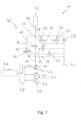
- FIG. 1 A drive system 10 according to the invention is explained in detail below with reference to the Fig. 2 the basic structure of a construction machine 12 is explained, in which the drive system 10 of the Fig. 1 can be integrated.
- This Construction machine 10 comprises drive wheels 16 on a rear carriage 14, which can be driven by the drive system 10 to move the construction machine 12, which is designed as a soil compactor, forward on the ground 18 to be compacted.
- a driver's cabin 20 is also provided on the rear carriage 14, in which a person controlling the construction machine 12 can be seated and from which the various functions of the construction machine 12 can be controlled.
- a compactor roller 24 is provided on a front carriage 22 which is connected in an articulated manner to the rear carriage 14 for steering the construction machine 12 designed as a soil compactor.
- the subsoil 18 on which the construction machine 12 is moving is compacted using this compactor roller 24.
- the compactor roller 24 can be assigned an unbalanced mass arrangement which can be accommodated, for example, inside the compactor roller 24 and can be put into operation to generate a vibration movement, i.e. a periodic up-down movement of the compactor roller 24, and/or to generate an oscillation movement, i.e. a back-and-forth movement of the compactor roller 24 in the circumferential direction.
- a vibration movement i.e. a periodic up-down movement of the compactor roller 24
- an oscillation movement i.e. a back-and-forth movement of the compactor roller 24 in the circumferential direction.
- the Fig. 1 The drive system 10 shown can be used.
- FIG. 2 the construction machine 12 shown in the form of a soil compactor is shown only with regard to its essential aspects and only as an example of a machine in which the drive system 10 of the Fig. 1
- this could be fitted with another drive wheel instead of the drive wheels 16, for example also for propelling the soil compactor through the drive system 10 of the Fig. 1 to be driven to rotate.
- the construction machine 12 could also be designed in the form of a wheel loader, a bulldozer, an excavator or the like.
- the drive system 10 of the Fig. 1 comprises, as the main energy source, a drive unit 26, for example in the form of a diesel internal combustion engine.
- This drive unit 26 is or can be coupled to a transmission arrangement 28, for example via a clutch arrangement, a hydrodynamic torque converter or the like.
- the drive torque provided by the drive unit 26 can be transmitted or distributed to various system areas via the transmission arrangement 28.
- One of these system areas comprises a hydraulic drive circuit 30 with a hydraulic drive pump 32 integrated therein.
- This can be permanently coupled to the transmission arrangement 28 or can be coupled to the transmission arrangement 28 via a clutch arrangement, for example.
- the hydraulic drive pump 32 When the hydraulic drive pump 32 is driven, it circulates fluid, e.g. hydraulic oil, in the hydraulic drive circuit 30, whereby a Fig. 1 A hydraulic drive motor (not shown) or possibly several hydraulic drive motors are driven so that a torque can be transmitted, for example, to the drive wheels 16 of the construction machine 12.
- fluid e.g. hydraulic oil
- a hydraulic drive motor not shown
- an independently constructed and operating hydraulic drive circuit can be provided.
- a hydraulic working circuit 34 designates another hydraulic circuit, namely a hydraulic working circuit.
- This also includes a hydraulic pump, in this case a hydraulic working pump 36.
- This hydraulic working pump 36 can also be permanently coupled to the gear arrangement 28 or, for example, coupled to the gear arrangement 28 via a clutch arrangement.
- a fluid circulation e.g. of hydraulic oil
- One or more hydraulic working motors can also be provided in the hydraulic working circuit 34, by means of which, for example, the unbalance mass arrangement in the compactor roller 24 can be driven.
- hydraulic pumps 32, 36 can advantageously be designed with a variable delivery volume, for example as swash plate pumps, in order to be able to adjust the fluid circulation in the hydraulic circuits 30, 34 designed as high-pressure circuits and thus the torque that can also be transmitted therein.
- the drive system 10 further comprises a hydraulic drive support unit, generally designated 38.
- This comprises a hydraulic pump/motor assembly 40, which can be permanently coupled to the gear arrangement 28 or, for example, is or can be coupled to the gear arrangement 28 via a clutch arrangement and is thus drivingly coupled to the gear arrangement 28 and via this to the drive unit 26 or the hydraulic circuits 30, 34, in particular their hydraulic pumps 32, 36.
- the hydraulic pump/motor assembly 40 can be switched between an operating state in which it can be operated as a pump and an operating state in which it can be operated as a motor.
- This assembly is also advantageously designed as a swash plate assembly.
- the hydraulic drive support unit 38 further comprises a Pressure fluid reservoir 42, which can be charged by operating the hydraulic pump/motor assembly 40 as a pump.
- the hydraulic pump/motor assembly 40 can pump fluid, e.g. hydraulic oil, from a preferably pressureless fluid reservoir 44 in the direction of the pressure fluid reservoir 42.
- a charge/discharge valve unit 48 is provided in a line 46 leading from the hydraulic pump/motor assembly 40 to the pressure fluid reservoir 42.
- This charge/discharge valve unit 48 which can be adjusted by electrical excitation, is positioned in the position shown in FIG. 1 by a preload spring or the like.
- Fig. 1 shown basic state, in which it interrupts the flow connection between the hydraulic pump/motor assembly 40 and the pressure fluid reservoir 42.
- the loading/unloading valve unit 48 can be designed such that in this state it acts as a check valve, which allows a fluid flow from the hydraulic pump/motor assembly 40 to the pressure fluid reservoir 42, but prevents a fluid flow in the opposite direction. For example, by electrically energizing the loading/unloading valve unit 48, it is brought into its release state, in which the flow connection between the pressure fluid reservoir 42 and the hydraulic pump/motor assembly 40 is released.
- a line 52 leading to the fluid reservoir 44 branches off from the section 50 of the line 46 located between the pressure fluid reservoir 42 and the charge/discharge valve unit 48.
- This line 52 basically establishes a connection between the pressure fluid reservoir 42 and the fluid reservoir 44.
- Three valve units 54, 56, 58 are arranged parallel to one another in the line 52.
- the valve unit 54 is an electrically excitable relief valve unit 54, which is preloaded, for example, by spring preload into a basic state in which it releases the flow connection between the pressure fluid reservoir 42 and the fluid reservoir 44. When the relief valve unit 54 is activated, for example by electrical excitation this is switched to its state which interrupts the flow connection between the pressure fluid accumulator 42 and the fluid reservoir 44.
- the relief valve unit 54 can be designed such that in this state it acts as a check valve which basically allows fluid flow from the fluid reservoir 44 in the direction of the pressure fluid accumulator 42, but prevents fluid flow in the opposite direction.
- a manual relief valve unit 56 is provided in parallel with the relief valve unit 54. This can be brought into its state releasing the flow connection between the pressure fluid accumulator 42 and the fluid reservoir 44 by manual actuation.
- an overload valve unit 58 is provided in the line 52, which allows the pressure in the pressure fluid accumulator 42 or in section 50 of the line 48 to be released to the fluid reservoir 44 when the fluid pressure in the pressure fluid accumulator 42 or in section 50 of the line 48 exceeds a predetermined limit pressure.
- a predetermined limit pressure For example, it can be provided that a fluid pressure of approximately 300 bar should prevail in the pressure fluid accumulator 42 at maximum loading.
- the overload valve unit 58 can be dimensioned such that when the pressure in the pressure fluid accumulator 42 exceeds 300 bar, it creates a flow connection between the pressure fluid accumulator 42 and the fluid reservoir 44 until the fluid pressure in the pressure fluid accumulator 42 has fallen below this limit again.
- the hydraulic drive support unit 38 further comprises a circulation valve unit 60.
- This is provided in the flow path between the hydraulic pump/motor assembly 40 and the fluid reservoir 44 and branches off from a section 62 of the line 46 located between the hydraulic pump/motor assembly 40 and the loading/unloading valve unit 48.
- the circulation valve unit 60 is basically pre-tensioned in a state in which a flow connection between the hydraulic pump/motor assembly 40 and the fluid reservoir 44. By means of, for example, electrical excitation, this circulation valve unit 60 can be brought into a state in which this flow connection is interrupted. In this state, the circulation valve unit 60 can act as a check valve that prevents flow from the hydraulic pump/motor assembly 40 to the fluid reservoir 44, but allows flow in the other direction.
- the circulation valve unit 60 can then be used, with the charge/discharge valve unit 48 positioned in the blocking position, to establish a flow connection between the hydraulic pump/motor assembly 40 and the fluid reservoir 44 when fluid circulation from the fluid reservoir 44 and back into the fluid reservoir 44 is to take place without further charging the pressure fluid reservoir 42.
- This can be advantageous in order to maintain a minimal fluid flow through the hydraulic pump/motor assembly 40 in order to dissipate heat generated in the area of this assembly.
- an overload valve unit 64 is arranged parallel to the circulation valve unit 60, which can be dimensioned such that it releases a flow connection to the fluid reservoir 44 at a limit pressure above the maximum boost pressure, for example at a limit pressure of approximately 330 bar, in order to prevent excessive pressure build-up, particularly in the region of the line 46.
- a check valve 66 is provided parallel to the circulation valve unit 60 and the overload valve unit 64. This is connected in such a way that it allows a flow from the fluid reservoir 44 into the line 46, in particular the section 62 thereof, but prevents a flow in the other direction in order to prevent the formation of a negative pressure in the area of the line 46.
- Flow throttle arrangements 68, 70, 72 are provided for the valve units which are to be adjusted manually and which release a flow path to the fluid reservoir 44, i.e. the expansion valve unit 54, the manual expansion valve unit 56 and the circulation valve unit 60, which cause a throttling of the fluid flow to the fluid reservoir 44, in particular when there are very large pressure differences between the pressure fluid reservoir 42 and the fluid reservoir 44.
- the drive support unit 38 further comprises a starting valve unit 74, which is arranged in a bypass flow path 76 bypassing the charging/discharging valve unit 48.
- This bypass flow path opens into the sections 62 and 50 of the line 46.
- a flow throttle arrangement 78 is provided upstream in the flow direction from the pressure fluid reservoir 42 to the hydraulic pump/motor assembly 40, i.e. upstream of the starting valve unit 74.
- the starter valve unit 74 can, for example, be pre-tensioned into a basic state that blocks the bypass flow path 76 and can be designed such that it acts as a check valve in this basic state and allows a flow from the hydraulic pump/motor assembly 40 to the pressure fluid reservoir 42, but prevents a flow in the other direction. For example, by electrical excitation, the starter valve unit 74 can be brought into a state that releases a flow connection from the pressure fluid reservoir 42 to the hydraulic pump/motor assembly 40.
- the starter valve unit 74 is preferably designed such that it can provide variable, preferably controllable volume flows in order to be able to vary the volume flow directed towards the hydraulic pump/motor assembly 40 accordingly.
- the starter valve unit 74 can be designed as a proportional valve.
- the flow restrictor arrangement 78 provided in the bypass flow path 76 in front of the starter valve unit 74 ensures that only a reduced volume flow can flow from the pressure fluid reservoir 42 to the starter valve unit 74, so that a volume flow that is already reduced with respect to the volume flow that can basically be delivered from the pressure fluid reservoir 42 can be regulated by the starter valve unit 74 in order to use a volume flow directed to the hydraulic pump/motor assembly 44 in a starter operating state to provide a drive assistance torque that is effective as a starter torque for the drive unit 26 in a motor operation of the hydraulic pump/motor assembly 40 via the gear arrangement 28.
- the hydraulic drive support unit 38 is coupled to the hydraulic circuits 30, 34 exclusively in terms of drive, i.e. mechanically, namely via the gear arrangement 28. This allows the hydraulic drive support unit 38 to be designed as an open circuit, i.e. as a low-pressure circuit, while the hydraulic circuits 30, 34 can be designed as closed hydraulic circuits, i.e. as high-pressure circuits.
- the Fig. 1 The drive system 10 shown can operate in different operating modes.
- the Fig. 1 shows a state in which the hydraulic drive support unit 38 is switched so that the pressure fluid accumulator 42 is connected to the fluid reservoir 44, i.e. any pressure built up therein can be released or no pressure is built up. This is a state that can be assumed when the drive system 10 is out of operation.
- the loading/unloading valve unit 48 is energized so that it is in its state which establishes a connection between the pressure fluid reservoir 42 and the hydraulic pump/motor assembly 40.
- the relief valve unit 54 and the circulation valve unit 60 are also controlled or energized in order to bring them into their blocking state.
- the drive unit 26 can drive the two hydraulic pumps 32, 36 for the travel drive and the drive of the unbalanced mass assembly via the gear arrangement 28.
- the hydraulic pump/motor assembly 40 is driven so that it works as a pump and pumps fluid from the fluid reservoir 44 into the pressure fluid reservoir 42.
- This state can be maintained until the pressure fluid reservoir 42 has reached a threshold load, which can be, for example, 85% of the maximum load.
- a threshold load can correspond to a boost pressure of about 255 bar.
- the hydraulic pump/motor assembly 44 can continue to operate in pump mode, albeit with reduced delivery capacity, in order to compensate for any leakage losses from the pressure fluid reservoir 42 via the valve units that shut it off, in particular in the direction of the fluid reservoir 44, and to ensure that a pressure is maintained that approximately corresponds to the threshold load.
- the direction of torque transmission is reversed in the hydraulic circuits 30, 34, so that the hydraulic pumps 32, 36, driven by a fluid flow generated by the respective hydraulic motors (not shown), temporarily act as motors and introduce a torque into the gear arrangement 28.
- This torque can be introduced via the gear arrangement 28 into the hydraulic pump/motor assembly 40, which then can be used again as a pump to further increase the pressure in the pressure fluid accumulator 42, for example until the maximum boost pressure is reached.
- the hydraulic pump/motor assembly 40 is set to a state with increased delivery capacity so that the required or desired pressure build-up in the pressure fluid accumulator 42 is achieved.
- This process can be continued or repeated until the maximum loading of the pressure fluid accumulator 42, i.e. the maximum boost pressure of, for example, 300 bar, is reached. If this is the case, the hydraulic pump/motor assembly 40 can be adjusted again to a state with lower delivery capacity or delivery rate to ensure that the pressure in the pressure fluid accumulator 42, which has been increased to the maximum boost pressure using at least one energy recovery process, is maintained.
- this energy recovery mode can be used to further charge the pressure fluid reservoir 42 even if energy can only be recovered from one of the two hydraulic circuits 30, 34.
- the drive unit 26 can also still be used in this state to introduce additional torque into the gear arrangement 28, in particular if it is possible to switch to energy recovery mode, but at the same time the pressure fluid reservoir 42 has not yet reached the threshold loading state of, for example, approximately 85% of the maximum loading.
- the energy stored in the pressure fluid reservoir 42 can be used to introduce a drive support torque into the gear arrangement 28 when the hydraulic pump/motor assembly 40 is operated as a motor and to direct this via the gear arrangement 28 to one or both hydraulic circuits 30, 40, i.e. to use it to support the driving of the respective hydraulic pump 32 or 36.
- the drive unit 26 can also be operated in such a way that it can deliver the maximum drive torque that can be provided by it, so that a total drive torque is passed via the gear arrangement 28 to the hydraulic circuits 30, 34, which is made up of the drive torque of the drive unit 26, for example the maximum drive torque thereof, and the drive support torque of the hydraulic drive support unit 38.
- the charge/discharge valve unit 48 is switched to its release state so that the pressure fluid accumulator 42 can empty itself via the hydraulic pump/motor assembly 40 in the direction of the fluid reservoir 44.
- the torque that can be provided by the hydraulic drive support unit 38 in this drive support operating state can be varied by appropriately adjusting the hydraulic pump/motor assembly 40 in motor operation.
- a start-stop operation can be provided for the drive unit 26, in which the drive unit 26 is temporarily switched off.
- This can be the case, for example, if a drive lever of the construction machine 12 is moved beyond the neutral position into a parking position, which on the one hand leads to a drop in the speed of the drive unit 12 to the idling speed and, on the other hand, can lead to a parking brake arrangement being activated to prevent unintentional rolling away.
- a predetermined period of time after the transition to this state, i.e. after activating the parking position the drive unit 26 can be switched off automatically, since it can be assumed that a torque requirement will not arise immediately in this state.
- the pressure fluid accumulator 42 is basically shut off, which means that all lines 46, 52 connecting the pressure fluid accumulator 42 either to the fluid reservoir 44 or to the hydraulic pump/motor assembly 44 are shut off by the valve units or valves provided therein.
- the pressure fluid accumulator 42 is charged in this state, so that the pressure fluid contained therein can be used to generate a drive assistance torque.
- the hydraulic drive support unit 38 is operated in the starting operating state.
- the valve units 48, 54, 56, 60 remain in their locked state and the starting valve unit 74 is switched to its released state, so that a volume flow of the pressure fluid contained in the pressure fluid reservoir 42 flows in the direction of the hydraulic pump/motor assembly 40. In this state, this is operated as a motor in such a way that the volume flow flowing in via the starting valve unit 74 generates such a drive support torque that the drive unit 12 can be started.
- the starter valve unit 74 can be brought back into its blocking state and the hydraulic pump/motor assembly 40 can, for example, be operated in pump mode again in order to recharge the pressure fluid reservoir 42 if necessary, or can be Drive support state, for example, when there is a high torque requirement when starting up the construction machine 12 or when commissioning the hydraulic working circuit 34, to be operated as a motor and to provide a drive support torque.
- This design of the drive unit 26 with a comparatively low maximum drive torque ensures efficient energy utilization with a generally small size, in which in particular the energy released in different states of the construction machine 12 can be used to charge the pressure fluid reservoir 42.
- Fig. 1 The drive system shown can be varied in a variety of ways, particularly with regard to the design of the hydraulic drive support unit.
- several pressure fluid reservoirs connected in parallel could of course be provided.
- the various valves or valve units can also be provided as separately constructed assemblies connected to one another by lines, or they can be integrated into a valve block, which leads to a compact, but nevertheless contributes to a design that works with a high level of operational reliability.
- the various hydraulic pumps as well as the hydraulic pump/motor assembly can be permanently coupled to the transmission arrangement, i.e. not via clutch arrangements or the like that interrupt the flow of torque.
- these pumps or assemblies which are designed as swash plate units, for example, the torque requirement or fluid delivery rate or performance can then be varied. If a particular hydraulic circuit or the hydraulic drive support unit is not to be operated, the hydraulic pumps or the hydraulic pump/motor assembly can be switched to a neutral state.
- the previously described aspect of operating the drive support unit 38 in the starting operating state can be combined in a particularly advantageous manner with the also described aspect of operating the hydraulic drive support unit 38 in the circulation operating state, in which fluid is passed from the fluid reservoir 44 via the circulation valve unit 60 and back to the fluid reservoir 44 by the hydraulic pump/motor assembly 40 in order to generate a cooling effect for the hydraulic pump/motor assembly 40, and can equally alternatively or additionally be advantageously combined with the previously described aspect of the design of the drive unit 26 in such a way that the maximum drive torque that can be provided by it is smaller than the maximum required torques that occur during operation, wherein in such a state the drive support torque that can be provided by the hydraulic drive support unit 38 can be used in order to, in conjunction with the drive torque provided by the drive unit 26, To provide a total torque that is sufficient even in the highest torque requirement condition to ensure drive system 10 in the requested manner.
Landscapes
- Engineering & Computer Science (AREA)
- General Engineering & Computer Science (AREA)
- Mechanical Engineering (AREA)
- Mining & Mineral Resources (AREA)
- Civil Engineering (AREA)
- Structural Engineering (AREA)
- Chemical & Material Sciences (AREA)
- Combustion & Propulsion (AREA)
- Physics & Mathematics (AREA)
- Fluid Mechanics (AREA)
- Transportation (AREA)
- Analytical Chemistry (AREA)
- Fluid-Pressure Circuits (AREA)
- Road Paving Machines (AREA)
Description
- Die vorliegende Erfindung betrifft ein Antriebssystem, insbesondere für eine selbstfahrende Baumaschine, insbesondere Bodenverdichter, gemäß dem Oberbegriff des Anspruchs 1.
- Aus der
WO 2013/074164A1 ist ein Antriebssystem einer als Radlader ausgebildeten Baumaschine bekannt. Bei diesem bekannten Antriebssystem ist ein Antriebsaggregat über eine Getriebeanordnung mit verschiedenen Hydraulikkreisläufen antriebsmäßig gekoppelt. Diese Hydraulikkreisläufe umfassen einen Hydraulik-Fahrkreislauf mit einer durch das Antriebsaggregat antreibbaren Hydraulik-Fahrpumpe und einem im Betrieb der Hydraulik-Fahrpumpe durch das strömende Fluid angetriebenen Hydraulik-Fahrmotor zum Antrieb der Antriebsräder des Radladers. Ferner sind ein bzw. mehrere Hydraulik-Arbeitskreisläufe vorgesehen. Auch diese umfassen jeweils eine durch das Antriebsaggregat über die Getriebeanordnung antreibbare Hydraulik-Arbeitspumpe. Durch den durch diese Pumpen generierten Hydraulikdruck können beispielsweise Kolben/Zylinder-Einheiten aktiviert werden, um im Arbeitsbetrieb des Radladers eine Schaufel zu bewegen. Dieses Antriebssystem umfasst ferner eine Hydraulik-Antriebsunterstützungseinheit. Diese umfasst eine durch das Antriebsaggregat über die Getriebeanordnung antreibbare Hydraulik-Pumpe/Motor-Baugruppe, welche im Pumpenbetrieb einen Druckfluidspeicher lädt, also den Druck des darin gespeicherten Fluids erhöht. Die Hydraulik-Pumpe/Motor-Baugruppe dieser Hydraulik-Antriebsunterstützungseinheit kann auch als Hydraulikmotor betrieben werden, um unter Entspannung des Drucks in dem Druckfluidspeicher ein Drehmoment zu generieren, welches über die Getriebeanordnung auf die verschiedenen Hydraulikkreisläufe, also den Hydraulik-Fahrkreislauf und den bzw. die Hydraulik-Arbeitskreisläufe übertragen werden kann. Die Hydraulik-Antriebsunterstützungseinheit kann somit ein Antriebsunterstützungsdrehmoment liefern. - Ein Antriebssystem gemäß dem Oberbegriff des Anspruchs 1 ist aus der
DE 10 2010 063 255 A1 bekannt. Bei diesem bekannten Antriebssystem ist eine Hydraulik-Pumpe/Motor-Baugruppe einer Hydraulik-Antriebsunterstützungseinheit an eine Nebenantriebswelle eines Antriebsaggregats angekoppelt. Ein Hydraulikkreislauf ist mit einer Hydraulikpumpe desselben an eine Hauptantriebswelle des Antriebsaggregats angekoppelt. - Aus der
WO 2011/133072 A1 ist ein Antriebssystem bekannt, bei welchem eine Hydraulik-Antriebsunterstützungseinheit dazu genutzt werden kann, ein Antriebsdrehmoment zum Anlassen eines als Brennkraftmaschine ausgebildeten Antriebsaggregats bereitzustellen. - Die Patentanmeldung
EP 2 689 718 A ist zudem ein sehr interessantes Beispiel aus dem Stand der Technik. - Es ist die Aufgabe der vorliegenden Erfindung, ein Antriebssystem, insbesondere für eine selbstfahrende Baumaschine, insbesondere Bodenverdichter, vorzusehen, welches eine effizientere Ausnutzung der Hydraulik-Antriebsunterstützungseinheit ermöglicht.
- Erfindungsgemäß wird diese Aufgabe gelöst durch ein Antriebssystem, insbesondere für eine selbstfahrende Baumaschine, insbesondere Bodenverdichter, gemäß Anspruch 1. Dieses umfasst:
- ein eine Brennkraftmaschine umfassendes Antriebsaggregat,
- wenigstens einen Hydraulikkreislauf mit einer durch das Antriebsaggregat antreibbaren Hydraulikpumpe,
- eine Hydraulik-Antriebsunterstützungseinheit mit einer HydraulikPumpe/Motor-Baugruppe und wenigstens einem Druckfluidspeicher, wobei die Hydraulik-Pumpe/Motor-Baugruppe mit dem Antriebsaggregat oder/und wenigstens einem Hydraulikkreislauf antriebsmäßig gekoppelt oder koppelbar ist, wobei die Hydraulik-Pumpe/Motor-Baugruppe in einem Ladebetriebszustand durch das Antriebsaggregat oder/und wenigstens einen Hydraulikkreislauf als Pumpe zum Beladen wenigstens eines Druckfluidspeichers betreibbar ist und in einem Antriebsunterstützungsbetriebszustand als Motor zur Bereitstellung eines Antriebsunterstützungsdrehmomentes für die Hydraulikpumpe wenigstens eines Hydraulikkreislaufs betreibbar ist.
- Für eine definierte Beladung bzw. Entladung eines Druckfluidspeichers zur Aufnahme bzw. zum Abgeben von Druckfluid umfasst die Hydraulik-Antriebsunterstützungseinheit ferner eine Lade/Entlade-Ventileinheit zum wahlweisen Freigeben/Unterbrechen einer Strömungsverbindung zwischen der Hydraulik-Pumpe/Motor-Baugruppe und wenigstens einem Druckfluidspeicher wenigstens in Strömungsrichtung vom Druckfluidspeicher zur Hydraulik-Pumpe/Motor-Baugruppe.
- Dabei ist weiter vorgesehen, dass die Hydraulik-Pumpe/Motor-Baugruppe in einem Anlassbetriebszustand als Motor zum Anlassen des Antriebsaggregats betreibbar ist.
- Durch das Ausnutzen der Hydraulik-Pumpe/Motor-Baugruppe als Motor zum Anlassen des Antriebsaggregats besteht die Möglichkeit, die Hydraulik-Antriebsunterstützungseinheit in einem weiteren Betriebszustand, also dem Anlassbetriebszustand, zu nutzen. Dies entlastet andere Systembereiche, wie einen beispielsweise in Zuordnung zu dem Antriebsaggregat allgemein vorgesehenen, elektrisch zu betreibenden Anlasser und gestattet andererseits das vorübergehende energiesparende Abstellen des Antriebsaggregats, wenn dieses beispielsweise während eines vorübergehenden Parkens einer mit einem derartigen Antriebssystem ausgestatteten Baumaschine nicht zur Erzeugung eines Antriebsdrehmoments benötigt wird.
- Um die in einem Druckfluidspeicher gespeicherte Energie zum Anlassen des Antriebsaggregats in einfacher Weise nutzen zu können, umfasst die Hydraulik-Antriebsunterstützungseinheit ferner in einem die Lade/Entlade-Ventileinheit umgehenden Bypassströmungsweg ein Anlass-Ventileinheit zum wahlweisen Freigeben/Unterbrechen einer Strömungsverbindung zwischen wenigstens einem Druckfluidspeicher und der HydraulikPumpe/Motor-Baugruppe wenigstens in Strömungsrichtung von dem Druckfluidspeicher zur Hydraulik-Pumpe/Motor-Baugruppe. Dieses Anlassventil kann also speziell für die zum Anlassen erforderlichen Volumenströme ausgebildet sein, kann insbesondere dazu ausgebildet sein, den Volumenstrom auch definiert einzustellen bzw. zu regeln, um zu gewährleisten, dass durch die Hydraulik-Pumpe/Motor-Baugruppe im Anlassbetriebszustand auch nur das für das Anlassen des Antriebsaggregats erforderliche Antriebsunterstützungsdrehmoment bereitgestellt wird.
- Um bei dem erfindungsgemäßen Antriebssystem für den Anlassbetriebszustand grundsätzlich eine Drosselung auf dafür erforderliche Volumenströme bereitstellen zu können, ist im Bypassströmungsweg im Strömungsweg zwischen dem wenigstens einen Druckspeicher und der Anlass-Ventileinheit oder/und im Bypassströmungsweg im Strömungsweg zwischen der Anlass-Ventileinheit und der Hydraulik-Pumpe/Motor-Baugruppe eine Strömungsdrosselanordnung vorgesehen.
- Eine definierte Einstellung des zum Anlassen des Antriebsaggregats erforderlichen Drehmoments kann in einfacher Weise dadurch erhalten werden, dass die Anlass-Ventileinheit ein Proportionalventil umfasst.
- Die definierte Entladung des Druckfluidspeichers kann ferner dadurch erhalten werden, dass die Hydraulik-Antriebsunterstützungseinheit eine Entspannungs-Ventileinheit zum wahlweisen Freigeben/Unterbrechen einer Strömungsverbindung zwischen wenigstens einem Druckfluidspeicher und einem Fluidreservoir wenigstens in Strömungsrichtung vom Druckfluidspeicher zum Fluidreservoir umfasst.
- Eine insbesondere in Fehlerzuständen auftretende, undefinierte Entleerung eines Druckfluidspeichers in Richtung zur Hydraulik-Pumpe/Motor-Baugruppe kann bei einer vorteilhaften Weiterbildung des erfindungsgemäßen Antriebssystems beispielsweise dadurch verhindert werden, dass die Anlass-Ventileinheit oder/und die Lade/Entlade-Ventileinheit in einen die Strömungsverbindung unterbrechenden Grundzustand vorgespannt ist oder/und dass die Entspannungs-Ventileinheit in einen die Strömungsverbindung freigebenden Grundzustand vorgespannt ist.
- Bei einer besonders vorteilhaften Weiterbildung besteht zwischen wenigstens einem Fluidkreislauf, vorzugsweise jedem Fluidkreislauf und der Hydraulik-Antriebsunterstützungseinheit keine Fluidaustauschverbindung. Dies ermöglicht es, einen derartigen Fluidkreislauf als geschlossenen Hochdrucckreislauf auszugestalten.
- Die vorliegende Erfindung betrifft ferner eine selbstfahrende Baumaschine, insbesondere Bodenverdichter, welche ein erfindungsgemäß aufgebautes Antriebssystem umfasst.
- Bei einem Verfahren zum Betreiben eines erfindungsgemäßen Antriebssystems wird die Hydraulik-Pumpe/Motor-Baugruppe in einem Anlassbetriebszustand als Motor zum Anlassen des Antriebsaggregats betrieben.
- Das Antriebsaggregat kann beispielsweise dann außer Betrieb gesetzt werden, wenn die Drehzahl des Antriebsaggregats unter eine Schwellendrehzahl abfällt oder unter dieser ist, vorzugsweise im Bereich einer Leerlaufdrehzahl des Antriebsaggregats ist. Dieser Zustand kann beispielsweise dann eingenommen werden, wenn ein in einer derartigen Baumaschine vorgesehener Fahrhebel über eine Neutralstellung hinaus in eine Parkstellung bewegt wird, wodurch signalisiert wird, dass zumindest vorübergehend ein Fahr- bzw. Arbeitsbetrieb nicht gefordert wird.
- Wird eine Betriebsanforderung für das Antriebssystem erzeugt, beispielsweise durch Verstellen eines Fahrhebels von der Parkstellung in die Neutralstellung, kann das Antriebssystem die Hydraulik-Pumpe/Motor-Baugruppe im Anlassbetriebszustand betreiben, so dass das Antriebsaggregat angelassen wird und wieder zur Erzeugung eines Antriebsdrehmoments zur Verfügung steht.
- Die Erfindung wird nachfolgend mit Bezug auf die beiliegenden Figuren detailliert beschrieben. Es zeigt:
- Fig. 1
- in prinzipartiger Darstellung den Aufbau eines Antriebssystems für eine selbstfahrende Baumaschine;
- Fig. 2
- eine als selbstfahrender Bodenverdichter ausgebildete Baumaschine, in welcher das Antriebssystem der
Fig. 1 zur Anwendung kommen kann. - Bevor im Folgenden mit Bezug auf die
Fig. 1 ein erfindungsgemäßes Antriebssystem 10 detailliert erläutert wird, wird im Folgenden mit Bezug auf dieFig. 2 der grundsätzliche Aufbau einer Baumaschine 12 erläutert, in welche das Antriebssystem 10 derFig. 1 integriert werden kann. Diese Baumaschine 10 umfasst an einem Hinterwagen 14 Antriebsräder 16, die durch das Antriebssystem 10 zur Voranbewegung der als Bodenverdichter ausgebildeten Baumaschine 12 auf dem zu verdichtenden Untergrund 18 angetrieben werden können. Am Hinterwagen 14 ist ferner eine Führerkabine 20 vorgesehen, in welcher eine die Baumaschine 12 steuernde Person Platz findet und von welcher aus die verschiedenen Funktionalitäten der Baumaschine 12 gesteuert werden können. - An einem zum Lenken der als Bodenverdichter ausgebildeten Baumaschine 12 mit dem Hinterwagen 14 gelenkig verbundenen Vorderwagen 22 ist eine Verdichterwalze 24 vorgesehen. Mit dieser Verdichterwalze 24 wird der Untergrund 18, auf welchem die Baumaschine 12 sich bewegt, verdichtet. Um diesen Verdichtungsvorgang in definierter Art und Weise durchführen zu können, kann der Verdichterwalze 24 eine Unwuchtmassenanordnung zugeordnet sein, die beispielsweise im Inneren der Verdichterwalze 24 aufgenommen sein kann und zur Erzeugung einer Vibrationsbewegung, also einer periodischen Auf-Ab-Bewegung der Verdichterwalze 24, oder/und zur Erzeugung einer Oszillationsbewegung, also einer Hin-Her-Bewegung der Verdichterwalze 24 in Umfangsrichtung, in Betrieb gesetzt werden kann. Auch hierzu kann, wie im Folgenden noch dargelegt, das in
Fig. 1 dargestellte Antriebssystem 10 eingesetzt werden. - Es sei darauf hingewiesen, dass in
Fig. 2 die in Form eines Bodenverdichters dargestellte Baumaschine 12 nur hinsichtlich ihrer wesentlichen Aspekte und nur als ein Beispiel einer Maschine dargestellt ist, in welcher das Antriebssystem 10 derFig. 1 Anwendung finden kann. Beispielsweise könnte bei Ausgestaltung als Bodenverdichter dieser anstelle der Antriebsräder 16 mit einer weiteren, dann beispielsweise auch zum Vortrieb des Bodenverdichters durch das Antriebssystem 10 derFig. 1 zur Drehung anzutreibenden Verdichterwalze ausgestaltet sein. Auch könnte die Baumaschine 12 in Form eines Radladers, einer Planierraupe, eines Baggers oder dergleichen ausgebildet sein. - Das Antriebssystem 10 der
Fig. 1 umfasst als Hauptenergiequelle ein beispielsweise als Diesel-Brennkraftmaschine ausgebildetes Antriebsaggregat 26. Dieses Antriebsaggregat 26 ist beispielsweise über eine Kupplungsanordnung, einen hydrodynamischen Drehmomentwandler oder dergleichen mit einer Getriebeanordnung 28 antriebsmäßig gekoppelt oder koppelbar. Über die Getriebeanordnung 28 kann das vom Antriebsaggregat 26 bereitgestellte Antriebsdrehmoment auf verschiedene Systembereiche übertragen bzw. verteilt werden. - Einer dieser Systembereiche umfasst einen Hydraulik-Fahrkreislauf 30 mit einer in diesen integrierten Hydraulik-Fahrpumpe 32. Diese kann mit der Getriebeanordnung 28 permanent gekoppelt sein oder beispielsweise über eine Kupplungsanordnung an die Getriebeanordnung 28 angekoppelt sein bzw. werden. Bei Antreiben der Hydraulik-Fahrpumpe 32 wälzt diese Fluid, z. B. Hydrauliköl, in dem Hydraulik-Fahrkreislauf 30 um, wodurch ein in
Fig. 1 nicht dargestellter Hydraulik-Fahrmotor oder ggf. mehrere Hydraulik-Fahrmotoren angetrieben werden, so dass ein Drehmoment beispielsweise auf die Antriebsräder 16 der Baumaschine 12 übertragen werden kann. Es ist hier darauf hinzuweisen, dass beispielsweise in Zuordnung zu jedem Antriebsrad 16 oder beispielsweise in Zuordnung zu jedem Kettenfahrwerk einer Baumaschine ein eigenständig aufgebauter und arbeitender Hydraulik-Fahrkreislauf vorgesehen sein kann. - Mit 34 ist ein weiterer Hydraulikkreislauf, nämlich ein Hydraulik-Arbeitskreislauf, bezeichnet. Auch dieser umfasst eine Hydraulikpumpe, hier also eine Hydraulik-Arbeitspumpe 36. Auch diese Hydraulik-Arbeitspumpe 36 kann mit der Getriebeanordnung 28 permanent gekoppelt sein oder beispielsweise über eine Kupplungsanordnung an die Getriebeanordnung 28 angekoppelt werden. Im Betrieb der Hydraulik-Arbeitspumpe 36 erzeugt diese eine Fluidumwälzung, z. B. von Hydrauliköl, im Hydraulik-Arbeitskreislauf 34. Auch im Hydraulik-Arbeitskreislauf 34 können ein bzw. mehrere Hydraulik-Arbeitsmotoren vorgesehen sein, durch welche beispielsweise die Unwuchtmassenanordnung in der Verdichterwalze 24 angetrieben werden kann.
- Es ist darauf hinzuweisen, dass die Hydraulikpumpen 32, 36 vorteilhafterweise mit variablem Fördervolumen, beispielsweise als Taumelscheibenpumpen, ausgebildet sein können, um auf diese Art und Weise die Fluidumwälzung in den als Hochdruckkreisläufen ausgebildeten Hydraulikkreisläufen 30, 34 und somit das darin auch übertragbare Drehmoment einstellen zu können.
- Das Antriebssystem 10 umfasst ferner eine allgemein mit 38 bezeichnete Hydraulik-Antriebsunterstützungseinheit. Diese umfasst eine HydraulikPumpe/Motor-Baugruppe 40, die mit der Getriebeanordnung 28 permanent gekoppelt sein kann oder beispielsweise über eine Kupplungsanordnung an die Getriebeanordnung 28 angekoppelt oder ankoppelbar ist und auf diese Art und Weise mit der Getriebeanordnung 28 und über diese mit dem Antriebsaggregat 26 bzw. den Hydraulikkreisläufen 30, 34, insbesondere deren Hydraulikpumpen 32, 36 antriebsmäßig gekoppelt ist. Die HydraulikPumpe/Motor-Baugruppe 40 ist zwischen einem Betriebszustand, in welchem diese als Pumpe betreibbar ist, und einem Betriebszustand, in welchem diese als Motor betreibbar ist, umschaltbar. Vorteilhafterweise ist auch diese Baugruppe als Taumelscheibenaggregat aufgebaut.
- Man erkennt in
Fig. 1 , dass die Hydraulik-Antriebsunterstützungseinheit 38 und das Antriebsaggregat 26 zueinander parallel über die Getriebeanordnung 28 mit den verschiedenen Hydraulikkreisläufen 30, 34 gekoppelt oder koppelbar sind. Somit ist ein nachfolgend detaillierter beschriebener direkter Drehmomentenaustausch beispielsweise zwischen dem Antriebsaggregat 26 und den Hydraulikkreisläufen 30, 34 und auch ein direkter Drehmomentenaustausch zwischen der Hydraulik-Antriebsunterstützungseinheit 38 und den Hydraulikkreisläufen 30, 34 möglich. - Die Hydraulik-Antriebsunterstützungseinheit 38 umfasst ferner einen Druckfluidspeicher 42, welcher durch den Betrieb der HydraulikPumpe/Motor-Baugruppe 40 als Pumpe geladen werden kann. Dazu kann die Hydraulik-Pumpe/Motor-Baugruppe 40 Fluid, z. B. Hydrauliköl, aus einem vorzugsweise drucklosen Fluidreservoir 44 in Richtung zum Druckfluidspeicher 42 fördern.
- In einer von der Hydraulik-Pumpe/Motor-Baugruppe 40 zum Druckfluidspeicher 42 führenden Leitung 46 ist eine Lade/Entlade-Ventileinheit 48 vorgesehen. Diese z. B. durch elektrische Erregung zu verstellende Lade/Entlade-Ventileinheit 48 ist beispielsweise durch eine Vorspannfeder oder dergleichen in den in
Fig. 1 dargestellten Grundzustand vorgespannt, in welchem sie die Strömungsverbindung zwischen der Hydraulik-Pumpe/Motor-Baugruppe 40 und dem Druckfluidspeicher 42 unterbricht. Dabei kann die Lade/Entlade-Ventileinheit 48 so ausgebildet sein, dass sie in diesem Zustand als Rückschlagventil wirksam ist, welches zwar einen Fluidstrom von der Hydraulik-Pumpe/Motor-Baugruppe 40 zum Druckfluidspeicher 42 zulässt, jedoch einen Fluidstrom in umgekehrter Richtung unterbindet. Beispielsweise durch elektrische Erregung der Lade/Entlade-Ventileinheit 48 wird diese in ihren Freigabezustand gebracht, in welchem die Strömungsverbindung zwischen dem Druckfluidspeicher 42 und der Hydraulik-Pumpe/Motor-Baugruppe 40 freigegeben ist. - Von dem zwischen dem Druckfluidspeicher 42 und der Lade/Entlade-Ventileinheit 48 liegenden Abschnitt 50 der Leitung 46 zweigt eine zum Fluidreservoir 44 führende Leitung 52 ab. Diese Leitung 52 stellt grundsätzlich eine Verbindung zwischen dem Druckfluidspeicher 42 und dem Fluidreservoir 44 her. In der Leitung 52 sind parallel zueinander drei Ventileinheiten 54, 56, 58 angeordnet. Die Ventileinheit 54 ist eine beispielsweise elektrisch erregbare Entspannungs-Ventileinheit 54, die beispielsweise durch Federvorspannung in einen Grundzustand vorgespannt ist, in welchem sie die Strömungsverbindung zwischen dem Druckfluidspeicher 42 und dem Fluidreservoir 44 freigibt. Bei Aktivierung der Entspannungs-Ventileinheit 54 beispielsweise durch elektrische Erregung wird diese in ihren die Strömungsverbindung zwischen dem Druckfluidspeicher 42 und dem Fluidreservoir 44 unterbrechenden Zustand geschaltet. Dabei kann die Entspannungs-Ventileinheit 54 so ausgebildet sein, dass sie in diesem Zustand als Rückschlagventil wirksam ist, welches eine Fluidströmung vom Fluidreservoir 44 in Richtung zum Druckfluidspeicher 42 grundsätzlich zulässt, eine Fluidströmung in umgekehrter Richtung jedoch unterbindet.
- Parallel zur Entspannungs-Ventileinheit 54 ist eine Manuell-Entspannungs-Ventileinheit 56 vorgesehen. Diese kann durch manuelle Betätigung in ihren die Strömungsverbindung zwischen dem Druckfluidspeicher 42 und dem Fluidreservoir 44 freigebenden Zustand gebracht werden.
- Parallel zu den Ventileinheiten 54, 56 ist in der Leitung 52 eine Überlast-Ventileinheit 58 vorgesehen, welche dann, wenn der Fluiddruck im Druckfluidspeicher 42 bzw. im Abschnitt 50 der Leitung 48 einen vorbestimmten Grenzdruck übersteigt, eine Entspannung des Druckfluidspeichers 42 zum Fluidreservoir 44 zulässt. Beispielsweise kann vorgesehen sein, dass bei maximaler Beladung im Druckfluidspeicher 42 ein Fluiddruck von etwa 300 bar vorherrschen soll. Bei derartiger Auslegung kann die Überlast-Ventileinheit 58 so dimensioniert sein, dass sie bei einen Druck von 300 bar übersteigendem Druck im Druckfluidspeicher 42 eine Strömungsverbindung zwischen dem Druckfluidspeicher 42 und dem Fluidreservoir 44 herstellt, bis der Fluiddruck im Druckfluidspeicher 42 wieder unter diesen Grenzwert abgefallen ist.
- Die Hydraulik-Antriebsunterstützungseinheit 38 umfasst ferner eine Umwälz-Ventileinheit 60. Diese ist im Strömungsweg zwischen der HydraulikPumpe/Motor-Baugruppe 40 und dem Fluidreservoir 44 vorgesehen und zweigt von einem zwischen der Hydraulik-Pumpe/Motor-Baugruppe 40 und der Lade/Entlade-Ventileinheit 48 liegenden Abschnitt 62 der Leitung 46 ab. Die Umwälz-Ventileinheit 60 ist grundsätzlich in einen Zustand vorgespannt, in welchem eine Strömungsverbindung zwischen der HydraulikPumpe/Motor-Baugruppe 40 und dem Fluidreservoir 44 besteht. Durch z. B. elektrische Erregung kann diese Umwälz-Ventileinheit 60 in einen Zustand gebracht werden, in welchem diese Strömungsverbindung unterbrochen ist. In diesem Zustand kann die Umwälz-Ventileinheit 60 als Rückschlagventil wirksam sein, das eine Strömung von der Hydraulik-Pumpe/Motor-Baugruppe 40 zum Fluidreservoir 44 unterbindet, eine Strömung in der anderen Richtung jedoch freigibt.
- Die Umwälz-Ventileinheit 60 kann bei in der Sperrstellung positionierter Lade/Entlade-Ventileinheit 48 dann zum Herstellen einer Strömungsverbindung zwischen der Hydraulik-Pumpe/Motor-Baugruppe 40 und dem Fluidreservoir 44 genutzt werden, wenn eine Fluidumwälzung aus dem Fluidreservoir 44 und zurück in das Fluidreservoir 44 stattfinden soll, ohne dabei den Druckfluidspeicher 42 weiter zu laden. Dies kann vorteilhaft sein, um einen minimalen Fluidstrom durch die Hydraulik-Pumpe/Motor-Baugruppe 40 aufrecht zu erhalten, um im Bereich dieser Baugruppe generierte Wärme abzuführen.
- Parallel zu der Umwälz-Ventileinheit 60 ist ferner eine Überlast-Ventileinheit 64 angeordnet, welche so dimensioniert sein kann, dass sie bei über dem maximalen Ladedruck liegendem Grenzdruck, beispielsweise bei einem Grenzdruck von etwa 330 bar, eine Strömungsverbindung zum Fluidreservoir 44 freigibt, um einen übermäßigen Druckaufbau insbesondere im Bereich der Leitung 46 zu verhindern.
- Ferner ist parallel zur Umwälz-Ventileinheit 60 und zur Überlast-Ventileinheit 64 ein Rückschlagventil 66 vorgesehen. Dieses ist so geschaltet, dass es eine Strömung von dem Fluidreservoir 44 in die Leitung 46, insbesondere den Abschnitt 62 derselben, zulässt, eine Strömung in der anderen Richtung jedoch unterbindet, um auf diese Art und Weise das Entstehen eines Unterdrucks im Bereich der Leitung 46 zu verhindern.
- In Zuordnung zu allen entweder durch elektrische Erregung oder durch manuelle Betätigung zu verstellenden und einen Strömungsweg zum Fluidreservoir 44 freigebenden Ventileinheiten, also der Entspannungs-Ventileinheit 54, der Manuell-Entspannungs-Ventileinheit 56 und der Umwälz-Ventileinheit 60, sind Strömungsdrosselanordnungen 68, 70, 72 vorgesehen, welche insbesondere beim Bestehen sehr großer Druckdifferenzen zwischen dem Druckfluidspeicher 42 und dem Fluidreservoir 44 eine Drosselung des Fluidstroms zum Fluidreservoir 44 bewirken.
- Die Antriebs-Unterstützungseinheit 38 umfasst ferner eine Anlass-Ventileinheit 74, die in einem die Lade/Entlade-Ventileinheit 48 umgehenden Bypassströmungsweg 76 angeordnet ist. Dieser Bypassströmungsweg mündet in die Abschnitte 62 bzw. 50 der Leitung 46 ein. In Strömungsrichtung von dem Druckfluidspeicher 42 zur HydraulikPumpe/Motor-Baugruppe 40 stromaufwärts, also vor der Anlass-Ventileinheit 74, ist eine Strömungsdrosselanordnung 78 vorgesehen.
- Die Anlass-Ventileinheit 74 kann beispielsweise in einen den Bypassströmungsweg 76 absperrenden Grundzustand vorgespannt sein und kann so ausgebildet sein, dass sie in diesem Grundzustand als Rückschlagventil wirksam ist und sie eine Strömung von der HydraulikPumpe/Motor-Baugruppe 40 zum Druckfluidspeicher 42 zulässt, eine Strömung in der anderen Richtung jedoch unterbindet. Durch beispielsweise elektrische Erregung kann die Anlass-Ventileinheit 74 in einen eine Strömungsverbindung vom Druckfluidspeicher 42 zur HydraulikPumpe/Motor-Baugruppe 40 freigebenden Zustand gebracht werden. Dabei ist vorzugsweise die Anlass-Ventileinheit 74 so ausgebildet, dass sie veränderbare, vorzugsweise regelbare Volumenströme bereitstellen kann, um auf diese Art und Weise den in Richtung zur Hydraulik-Pumpe/Motor-Baugruppe 40 geleiteten Volumenstrom entsprechend variieren zu können. Beispielsweise kann die Anlass-Ventileinheit 74 als Proportionalventil ausgebildet sein. Zusätzlich sorgt die im Bypassströmungsweg 76 vor der Anlass-Ventileinheit 74 vorgesehene Strömungsdrosselanordnung 78 dafür, dass nur ein reduzierter Volumenstrom vom Druckfluidspeicher 42 zur Anlass-Ventileinheit 74 strömen kann, so dass ein bezüglich des aus dem Druckfluidspeicher 42 grundsätzlich abgebbaren Volumenstroms bereits reduzierter Volumenstrom durch die Anlass-Ventileinheit 74 reguliert werden kann, um einen in einem Anlassbetriebszustand zur Hydraulik-Pumpe/Motor-Baugruppe 44 geleiteten Volumenstrom dazu zu nutzen, in einem Motorbetrieb der Hydraulik-Pumpe/Motor-Baugruppe 40 über die Getriebeanordnung 28 ein als Anlassdrehmoment für das Antriebsaggregat 26 wirksames Antriebsunterstützungsdrehmoment bereitzustellen.
- Bei dem vorangehend beschriebenen Antriebssystem 10 besteht zwischen der Hydraulik-Antriebsunterstützungseinheit 38 und den für den Betrieb der Baumaschine 10 erforderlichen Hydraulikkreisläufen 30, 34 keine Fluidaustauschverbindung. Die Hydraulik-Antriebsunterstützungseinheit 38 ist mit den Hydraulikkreisläufen 30, 34 ausschließlich antriebsmäßig, also mechanisch gekoppelt, nämlich über die Getriebeanordnung 28. Dies gestattet es, die Hydraulik-Antriebsunterstützungseinheit 38 als offenen Kreislauf, also als Niederdruckkreislauf auszugestalten, während die Hydraulikkreisläufe 30, 34 als geschlossene Hydraulikkreisläufe, also als Hochdruckkreisläufe, ausgebildet sein können.
- Das in
Fig. 1 dargestellte Antriebssystem 10 kann in verschiedenen Betriebsmodi arbeiten. DieFig. 1 zeigt einen Zustand, bei welchem die Hydraulik-Antriebsunterstützungseinheit 38 so geschaltet ist, dass der Druckfluidspeicher 42 in Verbindung mit dem Fluidreservoir 44 ist, also ein darin ggf. aufgebauter Druck sich entspannen kann bzw. kein Druck aufgebaut wird. Dies ist ein Zustand, der dann eingenommen werden kann, wenn das Antriebssystem 10 außer Betrieb ist. - Soll das Antriebssystem 10 betrieben werden, beispielsweise um den in
Fig. 2 dargestellten Bodenverdichter voranzubewegen und dabei auch unter Ausnutzung von Vibrations- oder/und Oszillationsbewegungen der Verdichterwalze 24 den Untergrund 18 zu verdichten, wird die Lade/Entlade-Ventileinheit 48 erregt, so dass sie in ihren eine Verbindung zwischen dem Druckfluidreservoir 42 und der Hydraulik-Pumpe/Motor-Baugruppe 40 herstellenden Zustand ist. Gleichzeitig werden auch die Entspannungs-Ventileinheit 54 und die Umwälz-Ventileinheit 60 angesteuert bzw. erregt, um sie in ihren Sperrzustand zu bringen. Das Antriebsaggregat 26 kann in diesem Zustand über die Getriebeanordnung 28 die beiden Hydraulikpumpen 32, 36 für den Fahrantrieb und den Antrieb der Unwuchtmassenanordnung antreiben. Ferner wird die HydraulikPumpe/Motor-Baugruppe 40 angetrieben, so dass diese als Pumpe arbeitend Fluid aus dem Fluidreservoir 44 in den Druckfluidspeicher 42 fördert. Dieser Zustand kann so lange beibehalten werden, bis der Druckfluidspeicher 42 eine Schwellenbeladung erreicht hat, die beispielsweise bei 85 % der maximalen Beladung liegen kann. Bei einem maximalen Ladedruck von etwa 300 bar kann diese Schwellenbeladung also einem Ladedruck von etwa 255 bar entsprechen. - Ist dieser Zustand erreicht, kann die Hydraulik-Pumpe/Motor-Baugruppe 44 weiterhin im Pumpenbetrieb, wenngleich mit geminderter Förderleistung weiterbetrieben werden, um etwaige Leckageverluste aus dem Druckfluidspeicher 42 über die diesen insbesondere in Richtung zum Fluidreservoir 44 hin absperrenden Ventileinheiten zu kompensieren und dafür zu sorgen, dass ein Druck aufrecht erhalten bleibt, der in etwa der Schwellenbeladung entspricht.
- Wird im Betrieb der Baumaschine 12 Energie frei, beispielsweise weil diese verzögert werden soll oder der Betrieb der Unwuchtmassenanordnung eingestellt werden soll, so findet in den Hydraulikkreisläufen 30, 34 eine Umkehr der Drehmomentenübertragungsrichtung statt, so dass vorübergehend die Hydraulikpumpen 32, 36, angetrieben durch einen durch die jeweiligen nicht dargestellten Hydraulikmotoren generierten Fluidstrom, als Motoren wirksam sind und ein Drehmoment in die Getriebeanordnung 28 einleiten. Dieses Drehmoment kann über die Getriebeanordnung 28 in die Hydraulik-Pumpe/Motor-Baugruppe 40 eingeleitet werden, welche dann wieder als Pumpe genutzt werden kann, um den Druck im Druckfluidspeicher 42 weiter zu erhöhen, beispielsweise bis der maximale Ladedruck erreicht ist. Dazu wird die Hydraulik-Pumpe/Motor-Baugruppe 40 in einen Zustand mit erhöhter Förderleistung gestellt, so dass der erforderliche bzw. gewünschte Druckaufbau im Druckfluidspeicher 42 erreicht wird. Dieser Vorgang kann so lange fortgesetzt bzw. so oft wiederholt werden, bis die maximale Beladung des Druckfluidspeichers 42, also der maximale Ladedruck von beispielsweise 300 bar, erreicht ist. Ist dies der Fall, kann die Hydraulik-Pumpe/Motor-Baugruppe 40 wieder in einen Zustand mit geringerer Förderleistung bzw. Förderrate verstellt werden, um dafür zu sorgen, dass im Druckfluidspeicher 42 der unter Ausnutzung wenigstens eines Energierückgewinnungsvorgangs auf den maximalen Ladedruck erhöhte Druck aufrecht erhalten bleibt.
- Es ist darauf hinzuweisen, dass dieser Energierückgewinnungsbetrieb zum weiteren Beladen des Druckfluidspeichers 42 auch dann genutzt werden kann, wenn nur aus einem der beiden Hydraulikkreisläufe 30, 34 die Rückgewinnung von Energie möglich ist. Ferner kann auch in diesem Zustand das Antriebsaggregat 26 noch genutzt werden, um ein zusätzliches Drehmoment in die Getriebeanordnung 28 einzuleiten, insbesondere wenn in einen Energierückgewinnungsbetrieb übergegangen werden kann, gleichzeitig der Druckfluidspeicher 42 jedoch noch nicht den Zustand der Schwellenbeladung von beispielsweise etwa 85 % der maximalen Beladung erreicht hat.
- Insbesondere im Energierückgewinnungsbetrieb ist es besonders vorteilhaft, dass über die Getriebeanordnung 28 eine direkte Verbindung zwischen den Hydraulikkreisläufen 30, 34 und der Hydraulik-Antriebsunterstützungseinheit 38 besteht, so dass die im Energierückgewinnungsbetrieb freigesetzte Energie ohne beispielsweise über das Antriebsaggregat 26 geleitet zu werden in Richtung zur Hydraulik-Antriebsunterstützungseinheit 38 geleitet werden kann.
- Besteht im Bereich von einem oder beiden Hydraulikkreisläufen 30, 34 eine hohe Drehmomentenanforderung, beispielsweise weil kurzzeitig die Baumaschine 12 eine vergleichsweise hohe Steigung überwinden soll oder über eine Randsteinkante oder ein sonstiges Hindernis hinweg bewegt werden soll, kann die im Druckfluidspeicher 42 gespeicherte Energie genutzt werden, um bei Betreiben der Hydraulik-Pumpe/Motor-Baugruppe 40 als Motor ein Antriebsunterstützungsdrehmoment in die Getriebeanordnung 28 einzuleiten und dieses über die Getriebeanordnung 28 zu einem oder beiden Hydraulikkreisläufen 30, 40 zu leiten, also zum unterstützenden Antreiben der jeweiligen Hydraulikpumpe 32 bzw. 36 zu nutzen. In diesem Zustand kann beispielsweise auch das Antriebsaggregat 26 so betrieben werden, dass es das durch dieses maximal bereitstellbare Antriebsdrehmoment liefern kann, so dass ein Gesamtantriebsdrehmoment über die Getriebeanordnung 28 zu den Hydraulikkreisläufen 30, 34 geleitet wird, welches sich aus dem Antriebsdrehmoment des Antriebsaggregats 26, beispielsweise dem maximalen Antriebsdrehmoment desselben, und dem Antriebsunterstützungsdrehmoment der Hydraulik-Antriebsunterstützungseinheit 38 zusammensetzt. Um diesen Zustand zu erreichen, ist die Lade/Entlade-Ventileinheit 48 in ihren Freigabezustand geschaltet, so dass der Druckfluidspeicher 42 sich über die HydraulikPumpe/Motor-Baugruppe 40 in Richtung zum Fluidreservoir 44 entleeren kann. Das in diesem Antriebsunterstützungsbetriebszustand durch die Hydraulik-Antriebsunterstützungseinheit 38 bereitstellbare Drehmoment kann durch entsprechende Verstellung der Hydraulik-Pumpe/Motor-Baugruppe 40 im Motorbetrieb variiert werden.
- Soll die mit dem Antriebssystem 10 ausgestattete Baumaschine 12 vorübergehend nicht genutzt werden, jedoch nicht vollständig deaktiviert werden, so kann für das Antriebsaggregat 26 ein Start-Stopp-Betrieb vorgesehen sein, in welchem das Antriebsaggregat 26 vorübergehend abgestellt wird. Dies kann beispielsweise dann der Fall sein, wenn ein Fahrhebel der Baumaschine 12 über die Neutralposition hinaus in eine Parkposition bewegt wird, was einerseits zum Abfall der Drehzahl des Antriebsaggregats 12 auf die Leerlaufdrehzahl führt und andererseits dazu führen kann, dass zum Verhindern eines unbeabsichtigten Wegrollens eine Parkbremsanordnung aktiviert wird. Beispielsweise eine vorbestimmte Zeitdauer nach dem Übergang in diesen Zustand, also nach dem Aktivieren der Parkposition, kann das Antriebsaggregat 26 automatisch abgestellt werden, da davon auszugehen ist, dass in diesem Zustand nicht unmittelbar eine Drehmomentenanforderung entstehen wird. In diesem Zustand ist der Druckfluidspeicher 42 grundsätzlich abgesperrt, was bedeutet, dass alle den Druckfluidspeicher 42 entweder mit dem Fluidreservoir 44 oder der Hydraulik-Pumpe/Motor-Baugruppe 44 verbindenden Leitungen 46, 52 durch die darin jeweils vorgesehenen Ventileinheiten bzw. Ventile abgesperrt sind. Der Druckfluidspeicher 42 ist in diesem Zustand geladen, so dass das darin enthaltene Druckfluid zur Erzeugung eines Antriebsunterstützungsdrehmoments genutzt werden kann.
- Wird ausgehend von diesem Zustand eine Betriebsanforderung generiert, beispielsweise durch Verstellen des Fahrhebels der Baumaschine 12 aus der Parkposition in die Neutralposition, aus welcher dann beispielsweise die Vorwärtsfahrposition oder die Rückwärtsfahrposition eingenommen werden kann, wird die Hydraulik-Antriebsunterstützungseinheit 38 im Anlassbetriebszustand betrieben. Dazu bleiben die Ventileinheiten 48, 54, 56, 60 in ihrem Sperrzustand und die Anlass-Ventileinheit 74 wird in ihren Freigabezustand geschaltet, so dass ein Volumenstrom des im Druckfluidspeicher 42 enthaltenen Druckfluids in Richtung zur HydraulikPumpe/Motor-Baugruppe 40 strömt. Diese wird in diesem Zustand als Motor betrieben und zwar derart, dass mit dem über die Anlass-Ventileinheit 74 heranströmenden Volumenstrom ein derartiges Antriebsunterstützungsdrehmoment generiert wird, dass das Antriebsaggregat 12 angelassen werden kann. Ist das Antriebsaggregat 26 wieder im Betrieb, kann die Anlass-Ventileinheit 74 wieder in ihren Sperrzustand gebracht werden und die Hydraulik-Pumpe/Motor-Baugruppe 40 kann beispielsweise wieder im Pumpenbetrieb betrieben werden, um erforderlichenfalls den Druckfluidspeicher 42 wieder zu laden, oder kann im Antriebsunterstützungszustand betrieben werden, um beispielsweise dann, wenn beim Anfahren der Baumaschine 12 oder bei der Inbetriebnahme des Hydraulik-Arbeitskreislaufs 34 eine hohe Drehmomentenanforderung besteht, als Motor betrieben zu werden und ein Antriebsunterstützungsdrehmoment bereitzustellen.
- Die Ausgestaltung des Antriebssystems 10 ermöglicht es, das Antriebsaggregat 26 so hinsichtlich des durch dieses maximal bereitstellbaren Antriebsdrehmoments auszulegen, dass dieses maximale Antriebsdrehmoment kleiner ist, als ein im Betrieb der Baumaschine 12 maximal auftretendes Anforderungsdrehmoment. Da in Zuständen, in welchen eine derartige Drehmomentenanforderung vorliegt, die Hydraulik-Antriebsunterstützungseinheit 38 das Antriebsunterstützungsdrehmoment bereitstellen kann, ist es möglich, ein Gesamtantriebsdrehmoment in die Hydraulikkreisläufe 30, 34 einzuleiten, welches dem angeforderten Drehmoment entspricht, um somit die Baumaschine 12 in geeigneter Weise betreiben zu können.
- Durch diese Auslegung des Antriebsaggregats 26 mit vergleichsweise niedrigem maximalem Antriebsdrehmoment wird bei allgemein geringer Baugröße eine effiziente Energieausnutzung gewährleistet, bei welcher insbesondere auch die in verschiedenen Zuständen der Baumaschine 12 frei werdende Energie genutzt werden kann, um den Druckfluidspeicher 42 zu laden.
- Es sei darauf hingewiesen, dass das in
Fig. 1 dargestellte Antriebssystem insbesondere hinsichtlich der Ausgestaltung der Hydraulik-Antriebsunterstützungseinheit in verschiedenster Weise variiert werden kann. So könnten selbstverständlich mehrere beispielsweise parallel geschaltete Druckfluidspeicher vorgesehen sein. Auch können die verschiedenen Ventile bzw. Ventileinheiten jeweils als separat aufgebaute und durch Leitungen miteinander verbundene Baugruppen vorgesehen sein oder können in einen Ventilblock integriert sein, was zu einer kompakten, gleichwohl jedoch mit hoher Betriebssicherheit arbeitenden Ausgetaltung beiträgt. - Ferner können beispielsweise die verschiedenen Hydraulikpumpen ebenso wie die Hydraulik-Pumpe/Motor-Baugruppe mit der Getriebeanordnung permanent, also nicht über den Drehmomentenfluss unterbrechende Kupplungsanordnungen oder dergleichen gekoppelt sein. Durch die Verstellung dieser beispielsweise als Taumelscheibenaggregate ausgebildeten Pumpen bzw. Baugruppen kann dann die Drehmomentenanforderung bzw. Fluidförderrate bzw. -leistung variiert werden. Soll ein jeweiliger Hydraulikkreislauf bzw. die Hydraulik-Antriebsunterstützungseinheit nicht betrieben werden, so können die Hydraulikpumpen bzw. die Hydraulik-Pumpe/Motor-Baugruppe in einen Neutralzustand geschaltet werden.
- Der vorangehend beschriebene Aspekt des Betreibens der Antriebs-Unterstützungseinheit 38 im Anlassbetriebszustand kann in besonders vorteilhafter Weise kombiniert werden mit dem ebenfalls beschriebenen Aspekt des Betreibens der Hydraulik-Antriebsunterstützungseinheit 38 im Umwälzbetriebszustand, in welchem durch die Hydraulik-Pumpe/Motor-Baugruppe 40 Fluid aus dem Fluidspeicher 44 über die Umwälz-Ventileinheit 60 und zurück zum Fluidspeicher 44 geleitet wird, um eine Kühlwirkung für die Hydraulik-Pumpe/Motor-Baugruppe 40 zu generieren, und kann gleichermaßen alternativ oder zusätzlich in vorteilhafter Weise auch kombiniert werden mit dem vorangehend beschriebenen Aspekt der Auslegung des Antriebsaggregats 26 derart, dass das durch dieses bereitstellbare maximale Antriebsdrehmoment kleiner ist, als die im Betrieb auftretenden maximalen Anforderungsdrehmomente, wobei in einem derartigen Zustand das durch die Hydraulik-Antriebsunterstützungseinheit 38 bereitstellbare Antriebsunterstützungsdrehmoment genutzt werden kann, um in Verbindung mit dem durch das Antriebsaggregat 26 bereitgestellten Antriebsdrehmoment ein Gesamtdrehmoment bereitzustellen, das auch im Zustand höchster Drehmomentenanforderung genügt, um das Antriebssystem 10 in der angeforderten Art und Weise betreiben zu können.
Claims (7)
- Antriebssystem, insbesondere für eine selbstfahrende Baumaschine, insbesondere Bodenverdichter, umfassend:- ein eine Brennkraftmaschine umfassendes Antriebsaggregat (26),- wenigstens einen Hydraulikkreislauf (30, 34) mit einer durch das Antriebsaggregat (26) antreibbaren Hydraulikpumpe (32, 36),- eine einen offenen Kreislauf umfassende Hydraulik-Antriebsunterstützungseinheit (38) mit einer HydraulikPumpe/Motor-Baugruppe (40) und wenigstens einem Druckfluidspeicher (42), wobei die Hydraulik-Pumpe/Motor-Baugruppe (40) mit dem Antriebsaggregat (26) oder/und wenigstens einem Hydraulikkreislauf (30, 34) antriebsmäßig gekoppelt oder koppelbar ist, und mit einer Lade/Entlade-Ventileinheit (48) zum wahlweisen Freigeben/Unterbrechen einer Strömungsverbindung zwischen der Hydraulik-Pumpe/Motor-Baugruppe (40) und wenigstens einem Druckfluidspeicher (42) wenigstens in Strömungsrichtung vom Druckfluidspeicher (42) zur Hydraulik-Pumpe/Motor-Baugruppe (40),wobei die Hydraulik-Pumpe/Motor-Baugruppe (40) in einem Ladebetriebszustand durch das Antriebsaggregat (26) oder/und wenigstens einen Hydraulikkreislauf (30, 34) als Pumpe zum Beladen wenigstens eines Druckfluidspeichers (42) betreibbar ist und in einem Antriebsunterstützungsbetriebszustand als Motor zur Bereitstellung eines Antriebsunterstützungsdrehmomentes für die Hydraulikpumpe (32, 36) wenigstens eines Hydraulikkreislaufs (30, 34) betreibbar ist,wobei die Hydraulik-Pumpe/Motor-Baugruppe (40) in einem Anlassbetriebszustand als Motor zum Anlassen des Antriebsaggregats (26) betreibbar ist,dadurch gekennzeichnet, dass die Hydraulik-Antriebsunterstützungseinheit (38) in einem die Lade/Entlade-Ventileinheit (48) umgehenden Bypassströmungsweg (76) eine Anlass-Ventileinheit (74) zum wahlweisen Freigeben/Unterbrechen einer Strömungsverbindung zwischen wenigstens einem Druckfluidspeicher (42) und der Hydraulik-Pumpe/Motor-Baugruppe (40) wenigstens in Strömungsrichtung von dem Druckfluidspeicher (42) zur Hydraulik-Pumpe/Motor-Baugruppe (40) umfasst, und- dass im Bypassströmungsweg (76) im Strömungsweg zwischen dem wenigstens einen Druckspeicher (42) und der Anlass-Ventileinheit (74) oder/und im Bypassströmungsweg (76) im Strömungsweg zwischen der Anlass-Ventileinheit (74) und der Hydraulik-Pumpe/Motor-Baugruppe (40) eine Strömungsdrosselanordnung (78) vorgesehen ist.
- Antriebssystem nach Anspruch 1,
dadurch gekennzeichnet, dass die Anlass-Ventileinheit (74) ein Proportionalventil umfasst. - Antriebssystem nach Anspruch 1 oder 2,
dadurch gekennzeichnet, dass die Hydraulik-Antriebsunterstützungseinheit (38) eine Entspannungs-Ventileinheit (54) zum wahlweisen Freigeben/Unterbrechen einer Strömungsverbindung zwischen wenigstens einem Druckfluidspeicher (42) und einem Fluidreservoir (44) wenigstens in Strömungsrichtung vom Druckfluidspeicher (42) zum Fluidreservoir (44) umfasst. - Antriebssystem nach einem der Ansprüche 1 bis 3,
dadurch gekennzeichnet, dass die Anlass-Ventileinheit (74) oder/und die Lade/Entlade-Ventileinheit (48) in einen die Strömungsverbindung unterbrechenden Grundzustand vorgespannt ist oder/und dass die Entspannungs-Ventileinheit (54) in einen die Strömungsverbindung freigebenden Grundzustand vorgespannt ist. - Antriebssystem nach einem der Ansprüche 1 bis 4,
dadurch gekennzeichnet, dass zwischen wenigstens einem Hydraulikkreislauf (30, 34) und der Hydraulik-Antriebsunterstützungseinheit (38) keine Fluidaustauschverbindung besteht. - Antriebssystem nach Anspruch 5,
dadurch gekennzeichnet, dass zwischen jedem Hydraulikkreislauf (30, 34) und der Hydraulik-Antriebsunterstützungseinheit (38) keine Fluidaustauschverbindung besteht. - Selbstfahrende Baumaschine, insbesondere Bodenverdichter, umfassend ein Antriebssystem (10) nach einem der vorhergehenden Ansprüche.
Applications Claiming Priority (2)
| Application Number | Priority Date | Filing Date | Title |
|---|---|---|---|
| DE102013227035.6A DE102013227035A1 (de) | 2013-12-20 | 2013-12-20 | Antriebssystem, insbesondere für eine selbstfahrende Baumaschine, insbesondere Bodenverdichter |
| EP14193125.3A EP2891791B1 (de) | 2013-12-20 | 2014-11-14 | Antriebssystem, insbesondere für eine selbstfahrende Baumaschine, insbesondere Bodenverdichter |
Related Parent Applications (2)
| Application Number | Title | Priority Date | Filing Date |
|---|---|---|---|
| EP14193125.3A Division-Into EP2891791B1 (de) | 2013-12-20 | 2014-11-14 | Antriebssystem, insbesondere für eine selbstfahrende Baumaschine, insbesondere Bodenverdichter |
| EP14193125.3A Division EP2891791B1 (de) | 2013-12-20 | 2014-11-14 | Antriebssystem, insbesondere für eine selbstfahrende Baumaschine, insbesondere Bodenverdichter |
Publications (2)
| Publication Number | Publication Date |
|---|---|
| EP3839241A1 EP3839241A1 (de) | 2021-06-23 |
| EP3839241B1 true EP3839241B1 (de) | 2024-10-30 |
Family
ID=51900252
Family Applications (2)
| Application Number | Title | Priority Date | Filing Date |
|---|---|---|---|
| EP21153924.2A Active EP3839241B1 (de) | 2013-12-20 | 2014-11-14 | Antriebssystem, insbesondere für eine selbstfahrende baumaschine, insbesondere bodenverdichter |
| EP14193125.3A Active EP2891791B1 (de) | 2013-12-20 | 2014-11-14 | Antriebssystem, insbesondere für eine selbstfahrende Baumaschine, insbesondere Bodenverdichter |
Family Applications After (1)
| Application Number | Title | Priority Date | Filing Date |
|---|---|---|---|
| EP14193125.3A Active EP2891791B1 (de) | 2013-12-20 | 2014-11-14 | Antriebssystem, insbesondere für eine selbstfahrende Baumaschine, insbesondere Bodenverdichter |
Country Status (5)
| Country | Link |
|---|---|
| US (1) | US10059184B2 (de) |
| EP (2) | EP3839241B1 (de) |
| JP (1) | JP5972351B2 (de) |
| CN (2) | CN104728185B (de) |
| DE (1) | DE102013227035A1 (de) |
Families Citing this family (5)
| Publication number | Priority date | Publication date | Assignee | Title |
|---|---|---|---|---|
| DE102016217061A1 (de) | 2016-08-23 | 2018-03-01 | Voith Patent Gmbh | Hydrostatisches System und Pumpstation für eine Öl- oder Gas-Pipeline |
| CN106678098B (zh) * | 2016-12-30 | 2018-08-28 | 徐州重型机械有限公司 | 起重机液压控制系统和起重机 |
| TWI725553B (zh) | 2019-09-24 | 2021-04-21 | 友達光電股份有限公司 | 顯示裝置及其製造方法 |
| JP7009600B1 (ja) * | 2020-12-07 | 2022-01-25 | 日立建機株式会社 | 作業機械 |
| US11639594B2 (en) * | 2021-01-14 | 2023-05-02 | Deere & Company | Transmission system with traction motor-driven hydraulic circuit and method of controlling same |
Citations (2)
| Publication number | Priority date | Publication date | Assignee | Title |
|---|---|---|---|---|
| EP2687718A1 (de) * | 2012-07-20 | 2014-01-22 | Poclain Hydraulics Industrie | Hydraulikkreis mit progressiver Hubraumfüllung für hydraulisches Gerät |
| EP2886381A2 (de) * | 2013-12-20 | 2015-06-24 | Hamm AG | Antriebssystem, insbesondere für eine selbstfahrende Baumaschine, insbesondere Bodenverdichter |
Family Cites Families (21)
| Publication number | Priority date | Publication date | Assignee | Title |
|---|---|---|---|---|
| JP3018521U (ja) | 1995-02-10 | 1995-11-21 | 日立建機ダイナパツク株式会社 | 転圧機械用ブレーキ装置 |
| JP4064016B2 (ja) * | 1999-09-13 | 2008-03-19 | 本田技研工業株式会社 | 内燃機関の始動制御装置 |
| JP2001253649A (ja) | 2000-03-15 | 2001-09-18 | Oil Drive Kogyo Kk | 油圧エレベータの油圧回路 |
| JP2003314510A (ja) * | 2002-04-22 | 2003-11-06 | Komatsu Ltd | 油圧エネルギー回生システム |
| JP2004028212A (ja) | 2002-06-26 | 2004-01-29 | Komatsu Ltd | 圧油エネルギー同時回収装置 |
| JP2004300947A (ja) | 2003-03-28 | 2004-10-28 | Shin Caterpillar Mitsubishi Ltd | 作業機械のエンジン制御装置 |
| US20060108860A1 (en) * | 2004-11-23 | 2006-05-25 | Delaware Capital Formation | Brake energy recovery system |
| DE102006046127A1 (de) * | 2006-09-28 | 2008-04-03 | Robert Bosch Gmbh | Energiespeichereinheit |
| CN100427771C (zh) * | 2006-12-14 | 2008-10-22 | 浙江大学 | 一种液压配重可变的节能液压升降系统 |
| CN100535454C (zh) * | 2007-06-25 | 2009-09-02 | 哈尔滨工业大学 | 二次调节流量耦联液压蓄能器储能静液传动装置 |
| US20130111890A1 (en) * | 2010-04-19 | 2013-05-09 | Parker Hannifin Ab | Hydraulic start/stop system |
| DE102010063255A1 (de) | 2010-12-16 | 2012-06-21 | Hamm Ag | Selbstfahrende Verdichtungswalze und Verfahren zum Betreiben einer selbstfahrenden Verdichtungswalze |
| DE102011104919A1 (de) * | 2011-04-04 | 2012-10-04 | Linde Material Handling Gmbh & Co. Kg | Antriebsstrang eines Fahrzeugs, insbesondere einer mobilen Arbeitsmaschine |
| DE102011111924B4 (de) * | 2011-08-31 | 2019-10-31 | Atlas Weyhausen Gmbh | Baumaschine, insbesondere Radlader oder Walze |
| JP2013091953A (ja) * | 2011-10-25 | 2013-05-16 | Nobuyuki Sugimura | 建設機械のエンジン始動補助機構 |
| US9096115B2 (en) | 2011-11-17 | 2015-08-04 | Caterpillar Inc. | System and method for energy recovery |
| JP5872268B2 (ja) * | 2011-12-01 | 2016-03-01 | 株式会社小松製作所 | 作業車両の回生制御装置および作業車両の回生制御方法 |
| FR2989741A1 (fr) * | 2012-04-23 | 2013-10-25 | Manitou Bf | Dispositif d'arret automatique et de redemarrage automatique d'un moteur a combustion interne. |
| DE102012008192A1 (de) * | 2012-04-26 | 2013-10-31 | Deutz Aktiengesellschaft | Hydraulikhybrid |
| DE102012207238A1 (de) | 2012-05-02 | 2013-11-07 | Robert Bosch Gmbh | Startvorrichtung |
| CN203214493U (zh) * | 2013-03-15 | 2013-09-25 | 宝钢工业炉工程技术有限公司 | 升降设备在稳定载荷下的势能回收液压控制系统 |
-
2013
- 2013-12-20 DE DE102013227035.6A patent/DE102013227035A1/de not_active Ceased
-
2014
- 2014-11-14 EP EP21153924.2A patent/EP3839241B1/de active Active
- 2014-11-14 EP EP14193125.3A patent/EP2891791B1/de active Active
- 2014-12-18 JP JP2014255949A patent/JP5972351B2/ja active Active
- 2014-12-18 CN CN201410790978.2A patent/CN104728185B/zh active Active
- 2014-12-18 US US14/574,890 patent/US10059184B2/en active Active
- 2014-12-18 CN CN201420807510.5U patent/CN204532651U/zh not_active Withdrawn - After Issue
Patent Citations (3)
| Publication number | Priority date | Publication date | Assignee | Title |
|---|---|---|---|---|
| EP2687718A1 (de) * | 2012-07-20 | 2014-01-22 | Poclain Hydraulics Industrie | Hydraulikkreis mit progressiver Hubraumfüllung für hydraulisches Gerät |
| EP2886381A2 (de) * | 2013-12-20 | 2015-06-24 | Hamm AG | Antriebssystem, insbesondere für eine selbstfahrende Baumaschine, insbesondere Bodenverdichter |
| EP2886381B1 (de) * | 2013-12-20 | 2017-09-13 | Hamm AG | Antriebssystem, insbesondere für eine selbstfahrende Baumaschine, insbesondere Bodenverdichter |
Also Published As
| Publication number | Publication date |
|---|---|
| JP5972351B2 (ja) | 2016-08-17 |
| JP2015121088A (ja) | 2015-07-02 |
| DE102013227035A1 (de) | 2015-06-25 |
| EP2891791B1 (de) | 2021-03-10 |
| CN204532651U (zh) | 2015-08-05 |
| CN104728185A (zh) | 2015-06-24 |
| EP2891791A1 (de) | 2015-07-08 |
| EP3839241A1 (de) | 2021-06-23 |
| CN104728185B (zh) | 2017-09-01 |
| US10059184B2 (en) | 2018-08-28 |
| US20150174997A1 (en) | 2015-06-25 |
Similar Documents
| Publication | Publication Date | Title |
|---|---|---|
| EP2531305B1 (de) | Vibrationsantrieb | |
| DE68912875T2 (de) | Bremssystem mit Energierückgewinnung für ein Fahrzeug. | |
| EP1963687B1 (de) | Verfahren zum steuern eines hydrostatischen antriebs | |
| EP3839241B1 (de) | Antriebssystem, insbesondere für eine selbstfahrende baumaschine, insbesondere bodenverdichter | |
| DE102013227007B4 (de) | Selbstfahrende Baumaschine, insbesondere Bodenverdichter | |
| DE112011104435T5 (de) | Hydrauliksteuersystem mit Energiewiedergewinnung | |
| WO2012080411A2 (de) | Selbstfahrende verdichtungswalze und verfahren zum betreiben einer selbstfahrenden verdichtungswalze | |
| DE112011103974T5 (de) | Hydraulikventilatorkreislauf mit Energiewiedergewinnung | |
| DE4333564A1 (de) | Verfahren zum Antreiben von Nebenaggregaten an Fahrzeugen, insbesondere an Kraftfahrzeugen, und Anordnung zur Durchführung des Verfahrens | |
| DE102011104919A1 (de) | Antriebsstrang eines Fahrzeugs, insbesondere einer mobilen Arbeitsmaschine | |
| EP1963125A1 (de) | Antrieb mit energierückgewinnungs- und retarderfunktion | |
| EP2081787A2 (de) | Hydrostatischer antrieb mit bremsenergierückgewinnung | |
| DE3247335C2 (de) | ||
| EP2886381B1 (de) | Antriebssystem, insbesondere für eine selbstfahrende Baumaschine, insbesondere Bodenverdichter | |
| DE102011105006A1 (de) | Antriebsstrang eines Fahrzeugs | |
| DE102010010472A1 (de) | Kraftfahrzeug mit einem hydraulischen Zusatzantrieb | |
| DE3302546A1 (de) | Antriebssystem | |
| EP2735727B1 (de) | Hydrostatisches Triebwerk als hydraulischer Starter eines Verbrennungsmotors | |
| DE102011104921A1 (de) | Antriebsstrang einer mobilen Arbeitsmaschine | |
| DE102021210054A1 (de) | Energieeffiziente elektrisch-hydraulische Steueranordnung | |
| DE102013006408B4 (de) | Arbeitsmaschine | |
| DE10134789C2 (de) | Fahrantrieb für ein Kettenfahrzeug | |
| DE102016224401A1 (de) | Arbeitshydrauliksystem und Fahrzeug mit dem Arbeitshydrauliksystem | |
| DE102019203964A1 (de) | Verfahren zum Abbrechen eines Fahrbereichswechsels in einem hydrostatischen Fahrantrieb | |
| DE1298005B (de) | Hydrostatischer Fahrantrieb fuer Arbeitsmaschinen |
Legal Events
| Date | Code | Title | Description |
|---|---|---|---|
| PUAI | Public reference made under article 153(3) epc to a published international application that has entered the european phase |
Free format text: ORIGINAL CODE: 0009012 |
|
| STAA | Information on the status of an ep patent application or granted ep patent |
Free format text: STATUS: THE APPLICATION HAS BEEN PUBLISHED |
|
| AC | Divisional application: reference to earlier application |
Ref document number: 2891791 Country of ref document: EP Kind code of ref document: P |
|
| AK | Designated contracting states |
Kind code of ref document: A1 Designated state(s): AL AT BE BG CH CY CZ DE DK EE ES FI FR GB GR HR HU IE IS IT LI LT LU LV MC MK MT NL NO PL PT RO RS SE SI SK SM TR |
|
| STAA | Information on the status of an ep patent application or granted ep patent |
Free format text: STATUS: REQUEST FOR EXAMINATION WAS MADE |
|
| 17P | Request for examination filed |
Effective date: 20211210 |
|
| RBV | Designated contracting states (corrected) |
Designated state(s): AL AT BE BG CH CY CZ DE DK EE ES FI FR GB GR HR HU IE IS IT LI LT LU LV MC MK MT NL NO PL PT RO RS SE SI SK SM TR |
|
| STAA | Information on the status of an ep patent application or granted ep patent |
Free format text: STATUS: EXAMINATION IS IN PROGRESS |
|
| 17Q | First examination report despatched |
Effective date: 20230725 |
|
| GRAP | Despatch of communication of intention to grant a patent |
Free format text: ORIGINAL CODE: EPIDOSNIGR1 |
|
| STAA | Information on the status of an ep patent application or granted ep patent |
Free format text: STATUS: GRANT OF PATENT IS INTENDED |
|
| INTG | Intention to grant announced |
Effective date: 20240814 |
|
| GRAS | Grant fee paid |
Free format text: ORIGINAL CODE: EPIDOSNIGR3 |
|
| GRAA | (expected) grant |
Free format text: ORIGINAL CODE: 0009210 |
|
| STAA | Information on the status of an ep patent application or granted ep patent |
Free format text: STATUS: THE PATENT HAS BEEN GRANTED |
|
| AC | Divisional application: reference to earlier application |
Ref document number: 2891791 Country of ref document: EP Kind code of ref document: P |
|
| AK | Designated contracting states |
Kind code of ref document: B1 Designated state(s): AL AT BE BG CH CY CZ DE DK EE ES FI FR GB GR HR HU IE IS IT LI LT LU LV MC MK MT NL NO PL PT RO RS SE SI SK SM TR |
|
| REG | Reference to a national code |
Ref country code: GB Ref legal event code: FG4D Free format text: NOT ENGLISH |
|
| REG | Reference to a national code |
Ref country code: CH Ref legal event code: EP |
|
| REG | Reference to a national code |
Ref country code: DE Ref legal event code: R096 Ref document number: 502014016884 Country of ref document: DE |
|
| REG | Reference to a national code |
Ref country code: IE Ref legal event code: FG4D Free format text: LANGUAGE OF EP DOCUMENT: GERMAN |
|
| REG | Reference to a national code |
Ref country code: SE Ref legal event code: TRGR |
|
| REG | Reference to a national code |
Ref country code: LT Ref legal event code: MG9D |
|
| REG | Reference to a national code |
Ref country code: NL Ref legal event code: MP Effective date: 20241030 |
|
| PG25 | Lapsed in a contracting state [announced via postgrant information from national office to epo] |
Ref country code: IS Free format text: LAPSE BECAUSE OF FAILURE TO SUBMIT A TRANSLATION OF THE DESCRIPTION OR TO PAY THE FEE WITHIN THE PRESCRIBED TIME-LIMIT Effective date: 20250228 Ref country code: HR Free format text: LAPSE BECAUSE OF FAILURE TO SUBMIT A TRANSLATION OF THE DESCRIPTION OR TO PAY THE FEE WITHIN THE PRESCRIBED TIME-LIMIT Effective date: 20241030 Ref country code: PT Free format text: LAPSE BECAUSE OF FAILURE TO SUBMIT A TRANSLATION OF THE DESCRIPTION OR TO PAY THE FEE WITHIN THE PRESCRIBED TIME-LIMIT Effective date: 20250228 |
|
| PG25 | Lapsed in a contracting state [announced via postgrant information from national office to epo] |
Ref country code: FI Free format text: LAPSE BECAUSE OF FAILURE TO SUBMIT A TRANSLATION OF THE DESCRIPTION OR TO PAY THE FEE WITHIN THE PRESCRIBED TIME-LIMIT Effective date: 20241030 Ref country code: NL Free format text: LAPSE BECAUSE OF FAILURE TO SUBMIT A TRANSLATION OF THE DESCRIPTION OR TO PAY THE FEE WITHIN THE PRESCRIBED TIME-LIMIT Effective date: 20241030 |
|
| PG25 | Lapsed in a contracting state [announced via postgrant information from national office to epo] |
Ref country code: BG Free format text: LAPSE BECAUSE OF FAILURE TO SUBMIT A TRANSLATION OF THE DESCRIPTION OR TO PAY THE FEE WITHIN THE PRESCRIBED TIME-LIMIT Effective date: 20241030 |
|
| PG25 | Lapsed in a contracting state [announced via postgrant information from national office to epo] |
Ref country code: ES Free format text: LAPSE BECAUSE OF FAILURE TO SUBMIT A TRANSLATION OF THE DESCRIPTION OR TO PAY THE FEE WITHIN THE PRESCRIBED TIME-LIMIT Effective date: 20241030 |
|
| PG25 | Lapsed in a contracting state [announced via postgrant information from national office to epo] |
Ref country code: NO Free format text: LAPSE BECAUSE OF FAILURE TO SUBMIT A TRANSLATION OF THE DESCRIPTION OR TO PAY THE FEE WITHIN THE PRESCRIBED TIME-LIMIT Effective date: 20250130 |
|
| PG25 | Lapsed in a contracting state [announced via postgrant information from national office to epo] |
Ref country code: LV Free format text: LAPSE BECAUSE OF FAILURE TO SUBMIT A TRANSLATION OF THE DESCRIPTION OR TO PAY THE FEE WITHIN THE PRESCRIBED TIME-LIMIT Effective date: 20241030 Ref country code: GR Free format text: LAPSE BECAUSE OF FAILURE TO SUBMIT A TRANSLATION OF THE DESCRIPTION OR TO PAY THE FEE WITHIN THE PRESCRIBED TIME-LIMIT Effective date: 20250131 |
|
| PG25 | Lapsed in a contracting state [announced via postgrant information from national office to epo] |
Ref country code: PL Free format text: LAPSE BECAUSE OF FAILURE TO SUBMIT A TRANSLATION OF THE DESCRIPTION OR TO PAY THE FEE WITHIN THE PRESCRIBED TIME-LIMIT Effective date: 20241030 |
|
| PG25 | Lapsed in a contracting state [announced via postgrant information from national office to epo] |
Ref country code: RS Free format text: LAPSE BECAUSE OF FAILURE TO SUBMIT A TRANSLATION OF THE DESCRIPTION OR TO PAY THE FEE WITHIN THE PRESCRIBED TIME-LIMIT Effective date: 20250130 |
|
| REG | Reference to a national code |
Ref country code: CH Ref legal event code: PL |
|
| PG25 | Lapsed in a contracting state [announced via postgrant information from national office to epo] |
Ref country code: SM Free format text: LAPSE BECAUSE OF FAILURE TO SUBMIT A TRANSLATION OF THE DESCRIPTION OR TO PAY THE FEE WITHIN THE PRESCRIBED TIME-LIMIT Effective date: 20241030 |
|
| PG25 | Lapsed in a contracting state [announced via postgrant information from national office to epo] |
Ref country code: MC Free format text: LAPSE BECAUSE OF FAILURE TO SUBMIT A TRANSLATION OF THE DESCRIPTION OR TO PAY THE FEE WITHIN THE PRESCRIBED TIME-LIMIT Effective date: 20241030 |
|
| PG25 | Lapsed in a contracting state [announced via postgrant information from national office to epo] |
Ref country code: DK Free format text: LAPSE BECAUSE OF FAILURE TO SUBMIT A TRANSLATION OF THE DESCRIPTION OR TO PAY THE FEE WITHIN THE PRESCRIBED TIME-LIMIT Effective date: 20241030 |
|
| PG25 | Lapsed in a contracting state [announced via postgrant information from national office to epo] |
Ref country code: LU Free format text: LAPSE BECAUSE OF NON-PAYMENT OF DUE FEES Effective date: 20241114 |
|
| REG | Reference to a national code |
Ref country code: CH Ref legal event code: PL |
|
| PG25 | Lapsed in a contracting state [announced via postgrant information from national office to epo] |
Ref country code: EE Free format text: LAPSE BECAUSE OF FAILURE TO SUBMIT A TRANSLATION OF THE DESCRIPTION OR TO PAY THE FEE WITHIN THE PRESCRIBED TIME-LIMIT Effective date: 20241030 |
|
| PG25 | Lapsed in a contracting state [announced via postgrant information from national office to epo] |
Ref country code: CH Free format text: LAPSE BECAUSE OF NON-PAYMENT OF DUE FEES Effective date: 20241130 |
|
| PG25 | Lapsed in a contracting state [announced via postgrant information from national office to epo] |
Ref country code: RO Free format text: LAPSE BECAUSE OF FAILURE TO SUBMIT A TRANSLATION OF THE DESCRIPTION OR TO PAY THE FEE WITHIN THE PRESCRIBED TIME-LIMIT Effective date: 20241030 |
|
| PG25 | Lapsed in a contracting state [announced via postgrant information from national office to epo] |
Ref country code: SK Free format text: LAPSE BECAUSE OF FAILURE TO SUBMIT A TRANSLATION OF THE DESCRIPTION OR TO PAY THE FEE WITHIN THE PRESCRIBED TIME-LIMIT Effective date: 20241030 |
|
| PG25 | Lapsed in a contracting state [announced via postgrant information from national office to epo] |
Ref country code: IT Free format text: LAPSE BECAUSE OF FAILURE TO SUBMIT A TRANSLATION OF THE DESCRIPTION OR TO PAY THE FEE WITHIN THE PRESCRIBED TIME-LIMIT Effective date: 20241030 |
|
| REG | Reference to a national code |
Ref country code: DE Ref legal event code: R097 Ref document number: 502014016884 Country of ref document: DE |
|
| REG | Reference to a national code |
Ref country code: BE Ref legal event code: MM Effective date: 20241130 |
|
| PLBE | No opposition filed within time limit |
Free format text: ORIGINAL CODE: 0009261 |
|
| STAA | Information on the status of an ep patent application or granted ep patent |
Free format text: STATUS: NO OPPOSITION FILED WITHIN TIME LIMIT |
|
| 26N | No opposition filed |
Effective date: 20250731 |
|
| PG25 | Lapsed in a contracting state [announced via postgrant information from national office to epo] |
Ref country code: BE Free format text: LAPSE BECAUSE OF NON-PAYMENT OF DUE FEES Effective date: 20241130 |
|
| PG25 | Lapsed in a contracting state [announced via postgrant information from national office to epo] |
Ref country code: FR Free format text: LAPSE BECAUSE OF NON-PAYMENT OF DUE FEES Effective date: 20241230 |
|
| PG25 | Lapsed in a contracting state [announced via postgrant information from national office to epo] |
Ref country code: IE Free format text: LAPSE BECAUSE OF NON-PAYMENT OF DUE FEES Effective date: 20241114 |
|
| PGFP | Annual fee paid to national office [announced via postgrant information from national office to epo] |
Ref country code: DE Payment date: 20251119 Year of fee payment: 12 |
|
| PGFP | Annual fee paid to national office [announced via postgrant information from national office to epo] |
Ref country code: GB Payment date: 20251121 Year of fee payment: 12 |
|
| PG25 | Lapsed in a contracting state [announced via postgrant information from national office to epo] |
Ref country code: AT Free format text: LAPSE BECAUSE OF NON-PAYMENT OF DUE FEES Effective date: 20241114 |
|
| REG | Reference to a national code |
Ref country code: AT Ref legal event code: MM01 Ref document number: 1737082 Country of ref document: AT Kind code of ref document: T Effective date: 20241114 |
|
| PGFP | Annual fee paid to national office [announced via postgrant information from national office to epo] |
Ref country code: SE Payment date: 20251119 Year of fee payment: 12 |
|
| PGFP | Annual fee paid to national office [announced via postgrant information from national office to epo] |
Ref country code: CZ Payment date: 20251106 Year of fee payment: 12 |